Article

Response of Chlorella sorokiniana to Co-Exposure to Sulfamethoxazole and Polystyrene Microplastics: Toxicity Effect, Defense and Biodegradation Mechanism

Ministry of Education Key Laboratory of Integrated Regulation and Resource Development on Shallow Lakes, College of Environment, Hohai University, Nanjing 210098, China
*
Author to whom correspondence should be addressed.
Water 2026, 18(11), 1334; https://doi.org/10.3390/w18111334
Submission received: 23 April 2026 / Revised: 19 May 2026 / Accepted: 26 May 2026 / Published: 31 May 2026
(This article belongs to the Section Water Quality and Contamination)

Abstract

Microalgal biotransformation plays an important role in determining the environmental fate of trace antibiotics. However, the role of polystyrene microplastics (PS-MPs) in regulating algal stress responses and antibiotic biotransformation remains poorly understood. In this study, PS-MPs and sulfamethoxazole (SMX) were selected as representative pollutants to investigate the toxic effects, defense responses, and SMX degradation mechanism of typical microalgae, i.e., Chlorella sorokiniana, under single- and combined exposure conditions (PS-MPs: 10 mg/L; SMX: 0.5 and 5 mg/L) over 8 days. The results showed that co-exposure significantly alleviated growth inhibition, photosynthesis inhibition, and reactive oxygen species (ROS) accumulation. Meanwhile, antioxidant enzyme activities decreased, whereas extracellular polymeric substance (EPS) secretion increased markedly, with the highest exopolysaccharide content reaching 83.22 ± 0.13 mg/L in the PS-MPs + 5 mg/L SMX group. Compared with the 5 mg/L SMX group, the biodegradation ratio and total removal ratio of SMX in the PS-MPs + 5 mg/L SMX group increased from 28.90% to 39.50% and from 40.90% to 50.50%, respectively. The relevant research proved that high EPS secretions facilitated SMX degradation and consequently reduced biotoxicity. Moreover, eleven degradation products and three potential transformation pathways were identified during the incubation. During the co-exposure of SMX and PS-MPs, most metabolites exhibited lower toxicity and bioaccumulation potential than SMX, indicating reduced ecological risk in the presence of PS-MPs. These findings provide new insight into the fate of antibiotics in microplastic-contaminated aquatic systems.

1. Introduction

Sulfamethoxazole (SMX), a widely used broad-spectrum antibiotic for the treatment and prevention of bacterial infections, has a global annual consumption exceeding 84,240 tons [1]. However, only a limited proportion of SMX can be metabolized or absorbed by organisms, resulting in its massive release into aquatic environments. SMX has been frequently detected in various aquatic matrices worldwide, with concentrations ranging from 30 to 480 ng/L, while in pharmaceutical wastewater, hospital effluents, aquaculture wastewater and wastewater treatment plant influents, concentrations reached the mg/L level [2]. Moreover, mg/L-level antibiotic concentrations are commonly used in microalgal toxicity and biotransformation studies to clarify dose–response relationships, physiological stress mechanisms, and degradation pathways [3,4]. Notably, the widespread occurrence of SMX not only broadens the environmental exposure pathways of antibiotics but also accelerates the dissemination of antibiotic resistance genes (ARGs) and resistant bacteria [5], thus posing potential risks to aquatic ecosystems and public health [6]. Therefore, exploring ecologically benign transformation pathways for SMX has become an urgent research priority. MPs, defined as plastic fragments measuring less than 5 mm in size, are ubiquitous environmental contaminants derived from the massive production and consumption of plastics worldwide [7,8]. Due to their strong mobility and persistence, MPs have been widely detected in the marine environment [9], freshwater systems [10], sediments [11], the atmosphere [12], and even polar regions [13]. Polystyrene microplastics (PS-MPs), as a typical type of MPs, can effectively adsorb SMX through their strong π-π interactions, large specific surface area and hydrophobic properties [13,14,15,16], which alters the antibiotic’s distribution in the aquatic environment and further affects its environmental fate. Although numerous studies have investigated the effects of MPs on the physical and chemical transformation of antibiotics, research on the biodegradation processes of antibiotics in the presence of MPs remains limited, especially for the combined system of SMX and PS-MPs.
As primary producers in the aquatic ecosystem, microalgae are widely used as model organisms to evaluate pollutant toxicity and explore antibiotic degradation behaviors due to their high contaminant sensitivity and rapid propagation [17,18]. Many studies have confirmed the dominant contribution of microalgae to antibiotic biodegradation in aquatic environments. For example, Xie et al. reported that Chlamydomonas sp. Tai-03 achieved a 100.0% removal efficiency for ciprofloxacin and 54.53% for sulfadiazine in a simulated municipal wastewater system [19]. Pan et al. found that Microcystis aeruginosa removed more than 98.0% of tetracycline in a BG11 culture system, while Chlorella pyrenoidosa exhibited a removal efficiency ranging from 36.7% to 93.9%, further highlighting the antibiotic remediation capacity of photosynthetic microorganisms [20]. With stronger metabolic activities and the secretion of CYP450 enzymes [21] exhibited in microalgae, more antibiotics, like SMX, could be metabolized and transformed [21,22]. In addition, extracellular polymeric substances (EPSs), an important component of microalgal cells, play a key role in the microalgal defensive system and biodegradation. For example, the aromatic amino acids in EPSs could generate persistent free radicals (PFRs) by photo-chemical reactions under light conditions and facilitate antibiotic degradation [23]. Indeed, existing studies have mainly focused on single-exposure systems, confirming the effectiveness and different removal ratios of various antibiotics by microalgae [22]. The model organisms commonly used in this type of research include Chlorella vulgaris [24], Chlorella pyrenoidosa [20] and Chlorella sorokiniana (C. sorokiniana) [21]. They not only exhibit strong pollutant tolerance and degradation capacity to SMX [24], but also have been reported with several SMX degradation products by C. sorokiniana [21].
However, multiple pollutants actually coexist in the natural environment, and the environmental impacts arising from microalgae co-exposure to microplastics and other emerging pollutants have attracted growing research attention. Current studies on the combined exposure of MPs and antibiotics have revealed inconsistent and unpredictable effects on antibiotic biodegradation by microalgae. Wu et al. found that PS-MPs inhibited the biodegradation of levofloxacin by Chlorella vulgaris by suppressing its cellular metabolic activities and defensive systems [25], while the amide groups within PS-MPs were proven to accelerate tetracycline removal in the continuous advanced microalgal treatment system [26]. The multiple and unpredictable changes in biotoxicity under the co-exposure condition could be explained by “Trojan Horse” effects [27,28], which are caused by the adsorption capacity of MPs of microalgae, being confirmed by both laboratory simulation [29,30] and filed observations [31,32], and this combined exposure has also been found to induce erratic biotoxicity variations in microalgae. For instance, antibiotics, like azithromycin [33] and clarithromycin [33], displayed less biotoxicity effects under co-exposure with MPs, while Wang et al. found that the combined exposure of nano-plastics and SMX to microalgae at 72 h exhibited different biotoxicity changes under different conditions [34].
Despite these advances, the mechanistic link between the co-exposure of MPs and antibiotics and microalgal EPS regulation remains insufficiently understood. EPSs fundamentally serve as a key extracellular interface between microalgal cells and surrounding pollutants, and may participate in cell protection, pollutant enrichment, and extracellular transformation [35]. Nevertheless, it remains unclear whether PS-MP and SMX co-exposure can reshape EPS secretion and composition in C. sorokiniana. Moreover, whether such EPS-mediated regulation could contribute to reduced algal stress and enhanced SMX biotransformation is unknown. Addressing this gap is essential for understanding the environmental fate of antibiotics in microplastic-contaminated aquatic systems. Additionally, the ecological safety of the SMX degradation products in this combined system has not been elucidated, and how C. sorokiniana modulates its biological responses and biodegradation processes to counteract the altered biotoxicity induced by PS-MPs and SMX co-exposure also warrants systematic investigation. To fill these research gaps, this study systematically investigated the physiological response of C. sorokiniana and the degradation behavior of SMX under individual and combined exposure to PS-MPs and SMX. Furthermore, the transformation pathways of SMX and the associated ecological risks of its transformation products were elucidated. This work aims to provide theoretical and data support for the ecologic risk assessment and scientifical control of emerging contaminants in the environment.

2. Materials and Methods

2.1. Tested Microalgae and Materials

C. sorokiniana (FACHB-25), provided by Freshwater Algae Culture Collection at the Institute of Hydrobiology (Wuhan, China) was selected as the microalgae for the experiment. Sulfamethoxazole (SMX, CAS: NO.723-46-6, purity ≥98%) was purchased from Aladdin (Shanghai, China). The polystyrene microplastics (PS-MPs, diameter 1 µm, PS 020001, 2.5 wt%) were supplied by Wuxi Ruige Biotechnology Co., Ltd., Wuxi, China.
C. sorokiniana cells were cultivated in sterilized BG-11 medium, as shown in Table 1 on the request of manufacturer. All cultures were manually shaken at least three times daily to keep the suspension of microalgae. All cultivation experiments were conducted in the illumination incubator with a 12:12 h light/dark cycle, 2000 ± 50 lx light intensity, and 25 ± 1 °C conditions. The original algal concentration was 1 × 10⁶ cells/mL for all experiments. All experiments used algal cells in the logarithmic growth phase, and the initial concentration of the diluted algal solution was 1 × 10⁶ cells/mL.
The mother liquor of PS-MPs and SMX was prepared at 100 mg/L, and different mother liquors were added to the original microalgae liquor under single and combined exposure. Six treatment groups were obtained after addition of PS-MPs and SMX, including (1) the group without SMX and PS-MPs (control); (2) the 10 mg/L PS-MPs group (PS-MPs); (3) the 0.5 and 5 mg/L SMX group (0.5 SMX, 5 SMX); and (4) the co-exposure group: 0.5, 5 mg/L SMX combined with 10 mg/L PS-MPs (PS-MPs + 0.5 SMX, PS-MPs + 5 SMX), with an exposure time of 8 days. The exposure concentrations were determined by the environmental concentration [36] and previous studies [37].

2.2. Combined Toxicity Assessment and Photosynthetic Pigments Analysis and Combined Toxicity Assessment

The incubation experiments lasted for 8 days. The 8-day exposure period was selected based on preliminary experiments, during which C. sorokiniana maintained active growth and exhibited measurable physiological responses and SMX removal and transformation, while avoiding severe nutrient limitation or self-shading caused by prolonged cultivation. The variation in biomass was detected at 24 h (1-day) intervals. After 8 days of exposure, the inhibition rate (IR) of C. sorokiniana was calculated via the following formula:
(IR)% = (1 − N/N0) × 100%
where N and N0 are the cell density of the treatment and control groups, respectively.
The combined toxicity of SMX with PS was assessed with the independent action (IA) model:
E ( C x m i x )   =   1     i = 1 n 1     E C x i
where E(Cxmix) is the total growth inhibition rate (%) of n kinds of pollutants, n is the number of mixture components, and E(Cxi) is the growth inhibition rate (%) of the ith pollutant applied a in a concentration Ci. The type of combined toxicity, including synergism, addition, or antagonism, was deduced by comparing the expected results computed by the IA model with the experimental results. When multiple contaminants coexist, if the expected result < the experimental result, the combined toxic mode is synergism; if the expected result = the experimental result, the mode presents an additive effect; if the expected result > the experimental result, the combined toxic mode is antagonism.
The contents of carotenoids (Car), chlorophyll-a (Chl-a), and chlorophyll-b (Chl-b) were determined by using 95% alcohol freezing extraction at 4-day intervals. The content of Chl-a, Chl-b, and Car was computed with equations as follows [38]:
CChl-a = 13.95A665 − 6.88A649
CChl-b = 24.96A649 − 7.32A665
CCar = (1000A470 − 2.05CChl-a − 114.8CChl-b)/245
where A665, A649, and A470 represent the absorbance values at 665, 649, and 470 nm, respectively.

2.3. Reactive Oxygen Species and EPS Assays

At 4-day intervals, the cells were stained with 2′,7′-dichlorodihydrofluorescein diacetate (DCFH-DA). Reactive oxygen species (ROS) levels were measured by flow cytometry (BD LSR Fortessa 4, BD Biosciences, San Jose, CA, USA). EPSs were extracted by thermal extraction method [39] and characterized with 3D-EEM fluorescence spectrometry (F-7000, Hitachi, Tokyo, Japan). The content of polysaccharides was measured via the anthrone–sulfuric acid method.

2.4. Antioxidative Enzymes Detection

At 4-day intervals, C. sorokiniana was collected through centrifugation (4000 rpm, 10 min). The collected cells were rinsed twice, resuspended in PBS, and sonicated (300 W, 10 min), followed by centrifugation to extract the supernatant. SOD and CAT activity were assayed according to the protocols supplied with the assay kits (SOD: A001-1-1, CAT: A007-1-1 Nanjing Jiancheng Bioengineering Institute, Nanjing, China).

2.5. SMX Removal and Degradation Products Analysis

Besides the four treatment groups with microalgae (0.5 SMX, 5 SMX, PS + 0.5 SMX, PS + 5 SMX), another four treatment groups with no microalgae and the same pollutant concentration were also tested to measure the abiotic degradation of SMX. Based on the following methods, all SMX quantification was performed by Ultra-Performance Liquid Chromatography–Tandem Mass Spectrometry (UPLC-MS/MS) using a Waters ACQUITY UPLC Xevo TQ-S (Waters Company, Milford, MA, USA) equipped with an ACQUITY UPLC BEH C18 column. At 8 days of exposure, samples from each treatment group were filtered through a 0.22 µm filter membrane and diluted with 50% methanol aqueous solution. The content of SMX and its degradation products were determined by UPLC-MS/MS with an electrospray ion source in positive ionization mode (ESI+), equipped with an ACQUITYUPLCBEHC18 column (2.1 mm × 100 mm, 1.7 µm). The mobile phase is methanol aqueous solution containing 0.05% formic acid (v:v = 2:98; A) and acetonitrile (B). The flow rate is 0.4 mL/min. The gradient elution conditions are shown in Table 1. Ionization method: ESI+; capillary voltage: 3500 V; cone voltage: 40 V; ion source temperature: 150 °C; and desolvation temperature: 500 °C.
After the identification of the structures of the degradation products, T.E.S.T 5.1.2.0 and ECOSAR 2.2 software were used to predict the acute toxicity, chronic toxicity and bioaccumulation factors of the degradation products.

2.6. Statistical Analysis

All experiments were calculated and presented as mean ± standard deviation. Statistical analysis was carried out using one-way analysis of variance (ANOVA) to assess significant differences. Flow cytometry and other data analysis were carried out by FlowJo-V10 software and Origin 2021, respectively.

3. Results

3.1. Toxicity Effect of PS-MPs and SMX on C. sorokiniana

3.1.1. Effects on the Growth of C. sorokiniana

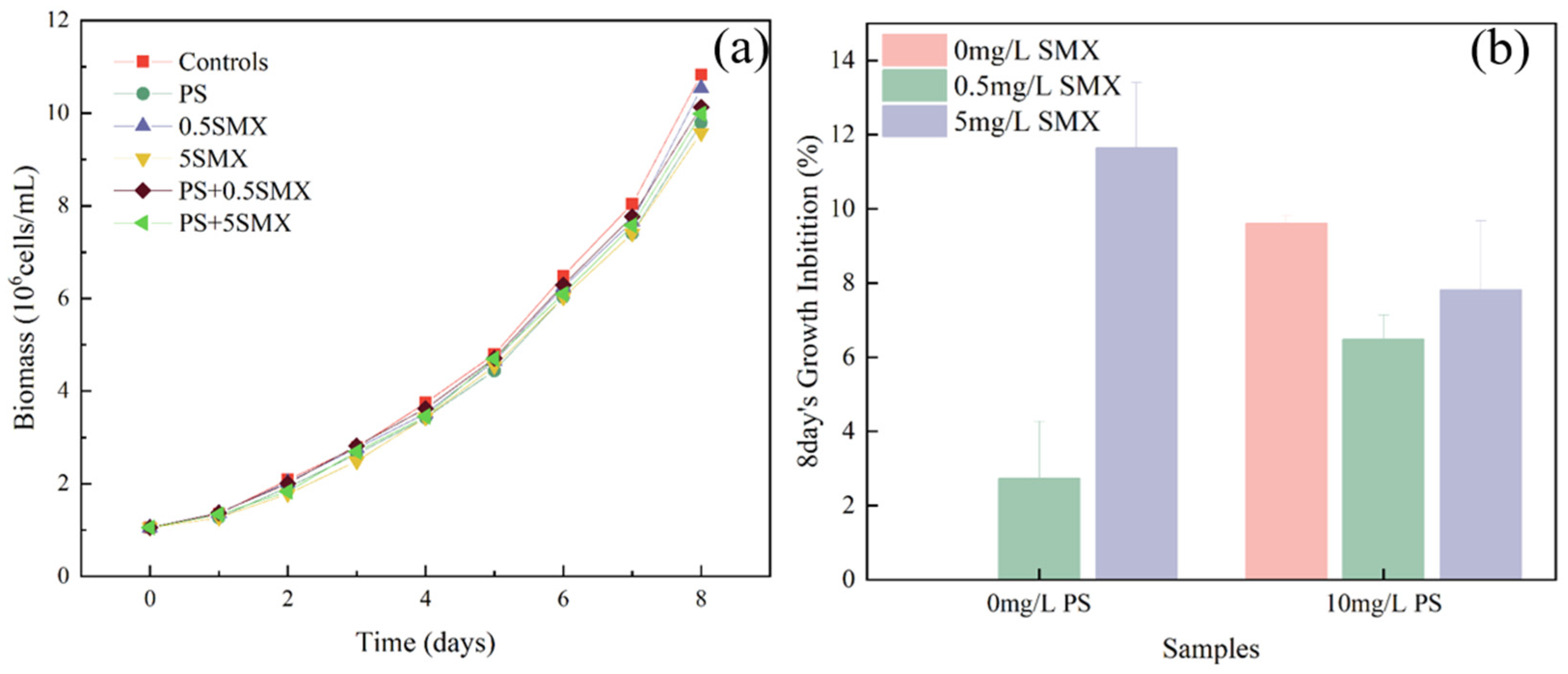
The biomass and inhibition rate were analyzed to evaluate the effects of SMX and PS-MPs on the growth of C. sorokiniana (Figure 1). Algal biomass production was inhibited under both the single- and combined-exposure conditions, with the highest growth inhibition rate observed in the 5 SMX treatment group on day 8 (11.63 ± 1.77%). This may be because the higher SMX concentration exerted stronger stress on algal photosynthesis and cellular metabolism. Similar studies have shown that sulfonamide antibiotics can inhibit the growth of Chlorella vulgaris by disturbing photosynthetic performance, inducing ROS accumulation, altering antioxidant enzyme activities, and causing cellular structural damage [40]. However, the co-exposure of PS-MPs and 5 mg/L SMX reduced the growth inhibition rate of microalgae, with an inhibition rate of 7.81 ± 1.88% (PS-MPs + 5 SMX). The expected values on the 4th and 8th day (EC-expected) for the co-exposure groups calculated via the IA model exceeded the experimental values (EC-tested), suggesting that PS and SMX exhibited antagonism on the combined toxicity of C. sorokiniana (Table 2).
Similar antagonistic effects have been reported previously. For instance, 20 mg/L PVC MPs reduced the toxicity of 1.5 mg/L Zn (II) [41], and an antagonistic interaction was also observed between tetracycline and polystyrene microplastics [42]. In this study, the antagonistic interaction of SMX and PS-MPs on C. sorokiniana reduced the biotoxicity, indicating stronger metabolic activities of microalgae under SMX and PS-MPs co-exposure.

3.1.2. Effects on Photosynthesis of C. sorokiniana

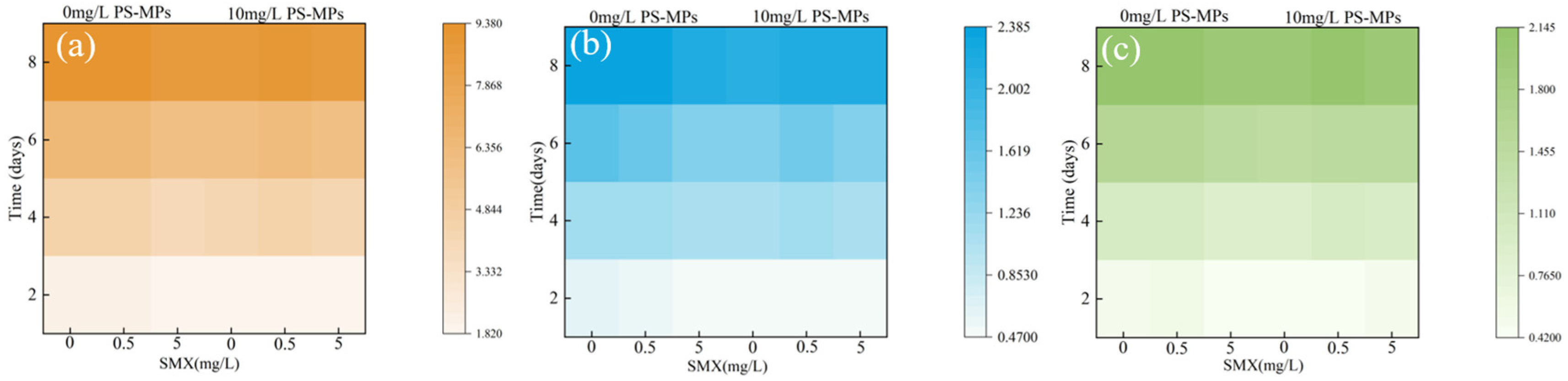
To investigate the changes in the photosynthetic system, the content of three main chlorophyll substances was determined, including chlorophyll-a (Chl-a), and chlorophyll-b (Chl-b), and carotenoids (Car) (Figure 2a–c). Under SMX or PS-MP stress, the contents of Chl-a, Chl-b and carotenoids in C. sorokiniana decreased compared with the control group, and the higher concentration of SMX (5 mg/L) exhibited a greater inhibition effect on the pigment contents. After the 8-day exposure, the inhibition ratios for Chl-a, Chl-b, and carotenoids across the three treatment groups were as follows: 7.59%, 12.56%, and 6.22% in PS-MPs group; 7.51%, 8.25%, and 7.33% in the 5 SMX group; and 6.84%, 9.63%, and 5.87% in the PS-MPs + 5 SMX group, respectively. The results showed that the combined exposure of PS-MPs and SMX reduced the photosynthesis inhibition of microalgae. Changes in the pigment contents showed trends consistent with the observed growth inhibition, as discussed above. The alleviation of photosynthetic inhibition might support cellular metabolic activity, thereby facilitating the biodegradation of SMX. Moreover, the three indicators for photosynthesis accumulated with increasing exposure duration in all groups, validating the self-regulatory and adaptive capacity of microalgae.

3.1.3. Oxidative Stress on C. sorokiniana

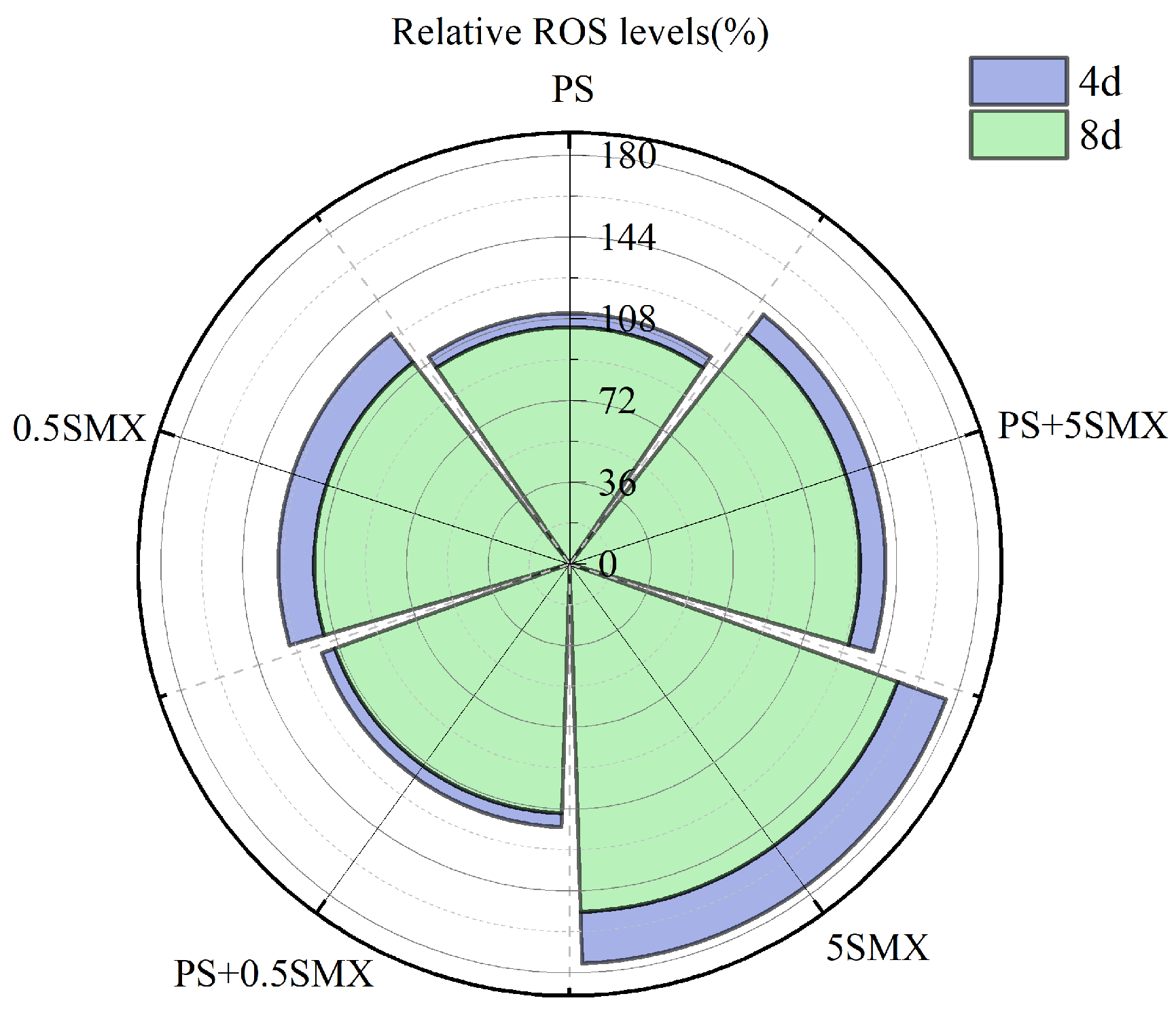
To investigate the oxidative stress on C. sorokiniana in single and combined exposure to PS-MPs and SMX, the changes in relative ROS ratios (Figure 3) were measured. Compared with the control group, both single and combined exposure to SMX and PS-MPs increased ROS accumulation in microalgae, implying that both SMX and PS-MPs imposed oxidative stress. However, the ROS levels in the co-exposure groups were consistently lower than that of the single SMX exposure groups.
As the exposure time increased from 4 to 8 days, the ROS levels in the microalgae remarkably decreased from 128.34% to 112.55% (0.5 SMX), from 176.04% to 153.42% (5 SMX), from 116.01% to 109.98% (PS-MPs + 0.5 SMX), and from 139.11% to 127.87% (PS-MPs + 5 SMX), respectively. This temporal decline confirmed that C. sorokiniana was able to partially adapt to pollutant stress over time. It is found that the ROS levels of the co-exposure groups of PS-MPs + 5 SMX and PS-MPs + 0.5 SMX reduced by 25.55% and 2.57%, respectively, compared with those in the corresponding 5 mg/L and 0.5 mg/L SMX single-exposure groups after 8 days duration. Therefore, the co-exposure to PS-MPs and SMX reduced ROS levels in microalgae compared to the corresponding single SMX exposure group. This was consistent with previous research, which reported similar results when 10 mg/L of PS-MPs were co-exposed to other contaminants, such as 0.15 mg/L of non-particulate copper and 1 mg/L of tetracycline [42,43,44].

3.2. Defense Mechanism of C. sorokiniana Under Stress from PS-MPs and SMX

3.2.1. Antioxidant Responses of C. sorokiniana

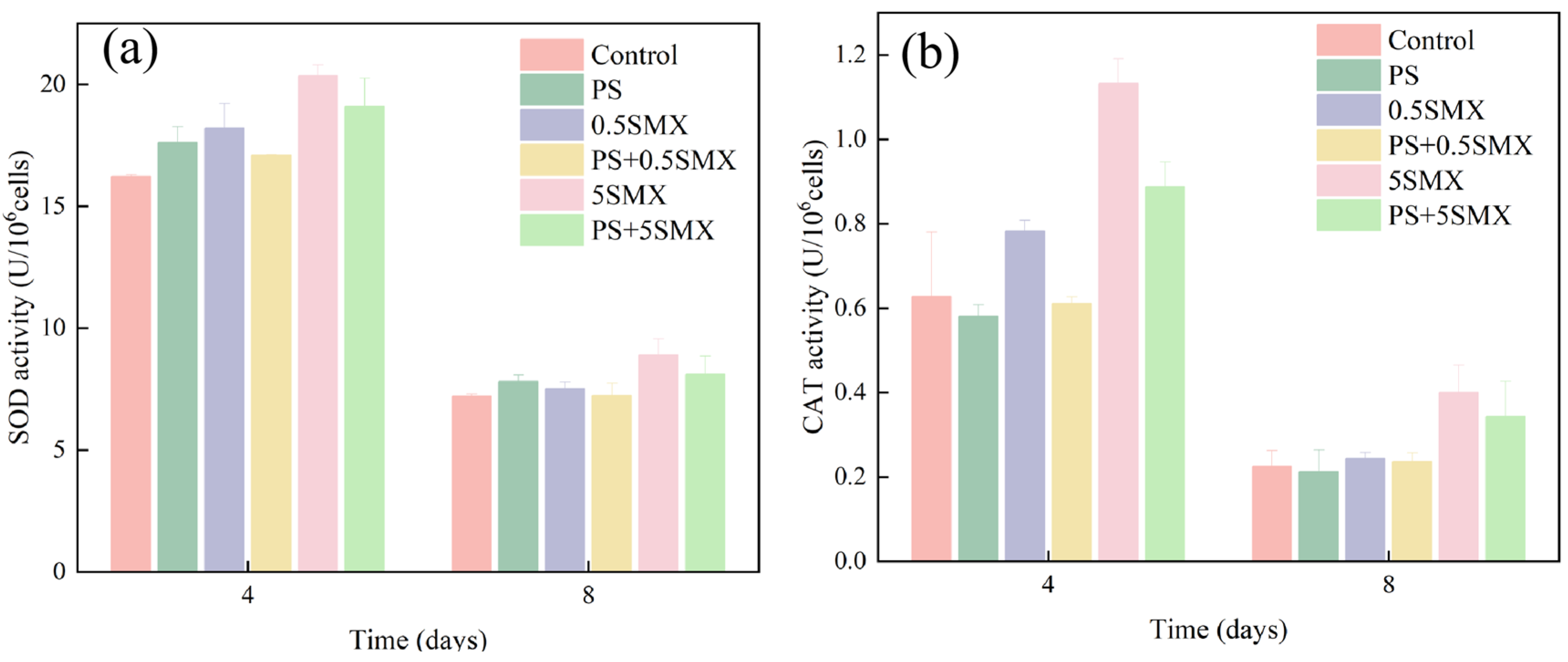
Superoxide dismutase (SOD) and catalase (CAT) are two main antioxidant enzymes in microalgae, which can clear excess ROS induced by pollutants and alleviate cell damage [45]. Among them, SOD mainly catalyzes the conversion of O2 · into H2O2 and O2 [46]. As shown in Figure 4a, SOD activity in microalgae increased with increasing SMX concentration. The SOD activity in the PS-MPs + 5 SMX, 5 SMX, PS-MPs + 0.5 SMX, and 0.5 SMX treatment groups was 19.09 ± 1.17, 20.35 ± 0.46, 17.09 ± 0.03, and 18.21 ± 0.99 U/106 cells, respectively, at the 4th day. Compared to single exposure to SMX, combined exposure to PS-MPs and SMX reduced SOD activity. In addition, with the increase in exposure time, the SOD activity in each treatment group decreased remarkably. This suggested that microalgae employed SOD to clear O2· in microalgae and convert it into H2O2 to alleviate oxidative damage. Thus, the combined exposure and long-term culture of PS-MPs and SMX resulted in a decrease in SOD activity, mainly associated with lower intracellular ROS levels and a weakened oxidative stress response (Figure 3).
Since H2O2 produced by SOD conversion is a precursor of ·OH, it still has toxic effects on microalgae. CAT, another key antioxidant enzyme, can convert H2O2 into H2O and O2 [47]. As illustrated in Figure 4b, the CAT activity in C. sorokiniana after single and combined exposure to PS-MPs and SMX followed a consistent order analogous to SOD: 5 SMX > PS-MPs + 5 SMX > 0.5 SMX > PS-MPs + 0.5 SMX. In line with the variation in SOD activity, CAT activity decreased markedly with exposure duration, increasing from 4 days to 8 days.
Overall, C. sorokiniana activated a coordinated enzymatic antioxidant system to mitigate oxidative stress induced by chemical pressure. Specifically, at the 4th day of exposure, SOD activity peaked in the 5 SMX group at 20.35 ± 0.46 U/106 cells, while the addition of PS-MPs (PS-MPs + 5 SMX) attenuated this response to 19.09 ± 1.17 U/106 cells. The observed reduction in enzyme activity under co-exposure conditions suggests an antagonistic interaction between PS-MPs and SMX. Furthermore, the remarkable decrease in enzyme levels from day 4 to day 8 indicated a transition from acute stress to partial physiological adaptation. This temporal decline implied that SMX was potentially degraded or sequestered over time and the persistent oxidative pressure on the photosynthetic apparatus was relieved, allowing the cells to re-establish metabolic homeostasis and reduce the energetic cost of maintaining high antioxidant titers.

3.2.2. Changes in EPS Content of C. sorokiniana Cells

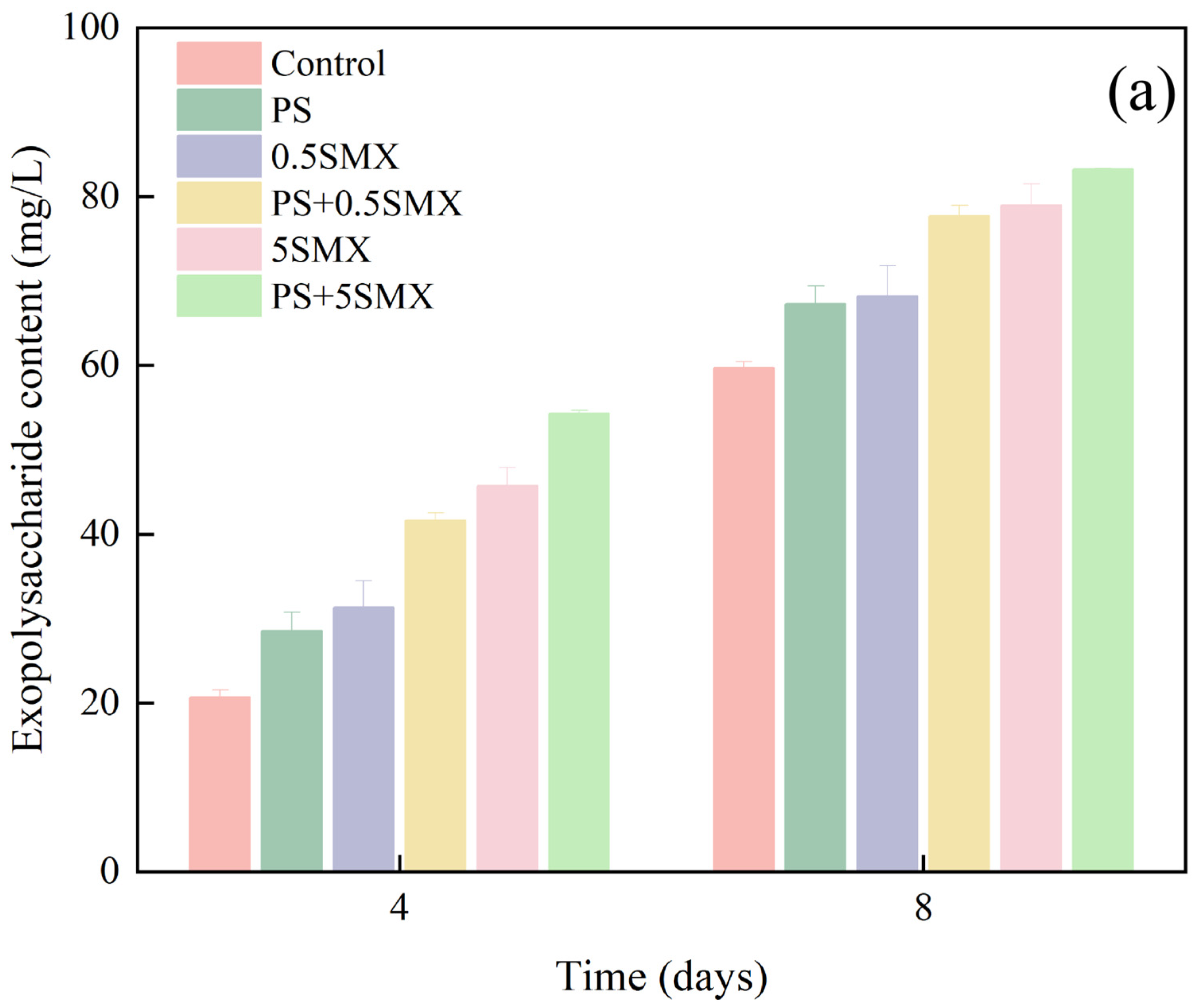
EPSs are high-molecular polymers secreted by microalgae, primarily composed of polysaccharides and proteins [48]. As an important protective interface between cells and the surrounding environment, EPS are usually involved in stress buffering, pollutant interaction, and extracellular protection [49]. As shown in Figure 5a, the exopolysaccharide content in the co-exposure group consistently exceeded that in the PS-MPs or SMX single-exposure groups. The maximum exopolysaccharide content was 83.22 ± 0.13 mg/L in the PS-MPs + 5 SMX group, corresponding to 139.46% of the control group. Additionally, the exopolysaccharide content in all treatment groups displayed a progressive increase as exposure duration extended from 4 to 8 days.
EPS is one of the most informative indicators in this study. The reason is that the co-exposure groups not only showed lower intracellular stress but also exhibited stronger extracellular responses. This means that the change induced by PS-MPs was not simply “less damage” but may also have involved a redistribution of the defense strategy of C. sorokiniana. In other words, under co-exposure, the microalgae appeared to rely less on a strong intracellular oxidative-defense response and more on an enhanced extracellular interface represented by EPSs.
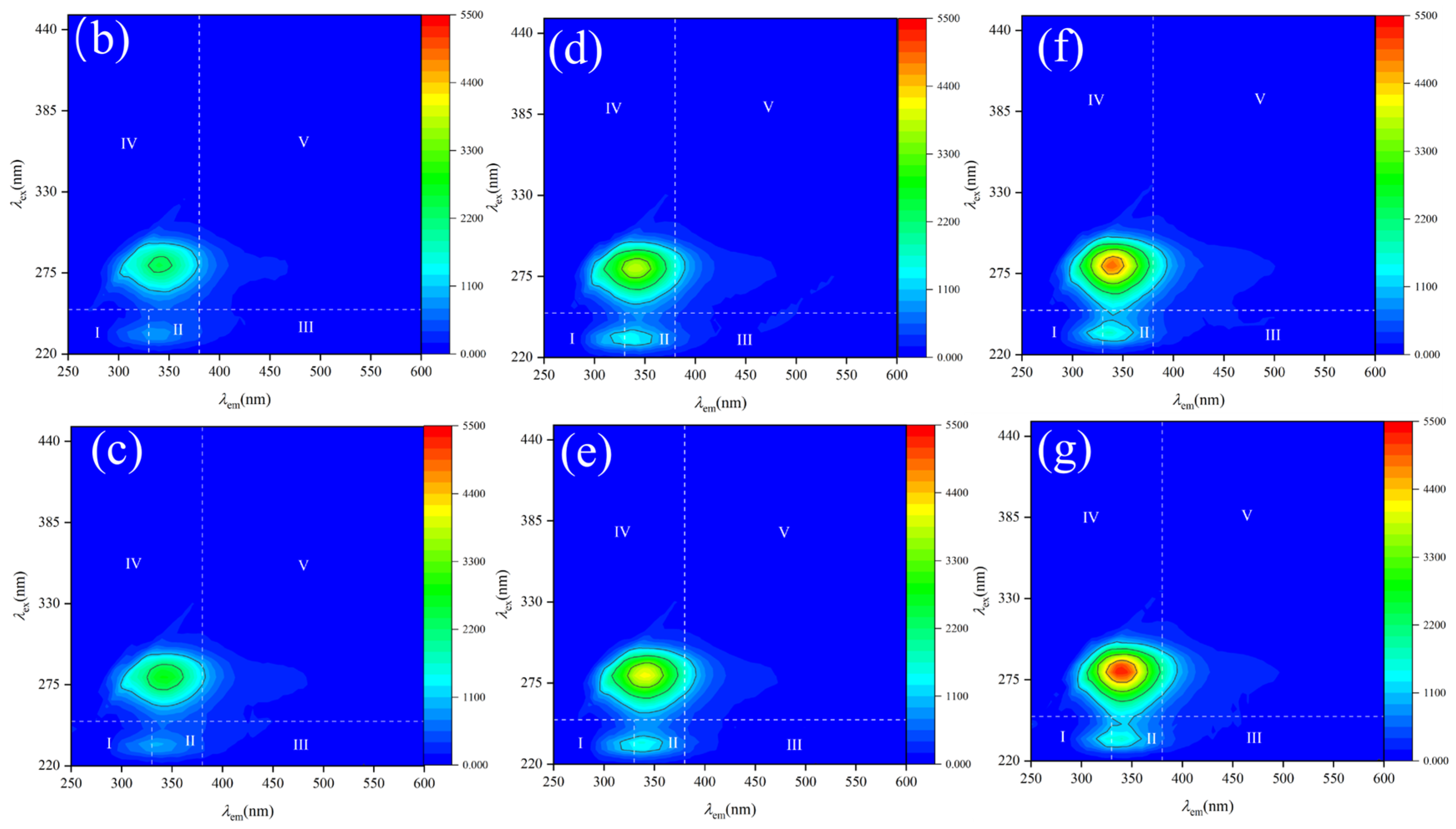
Furthermore, a 3D-EEM fluorescence spectrometer was employed to further analyze EPS composition (Figure 5b–g; Figure S1). Two peaks (Ex/Em: 280/345–350 nm; Ex/Em: 225–230/340–350 nm) were detected in all groups, identified as tryptophan- and tyrosine-like substances, belonging to aromatic proteins. The stable position of the two peaks indicated that PS-MPs and SMX did not induce EPS structural transformation. However, the characteristic peak intensity followed a clear order: PS + 5 SMX > 5 SMX > PS + 0.5 SMX > 0.5 SMX > PS > control. Accordingly, the corresponding co-exposure treatment groups exhibited a notably stronger characteristic peak intensity relative to the single-exposure group, suggesting that the combined presence of PS-MPs and SMX promoted the secretion of aromatic proteins. Therefore, the co-exposure groups showed significantly stronger characteristic peak intensities than the single-exposure groups, implying that the combined presence of PS-MPs and SMX enhanced the secretion of aromatic proteins. Combined with the reduction in antioxidant enzyme secretion under co-exposure mentioned above, higher EPS secretion was chosen as the main bio-response strategy for SMX and PS-MP co-exposure.

3.3. SMX Biodegradation by C. sorokiniana Under Combined Exposure of PS-MPs and SMX

3.3.1. SMX Degradation Efficiency

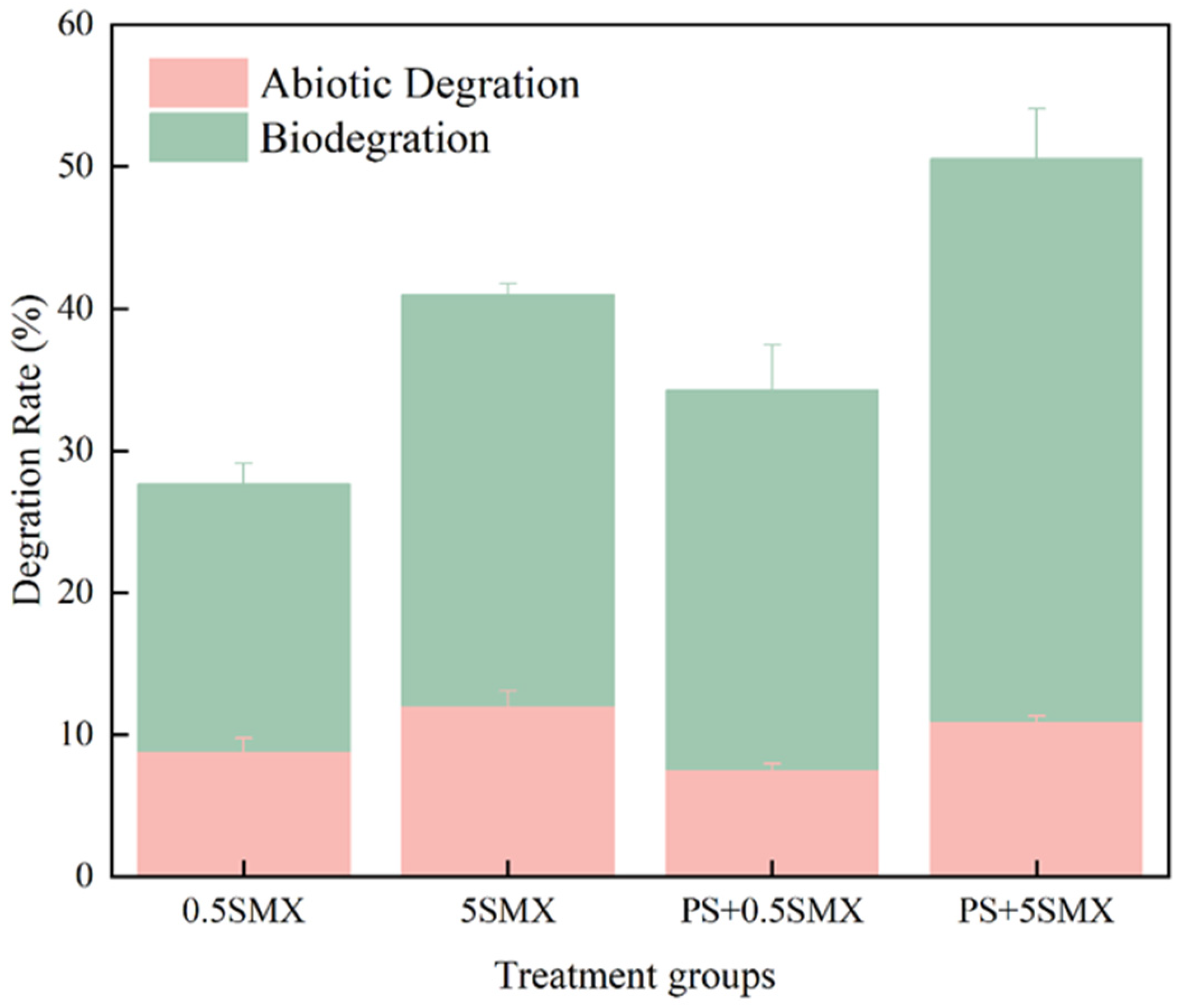
SMX can be removed in the environment through abiotic degradation and bio-adsorption [50], bioconcentration [51] and biodegradation, of which bio-adsorption and bioconcentration are prerequisites for biodegradation [52]. The degradation performance of SMX by C. sorokiniana under single and combined exposure to PS-MPs and SMX is presented in Figure 6.
The highest degradation ratio (50.56%) was exhibited by the PS-MPs + 5 SMX group, while the lowest (27.64%) was exhibited by the 0.5 SMX group. In general, co-exposure exhibited a higher biodegradation ratio with very slight changes in abiotic degradation rate, indicating that the presence of PS-MPs enhanced the transformation and removal of SMX. Further analysis of abiotic degradation and biodegradation found that in the 0.5 SMX and 5 SMX groups, 8.84% and 12.04% of SMX could be transformed through abiotic degradation, respectively, while 18.80% and 28.94% of SMX were transformed through biodegradation. Intriguingly, an upward trend in SMX biodegradation was observed under combined-exposure conditions. Specifically, the biodegradation ratios reached 26.72% and 39.58% for the PS-MPs + 0.5 SMX and PS-MPs + 5 SMX group, respectively. These results demonstrated that PS-MPs facilitated the algal degradation of SMX, with a markedly higher relative contribution of biodegradation under co-exposure conditions.
For the co-exposure system, separating and quantifying the respective contributions of PS-MPs, microalgae and EPSs to SMX adsorption is indeed important for understanding SMX partitioning, bioavailability changes, and algal-associated transformation processes. Although abiotic degradation and algal-mediated biodegradation were distinguished using corresponding control groups, the independent adsorption contribution of algal cells and PS-MPs was not separately quantified. This likely represents a limitation of the present study. Because adsorbed SMX may dynamically exchange with the dissolved phase and further participate in algal uptake or biodegradation, adsorption should be interpreted as a potential intermediate process rather than a final removal pathway [53]. In future studies, we will quantify the adsorption–desorption behavior of SMX on algal cells and PS-MPs to establish a more complete mass balance.

3.3.2. SMX Degradation Products and Routines

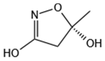
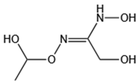
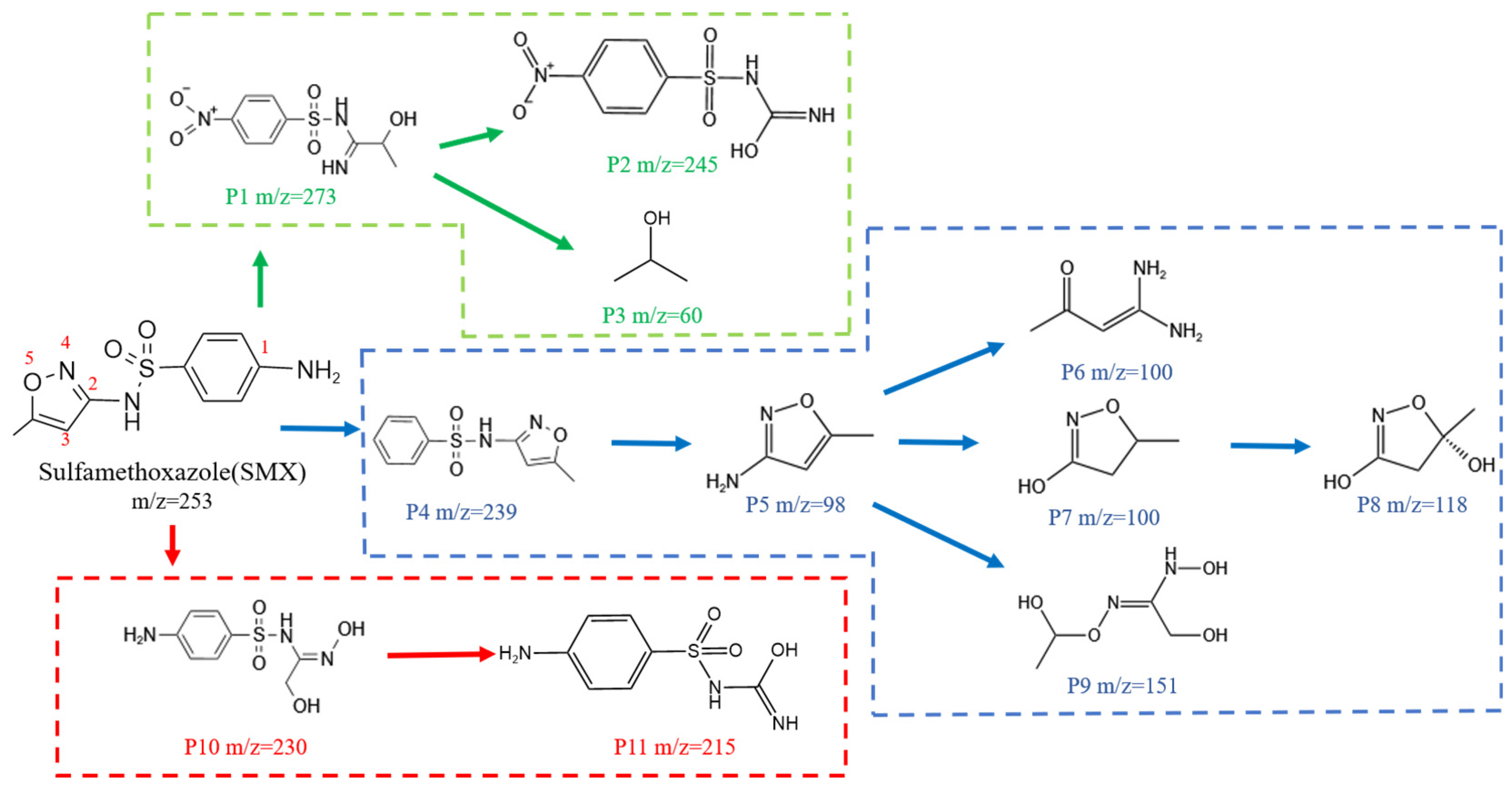
The degradation products of SMX were also analyzed by UPLC-MS/MS in this study. Notably, compared with single exposure to SMX, the transformation routines in co-exposure groups exhibited similar transformed products and features. Based on the identified transformation products (P1–P11), the MS/MS fragmentation spectra of SMX and its proposed transformation products P1–P11 are provided in Figure S2; three possible degradation pathways of SMX were proposed (Figure 7), reflecting sequential oxidative fragmentation, structural rearrangement, and advanced transformation processes rather than random breakdown. The molecular structures, formulas, m/z values, and retention times of these products are shown in Table 3.
Based on the identified transformation products, three major degradation pathways of SMX were proposed, including aromatic-ring nitration, isoxazole-ring cleavage, and aniline–sulfonamide oxidation.
Pathway I mainly involved nitration and subsequent oxidative degradation of the aromatic ring. In this pathway, nitration-related products were detected. The formation of P1 (m/z 273) suggested electrophilic nitration of the benzene ring, which was likely driven by ROS generated under oxidative stress conditions [54]. P1 was then further degraded to P2 (m/z 245) through side-chain shortening and oxidative cleavage. Meanwhile, small alcohol fragments such as P3 (m/z 60) were released, which may be attributed to C–C bond scission and terminal oxidation [55]. Therefore, Pathway I reflected ROS-mediated modification and breakdown of the aromatic-ring structure of SMX.
Pathway II was characterized by cleavage of the isoxazole moiety and progressive fragmentation of heterocyclic intermediates. The initial transformation of SMX (m/z 253) involved the cleavage of the isoxazole ring, yielding P4 (m/z 239). This is consistent with the preferential vulnerability of the heterocyclic isoxazole moiety under oxidative stress conditions [56]. Subsequent degradation of P4 resulted in the formation of P5 (m/z 98) [57], indicating further ring-opening and fragmentation of the isoxazole-derived structure. From P5, several downstream reactions occurred. One branch involved hydroxylation and rearrangement reactions, producing P7 (m/z 100) and P8 (m/z 118), both of which showed increased oxygen content and polarity. These transformations suggested the involvement of hydroxyl radicals (·OHs) or enzymatically mediated oxygenation, leading to progressive oxidation of residual heterocyclic fragments. Another branch yielded P6 (m/z 100), likely through carbon–nitrogen bond cleavage and deamination, representing a low-molecular-weight fragment with reduced aromaticity. In parallel, P5 also underwent oxidative condensation and functional-group substitution to generate P9 (m/z 151), which retained both hydroxyl and amino functionalities. This transformation may indicate partial recombination of fragmented moieties, possibly mediated by intracellular redox-active intermediates [58]. Overall, Pathway II represented the destruction of the isoxazole ring and the subsequent formation of small polar fragments.
Pathway III was mainly associated with oxidative transformation of the aniline–sulfonamide moiety. Unlike Pathways I and II, which primarily involved aromatic-ring nitration and isoxazole-ring cleavage, respectively, Pathway III occurred mainly on the sulfonamide side chain of SMX [59]. Direct oxidation of the sulfonamide moiety produced P10 (m/z 230), followed by further oxidation and amide rearrangement to form P11 (m/z 215). These reactions were indicative of oxidative dealkylation and sulfonamide bond modification, which were frequently reported during antibiotic transformation under biological oxidative stress conditions. Therefore, Pathway III reflected the oxidative modification of the aniline–sulfonamide structure rather than the cleavage of the isoxazole ring.

4. Discussion

4.1. Relation Between SMX Degradation and Physiological Characteristics of C. sorokiniana

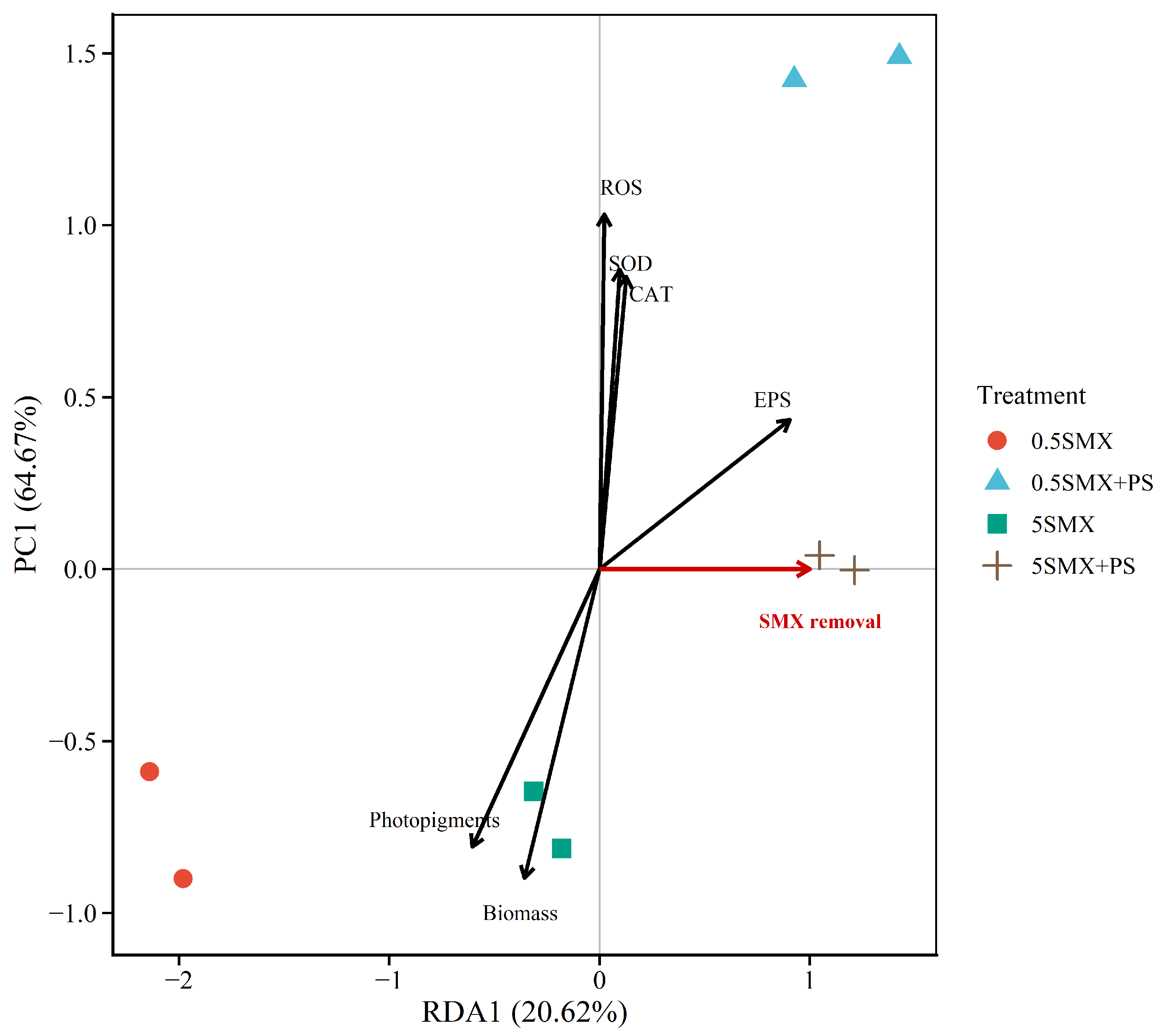
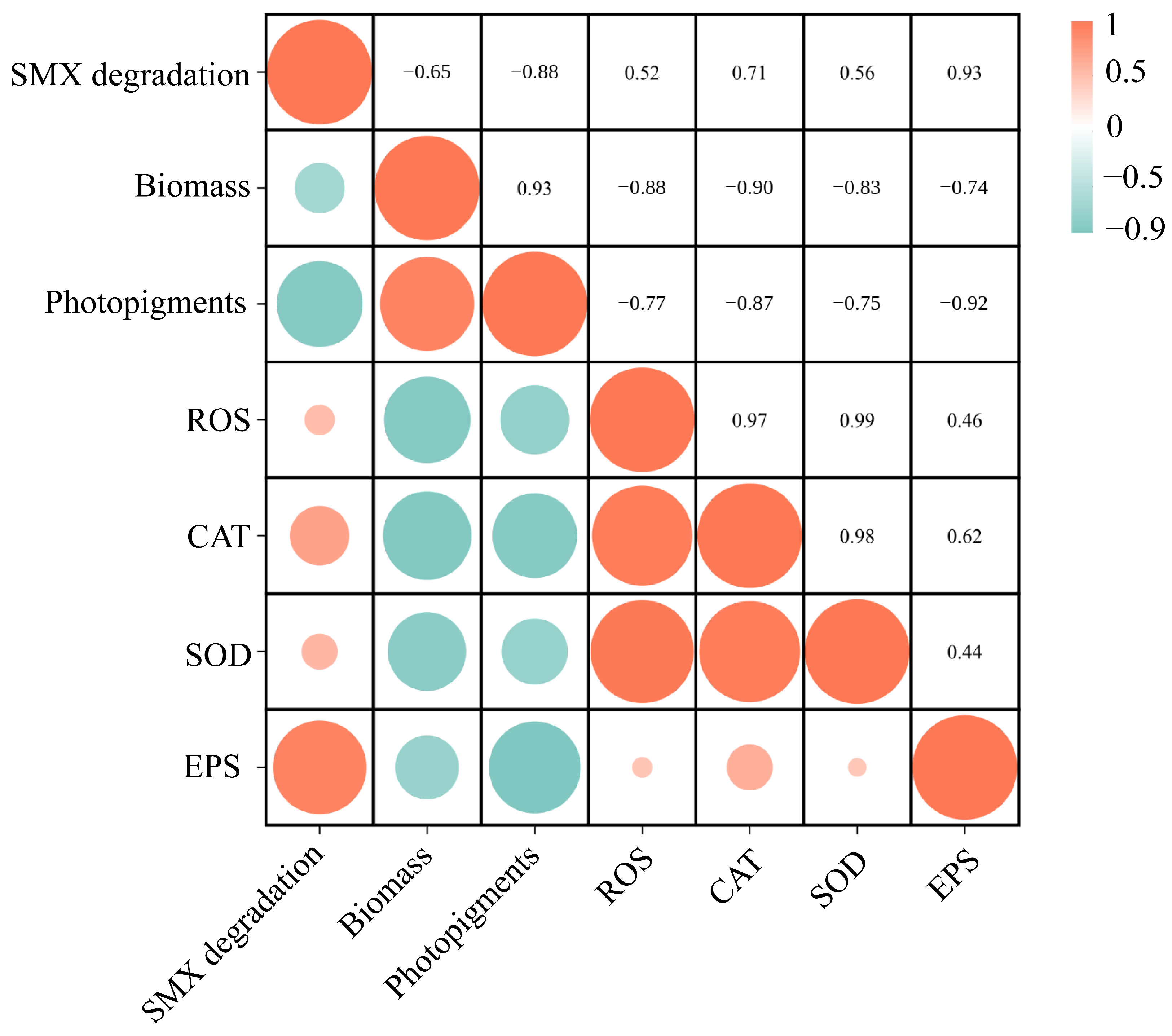
As shown in Figure 8, correlation analysis was performed between the SMX degradation ratio and the physiological and biochemical indicators of C. sorokiniana. A weak correlation was observed between the SMX degradation ratio and algal biomass, photosynthetic pigment, ROS, CAT activity and SOD activity, with correlation coefficients of −0.65, −0.87, 0.52, 0.71 and 0.56, respectively. However, the SMX degradation ratio exhibited a significant positive correlation with EPSs, with a correlation coefficient of 0.93. Stronger relationships between SMX degradation and EPSs were observed than physiological indicators, like ROS, biomass and antioxidant enzymes, suggesting that the effect of physiological regulation on SMX transformation may have been expressed mainly through changes at the extracellular interface.
EPSs not only functioned as a physical barrier between the cell membrane and environmental stressors, but also possessed multiple binding sites that interacted with small molecules to facilitate antibiotic transport. Additionally, they serve as a chemical reactor that degrades environmental antibiotics through abundant functional groups and active substances [60,61,62]. Therefore, EPSs played an important role in SMX enrichment and transformation, mitigating its toxic effects on microalgae and making contributions to the SMX degradation.
Moreover, significant positive correlations between ROS and antioxidative enzymes activity and between biomass and photosynthetic pigment contents were also observed (correlation coefficient: 0.97 between ROS and CAT; 0.99 between ROS and SOD, 0.94 between photosynthetic pigment contents and biomass). These results demonstrate the crucial roles of algal cellular antioxidant activity in response to oxidative stress and highlight the important function of photosynthesis in supporting algal growth and survival.
Moreover, redundancy analysis, as shown in Figure 9, was performed to further explore the relationship between SMX removal and the physiological responses of algae. SMX removal was used as the explanatory variable, while biomass, photopigments, ROS, CAT, SOD, and EPS were used as response variables. The RDA model explained 20.62% of the total variation in the physiological responses of algae, but the overall model was not statistically significant based on permutation tests (F = 1.5584, p = 0.224). Nevertheless, the ordination pattern showed that EPSs were oriented close to the SMX removal vector, suggesting a positive association between EPS secretion and SMX removal. Therefore, the RDA result was interpreted as exploratory evidence and was discussed together with the correlation analysis and physiological response data.

4.2. Ecotoxicity Predictions of SMX Degradation Products

SMX generated various degradation products during the degradation process. However, the toxic effects and ecological risks of the degradation products on organisms remain unknown. Therefore, based on the proposed molecular structure, T.E.S.T software and ECOSAR software are employed to predict the acute toxicity, chronic toxicity and bioaccumulation of 11 proposed degradation products (Table 4). The predicted ecotoxicity results indicated that the transformation of SMX led to pronounced changes in its toxicity profile across multiple biological endpoints [63,64].
Biotoxicity effects include acute toxicity and chronic toxicity, which were measured by EC50/LC50 values toward fish, Daphnia, and green alga. A higher EC50 or LC50 value indicates lower biotoxicity. As shown in Table 4, the EC50 and LC50 values for the acute and chronic toxicity of the nine products (P1–2, P5–11) were significantly higher than those of SMX, while only two products (P3, P4) exhibited the lower EC50 and LC50 values than SMX. These results suggested that the biotoxicity remarkably reduced following the biodegradation of SMX by C. sorokiniana.
Bioaccumulation factor (BAF), as an important indicator to evaluate the ability of pollutants to accumulate in organisms, can intuitively reflect the environmental risks of pollutants [65]. A higher bioaccumulation factor indicates a greater capacity for the pollutant to bioaccumulate in organisms and a more pronounced biomagnification effect along the food chain. As shown in Table 4, most degradation products (10 products: P1–3 and P5–11) were predicted to have lower bioaccumulation potential than SMX, reflecting an overall decline in the tendency for biological enrichment during transformation. Briefly, these findings revealed that SMX degradation generated less toxic and bioaccumulative products, reducing its ecotoxicity.
Although T.E.S.T and ECOSAR provided useful preliminary screening of the toxicity and bioaccumulation potential of SMX transformation products, the predicted results should be interpreted with caution. These models are mainly based on QSAR approaches and available training datasets, and their prediction accuracy may be limited for transformation products with scarce experimental toxicity data or structures outside the model applicability domain [66]. Therefore, the toxicity prediction results in this study should be regarded as indicative rather than definitive, and further experimental ecotoxicity tests are needed to validate the actual risks of SMX metabolites.

4.3. Physiological Response of C. sorokiniana Under Co-Exposure of SMX and PS-MPs

PS-MPs can adhere to the surface of microalgae, disrupting mass transfer and cellular homeostasis and thereby inducing cytotoxic effects [67,68]. SMX may also impair photosynthetic systems indirectly by inhibiting folic acid synthesis, leading to biotoxic effects [69]. However, compared with single SMX exposure, co-exposure with PS-MPs caused lower ROS accumulation and weaker photosynthetic pigment inhibition. This response may be partly related to a redistribution of SMX among different environmental compartments rather than a simple increase or decrease in its overall bioavailability. Specifically, adsorption of SMX onto PS-MPs could reduce the freely dissolved SMX fraction and thereby alleviate the immediate toxic pressure on algal cells [16]. Previous studies have shown that PS-MPs can adsorb SMX through π–π interactions and electron cloud overlap between aromatic rings [27]. However, the enhanced SMX biodegradation under co-exposure confirmed that PS-MPs adsorption alone cannot fully explain the attenuated biological responses. Instead, PS-MPs and SMX co-exposure may have induced a distinct physiological adjustment in C. sorokiniana, allowing the cells to reduce intracellular oxidative stress while maintaining SMX accessibility for biotransformation.
EPS secretion appeared to be a key component of this physiological adjustment. Under co-exposure, increased EPS production may have provided a functional interface for cell surface protection, SMX retention, and subsequent transformation. Abiotic degradation contributed only slightly to SMX removal, with degradation ratios of 12.04% in the 5 SMX group and 10.98% in the PS-MPs + 5 SMX group, indicating that abiotic photolysis was not the main removal pathway. In contrast, the SMX biodegradation ratio increased from 28.94% under single exposure to SMX to 39.58% under combined exposure, suggesting that C. sorokiniana played a more active role in SMX transformation in the presence of PS-MPs.
This apparently paradoxical response may be explained by distinguishing between freely dissolved bioavailability and cell-surface-associated availability. While PS-MP adsorption may decrease the freely dissolved SMX fraction and reduce direct intracellular stress, EPS secreted by C. sorokiniana may enrich SMX near the algal surface and create a microenvironment favorable for extracellular or cell-associated transformation. The exopolysaccharide content increased from 79.85 ± 2.57 mg/L to 83.22 ± 0.13 mg/L under co-exposure, which may strengthen the protective matrix around algal cells and facilitate SMX retention near the cell surface. Moreover, aromatic proteins were the main protein components increased under co-exposure, as shown in Figure 5b–g. Studies on algal extracellular organic matter showed that an increase in extracellular organic carbon from low mg-C/L levels to tens or even over 100 mg-C/L during algal growth was accompanied by increased production of photochemically generated reactive species, including triplet-state organic matter, hydroxyl radicals, and singlet oxygen [70]. Moreover, previous studies have reported that EPS contains redox-active and photosensitizing components capable of generating persistent free radicals [71], with aromatic amino acids playing an important role [23]. Under light conditions, these EPS-associated active components may promote ROS-mediated reactions with SMX, thereby contributing to its biodegradation.
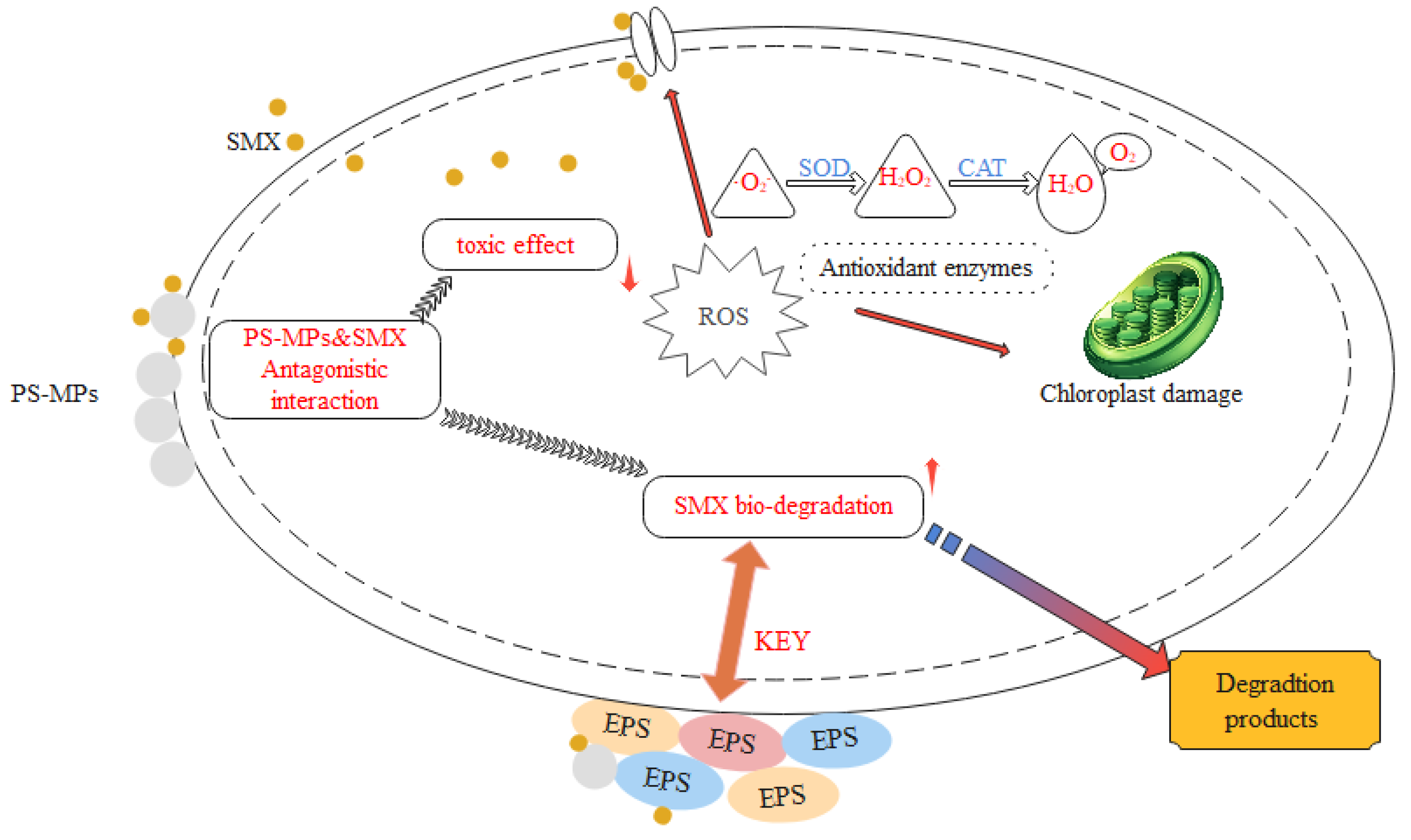
Therefore, under the present experimental conditions, the lower biotoxicity and higher SMX biodegradation under co-exposure should not be interpreted as direct evidence for a uniform increase in SMX bioavailability. Rather, PS-MPs and EPSs may have reshaped the distribution and accessibility of SMX. The freely dissolved fraction responsible for immediate toxicity may have decreased, whereas EPS-associated retention near algal cells may have favored SMX transformation. This mechanism, as shown in Figure 10, may explain why co-exposure reduced intracellular stress while enhancing SMX degradation [70,71].

5. Conclusions

This study demonstrated that PS-MPs can alter the toxicological response and antibiotic transformation behavior of C. sorokiniana under SMX exposure. Although both PS-MPs and SMX imposed stress on algal cells, their combined exposure did not simply intensify toxicity. ROS levels in the PS-MPs + 5 SMX and PS-MPs + 0.5 SMX groups decreased by 25.55% and 2.57%, respectively, compared with the corresponding SMX single-exposure groups. Instead, with ECexpected reaching 20.12% and ECtested reaching 7.81%, the co-exposure system showed an antagonistic interaction, characterized by attenuated oxidative stress and weaker photosynthetic inhibition compared with SMX exposure alone.
The reduced biological stress under co-exposure was closely associated with EPS-mediated physiological regulation. The PS-MPs + 5 SMX group secreted 105.41% of the exopolysaccharide content of the 5 SMX groups. Increased EPS secretion may have provided a protective extracellular interface that reduced direct intracellular stress while facilitating SMX retention and algal-associated transformation. In particular, EPS components with redox-active and photosensitizing properties may contribute to SMX degradation through radical-mediated reactions. Therefore, EPSs should not be regarded only as a stress-response marker, but also as a functional interface linking cellular protection and antibiotic biotransformation.
From an environmental perspective, these findings suggest that C. sorokiniana may contribute to the attenuation and detoxification of antibiotics in microplastic-contaminated aquatic systems. The enhanced SMX degradation and the lower predicted toxicity and bioaccumulation potential of most transformation products indicate a potential role of microalgae in antibiotic remediation under combined pollution scenarios. Nevertheless, the ecological risks of the transformation products were evaluated using predictive models, and further experimental toxicity assays are needed to validate their actual environmental effects. Overall, this study highlights the importance of considering microplastic–antibiotic interactions, algal defense responses, and transformation product risks when assessing the fate of antibiotics in aquatic environments.

Supplementary Materials

The following supporting information can be downloaded at https://www.mdpi.com/article/10.3390/w18111334/s1, Figure S1: 3D-EEM images of EPS: (a) Control; (b) PS; (c) 0.5SMX; (d) PS + 0.5SMX; (e) 5SMX; (f) PS + 5SMX. Figure S2: Total ion chromatograms and MS/MS fragmentation spectra of SMX and its transformation products.

Author Contributions

Conceptualization, methodology, T.Q. and L.W.; investigation, data collection, formal analysis, visualization and writing—original draft preparation: T.Q.; supervision, resources, writing—review and editing, L.W. All authors have read and agreed to the published version of the manuscript.

Funding

This research was funded by the National College Students’ Innovative Entrepreneurial Training Plan Program of China (202510294028) and the National Key Research and Development Program of China (2024YFC3214600).

Data Availability Statement

The original contributions presented in the study are included in the article. Further inquiries can be directed to the corresponding authors.

Acknowledgments

We would like to sincerely thank all the editorial staff and related personnel of the journal for their assistance and support throughout the review and publication process. We would also like to thank the reviewers for their professional and insightful comments on the manuscript.

Conflicts of Interest

The authors declare no conflicts of interest.

Abbreviations

The following abbreviations are used in this manuscript:
C. sorokinianaChlorella sorokiniana
PS-MPsPolystyrene microplastics
SMXSulfamethoxazole
ROSReactive oxygen species
EPSsExtracellular polymeric substances
ARGsAntibiotic resistance genes
PFRsPersistent free radicals
CarsCarotenoids
Chl-aChlorophyll-a
Chl-bChlorophyll-b
IRInhibition rate
IA modelIndependent action model
DCFH-DA2′,7′-dichlorodihydrofluorescein diacetate
UPLC-MS/MSUltra-performance liquid chromatography–tandem mass spectrometry
SODSuperoxide dismutase
CATCatalase
BAFBioaccumulation factor

References

  1. Shao, Y.; Wang, Y.; Yuan, Y.; Xie, Y. A systematic review on antibiotics misuse in livestock and aquaculture and regulation implications in China. Sci. Total Environ. 2021, 798, 149205. [Google Scholar] [CrossRef]
  2. Zhang, X.; Su, H.; Gao, P.; Li, B.; Feng, L.; Liu, Y.; Du, Z.; Zhang, L. Effects and mechanisms of aged polystyrene microplastics on the photodegradation of sulfamethoxazole in water under simulated sunlight. J. Hazard. Mater. 2022, 433, 128813. [Google Scholar] [CrossRef]
  3. Liu, H.; Xu, Y.; Li, L.; Yuan, S.; Geng, H.; Tang, Y.; Dai, X. A novel green composite conductive material enhancing anaerobic digestion of waste activated sludge via improving electron transfer and metabolic activity. Water Res. 2022, 220, 118687. [Google Scholar] [CrossRef]
  4. Huang, R.; Liu, W.; Su, J.; Li, S.; Wang, L.; Jeppesen, E.; Zhang, W. Keystone microalgae species determine the removal efficiency of sulfamethoxazole: A case study of Chlorella pyrenoidosa and microalgae consortia. Front. Plant Sci. 2023, 14, 1193668. [Google Scholar] [CrossRef] [PubMed]
  5. Zhang, H.; Li, M.; Cui, Y.; Qi, J.; Jiang, R.; Du, B.; Liu, Q.; Wang, Z.; Li, X. Removal of antibiotics and antibiotic resistance genes from swine wastewater by visible-light driven photo bio-electro-Fenton system: Performance, mechanism, and energy self-supply balance. Bioresour. Technol. 2026, 444, 134008. [Google Scholar] [CrossRef] [PubMed]
  6. Li, S.; Zhang, C.; Li, F.; Hua, T.; Zhou, Q.; Ho, S.-H. Technologies towards antibiotic resistance genes (ARGs) removal from aquatic environment: A critical review. J. Hazard. Mater. 2021, 411, 125148. [Google Scholar] [CrossRef]
  7. Zhao, S.; Kvale, K.F.; Zhu, L.; Zettler, E.R.; Egger, M.; Mincer, T.J.; Amaral-Zettler, L.A.; Lebreton, L.; Niemann, H.; Nakajima, R.; et al. The distribution of subsurface microplastics in the ocean. Nature 2025, 641, 51–61. [Google Scholar] [CrossRef]
  8. Villarrubia-Gómez, P.; Cornell, S.E.; Fabres, J. Marine plastic pollution as a planetary boundary threat—The drifting piece in the sustainability puzzle. Mar. Policy 2018, 96, 213–220. [Google Scholar] [CrossRef]
  9. Bansal, M.; Santhiya, D.; Sharma, J.G. Behavioural Mechanisms of Microplastic Pollutants in Marine Ecosystem: Challenges and Remediation Measurements. Water Air Soil Pollut. 2021, 232, 372. [Google Scholar] [CrossRef]
  10. Phuong, N.N.; Duong, T.T.; Le, T.P.Q.; Hoang, T.K.; Ngo, H.M.; Phuong, N.A.; Pham, Q.T.; Doan, T.O.; Ho, T.C.; Da Le, N.; et al. Microplastics in Asian freshwater ecosystems: Current knowledge and perspectives. Sci. Total Environ. 2022, 808, 151989. [Google Scholar] [CrossRef]
  11. Sun, Z.-L.; Sun, L.-Q.; Wang, B. Microplastic Pollution in the Yellow River Basin: Current Status and Control Strategy. Water Air Soil Pollut. 2023, 234, 30. [Google Scholar] [CrossRef]
  12. Choi, H.; Lee, I.; Kim, H.; Park, J.; Cho, S.; Oh, S.; Lee, M.; Kim, H. Comparison of Microplastic Characteristics in the Indoor and Outdoor Air of Urban Areas of South Korea. Water Air Soil Pollut. 2022, 233, 169. [Google Scholar] [CrossRef]
  13. Mishra, A.K.; Singh, J.; Mishra, P.P. Microplastics in polar regions: An early warning to the world’s pristine ecosystem. Sci. Total Environ. 2021, 784, 147149. [Google Scholar] [CrossRef] [PubMed]
  14. Huang, Y.; Liu, Q.; Jia, W.; Yan, C.; Wang, J. Agricultural plastic mulching as a source of microplastics in the terrestrial environment. Environ. Pollut. 2020, 260, 114096. [Google Scholar] [CrossRef]
  15. Zhang, S.; Wang, H.; Liu, M.; Yu, H.; Peng, J.; Cao, X.; Wang, C.; Liu, R.; Kamali, M.; Qu, J. Press perturbations of microplastics and antibiotics on freshwater micro-ecosystem: Case study for the ecological restoration of submerged plants. Water Res. 2022, 226, 119248. [Google Scholar] [CrossRef]
  16. Li, J.; Zhang, K.; Zhang, H. Adsorption of antibiotics on microplastics. Environ. Pollut. 2018, 237, 460–467. [Google Scholar] [CrossRef]
  17. Ha, G.-S.; Sim, M.-G.; Jeon, B.-H.; Baek, G. Bioremediation of perfluorooctanoic acid using microalgae with a transcriptomic approach. J. Hazard. Mater. 2025, 488, 137508. [Google Scholar] [CrossRef] [PubMed]
  18. Yu, C.; Pang, H.; Wang, J.-H.; Chi, Z.-Y.; Zhang, Q.; Kong, F.-T.; Xu, Y.-P.; Li, S.-Y.; Che, J. Occurrence of antibiotics in waters, removal by microalgae-based systems, and their toxicological effects: A review. Sci. Total Environ. 2022, 813, 151891. [Google Scholar] [CrossRef]
  19. Xie, P.; Chen, C.; Zhang, C.; Su, G.; Ren, N.; Ho, S.-H. Revealing the role of adsorption in ciprofloxacin and sulfadiazine elimination routes in microalgae. Water Res. 2020, 172, 115475. [Google Scholar] [CrossRef]
  20. Pan, M.; Lyu, T.; Zhan, L.; Matamoros, V.; Angelidaki, I.; Cooper, M.; Pan, G. Mitigating antibiotic pollution using cyanobacteria: Removal efficiency, pathways and metabolism. Water Res. 2021, 190, 116735. [Google Scholar] [CrossRef]
  21. Chu, Y.; Zhang, C.; Wang, R.; Chen, X.; Ren, N.; Ho, S.-H. Biotransformation of sulfamethoxazole by microalgae: Removal efficiency, pathways, and mechanisms. Water Res. 2022, 221, 118834. [Google Scholar] [CrossRef]
  22. Xiong, Q.; Liu, Y.-S.; Hu, L.-X.; Shi, Z.-Q.; Cai, W.-W.; He, L.-Y.; Ying, G.-G. Co-metabolism of sulfamethoxazole by a freshwater microalga Chlorella pyrenoidosa. Water Res. 2020, 175, 115656. [Google Scholar] [CrossRef]
  23. Li, S.; Mi, Z.; Zhang, X.; Zhao, T.; Wang, K.; Ho, S.-H. The hidden power of microalgal extracellular polymeric substances: A natural source of persistent free radicals for aquatic environmental remediation. Water Res. 2026, 296, 125589. [Google Scholar] [CrossRef]
  24. Abuhasheesh, Y.; Ghazal, A.; Tang, D.Y.Y.; Banat, F.; Hasan, S.W.; Show, P.L. Advances in Chlorella microalgae for sustainable wastewater treatment and bioproduction. Chem. Eng. J. Adv. 2025, 22, 100715. [Google Scholar] [CrossRef]
  25. Wu, X.; Wu, H.; Zhang, A.; Sekou, K.; Li, Z.; Ye, J. Influence of polystyrene microplastics on levofloxacin removal by microalgae from freshwater aquaculture wastewater. J. Environ. Manag. 2022, 301, 113865. [Google Scholar] [CrossRef]
  26. Zhang, C.; Xie, P.; Wang, Z.; Chang, H.; Ren, N.; Ho, S.-H. Amide groups within polystyrene accelerates tetracycline removal in a continuous advanced microalgal treatment system. J. Hazard. Mater. 2024, 477, 135346. [Google Scholar] [CrossRef] [PubMed]
  27. Tang, K.H. Combined Toxicity of Microplastics and Antimicrobials on Animals: A Review. Antibiotics 2025, 14, 896. [Google Scholar] [CrossRef] [PubMed]
  28. Kong, Y.; Zhou, Q.; Wang, R.; Chen, Q.; Xu, X.; Zhu, L.; Wang, Y. Alleviating effects of microplastics together with tetracycline hydrochloride on the physiological stress of Closterium sp. Environ. Sci. Process. Impacts 2024, 26, 1588–1600. [Google Scholar] [CrossRef]
  29. Ateia, M.; Zheng, T.; Calace, S.; Tharayil, N.; Pilla, S.; Karanfil, T. Sorption behavior of real microplastics (MPs): Insights for organic micropollutants adsorption on a large set of well-characterized MPs. Sci. Total Environ. 2020, 720, 137634. [Google Scholar] [CrossRef]
  30. Li, Z.; Dong, S.; Huang, F.; Lin, L.; Hu, Z.; Zheng, Y. Toxicological Effects of Microplastics and Sulfadiazine on the Microalgae Chlamydomonas reinhardtii. Front. Microbiol. 2022, 13, 865768. [Google Scholar] [CrossRef] [PubMed]
  31. Chen, Y.; Li, J.; Wang, F.; Yang, H.; Liu, L. Adsorption of tetracyclines onto polyethylene microplastics: A combined study of experiment and molecular dynamics simulation. Chemosphere 2021, 265, 129133. [Google Scholar] [CrossRef] [PubMed]
  32. Wei, X.; Li, M.; Wang, Y.; Jin, L.; Ma, G.; Yu, H. Developing Predictive Models for Carrying Ability of Micro-Plastics towards Organic Pollutants. Molecules 2019, 24, 1784. [Google Scholar] [CrossRef]
  33. González-Pleiter, M.; Pedrouzo-Rodríguez, A.; Verdú, I.; Leganés, F.; Marco, E.; Rosal, R.; Fernández-Piñas, F. Microplastics as vectors of the antibiotics azithromycin and clarithromycin: Effects towards freshwater microalgae. Chemosphere 2021, 268, 128824. [Google Scholar] [CrossRef]
  34. Wang, C.; He, M.; Wu, C.; Chen, Z.; Jiang, L.; Wang, C. Toxicity interaction of polystyrene nanoplastics with sulfamethoxazole on the microalgae Chlamydomonas reinhardtii: A closer look at effect of light availability. J. Environ. Manag. 2023, 340, 117969. [Google Scholar] [CrossRef] [PubMed]
  35. Liu, C.; Yue, Z.; Ma, D.; Li, K.; Xie, Z.; Zhang, T.; Wang, J. Effect of hydrothermal carbonization on pyrolysis behavior, nutrients and metal species distribution in municipal sludge. Bioresour. Technol. 2024, 399, 130524. [Google Scholar] [CrossRef]
  36. Xia, F.; Liu, H.; Zhang, J.; Wang, D. Migration characteristics of microplastics based on source-sink investigation in a typical urban wetland. Water Res. 2022, 213, 118154. [Google Scholar] [CrossRef] [PubMed]
  37. Zhang, Y.; Wan, J.; Li, Z.; Wu, Z.; Dang, C.; Fu, J. Enhanced removal efficiency of sulfamethoxazole by acclimated microalgae: Tolerant mechanism, and transformation products and pathways. Bioresour. Technol. 2022, 347, 126461. [Google Scholar] [CrossRef] [PubMed]
  38. Liu, B.; Liu, W.; Nie, X.; Guan, C.; Yang, Y.; Wang, Z.; Liao, W. Growth response and toxic effects of three antibiotics on Selenastrum capricornutum evaluated by photosynthetic rate and chlorophyll biosynthesis. J. Environ. Sci. 2011, 23, 1558–1563. [Google Scholar] [CrossRef]
  39. Yan, Z.; Xu, L.; Zhang, W.; Yang, G.; Zhao, Z.; Wang, Y.; Li, X. Comparative toxic effects of microplastics and nanoplastics on Chlamydomonas reinhardtii: Growth inhibition, oxidative stress, and cell morphology. J. Water Process Eng. 2021, 43, 102291. [Google Scholar] [CrossRef]
  40. Chen, S.; Wang, L.; Feng, W.; Yuan, M.; Li, J.; Xu, H.; Zheng, X.; Zhang, W. Sulfonamides-induced oxidative stress in freshwater microalga Chlorella vulgaris: Evaluation of growth, photosynthesis, antioxidants, ultrastructure, and nucleic acids. Sci. Rep. 2020, 10, 8243. [Google Scholar] [CrossRef]
  41. Li, Y.; Liu, S.; Ji, Z.; Sun, J.; Liu, X. Distinct responses of Chlorella vulgaris upon combined exposure to microplastics and bivalent zinc. J. Hazard. Mater. 2023, 442, 130137. [Google Scholar] [CrossRef]
  42. Song, J.; Yang, K.; Ding, A.; Jin, N.; Sun, Y.; Zhang, D. Antagonistic effects of polystyrene microplastics and tetracycline on Chlorella pyrenoidosa as revealed by infrared spectroscopy coupled with multivariate analysis. J. Hazard. Mater. 2025, 491, 137896. [Google Scholar] [CrossRef] [PubMed]
  43. Ali, W.; Jeong, H.; Lee, J.-S.; Zinck, P.; Souissi, S. Biodegradable microplastics interaction with pollutants and their potential toxicity for aquatic biota: A review. Environ. Chem. Lett. 2024, 22, 1185–1220. [Google Scholar] [CrossRef]
  44. Pang, R.; Shao, B.; Chen, Q.; Shi, H.; Xie, B.; Soliman, M.; Tai, J.; Su, Y. The co-occurrent microplastics and nano-CuO showed antagonistic inhibitory effects on bacterial denitrification: Interaction of pollutants and regulations on functional genes. Sci. Total Environ. 2023, 862, 160892. [Google Scholar] [CrossRef]
  45. Eheneden, I.; Wang, R.; Chen, G.; Adesina, O.B.; Haijing, R.; Bavumiragira, J.P.; Zhao, J. Sulfamethoxazole removal and ammonium conversion in microalgae consortium: Physiological responses and microbial community changes. Sci. Total Environ. 2024, 954, 176539. [Google Scholar] [CrossRef]
  46. Ma, Y.; Lin, S.; Guo, T.; Guo, C.; Li, Y.; Hou, Y.; Gao, Y.; Dong, R.; Liu, S. Exploring the influence of sulfadiazine-induced stress on antibiotic removal and transformation pathway using microalgae Chlorella sp. Environ. Res. 2024, 256, 119225. [Google Scholar] [CrossRef]
  47. Rezaee, A.; Kosari-Nasab, M.; Movafeghi, A. Cellular toxicity of cefazolin sodium to the green microalga Chlorella vulgaris: Evaluation of biological responses. Biologia 2023, 78, 3039–3048. [Google Scholar] [CrossRef]
  48. Fayaz, T.; Renuka, N.; Ratha, S.K. Antibiotic occurrence, environmental risks, and their removal from aquatic environments using microalgae: Advances and future perspectives. Chemosphere 2024, 349, 140822. [Google Scholar] [CrossRef]
  49. Cheng, Q.; Jiang, Y.; Jin, Z.; Hui, C.; Xu, L.; Zhou, Q.; Zhao, Y.; Du, L.; Jiang, H. Enhanced excretion of extracellular polymeric substances associated with nonylphenol tolerance in Dictyosphaerium sp. J. Hazard. Mater. 2020, 395, 122644. [Google Scholar] [CrossRef] [PubMed]
  50. Long, S.; Hamilton, P.B.; Wang, C.; Li, C.; Xue, X.; Zhao, Z.; Wu, P.; Gu, E.; Uddin, M.M.; Li, B.; et al. Bioadsorption, bioaccumulation and biodegradation of antibiotics by algae and their association with algal physiological state and antibiotic physicochemical properties. J. Hazard. Mater. 2024, 468, 133787. [Google Scholar] [CrossRef] [PubMed]
  51. Hu, T.; Zhang, J.; Xu, X.; Wang, X.; Yang, C.; Song, C.; Wang, S.; Zhao, S. Bioaccumulation and trophic transfer of antibiotics in the aquatic and terrestrial food webs of the Yellow River Delta. Chemosphere 2023, 323, 138211. [Google Scholar] [CrossRef]
  52. Zhao, K.; Si, T.; Liu, S.; Liu, G.; Li, D.; Li, F. Co-metabolism of microorganisms: A study revealing the mechanism of antibiotic removal, progress of biodegradation transformation pathways. Sci. Total Environ. 2024, 954, 176561. [Google Scholar] [CrossRef]
  53. Razanajatovo, R.M.; Ding, J.; Zhang, S.; Jiang, H.; Zou, H. Sorption and desorption of selected pharmaceuticals by polyethylene microplastics. Mar. Pollut. Bull. 2018, 136, 516–523. [Google Scholar] [CrossRef]
  54. Zhao, H.; Zheng, Z.; Zhu, S.; Guo, R.; Liu, Y.; Chen, J.; Yang, Q. Tourmaline-mediated electrochemical system for sulfamethoxazole degradation: Performance, mechanism, and toxicity evaluation. Chem. Eng. J. 2023, 477, 147094. [Google Scholar] [CrossRef]
  55. Hu, W.; Tan, J.; Pan, G.; Chen, J.; Chen, Y.; Xie, Y.; Wang, Y.; Zhang, Y. Direct conversion of wet sewage sludge to carbon catalyst for sulfamethoxazole degradation through peroxymonosulfate activation. Sci. Total Environ. 2020, 728, 138853. [Google Scholar] [CrossRef]
  56. Wang, S.; Wang, J. Peroxymonosulfate activation by Co9S8@ S and N co-doped biochar for sulfamethoxazole degradation. Chem. Eng. J. 2020, 385, 123933. [Google Scholar] [CrossRef]
  57. Liu, Y.; Zhou, R.; Tang, Y.; Li, X.; Xu, L.; Fu, Y. Enhanced Mn(II)/peracetic acid by nitrilotriacetic acid to degrade organic contaminants: Role of Mn(V) and organic radicals. Sci. Rep. 2024, 14, 29686. [Google Scholar] [CrossRef] [PubMed]
  58. Liu, Y.; Wang, S.; Wang, Z.; Fu, Y.; Zhou, R. FeCu-coal gangue heterogeneous activation of peracetic acid for degradation of sulfamethoxazole. J. Environ. Chem. Eng. 2023, 11, 110007. [Google Scholar] [CrossRef]
  59. Luo, L.; Sun, Z.; Chen, Y.; Zhang, H.; Sun, Y.; Lu, D.; Ma, J. Catalytic ozonation of sulfamethoxazole using low-cost natural silicate ore supported Fe2O3: Influencing factors, reaction mechanisms and degradation pathways. RSC Adv. 2023, 13, 1906–1913. [Google Scholar] [CrossRef] [PubMed]
  60. Li, S.; Duan, G.; Xi, Y.; Chu, Y.; Li, F.; Ho, S.-H. Insights into the role of extracellular polymeric substances (EPS) in the spread of antibiotic resistance genes. Environ. Pollut. 2024, 343, 123285. [Google Scholar] [CrossRef]
  61. Zheng, J.; Wang, S.; Gong, Q.; Zhou, A.; Liang, B.; Zhao, B.; Li, H.; Zhang, X.; Yang, Y.; Yue, X. Fate of antibiotic resistance genes and EPS defence mechanisms during simultaneous denitrification and methanogenesis, coupled with the biodegradation of multiple antibiotics under zinc stress. Water Res. 2024, 261, 121996. [Google Scholar] [CrossRef]
  62. Zeng, Q.; Sun, J.; Bai, X.; Xu, Z. Immobilization of phototroph-derived extracellular polymer for simultaneous removal of antibiotics and heavy metals: A sustainable approach for advanced treatment of secondary effluent. J. Clean. Prod. 2023, 396, 136495. [Google Scholar] [CrossRef]
  63. Zhang, Y.; Li, L.; Pan, Z.; Zhu, Y.; Shao, Y.; Wang, Y.; Yu, K. Degradation of sulfamethoxazole by UV/persulfate in different water samples: Influential factors, transformation products and toxicity. Chem. Eng. J. 2020, 379, 122354. [Google Scholar] [CrossRef]
  64. Trovó, A.G.; Nogueira, R.F.P.; Agüera, A.; Sirtori, C.; Fernández-Alba, A.R. Photodegradation of sulfamethoxazole in various aqueous media: Persistence, toxicity and photoproducts assessment. Chemosphere 2009, 77, 1292–1298. [Google Scholar] [CrossRef]
  65. Yuan, Z.; Nag, R.; Cummins, E. Human exposure to micro/nano-plastics through vegetables, fruits, and grains—A predictive modelling approach. J. Hazard. Mater. 2024, 480, 135900. [Google Scholar] [CrossRef] [PubMed]
  66. Melnikov, F.; Kostal, J.; Voutchkova-Kostal, A.; Zimmerman, J.B.; Anastas, P.T. Assessment of predictive models for estimating the acute aquatic toxicity of organic chemicals. Green Chem. 2016, 18, 4432–4445. [Google Scholar] [CrossRef]
  67. Zhao, S.; Qian, J.; Wang, P.; Tang, S.; Lu, B.; He, Y.; Xu, K. The Effects of Microplastics on Growth and Photosynthetic Activity of Chlorella pyrenoidosa: The Role of Types and Sizes. Water Air Soil Pollut. 2023, 234, 628. [Google Scholar] [CrossRef]
  68. Wan, J.-K.; Chu, W.-L.; Kok, Y.-Y.; Lee, C.-S. Distribution of Microplastics and Nanoplastics in Aquatic Ecosystems and Their Impacts on Aquatic Organisms, with Emphasis on Microalgae. In Reviews of Environmental Contamination and Toxicology Volume 246; de Voogt, P., Ed.; Springer International Publishing: Cham, Switzerland, 2019; pp. 133–158. [Google Scholar] [CrossRef]
  69. Wu, P.; Luo, Y.; Hu, T.; An, X.; Xu, X.; Sun, L.; Tang, T.; Fan, J. Sustainable Biodegradation of Triclosan and Sulfamethoxazole with Cyanobacteria: Resistance Mechanism and Metabolic Transformation. ACS ES&T Water 2025, 5, 943–952. [Google Scholar] [CrossRef]
  70. Liu, Y.; Yang, F.; Liu, S.; Zhang, X.; Li, M. Molecular characteristics of microalgal extracellular polymeric substances were different among phyla and correlated with the extracellular persistent free radicals. Sci. Total Environ. 2023, 857, 159704. [Google Scholar] [CrossRef]
  71. Zhou, S.; Liao, Z.; Zhang, B.; Hou, R.; Wang, Y.; Zhou, S.; Zhang, Y.; Ren, Z.J.; Yuan, Y. Photochemical Behavior of Microbial Extracellular Polymeric Substances in the Aquatic Environment. Environ. Sci. Technol. 2021, 55, 15090–15099. [Google Scholar] [CrossRef]
Figure 1. Effects of SMX and PS-MPs on the biomass and inhibition rate of C. sorokiniana. (a) Biomass; (b) growth inhibition rate.
Water 18 01334 g001
Figure 2. The effects of PS-MPs and SMX on photosynthesis of C. sorokiniana. (a) Chl-a content; (b) Chl-b content; (c) Car content.
Water 18 01334 g002
Figure 3. Effects of PS-MPs and SMX on relative ROS levels of C. sorokiniana. Samples were collected on day 4 and day 8.
Water 18 01334 g003
Figure 4. Antioxidant responses of C. sorokiniana. Samples were collected on day 4 and day 8. (a) SOD activity; (b) CAT activity.
Water 18 01334 g004
Figure 5. Effect of SMX and PS-MPs on EPS content and composition. (a) EPS content. (bg) 3D-EEM images of EPS: (b) cells; (c) cells in PS-MPs; (d) cells in 0.5 SMX; (e) cells in PS-MPs + 0.5 SMX; (f) cells in 5 SMX; (g) cells in PS-MPs + 5 SMX. Regions I–V in figure (b) represent aromatic protein-like substances, tryptophan protein-like substances, fulvic acid-like substances, soluble microbial by-product-like substances, and humic acid-like substances, respectively.
Water 18 01334 g005aWater 18 01334 g005b
Figure 6. Degradation efficiency of SMX.
Water 18 01334 g006
Figure 7. The proposed degradation products and potential degradation pathways for SMX. Arrows indicate the proposed transformation directions of SMX and its degradation products. P1–P11 represent the identified transformation products. Different colors indicate different proposed degradation routes.
Water 18 01334 g007
Figure 8. Correlation between SMX degradation and physiological characteristics of C. sorokiniana. Cyan circles indicate negative correlations, whereas orange circles indicate positive correlations. The circle area represents the strength of the correlation, with larger circles indicating stronger correlations.
Water 18 01334 g008
Figure 9. Redundancy analysis showing the exploratory association between SMX removal and algal physiological responses under different treatments.
Water 18 01334 g009
Figure 10. Bio-response of C. sorokiniana under co-exposure of SMX and PS-MPs.
Water 18 01334 g010
Table 1. The component of BG-11 medium.
ComponentStock Concentration
(g/L dH2O)
NaNO31.5
K2HPO4·3H2O0.04
MgSO4·7H2O0.075
CaCl2·2H2O0.036
Citric acid0.006
Ferric ammonium citrate0.006
EDTA0.001
Na2CO30.02
H3BO30.00286
MnCl2·H2O0.00181
ZnSO4·7H2O0.000222
CuSO4·5H2O0.000079
NaMoO4·2H2O0.00039
Co(NO3)2·6H2O0.000049
Table 2. The combined toxicity of PS and SMX on C. sorokiniana was calculated using the independent action model.
EC (Expected)%EC (Tested)%Combined Toxicity
At 4th day
EC (PS + 0.5 SMX)14.363.39antagonism
EC (PS + 5 SMX)16.637.90antagonism
At 8th day
EC (PS + 0.5 SMX)12.086.48antagonism
EC (PS + 5 SMX)20.127.81antagonism
Table 3. The mass spectrometry information of SMX and its degradation products.
Degradation ProductsMolecular StructureMolecular
Formula
Mass/
Charge
(m/z)
Retention
Time
SMXWater 18 01334 i001C10H11O3N3S253/
Product 1
P1
Water 18 01334 i002C9H11O5N3S2732.449 min
Product 2
P2
Water 18 01334 i003C7H7O5N3S2453.552 min
Product 3
P3
Water 18 01334 i004C3H8O604.041 min
Product 4
P4
Water 18 01334 i005C10H10O3N2S2392.449 min
Product 5
P5
Water 18 01334 i006C4H6ON2982.449 min
Product 6
P6
Water 18 01334 i007C4H8ON21002.449 min
Product 7
P7
Water 18 01334 i008C4H7O2N1012.449 min
Product 8
P8
Water 18 01334 i009C4H7O3N1141.426 min
Product 9
P9
Water 18 01334 i010C5H12O3N21512.449 min
Product 10
P10
Water 18 01334 i011C8H10O4N2S2304.041 min
Product 11
P11
Water 18 01334 i012C7H9O3N3S2152.700 min
Table 4. Prediction of ecotoxicity of SMX degradation products.
Degradation
Products
Acute Toxicity (EC50 or LC50)Chronic Toxicity (EC50 or LC50)Bioaccumulation Factor
Fish (96 h)Daphnia (48 h)Green
Algae (96 h)
Fish (96 h)Daphnia (48 h)Green Algae (96 h)
SMX4.78 × 1032.36 × 10398639615618917.11
Product 1 (P1)4.56 × 1061.66 × 1061.98 × 1052.64 × 1054.72 × 1041.94 × 104N/A
Product 2 (P2)7.38 × 1043.22 × 1048.06 × 1035.29 × 1031.51 × 1031.17 × 103N/A
Product 3 (P3)1.74 × 10384432614152.959.82.13
Product 4 (P4)67536321561.930.349.836.32
Product 5 (P5)6.95 × 1033.23 × 1031.06 × 1035371811783.26
Product 6 (P6)2.94 × 1051.16 × 1051.90 × 1041.87 × 1044.09 × 1032.21 × 1030.37
Product 7 (P7)1.70 × 1047.61 × 1032.12 × 1031.26 × 1033833283.07
Product 8 (P8)4.42 × 1041.91 × 1044.59 × 1033.13 × 1038696531.81
Product 9 (P9)2.94 × 1051.76 × 1052.89 × 1042.85 × 1046.21 × 1033.35 × 1030.933
Product 10 (P10)1.17 × 1064.51 × 1056.79 × 1047.25 × 1041.50 × 1047.51 × 1030.62
Product 11 (P11)2.96 × 1051.21 × 1052.28 × 1041.96 × 1044.68 × 1032.86 × 103N/A
Disclaimer/Publisher’s Note: The statements, opinions and data contained in all publications are solely those of the individual author(s) and contributor(s) and not of MDPI and/or the editor(s). MDPI and/or the editor(s) disclaim responsibility for any injury to people or property resulting from any ideas, methods, instructions or products referred to in the content.