Article

Influence of Dam Surface Flood Discharge Patterns on Navigation Flow Conditions in the Downstream Approaching Channel: A Case Study of the Xiangjiaba Hydraulic Project, China

1
College of Harbour, Coastal and Offshore Engineering, Hohai University, Nanjing 210098, China
2
State Key Laboratory of Marine Environmental Science, College of Ocean and Earth Sciences, Xiamen University, Xiamen 361102, China
3
Power China Zhongnan Engineering Corporation Limited, Changsha 410014, China
*
Author to whom correspondence should be addressed.
Water 2026, 18(11), 1329; https://doi.org/10.3390/w18111329
Submission received: 18 April 2026 / Revised: 18 May 2026 / Accepted: 27 May 2026 / Published: 30 May 2026
(This article belongs to the Section Hydraulics and Hydrodynamics)

Abstract

Flood discharge from the dam surface and tailwater discharge from the power station directly affect the hydrodynamic processes in the downstream river channel as well as at the entrance area of approaching channel, which are closely related to the navigation stability and safety of vessels entering or leaving the ship lock. To investigate the influence of different dam flood discharge operational scenarios on the hydrodynamic characteristics at the entrance of the downstream ship lock approach channel, a three-dimensional nested coupled CFD model is established for free surface flows with strong nonlinearity in the stilling basin and unsteady turbulent flows in the downstream channel of the Xiangjiaba Hydraulic Project. The model adopts the Reynolds-Averaged Navier–Stokes (RANS) equations for unsteady flows, combined with the Realizable k-ε turbulence model as well as the VOF free surface tracking method for stilling basin flow and the standard k-ε turbulence model for downstream river flow, respectively. Numerical investigations are conducted to clarify characteristics of river flows associated with the discharged flood from dam surface and tailwater from power stations under different flood discharge patterns. The results show that the balanced discharge scenario involving the combined operation of releasing the flood through the crest and middle outlets of both left and right stilling basins can significantly reduce flow velocity and water level fluctuations near the entrance of the approach channel. Optimizing flood discharge scheduling can effectively improve flow conditions at the entrance area, which is beneficial to enhancing navigation safety for ships.

1. Introduction

Inland waterway transportation plays a vital role in the integrated transportation system, in which navigation–power junctions serve as key infrastructures ensuring flood control, power generation, and shipping functions. The flow conditions at the downstream approach channel entrance area, as a critical zone connecting the main river and the ship lock, are directly related to the maneuverability and safety of vessels [1,2,3,4,5]. During flood discharge operations, the high-velocity flow from the stilling basin and outlets of the water power station may result in complicated flow patterns in the downstream, such as strong transverse currents, large-scale recirculation and very big water surface fluctuations at the entrance area of approaching channel. These adverse flow characteristics severely affect the normal operation of ship locks and pose substantial threats to navigation safety [6,7,8]. Therefore, while ensuring normal operation of flood discharge requirements of the hydraulic complex, the question of how to mitigate the adverse effects of flood discharge on the navigational flow conditions in the downstream approach channel entrance area through optimized discharge operation strategies has become an important research topic in the safe operation and management of hydraulic hubs.
Regarding problems related to the energy dissipation of flood discharge flow in the stilling basin, extensive studies have been conducted on the hydraulic jump regimes, air–water mixing characteristics, and turbulent distributions within stilling basins under different Froude numbers [9,10,11]. Researchers have also investigated the effects of stilling basin structure parameters (e.g., bottom slope, chute angle, and geometric dimensions) on energy dissipation efficiency and downstream flow patterns [12]. Most research methods for numerical simulation on hydraulic jumps in stilling basins are based on the Reynolds-Averaged Navier–Stokes (RANS) equations. They adopt the Volume of Fluid (VOF) method for free surface tracking and the k-ε turbulence model to solve two-phase flow problems, which improves computational efficiency while ensuring calculation accuracy [13,14]. Deng et al. [15] used a numerical simulation method based on the RNG k-ε turbulence model to study the stilling basin of the Xiangjiaba Hydropower Project, and analyzed in detail the characteristics of water surface morphology, bottom plate flow velocity, and pressure distribution in the stilling basin by combining with hydraulic model test results. Bayón et al. [16] employed the RANS k-ε turbulence model and VOF method in OpenFOAM to investigate the turbulence characteristics and hydraulic jump rolling behaviors of multiple horizontal submerged jets at Xiangjiaba, focusing on the evolution characteristics of flow fields in the stilling basin. However, most of these studies focus on the hydraulic performance of energy dissipators themselves, with limited attention paid to the coupled interaction between discharge flow and navigable flow conditions.
Extensive research has been conducted globally on the flow characteristics of navigation approach channels and the influence of hydraulic structures. Numerous studies have focused on identifying the hydraulic indices for safe navigation, including the limits of transverse velocity, longitudinal velocity, and circulation intensity [17,18,19]. For example, Wang et al. [20] analyzed the velocity distribution, transverse flow, recirculation intensity, and water level fluctuation characteristics in the approach channel entrance region downstream of a high dam project through prototype observation and field monitoring. They revealed the disturbance features of flood discharge flow on navigable hydraulic conditions. Yu et al. [21] investigated the navigable flow conditions in the approach channel entrance downstream of navigation structures via physical experiments. The velocity distribution, flow pattern characteristics, and their impacts on ship navigation under various flood discharge operation scenarios were examined, and corresponding optimization measures were proposed for adverse flow problems. Physical model tests can intuitively reproduce complex flow phenomena and play an indispensable role in revealing flow mechanisms in practical engineering. However, they suffer from drawbacks such as high operational costs, long test cycles, and scale effects.
In recent years, with the continuous development of computer technology, numerical models have been widely applied in solving practical fluid mechanics problems in hydraulic engineering [22,23,24]. Shang et al. [25] established a one-dimensional unsteady flow model for the Xiaonanhai Hydropower Station in China and simulated the navigational impacts of daily regulation on downstream waterways during dry seasons. They concluded that unsteady flow induced by daily regulation is a key factor deteriorating downstream navigational conditions. One-dimensional models are often insufficient to capture the complex flow patterns in the entrance region, and navigational safety should be comprehensively evaluated by combining multiple indicators including flow velocity, water level variation rate, and ship navigation forces [26]. Taking the Xiangjiaba Reservoir as a case study, Jia et al. [27] developed a two-dimensional hydrodynamic model and demonstrated that transverse flow, longitudinal velocity, and water level fluctuation amplitude directly determine navigability, based on which operation schemes were proposed.
However, flood discharge jet over dams and the fluid motion in the stilling basin are characterized by strong turbulence and large free-surface deformation, which induce complex and highly nonlinear unsteady flow phenomena in the downstream channel near the hydraulic structure. To date, numerical simulations of unsteady flows in the downstream reach have predominantly relied on two-dimensional depth-averaged models. In such models, the inflow boundary from the stilling basin is typically simplified as a prescribed time series of discharge or velocity. Consequently, these simplified boundary conditions fail to accurately reproduce the complex hydrodynamic responses in the downstream channel vicinity, particularly those induced by the highly non-linear outflow at the tailwater sill of the stilling basin.
Therefore, this study fully considers the influence of strong nonlinear phenomena of fluid flow in the stilling basin due to dam flood discharge on the flow characteristics of the downstream river as well as around the entrance area of the approaching channel, and develops a 3D-coupled numerical model to simulate the whole hydrodynamic processes of downstream river flow in practical hydraulic engineering associated with high-speed currents due to flood discharge over a dam and tailwater release from power station outlets. The developed numerical model includes a 3D CFD model for simulating violent turbulent-free surface flow with large air–water interface deformations in stilling basins associated with dam flood discharge, as well as an unsteady flow model to simulate the fluid flow in the downstream river channel. The two models are coupled using hydrodynamic variables such as velocity and pressure at the stilling basin end sill as interface conditions. Based on model validation, the variations in flow velocity and water level fluctuations near the entrance of the downstream ship lock approach channel under different operating conditions of the hydraulic complex are simulated and analyzed and the influence of dam flood discharge modes on the navigational flow conditions at the entrance area is clarified, providing technical support for optimizing a flood discharge operation strategy for a hydraulic hub.

2. Materials and Methods

2.1. Overview of the Study Area

The Xiangjiaba Hydraulic Hub is a major navigation project constructed after the Three Gorges Project. The project is located on the Jinsha River at the border between Yibin County, Sichuan Province, and Shuifu County, Yunnan Province. As the last cascade in the Jinsha River hydropower base, it is also the only dam in the base equipped with a ship lift. The dam site is approximately 33 km from Yibin City, Sichuan Province, and 1.5 km from Shuifu County, Yunnan Province.
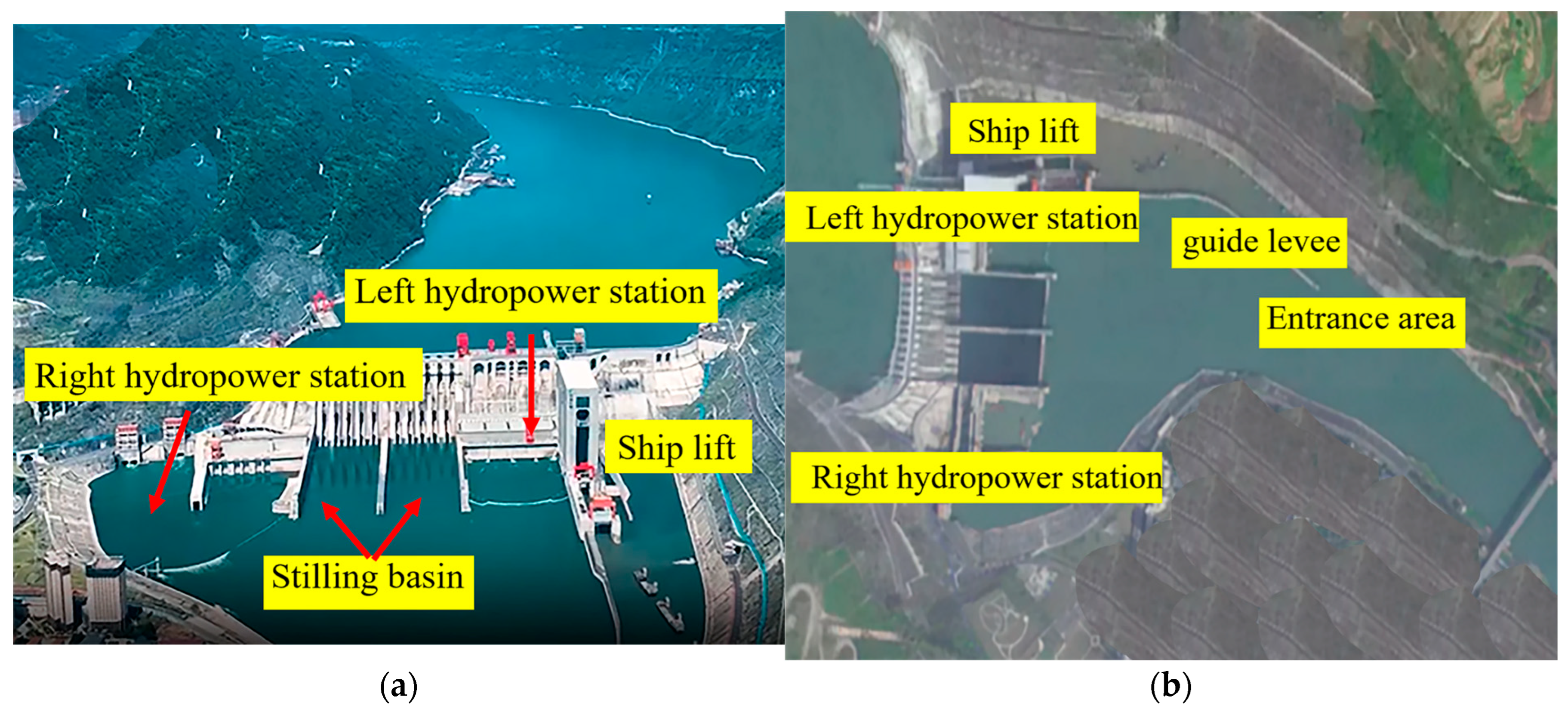
The Xiangjiaba Hydropower Station mainly focuses on power generation, and also improves navigation conditions. It undertakes the functions of flood control, irrigation, sediment interception, and counter-regulation for the Xiluodu Hydropower Station. The total reservoir capacity is 5.159 billion m3, with a total installed capacity of 6400 MW and a unit capacity of 800 MW. The maximum dam height of the spillway section is 144 m, and the maximum discharge is 48,660 m3/s. The project mainly consists of water-retaining structures, flood discharge and energy dissipation structures, sediment flushing structures, a power generation system at the left bank, an underground power generation system at the right bank, and navigation structures. The arrangement of the Xiangjiaba Hydraulic Project is depicted in Figure 1.

2.2. Hydrodynamic Model

Considering computational efficiency and the different characteristics of fluid flows in the stilling basin and the downstream river channel of the hydraulic hub, a three-dimensional CFD model based on STAR-CCM+ is established for fluid flow in the stilling basin with large free-surface deformation associated with dam flood discharge. This model uses the Reynolds-averaged Navier–Stokes (RANS) equations and the Realizable k-ε turbulence model, together with the Volume of Fluid (VOF) method capable of accurately capturing the air–water interface. For the downstream river channel, the MIKE 3 FM module based on the three-dimensional shallow water equations and the k-ε turbulence model is applied to simulate the unsteady flow. The two models were coupled together using hydrodynamic variables such as velocity and pressure at the smooth transition section of the stilling basin end sill as interface conditions, thereby constructing an integrated three-dimensional coupled nested numerical model to simulate the entire flow process covering the stilling basin and the downstream river channel of the hydraulic complex.

2.2.1. Dam Flood Discharge Jet and Stilling Basin Flow Model

(a) RANS Flow Equations:
ρ t + ρ u i x i = 0
u i t + ( u i u j ) x j = 1 ρ p x i + μ 1 ρ 2 u i x j x j + g i
where ρ denotes the fluid density; u i and u j denote the time-averaged velocity components in the i and j directions, respectively; t denotes time; x i and x j denote the spatial coordinate components; p denotes pressure; μ denotes the dynamic viscosity coefficient; and g i denotes the gravitational acceleration in the x i direction.
(b) Realizable k-ε Turbulence Equations:
ρ k t + ρ k u i x i = x i μ + μ t σ k k x i + P k ρ ε
ρ ε t + ρ ε u i x i = x i μ + μ t σ ε ε x i + ρ C 1 S ε ρ C 2 ε 2 k + υ ε
where ρ denotes the fluid density; t denotes time; u i denotes the time-averaged velocity component; x i denotes the spatial coordinate component; μ denotes the dynamic viscosity; ν denotes the kinematic viscosity; k denotes the turbulent kinetic energy; ε denotes the turbulent dissipation rate; μ t = ρ C μ k 2 ε denotes the turbulent viscosity; P k denotes the production term of turbulent kinetic energy; S denotes the modulus of the mean strain rate tensor; σ k and σ ε denote empirical constants; υ ε denotes the damping term; C 1 denotes the production coefficient; and C 2 denotes the dissipation coefficient.
(c) VOF Free-Surface tracking Equation:
α q t + μ i α q x i = 0
To capture the gas–liquid free interface in spillway discharge, the Volume of Fluid (VOF) method is adopted. The phase volume fraction is defined as α q (for the water phase q = w ) and q = a (for the gas phase), and satisfies α w + α a = 1 .

2.2.2. Downstream River Flow Model

(a) Shallow Water Equations:
u i x i = S
u i t + u j u i x j = ε i j 3 f u j g η x i 1 ρ 0 p a x i g ρ 0 z η ρ x i d z 1 ρ 0 h s i j x j + x j A u i x j + z ν t u i z + u s , i S
where t denotes time; u i and u j denote the time-averaged velocity components; x i and x j denote the spatial coordinate components; i = 1,2 , 3 ; j = 1,2 ; g denotes the gravitational acceleration; υ t denotes the turbulent eddy viscosity coefficient; A denotes the horizontal eddy viscosity coefficient; η denotes the free surface elevation relative to the reference datum; f denotes the Coriolis parameter; ρ denotes the water density; ρ 0 denotes the reference water density; p a denotes the atmospheric pressure; h denotes the total water depth; s i j denotes the horizontal stress tensor; S denotes the mass source/sink term; u s , i denotes the velocity components of the source/sink flow; and ε i j 3 denotes the Levi–Civita permutation symbol.
(b) k-ε Turbulence Equations:
ρ k t + ρ k u i x i = x i μ + μ t σ k k x i + P k ρ ε
ρ ε t + ρ ε u i x i = x i μ + μ t σ ε ε x i + C ε 1 ε k P k C ε 2 ρ ε 2 k
where ρ denotes the fluid density; t denotes time; u i denotes the time-averaged velocity component; x i denotes the spatial coordinate component; μ denotes the dynamic viscosity; k denotes the turbulent kinetic energy; ε denotes the turbulent dissipation rate; μ t = ρ C μ k 2 ε denotes the turbulent viscosity; P k denotes the production term of turbulent kinetic energy; σ k and σ ε denote empirical constants; C ε 1 denotes the production coefficient; and C ε 2 denotes the dissipation coefficient.

2.2.3. Computational Resources and Efficiency

To address the computational demands of this coupled nested model, all simulations were performed on a dedicated workstation equipped with dual Intel Xeon Platinum 8223CL processors (3.00 GHz), 192 GB of DDR4 RAM, and an NVIDIA GeForce RTX 5060 Ti GPU.
The high-precision STAR-CCM+ model of the stilling basin is solved by CPU parallel processing. An adaptive time step scheme is adopted with a minimum time step of 0.01 s, and approximately 50 h are required to complete 400 s of physical simulation.
The downstream river MIKE 3 model is solved by GPU acceleration. An adaptive time step scheme is adopted with a minimum time step of 0.001 s, and approximately 7 h are required to complete 4000 s of physical simulation.

2.3. Model Establishment and Validation

2.3.1. Mesh Generation

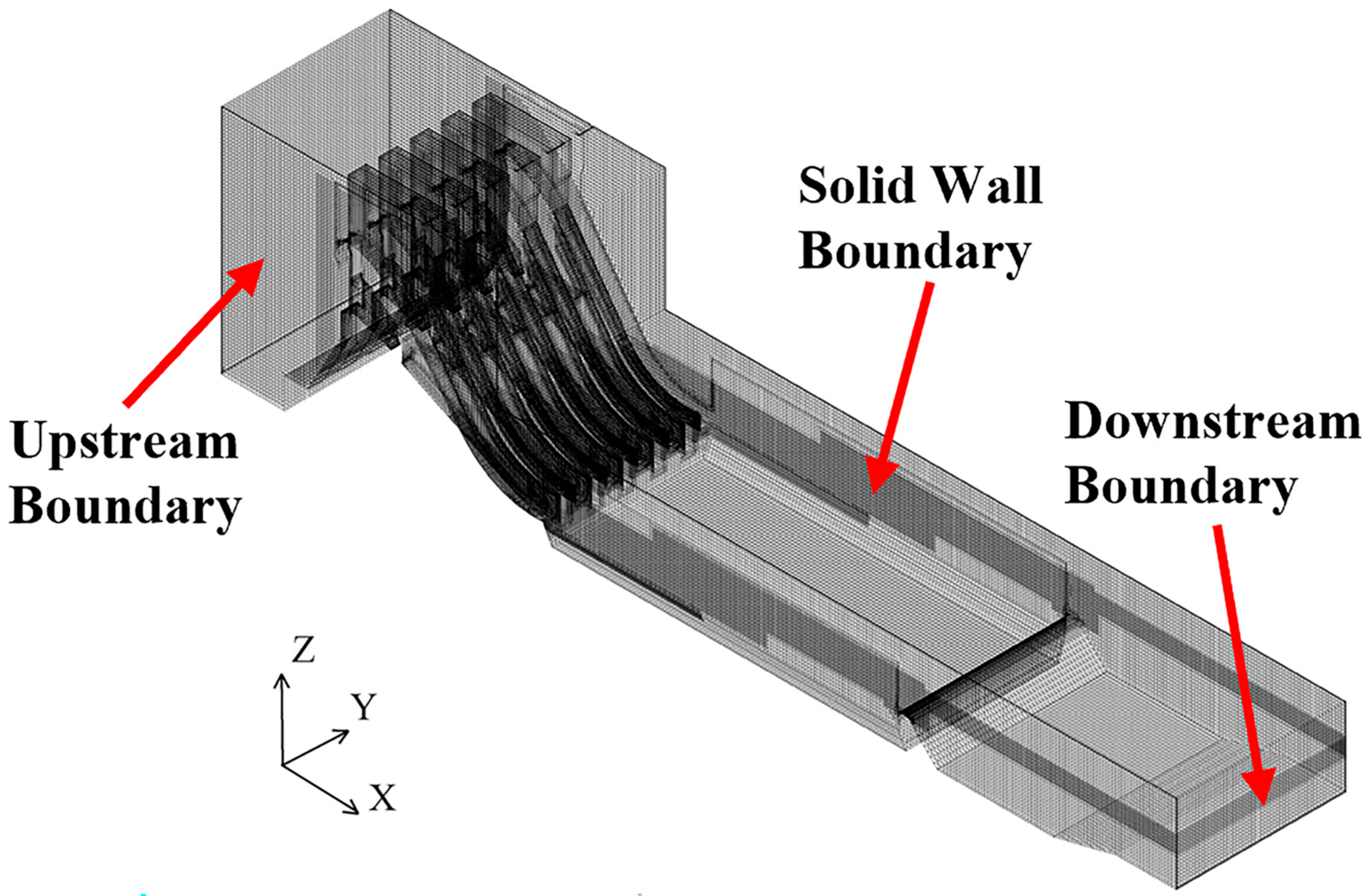
The left single-bay overflow dam section of the Xiangjiaba Hydraulic Complex is selected here as an example for depicting the flood discharge jet and stilling basin model. As shown in Figure 2, a zoned structured mesh is adopted, with hexahedral grids of 2 m used in the upstream dam region and the end sill outflow region, and hexahedral grids of 1 m used in the dam spillway discharge zone and the stilling basin discharge zone. A prism layer mesh with a thickness of 0.1 m is applied near the dam wall, and the total number of grids in the model is approximately 270 × 104.
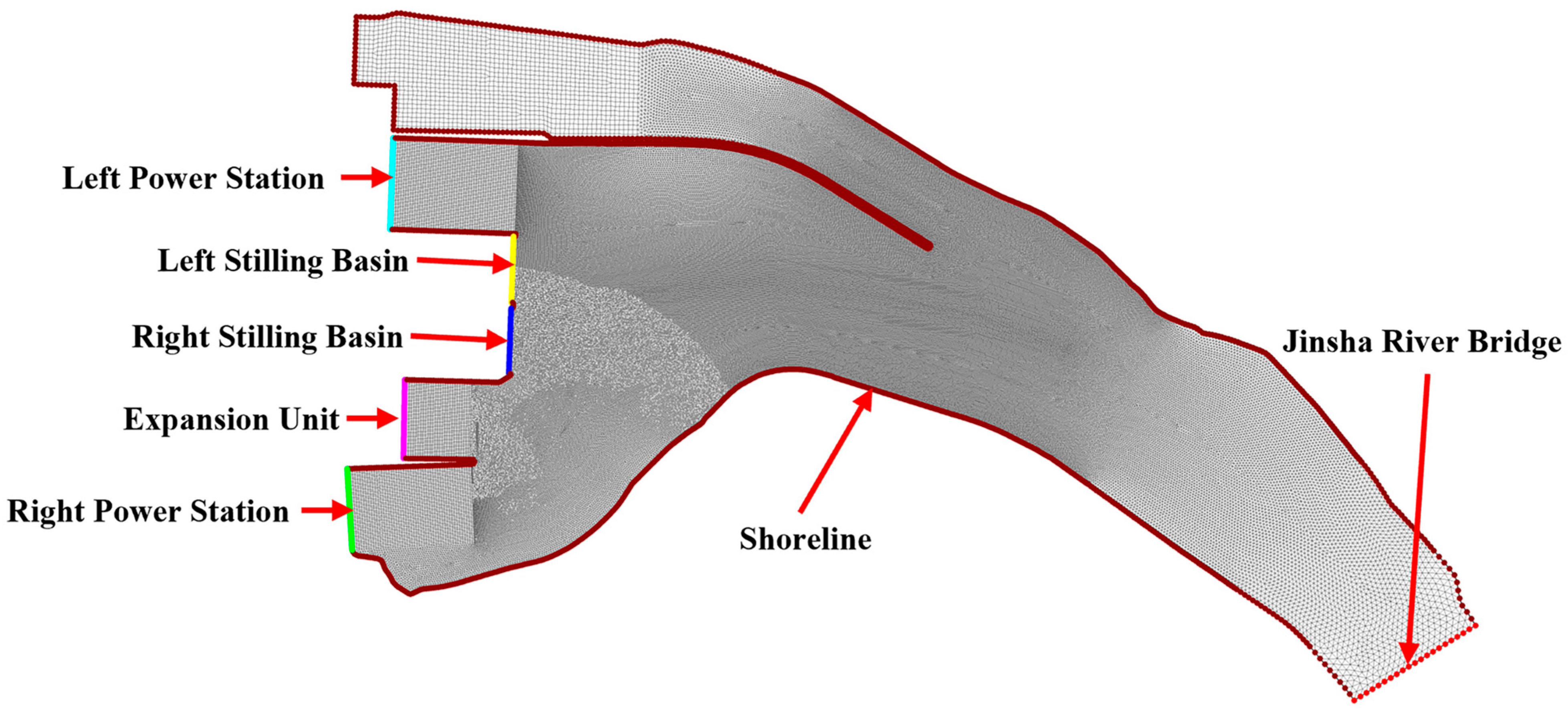
For the downstream river model, as shown in Figure 3, the downstream reach from the hydraulic complex to the Jinsha River Bridge is set as the simulation domain. In the simulation, an unstructured mesh is used to generalize the curved river channel and shoreline. Quadrilateral grids of 2 m × 4 m are used in the left bank powerhouse outflow region, the right bank expansion unit outflow region, and the right bank powerhouse outflow region; quadrilateral grids with a side length of 7.5 m are used in the ship lift area; triangular grids with a side length of 2.5 m are used from the outflow boundaries of the left and right stilling basins to the entrance area of the downstream approach channel; and triangular grids with side lengths transitioning from 8 m to 18 m are used in the region from the Jinsha River Bridge to the downstream Hengjiang section, with a total grid number of approximately 18 × 104.

2.3.2. Coupling of the Numerical Models and Boundary Conditions

To simulate the unsteady flow in the downstream river channel due to dam flood discharge and tailwater from power stations, the free-surface CFD model for dam flood discharge and stilling basin flow is coupled with the unsteady turbulent model for downstream river flows by transferring the hydrodynamic variables (velocities, pressure and water surface elevation, etc.) in the interface set at the tail end of the stilling basin.
Moreover, the boundary conditions adopted in the present model are specified as follows: (1) Dam Flood Discharge Jet and Stilling Basin Flow Model: The upstream and downstream boundaries of the computational domain are set as pressure boundaries with specified water level elevations, where the upstream water level is 380 m and the downstream water level is 285 m. A standard atmospheric pressure boundary is applied at free surface of the computational domain, while no-slip wall boundaries with specified roughness heights are imposed on the dam surface and stilling basin walls within the domain. (2) Downstream River Flow Model: The tailwater boundaries on the left and right power stations are set as fixed velocity boundaries. As mentioned above, on the interface of the stilling basin tail, the simulated time series of hydrodynamic variables by upstream stilling basin model are adopted as the upstream boundary. A fixed discharge condition is specified for the upstream power station, a no-slip wall boundary is applied along the shoreline, and a fixed water level boundary of 273.1 m is set at the downstream boundary.

2.3.3. Model Validation

(a)
Verification of Flood Discharge Jet and Stilling Basin Flow Model.
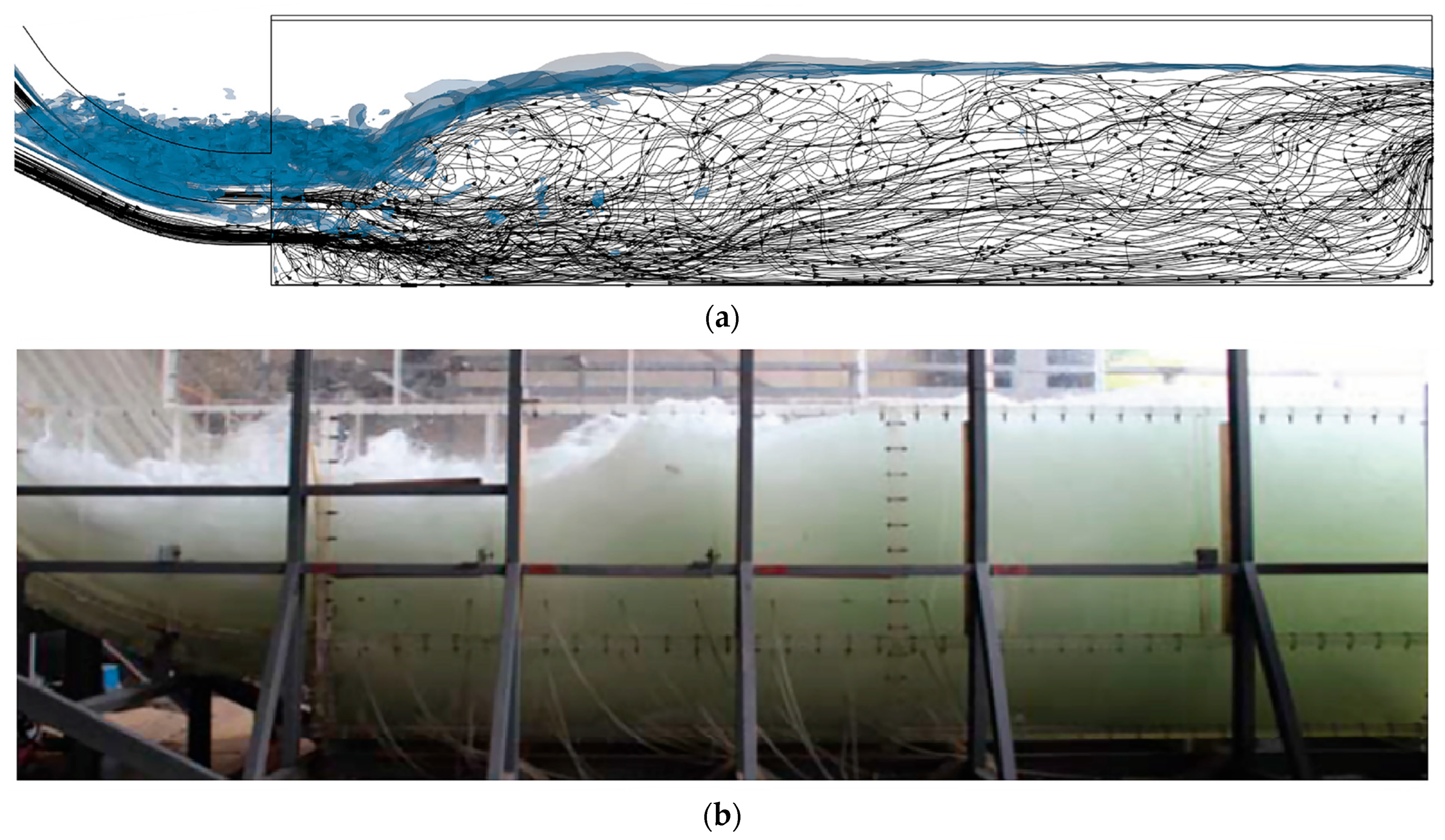
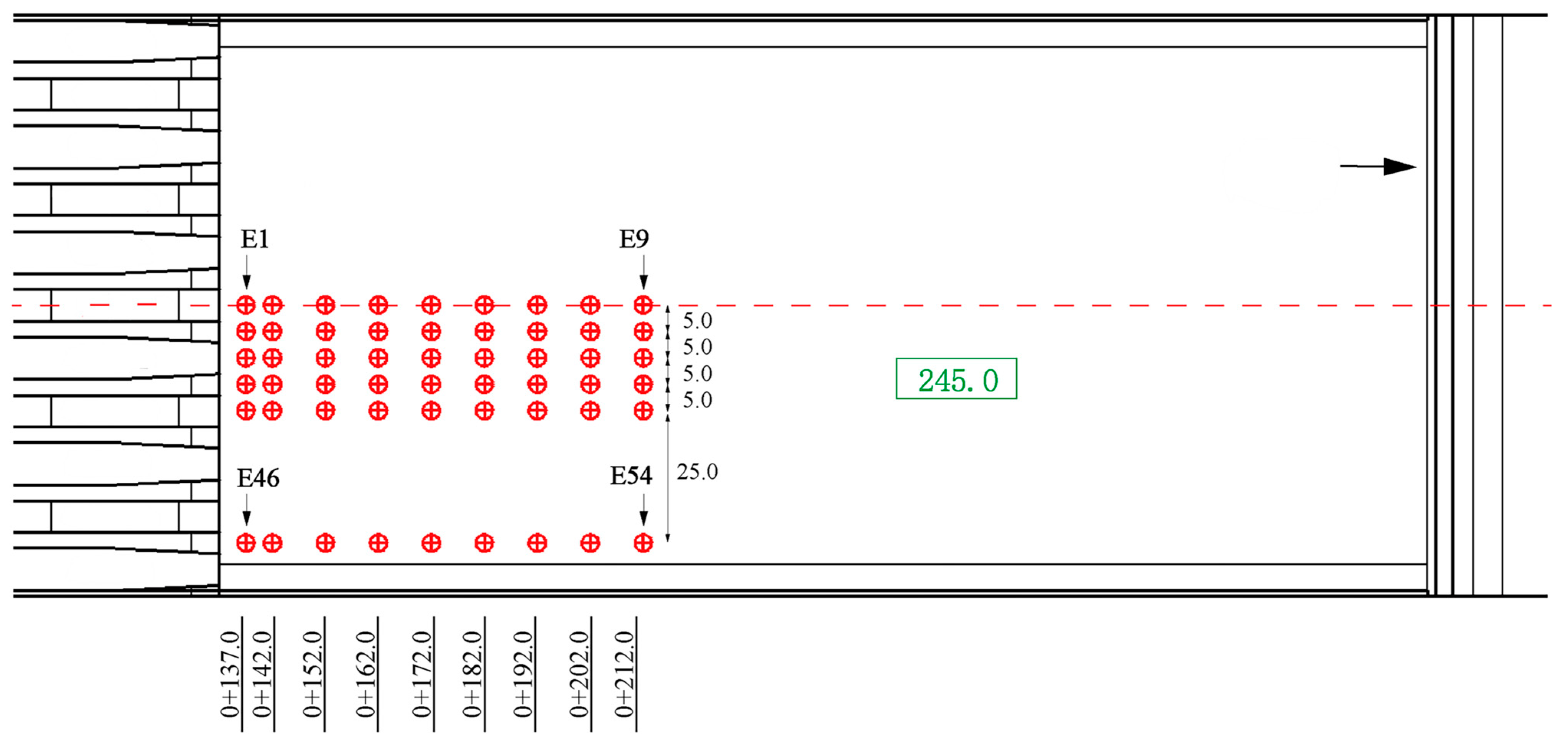
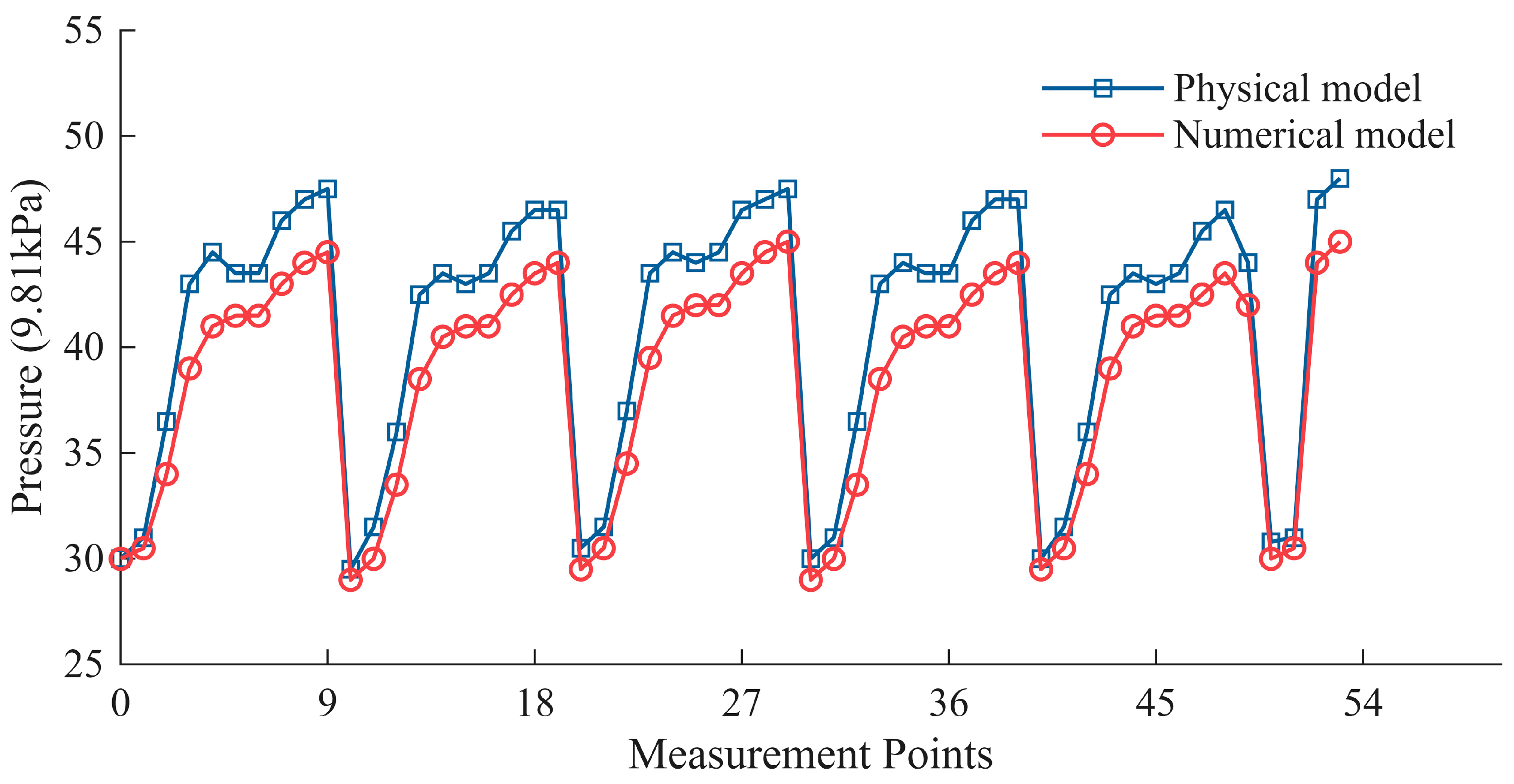
To verify the reliability of the numerical method, full discharge through surface and mid-level outlets is adopted in this study. The simulated flow regime in the stilling basin and pressure distribution on the stilling basin bottom slab are compared with the tested results of physical model tests. The comparison shows that both the simulated flow regime and bottom pressure distribution are in good agreement with the measured data. Therefore, the established numerical model can accurately simulate flood discharge in the stilling basin. The flow regimes in the stilling basin from the physical test and numerical simulation are compared in Figure 4; the layout of measuring points on the stilling basin floor and the comparison of bottom pressure are shown in Figure 5 and Figure 6.
(b)
Verification of Downstream River Flow Model.
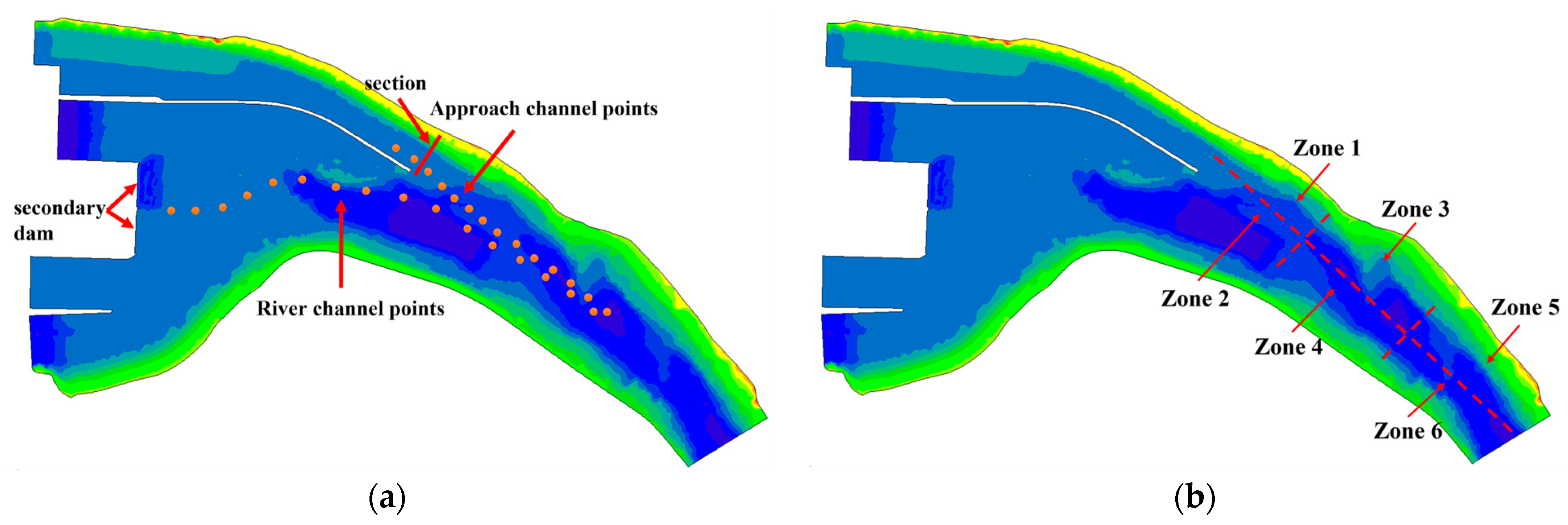
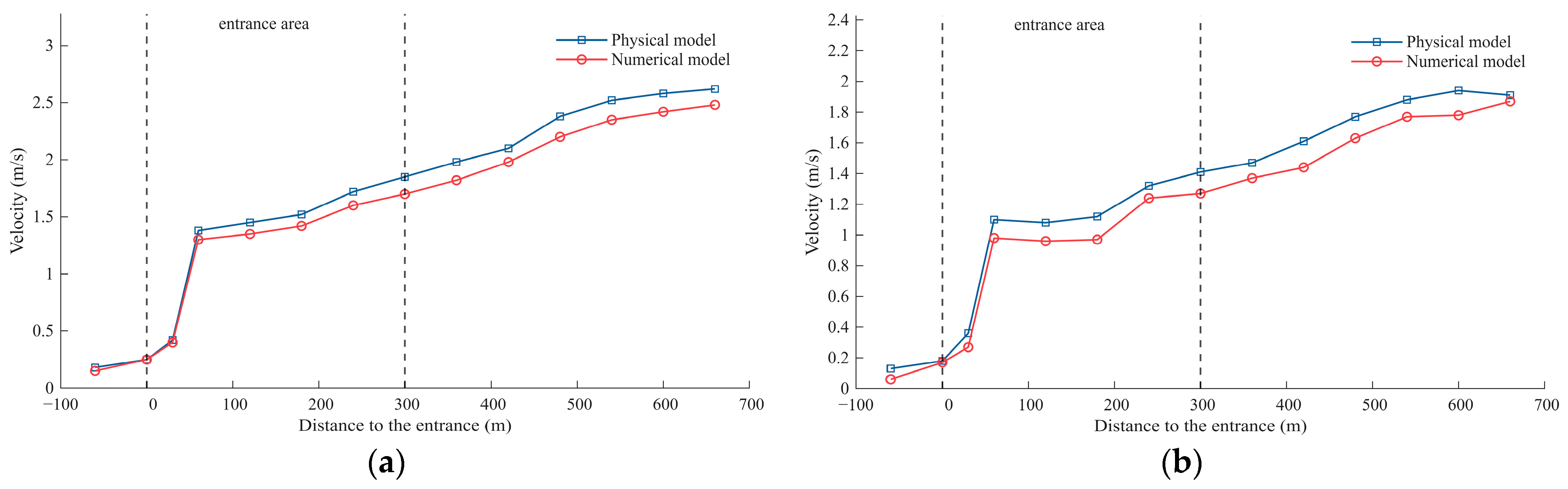
For to the 1:40 large-scale physical model test, the experimental cases listed in Table 1 were selected to simulate the flow regime in the entrance area of the downstream approach channel, and the simulation accuracy of the established numerical model was validated through comparison with measured data. Figure 7 gives a schematic diagram of measuring points for water level fluctuation and current velocity and monitoring zone division in the downstream reach.
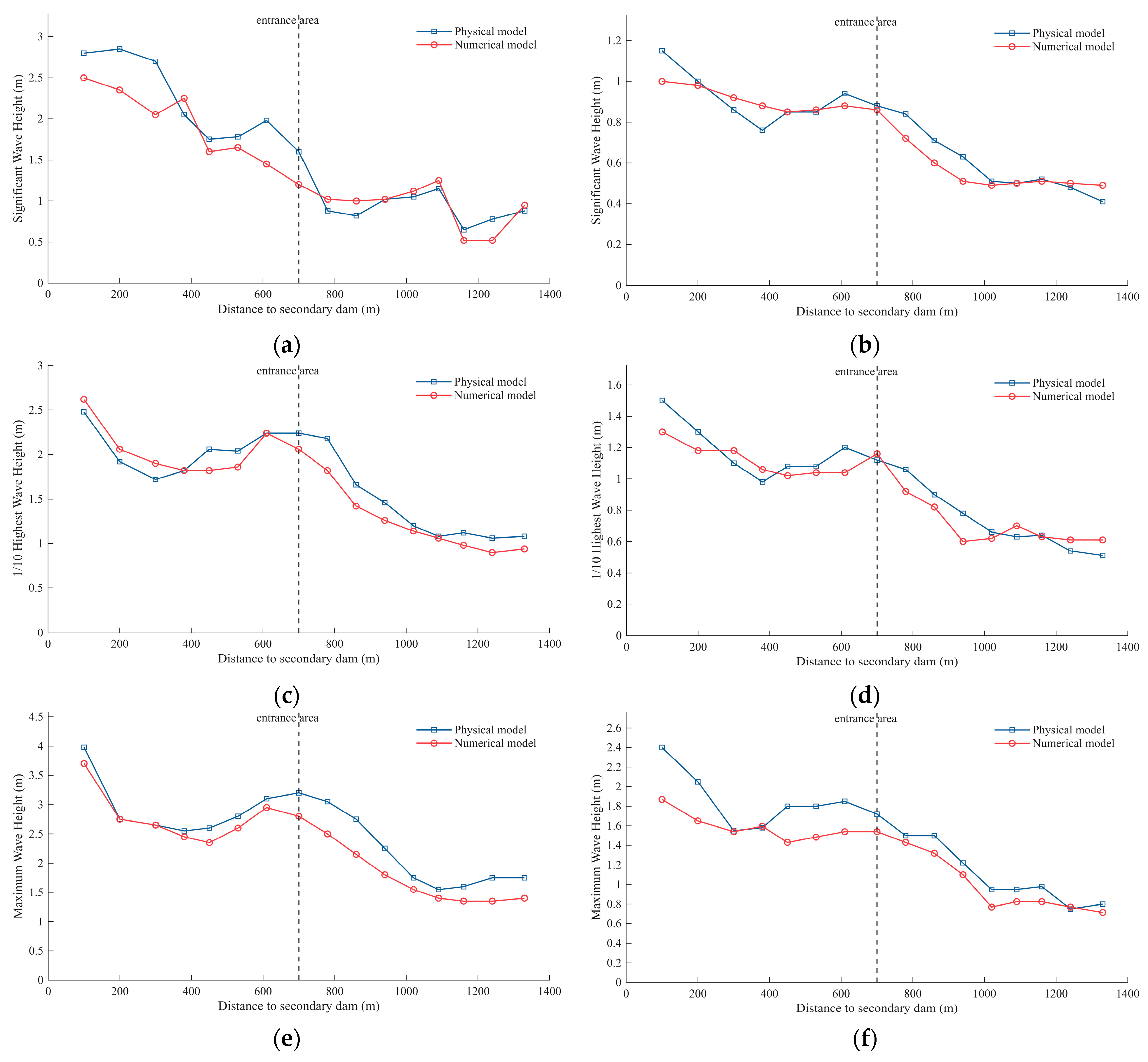
Figure 8 shows the comparison between the simulated results and the physical model test for the longitudinal distribution of wave height along the downstream river channel under the above conditions. In reference to wave theory, to represent the characteristics of water level fluctuations in the downstream river channel associated with dam discharge water, the concept of wave height is introduced in this study. It should be noted that the water level fluctuations in the downstream channel primarily originate from periodic short-wave oscillations with a period of approximately 5–8 s, which are generated by the turbulent outflow from the stilling basin. After the numerical simulation reached a steady state, a continuous 800 s time series of water level data was extracted for statistical analysis. The significant wave height, one-tenth highest wave height, and maximum wave height were subsequently calculated based on the above extracted data. Table 2 presents the comparison of the maximum characteristic wave heights due to water level fluctuation along the downstream river channel between the physical model and the numerical model. The results indicate that, in terms of both the overall trend of the longitudinal variation in characteristic wave heights along the downstream river channel and the magnitude of the maximum characteristic wave heights, the numerical model and physical model results are in good agreement, with the errors of significant wave height, 1/10 highest wave height, and maximum wave height all within ±10%.
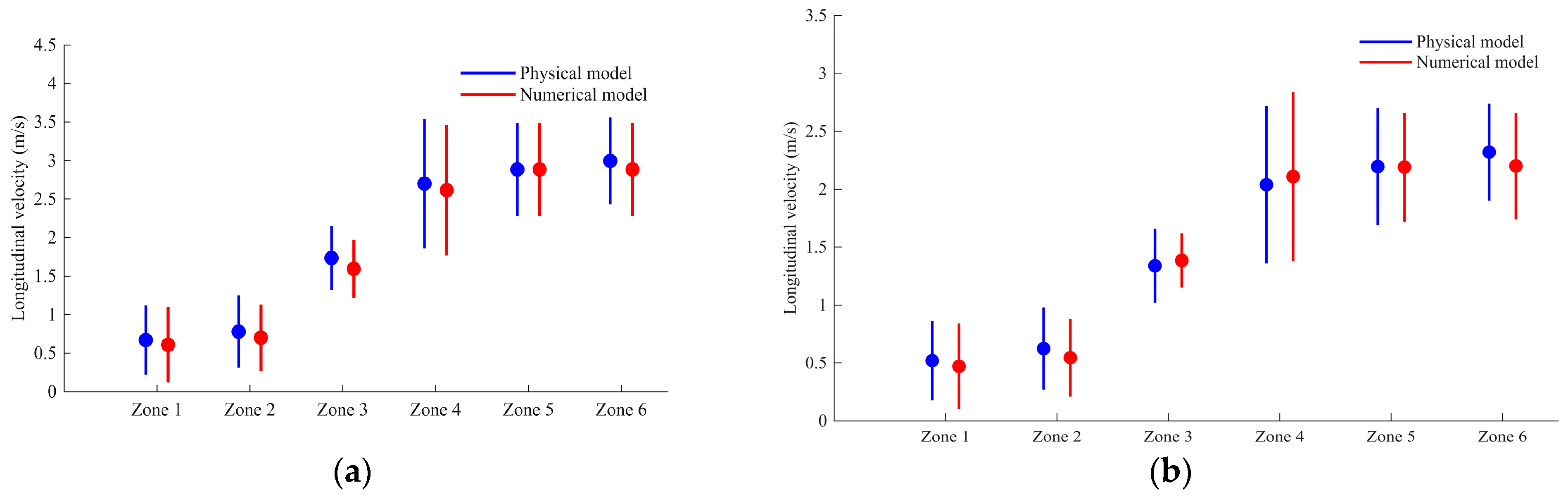
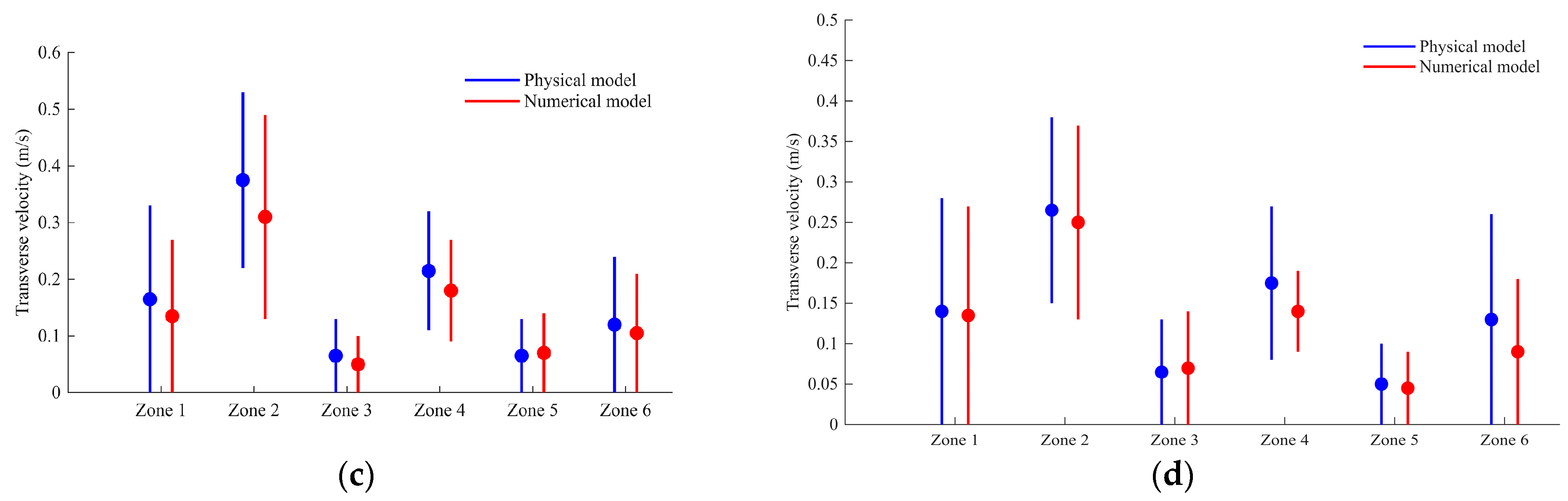
Figure 9 shows the comparison between the simulated and measured current velocity magnitudes in the entrance area of the downstream approach channel under the above conditions. As can be seen, the overall distribution patterns of velocity magnitude in the entrance area are similar between the numerical and physical models. Figure 10 presents a quantitative comparison of the longitudinal velocity and transverse velocity obtained by the numerical model and physical model for different monitoring zones within the entrance area.
In summary, the numerical simulation results agree well with the physical model test results, indicating that the coupled nested numerical model established in this study can effectively simulate the downstream river flow under dam flood discharge conditions of a hydraulic complex, and can be used for comparative analysis of different discharge operation modes.

2.3.4. Grid Independence Verification

To ensure that the numerical results are not significantly affected by mesh resolution, grid independence verification was carried out for the stilling basin model and the downstream river model, respectively, given their distinct physical characteristics, governing equations, and mesh topologies. Following the Grid Convergence Index (GCI) method recommended by the ASME V&V standard, three mesh systems with a refinement ratio of approximately 1.5 were generated for each model. The baseline (medium) meshes described in Section 2.3.1 served as the reference level. The GCI is defined as follows:
G C I = F s ε r p 1
where F s = 1.25 is the safety factor for three-grid studies, ε is the relative error between the fine and medium grid solutions, r is the refinement ratio, and p is the formal order of accuracy of the numerical scheme. In this study, a second-order discretization scheme was employed; therefore, p = 1.97 is adopted herein.
(a)
Verification of Flood Discharge Jet and Stilling Basin Flow Model.
Three structured hexahedral mesh systems were generated for the stilling basin model. Table 3 summarizes the mesh configurations. The average bottom pressure of the stilling basin was selected as the key variable. Grid independence of the stilling basin flow model was verified using the GCI method. The GCI value of 1.10% for the medium mesh (2.7 × 10⁶ cells) is well below the 5% threshold, confirming that the discretization error is sufficiently small and the solution is no longer sensitive to further mesh refinement.
(b)
Verification of Downstream River Flow Model.
Similarly, three unstructured mesh systems were tested for the downstream river model. The significant wave height (H_(1/10)) near the entrance of the downstream approach channel was selected as the key indicator, as it directly reflects the flow disturbances affecting navigation safety.
Table 4 summarizes the mesh configurations. The GCI value for the medium mesh (1.80 × 10⁵ cells) is 3.43%, which is below the 5% threshold, indicating that this mesh resolution meets the computational requirements of the downstream river model.

3. Results

3.1. Simulation of Downstream Flow Response to Dam Flood Discharge

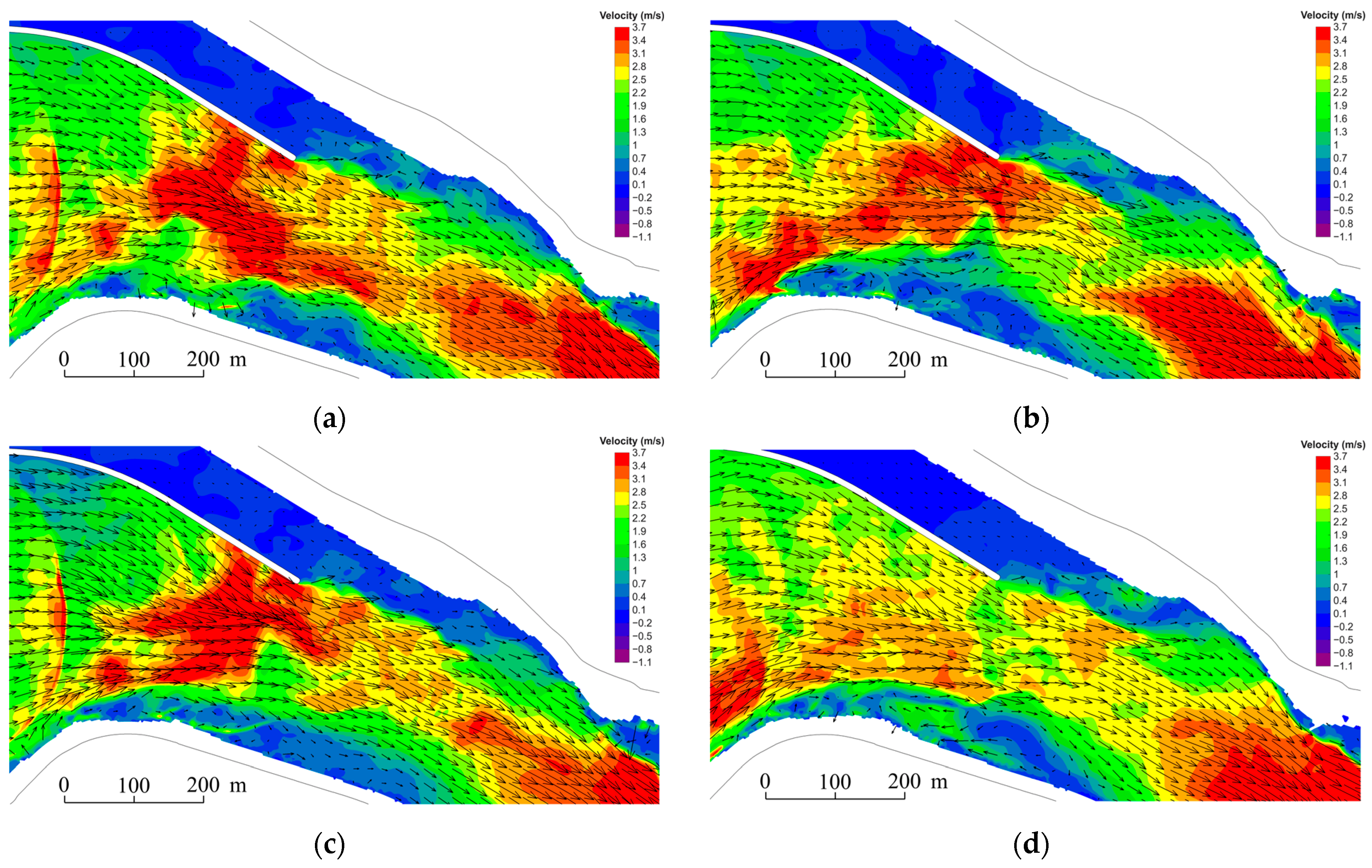
Different dam flood discharge operation scenarios have significant influences on the downstream river flows, especially in the vicinity of a ship lock approach entrance that may affect the navigation of vessels. To investigate the impact of different flood discharge gate operation scenarios on the navigational flow conditions near the entrance area of the downstream approach channel of the Xiangjiaba ship lift, and to compare the flow patterns in the downstream river channel and the entrance area under different gate opening combinations, this study considers four dam flood discharge operation modes: full discharge through surface outlets of the left basin, balanced discharge through surface and mid-level outlets of the left basin, full discharge through mid-level outlets of the left basin, and balanced discharge through surface and mid-level outlets of both left and right stilling basins. Table 5 lists the discharge distribution under the simulation conditions, and Table 6 presents the number of opened gates and opening heights of surface and mid-level outlets under different conditions.

3.2. Characteristics of Flow Structure and Velocity Distribution

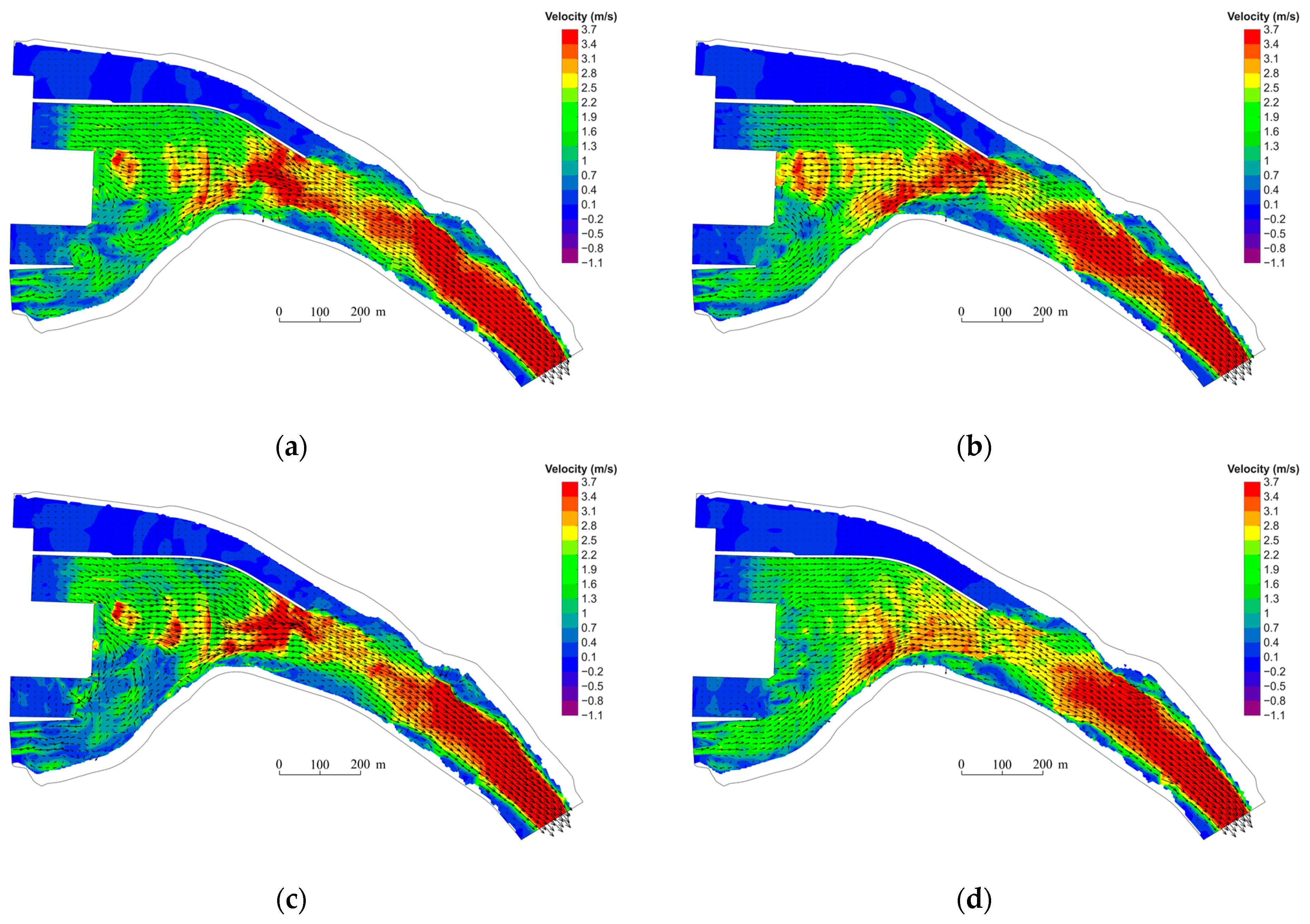
Figure 11 presents the snapshots of simulated surface velocity distribution in the downstream river channel under different dam flood discharge operation scenarios. The common features are that in all cases a distinct high-velocity zone develops near the entrance of the approaching channel in the downstream river, which is mainly caused by the gradual contraction of a section downstream and the complicated interaction of currents coming from dam flood discharge and tailwater from left and right power stations in the upstream region of the entrance area. However, the flow structures and magnitude of maximum velocity show different results for the four different flooding discharge scenarios. As shown in Figure 11a, when only the left-basin dam surface outlets are fully opened (Case 1), an apparent high-velocity flow band forms on the river surface downstream, with a maximum surface velocity of 3.62 m/s. The core high-velocity region is located slightly to the left of the main axis of the river channel, and the high-velocity flow attenuates slowly along the channel, resulting in a wide influential range with comparatively big surface velocity. From Figure 11b, when the surface and mid-level outlets of the left basin are jointly operated, multiple discharge flows merge, enhancing vertical and transverse momentum exchange and leading to a more uniform surface velocity distribution in the downstream river channel compared with the surface outlet-only condition. The maximum surface velocity is reduced to 3.54 m/s, and the extent of the high-velocity zone decreases. As seen from Figure 11c, when only the mid-level outlets of the left basin are used, the flow remains submerged over a certain distance before gradually rising up and diffusing, and the surface flow is mainly driven by shear stress; as a result, the overall surface velocity in the downstream river channel is relatively small, with a maximum surface velocity of 3.14 m/s. In contrast, as shown in Figure 11d, when both the surface and mid-level outlets of the left and right stilling basins are in operation, the unit discharge per width is relatively small, and the flows rapidly converge after passing through the gates, with interaction and friction among different flow streams. As a result, the downstream river flow becomes more stable, and the surface velocity distribution is more uniform comparatively, with a maximum surface velocity of 3.10 m/s. Under this condition, the flow energy is dissipated most effectively, resulting in the least impact on the downstream riverbed and representing a relatively safe operating condition with weak disturbance to downstream waters.
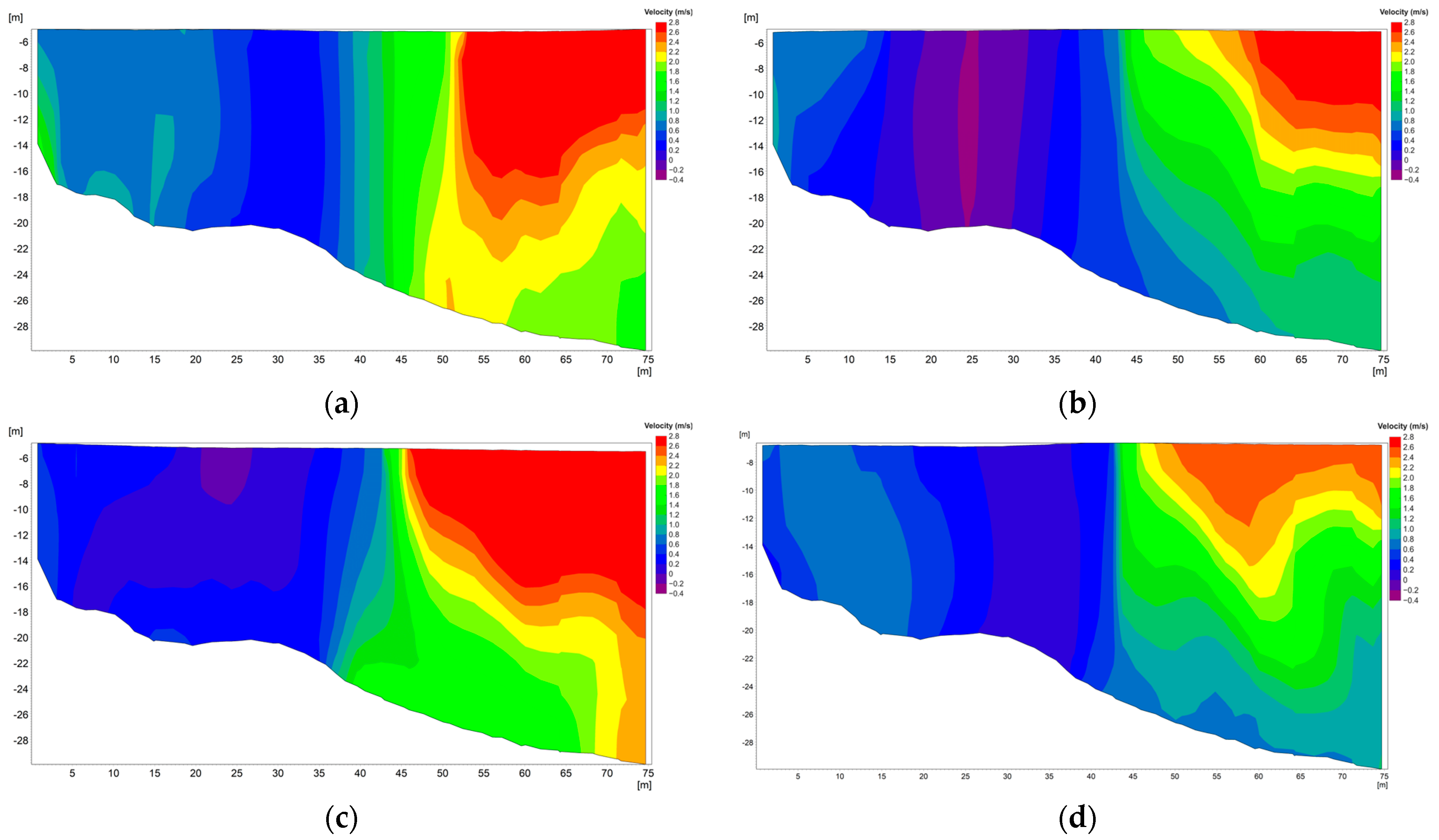
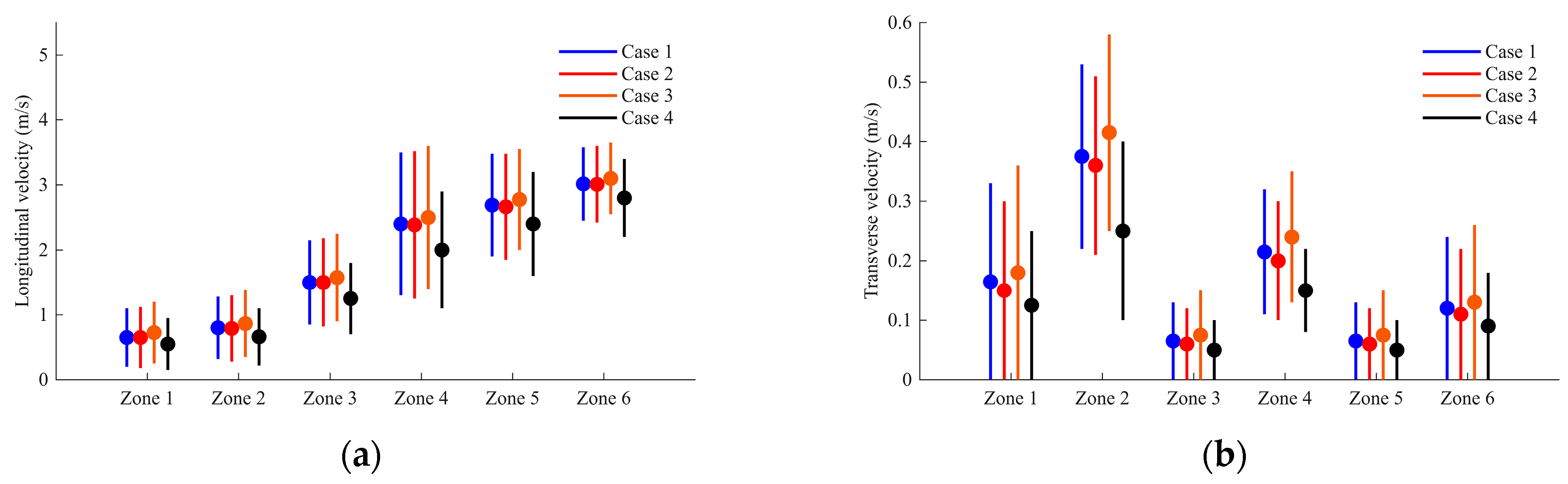
Figure 12 gives the corresponding simulated velocity distribution in the entrance area of the downstream approach channel under different operation modes with varied dam flood discharge through surface and mid-level outlets. Figure 13 presents the corresponding cross-sectional velocity distribution in the entrance area of the downstream approach channel, and Figure 14 give the calculated longitudinal and transverse velocities within different monitoring zones. As can be seen from Figure 14, among the four operation modes, the two modes with balanced discharge through surface and mid-level outlets exhibit smaller transverse velocities in the entrance area.
When only the surface outlets of the left basin are operated, the high-velocity flow on the right side of the entrance area is concentrated within 9 m below the water surface and extends over a relatively long distance (0~420 m downstream of the entrance area); its affected range is relatively narrow, with a maximum longitudinal velocity of 1.12 m/s. A large-scale transverse flow appears within 0~200 m downstream of the entrance, with a maximum velocity of 0.32 m/s; in addition, a large recirculation zone forms in the left half of the region within 0~200 m downstream of the entrance, with a recirculation length of approximately 110 m and a maximum recirculation velocity of about 0.82 m/s.
Compared with the surface outlet-only condition, when balanced discharge through surface and mid-level outlets of the left basin is adopted, both the velocity and penetration depth of the high-velocity flow on the right side of the entrance area decrease, being concentrated within 5 m below the water surface and extending over a shorter distance (0~190 m downstream of the entrance area); the affected range of the entrance area is reduced, with a maximum longitudinal velocity of 1.05 m/s; the region with transverse flow is significantly reduced, and the maximum transverse velocity decreases to 0.15 m/s; the recirculation zone is located in the left half, within 0~200 m downstream of the entrance area, with its length reduced to about 60 m and a maximum recirculation velocity of approximately 0.63 m/s.
When only the mid-level outlets of the left basin are operated, the submerged depth of the high-velocity flow on the right side of the entrance area increases, being concentrated within 13 m below the water surface and extending over a relatively long distance (0~300 m downstream of the entrance area); the affected range of the entrance area is the largest, with a maximum longitudinal velocity of 0.96 m/s; transverse flow is mainly distributed within the range of 200~420 m downstream of the entrance area, with a maximum transverse velocity of 0.39 m/s; the recirculation length in the left half within 0~200 m downstream of the entrance area decreases to about 16 m, with a maximum recirculation velocity of approximately 0.54 m/s.
If balanced discharge through surface and mid-level outlets of both the left and right basins is adopted, the submergence depth of the high-velocity flow on the right side of the entrance area will be relatively small, being concentrated within 5 m below the water surface, and the velocity will also be lower than that under the other three operation modes, with a short extension distance (0~50 m downstream of the entrance area); the affected range of the entrance area shifts to the right, with a maximum longitudinal velocity of 0.87 m/s; the influence of transverse velocity is limited, with a maximum transverse velocity of 0.11 m/s within 0~200 m downstream of the entrance area. However, the recirculation length in the left half within 0~200 m downstream of the entrance area is relatively long, approximately 90 m, with a maximum recirculation velocity of 0.58 m/s.
Based on the navigation control limits for Class IV waterways specified in the Chinese national standard Navigation Standard for Inland Waterways (GB 50139-2014) (longitudinal velocity ≤ 2.0 m/s, transverse velocity ≤ 0.30 m/s) [28], a quantitative assessment of navigation flow conditions was conducted for the velocity distributions across six zones under the four discharge scenarios.
Within Zones 1–2, the longitudinal velocity under all scenarios is well below the standard limit, presenting favorable navigation flow conditions. In Zone 3, local exceedance of the longitudinal velocity limit occurs in Cases 1–3, while Case 4 remains within the permissible range. From Zone 4 to Zone 6, both the average and peak longitudinal velocities of Cases 1–3 substantially exceed the threshold of 2.0 m/s, failing to satisfy navigation criteria. Although longitudinal velocity also exceeds the limit in Zones 4–6 for Case 4, the degree of exceedance is far lower than that of Cases 1–3.
In terms of transverse velocity, the velocity exceedance for Cases 1–3 is mainly concentrated in Zones 1, 2 and 4. Among these zones, the average transverse velocity in Zone 2 exceeds the control limit of 0.30 m/s, showing the most serious violation. In comparison, Case 4 also shows an exceedance of transverse velocity in Zone 2 but with lower magnitude than the other cases.
This study adopts an extremely high discharge rate of 12,000 m3/s. Under this condition, the flow velocities in Cases 1–3 exceed the regulatory limits in most key zones and therefore do not satisfy the navigation requirements. For Case 4, although the recirculation zone extends to approximately 90 m, the recirculation velocity remains comparatively low and may have a minor impact on vessel navigation compared with the exceedance of transverse velocity. Overall, Case 4 provides improved local flow conditions and better comprehensive navigation performance. Moreover, Case 4 does not incur excessive additional costs in routine operation and maintenance, nor does cost become an obstacle to selecting this gate operation scheme in practice.

3.3. Characteristics of Water Surface Fluctuations

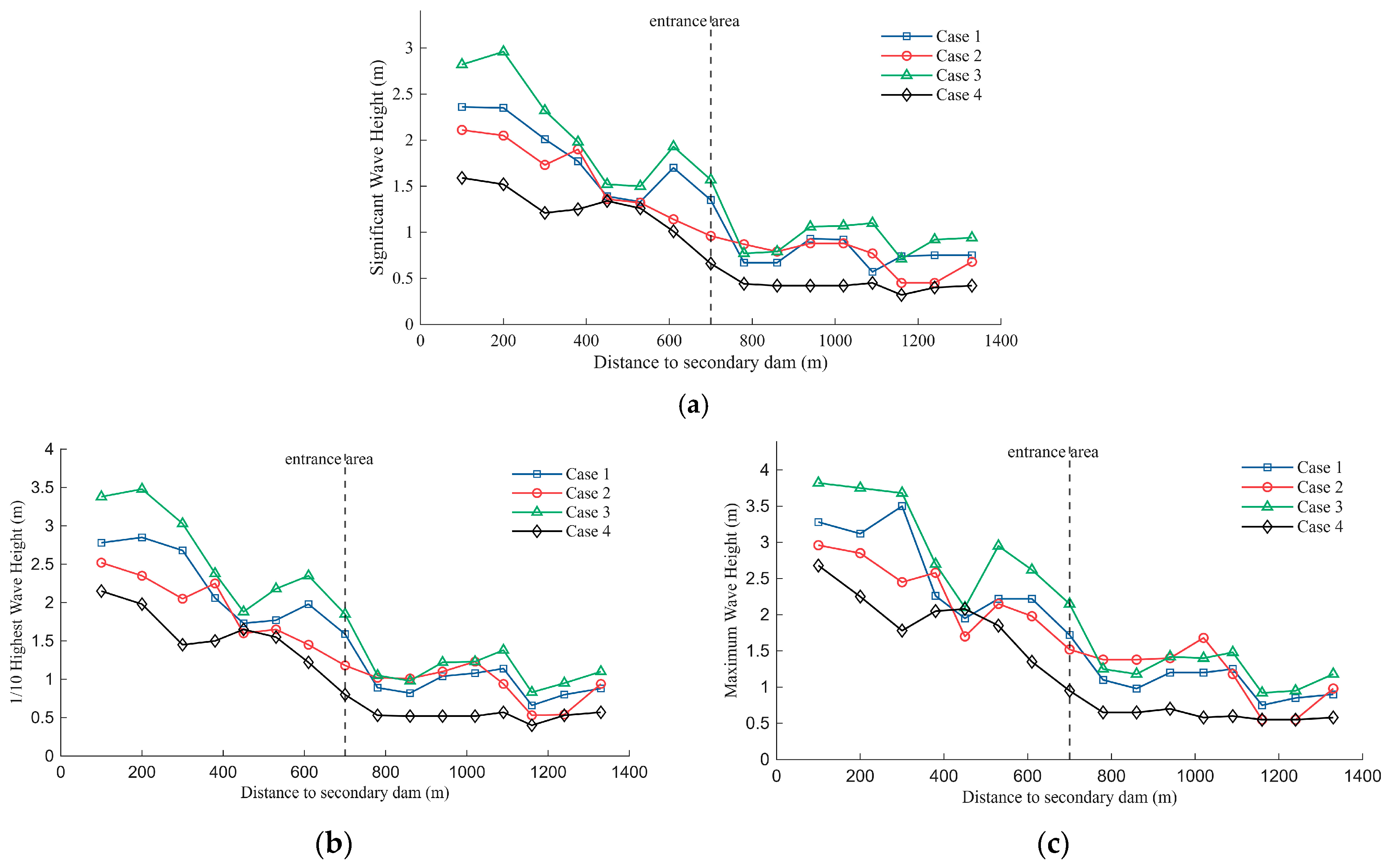
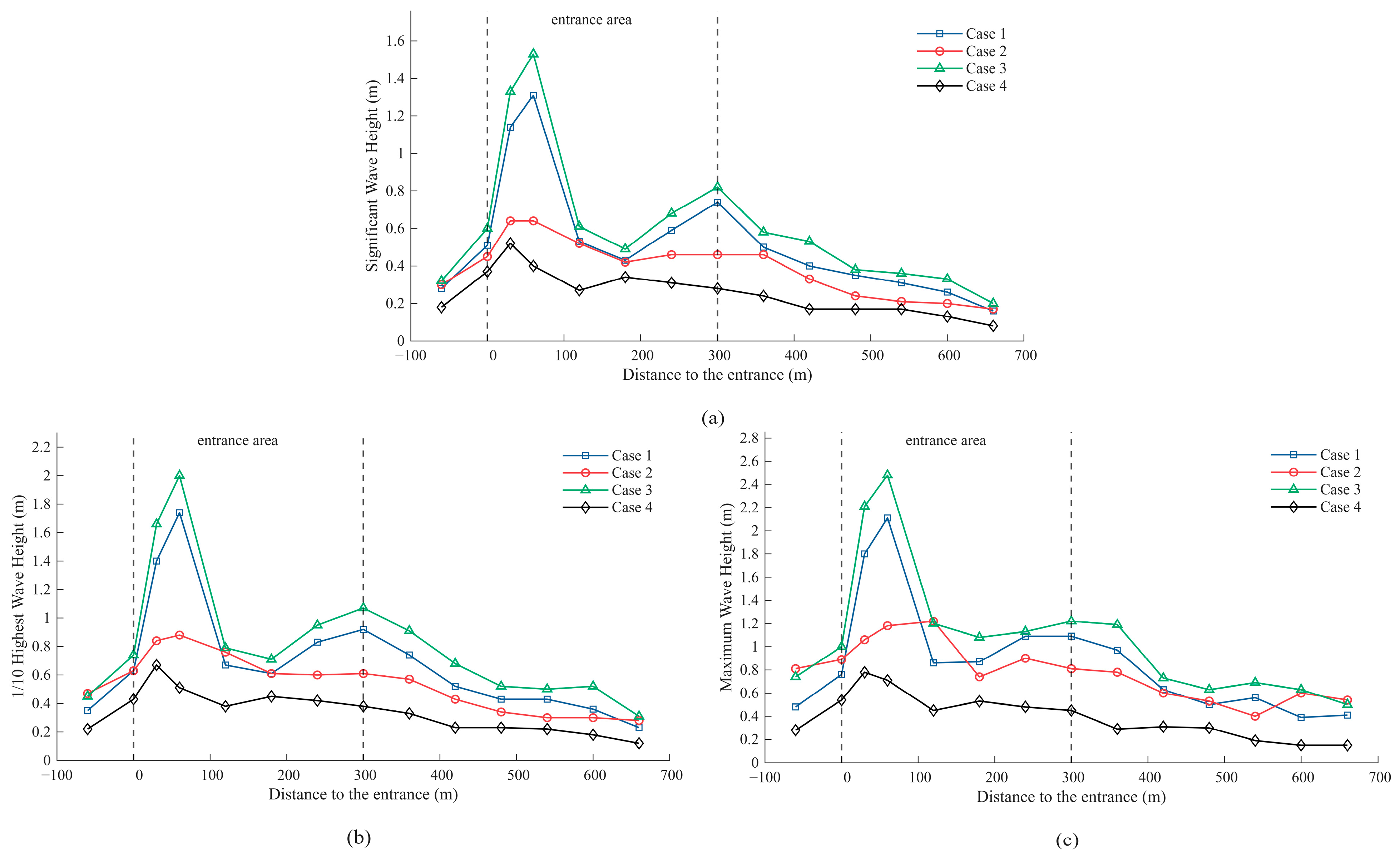
Figure 15 shows the longitudinal variations in characteristic wave heights in the downstream river channel under the four flood discharge modes. As can be seen from Figure 15, under the influence of flood discharge, the flow energy is most concentrated within 300 m downstream of the secondary dam of the stilling basin under all four conditions, where the water surface fluctuation wave height reaches its maximum and then exhibits a decreasing trend along the channel; however, with the gradual narrowing in the river bank from the upstream to the approaching entrance, the flow energy reconverges, forming a new peak which then rapidly decreases near the entrance area and finally stabilizes approximately 200 m downstream of the entrance area. Among the three operation modes involving discharge from the left basin, the balanced discharge through surface and mid-level outlets results in the smallest water surface fluctuation wave height along the river channel, especially with the significant wave height being notably lower than that under either surface outlet-only or mid-level outlet-only conditions; the wave height under balanced discharge through surface and mid-level outlets of both basins is lower than that under the three left-basin discharge modes.
Figure 16 shows the longitudinal variations in characteristic wave heights in the approach channel under the four flood discharge modes. As shown in Figure 16, the entrance area is the region with the most intensive water surface fluctuations and the highest navigation risk in the downstream approach channel. Within the range of 0~100 m downstream of the entrance, the high-velocity flow in the river channel strongly interacts with the low-velocity flow in the approach channel, resulting in peak wave heights under all four operation modes; as energy dissipates, the wave height downstream of the entrance rapidly decreases and eventually stabilizes. Comparing the four operation modes, the ranking of wave height due to water surface fluctuation within the entrance area is as follows: full discharge through mid-level outlets of the left basin (1/10 highest wave height ≈ 2.1 m) > full discharge through surface outlets of the left basin (≈1.83 m) > balanced discharge through surface and mid-level outlets of the left basin (≈1.68 m) > balanced discharge through surface and mid-level outlets of both basins (≈0.79 m). This pattern is primarily controlled by the location of energy input, mixing intensity, and spatial distribution under different flood discharge modes. When only the mid-level outlets of the left basin are operated, a submerged jet forms in the stilling basin, and a shear layer develops between the deep jet and the surface flow, with upward vortices inducing surge waves, resulting in the largest wave height; when only the surface outlets of the left basin are operated, a shallow surface jet forms in the stilling basin, and strong air entrainment at the surface leads to enhanced energy dissipation, thereby reducing the wave height compared with the mid-level outlet condition. When balanced discharge through surface and mid-level outlets of the left basin is adopted, multiple flow streams from upper and lower layers mix within the stilling basin, accelerating energy dissipation through vertical turbulence and reducing the residual wave energy transmitted to the entrance area, resulting in a further decrease in wave height. When balanced discharge through surface and mid-level outlets of both basins is adopted, the inflow energy is effectively distributed, the unit discharge per width is reduced, and multiple flow streams rapidly converge and mix after passing through the gates, leading to the most effective energy dissipation, the most stable water surface in the entrance area, and the smallest wave height.

4. Discussion

Through the development of a three-dimensional nested coupled CFD model for simulating the whole hydrodynamic process from the dam surface flood jet to the stilling basin and downstream flows, the influence of four different dam flood discharge operational scenarios on the hydrodynamic characteristics at the entrance of the downstream ship lock approach channel were examined. The simulated results showed that with balanced discharge through surface and mid-level outlets of both left and right basins, the amplitude of water surface fluctuations is much smaller than that under the other three modes.
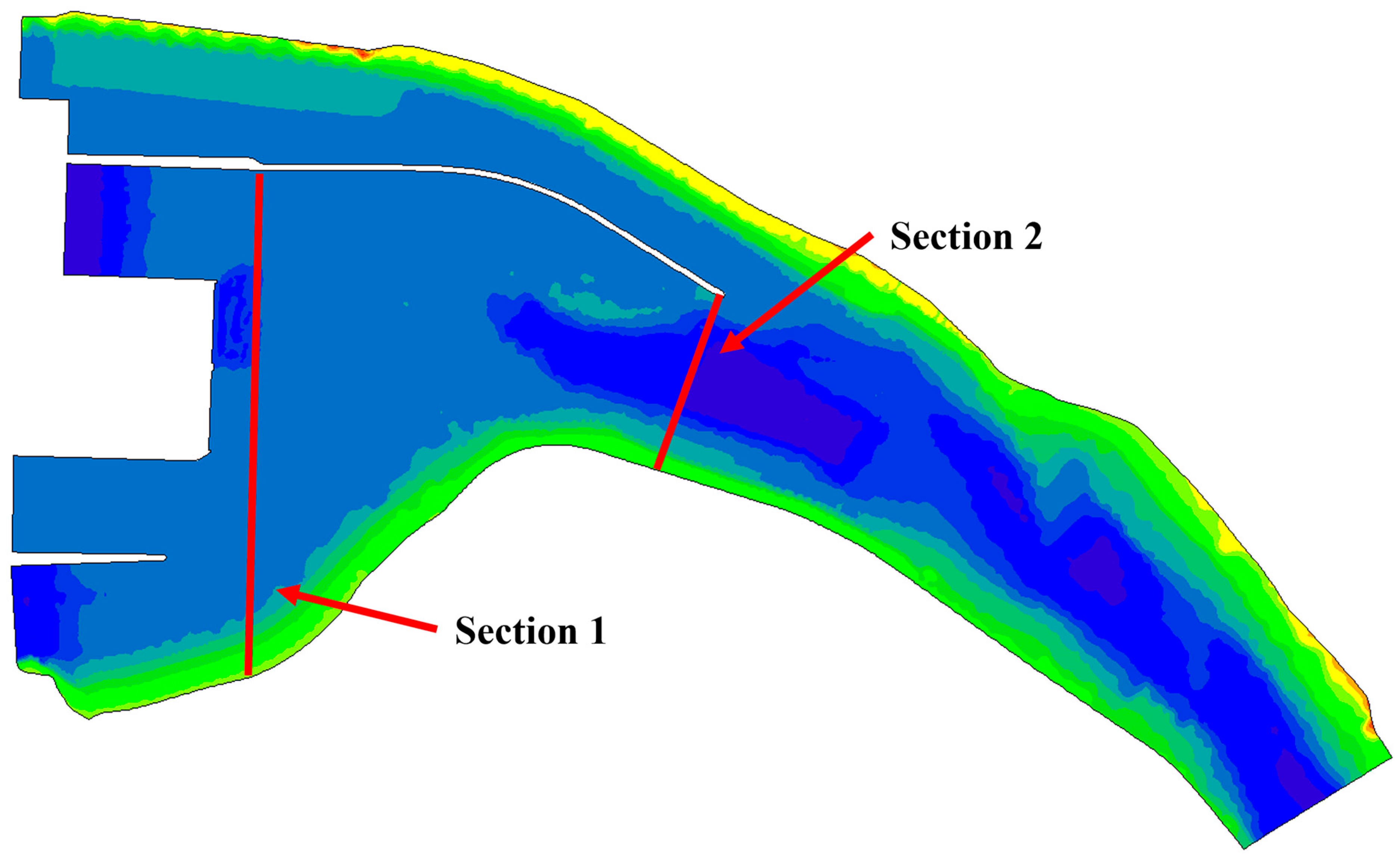
To understand why the balanced discharge scenario performs best, the energy dissipation along the river reach from the stilling basin outlet to the navigation entrance area is compared among the four flood discharge cases. As shown in Figure 17, two monitoring sections are defined in the downstream river model. Section 1 is located immediately downstream of the stilling basin end sill, and Section 2 is placed at the entrance of the approach channel. The specific energy at each section is calculated by E = z + V 2 2 g , where z is the water level relative to a datum, V is the cross-sectionally averaged velocity, and g is the gravitational acceleration. The energy dissipation between the two sections is then obtained as Δ E = E 1 E 2 .
Table 7 summarizes the specific energy and energy dissipation for the four flood discharge cases. Among all cases, Case 4 (balanced discharge through surface and mid-level outlets of both left and right stilling basins) yields the lowest specific energy at Section 1 and the largest energy dissipation ΔE. This indicates that the multi-jet interactions generated in Case 4 enhance the energy loss along the downstream river reach. Consequently, the flow velocity and wave height due to water level fluctuation at the entrance area are minimized under Case 4, which is consistent with the observations in Section 3.2 and Section 3.3.
In contrast, Case 1 and Case 3 produce higher specific energy at Section 1 and lower energy dissipation. This explains why these two cases exhibit more energetic and less stable flow conditions in the entrance area, with larger wave heights and higher transverse velocities. Case 2, using combined surface and mid-level outlets of the left basin only, shows intermediate performance between the single-layer cases and Case 4.
Therefore, the distinct flow patterns downstream and around the entrance area of the navigation channel under four discharge scenarios can be explained by the differences in fluid energy of the stilling basin and the current mixing intensity upstream of the navigation entrance. When only single-layer outlets are operated, a concentrated high-velocity jet forms, leading to uneven velocity distribution and strong water surface oscillations. The combined operation of surface and middle outlets enhances vertical momentum exchange and accelerates energy dissipation, thereby reducing both flow velocity and water surface fluctuation. These findings align with previous field observations that symmetric and distributed discharge is beneficial for stabilizing downstream flow regimes.
It should be noted that the present coupled model is unidirectional, and the feedback effects of downstream flow on the stilling basin were not included; this is left for future studies.

5. Conclusions

Based on the RANS equations, the Realizable k-ε turbulence model, and the VOF free-surface tracking method, a three-dimensional air–water two-phase flow numerical model was established to simulate dam flood discharge jets and stilling basin flows, and was coupled with the MIKE3 three-dimensional shallow water model to construct a 3D nested numerical model, so as to simulate the whole hydrodynamic process from the dam flood discharge jets and stilling basin flows and tailwater discharge from power water station to the downstream river flows. Taking the Xiangjiaba Hydraulic project as an example, under the condition of identical total water discharge, four typical dam flood discharge operation modes—full discharge through surface outlets of the left basin, balanced discharge through surface and mid-level outlets of the left basin, full discharge through mid-level outlets of the left basin, and balanced discharge through surface and mid-level outlets of both left and right basins—were simulated and analyzed in terms of flow velocity distribution and water surface fluctuation characteristics in the downstream river channel and the entrance area of the approach channel. The primary conclusions are as follows.
(1) Comparison with measured results from hydraulic model tests demonstrates that the constructed three-dimensional nested coupled numerical model can simulate with high accuracy the strongly turbulent flow in the stilling basin with large free-surface deformation as well as the unsteady flow in the downstream river channel.
(2) The dam flood discharge pattern significantly affects the velocity distribution and water surface fluctuations in the downstream approach channel entrance area. The balanced discharge through surface and mid-level outlets of both left and right stilling basins minimizes the transverse velocity as well as its influential range, and reduces the amplitude of water level fluctuations. Although the recirculation zone is relatively long, the recirculation velocity is the lower, leading to the most favorable overall flow conditions for ship navigation. This reveals the principle that distributed inflow, layered mixing, and symmetric outflow can effectively reduce flow velocity, turbulence intensity, and water level fluctuation amplitude near the entrance area.
(3) The research results can provide a reference for the formulation and optimization of flood discharge scheduling schemes of similar high-head navigation–hydropower hubs, so as to better balance flood discharge requirements and navigation safety.

Author Contributions

X.Z. contributed to the modeling, data analysis, and the finalization of the manuscript. B.C. was involved in the modeling and figure preparation. Y.Z. contributed to the visualization. Z.Z. and Q.J. supervised the model construction and the manuscript writing. All authors have read and agreed to the published version of the manuscript.

Funding

This research was funded by the National Key R&D Program of China (No. 2023YFC3008100) and the Research Project on Flow Conditions at the Downstream Approach Channel Entrance of the Xiangjiaba Hydropower Station’s Ship Lift (No. 823121916).

Data Availability Statement

Data available on request due to restrictions, e.g., privacy or ethical. The data presented in this study are available on request from the corresponding author.

Acknowledgments

The authors thank the reviewers for their constructive comments and suggestions.

Conflicts of Interest

Author Zhenyu Zhong was employed by the Power China Zhongnan Engineering Corporation Limited. The remaining authors declare that the research was conducted in the absence of any commercial or financial relationships that could be construed as potential conflicts of interest.

References

  1. Mei, L.; An, J.; Li, Z.; Zhang, S.; Ding, L. Study of Navigable Flow Conditions in the Intermediate Channel of Decentralized Cascade Locks. Water 2023, 15, 3394. [Google Scholar] [CrossRef]
  2. Qi, C.; Pu, X.; Peng, W.; Ouyang, Q.; Wang, D.; Liu, Z.; Wang, F. Development and Application of a New Auxiliary Diversion Structure for Mountain Ship Lock: A Case Study of Wuqiangxi Lock in China. Water 2023, 15, 941. [Google Scholar] [CrossRef]
  3. Wan, Z.Y.; Li, Y.; Wang, X.G.; An, J.F.; Cheng, L.; Liao, Y.P. Effect of ship-lock-induced surges on navigation safety in a branched lower approach channel system. J. Hydroinform. 2022, 24, 481–496. [Google Scholar] [CrossRef]
  4. Wang, F.; An, X. Study on Flow Conditions for Navigation in Entrance Area and Connection Reach Downstream of the Lock of a New Hub. IOP Conf. Ser. Earth Environ. Sci. 2021, 768, 012049. [Google Scholar] [CrossRef]
  5. Liang, S.; Yang, X.; Bi, F.; Ye, C. Vessel Traffic Scheduling Method for the Controlled Waterways in the Upper Yangtze River. Ocean Eng. 2019, 172, 96–104. [Google Scholar] [CrossRef]
  6. An, R.; Yu, S.; Yu, C.; Li, J. Numerical simulation of breaking wave propagation under various gate lifting speeds by a level set method. Ocean Eng. 2024, 312, 119162. [Google Scholar] [CrossRef]
  7. Khanov, N.V.; Chernykh, O.N.; Burlachenko, Y.Y.; Burlachenko, A.V.; Brakeni, A. Experimental Design Justification of the Short-Span Spillway’s Tail-Water Devices. Larhyss J. 2024, 59, 181–192. [Google Scholar]
  8. Wan, Z.; Li, Y.; Wang, X.; An, J.; Dong, B.; Liao, Y. Influence of Unsteady Flow Induced by a Large-Scale Hydropower Station on the Water Level Fluctuation of Multi-Approach Channels: A Case Study of the Three Gorges Project, China. Water 2020, 12, 2922. [Google Scholar] [CrossRef]
  9. Wang, H.; Murzyn, F.; Chanson, H. Interaction between free-surface, two-phase flow and total pressure in hydraulic jump. Exp. Therm. Fluid Sci. 2015, 64, 30–41. [Google Scholar] [CrossRef]
  10. Kucukali, S.; Chanson, H. Turbulence measurements in the bubbly flow region of hydraulic jumps. Exp. Therm. Fluid Sci. 2008, 33, 41–53. [Google Scholar] [CrossRef]
  11. Zhang, G.; Wang, H.; Chanson, H. Turbulence and aeration in hydraulic jumps: Free-surface fluctuation and integral turbulent scale measurements. Environ. Fluid Mech. 2013, 13, 189–204. [Google Scholar] [CrossRef]
  12. Montano, L.; Felder, S. An experimental study of air-water flows in hydraulic jumps on flat slopes. J. Hydraul. Res. 2020, 58, 767–777. [Google Scholar] [CrossRef]
  13. Qian, Z.-D.; Hu, X.-Q.; Huai, W.-X.; Amador, A. Numerical simulation and analysis of water flow over stepped spillways. Sci. China Ser. E Technol. Sci. 2009, 52, 1958–1965. [Google Scholar] [CrossRef]
  14. Shaheed, R.; Mohammadian, A.; Yan, X. Numerical Simulation of Turbulent Flow in Bends and Confluences Considering Free Surface Changes Using the Volume of Fluid Method. Water 2022, 14, 1307. [Google Scholar] [CrossRef]
  15. Deng, J.; Xu, W.; Zhang, J.; Qu, J.; Yang, Y. A new type of plunge pool—Multi-horizontal submerged jets. Sci. China Ser. E Technol. Sci. 2008, 51, 2128–2141. [Google Scholar] [CrossRef]
  16. Bayón, A.; Moradi, M.; Sajjadi, M.; Vallés-Morán, F.J. Numerical modeling of multi-horizontal submerged jets (MHSJ) stilling basins using CFD techniques. In Proceedings of the 38th IAHR World Congress, Panama City, Panama, 1–6 September 2019; pp. 1–8. [Google Scholar] [CrossRef]
  17. Wu, Y.L.; Li, X.J.; Du, X.H. Research on the influence of unsteady flow produced by operation of TGP on navigation III: Lower Yichang reach of Gezhouba project. J. Hydrodyn. Ser. A 2006, 21, 67–73. [Google Scholar]
  18. Kim, B.-J.; Hwang, J.-H.; Kim, B. FLOW-3D Model Development for the Analysis of the Flow Characteristics of Downstream Hydraulic Structures. Sustainability 2022, 14, 10493. [Google Scholar] [CrossRef]
  19. Liu, Z.; Hu, Y.; Li, Z. Transformer-based surrogate models for predicting flow velocities in downstream approach channels of multi-line ship locks. J. Hydrol. 2026, 668, 134994. [Google Scholar] [CrossRef]
  20. Wang, X.; Zhang, S. Observation of Navigational Hydraulic Characteristics in the Downstream Entrance Area. In Hydraulic Structure and Hydrodynamics; Springer Nature: Singapore, 2024; pp. 375–387. [Google Scholar] [CrossRef]
  21. Yu, K.; Han, C.; Han, K.; Zhao, J.; Yu, Z. Experimental study on navigation flow condition of downstream approach channel of navigation facilities of Baise water conservancy project. In Smart Rivers; Springer Nature: Singapore, 2023; pp. 1471–1480. [Google Scholar] [CrossRef]
  22. Battiston, C.C.; Bombardelli, F.A.; Schettini, E.B.C.; Oliveira, G.P. Mean flow and turbulence statistics through a sluice gate in a navigation lock system: A numerical study. Eur. J. Mech. B/Fluids 2020, 84, 155–163. [Google Scholar] [CrossRef]
  23. Paternina-Verona, D.A.; Coronado-Hernández, O.E.; Espinoza-Román, H.G.; Pizarro, A. Three-dimensional analysis of air-admission orifices in pipelines during hydraulic drainage events. Sustainability 2022, 14, 14600. [Google Scholar] [CrossRef]
  24. Daneshfaraz, R.; Norouzi, R.; Abbaszadeh, H.; Ravansari, M. Influence of sill on the hydraulic regime in sluice gates: An experimental and numerical analysis. Fluids 2022, 7, 244. [Google Scholar] [CrossRef]
  25. Shang, Y.; Li, X.; Gao, X.; Li, Y. Influence of daily regulation of a reservoir on downstream navigation. J. Hydrol. Eng. 2017, 22, 05017010. [Google Scholar] [CrossRef]
  26. Liu, Y.; Chen, S.; Huang, W.; Zhang, J. Discussion of “Influence of Daily Regulation of a Reservoir on Downstream Navigation” by Yizi Shang, Xiaofei Li, Xuerui Gao, Yanxiang Guo, Yuntao Ye, and Ling Shang. J. Hydrol. Eng. 2018, 23, 07018010. [Google Scholar] [CrossRef]
  27. Jia, T.; Qin, H.; Yan, D.; Zhang, Z.; Liu, B.; Li, C.; Wang, J.; Zhou, J. Short-Term Multi-Objective Optimal Operation of Reservoirs to Maximize the Benefits of Hydropower and Navigation. Water 2019, 11, 1272. [Google Scholar] [CrossRef]
  28. GB 50139-2014; Standard for Inland Waterway Navigation. China Planning Press: Beijing, China, 2014.
Figure 1. Layout of the Xiangjiaba Hydropower Complex. (a) Layout of the dam and downstream stilling basin; (b) layout of the downstream approach channel and navigation structures.
Water 18 01329 g001
Figure 2. Schematic diagram of the flooding and stilling basin fluid model.
Water 18 01329 g002
Figure 3. Schematic diagram of the Downstream River flow model.
Water 18 01329 g003
Figure 4. Comparison of flow regime in the stilling basin. (a) Simulated; (b) measured.
Water 18 01329 g004
Figure 5. Schematic diagram of measuring points for pressure on the stilling basin floor.
Water 18 01329 g005
Figure 6. Comparison of simulated and measured pressure on stilling basin bottom.
Water 18 01329 g006
Figure 7. Schematic diagram of measuring points of water level fluctuation and current velocity. (a) Measuring point division; (b) zone division.
Water 18 01329 g007
Figure 8. Comparison of simulated and measured characteristic wave heights due to water level fluctuation along the river channel under two typical discharge conditions. (a,c,e) Total discharge = 12,061 m3/s; (b,d,f) total discharge = 9012 m3/s.
Water 18 01329 g008
Figure 9. Comparison of simulated and measured current velocity in the approach channel. (a) Total discharge = 12,061 m3/s; (b) total discharge = 9012 m3/s.
Water 18 01329 g009
Figure 10. Comparison of current velocities in different zones. (a,c) Total discharge = 12,061 m3/s; (b,d) total discharge = 9012 m3/s.
Water 18 01329 g010aWater 18 01329 g010b
Figure 11. Snapshots of simulated surface velocity fields in the downstream river channel for different flood discharge scenarios. (a) Case 1; (b) Case 2; (c) Case 3; (d) Case 4.
Water 18 01329 g011
Figure 12. Simulated velocity distributions in the entrance area. (a) Case 1; (b) Case 2; (c) Case 3; (d) Case 4.
Water 18 01329 g012
Figure 13. Simulated cross-sectional velocity distribution. (a) Case 1; (b) Case 2; (c) Case 3; (d) Case 4.
Water 18 01329 g013
Figure 14. Comparison of simulated velocities within different monitoring zones. (a) Longitudinal velocity; (b) transverse velocity.
Water 18 01329 g014
Figure 15. Simulated variations in wave height due to water surface fluctuations along the river channel. (a) Significant wave height; (b) 1/10 highest wave height; (c) maximum wave height.
Water 18 01329 g015
Figure 16. Simulated variations in wave height due to water surface fluctuation along the approach channel. (a) Significant wave height; (b) 1/10 highest wave height; (c) maximum wave height.
Water 18 01329 g016
Figure 17. Layout of the two monitoring sections for energy dissipation analysis: Section 1 at the stilling basin outlet and Section 2 at the entrance of the approach channel.
Water 18 01329 g017
Table 1. Calculation conditions.
Reservoir Water Level (m)Discharge (m3/s)
Total Released DischargePower Station DischargeTotal Dam Flooding Discharge
371.512,06164005661
371.5901264003012
Table 2. Comparison of simulated and measured wave height due to water level fluctuation along the downstream of river channel.
ConditionWave Height ParameterTested Value (m)Simulated Value (m)Error (%)
Case 1Maximum WLF Height3.22.98−6.9
Significant WLF Height1.681.61−4.2
1/10 Highest WLF Wave Height2.212.08−5.9
Case 2Maximum WLF Height1.731.59−8.1
Significant WLF Height0.870.82−1.8
1/10 Highest WLF Wave Height1.091.166.4
Note: WLF is the abbreviation for Water Level Fluctuation.
Table 3. Grid independence verification for the stilling basin and flood discharge jet model.
Total CellsRefinement Ratio rKey Variable Φ
(9.81 kPa)
ε (%)GCI (%)
1.23 × 10 6 36.07
2.7 × 10 6 1.3037.122.821.10
5.91 × 10 6 1.2937.601.270.51
Table 4. Grid independence verification for the downstream river flow model.
Total CellsRefinement Ratio rKey Variable Φ
(m)
ε (%)GCI (%)
1.03 × 10 5 3.10
1.80 × 10 5 1.213.141.273.42
2.95 × 10 5 1.183.160.632.01
Table 5. Simulation conditions.
CaseDam Flood Discharge Operation ModeDischarge (m3/s)
Left Basin DischargeRight Basin DischargePower Station DischargeTotal Discharge
1Full discharge through surface outlets of the left basin56000640012,000
2Balanced discharge through surface and mid-level outlets of the left basin56000640012,000
3Full discharge through mid-level outlets of the left basin56000640012,000
4Balanced discharge through surface and mid-level outlets of both basins28002800640012,000
Table 6. Opening of discharge gate of surface and mid-level outlets.
CaseOpening of Surface Outlet Gates (m)Opening of Mid-Level Outlet Gates (m)
Left Stilling BasinRight Stilling BasinLeft Stilling BasinRight Stilling Basin
18000
25.504.50
30070
42.82.82.12.1
Table 7. Specific energy and energy dissipation along the downstream river reach for the four flood discharge cases.
CaseSpecific Energy
at Section 1 (m)
Specific Energy
at Section 2 (m)
Energy Dissipation ΔE (m)
1−4.31−4.980.67
2−4.84−5.620.78
3−3.91−4.670.76
4−5.69−6.580.89
Disclaimer/Publisher’s Note: The statements, opinions and data contained in all publications are solely those of the individual author(s) and contributor(s) and not of MDPI and/or the editor(s). MDPI and/or the editor(s) disclaim responsibility for any injury to people or property resulting from any ideas, methods, instructions or products referred to in the content.