Article

Political Ontology in the Environmental Management of Hydrosocial Territories: Introducing Water-Important SocioEcological Systems (WISe)


by
Sonia Margarita Triviño
1,2,
Alejandro Figueroa-Benitez
1,3,*,
Apolinar Figueroa
1,3 and
Jaime Amezaga
4
1
Doctorado Interinstitucional en Ciencias Ambientales, Universidad del Cauca, Popayán 190001, Colombia
2
Grupo de Investigación en Estudios Ambientales (GEA), Cauca 190001, Colombia
3
Grupo de Investigación en Innovación Ambiental y del Paisaje [GIIAP], Cauca 190001, Colombia
4
Centre for Water, School of Engineering, Newcastle University, Newcastle upon Tyne NE1 7RU, UK
*
Author to whom correspondence should be addressed.
Water 2026, 18(11), 1319; https://doi.org/10.3390/w18111319
Submission received: 2 April 2026 / Revised: 20 April 2026 / Accepted: 22 April 2026 / Published: 29 May 2026
(This article belongs to the Special Issue Advances in Water Management and Water Policy Research, 2nd Edition)

Abstract

This paper addresses a persistent divide in water governance: critical frameworks reveal power dynamics and ontological diversity but lack operational guidance, while operational frameworks prioritize technical management at the expense of ontological plurality and social legitimacy. We introduce Water-Important Socioecological Systems (WISe) as a prescriptive framework that integrates political ontology with hydrosocial territory analysis to inform more reflexive and inclusive water governance. WISe designates specific zones where ecological functions for water sustainability are concentrated and where social practices, productive livelihoods, and symbolic meanings coexist inseparably with biophysical processes. Unlike Integrated Water Resources Management (IWRM), which treats social and ecological dimensions as separate pillars, and the Ostrom Social-Ecological Systems framework, which undertheorizes ontological plurality, WISe explicitly centers the coexistence of multiple ways of understanding and relating to water as a governance principle. The framework was developed through a five-phase mixed-methods conceptual inquiry combining a systematic literature review (202 documents), an exploratory stakeholder survey of 223 participants across six Colombian hydrographic basins, and an analysis of designated water-strategic ecosystems. The findings reveal that ontological diversity is distributed across all stakeholder groups: hydrological supply framings predominate (36.4–45.8%), yet territorial-integrated perspectives appear in all groups, with government actors (22.9%) showing the highest proportion. The majority (56.1%) perceive WISe as exclusively state-managed, revealing a dominant ontological position that reduces socioecological territories to objects of administrative control. This article presents WISe as a conceptual and prescriptive framework informed by exploratory empirical evidence. Rather than offering a definitive empirical validation of the model, this study provides initial analytical grounding for its development and identifies indicative patterns that warrant further testing across other geographical and institutional contexts. WISe offers a framework comprising six defining characteristics and five operational dimensions that bridge theoretical understandings with governance-oriented analysis, treating ontological difference not as an obstacle but as essential knowledge for more reflexive and equitable water governance.

1. Introduction

This research presents a theoretical contribution to environmental management through political ontology, drawing on Colombia as an illustrative case study. While our analysis is grounded in Colombian contexts, the conceptual framework we develop has broader applications for understanding hydrosocial territories globally. Colombia’s status as a megadiverse country—with over 98 general ecosystems and more than eight thousand specific ones—provides a rich setting for examining the interplay between ecological diversity and social complexity. This abundance of ecosystems is matched by an abundance of social groups, frequently with distinctive organizational and ontological characteristics, creating a complex mosaic of human–nature relationships that challenge conventional management approaches [1].
A persistent challenge in Colombia and similar contexts is that imposing generalized principles or regulations through top-down environmental management frameworks often disrupts established local practices and fosters conflicts with communities. These conflicts typically arise from failing to recognize the rights of communities adequately, their longstanding presence, and their traditional land-use practices within a given territory, factors frequently overlooked in new regulations. This pattern of conflict between institutional frameworks and local realities represents a core characteristic of environmental governance in Colombia but also reflects broader global patterns in complex socioecological systems management.

1.1. Defining Ontology and Political Ontology

Ontology, in its broadest sense, refers to the study of what exists and the fundamental nature of existence [2,3]. In environmental research, ontology translates into examining how different social groups define what water “is”, what ecosystems “are,” and how relationships between humans and nature should be understood and organized. Ontological perspectives determine what is considered to exist and how these existences are categorized, understood, and related to one another. In environmental contexts, ontological frameworks shape how communities, institutions, and other actors perceive and interact with ecological systems; what they consider valuable; how they define problems; and what solutions they deem appropriate.
We distinguish between two interconnected ontological dimensions central to the analysis: the Ontology of Space (Geographic Ontology), which examines how territorial spaces are constructed, inhabited, and contested by different actors, and the Ontology of Being, which refers to how actors understand, value, and relate to water ecosystems, their constitutive elements, their relational capacities, and the appropriate forms of human engagement with them [4].
Political ontology, as developed by Blaser [2,5,6], extends ontological inquiry into the domain of governance and environmental conflict. Its central premise is that environmental conflicts are not merely disputes over resources or their distribution but disputes between different realities. Where conventional environmental discourse assumes a single, objective nature that different groups simply interpret differently, political ontology recognizes that multiple worlds coexist, each with its own internal logic of significance, value, and relational possibility [7,8]. These multiple realities are not equally represented in governance structures: some are institutionalized and authorized, while others are marginalized.
This understanding also draws on Mol’s notion of ontological politics [9], which argues that practices do not simply describe a pre-given reality but participate in enacting particular realities. From this perspective, governance is never epistemically neutral: it stabilizes some ways of being and relating to the world while marginalizing others. We aim to build on this insight by treating water governance not only as a matter of coordination or management but also as a site where multiple realities are recognized, ordered or excluded.
The political ontology framework helps explain why technical or purely administrative solutions frequently fail to resolve water conflicts. They overlook the fundamental incommensurability of different ways of understanding human–water relationships. By recognizing how multiple ontologies coexist and compete within governance spaces, we can better understand the complex dynamics that shape environmental conflicts and develop management approaches that acknowledge this plurality rather than imposing a single dominant worldview.
Recent work on the ontological dimension of environmental conflicts corroborates this point by showing that many environmental disputes cannot be reduced to disagreements over resource use but involve deeper divergences over what entities, relations, and obligations are politically real [10]. This moves political ontology beyond abstract theory and toward a more explicit engagement with governance, conflict, and methodological design. We enter this emerging conversation, which seeks not only to diagnose ontological conflicts but also to think through its institutional implications.

1.2. The Analytical–Operational Divide in Water Governance

Most research in environmental governance and water management assumes a common ontology, treating environmental concepts and practices as universally understood across different stakeholder groups. This assumption overlooks the diverse ways in which communities, institutions, and other actors perceive, define, and interact with water systems. These diverse ontologies are not simply coexisting but actively contested in environmental governance spaces.
Three frameworks dominate contemporary water governance discourse, each with significant strengths and limitations.
Integrated Water Resources Management (IWRM) has achieved remarkable institutional reach, with over 170 countries formally adopting basin-level governance structures [11]. Yet IWRM treats the social and ecological dimensions of water systems as separate pillars to be balanced rather than as mutually constitutive wholes. It is notably silent on ontological diversity, assuming a universal framework for understanding what water is and how it should be managed [12].
The Ostrom Social-Ecological Systems (SES) framework [13,14] offers sophisticated diagnostic analysis, recognizing that governance outcomes depend on interactions between social institutions and biophysical conditions. However, the SES framework presupposes a naturalist ontological monism where water is treated as a measurable resource and undertheorizes power relations, treating governance primarily as an organizational challenge rather than a political struggle between competing realities [15].
A parallel critique has been advanced within the water governance literature itself. Harrington [16] argues that collaborative water governance often assumes a shared understanding of what water is while leaving its ontological premises unexamined. As a result, even governance arrangements presented as participatory or collaborative may continue to reproduce a singular, modernist ontology of water. This helps explain why existing frameworks can appear institutionally progressive while remaining incapable of engaging ontological plurality in practice.
Hydrosocial territories theory [17,18] represents the most analytically sophisticated framework. It directly challenges the nature–society separation, recognizing territories as simultaneously ecological and social, politically contested, and shaped by power asymmetries. The framework increasingly engages with ontological diversity, showing how different communities understand territorial water systems in fundamentally different ways. Yet hydrosocial territories theory remains primarily critical–analytical rather than prescriptive, offering limited guidance for governing differently [12,19]. Table 1 positions these frameworks comparatively.
The gap revealed by this comparison is consequential: no existing framework integrates strong analytical capabilities across all dimensions and functions as a prescriptive governance tool. This analytical–operational divide represents a serious limitation for water governance in the Global South, where the need for both critical understanding and practical institutional change is the most acute [12].
This analytical and operational divide is also visible in the recent environmental governance literature. Walker DePuy [37] shows that dominant governance instruments across land, water, and biodiversity are grounded in modernist ontological assumptions that make some relations visible while rendering other illegible. Their argument is particularly relevant here, as it demonstrates that environmental governance is not only a technical field of intervention but also an ontological ordering project. We respond to this problem by treating ontological plurality as governance-relevant and by translating that recognition into operational dimensions.

1.3. Introducing WISe

In this context, we introduce Water-Important Socioecological Systems (WISe), defined as an analytical and applied governance framework for studying socioecological systems of “high” water relevance, where water’s ecological dimension (recharge, regulation, provision), social dimension (uses, practices, meanings), and political dimension (governance, conflicts, agreements) are inseparably intertwined. Unlike the broader category of hydrosocial territories, WISe designates specific zones of ecosystemic importance for water sustainability (springs, wetlands, recharge zones, river reaches) that fulfill critical ecological functions while simultaneously serving as inhabited spaces traversed by productive, symbolic, and institutional dimensions.
WISe comprises six defining characteristics:
  • Water Centrality: Defined by the system’s strategic function in water regulation, provision, and quality, which constitutes the gravitational center around which social and political dimensions organize.
  • Socioecological Condition: Biophysical processes (recharge, regulation, connectivity) and social–productive practices (agriculture, community management) are integrated inseparably rather than as separate pillars.
  • Multiple Actors and Communities: These are inhabited territories where conservation articulates with the social and productive life of communities, institutions, and private actors.
  • Ontological Plurality: Multiple ways of understanding and relating to water coexist, derived from diverse worldviews, historical trajectories, and practices. This plurality is treated as a structural feature of the system, not a problem to resolve.
  • Critical Governance Scale: Essential ecosystem functions and diverse social uses are concentrated at this scale, making WISe territories points of negotiation, conflict, and potential agreement.
  • Dynamic and Situated Character: WISe are systems in constant transformation, defined by ecological processes, human decisions, and evolving institutional regimes.
Understanding these areas as hydrosocial territories, spaces constituted through interactions among water flows, human practices, ecological systems, and institutional arrangements [17], is essential for effective management. WISe builds on hydrosocial territories scholarship but adds an explicitly prescriptive orientation: rather than remaining at the critical–analytical level, it proposes to translate these insights into categories and dimensions relevant to governance design, as developed in Section 4 and Section 5.
From a policymaking perspective, Colombia’s environmental diversity amplifies the complexity of crafting effective policies. The designation of “Areas and Ecosystems of Strategic Importance for Water Resource Conservation” [38] underscores certain ecosystems’ role in maintaining water security. However, the regulatory framework creates a problematic dichotomy between “areas” (subject to human intervention) and “ecosystems” (strictly conserved zones), framing the ecosystem–society relationship solely in terms of environmental goods and services provision.
This research addresses the need for studies integrating public policy with socioecological water contexts at scales smaller than hydrographic basins [39,40]. We employ an interdisciplinary methodological approach structured in five phases: (1) defining ontological dimensions and knowledge gaps in WISe, (2) systematic documentary analysis, (3) an analysis of stakeholder perceptions, (4) the construction of an integrative spatial–conceptual category, and (5) synthesis and conclusions.
A key finding of this study is the significant value that political ontology offers for environmental management within hydrosocial territories. By framing these territories through diverse ontological lenses, our analysis reveals how divergences at regional or local scales shape water ecosystem dynamics and intensify institutional and communal challenges in achieving sustainable water resource management. Accordingly, the aim of this article is not to validate WISe as a universally applicable governance model but to develop it as a conceptual and prescriptive framework grounded in theoretical synthesis, documentary and policy analysis, and exploratory stakeholder evidence from Colombia. While the empirical material used here is context-specific, the framework is proposed as analytically transferable rather than empirically generalized and therefore requires further testing across different geographical and institutional settings.

2. Materials and Methods

2.1. Methodological Approach

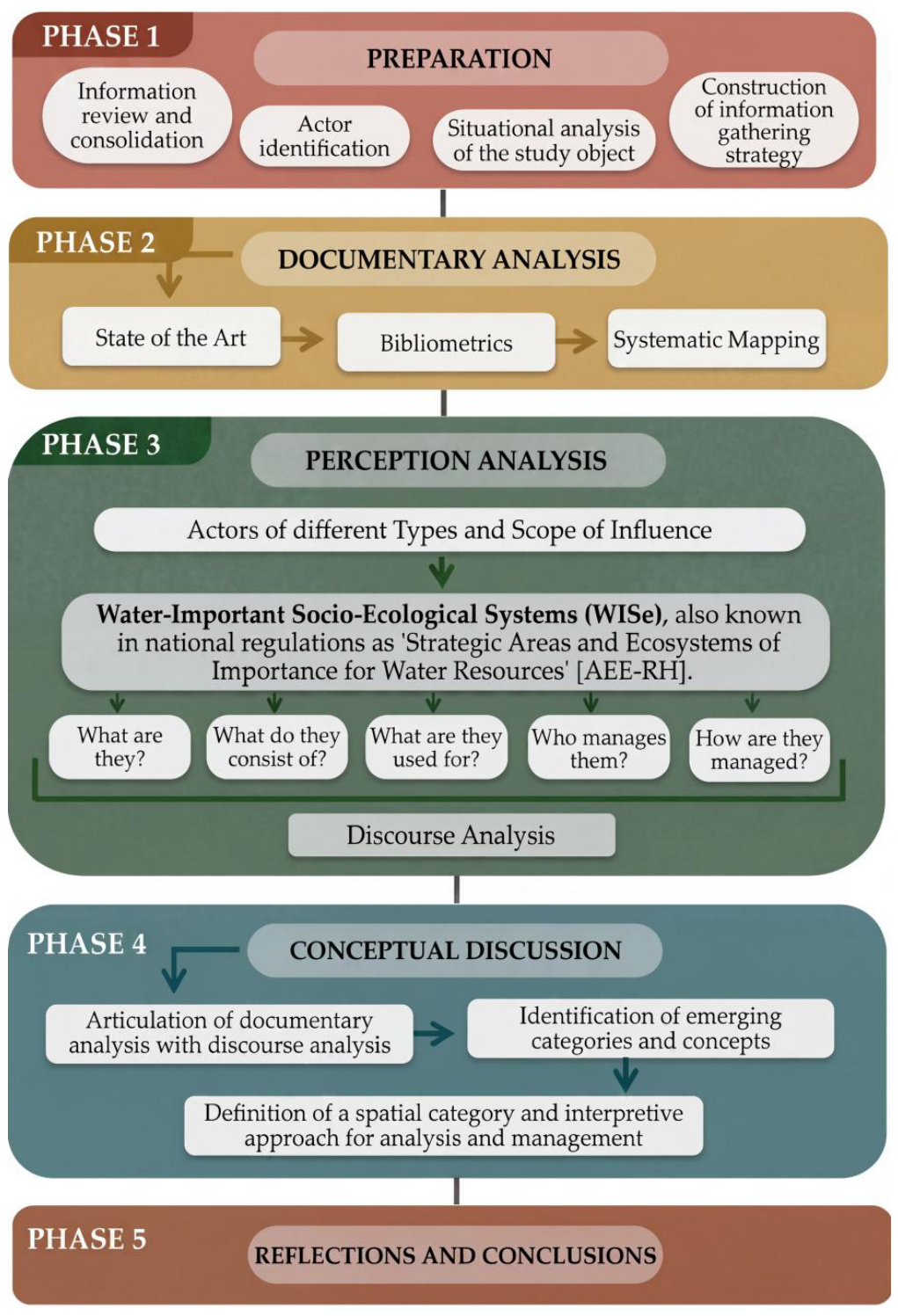
Methodologically, this study should be read as framework-building research rather than model validation. The empirical component is exploratory and is used to ground, refine, and illustrate the proposed framework, not to test it conclusively or estimate population-level distributions. This paper presents a conceptual contribution employing a mixed-methods approach to framework development. Rather than hypothesis-testing through conventional empirical research, this study integrates theoretical analysis, documentary evidence, and exploratory stakeholder data to construct an integrative conceptual framework for understanding Water-Important Socioecological Systems (WISe). The methodology follows a five-phase sequential design (Figure 1), progressing from preparation and documentary analysis through stakeholder perception analysis to conceptual synthesis. Each phase is described below.

2.2. Phase 1: Preparatory Information Gathering

During the initial phase, we reviewed and consolidated existing information, focusing on case studies highlighting the WISe dynamics of use, management, and conservation. Through preliminary consultation with basin authorities, community organizations, and government institutions across six Colombian hydrographic regions (Amazonas, Caribe, Cauca, Magdalena, Orinoco, and Pacific), three primary knowledge gaps were identified: (1) public policies associated with WISe exhibit significant conceptual and operational gaps in their construction and execution; (2) local conflicts in the management, use, and conservation of WISe disrupt cohesive governance and reflect underlying ontological divergences; and (3) different WISe conceptions lack conceptual clarity and methodology for their identification, delimitation, and management.
These gaps informed the development of a fieldwork strategy involving: first, systematic information gathering through survey development with open-ended questions to elicit stakeholders’ ontological perspectives without imposing predetermined frameworks; second, stakeholder mapping, categorizing actors according to their relationship with water resources; and third, an analysis plan integrating qualitative methods to identify patterns in discourse and practice across different actor groups and geographic contexts.

2.3. Phase 2: Documentary Analysis

In the literature review phase, we systematically examined documents from multiple sources including peer-reviewed articles, academic repositories, books, and research reports. We selected Scopus as our primary database and limited our search to publications from 2011 to 2024 to focus on contemporary perspectives.
The search strategy employed key term combinations addressing water governance, ecological management, watershed management, ontological approaches, territoriality, and socioecological systems. This initial search yielded 713 results. A three-step filtering process was applied: first, the removal of duplicates; then the exclusion of ineligible document types (news items and editorials); and finally, the elimination of irrelevant documents based on thematic content analysis. This process resulted in 168 Scopus-indexed documents for further analysis.
Parallel searches in the Web of Science, JSTOR, Google Scholar, and Academia databases, with the addition of “ontology” as a key search term, yielded 34 additional unique documents: 15 from Google Scholar, 11 from Academia, 6 from Web of Science, and 2 from JSTOR. The combined dataset of 202 documents provided a comprehensive foundation for analysis, with 67% of publications dating from the most recent eight years (2017–2024). From this corpus, 112 documents were retained following a screening for detailed analytical review and systematic mapping. This second-stage selection included documents that were directly relevant to the thematic core of this study and that provided sufficient conceptual or methodological content for inclusion in the content analysis matrix. The retained documents were reviewed analytically to identify their conceptual and methodological contributions and were then classified through systematic mapping according to three dimensions: thematic focus, contribution type, and research type. This process allowed us to identify patterns in the literature, determine the state of the question, and locate the main research gaps relevant to the construction of the WISe framework.
We applied keyword co-occurrence analysis using SciMAT v1.1.04 bibliometric software [41] and systematic mapping methodology [42] to categorize the literature according to thematic focus, methodological approach, and conceptual framework.

2.4. Phase 3: Analysis of Stakeholder Perceptions

Phase 3 involved an exploratory stakeholder survey designed to surface the diversity of ontological perspectives on WISe without imposing predetermined frameworks. The survey was not designed for statistical representativeness but rather to provide empirical grounding for the conceptual framework by capturing the range of ontological positions present across different actor groups.
This phase employed a non-probabilistic, purposive recruitment strategy, consistent with the exploratory and framework-building orientation of this study. Potential participants were identified during Phase 1 through preliminary consultation with relevant actors linked to water governance across six Colombian hydrographic regions. Based on this stakeholder mapping, participants were invited to complete an online Google Forms survey composed of five open-ended questions.
The purpose of the recruitment was not to obtain a statistically representative sample but to capture a diverse range of ontological perspectives across actor types and territorial contexts relevant to WISe governance. Diversity was therefore sought through the inclusion of respondents occupying different institutional and territorial roles rather than through probabilistic selection.
Because the survey was administered online, participation depended on internet access, digital literacy, and willingness to respond. This introduces limitations, particularly for rural populations and actors with lower levels of connectivity, and may have contributed to uneven territorial participation. Accordingly, the resulting dataset should be interpreted as an exploratory corpus of stakeholder perspectives rather than as a representative sample of all actors involved in WISe governance in Colombia.
Thus, the survey was administered to 223 participants representing diverse sectors and geographic regions across Colombia’s six major hydrographic basins. The participant sample reflected gender balance (48% female, 52% male) and age diversity (18–30: 27%; 31–45: 38%; 46–60: 24%; over 60: 11%).
Participants were categorized into four functional groups: (1) civil society—communities living in rural areas or within water-important ecosystems (29%); (2) community organizations—water board presidents, community leaders, indigenous representatives, council members, and cooperative participants (30%); (3) private sector—companies, guilds, and non-profit organizations (20%); and (4) government—municipal officials, watershed management professionals, academics, and planning secretaries (21%). Academics were grouped within the government category because, in the Colombian context of this study, they operated through public institutional roles and formed part of the public service and policy advisory environment relevant to environmental planning and territorial water governance. The classification therefore followed governance function and institutional role, rather than disciplinary identity.
The survey comprised five open-ended questions addressing: what respondents consider WISe to be, what constitutes them, what they are used for, who manages them, and how management occurs in practice. Open-ended design was intentional, prioritizing local languages and forms of organization over externally imposed categories.
Responses were analyzed using discourse analysis grounded in Foucauldian frameworks [43,44], examining how participants discursively constructed WISe, the ontological assumptions embedded in their descriptions, and the governance relationships implied in their statements [45]. A coding framework was developed inductively to identify recurring themes, conceptual patterns, and distinctive epistemological positions across stakeholder groups. Each question was coded independently: Questions 1 and 2 were coded for ontological characterizations of WISe (5 codes), Question 3 for types of ecosystem service use (5 codes), Question 4 for governance orientations (4 codes), and Question 5 for management practices (5 codes). All questions included codes for “Other” and “No Knowledge”; “Other” responses were negligible and are not reported separately. This approach enabled the systematic identification of qualitative patterns while preserving the semantic richness of responses [23,29,46,47].
Coding was conducted by a single primary coder (S.M.T.), whose expertise includes Environmental Science, Landscape Planning, political ontology, governance, and water resource management.
The coding process followed an inductive workflow. First, all responses were read openly and repeatedly in order to identify recurrent terms, semantic patterns, and conceptual references. Second, provisional codes were created independently for each survey question, since each question addressed a distinct analytical dimension of WISe. Third, these provisional codes were refined iteratively through comparison across responses and stakeholder groups. Fourth, the resulting categories were consolidated into a final codebook used to organize and quantify discourse patterns by stakeholder group.
Because coding was conducted by a single primary coder, no formal intercoder reliability coefficient was calculated. To strengthen interpretive consistency, the coding structure and emerging categories were discussed with coauthors during the refinement process, and adjustments to category definitions were resolved through consensus. This approach is consistent with the exploratory and framework-building orientation of this study while also constituting an important methodological limitation.

2.5. Phase 4: Spatial–Conceptual Category Construction

Phase 4 integrated the findings from the preceding phases to construct the WISe framework as an integrative spatial–conceptual category. This phase synthesized theoretical foundations with identified knowledge gaps and stakeholder ontological diversity into a coherent analytical and governance framework. The analysis examined how existing concepts acquired new or complementary meanings within the context of WISe management, particularly noting how terms like “conservation,” “management,” and “governance” carried different ontological implications across stakeholder groups.

2.6. Phase 5: Synthesis and Conclusions

In this final phase, we synthesized the findings across all preceding phases, evaluating how the WISe framework addresses conceptual gaps in policy and practice, providing a methodology for identifying and delimiting WISe across contexts, and acknowledging multiple ontological approaches to governance. This phase identified practical implications for water governance, policy recommendations, and pathways for future research.

3. Results

This section presents the findings organized in three interconnected parts: Part 1 examines the current state of WISe governance in Colombia based on documentary and regulatory analysis; Part 2 reviews the relevant literature landscape from the systematic mapping; and Part 3 consolidates stakeholder perspectives on WISe, revealing the diversity of ontological positions that any governance framework must accommodate.

3.1. Environmental Management of WISe in Colombia

This study introduces Water-Important Socioecological Systems (WISe) as a framework for understanding what Colombian legislation identifies as “Areas and Ecosystems of Strategic Importance for Water Resource Conservation.” Colombia’s approach to defining and managing these systems reflects a growing awareness of their strategic role in water security. However, policies have historically lacked clear guidelines and a holistic view, potentially leading to resource conflicts such as disputes over water allocation.
A key conceptual limitation in current approaches is the narrow framing of ecosystem–society relationships solely in terms of environmental goods and services provision, neglecting the deeper cultural, historical, and symbolic connections that communities maintain with their environments. This narrow framing has deep institutional roots. Although legal interest in these ecosystems emerged as early as 1974 with the National Code of Renewable Natural Resources, it took decades for a coherent public policy definition to solidify, largely due to fragmented institutional efforts and competing priorities. Subsequent policies (PGIRH 2010 [38], Biodiversity Management 2012 [48]) expanded the scope beyond traditional water sources to include wetlands, forests, and other hydrological cycle components, yet specific management protocols remained absent.
The fragmented regulatory approach, exemplified in decrees 1640 (2012) and 0953 (2013), places a disproportionate burden on environmental authorities and local governments to identify and prioritize WISe. Without a unified framework, conflicting interpretations and actions increase. The normative approach frames the ecosystem–society relationship solely in terms of environmental goods and services, establishing management guidelines that oscillate between water resource policies and biological conservation approaches.
Designating these areas lacks a clear theoretical foundation and practical guidelines, reinforcing typological inconsistencies. The failure to integrate socioecological concepts that reflect the interconnectedness of ecosystems with cultural and community identities and the interchangeable use of “ecosystem” and “area” in institutional discourse create ambiguity in policy development and perpetuate confusion about conservation implementation.
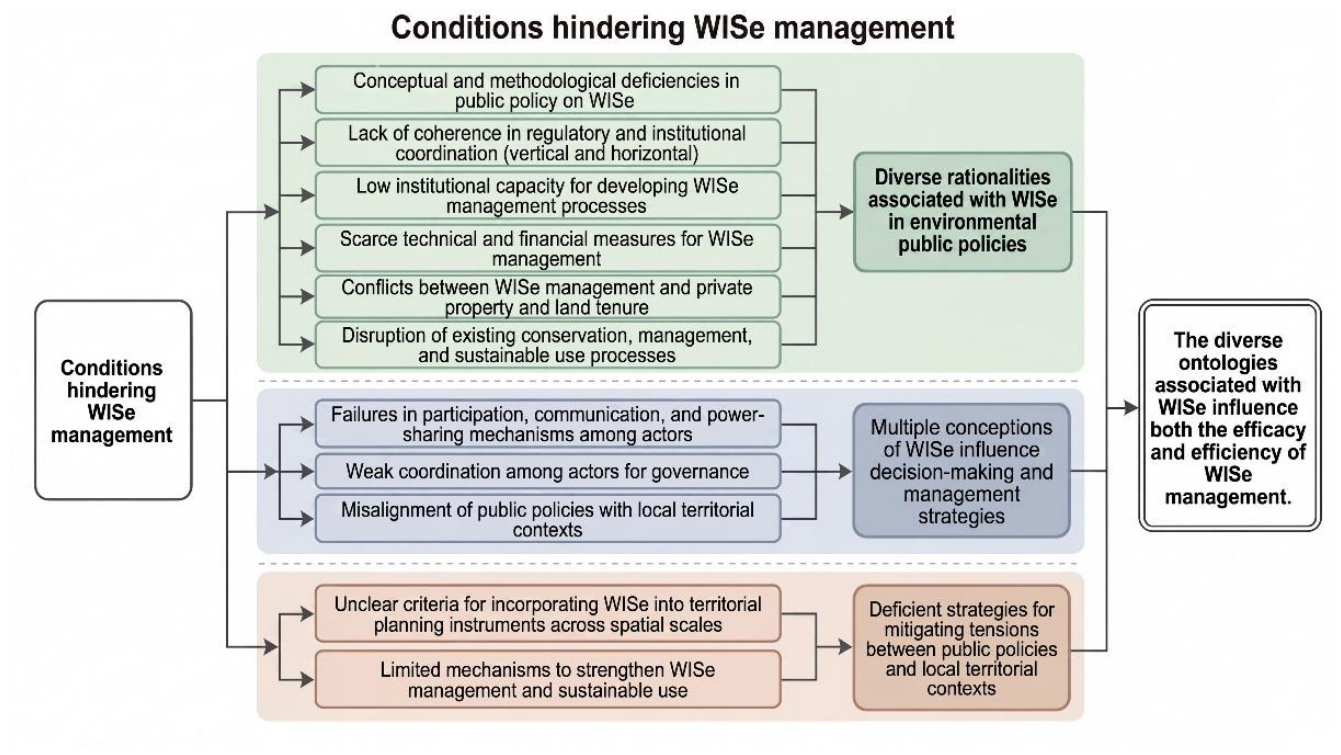
Three common elements have been identified as significant hindrances to WISe management: (1) public policies exhibit significant conceptual and operational gaps in their construction and execution; (2) local conflicts in management, use, and conservation disrupt cohesive governance; and (3) different WISe conceptions lack conceptual clarity and a methodology for their identification, delimitation, and management.
The cascading effects of these issues (Figure 2) manifest in social unrest, communication breakdowns, and widespread mistrust in participatory governance processes.

3.2. Studies Related to WISe Management

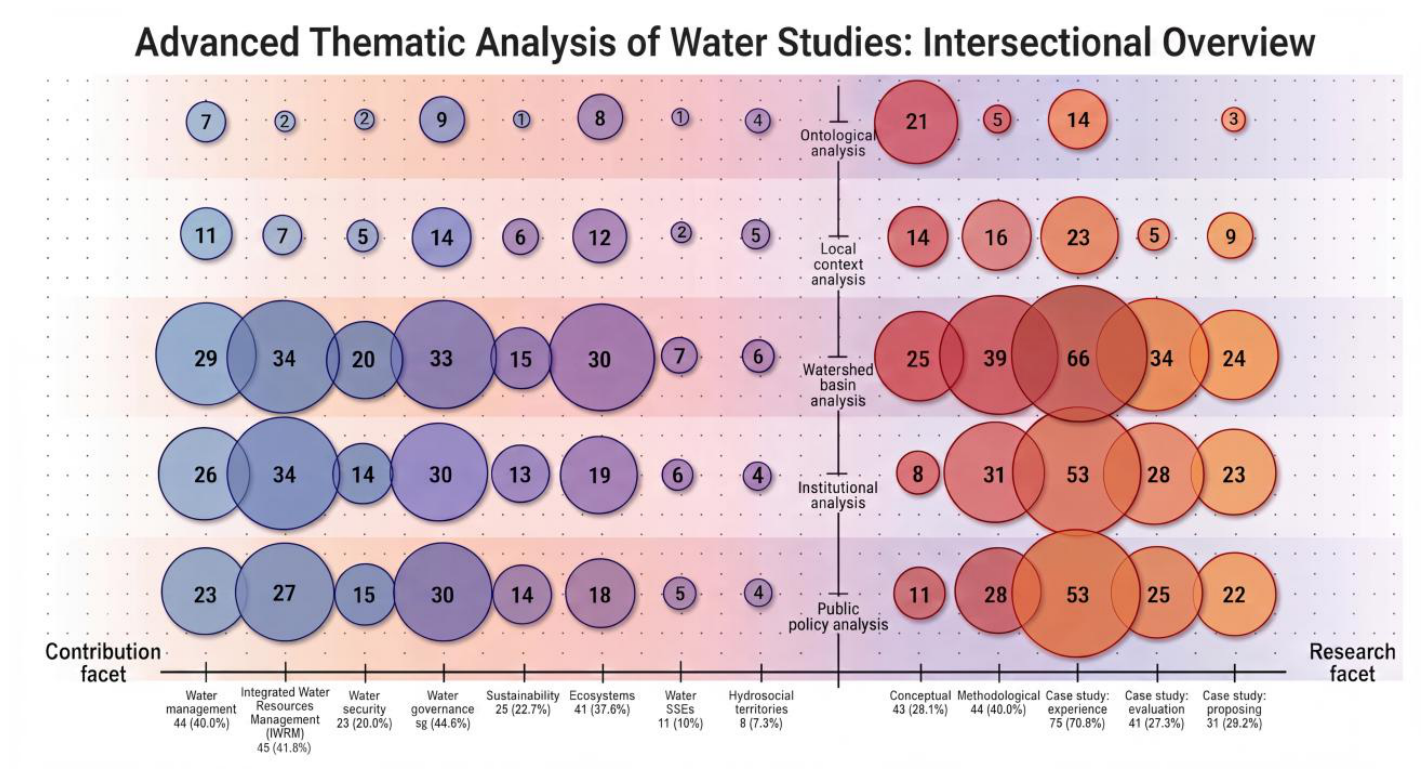
The systematic literature mapping identified patterns, trends, and knowledge gaps across the 202-document corpus (Figure 3). Of these, 112 publications were selected for detailed analysis, focusing on the most recent five years and originating from countries such as the US, UK, Australia, and Germany [15].
The findings indicate that research has predominantly focused on Integrated Water Resources Management (IWRM) at the hydrographic basin scale, reflecting its widespread acceptance as a standard framework. However, this dominance has hindered the exploration of smaller scales or local socioecological contexts where unique governance challenges, stakeholder dynamics, and cultural considerations require tailored approaches outside the traditional IWRM paradigm. Governance, power dynamics, and diverse perspectives on water security remain underexamined.
The systematic mapping highlighted a notable gap in the literature concerning “ontological analysis,” particularly its application in local contexts below the watershed scale. This gap was especially significant given the intersections identified between ontological perspectives, institutional dynamics, and public policy frameworks. Incorporating ontological analysis into governance frameworks offers a promising avenue to uncover the political–institutional dynamics underlying environmental conflicts centered on water security within complex socioecological systems.
This research addresses these gaps by seeking to recognize a spatial category that integrates WISe social, economic, political, and ecological dimensions through comprehensive ontological and methodological inquiry. Unlike existing models that treat these dimensions in isolation, WISe adopts a dynamic and integrative approach, embedding ontological analysis into public policy and territorial governance.

3.3. Stakeholder Perceptions of WISe

A sample of 223 social actors participated in an exploratory analysis of perceptions regarding the conception, conservation status, use, and management of WISe. These actors were drawn from different basins across Colombia, with balanced representation in terms of gender and age. A coding framework was developed inductively to abstract and analyze trends, synthesizing and quantifying the qualitative content of responses. Table 2 presents the six conceptual categories identified and their distribution across stakeholder groups.
The findings indicate that participants across all groups predominantly conceptualized WISe through a hydrological supply framework (RHS), emphasizing their function in maintaining water availability. As one government professional involved in watershed management stated, “They are ecoregions of great importance for water provision to socioecosystems, defined as special protection zones through territorial planning.” Similarly, a rural community member described them as “zones that are protected so that water does not run out.” This framing reflects the dominant institutional discourse centered on the hydrological cycle and water provision.
The second most common framing—Natural Resources (RHN)—emphasized the conservation of biophysical elements: “forests, water springs, watersheds, páramos.” Together, these two categories accounted for approximately 65.2–68.9% of responses across all groups, suggesting that the institutional–technical discourse has permeated stakeholder conceptions broadly.
Notably, the analysis revealed that ontological diversity was distributed across all stakeholder groups rather than concentrated in any single category. Territorial-integrated responses (RHT) incorporating cultural values, life-sustaining functions, and socioecological complexity appeared in all groups. Government respondents showed the highest proportion of territorial-integrated perspectives (22.9%), followed by community organizations (18.2%), the private sector (11.1%), and civil society (9.4%). This pattern suggests that direct engagement with water management instruments and territorial planning processes may foster more holistic conceptualizations of water systems. However, the richest articulations of water’s cultural and life-sustaining significance emerged from community organization respondents, whose language emphasized lived experience, territorial identity, and spiritual connections. As one indigenous community leader stated, “These are spaces of spiritual power,” while a rural cooperative representative described them as “life givers” (dadoras de vida). A member of a rural community offered a perspective rooted in territorial practice: “Those spaces that exist in the territory and that as a community we call reserve zones.”
Regarding the perceived uses of WISe (Table 3), conservation-oriented framings dominated across all groups. The most frequent response category was Conservation of Ecosystem Environmental Services (CSE, 43.5%), which framed WISe use in terms of broad ecosystem-level conservation. The second most frequent, Conservation of Hydrological Environmental Services (CSH, 34.5%), narrowed the focus specifically on water-related services. Together, these two conservation categories accounted for 78% of all responses, reinforcing the pattern observed in Table 2 where hydrological supply and natural resource framings predominated. Ecosystem Goods and Services (BSE, 9.0%), which explicitly included use and exploitation alongside conservation, was notably more frequent among government respondents (14.6%) than other groups, suggesting familiarity with ecosystem service frameworks in institutional discourse. Socioecological System Dynamics (SSE, 4.5%), which framed WISe use in terms of integrated system support functions, remained marginal across all groups. Actor-Based Management (GMA, 6.7%) was the most frequent among private sector respondents (11.1%), reflecting a governance-oriented understanding of WISe purpose.
Regarding whom manages WISe (Table 4), the majority of respondents (56.1%) attributed governance exclusively to government institutions (GA), while 28.3% identified collaborative governance arrangements (GB), 6.7% mentioned private sector governance (GC), and only 4.9% recognized community-based governance (GD). An additional 4.0% reported no knowledge of governance arrangements (NTC). This distribution reveals a dominant ontological position in which WISe are understood as objects of state administration rather than as co-governed territories. The low recognition of community governance (GD) is particularly striking given that community organizations constituted 30% of the sample—suggesting that even actors with direct territorial experience have internalized the institutional state framing of governance responsibility. This perception persists even among community actors who simultaneously reported experiencing management failures.
Regarding how management is practiced (Table 5), responses revealed critical tensions between different management realities. Articulated Management among Actors (MAA, 23.8%) and Absent Management (MGA, 23.3%) were the two most frequent responses overall, revealing a polarized landscape: roughly equal proportions of respondents perceived either coordinated multi-actor management or the complete absence of governance. Impositive External Management (MEI, 18.4%) was notably more prevalent among government respondents (25.0%) than civil society (10.9%), suggesting that actors positioned within institutional structures are more likely to recognize the top-down character of existing governance. Community or Traditional Management (MCT, 13.9%) was the most frequently cited by civil society (17.2%) and community organizations (15.2%), reflecting the local awareness of endogenous governance practices. Absent External Management as a Need (MEA, 11.2%) captured a distinct position: respondents who identified the absence of necessary external support, most frequently among government (14.6%) and community organizations (13.6%). The relatively high NTC rate (9.4%) suggests that management practice is the least understood dimension of WISe governance among respondents.
A civil society participant from La Argentina municipality observed the following: “I believe mistakes are made, such as fencing off these zones with barbed wire, which prevents the free movement of animals.” A government official acknowledged the following: “I consider it a vertical process, where legislation has been generated but adequate mechanisms for implementation do not exist, nor the necessary control for adequate protection. There are no genuine articulation strategies.” A community organization representative argued that “these areas should be managed with the participation of all social actors in the territories.”
Impositive External Management (MEI, 18.39% overall) was the most prevalent among government respondents (25.00%) and private sector respondents (22.22%). Rather than indicating a contradiction, this pattern may reflect a reflexive recognition among actors positioned within formal governance structures that many management actions are shaped by hierarchical mandates, fragmented regulatory instruments, and procedures defined externally to local territorial dynamics. In this sense, respondents linked to institutional implementation may be especially aware of the top-down character of existing governance arrangements. This interpretation remains exploratory and warrants further study.
Four key challenges emerged from the analysis. First, there is a lack of clarity about the fundamental nature and definition of WISe, resulting in conceptual ambiguity across all actor groups. Second, there is a predominant association of WISe with conservation functions, which often overlooks the integration of human activities within socioecological systems. Third, governance is largely perceived as institutional, with limited recognition of collaborative or community-based approaches. Fourth, there are significant knowledge gaps regarding management practices and their scope for promoting sustainable governance.
These findings highlight the absence of a shared conception of WISe as territories where physical, biotic, social, cultural, and economic components interact. This oversight has implications for rural water resource management, as these areas serve both as zones for water production and as vital sources of subsistence for local communities. Addressing this multidimensionality is essential for developing governance strategies that align with the realities of these territories and the needs of their inhabitants.

4. Discussion

4.1. Theoretical–Practical Contributions for WISe

Understanding the levels of interaction within societies, symbolic, cognitive, and behavioral, to analyze the dynamics circumscribing the space and realities of a territory requires starting with the meanings of “place,” “space,” “landscape,” and “territory.” These concepts, articulated with distinct significances, necessitate the establishment of an epistemic position to identify the spatial category of interest in studying ecosystems associated with water security.
The concept of “place” links elements of locality, location, and a sense of belonging, where interactions can be understood as “an intermediate place between the world and the individual” [49]. “Place” must be understood as a hybrid concept tied to spaces of experience and coexistence necessary for comprehending societies. It becomes a reference point for the quotidian and human experience, anchoring communities to meaning [50]. However, this conceptualization is not universal, as it is shaped by the specific dynamics of community interaction, contextual realities, and power relations inherent in the geographical spaces that define and identify them. Within this analysis, such “lived spaces” are intimately connected to water resources.
“Space,” by contrast, encompasses the inseparable set of natural, geographical, and social objects interwoven with the life that fills, animates, and gives them meaning—a dynamic concept of “society in motion” [51]. Space participates equally in the physical and social realms, constituting a hybrid [49]. This understanding demands methodological tools from landscape studies, where the concept of space addresses the interrelationships that define it.
Landscape, despite existing within the “reality of things,” cannot be reduced to a mere object; instead, it represents a relationship between the perceiving subject and the surrounding environment, a dynamic exchange in which the observer’s cultural and personal filters imbue the landscape with symbolic meaning [52]. These perceptions transform into codes of culture, presenting landscape as a dynamic code of symbols reflecting the past, present, and potential futures of societies [33].
As an integral theoretical and practical contribution, the landscape is considered as the space perceived by the population, where the culture of a society is projected, whose character results from the action and interaction of physical dimensions, material elements, cultural elements, and community perceptions in a territory articulated by water.
“Territory,” in turn, is constructed through a web of interrelations involving actors and social institutions associated with a common material base. It is valued from ecological, economic, geopolitical, and cultural perspectives, becoming a symbolic–expressive representation of social actors’ worldviews. Territory emerges as an “appropriated space,” continuously constructed through social processes of territoriality and territorialization, defined by culture, collective memory, narratives, and symbolic representations [26,28].
Particularly in the Colombian context, the concept of territory emerges as central within the language and narratives of local communities. This concept underpins collective identity and cultural heritage, shaping understanding and management practices related to water resources. Communities articulate their experiences, struggles, and territorial claims predominantly through “territory,” making it essential for interpreting local socioecological interactions and governance practices.
Therefore, WISe cannot be understood without considering the significance and centrality of territory. “Territory” represents an inhabited space where ecological, historical, symbolic, and political processes converge, interrelate, and interact. Within this framework, water becomes the central element that binds networks, transforming them into spaces constructed through its existence and intentionality, materialized in the interrelationships of biophysical, social, and cultural systems. These spaces can be conceived as hydrosocial territories.
In this framework, it is pertinent to acknowledge the concept of hydrosocial territories as defined by Boelens and colleagues [17] as spaces that are “(re)created through interactions between human practices, water flows, hydraulic technologies, biophysical elements, socio-economic, cultural, political structures and institutions.”
The concept of territory within hydrosocial territories becomes a hybrid of form and content. The inclusion of subjective ontologies is essential; these ontologies may lack objective representation but hold real significance within the structure of these other realities [27]. This inclusion of subjectivities reflects the diverse realities of local contexts and “places,” recognizing plural ontologies and ways of thinking as key elements in understanding how hydrosocial territories are managed.
Environmental management from the perspective of hydrosocial territories provides a tool for identifying cultural expressions and narratives associated with “place” and territory. Such an approach fosters the development of a theoretical framework capable of addressing both the aesthetic and pragmatic realities of place and territory.
While hydrosocial territories provide a broad conceptual framework for understanding water–society–nature relationships, WISe represents an operationalization adapted specifically to areas designated as having strategic importance for water conservation. The distinctive feature of WISe lies in its integration of ontological plurality directly into governance frameworks, acknowledging water-important ecosystems simultaneously as biophysical entities, sources of cultural meaning, and objects of political contestation. Unlike the more descriptive–analytical concept of hydrosocial territories, WISe offers a prescriptive framework that bridges theoretical understandings with practical implementation strategies for managing these designated areas.

4.2. Political Ontology in Hydrosocial Territory Management

The findings presented here should not be interpreted as validating WISe in a definitive sense. Rather, they provide exploratory empirical support for the analytical relevance of the framework and illustrate the kinds of ontological tensions that WISe is designed to make visible in water governance contexts.
The findings of this study suggest that the role of ontology in water governance extends well beyond philosophical abstraction. The exploratory survey data (Section 3.3) revealed that a hydrological supply framing (RHS) predominated across all stakeholder groups (36.4–45.8%), suggesting that the institutional–technical discourse has achieved a form of ontological hegemony, shaping how water territories are understood even among actors whose daily practices reflect more integrated relationships with water systems. This finding aligns with Walsh’s [34] argument that ontology functions as a hidden driver of politics and policy, operating beneath explicit institutional arrangements to structure what counts as legitimate knowledge and appropriate governance.
In this sense, ontology operates not only as a terrain of conflict or resistance but also as a governmental practice. Pellizzoni [53] argues that contemporary governance increasingly reshapes nature into administratively legible entities, making intervention possible while narrowing the range of realities that can appear as governable. This perspective deepens our readings of the WISe findings: it helps explain why hydrological supply framings remain dominant even where actors inhabit more relational territorial worlds, since governance instruments do not merely regulate territories; they help define what those territories are allowed to be.
The survey data also revealed an important counterpoint: territorial-integrated perspectives (RHT) were present across all groups, with government actors showing the highest proportion (22.9%), challenging simplistic narratives that oppose institutional knowledge against local wisdom. Instead, it suggests that actors positioned at the intersection of governance instruments and territorial realities, such as watershed management professionals and municipal environmental officers, may develop more integrated perspectives precisely because they confront the inadequacy of reductive frameworks in daily practice. Community organization respondents, meanwhile, offered the richest language connecting water to cultural identity, spiritual significance, and territorial autonomy, perspectives that, though less frequent in the coding, represent ontological positions that conventional governance frameworks systematically exclude.
This ontological exclusion has material consequences. The finding that 56.1% of respondents perceive WISe as exclusively managed by government authorities (Table 4), even in contexts where government management has demonstrably failed, reveals how deeply the administrative state ontology has been naturalized. The usage data (Table 3) reinforces this pattern: 78% of responses framed WISe purpose in conservation terms (CSE and CSH combined), with only 4.5% articulating integrated Socioecological System Dynamics (SSE). The management practice data (Table 5) adds further depth: the near-equal prevalence of Articulated Management (MAA, 23.8%) and Absent Management (MGA, 23.3%) reveals a governance landscape that respondents perceive as fundamentally polarized between coordination and abandonment. The fact that government respondents reported the highest proportion of Impositive External Management (MEI, 25.0%) is particularly telling; those positioned within institutional structures are the most likely to recognize the top-down character of existing governance as a problem. When communities describe management as “a vertical process where legislation has been generated but adequate mechanisms for implementation do not exist,” they are articulating an ontological tension: the reality of their territorial experience contradicts the reality assumed by the governance framework. This disconnect is not a communication problem to be solved by better consultation; it is an ontological conflict requiring the structural recognition of multiple legitimate ways of governing water territories.
This reflexive recognition also points to the institutional architecture from which it emerges. The environmental management of Areas and Ecosystems of Strategic Importance is shaped by a cascade of national instruments, notably the PGIRH [38], decrees 1640 and 0953, and the PNGIBSE [48], that issue generalized guidelines without providing the implementation mechanisms, unified frameworks, or articulation with local territorial realities that would allow them to land coherently at the sub-basin scale. The burden of reconciling these instruments with territorial complexity falls on municipal governments, planning secretaries, and watershed management professionals, who must enforce externally defined procedures, including the persistent legislative dichotomy between “areas” subject to intervention and “ecosystems” strictly conserved, without the discretion to harmonize them with socioecological heterogeneity on the ground. Formalized structures such as the POMCAs and basin councils further concentrate decision-making among higher-level technical–administrative actors. This pattern among government respondents appears not as an inconsistency but as a scalar diagnosis: the scale at which norms are produced is decoupled from the sub-basin scale at which WISe actually exist and must be governed. This scalar decoupling is one of the forms of ontological tension that the conflict governance dimension of WISe is meant to make legible.
These observations resonate with the broader political ecology literature. Flaminio [28] has shown how water policies revolve around discourses, representations, and perceptions that reflect conflicting ontologies, leading to persistent governance challenges. Yates and colleagues [26] have explored the implications of ontological plurality for governance design, highlighting the need for networked dialog that incorporates diverse perspectives on water. The case studies analyzed in the broader research from which this paper derives, the Piendamó watershed (Cauca) and the Río Seco watershed (Magdalena), illustrate these dynamics with clarity. In the Piendamó basin, indigenous communities understand water as an expression of territorial integrity, “the great house”, while peasant communities relate to water primarily as a material condition of subsistence. Both positions are internally coherent and empirically grounded, yet no institutional mechanism exists to articulate them into shared governance. In the Río Seco basin, a formalized institutional structure (POMCA, basin council) concentrates decision-making in technical–administrative actors while marginalizing community knowledge and management practices that have sustained water systems for generations.
Götz and Middleton [27], in their study of the Salween River’s hydrosocial territories, have similarly demonstrated the importance of analyzing multiple ontologies to uncover spatial and temporal power relations. Their findings stress that dominant ontologies often impose themselves on governance structures, necessitating political ontology as a tool for understanding territorialization dynamics. The concept of “hydromentality”, a water-related thought system among actors who conserve, use, and manage water resources, further illuminates how such mentalities influence governance at various spatial scales [54].
A central result of this study is the identification of the analytical–operational gap as a primary challenge for water governance that takes ontological plurality seriously. As Table 1 illustrates, the frameworks that best capture the complexity of water–society relations (hydrosocial territories, political ontology) lack operational governance tools, while most operational frameworks (IWRM, SES) systematically exclude ontological complexity. WISe addresses this gap through five operational dimensions (Table 6) that translate political ontology’s analytical power into governance-relevant categories.
Each dimension is traversed by the three conceptual pillars that sustain the WISe framework: socioecological systems (which foreground the inseparability of natural and social processes), political ontology (which demands recognition of both the ontology of being and the ontology of space), and hydrosocial territories (which situate the analysis within broader territorial networks where ecological flows, institutions, and social relations circulate).
The findings provide exploratory empirical grounding for the WISe framework and illustrate the kinds of ontological tensions it is designed to make visible; they should not be interpreted as a definitive test of the framework’s general validity. By incorporating ontological analysis into governance practice, the WISe framework enables governance approaches that move beyond the false choice between ecological conservation and social life. The framework proposes that effective water governance requires governing with ontological awareness—designing institutions capable of recognizing, negotiating between, and institutionally accommodating multiple water realities rather than suppressing them under a single dominant framework [32,55,56].

4.3. Limitations

Several limitations qualify for this research. The stakeholder survey was exploratory in design, intended to surface the diversity of ontological perspectives as empirical grounding for the conceptual framework rather than to achieve statistical representativeness. The cross-tabulations and proportions reported should be interpreted as indicative patterns revealing the structure of ontological diversity, not as precise population estimates. Additionally, this study is grounded in the Colombian context, characterized by specific regulatory traditions and exceptional biocultural diversity. For this reason, the broader relevance of WISe should be understood in terms of analytical transferability rather than empirical generalizability. Further application and testing in other contexts will be necessary to assess the robustness and adaptability of the framework. The literature review covered publications through 2024; given the rapid evolution of water governance scholarship, relevant contributions may have appeared since. This paper does not include longitudinal data tracking how ontological perspectives evolve over time, a dimension that would strengthen the understanding of governance dynamics. Finally, while the WISe framework proposes five operational dimensions, their full operationalization into governance protocols and institutional design processes requires further development and testing in practice.

5. Conclusions

This article should be understood primarily as a conceptual and framework-building contribution. Its empirical component is exploratory and intended to inform the development of WISe, rather than to offer a definitive validation of the model. The management of Areas and Ecosystems of Strategic Importance for Water Resource Conservation in Colombia exemplifies the need for governance approaches that account for the interconnected ecological, social, and political dimensions of water territories. This study introduced WISe as a conceptual and prescriptive framework that positions the coexistence of multiple ontologies, multiple ways of understanding, valuing, and governing water, as a structural feature of Water-Important Socioecological Systems rather than an obstacle to overcome.
The research findings point to three interconnected problems. First, current governance lacks conceptual and methodological clarity, reflected in the exploratory survey where hydrological supply framings predominated across all groups (36.4–45.8%), indicating that institutional discourse has achieved a form of ontological hegemony that narrows how even community actors conceptualize their own territories. Second, the dominance of state-centric governance perceptions, with 56.1% of respondents attributing management exclusively to government authorities, persists alongside widespread recognition that existing management is vertical, fragmented, and disconnected from territorial realities. Third, the literature review confirmed that research on water governance at sub-basin scales, and particularly research employing ontological analysis, remains underdeveloped relative to the IWRM-dominated basin-level paradigm.
Against these findings, WISe contributes at two levels. Diagnostically, the framework’s six defining characteristics and five operational dimensions provide a structured approach for identifying where ontological divergences exist, how they manifest in governance conflicts, and what dimensions of the socioecological system they engage. The operational dimensions (ecological–functional, socio-productive, normative–institutional, symbolic–relational, and conflict governance) translate political ontology’s analytical power into governance-relevant categories that practitioners and policymakers can engage with directly. Generatively, WISe proposes that governance must be redesigned to accommodate ontological plurality. This means creating institutional arrangements where multiple water realities, water as an ecological system, as a livelihood foundation, as cultural patrimony, and as a governance object, can coexist and inform decision-making without requiring resolution into a single dominant framework.
Three concrete governance orientations emerge from this analysis. First, territorial governance at the WISe scale must incorporate mechanisms for ontological dialog spaces where different understandings of water and territory are made explicit, compared, and negotiated rather than suppressed under technical consensus. Second, the persistent dichotomy between “areas” and “ecosystems” in Colombian legislation must be replaced by integrated categories that recognize the socioecological nature of water-important territories. Third, governance must recognize and institutionally validate community-based management practices that embody locally coherent ontological positions, rather than treating them as obstacles to formal planning.
Future research should focus on operationalizing the WISe framework into specific governance protocols, testing its applicability across different geographical and institutional contexts, and developing longitudinal analyses of how ontological perspectives shift under changing governance arrangements. These efforts will contribute to governance systems capable of meeting the demands of contemporary socioecological realities by treating the plurality of human and non-human relationships within water territories not as a complication but as the starting point for equitable, adaptive, and ecologically grounded management.

Author Contributions

Conceptualization, S.M.T.; Formal analysis, S.M.T.; Investigation, S.M.T.; Methodology, S.M.T.; Project administration, A.F.; Resources, A.F.-B.; Supervision, A.F. and J.A.; Validation, A.F.-B. and A.F.; Visualization, A.F.-B.; Writing—original draft, S.M.T.; Writing—review and editing, A.F.-B. and J.A. All authors have read and agreed to the published version of the manuscript.

Funding

This research received no external funding.

Data Availability Statement

The original contributions presented in this study are included in the article. Further inquiries can be directed to the corresponding author.

Acknowledgments

The authors would like to express their gratitude to the 223 stakeholders who participated in this research, sharing their valuable perspectives and knowledge about water management in Colombia. Special thanks to the Universidad del Cauca and the Doctorado Interinstitucional en Ciencias Ambientales program. We also appreciate the constructive feedback provided by our colleagues at the Grupo de Investigación en Innovación Ambiental y del Paisaje (GIIAP) and Grupo de Investigación en Estudios Ambientales (GEA) during various stages of this project.

Conflicts of Interest

The authors declare no conflict of interest.

References

  1. Ruiz-Agudelo, C.A.; Suarez, A.; Gutiérrez-Bonilla, F.D.P.; Cortes-Gómez, A.M. The Economic Valuation of Ecosystem Services in Colombia. Challenges, Gaps and Future Pathways. J. Environ. Econ. Policy 2023, 12, 285–304. [Google Scholar] [CrossRef]
  2. Blaser, M. Ontological Conflicts and the Stories of Peoples in Spite of Europe. Curr. Anthropol. 2013, 54, 547–568. [Google Scholar] [CrossRef] [PubMed]
  3. Hay, C. Political Ontology; Oxford University Press: Oxford, UK, 2011. [Google Scholar]
  4. Parsons, M.; Nalau, J.; Fisher, K.; Brown, C. Disrupting Path Dependency: Making Room for Indigenous Knowledge in River Management. Glob. Environ. Change 2019, 56, 95–113. [Google Scholar] [CrossRef]
  5. Blaser, M. Ontology and Indigeneity: On the Political Ontology of Heterogeneous Assemblages. Cult. Geogr. 2014, 21, 49–58. [Google Scholar] [CrossRef]
  6. Blaser, M. On the Properly Political (Disposition for the) Anthropocene. Anthropol. Theory 2019, 19, 74–94. [Google Scholar] [CrossRef]
  7. Escobar, A. Designs for the Pluriverse: Radical Interdependence, Autonomy, and the Making of Worlds; Duke University Press: Durham, NC, USA, 2018. [Google Scholar]
  8. De la Cadena, M.; Blaser, M. (Eds.) A World of Many Worlds; Duke University Press: Durham, NC, USA, 2018. [Google Scholar]
  9. Mol, A. Ontological Politics. A Word and Some Questions. Sociol. Rev. 1999, 47, 74–89. [Google Scholar] [CrossRef]
  10. Flemmer, R.; Gresz, V.; Hein, J. What Is at Stake? The Ontological Dimension of Environmental Conflicts. Soc. Nat. Resour. 2024, 37, 608–622. [Google Scholar] [CrossRef]
  11. Molle, F.; Mollinga, P.; Wester, P. Hydraulic Bureaucracies and the Hydraulic Mission: Flows of Water, Flows of Power. Water Altern. 2009, 2, 328–349. [Google Scholar]
  12. Whaley, L. Water Governance Research in a Messy World: A Review. Water Altern.-Interdiscip. J. Water Politics Dev. 2022, 15, 218–250. [Google Scholar]
  13. Ostrom, E. A General Framework for Analyzing Sustainability of Social-Ecological Systems. Science 2009, 325, 419–422. [Google Scholar] [CrossRef] [PubMed]
  14. McGinnis, M.D.; Ostrom, E. Social-Ecological System Framework: Initial Changes and Continuing Challenges. Ecol. Soc. 2014, 19, 30. [Google Scholar] [CrossRef]
  15. Cleaver, F.; Whaley, L. Understanding Process, Power, and Meaning in Adaptive Governance: A Critical Institutional Reading. Ecol. Soc. 2018, 23, 49. [Google Scholar] [CrossRef]
  16. Harrington, C. The Political Ontology of Collaborative Water Governance. Water Int. 2017, 42, 254–270. [Google Scholar] [CrossRef]
  17. Boelens, R.; Hoogesteger, J.; Swyngedouw, E.; Vos, J.; Wester, P. Hydrosocial Territories: A Political Ecology Perspective. Water Int. 2016, 41, 1–14. [Google Scholar] [CrossRef]
  18. Boelens, R.; Hommes, L.; Hoogesteger, J.; Swyngedouw, E.; Vos, J.; Wester, P. Hydrosocial Territories: Imaginaries, Materialities, and Struggles over Knowledge, Order and Meaning. Water Int. 2025, 50, 426–462. [Google Scholar] [CrossRef]
  19. Alba, R.; Betancur Alarcon, L.; Pereira Prado, M.; Jaramillo Villa, U.; Ortiz-Guerrero, C.E. Hydrosocial Territories Research: An Overview. WIREs Water 2025, 12, e70023. [Google Scholar] [CrossRef]
  20. Binder, C.R.; Hinkel, J.; Bots, P.W.G.; Pahl-Wostl, C. Comparison of Frameworks for Analyzing Social-Ecological Systems. Ecol. Soc. 2013, 18, 26. [Google Scholar] [CrossRef]
  21. Mitchell, B. “Integrated Water Resources Management: A Reassessment” by Asit K. Biswas. Water Int. 2004, 29, 398–399. [Google Scholar] [CrossRef]
  22. Linton, J.; Budds, J. The Hydrosocial Cycle: Defining and Mobilizing a Relational-Dialectical Approach to Water. Geoforum 2014, 57, 170–180. [Google Scholar] [CrossRef]
  23. Clement, F.; Suhardiman, D.; Bharati, L. IWRM Discourses, Institutional Holy Grail and Water Justice in Nepal. Water Altern. 2017, 10, 870–887. [Google Scholar]
  24. Biswas, A.K. Integrated Water Resources Management: A Reassessment. Water Int. 2004, 29, 248–256. [Google Scholar] [CrossRef]
  25. Biswas, A.K. Integrated Water Resources Management: Is It Working? Int. J. Water Resour. Dev. 2008, 24, 5–22. [Google Scholar] [CrossRef]
  26. Yates, J.S.; Harris, L.M.; Wilson, N.J. Multiple Ontologies of Water: Politics, Conflict and Implications for Governance. Environ. Plan. D Soc. Space 2017, 35, 797–815. [Google Scholar] [CrossRef]
  27. Götz, J.M.; Middleton, C. Ontological Politics of Hydrosocial Territories in the Salween River Basin, Myanmar/Burma. Political Geogr. 2020, 78, 102115. [Google Scholar] [CrossRef]
  28. Flaminio, S. Modern and Nonmodern Waters: Sociotechnical Controversies, Successful Anti-Dam Movements and Water Ontologies. Water Altern. 2021, 14, 204–227. [Google Scholar]
  29. Hussein, H. Lifting the Veil: Unpacking the Discourse of Water Scarcity in Jordan. Environ. Sci. Policy 2018, 89, 385–392. [Google Scholar] [CrossRef]
  30. Cox, M.; Arnold, G.; Villamayor Tomás, S. A Review of Design Principles for Community-Based Natural Resource Management. Ecol. Soc. 2010, 15, 38. [Google Scholar] [CrossRef]
  31. Swyngedouw, E. The Political Economy and Political Ecology of the Hydro-Social Cycle. J. Contemp. Water Res. Educ. 2009, 142, 56–60. [Google Scholar] [CrossRef]
  32. Boelens, R. Water, Power and Identity: The Cultural Politics of Water in the Andes; Routledge: Abingdon, UK, 2015; pp. 1–365. [Google Scholar]
  33. Sanchis Ibor, C.; Boelens, R. Gobernanza Del Agua y Territorios Hidrosociales: Del Análisis Institucional a La Ecología Política. Cuad. Geogr. Univ. València 2018, 101, 13–28. [Google Scholar] [CrossRef]
  34. Walsh, Z. Ontology as a Hidden Driver of Politics and Policy: Commoning and Relational Approaches to Governance. A Deep Dive Co-Hosted by the Commons Strategies Group and the Institute for Advanced Sustainability Studies; Institute for Advanced Sustainability Studies (IASS): Potsdam, Germany, 2019. [Google Scholar]
  35. Pahl-Wostl, C. A Conceptual Framework for Analysing Adaptive Capacity and Multi-Level Learning Processes in Resource Governance Regimes. Glob. Environ. Change 2009, 19, 354–365. [Google Scholar] [CrossRef]
  36. Pahl-Wostl, C. Water Governance in the Face of Global Change; Springer International Publishing: Cham, Switzerland, 2015. [Google Scholar]
  37. DePuy, W.; Weger, J.; Foster, K.; Bonanno, A.M.; Kumar, S.; Lear, K.; Basilio, R.; German, L. Environmental Governance: Broadening Ontological Spaces for a More Livable World. Environ. Plan. E Nat. Space 2022, 5, 947–975. [Google Scholar] [CrossRef]
  38. Ministerio de Ambiente, Vivienda y Desarrollo Territorial Politica Nacional para la Gestión Integral del Recurso Hidrico. 2010. Available online: https://www.minambiente.gov.co/wp-content/uploads/2021/10/Politica-nacional-Gestion-integral-de-recurso-Hidrico-web.pdf (accessed on 2 April 2026).
  39. Alexandra, J. Losing the Authority—What Institutional Architecture for Cooperative Governance in the Murray Darling Basin? Australas. J. Water Resour. 2019, 23, 99–115. [Google Scholar] [CrossRef]
  40. Trein, P.; Meyer, I.; Maggetti, M. The Integration and Coordination of Public Policies: A Systematic Comparative Review. J. Comp. Policy Anal. Res. Pract. 2019, 21, 332–349. [Google Scholar] [CrossRef]
  41. Cobo, M.J.; López-Herrera, A.G.; Herrera-Viedma, E.; Herrera, F. A New Science Mapping Analysis Software Tool. J. Am. Soc. Inf. Sci. Tec. 2012, 63, 1609–1630. [Google Scholar] [CrossRef]
  42. James, K.L.; Randall, N.P.; Haddaway, N.R. A Methodology for Systematic Mapping in Environmental Sciences. Environ. Evid. 2016, 5, 7. [Google Scholar] [CrossRef]
  43. Foucault, M.; Morey, M.; Alvarez-Uría, F.; Varela, J.; Gabilondo, A. Obras Esenciales; Paidós: Barcelona, Spain, 1999. [Google Scholar]
  44. Johnson, M.N.P.; McLean, E. Discourse Analysis. In International Encyclopedia of Human Geography; Elsevier: Amsterdam, The Netherlands, 2020; pp. 377–383. [Google Scholar]
  45. Arfan, M.; Ansari, K.; Ullah, A.; Hassan, D.; Siyal, A.A.; Jia, S. Agenda Setting in Water and IWRM: Discourse Analysis of Water Policy Debate in Pakistan. Water 2020, 12, 1656. [Google Scholar] [CrossRef]
  46. Daus, M.; Koberger, K.; Gnutzmann, N.; Hertrich, T.; Glaser, R. Transferring Water While Transforming Landscape: New Societal Implications, Perceptions and Challenges of Management in the Reservoir System Franconian Lake District. Water 2019, 11, 2469. [Google Scholar] [CrossRef]
  47. Mehta, L. The Politics and Poetics of Water: The Naturalisation of Scarcity in Western India; Orient Blackswan: Hyderabad, India, 2005. [Google Scholar]
  48. Ministerio de Ambiente y Desarrollo Sostenible. Política Nacional Para La Gestión Integral de La Biodiversidad y Sus Servicios Ecosistémicos (PNGIBSE); Ministerio de Ambiente y Desarrollo Sostenible: Bogotá, Colombia, 2012.
  49. Porto-Gonçalves, C. De Saberes y de Territorios—Diversidad y Emancipación a Partir de La Experiencia Latino-Americana. Polis Rev. Latinoam. 2009, 22, 1–13. Available online: https://journals.openedition.org/polis/2636 (accessed on 2 April 2026).
  50. Latour, B. Pandora’s Hope: Essays on the Reality of Science Studies; Harvard University Press: Cambridge, MA, USA, 1999. [Google Scholar]
  51. Sabogal Serrano, M.P. Subjetividades Caníbales El Pensamiento En Perspectiva. Cuadrantephi 2013, 1–14. [Google Scholar]
  52. Bormpoudakis, D. Three Implications of Political Ontology for the Political Ecology of Conservation. J. Political Ecol. 2019, 26, 545–566. [Google Scholar] [CrossRef]
  53. Pellizzoni, L. Ontological Politics in a Disposable World: The New Mastery of Nature, 1st ed.; Routledge: Abingdon, UK, 2016. [Google Scholar]
  54. Paranage, K.; Yang, N. The Existence of Multiple Hydro-Mentalities and Their Implications for Water Governance: A Case Study from Sri Lanka. Water 2020, 12, 2043. [Google Scholar] [CrossRef]
  55. Ulloa, A. Concepciones de La Naturaleza En La Antropología Actual. In Cultura y Naturaleza; Montenegro Martínez, L., Ed.; Jardín Botánico de Bogotá, José Celestino Mutis: Bogotá, Colombia, 2011; pp. 25–48. [Google Scholar]
  56. Ulloa, A.; Damonte, G.; Quiroga, C.; Navarro, D. Gobernanzas Plurales del Agua: Formas Diversas de Concepción, Relación, Accesos, Manejos y Derechos del Agua en Contextos de Gran Minería en Colombia y el Perú; National University of Colombia: Bogotá, Colombia, 2020. [Google Scholar]
Figure 1. Methodological route.
Water 18 01319 g001
Figure 2. Conditions that hinder environmental management.
Water 18 01319 g002
Figure 3. Literature mapping results.
Water 18 01319 g003
Table 1. Comparison of water governance frameworks.
DimensionIWRMSES (Ostrom)Hydrosocial TerritoriesWISe
Socioecological hybriditySeparate pillars: Social, economic, and environmental dimensions treated as distinct sectors to be balanced through integration Coupled but analytically distinct: Resource systems and governance systems modeled as interacting subsystems but maintained as separate analytical categories [11,12,13,14,20,21]Very strong: Water and society are mutually constitutive; territories are produced through the entanglement of biophysical flows, social practices, and power relations [17,18,22]Very strong: Ecological, social–productive, and institutional dimensions are treated as inseparable within designated water-important zones (inherited from hydrosocial territories; this study)
Multiple actorsModerate: Formally promotes stakeholder participation, but implementation tends toward state-led, techno-bureaucratic management with limited recognition of diverse knowledge systems [11,23]Strong: Explicitly models multiple user groups, governance actors, and their interactions across institutional levels [13,14]Very strong: Foregrounds how different actors—state agencies, communities, private sector, and indigenous groups—contest and co-produce territorial water arrangements [17,19]Very strong: Survey design captures six stakeholder groups; the framework treats actor diversity and their ontological positions as structurally constitutive of the system (this study)
Ontological pluralityAbsent: Assumes a universal techno-scientific framework for understanding what water is and how it should be managed; alternative ontologies are not recognized as governance-relevant [12,23,24,25]Weak (naturalist assumptions): Treats water as a measurable, bounded resource within a naturalist ontology; does not theorize the possibility that actors may inhabit fundamentally different realities about what water is [12,15]Strong and growing: Increasingly engages with ontological diversity, showing how different communities understand territorial water systems in fundamentally different ways [18,26,27,28]Explicitly central: Ontological plurality is a defining characteristic; the coexistence of multiple ways of understanding water is treated as a structural feature to be governed with, not a problem to resolve (this study)
Power and political contestationWeak: Depoliticizes water governance through techno-managerial discourse; power asymmetries are obscured by the rhetoric of integration and participation [23,29]Weak (undertheorized): Governance treated primarily as an organizational challenge; power relations, domination, and political struggle are not central analytical categories [15,30] Very strong: Power is a central analytical lens; the framework examines how dominant actors impose territorial imaginaries and how marginalized groups contest them [17,31,32,33]Strong: Integrates political ontology’s attention to how dominant ontologies are naturalized and imposed; the conflict governance dimension addresses power dynamics explicitly [2,34]
Critical governance scaleBasin-level: Adopts the hydrographic basin as the default management unit, with governance structures organized at this scale [11]Multi-level: Recognizes nested governance structures from local to global, but power dynamics across scales are undertheorized [13,15]Multi-scalar: Analyzes how territories are produced, contested, and governed across multiple interrelated spatial and temporal scales simultaneously [17,19,27,32]Sub-basin/ecosystem: Operates at the scale where ecological functions for water sustainability are concentrated and where diverse social practices, meanings, and governance claims intersect (this study)
Dynamic characterLargely static: Frameworks and management plans tend toward fixed institutional designs; adaptive management exists in discourse but is weakly implemented in practice [12,35,36]Partial (diagnostic snapshot): Provides sophisticated analysis of system states at a given point but is better suited to diagnosis than to capturing transformation processes over time [13,14]Very strong: Territories are understood as continuously produced, contested, and transformed through ongoing struggles over water, meaning, and governance [17,18]Situated and dynamic: Systems in constant transformation, defined by ecological processes, human decisions, and evolving institutional regimes; temporality is constitutive (this study)
Table 2. Conceptual categories in stakeholder responses: “what are Water-Important Socioecological Systems?”
Category (Code)DescriptionRepresentative KeywordsCivil Society (%)Community Orgs (%)Government (%)Private Sector (%)
Water Resource as System (RHS)WISe understood as hydrological system for water provision“water supply,” “strategic areas,” “water production”37.5036.3645.8340.00
Water Resource and Natural Interaction (RHN)WISe as interaction between water and natural system (biotic and abiotic)“páramos,” “springs,” “wetlands,” “protection”28.1228.7922.9228.89
Water Resource as Territory (RHT)WISe as territory united by water, integrating cultural and socioecological values“life spaces,” “cultural values,” “sustainability for community”9.418.1822.9211.11
Water Resource and Natural Coverages (RHC)WISe described by physical land cover features“mountain ridges,” “highlands,” “water bodies”12.5013.648.3313.33
Water Resource Defined by Governance (RHG)WISe defined through institutional governance arrangements“company,” “public services,” “authorities”6.251.520.02.22
No Knowledge (NTC)No response or “I don’t know”6.251.520.04.44
Note: Percentages are rounded to two decimal places; totals may not equal exactly 100.00 due to rounding.
Table 3. Perceived uses of WISe: “what are they used for?”
Category (Code)DescriptionCivil Society (%)Community Orgs (%)Government (%)Private Sector (%)Total (%)
Conservation of Ecosystem Environmental Services (CSE)Conservation of environmental services at the general ecosystem level46.8846.9739.5837.7843.50
Conservation of Hydrological Environmental Services (CSH)Conservation specifically of water-related environmental services31.2534.8531.2542.2234.53
Ecosystem Goods and Services (BSE)Ecosystem goods and services, including use and exploitation7.819.0914.584.448.97
Actor-Based Management (GMA)Determined by actor management and governance6.254.556.2511.116.73
Socioecological System Dynamics (SSE)Support dynamics of an integrated socioecological system4.693.036.254.444.48
No Knowledge (NTC)No response or “I don’t know”3.121.522.080.01.79
Note: Percentages are rounded to two decimal places; totals may not equal exactly 100.00 due to rounding.
Table 4. Governance attribution: “who manages WISe?”
Category (Code)DescriptionCivil Society (%)Community Orgs (%)Government (%)Private Sector (%)Total (%)
Institutional Governance (GA)Government institutions as sole managers53.1256.0656.2560.056.05
Collaborative Governance (GB)Shared governance among multiple actor types21.8833.3329.1728.8928.25
Private Sector Governance (GC)Private actors as managers10.946.066.252.226.73
Community Governance (GD)Community-based governance6.253.036.254.444.93
No Knowledge (NTC)No response or “I don’t know”7.811.522.084.444.04
Note: Percentages are rounded to two decimal places; totals may not equal exactly 100.00 due to rounding.
Table 5. Management practices: “how are WISe managed?”
Category (Code)DescriptionCivil Society (%)Community Orgs (%)Government (%)Private Sector (%)Total (%)
Articulated Management (MAA)Coordinated management among actors25.0024.2416.6728.8923.77
Absent Management (MGA)Management and governance are absent23.4425.7620.8322.2223.32
Impositive External Management (MEI)Top-down external management imposed on territories10.9418.2825.022.2218.39
Community or Traditional Management (MCT)Community-based or traditional management practices17.1915.1512.508.8913.90
Absent External Management—Need (MEA)External management absent but perceived as needed7.8113.6414.588.8911.21
No Knowledge (NTC)No response or “I don’t know”15.623.0310.428.999.42
Note: Percentages are rounded to two decimal places; totals may not equal exactly 100.00 due to rounding.
Table 6. WISe operational dimensions.
ComponentDescriptionKey Analytical Questions
Ecological–FunctionalEcosystem dynamics sustaining water security: recharge, regulation, connectivity, hydrological flowsWhat biophysical processes sustain water availability? How do ecological functions interact with human activities?
Socio-ProductiveForms of territorial occupation associated with water use: agriculture, livestock, artisanal activitiesHow do productive practices depend on and transform water systems? What land-use patterns shape the territory?
Normative–InstitutionalRules, laws, and governance structures: policies, planning instruments, institutional arrangementsWhat regulatory frameworks govern the territory? How do formal and informal norms coexist or conflict?
Symbolic–RelationalVisions, meanings, and values attributed to water: cultural representations, identity, knowledge systemsHow do different actors understand and value water? What symbolic meanings shape their practices?
Conflict and GovernanceConflicts, negotiations, and integration processes: power dynamics, stakeholder interactionsWhat tensions exist between actors? What mechanisms enable or obstruct collaborative governance?
Disclaimer/Publisher’s Note: The statements, opinions and data contained in all publications are solely those of the individual author(s) and contributor(s) and not of MDPI and/or the editor(s). MDPI and/or the editor(s) disclaim responsibility for any injury to people or property resulting from any ideas, methods, instructions or products referred to in the content.