Review

Water Pollution and Its Impact on the Cardiovascular System in the Context of Current Data on These Pollutants in Poland and Uzbekistan—Preliminary Reports


by
Janusz Sielski
1,*,
Małgorzata A. Jóźwiak
2,
Marek Jóźwiak
2,
Rashid Kulmatov
3,
Zafarjon Jabbarov
3,
Atabek Alimov
3,
Ulugbek Mirkhodjaev
3 and
Karol Kaziród-Wolski
1
1
Collegium Medicum, Jan Kochanowski University, 25-369 Kielce, Poland
2
Faculty of Biology, European Institute of Post-Graduate Education in Kielce, 25-305 Kielce, Poland
3
Faculty of Biology and Ecology, National University of Uzbekistan Named After Mirzo Ulugbek, University Street, 4, Tashkent 100174, Uzbekistan
*
Author to whom correspondence should be addressed.
Water 2026, 18(11), 1299; https://doi.org/10.3390/w18111299
Submission received: 22 April 2026 / Revised: 15 May 2026 / Accepted: 21 May 2026 / Published: 27 May 2026
(This article belongs to the Section Water and One Health)

Abstract

The exposome concept combines classic risk factors for cardiovascular disease with new, non-classical factors. One of the main non-classical factors is environmental pollution, including water pollution. This pollution is widespread worldwide. Based on government reports on water pollution in Poland and Uzbekistan and the available literature, the authors point to health problems affecting residents of both countries. The presented tabulation of cardiovascular disease incidence rates indicates an upward trend. It was found that the components of water pollution and the mechanisms by which this pollution affects the cardiovascular system are similar in both countries. These include heavy metals, arsenic, cadmium, lead, mercury, as well as nitrogen compounds from soil and microplastics. This article is an observational report and represents an important step towards understanding the relationship between water pollution and the cardiovascular system. Due to the lack of comprehensive knowledge, particularly regarding the impact of microplastics, nitrates, and nitrites found in water on the cardiovascular system, further research in this area is necessary.

Graphical Abstract

1. Introduction

Non-communicable diseases currently cause 70% of deaths worldwide, 44% of which are cardiovascular disease (CVD) [1]. Traditional risk factors such as cigarette smoking, hypercholesterolemia, hypertension, diabetes, and genetic factors have been widely recognized for many years. It is now believed that, in addition to traditional risk factors, environmental factors such as air pollution, noise, water pollution, and light pollution should also be considered [2,3,4]. The role of non-conventional cardiovascular risk factors is growing. According to the European Society of Cardiology and the American Heart Association, they cause over 20 million deaths annually [5,6]. In recent years, attention has been drawn to the exposome concept, which combines the impact of classic cardiovascular risk factors with non-classical factors, allowing for the assessment of all risk factors across the lifespan [7,8].

2. Materials and Methods

This comparative narrative review was conducted in accordance with the principles of methodological transparency, structured screening, and reproducible synthesis articulated in the PRISMA 2020 statement, which served as a guiding framework rather than a binding registration protocol, given the explicitly narrative, comparative, and partly regulatory orientation of the present work. The objective was to integrate, through a structured search and a thematic synthesis, the contemporary evidence linking waterborne contamination to cardiovascular morbidity with a parallel comparative analysis of the water-pollution landscape in two geographically and regulatorily distinct countries—Poland, a Central-European Member State of the European Union, and Uzbekistan, a Central-Asian republic confronted with the legacy of the Aral Sea desiccation and post-Soviet agro-industrial pressure.
A systematic literature search was performed across four major bibliographic databases—PubMed/MEDLINE, Scopus, Web of Science Core Collection, and Google Scholar—covering peer-reviewed publications issued between January 2019 and February 2026. Particular emphasis was placed on high-impact contributions from Nature Reviews Cardiology, The New England Journal of Medicine, The Lancet Planetary Health, Circulation, the European Heart Journal, the Journal of the American College of Cardiology, Hypertension, Environment International, and Environmental Pollution. The temporal window was deliberately broadened beyond the customary five-year horizon in order to encompass both the seminal mechanistic investigations on heavy-metal cardiotoxicity, which still constitute the toxicological foundation of the field, and the most recent evidence on emerging contaminants—nano- and microplastics, polyfluoroalkyl substances, bisphenols, phthalates, and other endocrine-disrupting chemicals—whose cardiovascular relevance has only recently been demonstrated in human atheromatous tissue.
The search strategy combined controlled vocabulary (MeSH and Emtree terms) with free-text descriptors and Boolean operators, yielding an exhaustive corpus of records. Representative search strings included: “(water pollution OR drinking-water contamination) AND (cardiovascular disease OR atherosclerosis OR hypertension OR ischemic heart disease OR stroke)”; “(arsenic OR cadmium OR lead OR mercury) AND (cardiovascular OR endothelial dysfunction OR oxidative stress OR atherosclerosis)”; “(microplastics OR nanoplastics OR bisphenol A OR phthalates OR PFAS) AND (cardiovascular OR atherosclerotic plaque OR thrombosis OR arrhythmia)”; “(nitrates OR nitrites OR nitroaromatic compounds) AND (blood pressure OR methemoglobinemia OR cardiovascular outcomes)”; and country-specific queries combining “Poland” or “Uzbekistan” with “water quality,” “Aral Sea,” “Amu Darya,” “Syr Darya,” “Chirchik,” “Karakalpakstan,” “Vistula,” and “exposome.” Reference-list back-tracing of pivotal reviews, umbrella reviews, and meta-analyses was systematically applied to ensure that landmark guideline-cited evidence was not omitted. In parallel, authoritative gray literature was retrieved, including documents issued by the World Health Organization, the European Environment Agency, the European Union (Water Framework Directive 2000/60/EC), the United States Environmental Protection Agency, the Polish Chief Inspectorate of Environmental Protection (Surface-Water Status Reports for the 2019–2024 cycle), and the Ministry of Ecology, Environmental Protection and Climate Change of the Republic of Uzbekistan, in order to anchor the comparative regulatory analysis in primary source material.
Eligibility was assessed against pre-specified inclusion and exclusion criteria summarized in Table 1, prioritizing methodological rigor, thematic congruence with the cardiovascular consequences of waterborne contaminants, and the availability of full-text articles in English. Original investigations—randomized controlled trials, prospective and retrospective cohort studies, cross-sectional epidemiological analyses, case–control studies, and well-designed in vivo and in vitro experimental studies—were given precedence, complemented by systematic reviews, umbrella reviews, and meta-analyses providing pooled effect estimates for cardiovascular endpoints. Editorials, letters to the editor, conference abstracts without full-text accessibility, predatory-journal output, and publications devoid of clearly defined methodology were excluded. Records retrieved from the four databases were merged in a reference-management environment (Zotero, version 9, Corporation for Digital Scholarship, Vienna, VA, USA); duplicate entries were removed, and the remaining records were screened sequentially by title, abstract, and full text. Discrepant judgements were resolved by consensus among the authors, with reference to the cardiovascular and environmental expertise represented within the research team in Kielce (Poland) and Tashkent (Uzbekistan).
The retrieved evidence was thereafter subjected to a structured thematic synthesis organized along three interrelated analytical axes addressing the principal mechanistic clusters of waterborne cardiovascular risk: (i) the molecular and clinical impact of heavy-metal contamination, with particular reference to arsenic, cadmium, lead, and mercury; (ii) the role of nitrogen-bearing compounds—nitrates, nitrites, and nitroaromatic xenobiotics—entering aquatic systems through agricultural runoff, livestock effluents, and industrial discharges; and (iii) the cardiovascular sequelae of microplastic, nanoplastic, and plastic-derived chemical exposure, including bisphenols, phthalates, and persistent organic pollutants. A parallel regional axis compared the contemporary water-pollution landscape of Poland—governed by the EU Water Framework Directive and assessed in 3037 surface-water bodies and 805 lake water bodies—with that of Uzbekistan, characterized by transboundary river dependence (the Amu Darya and Syr Darya basins), the ecological collapse of the Aral Sea, and the chronic exposure of the Karakalpakstan population to salinized and pesticide-contaminated drinking water. The detailed inclusion and exclusion criteria are presented in Table 1, and the corresponding study-selection workflow is depicted in Figure 1. During the preparation of this work, the authors used Gemini 3.1 Pro AI model from Google in the “nano banana” module to generate Figure 3 for the manuscript. This tool was utilized under the Google Terms of Service and applicable commercial licensing. After using this tool, all authors reviewed and edited the content as needed and take full responsibility for the content of the publication.

3. Water Pollution in Poland and Uzbekistan

Water is a key component of the natural environment. It is the primary quantitative component of all living organisms on Earth and, at the same time, a crucial element of the environment in which they live. Scientific and technical interest in water exceeds that of any other substance. This is due to its importance in physical chemistry, chemical reactions, biochemistry and biology, medicine, meteorology, and food science. Water quality directly impacts the health of humans and ecosystems.

3.1. Water Pollution in Poland

Regulations regarding surface water quality in Poland are based primarily on EU law, in particular the Water Framework Directive (WFD), implemented into national law through the Water Law Act [10] and the Regulation of the Minister of Infrastructure of 25 June 2021 on the classification of ecological status, ecological potential, and chemical status, and the method for classifying the status of surface water bodies, as well as environmental quality standards for priority substances [11].
In EU regulations, “good water status” is a binary assessment: either good or poor. To achieve this status, over a hundred indicators are analyzed, grouped into two main packages: chemical status, which assesses water quality in terms of the presence of chemical substances, and ecological status, which determines the quality of the aquatic ecosystem and thus aquatic life.
Surface water quality in Poland is assessed in so-called “water bodies,” which are sections of rivers, lakes, or coastal waters that form a coherent environmental and ecological whole. There are 3037 such units in Poland, including 2340 natural water bodies and 697 artificial and heavily modified water bodies. Two main sets of indicators are analyzed for each unit: chemical status, which assesses water quality for the presence of chemicals, and ecological status, which determines the quality of the aquatic ecosystem, and thus aquatic life.
According to the Report, two water bodies (0.09%) achieved very good ecological status, 163 (6.97%) achieved good ecological status, 1080 (46.15%) achieved moderate ecological status, while 1095 (46.79%) remained in poor or poor ecological status. The biological element that most often determined or co-determined poor ecological status or potential (80%) was ichthyofauna, with benthic macroinvertebrates accounting for 25%. Phytoplankton did not achieve very good status anywhere, and as many as 84% of the river water bodies examined for it achieved a status worse than good. The condition of macrophytes can generally be described as moderate, offering the best classification for phytobenthos—plant organisms (algae, cyanobacteria, mosses) and vascular plants inhabiting the bottom of water bodies. The standards for good status in the tested surface water bodies were exceeded by physicochemical elements such as dissolved oxygen (22%), BOD5 (16%), total organic carbon (41%), electrolytic conductivity (28%), ammonium nitrogen (16%), nitrate nitrogen (34.5%), total nitrogen (38%), phosphate phosphorus (29%), total phosphorus (14.5%) and As, Cr, Zn, Cu, Mn, Ba, N, Al, Ca, Se, Mo, Ta, Ti, W Co, Sn PAHs, chlorides, sulfates, fluorides, calcium, magnesium, and nitrite nitrogen.
The chemical status classification for river surface water bodies in the 2019–2024 period indicated good status for 13.63% of water bodies, and below good status for 86.37%.
In 2019–2024, 805 lake surface water bodies (WBs) were also assessed, including 700 natural WBs and 105 heavily modified WBs. The results showed that, of the surface water bodies, only two lakes (0.29%) achieved very good ecological status, 127 (18.14%) achieved good status, 375 (53.57%) achieved moderate status, and 126 (18.00%) achieved poor ecological status, while poor ecological status was determined for 70 lakes (10%).
The biological element that most frequently (72%) determined or contributed to poor status is phytoplankton. For benthic macroinvertebrates, this figure is 25%. The role of other elements in determining poor condition is minor—around 10 percent each for ichthyofauna, macrophytes, and benthic macroinvertebrates.
The chemical status of lake water bodies monitored during the 2019–2024 period was determined for 747 water bodies, of which 101 (13.52%) had good chemical status, and 646 (86.48%) had below-good chemical status.
The main sources of surface water pollution in Poland are primarily agriculture (fertilizer and pesticide runoff, animal excrements), untreated municipal sewage discharge from urban areas, industrial activities (sewage discharge, heavy metals), and runoff from roads and urban areas.

3.2. Water Pollution in Uzbekistan 2026

Water is a critical resource for Uzbekistan. The vast majority of water is formed outside the country (approximately 80%), while the minority portion is formed within the country (roughly 20%), particularly in mountainous areas. The water formed outside the country is delivered by transboundary rivers, the Amu Darya and the Syr Darya rivers and used for agricultural irrigation.
Over the last few years, water quality deterioration and pollution have emerged as a growing environmental issue for Uzbekistan, leading to severe environmental consequences. Pollutants mainly originating from industrial activities and agricultural fertilization enter water bodies, river, lakes, and ponds, and directly impact consumers, which cause long-term health-related problems, necessitating continuous observation. In order to monitor water quality, currently Uzbekistan utilizes 108 stations on 59 water bodies (i.e., rivers, canals and lakes) for hydrochemical observations in which 43 ingredients are measured. More than one thousand water samples are collected each year and subsequent chemical analyses are carried out. The highest recorded mineralization levels and contamination are observed in the middle and lower reaches of the Amu Darya and the Syr Darya rivers [12]. At the national scale, the water pollution index (WPI) is used to measure and assess water quality status based on six indicators. Dissolved oxygen content and biological oxygen content are mandatory indicators, while the remaining indicators are those exhibiting the highest concentrations than normal. Based on the calculated values of the WPI, water quality status is divided into seven classes, with values being less than or equal to 0.3 and 0.3 to 1.0 are classified as “very clean” and “clean”, respectively. The WPI values between 1.0 and 2.5 are considered “moderately polluted”, followed by 2.5 to 4.0 “contaminated”, and 4.0–6.0 “dirty”. Once the WPI values exceed 6.0 (up to 10.0), the water quality is considered “very dirty” [13].
According to the national state of the environment report of Uzbekistan, the transboundary rivers in the country are polluted by agricultural runoff, industrial waste, untreated sewage water and wastewater discharge, which pose major risks to human health and well-being, particularly in the downstream areas. Furthermore, water bodies, particularly rivers and canals flowing through industrialized zones, are often exposed to pollution by heavy metals and other potentially toxic elements, while, in farming-dominant areas, agricultural runoff is the primary source of contamination with nutrients (N, P), pesticides, and sediments.
Recent studies conducted in a highly industrialized zone of Uzbekistan, the Tashkent region, indicate that the Chirchik and Akhangaran rivers are both contaminated with heavy metals, with the former presenting low to moderate contamination levels (Li, Be, Co, Ni, Sb, V, and Cr) and the latter exhibiting moderate to high contamination (Cu, Zn, Mo, Cd, Tl, Pb, and As) [14]. In addition, Critical Polycyclic Aromatic Hydrocarbons (PAHs) concentrations near a power plant and a metal mine and metallurgical complex, Organochlorine Pesticides (OCPs), including DDT and Chlorobenzenes, and high concentrations of Polychlorinated Biphenyl (PCBs) have been detected near Tashkent [15]. River pollution with microplastics is also a growing issue, especially in Ferghana province, where Sokh, Chodaksay, Govasay, Kasansay, Chartaksay, and Andizhansay rivers present microplastic pollution with a diameter of 0.15–5 mm in water [16]. Similarly, the Samarkand and Navoi provinces exhibit the very existence of microplastic pollution, with the particles ranging from 0.15 to 3.00 mm in the Zarafshan River [17]. The microplastics detected in these studies are mainly polyethylene terephthalate originating from industrial activities and local anthropogenic factors.
The rapid desiccation of the Aral Sea, a fourth largest lake in the world, has led to the emergence of multiple ecological disasters and problems, which present serious health risks to local people living in the region. The excessive application of organochlorine pesticides, including aldrin, lindane (γ-hexachlorocyclohexane, and dichlorodiphenyltrichloroethane, in order to increase cotton production capacity has further escalated local salinity in soil and water. Especially, the population in the Republic of Karakalpakstan have become subjected to severe chronic illness, with anemia, kidney and liver disease, respiratory infections, allergies, and cancer being widespread especially among women and children. Drinking water is highly saline, with salinity levels being six times greater than World Health Organization standards [18]. The scarcity or lack of fresh water often compels communities to use groundwater as a primary source of drinking water in Karakalpakstan. However, the groundwater is also contaminated by agricultural fertilization. For instance, a recent study on assessing groundwater quality in the Amudarya district of Karakalpakstan found the groundwater (10–25 m deep) to be fair (according to Canadian Council of Ministers of the Environment Water Quality Index (CCME WQI) model), and unsuitable for drinking since certain parameters, including Total dissolved solids (TDS) and chloride (Cl) did not align with international and local standards [19]. Similarly, the Amu Darya River water exhibits higher mineralization levels in the territory of Karakalpakstan, reaching up to 2700 mL gram per liter, thus making it unsuitable for drinking [20]. This is because untreated industrial and domestic wastewater discharges into Amu Darya River from settlements on the upper and middle stream areas contribute to its mineralization, leading to higher concentration in the lower part of the river [21].
Groundwater is the second important source of water, mainly used for drinking, domestic use, industrial activities and even land irrigation. There are around 50,839 groundwater wells in operation, which supply water in 69 cities. Over 43% of these wells are used for domestic purposes [13]. Groundwater with salinity up to 1 g/L is scattered around mountainous regions of Tashkent, Samarkand, Surkhandarya, Namangan, and Andijan provinces where the majority of runoff formation occur. On the other hand, the republic of Karakalpakstan and Bukhara, Khorezm, Navoi provinces lack natural fresh groundwater reserves, which corresponds to 0.3%. In these regions, although there has been some progress, providing local population with sufficient drinking water system still remain challenging, and existing infrastructures are outdated. As a result, they use hand pumps to extract water for drinking. In turn, water pumped through those hand pumps are not entirely suitable for consumption, with parameters being higher than normal standards [17]. The mechanism of water pollution is demonstrated in Figure 2.

3.3. Summary

Water pollution in Uzbekistan and Poland is linked to two distinct types of ecological crises. Uzbekistan is grappling with an existential ecological catastrophe (desiccation and salinization), while in Poland the main problem is the chemical and biological degradation of surface waters (eutrophication, industrial and urban pollution). In both cases, the waters are contaminated with heavy metals and microplastics, which directly or indirectly contribute to the increase in cardiovascular diseases. The tables (Table 2 and Table 3) indicates a 3.62% increase in hospitalizations in Uzbekistan between 1990 and 2025 per 100,000 inhabitants. In Poland, an increase in hospitalizations was also recorded between 2014 and 2019, but it was much smaller, at 0.2% per 100,000 inhabitants. In 2020, due to limited access to healthcare during the COVID-19 pandemic, the number of people hospitalized decreased significantly.

4. The Impact of Water Pollution on the Occurrence of Cardiovascular Diseases

The scientific literature has given little attention to the role of water pollution in promoting cardiovascular disease. Water pollution is a complex issue. On the one hand, it involves contamination with heavy metals such as arsenic, cadmium, lead, and mercury, and on the other hand, contamination with nitrogen compounds, low microbial content, and the presence of chemicals [22]. In recent years, significant attention has been paid to contamination with microplastic particles [23].

4.1. The Impact of Water Pollution with Heavy Metals on the Cardiovascular System

4.1.1. Arsenic

Arsenic is a metal found primarily in drinking water and food. Current data indicate that over 100 million people worldwide are exposed to toxic levels of arsenic. Concentrations exceeding 50 micrograms/L are considered toxic [24,25,26]. The impact of arsenic on cardiovascular disease primarily affects coronary heart disease, ischemic stroke, and peripheral artery disease [27,28]. Experimental studies in animals have demonstrated that long-term exposure to arsenic can induce and accelerate atherosclerotic processes and vascular endothelial dysfunction. These effects most commonly result in increased inflammation, endothelial and smooth muscle cell proliferation, increased oxidative stress, vascular remodeling, and apoptosis [29,30,31,32].
Acute exposure to arsenic causes symptoms such as vomiting, abdominal pain, and diarrhea. In more severe cases, sensory disturbances, persistent burning sensations in the extremities, and severe muscle spasms can occur. Sudden death can also occur. Chronic exposure causes skin lesions in the form of dermatitis, hyperkeratosis, and discoloration of the hands and feet. Chronic exposure also causes and accelerates diabetes, neurological disorders, and intellectual disabilities. Furthermore, arsenic has been linked to certain cancers of the lung, liver, bladder, skin, and prostate [33,34].

4.1.2. Cadmium

Cadmium enters the body through food. Cadmium is a trace element that does not play a major role in metabolism, and if it does enter the body, it accumulates [35]. The most important endpoints of systemic cadmium exposure include reduced bone mineral density, renal tubular degeneration, and bioaccumulation of Cd in the renal cortex [36]. Several interesting studies can be found in the literature describing increased cardiovascular risk and stroke risk with cadmium exposure. Chowdhury et al. found an increased risk of cardiovascular disease, including coronary heart disease, of 1.36 [95% confidence interval (CI): 1.11, 1.66] [34]. The association between exposure to toxic heavy metals and stroke was also demonstrated by Bao QJ et al. [36]. In a large study, the association between heavy metals and stroke was analyzed. Chronic exposure to Cadmium—(RR = 1.30; 95% CI, 1.13–1.48) was significantly associated with stroke. This association was probably dose-dependent [37] An interesting, new analysis of the association between exposure to environmental pollution, including Cadmium, was presented in a comprehensive study by He X. et al. [38]. The aim of this study was, among other things, to determine the association between exposure to environmental pollution with heavy metals and cardiovascular diseases. According to this study, exposure to Cadmium significantly increases the risk of ischemic heart disease. In terms of cases of ischemic heart disease, RR = 1.25; 95% CI, 1.16–1.35, in terms of mortality due to ischemic heart disease, RR = 1.41; 95% CI, 1.30–1.51, and in terms of all-cause mortality, RR = 1.40; 95% CI, 1.24–1.52 [39].

4.1.3. Lead

Water contamination with lead increases exposure to this element. In turn, exposure to lead significantly and potentially accelerates the development of many diseases and disorders of the cardiovascular system. These include primarily coronary heart disease, peripheral arterial disease, left ventricular hypertrophy, and cardiac arrhythmias. These changes occur during both acute and chronic exposure [40,41,42,43]. A large clinical study assessing the effects of lead on cardiovascular disease was conducted by Obeng-Gyasi E. et al. [42] on a large population of American adults over the age of 20. This study used data from the National Health and Nutrition Examination Survey from 2007–2008 and data from 2009–2010. Regression analysis showed that diastolic blood pressure and HDL cholesterol were significantly associated with blood lead levels. An analysis of occupational exposure was also performed. In an occupational analysis, systolic blood pressure (SBP), DBP, C-reactive protein (CRP), triglycerides, LDL cholesterol, and HDL cholesterol showed differences between populations in exposed and less exposed occupations. Lead exposure was found to have a profound effect on the cardiovascular system, with potentially adverse effects occurring at all exposure levels [44]. Interestingly, an animal study on the effect of lead on the beta-adrenergic system was conducted by Tsao DA et al. [43]. It was found that an increase in plasma norepinephrine levels, a decrease in beta-adrenergic receptor and cAMP activity in the aorta, and an increase in beta-adrenergic receptor and cAMP activity in the kidneys contributed to the increased blood pressure in lead-induced hypertension. The decrease in beta-adrenergic receptor and cAMP activity in the heart resulted in a decrease in cardiac contractility [45]. An interesting review of research on the effects of lead, among other substances, on the body was presented by Ferreira G. et al. [44]. In a modern literature review, they identified the effects of lead on heart function, extrasystoles, and heart rhythm. They discussed the direct mechanisms of the harmful effects of these heavy metals on heart function. They concluded that lead exposure should be considered a significant risk factor for cardiovascular disease [46].

4.1.4. Mercury

Mercury, via water, is a significant environmental pollutant and a threat to public health, primarily known for its neurotoxic effects. Increasing evidence also indicates its harmful effects on the cardiovascular system, particularly in adults. Mercury exposure leads to a number of pathological events: platelet activation, oxidative stress, increased inflammation, and damage to cardiomyocytes and vascular endothelial cells. These changes trigger the activation of proinflammatory processes, prothrombotic states, thrombosis, and vasculitis. A key effect is the formation of platelet-leukocyte aggregates (PLA), which exacerbate thromboinflammatory states and endothelial dysfunction. These processes significantly increase the risk of cardiovascular disease, including thrombosis and vasculitis [47]. Among the observational studies, it is worth citing studies demonstrating increased exposure to mercury compounds in residents of the Amazon River basin and a correlation with the occurrence of hypertension [48,49]. Valera et al. also published reports on increased blood pressure and heart rate variability (HRV) among Quebec residents exposed to mercury compounds [50,51,52,53,54].

4.1.5. Summary

A similar mechanism of endothelial damage, oxidative stress, inflammation, and atherosclerosis is noteworthy in the key impact of major heavy metals on the cardiovascular system. This impact is most noticeable in the case of pesticides, PAHs, PFAS, PCBs, and microplastics.

4.2. Differentiating the Impact of Heavy Metals on the Main Cardiovascular Diseases

4.2.1. Hypertension

The impact of heavy metals on hypertension is toxicity based on inducing oxidative stress, promoting inflammation of the vascular endothelium, endothelial dysfunction, and disruption of calcium metabolism [55]. As demonstrated by Nguyen HD et al. [54] in a study of pre- and post-menopausal women (7226 women studied between 2009 and 2017), doubling the serum cadmium concentration was associated with hypertension in pre-menopausal women (OR 2.47; 95% CI, 1.01–6.10, p = 0.049) and post-menopausal women (OR 1.70; 95% CI, 1.02–2.84, p = 0.043). Similarly, with mercury, a doubling of serum mercury concentration increased the quotient the odds of hypertension by 3.08 (95% CI, 1.12–8.43, p = 0.029) [56]. Also Li W. et al. in a large study including a total of 9005 patients using a machine learning model showed that heavy metals significantly affect the incidence of hypertension, especially lead, cadmium, and cobalt [55].

4.2.2. Coronary Artery Disease

Heavy metals disrupt key intracellular reactions and functions. Similar to hypertension, they lead to oxidative stress and chronic inflammation. They lead to endothelial dysfunction. They are associated with subclinical atherosclerosis, coronary artery stenosis, calcification, and, through this mechanism, a higher risk of coronary heart disease [57]. In the study by McGraw KE et al. [58], involving 6418 patients from 2000 to 2002, metal exposure was generally associated with the extent of coronary artery calcification at baseline and during follow-up. These results confirm the association of metals with the progression of atherosclerosis, potentially offering a new strategy for the prevention and treatment of atherosclerosis progression [59].

4.2.3. Stroke

Considering the mechanism of heavy metal influence on the pathogenesis of ischemic stroke, it is similar to that in other cardiovascular diseases. He J. et al. [57], in a large study of 9399 patients, ischemic stroke was diagnosed in 421 (4.4%). An interaction between ischemic stroke and lead exposure was found. The study revealed elevated inflammatory markers [60]. An interesting study on stroke risk was presented by Yen CC. et al. [59]. They examined the relationships between the concentrations of heavy metals lead [Pb], mercury [Hg], cadmium [Cd], and arsenic in the serum and urine of patients with acute ischemic stroke. This study showed that elevated serum cadmium and lead levels increased the risk of ischemic stroke in patients [61].

4.2.4. Heart Failure

Although toxic metals, such as cadmium (Cd), mercury (Hg), and arsenic (As), have been linked to cardiovascular diseases, their specific role in the incidence and prognosis of heart failure (HF) remains elusive. Lin et al. [60] investigated the associations between heavy metals and HF outcomes utilizing data from the National Health and Nutrition Examination Survey (NHANES) spanning 2003 to 2018 (n = 11,592). Metal concentrations were quantified in blood (Cd, Hg, Pb) and urine (As, Hg, among others). Their findings highlight the role of cadmium as a significant risk factor for heart failure, whereas the implications of the other heavy metals evaluated in the study remain unclear [62].

4.3. The Impact of Nitro Compound Water Pollution on the Cardiovascular System

Discussions about the harmfulness of nitrates in drinking water for humans are quite controversial. The main nitro compounds contaminating water are organic compounds, namely 2-nitrophenol and 4-nitrophenol, nitrobenzene, and nitroaniline. They are highly soluble and stable in water [63]. Organic compounds containing a nitro group play a significant role in the impact on the human body, especially considering their dual nature. On the one hand, they are used in therapy, but on the other hand, they have carcinogenic, mutagenic, genotoxic, and hepatotoxic effects [64]. The effects of nitro compounds on the human body mainly include their impact on methemoglobin formation, neurotoxicity, and impact on the central nervous system and circulatory system. Therefore, it is extremely important to remove nitro compounds from water reservoirs and water intakes using methods such as adsorption, photocatalytic degradation, and chemical degradation. There is ample evidence linking exposure to nitro compounds with cardiovascular diseases such as hypertension, obesity, and hyperlipidemia. In the case of hypertension, Tang X. et al. [65] conducted a study in a group of 1147 elderly patients and demonstrated an association between hypertension and environmental exposure to nicotinoids (insecticidal pesticides). It was concluded that exposure to these chemicals may increase the risk of hypertension in elderly patients [65]. Similarly, Gustavsson P. et al., in a large population-based SHEEP study involving 1658 patients, confirmed a high population risk, among others, in terms of obesity and exposure to nitro compounds [66]. The impact of selected water pollution on human health is presented in Table 4.

4.4. Microplastic Water Pollution and the Cardiovascular System

Microplastic production has increased significantly over the past 70 years. It currently stands at 359 million tons per year. China is the world’s largest producer of microplastics, producing 17.5% of the global total. Turkey, on the other hand, generates the greatest pollution of Mediterranean waters, producing 144 tons of microplastics daily. Microplastics constitute 75% of marine litter, with land-based sources accounting for 80–90% of the pollution, while ocean sources only account for 10–20% [67]. There is ample evidence in the literature documenting the harmful effects of microplastics on the cardiovascular system. A 10-year cohort study by Bao et al. demonstrated that long-term bisphenol A exposure significantly elevates the risk of cardiovascular disease by 46–49%, specifically predisposing individuals to hypertension, coronary heart disease, and acute coronary syndromes [68,69]. Bae et al. conducted a randomized controlled trial and demonstrated that drinking water from bottles containing bisphenol A rapidly increases urinary levels of this compound and leads to hypertension [70]. Jaimes R 3rd et al. [71] demonstrated the cardiodepressant effect of phthalate. Exposure to phthalate affects coronary circulation, causes impaired atrial contractility, causes bradycardia, disturbs atrioventricular conduction, and has a negative dromotropic effect [71]. In a prospective study of 304 patients undergoing endarterectomy, Marfella et al. detected polyethylene and polyvinyl chloride in 58.4% and 12.1% of carotid atherosclerotic plaques, respectively, revealing that the presence of these micro- and nanoplastics was associated with a 4.53-fold higher risk of the primary composite endpoint (95% CI: 2.00–10.27; p < 0.001) [72]. Wang et al. demonstrated that microplastics disrupt the gut flora and compromise intestinal barrier integrity, leading to higher microplastic concentrations in the stool samples of hypertensive patients compared to healthy controls [73]. Similarly, Cui et al. identified elevated microplastic levels in carotid endarterectomy specimens and suggested a potential correlation between vascular plastic distribution and lipid accumulation [74]. Yang et al. [75] demonstrated that microplastic exposure correlates with heightened atherosclerotic and acute coronary syndrome risks, showing in a study of 101 patients that microplastic concentrations were significantly higher in those with ST-segment elevation myocardial infarction (STEMI) than in patients with unstable angina. In a subsequent study, Wang et al. [76] confirmed the presence of microplastics in thrombi retrieved from patients with acute coronary syndromes, ischemic stroke, and deep vein thrombosis, demonstrating that higher microplastic content within these clots correlates with an increased risk of developing these thrombotic disorders. Wang et al. [77] revealed a synergistic toxicological profile between polylactic acid and copper nanoplastics from a gut microbiota perspective, showing that co-exposure in mice exacerbates cardiotoxicity, as evidenced by marked cardiac hypertrophy and fibrosis. Atrial fibrillation, the most common arrhythmia, can also be accelerated and modified by microplastics. Water pollution exposes the body to contaminants such as heavy metals, pesticides, and microplastics, both through direct contact and through the food chain [78]. Atrial fibrillation is significantly associated with the problem of ischemic strokes. Numerous studies have shown that embolic strokes can result from the action of microplastics [79]. Wang T. et al. demonstrated both qualitative and quantitative evidence that higher concentrations of microplastics in stroke thrombi can cause the onset and exacerbation of the disease [76].
The impact of microplastics is not always easy to determine against other factors. The most important mechanisms of this impact are mainly increased oxidative stress, increased inflammation, and hormonal influences [80]. Further research is needed to understand the impact of plastic and microplastic exposure on the cardiovascular system.
The impact of microplastic water pollution on Cardiovascular Health is presented in Table 5.

5. Discussion

In the mid-19th century, with increasing industrialization, scientists began to recognize the negative effects of human activity. Today, environmental pollution is one of the most serious challenges facing the modern world. Air and water pollution are significant factors leading to numerous serious diseases [81]. Air pollution is the ancestor of environmental degradation. This is confirmed by environmental science. Polluted air acts as the initial link in the chain of ecosystem degradation, transporting pollutants to soil and water, and affecting the climate [82].
Water is another crucial component of the abiotic environment. It is crucial for life on Earth. Water pollution leads to reduced drinking water supply, loss of biodiversity, fish kills, and the creation of dead zones. It causes eutrophication, soil contamination, and the penetration of heavy metals and plastics into the food chain, damaging both aquatic and terrestrial ecosystems [83,84,85,86,87]. Each country has its own regulations for assessing water pollution. In the USA, this is regulated by two documents: the Clean Water Act [88,89] and the Safe Drinking Water Act [90,91], which define chemical, physical, and biological indicators, analyses bottom sediments and fish tissues, and assess habitats. In China, water quality assessment is based on an extensive, centralized monitoring system that classifies surface and groundwater according to their suitability for use (e.g., drinking water, industrial water, agricultural water). The GB 3838-2002 [9] act provides for the prevention of water pollution, the protection of surface water quality and human health, and the maintenance of a healthy ecosystem. In the European Union, the scope and methodology of water quality assessment are defined by the Water Framework Directive of 2000. The World Health Organization (WHO) assesses water pollution primarily through the prism of its suitability for consumption and its impact on human health, based on the Guidelines for Drinking-water Quality (GDWQ). Currently, science is increasingly emphasizing the complex elements of human exposure to external influences. These include air and water pollution, as well as all other factors affecting humans from birth. All of these elements have recently been linked by the concept of the exposome. Medicine can now make a valuable contribution to the concept of exposure science [92].
In medicine, we are currently observing a significant shift in the vector of disease from infectious diseases to non-communicable diseases (NCDs), including cardiovascular diseases, cancers, respiratory diseases, and diabetes [93,94,95]. These changes are largely due to demographic changes, improved pediatric care, general improvements in hygiene, and the elimination of many risk factors via nutrition and infectious agent vaccination programs. This situation occurs in high-income countries. However, infectious diseases can pose a significant burden on the health system in low- and middle-income countries [96]. It is important to note that the incidence of noncommunicable diseases is constantly increasing. This is due to the unfavorable influence of the environment and external factors related to lifestyle. Currently, the main mortality factors are considered to be high systolic blood pressure (19.2%), cigarette smoking (15.4%), unfavorable dietary conditions (14%), and inappropriate ambient temperature [97]. Worldwide, the leading cause of death is circulatory system disease, accounting for 44% of non-communicable diseases, followed by cancer 22%, respiratory diseases 9%, diabetes 4%, and others 21% [98]. The Global Burden of Disease Study estimated that environmental pollution overall causes 268 million disability-related life years (DALYs) [99].
Studies have shown that water pollution contributes to the development of atherosclerosis. In particular, exposure to cadmium is associated with an increased incidence of coronary heart disease, peripheral artery disease, atherosclerosis, and stroke, as well as increased cardiovascular mortality [100]. This is evidenced, among others, by the study by Tellez-Plaza M et al., who systematically reviewed twelve epidemiological studies. The pooled relative risks (95% confidence intervals) for cardiovascular disease, coronary heart disease, stroke, and peripheral artery disease were 1.36, 1.30, 1.18, and 1.49, respectively [101]. As demonstrated in a well-designed review of studies by Cosselman KE et al., arsenic, mercury, and lead also significantly contribute to the development of carotid atherosclerosis and peripheral artery disease [102]. All previously mentioned heavy metals, including copper, increase the risk of coronary heart disease. An interesting meta-analysis was presented by Hu XF et al. [103], who, in 14 studies and 34,000 participants from 17 countries, found that mercury exposure was significantly associated with an increased risk of coronary heart disease (CHD) 1.21, all-cause mortality 1.21, cardiovascular mortality 1.68, and mortality from other heart diseases 1.50. Chronic mercury exposure was associated with an increased risk of all-cause mortality and fatal/nonfatal CHD. Chronic mercury exposure was associated with an increased risk of all-cause mortality and fatal/nonfatal CHD [104].
Many chemical contaminants present in plastics significantly pollute water. These include phthalates, bisphenols, polyhalogenated compounds, and dioxins. The mechanism of these contaminants is primarily their impact on endocrine disruption and increased risk of atherosclerotic coronary heart disease. Microplastic particles also play a significant role in the development of atherosclerosis. Plastic-related chemicals, such as phthalates, bisphenols, polyhalogenated compounds, and dioxins, are endocrine-disrupting and persistent organic pollutants that increase the risk of atherosclerotic coronary heart disease [105,106,107,108,109].
It should be noted that many of these soil/water contaminants are also toxic air pollutants, especially particulate matter, suggesting similar pathomorphological mechanisms. Microplastic particles have also been suggested to promote the development of atherosclerotic plaques, their progression, and subsequent cardiovascular events. Marfella R. et al. [72] conducted an interesting study on microplastics accumulating in carotid atherosclerotic plaques. The study enrolled 304 patients. Polyethylene was detected in carotid atherosclerotic plaques in 150 patients (58.4%). Among these, patients with carotid atherosclerotic plaques had a higher risk of the composite endpoint of myocardial infarction, stroke, or all-cause death after 34 months of follow-up in whom microplastics and nanoplastics were detected in their atherosclerotic plaques [72].
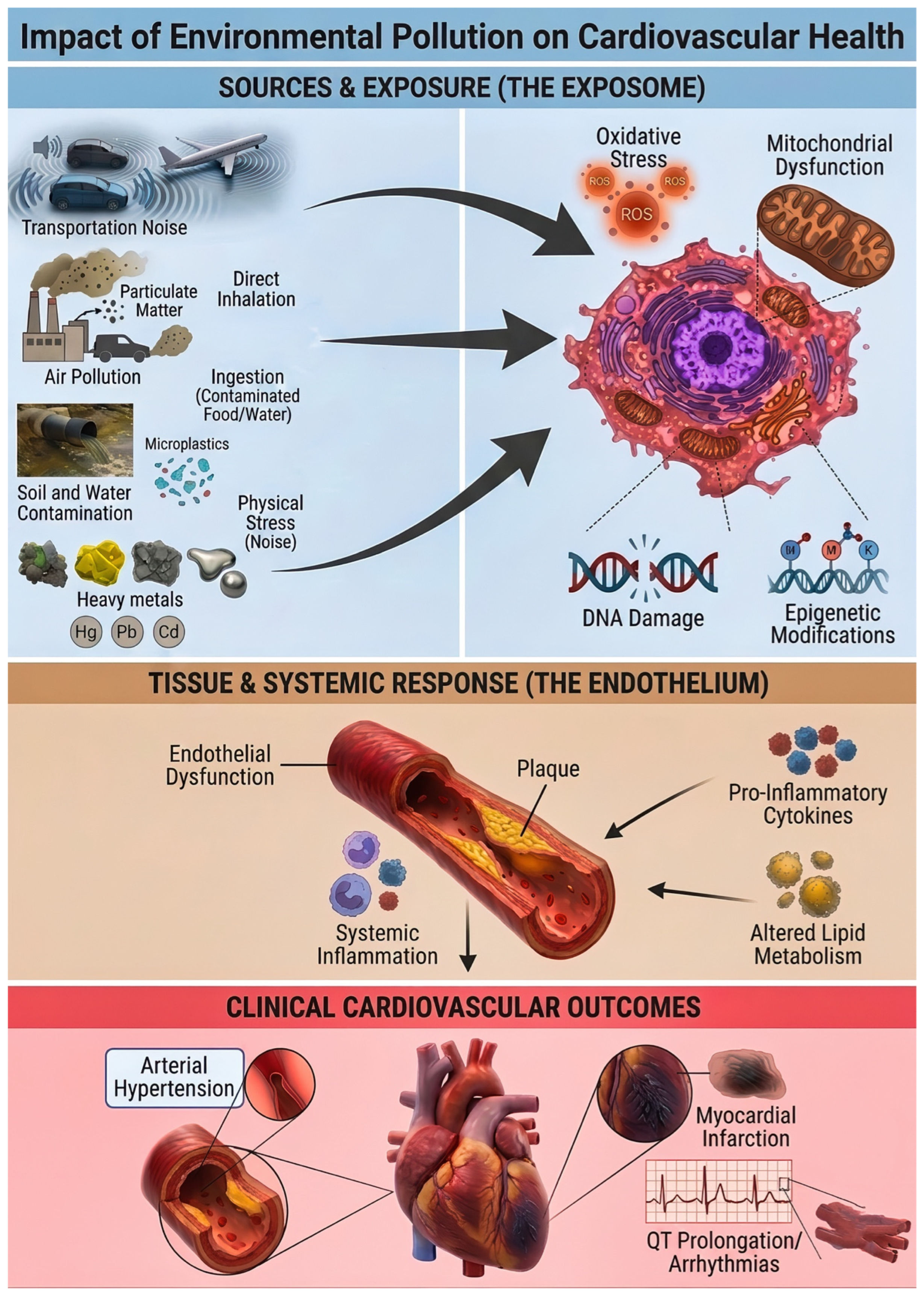
In recent years, the concept of the exposome has been widely discussed regarding the impact of environmental pollution on the body, including the cardiovascular system. This concept was first presented in the literature by Christopher Paul Wild [110]. He emphasizes the need to study the influence of environmental factors—not just genetic ones—in the epidemiology of various diseases. Genes only determine 25–30% of the aging process, lifespan, and diseases, including cardiovascular diseases [111]. To facilitate cardiovascular risk assessment, environmental hazards can be divided into four categories: airborne hazards, foodborne hazards, green spaces, and population activity levels. These categories are interrelated, but this grouping facilitates the assessment of environmental hazards for a specific individual. In this regard, water pollution and its impact on the cardiovascular system play a significant role. This impact is both direct and indirect through soil contamination and agricultural products. A summary of the impact of environmental pollution on the development of cardiovascular diseases is presented in Figure 3.
Figure 3. Summary of impact of environmental pollution on cardiovascular system.
Water 18 01299 g003

6. Conclusions

Water contamination with heavy metals, chemicals, and microplastics poses a significant threat to the cardiovascular system. Toxins present in drinking water can lead to serious illnesses, increasing the risk of hypertension, atherosclerosis, and heart muscle damage. Despite a growing number of studies confirming this correlation, public opinion continues to downplay the impact of the environment on public health. Therefore, governments and non-governmental institutions should be tasked with popularizing the One Health concept. This integrated, interdisciplinary approach recognizes that human health is closely linked to the state of the natural environment.

7. Limitations

The authors are aware of the limitations of the presented study. Because we are comparing a European country and a Central Asian country, there are significant social and environmental differences. This results in significant heterogeneity in the data. Collaboration between researchers from two different scientific communities also creates difficult-to-avoid differences in study oversight. This may lead to a certain reporting bias, which is difficult to avoid with this type of study design. Nevertheless, we believe that the beginning of our collaboration provides interesting comparative data. We will continue our research and address important environmental and health issues. This will have a positive impact on our societies.

Author Contributions

Conceptualization, J.S.; methodology, K.K.-W.; software, M.A.J.; validation, M.J., A.A. and Z.J.; formal analysis, U.M.; investigation, A.A. and R.K.; resources, A.A. and U.M.; data curation, J.S.; writing—original draft preparation, J.S.; writing—review and editing, A.A.; visualization, A.A. and U.M.; supervision, J.S. and K.K.-W.; project administration, J.S.; funding acquisition, J.S. All authors have read and agreed to the published version of the manuscript.

Funding

This research was partly funded by Jan Kochanowski University in Kielce, Kielce, Poland. Grant number 2026.16 and The APC was funded by revivers vouchers Janusz Sielski, Karol Kaziród-Wolski.

Data Availability Statement

The original contributions presented in this study are included in the article. Further inquiries can be directed to the corresponding author.

Acknowledgments

This manuscript was created as a result of cooperation between the National University of Uzbekistan named after Mirzo Ulugbek and Jan Kochanowski University of Kielce, Poland. Agreement signed in February 2024. and the National University of Uzbekistan named after Mirzo Ulugbek and the European Institute of Post-Graduate Education in Kielce, Kielce, Poland. Agreement signed in February 2024. During the preparation of this work, the authors used Gemini 3.1 Pro AI model from Google in the “nano banana” module to generate Figure 3 for the manuscript. This tool was utilized under the Google Terms of Service and applicable commercial licensing. After using this tool, all authors reviewed and edited the content as needed and take full responsibility for the content of the publication. Graphical abstract was created using figures adapted from Servier Medical Art (https://smart.servier.com), licensed under CC BY 4.0 (https://creativecommons.org/licenses/by/4.0/).

Conflicts of Interest

The authors declare no conflicts of interest.

References

  1. World Health Organization. Noncommunicable Diseases. Updated 2025. World Health Organization. Available online: https://www.who.int/news-room/fact-sheets/detail/noncommunicable-diseases (accessed on 31 October 2025).
  2. Rajagopalan, S.; Landrigan, P.J. Pollution and the heart. N. Engl. J. Med. 2021, 385, 1881–1892. [Google Scholar] [CrossRef]
  3. Fuller, R.; Landrigan, P.J.; Balakrishnan, K.; Bathan, G.; Bose-O’Reilly, S.; Brauer, M.; Caravanos, J.; Chiles, T.; Cohen, A.; Corra, L.; et al. Pollution and health: A progress update. Lancet Planet. Health 2022, 6, e535–e547. [Google Scholar] [CrossRef] [PubMed]
  4. Al-Kindi, S.; Paneni, F.; Brook, R.D.; Rajagopalan, S. Residual environmental risk in patients with cardiovascular disease: An overlooked paradigm. Eur. Heart J. 2023, 44, 4612–4614. [Google Scholar] [CrossRef]
  5. Münzel, T.; Lüscher, T.; Kramer, C.M.; Churchwell, K.; Mbakwem, A.; Rajagopalan, S. Environmental stressors and cardiovascular health: Acting locally for global impact in a changing world: A statement of the European Society of Cardiology, the American College of Cardiology, the American Heart Association, and the World Heart Federation. J. Am. Coll. Cardiol. 2026, 87, 1405–1413. [Google Scholar] [CrossRef]
  6. GBD 2019 Diabetes and Air Pollution Collaborators. Estimates, trends, and drivers of the global burden of type 2 diabetes attributable to PM2.5 air pollution, 1990-2019: An analysis of data from the Global Burden of Disease Study 2019. Lancet Planet. Health 2022, 6, e586–e600. [Google Scholar] [CrossRef]
  7. Munzel, T.; Sorensen, M.; Daiber, A. Transportation noise pollution and cardiovascular disease. Nat. Rev. Cardiol. 2021, 18, 619–636. [Google Scholar] [CrossRef] [PubMed]
  8. Münzel, T.; Hahad, O.; Lelieveld, J.; Aschner, M.; Nieuwenhuijsen, M.J.; Landrigan, P.J.; Daiber, A. Soil and water pollution and cardiovascular disease. Nat. Rev. Cardiol. 2025, 22, 71–89. [Google Scholar] [CrossRef]
  9. GB 3838-2002; Environmental Quality Standards for Surface Water. Ministry of Ecology and Environment of the PRC: Beijing, China, 2002.
  10. Directive 2000/60/EC of the European Parliament and of the Council of 23 October 2000 Establishing a Framework for Community Action in the Field of Water Policy. 2000. Available online: https://eur-lex.europa.eu/eli/dir/2000/60/oj/eng (accessed on 14 May 2026).
  11. Regulation of the Minister of Infrastructure of 25 June 2021 on the Classification of Ecological Status, Ecological Potential and Chemical Status and the Method for Classifying the Status of Surface Water Bodies, as Well as Environmental Quality Standards for Priority Substances. 2021. Available online: https://eli.gov.pl/api/acts/DU/2021/1475/text/O/D20211475.pdf (accessed on 14 May 2026).
  12. Ministry of Ecology, Environmental Protection and Climate Change of the Republic of Uzbekistan. National State of the Environment Report: Uzbekistan; International Institute for Sustainable Development: Winnipeg, MB, Canada, 2023. [Google Scholar]
  13. Fornasaro, S.; Ghezzi, L.; Arrighi, S.; Shukurov, N.; Petrov, M.; Tomei, A.; Petrini, R. Geochemistry and risk assessment of potentially toxic elements in surface river sediments (Chirchik-Akhangaran basin, Uzbekistan). Environ. Geochem. Health 2025, 47, 127. [Google Scholar] [CrossRef]
  14. Tomei, A.; Fornasaro, S.; Arrighi, S.; Ghezzi, L.; Cogorno, M.; Petrini, R.; Petrov, M.; Shukurov, N.; Giannarelli, S. Legacy, distribution and risk assessment of persistent organic pollutants in river sediments in a mixed sources area. Water Air Soil Pollut. 2025, 237, 133. [Google Scholar] [CrossRef]
  15. Khusanov, A.; Frank, Y.; Abduvalieva, M.; Yakhyoyev, A.; Sabirov, O.; Vorobiev, E.; Rakhmatullina, S.; Tashbaev, S.; Juraev, M.; Isaqov, I. Characteristics of microplastic pollution in the rivers of the Fergana Valley, Central Asia. Environ. Monit. Assess. 2025, 197, 896. [Google Scholar] [CrossRef]
  16. Khusanov, A.; Sabirov, O.; Frank, Y.; Vorobev, D.; Vorobev, E.; Rakhmatullina, S.; Tashbaev, S.; Mamatkarimova, S.; Yakhyoyev, A.; Juraev, M. Microplastic pollution of the Zrafshan river tributary in Samarkand and Navoi regions of the Republic of Uzbekistan. Green Anal. Chem. 2025, 12, 100200. [Google Scholar] [CrossRef]
  17. Bartrem, C.; Kurbanov, M.I.; Keller, B.D.; Fiori, A.; Von Lindern, I.; Khajiev, P.Z.; Rustamov, D.; Lee, J.; Steiner, M.; Paluaniyazova, Z. Organochlorine pesticides and salinity in Karakalpakstan, Uzbekistan: Environmental health risks associated with the Aral Sea crisis. Int. J. Environ. Res. Public Health 2025, 22, 1751. [Google Scholar] [CrossRef]
  18. Rajabova, N.; Sherimbetov, V.; Sadiq, R.; Aboukila, A.F. An assessment of collector-drainage water and groundwater: An application of CCME WQI model. Water 2025, 17, 2191. [Google Scholar] [CrossRef]
  19. Crosa, G.; Froebrich, J.; Nikolayenko, V.; Stefani, F.; Galli, P.; Calamari, D. Spatial and seasonal variations in the water quality of the Amu Darya River (Central Asia). Water Res. 2006, 40, 2237–2245. [Google Scholar] [CrossRef]
  20. Sadikova, U.; Usmanov, I.; Rakhimov, N.; Usmanov, S.; Kudratov, T.; Mirkhasilova, Z. River water quality Amudarya in territory of Karakalpakstan. E3S Web Conf. 2023, 401, 02008. [Google Scholar] [CrossRef]
  21. Kaya, C.; Ashraf, M.; Sarkar, B.; Bolan, N.; Rinklebe, J.; Ahmad, P. Nanoplastics in soil and aquatic ecosystems: Sources, impacts, and nature-based remediation strategies. Environ. Pollut. 2026, 395, 127723. [Google Scholar] [CrossRef] [PubMed]
  22. EFSA Panel on Contaminants in the Food Chain. Scientific opinion on arsenic in food. EFSA J. 2009, 7, 1351. [Google Scholar] [CrossRef]
  23. World Health Organization. United Nations Synthesis Report on Arsenic in Drinking Water; WHO Arsenic Report; World Health Organization: Geneva, Switzerland, 2001. [Google Scholar]
  24. Alaerts, G.J.; Khouri, N.; Kabir, B. Strategies to mitigate arsenic contamination of water supply. In Arsenic in Drinking Water: United Nations Synthesis Report on Arsenic in Drinking Water; World Bank Arsenic Report; The World Bank: Washington, DC, USA, 2001. [Google Scholar]
  25. Navas-Acien, A.; Sharrett, A.R.; Silbergeld, E.K.; Schwartz, B.S.; Nachman, K.E.; Burke, T.A. Arsenic exposure and cardiovascular disease: A systematic review of the epidemiologic evidence. Am. J. Epidemiol. 2005, 162, 1037–1049. [Google Scholar] [CrossRef]
  26. Wang, C.H.; Hsiao, C.K.; Chen, C.L.; Hsu, L.I.; Chiou, H.Y.; Chen, S.Y.; Hsueh, Y.M.; Wu, M.M.; Chen, C.J. A review of the epidemiologic literature on the role of environmental arsenic exposure and cardiovascular diseases. Toxicol. Appl. Pharmacol. 2007, 222, 315–326. [Google Scholar] [CrossRef]
  27. Alissa, E.M.; Ferns, G.A. Heavy metal poisoning and cardiovascular disease. J. Toxicol. 2011, 2011, 870125. [Google Scholar] [CrossRef]
  28. Jomova, K.; Valko, M. Advances in metal-induced oxidative stress and human disease. Toxicology 2011, 283, 65–87. [Google Scholar] [CrossRef]
  29. Cheng, T.J.; Chuu, J.J.; Chang, C.Y.; Tsai, W.C.; Chen, K.J.; Guo, H.R. Atherosclerosis induced by arsenic in drinking water in rats through altering lipid metabolism. Toxicol. Appl. Pharmacol. 2011, 256, 146–153. [Google Scholar] [CrossRef]
  30. States, J.C.; Srivastava, S.; Chen, Y.; Barchowsky, A. Arsenic and cardiovascular disease. Toxicol. Sci. 2009, 107, 312–323. [Google Scholar] [CrossRef]
  31. Chung, J.Y.; Yu, S.D.; Hong, Y.S. Environmental source of arsenic exposure. J. Prev. Med. Public Health 2014, 47, 253. [Google Scholar] [CrossRef]
  32. Khan, S.S.; Sharma, A.; Flora, S.J. Phytochemicals in the management of arsenic toxicity. Chem. Res. Toxicol. 2022, 35, 916–934. [Google Scholar] [CrossRef]
  33. Joint FAO/WHO Expert Committee on Food Additives. Safety Evaluation of Certain Food Additives and Contaminants; World Health Organization: Geneva, Switzerland, 2011. [Google Scholar]
  34. Schaefer, H.R.; Flannery, B.M.; Crosby, L.; Jones-Dominic, O.E.; Punzalan, C.; Middleton, K. A systematic review of adverse health effects associated with oral cadmium exposure. Regul. Toxicol. Pharmacol. 2022, 134, 105243. [Google Scholar] [CrossRef] [PubMed]
  35. Chowdhury, R.; Ramond, A.; O’Keeffe, L.M.; Shahzad, S.; Kunutsor, S.K.; Muka, T.; Gregson, J.; Willeit, P.; Warnakula, S.; Khan, H.; et al. Environmental toxic metal contaminants and risk of cardiovascular disease: Systematic review and meta-analysis. BMJ 2018, 362, k3310. [Google Scholar] [CrossRef]
  36. Bao, Q.J.; Zhao, K.; Guo, Y.; Wu, X.T.; Yang, J.C.; Yang, M.F. Environmental toxic metal contaminants and risk of stroke: A systematic review and meta-analysis. Environ. Sci. Pollut. Res. Int. 2022, 29, 32545–32565. [Google Scholar] [CrossRef]
  37. Cheng, Y.; Schwartz, J.; Vokonas, P.S.; Weiss, S.T.; Aro, A.; Hu, H. Electrocardiographic conduction disturbances in association with low-level lead exposure (the Normative Aging Study). Am. J. Cardiol. 1998, 82, 594–599. [Google Scholar] [CrossRef] [PubMed]
  38. He, X.; Sun, H.; Zhao, Y.; Fu, X.; Wang, M.; Liu, M.; Su, Y.; Hu, F.; Qin, P.; Zhang, M.; et al. Association of environmental metallic and metalloid contaminants with cardiovascular and all-cause mortality: An umbrella review of systematic reviews and meta-analyses. Eur. J. Prev. Cardiol. 2025, 32, 1815–1824. [Google Scholar] [CrossRef] [PubMed]
  39. Navas-Acien, A.; Guallar, E.; Silbergeld, E.K.; Rothenberg, S.J. Lead exposure and cardiovascular disease: A systematic review. Environ. Health Perspect. 2007, 115, 472–482. [Google Scholar] [CrossRef] [PubMed]
  40. Martin, D.; Glass, T.A.; Bandeen-Roche, K.; Todd, A.C.; Shi, W.; Schwartz, B.S. Association of blood lead and tibia lead with blood pressure and hypertension in a community sample of older adults. Am. J. Epidemiol. 2006, 163, 467–478. [Google Scholar] [CrossRef] [PubMed]
  41. Chen, C.C.; Yen, H.W.; Lo, Y.H.; Chu, Y.H.; Chiu, Y.W.; Chuang, H.Y. The association of prolonged QT interval on electrocardiography and chronic lead exposure. J. Occup. Environ. Med. 2013, 55, 614–619. [Google Scholar] [CrossRef] [PubMed]
  42. Obeng-Gyasi, E.; Armijos, R.X.; Weigel, M.M.; Filippelli, G.M.; Sayegh, M.A. Cardiovascular-related outcomes in US adults exposed to lead. Int. J. Environ. Res. Public Health 2018, 15, 759. [Google Scholar] [CrossRef]
  43. Tsao, D.A.; Yu, H.S.; Cheng, J.T.; Ho, C.K.; Chang, H.R. The change of beta-adrenergic system in lead-induced hypertension. Toxicol. Appl. Pharmacol. 2000, 164, 127–133. [Google Scholar] [CrossRef]
  44. Ferreira, G.; Santander, A.; Chavarría, L.; Cardozo, R.; Savio, F.; Sobrevia, L.; Nicolson, G.L. Functional consequences of lead and mercury exposomes in the heart. Mol. Asp. Med. 2022, 87, 101048. [Google Scholar] [CrossRef]
  45. Genchi, G.; Sinicropi, M.S.; Carocci, A.; Lauria, G.; Catalano, A. Mercury exposure and heart diseases. Int. J. Environ. Res. Public Health 2017, 14, 74. [Google Scholar] [CrossRef]
  46. Houston, M.C. Role of mercury toxicity in hypertension, cardiovascular disease, and stroke. J. Clin. Hypertens. 2011, 13, 621–627. [Google Scholar] [CrossRef]
  47. Fillion, M.; Mergler, D.; Sousa Passos, C.J.; Larribe, F.; Lemire, M.; Guimarães, J.R. A preliminary study of mercury exposure and blood pressure in the Brazilian Amazon. Environ. Health 2006, 5, 29. [Google Scholar] [CrossRef]
  48. Valera, B.; Dewailly, E.; Poirier, P. Cardiac autonomic activity and blood pressure among Nunavik Inuit adults exposed to environmental mercury: A cross-sectional study. Environ. Health 2008, 7, 29. [Google Scholar] [CrossRef]
  49. Valera, B.; Dewailly, E.; Poirier, P. Environmental mercury exposure and blood pressure among Nunavik Inuit adults. Hypertension 2009, 54, 981–986. [Google Scholar] [CrossRef]
  50. Valera, B.; Dewailly, E.; Poirier, P. Impact of mercury exposure on blood pressure and cardiac autonomic activity among Cree adults (James Bay, Quebec, Canada). Environ. Res. 2011, 111, 1265–1270. [Google Scholar] [CrossRef]
  51. Valera, B.; Muckle, G.; Poirier, P.; Jacobson, S.W.; Jacobson, J.L.; Dewailly, E. Cardiac autonomic activity and blood pressure among Inuit children exposed to mercury. Neurotoxicology 2012, 33, 1067–1074. [Google Scholar] [CrossRef]
  52. Valera, B.; Dewailly, E.; Poirier, P. Association between methylmercury and cardiovascular risk factors in a native population of Quebec (Canada): A retrospective evaluation. Environ. Res. 2013, 120, 102–108. [Google Scholar] [CrossRef]
  53. Ozarde, Y.; Purandare, D.; Deshmukh, S.; Gadhave, R. Heavy metals and cardiovascular health: Uncovering links and health challenges. J. Trace Elem. Med. Biol. 2025, 89, 127648. [Google Scholar] [CrossRef]
  54. Nguyen, H.D.; Oh, H.; Kim, M.S. Effects of heavy metals on hypertension during menopause: A Korean community-based cross-sectional study. Menopause 2021, 28, 1400–1409. [Google Scholar] [CrossRef] [PubMed]
  55. Li, W.; Huang, G.; Tang, N.; Lu, P.; Jiang, L.; Lv, J.; Qin, Y.; Lin, Y.; Xu, F.; Lei, D. Effects of heavy metal exposure on hypertension: A machine learning modeling approach. Chemosphere 2023, 337, 139435. [Google Scholar] [CrossRef]
  56. Lamas, G.A.; Bhatnagar, A.; Jones, M.R.; Mann, K.K.; Nasir, K.; Tellez-Plaza, M.; Ujueta, F.; Navas-Acien, A. Contaminant metals as cardiovascular risk factors: A scientific statement from the American Heart Association. J. Am. Heart Assoc. 2023, 12, e029852. [Google Scholar] [CrossRef]
  57. He, J.; Zhang, W.; Zhao, F.; Wang, M.; Wang, Z.; Liang, C.; Pan, J.; Jia, J.; Zhang, M. Investigation of the relationship between lead exposure in heavy metals mixtures and the prevalence of stroke: A cross-sectional study. BMC Public Health 2024, 24, 3474. [Google Scholar] [CrossRef] [PubMed]
  58. McGraw, K.E.; Schilling, K.; Glabonjat, R.A.; Galvez-Fernandez, M.; Domingo-Relloso, A.; Martinez-Morata, I.; Jones, M.R.; Nigra, A.; Post, W.S.; Kaufman, J. Urinary metal levels and coronary artery calcification: Longitudinal evidence in the Multi-Ethnic Study of Atherosclerosis. J. Am. Coll. Cardiol. 2024, 84, 1545–1557. [Google Scholar] [CrossRef] [PubMed]
  59. Yen, C.C.; Chen, H.H.; Hsu, Y.T.; Tseng, C.J.; Lin, C.H. Effects of heavy metals in acute ischemic stroke patients: A cross-sectional study. Medicine 2022, 101, e28973. [Google Scholar] [CrossRef]
  60. Lin, Z.; Dong, Y.; Di, X.; Bai, Y.; Tang, J.; Lai, G.; Wang, S.; Wang, X.; Liu, Y.; Zhao, Y. Association between heavy metal exposure and heart failure incidence and mortality: Insights from NHANES data (2003-2018). BMC Public Health 2025, 25, 1935. [Google Scholar] [CrossRef]
  61. Nasrollahzadeh, M.; Nezafat, Z.; Gorab, M.G.; Sajjadi, M. Recent progresses in graphene-based (photo)catalysts for reduction of nitro compounds. Mol. Catal. 2020, 484, 110758. [Google Scholar] [CrossRef]
  62. Haleem, A.; Shafiq, A.; Chen, S.Q.; Nazar, M. A comprehensive review on adsorption, photocatalytic and chemical degradation of dyes and nitro-compounds over different kinds of porous and composite materials. Molecules 2023, 28, 1081. [Google Scholar] [CrossRef] [PubMed]
  63. Mansour, C.; Guibbolini, M.; Rouane Hacene, O.; Saidane Mosbahi, D.; Risso-de Faverney, C. Oxidative stress and damage biomarkers in clam Ruditapes decussatus exposed to a polluted site: The reliable biomonitoring tools in hot and cold seasons. Arch. Environ. Contam. Toxicol. 2020, 78, 478–494. [Google Scholar] [CrossRef]
  64. Lind, L.; Lind, P.M. Can persistent organic pollutants and plastic-associated chemicals cause cardiovascular disease? J. Intern. Med. 2012, 271, 537–553. [Google Scholar] [CrossRef]
  65. Tang, X.; Ma, J.; Liu, P.; Yu, S.; Ren, X.; Zhu, W.; Chen, X.; Ge, Y.; Huang, H.; Liu, J.; et al. Urinary neonicotinoid exposure and its association with hypertension and dyslipidemia among the elderly: A cross-sectional study in Shenzhen, China. Chemosphere 2025, 370, 143973. [Google Scholar] [CrossRef] [PubMed]
  66. Gustavsson, P.; Plato, N.; Hallqvist, J.; Hogstedt, C.; Lewné, M.; Reuterwall, C.; Schéele, P. A population-based case-referent study of myocardial infarction and occupational exposure to motor exhaust, other combustion products, organic solvents, lead, and dynamite. Epidemiology 2001, 12, 222–228. [Google Scholar] [CrossRef]
  67. Osman, A.I.; Hosny, M.; Eltaweil, A.S.; Omar, S.; Elgarahy, A.M.; Farghali, M.; Yap, P.S.; Wu, Y.S.; Nagandran, S.; Batumalaie, K.; et al. Microplastic sources, formation, toxicity and remediation: A review. Environ. Chem. Lett. 2023, 21, 2129–2169. [Google Scholar] [CrossRef]
  68. Bao, W.; Liu, B.; Rong, S.; Dai, S.Y.; Trasande, L.; Lehmler, H.J. Association between bisphenol A exposure and risk of all-cause and cause-specific mortality in US adults. JAMA Netw. Open. 2020, 3, e2011620. [Google Scholar] [CrossRef]
  69. Ramadan, M.; Cooper, B.; Posnack, N.G. Bisphenols and phthalates: Plastic chemical exposures can contribute to adverse cardiovascular health outcomes. Birth Defects Res. 2020, 112, 1362–1385. [Google Scholar] [CrossRef] [PubMed]
  70. Bae, S.; Hong, Y.C. Exposure to bisphenol A from drinking canned beverages increases blood pressure: Randomized crossover trial. Hypertension 2015, 65, 313–319. [Google Scholar] [CrossRef]
  71. Jaimes, R., 3rd; McCullough, D.; Siegel, B.; Swift, L.; McInerney, D.; Hiebert, J.; Perez-Alday, E.A.; Trenor, B.; Sheng, J.; Saiz, J.; et al. Plasticizer interaction with the heart: Chemicals used in plastic medical devices can interfere with cardiac electrophysiology. Circ. Arrhythm. Electrophysiol. 2019, 12, e007294. [Google Scholar] [CrossRef]
  72. Marfella, R.; Prattichizzo, F.; Sardu, C.; Fulgenzi, G.; Graciotti, L.; Spadoni, T.; D’Onofrio, N.; Scisciola, L.; La Grotta, R.; Frigé, C. Microplastics and nanoplastics in atheromas and cardiovascular events. N. Engl. J. Med. 2024, 390, 900–910. [Google Scholar] [CrossRef] [PubMed]
  73. Wang, S.; Yan, K.; Dong, Y.; Chen, Y.; Song, J.; Chen, Y.; Liu, X.; Qi, R.; Zhou, X.; Zhong, J.; et al. The influence of microplastics on hypertension-associated cardiovascular injury via the modulation of gut microbiota. Environ. Pollut. 2025, 368, 125760. [Google Scholar] [CrossRef] [PubMed]
  74. Cui, C.; Guo, Z.; Liu, Y.; Han, N.; Song, J.; Chen, Y.; Zheng, Y.; Sheng, C.; Balmer, L.; Li, H.; et al. Tissue-specific distribution of microplastics in human blood and carotid plaques: A paired sample analysis. Environ. Int. 2025, 203, 109743. [Google Scholar] [CrossRef]
  75. Yang, Y.; Zhang, F.; Jiang, Z.; Du, Z.; Liu, S.; Zhang, M.; Jin, Y.; Qin, Y.; Yang, X.; Wang, C.; et al. Microplastics are associated with elevated atherosclerotic risk and increased vascular complexity in acute coronary syndrome patients. Part. Fibre Toxicol. 2024, 21, 34. [Google Scholar] [CrossRef]
  76. Wang, T.; Yi, Z.; Liu, X.; Cai, Y.; Huang, X.; Fang, J.; Shen, R.; Lu, W.; Xiao, Y.; Zhuang, W.; et al. Multimodal detection and analysis of microplastics in human thrombi from multiple anatomically distinct sites. EBioMedicine 2024, 103, 105118. [Google Scholar] [CrossRef]
  77. Wang, Y.; Wang, X.; Gan, B.; Jia, T.; Xu, T.; Xu, H. The “Butterfly Effect” of heart failure: Induced by the combination of polylactic acid nanoplastics and copper from the perspective of gut microbiome. Chem. Biol. Interact. 2025, 421, 111769. [Google Scholar] [CrossRef]
  78. Gomez-Delgado, F.; Raya-Cruz, M.; Romero-Cabrera, J.L.; Perez-Martinez, P. Environmental pollution and cardiovascular health: Challenges and new perspectives. Clin. Investig. Arterioscler. 2025, 38, 500802. [Google Scholar] [CrossRef]
  79. Mol, K.; Mulder, I.A.; van Bavel, E. Micro-embolic events and their clearing in the brain: A narrative review. Acta Physiol. 2025, 241, e70098. [Google Scholar] [CrossRef] [PubMed]
  80. Posnack, N.G. Plastics and cardiovascular disease. Nat. Rev. Cardiol. 2021, 18, 69–70. [Google Scholar] [CrossRef] [PubMed]
  81. Cox, D.T.C.; Shanahan, D.F.; Hudson, H.L.; Plummer, K.E.; Siriwardena, G.M.; Fuller, R.A.; Anderson, K.; Hancock, S.; Gaston, K.J. Doses of neighborhood nature: The benefits for mental health of living with nature. Bioscience 2017, 67, 147–155. [Google Scholar] [CrossRef]
  82. Sustainability Directory. How Does Air Pollution Affect Ecosystems? Sustainability Directory. 2025. Available online: https://pollution.sustainability-directory.com/question/how-does-air-pollution-affect-ecosystems/ (accessed on 14 May 2026).
  83. Pajewski, T. Zanieczyszczenie wody jako negatywny efekt działalności rolniczej. Rocz. Nauk. 2016, 18, 191–195. [Google Scholar]
  84. Czajkowska, A. Stopień zanieczyszczenia związkami biogennymi płytkich wód podziemnych w zagospodarowanej rolniczo części zlewni Bierawki. Gór. Geol. 2010, 5, 91–103. [Google Scholar]
  85. Wojtkowska, M.; Bojanowski, D. Influence of catchment use of river water pollution by forms of phosphorus. Annu. Set. Environ. Prot. 2018, 20, 887–904. [Google Scholar]
  86. Dodds, W.K.; Smith, V.H. Nitrogen, phosphorus, and eutrophication in streams. Inland Waters 2016, 6, 155–164. [Google Scholar] [CrossRef]
  87. Osman, K.T. Soils: Principles, Properties and Management; Springer: Berlin/Heidelberg, Germany, 2013. [Google Scholar] [CrossRef]
  88. World Health Organization. Guidelines for Drinking-Water Quality: Fourth Edition Incorporating the First and Second Addenda; World Health Organization: Geneva, Switzerland, 2022. [Google Scholar]
  89. Safe Drinking Water Act; 42 USC §300f et seq.; The U.S. Congress: Washington, DC, USA, 1974.
  90. Ministry of Ecology and Environment. Environmental Quality Standard for Surface Water; Ministry of Ecology and Environment: Beijing, China, 2002.
  91. Ramowa Dyrektywa Wodna 2000. Dyrektywa 2000/60/WE Parlamentu Europejskiego i Rady z Dnia 23 Października 2000 r. Available online: https://kszoszk.wordpress.com/wp-content/uploads/2013/12/ramowa_dyrektywa_wodna.pdf (accessed on 14 May 2026).
  92. Paganelli, M.; De Palma, G.; Apostoli, P. Esposoma: Da intuizione a linea di ricerca obbligata nelle Scienze Mediche Occupazionali e Ambientali [Exposome: From an intuition to a mandatory research field in occupational and environmental medicine]. G. Ital. Med. Lav. Ergon. 2017, 39, 68–71. [Google Scholar]
  93. Vrijheid, M. The exposome: A new paradigm to study the impact of environment on health. Thorax 2014, 69, 876–878. [Google Scholar] [CrossRef]
  94. Daiber, A.; Kuntic, M.; Lelieveld, J.; Hahad, O.; Münzel, T. Das Exposom charakterisiert die Auswirkungen unserer Umwelt auf Stoffwechsel und Gesundheit. Aktuelle Kardiol. 2021, 10, 502–508. [Google Scholar] [CrossRef]
  95. Lozano, R.; Naghavi, M.; Foreman, K.; Lim, S.; Shibuya, K.; Aboyans, V.; Abraham, J.; Adair, T.; Aggarwal, R.; Ahn, S.Y.; et al. Global and regional mortality from 235 causes of death for 20 age groups in 1990 and 2010: A systematic analysis for the Global Burden of Disease Study 2010. Lancet 2012, 380, 2095–2128. [Google Scholar] [CrossRef]
  96. Landrigan, P.J.; Fuller, R.; Acosta, N.J.R.; Adeyi, O.; Arnold, R.; Basu, N.N.; Baldé, A.B.; Bertollini, R.; Bose-O’Reilly, S.; Boufford, J.I.; et al. The Lancet Commission on pollution and health. Lancet 2018, 391, 462–512. [Google Scholar] [CrossRef]
  97. GBDRF Collaborators. Global burden of 87 risk factors in 204 countries and territories, 1990-2019: A systematic analysis for the Global Burden of Disease Study 2019. Lancet 2020, 396, 1223–1249. [Google Scholar] [CrossRef] [PubMed]
  98. World Health Organization/The Global Health Observatory. Noncommunicable Diseases: Mortality; WHO Global Health Observatory: Geneva, Switzerland, 2011; Available online: https://iris.who.int/items/0b03d158-6900-44d8-8719-c3ed0303bc1d (accessed on 14 May 2026).
  99. GBD DALYs and HALE Collaborators. Global, regional, and national disability-adjusted life-years (DALYs) for 315 diseases and injuries and healthy life expectancy (HALE), 1990-2015: A systematic analysis for the Global Burden of Disease Study 2015. Lancet 2016, 388, 1603–1658. [Google Scholar] [CrossRef]
  100. Daiber, A.; Rajagopalan, S.; Kuntic, M.; Münzel, T. Cardiovascular risk posed by the exposome. Atherosclerosis 2025, 405, 119222. [Google Scholar] [CrossRef]
  101. Tellez-Plaza, M.; Jones, M.R.; Dominguez-Lucas, A.; Guallar, E.; Navas-Acien, A. Cadmium exposure and clinical cardiovascular disease: A systematic review. Curr. Atheroscler. Rep. 2013, 15, 356. [Google Scholar] [CrossRef]
  102. Cosselman, K.E.; Navas-Acien, A.; Kaufman, J.D. Environmental factors in cardiovascular disease. Nat. Rev. Cardiol. 2015, 12, 627–642. [Google Scholar] [CrossRef] [PubMed]
  103. Hu, X.F.; Lowe, M.; Chan, H.M. Mercury exposure, cardiovascular disease, and mortality: A systematic review and dose-response meta-analysis. Environ. Res. 2021, 193, 110538. [Google Scholar] [CrossRef]
  104. Su, T.C.; Hwang, J.J.; Sun, C.W.; Wang, S.L. Urinary phthalate metabolites, coronary heart disease, and atherothrombotic markers. Ecotoxicol. Environ. Saf. 2019, 173, 37–44. [Google Scholar] [CrossRef]
  105. Melzer, D.; Osborne, N.J.; Henley, W.E.; Cipelli, R.; Young, A.; Money, C.; McCormack, P.; Luben, R.; Khaw, K.T.; Wareham, N.J.; et al. Urinary bisphenol A concentration and risk of future coronary artery disease in apparently healthy men and women. Circulation 2012, 125, 1482–1490. [Google Scholar] [CrossRef] [PubMed]
  106. Mattsson, K.; Rignell-Hydbom, A.; Holmberg, S.; Thelin, A.; Jönsson, B.A.; Lindh, C.H.; Sehlstedt, A.; Rylander, L. Levels of perfluoroalkyl substances and risk of coronary heart disease: Findings from a population-based longitudinal study. Environ. Res. 2015, 142, 148–154. [Google Scholar] [CrossRef] [PubMed]
  107. Winquist, A.; Steenland, K. Modeled PFOA exposure and coronary artery disease, hypertension, and high cholesterol in community and worker cohorts. Environ. Health Perspect. 2014, 122, 1299–1305. [Google Scholar] [CrossRef] [PubMed]
  108. Lind, P.M.; Lind, L. Are persistent organic pollutants linked to lipid abnormalities, atherosclerosis and cardiovascular disease? A review. J. Lipid Atheroscler. 2020, 9, 334–348. [Google Scholar] [CrossRef]
  109. Wild, C.P. Complementing the genome with an “exposome”: The outstanding challenge of environmental exposure measurement in molecular epidemiology. Cancer Epidemiol. Biomark. Prev. 2005, 14, 1847–1850. [Google Scholar] [CrossRef]
  110. vB Hjelmborg, J.; Iachine, I.; Skytthe, A.; Vaupel, J.W.; McGue, M.; Koskenvuo, M.; Kaprio, J.; Pedersen, N.L.; Christensen, K. Genetic influence on human lifespan and longevity. Hum. Genet. 2006, 119, 312–321. [Google Scholar] [CrossRef]
  111. Reeves, F.; Potter, B.J. Toward a cardio-environmental risk model: Environmental determinants of cardiovascular disease. Can. J. Cardiol. 2023, 39, 1166–1181. [Google Scholar] [CrossRef]
Figure 1. Schematic study-selection process for the present comparative narrative review on water pollution and cardiovascular health in Poland and Uzbekistan. The diagram follows the structural logic of the PRISMA 2020 flow chart, used here as a transparency-enhancing framework rather than as a registered systematic review protocol. Records were identified through PubMed, Scopus, Web of Science, and Google Scholar, complemented by authoritative gray literature and reference-list back-tracing. After duplicate removal and sequential title/abstract and full-text screening, n = 117 publications were retained for the qualitative thematic synthesis, organized along three mechanistic axes (heavy metals; nitrogen and nitroaromatic compounds; microplastics, nanoplastics, and plastic-derived chemicals) and one comparative regional axis (Poland vs. Uzbekistan).
Water 18 01299 g001
Figure 2. Overall scheme of water pollution in Uzbekistan.
Water 18 01299 g002
Table 1. Inclusion and exclusion criteria for articles considered in this comparative narrative review.
Inclusion CriteriaExclusion Criteria
Peer-reviewed articles published between January 2019 and February 2026, indexed in major bibliographic databases (PubMed, Scopus, Web of Science, Google Scholar).Articles published before 2019 or beyond the search closure date, except for pivotal historical references essential for methodological or regulatory context.
Publications subjected to formal editorial and peer-review processes, including high-impact cardiovascular and environmental-health journals (e.g., Nature Reviews Cardiology, NEJM, The Lancet Planetary Health, Circulation, European Heart Journal, JACC, Environment International, Environmental Pollution, Hypertension).Editorials, letters to the editor, commentaries, conference abstracts and proceedings lacking full-text availability, and content originating from non-indexed or predatory journals.
Studies explicitly addressing the cardiovascular consequences of waterborne contaminants, including heavy metals (arsenic, cadmium, lead, mercury), nitrogen-bearing compounds (nitrates, nitrites, nitroaromatics), microplastics, nanoplastics, bisphenols, phthalates, perfluoroalkyl substances, and other persistent organic pollutants.Studies focused exclusively on environmental matrices unrelated to water (e.g., ambient air pollution, occupational dust, indoor pollutants) or on outcomes outside the cardiovascular domain.
Original investigations: randomized controlled trials, prospective and retrospective cohort studies, cross-sectional epidemiological analyses, case–control studies, and controlled experimental in vivo and in vitro investigations.Publications with insufficient methodological rigor, lacking a clearly defined study design, sample characterization, or analytical strategy.
Systematic reviews, umbrella reviews, meta-analyses, and structured narrative reviews providing pooled effect estimates, dose–response modeling, or coherent mechanistic synthesis.Narrative summaries that merely reproduce previously published findings without critical appraisal, methodological scrutiny, or original interpretive contribution.
Articles aligned with current international clinical and regulatory frameworks (WHO Guidelines for Drinking-water Quality, EU Water Framework Directive 2000/60/EC, US Clean Water Act, US Safe Drinking Water Act, Chinese GB 3838-2002 [9], and ESC/AHA/ACC/WHF environmental statements).Articles disregarding contemporary regulatory standards or relying on superseded environmental quality benchmarks no longer endorsed by competent authorities.
Authoritative gray literature, including reports issued by the World Health Organization, the European Environment Agency, the Polish Chief Inspectorate of Environmental Protection (Surface-Water Status Reports 2019–2024), and the Ministry of Ecology, Environmental Protection and Climate Change of the Republic of Uzbekistan.Non-validated online sources, advocacy blogs, commercial white papers, and unverified institutional documents lacking traceable authorship.
Studies addressing the cardiovascular and exposomic relevance of water pollution in Poland, Uzbekistan, or comparable Central-European and Central-Asian settings, including transboundary basins (Amu Darya, Syr Darya, Vistula) and the Aral Sea region.Country-specific investigations whose ecological, regulatory, or demographic context renders the findings non-transferable to the Polish–Uzbek comparative framework adopted in this review.
Articles published in the English language with full-text availability for critical appraisal and synthesis.Publications in languages other than English without an authoritative translation, or articles whose full text could not be retrieved despite reasonable efforts.
Table 2. Number of people hospitalized due to cardiovascular diseases in Poland in 2014–2021 per 100,000 inhabitants.
20142015201620172018201920202021
Number of hospitalized82386087396410071022765737
Percentage0.820.860.870.961.01.020.770.74
Table 3. Number of people hospitalized due to cardiovascular diseases in Uzbekistan in 1991–2024 per 100,000 inhabitants.
1991200020052010201520202024
Number of hospitalized1014120914521630233128514628
Percentage1.011.211.451.632.332.854.63
Table 4. Pathophysiological Mechanisms and Clinical Implications of Heavy Metal Exposure on Cardiovascular Health.
Toxic ElementPrimary Exposure SourcesPathophysiological MechanismsTarget Biological Systems & ProcessesClinical Outcomes & Cardiovascular Pathology
Arsenic (As)Drinking water (>50 µg/L), foodOxidative stress; inflammation; vascular remodeling; apoptosisVascular endothelium; Smooth muscle cells; Skin, Liver, LungsAtherosclerosis, Coronary Heart Disease (CHD), Ischemic Stroke, Peripheral Artery Disease (PAD)
Cadmium (Cd)Food ingestionRenal tubular degeneration; calcium metabolism disruptionRenal cortex; Bone mineral density; Vascular endotheliumIschemic Heart Disease (RR: 1.25); Stroke (RR: 1.30); Increased all-cause mortality (RR: 1.40)
Lead (Pb)Water contamination; occupationBeta-adrenergic system dysregulation; CRP activation; lipid alterationsAutonomic nervous system; Aortic/renal beta-receptors; Left ventricleHypertension, Left Ventricular Hypertrophy, Cardiac Arrhythmias, PAD
Mercury (Hg)Water pollution; food chainPlatelet-leukocyte aggregates (PLA); platelet activation; prothrombotic stateCardiomyocytes; Vascular endothelial cells; Hematological systemThrombosis, Hypertension, decreased Heart Rate Variability (HRV), vasculitis
Cobalt (Co)Environmental/industrial pollutionOxidative stress and endothelial dysfunctionSystemic vasculature; Intracellular signaling pathwaysHypertension and subclinical atherosclerosis
Table 5. Pathophysiological Mechanisms and Clinical Implications of Microplastic Exposure on Cardiovascular Health.
Exposure Source/AgentPathophysiological MechanismsTargeted Biological StructuresClinical Outcomes & Pathologies
Environmental Microplastics (PE, PVC)Physical accumulation in arterial walls; promotion of plaque instability.Carotid atherosclerotic plaquesAtherosclerosis: Increased risk of myocardial infarction and stroke (HR: 4.53).
Bisphenol A (BPA)(Leaching from bottles/containers)Endocrine disruption; rapid systemic absorption and hormonal interference.Endothelium; Autonomic nervous systemHypertension: Acute blood pressure elevation; long-term risk of Coronary Heart Disease (CHD).
PhthalatesDirect cardiodepressant action; interference with electrical signaling.Atrioventricular node; Atrial myocardiumArrhythmias: Bradycardia, impaired contractility, and negative dromotropic effects.
Oral Ingestion (Food/Water chain)Disruption of the gut-vascular axis; intestinal barrier compromise (leaky gut).Gut microbiota; Intestinal mucosal barrierSystemic Hypertension: Mediated by dysbiosis and secondary metabolic inflammation.
Microplastic-Metal Co-exposure (e.g., PLA + Copper)Synergistic oxidative stress; protein carbonylation; DNA damage.Cardiomyocytes; FibroblastsStructural Heart Disease: Significant cardiac hypertrophy and myocardial fibrosis.
Thrombus EntrapmentQualitative/quantitative modification of clot structure; physical nidus for aggregation.Intravascular fibrin/platelet matricesThrombotic Diseases: Acute Coronary Syndrome (ACS), Ischemic Stroke, and Deep Vein Thrombosis (DVT).
General Plastic ParticulatesInduction of chronic systemic inflammation (pro-inflammatory cytokines); oxidative stress.Systemic vasculature; Sinoatrial nodeAtrial Fibrillation (AF): Acceleration of arrhythmic remodeling and increased embolic potential.
Disclaimer/Publisher’s Note: The statements, opinions and data contained in all publications are solely those of the individual author(s) and contributor(s) and not of MDPI and/or the editor(s). MDPI and/or the editor(s) disclaim responsibility for any injury to people or property resulting from any ideas, methods, instructions or products referred to in the content.