Article

Depth-Dependent Variations in Fragmentation and Shear Strength of Gravelly Soil Under Shallow Overburden and Groundwater Conditions

1
School of Architecture and Civil Engineering, Chengdu University, Chengdu 610106, China
2
Sichuan Provincial Seventh Geological Brigade, Leshan 614000, China
3
State Key Laboratory of Geohazard Prevention and Geoenvironment Protection, Chengdu University of Technology, Chengdu 610051, China
4
Major Hazard Monitoring and Emergency Response Key Laboratory of Sichuan Province, Chengdu University, Chengdu 610106, China
5
Sichuan Provincial Education Department Engineering Research Center for Unsaturated Soil Mechanics and Engineering Technology, Chengdu 610106, China
*
Author to whom correspondence should be addressed.
Water 2026, 18(11), 1288; https://doi.org/10.3390/w18111288
Submission received: 29 April 2026 / Revised: 20 May 2026 / Accepted: 22 May 2026 / Published: 26 May 2026

Abstract

The mechanical behavior of gravelly soils in shallow overburden environments is significantly modulated by groundwater fluctuations, which govern the in situ moisture distribution and, consequently, control particle fragmentation processes and the evolution of shear strength. Fragmentation was quantitatively characterized through particle size distribution, fractal dimension, mean particle size, and statistical parameters derived from Weibull and generalized extreme value distributions. Shear strength was evaluated via consolidated–drained triaxial tests. The results demonstrate a clear depth dependency of the soil’s physical and mechanical properties. As the sampling depth increased from 3.0 m to 26.5 m, the natural moisture content decreased from 2.89% to 0.77%. Fractal analysis reveals that the fractal dimension of the particles increased from 2.304 to 2.671, reflecting an intensified fragmentation process at greater depths. Triaxial test results indicate that with increasing depth, the internal friction angle increased from 28.63° to 40°, while the cohesion decreased from 18.59 kPa to 5.47 kPa. These quantitative variations suggest that the coupled effects of groundwater variation and overburden pressure collectively govern the evolution of fragmentation characteristics and the divergent trends observed in shear strength components.

1. Introduction

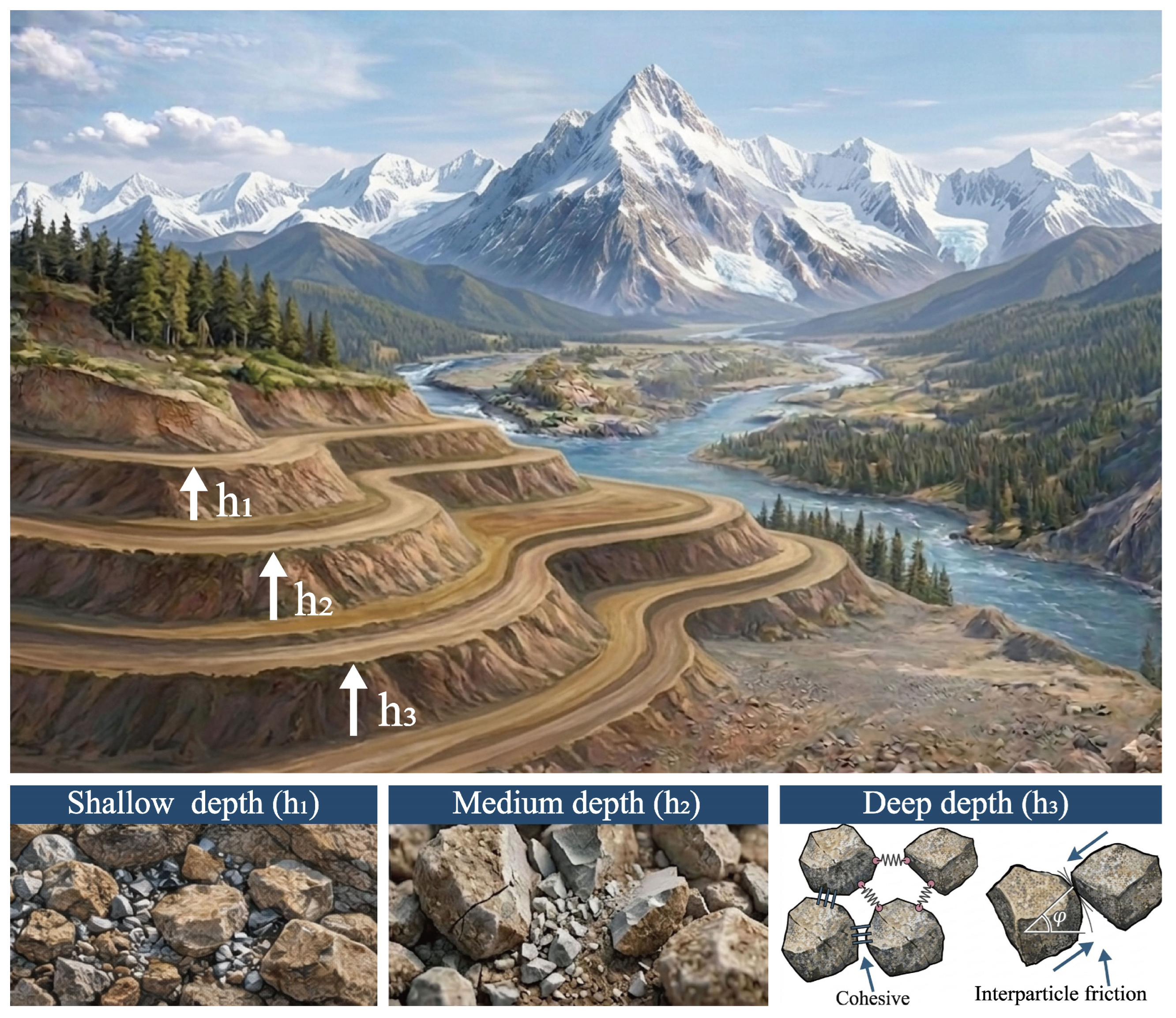
Gravel soils, characterized by their coarse-grained texture and heterogeneous particle size distribution, constitute a critical geomaterial in geotechnical engineering applications such as embankment construction, slope stability assessment, and foundation design [1]. The mechanical behavior of these soils under external loading is governed by a complex interplay of frictional resistance, particle interlocking, and stress-induced dilation, each of which demonstrates pronounced sensitivity to the overburden pressure associated with varying burial depths [2,3]. Significant variations in the physical and mechanical properties of gravelly soils are frequently observed between shallow and deeper strata, attributable to differences in overburden stress, moisture conditions, and depositional history, as shown in Figure 1. Elucidating the relationship between particle fragmentation characteristics and the evolution of shear strength under different overburden depths is therefore essential for evaluating the long-term performance of gravelly fills and for mitigating geohazards induced by particle breakage.
Extensive laboratory experimentation has been conducted to investigate the mechanical response of gravelly soils, yielding considerable insight into their fundamental properties [4,5,6]. These investigations have substantially advanced the understanding of particle fragmentation, a critical mechanism in the constitutive modeling of coarse-grained geomaterials [7,8,9]. The shear behavior of granular soils has been strongly correlated with particle size distribution, establishing a clear linkage between grain size and susceptibility to breakage [10,11,12]. To examine the interaction between particle morphology and fragmentation, a computational framework integrating peridynamics with non-smooth contact dynamics has been developed, providing valuable perspectives on their coupled response [13]. Concurrent research employing triaxial testing has evaluated the combined influence of grain size and confining pressure on the fragmentation characteristics of rockfill materials through systematic particle size reduction analysis [14]. Moreover, energy dissipation due to particle breakage at grain contacts has been incorporated into analytical models, revealing its considerable influence on the shear strength of sandy soils [15]. Drained triaxial shear tests under varying axial strains and confining pressures have further demonstrated a strong correlation between particle shape evolution and fragmentation behavior in carbonate sands [16,17]. Contemporary characterization of fragmentation in geotechnical materials predominantly relies on statistical approaches, with fractal models based on particle size distributions being widely employed. Recent studies have applied such models to establish relationships between fractal dimension and particle breakage rates in coarse-grained soils [18,19]. Comprehensive investigations of rockfill materials under varying gradations, densities, and confining pressures have delineated intrinsic connections among fractal dimension, gradation, and confinement [20,21]. Furthermore, fractal theory has been utilized to optimize particle gradations, thereby enhancing interparticle packing efficiency and underscoring the pivotal role of gradation in governing the mechanical properties of granular soils [22]. Furthermore, recent studies employing catastrophe theory and analytical frameworks based on energy instability have further revealed the abrupt failure mechanisms in geomaterials under coupled stress and environmental conditions, providing a theoretical reference for quantifying progressive and catastrophic fragmentation behaviors [23].
The mechanical properties of gravelly soils demonstrate considerable variability with depth, as differential overburden conditions induce distinct alterations in soil behavior. Meanwhile, multi-factor coupled numerical studies have revealed that seepage fields and stress redistribution jointly control the structural stability of underground strata [24]. To elucidate the effects of burial depth on the physico-mechanical characteristics of such materials, a series of laboratory investigations have been conducted [25,26,27]. Studies examining the relationship between dynamic fracture toughness and dynamic tensile strength in rock specimens retrieved from varying depths have revealed depth-dependent mechanical responses [28]. Research on crack propagation and fracture toughness under different burial conditions further indicates that the anisotropy of rock fracture toughness evolves with increasing depth [29]. Additionally, investigations on shale have demonstrated a pronounced influence of burial depth on fractal dimensions, with both fractal dimension and pore structure complexity exhibiting an increasing trend as depth increases [30]. In the context of clastic sandstones, coupled elastoplastic damage mechanics under varying burial depths have been analyzed, clarifying the role of depth on key mechanical parameters [31]. Moreover, water-related geological processes such as immersion have been proven to significantly alter the mechanical properties, hydrochemical characteristics, and structural stability of cemented soils, further complicating the depth-dependent mechanical evolution of geomaterials [32,33].
Existing research encompasses the evaluation of fragmentation parameters, correlations linking particle size distribution to shear response, and fractal models derived from statistical theory that analyse associated geotechnical properties. Nevertheless, disintegration characteristics and shear strength of gravelly soils subjected to shallow overburden pressures remain inadequately explored, particularly in depth ranges where confining stresses generated by overlying strata are limited. The present study investigates the evolution of fragmentation behaviours and shear strength for sampling gravelly soils across burial depths from 3.0 m to 26.5 m. Novel contributions of this work include characterising particle size distribution transitions via Fractal, Weibull, and GEV models, quantifying the influences of natural moisture loss on cohesion and internal friction angle, and establishing mechanical relationships between burial depth and shear strength parameters. Findings obtained from this research provide a theoretical basis for stability analysis of shallow-buried structures and slopes under variable hydrogeological conditions.

2. Methodology

2.1. Specimen Preparation

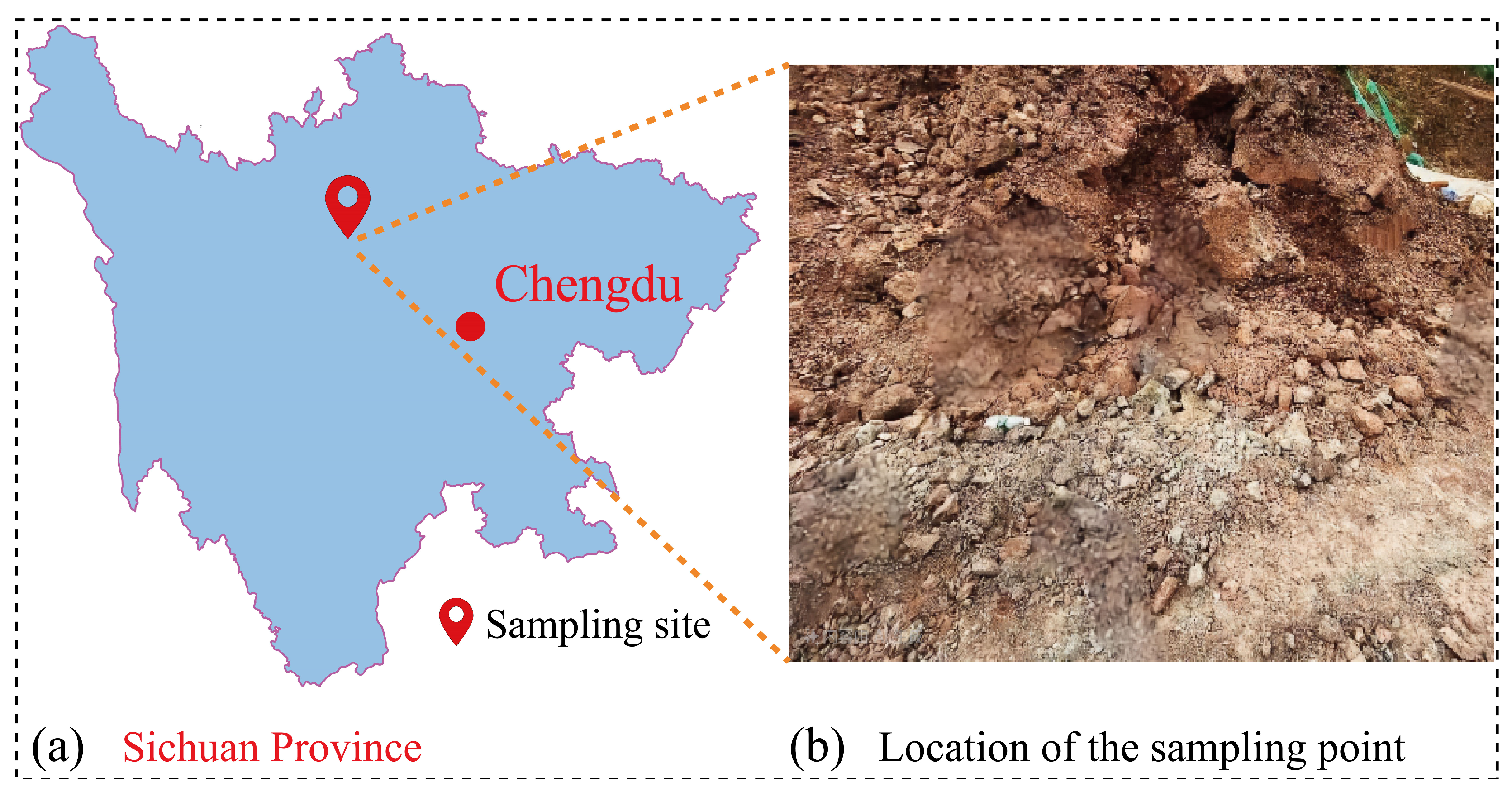
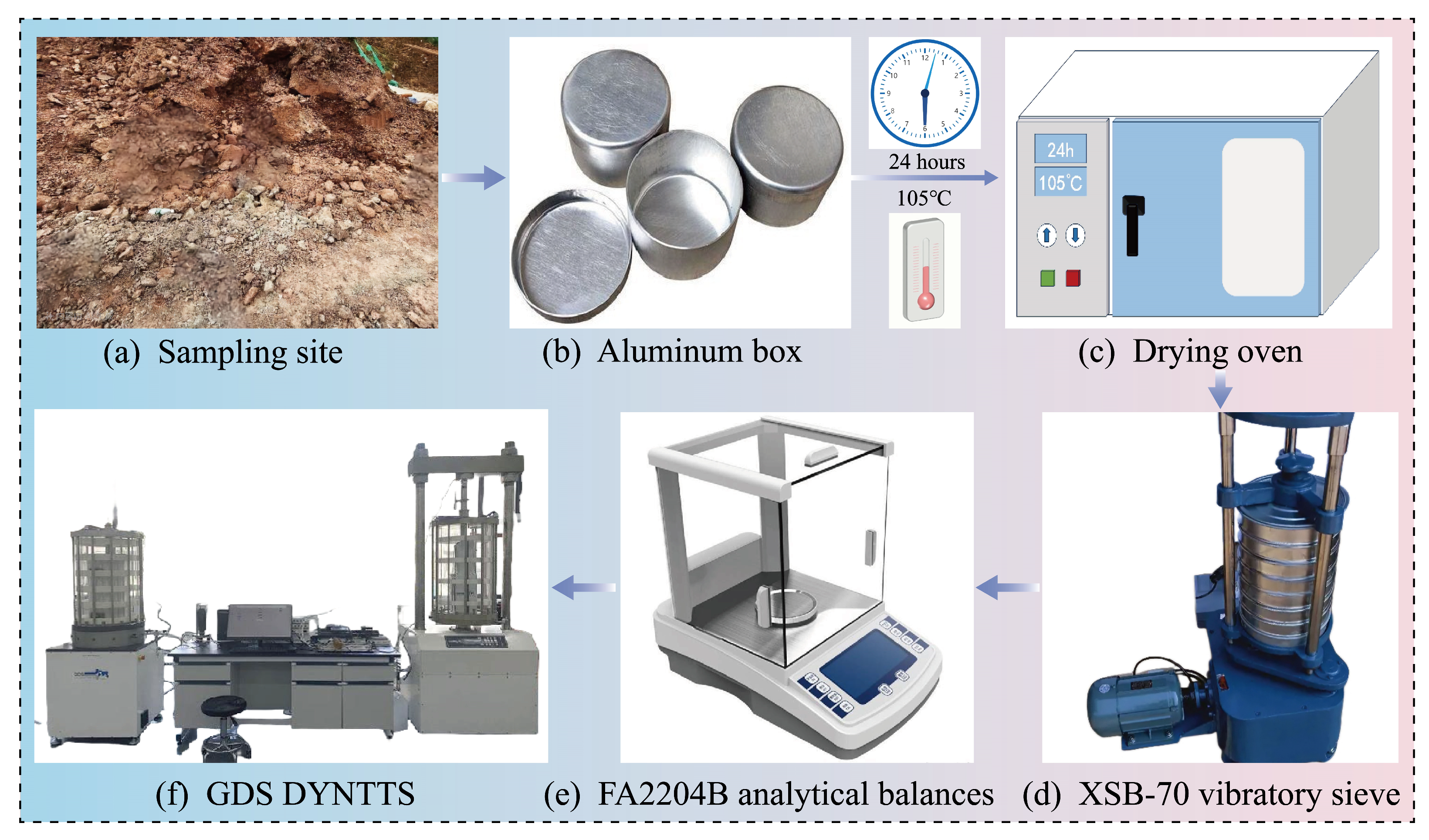
The gravelly soil investigated in this study was obtained from a site located in Sichuan province of China, Sichuan Province, China, as illustrated in Figure 2a,b and Figure 3a. Gravelly soils are widely employed in civil engineering practices, such as in the construction of building foundations and road subgrades, with the zone of substantial engineering influence generally extending to depths of approximately 20 m. The specimens were collected from depths ranging between 3.0 m and 26.5 m, which corresponds to shallow overburden conditions in geotechnical terms. Characterized by low geostatic stress and active interaction with groundwater, distinguishing the shallow horizon from the deep-seated stable strata experiencing high stress conditions. The selection of sampling depths was informed by a comprehensive field investigation that accounted for the local geological characteristics and stratigraphic profile. This interval encompasses a transition from relatively shallow to deeper subsurface layers, thereby facilitating the characterization of soil behavior under varying stress states, groundwater conditions, and environmental influences. The analysis of specimens retrieved from this depth range ensures that the experimental results are both representative of typical field conditions and practically manageable, thus optimizing the research design without sacrificing broader applicability. The sampling procedure followed established geotechnical protocols to minimize disturbance and preserve in situ soil properties, thereby establishing a reliable basis for subsequent laboratory testing and analysis. In this study, ten gravelly soil samples were acquired and labeled according to the notation S-D, where S designates gravelly soil and D indicates the sample identifier; for instance, S-1 refers to the sample retrieved from the shallowest depth.

2.2. Laboratory Experiments

The moisture content of undisturbed gravelly soil specimens was determined through standardized oven-drying procedures in accordance with geotechnical laboratory protocols. A representative soil sample was transferred to a pre-weighed container, and the combined mass of the soil and container was recorded. The container was then placed in a drying oven maintained at 105 °C to 110 °C and dried until a constant mass was achieved, typically over a period of 24 h. After drying, the sample was removed from the oven and cooled in a desiccator to minimize moisture reabsorption. The mass of the dried sample and container was subsequently measured. The moisture content (ω) was calculated using the following equation:
w = m m d m d × 100 %
where m and md represent the mass of the natural and dried soil sample, respectively.
The undisturbed specimens were processed under natural moisture content preservation conditions using controlled thermal dehydration. Specimens were systematically arranged in a forced-air convection oven maintained at 105 ± 2 °C, with a minimum interparticle spacing of 20 mm to ensure uniform heat transfer and prevent localized moisture retention, as illustrated in Figure 3b,c. Following a 24 h dehydration cycle that achieved mass stabilization, particle size distribution analysis was performed through standardized sieving procedures compliant with ASTM D6913 [34]. A nested sieve series with aperture sizes of 2, 5, 10, 20, 40, and 60 mm was utilized for gradation characterization. The sieving process commenced with the removal of oversize particles using a 60 mm sieve to meet large-scale triaxial testing specifications. Subsequent fractionation through a 2 mm test sieve enabled separation of coarse and fine fractions, with mass measurements recorded to a precision of 0.01 g using analytical balances. Mechanical sieving was conducted with an XSB-70 vibratory sieve shaker manufactured by Haoxin Mining Machinery Factory, Shicheng County, Ganzhou, Jiangxi, China, to ensure adequate particle separation, maintaining mass balance tolerance within 1% of the initial specimen mass, as shown in Figure 3d,e.
The experimental program employed a programmable servo-controlled rigid testing system designed for geomechanical evaluation of rock and concrete materials, as depicted in Figure 3f. The triaxial apparatus was used to simulate stress conditions representative of shallow depths. The robust configuration of the system allowed comprehensive investigation of coarse-grained soils under controlled loading. Experiments were conducted under prescribed confining pressures to replicate in situ stress states. Each specimen underwent a series of consolidated drained triaxial compression tests to determine shear strength parameters, including cohesion and internal friction angle. Testing adhered to standard triaxial procedures for soils, ensuring accurate measurement of stress-strain behavior and pore pressure response. The large-scale consolidated drained triaxial compression tests were performed on specimens with a diameter of 300 mm and a height of 600 mm. To achieve a representative soil fabric, the specimen diameter was determined based on the maximum particle size of the gravelly soil, and the resulting ratio of specimen diameter to maximum particle size is 5, which strictly satisfies the conventional geotechnical standard requiring that the ratio of specimen diameter to maximum particle size must be greater than or equal to 5 for coarse-grained soils. The compliance with the grain size limitation confirms that the laboratory specimens maintain sufficient statistical representativeness of the in situ material. Specimen installation incorporated a dual drainage configuration using a 0.3 mm thick reinforced latex membrane secured by end caps sealed with O-rings. To achieve full saturation, carbon dioxide was initially flushed through the specimen for 1 h, followed by deaerated water percolation and subsequent backpressure application until the pore pressure coefficient exceeded 0.95. Isotropic consolidation was then conducted under target confining pressures of 100, 200, and 300 kPa until the volumetric change rate decreased below 0.05 cm3/min, which typically required two to four hours. Monotonic shearing was subsequently performed under strain rate-regulated conditions at an axial strain rate of 0.5%/min, which was sufficiently slow to ensure complete dissipation of pore water pressures and maintain fully drained conditions throughout the shearing process. The shear strength of gravelly soil is fundamentally characterized by cohesion and internal friction angle. These parameters are derived from the Mohr–Coulomb failure criterion, which describes the shear strength of a soil as a function of the normal stress acting on the failure plane. The equation is expressed as:
τ = C + σ n tan φ
where τ is the shear strength, σn is the normal stress, C is the cohesion, and φ is the internal friction angle.

2.3. Mean Particle Size

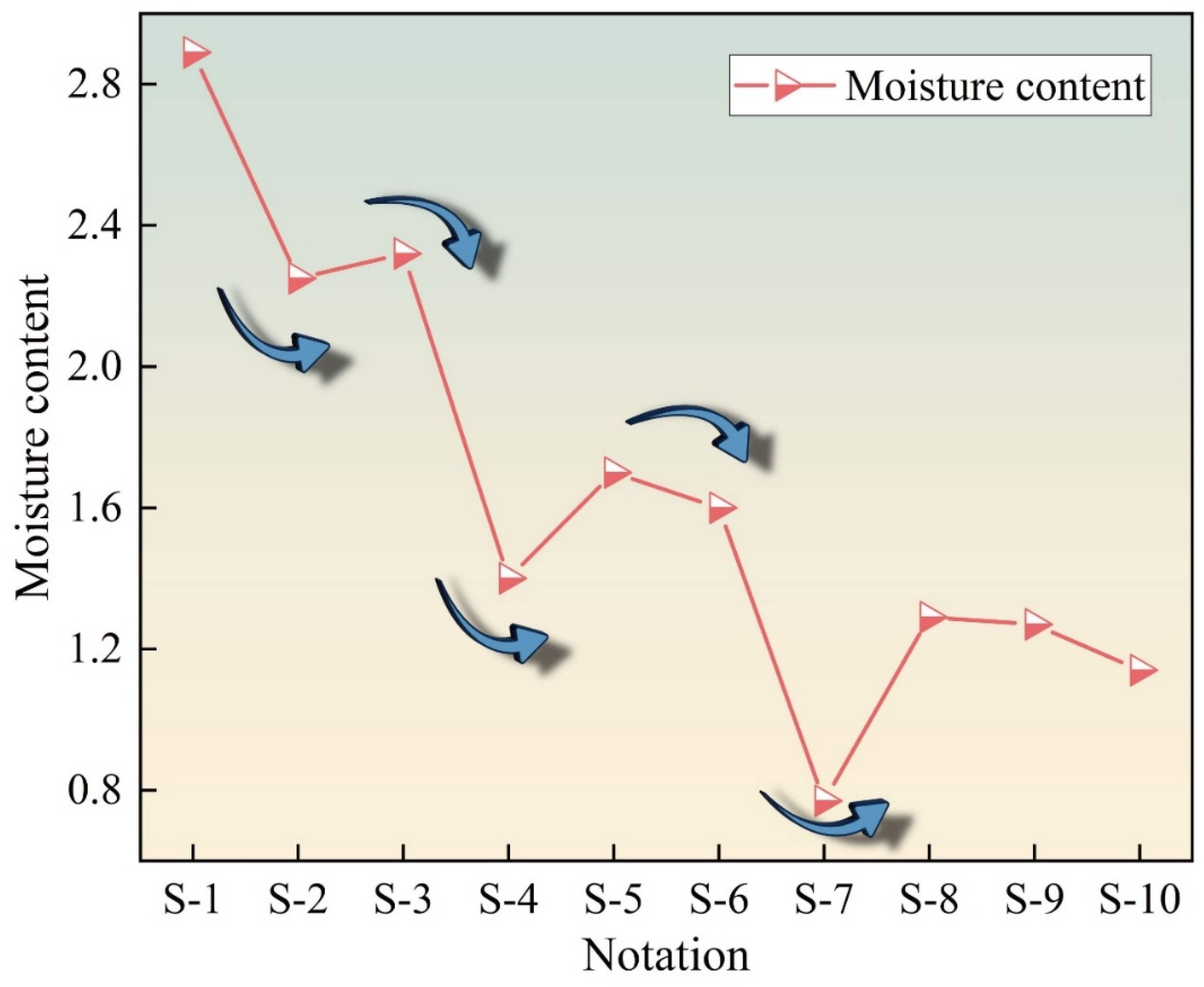
The moisture content profile of natural gravel soil beneath shallow overburden is presented in Figure 4. As shown, moisture content exhibits significant variation with depth, ranging from a maximum of 2.89% at a shallow depth of 3.0–4.5 m to a minimum of 0.77% at 21.0–22.0 m, with blue curved arrows marking the fluctuations in moisture content at each sampling point. The elevated moisture content observed in the near-surface sample is likely attributable to its proximity to the ground surface, where seasonal precipitation and groundwater infiltration exert more pronounced effects. In contrast, deeper samples generally display lower moisture contents, averaging approximately 1.2%, indicating a relatively stable and drier subsurface environment beyond 20 m depth. A slight moisture increase is noted between 12.0–16.0 m, with values of 2.25% and 2.32%, respectively, which may reflect localized variations in soil composition, porosity, or limited groundwater influence at these intermediate depths. Below 18.3 m, moisture content consistently declines, stabilizing below 1.7%, except for a minor anomaly at 24.0–25.0 m. This overall trend of decreasing moisture content with depth aligns with the anticipated reduction in water retention capacity in gravelly soils under shallow overburden, where overburden pressure and drainage conditions become increasingly dominant.
Quantification of particle size distribution constitutes a fundamental aspect in characterizing the fragmentation behavior of gravelly soils. In this study, particle size distribution characteristics were examined to assess scale-dependent fragmentation patterns at varying depths. The mean particle size serves as a key indicator for evaluating granulometric evolution during particle fragmentation. Unlike conventional arithmetic averaging, the MPS adopted herein is defined as a weighted geometric mean, which more effectively captures the logarithmic nature of particle size distributions, particularly when tracking the progressive generation of fines during shear-induced particle breakage. Higher MPS values correspond to coarser particle assemblies, whereas lower values reflect enhanced fragmentation and increased fines content. This metric demonstrates heightened sensitivity to particle crushing, as geometric averaging amplifies changes within the finer fraction compared with arithmetic-mean approaches.
Gradation analysis was conducted in compliance with ASTM D6913-17 [34] using a manual dry-sieving procedure. A geometrically progressive sieve series with apertures of 2, 5, 10, 20, 40, and 60 mm was selected to adequately characterize the full gradation spectrum within practical experimental constraints. Mean Particle Size was adopted as the characteristic metric for fragmentation analysis rather than relative breakage indices such as Hardin’s index. This preference is based on the superior compatibility of MPS with the scale parameters of the adopted Weibull and GEV statistical models. For the investigated coarse gravels, MPS serves as a sensitive and robust indicator of the skeleton’s structural shift, effectively capturing the bulk mass redistribution and the primary fragmentation of the coarse fraction under varying depth and groundwater conditions. The mean particle size was employed as a critical fragmentation index, defined via logarithmic moment integration [31]:
MPS = U i × b i U i
where bi represents the geometric mean of adjacent sieve sizes bounding the ith particle fraction, Ui corresponds to the normalized mass fraction satisfying. This formulation provides enhanced sensitivity to the evolution of fines content during shear-induced particle breakage relative to conventional arithmetic-mean approaches.

2.4. Fractal Dimension

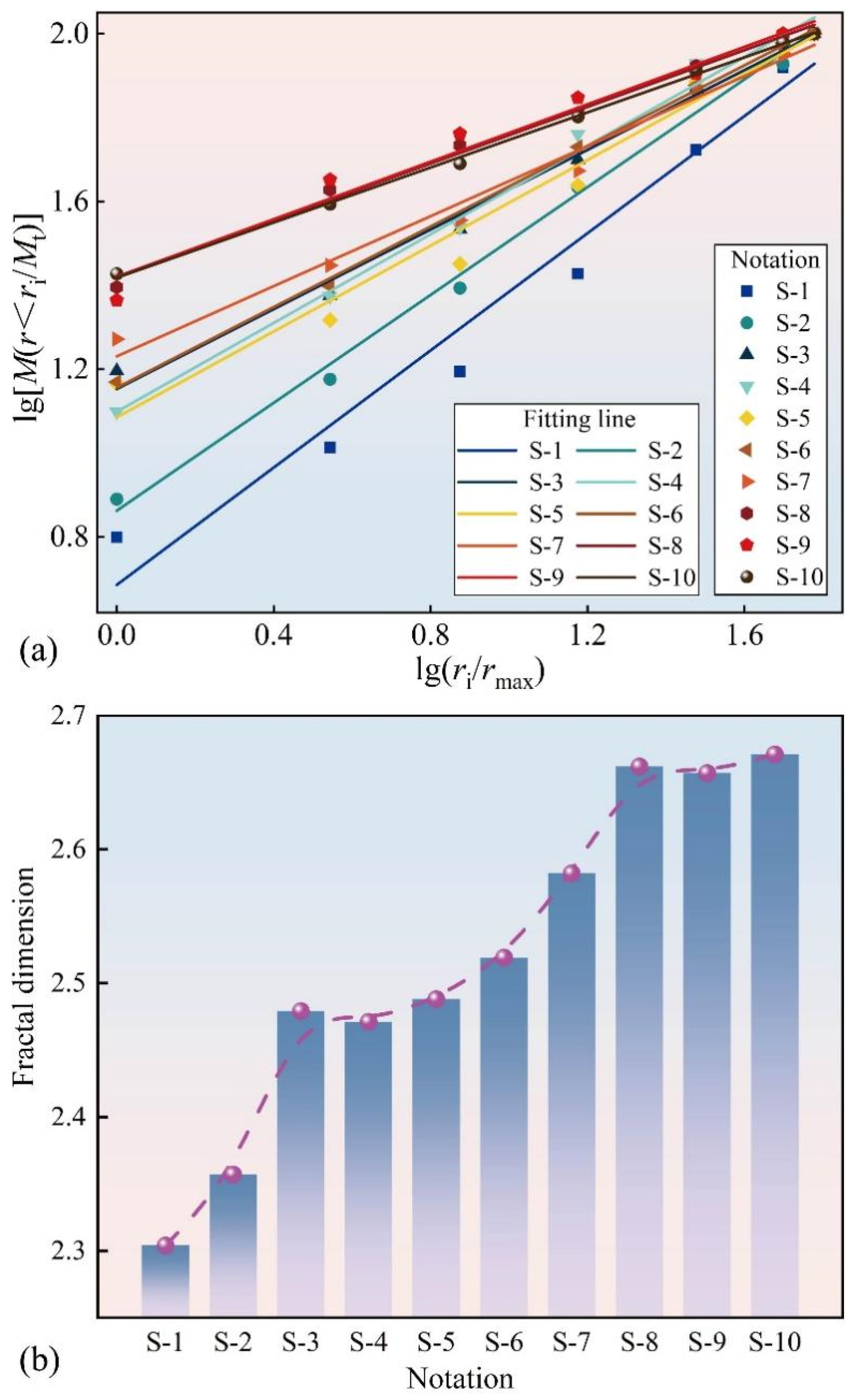
The fractal dimension concept offers a robust mathematical framework for quantifying scale-invariant fragmentation patterns in gravelly soils. As a fundamental parameter in fractal geometry, it characterizes the space-filling capacity and structural complexity of particulate systems. In geomechanical contexts, the fractal dimension typically ranges from 2.0 to 3.0 for three-dimensional particle assemblies, with higher values indicating enhanced spatial filling efficiency due to increased particle crushing or preferential size redistribution. This parameter fundamentally captures the scale-invariant nature of fragmentation processes under varying overburden stresses. For granular assemblies, the fractal dimension is derived from the power-law scaling of cumulative mass distributions. Specifically, the determination of fractal dimension (D) adheres to the mass-size scaling relationship based on fractal geometry principles [35]:
D = 3 k = 3 Δ lg M r < r i / M t Δ lg r i / r max
where M(r < ri) represents the cumulative mass of particles below size ri; Mt denotes the total specimen mass; rmax denotes the maximum particle diameter of 60 mm. The fractal dimension (D) is then determined via least-squares regression of the experimental sieve data, where the slope k of the linear fit in lg(ri/rmax) versus lg(M(r < ri)/Mt).

2.5. Statistical Analysis

The statistical distribution of gravel soil under shallow overburden is pivotal for elucidating its fragmentation characteristics and mechanical behavior. This section examines the parameters of the Weibull and Generalized Extreme Value distributions fitted to data obtained at various depths, with an emphasis on interpreting the fitting parameters and their implications for the particle size distribution. Originally proposed for fatigue failure analysis, the Weibull distribution has become an essential tool in geomaterial research due to its capacity to statistically characterize the heterogeneous fragmentation and stress-dependent variability inherent in granular materials [36,37]. For a given gravel soil sample, the relative particle size xi is defined as the ratio of the particle diameter di to the maximum particle size dmax:
x i = d i d max
The cumulative percentage of particles finer than xi, denoted pi, is modeled by the Weibull cumulative distribution function (CDF):
p i = 1 exp x i λ k
where λ and k stand for dimensionless scale parameter and dimensionless shape parameter governing the distribution characteristics. To extract λ and k from experimental data, the Weibull CDF is linearized by a double logarithmic transformation:
ln ln 1 / p i = k ln x i k ln λ
Plotting ln ln(1/pi) vs. ln(xi) generates a linear relationship, where λ and k can be inferred via the slope and intercept.
The Generalized Extreme Value distribution is a statistical continuous probability distribution based on extreme value theory, widely applied to analyze the frequency and intensity of extreme events. In the context of rock fragmentation, the GEV distribution is particularly effective in describing the size distribution of fragmented particles. The GEV framework herein does not imply a literal macroscopic extreme event but serves as a robust statistical descriptor for the asymptotic tail behavior of grain size distributions. In gravelly soils, extreme size fractions, namely the oversized skeletal gravels and newly generated ultra-fine matrix, disproportionately govern soil fabric and shear strength, and the statistical model effectively quantifies the boundary shifts that depend on the depth of burial. The probability density function of the GEV distribution is expressed as [38]:
F d ; ξ , μ , η = exp 1 + ξ d μ η 1 / ξ
where ξ is the shape parameter, determining the tail shape of the distribution and its ability to model extreme values. The location parameter μ represents the central tendency of the data, typically corresponding to the mean or median of the fragment size distribution. The scale parameter η measures the dispersion or range of the data.
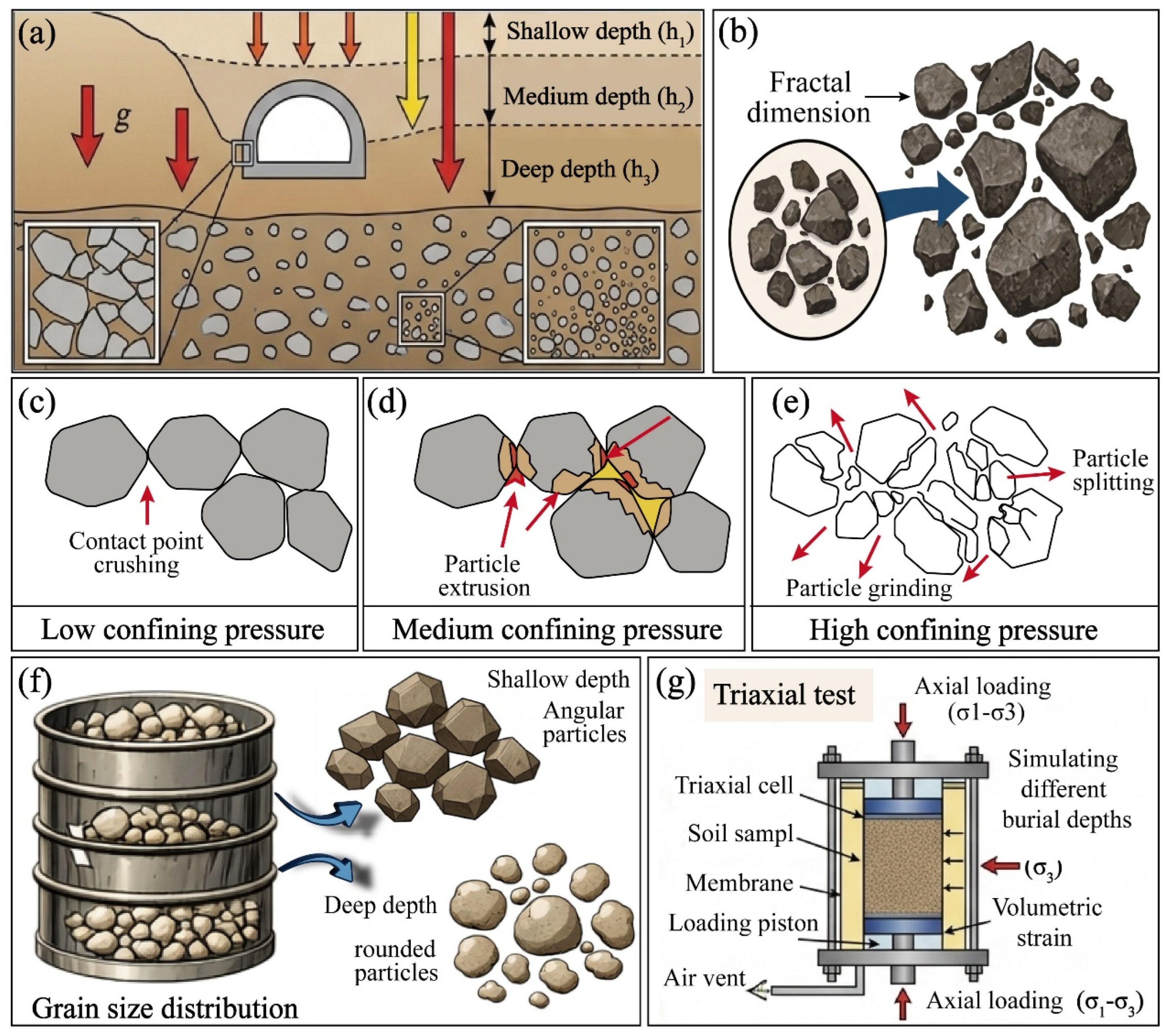
Furthermore, the authors used the generative AI tool Doubao (version 2.8.7, ByteDance) to create the original initial drafts of Figure 1 and Figure 14 during the preparation of this manuscript. The tool was employed solely for the purpose of generating preliminary visual concepts based on general text prompts. Subsequently, the authors extensively refined and modified these drafts by incorporating manuscript-specific data, annotations, and scientific context to produce the final published figures. All AI-generated output was critically reviewed and edited by the authors, who take full responsibility for the accuracy and integrity of the content.

3. Results

3.1. Fragmentation Characteristics of Gravel Soil Under Shallow Overburden

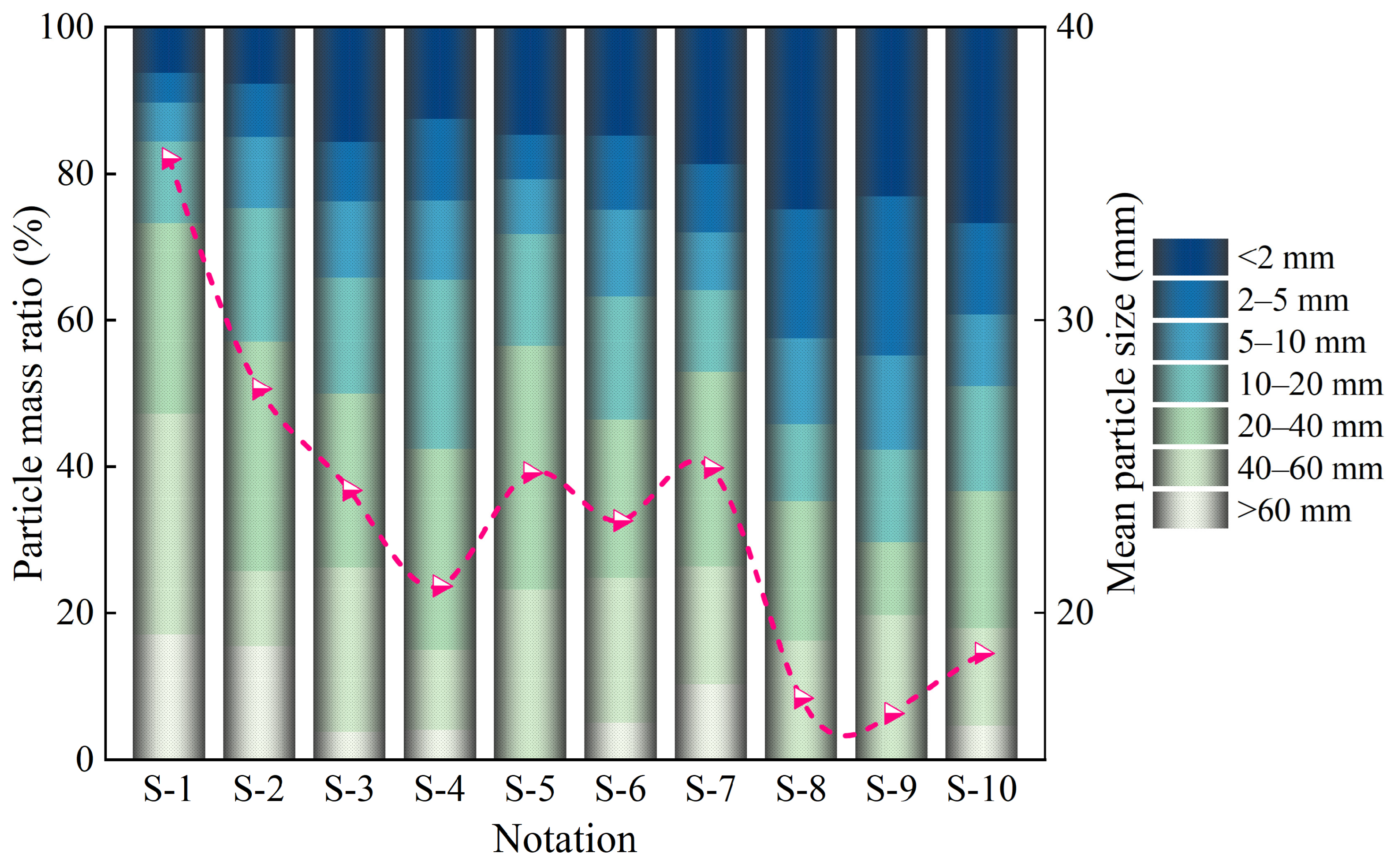
The particle size distribution of fragmented soil across varying depths is depicted in Figure 5, which presents the mass percentage of particles within each size fraction, with the pink dashed line representing the variation trend of mean particle size with sampling depth. It is evident that gravel soil undergoes substantial transformation under different overburden depths, leading to distinct particle size distributions. At shallower depths, medium-sized particles (20–60 mm) constitute the dominant fraction, displaying a relatively dispersed distribution. With increasing overburden depth, soil fragmentation results in more pronounced particle size differentiation. At greater depths, the proportion of fine particles (<2 mm) rises significantly. Within the shallow depth range, the proportion of medium-sized particles decreases with depth, whereas the proportion of fine particles increases. In deeper strata, further increases in overburden depth exert a negligible influence on the proportion of large particles (>60 mm).
The fragmentation characteristics of gravel soil under varying overburden conditions were systematically examined using the mean particle size and fractal dimension. The mean particle size serves as a fundamental parameter reflecting the average particle size within the soil matrix. In this study, MPS was computed for each sampling depth. The MPS values range from 16.57 mm to 35.51 mm, indicating considerable variation in particle size distribution with depth. Relatively high MPS values at shallower depths suggest a predominance of coarser particles. Overall, MPS exhibits a gradual decrease with increasing depth. This trend implies that soil becomes progressively finer under greater overburden depth, likely attributable to enhanced pressure and consequent fragmentation of larger particles. Notably, the MPS at S-10 with 26.0–26.5 m shows a slight increase to 18.63 mm, which may be ascribed to localized variations in soil composition or measurement uncertainties.
The fractal dimension, as presented in Figure 6a,b, quantifies the complexity and uniformity of the particle size distribution. A higher fractal dimension corresponds to a more uniform and complex distribution of particle sizes, whereas a lower value indicates a broader size range with reduced uniformity. In general, the fractal dimension of gravel soil increases with depth, ranging from 2.304 to 2.671. This ascending trend reflects progressive soil fragmentation under deeper overburden conditions. Fractal dimension values exceeding 2.3 indicate that the particle size distribution becomes more intricate and uniform with increasing depth, suggesting that gravel soil at greater depths exhibits a more homogeneous fragmentation pattern. This is likely due to higher overburden pressure promoting more consistent particle breakage. The concurrent decrease in mean particle size and increase in fractal dimension with depth reflect a transition from coarser, less uniformly distributed particles at shallow depths to finer, more uniformly fragmented particles at greater depths. This pattern aligns with the hypothesis that elevated overburden pressures induce more intensive particle breakage and a narrower particle size distribution.

3.2. Statistical Distribution of Gravel Soil Under Shallow Overburden

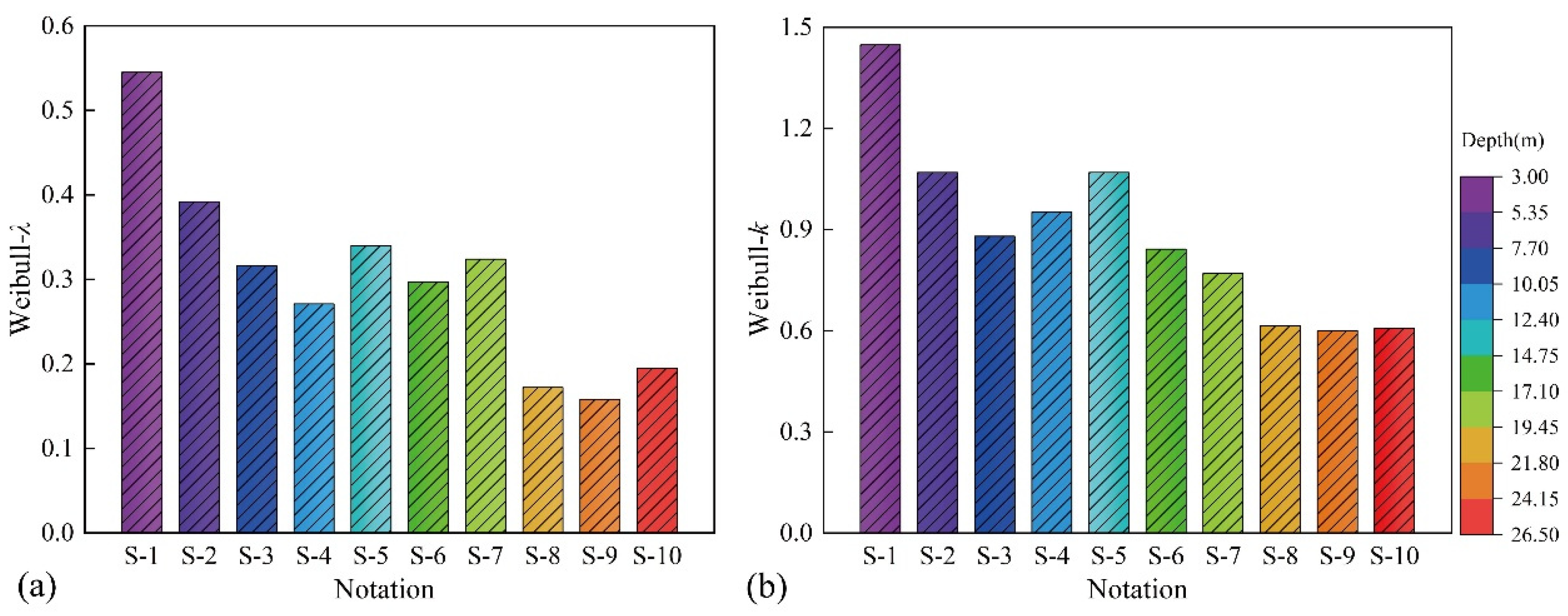
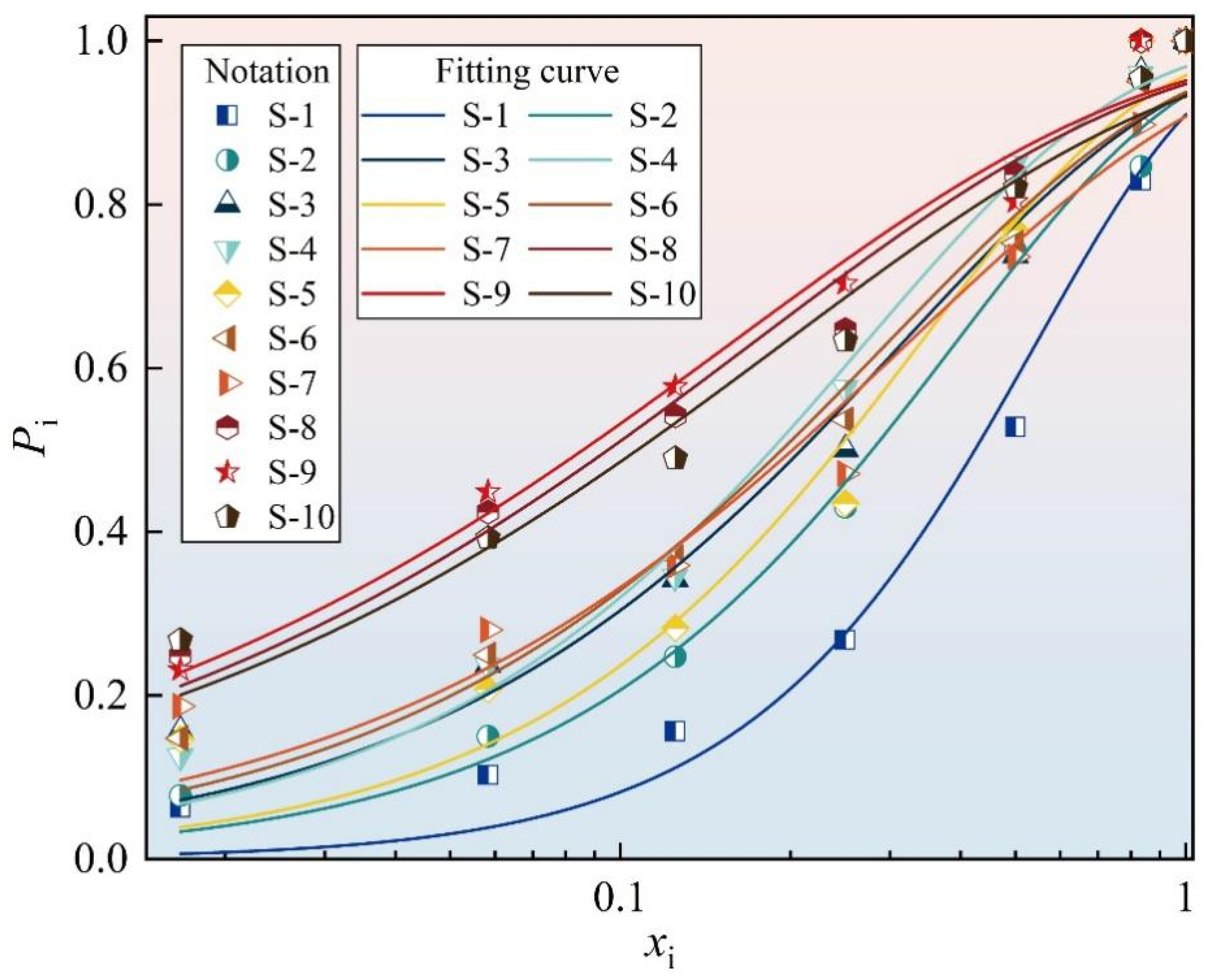
The Weibull distribution fitting curves presented in Figure 7 exhibit a generally high goodness-of-fit, with coefficients of determination (R2) ranging from 0.944 to 0.988, indicating a satisfactory fit to the gravel soil data. As illustrated in Figure 8a,b, the Weibull distribution parameters, namely the scale parameter λ and the shape parameter k, demonstrate clear depth-dependent variations. The scale parameter λ, which governs the characteristic particle size, ranges from 0.158 to 0.545, reflecting heterogeneity in the grain size distribution across depth. Lower λ values signify a predominance of fine particles resulting from intense fragmentation, whereas higher λ values suggest a coarser gradation with limited particle breakage. In this study, λ decreases with increasing depth, indicating a greater proportion of fine particles at greater depths. The shape parameter k, which quantifies distribution skewness and failure mode, varies between 0.600 and 1.448, reflecting differences in the fragmentation characteristics of the gravel soil across depths. A larger k value implies more concentrated fragmentation, with most particles exhibiting similar sizes. Conversely, a smaller k value indicates a more dispersed fragmentation pattern, characterized by a broader particle size distribution. k decreases with depth, reflecting increased dispersion in particle sizes. A k value greater than 1 signifies a concentrated failure mechanism dominated by localized stress concentrations, whereas a k value below 1 suggests a more uniform failure pattern with dispersed particle breakage. Notably, most boreholes exhibit k values below 1, indicating pronounced variability in fragmentation behavior or increasing strength heterogeneity with depth. This trend supports the hypothesis that shallow overburden conditions amplify spatial non-uniformity in particle breakage.
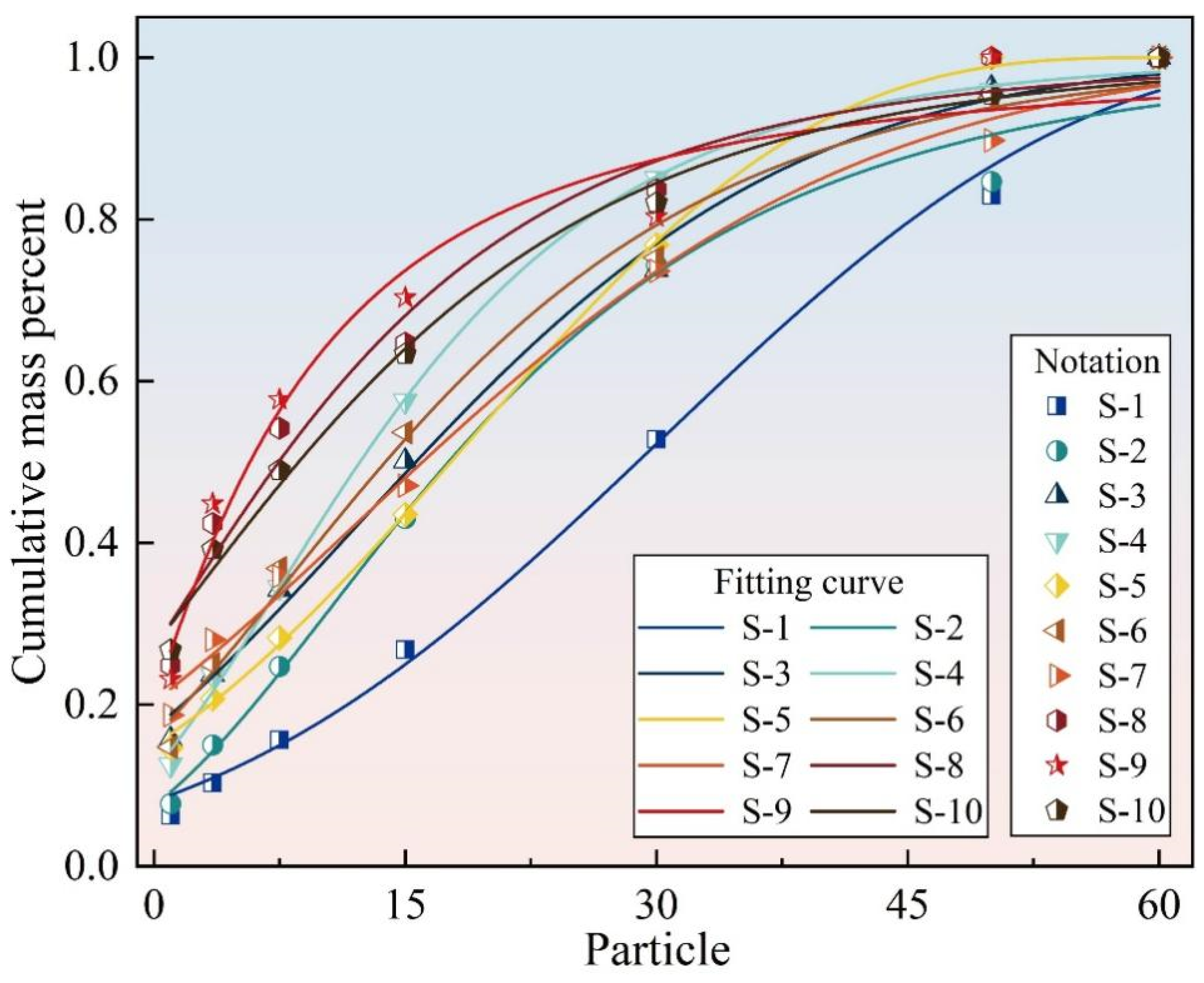
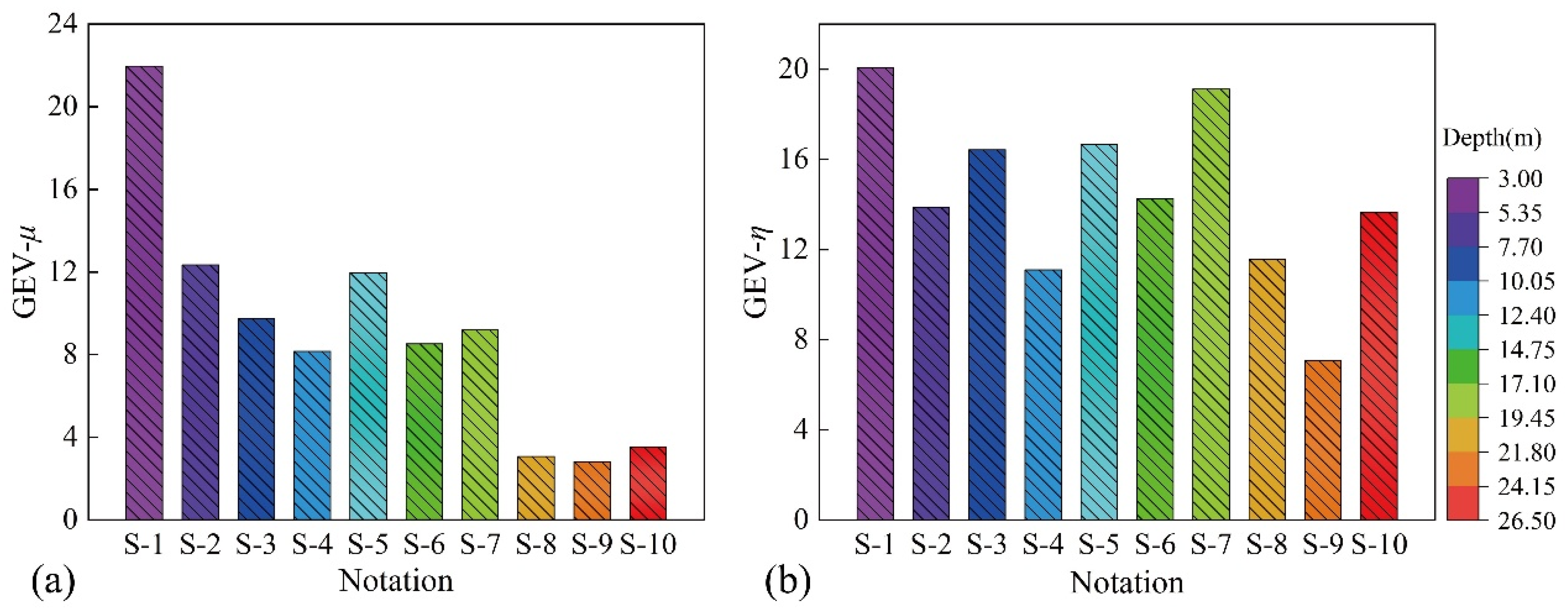
The GEV distribution parameters (ξ, μ, η) were derived by fitting the distribution curves (Figure 9) using Equation (7). Curve fitting was performed with the data analysis software ORIGIN 2022. The values of μ and η are shown in Figure 10a,b. These parameters were analyzed to extract insights into the fragment size distribution of the gravel soil. The shape parameter (ξ) of the GEV distribution is critical for determining the tail behavior of the distribution, particularly regarding the occurrence of extreme particle sizes. A negative ξ suggests a finite upper bound for extreme values, whereas a positive ξ indicates a heavy-tailed distribution, implying a higher probability of larger particle sizes. In this study, ξ exhibits no consistent trend with depth. The location parameter μ represents the central tendency of extreme values in the particle size distribution, reflecting the average particle size of the fragmented gravel soil and providing a measure of the distribution’s central tendency. It is observed that μ decreases with increasing depth, corresponding to a reduction in particle size. The scale parameter η governs the spread of the distribution, determining the variability of extreme values. A larger η indicates greater variability, while a smaller η implies less dispersion. In this investigation, η shows no significant depth-dependent trend.

3.3. Shear Strength Parameters of Gravel Soil Under Shallow Overburden

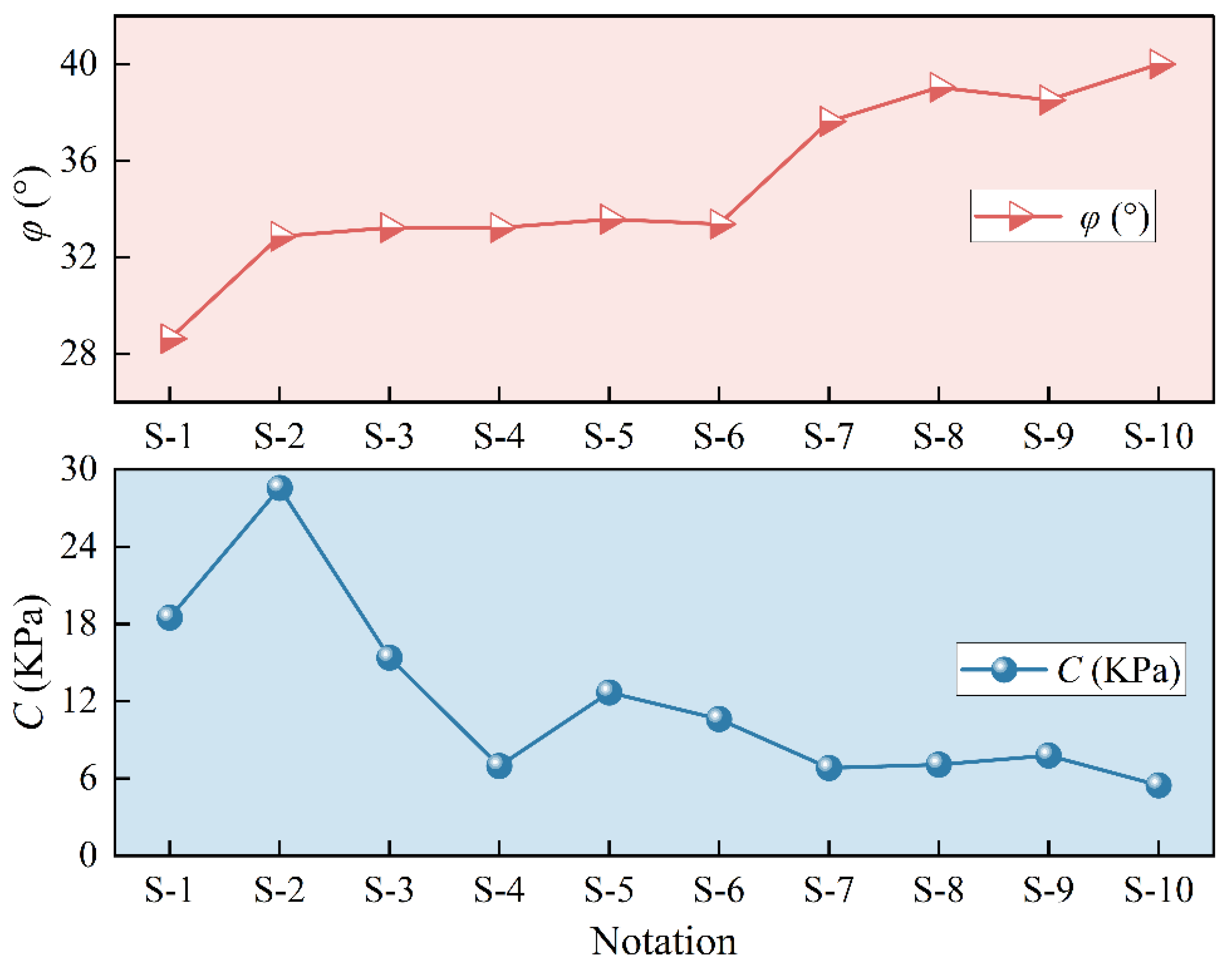
Cohesion denotes the inherent shear resistance of soil arising from interparticle forces, independent of normal stress. In gravelly soils, cohesion is generally low due to the larger particle size and weaker interparticle attraction compared with fine-grained materials such as clays. Nevertheless, cohesion can be affected by factors, including particle surface roughness, cementation, and the content of fine particles. For example, at a depth of 3.0–4.5 m, the cohesion measures 18.59 kPa, which is relatively high in comparison with deeper strata. This may be ascribed to cementation or elevated fines content near the surface. With increasing depth, cohesion declines, reaching a minimum of 5.47 kPa at 26.0–26.5 m. This trend implies that the cohesive behavior of the gravel soil diminishes with depth, likely due to decreased fines content and reduced cementation. Beyond particle size distribution, the morphological features of gravels exhibit distinct variations that depend directly on the depth of burial. Although particles maintain higher angularity under low confinement in shallow horizons, the synergy of intensified geostatic pressure and chronic groundwater immersion at greater depths accelerates the attrition of particle edges, which progressively smooths the gravel framework. The shift in morphology is confirmed by the systematic rise in the fractal dimension of particle mass, which demonstrates that sharp and irregular particle boundaries undergo microscopic fragmentation. Crucially, the transition from angular geometries to those that are subrounded or flaky significantly diminishes the mechanical interlocking typically provided by sharp grain boundaries, directly driving the macroscale reduction in cohesion. Consequently, the alterations in shape combined with reduced mean particle sizes collectively govern the evolution of the macroscale mechanical strength of the soil.
The internal friction angle is defined as the angle between the normal stress axis and the failure envelope in the Mohr–Coulomb diagram, representing the soil’s capacity to resist shear deformation through interparticle friction. In this investigation, gravel soils typically demonstrate high internal friction angles owing to the angularity and large size of particles, which enhance frictional resistance. Experimental results show that the internal friction angle increases with depth, ranging from 28.63° at 3.0–4.5 m to 40° at 25.0–26.5 m. This trend can be explained by the rise in overburden pressure with depth, which leads to denser particle packing. The increased density enhances intergranular friction, thereby improving shear resistance. Moreover, the decrease in fines content with depth may further contribute to the increase in internal friction angle, as shear behavior becomes dominated by larger gravel particles.
Depth-dependent variations in cohesion and internal friction angle are crucial for understanding the mechanical response of gravel soil under shallow overburden conditions. The shear strength characteristics under such conditions are illustrated in Figure 11. The reduction in cohesion with depth suggests that inherent shear resistance decreases as overburden increases, potentially due to the degradation of cementation bonds or the reduction in fines content. In contrast, the increase in internal friction angle with depth indicates an enhancement in the soil’s ability to resist shear via particle friction under greater overburden. These findings underscore the necessity of accounting for depth-dependent shear strength parameters in the design of engineering structures in gravel soils. For instance, the design of shallow foundations or retaining walls in gravel deposits should consider the potential decrease in cohesion near the surface, while utilizing the higher internal friction angles at greater depths to ensure stability.

4. Discussion

The experimental findings of this study elucidate the complex relationships between fragmentation characteristics and the shear strength of gravel soil under shallow overburden conditions. The discussion centers on the interplay among six key parameters—fractal dimension, mean particle size, Weibull-λ, Weibull-k, GEV-μ, and GEV-η—and their influence on the cohesion and internal friction angle of gravel soil. Collectively, these parameters provide critical insights into the fragmentation behavior and shear strength of the material, which are essential for understanding its mechanical response under varying burial depths. The following analysis examines the effects of these parameters on the cohesion and internal friction angle of gravel soil.
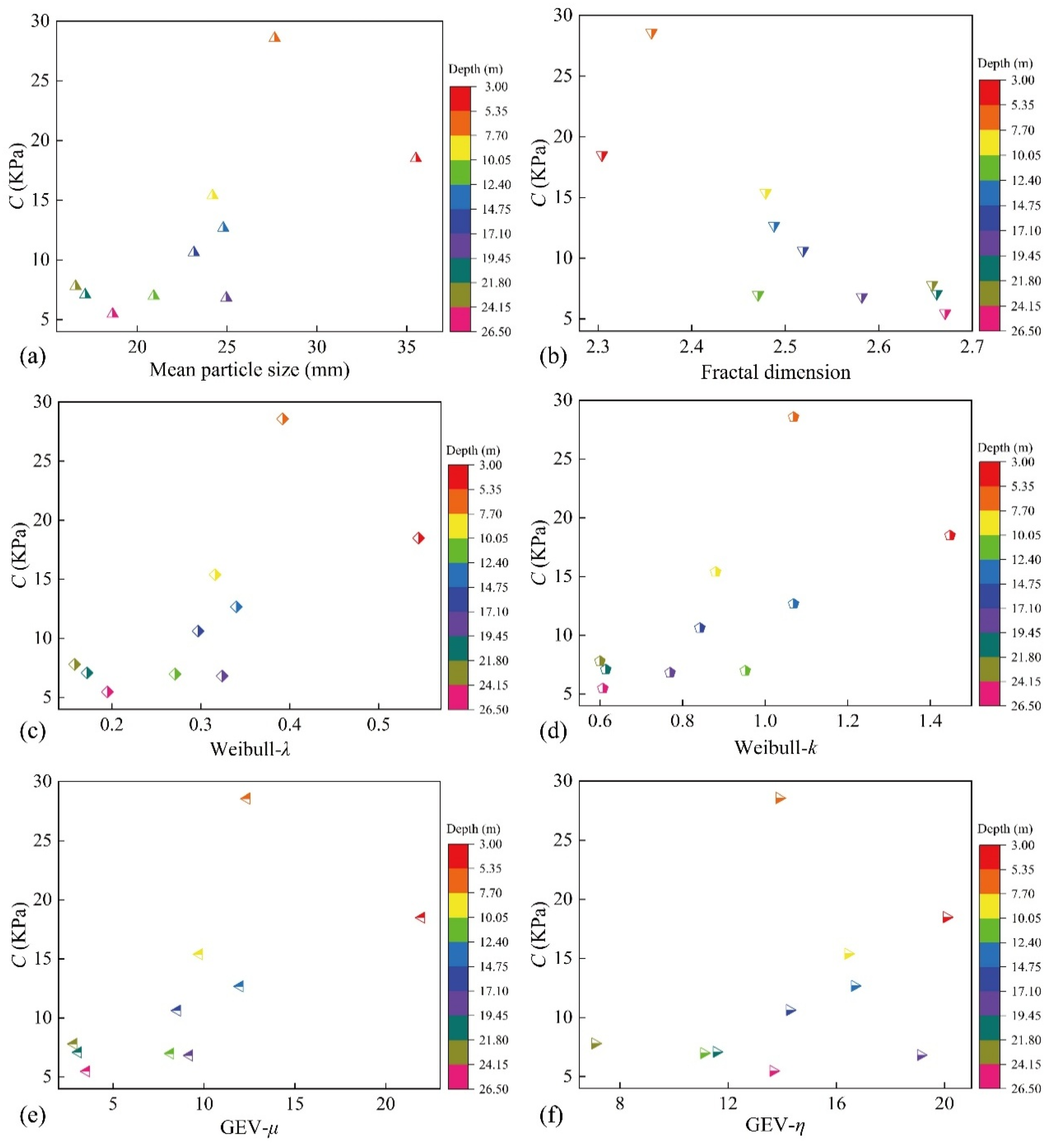
Figure 12 illustrates the correlation between the fragmentation characteristics of gravel soil in shallow overburden and the cohesion parameter. The fractal dimension, which quantifies the complexity of particle surfaces following fragmentation, demonstrates a positive correlation with cohesion. A higher fractal dimension corresponds to rougher particle surfaces, which can enhance interparticle contact and frictional resistance, thereby increasing cohesion. This increased surface roughness likely strengthens interparticle interactions, a key factor governing the shear strength of granular materials. This observed divergent evolution of cohesion and internal friction angle with depth is consistent with the microstructural bonding and interlocking mechanisms reported for granular soils [39]. The mean particle size exhibits a nonlinear relationship with cohesion. Smaller particles generally have higher specific surface areas, which may increase interparticle friction and cohesion. However, this relationship is not straightforward, as particle size distribution also plays a significant role.
In this study, variations in MPS with depth may reflect changes in the physical properties of the gravel soil, subsequently influencing its shear strength. Crucially, the reduction in median particle size, which varies with depth, and the rise in fractal dimension cannot be purely ascribed to modern static overburden pressure, but rather reflect a synergy of tectonic history, hydrogeological weathering, and mechanical stress. Structurally, historical fault shearing in the tectonically active sampling area induced extensive microscopic fissures within deeply buried gravels, increasing the inherent fragility of the particles. Hydrogeologically, deeper horizons endure chronic groundwater fluctuations that accelerate hydraulic slaking and mineralogical alteration of vulnerable pelitic or fissile fragments. The exposure to combined hydrological and chemical processes dissolves cementitious matrices, triggering particle surface deterioration and microscopic cracking that drastically lower the crushing threshold. Consequently, the coupling of historical tectonic damage incurred prior to loading, prolonged groundwater weathering, and modern overburden cumulatively drives the intensified fragmentation observed at greater depths.
The decrease in Weibull-λ suggests that the fragmentation process becomes more heterogeneous with increasing overburden, potentially leading to reduced cohesion. Conversely, Weibull-k, which reflects the uniformity of fragmentation, also shows a decreasing trend with depth. Lower Weibull-k values indicate greater variability in the fragmentation process, which may result in less predictable shear strength. GEV-μ decreases with depth, indicating a shift in the location parameter of extreme fragmentation events toward lower values. This implies that extreme fragmentation events at greater depths are less severe, which may correlate with the observed reduction in cohesion. A smaller GEV-η value suggests a narrower range of extreme fragmentation events, potentially contributing to more consistent shear strength.
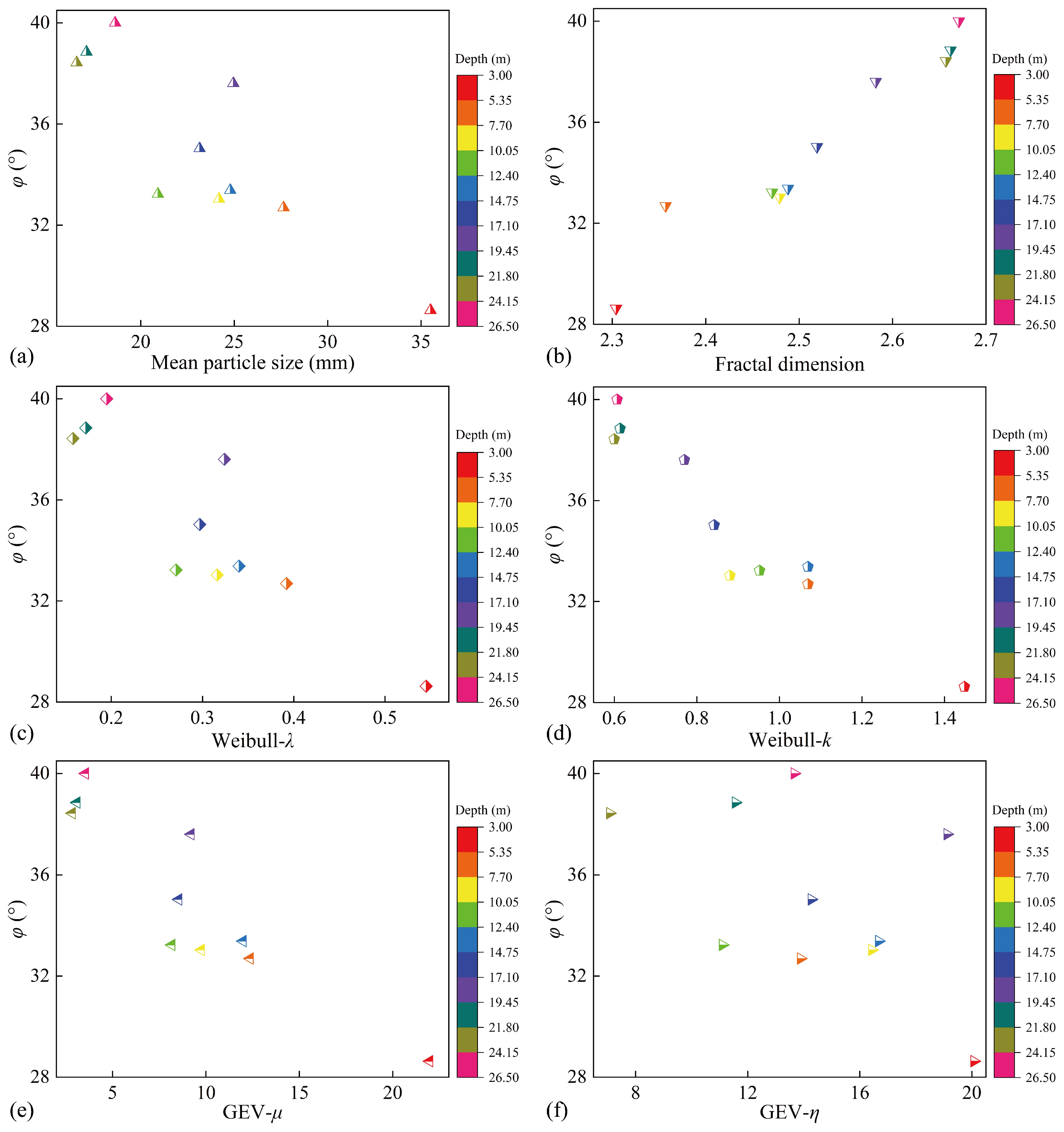
The correlation between the fragmentation characteristics of gravel soil in shallow overburden and the internal friction angle is presented in Figure 13. The increase in fractal dimension suggests a more uniform particle size distribution at greater depths, which can enhance the internal friction angle. Higher fractal dimensions are associated with improved particle interlocking, leading to higher shear strengths in granular materials. Thus, the observed increase in φ can be partially attributed to the rising fractal dimension, which reflects a more stable and rigid granular structure. MPS is inversely related to the internal friction angle, as smaller particles at greater depths correspond to higher φ values. However, the nonlinearity observed in the MPS relationship indicates that particle breakage and rearrangement under overburden pressure also significantly influence φ. The reduction in Weibull-λ and Weibull-k with depth correlates with the increase in φ, as a more heterogeneous particle size distribution at greater depths enhances interparticle friction and shear resistance. The Weibull parameters are sensitive to the degree of particle fragmentation and can be utilized to predict the shear strength of granular materials. The observed trends in GEV-μ and GEV-η suggest that the fragmentation process at greater depths is characterized by a higher likelihood of extreme particle sizes, which can influence the internal friction angle, demonstrating that the GEV parameters are effective in capturing the effects of particle size extremes on the shear strength of granular soils.
The fragmentation characteristics and shear strength of gravel soil under shallow overburden are influenced by a combination of factors, including particle size distribution, surface roughness, and the variability of the fragmentation process. The interplay between the fractal dimension, MPS, Weibull parameters, and GEV parameters provides insights into the physical and mechanical properties of gravel soil under shallow overburden. The fractal dimension and MPS collectively influence the particle size distribution, which in turn affects the Weibull and GEV parameters. These parameters, by quantifying the fragmentation process, provide a link between the particle size distribution and the shear strength of the gravel soil. The fractal dimension and MPS collectively influence the interparticle contact and friction, which are critical for determining cohesion. The Weibull and GEV parameters, on the other hand, provide information about the variability and extremes of the fragmentation process, which can affect the shear strength. As schematically illustrated in Figure 14, intensifying particle fragmentation under increasing burial depth facilitates a transition in the soil fabric, whereby smaller fragments fill the intergranular voids between larger particles. This structural reconfiguration leads to a denser packing state and an increased number of interparticle contact points, which significantly enhances the internal interlocking and frictional resistance within the soil matrix. While the reduction in MPS and the increase in fractal dimension optimize this packing efficiency, the associated degradation of the original coarse-grained skeleton provides a physical basis for the observed evolution of cohesion and friction parameters. The observed increase in φ with depth can thus be attributed to the combined effects of increasing fractal dimension, decreasing MPS, and changes in the Weibull and GEV parameters, which collectively enhance the interparticle friction and resistance.
Figure 14. Schematic diagram of fragmentation mechanism of gravelly soil under shallow overburden conditions. (a) schematic of overburden stress distribution and particle fragmentation at different burial depths; (b) the relationship between particle breakage and fractal dimension; (ce) particle breakage modes under low, medium, and high confining pressures; (f) changes in particle morphology and size distribution with burial depth; (g) triaxial test setup used to simulate different overburden pressures.
Water 18 01288 g014
Quantitative contribution analysis indicates that overburden pressure accounts for approximately 62.3% of the variation in particle fragmentation, whereas moisture change related to groundwater dynamics contributes 37.7%, confirming overburden pressure as the dominant factor. The opposite trends of cohesion and internal friction angle originate from changes in the mesostructure. Increasing depth weakens the bonding between particles and reduces cohesion, while closer packing enhances friction and raises the internal friction angle.
The strength trends that vary directly with the depth of burial align well with classical observations in the geomechanics of coarse-grained soils. Specifically, the enhancement of internal friction angle under closer packing states mirrors the skeleton interlocking and dilatancy mechanisms widely reported in the literature for rockfill and gravelly materials under low confining pressures [40]. However, while conventional investigations into landslides and granular frameworks primarily emphasize static stress-induced crushing as the sole driver of particle size reduction [41], the experimental evidence demonstrates that groundwater-driven hydraulic slaking plays a more dominant role in selectively reducing cohesion in shallow overburdens. The findings obtained from the current investigation provide valuable insights for advancing the engineering design and stability analysis of structures constructed with gravel soil.
While this study reveals depth-related characteristics of gravelly soils, several limitations exist. First, only static loading tests were conducted without considering dynamic and cyclic stresses in real conditions. Second, internal particle contact changes were analyzed indirectly through particle size data rather than direct observation. Future research may examine soil behaviors under cyclic or dynamic loading to understand particle damage caused by earthquakes and water level changes. Combining microscopic observation with numerical simulation is also suggested to connect statistical analysis with physical particle mechanics.

5. Conclusions

Understanding the fragmentation characteristics and shear strength of gravel soil under shallow overburden conditions is essential for evaluating the stability and performance of geotechnical structures, including foundations, slopes, and embankments. This study quantitatively investigates the depth-dependent fragmentation characteristics and shear strength evolution of gravelly soil under shallow overburden and groundwater conditions via large-scale consolidated–drained triaxial tests, fractal analysis, and statistical modeling. The key qualitative and quantitative findings are summarized as follows:
The fragmentation characteristics of gravel soil demonstrate a clear dependence on overburden pressure and depth. As the sampling depth increases from 3.0 m to 26.5 m, the mean particle size exhibits a systematic reduction, whereas the fractal dimension rises significantly from 2.304 in the shallow layers to 2.671 in the deep strata. Elevated overburden pressures induce more pronounced particle breakage and lead to a more uniform particle size distribution. The prevalence of finer particles at greater depths contributes to higher internal friction angles, thereby enhancing the shear resistance of the soil.
The shear strength of gravel soil, characterized by cohesion and internal friction angle, exhibits significant variation with depth. Cohesion decreases with increasing depth, indicating that the soil exhibits reduced cohesion at greater depths, likely due to diminished fines content and cementation. In contrast, the internal friction angle increases with depth. This trend can be attributed to denser particle packing under higher overburden pressures, which amplifies interparticle friction and shear resistance. The depth-dependent variations in cohesion and internal friction angle underscore the necessity of accounting for overburden effects in geotechnical design. These observations offer valuable guidance for optimizing engineering practices in shallow overburden environments.
The Weibull scale parameter λ and shape parameter k decrease quantitatively with depth from 0.545 to 0.158 and from 1.448 to 0.600, respectively, reflecting increased heterogeneity in the particle size distribution and more intensive particle fragmentation. These parameters are sensitive to the extent of particle breakage and can be employed to predict the shear strength of granular materials. Furthermore, the generalized extreme value location parameter μ decreases quantitatively from 21.970 to 2.833 with increasing depth, while the scale parameter η varies between 7.082 and 20.079, suggesting that extreme particle sizes become more probable at greater depths, which may influence the internal friction angle. This demonstrates the utility of GEV parameters in characterizing the impact of particle size extremes on the shear strength of gravel soil.
The findings from this study provide insights for geological hazard mitigation, demonstrating that in shallow overburden strata, slaking driven by groundwater dominates cohesion degradation compared with particle crushing induced by static stress. While this work establishes a macrostatistical baseline under static monotonic conditions, natural deposits in tectonically active areas undergo cyclic loading and dynamic groundwater changes. Future research can adopt large-scale cyclic triaxial tests to investigate pore pressure development and cumulative particle degradation under seismic effects. Combining nondestructive imaging with discrete element method simulations is also recommended to build multiscale frameworks that can quantify contact anisotropy and microcrack propagation, successfully linking empirical statistical models with discrete granular mechanics.

Author Contributions

Conceptualization, P.F.; methodology, H.G. and P.F.; validation, H.G. and H.H.; formal analysis, H.G. and P.F.; investigation, H.G., H.H., J.R., G.W. and P.F.; resources, H.G., H.H. and P.F.; data curation, H.G., H.H. and P.F.; writing—original draft preparation, H.G. and P.F.; writing—review and editing, H.H., J.R., G.W., R.T., H.L. and J.D.; visualization, H.G., H.H. and P.F.; supervision, H.G., J.R., G.W., R.T., H.L., J.D. and P.F.; project administration, P.F.; funding acquisition, P.F. All authors have read and agreed to the published version of the manuscript.

Funding

This work was financially supported by the General Program of National Natural Science Foundation of China (Grant No. 42477179), the Sichuan Science and Technology Program (Grant No. 2026NSFSCZY0031), National Natural Science Foundation of China (Grant No. 42125702, 42293353, 42502261), the Chengdu Science and Technology Program (Grant No. 2025-YF05-00392-SN), and Open Research Fund of State Key Laboratory of Geomechanics and Geotechnical Engineering Safety, Institute of Rock and Soil Mechanics, Chinese Academy of Sciences (Grant No. SKLGGES-025020).

Data Availability Statement

The original contributions presented in this study are included in the article. Further inquiries can be directed to the corresponding authors.

Acknowledgments

The authors would like to extend their gratitude to the editor and anonymous referees of this manuscript for their suggestions and comments, which have contributed significantly to its improvement. During the preparation of this work, the authors used Doubao (a generative AI tool, version 2.8.7, developed by ByteDance) for the purpose of generating the original initial subgraph of Figure 1 and Figure 14. The authors have reviewed and edited the output and take full responsibility for the content of this publication.

Conflicts of Interest

The authors declare that they have no known competing financial interests or personal relationships that could have appeared to influence the work reported in this study.

References

  1. Feng, M.; Cao, X.; Jiang, T.; Zhang, W. Effects of particle gradation and material proportions on the mechanical properties of crushed stone aggregates under cyclic loading. J. Build. Eng. 2024, 97, 110777. [Google Scholar] [CrossRef]
  2. Fan, H.; Sun, S.; Wei, J.; Le, H.; Zhu, F.; Wang, W.; Liu, Y.; Wang, J. Shear behavior of soil-rock mixture composed of diorite-porphyrite considering weathering sequence. Int. J. Geomech. 2021, 21, 04021122. [Google Scholar] [CrossRef]
  3. Liang, S.; Xiao, X.; Feng, D. Study on large-scale direct shear test on soil-rock mixture in an immersion state under water. Int. J. Geomech. 2023, 23, 04022294. [Google Scholar] [CrossRef]
  4. Carraro, J.A.H.; Prezzi, M.; Salgado, R. Shear strength and stiffness of sands containing plastic or nonplastic fines. J. Geotech. Geoenviron. Eng. 2009, 135, 1167–1178. [Google Scholar] [CrossRef]
  5. Liu, P.; Meng, M.; Xiao, Y.; Liu, H.; Yang, G. Dynamic properties of polyurethane foam adhesive-reinforced gravels. Sci. China Technol. Sci. 2021, 64, 535–547. [Google Scholar] [CrossRef]
  6. Ning, F.; Liu, J.; Kong, X.; Zou, D. Critical state and grading evolution of rockfill material under different triaxial compression tests. Int. J. Geomech. 2020, 20, 04019154. [Google Scholar] [CrossRef]
  7. Anderson, W.F.; Fair, P. Behavior of railroad ballast under monotonic and cyclic loading. J. Geotech. Geoenviron. Eng. 2008, 134, 316–327. [Google Scholar] [CrossRef]
  8. Hu, W.; Yin, Z.; Dano, C.; Hicher, P.Y. A constitutive model for granular materials considering grain breakage. Sci. China Technol. Sci. 2011, 54, 2188–2196. [Google Scholar] [CrossRef]
  9. Indraratna, B.; Lackenby, J.; Christie, D. Effect of confining pressure on the degradation of ballast under cyclic loading. Géotechnique 2005, 55, 325–328. [Google Scholar] [CrossRef]
  10. Li, T.; Qian, Y.; Liang, F.; Wang, C. A constitutive model for the gravelly soil-structure interface considering particle breakage and fabric change. Comput. Geotech. 2024, 165, 105908. [Google Scholar] [CrossRef]
  11. Shahnazari, H.; Rezvani, R. Effective parameters for the particle breakage of calcareous sands: An experimental study. Eng. Geol. 2013, 159, 98–105. [Google Scholar] [CrossRef]
  12. Rezvani, R.; Nabizadeh, A.; Amin Tutunchian, M. The effect of particle size distribution on shearing response and particle breakage of two different calcareous soils. Eur. Phys. J. Plus 2021, 136, 1008. [Google Scholar] [CrossRef]
  13. Zhu, F.; Zhao, J. Interplays between particle shape and particle breakage in confined continuous crushing of granular media. Powder Technol. 2021, 378, 455–467. [Google Scholar] [CrossRef]
  14. Gupta, A.K. Effects of particle size and confining pressure on breakage factor of rockfill materials using medium triaxial test. J. Rock Mech. Geotech. Eng. 2016, 8, 378–388. [Google Scholar] [CrossRef]
  15. Ueng, T.S.; Chen, T.J. Energy aspects of particle breakage in drained shear of sands. Géotechnique 2000, 50, 65–72. [Google Scholar] [CrossRef]
  16. Hu, X.; Zhang, H.; Boldini, D.; Liu, C.; He, C.; Wu, S. 3D modelling of soil-rock mixtures considering the morphology and fracture characteristics of breakable blocks. Comput. Geotech. 2021, 132, 103985. [Google Scholar] [CrossRef]
  17. Xiao, Y.; Ling, Y.; Shi, J.; Sun, Y.; Liu, H. Breakage and morphology of sands in drained shearing. Int. J. Geomech. 2022, 22, 04022140. [Google Scholar] [CrossRef]
  18. Konrad, J.M.; Salami, Y. Particle breakage in granular materials—A conceptual framework. Can. Geotech. J. 2018, 55, 710–719. [Google Scholar] [CrossRef]
  19. Ruiz-Carulla, R.; Corominas, J.; Mavrouli, O. A fractal fragmentation model for rockfalls. Landslides 2017, 14, 875–889. [Google Scholar] [CrossRef]
  20. Peng, K.; Liu, Z.; Zou, Q.; Wu, Q.; Zhou, J. Mechanical property of granite from different buried depths under uniaxial compression and dynamic impact: An energy-based investigation. Powder Technol. 2020, 362, 729–744. [Google Scholar] [CrossRef]
  21. Yang, G.; Chen, Z.; Sun, Y.; Jiang, Y. Effects of relative density and grading on the particle breakage and fractal dimension of granular materials. Fractal Fract. 2022, 6, 347. [Google Scholar] [CrossRef]
  22. Zhang, Z.; Ye, W.M.; Liu, Z.R.; Chen, B.; Cui, Y.J. Influences of PSD curve and vibration on the packing dry density of crushed bentonite pellet mixtures. Constr. Build. Mater. 2018, 185, 246–255. [Google Scholar] [CrossRef]
  23. Li, G.; Zhang, H.; Li, M.; Shen, Z.; Tian, A.; Wang, L. Study on coal wall spalling mechanism of large mining height working face based on folding mutation theory. Sci. Rep. 2026, 16, 15277. [Google Scholar] [CrossRef]
  24. Li, Z.; Ren, H.; Wang, W.; Du, F.; Huang, Y.; Cao, Z.; Wang, L. Multi-Factor Coupled Numerical Simulation and Sensitivity Analysis of Hysteresis Water Inundation Induced by the Activation of Small Faults in the Bottom Plate Under the Influence of Mining. Appl. Sci. 2026, 16, 1051. [Google Scholar] [CrossRef]
  25. Aschwanden, L.; Diamond, L.W.; Adams, A. Effects of progressive burial on matrix porosity and permeability of dolostones in the foreland basin of the Alpine Orogen, Switzerland. Mar. Pet. Geol. 2019, 100, 148–164. [Google Scholar] [CrossRef]
  26. Jiang, X.W.; Wan, L.; Wang, X.S.; Liang, S.H.; Hu, B.X. Estimation of fracture normal stiffness using a transmissivity-depth correlation. Int. J. Rock Mech. Min. Sci. 2009, 46, 51–58. [Google Scholar] [CrossRef]
  27. Marcussen, Ø.; Maast, T.E.; Mondol, N.H.; Jahren, J.; Bjørlykke, K. Changes in physical properties of a reservoir sandstone as a function of burial depth-The Etive Formation, northern North Sea. Mar. Pet. Geol. 2010, 27, 1725–1735. [Google Scholar] [CrossRef]
  28. Man, K.; Liu, X. Dynamic fracture toughness and dynamic tensile strength of the rock from different depths of beijing datai well. Adv. Civ. Eng. 2018, 2018, 2567438. [Google Scholar] [CrossRef]
  29. Zhou, Q.; Zhu, Z.; Liu, W.; Lu, H.; Fan, Z.; Nie, X.; Li, C.; Wang, J.; Ren, L. Hydraulic fracturing behaviors of shale under coupled stress and temperature conditions simulating different burial depths. Int. J. Min. Sci. Technol. 2024, 34, 783–797. [Google Scholar] [CrossRef]
  30. Yang, M.; Pan, Y.; Feng, H.; Yan, Q.; Lu, Y.; Wang, W.; Qi, Y.; Zhu, H. Fractal characteristics of pore structure of longmaxi shales with different burial depths in Southern Sichuan and its geological significance. Fractal Fract. 2024, 9, 2. [Google Scholar] [CrossRef]
  31. Zhang, Y.; Wang, L.; Zi, G.; Zhang, Y. Mechanical behavior of coupled elastoplastic damage of clastic sandstone of different burial depths. Energies 2020, 13, 1640. [Google Scholar] [CrossRef]
  32. Feng, P.; Li, J.; Cao, P.; Ren, J.; Dong, Y.; Wu, G.; Tang, R.; Fan, X. Effects of water immersion on the mechanical properties and hydrochemical characteristics of cemented calcareous soil. Soils Found. 2026, 66, 101759. [Google Scholar] [CrossRef]
  33. Feng, P.; Zhao, J.; Dai, F.; Wei, M.; Liu, B. Mechanical behaviors of conjugate-flawed rocks subjected to coupled static-dynamic compression. Acta Geotech. 2022, 17, 1765–1784. [Google Scholar] [CrossRef]
  34. ASTM D6913/D6913M-17; Standard Test Methods for Particle-Size Distribution (Gradation) of Soils Using Sieve Analysis. ASTM International: West Conshohocken, PA, USA, 2017. [CrossRef]
  35. Deng, Y.; Chen, M.; Jin, Y.; Zou, D. Theoretical analysis and experimental research on the energy dissipation of rock crushing based on fractal theory. J. Nat. Gas Sci. Eng. 2016, 33, 231–239. [Google Scholar] [CrossRef]
  36. Fang, Z.; Patterson, B.R.; Turner, M.E., Jr. Modeling particle size distributions by the Weibull distribution function. Mater. Charact. 1993, 31, 177–182. [Google Scholar] [CrossRef]
  37. Fan, B.J.; Zhao, F.J.; Zhang, Z.T.; Liu, Y.H. Experimental study on the disintegration properties of red sandstone. Geotech. Geol. Eng. 2022, 40, 2077–2089. [Google Scholar] [CrossRef]
  38. Feng, P.; Cao, P.; Li, J.; Tang, R.; Li, H. Dynamic fracture mechanism and fragment characteristics of sandstone specimens with asymmetrical conjugate fissures under static pre-compression. Sci. Rep. 2024, 14, 21268. [Google Scholar] [CrossRef]
  39. Rasheed, R.M.; Moghal, A.A.B. Efficacy of crustacean and protein-based biopolymer inclusion on the strength characteristics of organic soil. Int. J. Geomech. 2024, 24, 04024249. [Google Scholar] [CrossRef]
  40. Sture, S.; Costes, N.C.; Batiste, S.N.; Lankton, M.R.; AlShibli, K.A.; Jeremic, B.; Swanson, R.A.; Frank, M. Mechanics of granular materials at low effective stresses. J. Aerosp. Eng. 1998, 11, 67–72. [Google Scholar] [CrossRef]
  41. Marsal, R.J. Large scale testing of rockfill materials. J. Soil Mech. Found. Div. 1967, 93, 27–43. [Google Scholar] [CrossRef]
Figure 1. Schematic diagram of gravelly soil strata and particle characteristics under different overburden depths.
Water 18 01288 g001
Figure 2. (a) Sichuan Province within China and (b) location of the sampling point.
Water 18 01288 g002
Figure 3. Experimental apparatus and procedure for gravel soils.
Water 18 01288 g003
Figure 4. The moisture content of the natural gravel soil under shallow overburden, with blue curved arrows marking the fluctuations in moisture content at each sampling point.
Water 18 01288 g004
Figure 5. Fragment characteristics of gravel soil under shallow overburden: particle mass ratio and mean particle size, with the pink dashed line representing the variation trend of mean particle size with sampling depth.
Water 18 01288 g005
Figure 6. (a) Fractal dimension fitting and (b) fractal dimension of gravel soil under shallow overburden.
Water 18 01288 g006
Figure 7. Weibull fitting curves of gravel soil under shallow overburden.
Water 18 01288 g007
Figure 8. Statistical characterization of gravel soil under shallow overburden: (a) λ in Weibull distribution versus depth; (b) k in Weibull distribution versus depth.
Water 18 01288 g008
Figure 9. GEV fitting curves of gravel soil under shallow overburden.
Water 18 01288 g009
Figure 10. Statistical characterization of gravel soil under shallow overburden: (a) μ in the GEV distribution versus depth; (b) η in the GEV distribution versus depth.
Water 18 01288 g010
Figure 11. The shear strength of gravel soil under shallow overburden.
Water 18 01288 g011
Figure 12. Correlation between fragmentation characteristics and cohesion parameter (C) of gravel soil in the shallow overburden: (a) Mean particle size vs. C. (b) Fractal dimension vs. C;. (c) Weibull-λ vs. C. (d) Weibull-k vs. C. (e) GEV-μ vs. C. (f) GEV-η vs. C.
Water 18 01288 g012
Figure 13. Correlation between fragmentation characteristics and the internal friction angle parameter (φ) of gravel soil in the shallow overburden: (a) Mean particle size vs. φ. (b) Fractal dimension vs. φ. (c) Weibull-λ vs. φ. (d) Weibull-k vs. φ. (e) GEV-μ vs. φ. (f) GEV-η vs. φ.
Water 18 01288 g013
Disclaimer/Publisher’s Note: The statements, opinions and data contained in all publications are solely those of the individual author(s) and contributor(s) and not of MDPI and/or the editor(s). MDPI and/or the editor(s) disclaim responsibility for any injury to people or property resulting from any ideas, methods, instructions or products referred to in the content.