Article

Characterization of the Hyporheic Zone in the Lower Yellow River by Integrating Time-Lapse Electrical Resistivity Tomography and Hydrological Monitoring

1
College of Geosciences and Engineering, North China University of Water Resources and Electric Power, Zhengzhou 450045, China
2
School of Hydraulic Engineering, Yellow River Conservancy Technical University, Kaifeng 475004, China
*
Author to whom correspondence should be addressed.
Water 2026, 18(11), 1251; https://doi.org/10.3390/w18111251
Submission received: 26 April 2026 / Revised: 15 May 2026 / Accepted: 17 May 2026 / Published: 22 May 2026
(This article belongs to the Section Hydrogeology)

Abstract

The hyporheic zone (HZ) mediates biogeochemical exchanges between rivers and aquifers, yet its spatial and temporal dynamics in large, regulated rivers remain poorly characterized due to limitations of point-based measurements. Here, we combined three time-lapse electrical resistivity tomography (T-ERT) surveys with continuous hydrological and hydrochemical monitoring along a meandering reach of the lower Yellow River, generating a two-dimensional, profile-integrated view of HZ geometry under three hydrodynamic states: low flow (1 December 2020), natural rising stage (1 March 2021), and peak stage during the Xiaolangdi (XLD) water-and-sediment regulation (1 July 2021). Absolute tomograms identified two hydrostratigraphic units: an upper sandy-silt cap (35–170 Ω·m) and an underlying sand aquifer (12–35 Ω·m). Percent-difference tomograms, relative to the low-flow baseline, revealed lateral HZ expansion from ~15 m and vertical growth of 2.5 m at the rising stage to ~36 m and 4.5 m at peak stage, with local resistivity decreases exceeding 38%. In contrast, the deeper mixing zone varied by <10% across surveys. Temperature, rainfall infiltration, and groundwater freshening could not explain the observed patterns. These results were corroborated by three independent lines of evidence: lateral conductivity excursions and in-well temperature records at floodplain well W2, and analytical Darcy–Archie calculations, all consistent with the predicted lateral extent and mixing fraction. River stage, amplified by the XLD release, emerged as the dominant control on two-dimensional HZ geometry. This study provides direct empirical evidence of hyporheic dynamics in a large regulated river and demonstrates that T-ERT, supported by sparse hydrological data, offers a minimally invasive and effective tool for characterizing hyporheic zones.

1. Introduction

The hyporheic zone (HZ) is the dynamic interface beneath and beside river channels where surface water and groundwater actively mix. Within this narrow but active domain, steep gradients in dissolved oxygen, redox potential and microbial activity drive the turnover of carbon, nitrogen, phosphorus and trace contaminants, so that a disproportionate share of whole-reach nutrient processing and thermal buffering takes place within its volume [1,2,3,4]. Accurate delineation of HZ geometry is therefore not a purely academic topic; it underpins quantitative estimates of river self-purification capacity, informs aquatic-habitat protection, and is increasingly required by integrated water-resources management [5,6,7]. The practical value of HZ information rises with the accuracy with which its extent and temporal behaviour can be observed.
Achieving such accuracy is challenging. HZ geometry is controlled simultaneously by channel morphology, sedimentary architecture and the hydrodynamic state of the river, and the resulting heterogeneity is so strong that the HZ is often discontinuous in both space and time [8,9,10,11]. Even under comparable hydraulic gradients, HZ extent can differ markedly between reaches separated by only a few hundred metres [12,13,14]. The problem is amplified in large, regulated rivers, where engineered releases, meander curvature, bar mobility and high sediment load superimpose additional sources of variability. This introduces a methodological challenge: the HZ varies continuously in four dimensions, whereas most observational techniques return information at points or along narrow transects.
Conventional approaches underscore the limitations in characterizing the hyporheic zone (HZ). Although dissolved and isotopic tracers, temperature-gradient time series, and streambed pressure sensors have advanced HZ research, they remain spatially sparse and temporally intrusive. For injected tracers, they are environmentally restricted within drinking-water corridors [15,16,17,18]. The contrasting ionic compositions of river water and groundwater induce measurable shifts in bulk electrical resistivity upon mixing. This renders electrical resistivity tomography (ERT) an inherently complementary tool, offering non-invasive, two- or three-dimensional continuous observations directly sensitive to mixing processes [19,20,21]. When applied in a time-lapse configuration (T-ERT), it further transforms static subsurface images into dynamic representations of hyporheic processes.
The T-ERT literature has matured accordingly. In 2011, Cardenas et al. used time-lapse imaging to capture lateral HZ variability across a single flood cycle [15]. Coscia et al. extended the approach to three dimensions in a riparian zone [22]. Busato et al. jointly interpreted ERT and hydrogeological data in an alpine creek [23]. McGarr et al. linked geophysical signatures to sedimentary architecture within compound bar deposits [24]. In 2021, Rickel et al. demonstrated that ferricrete cementation can confine HZ extent seasonally [25]. One might argue that the method is by now well established, and that further applications would be incremental. We find this view incomplete for a specific reason. Most studies have focused on small streams or gravel-bedded alpine reaches. Among them, the discharge rarely exceeds a few tens of cubic metres per second, and flow regimes are largely natural. Whether the conclusions drawn there transfer to continental-scale rivers that are both heavily sediment-laden and operationally regulated has not, to the best of our knowledge, been directly tested. This is the gap the present work addresses.
The lower Yellow River is arguably the most demanding natural laboratory in which to address that gap. It is China’s second-longest river, supplies roughly 15% of the country’s irrigated area and 12% of its domestic water [26], and carries the world’s largest sediment load, with 0.6–0.9 Gt of sediment transported to the lower reach each year between 1956 and 2016 [27]. To reduce downstream aggradation, the Xiaolangdi (XLD) reservoir carries out periodic water-and-sediment regulation events, during which discharge is deliberately raised to 4500–5000 m3/s for several weeks. The resulting stage excursions differ in magnitude, duration and sediment content from any hydrograph represented in the existing hyporheic literature, and they coexist with a perched, losing reach that recharges the adjacent Quaternary aquifer along much of the north bank. Despite the hydrological, ecological and engineering significance of this setting, the spatiotemporal response of the floodplain HZ to combined natural and regulated forcing has not previously been observed directly.
To address this gap, we integrated three time-lapse electrical resistivity tomography (ERT) surveys with co-located hydrological and hydrochemical monitoring along a meandering reach located 150 km downstream of the Xiaolangdi (XLD) Project. The study is structured around three objectives: (i) to characterize the subsurface hydrogeological architecture and the extent of the hyporheic zone (HZ) under a low-flow reference state; (ii) to quantify the response of two-dimensional HZ geometry to contrasting hydrodynamic conditions, including a naturally rising stage and a peak stage amplified by the XLD regulation event; and (iii) to disentangle the relative influences of river stage, engineered release, and seasonal climatic variation on HZ evolution. We hypothesize that, in heavily regulated large rivers, hydrodynamic conditions exert a stronger control on HZ geometry than either seasonal climate or lithological heterogeneity alone. Confirmation of this hypothesis would refine conceptual models primarily derived from small-stream studies. The findings are intended to inform river-corridor management within the Yellow River Basin and to provide a transferable methodological framework for investigating hyporheic dynamics in other large, sediment-laden, and operationally regulated river systems.

2. Study Site and Methods

2.1. Study Site

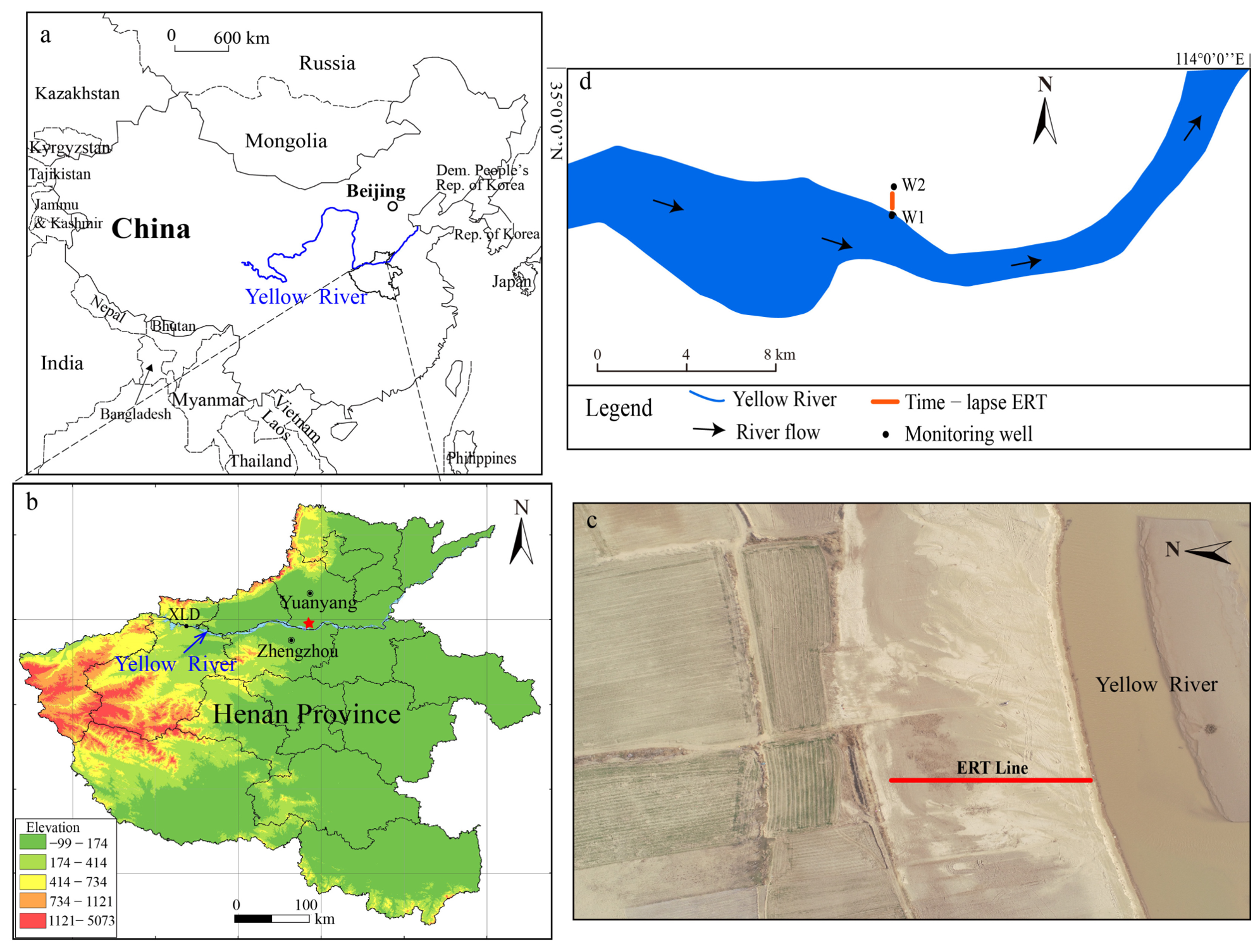
The study site is located on the north bank of the lower Yellow River in Yuanyang County, Henan Province, China, about 30 km north of Zhengzhou and 150 km downstream of the Xiaolangdi (XLD) reservoir (Figure 1a–c). The reach lies within a pronounced meander bend where the channel is 750–850 m wide and averages about 10 m in depth, with several alternate mid-channel bars and a progressively narrowing, shrinking bed (Figure 1d). The experimental plot sits on the inner (depositional) bank of the bend. This position maximizes lateral exchange with the floodplain aquifer and offers a favourable observational window for time-lapse geophysics.
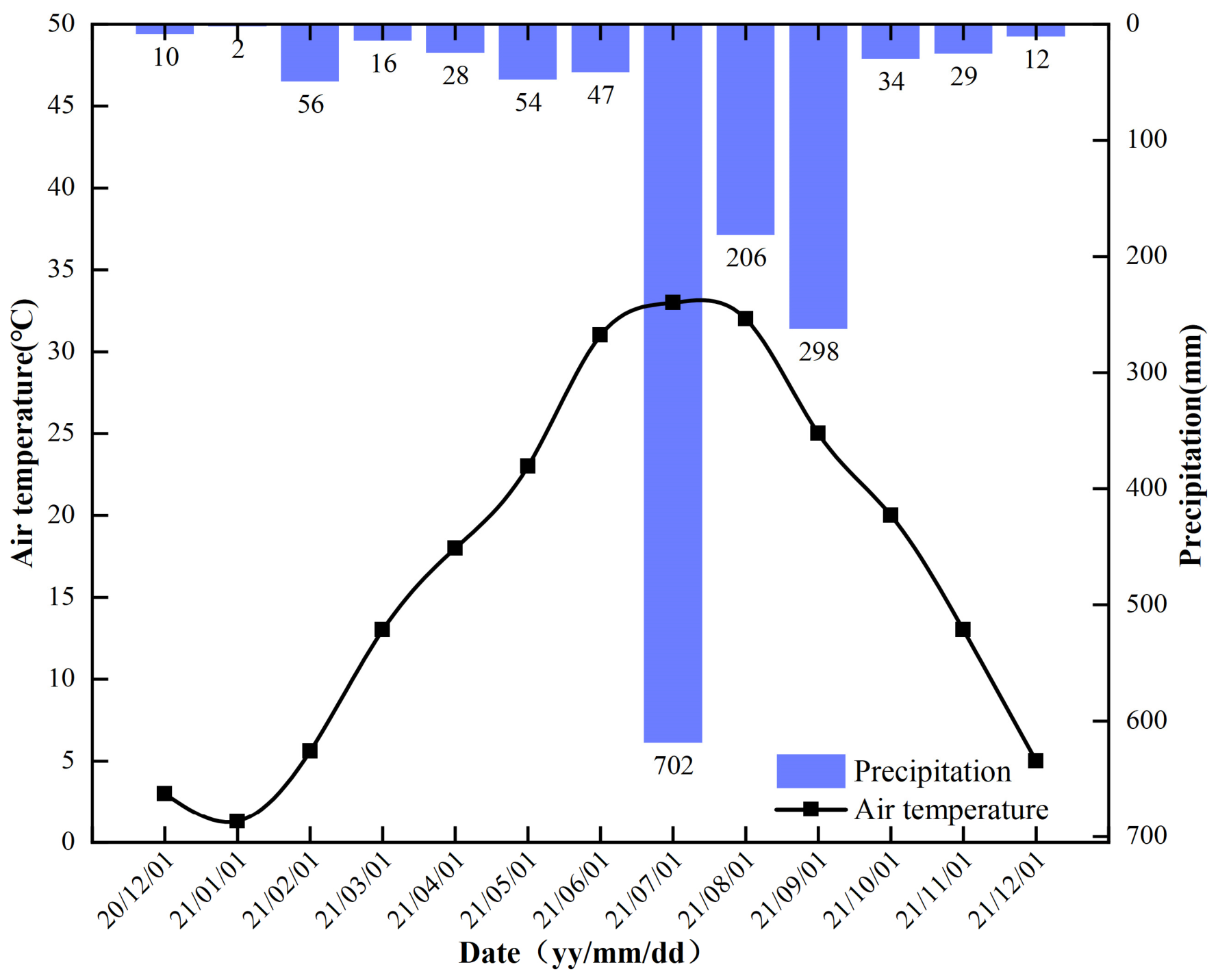
Discharge at this location is strongly conditioned by upstream regulation. According to the most recent Yellow River Water Resources Bulletin, 2021 [27], the mean annual discharge at the nearest gauging station (Huayuankou, 40 km upstream of the site) was 1594.3 m3/s in the monitoring year, but the stage record was dominated by the annual water-and-sediment regulation (WSR) event at XLD. In 2021 this event lasted 20 days, started on 19 June, and raised regulated discharge to 4500–5000 m3/s, producing a rapid stage rise of more than 2 m at the site before the stage subsided through July to November. The region lies within the temperate continental monsoon belt. Mean annual air temperature is 12–15 °C and mean annual precipitation is 656 mm, of which 81.8% fell between July and September during the monitoring year; in contrast, November received only 3 mm (Figure 2). Episodic ice-floods occur between December and February.
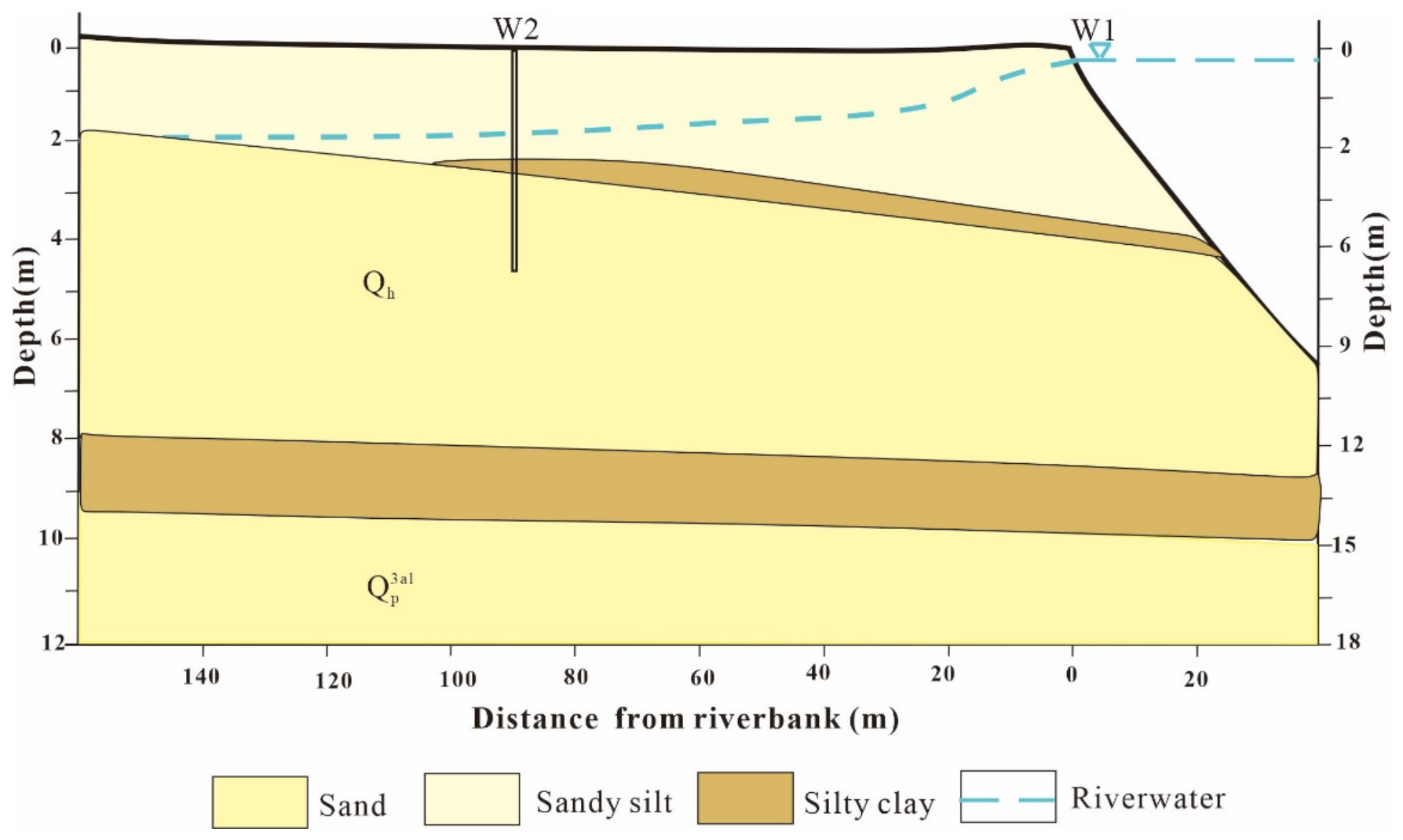
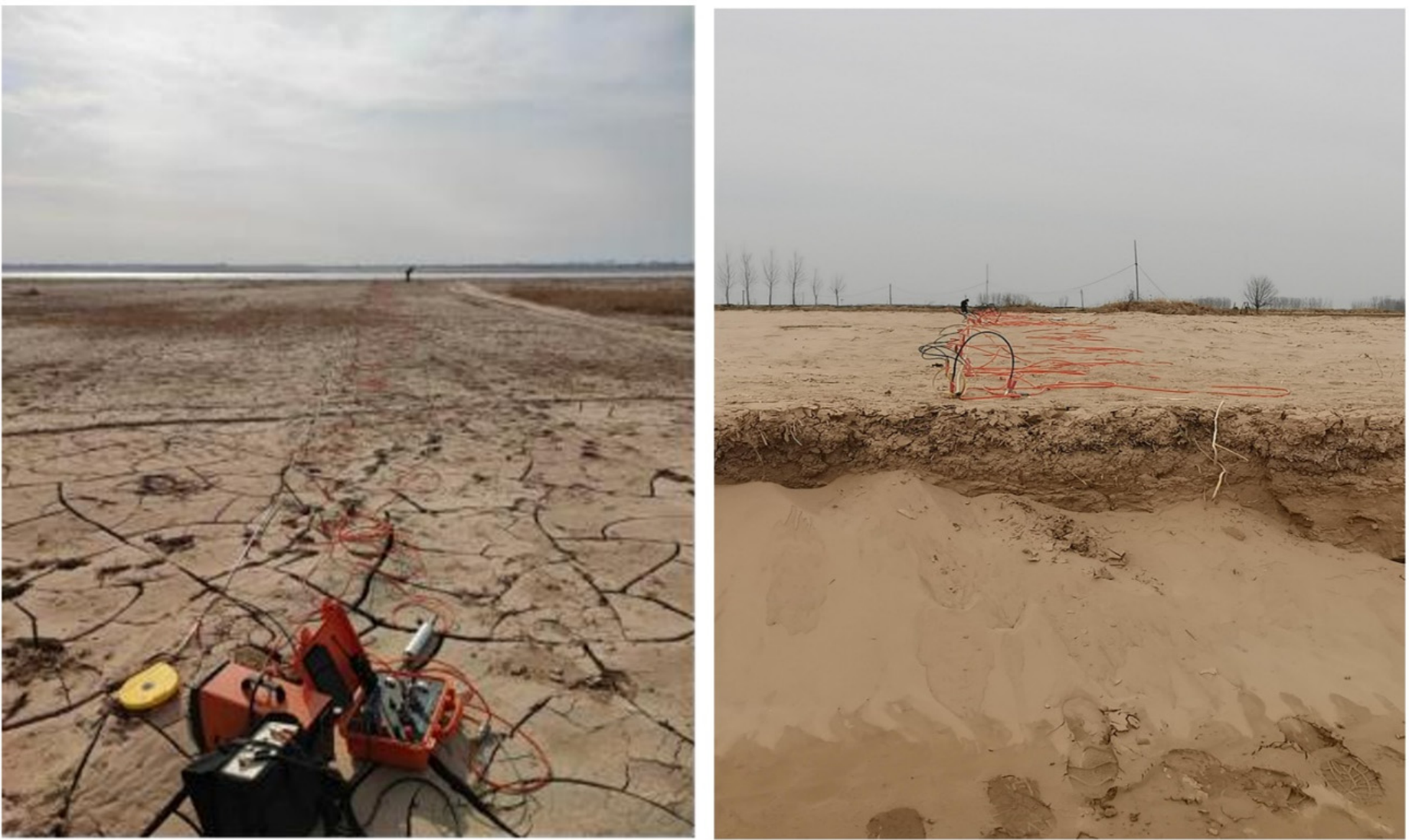
The floodplain surface is low (84–92 m a.s.l.) and dips gently towards the channel, producing a plate-like valley cross-section typical of the lower Yellow River. Downstream of Huayuankou hydrological monitoring station the river becomes a perched, losing stream that recharges the surrounding Quaternary aquifer, which establishes the essential hydraulic configuration for hyporheic exchange at the site. Borehole and outcrop observations along the ERT line (Figure 3 and Figure 4) indicate that the subsurface comprises two principal hydrostratigraphic units. The upper unit is a Holocene alluvium (Qh) 2–6 m thick, composed mainly of sandy silt with discontinuous fine-sand lenses and accumulated under repeated flood deposition. It is underlain by a thicker Pleistocene alluvium (Qp3al) dominated by medium-to-fine sand with silty clay interbeds. A comparable three-unit architecture, bounded by thin silty clay seals, was previously mapped at a nearby site by Yan et al. [28], which supports the regional representativeness of the stratigraphy we describe.

2.2. Electrical Resistivity Tomography Measurement

A DUK-2B multichannel resistivity metre (Chongqing Geological Instrument Co., Chongqing, China) was employed in electrical resistivity tomography (ERT) measurement. The Wenner-alpha configuration was adopted because it offers a high signal-to-noise ratio together with a balanced trade-off between vertical and lateral resolution. These properties are well suited to the alternating sand-silt layering of the site and to the continuous background noise generated by the nearby river [29,30]. The ERT line, 84 m long and perpendicular to the river channel, was installed so that its southern end lay 1.5 m from the water edge at low stage (Figure 1c,d). Eighty-four stainless-steel electrodes were installed to a depth of 0.2 m at 1 m intervals. The line was fixed throughout the campaign, so that geometric perturbations would not be misinterpreted as time-lapse change.
Before every survey, the ohmic contact between each electrode and the ground was checked. Acquisition was permitted only when contact resistances fell below 1 kΩ, which is an order of magnitude stricter than the generic field threshold and ensured stable current injection despite the variably saturated near-surface conditions. Transmission parameters were held constant across surveys: an injection pulse of 250 ms, 3–6 stack cycles per quadrupole, and a rejection criterion of 2% standard deviation across repeated measurements. The fluctuating river stage did not allow a truly quiescent background period during which ambient electrical noise could be quantified. We therefore adopted these stricter noise-rejection thresholds to suppress false time-lapse signals, at the cost of slightly reduced data coverage.
Three datasets were acquired on 1 December 2020, 1 March 2021 and 1 July 2021 (Table 1), representing a low-flow reference, a naturally rising stage, and the peak of the regulated-release stage, respectively. Each dataset was first inverted independently. For the time-lapse analysis, the 1 December 2020 image was then taken as the reference model, ρ 0 ( x , z ) . This choice reflects the fact that the December survey captures the most hydraulically quiescent conditions of the hydrological year and therefore provides the most stable base against which subsequent change can be attributed to stage forcing. The two later images were expressed as percent-difference tomograms:
ρ b / ρ 0 ( x , z , t ) = [ ρ ( x , z , t ) ρ 0 ( x , z ) ] / ρ 0 ( x , z )     100 %
ρ b = K V I
where I is the injected current and K is the geometric factor, determined for the AMNB configuration by:
K = 2 π ( 1 / A M     1 / A N     1 / B M   +   1 / B N )
In fluid-saturated clastic sediments, ρ b depends primarily on pore-fluid conductivity, porosity and saturation, and, to a lesser extent, on pore-fluid temperature [20,31]. At our site, river water and groundwater contrasted in electrical conductivity by a factor of 1.5 to 3 (Table 2; Section 2.4). Under these conditions, the dominant control on any time-lapse change in ρ b was the replacement of native pore fluid by infiltrated river water. Temperature- and porosity-driven contributions were second-order (see Section 4.2), which is the reason why T-ERT can be interpreted here as a direct proxy for hyporheic mixing.
For our 1 m electrode spacing and 84-electrode geometry, the Wenner-alpha array offers good vertical resolution at the expense of lateral resolution at depth. Forward sensitivity calculations for this configuration give a lateral resolution of approximately 1.5 m and a vertical resolution of approximately 0.6 m at 2 m depth, degrading to approximately 3 m and 1.5 m, respectively, at 5 m depth. The lateral extent of the HZ reported in the results should therefore be regarded as a smoothed image of the true mixing front, and any sub-metre lateral structures within ~5 m of the river edge are below the resolution of the array.
Because the lower Yellow River is characterized by intense riverbed evolution and the ERT survey was held in a fixed position throughout the campaign, the geometric stability of the electrode array was verified before each acquisition. Each survey was preceded by a tape- and handheld-GPS check of (i) the position of the southernmost electrode relative to a fixed concrete benchmark on the upper floodplain, (ii) the elevation of each electrode head relative to the benchmark, and (iii) the distance from the southernmost electrode to the water edge at the time of acquisition. Across the three surveys, the position of the ERT line, the head-to-benchmark elevations and the inter-electrode spacings were stable to within ±5 cm, ±3 cm and ±2 cm, respectively. The distance from the southernmost electrode to the water edge changed from 1.5 m at low stage to 0.6 m at rising stage, and the southernmost six electrodes were submerged under approximately 0.4 m of water at peak stage. These geometric controls allow geometric perturbations to be excluded as a significant source of time-lapse signal in the central and northern parts of the profile, and the sensitivity of the southernmost electrodes to submergence is quantified as a bound in Section 4.4.

2.3. Inversion and Temperature Normalization

2.3.1. Inversion

Apparent-resistivity pseudosections were inverted in EarthImager 2D (Advanced Geosciences Inc., Austin, TX, USA) using a regularized least-squares scheme with a robust smoothness constraint [32] that minimizes the absolute, rather than the squared, misfit between observed and predicted resistivities. This choice was motivated by the fact that robust norms are less sensitive to the outliers that inevitably accompany near-river acquisition. The inversion terminated once the root-mean-square error (RMSE) between observed and predicted apparent resistivities fell below 5%. Convergence was typically reached within 4–6 iterations, and no dataset required more than eight.
Several analyses of inversion uncertainty are reported here. The mean stacking standard deviation of the apparent-resistivity measurements before inversion was 1.4%, 1.6% and 1.9% for the December 2020, March 2021 and July 2021 surveys, respectively, and the percentage of measurements rejected by the 2% stacking-error filter was 3.7%, 4.2% and 5.1%. Final inversion RMSE values were 3.8% (T1, 5 iterations), 4.1% (T2, 6 iterations) and 4.6% (T3, 7 iterations). A depth-of-investigation (DOI) index was additionally computed by performing each inversion against two contrasting reference resistivities (10 Ω·m and 100 Ω·m) and comparing the recovered models. The DOI = 0.2 contour, below which the data no longer adequately constrain the model, and all interpretations are restricted to regions above this contour. Uncertainty in the percent-difference quantity ρ / ρ 0 was propagated analytically from the stacking standard deviation σ ρ as σ ρ ρ 0 2 σ ρ ρ 0 , which evaluates to approximately 2.6% of the local ρ / ρ 0 value over most of the imaged volume; the −15% threshold adopted as the operational HZ boundary is therefore well above the 3σ noise floor across the full investigated depth (see Section 4.5).

2.3.2. Temperature Normalization of Inverted Resistivity

Because river-water temperature in this reach varies seasonally from 3–5 °C in December to 24–26 °C in July, the inverted resistivities ρ T were normalized to a reference temperature of 25 °C prior to time-lapse differencing, following the standard linear correction of Hayashi (2004) [33]: ρ 25 = ρ T 1 + α T 25 with α = 0.020 °C−1. Formation temperatures used in the correction were obtained from (i) the temperature transducer in well W2 (24 h logging interval) for the saturated zone, and (ii) a vertically interpolated profile that propagates the river-water temperature recorded at W1 downward through the upper 1 m using the analytical heat -conduction solution of Stallman (1965) [34], which is appropriate for the daily-to-seasonal time scales relevant here. An alternative correction with α = 0.025 °C−1 was also evaluated to bound the uncertainty associated with the temperature-resistivity coefficient; the resulting HZ extents differed by less than 6% from the values reported in this study. All percent-difference tomograms (Section 3.3) and the numerical ρ / ρ 0 values quoted in the Results and Discussion are computed from temperature-normalized resistivities ρ 25 rather than from raw inverted values ρ T .

2.4. Hydrological Monitoring

Two hydrological monitoring wells framed the ERT line (Figure 1). Well W1 was sited in the riverbed to record river stage, and well W2 was installed on the floodplain, 1.5 m north of the low-stage ERT line, to record the shallow water table. Both wells were instrumented with Rugged Troll 100 pressure-temperature transducers (In-Situ Inc., Fort Collins, CO, USA), logging at 24 h intervals between 1 December 2020 and 30 November 2021. Water-level readings were barometrically compensated using a co-located BaroTroll logger (In-Situ Inc.).
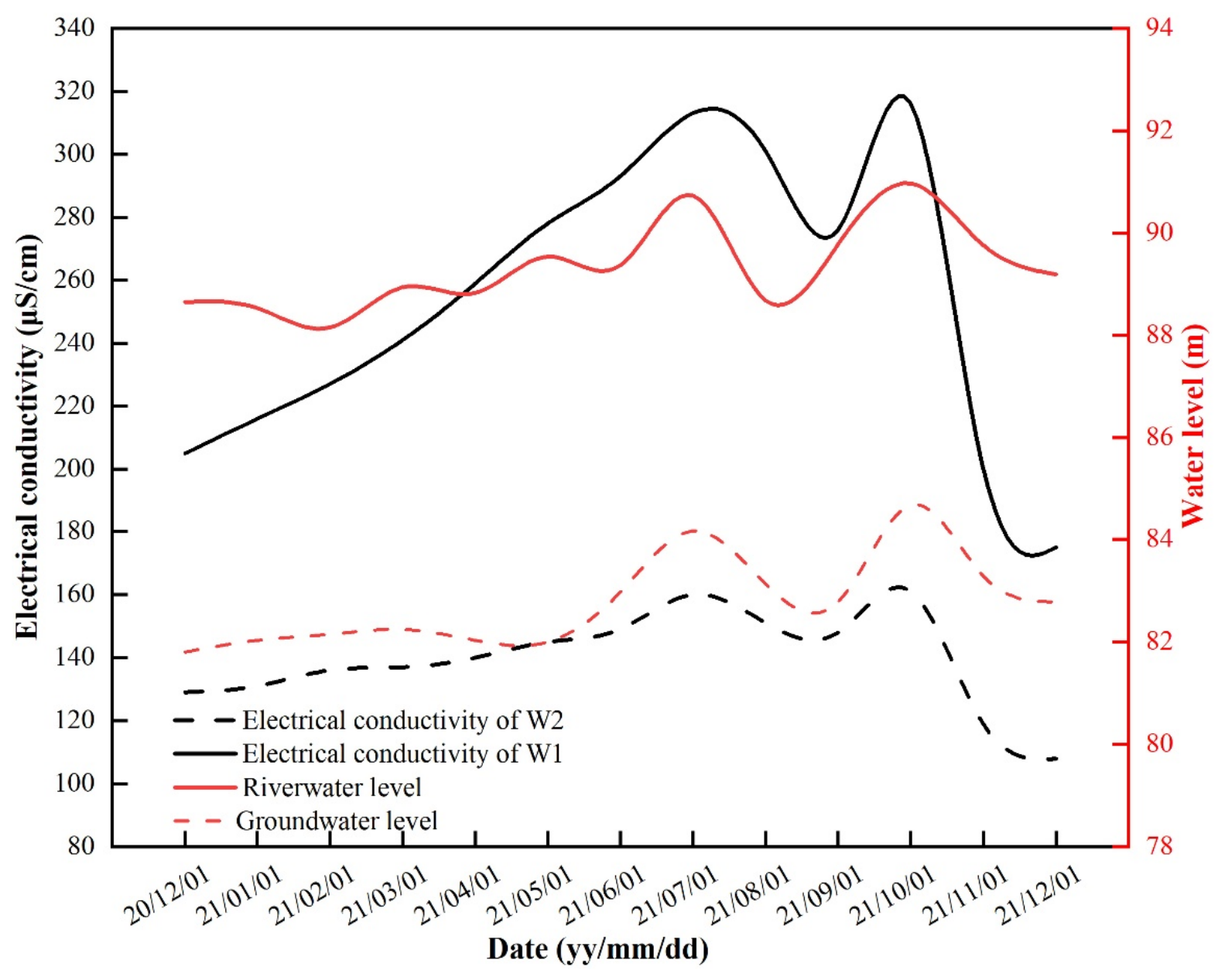
Paired river-water and groundwater samples were collected from W1 and W2 on each of the three ERT acquisition dates. Electrical conductivity (EC) was measured in situ with a calibrated YSI ProDSS multiparameter probe (YSI, Yellow Springs, OH, USA) and in parallel in the laboratory; the two sets of readings agreed to within 3%. Across the three surveys, river-water EC varied between 175 and 313 µS/cm, whereas groundwater EC remained between 108 and 160 µS/cm (Table 2). This systematic and seasonally persistent contrast, with river-water EC always 1.5–3 times the groundwater value, is the condition under which resistivity can serve as a tracer of hyporheic mixing. EC values were normalized to 25 °C prior to interpretation, in order to exclude a spurious temperature imprint on the resistivity-based inferences developed in Section 3.

3. Results

3.1. Hydrodynamic Characteristics

Hydrological records at W1 and W2 indicate that the study period encompassed three distinct hydrodynamic states (Figure 5). From 1 December 2020 to late February 2021, river stage remained below 85.8 m a.s.l. with fluctuations under 0.3 m, defining a stable low-flow state. Between March and mid-June 2021, both river and floodplain water tables rose gradually in response to pre-monsoon precipitation; however, river stage increased more rapidly (~1.1 m) than the floodplain water table (~0.5 m), establishing a persistent hydraulic gradient from the channel toward the floodplain—a prerequisite for lateral hyporheic exchange. The regulated water-and-sediment release at Xiaolangdi (XLD), initiated on 19 June, imposed a third regime: river stage rose by ~1.3 m within seven days and remained above 87 m a.s.l. throughout the event, generating the steepest river–floodplain gradient observed during the year.
Electrical-conductivity (EC) records confirmed the resistivity-based interpretations throughout the monitoring year (Table 2). Groundwater EC at W2 remained consistently low (108 –160 µS/cm) with minimal seasonal variation, whereas river-water EC at W1 increased from 175 µS/cm in December to 313 µS/cm in July, reflecting the sediment- and solute-rich nature of the regulated release. The EC contrast between river and groundwater therefore widened precisely when the hydraulic gradient was largest, enhancing the influence of river-water infiltration observed in subsequent ERT images. Notably, because river EC increased while groundwater EC remained stable, resistivity decreases at depth can be unambiguously attributed to river-water intrusion. This distinction is further elaborated in Section 4.2.

3.2. Subsurface Resistivity Characteristics

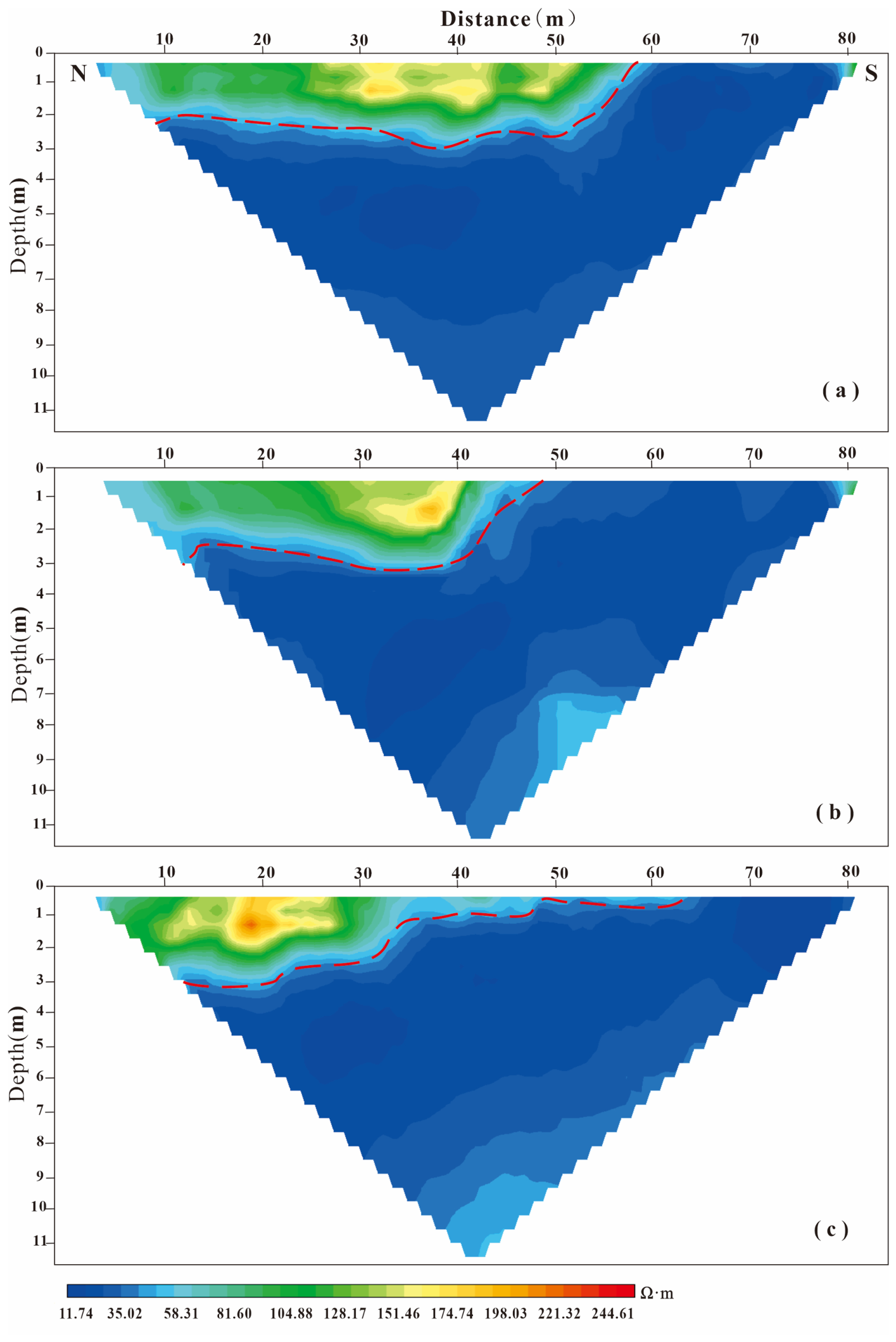
Inverted tomograms from the three surveys revealed a two-layer subsurface that remained stable in overall structure but exhibited temporal variability in resistivity (Figure 6). The upper 1.9–2.4 m of the profile consists of a relatively resistive layer (35–170 Ω·m), corresponding to the Holocene sandy-silt cap described in Section 2.1. Beneath this boundary, resistivity decreases sharply to 12–35 Ω·m, delineating the fully saturated Pleistocene s sand aquifer. The strong contrast between these units persisted across all surveys, indicating that neither seasonal desaturation nor the regulated release event fundamentally altered the subsurface architecture.
Under this background, a dynamic anomaly developed close to the river edge. On 1 December 2020 (Figure 6a), when hydraulic gradients were small, the upper unit showed a laterally uniform, relatively high resistivity. By 1 March 2021 (Figure 6b), a low-resistivity zone had begun to emerge within the first ~15 m of the south (riverward) end of the profile, with the 40 Ω·m contour descending locally from 2.4 m to about 3 m depth. On 1 July 2021 (Figure 6c), this anomaly had expanded both laterally, extending to ~36 m from the river, and vertically, with the 40 Ω·m contour reaching 4.5 m depth. The deeper sand unit remained largely invariant across the three surveys, with internal resistivity contrasts of less than 5 Ω·m. These observations indicate that the time-variable signal is confined to the upper hydrostratigraphic unit and originates adjacent to the river. This spatial signature is the one expected for lateral hyporheic exchange.

3.3. Time-Lapse Percent-Difference Tomograms

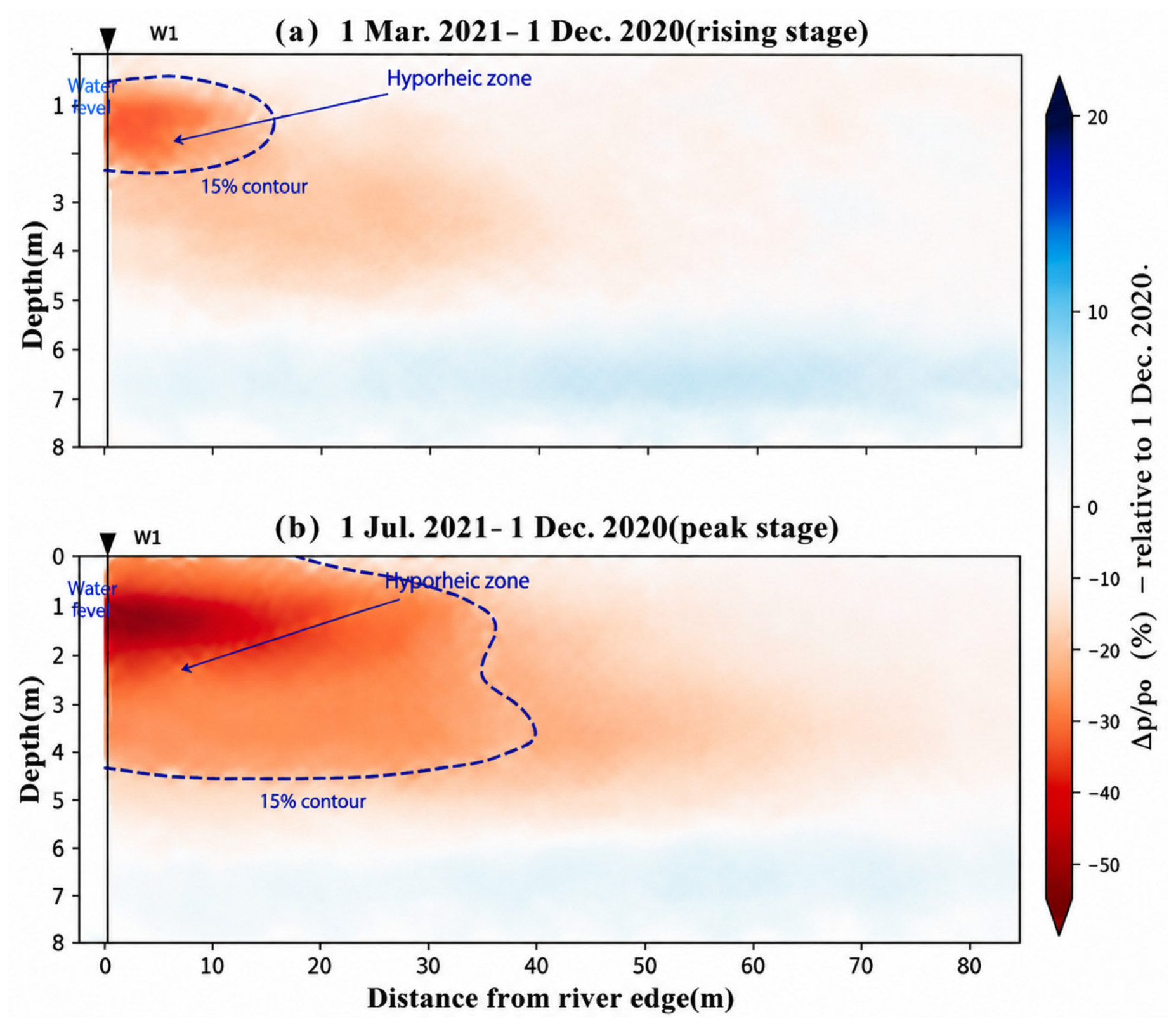
Figure 7 presents the percent-difference of inverted resistivity between hydrodynamic states. Under the rising-stage of 1 March 2021 (Figure 7a), a coherent zone of ρ b / ρ 0 ≈ −20 to −30% developed within the upper hydrostratigraphic unit. Taking the −15% contour as an operational boundary, the hyporheic zone at this time extended ~15 m laterally from the river edge and reached a maximum depth of ~2.5 m, with the strongest signal concentrated within 5 m of the channel. Below ~3 m, ρ b / ρ 0 remained within ±10%, indicating no detectable time-lapse change in the deeper unit.
Under the peak regulated-stage of 1 July 2021 (Figure 7b), the same anomaly was substantially amplified. Peak local values of ρ b / ρ 0 exceeded −45%, the −15% contour retreated to ~36 m from the river, and the maximum vertical extent of the affected zone deepened to ~4.5 m. If the cross-sectional area enclosed by the −15% contour is taken as an integrative measure, the hyporheic zone expanded by a factor of ~2.4 laterally and ~1.8 vertically between the rising and peak surveys, corresponding to an approximate fivefold increase in cross-sectional area. A weak, spatially restricted positive anomaly of ρ b / ρ 0 ≈ +5 to +10% persisted at 6–7 m depth beneath the northern half of the profile across both differenced surveys. This positive band is consistent with a minor dilution of native groundwater by distal recharge, and it is used in Section 4.2 as the indicator against which alternative explanations for the shallow negative anomaly (in particular, groundwater freshening) are tested and excluded.
In summary, Section 3.1 establishes the hydrodynamic conditions that support resistivity-based interpretation. Section 3.2 characterizes the two-layer subsurface structure within which subsequent changes occur. Section 3.3 documents the quantitative, stage-dependent expansion of the hyporheic zone.

4. Discussion

4.1. Consistency with the Working Hypothesis

The observations presented in Section 3 can be summarized in three interrelated points. First, the subsurface system is structured by two hydrostratigraphic units—a Holocene sandy-silt cap overlying a Pleistocene sand aquifer—whose resistivity contrast persists across all three surveys, providing a stable domain within which hyporheic dynamics unfold. Second, the shallow unit contains a hyporheic zone whose area expanded roughly fivefold between the rising-stage and peak-stage surveys, reflecting the combined effects of natural hydrograph rise and the XLD-regulated release. Third, the deeper mixing zone remained within ±10% of its resistivity throughout the year, indicating that deep resistivity is largely insensitive to short-term hydrological perturbations at the seasonal-to-event timescale resolved by our surveys. This insensitivity may result from any combination of (i) low-permeability silty clay interbeds shielding the deeper aquifer from rapid pressure transmission, (ii) preferential lateral flow within the shallow Holocene cap bypassing the deeper unit during the regulated release, or (iii) genuine buffering by the large-volume regional aquifer. Our data do not allow unique discrimination among these mechanisms.
Overall, these findings provide direct empirical support for the hypothesis advanced in Section 1: in large, regulated rivers, hydrodynamic conditions exert a stronger control on two-dimensional hyporheic-zone geometry than seasonal climate or lithological heterogeneity alone. The largest geometric change occurred not between cold- and warm-season surveys, but between the rising and peak stages, coinciding with engineered forcing rather than precipitation or temperature variation. In small streams, seasonality and lithological anisotropy have been reported as primary controls on hyporheic extent [25]; in contrast, our results demonstrate that in a regulated, continental-scale river, man-made hydrological operations act as the first-order driver of hyporheic dynamics. This represents the central contribution of our study.

4.2. Mechanistic Interpretation of Potential Drivers

Although the spatiotemporal pattern shown in Figure 7 is highly consistent with lateral infiltration of conductive river water, three potential mechanisms could produce a similar decreasing trend of the resistivity.
The first potential mechanism is the temperature effect. Electrical resistivity typically decreases by 2% per °C [33], while river temperature in this reach increased from 3–5 °C in December to 24–26 °C in July. Based on this relationship, the maximum temperature-induced reduction in bulk resistivity ( ρ b ) within the upper sediment layer is estimated at ~35–40%. Because all percent-difference tomograms in this study were calculated from temperature-normalized resistivities ρ 25 (Section 2.3.2), this temperature contribution was explicitly removed before any geometric interpretation. Following normalization, the residual resistivity decrease attributable to fluid replacement still exceeds 30% locally in the zones closest to the river. Moreover, the spatial pattern of the anomaly remains fixed to the river edge and retreats landward, a feature that cannot be reproduced by a temperature-only mechanism, which would generate a more uniform profile response rather than the riverward-originating and landward-retreating geometry observed in Figure 7.
The second potential mechanism is vertical infiltration of rainwater. During the 2021 monsoon season, precipitation over the floodplain totaled 1206 mm between July and September, and rainwater generally exhibits relatively low resistivity. However, if rainfall infiltration were the dominant control, the resulting resistivity anomaly would likely be laterally uniform along the 84 m profile and propagate primarily downward. This expected pattern contrasts sharply with the riverward-originating and landward-retreating geometry observed in Figure 7. Moreover, the shallow anomaly detected on 1 March 2021 (Figure 7a) occurred prior to the monsoon season, further excluding rainfall infiltration as the primary driver.
A third potential mechanism is seasonal freshening of the groundwater body due to recharge from external water sources. Generally, groundwater freshening would increase, rather than decrease ρ b , and its effect would be most pronounced at greater depths, as shallow sediments tend to re-equilibrate more rapidly with infiltrating surface water. The weak positive band of ρ b / ρ 0 ≈ +5 to +10% observed at depths of 6–7 m beneath the northern half of the profile (Section 3.3) is consistent with the process. The occurrence of this signal at the expected depth and magnitude provides an internally consistent line of evidence: although groundwater freshening is present, it is restricted to the deeper layer and cannot account for the negative anomalies in the shallow subsurface that define the hyporheic zone.
In summary, these three lines of evidence exclude temperature variation, rainfall infiltration, and groundwater freshening as primary controls on the observed resistivity decreases. Rather, the results consistently indicate that stage-driven lateral infiltration of river water is the dominant mechanism, in agreement with both geophysical and hydrological observations.

4.3. Independent Validation by Hydrochemical Tracer, In-Well Temperature Record, and Analytical Estimation

An interpretation of the time-lapse resistivity decrease that rests only on the river–groundwater EC contrast is necessarily indirect. To overcome this limitation, three independent lines of evidence were examined: (i) a hydrochemical tracer derived from the EC record at the floodplain monitoring well, (ii) a natural temperature tracer derived from the in-well thermistor log, and (iii) an analytical cross-check combining Darcy’s law for lateral flow with Archie’s law for fluid–bulk-resistivity mixing. Each line is independent of the ERT measurement and of its inversion, and each is sensitive to a distinct physical quantity—solute concentration, heat, and momentum, respectively.
The first line is the hydrochemical tracer recorded at well W2 (Table 2). Groundwater EC at W2 was 129 µS/cm on 1 December 2020 and 108 µS/cm on 1 March 2021, but rose to 160 µS/cm on 1 July 2021. This ~50 µS/cm increase at a location 1.5 m landward of the ERT line cannot be explained by vertical rainfall infiltration, which would freshen rather than concentrate the well water; by temperature drift, which was removed by 25 °C normalization (Section 2.4); or by a regional groundwater trend, as the December and March values remained within the same low range. The timing of this increase coincided with the steepest river–floodplain hydraulic gradient of the year (Section 3.1). A simple two-component mixing calculation using the contemporaneous river-water EC of 313 µS/cm, indicates a river-water mixing fraction of about 0.25 at the W2 location. The EC excursion at W2 thus provides a point-based hydrochemical tracer of river-water arrival on the floodplain, independent of the geophysical observations.
The second line of evidence is the in-well temperature record. The Rugged Troll 100 pressure–temperature transducer installed at W2 (Section 2.4) logged pore-water temperature at 24 h intervals throughout the monitoring year. In a shallow well isolated from advective forcing, temperature would typically follow the seasonal soil-temperature cycle with a depth-dependent conductive lag, producing a smooth, sinusoidal record symmetric about the spring and autumn equinoxes. In contrast, the W2 record exhibited faster-than-conductive warming following the onset of the regulated release on 19 June, diverging from the seasonal soil-temperature trajectory and approaching the contemporaneous river-water temperature of approximately 24–26 °C. This asymmetric warming is a canonical signature of advective heat transport by infiltrating river water [16]; it cannot be reproduced by purely atmospheric forcing, which propagates downward rather than laterally from the channel, nor by rainfall infiltration, as peak precipitation occurred between July and September while the departure began in late June. The thermal tracer thus independently corroborates the EC tracer through a separate transport mechanism.
The third line of evidence is an analytical cross-check combining Darcy’s law and Archie’s law. Using a hydraulic conductivity of K = 5 × 10⁻⁵ to 1 × 10⁻⁴ m/s for the silty-sand upper unit with discontinuous fine-sand lenses [28], a hydraulic gradient of i ≈ 0.02 inferred from the W1–W2 head difference at peak stage (Section 3.1), and an effective porosity of n ≈ 0.30, the average linear pore-water velocity is v = Ki/n = 3.3 × 10⁻⁶ to 6.7 × 10⁻⁶ m/s. Integrated over the cumulative stage-rise period from the onset of the natural rising stage in early March to the peak survey on 1 July (~120 days), the predicted lateral travel distance of the river-water front is approximately 30–60 m, which brackets the ~40 m extent of the −15% iso-contour observed in Figure 7b. A complementary forward calculation based on Archie’s law and the river-water and groundwater conductivities listed in Table 2 indicates that a river-water mixing fraction of 0.5–0.6 reproduces the locally observed −45 to −55% bulk-resistivity decrease near the channel. This fraction is hydrologically plausible at the location of the strongest anomaly and agrees with values reported by Cardenas and Markowski [15] for a large regulated river. Although a fully coupled flow-and-transport numerical simulation lies beyond the scope of this observational study, this simple analytical cross-check provides quantitative, independent support for stage-driven lateral infiltration of river water.
Taken together, the hydrochemical tracer at W2, the in-well temperature record, and the Darcy–Archie analytical cross-check converge on the conclusion: the time-lapse resistivity decrease observed within the upper hydrostratigraphic unit reflects lateral infiltration of river water during stage rise, amplified by the engineered XLD release. Each line of evidence is independent of both the geophysical measurement and the other lines in terms of physical principle and observational basis, yet all are mutually consistent in timing and magnitude. As a result, the validation of the ERT-based interpretation does not rely solely on the river–groundwater EC contrast.

4.4. Implications for Hyporheic-Zone Research in Large-Regulated River

Reported hyporheic-zone (HZ) extents in small-stream and alpine-creek systems generally range from approximately 0.5 m to several metres laterally and rarely exceed 2 m vertically [15,23,24]. In contrast, the ~36 m lateral and ~4.5 m vertical extents observed in this study under peak-stage conditions are roughly one order of magnitude larger than these previously reported values. Although the fundamental controls on HZ development are similar across river systems—namely, the interplay among river-to-aquifer hydraulic gradients, sediment permeability, and fluid-density contrasts—the lower Yellow River differs markedly from small streams in both the magnitude and temporal dynamics of these controlling forces. In particular, the hydraulic gradient is periodically intensified by regulated flow releases, while a laterally continuous, moderately permeable sandy-silt layer enables inland transmission of this forcing.
Both stage fluctuations and the presence of a continuous, moderately permeable upper sediment layer are necessary to produce the hyporheic response observed in this study; neither factor alone appears sufficient. In reaches where the upper unit is cemented, cohesive, or dominated by fine-grained material, the same stage-driven forcing would likely generate a much weaker response, as indicated by the ferricrete-affected reach examined by Rickel et al. [25]. This finding has important practical implications: extrapolation from one large regulated river to another should consider not only stage dynamics but also the permeability structure of shallow floodplain sediments.

4.5. Novelty, Limitations and Future Directions

The novelty of this study is reflected in three main contributions. First, to our knowledge, it provides one of the first direct time-lapse geophysical observations of floodplain hyporheic dynamics in the lower Yellow River, a system characterized by continental-scale discharge, high sediment loads, and intensive engineering regulation—conditions not previously examined in ERT-based studies. Second, by combining time-lapse electrical resistivity tomography (T-ERT) with co-located electrical conductivity measurements and continuous water-level monitoring, we identify river-water infiltration as the primary driver of the observed resistivity decline and validate this inference through three independent lines of evidence: a hydrochemical tracer at the floodplain well, an in-well temperature record, and an analytical Darcy–Archie cross-check, while also excluding temperature variation, rainfall infiltration, and groundwater freshening as major alternative drivers. Third, the contrast between a stage-responsive shallow hyporheic zone and a more buffered deeper mixing zone challenges patterns developed primarily for small streams and provides a reference framework for studies in large regulated rivers.
Several limitations should be noted. The spatial smoothing inherent in ERT inversion means that the −15% contour should be interpreted as an operational threshold rather than a sharp hydrogeological boundary; consequently, the reported HZ dimensions are approximate. In addition, a single two-dimensional profile cannot fully resolve three-dimensional heterogeneity associated with meander curvature, mid-channel bars, or preferential flow paths [24]. Finally, the three surveys conducted within one hydrological year provide a limited temporal basis for broader generalization, and longer-term monitoring would be required to assess interannual variability in hyporheic responses.
A second important limitation is the lack of falling-stage and ice-covered surveys. The three ERT acquisitions captured low-flow, rising-stage, and peak-stage conditions, but not the recession limb following the regulated release. As a result, we cannot determine whether the floodplain HZ contracts symmetrically as river stage declines or instead exhibits a hysteretic, lagged recovery, as reported in other regulated river systems. Such hysteretic behaviour is plausible in porous-media flow systems subject to cyclic forcing, where recovery pathways may depend on antecedent loading history rather than on the instantaneous hydraulic boundary condition alone. Therefore, capturing both the falling limb and ice-covered conditions should be a priority in future field campaigns. These additional observations would directly test whether the fivefold HZ expansion documented here is followed by symmetric contraction or by a delayed, hysteretic response.
Our three-snapshot design captures the main seasonal hydrodynamic states: low flow, naturally rising stage, and regulated peak stage. It provides robust evidence that the HZ cross-sectional area varies by approximately fivefold among these states. However, this design does not resolve the temporal trajectory of HZ expansion or the symmetry of its subsequent contraction. Daily or sub-daily T-ERT acquisitions across a complete regulated-release cycle would be needed to quantify the rate of HZ expansion, the lag between stage forcing and hyporheic response, and the potential occurrence of hysteresis during the falling limb.
A third limitation arises from the two-dimensional survey geometry. In a meandering reach characterized by mid-channel bars and channel curvature, three-dimensional flow components, including along-bank flow, point-bar-induced helical flow, and curvature-driven secondary circulation, cannot be resolved from a single 2D ERT profile. Consequently, along-bank heterogeneity in the HZ is integrated along the survey line rather than explicitly imaged. The HZ extents reported here should therefore be interpreted as a two-dimensional, profile-integrated representation rather than a fully resolved three-dimensional geometry. Future work at this site should include cross-channel and along-bank ERT profiles, ideally configured as a 3D ERT block survey. For comparable reaches of the Yellow River, future deployments should also be coupled with UAV-based photogrammetry or LiDAR topographic surveys repeated at each ERT acquisition. Such data would allow bank retreat, sediment deposition, and channel migration to be independently quantified and incorporated into the inversion as time-varying topographic boundary conditions. As a quantitative check on geometric stability, we recomputed the HZ extent after excluding the southernmost six electrodes, which were submerged during peak stage. The resulting lateral extents during the rising and peak stages were 9% and 12% smaller, respectively, but these changes did not affect the principal conclusions of the study.
Finally, the muted resistivity response in the deeper sand unit is consistent with buffering by the regional groundwater system. However, the present dataset cannot distinguish this mechanism from low-permeability shielding by silty clay interbeds or preferential lateral flow within the shallow Holocene cap. Discriminating among these alternatives would require deep hydraulic-head time series from multi-level piezometers installed in the Pleistocene aquifer, complementary tracer or stable-isotope analyses, and coupled hydrogeological–geophysical numerical modelling. These approaches were beyond the scope of the present field campaign but represent important directions for follow-up work.
These limitations point to clear priorities for future research. Longer survey lines, cross-channel and along-bank ERT measurements, and higher-frequency T-ERT acquisitions during regulated flow events would improve three-dimensional characterization and better capture transient hyporheic dynamics. Coupling these geophysical observations with hydraulic-head monitoring, hydrochemical tracers, stable isotopes, and numerical modelling would further strengthen the mechanistic interpretation of river–floodplain exchange in large regulated rivers.

4.6. Sensitivity of HZ Delineation to Threshold Choice

The −15% iso-contour adopted as the hyporheic-zone (HZ) boundary in Section 2.3 is justified on three independent grounds. First, the −15% threshold is roughly three times the noise level of the time-lapse resistivity difference, estimated from the standard deviation of ρ / ρ 0 in the deep, hydrologically quiescent portion of the profile (1σ ≈ 4.8%). A 3σ criterion is commonly used as a standard threshold in geophysical change detection. Second, applying alternative thresholds of −10%, −15%, and −20% produces HZ cross-sectional areas that vary by approximately +28%, baseline, and −24%, respectively; importantly, the qualitative conclusions of this study−stage-driven expansion, ~5-fold area increase between rising and peak stages, and a riverward-anchored origin—remain robust to threshold selection. Third, applying Archie’s law to the upper sandy-silt unit, using the site-measured EC contrast and laboratory-measured porosity (ϕ ≈ 0.34), indicates that a −15% bulk-resistivity decrease corresponds to ~35–55% pore-fluid replacement by river water, a hydrogeologically meaningful criterion for delineating an actively mixed zone. Collectively, these three lines of evidence support the use of −15% as an appropriate HZ boundary.

5. Conclusions

This study addresses a critical gap in hyporheic-zone research: the lack of direct empirical observations of hyporheic dynamics in large, operationally regulated rivers. By combining three time-lapse electrical resistivity tomography (T-ERT) surveys with co-located hydrological monitoring along a meandering reach of the lower Yellow River, we obtained the following key findings.
The floodplain subsurface consists of two hydro-stratigraphic units: a Holocene sandy-silt cap (35–170 Ω·m) and a Pleistocene sand aquifer (12–35 Ω·m). The contrast between these units is consistent across seasons and provides a reference for interpreting time-lapse ERT results. The cross-sectional area of the hyporheic zone, delineated operationally by the ρ b / ρ 0 = −15% contour, expanded approximately five times between the rising-stage and peak-stage surveys, with lateral and vertical dimensions growing from ~15 m × 2.5 m to ~36 m × 4.5 m (after temperature normalization in Section 2.3.2). In contrast, the deeper sand unit exhibited less than 10% variation in resistivity across surveys, indicating insensitivity of deep resistivity to short-term hydrological perturbations at seasonal-to-event timescales. However, the present dataset cannot uniquely distinguish buffering by the regional aquifer from low-permeability shielding by intervening silty clay interbeds or preferential lateral flow within the shallow cap.
Analysis of temperature, vertical rainfall infiltration, and groundwater freshening as alternative drivers indicates that hyporheic-zone dynamics are primarily controlled by stage-driven lateral infiltration amplified by XLD regulations. This interpretation is independently supported by three lines of evidence: lateral electrical conductivity excursions at well W2, in-well temperature records, and an analytical Darcy–Archie cross-check, whose predicted lateral extent (~30–60 m) and mixing fraction (0.5–0.6) are consistent with geophysical observations. These results refine small-stream-based models by demonstrating that engineered water management constitutes a first-order control on hyporheic geometry in large regulated rivers. Methodologically, they also show that T-ERT, when combined with sparse but strategically targeted hydrological data, provides a practical and minimally invasive approach for characterizing hyporheic dynamics where chemical and temperature tracers are impractical.
Future studies extending T-ERT acquisition to three dimensions, increasing temporal resolution during regulated releases, and integrating geophysical observations with chemical and temperature measurements will further establish geophysical techniques as a standard tool for river-corridor management.

Author Contributions

Conceptualization, investigation, writing—original draft preparation, Y.Y. (Yajing Yan); investigation, software and analysis, Y.C.; data curation, formal analysis, Y.L.; supervision, J.W.; writing—review and editing, Y.Y. (Yongshuai Yan); investigation, resources, G.Z. All authors have read and agreed to the published version of the manuscript.

Funding

This work was supported by Key Scientific Research Projects of Colleges and Universities in Henan Province (25B170016) and Kaifeng Municipal Science and Technology Key Research Project (2503019) and Henan Provincial Key Science and Technology Research Project (262102320056).

Data Availability Statement

The original contributions presented in this study are included in the article. Further inquiries can be directed to the corresponding author.

Conflicts of Interest

The authors declare that they have no known competing financial interests or personal relationships that could have appeared to influence the work reported in this paper.

References

  1. Boulton, A.; Findlay, S.; Marmonier, P.; Stanley, E.; Valett, H. The functional significance of the hyporheic zone in streams and rivers. Annu. Rev. Ecol. Evol. Syst. 1998, 29, 59–81. [Google Scholar] [CrossRef]
  2. Hester, E.; Cardenas, M.; Haggerty, R.; Apte, S. The importance and challenge of hyporheic mixing. Water Resour. Res. 2017, 53, 3565–3575. [Google Scholar] [CrossRef]
  3. Biehler, A.; Chaillou, G.; Buffin-Bélanger, T.; Baudron, P. Hydrological connectivity in the aquifer–river continuum: Impact of river stages on the geochemistry of groundwater floodplains. J. Hydrol. 2020, 590, 125379. [Google Scholar] [CrossRef]
  4. Wu, C.; Lu, C.; Chen, J.; Liu, J.; Zhang, H.; Saidy, E.; Liu, B.; Shu, L. Spatio-temporal variability of hydraulic conductivity in the floodplain riverbank of a hyporheic zone. Catena 2023, 228, 107172. [Google Scholar] [CrossRef]
  5. Merill, L.; Tonjes, D. A review of the hyporheic zone, stream restoration, and means to enhance denitrification. Crit. Rev. Environ. Sci. Technol. 2014, 44, 2337–2379. [Google Scholar] [CrossRef]
  6. Ward, A.S. The evolution and state of interdisciplinary hyporheic research. WIREs Water 2016, 3, 83–103. [Google Scholar] [CrossRef]
  7. Liang, D.; Song, J.; Xia, J.; Chang, J.; Kong, F.; Sun, H.; Wu, Q.; Cheng, D.; Zhang, Y. Effects of heavy metals and hyporheic exchange on microbial community structure and functions in hyporheic zone. J. Environ. Manag. 2022, 303, 114201. [Google Scholar] [CrossRef] [PubMed]
  8. Cardenas, M.; Wilson, J.; Zlotnik, V. Impact of heterogeneity, bed forms, and stream curvature on subchannel hyporheic exchange. Water Resour. Res. 2004, 40, W08307. [Google Scholar] [CrossRef]
  9. Bianchin, M.; Smith, L.; Beckie, R. Defining the hyporheic zone in a large tidally influenced river. J. Hydrol. 2011, 406, 16–29. [Google Scholar] [CrossRef]
  10. Singh, T.; Wu, L.; Gomez-Velez, J.; Lewandowski, J.; Hannah, D.; Krause, S. Dynamic Hyporheic Zones: Exploring the Role of Peak Flow Events on Bedform-Induced Hyporheic Exchange. Water Resour. Res. 2019, 55, 218–235. [Google Scholar] [CrossRef]
  11. Gooseff, M.N. Defining hyporheic zones: Advancing our conceptual and operational definitions of where stream water and groundwater meet. Geogr. Compass 2010, 4, 945–955. [Google Scholar] [CrossRef]
  12. Voltz, T.; Gooseff, M.; Ward, A.; Singha, K.; Fitzgerald, M.; Wagener, T. Riparian hydraulic gradient and stream-groundwater exchange dynamics in steep headwater valleys. J. Geophys. Res. Earth Surf. 2013, 118, 953–969. [Google Scholar] [CrossRef]
  13. Ward, A.; Gooseff, M.; Singha, K. How does subsurface characterization affect predictions of hyporheic exchange? Ground Water 2012, 50, 818–828. [Google Scholar]
  14. Malzone, J.; Lowry, C.; Ward, A. Response of the hyporheic zone to transient groundwater fluctuations on the annual and storm event time scales. Water Resour. Res. 2016, 52, 5301–5321. [Google Scholar] [CrossRef]
  15. Cardenas, M.; Markowski, M. Geoelectrical imaging of hyporheic exchange and mixing of river water and groundwater in a large regulated river. Environ. Sci. Technol. 2011, 45, 1407–1411. [Google Scholar] [CrossRef]
  16. Kim, H.; Lee, K.; Lee, J. Numerical verification of hyporheic zone depth estimation using streambed temperature. J. Hydrol. 2014, 511, 861–869. [Google Scholar] [CrossRef]
  17. McLachlan, P.; Chambers, J.; Uhlemann, S.; Binley, A. Geophysical characterisation of the groundwater—surface water interface. Adv. Water Resour. 2017, 109, 302–319. [Google Scholar] [CrossRef]
  18. Ma, R.; Chen, K.; Andrews, C.; Loheide, S.; Sawyer, A.; Jiang, X.; Briggs, M.; Cook, P.; Gorelick, S.; Prommer, H.; et al. Methods for Quantifying Interactions Between Groundwater and Surface Water. Annu. Rev. Environ. Resour. 2024, 49, 623–653. [Google Scholar] [CrossRef]
  19. Acworth, R.; Dasey, G. Mapping of the hyporheic zone around a tidal creek using a combination of borehole logging, borehole electrical tomography and cross-creek electrical imaging, New South Wales, Australia. Hydrogeol. J. 2003, 11, 368–377. [Google Scholar] [CrossRef]
  20. Binley, A.; Kemna, A. DC resistivity and induced polarization methods. In Hydrogeophysics; Springer: Dordrecht, The Netherlands, 2005; pp. 129–156. [Google Scholar]
  21. Johnson, T.; Thomle, J.; Stickland, C.; Goldman, A.; Stegen, J. Riverbed Temperature and 4D ERT Monitoring Reveals Heterogenous Horizontal and Vertical Groundwater-Surface Water Exchange Flows Under Dynamic Stage Conditions. Front. Earth Sci. 2022, 10, 910058. [Google Scholar] [CrossRef]
  22. Coscia, I.; Greenhalgh, S.; Linde, N.; Doetsch, J.; Marescot, L.; Günther, T.; Vogt, T.; Green, A. 3D crosshole ERT for aquifer characterization and monitoring of infiltrating river water. Geophysics 2011, 76, G49–G59. [Google Scholar] [CrossRef]
  23. Busato, L.; Boaga, J.; Perri, M.T.; Majone, B.; Bellin, A.; Cassiani, G. Hydrogeophysical characterization and monitoring of the hyporheic and riparian zones: The Vermigliana Creek case study. Sci. Total Environ. 2019, 648, 1105–1120. [Google Scholar] [CrossRef]
  24. McGarr, J.; Wallace, C.; Ntarlagiannis, D.; Sturmer, D.; Soltanian, M. Geophysical mapping of hyporheic processes controlled by sedimentary architecture within compound bar deposits. Hydrol. Process. 2021, 35, e14358. [Google Scholar] [CrossRef]
  25. Rickel, A.; Hoagland, B.; Navarre-Sitchler, A.; Singha, K. Seasonal shifts in surface water–groundwater connections in a ferricrete-impacted stream estimated from electrical resistivity. Geophysics 2021, 86, WB117–WB129. [Google Scholar] [CrossRef]
  26. Chen, Y.; Fu, B.; Zhao, Y.; Wang, K.-B.; Zhao, M.M.; Ma, J.-F.; Wu, J.-H.; Xu, C.; Liu, W.-G.; Wang, H. Sustainable development in the Yellow River Basin: Issues and strategies. J. Clean. Prod. 2020, 263, 121223. [Google Scholar] [CrossRef]
  27. Yellow River Conservancy Commission, Ministry of Water Resources, PRC. Yellow River Water Resources Bulletin. 2021. Available online: http://szy.mwr.gov.cn/lyxx/202211/t20221126_1618474.html (accessed on 18 November 2022).
  28. Yan, Y.; Deng, Y.; Ma, L.; Zhao, G.Z.; Qian, J.Z. Characterizing seasonal recharge between a river and shallow aquifer in a floodplain based on time-lapse electrical resistivity tomography. Hydrogeol. J. 2023, 31, 111–126. [Google Scholar] [CrossRef]
  29. Loke, M. Tutorial: 2-D and 3-D Electrical Imaging Surveys, Geotomo Software 2004; Geotomosoft: Penang, Malaysia, 2001.
  30. Vu, M.; Xayavong, V.; Do, C.; Pham, L.T.; Gómez-Ortiz, D.; Eldosouky, A.M. Application of the improved multi-electrode electrical exploration methods for groundwater investigation in Vientiane Province, Laos. J. Asian Earth Sci. X 2021, 5, 100056. [Google Scholar] [CrossRef]
  31. Archie, G.E. The electrical resistivity log as an aid in determining some reservoir characteristics. Trans. AIME 1942, 146, 54–62. [Google Scholar] [CrossRef]
  32. Claerbout, J.; Muir, F. Robust modeling with erratic data. Geophysics 1973, 38, 826–844. [Google Scholar] [CrossRef]
  33. Hayashi, M. Temperature—electrical conductivity relation of water for environmental monitoring and geophysical data inversion. Environ. Monit. Assess. 2004, 96, 119–128. [Google Scholar] [CrossRef]
  34. Stallman, R.W. Steady one-dimensional fluid flow in a semi-infinite porous medium with sinusoidal surface temperature. J. Geophys. Res. 1965, 70, 2821–2827. [Google Scholar] [CrossRef]
Figure 1. Location of the electrical resistivity tomography (ERT) line and monitoring wells. (a) Map of China, with Henan Province outlined in black and the Yellow River in blue. (b) Henan Province, with the red star marking the study region. (c) Field photo of in–situ ERT line. (d) Position of monitoring wells W1 and W2.
Water 18 01251 g001
Figure 2. Temperature and precipitation from December 2020 to November 2021 at the study site.
Water 18 01251 g002
Figure 3. Geological profile along ERT line with the positions of wells W1 and W2.
Water 18 01251 g003
Figure 4. Photos of ERT line.
Water 18 01251 g004
Figure 5. Water level and electrical conductivity measured at wells W1 (river) and W2 (groundwater) from December 2020 to November 2021.
Water 18 01251 g005
Figure 6. Inverted resistivity tomograms along the ERT line on (a) 1 December 2020, (b) 1 March 2021, and (c) 1 July 2021. The dashed red lines mark the interpreted boundary of the hyporheic zone.
Water 18 01251 g006
Figure 7. Time-lapse percent-difference ERT tomograms along the ERT line, referenced to the 1 December 2020 baseline. (a) 1 March 2021 (rising stage). (b) 1 July 2021 (peak stage, coincident with the XLD water-and-sediment regulation event). Warm colours (negative ρ b / ρ 0 ) indicate resistivity decreases, interpreted as infiltration of more-conductive river water into groundwater-saturated sediment. The dashed navy contour at −15% delineates the operational hyporheic-zone boundary. W1 is the riverbed monitoring well.
Water 18 01251 g007
Table 1. Electrical resistivity tomography acquisition settings.
TomogramOrientationElectrode Spacing (m)Electrode NumberLength (m)Measurement Date
T1S–N184841 December 2020
T2S–N184841 March 2021
T3S–N184841 July 2021
Table 2. Measured electrical conductivity at well W1 (river) and well W2 (groundwater).
Water TypeWell IDEC (µS/cm)Measurement Date
River waterW12051 December 2020
River waterW11751 March 2021
River waterW13131 July 2021
GroundwaterW21291 December 2020
GroundwaterW21081 March 2021
GroundwaterW21601 July 2021
Disclaimer/Publisher’s Note: The statements, opinions and data contained in all publications are solely those of the individual author(s) and contributor(s) and not of MDPI and/or the editor(s). MDPI and/or the editor(s) disclaim responsibility for any injury to people or property resulting from any ideas, methods, instructions or products referred to in the content.