Article

Off the Record: Unveiling Volume of Unreported Catch in Marine Fisheries with Data from Labuan Fishing Port, Java, Indonesia

1
Study Program of Fisheries Management, Faculty of Science and Technology, Universitas Terbuka, Jl. Cabe Raya Pondok Cabe Pamulang, Tangerang Selatan 15418, Indonesia
2
Department of Aquatic Resources Management, IPB University, Jl. Raya Dramaga, Bogor 16680, Indonesia
3
Centre for Coastal and Marine Resources Management (CCMRS), IPB University, Baranangsiang, Bogor 16143, Indonesia
4
Department of Zoology and Fisheries, Faculty of Agrobiology, Food and Natural Resources, Czech University of Life Sciences Prague, Kamýcká 129, 16500 Prague, Czech Republic
5
Department of Preschool & Primary Education, Faculty of Education, Jan Evangelista Purkyně University in Ústí nad Labem, Pasteurova 1, 400 96 Ústí nad Labem, Czech Republic
6
Department of Biology, Faculty of Science, Humanities and Education, Technical University of Liberec, Studentská 1402/2, 461 17 Liberec, Czech Republic
*
Author to whom correspondence should be addressed.
Water 2026, 18(11), 1250; https://doi.org/10.3390/w18111250
Submission received: 21 April 2026 / Revised: 19 May 2026 / Accepted: 20 May 2026 / Published: 22 May 2026

Abstract

Marine fisheries provide a nutrient source for humans, and Indonesian marine fisheries have the second-highest production rate globally. Reliable evidence of the volume of captured fish is crucial for the sustainable management of Indonesian fisheries. The Labuan Fishing Port in Banten Province, Sunda Strait, was surveyed between September 2022 and March 2023. Based on personal inspections and an anonymous questionnaire, fishermen used various methods to catch fish. The captures by fisheries showed that the gear types, including purse seines and a mix of several types of gear, were the largest contributors to officially registered (auctioned) production, with 85.85% and 83.91% of their captures being auctioned, while bottom otter trawls auctioned 7.91% of their capture only. The reported reasons for unrecorded catch varied, with time pressure and lack of supervision being the leading factors. Most unrecorded captured fish were sold directly to buyers or taken home for consumption. Thus, the reports are considered inaccurate. Implementation of real-time data capture techniques and enhancements to marketing and auction systems was recommended.

1. Introduction

The world’s oceans and seas serve as a vital nutrient source for human consumption, with food provided mostly by fisheries [1], and fishing effort continues to increase [2]. For decades, overfishing of many commercially harvested fish stocks has threatened the sustainable use of marine ichthyofauna [3,4]. Moreover, negative changes in the species, size, and biomass structure of marine biota related to intensive fisheries have resulted from a decline in abundance and density in the highly fished taxa [5,6].
From a global perspective, unreported or misreported marine fishing activities present a significant problem, causing the underestimation of the total fishery volume at relevant spatial–temporal scales [2,7,8,9]. Improved knowledge of the real volume of fish catches and potential overfishing is important for understanding the current status and trends of coastal marine resources, especially around major islands and close to densely populated areas [9,10]. In addition, the unreported removal of captured species can negatively affect fish populations by exceeding limits due to the resulting low accuracy of fishery evidence [11]. Sustainable and responsible management covers regulations, monitoring, and further control activities requiring the cooperation of all stakeholders, but this is ignored, especially by small-scale fishermen, in many regions worldwide [12].
Especially in small-scale fisheries in developing countries, vessels are rarely subject to rigorous inspection due to their high numbers and related high scrutiny costs [13]. Fishermen and vessel owners often engage in unreported fishing practices to maximise profits and cut costs, breaching fishing regulations [2]. Unreported catch (not submitted to official records), unrecorded catch (not captured in the enumeration system), and illegal catch (violates regulations) are recognised [14]. Small-scale fisheries occur worldwide, but predominantly in tropical low- or mid-income countries, being fundamental for the livelihood, welfare, and food security of coastal communities in these countries [15]. Moreover, decision-makers tend to overlook small-scale fisheries and favour commercial ones, which are important sources of foreign exchange revenue, even though capture from small-scale fisheries significantly contributes to the international seafood market [16]. Although improvement in this regard is urgently required, loopholes and information gaps caused by inconsistent monitoring efforts in fisheries at various national and regional levels leave food security and marine biodiversity at continued risk from unregulated fishing activities [17].
The fastest increase in the number of marine fisheries is predictably in the Indo-Pacific region [18]. In Indonesia, a tropical upper-middle-income Southeast Asian country [19], there are many places where marine resources, such as fish, crustaceans, molluscs, sea cucumbers and other valuable taxa, are harvested at varying levels of intensity [20]. Catches in Indonesia consist of both demersal and pelagic species. At circa 5.8 million km2, Indonesia has one of the largest maritime domains worldwide [21,22]. From a global perspective, Indonesian marine fisheries have the second-highest production rate behind China [23,24]. In this large archipelagic country, locals from coastal communities are usually involved in the fishing, seafood and ornamental trade industries, with their long-term livelihoods closely related to the balance and sustainability of the marine environment e.g., [23,25,26,27].
Indonesia’s national fisheries catch recording and reporting system operates through a hierarchical structure involving the Ministry of Maritime Affairs and Fisheries of the Republic of Indonesia (MMAF), provincial fisheries offices, and port-level Technical Implementation Units (Units Pelaksana Teknis/UPTs). At designated fish landing sites, trained enumerators are responsible for recording all catch that passes through official auction channels. This data is compiled monthly and submitted upward through the provincial fisheries office to the national MMAF database. However, this system is structurally limited to catch that enters the formal auction process, leaving all fish sold through informal channels, including direct sales to buyers, market transactions, and on-board or household consumption, entirely outside the official record [20,22].
In recent years, Indonesia has piloted electronic and digital logbook systems as part of its broader effort to improve fishery data quality and combat illegal, unreported and unregulated (IUU) fishing [22,28]. These initiatives, however, have predominantly targeted larger commercial vessels with monitoring obligations under national fisheries law, leaving significant coverage gaps for the substantial majority of the fleet operating below 10 gross tonnage (GT).
One of the most important regions in this regard is the Sunda Strait, located between the southern tip of Sumatra and the western tip of Java at the confluence of the Indian Ocean and Java Sea, containing abundant nutrients and phytoplankton which support pelagic and demersal fish taxa there [29]. Fishing in the Sunda Strait supplies marine fish for human consumption, especially in the western part of Java Island [30,31]. The fishing grounds are in coastal areas and around small islands in this strait [32]. This area is part of the Fisheries Management Area (no. 572) and has great economic potential for fisheries in Indonesia [33]. On the other hand, sustainable fishing in the Sunda Strait faces various challenges and environmental threats, such as increasing demand for demersal fish taxa and related intensive capture, which negatively impact the abundance of Sulphur goatfish (Upeneus spp.) and other species with economic value [28], including endangered species [33]. Fishermen there employ various techniques and tactics from traditional methods to mechanised gear [34].
Prior studies have begun to quantify the extent of unreported or misreported catch in Indonesian fisheries, though empirical data remain scarce. Navarrete Forero et al. [23] employed participatory GPS vessel tracking to reconstruct spatial fishing patterns among artisanal fishers in South Sulawesi. Their research revealed that the spatial extent of actual fishing effort substantially exceeded that implied by official landing records, an indirect indicator of systematic underreporting at the fleet level. Similarly, Hoenner et al. [12] used commercial anti-theft tracking devices aboard fishing vessels to infer at-sea activity, and found discrepancies between vessel behaviour and officially declared fishing effort that point to pervasive non-compliance in catch reporting among small-scale operators.
Marine fishery management in Indonesia faces a huge dilemma in how to be sustainable, because while some resources are overexploited, fisheries are expected to contribute to the national economy through an increase in total catches and the provision of employment for many people [32]. Although the recently implemented Indonesian policy and restrictions to minimise and combat illegal fishing by foreign-flagged vessels may be considered successful [35], reliable evidence of the volume of fish captured in the Sunda Strait by local fishermen is crucial for further sustainable practices and management of marine fisheries there. Therefore, we decided to conduct a detailed analysis comparing data from the Labuan Fishing Port and evidence from fish auctions with the behaviour of local fishermen and vessel owners. This approach is essential for the evaluation of the volume of unreported and unrecorded catches in the Sunda Strait.
To the best of our knowledge, this study is among the first to provide empirical, gear-group-disaggregated estimates of unreported catch volume at Labuan Fishing Port in the Sunda Strait, simultaneously combining direct landing observation at official auction sites with data from an anonymous questionnaire administered to fishermen across three distinct gear categories. This dual-method approach addresses a substantive gap in Indonesian fisheries monitoring research and provides a more granular basis for evidence-based fisheries governance than has previously been available for this region.

2. Material and Methods

2.1. Study Locality

The Labuan Fishing Port (also called Labuan Coastal Fishing Port) in Banten Province, Java, Indonesia, was selected as a study locality because it is one of the country’s largest fish auctions and fish markets (Figure 1a,b). This port was established as the centre for the management and development of fishing ports in the Banten Province by MMAF. It is a major landing site for fishermen operating in the Sunda Strait and a hub of the fishing industry in the entire Pandeglang Regency (Figure S1). The approximate annual landing volume was 190 thousand tons (in 2017) [36], and 57 species were recorded to be landed there [37]. With more than 22% of the total volume, the most exploited marine fish species is mackerel tuna (Euthynnus affinis) [36]. The total human population is estimated to be over 62 thousand inhabitants living on an area of 15.66 km2, and the area has the highest concentration of fishermen in the Regency.

2.2. Data Collection and Analysis

The study was conducted between September 2022 and March 2023. Data were collected around the entire Labuan Fishing Port area, focusing on fish auction sites 1–3, Badak market, Labuan market, and local fishermen’s houses around the port (Figure 1c). The primary data were gathered through personal interviews and questionnaires, and direct observations regarding the landing and auctioning of marine fishery catches and sales outside the auctions. The respondents in this study were fishermen from Labuan Fishing Port in Banten, with roles ranging from crewmen responsible for operating fishing equipment to captains and ship owners. The smaller the boat being operated, the more tasks the crew members were responsible for. The number of respondents to be gathered was 30 per fishing gear group. Each respondent represents a different vessel.
The sampling frame for respondent selection consisted of registered vessel lists maintained at Labuan Fishing Port, stratified by gear type and crew size. Stratification by crew size was applied because crew numbers are closely linked to vessel capacity, trip duration, and the volume of unreported production attributable. All active fishing vessels of each gear type that were registered at the port and had completed at least one fishing trip during the study period were considered eligible for inclusion.
The main objective of the questionnaire was to address the amount of unreported production outside the auction sites related to the number of fish sold directly to buyers, the market, and processors, consumed on ships, taken home, caught for bait, sold at sea, and discarded as bycatch. In Indonesia, in vessels where a fishing logbook is mandatory, all catches must be reported. The questionnaire also covered the behaviour of fishermen not recorded directly at the port.
The questionnaire comprised four question categories. Category (i) covered vessel and gear characteristics (vessel size, gear type, engine capacity, and crew number). Category (ii) addressed trip duration and frequency per month, as longer and more frequent trips are associated with greater informal catch disposal. Category (iii) collected catch volume estimates by disposal category (auctioned, sold directly to buyers or processors, taken home, sold to market, sold at sea, used as bait, consumed on-board, and discarded as bycatch). Category (iv) recorded self-reported reasons for non-registration, including time pressure, absence of enumerators, low catch volume, lack of supervision, facility damage, fee concerns, and unfamiliarity with recording tools. The questionnaire was administered anonymously to reduce social desirability bias.
Respondents were selected using stratified random sampling, with a focus on fishermen with different fishing gear and the number of crew members on their vessels (crew members of various ages were randomly asked to fill out the questionnaire). Fishing gear in the Labuan Fishing Port, according to the study by Kartini, et al. [38], includes purse seines, seine nets, lift nets, beach seines, bottom otter trawl nets, gill nets, and hooks and lines. Based on these categories, the respondents were sorted into three groups: (i) bottom otter trawl with 2–3 fishermen (hereafter referred to as BOT); (ii) boats with purse seines with 10–25 fishermen (hereafter referred to as PS); and (iii) boats with mixed fishing gear (hooks and lines/gill nets/bottom otter trawl nets) with 4–6 fishermen (hereafter referred to as MIX). Vessels were categorised based on the type of fishing gear used, the fishing operation and the number of crew members. Each type of fishing gear had a different number of crew members and a different operation. The number of crew members and fishing behaviour are crucial factors in unreported production, as a larger crew size typically results in greater unreported production in terms of on-board consumption and home consumption. Groups with larger crews typically undertake longer trips.
Each type of fishing gear group had a different total number of boats in operation. The PS stratum comprised exactly 30 active vessels at Labuan Fishing Port. Data collection was conducted by census from 30 respondents of that group. For the BOT and MIX groups, each of which comprised more than 60–100 active vessels, the sample of 30 respondents represents approximately 30–50% of the active fleet in each stratum. This level of coverage is considered adequate for the purposes of initial descriptive estimation of unreported catch volumes and the identification of leading nonreporting factors. The limitation imposed by the partial sampling of BOT and MIX fleets is explicitly acknowledged, and future studies are encouraged to achieve broader coverage to improve the precision and generalisability of unreported catch estimates across these gear groups.
Within each gear stratum, vessels were selected using a random approach: fishing vessels were approached by the research team upon returning to port for landing events at the auction sites and fish markets throughout the study period. The captain of each returning vessel was invited to participate; where the captain was unavailable, a crew member was interviewed instead. Vessel operators who declined participation were noted, and the next available vessel of the same gear type was approached as a replacement. Port authority staff assisted the research team in identifying eligible vessels. Sampling within each stratum continued until 30 valid respondents had been enrolled.
To assess the potential for non-response bias, the total number of vessels approached within each gear stratum was recorded alongside the number that agreed to participate. The non-response rate and any observable differences between participating and non-participating vessels are reported as part of the revised results to allow readers to evaluate the potential direction and magnitude of non-response bias. As a precautionary note, it is possible that fishermen with higher volumes of unreported catch may have been less willing to participate, which would lead to an underestimation of actual unreported production. This source of bias is acknowledged as a limitation of the present study.
The bottom otter trawl net (BOT) is pulled by a vessel. The use of BOT follows the enactment of Law No. 31 of 2004, Article 9, Paragraph 1, which prohibits the operation of trawl nets or tiger nets in order to preserve the sustainability of fishery resources from destructive fishing gear. Fishing vessels with bottom trawl nets at Labuan Fishing Port, Banten, generally have a capacity of less than 10 GT and are manned by 2–3 crew members. These vessels operate on one-day trips or two-day trips, with a total of 15–27 days at sea per month, departing between 04:00 and 05:00 and returning between 12:00 and 15:00. There is a bycatch consisting of small fish.
The purse seine net (PS) is a type of net that is pulled toward the vessel to trap pelagic fish. Fishing vessels with purse seine nets at Labuan Fishing Port have a capacity of 30 GT or less. Most of these vessels operate on three-to-five-day trips, while some rarely conduct one-day trips, departing between 05:00 and 10:00 and returning between 15:00 and 17:00, or returning at 05:00, with a total of 15–30 at sea activity per month. Vessels are manned by 10–25 crew members. The purse seine vessel is usually accompanied by a ship equipped with a fishing aid in the form of torches, operated by 4 fishermen. The difference in productivity within the group occurs because the trip duration affects productivity due to the increased number of fishing gear settings.
The gill net is a drifting piece of gear, placed in the water column to catch pelagic fish. Demersal fish can also be caught, usually as bycatch. Bottom longline hooks are constructed with a main line, weights, floats, hooks, and bait to catch demersal fish. Some bottom longline vessels equipped with bottom trawl nets can use their catch as bait, while bottom longline vessels without bottom trawl nets purchase natural bait at the market. The gill net/bottom line/bottom trawl net group (MIX) is considered a single category because the vessels are around 15 GT or smaller and are manned by 4–6 crew members. This group also sometimes sets two pieces of fishing gear on the same day. Vessels operate using a one-day fishing system or a three-to-five-day fishing system, with departure times between 04:00 and 08:00, and return times between 12:00 or 15:00–17:00, for a total of 15–30 days at sea per month. The number of days per trip and the total trips per month may vary depending on crew size, supplies, sea weather conditions, and catch outcomes.
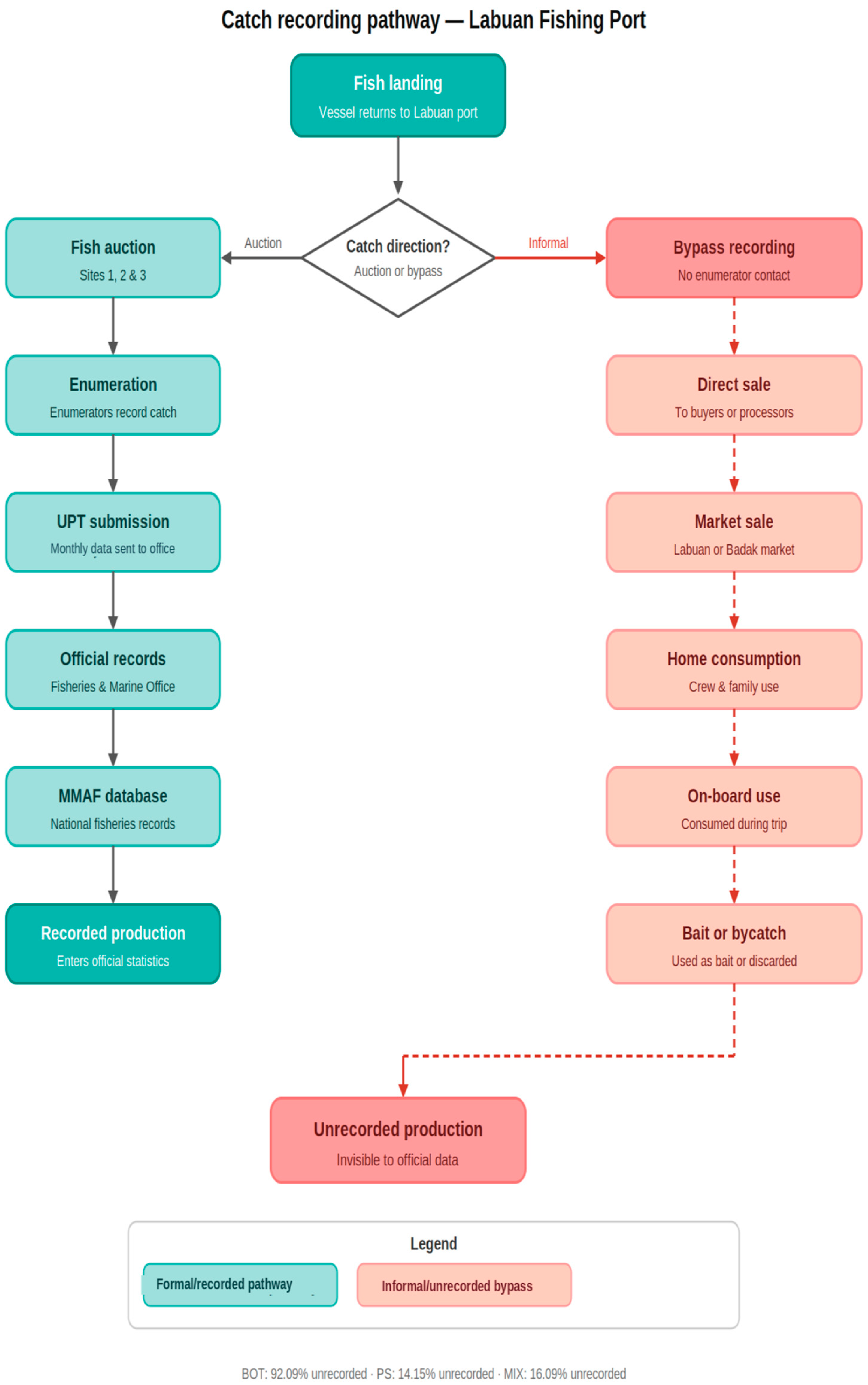
The secondary data for confirmation were obtained from recorded fishing vessel sizes and fishing gear entering the fish auctions. The findings were analysed using descriptive statistics and are presented as percentages. The technical flow for reporting catch results at Labuan Fishing Port is only conducted when the catch has been auctioned at one of the three fish landing sites. The fish that have been auctioned are recorded by enumerators. The official recording results are then submitted by officers to the Technical Implementation Unit, Labuan, Banten, once a month. The data is subsequently reported to the Fisheries and Marine Affairs Office. Fish caught by fishermen that are not channelled to the landing sites for auction are not recorded officially by enumerators, such as fish sold directly to buyers, to processors, at markets, or at sea, crew shares to be taken home, fish discarded due to bycatch, and fish consumed on-board during the trip. This occurs because official recording by enumerators at Labuan Fishing Port is only carried out when the production is first distributed to the landing sites. Findings from the presented sample have limits that can be transferred and generalised to the total volume, which require further monitoring.

3. Results

The number of respondents (=vessels) was 30 per group: bottom otter trawls = BOT; purse seine = PS; and a mix of hooks, lines, gill nets, and trawls = MIX. The captures by fisheries in the Labuan Fishing Port were routinely documented in the auctions by authorised office personnel and compared with survey data (Figure 2). The records showed that the PS and MIX groups were the largest contributors of officially registered production, with 85.85% and 83.91% of their captures, respectively, being registered when the fish were delivered to the auctions (all vessels in both groups passed official registration; Table 1). In contrast, just 7.91% of BOT captures were registered, with only 2 of 30 vessels in this group passing official registration. The reasons why fishermen did not record their production varied, with time pressure and lack of supervision being the leading factors in all groups (summarised in Table 2). The vast majority of unrecorded captured fish was sold directly to buyers, processors and local markets, or taken home for consumption by fishermen, crew members, and their families (Table 3). Production per vessel per trip ranged from 0 to 80 kg in BOT, 30 to 600 kg in MIX, and 50 to 1500 kg in PS. The largest unrecorded fish production per vessel was 30 kg in MIX, 80 kg in BOT, and 375 kg in PS, with a total volume within the survey of 3089 kg in PS, 1689.5 kg in MIX, and 1396.5 kg in BOT. The discarding of bycatch fish was found in just two vessels in the BOT group.
Among all recorded factors associated with underreporting, “Time pressure” and “No supervision” dominated among all gear types, jointly accounting for 53–70% of all mentions in each analysed group. To ascertain differences among gear types (BOT, PS, and MIX), a one-way ANOVA test was used (each group contributes nine factor-count observations). The differences were not statistically significant in terms of mean factor counts per group (F = 0.284, p = 0.7553).

4. Discussion

Even though Indonesia recently declared a decrease in illegal fishing activity and improved transparency, monitoring, and enforcement in the marine fishery [35], our findings revealed that unreported capture still exists. According to MMAF regulation no. 33 of 2021, reports are considered accurate if the discrepancy between the recorded and landed production is less than or equal to 10%, but this limit was found to be exceeded across all evaluated fishing types (92.09% for bottom otter trawls, 14.15% for purse seine nets, and 16.09% for mixes of hooks, lines, gill nets, and trawls) in the Sunda Strait within the monitored period. The finding that circa 92% of BOT catches were unrecorded aligns with global estimates of small-scale fisheries by Agnew et al. [7] and Zeller et al. [9], who reported significant underreporting in Pacific Island waters and globally. This finding underscores that non-compliance in small-scale fisheries is not an isolated phenomenon but a widespread challenge across tropical developing nations. The main factors identified as causing unreported catch were time pressure and a lack of supervision, and both occurred among all gear types with no significant difference.
Even though the volume of unreported catch from vessels using bottom otter trawls was much higher than the reported part, the total volume was relatively low in comparison with purse seine production, the most frequently used technique and gear among local fishermen in the Sunda Strait. Optimising purse seine fishing in Indonesia was highlighted by some authors as essential to maximising profit, with fishermen’s understanding of the environmental conditions and various aspects perceived to be crucial [39]. Since this profit is directly related to the survival of marine biota and the long-term balance of marine ecosystems, it is crucial to encourage local communities to adopt sustainable fishing practices to receive benefits from a healthy ocean [40,41].
It is promising that a slowdown in the depletion of harvested marine fish was recorded in certain taxa [40]. But this scenario does not apply to all economically valuable fish species, as a decline in average fishery biomass exists across oceans [42]. Although fishery data are the key to assessing marine fish stocks, the availability of data in Indonesia tends to be low due to non-compliance and disregard for mandatory fishery rules and regulations [24]. Moreover, implemented Indonesian regulations and restrictions shifted the volume of unreported catch, with small-scale fishing accounting for the majority of unreported production [22]. Unreported catches from marine fisheries in the Sunda Strait are commonly taken home for consumption, sold directly to customers, or delivered to the street market, which can be considered illicit. The pattern of selling fish directly to buyers or taking catches home observed across all gear groups in the present study is consistent with documented informal fish trade channels in tropical artisanal fisheries, where such practices are widely reported as primary pathways for unreported catch distribution [15,16].
Without improvements in fishery management and practices, the decline of many important and economically valuable species stocks is expected in the near future in Indonesia; for example, tuna fish stocks are at risk [43]. It is known that recovery of marine biota requires substantial short-term reductions in fishing efforts, and Indonesian decision-makers have focused on reforming fisheries to minimise economic losses as much as possible [35]. Certain restrictions are considered ineffective; for example, crew members arrested from vessels involved in unreported catches can be easily replaced by their employers because they are recruited from a cheap labour pool [22,44]. As mentioned by Leonardo and Deeb [22], for regulations to avoid harming local fishermen, it is necessary to minimise their motivation to violate laws. The acceptance of rules by local communities is required for these regulations to be effective, and the arguments for this must be correctly and appropriately explained by stakeholders. The predominance of time pressure and lack of supervision as the leading nonreporting factors across all gear groups in this study corroborates similar findings from developing-country fisheries contexts. Temple et al. [11] and Houk et al. [10] likewise identified enforcement deficits and operational time constraints as key structural barriers to accurate catch recording among small-scale fishermen in comparable regional settings.
Since the controlled and sustainable exploitation of marine fish is crucial for human livelihood and prosperity, as well as for marine biodiversity and ecosystems as a whole, fisheries management needs improvement in data collection. Since the absence of supervision was indicated as one of the most common reasons for fishermen not recording their catches, intensive education on how and why to offer complete evidence and report accurate catch data is essential for effective resource governance. In this regard, developing easy-to-follow and time-efficient tools and applications that are community-friendly is recommended as an effective way to address the problem in the long run. These need to be addressed as they are a frequently cited barrier to reporting accurate capture.
Improved monitoring and reports are important for assessing the magnitude of the harvest and income derived from fishing [45], but it is expected that ongoing management strategies will face underreporting of capture volume and limited data reporting by most local fishermen. Implementation of real-time data capture techniques, as well as enhancements to marketing and auction systems, could be beneficial. Furthermore, the creation and release of motivational campaigns supported by local and national governments for local fishermen should be considered to address the issue. This effort must be supported by governance authorities, as well as the formulation and implementation of feasible laws and regulations.

Supplementary Materials

The following supporting information can be downloaded at: https://www.mdpi.com/article/10.3390/w18111250/s1, Figure S1: Labuan Fishing Port and fish markets.

Author Contributions

E.Y. contributed as a corresponding author, funding acquirer, and manuscript writer. Y. contributed as supervisor, proofreader, and conceptualizer. S.A.S. contributed as the data collector, data analyst, and a manuscript writer. J.P. managed the data set and edited the manuscript. All authors have read and agreed to the published version of the manuscript.

Funding

This research received no external funding.

Institutional Review Board Statement

The study was conducted in accordance with the Declaration of Helsinki of 1975, and the protocol was approved by The Research Ethics Committee of Universitas Terbuka (No. B/553/UN31.LPPM/PT.01.03/2023) on 2 May 2023.

Informed Consent Statement

Verbal informed consent was obtained from the participants. The rationale for utilising verbal consent is that the participants responded via personal interviews and were not motivated to sign a form, and obtaining a written signature was technically difficult.

Data Availability Statement

The original results presented in this study are included in the current paper. For any further inquiries, please contact the corresponding author.

Acknowledgments

We thank Universitas Terbuka for providing research funding through the fundamental research scheme. We also thank the fishermen in Labuan Coastal Fishing Port, Banten, Indonesia, for granting permission to conduct our research at the study site. Finally, we would like to thank the two anonymous reviewers for the valuable comments and criticism that contributed to the substantial improvement of the manuscript. The English was proofread by Karen Cooper.

Conflicts of Interest

The authors declare no conflicts of interest.

References

  1. Zhou, S.; Smith, A.D.; Knudsen, E.E. Ending overfishing while catching more fish. Fish Fish. 2015, 16, 716–722. [Google Scholar] [CrossRef]
  2. Auld, K.; Baumler, R.; Han, D.P.; Neat, F. The collective effort of the United Nations Specialised Agencies to tackle the global problem of illegal, unreported and unregulated (IUU) fishing. Ocean Coast. Manag. 2023, 243, 106720. [Google Scholar] [CrossRef]
  3. Burgess, M.G.; Polasky, S.; Tilman, D. Predicting overfishing and extinction threats in multispecies fisheries. Proc. Natl. Acad. Sci. USA 2013, 110, 15943–15948. [Google Scholar] [CrossRef]
  4. Costello, C.; Ovando, D.; Hilborn, R.; Gaines, S.D.; Deschenes, O.; Lester, S.E. Status and solutions for the world’s unassessed fisheries. Science 2012, 338, 517–520. [Google Scholar] [CrossRef]
  5. Daan, N.; Gislason, H.; Pope, J.G.; Rice, J.C. Changes in the North Sea fish community: Evidence of indirect effects of fishing? ICES J. Mar. Sci. 2005, 62, 177–188. [Google Scholar] [CrossRef]
  6. Britten, G.L.; Dowd, M.; Minto, C.; Ferretti, F.; Boero, F.; Lotze, H.K. Predator decline leads to decreased stability in a coastal fish community. Ecol. Lett. 2014, 17, 1518–1525. [Google Scholar] [CrossRef]
  7. Agnew, D.J.; Pearce, J.; Pramod, G.; Peatman, T.; Watson, R.; Beddington, J.R.; Pitcher, T.J. Estimating the worldwide extent of illegal fishing. PLoS ONE 2009, 4, e4570. [Google Scholar] [CrossRef]
  8. Sumaila, U.R.; Alder, J.; Keith, H. Global scope and economics of illegal fishing. Mar. Policy 2006, 30, 696–703. [Google Scholar] [CrossRef]
  9. Zeller, D.; Harper, S.; Zylich, K.; Pauly, D. Synthesis of underreported small-scale fisheries catch in Pacific island waters. Coral Reefs 2015, 34, 25–39. [Google Scholar] [CrossRef]
  10. Houk, P.; Rhodes, K.; Cuetos-Bueno, J.; Lindfield, S.; Fread, V.; McIlwain, J. Commercial coral-reef fisheries across Micronesia: A need for improving management. Coral Reefs 2012, 31, 13–26. [Google Scholar] [CrossRef]
  11. Le Gallic, B.; Cox, A. An economic analysis of illegal, unreported and unregulated (IUU) fishing: Key drivers and possible solutions. Mar. Policy 2006, 30, 689–695. [Google Scholar] [CrossRef]
  12. Temple, A.J.; Skerritt, D.J.; Howarth, P.E.; Pearce, J.; Mangi, S.C. Illegal, unregulated and unreported fishing impacts: A systematic review of evidence and proposed future agenda. Mar. Policy 2022, 139, 105033. [Google Scholar] [CrossRef]
  13. Hoenner, X.; Barlian, E.; Ernawati, T.; Hardesty, B.; Kembaren, D.; Mous, P.; Sadiyah, L.; Satria, F.; Wilcox, C. Using anti-theft tracking devices to infer fishing vessel activity at sea. Fish. Res. 2022, 249, 106230. [Google Scholar] [CrossRef]
  14. Ainsworth, C.; Pitcher, T. Estimating illegal, unreported and unregulated catch in British Columbia’s marine fisheries. Fish. Res. 2005, 75, 40–55. [Google Scholar] [CrossRef]
  15. Teh, L.S.; Teh, L.C.; Sumaila, U.R. Quantifying the overlooked socio-economic contribution of small-scale fisheries in Sabah, Malaysia. Fish. Res. 2011, 110, 450–458. [Google Scholar] [CrossRef]
  16. Crona, B.I.; Basurto, X.; Squires, D.; Gelcich, S.; Daw, T.M.; Khan, A.; Havice, E.; Chomo, V.; Troell, M.; Buchary, E.A. Towards a typology of interactions between small-scale fisheries and global seafood trade. Mar. Policy 2016, 65, 1–10. [Google Scholar] [CrossRef]
  17. Roberson, L.A.; Kiszka, J.J.; Watson, J.E. Need to address gaps in global fisheries observation. Conserv. Biol. 2019, 33, 966–968. [Google Scholar] [CrossRef]
  18. Warren, C.; Steenbergen, D.J. Fisheries decline, local livelihoods and conflicted governance: An Indonesian case. Ocean Coast. Manag. 2021, 202, 105498. [Google Scholar] [CrossRef]
  19. Ratnasari, V.; Audha, S.H.; Dani, A.T.R. Statistical modeling to analyze factors affecting the middle-income trap in Indonesia using panel data regression. MethodsX 2023, 11, 102379. [Google Scholar] [CrossRef]
  20. Sunoko, R.; Huang, H.-W. Indonesia tuna fisheries development and future strategy. Mar. Policy 2014, 43, 174–183. [Google Scholar] [CrossRef]
  21. Brotosusilo, A.; Apriana, I.W.A.; Satria, A.A.; Jokopitoyo, T. Littoral and coastal management in supporting maritime security for realizing Indonesia as world maritime axis. IOP Conf. Ser. Earth Environ. Sci. 2016, 30, 012016. [Google Scholar] [CrossRef]
  22. Leonardo, A.; Deeb, N. Illegal, unreported and unregulated (IUU) fishing in Indonesia: Problems and solutions. IOP Conf. Ser. Earth Environ. Sci. 2022, 1081, 012013. [Google Scholar] [CrossRef]
  23. Navarrete Forero, G.; Miñarro, S.; Mildenberger, T.K.; Breckwoldt, A.; Sudirman; Reuter, H. Participatory boat tracking reveals spatial fishing patterns in an Indonesian artisanal fishery. Front. Mar. Sci. 2017, 4, 409. [Google Scholar] [CrossRef]
  24. Jaya, I.; Satria, F.; Nugroho, D.; Sadiyah, L.; Buchary, E.A.; White, A.T.; Franklin, E.C.; Courtney, C.A.; Green, G.; Green, S.J. Are the working principles of fisheries management at work in Indonesia? Mar. Policy 2022, 140, 105047. [Google Scholar] [CrossRef]
  25. Baum, G.; Kusumanti, I.; Breckwoldt, A.; Ferse, S.C.; Glaser, M.; Adrianto, L.; van der Wulp, S.; Kunzmann, A. Under pressure: Investigating marine resource-based livelihoods in Jakarta Bay and the Thousand Islands. Mar. Pollut. Bull. 2016, 110, 778–789. [Google Scholar] [CrossRef]
  26. Herdiansyah, H.; Saiya, H.G.; Afkarina, K.I.I.; Indra, T.L. Coastal community perspective, waste density, and spatial area toward sustainable waste management (Case study: Ambon bay, Indonesia). Sustainability 2021, 13, 10947. [Google Scholar] [CrossRef]
  27. Akmal, S.G.; Zámečníková-Wanma, B.P.; Prabowo, R.E.; Khatami, A.M.; Novák, J.; Petrtýl, M.; Kalous, L.; Patoka, J. Marine ornamental trade in Indonesia. Aquat. Living Resour. 2020, 33, 25. [Google Scholar] [CrossRef]
  28. Lindawati, L.; Mardyani, Y.; Yanti, N.; Boer, M. Assessing and managing demersal fisheries in Sunda Strait: Bio-economic modelling. IOP Conf. Ser. Earth Environ. Sci. 2021, 860, 012062. [Google Scholar] [CrossRef]
  29. Irnawati, R.; Nurdin, H.S.; Susanto, A.; Surilayani, D.; Hamzah, A.; Supadminingsih, F.N. Multidimensional scaling for sustainability of small pelagic fisheries in Sunda Strait. Agric. Nat. Resour. 2021, 55, 387–394. [Google Scholar]
  30. Yonvitner; Boer, M.; Kurnia, R. Assesment of fisheries efectivity to sustainable fisheries development in Banten Province. J. Kebijak. Perikan. Indones. 2020, 12, 35–46. [Google Scholar] [CrossRef]
  31. Irnawati, R.; Nurdin, H.S.; Susanto, A.; Supadminingsih, F.N.; Surilayani, D.; Hamzah, A. Small pelagis fisheries productivity in coast of the Sunda Strait of Banten Province. In Joint Proceedings of the 2nd and the 3rd International Conference on Food Security Innovation (ICFSI 2018–2019); Atlantis Press: Amsterdam, The Netherlands, 2021; pp. 200–202. [Google Scholar]
  32. Mous, P.J.; Pet, J.; Arifin, Z.; Djohani, R.; Erdmann, M.; Halim, A.; Knight, M.; Pet-Soede, L.; Wiadnya, G. Policy needs to improve marine capture fisheries management and to define a role for marine protected areas in Indonesia. Fish. Manag. Ecol. 2005, 12, 259–268. [Google Scholar] [CrossRef]
  33. Yonvitner, Y.; LIoret, J.; Boer, M.; Kurnia, R.; Akmal, S.G.; Yuliana, E.; Yani, D.E.; Gómez, S.; Setijorini, L.E. Vulnerability of marine resources to small-scale fishing in a tropical area: The example of Sunda Strait in Indonesia. Fish. Manag. Ecol. 2020, 27, 472–480. [Google Scholar] [CrossRef]
  34. Halim, A.; Wiryawan, B.; Loneragan, N.R.; Hordyk, A.; Sondita, M.F.A.; White, A.T.; Koeshendrajana, S.; Ruchimat, T.; Pomeroy, R.S.; Yuni, C. Developing a functional definition of small-scale fisheries in support of marine capture fisheries management in Indonesia. Mar. Policy 2019, 100, 238–248. [Google Scholar] [CrossRef]
  35. Cabral, R.B.; Mayorga, J.; Clemence, M.; Lynham, J.; Koeshendrajana, S.; Muawanah, U.; Nugroho, D.; Anna, Z.; Mira; Ghofar, A. Rapid and lasting gains from solving illegal fishing. Nat. Ecol. Evol. 2018, 2, 650–658. [Google Scholar] [CrossRef]
  36. Wahyuningsih, D.; Irnawati, R.; Surilayani, D. Marketing chain and quality of mackerel tuna (Euthynnus affinis) landed at Labuan Coastal Fishing Port. J. Perikan. Dan Kelaut. 2019, 9, 111–124. [Google Scholar]
  37. Yonvitner; Yuliana, E.; Yani, D.E.; Setijorini, L.E.; Nurhasanah; Santoso, A.; Boer, M.; Kurnia, R.; Perdinan; Agus, S.B. Effect of silent tsunami sunda strait to fisheries activity: Record from Labuan Landing Port, Pandeglang. AIP Conf. Proc. 2021, 2320, 040027. [Google Scholar]
  38. Kartini, N.; Boer, M.; Affandi, R. Analysis of CPUE (catch per unit effort) and sustainable potential of tembang fisheries resources (Sardinella fimbriata) in the waters of Sunda Strait. Manfish J. 2021, 1, 183–189. [Google Scholar] [CrossRef]
  39. Wiyono, E.S. Optimizing purse seine fishing operations in the Java Sea, Indonesia. Aquac. Aquar. Conserv. Legis. 2014, 7, 475–482. [Google Scholar]
  40. Duarte, C.M.; Agusti, S.; Barbier, E.; Britten, G.L.; Castilla, J.C.; Gattuso, J.-P.; Fulweiler, R.W.; Hughes, T.P.; Knowlton, N.; Lovelock, C.E. Rebuilding marine life. Nature 2020, 580, 39–51. [Google Scholar] [CrossRef]
  41. Lubchenco, J.; Cerny-Chipman, E.B.; Reimer, J.N.; Levin, S.A. The right incentives enable ocean sustainability successes and provide hope for the future. Proc. Natl. Acad. Sci. USA 2016, 113, 14507–14514. [Google Scholar] [CrossRef]
  42. Palomares, M.; Froese, R.; Derrick, B.; Meeuwig, J.; Nöel, S.-L.; Tsui, G.; Woroniak, J.; Zeller, D.; Pauly, D. Fishery biomass trends of exploited fish populations in marine ecoregions, climatic zones and ocean basins. Estuar. Coast. Shelf Sci. 2020, 243, 106896. [Google Scholar] [CrossRef]
  43. Khan, A.M.; Jiang, M.-g.; Yang, X.-q.; Apriliani, I.M.; Purba, N.P.; Wiryawan, B.; Pasaribu, B. Illegal fishing threatens the sustainability of future tuna commodities in Indonesia. Mar. Policy 2024, 159, 105936. [Google Scholar] [CrossRef]
  44. Chapsos, I.; Hamilton, S. Illegal fishing and fisheries crime as a transnational organized crime in Indonesia. Trends Organ. Crime. 2019, 22, 255–273. [Google Scholar] [CrossRef]
  45. Rudd, M.B.; Branch, T.A. Does unreported catch lead to overfishing? Fish Fish. 2017, 18, 313–323. [Google Scholar] [CrossRef]
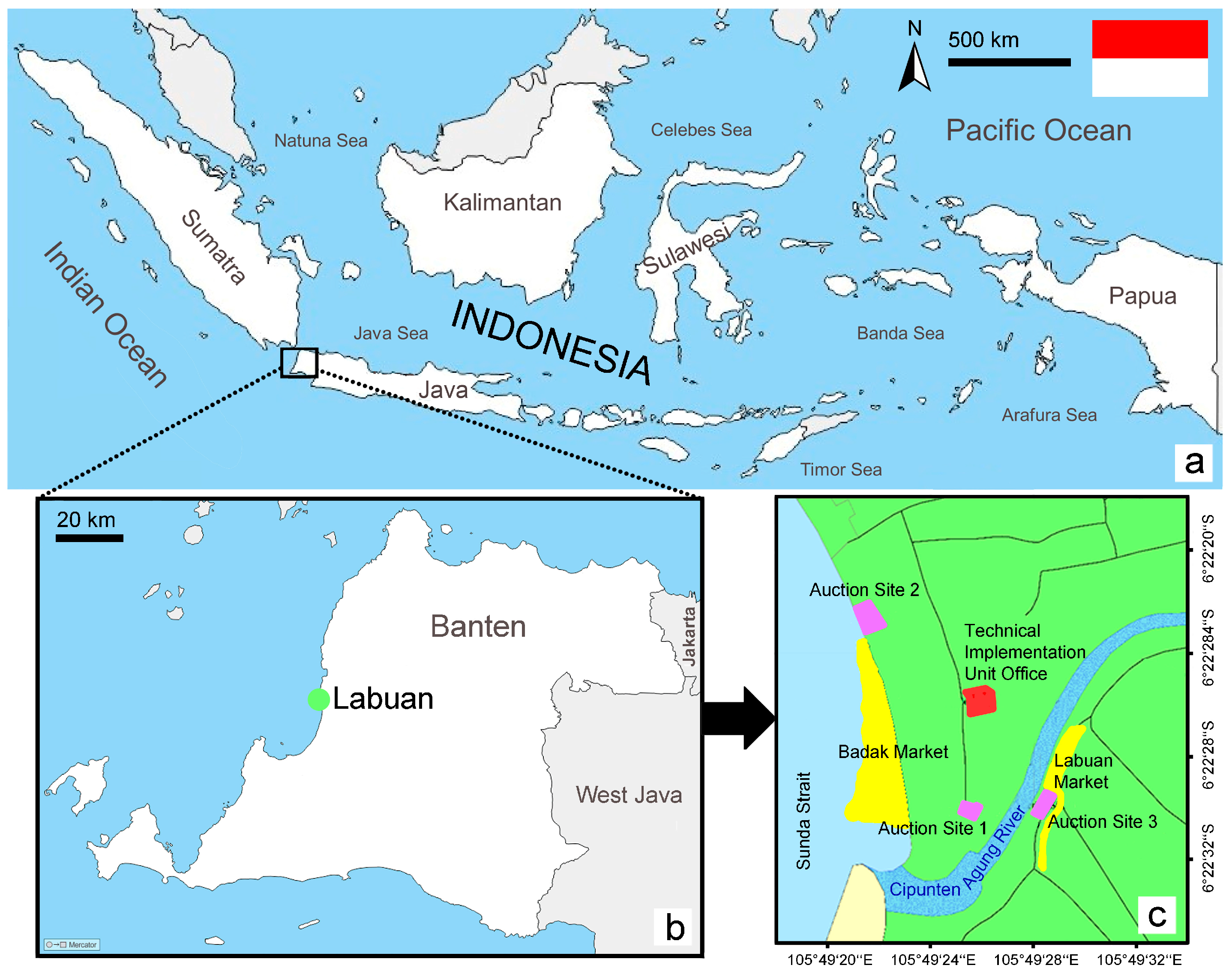
Figure 1. (a) Map of Indonesia with (b) a focus on Banten Province, where Labuan is indicated by a green dot. (c) Map of Labuan Fishing Port with markets (yellow), auction sites (purple) and the office (red) indicated.
Water 18 01250 g001
Figure 2. Process flow diagram of the catch recording pathway at Labuan Fishing Port, Banten Province, Indonesia. Teal nodes represent the formal auction-based pathway entering official records. Coral nodes represent informal bypass channels producing unrecorded catch. The diamond node marks the critical decision fork where catch either enters or bypasses official recording.
Water 18 01250 g002
Table 1. Production from fish capture (in kg) regarding activities and fishing type (bottom otter trawls = BOT; purse seine = PS; and mix of hooks, lines, gill nets, and trawls = MIX). Both the total recorded and unrecorded data are also given in percentages.
Fishing Type [kg]
ActivityBOTPSMixed
Auctioned12018,7408810
Sold directly to customers260330271
Taken home1571664.5490
Sold to market847100315
Sold at sea000
Sold to processors7020060
Bycatch1000
Used as bait00257.5
Consumed on-board52.5794.5296
Total recorded data12018,7408810
%7.9185.8583.91
Total unrecorded data1396.530891689.5
%92.0914.1516.09
Table 2. Factors declared by local fishermen that cause unreported data, with the number and percentage of vessels for each fishing type (bottom otter trawls = BOT; purse seine = PS; and mix of hooks, line or gill nets, and trawls = MIX) where these reasons were reported.
Factors Causing Unreported ProductionNumber of Vessels/Fishing Type
BOTPSMIX
Low catch volume81210
Landing out of the auction time712
No enumerators available412
No supporting tools familiar to fishermen632
Concern about paying fees322
Damaged facilities100
Time pressure283026
No supervision282322
Others 21412
Table 3. Activities processing unrecorded fish with the number and percentage of vessels for each fishing type (bottom otter trawls = BOT; purse seine = PS; and mix of hooks, line or gill nets, and trawls = MIX) where these activities are applied.
ActivityNumber of Vessels/Fishing Type
BOTPSMIX
Fish sold directly to buyers, processors, or markets30 (100%)11 (36.7%)15 (50%)
Fish consumed or taken home30 (100%)30 (100%)30 (100%)
Fish used as bait006 (20%)
Fish discarded as bycatch2 (6.7%)00
Disclaimer/Publisher’s Note: The statements, opinions and data contained in all publications are solely those of the individual author(s) and contributor(s) and not of MDPI and/or the editor(s). MDPI and/or the editor(s) disclaim responsibility for any injury to people or property resulting from any ideas, methods, instructions or products referred to in the content.