Article

Oil Separation Performance of Transformer Accident Oil Under Different Degreasing Methods

1
State Grid Jiangsu Electric Power Design and Consulting Co., Ltd., Nanjing 210008, China
2
Economic Research Institute, State Grid Jiangsu Electric Power Co., Ltd., Nanjing 210008, China
3
College of Urban Construction, Nanjing Tech University, Nanjing 211816, China
*
Author to whom correspondence should be addressed.
Water 2026, 18(10), 1222; https://doi.org/10.3390/w18101222
Submission received: 15 April 2026 / Revised: 15 May 2026 / Accepted: 15 May 2026 / Published: 19 May 2026
(This article belongs to the Section Wastewater Treatment and Reuse)

Abstract

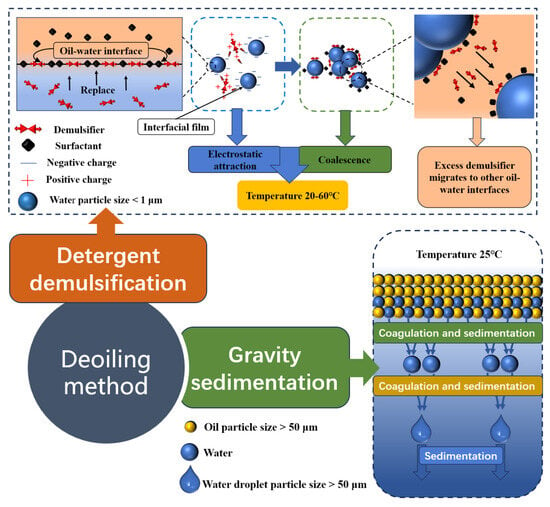
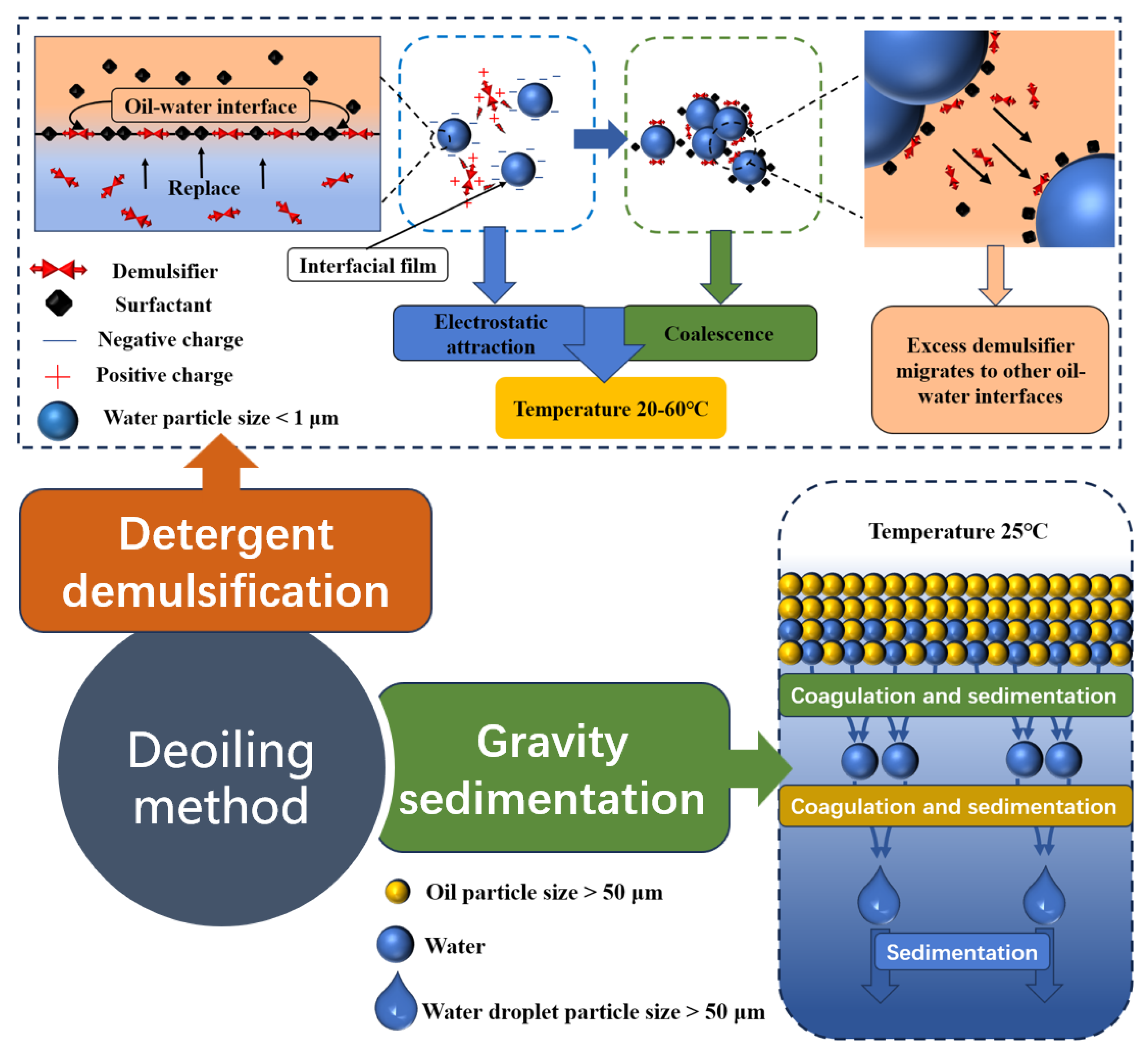
This study investigates the separation performance of transformer oil–water mixtures using gravity separation and chemical demulsification. The synthetic emulsion had an initial oil concentration (C0) of approximately 246,000 mg/L. For gravity separation, the effects of compartment volume ratio, influent flow rate, initial water level, and oil discharge strategy were systematically evaluated. Under optimal conditions (volume ratio 2:1:1, flow rate 0.0055 L/s, initial water level 5 cm), the effluent oil concentration was reduced to as low as 0.020 mg/L, corresponding to a removal efficiency higher than 99.99%. For chemical demulsification, polyaluminum chloride (PAC), polyferric sulfate (PFS), polyacrylamide (PAM), and an organosilicon polyether demulsifier (MCL-D) were tested. The effects of pH, dosage, and temperature on demulsification efficiency (DE) and dehydration rate (DR) were investigated. Under optimal conditions (pH 3–5, dosage 300 mg/L, temperature 50 °C), MCL-D achieved the best performance, with a DE of 95.09% and a DR of 99.50%. Overall, gravity separation is effective for removing free and dispersed oil with low operational cost, whereas chemical demulsification is more suitable for treating stable emulsified oil. The combination of these two methods provides an efficient strategy for the treatment of transformer oil-containing wastewater.

Graphical Abstract

1. Introduction

Transformer oil serves as the insulating and cooling medium for key equipment such as transformers in power systems. During grid operation, maintenance, and fault handling, transformer oil may enter water bodies through equipment leakage, cleaning activities, and oil aging or deterioration. This produces oily wastewater in which transformer oil is the dispersed phase and water is the continuous phase. Such wastewater contains complex components, including transformer oil, residual equipment additives, and foaming agents introduced during operation. After mixing or hydraulic disturbance, it can readily form a stable oil-in-water (O/W) emulsion [1]. Direct discharge of this wastewater leads to the formation of an oil film on the water surface, which hinders oxygen transfer, causes mortality in aquatic organisms, and disrupts ecological balance [2,3]. At the same time, chemicals carried in the oil phase may accumulate through the food chain and pose potential risks to human health [4,5]. In addition, if oily wastewater enters a sewage treatment system, it can contaminate treatment facilities and reduce treatment efficiency. Therefore, the efficient separation and treatment of transformer oil-containing wastewater have become key environmental protection issues in the power industry [6].
Many countries and regions have established stringent environmental standards for the discharge of oily wastewater. For example, China’s Integrated Wastewater Discharge Standard (GB 8978-1996) requires the oil content of discharged oily wastewater to be below 10 mg/L for the first and second grades and below 30 mg/L for the third grade [7]. The Pollutant Discharge Standard for Petroleum Chemical Industry (GB 31571-2015) imposes even stricter requirements on wastewater discharged from power facilities such as substations [8]. At present, various technologies are applied to treat oily wastewater, and their quantitative performance differs significantly: air flotation achieves an oil removal rate of 85–90% for dispersed oil but consumes high energy and performs poorly on stable emulsified oil; membrane separation provides high precision with the oil removal rate exceeding 98%, yet it suffers from high cost and serious membrane fouling; conventional coagulation is suitable for low-concentration oily wastewater with 70–85% oil removal but may cause secondary pollution; gravity oil separation based on density difference is cost-free and chemical-free, reaching 90–99% removal for free oil but barely effective for emulsified oil droplets; chemical demulsification efficiently destabilizes emulsified systems, achieving 90–95% oil removal for emulsified oil, but requires optimized reagent type and dosage [9]. In recent years, advanced functional materials have emerged as promising alternatives to traditional gravity and chemical separation methods for oily wastewater treatment. Membrane filtration, adsorptive separation, and bio-inspired wettability materials have attracted extensive research attention owing to their high separation efficiency and environmental adaptability. Among them, superhydrophobic/superoleophilic bio-inspired surfaces have developed rapidly as an emerging oil–water separation strategy. By rationally regulating surface micro/nanostructure and chemical composition, such materials achieve selective oil–water penetration and show excellent stretchability, durability, and stable wettability both in air and under oil environments [10]. Biomimetic super-lyophobic and super-lyophilic materials have opened a new research direction beyond natural interfacial properties, providing flexible and efficient solutions for the purification of complex oily wastewater [11]. Nevertheless, most advanced material methods still face limitations such as high cost, difficult large-scale fabrication, and poor stability in practical complex wastewater. Traditional gravity separation and chemical demulsification still possess irreplaceable advantages in engineering applications due to their low cost, simple operation and easy scale-up. Therefore, optimizing the performance of conventional separation processes still has important practical significance. Among these technologies, gravity oil separation and chemical demulsification are widely used for transformer oil-containing wastewater due to their low cost, strong adaptability and simple operation. However, current studies still have obvious research gaps: most focus on a single treatment technology, lacking systematic comparative analysis of gravity separation and chemical demulsification for transformer accident oily wastewater containing foaming agents; the optimization of operating parameters (e.g., compartment volume ratio, initial water level) in gravity separation is incomplete; screening and in-depth mechanistic analysis of high-efficiency demulsifiers for transformer oil emulsions are insufficient, and especially quantitative comparison and the interfacial mechanism of organosilicon polyether demulsifier MCL-D are rarely reported [12,13,14]. Moreover, the stabilization mechanism of transformer oil emulsion under actual working conditions and the synergistic effect of the two separation methods need further clarification. Although gravity separation and chemical demulsification are widely used in oily wastewater treatment, their applicability to transformer accident oil-containing wastewater remains insufficiently clarified. In engineering practice, gravity oil separators are usually operated as a low-cost pretreatment unit, but their performance is strongly affected by hydraulic conditions, oil accumulation, and internal compartment configuration. Stable emulsified oil, especially emulsions formed in the presence of foaming agents and hydraulic disturbance, is difficult to remove by gravity separation alone. Chemical demulsification can destabilize emulsified oil droplets, but its performance depends strongly on reagent type, dosage, pH, and temperature, and inappropriate reagent selection may increase operating cost or introduce secondary pollution. Therefore, the problem addressed in this study is not whether gravity separation and chemical demulsification can remove oil in general, but how these two commonly used approaches should be optimized and selected for transformer accident oil-containing wastewater. This study aims to clarify the operating conditions under which gravity separation is effective, identify the limitations of gravity separation for emulsified oil, compare the performance of typical demulsifiers, and provide practical guidance for selecting pretreatment and advanced treatment strategies in power industry wastewater management.
To address the above challenges and fill the research gaps, this study takes transformer accident oily wastewater (forming stable O/W emulsion) as the research object and systematically investigates the oil removal performance of gravity oil separation and chemical demulsification. Single-factor experiments are conducted to optimize the effects of compartment volume ratio, inlet flow rate, initial water level and continuous discharge time on separation efficiency during gravity oil separation. Four typical demulsifiers—polyaluminum chloride (PAC), polyferric sulfate (PFS), polyacrylamide (PAM) and organosilicon polyether demulsifier (MCL-D)—are selected to evaluate the effects of pH, dosage and temperature on demulsification efficiency (DE) and dehydration rate. Furthermore, the demulsification mechanism is deeply analyzed based on functional group structure, surface tension, zeta potential and dynamic interfacial tension. This study aims to clarify the applicable scope and optimal parameters of the two separation methods, reveal the demulsification mechanism of MCL-D, and provide technical support and theoretical basis for the efficient treatment of transformer oily wastewater in the power system.

2. Materials and Methods

2.1. Experimental Materials

The transformer oil used in the experiment was provided by a power supply company. The density of transformer oil is 867.22 kg/m3, and the kinematic viscosity is 15.75 mm2/s at 24 °C, with stable physical and chemical properties, which is consistent with the actual oil produced by transformer faults in the power system. The oil–water mixture used in the experiment was prepared with a volume ratio of oil to water = 1:2, and the initial oil content in the emulsion was controlled at 246 g/L. The n-hexane, anhydrous sodium sulfate, fluorosilica, and the foam agent were of industrial grade. The PAC, PFS, and MCL-D were all of analytical purity and were purchased from Nanjing Wanqing Analytical Instrument Co., Ltd. (Nanjing, China). PAM was of analytical purity and was purchased from Eiseng (China) Coagulant Co., Ltd. (Taizhou, China).

2.2. Experimental Method

2.2.1. Gravity Oil Separation Experiment

As shown in Figure S1, the length, width and height of the gravity oil separator are 60 cm, 15 cm and 20 cm respectively. The oily wastewater flows into the inlet which is 12 cm away from the bottom of the separator, and then flows out from the outlet which is 10 cm away from the bottom. Removable baffles were inserted into pre-set slots to divide the separator into three compartments with different volume ratios. The available baffle positions were 5, 15, 20, 30, 40, and 45 cm from the inlet, allowing the compartment volume ratios to be adjusted to 1:1:1, 1:1:2, 1:2:1, and 2:1:1. During operation, oily wastewater continuously entered the separator through the inlet and continuously exited through the outlet. The accumulated floating oil layer was periodically withdrawn from the top of the separator when oil withdrawal was applied. The tested operating parameters included compartment volume ratio, influent flow rate, initial water level, and continuous operating time. Here, “initial water level” refers to the pre-set water height in the separator before the oily wastewater influent started. Oil withdrawal refers only to the removal of the floating oil layer from the top of the separator; it does not mean interruption of the outlet flow. Effluent samples were collected at designated times, and oil concentration was measured to evaluate the separation performance. For example, when the volume ratio is 2:1:1, the baffles are set at 30 cm and 45 cm. When the oil–water ratio is 1:2, the water flows out after passing through three compartments. Wastewater flows under particular baffles. Hydraulic retention time (HRT) was calculated according to the effective volume and inlet flow rate, and ranged from 1200 s to 2400 s under different working conditions. Reynolds number (Re) was used to characterize the flow regime, and Re < 2000 in all tests, indicating a stable laminar flow state, which satisfies the basic assumption of oil droplet floating based on Stokes’ law. After collecting 500 mL of water sample, the oil content is measured. The effects of compartment volume ratio, inlet flow rate, initial water level of the oil separator, and continuous discharge time on the DE are studied.

2.2.2. Demulsification Experiment

The oily wastewater emulsion was prepared with 100 mL of water, 50 mL of transformer oil, and 4.64 mL of foaming agent, corresponding to an oil-to-water volume ratio of 1:2. It should be noted that this ratio is relatively high for simplifying laboratory simulation, which is a limitation of this study; actual engineering application needs to be verified with real low-concentration wastewater. The emulsion was prepared by mechanical stirring at 300 rpm for 10 min, followed by ultrasonic treatment for 30 min at 25 °C to form a stable oil-in-water (O/W) emulsion. The droplet size of the prepared emulsion was 5–20 μm, and no obvious stratification was observed within 24 h, indicating good stability. A specified amount of demulsifier was added into the emulsion, followed by rapid stirring for 2 min to ensure uniform mixing. The mixture was then allowed to stand for 60 min; this settling duration was determined by preliminary experiments to ensure sufficient oil-water separation and stable test data. After settling, 100 mL of the water layer was collected to measure the oil content, and the demulsification efficiency (DE) and dehydration rate (DR) were calculated accordingly.

2.2.3. Water Quality Determination and Characterization

The oil content in water was determined by ultraviolet spectrophotometry (HJ970-2018) [15] (ultraviolet–visible spectrophotometer, UV-5500PC, Yuanxie Instrument Co., Ltd., China). Residues of oil were extracted with n-hexane; the oil concentration was quantified using a standard curve established at 225 nm (Figure S2). For samples with oil concentration exceeding the linear range of the calibration curve (approximately 0–0.4 mg/L), appropriate dilution with n-hexane was applied before measurement. The dilution factor was controlled between 50 and 200 according to the initial sample concentration. All diluted samples were measured in parallel, and the relative deviation was controlled within ±5% to ensure accuracy and reliability. It should be noted that transformer oil consists of complex hydrocarbons, and single-wavelength detection at 225 nm provides relative quantitative data for comparative experimental analysis, which is a limitation of the analytical method. The initial oil concentration (C0) of the synthetic emulsion used in all experiments was 246,000 mg/L (246 g/L), which was prepared at an oil-to-water volume ratio of 1:2 with 3% foaming agent. This value was consistently used in all efficiency calculations and is consistent with the actual preparation composition. The formulas for the demulsification efficiency (DE) and dehydration rate (DR) are as follows:
D E = C 0 C 1 C 0 × 100 % ,
In the formula, DE: Demulsification efficiency; C0: Initial amount of emulsified oil, mg/L; C1: Amount of emulsified oil after demulsification, mg/L.
D R = V V 0 × 100 % ,
In the formula, DR: Dehydration rate; V: The volume of water removed within a certain period of time (in mL); V0: The initial water volume in the emulsion (100 mL).
η = C 0 C 1 C 0 × 100 % ,
In the formula, η : Oil removal rate; C0: Initial oil concentration (246,000 mg/L), mg/L; C1: Effluent oil concentration, mg/L. Residual oil concentration refers to the measured oil content in the effluent.
The Fourier Transform Infrared Spectrometer (Thermo Scientific Nicolet Summit X, Waltham, MA, USA) was used to conduct infrared spectroscopy tests on the demulsifier. The surface tension/dynamic interfacial tension of the oil–water mixture was measured using the Surface Tension/Interface Tension Tester (Dataphysics OCA20, Dataphysics Company, Charlotte, NC, USA). The Zeta potential of the oil–water mixture was detected using the Nanoparticle Size and Zeta Potential Analyzer (Malvern Zetasizer Nano ZS90, Malvern Panacea, Malvern, UK). All experiments were conducted in triplicate. Data are expressed as mean ± standard deviation (SD). Relative standard deviation (RSD) was controlled within 5% to ensure reliability and reproducibility.

3. Results and Discussion

3.1. Optimization of Gravity Oil–Water Separation in Accident Oil Tank

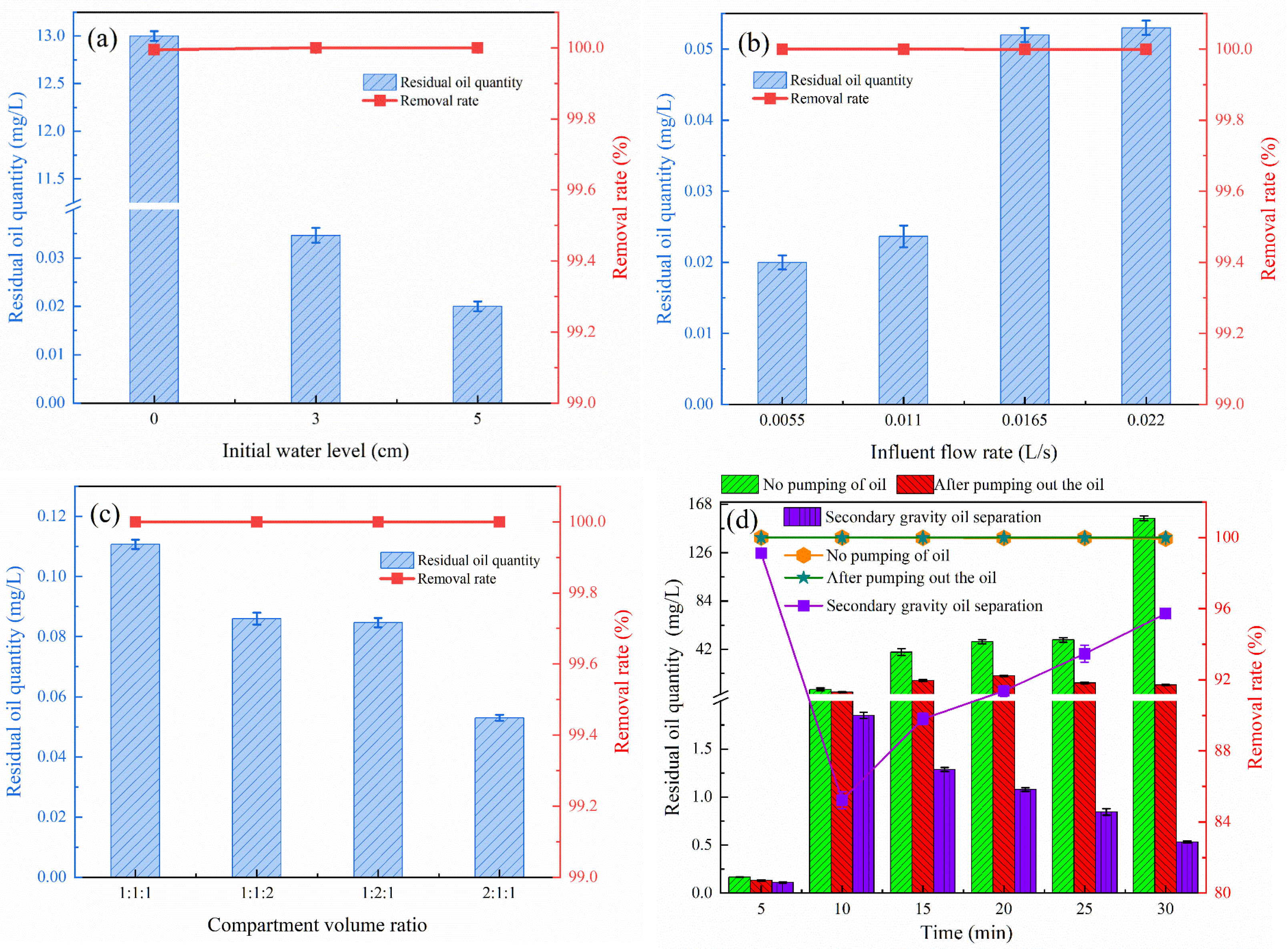
As shown in Figure 1, oil withdrawal means that the accumulated floating oil layer is siphoned or pumped out periodically from the top of the separator to prevent re-entrainment. The liquid continuously flows out from the outlet during the whole experiment. Figure 1 shows that gravity separation was controlled mainly by hydraulic stability and oil-layer management rather than by a single geometric parameter. Among the tested compartment configurations, the 2:1:1 ratio produced the lowest effluent oil concentration, indicating that an enlarged front compartment and appropriate baffle arrangement helped reduce short-circuiting and oil droplet carryover. However, the results should not be interpreted as a simple monotonic effect of first-compartment volume, because the total separator volume remained constant and changing one compartment necessarily changed the others. The separation performance was therefore attributed to the combined effects of residence time distribution, flow-field stability, and baffle-induced oil retention. The influent flow rate had a clearer practical implication. Lower flow rates improved separation because they provided sufficient time for oil droplets to rise and accumulate at the surface. In contrast, higher flow rates increased hydraulic disturbance and promoted the carryover or redistribution of fine droplets. The initial water level mainly affected the start-up stage by providing a buffer layer that reduced direct impact of the influent on the tank bottom. Periodic oil withdrawal further improved stability by preventing excessive oil-layer thickening and secondary dispersion. These findings suggest that, in practical operation, gravity separators should be operated at moderate hydraulic loading, with sufficient initial water depth and timely removal of floating oil.
The compartment volume ratio affected separation performance by changing the spatial distribution of the compartments and thus the residence time of the oil phase and the stability of the flow field. At a volume ratio of 2:1:1, the larger first compartment extended the hydraulic retention time (HRT) of the oil–water mixture and mitigated the effect of influent disturbances. This provided oil droplets with sufficient time to rise according to Stokes’ law, form a distinct oil layer, and effectively reduce the carryover of fine oil droplets with the effluent. In contrast, under the 1:1:1 ratio, the more uniform compartment division shortens the effective floating distance and destabilizes the flow field, leading to increased oil carryover. As a result, some oil droplets were entrained toward the outlet, increasing the effluent oil content [16].
The influent flow rate affected separation efficiency by altering the HRT of the mixture within the separator [17]. At a flow rate of 0.0055 L/s, the HRT was sufficiently long to allow oil droplets to overcome flow disturbances and rise steadily to the liquid surface in accordance with Stokes’ law. As the flow rate increased, the HRT shortened, and small droplets that had not completed their upward migration were carried to the outlet. Moreover, higher flow rates intensified turbulence in the flow field, disrupted the stable accumulation of the oil phase, and caused previously separated oil droplets to redisperse into the aqueous phase.
The initial water level acts as a buffer layer at the start-up stage, which stabilizes the entire flow field during the whole continuous-flow operation. It reduces disturbance, prevents oil droplets from being directly washed out, and maintains stable separation throughout the experiment. The initial water level determined the effective separation height and the buffering capacity of the flow field and thus influenced oil phase separation [18]. At an initial water level of 0 cm, the absence of a pre-existing water layer allowed the incoming mixture to strike the tank bottom directly, generating severe flow disturbances. The oil phase could not rapidly form a stable floating layer, and many oil droplets were discharged directly with the water flow, leading to a sharp increase in effluent oil content. As the initial water level increased, the pre-existing water body acted as a buffer layer that absorbed influent kinetic energy, reduced turbulence, and increased the effective rise height and separation space. This created more favorable conditions for oil droplet rise and accumulation. At an initial water level of 5 cm, the buffering effect and effective separation space reached an optimal balance, enabling stable oil droplet rise and accumulation and therefore the best separation performance.
Under conditions without oil withdrawal, the oil phase continuously accumulated over time, gradually increasing the thickness of the oil layer. This thick layer was susceptible to secondary dispersion under flow disturbances, generating fine oil droplets. It also hindered water-phase flow, causing some oil droplets to be discharged with the effluent. As a result, the effluent oil content increased progressively. In contrast, regular oil withdrawal stabilized the oil–water interface by promptly removing the accumulated oil phase, preventing excessive oil-layer thickness and the associated secondary pollution while maintaining a stable separation space and flow field. Therefore, the effluent oil content decreased markedly and tended to stabilize over time because the rate of oil accumulation was reduced. During the secondary oil separation stage, the influent oil content was already much lower. Oil droplets therefore continued to separate efficiently without substantially thickening the oil layer, leading to a gradual decline in effluent oil content. This result demonstrates the deep purification capability of secondary oil separation for low-concentration oily wastewater [19].

3.2. Performance of Chemical Demulsification

3.2.1. Effect of pH on Demulsification Performance

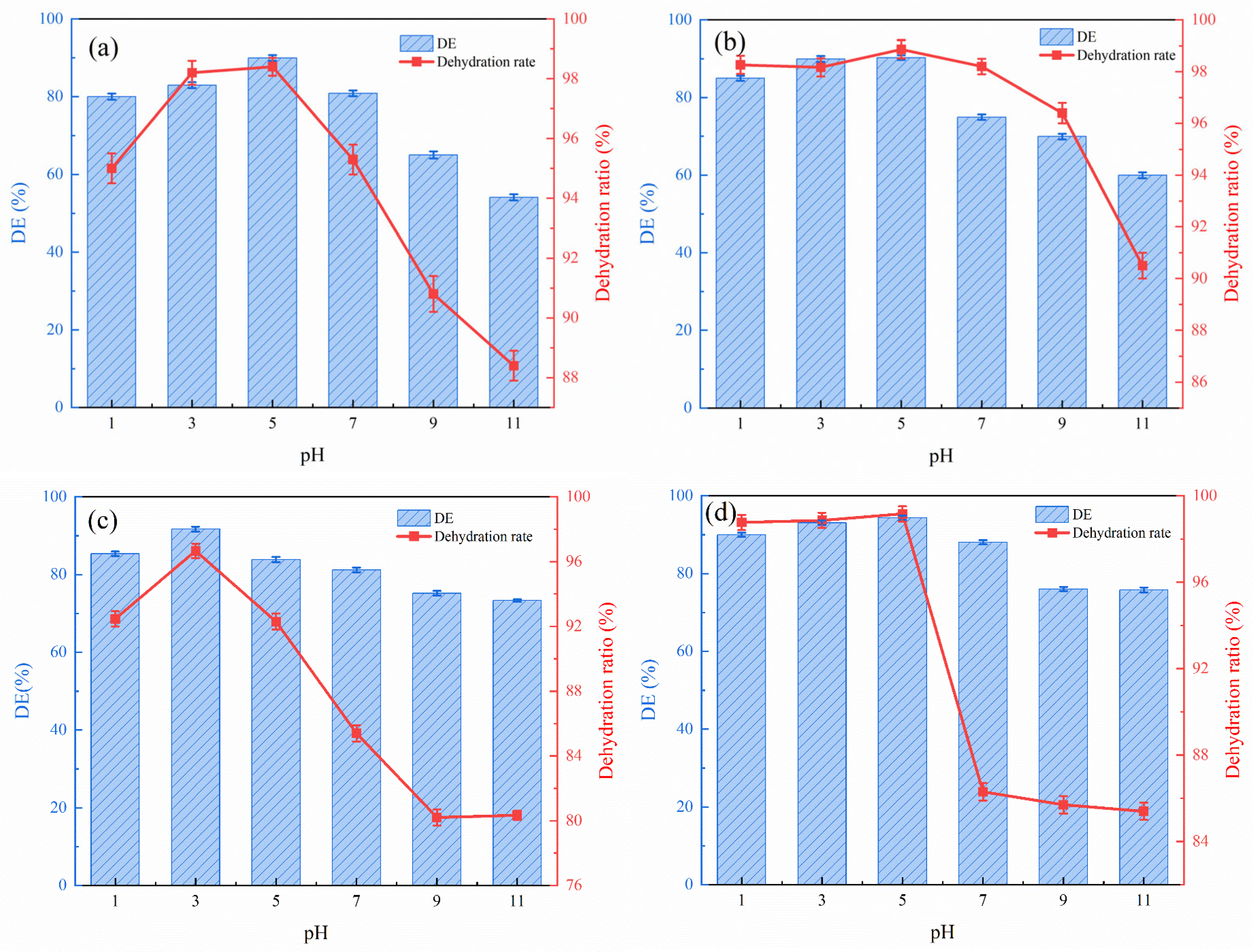
As shown in Figure 2, at a dosage of 300 mg/L and a temperature of 20 °C, the demulsification performance of PAC and PFS showed a strong dependence on pH and peaked in the weakly acidic range (pH 3–5). Both PAC and PFS achieved optimal demulsification performance at pH = 5. However, when the pH increased to 9 or above, the DE of both demulsifiers dropped below 75.00%, and the residual oil content increased from approximately 5 mg/L to more than 20 mg/L [20]. PAM showed its best performance at pH = 3, with a DE of 91.72% and a dehydration rate of 96.70%. Its demulsification performance gradually declined as the pH moved away from 3 [21]. MCL-D had a wider applicable pH range and maintained a DE above 85.00% at pH 3–5. Its DE decreased to below 80.00% at pH = 11 [22].
PAC and PFS are inorganic flocculating demulsifiers, and their demulsification performance depends on the form of the hydroxyl complexes produced by hydrolysis. Under weakly acidic conditions (pH = 3–5), PAC hydrolyzed to form Al(OH)2+ and Al(OH)3 flocs, whereas PFS formed Fe(OH)2+ and Fe(OH)3 colloids. These hydroxyl complexes can efficiently capture emulsified oil droplets and promote their sedimentation through charge neutralization and adsorption bridging. Under strongly alkaline conditions, however, PAC and PFS readily hydrolyzed to non-adsorptive Al(OH)4 and Fe(OH)4, which led to a marked decline in flocculation capacity. As a polymer demulsifier, PAM has a molecular chain charge density that is affected by pH. At pH = 3, the molecular chain remained in a stretched state, enabling hydrogen bonding and hydrophobic interactions to promote bridging and aggregation of oil droplets. Based on typical polymer behavior reported in the literature, the molecular chain may curl under non-optimal pH. MCL-D, with its organosilicon polyether dual structure, reduces the interfacial tension between oil and water. The silicon–oxygen main chain and the polyether side chain are chemically stable, and their surface activity is only slightly attenuated under strongly alkaline conditions. Therefore, MCL-D showed a wider pH applicability range [23]. Because the molecular conformation of PAM was not directly observed in this study, the explanation of pH-dependent PAM performance should be regarded as an inference based on polymer behavior reported in previous studies. Under strongly acidic conditions, protonation may enhance chain extension and electrostatic interaction with negatively charged oil droplets, whereas under non-optimal pH conditions the polymer chain may become less favorable for bridging. This possible mechanism is consistent with the observed decrease in demulsification efficiency, but further microscopic or rheological evidence would be required to confirm the conformational change directly.

3.2.2. Effect of Dosage on Demulsification Performance

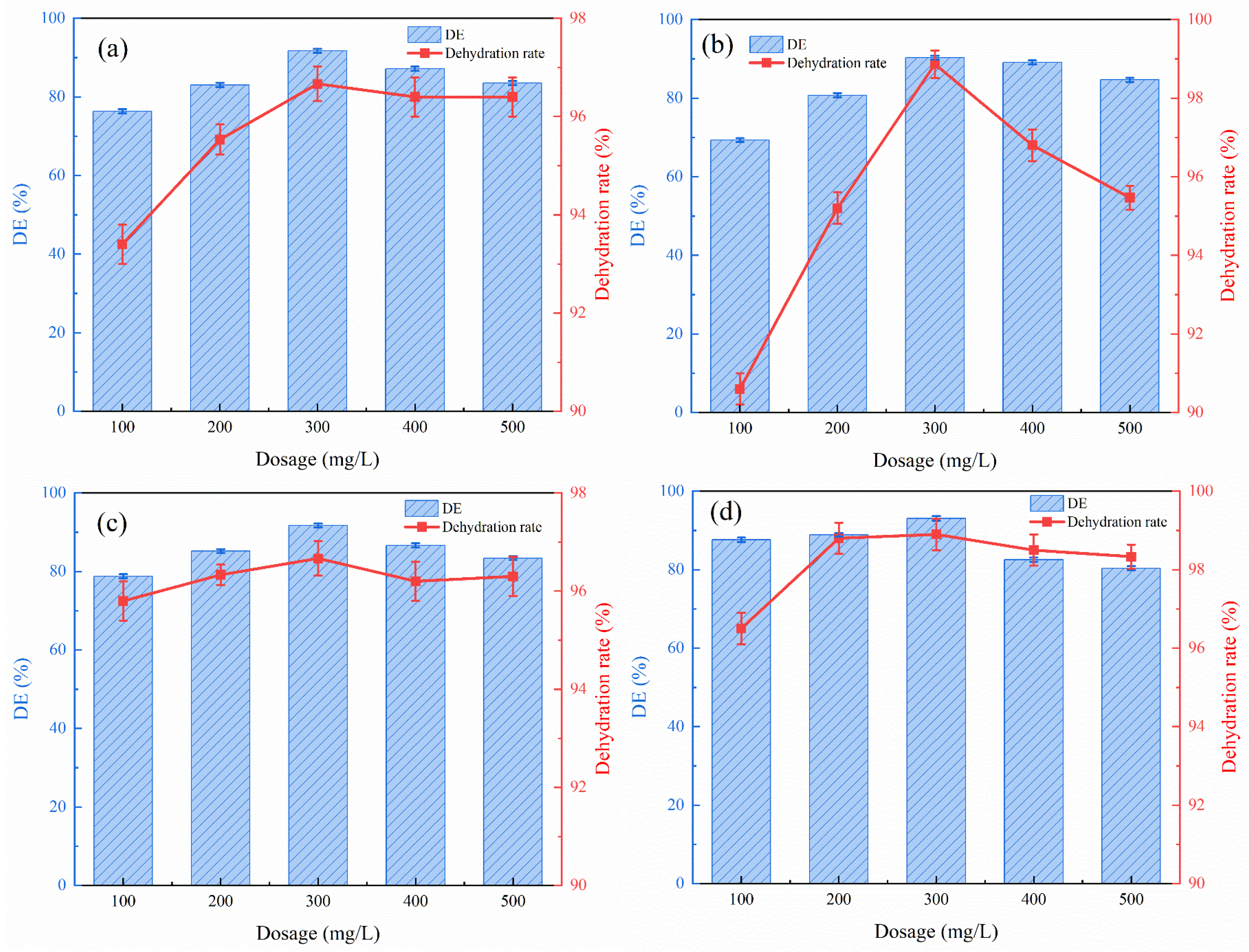
As shown in Figure 3, under the optimal pH and at 20 °C, the performance of all four demulsifiers followed a common pattern, where it first improved and then stabilized with a slight decline, and all four achieved their optimum at a dosage of 300 mg/L. When the dosage was below 300 mg/L, demulsification performance improved significantly as the dosage increased. When the dosage exceeded 300 mg/L, the DE of all four demulsifiers declined slightly by 1% to 5%. For example, the DE of PAM decreased to 88.30% at 500 mg/L, and the residual oil content increased to above 6.000 mg/L. The dehydration rate also declined from its peak of 96.70% to around 95.00%.
The effect of demulsifier dosage on demulsification performance was governed by the balance between the dose effect and the aggregation effect [24]. When the dosage was insufficient, the number of flocs formed by hydrolyzed PAC and PFS was limited and could not fully cover the oil droplet surface to promote coalescence. Likewise, the polymer chains of PAM and the surface-active molecules of MCL-D could not form a continuous interfacial disruption layer because of their low concentration, so the oil droplets remained in a stable emulsified state [25]. At a dosage of 300 mg/L, the ratio of demulsifier molecules to oil droplets per unit volume was well matched. Under this condition, the adsorption of inorganic demulsifiers, the bridging effect of organic polymers, and the interfacial tension reduction caused by organosilicon polyether all reached their maximum effectiveness [26]. When the dosage was excessive, PAC and PFS formed aggregated flocs, which reduced specific surface area and blocked adsorption sites [27]. The polymer chains of PAM also tended to entangle, producing steric hindrance that impeded contact between oil droplets. For MCL-D, excessive accumulation of molecules at the oil–water interface instead formed a new, stable emulsifying layer. When the dosage was excessive, PAC and PFS formed aggregated flocs, which reduced specific surface area and blocked adsorption sites. The polymer chains of PAM also tended to entangle, producing steric hindrance that impeded contact between oil droplets. For MCL-D, excessive accumulation of molecules at the oil–water interface instead formed a new, stable emulsifying layer. Based on the changes in zeta potential and interfacial tension, it is reasonably inferred that the above reasons may lead to the slight decrease in demulsification performance, which is a plausible explanation supported by existing characterization data. Notably, the dehydration rate curve of PFS (Figure 3b) shows a sharper rising trend and a more significant decline with the increase in dosage compared with the other three demulsifiers. This special behavior is attributed to the inherent characteristics of iron-based inorganic coagulants: PFS hydrolyzes faster and forms colloidal flocs more rapidly, resulting in higher sensitivity to dosage changes. At the optimal dosage, flocs grow rapidly and capture oil droplets sufficiently, so the dehydration rate increases sharply. When the dosage is excessive, a large number of Fe(OH)3 colloids undergo rapid self-aggregation, compressing the floc structure and hindering the full release of free water, leading to a more obvious drop in the dehydration rate. This difference reflects that PFS is dominated by a flocculation–sedimentation mechanism, which is significantly different from the interfacial adsorption mechanism of polymer and organosilicon demulsifiers. As a result, the demulsification performance of all four demulsifiers decreased slightly, which further confirms the importance of matching demulsifier dosage to the oil droplet concentration in the emulsion system [28].

3.2.3. Effect of Temperature on Demulsification Performance

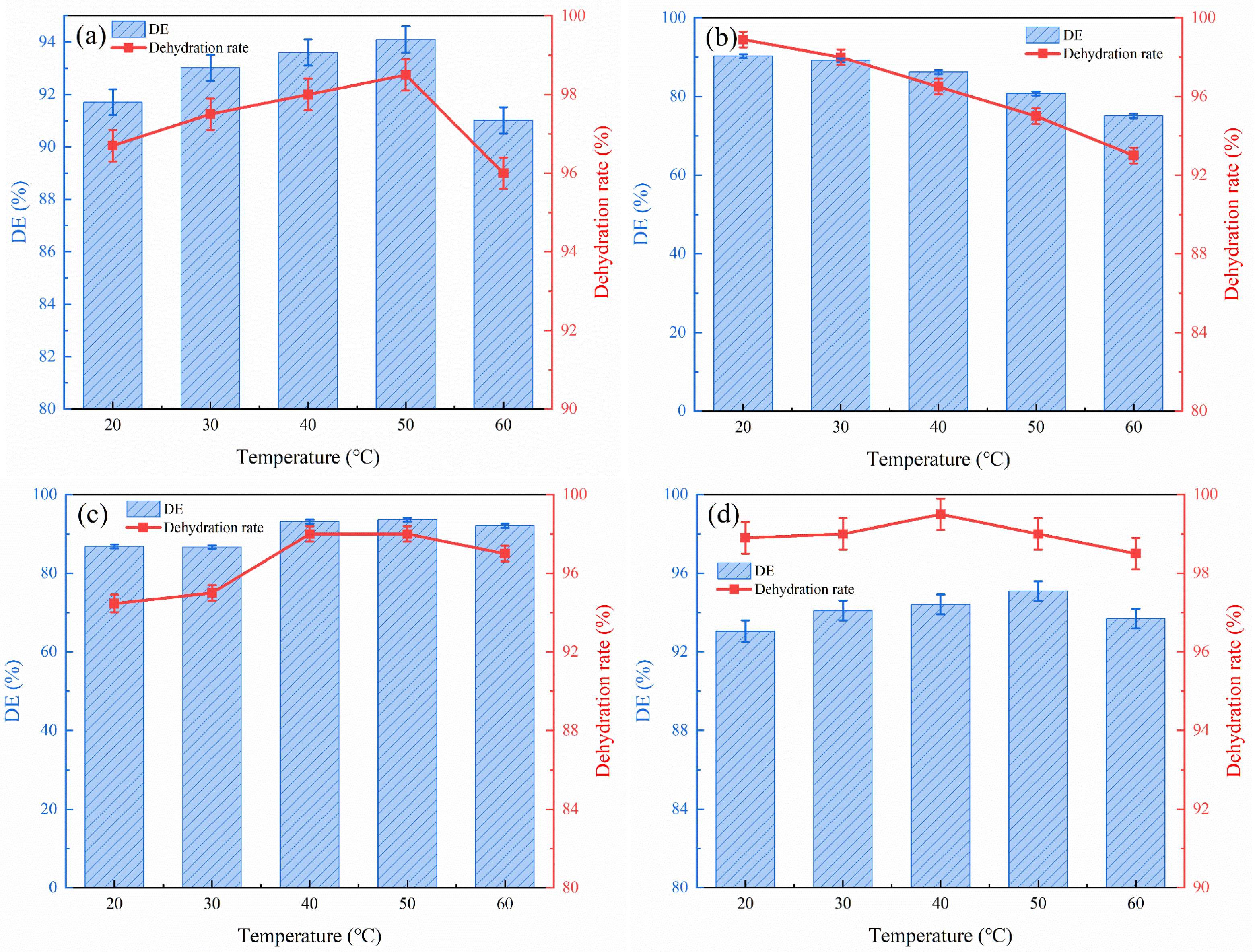
As shown in Figure 4, at 20 °C, the DE of PAC was 91.72% and the dehydration rate was 96.70%. As the temperature increased to 50 °C, these values rose to 94.12% and 98.50%, respectively; at 60 °C, they decreased to 91.04% and 96.00%, respectively. The DE and dehydration rate of PFS decreased continuously as the temperature increased. The performance of PAM decreased slightly at 30 °C, with a DE of 86.67% and a dehydration rate of 95.00%. From 40 °C to 50 °C, its DE increased to above 93%, and at 60 °C it decreased slightly to 92.15%. MCL-D showed the best overall performance, with the DE increasing from 93.05% at 20 °C to 95.09% at 50 °C, while the dehydration rate remained above 98.50%. Both the DE and the dehydration rate decreased slightly at 60 °C.
Temperature affected demulsification mainly by changing the viscosity of the transformer oil and the activity of demulsifiers. With the increase in temperature from 20 °C to 50 °C, the kinematic viscosity of transformer oil decreased from 15.75 mm2/s to 11.32 mm2/s, which accelerated the collision and coalescence of oil droplets and improved the separation speed. The optimal temperature of 50 °C can ensure high demulsification efficiency with relatively low energy consumption, which has good adaptability to practical engineering applications. When the temperature exceeds 60 °C, the thermal stability of demulsifiers decreases, leading to the decline of performance. Temperature affected demulsification by influencing oil-phase viscosity, demulsifier activity, and the properties of the oil–water interface. For PAC, increasing the temperature from 20 °C to 50 °C reduced oil-phase viscosity, accelerated oil droplet coalescence, and enhanced the activity of hydroxyl complexes, thereby strengthening the adsorption-bridging effect [29]. The optimum was reached at 50 °C, whereas 60 °C may have reduced the thermal stability of the flocs and thus weakened performance [30]. PFS was more sensitive to temperature changes. Elevated temperature can disrupt the colloidal structure of Fe(OH)2+ and Fe(OH)3, resulting in a marked decline in flocculation capacity. Therefore, its DE decreased continuously. The polymer chains of PAM remained in a stretched state at an appropriate temperature (40–50 °C), which produced the highest bridging efficiency. Excessively high or low temperature caused the molecular chains to coil or undergo thermal aging [31]. The organosilicon polyether structure of MCL-D has strong chemical stability and can stably reduce oil–water interfacial tension at moderate and low temperatures. It can be observed from Figure 4 that the error bars of PAC and MCL-D are relatively large, while those of PFS and PAM are small. This is because PAC and MCL-D act on the oil–water interface and are more sensitive to mixing intensity, temperature fluctuation and interfacial state, resulting in relatively large experimental variability. In contrast, PFS and PAM form stable flocculation systems with good uniformity and repeatability, showing smaller data dispersion. This difference reflects the inherent characteristics of different demulsification mechanisms rather than experimental operation errors. Its interfacial activity was optimal at 50 °C and decreased only slightly at higher temperatures [32].

3.3. Mechanism of Chemical Demulsification and Oil Removal

3.3.1. Surface Tension Analysis

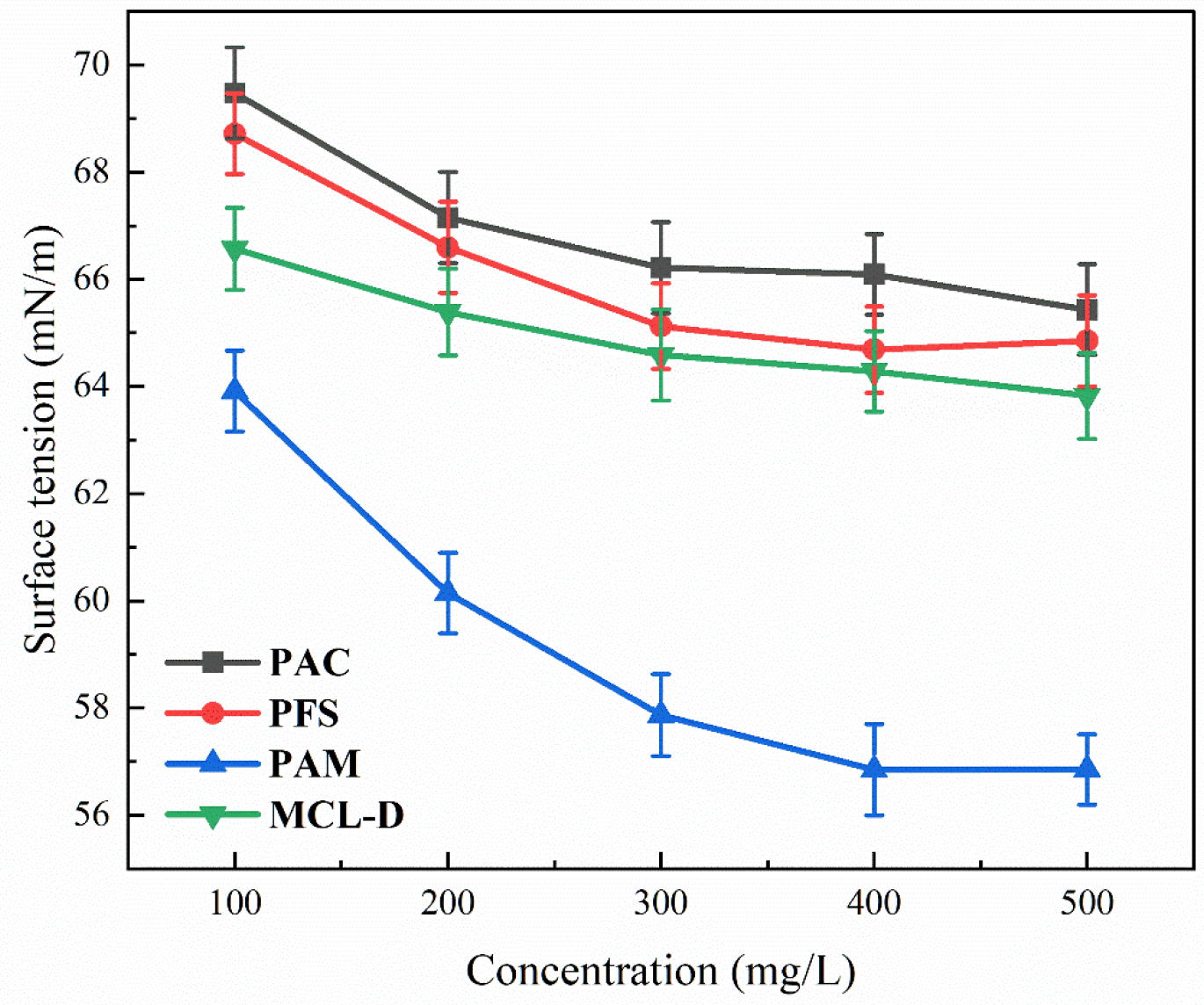
Figure 5 shows the surface tension of the oil–water mixture containing demulsifiers at different concentrations (100–500 mg/L) under a constant temperature of 25.0 ± 0.5 °C. The surface tension of PAM decreased markedly as the concentration increased. When the concentration rose from 100 mg/L to 500 mg/L, the surface tension fell from 63.81 mN/m to 56.75 mN/m, representing a large decrease. By contrast, the surface tension values of PAC and PFS changed more gradually and both decreased slowly as concentration increased. At a concentration of 500 mg/L, the surface tension remained at approximately 65.40 mN/m for PAC and 64.75 mN/m for PFS. The surface tension of MCL-D decreased only slightly with increasing concentration. Overall, it fluctuated within 64.00–66.00 mN/m, with a variation of less than 2.00 mN/m.
The variation in surface tension was fundamentally related to the interfacial activity of the demulsifiers [33]. The stronger the adsorption of demulsifier molecules at the oil–water interface, the more readily they weakened intermolecular forces at the interface and thus reduced surface tension. As a cationic polymer demulsifier, PAM contains both hydrophobic and hydrophilic segments along its molecular chain. As the concentration increased, more PAM molecules migrated to the oil–water interface and aligned directionally, effectively reducing interfacial binding energy and causing a pronounced decrease in surface tension [34]. PAC and PFS are inorganic demulsifiers whose primary mechanism is adsorption bridging through hydrolyzed flocs. Their interfacial activity is relatively weak, and only a small fraction of ions participates in interfacial adsorption, so their ability to reduce surface tension is limited. Therefore, the surface tension changed only gradually with concentration [35]. MCL-D is a nonionic organosilicon polyether demulsifier and typically has strong interfacial activity, but in this experiment its reduction in surface tension was relatively small. This is because, within the concentration range of 100–500 mg/L, interfacial adsorption by MCL-D had already approached saturation. For MCL-D, the small change in surface tension is not due to weak interfacial activity, but because MCL-D, as a nonionic organosilicon polyether demulsifier, has already approached interfacial saturation adsorption at 100 mg/L. Within 100–500 mg/L, the interface has been fully covered, and further increasing the concentration cannot significantly change the arrangement and density of molecules at the interface. Therefore, the surface tension remains stable with only small fluctuations. This is a typical characteristic of high-efficiency organosilicon demulsifiers and does not affect its strong demulsification ability. Additional increases in concentration produced only a limited optimization effect on the arrangement of interfacial molecules, so the surface tension remained relatively stable [36].

3.3.2. Infrared Spectroscopy Analysis of Demulsifiers

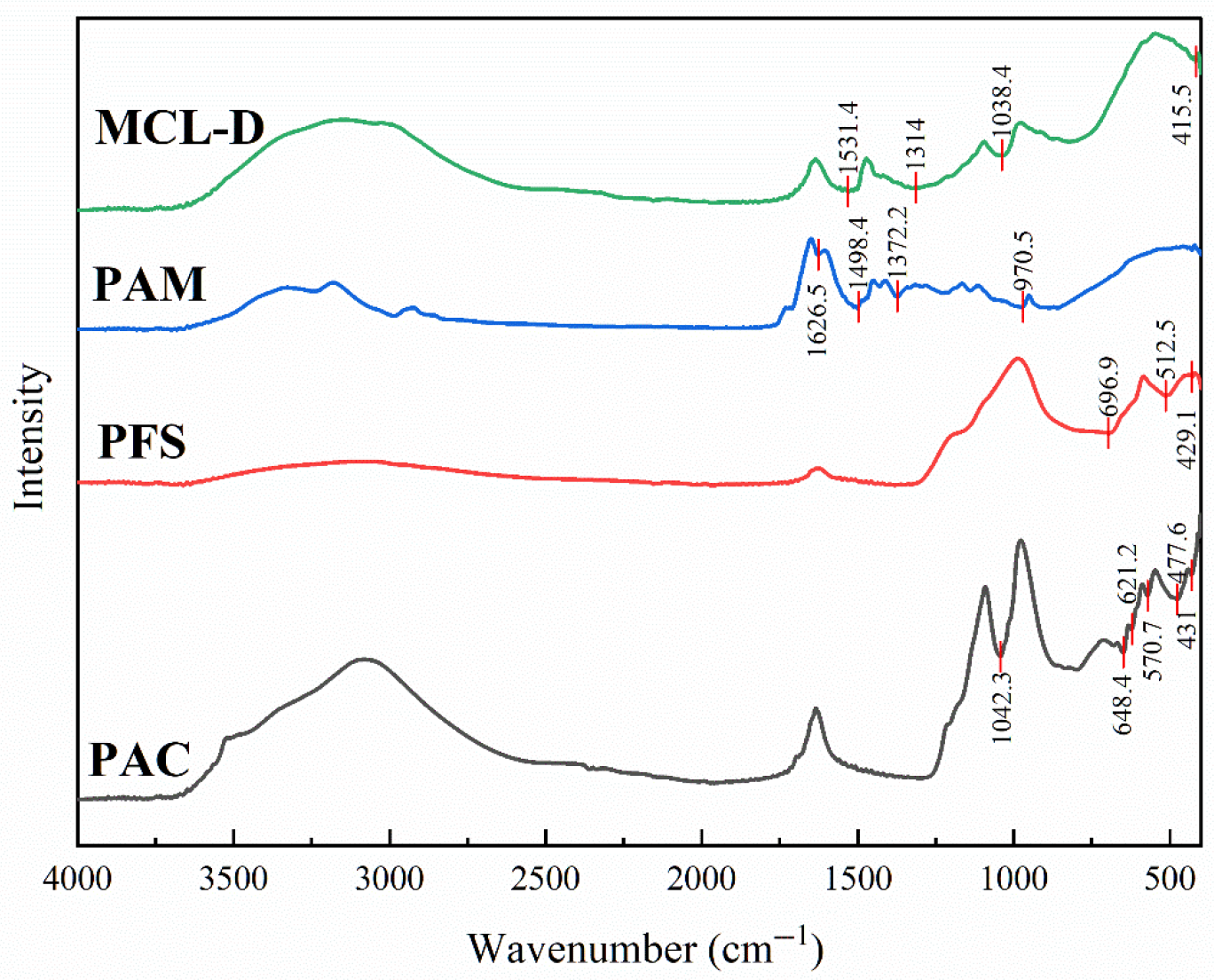
As shown in Figure 6, the infrared spectra of the four demulsifiers, namely PAC, PFS, PAM, and MCL-D, are presented in sequence. FTIR analysis was used to identify functional groups that may contribute to demulsification behavior rather than to verify the exact commercial composition of the reagents. The observed Al-O/Al-OH, Fe-O, amide, and Si-O-Si/polyether-related bands are consistent with the expected functional structures of PAC, PFS, PAM, and MCL-D, respectively. These structural features provide a reasonable basis for interpreting their different interfacial activities and charge-related behaviors. However, FTIR alone cannot directly demonstrate the complete demulsification pathway; therefore, the mechanism is discussed together with surface tension, interfacial tension, and zeta potential results. Analysis of the characteristic peaks clearly identifies the core functional groups of each substance. For PAC, the absorption peak at 1042.3 cm−1 corresponds to the stretching vibration of the Al-OH bond, whereas the peaks at 648.4, 621.2, and 570.7 cm−1 and at 431.0 and 477.6 cm−1 correspond to the stretching and bending vibrations of the Al-O bond. This confirms that PAC is an inorganic polymer demulsifier with an aluminum hydroxide complex structure [37]. The characteristic peaks of PFS are concentrated in the low-frequency region, and the absorption peaks at 696.9, 512.5, and 429.1 cm−1 all correspond to Fe-O vibrations, reflecting the skeletal characteristics of an iron-based inorganic polymer [38]. For PAM, the absorption peak at 1626.5 cm−1 is assigned to the stretching vibration of C=O. The absorption peaks at 1498.4 and 1372.2 cm−1 arise from overlapping N-H bending and C-N stretching vibrations. The absorption peak at 970.5 cm−1 results from the superposition of C-N stretching and N-H bending vibrations and further confirms the presence of the amide group. These three characteristic regions confirm an organic polymer structure containing amide groups [39]. For MCL-D, the peak at 1038.4 cm−1 corresponds to the stretching vibration of the Si-O-Si bond. The absorption peaks at 1531.4 and 1314 cm−1 correspond to C-H bending vibrations of the polyether chain, and the peak at 415.5 cm−1 corresponds to the bending vibration of the Si-O bond, clearly indicating the parent organosilicon–polyether structure. These functional groups provide the structural basis for the interfacial interactions of each demulsifier [40]. The metal-hydroxyl/oxygen bonds of PAC and PFS constitute the core sites for adsorption bridging, the amide groups of PAM are responsible for charge neutralization, and the silicon–oxygen–polyether structure of MCL-D dominates interfacial tension regulation [41]. By linking each functional group to its actual role in demulsification, the structure–performance relationship is directly demonstrated rather than merely interpretative. FTIR results reveal the structural basis of the interfacial activity and demulsification mechanism.

3.3.3. Interfacial Tension (IFT) Analysis

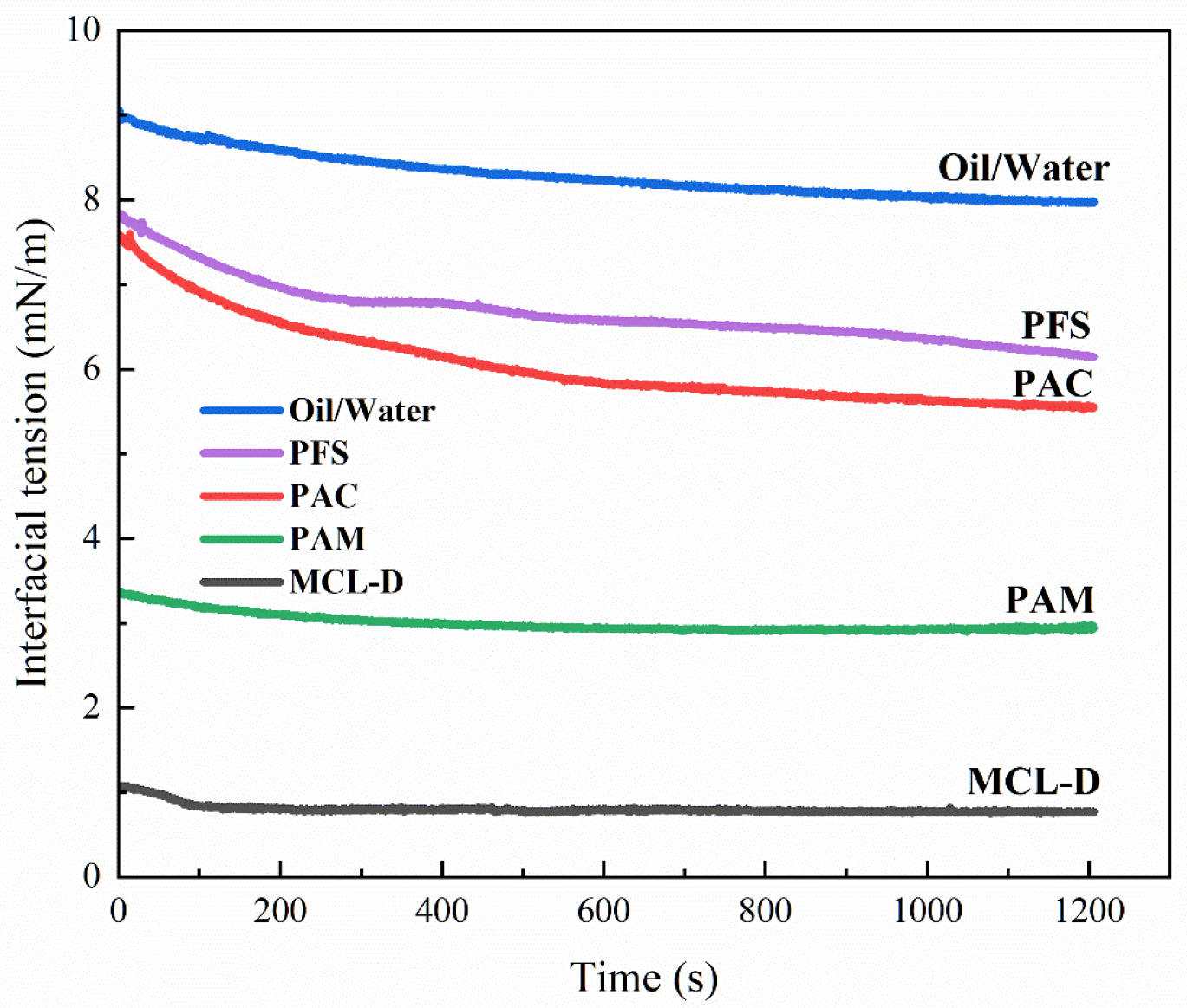
As shown in Figure 7, in the blank system without demulsifier addition, the interfacial tension remained relatively stable over time, indicating that the natural oil–water interfacial tension was difficult to reduce spontaneously and that the system was highly stable [42]. After demulsifier addition, the dynamic interfacial tension in all four systems decreased to different extents. The decrease was most pronounced for MCL-D, whose value fell from 1.07 mN/m initially to 0.77 mN/m at 1200 s. The PAM system showed a similar trend. PAC and PFS weakened interfacial tension less effectively than PAM and MCL-D.
Interfacial tension was measured using the pendant drop method with a Dataphysics OCA20 tensiometer at 25 ± 0.5 °C. Demulsifier concentration was 300 mg/L, and data were collected every 10 s up to 1200 s. The change in dynamic interfacial tension essentially reflects the adsorption kinetics of demulsifier molecules at the oil–water interface and is primarily related to their molecular structure and interfacial activity. As shown in the figure, the interfacial tension of the blank oil–water system without demulsifier remains relatively stable over the entire test period. Without added demulsifier, the oil–water interface is governed by the natural interactions between water and oil molecules. The intermolecular forces are strong, so the interfacial tension does not decrease spontaneously over time, which is also a key reason for the long-term stability of the original emulsion [43]. For all demulsifier treatments, interfacial tension declines sharply at the initial stage and then tends to level off rapidly, indicating that molecular adsorption at the interface is completed in a very short time before the early sampling time points. Among all groups, the MCL-D system maintains lower and more stable interfacial tension throughout the whole process compared with the blank group, showing excellent interfacial adsorption stability. As an organosilicon polyether demulsifier, MCL-D contains hydrophobic siloxane segments and hydrophilic polyether segments. Its molecules adsorb rapidly and arrange densely at the interface, allowing them to quickly replace the original interfacial composition and weaken interfacial binding energy. Therefore, the dynamic interfacial tension decreased most markedly and remained stable afterwards [44]. PAM, as an organic polymer demulsifier, has a long molecular chain, and its hydrophilic and hydrophobic groups adsorb at the interface through directional arrangement, gradually disrupting the stability of the interfacial layer. Although its adsorption rate was slightly lower than that of MCL-D, it could still effectively reduce interfacial tension to a relatively low level [45]. PAC and PFS are inorganic demulsifiers with weak interfacial activity. They mainly act through adsorption bridging by hydrolysis-generated flocs, while only a small number of ions participate in interfacial adsorption. Their ability to weaken intermolecular interactions at the interface is therefore limited. Accordingly, their dynamic interfacial tension decreased more gradually and to a smaller extent [46]. Overall, a lower equilibrium interfacial tension reduces the energy barrier for oil droplet coalescence and promotes droplet collision and merging, which is also one of the main reasons why MCL-D and PAM showed better demulsification performance than inorganic coagulants in this study [47].

3.3.4. Zeta Potential Analysis

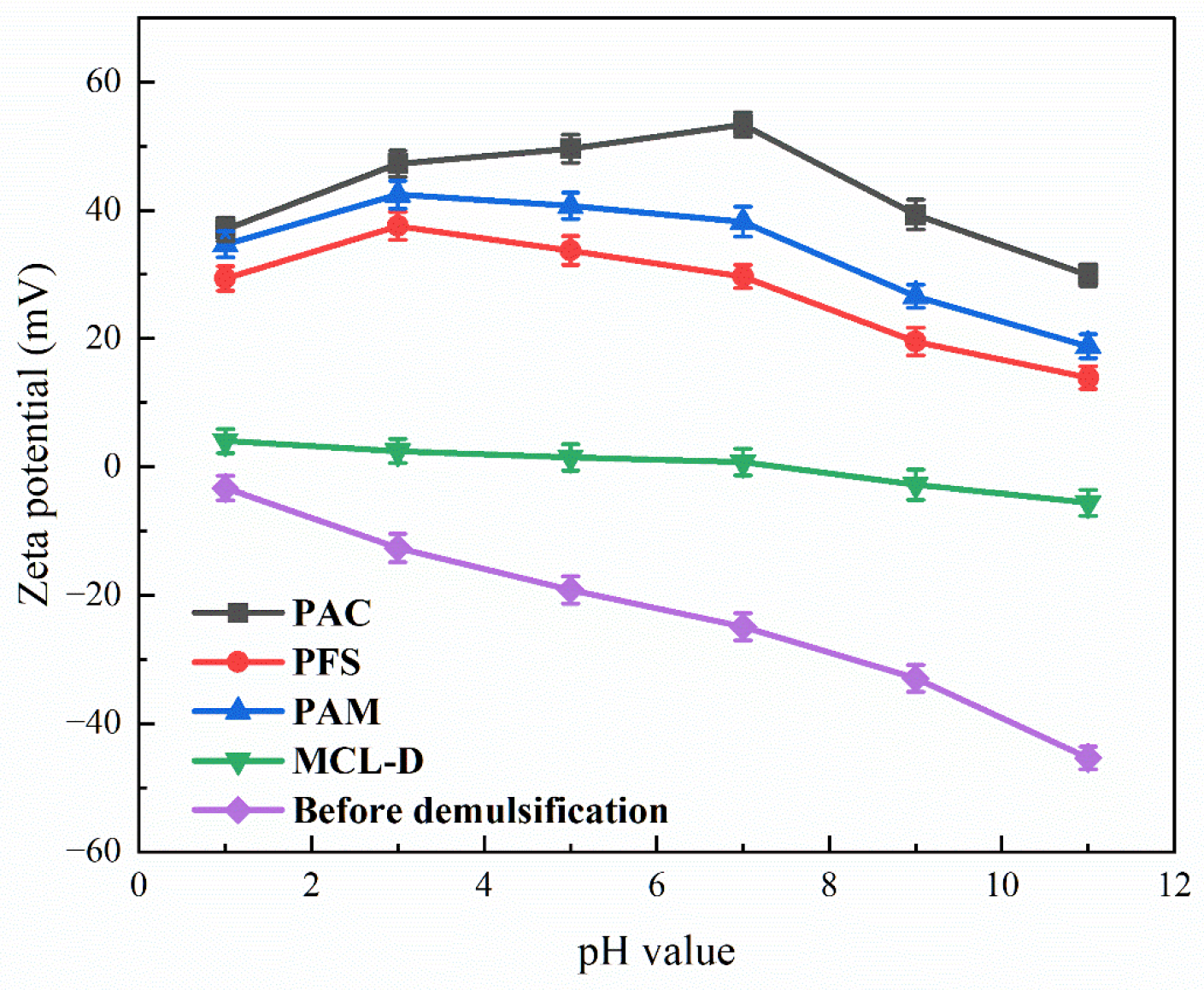
As shown in Figure 8, within the pH range of 1–11, the zeta potentials of PAC, PAM and PFS remained positive. The zeta potential of PAC gradually increased as pH rose, reached a maximum at pH = 7, and then slowly decreased. PFS followed a similar pattern, although its overall potential was slightly lower than that of PAC. The zeta potential of PAM was also positive and initially remained relatively stable before gradually decreasing with increasing pH [48]. The zeta potential of MCL-D remained close to 0.0 mV and was only weakly affected by pH fluctuations. In the system without demulsifier addition, the zeta potential was negative. As the pH increased, the absolute value of the negative potential of the oil droplets increased continuously, reaching −45.6 mV at pH = 11.
The decrease in the absolute zeta potential weakens electrostatic repulsion, promotes oil droplet collision and coalescence, and thus directly improves demulsification efficiency. Zeta potential is a key parameter that reflects the net surface charge state of particles, including oil droplets and demulsifier flocs. PAC and PFS, as cationic inorganic demulsifiers, hydrolyzed to form positively charged hydroxyl complexes. Because the degree of protonation is higher under acidic to near-neutral conditions, these demulsifiers maintained relatively high positive potentials and could effectively neutralize the negative charges on the oil droplet surface, thereby weakening electrostatic repulsion and promoting oil droplet coalescence [49]. Under strongly alkaline conditions, precipitation of metal hydroxides reduced the density of positively charged groups, and the potential consequently decreased. PAM is cationic polyacrylamide (CPAM). At low pH, the positively charged groups in the molecule are fully protonated, resulting in a relatively high positive potential. As the pH increases, the degree of protonation decreases, and the potential gradually declines [50]. MCL-D is a nonionic demulsifier with no charged functional groups, so its zeta potential remains close to neutral. Without demulsifier addition, the oil droplets are negatively charged because of anion adsorption from the aqueous phase. As pH increases, anion dissociation is enhanced, which increases the negative charge density of the oil droplets. The absolute value of the negative zeta potential therefore increases, strengthening electrostatic repulsion between droplets and improving system stability, which makes natural coalescence more difficult [51]. The pH trend of zeta potential is consistent with demulsification performance.

4. Conclusions

This study clarifies the different roles of gravity separation and chemical demulsification in the treatment of transformer accident oil-containing wastewater. The results indicate that gravity separation is suitable as a low-cost pretreatment step for removing free and dispersed oil, but its performance depends strongly on hydraulic conditions. In practical operation, a stable flow field, moderate influent flow rate, sufficient initial water depth, and timely withdrawal of the floating oil layer are more important than simply increasing one compartment volume. Therefore, existing gravity oil separators should be operated with attention to hydraulic loading and oil-layer management to avoid oil carryover and secondary dispersion.
For stable emulsified oil, gravity separation alone is insufficient, and chemical demulsification is required as an advanced treatment step. Among the tested reagents, MCL-D showed the best overall performance and broader adaptability, especially under weakly acidic conditions and at an optimized dosage of 300 mg/L. The interfacial tension and zeta potential results suggest that MCL-D and PAM mainly improve demulsification by reducing interfacial stability and promoting droplet coalescence, whereas PAC and PFS depend more strongly on charge neutralization and adsorption bridging. These mechanistic interpretations are based on the combined experimental evidence and relevant literature, rather than direct microscopic observation.
From an engineering perspective, the results support a staged treatment strategy: gravity separation should first be used to remove free oil and reduce the oil load, followed by chemical demulsification when stable emulsified oil remains. This combined strategy can reduce chemical consumption, improve treatment reliability, and provide a practical route for transformer oil-containing wastewater management in power facilities. This study was conducted using a synthetic transformer oil emulsion with relatively high oil content. Real transformer accident wastewater containing more complex impurities was not used for validation. These are limitations of the present work, and further tests using real field wastewater will be conducted in future engineering applications.

Supplementary Materials

The following supporting information can be downloaded at: https://www.mdpi.com/article/10.3390/w18101222/s1, Figure S1: Schematic diagram of the gravity oil separator: (a) Front view; (b) Side view; Figure S2: Standard Curve.

Author Contributions

Conceptualization, L.Y., H.S., J.Z. and J.W.; methodology, L.Y., B.S. and Y.S.; resources, Y.S. and L.Y.; data curation, L.Y.; writing—original draft preparation, H.S. and Y.S.; writing—review and editing, L.Y. and Y.S.; supervision, J.W. and Y.S.; project administration, L.Y. and Y.S.; funding acquisition, L.Y. and W.S. All authors have read and agreed to the published version of the manuscript.

Funding

This research was supported by the Sci-Tech project (JE202405) from State Grid Jiangsu Electric Power Design and Consulting Co., Ltd.

Data Availability Statement

The original contributions presented in this study are included in the article/Supplementary Materials. Further inquiries can be directed to the corresponding author.

Conflicts of Interest

This study was funded by State Grid Jiangsu Electric Power Design and Consulting Co., Ltd. Some of the authors—Han Shi, Lijuan Yao, and Jun Wang—are employed by State Grid Jiangsu Electric Power Design and Consulting Co., Ltd. and State Grid Jiangsu Electric Power Co., Ltd. Their contributions included conceptualization, writing—original draft preparation, methodology, resources, data curation, writing—review and editing, project administration, funding acquisition, and supervision. The remaining authors declare no other competing financial or personal relationships that could have influenced this work.

References

  1. Deng, Y.; Dai, M.; Wu, Y.; Peng, C. Emulsion System, Demulsification and Membrane Technology in Oil-Water Emulsion Separation: A Comprehensive Review. Crit. Rev. Environ. Sci. Technol. 2023, 53, 1254–1278. [Google Scholar] [CrossRef]
  2. Sharma, K.; Shah, G.; Singhal, K.; Soni, V. Comprehensive Insights into the Impact of Oil Pollution on the Environment. Reg. Stud. Mar. Sci. 2024, 74, 103516. [Google Scholar] [CrossRef]
  3. Yu, L.; Han, M.; He, F. A Review of Treating Oily Wastewater. Arab. J. Chem. 2017, 10, S1913–S1922. [Google Scholar] [CrossRef]
  4. Lovindeer, R.; Mynott, S.; Porobic, J.; Fulton, E.A.; Hook, S.E.; Pethybridge, H.; Allen, S.E.; Latornell, D.; Morzaria-Luna, H.N.; Melbourne-Thomas, J. Ecosystem-Level Impacts of Oil Spills: A Review of Available Data with Confidence Metrics for Application to Ecosystem Models. Environ. Model. Assess. 2023, 28, 939–960. [Google Scholar] [CrossRef]
  5. Zheng, W.; Huang, J.; Li, S.; Ge, M.; Teng, L.; Chen, Z.; Lai, Y. Advanced Materials with Special Wettability toward Intelligent Oily Wastewater Remediation. Acs Appl. Mater. Interfaces 2021, 13, 67–87. [Google Scholar] [CrossRef]
  6. Gupta, R.K.; Dunderdale, G.J.; England, M.W.; Hozumi, A. Oil/Water Separation Techniques: A Review of Recent Progresses and Future Directions. J. Mater. Chem. A 2017, 5, 16025–16058. [Google Scholar] [CrossRef]
  7. GB 8978–1996; Integrated Wastewater Discharge Standard. China Environmental Science Press: Beijing, China, 1996.
  8. GB 31571–2015; Emission Standard of Pollutants for Petroleum Chemical Industry. China Environmental Science Press: Beijing, China, 2015.
  9. Mysore, D.; Viraraghavan, T.; Jin, Y.C. Oil/Water Separation Technology—A Review. J. Residuals Sci. Technol. 2006, 3, 5–14. [Google Scholar]
  10. Rather, A.M.; Manna, U. Stretchable and durable superhydrophobicity that acts both in air and under oil. J. Mater. Chem. A 2017, 5, 15208–15216. [Google Scholar] [CrossRef]
  11. Wang, B.; Liang, W.; Guo, Z.; Liu, W. Biomimetic super-lyophobic and super-lyophilic materials applied for oil/water separation: A new strategy beyond nature. Chem. Soc. Rev. 2015, 44, 336–361. [Google Scholar] [CrossRef] [PubMed]
  12. Yu, H.; Zhang, H.; Liu, G.; Chen, X.; Chen, X.; Yang, Y.; Sun, Z.; Tang, L.; Dong, L.; Wang, Y.; et al. Preparation of Microencapsulated Coagulants and Application to Oil-Water Separation under Gravity Coagulation Conditions. Fuel 2024, 363, 131022. [Google Scholar] [CrossRef]
  13. HJ 970-2018; Water Quality—Determination of Petroleum—Ultraviolet Spectrophotometric Method. China Environmental Science Press: Beijing, China, 2018.
  14. Putatunda, S.; Bhattacharya, S.; Sen, D.; Bhattacharjee, C. A Review on the Application of Different Treatment Processes for Emulsified Oily Wastewater. Int. J. Environ. Sci. Technol. 2019, 16, 2525–2536. [Google Scholar] [CrossRef]
  15. Zhou, Y.; Zheng, H.; Huang, Y.; Zheng, X.; Liu, Z.; An, Y.; Zhao, C.; Liu, Y. Hydrophobic Modification of Cationic Microblocked Polyacrylamide and Its Enhanced Flocculation Performance for Oily Wastewater Treatment. J. Mater. Sci. 2019, 54, 10024–10040. [Google Scholar] [CrossRef]
  16. Liu, E.; Pang, J.; Huang, S. Research on the Gravity Sedimentation Law of Watery Crude Oil in Large Oil Tanks. Energy Sources Part A Recovery Util. Environ. Eff. 2024, 46, 14300–14315. [Google Scholar]
  17. Assar, M.; Simon, S.; Sorland, G.H.; Grimes, B.A. A Theoretical and Experimental Investigation of Batch Oil-Water Gravity Separation. Chem. Eng. Res. Des. 2023, 194, 136–150. [Google Scholar] [CrossRef]
  18. Mazumdar, M.; Roy, S. Gravity Induced Coalescence in Emulsions with High Volume Fractions of Dispersed Phase in the Presence of Surfactants. Aiche J. 2017, 63, 4379–4389. [Google Scholar] [CrossRef]
  19. Wang, Z.; Zhang, X.; Liao, R.; Li, K.; Wu, H.; Yang, W. Study of Oil Droplet Patterns and Laws of Motion Based on Multi-Field Synergistic Effects. Colloids Surf. A Physicochem. Eng. Asp. 2025, 705, 135518. [Google Scholar] [CrossRef]
  20. Zhao, C.; Zhou, J.; Yan, Y.; Yang, L.; Xing, G.; Li, H.; Wu, P.; Wang, M.; Zheng, H. Application of Coagulation/Flocculation in Oily Wastewater Treatment: A Review. Sci. Total Environ. 2021, 765, 142795. [Google Scholar] [CrossRef]
  21. Ma, J.; Shi, J.; Ding, L.; Zhang, H.; Zhou, S.; Wang, Q.; Fu, X.; Jiang, L.; Fu, K. Removal of Emulsified Oil from Water Using Hydrophobic Modified Cationic Polyacrylamide Flocculants Synthesized from Low-Pressure UV Initiation. Sep. Purif. Technol. 2018, 197, 407–417. [Google Scholar] [CrossRef]
  22. Wang, D.; Li, J.; Liu, Y.; Guo, N.; Qin, Q. Sesame Pods Derived High-Efficiency Demulsifier: Synthesis and Demulsification Performance in Oily Wastewater Treatment. Process Saf. Environ. Prot. 2025, 203, 107976. [Google Scholar] [CrossRef]
  23. Wang, D.; Yang, D.; Huang, C.; Huang, Y.; Yang, D.; Zhang, H.; Liu, Q.; Tang, T.; El-Din, M.G.; Kemppi, T.; et al. Stabilization Mechanism and Chemical Demulsification of Water-in-Oil and Oil-in-Water Emulsions in Petroleum Industry: A Review. Fuel 2021, 286, 119390. [Google Scholar] [CrossRef]
  24. Li, Z.; Chakraborty, A.; Fuentes, J.; Zamora, E.; Vazquez, F.; Xu, Z.; Liu, Q.; Flores, C.; McCaffrey, W.C. Study on Demulsifier Crude Oil Interactions at Oil-Water Interface for Crude Oil Dehydration. Colloids Surf.-Physicochem. Eng. Asp. 2021, 630, 127526. [Google Scholar] [CrossRef]
  25. Shu, G.; Bu, K.; Zhao, B.; Zheng, S. Evaluation of Newly Developed Reverse Demulsifiers and Cationic Polyacrylamide Flocculants for Efficient Treatment of Oily Produced Water. Colloids Surf.-Physicochem. Eng. Asp. 2021, 610, 125646. [Google Scholar] [CrossRef]
  26. Santos, A.S.; Marques, A.M.T.; Palermo, L.C.M.; Mansur, C.R.E. Influence of Molar Mass of Partially Hydrolyzed Polyacrylamide on the Treatment of Produced Water from Enhanced Oil Recovery. Colloids Surf. A Physicochem. Eng. Asp. 2020, 584, 124042. [Google Scholar] [CrossRef]
  27. Zhang, Z. The Flocculation Mechanism and Treatment of Oily Wastewater by Flocculation. Water Sci. Technol. 2017, 76, 2630–2637. [Google Scholar] [CrossRef] [PubMed]
  28. Ma, W.; Liu, H.; Jiang, X.; Ding, Y.; Chen, L.; Zhao, Y.; Li, Z.; Jin, B.; Mi, Y. Ambient-Temperature Synthesis and Demulsification Performance of a Demulsifier with Concentrated Hydrophilic Groups and Dispersed Hydrophobic Chains. Sep. Purif. Technol. 2025, 379, 135050. [Google Scholar] [CrossRef]
  29. Almojjly, A.; Johnson, D.; Oatley-Radcliffe, D.L.; Hilal, N. Removal of Oil from Oil-Water Emulsion by Hybrid Coagulation/Sand Filter as Pre-Treatment. J. Water Process Eng. 2018, 26, 17–27. [Google Scholar] [CrossRef]
  30. Li, Z.; Fuentes, J.; Chakraborty, A.; Zamora, E.; Prasad, V.; Vazquez, F.; Xu, Z.; Liu, Q.; Flores, C.; McCaffrey, W.C. Dehydration of Water-in-Crude Oil Emulsions Using Polymeric Demulsifiers: A Model for Water Removal Based on the Viscoelastic Properties of the Oil-Water Interfacial Film. Fuel 2023, 332, 126185. [Google Scholar] [CrossRef]
  31. Rajak, V.K.; Singh, I.; Kumar, A.; Mandal, A. Optimization of Separation of Oil from Oil-in-Water Emulsion by Demulsification Using Different Demulsifiers. Pet. Sci. Technol. 2016, 34, 1026–1032. [Google Scholar] [CrossRef]
  32. Sun, H.; Wang, Q.; Li, X.; He, X. Novel Polyether-Polyquaternium Copolymer as an Effective Reverse Demulsifier for O/W Emulsions: Demulsification Performance and Mechanism. Fuel 2020, 263, 116770. [Google Scholar] [CrossRef]
  33. Shen, L.; Ai, G.; Ao, Y.; Zeng, G.; Yang, Y.; Feng, X.; Zhang, Z.; Yuan, H.; Ye, F.; Mi, Y. Treatment of Water-in-Crude Oil Emulsion Driven by SiO2 Modified Rice Bran. Colloids Surf.-Physicochem. Eng. Asp. 2021, 631, 127708. [Google Scholar] [CrossRef]
  34. Ma, J.; Fu, X.; Xia, W.; Zhang, R.; Fu, K.; Wu, G.; Jia, B.; Li, S.; Li, J. Removal of Emulsified Oil from Water by Using Recyclable Chitosan Based Covalently Bonded Composite Magnetic Flocculant: Performance and Mechanism. J. Hazard. Mater. 2021, 419, 126529. [Google Scholar] [CrossRef]
  35. Dhandhi, Y.; Saw, R.K.; Singh, R.; Naiya, T.K. Application of a Novel Surface-Active Green Demulsifier for Demulsification of Field Crude Oil Emulsion. Sep. Sci. Technol. 2023, 58, 1654–1678. [Google Scholar] [CrossRef]
  36. Ye, F.; Mi, Y.; Liu, H.; Zeng, G.; Shen, L.; Feng, X.; Yang, Y.; Zhang, Z.; Yuan, H.; Yan, X. Demulsification of Water-in-Crude Oil Emulsion Using Natural Lotus Leaf Treated via a Simple Hydrothermal Process. Fuel 2021, 295, 120596. [Google Scholar] [CrossRef]
  37. Shao, Z.; Mu, Y.; Yang, S.; Li, T.; Wang, T.; Ren, S. Preparation of Novel Nanoparticle Demulsifier and Its Demulsification for Surfactant-Stabilized Crude Oil Emulison. Colloids Surf. A Physicochem. Eng. Asp. 2025, 704, 135515. [Google Scholar] [CrossRef]
  38. Gu, Y.; Wei, L.; Liu, C.; Jia, X.; Qin, W.; Shi, L.; Zhang, L. Fluorinated Polyether Grafted TiO2 Magnetic Composite Material for Oil-Water Separation of Crude Oil Emulsion. J. Dispers. Sci. Technol. 2024, 45, 1296–1306. [Google Scholar] [CrossRef]
  39. Al-Sabagh, A.M.; Sharaky, A.M.; El-din, M.R.N.; Hussein, K.M. Destabilization of Gas Condensate Oil-Water Emulsion by Dissolved Air Flotation Using New Non Ionic Surfactants. Tenside Surfactants Deterg. 2015, 52, 88–98. [Google Scholar] [CrossRef]
  40. Jia, X.; Wei, L.; Fu, M.; Liu, C.; Gu, Y.; Qin, W.; Zhang, L.; Geng, X.; Guo, H. One-Pot Preparation of Environmentally Friendly, High Demulsification Rate and Novel Functional Magnetic Demulsifier: Used for Oil and Water Separation in Crude Oil Emulsion. Arab. J. Chem. 2023, 16, 105134. [Google Scholar] [CrossRef]
  41. Zhang, Z.; Shen, L.; Hu, W.; Mi, Y.; Yuan, H.; Kuang, J.; Ye, F.; Jiang, X.; Luo, Y.; Liu, W.; et al. Treatment of Oily Wastewater Using a Hyperbranched Poly (Amido Amine) Demulsifier with 1,4-Phenylene Diamine as Central Core. Chemistryselect 2020, 5, 9980–9988. [Google Scholar] [CrossRef]
  42. Wang, Q.; Puerto, M.C.; Warudkar, S.; Buehler, J.; Biswal, S.L. Recyclable Amine-Functionalized Magnetic Nanoparticles for Efficient Demulsification of Crude Oil-in-Water Emulsions. Environ. Sci.-Water Res. Technol. 2018, 4, 1553–1563. [Google Scholar] [CrossRef]
  43. Yan, H.; Yu, X.; Cui, J.; Yang, H.; Su, G. Demulsification Efficiency and Mechanism of Hydrophobic Carbon Chains Modified Hyperbranched Polyethylenimide on Oil-in-Water Emulsion. Geoenergy Sci. Eng. 2024, 233, 212526. [Google Scholar] [CrossRef]
  44. Huang, B.; Li, X.; Zhang, W.; Fu, C.; Wang, Y.; Fu, S. Study on Demulsification-Flocculation Mechanism of Oil-Water Emulsion in Produced Water from Alkali/Surfactant/Polymer Flooding. Polymers 2019, 11, 395. [Google Scholar] [CrossRef]
  45. Zhang, Z.; Feng, X.; Zeng, G.; Liu, H.; Shen, L.; Yang, Y.; Yuan, H.; Yan, X.; Mi, Y. Hyperbranched Poly(Amido Amine) Demulsifiers Using Diaminonaphthalene as the Central Core and Their Demulsification Performance in Oil-in-Water and Water-in-Oil Emulsions. Energy Fuels 2021, 35, 3095–3103. [Google Scholar] [CrossRef]
  46. Lv, Y.; Zhang, S.; Zhang, Y.; Yin, H.; Feng, Y. Hydrophobically Associating Polyacrylamide “Water-in-Water” Emulsion Prepared by Aqueous Dispersion Polymerization: Synthesis, Characterization and Rheological Behavior. Molecules 2023, 28, 2698. [Google Scholar] [CrossRef]
  47. Zhao, Y.; He, J.A.; He, T.; Chen, L.; Lai, L.; Yan, X.; Yu, W.; Mi, Y. Synthesis of Cyclodextrin-Based Demulsifier for Treatment of Oily Wastewater through Hydrophobic Modification Strategy. J. Mol. Liq. 2024, 402, 124783. [Google Scholar] [CrossRef]
  48. Altaf, M.F.; Peng, B.; Irfan, H.M.; Miao, Z.; Ousseini, O.S.; He, J.; Kecebas, A.; Aryanfar, Y. Sustainable Oil-Water Separation via Hydrophobic Nano-Modified Cationic Polyacrylamide: Enhanced Efficiency and Eco-Friendly Applications. J. Indian Chem. Soc. 2025, 102, 102026. [Google Scholar] [CrossRef]
  49. Duan, M.; He, Z.; Wang, X.; Jing, B.; Xu, Z.; Xiong, Y.; Fang, S. A Novel Interface-Active Cationic Flocculant for the Oil-Water Separation of Oily Wastewater Produced from Polymer Flooding. J. Mol. Liq. 2019, 286, 110868. [Google Scholar] [CrossRef]
  50. Tung, H.N.; Nhung, T.N.; Thao, T.P.N.; Ngoc, T.D.; Lam, A.T.T.; Linh, P.D.N.; Thanh, T.B. Optimizing the Conditions of Cationic Polyacrylamide Inverse Emulsion Synthesis Reaction to Obtain High-Molecular-Weight Polymers. Polymers 2022, 14, 2866. [Google Scholar]
  51. Ding, Y.; Li, H.; Jia, J.; Ouyang, S.; Jiang, W.; Chen, L.; Zhao, Y.; Zhang, Z.; Mi, Y. Synthesis of a Demulsifier for Treating Crude Oil-in-Water Emulsion through a Straightforward Low-Temperature Process. J. Mol. Liq. 2024, 410, 125635. [Google Scholar] [CrossRef]
Figure 1. Influence of oil separation tank parameters on gravity oil separation performance: (a) Initial water level; (b) Influent flow rate; (c) Comartition volume ratio; (d) Watering time.
Water 18 01222 g001
Figure 2. Influence of pH on the demulsification performance of the demulsifiers: (a) PAC; (b) PFS; (c) PAM; (d) MCL-D.
Water 18 01222 g002
Figure 3. Influence of dosage on the demulsification performance of the demulsifiers: (a) PAC; (b) PFS; (c) PAM; (d) MCL-D.
Water 18 01222 g003
Figure 4. Influence of temperature on the demulsification performance of the demulsifiers: (a) PAC; (b) PFS; (c) PAM; (d) MCL-D.
Water 18 01222 g004
Figure 5. Surface tension of the oil–water mixture.
Water 18 01222 g005
Figure 6. Infrared spectra of the demulsifiers.
Water 18 01222 g006
Figure 7. IFT of the different demulsifiers.
Water 18 01222 g007
Figure 8. Zeta potential of the different demulsifiers at different pH.
Water 18 01222 g008
Disclaimer/Publisher’s Note: The statements, opinions and data contained in all publications are solely those of the individual author(s) and contributor(s) and not of MDPI and/or the editor(s). MDPI and/or the editor(s) disclaim responsibility for any injury to people or property resulting from any ideas, methods, instructions or products referred to in the content.