1. Introduction
Tropical river basins are characterized by strong seasonal contrasts between dry and rainy periods, during which intense precipitation, steep topography, and high connectivity between hillslopes and channels promote rapid mobilization of sediments and dissolved organic matter, leading to pronounced spatial and temporal variability in water quality parameters [
1]. Effective watershed management is crucial for the conservation of aquatic and terrestrial ecosystems, but also for ensuring the availability of water resources in the face of population growth, agricultural expansion, and climate change pressures that are particularly pronounced in tropical regions [
2,
3]. In these environments, hydrological responses are often nonlinear and highly sensitive to seasonal rainfall variability, making continuous monitoring and adaptive watershed management essential to safeguard the ecosystem services they provide [
4,
5].
Water quality in tropical rivers responds to complex interactions between natural factors such as altitude, vegetation cover, and rainfall patterns, and anthropogenic factors such as deforestation, intensive use of agrochemicals, and point and diffuse discharges associated with agricultural, urban, and hydroelectric activities [
6,
7,
8]. These interactions are often amplified along altitudinal gradients, where land-use changes and hydrological connectivity can differentially affect upstream, midstream, and downstream river segments, leading to marked spatial heterogeneity in water quality conditions.
The evaluation of physicochemical parameters such as dissolved oxygen (DO), turbidity, potential of hydrogen (pH), total dissolved solids (TDS), and electrical conductivity (EC) allows for the diagnosis of the health status of aquatic ecosystems and the anticipation of impacts derived from diffuse pollution, erosion, and surface runoff [
9,
10]. In tropical watersheds, these parameters are strongly modulated by seasonal precipitation regimes, which control sediment mobilization, organic matter transport, and dilution or concentration processes, particularly during intense rainfall events.
Although tropical countries such as Panama possess relatively abundant water resources, increasing anthropogenic pressures threaten watershed integrity. According to the Ministry of Environment of Panama, the country has 52 watersheds, of which 34 drain into the Pacific Ocean and 18 into the Atlantic Ocean [
11]. Despite this apparent abundance, many Panamanian watersheds are increasingly exposed to cumulative anthropogenic pressures, including the expansion of the agricultural frontier, the deforestation of water recharge areas, the increase in hydroelectric projects, and indiscriminate use of fertilizers and pesticides. These factors have altered the ecological balance of river systems, affecting their quality and availability [
12,
13]. The Chiriquí Viejo River basin, located in western Panama, is an emblematic case due to its ecological, water, and productive importance [
14]. This basin has experienced persistent socio-environmental conflicts driven by the intensive exploitation of water resources for hydroelectric power generation—currently hosting at least 22 operational projects as well as the expansion of intensive agriculture and urban growth in environmentally vulnerable areas [
7]. These processes alter the natural hydrological regime of rivers, affecting their longitudinal connectivity, seasonality, and water quality [
15].
Although several site specific and short-term monitoring efforts have been conducted, a significant knowledge gap remains regarding integrated assessments that simultaneously address spatial (altitudinal and longitudinal) and temporal (seasonal) variability of water quality in relation to precipitation patterns and land-use pressures [
16]. Such integrative approaches are particularly scarce in tropical basins characterized by strong rainfall seasonality and multiple anthropogenic stressors, limiting the ability to identify the dominant drivers of water quality deterioration.
In this context, the present study aims to evaluate the spatio-temporal variability of key physicochemical water quality parameters along the Chiriquí Viejo River basin across dry and rainy seasons using a monitoring network distributed along an altitudinal gradient and analyzed through linear mixed-effects models. While precipitation and land-use change are recognized drivers of tropical river degradation, studies in Central America rarely integrate seasonal hydrological contrasts, longitudinal basin gradients, and hierarchical repeated-measures modeling within a single analytical framework. By explicitly accounting for spatial structure and temporal dependence, this study provides one of the first process-oriented assessments for a Panamanian tropical watershed, generating quantitative evidence to support spatially informed monitoring and adaptive watershed management.
We hypothesize that turbidity and apparent color increase significantly in the middle and lower sections of the basin during the rainy season as a result of the interaction between intensified precipitation and land-use practices that enhance surface runoff and sediment transport. The integration of physicochemical, spatial, and climatic data provides a comprehensive understanding of the eco-hydrological functioning of the Chiriquí Viejo River basin and offers a scientifically robust basis for the formulation of conservation strategies and sustainable watershed management measures. Under a scenario of increasing anthropogenic pressure and climate variability in tropical river systems, this integrative approach is particularly relevant for supporting evidence-based decision-making and enhancing the ecological and social resilience of watersheds.
2. Materials and Methods
2.1. Study Area
The Chiriquí Viejo River basin is located in western Panama in Central America, within the province of Chiriquí, near the border with Costa Rica. The basin covers approximately 1380 km
2 and drains westward into the Pacific Ocean through a main river channel of about 161 km in length [
17]. The river originates in the highlands of the Barú volcanic massif, with headwaters exceeding 3000 m above sea level (m.a.s.l.), generating a pronounced altitudinal and geomorphological gradient that controls hydrological processes and water quality dynamics.
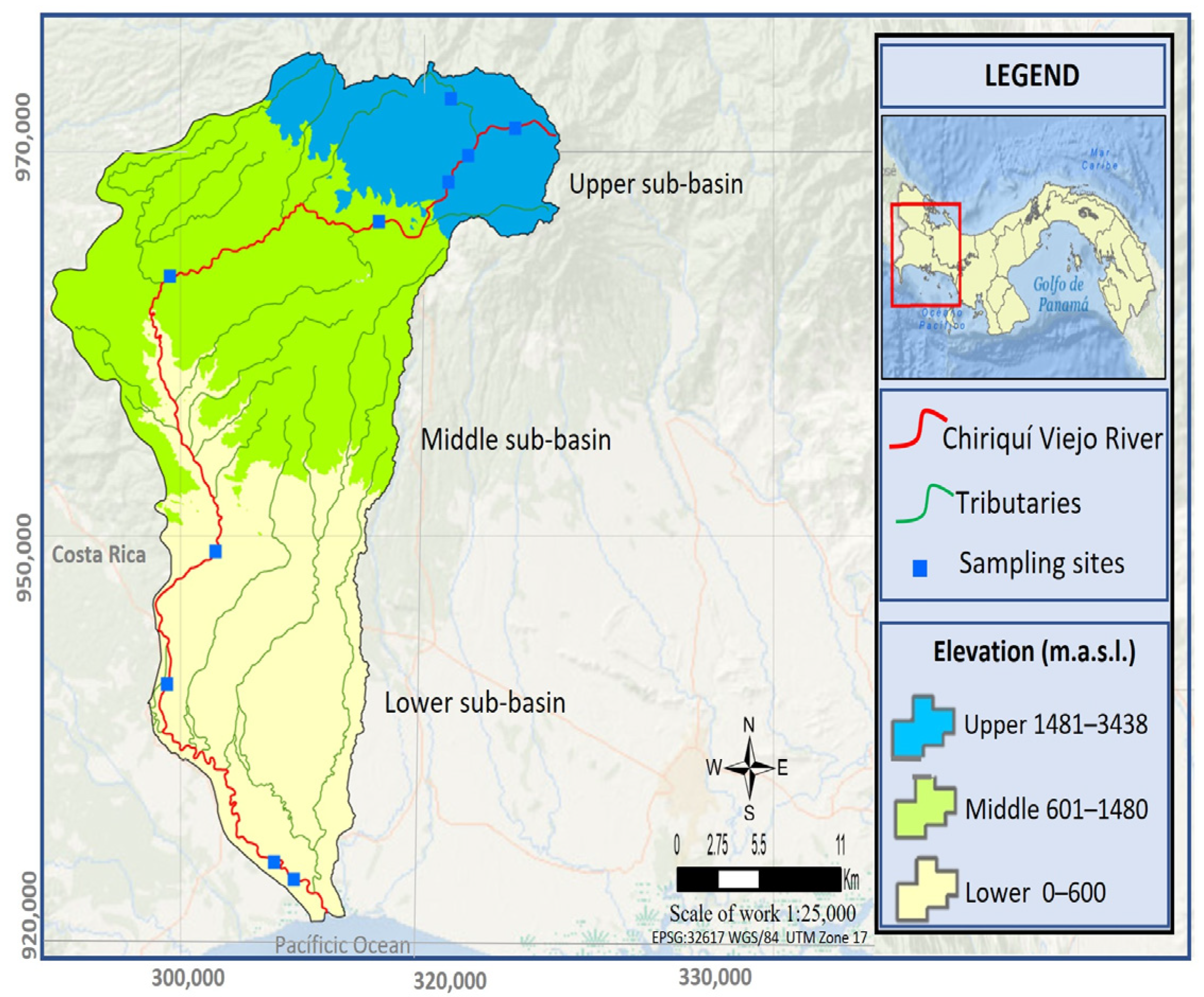
For analytical purposes, the basin was stratified into three elevation-based sub-basins: upper basin (>1480 m.a.s.l.), middle basin (600–1480 m.a.s.l.), and lower basin (<600 m.a.s.l.) (
Figure 1). This stratification was designed to capture longitudinal gradients in land use intensity, hydrological connectivity, and physicochemical conditions along the river continuum, which are characteristic of tropical mountainous watersheds.
The regional climate is humid tropical with a bimodal precipitation regime, characterized by a dry season (December–April) and a rainy season (May–November). This climatic seasonality was explicitly incorporated into the sampling design and subsequent statistical analyses to assess seasonal controls on water quality variability.
2.2. Sampling Design and Monitoring Network
Water quality monitoring was conducted at ten fixed sampling sites (NW-01 to NW-10) distributed along the main channel of the Chiriquí Viejo River. Sampling sites were grouped according to basin position as follows:
Upper sub-basin: NW-01, NW-02, NW-03, NW-04 (4 sites).
Middle sub-basin: NW-05, NW-06 (2 sites).
Lower sub-basin: NW-07, NW-08, NW-09, NW-10 (4 sites).
The spatial distribution of sites was selected to represent contrasting degrees of anthropogenic pressure, including conserved headwaters, agricultural areas, hydroelectric influence zones, and downstream urbanized segments. This altitudinal arrangement allowed for the evaluation of spatial patterns in physicochemical parameters along the river gradient.
All sites were sampled monthly over a nine-month monitoring period, covering the rainy season (May–October 2024) and the dry season (January–March 2025). This sampling design ensured balanced representation of hydrological conditions across seasons, with each site sampled once per month. The monthly design was intended to characterize seasonal variability rather than short-duration storm responses. As a result, a balanced spatio-temporal dataset was obtained, allowing robust assessment of both seasonal and spatial variability in water quality parameters.
The seasonal classification ensured observations for dry and rainy periods, enabling direct and statistically consistent comparisons between contrasting hydrological conditions across basin levels (
Table 1).
2.3. Dataset Structure and Sample Collection
The monitoring resulted in the following number of observations per parameter:
Per site: 9 samples
Upper basin: 4 sites × 9 months = 36 samples
Middle basin: 2 sites × 9 months = 18 samples
Lower basin: 4 sites × 9 months = 36 samples
The total number of observations per parameter was 90 measurements, yielding a hierarchical dataset structure in which repeated monthly observations are nested within fixed sampling sites, and sampling sites are nested within basin-level zones. This structure is well suited for mixed-effects modeling approaches, allowing the explicit separation of temporal variability, spatial gradients, and site-specific effects on water quality parameters.
Water samples were collected from the main river channel at a depth of approximately 20–30 cm below the water surface, avoiding bank disturbance, stagnant zones, and areas influenced by localized turbulence. Sampling was conducted under comparable hydrological conditions whenever possible to ensure consistency across monitoring campaigns.
2.4. Sample Analysis
Sample collection, handling, preservation, and physicochemical analyses followed standardized procedures established by the Water and Physicochemical Services Laboratory (LASEF) and the Standard Methods for the Examination of Water and Wastewater [
18]. All analyses were conducted according to the internal analytical protocols of LASEF, which operates under an internationally accredited laboratory quality management system.
DO, pH, EC, TDS, and temperature were measured in situ using a Hach HQ40d-Multi portable multiparameter meter (Hach Company, Loveland, CO, USA). This calibrated instrument integrates interchangeable probes for DO, pH, EC/TDS, enabling reliable field measurements in accordance with manufacturer specifications and the corresponding Standard Methods for the Examination of Water and Wastewater [
18].
DO was measured following the electrometric method (SM 4500-O H) using a DO probe (model: LDO101), connected to a portable multiparameter meter (model: HQ40d; Hach, Loveland, CO, USA) with an operating range of 0.05 to 20.00 mg/L and an analytical accuracy of 0.10 mg/L. The pH was measured by the electrometric method (SM 4500-H+ B) using a combined glass electrode (model: PHC101), also coupled to the HQ40d multiparameter meter (Hach, Loveland, CO, USA), operating within a range of 2.00 to 14.00 and an accuracy of 0.02. EC was determined according to SM 2510 B. TDS was estimated using the electrometric method Hach 8160 integrated into the EC/TDS probe (model: CDC401) manufactured by Hach (Loveland, CO, USA). The instrument has an operating range of 0.01 to 200,000 μS/cm for EC and 0.00 to 50,000 mg/L as NaCl for TDS, with an analytical accuracy of 0.50% for TDS.
Apparent color (Pt–Co units) was measured in situ using a HANNA color comparator HI727 color comparator (Hanna Instruments, Woonsocket, RI, USA), while turbidity was analyzed at the LASEF facilities using a HACH 2100N turbidimeter (Hach, Loveland, CO, USA) (
Table 2). Apparent color measurements were conducted without filtration and are reported as Pt–Co units, reflecting the combined influence of dissolved and suspended materials. Field blanks and calibration standards were included during each sampling campaign to ensure analytical reliability.
2.5. Quality Assurance and Quality Control (QA/QC)
All analyses were performed under a quality assurance and quality control framework consistent with ISO/IEC 17025principles. All equipment used for measurements was calibrated by an ISO/IEC 17025accredited calibration laboratory, and an internal verification of the equipment is carried out before each sampling campaign following manufacturer specifications and laboratory protocols. The measuring equipment was verified using certified reference standards, and periodic duplicate measurements were conducted to assess analytical reproducibility and instrument stability. All probes were calibrated prior to each field campaign using certified reference standards, following the manufacturer’s calibration protocols and the internal quality assurance procedures of the Water and Physicochemical Services Laboratory (LASEF).
Field blanks and calibration verification standards were included during each sampling campaign to ensure analytical accuracy and data reliability. Routine quality control procedures included verification of instrument performance, review of anomalous or extreme values, and consistency checks across consecutive sampling events.
Data validation involved cross-checking field records, instrument logs, and laboratory results to ensure internal consistency and traceability. Only validated data were included in subsequent statistical analyses.
2.6. Precipitation Data and Spatial Analysis
Precipitation data were obtained from six meteorological stations operated by the Panamanian Institute of Meteorology and Hydrology [
19], distributed across and around the Chiriquí Viejo River basin. Monthly accumulated precipitation values were used as the temporal scale of analysis, consistent with the monthly water quality monitoring frequency. To characterize the spatial distribution of precipitation, an Inverse Distance Weighting (IDW) interpolation was applied using ArcGIS v10.8.2.
The IDW method estimates precipitation at unsampled locations as a weighted average of surrounding meteorological stations, where weights decrease as a function of distance, according to the following equation:
where
P(X
o) is the estimated precipitation at location X
o, P(Xi) represents the observed precipitation at station
i,
di is the distance between station
i and location X
o, p is the power parameter (set to 2), and
n is the number of stations.
The spatial interpolation was performed using a raster resolution of 1 km, providing a consistent representation of precipitation gradients across the basin. Interpolated monthly precipitation values were extracted at each water-quality sampling site and incorporated as an explanatory variable to support the interpretation of seasonal and spatial patterns in physicochemical parameters. IDW interpolation was conducted using a power parameter of 2 and a variable search radius. Given the limited number of meteorological stations (n = 6), robust semivariogram calibration required for geostatistical kriging was constrained and could increase model uncertainty. Therefore, IDW was selected as a conservative, transparent, and reproducible method for representing basin-scale monthly precipitation patterns without overfitting. Future studies with denser monitoring networks may benefit from kriging or elevation-informed interpolation approaches.
2.7. Land Cover
The base land-use and land-cover layer was obtained from Panama’s National Environmental Information System [
20]. The dataset was processed, reclassified, and aggregated by basin level (upper, middle, and lower) to quantify dominant land-use categories and anthropogenic pressure gradients. These spatial metrics were used to support the interpretation of observed water quality patterns along the altitudinal gradient of the Chiriquí Viejo River basin. Land-cover composition was quantified for each basin level using GIS zonal statistics. The proportional area of major land-cover classes was calculated and summarized as forest cover (%) and anthropogenic land use (%; crops, pasture, and infrastructure). These variables were incorporated as spatial covariates in supplementary mixed-effects analyses to evaluate associations with water-quality gradients.
2.8. Statistical Analysis
Statistical analyses were conducted to evaluate spatial and seasonal variability in physicochemical water quality parameters. Prior to modeling, variables exhibiting strong right-skewness and event-driven extremes were transformed to improve normality and variance homogeneity: turbidity and apparent color were analyzed using log10(x + 1) transformation, while electrical conductivity and total dissolved solids (TDS) were analyzed using natural logarithmic transformation.
To account for repeated measurements collected monthly at the same monitoring sites (10 sites), linear mixed-effects models (LMMs) were applied. For each water quality parameter, the following model according to the following equation:
where
represents the observed value of the response variable at season
i, basin level
j, and site
k. Season and basin level were included as fixed effects.
represents the random intercept associated with monitoring site and
represents the residual error.
This structure accounts for the hierarchical nature of the dataset, in which repeated observations are nested within sampling sites.
Models were fitted using Restricted Maximum Likelihood (REML). The significance of fixed effects was evaluated using Satterthwaite-approximated degrees of freedom. Model assumptions were evaluated through residual diagnostics, including Q–Q plots and residuals versus fitted values. When the random-effect variance was negligible (<5% of total variance), repeated-measures models with cluster-robust inference were used to confirm the stability of statistical inference. Statistical significance was established at p < 0.05. Statistical analyses were performed using Jamovi (version 2.7.6), and graphical outputs (boxplots and scatter matrices) were generated within the same environment.
3. Results
3.1. Spatial (Altitudinal) Variation in Physicochemical Parameters
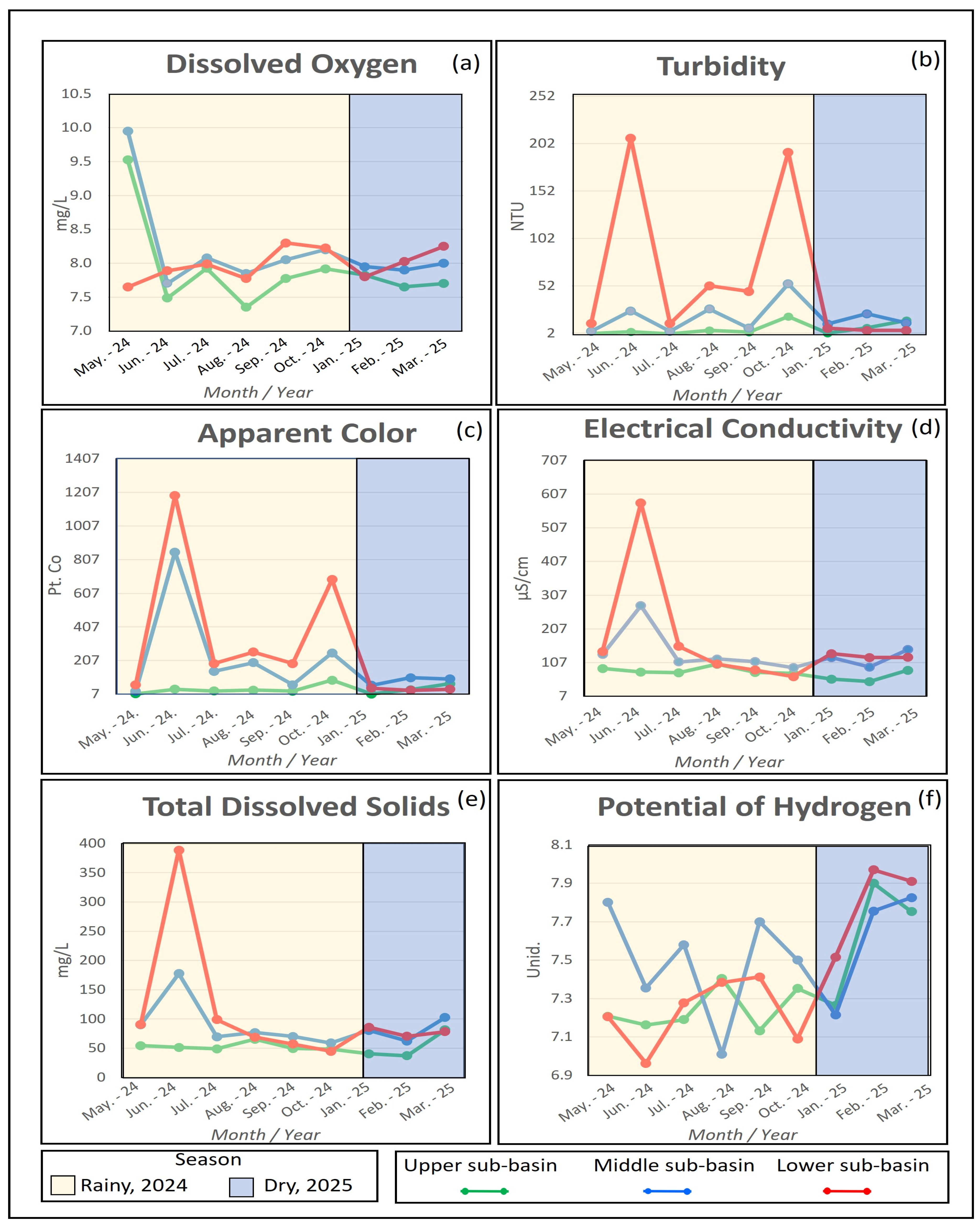
The analysis of physicochemical parameters revealed spatial and seasonal differences in water quality along the altitudinal gradient of the Chiriquí Viejo River basin (
Table 3,
Figure 2). Descriptive statistics indicate that the upper basin is characterized by lower turbidity, apparent color, electrical conductivity, and total dissolved solids, together with higher dissolved oxygen concentrations. In contrast, the middle and lower basin exhibited greater variability and higher values of sediment- and solute-related parameters, particularly during the rainy season.
3.1.1. Upper Basin
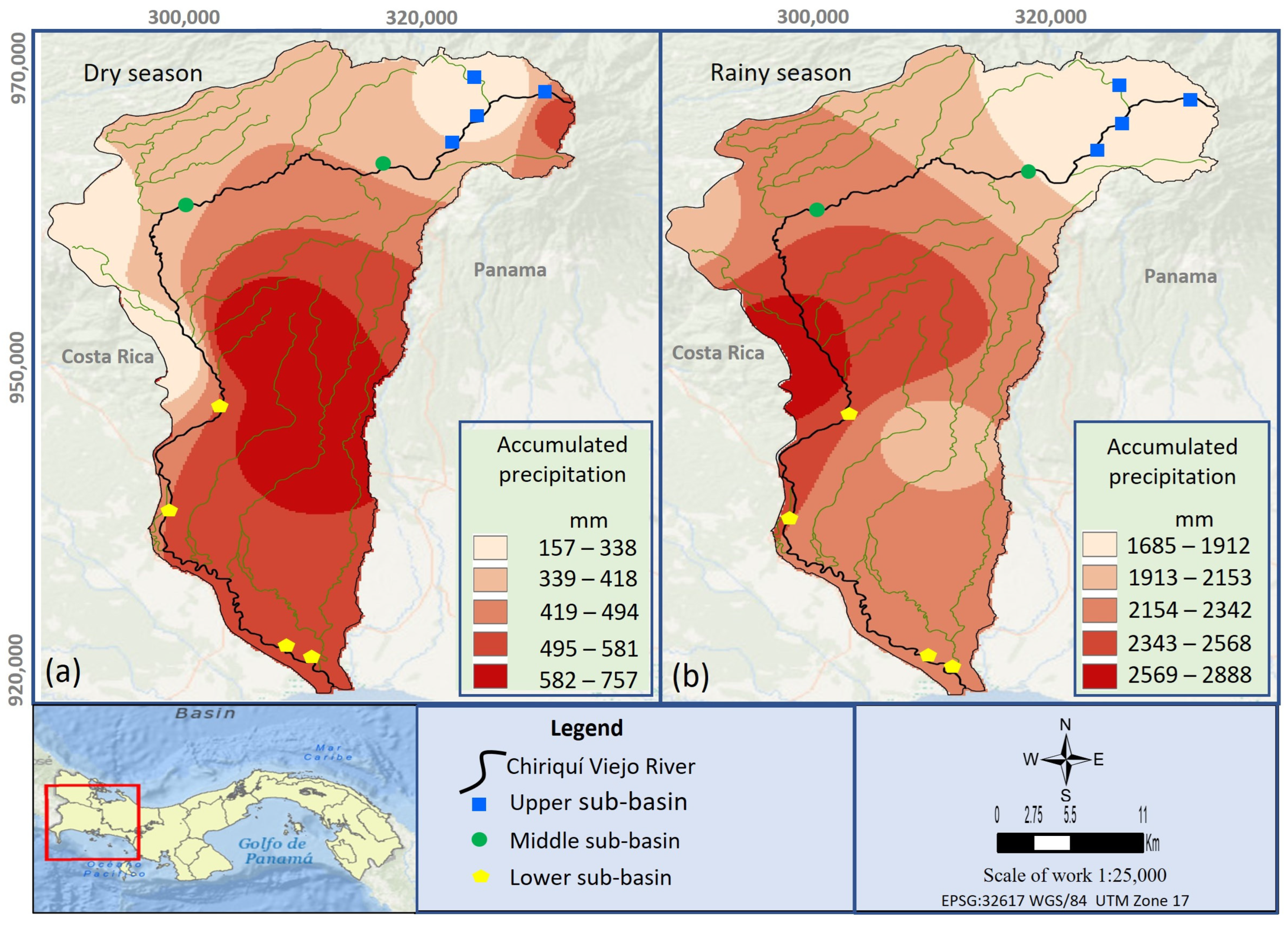
At sites located in the upper basin (NW-01 to NW-04), DO values remained high and stable throughout the monitoring period, with mean concentrations ranging between 7.20 and 9.80 mg/L. Turbidity values were generally low, with mean values below 8.39 NTU, although occasional short-term peaks of up to 60.00 NTU were observed during the dry season. The pH remained near neutral 6.72 to 8.04, TDS ranged between 19.80 and 138.00 mg/L, and EC varied from 20.30 to 152.00 μS/cm. Apparent color values remained below 225.0 Pt–CoPt–Co. Annual accumulated precipitation in this section ranged between 1920 and 2220 mm.
3.1.2. Middle Basin
In the middle basin (NW-05 to NW-06), DO concentrations ranged between 7.50 and 10.00 mg/L, with slightly lower values recorded during the dry season. Turbidity exhibited pronounced seasonal variability, with increases beginning in May and average peaks between 61 and 56 NTU, reaching maximum values in October 2024. pH values ranged from 6.86 to 7.96, while TDS increased until 188 mg/L in rainy season, and EC reached 297 μS/cm at certain sites. Apparent color values ranged between 25.00 and 270.00 Pt–CoPt–Co. Annual precipitation totals in this zone ranged from 2450 to 2676 mm.
3.1.3. Lower Basin
In the lower basin (NW-07 to NW-10), DO exhibited the lowest values observed in the study, with averages between 8.00 and 8.30 mg/L. Turbidity increased substantially, increasing markedly during the rainy season with average values of 87.10 NTU and maximum values reaching 237.00 NTU during the rainy season. pH values ranged from 7.34 to 8.56, TDS increased up to 781 mg/L, and EC reached 1 158 μS/cm. Apparent color values ranged between 20.00 and 1 600 Pt–Co. Annual precipitations in the middle–lower basin ranged from 2221 to 3280 mm (
Figure 3).
3.2. Seasonal Variation and Precipitation Patterns
Marked seasonal differences were observed between the dry and rainy seasons across all basin levels (
Figure 2). During the rainy season (May to October) (
Figure 3), the highest physicochemical values in this study were recorded in the middle and lower basin, suggesting the influence of runoff events and heavy rainfall. Maximum turbidity values reached 237.00 NTU, while apparent color peaked at 1600 Pt–Co at downstream sites, coinciding with months of highest rainfall. TDS exhibited maximum values of up to 781 mg/L during peak runoff events, whereas seasonal mean maxima remained below 125.00 mg/L. These extreme values were site- and event-specific, highlighting the role of short-term hydrological pulses rather than sustained baseline conditions in driving water quality degradation.
In contrast, during the dry season, precipitation values were substantially lower particularly in the upper basin, where monthly accumulations were generally below 338 mm and physicochemical parameters showed lower variability and more stable conditions.
3.3. Land Use Patterns Along the Altitudinal Gradient
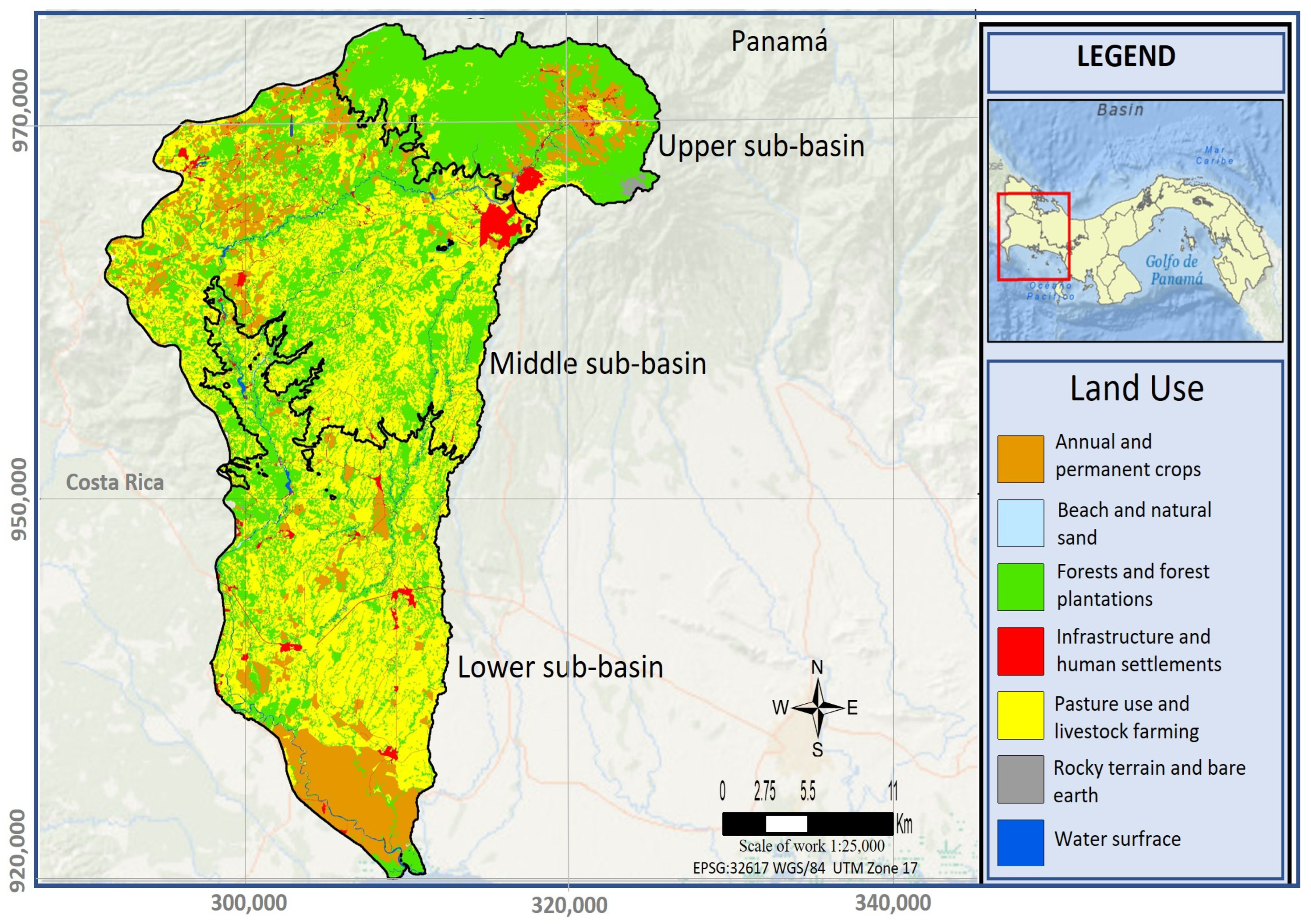
Spatial analysis of land use revealed an altitudinal gradient of anthropogenic transformation within the basin (
Figure 4). Land-cover analysis revealed a progressive transition from forest-dominated landscapes in the upper basin to agricultural- and pasture-dominated land uses in the middle and lower basins, reflecting an increasing gradient of anthropogenic pressure along the river continuum.
Quantitative land-cover analysis revealed a marked spatial gradient across the basin (
Table 4). Forest cover decreased from 72.90% in the upper basin to 28.98% in the lower basin, whereas anthropogenic land use increased from 25.70% to 69.39%. These patterns were consistent with the observed downstream increases in turbidity, apparent color, conductivity, and total dissolved solids.
3.4. Mixed-Effects Modeling of Spatial and Seasonal Controls on Water Quality
The mixed-effects modeling framework allowed the evaluation of seasonal hydrological effects while accounting for the hierarchical structure of the dataset and repeated measurements within monitoring sites.
Linear mixed-effects models (LMM) were applied to evaluate the effects of Season (dry vs. rainy), Basin level (upper, middle, lower), and their interaction on physicochemical water quality parameters. This modeling framework allowed the separation of seasonal hydrological effects from spatial gradients and site-specific variability along the river continuum. The LMM results revealed a significant effect of Basin level and Season on turbidity and apparent color (p < 0.05), as well as a significant Season × Basin level interaction, indicating that seasonal precipitation effects on these parameters were not spatially uniform. Specifically, turbidity and apparent color increased disproportionately in the middle and lower basin during the rainy season, consistent with enhanced surface runoff, sediment mobilization, and land-use-related disturbance in these zones. In contrast, changes in the upper basin were comparatively minor.
EC and TDS also exhibited significant spatial effects associated with basin level (p < 0.05), with higher values in the middle and lower basin, although their seasonal interaction terms were weaker than those observed for turbidity and apparent color. These patterns suggest that solute transport is influenced by both cumulative downstream inputs and hydrological connectivity, but responds less abruptly to seasonal rainfall events than particulate-related parameters.
DO did not show significant effects of Season, Basin level, or their interaction in the mixed-effects models (p > 0.05). This lack of response indicates that DO dynamics in the Chiriquí Viejo River are governed by processes distinct from those controlling sediment and solute transport, such as reaeration, flow turbulence, and longitudinal mixing, which may buffer seasonal and spatial variability.
Overall, the mixed-effects modeling approach strengthened the inferential power of the analysis beyond descriptive statistics by explicitly quantifying the joint influence of spatial structure and seasonal hydrology on water quality. The strong model response of turbidity and apparent color supports their use as sensitive indicators of precipitation-driven impacts in tropical river systems, particularly in basins experiencing land-use intensification.
Model Assumptions and Diagnostics
Residual diagnostics indicated that variance-stabilizing transformations substantially improved model performance for event-driven variables, particularly turbidity and apparent color. Although minor deviations from normality persisted, these patterns are common in hydrological datasets influenced by episodic rainfall events in tropical river systems. Residual-versus-fitted plots and Q–Q plots confirmed that model assumptions were sufficiently met for inferential purposes. Additional details of the statistical procedures and model assumptions are provided in
Appendix A,
Table A3.
4. Discussion
The results of this study demonstrate a clear spatial and seasonal structuring of physicochemical water quality along the Chiriquí Viejo River basin, governed by the combined influence of altitude, precipitation regime, and land-use patterns. The progressive increase in turbidity, apparent color, electrical conductivity, and total dissolved solids (TDS) from the upper to the lower basin reflects an intensification of anthropogenic pressures and hydrological connectivity downstream, a pattern reported in tropical watersheds subjected to agricultural expansion and landscape transformation.
4.1. Seasonal Hydrological Controls on Water Quality Dynamics
The mixed-effects modeling results demonstrate that seasonal hydrological variability plays a central role in shaping water quality patterns in the Chiriquí Viejo River basin, particularly for particulate-related parameters such as turbidity and apparent color. The significant seasonal effect detected by the LMM confirms that increased precipitation during the rainy season enhances surface runoff and sediment transport processes, leading to higher concentrations of suspended materials in the water column. Similar responses have been reported in tropical river systems, where rainfall intensity and seasonal hydrological pulses are primary drivers of sediment mobilization and optical water quality degradation [
21,
22]. Unlike descriptive seasonal comparisons, the LMM framework allows these seasonal effects to be interpreted while controlling for spatial heterogeneity and site-level variability. This strengthens the inference that the observed increases in turbidity and apparent color are not solely site-specific phenomena, but basin-wide responses to seasonal hydrological forcing. Comparable mixed-effects approaches have been successfully applied to disentangle seasonal and spatial controls on water quality in heterogeneous watersheds [
23] reinforcing the methodological robustness of the present study.
4.2. Spatial Gradients and Land-Use Influence Along the Basin
The upper basin exhibited consistently low turbidity, apparent color, EC and TDS values across both hydrological seasons, together with high DO concentrations, reflecting the characteristics of a relatively conserved headwater system. In this sector, steep slopes, dense forest cover, and limited human intervention favor infiltration processes, reduce surface runoff, and enhance natural reaeration through increased flow turbulence. Comparable physicochemical conditions have been reported for tropical mountainous rivers, where preserved vegetation and geomorphological features act as effective buffers against sediment and solute mobilization [
4,
9]. In contrast, the significant basin-level effects identified by the mixed-effects models indicate a clear longitudinal degradation gradient, with progressively higher turbidity, apparent color, EC, and TDS values toward the middle and lower sections of the basin. These spatial patterns reflect the cumulative impacts of land-use change, intensified anthropogenic pressure, and the downstream integration of tributary inputs, consistent with upstream–downstream water quality gradients documented in tropical river basins undergoing agricultural expansion and riparian alteration [
24,
25]. The incorporation of quantitative land-cover metrics further strengthens this interpretation. Forest cover declined markedly from the upper to the lower basin, whereas agricultural, pasture, and infrastructure uses increased downstream. This spatial transition likely enhances soil disturbance, runoff generation, and the transport of sediments and dissolved materials into the river network, reinforcing the observed increases in turbidity, apparent color, EC, and TDS. Recent hydrological studies conducted in the Chiriquí Viejo River basin indicate that hydroelectric development has significantly altered the natural flow regime, with reductions of up to 47.8% in downstream discharge. These structural changes in flow dynamics may influence sediment transport, dilution capacity, and seasonal variability of physicochemical parameters, particularly in the middle and lower basin sections. Such hydrological alterations likely contribute to the spatial patterns in this study. These findings highlight the importance of considering hydropower regulation as an additional driver of water quality variability in tropical regulated river systems [
26].
4.3. Interaction Between Seasonality and Spatial Structure
The mixed-effects models provide robust quantitative evidence that the influence of seasonal rainfall on water quality is strongly modulated by spatial position within the Chiriquí Viejo River basin. For turbidity and apparent color, the significant Season × Basin-level interaction indicates that rainy-season effects are spatially heterogeneous, with a disproportionate amplification in the middle and, particularly, the lower basin, while the magnitude of the seasonal increase is markedly attenuated in the upper basin. This pattern suggests that downstream sections are more susceptible to precipitation-driven sediment and particulate inputs, likely as a result of higher land-use intensity, altered riparian zones, greater soil exposure, and enhanced hillslope–channel connectivity under high-precipitation conditions. The similar seasonal and spatial responses observed for turbidity and apparent color further support the interpretation that these parameters are governed by common transport processes associated with surface runoff and sediment mobilization. Comparable interaction effects between rainfall seasonality and land-use transformation have been reported in tropical and subtropical watersheds subjected to agricultural expansion and riparian alteration [
27,
28], as well as in tropical river systems experiencing stormflow-driven degradation [
5,
10,
29]. In contrast, the absence of a comparable interaction effect in the upper basin highlights the buffering role of forest cover and geomorphological stability in mitigating hydrological disturbances, as forested headwaters are widely recognized for their capacity to reduce sediment yield and dampen rainfall-driven variability in water quality [
30].
4.4. Dissolved Oxygen Dynamics and the Absence of Strong Correlations
Unlike turbidity, color, EC, TDS and DO) exhibited relatively narrow ranges and did not show strong or significant correlations with the other physicochemical parameters. The lack of significant seasonal or spatial effects on DO suggests that dynamics of this parameter in the Chiriquí Viejo River are regulated by processes such as reaeration, flow turbulence, and longitudinal mixing, which may buffer short-term hydrological variability. This finding aligns with previous studies indicating that DO often responds more strongly to hydraulic conditions than to land-use or seasonal sediment dynamics in well-mixed tropical rivers. This apparent decoupling between DO and runoff-related parameters has been documented in other tropical river systems, where high reaeration rates and relatively rapid flow prevent sustained oxygen depletion, even during periods of elevated turbidity and organic input [
9,
10].
Consequently, the lack of strong statistical relationships between DO and variables such as turbidity or color should not be interpreted as an absence of impact, but rather as evidence that DO is a less sensitive indicator of short-duration runoff events in well-aerated lotic systems.
4.5. Interaction Between Precipitation, Land Use, and Water Quality
The joint analysis of seasonal precipitation patterns, land-use distribution, and water quality indicators provides strong support for the study hypothesis. The middle and lower basins, which receive higher rainfall totals and are characterized by more intensive agricultural and pastoral land use, consistently exhibited higher average values and greater variability of turbidity, apparent color, EC, and TDS during the rainy season. This interaction highlights the central role of precipitation in activating and intensifying land-use-driven processes, such as soil erosion, nutrient leaching, and sediment transport.
Comparable findings have been reported in recent studies across tropical catchments, where rainfall seasonality and land-use change jointly explain much of the observed spatial and temporal variability in river water quality [
8,
29]. In this context, the Chiriquí Viejo River basin exemplifies how cumulative anthropogenic pressures, when coupled with intense seasonal rainfall, can lead to both chronic degradation and acute water quality extremes.
4.6. Implications for Monitoring and Watershed Management
The coexistence of high average concentrations and extreme episodic peaks in the middle and lower basin suggests a scenario of chronic stress punctuated by acute disturbance events, with potential implications for aquatic habitats, light penetration, and downstream water uses. These findings underscore the importance of incorporating seasonal and event-based perspectives into monitoring programs, particularly in tropical watersheds with pronounced rainfall variability.
From a management perspective, the results support differentiated interventions according to basin position. In the upper basin, priority should be given to conserving forest cover, water-recharge zones, and riparian corridors that currently function as hydrological buffers. In the middle basin, management actions should focus on erosion control, improved agricultural practices, and restoration of degraded riparian margins. In the lower basin, where cumulative impacts were greatest, priority measures should include runoff management, sediment retention strategies, wastewater control, and stricter land-use planning. In addition, monitoring efforts should be intensified during the rainy season, when water-quality deterioration was most pronounced.
4.7. Limitations and Future Research
Despite the robustness of the monitoring design and analytical approach, several limitations should be acknowledged. First, the monthly sampling frequency, while adequate for capturing seasonal contrasts and persistent spatial gradients, may not fully resolve short-duration hydrological pulses generated by intense rainfall events. As a result, instantaneous peaks in turbidity, suspended sediment transport, and associated short-term fluctuations in conductivity or dissolved oxygen may have been underestimated. Event-based or high-frequency monitoring during storm periods would provide a more complete characterization of runoff-driven water quality dynamics in tropical river systems.
Second, the monitoring period covered nine months within a single hydrological cycle, including one rainy season and one dry season. Although this design enabled robust comparisons between contrasting seasonal conditions, it does not capture interannual climatic variability or long-term trends in water quality responses. Therefore, the observed patterns should be interpreted as representative of the monitored hydrological year rather than definitive long-term trajectories. Future multi-year monitoring programs would improve the assessment of temporal trends and climate-related variability in tropical river basins.
Third, the study focused on core physicochemical parameters and did not include microbiological, nutrient, or trace-metal indicators, which could provide additional insight into ecological condition, contamination sources, and ecosystem responses. Nevertheless, the selected variables represent widely used first-order indicators of sediment transport, ionic enrichment, and hydrological disturbance. Future research should integrate microbiological, nutrient, trace-metal, and ecological metrics to develop a more comprehensive assessment of river health under changing land-use and climatic conditions.
Although precipitation was incorporated as a climatic driver, direct hydrological variables such as runoff, river discharge, and flow velocity were not continuously available for all monitoring sites. These variables strongly influence dilution capacity, sediment transport, and residence time in river systems. Future monitoring programs should integrate hydrometric measurements to strengthen process-based interpretation of seasonal water-quality responses.
Finally, although basin-level quantitative land-cover metrics were incorporated in the analysis, finer-scale variables at sub-catchment and riparian-buffer levels were not explicitly modeled. Future studies should integrate higher-resolution land-use metrics together with continuous discharge data to strengthen causal inference and predictive capacity.
5. Conclusions
This study provides a comprehensive assessment of the spatial and seasonal variability of physicochemical water quality in the Chiriquí Viejo River basin, demonstrating how altitude, precipitation regime, and land-use patterns jointly shape water quality dynamics in a tropical watershed. The results reveal a clear longitudinal gradient, with relatively conserved conditions in the upper basin and progressive deterioration toward the middle and lower sections, reflecting increasing anthropogenic pressure and downstream accumulation of impacts.
Parameters associated with sediment and solute transport—particularly turbidity and apparent color—exhibited pronounced seasonal amplification during the rainy period and significantly higher values in the middle and lower basin, as confirmed by linear mixed-effects models. The occurrence of extreme values during the rainy season indicates that water quality degradation is driven not only by chronic land-use pressures but also by episodic hydrological events that intensify surface runoff, erosion, and the mobilization of organic and mineral materials. In contrast, electrical conductivity and total dissolved solids showed primarily spatial gradients, suggesting cumulative downstream controls rather than direct sensitivity to short-term rainfall variability.
Dissolved oxygen remained relatively stable across basin levels and seasons, indicating that oxygen dynamics in the Chiriquí Viejo River are governed mainly by physical and hydrodynamic processes such as flow turbulence and atmospheric exchange, rather than by sediment- or runoff-driven mechanisms. This decoupling highlights the importance of using multiple complementary indicators when assessing water quality in tropical lotic systems.
From a management perspective, these findings emphasize the need for spatially differentiated watershed strategies. Protection of upper basin areas is critical to maintain their buffering role, while management actions in the middle and lower basin should prioritize riparian restoration, erosion control, and sustainable land-use practices to reduce sediment and organic matter inputs, particularly during the rainy season. Overall, this study demonstrates that integrating physicochemical monitoring with spatial analysis and mixed-effects modeling provides a robust framework for diagnosing water quality dynamics and supporting adaptive, evidence-based watershed management in tropical river basins facing increasing climatic variability and land-use pressure.
These findings provide a practical basis for watershed authorities to prioritize interventions spatially, optimize rainy-season monitoring programs, and implement adaptive management strategies aimed at reducing erosion, sediment inputs, and water-quality deterioration under increasing climatic variability and land-use pressure.
Future studies should extend monitoring across multiple hydrological years to evaluate interannual variability and long-term trends in water quality under changing climatic and land-use conditions.




 ,
,