Landscape Controls on Coupled Water–Air Pollution in an Urbanized Watershed: A GeoSHAP Analysis of the Liaohe River Basin, China


Abstract
1. Introduction
2. Materials and Methods
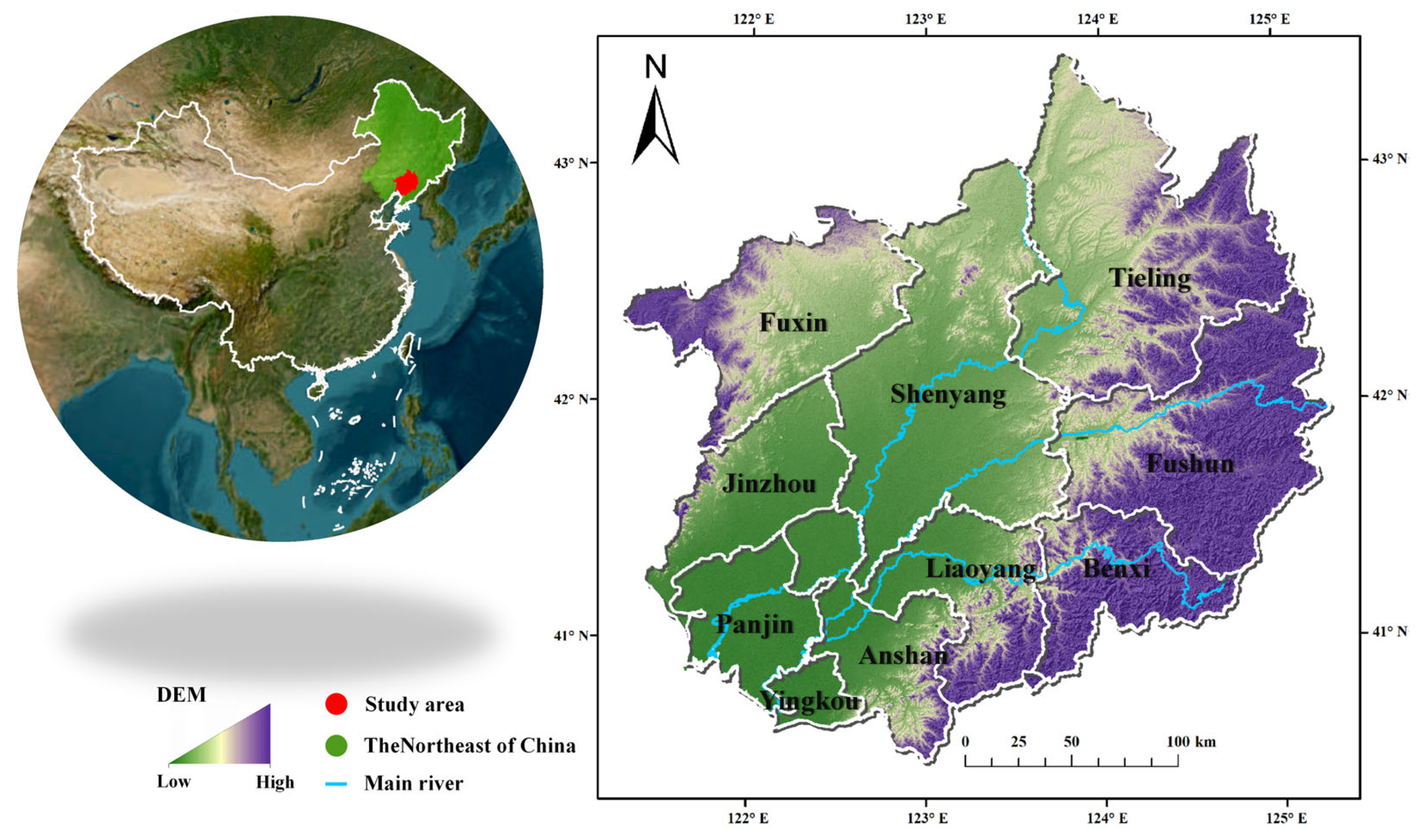
2.1. Study Area and Sub-Basin Delineation
2.2. Data Sources and Preprocessing
2.3. Study Methods
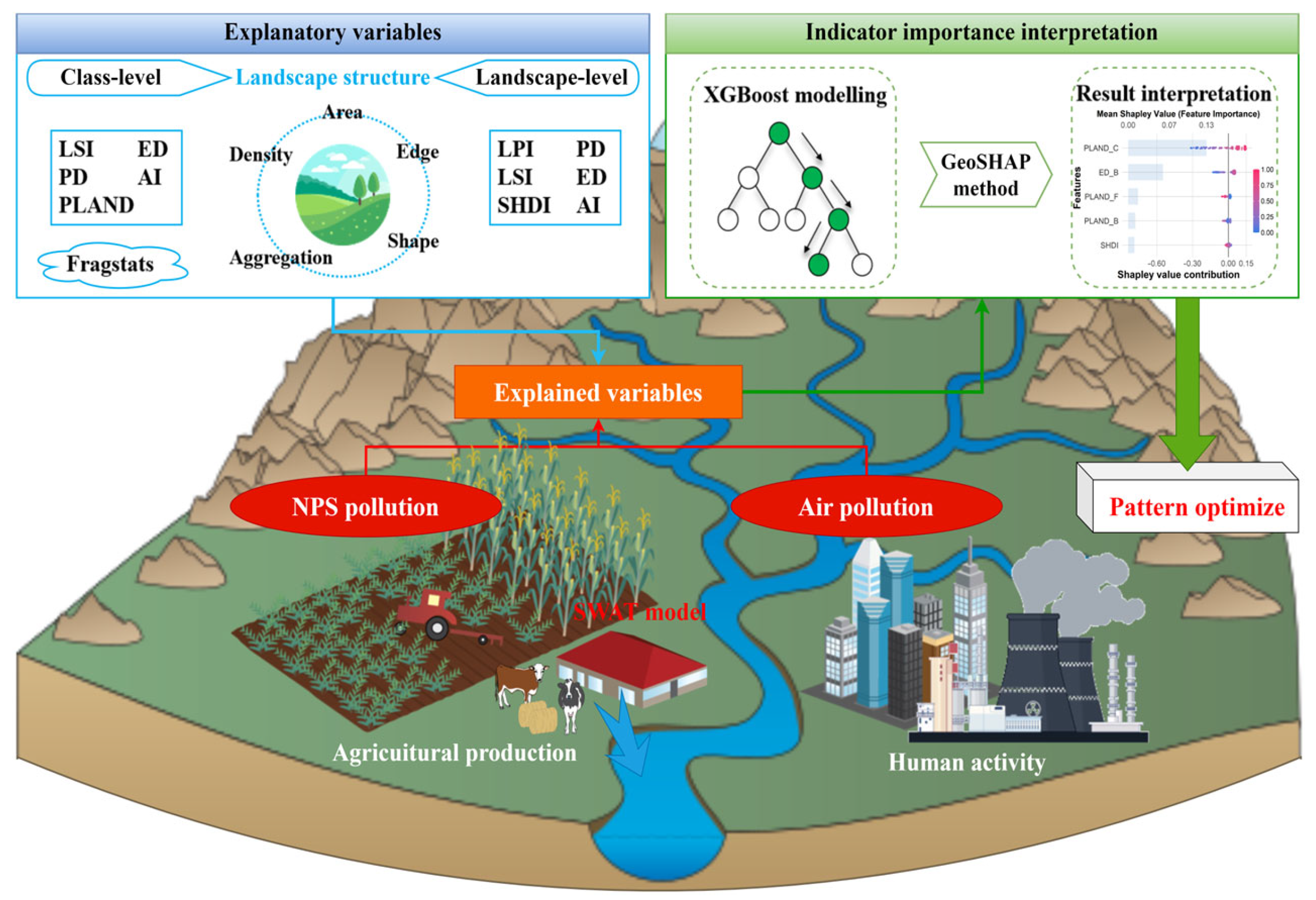
2.3.1. Landscape Metrics
2.3.2. Aquatic and Atmospheric Pollution Indicators
2.3.3. Composite Pollution Index (Coupling Coordination Degree, CCD)
2.3.4. GeoXGBoost Modeling
2.3.5. GeoSHAP Interpretation and Comparative Analysis
3. Results
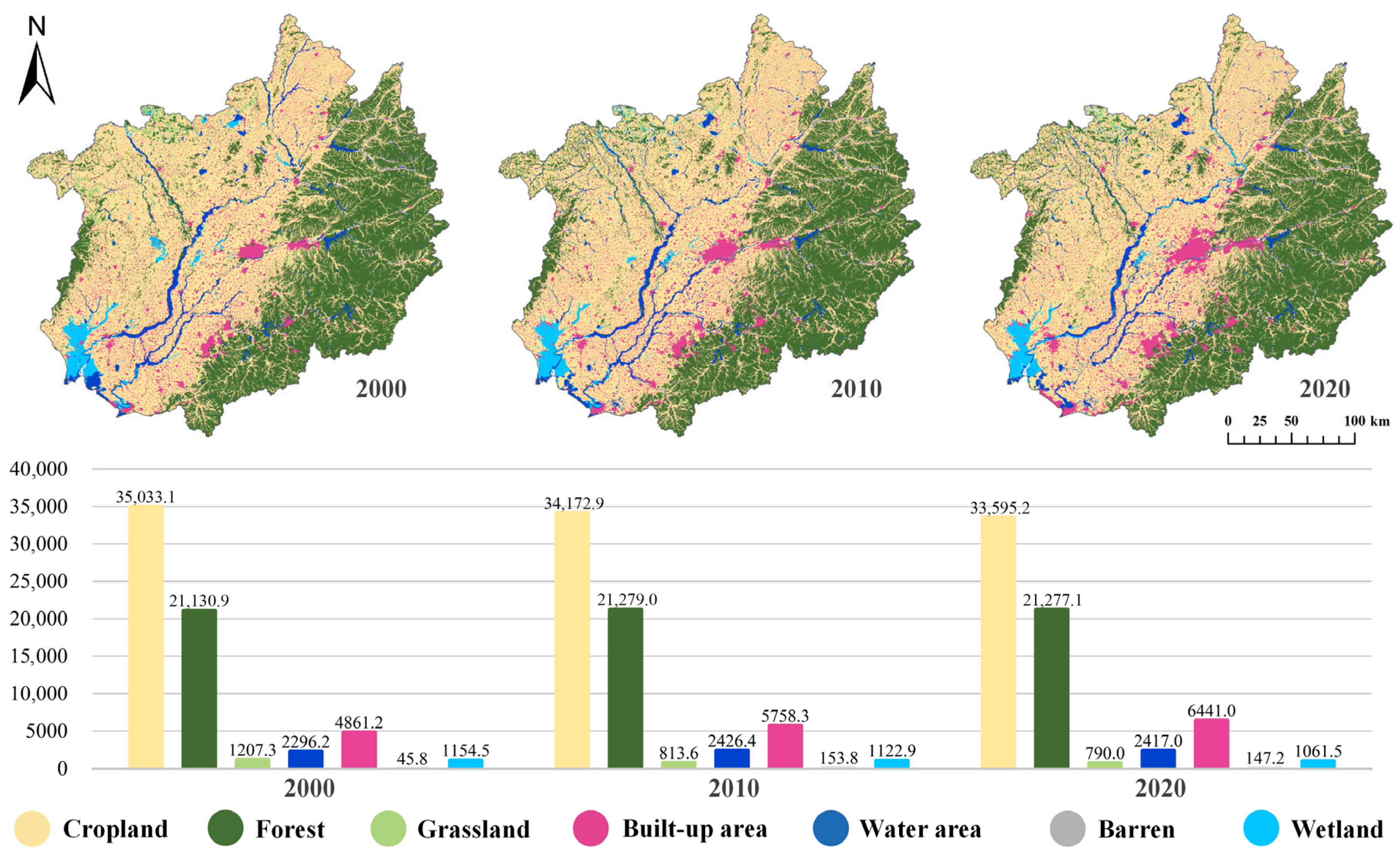
3.1. Landscape Pattern Dynamics
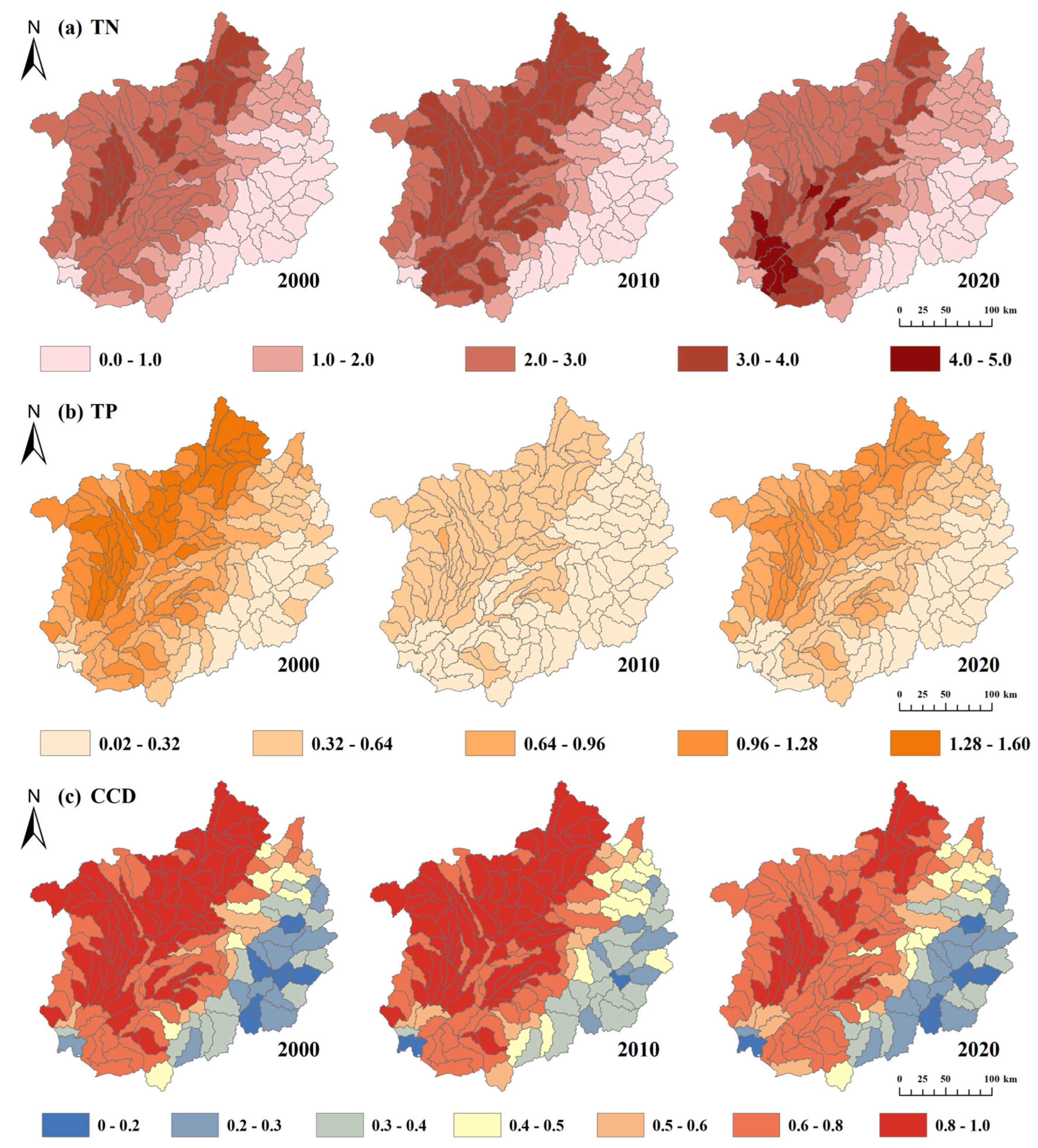
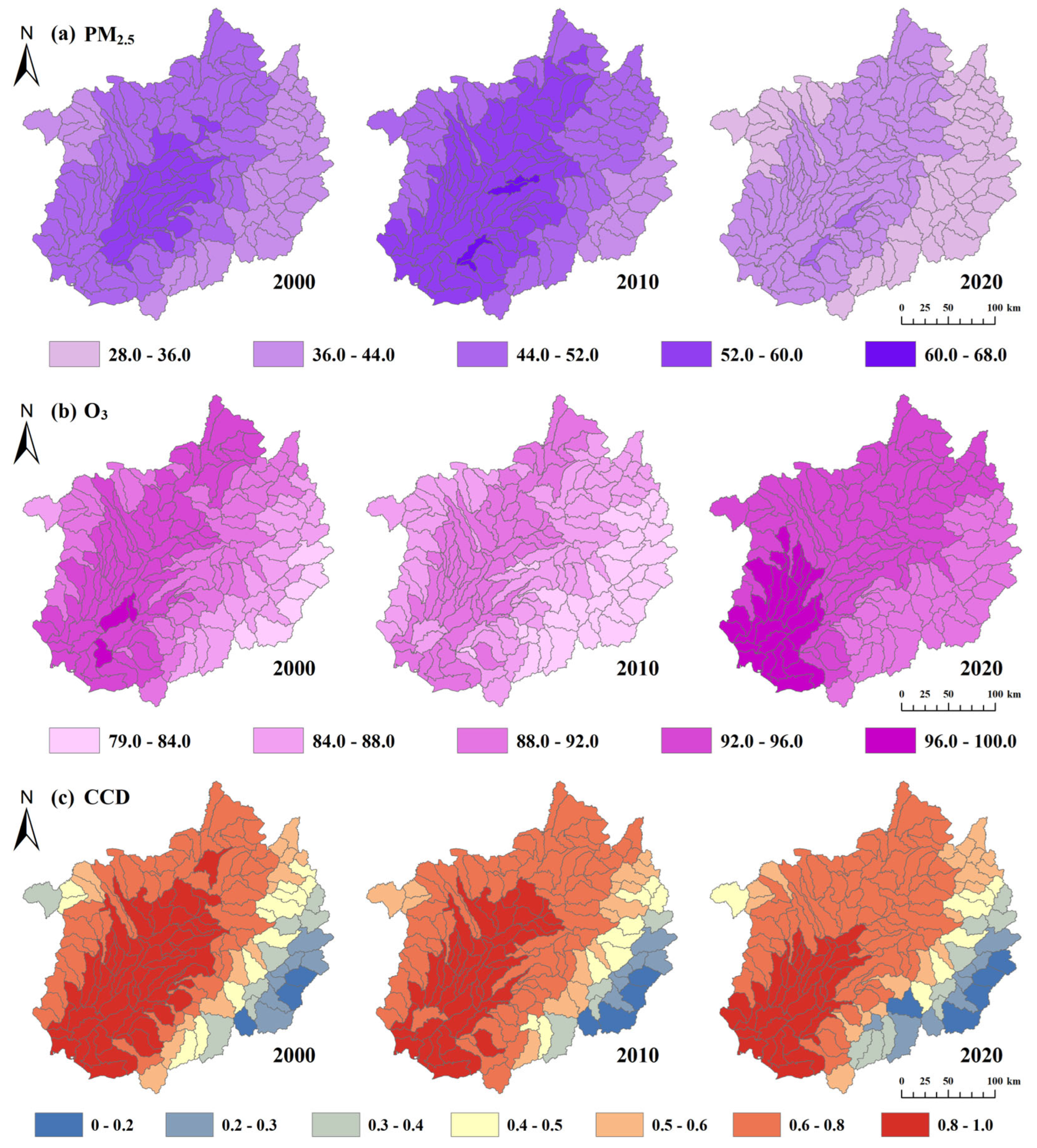
3.2. CCD Analysis
3.3. GeoXGBoost Performance and GeoSHAP Interpretation of the Water and Air Quality Coupling Coordination Degrees
3.3.1. Landscape Predictors Showed Stronger Model Performance for the Aquatic System than for the Atmospheric System
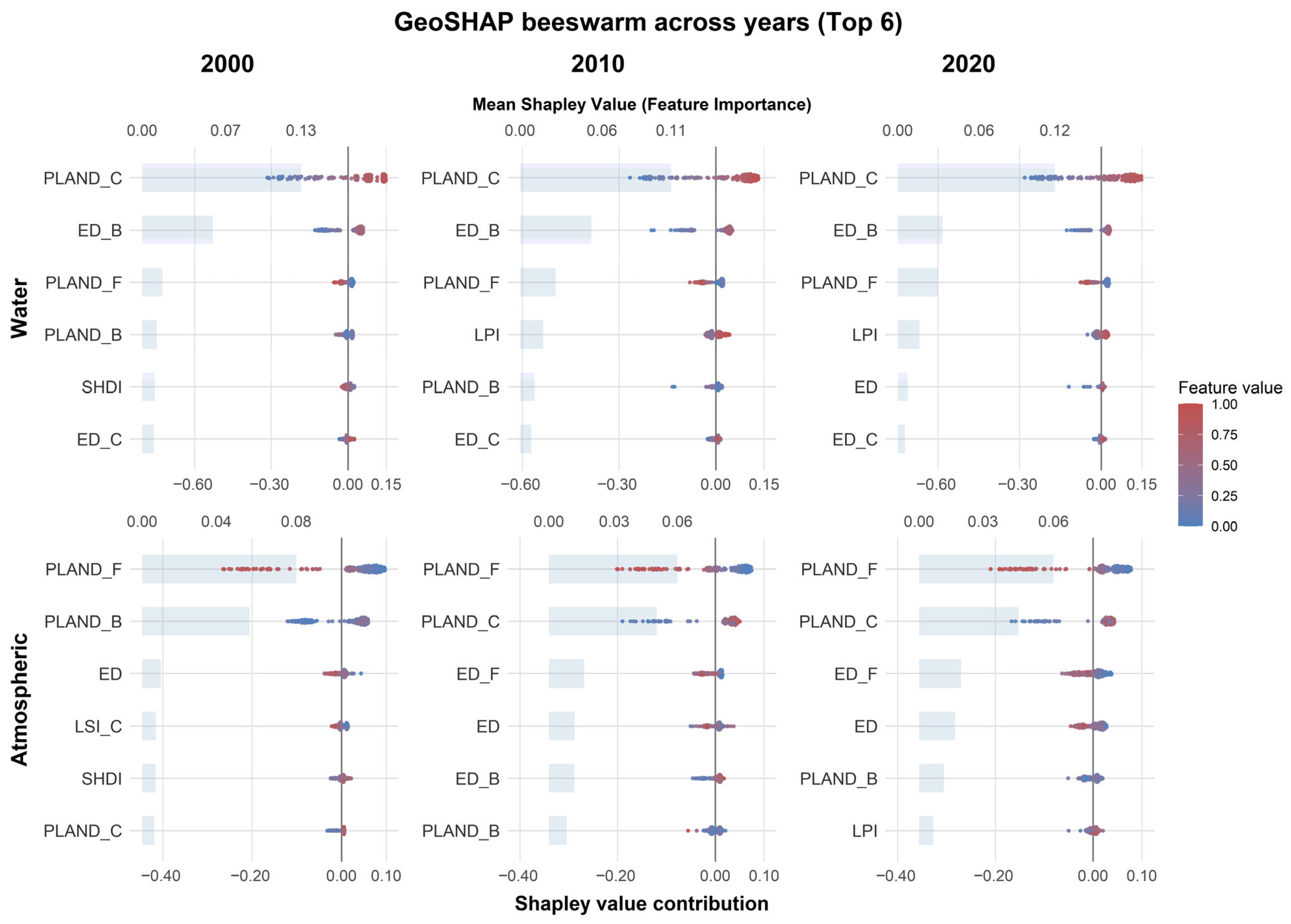
3.3.2. Stable Cropland and Forest Predictors Characterized the Aquatic and Atmospheric Systems
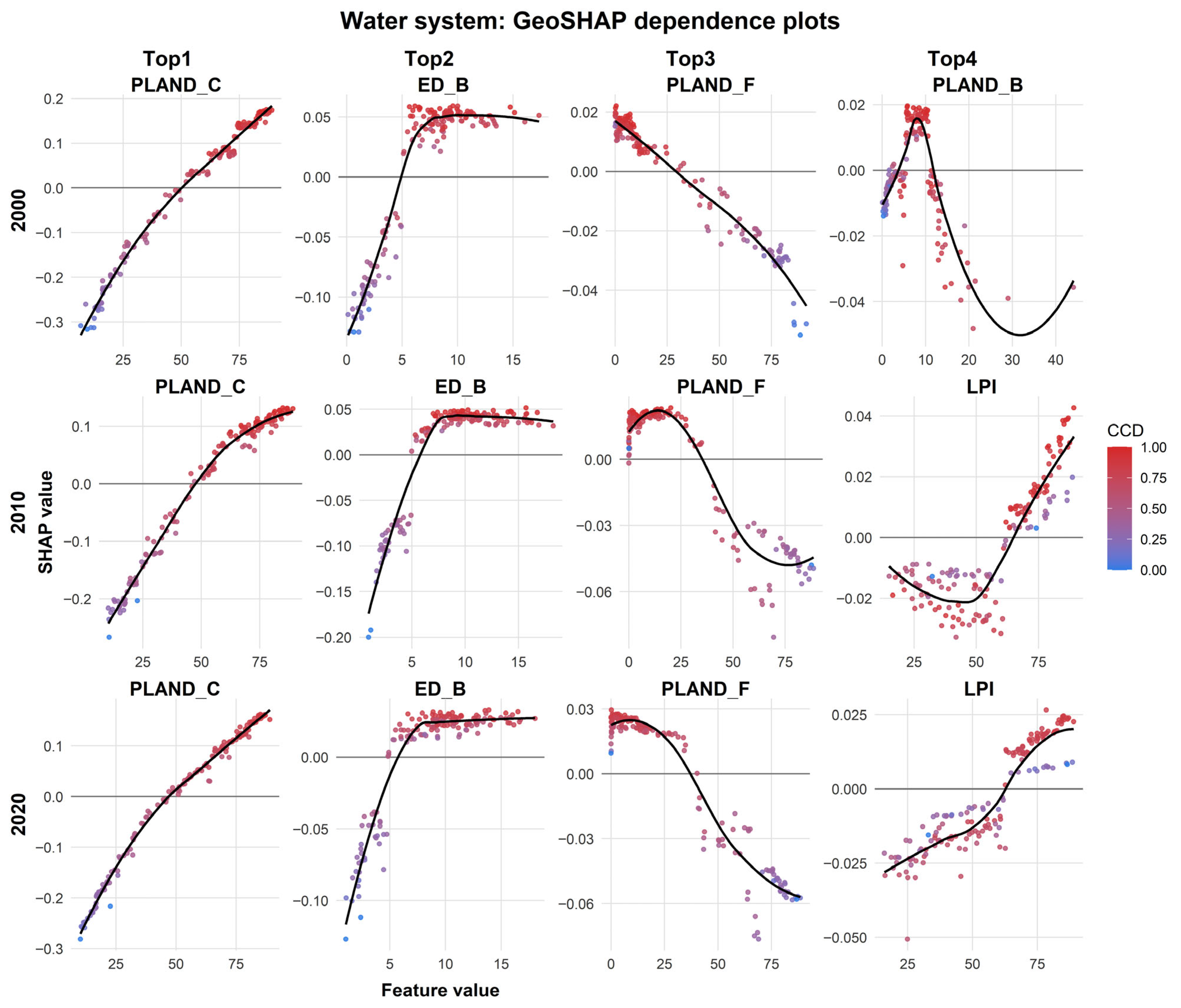
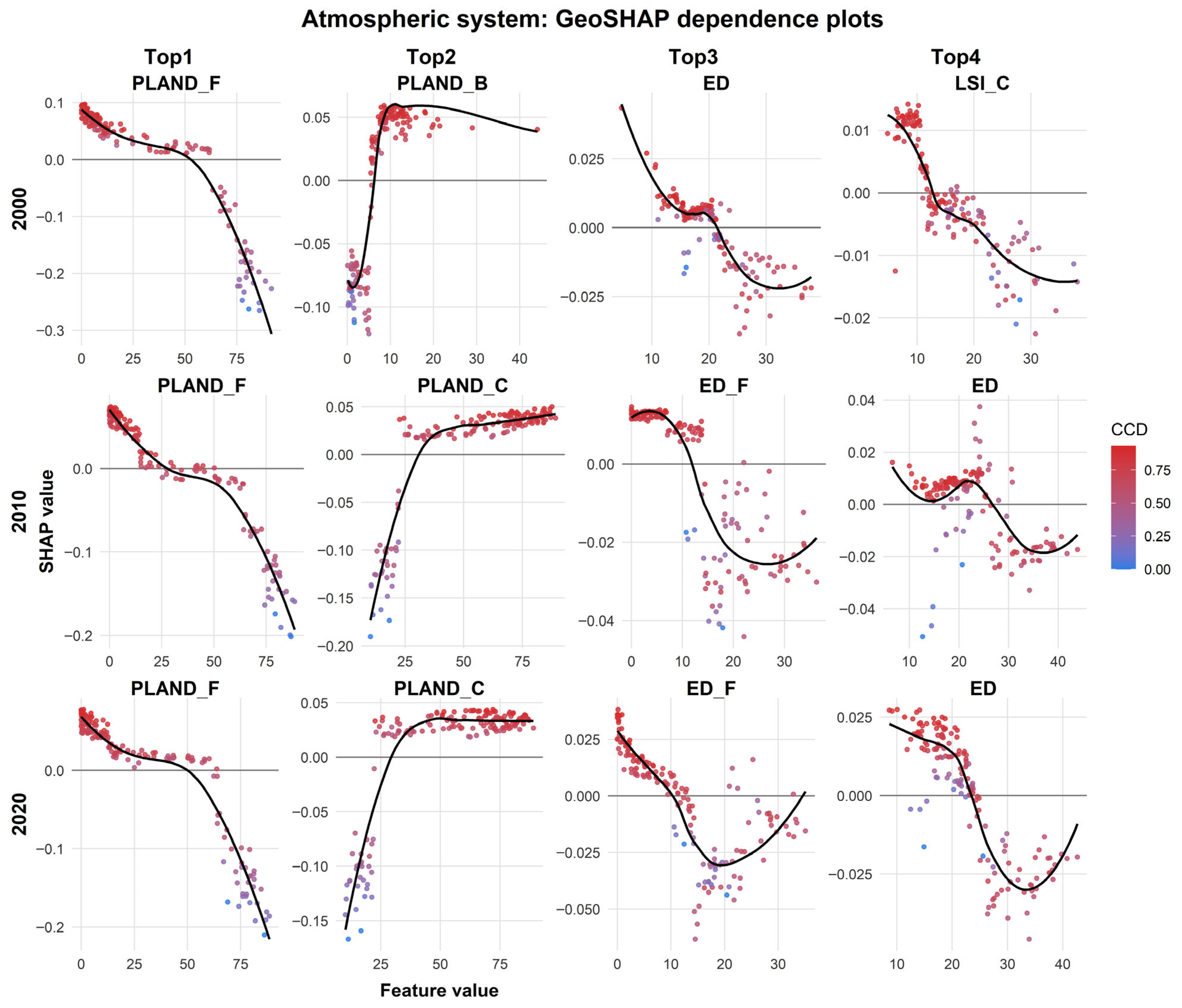
3.3.3. Nonlinear Response Intervals in the Fitted Curves Showed Changing Landscape Associations
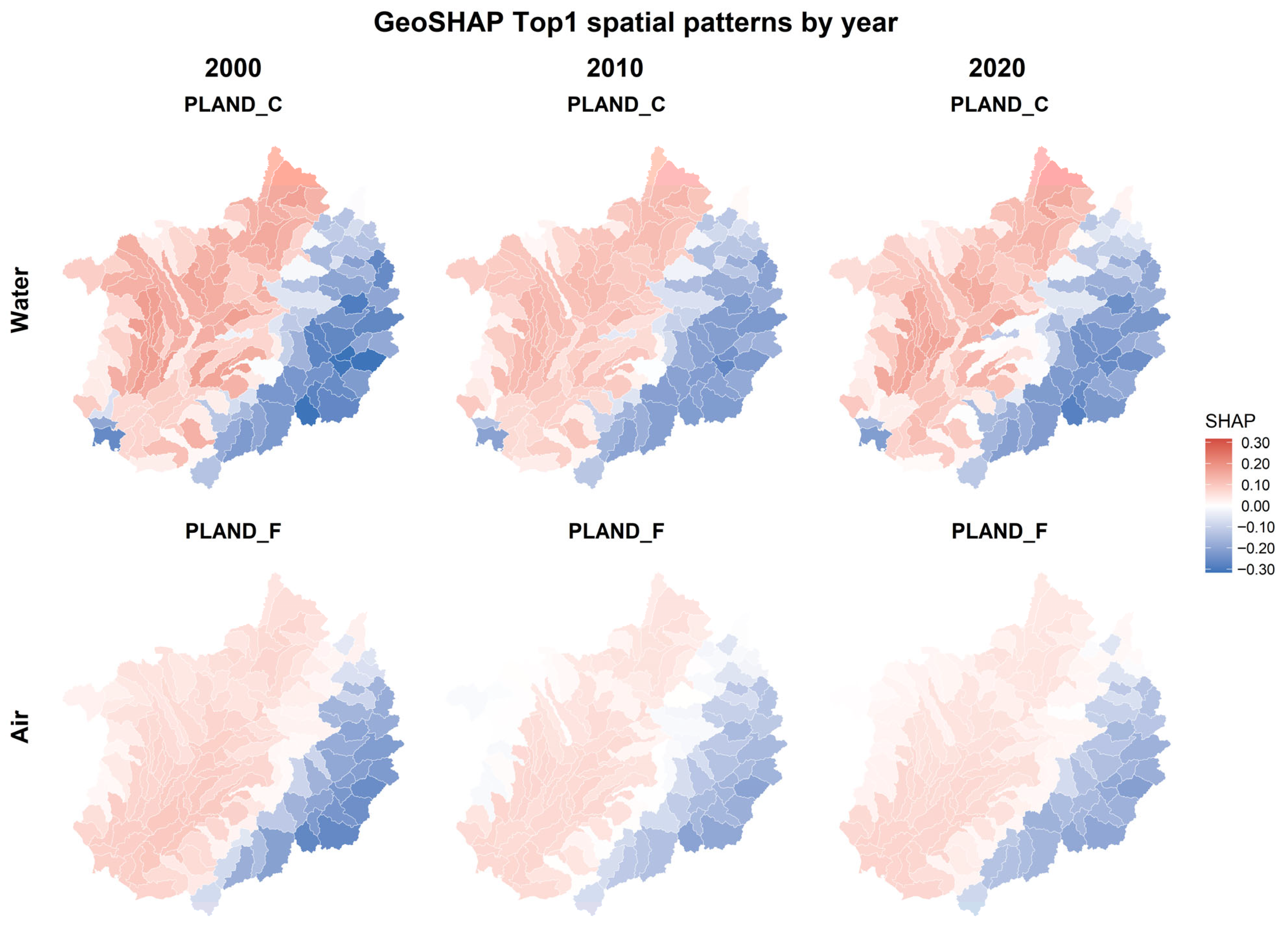
3.3.4. Dominant Landscape Predictors Were Expressed as Persistent Basin-Wide Gradients
4. Discussion
4.1. Cropland Dominance Was Associated with Aquatic Coupling Through Source Continuity and Delivery Efficiency
4.2. Landscape Associations with the Atmospheric Coupled Pollution System
4.3. Different Transport Domains Were Associated with Different Predictor Hierarchies and Transition Intervals
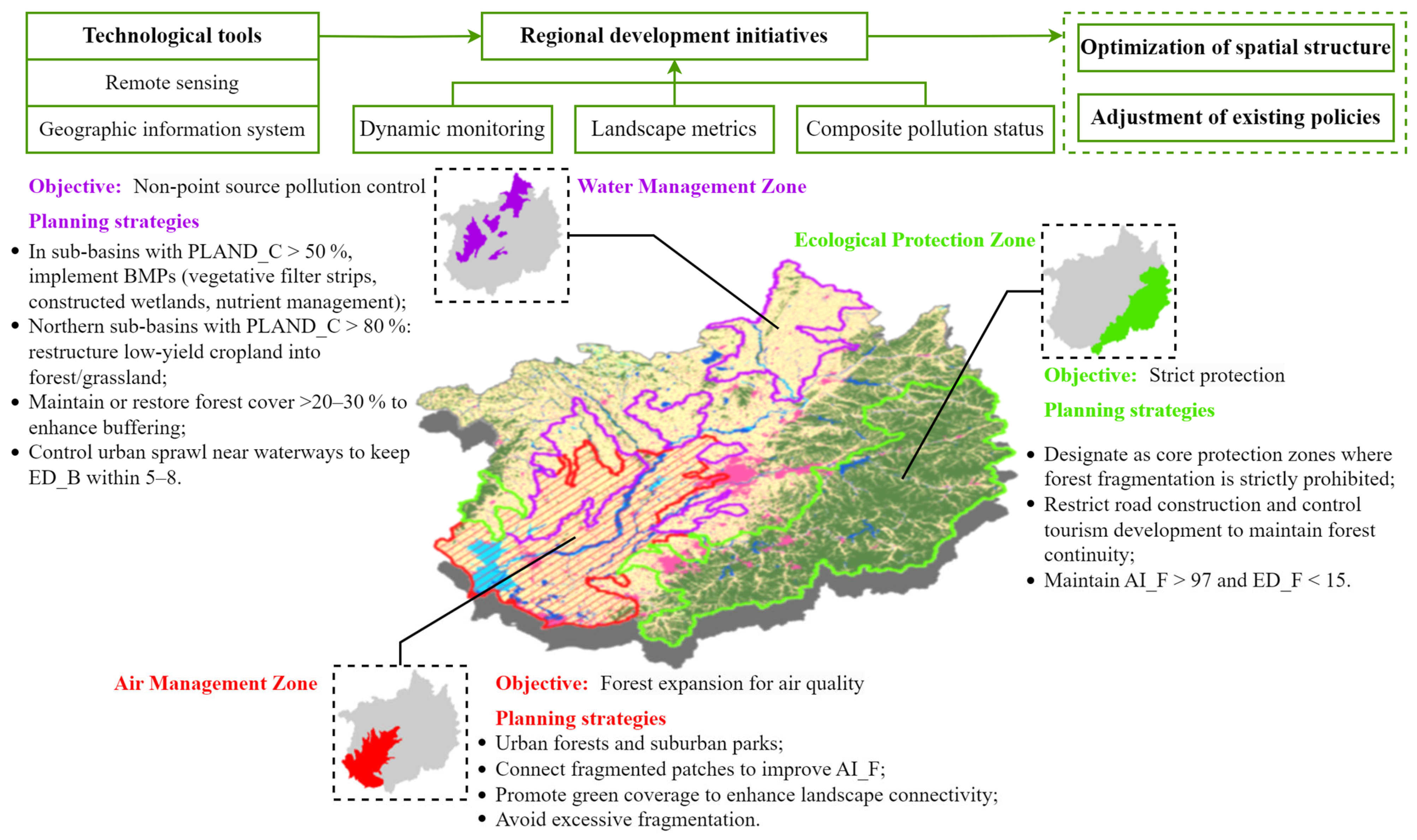
4.4. Implications for Territorial Spatial Planning
4.5. Limitations and Future Directions
5. Conclusions
Author Contributions
Funding
Data Availability Statement
Acknowledgments
Conflicts of Interest
References
- Bryan, B.A.; Gao, L.; Ye, Y.; Sun, X.; Connor, J.D.; Crossman, N.D.; Stafford-Smith, M.; Wu, J.; He, C.; Yu, D.; et al. China’s response to a national land-system sustainability emergency. Nature 2018, 559, 193–204. [Google Scholar] [CrossRef]
- Zhang, Q.; Zheng, Y.; Tong, D.; Shao, M.; Wang, S.; Zhang, Y.; Xu, X.; Wang, J.; He, H.; Liu, W.; et al. Drivers of improved PM2.5 air quality in China from 2013 to 2017. Proc. Natl. Acad. Sci. USA 2019, 116, 24463–24469. [Google Scholar] [CrossRef]
- Wu, J.; Wang, Y.; Liang, J.; Yao, F. Exploring common factors influencing PM2.5 and O3 concentrations in the Pearl River Delta: Tradeoffs and synergies. Environ. Pollut. 2021, 285, 117138. [Google Scholar] [CrossRef] [PubMed]
- Chen, L.; Dai, Y.; Zhi, X.; Xie, H.; Shen, Z. Quantifying nonpoint source emissions and their water quality responses in a complex catchment: A case study of a typical urban-rural mixed catchment. J. Hydrol. 2018, 559, 110–121. [Google Scholar] [CrossRef]
- Turner, M.G.; O’Neill, R.V.; Gardner, R.H.; Milne, B.T. Effects of changing spatial scale on the analysis of landscape pattern. Landsc. Ecol. 1989, 3, 153–162. [Google Scholar] [CrossRef]
- Xue, F.; Yang, Y.R.; Hu, Y.N. Integrating supply and benefits of ecosystem services into ecological security pattern: A spatial flow perspective. Ecol. Indic. 2024, 166, 112455. [Google Scholar] [CrossRef]
- Ding, J.; Jiang, Y.; Liu, Q.; Hou, Z.; Liao, J.; Fu, L.; Peng, Q. Influences of the land use pattern on water quality in low-order streams of the Dongjiang River Basin, China: A multi-scale analysis. Sci. Total Environ. 2016, 551, 205–216. [Google Scholar] [CrossRef]
- Zheng, S.; Zhou, X.; Singh, R.P.; Wu, Y.; Ye, Y.; Wu, C. The spatiotemporal distribution of air pollutants and their relationship with land-use patterns in Hangzhou City, China. Atmosphere 2017, 8, 110. [Google Scholar] [CrossRef]
- Wang, R.J.; Eckelman, M.J.; Zimmerman, J.B.; Li, X.; Ma, D.; Sun, P.; Sun, G. Discussing on “source-sink” landscape theory and phytoremediation for non-point source pollution control in China. Environ. Sci. Pollut. Res. 2020, 27, 44797–44806. [Google Scholar] [CrossRef] [PubMed]
- Boano, F.; Caruso, A.; Costamagna, E.; Ridolfi, L.; Fiore, S.; Demichelis, F.; Galvão, A.; Pisoeiro, J.; Rizzo, A.; Masi, F. A review of nature-based solutions for greywater treatment: Applications, hydraulic design, and environmental benefits. Sci. Total Environ. 2020, 711, 134731. [Google Scholar] [CrossRef]
- Shen, Z.; Zhang, Z.; Cui, L.; Xia, Z.; Zhang, Y. Coordinated change of PM2.5 and multiple landscapes based on spatial coupling model: Comparison of inland and waterfront cities. Environ. Impact Assess. Rev. 2023, 102, 107194. [Google Scholar] [CrossRef]
- Yang, L.J.; Wang, S.; Hu, X.; Shi, T. County-based PM2.5 concentrations’ prediction and its relationship with urban landscape pattern. Processes 2023, 11, 704. [Google Scholar] [CrossRef]
- Yang, H.O.; Leng, Q.; Xiao, Y.; Chen, W. Investigating the impact of urban landscape composition and configuration on PM2.5 concentration under the LCZ scheme: A case study in Nanchang, China. Sustain. Cities Soc. 2022, 84, 104006. [Google Scholar] [CrossRef]
- Liu, Y.; Fu, B.; Zhao, W.; Wang, S.; Deng, Y. A solution to the conflicts of multiple planning boundaries: Landscape functional zoning in a resource-based city in China. Habitat Int. 2018, 77, 43–55. [Google Scholar] [CrossRef]
- Fan, J.; Wang, Y.; Wang, C.; Chen, T.; Jin, F.; Zhang, W.; Li, L.; Xu, Y.; Dai, E.; Tao, A.; et al. Reshaping the sustainable geographical pattern: A major function zoning model and its applications in China. Earth’s Future 2019, 7, 25–42. [Google Scholar] [CrossRef]
- Liu, Y.; Zhou, Y. Territory spatial planning and national governance system in China. Land Use Policy 2021, 102, 105288. [Google Scholar] [CrossRef]
- Xia, H.; Yuan, S.F.; Prishchepov, A.V. Spatial-temporal heterogeneity of ecosystem service interactions and their social-ecological drivers: Implications for spatial planning and management. Resour. Conserv. Recycl. 2023, 189, 106767. [Google Scholar] [CrossRef]
- Huang, X.F.; Hua, W.W.; Dai, X.Y. Performance evaluation of watershed environment governance: A case study of Taihu Basin. Water 2022, 14, 158. [Google Scholar] [CrossRef]
- Locke, K.A. Modelling relationships between land use and water quality using statistical methods: A critical and applied review. J. Environ. Manag. 2024, 362, 121290. [Google Scholar] [CrossRef] [PubMed]
- Li, Y.; Huang, L.; Li, S.; Cao, M.; Tan, P.; Wang, Q.; Meng, H.; Yin, S.; Zhang, W. The role of urban green space landscape patterns in the synergistic prevention of PM2.5 and ozone pollution: A case study in Shenyang City, China. Atmos. Pollut. Res. 2024, 15, 102278. [Google Scholar] [CrossRef]
- Li, Z.Q. Extracting spatial effects from machine learning model using local interpretation method: An example of SHAP and XGBoost. Comput. Environ. Urban Syst. 2022, 96, 101845. [Google Scholar] [CrossRef]
- Roberts, D.R.; Bahn, V.; Ciuti, S.; Boyce, M.S.; Elith, J.; Guillera-Arroita, G.; Hauenstein, S.; Lahoz-Monfort, J.J.; Schröder, B.; Thuiller, W.; et al. Cross-validation strategies for data with temporal, spatial, hierarchical, or phylogenetic structure. Ecography 2017, 40, 913–929. [Google Scholar] [CrossRef]
- Huang, J.; Li, Q.; Pontius, R.G., Jr.; Klemas, V.; Hong, H. Detecting the dynamic linkage between landscape characteristics and water quality in a subtropical coastal watershed, Southeast China. Environ. Manag. 2013, 51, 32–44. [Google Scholar] [CrossRef] [PubMed]
- Tu, J. Spatially varying relationships between land use and water quality across an urbanization gradient explored by geographically weighted regression. Appl. Geogr. 2011, 31, 376–392. [Google Scholar] [CrossRef]
- De Mello, K.; Valente, R.A.; Randhir, T.O.; dos Santos, A.C.A.; Vettorazzi, C.A. Effects of land use and land cover on water quality of low-order streams in Southeastern Brazil: Watershed versus riparian zone. Catena 2018, 167, 130–138. [Google Scholar] [CrossRef]
- Clément, F.; Ruiz, J.; Rodríguez, M.A.; Blais, D.; Campeau, S. Landscape diversity and forest edge density regulate stream water quality in agricultural catchments. Ecol. Indic. 2017, 72, 627–639. [Google Scholar] [CrossRef]
- Kaushal, S.S.; Belt, K.T. The urban watershed continuum: Evolving spatial and temporal dimensions. Urban Ecosyst. 2012, 15, 409–435. [Google Scholar] [CrossRef]
- Bell, C.D.; Tague, C.L.; McMillan, S.K. Modeling runoff and nitrogen loads from a watershed at different levels of impervious surface coverage and connectivity to storm water control measures. Water Resour. Res. 2019, 55, 2690–2707. [Google Scholar] [CrossRef]
- Oswald, C.J.; Kelleher, C.; Ledford, S.H.; Hopkins, K.G.; Sytsma, A.; Tetzlaff, D.; Toran, L.; Voter, C. Integrating urban water fluxes and moving beyond impervious surface cover: A review. J. Hydrol. 2023, 618, 129188. [Google Scholar] [CrossRef]
- Teixeira, Z.; Teixeira, H.; Marques, J.C. Systematic processes of land use/land cover change to identify relevant driving forces: Implications on water quality. Sci. Total Environ. 2014, 470, 1320–1335. [Google Scholar] [CrossRef]
- Lee, S.W.; Hwang, S.J.; Lee, S.B.; Hwang, H.S.; Sung, H.C. Landscape ecological approach to the relationships of land use patterns in watersheds to water quality characteristics. Landsc. Urban Plan. 2009, 92, 80–89. [Google Scholar] [CrossRef]
- Sicard, P.; Agathokleous, E.; Araminiene, V.; Carrari, E.; Hoshika, Y.; De Marco, A.; Paoletti, E. Should we see urban trees as effective solutions to reduce increasing ozone levels in cities? Environ. Pollut. 2018, 243, 163–176. [Google Scholar] [CrossRef] [PubMed]
- Zhai, C.; Bao, G.; Zhang, D.; Sha, Y. Urban forest locations and patch characteristics regulate PM2.5 mitigation capacity. Forests 2022, 13, 1408. [Google Scholar] [CrossRef]
- Zhang, X.D.; Du, J.; Zhang, L.M.; Huang, T.; Gao, H.; Mao, X.X.; Ma, J.M. Impact of afforestation on surface ozone in the North China Plain during the three-decade period. Agric. For. Meteorol. 2020, 287, 107979. [Google Scholar] [CrossRef]
- Duan, Z.X.; Yang, Y.; Wang, L.; Liu, C.; Fan, S.; Chen, C.; Tong, Y.; Lin, X.; Gao, Z. Temporal characteristics of carbon dioxide and ozone over a rural-cropland area in the Yangtze River Delta of eastern China. Sci. Total Environ. 2021, 757, 143750. [Google Scholar] [CrossRef]
- Lu, D.B.; Xu, J.; Yue, W.; Mao, W.; Yang, D.; Wang, J. Response of PM2.5 pollution to land use in China. J. Clean. Prod. 2020, 244, 118741. [Google Scholar] [CrossRef]
- Zhang, Q.; He, K.B.; Huo, H. Cleaning China’s air. Nature 2012, 484, 161–162. [Google Scholar] [CrossRef] [PubMed]
- Xie, W.D.; Wu, J.S. Effects of land use and urban landscape pattern on PM2.5 concentration: A Shenzhen case study. Acta Sci. Nat. Univ. Pekin. 2017, 53, 160–170. [Google Scholar]
- Lin, F.Y.; Chen, X.W. Effects of landscape patterns on atmospheric particulate matter concentrations in Fujian Province, China. Atmosphere 2023, 14, 787. [Google Scholar] [CrossRef]
- Chen, X.; Wei, F. Reducing PM2.5 and O3 through optimizing urban ecological land form based on its size thresholds. Atmos. Pollut. Res. 2025, 16, 102466. [Google Scholar] [CrossRef]
- Basu, N.B.; Van Meter, K.J.; Byrnes, D.K.; Van Cappellen, P.; Brouwer, R.; Jacobsen, B.H.; Jarsjö, J.; Rudolph, D.L.; Cunha, M.C.; Nelson, N.; et al. Managing nitrogen legacies to accelerate water quality improvement. Nat. Geosci. 2022, 15, 97–105. [Google Scholar] [CrossRef]
- Qu, K.; Yan, Y.; Wang, X.; Jin, X.; Vrekoussis, M.; Kanakidou, M.; Brasseur, G.P.; Lin, T.; Xiao, T.; Cai, X.; et al. The effect of cross-regional transport on ozone and particulate matter pollution in China: A review of methodology and current knowledge. Sci. Total Environ. 2024, 947, 174196. [Google Scholar] [CrossRef]





| Data | Time | Data Format | Data Source |
|---|---|---|---|
| Digital elevation model (DEM) | - | Grid (cell size, 10 × 10 m) | http://www.gscloud.cn (accessed on 20 April 2025) |
| Soil map and properties | - | Grid (cell size, 1 × 1 km) | Harmonized World Soil Database (https://iiasa.ac.at/models-tools-data/hwsd, accessed on 10 April 2025) |
| Land use map | 2000, 2010, 2020 | Grid (cell size, 30 × 30 m) | Landsat 5 Thematic Mapper and Landsat 8 Operational Land Imager (https://earthexplorer.usgs.gov/, accessed on 16 May 2025) |
| Weather | 2000–2020 | Database file (DBF) | China Meteorological Administration (https://data.cma.cn/, accessed on 21 May 2024) |
| Hydrology and water quality data | 2000–2020 | Database file (DBF) | Local hydrographical station and environmental monitoring station |
| PM2.5 data | 2000, 2010, 2020 | Grid (cell size, 1 × 1 km) | ChinaHigh PM2.5 data set (https://zenodo.org/record/6398971, accessed on 15 April 2025) |
| O3 data | 2000, 2010, 2020 | Grid (cell size, 1 × 1 km) | ChinaHigh O3 data set (https://zenodo.org/records/13342827, accessed on 15 April 2025) |
| Metric | Level | Main Meaning | Ecological Interpretation in This Study |
|---|---|---|---|
| PLAND | Class | Relative area of a given land type | Represents the dominance of cropland, forest, or built-up land within a sub-basin |
| LPI | Landscape | Relative area of the largest patch | Reflects landscape dominance and the presence of a controlling spatial matrix |
| PD | Landscape/class | Number of unit area | Indicates fragmentation intensity |
| ED | Landscape/class | Total edge length per unit area | Represents interface density and edge-related ecological exchange |
| AI | Landscape/class | Degree of aggregation among similar patches | Represents spatial cohesion and continuity of a land type |
| LSI | Landscape/class | Shape complexity of the landscape or class | Captures geometric irregularity and spatial complexity |
| SHDI | Landscape | Landscape diversity | Reflects overall landscape heterogeneity and compositional complexity |
Disclaimer/Publisher’s Note: The statements, opinions and data contained in all publications are solely those of the individual author(s) and contributor(s) and not of MDPI and/or the editor(s). MDPI and/or the editor(s) disclaim responsibility for any injury to people or property resulting from any ideas, methods, instructions or products referred to in the content. |
© 2026 by the authors. Licensee MDPI, Basel, Switzerland. This article is an open access article distributed under the terms and conditions of the Creative Commons Attribution (CC BY) license.
Share and Cite
Shi, S.; Zhang, T.; Liu, M. Landscape Controls on Coupled Water–Air Pollution in an Urbanized Watershed: A GeoSHAP Analysis of the Liaohe River Basin, China. Water 2026, 18, 1212. https://doi.org/10.3390/w18101212
Shi S, Zhang T, Liu M. Landscape Controls on Coupled Water–Air Pollution in an Urbanized Watershed: A GeoSHAP Analysis of the Liaohe River Basin, China. Water. 2026; 18(10):1212. https://doi.org/10.3390/w18101212
Chicago/Turabian StyleShi, Sixue, Tingshuang Zhang, and Miao Liu. 2026. "Landscape Controls on Coupled Water–Air Pollution in an Urbanized Watershed: A GeoSHAP Analysis of the Liaohe River Basin, China" Water 18, no. 10: 1212. https://doi.org/10.3390/w18101212
APA StyleShi, S., Zhang, T., & Liu, M. (2026). Landscape Controls on Coupled Water–Air Pollution in an Urbanized Watershed: A GeoSHAP Analysis of the Liaohe River Basin, China. Water, 18(10), 1212. https://doi.org/10.3390/w18101212