Emergency Household Water Treatment for Conflict-Induced Supply Disruption: A Case Study of Multi-Contaminant Raw Water in Mykolaiv, Ukraine

 ,
,  , ,
, ,  ,
,  , and
, and
Abstract
1. Introduction
2. Background and Water Supply Disruption Context
3. Contaminant Profile and Analytical Scope
4. Materials and Methods
4.1. Data Collection and Sources
4.2. Sample Collection and Handling
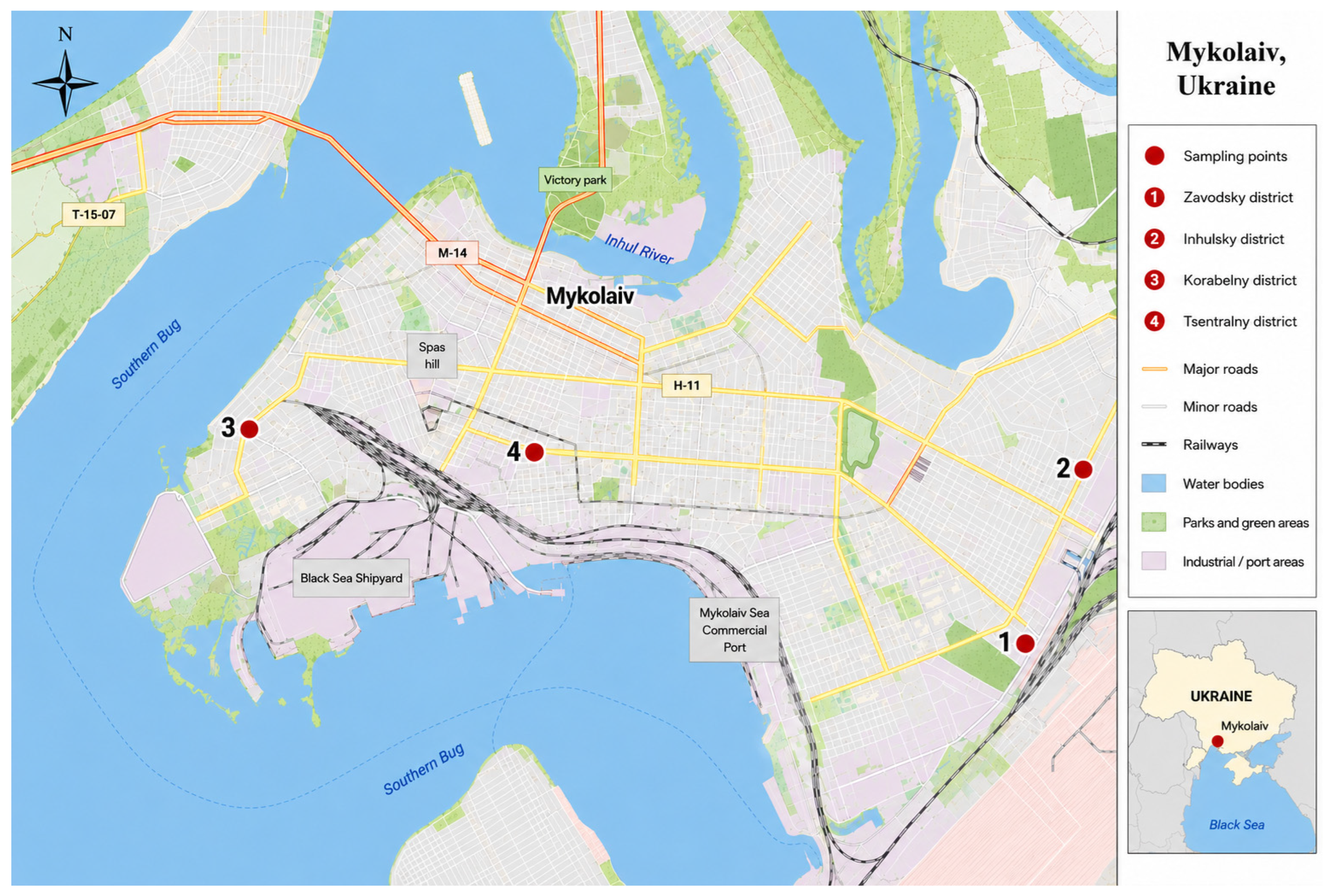
- Sample 1: Groundwater obtained from a private well in the Zavodsky district;
- Sample 2: Water from the centralized distribution network in a district constructed in the 1950s–1960s (Inhulsky district), additionally treated with household filtration devices;
- Sample 3: Water from the centralized urban network in a district built during the 1980s–1990s (Korabelny district);
- Sample 4: Water from the centralized urban network in a different district of similar construction period (Tsentralny district).
4.3. Physicochemical Analysis and Bacteriological Testing
4.4. Statistical Analysis
4.5. Overview of Evaluated Methods
- Boiling with preliminary filtration: Thermal inactivation of microorganisms combined with cloth or sand filtration for particulate removal.
- Chemical oxidation (KMnO4) combined with thermal softening: A multi-stage protocol involving sodium carbonate addition, boiling, and permanganate oxidation.
- Sorption on mineral-based media: Use of shungite, a naturally occurring carbon-rich mineral, as a filtration medium for organic compound and heavy metal adsorption.
- Commercial point-of-use devices: Activated carbon filter pitchers, ceramic candle filters, and UV disinfection pens.
5. Results
5.1. Water Quality Under Prolonged Infrastructure Disruptions: Evidence from Mykolaiv
5.2. Evaluation of Household Water Purification Methods
6. Discussion
6.1. Immediate and Short-Term Solutions for Water Purification
6.2. Experimental Validation of the Emergency Domestic Water Purification Procedure
6.2.1. Performance of the Four-Stage Purification Protocol
6.2.2. Comparative Suitability for Mykolaiv Conditions
6.3. Long-Term and Sustainable Solutions
- Mobile treatment units: Mobile water purification systems designed to process large volumes of water can serve as an effective intermediate solution at the community level. These units are capable of combining filtration and desalination processes to produce water suitable for consumption. Their modular design allows rapid deployment and flexible operation; however, their effectiveness depends on logistical coordination, technical maintenance, and sustained operational support.
- Desalination plants: In regions where elevated salinity constitutes a dominant water-quality challenge, desalination represents a technically viable option for producing potable water. While this technology requires substantial financial investment and ongoing maintenance, large-scale desalination facilities may provide a stable and controllable source of drinking water if integrated into broader water management strategies. The feasibility of such systems depends on infrastructure capacity, energy availability, and long-term operational planning.
- Community-based filtration systems: Decentralized filtration stations installed at the neighborhood level offer an alternative approach to improving access to safer water. Systems equipped with multi-layer sand filters and activated carbon can effectively reduce suspended solids, organic contaminants, and certain dissolved compounds. When connected to local groundwater sources, these installations can function as sustainable, low-maintenance solutions that complement centralized water supply networks.
7. Conclusions and Practical Implications
- Immediate Measures: It is recommended to ensure the wide availability of household water-purification agents, including chlorine-based disinfectants and purification tablets, in areas experiencing reduced water quality. Clear guidance on their correct and safe use should be provided, alongside general information on the effectiveness of thermal treatment methods such as boiling under conditions of elevated contamination risk.
- Expansion of Mobile Treatment Capacity: The deployment of mobile water-treatment units should be intensified to improve spatial coverage and continuity of supply. These systems should be equipped with advanced filtration and, where necessary, desalination technologies to address elevated salinity and chemical contamination in raw water sources.
- Development of Community-Level Filtration Infrastructure: The establishment of decentralized, neighborhood-based filtration points is recommended as a sustainable intermediate solution. Systems based on sand and activated-carbon filtration, supported by routine technical maintenance, can improve access to safer water while reducing dependence on centralized distribution networks.
- International Technical and Financial Cooperation: Long-term stabilization of water supply systems requires external technical expertise and financial resources. Cooperation with international partners is recommended to support infrastructure upgrades, including the rehabilitation of groundwater wells and the implementation of large-scale treatment facilities. Such initiatives should prioritize technical feasibility, operational sustainability, and long-term maintenance capacity.
- Public Health Surveillance: Continuous monitoring of public-health indicators related to water quality is essential. Systematic surveillance enables early identification of potential waterborne health risks and supports timely intervention, particularly in densely populated urban areas.
- Research and Technological Development: Further research into low-cost, easily deployable water-treatment technologies is strongly encouraged. Particular attention should be given to modular systems, portable UV-based solutions, and other scalable technologies that can be adapted to household and community use under conditions of limited infrastructure availability.
Author Contributions
Funding
Data Availability Statement
Acknowledgments
Conflicts of Interest
References
- The United Nations [United Nations Development Programme]. Human Development Report 2006. Beyond Scarcity: Power, Poverty and the Global Water Crisis; United Nations Development Programme: New York, NY, USA, 2006. [Google Scholar]
- Food and Agriculture Organization of the United Nations. Coping with Water Scarcity: An Action Framework for Agriculture and Food Security; FAO Publications: Rome, Italy, 2012; ISBN 9789251073049. [Google Scholar]
- Mykolaiv Regional Online Newspaper “Novyny N”. Available online: https://novosti-n.org/ua/news/Trubu-vodoprovodu-do-Mykolayeva-pidirvaly-okupanty-soczmerezhi-239795 (accessed on 4 November 2024).
- ICRC. Protecting People’s Dignity: ICRC Helps Resolve a Drinking Water Issue in the Mykolaiv Pre-Trial Detention Centre. Available online: https://blogs.icrc.org/ua/2024/07/in-english/protecting-people-s-dignity-icrc-helps-resolve-a-drinking-water-issue-in-the-mykolaiv-pre-trial-detention-centre/ (accessed on 4 November 2024).
- IOM. Down Trickle How Iom Supports Water Access Communities Mykolaiv Region. Available online: https://ukraine.iom.int/stories/down-trickle-how-iom-supports-water-access-communities-mykolaiv-region (accessed on 4 November 2024).
- Mykolaiv Regional Online Newspaper “Novyny N”. Available online: https://novosti-n.org/ua/news/U-Mykolayevi-natovpy-lyudej-jdut-do-richok-ta-dzherel-bilya-miscz-pidvezennya-vody-velychezni-chergy-239918 (accessed on 4 November 2024).
- MykVisti Online Media. Available online: https://nikvesti.com/ua/news/public/246242 (accessed on 4 November 2024).
- Mykolaiv Regional Online Newspaper “Novyny N”. Available online: https://novosti-n.org/ua/analitic/CHomu-Mykolayiv-u-krytychnij-sytuacziyi-opynyvsya-bez-vody--4644 (accessed on 4 November 2024).
- Mykolaiv Regional Online Newspaper “Novyny N”. Available online: https://novosti-n.org/news/-Mogut-vzorvat-trubu-snova-Kym-pryzval-ne-rasschytivat-na-czentralyzovannoe-vodosnabzhenye-Nykolaeva-240723 (accessed on 4 November 2024).
- Mykolaiv Regional Online Newspaper “Novyny N”. Available online: https://novosti-n.org/news/V-Nykolaeve-v-vodoprovod-zapustyat-tehnycheskuyu-vodu-yz-YUzhnogo-Buga-postepenno-ee-zamenyat-na-pytevuyu-241037 (accessed on 4 November 2024).
- Ministry of Health of Ukraine. State Sanitary Norms and Rules “Hygienic Requirements for Drinking Water Intended for Human Consumption” (DSanPiN 2.2.4-171-10). Approved by Order No. 400 of 12 May 2010; Registered with the Ministry of Justice of Ukraine Under No. 452/17747. Available online: https://zakon.rada.gov.ua/laws/show/z0452-10 (accessed on 12 December 2025).
- Snizhko, S.; Didovets, I.; Shevchenko, O.; Yatsiuk, M.; Hattermann, F.F.; Bronstert, A. Southern Bug River: Water Security and Climate Changes Perspectives for Post-War City of Mykolaiv, Ukraine. Front. Water 2024, 6, 1447378. [Google Scholar] [CrossRef]
- Tayeh, Y.A. A Comprehensive Review of Reverse Osmosis Desalination: Technology, Water Sources, Membrane Processes, Fouling, and Cleaning. Desalin. Water Treat. 2024, 320, 100882. [Google Scholar] [CrossRef]
- Li, K.; Bruning, H.; Xu, H.; Rijnaarts, H.H.M.; Post, J.W. High-Recovery and Chemical-Free Desalination of Sodium Chloride-Containing Waters with Modified Electrodialysis Metathesis. Desalination 2025, 604, 118720. [Google Scholar] [CrossRef]
- Meléndez-Plata, G.; Mastrogiacomo, J.R.A.; Castellanos, M.L.; Romero, J.P.; Hincapié, V.; Lizcano, H.; Acero, J.D.; Villegas-Torres, M.F.; Gómez, J.M.; Cruz, J.C.; et al. Malodorous Gases in Aquatic Environments: A Comprehensive Review from Microbial Origin to Detection and Removal Techniques. Processes 2025, 13, 1077. [Google Scholar] [CrossRef]
- Fontalvo, N.P.M.; Gamero, W.B.M.; Ardila, H.A.M.; Gonzales, A.F.P.; Ramos, C.G.; Munoz, A.E.P. Removal of Nitrogenous Compounds from Municipal Wastewater Using a Bacterial Consortium: An Opportunity for More Sustainable Water Treatments. Water Air Soil Pollut. 2022, 233, 339. [Google Scholar] [CrossRef]
- Edwards, T.M.; Puglis, H.J.; Kent, D.B.; Durán, J.L.; Bradshaw, L.M.; Farag, A.M. Ammonia and aquatic ecosystems—A Review of Global Sources, Biogeochemical Cycling, and Effects on Fish. Sci. Total Environ. 2024, 907, 167911. [Google Scholar] [CrossRef]
- Sun, H.; Zhou, Y.; Du, M.; Du, Z. Enhanced Removal of Refractory Organic Compounds from Coking Wastewater Using Polyaluminum Chloride with Coagulant Aids. Water 2024, 16, 2662. [Google Scholar] [CrossRef]
- Qi, Y.; He, K. Science and Technology for Water Purification: Achievements and Strategies. Water 2025, 17, 91. [Google Scholar] [CrossRef]
- Kasiński, S.; Kowal, P.; Czerwionka, K. Advanced Technologies for Nitrogen Removal and Recovery from Municipal and Industrial Wastewater. Materials 2025, 18, 1422. [Google Scholar] [CrossRef]
- Sanchez-Ledesma, L.M.; Rodríguez-Victoria, J.A.; Ramírez-Malule, H. Effect of Fermentation Time, pH, and Their Interaction on the Production of Volatile Fatty Acids from Cassava Wastewater. Water 2024, 16, 1514. [Google Scholar] [CrossRef]
- Guo, J.; Cheng, L.; Yang, M.; Wang, Z. Physicochemical Characteristics and Microbial Community Analysis of a Wetland System Treating Acid Mine Drainage. Sci. Rep. 2026, 16, 3360. [Google Scholar] [CrossRef]
- Reyes-Márquez, A.; Barrera-Huertas, H.A.; Sedeño-Díaz, J.E.; Morales-Acuña, E.; Aguíñiga-García, S.; Cervantes-Duarte, R.; López-López, E. Heavy Metal Pollution in Water and Seston in a Subtropical Coastal Lagoon of the Gulf of Mexico: Hydrometeorological and Anthropic Influence. Water 2025, 17, 1929. [Google Scholar] [CrossRef]
- Setlow, P.; Christie, G. What’s New and Notable in Bacterial Spore Killing! World J. Microbiol. Biotechnol. 2021, 37, 144. [Google Scholar] [CrossRef]
- ISO 9308-1; Water Quality—Enumeration of Escherichia coli and Coliform Bacteria—Part 1: Membrane Filtration Method for Waters with Low Bacterial Background Flora. International Organization for Standardization: Geneva, Switzerland, 2014. Available online: https://www.iso.org/standard/55832.html (accessed on 10 May 2026).
- ISO 9308-2; Water Quality—Enumeration of Escherichia coli and Coliform Bacteria—Part 2: Most Probable Number Method. International Organization for Standardization: Geneva, Switzerland, 2012. Available online: https://www.iso.org/standard/52246.html (accessed on 10 May 2026).
- ISO 6222; Water Quality—Enumeration of Culturable Micro-Organisms—Colony Count by Inoculation in a Nutrient Agar Culture Medium. International Organization for Standardization: Geneva, Switzerland, 1999. Available online: https://www.iso.org/standard/28960.html (accessed on 10 May 2026).
- Zeitoun, M.; Warner, J. Hydro-Hegemony—A Framework for Analysis of Transboundary Water Conflicts. Water Policy 2006, 8, 435–460. [Google Scholar] [CrossRef]
- Lantagne, D.; Clasen, T. Effective Use of Household Water Treatment and Safe Storage in Response to the 2010 Haiti Earthquake. Am. J. Trop. Med. Hyg. 2012, 89, 426–433. [Google Scholar] [CrossRef]
- Vörösmarty, C.; McIntyre, P.; Gessner, M.; Dudgeon, D.; Prusevich, A.; Green, P.; Glidden, S.; Bunn, S.E.; Sullivan, C.A.; Reidy Liermann, C.; et al. Global Threats to Human Water Security and River Biodiversity. Nature 2010, 467, 555–561. [Google Scholar] [CrossRef]
- Sobsey, M.D. Managing Water in the Home: Accelerated Health Gains from Improved Water Supply. WHO. 2002. Available online: https://www.who.int/publications/i/item/WHO-SDE-WSH-02.07 (accessed on 1 May 2026).
- Clasen, T.F.; Alexander, K.T.; Sinclair, D.; Boisson, S.; Peletz, R.; Chang, H.H.; Majorin, F.; Cairncross, S. Interventions to Improve Water Quality for Preventing Diarrhoea. Cochrane Database Syst. Rev. 2015, 10, CD004794. [Google Scholar] [CrossRef]
- Ali, I.; Gupta, V.K. Advances in Water Treatment by Adsorption Technology. Nat. Protoc. 2006, 1, 2661–2667. [Google Scholar] [CrossRef] [PubMed]
- Crini, G.; Lichtfouse, E. Advantages and Disadvantages of Techniques used for Wastewater Treatment. Environ. Chem. Lett. 2018, 17, 145–155. [Google Scholar] [CrossRef]
- Bhatnagar, A.; Sillanpää, M. Utilization of Agro-Industrial and Municipal Waste Materials as Potential Adsorbents for Water Treatment—A Review. Chem. Eng. J. 2010, 157, 277–296. [Google Scholar] [CrossRef]
- Boving, T.; Craver, V.; Labhasetwar, P.; Sabatini, D. Sustainable Groundwater Treatment Technologies for Underserved Rural Communities in Emerging Economies. Sci. Total Environ. 2022, 813, 152633. [Google Scholar] [CrossRef]



| Indicator | Units | Test Results (Mean ± SD) | Regulatory Limit (DSanPiN 2.2.4-171-10) [11] |
|---|---|---|---|
| pH | pH units | 7.9 ± 0.5 | 6.5–8.5 |
| Electrical Conductivity | mS cm | 4.23 ± 0.02 | Non specified * |
| Sodium (Na+) | mmol/L | 17.93 ± 0.71 | Non specified ** |
| Potassium (K+) | mmol/L | 0.28 ± 0.01 | Non specified ** |
| Magnesium (Mg2+) | mmol/L | 18.13 ± 0.36 | Non specified *** |
| Calcium (Ca2+) | mmol/L | 7.81 ± 0.12 | Non specified *** |
| Sulfates (SO42−) | mmol/L | 24.0 ± 0.6 | ≤2.6 |
| Chlorides (Cl−) | mmol/L | 19.7 ± 0.35 | ≤7.0 |
| Bicarbonates (HCO3−) | mmol/L | 5.38 ± 0.08 | Non specified |
| No. | Water Quality Parameter (Unit) | Sample Identification | Regulatory Limit (DSanPiN 2.2.4-171-10) [11] | A Bottled Water Morshynska (Non-Carbonated)-Control Profile | |||
|---|---|---|---|---|---|---|---|
| Test Results-Drinking Water | |||||||
| Sample 1 | Sample 2 | Sample 3 | Sample 4 | ||||
| 1 | Odor, scores: at 20 °C | 3 | 3 | 4 | 3 | ≤2 | 0 |
| at 60 °C | 3 | 3 | 4 | 4 | ≤2 | 0 | |
| 2 | Taste and aftertaste, scores | 3 | 3 | 3 | 3 | ≤2 | 0 |
| 3 | A pH, units of pH | 7.2 ± 0.5 | 7.1 ± 0.5 | 7.0 ± 0.5 | 7.1 ± 0.5 | 6.5–8.5 | 6.9 ± 0.5 |
| 4 | Total hardness, mmol/L | 10.4 ± 0.2 | 9.2 ± 0.1 | 0.5 ± 0.1 | 9.2 ± 0.1 | 1.5–7.0 (≤7) * | 3.4 ± 0.1 |
| 5 | Carbonate hardness (alkalinity), mmol/L | 3.2 ± 0.1 | 3.6 ± 0.2 | 0.5 ± 0.1 | 3.7 ± 0.2 | 0.5–6.5 * | 1.6 ± 0.1 |
| 6 | Permanganate oxidizability, mg/L | 27.5 ± 1.1 | 29.1 ± 1.2 | 15.6 ± 0.7 | 28.7 ± 1.0 | ≤5 | 1.3 ± 0.1 |
| 7 | Total iron (Fe), mg/L | 0.27 ± 0.03 | 0.26 ± 0.02 | 0.03 ± 0.01 | 0.26 ± 0.03 | ≤0.2 | Less than 0.01 |
| 8 | Nitrates (NO3−), mg/L | 8.3 ± 0.7 | 4.2 ± 0.3 | 2.2 ± 0.1 | 4.2 ± 0.2 | ≤50 | 0.5 ± 0.1 |
| 9 | Sulfates (SO42−), mg/L | 730 ± 29 | 720 ± 20 | 3 ± 1 | 780 ± 24 | ≤250 | 23 ± 1 |
| 10 | Chlorides (Cl−), mg/L | 447 ± 8 | 329 ± 5 | 56 ± 1 | 324 ± 7 | ≤250 | 18 ± 1 |
| 11 | Calcium content, mg/L | 90.2 ± 1.5 | 80.2 ± 1.0 | 10.2 ± 0.4 | 80.2 ± 0.9 | Non specified | 60.3 ± 0.8 |
| 12 | Magnesium content, mg/L | 71.7 ± 3.4 | 63.2 ± 2.8 | 0.6 ± 0.1 | 63.2 ± 2.6 | Non specified | 5.0 ± 0.1 |
| 13 | Total dissolved solids, mg/L | 1420 ± 22 | 1020 ± 19 | 140 ± 2 | 980 ± 18 | ≤1000 | 214 ± 6 |
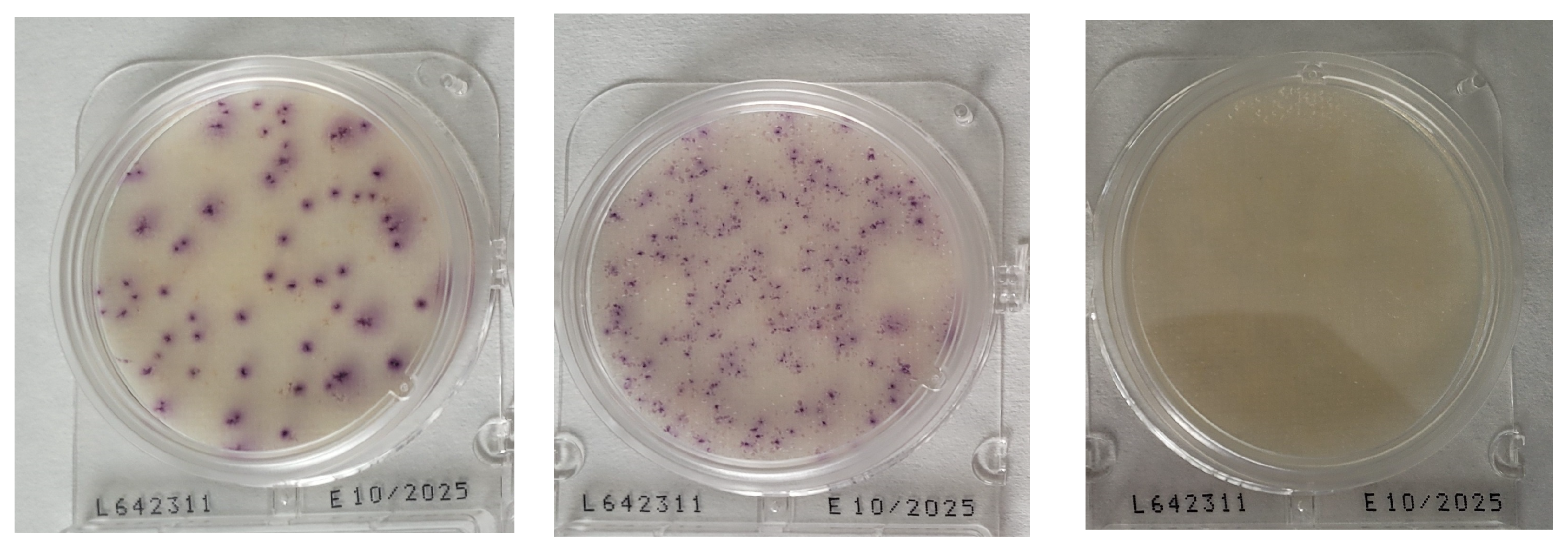
| 14 | E. coli, CFU/100 mL | 4 | 5 | Absence | 5 | Absence | Absence |
| 15 | The total microbial count, CFU/cm3 ** | 19 | 126 | 25 | 126 | ≤100 | 8 |
| Stage | Content of Action | Procedure | Duration | Result |
|---|---|---|---|---|
| 1. Chemical oxidation and sedimentation | Strong oxidant reagent-KMnO4 | Add 50 mL of 5% solution until a light pink color is achieved. | 30–60 min | A brown, viscous precipitate should form. This stage removes bacterial contamination and precipitates iron compounds. Critical step: Carefully decant the water into a container for boiling, ensuring the sediment is not poured out, or filter through three layers of cotton cloth. |
| 2. Thermal treatment | Disinfection and softening | Moderate boiling. Add 3–5 small pieces of porous porcelain (e.g., from a broken cup) to ensure even boiling. | 5 min | Complete inactivation of viruses and bacteria; evaporation of volatile organic matter; decomposition of temporary hardness salts (softening). Post-action: Cool the water to 40–50 °C (use kitchen thermometer). |
| 3. Sorption and post-purification | Sorption of pollutants | Slow filtration or infusion by passing water through a layer of shungite stones (approx. 500 g). | 0.5–2 h | Removal of heavy metals, manganese, and iron residues; improvement of turbidity, odor, and taste. |
| 4. Final conservation | Addition of natural water preservative | Add 10–15 drops of thyme alcohol tincture or one tablespoon of water-based thyme extract to the cold, filtered water. | Mix and wait 20–30 min before using | Prevents microbial growth and provides a pleasant smell. The effect lasts 48–72 h, depending on light and temperature. |
| Item | Specification | Approximate Cost (€) |
|---|---|---|
| Potassium permanganate (KMnO4) * | Pharmaceutical grade, 5 g package | 0.50 |
| Shungite stones | Over-the-counter, 500 g portion (two portions recommended) | 1.00 (per portion) |
| Thyme alcoholic tincture | Over-the-counter, 50 mL bottle | 2.70 |
| Enameled saucepan | 5.5 L capacity | 10.00 |
| Glass storage bottle | 5 L capacity, with cork or stopper | 2.80 |
| Electronic kitchen thermometer | Needle-type, accuracy ±1 °C | 1.70 |
| Optional: Silver ionizer | As available commercially | Varies (minimal 35—silver ionizer devices designed for water purification) |
| No. | Water Quality Parameter (Unit) | Test Results | Regulatory Limit (DSanPiN 2.2.4-171-10) [11] | A Bottled Water Morshynska (Non-Carbonated)-Control Profile | |
|---|---|---|---|---|---|
| Initial Sample | Purified Sample | Tap Water (Distribution Points) | |||
| 1 | Odor, scores: at 20 °C at 60 °C | 3 4 (swam) | 1 2 (slightly smell on thyme) | ≤2 ≤2 | 00 |
| 2 | Taste and aftertaste, scores | 2 | 1 | ≤2 | 0 |
| 3 | A pH, units of pH | 7.5 ± 0.5 | 6.9 ± 0.5 | 6.5–8.5 | 6.9 ± 0.5 |
| 4 | Total hardness, mmol/L | 8.4 ± 0.2 | 5.1 ± 0.1 | 1.5–7.0 (≤7) * | 3.4 ± 0.1 |
| 5 | Carbonate hardness (alkalinity), mmol/L | 3.2 ± 0.1 | Less than 0.5 | 0.5–6.5 * | 1.6 ± 0.1 |
| 6 | Permanganate oxidizability, mg/L | 31.0 ± 0.7 | 4.6 ± 0.1 | ≤5 | 1.3 ± 0.1 |
| 7 | Total iron (Fe), mg/L | 0.32 ± 0.03 | Less than 0.05 | ≤0.2 | Less than 0.01 |
| 8 | Nitrates (NO3−), mg/L | 3.6 ± 0.1 | 5.7 ± 0.1 | ≤50 | 0.5 ± 0.1 |
| 9 | Sulfates (SO42−), mg/L | 690 ± 13 | 455 ± 8 | ≤250 | 23 ± 1 |
| 10 | Chlorides (Cl−), mg/L | 297 ± 5 | 313 ± 6 | ≤250 | 18 ± 1 |
| 11 | Calcium content, mg/L | 140.0 ± 2.0 | 81.6 ± 1.6 | Not specified | 60.3 ± 0.8 |
| 12 | Magnesium content, mg/L | 16.8 ± 0.4 | 12.2 ± 0.1 | Not specified | 5.0 ± 0.1 |
| 13 | Total dissolved solids, mg/L | 1340 ± 20 | 1105 ± 18 | ≤1000 | 214 ± 6 |
| 14 | E. coli, CFU/100 mL ** | Presence | Absence | Absence | Absence |
| Method | Microbial Reduction | Hardness Reduction | Heavy Metal Removal | SO42−/Cl− Removal | Relative Cost | Recommended Application |
|---|---|---|---|---|---|---|
| Boiling only | High | Partial (temporary) | None | None | Low | Emergency microbial disinfection only |
| Boiling and Na2CO3 | High | High (temporary) | Low | None | Low | Softening for laundry/hygiene |
| KMnO4 + boiling | Very High | Partial | Moderate | None | Low | Oxidation of organic pollutants and Iron |
| Shungite filtration | Low | None | Moderate | None | Low | Supplementary sorption of organic pollutants/metals |
| Four-stage protocol (Table 3) | Very high | High | High | None | Low | Recommended for comprehensive household treatment |
| UV disinfection | High | None | None | None | Medium/High | Microbial safety (requires clear water) |
| Reverse osmosis (RO) | Very high | High | High | High | High | Optimal but cost/energy intensive |
Disclaimer/Publisher’s Note: The statements, opinions and data contained in all publications are solely those of the individual author(s) and contributor(s) and not of MDPI and/or the editor(s). MDPI and/or the editor(s) disclaim responsibility for any injury to people or property resulting from any ideas, methods, instructions or products referred to in the content. |
© 2026 by the authors. Licensee MDPI, Basel, Switzerland. This article is an open access article distributed under the terms and conditions of the Creative Commons Attribution (CC BY) license.
Share and Cite
Kalinichenko, A.; Ushchapivska, T.; Honcharenko, I.; Hovorukha, V.; Tashyrev, O.; Sporek, M.; Patyka, V. Emergency Household Water Treatment for Conflict-Induced Supply Disruption: A Case Study of Multi-Contaminant Raw Water in Mykolaiv, Ukraine. Water 2026, 18, 1183. https://doi.org/10.3390/w18101183
Kalinichenko A, Ushchapivska T, Honcharenko I, Hovorukha V, Tashyrev O, Sporek M, Patyka V. Emergency Household Water Treatment for Conflict-Induced Supply Disruption: A Case Study of Multi-Contaminant Raw Water in Mykolaiv, Ukraine. Water. 2026; 18(10):1183. https://doi.org/10.3390/w18101183
Chicago/Turabian StyleKalinichenko, Antonina, Tetiana Ushchapivska, Iryna Honcharenko, Vira Hovorukha, Oleksandr Tashyrev, Monika Sporek, and Volodymyr Patyka. 2026. "Emergency Household Water Treatment for Conflict-Induced Supply Disruption: A Case Study of Multi-Contaminant Raw Water in Mykolaiv, Ukraine" Water 18, no. 10: 1183. https://doi.org/10.3390/w18101183
APA StyleKalinichenko, A., Ushchapivska, T., Honcharenko, I., Hovorukha, V., Tashyrev, O., Sporek, M., & Patyka, V. (2026). Emergency Household Water Treatment for Conflict-Induced Supply Disruption: A Case Study of Multi-Contaminant Raw Water in Mykolaiv, Ukraine. Water, 18(10), 1183. https://doi.org/10.3390/w18101183