Article

Linking Hydroclimate Variability to Avalanche Activity and Snowpack Conditions in a Data-Scarce Mountain Basin of Varzob, Tajikistan

1
Key Laboratory of Ecological Safety and Sustainable Development in Arid Lands, Xinjiang Institute of Ecology and Geography, Chinese Academy of Sciences, Urumqi 830011, China
2
University of Chinese Academy of Sciences, Beijing 100049, China
3
Tianshan Station for Snowcover and Avalanche Research, Chinese Academy of Sciences, Xinyuan 835800, China
4
Research Center for Ecology and Environment of Central Asia, Dushanbe 734063, Tajikistan
5
Center of Glaciology Agency for Hydrometeorology, Committee for Environmental Protection under the Government of the Republic of Tajikistan, Dushanbe 734025, Tajikistan
*
Author to whom correspondence should be addressed.
Water 2026, 18(10), 1185; https://doi.org/10.3390/w18101185
Submission received: 21 April 2026 / Revised: 12 May 2026 / Accepted: 13 May 2026 / Published: 14 May 2026
(This article belongs to the Special Issue Hydroclimatic Changes in the Cold Regions)

Highlights

What are the main findings?
  • Mean annual runoff was 6.7% higher in 1991–2018 than in 1940–1990, but the long-term trend was not significant (p = 0.23); in contrast, the spring snowmelt centre shifted 3.7 days earlier (p < 0.001).
  • Snow water equivalent measured at 7 sites (1930–2955 m) reached 200–440 mm, with wet snow layers and ice crusts indicating avalanche-prone conditions.
  • Mapped avalanche paths terminate directly at the Varzob River, indicating spatial connectivity that could allow avalanche snow to contribute to spring runoff.
What are the implications of the main findings?
  • Spring flood forecasting in the Varzob basin should consider avalanche snow as an additional water source.
  • Field snow surveys combined with satellite mapping can compensate for the lack of avalanche monitoring in data-scarce regions.
  • Significant cold-season warming and persistent wind redistribution (no significant trend in wind speed) influence snowpack stability, while thaw-day frequency showed no significant trend.

Abstract

The data-scarce Varzob River basin, Tajikistan, shows significant cold-season warming, an earlier spring runoff shift, and a sharp rise in avalanche frequency. We analyse long-term runoff (1940–2018), meteorological records (2000–2024), avalanche observations (2019–2026), field snow surveys (2025–2026), and satellite/UAV imagery (2024–2025). Annual runoff shows a 6.7% higher mean in 1991–2018 than in 1940–1990, but the long-term trend is not significant (p = 0.23). However, the centre of mass of spring runoff shifted significantly earlier by 3.7 days (p < 0.001). Cold-season temperature increased significantly (p = 0.016), while wind speed showed no significant trend (p = 0.061). Snow water equivalent at seven elevations (1930–2955 m) ranges from 200 to 440 mm, and melt-freeze crusts indicate a snowpack prone to wet-slab avalanches. Avalanche frequency increased from 81 events in 2019 to 430 in 2025 and 560 (partial) in 2026, coinciding with a ~70% higher snow water equivalent in 2026. Mapped avalanche paths terminate less than 50 m from the Varzob River, suggesting a potential, though unquantified, contribution of avalanche snow to spring runoff. The integration of long-term hydrology, high-resolution meteorology, field surveys, and remote sensing offers a replicable framework for cryospheric-hydrological studies in data-scarce mountain basins.

1. Introduction

Mountain regions are highly sensitive to hydroclimatic variability, which controls snow accumulation, melt processes, and associated natural hazards [1,2]. Among these hazards, snow avalanches pose a major threat to infrastructure, transportation networks, and human safety, especially in areas with complex topography and sparse monitoring [3,4,5].
In snow-dominated catchments, the timing of spring runoff is a sensitive indicator of climate change. Warmer temperatures accelerate snowmelt, shifting the centre of mass of the hydrograph earlier and reducing summer flows [2,6]. This shift can occur even when total annual runoff shows no significant trend [7,8]. In the Varzob basin, glaciers occupy about 3% of the area and also contribute to runoff, especially in late summer [9], but the present study focuses on seasonal snow and avalanche processes.
Avalanche formation is closely linked to snowpack properties and meteorological conditions. Wind plays a key role by transporting snow from windward to leeward slopes, creating dense, unstable wind slabs [10]. This process, known as leeward loading, is particularly effective on slopes oriented opposite to prevailing winds [11]. However, in many regions, including Central Asia, wind speed and direction are rarely measured, and their role in avalanche formation remains poorly quantified [12]. Slope angle is equally important because most avalanches release on slopes between 30° and 45° [13].
Avalanches not only pose hazards but also affect hydrology. When avalanche snow deposits into stream channels, it melts later than the surrounding snowpack due to its higher density and volume, potentially contributing to spring runoff as a delayed water source [14]. Such contributions are rarely quantified, but the spatial connectivity between avalanche paths and river channels is a necessary first step to evaluate this effect.
The Varzob River basin in Tajikistan is a typical data-scarce mountain environment where avalanches frequently affect the M34 highway, a road carrying over 90% of the country’s freight [14]. No integrated study has yet linked long-term hydroclimatic trends, avalanche activity, and runoff timing in this basin [15,16,17]. Here, we combine long-term hydrological records (1940–2018), high-resolution meteorological data from a local automatic weather station (2000–2024), field snow surveys (2025–2026), and satellite/UAV imagery (2024–2025). Our goals are: (1) to quantify trends in runoff timing and meteorological variables; (2) to characterise snowpack properties (snow water equivalent, density, crusts); and (3) to map the spatial relationship between avalanche paths and the Varzob River. By integrating multiple data sources, this study provides new insights into avalanche processes and their potential hydrological relevance, and outlines priorities for enhanced monitoring in this data-scarce mountain basin.

2. Materials and Methods

2.1. Study Area

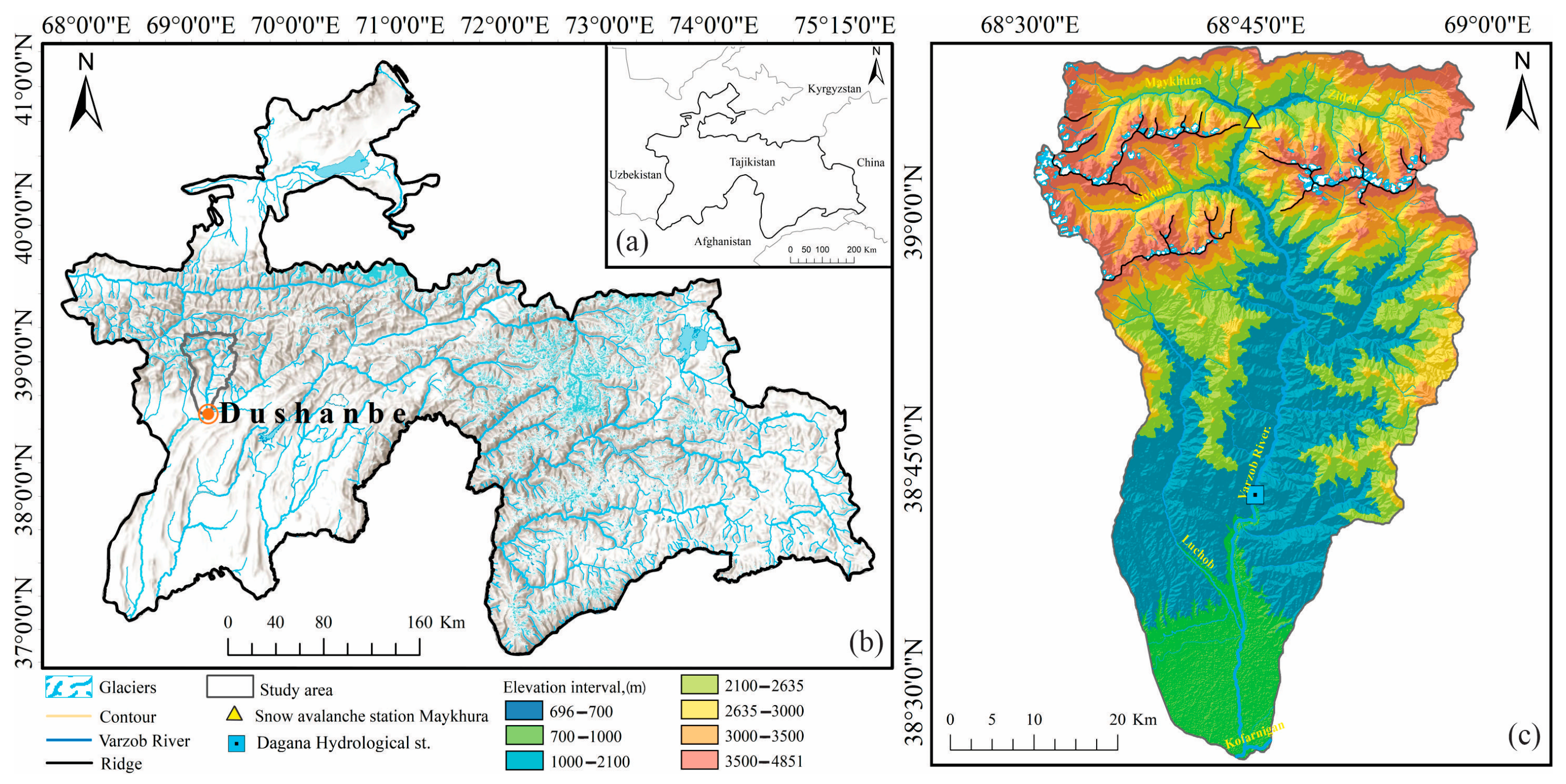
The VRB is situated in the Pamir-Alai mountain system of western Tajikistan, Central Asia, between 68°30′–69°00′ E and 37°35′–39°05′ N (Figure 1). The basin covers an area of 2542.5 km2 and exhibits a pronounced topographic relief, with elevations ranging from 802 m a.s.l. at the confluence with the Kafirnigan River to 4830 m a.s.l. along the main ridge of the Gissar Range [15]. The mean elevation is 2670 m a.s.l., and steep slopes characterise the basin, particularly in the middle and upper reaches where avalanche release zones are typically located [16].
The climate of the VRB is humid by Central Asian standards, with annual precipitation exceeding 1000 mm and locally surpassing 1500 mm at higher elevations. Precipitation is strongly seasonal: moisture-bearing air masses from the southwest ascend through the Varzob gorge, leading to orographic condensation and resulting in rain during summer and snow during winter. Snow cover typically develops from November to April at elevations between 1500 and 2500 m and may persist until June above 3000 m. This heavy winter snowpack, combined with the steep terrain, makes the VRB one of the most avalanche-prone regions of Tajikistan. Glaciers currently occupy 36.1 km2, approximately 3% of the basin, contributing to the long-term water supply and influencing runoff seasonality [15].
The basin is drained by the Varzob River, a major tributary of the Kafirnigan River, which provides water for irrigation, hydropower, and the domestic supply of the capital Dushanbe. A strategic transport artery, the M34 highway (Dushanbe–Khujand section), traverses the basin and carries over 90% of freight between southern and northern Tajikistan. Avalanches frequently block this road, causing economic losses and posing risks to passengers. Approximately 5180 individuals are exposed to avalanche hazard in Tajikistan, with the Varzob corridor being a hotspot [17]. Despite this, systematic avalanche monitoring in the VRB is virtually absent, and existing research has focused on other passes (Anzob, Shakhristan) where dedicated programmes exist [18]. The precise failure mechanisms of avalanches in the Varzob basin remain poorly constrained. While some wet snow avalanches may involve slow creep before release, this is not universally observed.
For this study, we selected VRB (Figure 2) as the primary study area. This basin integrates three essential data sources: (i) a long-term hydrological gauge with daily discharge records from 1940 to 2018; (ii) automatic weather station (AWS) operating continuously from 2000 to 2024, providing high-resolution data on air temperature, precipitation, snow depth, and wind speed; and (iii) seven manual snow-survey points established in 2025–2026, covering an elevation range from 1930 to 2955 m. The VRB is a representative basin in Tajikistan in terms of its steep slopes, heavy snow accumulation, and avalanche exposure, making it an ideal natural laboratory for linking hydroclimatic variability to avalanche activity in a data-scarce mountain environment.

2.2. Data Sources

This study integrated multiple datasets, including long-term hydrological records, meteorological time series, recent avalanche observations, field-based snow measurements, unmanned aerial vehicle (UAV) imagery, and a digital elevation model (DEM).
Daily runoff data (m3 s−1) for the Varzob River at the Dagana gauge were obtained for the period 1940–2018. No data are available for later years. These data were used to analyse long-term trends and seasonal shifts in spring runoff. Daily meteorological observations (air temperature, precipitation, snow depth, wind speed) from Maykhura AWS were available for the period 2000–2024. The overlapping period for the combined analysis of runoff and meteorological data is therefore 2000–2018, because the runoff records end in 2018. The station is located at an elevation of 1937 m within the VRB. Quality control included range checks and removal of obvious outliers; missing values (less than 3% of the record) were linearly interpolated.
Systematic records of avalanche occurrences and associated fatalities were compiled for the period 2019–2026. These data were collected by road patrols and local authorities and include the date, approximate location, and, when available, the size of each event. Manual snowpack measurements were conducted during several campaigns in January and February of 2025 and 2026. Snow depth (cm) and bulk density (g cm−3) were measured along 40 m transects at regular intervals (every 2 m), resulting in 20 measurements per survey. Measurements were taken at seven snow points spanning elevations from 1930 to 2955 m, covering different slope aspects and terrain units.
A DJI Mavic 3E UAV (SZ DJI Technology Co., Ltd., Shenzhen, China) was flown on 27 March 2024 and 10 April 2025 to acquire orthophotos (0.1 m resolution) of avalanche-affected areas and map avalanche deposits and their proximity to the Varzob River. Finally, a 30 m resolution DEM (SRTM) was used to derive topographic parameters and to extract the release-zone characteristics of mapped avalanche paths.

2.3. Snowpack Analysis

Snow water equivalent (SWE) was calculated from the measured snow depth and bulk density using the following formula:
SWE = hsnow · ρsnow
where h snow is the snow depth (in metres) and ρ snow is the bulk density (in kg m−3). The result is expressed in millimetres of water equivalent (mm) [7,19]. Basic statistical parameters (mean, minimum, and maximum) were computed to evaluate the variability of snow depth, density, and SWE across the seven snow points and between the two survey years (2025 and 2026). Because observations were limited to two winter seasons, the analysis focused on spatial variability along the altitudinal gradient and on aspect-related differences in snowpack properties, rather than on long-term temporal trends.

2.4. Hydroclimatic and Avalanche Analysis

Meteorological data from the Maykhura automatic weather station (2000–2024) were filtered to include only the cold season (November–March). Missing precipitation values were replaced with zeros, while other variables (temperature, snow depth, wind) were subjected to range checks and linear interpolation of short gaps (<3% of data) [20].
To quantify the seasonal shift in spring runoff, the centre of mass (CM) of the annual hydrograph was calculated for two periods (1940–1990 and 1991–2018) using monthly runoff values expressed as percentages of the annual total:
C M = i = 1 12 t i · p i i = 1 12 p i
where t i is the midpoint day of month i (e.g., 15.5 for January, 45.5 for February, …, 349.5 for December) and p i is the monthly runoff as a percentage of the annual total [15]. The centre of mass was calculated for the full annual hydrograph to capture the complete seasonal redistribution, including the decrease in summer flows. A sensitivity test using only the spring months (March–June) gave a very similar significant shift, confirming that the result is not sensitive to the choice of period. The difference in CM between the two periods ( Δ C M ) was tested for statistical significance using a bootstrap resampling procedure with 10,000 iterations [21]. In each iteration, the 24 monthly values (12 months × 2 periods) were randomly shuffled and reassigned to two new groups; Δ C M was recomputed. The p-value is the proportion of iterations in which the absolute random shift equalled or exceeded the observed Δ C M .
Long-term trends in annual runoff, mean temperature for the cold season (November–March), and the number of thaw days (days with daily mean temperature > 0 °C and snow depth ≥ 1 cm) were assessed using the non-parametric Mann–Kendall test [20]. The test statistic S is given by:
s = k = 1 n 1 j = k + 1 n sgn x j x k
where sgn ( x j x k ) = 1 if x j > x k , 0 if x j = x k , and 1 if x j < x k . The magnitude of the trend was estimated using Sen’s slope estimator:
β = m e d i a n j k x j x k f o r   a l l   j > k
Trends with p < 0.05 were considered statistically significant. Linear regression is shown in figures only for visual reference; all statistical significance is assessed using the Mann–Kendall test.
Avalanche records from 2019 to 2026 were analysed in relation to meteorological conditions and snowpack properties. Each day with an observed avalanche was classified as an “avalanche day”, and days without any reported avalanche served as non-avalanche conditions. The overlap between the systematic avalanche record (starting in 2019) and the continuous meteorological data (2000–2024) is six years (2019–2024). Comparative graphical analysis (boxplots and time series) was used to identify relationships between snowpack characteristics (snow depth, density, SWE), air temperature, and avalanche occurrence [1].

2.5. Spatial Analysis

Topographic parameters (elevation, slope angle, and slope aspect) were derived from the 30 m SRTM DEM [21]. Slope angle (in degrees) was computed as:
s l o p e = a r c t a n p q + q 2
where p and q are the first derivatives of elevation in the x and y directions, respectively [22]. Snowpack measurements were analysed across elevation zones to assess how altitude influences snow accumulation and density. Drone orthophotos (0.1 m resolution) were georeferenced and visually interpreted to map snow distribution patterns and to delineate avalanche-affected areas. The resulting avalanche polygons were overlaid on the DEM to extract the elevation, slope, and aspect of each release zone and to measure the distance from each avalanche deposit to the Varzob River channel.

3. Results

3.1. Long-Term Runoff Trends (1940–2018)

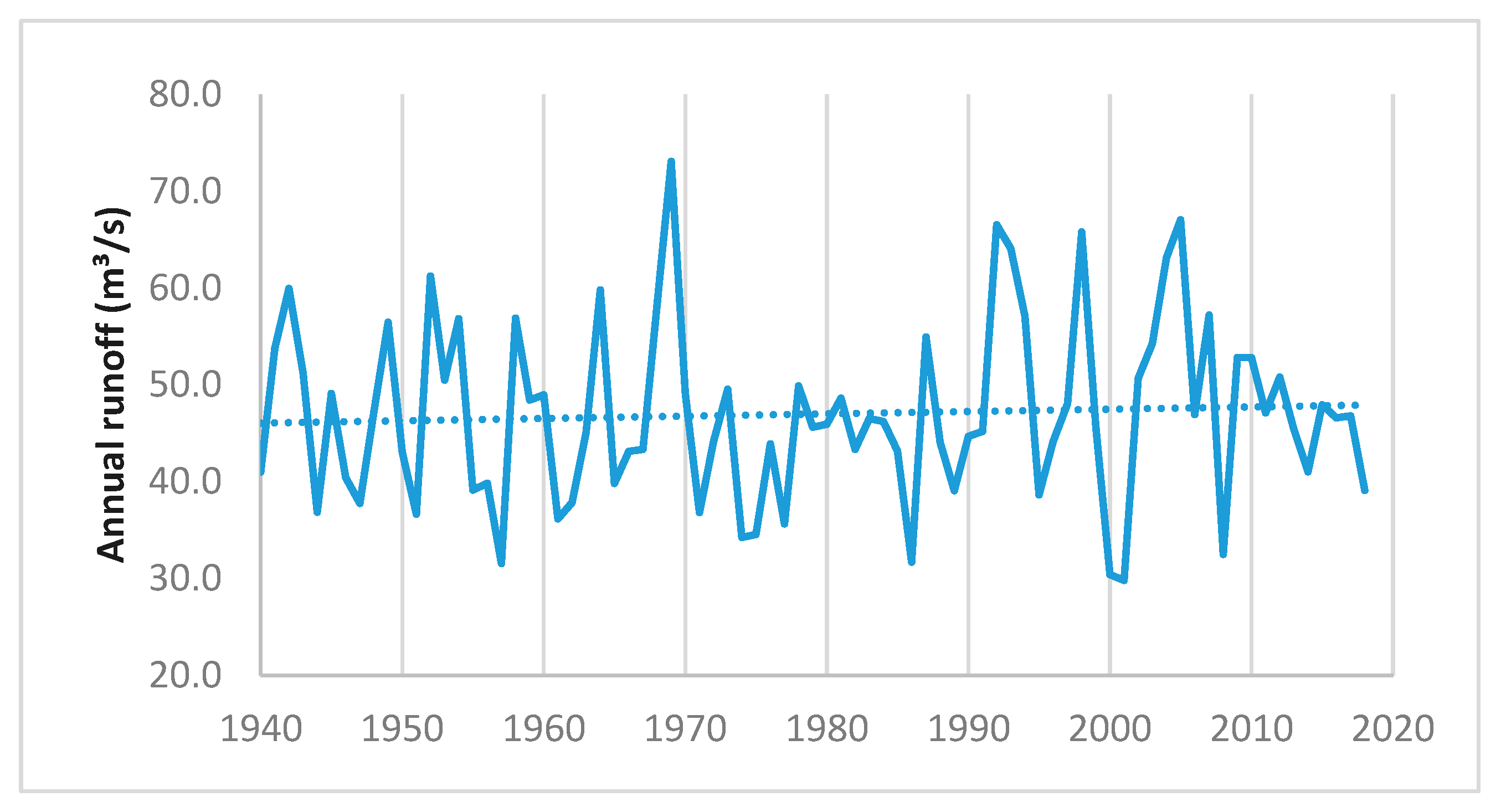
Annual runoff in the Varzob basin increased slightly over the 79-year record, from a mean of 48 m3 s−1 in 1940–1990 to 52 m3 s−1 in 1991–2018, a relative rise of 6.7% (Figure 3). However, the Mann–Kendall trend test applied to the full time series did not detect a statistically significant upward trend (τ = 0.098, Sen’s slope = +0.076 m3 s−1 yr−1, p = 0.23). The dashed line in Figure 3 illustrates this weak positive tendency, which is largely driven by the high-runoff years after 1990 but remains within the range of natural interannual variability.
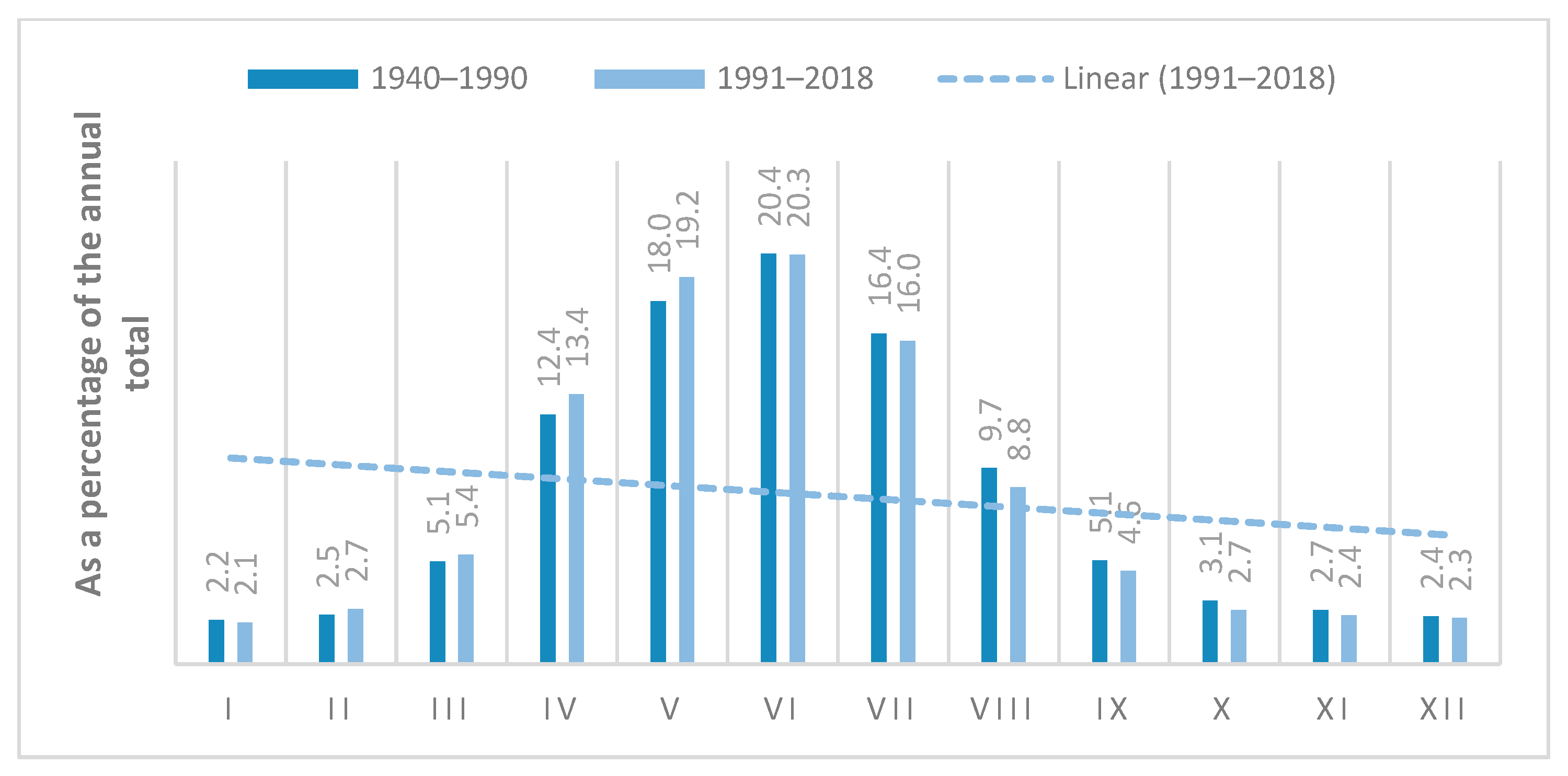
Seasonal redistribution of runoff tells a different, much clearer story. The centre of mass of the annual hydrograph shifted significantly from day 169.8 (≈18 June) in 1940–1990 to day 166.0 (≈15 June) in 1991–2018—a difference of 3.7 days earlier (Figure 4). To assess whether this shift could have occurred by chance, we performed a bootstrap resampling procedure (10,000 iterations), randomly reassigning monthly runoff values between the two periods and recalculating the shift each time. The observed 3.7-day shift exceeded 99.9% of the random shifts, yielding p < 0.001. Monthly hydrographs show that the change is concentrated in spring: March flows increased by 71%, and April flows by 16%, while summer flows (July–August) decreased slightly. A spring-only (March–June) centre of mass gave a comparable shift (3.6 days, p < 0.001).
This pattern of earlier and higher spring flows coincides with a significant increase in cold-season temperatures (Section 3.3). Notably, the frequency of thaw days did not change significantly over the same period, indicating that the seasonal shift in runoff is not driven by a simple increase in the number of melt events. Instead, other factors such as changes in snowpack stratigraphy may be responsible. The direct contribution of avalanche-derived snow to spring runoff is examined in Section 3.4 and further discussed in Section 4.

3.2. Snow Water Equivalent and Its Altitudinal Gradient

Manual snow surveys were conducted at seven elevations (1930–2955 m) in January and February of 2025 and 2026. The measured snow depth, bulk density, and calculated SWE are summarised in Table 1 (2025) and Table 2 (2026).
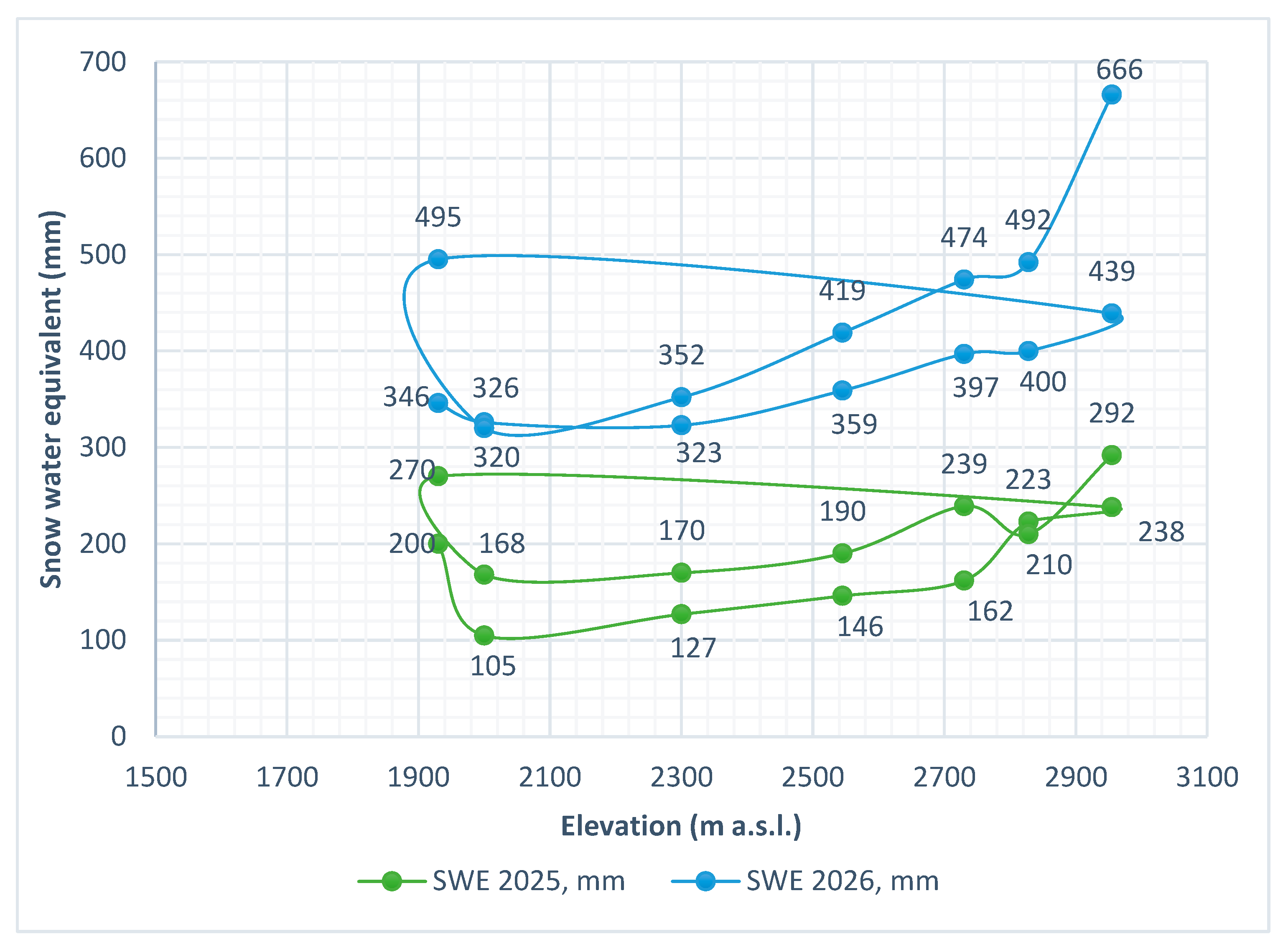
A clear altitudinal gradient was observed in both years. Figure 5 shows the SWE values plotted against elevation for January 2025 (blue markers) and January 2026 (red markers). Each marker represents the mean SWE measured at a single snow point. The lines connecting the markers emphasise the overall trend: SWE increases systematically with elevation. In January 2025, SWE rose from 200 mm at 1930 m to 238 mm at 2955 m; in January 2026, SWE increased from 346 mm to 439 mm over the same elevation range. The 2026 snowpack contained, on average, 70% more water than the 2025 snowpack at equivalent elevations, illustrating strong interannual variability.
Seasonal evolution was also evident. Between January and February, snow density increased markedly due to settling and melt-refreeze cycles—for example, at 1930 m, density rose from 0.20 to 0.29 g cm−3 in 2025 and from 0.20 to 0.33 g cm−3 in 2026. Consequently, SWE at the same site increased from 200 to 270 mm (+35%) in 2025 and from 346 to 495 mm (+43%) in 2026. The highest SWE values (666 mm) were recorded at 2955 m in February 2026, coincident with the highest density (0.30 g cm−3) and field observations of melt-freeze crusts and wet layers, a snowpack stratigraphy known to favour wet-slab avalanche release.
Taken together, these measurements demonstrate that the high-elevation zones of the VRB store substantial amounts of water in the snowpack (up to 440 mm SWE in January and >660 mm by late winter), and that the snowpack is often characterised by weak layers and rapid densification, which increase avalanche susceptibility during warming events.

3.3. Meteorological Trends (2000–2024)

To evaluate the climatic drivers of avalanche activity, we analysed daily meteorological records from the Maykhura automatic weather station for the period 2000–2024 (cold season). This station is located within the VRB at an elevation of approximately 1930 m a.s.l. and is representative of the mid-elevation avalanche release zones. Variables included winter (December–February) mean temperature, the annual number of thaw days (daily mean temperature > 0 °C and snow depth ≥ 1 cm), maximum snow depth, and mean winter wind speed. Missing data occurred for thaw days in 2012 (snow measurement site destroyed by a debris flow) and for wind speed in 2016–2017 (instrument failure); these gaps were left unfilled and do not affect the trend estimates.
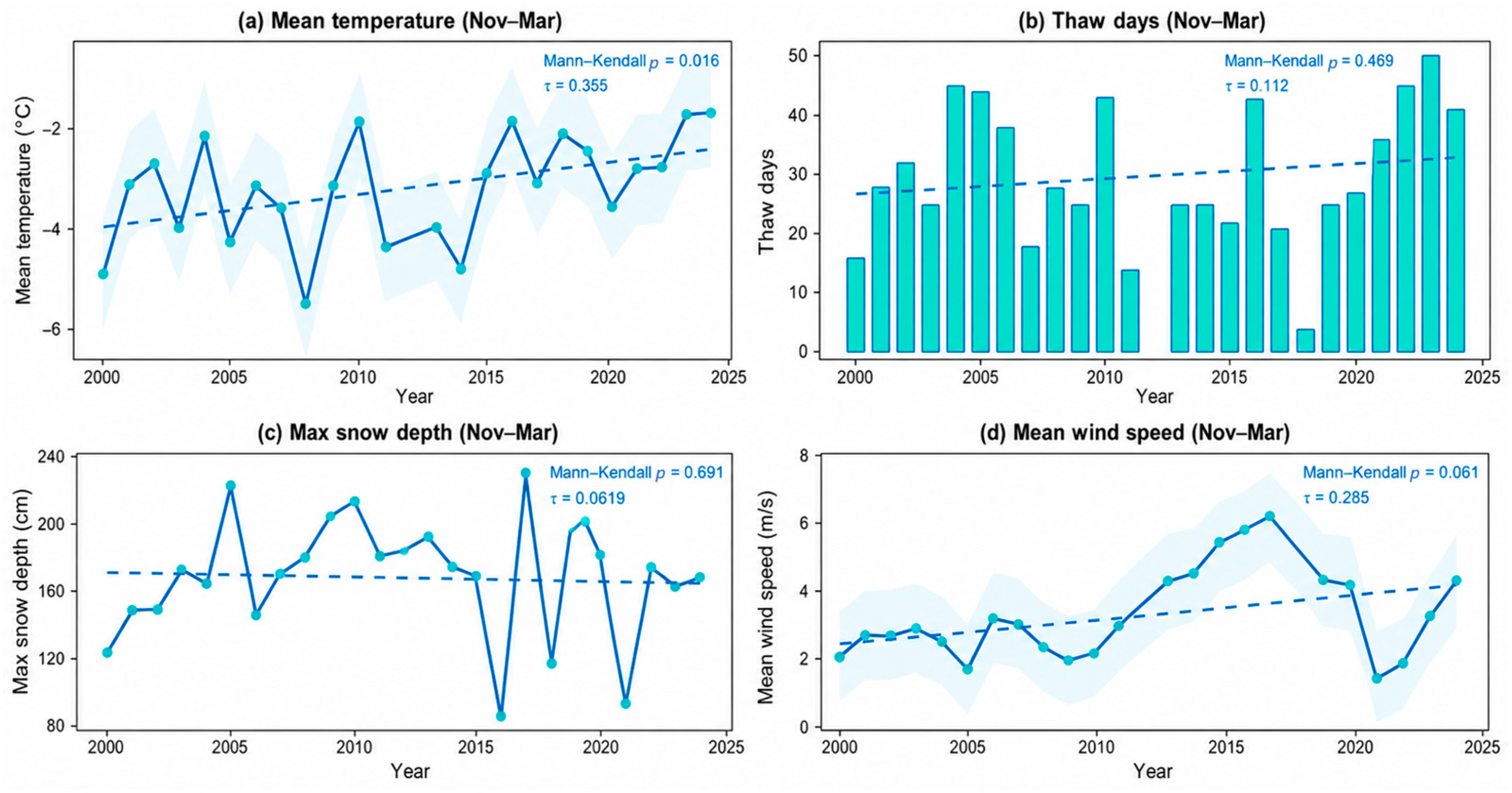
Winter temperature increased significantly over the 25-year period (τ = 0.355, p = 0.016; Figure 6a). The mean cold-season temperature rose from approximately −6.5 °C in the early 2000s to −4.2 °C in the early 2020s. However, mean temperature for the main snowmelt months (April–May) showed no significant trend (Mann–Kendall p = 0.71, τ = −0.058).
Thaw days showed no statistically significant trend (τ = 0.112, p = 0.469; Figure 6b). The annual number of thaw days fluctuated between 5 and 25, with no systematic increase over the 25-year period. The missing value for 2012 does not influence this conclusion. The annual sum of positive daily mean temperatures (thaw degree-days), a proxy for thaw intensity, also showed no significant trend (Mann–Kendall τ = 0.181, p = 0.224). This result indicates that the observed rise in avalanche frequency (Section 3.4) is not directly driven by a long-term increase in the frequency of thaw events at the daily scale. However, the intensity and duration of individual thaw episodes, which we could not quantify from daily mean data, may still play a role.
Maximum snow depth also revealed no significant trend (τ = 0.062, p = 0.691; Figure 6c). Winter maxima ranged from 60 to 180 cm, with a slight negative slope (−0.54 cm yr−1) that was indistinguishable from random variability. Hence, the increase in avalanche activity cannot be attributed to a long-term increase in snow accumulation at the Maykhura station.
Wind speed did not exhibit a statistically significant trend (τ = 0.285, p = 0.061; Figure 6d). Because of the raised concern about the missing years 2016–2017, we performed a sensitivity test by excluding these two years from the analysis. The Mann–Kendall test then gave τ = 0.253 and p = 0.116, confirming that the gaps do not affect the conclusion of a non-significant trend. The number of days with strong winds also showed no significant trend (p = 0.12).
In summary, the 25-year meteorological record for the cold season shows that temperature increased significantly, while thaw days, maximum snow depth, and wind speed showed no significant trends.

3.4. Avalanche Terrain Characteristics and River Connectivity

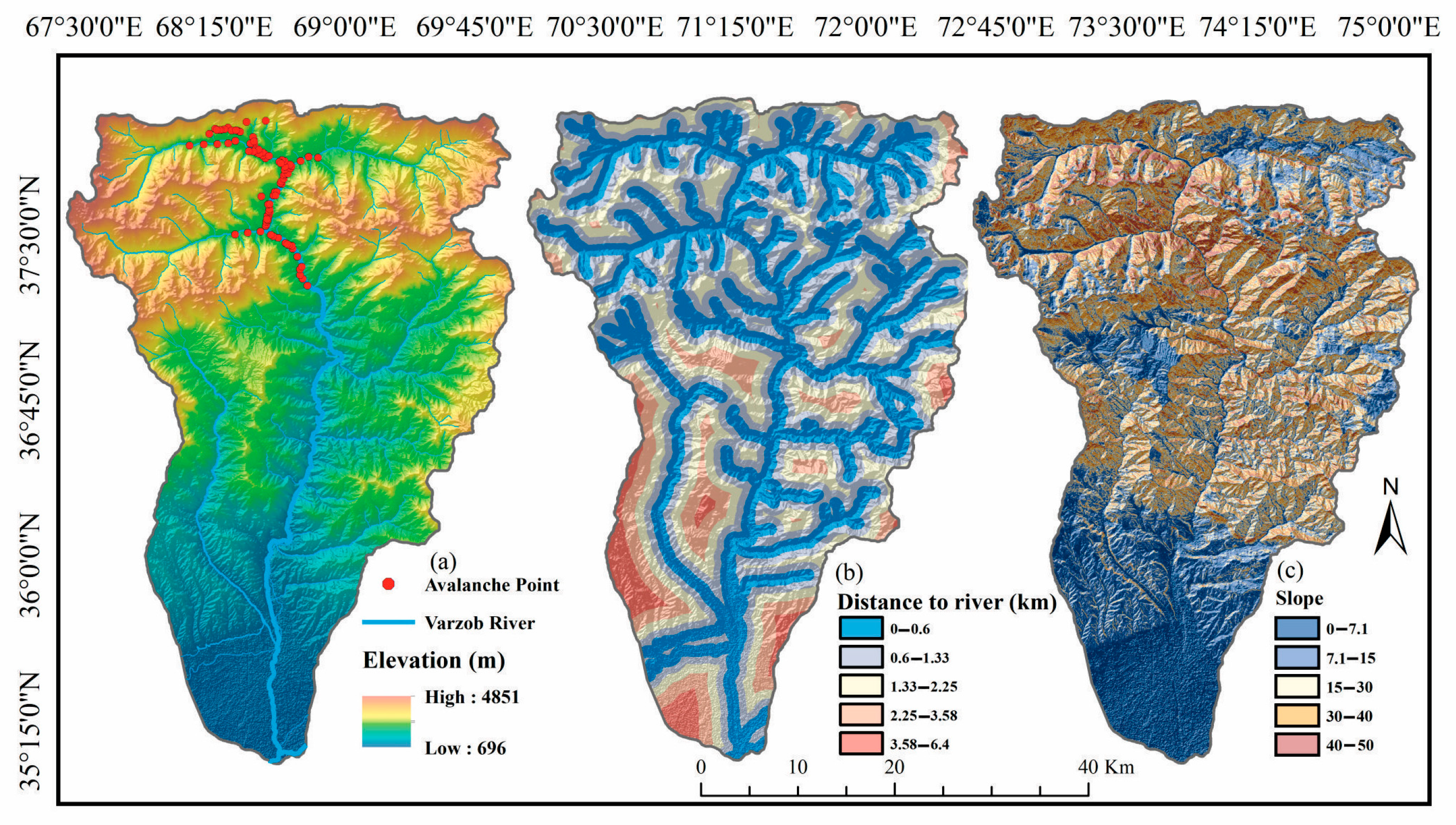
During field campaigns in 2026, we identified and mapped approximately 90 avalanche points along the Varzob River valley. The locations of these points are shown in Figure 7, overlaid on a slope angle map derived from the 30 m DEM. The slope in the avalanche release zones typically ranges from 30° to 40°, locally reaching 50°, which is well within the range known to favour avalanche initiation. The mapped runout points are concentrated along the middle and lower reaches of the Varzob River, with most of them terminating directly on the riverbank or within the active channel. The inventory was created by systematically mapping all visible avalanche deposits along the entire Varzob valley using UAV orthophotos (0.1 m resolution) and field surveys during the snow campaigns in 2025 and 2026.
The distance-to-river analysis shows that all recorded avalanche events are located within a range of 0 to approximately 0.6–1 km from the river network. This indicates a strong spatial concentration of avalanche activity in close proximity to the river system. Such close proximity suggests a high potential for direct transfer of avalanche-derived snow to the river channel during melt periods.
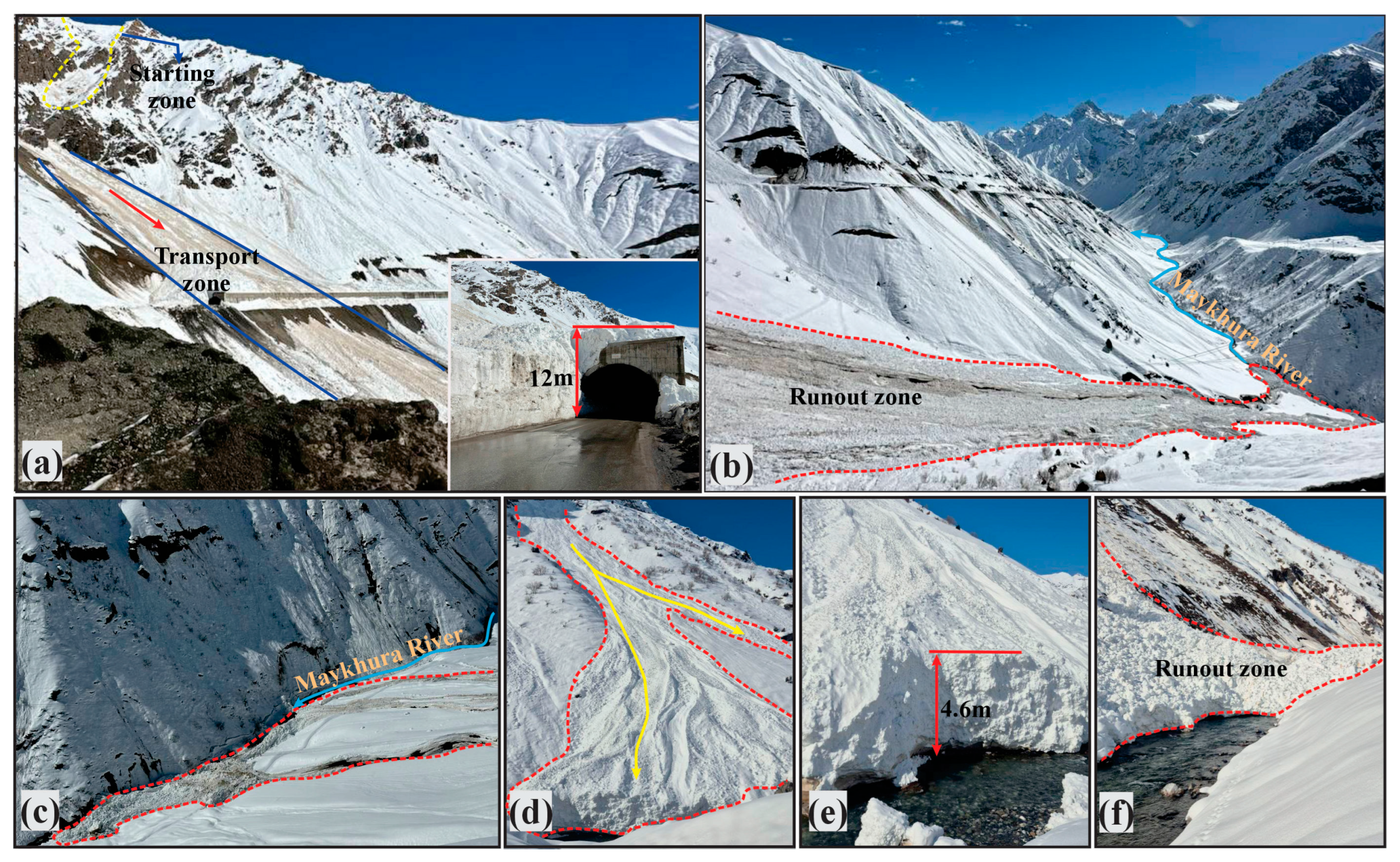
Field photographs (e.g., Figure 8) provide ground-based confirmation of this spatial connectivity. In Figure 8, an avalanche runout zone is visible crossing the M34 highway (labelled “Transport”) and extending to the Varzob River (“Runout zone”). The debris covers the road and reaches the water’s edge, demonstrating that avalanche snow can directly enter the river system. Such direct evidence is rare in data-scarce mountain regions and is consistent with the hypothesis that avalanche-derived snowmelt contributes to spring runoff.
The spatial distribution of the 90 points confirms that most avalanches occur on steep, northwest-facing slopes and terminate near the river. This pattern, combined with the observed significant warming (Section 3.3), indicates a high potential for avalanche-induced snow delivery to the river channel during rapid spring warming.
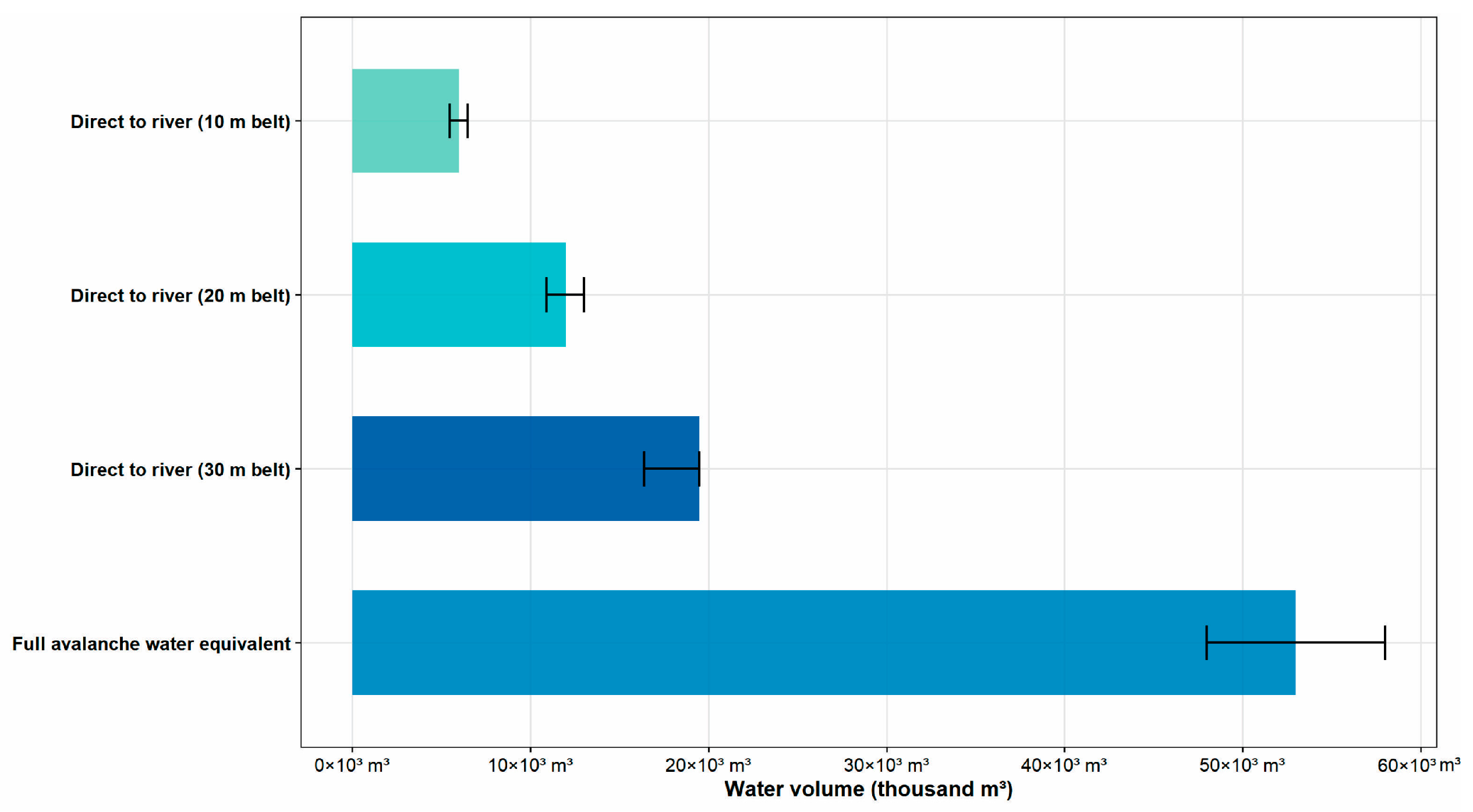
A quantitative estimate of the meltwater contribution from the avalanche shown in Figure 9 was made using field and UAV data. The deposit area, mapped from the UAV orthophoto, is 0.046 km2 (46,000 m2). The mean snow depth measured in the field is 2.5 m. The total snow volume is therefore 46,000 m2 × 2.5 m = 115,000 m3. Assuming a dense wet-snow density of 420–500 kg m−3 (typical for wet-slab avalanches), the total meltwater equivalent of the whole deposit is 48,300–57,500 m3. However, only the snow lying directly in the stream channel or immediately adjacent to it contributes directly to spring runoff. For a 520 m long deposit, three channel-contact belt widths (10, 20, and 30 m) were considered. The resulting direct meltwater input ranges from 5500 to 19,500 m3. This corresponds to approximately 2.6–25% of one day’s streamflow for a typical spring discharge of 0.8–2.6 m3 s−1. The remainder of the avalanche debris would melt later, contributing as hillslope or tributary runoff. The estimate is illustrative and actual contributions depend on melt conditions and the fraction of snow that directly enters the river.
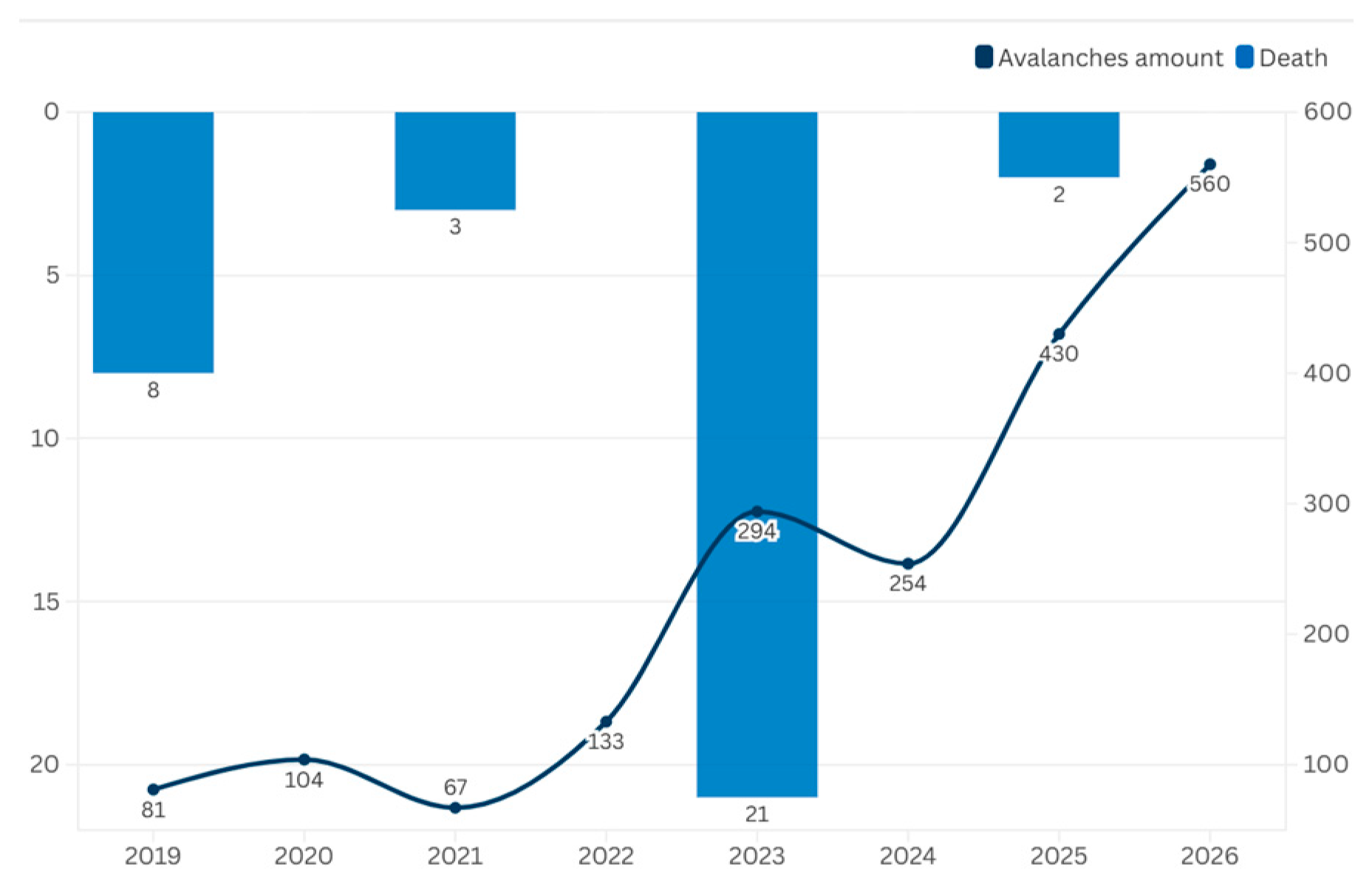
Systematic records of avalanche occurrences and associated fatalities were compiled for the period 2019–2026 (Figure 10). The annual number of avalanches increased sharply over this period, from 81 events in 2019 to 560 events in 2026 (the 2026 value is a partial record, as of late February). The highest complete year was 2025 with 430 events. A Mann–Kendall trend test applied to the 2019–2025 series (excluding the incomplete 2026) indicates a statistically significant positive trend (τ = 0.90, p < 0.05), with a Sen’s slope of approximately +68 events per year.
Fatalities show a different pattern. The highest number of deaths occurred in 2023 (21 fatalities), followed by 2019 (8) and 2021 (3). No fatalities were recorded in 2020, 2022, 2024, and 2026 (so far). The large death toll in 2023, despite a lower avalanche count (294) than in 2025 (430) or 2026 (560), suggests that the severity or location of avalanches, rather than just their frequency, determines the impact on human life.
In 2026, SWE was approximately 70% higher compared to 2025, indicating substantially greater water storage in the snowpack. Correspondingly, avalanche activity increased from 430 events in 2025 to 560 events during January-March 2026, representing an increase of about 30%. Most avalanche events were concentrated on slopes between 30° and 45°, confirming the dominant role of terrain steepness.

4. Discussion

This study integrated long-term hydrological records (1940–2018), high-resolution meteorological observations from the Maykhura station (2000–2024), field snow surveys (2025–2026), satellite and UAV mapping, and an inventory of ~90 avalanche points to investigate the links between hydroclimatic variability, avalanche activity, and spring runoff in the data-scarce VRB of Tajikistan. Our results provide three main insights, discussed below.
The observed increase in avalanche activity is consistent with the substantially higher SWE values recorded in 2026, suggesting that interannual variability in snowpack properties plays a key role in controlling avalanche occurrence.

4.1. Hydroclimatic Trends and Seasonal Shift

Annual runoff at the Dagana gauge increased slightly over the 79 years. However, the trend was not statistically significant (Sen’s slope = +0.076 m3 s−1 yr−1, p = 0.23). Nevertheless, a much clearer signal emerged from the seasonal redistribution of runoff. The centre of mass of the annual hydrograph shifted significantly by 3.7 days earlier (p < 0.001), from day 169.9 (∼18 June) in 1940–1990 to day 166.2 (∼15 June) in 1991–2018. Moreover, this shift was accompanied by a marked increase in March–April flows (+71% and +16%, respectively) and a slight decrease in summer months. Thus, these changes are consistent with warming-induced earlier snowmelt reported in many cold regions.
Despite the lack of a significant trend in total annual runoff, the strong seasonal shift does not contradict it. In snow-dominated basins, earlier melt can lead to lower summer flows while keeping annual totals stable, especially if winter precipitation does not change significantly. Our meteorological data for the cold season (November–March, Mann–Kendall) show a significant increase in temperature (p = 0.016), while wind speed showed no significant trend (p = 0.061).
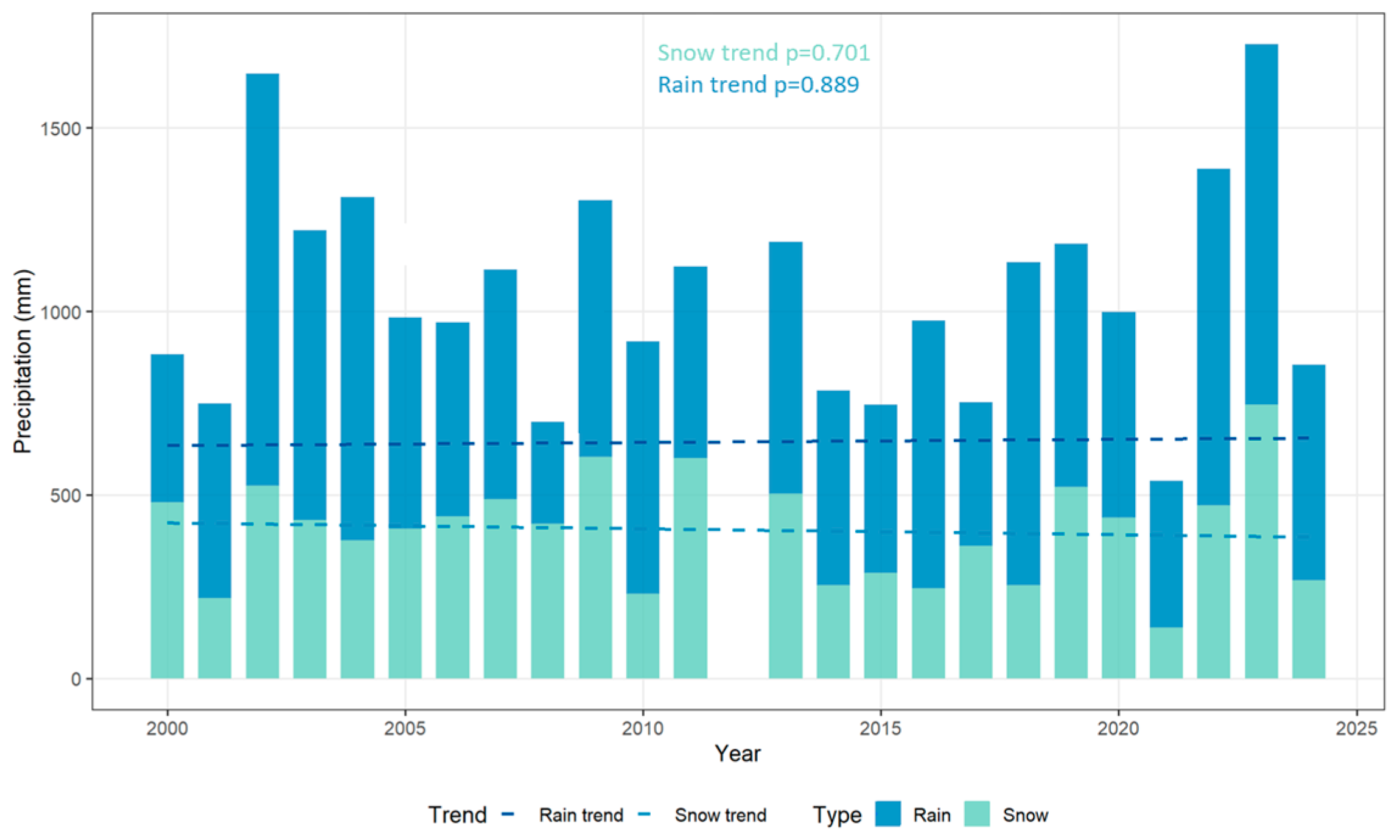
To further investigate whether changes in precipitation amount could explain the observed runoff shift, we separated cold-season precipitation into snow and rain at the Maykhura station (Figure 11). Linear regression revealed no statistically significant trend in either snow amount (p = 0.70) or rain amount (p = 0.89) over 2000–2024. Therefore, this confirms that the earlier spring runoff and the increase in avalanche frequency are not driven by a long-term change in solid or liquid precipitation. Instead, the significant warming is the dominant climatic driver, while wind-driven snow redistribution (without a long-term increase in wind speed) may still enhance leeward snow accumulation in certain years.

4.2. Snowpack Conditions Confirm High Avalanche Susceptibility

Manual snow surveys at seven elevations (1930–2955 m) in 2025–2026 revealed a strong altitudinal gradient of SWE, from 200 mm at 1930 m to 440 mm at 2955 m in January, and exceeding 660 mm by late February at the highest sites. Moreover, the 2026 snowpack contained approximately 70% more water than the 2025 snowpack at the same elevation, illustrating large interannual variability.
Critically, snow density increased markedly from January to February (from 0.20 to 0.33 g cm−3 at 1930 m), and field observations documented melt-freeze crusts and wet layers at five of the seven sites. Therefore, such stratigraphy, with dense, wet layers overlying weaker snow, is notoriously unstable and prone to wet-slab avalanche release during rapid warming or rain-on-snow events [23,24]. Despite the absence of a trend in thaw-day frequency, the presence of these layers, combined with wind-driven snow redistribution, implies that the snowpack is often preconditioned for failure under favourable topographic-wind coupling.
Furthermore, our slope-aspect analysis (Figure 7) confirmed that most avalanche release zones are on northwest-facing slopes with gradients of 30–40°, which are well-known avalanche release slopes. Thus, this topographic-wind coupling is a well-known avalanche driver [4,25], and it provides a physical mechanism for leeward snow accumulation, even without a long-term increase in wind speed.

4.3. Direct Evidence That Avalanches Reach the River—A Missing Link in Hydrological Models

Using UAV and satellite imagery, approximately 90 avalanche points along the Varzob River valley were mapped, with many runout zones terminating less than 50 m from the active channel. Field photographs (Figure 8) confirmed that avalanche debris crossed the M34 highway and reached the riverbank in February 2026. Consequently, this is, to our knowledge, one of the first documented cases in Central Asia where avalanche-river spatial connectivity is demonstrated with both high-resolution imagery and ground truth [26,27,28].
The spatial proximity suggests a potential for avalanche-derived snow to enter the river network upon melting. However, the actual contribution to spring runoff cannot be quantified without volume measurements or hydrograph analysis. The rapid increase in avalanche frequency after 2020 (from 81 events in 2019 to 430 in 2025 and 560 partial in 2026, Figure 10) coincides with significant warming (Section 3.3) and the anomalously high snow water equivalent in 2026 (70% above 2025). Wind speed showed no significant trend (Section 3.3), so the rising avalanche frequency cannot be attributed to stronger winds.
Although the volumetric estimate suggests that the direct meltwater contribution from avalanche snow is likely a small fraction (a few percent) of the spring snowmelt discharge, wet-snow and debris avalanches can temporarily block stream channels. Such natural dams may cause brief flow perturbations or localised backwater effects, even if the total water volume added is modest. Observations show that the avalanche debris fully covered the highway and extended to the riverbank, but it was not possible to monitor whether the stream was temporarily obstructed. This aspect remains a valuable direction for future research, requiring high-frequency monitoring (e.g., cameras or pressure sensors) to capture short-term hydrological responses.

4.4. Comparison with Other Cold Regions

The observed 3.7-day earlier spring runoff aligns with warming-driven shifts reported from the European Alps [29], the Tien Shan [4,30], the western United States and Canada [11,31], and the Colorado River Basin [32]. Detailed energy-balance measurements by [19] in the Sierra Nevada underline the importance of multi-variable meteorological data for understanding snowmelt timing, an approach we have applied to the Varzob basin. Ref. [31] projected that future warming could advance snowmelt-driven runoff by up to two months, illustrating the sensitivity of snow-dominated catchments, a sensitivity already evident in our 3.7-day shift.
Wind-driven snow redistribution is a key avalanche mechanism in the Alps, the Rocky Mountains, and western Canada [8,10]. Ref. [10] found that large avalanche years in the northern Rocky Mountains were associated with positive snowpack anomalies, consistent with our observation that a 70% higher snow water equivalent in 2026 coincided with a sharp rise in avalanche frequency. Although our study detected no significant wind speed trend, the prevalence of northwest-facing slopes and the lack of wind direction measurements preclude a direct comparison. A common data gap was also noted by [11] in the Canadian Hydrological Model.
Quantification of avalanche contribution to streamflow remains rare. Ref. [14] estimated that avalanche snow contributed 2–4% of spring runoff in a Canadian catchment, and up to 8% following a winter of maximum avalanche activity. Our volumetric estimate (Section 3.4, Figure 9) yields a similar order of magnitude (a few percent of daily flow), supporting a modest but measurable hydrological effect. Ref. [14] also noted that avalanche snow melts later than undisturbed snow, consistent with our field observations of melt-freeze crusts. Finally, our integrated methodology mirrors the ‘Rapid Hydro Assessment’ approach [33] and is transferable to other data-scarce cold regions, as exemplified by the process-based modelling of [11].

4.5. Limitations and Future Research

Despite its strengths, this study has several limitations. First, manual snow surveys cover only two years (2025–2026), so interannual variability in snowpack properties is not fully captured. Long-term snowpack monitoring is essential for capturing interannual variability, as highlighted by [34] and by [3] for the Amu Darya basin. Second, the meteorological record from Maykhura station has gaps (2012 for snow, 2016–2017 for wind). Data gaps are a common challenge in high-mountain regions, and their treatment (e.g., interpolation) can introduce uncertainties [35,36,37,38]. Third, the avalanche inventory is based on post-event mapping without systematic recurrence statistics. This lack of systematic observation is typical for Central Asia. Fourth, runoff data stops in 2018, preventing a direct hydrological response analysis for the extreme snow year 2026. Fifth, the lack of sub-daily discharge data limits our ability to isolate individual avalanche-induced flood pulses.
Systematic records of highway damage and the costs of snow-removal operations were not available for this study, but collecting such data would help justify investment in avalanche monitoring and mitigation infrastructure. The persistence time of avalanche debris in the river channel and its effect on the timing of runoff (peak vs. falling limb) could not be determined from the available data, as this was a one-off event without continuous monitoring.
Therefore, future work should: (i) extend snow surveys to a multi-decadal network; (ii) install automatic cameras, geophones, or radar to detect avalanche timing and volume which has proved useful for detecting ice-avalanche-triggered floods [39]; (iii) couple a distributed hydrological model with an avalanche mass-input module following the approach of [40] for glacierized basins; (iv) use long-term satellite archives as reviewed by [41] to reconstruct avalanche recurrence intervals as demonstrated for the Šar Mountains by [42]; and (v) explore more practical alternatives for wind monitoring, such as satellite-based wind products or a limited number of strategically placed test sites, while acknowledging that ridgetop installations remain difficult.

4.6. Practical Implications

Despite these limitations, our results have immediate practical value. First, the significant 3.7-day earlier shift in spring runoff implies that flood forecasting in the VRB must account for changing snowmelt timing, not only average precipitation. Consequently, reservoir operators should prepare for earlier and higher March–April inflows, which offer opportunities for hydropower but also risk untimely spillage.
Moreover, the spatial inventory of ~90 avalanche paths provides a ready-made tool for prioritising road protection measures and for designing early warning systems. Furthermore, the finding that wind speed (even without a significant long-term trend) influences snow redistribution suggests that monitoring and forecasting systems should integrate wind data more heavily, especially wind direction when available. The importance of such integrated approaches is increasingly recognised, for example, in the Western Himalayas [43] and the Andes [44].
Finally, our integrated methodological framework demonstrates that even in data-scarce regions, a combination of long-term hydrology, focused meteorological time series, field snow surveys, and remote sensing can yield robust, actionable science. Therefore, this approach can be directly transferred to other cold, avalanche-prone mountain basins in Central Asia and beyond.

5. Conclusions

This study shows that avalanches can redistribute snow mass and associated water from mountain slopes toward the river network. The results highlight the strong influence of snowpack conditions on avalanche activity. In 2026, SWE was approximately 70% higher than in 2025, indicating substantial interannual variability in snow storage. Correspondingly, avalanche activity increased from 430 events in 2025 (full year) to 560 events during the partial record of January–March 2026. In addition, most avalanche events occurred on slopes between 30° and 45°, confirming the dominant role of topographic controls in avalanche release. Cold-season temperature increased significantly (p = 0.016), whereas wind speed showed no significant trend.
The spatial analysis shows that avalanche events are closely connected to the river network (many runout zones <50 m from the channel). This spatial coincidence suggests a potential for avalanche-derived snow to contribute to river discharge, but the actual contribution remains unquantified. The results underline that avalanche processes may be relevant for hydrological assessments of mountain regions, especially if climate change continues to affect snowpack stability. However, direct attribution to climate change is limited by the short avalanche inventory (2019–2026) and potential reporting biases. From a practical perspective, the findings are relevant for flood risk assessment, water resource management, and hazard monitoring in mountain catchments. Although based on limited field observations, this study provides new insight into the linkage between snowpack properties, avalanche dynamics, and water transfer processes.

Author Contributions

Conceptualization, F.V., Y.L. and N.N.; methodology, F.V., Y.L. and M.G.; software, F.V. and K.N.; validation, Y.L. and N.N.; formal analysis, F.V. and N.N.; investigation, F.V., N.N. and K.N.; resources, Y.L. and M.G.; data curation, F.V. and K.N.; writing—original draft preparation, F.V.; writing—review and editing, F.V., N.N.; visualization, F.V. and K.N.; supervision, M.G. and Y.L.; project administration, M.G. and Y.L.; funding acquisition, M.G. All authors have read and agreed to the published version of the manuscript.

Funding

This research was funded by the Key Research Program of the Research Center for Ecology and Environment of Central Asia, Chinese Academy of Sciences (Grant No. 1117007001), the National Natural Science Foundation of China (NSFC, Grant No. 42371146), and the Youth Innovation Promotion Association of the Chinese Academy of Sciences (Grant No. Y970000375).

Data Availability Statement

The meteorological data supporting the findings of this study are openly available in the Open Science Framework (OSF) repository at https://osf.io/53n7y/overview?view_only=e3bd86994cc94c8eb2c6065ee87471f6 (accessed on 10 March 2026). These data include daily observations of air temperature, precipitation, snow depth, and wind speed from the Maykhura automatic weather station for the period 2000–2024. The hydrological data used in this study are not publicly available due to institutional restrictions, but can be requested from the corresponding author upon reasonable request.

Acknowledgments

The authors gratefully acknowledge the financial support provided by the ANSO Scholarship for Young Talents and the University of Chinese Academy of Sciences (UCAS) for their contribution, which made this research possible.

Conflicts of Interest

The authors declare no conflicts of interest.

Abbreviations

The following abbreviations are used in this manuscript:
SWESnow Water Equivalent
AWSAutomatic Weather Station
CMCentre of Mass (of runoff)
HSSnow depth (from German Höhe des Schnees)
VRBVarzob River Basin

References

  1. Qiang, X.; Huang, J.; Guo, Q.; Yang, Z.; Wang, B.; Liu, J. Dynamic Evolution and Triggering Mechanisms of the Simutasi Peak Avalanche in the Chinese Tianshan Mountains: A Multi-Source Data Fusion Approach. Remote Sens. 2025, 17, 2755. [Google Scholar] [CrossRef]
  2. Li, Z.; Li, F.; Tavakoli, S.; Liu, X.; Dai, C. Cold Region Ice/Snow Actions in Hydrology, Ecology and Engineering. Water 2024, 16, 689. [Google Scholar] [CrossRef]
  3. Caiserman, A.; Sidle, R.C.; Steiner, J.; Shibkov, E. Long-Term Snow Avalanche Trends in High Mountain Asia: Climatic Drivers and Impacts. Earth’s Future 2026, 14, e2025EF006503. [Google Scholar] [CrossRef]
  4. Medeu, A.; Blagovechshenskiy, V.; Gulyayeva, T.; Zhdanov, V.; Ranova, S. Interannual Variability of Snowiness and Avalanche Activity in the Ile Alatau Ridge, Northern Tien Shan. Water 2022, 14, 2936. [Google Scholar] [CrossRef]
  5. Wei, H.; Wang, Y.; Wang, S.; Hao, J.; Chen, G.; Fu, X. Study on the Snowfall Amount Triggering Regional Avalanches in Southeastern Tibet. Water 2025, 17, 1631. [Google Scholar] [CrossRef]
  6. Hatvan, V.; Gobiet, A.; Reiweger, I. Drivers of Rill Formation on the Snow Surface: Rain Versus Meltwater—A Case Study in the Austrian Alps. Atmosphere 2026, 17, 384. [Google Scholar] [CrossRef]
  7. Donahue, C.; Hammonds, K. Laboratory Observations of Preferential Flow Paths in Snow Using Upward-Looking Polarimetric Radar and Hyperspectral Imaging. Remote Sens. 2022, 14, 2297. [Google Scholar] [CrossRef]
  8. Meister, R. Influence of Strong Winds on Snow Distribution and Avalanche Activity. Ann. Glaciol. 1989, 13, 195–201. [Google Scholar] [CrossRef]
  9. Norova, N.; Samat, A.; Abuduwaili, J. A Systematic Review of Methodological Advances in Glacier-Velocity Retrieval with an Emphasis on Debris-Covered Glaciers. Remote Sens. 2026, 18, 62. [Google Scholar] [CrossRef]
  10. Peitzsch, E.H.; Pederson, G.T.; Birkeland, K.W.; Hendrikx, J.; Fagre, D.B. Climate Drivers of Large Magnitude Snow Avalanche Years in the U.S. Northern Rocky Mountains. Sci. Rep. 2021, 11, 10032. [Google Scholar] [CrossRef]
  11. Marsh, C.; Vionnet, V.; Pomeroy, J. The Canadian Hydrological Model: A New Way to Estimate Snowpacks in the Canadian Rockies. Avalanche J. 2022, 23, 28–33. [Google Scholar]
  12. Gulayozov, M.; Chen, X.; Safarov, M.; Liu, T.; Fazylov, A.R.; Navruzshoev, H. Hydroclimatic and Cryospheric Changes in the Eastern Pamir Plateau, Tajikistan: A 31-a Remote Sensing Assessment of Yashilkul Lake. Reg. Sustain. 2026, 7, 100329. [Google Scholar] [CrossRef]
  13. Schweizer, J.; Bruce Jamieson, J.; Schneebeli, M. Snow Avalanche Formation. Rev. Geophys. 2003, 41, 2002RG000123. [Google Scholar] [CrossRef]
  14. de Scally, F.A. Influence of avalanche snow transport on snowmelt runoff. J. Hydrol. 1992, 137, 73–97. [Google Scholar] [CrossRef]
  15. Ayombekov, Q.; Chen, X.; Gulayozov, M.; Liu, T.; Mamadbekov, F.; Abdullaev, F.; Yogibekov, D.; Liu, H.; Kabutov, Z.; Omid Reza Shobairi, S. Study of the Impact of Climate Change on the Runoff of the Varzob River Basin in Tajikistan. Evid. Earth Sci. 2025, 1, 93–124. [Google Scholar] [CrossRef]
  16. Chen, Y.; Fang, G.; Li, Z.; Zhang, X.; Li, W.; Gulahmadov, N.; Nasrulloev, F.; Gulakhmadov, A. Water Resources and Sustainable Management in Tajikistan under Global Change. Reg. Sustain. 2026, 7, 100291. [Google Scholar] [CrossRef]
  17. Gulahmadov, N.; Chen, Y.; Gulakhmadov, M.; Satti, Z.; Naveed, M.; Davlyatov, R.; Ali, S.; Gulakhmadov, A. Assessment of Temperature, Precipitation, and Snow Cover at Different Altitudes of the Varzob River Basin in Tajikistan. Appl. Sci. 2023, 13, 5583. [Google Scholar] [CrossRef]
  18. Caiserman, A.; Sadyrov, S.; Sidle, R.C.; Asadi, H.; Jarihani, B.; Qadamov, A.; Muzafari, S. Long Time Series Analysis of Snow Water Equivalent across the Amu Darya Water Towers from Remote Sensing and In-Situ Records. J. Hydrol. Reg. Stud. 2026, 64, 103224. [Google Scholar] [CrossRef]
  19. Marks, D.; Dozier, J.; Davis, R.E. Climate and Energy Exchange at the Snow Surface in the Alpine Region of the Sierra Nevada: 1. Meteorological Measurements and Monitoring. Water Resour. Res. 1992, 28, 3029–3042. [Google Scholar] [CrossRef]
  20. Hamed, K.H. Trend Detection in Hydrologic Data: The Mann–Kendall Trend Test under the Scaling Hypothesis. J. Hydrol. 2008, 349, 350–363. [Google Scholar] [CrossRef]
  21. Efron, B. Bootstrap Methods: Another Look at the Jackknife. Ann. Statist. 1979, 7, 1–26. [Google Scholar] [CrossRef]
  22. Rahmati, O.; Ghorbanzadeh, O.; Teimurian, T.; Mohammadi, F.; Tiefenbacher, J.P.; Falah, F.; Pirasteh, S.; Ngo, P.-T.T.; Bui, D.T. Spatial Modeling of Snow Avalanche Using Machine Learning Models and Geo-Environmental Factors: Comparison of Effectiveness in Two Mountain Regions. Remote Sens. 2019, 11, 2995. [Google Scholar] [CrossRef]
  23. Rivas, B.; Osores, V.; González, D.; Gualtieri, C.; Yépez, S. Performance Evaluation of the SRM and GRxJ—CemaNeige Models for Daily Streamflow Simulation in Two Catchments with Snow and Rain Dominated Hydrological Regimes. Water 2025, 17, 3413. [Google Scholar] [CrossRef]
  24. Li, Y.; Sun, F.; Chen, Y.; Fang, G.; Li, Z.; Duan, W.; Qin, J.; Zhang, X.; Li, B. Unraveling the Complexities of Rain-on-Snow Events in High Mountain Asia. npj Clim. Atmos. Sci. 2025, 8, 118. [Google Scholar] [CrossRef]
  25. Li, S.; Li, C.; Li, Z.; Li, L.; Wang, W. Ice Avalanche-Triggered Glacier Lake Outburst Flood: Hazard Assessment at Jiongpuco, Southeastern Tibet. Water 2025, 17, 2102. [Google Scholar] [CrossRef]
  26. Odinaev, M.; Hu, Z.; Chen, X.; Mao, M.; Zhang, Z.; Zhang, H.; Wang, M. Dynamic Changes of Terrestrial Water Cycle Components over Central Asia in the Last Two Decades from 2003 to 2020. Remote Sens. 2023, 15, 3318. [Google Scholar] [CrossRef]
  27. Li, C.; Yu, Y.; Sun, L.; He, J.; Lu, Y.; Guo, Z.; Fang, G.; Ulman, A.; Salnikov, V.; Malik, I.; et al. Spatiotemporal Heterogeneity of Runoff in Tajikistan and Its Driving Mechanisms under Climate Change. Reg. Sustain. 2026, 7, 100297. [Google Scholar] [CrossRef]
  28. Li, Y.; Chen, Y.; Wang, F.; Zhang, X.; Zhang, Q.; Sun, F.; Fang, G.; Sharofiddinov, S.; Niyazov, J. Risks of Snow Drought and Impacts on Streamflow in Tajikistan. Reg. Sustain. 2026, 7, 100298. [Google Scholar] [CrossRef]
  29. Zampieri, M.; Scoccimarro, E.; Gualdi, S.; Navarra, A. Observed Shift towards Earlier Spring Discharge in the Main Alpine Rivers. Sci. Total Environ. 2015, 503–504, 222–232. [Google Scholar] [CrossRef]
  30. Chen, Y.; Li, Z.; Fang, G.; Li, W. Large Hydrological Processes Changes in the Transboundary Rivers of Central Asia. J. Geophys. Res. Atmos. 2018, 123, 5059–5069. [Google Scholar] [CrossRef]
  31. Rauscher, S.; Pal, J.; Diffenbaugh, N.; Benedetti, M. Future changes in snowmelt-driven runoff timing over the western US. Geophys. Res. Lett. 2008, 35, L16703. [Google Scholar] [CrossRef]
  32. Tillman, F.D.; Day, N.K.; Miller, M.P.; Miller, O.L.; Rumsey, C.A.; Wise, D.R.; Longley, P.C.; McDonnell, M.C. A Review of Current Capabilities and Science Gaps in Water Supply Data, Modeling, and Trends for Water Availability Assessments in the Upper Colorado River Basin. Water 2022, 14, 3813. [Google Scholar] [CrossRef]
  33. Mejia, A.I. Assessment of Hydrologic Controls on Applicability of Routing Methods. J. Hydrol. Eng. 2013, 18, 948–957. [Google Scholar] [CrossRef]
  34. Albalat, A.; Trapero, L.; Lemus-Canovas, M.; Pons, M. Characterizing Past and Current Snow Seasons through the Application of a New Multivariate Snow Index. J. Hydrol. 2025, 657, 133050. [Google Scholar] [CrossRef]
  35. Wang, H.; Wang, B.-B.; Cui, P.; Ma, Y.-M.; Wang, Y.; Hao, J.-S.; Wang, Y.; Li, Y.-M.; Sun, L.-J.; Wang, J.; et al. Disaster Effects of Climate Change in High Mountain Asia: State of Art and Scientific Challenges. Adv. Clim. Change Res. 2024, 15, 367–389. [Google Scholar] [CrossRef]
  36. Wang, Z.; Jaya Baskar, J.V.; Sistla Naga Sai, M.S.; Svoma, B.; Vivoni, E.R. Spatiotemporal Patterns of Intermittent Snow Cover from PlanetScope Imagery Using Deep Learning. Geophys. Res. Lett. 2025, 52, e2025GL116582. [Google Scholar] [CrossRef]
  37. Delle Monache, D.; Martino, G.; Chiocchio, A.; Siclari, A.; Bisconti, R.; Maiorano, L.; Canestrelli, D. Mapping Local Climates in Highly Heterogeneous Mountain Regions: Interpolation of Meteorological Station Data vs. Downscaling of Macroclimate Grids. Ecol. Inform. 2024, 82, 102674. [Google Scholar] [CrossRef]
  38. Chabot, D.; Kaba, A. Avalanche forecasting in the central Asian countries of Afghanistan, Pakistan and Tajikistan. In Proceedings of the International Snow Science Workshop (ISSW), Breckenridge, CO, USA, 3–7 October 2016. [Google Scholar]
  39. Li, Y.; Yu, B.; Huang, H.; Zhang, J.; Tian, Y.; Gao, B.; Gong, C.; Chen, L.; Yang, D.; Xie, Q.; et al. A Rock-Ice Avalanche Induced Complex Hazard Cascade in the Suku River Basin, Southeastern Tibetan Plateau. Geomorphology 2025, 489, 110000. [Google Scholar] [CrossRef]
  40. Omani, N.; Srinivasan, R.; Karthikeyan, R.; Smith, P.K. Hydrological Modeling of Highly Glacierized Basins (Andes, Alps, and Central Asia). Water 2017, 9, 111. [Google Scholar] [CrossRef]
  41. Ye, Q.; Wang, Y.; Liu, L.; Guo, L.; Zhang, X.; Dai, L.; Zhai, L.; Hu, Y.; Ali, N.; Ji, X.; et al. Remote Sensing and Modeling of the Cryosphere in High Mountain Asia: A Multidisciplinary Review. Remote Sens. 2024, 16, 1709. [Google Scholar] [CrossRef]
  42. Durlević, U.; Valjarević, A.; Novković, I.; Ćurčić, N.B.; Smiljić, M.; Morar, C.; Stoica, A.; Barišić, D.; Lukić, T. GIS-Based Spatial Modeling of Snow Avalanches Using Analytic Hierarchy Process. A Case Study of the Šar Mountains, Serbia. Atmosphere 2022, 13, 1229. [Google Scholar] [CrossRef]
  43. Ballesteros-Cánovas, J.A.; Trappmann, D.; Madrigal-González, J.; Eckert, N.; Stoffel, M. Climate Warming Enhances Snow Avalanche Risk in the Western Himalayas. Proc. Natl. Acad. Sci. USA 2018, 115, 3410–3415. [Google Scholar] [CrossRef] [PubMed]
  44. López-Moreno, J.I.; Gascoin, S.; Herrero, J.; Sproles, E.A.; Pons, M.; Alonso-González, E.; Hanich, L.; Boudhar, A.; Musselman, K.N.; Molotch, N.P.; et al. Different Sensitivities of Snowpacks to Warming in Mediterranean Climate Mountain Areas. Environ. Res. Lett. 2017, 12, 074006. [Google Scholar] [CrossRef]
Figure 1. (ac) Study area map of the VRB, showing elevation, Dagana hydrological station, and Maykhura meteorological station.
Water 18 01185 g001
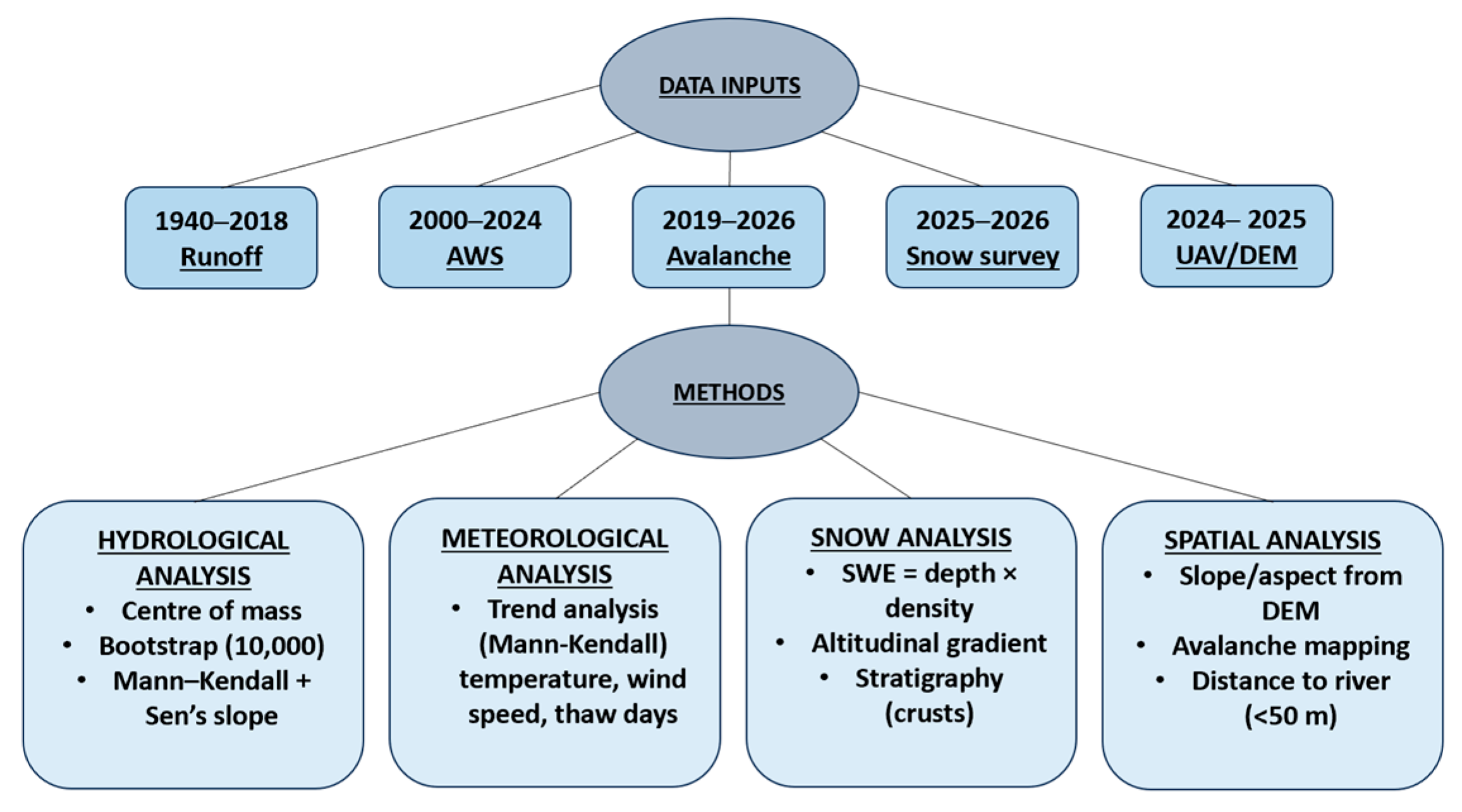
Figure 2. Schematic overview of the data integration and analytical workflow used to link hydroclimatic variability, snowpack conditions, and avalanche activity in the VRB.
Water 18 01185 g002
Figure 3. Annual runoff in the Varzob River at the Dagana gauge (1940–2018). The dashed line indicates the linear trend (Sen’s slope = +0.076 m3 s−1 yr−1, p = 0.23, not statistically significant). The significant seasonal shift in the hydrograph is shown in Figure 4.
Water 18 01185 g003
Figure 4. Mean monthly runoff for the periods 1940–1990 and 1991–2018. The centre of mass shifted 3.7 days earlier (from day 169.8 to day 166.0); the shift is statistically significant (p < 0.001, bootstrap test with 10,000 resamplings).
Water 18 01185 g004
Figure 5. SWE as a function of elevation for January 2025 and January 2026. Each marker represents the mean SWE at a snow point. The 2026 snowpack contained approximately 70% more water than the 2025 snowpack at the same elevation.
Water 18 01185 g005
Figure 6. Meteorological trends at Maykhura station for the cold season (November–March, 2000–2024). (a) Mean temperature—significant increase (τ = 0.355, p = 0.016). (b) Thaw days—no trend (τ = 0.112, p = 0.469). (c) Maximum snow depth—no trend (τ = 0.062, p = 0.691). (d) Mean wind speed—no significant trend (τ = 0.285, p = 0.061). Dashed lines show linear regression fits for visual reference; all significance is based on the Mann–Kendall test.
Water 18 01185 g006
Figure 7. Avalanche points (n ≈ 90) mapped in the Varzob basin. Background: slope angle and elevation. (a) elevation map with mapped avalanche points and the Varzob River; (b) distance-to-river map showing proximity of avalanche locations to the river network; and (c) slope distribution map of the study area.
Water 18 01185 g007
Figure 8. Field photograph of an avalanche runout zone (February 2026). Avalanche debris crosses the M34 highway (“Transport”) and reaches the river (“Runout zone”). River valley. (a,b) Avalanche starting, transport, and runout zones; deposits exceed the 12 m avalanche gallery height. (c,d) Avalanche movement toward the Maykhura River channel. (e,f) Deposits up to 4.6 m thick partially block the river channel.
Water 18 01185 g008
Figure 9. Estimated meltwater contribution from avalanche debris located in and adjacent to the Maykhura River channel, a right tributary of the Varzob River, following the avalanche event of 15 February 2026. The estimates are based on a mapped avalanche-debris area of 0.046 km2, a mean deposit thickness of 2.5 m, a deposit length of 520 m, and assumed dense avalanche-snow densities of 420–500 kg m−3. The direct channel-contact meltwater contribution was calculated for 10, 20, and 30 m wide near-channel belts.
Water 18 01185 g009
Figure 10. Annual number of avalanches and fatalities in the VRB, 2019–2026. Data for 2026 are partial (January–February only).
Water 18 01185 g010
Figure 11. Annual amounts of snow (light blue) and rain (dark blue) at Maykhura station, 2000–2024. Large interannual variability is evident; therefore, linear trends should be interpreted with caution, and the Mann–Kendall test confirms no significant trend for snow (p = 0.70) or rain (p = 0.89).
Water 18 01185 g011
Table 1. Snow depth, density, and SWE at seven snow points in the VRB, January–February 2025.
Snow PointElevation (m a.s.l.)DateMax Snow Depth (cm)Min Snow Depth (cm)Mean Snow Depth (cm)Mean Density (g cm−3)SWE (mm)
№5193025 January 2025112861000.2200
№6200026 January 20255645510.21105
№7230027 January 20257164680.18127
№8254528 January 20258570770.18146
№9273030 January 202511086950.18162
№10282830 January 20251321241280.18223
№11295531 January 20251571501450.16238
№5193020 February 20259690930.29270
№6200021 February 20255645530.33168
№7230022 February 20256760630.27170
№8254523 February 20257570730.26190
№9273024 February 202510389950.26239
№10282825 February 20258980850.25210
№11295526 February 20251371301330.22292
Table 2. Snow depth, density and SWE at seven snow points in the VRB, January–February 2026.
Snow PointElevation (m a.s.l.)DateMax Snow Depth (cm)Min Snow Depth (cm)Mean Snow Depth (cm)Mean Density (g cm−3)SWE (mm)
№5193025 January 20261761681730.20346
№6200025 January 20261681601640.20326
№7230026 January 20261771701720.19323
№8254527 January 20261951841890.19359
№9273028 January 20262122042090.19397
№10282829 January 20262262172220.18400
№11295531 January 20262472402440.18439
№5193020 February 20261551451500.33495
№6200021 February 202610590970.38320
№7230022 February 20261151001100.32352
№8254523 February 20261351251310.32419
№9273024 February 20261601451530.31474
№10282825 February 20261671601640.30492
№11295526 February 20262262172220.30666
Disclaimer/Publisher’s Note: The statements, opinions and data contained in all publications are solely those of the individual author(s) and contributor(s) and not of MDPI and/or the editor(s). MDPI and/or the editor(s) disclaim responsibility for any injury to people or property resulting from any ideas, methods, instructions or products referred to in the content.