Article

Anthropogenic and Watershed Controls on the Distribution of Selenium Species in Waters of an Estuarine System (Adour River Estuary, France)


1
Universite de Pau et des Pays de l’Adour, CNRS, Institute of Analytical Sciences and Physical-Chemistry for the Environment and Materials—IPREM, 64000 Pau, France
2
Sorbonne Université, Institute of Ecology and Environmental Sciences–iEES Paris, 75005 Paris, France
*
Authors to whom correspondence should be addressed.
Water 2026, 18(10), 1161; https://doi.org/10.3390/w18101161
Submission received: 2 April 2026 / Revised: 30 April 2026 / Accepted: 8 May 2026 / Published: 12 May 2026
(This article belongs to the Special Issue Biogeochemical Cycling of Trace Elements in Aquatic Environments)

Abstract

Selenium plays a crucial role in estuarine biogeochemistry, balancing essential nutrient functions with potential environmental toxicity. This study examines the seasonal distribution of dissolved Se species, including volatiles, in the Adour estuary in relation to anthropogenic influences. To characterize major Se inputs from upstream watersheds to downstream tributaries, water samples were collected at low tide during three different seasons in upstream freshwaters, industrial/urban effluents and downstream estuarine waters. A tidal-cycle sampling campaign was conducted under low discharge conditions to assess Se dynamics during downstream estuarine mixing. Total dissolved Se (TDSe) concentrations ranged from 71 (pristine river) to 656 ng L−1 (industrial/urban-impacted tributaries). TDSe correlated strongly with nitrate (r = 0.84) in upstream waters, indicating significant agricultural and livestock contributions at the watershed scale. Selenate was the dominant species, followed by Se(-II+0) fraction and selenite. Volatile Se compound concentrations varied from 51 to 2757 pg L−1. Seasonal changes suggest that Se speciation is mainly controlled by watershed inputs derived from land use (agricultural and livestock practices) rather than downstream estuarine inputs. This speciation study further indicates that Se reactivity/bio-availability in estuarine systems can be largely influenced by anthropogenic activities, although further characterization of the aqueous reduced Se fraction is still needed.

1. Introduction

Selenium can exist in multiple oxidation states and form both organic and inorganic species making its biogeochemical behavior highly complex and dynamic in aquatic systems [1]. Despite its recognized role as both an essential nutrient and a potential toxicant for aquatic biota, selenium is not currently regulated under the European Water Framework Directive as a priority substance [2], and systematic monitoring of Se remains largely absent from water quality assessment programs.
Estuarine systems are transitional zones between freshwater and marine systems, which gives them a key role in regulating the bio-availability and distribution of Se along the land–sea continuum and coastal ecosystems [3]. The estuarine mixing behavior of total selenium and/or selenium species has been reported as conservative or non-conservative [4,5,6,7,8,9,10] and is influenced by anthropogenic sources such as industrial discharge, agricultural runoff, and urban wastewater [11]. The presence of selenate (Se(VI)) is commonly linked to agricultural activities, while selenite (Se(IV)) is often dominant in industrial effluents [4]. Reduced Se species, including elemental Se and selenides, are associated with microbial processes [12]. In addition, volatile Se species (e.g., dimethylselenide and dimethylselenyl sulfide) result from microbial methylation and contribute to atmospheric Se cycling [13,14]. The distribution and behavior of Se species in estuarine systems are strongly influenced by watershed characteristics, including land use, hydrology, and nutrient inputs. In addition, multiple anthropogenic sources of Se (urban, industrial, agricultural, …) can lead to complex Se speciation changes in transitional waters that remain merely characterized in a few specific estuarine systems worldwide.
Among watershed land uses, agricultural and livestock activities significantly impact nutrient loads [15]. Nitrate, as a major component of agricultural runoff (synthetic fertilizers, manure applications, and soil leaching) is commonly found in estuarine systems [16]. High nitrate concentrations in watersheds are often associated with intensive farming practices and can influence biogeochemical processes within estuarine environments. Additionally, wastewater discharges from urban/industrial sources can introduce both inorganic and organic Se species, altering their distribution and reactivity in estuarine waters [7].
The Adour estuary, in southwestern France, represents a relevant case study to investigate Se cycling in a mixed-use estuarine system under significant agricultural, urban, and industrial pressures. Its watershed is characterized by a mosaic of land uses dominated by intensive agriculture (predominantly maize cultivation and cattle grazing) alongside urban centers and a range of industrial activities (agro-food processing, papermaking, and aeronautics) concentrated notably around the port of Bayonne, one of the ten largest commercial ports in France [17,18]. Diffuse agricultural inputs have been identified as a key pressure on water quality in successive River Basin Management Plans (SAGE Adour) [18,19]. Knowledge of the distribution and speciation of Se in such intensively managed watersheds is thus needed to understand Se cycling in this transitional estuarine system and implications for downstream coastal ecosystems including the Bay of Biscay, where seasonal blooms of toxic microalgae (Ostreopsis spp.) have been increasingly documented in recent years [18].
Selenium distribution in the Adour estuary is almost unknown except for recently reported total Se concentration in surface sediments [20] and in mountain lakes headwaters or rainwaters [21,22]. This estuarine system thus represents a data gap of direct environmental relevance: while nitrate and phosphorus dynamics have been increasingly documented at the watershed scale [18,19], selenium has not been investigated prior to this work. Although previous studies have documented Se behavior in other estuarine systems, there remains a lack of information regarding its speciation, particularly concerning the identification of human activities controlling Se species inputs into estuaries and the co-occurrence of volatile Se compounds in major estuarine inputs [23]. This study aims thus to characterize Se speciation in the Adour estuary, following a sampling strategy mainly focused on water sample collection at low tide from main streams and tributaries in order to assess the major inputs from watershed land uses integrating seasonal changes. By combining total Se measurements with dissolved and volatile Se species analyses, this work provides a comprehensive evaluation of Se dynamics in an estuarine system subject to both natural and anthropogenic influences and their potential implications for adjacent coastal ecosystems.

2. Materials and Methods

2.1. Study Area

The Adour estuary represents the end-member of a coastal watershed (western Pyrenees) located in southwestern France. It receives water from the Adour River, whose catchment area (16,900 km2) is characterized by widespread agriculture, farming, industry, and major urban centers (Pau, Tarbes, Mont de Marsan, Dax, and Lourdes), resulting in significant contamination with nitrates, pesticides and organic compounds [19]. These land uses generate substantial nitrogen fluxes into the hydrographic network: within the lower Adour watershed [24], agriculture alone is estimated to export between 44 and 278 tons of nitrogen per year to surface waters, while wastewater treatment plants discharge approximately 205 tons of nitrogen annually [18]. The estuarine section of the Adour River also receives the contribution of the Nive River (1000 km2 river watershed) [24] together with water inputs from many small tributaries. The main difference between the Adour and the Nive is related to land use. The Nive primarily drains forested and pasture areas, resulting in markedly lower nutrient concentrations, a contrast that proved valuable for disentangling land-use controls on Se distribution in this study.
The Adour River estuary watershed is influenced by the Pyrenean mountains and characterized by an oceanic-driven climate influenced by the North Atlantic Ocean [19]. Its average total flow (311 m3 s−1) is influenced by rainfall and snow-melting, with high-water periods between November and February [16]. Such a situation occurred before the January 2018 sampling, resulting in larger river discharge and terrestrial runoff leading to higher water turbidity (cf. Section 2.2).

2.2. Sampling, Samples, and General Physicochemical Parameters

A total of thirty-six samples were collected at twelve sites in three seasonal sampling campaigns in May 2017 (n = 12), September 2017 (n = 12), and January-February 2018 (n = 12) in order to describe spatial and seasonal variations (Table S1 and Figure 1). The Adour riverine daily discharge averaged 200, 108, and 643 m3 s−1 respectively, in the May, September and January three-day sampling campaigns. For these same periods, the Nive riverine daily discharge averaged 11.4, 19.4 and 85.5 m3 s−1 respectively [25]. Tidal coefficients were between 78 and 83 in May, 80 and 97 in September and from 93 to 109 in January [25]. For the seasonal samplings, sample collection was carried out at low tide to specifically characterize Se content and species in upstream waters of the estuary. In addition, one campaign was conducted during a full tidal cycle (September 2018) in the main channel downstream section of the estuary (Table S1) to evaluate the effects of downstream estuarine mixing and marine inputs on Se species content. Finally, additional samples were collected in May 2022, under total river discharge close to May 2017 (ca. 225 m3 s−1, https://hydro.eaufrance.fr) and specifically focusing on upstream stations (n = 8, freshwater samples) including major tributaries and fluvial end-members of the upstream Adour estuary (Adour River ST1, Nive River ST3, Adour River at Saubusse A1, Gave de Pau A2, Gave d’Oloron A3, Gaves réunis A4, Bidouze River A5, and Aran River A6).
The group of four sampling points located at or close to each main river mouth is referred to as “upstream waters”. It includes ST1 and ST2, located at the Adour River and ST3 and ST4 at the Nive River, which were collected during the three-seasonal campaigns and, in May 2022 (ST1 and ST3). ST1 and ST3 were located at the salt intrusion limit of each river (Table S1). The second group is referred to as “effluent impacted waters” and included four sampling stations within the estuarine system located directly either at the outlet of urban wastewater treatment plants (WWTP) (Saint Frédéric, ST5, and Saint Bernard, ST6) or in small urban tributaries passing through industrialized and urban areas (streams Aritxague, ST7, and Maharin, ST8). Finally, the downstream estuarine mixing section (i.e., where salinity might increase) was identified as the “downstream waters” group. It consists of four sampling points (ST A–D) located along the urban, industrial, and harbor areas just upstream of the estuary mouth. The full tidal cycle sampling of September 2018 was carried out at STB.
Sub-surface water samples were collected by hand in upstream, effluent-impacted waters and at STA. At stations ST B–D, sub-surface samples were collected on board a flat motor boat, using a non-metallic and PTFE-coated sampler (5 L Go-Flo; General Oceanic). The Go-Flo sampler was operated with gloves and water was transferred to sample containers using a pre-cleaned silicone tube. For volatile Se species analysis, a one-liter sample was collected in two 500 mL Teflon bottles, avoiding bubbles and headspace. Samples were immediately stored in the dark and transported to the laboratory within the following 4 h. In the laboratory, samples were preserved in the dark at 4 °C for the subsequent purge and trap of gaseous species carried out within the day (cf. Section 2.5). These conditions allowed the pre-concentration of dissolved volatile Se compounds and the preservation of their speciation as previously described by Lanceleur et al. [23]. For bulk Se analysis, aliquots were collected in 50 mL polypropylene Falcon tubes and acidified with 500 µL (1% v/v) HNO3 (69%, trace metal grade). For total dissolved Se and non-volatile dissolved Se species analyses, aliquots were collected in 125 mL polyethylene bottles without headspace and stored in the dark. Samples were transported immediately to the laboratory, filtered (precleaned 0.45 µm PVDF, Durapore membrane filter) and separated into two aliquots of 50 mL (Falcon tubes) for later analyses. Samples for total dissolved Se were acidified in the same way as those for total bulk Se. The filtered fraction therefore contained both Se in the dissolved phase and colloidal phase, below 0.45 µm in size. For Se speciation in the filtered fraction, samples were stored without headspace in cold and dark conditions. The analysis of the samples was carried out within two weeks of the sampling date. Such storage conditions and time have been validated for stability in a previous study [26].
Physicochemical parameters, including temperature, pH, conductivity, oxygen saturation, and salinity, were measured on-site using a multi-parametric probe (HANNA Instruments® HI-9829, Lingolsheim, France). Ancillary data, including nutrients (N, P, Si), sulfates, and dissolved organic carbon (DOC) concentrations were measured in the laboratory from simultaneous samples by colorimetric methods, nephelometry and catalytic combustion respectively [27,28].

2.3. Total Se Analysis

Unfiltered samples (45 mL) were digested with HNO3 (1.0 mL) and HCl (0.5 mL) in sealed tubes for 3 h at 90 °C in a hot block (DIGIPREP, SCP Science, Baie-D’Urfé, Québec, Canada). Digested samples were adjusted to a final volume of 50 mL after digestion and filtered (0.45 µm) before the analysis [21].
Total Se concentrations in bulk and filtered waters were measured with an Agilent 7900 Series inductively coupled plasma mass spectrometer (ICP-MS) system (Agilent Technologies, Santa Clara, CA, USA) equipped with an octopole reaction system, concentric nebulizer, and a Scott double pass spray chamber cooled to 2 °C. Argon-based polyatomic interferences were reduced by using H2 as cell gas at a flow rate of 5 mL min−1 as previously described [21]. Acquisition parameters consisted of 10 replicates with 50 sweeps/replicate and an integration time of 2 s per isotope; m/z monitored masses were 77 and 78. External calibration was performed for samples with salinity < 1 psu. Samples containing salinity >1 psu were diluted up to twenty times to avoid instrumental problems related to salt precipitation. In that case, quantification was based on standard additions. Limits of quantification (LQ, based on 78Se) were between 1 and 5 ng Se L−1. Typical analytical precision was <10% (relative standard deviation, 10 replicates). For diluted samples, LQ was then increased by the dilution factor value. Only total dissolved Se concentrations were determined for the May 2022 samples.

2.4. Dissolved Non-Volatile Se Speciation Analysis

Chromatographic analysis of non-volatile selenium species was carried out with an Agilent 1200 HPLC pump hyphenated to ICP-MS. Most samples were analyzed using a porous graphitic carbon stationary phase (Hypercarb column 10 cm × 4.6 mm i.d, Thermo Scientific, Waltham, MA, USA) with a formic acid mobile phase (240 mmol L−1, 1% methanol and pH 2.4 adjusted with ammonia), delivered at a 1 mL min−1 flow rate following the method previously described in [21]. Standard addition was used for species quantification. Quantification limits were 3.6 and 2.2 ng Se L−1 for selenite and selenate, respectively, for 200 µL injected volumes. Exceptionally, samples of September 2017 were analyzed using the mixed-mode column OmniPac PAX-500 (25 cm × 4 mm i.d., Thermo Scientific, USA) with an ammonium nitrate mobile phase (20 mmol L−1, 2% methanol, pH 8.0 adjusted with ammonia), delivered at a 1 mL min−1 flow rate following the method previously described in [21]. In this case, LQ was 12 and 10 ng Se L−1 for Se(IV) and Se(VI), respectively. Duplicates of all samples were injected, obtaining a relative standard deviation below 10%, except for some samples close to the LQ for which RSD was up to 15%. Due to their salinity, the September samples at ST C and D required a tenfold dilution. The consequent increase in quantification limits prevented detection and quantification of selenium species. The chromatographic methods used both allowed the separation of selenite, selenate, and selenomethionine [21] and only selenate and selenite were detected in the analyzed samples. Operationally defined Se (-II+0) fraction was calculated as the difference between the total dissolved Se concentration and those of selenite and selenate (Se (-II+0) = TDSe − Se(IV) − Se(VI)). This fraction was used to estimate the contribution of Se(-II) and colloidal elemental Se (Se(0)) in water samples.

2.5. Dissolved Volatile Se Speciation Analysis

Volatile Se compounds were determined by purge and cryogenic trapping followed by cryogenic gas chromatography (GC) coupled to ICP-MS, following a previously described method [26,29]. Water samples were purged with 500 mL min−1 pure N2 for 45 min. The water vapor generated during the purge was condensed in a moisture trap maintained at −20 °C. The gas stream was then carried through a glass column filled with carbotrap. The glass columns were then closed and stored in the dark at 4 °C in a sealed double bag until the GC-ICPMS (Thermo Scientific, USA) analysis. Pre-concentrated volatile Se species were thermo-desorbed from carbotrap columns at 250 °C for 2 min under 100 mL min−1 He flow, trapped on a glass column filled with Chromosorb SP2100 and submerged in liquid N2, prior to GC elution [29]. External calibration was performed by injection of Se standards gravimetrically diluted from pure DMSe and DMDSe. The limits of quantification ranged from 1 to 4 pg Se L−1 for DMSe, DMSeS, and DMDSe. Thermodesorption efficiency was controlled by carrying out two consecutive analyses of the same carbotrap column. Analysis of purge blanks was performed to estimate the efficiency of the sample treatment procedure. Total Volatile Se (TVSe) was determined as the sum of DMSe, DMSeS and DMDSe concentrations.

2.6. Statistical Data Treatment

For statistical treatment, a value of one-half the quantification limit was assigned to selenite and selenate concentrations in samples that did not contain quantifiable species levels, except for samples for which species quantification was impaired due to dilution. These samples were excluded from statistical calculations.
All sample sets were tested for normality using the Shapiro–Wilk test. For normally distributed samples, Pearson correlation coefficients (r) and a paired t-test were used. In the other cases, Spearman coefficients (ρ) and the non-parametric Wilcoxon signed-rank test were used. Two-tailed parametric and non-parametric tests were used to study significant differences among values, while one-tailed tests were subsequently applied to statistically confirm if one value was significantly higher. These analyses were carried out using the R Commander package of R free software (R Core Team, 2025, version 4.5.1).

3. Results and Discussion

3.1. Influence of Watershed Land Use and River Inputs on Total Se in Estuarine Waters

3.1.1. Hydro-Biogeochemical Overview of the Surface Waters

Physicochemical conditions across the three seasonal campaigns reflected the expected hydrological contrast between high-flow (January, mean discharge 643 m3 s−1) and low-flow (September, 108 m3 s−1) periods. Water temperature ranged between 14 and 21 °C in May and September and between 8 and 15 °C in January (Table S2). Due to sampling time constraints, some stations were sampled slightly after low tide and exhibited higher salinity than expected. Conductivity confirmed the salinity gradient from freshwater upstream stations (0.2 to 0.5 mS cm−1 at ST 1–4) to estuarine downstream stations (0.4 to 18 mS cm−1 at ST A–D), with effluent-impacted stations (ST 5–8) showing intermediate values (0.2 to 3.5 mS cm−1).
Nitrate was the dominant dissolved inorganic nitrogen species (>90% of total inorganic N, median value of 111 µmol L−1) and exhibited a clear spatial gradient from upstream to downstream. Highest concentrations were recorded at Adour River stations ST 1–2 (119–199 µmol L−1), and at the Bidouze River end-member (154 µmol L−1) reflecting the dominant agricultural land use of these sub-catchments [18,19]. Nive River stations ST 3–4 showed markedly lower nitrate concentrations (53–70 µmol L−1), consistent with its predominantly forested and pastoral watershed.
Phosphate concentrations were generally in the sub-µM range (median of 0.6 µmol L−1) except at ST5 in January 2018 (60 µmol L−1), where WWTP discharge was dominant; N/P molar ratios of 68–298 confirmed N-excess conditions throughout. Dissolved organic carbon (DOC) and Chl-a concentrations are provided in Table S2; both parameters showed elevated values in effluent-impacted waters, reflecting inputs of organic matter from wastewater sources.

3.1.2. Total Selenium in Waters

Detailed data for bulk and dissolved total Se concentrations are presented in Table S3. Average dissolved Se concentrations were 127 ± 44 ng L−1 for the upstream waters group, 137 ± 48 ng L−1 for the downstream waters group, and 350 ± 175 ng L−1 in the effluent-impacted waters group, indicating anthropogenic contributions. The TDSe concentration range determined at the Adour estuary was similar to that reported in other estuaries (Table 1).
Selenium concentrations in the Adour and Nive rivers were very similar in May and September (TSe bulk = 139 ± 11 and 83 ± 10; TDSe = 131 ± 10 and 78 ± 7 ng L−1 in average, respectively), while higher Se concentrations were determined in January (TSe bulk = 224 ± 17 and 118 ± 10; TDSe = 186 ± 15 and 92 ± 7 ng L−1 respectively) (Table S3). The concentrations of total Se (bulk and dissolved) were strongly and positively correlated with river discharge (r > 0.9, p < 0.0001). The non-parametric Wilcoxon signed-rank test indicated that bulk and dissolved total Se concentrations differed significantly (p < 0.001), demonstrating the presence of particulate Se (> 0.45 µm) in such waters. Selenium was however, predominantly present in the filter-passing “dissolved” phase with an average proportion of 90%, comparable with that reported by Cutter [4] (92%).
Industry-impacted stations ST 7–8 displayed significantly higher Se concentrations (TDSe = 485 ± 135 ng L−1) than urban-impacted sites ST 5–6 (TDSe = 215 ± 72 ng L−1; paired t-test p < 0.001). Other studies have previously observed the contribution from industrial or urban effluents with high Se concentrations to estuarine water Se contents [4,6]. In the Adour estuary, the water discharge of such tributaries with elevated Se has been established to be around two orders of magnitude lower than the major upstream watershed (Adour River) [30]. As a consequence, such effluent and minor urban tributaries did not significantly impact the Se concentration of downstream waters along the three seasonal campaigns.

3.1.3. Factors Influencing Se Spatial Variability

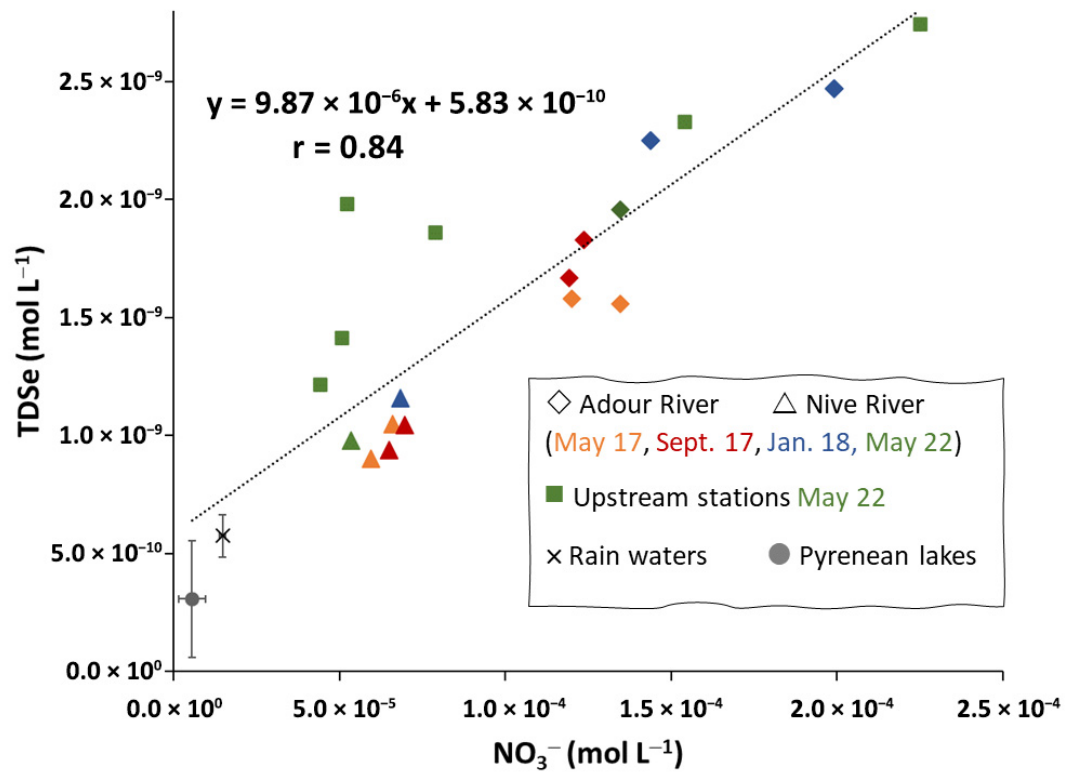
We recently identified that in the headwaters of the Adour watershed, i.e., in the remote Pyrenean mountain lakes, the Se background concentrations could be related to the additive contributions of chemical weathering and atmospheric deposition [21]. Because headwaters displayed lower Se levels (7–74 ng L−1, Table S4) compared to downstream waters from the present study (75–203 ng L−1, Table 1), the Adour upstream watershed is certainly an important source of Se. The Se concentrations in the Adour River end-member (150 ± 28 ng L−1) exceeded those in the Nive River (82 ± 8 ng L−1), in Pyrenean lake headwaters, and in rainwaters (45 ± 7 ng L−1) [22] (Table S4). Correlation analysis in upstream waters showed that dissolved Se concentrations were positively correlated with those of nitrate and silicate (Table S5). Nitrate concentrations observed at the Adour and Nive rivers were also higher (5 to 20 times) than those observed in Pyrenean lakes and rainwaters. The linear correlation between Se and nitrate concentrations (r = 0.84, p < 0.001, Figure 2) pointed to agricultural and livestock influences. This relationship is further supported by the Se/N molar ratios calculated from Table S4: the Adour River displayed a remarkably stable mean ratio of 1.4 ± 0.1 ×10⁻⁵ across all seasons and discharge conditions, essentially identical to that of the Nive River (1.6 ± 0.1 ×10⁻⁵), despite the two- to threefold difference in absolute TDSe and NO3 concentrations between the two systems. This convergence strongly suggests a common diffuse source controlling the Se/N ratio at the watershed scale, rather than a simple dilution effect. Adour tributaries showed a slightly higher mean ratio (2.6 ± 0.1 ×10⁻⁵), consistent with smaller catchments where the relative contribution of geogenic Se or atmospheric deposition to low-nitrate waters is proportionally larger. By contrast, western Pyrenean headwater lakes, representing pre-agricultural background conditions, exhibited a much higher and more variable Se/N ratio (9.2 ± 8.9 ×10⁻⁵) at very low absolute concentrations, reflecting Se inputs decoupled from nitrogen cycling.
The dominant Se species in the Se/N correlation is selenate (ρ = 0.79 with NO3, Table S5), consistent with oxidizing soil conditions prevailing in agricultural catchments where selenate is the thermodynamically stable form and co-leaches with nitrate through similar pathways. This is mechanistically coherent with the known inhibition of Se(IV) reduction and enhancement of Se oxidation in soils receiving nitrate fertilizers [16].
A study of trace element inputs in French agricultural soils identified mineral fertilizers as the primary Se source, followed by animal breeding effluents and atmospheric deposition [15]. The Adour watershed dominated by maize cultivation (38% land use) and livestock farming (20% land use) [24], provides the conditions for such co-mobilization of Se and N. Seasonal variations reinforced this interpretation: higher TDSe and NO3 during high-flow periods (January) reflect increased agricultural runoff, while lower concentrations during low-flow periods (September) reflect biological uptake and reduced leaching, a pattern consistent with diffuse non-point source behavior rather than point-source inputs.

3.2. Incoming Water Type and Estuarine Mixing Influence on Selenium Species Distribution

3.2.1. Selenium Speciation in the Different Estuarine Waters

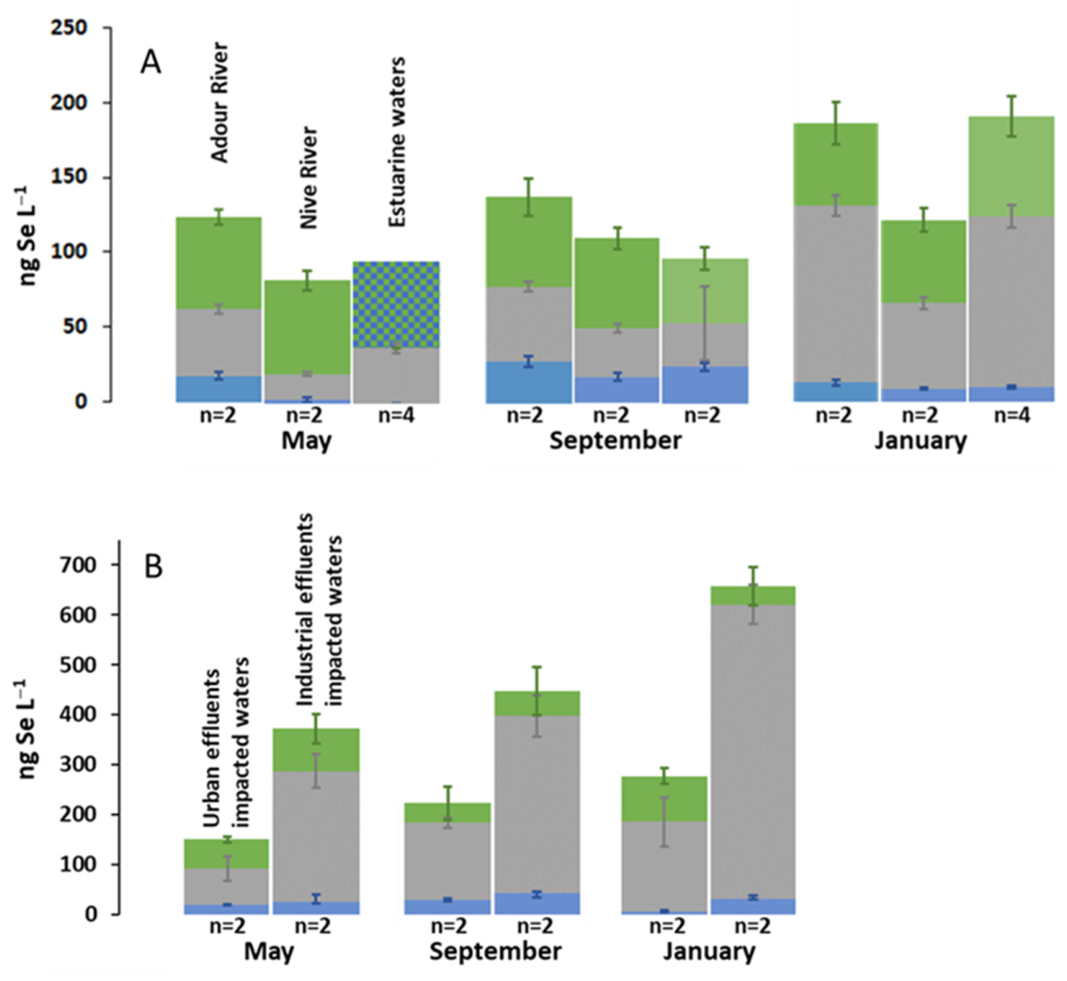
In upstream waters, despite differences in concentration values (Table 1 and Table S3), species distribution was found to be similar in both the Adour and Nive rivers, with a weaker contribution of selenite compared to those of selenate and Se(-II+0) in the three seasonal surveys. In the Adour River, dissolved species distribution remained very close in May and September: Se(-II+0) (47 ± 7%) ≥ Se(VI) (36 ± 3%) > Se(IV) (17 ± 4%) (Figure 3, Table S3); while in January, a different distribution included a higher proportion of selenate (63 ± 6%) and lower contributions of Se(-II+0) (30 ± 8%) and selenite (7 ± 1%). In the Nive River, Se species distribution indicated the predominance of Se(-II+0) in the May sampling (75 ± 11%) while oxidized selenium forms (IV+VI) prevailed in September and January (67 ± 8% on average) (Figure 3). Total volatile Se averaged 139 ± 46 pg L−1 in the Adour River and 93 ± 25 pg L−1 in the Nive River, without any statistically significant difference (paired t-test, p > 0.05). A similar volatile species distribution was also observed with a predominance of DMSe (67 ± 10% Adour, 54 ± 24% Nive) and DMSeS (29 ± 9% Adour, 43 ± 25% Nive) in comparison with DMDSe (≤4 ± 2%) (Table 2 and Table S3). Interestingly, the Adour River concentration of TVSe in September was almost twice that of those in May and January, with no apparent species distribution modification, DMSe being predominant for all periods (Table S3).
The Adour River watershed water discharge dominates water inputs, being around ten times higher than the Nive. The concentrations of selenium in downstream estuarine waters were thus dependent on those of the Adour upstream samples. This was particularly obvious for the January sampling, where the high Adour River discharge resulted in nearly identical Se concentrations and distribution in estuarine stations (Figure 3). Estuarine waters exhibited similar species distribution at the three seasonal surveys: Se(VI) (49 ± 11%) ≥ Se(-II+0) (35 ± 2%) > Se(IV) (12 ± 12%). For volatile species, DMDSe was a minority in all seasons, while the contributions of DMSe and DMSeS were similar in September and reversed between May and January (Table 2 and Table S3).
Almost half of the dissolved Se content in the downstream and upstream waters consisted of unidentified species. The presence of reduced and/or colloidal Se, as well as the production of volatile compounds, is first driven by the inputs of organic matter and the biological primary productivity [10,26,31,32]. The production of volatile Se, largely composed of DMSe and DMSeS, was observed regardless of water type and season (Table S3, Figure S1). Unlike total dissolved selenium concentrations, the TVSe concentration was significantly higher downstream (median of 254 pg L−1) than upstream (median of 111 pg L−1) (Wilcoxon signed-rank test, p < 0.05) together with a slight increase in DMSeS proportion and decrease in DMSe within estuarine mixing waters compared to upstream waters.
At urban and industrial locations, the main species detected was also selenate (72 ± 18%), followed by the Se(-II+0) fraction (21 ± 15%), and the presence of selenite was residual, representing 8 ± 5% of TDSe (Table 1). Species order predominance was thus similar to that observed in upstream and downstream waters, but with a higher proportion of selenate, together with a lower proportion of Se(-II+0). This divergence was even more pronounced in waters impacted by industrial effluents (ST 7–8) where Se(VI) and Se(-II+0) proportions were 82 ± 14 and 13 ± 11% respectively. The effluent-impacted waters group presented a large range of TVSe concentrations (Table 2) significantly higher than in downstream stations (Wilcoxon signed-rank test, p < 0.01). Those stations are also characterized by high dissolved organic matter (Table S2) linked to the presence of bacteria and hydrophilic microbes [19]. The microbial production of volatile Se compounds may be promoted in effluent-impacted waters as previously shown in polluted and highly heterotrophic estuarine systems [13,31,32]. Volatile species proportions were similar to those observed in downstream waters.
The distribution of dissolved selenium species in downstream surface estuarine waters was thus very similar to that in upstream waters, with major and comparable contributions of selenate and Se(-II+0) compared to selenite as reported in other estuaries (Table 1). Concentrations of TVSe compounds at the Adour estuary were in the low range of reported values in European estuaries (Table 2). DMSe and DMSeS were major components in comparable parts, while in European estuaries, more than 80% of TVSe corresponded to DMSe, which was probably the result of larger heterotrophic activities encountered in the extensive high-turbidity zone of those estuaries [31,32]. Spatial and seasonal variations were observed among the different water types. While selenate proportion was especially higher in winter (64% of TDSe), selenite was linked to biological activity during spring and summer periods, mainly from microbial oxidation pathways of reduced Se. Indeed, unidentified Se species composed around 40% of TDSe, presumably in the form of colloidal elemental Se and other reduced inorganic or organic species [33]. Overall, Se speciation results are consistent along the estuarine system, and even if urban and industrial tributaries are exhibiting higher concentrations than upstream rivers, the net flux contribution of those more “contaminated” tributaries does not significantly change the main Se species distribution during estuarine mixing even at low river discharge [29].

3.2.2. Effect of Estuarine Mixing During Tidal Cycle

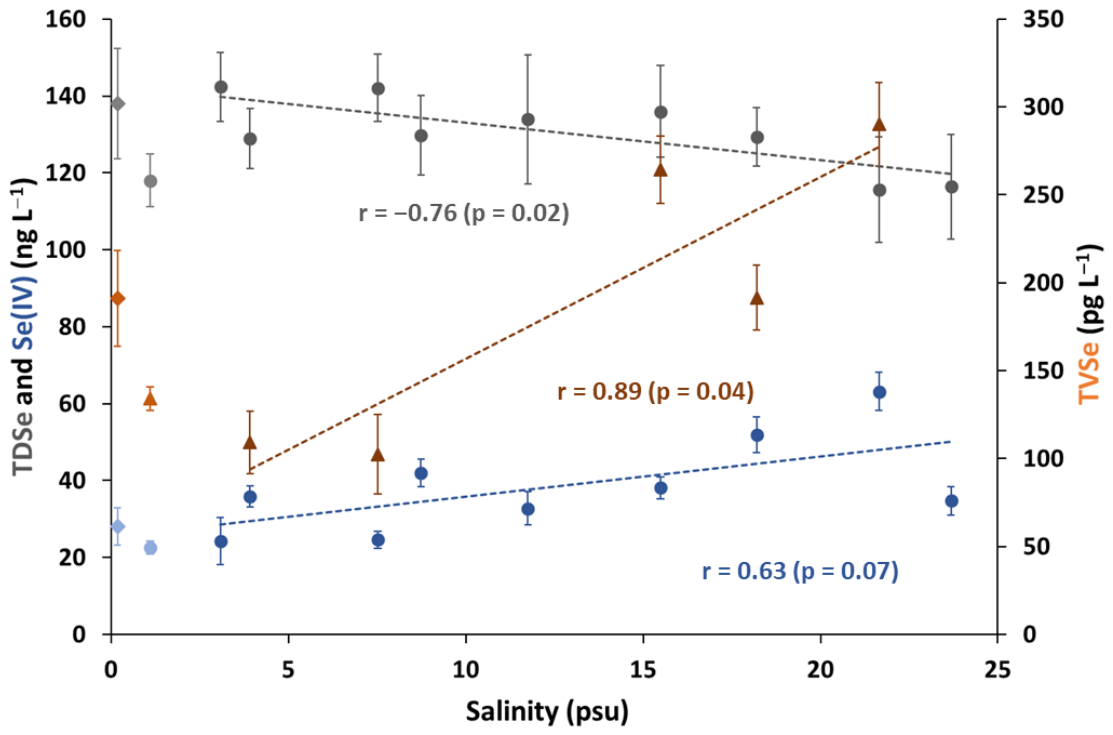
Although this tidal cycle survey represents a single campaign conducted under low-discharge conditions (September 2018), it provides a unique salinity gradient, from 3 to 24 psu within hours, that the seasonal low-tide sampling strategy could not capture and thus offers complementary insight into Se speciation dynamics during estuarine mixing (Table S6). Evolution of dissolved and volatile selenium concentrations during the tidal cycle of September 2018 (3 psu < salinity < 24 psu) is presented in Figure 4 and extended to low salinity values data of September 2017 at the same estuarine station, STB (salinity = 1.1 psu), and at Adour River ST1 and ST2 (mean salinity = 0.19 psu).
Concentration of TDSe decreased with increasing salinity, from 142 ± 9 ng L−1 at 3.1 psu to 116 ± 14 ng L−1 at 21.7–23.7 psu (r = −0.76, p = 0.02). Selenate concentration was relatively constant (41 ± 6 ng Se L−1, i.e., 31 ± 6% of TDSe, Table S6). In contrast, selenite concentration and its relative contribution increased with salinity, from lowest values (24 ± 6 ng L−1, 17 ± 4%) at low tide to values approximately doubled (50 ± 14 ng L−1, 42 ± 12%) at salinities > 18 psu (r = 0.63, p = 0.07, Figure 4). TVSe concentrations were also higher at high tide (Figure 4), ranging from 102 ± 5 to 290 ± 15 pg Se L−1. A large positive relationship was also obtained between TVSe concentration and salinity (r = 0.89, p = 0.04, Figure 4). The increase in TVSe was due almost exclusively to the higher production of the mixed Se–S species DMSeS as previously documented in Atlantic marine waters [34] and in relation to the occurrence of specific marine algae able to produce a significant proportion of organic sulphur metabolites, leading for example to dimethylsulfide formation (i.e., DMS). The trend of the Se(-II+0) fraction, although with larger uncertainties, is opposite, showing an overall decreasing trend with increasing salinity (Table S6).
The hydrodynamics of the Adour estuary, in particular, a short residence time (hours to days) for freshwater and particles [35], limit the potential formation of a high turbidity zone compared to other macrotidal estuaries [29,31,32]. Observations from the Gironde macrotidal estuarine system indicated that residence times of particles were enough to efficiently degrade organic matter and produce volatile Se species [13]. In contrast, the short residence time and absence of a turbidity zone in the Adour estuary hinder biogeochemical processes in the inner estuary and limit the formation of volatile Se compounds via the degradation of biogenic organoselenium compounds before they reach the downstream coastal zone. These observations, while based on a single tidal cycle, are consistent with the seasonal patterns described in Section 3.2.1 and with the documented behavior of DMSeS in Atlantic coastal systems [34]. A full seasonal characterization of tidal Se dynamics would be needed to confirm whether the DMSeS production observed here varies with biological productivity and river discharge.

4. Conclusions

This study provides a comprehensive assessment of the distribution of dissolved selenium and its species in the Adour River estuary. The results highlight the complex interplay between watershed land uses derived inputs, estuarine mixing, and seasonal dynamics. They demonstrate that selenium concentrations in the estuarine system can be strongly influenced by specific anthropogenic activities within the watershed, particularly from agricultural and livestock practices, as shown by the significant correlation between selenium and nitrate levels. The study underscores that total selenium is predominantly found in dissolved form, with effluent-impacted waters displaying the highest concentrations due to industrial and urban discharges. However, the filtration cutoff used (0.45 µm) does not allow discarding the contribution of the colloidal fraction, as it was observed for other metals in a previous study from our team. A significant proportion (up to 76%) of the filter-passing fraction is associated with unknown Se(-II) and/or Se(0) that can also be linked to the colloidal fraction (especially for insoluble Se(0)). Further investigations are required to identify the chemical forms of the unidentified Se(-II+0) pool and colloidal association of the Se compounds in estuarine waters. Our results also demonstrate the need to better predict how agricultural practices may increase Se inputs to river and marine systems and how industrial or urban practices and management may alter Se cycling in those environments.
Overall, estuaries exhibit selenium cycling patterns that are consistent (other European, American, and Asian estuaries), but this work highlights the need for continued monitoring and understanding of selenium pathways at watershed scales in different regions of the world, particularly in regions with significant agricultural and industrial pressure, to better anticipate potential environmental impacts on coastal ecosystems.

Supplementary Materials

The following supporting information can be downloaded at: https://www.mdpi.com/article/10.3390/w18101161/s1, Table S1: Sampling description including dates, decimal GPS coordinates and water type per sampling station; Table S2: Raw data for: temperature (temp.), dissolved oxygen (DO), conductivity (Cond.), nitrates (NO3), phosphates (PO43−), sulfates (SO42−), dissolved organic carbon (DOC) and chlorophyll a (Chl-a); Table S3: Raw data for total Se bulk (TSe bulk), dissolved (TDSe), selenite, selenate and Se (-II+0) fraction expressed as ng Se L−1. Data for total volatile Se (TVSe), dimethylselenide (DMSe), dimethyl selenide sulphide (DMSeS) and dimethyl diselenide (DMDSe) expressed in pg Se L−1; Table S4: Total dissolved Se (TDSe), nitrate concentrations, and Se/N molar ratios for Adour River (ST 1–2 + A1 Saubusse), Nive River (ST 3–4) and Adour River tributaries. Comparison of corresponding mean values with western Pyrenean lakes (headwaters of the basin) and rainwaters of nearby areas; Table S5: Spearman correlation matrix of major components in Adour, Nive and upstream waters and selenium species/pools; Table S6: Data for the tidal cycle sampling campaign carried out in September 2018. The percentage of Se(IV) and Se(VI) is based on TDSe; Figure S1: Distribution of volatile Se species among sampling dates. Data presented as the average and associated deviation for sampled stations at: (A) Adour River, Nive River and estuarine waters; and (B) urban and industrial effluent-impacted waters. Color code: orange for DMSe, yellow for DMSeS and red for DMDSe.

Author Contributions

Conceptualization, D.A. and L.L.; methodology, D.A., L.L., E.T. and M.B.; validation, E.T., J.D., L.L. and M.B.; investigation, D.A., E.T., A.R.-R., S.V., J.D., L.L., M.S. and M.B.; writing—original draft preparation, A.R.-R., D.A., M.S. and M.B.; writing—review and editing, D.A., M.S., L.L. and M.B.; funding acquisition, D.A. and M.B. All authors have read and agreed to the published version of the manuscript.

Funding

This work was supported by Université de Pau et de Pays de l’Adour (UPPA) in the framework of the Energy Environment Solutions (E2S-UPPA) initiative of excellence (I-SITES, PIA France) for the Scientific Hub ‘Metals in Environmental Systems Microbiology (MeSMic). This work was also part of the MICROPOLIT research program co-financed by the European Union and l’Agence de l’Eau Adour Garonne. A.R.R. acknowledges the financial support of the Doctoral School (ED 211–UPPA/IPREM) for her PhD fellowship. The contributions of the Aquitaine Region (AQUITRACES project n° 20131206001-13010973) and ANR IA RSNR (AMORAD project n°ANR-11-RSNR-0002) for equipment funding are acknowledged.

Data Availability Statement

The original contributions presented in this study are included in the article/Supplementary Material. Further inquiries can be directed to the corresponding authors.

Acknowledgments

Marcela Angel (English instructor, Universite de Pau et des Pays de l’Adour) is acknowledged for English language editing.

Conflicts of Interest

The authors declare no conflicts of interest.

References

  1. Measures, C.I.; Burton, J.D. Behaviour and speciation of dissolved selenium in estuarine waters. Nature 1978, 273, 293–295. [Google Scholar] [CrossRef]
  2. European Commission. Directive 2000/60/EC of the European Parliament and of the Council of 23 October 2000 Establishing a framework for Community Actions in the Field of Water Policy. Official Journal of the European Communities L 327. 22 December 2000. Current Consolidated Version 20/11/2014. Available online: https://eur-lex.europa.eu/legal-content/EN/TXT/PDF/?uri=CELEX:02000L0060-20141120 (accessed on 30 March 2026).
  3. Cutter, G.A.; San Diego-McGlone, M.L.C. Temporal variability of selenium fluxes in San Francisco Bay. Sci. Total Environ. 1990, 97–98, 235–250. [Google Scholar] [CrossRef]
  4. Cutter, G. The Estuarine Behaviour of Selenium in San Francisco Bay. Estuar. Coast. Shelf Sci. 1989, 28, 13–34. [Google Scholar] [CrossRef]
  5. Guan, D.M.; Martin, J.M. Selenium distribution in the Rhône delta and the Gulf of Lions. Mar. Chem. 1991, 36, 303–316. [Google Scholar] [CrossRef]
  6. Hung, J.-J.; Shy, C.-P. Speciation of Dissolved Selenium in the Kaoping and Erhjen Rivers and Estuaries, Southwestern Taiwan. Estuaries 1995, 18, 234–240. [Google Scholar] [CrossRef]
  7. Cutter, G.A.; Cutter, L.S. Selenium biogeochemistry in the San Francisco Bay estuary: Changes in water column behavior. Estuar. Coast. Shelf Sci. 2004, 61, 463–476. [Google Scholar] [CrossRef]
  8. Yao, Q.Z.; Zhang, J.; Qin, X.G.; Xiong, H.; Dong, L.X. The behavior of selenium and arsenic in the Zhujiang (Pearl River) Estuary, South China Sea. Estuar. Coast. Shelf Sci. 2006, 67, 170–180. [Google Scholar] [CrossRef]
  9. Chang, Y.; Zhang, J.; Qu, J.; Zhang, G.; Zhang, A.; Zhang, R. The behavior of dissolved inorganic selenium in the Changjiang Estuary. J. Mar. Syst. 2016, 154, 110–121. [Google Scholar] [CrossRef]
  10. Chang, Y.; Wu, Y.; Zhang, J.; Wang, X.; Jiang, S.; Cao, W.; Wang, X.; Qu, J.; Zhang, Z.; Jin, J.; et al. Effects of algal blooms on selenium species dynamics: A case study in the Changjiang Estuary, China. Sci. Total Environ. 2021, 768, 144235. [Google Scholar] [CrossRef] [PubMed]
  11. Presser, T.S.; Luoma, S.N. A methodology for ecosystem-scale modeling of selenium. Integr. Environ. Assess. Manag. 2010, 6, 685–710. [Google Scholar] [CrossRef]
  12. Chasteen, T.G.; Bentley, R. Biomethylation of selenium and tellurium: Microorganisms and plants. Chem. Rev. 2003, 103, 1–25. [Google Scholar] [CrossRef]
  13. Amouroux, D.; Donard, O.F.X. Evasion of selenium to the atmosphere via biomethylation processes in the Gironde estuary, France. Mar. Chem. 1997, 58, 173–188. [Google Scholar] [CrossRef]
  14. Wen, H.; Carignan, J. Reviews on atmospheric selenium: Emissions, speciation and fate. Atmos. Environ. 2007, 41, 7151–7165. [Google Scholar] [CrossRef]
  15. Belon, E.; Boisson, M.; Deportes, I.Z.; Eglin, T.K.; Feix, I.; Bispo, A.O.; Galsomies, L.; Leblond, S.; Guellier, C.R. An inventory of trace elements inputs to French agricultural soils. Sci. Total Environ. 2012, 439, 87–95. [Google Scholar] [CrossRef]
  16. Seiler, R.L.; Skorupa, J.P.; Naftz, D.L.; Nolan, B.T. Irrigation-induced contamination of water, sediment, and biota in the western United States—Synthesis of data from the National Irrigation Water Quality Program. In US Geological Survey Paper; United States Geological Survey: Reston, VA, USA, 2003. Available online: https://pubs.usgs.gov/pp/pp1655 (accessed on 30 March 2023).
  17. Adour Institution. Diagnostic de l’Estuaire de l’Adour. 2016. Available online: https://www.eptb-a3.fr/observatoire-de-l-eau/adourthek/details/adourthek-3027.html (accessed on 30 March 2025).
  18. Adour Institution. Etat des Lieux et Amélioration des Connaissances des Flux de Nutriments dans le Bassin de l’Adour et sur le Périmètre du SAGE Adour aval. 2024. Available online: https://ftp.eptb-a3.fr/Gestion_integree/SAGE_Midouze/ETUDE_NUTRIMENTS_Vdef_mai2024.pdf (accessed on 17 March 2026).
  19. Comité de Bassin Adour-Garonne. Synthèse de l’Actualisation de l’État des Lieux du SDAGE 2016–2021. 2014. Available online: https://eau-grandsudouest.fr/sites/default/files/2020-10/2030SYNTHLITTORALBD_0.pdf (accessed on 30 March 2025).
  20. Veloso, S.; Amouroux, D.; Lanceleur, L.; Cagnon, C.; Monperrus, M.; Deborde, J.; Cravo Laureau, C.; Duran, R. Keystone microbial taxa organize micropollutant-related modules shaping the microbial community structure in estuarine sediments. J. Hazard. Mater. 2023, 448, 130858. [Google Scholar] [CrossRef]
  21. Bueno, M.; Duval, B.; Tessier, E.; Romero-Rama, A.; Kortazar, L.; Fernandez, L.A.; De Diego, A.; Amouroux, D. Selenium distribution and speciation in waters of pristine alpine lakes from central-western Pyrenees (France-Spain). Environ. Sci. Process. Impacts 2022, 24, 1430–1442. [Google Scholar] [CrossRef] [PubMed]
  22. Roulier, M.; Bueno, M.; Coppin, F.; Nicolas, M.; Thiry, Y.; Rigal, F.; Le Hecho, I.; Pannier, F. Atmospheric iodine, selenium and caesium wet depositions in France: I. Spatial and seasonal variations. Chemosphere 2021, 273, 128971. [Google Scholar] [CrossRef]
  23. Lanceleur, L.; Tessier, E.; Bueno, M.; Pienitz, R.; Bouchard, F.; Cloquet, C.; Amouroux, D. Cycling and atmospheric exchanges of selenium in Canadian subarctic thermokarst ponds. Biogeochemistry 2019, 145, 193–211. [Google Scholar] [CrossRef]
  24. Adour Institution. Schéma d’Aménagement et de Gestion des Eaux (SAGE) du Bassin Adour aval. 2016. Available online: https://www.eptb-a3.fr/files/adour_files/docs/SAGE_Adour_aval/Etat_des_lieux/SAGE_Adour_aval_Etats_des_lieux_2016_10_13.pdf (accessed on 30 March 2025).
  25. Veloso, S. Impact des Micropolluants sur les Communautés Microbiennes en Milieu Estuarien. Ph.D. Thesis, Université de Pau et des Pays de l’Adour, Pau, France, 2021. [Google Scholar]
  26. Be’eri-shlevin, Y.; Bueno, M.; Tessier, E.; Romero-Rama, A.; Sukenik, A.; Zohary, T.; Amouroux, D. Biogeochemistry of Selenium compounds in the water column of warm monomictic Lake Kinneret. Biogeochemistry 2022, 157, 291–311. [Google Scholar] [CrossRef]
  27. Stoichev, T.; Thibault de Chanvalon, A.; Veloso, S.; Deborde, J.; Tessier, E.; Lanceleur, L.; Amouroux, D. Assessing and predicting the changes for inorganic mercury and methylmercury concentrations in surface waters of a tidal estuary (Adour Estuary, SW France). Mar. Pollut. Bull. 2023, 186, 114400. [Google Scholar] [CrossRef] [PubMed]
  28. Margalef-Marti, R.; Sebilo, M.; Thibault de Chavalon, A.; Anschutz, P.; Charbonnier, C.; Lauga, B.; Gonzalez-Alvarez, I.; Tessier, E.; Amouroux, D. Upside down sulphate dynamics in a saline inland lake. Sci. Rep. 2023, 13, 3032. [Google Scholar] [CrossRef] [PubMed]
  29. Amouroux, D.; Tessier, E.; Pécheyran, C.; Donard, O.F.X. Sampling and probing volatile metal(loid) species in natural waters by in-situ purge and cryogenic trapping followed by gas chromatography and inductively coupled plasma mass spectrometry (P-CT-GC-ICP/MS). Anal. Chim. Acta 1998, 377, 241–254. [Google Scholar] [CrossRef]
  30. Point, D. Spéciation et Biogéochimie des Éléments Traces Métalliques dans l’Estuaire de l’Adour. Ph.D. Thesis, Université de Pau et des Pays de l’Adour, Pau, France, 2004. [Google Scholar]
  31. Tessier, E.; Amouroux, D.; Abril, G.; Lemaire, E.; Donard, O.F.X. Formation and volatilisation of alkyl-iodides and -selenides in macrotidal estuaries. Biogeochemistry 2002, 59, 183–206. [Google Scholar] [CrossRef]
  32. Tessier, E.; Amouroux, D.; Donard, O.F.X. Biogenic volatilization of trace elements from European estuaries. In Biogeochemistry of Environmentally Important Trace Elements; Cai, Y., Braids, O.C., Eds.; American Chemical Society: Washington, DC, USA, 2002; Chapter 12; pp. 151–165. [Google Scholar] [CrossRef]
  33. Tagayanagi, K.; Wong, G.T.F. Organic and colloidal selenium in southern Chesapeake Bay and adjacent waters. Mar. Chem. 1984, 14, 141–148. [Google Scholar] [CrossRef]
  34. Amouroux, D.; Liss, P.S.; Tessier, E.; Hamren-Larsson, M.; Donard, O.F.X. Role of oceans as biogenic sources of selenium. Earth Planet. Sci. Lett. 2001, 189, 277–283. [Google Scholar] [CrossRef]
  35. Defontaine, S.; Sous, D.; Morichon, D.; Verney, R.; Monperrus, M. Hydrodynamics and SPM transport in an engineered tidal estuary: The Adour river (France). Estuar. Coast. Shelf Sci. 2019, 231, 106445. [Google Scholar] [CrossRef]
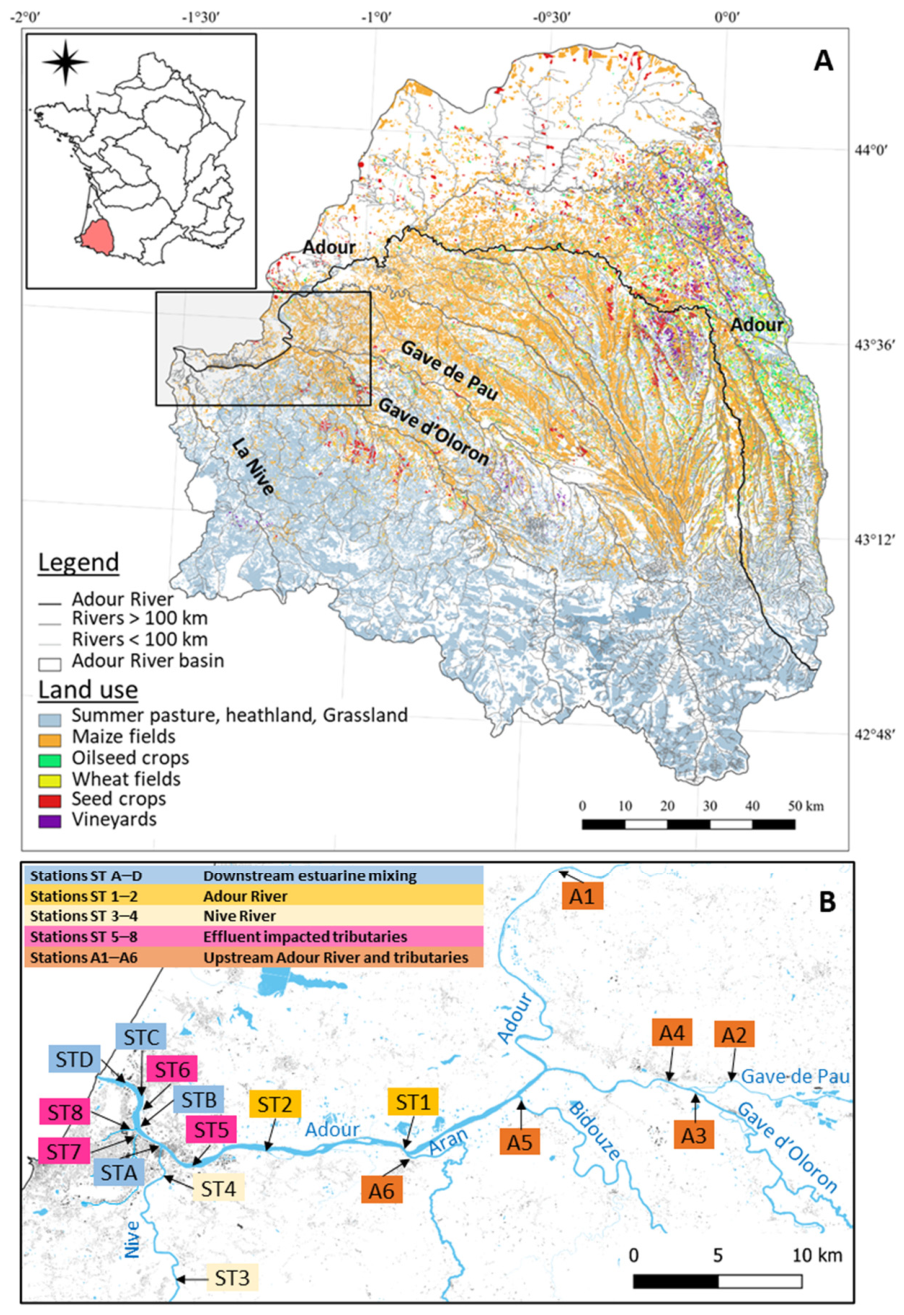
Figure 1. Maps of the Adour River estuary showing (A) the localization of the Adour River Basin in the French territory and major land uses within the area; (B) an enlarged view of the sampling sites for this study. Maps created with QGIS software (version 3.44.7) and the RPG (A) and TOPAGE (B) databases.
Water 18 01161 g001
Figure 2. Regression line (dashed) between nitrate and total dissolved Se (TDSe) concentrations in Adour (ST 1–2, diamond), Nive (ST 3–4, triangle), and additional upstream stations of May 2022 (A1–A6, square). Sampling dates correspond to May 2017 (orange), September 2017 (red), January 2018 (blue), and May 2022 (green). Mean values for wet deposition calculated from annual concentrations in the Adour watershed [22] and mean values for Pyrenean lakes calculated from concentrations reported in lakes in the Cauterets and Ayous areas located within the Adour Watershed [21].
Water 18 01161 g002
Figure 3. Distribution of dissolved selenium species among sampling dates. Data presented as the average and associated deviation for sampled stations at: (A) Adour River (ST 1–2), Nive River (ST 3–4), and estuarine waters (ST A–D); and (B) urban (ST 5–6) and industrial (ST 7–8) effluent-impacted waters. Color code: blue for selenite, gray for selenate and green for Se(-II+0).
Water 18 01161 g003
Figure 4. Evolution of TDSe (gray), Se(IV) (blue) and TVSe (orange) concentrations as a function of salinity: during tidal cycles at STB in September 2018 (darker circles and triangles) and in September 2017 (light-colored circles and triangles), and at Adour River (ST1-2) in September 2017 (light-colored diamonds). Numeric values indicate Pearson correlation coefficients with corresponding p-values, considering tidal cycle data.
Water 18 01161 g004
Table 1. Total selenium and selenium species concentration ranges (in ng L−1) in estuaries, including data from this study.
SiteTSe BulkTDSeSe(IV)Se(VI)Se(-II+0) 1Ref.
Adour River135–226123–19511–3144–12350–68This study
Nive River70–12271–92<3–1917–6024–63
Downstream waters84–24975–2039–2635–12042–73
Urban-impacted waters176–400126–337<3–3048–228<16–101
Industry-impacted waters379–802365–65622–49235–630<5–104
San Francisco Bay 59–381 248–3588–10417–195<1–196[4,7]
Rhône 47–3275–76 23–92 [5]
Kaoping 38–95 <5–2212–675–50 3[6]
Erhjen 32–110 <5–75<5–28 <5–40 3
Zhujiang 22–22547–257 [8]
Changjiang 158–553<0.2–2258–37943–130[9,10]
Notes: 1 Se(-II+0) fraction calculated as the difference TDSe—(Se(IV) + Se(VI)). 2 Bulk Se concentration calculated from concentrations of total dissolved and particulate selenium. 3 This fraction was determined as the organic selenium pool (preconcentrated with a C18 column at pH 8 and 3 as neutral/basic and acidic organic Se).
Table 2. Total volatile Se and volatile Se species in estuaries including data from this study.
SiteTVSeDMSeDMSeSDMDSeRef.
pg Se L−1
Adour River83–20846–14114–59<4–8This study
Nive River52–12121–10213–91<4–7
Downstream waters92–77557–17720–675<4–32
Urban-impacted waters204–237397–69346–16698–20
Industry-impacted waters433–221283–36080–206636–69
SiteTVSepg L1% DMSe% DMSeS% DMDSeRef.
Adour estuary average (n = 36)431 ± 53450 ± 2245 ± 234 ± 3This study
Rhine estuary37–242373%23%4%[31,32]
Scheldt estuary51–806784%12%4%
Gironde estuary22–135182%13%5%[13,31,32]
Seine estuary317–485594%4%3%[23]
Arcachon Bay30–42681%14%5%
Norway Bay12–15679%21%n.d. *
Note: * n.d.: not determined.
Disclaimer/Publisher’s Note: The statements, opinions and data contained in all publications are solely those of the individual author(s) and contributor(s) and not of MDPI and/or the editor(s). MDPI and/or the editor(s) disclaim responsibility for any injury to people or property resulting from any ideas, methods, instructions or products referred to in the content.