Article

Vertical Distribution of Different Types of Particulate Matter and Its Impact on Remote Sensing Estimation of Net Primary Productivity in the Oligotrophic Tropical Western Pacific Ocean


1
Laboratory of Marine Geology and Environment, Institute of Oceanology, Chinese Academy of Sciences, Qingdao 266071, China
2
Laboratory for Marine Geology, Qingdao Marine Science and Technology Center, Qingdao 266061, China
3
University of Chinese Academy of Sciences, Beijing 100049, China
4
College of Electronic and Information Engineering, Guangdong Ocean University, Zhanjiang 524088, China
*
Authors to whom correspondence should be addressed.
Water 2026, 18(10), 1116; https://doi.org/10.3390/w18101116
Submission received: 26 March 2026 / Revised: 3 May 2026 / Accepted: 5 May 2026 / Published: 7 May 2026
(This article belongs to the Section Oceans and Coastal Zones)

Abstract

The estimated spatiotemporal characteristics of particulate matter in the ocean vary with the measurement method used. This variation introduces considerable uncertainty in our understanding of how particle scattering cross-section, particle size, and carbon content relate to one another at local, regional, and global scales. A more accurate and detailed characterization of the spatiotemporal variations of particles in the water column and of the contribution of different types of particles to the optical parameters of water are crucial for improving our understanding of the marine biogeochemical cycle. In this study, we investigated how composition, size, and particulate organic carbon (POC) content of particulate matter, along with their corresponding optical proxies, change in the upper 200 m of an oligotrophic region in the tropical Western Pacific Ocean. We estimated the contributions of various water components to the particle backscattering coefficient and to POC. Using newly collected, vertically resolved data, we derived depth-resolved net primary productivity (NPP) with the absorption-based production model (AbPM) and the carbon-based production model (CbPM); both models account for vertical variations in water column properties. Our results indicated that particles larger than 8 µm (especially minerals and aggregates) accounted for an increasing amount of POC at depths greater than 100 m, with a maximum at 500 m. In contrast, chlorophyll content decreased steadily with depth. Our comparison of the backscatter and absorption coefficients (optical proxies of POC) had the same trend, although the specific components that contributed to POC were different. Changes in parameters such as particle composition, size, POC content, and their optical proxies all corresponded to changes in the deep chlorophyll maximum (DCM) along the latitudinal gradient. When we compared the NPP estimates from the two approaches, the CbPM yielded higher values than the AbPM in surface waters, likely because of the way particles are distributed vertically. In areas where the DCM was deeper, the AbPM provided a better accounting of how individual components contributed to the NPP. Together, these findings clarify how particle composition and its vertical variability influence POC and inherent optical properties (IOPs) in this oligotrophic region. They also offer a basis for interpreting water column characteristics and assessing how changes in NPP may affect biogeochemical processes.

1. Introduction

The particulate matter in oceanic waters plays a crucial role in the biological carbon cycle because it can facilitate the transfer of carbon from the surface to the deep sea and thereby decrease the level of atmospheric CO2 [1,2]. This particulate matter includes mineral particles, various microorganisms (viruses, bacteria, phytoplankton, and zooplankton), and biological detritus (fragments of organisms and feces) whose concentration, size, and composition vary in space and time [3,4]. Identifying the vertical distributions in the concentration, size, and composition of different types of particulate matter is essential for making accurate estimates of the global carbon flux [5,6,7,8,9].
Changes in the particle composition of the upper ocean layers can also alter its optical properties [10,11]. Thus, measurements of the inherent optical properties (IOPs) of the ocean can provide important information about the dynamics and distributions of ocean particles from the surface to the interior of the ocean [12,13,14]. The continuing improvements in the resolution of in situ and remote sensing instruments that are used to measure the optical parameters of ocean waters have not only provided significant information about key biogeochemical parameters, such as particulate organic carbon (POC) [15,16,17,18], but have also enabled more reliable estimates of carbon flux at scales beyond the reach of traditional discrete water sampling or autonomous platforms [19,20,21].
However, spatiotemporal variations in the size, shape, and chemical composition of phytoplankton and the different methods used to measure POC and particle size distribution (PSD) [3,22,23] have led to considerable uncertainty about the relationship of the particle scattering cross-section with the size and carbon content of particles at local, regional, and global scales [2,24,25]. For several decades, researchers have examined the relationship of particle size, shape, morphology, and internal structure on light attenuation and backscatter [15,26,27,28], and the relationship of POC with attenuation and backscatter [17,29,30]. Because of the continuing improvement in observational techniques, measurements of optical parameters in the open ocean have changed from measurements of scattering by particles larger than the wavelength of light (>1 μm) [31,32] to measuring particles with diameters less than 8 μm. Particles smaller than 1 μm are considered responsible for most of the backscatter [33], with those smaller than 0.5 μm contributing approximately 30–40% of the total backscatter [34]. Particles larger than 20 μm are mainly responsible for absorption. However, the optical properties of water and changes in carbon content due to particulate matter depend on geographic region, season, location in the water column, and the diel vertical migration of organisms [10,28,35,36]. The organic and inorganic components of microorganisms change throughout their life cycles, and are also affected by diffusion [37], the mixed-layer pump [38], and mesoscale processes such as cyclonic eddies [39]. Therefore, a more comprehensive understanding of the effect of different water particles on different optical parameters and determination of the distribution of these particles in the water column and their seasonal and diel variations are crucial for advancing our understanding of marine biogeochemical cycles.
The backscatter coefficient of particulate matter (bbp) is often used to estimate phytoplankton carbon biomass (Cphyto) [18,23]. The bbp is influenced by cell size and composition and by non-algal particles (NAP) [10,11,40,41]. Although it is impossible to monitor specific phytoplankton taxa in situ, studies of laboratory cultures and field observations have clarified the relationship of cell size with the backscatter ratio and cross-section, the primary and secondary contributions of bacteria and nanoeukaryotes to backscatter [24,35], the strong ecological niche partitioning of Prochlorococcus and Synechococcus in vertical profiles and their seasonal dynamics, and the role of NAP on backscatter [13,28]. A limitation is that phytoplankton can accumulate below the sea surface, such as in deep mixed layers and under ice [42], and satellites cannot easily record their vertical stratification under these conditions.
Permanently stratified water bodies have the greatest new production (introduction of organic matter from external sources) in the lower part of the euphotic zone (~150 to 200 m). Although production from primary producers is significantly lower in this region than in the upper layers [43], it may be sufficient to sustain the upper trophic levels and the export of organic matter. Moreover, in these oligotrophic regions, the variability in total primary productivity (PP) is unrelated to the size structure of the phytoplankton community [44]. Instead, changes in PP are due to the dynamics of the microbial community and the relative contributions of Synechococcus and microeukaryotes to the Cphyto [45,46]. The proportion of phytoplankton in POC is also smaller in the lower part of the euphotic zone than in areas with high primary production because it is an oligotrophic community with a dominance of nonphotosynthetic species. This overall community consists of species in the turbulent mixed layer of the upper ocean—which are observable by satellite measurements of visible radiation—and species below the mixed layer, in a stable and stratified environment—which are not observable by satellites [28,47,48]. These two regions have different phytoplankton assemblages [49,50]. The biological pump processes that occur at the surface of mixed water bodies decrease the depth of the deep chlorophyll maximum (DCM) in permanently stratified water bodies [14,38,51,52], and the characteristics of this region differ from those at the surface, as indicated by greater variability in the optical proxy for Cphyto [18,23]. Although these oligotrophic regions have low levels of nutrients in the euphotic zone, low Cphyto, and low primary production throughout the year, they make significant contributions to global marine primary production because of their large expanse [53,54].
We examined subtropical gyres at low latitudes in the tropical Western Pacific Ocean. This oligotrophic region is one of the most complex hydrographic regions in the world because equatorial currents and western boundary currents affect surface circulation [55,56,57]. A 1979 study examined a prominent DCM layer that developed between depths of 65 and 150 m and showed that the suspended particles around the DCM had more phytoplankton than the upper layers. Autotrophic eukaryotes near the surface and at the DCM accounted for most of the POC, and prokaryotic picoplankton accounted for much less (6.3 to 14.9%) [58]. There is also a latitudinal gradient of the POC in this region, with lower levels at low latitudes based on a winter survey in 2021 [59]. Previous studies showed that the POC content of oligotrophic waters was spatially heterogeneous and related to the chlorophyll concentration and additional local factors. To improve our understanding of marine biogeochemical cycles in this region, it is necessary to characterize the detailed spatiotemporal variation of particles in water columns and explore the influence of particle composition on different optical parameters, as well as their impact on primary productivity.
We analyzed the spatiotemporal and vertical variations in the characteristics of particulate matter (composition, size, POC, and optical proxies) in the water column at different stations in the tropical Western Pacific Ocean. We then estimated the contribution of each component of the water body on the particulate bbp and POC, and examined spatiotemporal variations in vertical distribution using our own data and data from the Biogeochemical Argo profile (BGC-Argo). These data allowed us to characterize the composition optical properties of different POCs. Furthermore, different models were used to estimate the stratified NPP of the water column. The changes in the composition of water column particles and their optical parameters with depth were investigated as well as their impact on the estimation of NPP.
For convenience, a complete list of abbreviations is provided in the Abbreviations section at the end of the manuscript.

2. Materials and Methods

2.1. Field Measurements

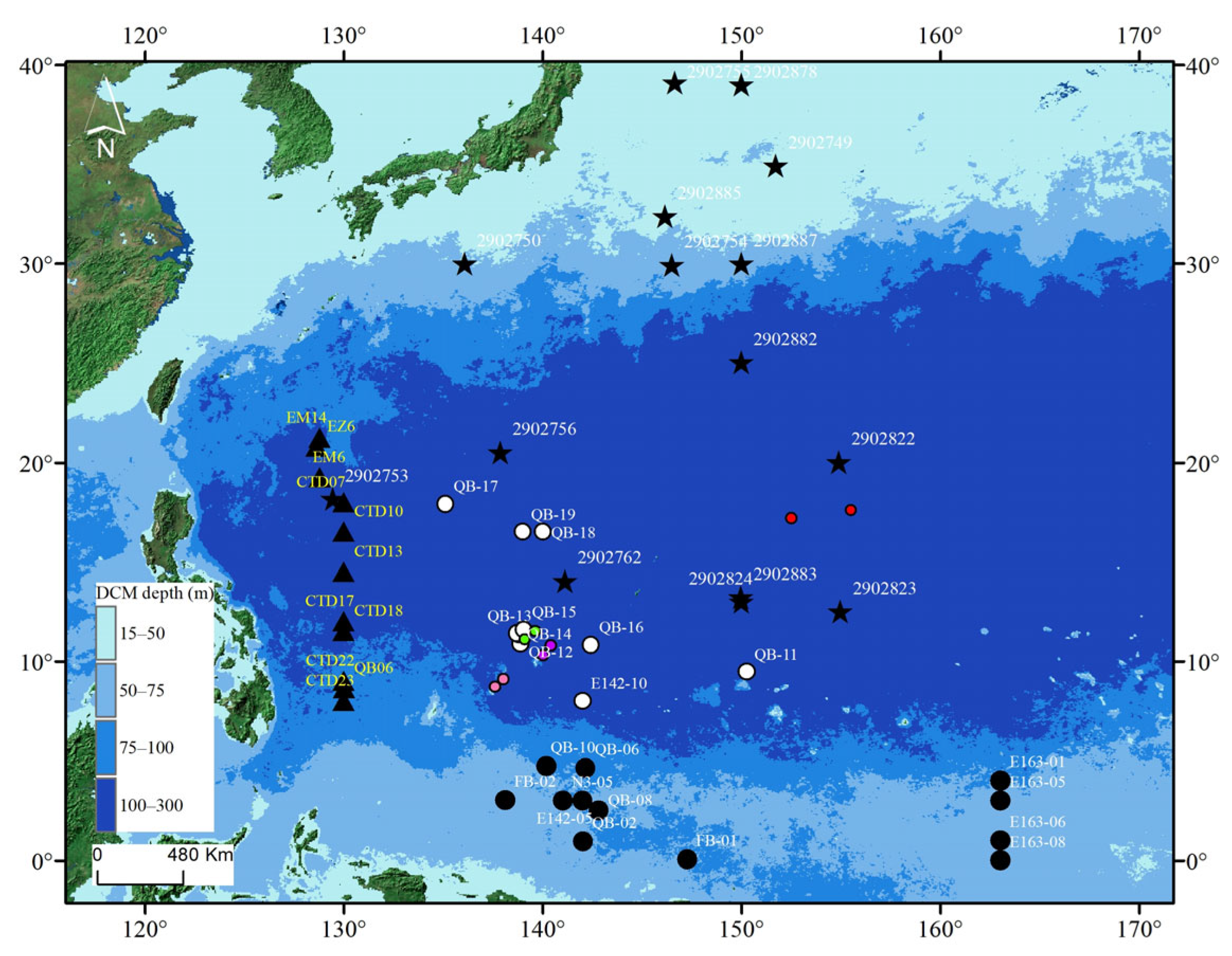
From December 2014 to May 2021, the Institute of Oceanology of the Chinese Academy of Sciences organized several expeditions of the Kexue Research Vessel in the Philippine Sea and adjacent waters (0° to 21° N, 126° to 163° E) of the tropical Western Pacific Ocean. Field studies and discrete sampling included measurements of spectral IOPs, chlorophyll a (Chl-a), PSD, and POC at 33 stations, and microalgal plankton at 102 stations [60] (Figure 1). Previous studies [54,61] have shown that the DCM in this region maintains consistent depth patterns across different years, with latitudinal gradients being more pronounced than interannual variations. Therefore, while some interannual variability may exist, it does not significantly affect the general vertical patterns of particle distribution and optical properties that form the core focus of this study. The BGC-Argo data were used here to provide broader temporal and deeper vertical context, rather than for direct point-by-point validation against the ship-based measurements.
The total bbp values were measured at six wavelengths (442, 488, 550, 620, 700, and 852 nm) using a HydroScat-6P (Hobi Labs, Bellevue, WA, USA), PSD was measured using the laser diffraction particle analyzer (LISST-100X Type C, Sequoia Scientific, Inc., Bellevue, WA, USA), and size ranges were plotted on a logarithmic scale ranging from 2.72 to 500 µm for analysis. Continuous vertical profiles were obtained using the HydroScat-6 and LISST instruments deployed at a speed of approximately 0.5 m/s. The specific procedures used for field measurements and data processing have been described by Liu et al. [61]. These continuous measurements provided high-resolution depth profiles (approximately 1 m vertical resolution) of optical parameters and particle size distributions throughout the water column. The continuous profiles complement the discrete sampling by capturing fine-scale variations between the fixed depth levels (5, 25, 50, 75, 100, 150, and 200 m) and allow for the characterization of vertical gradients, particularly around the DCM layer. The continuous data were averaged into 1 m depth bins for analysis and used to construct the detailed vertical profiles. Discrete water samples (4 L) were collected at seven depths (5, 25, 50, 75, 100, 150, and 200 m) using Niskin bottles (Sea-Bird Electronics, Inc., Bellevue, WA, USA) that were mounted on a rosette sampler attached to the Sea-bird SBE911 CTD (Sea-Bird Electronics, Inc., Bellevue, WA, USA). Each sample was passed through a 25 mm Whatman GF/F filter (pore size: 0.7 µm) (Whatman, Inc., Kent, UK) at low vacuum pressure and then stored in a Petri dish at −80 °C prior to the analysis of POC, particulate absorption, Chl-a, and picoplankton groups. The picoplankton groups (photosynthetic Synechococcus [SYN], Prochlorococcus [PRO], picoeukaryotes [PEUK], nanoeukaryotes [NEUK], and heterotrophic prokaryotes [HP]) were determined using a fluorescence-activated cell sorter (FACS Jazz flow cytometer, Becton Dickinson, Franklin Lakes, NJ, USA) with a protocol adapted from [62]. More detailed descriptions of the procedures used for sample processing have been described by Zhao et al. [60] and Liu et al. [61].
The POC samples were collected on pre-combusted filters (450 °C for 4–6 h). After filtration, the filters were rinsed with pre-prepared artificial seawater to remove residual dissolved organic carbon (DOC) and stored prior to subsequent analysis in the laboratory by combustion of the filters [63]. Before analysis, inorganic carbon was removed by applying 0.25 mL of 10% HCl to each filter, drying at 55 °C, and then exposing the filters to concentrated HCl vapor in a desiccator for 48 h. The POC level was then determined using a Vario ELIII CHNOS Elemental Analyzer (Elementar Analysensysteme GmbH, Hamburg, Germany). The analytical precision (%CV) of this method was estimated at about 4% based on three measurements of the same samples.

2.2. Data Processing

2.2.1. Size-Partitioned Cphyto

The total Cphyto was calculated from the volume-to-carbon relationships for morphologically different dinoflagellates, diatoms, and other protist groups compiled by MDL2000 [30,64,65,66,67,68]. The volume percentage content of each class was computed by multiplying the number of particles per unit volume by the diameter of a volume-equivalent sphere at the midpoint of the class [69,70,71]. The number of living Cphyto in a size class was then estimated by multiplication [65]. The distribution function describing the number of particles per unit volume within each size class of suspended particulate matter was obtained from the LISST survey. The phytoplankton was classified into four size groups: picoplankton (0.7 to 2 µm), nanoplankton (2 to 20 µm), microplankton (20 to 200 µm), and mesoplankton (200 to 500 µm).

2.2.2. Contributions of Particulate Matter to bbp

The total backscatter was simulated as the sum of the backscatter from water and the backscatter by particles [26,72]. The particulate backscatter in the water column was defined as the sum of the products of the backscatter cross-section and the total carbon biomass of each sample of detritus and plankton [18,35].
The water column particulate matter was first divided into algae and NAP, and then the contribution of the two components to the backscattering of particulate matter was analyzed [26,73]. The backscatter cross-section values for each type of plankton was obtained from Stramski et al. [40], who measured cross-sections for several species (heterotrophic bacteria, SYN, PRO, PEUK, etc.) at wavelengths between 350 and 750 nm. For biological detritus and minerals, the backscatter cross-sections were from Stramski et al. [40]. The biomasses of several plankton species were from Zhao et al. [60] and Zhao [74]. The abundance of total suspended particles, biological detritus, minerals, and aggregate particles were from Shi et al. [75].

2.2.3. Estimation of NPP in Stratified Water Columns

To study the influence of vertical variations in the optical properties in the water column on the remote sensing estimation of NPP, we selected the carbon-based production model (CbPM) and absorption-based production model (AbPM) to estimate the stratified NPP profiles of the water column based on the stratification characteristics of oceanic water in oligotrophic sea areas. The calculation process begins with the application of the Gaussian function fitting method to reconstruct the vertical profile of surface chlorophyll concentration obtained from satellite remote sensing. The physically meaningful vertical profile of chlorophyll concentration is then optimized through the nonlinear least squares method and verified with measured data. The Hydrolight (Hydrolight-Ecolight 5.0) radiative transfer model was used to numerically simulate the underwater light field. The depth-resolved diffuse attenuation coefficient of downwelling irradiance (Kd(z, λ)), photosynthetically active radiation (PAR(z)), particle backscattering coefficients (bbp(z, λ)), phytoplankton absorption coefficient (aph(z, λ)), and the euphotic zone depth (Zeu) were simulated. The carbon content of phytoplankton in the water column was calculated based on the relationship between the backscattering coefficient and the vertical distribution of POC and was compared to and verified with the measured backscattering coefficient and absorption coefficient. Finally, the above optical parameters were input into the CbPM and AbPM primary productivity models to achieve the vertical refinement estimation of the water column integrated net primary productivity (iNPP). The detailed calculation process can be found in Sections S3 and S6 of the Supplementary Materials. The validation of the Gaussian-fitted Chl-a profiles against the in situ data is shown in Figure S1. The simulated IOPs and AOPs from Hydrolight showed good agreement with the in situ measurements (Figures S2–S4, Table S1).

2.2.4. Statistical Analyses

Some indicators were used to assess the performance of the developed models in this study, including the determination coefficient (R2) and root mean square error (RMSE); all R coefficients were statistically significant (p < 0.01). The model performance was evaluated by calculating the systematic error in logarithmic space, as follows:
B i a s = m e d i a n ( log 10 ( y i ) log 10 ( x i ) )
R M S E = i = 1 n ( x i y i ) 2 n .
where n is the number of samples, xi is the measured value, and yi is the estimated value.

2.2.5. Sensitivity Analysis

The 21 in situ measured data were used in the Monte Carlo sensitivity analysis to evaluate the accuracy and robustness of AbPM and CbPM under the input uncertainty based on MODIS data. Two metrics were computed from the deviation of each perturbed iNPP estimate relative to the in situ reference, as follows:
R M S R E = 1 N i = 1 N ( N P P i N P P r e f N P P r e f ) 2 × 100 %
S t d _ B i a s = std ( N P P i N P P r e f N P P r e f ) × 100 %
RMSRE reflects the combined accuracy and sensitivity under input uncertainty (smaller values indicate better performance). Std_Bias reflects robustness to random input noise. The specific results of the sensitivity analysis can be found in the Supplementary Materials.

3. Results

3.1. Vertical Distribution of Different Types of Suspended Particulate Matter

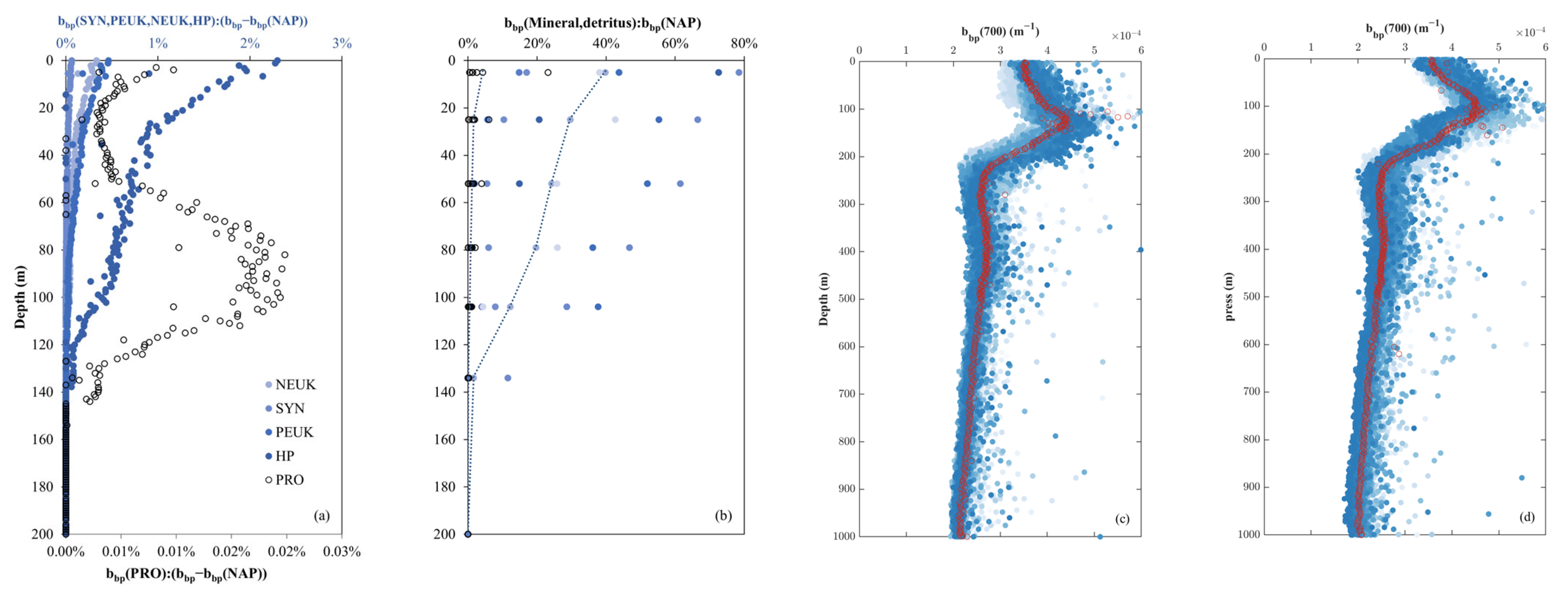
From 2014 to 2019, we examined seasonal changes in the vertical distribution of different groups of autotrophic picoplankton [60]. The 15 stations for the winter survey were in seasonally stratified regions, and the stations for the other three seasons were in permanently stratified regions. Overall, the results indicate that the chlorophyll maximum was in relatively shallow water (upper 100 m) during winter, and extended below 100 m during other seasons. Among the autotrophic picoplankton, SYN had a high abundance in the upper 100 m (above the DCM), PRO and PEUK had high abundance near the DCM, and NEUK and HP had wider distributions, with high abundances at the surface layer and the DCM layer. Among all groups, PEUK accounted for more than 45% of the biomass in the top layer (above the DCM) and PRO accounted for more than 50% of the biomass near the DCM. The biomass of PRO was greatest in the DCM layer. In addition, the proportion of HP in the water column was higher than that of autotrophic plankton, and it gradually decreased with depth [60].
Scanning electron microscopy of the total suspended particulates (consisting of biological detritus, minerals, aggregates) showed that mineral particles were most abundant (2.5 × 10⁵ particles/L) at a depth of 500 m, followed by aggregates (1.2 × 10⁵ particles/L) also at 500 m [75]. Overall, biological detritus had the lowest abundance, and its maximum was 0.6 × 10⁵ particles/L near the surface. The amount of biological detritus decreased to less than 0.2 × 10⁵ particles/L at 150 m, and did not change significantly at greater depths. For each type of particle, there was no statistically significant vertical variation in abundance from the surface to a depth of 150 m. However, the abundances of mineral particles and aggregates gradually increased at 150 m, reached maxima at 500 m, and then gradually decreased at depths of 1000 m and more. The vertical variation of total suspended particulates was similar to that of minerals (the most abundant particle).
The contribution of HP to the backscattering of algae in autotrophic microorganisms was two orders of magnitude higher than that of other types. PRO mainly contributed to the backscattering of algae in the DCM layer, followed by PEUK > NEUK > SYN, among which SYN had the smallest contribution, about one order of magnitude lower. In NAP, mineral particles contributed the most, higher than detritus, with the highest proportion reaching 80%. From the ultra-oligotrophic area with DCM > 100 m to the area with DCM < 100 m, the contribution of algae to backscattering gradually decreased, while that of non-algae gradually increased (Figure 2a,b). Based on the BGC-Argo data, during the investigation period (from April 2020 to April 2021), the high-value area of NAP near 500 m did not significantly contribute to the backscattering of particles (Figure 2c,d).

3.2. Vertical Distribution of Suspended Particles with Different Sizes

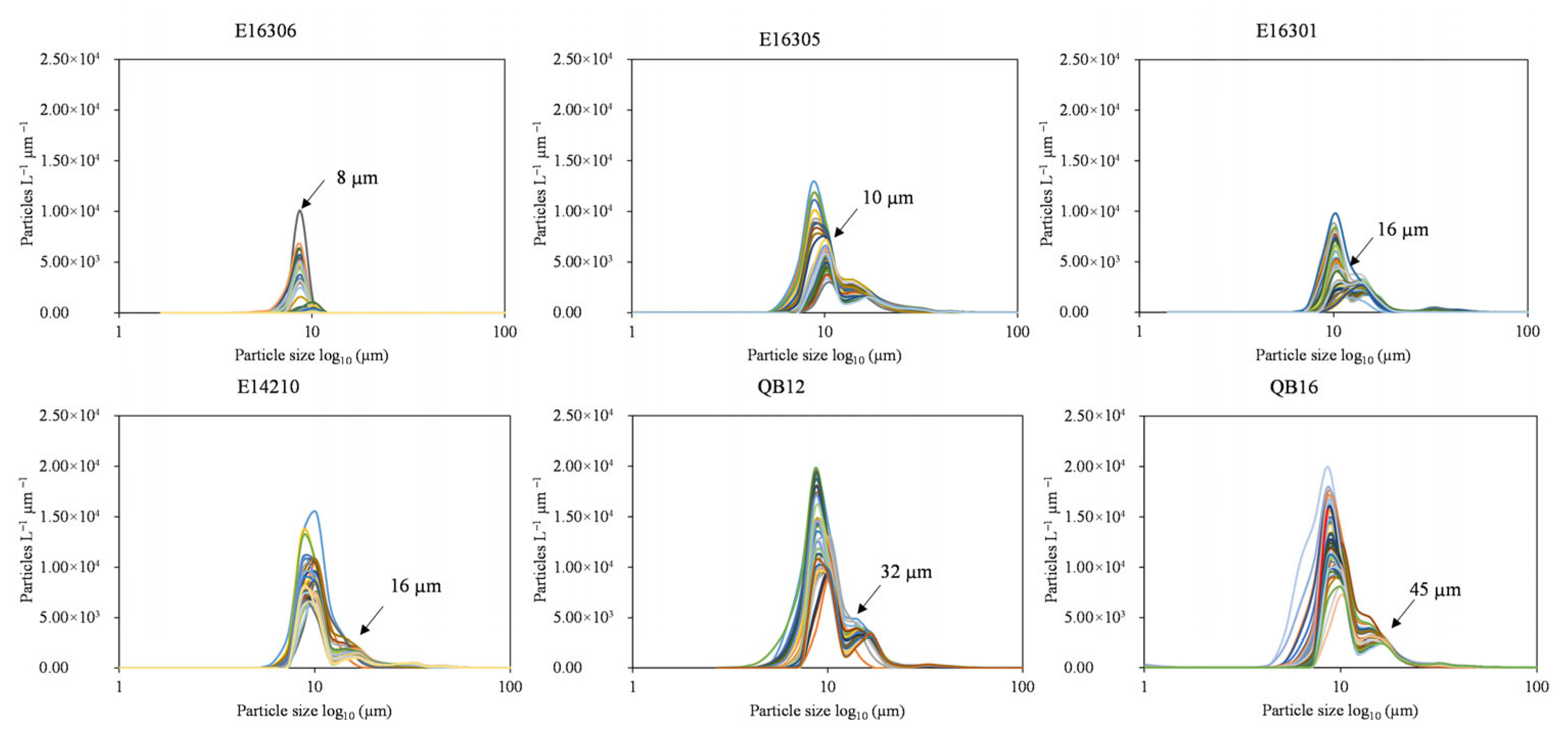
We used data from LISST to measure the vertical distribution of particulate matter in different size groups in the ultra-oligotrophic and permanently stratified waters at six stations that had different levels of Chl-a (Figure 3). The upper layer was mainly composed of submicron particles (particles smaller than 1 μm). As depth increased, particles of about 8 μm were most predominant. For depths greater than 150 m, there were peaks at 10 μm, 16 μm, 32 μm, and 45 μm. In general, stations with a higher level of Chl-a had smaller particles, and particle size increased as the number of particles increased (Figure 3).
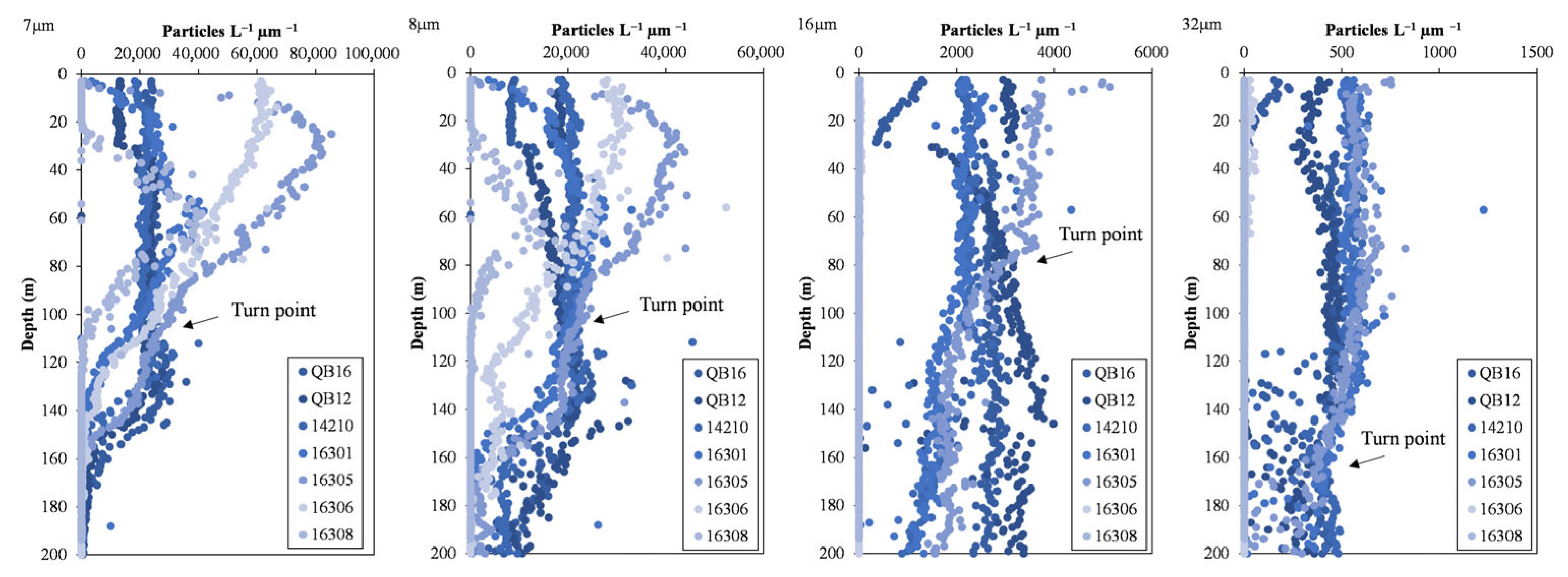
We then analyzed the vertical distribution of particles in four size groups (7, 8, 16, and 32 µm) at seven stations that had different DCM depths (Figure 4). In this figure, a darker blue color indicates a station with a greater DCM depth (as in the background color of Figure 1). In general, the smallest particles (7 and 8 µm) were most abundant at the upper and middle layers, and less abundant at greater depths. In contrast, the larger particles (16 and 32 µm) had a more even distribution from the surface to 200 m. At the stations with a shallower DCM, the smaller particles (7 µm and 8 µm) were more abundant in the surface layer. However, at stations with a greater DCM, the distribution of small particles in the upper and middle layers was relatively uniform and their content was relatively low, only one-third of that at the stations with a shallow DCM. However, between 100 m and 160 m in depth, their content was twice that of the stations with a shallow DCM. This feature was not significant as the particle size increased. These vertical variations were not obvious for particles smaller than 2 µm and particles larger than 100 µm.
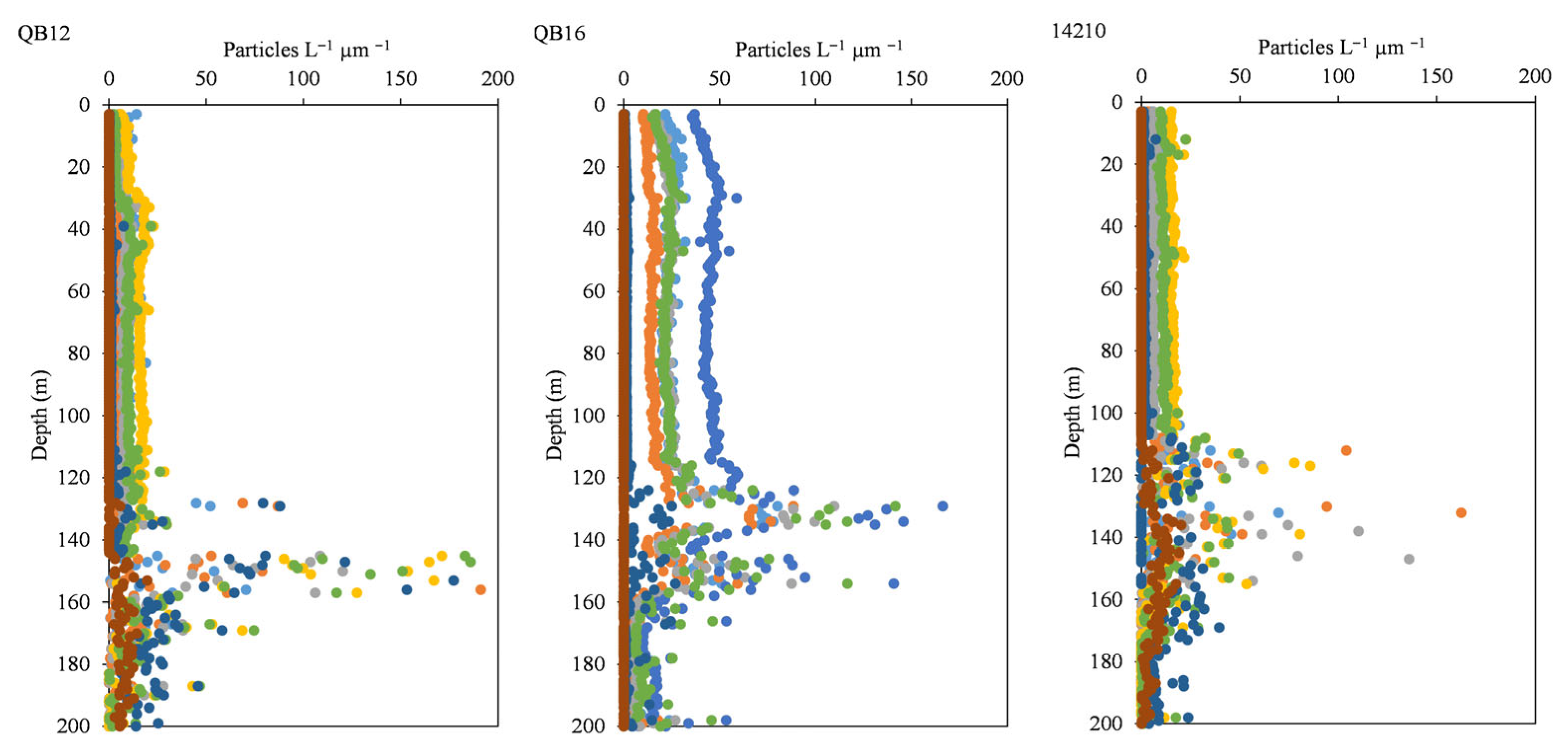
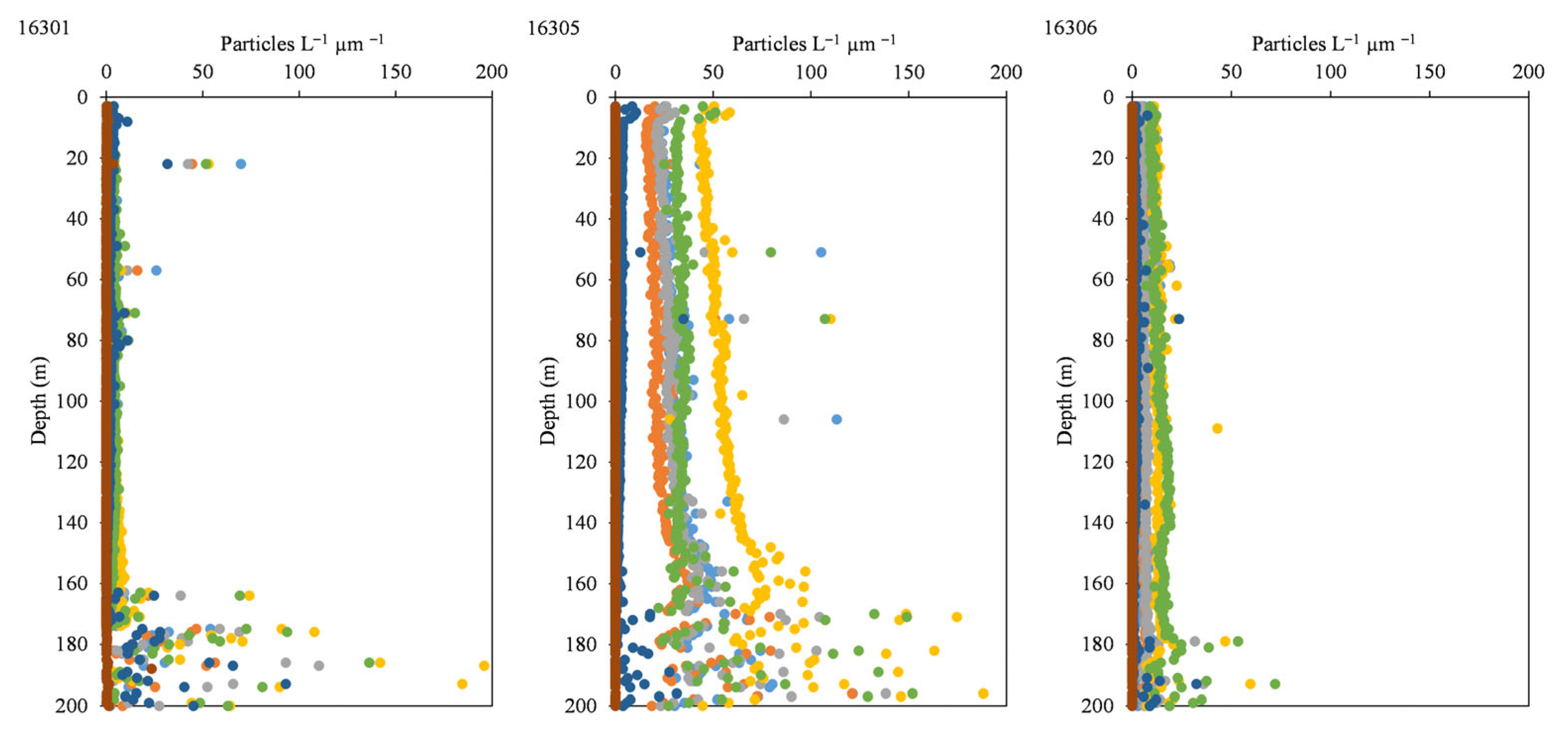
In addition, our analysis of large particles (170 µm to 460 µm) at three ultra-oligotrophic stations that had a deep DCM indicated that there were peaks in the DCM layer (Figure 5, top). In contrast, three other stations in which the DCM was not as deep mainly had large particles below 150 m and did not overlap the DCM layer.

3.3. Vertical Distribution of Carbon in Phytoplankton

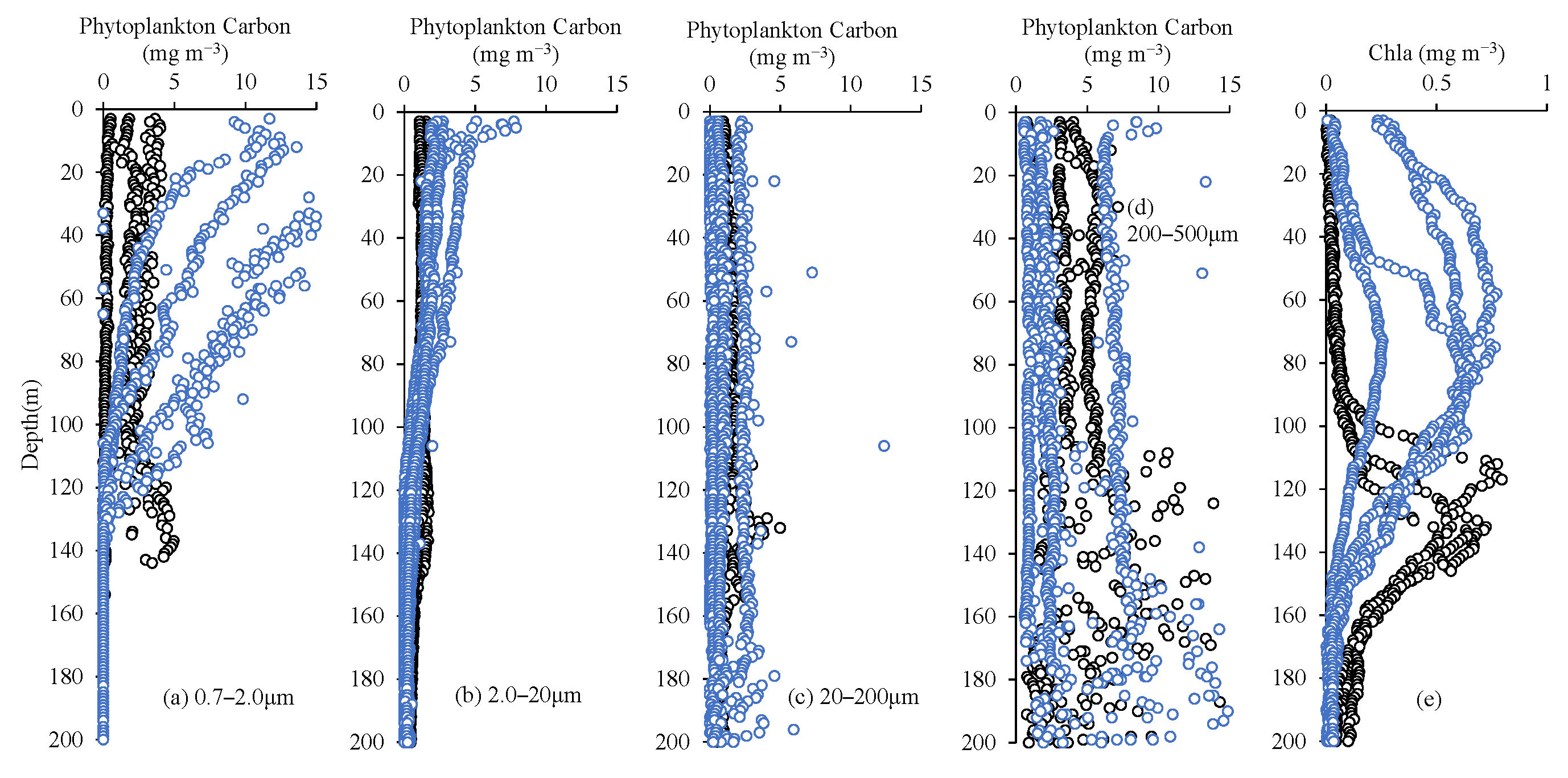
We then examined the effect of depth on the Cphyto in four different size groups and on the total Chl-a (Figure 6), with extrapolation of particles to 0.7 µm based on the allometric relationship between phytoplankton volume and carbon content. Due to the uncertainty of LISST measurements, the particle size range of suspended particulates was extrapolated to 500 µm, and the phytoplankton carbon content was estimated [34,74].
The results show that the carbon contribution of the smallest group was greatest in regions when the DCM was above 100 m. This contribution decreased markedly with depth and was close to 0 below the DCM. However, when the DCM was deeper than 100 m, the carbon content of the smallest phytoplankton decreased slightly with depth. Overall, the contribution of these small particles and the largest particles (200 to 500 µm) were greater than for the other two groups. In addition, estimation of phytoplankton carbon content by LISST demonstrated that the largest group had a greater carbon content in water below the DCM.
We also analyzed the effect of depth on the Cphyto/POC ratio of phytoplankton in the same four size groups. The contribution of the smallest phytoplankton at the surface layer was 30% on average, and the contribution of the largest particles at 150 m was also about 30%. Particles in the other two groups contributed much less to the POC. Interestingly, when we fit these data to exponential equations, the exponent was positive for the 20 to 200 µm group but negative for the three other groups.

3.4. Vertical Variation of Particulate Carbon Optical Proxies

POC can also be estimated by optical measurements from remote sensing or in situ data collection to determine the distribution of POC at larger scales [43,76,77,78,79,80]. The particulate matter attenuation coefficient usually has a linear correlation with the concentration of POC [81,82,83], although some studies have reported different relationships in certain regions [54,84]. Variations in the relationship between the POC and bbp of particles in marine environments may be due to spatial variability in the composition of POC. We identified a general linear relationship between the bbp of particles and POC, and found that this correlation was more significant in waters with a DCM above 100 m. Moreover, we found that the decrease in the POC/bbp(700) ratio with depth was not significant when the DCM was below 100 m. In this case, the higher POC/bbp(700) ratio in shallow water was mainly due to a higher level of POC, but these particles did not affect bbp(700), especially when the DCM was above 100 m. At a depth of 200 m, the ratio was the largest and higher than that at the surface. Our analysis of particle composition showed that particles in this region were mainly in the range of 170 to 460 µm, there were relatively few particles, and these particles were mainly minerals and aggregates (Figure 5). The POC/Chl-a ratio increased from 150 to 200 m, and was much greater at 200 m than at the surface. This indicates that POC mainly consisted of particles that did not contain Chl-a. This pattern also occurred when the DCM was deeper than 100 m. Thus, the POC/bbp(700) ratio and the POC/Chl-a ratio both increased at depths greater than 150 m, and their values were comparable to those at the surface. However, the distribution of large particles (170 to 460 µm) was consistent with the distribution of the DCM, with a peak near 150 m (Figure 5).
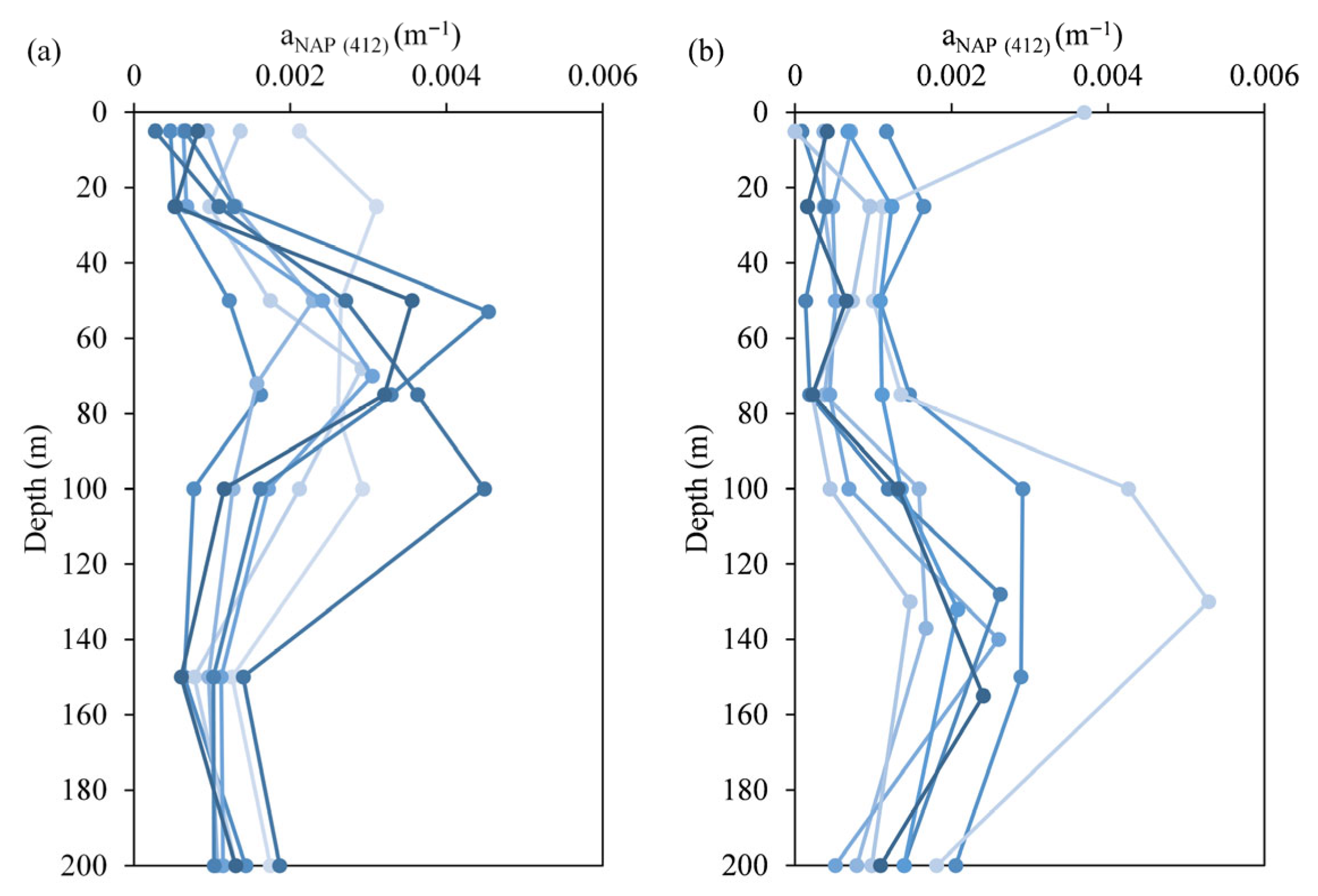
Based on these results, we can infer that minerals and aggregates that reached their maxima at a depth of 150 m to 500 m accounted for most of the POC in this region. However, the bbp was unaffected by these particles. We also analyzed the effect of depth on changes in the absorption coefficient of non-algal particulates, aNAP(412), from simultaneous measurements (Figure 7). When the DCM was less than 100 m, the absorption of non-algal particles in water below 150 m only had a very slight increase. This is consistent with previous studies that reported that particles larger than 20 µm mainly contributed to absorption [31,33,34,85]. However, due to the low abundance of large particles, their contribution to the total absorption coefficient was small, and there were no large changes in the total absorption coefficient. Therefore, backscatter and attenuation as optical proxies for POC only represent the same trend, but reflect different components contributing to POC.
Optical proxies are often used to estimate the different components of the POC because they are easier to measure. We therefore examined the relationship between the POC and bbp for stations with a DCM above 100 m, below 100 m, and all stations together. In each case, there was a significantly positive correlation between these two variables. In addition, the R2 was greater for stations with a DMC above 100 m (R2 = 0.85) than for stations with a DCM below 100 m (R2 = 0.50).
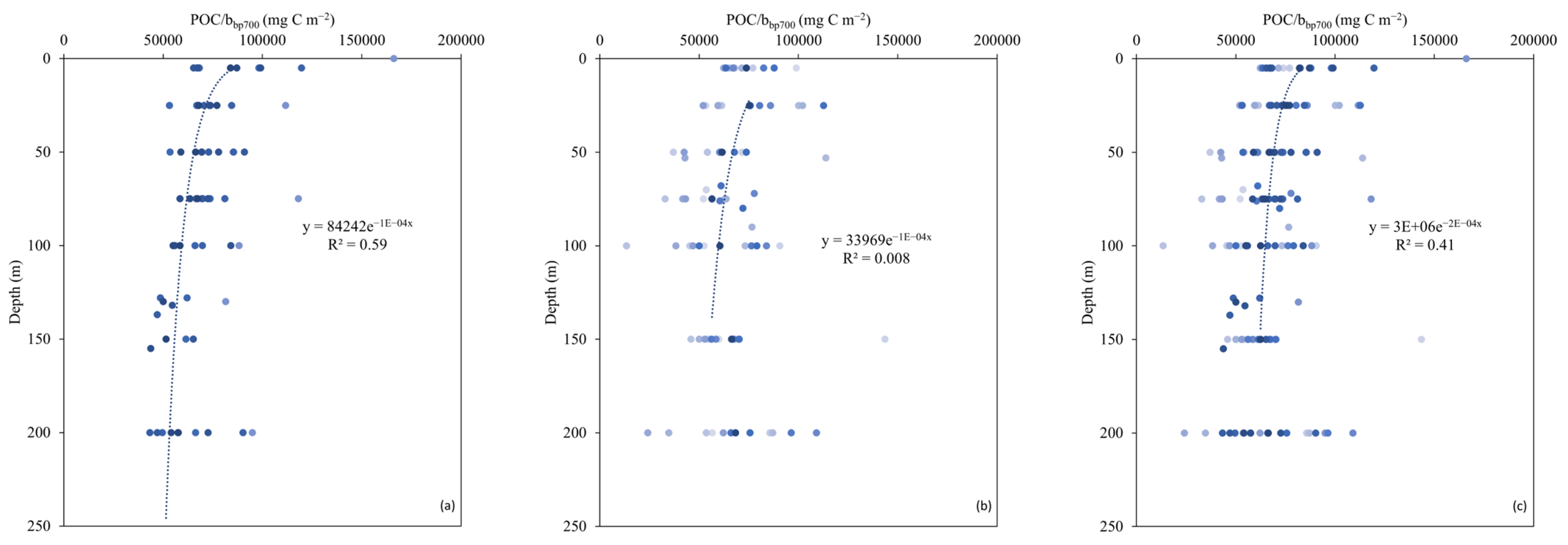
Galí et al. [17] previously reported that the POC/bbp(700) ratio decreased exponentially with depth. We therefore determined this relationship at our study site (Figure 8). This relationship was also present in stations with a DCM above 100 m (R2 = 0.59), but not in stations with a DCM below 100 m (R2 = 0.01), as the POC and bbp(700) had little vertical change from the surface to 150 m.

4. Discussion

4.1. Vertical Characteristics of Suspended Particle Components and Particulate Carbon

Previous studies of the vertical distribution of POC in oceans throughout the world have shown that the concentration decreases exponentially below the isolume, and that the upper region of the isolume may have a POC maximum due to the presence of photosynthetic plankton [86]. However, the present study of an oligotrophic oceanic area showed that there was no subsurface maximum POC, regardless of DCM depth.
Flow cytometry studies showed that particulate matter in water above the DCM layer mainly consisted of submicron particles, especially SYN, PEUK, and HP, and the DCM layer itself had a greater abundance of PRO and NEUK [74]. This result is consistent with a previous study that identified niche partitioning between PRO and SYN in the depth profile [13]. PEUK accounts for more than 45% of POC in water above the DCM, and PRO accounts for more than 50% of POC in the DCM layer [75]. Our scanning electron microscopy analysis showed that mineral particles and aggregates, followed by biological detritus, were the main particles in the upper water; LISST measurements showed that submicron particles had an even greater abundance, although these very small particles did not account for a significant part of the total POC.
For water below the DCM layer, the particulates were mostly larger than 8 μm (Figure 3). The abundance of biological detritus gradually decreased with depth, but mineral particles and aggregates gradually increased with depth and reached maxima at a depth of 500 m. This may indicate the characteristics of the deep-sea scattering layer formed by the diurnal migration of zooplankton [57]. Correspondingly, the concentration of POC decreased gradually from 100 m to 200 m. A previous study reported a slight increase in POC at a depth of 500 m [87,88]. Thus, mineral and aggregate particles made the greatest contribution to the POC at the surface and at 200 m, consistent with our measurements of the POC/Chl-a ratio. The results of the LISST survey also showed that when the DCM was above 100 m, particles larger than 100 μm mainly occurred at a depth of 150 m to 200 m; when the DCM was below 100 m, these particles were generally deeper (Figure 3).
We found that as the depth increased, the number of particles gradually decreased and the particle size gradually increased (Figure 4). The vertical distribution of Cphyto according to the size showed that larger particles made a greater contribution as depth increased (Figure 6). Therefore, submicron particles of microplankton contributed more to the POC in shallow water, and minerals and aggregate particles contributed more to the POC in deep water (Figure 4 and Figure 5).

4.2. Spatial Variations of Suspended Particle Components

In our study area, the vertical characteristics of optical and environmental indicators at each station were related to the distribution of the DCM [54,89]. The depth of the DCM gradually increased, and its intensity gradually weakened from the high-latitude eutrophic region to the low-latitude oligotrophic region [90]. The dynamics and the process of phytoplankton acclimation to light may affect the formation of the DCM [54,89,91,92]. Thus, the ecological preferences of different phytoplankton within the DCM and the balance between light and nutrients are responsible for differences in the depth of the DCM and the deep biomass maximum (DBM), and these differences are also reflected in the vertical distribution of IOPs.
Our study area was in a latitudinal transition zone from eutrophic to oligotrophic waters (Figure 1), and the DCM became deeper as the water became more oligotrophic [89,92]. Seasonal variations affect the depth and intensity of the DCM, but changes in the latitudinal gradient do not vary with the seasons. Analysis of data from the BGC-Argo stations in this area showed that the bbp had a similar trend as the DCM: decreased depth and intensity with latitude. However, the peaks of these two measurements did not overlap; the bbp peak was slightly shallower than the DCM peak [61]. Moreover, the vertical changes and simulations of particles [61] indicated that particles that were 10 to 20 μm in size contributed significantly to the bbp in the study area. The contributions of particles in other size ranges were significantly different for stations with a shallow DCM (<100 m) and a deep DCM (>100 m). In the most oligotrophic area (deep DCM), particles smaller than 2 μm made a relatively small contribution to the POC, but large particles (20 to 200 μm) made a large contribution. However, due to their low abundance, the total backscatter was relatively low. At stations with a shallow DCM, large particles made almost no contribution to the backscatter.
This pattern also occurred in deeper waters and for larger particles [59]. The finding that chlorophyll, POC, particle size classes, bbp, and the absorption coefficient change with latitude indicates that the composition of particles in the water column impacts the POC and IOPs, and serve as the basic framework for maintaining the changes in water body properties along with temperature and salinity. In addition, our research samples were collected in different months from 2014 to 2021. Among them, 2014, 2015, and 2018 were El Niño years, and 2021 was also an El Niño year. No significant regular patterns were observed in the vertical distribution of water body particulates during abnormal climatic years.
Other local factors, such as mesoscale processes, water flow velocity and terrain, may have an impact on the intensity of this pattern. Further investigation and research are needed in the future to determine this situation.

4.3. The Influence of Suspended Particles’ Component Variation on Remote Sensing Estimation of NPP

The in situ observation data indicate that the vertical differentiation of NAP and dissolved organic matter will lead to a significant vertical decoupling phenomenon in optical parameters (such as the absorption coefficient and backscattering coefficient) and chlorophyll concentration profiles [8,61]. This vertical non-covariance of biological–optical parameters constitutes a potential source of error for the primary productivity models that are inverted based on surface remote sensing reflectance. Affected by light intensity, nutrients and vertical mixing, the phytoplankton and particulate matter in the water column exhibit stratified distribution, which also leads to the vertical stratification of IOPs and POC. Therefore, since the backscattering coefficient of particulate matter and the absorption coefficient of phytoplankton dominate the vertical stratification in the sea waters, the models (CbPM and AbPM) that use these two parameters as input and consider the vertical variations were employed to estimate the NPP.
During the process of model construction, the design of the integration algorithm must fully consider the nonlinear characteristics of the photosynthetic rate varying with depth. The AbPM model based on the absorption coefficient calculates the capture efficiency of light energy by the pigment absorption of phytoplankton layer by layer, which can more directly correlate the light attenuation process with primary production. CbPM calculates the carbon content of phytoplankton based on the backscattering coefficient. The relationship between POC and bbp(700) used for Cphyto estimation was established via K-fold cross-validation (Figure S5). However, the contribution of non-algal particles in deep water to the scattering signal may cause systematic errors, especially in areas where suspended minerals or organic debris are abundant.
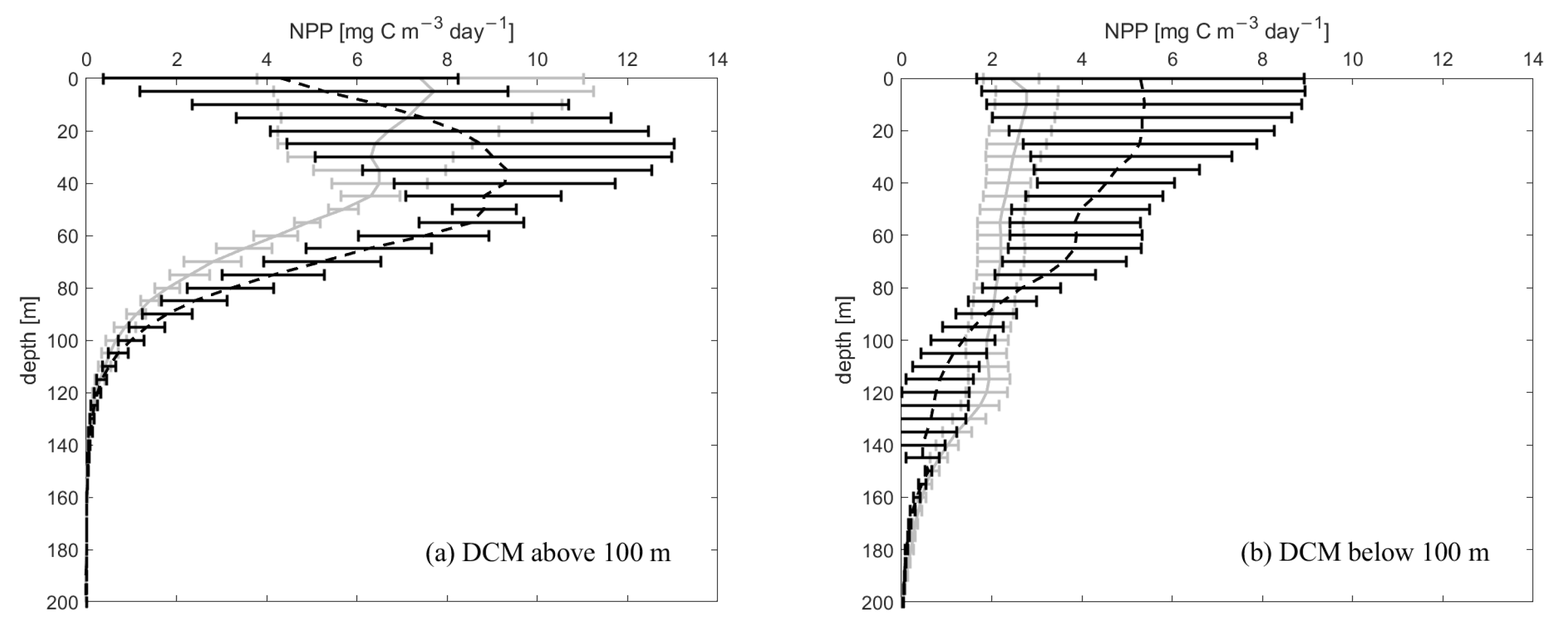
According to the seasonal variance in the Chl-a method proposed by Westberry et al. [93], the maximum value distribution of subsurface Chl-a presents two conditions, namely, the high-variance regions (less than 100 m) and the low-variance regions (more than 100 m), respectively. Using the AbPM and CbPM models to estimate the NPP based on the measured data (Figure S6), in regions where the DCM was deeper, the NPP estimated by the CbPM model gradually decreased with depth, and accelerated its decrease in the 80–100 m depth. This change mainly represents the contribution of phytoplankton carbon (particles smaller than 2 µm) to primary productivity (Figure 6a). It is mainly distributed in the upper waters, and indicates that this model is insensitive to the contribution of large particles distributed at a depth more than 100 m. These particles are mainly minerals and aggregates. The results of the AbPM estimation showed that the variation with depth from the surface to the maximum layer of the DCM was not significant, which was consistent with the vertical distribution characteristics of chlorophyll and POC (Figure 9). It could reflect the contribution characteristics of each particle size throughout the water column, especially the large particles at depths of more than 100 m. In regions with a shallow DCM layer, both AbPM and CbPM showed that the high-value areas occur in the upper water layer, which is consistent with the characteristics of the DCM layer. However, the extreme values in the subsurface layer as shown by the AbPM model were not significant. This is mainly because the input parameters of this model are the absorption of phytoplankton, and its distribution in the water column profile is in good agreement with the high-value areas of chlorophyll concentration. The light physiological changes recorded by chlorophyll that mark the pigment accumulation will greatly confuse the interpretation of these temporal (or spatial) trends in Chl-a. In fact, this physiological effect can even drive changes in NPP, which are in the opposite direction of Chl-a, depending on whether the response is to changes in light or changes in nutrient exposure. In the subtropical circulation, the rates of NPP and Chl-a often decouple from each other [94].
Deep-DCM group (>100 m, n = 9): AbPM showed a median RMSRE of 51.9% (mean 47.6%), significantly lower than CbPM’s median of 380.6% (mean 380.2%), with a one-tailed Wilcoxon p = 0.002 (Figure S7). AbPM’s Std_Bias (median 23.2%, mean 22.0%) was also significantly lower than CbPM’s (median 32.0%, mean 31.8%), p = 0.002 (Figure S8), indicating stronger robustness to input perturbations. The distribution of relative bias for the deep-DCM group is shown in Figure S9.
To evaluate the accuracy and robustness of AbPM and CbPM under the condition of input uncertainty based on MODIS data, a Monte Carlo sensitivity analysis was conducted using the measured data from 21 in situ measurement data. The results show that AbPM’s RMSRE (mean 33.5%) in the shallow-DCM group (<100 m, n = 12) was significantly lower than that of CbPM (mean 236.0%), p = 0.0005. The Std_Bias for AbPM (mean 14.3%) was also lower than that of CbPM (mean 22.0%), p = 0.021.
Cross-group comparison indicated that the performance gap was more pronounced in the deep-DCM group. CbPM’s RMSRE rose sharply from 236% in shallow-DCM to 380% in deep-DCM, whereas AbPM’s increased only modestly from 33.5% to 47.6%. The scatter plot of metrics versus DCM depth further illustrates the divergence between models with increasing DCM depth (Figure S10). The analysis verified that in deep water areas (>100 m), AbPM is significantly superior to CbPM.
Overall, the CbPM estimation value was slightly larger than the AbPM estimation. This is mainly influenced by the ecological niche distribution of autotrophic phytoplankton. The absorption of non-algal particles such as mineral particles and aggregates has a negligible impact on the estimation result. It mainly represents the process of the absorption efficiency of photosynthetic pigments for light energy. On the other hand, the CbPM estimation result is affected by the carbon content of phytoplankton. Its vertical variation in the water column is in good agreement with the backscatter of particles and the vertical distribution of heterotrophic organisms. Submicron-sized algal and non-algal particles all contribute to backscatter, and the estimated value mainly focuses on the conversion efficiency process of light energy to biological carbon fixation.
Therefore, as reflected by the various optical proxies of POC, these may merely be different components of POC. In the subtropical oligotrophic gyres, due to the existence of the DCM and its latitude gradient variations, the primary productivity estimated using various optical indicators may only be the contribution of different layers of particulate components within the water column. It also may only represent a part of the entire energy conversion pathway of primary productivity [95], especially in oligotrophic sea areas where the DCM is at more than 100 m. The AbPM estimation model can better represent the contribution characteristics of each particulate component of the waters to primary productivity at different depths.
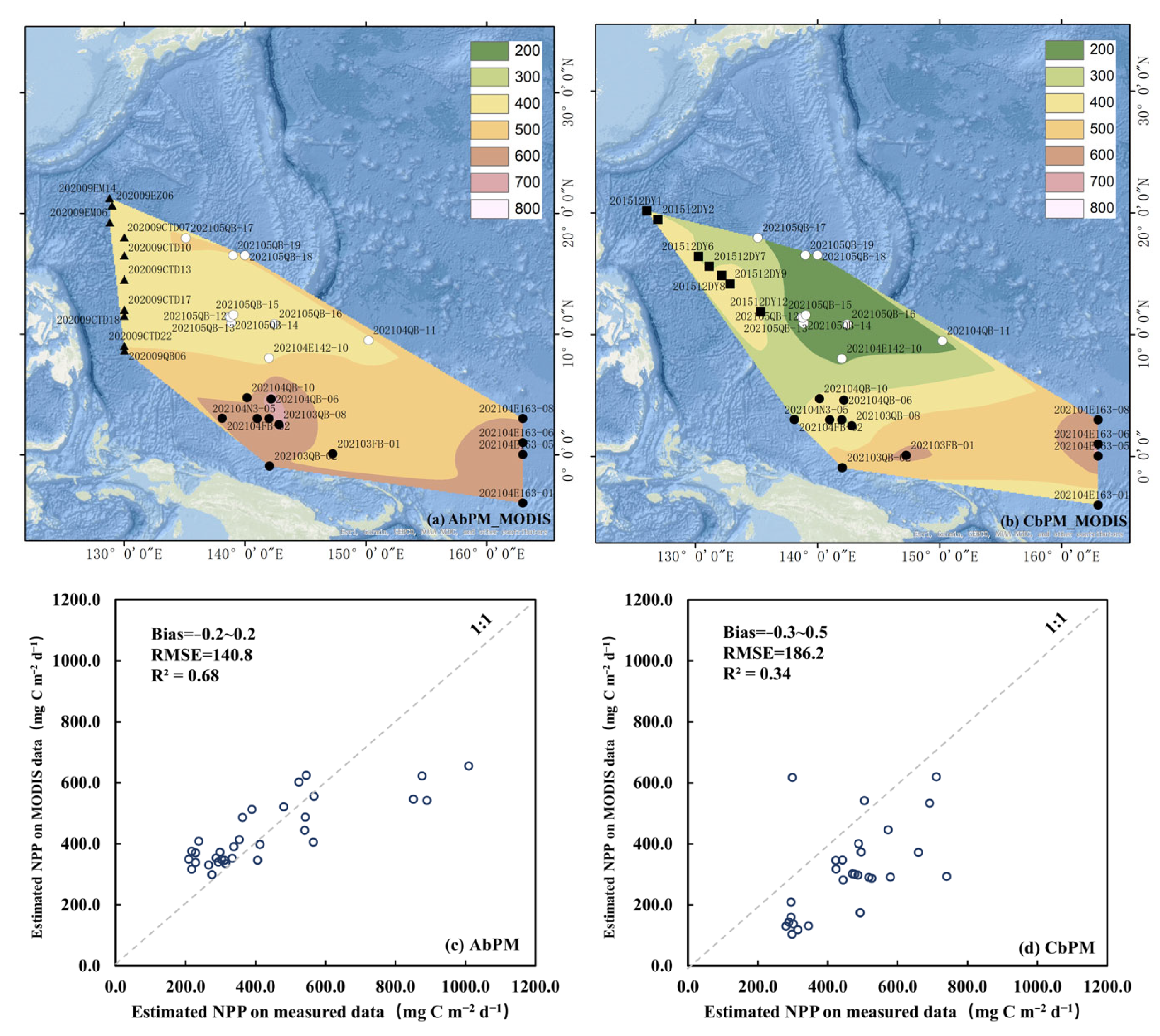
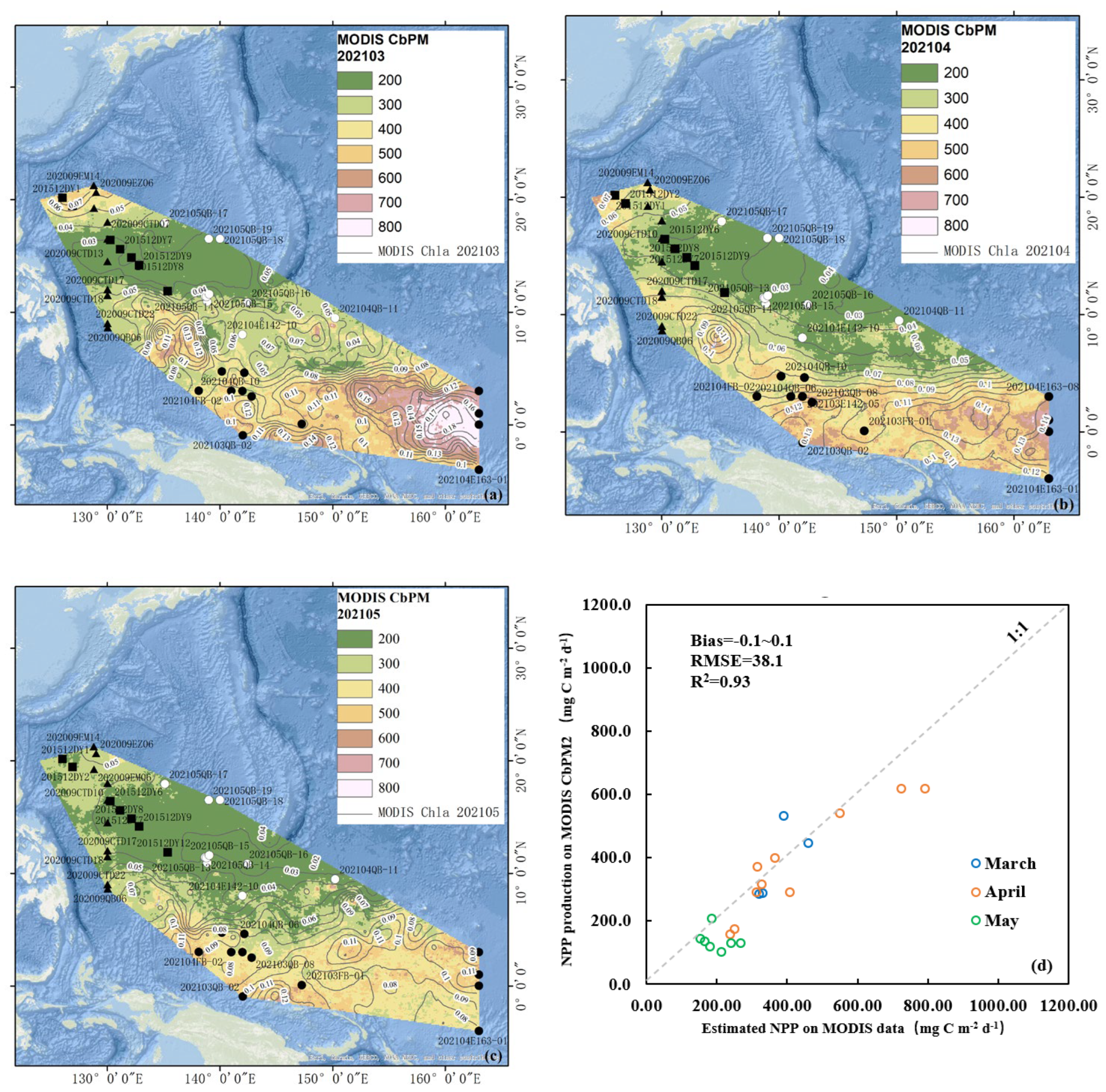
Based on the above analysis, the MODIS surface chlorophyll concentration data and the Hydrolight simulation method were used to estimate the water column integrated NPP at each sampling station (the specific calculation process is shown in the Supplementary Materials), and a comparative analysis was conducted with the MODIS primary productivity monthly average product data estimated based on the carbon-based production model-2 (CbPM2) model (https://orca.science.oregonstate.edu/npp_products.php, accessed on 13 February 2026.) that was downloaded. The comparison revealed that the AbPM model results for the water column-integrated NPP estimated based on the MODIS chlorophyll profile reconstruction were higher than those of the CbPM model, with an average difference of 146.5 mg C m−2d−1 (Figure 10a,b). Particularly in the ultra-oligotrophic waters with DCM > 100 m (the area indicated by the white solid circles in the figure), the AbPM model results were, on average, 231.1 mg C m−2d−1. By comparing the estimated results with those estimated from the measured data, it can be seen that the estimated results of AbPM were closer to those estimated from the measured data (R2 = 0.68), while the estimated values of the CbPM model (R2 = 0.34) were lower than those estimated from the measured data. Meanwhile, the remote sensing estimation results of CbPM were compared with the MODIS-based NPP CbPM2 product data (Figure 11a–c), and it was found that the estimation results were highly consistent with the corresponding monthly average products (R2 = 0.93) (Figure 11d) and were also consistent with the spatial distribution of the monthly average product of chlorophyll concentration. In conclusion, this indicates that the CbPM model based on MODIS surface chlorophyll concentration for depth integration NPP is consistent with the integration results under the assumption of homogeneous water and exponential attenuation of the light field, suggesting that this model fails to capture the stratified variation characteristics of the underwater light field. Meanwhile, the closer agreement between the AbPM model and the measured estimation results once again demonstrates its ability to reflect the contribution of each water component to the NPP.
Therefore, when estimating the NPP in oligotrophic gyres, in the areas where the DCM is deeper than 100 m, the different effects of the vertical stratification distribution of particulates in water columns on backscattering and absorption, as well as the different effects of the stratified distribution of different types and sizes of particulates in the water columns on the NPP model, should be considered.

5. Conclusions

We analyzed the vertical distribution of different particles in the upper water column of the tropical oligotrophic waters of the Western Pacific Ocean and examined factors that influenced the vertical distribution of the NPP. Previous studies showed that there were uncertainties in these characteristics at local and global scales because of temporal and spatial changes in the composition of particulate matter as well as differences in observation methods. The present study indicated that vertical variations of POC were not significant when the DCM was above 100 m, but these variations increased when the DCM was deeper than 100 m. In the latter case, as the depth increased, the size of the particles gradually increased and the number of particles gradually decreased. In regions with a shallow DCM layer, the particles were mainly submicron particles (SYN, PEUK, and HP). In regions where the DCM was deeper, the particles were mostly larger than 8 µm, biogenic debris gradually decreased with water depth, and mineral particles and aggregates increased as the depth increased to 500 m. However, the vertical variation pattern of bbp was not directly governed by the changes in these specific particle assemblages. When the DCM was less than 100 m, the absorption of non-algal particles in water below 150 m only had a very slight increase. Backscatter and attenuation as optical proxies for POC only represented the same trend, but reflected different components contributing to POC.
For the water above the DCM, PEUK accounted for more than 45% of the POC, and PRO accounted for more than 50% of the POC in the DCM. Below the DCM, the contribution of mineral and aggregate particles larger than 8 μm gradually increased and reached maxima at 500 m, whereas the amount of chlorophyll gradually decreased with depth. There were also variations in these characteristics along a latitude gradient, in that the DCM became deeper and had greater intensity as the latitude increased. In regions with a shallow DCM layer, both AbPM and CbPM showed that the high-value areas occurred in the upper water layer, which is consistent with the characteristics of the DCM layer. However, the extreme values in the subsurface layer as shown by the AbPM model were not significant due to the decoupling from NPP and Chl-a. In regions where the DCM was deeper, the AbPM could reflect the contribution characteristics of each particle size throughout the water column, especially the large particles at depths of more than 100 m; however, the CbPM model was insensitive to the contribution of large particles distributed at depths of more than 100 m. Overall, the CbPM estimation value was slightly larger than the AbPM in the top layer. The former mainly focuses on the conversion efficiency process of light energy to biological carbon fixation, and the latter mainly represents the process of the absorption efficiency of photosynthetic pigments for light energy. Our research has revealed the contribution of each component of the waters to each optical parameter and clarified the characteristics of the impact of each component on the remote sensing estimation of the NPP.

Supplementary Materials

The following supporting information can be downloaded at: https://www.mdpi.com/article/10.3390/w18101116/s1, Figure S1: Correlation between the Chl-a concentration measured in situ and Gauss fitting Chl-a concentration. The blue dashed line is linear regression (R2 = 0.56); Figure S2: The average IOP of each station with a DCM more than 100 m output by Hydrolight modeling, including (a) the absorption coefficient subtracting the corresponding values due to pure water, (b) the scattering coefficient subtracting the corresponding values due to pure water, and (c) the total beam attenuation coefficient; Figure S3: The simulation average IOP of each station with a DCM more than 100 m compared with in situ data, including (a) the absorption coefficient subtracting the corresponding values due to pure water, (b) the scattering coefficient subtracting the corresponding values due to pure water, and (c) the total beam attenuation coefficient; Figure S4: The simulation average AOP of each station with a DCM more than 100 m compared with in situ data, including (a) Ed in three bands of 443 nm, 490 nm, and 550 nm and (b) Kd (490 nm); Figure S5: Depth distribution of POC concentration to the bbp(700) ratio at all stations. The dotted line is the K-fold cross-validation regression models. The yellow diamond is the mean POC concentration at each depth. The shades of blue indicate different sites. It should be noted that because the value of POC concentration and bbp(700) is basically 5 orders of magnitude different, the vertical axis is POC/bbp(700)/1000 to reduce the loss caused by the difference in the order of magnitude in the calculation; Figure S6: The influence of depth on the estimation of the NPP by the remote sensing model when DCM is applied at depths (a) above 100 m and (b) below 100 m. The black dotted line represents the estimation result of CbPM, and the gray solid line represents the estimation result of AbPM. Error bars (black horizontal lines within each point) represent the 95% confidence interval in the parameters; Figure S7. RMSRE of AbPM and CbPM for shallow-DCM (<100 m) and deep-DCM (>100 m) groups; Figure S8. Std_Bias of AbPM and CbPM for shallow-DCM (<100 m) and deep-DCM (>100 m) groups; Figure S9. Distribution of relative bias for AbPM and CbPM in the deep-DCM (>100 m) group; Figure S10. RMSRE and Std_Bias versus DCM depth for CbPM, showing the divergence with increasing DCM depth; Table S1: Correlation analysis between in situ station parameter model results and in situ data; Table S2. Assigned relative uncertainties (1σ) for MODIS-driven input parameters used in the Monte Carlo sensitivity analysis; Table S3. Summary of sensitivity analysis metrics (mean ± standard deviation) for AbPM and CbPM in shallow-DCM (<100 m) and deep-DCM (>100 m) groups. References [93,95,96,97,98,99,100,101] are cited in the Supplementary Materials.

Author Contributions

Conceptualization, Y.L. (Yunwei Li) and H.H.; methodology, Y.L. (Yanxia Liu); software, Y.L. (Yunwei Li) and Y.L. (Yanxia Liu); validation, Y.L. (Yunwei Li) and Y.L. (Yanxia Liu); formal analysis, Y.L. (Yafei Luo); investigation, Y.L. (Yunwei Li); resources, Y.L. (Yunwei Li); data curation, Y.L. (Yanxia Liu); writing—original draft preparation, Y.L. (Yanxia Liu); writing—review and editing, Y.L. (Yanxia Liu); visualization, Y.L. (Yunwei Li); supervision, Y.L. (Yafei Luo); project administration, H.H.; funding acquisition, H.H. All authors have read and agreed to the published version of the manuscript.

Funding

This research was funded by the Natural Science Foundation of Shandong Province (ZR2023MD105) and National Natural Science Foundation of China (NSFC), grant numbers 42206187 and 41976166.

Data Availability Statement

The data underlying the results presented in this paper are not publicly available at this time but may be obtained from the authors upon reasonable request.

Acknowledgments

We thank the crew of the “Kexue” for their support in the cruises. We would like to acknowledge the International Argo Program and the national programs that contribute to the BGC-Argo data, which were collected and made freely available (https://www.ocean-ops.org, accessed 22 February 2026).

Conflicts of Interest

The authors declare no conflicts of interest.

Abbreviations

POCParticulate organic carbon
NPPNet primary productivity
DCMDeep chlorophyll maximum
AbPMAbsorption-based production model
CbPMCarbon-based production model
ChlaChlorophyll a
SYNSynechococcus
PROProchlorococcus
PEUKPicoeukaryotes
NEUKNanoeukaryotes
HPHeterotrophic prokaryotes
IOPsInherent optical properties
bbpParticle backscattering coefficient
aphPhytoplankton absorption coefficient
aNAPAbsorption coefficient of non-algal particulates
CphytoPhytoplankton carbon
PAR(z)Photosynthetically active radiation (at depth z)
ZeuEuphotic zone depth
KdDiffuse attenuation coefficient of downwelling irradiance
λWavelength
PSDParticle size distribution

References

  1. Falkowski, P.G.; Barber, R.T.; Smetacek, V.V. Biogeochemical Controls and Feedbacks on Ocean Primary Production. Science 1998, 281, 200–207. [Google Scholar] [CrossRef] [PubMed]
  2. Organelli, E.; Dall’Olmo, G.; Brewin, R.J.W.; Nencioli, F.; Tarran, G.A. Drivers of spectral optical scattering by particles in the upper 500 m of the Atlantic Ocean. Opt. Express 2020, 28, 34147–34166. [Google Scholar] [CrossRef] [PubMed]
  3. Haëntjens, N.; Boss, E.S.; Graff, J.R.; Chase, A.P.; Karp-Boss, L. Phytoplankton size distributions in the western North Atlantic and their seasonal variability. Limnol. Oceanogr. 2022, 67, 1865–1878. [Google Scholar] [CrossRef]
  4. Xiong, Y.; Zhang, X.; Huot, Y.; Stephens, B.M.; Carlson, C.A. The Variability of the Size Distributions of Submicron Particles in the Oceans. J. Geophys. Res. Ocean. 2024, 129, e2024JC020983. [Google Scholar] [CrossRef]
  5. Brewin, R.J.W.; Sathyendranath, S.; Jackson, T.; Barlow, R.; Brotas, V.; Airs, R.; Lamont, T. Influence of light in the mixed-layer on the parameters of a three-component model of phytoplankton size class. Remote Sens. Environ. 2015, 168, 437–450. [Google Scholar] [CrossRef]
  6. Davies, E.J.; Basedow, S.L.; McKee, D. The hidden influence of large particles on ocean colour. Sci. Rep. 2021, 11, 3999. [Google Scholar] [CrossRef]
  7. Reynolds, R.A.; Stramski, D. Variability in Oceanic Particle Size Distributions and Estimation of Size Class Contributions Using a Non-parametric Approach. J. Geophys. Res. Ocean. 2021, 126, e2021JC017946. [Google Scholar] [CrossRef]
  8. Bisson, K.M.; Kiko, R.; Siegel, D.A.; Guidi, L.; Picheral, M.; Boss, E.; Cael, B.B. Sampling uncertainties of particle size distributions and derived fluxes. Limnol. Oceanogr. Methods 2022, 20, 754–767. [Google Scholar] [CrossRef]
  9. Clements, D.J.; Yang, S.; Weber, T.; McDonnell, A.M.P.; Kiko, R.; Stemmann, L.; Bianchi, D. Constraining the Particle Size Distribution of Large Marine Particles in the Global Ocean With In Situ Optical Observations and Supervised Learning. Glob. Biogeochem. Cycles 2022, 36, e2021GB007276. [Google Scholar] [CrossRef]
  10. Green, R.E.; Sosik, H.M.; Olson, R.J. Contributions of phytoplankton and other particles to inherent optical properties in New England continental shelf waters. Limnol. Oceanogr. 2003, 48, 2377–2391. [Google Scholar] [CrossRef]
  11. Koestner, D.; Stramski, D.; Reynolds, R.A. Assessing the effects of particle size and composition on light scattering through measurements of size-fractionated seawater samples. Limnol. Oceanogr. 2019, 65, 173–190. [Google Scholar] [CrossRef]
  12. O’Neil, J.M.; Davis, T.W.; Burford, M.A.; Gobler, C.J. The rise of harmful cyanobacteria blooms: The potential roles of eutrophication and climate change. Harmful Algae 2012, 14, 313–334. [Google Scholar] [CrossRef]
  13. Casey, J.R.; Aucan, J.P.; Goldberg, S.R.; Lomas, M.W. Changes in partitioning of carbon amongst photosynthetic pico- and nano-plankton groups in the Sargasso Sea in response to changes in the North Atlantic Oscillation. Deep Sea Res. Part II Top. Stud. Oceanogr. 2013, 93, 58–70. [Google Scholar] [CrossRef]
  14. Stukel, M.R.; Irving, J.P.; Kelly, T.B.; Ohman, M.D.; Fender, C.K.; Yingling, N. Carbon sequestration by multiple biological pump pathways in a coastal upwelling biome. Nat. Commun. 2023, 14, 2024. [Google Scholar] [CrossRef]
  15. Dall’Olmo, G.; Westberry, T.K.; Behrenfeld, M.J.; Boss, E.; Slade, W.H. Significant contribution of large particles to optical backscattering in the open ocean. Biogeosciences 2009, 6, 947–967. [Google Scholar] [CrossRef]
  16. Brewin, R.J.; Dall’Olmo, G.; Sathyendranath, S.; Hardman-Mountford, N.J. Particle backscattering as a function of chlorophyll and phytoplankton size structure in the open-ocean. Opt. Express 2012, 20, 17632–17652. [Google Scholar] [CrossRef]
  17. Galí, M.; Falls, M.; Claustre, H.; Aumont, O.; Bernardello, R. Bridging the gaps between particulate backscattering measurements and modeled particulate organic carbon in the ocean. Biogeosciences 2022, 19, 1245–1275. [Google Scholar] [CrossRef]
  18. Serra–Pompei, C.; Hickman, A.; Britten, G.L.; Dutkiewicz, S. Assessing the Potential of Backscattering as a Proxy for Phytoplankton Carbon Biomass. Glob. Biogeochem. Cycles 2023, 37, e2022GB007556. [Google Scholar] [CrossRef]
  19. Bishop, J.K.; Wood, T.J.; Davis, R.E.; Sherman, J.T. Robotic observations of enhanced carbon biomass and export at 55 degrees during SOFeX. Science 2004, 304, 417–420. [Google Scholar] [CrossRef]
  20. Honjo, S.; Manganini, S.J.; Krishfield, R.A.; Francois, R. Particulate organic carbon fluxes to the ocean interior and factors controlling the biological pump: A synthesis of global sediment trap programs since 1983. Prog. Oceanogr. 2008, 76, 217–285. [Google Scholar] [CrossRef]
  21. Bishop, J.K.B.; Wood, T.J. Year-round observations of carbon biomass and flux variability in the Southern Ocean. Glob. Biogeochem. Cycles 2009, 23, 1–12. [Google Scholar] [CrossRef]
  22. Slade, W.H.; Boss, E. Spectral attenuation and backscattering as indicators of average particle size. Appl. Opt. 2015, 54, 7264–7277. [Google Scholar] [CrossRef] [PubMed]
  23. Rasse, R.; Dall’Olmo, G.; Graff, J.; Westberry, T.K.; van Dongen-Vogels, V.; Behrenfeld, M.J. Evaluating Optical Proxies of Particulate Organic Carbon across the Surface Atlantic Ocean. Front. Mar. Sci. 2017, 4, 367. [Google Scholar] [CrossRef]
  24. Zhou, W.; Wang, G.; Sun, Z.; Cao, W.; Xu, Z.; Hu, S.; Zhao, J. Variations in the optical scattering properties of phytoplankton cultures. Opt. Express 2012, 20, 11189–11206. [Google Scholar] [CrossRef] [PubMed]
  25. Graff, J.R.; Westberry, T.K.; Milligan, A.J.; Brown, M.B.; Dall’Olmo, G.; Dongen-Vogels, V.v.; Reifel, K.M.; Behrenfeld, M.J. Analytical phytoplankton carbon measurements spanning diverse ecosystems. Deep Sea Res. Part I Oceanogr. Res. Pap. 2015, 102, 16–25. [Google Scholar] [CrossRef]
  26. Whitmire, A.L.; Pegau, W.S.; Karp-Boss, L.; Boss, E.; Cowles, T.J. Spectral backscattering properties of marine phytoplankton cultures. Opt. Express 2010, 18, 15073–15093. [Google Scholar] [CrossRef]
  27. Kheireddine, M.; Brewin, R.J.W.; Ouhssain, M.; Jones, B.H. Particulate Scattering and Backscattering in Relation to the Nature of Particles in the Red Sea. J. Geophys. Res. Ocean. 2021, 126, e2020JC016610. [Google Scholar] [CrossRef]
  28. Brewin, R.J.W.; Dall’Olmo, G.; Gittings, J.; Sun, X.; Lange, P.K.; Raitsos, D.E.; Bouman, H.A.; Hoteit, I.; Aiken, J.; Sathyendranath, S. A Conceptual Approach to Partitioning a Vertical Profile of Phytoplankton Biomass Into Contributions From Two Communities. J. Geophys. Res. Ocean. 2022, 127, e2021JC018195. [Google Scholar] [CrossRef]
  29. Martinez-Vicente, V.; Dall’Olmo, G.; Tarran, G.; Boss, E.; Sathyendranath, S. Optical backscattering is correlated with phytoplankton carbon across the Atlantic Ocean. Geophys. Res. Lett. 2013, 40, 1154–1158. [Google Scholar] [CrossRef]
  30. Qiu, G.; Xing, X.; Boss, E.; Yan, X.H.; Ren, R.; Xiao, W.; Wang, H. Relationships between optical backscattering, particulate organic carbon, and phytoplankton carbon in the oligotrophic South China Sea basin. Opt. Express 2021, 29, 15159–15176. [Google Scholar] [CrossRef]
  31. Morel, A. Diffusion de la lumière par les eaux de mer: Résultats expérimentaux et approche théorique. In Optics of the Sea; AGARD Lecture Series No.61; NATO-AGARD: Neuilly-sur-Seine, France, 1973; Section 3.1; pp. 1–76. [Google Scholar]
  32. Mitchell, B.G.; Kiefer, D.A. Light scattering by particle size fractions: Significance for ocean color models. A collection of extended abstracts. In Proceedings of the Symposium on the Radiation Transfer in the Ocean and Remote Sens. of Ocean Properties, IAMAP Third Scientific Assembly, Hamburg, Germany, 17–28 August 1981. [Google Scholar]
  33. Stramski, D.; Kiefer, D.A. Light scattering by microorganisms in the open ocean. Prog. Oceanogr. 1991, 28, 343–383. [Google Scholar] [CrossRef]
  34. Zhao, Y.Y.; Poulin, C.; McKee, D.; Hu, L.; Agagliate, J.; Yang, P.; Xiaodong, Z. A closure study of ocean inherent optical properties using flow cytometry measurements. J. Quant. Spectrosc. Radiat. Transf. 2020, 241, 106730. [Google Scholar] [CrossRef]
  35. Martinez-Vicente, V.; Tilstone, G.H.; Sathyendranath, S.; Miller, P.I.; Groom, S.B. Contributions of phytoplankton and bacteria to the optical backscattering coefficient over the Mid-Atlantic Ridge. Mar. Ecol. Prog. Ser. 2012, 445, 37–51. [Google Scholar] [CrossRef]
  36. Henderikx-Freitas, F.; Allen, J.G.; Lansdorp, B.M.; White, A.E. Diel variations in the estimated refractive index of bulk oceanic particles. Opt. Express 2022, 30, 44141–44159. [Google Scholar] [CrossRef] [PubMed]
  37. Lewis, M.R.; Hebert, D.; Harrison, W.G.; Platt, T.; Oakey, N.S. Vertical Nitrate Fluxes in the Oligotrophic Ocean. Science 1986, 234, 870–873. [Google Scholar] [CrossRef]
  38. Dall’Olmo, G.; Dingle, J.; Polimene, L.; Brewin, R.J.; Claustre, H. Substantial energy input to the mesopelagic ecosystem from the seasonal mixed-layer pump. Nat. Geosci. 2016, 9, 820–823. [Google Scholar] [CrossRef]
  39. Seki, M.P.; Polovina, J.J.; Brainard, R.E.; Bidigare, R.R.; Leonard, C.L.; Foley, D.G. Biological enhancement at cyclonic eddies tracked with GOES Thermal Imagery in Hawaiian waters. Geophys. Res. Lett. 2001, 28, 1583–1586. [Google Scholar] [CrossRef]
  40. Stramski, D.; Bricaud, A.; Morel, A. Modeling the inherent optical properties of the ocean based on the detailed composition of the planktonic community. Appl. Opt. 2001, 40, 2929–2945. [Google Scholar] [CrossRef]
  41. Slade, W.H.; Boss, E.; Russo, C. Effects of particle aggregation and disaggregation on their inherent optical properties. Opt. Express 2011, 19, 7945–7959. [Google Scholar] [CrossRef]
  42. Hague, M.; Vichi, M. Southern Ocean Biogeochemical Argo detect under-ice phytoplankton growth before sea ice retreat. Biogeosciences 2021, 18, 25–38. [Google Scholar] [CrossRef]
  43. Cetinić, I.; Perry, M.J.; Briggs, N.T.; Kallin, E.; D’Asaro, E.A.; Lee, C.M. Particulate organic carbon and inherent optical properties during 2008 North Atlantic Bloom Experiment. J. Geophys. Res. Ocean. 2012, 117, 1–18. [Google Scholar] [CrossRef]
  44. Marañón, E.; Holligan, P.M.; Barciela, R.; González, N.; Mouriño, B.; Pazó, M.J.; Varela, M. Patterns of phytoplankton size structure and productivity in contrasting open-ocean environments. Mar. Ecol. Prog. Ser. 2001, 216, 43–56. [Google Scholar] [CrossRef]
  45. Marañón, E.; Behrenfeld, M.J.; González, N.; Mouriño, B.; Zubkov, M.V. High variability of primary production in oligotrophic waters of the Atlantic Ocean: Uncoupling from phytoplankton biomass and size structure. Mar. Ecol. Prog. Ser. 2003, 257, 1–11. [Google Scholar] [CrossRef]
  46. Cotti-Rausch, B.E.; Lomas, M.W.; Lachenmyer, E.M.; Baumann, E.G.; Richardson, T.L. Size-fractionated biomass and primary productivity of Sargasso Sea phytoplankton. Deep Sea Res. Part I Oceanogr. Res. Pap. 2020, 156, 103141. [Google Scholar] [CrossRef]
  47. Sauzède, R.; Lavigne, H.; Claustre, H.; Uitz, J.; Schmechtig, C.; D’Ortenzio, F.; Guinet, C.; Pesant, S. Vertical distribution of chlorophyll a concentration and phytoplankton community composition from in situ fluorescence profiles: A first database for the global ocean. Earth Syst. Sci. Data 2015, 7, 261–273. [Google Scholar] [CrossRef]
  48. Brewin, C.R.; Cloitre, M.; Hyland, P.; Shevlin, M.; Maercker, A.; Bryant, R.A.; Humayun, A.; Jones, L.M.; Kagee, A.; Rousseau, C.; et al. A review of current evidence regarding the ICD-11 proposals for diagnosing PTSD and complex PTSD. Clin. Psychol. Rev. 2017, 58, 1–15. [Google Scholar] [CrossRef]
  49. Venrick, E.L. The vertical distributions of chlorophyll and phytoplankton species in the North Pacific central environment. J. Plankton Res. 1988, 10, 987–998. [Google Scholar] [CrossRef]
  50. Lange, P.K.; Ligowski, R.; Tenenbaum, D.R. Phytoplankton in the embayments of King George Island (Antarctic Peninsula): A review with emphasis on diatoms. Polar Rec. 2018, 54, 158–175. [Google Scholar] [CrossRef]
  51. Mignot, A.; Claustre, H.; D’Ortenzio, F.; Xing, X.; Poteau, A.; Ras, J. From the shape of the vertical profile of in vivo fluorescence to Chlorophyll-a concentration. Biogeosciences 2011, 8, 2391–2406. [Google Scholar] [CrossRef]
  52. Cornec, M.; Laxenaire, R.; Speich, S.; Claustre, H. Impact of Mesoscale Eddies on Deep Chlorophyll Maxima. Geophys. Res. Lett. 2021, 48, 106730. [Google Scholar] [CrossRef]
  53. Antoine, D.; André, J.M.; Morel, A. Oceanic primary production: 2. Estimation at global scale from satellite (Coastal Zone Color Scanner) chlorophyll. Glob. Biogeochem. Cycles 1996, 10, 57–69. [Google Scholar] [CrossRef]
  54. Mignot, A.; Claustre, H.; Uitz, J.; Poteau, A.; D’Ortenzio, F.; Xing, X. Understanding the seasonal dynamics of phytoplankton biomass and the deep chlorophyll maximum in oligotrophic environments: A Bio-Argo float investigation. Glob. Biogeochem. Cycles 2014, 28, 856–876. [Google Scholar] [CrossRef]
  55. Hu, D.; Wu, L.; Cai, W.; Gupta, A.S.; Ganachaud, A.; Qiu, B.; Gordon, A.L.; Lin, X.; Chen, Z.; Hu, S.; et al. Pacific western boundary currents and their roles in climate. Nature 2015, 522, 299–308. [Google Scholar] [CrossRef]
  56. Jia, Q.; Li, T.; Xiong, Z.; Steinke, S.; Jiang, F.; Chang, F.; Qin, B. Hydrological variability in the western tropical Pacific over the past 700 kyr and its linkage to Northern Hemisphere climatic change. Palaeogeogr. Palaeoclimatol. Palaeoecol. 2018, 493, 44–54. [Google Scholar] [CrossRef]
  57. Ma, J.; Song, J.; Li, X.; Yuan, H.; Li, N.; Duan, L.; Wang, Q. Environmental characteristics in three seamount areas of the Tropical Western Pacific Ocean: Focusing on nutrients. Mar. Pollut. Bull. 2019, 143, 163–174. [Google Scholar] [CrossRef]
  58. Furuya, K. Subsurface chlorophyll maximum in the tropical and subtropical western Pacific Ocean: Vertical profiles of phytoplankton biomass and its relationship with chlorophylla and particulate organic carbon. Mar. Biol. 1990, 107, 529–539. [Google Scholar] [CrossRef]
  59. Wang, Z.; Fang, C.; Yang, C.; Zhang, G.; Sun, D. Latitudinal gradient and influencing factors of deep-sea particle export along the Kyushu-Palau Ridge in the Philippine Sea. Sci. Total Environ. 2024, 906, 167460. [Google Scholar] [CrossRef] [PubMed]
  60. Zhao, Y.C.; Zhao, Y.; Zheng, S.; Zhao, L.; Li, X.; Zhang, W.; Gregori, G.; Xiao, T. Virioplankton distribution in the tropical western Pacific Ocean in the vicinity of a seamount. MicrobiologyOpen 2020, 9, 1207–1224. [Google Scholar] [CrossRef]
  61. Liu, Y.; Li, Y.; Yan, L.; Zhang, Z.; Bi, H.; Huang, H. Variability in the relationship between light scattering and chlorophyll a concentration in oligotrophic tropical regions of the Western Pacific Ocean. Opt. Express 2024, 32, 12141–12159. [Google Scholar] [CrossRef]
  62. Marie, D.; Simon, N.; Guillou, L.; Partensky, F.; Vaulot, D. Flow Cytometry Analysis of Marine Picoplankton. In In Living Color: Protocols in Flow Cytometry and Cell Sorting; Diamond, R.A., Demaggio, S., Eds.; Springer: Berlin/Heidelberg, Germany, 2000; pp. 421–454. [Google Scholar]
  63. Parsons, T.R.; Maita, Y.; Lalli, C.M. (Eds.) Determination of Nitrate. In A Manual of Chemical & Biological Methods for Seawater Analysis; Pergamon: Amsterdam, The Netherlands, 1984; pp. 3–7. [Google Scholar]
  64. Kostadinov, T.S.; Siegel, D.A.; Maritorena, S. Global variability of phytoplankton functional types from space: Assessment via the particle size distribution. Biogeosciences 2010, 7, 3239–3257. [Google Scholar] [CrossRef]
  65. Kostadinov, T.S.; Milutinović, S.; Marinov, I.; Cabré, A. Carbon-based phytoplankton size classes retrieved via ocean color estimates of the particle size distribution. Ocean. Sci. 2016, 12, 561–575. [Google Scholar] [CrossRef]
  66. Kostadinov, T.S.; Robertson Lain, L.; Kong, C.E.; Zhang, X.; Maritorena, S.; Bernard, S.; Loisel, H.; Jorge, D.S.F.; Kochetkova, E.; Roy, S.; et al. Ocean color algorithm for the retrieval of the particle size distribution and carbon-based phytoplankton size classes using a two-component coated-sphere backscattering model. Ocean. Sci. 2023, 19, 703–727. [Google Scholar] [CrossRef]
  67. Roy, S.; Sathyendranath, S.; Platt, T. Size-partitioned phytoplankton carbon and carbon-to-chlorophyll ratio from ocean colour by an absorption-based bio-optical algorithm. Remote Sens. Environ. 2017, 194, 177–189. [Google Scholar] [CrossRef]
  68. Zheng, W.; Zhou, W.; Cao, W.; Liu, Y.; Wang, G.; Deng, L.; Li, C.; Zhang, Y.; Zeng, K. Vertical Variability of Total and Size-Partitioned Phytoplankton Carbon in the South China Sea. Remote Sens. 2021, 13, 993. [Google Scholar] [CrossRef]
  69. Reynolds, R.A.; Stramski, D.; Wright, V.M.; Woźniak, S.B. Measurements and characterization of particle size distributions in coastal waters. J. Geophys. Res. Ocean. 2010, 115, 1–19. [Google Scholar] [CrossRef]
  70. Roy, S.; Sathyendranath, S.; Bouman, H.; Platt, T. The global distribution of phytoplankton size spectrum and size classes from their light-absorption spectra derived from satellite data. Remote Sens. Environ. 2013, 139, 185–197. [Google Scholar] [CrossRef]
  71. Mohammadpour, G.; Gagné, J.-P.; Larouche, P.; Montes-Hugo, M.A. Optical properties of size fractions of suspended particulate matter in littoral waters of Québec. Biogeosciences 2017, 14, 5297–5312. [Google Scholar] [CrossRef]
  72. Morel, A.; Ahn, Y.-H.; Partensky, F.; Vaulot, D.; Claustre, H. Prochlorococcus and Synechococcus: A comparative study of their optical properties in relation to their size and pigmentation. J. Mar. Res. 1993, 51, 617–649. [Google Scholar] [CrossRef]
  73. Bricaud, A.; Bédhomme, A.-L.; Morel, A. Optical properties of diverse phytoplanktonic species: Experimental results and theoretical interpretation. J. Plankton Res. 1988, 10, 851–873. [Google Scholar] [CrossRef]
  74. Zhao, Y.C. Ecological Distribution Characteristics of Ultraplankton and Virioplankton in Seamounts of the Tropical Western Pacific Ocean. Ph.D. Thesis, University of Chinese Academy of Sciences, Beijing, China, 2020. [Google Scholar] [CrossRef]
  75. Shi, X.; Wang, Z.; Gao, W.; Huang, H. Distribution of suspended particulate matter in the Caroline M4 seamount in the western Pacific Ocean and its influencing factors. Oceanol. Limnol. Sin. 2023, 54, 703–717. [Google Scholar] [CrossRef]
  76. Stramski, D.; Reynolds, R.; Kahru, M.; Mitchell, B. Estimation of Particulate Organic Carbon in the Ocean from Satellite Remote Sens. Science 1999, 285, 239–242. [Google Scholar] [CrossRef]
  77. Stramski, D.; Reynolds, R.A.; Babin, M.; Kaczmarek, S.; Lewis, M.R.; Röttgers, R.; Sciandra, A.; Stramska, M.; Twardowski, M.S.; Franz, B.A.; et al. Relationships between the surface concentration of particulate organic carbon and optical properties in the eastern South Pacific and eastern Atlantic Oceans. Biogeosciences 2008, 5, 171–201. [Google Scholar] [CrossRef]
  78. Poteau, A.; Boss, E.; Claustre, H. Particulate concentration and seasonal dynamics in the mesopelagic ocean based on the backscattering coefficient measured with Biogeochemical-Argo floats. Geophys. Res. Lett. 2017, 44, 6933–6939. [Google Scholar] [CrossRef]
  79. Stramski, D.; Joshi, I.; Reynolds, R.A. Ocean color algorithms to estimate the concentration of particulate organic carbon in surface waters of the global ocean in support of a long-term data record from multiple satellite missions. Remote Sens. Environ. 2022, 269, 112776. [Google Scholar] [CrossRef]
  80. Biogeochemical-Argo Planning Group. The Scientific Rationale, Design and Implementation Plan for a Biogeochemical-Argo Float Array; Ifremer: Brest, France, 2016; pp. 10–17. [Google Scholar] [CrossRef]
  81. Gardner, W.D.; Walsh, I.D.; Richardson, M.J. Biophysical forcing of particle production and distribution during a spring bloom in the North Atlantic. Deep Sea Res. Part II Top. Stud. Oceanogr. 1993, 40, 171–195. [Google Scholar] [CrossRef]
  82. Loisel, H.; Morel, A. Light scattering and chlorophyll concentration in case 1 waters: A reexamination. Limnol. Oceanogr. 1998, 43, 847–858. [Google Scholar] [CrossRef]
  83. Claustre, H.; Morel, A.; Babin, M.; Cailliau, C.; Marie, D.; Marty, J.C.; Tailliez, D.; Vaulot, D. Variability in particle attenuation and chlorophyll fluorescence in the tropical Pacific: Scales, patterns, and biogeochemical implications. J. Geophys. Res. Ocean. 1999, 104, 3401–3422. [Google Scholar] [CrossRef]
  84. Fennel, K.; Boss, E. Subsurface maxima of phytoplankton and chlorophyll: Steady-state solutions from a simple model. Limnol. Oceanogr. 2003, 48, 1521–1534. [Google Scholar] [CrossRef]
  85. Durand, M.D.; Olson, R.J. Contributions of phytoplankton light scattering and cell concentration changes to diel variations in beam attenuation in the equatorial Pacific from flow cytometric measurements of pico-, ultra- and nanoplankton. Deep Sea Res. Part II Top. Stud. Oceanogr. 1996, 43, 891–906. [Google Scholar] [CrossRef]
  86. Fox, J.; Behrenfeld, M.J.; Halsey, K.H.; Graff, J.R. Global Estimates of Particulate Organic Carbon Concentration From the Surface Ocean to the Base of the Mesopelagic. Glob. Biogeochem. Cycles 2024, 38, e2024GB008149. [Google Scholar] [CrossRef]
  87. Ma, J.; Song, J.; Li, X.; Wang, Q.; Zhong, G.; Yuan, H.; Li, N.; Duan, L. The OMZ and Its Influence on POC in the Tropical Western Pacific Ocean: Based on the Survey in March 2018. Front. Earth Sci. 2021, 9, 632229. [Google Scholar] [CrossRef]
  88. Guo, J.; Zhou, B.; Achterberg, E.P.; Yuan, H.; Song, J.; Duan, L.; Li, X. Rapid Cycling of Bacterial Particulate Organic Matter in the Upper Layer of the Western Pacific Warm Pool. Geophys. Res. Lett. 2023, 50, e2023GL102896. [Google Scholar] [CrossRef]
  89. Masuda, Y.; Yamanaka, Y.; Smith, S.L.; Hirata, T.; Nakano, H.; Oka, A.; Sumata, H. Photoacclimation by phytoplankton determines the distribution of global subsurface chlorophyll maxima in the ocean. Commun. Earth Environ. 2021, 2, 128. [Google Scholar] [CrossRef]
  90. Britten, G.L.; Padalino, C.; Forget, G.; Follows, M.J. Seasonal Photoacclimation in the North Pacific Transition Zone. Glob. Biogeochem. Cycles 2022, 36, e2022GB007324. [Google Scholar] [CrossRef]
  91. Estrada, M.; Marrasé, C.; Latasa, M.; Berdalet, E.; Delgado, M.; Riera, T. Variability of deep chlorophyll maximum characteristics in the Northwestern Mediterranean. Mar. Ecol. Prog. Ser. 1993, 92, 289–300. [Google Scholar] [CrossRef]
  92. Moeller, H.V.; Laufkotter, C.; Sweeney, E.M.; Johnson, M.D. Light-dependent grazing can drive formation and deepening of deep chlorophyll maxima. Nat. Commun. 2019, 10, 1978. [Google Scholar] [CrossRef]
  93. Westberry, T.K.; Behrenfeld, M.J.; Siegel, D.A.; Boss, E. Carbon-based primary productivity modeling with vertically resolved photoacclimation. Glob. Biogeochem. Cycles 2008, 22, 1–18. [Google Scholar] [CrossRef]
  94. Chavez, F.P.; Messie, M.; Pennington, J.T. Marine primary production in relation to climate variability and change. Annu. Rev. Mar. Sci. 2011, 3, 227–260. [Google Scholar] [CrossRef]
  95. Antoine, D.; Morel, A. Oceanic primary production: 1. Adaptation of a spectral light-photosynthesis model in view of application to satellite chlorophyll observations. Glob. Biogeochem. Cycles 1996, 10, 43–55. [Google Scholar] [CrossRef]
  96. Kiefer, D.A.; Mitchell, B.G. A simple, steady state description of phytoplankton growth based on absorption cross section and quantum efficiency. Limnol. Oceanogr. 1983, 28, 770–776. [Google Scholar] [CrossRef]
  97. Lee, Z.P.; Carder, K.L.; Marra, J.; Steward, R.G.; Perry, M.J. Estimating primary production at depth from Remote Sens. Appl. Opt. 1996, 35, 463–474. [Google Scholar] [CrossRef]
  98. Lewis, M.R.; Cullen, J.J.; Platt, T. Phytoplankton and thermal structure in the upper ocean: Consequences of nonuniformity in chlorophyll profile. J. Geophys. Res. Ocean. 1983, 88, 2565–2570. [Google Scholar] [CrossRef]
  99. Uitz, J.; Claustre, H.; Morel, A.; Hooker, S.B. Vertical distribution of phytoplankton communities in open ocean: An assessment based on surface chlorophyll. J. Geophys. Res. Ocean. 2006, 111, 1–23. [Google Scholar] [CrossRef]
  100. Millán-Núñez, R.; Alvarez-Borrego, S.; Trees, C.C. Modeling the vertical distribution of chlorophyll in the California Current System. J. Geophys. Res. Ocean. 1997, 102, 8587–8595. [Google Scholar] [CrossRef]
  101. Behrenfeld, M.J.; Boss, E.; Siegel, D.A.; Shea, D.M. Carbon-based ocean productivity and phytoplankton physiology from space. Glob. Biogeochem. Cycles 2005, 19, 1–14. [Google Scholar] [CrossRef]
Figure 1. Geographical location of sample sites in the BGC-Argo dataset (black stars, data from April 2020 to April 2021) and location of stations sampled during different cruises in the Philippine Sea and nearby waters (other symbols). Filled triangles: sampling in September 2020; open circles: sampling between April and May 2021 at depths greater than 100 m; filled circles: sampling between April and May 2021 at depths less than 100 m; pink-filled circles: sampling from December 2014 to January 2015 (15 stations); green-filled circles: sampling from March to April of 2016 and 2018 (40 stations); purple-filled circles: sampling from May to June 2019 (25 stations); red-filled circles: sampling from August to September 2017 (22 stations). The shade of blue in the background indicates the average DCM depth from March to June 2021 (inset).
Water 18 01116 g001
Figure 2. (a) Variation of bbp(SYN, PEUK, NEUK, HP, PRO)/(bbp − bbpNAP) with depth and (b) variation of bbp(minerals, dtritus)/bbp(NAP) with depth at the wavelength of 700 nm. Variation of bbp(700) with depth (c) from mid-April 2020 to mid-November 2020 and (d) from mid-November 2020 to mid-April 2021 of the following year from the BGC-Argo dataset. Note: Open red circles represent the annual average of blue-gradient-colored circles (gradient colors are used to distinguish data at different times).
Water 18 01116 g002
Figure 3. Size distribution of particles (range: 1 to 100 µm) at depths of 150 to 200 m at six stations with different levels of Chl-a. Chl-a concentration: E16306 > E16305 > E16301 > E14210 > QB12 > QB16. Colors indicate different depths of 150 to 200 m.
Water 18 01116 g003
Figure 4. Variation of particle concentration (particles L−1 µm−1) with depth in four size groups (7, 8, 16, and 32 µm) at seven stations that had DCMs at different depths. Darker blue indicates greater DCM depth.
Water 18 01116 g004
Figure 5. Variation of the concentration (particles L−1 µm−1) of large particles (170 to 460 µm) with depth in permanently stratified waters with (top) a deep DCM and seasonally stratified waters with (bottom) a shallow DCM. Different colors are used to distinguish between the different sampling stations.
Water 18 01116 g005aWater 18 01116 g005b
Figure 6. Variation of Cphyto with depth for particles that ranged from (a) 0.7 to 2 µm, (b) 2 to 20 µm, (c) 20 to 200 µm, and (d) 200 to 500 µm, and (e) on the total Chl-a concentration. Blue open circles: DCM < 100 m; black open circles: DCM > 100 m.
Water 18 01116 g006
Figure 7. Variation of the absorption coefficient of non-algal particulate matter (aNAP(412)) with depth when the DCM was (a) above 100 m and (b) below 100 m. Shades of blue indicate different stations.
Water 18 01116 g007
Figure 8. Variation of the POC/bbp(700) ratio with depth in water column at stations with a DCM (a) above 100 m, (b) below 100 m, and (c) at all stations. Shades of blue indicate different stations.
Water 18 01116 g008
Figure 9. Variation of NPP estimates with depth from the remote sensing models when the DCM is located at depths (a) above 100 m and (b) below 100 m. The black dotted line represents the estimation result of CbPM, and the gray solid line represents the estimation result of AbPM. Error bars (black horizontal lines within each point) represent the 95% confidence interval on the parameters.
Water 18 01116 g009
Figure 10. The vertically integrated NPP calculated based on MODIS data using (a) the AbPM model and (b) the CbPM model, and their relationship with the vertically integrated NPP estimated based on measured data using (c) the AbPM model and (d) the CbPM model, where bias is expressed as a range of values for all stations. Dashed lines indicate the 1:1 line in (c) and (d). Open circles in (c) indicate stations in (a), and open circles in (d) indicate stations in (b).
Water 18 01116 g010
Figure 11. The NPP monthly average product data of MODIS based on the CbPM2 model and Chl-a (contour line, mg m−3) in (a) March, (b) April, and (c) May, and (d) the corresponding relationship of the vertically integrated NPP calculated based on MODIS data using the CbPM model, where bias is expressed as a range of values for all stations.
Water 18 01116 g011
Disclaimer/Publisher’s Note: The statements, opinions and data contained in all publications are solely those of the individual author(s) and contributor(s) and not of MDPI and/or the editor(s). MDPI and/or the editor(s) disclaim responsibility for any injury to people or property resulting from any ideas, methods, instructions or products referred to in the content.