Article

Analyzing the Effectiveness of Water Reclamation Processes in Terms of Costs and Water Quality in Taiwan


1
Center for Engineering Sustainability and Resilience, McCormick School of Engineering, Northwestern University, Evanston, IL 60201, USA
2
School of Interdisciplinary Engineering and Sciences, National University of Sciences and Technology, Islamabad 44000, Pakistan
3
Institute of Environmental Engineering and Management, National Taipei University of Technology, Taipei 106344, Taiwan
4
Agriculture Engineering Research Center, Taoyuan 327005, Taiwan
*
Author to whom correspondence should be addressed.
Water 2026, 18(1), 62; https://doi.org/10.3390/w18010062
Submission received: 23 October 2025 / Revised: 10 December 2025 / Accepted: 18 December 2025 / Published: 24 December 2025
(This article belongs to the Section Water Resources Management, Policy and Governance)

Abstract

The use and promotion of reclaimed water have become global trends and have been widely adopted in countries such as Singapore, Israel, Japan, and the United States. In recent years, Taiwan has also been promoting demonstration plants for reclaimed water by enacting the Reclaimed Water Resources Development Act. Since the demonstration plants apply different reclamation processes, the costs and quality of the reclaimed water vary. This study aims to analyze the cost effectiveness of reclaimed water under three different scenarios, based on operational costs and water quality data from three demonstration plants: the Fongshan River Reclaimed Water Plant, the Shui Nan Water Resource Recovery Center, and the Futian Water Resource Recovery Center. The result shows that the most cost-effective scenario is either the high-cost-high-quality scenario or the low-cost-low-quality one. The moderate scenario is not preferred in terms of cost effectiveness. If the consideration is simply the total cost as a society, the high-cost-high-quality scenario might be preferred. But if “who pays for the cost” is taken into consideration, the low-cost-low-quality scenario is preferred since the cost would be mostly shouldered by the industrial users, rather than the government. The result can not only be used as a reference for the determination of the unified price and water quality standard for reclaimed water in Taiwan in the future but also shed light on the determination of water reclamation processes globally.

1. Introduction

Recently, water scarcity emerged as a global environmental challenge [1]. Rapid population growth, urbanization, and technological advancements drove global water withdrawals to six times the amount, with a drastic increase in freshwater consumption of 1% [2]. The sporadic effects of climate change and its hydrological implications have gained momentum in contemporary research discourse, particularly effective water resource management, through prioritizing water reuse in the water-stressed regions [3].
The existing disparities in Taiwan further exacerbated the situation of water resources. The geographical location of Taiwan is steep and the rivers flow very fast, resulting in accumulation of sediments in the water reservoirs, which reduces the storage capacity as time passes. To address such systematic issues in the management of water resources, the legislative framework for reclaimed water of the cornerstone is aiming to achieve the goal of 1,320,000 tons per day by 2031 [4]. The landmark legislation titled “Reclaimed Water Resources Development Act” provides framework for repurposing wastewater and effluent, in addition to setting procedures for the use of reclaimed water for industries [1]. Therefore, systematic interventions by the government encourage the shift from freshwater to reclaimed water by industries.
As part of the water resource management strategy, it is critical to adopt alternative efficient and cost-effective water resources [5]. Reclaimed water is one of the potential alternatives to reduce water scarcity, freshwater consumption, and efficiency of of industrial use of water [6]. The expansion of industries and the advancements of agriculture sectors emphasize the adoptability of sustainable water resource management by establishing a standardized water quality criterion [7].
However, an optimal treatment process that ensures quality water remains a significant challenge as it requires distinctive physiochemical and microbiological quality criteria, based on intended reuse application. Thus, modern wastewater treatment processes increasingly adopt fit-for-purpose approaches in which treatment trains are efficiently calibrated to meet the minimum performance targets such as industrial cooling, agricultural irrigation, groundwater recharge, or potable use. Such strategies emphasize the use of multi-barrier approaches for ensuring safety, sustainability, and reliability by avoiding excessive treatment intensity. This paradigm presumed that with the combination of technologies, aligning with quality requirements, cost-effectiveness, and minimizing environmental risks, having no single “optimal” treatment system is a real challenge instead of employing a single “optimal” treatment system.
Shifting from freshwater to alternative water resources has gained prominence in many countries, including Singapore, Israel, Japan, and the United States [8]. On the other hand, growing economies like Taiwan are struggling to adopt efficient reclaimed water processes as part of alternate water resource strategy. These efforts further deteriorated with extreme rainfall, rapid weather shifts, and flash floods in Taiwan [9].
The practice of using reclaimed water in Taiwan has been evolving after the advent of technology and the implementation of regulatory frameworks [10]. Three main methods have been employed in Taiwan for reclaimed water treatment plants: reverse osmosis (RO) membrane treatment, membrane bioreactor (MBR) treatment, and sand filtration treatment [11,12]. All of these vary significantly according to their efficiency, cost, and environmental impact. Determining the most cost-effective, efficient, and quality water treatment is important for future water security in Taiwan because reclaimed water treatment processes involve varying capital, operational, and maintenance costs and sustainability [3,4,8]. In addition to the economic viability of the reclaimed water treatment process, environmental implications are crucial, particularly in energy consumption and sludge management [13,14,15,16].
One of the widely adopted reclaimed water treatment processes is reverse osmosis (RO), which ensures high quality water by removing contaminants through semi-permeable membranes, dissolved solids, and other microorganisms from wastewater [17]. Its effectiveness has also been observed in industrial use where high-purity water was required [18]. The other method is membrane bioreactor (MBR) technology, which uses membrane filtration to optimize pollutant removal capacity. MBR is considered an efficient process offering high effluent quality, lower sludge production, and reduced wastage [19]. The conventional method for reclaimed water treatment is sand filtration, which removes suspended solids and turbidity from wastewater. Advanced reclaimed water processes also rely on this method as part of the pretreatment step before advanced filtration processes [17]. All three processes are part of major reclaimed treatment plants in Taiwan; however, their viability in terms of cost and water quality is important.
Research discourse on the potential use of reclamation water in tropical islands worldwide has gained attention in the past decade. For example, Widianingtias, Kazama, Benyapa and Takizawa [20] assessed the potential for water reclamation in Bali Province, Indonesia. Focusing on two wastewater treatment plants, various management issues were highlighted, including fluctuating water demand, water quality, and safety regarding the use of reclaimed water. Using causal loop analysis, it was found that aerator malfunction contributes to low dissolved oxygen, poor BOD removal, sludge carryover, and low sludge concentrations. In addition to WWTP efficiency, these effects produce effluent quality that is incompatible with most water-reuse criteria requiring low organic loads, low turbidity, and reliable pathogen removal—restricting the reuse options.
However, James-Overheu [21] investigated two advanced water treatment plants in South-East Queensland using a triple bottom line (TBL) approach, which reports economic, environmental, and social costs to alternative energy resources. The study suggested a wide range of interventions regarding reclaimed water for marginal potable water supplies, environmental considerations, and social costs of introducing a recycled water supply for potable and nonpotable use.
Unlike many countries with abundant freshwater sources, Taiwan faces significant challenges in securing a stable water supply. With more than 70% of its land covered by mountains, its rivers are short and flow quickly into the sea, reducing natural water retention [22]. Additionally, Taiwan’s high population density exacerbates water demand, making efficient water reclamation essential for sustainable development. The country’s vulnerability to droughts and typhoons has further driven the adoption of advanced water reuse technologies to secure its future water [23]. In addition, evidence to analyze the water quality and cost analysis of reclaimed water treatment plants in Taiwan is limited. Researchers such as Y.-T. Chen and Chen [24] analyzed the extent to which effluent should be reclaimed for industrial use and factors affecting wastewater reuse. The research findings indicated that the low price of freshwater is inversely proportional to the use of reclaimed water. However, Chiueh, Chen, and Ding [25] analyzed the willingness to pay for reclaimed water using the contingent valuation method (CVM). The study pointed out the variance in willingness to pay despite setting the scenario of ensuring water supply throughout the year, financial compensation, and other such incentives. However, Shiu, Lee, Lin, and Chiueh [20] developed a dynamic life cycle assessment method by validating the water treatment facilities in Kinmen Islands, Taiwan. The study found that the dependence on groundwater was reduced to 43% from 77% in Kinmen, and the efficiency of water treatment is strongly associated with the environmental aspects of water treatment plants. In addition, Y.-F. Chen and Mao [2] explored the state of water resources in Taiwan using existing databases. Researchers suggested developing alternate water resources such as increased reclaimed water use, optimum use of renewable water resources, etc.
Research studies on water reuse and reclamation have explored economic feasibility, technological innovation, and policy or water quality management, with many studies covering multiple areas. From an economic point of view, water reuse projects are evaluated based on capital costs, operational efficiency, and long-term returns. A technoeconomic analysis of wastewater reclamation in a petrochemical factory highlighted investment and environmental trade-offs, showing reuse feasibility under optimized energy and membrane conditions [26,27]. A cost–benefit analysis of agricultural waste recycling in Taiwan further supports the economic sustainability of reuse within circular systems [28]. Coastal reclamation in Dalian Port aims to bridge environmental restoration endeavors with strategic economic planning in line with the region’s development goals [29,30]. Technologically, membrane systems such as Membrane Capacitive Deionization (MCDI) and MBR are central, with studies advancing from basic deionization to hybrid methods that improve recovery, energy efficiency, and microbial control [1,30]. Anaerobic osmotic membrane systems for complex wastewater have shown potential for industrial contaminants such as Tetramethylammonium Hydroxide (TMAH) [30], and MCDI-based systems offer scalable solutions for tap and industrial water reuse [10].
Policy frameworks also play a critical role, with Taiwan’s national review of reclaimed water practices highlighting public–private collaboration and infrastructure development to improve water security [1].
Despite originating from different domains, the relevance of this research is also evident in coastal reclamation work, where long-term planning and regulations are essential for stability and effective implementation [1,29]. This notion directly applies to the reclaimed water development in Taiwan where forward-looking policy frameworks are crucial for adopting cost-effective operations and consistent affluent quality. These studies collectively highlight the intersection of cost effectiveness, technological advancements, and governance in driving sustainable water reuse. However, attempting to find the optimal reclamation treatment process that balances the trade-off between costs and water quality reveals a gap in the literature. Therefore, to overcome this gap, this is the first study that integrates a weighted water quality compliance index, a full component-level OPEX breakdown, and a Monte Carlo risk assessment to compare alternative wastewater reclamation routes in Taiwan.
This study analyzes the costs and corresponding water quality for three different water reclamation treatment processes based on actual data and aims to determine the recommended reclamation process and the potential reclaimed water standard in Taiwan. The main research objectives of this study are as follows:
  • To analyze the operational cost of the reclaimed water treatment process in three different treatment processes in Taiwan.
  • Examine the water quality of reclaimed water treatment plants in Taiwan.
The proposed objectives are achieved using three scenarios. These scenarios are based on reclaimed water treatment processes being used in Taiwan. The scenarios are as follows:
  • Scenario A: Sand filtration → ultra filtration (UF) → reverse osmosis (RO) disinfection
  • Scenario B: Aeration and Grit Removal A/O membrane bioreactor (MBR) system disinfection
  • Scenario C: Sand filtration disinfection

2. Materials and Methods

Three scenarios used in the study are based on treated municipal wastewater effluent as the initial source water. It primarily consists of urban domestic sewage instead of major industrial contributions. The scenario parameters indicate the effluent quality and treatment mechanisms of three representative water treatment facilities: the Kaohsiung Fongshan River Wastewater Treatment Plant, the Shuinan Water Resources Recycling Center, and the Futian Water Resources Recycling Center. Since all the facilitates operate using a combination of both conventional and advanced treatment processes, municipal wastewater was the baseline source water for all simulations.

2.1. Setting Scenario A

This section refers to the Kaohsiung Fongshan River Wastewater Treatment Plant. Years ago, the Fongshan River Wastewater Treatment Plant was constructed in 2006 and began operations in 2009. However, as part of government efforts for adaptation of alternate water resources to meet the growing demand for water, the Fongshan River Wastewater Treatment Plant had become the first demonstration of a reclaimed water plant, was constructed in 2016, and became operational in 2018. Its designed treatment could withstand a capacity of 109,600 cubic meters per day (CMD) of wastewater, with a maximum daily wastewater capacity of 130,000 CMD. After the operationalization of the reclaimed water plant, the wastewater treatment plant and reclaimed water plant were merged and renamed the “Fongshan Water Resource Center.” It became the largest-capacity water reclamation plant in Taiwan, with a reclaimed water volume that reached 47,616 CMD.
For simplicity, the scenario A water treatment plant is based on the Fongshan Water Resource Center, with a designed production capacity of 45,000 CMD, and the treatment process involves filtration of sand, ultra filtration (UF), reverse osmosis (RO), and chlorination elimination (see Figure 1).

2.2. Setting Scenario B

Scenario B refers to the Shuinan Water Resources Recycling Center, which was completed on 1 December 2016 and officially began its operations on 14 February 2017. Its designed average daily treatment capacity is 18,000 CMD, with a maximum daily sewage capacity of 23,400 CMD. Currently, the average daily treatment capacity is 4345 CMD. The treatment process involves an aerated grit chamber, anoxic–oxic (AO) process, a membrane bioreactor (MBR), and chlorine disinfection, as shown in Figure 2 below.
Scenario B refers to the Water Resources Recycling Center in the Shuinan Economic and Trade Park; the production capacity is set to 45,000 CMD so that each scenario could be compared directly. The treatment process involves an aerated grit chamber, anoxic–oxide (AO) process, a membrane bioreactor (MBR), and chlorine disinfection, as shown in Figure 2. With an estimated production rate of 80%, the daily average treatment capacity is 56,250 CMD.
Due to the monitoring parameters for actual water quality in Shuinan being insufficient when comparing among scenarios, the treated water quality in scenario B is referenced from both the actual reclaimed water quality and simulated water quality in the design process. This simulated water quality was derived using water quality simulation software, coupled with sampling results from the design stage [31].

2.3. Setting Scenario C

Founded in 2015, the Futian Water Resource Recycling Center is the longest-distance and largest-volume reclaimed water demonstration project in Taiwan, with a planned supply capacity of 58,000 CMD (cubic meters per day) by 2024, primarily supplying to the Dragon Steel Corporation. As a collaboration between the Ministry of Economic Affairs, the Ministry of Interior, the Ministry of Transportation and Communications, and the Taichung City Government, with a total budget of 4.179 billion NT Dollars, the project is divided into four phases, and its first two phases have already been completed. After passing through sand filtration and UV disinfection, the reclaimed water is transported to the Taichung Harbor Related Industrial Park Service Center.
For scenario C, the designed water output is 45,000 CMD to match the other scenarios. The treatment process includes “sand filtration + UV disinfection,” as shown in Figure 3. The overall plant water production rate is approximately 95%, thus making the average daily treated water volume 47,368 CMD. It is noteworthy to state that the main difference between scenario B and C is their disinfection process, as scenario B uses chlorination disinfection, whereas scenario C uses UV disinfection.
The water quality for Scenario C is based on the “Futian Water Resource Recycling Center Effluent Reuse Pilot Plant Performance and Water Quality Verification Final Report.” The influent water quality refers to the Futian effluent [27] and the reclaimed water quality references the sand filtration + UV-treated water from the Futian pilot plant for the influent water quality and reclaimed water supply (see Table 1 for a summary of the recycled water quality).

3. Economic Assumptions and Sensitivity Framework

3.1. Discounting and Capital Recovery

Unless stated otherwise, all capital expenditures (CAPEX) were annualized over a 20-year design life at a real discount rate of 4.5%, reflecting the 20-year corporate bond yield of the Taiwan Power Company (3.5%) plus a 1% project-specific risk premium.
Annualized cost A was obtained with the standard capital recovery factor (CRF):
CRF = i ( 1 + i ) n ( 1 + i ) n 1 A = P × CRF ,
where n is the service life (20 y), i is the real discount rate (4.5%), and P is the present value of the investment.
For scenario A, P = 2.081 × 10⁹ NTD; hence, normalizing to the design output (45,000 m3 d−1, 350 d y−1) yields a unit CAPEX of 10.0 NTD t−1.

3.2. Escalation

The base year electricity tariff adopts the 2024 high-voltage industrial rate of 2.62 NTD kWh−1. A real annual escalation of 1.8% is imposed—the ten-year average growth of the industrial electricity CPI. Specific energy consumptions (SEC) for the three scenarios are 1.67, 1.41, and 0.53 kWh t−1 (A, B, C, respectively); therefore, the first-year power costs are 4.37, 3.69, and 1.39 NTD t−1. Power costs of year y are recursively inflated by a factor of 1.018.

3.3. Sensitivity Design

To test the robustness of the social unit cost (SUC) against economic volatility, a 3 × 3 factorial sensitivity matrix is evaluated:
i = { 2.0 , 4.5 , 6.0 }   % × Δ Electricity   Price = { 10 , 0 , + 20 }   % .
For each of the nine combinations, the SUC is recomputed. As an illustration, a +20% power increase increases the OPEX by 6.3 NTD t−1, driving its SUC from 31.3 to 37.6 NTD t−1.

3.4. Summary

Table 2 consolidates the procedures described above and can be inserted verbatim into the “Economic Assumptions” subsection of the manuscript.

4. Results and Discussion

4.1. Estimation of Operating Costs

The following parameters in Table 3 are common principles for the reclaimed water plants in scenarios A, B, and C, with specific differences due to the varying treatment processes and methods at each plant. The estimate was also based on budget data from the Fengshan Reclaimed Water Plant, Futian Water Resource Recycling Center, and Shuinan Water Resources Recycling Center.

4.1.1. Operating Cost Estimate for Scenario A

The reclaimed water plant in scenario A has a treatment capacity of 68,920 CMD and a designed output of 45,000 CMD, with a water production rate of approximately 65%. Based on the research parameters established in this study, the main costs are electricity (29%), personnel expenses (16%), and water treatment consumables (15%).
This study assumed that in the future, when the reclaimed water market achieves a supply–demand balance, and government subsidies for construction costs are not required or insufficient, users may share the construction costs. Under this principle, the present value of the construction cost for scenario A is NTD 2,080,766,607, with an annual value of NTD 174,298,703 and a unit cost of NTD 11.07 per ton.
Note that the operational costs for scenario A only include wastewater reclamation processes (mainly UF + RO, as shown in Figure 1). For wastewater pretreatment, the operational and influent data from the Fongshan Water Resource Recovery Center in 2020 were referenced to estimate the pretreatment costs for scenario A. The treatment process at the Fongshan Water Resource Recovery Center includes aerated grit removal, primary sedimentation, modified Ludzack–Ettinger (MLE) activated anoxic–oxic sludge with nitrification liquid return, final sedimentation, and disinfection.

4.1.2. Operating Cost Estimate for Scenario B

In scenario B, the reclaimed water treatment plant has a water treatment capacity of 56,250 CMD with a designed output of 45,000 CMD, producing a production rate of approximately 80%. The analysis was conducted on the study’s parameter settings. The main costs are sludge treatment and disposal (32%), electricity (31%), and personnel expenses (12%). These costs include both pretreatment and reclaimed water treatment.
This study assumed that in the future, when the reclaimed water market achieves a supply–demand balance, and government subsidies for construction costs are not required or insufficient, users may share the construction costs. According to this principle, the present value of the construction cost is NTD 1,817,678,509, with an annualized value of NTD 152,260,713 and a unit cost of NTD 9.67 per ton for scenario B.

4.1.3. Operating Cost Estimate for Scenario C

In scenario C, the recycled water plant has a treatment capacity of 47,386 CMD, with a designed output of 45,000 CMD, resulting in a water production rate of approximately 95%. Based on the parameters established in this study, the main costs are personnel expenses (39%), disposal and handling fees (21%), and electricity costs (15%).
Considering the future scenario where the recycled water market reaches a balance between supply and demand, with no government subsidies for construction costs or where government subsidies are insufficient, the construction costs may need to be shared by the users. In this case, the present value of the construction costs for scenario C is NTD 323,295,651, with an annual value of NT 27,081,371 and a unit cost of NTD 1.72 per ton.
Since scenario C does not include the operational costs for sewage pretreatment, operational data and influent water data from the Futian Water Resource Recovery Center in 2020 are used as references for estimating the pretreatment costs for scenario C. The treatment process at the Futian Water Resource Recovery Center includes vortex grit removal, primary sedimentation, activated sludge process, final sedimentation, and disinfection.

4.1.4. Summary of Costs for Scenarios A, B, and C

Table 4 consolidates the costs outlined above and the cost analysis combined with the structure of water use and water consumption of various industries for the analysis. In all three scenarios, operational costs are primarily dominated by personnel expenses and electricity costs.
Taking into account both construction and operational costs, the total costs of scenario C (sand filtration) are significantly lower than scenario A (UF + RO) and scenario B (MBR), while the costs of scenario B are slightly lower than those of scenario A.

4.2. Comparison of the Quality of Recycled Water in Scenarios A, B, and C with Tap Water

4.2.1. Quality Standards

Comparison of tap water quality standards with the recycled water quality is provided in the three scenarios. The analysis is based on the parameters, i.e., water quality parameters such as suspended solids (SS), ammonia nitrogen, turbidity, total hardness, Total Organic Carbon (TOC), and electrical conductivity. These parameters are referenced from the recycled water supply standards of the Fongshan Reclaimed Water Plant. Since some items in the tap water standards do not have set benchmarks (e.g., suspended solids), the tap water quality for clear water is used as a substitute. For the TOC item, the source water quality standards for drinking water were adopted, and electrical conductivity was measured by the tap water quality for clear water.

4.2.2. Suspended Solids (SS)

The quality standards for tap water do not have a limit for SS, but the quality of the raw water for tap water is relatively clean, and the clear water quality for tap water should be ND (<2.5 mg/L). Scenarios A and B are ND (<2.5 mg/L), whereas scenario C ranges from 0.4 to 3.4 mg/L, which is below the detection limit for A and B. RO membranes can remove over 99% of SS. Although the quality of the SS water in scenario C is slightly higher in clean tap water than clear water, the SS supply of the Fongshan Reclaimed Water Plant is <3 Mg/L. Therefore, the SS water quality in scenario C can be acceptable to most manufacturers, who can also adopt additional treatments such as sand filtration, ion exchange resins, activated carbon, MF/UF/RO or MBR to further reduce SS levels.

4.2.3. Ammonia Nitrogen

The standard of quality in tap water for ammonia nitrogen is <0.5 mg/L. The average water quality for scenario A is 0.13 mg/L, for scenario B it is 1.33 mg/L, and for scenario C it is 7.1 mg/L. Hence, scenarios B and C do not meet this standard. Many manufacturers use tap water quality standards as a reference for their water requirements, and the presence of ammonia nitrogen can lead to microbial growth, causing pipeline blockages and corrosion.
As the use of water by manufacturers mainly involves process and cooling water, the ammonia nitrogen for cooling water should be <10 mg/L [32,33]. Therefore, the recycled water in scenarios B and C is suitable for the use of cooling water. Assuming that manufacturers have stricter ammonia nitrogen requirements for process water, in that case, they can adopt treatment methods such as ion exchange, breakpoint chlorination, biological nitrification–denitrification, ammonia stripping, or reverse osmosis.

4.2.4. Turbidity

The standard for turbidity is <4 NTU (when the source water is below 500 NTU). The average water quality for scenario A is 0.07 NTU, for scenario B is 0.46 NTU, and for scenario C it ranges from 0.8 to 3.3 NTU.

4.2.5. Total Hardness (CaCO3)

The average water quality for scenario A is 2.7 mg/L, for scenario B is 146.2 mg/L, and for scenario C is 148.4 mg/L. The hardness standard for tap water is <400 mg/L.

4.2.6. Total Organic Carbon (TOC)

Tap water quality standards do not establish a limit for TOC; however, the standard for drinking water is <4 mg/L. The average water quality for scenario A is 0.22 mg/L, for scenario B is 3.93 mg/L, and for scenario C it ranges from 1.9 to 3.9 mg/L.

4.2.7. Electrical Conductivity

The tap water quality standards do not set a limit for electrical conductivity; however, tap water and clear water quality is used for reference. The average water quality for scenario A is 51 μS/cm, for scenario B is 606 μS/cm, and for scenario C it ranges from 457 to 497 μS/cm. As shown in Table 1 above, electrical conductivity is an important factor for many manufacturers in deciding whether to use recycled water. If low electrical conductivity is required, manufacturers can install additional treatment equipment. Desalination methods include membrane separation (NF, RO), electrodialysis, and ion exchange.
When comparing the recycled water in scenario A with the tap water standards, scenario A, which uses RO-grade treatment, meets all the specified standards. In contrast, scenario B does not meet the standards for some parameters, such as ammonia nitrogen and conductivity. Scenario C also fails to meet the standards for some parameters, including suspended solids, ammonia nitrogen, and conductivity; see Table 5.

4.3. Point-of-Use Pretreatment Costs in Scenarios A–C

To fully compare the total costs for applying reclaimed water for industrial use, this study further estimates the potential pretreatment cost for industrial users at point of use. Since the supplied water quality does not always meet the requirement for usage, industrial users usually have pretreatment procedures on site. Treatment depends on the quality difference between the supplied water and the usage requirement. It is expected that for lower supplied water quality, such as scenario C, while the construction and operation cost is lower, the pretreatment cost for industrial users would be higher. Thus, the estimation of pretreatment cost would provide a broader view about the total cost for certain scenarios. Since the costs are paid by different parties (construction and operation costs for reclamation processes are usually paid by the government, and on-site pretreatment are usually paid by the reclaimed water user), we refer the total costs (paid by different parties) as social costs in this study.
In this study, nine of the top ten industrial sectors by water consumption in Taiwan are included in the estimation. Food manufacturing is excluded because reclaimed water is currently prohibited in this industry in Taiwan, due to the concern for human health. For the other nine sectors, the water demand is divided into two usages: for process use and for cooling. The water consumption by sector is listed in Table 6.
For each water usage by sector, the demanded water quality is compared with that for each scenario. In cases where the supplied reclaimed water quality does not meet the requirements, pretreatment is expected. The pretreatment procedure used in this study is UF + RO or RO. The selection of procedure depends on quality requirement. The costs are further estimated. If the reclaimed water quality has already met the usage requirement, the cost is estimated as zero. The unit cost of pretreatment for applying reclaimed water for each scenario by industrial sector is thus listed in Table 7. The total cost for each scenario is calculated after weighing the proportion under consumption.

4.4. Summary of Comparison in Scenarios A–C

After the calculation of costs and the comparison of treated water quality for each scenario, Table 8 concludes the integrated performance for scenarios A to C. In terms of social unit cost, scenarios A and C are clearly preferred over scenario B. Note that due to the nature of the MBR system, scenario B has been incorporated in the pretreatment cost for raw sewage, while the sewage treatment cost is not included in scenarios A and C. But given the raw sewage treatment cost ranges from 5 to 8 NTD/ton, scenario B is not cost effective even with taking the pretreatment of sewage into consideration. When comparing scenarios A and C, it seems that scenario A is preferred in terms of total performance, since the water quality is much better than that for scenario C, while the social unit cost is only slightly higher. However, this preference would only hold without considering who pays for the costs. Note that in the case of Taiwan, construction and operation costs are shouldered by the government, while the point-of-use pretreatment cost is taken on by industrial users. In cases where the government takes its own cost burden into consideration, then scenario C might be preferred because both the social unit cost and the cost taken on by the government are the lowest among all scenarios. The supplied water quality might be the lowest, but it also reflects fairness among industrial users in a way. Whoever requires higher water quality pays more for the pretreatment cost. As a result, the comparison of three scenarios in this study reveals a trade-off between high cost/high quality and low cost/low quality.
Furthermore, Table 9 compares the marginal cost per item achieved for three full-scale Taiwanese reclamation routes under identical demand for 45,000 CMD demand.
CP index = items passed social unit cost.
Construction costs are annualized at 4% over 20 y [10].
All unit costs based on 45,000 CMD × 350 d y1 output.
Total unit cost (NTD/t) = Construction + O&M + Pretreatment.

5. Sensitivity and Uncertainty Analysis

5.1. One-Way Sensitivity (Tornado Diagram)

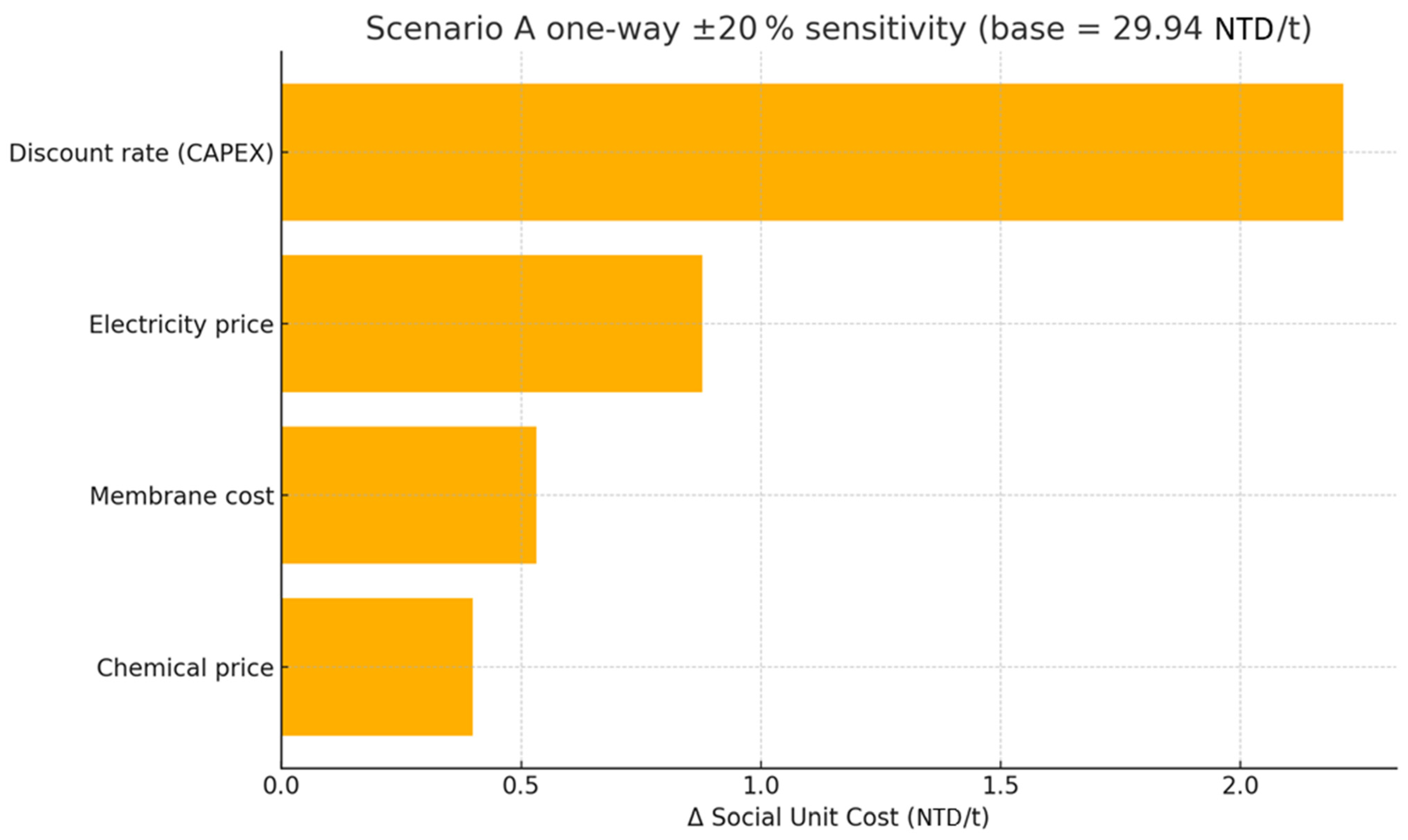
Figure 4 illustrates the effect of ±20% perturbations in the four most influential economic drivers on the social unit cost (SUC) of scenario A. Tornado bars were generated by varying each parameter while holding all others at their baseline values (Section 2.2) and recalculating SUC:
  • The discount rate (via CAPEX annualization) exerts the greatest leverage, shifting SUC by ±2.3 NT t−1 for a 20% change.
  • The electricity tariff ranks second (±1.0 NT t−1), followed by membrane replacement cost of membrane replacement and the chemical price.
  • The same exercise for scenarios B and C returns identical parameter ordering, confirming that capital discounting and power tariffs dominate cost uncertainty across all treatment trains.

5.2. Probabilistic Uncertainty (Monte Carlo Simulation)

A Latin Hypercube Monte Carlo model (20,000 iterations) was then executed to propagate simultaneous uncertainty in discount rate, electricity price, chemical price, and membrane replacement cost:
  • Discount rate: triangular (2%, 4.5%, 6%);
  • Electricity price multiplier: triangular (0.9, 1.0, 1.2);
  • Chemical price multiplier: triangular (0.85, 1.0, 1.20);
  • Membrane replacement multiplier: triangular (0.80, 1.0, 1.30).
CAPEX was rescaled using the exact CRF for each sampled iii; OPEX subcomponents were inflated by the sampled multipliers; and fixed items (e.g., extra on-site treatment) were left unchanged. Figure 4 (histograms, Supplementary) summarizes the outcomes.
The simulation shows that scenario A is the least costly option in 100% of trials, indicating that the cost advantage observed in the deterministic baseline (Section 3.3) is robust to plausible economic fluctuations. Scenarios B and C never outperform A within the tested uncertainty bounds; their cost rankings also remain unchanged (A < C < B) in every iteration.

5.3. Managerial Implications

Because discounting and electricity tariffs jointly account for >70% of SUC variance, price revision clauses for power and access to preferential finance are pivotal levers for risk mitigation. On the contrary, uncertainty in chemical prices and membrane life exert a relatively minor influence (<0.6 NT t−1 each) and are unlikely to overturn project selection decisions.
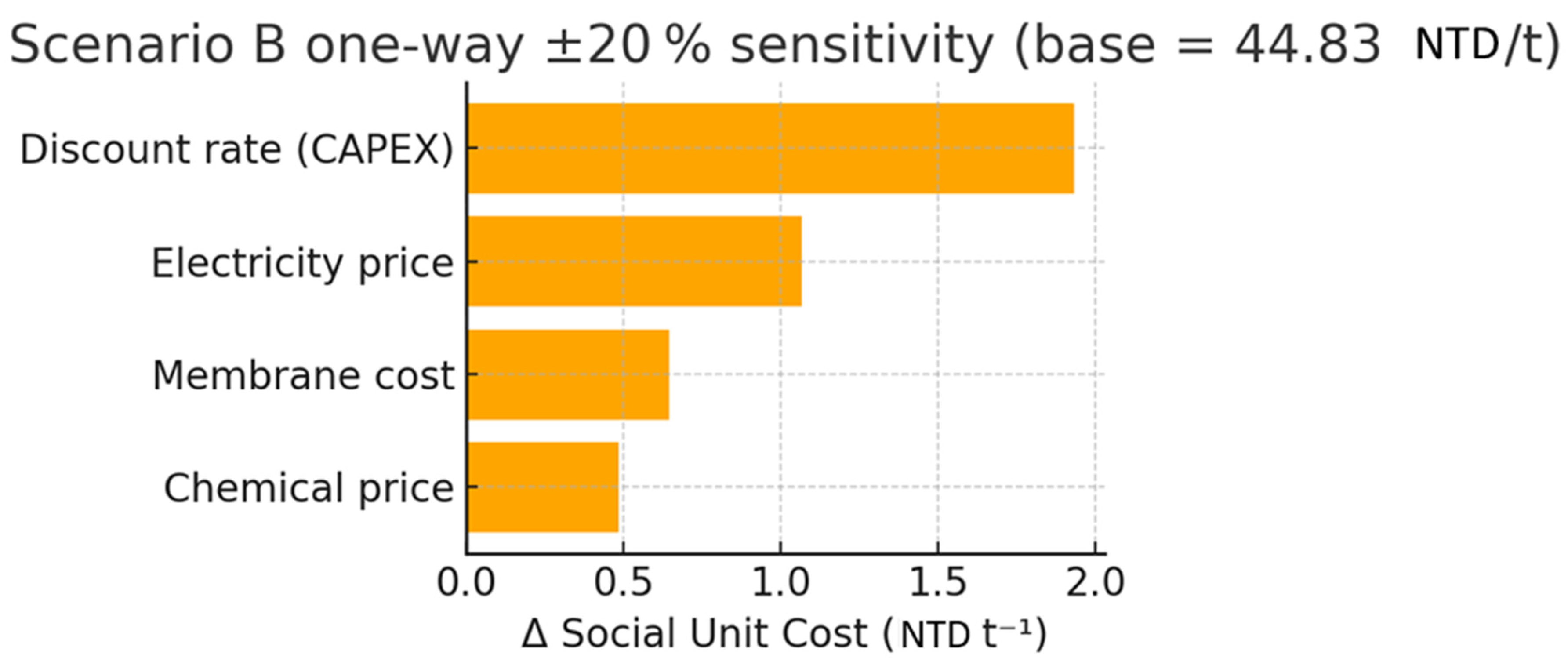
In Figure 5, bars represent the increase in the social unit cost (SUC) resulting from a + 20% change in each economic driver while all others remain at baseline values (base = 44.83 NTD m−3). Discount-rate uncertainty dominates, followed in descending order by electricity tariff, membrane replacement cost, and chemical price; the ranking of drivers mirrors that of scenario A (Figure 4), confirming a consistent sensitivity hierarchy across treatment options.
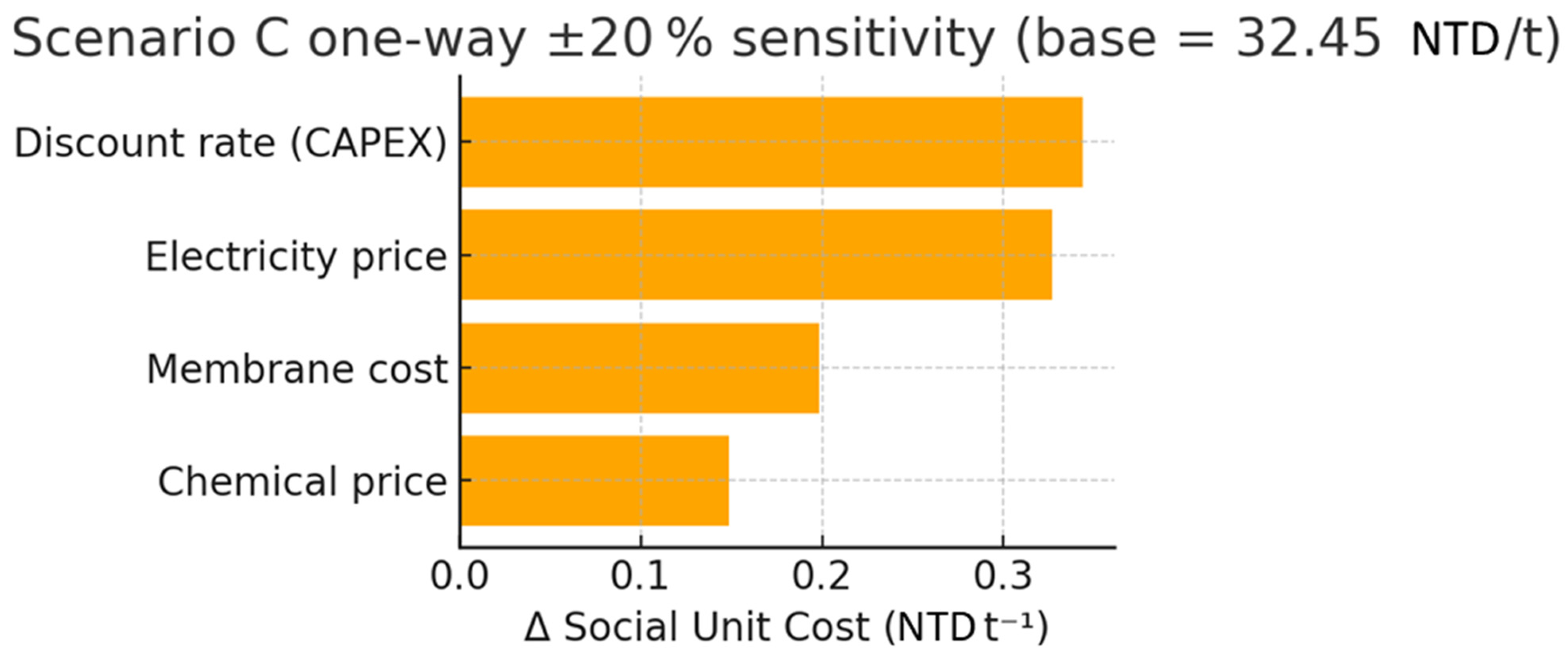
From Figure 6, bars indicate the increase in social unit cost (SUC) produced by a + 20% change in each economic driver, with the baseline held at 32.45 NTD m−3. Although the same parameter hierarchy is observed—discount rate > electricity tariff > membrane cost > chemical price—the absolute sensitivities are an order-of-magnitude lower than scenarios A and B, reflecting scenario C’s low-CAPEX, low-energy design.
Scenario C shows the smallest absolute sensitivity: even a +20% power tariff adds only 0.33 NTD m−3 to its SUC, two-thirds below the corresponding burden for scenario B.

6. Conclusions

After analyzing the total costs and water quality for scenarios A (UF + RO), B (MBR) and C (sand filtration), it is clear that there is a trade-off between costs and water quality. When comparing scenarios A, B, and C, scenario B is clearly not preferred since the cost is significantly higher than A and C while the treated water quality is not better. Thus, the trade-off between cost and water quality is actually the comparison between high-cost-high-quality (scenario A) and low-cost-low-quality (scenario C). Under the consideration of total social cost, scenario A is preferred since it provides the highest quality reclaimed water with the lowest social cost. However, note that the government is responsible for almost all the costs in scenario A, while the users are responsible for the extra on-site costs. If “Who pays for the cost?” is taken into consideration, then scenario C might be preferred, especially by the government.

Author Contributions

Conceptualization, L.-H.C.H.; methodology, L.-H.C.H., Y.-H.Y. and S.A.; software, Y.-H.Y.; validation, L.-H.C.H. and S.A.; formal analysis, Y.-H.Y. and L.-H.C.H.; investigation, Y.-H.Y.; resources, L.-H.C.H.; data curation, Y.-H.Y., S.A. and W.-L.L.; writing—original draft preparation, S.A.; writing—review and editing, L.-H.C.H.; visualization, I.N.; supervision, L.-H.C.H.; project administration, L.-H.C.H.; funding acquisition, L.-H.C.H. All authors have read and agreed to the published version of the manuscript.

Funding

This work was supported by the Ministry of Science and Technology, Taiwan [grant number 109-2221-E-033-004-MY2].

Data Availability Statement

The data that support the findings of this study are available from Blue Whale Water Technologies Corporation (Fongshan River Reclaimed Water Plant), Shui Nan Water Resource Recovery Center, and the Futian Water Resource Recovery Center. These data are not publicly available due to involving trade secrets for private companies. The data are, however, available from the authors upon reasonable request and with the permission of corresponding corporations.

Conflicts of Interest

The authors declare no conflict of interest.

References

  1. Chang, H.-M.; Chen, S.-S.; Hsiao, S.-S.; Chang, W.-S.; Chien, I.C.; Duong, C.C.; Nguyen, T.X.Q. Water reclamation and microbial community investigation: Treatment of tetramethylammonium hydroxide wastewater through an anaerobic osmotic membrane bioreactor hybrid system. J. Hazard. Mater. 2022, 427, 128200. [Google Scholar] [CrossRef] [PubMed]
  2. Capodaglio, A.G.; Olsson, G. Energy issues in sustainable urban wastewater management: Use, demand reduction and recovery in the urban water cycle. Sustainability 2019, 12, 266. [Google Scholar] [CrossRef]
  3. Water. Taiwan Water Corporation, Eighth District Management Office. Available online: https://www.water.gov.tw/dist8 (accessed on 9 August 2025).
  4. Chiueh, Y.; Chen, H.H.; Ding, C.-F. The willingness of industrial water users for reclaimed water in Taiwan. In Current Issues of Water Management; IntechOpen: London, UK, 2011; pp. 261–270. [Google Scholar]
  5. Narvaez, L.; Janzen, S.; Eberle, C.; Sebesvari, Z. Technical Report: Taiwan Drought; United Nations University—Institute for Environment and Human Security (UNU-EHS): Bonn, Germany, 2022. [Google Scholar]
  6. Lin, C.W.; Tran, H.N.; Juang, R.-S. Reclamation and reuse of wastewater by membrane-based processes in a typical midstream petrochemical factory: A techno-economic analysis. Environ. Dev. Sustain. 2024, 26, 5419–5430. [Google Scholar] [CrossRef]
  7. Chen, Y.F.; Mao, C.-H. The current situation of water resources and future feasible plans in Taiwan. Int. J. Water 2021, 14, 240–255. [Google Scholar] [CrossRef]
  8. Widianingtias, M.; Kazama, S.; Benyapa, S.; Takizawa, S. Assessment of the potential for water reclamation and reuse in Bali Province, Indonesia. Water 2023, 15, 2642. [Google Scholar] [CrossRef]
  9. Chiang, T.Y.; Perng, Y.H.; Liou, L.E. Impact and Adaptation Strategies in Response to Climate Change on Taiwan’s Water Resources. Appl. Mech. Mater. 2016, 858, 335–341. [Google Scholar] [CrossRef]
  10. Bonazzi, D. Imminent Risk of a Global Water Crisis, Warns the UN World Water Development Report 2023; UNESCO: Paris, France, 2024; Available online: https://www.unesco.org/en/articles/imminent-risk-global-water-crisis-warns-un-world-water-development-report-2023 (accessed on 22 July 2025).
  11. Administration of Construction and Planning. Operations and Management Manual for Public Wastewater Treatment Plants—Fiscal Year 2018. 11 March 2018. Available online: https://www.nlma.gov.tw/uploads/files/83320fec359b5de471072414ca9933a8.pdf (accessed on 7 July 2025).
  12. Zhang, G.; Xu, S.; Huang, M.; Li, M.; Jhang, W. Ammonia-Nitrogen Wastewater Treatment and Recovery Technologies and Case Studies. ITRI. 2013. Available online: https://www.itri.org.tw/ListStyle.aspx?DisplayStyle=01_content&SiteID=1&MmmID=1036233376167172113&MGID=620634556625725103 (accessed on 17 February 2025).
  13. Bluewhalecorp. BlueWhalecorporation. 2024. Available online: https://www.bluewhalecorp.com (accessed on 17 February 2025).
  14. Bogardi, J.J.; Bharati, L.; Foster, S.; Dhaubanjar, S. Water and its management: Dependence, linkages and challenges. In Handbook of Water Resources Management: Discourses, Concepts and Examples; Springer: Cham, Switzerland, 2021; pp. 41–85. [Google Scholar]
  15. Chen, P. Unlocking policy effects: Water resources management plans and urban water pollution. J. Environ. Manag. 2024, 365, 121642. [Google Scholar] [CrossRef] [PubMed]
  16. Awad, H.; Alalm, M.G.; El-Etriby, H.K. Environmental and cost life cycle assessment of different alternatives for improvement of wastewater treatment plants in developing countries. Sci. Total Environ. 2019, 660, 57–68. [Google Scholar] [CrossRef] [PubMed]
  17. Li, X.; Li, X.; Li, Y. Research on reclaimed water from the past to the future: A review. Environ. Dev. Sustain. 2022, 24, 112–137. [Google Scholar] [CrossRef]
  18. Yu, W.-S.; Liu, H.-C.; Lin, H.-C.; Lee, M.; Hou, C.-H. Synergizing MBR and MCDI systems as a sustainable solution for decentralized wastewater reclamation and reuse. Sustain. Environ. Res. 2024, 34, 12. [Google Scholar] [CrossRef]
  19. Linh, N.S.; Ahmed, F.; Loc, H.H. Applications of nature-based solutions in urban water management in Singapore, Thailand, and Vietnam: A review. In Regional Perspectives of Nature-Based Solutions for Water: Benefits and Challenges; Springer: Cham, Switzerland, 2023; pp. 101–126. [Google Scholar]
  20. Wang, C.; Wang, J. Analysis and Evaluation of Taiwan Water Shortage Factors and Solution Strategies. Asian Soc. Sci. 2010, 6, 44. [Google Scholar] [CrossRef]
  21. Kanchanapiya, P.; Tantisattayakul, T. Trends in wastewater reclamation in Thailand. Water Sci. Technol. 2022, 86, 2878–2911. [Google Scholar] [CrossRef] [PubMed]
  22. MFW. Environmental Forest Water Environmental. 2024. Available online: https://www.mfw.com.tw/ (accessed on 5 May 2025).
  23. National Land Management Agency, MOI. 2024. Available online: https://www.nlma.gov.tw/ch (accessed on 12 May 2025).
  24. Cheng, H.-H.; Yu, W.-S.; Tseng, S.-C.; Wu, Y.-J.; Hsieh, C.-L.; Lin, S.-S.; Chu, C.-P.; Huang, Y.-D.; Chen, W.-R.; Lin, T.-F.; et al. Reclaimed water in Taiwan: Current status and future prospects. Sustain. Environ. Res. 2023, 33, 16. [Google Scholar] [CrossRef]
  25. Goh, K.C.; Kurniawan, T.A.; Goh, H.H.; Zhang, D.; Jiang, M.; Dai, W.; Khan, M.I.; Othman, M.H.D.; Aziz, F.; Anouzla, A.; et al. Strengthening Infrastructure Resilience for Climate Change Mitigation: Case Studies from the Southeast Asia Region with a focus on Wastewater Treatment Plants in the response to flood challenges. ACS EST Water 2024, 4, 3725–3740. [Google Scholar] [CrossRef]
  26. Meier, D.A.; Chen, B.; Myers, C. Cooling water systems: An overview. In Water-Formed Deposits; Elsevier: Amsterdam, The Netherlands, 2022; pp. 239–267. [Google Scholar]
  27. Water Resources Agency. The Water Recycling Pilot Plant test Project of the Taichung Futian Water Resources Recycling Center. Available online: https://www.wra.gov.tw/wrapen/cp.aspx?n=2646 (accessed on 4 June 2025).
  28. James-Overheu, C.A. Recycled Water in Queensland: Building a Model for the Full Cost of Recycled Class A+ Water. Ph.D. Thesis, University of Southern Queensland, Toowoomba, Australia, 2016. Available online: https://research.usq.edu.au/item/q3878/recycled-water-in-queensland-building-a-model-for-the-full-cost-of-recycled-class-a-water (accessed on 12 August 2025).
  29. Chen, T.-H.; Yeh, K.-H.; Lin, C.-F.; Lee, M.; Hou, C.-H. Technological and economic perspectives of membrane capacitive deionization (MCDI) systems in high-tech industries: From tap water purification to wastewater reclamation for water sustainability. Resour. Conserv. Recycl. 2022, 177, 106012. [Google Scholar] [CrossRef]
  30. Chen, Y.; Li, Y.; Shou, Y.; Liu, B.; Li, H.; Liu, B.; Chen, S.; Dong, S. Exploring the Ecological Impacts and Implementation Strategies of Reclamation in Taiping Bay of Dalian Port as an Example. J. Taiwan Inst. Chem. Eng. 2025, 166, 105023. [Google Scholar] [CrossRef]
  31. Taichung City Government Water Resources Bureau. Preliminary Planning Report and Construction and Financial Plan (Approved Version) for the BTO Project of the New Construction, Transfer, and Operation of Effluent Reclamation and Reuse at the Taichung Shuinan Water Resource Recovery Center; Taichung City Government Water Resources Bureau: Taichung, Taiwan, 2020. [Google Scholar]
  32. Hoinkis, J.; Deowan, S.A.; Panten, V.; Figoli, A.; Huang, R.R.; Drioli, E. Membrane bioreactor (MBR) technology: A promising approach for industrial water reuse. Procedia Eng. 2012, 33, 234–241. [Google Scholar] [CrossRef]
  33. Ni, C.; Lin, J. MBR Technology Applied in Industrial Wastewater Treatment and Reclamation-Twelve years of experience in Taiwan. In Proceedings of the 3rd International Conference on Membrane Bioreactors (MBR) for Wastewater Treatment of MBR Asia, Bangkok, Thailand, 21–22 January 2013. [Google Scholar]
Figure 1. Scenario A reclaimed water treatment process. Source: Compiled by this research.
Water 18 00062 g001
Figure 2. Scenario B reclaimed water treatment process. Source: Compiled by this study.
Water 18 00062 g002
Figure 3. Scenario C reclaimed water treatment process. Source: Compiled by this research.
Water 18 00062 g003
Figure 4. Tornado diagram for scenario A (one-way ±20% sensitivity).
Water 18 00062 g004
Figure 5. One-way ± 20% sensitivity analysis for scenario B.
Water 18 00062 g005
Figure 6. One-way ± 20% sensitivity analysis for scenario C.
Water 18 00062 g006
Table 1. Merged recycled water quality table (scenarios A, B, C). Source: Compiled by this study.
Water-Quality ParameterUnitScenario A
(UF + RO)
Scenario B
(MBR)
Scenario C
(Sand + UV)
Suspended Solids (SS)mg/L<2.5<2.51.9
Ammonia Nitrogen (NH3-N)mg/L0.131.337.1
TurbidityNTU0.070.462.1
Total Hardness (as CaCO3)mg/L2.7146.2148.4
Total Organic Carbon (TOC)mg/L0.223.932.9
Electrical Conductivity (EC)µS/cm51606477
Table 2. Economic assumptions.
ModuleImplementation StepsWorked Example (for Inclusion in the Manuscript)
1. Unified discount rate and horizon• Adopt a 20-year design life (per Water Reuse Operation Manual).
• Baseline i = 4.5% i = 4.5%; sensitivity at 2% and 6%.
Baseline: n = 20 y, i = 4.5%. Sensitivity: −50 bp and +150 bp.
2. Full CRF presentation + example• Present the CRF formula and then work on scenario A.P = 2.081 × 10⁹ P = 2.081 × 10⁹ NTD, n = 20, i = 4.5% → CRF = 0.0760 A = 158.3 A = 158.3 M NTD y−1. Unit CAPEX = A/(45,000CMD × 350)A/(45,000CMD × 350) = 10.0 NTD t−1.
3. Electricity price and escalation• Base tariff 2.62 NTD kWh−1 (2024).
• Real increase 1.8% y−1.
• List SEC values (A: 1.67; B: 1.41; C: 0.53 kWh t−1).
Year 1 power cost = 2.62 × SEC. Year y cost = prior-year cost × 1.018.
4. CAPEX and OPEX sensitivity matrix• Evaluate SUC for 3 discount rates × 3 power price shocks (10%, 0%, +20%).
• Display as heat map/spider plot.
Example narrative: “With a +20% tariff, Scenario A’s OPEX of scenario A increases by 6.3 NTD t−1, increasing the SUC from 31.3 to 37.6 NTD t−1.”
Note: All monetary values are expressed in 2024 NTD.
Table 3. Parameters for research analysis.
Sr.Parameter (s)Explanation
1Operating Days350 days/year, with 15 days of annual equipment check.
2Water Production45,000 CMD.
3Personnel CostsBased on the staffing structure of the reclaimed water plant (data available per request), the salaries are graded accordingly. The total personnel cost is calculated as the base salary × 1.55.
4Administrative ExpensesDetermined by the complexity and amount of plant facilities and tasks, calculated as 10% to 15% of the total monthly base salary. This study sets it at 15% of the total monthly base salary.
5Facility Maintenance Costs Approximately 0.5% of the direct construction costs.
6Water Treatment Chemical CostsIncluded costs for acid-based chemicals, deodorants, disinfectants, and chemical dosing agents, individually set according to each plant’s treatment process.
7Water Treatment Consumable Costs Included costs for replacing activated carbon, UF/RO membranes, ozone equipment, UV equipment, and sand replenishment, individually set according to each plant’s treatment process.
8In-House Water Quality Testing CostsIncluded consumable fees costs at 3% of the base salary, instrument maintenance and calibration costs at 20% of consumable costs, and waste liquid disposal costs at 10% of consumable costs.
9Waste Disposal CostsIncluded costs for the removal and treatment of screenings, grit, and sludge. These are estimated based on market prices (data available per request), with scenarios A and C calculated to produce 1 ton of sludge cake, 0.01 tons of screenings (including plant waste), and 0.01 tons of grit per 10,000 tons treated sewage. Costs are estimated at the highest market price (screening removal cost: 3000 NTD/truck, treatment cost: 6000 NTD/ton; grit removal cost: 1000 NTD/ton, treatment cost: 9000 NTD/ton; sludge removal cost: 1000 NTD/ton, treatment cost: 8000 NTD/ton). Scenario B, which includes primary treatment, is estimated based on actual water plant data due to increased sludge production.
10Mandatory and Regular Inspection CostsApproximately 4% of the base salary.
11Occupational Safety and Health CostsApproximately 2% of the base salary.
12Environmental Cleaning CostsApproximately 5% of the base salary.
13Insurance CostsIncluded employer liability insurance, third party liability insurance, and public accident insurance, estimated at approximately 4000 NTD per person per year; commercial fire insurance, approximately 0.087% of the construction contract amount; additional insurance at 200% of the fire insurance rate.
14Electricity CostsIncluded basic electricity charges and variable electricity charges, individually set based on each plant’s electromechanical equipment. If historical electricity data are not available, the estimate can range from 0.4 to 1.5 NTD per ton of water treated.
15Water CostsBasic water charges and variable water charges included. Since reclaimed water plants do not install separate water meters, basic water charges are not considered. Variable water charges are estimated at 12 NTD per cubic meter, with an assumed daily water consumption of 90 L per person.
16Management Fees and Profit8% of the total costs for items 1 to 15.
17Value-added Tax5% of the total costs for items 1 to 16.
18Unit Production Cost of Water (NTD/ton)Total Annual Cost (NTD/year)/Total Water Volume (tons/year) (water production CMD × 350 days).
Table 4. Comparison of Costs for Each Scenarios.
ItemPretreatment Cost (NTD/ton)Recycled Water Treatment Operation Cost (NTD/ton)Total Treatment Cost (NTD/ton)Construction Cost (NTD/ton)
Scenario A5.5613.3118.8711.07
Scenario B16.1616.169.67
Scenario C4.974.969.931.72
Table 5. Summary of the comparison between recycled water in scenarios A, B, and C with tap water standards.
ItemUnitTap Water Standard/Reference ValueScenario A (UF + RO)Scenario B (MBR)Scenario C (Sand + UV)
SSmg L−1<2.5○ < 2.5○ < 2.5▲ 0.3–3.4
NH3-Nmg L−1<0.5○ 0.13▲ 1.33▲ 7.1
TurbidityNTU<4 (The water source is below 500 NTU)○ 0.07○ 0.46○ 0.8–3.3
Total hardness (CaCO3)mg L−1<400○ 2.7○ 146.2○ 148.4
TOCmg L−1<4○ 0.22○ 3.93○ 1.9–3.9
ECµS cm−1105–307◎ 51▲ 606▲ 457–497
Notes: Sources of benchmark/reference values: The quality standards for tap water, the quality standards for drinking water source quality, and the average range of finished tap water measured. Legend: ◎ better than the benchmark; ○ meets the benchmark or is equivalent to tap water quality; ▲ fails to meet the benchmark or is poorer than tap water quality.
Table 6. Industrial water consumption by sector in Taiwan.
SectorRankWater Consumption (Million m3)Share of National Industrial Water Use (%)Process Water (%)Cooling Water (%)
Chemical Materials Manufacturing1312.0818.6737.248.5
Paper Products Manufacturing2243.3714.5693.81.8
Food Manufacturing *3174.8510.4668.611.1
Textile Industry4144.388.6484.76.8
Fabricated Metal Products5120.237.1983.46.7
Electronic Components Manufacturing694.105.6381.912.0
Plastic Products Manufacturing789.955.3870.921.5
Basic Metal Manufacturing881.124.8528.265.5
Petroleum/Coal Manufacturing963.993.8328.256.6
Non-metallic Mineral Products1063.183.7887.17.2
Note: * Food manufacturing is not included in the estimation due to legal prohibition of using reclaimed water.
Table 7. Unit cost of point-of-use pretreatment by sector (NTD/ton).
ScenarioChemical MaterialsPaper ProductsTextile IndustryFabricated Metal ProductsElectronic ComponentsPlastic ProductsBasic MetalsPetroleum/CoalNon-Metallic Mineral ProductsTotal (NTD/ton)
A0.000.000.000.0016.570.000.000.000.001.33
B8.2518.6417.5917.5933.1414.5819.006.3217.5516.10
C9.0320.4119.2519.2534.7115.9620.806.9219.2117.50
Note: Source: Compiled from this study. Note: Formula = Total Social Expenditure ÷ (Process Water Volume + Cooling Water Volume).
Table 8. Integrated cost–performance comparison for the three treatment scenarios.
ScenarioConstruction CostOperation CostsPoint-of-Use PretreatmentSocial Unit CostWater Quality (Rank)
A11.0718.871.3331.271
B9.6716.1616.144.932
C1.729.9317.529.153
Note: Source: Compiled by this study. Social unit cost (per ton) = construction (annualized) + O&M + point-of-use pretreatment.
Table 9. Comparison of the marginal cost per tap water quality item achieved for three full-scale Taiwanese reclamation routes under identical 45,000 CMD demand.
FieldDefinition/Formula
Construction Cost (CAPEX)1. First, convert the capital cost P to an annualized value A using the capital recovery factor (CRF):
A = P × i ( 1 + i ) n ( 1 + i ) n 1 where n = 15 years, i = 3 % .
2. Unit CAPEX: A   ( d e s i g n   production   rate × 350   days )
Wastewater PretreatmentBased on 2020 O&M data from the Fengshan/Futian public reclaimed water centers:
Unit   cost = annual   O & M   expenseannual   influent   volume .
For Scenario B, this cost is already included in O&M, so the table shows “—" to avoid double-counting.
Reclaimed water O&M total   annual   O & M   expense ÷ ( Q prod × 350   days )
Extra On-site TreatmentUpper-bound additional UF/RO investment and operating costs at the user site:
RO = 19 NTD/t, UF + RO = 20.8 NTD/t.
If the plant effluent already meets the process/cooling requirements, the value is 0 NTD/t.
Social Unit Cost P [ total   treatment + extra   treatment ] + ( P + C ) × CAPEX P + C
CP indexInverse metric: Passes Social Cost; a higher value means more water-quality benefit per unit of social cost.
Notes: Additional treatment required at the point of use. Social cost combines plant-side CAPEX + O&M with any additional treatment on the user side, normalized by total water demand. Used in the main table for a rapid cost-effectiveness comparison.
Disclaimer/Publisher’s Note: The statements, opinions and data contained in all publications are solely those of the individual author(s) and contributor(s) and not of MDPI and/or the editor(s). MDPI and/or the editor(s) disclaim responsibility for any injury to people or property resulting from any ideas, methods, instructions or products referred to in the content.