Next Article in Journal
Multi-Factor Driving Force Analysis of Soil Salinization in Desert–Oasis Regions Using Satellite Data
Previous Article in Journal
Conjunctive-Use Frameworks Driven by Surface Water Operations: Integrating Concentrated and Distributed Strategies for Groundwater Recharge and Extraction
error_outline You can access the new MDPI.com website here. Explore and share your feedback with us.
 
 
Article

Temporal Variability of Bioindicators and Microbial Source-Tracking Markers over 24 Hours in River Water


1
Department of Civil and Environmental Engineering, University of Yamanashi, 4-3-11 Takeda, Kofu 400-8511, Yamanashi, Japan
2
Department of Engineering, University of Yamanashi, 4-3-11 Takeda, Kofu 400-8511, Yamanashi, Japan
3
Interdisciplinary Center for River Basin Environment, University of Yamanashi, 4-3-11 Takeda, Kofu 400-8511, Yamanashi, Japan
*
Authors to whom correspondence should be addressed.
Water 2026, 18(1), 132; https://doi.org/10.3390/w18010132
Submission received: 26 November 2025 / Revised: 23 December 2025 / Accepted: 31 December 2025 / Published: 5 January 2026
(This article belongs to the Section Biodiversity and Functionality of Aquatic Ecosystems)

Abstract

With increasing contamination in aquatic ecosystems, effective monitoring is crucial to preserve biodiversity and protect public health. This study quantified bioindicators (red swamp crayfish (Pcla), Genji-firefly (Lcr2), Ayu fish (Paa), and caddisfly (Sma)), microbial source tracking markers (ruminants (BacR), pigs (Pig2Bac), and humans (gyrB)), and a fecal indicator bacterium (Escherichia coli (sfmD)) using quantitative PCR on river water samples collected every 2 h between 21 and 22 July 2023 (from the Omo and Bingushi Rivers in Yamanashi Prefecture, Japan). Initially, the optimal filter sizes of 1.0, 0.65, and 0.22 µm were evaluated, where the 0.65 µm filter yielded higher Paa concentrations (Kruskal–Wallis test, p < 0.05) and was used subsequently. BacR and Paa exhibited 100% detection in the Omo (13/13) and Bingushi (13/13) Rivers with concentrations of 5.0 log10 and 5.5 log10 copies/L, respectively. These concentrations were used to assess 24 h temporal variability, but no significant fluctuations or cyclical trends between morning, afternoon, evening, and night were observed in either river. The BacR–Paa pair exhibited perfect positive detection correlation (Φ = 1.0) and complete similarity (Jaccard Index = 1.0), but a moderate negative correlation of mean concentrations highlights the importance of considering habitat overlaps and behavioral synchronicity.

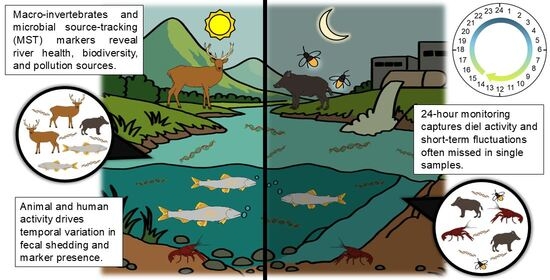
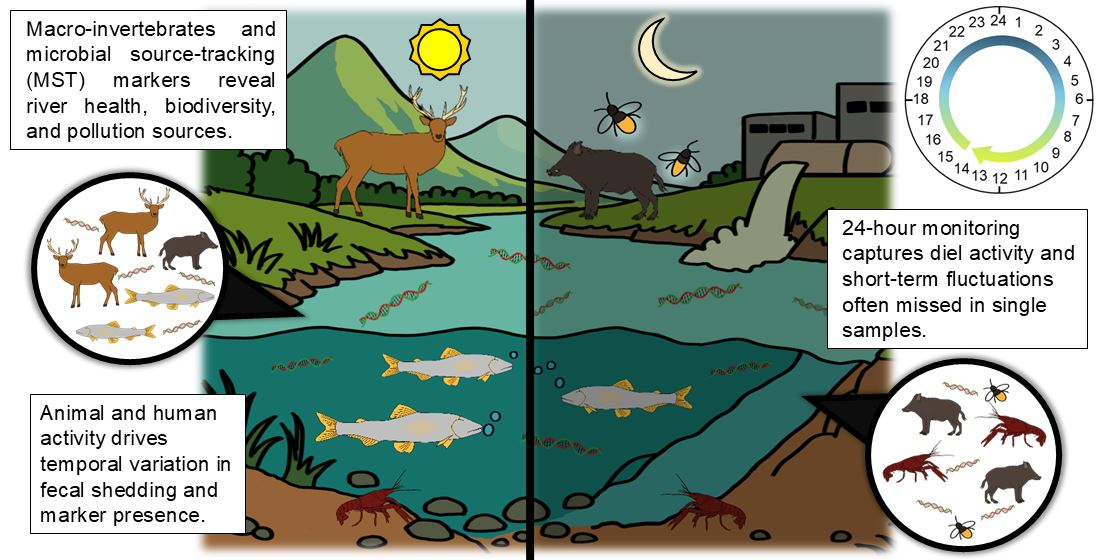
Graphical Abstract

1. Introduction

As global development accelerates, the biodiversity of the Earth faces increasing threats from the declining sustainability of ecosystems [1]. Various tools have predicted the decline of biodiversity and the loss of habitat, distribution, and species abundance [2]. Moreover, most of the species in the ecosystem are yet to be identified and reported [3]. Conventionally, the distribution pattern and the population estimation of biodiversity depend on physical identification; however, factors such as non-standardized sampling, invasive methods, and limited expertise in modern taxonomy may yield less accurate results [4,5]. To address these concerns, advancements in molecular techniques and nucleic acid research provide more rapid, cost-effective, non-invasive, and sensitive approaches for monitoring global biodiversity, encouraging more effective management strategies [6]. An alternative approach has been developed to enable more precise identification on a broader scale by utilizing environmental DNA (eDNA).
eDNA refers to the composite DNA collected from environmental samples, which may be categorized as an organismal DNA representing whole organisms, such as microorganisms, and extra-organismal DNA representing shed-tissue/DNA, such as from macro-organisms [7,8]. eDNA analysis methods have rapidly evolved for detecting target species, determining their abundance, and evaluating their community composition in aquatic environments [9,10,11,12,13,14,15]. eDNA has been used in various ecosystems, such as in subterranean environments [16], deep oceanic regions [17], coral reefs [18], geothermal sites in the Antarctic [19], and freshwater ponds [20].
Given the increasing prevalence of environmental contamination in aquatic ecosystems, monitoring is crucial to protect biodiversity. Various ecosystems are impacted by environmental contamination, necessitating environmental monitoring to combat and prevent this issue [21]. The impact of environmental changes on habitats, communities, or ecosystems can be represented by a species or group of species known as bioindicators. These organisms reflect the biotic and abiotic states of the environment and reveal whether changes have beneficial or harmful effects on the ecosystem [22]. Insects are the most prevalent animals among the benthic fauna in rivers and streams [23] that exert fluctuation effects on the environment. Similarly, other aquatic taxa, including fish, amphibians, and plants, are recognized as potential bioindicators for assessing variations in pollutant concentrations in aquatic ecosystems [24]. Fish species have a higher probability of detection using eDNA in aquatic environments than using conventional methods. Plecoglossus altivelis (Ayu fish), Procambarus clarkii (red swamp crayfish), Luciola cruciata (fireflies), and Stenopsyche marmorata (caddisfly) play crucial roles in environmental monitoring and assessment. These organisms are highly sensitive to fluctuations in their habitats, making them effective indicators of ecosystem health and water quality. Bioindicators serve as key indicators of water quality and ecosystem health. For example, the Ayu fish, an amphidromous fish species with a 1-year life span, is typically used to assess the quality of freshwater habitats because its presence and health are sensitive to factors such as temperature [25] and water quality parameters [26]. Typically, Ayu fish larvae travel downstream toward coastal areas immediately after hatching and spend the winter in brackish water near estuaries with temperature ranges of 5–10 °C. During spring, the juvenile fish migrate upstream and disperse further once the water temperatures reach 10–13 °C and remain there until they mature. In autumn, the mature Ayu fish travel downstream and spawn from evening to night, after which they die. Caddisflies are also extensively used as indicators of water quality [27] because of their sensitivity to several water quality parameters, such as cool temperatures and dissolved oxygen content. However, unlike Ayu fish, caddisflies are macro-invertebrates that are commonly found in rivers with gravel substrata where they can build retreats and feeding nets using stones [28] and feed off the organic detritus present around the riverbed. Caddisflies also exhibit a 1-year life cycle during which they undergo complete metamorphosis, progressing from eggs to five larval stages to pupal and adult stages. The larval stage is the longest among all caddisfly developmental stages, which may occur for approximately 2 months underwater. A study in Russia observed that caddisfly larvae account for 77% of the total caddisfly biomass and 35% of the total river zoobenthos biomass [29], indicating the usefulness of caddisflies as a bioindicator in rivers. Similarly, crayfish are important because of their role in nutrient cycling and as prey for other organisms [30]. Fireflies are indicators of habitat integrity [31]. The occurrence of these organisms provides valuable insights into the effects of pollution and environmental changes on biodiversity. These bioindicators were selected based on their ecological relevance to riverine systems and suitability for eDNA detection in aquatic environments in Japan [23,26,28,32,33,34,35], as these organisms typically shed detectable levels of DNA into the surrounding environment and represent various trophic levels and ecological niches within freshwater ecosystems. The difference in life cycles and activity patterns also illustrate their suitability for short-term temporal dynamics assessment. By studying the bioindicators, early signs of ecological stress can be detected, thereby guiding conservation efforts and information management practices to protect and restore vital ecosystems.
In addition to bioindicators, microbial source tracking (MST) can be used to identify and trace the sources of fecal contamination using host-specific genetic markers, such as Bacteroidales, in various environments. Increased fecal contamination in rivers is associated with parameters such as lower pH, dissolved oxygen, electrical conductivity (EC), total nitrogen, NO3-N, and phosphates [36,37], which are important in ecological studies to determine the health of the river ecosystem and its inhabitants. Monitoring both macro-invertebrates and fecal contamination sources provides insights into river water conditions, biodiversity, and fecal pollution origins, which can also serve as a preventative measure for protecting the environment and public health. MST markers, such as ruminant-specific (BacR; [38]), pig-specific (Pig2Bac; [39]), and human-specific Bacteroidales (gyrB; [40]), assist in distinguishing between varying sources of pollution, providing critical information for managing water quality and mitigating the effects of pollution. The temporal dynamics of aquatic species, including the selected bioindicators, considerably affect the eDNA concentration. For example, the spawning activity of Ayu fish [41] and the nocturnal foraging of red swamp crayfish [42,43] may increase eDNA shedding during specific times of the day. Furthermore, the diurnal activity of animals, such as ruminants [44,45] and humans, and the variable activity of pigs [46] contribute to temporal fluctuations in fecal shedding, affecting the presence and concentration of MST markers in aquatic environments. eDNA sampling is often conducted at different times of day despite the possibility of short-term changes in target concentration at a sampling site [47]. However, continuous 24 h monitoring enables improved understanding of the diel patterns of organismal activity and their fecal matter deposition into river ecosystems, capturing any short-term fluctuations that may be overlooked during a single time-point sampling. Conducting repeated sampling from a fixed point over 24 h ensures consistency and comparability, allowing more accurate temporal variability to be evaluated while minimizing potential bias that can occur from sampling at different times of day, especially when monitoring targets with known diel behavioral patterns [47]. The integration of eDNA analysis and MST markers allows for a comprehensive assessment of both macro-organismal and microbial communities, enhancing our ability to effectively monitor and manage ecosystem health.
Various methods, including alcohol precipitation [48], passive eDNA sampling [49], and filtration [50,51,52], are used to determine the optimal method for capturing eDNA for ecosystem monitoring. The filtration of river samples allows use of larger volumes of water and facilitates more rapid and easier DNA extraction. However, the organic matter present in river water can lead to filter clogging, causing longer sampling processing durations and increased filter damage. Therefore, determining the optimal filter pore size for DNA capture from river water samples is essential prior to the detection of the desired targets.
This study aimed to quantify the 24 h temporal variability of bioindicator eDNA, MST markers, and a fecal indicator bacterium, Escherichia coli, in two Japanese rivers. Specifically, this study addressed four research questions: (1) Which filter pore size is optimal for detecting bioindicators and MST markers? (2) How do the MST marker and bioindicator concentrations fluctuate over a 24 h cycle in response to organismal activity and environmental conditions? (3) Can 24 h monitoring reveal short-term variations in fecal pollution and the presence of macro-organisms, which are otherwise not captured by a single time-point sampling? (4) What are the relationships and co-occurrence patterns between MST markers and bioindicators in river water? Based on literature, we hypothesized that (1) a filter size of 0.65 µm yields optimal detection and concentrations of bioindicators and MST markers, (2) MST marker and bioindicator concentrations exhibit diel fluctuations, except for crayfish and Genji fireflies, (3) 24 h monitoring reveals short-term changes that may be overlooked by a single time-point sampling, and (4) bioindicators and MST markers are strongly associated and co-occur in rivers. Through the combined use of eDNA and MST markers, this study sought to provide a more holistic understanding of ecosystem dynamics, supporting improved conservation and management strategies to protect biodiversity under rapid environmental changes.

2. Materials and Methods

2.1. Collection and Filtration of River Water Samples

Two liters of river water samples were collected every 2 h from the Omo and Bingushi Rivers located in Koshu City in Yamanashi Prefecture (Figure 1) from 14:00 on 21 July 2023 to 14:00 on 22 July 2023. The Omo River sampling site was in a mixed land-use setting close to the forested and residential areas, whereas the Bingushi River sampling site was situated within a forested area with limited residential influence. The sampling period was selected to occur in summer, where the target species exhibit high biological activity and sustained interaction with the aquatic environment. The sunrise and sunset times during the sample collection period were 4:46 and 18:59, respectively. The river water samples were collected from the river surface in 500 mL bottles soaked for at least 30 min in a 0.3% bleach solution, prepared by 20-fold dilution of Kao bleach (6% sodium hypochlorite) with distilled water. Finally, the bottles were rinsed with tap water and then distilled water. During each sampling event, water quality parameters, including EC, total dissolved solids (TDS), resistivity (RES), salinity, temperature, and pH, were measured onsite using a waterproof conductivity meter (Model AS650, As One Corporation, Osaka, Japan) and a pocket pH meter (LAQUA twin pH-11; Horiba Lt., Kyoto, Japan). After the final collection, the samples were transported to the laboratory and processed immediately. In the laboratory, 500 mL of each river water sub-sample was filtered through mixed cellulose ester (MCE) membrane filters of three different pore sizes: 1.0, 0.65, and 0.22 µm (diameter, 47 mm; ADVANTEC, Tokyo, Japan). Finally, the filters were transferred to 2.0 mL microtubes and stored at −20 °C.

2.2. eDNA Extraction from River Water Samples

Subsequently, the membrane filters were subjected to eDNA extraction using the DNeasy Blood and Tissue Kit (QIAGEN, Hilden, Germany). First, 360 µL of Buffer ATL and 40 µL of Proteinase K were added to the microtubes containing the membrane filters, which were vortexed and incubated at 56 °C for 2 h with continuous rotation. Then, 400 µL of Buffer AL and 400 µL of 99.5% ethanol (Kanto Chemical, Tokyo, Japan) were added to the mixture and vortexed. A volume of 650 µL of the mixture was transferred to a spin column and centrifuged at 8000 rpm for 2 min; this step was repeated until all the mixture was centrifuged. Finally, the spin column was centrifuged dry at 14,000 rpm for 1 min, and 200 µL of Buffer AE was added to the mixture and centrifuged at 14,000 rpm for 3 min to obtain the DNA extract. To remove any PCR inhibitors, the DNA extract was subjected to the One-Step PCR Inhibitor Removal Kit (Zymo Research, Irvine, CA, USA) following the manufacturer’s instructions.

2.3. Quantitative PCR (qPCR) of Bioindicators, MST Markers, and E. coli

In this study, four bioindicators, namely, red swamp crayfish (Pcla), Genji-firefly (Lcr2), Ayu fish (Paa), and caddisfly (Sma); three MST markers (BacR, Pig2Bac, and gyrB); and E. coli (sfmD) were selected for assessment of the river water samples. The Pcla assay targets the cytochrome C oxidase subunit I from mitochondrial DNA of the red swamp crayfish [54]. The Lcr2 assay targets the mtDNA 16S rRNA region of the Genji-firefly [33]. The Paa assay targets the mitochondrial cytochrome B gene that is specific to the Ayu fish [32]. The Sma assay targets the cytochrome C oxidase subunit I in the mtDNA of the caddisfly species Stenopsyche marmorata [55]. BacR and Pig2Bac target the ruminant-specific [38] and pig-specific [39] Bacteroidales 16S rRNA. The gyrB marker used in this study targets the bacterial DNA gyrase subunit B gene, an indispensable type II topoisomerase, and was designed to selectively amplify Bacteroides fragilis, a commensal bacterium present in the human gut microbiome, for human-associated MST [56]. The sfmD gene encodes the export usher protein on the outer membrane in E. coli [57].
The qPCR analysis of the MST markers and E. coli was performed using a 25-μL qPCR mixture for each well comprising 12.5 μL of Probe qPCR Mix with UNG (Takara Bio, Kusatsu, Japan) for the MST markers; Probe qPCR Mix (Takara Bio) for sfmD, BacR, Pig2Bac, and gyrB; 0.1 μL each of the forward and reverse primers (100 pmol/μL); 0.05 μL of a probe (100 pmol/μL); 9.75 μL of PCR-grade water; and 2.5 μL of the DNA extract. Similarly, the qPCR analysis of the bioindicator markers was performed using 20 µL qPCR mixtures comprising 12.5 μL of Probe qPCR Mix with UNG, 0.36 μL each of the forward and reverse primers (50 pmol/μL), 0.25 μL of a probe (10 pmol/μL), 5.53 μL of PCR-grade water, and 1.0 μL of the DNA extract for the Pcla, Lcr2, and Paa assays. In contrast, the qPCR analysis of the Sma assay was performed using a 15 µL mixture comprising 7.5 µL of TB Green Premix Ex Taq II (Tli RNaseH Plus) (Takara Bio), 0.27 µL each of the forward and reverse primers (50 pmol/µL), 4.96 µL of PCR-grade water, and 2.0 µL of the DNA extract. A standard curve was established by employing six 10-fold serial dilutions using positive control gBlocks Gene Fragments (Integrated DNA Technologies, Coralville, LA, USA) or artificially synthesized plasmid DNA containing the amplification sequences (2.0 × 100–2.0 × 10⁵ copies/μL) for the qPCR run. Each qPCR run included duplicate samples, standards, and negative controls.
The Thermal Cycler Dice Real Time System III (Takara Bio) was used to perform the qPCR analysis under the following thermal conditions: hold at 95 °C for 30 s, followed by 45 cycles of 95 °C for 5 s and 60 °C for 30 s for sfmD; hold at 25 °C for 10 min and then at 95 °C for 30 s, followed by 45 cycles of 95 °C for 5 s and 60 °C for 30 s for BacR, Pig2Bac, and gyrB. For the bioindicators, the thermal conditions were as follows: hold at 25 °C for 10 min, then at 50 °C for 2 min, and again at 95 °C for 10 min, followed by 55 cycles of 95 °C for 15 s and 60 °C for 1 min for Pcla and Lcr2; hold at 25 °C for 10 min, then at 95 °C for 30 s, and again at 95 °C for 10 min, followed by 55 cycles of 95 °C for 15 s and 60 °C for 1 min for the Paa assay; finally, hold at 50 °C for 2 min and then at 95 °C for 2 min, followed by 40 cycles of 95 °C for 15 s and 60 °C for 1 min, dissociation for 1 cycle of 95 °C for 15 s, 60 °C for 30 s, and then 95 °C for 15 s for the Sma assay. The cut-off points were established as follows: 40 for sfmD, BacR, Pig2Bac, and gyrB; 50 for Pcla and Lcr2; 33 for Paa; 35 for Sma.

2.4. Data Analysis

In this study, only two-well positive targets were quantified, whereas one- and two-well positive targets were considered for qualitative results. During the statistical analysis, the limit of quantification (LOQ) values were applied to the samples with single-well positives, whereas the limit of detection (LOD) evaluation was applied to the non-detected samples. The LOQ values were computed as 50% of the lowest concentration in the two-well positive samples, whereas the LOD values were calculated as 50% of the LOQ concentration. The Paa and Sma detection ratios and concentrations in the Bingushi River were previously reported by Xu et al. [34]. Microsoft Excel for Microsoft 365 (Microsoft Corporation, Redmond, WA, USA) was used to compare the detection ratios between the assays, rivers, and filter pore sizes, and the chi-square test and Fisher’s exact test were used to evaluate the inter-group differences. Subsequently, the Kruskal–Wallis test was used to assess significant difference in concentration levels among the filter pore sizes. Spearman’s rank correlation was performed to observe the correlation between the sampling time and the target concentration across the 24 h period. Circular regression was performed using R software version 4.3.3 [58] to observe the presence of a cyclical pattern in the target concentrations. In addition, changes in the concentration between the morning (06:00–12:00), afternoon (12:00–18:00), evening (18:00–00:00), and night (00:00–06:00) periods were assessed using the Kruskal–Wallis test. The relationship of the detection ratios was judged based on the Φ coefficient, which measured the strength of co-occurrence of two targets, and the Jaccard index, which measured the similarity between two targets based on shared detections. Finally, Pearson correlation analysis was performed to evaluate the correlation between the target concentrations and water quality parameters. For all statistical analyses, a p-value of <0.05 was considered statistically significant.

3. Results

3.1. Assessment of Optimal Filter Pore Size for eDNA Collection

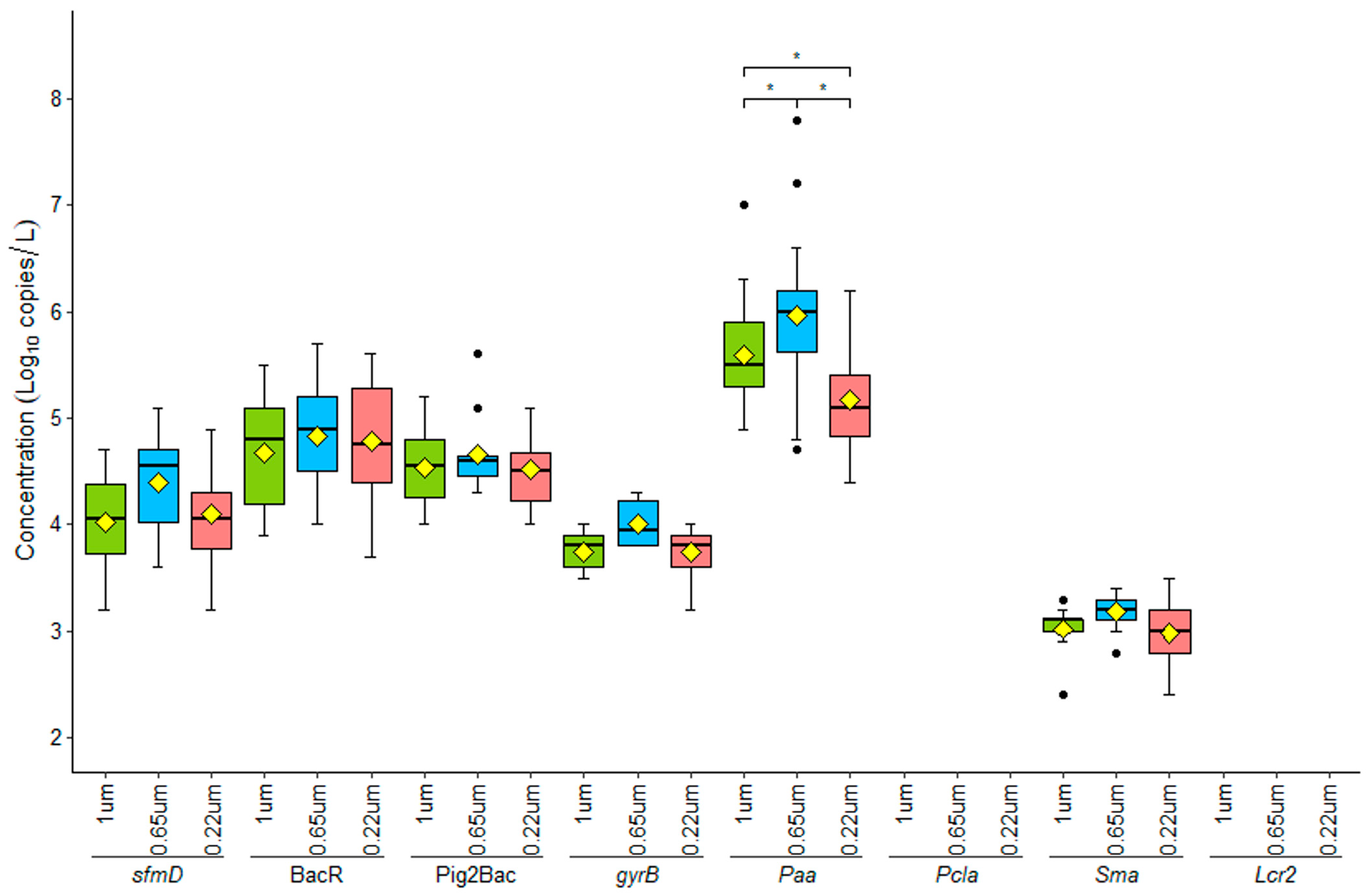
First, all markers detected were evaluated across different filter pore sizes. Table 1 shows consistent detection ratios across all filter pore sizes, with variations of up to three samples per assay per river, showing no statistically significant differences (chi-square test and Fisher’s test, p > 0.05). Subsequently, the mean concentration levels of all assays were compared between the three filter pore sizes (Figure 2). Among all assays, Paa was detected in significantly higher concentrations using the 0.65 µm pore size than the 1.0 and 0.22 µm pore sizes and using the 1.0 µm pore size than the 0.22 µm pore size (Kruskal–Wallis test, p < 0.05). Although the other assays did not show statistically significant differences, the sfmD, BacR, Pig2Bac, gyrB, and Sma concentrations detected using the 0.65 µm filter were the highest among the three filter pore sizes. These results suggest that although detection consistency is generally maintained across filter types, the choice of pore size influences the concentration estimates of specific targets. In particular, the enhanced recovery of Paa at 0.65 µm indicates that medium-sized filters provide more efficient capture of certain targets, potentially due to the optimal retention of their DNA or associated particles, as previously hypothesized. Therefore, the results obtained from the use of the 0.65 µm filter were subsequently used in the detection analysis.

3.2. Detection of sfmD, MST Markers, and Bioindicators in the Omo and Bingushi Rivers

Monitoring the presence of sfmD and MST markers is essential for understanding the ecological health of aquatic environments and ensuring public safety. As shown in Table 1, sfmD was detected in 100% (13/13) and 85% (11/13) of the Omo and Bingushi River samples, respectively. Among the MST markers, BacR was detected in 100% (13/13) of river samples, whereas Pig2Bac was detected in 38% (5/13) of the Omo River samples, and gyrB was detected in only 23% (3/13) of the Bingushi River samples. The detection ratio of Pig2Bac was significantly lower than that of BacR in the Omo River samples, whereas in the Bingushi River samples, gyrB was significantly less prevalent than both BacR and Pig2Bac (Fisher’s exact test, p < 0.05).
Moreover, monitoring the presence of bioindicators such as Lcr2, Pcla, Paa, and Sma is imperative for assessing the ecological health of aquatic environments and information conservation efforts. In this study, all target organisms, except Pcla, were detected in the Omo River samples. Among the bioindicators, Paa exhibited the highest detection ratio of 100% (13/13) in the Omo and Bingushi River samples, as previously reported by Xu et al. [49]. However, the positive ratios of Paa and Sma were significantly higher in the Omo River samples than those of Pcla and Lcr2 (Fisher’s exact test, p < 0.05). Among the two rivers, only Sma detection was significantly lower in the Bingushi River samples at 31% (4/13) than in the Omo River samples at 92% (12/13) (Fisher’s exact test, p < 0.05).

3.3. Variations in Concentrations of Bioindicators, MST Markers, and sfmD over 24 h

Among all targets, a moderate-to-strong negative correlation was observed in the Omo River samples between the sample collection time and the target concentrations of gyrB (ρ = −0.67) and Sma (ρ = −0.78) using the 0.65 µm pore size filter, whereas, in the Bingushi River samples, a moderate positive correlation was exhibited by sfmD (ρ = 0.46) (Spearman’s rank correlation, p < 0.05).
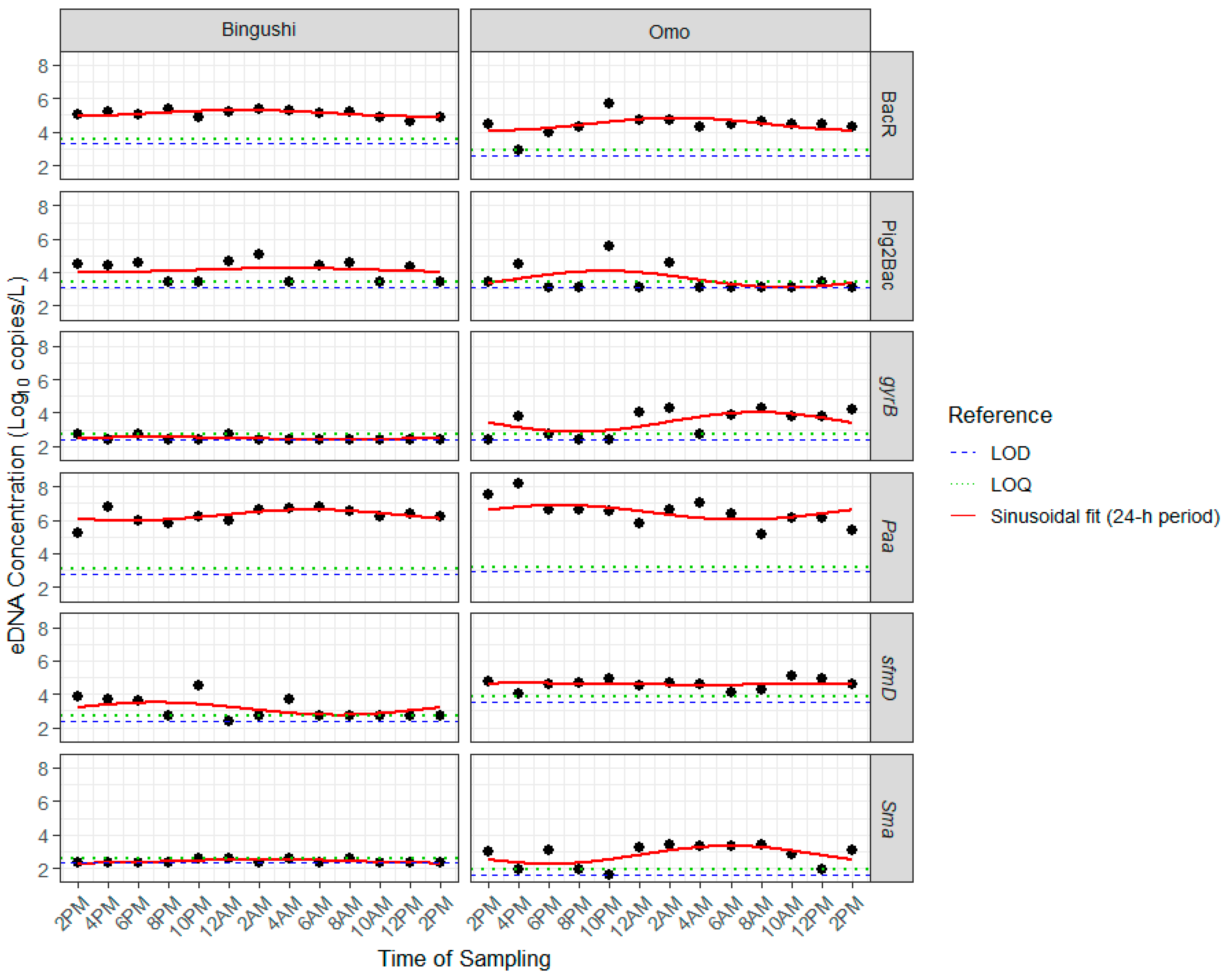
To further investigate any potential temporal patterns in the target concentrations over 24 h, a cyclical trend analysis was performed using circular regression. As shown in Figure 3, the cyclical trend analysis identified a statistically significant y-intercept and cos(θ) term for BacR (5.1, −0.18) and Sma (2.4, −0.11) in the Bingushi River samples, indicating a cyclical pattern with peaks at 0 or 12 h. However, the adjusted R2 values were relatively low (<0.40) for both targets, indicating that the observed cyclical trends accounted for only less variability. These results indicate that although cyclical patterns exist, contrary to our hypothesis, they are not strongly predictive, and other factors contribute to the observed fluctuations.
Finally, although it was hypothesized that 24 h monitoring would reveal short-term changes, no statistically significant differences in the target concentrations were observed across the morning, afternoon, evening, and night periods for any target, indicating that the eDNA concentrations remained stable over the 24 h period (Kruskal–Wallis test, p > 0.05).

3.4. Correlation Analysis of sfmD, MST Markers, Bioindicators, and Water Quality Parameters

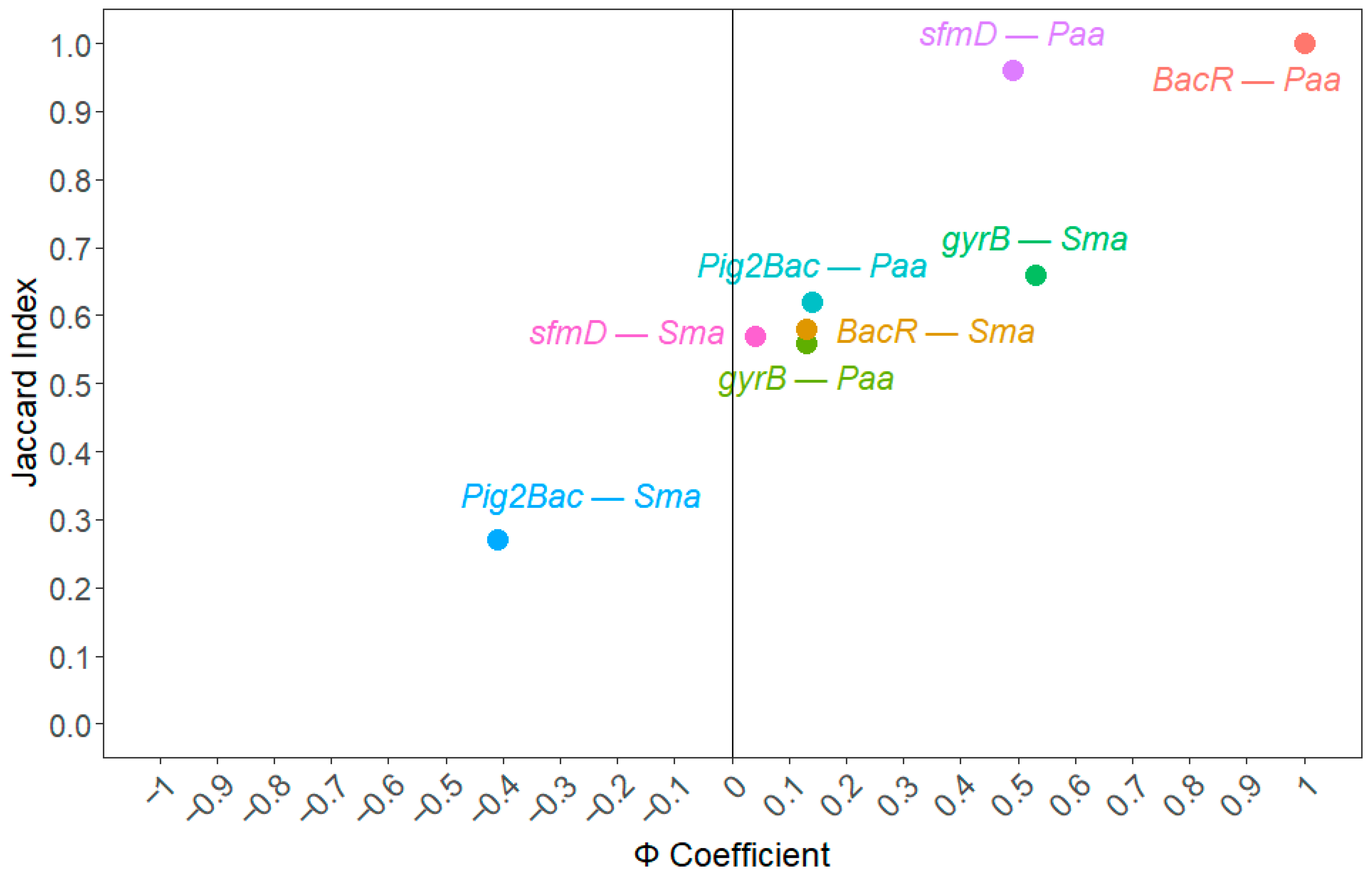
This study also examined the relationships of the detection ratios between fecal markers and bioindicator pairs across all samples. To ensure analysis robustness, the data from use of the 1.0 and 0.22 µm filter pores were included. Although the 0.65 µm filter was established as optimal, the inclusion of data from the other two filters was justified because no significant difference in the detection ratios was observed. By including the data from all filter sizes, the analysis reflects a broader range of sample collection conditions, thereby enhancing the reliability and generalizability of the findings. As shown in Figure 4, the BacR–Paa pair observed a Φ coefficient and Jaccard index of 1.0, indicating a perfect positive correlation and high co-occurrence of both targets. Similarly, the sfmDPaa pair exhibited a high Jaccard index (1.0) but a moderately positive Φ coefficient (0.49), indicating that although their detection patterns were highly similar, they had a moderate-strength correlation, possibly due to external factors influencing their presence. In contrast, the Pig2Bac–Sma pair exhibited a negative Φ coefficient (–0.41) and a low Jaccard index (0.27), indicating a moderate negative correlation and low similarity in detection patterns, suggesting that these markers rarely co-occur in the same samples.
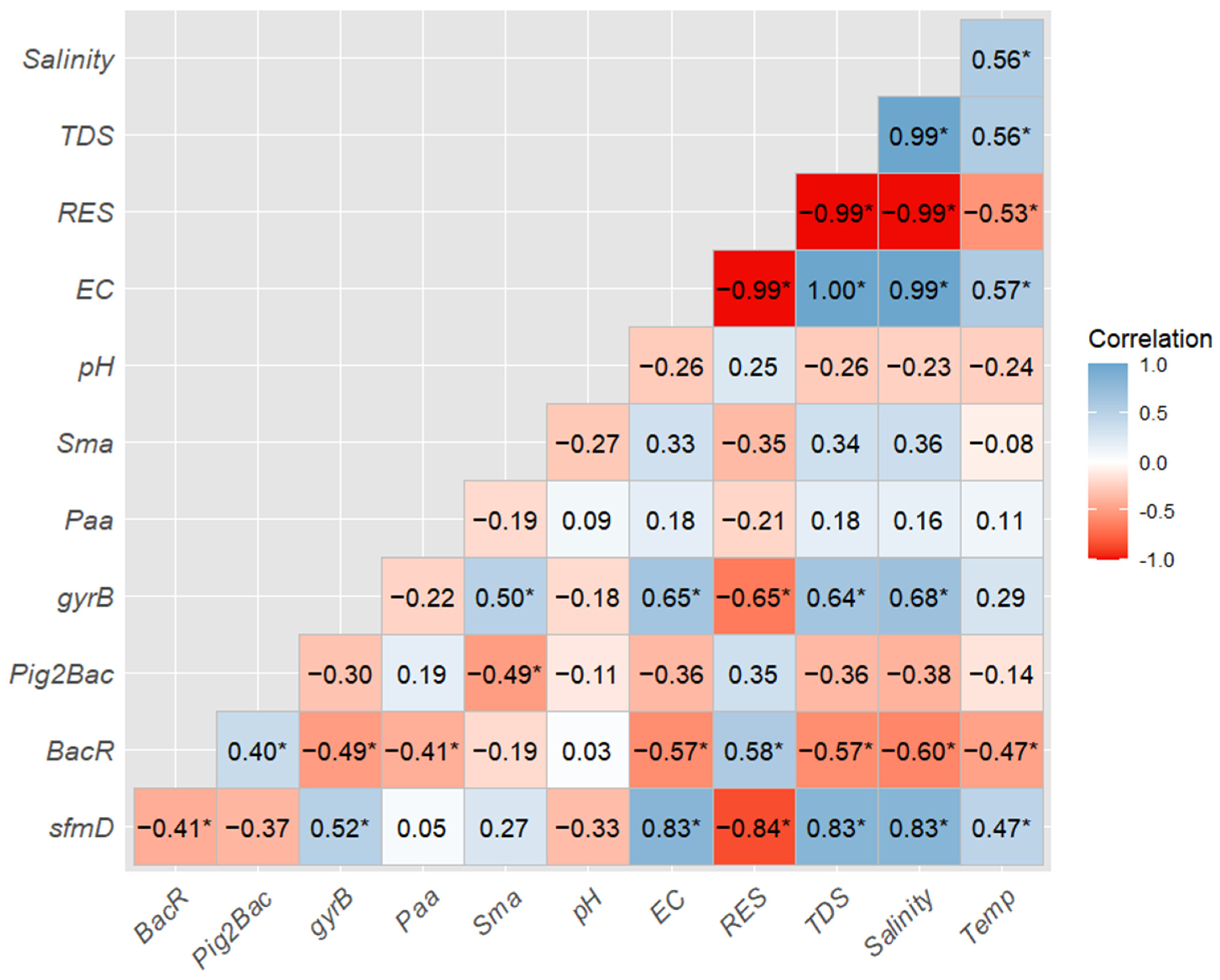
To further evaluate the relationship between the fecal markers and bioindicators, the correlations between the concentrations of sfmD, the MST markers, the bioindicators, and the water quality parameters were evaluated (Figure 5). Unlike the previous analysis, which used detection ratios, this analysis focused solely on the concentration data from the 0.65 µm filter. Among the various combinations, the highest correlations were observed among the water quality parameters, such as EC and TDS (r = 1.0) and RES and salinity (r = −0.99). Subsequently, moderate-to-high positive correlations were observed between the sfmD/MST markers and the water quality parameters, such as BacR and RES (r = 0.58) and sfmD and EC (r = 0.83). Similarly, moderate correlations were observed between sfmD and MST markers, with only BacR and Pig2Bac (r = 0.40) and sfmD and gyrB (r = 0.52) exhibiting positive correlations. Paa exhibited a significant negative correlation with BacR (r = −0.41), whereas Sma exhibited significant positive and negative correlations with gyrB (r = 0.50) and Pig2Bac (r = −0.49), respectively. Although some associations and co-occurrence patterns were observed between bioindicators and MST markers, these results did not completely align with the hypothesis that they are strongly associated.

4. Discussion

4.1. Optimal Filter Pore Size for eDNA Capture

To determine the optimal method of capturing eDNA from river water, three different pore sizes (1.0, 0.65, and 0.22 µm) were used to filter the river water samples and compare all targets. None of the targets exhibited significant differences in the detection ratios across the three pore sizes. However, sfmD, gyrB, and Paa exhibited significantly higher concentrations with the 0.65 µm filter, indicating a higher DNA yield compared to the 0.22 and 1.0 µm filters. Similarly, comparative studies of various filter pore sizes have reported clogging of the 0.2 µm filter during filtration of turbid water samples even though the 1.0 µm filter could be used for pre-filtration, so the use of larger-pore-size filters is recommended for efficient filtration [59,60]. Another study observed high eDNA retention on a 0.2 µm filter, but the clogging resulted in a lower yield of the target genome, recommending the use of a 0.6 µm filter for ensuring optimal balance between the total yield and quantification accuracy [61]. Moreover, no statistically significant difference was observed in the target concentrations between all three filter pore sizes, whereas only the 0.6 and 1.0 µm pore sizes exhibited no significant difference in the target concentration yield [61]. In addition to the filter pore size, the membrane filter material affects the amount of DNA captured during filtration. Liang and Keeley [62] evaluated the recovery rate of spiked plasmids using membrane filters prepared from different materials, such as polyvinylidene fluoride, polyethersulfone, polycarbonate, and MCE. The MCE filters yielded the highest plasmid recovery, whereas the polycarbonate filters exhibited the lowest plasmid recovery. Similar findings have been reported in other studies that compare filter materials for eDNA capture, where the DNA yield varied with the membrane type used [60,63,64]. These differences could be attributed to the electrochemical properties of the filter materials; for example, cellulose nitrate and cellulose acetate are electron donors, whereas high-molecular-weight DNA acts as an electron acceptor in aqueous environments [60]. Nevertheless, pH, the presence of organic and inorganic particles, and pore size play critical roles in determining the DNA yield. Therefore, the use of 0.65 µm MCE filters may be optimal for the capture of eDNA from river water.

4.2. sfmD, MST Markers, and Bioindicators in the Omo and Bingushi Rivers

After establishing the optimal filter pore size, the detection and concentrations of sfmD, MST markers, and bioindicators were assessed using only the data collected with the 0.65 µm filter. Among the MST markers tested, BacR exhibited the highest detection ratio in the Omo (100%) and Bingushi (100%) river samples, whereas the detection ratio of Pig2Bac was significantly lower than that of BacR in the Omo River samples (38%). These results indicate high ruminant fecal contamination in the two rivers, which could be attributed to the prevalence of wild deer in forests surrounding the Kofu Valley, which is consistent with the results of previous studies on the occurrence of BacR and Pig2Bac within the valley [65,66]. The higher detection ratios and concentrations of BacR and Pig2Bac in the Bingushi River samples compared to the Omo River samples indicate direct fecal contamination from wild deer because the Bingushi River originates from a forested area without other known sources of ruminant fecal contamination. In contrast, the sampling site of the Omo River was located in the urban area, which is supported by the higher detection and concentration of the human-specific marker gyrB in the Omo River samples compared to the Bingushi River samples, indicating a remarkable influence of urban fecal contamination sources on the Omo River. Similar trends were observed in nearby rivers in Malla et al. [66]. The disparity in the detection of ruminants and pigs may also be influenced by the performance of these assays. According to previous research, BacR exhibited a sensitivity, specificity, and accuracy of 93%, 97%, and 96%, respectively, whereas Pig2Bac exhibited the corresponding values of 100%, 73%, and 75% [66]. Despite this difference, the detection in both studies observed equivalent ratios, suggesting that these MST markers are applicable for testing in river ecosystems.
In addition to the MST markers, potential bioindicator species were targeted in the eDNA samples collected from the Omo and Bingushi Rivers. Among the four targets, Sma and Paa were detected in both rivers, whereas low detection of Lcr2 was achieved in the Omo River samples. Unlike the MST markers, higher detection of Sma was achieved in the Omo River samples than in the Bingushi River samples. Caddisflies are part of the Ephemeroptera, Plecoptera, and Trichoptera monitoring indexes and can be used for assessing environmental conditions [67], such as trace metal monitoring, radioactive contamination [28], and natural- and human-induced stressors [68]. The higher detection of caddisflies in rivers can be attributed to cool temperatures and increasing river widths, water levels, and substrate diversity in non-polluted waters [69]. The caddisfly species are also referred to as the underwater architects of nature because of their ability to produce silk that is used to build protective structures that assist with food capture and circulation of oxygenated water across the abdominal gills [70]. The substantial interaction of larvae with silk structures and the adhesive properties of the silk fibers capturing the DNA shed from the epithelial cells and fecal matter of caddisfly larvae further contribute to the high detection of Sma [70,71]. In contrast, due to the popularity of Ayu fish among anglers, local fisheries cooperative associations regularly stock Japanese rivers with large numbers of juvenile Ayu fish during the spring, including in the Kofu Valley [72]. In the upstream regions of the Fuefuki River juvenile Ayu fish are released, which are directly upstream of the Omo and Bingushi Rivers, thereby facilitating the release of high concentrations of DNA from Ayu fish. The river water samples were collected during summer, coinciding with the pre-spawning period of Ayu fish to their autumn spawning season, during which increased biological activity and physiological preparation may contribute to the elevated eDNA concentrations. This was in line with the result of a previous study on Japanese eels, which reported the eDNA concentrations to be 10–200 times higher after spawning [73]. In contrast, during this season, Genji-firefly larvae are expected to have already settled at the bottom of the river, where they feed and undergo molting from August to March. However, their survival depends on specific environmental conditions, including high dissolved oxygen levels, a pH of approximately 7.3, and the presence of black snails as prey. Yajima [35] investigated the survivability of Genji-firefly larvae in streams harboring only large (>20 mm) and small (<20 mm) snails. The study observed that the presence of red crayfish, which likely preyed on medium-sized (20 mm) snails, resulted in their elimination. After the removal of red crayfish, an increase in medium-sized snail population was observed, followed by the detection of adult fireflies in the following year, suggesting an inverse relationship between Genji fireflies and red crayfish. In this study, red crayfish were detected in the Omo River at 4:00 and 12:00, consistent with their nocturnal and burrowing behaviors, which may account for the absence of Genji-firefly populations. In addition to the ecological factors, the methodological factors may also contribute to the low detection of Pcla and Lcr2. Both red crayfish and Genji-firefly larvae are benthic organisms that typically burrow in sediments and feed on river substrates. As a result, the DNA may be retained within the sediments and released intermittently into the aquatic environment, where it is less likely to be consistently captured by surface water sampling. The burrowing behavior, limited direct shedding into the water, and dilution of locally released eDNA may therefore decrease detectability; however, low detection does not necessarily indicate true absence.

4.3. Variation in Bioindicators, MST Markers, and E. coli Concentrations over 24 h

In addition to the filter pore sizes, the timing of target detection and peak concentrations was compared between the two river samples. In the Omo River samples, gyrB (ρ = −0.67) and Sma (ρ = −0.78) exhibited a strong negative correlation with the sampling time, whereas, in the Bingushi River samples, sfmD (ρ = 0.46) exhibited a moderate positive correlation with the sampling time. No cyclical trends or differences in the concentrations between the morning, afternoon, evening, and night periods were observed in either river sample, indicating limited diel variability during the sampling period. This can be attributed to the proximity of the location of the Bingushi River sampling point to a forest area that consists of animals, including deer and wild boars. BacR, Pig2Bac, and Paa were consistently detected throughout the 24 h sampling period, whereas gyrB was only detected once between 22:00 and 6:00. Despite the diurnal or nocturnal activity of patterns of deer, wild boar, or Ayu fish, eDNA released upstream may be continuously transported downstream, replenishing any degraded or settled eDNA at the sampling site and thereby smoothing short-term temporal fluctuations [74]. According to previous studies, optimal eDNA detection occurs in target organisms within 100 to 200 m from the sampling site [75,76]. In contrast to macro-organisms, MST markers originate from fecal matter that can be continuously supplied from upstream sites and distributed downstream the river. Previous studies have demonstrated that these DNA-containing sediments can be resuspended under high-flow conditions [59,77,78], facilitating repeated release of microbial DNA into the water column resulting in consistent detection of BacR and Pig2Bac. The persistence of Bacteroidales in water bodies can influence changes, or the lack thereof, in detected concentrations. For instance, the decay rate of BacR increases with increasing water temperature, thereby enhancing rapid degradation and detection loss, as reported in several studies [79,80,81]. However, a major factor contributing to the decay of Bacteroidales in aquatic environments is predation or phage lysis, where bacteriophages infect and lyse bacterial cells, facilitating DNA release [79]. Although free DNA can persist for extended periods at cold temperatures, reduced predation under these conditions allows Bacteroidales cells and DNA-bound particles to persist longer, facilitating their capture during filtration. Similarly, some studies have detected eDNA from dead organisms; however, the detection ratio decreased over time, whereas eDNA from live organisms was detected consistently [50]. Although some of these factors contribute to the consistent detection of some targets, they may also be responsible for the limited detection of other targets. The 24 h sampling period conducted in this study was designed to investigate short-term (diel) variability rather than seasonal trends. Due to the sampling occurring in summer, when biological activity of the targets is high, the absence of pronounced diel patterns suggests that eDNA concentrations were relatively stable within the 24 h duration under biologically active conditions. Thus, understanding the interplay between environmental conditions, such as hydrological transport and sediment dynamics, and target biology is essential for interpreting short-term temporal patterns in riverine eDNA.

4.4. Relationship of sfmD, MST Markers, Bioindicators, and Water Quality Parameters

The relationships of the detection ratio between the fecal markers and bioindicators were evaluated using the Φ coefficient and Jaccard index, revealing varying degrees of association. Only the BacR–Paa pair exhibited a perfect positive correlation (Φ = 1.0) and complete similarity (Jaccard Index = 1.0) in the detection patterns, which can be attributed to the substantial presence of deer and cultured Ayu fish in Yamanashi Prefecture, as previously mentioned. This also indicates that both targets share environmental behaviors and similar persistence in river water, enabling simultaneous biodiversity conservation, fecal pollution tracking, and public health protection. In contrast, the Pig2Bac–Sma pair exhibited a negative correlation and low similarity, indicating an inverse correlation between both targets. This could result from varying persistence, degradation rates, and relationships between the organisms, as previously discussed. To further assess the relationships between the targets, the target concentrations–water quality parameter correlation was evaluated. Among all fecal markers, sfmD and gyrB exhibited the highest correlation (r = 0.52), suggesting a moderate association between the two targets. A similar trend was reported in a previous study that investigated fecal-source and water samples from the Kathmandu Valley in Nepal [82]. However, a strong correlation between the bioindicator and MST marker concentrations was not observed. The highest observed r-values were 0.50 (gyrBSma) and −0.49 (Pig2Bac–Sma), indicating a certain level of association but not a definitive link between these genes. The low association between the MST marker and bioindicator species concentrations can be attributed to many factors, such as environmental persistence, microbial competition, and variations in contamination sources. Moreover, despite the high Jaccard similarity and positive Φ coefficient between BacR and Paa, no correlation between their mean concentrations was observed. This pattern can be attributed to overlapping habitats and seasonal activity between deer and Ayu fish, where both target species simultaneously shed DNA into the river. Hydrological factors, such as runoff from forests, and the spawning activities of Ayu fish may contribute to their co-occurrence. In addition, differences in DNA degradation rates can influence detection discrepancies, because fecal markers are typically more transient in the environment than bioindicator species. Microbial interactions, such as predation or enzymatic degradation, may further impact DNA persistence in the water column. Finally, the dilution effects of river flow and sedimentation dynamics can influence eDNA detectability, potentially explaining the weak correlation in concentrations despite strong presence–absence associations. Future studies incorporating direct measurements of DNA degradation, sediment interactions, and seasonal hydrological changes can provide deeper insights into these complex ecological relationships. Overall, these findings highlight the complexity of interpreting the fecal marker–bioindicator correlation, emphasizing the importance of considering presence–absence data and concentration-based analyses, especially when examining the temporal variability in eDNA.
Although this study provides valuable insights into eDNA dynamics in river systems, several limitations exist. First, seasonal variations in eDNA concentrations were not examined, and different hydrological conditions could influence the detection patterns. Addressing these limitations in future research will provide a better understanding of seasonal impacts on eDNA persistence and transport, thereby improving the reliability of long-term monitoring strategies. Second, the environmental persistence and degradation rates of eDNA were inferred from the literature rather than direct measurements, thus potentially introducing variability. Conducting controlled degradation experiments in future research will provide more precise estimates of eDNA longevity in river environments. Finally, although filter pore size comparisons provide practical insights, further validation under different water conditions is necessary to confirm the optimal filtration strategy. Expanding filtration trials under various turbidity levels and flow conditions will enhance the adaptability of eDNA methodologies for diverse aquatic ecosystems.

5. Conclusions

This study successfully implemented eDNA analysis to assess the bioindicators and MST markers in the Omo and Bingushi Rivers, revealing significant ruminant fecal contamination and the presence of Ayu fish in Yamanashi Prefecture. The 0.65 µm filter pore size was determined as the most effective for eDNA capture across the targets. Despite the minimal temporal target concentration variations, which were likely influenced by upstream flow and sediment dynamics, the patterns of co-detection, such as strong correlations between BacR and Ayu fish, highlighted the potential of eDNA to reflect ecological interactions. Overall, this study emphasizes the efficacy of eDNA for environmental monitoring, demonstrating its potential for simultaneous tracking of fecal pollution and biodiversity. This study also stresses the need for further investigation into seasonal impacts, eDNA persistence, and extended sampling durations in future studies.

Author Contributions

Conceptualization, E.H. and S.Y.; methodology, N.S., Y.X., Y.S., E.H. and S.Y.; validation, N.S., E.H. and S.Y.; formal analysis, N.S. and Y.X.; investigation, N.S., Y.X., Y.S., E.H. and S.Y.; writing—original draft preparation, N.S.; writing—review and editing, E.H. and S.Y.; visualization, N.S.; supervision, E.H. and S.Y.; project administration, E.H. and S.Y.; funding acquisition, E.H. and S.Y. All authors have read and agreed to the published version of the manuscript.

Funding

This study was supported by the Platform for Young Scientists Development in the University of Yamanashi, the FY2019 MLIT Research Grant for River and Erosion Control Technology in the Field of Regional Issues (River Ecology), the Program to support research activities of female researchers in the University of Yamanashi, and the Japan Society for the Promotion of Science (JSPS) through Grant-in-Aid for Scientific Research (B) (grant number JP23K26230). This work was carried out with partial support by the Gender Equality Office, University of Yamanashi.

Data Availability Statement

The original contributions presented in this study are included in the article. Further inquiries can be directed to the corresponding authors.

Acknowledgments

The authors acknowledge the Yamanashi Junior Doctor Nature Academy, Futaba Kazama, Takashi Nakamura, Takuya Matsuura, the members of Yaegashi’s laboratory at the University of Yamanashi for their support on river water sampling, and the members of Haramoto’s laboratory for their support and efforts in the laboratory work.

Conflicts of Interest

The authors declare no conflicts of interest.

References

  1. Garlapati, D.; Charankumar, B.; Ramu, K.; Madeswaran, P.; Ramana Murthy, M.V. A review on the applications and recent advances in environmental DNA (eDNA) metagenomics. Rev. Environ. Sci. Biotechnol. 2019, 18, 389–411. [Google Scholar] [CrossRef]
  2. Pereira, H.M.; Leadley, P.W.; Proença, V.; Alkemade, R.; Scharlemann, J.P.; Fernandez-Manjarrés, J.F.; Araújo, M.B.; Balvanera, P.; Biggs, R.; Cheung, W.W.L.; et al. Scenarios for global biodiversity in the 21st century. Science 2010, 330, 1496–1501. [Google Scholar] [CrossRef] [PubMed]
  3. Dirzo, R.; Young, H.S.; Galetti, M.; Ceballos, G.; Isaac, N.J.; Collen, B. Defaunation in the Anthropocene. Science 2014, 345, 401–406. [Google Scholar] [CrossRef]
  4. Pikitch, E.K. A tool for finding rare marine species. Science 2018, 360, 1180–1182. [Google Scholar] [CrossRef]
  5. Thomsen, P.F.; Willerslev, E. Environmental DNA—An emerging tool in conservation for monitoring past and present biodiversity. Biol. Conserv. 2015, 183, 4–18. [Google Scholar] [CrossRef]
  6. Valentini, A.; Taberlet, P.; Miaud, C.; Civade, R.; Herder, J.; Thomsen, P.F.; Bellemain, E.; Besnard, A.; Coissac, E.; Boyer, F.; et al. Next-generation monitoring of aquatic biodiversity using environmental DNA metabarcoding. Mol. Ecol. 2016, 25, 929–942. [Google Scholar] [CrossRef]
  7. Pawlowski, J.; Apothéloz-Perret-Gentil, L.; Altermatt, F. Environmental DNA: What’s behind the term? Clarifying the terminology and recommendations for its future use in biomonitoring. Mol. Ecol. 2020, 29, 4258–4264. [Google Scholar] [CrossRef]
  8. Rodríguez-Ezpeleta, N.; Zinger, L.; Kinziger, A.; Bik, H.M.; Bonin, A.; Coissac, E.; Emerson, B.C.; Lopes, C.M.; Pelletier, T.A.; Taberlet, P.; et al. Biodiversity monitoring using environmental DNA. Mol. Ecol. Res. 2021, 21, 1405–1409. [Google Scholar] [CrossRef]
  9. Kelly, R.P.; Port, J.A.; Yamahara, K.M.; Crowder, L.B. Using environmental DNA to census marine fishes in a large mesocosm. PLoS ONE 2014, 9, e86175. [Google Scholar] [CrossRef]
  10. Minamoto, T.; Yamanaka, H.; Takahara, T.; Honjo, M.N.; Kawabata, Z.I. Surveillance of fish species composition using environmental DNA. Limnology 2012, 13, 193–197. [Google Scholar] [CrossRef]
  11. Pilliod, D.S.; Goldberg, C.S.; Arkle, R.S.; Waits, L.P. Factors influencing detection of eDNA from a stream-dwelling amphibian. Mol. Ecol. Res. 2014, 14, 109–116. [Google Scholar] [CrossRef] [PubMed]
  12. Takahara, T.; Minamoto, T.; Yamanaka, H.; Doi, H.; Kawabata, Z. Estimation of fish biomass using environmental DNA. PLoS ONE 2012, 7, e35868. [Google Scholar] [CrossRef] [PubMed]
  13. Takahara, T.; Minamoto, T.; Doi, H. Using environmental DNA to estimate the distribution of an invasive fish species in ponds. PLoS ONE 2013, 8, e56584. [Google Scholar] [CrossRef]
  14. Thomsen, P.F.; Kielgast, J.; Iversen, L.L.; Wiuf, C.; Rasmussen, M.; Gilbert, M.T.P.; Orlando, L.; Willerslev, E. Monitoring endangered freshwater biodiversity using environmental DNA. Mol. Ecol. 2011, 21, 2565–2573. [Google Scholar] [CrossRef]
  15. Thomsen, P.F.; Kielgast, J.; Iversen, L.L.; Møller, P.R.; Rasmussen, M.; Willerslev, E. Detection of a diverse marine fish fauna using environmental DNA from seawater samples. PLoS ONE 2012, 7, e41732. [Google Scholar] [CrossRef]
  16. Saccò, M.; Guzik, M.T.; van der Heyde, M.; Nevill, P.; Cooper, S.J.; Austin, A.D.; Coates, P.J.; Allentoft, M.E.; White, N.E. eDNA in subterranean ecosystems: Applications, technical aspects, and future prospects. Sci. Total Environ. 2022, 820, 153223. [Google Scholar] [CrossRef]
  17. McClenaghan, B.; Fahner, N.; Cote, D.; Chawarski, J.; McCarthy, A.; Rajabi, H.; Singer, G.; Hajibabaei, M. Harnessing the power of eDNA metabarcoding for the detection of deep-sea fishes. PLoS ONE 2020, 15, e0236540. [Google Scholar] [CrossRef]
  18. Richards, Z.T.; Stat, M.; Heydenrych, M.; DiBattista, J.D. Environmental DNA for biodiversity monitoring of coral reefs. In Coral Reefs of the World; van Oppen, M.J.H., Aranda Lastra, M., Eds.; Springer Nature: Cham, Switzerland, 2022; pp. 203–224. [Google Scholar]
  19. Fraser, C.I.; Connell, L.; Lee, C.K.; Cary, S.C. Evidence of plant and animal communities at exposed and subglacial (cave) geothermal sites in Antarctica. Polar Biol. 2018, 41, 417–421. [Google Scholar] [CrossRef]
  20. Harper, L.R.; Lawson Handley, L.; Carpenter, A.I.; Ghazali, M.; Di Muri, C.; Macgregor, C.J.; Logan, T.W.; Law, A.; Breithaupt, T.; Read, D.S.; et al. Environmental DNA (eDNA) metabarcoding of pond water as a tool to survey conservation and management priority mammals. Biol. Conserv. 2019, 238, 108225. [Google Scholar] [CrossRef]
  21. Chowdhury, S.; Dubey, V.K.; Choudhury, S.; Das, A.; Jeengar, D.; Sujatha, B.; Kumar, A.; Kumar, N.; Semwal, A.; Kumar, V. Insects as bioindicator: A hidden gem for environmental monitoring. Front. Environ. Sci. 2023, 11, 1146052. [Google Scholar] [CrossRef]
  22. Parmar, T.K.; Rawtani, D.; Agrawal, Y.K. Bioindicators: The natural indicator of environmental pollution. Front. Life Sci. 2016, 9, 110–118. [Google Scholar] [CrossRef]
  23. Yaegashi, S.; Watanabe, K.; Monaghan, M.T.; Omura, T. Fine-scale dispersal in a stream caddisfly inferred from spatial autocorrelation of microsatellite markers. Freshw. Sci. 2014, 33, 172–180. [Google Scholar] [CrossRef]
  24. Okwuosa, O.B.; Eyo, J.E.; Omovwohwovie, E.E. Role of fish as bioindicators: A Review. Iconic Res. Eng. J. 2019, 2, 1456–8880. [Google Scholar]
  25. Kato, G.; Nakajima, H.; Suzuki, K.; Kanzawa, Y.; Nakayasu, C.; Taguchi, K.; Kurata, O.; Sano, M. Decreased resistance to bacterial cold-water disease and excessive inflammatory response in ayu (Plecoglossus altivelis) reared at high water temperature. Front. Immunol. 2023, 14, 1101491. [Google Scholar] [CrossRef]
  26. Yoshida, K.; Yajima, H.; Islam, M.T.; Pan, S. Assessment of spawning habitat suitability for Amphidromous Ayu (Plecoglossus altivelis) in tidal Asahi River sections in Japan: Implications for conservation and restoration. Riv. Res. Appl. 2024, 40, 1497–1511. [Google Scholar] [CrossRef]
  27. Thamsenanupap, P.; Seetapan, K.; Prommi, T. Caddisflies (trichoptera, insecta) as bioindicator of water quality assessment in a small stream in northern Thailand. Sains Malays. 2021, 50, 655–665. [Google Scholar]
  28. Wityi, H. Applicability of Stenopsyche (Trichoptera: Stenopsychidae) Species as an Indicator in Environmental Monitoring. Ph.D. Thesis, Saitama University, Saitama, Japan, 2014. [Google Scholar]
  29. Kocharina, S.L. Growth and production of filter-feeding caddis fly (Trichoptera) larvae in a foothill stream in the Soviet far East. Aquat. Insects 1989, 11, 161–179. [Google Scholar] [CrossRef]
  30. Fritschie, K.J.; Olden, J.D. Disentangling the influences of mean body size and size structure on ecosystem functioning: An example of nutrient recycling by a non-native crayfish. Ecol. Evol. 2016, 6, 159–169. [Google Scholar] [CrossRef]
  31. Shen, M.; Qing, Z.; Lin, S. The impact of environment situation on fireflies and the contribution of fireflies on environment situation. Theor. Nat. Sci. 2023, 4, 391–396. [Google Scholar] [CrossRef]
  32. Yamanaka, H.; Minamoto, T. The use of environmental DNA of fishes as an efficient method of determining habitat connectivity. Ecol. Indic. 2016, 62, 147–153. [Google Scholar] [CrossRef]
  33. Watanabe, R.; Nakao, K.; Hiraishi, Y.; Tsuri, K.; Yamanaka, H.; Yuma, M.; Maruyama, A. Detection and quantitative possibility of firefly larvae (Luciola cruciata) using environmental DNA analysis. Ecol. Civil Eng. 2021, 23, 279–293. [Google Scholar] [CrossRef]
  34. Xu, Y.Q.; Sthapit, N.; Haramoto, E.; Yaegashi, S. Diurnal variations of environmental DNA concentrations originated from Ayu fish Plecoglossus altivelis and macroinvertebrate Stenopsyche marmorata in Bingushi River. J. JSCE 2024, 80, 24–25021. [Google Scholar] [CrossRef]
  35. Yajima, M. Breeding fireflies at Tama Zoo: An ecological approach. Zool. Gart. 2007, 77, 84–95. [Google Scholar] [CrossRef]
  36. Seo, M.; Lee, H.; Kim, Y. Relationship between Coliform Bacteria and Water Quality Factors at Weir Stations in the Nakdong River, South Korea. Water 2019, 11, 1171. [Google Scholar] [CrossRef]
  37. Aram, S.A.; Saalidong, B.M.; Lartey, P.O. Comparative assessment of the relationship between coliform bacteria and water geochemistry in surface and ground water systems. PLoS ONE 2021, 16, E0257715. [Google Scholar] [CrossRef]
  38. Reischer, G.H.; Kasper, D.C.; Steinborn, R.; Mach, R.L.; Farnleitner, A.H. Quantitative PCR method for sensitive detection of ruminant fecal pollution in freshwater and evaluation of this method in alpine karstic regions. Appl. Environ. Microbiol. 2006, 72, 5610–5614. [Google Scholar] [CrossRef]
  39. Mieszkin, S.; Furet, J.P.; Corthier, G.; Gourmelon, M. Estimation of pig fecal contamination in a river catchment by real-time PCR using two Pig-Specific Bacteroidales 16S rRNA genetic markers. Appl. Environ. Microbiol. 2009, 75, 3045–3054. [Google Scholar] [CrossRef]
  40. Kildare, B.J.; Leutenegger, C.M.; McSwain, B.S.; Bambic, D.G.; Rajal, V.B.; Wuertz, S. 16S rRNA-based assays for quantitative detection of universal, human-, cow-, and dog-specific fecal Bacteroidales: A Bayesian approach. Water Res. 2007, 41, 3701–3715. [Google Scholar] [CrossRef] [PubMed]
  41. Inui, R.; Akamatsu, Y.; Kono, T.; Saito, M.; Miyazono, S.; Nakao, R. Spatiotemporal changes of the environmental DNA concentrations of amphidromous fish Plecoglossus altivelis altivelis in the spawning grounds in the Takatsu River, Western Japan. Front. Ecol. Evol. 2021, 9, 622149. [Google Scholar] [CrossRef]
  42. Gherardi, F.; Barbaresi, S.; Salvi, G. Spatial and temporal patterns in the movement of Procambarus clarkii, an invasive crayfish. Aquat. Sci. 2000, 62, 179–193. [Google Scholar] [CrossRef]
  43. Weber, S.; Traunspurger, W. Invasive red swamp crayfish (Procambarus clarkii) and native noble crayfish (Astacus astacus) similarly reduce oligochaetes, epipelic algae, and meiofauna biomass: A microcosm study. Freshw. Sci. 2017, 36, 103–112. [Google Scholar] [CrossRef]
  44. Sakuragi, M.; Igota, H.; Uni, H.; Kaji, K.; Kaneko, M.; Akamatsu, R.; Maekawa, K. Comparison of diurnal and 24-hour sampling of habitat use by female sika deer. Mammal Study 2002, 27, 101–105. [Google Scholar] [CrossRef]
  45. Ikeda, T.; Takahashi, H.; Yoshida, T.; Igota, H.; Matsuura, Y.; Takeshita, K.; Kaji, K. Seasonal variation of activity pattern in sika deer (Cervus nippon) as assessed by camera trap survey. Mammal Study 2015, 40, 199–205. [Google Scholar] [CrossRef]
  46. Nicosia, G.; de Miguel, A.; Fumagalli, A.; Diego-Arnaldo, R.B.; Gürtler, R.E. Influence of COVID-19 lockdown and hunting disturbance on the activity patterns of exotic wild boar (Sus scrofa) and axis deer (Axis axis) in a protected area of northeastern Argentina. Eur. J. Wildl. Res. 2023, 69, 96. [Google Scholar] [CrossRef]
  47. Jensen, M.R.; Sigsgaard, E.E.; Ávila, M.d.P.; Agersnap, S.; Brenner-Larsen, W.; Sengupta, M.E.; Xing, Y.; Krag, M.A.; Knudsen, S.W.; Carl, H.; et al. Short-term temporal variation of coastal marine eDNA. Environ. DNA 2022, 4, 747–762. [Google Scholar] [CrossRef]
  48. Persaud, S.F.; Cottenie, K.; Gleason, J.E. Ethanol eDNA Reveals Unique Community Composition of Aquatic Macroinvertebrates Compared to Bulk Tissue Metabarcoding in a Biomonitoring Sampling Scheme. Diversity 2021, 13, 34. [Google Scholar] [CrossRef]
  49. Verdier, H.; Konecny-Dupre, L.; Marquette, C.; Reveron, H.; Tadier, S.; Grémillard, L.; Barthès, A.; Datry, T.; Bouchez, A.; Lefébure, T. Passive sampling of environmental DNA in aquatic environments using 3D-printed hydroxyapatite samplers. Mol. Ecol. Res. 2022, 22, 2158–2170. [Google Scholar] [CrossRef]
  50. Kamoroff, C.; Goldberg, C.S. An issue of life or death: Using eDNA to detect viable individuals in wilderness restoration. Freshw. Sci. 2018, 37, 685–696. [Google Scholar] [CrossRef]
  51. Muha, T.P.; Robinson, C.V.; Garcia, D.L.C.; Consuegra, S. An optimised eDNA protocol for detecting fish in lentic and lotic freshwaters using a small water volume. PLoS ONE 2019, 14, E0219218. [Google Scholar] [CrossRef]
  52. Sahu, A.; Kumar, N.; Singh, C.P.; Singh, M. Environmental DNA (eDNA): Powerful technique for biodiversity conservation. J. Nat. Conserv. 2022, 71, 126325. [Google Scholar] [CrossRef]
  53. QGIS.org. QGIS Geographic Information System. Open Source Geospatial Foundation Project. 2025. Available online: http://qgis.org (accessed on 4 April 2025).
  54. Ogata, S.; Doi, H.; Igawa, T.; Komaki, S.; Takahara, T. Environmental DNA methods for detecting two invasive alien species (American bullfrog and red swamp crayfish) in Japanese ponds. Ecol. Res. 2022, 37, 701–710. [Google Scholar] [CrossRef]
  55. Yaegashi, S.; Watanabe, K.; Monaghan, M.T.; Omura, T. Genetic structure and gene flow between altitudinally isolated populations of Stenopysche marmorata. In Proceedings of the 12th International Symposium of Ecohydraulics (ISE 2018), Tokyo, Japan, 19–24 August 2018. [Google Scholar]
  56. Lee, C.S.; Lee, J. Evaluation of new gyrB-based real-time PCR system for the detection of B. fragilis as an indicator of human-specific fecal contamination. J. Microbiol. Methods 2010, 82, 311–318. [Google Scholar] [CrossRef]
  57. Kaclı’kova’, E.; Pangallo, D.; Oravcova, K.; Drahovska’, H.; Kutcha, T. Quantification of Escherichia coli by kinetic 5′-nuclease polymerase chain reaction (real-time PCR) oriented to sfmD gene. Lett. Appl. Microbiol. 2005, 41, 132–135. [Google Scholar] [CrossRef]
  58. R Core Team. R: A Language and Environment for Statistical Computing; R Foundation for Statistical Computing: Vienna, Austria, 2025. Available online: https://www.R-project.org/ (accessed on 27 December 2025).
  59. Turner, C.R.; Barnes, M.A.; Xu, C.C.Y.; Jones, S.E.; Jerde, C.L.; Lodge, D.M. Particle size distribution and optimal capture of aqueous macrobial eDNA. Methods Ecol. Evol. 2014, 5, 676–684. [Google Scholar] [CrossRef]
  60. Majaneva, M.; Diserud, O.H.; Eagle, S.H.C.; Boström, E.; Hajibabaei, M.; Ekrem, T. Environmental DNA filtration techniques affect recovered biodiversity. Sci. Rep. 2018, 8, 4682. [Google Scholar] [CrossRef] [PubMed]
  61. Eichmiller, J.J.; Miller, L.M.; Sorensen, P.W. Optimizing techniques to capture and extract environmental DNA for detection and quantification of fish. Mol. Ecol. Res. 2016, 16, 56–68. [Google Scholar] [CrossRef] [PubMed]
  62. Liang, Z.; Keeley, A. Filtration Recovery of Extracellular DNA from Environmental Water Samples. Environ. Sci. Technol. 2013, 47, 9324–9331. [Google Scholar] [CrossRef]
  63. Liu, Q.; Tan, J.; Wang, M.; Xin, N.; Qi, R.; Wang, H. Optimization of pore size and filter material for better enrichment of environmental DNA. Front. Environ. Sci. 2024, 12, 1422269. [Google Scholar] [CrossRef]
  64. Chen, X.; Kong, Y.; Zhang, S.; Zhao, J.; Yao, M. Comparative evaluation of common materials as passive samplers of environmental DNA. Environ. Sci. Technol. 2022, 56, 10798–10807. [Google Scholar] [CrossRef]
  65. Haramoto, E.; Osada, R. Assessment and application of host-specific Bacteroidales genetic markers for microbial source tracking of river water in Japan. PLoS ONE 2018, 13, e207727. [Google Scholar] [CrossRef]
  66. Malla, B.; Yamamoto, K.; Furukawa, K.; Haramoto, E. Performance evaluation and application of host-specific Bacteroidales and mitochondrial DNA markers to identify sources of fecal contamination in river water in Japan. PLoS Water 2024, 3, e0000210. [Google Scholar] [CrossRef]
  67. Thorp, J.H.; Rogers, D.C. (Eds.) Chapter 25—Caddisflies: Insect Order Trichoptera. In Field Guide to Freshwater Invertebrates of North America; Academic Press: Cambridge, MA, USA, 2011; pp. 219–227. [Google Scholar]
  68. Bonada, N.; Prat, N.; Resh, V.H.; Statzner, B. Developments in aquatic insect biomonitoring: A comparative analysis of recent approaches. Annu. Rev. Entomol. 2006, 51, 495–523. [Google Scholar] [CrossRef] [PubMed]
  69. Basaguren, A.; Orive, E. The relationship between water quality and caddisfly assemblage structure in fast-running rivers, the River Cadagua Basin. Environ. Monit. Assess. 1990, 15, 35–48. [Google Scholar] [CrossRef]
  70. Standring, S.; Heckenhauer, J.; Stewart, R.J.; Frandsen, P.B. Unraveling the genetics of underwater caddisfly silk. Trends Genet. 2025, 41, 537–546. [Google Scholar] [CrossRef] [PubMed]
  71. Hatano, T.; Nagashima, T. The secretion process of liquid silk with nanopillar structures from Stenopsyche marmorata (Trichoptera: Stenopsychidae). Sci. Rep. 2015, 5, 9237. [Google Scholar] [CrossRef]
  72. Kumada, N.; Arima, T.; Tsuboi, J.I.; Ashizawa, A.; Fujioka, M. The multi-scale aggregative response of cormorants to the mass stocking of fish in rivers. Fish. Res. 2013, 137, 81–87. [Google Scholar] [CrossRef]
  73. Takeuchi, A.; Iijima, T.; Kakuzen, W.; Watanabe, S.; Yamada, Y.; Okamura, A.; Horie, N.; Mikawa, N.; Miller, M.J.; Kojima, T.; et al. Release of eDNA by different life history stages and during spawning activities of laboratory-reared Japanese eels for interpretation of oceanic survey data. Sci. Rep. 2019, 9, 6074. [Google Scholar] [CrossRef] [PubMed]
  74. Shogren, A.J.; Tank, J.L.; Andruszkiewicz, E.; Olds, B.; Mahon, A.R.; Jerde, C.L.; Bolster, D. Controls on eDNA movement in streams: Transport, retention, and resuspension. Sci. Rep. 2017, 7, 5065. [Google Scholar] [CrossRef] [PubMed]
  75. Wu, L.; Yamamoto, Y.; Yamaguchi, S.; Minamoto, T. Spatiotemporal changes in environmental DNA concentrations caused by fish spawning activity. Ecol. Indic. 2022, 142, 109213. [Google Scholar] [CrossRef]
  76. Tillotson, M.D.; Kelly, R.P.; Duda, J.J.; Hoy, M.; Kralj, J.; Quinn, T.P. Concentrations of environmental DNA (eDNA) reflect spawning salmon abundance at fine spatial and temporal scales. Biol. Conserv. 2018, 220, 1–11. [Google Scholar] [CrossRef]
  77. Stoeckle, B.C.; Beggel, S.; Cerwenka, A.F.; Motivans, E.; Kuehn, R.; Geist, J. A systematic approach to evaluate the influence of environmental conditions on eDNA detection success in aquatic ecosystems. PLoS ONE 2017, 12, e189119. [Google Scholar] [CrossRef]
  78. Eichmiller, J.J.; Bajer, P.G.; Sorensen, P.W. The relationship between the distribution of common carp and their environmental DNA in a small lake. PLoS ONE 2014, 9, e112611. [Google Scholar] [CrossRef]
  79. Sokolova, E.; Åström, J.; Pettersson, T.J.R.; Bergstedt, O.; Hermansson, M. Decay of Bacteroidales genetic markers in relation to traditional fecal indicators for water quality modeling of drinking water sources. Environ. Sci. Technol. 2011, 46, 892–900. [Google Scholar] [CrossRef] [PubMed]
  80. Bell, A.; Layton, A.C.; McKay, L.; Williams, D.; Gentry, R.; Sayler, G.S. Factors influencing the persistence of fecal Bacteroides in stream water. J. Environ. Qual. 2009, 38, 1224–1232. [Google Scholar] [CrossRef]
  81. Okabe, S.; Shimazu, Y. Persistence of host-specific Bacteroides–Prevotella 16S rRNA genetic markers in environmental waters: Effects of temperature and salinity. Appl. Microbiol. Biotechnol. 2007, 76, 935–944. [Google Scholar] [CrossRef] [PubMed]
  82. Raya, S.; Malla, B.; Thakali, O.; Angga, M.S.; Segawa, T.; Sherchand, J.B.; Haramoto, E. Validation and application of high-throughput quantitative PCR for the simultaneous detection of microbial source tracking markers in environmental water. Sci. Total Environ. 2024, 940, 173604. [Google Scholar] [CrossRef] [PubMed]
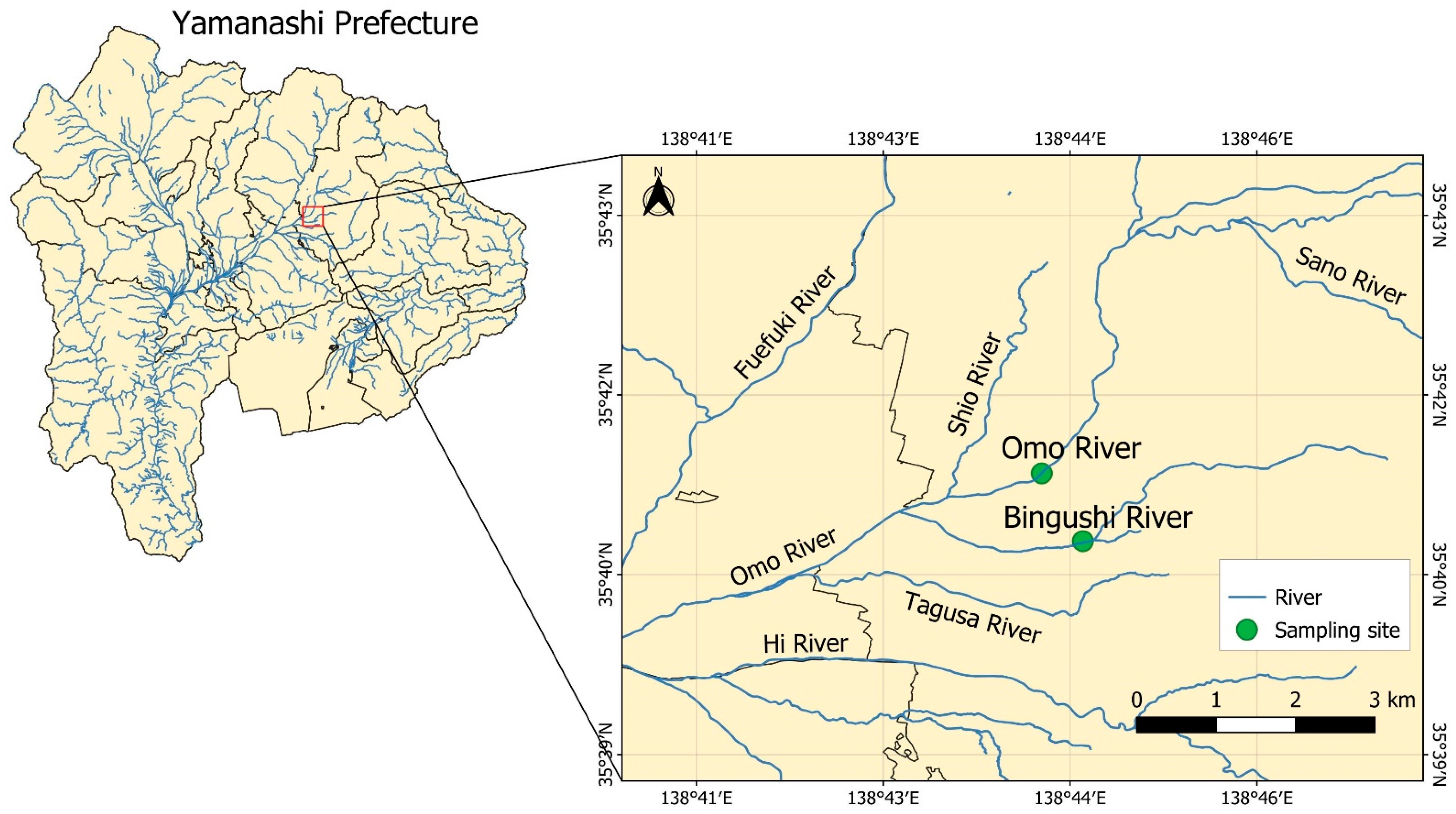
Figure 1. Map showing the sampling sites at the Omo and Bingushi Rivers. Map created using the Free and Open-Source QGIS [53].
Water 18 00132 g001
Figure 2. Mean concentrations of E. coli, MST markers, and bioindicators in the Omo and Bingushi Rivers across varying filter pore sizes. The box plots represent the range of the concentrations for each target, and the yellow diamond represents the mean concentration. The asterisks indicate a statistically significant difference between two target pairs (Kruskal–Wallis test, p < 0.05).
Water 18 00132 g002
Figure 3. Temporal variation in eDNA concentrations of fecal markers and bioindicators in the Omo and Bingushi Rivers over the 24 h sampling period. Each panel displays the fitted sinusoidal trend (red line) with a fixed 24 h period for each target.
Water 18 00132 g003
Figure 4. Pairwise scatter plot of Φ coefficient and Jaccard index values for fecal marker and bioindicator pairs, illustrating the correlation (Φ) and similarity (Jaccard index) in their detection ratios. The Jaccard index quantifies the co-occurrence between two targets, with values of 1.0 and 0.0 indicating that both targets are co-detected and never co-detected, respectively. The Φ coefficient measures the strength and direction of association between the detection patterns of the two targets, where values of +1.0, 0.0, and −1.0 indicate perfect positive, no, and perfect negative associations, respectively.
Water 18 00132 g004
Figure 5. Pearson’s correlation analysis of E. coli, MST markers, bioindicator concentrations, and water quality parameters. Asterisks indicate that p < 0.05, implying a statistically significant correlation between the two groups.
Water 18 00132 g005
Table 1. Detection ratios of E. coli, MST markers, and bioindicators in the Omo and Bingushi Rivers across varying filter pore sizes.
Sample (No. of Tested Samples)Pore SizeNo. of Positive Samples (%)
E. coliMST MarkersBioindicators
sfmD (%)BacR (%)Pig2Bac (%)gyrB (%)Pcla (%)Lcr2 (%)Sma (%)Paa (%)
Omo River
(n = 13)
1.0 μm 12 (92)12 (92)3 (23)11 (85)0 (0)1 (8)12 (92) 12 (92)
0.65 μm13 (100)13 (100)5 (38)10 (77)0 (0)1 (8)12 (92) 13 (100)
0.22 μm13 (100)13 (100)3 (23)12 (92)0 (0)0 (0)13 (100)13 (100)
Bingushi River
(n = 13)
1.0 μm12 (92)13 (100)11 (85)4 (31)0 (0)0 (0)2 (15) *13 (100) *
0.65 μm11 (85)13 (100)13 (100)3 (23)0 (0)0 (0)4 (31) *13 (100) *
0.22 μm12 (92)13 (100)13 (100)3 (23)0 (0)0 (0)5 (38) *13 (100) *
Note: * Reported in [34].
Disclaimer/Publisher’s Note: The statements, opinions and data contained in all publications are solely those of the individual author(s) and contributor(s) and not of MDPI and/or the editor(s). MDPI and/or the editor(s) disclaim responsibility for any injury to people or property resulting from any ideas, methods, instructions or products referred to in the content.