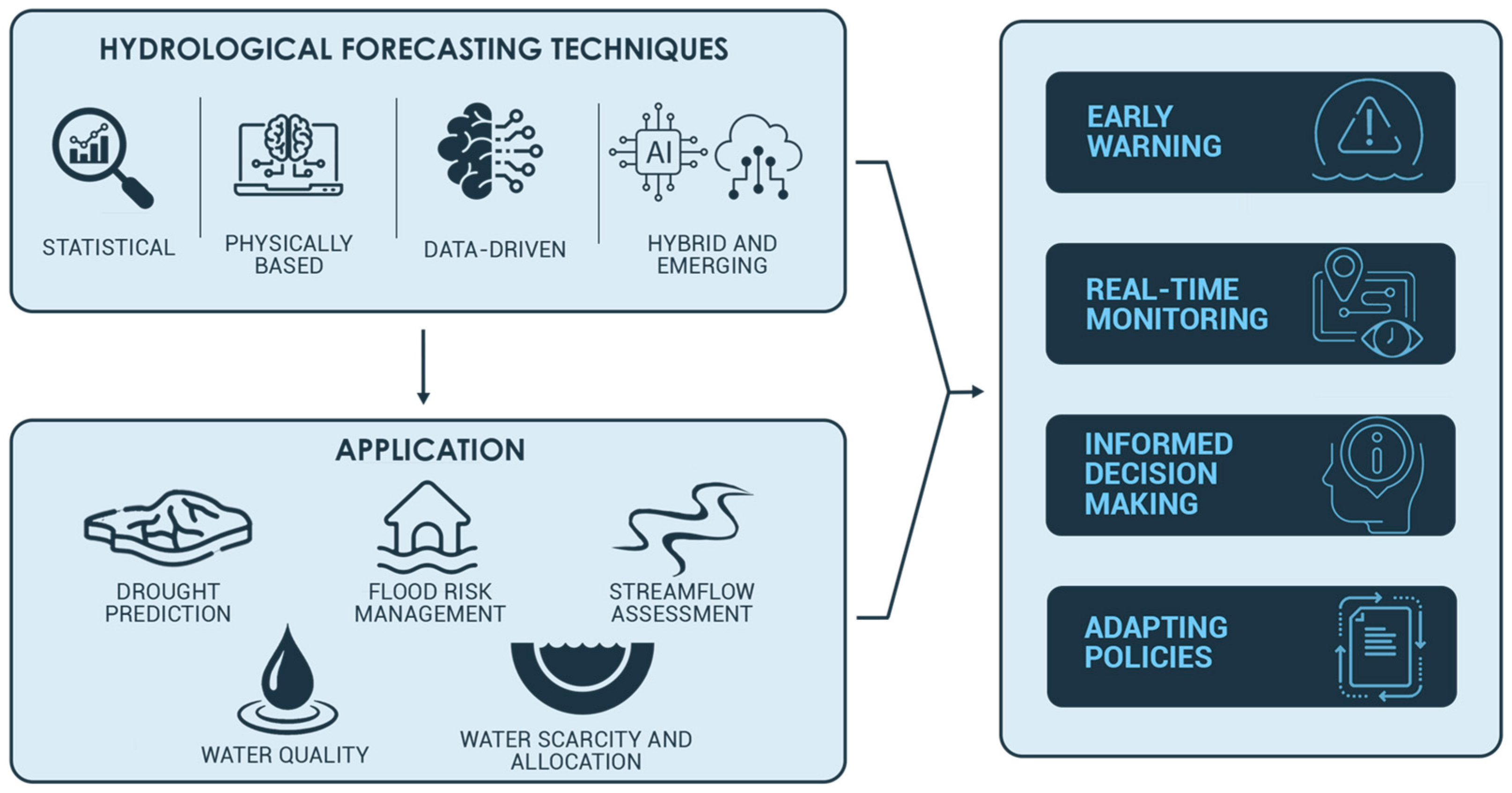
A Review of the Advances and Emerging Approaches in Hydrological Forecasting: From Traditional to AI-Powered Models

 , , and
Abstract
1. Introduction
2. Review Methodology
2.1. Literature Sourced and Selection Criteria
2.2. Thematic Classification
2.3. Temporal and Source Distribution
2.4. Reference Screening, Classification, and Meta-Analysis Procedure
3. Recent Trends in Hydrological Forecasting Techniques
3.1. Statistical Forecasting Techniques
3.2. Physically Based Models
3.3. Data-Driven Models
3.3.1. Machine Learning (ML) Techniques
3.3.2. Deep Learning
3.3.3. Performance and Data Requirements
3.4. Hybrid and Emerging Methods
Structural Typologies of Hybrid Hydrological Forecasting Models
3.5. Data Requirements and Dataset Specifications
3.6. Dataset Length and Sample Size Consideration in Hydrological Forecasting
- Small Datasets: These are defined as records shorter than 10 years. They are often utilized in regions where data is scarce, in pilot studies, or for real-time and event-based flood forecasting. Such datasets are increasingly prevalent in Internet of Things (IoT)-enabled systems, which are designed for rapid data collection and analysis. They are also commonly employed in flash flood studies and within newly established monitoring networks, where immediate data availability is crucial for timely decision-making.
- Medium Datasets: This category encompasses records that range from 10 to 30 years. Medium datasets represent the most frequently encountered length in operational hydrological forecasting. They strike a balance between temporal coverage and data quality, making them particularly useful for a variety of modeling techniques, including machine learning, deep learning, and the calibration of physically based models. The moderate duration of these datasets allows for a more comprehensive understanding of hydrological trends while maintaining sufficient data integrity for reliable forecasting.
- Large Datasets: Large datasets are those that exceed 30 years in length and are often sourced from long-term gauge networks, national hydrological services, or global reanalysis and satellite products. The extensive temporal coverage of these datasets makes them invaluable for applications sensitive to climatic variations. They are essential for long-term streamflow assessments, drought analysis, and cross-basin generalization studies, where understanding historical trends and variations is crucial for effective water resource management and planning.
3.7. Summary and Synthesis
3.8. Unified Benchmark Comparison of Hydrological Forecasting Model Families
4. Applications
4.1. Drought Prediction and Management
4.2. Streamflow Assessment
4.3. Flood Risk Management and Early Warning Systems
4.4. Water Quality
4.5. Water Scarcity and Allocation
4.6. Summary and Synthesis
5. Challenges and Solution-Oriented Future Directions in Hydrological Forecasting
5.1. Data Limitations and Infrastructure Constraints
5.2. Limited Model Transparency and Trustworthiness
5.3. Model Generalization and Cross-Basin Transferability
5.4. Non-Stationary Climate Conditions
5.5. Computational Constraints and Operational Barriers
5.6. Multi-Source Data Integration Challenges
5.7. Need for Standardized Evaluation and Benchmarking
5.8. Deepening Standardized Evaluation: Existing Frameworks, Gaps, and Actionable Pathways
5.9. Synthesis of Challenges and Future Directions
5.10. Integrated Discussion: Paired Challenges, Solution Pathways, and Regional Implementation
6. Summary and Conclusions
- Foundational models remain essential: Traditional statistical and physically based models provide critical insights into hydrological processes, but their standalone capabilities are limited in representing complex nonlinear interactions and rapidly changing climate-driven dynamics.
- Machine learning and deep learning significantly enhance predictive performance by learning complex, nonlinear, and high-dimensional relationships from large hydrometeorological datasets. These models excel at capturing spatiotemporal patterns, improving forecast accuracy and lead time, and enabling scalable, data-driven forecasting across diverse hydrological applications. Their strengths are particularly evident in short- to medium-term forecasting and real-time applications, where rapid computation and adaptability to large data volumes are critical. However, their effectiveness remains strongly dependent on data availability, training representativeness, and model interpretability.
- Hybrid and physics-informed models extend the capabilities of purely data-driven approaches by embedding hydrological process knowledge and physical constraints into learning frameworks. Rather than focusing solely on predictive accuracy, these models enhance robustness, physical consistency, and cross-basin generalization, especially in data-scarce or non-stationary environments. By coupling data-driven flexibility with process-based realism, hybrid approaches reduce overfitting, improve interpretability, and increase operational trust—making them particularly suitable for long-term planning, climate-sensitive forecasting, and decision-critical water management applications.
- Regional differences matter: Model performance and applicability vary with local climate, topography, hydrological regime, and data availability. Region-specific calibration and validation are crucial to ensure reliable hydrological forecasts and effective decision support.
- Persistent challenges remain: Data scarcity, limited transparency, and climate non-stationarity restrict model reliability, highlighting the need for expanded monitoring networks, explainable AI techniques, and climate-adaptive modeling frameworks.
- Operational implementation considerations: To ensure real-world utility, forecasting systems must improve computational efficiency, seamlessly integrate multi-source data, and adopt standardized benchmarking for scalability and comparability in real-time applications.
Author Contributions
Funding
Data Availability Statement
Conflicts of Interest
Abbreviations
| AI | Artificial Intelligence |
| ANFIS | Adaptive Neuro-Fuzzy Inference System (ANFIS) |
| ANN | Artificial Neural Network |
| ARIMA | Auto-regressive Integrated Moving Average |
| CIV | Variable Infiltration Capacity |
| CN | Curve Number |
| DL | Deep Learning |
| DT | Decision Trees |
| EFAS | European Flood Awareness System |
| GBM | Gradient Boosting Machine |
| GLM | Generalized Linear Model |
| GNN | Graph Neural Network |
| GT | Gamma Test |
| HEC-HMS | Hydrologic Engineering Center’s Hydrologic Modeling System |
| IoT | Internet of Things |
| KNN | K-Nearest Neighbors |
| LSTM | Long Short-term Memory |
| MARS | Multivariate Adaptive Regression Splines |
| MCA | Multi-criteria analysis |
| MIKE-SHE | MIKE Système Hydrologique Européen |
| ML | Machine Learning |
| NAEFS | North American Ensemble Forecast System |
| NARX | Nonlinear Autoregressive with Exogenous Input |
| NH3-N | Ammonia Nitrogen |
| NMME | North American Multimodel Ensemble |
| NSE | Nash-Sutcliffe Efficiency |
| NWP | Numerical Weather Prediction |
| RF | Random Forests |
| RNN | Recurrent Neural Network |
| RRKHS | Reproducing Kernel Hilbert Space |
| RVM | Relevance Vector Machine |
| SHAP | Shapley Additive Explanations |
| STA-GRU | Spatio-Temporal Attention Gated Recurrent Unit |
| SVM | Support Vector Machine |
| SWAT | Soil and Water Assessment Tool |
| WQI | Water Quality Index |
| XAI | Explainable Artificial Intelligence |
| XGBOOST | eXtreme Gradient Boosting |
References
- He, M.; Lee, H. Advances in Hydrological Forecasting. Forecasting 2021, 3, 517–519. [Google Scholar] [CrossRef]
- Moreido, V. Assessment of the Long-Term Hydrological Forecast Skill Evolution across Lead-Times within the Ensemble Streamflow Prediction Framework. Water Resour. 2018, 45, 122–127. [Google Scholar] [CrossRef]
- Robles, K.P.V.; Monjardin, C.E.F. Forecasting Climate Change Impacts on Water Security Using HEC-HMS: A Case Study of Angat Dam in the Philippines. Water 2025, 17, 2085. [Google Scholar] [CrossRef]
- Coughlan de Perez, E.; Berse, K.B.; Depante, L.A.C.; Easton-Calabria, E.; Evidente, E.P.R.; Ezike, T.; Heinrich, D.; Jack, C.; Lagmay, A.M.F.A.; Lendelvo, S.; et al. Learning from the Past in Moving to the Future: Invest in Communication and Response to Weather Early Warnings to Reduce Death and Damage. Clim. Risk Manag. 2022, 38, 100461. [Google Scholar] [CrossRef]
- Emerton, R.; Emerton, R.; Stephens, E.; Pappenberger, F.; Pagano, T.C.; Weerts, A.; Wood, A.W.; Salamon, P.; Brown, J.D.; Hjerdt, N.; et al. Continental and Global Scale Flood Forecasting Systems. Wiley Interdiscip. Rev. Water 2016, 3, 391–418. [Google Scholar] [CrossRef]
- Loukas, A.; Garrote, L.; Vasiliades, L. Hydrological and Hydro-Meteorological Extremes and Related Risk and Uncertainty. Water 2021, 13, 377. [Google Scholar] [CrossRef]
- Copernicus European Flood Awareness System. Available online: https://www.copernicus.eu/en/european-flood-awareness-system (accessed on 24 May 2025).
- Liu, Q.; Cui, B. Impacts of Climate Change/Variability on the Streamflow in the Yellow River Basin, China. Ecol. Model. 2011, 222, 268–274. [Google Scholar] [CrossRef]
- Yuan, X.; Ma, F.; Wang, L.; Zheng, Z.; Ma, Z.; Ye, A.; Peng, S. An Experimental Seasonal Hydrological Forecasting System over the Yellow River Basin—Part I: Understanding the Role of Initial Hydrological Conditions. Hydrol. Earth Syst. Sci. 2016, 20, 2437–2451. [Google Scholar] [CrossRef]
- Jones, L.; Dougill, A.; Jones, R.G.; Steynor, A.; Watkiss, P.; Kane, C.; Koelle, B.; Moufouma-Okia, W.; Padgham, J.; Ranger, N.; et al. Ensuring Climate Information Guides Long-Term Development. Nat. Clim. Chang. 2015, 5, 812–814. [Google Scholar] [CrossRef]
- Thiemig, V.; de Roo, A.; Gadain, H. Current Status on Flood Forecasting and Early Warning in Africa. Int. J. River Basin Manag. 2011, 9, 63–78. [Google Scholar] [CrossRef]
- Venäläinen, A.; Pilli-Sihvola, K.; Tuomenvirta, H.; Ruuhela, R.; Kululanga, E.; Mtilatila, L.; Kanyanga, J.; Nkomoki, J. Analysis of the Meteorological Capacity for Early Warnings in Malawi and Zambia. Clim. Dev. 2016, 8, 190–196. [Google Scholar] [CrossRef]
- ICRISAT Servir West Africa. Available online: https://servir.icrisat.org/ (accessed on 24 May 2025).
- United Nations Office for Disaster Risk Reduction. Key Findings and Recommendations to Achieve Early Warnings for All. In Global Status of Multi-Hazard Early Warning Systems 2023; United Nations Office for Disaster Risk Reduction: Geneva, Switzerland, 2024; pp. 110–120. [Google Scholar] [CrossRef]
- Jean-Baptiste, N.; Kabisch, S.; Kuhlicke, C. Urban Vulnerability Assessment in Flood-Prone Areas in West and East Africa. In Urban Environment; Springer: Dordrecht, The Netherlands, 2013; pp. 203–215. [Google Scholar] [CrossRef]
- Gudoshava, M.; Otieno, G.; Koech, E.; Misiani, H.; Ongoma, J.G.; Heinrich-Mertsching, C.; Wachana, C.; Endris, H.S.; Mwanthi, A.; Kilavi, M.; et al. Advances, Gaps and Way Forward in Provision of Climate Services over the Greater Horn of Africa. Front. Clim. 2024, 6, 1307535. [Google Scholar] [CrossRef]
- Omukuti, J.; Wanzala, M.A.; Ngaina, J.; Ganola, P. Develop Medium- to Long-Term Climate Information Services to Enhance Comprehensive Climate Risk Management in Africa. Clim. Resil. Sustain. 2023, 2, e247. [Google Scholar] [CrossRef]
- Renner, R. Climate Change, Extreme Weather, and Water Utilities: Preparing for the New Normal. J. Am. Water Work. Assoc. 2013, 105, 44–51. [Google Scholar] [CrossRef]
- World Meteorological Organization. Weather-Related Disasters Increase over Past 50 Years, Causing More Damage but Fewer Deaths 2021. Available online: https://wmo.int/media/news/weather-related-disasters-increase-over-past-50-years-causing-more-damage-fewer-deaths (accessed on 5 November 2025).
- Mahardhika, S.P.; Putriani, O. Deployment and Use of Artificial Intelligence (AI) in Water Resources and Water Management. IOP Conf. Ser. Earth Environ. Sci. 2023, 1195, 012056. [Google Scholar] [CrossRef]
- Allen-Dumas, M.R.; Xu, H.; Kurte, K.R.; Rastogi, D. Toward Urban Water Security: Broadening the Use of Machine Learning Methods for Mitigating Urban Water Hazards. Front. Water 2021, 2, 562304. [Google Scholar] [CrossRef]
- Chang, F.J.; Guo, S. Advances in Hydrologic Forecasts and Water Resources Management. Water 2020, 12, 1819. [Google Scholar] [CrossRef]
- Gong, X.; Zhang, Q.; Tang, S.; Bai, Y.; Singh, V.P.; Lu, Z. Proactive Dynamic Flooding Regulations for River Basins in China’s Arid and Semi-Arid Region of Xinjiang. J. Hydrol. Reg. Stud. 2025, 59, 102457. [Google Scholar] [CrossRef]
- Hajibabaei, E.; Ghasemi, A. Flood Management, Flood Forecasting and Warning System. Int. J. Sci. Eng. Appl. 2017, 6, 33–38. [Google Scholar] [CrossRef]
- Jain, S.K.; Mani, P.; Jain, S.K.; Prakash, P.; Singh, V.P.; Tullos, D.; Kumar, S.; Agarwal, S.P.; Dimri, A.P. A Brief Review of Flood Forecasting Techniques and Their Applications. Int. J. River Basin Manag. 2018, 16, 329–344. [Google Scholar] [CrossRef]
- Ranit, A.B.; Durge, P.V. Different Techniques of Flood Forecasting and Their Applications. In Proceedings of the 2018 3rd IEEE International Conference on Research in Intelligent and Computing in Engineering, RICE 2018, San Salvador, El Salvador, 22–24 August 2018. [Google Scholar] [CrossRef]
- Brunner, M.I.; Slater, L.; Tallaksen, L.M.; Clark, M. Challenges in Modeling and Predicting Floods and Droughts: A Review. Wiley Interdiscip. Rev. Water 2021, 8, e1520. [Google Scholar] [CrossRef]
- Wu, W.; Emerton, R.; Duan, Q.; Wood, A.W.; Wetterhall, F.; Robertson, D.E. Ensemble Flood Forecasting: Current Status and Future Opportunities. Wiley Interdiscip. Rev. Water 2020, 7, e1432. [Google Scholar] [CrossRef]
- Srinivasan, V.; Sanderson, M.; Garcia, M.; Konar, M.; Blöschl, G.; Sivapalan, M. Prediction in a Socio-Hydrological World. Hydrol. Sci. J. 2017, 62, 338–345. [Google Scholar] [CrossRef]
- Yu, X.; Duffy, C.J. Watershed Hydrology: Scientific Advances and Environmental Assessments. Water 2018, 10, 288. [Google Scholar] [CrossRef]
- Nearing, G.S.; Kratzert, F.; Sampson, A.K.; Pelissier, C.S.; Klotz, D.; Frame, J.M.; Prieto, C.; Gupta, H.V. What Role Does Hydrological Science Play in the Age of Machine Learning? Water Resour. Res. 2021, 57, e2020WR028091. [Google Scholar] [CrossRef]
- Singh, V.P. Hydrologic Modeling: Progress and Future Directions. Geosci. Lett. 2018, 5, 15. [Google Scholar] [CrossRef]
- Pechlivanidis, I.G.; Du, Y.; Bennett, J.; Boucher, M.A.; Chang, A.Y.Y.; Crochemore, L.; Dasgupta, A.; Baldassarre, G.D.; Luterbacher, J.; Pappenberger, F.; et al. Enhancing Research-to-Operations in Hydrological Forecasting: Innovations across Scales and Horizons. Bull. Am. Meteorol. Soc. 2025, 106, E894–E919. [Google Scholar] [CrossRef]
- Xu, J.; Anctil, F.; Boucher, M.-A. Hydrological Post-Processing of Streamflow Forecasts Issued from Multimodel Ensemble Prediction Systems. J. Hydrol. 2019. [Google Scholar] [CrossRef]
- Slater, L.J.; Arnal, L.; Boucher, M.A.; Chang, A.Y.Y.; Moulds, S.; Murphy, C.; Nearing, G.; Shalev, G.; Shen, C.; Speight, L.; et al. Hybrid Forecasting: Blending Climate Predictions with AI Models. Hydrol. Earth Syst. Sci. 2023, 27, 1865–1889. [Google Scholar] [CrossRef]
- Kochanek, K.; Markiewicz, I. Statistical Approach to Hydrological Analysis. Water 2022, 14, 1094. [Google Scholar] [CrossRef]
- Masselot, P.; Dabo-Niang, S.; Chebana, F.; Ouarda, T.B.M.J. Streamflow Forecasting Using Functional Regression. J. Hydrol. 2016, 538, 754–766. [Google Scholar] [CrossRef]
- Sharma, P.; Machiwal, D. Streamflow Forecasting: Overview of Advances in Data-Driven Techniques. In Advances in Streamflow Forecasting: From Traditional to Modern Approaches; Elsevier: Amsterdam, The Netherlands, 2021; pp. 1–50. [Google Scholar] [CrossRef]
- Mutis, M.; Beyaztas, U.; Simsek, G.G.; Shang, H.L.; Yaseen, Z.M. Development of Functional Quantile Autoregressive Model for River Flow Curve Forecasting. Earth Space Sci. 2024, 11, e2024EA003564. [Google Scholar] [CrossRef]
- Heddam, S. Hybrid Daily Streamflow Forecasting Based on Variational Mode Decomposition Random Vector Functional Link Network-Based Ensemble Forecasting. In Springer Climate; Springer: Cham, Switzerland, 2023; pp. 225–244. [Google Scholar] [CrossRef]
- Safari, M.J.S.; Rahimzadeh Arashloo, S.; Danandeh Mehr, A. Rainfall-Runoff Modeling through Regression in the Reproducing Kernel Hilbert Space Algorithm. J. Hydrol. 2020, 587, 125014. [Google Scholar] [CrossRef]
- Modaresi, F.; Araghinejad, S.; Ebrahimi, K. A Comparative Assessment of Artificial Neural Network, Generalized Regression Neural Network, Least-Square Support Vector Regression, and K-Nearest Neighbor Regression for Monthly Streamflow Forecasting in Linear and Nonlinear Conditions. Water Resour. Manag. 2018, 32, 243–258. [Google Scholar] [CrossRef]
- Behmanesh, J.; Ayashm, S. Rainfall-Runoff Modeling in the Turkey River Using Numerical and Regression Methods. J. Fundam. Appl. Sci. 2015, 7, 91. [Google Scholar] [CrossRef]
- Rezaie-Balf, M.; Zahmatkesh, Z.; Kim, S. Soft Computing Techniques for Rainfall-Runoff Simulation: Local Non–Parametric Paradigm vs. Model Classification Methods. Water Resour. Manag. 2017, 31, 3843–3865. [Google Scholar] [CrossRef]
- Baig, M.A.; Zaman, Q.; Baig, S.A.; Qasim, M.; Khalil, U.; Khan, S.A.; Ismail, M.; Muhammad, S.; Ali, S. Regression Analysis of Hydro-Meteorological Variables for Climate Change Prediction: A Case Study of Chitral Basin, Hindukush Region. Sci. Total Environ. 2021, 793, 148595. [Google Scholar] [CrossRef] [PubMed]
- Gacu, J.G.; Monjardin, C.E.F.; Mangulabnan, R.G.T.; Mendez, J.C.F. Application of Artificial Intelligence in Hydrological Modeling for Streamflow Prediction in Ungauged Watersheds: A Review. Water 2025, 17, 2722. [Google Scholar] [CrossRef]
- Tyralis, H.; Papacharalampous, G.; Langousis, A. Streamflow Forecasting at Large Time Scales Using Statistical Models. In Advances in Streamflow Forecasting: From Traditional to Modern Approaches; Elsevier: Amsterdam, The Netherlands, 2021; pp. 51–86. [Google Scholar] [CrossRef]
- Özdoğan-Sarıkoç, G.; Dadaser-Celik, F. Physically Based vs. Data-Driven Models for Streamflow and Reservoir Volume Prediction at a Data-Scarce Semi-Arid Basin. Environ. Sci. Pollut. Res. 2024, 31, 39098–39119. [Google Scholar] [CrossRef]
- Available online: https://www.researchgate.net/publication/272169378_A_Review_on_Physically_Based_Hydrologic_Modeling (accessed on 12 November 2025).
- Kang, H.; Sridhar, V. Improved Drought Prediction Using near Real-Time Climate Forecasts and Simulated Hydrologic Conditions. Sustainability 2018, 10, 1799. [Google Scholar] [CrossRef]
- Al-Areeq, A.M.; Al-Zahrani, M.A.; Sharif, H.O. The Performance of Physically Based and Conceptual Hydrologic Models: A Case Study for Makkah Watershed, Saudi Arabia. Water 2021, 13, 1098. [Google Scholar] [CrossRef]
- Sanjay Shekar, N.C.; Vinay, D.C. Performance of Hec-Hms and Swat to Simulate Streamflow in the Sub-Humid Tropical Hemavathi Catchment. J. Water Clim. Chang. 2021, 12, 3005–3017. [Google Scholar] [CrossRef]
- Chathuranika, I.M.; Gunathilake, M.B.; Baddewela, P.K.; Sachinthanie, E.; Babel, M.S.; Shrestha, S.; Jha, M.K.; Rathnayake, U.S. Comparison of Two Hydrological Models, HEC-HMS and SWAT in Runoff Estimation: Application to Huai Bang Sai Tropical Watershed, Thailand. Fluids 2022, 7, 267. [Google Scholar] [CrossRef]
- Aliye, M.A.; Aga, A.O.; Tadesse, T.; Yohannes, P. Evaluating the Performance of HEC-HMS and SWAT Hydrological Models in Simulating the Rainfall-Runoff Process for Data Scarce Region of Ethiopian Rift Valley Lake Basin. Open J. Mod. Hydrol. 2020, 10, 105–122. [Google Scholar] [CrossRef]
- HEC-HMS. Available online: https://www.hec.usace.army.mil/software/hec-hms/ (accessed on 31 May 2025).
- Monjardin, C.E.F.; Uy, F.A.A.; Tan, F.J.; Carpio, R.C.; Javate, K.C.P.; Laquindanum, J.P. Application of artificial neuro-fuzzy inference system in rainfall–runoff modelling at Imus River, Cavite. In Proceedings of the 2020 IEEE Conference on Technologies for Sustainability (SusTech), Santa Ana, CA, USA, 23–25 April 2020; pp. 1–8. [Google Scholar] [CrossRef]
- Janjić, J.; Tadić, L. Fields of Application of SWAT Hydrological Model—A Review. Earth 2023, 4, 331–344. [Google Scholar] [CrossRef]
- Guug, S.S.; Abdul-Ganiyu, S.; Kasei, R.A. Application of SWAT Hydrological Model for Assessing Water Availability at the Sherigu Catchment of Ghana and Southern Burkina Faso. HydroResearch 2020, 3, 124–133. [Google Scholar] [CrossRef]
- MIKE SHE|Integrated Hydrological Modelling Software. Available online: https://www.dhigroup.com/technologies/mikepoweredbydhi/mike-she (accessed on 31 May 2025).
- Ma, L.; He, C.; Bian, H.; Sheng, L. MIKE SHE Modeling of Ecohydrological Processes: Merits, Applications, and Challenges. Ecol. Eng. 2016, 96, 137–149. [Google Scholar] [CrossRef]
- Gu, Y.; Yan, B.; Wang, S.; Cai, Z.; Liu, H. Coupling a Physically Based Hydrological Model with a Modified Transformer for Long-Sequence Runoff and Peak-Flow Prediction. Sustainability 2025, 17, 8618. [Google Scholar] [CrossRef]
- Maurya, V. Advancements and Challenges in Hydrological Modelling. Int. J. Res. Appl. Sci. Eng. Technol. 2024, 12, 746–751. [Google Scholar] [CrossRef]
- Xing, Z.; Ma, M.; Su, Z.; Lv, J.; Yi, P.; Song, W. A Review of the Adaptability of Hydrological Models for Drought Forecasting. Proc. Int. Assoc. Hydrol. Sci. 2020, 383, 261–266. [Google Scholar] [CrossRef]
- Jehanzaib, M.; Ajmal, M.; Achite, M.; Kim, T.W. Comprehensive Review: Advancements in Rainfall-Runoff Modelling for Flood Mitigation. Climate 2022, 10, 147. [Google Scholar] [CrossRef]
- Yifru, B.A.; Lim, K.J.; Lee, S. Enhancing Streamflow Prediction Physically Consistently Using Process-Based Modeling and Domain Knowledge: A Review. Sustainability 2024, 16, 1376. [Google Scholar] [CrossRef]
- Huang, Y.; Bardossy, A. Impacts of Data Quantity and Quality on Model Calibration: Implications for Model Parameterization in Data-Scarce Catchments. Water 2020, 12, 2352. [Google Scholar] [CrossRef]
- Mosaffa, H.; Sadeghi, M.; Mallakpour, I.; Naghdyzadegan Jahromi, M.; Pourghasemi, H.R. Application of Machine Learning Algorithms in Hydrology. In Computers in Earth and Environmental Sciences: Artificial Intelligence and Advanced Technologies in Hazards and Risk Management; Elsevier: Amsterdam, The Netherlands, 2021; pp. 585–591. [Google Scholar] [CrossRef]
- Yaseen, Z.M. A New Benchmark on Machine Learning Methodologies for Hydrological Processes Modelling: A Comprehensive Review for Limitations and Future Research Directions. Knowl.-Based Eng. Sci. 2023, 4, 65–103. [Google Scholar] [CrossRef]
- Mosavi, A.; Ozturk, P.; Chau, K.W. Flood Prediction Using Machine Learning Models: Literature Review. Water 2018, 10, 1536. [Google Scholar] [CrossRef]
- Refadah, S.S. Development in Flood Forecasting: A Comprehensive Review of Complex and Machine Learning Models. Phys. Chem. Earth 2025, 139, 103975. [Google Scholar] [CrossRef]
- Farfán, J.F.; Palacios, K.; Ulloa, J.; Avilés, A. A Hybrid Neural Network-Based Technique to Improve the Flow Forecasting of Physical and Data-Driven Models: Methodology and Case Studies in Andean Watersheds. J. Hydrol. Reg. Stud. 2020, 27, 100652. [Google Scholar] [CrossRef]
- Behnamian, A.; Millard, K.; Banks, S.N.; White, L.; Richardson, M.; Pasher, J. A Systematic Approach for Variable Selection With Random Forests: Achieving Stable Variable Importance Values. IEEE Geosci. Remote Sens. Lett. 2017, 11, 1988–1992. [Google Scholar] [CrossRef]
- Tyralis, H.; Papacharalampous, G.; Langousis, A. A Brief Review of Random Forests for Water Scientists and Practitioners and Their Recent History in Water Resources. Water 2019, 11, 910. [Google Scholar] [CrossRef]
- Muñoz, P.; Orellana-Alvear, J.; Célleri, R. Application of a Machine Learning Technique for Developing Short-Term Flood and Drought Forecasting Models in Tropical Mountainous Catchments. In Integrated Research on Disaster Risks; Springer: Cham, Switzerland, 2021; pp. 11–35. [Google Scholar] [CrossRef]
- Contreras, P.; Orellana-Alvear, J.; Muñoz, P.; Bendix, J.; Célleri, R. Influence of Random Forest Hyperparameterization on Short-Term Runoff Forecasting in an Andean Mountain Catchment. Atmosphere 2021, 12, 238. [Google Scholar] [CrossRef]
- Pham, L.T.; Luo, L.; Finley, A. Evaluation of Random Forests for Short-Term Daily Streamflow Forecasting in Rainfall- And Snowmelt-Driven Watersheds. Hydrol. Earth Syst. Sci. 2021, 25, 2997–3015. [Google Scholar] [CrossRef]
- Liu, D.; Mishra, A.K.; Yu, Z.; Lü, H.; Li, Y. Support Vector Machine and Data Assimilation Framework for Groundwater Level Forecasting Using GRACE Satellite Data. J. Hydrol. 2021, 603, 126929. [Google Scholar] [CrossRef]
- Langhammer, J. Flood Simulations Using a Sensor Network and Support Vector Machine Model. Water 2023, 15, 2004. [Google Scholar] [CrossRef]
- Willard, J.D.; Varadharajan, C.; Jia, X.; Kumar, V. Time Series Predictions in Unmonitored Sites: A Survey of Machine Learning Techniques in Water Resources. Environ. Data Sci. 2025, 4, e7. [Google Scholar] [CrossRef]
- Zhao, X.; Wang, H.; Bai, M.; Xu, Y.; Dong, S.; Rao, H.; Ming, W. A Comprehensive Review of Methods for Hydrological Forecasting Based on Deep Learning. Water 2024, 16, 1407. [Google Scholar] [CrossRef]
- Kedam, N.; Tiwari, D.K.; Kumar, V.; Khedher, K.M.; Salem, M.A. River Stream Flow Prediction through Advanced Machine Learning Models for Enhanced Accuracy. Results Eng. 2024, 22, 102215. [Google Scholar] [CrossRef]
- Chowdhury, S.R.; Khare, Y.; Mazumdar, S. Classification of Diseases from CT Images Using LSTM-Based CNN. In Diagnostic Biomedical Signal and Image Processing Applications with Deep Learning Methods; Elsevier: Amsterdam, The Netherlands, 2023; pp. 235–249. [Google Scholar] [CrossRef]
- Kratzert, F.; Klotz, D.; Brenner, C.; Schulz, K.; Herrnegger, M. Rainfall-Runoff Modelling Using Long Short-Term Memory (LSTM) Networks. Hydrol. Earth Syst. Sci. 2018, 22, 6005–6022. [Google Scholar] [CrossRef]
- Feng, D.; Fang, K.; Shen, C. Enhancing Streamflow Forecast and Extracting Insights Using Long-Short Term Memory Networks With Data Integration at Continental Scales. Water Resour. Res. 2020, 56, e2019WR026793. [Google Scholar] [CrossRef]
- Monjardin, C.E.F.; Uy, F.A.A.; Tan, F.J. Estimation of River Discharge at Ungauged Catchment Using GIS Map Correlation Method as Applied in Sta. Lucia River in Mauban, Quezon, Philippines. IOP Conf. Ser. Mater. Sci. Eng. 2017, 216, 012045. [Google Scholar] [CrossRef]
- Li, W.; Kiaghadi, A.; Dawson, C. High Temporal Resolution Rainfall–Runoff Modeling Using Long-Short-Term-Memory (LSTM) Networks. Neural Comput. Appl. 2021, 33, 1261–1278. [Google Scholar] [CrossRef]
- Sabzipour, B.; Arsenault, R.; Troin, M.; Martel, J.L.; Brissette, F.; Brunet, F.; Mai, J. Comparing a Long Short-Term Memory (LSTM) Neural Network with a Physically-Based Hydrological Model for Streamflow Forecasting over a Canadian Catchment. J. Hydrol. 2023, 627, 130380. [Google Scholar] [CrossRef]
- Mangukiya, N.K.; Sharma, A. Deep Learning-Based Approach for Enhancing Streamflow Prediction in Watersheds With Aggregated and Intermittent Observations. Water Resour. Res. 2024, 61, e2024WR037331. [Google Scholar] [CrossRef]
- Wilbrand, K.; Taormina, R.; ten Veldhuis, M.C.; Visser, M.; Hrachowitz, M.; Nuttall, J.; Dahm, R. Predicting Streamflow with LSTM Networks Using Global Datasets. Front. Water 2023, 5, 1166124. [Google Scholar] [CrossRef]
- Zhang, Y.; Ragettli, S.; Molnar, P.; Fink, O.; Peleg, N. Generalization of an Encoder-Decoder LSTM Model for Flood Prediction in Ungauged Catchments. J. Hydrol. 2022, 614, 128577. [Google Scholar] [CrossRef]
- Pechlivanidis, I.G.; Musuuza, J.L. Customizing Large-Scale Hydrological Models: Harnessing the Open Data Realm for Impactful Local Applications. J. Hydrol. Reg. Stud. 2025, 59, 102390. [Google Scholar] [CrossRef]
- Erechtchoukova, M.G.; Khaiter, P.A. The Effect of Data Granularity on Prediction of Extreme Hydrological Events in Highly Urbanized Watersheds: A Supervised Classification Approach. Environ. Model. Softw. 2017, 96, 232–238. [Google Scholar] [CrossRef]
- Ardabili, S.; Mosavi, A.; Dehghani, M.; Várkonyi-Kóczy, A.R. Deep Learning and Machine Learning in Hydrological Processes Climate Change and Earth Systems a Systematic Review. Lect. Notes Netw. Syst. 2020, 101, 52–62. [Google Scholar] [CrossRef]
- Rahimzad, M.; Moghaddam Nia, A.; Zolfonoon, H.; Soltani, J.; Danandeh Mehr, A.; Kwon, H.H. Performance Comparison of an LSTM-Based Deep Learning Model versus Conventional Machine Learning Algorithms for Streamflow Forecasting. Water Resour. Manag. 2021, 35, 4167–4187. [Google Scholar] [CrossRef]
- Zhou, Q.; Teng, S.; Situ, Z.; Liao, X.; Feng, J.; Chen, G.; Zhang, J.; Lu, Z. A Deep-Learning-Technique-Based Data-Driven Model for Accurate and Rapid Flood Predictions in Temporal and Spatial Dimensions. Hydrol. Earth Syst. Sci. 2023, 27, 1791–1808. [Google Scholar] [CrossRef]
- Bhasme, P.; Vagadiya, J.; Bhatia, U. Enhancing Predictive Skills in Physically-Consistent Way: Physics Informed Machine Learning for Hydrological Processes. J. Hydrol. 2021, 615, 128618. [Google Scholar] [CrossRef]
- Leščešen, I.; Tanhapour, M.; Pekárová, P.; Miklánek, P.; Bajtek, Z. Long Short-Term Memory (LSTM) Networks for Accurate River Flow Forecasting: A Case Study on the Morava River Basin (Serbia). Water 2025, 17, 907. [Google Scholar] [CrossRef]
- Lees, T.; Reece, S.; Kratzert, F.; Klotz, D.; Gauch, M.; De Bruijn, J.; Kumar Sahu, R.; Greve, P.; Slater, L.; Dadson, S.J. Hydrological Concept Formation inside Long Short-Term Memory (LSTM) Networks. Hydrol. Earth Syst. Sci. 2022, 26, 3079–3101. [Google Scholar] [CrossRef]
- Tyralis, H.; Papacharalampous, G.; Langousis, A. Super Ensemble Learning for Daily Streamflow Forecasting: Large-Scale Demonstration and Comparison with Multiple Machine Learning Algorithms. Neural Comput. Appl. 2021, 33, 3053–3068. [Google Scholar] [CrossRef]
- Huang, W.; Lei, Y.; Feng, X.; Guo, R.; Zhang, J. Study on Flood Simulation and Early Warning in the XiHanShui River Basin Based on HEC-HMS Model. Preprints 2024. [Google Scholar] [CrossRef]
- Xiang, Z.; Demir, I. High-Resolution Rainfall-Runoff Modeling Using Graph Neural Network. arXiv 2021, arXiv:2110.10833. [Google Scholar]
- Sun, A.Y.; Jiang, P.; Yang, Z.L.; Xie, Y.; Chen, X. A Graph Neural Network (GNN) Approach to Basin-Scale River Network Learning: The Role of Physics-Based Connectivity and Data Fusion. Hydrol. Earth Syst. Sci. 2022, 26, 5163–5184. [Google Scholar] [CrossRef]
- Muñoz-Carpena, R.; Carmona-Cabrero, A.; Yu, Z.; Fox, G.; Batelaan, O. Convergence of Mechanistic Modeling and Artificial Intelligence in Hydrologic Science and Engineering. PLoS Water 2023, 2, e0000059. [Google Scholar] [CrossRef]
- Karim, F.; Armin, M.A.; Ahmedt-Aristizabal, D.; Tychsen-Smith, L.; Petersson, L. A Review of Hydrodynamic and Machine Learning Approaches for Flood Inundation Modeling. Water 2023, 15, 566. [Google Scholar] [CrossRef]
- Sheikh, M.R.; Coulibaly, P. Review of Recent Developments in Hydrologic Forecast Merging Techniques. Water 2024, 16, 301. [Google Scholar] [CrossRef]
- Duan, Y.; Akula, S.; Kumar, S.; Lee, W.; Khajehei, S. A Hybrid Physics-AI Model to Improve Hydrological Forecasts. Artif. Intell. Earth Syst. 2023, 2, 1–31. [Google Scholar] [CrossRef]
- Du, Y.; Pechlivanidis, I.G. Hybrid Approaches Enhance Hydrological Model Usability for Local Streamflow Prediction. Commun. Earth Environ. 2025, 6, 334. [Google Scholar] [CrossRef]
- Nguyen, P.S.; Nguyen, T.H.; Nguyen, T.H. A Real-Time Flood Forecasting Hybrid Machine Learning Hydrological Model for Krong H’nang Hydropower Reservoir. River 2024, 3, 107–117. [Google Scholar] [CrossRef]
- Chang, F.J.; Chang, L.C.; Chen, J.F. Artificial Intelligence Techniques in Hydrology and Water Resources Management. Water 2023, 15, 1846. [Google Scholar] [CrossRef]
- Gacu, J.G.; Monjardin, C.E.F.; Mangulabnan, R.G.T.; Pugat, G.C.E.; Solmerin, J.G. Artificial Intelligence (AI) in Surface Water Management: A Comprehensive Review of Methods, Applications, and Challenges. Water 2025, 17, 1707. [Google Scholar] [CrossRef]
- Morante-Carballo, F.; Arcentales-Rosado, M.; Caicedo-Potosí, J.; Carrión-Mero, P. Artificial Intelligence Applications in Hydrological Studies and Ecological Restoration of Watersheds: A Systematic Review. Watershed Ecol. Environ. 2025, 7, 230–248. [Google Scholar] [CrossRef]
- Wang, S.; Liang, L.; Zhang, Y.; Wen, X.H.; Wu, Y.S. Deep Learning Based Hydraulic-Mechanical Simulation of Petroleum Reservoirs. In Proceedings of the SPE Annual Technical Conference and Exhibition, Virtual, 26–29 October 2020. [Google Scholar] [CrossRef]
- Li, S.; Zhang, N.; Li, Q.; Vadim, S. Stability Study of Fluid-Solid Coupled Dynamic System of Seepage in Accumulative Broken Rock. Arab. J. Geosci. 2020, 13, 647. [Google Scholar] [CrossRef]
- Soo, E.Z.X.; Chin, R.J.; Ling, L.; Huang, Y.F.; Lee, J.L.; Lee, F.W. Streamflow Simulation and Forecasting Using Remote Sensing and Machine Learning Techniques. Ain Shams Eng. J. 2024, 15, 103099. [Google Scholar] [CrossRef]
- Prakash, C.; Barthwal, A.; Acharya, D. FLOODWALL: A Real-Time Flash Flood Monitoring and Forecasting System Using IoT. IEEE Sens. J. 2023, 23, 787–799. [Google Scholar] [CrossRef]
- Yang, S.N.; Chang, L.C. Regional Inundation Forecasting Using Machine Learning Techniques with the Internet of Things. Water 2020, 12, 1578. [Google Scholar] [CrossRef]
- Saha, A.; Chandra Pal, S. Application of Machine Learning and Emerging Remote Sensing Techniques in Hydrology: A State-of-the-Art Review and Current Research Trends. J. Hydrol. 2024, 632, 130907. [Google Scholar] [CrossRef]
- Koutsovili, E.I.; Tzoraki, O.; Theodossiou, N.; Tsekouras, G.E. Early Flood Monitoring and Forecasting System Using a Hybrid Machine Learning-Based Approach. ISPRS Int. J. Geoinf. 2023, 12, 464. [Google Scholar] [CrossRef]
- Kambarbekov, G.M.; Baimaganbetov, A.Y. Using artificial intelligence for hydrological modelling. Geogr. Water Resour. 2024, 1, 58–62. [Google Scholar] [CrossRef]
- Chin, R.J.; Lai, S.H. Editorial: Integration of hydrological models and machine learning techniques for water resources management. J. Civ. Eng. Sci. Technol. 2025, 16, 1–5. [Google Scholar] [CrossRef]
- Zhou, L. Perspective Chapter: Big Data and Deep Learning in Hydrological Modeling. In River Basin Management—Challenges and Coping Strategies; IntechOpen: London, UK, 2024. [Google Scholar] [CrossRef]
- Xu, C.; Zhong, P.A.; Zhu, F.; Xu, B.; Wang, Y.; Yang, L.; Wang, S.; Xu, S. A Hybrid Model Coupling Process-Driven and Data-Driven Models for Improved Real-Time Flood Forecasting. J. Hydrol. 2024, 638, 131494. [Google Scholar] [CrossRef]
- Monjardin, C.E.F.; Cabundocan, C.; Ignacio, C.; Tesnado, C.J. Impact of climate change on the frequency and severity of floods in the Pasig–Marikina River Basin. E3S Web Conf. 2019, 117, 5. [Google Scholar] [CrossRef]
- Ibañez, S.C.; Dajac, C.V.G.; Liponhay, M.P.; Legara, E.F.T.; Esteban, J.M.H.; Monterola, C.P. Forecasting Reservoir Water Levels Using Deep Neural Networks: A Case Study of Angat Dam in the Philippines. Water 2022, 14, 34. [Google Scholar] [CrossRef]
- Altarawneh, E.S.; Sharil, S.; Mohd Razali, S.F.; Ahmed, A.N.; El-Shafie, A. Hybrid Hydrological Modeling: Integration of Machine Learning and Conventional Hydrology. Phys. Chem. Earth Parts A/B/C 2025, 141, 104150. [Google Scholar] [CrossRef]
- Zhao, Q.; Zhu, Y.; Shu, K.; Wan, D.; Yu, Y.; Zhou, X.; Liu, H. Joint Spatial and Temporal Modeling for Hydrological Prediction. IEEE Access 2020, 8, 78492–78503. [Google Scholar] [CrossRef]
- Shu, Z.; Zhang, J.; Wang, L.; Jin, J.; Cui, N.; Wang, G.; Sun, Z.; Liu, Y.; Bao, Z.; Liu, C. Evaluation of the Impact of Multi-Source Uncertainties on Meteorological and Hydrological Ensemble Forecasting. Engineering 2022, 24, 212–228. [Google Scholar] [CrossRef]
- Lavers, D.A.; Ramos, M.H.; Magnusson, L.; Pechlivanidis, I.; Klein, B.; Prudhomme, C.; Arnal, L.; Crochemore, L.; Hurk, B.V.D.; Weerts, A.H.; et al. A Vision for Hydrological Prediction. Atmosphere 2020, 11, 237. [Google Scholar] [CrossRef]
- Pishvaei, M.H.; Noroozpour, S.; Sabzevari, T.; Kheirabadi, M.A.; Petroselli, A. Spatial and Temporal Distribution of Infiltration, Curve Number and Runoff Coefficients Using TOPMODEL and SCS-CN Models. J. Agric. Environ. Int. Dev. 2024, 118, 203–230. [Google Scholar] [CrossRef]
- Sit, M.; Demiray, B.Z.; Xiang, Z.; Ewing, G.J.; Sermet, Y.; Demir, I. A Comprehensive Review of Deep Learning Applications in Hydrology and Water Resources. Water Sci. Technol. 2020, 82, 2635–2670. [Google Scholar] [CrossRef]
- Htitiou, A.; Boudhar, A.; Benabdelouahab, T. Deep Learning-Based Spatiotemporal Fusion Approach for Producing High-Resolution NDVI Time-Series Datasets. Can. J. Remote Sens. 2021, 47, 182–197. [Google Scholar] [CrossRef]
- Gooch, R.; Chandrasekar, V. Integration of Real-Time Weather Radar Data and Internet of Things with Cloud-Hosted Real-Time Data Services for the Geosciences (CHORDS). In Proceedings of the International Geoscience and Remote Sensing Symposium (IGARSS) 2017, Fort Worth, TX, USA, 23–28 July 2017; pp. 4519–4521. [Google Scholar] [CrossRef]
- Koparanov, K.A.; Antonova, E.V.; Nakov, O.N.; Minkovska, D.V.; Georgiev, K.K.; Stoyanova, L.Y. Input Data Time Range Impact on Forecast Quality Using Automated Procedures. In Proceedings of the 2023 11th International Scientific Conference on Computer Science, COMSCI 2023, Sozopol, Bulgaria, 18–20 September 2023; pp. 1–4. [Google Scholar] [CrossRef]
- Boulmaiz, T.; Guermoui, M.; Boutaghane, H. Impact of Training Data Size on the LSTM Performances for Rainfall–Runoff Modeling. Model. Earth Syst. Environ. 2020, 6, 2153–2164. [Google Scholar] [CrossRef]
- Bansal, A.; Sharma, R.; Kathuria, M. A Systematic Review on Data Scarcity Problem in Deep Learning: Solution and Applications. ACM Comput. Surv. 2022, 54, 1–29. [Google Scholar] [CrossRef]
- Oyounalsoud, M.S.; Yilmaz, A.G.; Abdallah, M.; Abdeljaber, A. Drought Prediction Using Artificial Intelligence Models Based on Climate Data and Soil Moisture. Sci. Rep. 2024, 14, 19700. [Google Scholar] [CrossRef] [PubMed]
- Wang, H.; Asefa, T. Drought Monitoring, Mitigation, and Adaptation. In Extreme Hydrology and Climate Variability: Monitoring, Modelling, Adaptation and Mitigation; Elsevier: Amsterdam, The Netherlands, 2019; pp. 457–474. [Google Scholar] [CrossRef]
- Patel, R.; Patel, A. Evaluating the Impact of Climate Change on Drought Risk in Semi-Arid Region Using GIS Technique. Results Eng. 2024, 21, 101957. [Google Scholar] [CrossRef]
- Singh, V.P.; Khedikar, S.; Mathew, J.; Garg, T. Harnessing Artificial Intelligence for Drought Management. In Artificial Intelligence of Things for Weather Forecasting and Climatic Behavioral Analysis; IGI Global Scientific Publishing: Hershey, PA, USA, 2022; pp. 130–143. [Google Scholar] [CrossRef]
- Nandgude, N.; Singh, T.P.; Nandgude, S.; Tiwari, M. Drought Prediction: A Comprehensive Review of Different Drought Prediction Models and Adopted Technologies. Sustainability 2023, 15, 11684. [Google Scholar] [CrossRef]
- Prudhomme, C.; Barker, L.J.; Cammalleri, C.; Harrigan, S.; Ionita, M.; Vogt, J. Drought Early Warning Systems: Monitoring and Forecasting. In Hydrological Drought: Processes and Estimation Methods for Streamflow and Groundwater, 2nd ed.; Elsevier: Amsterdam, The Netherlands, 2023; pp. 595–635. [Google Scholar] [CrossRef]
- Kikon, A.; Deka, P.C. Artificial Intelligence Application in Drought Assessment, Monitoring and Forecasting: A Review. Stoch. Environ. Res. Risk Assess. 2022, 36, 1197–1214. [Google Scholar] [CrossRef]
- Inoubli, R.; Abbes, A.B.; Farah, I.R.; Singh, V.; Tadesse, T.; Sattari, M.T. A Review of Drought Monitoring Using Remote Sensing and Data Mining Methods. In Proceedings of the 2020 International Conference on Advanced Technologies for Signal and Image Processing, ATSIP 2020, Sfax, Tunisia, 2–5 September 2020. [Google Scholar] [CrossRef]
- Li, X.; Jia, H.; Wang, L. Remote Sensing Monitoring of Drought in Southwest China Using Random Forest and EXtreme Gradient Boosting Methods. Remote Sens. 2023, 15, 4840. [Google Scholar] [CrossRef]
- Zhao, Y.; Zhang, J.; Bai, Y.; Zhang, S.; Yang, S.; Henchiri, M.; Seka, A.M.; Nanzad, L. Drought Monitoring and Performance Evaluation Based on Machine Learning Fusion of Multi-Source Remote Sensing Drought Factors. Remote Sens. 2022, 14, 6398. [Google Scholar] [CrossRef]
- Li, J.; Zhang, S.; Huang, L.; Zhang, T.; Feng, P. Drought Prediction Models Driven by Meteorological and Remote Sensing Data in Guanzhong Area, China. Hydrol. Res. 2020, 51, 942–958. [Google Scholar] [CrossRef]
- Prodhan, F.A.; Zhang, J.; Hasan, S.S.; Pangali Sharma, T.P.; Mohana, H.P. A Review of Machine Learning Methods for Drought Hazard Monitoring and Forecasting: Current Research Trends, Challenges, and Future Research Directions. Environ. Model. Softw. 2022, 149, 105327. [Google Scholar] [CrossRef]
- Yue, Z.; Mei, X.; Xu, Z.; Zhong, S. A Literature Review of Study on Remote Sensing Drought Monitoring System. In Proceedings of the 12th International Conference on Agro-Geoinformatics, Agro-Geoinformatics 2024, Novi Sad, Serbia, 15–18 July 2024. [Google Scholar] [CrossRef]
- Rhee, J.; Im, J. Meteorological Drought Forecasting for Ungauged Areas Based on Machine Learning: Using Long-Range Climate Forecast and Remote Sensing Data. Agric. For. Meteorol. 2017, 237–238, 105–122. [Google Scholar] [CrossRef]
- Liu, M.; Zai, G.; Wang, G.; Shi, W.; Zhang, G. Research on the Application of Artificial Intelligence Algorithms in Drought Prediction. In Proceedings of the 2022 6th International Conference on Electronic Information Technology and Computer Engineering, Xiamen, China, 21–23 October 2022; pp. 1845–1850. [Google Scholar] [CrossRef]
- Aghakouchak, A.; Pan, B.; Mazdiyasni, O.; Sadegh, M.; Jiwa, S.; Zhang, W.; Love, C.A.; Madadgar, S.; Papalexiou, S.M.; Davis, S.J.; et al. Status and Prospects for Drought Forecasting: Opportunities in Artificial Intelligence and Hybrid Physical-Statistical Forecasting. Philos. Trans. R. Soc. A Math. Phys. Eng. Sci. 2022, 380, 20210288. [Google Scholar] [CrossRef]
- Wang, J.; Zhao, T.; Zhao, J.; Wang, H.; Lei, X. Improving Real-Time Reservoir Operation during Flood Season by Making the Most of Streamflow Forecasts. J. Hydrol. 2021, 595, 126017. [Google Scholar] [CrossRef]
- Zhang, Y.; Zhou, Z.; Deng, Y.; Pan, D.; Van Griensven Thé, J.; Yang, S.X.; Gharabaghi, B. Daily Streamflow Forecasting Using Networks of Real-Time Monitoring Stations and Hybrid Machine Learning Methods. Water 2024, 16, 1284. [Google Scholar] [CrossRef]
- Farfán-Durán, J.F.; Cea, L. Streamflow Forecasting with Deep Learning Models: A Side-by-Side Comparison in Northwest Spain. Earth Sci. Inform. 2024, 17, 5289–5315. [Google Scholar] [CrossRef]
- Gacu, J.G.; Monjardin, C.E.F.; Senoro, D.B.; Tan, F.J. Flood Risk Assessment Using GIS-Based Analytical Hierarchy Process in the Municipality of Odiongan, Romblon, Philippines. Appl. Sci. 2022, 12, 9456. [Google Scholar] [CrossRef]
- Balthazar, L.D.; Miranda, F.; Cândido, V.B.R.; Capriles, P.; Moraes, M.; Ribeiro, C.B.M.; Fayer, G.; Goliatt, L. Long-Term Natural Streamflow Forecasting under Drought Scenarios Using Data-Intelligence Modeling. Water Cycle 2024, 5, 266–277. [Google Scholar] [CrossRef]
- Liu, J.; Koch, J.; Stisen, S.; Troldborg, L.; Schneider, R.J.M. A National-Scale Hybrid Model for Enhanced Streamflow Estimation—Consolidating a Physically Based Hydrological Model with Long Short-Term Memory (LSTM) Networks. Hydrol. Earth Syst. Sci. 2024, 28, 2871–2893. [Google Scholar] [CrossRef]
- Martinho, A.D.; Hippert, H.S.; Goliatt, L. Short-Term Streamflow Modeling Using Data-Intelligence Evolutionary Machine Learning Models. Sci. Rep. 2023, 13, 13824. [Google Scholar] [CrossRef]
- Xie, T.; Chen, L.; Yi, B.; Li, S.; Leng, Z.; Gan, X.; Mei, Z. Application of the Improved K-Nearest Neighbor-Based Multi-Model Ensemble Method for Runoff Prediction. Water 2024, 16, 69. [Google Scholar] [CrossRef]
- Ardiansah, I.; Agung, A.M.; Asdak, C.; Bafdal, N.; Kastaman, R.; Putri, S.H.; Suparno, D.N. Integrated Streamflow Forecasting System: A Step Towards Smart Flood Management. Inform. (Lith. Acad. Sci.) 2023, 47. [Google Scholar] [CrossRef]
- Ghorpade, P.; Gadge, A.; Lende, A.; Chordiya, H.; Gosavi, G.; Mishra, A.; Hooli, B.; Ingle, Y.S.; Shaikh, N. Flood Forecasting Using Machine Learning: A Review. In Proceedings of the 2021 8th International Conference on Smart Computing and Communications: Artificial Intelligence, AI Driven Applications for a Smart World, ICSCC 2021, Kochi, India, 1–3 July 2021; pp. 32–36. [Google Scholar] [CrossRef]
- Goodarzi, M.R.; Poorattar, M.J.; Vazirian, M.; Talebi, A. Evaluation of a Weather Forecasting Model and HEC-HMS for Flood Forecasting: Case Study of Talesh Catchment. Appl. Water Sci. 2024, 14, 34. [Google Scholar] [CrossRef]
- González-Cao, J.; García-Feal, O.; Fernández-Nóvoa, D.; Domínguez-Alonso, J.M.; Gómez-Gesteira, M. Towards an Automatic Early Warning System of Flood Hazards Based on Precipitation Forecast: The Case of the Miño River (NW Spain). Nat. Hazards Earth Syst. Sci. 2019, 19, 2583–2595. [Google Scholar] [CrossRef]
- Koltsida, E.; Mamassis, N.; Kallioras, A. Hydrological Modeling Using the Soil and Water Assessment Tool in Urban and Peri-Urban Environments: The Case of Kifisos Experimental Subbasin (Athens, Greece). Hydrol. Earth Syst. Sci. 2023, 27, 917–931. [Google Scholar] [CrossRef]
- Jahanbani, H.; Ahmed, K.; Gu, B. Data-Driven Artificial Intelligence-Based Streamflow Forecasting, a Review of Methods, Applications, and Tools. J. Am. Water Resour. Assoc. 2024, 60, 1095–1119. [Google Scholar] [CrossRef]
- Zhang, N.; Xia, Z.; Li, P.; Chen, Q.; Ke, G.; Yue, F.; Xu, Y.; Wang, T. The Impact of Rainfall and Slope on Hillslope Runoff and Erosion Depending on Machine Learning. Front. Environ. Sci. 2025, 13, 1580149. [Google Scholar] [CrossRef]
- Tang, Y.; Sun, Y.; Han, Z.; Soomro, S.-e.-h.; Wu, Q.; Tan, B.; Hu, C. Flood Forecasting Based on Machine Learning Pattern Recognition and Dynamic Migration of Parameters. J. Hydrol. Reg. Stud. 2023, 47, 101406. [Google Scholar] [CrossRef]
- Mesquita, J.B.D.F.; Lima Neto, I.E. Coupling Hydrological and Hydrodynamic Models for Assessing the Impact of Water Pollution on Lake Evaporation. Sustainability 2022, 14, 13465. [Google Scholar] [CrossRef]
- Pan, D.; Deng, Y.; Yang, S.X.; Gharabaghi, B. Recent Advances in Remote Sensing and Artificial Intelligence for River Water Quality Forecasting: A Review. Environments 2025, 12, 158. [Google Scholar] [CrossRef]
- Geetha, M.; Bonthula, S.; Al-Maadeed, S.; Al-Lohedan, H.; Rajabathar, J.R.; Arokiyaraj, S.; Sadasivuni, K.K. Research Trends in Smart Cost-Effective Water Quality Monitoring and Modeling: Special Focus on Artificial Intelligence. Water 2023, 15, 3293. [Google Scholar] [CrossRef]
- Lofton, M.E.; Howard, D.W.; Thomas, R.Q.; Carey, C.C. Progress and Opportunities in Advancing Near-Term Forecasting of Freshwater Quality. Glob. Change Biol. 2023, 29, 1691–1714. [Google Scholar] [CrossRef]
- Seifeddine Zekrifa, D.M.; Kulkarni, M.; Bhagyalakshmi, A.; Devireddy, N.; Gupta, S.; Boopathi, S. Integrating Machine Learning and Ai for Improved Hydrological Modeling and Water Resource Management. In Artificial Intelligence Applications in Water Treatment and Water Resource Management; IGI Global Scientific Publishing: Hershey, PA, USA, 2023; pp. 46–70. [Google Scholar] [CrossRef]
- Abbas, F.; Cai, Z.; Shoaib, M.; Iqbal, J.; Ismail, M.; Arifullah, A.; Alrefaei, A.F.; Albeshr, M.F. Machine Learning Models for Water Quality Prediction: A Comprehensive Analysis and Uncertainty Assessment in Mirpurkhas, Sindh, Pakistan. Water 2024, 16, 941. [Google Scholar] [CrossRef]
- Sidek, L.M.; Mohiyaden, H.A.; Marufuzzaman, M.; Noh, N.S.M.; Heddam, S.; Ehteram, M.; Kisi, O.; Sammen, S.S. Developing an Ensembled Machine Learning Model for Predicting Water Quality Index in Johor River Basin. Environ. Sci. Eur. 2024, 36, 67. [Google Scholar] [CrossRef]
- Nallakaruppan, M.K.; Gangadevi, E.; Shri, M.L.; Balusamy, B.; Bhattacharya, S.; Selvarajan, S. Reliable Water Quality Prediction and Parametric Analysis Using Explainable AI Models. Sci. Rep. 2024, 14, 7520. [Google Scholar] [CrossRef]
- Xiong, R.; Xiong, J.; Zheng, Y.; Zhang, J.; Han, F.; Lu, H.; Zheng, Y. Improving Real-Time Forecasting of Bay Water Quality by Integrating in-Situ Monitoring, Machining Learning, and Process-Based Modeling. J. Environ. Manag. 2025, 386, 125816. [Google Scholar] [CrossRef] [PubMed]
- Zheng, Y.; Zhang, X.; Zhou, Y.; Zhang, Y.; Zhang, T.; Farmani, R. Deep Representation Learning Enables Cross-Basin Water Quality Prediction under Data-Scarce Conditions. NPJ Clean Water 2025, 8, 33. [Google Scholar] [CrossRef]
- Chang, F.J.; Tsai, Y.H.; Chen, P.A.; Coynel, A.; Vachaud, G. Modeling Water Quality in an Urban River Using Hydrological Factors—Data Driven Approaches. J. Environ. Manag. 2015, 151, 87–96. [Google Scholar] [CrossRef]
- Nivedetha, B. Water Quality Prediction Using AI and ML Algorithms. Sci. Temper 2023, 14, 527–532. [Google Scholar] [CrossRef]
- Doost, Z.H.; Yaseen, Z.M. Allocation of Reservoirs Sites for Runoff Management towards Sustainable Water Resources: Case Study of Harirud River Basin, Afghanistan. J. Hydrol. 2024, 634, 131042. [Google Scholar] [CrossRef]
- Estrada, L.; Garcia, X.; Saló-Grau, J.; Marcé, R.; Munné, A.; Acuña, V. Spatio-Temporal Patterns and Trends of Streamflow in Water-Scarce Mediterranean Basins. Hydrol. Earth Syst. Sci. 2024, 28, 5353–5373. [Google Scholar] [CrossRef]
- Saleh, M.A.; Rasel, H.M.; Ray, B. A Comprehensive Review towards Resilient Rainfall Forecasting Models Using Artificial Intelligence Techniques. Green Technol. Sustain. 2024, 2, 100104. [Google Scholar] [CrossRef]
- Lala, J.; Bazo, J.; Anand, V.; Block, P. Optimizing Forecast-Based Actions for Extreme Rainfall Events. Clim. Risk. Manag. 2021, 34, 100374. [Google Scholar] [CrossRef]
- PAGASA. Available online: https://www.pagasa.dost.gov.ph/learning-tools/how-weather-forecast-made (accessed on 4 July 2025).
- de Oliveira, E.C.L.; Nogueira Neto, A.V.; dos Santos, A.P.P.; da Costa, C.P.W.; de Freitas, J.C.G.; Souza-Filho, P.W.M.; Rocha, R.D.L.; Alves, R.C.; Franco, V.d.S.; de Carvalho, E.C.; et al. Precipitation Forecasting: From Geophysical Aspects to Machine Learning Applications. Front. Clim. 2023, 5, 1250201. [Google Scholar] [CrossRef]
- Bodnar, C.; Bruinsma, W.P.; Lucic, A.; Stanley, M.; Allen, A.; Brandstetter, J.; Garvan, P.; Riechert, M.; Weyn, J.A.; Dong, H.; et al. A Foundation Model for the Earth System. Nature 2025, 641, 1180–1187. [Google Scholar] [CrossRef] [PubMed]
- Yadav, K.; Malviya, S.; Tiwari, A.K. Improving Weather Forecasting in Remote Regions Through Machine Learning. Atmosphere 2025, 16, 587. [Google Scholar] [CrossRef]
- Alsumaiei, A.A. Long-Term Rainfall Forecasting in Arid Climates Using Artificial Intelligence and Statistical Recurrent Models. J. Eng. Res. 2025, 13, 1594–1602. [Google Scholar] [CrossRef]
- Hastuti, M.I.; Paski, J.A.I.; Fatkhuroyan, F. Improving Numerical Weather Prediction of Rainfall Events Using Radar Data Assimilation. Indones. J. Geogr. 2019, 51, 273–284. [Google Scholar] [CrossRef]
- Latif, S.D.; Alyaa Binti Hazrin, N.; Hoon Koo, C.; Lin Ng, J.; Chaplot, B.; Feng Huang, Y.; El-Shafie, A.; Najah Ahmed, A. Assessing Rainfall Prediction Models: Exploring the Advantages of Machine Learning and Remote Sensing Approaches. Alex. Eng. J. 2023, 82, 16–25. [Google Scholar] [CrossRef]
- Addor, N.; Nearing, G.; Prieto, C.; Newman, A.J.; Le Vine, N.; Clark, M.P. A Ranking of Hydrological Signatures Based on Their Predictability in Space. Water Resour. Res. 2018, 54, 8792–8812. [Google Scholar] [CrossRef]
- Ndomba, P.M. Streamflow Data Needs for Water Resources Management and Monitoring Challenges: A Case Study of Wami River Subbasin in Tanzania. In Nile River Basin: Ecohydrological Challenges, Climate Change and Hydropolitics; Springer: Cham, Switzerland, 2014; pp. 23–49. [Google Scholar] [CrossRef]
- Taye, M.T.; Zimale, F.A.; Woldesenbet, T.A.; Kebede, M.G.; Amare, S.D.; Tegegne, G.; Mekonnen, K.; Haile, A.T. Priority Research Topics to Improve Streamflow Data Availability in Data-Scarce Countries: The Case for Ethiopia. Hydrology 2023, 10, 220. [Google Scholar] [CrossRef]
- Wilby, R.L.; Clifford, N.J.; De Luca, P.; Harrigan, S.; Hillier, J.K.; Hodgkins, R.; Johnson, M.F.; Matthews, T.K.R.; Murphy, C.; Noone, S.J.; et al. The ‘Dirty Dozen’ of Freshwater Science: Detecting Then Reconciling Hydrological Data Biases and Errors. Wiley Interdiscip. Rev. Water 2017, 4, e1209. [Google Scholar] [CrossRef]
- Singh, V.P.; Singh, R.; Paul, P.K.; Bisht, D.S.; Gaur, S. Data Availability and Aquisition. In Hydrological Processes Modelling and Data Analysis; Springer: Singapore, 2024; pp. 13–34. [Google Scholar] [CrossRef]
- Chow, M.F. An Overview of the Integrated Flood Analysis System (IFAS) Studies in Insufficiently Gauged Catchments: Approaches, Challenges, and Prospects. In Integrated Research on Disaster Risks; Springer: Cham, Switzerland, 2021; pp. 71–85. [Google Scholar] [CrossRef]
- Nallakaruppan, M.K.; Shankar, N.; Bhuvanagiri, P.B.; Padmanaban, S.; Bhatia Khan, S. Advancing Solar Energy Integration: Unveiling XAI Insights for Enhanced Power System Management and Sustainable Future. Ain Shams Eng. J. 2024, 15, 102740. [Google Scholar] [CrossRef]
- Başağaoğlu, H.; Chakraborty, D.; Do Lago, C.; Gutierrez, L.; Şahinli, M.A.; Giacomoni, M.; Furl, C.; Mirchi, A.; Moriasi, D.; Şengör, S.S. A Review on Interpretable and Explainable Artificial Intelligence in Hydroclimatic Applications. Water 2022, 14, 1230. [Google Scholar] [CrossRef]
- Fan, M.; Liu, S.; Lu, D. Advancing Subseasonal Reservoir Inflow Forecasts Using an Explainable Machine Learning Method. J. Hydrol. Reg. Stud. 2023, 50, 101584. [Google Scholar] [CrossRef]
- Shen, C.; Laloy, E.; Elshorbagy, A.; Albert, A.; Bales, J.; Chang, F.J.; Ganguly, S.; Hsu, K.L.; Kifer, D.; Fang, Z.; et al. HESS Opinions: Incubating Deep-Learning-Powered Hydrologic Science Advances as a Community. Hydrol. Earth Syst. Sci. 2018, 22, 5639–5656. [Google Scholar] [CrossRef]
- Shi, H. A Comparative Review of Approaches for Enhancing Extrapolability in Process-Based and Data-Driven Models in Hydrology. Authorea 2024. [Google Scholar] [CrossRef]
- Zhong, L.; Lei, H.; Yang, J. Development of a Distributed Physics-Informed Deep Learning Hydrological Model for Data-Scarce Regions. In Proceedings of the EGU General Assembly 2024, Vienna, Austria, 14–19 April 2024. [Google Scholar] [CrossRef]
- Hassan, J.; Rowan, J.; Mukherjee, N. Exploring the Transferability of Knowledge In Deep Learning-Based Streamflow Models Across Global Catchments. In Proceedings of the EGU General Assembly 2025, Vienna, Austria, 27 April–2 May 2025. [Google Scholar] [CrossRef]
- Feng, D.; Lawson, K.; Shen, C. Mitigating Prediction Error of Deep Learning Streamflow Models in Large Data-Sparse Regions With Ensemble Modeling and Soft Data. Geophys. Res. Lett. 2021, 48, e2021GL092999. [Google Scholar] [CrossRef]
- De La Fuente, L.; Gupta, H.; Condon, L. Exploring Catchment Regionalization through the Eyes of HydroLSTM. In Proceedings of the EGU General Assembly 2024, Vienna, Austria, 14–19 April 2024. [Google Scholar] [CrossRef]
- Shen, C.; Song, Y.; Rahmani, F.; Bindas, T.; Aboelyazeed, D.; Sawadekar, K.; Clark, M.; Knoben, W. Differentiable Modeling for Global Water Resources under Global Change. In Proceedings of the EGU General Assembly 2024, Vienna, Austria, 14–19 April 2024. [Google Scholar] [CrossRef]
- Chau, K.W. Integration of Advanced Soft Computing Techniques in Hydrological Predictions. Atmosphere 2019, 10, 101. [Google Scholar] [CrossRef]
- Pagano, T.C.; Wood, A.W.; Ramos, M.-H.; Cloke, H.L.; Pappenberger, F.; Clark, M.P.; Cranston, M.; Kavetski, D.; Mathevet, T.; Sorooshian, S.; et al. Challenges of Operational River Forecasting. J. Hydrometeorol. 2014, 15, 1692–1707. [Google Scholar] [CrossRef]
- Ekström, M.; Gutmann, E.D.; Wilby, R.L.; Tye, M.R.; Kirono, D.G.C. Robustness of Hydroclimate Metrics for Climate Change Impact Research. Wiley Interdiscip. Rev. Water 2018, 5, e1288. [Google Scholar] [CrossRef]
- Ehret, U.; Gupta, H.V.; Sivapalan, M.; Weijs, S.V.; Schymanski, S.J.; Blöschl, G.; Gelfan, A.N.; Harman, C.; Kleidon, A.; Bogaard, T.A.; et al. Advancing Catchment Hydrology to Deal with Predictions under Change. Hydrol. Earth Syst. Sci. 2014, 18, 649–671. [Google Scholar] [CrossRef]
- Boulange, J.; Hanasaki, N.; Satoh, Y.; Yokohata, T.; Shiogama, H.; Burek, P.; Thiery, W.; Gerten, D.; Müller Schmied, H.; Wada, Y.; et al. Validity of Estimating Flood and Drought Characteristics under Equilibrium Climates from Transient Simulations. Environ. Res. Lett. 2021, 16, 104028. [Google Scholar] [CrossRef]
- Roehsner, P.; Baker, K.M. Sustainable System Design for Gridded, Spatio-Temporal, Agroecosystem Forecasting Models. J. Agric. Inform. 2016, 7, 269. [Google Scholar] [CrossRef]
- Miyoshi, T.; Kondo, K.; Terasaki, K. Big Ensemble Data Assimilation in Numerical Weather Prediction. Computer 2015, 48, 15–21. [Google Scholar] [CrossRef]
- Treinish, L.A.; Cipriani, J.P.; Praino, A.; Singhee, A.; Wang, H.; Sinn, M.; Lonij, V.; Fiot, J.B.; Chen, B. Enabling Coupled Models to Predict the Business Impact of Weather on Electric Utilities. IBM J. Res. Dev. 2016, 60, 5:1–5:10. [Google Scholar] [CrossRef]
- Das, J.; Manikanta, V.; Nikhil Teja, K.; Umamahesh, N.V. Two Decades of Ensemble Flood Forecasting: A State-of-the-Art on Past Developments, Present Applications and Future Opportunities. Hydrol. Sci. J. 2022, 67, 477–493. [Google Scholar] [CrossRef]
- Dasgupta, A.; Hostache, R.; Ramsankaran, R.; Grimaldi, S.; Matgen, P.; Chini, M.; Pauwels, V.R.N.; Walker, J.P. Earth Observation and Hydraulic Data Assimilation for Improved Flood Inundation Forecasting. In Earth Observation for Flood Applications: Progress and Perspectives; Elsevier: Amsterdam, The Netherlands, 2021; pp. 255–294. [Google Scholar] [CrossRef]
- Zhao, G.; Siebert, S.; Enders, A.; Rezaei, E.E.; Yan, C.; Ewert, F. Demand for Multi-Scale Weather Data for Regional Crop Modeling. Agric. For. Meteorol. 2015, 200, 156–171. [Google Scholar] [CrossRef]
- Gettelman, A.; Geer, A.J.; Forbes, R.M.; Carmichael, G.R.; Feingold, G.; Posselt, D.J.; Stephens, G.L.; van den Heever, S.C.; Varble, A.C.; Zuidema, P. The Future of Earth System Prediction: Advances in Model-Data Fusion. Sci. Adv. 2022, 8, eabn3488. [Google Scholar] [CrossRef]
- Brodaric, B.; Piasecki, M. Editorial: Water Data Networks: Foundations, Technologies and Systems, Implementations, and Uses. J. Hydroinformatics 2016, 18, 149–151. [Google Scholar] [CrossRef]
- Chen, Y.; Han, D. Big Data and Hydroinformatics. J. Hydroinformatics 2016, 18, 599–614. [Google Scholar] [CrossRef]
- Jackson, E.K.; Roberts, W.; Nelsen, B.; Williams, G.P.; Nelson, E.J.; Ames, D.P. Introductory Overview: Error Metrics for Hydrologic Modelling—A Review of Common Practices and an Open Source Library to Facilitate Use and Adoption. Environ. Model. Softw. 2019, 119, 32–48. [Google Scholar] [CrossRef]
- Zheng, F.; Maier, H.R.; Wu, W.; Dandy, G.C.; Gupta, H.V.; Zhang, T. On Lack of Robustness in Hydrological Model Development Due to Absence of Guidelines for Selecting Calibration and Evaluation Data: Demonstration for Data-Driven Models. Water Resour. Res. 2018, 54, 1013–1030. [Google Scholar] [CrossRef]
- Kang, S. Model Validation Failure in Class Imbalance Problems. Expert Syst. Appl. 2020, 146, 113190. [Google Scholar] [CrossRef]
- Brown, S.P.; Muchmore, S.W.; Hajduk, P.J. Healthy Skepticism: Assessing Realistic Model Performance. Drug Discov. Today 2009, 14, 420–427. [Google Scholar] [CrossRef]
- Li, J.; Liu, L.; Le, T.D.; Liu, J. Accurate Data-Driven Prediction Does Not Mean High Reproducibility. Nat. Mach. Intell. 2020, 2, 13–15. [Google Scholar] [CrossRef]
- Addor, N.; Newman, A.J.; Mizukami, N.; Clark, M.P. The CAMELS Data Set: Catchment Attributes and Meteorology for Large-Sample Studies. Hydrol. Earth Syst. Sci. 2017, 21, 5293–5313. [Google Scholar] [CrossRef]
- Vaughan, C.; Muth, M.F.; Brown, D.P. Evaluation of Regional Climate Services: Learning from Seasonal-Scale Examples across the Americas. Clim. Serv. 2019, 15, 100104. [Google Scholar] [CrossRef]
- Beven, K. Benchmarking Hydrological Models for an Uncertain Future. Hydrol. Process. 2023, 37, e14882. [Google Scholar] [CrossRef]



| Hybrid Type | Integration Logic | Typical Use Cases | Representative Applications |
|---|---|---|---|
| Serial Hybrid | Physical model outputs used as inputs to ML/DL models | Bias correction, long-term forecasting, data-scarce basins | SWAT → LSTM runoff refinement; HEC-HMS → ANN flood forecasting |
| Parallel Hybrid | Physical and ML models run independently; outputs fused | Real-time forecasting, uncertainty-aware prediction | WRF–HEC-HMS + RF streamflow fusion |
| Ensemble-Based Hybrid | Multiple models combined via weighting or meta-learning | Climate non-stationarity, extreme-event robustness | Multi-model flood early warning systems |
| Forecasting Approach | Typical Input Parameters | Typical Output Variables | Temporal Resolution | Common Data Sources |
|---|---|---|---|---|
| Statistical Models | Precipitation, temperature, historical streamflow | Streamflow, runoff, water level | Daily to monthly | Ground gauges, hydrometeorological stations |
| Physically Based Models | Precipitation, temperature, evapotranspiration, DEM, soil type, land use, channel geometry | Streamflow, flood hydrographs, soil moisture, groundwater recharge | Hourly to daily | Gauge data, DEMs, soil maps, land-use maps |
| Machine Learning (ML) | Precipitation, temperature, humidity, antecedent streamflow, soil moisture, LULC | Streamflow, flood peaks, drought indices | Sub-daily to daily | Gauges, reanalysis datasets, satellite products |
| Deep Learning (DL) | Multi-variable time series (precipitation, temperature, streamflow), spatial grids, remote sensing features | Streamflow, flood extent, water level | Sub-daily to daily | Satellite rainfall, reanalysis, IoT sensors |
| Hybrid/Physics–AI Models | Meteorological inputs, physical model outputs (e.g., runoff, baseflow), remote sensing variables | Streamflow, flood forecasts, drought indicators | Real-time to daily | Gauges, hydrological models, satellite and IoT data |
| Forecasting Technique | Description | Key References |
|---|---|---|
| Statistical Models | Use historical data and statistical relationships to predict hydrological variables | [36,37,41,45] |
| Physically Based Models | Simulate hydrological processes based on physical laws (e.g., mass/momentum conservation) | [48,49,50,51,55,56,57,58,59,60] |
| Machine Learning (ML) | Learn patterns from data without explicit process descriptions (e.g., RF, SVM, ANN) | [69,70,71,76,77,78,81,91,92,95,96,97,100,101,102] |
| Deep Learning (DL) | Uses deep neural networks (e.g., LSTM) to capture temporal-spatial dependencies | |
| Hybrid Models | Combine two or more models (e.g., physics–AI, HEC HMS + LSTM) to improve performance | [105,106,107,108,109,110,111,114,115] |
| Emerging Technologies | Integrate sensors, remote sensing, and AI for real-time, large-scale data assimilation |
| Region | Statistical | Physically Based | ML | DL | Hybrid | Emerging Tech |
|---|---|---|---|---|---|---|
| East Asia | ✔ | ✔ | ✔ | ✔ | ✔ | ✔ |
| South Asia | ✔ | ✔ | ✔ | ✔ | ✔ | — |
| Southeast Asia | — | ✔ | ✔ | ✔ | ✔ | — |
| Europe | ✔ | ✔ | ✔ | ✔ | ✔ | — |
| North America | ✔ | ✔ | ✔ | ✔ | ✔ | ✔ |
| South America | ✔ | ✔ | ✔ | ✔ | ✔ | — |
| Africa | ✔ | ✔ | ✔ | — | ✔ | — |
| Middle East | ✔ | ✔ | ✔ | — | ✔ | — |
| Model Family | Predictive Capability | Data Requirements | Computational Demand | Interpretability | Climate and Scenario Adaptability | Real-Time Suitability | Typical Use Contexts |
|---|---|---|---|---|---|---|---|
| Statistical Models | Moderate (linear-dominated) | Low to moderate | Low | High | Low | High | Baseline forecasting, data-scarce regions, benchmarking |
| Physically Based Models | Moderate to high (process-consistent) | High (multi-source, long-term) | High | Very high | Moderate | Moderate | Watershed analysis, scenario simulation, regulatory planning |
| Machine Learning (ML) | High (nonlinear patterns) | Moderate to high | Moderate | Low to moderate | Low to moderate | High | Short-term forecasting, data-rich basins |
| Deep Learning (DL) | Very high (spatiotemporal learning) | High to very high | High | Low | Low | Moderate | Large-scale, high-resolution, real-time systems |
| Hybrid/Physics–AI Models | High to very high | Moderate to high | Moderate to high | Moderate to high | High | High | Climate-sensitive forecasting, operational decision support |
| Title/Category | Models Used | Key Findings |
|---|---|---|
| Drought Prediction and Management | Hybrid Models (AI Models and ML and Remote Sensing) | Reliable, accurate robustness of data High consistency and advantageous in areas with sparse meteorological data |
| Streamflow Assessment | AI, Deep Learning, remote sensing, and Hybrid Models | Advantageous in long-term streamflow forecasting Yielding accurate and real-time forecasting |
| Flood Risk and Early Warning System | Physically based Models (HEC-HMS, SWAT) Data-driven Models (ML and DL) Hybrid Models (e.g., CNN-LSTM) | Real-time flood risk monitoring system Enhanced flood forecasting performance |
| Water Quality | Statistical Techniques Data-driven Model (ML) Hybrid Models (RF and Gradient Boosting Regression) | Accurate and precise quality assessment |
| Water Scarcity and Allocation | Data-driven Models (ML and DL) Hybrid Models (e.g., ANFIS, Aurora AI Model) | Sustainable solutions for water harvesting and allocation Accurate rainfall forecasting for managing limited water resources |
| Region | Streamflow | Flood | Drought | Water Quality | Water Scarcity |
|---|---|---|---|---|---|
| East Asia | ✔ | ✔ | ✔ | ✔ | ✔ |
| South Asia | ✔ | ✔ | ✔ | — | ✔ |
| Southeast Asia | ✔ | ✔ | — | — | ✔ |
| Europe | ✔ | ✔ | ✔ | ✔ | — |
| North America | ✔ | ✔ | ✔ | ✔ | — |
| South America | ✔ | ✔ | — | ✔ | — |
| Africa | ✔ | ✔ | ✔ | — | ✔ |
| Middle East | ✔ | — | ✔ | — | ✔ |
| Challenge Category | Summary of Key Issues | Corresponding Future Directions |
|---|---|---|
| Section 5. Data Limitations and Infrastructure Constraints | Sparse hydrometeorological data, limited gauge networks, inconsistent calibration, missing records, lack of real-time systems; restricted adoption of advanced models in data-poor regions. | Improve monitoring networks; integrate IoT and remote sensing; build unified data repositories; implement automated quality control; expand long-term and high-resolution datasets. |
| Section 5.2. Limited Model Transparency and Trustworthiness | ML/DL models behave as “black boxes”, limiting interpretability and operational trust; XAI only applied in narrow applications like WQI prediction. | Develop explainable AI methods; integrate physics-guided ML; improve model auditability; enhance stakeholder confidence; promote transparent operational frameworks. |
| Section 5.3. Model Generalization and Cross-Basin Transferability | ML/DL models overfit local hydrological conditions and fail when applied to ungauged basins; heterogeneous watershed characteristics hinder transferability. | Apply transfer learning and domain adaptation; create global benchmark datasets; develop physics-informed neural networks; explore minimal-calibration, globally trained models. |
| Section 5.4. Non-Stationary Climate Conditions | Climate change disrupts historical patterns, reducing reliability of models trained only on past data; increasing extremes and shifting regimes challenge forecast stability. | Use downscaled climate projections; implement adaptive/online learning; adopt probabilistic and scenario-based forecasting; integrate climate anomalies and ensemble climate models. |
| Section 5.5. Computational Constraints and Operational Barriers | Advanced hybrid and deep learning models require high computing power, limiting real-time use in agencies lacking HPC resources; heavy data assimilation increases processing time. | Develop lightweight model architectures; use cloud-based platforms; create reduced-order/efficient models; optimize data pipelines; promote open-source forecasting frameworks. |
| Section 5.6. Multi-Source Data Integration Challenges | Difficulties merging diverse data (IoT, satellite, radar, gauges) with different temporal and spatial resolutions; noisy or missing data reduce reliability. | Implement real-time data assimilation; standardize data formats; automate QC processing; build hydrological data lakes; incorporate uncertainty quantification for multi-source fusion. |
| Section 5.7. Need for Standardized Evaluation and Benchmarking | Inconsistent metrics, validation windows, and datasets reduce comparability across studies; limits reproducibility and objective model comparison. | Establish shared multi-basin benchmarks; unify evaluation metrics; use community-driven testing protocols; expand open-access datasets for model comparison and validation. |
| Key Challenge | Targeted Solution Pathway | Representative Regions |
|---|---|---|
| Data scarcity | Remote sensing, IoT, reanalysis integration | Africa, SE Asia, South America |
| Limited interpretability | Explainable AI, physics-guided ML | Europe, North America |
| Poor generalization | Transfer learning, global benchmarks | Asia, Global |
| Climate non-stationarity | Adaptive, probabilistic forecasting | Middle East, Australia |
| Computational constraints | Cloud-based, lightweight models | Developing regions |
| Data fusion complexity | Standardized data assimilation | Europe, East Asia |
| Inconsistent evaluation | Unified benchmarking platforms | Global |
Disclaimer/Publisher’s Note: The statements, opinions and data contained in all publications are solely those of the individual author(s) and contributor(s) and not of MDPI and/or the editor(s). MDPI and/or the editor(s) disclaim responsibility for any injury to people or property resulting from any ideas, methods, instructions or products referred to in the content. |
© 2026 by the authors. Licensee MDPI, Basel, Switzerland. This article is an open access article distributed under the terms and conditions of the Creative Commons Attribution (CC BY) license.
Share and Cite
Robles, K.P.V.; Solmerin, J.G.; Pugat, G.C.E.; Monjardin, C.E.F. A Review of the Advances and Emerging Approaches in Hydrological Forecasting: From Traditional to AI-Powered Models. Water 2026, 18, 119. https://doi.org/10.3390/w18010119
Robles KPV, Solmerin JG, Pugat GCE, Monjardin CEF. A Review of the Advances and Emerging Approaches in Hydrological Forecasting: From Traditional to AI-Powered Models. Water. 2026; 18(1):119. https://doi.org/10.3390/w18010119
Chicago/Turabian StyleRobles, Kevin Paolo V., Jerose G. Solmerin, Gerald Christian E. Pugat, and Cris Edward F. Monjardin. 2026. "A Review of the Advances and Emerging Approaches in Hydrological Forecasting: From Traditional to AI-Powered Models" Water 18, no. 1: 119. https://doi.org/10.3390/w18010119
APA StyleRobles, K. P. V., Solmerin, J. G., Pugat, G. C. E., & Monjardin, C. E. F. (2026). A Review of the Advances and Emerging Approaches in Hydrological Forecasting: From Traditional to AI-Powered Models. Water, 18(1), 119. https://doi.org/10.3390/w18010119