Hydrogeochemical Characteristics and Groundwater Quality in Chengde Bashang Area, China


Abstract
1. Introduction
2. Study Area
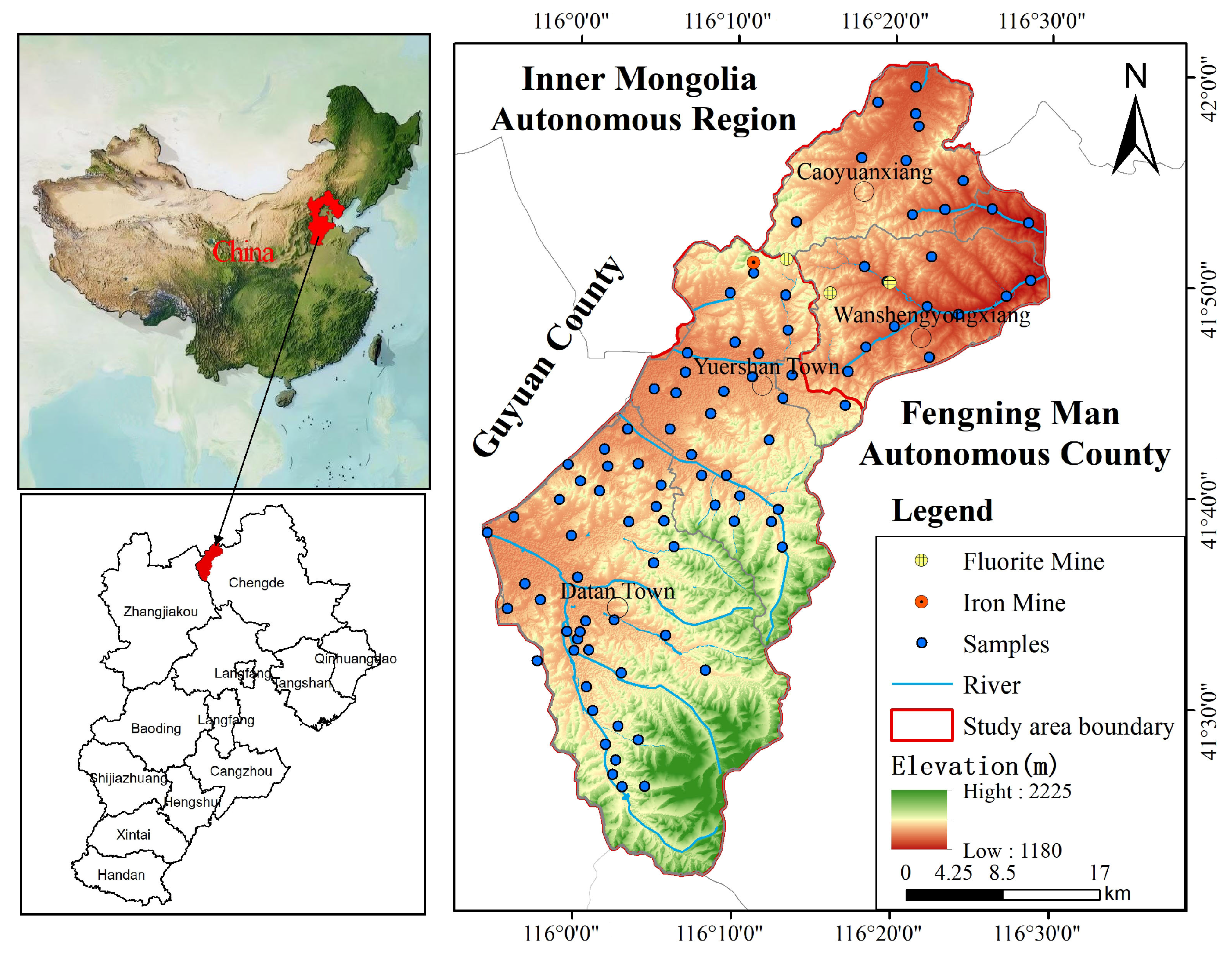
2.1. Geographical Conditions
2.2. Geological and Hydrogeological Conditions
3. Materials and Methods
3.1. Groundwater Sampling
3.2. Fuzzy Synthetic Evaluation (FSE) Method
3.3. Principal Components Analysis (PCA)
3.4. Spatial Analysis and Land Use Correlation
4. Results and Discussion
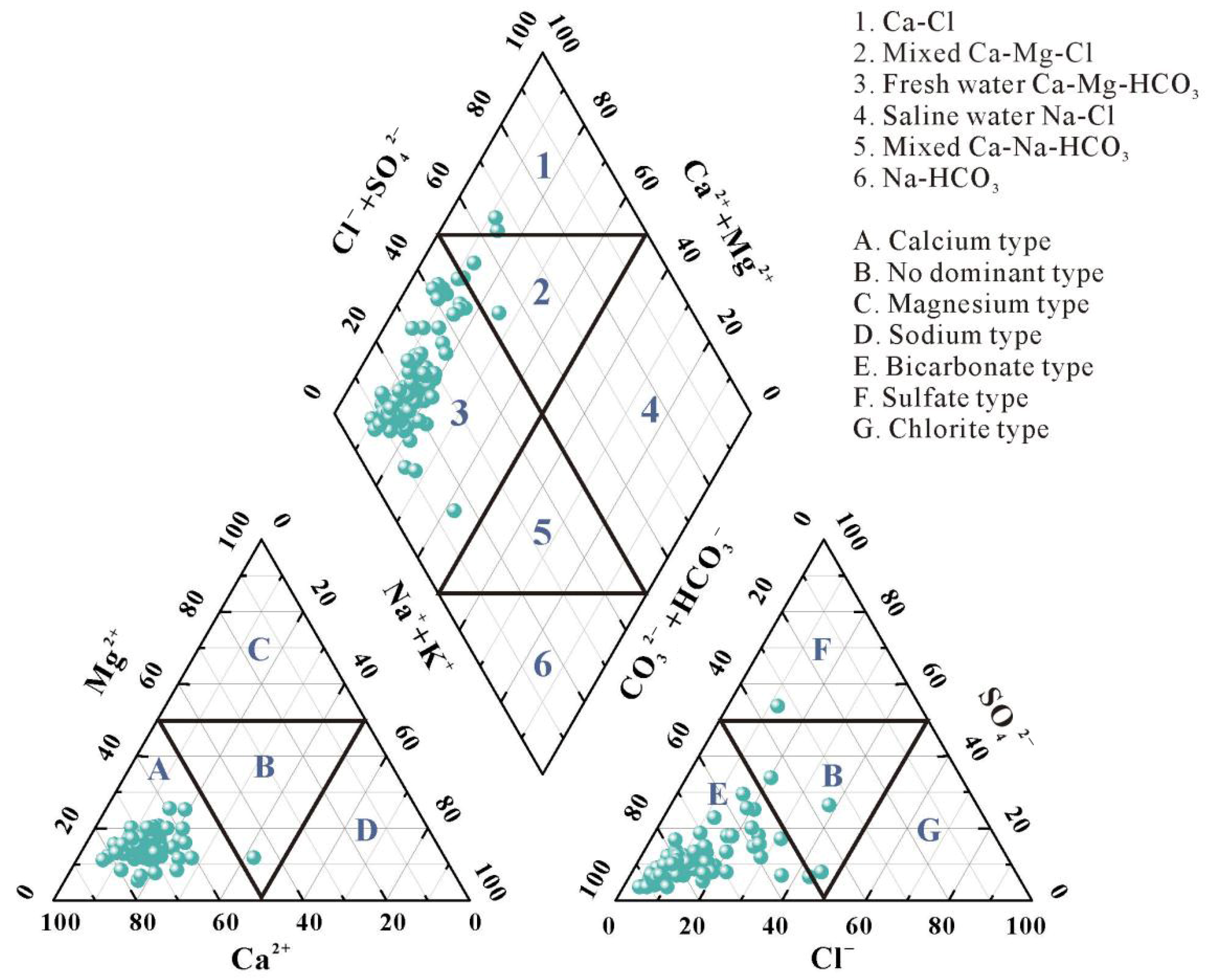
4.1. Characteristics of Groundwater Chemistry
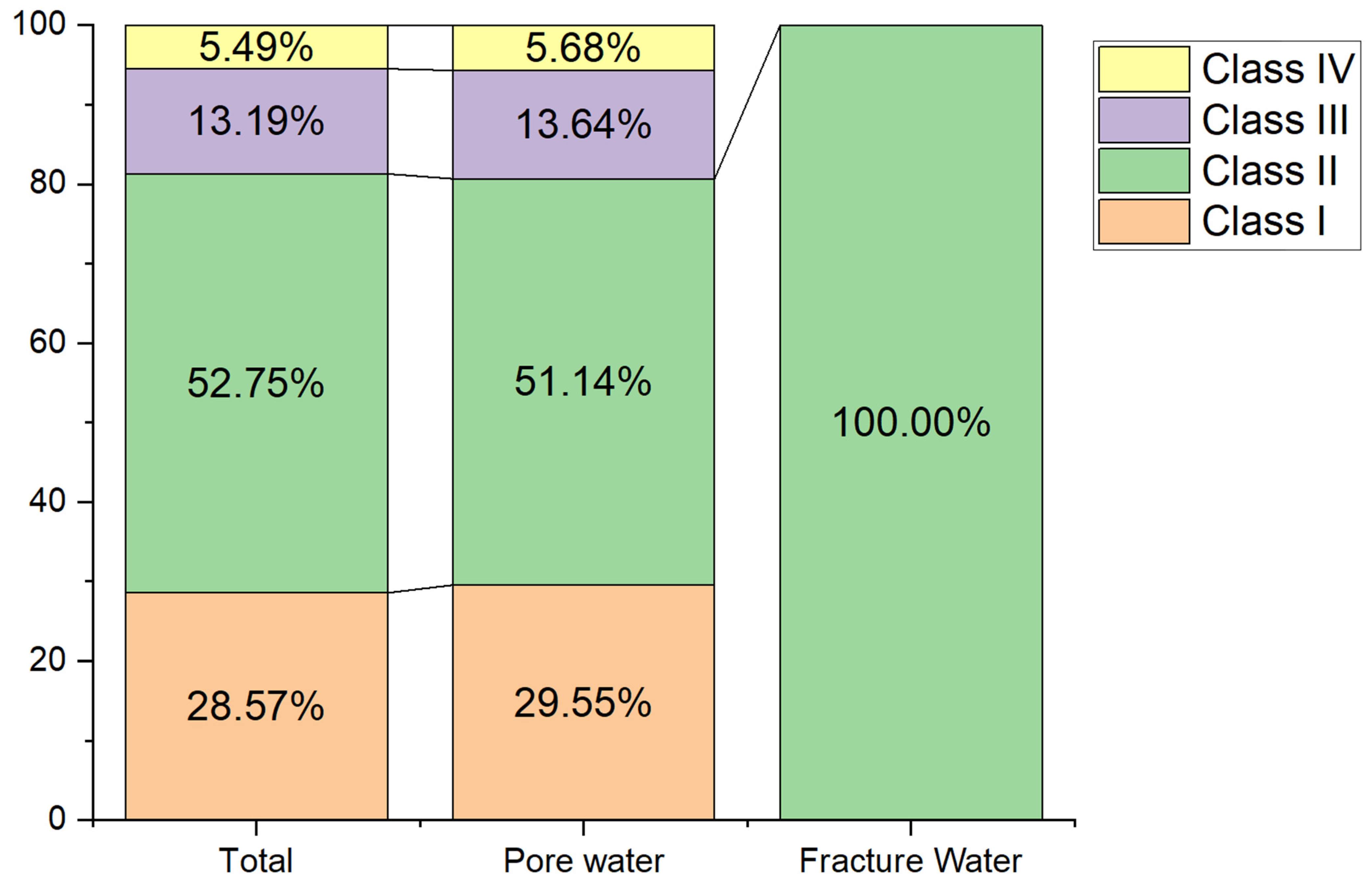
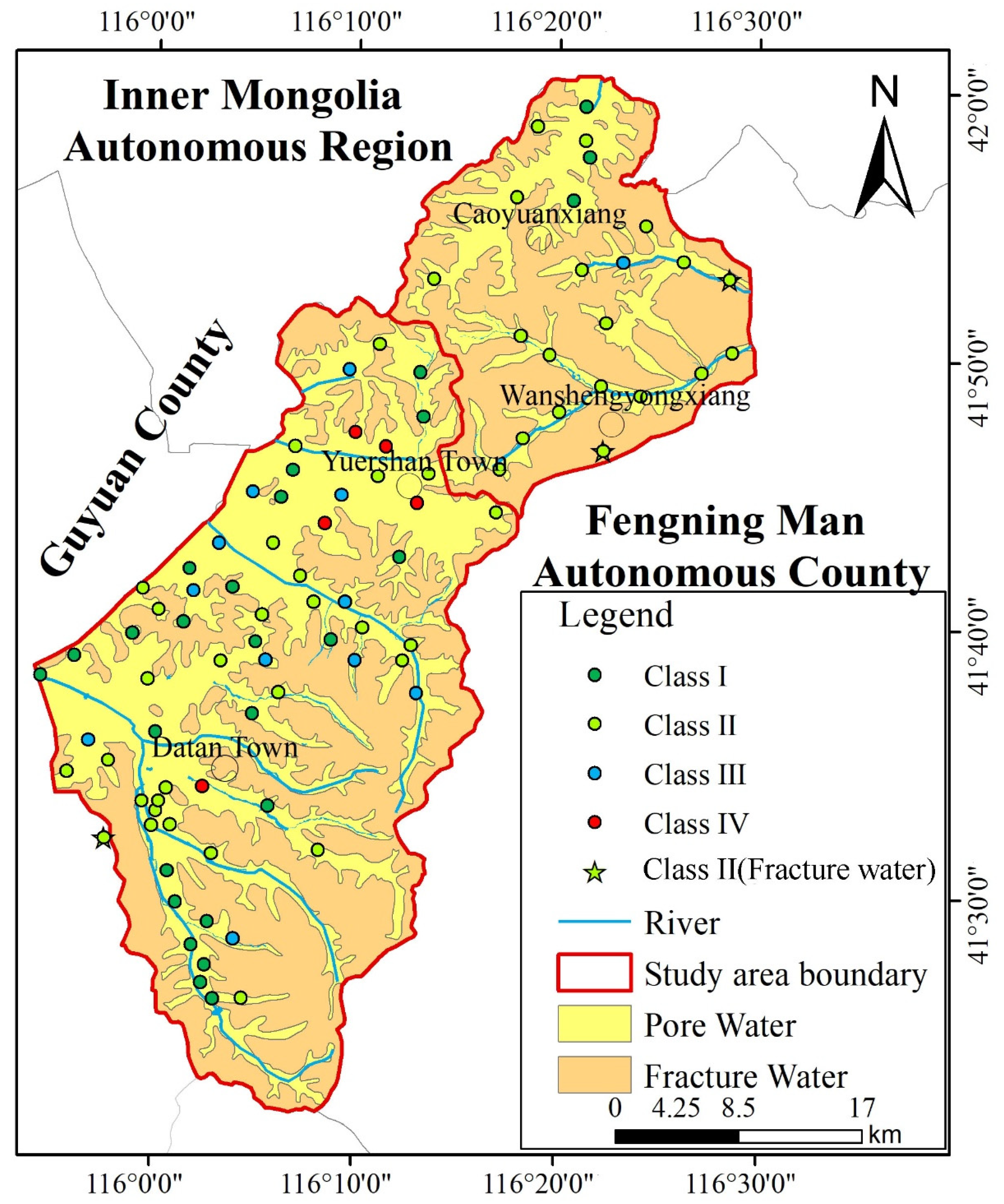
4.2. Distribution of Groundwater Quality
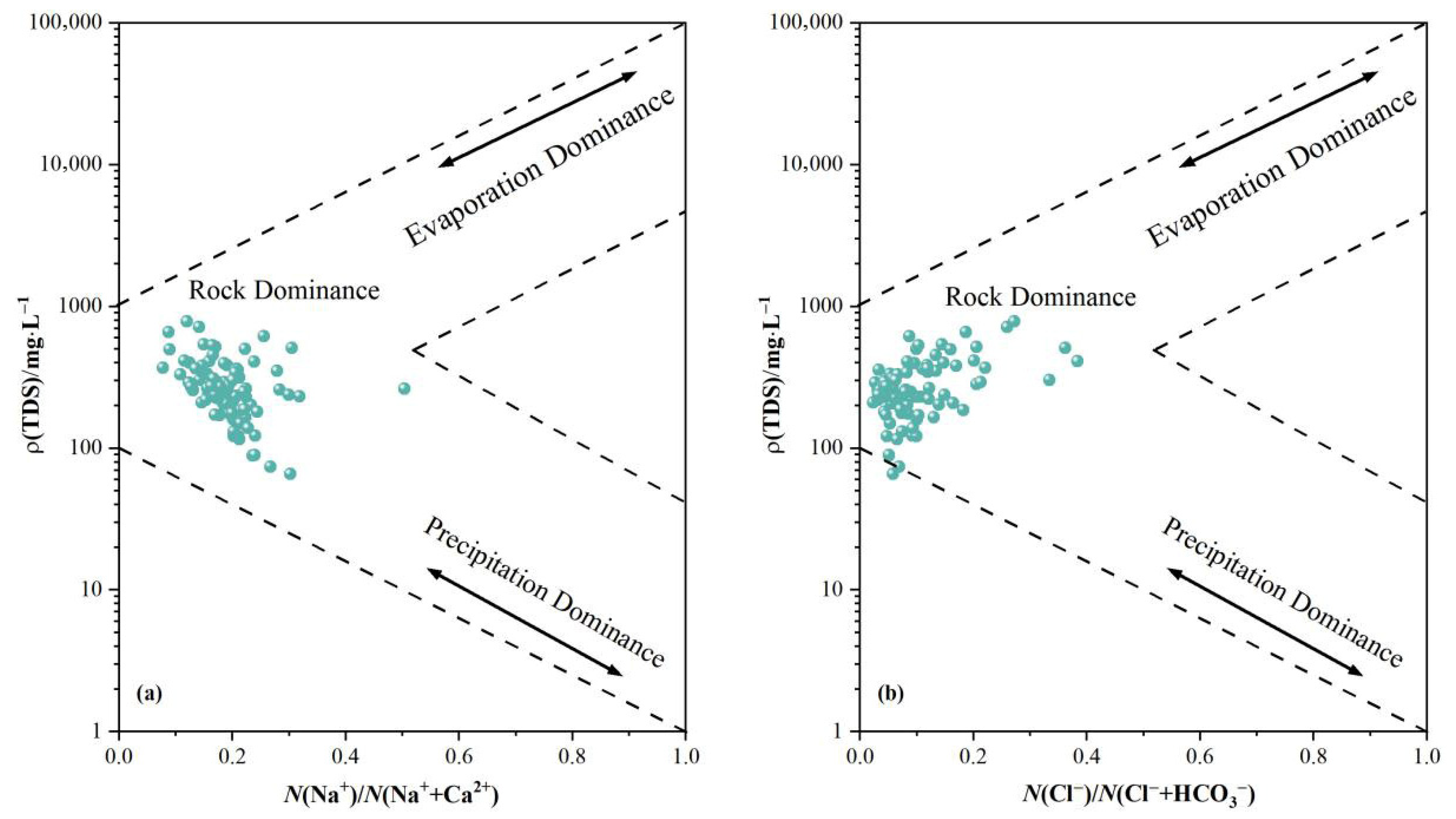
4.3. Factors Controlling Groundwater Quality
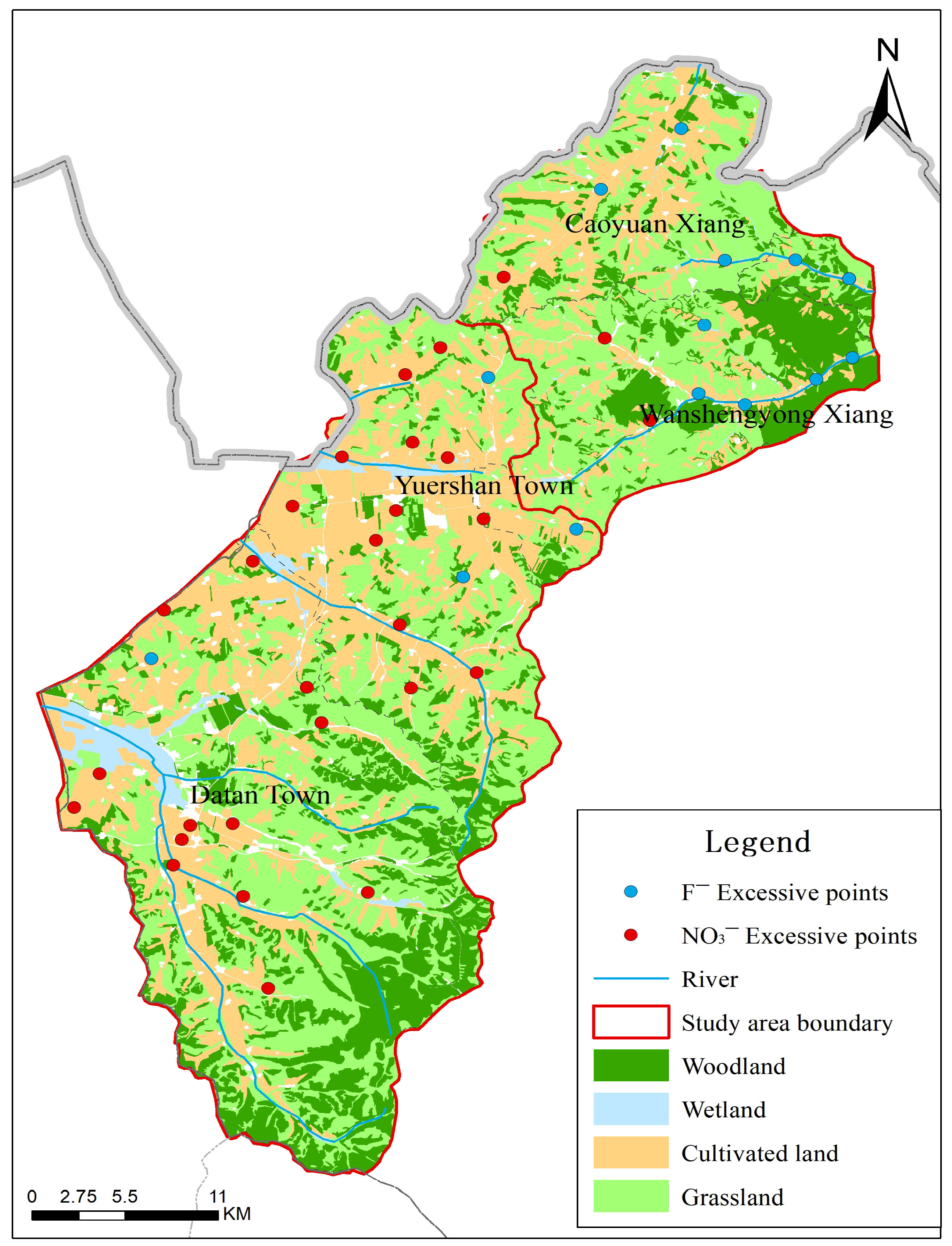
4.4. Spatial Correlation of Contaminants with Land Use and Geology
4.5. Implications for Water Resource Management
4.6. Limitations and Considerations for Seasonal Variation
- Nitrate (NO3−): The concentrations reported here reflect conditions following the period of summer rainfall. This could lead to either an under- or over-estimation of the annual pollution risk. On one hand, heavy rainfall can dilute nitrate concentrations in shallow aquifers. On the other hand, it can facilitate the rapid leaching of fertilizers from the root zone into the groundwater, potentially causing a “flush” of high nitrate levels [32,33]. Without dry-season data, the persistence and potential concentration of nitrate pollution during periods of lower groundwater flow remain unknown.
- Fluoride (F−): The observed F− exceedances are linked to fluoride-bearing minerals, evaporation and Hydrogeological conditions. In arid and semi-arid regions, intense evaporation is the key factor driving the concentration and enrichment of fluoride ions (F−) in groundwater, particularly in shallow aquifers. During the dry season, the absence of precipitation for dilution coupled with persistent evaporation causes F− concentrations to peak. Conversely, rainfall infiltration during the wet season significantly dilutes F− concentrations within groundwater [34,35,36]. The process of evaporative concentration is typically strongest during the dry season when temperatures are higher and precipitation is low. Therefore, the F− concentrations reported in this wet-season study might represent lower bounds, with potentially more severe exceedances occurring in the dry season as the water table declines and evaporation intensifies. However, some literature indicates that F− concentrations may be higher during the rainy season than the dry season, as substantial rainfall infiltration reduces groundwater pH. At slightly lower pH levels, fluoride ions adsorbed onto the surfaces of fluoride-bearing minerals such as fluorite and clay minerals are more readily desorbed into the water body, thereby increasing F− concentrations [37,38,39].
- Overall Assessment: The fuzzy synthetic evaluation indicating that 94.5% of samples are of good quality may be optimistic if dry-season concentrations of NO3−, F−, and other parameters (e.g., Mn, TDS) increase significantly. Conversely, the wet season might present the greatest risk for bacterial or organic contamination. Therefore, the groundwater quality classification and the identified spatial patterns of pollution should be viewed as specific to the wet season. The true annual risk and the effectiveness of proposed management strategies can only be accurately assessed through long-term monitoring that captures the full hydrological cycle.
5. Conclusions
Author Contributions
Funding
Data Availability Statement
Conflicts of Interest
References
- Sharma, K.; Raju, N.J.; Singh, N.; Sreekesh, S. Heavy metal pollution in groundwater of urban Delhi environs: Pollution indices and health risk assessment. Urban Clim. 2022, 45, 101233. [Google Scholar] [CrossRef]
- Subba Rao, N.; Dinakar, A.; Sun, A. Estimation of groundwater pollution levels and specific ionic sources in the groundwater, using a comprehensive approach of geochemical ratios, pollution index of groundwater, unmix model and land use/land cover—A case study. J. Contam. Hydrol. 2022, 248, 103990. [Google Scholar] [CrossRef]
- Ramamoorthy, A.; Abhishek, B.; Zhang, Z.H.; Nusrat, N.; Li, F.J.; Zhang, C.J.; Huang, X.Z. Quantifying climate variation and associated regional air pollution in southern India using Google Earth Engine. Sci. Total Environ. 2024, 909, 168470. [Google Scholar]
- Tanmoy, B.; Subodh, C.P.; Dipankar, R.; Asish, S.; Manisa, S.; Abu, R.M.; Towfiqul, I.; Aznarul, I.; Romulus, C. Evaluation of groundwater contamination and associated human health risk in a water-scarce hard rock-dominated region of India: Issues, management measures and policy recommendation. Groundw. Sustain. Dev. 2023, 23, 101039. [Google Scholar]
- Hussain, A.; Deshwal, A.; Priyadarshi, M.; Pathak, S.; Sambandam, G.; Chand, S.; Shukla, A.K. Landfill leachate analysis from selected landfill sites and its impact on groundwater quality, New Delhi, India. Environ. Dev. Sustain. 2024, 27, 12537–12562. [Google Scholar] [CrossRef]
- Li, F.-J.; Liu, Y.; Nazir, N.; Ayyamperumal, R. Evaluating the influencing factors of groundwater evolution in rapidly urbanizing areas using long-term evidence. Phys. Chem. Earth Parts A/B/C 2024, 136, 103728. [Google Scholar] [CrossRef]
- Fu, T.; Li, C.; Wang, Z.; Qi, C.; Chen, G.; Fu, Y.; Su, Q.; Xu, X.; Liu, W.; Yu, H. Hydrochemical characteristics and quality assessment of groundwater in Guangxi coastal areas, China. Mar. Pollut. Bull. 2023, 188, 114564. [Google Scholar] [CrossRef] [PubMed]
- Zhang, X.; Zhao, R.; Wu, X.; Mu, W. Hydrogeochemistry, identification of hydrogeochemical evolution mechanisms, and assessment of groundwater quality in the southwestern Ordos Basin, China. Environ. Sci. Pollut. Res. 2022, 29, 901–921. [Google Scholar] [CrossRef]
- Akkoyunlu, A.; Akiner, M.E. Pollution evaluation in streams using water quality indices: A case study from Turkey’s Sapanca Lake Basin. Ecol. Indic. 2012, 18, 501–511. [Google Scholar] [CrossRef]
- Kamboj, V.; Kamboj, N.; Bisht, A. An overview of water quality indices as promising tools for assessing the quality of water resources. Adv. Environ. Pollut. Manag. Wastewater Impacts Treat. Technol. 2020, 1, 188–214. [Google Scholar]
- Lu, W.; Wu, J.; Li, Z.; Cui, N.; Cheng, S. Water quality assessment of an urban river receiving tail water using the single-factor index and principal component analysis. Water Supply 2019, 19, 603–609. [Google Scholar] [CrossRef]
- Zhang, F.; Huang, G.; Hou, Q.; Liu, C.; Zhang, Y.; Zhang, Q. Groundwater quality in the Pearl River Delta after the rapid expansion of industrialization and urbanization: Distributions, main impact indicators, and driving forces. J. Hydrol. 2019, 577, 124004. [Google Scholar] [CrossRef]
- Liu, F.; Huang, G.; Sun, J.; Jing, J.; Zhang, Y. A new evaluation method for groundwater quality applied in Guangzhou region, China: Using fuzzy method combining toxicity index. Water Environ. Res. 2016, 88, 99–106. [Google Scholar] [CrossRef]
- Chanapathi, T.; Thatikonda, S. Fuzzy-based regional water quality index for surface water quality assessment. J. Hazard. Toxic Radioact. Waste 2019, 23, 04019010. [Google Scholar] [CrossRef]
- Icaga, Y. Fuzzy evaluation of water quality classification. Ecol. Indic. 2007, 7, 710–718. [Google Scholar] [CrossRef]
- Ocampo-Duque, W.; Ferre-Huguet, N.; Domingo, J.L.; Schuhmacher, M. Assessing water quality in rivers with fuzzy inference systems: A case study. Environ. Int. 2006, 32, 733–742. [Google Scholar] [CrossRef]
- Hao, J.; Zhang, Y.X.; Jing, Q.; Ning, G.F. Research on Groundwater Quality Evaluation with Fuzzy Mathematics. Adv. Mater. Res. 2012, 347–353, 2287–2294. [Google Scholar] [CrossRef]
- Qian, Y.; Hou, Q.; Wang, C.; Zhen, S.; Yue, C.; Cui, X.; Guo, C. Hydrogeochemical Characteristics and Groundwater Quality in Phreatic and Confined Aquifers of the Hebei Plain, China. Water 2023, 15, 3071. [Google Scholar] [CrossRef]
- General Administration of Quality Supervision Inspection and Quarantine of the People’s Republic of China (GAQSIQPRC). Standard for Groundwater Quality; Standards Press of China: Beijing, China, 2017. [Google Scholar]
- Zhang, B.; Song, X.; Zhang, Y.; Han, D.; Tang, C.; Yu, Y.; Ma, Y. Hydrochemical characteristics and water quality assessment of surface water and groundwater in Songnen Plain, Northeast China. Water Res. 2012, 46, 2737–2748. [Google Scholar] [CrossRef]
- Huang, G.; Liu, C.; Zhang, Y.; Chen, Z. Groundwater is important for the geochemical cycling of phosphorus in rapidly urbanized areas: A case study in the Pearl River Delta. Environ. Pollut. 2020, 260, 114079. [Google Scholar] [CrossRef]
- Huang, G.; Hou, Q.; Han, D.; Liu, R.; Song, J. Large scale occurrence of aluminium-rich shallow groundwater in the Pearl River Delta after the rapid urbanization: Co-effects of anthropogenic and geogenic factors. J. Contam. Hydrol. 2023, 254, 104130. [Google Scholar] [PubMed]
- Huang, G.; Chen, Z.; Liu, F.; Sun, J.; Wang, J. Impact of human activity and natural processes on groundwater arsenic in an urbanized area (South China) using multivariate statistical techniques. Environ. Sci. Pollut. Res. 2014, 21, 13043–13054. [Google Scholar] [CrossRef] [PubMed]
- Huang, G.; Zhang, M.; Liu, C.; Li, L.; Chen, Z. Heavy metal(loid)s and organic contaminants in groundwater in the Pearl River Delta that has undergone three decades of urbanization and industrialization: Distributions, sources, and driving forces. Sci. Total Environ. 2018, 635, 913–925. [Google Scholar] [CrossRef]
- Xing, L.; Guo, H.; Zhan, Y. Groundwater hydrochemical characteristics and processes along flow paths in the North China Plain. J. Asian Earth Sci. 2013, 70–71, 250–264. [Google Scholar] [CrossRef]
- Zhan, Y.; Guo, H.; Wang, Y.; Li, R.; Hou, C.; Shao, J.; Cui, Y. Evolution of groundwater major components in the Hebei Plain:Evidences from 30-year monitoring data. J. Earth Sci. 2014, 25, 563–574. [Google Scholar]
- Qu, S.; Zhao, Y.; Li, M.; Ren, X.; Wang, C.; Yang, X.; Hao, Y.; Dong, S.; Yu, R. Unveiling sources and fate of sulfate in lake-groundwater system combined Bayesian isotope mixing model with radon mass balance model. Water Res. 2025, 282, 123648. [Google Scholar] [CrossRef] [PubMed]
- Qu, S.; Wang, J.; Zhang, K.; Fan, M.; Zhao, Y.; Yang, X.; Wang, Z.; Gomes, H.; Gomes, R.; Duan, L.; et al. Fate and risks of potentially toxic elements associated with lacustrine groundwater discharge: Quantification, modeling, and biogeochemistry. Environ. Int. 2025, 202, 109707. [Google Scholar] [CrossRef]
- Zhang, L.; Dong, D.; Lv, S.; Ding, J.; Yan, M.; Han, G. Spatial evolution analysis of groundwater chemistry, quality, and fuoride health risk in southern Hebei Plain, China. Environ. Sci. Pollut. Res. 2023, 30, 61032–61051. [Google Scholar] [CrossRef]
- Xiao, Y.; Hao, Q.; Zhang, Y.; Zhu, Y.; Yin, S.; Qin, L.; Li, X. Investigating sources, driving forces and potential health risks of nitrate and fluoride in groundwater of a typical alluvial fan plain. Sci. Total Environ. 2022, 802, 149909. [Google Scholar] [CrossRef]
- Qu, S.; Ren, X.; Zhao, Y.; Mao, H.; Dong, S.; Yu, R. Unveiling origin and enrichment of fluoride in the Daihai Lake basin, China, using a hybrid hydrochemical and multi-isotopic method. J. Hydrol. 2025, 656, 133030. [Google Scholar] [CrossRef]
- Su, C.; Su, Y.; Zhang, R.; Xu, X.; Li, J. Spatio-Temporal Variations in Nitrate Sources and Transformations in the Midstream of the Yellow River Determined Based on Nitrate Isotopes and Hydrochemical Compositions. Water 2024, 16, 1173. [Google Scholar] [CrossRef]
- Ding, M.; Wu, H.; Zhang, H.; Zhu, Q.; Lei, R.; Li, K. Identifying seasonal sources and processes controlling nitrate in a typical reservoir-type headwater watershed of eastern china using stable isotopes. Agric. Ecosyst. Environ. 2025, 386, 109615. [Google Scholar] [CrossRef]
- Shaji, E.; Sarath, K.V.; Santosh, M.; Krishnaprasad, P.K.; Arya, B.K.; Babu, M.S. Fluoride contamination in groundwater:a global review of the status, processes, challenges, and remedial measures. Geosci. Front. 2024, 15, 101734. [Google Scholar] [CrossRef]
- Hao, C.; Wang, Y.; He, K.; Gui, H. Seasonal distribution of deep groundwater fluoride, geochemical factors and ecological risk for irrigation in the Shendong mining area, China. Front. Environ. Sci. 2022, 10, 1024797. [Google Scholar] [CrossRef]
- Selvam, S. A preliminary investigation of lithogenic and anthropogenic influence over fluoride ion chemistry in the groundwater of the southern coastal city, tamilnadu, india. Environ. Monit. Assess. 2015, 187, 106. [Google Scholar] [CrossRef] [PubMed]
- Chandrajith, R.; Diyabalanage, S.; Dissanayake, C.B. Geogenic fluoride and arsenic in groundwater of sri lanka and its implications to community health. Groundw. Sustain. Dev. 2020, 10, 100359. [Google Scholar] [CrossRef]
- Sreedevi, P.D.; Ahmed, S.; Reddy, D.V. Mechanism of fluoride and nitrate enrichment in hard-rock aquifers in gooty mandal, south india. Environ. Process. 2017, 4, 625–644. [Google Scholar] [CrossRef]
- Qu, X.; Zhai, P.; Shi, L.; Qu, X.; Bilal, A.; Han, J.; Yu, X. Distribution, enrichment mechanism and risk assessment for fluoride in groundwater: A case study of Mihe-Weihe River Basin, China. Front. Environ. Sci. Eng. 2023, 17, 70. [Google Scholar] [CrossRef]



| Items | Max | Min | Med | SD | CV (%) | PEV (%) | Allowable Values |
|---|---|---|---|---|---|---|---|
| pH | 8.08 | 6.59 | 7.28 | 0.35 | 4.74 | 0.00 | 6.5–8.5 |
| TH | 580.65 | 49.22 | 224.04 | 102.52 | 45.76 | 4.40 | 450 |
| TDS | 799.05 | 90.99 | 309.00 | 137.09 | 44.36 | 0.00 | 1000 |
| Ca2+ | 181.70 | 15.60 | 73.34 | 33.14 | 45.19 | / | / |
| Mg2+ | 30.82 | 1.49 | 9.94 | 5.45 | 54.85 | / | / |
| Na+ | 54.76 | 6.58 | 16.67 | 8.52 | 51.08 | 0.00 | 200 |
| K+ | 16.68 | 0.41 | 1.50 | 2.42 | 161.64 | / | / |
| HCO3− | 472.63 | 53.05 | 189.87 | 77.71 | 40.93 | / | / |
| SO42− | 113.14 | 4.65 | 23.35 | 19.93 | 85.33 | 0.00 | 250 |
| Cl− | 141.49 | 3.25 | 21.67 | 21.77 | 100.47 | 0.00 | 250 |
| F− | 1.94 | 0.00 | 0.57 | 0.37 | 64.03 | 15.38 | 1 |
| NO3−-N | 60.58 | 0.51 | 10.72 | 11.00 | 102.70 | 15.38 | 20 |
| NO2−N | 0.24 | - | 0.01 | 0.03 | 420.11 | 0.00 | 1 |
| CODMn | 2.78 | 0.39 | 0.99 | 0.45 | 45.56 | 0.00 | 3 |
| I− | 0.02 | - | 0.01 | 0.00 | 49.82 | 0.00 | 0.08 |
| Fe | 0.30 | - | 0.03 | 0.06 | 163.14 | 0.00 | 0.3 |
| Mn | 0.20 | - | 0.00 | 0.02 | 713.52 | 1.10 | 0.1 |
| Al | 0.39 | - | 0.02 | 0.06 | 263.17 | 3.30 | 0.2 |
| Cr6+ | 0.01 | - | 0.00 | 0.00 | 179.96 | 0.00 | 0.05 |
| As | 0.01 | - | 0.00 | 0.00 | 102.70 | 0.00 | 0.01 |
| Zn | 0.13 | - | 0.004 | 0.015 | 405.67 | 0.00 | 1 |
| Cu | - | - | 0 | 0 | 0 | 0 | 1 |
| Hg | - | - | 0 | 0 | 0 | 0 | 0.001 |
| Se | 0.009 | - | 0.001 | 0.001 | 111 | 0 | 0.01 |
| Cd | 0.001 | - | 0 | 0 | 625 | 0 | 0.005 |
| Items | Allowable Limits | Pore Water | Samples | Fracture Water | Samples |
|---|---|---|---|---|---|
| TH | <450 mg/L | 4.5% | 4 | 0 | 0 |
| TDS | <1000 mg/L | 0 | 0 | 0 | 0 |
| pH | 6.5 < pH < 8.5 | 0 | 0 | 0 | 0 |
| Na+ | <200 mg/L | 0 | 0 | 0 | 0 |
| Fe | <0.3 mg/L | 0 | 0 | 0 | 0 |
| Cl− | <250 mg/L | 0 | 0 | 0 | 0 |
| I− | <0.08 mg/L | 0 | 0 | 0 | 0 |
| SO42− | <250 mg/L | 0 | 0 | 0 | 0 |
| F− | <1 mg/L | 15.9% | 14 | 0 | 0 |
| Al | <0.2 mg/L | 3.4% | 3 | 0 | 0 |
| Zn | <1 mg/L | 0 | 0 | 0 | 0 |
| Mn | <0.1 mg/L | 1.1% | 1 | 0 | 0 |
| COD | <3 mg/L | 0 | 0 | 0 | 0 |
| NO3−-N | <20 mg/L | 15.9% | 14 | 0 | 0 |
| NH4+-N | <0.5 mg/L | 0 | 0 | 0 | 0 |
| Se | <0.01 mg/L | 0 | 0 | 0 | 0 |
| pH | 6.5–8.5 | 0 | 0 | 0 | 0 |
| NO2−-N | <1.0 mg/L | 0 | 0 | 0 | 0 |
| Cu | <1.0 mg/L | 0 | 0 | 0 | 0 |
| As | <0.01 mg/L | 0 | 0 | 0 | 0 |
| Cd | <0.005 mg/L | 0 | 0 | 0 | 0 |
| Pb | <0.01 mg/L | 0 | 0 | 0 | 0 |
| Cr(VI) | <0.05 mg/L | 0 | 0 | 0 | 0 |
| Hg | <0.001 mg/L | 0 | 0 | 0 | 0 |
| S2− | 0.02 mg/L | 0 | 0 | 0 | 0 |
| CN- | 0.05 mg/L | 0 | 0 | 0 | 0 |
| CHCl3 | 60 ug/L | 0 | 0 | 0 | 0 |
| CCl4 | 2.0 ug/L | 0 | 0 | 0 | 0 |
| C6H6 | 10 ug/L | 0 | 0 | 0 | 0 |
| C7H8 | 700 ug/L | 0 | 0 | 0 | 0 |
| Items | PC1 | PC2 | PC3 | PC4 | PC5 | PC6 |
|---|---|---|---|---|---|---|
| TDS | 0.975 | −0.119 | −0.061 | 0.093 | −0.034 | −0.123 |
| TH | 0.968 | −0.033 | −0.114 | 0.154 | −0.061 | −0.068 |
| Ca2+ | 0.955 | −0.079 | −0.105 | 0.167 | −0.027 | −0.08 |
| Mg2+ | 0.901 | 0.14 | −0.134 | 0.087 | −0.181 | −0.014 |
| Cl− | 0.768 | −0.366 | −0.047 | 0.064 | 0.412 | −0.017 |
| HCO3− | 0.748 | 0.559 | −0.006 | −0.093 | −0.049 | 0.055 |
| COD | 0.231 | −0.237 | 0.308 | −0.099 | −0.036 | 0.346 |
| Na+ | 0.245 | 0.206 | 0.262 | −0.402 | 0.314 | −0.099 |
| SO42− | 0.687 | −0.409 | 0.144 | −0.189 | −0.278 | 0.08 |
| NO3− | 0.392 | −0.463 | −0.18 | 0.375 | 0.83 | −0.357 |
| I− | 0.603 | 0.49 | −0.129 | −0.036 | −0.104 | 0.009 |
| F− | 0.077 | 0.647 | −0.291 | 0.157 | −0.094 | 0.258 |
| As | 0.316 | 0.596 | −0.155 | −0.213 | 0.168 | −0.126 |
| Fe | 0.015 | 0.175 | 0.865 | 0.387 | −0.083 | 0.02 |
| Al | 0.095 | 0.293 | 0.786 | 0.458 | −0.082 | −0.042 |
| K+ | 0.45 | −0.056 | 0.2 | −0.529 | −0.433 | 0.363 |
| Cr6+ | 0.2 | 0.313 | −0.264 | 0.453 | 0.293 | 0.107 |
| NO2− | 0.272 | −0.17 | 0.197 | −0.07 | 0.212 | 0.347 |
| Mn | 0.03 | 0.202 | 0.348 | −0.467 | 0.152 | −0.64 |
| Eigenvalue | 7.465 | 2.269 | 2.026 | 1.568 | 1.448 | 1.051 |
| Explained variance (%) | 39.287 | 11.944 | 10.661 | 8.251 | 7.621 | 5.532 |
| Cumulative of variance (%) | 39.287 | 51.231 | 61.892 | 70.143 | 77.764 | 83.296 |
Disclaimer/Publisher’s Note: The statements, opinions and data contained in all publications are solely those of the individual author(s) and contributor(s) and not of MDPI and/or the editor(s). MDPI and/or the editor(s) disclaim responsibility for any injury to people or property resulting from any ideas, methods, instructions or products referred to in the content. |
© 2025 by the authors. Licensee MDPI, Basel, Switzerland. This article is an open access article distributed under the terms and conditions of the Creative Commons Attribution (CC BY) license (https://creativecommons.org/licenses/by/4.0/).
Share and Cite
Xu, W.; Dong, Y.; Tian, X.; Cai, Z.; Zhai, H.; Qin, S. Hydrogeochemical Characteristics and Groundwater Quality in Chengde Bashang Area, China. Water 2025, 17, 3598. https://doi.org/10.3390/w17243598
Xu W, Dong Y, Tian X, Cai Z, Zhai H, Qin S. Hydrogeochemical Characteristics and Groundwater Quality in Chengde Bashang Area, China. Water. 2025; 17(24):3598. https://doi.org/10.3390/w17243598
Chicago/Turabian StyleXu, Wei, Yan Dong, Xiaohua Tian, Zizhao Cai, Hao Zhai, and Siyang Qin. 2025. "Hydrogeochemical Characteristics and Groundwater Quality in Chengde Bashang Area, China" Water 17, no. 24: 3598. https://doi.org/10.3390/w17243598
APA StyleXu, W., Dong, Y., Tian, X., Cai, Z., Zhai, H., & Qin, S. (2025). Hydrogeochemical Characteristics and Groundwater Quality in Chengde Bashang Area, China. Water, 17(24), 3598. https://doi.org/10.3390/w17243598