Article

Re-Scour Below a Self-Buried Submarine Pipeline

1
Key Laboratory of Equipment Safety and Intelligent Technology for Guangzhou Rail Transit System, Guangzhou Railway Polytechnic, Guangzhou 511300, China
2
Institute of Water Science and Technology, Hohai University, Nanjing 210098, China
3
School of Railway Engineering, Guangzhou Railway Polytechnic, Guangzhou 511300, China
*
Author to whom correspondence should be addressed.
Water 2025, 17(24), 3565; https://doi.org/10.3390/w17243565
Submission received: 4 November 2025 / Revised: 30 November 2025 / Accepted: 2 December 2025 / Published: 16 December 2025
(This article belongs to the Section Hydraulics and Hydrodynamics)

Abstract

The present study concerns the re-scour of a submarine pipeline after its scour-sagging-burial by modeling a tilting pipeline with varying embedment along the pipeline axis. The effect of the tilting angle on characteristics of three-dimensional scour was investigated, in terms of the scour topographies, the scour depth, as well as the scour propagation along the pipeline. Two previously undetected scour topographies, i.e., sand ripples that extend along the pipeline axis in the downstream direction of the pipeline and scour pits below the pipeline perpendicular to the pipeline axis, were found to significantly affect the development of the scour propagation and the scour depth. The whole scour propagation along the pipeline can be divided into the rapid scouring phase and the slow scouring phase. The transition point between the two phases takes place at the initial embedment-to-diameter ratio of 0.3. With the increase of the incident angle from 0° to 45°, the scour propagation rate increases during the rapid scouring phase but decreases during the slow scouring phase. A predictive model of the scour propagation rate was established based on the erosion characteristics of sediment and the shear stress magnification factor under the pipeline. The newly predictive model of scour propagation rate is found to provide satisfactory results for a tilting submarine pipeline under different flow incident angles.

1. Introduction

Scour beneath a submarine pipeline can adversely affect pipeline stability, which plays a key role in the design, construction, and maintenance of offshore oil and gas infrastructure. Scour initiates when the flow action drives sediment to critical conditions of mobilization [1,2,3]. Early studies on local scour simplified the scour into a two-dimensional problem by only considering the scour depth [4] and the time scale of local scour [5]. As a matter of fact, scour below pipelines exists in a form of three-dimensional scour inherently, i.e., following the scour initiation, the scour propagates along the axis of the pipeline as well.
A number of significant investigations have been undertaken on the three-dimensionality of scour in the last few decades through physical experiments [6,7,8,9] and numerical simulations [10,11,12]. A theoretical model was presented based on the assumption that the scour slope at the span shoulder was approximately equal to the natural repose angle of the sediment [13]. Later, a semi-empirical model [14] was proposed, adapted from the theoretical model of [13], by combining this semi-empirical model and the longitudinal erosion rate along the pipeline measured experimentally. The amplification factor of the bed shear stress at the shoulder of the free span can be estimated, and the result illustrates clearly that the shear stress amplification factor under the pipeline reduces with increasing pipeline embedment. Tests of steady currents acting on the pipeline were conducted for live bed conditions [15], and the study presented a general predictive formula for the longitudinal propagation rate regarded as a function of the vertical rate of average slope at the span shoulder. A further study [16] investigated the scour propagation velocity along the pipeline in the case of steady currents at a clear water scour regime. It was found that the scour propagation rate was sensitive to four nondimensional parameters, including the pipeline embedment, the water depth-to-diameter ratio, the Froude number, and the Shields parameters. Apart from the research on the pipeline-sediment-flow interaction, studies on the sediment erosion property have been conducted to address the relation between the sediment property and the scour rate beneath a pipeline. For example, a study investigated marine sediments and artificial sediments with a wide range of grain sizes and provided a theoretical model that can link the measured erosion rate of sediment to the expected scour rate [17]. A later approach was developed to quantitatively estimate scour propagation along pipelines with different erosion properties [18]. Apart from the studies on scour itself, the effect of a grade-control structure was investigated by [19] to predict the local scour downstream. Three distinct phases of the scour process were found before the equilibrium state, and a new scaling approach was proposed to improve the similarity of scour profiles. New predictive equations based on the new approach could be adapted to a number of scouring problems.
The free span of a pipeline takes place due to sediment erosion during scouring [20]. When the free span is long enough, however, the pipeline will sag into the scour hole due to its own weight [21]. When the pipeline reaches the bottom of the scour hole, the scour will stop, and the backfill process will begin [22]. The present work primarily focuses on the re-scour after the initial scour, pipeline sagging, and self-burial, which can be simplified as a pipeline buried in the seabed at a certain tilting angle with a varying embedment along the pipeline axis, as shown in Figure 1. Due to the different embedment depths along the pipeline, the development of scour depths below the pipeline at different positions, and the scour propagation rate will show differences along the pipeline, even in steady currents. And another problem worthy of attention is that there is no experimental result about the scour slope angle, which is usually assumed to be equal to the angle of repose of the sand in the existing studies about scour propagation [23]. Additionally, actual pipeline routes may cross a variety of different marine environments and the pipelines there may encounter different flow incident angles. One quantitative predictive method that considers the tilting of the pipeline, the flow incident angle, and marine sediment erosion properties is still required, which is highly significant for the safety assessment of submarine pipelines.
By employing a simplified physical model (Figure 1), this paper aims to study characteristics of the re-scour below a pipeline in steady currents and develop a predictive model of the scour propagation rate. Two critical parameters are quantified in the predictive model, i.e., the slope angle at the leading edge of the scour hole (Figure 2) and the magnification factor beneath the pipeline. The effects of the Shields parameter and flow incidence angle on scour topography, scour depth and scour propagation rate are discussed as well.

2. Materials and Methods

2.1. Problem Description

This experimental model is based on a simplified re-scour model after the pipeline experiences a self-burial process in practical engineering. According to Figure 1, the pipeline has been buried in the sand after experiencing the whole process, including the scour initiation, the scour propagation, and sagging, as well as backfilling when the pipeline reaches the bottom of the scour hole. The whole pipeline can be considered as a rigid body, and the deflection is small. We assume that the pipeline sagging is symmetric and simplify it by using a pipe model tilted at a small angle β (the angle between the pipeline axis and the initial sand surface). This angle can be estimated by the deflection formula of a pipeline [6], considering the pipeline diameter, concrete weight coating, and anti-corrosion layer thickness from a worldwide database, which turns out to be about 2°, taking the general values of parameters.
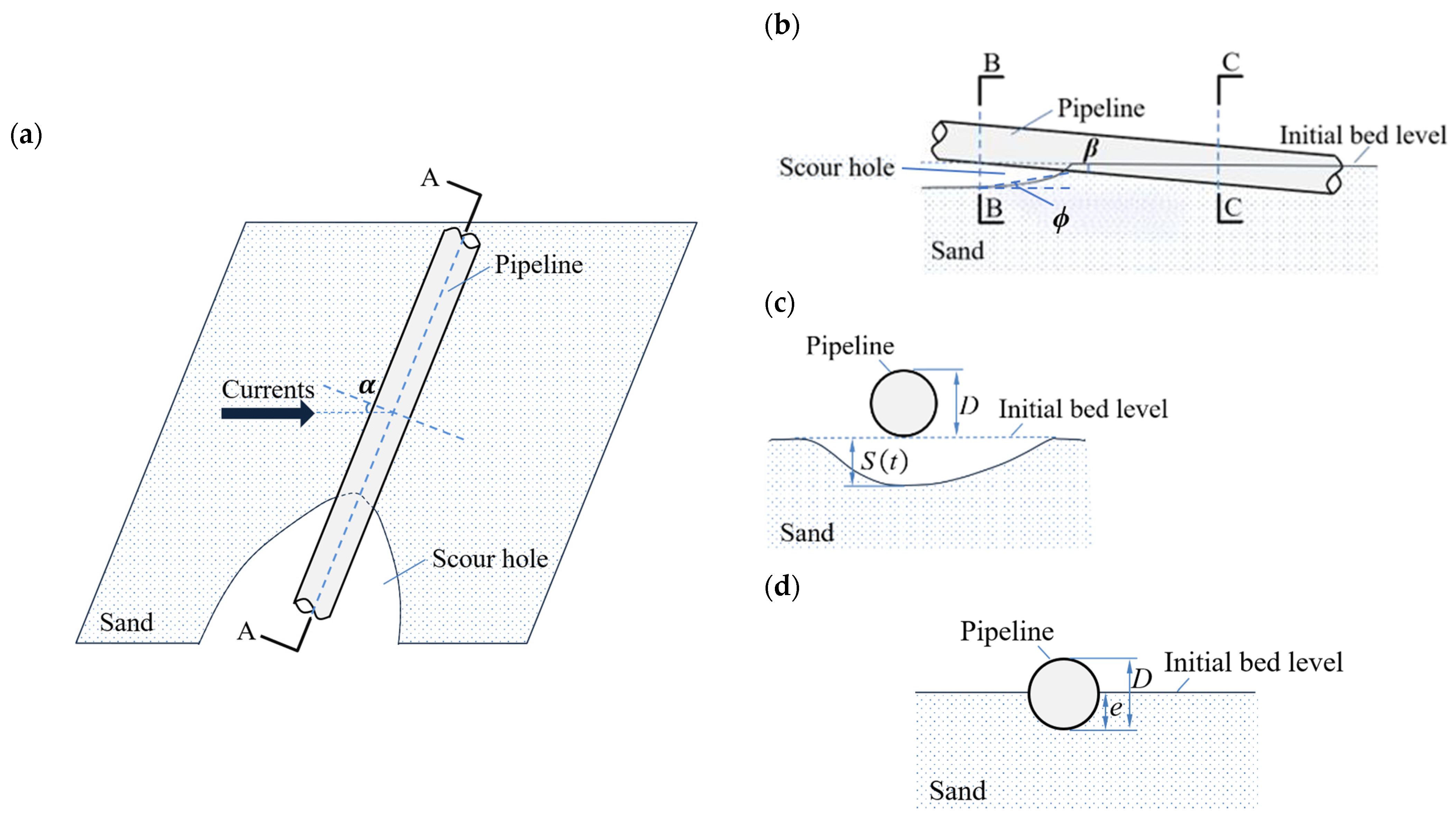
The scour propagation below a tilting pipeline, which is under the action of steady currents, is plotted in Figure 2 with various parameters. Figure 2a shows the flow incident angle α. α = 0° indicates the flow is perpendicular to the pipeline, and α > 0° indicates that the direction of the scour propagation along the pipeline is consistent with the direction of the velocity component along the pipeline. Figure 2b shows the A-A cross-section view with the tilting angle β of the pipeline and the slope angle ϕ. Through views of B-B and C-C cross-sections, we defined the pipeline diameter D, the scour depth S(t), and the embedment depth e.
Following [5], the vertical scour development below the pipeline over time can be presented by
S t = S 0 1 exp t T
where S0 is the equilibrium scour depth, which is a relatively constant value as the scour reaches the equilibrium stage. T is the time scale, which is used to evaluate the scour speed and can be approximated to the time required to reach 63% of the equilibrium depth. T is given by
T = D 2 g s 1 d 50 3 1 / 2 T *
where s is the specific gravity of sediment and s = ρs/ρw (ρs and ρw being the density of sediment and water, respectively); g is the gravitational acceleration; d50 is the median diameter of sediment; and T* is the non-dimensional time scale. Based on an empirical fit to experimental data available in the literature [5], it has been found that T* is a function of the undisturbed Shields parameter θ, for both current scour and wave scour under live bed conditions, i.e.,
T * = 1 50 θ 5 / 3
where θ is the non-dimensional shear stress converted from
θ = τ ρ g s 1 d 50 = u f 2 g s 1 d 50
where τ is the shear stress, ρ is the water density, and uf is the bed friction velocity. For the steady currents, uf can be obtained from the velocity measurements according to [24]
u z = u f κ ln z z 0
where u(z) is the measured velocity at a certain depth (z) above the seabed; κ = 0.4 is the Karman constant; and z0 is the bed roughness length calculated by the empirical expression from [25]
z 0 = k s 30 1 exp u f k s 27 ν + ν 9 u f
where ks = 2.5d50 is the Nikuradse equivalent sand grain roughness; ν = 1 × 10⁻⁶ m2/s is the kinematic viscosity of water.

2.2. Experiment Setup

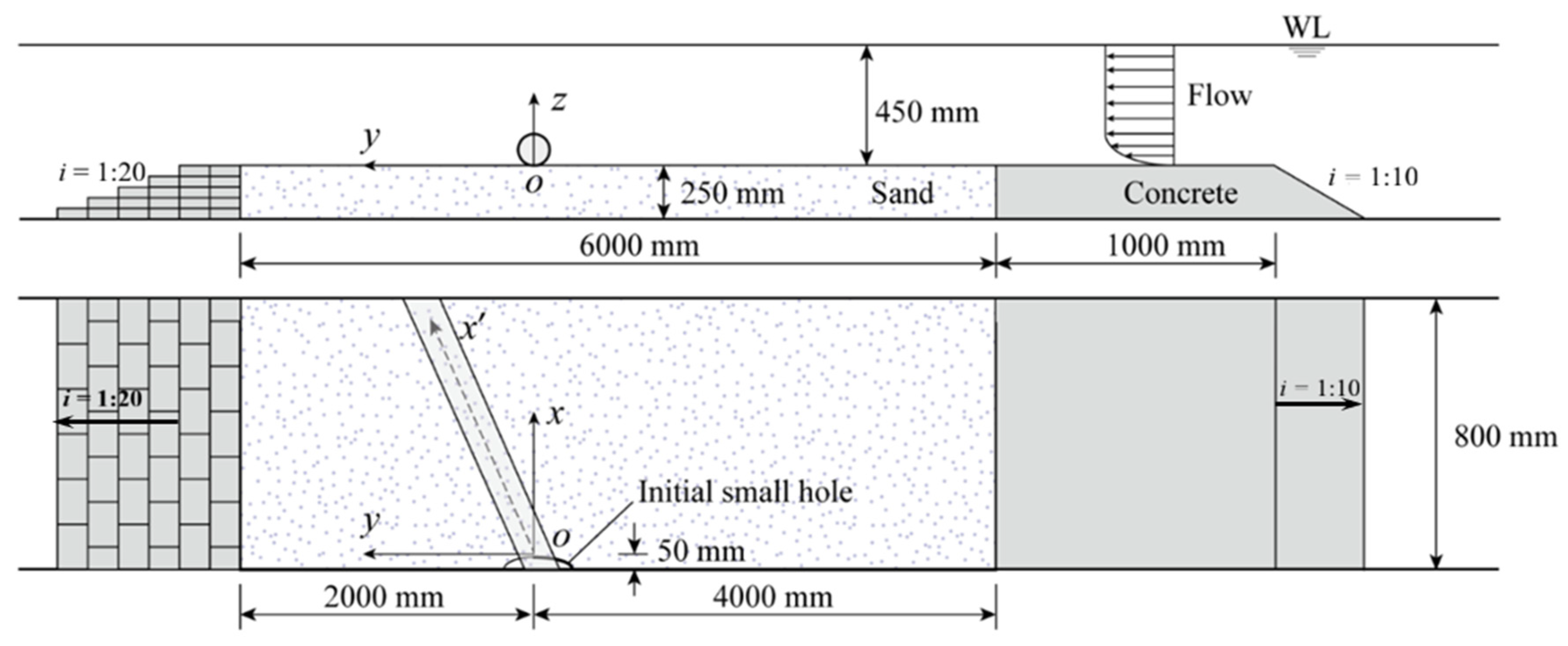
The experiment was conducted in a current/wave flume of 0.8 m in width, 0.8 m in depth and 22 m in length at Dalian University of Technology, Dalian, China. A test section of 7 m in length, 0.8 m in width, and 0.25 m in height was constructed in the middle section of the flume. The water depth of the steady current has been kept constant at 0.45 m. A concrete sand pit of 6 m long, 0.8 m wide, and 0.25 m deep was built in the test section. For the upstream of the sand pit, a transition area of 1 m made of concrete, together with a slope of 1:10 at the end, was set. For the transition from the test section to the original flume bed on the downstream end of the sand pit, a slope of 1:20 was made up of bricks to accelerate water drainage from the sand pit.
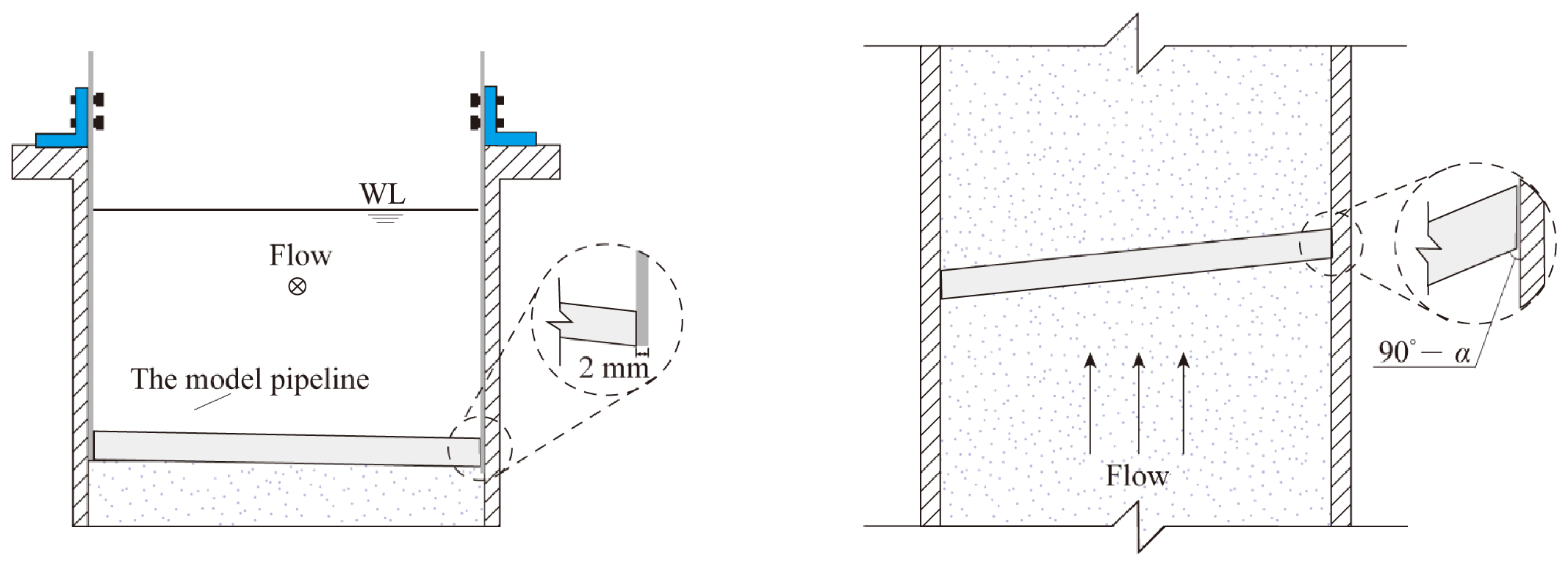
A model pipeline with an outer diameter of D = 5 cm was applied for the three-dimensional scour tests. The model pipeline was embedded obliquely in the sand across the width of the flume. The initial embedment depth of zero was set at 4 m from the upstream of the sand pit and 5 cm from one side wall of the flume. Enough upstream space can eliminate any influence from upstream surroundings and simulate the actual working condition with enough incoming sediment. A schematic drawing of the experiment setup is shown in Figure 3. Both ends of the model pipeline were pressed against the walls of the flume and fixed with two adjustable rigid arms to prevent potential movement or sagging of the model pipeline during the tests, as shown in Figure 4.
The non-cohesive silica sands used in the present experiment have a median particle size of d50 = 0.185 mm, a uniformity index of Cu = d60/d10 = 1.71, a specific gravity of s = 2.7, and a natural repose angle φ of 36°. The critical Shields parameter, which the skin friction Shields parameter exceeds when the sediment transport occurs, is calculated by the empirical formula proposed by [24]
θ c r = 0.3 1 + 1.2 D * + 0.055 1 exp 0.02 D *
where D* is the non-dimensional grain size and can be calculated according to
D * = g s 1 / ν 2 1 / 3 d 50
The critical Shields parameter θcr for the present study is 0.05. The threshold shear stress has been obtained from
τ c r = θ c r ρ g s 1 d 50
and τcr = 0.154 Pa.
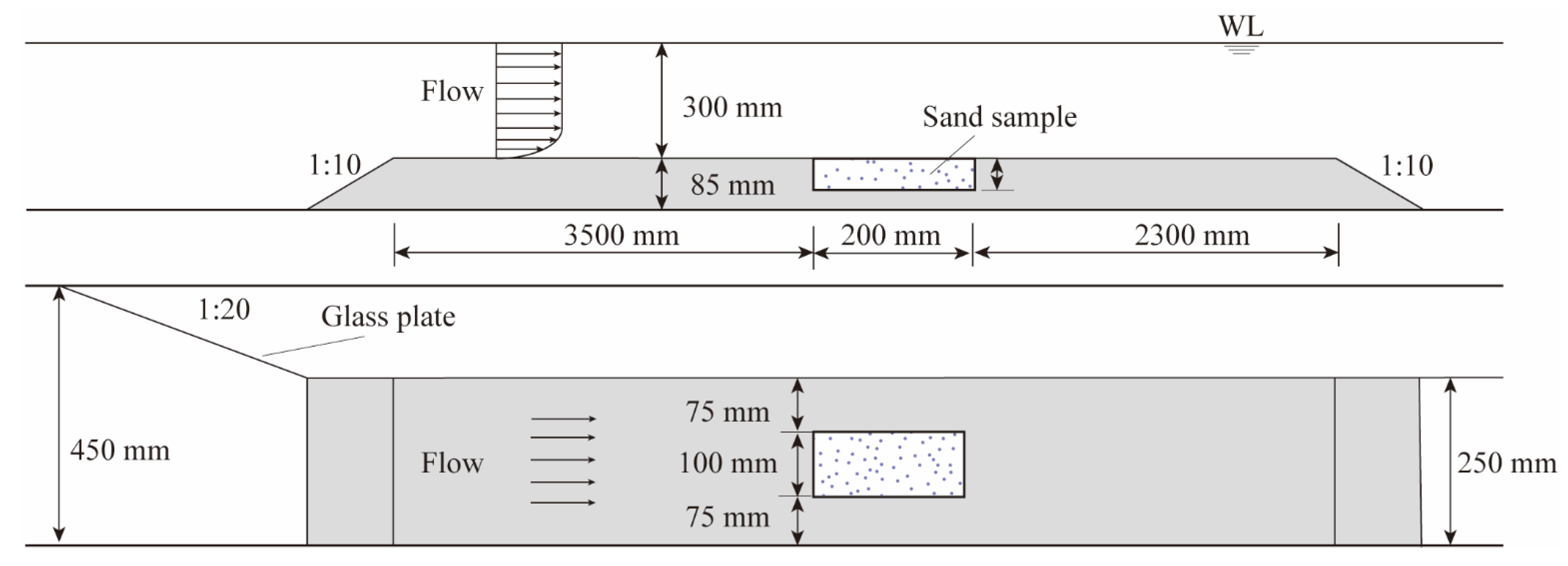
Erosion testing experiments in the present work were conducted in a current flume of 0.45 m in width and 0.6 m in height at Dalian University of Technology, Dalian, China. A schematic drawing of the erosion testing setup is shown in Figure 5. A sample holder with a length Lsam = 200 mm, a width of 100 mm and a height of 60 mm was set in the test section.
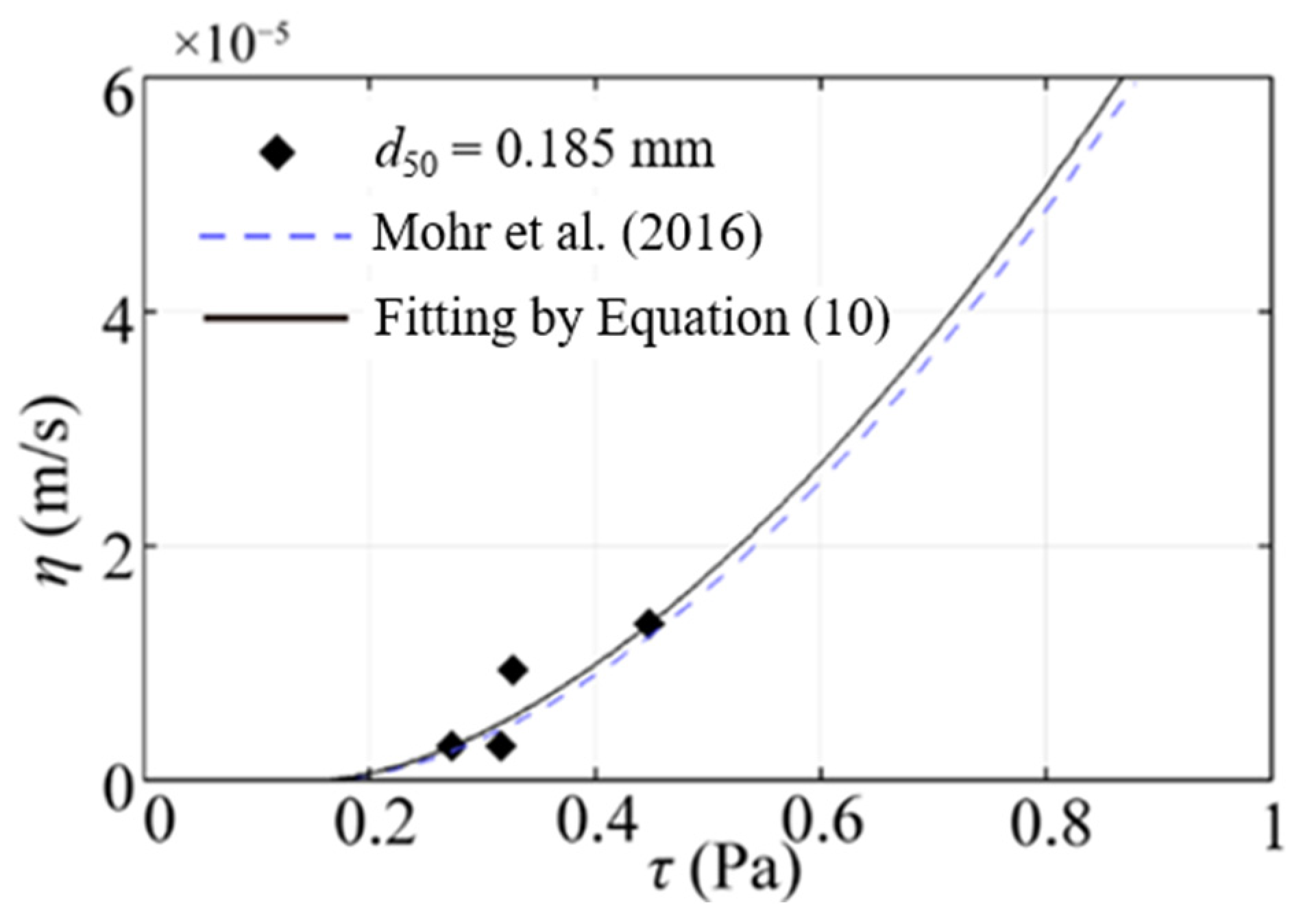
Shields parameters of steady currents have been calculated according to Equations (4) and (5), where the mean velocity is measured at 5 cm above the bed and 0.5 m from the upstream of the test section. The average erosion depth over the area of the sample was measured by using a 3-D sonar scanner (Model 2001, Marine Electronics Ltd., Guernsey, UK). An apparent erosion rate (η) was then calculated according to the measured sample depth, averaged over the sample area, over a time of 3 min. Figure 6 shows the apparent erosion rate, which is regarded as a function of seabed shear stress, and a trend line has been fitted to the data with the following expression
η = m τ τ c r n
and it was found to agree well with the results of [17]. A comparison of some physical properties of sediment and fitted parameters in the present work is listed in Table 1.
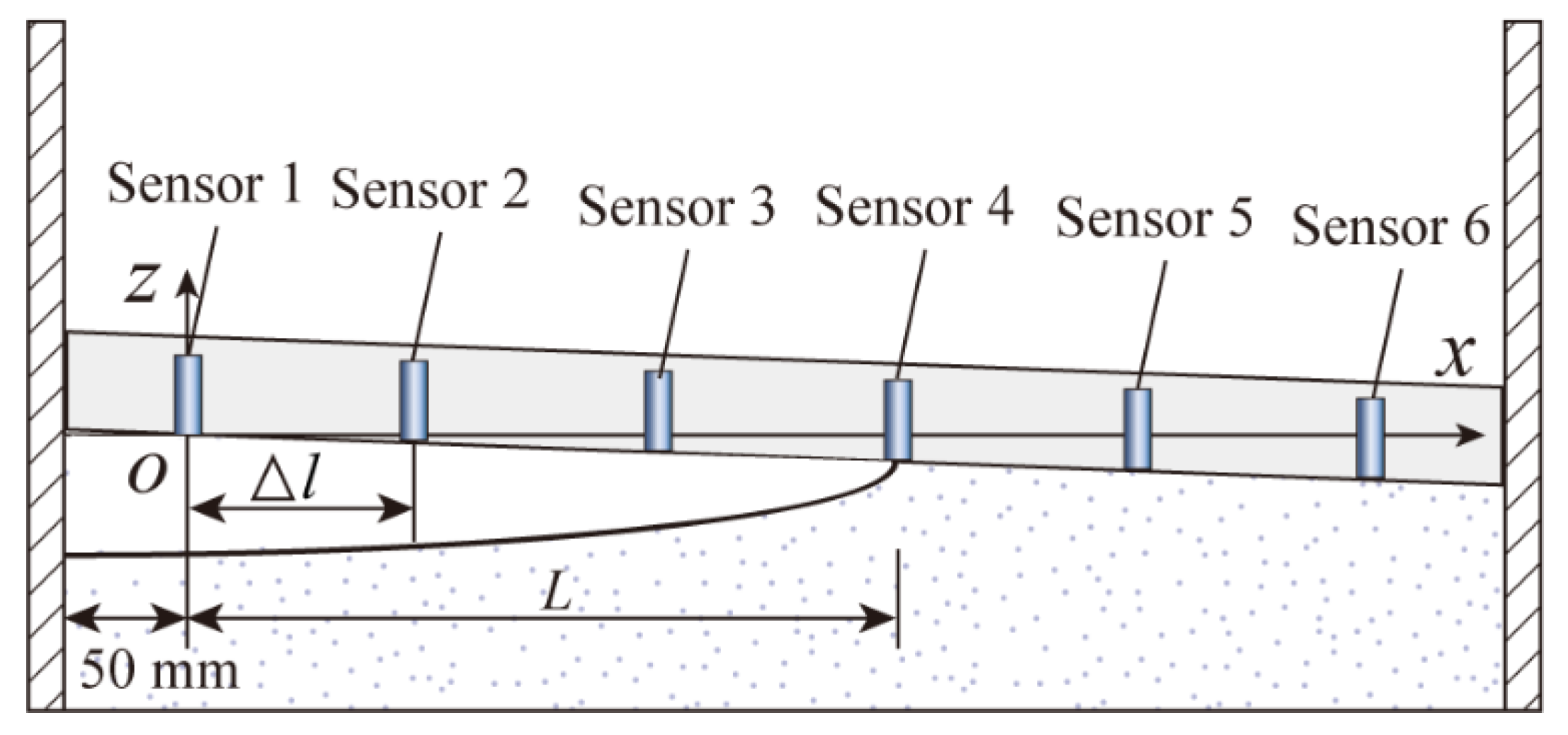
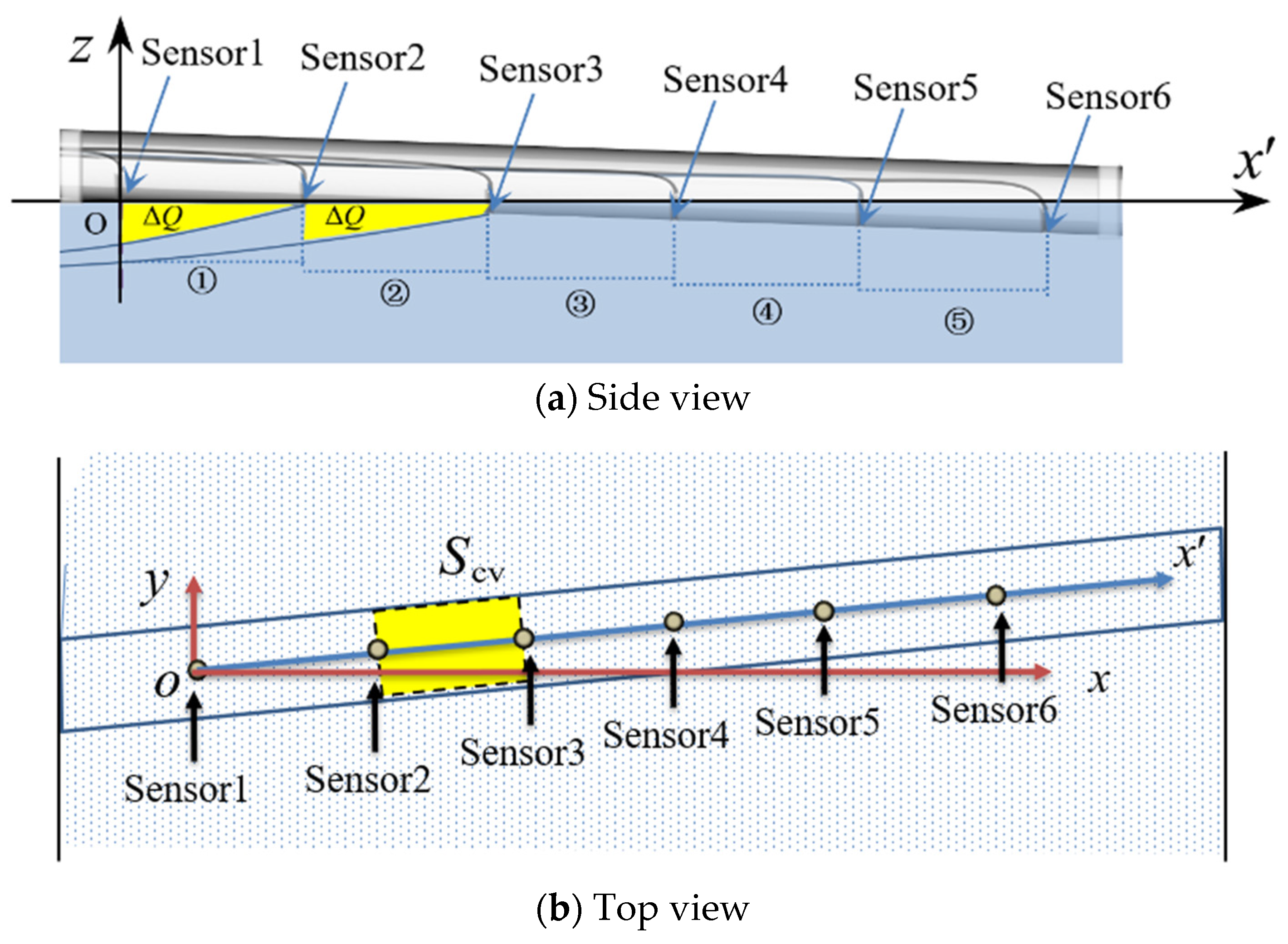
Along the pipeline axis, 6 ultrasound sensors were mounted inside the model pipeline at a uniform spacing Δ l as shown in Figure 7. This spacing was designed to allow the 6 ultrasound sensors to monitor the scour at locations where the initial buried depth ratio (e/D) ranges from 0 to 0.5, respectively, at an interval of 0.1. The x’ values of the ultrasound sensor corresponding embedment depth and initial buried depth ratio (e/D) are shown in Table 2. The ultrasound sensor (DOP 3010, Signal Processing SA, Savigny, Switzerland), with an accuracy of ±1 mm, is applied to measure the time-dependent scour depth (S (t)) below the model pipeline and scour length (L (t)) along the model pipeline. The scour topography around the model pipeline was measured by a 3D laser scanner (Lab-made, Dalian University of Technology, Dalian, China) after draining the residual water in the scour hole. The laser scanner can cover a range of 2 m × 2 m with a resolution of 2 mm, and a natural interpolation model was used to calculate the change in the amount of sand beneath the pipeline model.
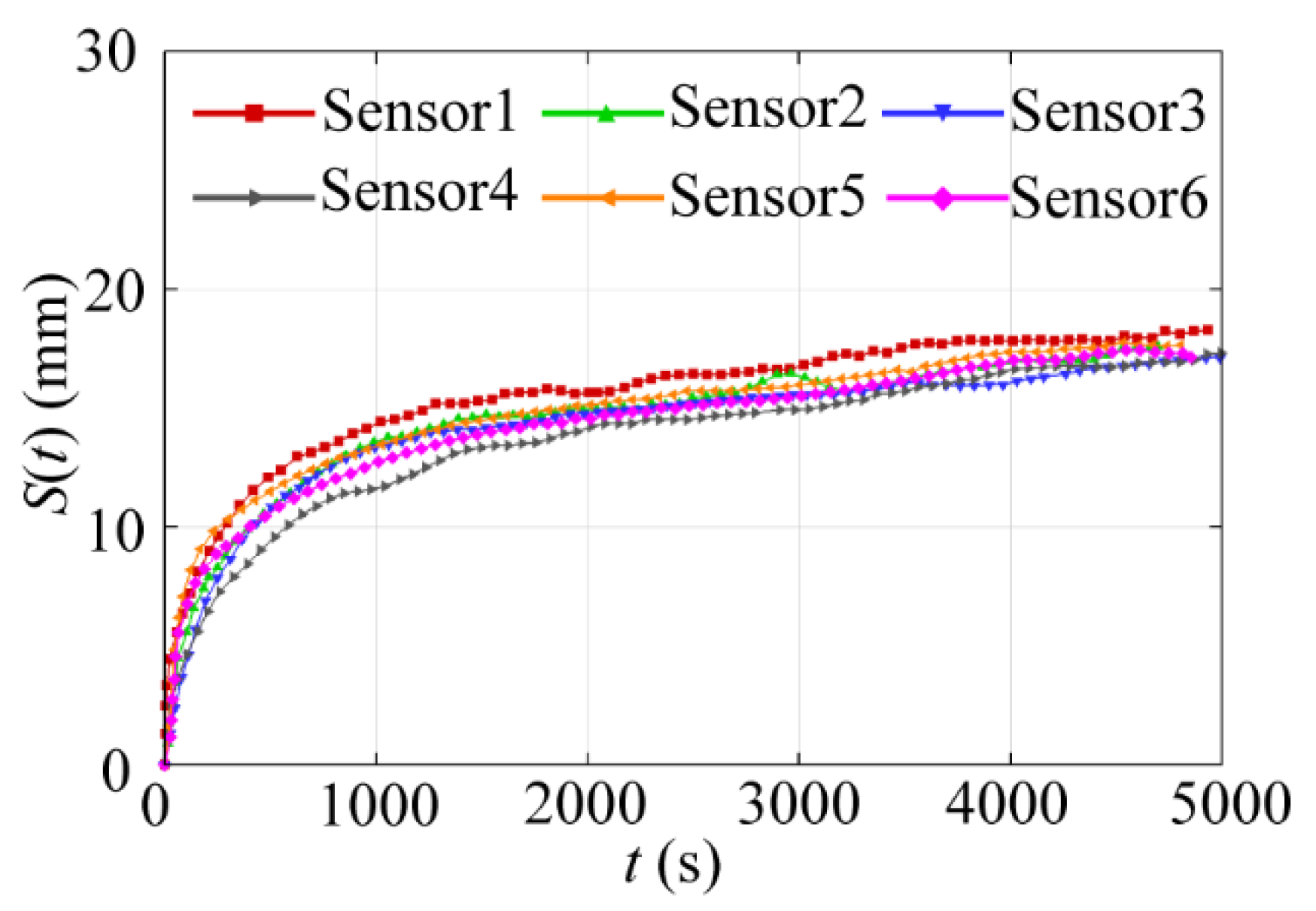
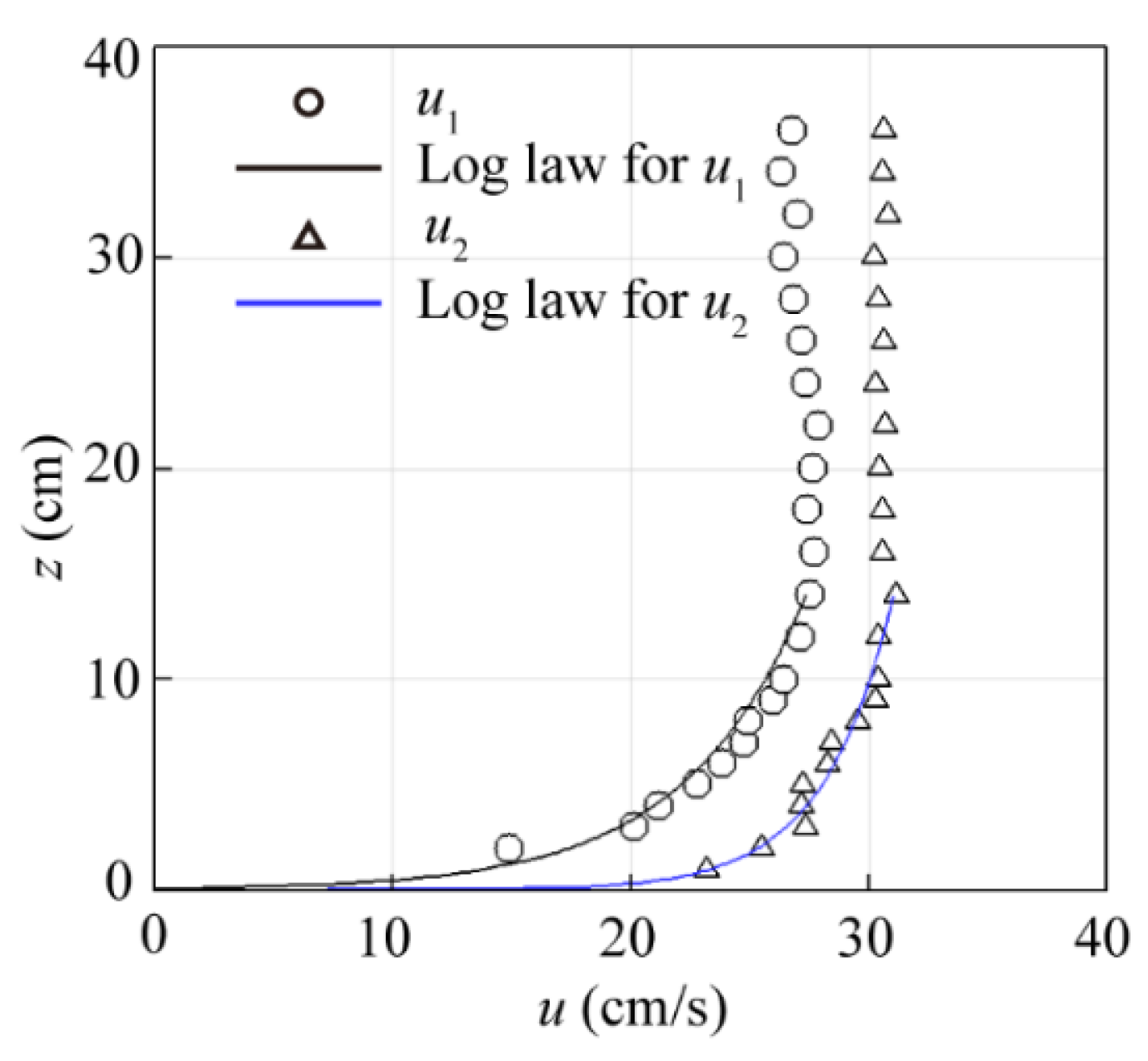
The velocity profile across the water depth was measured at the middle of the cross-section of the flume and within the transition section upstream of the pipeline model using a Acoustic Doppler Velocimeter (ADV, Vectrino 3D, Nortek Group, Vangkroke, Norway) before the tests. Two flow velocities, u1 = 0.28 m/s and u2 = 0.31 m/s, corresponding to θ1 = 0.053 and θ2 = 0.067, respectively, were generated in the flume to achieve the live-bed scour condition and investigate the effect of the Shields parameter on the scour process. Through Equations (2)–(4), the time scale for the two Shields parameters is T1 = 650 s and T2 = 440 s. Hereafter, any time normalization by time scale means to be normalized by the respective T. The velocity profiles are found to be correlated to the logarithmic law in the context of the boundary layer, as shown in Figure 8. Table 3 lists details of three-dimensional scour test conditions. It should be noted that one test condition of α = 0° and β = 0° has been conducted to validate the uniformity of the flow, the reliability of measurement equipment, and the experimental setup, which is shown in Figure 9. It is found that the time-development scour depths detected by 6 ultrasound sensors show good uniformity in data collection.

3. Results and Discussion

3.1. Scour Topography and Scour Depth

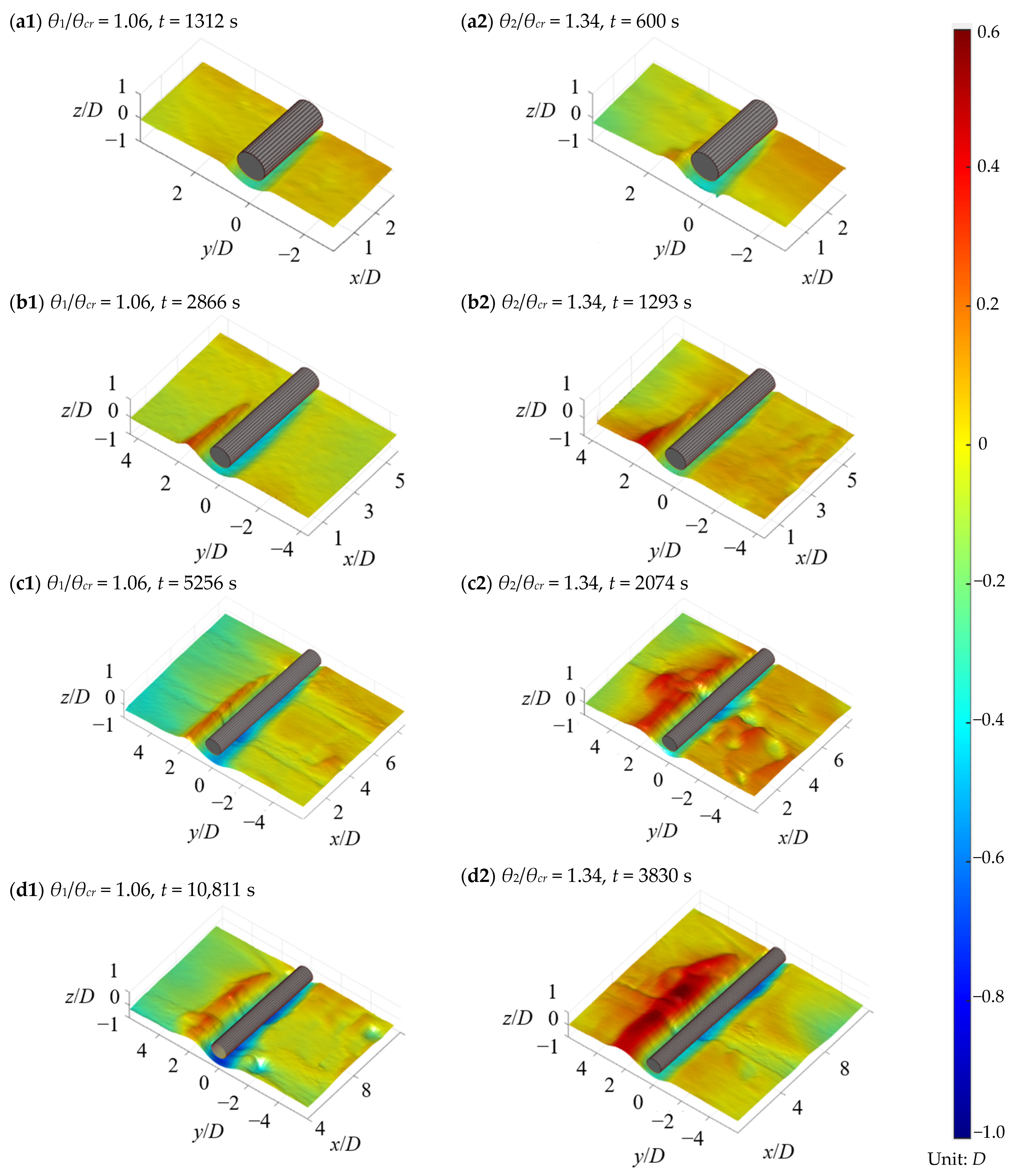
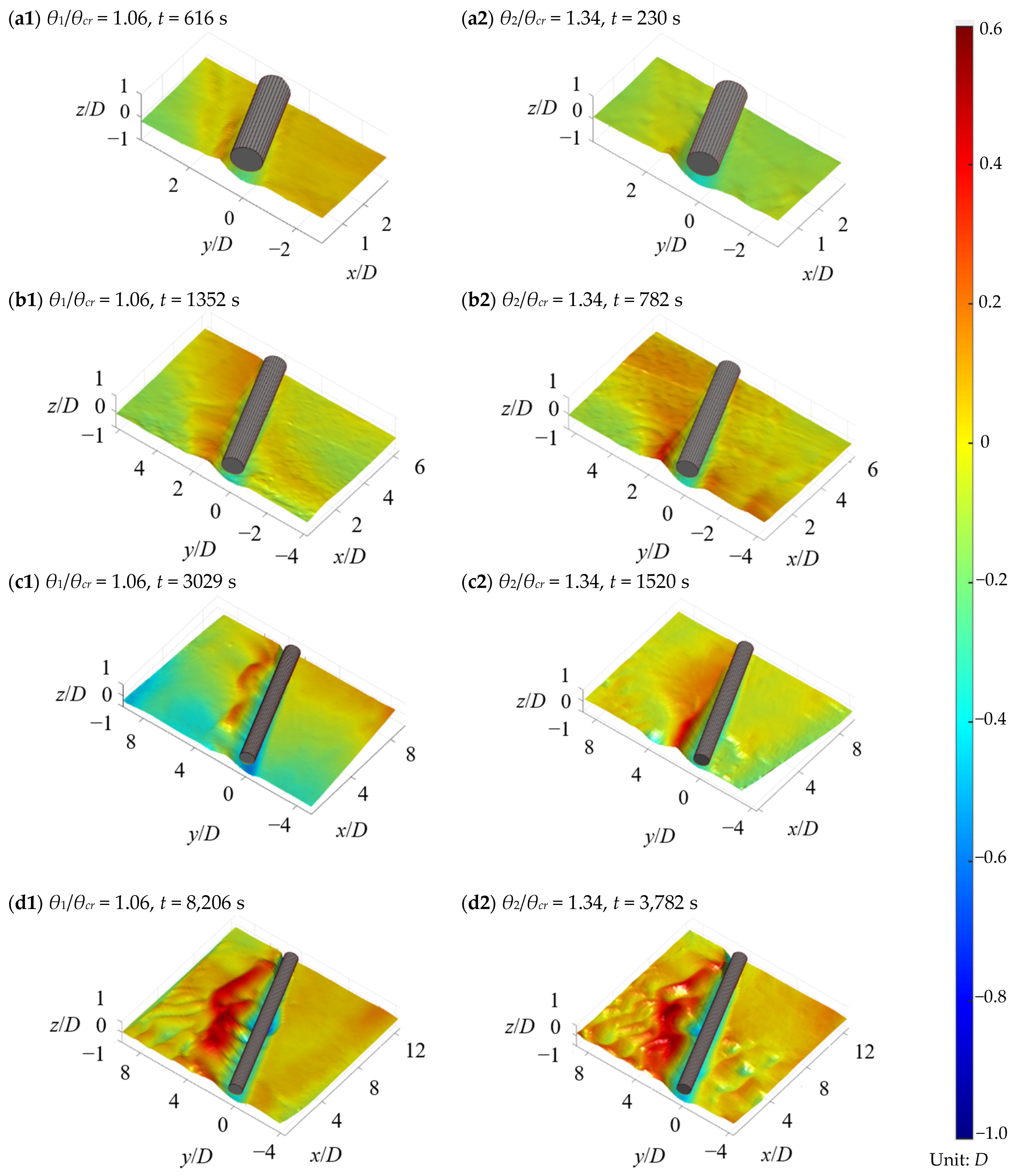
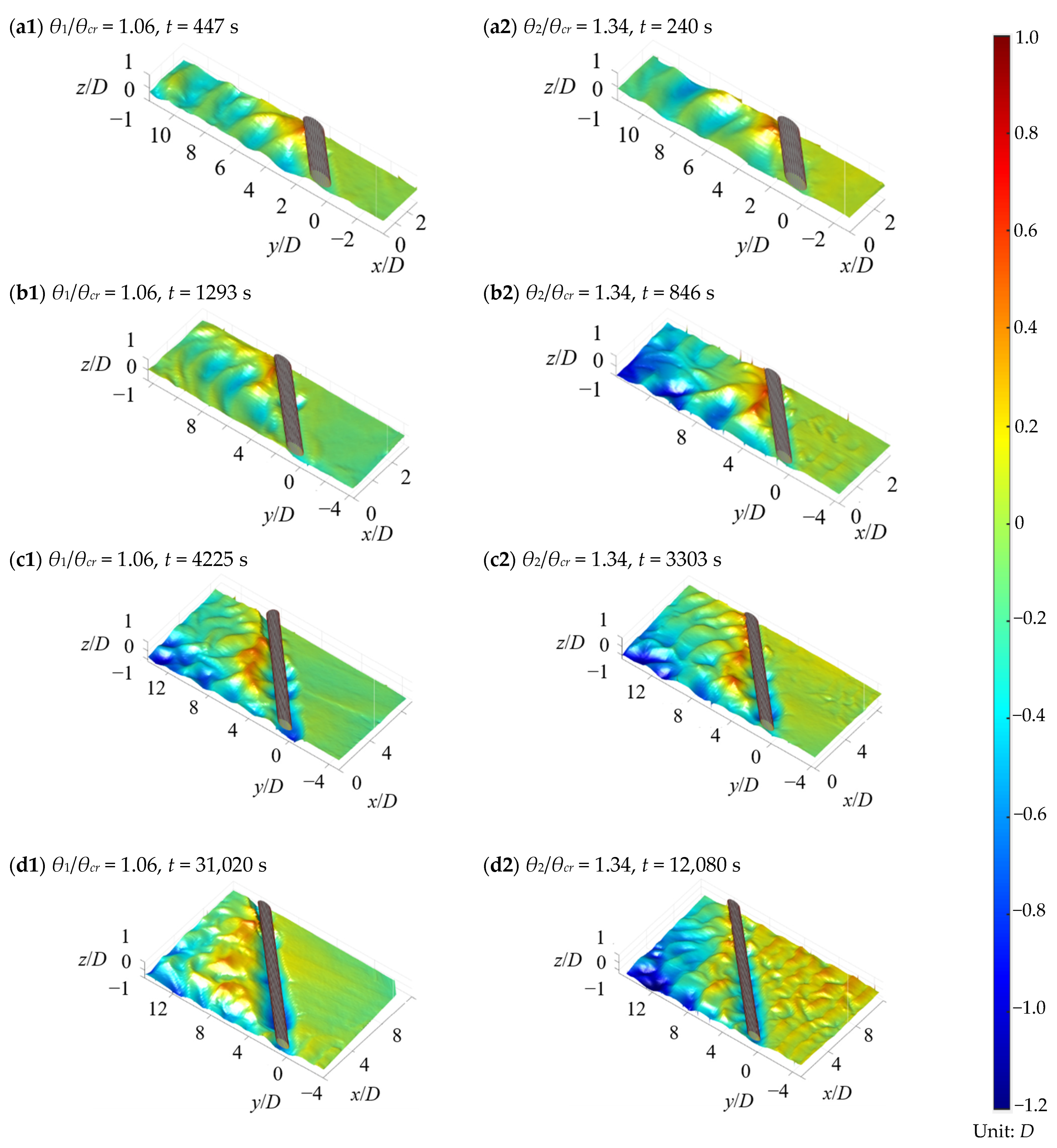
Scour topographies around the whole model pipe at different stages were recorded by a 3D laser scanner and the collected data was later processed using MATLAB (Version R2016a) to present the topographies. The topographies for α = 0° are illustrated in Figure 10. A certain amount of sediment has formed a protruding dune at the downstream of the pipeline for both θ1/θcr = 1.06 and θ2/θcr = 1.34, but the dune was formed earlier for θ2/θcr = 1.34. This is attributed to a stronger vortex hindering the eroded sediment below the pipe from transporting downstream when the current velocity is larger. A different scour pattern has been detected for the case of α = 22.5° and 45° as illustrated in Figure 11 and Figure 12, respectively. Some sand ripples have developed downstream and along the pipe over time. These sand ripples developed faster and more significantly for larger α and θ. Moreover, small scour pits appeared below the pipe within the range of the scour hole, and the longitudinal extension of these small scour pits is perpendicular to the model pipe. This is strong evidence that the velocity component along the pipeline axis dominates the scour progress below the pipe. The undulating terrain caused by sand ripples at the downstream of the pipeline should be closely related to the presence of scour pits. The scour pits appeared at troughs of sand ripples downstream from the pipeline, where the sediment below the pipe is easier to be transported.
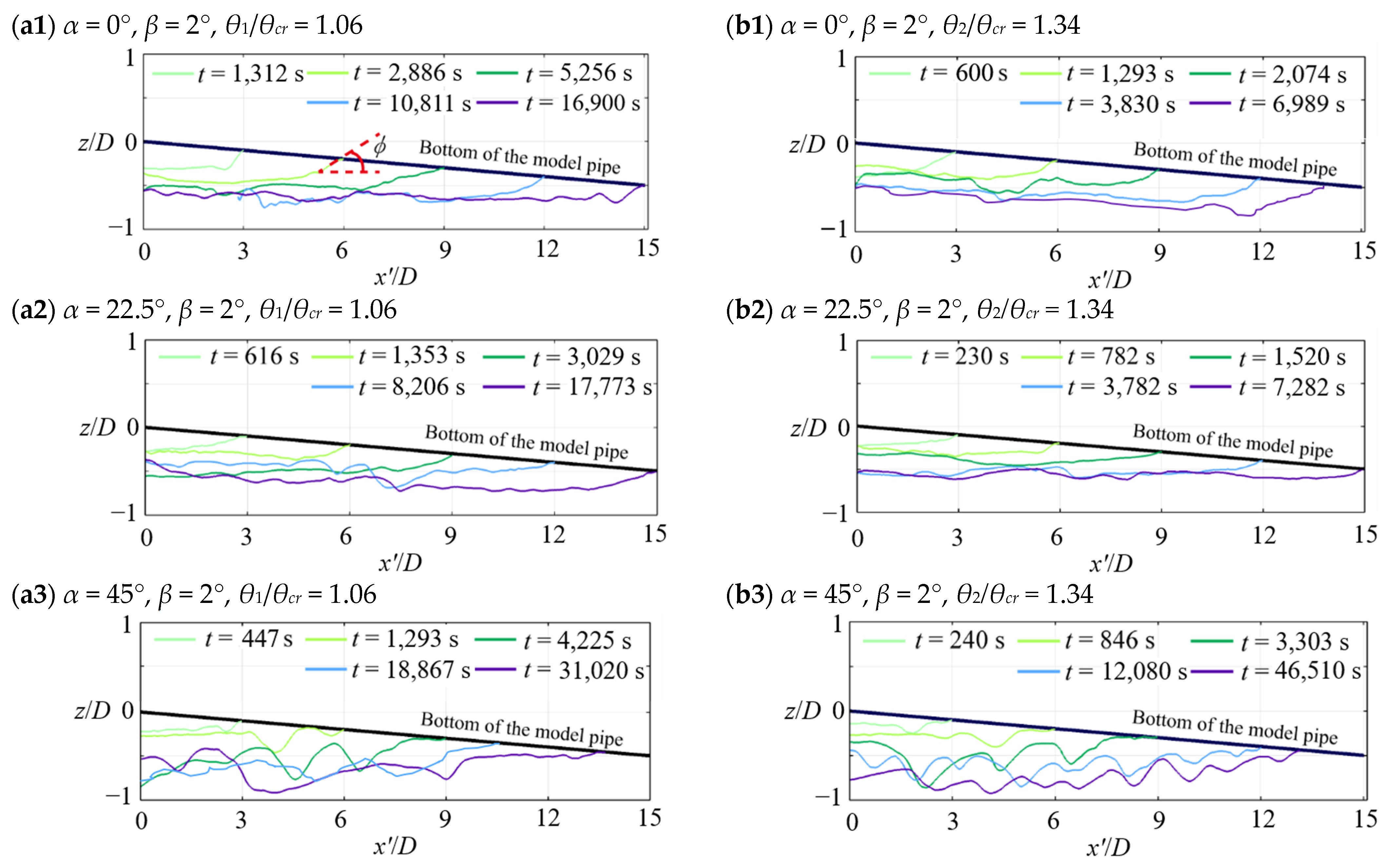
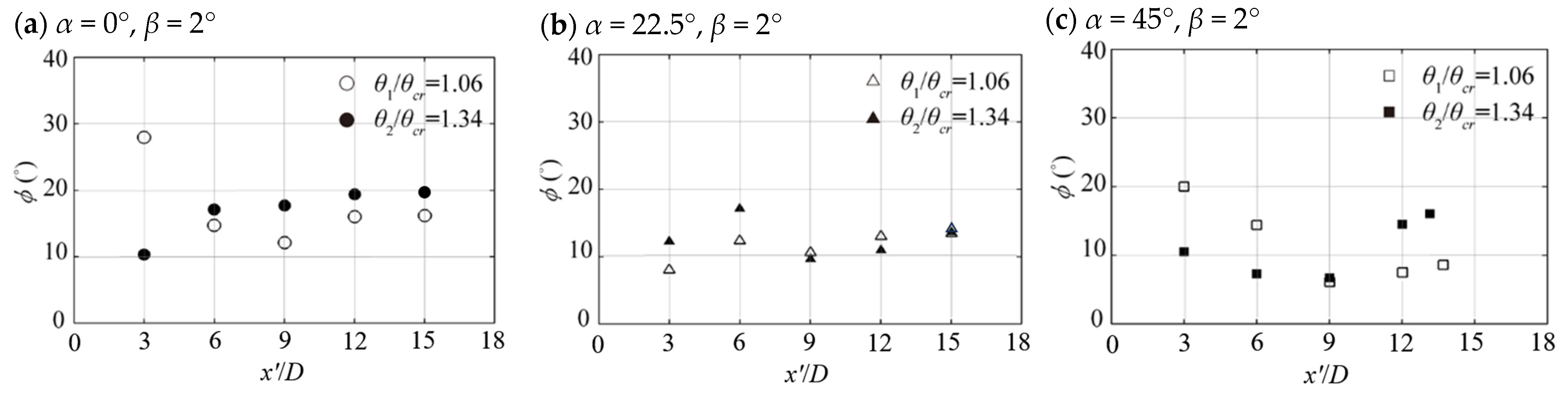
The terrain profiles below the pipelines are illustrated in Figure 13. It is noticed that the slope of the scour shoulder advances along the pipe axis at a certain angle. To determine the angle of scour slope, an approximately linear segment at the shoulder region of every terrain profile is calculated, and the calculation results are shown in Figure 14. For the cases of α = 0° and 22.5°, the angle of scour slope shows practically no sensitivity to the current velocity, which is between 10° and 30° for α = 0° and between 5° and 20° for α = 22.5°. As for α = 45°, however, the angle of scour slope shows a significant difference under different current velocities. This may be relevant to the scour pits, which are caused by the velocity component along the pipeline axis and are more obvious with larger α, as discussed above, below the pipe. The angle of scour slope discovered by the present work is different to the assumption of scour slope equal to the sand repose angle, which has been usually adopted in previous studies about scour propagation.
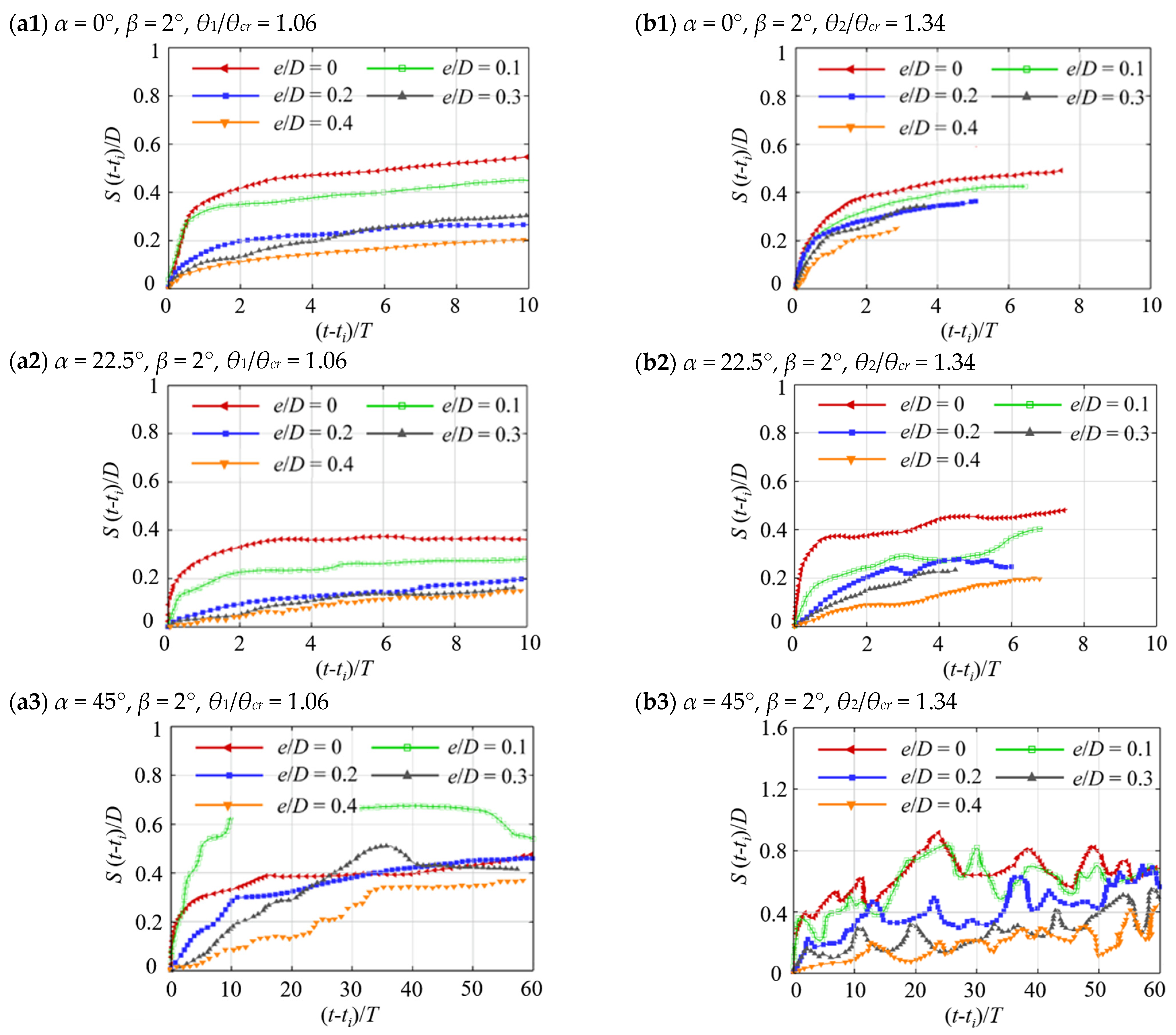
As mentioned above, temporal developments of the scour depth are recorded through ultrasound sensors. Through the equal spacing between adjacent ultrasound sensors, the time-dependent scour length L (t) can be calculated. Figure 15 shows the results of the time-dependent scour depth S (tti) of each ultrasound sensor in the same experimental case for the purpose of comparison (where ti is the time when scour propagation extends to the ultrasound sensor of number i). The developing rate of scour depth at the initial phase appears to decrease with the initial buried depth ratio e/D in the same case of θ, α, and β overall. It can be found from Figure 15 that the developing rate of scour depth for θ1 is larger than that for θ2 at e/D = 0 and 0.1.

3.2. Scour Propagation Rate

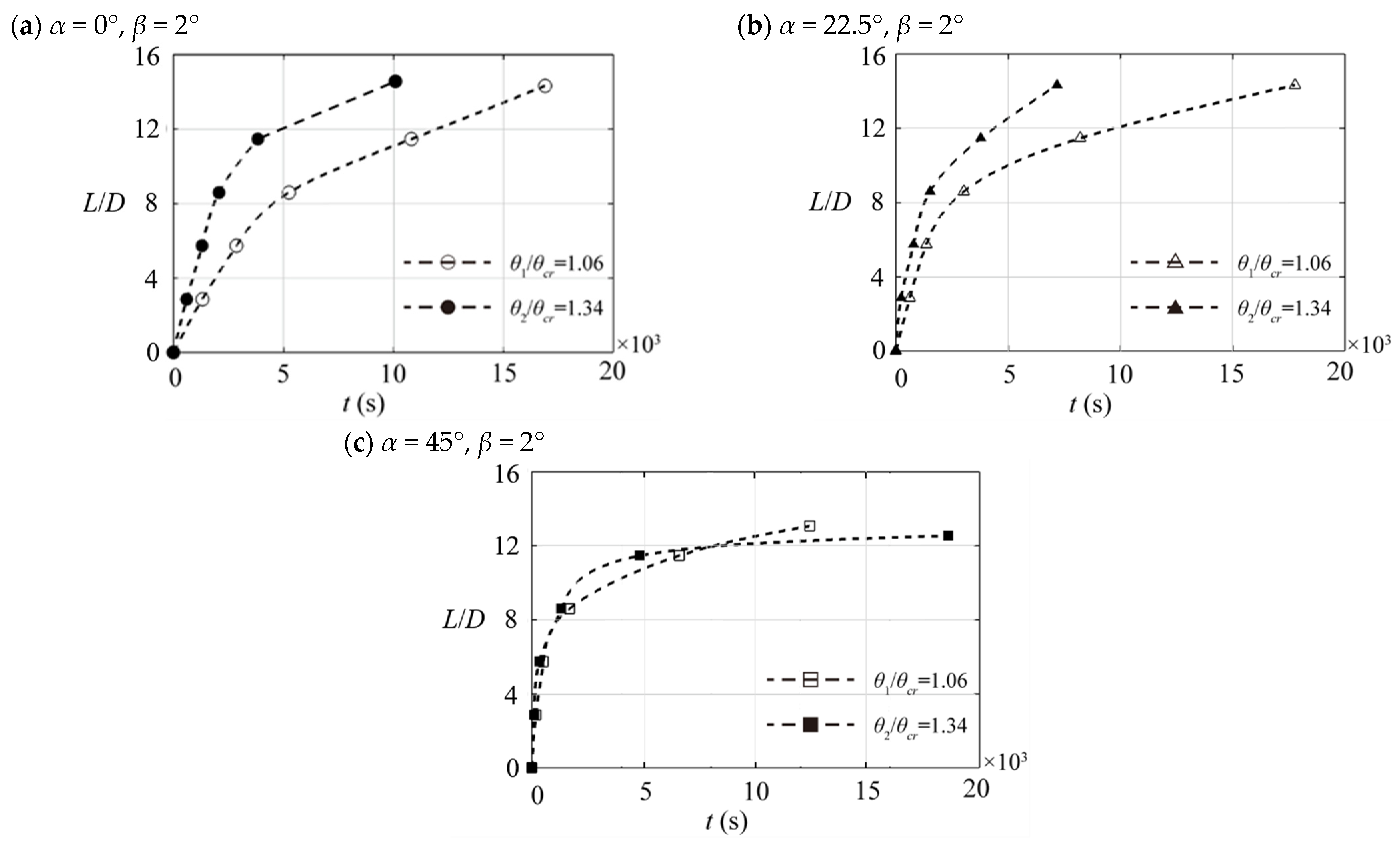
By ultrasound sensors monitoring the scour initiations at 6 positions, the time-dependent scour length (L (t)) along the model pipeline can be obtained. The results of the time-dependent scour propagation length for different flow incident angles are demonstrated in Figure 16. Two phases of scour propagation can be distinguished as a rapid propagation phase and a slow propagation phase. The transition point between the 2 phases is around L = 429 mm (which is the position of ultrasound sensor 4 with an initial buried depth ratio e/D = 0.3), and the value of this point slightly decreases with the increased flow incident angle. In Figure 16, it can be observed that the scour propagation rate increases with the increase of flow velocity in the rapid propagation phases, but the phenomenon observed is not obvious for the situation of the flow incident angles α = 45°. Comparing two phases in all conditions, a phenomenon can be discovered that the scour propagation length shows an increase with time in the rapid propagation phase, as the relatively shallow embedment depth and intensive streamline below the pipeline lead to the rapid development of scour propagation in this phase. But the time-dependent scour propagation length clearly shows a nonlinear growth trend in the slow propagation phase, especially in the conditions of the flow incident angles α = 45°, due to the increase of the embedment depth caused by sand ripples on the downstream side of the pipeline. Another interesting phenomenon is that the scour propagation rate begins to decrease in the slow propagation phase and reduces quickly with the increase of flow velocity in the case of α = 45°, as the thicker sand ripples, which is caused by the larger flow velocity contributing to the greater effect of flow structure, are transported along the pipeline, leading to a deeper embedment.
By comparing different results of time-dependent scour propagation lengths with various incident flows, some general characteristics can be observed:
(1)
In the rapid propagation phase, the scour propagation rate increases noticeably when α varies from 0° to 22.5° and shows no significant change when α further increases to 45°. This phenomenon can be explained by the scouring mechanism. When the flow is perpendicular to the pipeline, the flow dominates the scour process totally, causing the tunnel scouring, which is mainly responsible for scour propagation in the span shoulder region, although other spiral types of vortex caused by the three-dimensional separation in front of the pipeline may contribute to the free span expansion. When the flow has a certain angle acting on the pipeline (α ≠ 0°), the approaching flow velocity can be decomposed into the velocity component perpendicular to the pipeline and along the pipeline. The former leads to the scour propagation mainly by dominating the scour depth process, while the latter contributes to the scour propagation, similar to the horseshoe vortex in the scour around a pile discussed by [15]. As the flow incident angle α changes from 0° to 45°, the scour propagation rate increases significantly due to the combined action of the reduction of the velocity component perpendicular to the pipeline and the increase of the velocity component along the pipeline.
(2)
In the slow propagation phase, the scour propagation rate starts to decrease with the increase of embedment-to-diameter ratio (e/D), and reduces faster when α increases, because larger α leads to greater impact of flow structures formed downstream, causing the thicker sand ripples along the pipeline. As discussed in [9], a stable and well-developed scour shoulder is formed at the slow propagation stage, and it is less likely to be breached even by the velocity component along the pipeline. Meanwhile, the scouring tunnel effect has been significantly reduced for the inclined pipeline [15]. Therefore, both the scour length and scour rate have been found to decrease for the large flow incident angle case.

3.3. Prediction of Scour Propagation Rate

For the problem of a pipeline placed horizontally on the seabed with a series of embedment depths in the steady flow which acts on the pipeline at multiple angles, Ref. [15] proposed a predictive formula based on the assumption that the angle of the scour slope in the edge of the shoulder region is equal to the natural repose angle of the sand, and the equilibrium scour depth is equal to the diameter of the pipeline. Ref. [18] have applied the empirical formula of [15] into the prediction of the scour propagation rate for the case with a certain embedment depth in the time-varying currents perpendicular to the pipeline, and the experimental results agree well with the predicted results, in which the value of scour slope angle is constant. In this work, our predictive model of the scour prop also assumes that the tunnel scouring advances along the pipe axis with a constant shoulder slope angle.
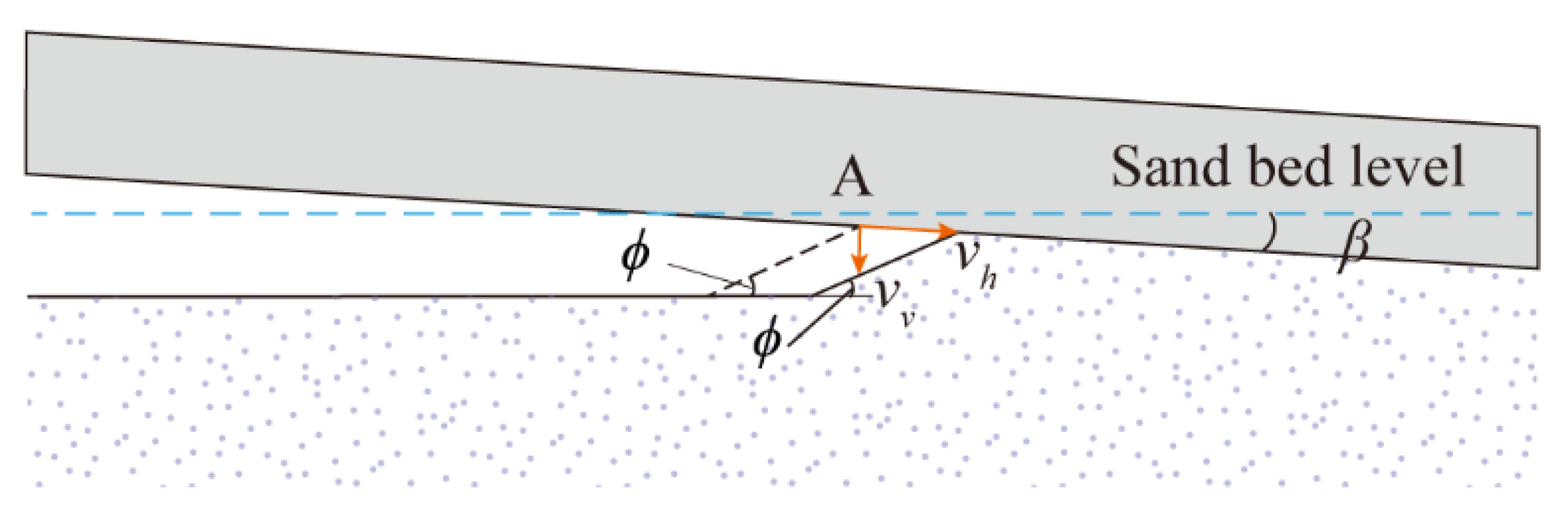
Figure 17 shows the schematic of the propagation of the slope shoulder during the scouring process. The scour propagation rate (Vh) can be defined as the rate of horizontal movement at point A, which is the junction of the shoulder slope and the bottom of the pipeline. The rate of vertical movement at point A is considered the initial rate of vertical scour (Vv), which is calculated by the derivation of Equation (1) as follows:
V v = d S t d t t = 0 = S 0 T
The vertical scour rate can be described as the variation of scour depth with respect to time [5]. From Figure 15, it is seen that the slope of scour depth is significantly large at the initial scour stage and then becomes significantly small after the scour reaches the equilibrium state. This equation implies the variation rate of scour depth can be assumed as constant at the beginning of scour, which is similar to that of a horizontal pipeline scour [1].
The formula for the geometric relationship between the vertical scour rate (Vv) and the scour propagation rate (Vh) can be obtained by the analysis of a simplified model illustrated in Figure 17 as
V v V h = sin ϕ + β cos ϕ
Substituting Equation (11) into Equation (12) then gives
V h = S 0 cos ϕ T sin ϕ + β
Ref. [17] showed that the time scale of the scour process, where the sediment is mobilized by bedload transport, can only be estimated according to
T = 2.8 S 0 η m a x D L s a m
where ηmax is the maximum erosion rate at the start of the scour process, which can be calculated by
η m a x = m λ τ τ c r n
λ represents the amplification factor under the pipeline. Combining Equations (13)–(15), we have
V h = K m λ τ τ c r n L s a m cos ϕ D sin ϕ + β
where Lsam is the length of the sand sample holder used in the sediment erosion test.
It was discovered that shear stress amplification below the pipeline decreases with an increase in the embedment depth of the pipe [12]. To explore the impact of the embedment depth variation (due to the existence of pipeline tilting angle) on the amplification factor, we define the sediment volume change ( Δ Q ) and average height change ( Δ H = Δ Q /Scv, Scv = Δ l ·D) in the projected area directly below the pipeline between adjacent ultrasound sensors, as illustrated in Figure 18. The average sediment erosion rate ( Δ H / Δ t ) can be simplified as the sediment erosion rate (ηmax) at the midpoint of the two adjacent ultrasound sensors, and the amplification coefficient at this midpoint can be calculated according to Equation (15).
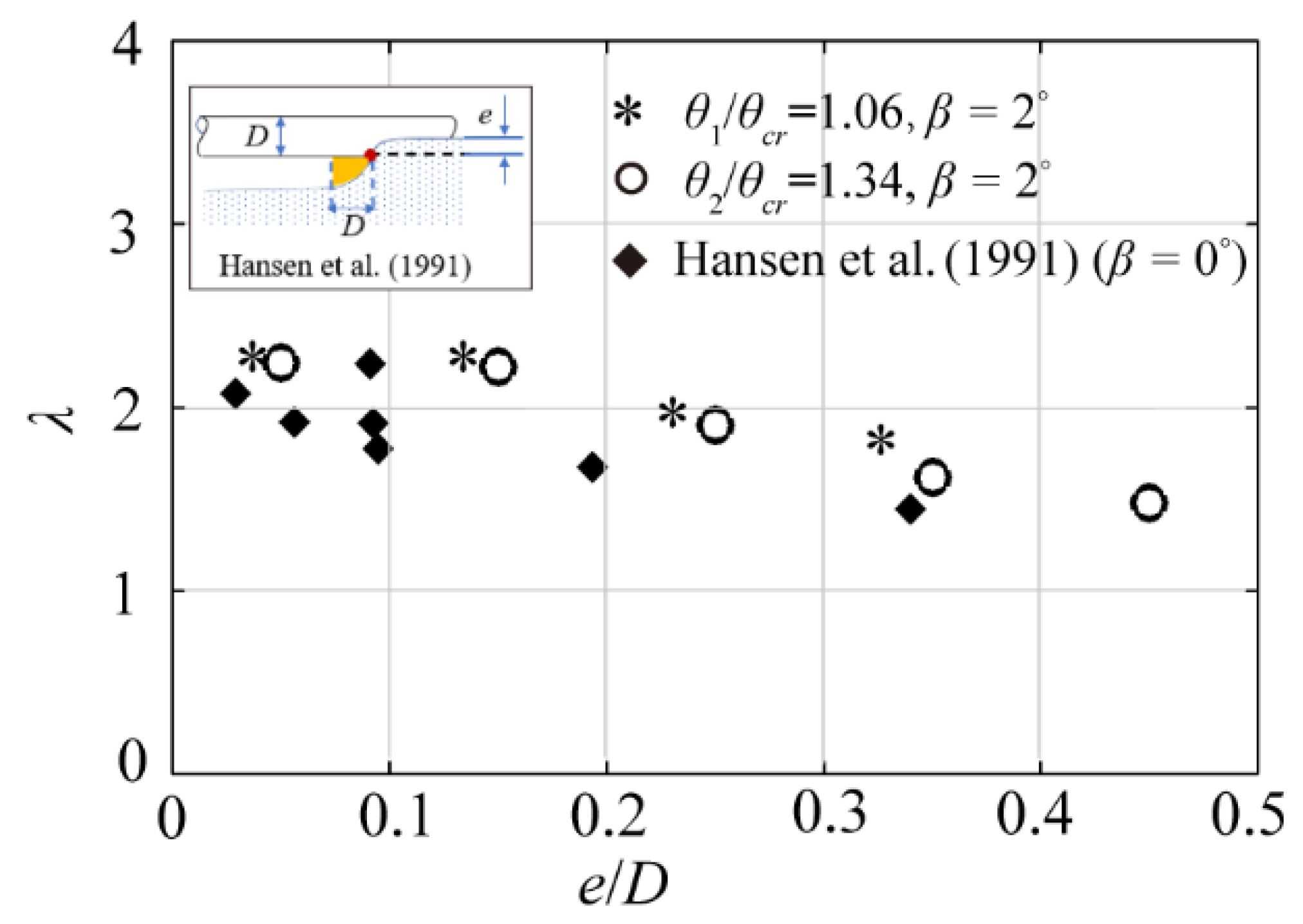
The amplification factor in the steady flows perpendicular to the pipeline plotted in Figure 19 is compared with the experimental results of [12], where the model pipeline was buried in the sediment at zero tilting angle, and the length used to compute the shear stress amplification at the corner area is one pipe diameter (as indicated in the sketch of Figure 18). The comparison shows that the result of the shear stress amplification factor obtained by the present method is similar to the result of [12], implying the feasibility of the present method.
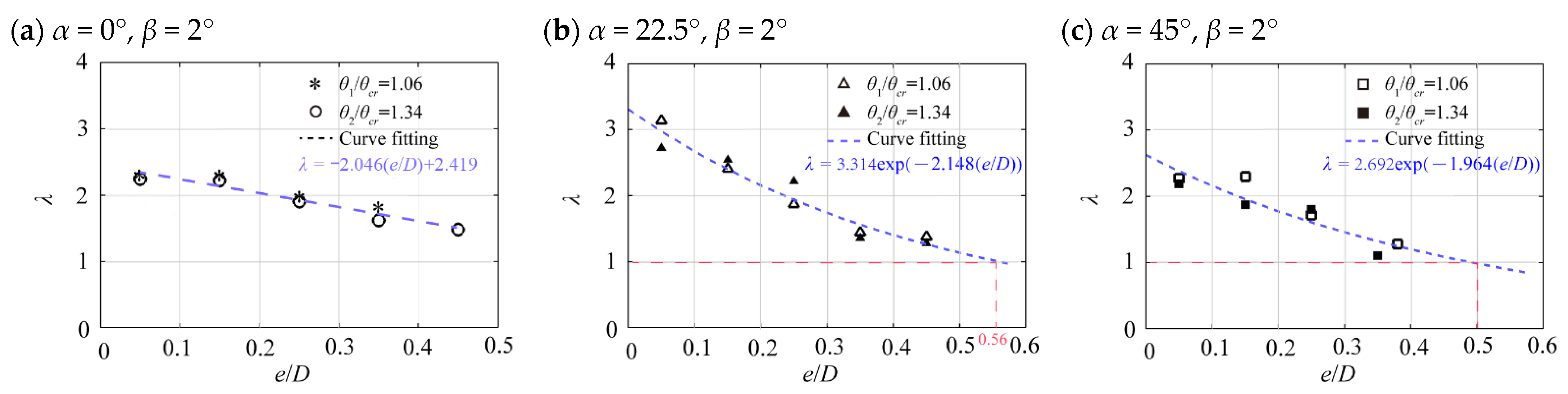
The amplification coefficients at different buried depths along the pipe axis with the different flow incident angles (α = 0°, 22.5°, and 45°) are shown in Figure 20. Fitting curves of the amplification coefficients have been plotted by fitting the experimental data. The fitting formulas corresponding to the different incident angles of flow (α = 0°, 22.5°, and 45°) are expressed as follows, respectively.
λ = 2.046 × e / D + 2.419
λ = 3.314 exp 2.148 e / D
λ = 2.692 exp 1.964 e / D
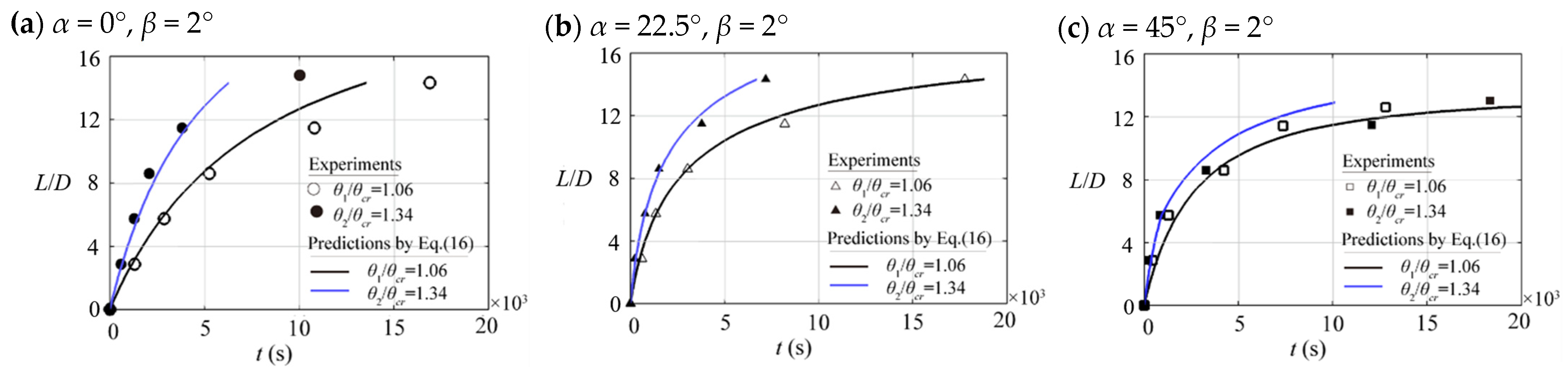
The scour propagation can be considered at the end when λ = 1, the amplifying action of shear stress below the pipeline disappears, and the amounts of coming sediment and leaving sediment below the pipeline are equal. Substituting Equations (17), (18), and (19) into Equation (16), respectively, we can predict the scour propagation rate at every position along the pipeline. When the scour shoulder slope reaches any initial embedment, the time can be calculated further. As shown in Figure 21, the results predicted using the present Equation (16) agree well with the experimental data, where K = 7. The angle of span shoulder slope ϕ is found to be 15°, 12°, and 8° for α = 0°, 22.5° and 45°, respectively.

4. Conclusions

Physical experiments have been conducted to study the characteristics of three-dimensional scour below a tilting submarine pipeline under currents. The following conclusions can be drawn from the work presented in this paper:
Sand ripples, which have a significant effect on the scour propagation along the pipe, formed downstream along the pipeline when there is a flow incident angle. The sand ripples tend to be more obvious with the increase of α and current velocity. Small scour pits below the pipe can be discovered for oblique flow conditions, and this phenomenon proves that the velocity component along the pipeline axis dominates the scour progress.
The angle of the scour slope shoulder is found to be smaller than the natural repose angle of the sand. Rapid propagation phase and slow propagation phase have been detected, and the transition point between the two phases is around where the initial buried depth ratio (e/D) is equal to 0.3.
The shear stress amplification factor below the tilting pipe has been quantified by calculating the variation of transportation sediments in the control volume below the pipe. Based on the measured angle of scour slope shoulder, the shear stress amplification factor, and the erosion properties of the sediment, a new prediction model has been developed to predict the scour propagation rate along the pipe.

Author Contributions

Conceptualization, writing—original draft preparation, project administration, X.L.; Methodology, formal analysis, writing—review and editing, Y.H.; Validation, data curation, writing—review and editing, L.C. All authors have read and agreed to the published version of the manuscript.

Funding

This research was funded by the 2024 Higher Education Scientific Research Project of Guangzhou Education Bureau, with Grant No. 2024312507.

Data Availability Statement

Data available upon request due to privacy.

Acknowledgments

The first author would like to acknowledge the valuable support from Dalian University of Technology. The third author would like to thank the support from New Talent Research Initiation Project of Guangzhou Railway Polytechnic.

Conflicts of Interest

The authors declare no conflicts of interest.

References

  1. Chiew, Y. Mechanics of local scour around submarine pipelines. J. Hydraul. Eng. 1990, 116, 515−529. [Google Scholar] [CrossRef]
  2. Sumer, B.M.; Fredsøe, J. Onset of scour below a pipeline exposed to waves. Int. J. Offshore Polar Eng. 1991, 1, 189–194. [Google Scholar]
  3. Sumer, B.M.; Truelsen, C.; Sichmann, T. Onset of scour below pipelines and self-burial. Coast. Eng. 2001, 42, 313−335. [Google Scholar] [CrossRef]
  4. Sumer, B.M.; Fredsøe, J. Scour below pipelines in waves. J. Waterw. Port Coast. Ocean Eng. 1990, 116, 307−323. [Google Scholar] [CrossRef]
  5. Fredsøe, J.; Sumer, B.M.; Arnskov, M.M. Time scale for wave/current scour below pipelines. Int. J. Offshore Polar Eng. 1992, 2, 13−17. [Google Scholar]
  6. Fredsøe, J.; Hansen, E.A.; Mao, Y.; Sumer, B.M. Three-dimensional scour below pipelines. J. Offshore Mech. Arct. Eng. 1988, 110, 373–379. [Google Scholar] [CrossRef]
  7. Liang, D.; Cheng, L. Numerical model for wave-induced scour below a submarine pipeline. J. Waterw. Port Coast. Ocean Eng. 2005, 131, 193–202. [Google Scholar] [CrossRef]
  8. Cheng, L.; Yeow, K.; Zang, Z. 3D scour below pipelines under waves and combined waves and currents. Coast. Eng. 2014, 83, 137–149. [Google Scholar] [CrossRef]
  9. Wu, Y.; Chiew, Y.M. Mechanics of pipeline scour propagation in the spanwise direction. J. Waterw. Port Coast. Ocean Eng. 2015, 141, 04014045. [Google Scholar] [CrossRef]
  10. Ajdehak, E.; Zhao, M.; Cheng, L.; Draper, S. Numerical investigation of local sour beneath a sagging subsea pipeline in steady currents. Coast. Eng. 2018, 136, 106–118. [Google Scholar] [CrossRef]
  11. Yan, S.; Wang, D.; Li, Y.; Gao, Y.; Lin, J.; Shi, Y. Incompressible Smoothed Particle Hydrodynamics Simulation of Sediment Erosion around Submarine Pipelines. Water 2024, 16, 1445. [Google Scholar] [CrossRef]
  12. Wang, Y.; Yu, S.; Wang, S.; Zhan, B.; Jin, Y.; Tang, G. Numerical Study on the Hydrodynamic Force on Submarine Pipeline Considering the Influence of Local Scour Under Unidirectional Flow. Water 2025, 17, 2737. [Google Scholar] [CrossRef]
  13. Bernetti, R.; Bruschi, R.; Valentini, V.; Venturi, M. Pipelines placed on erodible seabeds. In Proceedings of the 9th International Conference on Offshore Mechanics and Artic Engineering, Houston, TX, USA, 18–23 February 1990; pp. 155–164. [Google Scholar]
  14. Hansen, E.A.; Staub, C.; Fredsøe, J.; Sumer, B.M. Time-development of scour induced free spans of pipelines. In Proceedings of the 10th Offshore Mechanics and Artic Engineering Conference. Pipeline Technology, Stavanger, Norway, 23–28 June 1991; pp. 25–31. [Google Scholar]
  15. Cheng, L.; Yeow, K.; Zhang, Z.; Teng, B. Three-dimensional scour below offshore pipelines in steady currents. Coast. Eng. 2009, 56, 577−590. [Google Scholar] [CrossRef]
  16. Wu, Y.; Chiew, Y.M. Three-dimensional scour at submarine pipelines. J. Hydraul. Eng. 2012, 138, 788−795. [Google Scholar] [CrossRef]
  17. Mohr, H.; Drapper, S.; Cheng, L.; White, D.J. Predicting the rate of scour beneath subsea pipelines in marine sediments under steady flow conditions. Coast. Eng. 2016, 110, 111−126. [Google Scholar] [CrossRef]
  18. Draper, S.; Yao, W.; Cheng, L.; Tom, J.; An, H. Estimating the Rate of Scour Propagation Along a Submarine Pipeline in Time-Varying Currents and in Fine Grained Sediment. In Proceedings of the ASME 2018 37th International Conference on Ocean, Offshore and Arctic Engineering, Madrid, Spain, 17–22 June 2018; p. V005T04A019. [Google Scholar]
  19. Ben Meftah, M.; Mossa, M. New Approach to Predicting Local Scour Downstream of Grade-Control Structure. J. Hydraul. Eng. 2020, 146, 04019058. [Google Scholar] [CrossRef]
  20. Sumer, B.M.; Fredsøe, J. Self-burial of pipelines at span shoulders. Int. J. Offshore Polar Eng. 1994, 4, 30–35. [Google Scholar]
  21. Hansen, E.A.; Klomp, W.H.G.; Smed, P.F.; Chen, Z.; Bijker, R.; Bryndum, M.B. Free Span Development and Self-Lowering of Pipelines. In Proceedings of the 14th Offshore Mechanics and Artic Engineering Conference, Copenhagen, Denmark, 18–22 June 1995; pp. 409–417. [Google Scholar]
  22. Staub, C.; Bijker, R. Dynamic numerical models for sand waves and pipeline self-burial. In Proceedings of the 22nd International Conference on Coastal Engineering, Delft, The Netherlands, 2–6 July 1990; pp. 2508–2521. [Google Scholar]
  23. Dogan, M.; Arisoy, Y. The propagation of wave scour along the spanwise direction of submarine pipelines in case of clear-water regime. Coast. Eng. 2021, 168, 103958. [Google Scholar] [CrossRef]
  24. Soulsby, R.L.; Whitehouse, R.J.S.W. Threshold of Sediment Motion in Coastal Environments. In Proceedings of the 13th Australasian Coastal and Ocean Engineering Conference and the 6th Australasian Port and Harbour Conference, Christchurch, New Zealand, 7–11 September 1997; pp. 145–150. [Google Scholar]
  25. Christoffersen, J.B.; Jonsson, I.G. Bed friction and dissipation in a combined current and wave motion. Ocean. Eng. 1985, 12, 387−423. [Google Scholar] [CrossRef]
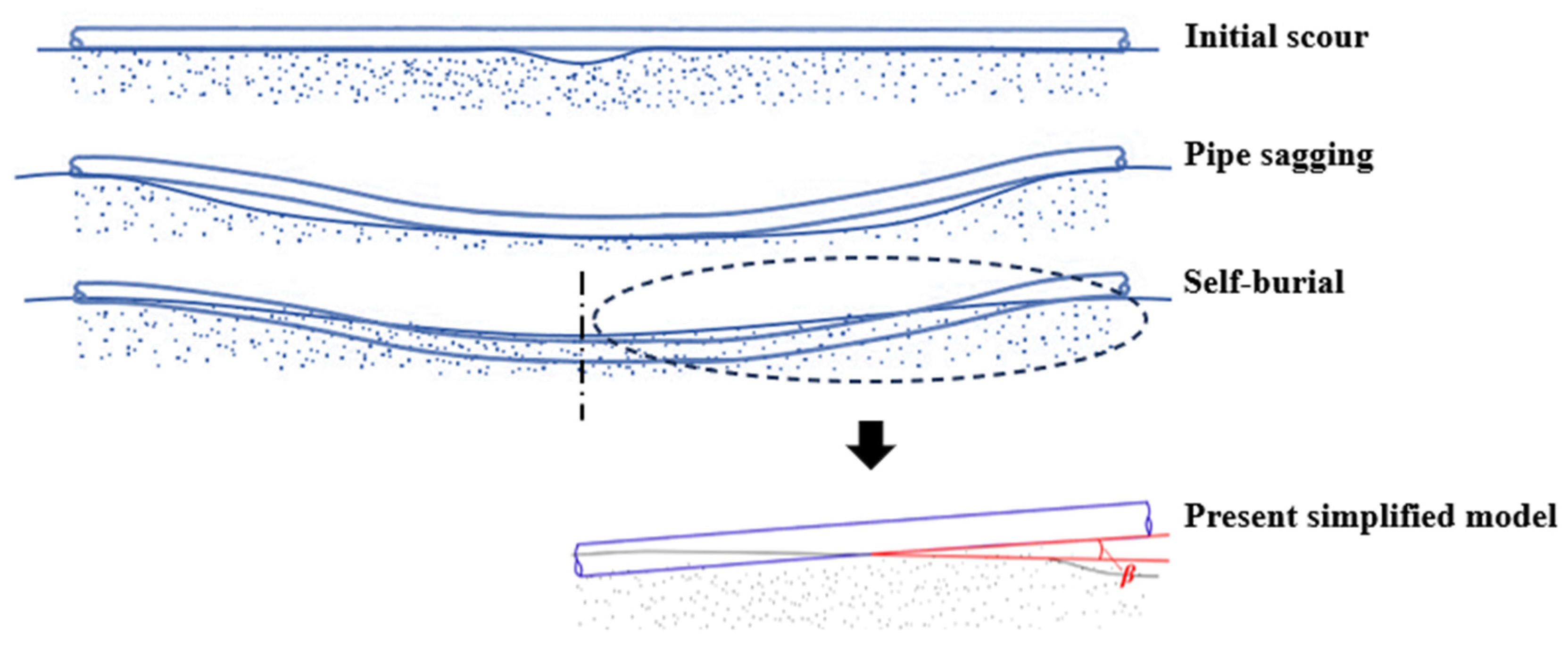
Figure 1. Sagging pipeline after self-burial and the pipeline tilting angle in the present study.
Water 17 03565 g001
Figure 2. Schematic of scour below a tilting pipeline. (a) Overall view; (b) A-A cross-section; (c) B-B cross-section; (d) C-C cross-section.
Water 17 03565 g002
Figure 3. Flume setup utilized in the three-dimensional scour experiment.
Water 17 03565 g003
Figure 4. Sketch of the front and plan views of the tilting model pipeline.
Water 17 03565 g004
Figure 5. Sketch of flume setup utilized in erosion test.
Water 17 03565 g005
Figure 6. Erosion rate measurements presented as a function of shear stress for present study and reference [17].
Water 17 03565 g006
Figure 7. Schematic of the ultrasound sensors mounted in the model pipeline (α = 0°).
Water 17 03565 g007
Figure 8. Velocity profiles at the middle of the test section of the flume.
Water 17 03565 g008
Figure 9. Time history of scour depth at different positions (α = 0°, β = 0°, θ2/θcr = 1.34).
Water 17 03565 g009
Figure 10. Sand bed morphology scan at α = 0°for various θ and t. (a1) θ1/θcr = 1.06, t = 1312 s; (a2) θ2/θcr = 1.34, t = 600 s; (b1) θ1/θcr = 1.06, t = 2866 s; (b2) θ2/θcr = 1.34, t = 1293 s; (c1) θ1/θcr = 1.06, t = 5256 s; (c2) θ2/θcr = 1.34, t = 2074 s; (d1) θ1/θcr = 1.06, t = 10,811 s; (d2) θ2/θcr = 1.34, t = 3830 s.
Water 17 03565 g010
Figure 11. Sand bed morphology scan at α = 22.5° for various θ and t. (a1) θ1/θcr = 1.06, t = 616 s; (a2) θ2/θcr = 1.34, t = 230 s; (b1) θ1/θcr = 1.06, t = 1,352 s; (b2) θ2/θcr = 1.34, t = 782 s; (c1) θ1/θcr = 1.06, t = 3029 s; (c2) θ2/θcr = 1.34, t = 1520 s; (d1) θ1/θcr = 1.06, t = 8206 s; (d2) θ2/θcr = 1.34, t = 3782 s.
Water 17 03565 g011
Figure 12. Sand bed morphology scan at α = 45° for various θ and t. (a1) θ1/θcr = 1.06, t = 447 s; (a2) θ2/θcr = 1.34, t = 240 s; (b1) θ1/θcr = 1.06, t = 1293 s; (b2) θ2/θcr = 1.34, t = 846 s; (c1) θ1/θcr = 1.06, t = 4225 s; (c2) θ2/θcr = 1.34, t = 3303 s; (d1) θ1/θcr = 1.06, t = 31,020 s; (d2) θ2/θcr = 1.34, t = 12,080 s.
Water 17 03565 g012
Figure 13. Terrain profiles below the pipeline for different α and θ. (a1) α = 0°, β = 2°, θ1/θcr = 1.06; (a2) α = 22.5°, β = 2°, θ1/θcr = 1.06; (a3) α = 45°, β = 2°, θ1/θcr = 1.06; (b1) α = 0°, β = 2°, θ2/θcr = 1.34; (b2) α = 22.5°, β = 2°, θ2cr = 1.34; (b3) α = 45°, β = 2°, θ2cr = 1.34.
Water 17 03565 g013
Figure 14. Slope angles at scour shoulder for different α and θ. (a) α = 0°, β = 2°; (b) α = 22.5°, β = 2°; (c) α = 45°, β = 2°.
Water 17 03565 g014
Figure 15. Time development of scour depth below the pipeline for different α and θ. (a1) α = 0°, β = 2°, θ1/θcr = 1.06; (a2) α = 22.5°, β = 2°, θ1/θcr = 1.06; (a3) α = 45°, β = 2°, θ1/θcr = 1.06; (b1) α = 0°, β = 2°, θ2/θcr = 1.34; (b2) α = 22.5°, β = 2°, θ2/θcr = 1.34; (b3) α = 45°, β = 2°, θ2/θcr = 1.34.
Water 17 03565 g015
Figure 16. Scour length propagation along the pipeline for different α and θ. (a) α = 0°, β = 2°; (b) α = 22.5°, β = 2°; (c) α = 45°, β = 2°.
Water 17 03565 g016
Figure 17. Schematic diagram of the propagation of the scour slope shoulder.
Water 17 03565 g017
Figure 18. Projection area utilized to calculate the sediment volume change in this study.
Water 17 03565 g018
Figure 19. Comparison of amplification factor for the present study and reference [14] at different θ with respect to embedment.
Water 17 03565 g019
Figure 20. Amplification coefficients distribution along the pipeline.
Water 17 03565 g020
Figure 21. Prediction of the scour propagation along the pipeline.
Water 17 03565 g021
Table 1. Properties of sediments utilized in the present study.
SedimentMedian Grain SizeUniformity IndexSpecific GravityFitting Parameters for Equation (10)
d50 (mm)Cusm n
This paper 0.1851.72.71.06 × 10−41.693
[17]0.1922.671.05 × 10−41.73
Table 2. Position of the ultrasound sensors.
Sensor No.123456
x’ (mm)0143286429572715
e (mm)0510152025
e/D00.10.20.30.40.5
Table 3. Summary of experimental conditions.
Test No.θ/θcrα (°)β (°)Scour StartScour Stop
e/De/D
C01.3400--
C11.060200.5
C21.340200.5
C31.0622.5200.5
C41.3422.5200.5
C51.0645200.4
C61.3445200.4
Disclaimer/Publisher’s Note: The statements, opinions and data contained in all publications are solely those of the individual author(s) and contributor(s) and not of MDPI and/or the editor(s). MDPI and/or the editor(s) disclaim responsibility for any injury to people or property resulting from any ideas, methods, instructions or products referred to in the content.