


Interregional Water Systems: An Alternative for Integrated Water Management Through Game Theory Application

 ,
,  ,
,
Abstract
1. Introduction
2. Methods
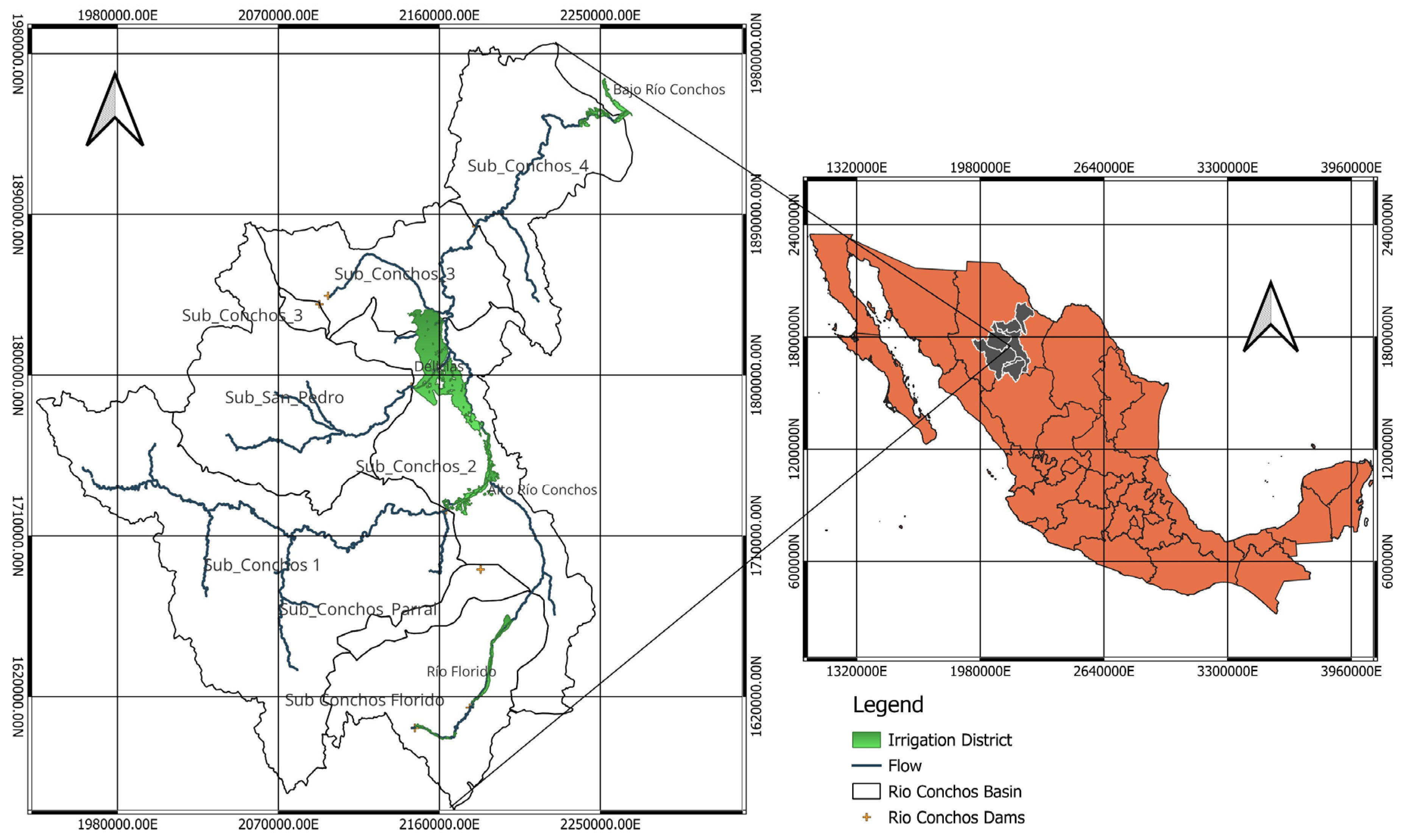
2.1. Study Area
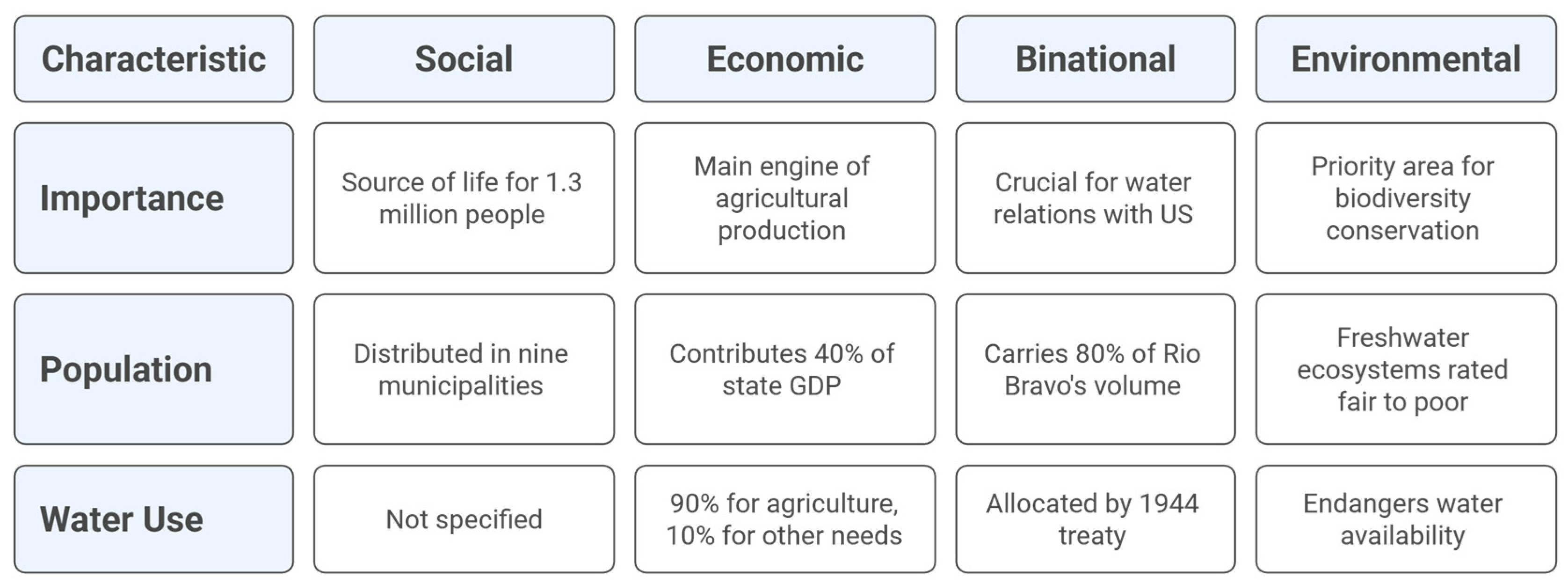
- Socially, the Conchos basin provides sustenance for nearly 1.3 million inhabitants, distributed in nine of the state’s most populated municipalities, including Chihuahua, Delicias, Hidalgo del Parral, Camargo, Jiménez and Ojinaga [17].
- Economically, the Conchos River is a key agricultural engine for the region. Its four main irrigation districts (005 Delicias, 090 Ojinaga, 103 Florido and 113 Alto Conchos) contribute approximately 40% of the state’s Gross Domestic Product (GDP) [10]. Moreover, about 90% of its surface water is used for agriculture, while the remaining 10% covers public-urban, industrial, livestock, and electricity generation need [18].
- Binationally, the Conchos River is crucial to the enforcement of the 1944 International Boundary and Water Treaty between Mexico and the United States. Although the treaty refers to the Rio Grande/Grande basin, it allocates the water of six major tributaries to the Conchos River [19], with the Conchos being the most important, transporting nearly 80% of the volume of the Río Bravo from its confluence at the Ojinaga-Presidio border [17]. This makes it a pillar of international water relations between Mexico and the United States.
- Finally, from an environmental perspective, the upper Conchos watershed is considered by the WWF-Carlos Slim Foundation Alliance as one of the 18 priority areas for Mexico’s Biodiversity Conservation and Sustainable Development Strategy [18]. However, the ecological functionality of its freshwater ecosystems has deteriorated over time from a previous classification of “fair” to the current rating “very poor”, threatening the availability of water and the conservation of its ecosystems [17].
2.2. Data Sources and Key Parameters
2.3. Crop Selection and Base Year
2.4. Water Demand
2.4.1. Irrigation Depth
- = Crop evapotranspiration, expressed in
- = Crop coefficient.
- = Reference crop evapotranspiration, in
2.4.2. Reference Evapotranspiration
2.4.3. Crop Growth Coefficient
2.4.4. Applied Water
- Applied Water.
- = Crop Evapotranspiration.
- = Efficiency of irrigation methods used for each crop.
2.5. Positive Mathematical Programming
- Step 1 Linear Programming (LP): The objective is to maximize profits in agricultural production. The distinctive feature of this phase is the so-called “calibration constraints.” These will force the model in this first instance to replicate exactly the observed crop areas and land allocation decisions of the selected base year. This ensures that the model calibrates its initial parameters based on actual behavior [25]. The profit maximization objective function for this instance is reflected in the following Equation (4):
- Irrigated area [Decision Variable].
- Price of each of the selected crops.
- = Yield of each of the selected crops.
- = Production cost for each of the selected crops.
- X = Planted area in the study zone (observed area).
- Water is applied for crop growth in each region.
- = Total available water by region or water under concession.
- Calibration constraint for land.
- 2.
- Step 2 Estimation of parameters α and γ: The second stage of the PMP process focuses on obtaining dual values using nonlinear cost or production functions. The objective of doing so is the mathematical construction of an increasing cost function that rationalizes the farmers’ observed production decisions, a function that the farmer can be considered to have implicitly followed as shown in Equations (8) and (9).
- 3.
- Stage 3 Nonlinear programming: The final stage of this process is the creation of a final optimization model that uses a cost/production function calculated using the parameters calculated in stage 2. This final model, with calibration, will accurately reproduce the production and use of selected base year inputs, which can be used to realistically and flexibly reproduce farmers’ responses to changes in policies and prices through the following Equation (10):
2.6. PMP Model in Python
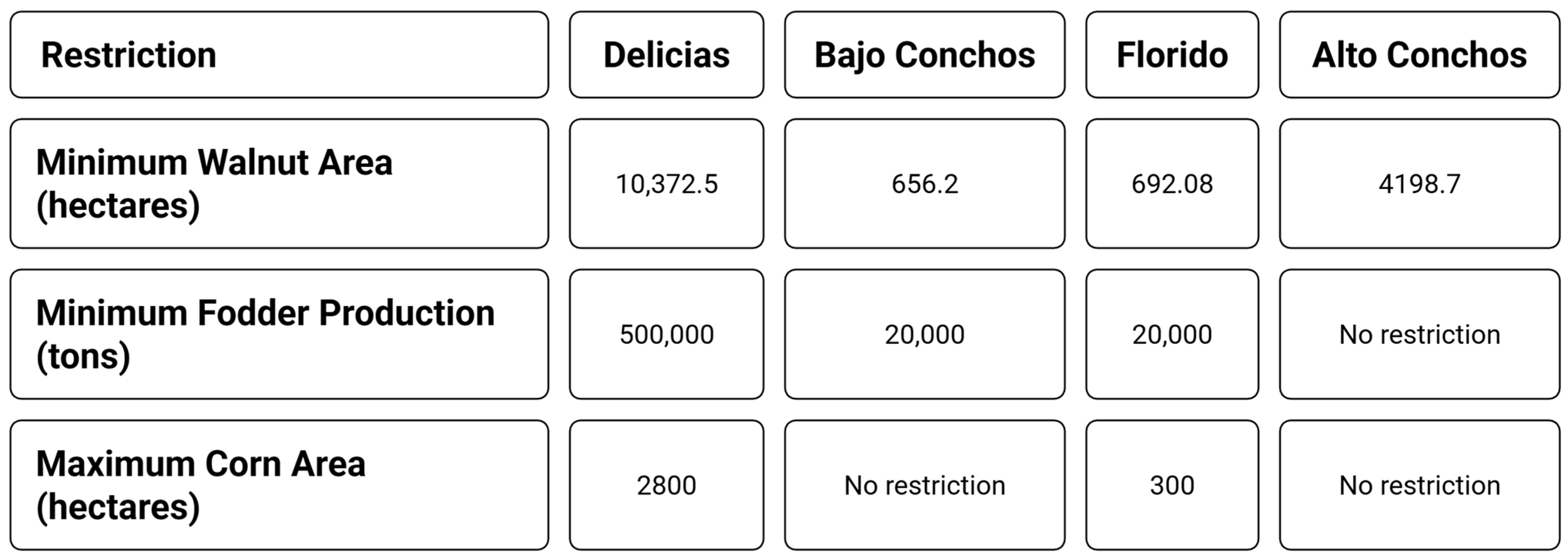
2.7. Restrictions
Interregional Restrictions
2.8. Yield Response to Water Deficit (Methodological Framework)
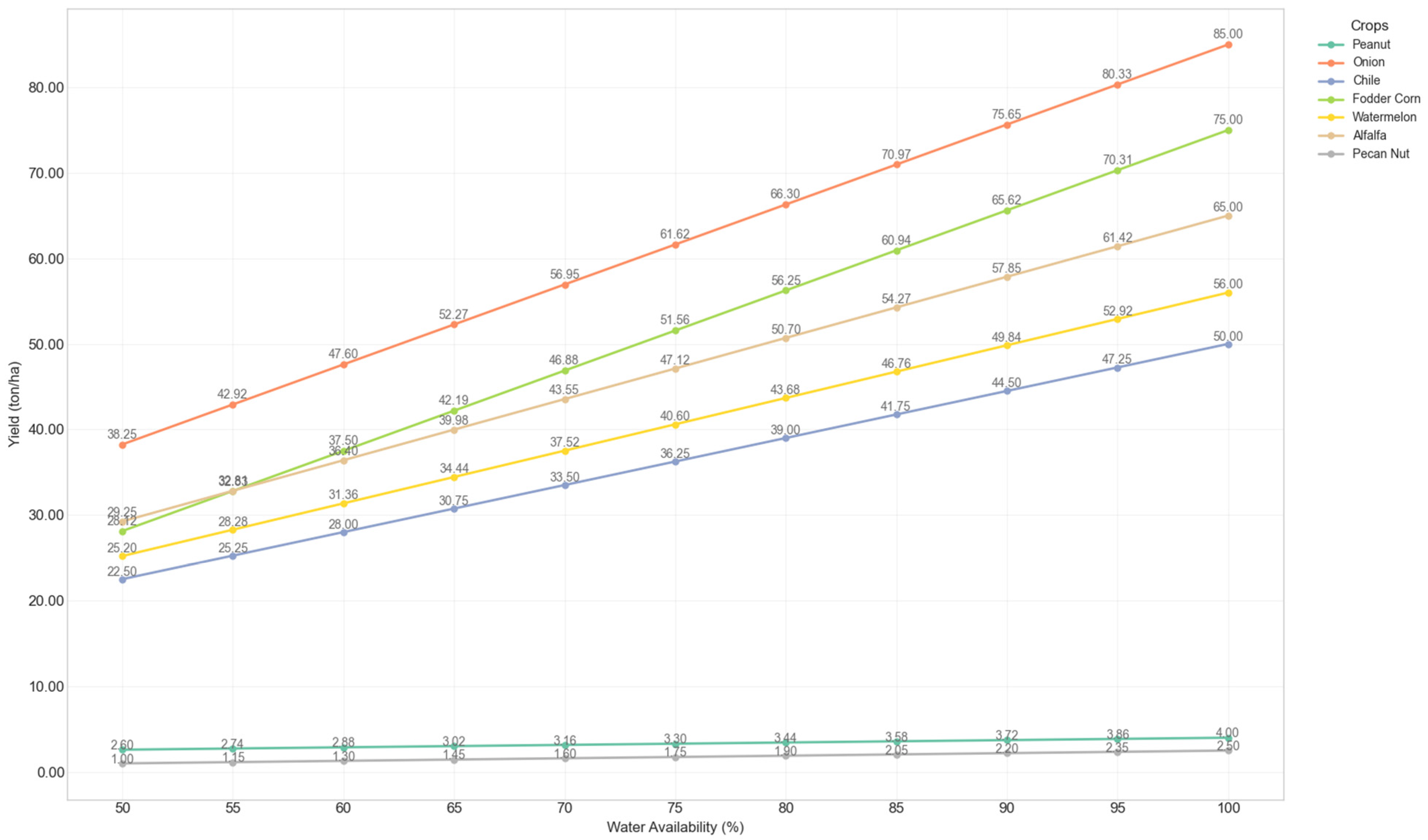
- = The adjusted yield performance depending on availability.
- = The actual yield of the irrigation districts, in this case, the base year yield.
- = The sensitivity factor for each of the crops.
- = The actual evapotranspiration of the crop under these conditions.
- = The maximum evapotranspiration of the crop.
- = Price of each of the crops analyzed.
- = modified yield for each availability of each of the crops analyzed.
- x = observed base area.
2.9. Game Theory
Cooperative Game Theory
3. Results
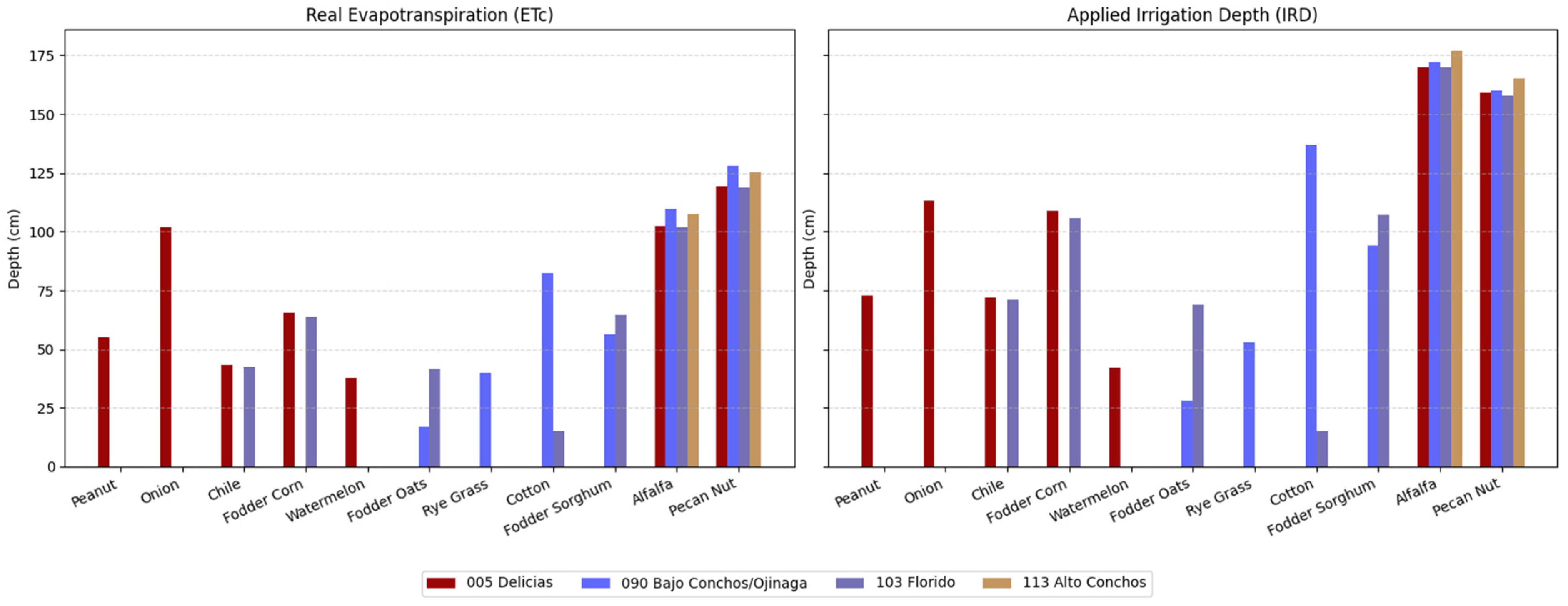
3.1. Evapotranspiration and Applied Water
3.2. PMP Models
- Shadow prices, which provide a measure of the opportunity cost of water
- The gross value of production in each district.
- The behavior yields in response to changes in water availability.
- Production performance under different considerations
3.2.1. Yield Response to Water Deficit Results
3.2.2. Crop Mix Simulation
3.3. Game Theory Models
4. Future Research
5. Conclusions
Author Contributions
Funding
Data Availability Statement
Acknowledgments
Conflicts of Interest
References
- Wu, X.; He, W.; Yuan, L.; Kong, Y.; Li, R.; Qi, Y.; Yang, D.; Degefu, D.M.; Ramsey, T.S. Two-Stage Water Resources Allocation Negotiation Model for Transboundary Rivers under Scarcity. Front. Environ. Sci. 2022, 10, 900854. [Google Scholar] [CrossRef]
- Fu, J.; Zhong, P.A.; Xu, B.; Zhu, F.; Chen, J.; Li, J. Comparison of Transboundary Water Resources Allocation Models Based on Game Theory and Multi-Objective Optimization. Water 2021, 13, 1421. [Google Scholar] [CrossRef]
- Semarnat, Y.C. Atlas del Agua en México; Semarnat Conagua: Mexico City, Mexico, 2018. [Google Scholar]
- Rodríguez-Flores, J.M.; Medellín-Azuara, J.; Valdivia-Alcalá, R.; Arana-Coronado, O.A.; García-Sánchez, R.C. Insights from a Calibrated Optimization Model for Irrigated Agriculture under Drought in an Irrigation District on the Central Mexican High Plains. Water 2019, 11, 858. [Google Scholar] [CrossRef]
- Yuan, L.; He, W.; Liao, Z.; Degefu, D.M.; An, M.; Zhang, Z.; Wu, X. Allocating Water in the Mekong River Basin during the Dry Season. Water 2019, 11, 400. [Google Scholar] [CrossRef]
- Lu, Y.; Tian, F.; Guo, L.; Borzì, I.; Patil, R.; Wei, J.; Liu, D.; Wei, Y.; Yu, D.J.; Sivapalan, M. Socio-Hydrologic Modeling of the Dynamics of Cooperation in the Transboundary Lancang-Mekong River. Hydrol. Earth Syst. Sci. 2021, 25, 1883–1903. [Google Scholar] [CrossRef]
- CILA. Acta 331; CILA: Ciudad Juárez, Mexico, 2024.
- CILA. Acta 309; CILA: El Paso, TX, USA, 2003.
- CILA. Acta 325; CILA: Ciudad Juárez, Mexico, 2020.
- Cuauhtémoc Osorno Córdova Red Mexicana de Cuencas—Presa La Boquilla: Los Conflictos Hídricos y La Iniciativa de La Ley General de Aguas. Available online: https://remexcu.org/index.php/blog/223-presa-la-boquilla-los-conflictos-hidricos-y-la-iniciativa-de-la-ley-general-de-aguas (accessed on 11 August 2025).
- IMCO. Aguas en México, ¿Escasez o Mala Gestión? IMCO: Mexico City, Mexico, 2023. [Google Scholar]
- Teasley, R.L. Evaluating Water Resource Management in Transboundary River Basins Using Cooperative Game Theory: The Rio Grande/Bravo Basin; The University of Texas at Austin: Austin, TX, USA, 2009. [Google Scholar]
- Montero Martínez, M.J.; Ibáñez Hernández, Ó.F. La Cuenca Del Río Conchos: Una Mirada Desde Las Ciencias Ante El Cambio Climático; IMTA: Jiutepec, Mexico, 2017; ISBN 9786079368890. [Google Scholar]
- Hernández Romero, P. Índice de Seguridad Hídrica En México. Ph.D. Thesis, Universidad de las Américas Puebla, Puebla, Mexico, 2019. [Google Scholar]
- Conabio Cuenca Alta del Río Conchos. Available online: http://www.conabio.gob.mx/conocimiento/regionalizacion/doctos/rhp_039.html (accessed on 17 April 2022).
- OpenAI. Available online: https://www.napkin.ai/ (accessed on 7 December 2025).
- World Wildlife Fund. Manejo Integral de La Cuenca Del Río Conchos; World Wildlife Fund: Gland, Switzerland, 2006. [Google Scholar]
- WWF-México; Fundación Carlos Slim. Río Conchos—Alto Río Bravo: Estrategia de Conservación de La Biodiversidad y El Desarrollo Sustentable; WWF-México: Mexico City, Mexico, 2009. [Google Scholar]
- CILA. Acta 234; CILA: Ciudad Juárez, Mexico, 1969.
- CONAGUA. Estadísticas Agrícolas de Los Distritos de Riego. Available online: https://www.gob.mx/conagua/documentos/estadisticas-agricolas-de-los-distritos-de-riego (accessed on 30 June 2025).
- FAO. Evapotranspiración del Cultivo; FAO: Rome, Italy, 2006; Volume 56.
- Sifuentes, E.; Jaime, I.; Cervantes, M. ¿Cómo Medir La Eficiencia de Aplicación de Nuestros Riesgos? INIFAP: Mexico City, Mexico, 2022; Available online: https://vun.inifap.gob.mx/VUN_MEDIA/BibliotecaWeb/_media/_desplegableproductores/14483_5266_C%c3%b3mo_medir_la_eficiencia_de_aplicaci%c3%b3n_de_nuestros_riegos.pdf (accessed on 13 October 2025).
- Howitt, R.E. Positive Mathematical Programming Following a Brief Overview of Past Ap-Proaches to Calibrating Programming Models of Farm Production and Problems Associated with These Models, the Equivalency of the Kuhn; Oxford University Press: Oxford, UK, 1995. [Google Scholar]
- Medellín-Azuara, J.; Harou, J.J.; Howitt, R.E. Estimating Economic Value of Agricultural Water under Changing Conditions and the Effects of Spatial Aggregation. Sci. Total Environ. 2010, 408, 5639–5648. [Google Scholar] [CrossRef] [PubMed]
- Medellín-Azuara, J.; Howitt, R.E.; Waller-Barrera, C.; Mendoza-Espinosa, L.G.; Lund, J.R.; Taylor, J.E. A Calibrated Agricultural Water Demand Model for Three Regions in Northern Baja California un Modelo Calibrado de Demanda de Agua Para uso Agrícola Para Tres Regiones en el Norte de Baja California; SciELO: Mexico City, Mexico, 2009. [Google Scholar]
- Bynum, M.L.; Hackebeil, G.A.; Hart, W.E.; Laird, C.D.; Nicholson, B.L.; Siirola, J.D.; Watson, J.-P.; Woodruff, D.L. Pyomo Optimization Modeling in Python, 3rd ed.; Sandia National Lab.: Livermore, CA, USA, 2020. [Google Scholar]
- Steduto, P.; Hsiao, T.C.; Fereres, E.; Raes, D. Crop Yield Response to Water; FAO: Rome, Italy, 2012; Volume 66. [Google Scholar]
- Peters, H. Game Theory A Multi-Leveled Approach, 1st ed.; Springer: Berlin/Heidelberg, Germany, 2008. [Google Scholar]


| Variable/Parameter | Main Source | Source Description | Period | Unit | Notes |
|---|---|---|---|---|---|
| Crop Area | CONAGUA | Irrigation Area reported in the irrigation statistics for the base year | Base Year (2020) | Ha | Used as part of the baseline data for the PMP Model |
| Crop Coefficient (Kc) | FAO | Standard FAO crop coefficients per growth stage | - | - | Used for each stage of phenological growth |
| Crop Costs | FIRAS | Production and irrigation costs per crop | Year 2020 | USD/ha | Used as Part of The Baseline Data for the PMP Model |
| Crop Prices | FIRAS | Price per crop | Year 2020 | USD/Ha | |
| Crop Yields | CONAGUA | Yields reported in the irrigation statistics for the base year | Base Year (2020) | Ton/Ha | |
| Irrigation efficiency by method (%) | SADER | 60% gravity irrigation, 90% for drip irrigation, and 75% for sprinkler irrigation | - | % | Each irrigation method was distinguished Used as Part of The Baseline Data for the PMP Model |
| Ky Values | FAO | Yield response factor under water deficit | - | - | By crop |
| Minimum Corn Area | Historical | Derived from historical irrigation and crop area data | - | Ha | Constraint in PMP model lineal and no lineal |
| Minimum Pecan Nut Area | - | Ha | |||
| Minimum Fodder production requirements | - | Ton/Ha | |||
| Reference evapotranspiration (ETo) | ClimateEngine.org | Constraint in PMP model | 2019–2020 agricultural cycle | mm/day | Daily values were converted to monthly values |
| Vegetative Cycle | FAO | Crop cycle length obtained from FAO | - | months | By Crop type |
| Water Reduction Factor (%) | Model assumption | 20% reduction applied in scenario analysis | Cila minutes (2000–2020) | % | Applied as a constraint in PMP model |
| Water Transfer Efficiency | SADER | Driving efficiency between districts | - | % | Applied in PMP model |
| Irrigation District 005 | Irrigation District 090 | Irrigation District 103 | Irrigation District 113 | ||||
|---|---|---|---|---|---|---|---|
| Crop | Cultivated Area % | Crop | Cultivated Area % | Crop | Cultivated Area % | Crop | Cultivated Area % |
| Alfalfa | 45.2 | Alfalfa | 46.6 | Alfalfa | 51.7 | Alfalfa | 20.5 |
| Peanut | 5.2 | Fodder Oats | 12.9 | Fodder Oats | 4.8 | Pecan Nut | 68.3 |
| Onion | 1.9 | Rye Grass | 5.7 | Chile | 2.8 | ||
| Chile | 6.3 | Cotton | 3.1 | Fodder Corn | 11.6 | ||
| Fodder Corn | 11.4 | Fodder Sorghum | 7.4 | Pecan Nut | 22.8 | ||
| Pecan Nuts | 19.6 | Pecan Nut | 23.6 | Fodder Sorghum | 6.3 | ||
| Watermelon | 6.7 | ||||||
| Total Select Crops | 96.3 | Total Select Crops | 99.3 | Total Select Crops | 100 | Total Select Crops | 88.8 |
| Total Other Crops | 3.7 | Total Other Crops | 0.7 | Total Other Crops | 0 | Total Other Crops | 11.2 |
| Duration of Vegetative Cycle | Start Month | Kc In | Kc Med | Kc Fin | |
|---|---|---|---|---|---|
| Perennial crops in irrigation districts: 005, 090, 103, and 113 | |||||
| Alfalfa | 12 months | 1 | 0.6 | 0.6 | 0.6 |
| Pecan Nuts | 12 months | 1 | 0.7 | 0.7 | 0.7 |
| Specific crops for Irrigation District 005 Delicias | |||||
| Chile | 4 months | 3 | 0.6 | 0.6 | 0.6 |
| Fodder Corn | 5 months | 3 | 0.7 | 1.2 | 0.475 |
| Onion | 6 months | 3 | 0.7 | 1 | 1 |
| Peanut | 5 months | 3 | 0.4 | 1.1 | 0.5 |
| Watermelon | 3 months | 3 | 0.4 | 1 | 0.75 |
| Specific crops for Irrigation District 090 Ojinaga | |||||
| Cotton | 7 months | 3 | 0.35 | 1.2 | 0.7 |
| Fodder Oats | 5 months | 10 | 0.3 | 1.15 | 0.25 |
| Fodder Sorghum | 4 months | 3 | 0.7 | 1.1 | 0.55 |
| Rye Grass | 5 months | 10 | 0.95 | 1.05 | 1 |
| Specific crops for Irrigation District 103 Florido | |||||
| Chile | 4 months | 3 | 0.6 | 0.6 | 0.6 |
| Fodder Corn | 5 months | 3 | 0.7 | 1.2 | 0.475 |
| Fodder Oats | 5 months | 3 | 0.3 | 1.15 | 0.25 |
| Fodder Sorghum | 5 months | 3 | 0.7 | 1.1 | 0.55 |
| Crop | Ky Value |
|---|---|
| Alfalfa | 1.1 |
| Cotton | 0.85 |
| PEPPER | 1.1 |
| Fodder Corn | 1.25 |
| Fodder Oat | 1.1 |
| Fodder Sorghum | 0.9 |
| Onion | 1.1 |
| Peanut | 0.7 |
| Rye Grass | 0.8 |
| Watermelon | 1.1 |
| pecan nut | 1.2 |
| Coalition | 100% | 95% | 90% | 85% | 80% | 75% | 70% |
|---|---|---|---|---|---|---|---|
| Individual Coalition | |||||||
| {Del} | $411.35 | $372.62 | $336.05 | $301.64 | $269.32 | $238.54 | $209.05 |
| {BC} | $19.93 | $18.28 | $16.72 | $15.24 | $13.80 | $12.38 | $10.99 |
| {Flor} | $15.64 | $14.27 | $12.97 | $11.73 | $10.55 | $9.39 | $8.26 |
| {AC} | $55.62 | $47.72 | $40.43 | $33.75 | $27.69 | $22.24 | $17.40 |
| Peer Coalition | |||||||
| {DEL, BC} | $431.29 | $390.93 | $352.82 | $316.94 | $283.15 | $250.97 | $220.12 |
| {DEL, FLOR} | $427.57 | $387.41 | $349.39 | $313.61 | $280.02 | $248.06 | $217.42 |
| {DEL, AC} | $466.99 | $421.61 | $378.57 | $337.71 | $298.63 | $260.95 | $226.55 |
| {BC, FLOR} | $35.71 | $32.82 | $30.03 | $27.31 | $24.58 | $21.96 | $19.45 |
| {BC, AC} | $75.57 | $66.51 | $57.42 | $49.08 | $41.49 | $34.64 | $28.54 |
| {FLOR, AC} | $71.29 | $63.84 | $55.20 | $46.63 | $38.86 | $31.89 | $25.71 |
| Coalition of Three | |||||||
| {DEL, BC, FLOR} | $447.52 | $405.74 | $366.18 | $328.95 | $293.90 | $260.52 | $228.51 |
| {DEL, BC, AC} | $486.93 | $439.92 | $395.32 | $352.95 | $312.44 | $273.36 | $237.66 |
| {DEL, FLOR, AC} | $483.21 | $436.46 | $392.00 | $349.82 | $309.56 | $270.60 | $234.90 |
| {BC, FLOR, AC} | $91.36 | $82.14 | $72.17 | $61.96 | $52.66 | $44.29 | $36.86 |
| Grand Coalition | |||||||
| {DEL, BC, FLOR, AC} | $503.16 | $454.77 | $408.76 | $365.06 | $323.36 | $283.00 | $246.01 |
| Coalition | 65% | 60% | 55% | 50% |
|---|---|---|---|---|
| Individual Coalition | ||||
| {Del} | $180.87 | $153.97 | $128.33 | $103.77 |
| {BC} | $9.62 | $8.27 | $6.94 | $5.64 |
| {Flor} | $7.15 | $6.05 | $4.85 | $2.43 |
| {AC} | $13.16 | $9.13 | $5.13 | $1.16 |
| Peer Coalition | ||||
| {DEL, BC} | $190.59 | $162.38 | $135.45 | $109.62 |
| {DEL, FLOR} | $188.09 | $160.07 | $133.32 | $107.66 |
| {DEL, AC} | $194.17 | $163.16 | $133.48 | $104.94 |
| {BC, FLOR} | $16.98 | $14.54 | $12.12 | $9.73 |
| {BC, AC} | $23.04 | $17.64 | $12.29 | $7.01 |
| {FLOR, AC} | $20.31 | $15.17 | $10.08 | $5.03 |
| Coalition of Three | ||||
| {DEL, BC, FLOR} | $197.85 | $168.51 | $140.46 | $113.52 |
| {DEL, BC, AC} | $203.94 | $171.61 | $140.63 | $110.80 |
| {DEL, FLOR, AC} | $201.39 | $169.25 | $138.46 | $108.82 |
| {BC, FLOR, AC} | $30.21 | $23.72 | $17.29 | $10.93 |
| Grand Coalition | ||||
| {DEL, BC, FLOR, AC} | $211.16 | $177.71 | $145.62 | $114.70 |
| 100% | 95% | 90% | 85% | |||||
|---|---|---|---|---|---|---|---|---|
| Centroid | Increase | Centroid | Increase | Centroid | Increase | Centroid | Increase | |
| DEL | $411.51 | 0.04% | $372.62 | 0.00% | $336.30 | 0.08% | $302.30 | 0.25% |
| BC | $19.94 | 0.03% | $18.31 | 0.15% | $16.74 | 0.13% | $15.24 | 0.00% |
| FLOR | $16.08 | 2.80% | $14.83 | 3.92% | $13.37 | 3.14% | $12.09 | 3.06% |
| AC | $55.63 | 0.01% | $49.01 | 2.70% | $42.34 | 4.72% | $35.33 | 4.67% |
| 80% | 75% | 70% | 65% | |||||
| Centroid | Increase | Centroid | Increase | Centroid | Increase | Centroid | Increase | |
| DEL | $270.02 | 0.26% | $238.64 | 0.04% | $209.10 | 0.02% | $180.89 | 0.01% |
| BC | $13.80 | 0.01% | $12.40 | 0.09% | $11.11 | 1.07% | $9.77 | 1.54% |
| FLOR | $10.86 | 3.01% | $9.61 | 2.29% | $8.35 | 1.04% | $7.22 | 0.91% |
| AC | $28.67 | 3.55% | $22.36 | 0.53% | $17.45 | 0.29% | $13.29 | 0.93% |
| 60% | 55% | 50% | ||||||
| Centroid | Increase | Centroid | Increase | Centroid | Increase | |||
| DEL | $153.98 | 0.00% | $128.33 | 0.00% | $103.77 | 0.00% | ||
| BC | $8.45 | 2.20% | $7.15 | 2.94% | $5.86 | 4.04% | ||
| FLOR | $6.09 | 0.72% | $4.99 | 2.84% | $3.89 | 60.48% | ||
| AC | $9.19 | 0.68% | $5.15 | 0.53% | $1.17 | 0.62% | ||
Disclaimer/Publisher’s Note: The statements, opinions and data contained in all publications are solely those of the individual author(s) and contributor(s) and not of MDPI and/or the editor(s). MDPI and/or the editor(s) disclaim responsibility for any injury to people or property resulting from any ideas, methods, instructions or products referred to in the content. |
© 2025 by the authors. Licensee MDPI, Basel, Switzerland. This article is an open access article distributed under the terms and conditions of the Creative Commons Attribution (CC BY) license (https://creativecommons.org/licenses/by/4.0/).
Share and Cite
Salomon-Vera, M.A.; Medellín-Azuara, J.; Arizmendi-Echegaray, G.; Corona-Vásquez, B. Interregional Water Systems: An Alternative for Integrated Water Management Through Game Theory Application. Water 2025, 17, 3562. https://doi.org/10.3390/w17243562
Salomon-Vera MA, Medellín-Azuara J, Arizmendi-Echegaray G, Corona-Vásquez B. Interregional Water Systems: An Alternative for Integrated Water Management Through Game Theory Application. Water. 2025; 17(24):3562. https://doi.org/10.3390/w17243562
Chicago/Turabian StyleSalomon-Vera, Miguel Angel, Josué Medellín-Azuara, Gerardo Arizmendi-Echegaray, and Benito Corona-Vásquez. 2025. "Interregional Water Systems: An Alternative for Integrated Water Management Through Game Theory Application" Water 17, no. 24: 3562. https://doi.org/10.3390/w17243562
APA StyleSalomon-Vera, M. A., Medellín-Azuara, J., Arizmendi-Echegaray, G., & Corona-Vásquez, B. (2025). Interregional Water Systems: An Alternative for Integrated Water Management Through Game Theory Application. Water, 17(24), 3562. https://doi.org/10.3390/w17243562


