Article

Carbon-Water Coupling and Ecosystem Resilience to Drought in the Yili-Balkhash Basin, Central Asia

1
Institute of Resources and Ecology, Yili Normal University, Yining 835000, China
2
College of Resources and Environment, Yili Normal University, Yining 835000, China
3
College of Biological Science and Technology, Yili Normal University, Yining 835000, China
*
Author to whom correspondence should be addressed.
Water 2025, 17(24), 3535; https://doi.org/10.3390/w17243535 (registering DOI)
Submission received: 5 November 2025 / Revised: 5 December 2025 / Accepted: 10 December 2025 / Published: 13 December 2025
(This article belongs to the Section Hydrology)

Abstract

The resilience of arid ecosystems to climate change hinges on their carbon-water dynamics. This study investigates the spatiotemporal patterns of ecosystem water use efficiency (WUE) and its resilience in the ecologically vulnerable Yili-Balkhash Basin, a critical watershed in Central Asia. Contrary to a basin-wide trend of increasing WUE, we identify a significant decline in the WUE of high-productivity forest ecosystems. We demonstrate that this decline stems from a fundamental decoupling between the drivers of carbon (GPP) and water (ET) cycles during drought periods. While GPP shows a positive response to atmospheric aridity (vapor pressure deficit), likely driven by co-varying high radiation and temperature, ET remains primarily controlled by soil moisture and surface thermal conditions. This driver asynchrony results in ET-dominated control over WUE across 65.8% of the basin, rendering forests particularly vulnerable. Machine learning-based attribution reveals that ecosystem resilience is not determined by long-term drought legacy but by the combined effects of immediate thermal stress and a one-month ecological memory. Our findings highlight an emerging vulnerability of high-productivity forest ecosystems to atmospheric aridity and underscore the necessity of process-based frameworks for assessing ecosystem stability under a changing climate.

1. Introduction

The carbon-water cycle in terrestrial ecosystems is a cornerstone of the Earth’s life-support system. Ecosystem water use efficiency (WUE), defined as the ratio of gross primary productivity (GPP) to evapotranspiration (ET), is a key indicator of carbon-water coupling [1]. This metric quantifies the carbon sequestration capacity of vegetation per unit of water consumed and reveals ecosystem adaptation strategies to climate change. Global climate change is profoundly reshaping ecosystem structure and function by increasing the frequency, intensity, and duration of drought events [2]. Dynamic changes in WUE mirror the adaptive strategies and resource allocation characteristics of vegetation under water stress. Therefore, systematically elucidating the mechanisms by which drought regulates WUE is crucial. This understanding is needed to accurately assess regional carbon sink potential, predict ecosystem response pathways to future climate, and formulate effective ecological conservation strategies.
A key debate in the field concerns whether physiological or physical processes primarily drive WUE changes under drought stress [3]. A comprehensive analysis of global flux data indicates that a consensus on drought’s impact on WUE remains elusive, with significant variations in WUE responses across different plant communities [4]. This suggests heterogeneous response mechanisms across ecosystems or drought types, as drought impacts exhibit marked spatial heterogeneity and differ among vegetation functional types [2,5]. In semi-arid and sub-humid ecosystems, GPP often shows higher sensitivity to drought than ET, and its substantial decline directly leads to reduced WUE during dry years. Conversely, in humid or energy-limited environments, ET dynamics tend to dominate WUE variations. Studies have shown that in water-sufficient regions, energy is the primary limiting factor for ET [6,7]. The relative control of GPP and ET may shift dynamically along a moisture gradient. One study found that in drier ecosystems, WUE correlates more strongly with GPP, whereas in wetter environments, it is more closely linked to ET [8]. In sparsely vegetated, extremely arid zones, observations indicate that new precipitation is primarily lost through soil evaporation with limited influence on GPP, making ET the dominant factor [9]. In contrast, in semi-arid regions with better vegetation cover, plants actively close their stomata in response to drought. Under mild to moderate drought, the decline in photosynthesis is primarily driven by stomatal limitation, which is a physiological mechanism [10]. This phenomenon significantly suppresses GPP, making its sensitivity exceed that of ET. This highlights the need to systematically test the relative importance of GPP and ET in regions with pronounced hydro-thermal gradients.
From a mechanistic perspective, the dynamic equilibrium between GPP and ET is primarily governed by two key water stress sources: atmospheric drought, represented by vapor pressure deficit (VPD), and soil drought, represented by soil water content (SWVL). VPD directly influences stomatal conductance by regulating the vapor pressure gradient between leaves and the atmosphere, thereby controlling photosynthesis and transpiration [3]. SWVL, in turn, determines the water supply available to plant roots and represents the fundamental source of water stress. Although the synergistic regulatory role of VPD and SWVL on ecosystem carbon-water fluxes is well-established, their relative importance under different environmental conditions remains debated [11]. This debate is complicated by the physical coupling between VPD and SWVL, which makes isolating their independent effects exceptionally challenging [12]. Existing studies often treat this driving relationship as static, overlooking its dynamic nature. This limitation hinders a deep understanding of ecosystem responses to compound drought events. Therefore, quantifying the dynamic regulatory roles of VPD and SWVL under varying moisture backgrounds is a critical step toward revealing the mechanisms underlying WUE responses to drought.
Beyond immediate responses, it is essential to explore an ecosystem’s capacity to maintain functional stability after drought disturbances—its ecological resilience. Resilience is typically characterized by two dimensions: resistance and recovery rate [13]. Current research predominantly focuses on describing resilience patterns. However, the quantitative attribution of its underlying drivers remains a pressing scientific challenge. This is particularly true for the integrated analysis of compound stresses (e.g., the interaction between VPD and SWVL) and ecological memory. Ecological memory, or the drought legacy effect, implies that ecosystem resilience is not a static property but a path-dependent dynamic process influenced by disturbance history [14]. Traditional analytical methods struggle to effectively distinguish the relative contributions of immediate climatic stress, compound drought effects, and historical climatic legacies. This makes it difficult to answer a fundamental question: What determines an ecosystem’s vulnerability or resilience to drought? The advent of machine learning and explainable artificial intelligence offers new avenues to address this challenge. These methods can handle complex nonlinear relationships and effectively attribute model predictions, thereby quantifying the importance of individual drivers [15,16,17].
As a critical transboundary endorheic basin, the Yili-Balkhash Basin faces the dual challenges of climate change and anthropogenic activities. Studies indicate that from 2000 to 2013, contrary to the slight precipitation increase in Central Asia, the YBB experienced a declining trend (0 to −3 mm/a). This, coupled with rising evapotranspiration, caused severe soil moisture deficits [18]. Concurrently, Tianshan glaciers are retreating at ~1.1 Gt/year. Consequently, terrestrial water storage has declined at −3.86 mm/a, intensifying ecological drought risks [19]. Human activities have further intensified this dynamic. Since 2000, particularly in the upstream regions, activities such as cropland expansion, cultivation, and forest vegetation restoration have improved Net Primary Productivity (NPP) but simultaneously intensified water demand. Conversely, overgrazing has led to a decline in grassland NPP [20]. To address these complex socio-ecological interactions, this study integrates multi-source remote sensing and reanalysis data to systematically investigate the following key scientific questions: (1) What is the dominant process (GPP or ET) controlling WUE dynamics under drought stress in the YBB, and how does it vary across ecosystem types? (2) How do the regulatory mechanisms of VPD and SWVL on carbon (GPP) and water (ET) fluxes change between dry and wet years? (3) What is the state of ecosystem drought resilience, and what are the relative contributions of immediate stress, compound drought effects, and ecological memory to this resilience? To answer the final question, we employ a machine learning and interpretable AI framework.

2. Materials and Methods

2.1. Study Area

The Yili-Balkhash Basin (YBB) (40–46° N, 75–85° E) is a major transboundary hydrological system in Central Asia (Figure 1a). The basin spans the arid-to-semi-humid transition zone, forming a complete ecosystem gradient from the Tianshan glaciers and alpine meadows to downstream plain oases, vast deserts, and large inland lake wetlands. This region features fragile ecosystems and is experiencing significant impacts from climate change, including persistent temperature increases, heightened evaporation, and increased drought frequency [21].
As a major transboundary river, the Yili River is under significant pressure. Agricultural expansion and water resource development in the upper reaches (within China) impact downstream ecosystems (in Kazakhstan), particularly Lake Balkhash and the Yili River Delta wetlands. This presents a classic scenario of dual stress from climate change and human activity [22,23,24]. This unique setting, with its natural environmental gradient compounded by human disturbance, makes the YBB an ideal region for studying how ecosystem carbon-water coupling responds to compound droughts and for exploring the mechanisms driving resilience. The findings are not only of regional importance but also have strategic implications for ecological security and sustainable water management across Central Asia.

2.2. Data Sources and Processing

2.2.1. GPP and ET Datasets

We obtained GPP and ET data for the period 1982–2018 from the National Earth System Science Data Center of China at a spatial resolution of 0.05° [25]. The data were preprocessed by converting formats and projections, adjusting units, and masking and clipping to the study area. These datasets were then aggregated to monthly and annual time scales.
The GLASS GPP product is based on an improved EC-LUE model that accounts for multiple environmental drivers. The GLASS ET product is derived through a Bayesian model averaging of five process-based ET datasets [26]. This product is based on advanced very high-resolution radiometer observations and has been validated by extensive ground-truth data, demonstrating high accuracy and reliability.

2.2.2. SPEI Data

We used the Standardized Precipitation Evapotranspiration Index (SPEI) to characterize the spatiotemporal evolution of drought events. Data from the global SPEIbase (v2.10) for the period 1982–2018 were used [27]. Gridded data were preprocessed using cubic convolution interpolation and cropped to the study area. The SPEI calculation is based on the climatic water balance (precipitation minus potential evapotranspiration), quantifying water surplus or deficit at a monthly scale. By integrating temperature, SPEI more accurately characterizes drought stress on vegetation under climate change compared to the SPI.

2.2.3. ERA5 Data

We utilized the fifth-generation atmospheric reanalysis data (ERA5) from the European Centre for Medium-Range Weather Forecasts [28]. We used soil moisture content (SWVL) for three layers (0–7 cm, 7–28 cm, and 28–100 cm) and calculated a weighted average based on layer thickness to represent the overall soil moisture profile. We computed vapor pressure deficit (VPD) from surface air temperature and dew point temperature using the formula proposed by Allen et al. [29] to characterize atmospheric aridity.
Other ERA5 variables included surface temperature (STL), shallow soil temperature (SNTR), and skin temperature (SKT). For soil temperature, we selected two layers (0–7 cm and 7–28 cm) and applied a weighted average. All ERA5 variables were resampled to a 0.05° resolution using the bilinear interpolation method and were cropped to the study area.

2.2.4. Land Cover Data

We used the Global Land Cover Fine Classification dataset (GLC_FCS30D) [30], which has a 30-m spatial resolution and is derived from Landsat imagery. To isolate the long-term impact of climate change and minimize interference from land cover dynamics, we focused on stable vegetation pixels, defined as pixels with no land cover change between 1985 and 2018. Data were resampled to a 0.05° resolution using a majority aggregation method. Figure 1e shows the spatial distribution of these stable vegetation types, which primarily include cropland, forest, shrubland, and grassland.

2.2.5. Climate Zone Data

We employed Kottek’s high-resolution Köppen-Geiger climate classification map (1 km resolution), which is based on climate data for the 1990–2010 baseline period, and has been updated using CMIP6 scenarios [31]. To highlight core differences in regional hydro-thermal conditions, we reclassified the original climate types into five primary categories: Arid Desert, Arid Steppe, Cold Temperate Humid, Cold Temperate Winter Dry, and Polar Tundra. The data were resampled to 0.05° resolution using the majority aggregation method.

2.3. Methods

2.3.1. Ecosystem Water Use Efficiency

WUE is an indicator of the biomass produced per unit of water consumed. We estimated WUE as the ratio of GPP to ET:
W U E = G P P E T ,
WUE is expressed in (gC·m−2·mm−1), GPP in (gC·m−2), and ET in (mm).

2.3.2. Dominant Process Classification

To investigate the response mechanism of WUE to drought, we quantified the relative sensitivity of GPP and ET to drought stress. Monthly time series of GPP, ET, and 3-month SPEI (SPEI-3) for each pixel were linearly detrended and normalized. SPEI-3 effectively reflects the cumulative water balance governing short-term plant physiological activities.
We used the Theil-Sen slope estimation method to calculate the sensitivity coefficients of GPP (SGPP) and ET (SET) to drought. This method estimates trends by calculating median slopes, providing robustness against outliers. The dominant process was determined by comparing |SGPP| and |SET|: if |SGPP| > |SET|, the WUE response was classified as GPP-dominated; otherwise, it was ET-dominated. The results were validated using Spearman’s rank correlation.

2.3.3. Vapor Pressure Deficit

VPD was calculated from air temperature and dew point temperature as follows:
V P D = e s e a ,
e s = 0.6108 × exp 17.27 × t 273.15 t 273.15 + 237.3 ,
e a = 0.6108 × exp 17.27 × t d 273.15 t d 273.15 + 237.3 ,
where e s is the saturated vapor pressure (kPa), e a is the actual vapor pressure (kPa), t is the actual air temperature (K), and td is the dewpoint temperature (K).

2.3.4. Elastic Net Regression

We employed Elastic Net regression to disentangle the effects of VPD, SWVL, and related thermal factors on GPP and ET. This method effectively addresses multicollinearity among predictor variables by combining L1 and L2 regularization, ensuring robust variable selection and reliable coefficient estimates.
Prior to modeling, all monthly time series data for each pixel were detrended and standardized. Using Python’s scikit-learn library (version 1.6.1), an independent model was built for each pixel with the ElasticNetCV module. This module uses 5-fold cross-validation to automatically optimize the L1 ratio from a predefined grid. The maximum number of iterations was set to 50,000 to ensure convergence. To investigate driving mechanisms under different moisture conditions, we partitioned the data into ‘drought years’ and ‘wet years’ based on the annual mean 12-month SPEI and conducted separate modeling for each scenario. All analyses were performed using Python 3.11.

2.3.5. Ecosystem Resilience Assessment

We quantified the ability of the YBB ecosystem to maintain functional stability under drought stress using a dimensionless resilience index (Rd). The index compares the mean WUE during drought and non-drought periods:
R d = W U E ¯ d W U E n d ¯ ,
where Rd represents the ecosystem resilience index; W U E d ¯ denotes the mean WUE across all drought years within the study period; and W U E n d ¯ is the mean WUE across all non-drought years.
Based on the calculated index values, we classified resilience into four levels according to the value of Rd:
  • Resilient: Rd ≥ 1.0
  • Slightly non-resilient: 0.9 ≤ Rd < 1.0
  • Moderately non-resilient: 0.8 ≤ Rd < 0.9
  • Severely non-resilient: Rd < 0.8

2.3.6. Attribution of Resilience Drivers

To analyze the non-linear effects and interactions of environmental factors on ecological resilience (Rd), we developed machine learning models using the XGBoost algorithm for each of the five stable vegetation types. The model predictors included several categories: concurrent environmental factors (e.g., SPEI, SKT, VPD), static geographical factors (elevation), historical lag effects (SPEI lagged by 1–12 months and Rd lagged by 1–3 months), and interaction terms to represent synergistic effects (e.g., VPD × SWVL) [32].
The models were trained on data from 1982–2010 and tested on data from 2011–2018. We used the Optuna framework (version 4.5.0) to perform 500 trials of hyperparameter optimization and ensured model robustness with 5-fold time-series cross-validation. Finally, we used the SHAP (SHAPley Additive exPlanations) method to quantify the relative contribution of each predictor to resilience, revealing the differing recovery mechanisms among vegetation types. All analyses were performed using Python 3.11.

3. Results

3.1. Spatiotemporal Dynamics of GPP, ET, and WUE

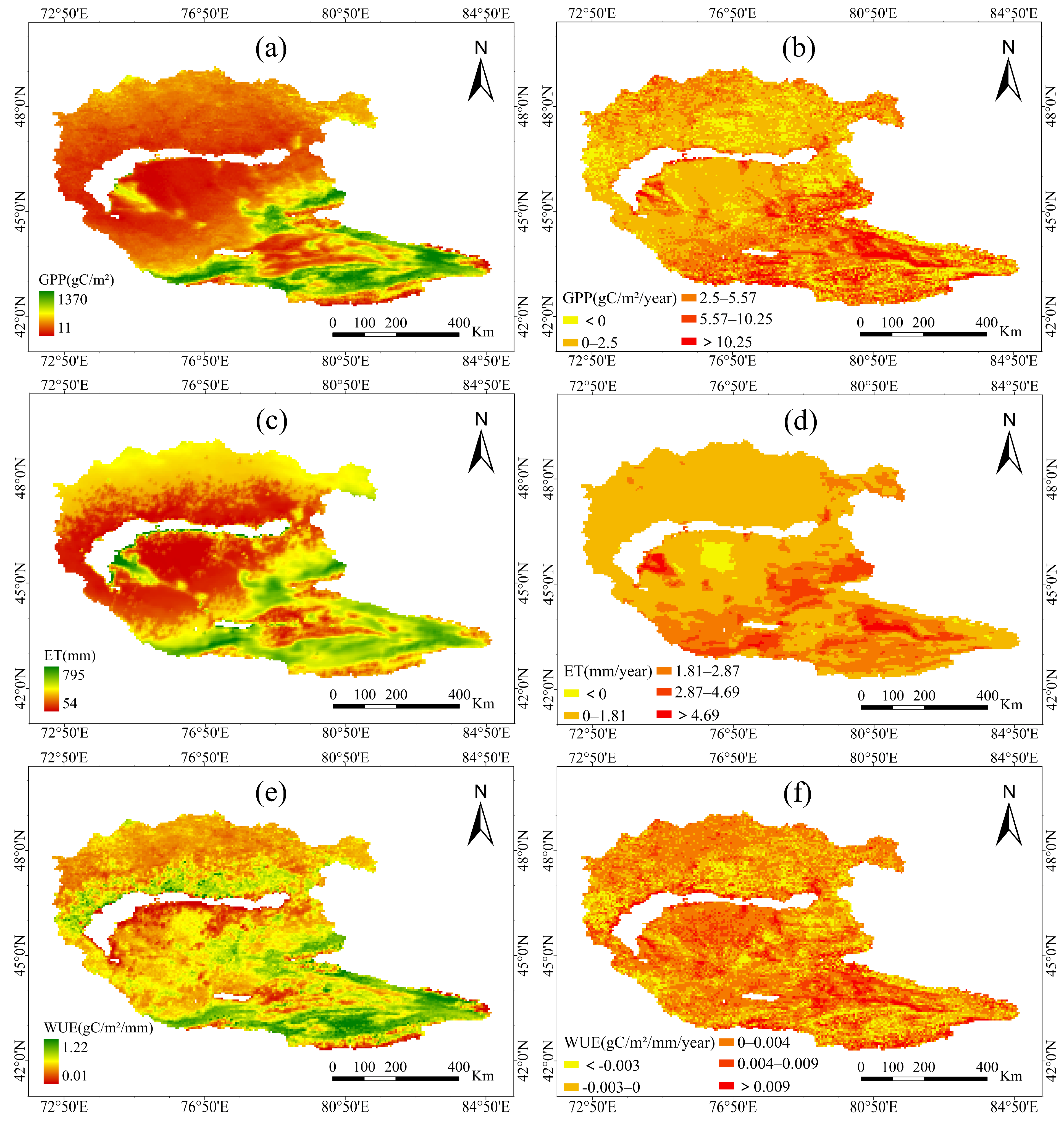
GPP, ET, and WUE in the YBB exhibited significant spatiotemporal heterogeneity (Figure 2a,c,e). The basin-average GPP was 345.2 gC·m−2. High values (>850 gC·m−2) were concentrated in the southeastern Yili River Valley (China) and the Almaty and Tekeli regions (Kazakhstan). These areas receive abundant precipitation (Table 1). Low values (<190 gC·m−2) were found in the Saryesik-Atyrau Desert. ET patterns were similar, with higher values in the east and lower values in the central-western regions.
WUE patterns closely followed those of GPP. Forested areas in the east had WUE values exceeding 2.0 gC·m−2·mm−1, whereas the desert east of Lake Balkhash had values as low as 1.12 gC·m−2·mm−1. Among vegetation types, forests had the highest GPP, ET, and WUE, while shrublands had the lowest. Among climate types, the cold-temperate winter-dry zone had the highest WUE (2.15 gC·m−2·mm−1), while the arid desert zone had the lowest (1.18 gC·m−2·mm−1).
From 1982 to 2018, GPP, ET, and WUE in the YBB showed an overall increasing trend (Figure 2b,d,f). The GPP growth rate was 2.73 gC·m−2·yr−1, the ET growth rate was 1.56 mm·yr−1, and the overall WUE growth rate was 0.0034 gC·m−2·mm−1·yr−1, representing an 8.95% increase over the period. Shrublands, grasslands, and croplands exhibited higher annual WUE growth rates than forests. Notably, forest was the only vegetation type showing a negative WUE trend. Among climatic zones, the cold-temperate winter-dry zone also exhibited a negative WUE trend, while polar tundra showed the highest GPP and WUE growth rates.

3.2. Dominant Control of GPP vs. ET on WUE Response to Drought

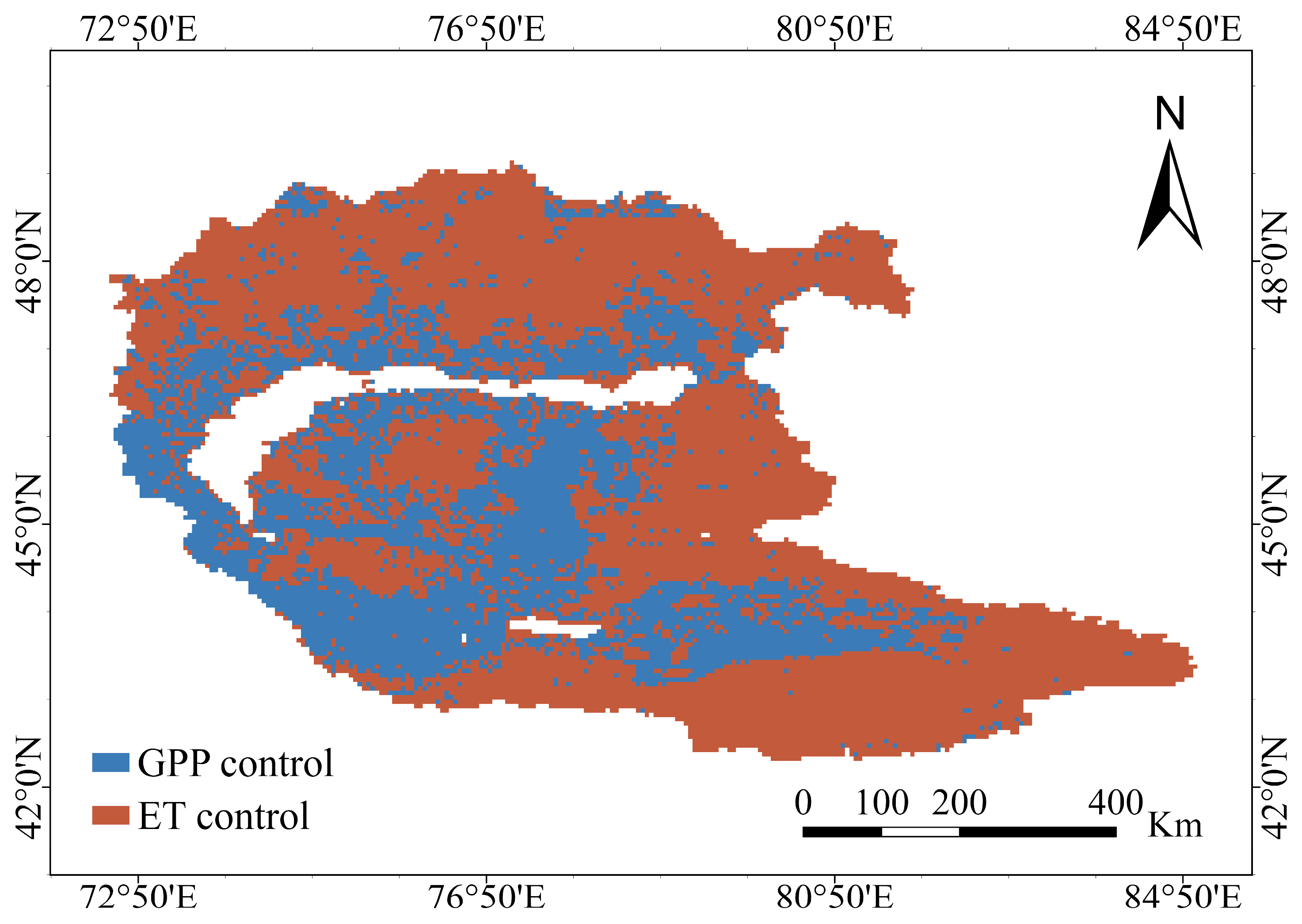
The response of ecosystem WUE to drought depends on the relative sensitivity of GPP and ET to water stress (Figure 3). This mechanism reveals the dynamic trade-off between biological and physical processes governing ecosystem carbon-water balance.
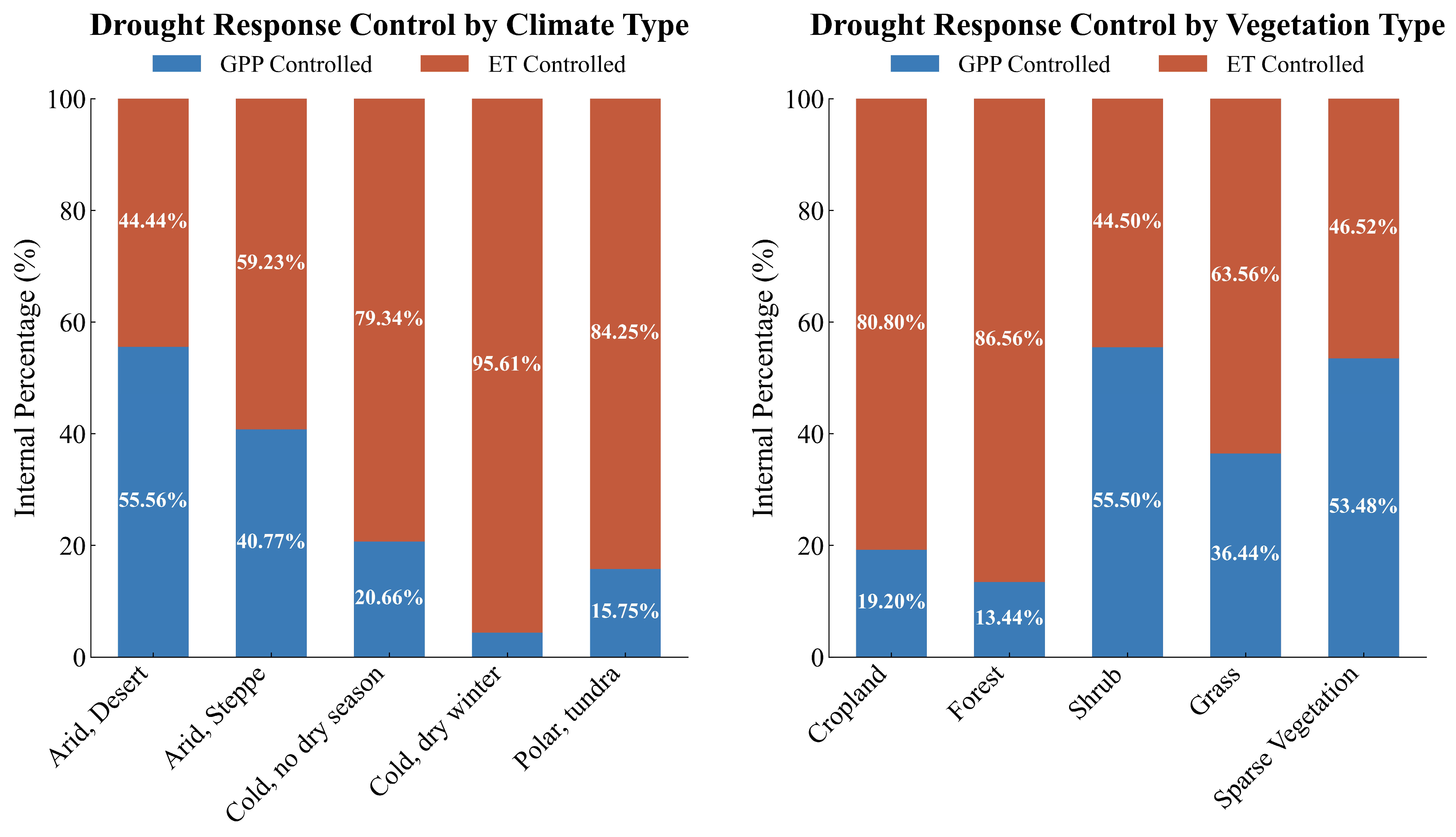
Figure 4 displays the spatial distribution of dominant factors governing WUE variation from 1982 to 2018. In 65.8% of the basin, the WUE response to drought was controlled by ET, while only 34.2% of the basin showed GPP-dominated responses. Further analysis of dominant factors across vegetation types and climatic zones (Figure 4) reveals that WUE variation in cropland and forest ecosystems is primarily ET-dominated, covering 80.80% and 86.56% of their respective areas. In contrast, shrub ecosystems are predominantly GPP-dominated, accounting for 55.5% of this vegetation type. From a climatic zoning perspective, ET dominance is particularly pronounced in arid and cold regions. In the cold-temperate winter-dry and cold-temperate humid zones, ET controlled 79.34% and 95.61% of the area, respectively.
This finding holds significant ecological implications: it suggests that ecosystems dominated by physical transpiration processes, particularly in croplands and forests within our study region, may exhibit heightened vulnerability to drought stress. When water stress intensifies, dramatic changes in ET may exceed the capacity of vegetation physiological regulation (GPP), thereby driving declines in WUE. Prolonged drought conditions can thus significantly impair ecosystem productivity and potentially hinder functional recovery.

3.3. Core Driving Mechanisms: Dynamic Changes Under Dry and Wet Scenarios

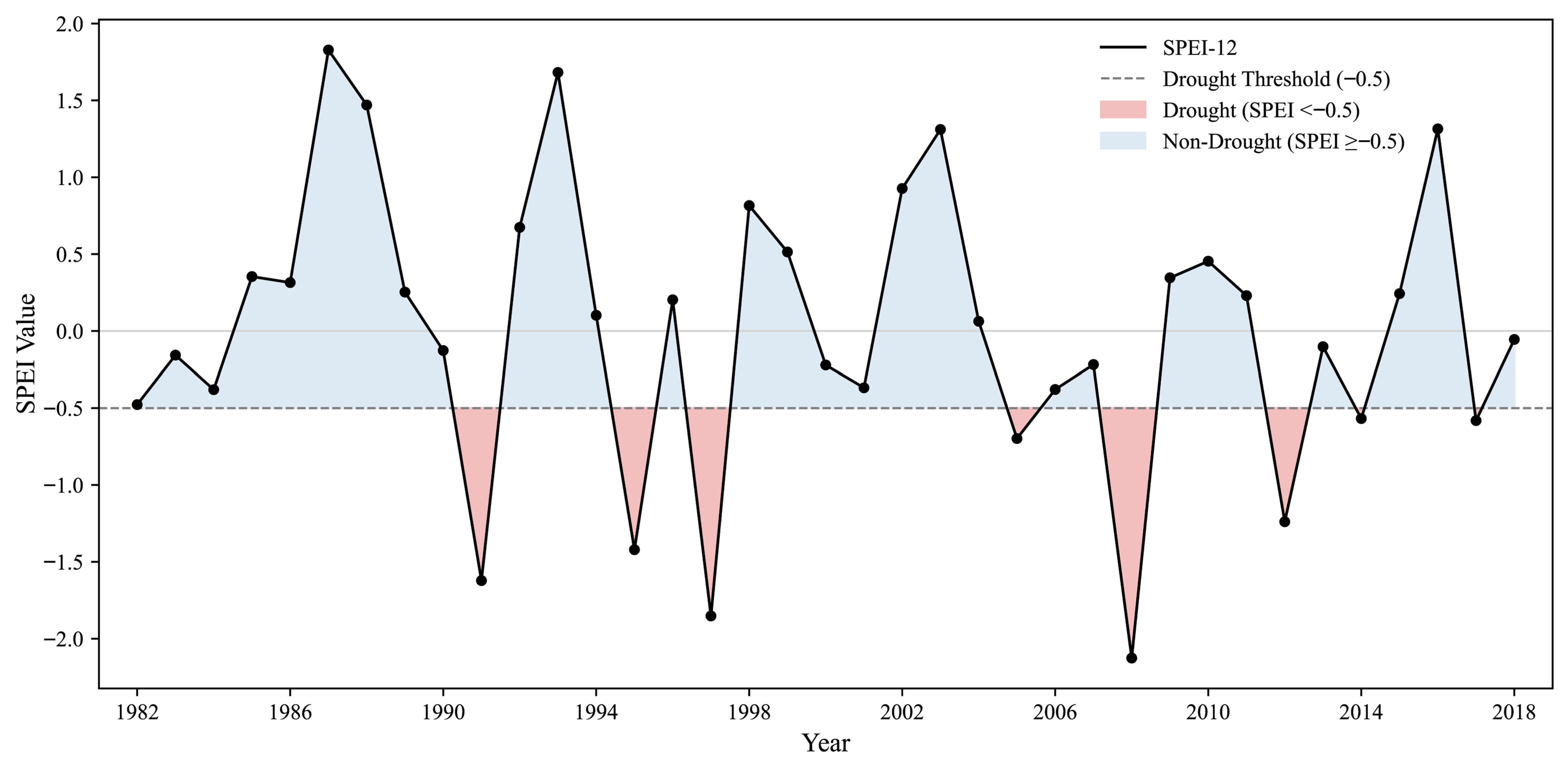
To uncover the core mechanisms governing carbon and water fluxes, we conducted a driver attribution analysis for distinct arid and humid scenarios. The Elastic Net regression models demonstrated robust performance, explaining a significant portion of the variance for both GPP and ET under both scenarios (R2 range: 0.716–0.860), which provides a solid quantitative foundation for our mechanistic interpretations. Statistical analysis indicates that the study area experienced 8 drought years and 29 non-drought years during the 37-year period. The specific drought years were 1991, 1995, 1997, 2005, 2008, 2009, 2012, 2014, and 2017, with the most severe drought occurring in 2008 (Figure A1).
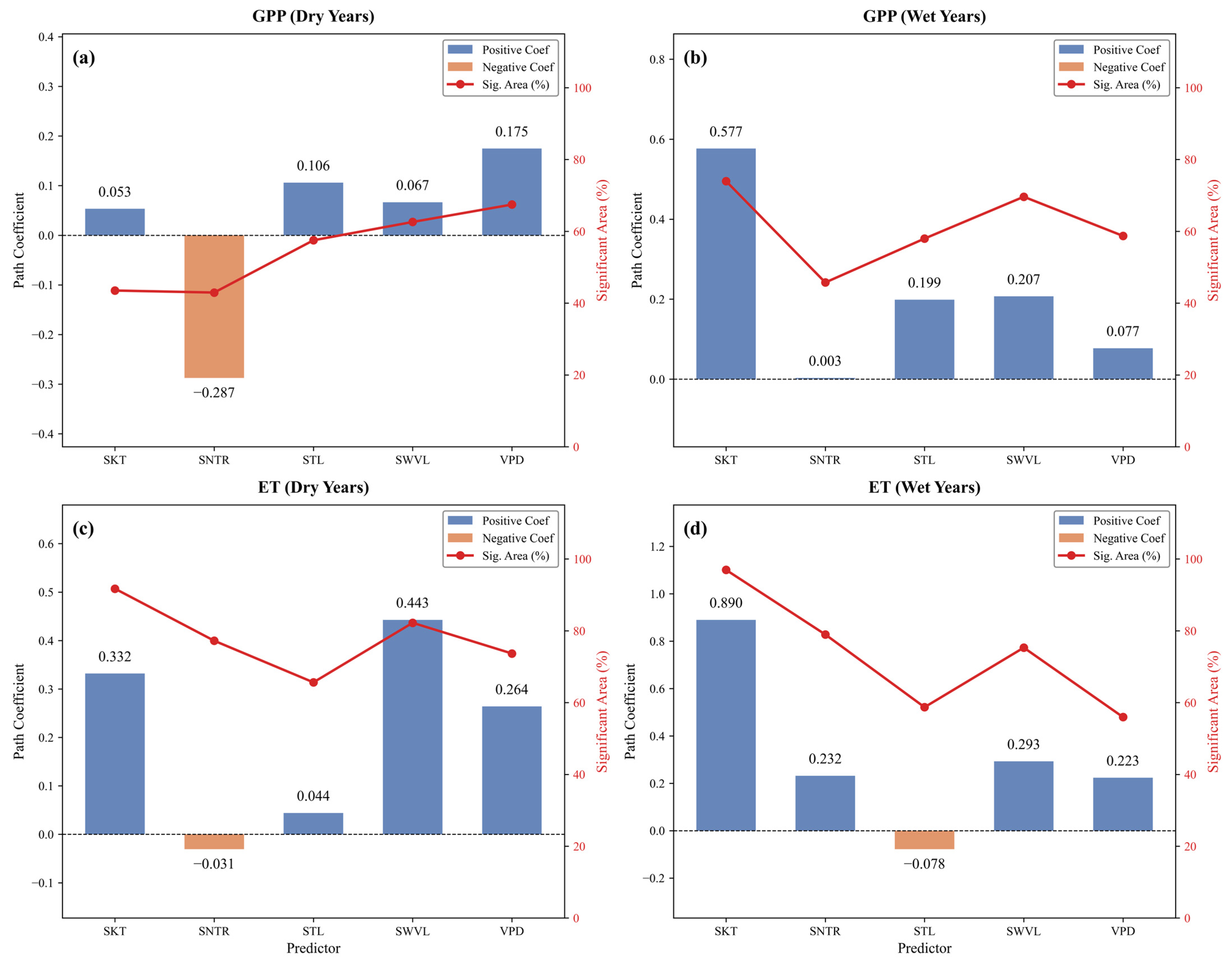
A clear divergence in driving mechanisms emerged during drought years (Figure 5). ET was primarily governed by a combination of soil water availability and thermal conditions. Specifically, SWVL emerged as the most influential driver (coefficient = +0.443), followed closely by SKT (+0.332), with VPD also contributing positively to ET (+0.264). In contrast, the GPP response was fundamentally different. Atmospheric aridity, represented by VPD, exerted the most pronounced positive effect (+0.175). This influence far outweighed weaker influences of SWVL (+0.067) and SKT (+0.053). Notably, SNTR showed a distinct negative effect (−0.287). This decoupling reveals that under drought stress, GPP is most sensitive to atmospheric aridity, while ET is controlled by edaphic and thermal factors.
During wet years, the ecosystem’s regulatory framework shifted substantially towards energy dominance. For GPP, SKT became the preeminent driver (+0.577), and the positive influence of SWVL was also enhanced (+0.207), while the effect of VPD diminished (+0.077). This indicates that under water-sufficient conditions, GPP is co-driven by thermal energy and soil moisture. For ET, the role of SKT became exceptionally prominent, with a coefficient of +0.890 that dwarfed all other variables. SWVL (+0.293) and VPD (+0.223) maintained their positive contributions, but their relative importance decreased significantly. This confirms that in humid environments, ET is overwhelmingly governed by energy availability.
In summary, the driving mechanisms of carbon and water fluxes in the YBB are highly contingent on moisture availability. Under drought years, the drivers for GPP and ET decouple—GPP is controlled by atmospheric aridity, while ET is dictated by soil moisture and thermal conditions. Conversely, when moisture is abundant, the entire system converges to an energy-controlled mode dominated by surface thermal dynamics.

3.4. Spatial Distribution of Ecosystem Resilience

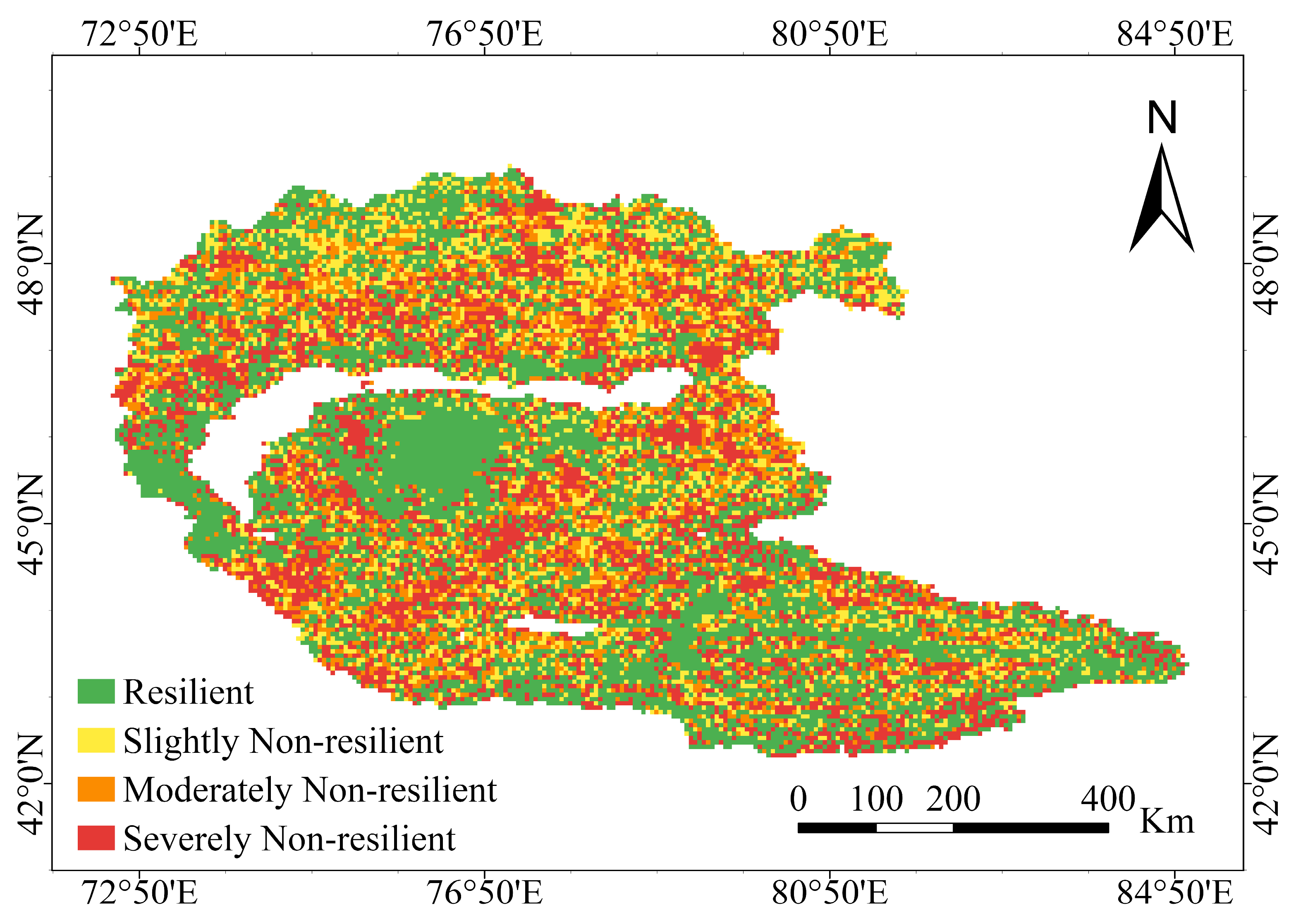
The resilience of the YBB ecosystem to drought exhibited pronounced spatial heterogeneity over the period 1982–2018 (Figure 6). The basin was predominantly non-resilient, with severely non-resilient areas covering 25.07% of the region. These vulnerable zones were concentrated in the hydro-thermally harsh interior of the Saryesik-Atyrau Desert and the arid regions northwest of Lake Balkhash. Moderately (17.08%) and slightly (17.36%) non-resilient areas were scattered in a fragmented pattern across the basin. In contrast, resilient areas, accounting for 40.49% of the basin, were distinctly clustered in regions with greater water availability, such as the oases within the Yili River Valley and the coastal zones of Lake Balkhash, underscoring the critical role of favorable local moisture conditions in sustaining ecosystem stability.
This spatial pattern was closely linked to underlying ecosystem characteristics, with resilience levels varying markedly across vegetation and climate types. Among vegetation types (Table 2), shrublands demonstrated exceptional drought resistance (Rd = 1.270) and were the only ecosystem to register a resilience index above 1.0. All other vegetation types were classified as slightly non-resilient, ordered by decreasing resilience: forest (Rd = 0.988), sparse vegetation (Rd = 0.978), grassland (Rd = 0.965), and cropland (Rd = 0.946). Notably, cropland ecosystems, which are subject to the most intensive human intervention, were the most vulnerable. This pattern was corroborated by the analysis of climate zones (Table 3). Ecosystems adapted to extreme conditions, such as those in the polar tundra (Rd = 1.224) and arid desert (Rd = 1.111) zones, exhibited the highest resilience. Conversely, the more mesic cold-temperate humid zone (Rd = 0.962) proved more vulnerable to drought disturbances, challenging the assumption that greater resource abundance directly translates to higher resilience.

3.5. Attribution of Ecological Resilience Drivers

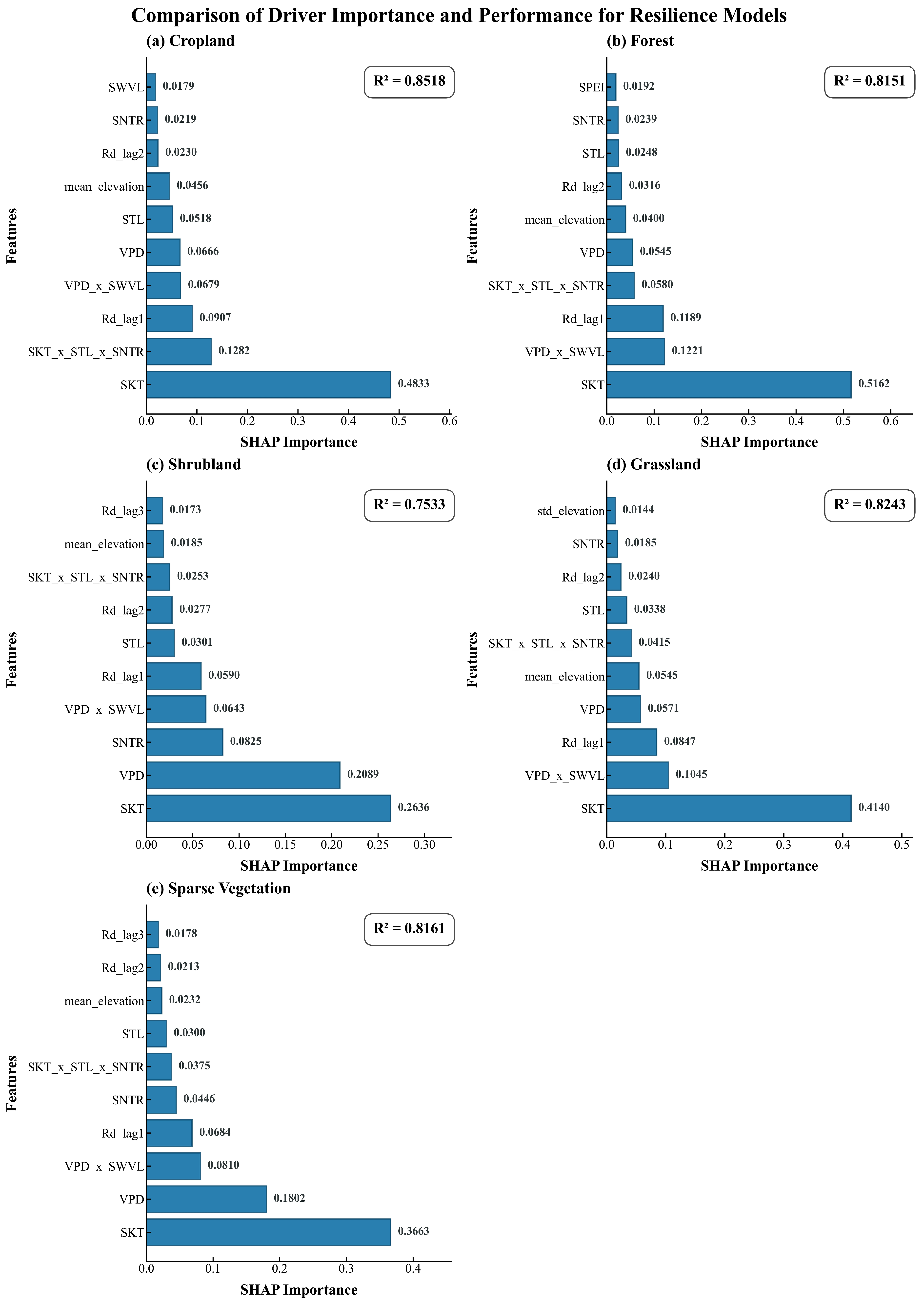
This study conducted attribution analyses of monthly resilience for five major vegetation types. All models demonstrated strong explanatory power (R2 ranging from 0.7533 to 0.8518) on the 2011–2018 test dataset, providing reliable quantitative foundations for subsequent driver analyses. SHAP-based analysis further revealed both universal patterns and type-specific characteristics in resilience drivers (Figure 7).
Two universal core drivers were identified across all vegetation types. Immediate thermal stress plays a dominant role: monthly SKT is the primary environmental variable influencing resilience across all ecosystems. Ecosystems exhibit pronounced short-term memory effects: the previous month’s resilience state (Rd_lag1), representing system lag, consistently ranks among the most significant factors, confirming the path-dependent nature of ecological recovery processes.
Secondary driving mechanisms exhibit marked heterogeneity across vegetation types, reflecting divergent responses to compound environmental stresses. For forest and grassland ecosystems, the compound drought effect (interaction between VPD and SWVL) ranks second only to SKT in importance, indicating these natural ecosystems are highly sensitive to the synergistic effects of atmospheric drought and soil moisture stress. The resilience of cropland ecosystems is more strongly regulated by the combined influence of multiple temperature variables—namely SKT, STL, and SNTR—collectively termed the composite thermal effect. This may relate to the direct response of artificially irrigated farmland ecosystems to thermal conditions. In shrub and sparse vegetation, the independent impact of current VPD, alongside the compound drought effect, constitutes a significant secondary driver. Topographic factors exhibited higher importance only in cropland and grassland models, indicating their crucial indirect role in specific ecosystems by regulating local hydrothermal conditions.
Ecological resilience in the YBB is shaped by high-temperature stress and short-term ecological memory. It is also influenced by ecosystem-specific secondary driving mechanisms, which show distinct response patterns to combined stress across vegetation types. This deepens understanding of regional ecosystem stability and underscores the necessity for tailored ecosystem management strategies.

4. Discussion

4.1. Divergent Carbon-Water Coupling Trends in the YBB

This study reveals a complex set of ecosystem responses in the YBB against the backdrop of global change. Our results show that WUE has increased across most ecosystems, including shrublands, grasslands, and croplands. This positive trend aligns with the widely observed global greening effect and associated WUE enhancement [33,34]. The primary mechanism is generally attributed to elevated atmospheric CO2 concentrations. The CO2 fertilization effect allows vegetation to maintain or enhance photosynthetic rates while partially closing stomata to reduce transpiration, thereby improving intrinsic water use efficiency [35,36]. For the vast arid regions within the basin where water is the primary limiting factor, improved water use from elevated CO2 plays a decisive positive role [37,38].
However, we found that in forest ecosystems—the most productive systems in the basin—and in the relatively mesic cold-temperate winter-dry climate zone, WUE exhibited a negative trend. Specifically, in the mountain forests of the Yili River Valley and Western Tianshan, dominated by Picea schrenkiana, the high-density canopy exerts a rainfall interception rate of up to 44–50%. This physical interception prevents effective soil recharge from minor precipitation events, creating a structural discrepancy between atmospheric precipitation inputs and actual soil water availability [39]. Furthermore, influenced by hydraulic limitations, mature forests adopt more conservative stomatal regulation strategies than younger stands, exhibiting heightened sensitivity to drought and temperature variability. This age-related physiological vulnerability renders the WUE of mature ecosystems more susceptible to decline under climatic stress [40]. Additionally, certain broadleaf species (e.g., Malus sieversii) exhibit a loss of adaptability to environmental stress, evidenced by a weakened correlation between radial growth and climatic factors under extreme warm-dry conditions [41].

4.2. Asymmetric Responses of GPP and ET and Their Ecological Implications

We identified an asymmetric response between the two components of WUE—GPP and ET—to drought. Our analysis revealed that in 65.8% of the basin, especially in forests (86.6%), the WUE response to drought is dominated by ET. In these systems, the sensitivity of transpiration (a largely physical process) to water stress surpasses the regulatory capacity of photosynthesis (a physiological process) [42]. During drought, the ecosystem’s water loss (ET) responds more directly and dramatically to environmental changes, driving the overall decline in WUE. This finding aligns with studies suggesting that accelerated ET growth under warming is becoming a key factor offsetting or even reversing the benefits of GPP growth [43,44].
Our analysis reveals a fundamental decoupling in the drivers of carbon and water fluxes during drought periods, which is key to understanding the observed decline in WUE in forest ecosystems. The most striking finding is the positive response of GPP to increased VPD during drought years. This result is counter-intuitive, as high VPD is typically considered a direct stressor that induces stomatal closure and suppresses photosynthesis [45,46]. However, in the semi-arid environment of the YBB, this positive coefficient likely reflects VPD acting as a proxy for the high-energy conditions that co-occur with drought. Drought periods in this region are often characterized by reduced cloud cover, leading to increased incoming solar radiation (i.e., photosynthetically active radiation, PAR) [47]. For ecosystems that are not yet at their critical soil water limitation threshold, this surplus of light energy can stimulate or maintain high rates of photosynthesis, causing GPP to appear positively correlated with VPD [48].
In stark contrast, the drivers of ET remained tightly coupled to direct physical constraints: soil water availability (SWVL) and surface thermal conditions (SKT). While GPP’s response was linked to an indirect energy proxy (VPD), ET responded directly to the tangible water supply from the soil and the thermal energy available to drive vaporization [49]. This creates a new form of asynchrony. It is not an opposition between suppression and stimulation, but rather a divergence in primary limiting factors and response magnitudes. Although GPP may increase modestly due to favorable light conditions, ET—especially in productive forest ecosystems with high hydraulic conductance—can accelerate much more dramatically in response to available soil moisture and high temperatures [44]. This disproportionate increase in water loss relative to carbon gain (i.e., ET sensitivity > GPP sensitivity) is the core mechanism that leads to a systemic decline in WUE. Therefore, the vulnerability of these forests stems from their inability to balance a modest, energy-driven carbon uptake against a rapid, soil-and-thermally-driven water loss under drought conditions.
The divergence trend in WUE across the YBB provides a regional case study illustrating the nonlinear interactions of global change drivers across different ecosystems. The core finding of this research identifies forests and cold-temperate winter-dry zones as potential ecosystem vulnerabilities. We reveal that elevated VPD, coupled with decoupled carbon and water drivers, constitutes the key mechanism deteriorating WUE in these highly productive ecosystems.

4.3. Spatial Heterogeneity of Ecosystem Resilience and Its Driving Mechanisms

Our assessment of ecosystem resilience in the YBB yielded findings that challenge conventional wisdom. The highest resilience was observed in arid desert and shrubland ecosystems, while temperate humid zones and forest ecosystems with more favorable hydro-thermal conditions exhibited greater vulnerability. This phenomenon indicates that ecosystem resilience to drought is not a simple function of resource abundance but is rather a product of long-term co-evolution between adaptive strategies and disturbance regimes [50,51].
The high resilience of arid ecosystems in this study reflects exceptional resistance rather than rapid recovery. Arid biotic communities, chronically exposed to intense water stress, have evolved effective risk-avoidance strategies [50,52]. In this study, shrublands emerge as resilience champions, vividly illustrating adaptive hardening theory. Research indicates that certain dominant species (such as Tamarix ramosissima and Haloxylon ammodendron) exhibit a phreatophytic nature, with root systems extending 3–4 m underground. This allows their transpiration activity to bypass the limitations of shallow soil moisture deficits. In terms of biological regulation, some species display anisohydric traits, maintaining high stomatal conductance and maximum transpiration rates even under drought stress. Furthermore, specific shrubs have evolved distinct morphological adaptations and strong plasticity in water source utilization. This dual buffering mechanism—comprising both structural and physiological aspects—enables vegetation growth to remain stable during periods of precipitation scarcity [53,54,55]. Forests and grasslands in humid regions are better adapted to water-rich environments, prioritizing resource acquisition and productivity maximization [56]. When encountering extreme drought, this stabilization strategy leaves them lacking physiological and ecological tools to cope with new stresses, resulting in a sharp decline in system function and heightened vulnerability [57,58]. As a system heavily influenced by human intervention, cropland exhibits the lowest resilience, exposing the excessive dependence of artificial ecosystems on external support and their lack of natural regulatory capacity [59,60].
SHAP attribution analysis reveals, from temporal and stress dimensions, that immediate thermal stress and short-term ecological memory are the core factors dominating resilience dynamics. SKT emerged as the primary driver, amplifying the effects of heat stress during drought [61]. High temperatures disrupt plant photosynthetic and respiratory enzyme activities. By driving elevated VPD, they dramatically enhance atmospheric water extraction from vegetation, pushing water stress toward physiological limits [62]. Following stress exposure, ecosystems maintain their internal resources, species composition, and physiological states for short periods, establishing initial conditions and recovery trajectories for subsequent shocks [63]. Ecosystem resilience is not a one-time stress response but a continuous, historically constrained dynamic process.
In terms of compound effects, different ecosystems exhibit significant heterogeneity. Natural ecosystems like forests and grasslands were extremely sensitive to compound drought (VPD × SWVL), corroborating recent concerns over compound extreme events [64,65]. When atmospheric and soil droughts occur simultaneously, their destructive impact on ecosystems far exceeds the linear sum of individual stresses, rapidly pushing vegetation toward critical thresholds of hydraulic failure and carbon imbalance [66]. In contrast, cropland ecosystems exhibit heightened sensitivity to combined thermal effects, clearly illustrating how human activities reshape ecosystem risk patterns. While irrigation substantially alleviates soil moisture constraints, it elevates thermal conditions to the primary bottleneck limiting crop growth and recovery [67,68].
This study investigated the spatial patterns and adaptive mechanisms of ecosystem resilience in the YBB, using attribution analysis to elucidate its dynamic processes. We demonstrate that resilience is collectively driven by immediate high-temperature stress, short-term ecological memory, and ecosystem-specific responses to compound stress. Against the backdrop of global change, assessing and managing ecosystem resilience must shift from traditional mean-state-based thinking to a new paradigm grounded in extreme events, dynamic processes, and system specificity.

4.4. Limitations and Future Outlook

This study integrated multi-source remote sensing and machine learning to analyze the spatiotemporal dynamics of WUE and drought resilience in the YBB. However, the conclusions should be interpreted with certain limitations in mind. Remote sensing and reanalysis data (e.g., GLASS GPP/ET, ERA5) have inherent uncertainties, especially in complex topography, which could affect the absolute accuracy of our assessments. While we focused on stable vegetation to isolate climate impacts, we did not explicitly account for the effects of intense human activities, such as agricultural expansion, on carbon and water cycles. Finally, although our statistical methods identified key drivers, they cannot fully reveal underlying physiological mechanisms like hydraulic failure. Future work should prioritize validating remote sensing data with integrated observation networks (e.g., eddy covariance towers, sensor networks) and incorporating land-use change analysis with dynamic vegetation models to better disentangle the effects of climate and human activities.

5. Conclusions

From 1982 to 2018, the GPP, ET, and WUE of the Yili-Balkhash Basin showed an overall increasing trend. However, this macro-level trend masked functional degradation in key ecosystems. The basin’s most productive forest ecosystem was the only vegetation type to exhibit a negative WUE trend, a pattern also observed in the cold-temperate winter-dry climate zone. In contrast, shrublands, grasslands, and croplands all demonstrated positive annual WUE growth.
The response of WUE to drought was dominated by ET processes rather than GPP across 65.8% of the basin. This ET dominance was particularly pronounced in forests with declining WUE (86.6%) and in croplands with increasing WUE (80.8%), whereas GPP was the dominant factor in shrub ecosystems (55.5%). The underlying driving mechanisms shifted fundamentally with moisture conditions. During drought years, the drivers of the carbon (GPP) and water (ET) cycles became decoupled. GPP responded positively to VPD, likely because high VPD co-occurred with high solar radiation that stimulated photosynthesis. In contrast, ET was more strongly and directly controlled by SWVL and SKT. In wet years, the system uniformly shifted to an energy-dominant mode, with SKT becoming the primary driver for both GPP and ET.
Ecosystem resilience showed a counter-intuitive pattern. Arid desert regions and shrublands, adapted to extreme environments, exhibited the highest resilience. Conversely, forests and humid zones with more favorable conditions demonstrated greater vulnerability. Cropland ecosystems showed the lowest resilience. Machine learning attribution indicated that resilience is determined not by cumulative historical drought but by two universal drivers: immediate thermal stress (current month’s SKT) and short-term ecological memory (previous month’s state). Furthermore, ecosystems showed distinct responses to compound stress: forests and grasslands were highly sensitive to compound drought (VPD and SWVL synergy), while croplands responded more strongly to composite thermal stress.

Author Contributions

Conceptualization, D.C.; methodology, L.L.; software, J.Y.; validation, L.L., Y.W. and J.L.; formal analysis, Z.L.; investigation, Y.W. and M.W.; resources, M.W.; data curation, J.Y.; writing—original draft preparation, Z.L.; writing—review and editing, D.C.; visualization, Z.L.; supervision, D.C.; project administration, D.C.; funding acquisition, Z.J. All authors have read and agreed to the published version of the manuscript.

Funding

This research was funded by the Open Project of the Institute of Resources and Ecology, Yili Normal University, grant number 2024XJPTZD016; the Natural Science Key Project of Yili Normal University to Enhance Comprehensive Discipline Strength, grant number 22XKZZ01; and the Postgraduate Research and Innovation Project of Xinjiang Uygur Autonomous Region, grant number XJ2025G250.

Data Availability Statement

GLASS GPP and ET data are available at the National Earth System Science Data Center of China (http://www.geodata.cn/). PEIbase v2.10 data are available at the CSIC SPEI Database (https://spei.csic.es/). ERA5 reanalysis data are available at the ECMWF Copernicus Climate Data Store (https://cds.climate.copernicus.eu/). GLC_FCS30D land cover data are available at the Casearth Data Center (http://data.casearth.cn/). Köppen-Geiger climate classification data are available at GloH2O (https://www.gloh2o.org/koppen/). Analysis code is available from the corresponding author upon reasonable request.

Acknowledgments

The authors would like to express their sincere gratitude to Dong Cui for his invaluable guidance and supervision throughout this research. We are also grateful to our lab members for their helpful discussions. We thank the anonymous reviewers for their insightful comments that helped improve this manuscript.

Conflicts of Interest

The authors declare no conflicts of interest. The funders had no role in the design of the study; in the collection, analyses, or interpretation of data; in the writing of the manuscript; or in the decision to publish the results.

Appendix A

Figure A1. Characteristics of SPEI-12 and identification of drought years in the study area from 1982 to 2018.
Water 17 03535 g0a1

References

  1. Cai, W.; Ullah, S.; Yan, L.; Lin, Y. Remote sensing of ecosystem water use efficiency: A review of direct and indirect estimation methods. Remote. Sens. 2021, 13, 2393. [Google Scholar] [CrossRef]
  2. Wu, C.; Wang, T. Evaluating cumulative drought effect on global vegetation photosynthesis using numerous GPP products. Front. Environ. Sci. 2022, 10, 908875. [Google Scholar] [CrossRef]
  3. Wen, R.; Qin, M.; Jiang, P.; Yang, F.; Liu, B.; Zhu, M.; Fang, Y.; Tian, Y.; Shang, B. Vegetation and evapotranspiration responses to increased atmospheric vapor pressure deficit across the global forest. Atmosphere 2024, 15, 408. [Google Scholar] [CrossRef]
  4. Yang, Y.; Guan, H.; Batelaan, O.; McVicar, T.R.; Long, D.; Piao, S.; Liang, W.; Liu, B.; Jin, Z.; Simmons, C.T. Contrasting responses of water use efficiency to drought across global terrestrial ecosystems. Sci. Rep. 2016, 6, 23284. [Google Scholar] [CrossRef] [PubMed]
  5. Yu, Z.; Wang, J.; Liu, S.; Rentch, J.S.; Sun, P.; Lu, C. Global gross primary productivity and water use efficiency changes under drought stress. Environ. Res. Lett. 2017, 12, 014016. [Google Scholar] [CrossRef]
  6. Salazar-Martínez, D.; Holwerda, F.; Holmes, T.R.; Yépez, E.A.; Hain, C.R.; Alvarado-Barrientos, S.; Ángeles-Pérez, G.; Arredondo-Moreno, T.; Delgado-Balbuena, J.; Figueroa-Espinoza, B.; et al. Evaluation of remote sensing-based evapotranspiration products at low-latitude eddy covariance sites. J. Hydrol. 2022, 610, 127786. [Google Scholar] [CrossRef]
  7. Shveytser, V.; Stoy, P.C.; Butterworth, B.; Wiesner, S.; Skaggs, T.H.; Murphy, B.; Wutzler, T.; El-Madany, T.S.; Desai, A.R. Evaporation and transpiration from multiple proximal forests and wetlands. Water Resour. Res. 2024, 60, e2022WR033757. [Google Scholar] [CrossRef]
  8. Perez-Quezada, J.F.; Trejo, D.; Lopatin, J.; Aguilera, D.; Osborne, B.; Galleguillos, M.; Zattera, L.; Celis-Diez, J.L.; Armesto, J.J. Drivers of ecosystem water use efficiency in a temperate rainforest and a peatland in southern South America. EGUsphere 2023, 2023, 1–26. [Google Scholar] [CrossRef]
  9. Scott, R.L.; Huxman, T.E.; Cable, W.L.; Emmerich, W.E. Partitioning of evapotranspiration and its relation to carbon dioxide exchange in a Chihuahuan Desert shrubland. Hydrol. Process. 2006, 20, 3227–3243. [Google Scholar] [CrossRef]
  10. Wang, Z.; Li, G.; Sun, H.; Ma, L.; Guo, Y.; Zhao, Z.; Gao, H.; Mei, L. Effects of drought stress on photosynthesis and photosynthetic electron transport chain in young apple tree leaves. Biol. Open 2018, 7, bio035279. [Google Scholar] [CrossRef]
  11. Wang, H.; Yan, S.; Ciais, P.; Wigneron, J.; Liu, L.; Li, Y.; Fu, Z.; Ma, H.; Liang, Z.; Wei, F.; et al. Exploring complex water stress–gross primary production relationships: Impact of climatic drivers, main effects, and interactive effects. Glob. Change Biol. 2022, 28, 4110–4123. [Google Scholar] [CrossRef]
  12. Fu, Z.; Ciais, P.; Prentice, I.C.; Gentine, P.; Makowski, D.; Bastos, A.; Luo, X.; Green, J.K.; Stoy, P.C.; Yang, H.; et al. Atmospheric dryness reduces photosynthesis along a large range of soil water deficits. Nat. Commun. 2022, 13, 989. [Google Scholar] [CrossRef] [PubMed]
  13. Xu, Q.; Yu, R.; Guo, L. Evaluation of forest ecosystem resilience to drought considering lagged effects of drought. Ecol. Evol. 2024, 14, e70281. [Google Scholar] [CrossRef] [PubMed]
  14. Müller, L.M.; Bahn, M. Drought legacies and ecosystem responses to subsequent drought. Glob. Change Biol. 2022, 28, 5086–5103. [Google Scholar] [CrossRef]
  15. Britton, A.; Graham, G.; Woloszyn, M. Exploring relationships between drought indices and ecological drought impacts using machine learning and explainable AI. J. Appl. Serv. Clim. 2024, 2024, 1–12. [Google Scholar] [CrossRef]
  16. Xue, C.; Zhang, Q.; Jia, Y.; Tang, H.; Zhang, H. Attribution of hydrological droughts in large river-connected lakes: Insights from an explainable machine learning model. Sci. Total Environ. 2024, 952, 175999. [Google Scholar] [CrossRef]
  17. Zhao, Y.; Zhang, J.; Bai, Y.; Zhang, S.; Yang, S.; Henchiri, M.; Seka, A.M.; Nanzad, L. Drought monitoring and performance evaluation based on machine learning fusion of multi-source remote sensing drought factors. Remote. Sens. 2022, 14, 6398. [Google Scholar] [CrossRef]
  18. Deng, H.; Chen, Y. Influences of recent climate change and human activities on water storage variations in Central Asia. J. Hydrol. 2017, 544, 46–57. [Google Scholar] [CrossRef]
  19. Deng, H.; Chen, Y.; Wang, H.; Zhang, S. Climate change with elevation and its potential impact on water resources in the Tianshan Mountains, Central Asia. Glob. Planet. Change 2015, 135, 28–37. [Google Scholar] [CrossRef]
  20. Zhang, F.; Zeng, B.; Cao, Y.; Li, F.; Tang, Z.; Qi, J. Human activities have markedly altered the pattern and trend of net primary production in the Ili River basin of Northwest China under current climate change. Land Degrad. Dev. 2022, 33, 2585–2595. [Google Scholar] [CrossRef]
  21. Yegizbayeva, A.; Koshim, A.G.; Bekmuhamedov, N.; Aliaskarov, D.T.; Alimzhanova, N.; Aitekeyeva, N. Satellite-based drought assessment in the endorheic basin of Lake Balkhash. Front. Environ. Sci. 2024, 11, 1291993. [Google Scholar] [CrossRef]
  22. de Boer, T.; Paltan, H.; Sternberg, T.; Wheeler, K. Evaluating vulnerability of Central Asian water resources under uncertain climate and development conditions: The case of the Ili-Balkhash Basin. Water 2021, 13, 615. [Google Scholar] [CrossRef]
  23. Thevs, N.; Rozi, A.; Kubal, C.; Abdusalih, N. Water consumption of agriculture and natural ecosystems along the Tarim River, China. Geo-Oeko 2013, 34, 50–76. [Google Scholar]
  24. Karina, Z. Kazakhstan’s National Priorities and Political and Institutional Response to the Water-Energy-Climate-Food Nexus: The Effects on the Ili-Balkhash Basin; CEU, Budapest College: Budapest, Hungary, 2011. [Google Scholar]
  25. Yuan, W.; Liu, S.; Yu, G.; Bonnefond, J.-M.; Chen, J.; Davis, K.; Desai, A.R.; Goldstein, A.H.; Gianelle, D.; Rossi, F.; et al. Global estimates of evapotranspiration and gross primary production based on MODIS and global meteorology data. Remote Sens. Environ. 2010, 114, 1416–1431. [Google Scholar] [CrossRef]
  26. Yao, Y.; Liang, S.; Li, X.; Hong, Y.; Fisher, J.B.; Zhang, N.; Chen, J.; Cheng, J.; Zhao, S.; Zhang, X.; et al. Bayesian multimodel estimation of global terrestrial latent heat flux from eddy covariance, meteorological, and satellite observations. J. Geophys. Res. Atmos. 2014, 119, 4521–4545. [Google Scholar] [CrossRef]
  27. Beguería, S.; Serrano, S.M.V.; Reig-Gracia, F.; Garcés, B.L. SPEIbase v.2.10 [Dataset]: A Comprehensive Tool for Global Drought Analysis. Digital. CSIC 2024. [Google Scholar] [CrossRef]
  28. Hersbach, H.; Bell, B.; Berrisford, P.; Hirahara, S.; Horányi, A.; Muñoz-Sabater, J.; Nicolas, J.; Peubey, C.; Radu, R.; Schepers, D.; et al. The ERA5 global reanalysis. Q. J. R. Meteorol. Soc. 2020, 146, 1999–2049. [Google Scholar] [CrossRef]
  29. Allen, R.G.; Pereira, L.S.; Raes, D.; Smith, M. Crop Evapotranspiration-Guidelines for Computing Crop Water Requirements; FAO Irrigation and Drainage Paper 56; FAO: Rome, Italy, 1998. [Google Scholar]
  30. Zhang, X.; Zhao, T.; Xu, H.; Liu, W.; Wang, J.; Chen, X.; Liu, L. GLC_FCS30D: The first global 30 m land-cover dynamics monitoring product with a fine classification system for the period from 1985 to 2022 generated using dense-time-series Landsat imagery and the continuous change-detection method. Earth Syst. Sci. Data 2024, 16, 1353–1381. [Google Scholar] [CrossRef]
  31. Kottek, M.; Grieser, J.; Beck, C.; Rudolf, B.; Rubel, F. World Map of the Köppen-Geiger Climate Classification Updated. Meteorol. Z. 2006, 15, 259–263. [Google Scholar] [CrossRef] [PubMed]
  32. Yang, M.; Zou, J.; Ding, J.; Zou, W.; Yahefujiang, H.J.F. Stronger cumulative than lagged effects of drought on vegetation in Central Asia. Forests 2023, 14, 2142. [Google Scholar] [CrossRef]
  33. Zhu, Z.; Piao, S.; Myneni, R.B.; Huang, M.; Zeng, Z.; Canadell, J.G.; Ciais, P.; Sitch, S.; Friedlingstein, P.; Arneth, A.; et al. Greening of the Earth and its drivers. Nat. Clim. Change 2016, 6, 791–795. [Google Scholar] [CrossRef]
  34. Piao, S.; Wang, X.; Park, T.; Chen, C.; Lian, X.; He, Y.; Bjerke, J.W.; Chen, A.; Ciais, P.; Tømmervik, H.; et al. Characteristics, drivers and feedbacks of global greening. Nat. Rev. Earth Environ. 2020, 1, 14–27. [Google Scholar] [CrossRef]
  35. Ainsworth, E.A.; Rogers, A. The response of photosynthesis and stomatal conductance to rising [CO2]: Mechanisms and environmental interactions. Plant Cell Environ. 2007, 30, 258–270. [Google Scholar] [CrossRef]
  36. Keenan, T.F.; Hollinger, D.Y.; Bohrer, G.; Dragoni, D.; Munger, J.W.; Schmid, H.P.; Richardson, A.D. Increase in forest water-use efficiency as atmospheric carbon dioxide concentrations rise. Nature 2013, 499, 324–327. [Google Scholar] [CrossRef]
  37. Donohue, R.J.; Roderick, M.L.; McVicar, T.R.; Farquhar, G.D. Impact of CO2 fertilization on maximum foliage cover across the globe’s warm, arid environments. Geophys. Res. Lett. 2013, 40, 3031–3035. [Google Scholar] [CrossRef]
  38. Huang, M.; Piao, S.; Sun, Y.; Ciais, P.; Cheng, L.; Mao, J.; Poulter, B.; Shi, X.; Zeng, Z.; Wang, Y. Change in terrestrial ecosystem water-use efficiency over the last three decades. Glob. Change Biol. 2015, 21, 2366–2378. [Google Scholar] [CrossRef] [PubMed]
  39. Zhao, S.; Zheng, X.-J.; Yin, L.; Wang, Y. Forest stand factors determine the rainfall pattern of crown allocation of Picea schrenkiana in the northern slope of Mount Bogda, Tianshan Range, China. Front. Plant Sci. 2023, 13, 1113354. [Google Scholar] [CrossRef]
  40. Jiao, L.; Jiang, Y.; Wang, M.; Zhang, W.; Zhang, Y. Age-effect radial growth responses of Picea schrenkiana to climate change in the eastern Tianshan Mountains, Northwest China. Forests 2017, 8, 294. [Google Scholar] [CrossRef]
  41. Shan, Q.; Ling, H.; Zhao, H.; Li, M.; Wang, Z.; Zhang, G. Do extreme climate events cause the degradation of Malus sieversii forests in China? Front. Plant Sci. 2021, 12, 608211. [Google Scholar] [CrossRef]
  42. Medlyn, B.E.; Duursma, R.A.; Eamus, D.; Ellsworth, D.S.; Prentice, I.C.; Barton, C.V.M.; Crous, K.Y.; DE Angelis, P.; Freeman, M.; Wingate, L. Reconciling the optimal and empirical approaches to modelling stomatal conductance. Glob. Change Biol. 2011, 17, 2134–2144. [Google Scholar] [CrossRef]
  43. Jung, M.; Reichstein, M.; Ciais, P.; Seneviratne, S.I.; Sheffield, J.; Goulden, M.L.; Bonan, G.; Cescatti, A.; Chen, J.; De Jeu, R.; et al. Recent decline in the global land evapotranspiration trend due to limited moisture supply. Nature 2010, 467, 951–954. [Google Scholar] [CrossRef]
  44. Schlesinger, W.H.; Jasechko, S. Transpiration in the global water cycle. Agric. For. Meteorol. 2014, 189, 115–117. [Google Scholar] [CrossRef]
  45. Yuan, W.; Zheng, Y.; Piao, S.; Ciais, P.; Lombardozzi, D.; Wang, Y.; Ryu, Y.; Chen, G.; Dong, W.; Hu, Z.; et al. Increased atmospheric vapor pressure deficit reduces global vegetation growth. Sci. Adv. 2019, 5, eaax1396. [Google Scholar] [CrossRef]
  46. Senf, C.; Seidl, R. Persistent impacts of the 2018 drought on forest disturbance regimes in Europe. Biogeosciences 2021, 18, 5223–5230. [Google Scholar] [CrossRef]
  47. Nemani, R.R.; Keeling, C.D.; Hashimoto, H.; Jolly, W.M.; Piper, S.C.; Tucker, C.J.; Myneni, R.B.; Running, S.W. Climate-driven increases in global terrestrial net primary production from 1982 to 1999. Science 2003, 300, 1560–1563. [Google Scholar] [CrossRef] [PubMed]
  48. Beer, C.; Ciais, P.; Reichstein, M.; Baldocchi, D.; Law, B.E.; Papale, D.; Soussana, J.; Ammann, C.; Buchmann, N.; Frank, D.; et al. Temporal and among-site variability of inherent water use efficiency at the ecosystem level. Glob. Biogeochem. Cycles 2009, 23, GB2018. [Google Scholar] [CrossRef]
  49. Liu, L.; Gudmundsson, L.; Hauser, M.; Qin, D.; Li, S.; Seneviratne, S.I. Soil moisture dominates dryness stress on ecosystem production globally. Nat. Commun. 2020, 11, 4892. [Google Scholar] [CrossRef]
  50. Holling, C.S. Resilience and Stability of Ecological Systems. Annu. Rev. Ecol. Syst. 1973, 4, 1–23. [Google Scholar] [CrossRef]
  51. Scheffer, M.; Carpenter, S.; Foley, J.A.; Folke, C.; Walker, B. Catastrophic shifts in ecosystems. Nature 2001, 413, 591–596. [Google Scholar] [CrossRef] [PubMed]
  52. Gazol, A.; Camarero, J.J.; Vicente-Serrano, S.M.; Sánchez-Salguero, R.; Gutiérrez, E.; de Luis, M.; Sangüesa-Barreda, G.; Novak, K.; Rozas, V.; Tíscar, P.A.; et al. Forest resilience to drought varies across biomes. Glob. Change Biol. 2018, 24, 2143–2158. [Google Scholar] [CrossRef]
  53. Xu, Y.; Zhao, H.; Zhou, B.; Dong, Z.; Li, G.; Li, S. Variations in water use strategies of Tamarix ramosissima at coppice dunes along a precipitation gradient in desert regions of northwest China. Front. Plant Sci. 2024, 15, 1408943. [Google Scholar] [CrossRef]
  54. Dai, Y.; Zheng, X.J.; Tang, L.S.; Li, Y. Dynamics of water usage in Haloxylon ammodendron in the southern edge of the Gurbantünggüt Desert. Chin. J. Plant Ecol. 2014, 38, 1214–1225. [Google Scholar]
  55. Xu, G.; Li, Y.; Xu, H. Seasonal variation in plant hydraulic traits of two co-occurring desert shrubs, Tamarix ramosissima and Haloxylon ammodendron, with different rooting patterns. Ecol. Res. 2011, 26, 1071–1080. [Google Scholar] [CrossRef]
  56. Reich, P.B. The world-wide ‘fast–slow’plant economics spectrum: A traits manifesto. J. Ecol. 2014, 102, 275–301. [Google Scholar] [CrossRef]
  57. Allen, C.D.; Macalady, A.K.; Chenchouni, H.; Bachelet, D.; McDowell, N.; Vennetier, M.; Kitzberger, T.; Rigling, A.; Breshears, D.D.; Hogg, E.H.; et al. A global overview of drought and heat-induced tree mortality reveals emerging climate change risks for forests. For. Ecol. Manag. 2010, 259, 660–684. [Google Scholar] [CrossRef]
  58. Choat, B.; Brodribb, T.J.; Brodersen, C.R.; Duursma, R.A.; López, R.; Medlyn, B.E. Triggers of tree mortality under drought. Nature 2018, 558, 531–539. [Google Scholar] [CrossRef]
  59. Tilman, D.; Cassman, K.G.; Matson, P.A.; Naylor, R.; Polasky, S. Agricultural sustainability and intensive production practices. Nature 2002, 418, 671–677. [Google Scholar] [CrossRef] [PubMed]
  60. Isbell, F.; Craven, D.; Connolly, J.; Loreau, M.; Schmid, B.; Beierkuhnlein, C.; Bezemer, T.M.; Bonin, C.; Bruelheide, H.; De Luca, E.; et al. Biodiversity increases the resistance of ecosystem productivity to climate extremes. Nature 2015, 526, 574–577. [Google Scholar] [CrossRef]
  61. Zscheischler, J.; Westra, S.; Van Den Hurk, B.J.J.M.; Seneviratne, S.I.; Ward, P.J.; Pitman, A.; AghaKouchak, A.; Bresch, D.N.; Leonard, M.; Wahl, T.; et al. Future climate risk from compound events. Nat. Clim. Change 2018, 8, 469–477. [Google Scholar] [CrossRef]
  62. Park Williams, A.; Allen, C.D.; Macalady, A.K.; Griffin, D.; Woodhouse, C.A.; Meko, D.M.; Swetnam, T.W.; Rauscher, S.A.; Seager, R.; Grissino-Mayer, H.D.; et al. Temperature as a potent driver of regional forest drought stress and tree mortality. Nat. Clim. Change 2013, 3, 292–297. [Google Scholar] [CrossRef]
  63. Anderegg, W.R.L.; Berry, J.A.; Smith, D.D.; Sperry, J.S.; Anderegg, L.D.L.; Field, C.B. The roles of hydraulic and carbon stress in a widespread climate-induced forest die-off. Proc. Natl. Acad. Sci. USA 2012, 109, 233–237. [Google Scholar] [CrossRef]
  64. Leonard, M.; Westra, S.; Phatak, A.; Lambert, M.; van den Hurk, B.; McInnes, K.; Risbey, J.; Schuster, S.; Jakob, D.; Stafford-Smith, M. A compound event framework for understanding extreme impacts. WIREs Clim. Change 2014, 5, 113–128. [Google Scholar] [CrossRef]
  65. Zscheischler, J.; Seneviratne, S.I. Dependence of drivers affects risks associated with compound events. Sci. Adv. 2017, 3, e1700263. [Google Scholar] [CrossRef] [PubMed]
  66. McDowell, N.; Pockman, W.T.; Allen, C.D.; Breshears, D.D.; Cobb, N.; Kolb, T.; Plaut, J.; Sperry, J.; West, A.; Williams, D.G.; et al. Mechanisms of plant survival and mortality during drought: Why do some plants survive while others succumb to drought? New Phytol. 2008, 178, 719–739. [Google Scholar] [CrossRef] [PubMed]
  67. Döll, P. Impact of climate change and variability on irrigation requirements: A global perspective. Clim. Change 2002, 54, 269–293. [Google Scholar] [CrossRef]
  68. Lobell, D.B.; Roberts, M.J.; Schlenker, W.; Braun, N.; Little, B.B.; Rejesus, R.M.; Hammer, G.L. Greater sensitivity to drought accompanies maize yield increase in the US Midwest. Science 2014, 344, 516–519. [Google Scholar] [CrossRef]
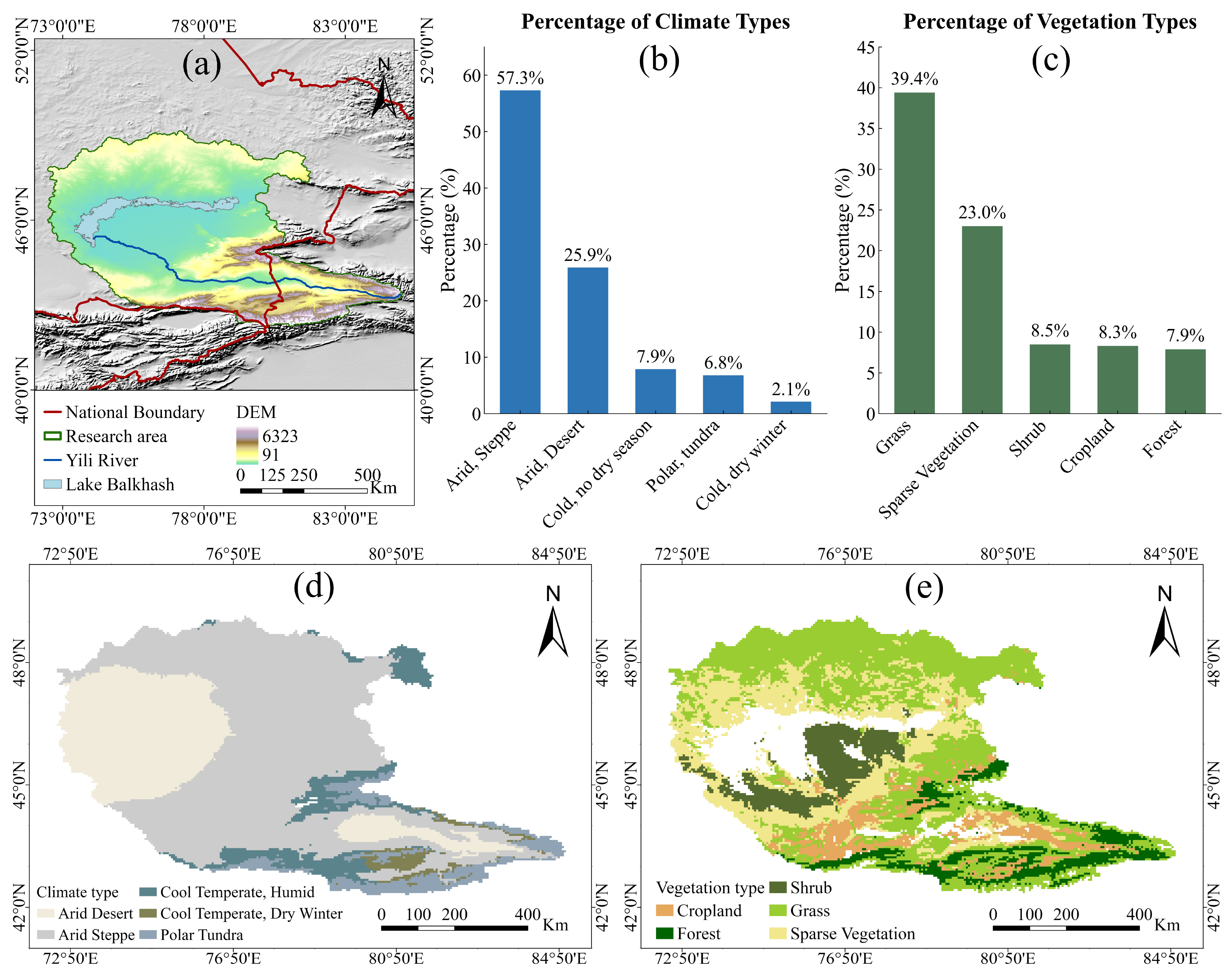
Figure 1. Overview of the YBB. (a) Geographical location and elevation (DEM); (b) Area percentage of climate types; (c) Area percentage of vegetation types; (d) Spatial distribution of climate types; (e) Spatial distribution of vegetation types.
Water 17 03535 g001
Figure 2. Spatiotemporal patterns of GPP, ET, and WUE. (a,c,e) Mean spatial distributions and (b,d,f) temporal trends for GPP, ET, and WUE from 1982 to 2018.
Water 17 03535 g002
Figure 3. Geographic distribution of the dominant driver (GPP or ET) governing the sensitivity of WUE to drought.
Water 17 03535 g003
Figure 4. Internal percentage of GPP- and ET-dominated control areas, classified by Climate type and Vegetation type.
Water 17 03535 g004
Figure 5. Standardized regression coefficients of the driving factors for GPP and ET during drought and wet years. Left axis: standardized regression coefficients. Right axis: Proportion of areas with significance p < 0.05. The subfigures show the results for (a) GPP in drought years, (b) GPP in wet years, (c) ET in drought years, and (d) ET in wet years.
Water 17 03535 g005
Figure 6. Spatial distribution pattern of ecosystem resilience (Rd) in the YBB from 1982 to 2018.
Water 17 03535 g006
Figure 7. SHAP importance of the top 10 drivers in the resilience models for each vegetation type. The R2 value represents the model’s performance on the test set.
Water 17 03535 g007
Table 1. Multi-year mean values and trends of GPP, ET, and WUE for different vegetation and climate types.
CategoryMean Spatial DistributionTemporal Trends
GPP (gC·m−2)ET (mm)WUE (gC·m−2·mm−1)GPP (gC·m−2·yr−1)ET (mm·yr−1)WUE (gC·m−2·mm−1·yr−1)
vegetation typeCropland563.978358.7801.5055.58932.74880.0053
Forest889.505439.6302.0093.87342.2991−0.0006
Shrub116.738116.2171.1221.45330.61140.0079
Grass359.084282.3811.2532.49511.58520.0017
Sparse Vegetation197.727172.7691.2471.98431.25430.0027
climate typeArid, Desert221.806195.3291.1772.48411.32060.0052
Arid, Steppe316.492248.1231.2522.36101.51350.0024
Cold, no dry season702.467405.4511.6844.22142.39560.0014
Cold, dry winter901.908417.0902.1493.43751.9635−0.0012
Polar, tundra396.716284.7771.3234.56121.62300.0093
Table 2. Resilience level proportions and mean resilience index for different vegetation types.
CroplandForestShrubGrassSparse Vegetation
Resilient28.27%16.16%20.29%26.78%28.48%
Slightly non-resilient21.03%18.20%10.93%20.14%16.83%
Moderately non-resilient24.35%30.27%11.36%17.76%16.72%
Severely non-resilient26.35%35.37%57.43%35.31%37.97%
Resilience Index0.94570.98801.26990.96550.9785
Table 3. Resilience level proportions and mean resilience index for different climate zones.
Arid, DesertArid, Steppe Cold, No Dry SeasonCold, Dry WinterPolar, Tundra
Resilient27.25%26.04%22.06%4.39%26.24%
Slightly non-resilient14.05%18.85%18.05%18.42%24.86%
Moderately non-resilient11.84%18.24%24.85%24.56%22.65%
Severely non-resilient46.86%36.51%35.05%52.63%26.24%
Resilience Index1.11050.96830.96190.99781.2239
Disclaimer/Publisher’s Note: The statements, opinions and data contained in all publications are solely those of the individual author(s) and contributor(s) and not of MDPI and/or the editor(s). MDPI and/or the editor(s) disclaim responsibility for any injury to people or property resulting from any ideas, methods, instructions or products referred to in the content.