Article

Pico-Hydropower and Cross-Flow Technology: Bibliometric Mapping of Scientific Research and Review


by
Lozano Sanchez-Cortez
1,*,
Beatriz Salvador-Gutierrez
1,
Hermes Pantoja-Carhuavilca
2,
Oscar Tinoco-Gomez
2,
Jorge Montaño-Pisfil
3,
Wilmer Chávez-Sánchez
3,
Ricardo Gutiérrez-Tirado
3,
José Poma-García
3,
Cesar Santos-Mejia
3 and
Jesús Vara-Sanchez
3
1
Faculty of Mechanical and Fluid Engineering, Universidad Nacional Mayor de San Marcos, Lima 15081, Peru
2
Faculty of Industrial Engineering, Universidad Nacional Mayor de San Marcos, Lima 15081, Peru
3
Faculty of Electrical and Electronic Engineering, Universidad Nacional del Callao, Callao 07011, Peru
*
Author to whom correspondence should be addressed.
Water 2025, 17(24), 3524; https://doi.org/10.3390/w17243524
Submission received: 22 September 2025 / Revised: 3 December 2025 / Accepted: 4 December 2025 / Published: 12 December 2025
(This article belongs to the Section Hydraulics and Hydrodynamics)

Abstract

This study aims to map the evolution of pico-hydropower and Michell–Banki (cross-flow) turbine research from 2000 to 2025 through a combined bibliometric analysis and qualitative mini-review. In total, 1036 Scopus-indexed records were initially identified and refined to 922 relevant publications for analysis. Bibliometric mapping with CiteSpace, VOSviewer, and Bibliometrix identified publication trends and seven major thematic clusters (dominated by topics such as cross-flow turbine design, renewable energy integration, and asynchronous generators), while a qualitative mini-review of key studies provided contextual depth. The analysis detected 25 keywords with strong citation bursts, indicating a shift in focus over the last decade from traditional electrical regulation toward digitalization and additive manufacturing. The mini-review distilled three dominant lines of inquiry geometric design optimization, hydraulic performance characterization, and socio-economic evaluation and highlighted critical knowledge gaps, including the absence of standardized flow–head–efficiency (Q–H–η) performance data, sparse reporting of economic metrics like levelized cost of energy (LCOE), and limited high-altitude (above 3000 m) validation of pico-hydro systems. This study’s integrative approach is unique compared to prior bibliometric or technical reviews, providing a comprehensive overview of the pico-hydropower landscape and outlining a future research agenda to standardize experimental protocols, integrate economic analysis, and extend cross-flow turbine deployments to high-Andean regions.

1. Introduction

Energy access is widely recognized as a cornerstone of sustainable development. The United Nations’ Sustainable Development Goal 7 (SDG7) explicitly calls to “ensure access to affordable, reliable, sustainable, and modern energy for all” by 2030 [1]. Yet as of 2019, approximately 840 million people—mostly in rural Sub-Saharan Africa and South Asia—still lacked access to electricity, and nearly 2.6 billion relied on traditional biomass for cooking [2]. This persistent energy poverty constrains education, healthcare, and economic opportunities while reinforcing social inequality and exposure to indoor air pollution [3]. Simultaneously, global decarbonization imperatives require the replacement of fossil-based off-grid systems such as diesel generators, which impose high fuel costs, complex logistics, and substantial greenhouse gas emissions [4]. To meet these dual challenges—universal energy access and climate mitigation—there is growing emphasis on decentralized renewable energy systems, including solar photovoltaics, wind, biomass, and small-scale hydropower [5]. Within this landscape, pico-hydropower (typically ≤5 kW) has emerged as a particularly promising solution that leverages local water resources to deliver clean, continuous, and low-cost electricity to remote communities [6]. By displacing diesel consumption and complementing solar generation, pico-hydro systems provide a climate-resilient pathway toward inclusive rural electrification and carbon-neutral energy transitions [7].
A pico-hydro turbine refers to a very small hydropower unit (typically ≤5 kW) designed for decentralized, off-grid applications [8]. A variety of pico-hydropower technologies have been developed to suit different site conditions. For ultra-low-head locations (head heights below 5 m), gravitational vortex and Archimedean screw turbines can be employed, offering efficient energy conversion with minimal environmental impact and high fish-friendliness [9]. Traditional water wheels (e.g., undershot or overshot types) operate under low-head conditions but historically with much lower efficiency than modern turbines. However, recent advances in water wheel design (for instance, Sagebien and Zuppinger wheels) have demonstrated greatly improved performance—achieving hydraulic efficiencies on the order of 80–85% [10]. These high-efficiency wheels are particularly suitable for very low-head installations (around 2 m head with 0.8 m3/s flow), where conventional low-head turbines (such as Kaplan or Michell–Banki designs) are neither efficient nor economically viable [11]. Consequently, well-designed contemporary water wheels can provide an efficient, cost-effective solution in sites with minimal head. At the opposite extreme, high-head streams (>20 m) are typically harnessed with impulse turbines such as Pelton or Turgo designs, which achieve superior efficiency while remaining mechanically simple and compact [12,13]. Axial-flow propeller and Kaplan turbines, by contrast, are best suited to moderate-head sites with relatively large flow rates and can reach peak hydraulic efficiencies on the order of 90% when properly optimized [14]. In addition to these purpose-built turbines, centrifugal pumps running in reverse—commonly known as Pumps-as-Turbines (PATs)—have been adopted as complementary low-cost alternatives; standard pump units are widely available and can attain roughly 60–85% efficiency when correctly matched to a site’s head and flow conditions [15,16]. Advances in computational modeling and control have further improved PAT performance, enabling smoother integration into hybrid renewable energy systems [17]. Each of these solutions comes with inherent operational limits (such as specific head requirements or sensitivity to flow variability), which must be considered when selecting appropriate pico-hydro technology for a given location.
Among all pico-hydro options, the Michell–Banki cross-flow turbine stands out for its exceptional versatility and practical advantages, and it is accordingly emphasized as a primary focus of the present study [18]. Cross-flow units can operate effectively across an unusually broad range of head heights—from as low as 2–3 m with proper design [19] up to around 200 m in certain designs, maintaining stable performance even under variable flow rates thanks to an open, self-clearing runner geometry and a dual-flow energy extraction mechanism [20]. These turbines also feature a simple, robust construction that tolerates sediment and lends itself to local fabrication and maintenance in small workshops using readily available materials [19]. Although such design features have enabled cross-flow turbines to be deployed across a wide range of installed capacities, including commercial units in the hundreds of kilowatts and even into the megawatt range, the present paper deliberately focuses on pico-hydropower applications with installed capacities of 5 kW or less. Collectively, these characteristics—a wide operating envelope, structural ruggedness, and ease of manufacture—have made the cross-flow one of the most widely adopted turbine architectures in pico-hydropower deployments worldwide [6]. While certain alternative turbines may achieve higher peak efficiencies in specific niche conditions, the cross-flow’s balanced combination of adaptability, durability, and cost-effectiveness makes it an exemplary reference technology for advancing very small-scale (≤5 kW) hydropower development.
The implementation of pico-hydroelectric systems, particularly those based on cross-flow (Michell–Banki) turbines, faces a series of technical, social, and economic challenges. One key technical challenge is that these turbines are often deployed in low-head (<25 m) environments with highly variable water flow. Cross-flow designs are well-suited to such fluctuating conditions due to their broad operating range and robust construction; however, the natural variability in the water resource can still cause power generation to become intermittent when flow rates diminish. Without complementary energy storage or supplemental generation, maintaining a continuous electricity supply under variable flow remains challenging [21]. To address this, hybridization with battery storage and integration with other renewable sources have been proposed as strategies to buffer flow variability and ensure a more stable output [22].
In terms of performance, the actual efficiency of these turbines is often suboptimal compared to ideal values. Although numerical studies have achieved improvements, many current designs still reach peak efficiencies below 80%, far below the ideal 88–92% range reported in the literature [13,20,23]. These findings highlight the need to optimize critical design parameters such as blade number, inlet angle, and injector geometry, which are not standardized in practice. Metaheuristic optimization algorithms (e.g., genetic algorithms, particle swarm optimization) are increasingly being applied to turbine design, suggesting a new research direction [24].
Another major challenge is the lack of accessible design and manufacturing methodologies, especially for resource-limited communities. Most academic and industrial studies rely on commercial CFD platforms such as ANSYS-CFX-based workbench 10.1 or Fluent, which remain the industry standard for hydroturbine and flow simulations because of their proven reliability, extensive validation, and continuous technical support [25,26]. These tools are particularly suitable for high-stakes engineering projects, where simulation fidelity and certification requirements demand validated solvers and industry-grade meshing and turbulence models [27]. At the same time, emerging open-source alternatives such as OpenFOAM, FreeCAD + CFDof, and SU2 are being increasingly adopted in academic research, training, and low-resource environments due to their flexibility, cost-effectiveness, and collaborative development model [28,29]. Although these tools are not yet standardized to the level of commercial codes, they provide a valuable complementary path for promoting accessibility and capacity building in computational design.
Additional issues include local fabrication and sustainability, where turbines must be buildable, repairable, and maintainable using minimal resources. While their simple construction is an advantage, sustainable business models and supply chains are still needed to ensure long-term accessibility and viability in remote communities. Innovative financing mechanisms, such as microcredit schemes and public–private partnerships, have shown promise in scaling rural hydro solutions [30]. Finally, there is a lack of replicable field studies that evaluate the real-world performance of these systems across diverse socio-technical contexts. Only a few isolated examples exist, such as a propeller turbine installed in a filtration building that successfully recovered approximately 10% of the system’s hydraulic energy [31] or case studies in Pakistan [32] and Cameroon [33] that revealed substantial discrepancies between laboratory-based performance predictions and actual field operation results due to load fluctuations, maintenance constraints, and installation conditions.
Earlier bibliometric analyses of hydropower were broader in scope [34], and previous pico-hydro studies often remained technical or qualitative without mapping the literature. In contrast, this paper stands out as the first to focus exclusively on the pico-hydropower and Michell–Banki turbine subfield through a scientometric lens, uniquely combining network-based mapping with a targeted technical mini-review. This approach goes beyond existing narrative reviews by revealing niche-specific research trends and gaps—for example, the scarcity of standardized Q–H–η curves, underreporting of economic performance data, and minimal high-altitude validations—which had not been clearly highlighted in earlier work.
In light of the above context and challenges, the present study aims to provide a comprehensive review of the pico-hydropower sector, with particular focus on Michell–Banki cross-flow turbine technology. We adopt a dual methodology that combines a scientometric (bibliometric) analysis of research trends [35,36] with a qualitative technical review, thereby explicitly concentrating on the pico-hydro and cross-flow subfield in greater detail than previous works. Specifically, our objectives are: (1) to map the evolution of pico-hydropower research from 2000 to 2025 using bibliometric tools, identifying the core literature, thematic clusters, and knowledge hotspots, and (2) to critically assess the state-of-the-art in pico-hydro turbine development and applications, highlighting key achievements, gaps, and future directions. This integrative approach represents the first time that pico-hydropower—especially Michell–Banki turbine research—is being reviewed through a bibliometric lens coupled with in-depth technical discussion. By revealing niche-specific trends (e.g., the rise in digital design techniques or the under-reporting of economic performance data) and by distilling insights from disparate case studies, the paper offers a unique contribution to the literature. In the concluding Section 1, we outline the novelty of our approach relative to prior studies: earlier hydropower reviews tended to either survey small hydro in broad terms or focus on technical aspects in isolation, whereas our work marries the quantitative mapping of publication networks with qualitative synthesis to uncover hidden connections and research gaps in pico-hydro development. Ultimately, the study provides an up-to-date overview and research agenda for pico-hydropower, identifying priority areas such as standardizing Q–H–η testing, exploring high-altitude performance, and integrating socio-economic analyses into future projects. By doing so, we hope to inform and encourage researchers, practitioners, and policymakers in advancing pico-hydropower as a viable component of sustainable energy strategies for both rural and urban communities.

2. Materials and Methods

The methodology illustrated in the Figure 1 outlines a structured, transparent, and reproducible approach for conducting a bibliometric analysis and mini-review in the domain of pico-hydropower and cross-flow turbine technologies. The process is divided into four interconnected stages: (1) data collection, (2) data exportation and visualization, (3) bibliometric analysis, and (4) a mini-review synthesis, each contributing to the identification of research patterns, trends, and knowledge gaps in the field.
The bibliometric query was carefully structured to capture the most relevant research specifically addressing pico-hydropower and Michell–Banki (cross-flow) turbines. The search was intentionally limited to terms such as “pico-hydro”, “cross-flow turbine”, “Michell–Banki”, * and “Banki turbine” within the title, abstract, or keywords fields (TITLE-ABS-KEY). These terms accurately represent the core focus of this study on very small-scale hydro systems typically producing only a few kilowatts or less. Broader expressions such as “small-scale hydro” or “micro-hydro” were deliberately excluded because they encompass systems up to several hundred kilowatts, often including technologies and scales beyond the pico-hydropower category (e.g., Pelton, Kaplan, and Turgo turbines). Including those keywords would have significantly widened the dataset and diluted the specific focus of this bibliometric mapping. However, we now explicitly acknowledge that other turbine types used in pico- and micro-hydro systems—including vortex, Archimedean screw, Turgo impulse, and small propeller/Kaplan designs—are discussed, to provide a broader overview of pico-hydro technologies and their diversity.
The search included all document types but was limited to articles published in English while restricting results to publications after 1999. An initial search retrieved 1036 documents, and after applying language and date filters, a final dataset of 922 articles was obtained. This systematic selection ensured that the dataset was both relevant and manageable for further bibliometric processing.
In the second stage, the collected data was exported and visualized using multiple tools to enable comprehensive analysis. The bibliographic metadata was exported in three formats: BibTeX (for use in CiteSpace), RIS (for VOSviewer), and CSV (for R’s Bibliometrix package). These formats allowed for flexibility in the use of multiple software tools, each specializing in a different type of analysis. CiteSpace was employed for co-citation analysis and temporal mapping of influential studies, VOSviewer was used to generate co-occurrence maps of keywords and thematic clusters, and Bibliometrix in R provided additional statistical and graphical capabilities. This multi-platform approach enhanced the analytical depth and ensured robust visual and quantitative outputs.
The third phase, bibliometric analysis, encompassed both source analysis and keyword analysis. The source analysis focused on identifying the most productive journals, authors, and institutions, while the keyword analysis aimed to detect recurring terms, conceptual clusters, and the evolution of thematic focus over time. The outputs of this phase included trends in annual publication volume, insights into the distribution of publications across sources, and the identification of research hotspots and emerging themes. Together, these analyses provided a comprehensive overview of the intellectual and thematic structure of the field, as well as its dynamic evolution.
The final stage involved conducting a review by synthesizing selected studies from the bibliometric dataset into a qualitative narrative. This step added interpretive depth by highlighting seminal works, identifying major technological breakthroughs, and contextualizing trends observed in the bibliometric data. The studies included in the qualitative synthesis were selected based on relevance, citation impact, and methodological rigor. The mini-review allowed the authors to interpret patterns not readily captured by metrics alone, offering a richer and more holistic understanding of the current state and future directions of pico-hydropower and cross-flow turbine research.
In summary, this methodology integrates rigorous data retrieval and filtering, advanced bibliometric mapping, and qualitative synthesis to offer a robust framework for understanding scientific progress in emerging renewable energy technologies. It provides valuable insights for researchers, policymakers, and practitioners seeking to navigate and contribute to the growing field of decentralized hydropower systems.

3. Results

3.1. Keywords Analysis

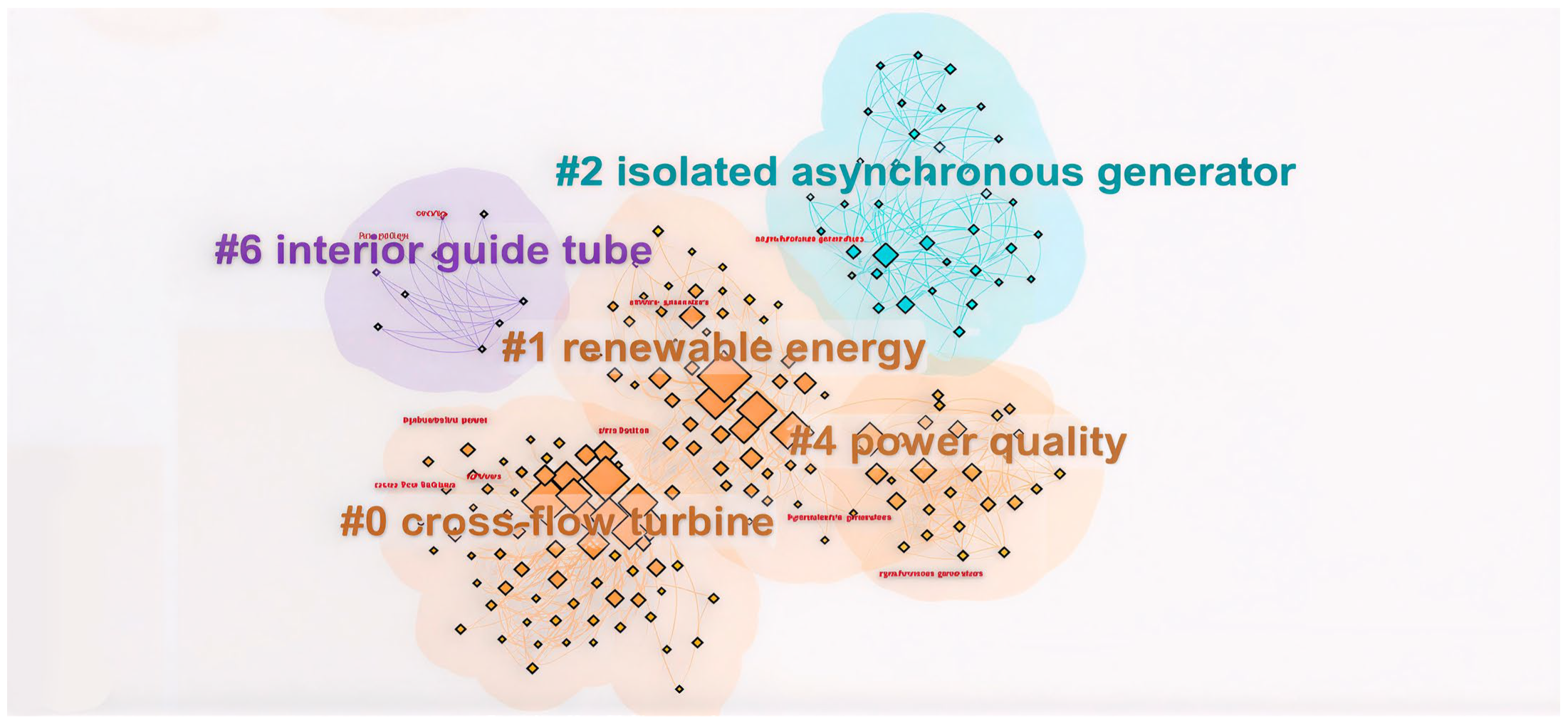
The visualization generated using CiteSpace, as shown Figure 2, presents a cluster-based co-citation network in the field of pico-hydropower and cross-flow turbines, offering a clear depiction of the intellectual structure and research frontiers of the domain. Each colored cluster represents a thematic grouping of co-cited articles, with labels automatically assigned based on dominant keywords. The figure reveals seven significant clusters, each representing a concentrated area of research.
At the core of the map is Cluster #0: “cross-flow turbine”, the largest and most central cluster, which reflects the dominant and foundational topic within the literature. This cluster aggregates research focusing on the mechanical design, optimization, and experimental validation of cross-flow turbines, often used in pico- and micro-hydropower applications. The dense citation connectivity within this cluster suggests a mature and active research area, supported by works such as Achebe [37], which explore the influence of blade configuration, nozzle shape, and flow parameters on turbine efficiency.
Adjacent to this is Cluster #1: “renewable energy”, which includes interdisciplinary studies linking cross-flow turbine technology to broader energy transition goals. This cluster integrates environmental impact analyses, system-level integration in off-grid solutions, and the role of pico-hydro in sustainable development strategies. It reflects a broader systems perspective, where technology is viewed not in isolation but as part of the renewable energy mix—an insight emphasized by Awandu [38], who argue for the contextual deployment of pico-hydro within community-scale electrification models.
Cluster #2: “isolated asynchronous generator” marks a distinct but technically critical subfield focusing on the electrical aspects of small-scale hydro systems. Articles in this cluster often address the challenges of frequency and voltage regulation, load matching, and grid independence, which are essential for stable off-grid power generation. This line of research is crucial in remote settings where synchronous grid connection is not possible, as discussed in Williamson and Lubitz [6], who highlight the advantages of asynchronous machines in cost-sensitive and technically constrained environments.
Cluster #4: “power quality” delves further into the electrical engineering dimension, focusing on the optimization of energy output and mitigation of harmonics, voltage dips, and load fluctuations. It is closely linked to Cluster #2, reinforcing the growing attention to system reliability and user-end performance in rural energy projects. Research in this area emphasizes the use of power electronics, control algorithms, and real-time monitoring systems, which are critical to ensuring the viability of decentralized pico-hydro grids.
On the periphery of the map, Cluster #6: “interior guide tube” represents a niche but technically advanced research topic, primarily addressing fluid dynamics, nozzle geometry, and internal flow control mechanisms. The highly localized connections within this cluster suggest an experimental and design-oriented focus, often driven by numerical simulations such as Computational Fluid Dynamics (CFD). These studies, such as those by [31], aim to enhance hydraulic efficiency at low-head and low-flow conditions—scenarios common in rural and off-grid installations.
In summary, the co-citation analysis reveals a multi-layered research landscape in which mechanical turbine design (Cluster #0), energy policy integration (Cluster #1), electrical optimization (Clusters #2 and #4), and advanced fluid mechanics (Cluster #6) coexist and occasionally overlap. The presence of these distinct but interconnected clusters suggests that while core technologies are well-established, emerging themes—such as guide tube optimization and asynchronous generators—continue to push the boundaries of innovation. This networked knowledge structure underlines the increasing complexity and interdisciplinary nature of modern pico-hydro research.
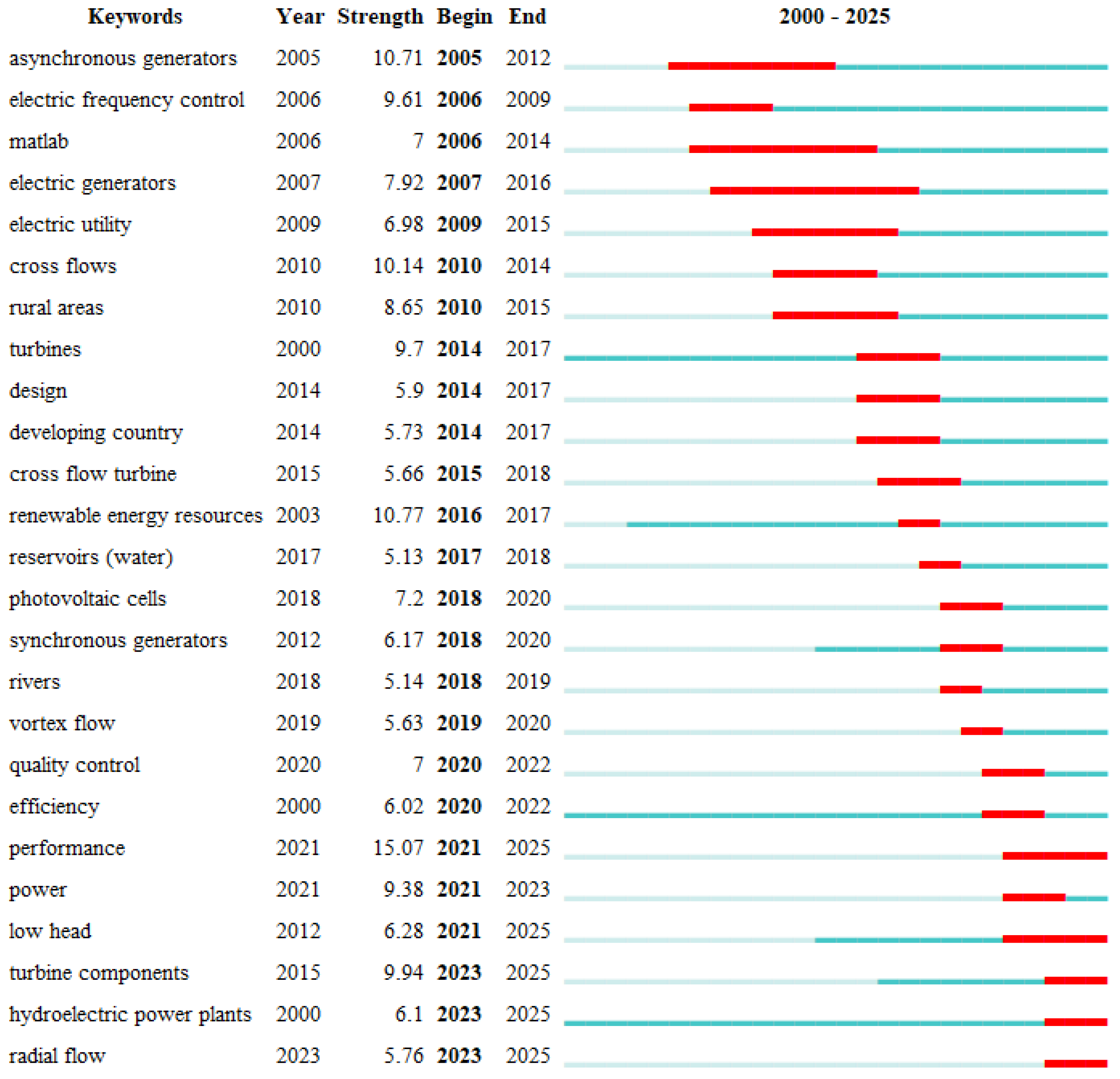
The visualization, in Figure 3, shows the Top 25 keywords with the strongest citation bursts in the field of pico-hydropower and cross-flow turbines from 2000 to 2025, offering deep insight into the temporal dynamics and shifting focus of research over time. A citation burst reflects a sudden and significant increase in attention to a specific topic, indicating its relevance and emerging importance during a given period. The keywords are ordered by burst strength, and the red segments on the timeline represent the period during which each keyword experienced heightened citation activity.
The keyword “asynchronous generators” recorded the highest citation burst strength (10.71) beginning in 2005 and peaking by 2012, reflecting the initial surge of interest in off-grid and isolated generation systems. This aligns with early development in standalone renewable systems, where asynchronous machines provided a cost-effective and robust alternative to synchronous units in remote applications. Similarly, keywords like “electric frequency control” (2006–2009) and “electric utility” (2009–2015) show strong bursts in the early 2000s, suggesting that foundational electrical integration challenges dominated research agendas at the time.
Mid-period bursts—particularly from 2010 to 2017—highlight a diversification of research topics. Terms like “cross flows”, “rural areas”, “developing country”, and “renewable energy resources” gained prominence, reflecting the growing attention to context-specific applications of pico-hydropower, especially for decentralized electrification in underserved regions. The rise in terms such as “design” and “turbines” also points to significant innovation in turbine architecture and localized energy solutions [38].
From 2017 onward, the field enters a phase of technological convergence and system integration. Notably, keywords like “photovoltaic cells”, “synchronous generators”, and “energy performance” reflect a hybridization trend—where pico-hydro systems are increasingly examined in combination with solar PV, energy storage, and multi-source microgrids [39]. The emergence of “quality control”, “efficiency”, and “vortex flow” around 2020–2022 further shows a shift toward optimization, modeling, and performance benchmarking.
The most recent and active bursts—ongoing until 2025—include keywords such as “performance” (15.07), “power”, “low head”, “turbine components”, “hydroelectric power plants”, and “radial flow”. These reflect the current research frontier, emphasizing component-level design, efficiency under low-head conditions, and refined fluid dynamics analysis. The burst in “turbine components” (2023–2025) also suggests renewed focus on customized engineering solutions and modular turbine architecture, possibly driven by advances in additive manufacturing (3D printing) and open-source prototyping.
In summary, the citation burst analysis reveals a temporal evolution in the research focus: starting from foundational electrical and control challenges, progressing through rural applications and turbine design innovation, and culminating in a modern wave of integrated, hybrid, and performance-optimized solutions. This trajectory demonstrates how the field has matured into a multidisciplinary domain, interlinking electrical engineering, fluid mechanics, rural development, and sustainability science.
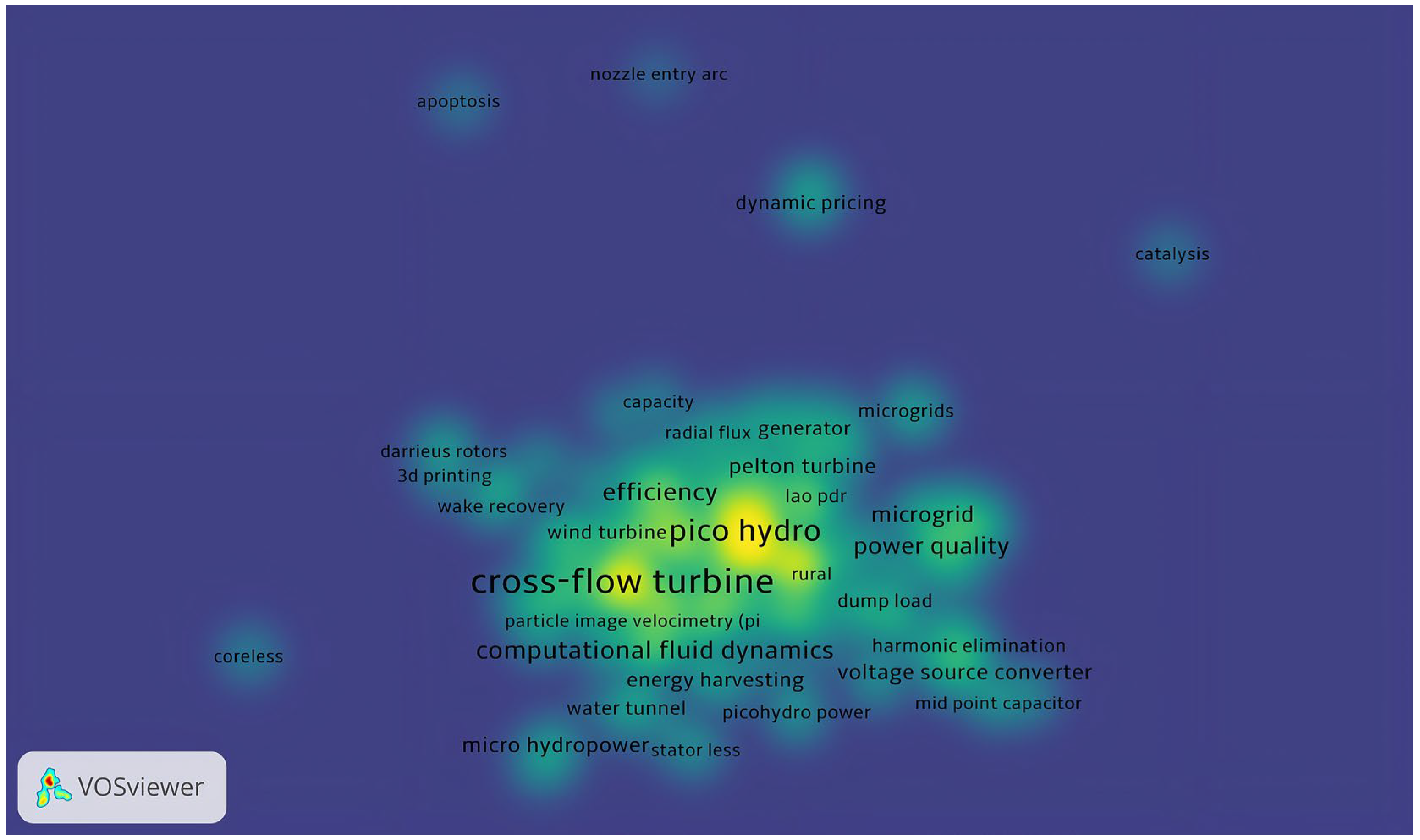
Based on the bibliometric maps and citation analyses conducted using VOSviewer and CiteSpace, the current landscape of research on pico-hydropower and cross-flow turbine systems reveals strong interdisciplinary integration and evolving thematic clusters. The heat map generated in VOSviewer highlights the dominant themes in the field, with keywords such as cross-flow turbine, pico-hydro, efficiency, computational fluid dynamics (CFD), and microgrids appearing centrally and in higher density zones, indicating high research interest and connectivity. This demonstrates the increasing importance of CFD in the optimization of turbine designs, as well as growing concerns regarding power quality in decentralized renewable systems.
Figure 4 illustrates a VOSviewer-generated bibliometric co-occurrence heatmap of keywords in pico-hydropower research, where the strong presence of terms such as voltage source converter, energy harvesting, and dynamic pricing indicates a distinct convergence between energy engineering and smart grid applications. The prominence of terms like 3D printing and Pelton turbine also reflects technological innovation and diversification within small-scale hydropower systems. Notably, occurrences of micro hydropower and radial flux generator suggest ongoing innovation in generator configuration for compact applications, often constrained by urban or underground infrastructure. Furthermore, the appearance of peripheral terms such as apoptosis and catalysis on the map may represent multidisciplinary spillover or outlier artifacts from broader datasets, warranting their exclusion in more narrowly focused domain analyses. Overall, the visualization underscores that pico-hydro and cross-flow turbines are no longer standalone mechanical concepts but are increasingly embedded in broader technological ecosystems involving IoT, smart metering, and advanced energy control systems. The ongoing integration of computational tools and additive manufacturing techniques into this field points to a future where system customization and performance modeling become routine in renewable microgeneration solutions [40].
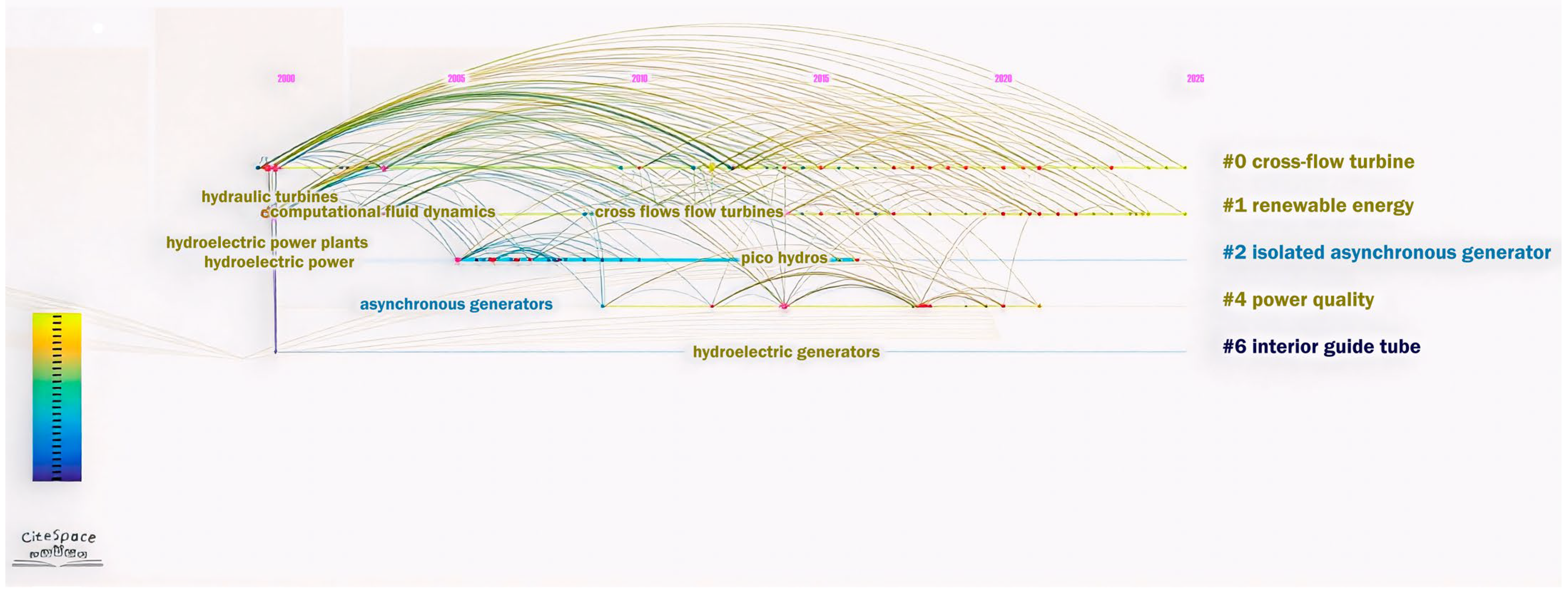
The CiteSpace timeline visualization (Figure 5) provides a comprehensive evolutionary map of keyword clusters and citation relationships in the field of pico-hydropower and cross-flow turbine research from 2000 to 2025. Each horizontal line represents a keyword cluster, labeled on the right (#0 to #6), and nodes along the timeline correspond to specific publications or keyword occurrences, with the lines above indicating citation links and influence over time. The colors reflect the temporal dimension, where darker hues (blue) indicate older citations and lighter hues (yellow to red) indicate more recent ones.
The largest and most influential cluster is #0: “cross-flow turbine”, which shows consistent development from around 2006 through 2025, indicating long-standing and ongoing interest in this topic. It connects strongly to computational fluid dynamics, hydraulic turbines, and hydroelectric power plants, reflecting the technological emphasis on design optimization and fluid mechanics. Cluster #1: “renewable energy” also spans nearly the full timeline, illustrating its foundational role in contextualizing pico-hydro systems within the broader renewable energy transition.
Cluster #2: “isolated asynchronous generator” emerges prominently from around 2010 onward, marking a shift in focus toward electrical integration and standalone power solutions, particularly for off-grid and rural applications. This reflects efforts to create fully self-sufficient energy units capable of operating without synchronized grid connections. Meanwhile, cluster #4: “power quality” shows a more recent rise in relevance post-2015, tied to the increasing need to stabilize voltage and frequency in small-scale distributed systems, especially in hybrid and microgrid configurations.
Interestingly, cluster #6: “interior guide tube” is a smaller and more specialized cluster that appears in recent years, suggesting emerging research in turbine flow path geometry and internal fluid control mechanisms—topics closely linked to CFD modeling and additive manufacturing methods. Additionally, clusters such as hydroelectric generators and pico-hydros appear closely linked to practical system implementations, while asynchronous generators and computational fluid dynamics act as methodological and technical bridges connecting diverse subfields.
In summary, this timeline reveals a clear evolution from mechanical turbine design (2000–2010) to electrical optimization and integration (2010–2020), and finally to intelligent control, power quality, and system miniaturization (2020–2025). The visualization underscores the interdisciplinary nature of the field, where mechanical engineering, fluid dynamics, and electrical systems increasingly converge to address real-world challenges in sustainable, decentralized power generation. Notably, cluster #0 (“cross-flow turbine”) persists from around 2006 through 2025, making it the longest-running cluster in the timeline and underscoring the sustained prominence of this research focus. Furthermore, the latter part of the timeline reveals that newer clusters blend multiple disciplines (e.g., combining mechanical, electrical, and computational domains), indicating an increasingly interdisciplinary approach and thematic branching as the field evolved.

3.2. Analysis of Sources and Documents

The Table 1 on “Sources Local Impact” presents a bibliometric overview of the most influential journals in the field of pico-hydropower and cross-flow turbine research, highlighting metrics such as h-index, g-index, m-index, total citations (TC), and publication volume (NP). Renewable Energy stands out as the most impactful source, with the highest h-index (23), g-index (42), and total citations (1891), indicating its central role in disseminating foundational and interdisciplinary research since 2003. In contrast, journals like Energy Procedia, Ocean Engineering, and the Journal of Advanced Research in Fluid Mechanics and Thermal Sciences demonstrate high m-indices (0.75–1.0), reflecting strong recent influence despite fewer years of activity. Specialized outlets such as the International Journal of Marine Energy, Journal of Renewable and Sustainable Energy, and WATER (Switzerland) also show consistent academic engagement in niche areas like marine energy and water-integrated microgeneration systems. Notably, CFD Letters exhibits the highest m-index (1.0) with a low number of publications, suggesting a concentrated impact in simulation and numerical optimization. Meanwhile, journals like Energies and Renewable and Sustainable Energy Reviews contribute a higher volume of articles but demonstrate lower m-indices, indicating broader scope with less direct influence on this specific field. Collectively, these metrics reveal a dynamic publication landscape, with both established and emerging journals shaping the evolution of micro-hydro and cross-flow turbine technologies.

3.3. Conceptual Structure

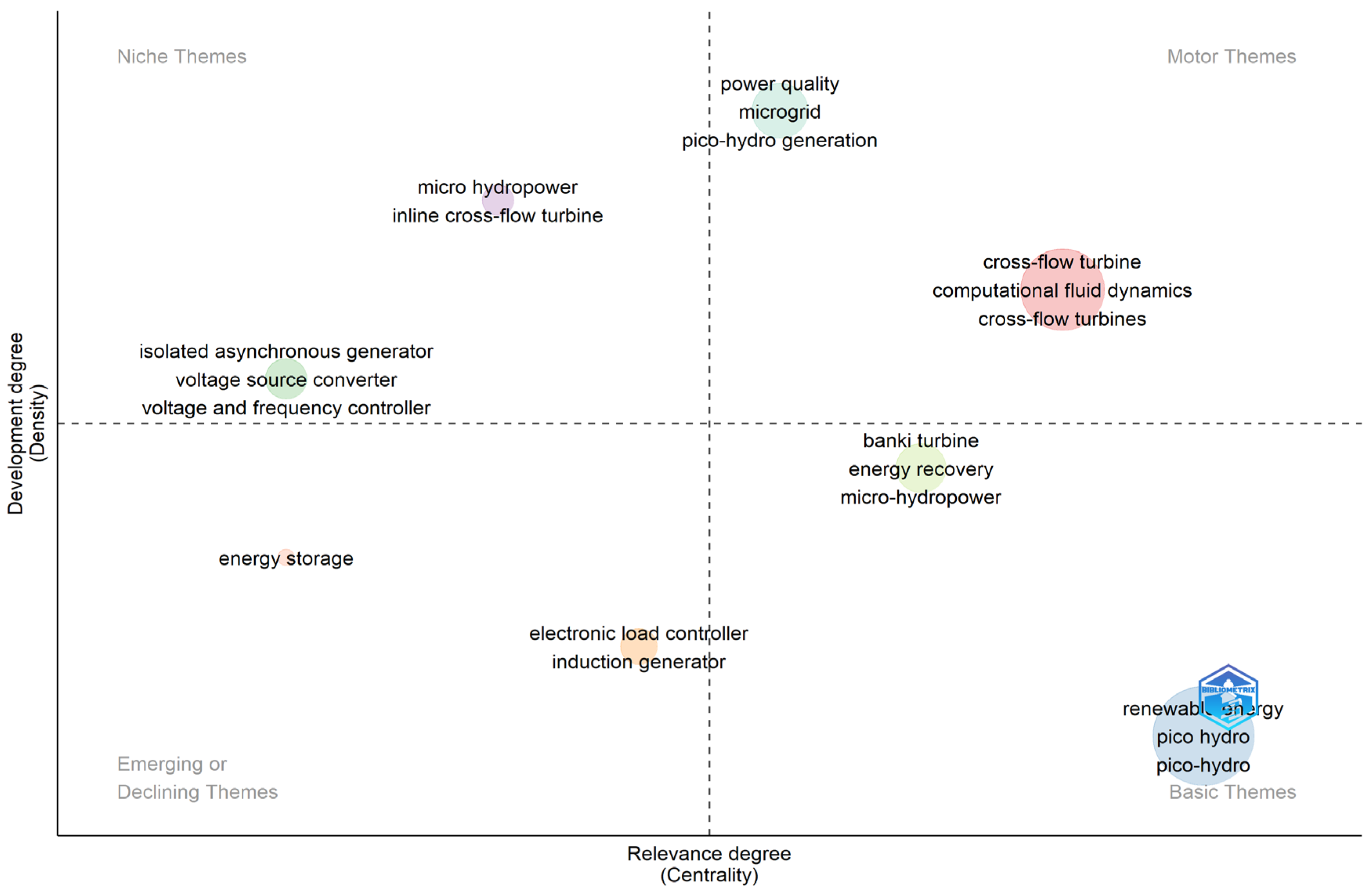
In Figure 6 The thematic map shown is a bibliometric visualization based on co-occurrence analysis of keywords from scientific publications related to pico-hydropower and cross-flow turbine technologies. The map is structured around two key axes: the vertical axis (density), which indicates how well-developed or mature a topic is internally, and the horizontal axis (centrality), which reflects how relevant and interconnected a topic is with others across the research domain. This layout helps identify both the core areas of research and those that are emerging, underdeveloped, or potentially declining.
In the upper right quadrant, labeled Motor Themes, we find the most relevant and mature topics in the field. Terms such as cross-flow turbine, computational fluid dynamics, and cross-flow turbines dominate this space. These themes are highly connected to other concepts and show a strong degree of internal development, making them strategic and essential to ongoing research. Their presence here suggests that cross-flow turbines, especially those optimized through CFD (computational fluid dynamics), are central to innovation in small-scale hydropower systems.
The upper left quadrant, called Niche Themes, contains well-developed but less central topics such as micro hydropower, inline cross-flow turbine, pico-hydro generation, power quality, and microgrid. These themes have high internal density but low connectivity to broader research areas. For instance, while power quality and microgrids are highly specialized and technically advanced topics, they have not yet become core themes in the broader pico-hydro research landscape. Their placement suggests that while these are areas of intense research, they are more isolated from interdisciplinary or mainstream academic discussions [6]. In the lower right quadrant, we find the Basic Themes, which are highly relevant across the field but not yet deeply developed. Terms like renewable energy, pico hydro, pico-hydro, micro-hydropower, energy recovery, and banki turbine fall under this category. These are foundational topics—frequently cited and conceptually central—yet still lacking thematic cohesion and depth. They represent the building blocks of the field, essential for orientation and theory-building, but offer substantial room for further investigation and specialization [41].
Finally, the lower left quadrant, designated as Emerging or Declining Themes, includes topics with both low development and low relevance—at least in the current literature. Here we find keywords like energy storage, isolated asynchronous generator, voltage source converter, electronic load controller, and induction generator. These topics may represent early-stage research with future potential or areas that have seen a decline in academic interest. For example, energy storage is undeniably vital for off-grid and hybrid energy systems, yet its specific integration with pico-hydro solutions remains underexplored in the literature. This suggests a research gap worth addressing.
Overall, this thematic map offers valuable insights into the intellectual structure and research dynamics of the field. It highlights core areas of innovation, identifies underdeveloped but important foundational themes, and points to potentially emerging areas that could shape future research. For scholars, policymakers, and funding agencies, such bibliometric tools are essential for tracking scientific progress and prioritizing investment in the most impactful areas of renewable energy research.

3.4. Research Trends

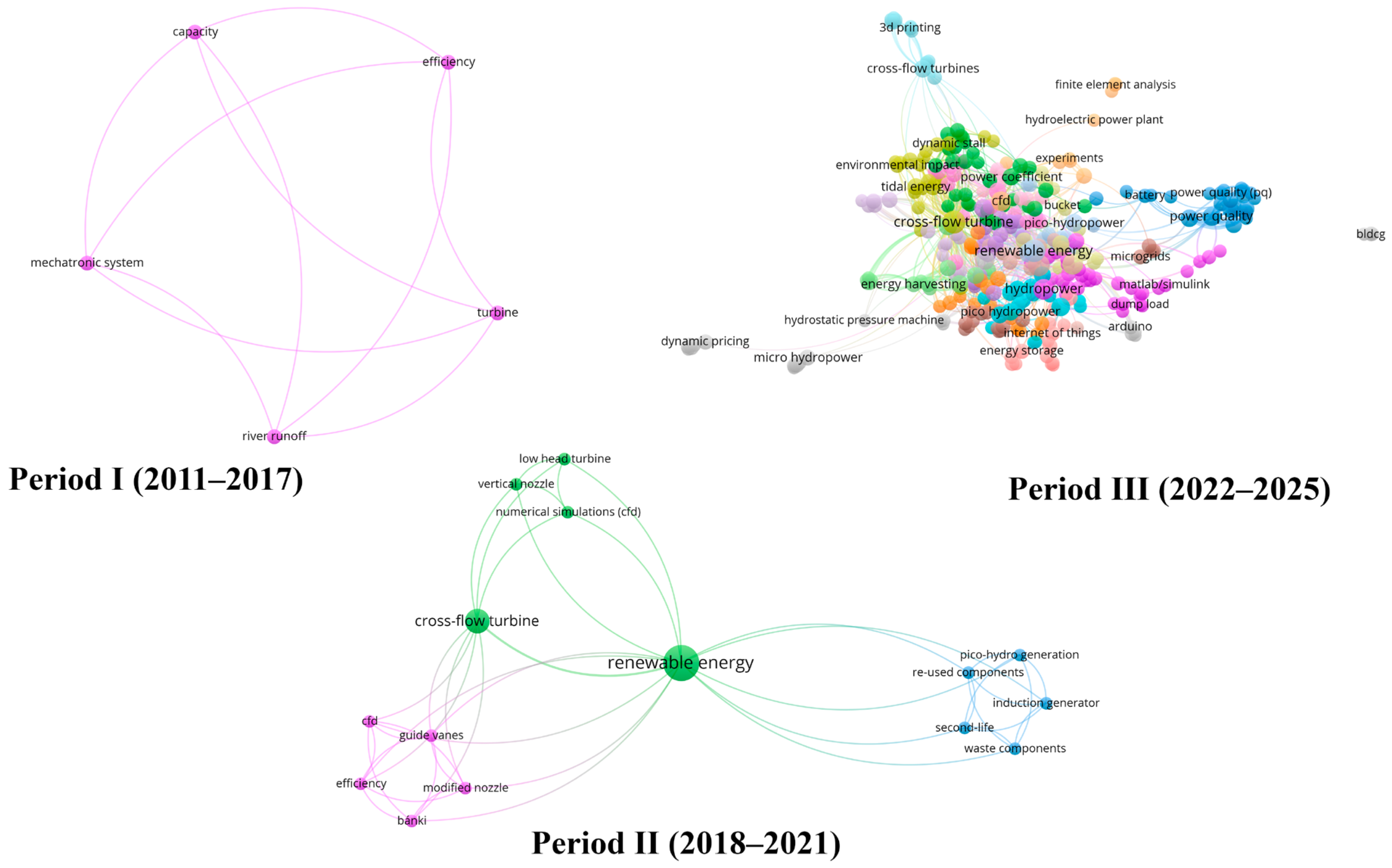
Figure 7 shows a longitudinal bibliometric evolution map of keyword co-occurrence in the field of pico-hydropower and cross-flow turbine technologies across three distinct time periods: 2000–2008, 2009–2016, and 2017–2025. The visualization was generated using VOSviewer version 1.6.20, a tool for constructing and visualizing bibliometric networks. Each node represents a keyword, and the connections (edges) denote co-occurrence relationships in published literature, reflecting the thematic structure and evolution of research focus over time.
In the 2000–2008 period, the research landscape was relatively sparse and narrowly focused. Key terms such as mechatronic system, efficiency, turbine, river runoff, and capacity dominate this early phase. The network is loosely connected and small in scale, suggesting that research on pico-hydropower systems and related technologies was in its nascent stage, with limited integration across disciplines.
The 2009–2016 period marks a significant expansion and thematic diversification. The term renewable energy emerges as the central hub, connecting with more specialized concepts such as cross-flow turbine, numerical simulations (CFD), vertical axis, and modified nozzle. Notably, sustainability and reuse-related themes appear for the first time (pico-hydro generation, re-used components, waste components), indicating a growing emphasis on circular economy principles and low-cost energy solutions. This phase also introduces terms like efficiency, induction generator, and secondary components, suggesting increased technical specificity and system-level integration.
In the most recent period, 2017–2025, the thematic network becomes significantly more complex and multidisciplinary. A dense cluster of interconnected terms such as cross-flow turbines, 3D printing, finite element analysis, microgrids, energy harvesting, and Internet of Things (IoT) reflect the integration of advanced manufacturing techniques, smart technologies, and environmental considerations. Additionally, terms like tidal energy, dynamic pricing, energy storage, battery, and hydro-optomechanics highlight the expanding interface between pico-hydro technologies and broader smart grid and hybrid renewable energy systems. The presence of Arduino, MATLAB/Simulink, and experiments also reflects a trend toward prototyping, simulation, and experimental validation.
Overall, the evolution across these three time slices illustrates a clear trajectory of maturation in the field: from isolated technical concerns to an integrated, multidisciplinary approach involving sustainability, digitalization, and distributed energy systems. This transformation reflects the increasing relevance of pico-hydropower and cross-flow turbines not only as standalone solutions but also as critical components of decentralized and smart renewable energy infrastructures.

4. Discussion

4.1. Dominant Research Lines

Publications (2000–2025) on Michell–Banki turbines (cross-flow turbines) converge into three main lines: (1) Geometric optimization (runner and nozzle design), (2) Hydraulic characterization and performance curves, and (3) Socio-economic integration in rural projects. Each line has generated significant advances, although with different degrees of maturity and with challenges still pending. The following section synthesizes recent findings in each area, emphasizing the critical analysis of results and gaps identified in the literature.

4.1.1. Geometric Optimization of the Turbine (Nozzle, Blades and Stages)

A substantial body of research has been devoted to refining the geometry of Michell–Banki turbines to maximize their hydraulic efficiency. Recent studies, assisted by CAD/CFD, have reaffirmed optimal design parameters suggested in classical works, refining them with greater rigor [42]. In particular, the nozzle attack angle (α) has been confirmed as critical: multiple experiments and simulations show that maintaining α at the minimum possible structural limit (22°) yields the highest efficiencies [43].
These design criteria reflect a consensus: geometric matching between the nozzle and runner is crucial to achieving high performance. In particular, Adhikari [13] found that two fundamental requirements to reach efficiencies ≥ 90% in cross-flow turbines are (i) converting the largest possible fraction of the available head into kinetic energy at the nozzle and (ii) perfectly coupling nozzle and runner design. Their critical review highlighted that many recent works achieved only modest efficiencies (<70%) due to misunderstandings or incomplete application of these principles, despite their availability in the literature. This has renewed appreciation for optimal design: studies with well-configured turbines have achieved peak efficiencies of 88–90%, whereas suboptimal designs lagged behind at 60–70%, underscoring the need to follow established guidelines [44].
The configuration of double-stage turbines (two passes of flow through the runner) has also been explored in comparison with the conventional single-stage design. In theory, a second stage allows for recovery of residual energy after the first pass. Numerical and experimental studies confirm that the second pass contributes modestly to total power (typically providing 10–30% of the overall energy) [45]. De Andrade [46] and Woldemariam [47] observed contributions close to 30–35% under certain regimes, while Adhikari [13] noted that at higher flow rates, the gap between both stages diminishes. In practice, the second stage can increase power output by 5–10% and broaden the efficiency curve at fractional flow rates, improving part-load performance. However, the efficiency of the first stage still dominates overall performance, meaning that a poor initial design cannot be compensated by the second. Many commercial cross-flow turbines retain the double-inlet runner design for operational robustness, as it better tolerates flow variations. For example, Ossberger’s cross-flow turbines, particularly at smaller scales (below 100 kW), utilize double-inlet configurations to maintain efficiency across varying flows. In contrast, numerous research prototypes adopt single-stage configurations to simplify testing and interpretation of results [23].

4.1.2. Hydraulic Parameters and Performance Curves (Head, Flow, Efficiency)

The second dominant line of research focuses on characterizing the hydraulic performance of the Michell–Banki turbine under diverse operating conditions [48]. This involves generating power and efficiency curves as functions of discharge (Q), net head (H), and rotational speed (n), both in laboratory and field settings. Such studies provide fundamental information for sizing pico-hydropower plants and understanding the operational limits of this technology in practice.
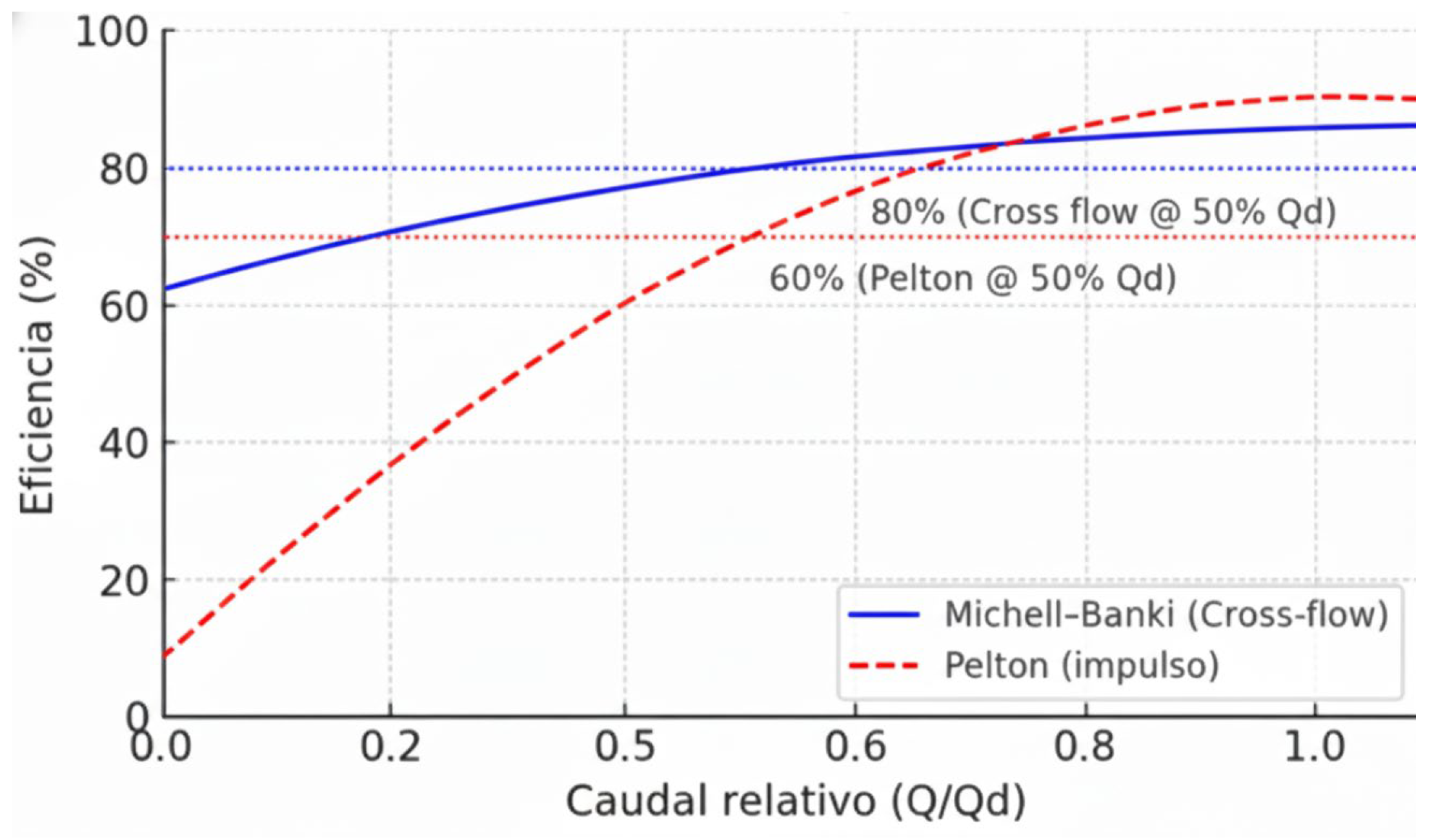
Under controlled laboratory conditions, multiple experiments have confirmed that well-designed Michell–Banki turbines achieve maximum hydraulic efficiencies in the range of 70–85% at their Best Efficiency Point (BEP) [49]. This peak efficiency is somewhat lower than that reported for Pelton or Francis turbines of similar scale (whose maxima reach 90–95%), partly due to inherent losses in cross-flow operation (internal jet collisions, dispersed fluid exit, etc.). Nevertheless, the Michell–Banki presents the advantage of remarkable robustness against load variations: unlike pure impulse turbines, it maintains relatively high efficiencies across a broad range of fractional flows [18]. Fiuzat [50] already observed that at 50% of design discharge, the efficiency of a Banki turbine decreases by only 5–10 percentage points compared to the BEP, whereas Pelton multi-jet turbines show much larger drops under similar conditions. This feature has been qualitatively confirmed in modern studies, which describe the cross-flow as “extremely robust” and insensitive to regime, environmental, and service variations. The explanation lies in its design: even when discharge is reduced, the Banki runner continues to receive flow across its entire width (thanks to the second stage and the open-flow passage), cushioning efficiency losses. Consequently, the Michell–Banki exhibits flatter part-load efficiency curves than Pelton or Kaplan turbines, which is valuable for projects in rivers with highly seasonal flows [51].
Despite lacking a needle nozzle like the Pelton or adjustable blades like the Kaplan, the Michell–Banki turbine can adapt to varying discharges through simple strategies [44]. Some prototypes incorporate flow dividers or deflector plates at the nozzle to partially throttle the jet during dry seasons while maintaining optimal velocity. Other designs segment the nozzle into sections that can be opened or closed in steps. These solutions (though less sophisticated than mechanisms in larger turbines) have proven effective in micro-hydro units ≤ 10 kW, where simplicity and low cost are paramount. Williamson even recommended taking advantage of the relatively low rotational speed of cross-flow turbines to directly couple permanent-magnet multipolar generators to the turbine shaft, avoiding gearboxes that introduce mechanical losses. This low-speed generator approach is feasible up to about 5–10 kW, a range in which Michell–Banki turbines typically operate at moderate angular speeds given their intermediate specific speed values. For larger units (>10 kW), belt or gear transmissions are sometimes employed, accepting the corresponding efficiency penalty [44].
Comparative studies confirm that the Michell-Banki turbine exhibits flatter efficiency curves at part load than equivalent Pelton or Kaplan turbines. In practice, multi-bucket Pelton turbines (free-jet impulse) achieve very high peak efficiencies (90–92%), but their efficiency declines appreciably at flows below the design point. For example, if a Pelton achieves 90% at full design flow, its efficiency can drop by well over 10 percentage points at 50% of Qd [50]. By contrast, the Michell–Banki cross-flow turbine maintains a much flatter efficiency curve under partial flow conditions. This is partly because, in a Pelton turbine, jet utilization is optimal at a specific flow rate per nozzle. As the flow rate decreases, the jet becomes less coherent, or injectors need to be closed, resulting in friction and dispersion losses. Kaplan turbines (adjustable-blade propellers), on the other hand, are designed to adapt to flow rate variations by changing the angle of their blades and guide vanes. In large-scale installations, a well-regulated Kaplan turbine can maintain high efficiencies (90%) over a relatively wide flow rate range. However, at small scales (micro/pico hydro), Kaplan turbines typically operate with fixed blades (propeller-type design) or with limited adjustments, so their efficiency curve narrows around the optimum point.
Another practical finding is the relative tolerance of Michell–Banki turbines to sediment-laden environments. In Andean, Himalayan, or other sand- and silt-rich basins, empirical evidence shows that cross-flow turbines suffer less erosive wear than, for example, fine-jet Peltons [52]. Their robust blades (with thick edges, often made of stainless steel) and the fact that the flow passes through a wide section rather than millimetric orifices allow small particles to traverse the runner with less immediate damage. While long-term operation still requires filtration and maintenance, in rural contexts with rudimentary water-cleaning systems this is an advantage. The Michell–Banki can continue operating with minimal maintenance where more delicate turbines would fail or rapidly lose performance due to erosion [53]. This robustness under suboptimal conditions (variable discharge, sediment-laden water, etc.) underpins the reputation of the cross-flow as an appropriate technology for microgeneration in challenging environments.
Despite advances in characterization, significant gaps remain in this line of research. On the one hand, many hydraulic performance studies of Michell–Banki turbines are based on single prototypes, with varying scales and methods, making direct comparison or generalization difficult [54,55]. The dispersion of results (especially in publicly available publications) complicates rigorous meta-analysis. For instance, few sources publish complete and reproducible Q–H–η datasets; often they report only peak efficiency and a single operating point, omitting off-BEP behavior [56]. This scarcity of shared data hinders cross-validation of CFD models and the calibration of simplified design tools. Moreover, with few exceptions, there is a lack of consensus on standardized testing methodologies for micro-turbines—such as unified criteria for correcting hydraulic efficiency for scale effects or protocols for field measurements. In sum, research on hydraulic parameters has consolidated qualitative knowledge about the behavior of the Banki turbine and its comparative advantages but faces the challenge of quantitatively unifying and disseminating these findings. Addressing this gap would be valuable to increase confidence in the performance of the Michell–Banki and optimize its integration into real-world projects.
The inclusion of the newly developed Q–H–η performance curve figure adds crucial engineering insight by visualizing the cross-flow turbine’s operational characteristics beyond the bibliometric analysis. This Figure 8 plots the turbine efficiency (η) against relative discharge (Q/Qd) and relative head (H/Hd), yielding the characteristic bell-shaped efficiency curve with a clear Best Efficiency Point (BEP) around Q/Qd = 1. At this BEP, the pico-hydro cross-flow (Michell–Banki) turbine achieves a peak efficiency on the order of 85–90%, which aligns with values reported for well-optimized designs in the literature [13].
For example, Sammartano [20] used CFD-based hydrodynamic modeling to derive similar efficiency curves and showed that a Michell–Banki turbine maintains high efficiency not only at the design flow but across a broad range around it. The plotted efficiency curve remains relatively flat around its peak—a known advantage of cross-flow turbines [13]—indicating that even under variable discharge, the turbine retains most of its performance. Indeed, prior studies observed that at 50% of the design flow, efficiency drops only by a few percentage points from the maximum, reflecting the cross-flow’s robust part-load behavior. Meanwhile, the head–discharge trend in the figure shows only a minor variation in normalized head (H/Hd stays near 1), implying that the net head is largely maintained across the operating range. This is consistent with design guidelines which emphasize flow control strategies to keep the head nearly constant at partial loads [57]. Overall, the Q–H–η figure highlights key performance metrics—including the BEP, peak efficiency (85–90%), and part-load efficiency resilience—thereby complementing the bibliometric content with concrete experimental and design data. This added depth strengthens the Results and Discussion by linking bibliometric trends to actual turbine behavior and technological implications in pico-hydro design.

4.1.3. Socio-Economic Integration: Feasibility, Levelized Costs (LCOE) and Rural Applications

The third prominent research line transcends the technical domain to analyze the socio-economic viability of implementing Michell–Banki turbines in isolated rural communities. It includes studies on the Levelized Cost of Electricity (LCOE), analyses of local business models, social impacts, and comparisons with alternatives such as solar panels or diesel generators. Multiple authors agree that the Michell–Banki turbine—due to its low cost and local manufacturability—can provide one of the most cost-effective forms of rural electricity wherever a usable water resource exists.
A key metric is the Levelized Cost of Electricity (LCOE), which in recent assessments indicates that well-implemented micro- and pico-hydro systems can generate power at highly competitive costs compared with other off-grid options [58]. A 2025 study in Ethiopia found that community-scale mini-hydropower grids achieved LCOEs between $0.09–0.16 per kWh, significantly lower than photovoltaic mini-grids in the same region ($0.15–0.22/kWh) [59]. Even compared to diesel energy, the advantage is clear: a global review reported that diesel generation in isolated systems typically costs $0.92–1.30/kWh [45], several times higher than local hydro. These current figures reinforce earlier general observations. An IRENA report [60] already estimated that very small hydro projects (<100 kW) had LCOEs in the $0.02–0.27/kWh range (with higher values applying to pico-hydro schemes of just a few kW), which, although higher than large-scale hydro, still far outperformed diesel costs > $0.50/kWh in remote areas and were competitive against solar with batteries in mountain climates. Therefore, low-power hydro often offers the lowest levelized cost among rural electrification technologies, provided that a permanent water flow is available.
Another aspect investigated is the modality of manufacturing and local involvement in pico-hydro projects. Since Michell–Banki turbines can be built in modestly equipped workshops, several initiatives have trained local technicians and established small in situ manufacturers. This reduces import costs, facilitates long-term maintenance, and strengthens community ownership of the technology. For example, in Peru, the company Tecnología Energética S.A.C. (Tepersac) has been manufacturing Banki-type turbines since 1996, producing more than 80 units ranging from 1 kW to 250 kW, which have been exported to Bolivia, Ecuador, El Salvador, and even the United Kingdom [61] in Nepal, the proliferation of micro-hydro since the 1980s has led to the establishment of at least seven local turbine manufacturers (some derived from workshops such as Balaju Yantra Shala or Butwal Engineering Works), which produce Pelton and cross-flow turbines of up to 50 kW, often organized in associations that ensure quality (e.g., Nepal Micro-Hydro Developers Association) [62]. These cases show that the Michell–Banki is not only an efficient hydraulic machine but also a vehicle for endogenous development: its simplicity allows rural communities not only to consume energy but also to participate in its construction, operation, and dissemination.
The socio-economic line underscores that the Michell–Banki turbine has consolidated its position as an appropriate technology for rural electrification [63], technically robust, economically affordable, and socially impactful. However, challenges and knowledge gaps remain. Few academic studies report in detail the economic performance, maintenance, tariff collection, or equipment failure rates after 5–10 years in pico-hydro projects, making it difficult to refine LCOE models with empirical data. Moreover, documentation of experiences in different countries often remains in technical reports or isolated case studies, without a globally accessible synthesis. Addressing these gaps through more publications that integrate economic and social data from operational projects would help strengthen the business case for Michell–Banki turbines and better inform policymakers and financiers. Meanwhile, the recent literature shows a clear consensus: when modest water resources are available, Michell–Banki turbines offer a sustainable rural energy solution with competitive costs and community benefits that go beyond electricity generation.

4.2. Gaps and Controversies

As highlighted, reproducible Q–H–η curve data remain lacking in the open research domain. Commercial turbine manufacturers do provide Q–H–η performance curves (“hill charts”) for their specific products, but these are typically proprietary, tailored to particular test conditions, and seldom published as machine-readable datasets that can be reused in independent studies. As a result, such manufacturer curves cannot easily support cross-laboratory performance comparison or systematic CFD model validation, especially in the pico-hydro range where standardized test benches are uncommon. In the scientific literature, most studies report changes in blade number or diameter ratios and publish only a single optimal η–Q curve, without the underlying numerical values or experimental uncertainty, which prevents reproducibility [20]. In addition, almost no measurements exist of internal pressure or velocity fields, due to instrumental complexity [64]. Without shared, openly accessible benchmarks, geometric optimization still relies on isolated tests, making it difficult to derive universal design rules or rigorously validate numerical simulations. Hence the urgency of agreeing on unified testing protocols and publishing open databases with normalized Q–H–η curves.
Reports on levelized costs and economic factors also highlight that only 12% of the reviewed articles include financial metrics (LCOE, NPV, or IRR), despite these indicators determining real-world feasibility in resource-constrained rural communities. This omission creates a controversy: efficiency improvements (adding blades, complex geometries) are proposed without quantifying the additional costs they entail. High-impact journals already show the wide LCOE range for pico-hydro of 0.02 to 0.30 USD/kWh [65,66] but this dispersion reflects the lack of a homogeneous comparative framework. Such techno-economic disconnection makes it difficult for planners or financiers to prioritize Michell–Banki turbines over alternatives. For this reason, the strategy recommended in Table 2 is to adopt mandatory LCOE templates and best-practice guidelines that integrate cost–benefit evaluations adjusted to the local context from the design phase onward.
There is also scarce in situ validation at altitudes > 3000 m—precisely the high-mountain conditions where much of the Andean and Himalayan pico-hydro potential lies. Lower atmospheric pressure may affect cavitation, net head, and the second flow pass in Michell–Banki turbines; however, most tests are conducted below 500 m a.s.l. in laboratories [67]. The few documented projects in Nepal or Peru do not record efficiency curves, limiting themselves to reporting energy output. This creates uncertainty in extrapolating laboratory data to real sites at 4000 m. The proposal in Table 2 calls for monitoring campaigns with instrumented prototypes and altitude correction factors, as well as portable test benches that allow validation of designs directly in high-altitude terrain. Until this gap is addressed, the robustness of the Banki design in extreme environments will remain based more on anecdote than on quantitative evidence.

4.3. Technological Implications

The direct technological implications have several practical consequences for advances in the design and performance of the Michell–Banki turbine. First, the efficiency gains achieved in optimized prototypes (reaching 85–90%) imply that modern cross-flow turbines can compete in performance with traditional turbines within certain ranges [23]. This reinforces their appeal for pico-hydro applications: with efficiencies approaching 90%, a well-designed Banki generates nearly as much energy as an equivalent Pelton but at lower cost and with greater tolerance to sediments [72].
Second, research has outlined clear design principles, laying the foundation for standardizing high-efficiency designs, Adhikari [13] emphasized that ensuring full head-to-kinetic energy conversion at the nozzle and precise matching between nozzle and runner are the main requirements for efficient designs. This understanding is increasingly being embedded in design manuals and dedicated software for Michell–Banki turbines, enabling engineers without prior experience to design geometries tailored to their sites. For example, Elbatran [73] developed an ANSYS-CFX-based workbench 10.1 UTM numerical framework in which different combinations of runner inlet and outlet angles are simulated for a given channel configuration, identifying the layouts that maximize the power coefficient and overall efficiency of the turbine. This type of CFD-driven design tool links available flow and head conditions to recommended turbine geometries, illustrating how recent research can be translated into practical computational support for pico-hydropower projects.
Another implication is the adaptation of the Michell–Banki turbine to new contexts. Its revitalization in energy recovery micro-plants [74] in potable water and irrigation networks [36] has been enabled by design modifications that allow operation under positive outlet pressure. Likewise, the turbine’s robustness makes it an attractive candidate for hydrokinetic applications (in river currents without head). Some authors have tested Banki-derived designs in floating devices, leveraging its insensitivity to debris and flow fluctuations. Although these hydrokinetic prototypes still achieve modest efficiencies, they demonstrate the versatility of the Michell–Banki architecture, positioning the turbine as a mature and adaptable technology ready for scaling up in rural projects: its recent efficiency improvements and refined design principles make it more competitive and reliable than ever.
Cavitation is one of the most critical hydraulic phenomena influencing the operational reliability and efficiency of small-scale and pico-hydropower turbines. It occurs when local static pressure drops below the vapor pressure of water, forming vapor bubbles that subsequently collapse in high-pressure regions, producing microjets and shock waves that erode metallic surfaces. In cross-flow and other reaction-type turbines, cavitation typically develops near runner blades, guide vanes, or draft tubes, leading to pitting, noise, and vibration that reduce both efficiency and component lifespan. The onset and severity of cavitation depend on operating head, flow velocity, and the design geometry of the runner and nozzle. Experimental and numerical studies confirm that improper flow alignment or excessive suction head can lower net efficiency by up to 10–15% due to vapor-induced flow instabilities [75]. For pico-hydro systems, mitigating cavitation through optimized nozzle design, surface polishing, or anti-cavitation coatings is essential to sustain performance in sediment-laden or fluctuating flow environments [76]. Continuous monitoring of flow conditions and maintaining safe Net Positive Suction Head (NPSH) levels can significantly reduce cavitation-related damage and enhance the operational life of pico-hydropower units.
Effective maintenance is fundamental to ensuring the longevity and performance stability of pico-hydropower installations, particularly in rural or community-managed systems. Routine tasks such as removing debris from intake screens, cleaning sediment traps, lubricating bearings, and inspecting runner blades and seals are essential to prevent performance degradation and mechanical failure. In many installations, inadequate maintenance leads to efficiency losses due to silt abrasion, cavitation damage, and trash rack blockage—issues that can reduce turbine output and shorten component lifespan if not addressed promptly [75]. Moreover, in remote communities, the lack of trained operators and spare parts remains a key barrier to sustainability [77]. Establishing local maintenance capacity through operator training, simplified system designs, and the use of locally manufacturable components has proven critical for minimizing downtime and ensuring project resilience [6]. Studies from East Africa and South Asia further emphasize that preventive maintenance programs and community-based management reduce operational costs and extend turbine service life, supporting the long-term viability of pico-hydropower as a decentralized energy solution [78].

4.4. Advanced Material and Coating Strategies for Pico-Hydro Turbines

Austenitic stainless steels AISI 304 and AISI 316L are the predominant base materials for pico-hydro turbine runners due to their combination of high tensile strength, toughness, and intrinsic corrosion resistance. Both alloys form a protective chromium oxide passive film in aerated water, and low-carbon grades (e.g., 316L) further minimize sensitization and weld-decay corrosion in service [79]. The key distinction is the 2–3% molybdenum content in 316L, which substantially enhances its resistance to chloride-induced pitting and crevice corrosion relative to 304, making 316L the preferred choice in more aggressive or saline environments [80]. Grade 316L also maintains excellent high-temperature strength and creep resistance alongside comparable mechanical ductility to 304, and its more robust passive film can afford slightly greater endurance against cavitation erosion in turbulent flows [81]. Nevertheless, under severe operating conditions, both 304 and 316L steels remain vulnerable to surface damage from high-velocity water, entrained sediments, and vapor bubble collapse. Over time, silt abrasion and cavitation pitting can roughen and erode unprotected stainless-steel surfaces, degrading hydraulic efficiency and eventually leading to blade failure if left unchecked [75]. These limitations in the base materials have driven extensive research into material improvements and protective coatings aimed at extending service life and reliability of hydro turbine components.
To mitigate cavitation–erosion and abrasive wear, a range of advanced coating and surface treatment technologies have been applied to pico-hydro turbine materials. High-Velocity Oxygen Fuel (HVOF) thermal spraying is among the most effective strategies, capable of depositing hard cermet coatings with excellent cohesion and tenacious bond strength to stainless steel substrates [79]. HVOF-sprayed nanostructured tungsten carbide composites (e.g., WC–Co–Cr or WC–Ni) exhibit superior hardness, toughness, and low porosity, translating into markedly improved resistance against slurry erosion and cavitation pitting compared to uncoated steel [82]. For instance, a nanostructured WC–10Ni coating applied via HVOF achieved a 284% increase in surface hardness and showed minimal material loss under combined cavitation–silt erosion testing, dramatically outperforming the bare 304/316L steel in laboratory simulations [75]. In parallel, physical vapor deposition (PVD) techniques enable ultrahard thin films (such as nitrides or carbides) to be uniformly deposited on turbine blades, enhancing surface hardness and corrosion resistance without altering component dimensions [83]. Multi-layer nano-coatings and novel material hybrids have also shown promise: for example, a microplasma-sprayed double-layer of V2O5 interlayer plus graphite topcoat increased blade surface microhardness above 2500 MPa and significantly improved wear and corrosion resistance in mini-hydropower turbines [84]. Laser-based treatments provide another potent approach for surface enhancement. Processes such as laser cladding and laser alloying can locally introduce hard phases or refined microstructures into stainless steel surfaces, thereby raising their cavitation erosion threshold and extending fatigue life [85]. Notably, laser alloying AISI 316L with tungsten carbides has been shown to more than double its incubation time for cavitation damage, while modern laser cladding of Co-based superalloys onto steel can create resilient skins that resist prolonged cavitation attack [86]. Overall, these advanced coating strategies—from HVOF nanostructured overlays to PVD films, composite spray coatings, and laser-hardened surfaces—have demonstrated substantial improvements in erosion–cavitation resistance. By protecting the underlying 304/316L substrates from direct exposure to aggressive flow conditions, such surface engineering interventions greatly prolong runner lifespans, reduce unplanned downtime, and lengthen overhaul intervals in pico-hydro installations.

4.5. Transfer to CAD/CAM Design and Local Manufacturing

A crucial aspect is how research insights are transferred into practice through computer-aided design (CAD/CAM) tools and local manufacturing. Michell–Banki turbines, with their relatively simple geometry (flat or single-curvature blades, sheet-metal nozzle), are ideal for decentralized fabrication. New knowledge enables the creation of precise CAD models of optimized runners and nozzles, which can then be manufactured using technologies ranging from CNC cutting to 3D printing (for prototypes). For example, researchers have 3D-printed mini-turbines to validate CFD-optimized designs, showing that rapid iteration between digital design and physical testing is feasible.
In rural settings, this means that local workshops with basic machinery could build turbines based on standardized CAD plans. Indeed, the NGO Practical Action in the Andes developed modular Michell–Banki turbine designs and trains local workshops in their fabrication. Thanks to these efforts, small Peruvian companies build 3–4 turbines per year following validated designs, using locally available materials (carbon steel, basic welding). Local manufacturing reduces costs (avoiding imports) and facilitates maintenance, since artisans are familiar with the machines.
Another important technological transfer is the incorporation of modern electronic controllers alongside the turbines. In isolated systems, Michell–Banki turbines are often coupled to induction generators due to their low cost and robustness, using an Electronic Load Controller (ELC) to regulate frequency and voltage.

4.6. Cavitation Phenomena in Michell–Banki (Cross-Flow) Turbines

Michell–Banki turbines (also known as cross-flow turbines) operate as impulse-type machines under largely atmospheric conditions, not as reaction turbines. Water enters through a nozzle as a free jet and passes twice through the runner, which is only partially filled with water and otherwise open to air. This open, free-surface design led to the conventional view that cross-flow turbines are not prone to cavitation. However, recent studies indicate that under certain conditions, localized cavitation can indeed occur in Michell–Banki turbines, potentially causing performance degradation and blade damage [87]. In other words, even a turbine fundamentally of the impulse type may experience cavitation in regions of low pressure within the flow.
Computational fluid dynamics (CFD) analyses have shown that vapor cavities tend to develop in the second stage of the cross-flow runner. In particular, cavitation bubbles were observed on the suction side near the inner (exit) edge of the runner blades. These regions experience flow separation and recirculation as the water jet changes direction, which can drop the local pressure below the vapor pressure of water. Cavitation inception in cross-flow units has been linked to operating regimes beyond the turbine’s optimum point. For example, Adhikari [87] found that cavitation in a 7 kW cross-flow turbine occurred only at rotational speeds higher than those for peak efficiency and at flow rates above the best-efficiency point. In practice, this means the usable operating range of a cross-flow turbine may be limited to avoid excessive cavitation. Furthermore, design studies suggest that cavitation is more likely in poorly optimized turbines that exhibit significant flow separation or eddies in the runner. In one comparison, a low-efficiency cross-flow design (69% peak efficiency) showed massive flow separation on the blades [13], a feature which can create the large pressure differentials that promote cavitation. By contrast, higher-efficiency designs with smoother flow patterns tend to delay the onset of cavitation.
Reduced atmospheric pressure (high-altitude sites): A lower ambient pressure reduces the available margin between operating and vapor pressure, thus decreasing the cavitation number (σ) for the same flow conditions. As demonstrated by Adhikari [87], cross-flow turbines operating under reduced atmospheric pressure or high heads experience cavitation on the suction side of the inner runner blades, particularly in the second stage. This highlights the importance of derating turbines or designing with increased cavitation margins in high-altitude environments to prevent premature vapor formation.
Excessive suction head or poor submergence: When a turbine is positioned too far above the tailwater, low pressures can develop at the outlet, approaching vapor pressure and inducing cavitation. Studies by Sirojuddin [88] confirmed that draft tube geometry and outlet submergence directly influence flow stability between the first and second stages of a Banki turbine. Poor submergence or an excessive suction lift lowers downstream pressure, promoting vapor bubble formation similar to that observed in reaction turbines with inadequate Net Positive Suction Head (NPSH).
High flow rates or overspeed operation: Operating a Michell–Banki turbine beyond its design discharge or rotational speed increases dynamic pressure differences across the blades. Experimental studies from Japan [89] have shown that cavitation occurs more readily under high-head and low-NPSHa conditions, where strong pressure differentials between the suction and pressure sides of short-chord blades lead to vapor formation. Similarly, Sansone [90] demonstrated through CFD simulations that overspeed operation intensifies dynamic stall and enlarges vapor cavities, magnifying pressure fluctuations and efficiency loss.
Suboptimal blade geometry or flow passages: Flow separation or poorly optimized blade curvature can create localized low-pressure zones prone to cavitation. Adhikari [87] emphasized that improper nozzle–runner matching and inaccurate blade angles increase turbulence and stagnation regions inside the runner, where cavitation tends to initiate. CFD-based optimization reviews [91] further corroborate that smoother flow channels, optimized inlet angles, and properly rounded trailing edges significantly reduce local pressure drops and the likelihood of cavitation inception.

4.7. Relevance for Andean Rural Electrification

The Michell–Banki turbine has proven to be of enormous relevance for rural electrification in the Andean region. For decades, countries such as Peru, Bolivia, Ecuador, and Colombia have had thousands of dispersed rural communities in inter-Andean valleys and Amazonian basins where grid extension is deficient [92]. In these areas, small mountain rivers and streams with hydro potential are abundant. Pico-hydro turbines (≤10 kW), and particularly the Michell–Banki due to their low cost [53], offer a context-appropriate solution that is technically and economically viable at small scale and manageable by the communities themselves.
Micro-hydro electrification not only provides kilowatts but also drives socio-economic development in isolated regions. The Michell–Banki turbine plays a central role in rural micro-hydro plants for several reasons:
Affordable cost: The cost of pico- and micro-hydropower (MHP) installations varies widely across regions depending on local manufacturing, terrain, and logistics. Global estimates indicate that pico- and micro-hydro systems typically range between USD 1000 and 6000 per kW installed, including civil works and basic distribution [6]. In South and Southeast Asia, community-scale systems in Nepal, Sri Lanka, and India report costs of USD 2000–5500 per kW, depending on head and local fabrication capacity [93]. In Sub-Saharan Africa, decentralized micro-hydro installations in Rwanda, Ethiopia, and Kenya range from USD 3000 to 6500 per kW, with cost reductions achieved through community labor and reuse of existing irrigation infrastructure [78]. Meanwhile, in Europe and North America, small and pico-hydro retrofits to water networks, mills, and rural sites have reported higher turnkey costs, typically USD 5000–10,000 per kW, due to regulatory and environmental compliance requirements [7]. For projects aimed at electricity supply, including transmission, in Sri Lanka, Nepal, Peru, and Zimbabwe, costs ranged between USD 1136 and 5630 per kW [94]. In India, MHP installations designed to deliver decentralized energy to rural communities in inaccessible areas are estimated at USD 2670 to 5010 per kW [95]. Comparative techno–economic studies consistently show that micro- and pico-hydropower achieve lower levelized costs of electricity (LCOE) than solar PV under favorable hydrological conditions. In Ethiopia, micro-hydro reached 0.0057 USD/kWh versus 0.049 USD/kWh for PV [96], while in Cameroon, hybrid hydro–PV systems reported 0.034–0.045 USD/kWh [97]. Similar findings in Indonesia confirmed hydropower’s cost advantage in hybrid schemes [98], whereas PV-based microgrids in Rwanda and East Africa showed higher LCOEs between 0.06 and 1.28 USD/kWh [99,100]. These results confirm that, in sites with reliable water flow and high capacity factors, pico-hydropower remains considerably more cost-effective than solar PV for comparable annual energy output.
Robustness: Banki turbines tolerate sediments and flow variations without large efficiency losses [44], making them ideal for Andean rivers with seasonal floods and suspended material.
Simple operation: Unlike more complex turbines, a Banki requires no fine adjustments; communities have operated projects for years with basic maintenance (cleaning trash racks, lubrication) and minimal failures.
Modular scalability: Cross-flow turbines can be clustered or have nozzles changed to adapt to increasing demand, adding flexibility for the future.
However, challenges remain to maximize the contribution of this technology in the Andes. One is adaptation to high altitudes. Many target communities are located in the puna or high plateau (>3500 m), where in situ validation of performance is required. Another challenge is long-term sustainability: ensuring the replacement of parts and local technical support. Here, community ownership is crucial: experience suggests that when communities are involved from design/fabrication through local workshops, the sense of ownership increases, resulting in diligent maintenance.
In the Andean region, water seasonality (drought vs. rainy seasons) can be compensated by complementary sources such as solar or wind. Michell–Banki turbines can be integrated into hybrid systems, where in dry season photovoltaics [101] provide supply and during rains hydro provides the base load, ensuring continuous community electricity. This approach is being explored in areas of Cusco and Cajamarca. The Michell–Banki turbine has become a key element in bringing energy to the most remote Andean communities. Its implementation in real projects has demonstrated tangible improvements in quality of life and local development. Trends indicate that, with falling electronics costs (for hybrid controls) and growing local technical capacity, micro-hydropower with cross-flow turbines will continue to expand as a clean, affordable, and sustainable rural energy solution in the Andean region.

4.8. Limitations

Although this study offers a comprehensive bibliometric overview of pico-hydropower and cross-flow turbine research, several limitations must be acknowledged to contextualize the validity and generalizability of the findings. First, the analysis relied exclusively on the Scopus database and included only English-language documents. This introduces potential language and coverage bias, possibly omitting relevant regional or non-indexed publications, especially from developing regions where pico-hydro research is often reported in local journals or technical reports. Second, bibliometric indicators such as citation counts and keyword co-occurrence should be interpreted with caution, as they may reflect visibility rather than scientific quality or practical impact. Variations in citation practices across disciplines and publication years can also influence the observed patterns. Finally, while every effort was made to present results clearly, certain passages discussing fluid mechanics, CFD modeling, and turbine design inherently require specialized knowledge. To improve accessibility, the revised manuscript now includes brief explanatory clauses for technical terms and background context before presenting complex results. Recognizing these limitations enhances the transparency and critical depth of our study while highlighting the need for future research to integrate multiple databases, multilingual datasets, and complementary qualitative assessments to obtain a more holistic understanding of global pico-hydropower research.

5. Conclusions

This study confirms that the Michell–Banki cross-flow turbine is a cornerstone of off-grid rural electrification due to its simple, robust design and low cost. However, realizing its full potential will require closing key gaps with clear, actionable steps: standardizing experimental protocols, developing open-access datasets of flow–head–efficiency (Q–H–η) curves, integrating standardized economic metrics like Levelized Cost of Energy (LCOE) into performance evaluations, and deploying pico-hydro prototypes equipped with IoT sensors in high-altitude regions to validate performance under reduced air pressure. The convergence of advanced hydraulic design with power electronics and digital technologies suggests that the next major gains will come from real-time monitoring and predictive control. These gains can be achieved by embedding IoT sensors and digital twin models for optimization and maintenance. To turn these innovations into widely adopted solutions, an interdisciplinary approach is needed: engineers, data scientists and policymakers must collaborate to align technical improvements with data-driven analysis, supportive regulations, and community engagement. The findings and research agenda outlined here can guide future investigations and help practitioners implement more reliable, efficient pico-hydropower projects in remote or high-altitude communities, ultimately accelerating rural electrification and sustainable development. Notably, this is the first study to focus exclusively on pico-hydropower and cross-flow turbines using a combined bibliometric mapping and in-depth review methodology. It provides a unique baseline for the field that future research and real-world applications can build upon.

Author Contributions

L.S.-C. and B.S.-G.; methodology, H.P.-C. and L.S.-C.; software, J.M.-P. and O.T.-G.; validation, W.C.-S., R.G.-T. and J.P.-G.; formal analysis, L.S.-C. and B.S.-G.; investigation, H.P.-C., C.S.-M. and J.V.-S.; resources, W.C.-S. and R.G.-T.; data curation, J.M.-P. and J.P.-G.; writing—original draft preparation, L.S.-C. and B.S.-G.; writing—review and editing, O.T.-G., W.C.-S., R.G.-T., J.P.-G., C.S.-M. and J.V.-S.; visualization, O.T.-G. and J.M.-P.; supervision, L.S.-C. and R.G.-T.; project administration, L.S.-C.; funding acquisition, L.S.-C. All authors have read and agreed to the published version of the manuscript.

Funding

This research received no external funding.

Data Availability Statement

The original contributions presented in this study are included in the article. Further inquiries can be directed to the corresponding author.

Conflicts of Interest

The authors declare no conflicts of interest.

Abbreviations

The following abbreviations are used in this manuscript:
CADComputer-Aided Design
CAMComputer-Aided Manufacturing
CDMClean Development Mechanism
CFDComputational Fluid Dynamics
CNCComputer Numerical Control
Q–H–ηFlow–Head–Efficiency performance curve
LCOELevelized Cost of Energy

References

  1. UN. Ensure Access to Affordable, Reliable, Sustainable and Modern Energy. Sustainable Development. Available online: https://www.un.org/sustainabledevelopment/energy/ (accessed on 15 November 2025).
  2. IEA. World Energy Outlook 2020. 2020. Available online: https://www.iea.org/reports/world-energy-outlook-2020 (accessed on 15 August 2025).
  3. Sovacool, B.K. Deploying off-grid technology to eradicate energy poverty. Science 2012, 338, 47–48. [Google Scholar] [CrossRef] [PubMed]
  4. Monyei, C.G.; Jenkins, K.; Serestina, V.; Adewumi, A.O. Examining energy sufficiency and energy mobility in the global south through the energy justice framework. Energy Policy 2018, 119, 68–76. [Google Scholar] [CrossRef]
  5. Adewumi, A.; Olu-lawal, K.A.; Okoli, C.E.; Usman, F.O.; Usiagu, G.S. Sustainable energy solutions and climate change: A policy review of emerging trends and global responses. World J. Adv. Res. Rev. 2024, 21, 408–420. [Google Scholar]
  6. Williamson, S.J.; Lubitz, W.D.; Williams, A.A.; Booker, J.D.; Butchers, J.P. Challenges facing the implementation of pico-hydropower technologies. J. Sustain. Res. 2019, 2, 1–35. [Google Scholar] [CrossRef]
  7. Quaranta, E.; Davies, P. Emerging and innovative materials for hydropower engineering applications: Turbines, bearings, sealing, dams and waterways, and ocean power. Engineering 2022, 8, 148–158. [Google Scholar] [CrossRef]
  8. Nenevê, G.H. Design of a Small-Scale Pico-Hydro System Using Pumps as Turbines. Master’s Thesis, Instituto Politecnico de Braganca, Bragança, Portugal, 2022. [Google Scholar]
  9. Subedi, T.R.; Shakya, S.R.; Bhattarai, S. Innovations in Toroidal Propellers and Ultra-Low-Head Turbines: Applications, Performance, and Future Prospects. J. Eng. Issues Solut. 2025, 4, 267–281. [Google Scholar] [CrossRef]
  10. Müller, G.; Kauppert, K. Performance characteristics of water wheels. J. Hydraul. Res. 2004, 42, 451–460. [Google Scholar] [CrossRef]
  11. Quaranta, E.; Revelli, R. Gravity water wheels as a micro hydropower energy source: A review based on historic data, design methods, efficiencies and modern optimizations. Renew. Sustain. Energy Rev. 2018, 97, 414–427. [Google Scholar] [CrossRef]
  12. Benzon, D.S.; Židonis, A.; Panagiotopoulos, A.; Petley, S.; Aggidis, G.A.; Anagnostopoulos, J.S.; Papantonis, D.E. Experimental Investigation and Analysis of Three Spear Valve Designs on the Performance of Turgo Impulse Turbines. 2021. Available online: https://www.researchgate.net/profile/Audrius-Zidonis/publication/320517934_Experimental_investigation_and_analysis_of_three_spear_valve_designs_on_the_performance_of_Turgo_impulse_turbines/links/59e9a6050f7e9bc89bcad133/Experimental-investigation-and-analysis-of-three-spear-valve-designs-on-the-performance-of-Turgo-impulse-turbines.pdf (accessed on 15 August 2025).
  13. Adhikari, R.; Wood, D. The design of high efficiency crossflow hydro turbines: A review and extension. Energies 2018, 11, 267. [Google Scholar] [CrossRef]
  14. Sudsuansee, T.; Phitaksurachai, S.; Pan-Aram, R.; Sritrakul, N.; Tiapled, Y. Design and Hydrodynamic Performance of Low Head Propeller Hydro Turbine for Wide Range High Efficiency Operation. Int. J. Thermofluids 2025, 27, 101228. [Google Scholar] [CrossRef]
  15. Zhou, P.; Gu, Y.; Yu, W.; Wu, Y.; Yao, Z.; Mou, J. Improved prediction model of energy performance for variable-speed pumps-as-turbines (PATs) in micro-hydropower schemes. J. Energy Storage 2025, 120, 116388. [Google Scholar] [CrossRef]
  16. Jain, S.V.; Patel, R.N. Investigations on pump running in turbine mode: A review of the state-of-the-art. Renew. Sustain. Energy Rev. 2014, 30, 841–868. [Google Scholar] [CrossRef]
  17. Puschnigg, S.; Patauner, D.; Böhm, H.; Doujak, E.; Müller, C. Digitalization and hydropower integration in water supply systems: Unlocking energy potential, efficiency, and resilience. Clean. Eng. Technol. 2025, 29, 101098. [Google Scholar] [CrossRef]
  18. Galvis-Holguin, S.; Sierra-Del-Rio, J.; Hincapié-Zuluaga, D.; Chica-Arrieta, E. Numerical validation of a design methodology for cross-flow turbine type Michell-Banki. Tecnol. Cienc. Agua 2021, 12, 111–141. [Google Scholar] [CrossRef]
  19. Hunt, A. Design and Scaling of Cross-Flow Turbines in Variable Confinement. Ph.D. Thesis, University of Washington, Seattle, WA, USA, 2024. [Google Scholar]
  20. Sammartano, V.; Aricò, C.; Carravetta, A.; Fecarotta, O.; Tucciarelli, T. Banki-Michell optimal design by computational fluid dynamics testing and hydrodynamic analysis. Energies 2013, 6, 2362–2385. [Google Scholar] [CrossRef]
  21. Hamlehdar, M.; Yousefi, H.; Noorollahi, Y.; Mohammadi, M. Energy recovery from water distribution networks using micro hydropower: A case study in Iran. Energy 2022, 252, 124024. [Google Scholar] [CrossRef]
  22. Odou, O.D.T.; Bhandari, R.; Adamou, R. Hybrid off-grid renewable power system for sustainable rural electrification in Benin. Renew. Energy 2020, 145, 1266–1279. [Google Scholar] [CrossRef]
  23. Quaranta, E.; Perrier, J.P.; Revelli, R. Optimal design process of crossflow Banki turbines: Literature review and novel expeditious equations. Ocean Eng. 2022, 257, 111582. [Google Scholar] [CrossRef]
  24. Shen, Z.; Gong, S.; Zu, H.; Guo, W. Multi-objective optimization study on the performance of double Darrieus hybrid vertical axis wind turbine based on DOE-RSM and MOPSO-MODM. Energy 2024, 299, 131406. [Google Scholar] [CrossRef]
  25. Aprovitola, A.; Dyblenko, O.; Pezzella, G.; Viviani, A. Aerodynamic analysis of a supersonic transport aircraft at low and high speed flow conditions. Aerospace 2022, 9, 411. [Google Scholar] [CrossRef]
  26. Крупа, Є.С.; Демчук, Є.О. Modern software for the numerical study of flow in hydraulic machines. In Bulletin of the National Technical University “KhPI”; Series: Hydraulic Machines and Hydraulic Units; NTU “KhPI” Publ.: Kharkiv, Ukraine, 2022; pp. 54–58. [Google Scholar]
  27. Bor, A.; Szabo-Meszaros, M.; Vereide, K.; Lia, L. Application of Three-Dimensional CFD Model to Determination of the Capacity of Existing Tyrolean Intake. Water 2024, 16, 737. [Google Scholar] [CrossRef]
  28. Dimakopoulos, A.; Longo, D.; Robinson, D.; Goater, A.; Harris, J.; Wood, M.; Cuomo, G. Modelling engineering applications using OpenFOAM at the riverine, coastal and marine environment. In Proceedings of the 12th OpenFOAM Workshop, Exeter, UK, 24–27 July 2017. [Google Scholar]
  29. Kusriantoko, P.; Daun, P.F.; Einarsrud, K.E. A comparative study of different CFD codes for fluidized beds. Dynamics 2024, 4, 475–498. [Google Scholar] [CrossRef]
  30. Yadoo, A.; Cruickshank, H. The role for low carbon electrification technologies in poverty reduction and climate change strategies: A focus on renewable energy mini-grids with case studies in Nepal, Peru and Kenya. Energy Policy 2012, 42, 591–602. [Google Scholar] [CrossRef]
  31. Thyer, S.; White, T. Energy recovery in a commercial building using pico-hydropower turbines: An Australian case study. Heliyon 2023, 9, e16709. [Google Scholar] [CrossRef] [PubMed]
  32. Jamal, A.; Khattak, A. Performance evaluation of micro hydro power plant using cross flow turbines in Northern Pakistan. Int. J. Eng. Work. 2021, 8, 41–46. [Google Scholar] [CrossRef]
  33. Ho-Yan, B.; Lubitz, W.D. Performance evaluation of cross-flow turbine for low head application. In Proceedings of the World Renewable Energy Congress, Linköping, Sweden, 8–13 May 2011; pp. 1394–1399. [Google Scholar]
  34. Luo, Q.; Xu, Y.-Y.; Zhang, W.; Wu, R.; Lin, X.; Cai, Q.; Chiu, M.-C. Research Status and Future Agenda in Small Hydropower from the Perspective of Sustainable Development Goals. ACS ES&T Water 2024, 4, 2212–2224. [Google Scholar] [CrossRef]
  35. Aria, M.; Cuccurullo, C. bibliometrix: An R-tool for comprehensive science mapping analysis. J. Informetr. 2017, 11, 959–975. [Google Scholar] [CrossRef]
  36. Rodríguez-Aburto, C.; Poma-García, J.; Montaño-Pisfil, J.; Morcillo-Valdivia, P.; Oyanguren-Ramirez, F.; Santos-Mejia, C.; Rodriguez-Flores, R.; Virú-Vasquez, P.; Pilco-Nuñez, A. Bibliometric Analysis of Global Publications on Management, Trends, Energy, and the Innovation Impact of Green Hydrogen Production. Sustainability 2024, 16, 11048. [Google Scholar] [CrossRef]
  37. Achebe, C.H.; Okafor, O.C.; Obika, E.N. Design and implementation of a crossflow turbine for Pico hydropower electricity generation. Heliyon 2020, 6, e04523. [Google Scholar] [CrossRef]
  38. Awandu, W.; Ruff, R.; Wiesemann, J.-U.; Lehmann, B. Status of micro-hydrokinetic river technology turbines application for rural electrification in Africa. Energies 2022, 15, 9004. [Google Scholar] [CrossRef]
  39. Lahimer, A.A.; Alghoul, M.A.; Sopian, K.; Amin, N.; Asim, N.; Fadhel, M.I. Research and development aspects of pico-hydro power. Renew. Sustain. Energy Rev. 2012, 16, 5861–5878. [Google Scholar] [CrossRef]
  40. Ma, T.; Yang, H.; Guo, X.; Lou, C.; Shen, Z.; Chen, J.; Du, J. Development of inline hydroelectric generation system from municipal water pipelines. Energy 2018, 144, 535–548. [Google Scholar] [CrossRef]
  41. Ho-Yan, B. Design of a low head pico hydro turbine for rural electrification in Cameroon. Ph.D. Thesis, University of Guelph, Guelph, ON, Canada, 2012. [Google Scholar]
  42. Eskin, D. On CFD-Assisted Research and Design in Engineering. Energies 2022, 15, 9233. [Google Scholar] [CrossRef]
  43. Liu, Z.; Feng, Z. Numerical simulation on the effect of jet nozzle position on impingement cooling of gas turbine blade leading edge. Int. J. Heat Mass Transf. 2011, 54, 4949–4959. [Google Scholar] [CrossRef]
  44. Assefa, E.Y.; Tesfay, A.H. Effect of Blade Profile on Flow Characteristics and Efficiency of Cross-Flow Turbines. Energies 2025, 18, 3203. [Google Scholar] [CrossRef]
  45. Ahmad, F.; Mirzamoghadam, A.V. Single vs. Two Stage High Pressure Turbine Design of Modern Aero Engines; American Society of Mechanical Engineers: New York, NY, USA, 1999; Volume 78583. [Google Scholar]
  46. De Andrade, J.; Curiel, C.; Kenyery, F.; Aguillón, O.; Vásquez, A.; Asuaje, M. Numerical investigation of the internal flow in a Banki turbine. Int. J. Rotating Mach. 2011, 2011, 841214. [Google Scholar] [CrossRef]
  47. Woldemariam, E.T.; Lemu, H.G.; Wang, G.G. CFD-driven valve shape optimization for performance improvement of a micro cross-flow turbine. Energies 2018, 11, 248. [Google Scholar] [CrossRef]
  48. Breslin, W.R. Small Michell (Banki) Turbine: A Construction Manual; Volunteers in Technical Assistance: Arlington, VA, USA, 1980. [Google Scholar]
  49. Sierra-Moreno, D.; Romero-Menco, F.; Velásquez-García, L.I.; Rubio-Clemente, A.; Chica, E. Recomendaciones para la realización y análisis de pruebas experimentales en turbinas hidráulicas tipo Michell-Banki. Rev. UIS Ing. 2024, 23, 47–70. [Google Scholar] [CrossRef]
  50. Fiuzat, A.A.; Akerkar, B.P. Power outputs of two stages of cross-flow turbine. J. Energy Eng. 1991, 117, 57–70. [Google Scholar] [CrossRef]
  51. Chávez, M.; Jorge, R. Optimización de los Factores de Operación para Mejorar el Rendimiento de la Pico Turbina Michell–Banki. Master’s Thesis, Universidad Nacional del Centro del Perú, Huancayo, Peru, 2014. [Google Scholar]
  52. Ghimire, A.; Dahal, D.R.; Pokharel, N.; Chitrakar, S.; Thapa, B.S.; Thapa, B. Opportunities and challenges of introducing Francis turbine in Nepalese micro hydropower projects. In Journal of Physics: Conference Series; IOP Publishing: Bristol, UK, 2019; p. 12007. [Google Scholar]
  53. Cerquera, M.S.A.; Parada, M.M.Á.; Palmeth, L.H.M.; Marín, J.G.A.; Vargas, J.C.A. Evaluation of the influence of the number of blades on a Michell Banki turbine on the power generated under given flow and head conditions. EUREKA Phys. Eng. 2025, 27–35. [Google Scholar] [CrossRef]
  54. Paris, L.S.; Restrepo, J.D.P.; Hernández, C.M. Construction and Performance Evaluation of a Michell-Banki Turbine Prototype. In Proceedings of the First LACCEI International Symposium on Mega and Micro Sustainable Energy Projects, Cancún, Mexico, 15 August 2013; p. 4. [Google Scholar]
  55. Zdrojewski, W. Measuring Stand Tests of a Michell-Banki Waterturbine Prototype, Performedunder Natural Conditions. Pr. Inst. Lotnictwa 2018, 2, 84–102. [Google Scholar] [CrossRef]
  56. Monsalve-Cifuentes, O.D.; Vélez-García, S.; Sanín-Villa, D.; Revuelta-Acosta, J.D. Fluid-Structure Numerical Study of an In-Pipe Axial Turbine with Circular Blades. Energies 2024, 17, 3539. [Google Scholar] [CrossRef]
  57. Adhikari, R.C.; Wood, D.H. A new nozzle design methodology for high efficiency crossflow hydro turbines. Energy Sustain. Dev. 2017, 41, 139–148. [Google Scholar] [CrossRef]
  58. Patro, E.R.; Kishore, T.S.; Haghighi, A.T. Levelized cost of electricity generation by small hydropower projects under clean development mechanism in India. Energies 2022, 15, 1473. [Google Scholar] [CrossRef]
  59. Temesgen, A.L.; Bekele, G. GIS-based assessment of economically feasible off-grid mini-grids in Ethiopia. Discov. Energy 2025, 5, 12. [Google Scholar] [CrossRef]
  60. Irena, W. Hydropower; Renewable Energy Technologies: Cost Analysis Series; IRENA: Abu Dhabi, United Arab Emirates, 2012; Volume 44. [Google Scholar]
  61. SCS. Turbines. Available online: https://www.sustainablecontrol.com/sustainablelive/Products/TurbinesAndGenerators.html#:~:text=The turbines supplied by SCS,UK and have 30%2B Installations (accessed on 25 July 2025).
  62. Gurung, A.; Bryceson, I.; Joo, J.H.; Oh, S.-E. Socio-economic impacts of a micro-hydropower plant on rural livelihoods. Sci. Res. Essays 2011, 6, 3964–3972. [Google Scholar]
  63. de Brito, R.B.; Santos, B.R.; Alexandrino, C.H.; Ferreira, T.A.A. Use of rainwater and water supply to produce electrical energy for homes. Obs. Econ. Latinoam. 2024, 22, e8145. [Google Scholar]
  64. Svrkota, D.; Tašin, S.; Stamenković, Ž. Transient-state analysis of hydropower plants with cross-flow turbines. Adv. Mech. Eng. 2022, 14, 16878132221098836. [Google Scholar] [CrossRef]
  65. Klein, S.J.W.; Fox, E.L.B. A review of small hydropower performance and cost. Renew. Sustain. Energy Rev. 2022, 169, 112898. [Google Scholar] [CrossRef]
  66. Vázquez-López, E.; Matitos-Montoya, V.; Marrero, M. Rehabilitation or Demolition of Small Hydropower Plants: Evaluation of the Environmental and Economic Sustainability of the Case Study” El Cerrajón”. Environments 2024, 11, 184. [Google Scholar] [CrossRef]
  67. Penche, C. Layman’s Guidebook on How to Develop a Small Hydro Site; DG XVII; European Commission: Brussels, Belgium, 1998. [Google Scholar]
  68. Poudel, B.; Maley, J.; Parton, K.; Morrison, M. Factors influencing the sustainability of micro-hydro schemes in Nepal. Renew. Sustain. Energy Rev. 2021, 151, 111544. [Google Scholar] [CrossRef]
  69. Isa, M.A.; Sudjono, P.; Sato, T.; Onda, N.; Endo, I.; Takada, A.; Muntalif, B.S.; Ide, J. Assessing the sustainable development of micro-hydro power plants in an isolated traditional village west java, indonesia. Energies 2021, 14, 6456. [Google Scholar] [CrossRef]
  70. Sinagra, M.; Creaco, E.; Morreale, G.; Tucciarelli, T. Energy recovery optimization by means of a turbine in a pressure regulation node of a real water network through a data-driven digital twin. Water Resour. Manag. 2023, 37, 4733–4749. [Google Scholar] [CrossRef]
  71. Romero-Menco, F.; Pineda-Aguirre, J.; Velásquez, L.; Rubio-Clemente, A.; Chica, E. Effects of the Nozzle Configuration with and without an Internal Guide Vane on the Efficiency in Cross-Flow Small Hydro Turbines. Processes 2024, 12, 938. [Google Scholar] [CrossRef]
  72. Reyna, T.; Irazusta, B.; Reyna, S.; Labaque, M.; Riha, C. Development of micro hydro turbines as renewable energy applications for educational purposes. In Proceedings of the 38th IAHR World Congress, Panama City, Panama, 1–6 September 2019. [Google Scholar]
  73. Elbatran, A.H.; Yaakob, O.B.; Ahmed, Y.M.; Shehata, A.S. Numerical and experimental investigations on efficient design and performance of hydrokinetic Banki cross flow turbine for rural areas. Ocean Eng. 2018, 159, 437–456. [Google Scholar] [CrossRef]
  74. Capera, F.S.; Marín, J.G.A.; Sandoval, C.C. Numerical Study of the Opening Angle Incidence in Michell-Banki Turbine’s Performance without Guide Blades. Int. J. Eng. Res. Afr. 2023, 67, 101–122. [Google Scholar] [CrossRef]
  75. Kashyap, T.; Thakur, R.; Ngo, G.H.; Lee, D.; Fekete, G.; Kumar, R.; Singh, T. Silt erosion and cavitation impact on hydraulic turbines performance: An in-depth analysis and preventative strategies. Heliyon 2024, 10, e28998. [Google Scholar] [CrossRef]
  76. Sun, J.; Ge, X.; Zhou, Y.; Liu, D.; Liu, J.; Li, G.; Zheng, Y. Research on synergistic erosion by cavitation and sediment: A review. Ultrason. Sonochem. 2023, 95, 106399. [Google Scholar] [CrossRef]
  77. Butchers, J.; Williamson, S.; Booker, J.; Tran, A.; Karki, P.B.; Gautam, B. Understanding sustainable operation of micro-hydropower: A field study in Nepal. Energy Sustain. Dev. 2020, 57, 12–21. [Google Scholar] [CrossRef]
  78. Gasore, G.; Ahlborg, H.; Ntagwirumugara, E.; Zimmerle, D. Progress for on-grid renewable energy systems: Identification of sustainability factors for small-scale hydropower in rwanda. Energies 2021, 14, 826. [Google Scholar] [CrossRef]
  79. Reza Kashyzadeh, K.; Ridha, W.K.M.; Ghorbani, S. The influence of nanocoatings on the wear, corrosion, and erosion properties of AISI 304 and AISI 316L stainless steels: A critical review regarding hydro turbines. Corros. Mater. Degrad. 2025, 6, 6. [Google Scholar] [CrossRef]
  80. Li, D.G.; Chen, D.R.; Liang, P. Enhancement of cavitation erosion resistance of 316 L stainless steel by adding molybdenum. Ultrason. Sonochem. 2017, 35, 375–381. [Google Scholar] [CrossRef] [PubMed]
  81. Song, R.; Xiang, J.; Hou, D. Characteristics of mechanical properties and microstructure for 316L austenitic stainless steel. J. Iron Steel Res. Int. 2011, 18, 53–59. [Google Scholar] [CrossRef]
  82. Hong, S.; Wu, Y.; Zhang, J.; Zheng, Y.; Qin, Y.; Lin, J. Ultrasonic cavitation erosion of high-velocity oxygen-fuel (HVOF) sprayed near-nanostructured WC–10Co–4Cr coating in NaCl solution. Ultrason. Sonochem. 2015, 26, 87–92. [Google Scholar] [CrossRef] [PubMed]
  83. Sharma, P.; Singh, V.; Singla, A.K.; Bansal, A.; Singla, J.; Goyal, D.K. Cavitation Erosion Investigations of Hard Carbide and Nitride Based Novel Coatings Manufactured by Plasma Spraying. Tribol. Trans. 2024, 67, 311–322. [Google Scholar] [CrossRef]
  84. Zhilkashinova, A.; Abilev, M.; Zhilkashinova, A. Microplasma-sprayed V2O5/C double-layer coating for the parts of mini-hydropower systems. Coatings 2020, 10, 725. [Google Scholar] [CrossRef]
  85. Lo, K.H.; Cheng, F.T.; Kwok, C.T.; Man, H.C. Improvement of cavitation erosion resistance of AISI 316 stainless steel by laser surface alloying using fine WC powder. Surf. Coat. Technol. 2003, 165, 258–267. [Google Scholar] [CrossRef]
  86. Wang, Z.; Zhang, S. Research Progress of Laser Cladding Coating on Titanium Alloy Surface. Coatings 2024, 14, 1495. [Google Scholar] [CrossRef]
  87. Adhikari, R.C.; Vaz, J.; Wood, D. Cavitation inception in crossflow hydro turbines. Energies 2016, 9, 237. [Google Scholar] [CrossRef]
  88. Sirojuddin, S.; Wardhana, L.K.; Kholil, A. Investigation of the draft tube variations against the first stage and the second stage flow of banki turbine. In IOP Conference Series: Materials Science and Engineering; IOP Publishing: Bristol, UK, 2021; p. 62077. [Google Scholar]
  89. Maître, T.; Pellone, C.; Sansone, E. Cavitating flow modeling in a cross-flow turbine. In Proceedings of the Second International Conference on Ocean Energy (ICOE 2008), Brest, France, 15–17 October 2008; pp. 15–17. [Google Scholar]
  90. Sansone, E.; Pellone, C.; Maître, T. Modeling the unsteady cavitating flow in a cross-flow water turbine. J. Fluids Eng. 2010, 132, 071302. [Google Scholar] [CrossRef]
  91. Mrope, H.A.; Chande Jande, Y.A.; Kivevele, T.T. A review on computational fluid dynamics applications in the design and optimization of crossflow hydro turbines. J. Renew. Energy 2021, 2021, 5570848. [Google Scholar] [CrossRef]
  92. Romero, H.; Sasso, J. Proyectos hídricos y ecología política del desarrollo en Latinoamérica: Hacia un marco analítico. In European Review of Latin American and Caribbean Studies/Revista Europea de Estudios Latinoamericanos y del Caribe; CEDLA: Amsterdam, The Netherlands, 2014; pp. 55–74. [Google Scholar][Green Version]
  93. Butchers, J.; Williamson, S.; Booker, J.; Pradhan, S.R.; Karki, P.B.; Gautam, B.; Pradhan, B.R.; Sapkota, P. A Methodology for Renovation of Micro-Hydropower Plants: A Case Study Using a Turgo Turbine in Nepal. J. Sustain. Res. 2023, 5, e230015. [Google Scholar] [CrossRef]
  94. Khennas, S.; Barnett, A. Best Practices for Sustainable Development of Micro-Hydro Power in Developing Countries. UK. 2000. Available online: http://reca-corp.com/files/57897266.pdf (accessed on 15 November 2025).
  95. Nouni, M.R.; Mullick, S.C.; Kandpal, T.C. Techno-economics of micro-hydro projects for decentralized power supply in India. Energy Policy 2006, 34, 1161–1174. [Google Scholar] [CrossRef]
  96. Feyissa, E.A.; Tibba, G.S.; Binchebo, T.L.; Bekele, E.A.; Kole, A.T. Energy potential assessment and techno–economic analysis of micro hydro–photovoltaic hybrid system in Goda Warke village, Ethiopia. Clean Energy 2024, 8, 237–260. [Google Scholar] [CrossRef]
  97. Iweh, C.D.; Semassou, G.C.; Ahouansou, R.H. Optimization of a Hybrid Off-Grid Solar PV—Hydro Power Systems for Rural Electrification in Cameroon. J. Electr. Comput. Eng. 2024, 2024, 4199455. [Google Scholar] [CrossRef]
  98. Syahputra, R.; Soesanti, I. Planning of Hybrid Micro-Hydro and Solar Photovoltaic Systems for Rural Areas of Central Java, Indonesia. J. Electr. Comput. Eng. 2020, 2020, 5972342. [Google Scholar] [CrossRef]
  99. Nsengimana, C.; Han, X.T.; Li, L. Comparative Analysis of Reliable, Feasible, and Low-Cost Photovoltaic Microgrid for a Residential Load in Rwanda. Int. J. Photoenergy 2020, 2020, 8855477. [Google Scholar] [CrossRef]
  100. Chang, K.-C.; Hagumimana, N.; Zheng, J.; Asemota, G.N.O.; Niyonteze, J.D.D.; Nsengiyumva, W.; Nduwamungu, A.; Bimenyimana, S. Standalone and minigrid-connected solar energy systems for rural application in Rwanda: An in situ study. Int. J. Photoenergy 2021, 2021, 1211953. [Google Scholar] [CrossRef]
  101. Macias Rodas, C.A.; de Paz, P.L.; Lastres Danguillecourt, O.; Ibáñez Duharte, G. Analysis and optimization to a test bench for Micro-hydro-generation. Energy Rep. 2022, 8, 321–328. [Google Scholar] [CrossRef]
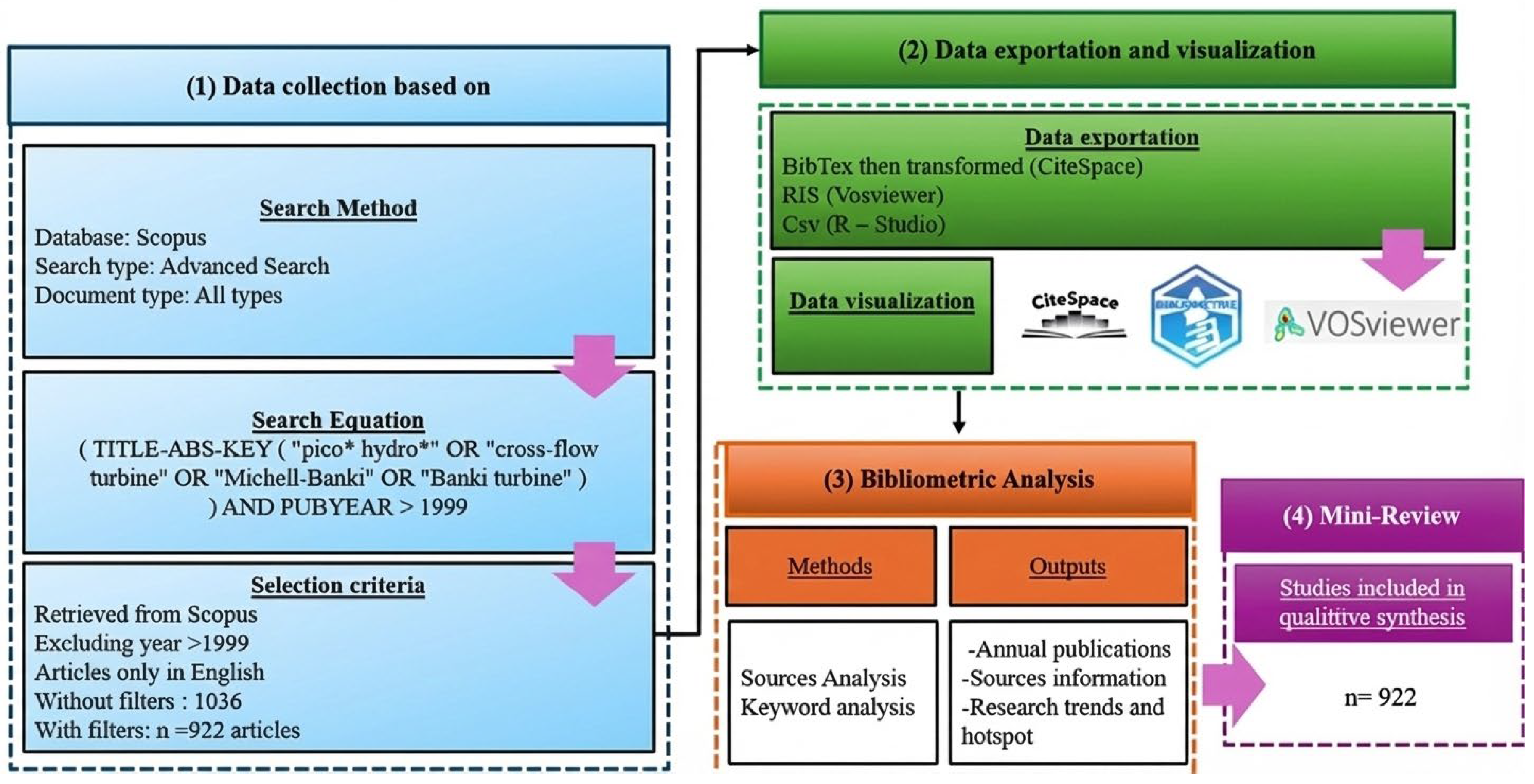
Figure 1. Methods for scientometric analysis, adapted from [18].
Water 17 03524 g001
Figure 2. Co-occurrence of keywords analysis. In the network, node (symbol) size is proportional to the co-citation frequency of each reference, so larger symbols correspond to more frequently co-cited papers.
Water 17 03524 g002
Figure 3. Top 25 keywords with the Strongest Citation Bursts. In this figure, “Year” indicates the starting year in which the citation burst for each keyword is detected; the red bars show the duration of that burst along the 2000–2025 timeline.
Water 17 03524 g003
Figure 4. Bibliometric keyword co-occurrence heatmap for pico-hydropower research. The color intensity indicates the frequency and centrality of keyword occurrences: yellow denotes high frequency or central importance, while blue denotes lower relevance or frequency.
Water 17 03524 g004
Figure 5. Timeline with keywords co-occurrence analysis.
Water 17 03524 g005
Figure 6. Thematic map.
Water 17 03524 g006
Figure 7. Research trends in different periods.
Water 17 03524 g007
Figure 8. Schematic comparison of efficiency curves between a Michell-Banki and a Pelton turbine for a hypothetical case. The cross-flow turbine (solid blue line) exhibits an efficiency plateau around the BEP (best efficiency point) that extends to flow rates of 50% Qd with only a slight decrease in performance.
Water 17 03524 g008
Table 1. Local impact of sources.
Sourcesh-Indexg-Indexm-IndexTCNPPY-Start
Renewable Energy234211891582003
Energy Procedia9130.818262132015
Ocean Engineering990.7516392014
Journal of Advanced Research in Fluid Mechanics and Thermal Sciences8131204262018
International Journal of Marine Energy770.63610672015
Journal of Renewable and Sustainable Energy7110.7164112016
Water (Switzerland)780.77815582017
CFD Letters690.7511992018
Energies6130.462339132013
Renewable and Sustainable Energy Reviews670.31635872007
Note: h-index—number of publications with at least h citations each; g-index—an index giving more weight to highly cited publications, defined as the highest number g such that the g most cited articles have collectively at least g_index > citations; m-index—the h-index divided by the number of years since the first publication (average annual impact rate); TC (total citations)—total number of citations received by the source’s publications; NP (number of publications)—total number of articles published in the field.
Table 2. Research gaps in Michell-Banki turbines (2000–2025).
ReferencesResearch GapAnalytical ImplicationSolution StrategyKey Studies/Examples
[64]Lack of comparable Q–H–η curvesThe lack of normalized hill charts makes it difficult to compare dice, calibrate CFDs, and extrapolate performance across scales; it leads to oversizing and efficiency losses.Unified testing protocols and open data repositories; parametric metamodels for generating standard curves from a few experimental points.Database of 270 plants compiled by Svrkotaetal as an initial attempt at synthesis.
[65,66]Economic Analysis Sub-Report (LCOE)Without energy cost metrics, technical results lack context: policy and financing decisions are based on conjecture.Integrate LCOE/IRR templates into articles and design software; editorial requirement to include a minimum techno-economic evaluation.Klein & Fox’s review shows dispersion of LCOE (0.02–0.30 USD/kWh) and lack of homogeneous data.
[67]Poor validation at altitudes >3000 mThe real-world performance of these systems in the Andes and Himalayas is still uncertain, as reduced atmospheric pressure can affect cavitation and net head, posing risks of unforeseen failures and escalated costs.Portable test benches and in situ monitoring campaigns; altitude correction factors in design guides.ESHA manuals warn of suction lift reduction, but dedicated testing on Banki turbines is lacking.
[68,69]Lack of post-installation sustainability analysisWithout follow-up of ≥5 years, the true failure rates, community management, and social returns are unknown; projects can collapse without registration.Periodic technical audits + socio-productive surveys; case banks with lessons learned to inform design and policies.A longitudinal study by Poudeletal identifies 30% of plants inoperative due to a lack of spare parts and training.
[70,71]Limited integration of IoT, digital twin and MLLack of sensor technology and predictive models limits real-time optimization, preventive maintenance, and collective learning; Industry 4.0 is underutilized.Implement low-cost sensors, lightweight SCADA, and digital twins; train ML algorithms for predictive maintenance and adaptive control.Sinagraetal created a digital twin for cross-flow turbine valves; still scarce in pico hydro.
Disclaimer/Publisher’s Note: The statements, opinions and data contained in all publications are solely those of the individual author(s) and contributor(s) and not of MDPI and/or the editor(s). MDPI and/or the editor(s) disclaim responsibility for any injury to people or property resulting from any ideas, methods, instructions or products referred to in the content.