Article

A Theoretical Model for Pipe Roof Support in Shallow Buried Tunnels Considering Changes in Water Content

1
Guangzhou Beierhuan Transportation Technology Co., Ltd., Guangzhou 510000, China
2
School of Civil Engineering, Sun Yat-sen University, Guangzhou 510275, China
*
Author to whom correspondence should be addressed.
Water 2025, 17(24), 3521; https://doi.org/10.3390/w17243521
Submission received: 1 November 2025 / Revised: 1 December 2025 / Accepted: 10 December 2025 / Published: 12 December 2025
(This article belongs to the Section Hydraulics and Hydrodynamics)

Abstract

Environmental conditions at shallow-buried tunnel portals often cause stratum moisture content variations, where pipe roof support is commonly used for pre-reinforcement. While studies show water content significantly affects soil strength, its impact on pipe roof behavior remains largely unexplored. This study develops a theoretical model for pipe roof longitudinal internal forces and deformations using Pasternak two-parameter foundation theory, incorporating subgrade reaction and shear moduli expressions that vary with saturation. Validation against field measurements shows good agreement with peak values, confirming model reliability. Parametric analysis reveals that increasing water content markedly amplifies pipe roof deformation: in unsaturated ground, deflection and rotation increase significantly with water content, while peak bending moment and shear force near the tunnel face slightly decrease. Under saturated conditions, the increases in deflection and rotation become substantially greater. The model quantitatively evaluates water content’s influence on pipe roof mechanical behavior, providing a theoretical basis for optimizing support systems in water-rich strata.

1. Introduction

The environmental conditions at the portal sections of shallow-buried tunnels often lead to changes in the moisture content of the stratum, where pipe roof support is commonly used for pre-reinforcement [1,2]. As an advanced pre-support measure for tunnels, the pipe roof grouting reinforcement technique can effectively reduce construction risks at the portal sections of shallow-buried tunnels [3] and is widely used in regions with humid and rainy climates, such as South China [4]. The soil above shallow-buried tunnels is often in an unsaturated state. Numerous existing studies have shown that changes in water content affect the physical and mechanical properties of soil, such as granite residual soil widely distributed in tropical and subtropical regions. For instance, Zhao et al. [5], analyzing results from scanning electron microscopy and nuclear magnetic resonance tests, found significant changes in the microstructure of granite residual soil during the wetting process, with an exponential relationship existing between soil structural characterization parameters (such as fractal dimension) and water content. Changes in water content affect the microstructure of soil, thereby influencing its strength characteristics [6]. Field investigation and sampling combined with laboratory analysis studies [7,8] indicate that water content not only affects soil unit weight but also alters soil shear strength by influencing matric suction. Yao et al. [9] investigated the effects of soil compaction and vertical stress on the water retention of granite residual soil and its implications for soil elastic modulus under rainfall and drying conditions through laboratory tests. Lu et al. [10] found that the elastic modulus of soil is closely related to its water content. Therefore, elucidating the influence of water content changes on the mechanical behavior of pipe roofs is of great significance for the design of tunnel pipe roof support.
Currently, there is extensive theoretical research on the mechanical behavior of pipe roof support. Among these, the Pasternak foundation model is widely used in studying the load-bearing mechanism of pipe roofs because it can effectively describe their mechanical behavior during tunnel excavation. For example, Wu et al. [11] analyzed the mechanical response of pipe roof structures considering soil arching effects based on the Pasternak foundation model. Zhang et al. [12] used the finite difference method to calculate the deflection of pipe roofs on a two-parameter foundation with variable subgrade coefficients. Xiao et al. [13] analyzed the interaction between tunnel rock/soil mass and the pipe roof support system during excavation and proposed measures to enhance the overall stability of the pipe roof. Wang et al. [14], by comparing calculation results from different foundation models with field test values, concluded that the pipe roof model based on Pasternak elastic foundation theory is more reasonable. Yang et al. [15] modified the Pasternak foundation model and established a mechanical model for pipe roofs in shallow-buried tunnels under biased pressure terrain. Chen et al. [16], based on the Pasternak beam model and considering the generalized shear force on the beam, derived an analytical solution for the deformation and internal forces of a finite-length beam under arbitrary load, establishing an elastic foundation beam mechanical model for advanced pipe roofs under typical tunnel excavation cycles. Li et al. [17] analyzed the influence mechanism of tunnel construction in soft soil on pile foundations based on the Pasternak shear layer foundation model and established a calculation model for the additional horizontal displacement and internal forces of piles. From the above, it is evident that changes in soil water content significantly affect the physical and mechanical properties of soil. However, the influence of variable soil water content—a critical state in many geotechnical environments—on pipe roof mechanical behavior remains poorly understood and rarely quantified in existing models.
To address this gap, this study develops a Pasternak-based model that incorporates the critical role of water content in pipe roof support. The model explicitly couples saturation-dependent matric suction with soil stiffness to predict internal forces and deformation. A parametric analysis then quantifies the influence of unsaturated conditions on structural behavior during excavation, providing practical design guidance for such environments

2. Model Development Model for Pipe Roof on Pasternak Foundation Considering Water Content

2.1. Influence of Water Content on the Two Parameters of Pasternak Foundation Theory

Elastic modulus is a key parameter in foundation settlement calculation. Existing stress–strain experimental results for unsaturated soils indicate that the elastic modulus is significantly affected by matric suction [18]. Therefore, it is necessary to consider the influence of soil saturation state on the elastic modulus and, consequently, on the two Pasternak parameters (i.e., soil subgrade reaction coefficient k and foundation shear modulus G). This paper adopts the research results from the literature [19] to calculate the two parameters of Pasternak foundation theory. The soil subgrade reaction coefficient k (kN/m3) and foundation shear modulus G (kN/m), which characterize the mechanical properties of the soil, can be expressed using the soil elastic modulus E (GPa), Poisson’s ratio μ, and the equivalent width of the foundation shear layer b (m) as:
k = 5 E 16 1 μ 2 b
G = 13 E b 32 ( 1 + μ )
To establish the relationship between the two parameters and water content, this paper adopts the method proposed in the literature [18], which is widely used internationally. Based on results from indoor model tests on different soils combined with the soil-water characteristic curve, it proposes a relationship between the unsaturated soil elastic modulus Eunsat and the saturated soil elastic modulus Esat and the degree of saturation S:
E u n s a t = E s a t 1 + α ( u a u w ) ( P a / 100 ) S β
where Pa is atmospheric pressure (taken as 100 kPa), α and β are fitting parameters, ua is pore air pressure, uw is pore water pressure, and ua-uw is the matric suction of the soil.
Combining Equations (1)–(3), the soil subgrade reaction coefficient kunsat (kN/m3) and foundation shear modulus Gunsat (kN/m) for the unsaturated soil layer can be obtained as shown in Equations (4) and (5), respectively:
k u n s a t = 5 E u n s a t 16 1 μ 2 b
G u n s a t = 13 E u n s a t b 32 ( 1 + μ )
Therefore, Equations (1), (4) and (5) can be used to calculate the two Pasternak parameters for unsaturated soil, providing key input parameters in the subsequent pipe roof model. Compared to the traditional method of directly using data from geotechnical investigation reports and applying empirical corrections for kunsat (kN/m3) and foundation shear modulus Gunsat (kN/m) in traditional pipe roof theoretical models, the method proposed in this paper reflects the relationship between the water content of the stratum soil and the mechanical behavior of the pipe roof.

2.2. Longitudinal Mechanical Model of Pipe Roof in Unsaturated Stratum Based on Pasternak Foundation Theory

Assuming the soil in the unsaturated stratum where the pipe roof is located is a homogeneous medium (i.e., uniform unsaturation and porosity) with continuous stress and deformation, the pipe roof is simplified as an Euler-Bernoulli beam longitudinally for force and deformation calculation, establishing a pipe roof analysis model based on Pasternak elastic foundation theory [15]. Treating the pipe roof as a beam with a constant cross-section, the mechanical equilibrium equation of the beam is derived based on static equilibrium conditions. Introducing the relationship between structural displacement and internal force from the Bernoulli-Euler beam theory, the governing differential equation for the deflection (m) of the pipe roof is obtained as Equation (6) [15,20]:
E I d 4 ω ( x ) d 4 x G b d ω 2 ( x ) d x 2 + k b ω ( x ) = b q ( x )
Substituting Equations (4) and (5) into Equation (6) yields the governing differential equation for the deflection of the pipe roof in unsaturated soil, as shown in Equation (7). Here, E represents the equivalent elastic modulus of the pipe roof structure given as E = E 1 I 1 + E 2 I 2 / I 1 + I 2 , where the subscript 1 and 2 indicate the properties of pipe and grout, respectively, I is its cross-sectional moment of inertia (m4) taken as the sum of I1 and I2, w(x) is the deflection of the beam at point x (m), b is the equivalent width of the foundation shear layer (m), q(x) is the overlying surrounding rock pressure on the pipe roof (kPa), and q(x) = γh, where γ is the unit weight of the overlying soil on the tunnel pipe roof, and h is the burial depth of the tunnel pipe roof (m).
E I d 4 ω ( x ) d 4 x 13 E u n s a t b 2 32 ( 1 + μ ) d ω 2 ( x ) d x 2 + 5 E u n s a t 16 1 μ 2 ω ( x ) = b q ( x )

2.3. Model Solution

This section adopts the computational model established in the author’s previous research [15] and uses the matrix method for model solution. According to the construction characteristics of advanced pipe roof support in tunnels, the pipe roof is divided along the tunnel excavation direction into the supported section (AO), the excavated but unsupported section (OB), the disturbed zone in the unexcavated section (BC), and the undisturbed zone in the unexcavated section (CD), as shown in Figure 1.
In the OB section, the structure is only subjected to the overlying surrounding rock load, so q(x) in Equation (7) is 0; for the BC section, the pipe roof is subjected to both the overlying surrounding rock load and the foundation reaction force; while in the CD section, only the foundation reaction force exists, so q(x) in Equation (7) is 0. Therefore, Equation (7) can be solved at different sections (OB, BC, and CD) of the pipe roof, and the deflection for the different zones is obtained as Equations (8), (9) and (10), respectively.
ω OB ( x ) = 1 24 E I b q ( x ) x 4 + π 1 x 3 + π 2 x 2 + π 3 x + π 4
ω BC ( x ) = e α 1 x ( ζ 1 cos α 2 x + ζ 2 sin α 2 x ) + e α 1 x ζ 3 cos α 2 x + ζ 4 sin α 2 x + q ( x ) k u n s a t
ω CD ( x ) = e α 1 x ( ζ 1 cos α 2 x + ζ 2 sin α 2 x ) + e α 1 x ζ 3 cos α 2 x + ζ 4 sin α 2 x
where the dimensional parameters α1 and α2 (in units of rad/m) are related to attenuation rates and are given by:
α 1 = 1 + G u n s a t b 1 2 2 k u n s a t E I 1 2
α 2 = 1 G u n s a t b 1 2 2 k u n s a t E I 1 2
Substituting Equations (4) and (5) into Equations (11) and (12) yields Equations (13) and (14):
α 1 = 1 + 13 5 b 2 80 I 1 μ 1 + μ 1 2
α 2 = 1 13 5 b 2 80 I 1 μ 1 + μ 1 2
The parameters π1, π2, π3, π4 and ζ1, ζ2, ζ3, ζ4 are integral constants to be determined, which can be solved once the boundary conditions are known. Specifically, the starting of the pipe roof, i.e., point A (x = 0) at the tunnel portal (Figure 1), is simplified as an elastically fixed end. Therefore, the boundary conditions at point A are:
ω A | x = 0 = w 0 ,   θ A | x = 0 = ω A | x = 0 = θ 0
where the subscript 0 indicates initial values.
Furthermore, the mechanical response of the pipe roof structure must strictly follow displacement continuity conditions and load transfer continuity principles. Therefore, at the tunnel face position, i.e., point B, the displacements and rotations on its left and right sides are equal. Let the length of the excavated section AB be L. Then, as the critical point between sections AB and BC, point B satisfies the relationship shown in Equation (16).
ω A B | x = L = ω B C | x = L ,   ω A B | x = L = ω B C | x = L , ω A B | x = L = ω B C | x = L ,   ω A B | x = L = ω B C | x = L
Since the pipe roof is simulated as a semi-infinite elastic foundation beam, the displacement and rotation at the far end of the pipe roof can be considered negligible. Therefore, for point D at the end of the undisturbed zone CD, assuming x approaches infinity, under this limit condition, the end deflection is 0 and the end rotation is 0, satisfying the relationship shown in Equation (17):
ω D | x = 0 ,   θ D | x = ω D | x = | 0 |
Now the boundary conditions (Equations (15)–(17)) are established in which the unknowns can be transformed into a matrix equation form as Equation (18):
0 0 0 1 0 0 0 0 1 0 0 0 a 3 a 2 a 1 e a α 1 cos ( a α 2 ) e a α 1 sin ( a α 2 ) 3 a 2 2 a 1 0 c 45 c 46 6 a 2 0 0 c 55 c 56 6 0 0 0 c 65 c 66 π 1 π 2 π 3 π 4 ζ 3 ζ 4 = ω 0 θ 0 ρ 3 ρ 4 ρ 5 ρ 6
From the equations, ζ1 and ζ2 are both 0, so they are not reflected in the matrix. The parameters on the left side of the matrix equation are:
c 45 = e a α 1 ( α 2 sin ( a α 2 ) + α 1 cos ( a α 2 ) ) ,   c 46 = e a α 1 α 1 sin ( a α 2 ) α 2 cos ( a α 2 ) c 55 = e a α 1 2 α 1 α 2 sin ( a α 2 ) ( α 1 2 α 2 2 ) cos ( a α 2 )   c 56 = e a α 1 2 α 1 α 2 cos ( a α 2 ) ( α 1 2 α 2 2 ) sin ( a α 2 ) c 65 = e a α 1 ( α 2 3 3 α 1 2 α 2 ) sin ( a α 2 ) + ( α 1 3 3 α 1 α 2 2 ) cos ( a α 2 ) c 66 = e a α 1 ( α 2 3 3 α 1 2 α 2 ) cos ( a α 2 ) + ( α 1 3 3 α 1 α 2 2 ) sin ( a α 2 )
Parameters ρ3 to ρ6 on the right side of the matrix equation are parameter expressions, whose forms are related to the adopted elastic modulus of the unsaturated soil layer:
ρ 3 = q x 16 1 μ 2 b 5 E b a 4 24 E I ,   ρ 4 = q x b a 3 6 E I ,   ρ 5 = q x b a 2 2 E I ,   ρ 6 = q x b a E I
Therefore, based on the deflection expressions (Equations (6) and (7)) for the aforementioned tunnel segments, the corresponding solutions for deflection, rotation (as the derivative of deflection), bending moment ( M x = E I d 2 ω / d x 2 , kN·m), and shear force (derivative of bending moment, kN) for each segment can be derived. For example, for the excavated but unsupported OB segment:
ω OB ( x ) = b q 24 E I x 4 + π 1 x 3 + π 2 x 2 + π 3 x + π 4
θ OB ( x ) = b q 6 E I x 3 + 3 π 1 x 2 + 2 π 2 x + π 3
M OB ( x ) = b q 2 x 2 6 π 1 E I x 2 E I π 2
V OB ( x ) = b q x 6 π 1 E I
which can be expressed in matrix form as:
ω OB ( x ) θ OB ( x ) M OB ( x ) V OB ( x ) = q x b x 1 24 E I x 3 1 6 E I x 2 1 2 x 1 + x 3 x 2 x 1 3 x 2 2 x 1 0 6 E I x 2 E I 0 0 6 E I 0 0 0 π 1 π 2 π 3 π 4
Similarly, the deflection, rotation, bending moment, and shear force for the disturbed zone BC in front of the tunnel face are
ω BC ( x ) θ BC ( x ) M BC ( x ) V BC ( x ) = q x k u n s a t 0 0 0 + e α 1 x cos ( α 2 x ) e α 1 x sin ( α 2 x ) e α 1 x α 2 sin ( α 2 x ) + α 1 cos ( α 2 x ) e α 1 x α 2 cos ( α 2 x ) α 1 sin ( α 2 x ) 2 E I e α 1 x α 1 α 2 sin ( α 2 x ) + ( α 2 2 α 1 2 ) cos ( α 2 x ) E I e α 1 x ( α 2 2 α 1 2 ) sin ( α 2 x ) + 2 α 1 α 2 cos ( α 2 x ) E I ( α 2 3 3 α 1 2 α 2 ) sin ( α 2 x ) E I ( 3 α 1 α 2 2 α 1 3 ) cos ( α 2 x ) E I ( 3 α 1 α 2 2 α 1 3 ) sin ( α 2 x ) E I ( 3 α 1 2 α 2 α 2 3 ) cos ( α 2 x ) ζ 3 ζ 4
and for the stable zone CD in front of the tunnel face:
ω C D ( x ) θ C D ( x ) M C D ( x ) V C D ( x ) = e α 1 x cos ( α 2 x ) e α 1 x sin ( α 2 x ) e α 1 x α 2 sin ( α 2 x ) + α 1 cos ( α 2 x ) e α 1 x α 2 cos ( α 2 x ) α 1 sin ( α 2 x ) 2 E I e α 1 x α 1 α 2 sin ( α 2 x ) + ( α 2 2 α 1 2 ) cos ( α 2 x ) E I e α 1 x ( α 2 2 α 1 2 ) sin ( α 2 x ) + 2 α 1 α 2 cos ( α 2 x ) E I ( α 2 3 3 α 1 2 α 2 ) sin ( α 2 x ) E I ( 3 α 1 α 2 2 α 1 3 ) cos ( α 2 x ) E I ( 3 α 1 α 2 2 α 1 3 ) sin ( α 2 x ) E I ( 3 α 1 2 α 2 α 2 3 ) cos ( α 2 x ) ζ 3 ζ 4
Once the unsaturated soil elastic modulus is determined using Equation (1), the subgrade reaction coefficient and shear modulus are subsequently calculated via Equations (4) and (5). These parameters are then used in Equations (25)–(27) to compute the deformation and internal forces of the pipe roof within the OB, BC, and CD segments for a single excavation cycle.

3. Model Verification and Parametric Analysis

Measured data on tunnel pipe roof deformation in the literature seldom report stratum saturation or water content. Therefore, this paper first validates the computational model using a dataset from literature [14] that includes the necessary deformation measurements. The application of this model requires the soil–water characteristic curve (SWCC) for the specific soil to relate water content to matric suction. Subsequently, a parametric analysis is conducted by varying the saturation of the soil layer surrounding the pipe roof, thereby quantifying its influence on the pipe roof’s internal forces and deformation.

3.1. Model Verification

The pipe roof design parameters used in this paper are consistent with those in the literature [14]. The excavation width and burial depth of the tunnel are 15.13 m and 5.137 m, respectively. The portal section is mainly silty clay, and the friction angle and unit weight have been reported to be 20° and 19 kN/m3, respectively. The length and spacing (b) of the pipe roof, which is composed of steel pipes with an outer diameter of 108 mm, are 30 m and 40 cm, respectively. The single-cycle excavation advance length a is 1.2 m. The surrounding rock pressure q is 97,507.7 Pa, and the excavation height H is 5 m. It should be noted that the moment of inertia and elastic modulus of the pipe roof both adopt the equivalent moment of inertia and equivalent elastic modulus of the entire pipe roof after grout consolidation; specific values are detailed in Table 1.
For the silty clay stratum encountered in the tunnel excavation, due to the scarcity of field monitoring data that concurrently record pipe roof behavior and soil–water characteristic curves (SWCCs), the SWCC parameters used in this analysis are adopted from the literature for a comparable silty clay [21], which gives matric suctions of 50 kPa and 200 kPa at saturation levels of 1.0 and 0.4, respectively. Poisson’s ratio is taken as 0.3. The unsaturated elastic modulus (Eunsat) was subsequently calculated from these values using Equation (3). The model parameters for the subgrade reaction (k) and shear modulus (G) were then derived from Eunsat via Equations (4) and (5). The parameters α and β in Equation (3) control the nonlinearity of the soil stiffness with respect to matric suction. Ideally, these parameters should be calibrated using site-specific soil data. However, the essential strength and SWCC data required for this calibration were not reported in the case study used for comparison. While Ref. [18] provided values for sandy soils, no specific values were available for the silty clay stratum in our case. Therefore, we adopted a value of 1.0 for both parameters. This assumption is justified for the following reasons: This value lies within the range reported for sandy soils [18] in the literature and serves as a standard reference point for parametric studies; a brief sensitivity analysis reveals that the model is symmetrically sensitive to ±25% variations in both α and β, leading to a ~±30% change in the computed elastic modulus and a consequent ∓30% change in the peak deflection. This confirms that while the exact values of α and β influence the quantitative output, the model’s qualitative behavior and the primary influence of saturation remain robust. The selection of α = β = 1.0 is considered a reasonable choice for this study.
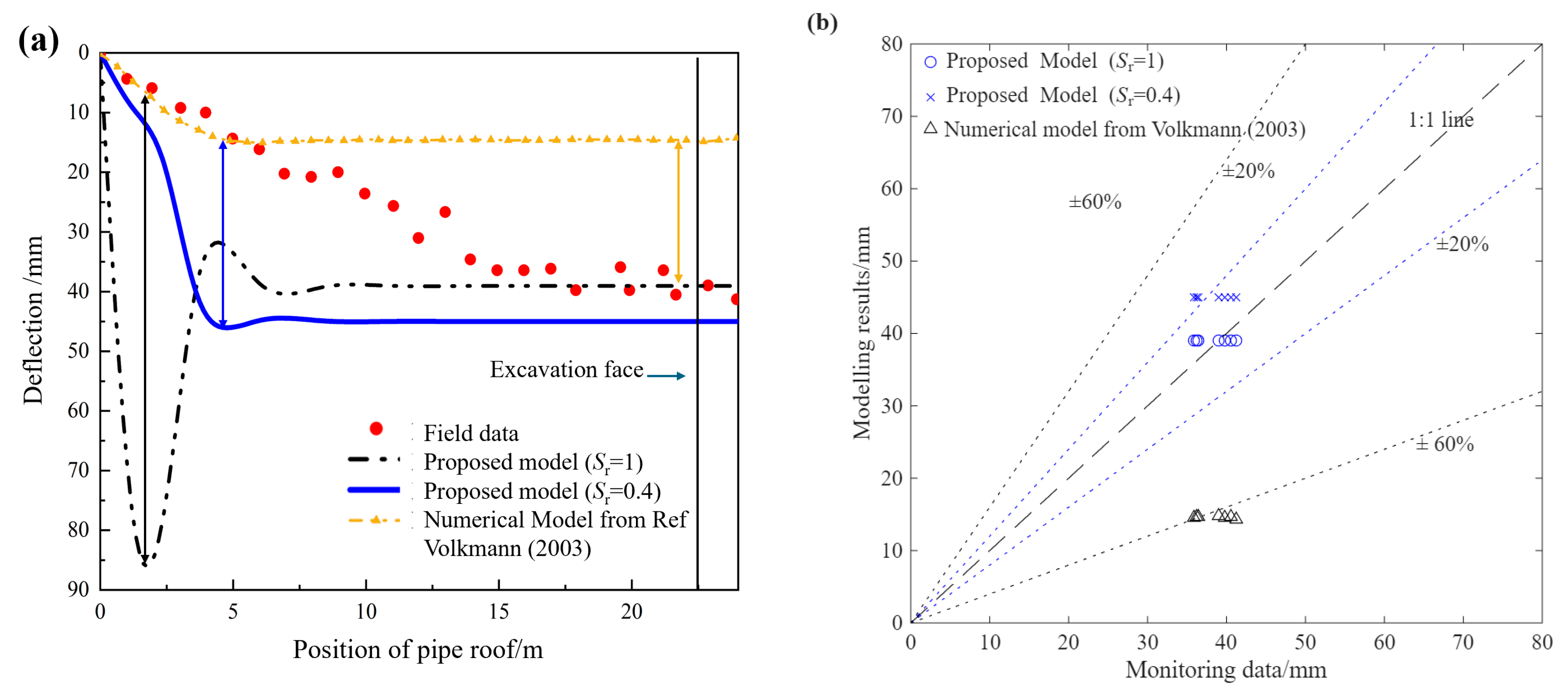
The deflection distribution and magnitude of the pipe roof calculated by the proposed model are relatively consistent with the field monitoring results and the numerical model calculation results proposed in the relevant literature [22] (as shown in Figure 2). The theoretically predicted deflection of the pipe roof all show a characteristic of first gradually increasing and then tending to stabilize. Changes in water content not only affect the asymptotic value of the deflection but also affect its peak value. For example, when the soil layer is fully saturated, i.e., under the extreme condition of direct excavation in a water-rich stratum, it can be found that within the excavation distance of 3 m in front of the entrance, the deflection of the tunnel pipe roof increases sharply, followed by a gradual decrease after reaching the peak. The peak deflection is about twice that calculated when the soil saturation is 0.4. After 6 m from the entrance, the deformation of the pipe roof tends to stabilize, and its value is slightly smaller than the stabilized deflection value when the soil saturation is 0.4. Especially, the prediction results when the soil saturation is 0.4 are more consistent with the data when the tunnel face is excavated to a position 22.5 m from the entrance than the results when the soil saturation is 1. When comparing the data at the tunnel face, the model results are closer to the field-measured data compared to the calculation results of previous numerical models (Figure 2b). Therefore, changes in water content have an important influence on both the peak and asymptotic values of deflection.
The hydro-mechanical behavior of unsaturated soils is highly dependent on an accurate soil–water characteristic curve (SWCC), which is a function of soil type, hysteresis, and void ratio [8,23]. Consequently, the proposed model requires further calibration with site-specific SWCC data when such monitoring data becomes available.

3.2. Parametric Analysis of Pipe Roof Mechanical Behavior Under Different Soil Water Contents

The parametric analysis in this section focuses on the influence of water content, as the relationship between saturation, matric suction, and soil stiffness is a central and novel component of the proposed model. While the sensitivity of the model to geometric parameters (e.g., pipe spacing, diameter) has been explored in prior literature [11,12,13,14,15] under fully drained or saturated conditions, their specific responses to the variation in water content introduced here are a critical area for further investigation. The parametric analysis selects a single steel pipe at the vault of the entrance of the Birgl Tunnel in Austria [12] as the research object. Assuming the initial deflection and initial rotation at the starting end of the pipe roof are both 0 (i.e., initial deflection w0 and initial rotation (rad) θ0 are 0), the mechanical behavior changes in the pipe roof are calculated based on the proposed model when the tunnel face is excavated to a position 1.5 m (a = 1.5 m) from the tunnel entrance. Stratum parameters use data, including the soil water characteristic curve from literature [24], to investigate the influence of water content changes in granite residual soil stratum on the mechanical behavior of the pipe roof during tunnel excavation. Relevant physical parameters are shown in Table 2:
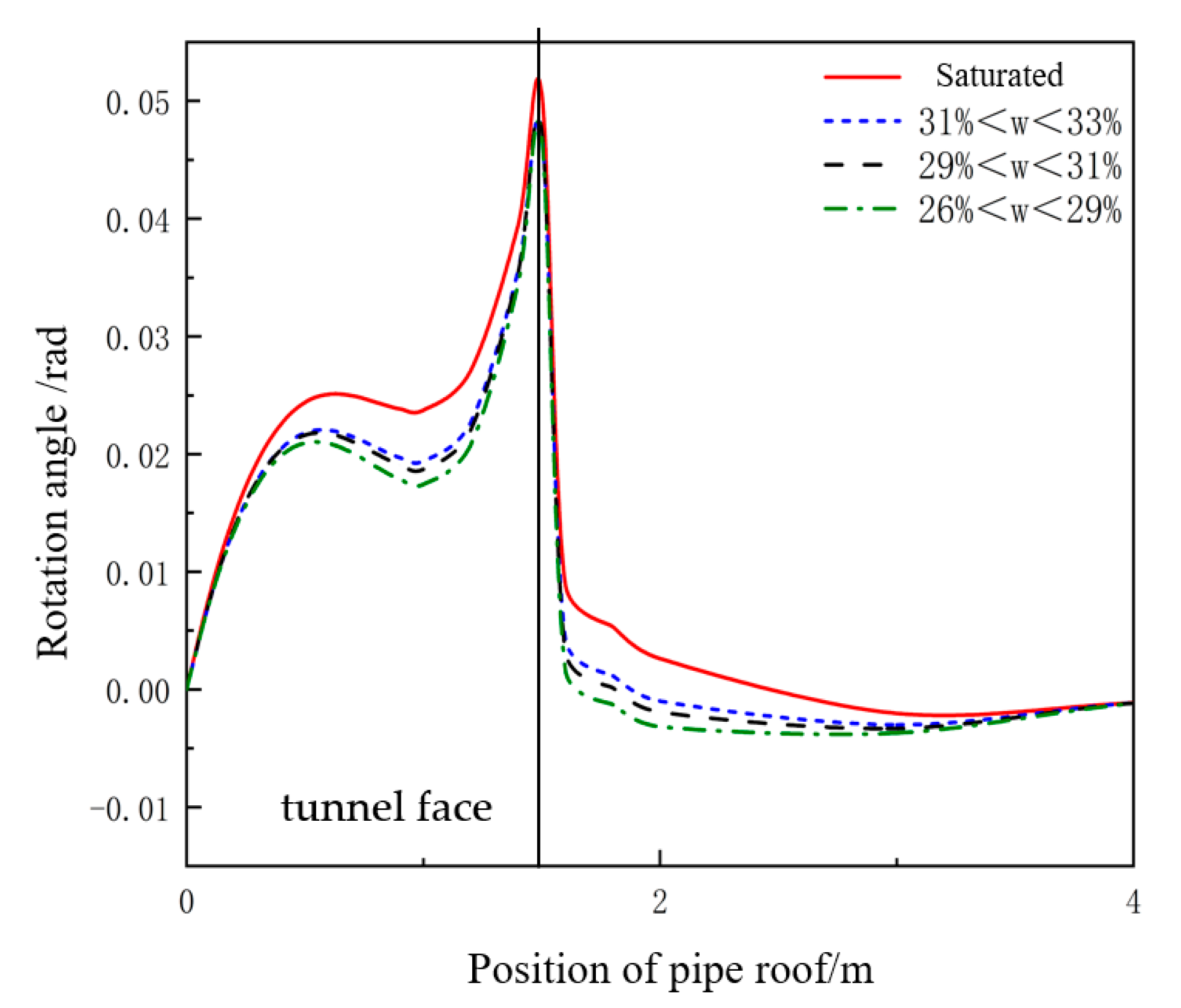
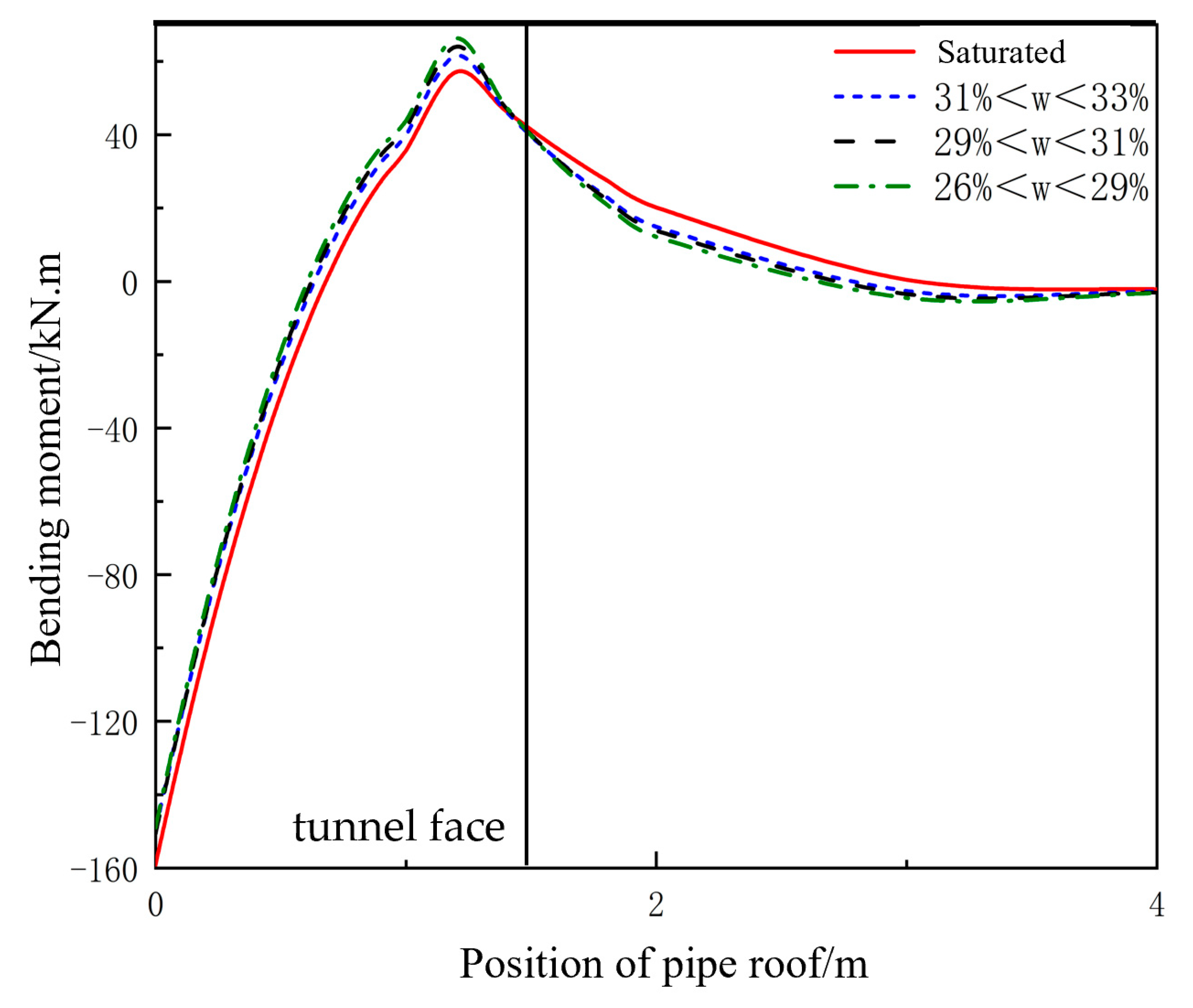
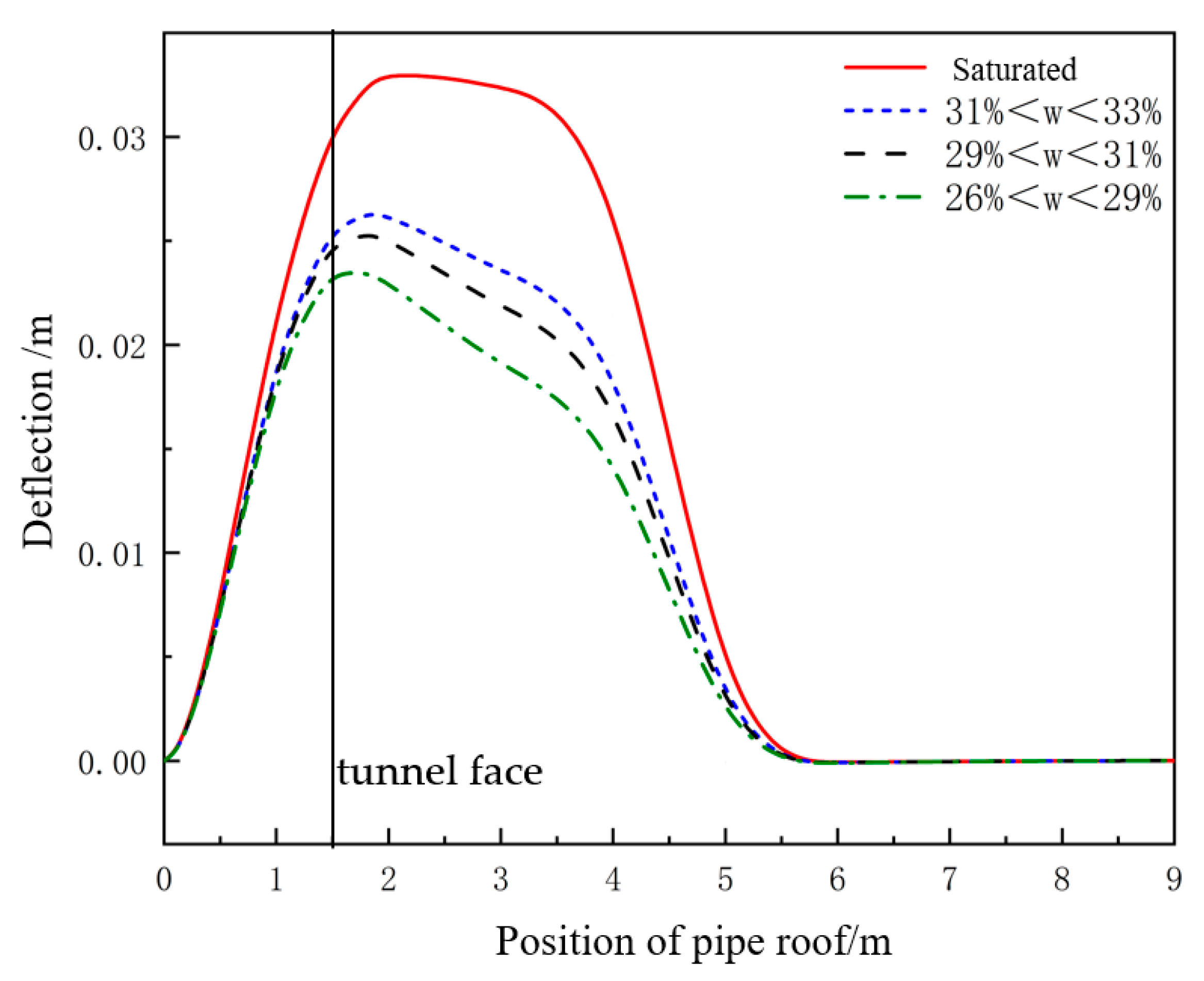
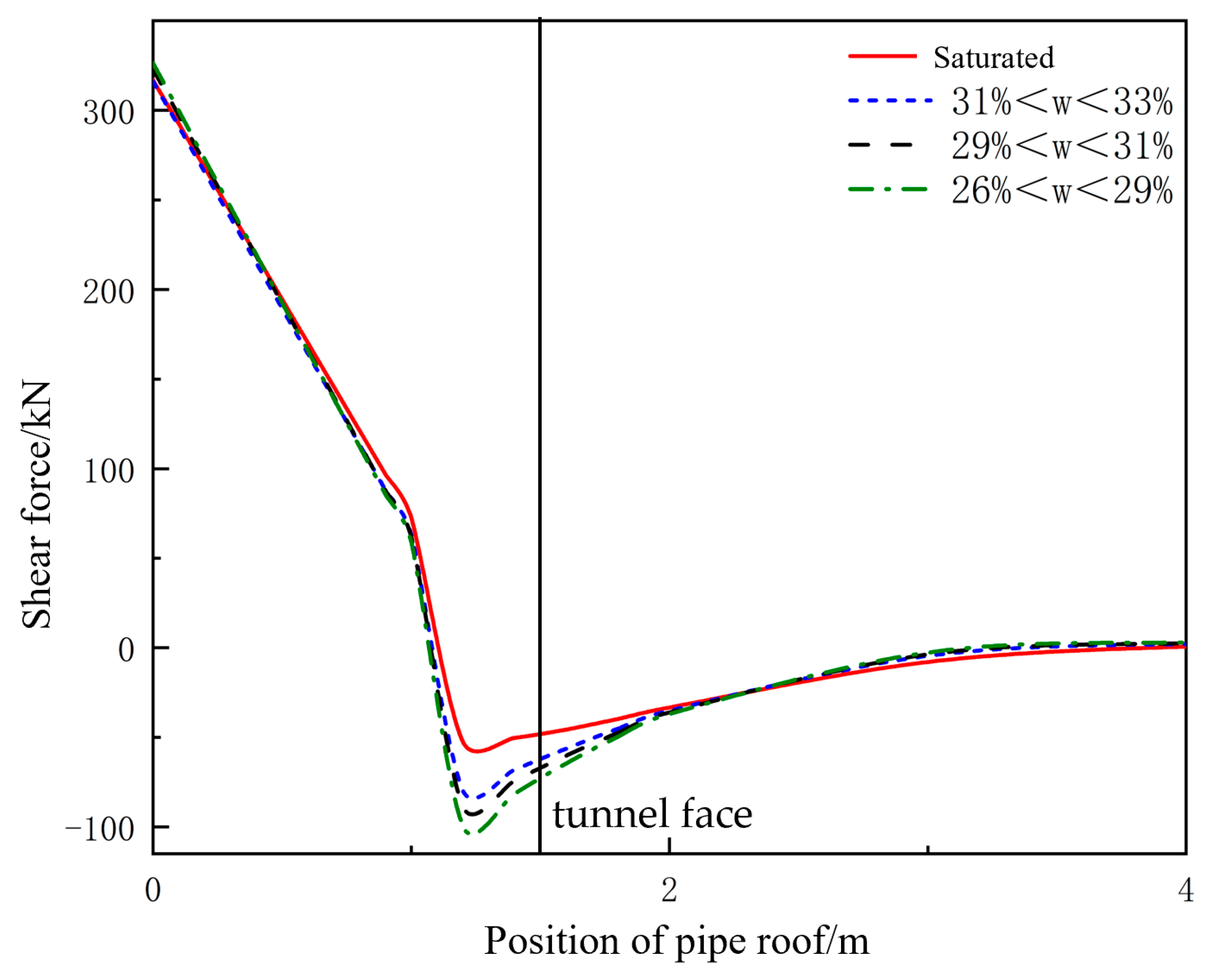
The influence of different water contents in the stratum where the pipe roof is located on the longitudinal deformation (including deflection, rotation) and internal forces (i.e., bending moment, shear force) of the pipe roof during excavation, calculated according to the tunnel face being 3 m from the entrance, are shown in Figure 3, Figure 4, Figure 5 and Figure 6, respectively.
Figure 3 illustrates the distinct influence of stratum water content on pipe roof deflection during tunnel excavation. In both saturated and unsaturated soils, the deflection exhibits a consistent trend: it increases sharply, peaks at a point behind the tunnel face (the first turning point at approximately 3 m), then decreases slowly before a second turning point ahead of the face (also near 3 m), after which it declines sharply and stabilizes. The primary difference lies in the magnitude of deformation and the span between turning points. The distance between the first and second turning points is significantly smaller in unsaturated soil than in saturated soil. Furthermore, within unsaturated conditions, the pipe roof deflection increases progressively with higher soil water content.
Figure 4 illustrates the influence of soil water content on pipe roof rotation. The general trend is consistent across different saturations: rotation increases sharply, followed by a slight decrease, after which it then surges to a peak before a sharp decline and eventual stabilization. The key differences are in the magnitude of deformation. Rotation in saturated soil is significantly greater than in unsaturated soil. Furthermore, within the unsaturated regime, an increase in water content leads to higher rotation values along the entire curve, although the peak rotation remains relatively constant. A significant jump in the peak rotation occurs only when the soil transitions from an unsaturated to a fully saturated state.
Figure 5 shows the influence of soil water content on the bending moment in the pipe roof. The general trend is consistent for all saturation levels: the bending moment increases sharply behind the tunnel face, then decreases slowly before stabilizing. However, the magnitude of the bending moment is highly dependent on water content. The bending moment in the excavated section behind the tunnel face is greater in saturated soil than in unsaturated soil. In contrast, the peak bending moment is larger in unsaturated soil. Furthermore, within the unsaturated regime, a higher soil water content leads to a reduction in the peak bending moment. Consequently, a transition from unsaturated to saturated conditions results in a significant decrease in the peak bending moment.
Figure 6 shows the influence of soil water content on the shear force in the pipe roof. The general trend is consistent for all saturation levels: the shear force decreases sharply, reverses direction, and increases, then decreases again before gradually stabilizing. The primary differences lie in the magnitude of the forces. The shear force in the excavated section behind the tunnel face is slightly smaller in saturated soil than in unsaturated soil. Conversely, the peak shear force is greater under saturated conditions. Furthermore, within the unsaturated regime, a higher soil water content leads to a reduction in the peak shear force. However, a transition from an unsaturated to a fully saturated state causes a significant increase in the peak shear force.

4. Conclusions

This paper proposes a theoretical model, based on the Pasternak foundation theory, for calculating the deformation and internal forces of pipe roofs under varying stratum water content. The model’s novelty lies in its incorporation of the soil–water characteristic curve (SWCC) to define how the subgrade reaction coefficient and shear modulus change with saturation. This allows it to quantitatively assess the impact of water content, a key advancement over traditional models. Due to the scarcity of field data that includes water content measurements, the model was validated against deformation data from the literature. The close agreement between the model’s predictions and the field monitoring data verifies its rationality and practical utility.
Parametric analysis results show that during excavation in unsaturated strata, as the water content of the soil increases, the deflection and rotation deformations of the pipe roof show an increasing trend, while the peak bending moment and shear force near the section behind the tunnel face (excavated section) gradually decrease. Therefore, if the water content of the soil in the stratum continuously increases due to rainfall during construction, it is necessary to consider changing the pipe roof layout scheme to improve construction safety.
Compared with unsaturated strata, during tunnel excavation in saturated strata, both the deflection and rotation deformations of the pipe roof show a significant increasing trend, while the peak bending moment and shear force borne by the pipe roof decrease significantly. Therefore, during construction, close attention should be paid to changes in soil water content, and drainage measures should be taken promptly to avoid the soil transitioning directly from an unsaturated to a saturated state.

Author Contributions

Conceptualization, J.C. and Y.W. (Yan Wang); methodology, M.H.; validation, J.C., Y.W. (Yan Wang) and J.W.; formal analysis, J.C. and J.W.; resources, J.C.; writing—original draft preparation, J.C.; writing—review and editing, M.H., Y.W. (Yan Wang), Y.W. (Yujing Wei) and H.Y. All authors have read and agreed to the published version of the manuscript.

Funding

This research was funded by National Natural Science Foundation of China, grant number 52578495.

Data Availability Statement

The original contributions presented in this study are included in the article. Further inquiries can be directed to the corresponding author.

Acknowledgments

The author H.Y. acknowledges the financial support by National Natural Science Foundation of China (52578495).

Conflicts of Interest

Authors Jingsong Chen, Mu He, Yan Wang and Jianbo Wu were employed by the company Guangzhou Beierhuan Transportation Technology Co., Ltd. The remaining authors declare that the research was conducted in the absence of any commercial or financial relationships that could be construed as a potential conflict of interest.

Nomenclature

SymbolUnitsMeaning
amadvance length of a single-cycle excavation
bmequivalent width of the foundation shear layer
Dmdiameter of pipe
E, Esat, EunsatGPaYoung’s modulus and the one at saturated and unsaturated conditions, respectively
G, GunsatkN/mshear modulus and the one at unsaturated condition
hmburial depth of the tunnel pipe roof
Hmexcavation Height
Im4cross-sectional moment of inertia
k, kunsatkN/m3soil subgrade reaction coefficient and the one at unsaturated condition
MkN·mbending moment
PakPaatmospheric pressure
qkPaoverlying surrounding pressure on the pipe roof
VkNshear force
uakPapore air pressure
uwkPapore water pressure
α, β/fitting parameters in Equation (3)
α1 α21/mattenuation rate parameters in Equations (11) and (12)
μ/Poisson’s ratio
γkN/m3unit weight of the overlying soil on the tunnel pipe roof
φ°internal friction angle
w, w0mdeflection of the beam and initial deflection
ρ3 to ρ6 /abbreviations used for parameter expressions
π1, π2, π3, π4/integral constants in Equation (8)
ζ1, ζ2, ζ3, ζ4/integral constants in Equations (9) and (10)

References

  1. Wei, G.; Xu, R. Prediction of longitudinal ground deformation due to tunnel construction with shield in soft soil. Chin. J. Geotech. Eng. 2005, 27, 1077–1081. [Google Scholar]
  2. Pan, Y.; Zheng, J.; Cui, L. Analysis of responses of pile groups due to tunnelling during excavation and operation periods considering rheological behavior of soft soils. Mod. Tunn. Technol. 2018, 55, 106–114. [Google Scholar]
  3. Song, Z.; Tian, X.; Zhou, G.; Li, W. Theoretical analysis of mechanical behavior of advanced pre-support of pipe-roof in tunnel. China, J. Highw. Transp. 2020, 33, 89–98. [Google Scholar]
  4. Lei, Y.; Shi, C. Study on deformation control technology of shallow and large cross-section tunnel beneath expressway in soft rock. J. Railw. Sci. Eng. 2018, 15, 1239–1246. [Google Scholar]
  5. Zhao, Y.; Feng, W.; Yi, X.; Bai, H.; Li, S.; Zhao, J. Microstructural changes of granite residual soil during humidification process. J. Harbin Inst. Technol. 2025, 57, 132–140. [Google Scholar]
  6. An, R.; Kong, L.; Li, C. Strength attenuation and microstructure damage of granite residual soils under hot and rainy weather. Chin. J. Rock Mech. Eng. 2020, 39, 1902–1911. [Google Scholar]
  7. Li, K.; Wang, Z.; Wei, C.; Yan, R. Effect of saturation on shear strength characteristics of weathered granite slope soils. Rock Soil Mech. 2016, 37, 267–273. [Google Scholar]
  8. Yang, H.; Khoshghalb, A.; Russell, A.R. Fractal-based estimation of hydraulic conductivity from soil–water characteristic curves considering hysteresis. Géotech. Lett. 2014, 4, 1–10. [Google Scholar] [CrossRef]
  9. Yao, Y.; Ni, J.; Li, J. Stress-dependent water retention of granite residual soil and its implications for ground settlement. Comput. Geotech. 2021, 129, 103835. [Google Scholar] [CrossRef]
  10. Lu, N.; Kaya, M. A power law for elastic moduli of unsaturated soil. J. Geotech. Geoenviron. Eng. 2014, 140, 46–56. [Google Scholar] [CrossRef]
  11. Wu, Y.; Xiao, C.; Chen, F.; Cai, G. Study on mechanical characteristics of pipe umbrella support in shallow buried tunnels. Tunn. Undergr. Space Technol. 2024, 145, 105578. [Google Scholar] [CrossRef]
  12. Zhang, Z.; Li, H.; Liu, H.; Li, G.; Shi, X. Load transferring mechanism of pipe umbrella support in shallow-buried tunnels. Tunn. Undergr. Space Technol. 2014, 43, 213–221. [Google Scholar] [CrossRef]
  13. Xiao, H.; Zhou, S.; Sun, Y. Stability analysis and case study of shallow tunnel using pipe roof support. Geotech. Geol. Eng. 2019, 37, 1249–1260. [Google Scholar] [CrossRef]
  14. Wang, D.; Yuan, J.; Li, J.; Peng, X.; Wu, Z.; Liu, W.; Wang, H. Deformation prediction of pipe roof in shallow soft portal section of tunnels considering construction feature. Chin. J. Rock Mech. Eng. 2017, 36, 716–724. [Google Scholar]
  15. Yang, H.; Xu, Z.; Huang, L.; Lin, C.G. A pasternak foundation-based theoretical model for pipe roof support in shallow buried biased pressure tunnel. J. Railw. Sci. Eng. 2025, 22, 3148–3159. [Google Scholar] [CrossRef]
  16. Chen, L.; Jia, C.; Lei, M.; He, Y.; Shi, C.; Li, A. An improved model of the pasternak foundation beam umbrella arch considering the generalized shear force. J. Cent. South Univ. 2025, 32, 1503–1519. [Google Scholar] [CrossRef]
  17. Li, K.; Qi, Y.; Wang, Y.; Chou, H.; Zhang, X.; Wu, G. Analysis of horizontal displacement of single pile induced by lateral penetration of tunnel based on the pasternak shear layer theory. Mod. Tunn. Technol. 2023, 60, 111–119. [Google Scholar]
  18. Oh, W.T.; Vanapalli, S.K.; Puppala, A.J. Semi-empirical model for the prediction of modulus of elasticity for unsaturated soils. Can. Geotech. J. 2009, 46, 903–914. [Google Scholar] [CrossRef]
  19. Lu, X. Mechanical Mechanism of Pipe Roofs Based on the Pasternak Model with Variable Coefficient of Subgrade Reaction. Ph.D. Thesis, Harbin Institute of Technology, Harbin, China, 2016. [Google Scholar]
  20. Zhang, J.; Yan, S.; Wang, W.; Sun, W. Theoretical analysis of bearing mechanism of pipe sheds. J. Southwest Jiaotong Univ. 2025, 60, 111–118. [Google Scholar]
  21. Li, J.; Lu, Z.; Guo, L.; Zhang, L.M. Experimental study on soil-water characteristic curve for silty clay with desiccation cracks. Eng. Geol. 2017, 218, 70–76. [Google Scholar] [CrossRef]
  22. Volkmann, G.M. Rock mass pipe roof support interaction measured by chain inclinometers at the birgltunnel. In Proceedings of the Geotechnical Measurements and Modelling, Karlsruhe, Germany, 23–26 September 2003; pp. 105–109. [Google Scholar]
  23. Yang, H.; Russell, A.R. Cavity expansion in unsaturated soils exhibiting hydraulic hysteresis considering three drainage conditions. Int. J. Numer. Anal. Methods Geomech. 2015, 39, 1975–2016. [Google Scholar] [CrossRef]
  24. Rahardjo, H.; Melinda, F.; Leong, E.C.; Rezaur, R.B. Stiffness of a compacted residual soil. Eng. Geol. 2011, 120, 60–67. [Google Scholar] [CrossRef]
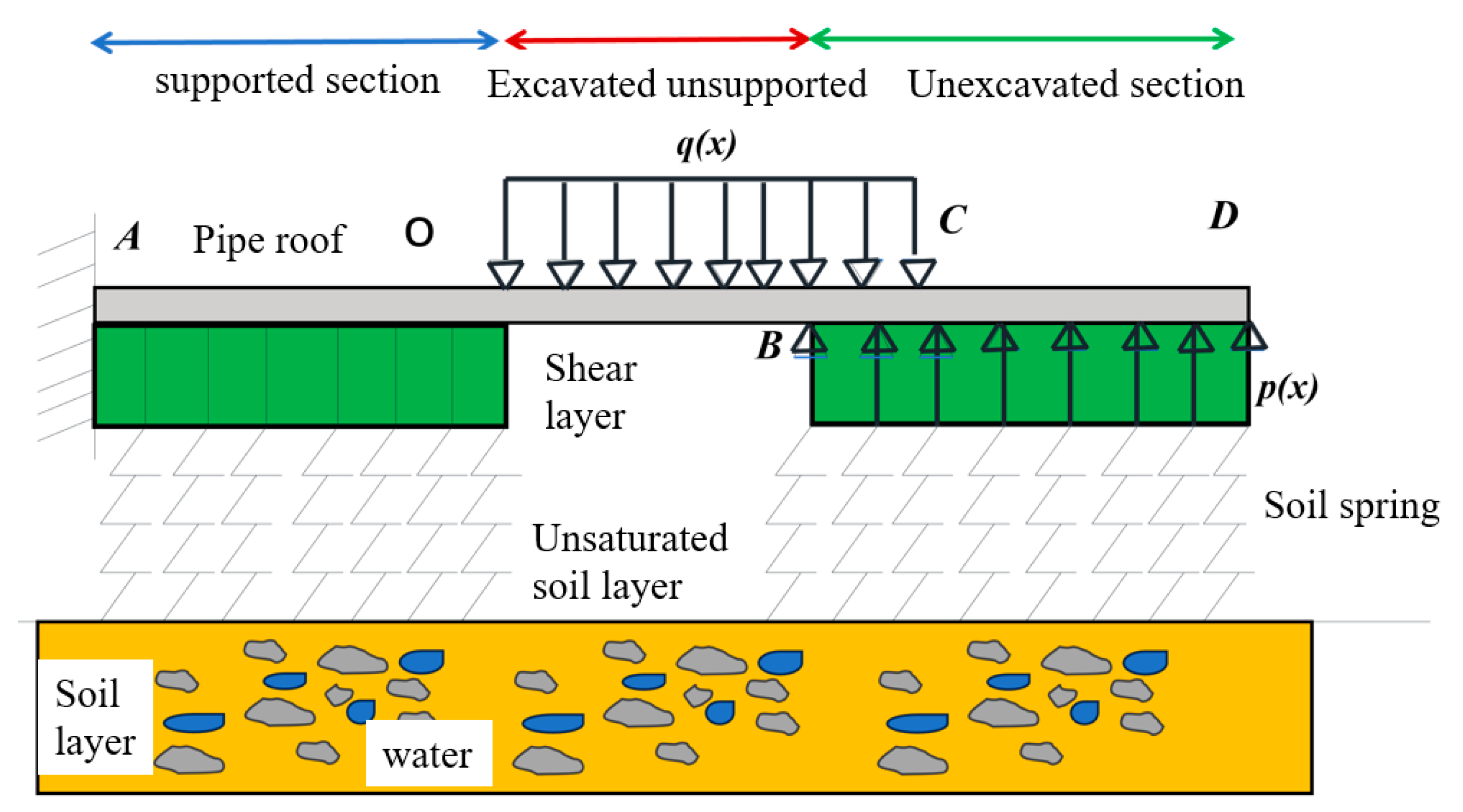
Figure 1. Stress mode for pipe roof under water-rich stratum conditions.
Water 17 03521 g001
Figure 2. Comparison of the proposed model’s predictions and available monitoring data (a) along the excavation and (b) at the excavation face [22].
Water 17 03521 g002
Figure 3. Effect of soil volume moisture content on deflection deformation of pipe shed.
Water 17 03521 g003
Figure 4. Effect of soil volume moisture content on rotation deformation of pipe shed.
Water 17 03521 g004
Figure 5. Effect of soil volume moisture content on the bending moment of the pipe shed.
Water 17 03521 g005
Figure 6. Effect of soil volume moisture content on the shear force of the pipe shed.
Water 17 03521 g006
Table 1. Input parameters for pipe roof analysis.
Excavation Advance, a/(m)Circumferential Spacing, b/(m)Excavation Height H/(m)Surrounding Rock Pressure q/(kPa)Equivalent Moment of Inertia, I/(mm4)Equivalent Elastic Modulus, E/(GPa)Tunnel Burial Depth h/(m)
1.20.4597.507721,510,00091.75.137
Table 2. Physical and mechanical parameters.
Tunnel Burial Depth
h/m
Elastic Modulus
E/MPa
Pipe Diameter
D/mm
Pipe Spacing
b/cm
Internal Friction Angle
φ/(°)
Soil Unit Weight
γ/(kN/m3)
30100114403018.5
Disclaimer/Publisher’s Note: The statements, opinions and data contained in all publications are solely those of the individual author(s) and contributor(s) and not of MDPI and/or the editor(s). MDPI and/or the editor(s) disclaim responsibility for any injury to people or property resulting from any ideas, methods, instructions or products referred to in the content.