1. Introduction
Water quality monitoring is a critical practice for safeguarding public health, protecting the environment, and ensuring sustainable water resource management. Globally, water pollution is an escalating concern, and the deterioration of water quality poses serious threats to ecosystem stability and human well-being [
1]. Real-time and accurate monitoring and prediction of water quality are therefore essential. Effective monitoring systems not only facilitate the timely detection of and response to contamination events but also supply scientific data to support water resource management and policy-making [
2]. With increasing industrialization and climate change impacts worldwide, the significance of robust water quality monitoring continues to grow [
3].
In recent years, water quality prediction has emerged as a vital research focus, with growing emphasis on leveraging advanced computational approaches particularly deep learning to enhance predictive accuracy and operational efficiency. For instance, Lee et al. utilized Long Short-Term Memory (LSTM) models to improve early warnings for harmful algal blooms in major South Korean rivers [
4]. Similarly, Liu et al. demonstrated the feasibility of LSTM-based deep neural networks for water quality prediction in IoT contexts, stressing the importance of high-quality input data [
5]. Hu et al. introduced a deep LSTM approach to predict pH and temperature in smart mariculture, overcoming limitations of traditional forecasting techniques [
6]. Other studies have explored soft sensing of 5-day biochemical oxygen demand (BOD) in urban waters using deep learning [
7], compared multiple machine learning models for surface water quality prediction using large datasets [
8], and developed real-time probabilistic forecasting frameworks combining deep learning with post-processing [
9]. Hybrid architectures, such as CNN-LSTM models, have also shown promise for short-term water quality forecasting [
10], while AI-driven index prediction and classification aid water management decisions. Beyond water quality, deep reinforcement learning has been applied in related areas such as agricultural yield prediction [
11], and comparative analyzes confirm the superiority of deep learning over conventional machine learning in groundwater quality prediction [
12]. Collectively, these studies underscore the potential of deep learning in this domain.
However, existing research has two key limitations: (1) a predominant focus on individual model architectures without systematic integration of feature augmentation strategies, leading to suboptimal handling of temporal dependencies; and (2) limited attention to computational efficiency and data redundancy reduction in high-dimensional water quality datasets. These gaps restrict the practical deployment of real-time prediction systems.
Conventional water quality monitoring typically depends on field sampling and subsequent laboratory analysis. Although accurate, these approaches are time-consuming, labor-intensive, and inadequate for real-time monitoring requirements [
13]. Recent advances in sensor technologies and information systems have promoted the adoption of online monitoring and automated data acquisition [
14]. Nevertheless, challenges such as data instability and limited spatial coverage persist.
In terms of prediction, classical statistical techniques—including regression analysis and time series models—are frequently applied to water quality data, yet they often struggle to capture complex nonlinear dynamics [
15]. The emergence of artificial intelligence and machine learning has opened new avenues for improving predictive performance. Methods such as Support Vector Machines (SVMs), Random Forests (RF), and Artificial Neural Networks (ANNs) have demonstrated improved results [
16]. However, these techniques generally depend on multi-dimensional datasets, which can be difficult to obtain; they often entail considerable model complexity, extended training times, and limited prediction accuracy [
17].
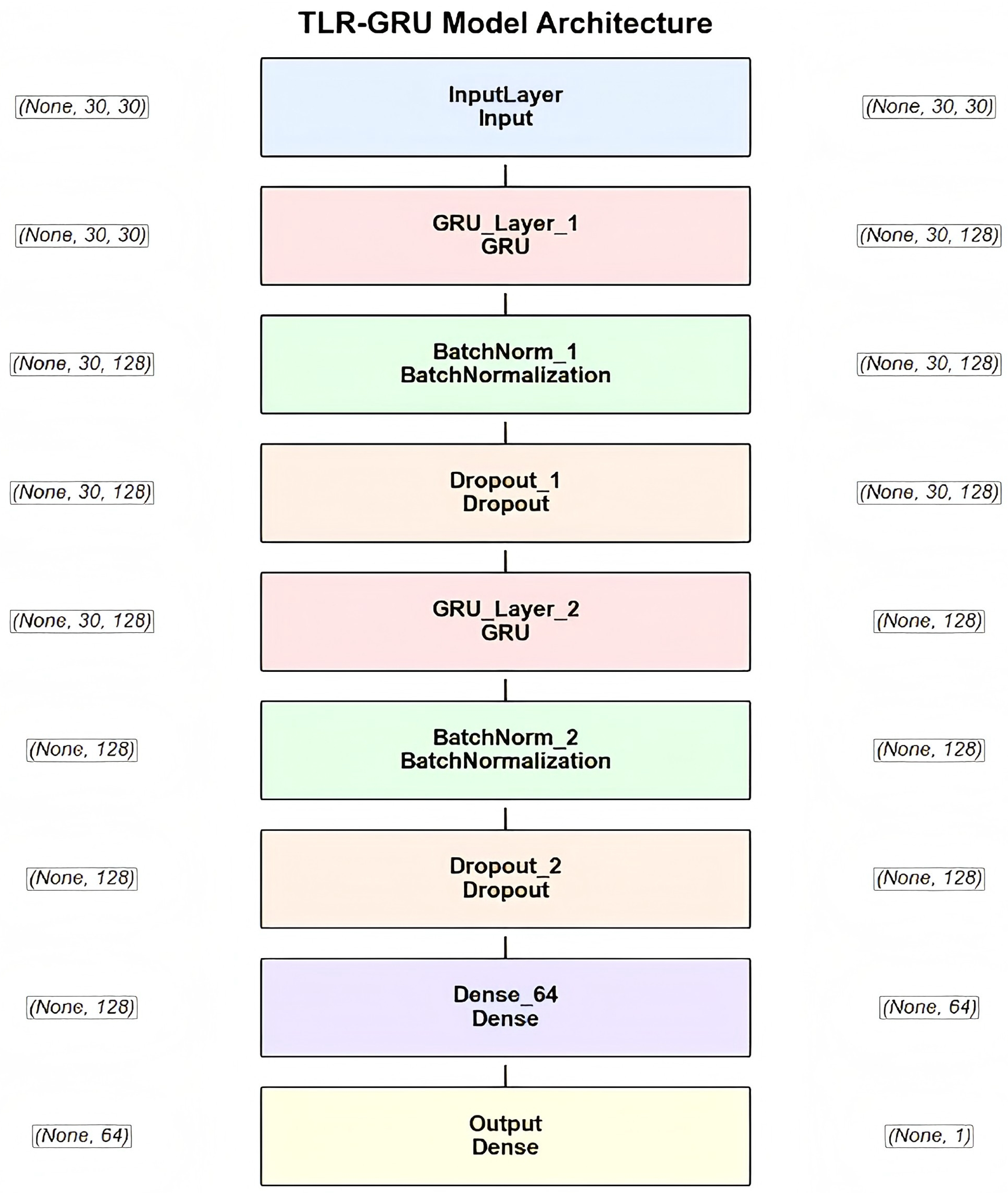
To address these challenges, this study introduces a novel framework that combines multiple feature augmentation techniques with Principal Component Analysis (PCA) and a tailored deep learning model for efficient water quality parameter prediction, as illustrated in
Figure 1 [
18]. The TLR-GRU model was selected for its superior ability to handle long-term dependencies with lower computational complexity than LSTM, while integrated dropout and batch normalization layers mitigate overfitting. We expect the proposed framework to improve predictive accuracy significantly, with preliminary analyses indicating potential gains of over 5% in R
2 and 30% reduction in MAPE.
The key innovations are:
Systematic integration of five feature augmentation methods (time-based, periodic, differenced, lagged, and sliding-window) with PCA for dimensionality reduction, enhancing temporal pattern capture while reducing redundancy.
Development of a Two-Layer Regularized GRU (TLR-GRU) model optimized for water quality time series data, balancing computational efficiency and generalization performance.
Comprehensive evaluation of feature augmentation and model configurations, validating accuracy improvements and operational cost reductions through multi-fidelity validation.
By integrating these components, this work provides a new technical pathway for water quality parameter prediction and offers scientific support for environmental monitoring. The results demonstrate that the proposed methodology enhances predictive performance while maintaining practical viability, underscoring its theoretical and practical relevance.
3. Results and Discussion
This section presents a comprehensive evaluation of the proposed deep learning models for water quality prediction. The analysis compares model performance across different feature augmentation methods, examines computational efficiency, and identifies the optimal configuration based on both accuracy and resource utilization metrics.
3.1. Performance Comparison of Models Under Different Feature Augmentation Methods
Table 4 presents a comprehensive comparison of three deep learning architectures with six feature augmentation methods. The TLR-GRU model with sliding window features demonstrates superior performance, achieving the highest test R
2 (0.941) and lowest error metrics. This configuration reduces RMSE by 27.36% and MAE by 36.71% compared to basic data processing.
The sliding window approach consistently outperforms other feature augmentation methods across all models due to its ability to capture local temporal dynamics and short-term fluctuations in water quality data. By maintaining a moving window of historical observations, this method effectively preserves temporal dependencies while reducing noise and outliers that can negatively impact prediction accuracy.
Analysis of training versus test performance reveals important insights about model generalization. The TLR-GRU model shows minimal overfitting, with only a 1.05% decrease in R2 from training to test sets. In contrast, the TLD-Transformer exhibits significant overfitting, with a 18.9% performance drop, indicating poor generalization capability. This suggests that the regularization strategies in TLR-GRU (batch normalization and dropout) effectively prevent overfitting while maintaining model capacity.
Computational efficiency analysis (
Table 5) shows that the sliding window method imposes moderate resource demands. The TLR-GRU implementation requires 663.451 s training time with 70.331 MB memory utilization, representing a favorable balance between computational cost and predictive performance.
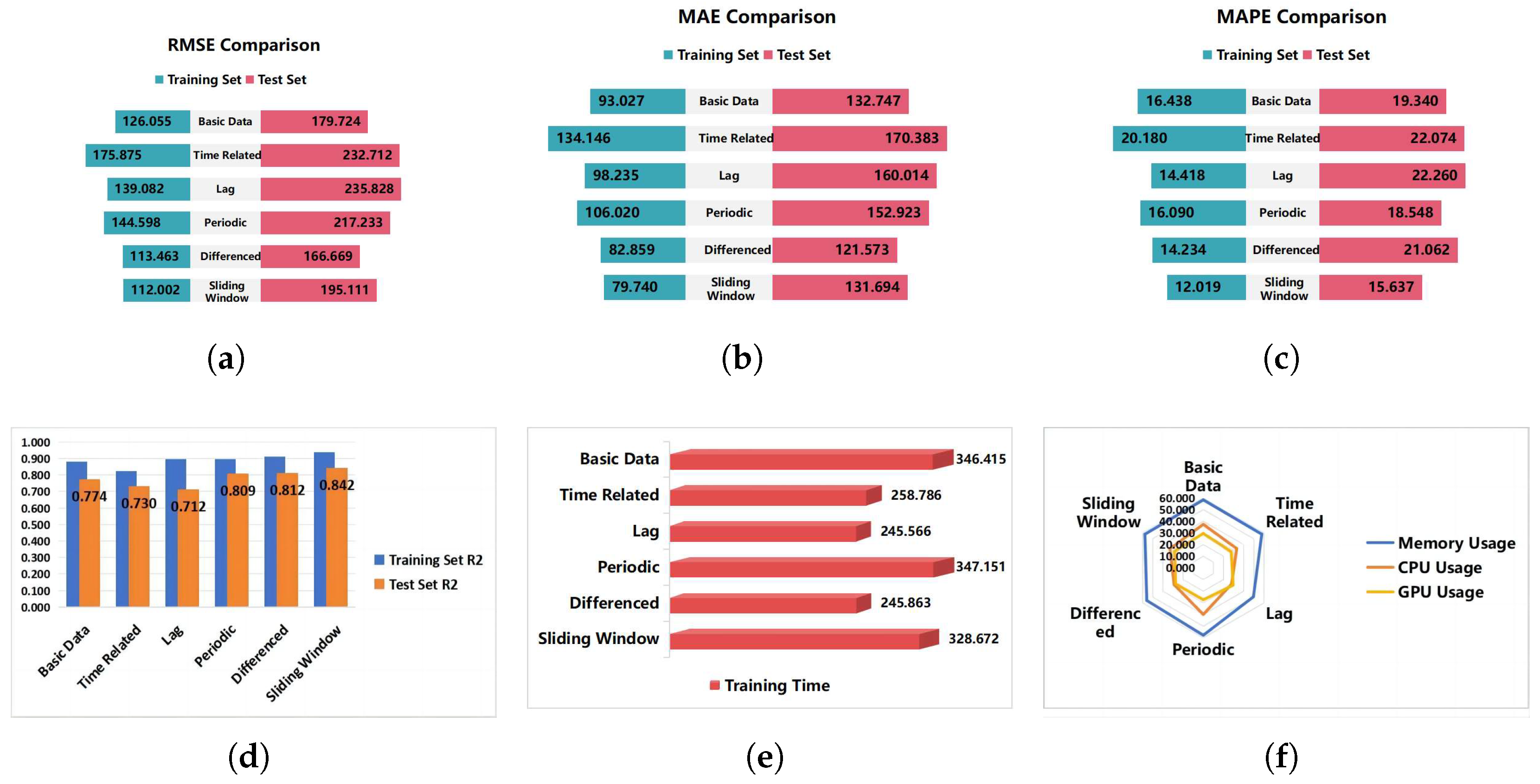
Visual analysis of model performance (
Figure 3) confirms the superiority of the sliding window approach across all evaluation dimensions. The consistency of improvements across accuracy metrics (R
2 improvement: 6.70–8.79%) and error reduction (RMSE reduction: 8.55–27.36%; MAE reduction: 0.79–36.71%; MAPE reduction: 19.15–45.08%) demonstrates the robustness of this feature augmentation method.
3.2. Comparison of Other Models
Evaluation of seven deep learning architectures (
Table 6) reveals significant performance variations. The TLR-GRU model achieves superior generalization with the highest test R
2 (0.941) and lowest error metrics. The WaveNet architecture, while exhibiting excellent training performance (R
2: 0.975), shows reduced test effectiveness (R
2: 0.870), indicating potential overfitting.
Computational efficiency analysis (
Table 7) shows substantial variation in resource requirements. The TLD-Transformer achieves the shortest training time (116.975 s), while the TLR-GRU model occupies an intermediate position with 663.451 s, representing an optimal balance between computational overhead and predictive performance.
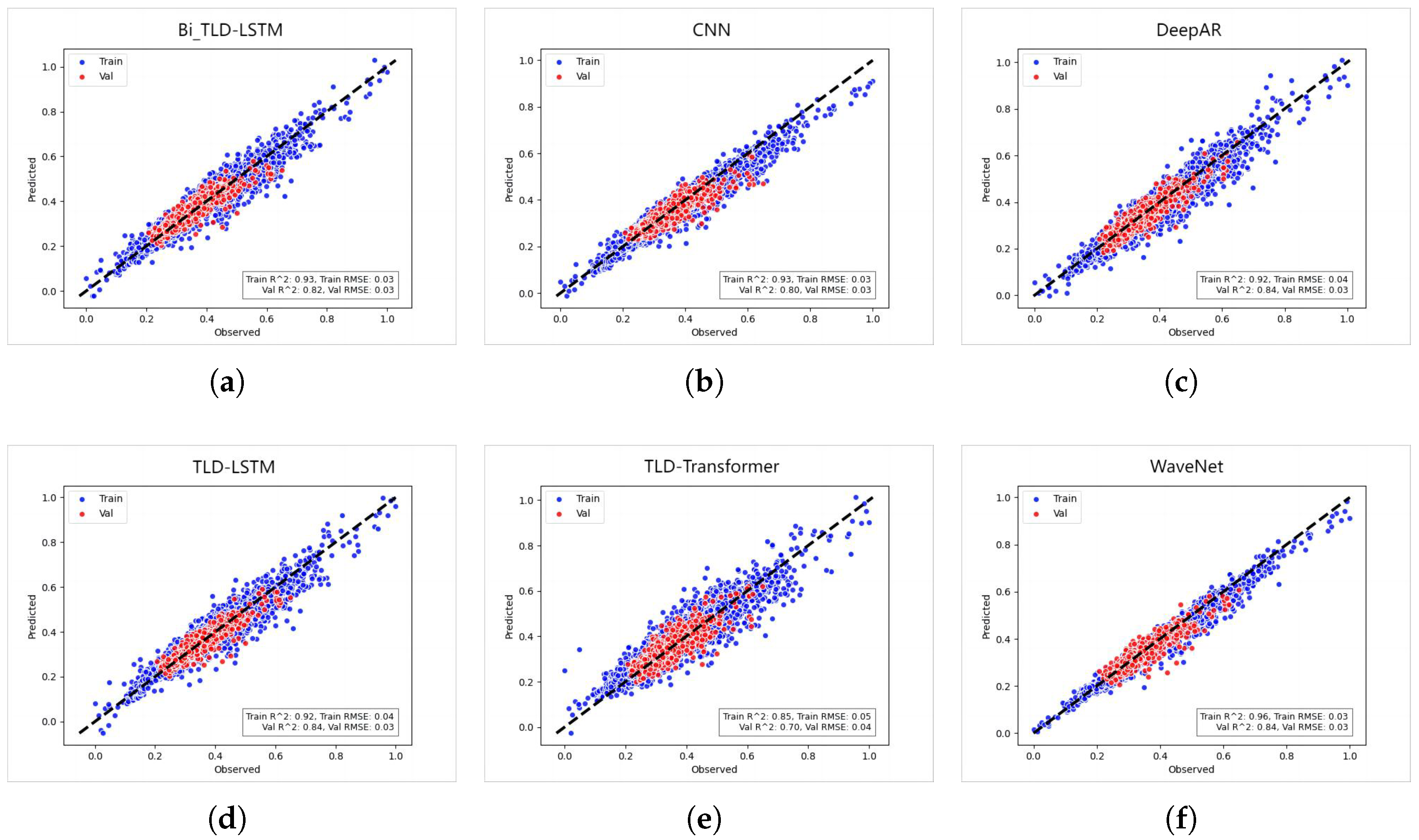
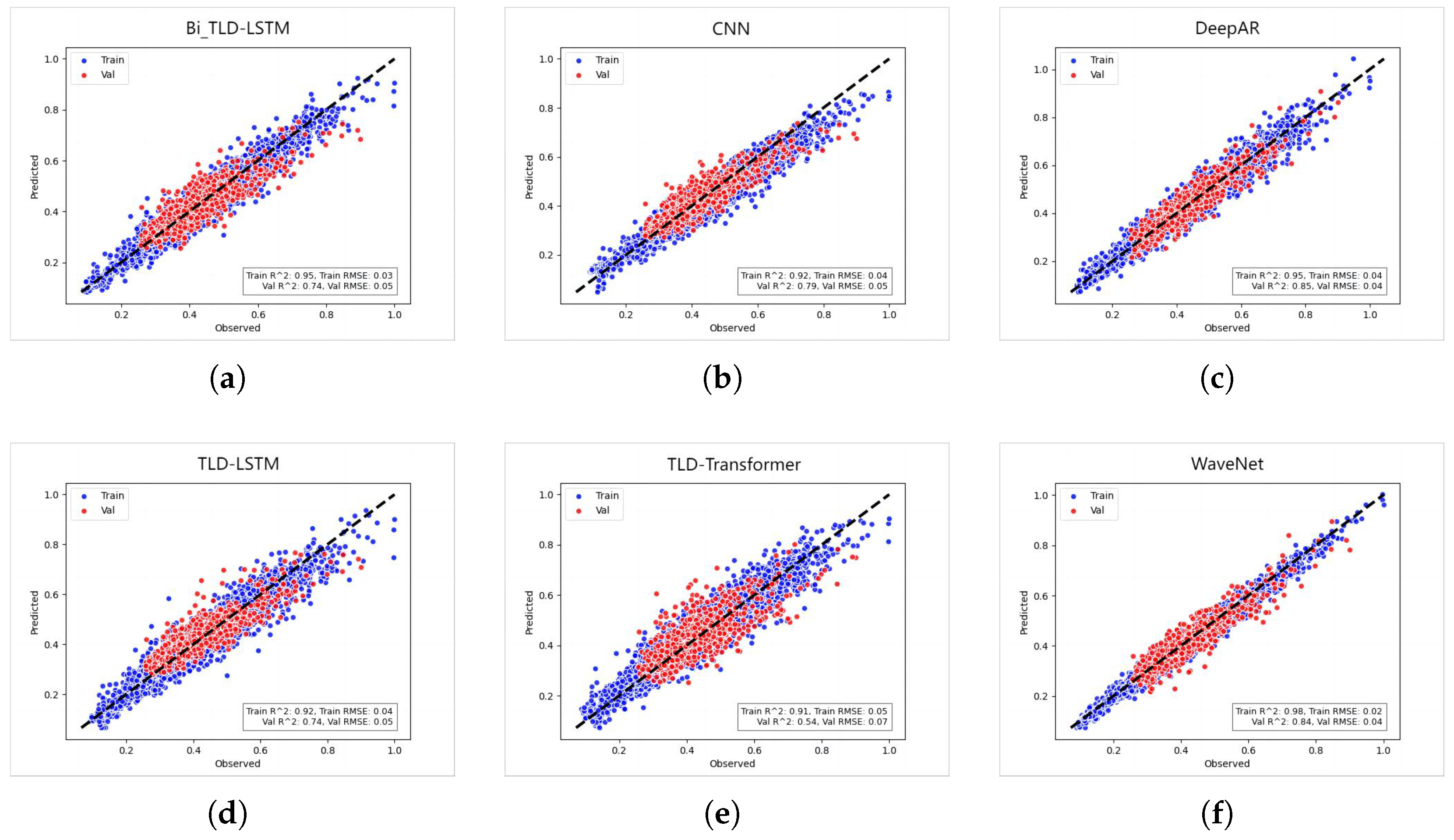
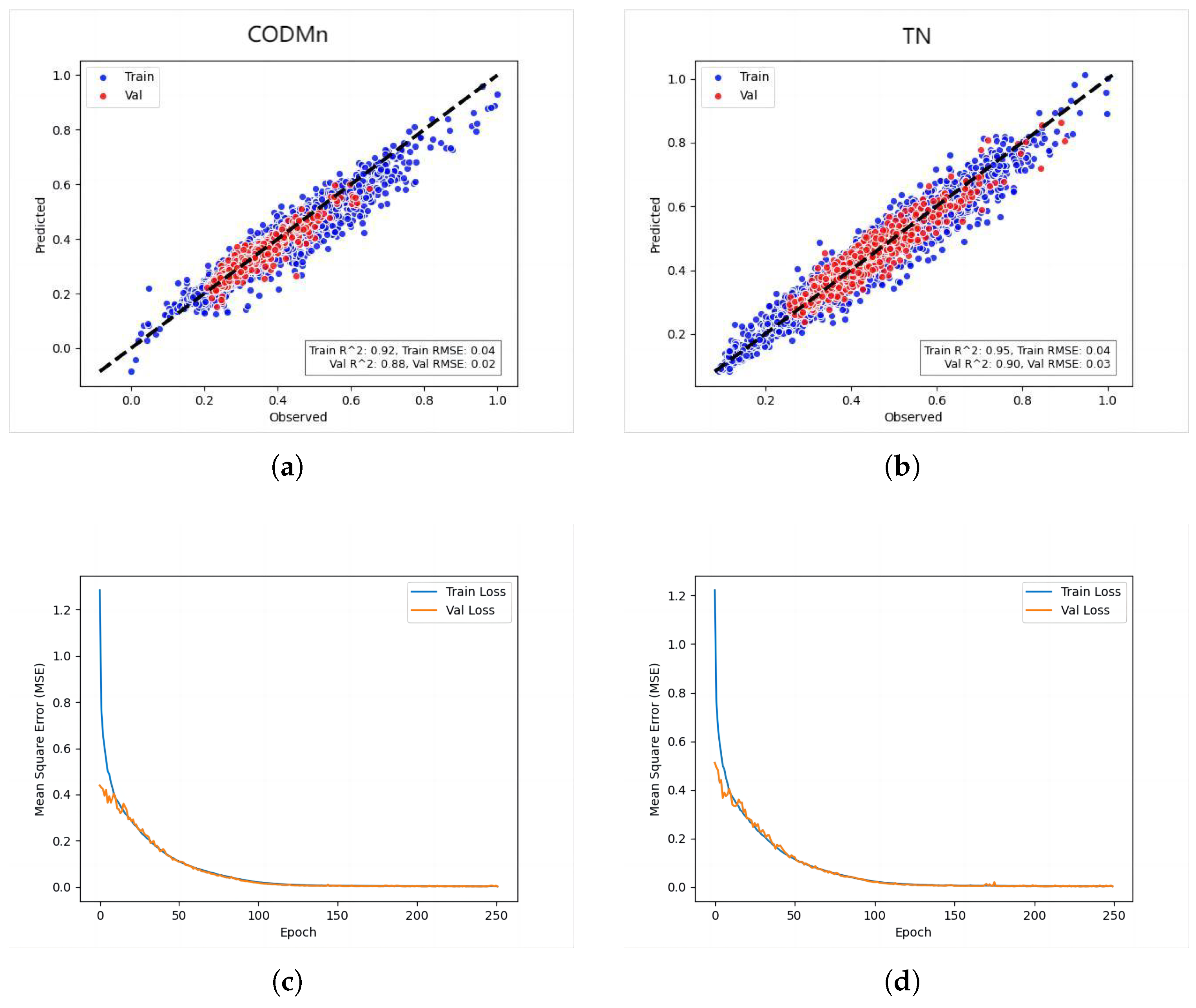
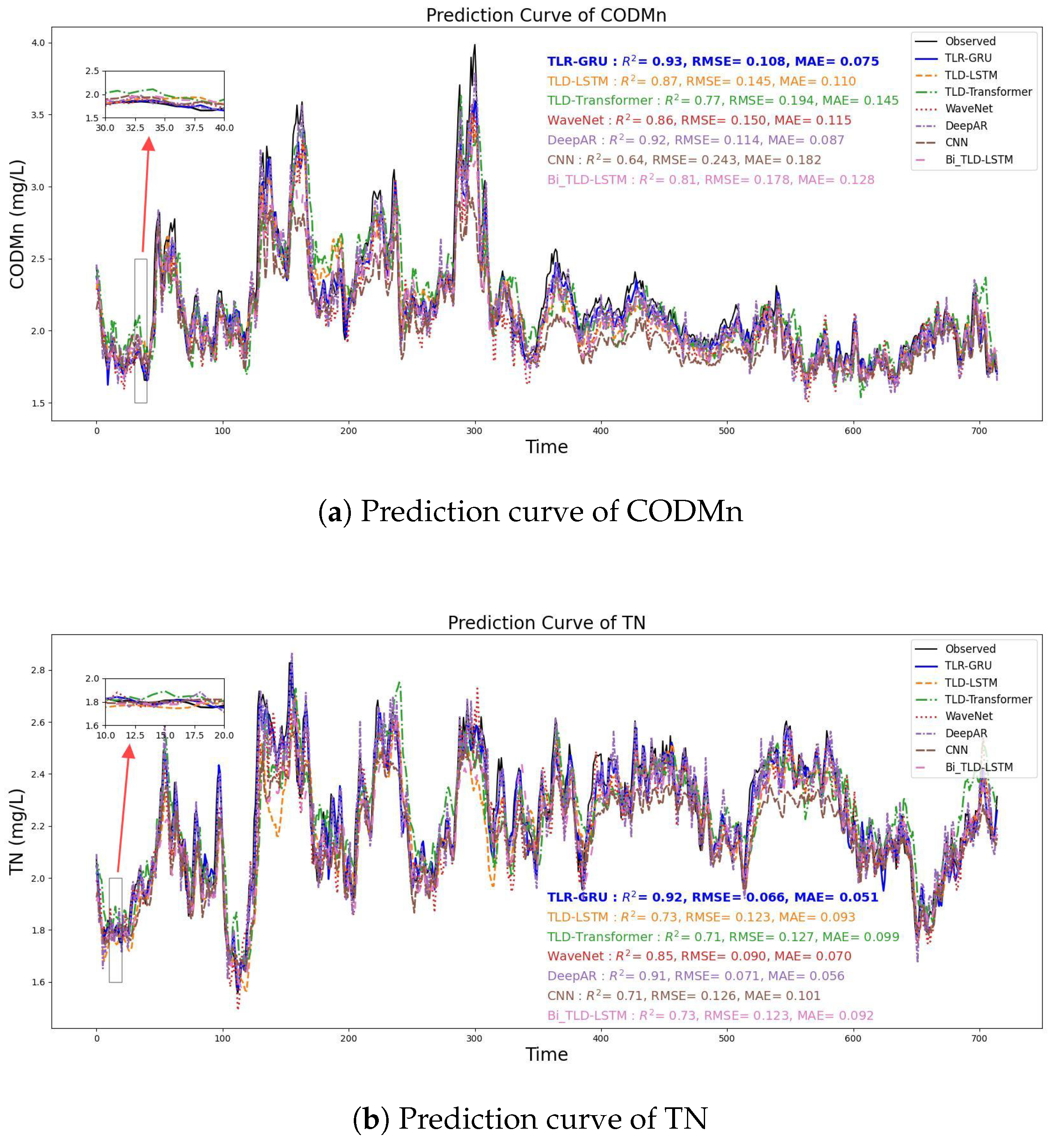
Detailed examination of CODMn and TN predictions (
Figure 4 and
Figure 5) reveals that the TLR-GRU model maintains excellent agreement between predicted and observed values. The model achieves R
2 values of 0.92 (training) and 0.88 (validation) for CODMn, and 0.95/0.90 for TN, demonstrating robust generalization across different water quality parameters.
The convergence behavior (
Figure 6) confirms the TLR-GRU’s training stability, with smooth loss reduction observed across iterations. Comparative prediction curves (
Figure 7) further validate the model’s capacity to accurately capture temporal dynamics, particularly in tracking sudden changes and trend variations.
3.3. Summary of Optimal Model
Based on the comprehensive evaluation, the TLR-GRU model with sliding window feature augmentation emerges as the optimal configuration for water quality prediction. This combination achieves the best balance between predictive accuracy (test R2: 0.941) and computational efficiency (training time: 663.451 s). The model’s superior performance stems from its effective handling of temporal dependencies through GRU mechanisms, combined with robust regularization strategies that prevent overfitting while maintaining generalization capability across different water quality parameters.
4. Conclusions
This study develops an integrated framework combining feature augmentation strategies with deep learning to address critical limitations in water quality prediction. The proposed methodology demonstrates significant improvements in predictive accuracy while maintaining computational efficiency, offering a practical solution for real-time environmental monitoring.
The key innovation lies in the synergistic integration of multiple feature augmentation methods—particularly the sliding window approach—with PCA dimensionality reduction and a tailored TLR-GRU architecture. This comprehensive approach effectively captures complex temporal patterns while mitigating overfitting through sophisticated regularization techniques. Experimental results confirm substantial performance enhancements, with the optimal configuration achieving a 7.78% increase in R2 and simultaneous error reductions of 27.36% in RMSE, 36.71% in MAE, and 45.08% in MAPE compared to conventional methods.
For practical applications, this research provides water resource managers with an efficient tool for real-time quality monitoring and early warning systems. The framework’s ability to accurately predict key parameters enables proactive intervention and supports data-driven decision-making for sustainable water management. The methodology is readily deployable in existing monitoring infrastructure without substantial additional costs.
Future work will explore extending the framework to incorporate meteorological and hydrological data, developing adaptive feature selection mechanisms, and implementing transfer learning approaches for enhanced generalization across diverse conditions. These advancements will further strengthen the framework’s applicability in real-world environmental monitoring scenarios.




 ,