Article

Assessing Climate Change and Reservoir Impacts on Upper Miño River Flow (NW Iberian Peninsula) Using Neural Networks


by
Helena Barreiro-Fonta
* and
Diego Fernández-Nóvoa
Centro de Investigación Mariña (CIM), Environmental Physics Laboratory (EPhysLab), Universidade de Vigo, Campus da Auga, 32004 Ourense, Spain
*
Author to whom correspondence should be addressed.
Water 2025, 17(24), 3514; https://doi.org/10.3390/w17243514
Submission received: 25 September 2025 / Revised: 18 November 2025 / Accepted: 5 December 2025 / Published: 12 December 2025
(This article belongs to the Special Issue Application of Machine Learning in Hydrologic Sciences)

Abstract

Climate change is altering the global hydrological cycle, which, combined with human interventions, such as reservoir operation, further disrupts river flows. Given the heterogeneity and importance of these impacts, and the particularities of each basin, regional studies are essential to assess local vulnerabilities. This study focuses on the upper Miño basin (NW Iberian Peninsula), together with the Belesar reservoir, to evaluate projected changes in streamflow between historical (1985–2014) and future (2070–2099) periods under the SSP5-8.5 and the SSP2-4.5 scenarios. Neural networks were applied to model the hydrological cycle, estimating flow from temperature and precipitation data, as well as to simulate reservoir operation, achieving successful validation. Results for SSP5-8.5 reveal a projected intensification of the hydrological cycle, with the 10th percentile (defining low-flow conditions) projected to decrease by approximately −10%, while the 99.997th percentile (defining high-flow conditions) is expected to increase by about +5%. Mean streamflow is projected to decline by more than −15%. Under the more moderate SSP2-4.5 scenario, changes are less pronounced, with the low-flow percentile expected to decrease by roughly −5% and mean streamflow showing a projected decline not reaching −15%. In contrast, the high-flow percentile exhibits an opposite trend, with a projected decrease of about −30% relative to the historical period. The analysis of reservoir operation was conducted under the most extreme emission scenario (SSP5-8.5), to assess its regulatory capacity under the harshest projected hydrological conditions. Results show that reservoir operation helps moderate the projected impact by redistributing water from wetter to drier periods, more than doubling projected summer flows downstream relative to upstream, and lowering winter flows, with the one-year return period value (99.997th percentile) projected to be reduced by approximately −15% by reservoir operation. Although natural future conditions are projected to become more critical, both the adoption of a more moderate emission pathway and an adequate reservoir operation will contribute to alleviating the most adverse hydrological impacts.

1. Introduction

Climate change is altering multiple components of the Earth system, such as energy balances and, consequently, atmospheric dynamics, and it is expected to continue along this trend [1]. These modifications not only disrupt large-scale circulation patterns but also influence the redistribution of humidity and the occurrence of meteorological extremes, which are closely linked to water availability [2,3]. One of the most sensitive and directly impacted systems is the hydrological cycle, which regulates the distribution, movement, and storage of water across the atmosphere, land surface, and subsurface environments [2]. The relevance of this cycle resides in its role in elucidating and understanding how rainfall contributes to river discharge and how water is exchanged between different environmental compartments.
Numerous studies have documented a global intensification of the hydrological cycle, leading to an increased frequency of extreme events- such as droughts and floods—while moderate events become less common [4,5,6]. This intensification carries significant consequences, including heightened pressure on freshwater availability, challenges for food production, destabilization of aquatic and terrestrial ecosystems, and more intense and frequent extreme events [7].
Importantly, the effects of climate change on the hydrological cycle are not spatially uniform. Regional variability in precipitation regimes, temperature trends, and evapotranspiration rates means that some areas are more susceptible to certain types of changes than others [8,9]. Moreover, human activities, such as land use changes, urbanization, and the construction and operation of reservoirs, further modify watershed topography and hydrological responses [10,11]. In addition, each basin also possesses a unique topography and geomorphological structure that conditions how it responds to climatic and anthropogenic influences [12]. Therefore, understanding how the hydrological cycle is being transformed under climate change requires localized studies that account for both natural and anthropogenic drivers. For this reason, regionalized studies are particularly important, especially in areas or basins where human activities are significantly influenced by hydrological changes [13].
In this sense, the Iberian Peninsula is considered a region highly vulnerable to extreme hydrological events, including both droughts and floods, a trend that is expected to continue intensifying in the future [6,14,15,16,17,18]. Indeed, previous studies have projected an overall intensification of the hydrological cycle across this region [19]. On the one hand, increasing water scarcity situations have been projected in several basins as a consequence of climate change [20,21]. On the other hand, an intensification of future floods events has also been reported in previous studies [15]. Notably, western Iberia is particularly prone to the influence of Atmospheric Rivers, which are associated with extreme precipitation and are projected to intensify under a warming climate [22,23].
Within this highly vulnerable setting, particular attention has been given to the Miño-Sil River basin, located in the northwest of the Iberian Peninsula [15,24,25]. This transboundary basin is one of the most significant hydrological systems in the region, providing essential water resources for ecosystems, agriculture, hydropower generation, and human consumption [26]. This basin covers, approximately, 17,619 km2, of which 8288 km2 correspond to the Miño basin and 7987 km2 to its main tributary, the Sil River [27]. Several studies have already highlighted the susceptibility of the basin to extreme hydrological events. For instance, ref. [15] conducted a study on extreme events in the city of Ourense, concluding that floods are expected to become increasingly frequent and intense in the future, affecting larger areas and generating more severe impacts. In addition, in this study it was also reported a projected decrease in future water availability in the basin, especially during the dry season [15]. Ref. [24] conducted a study in the upper Miño region aimed at implementing an early warning system in response to the high vulnerability of this area to flooding events. This initial project was expanded by [15], who developed a flood early warning system covering a large portion of the basin. Therefore, given the vulnerabilities of this basin, the hydrological cycle in the Upper Miño, representing a section under natural flow regime, will be modeled using artificial neural networks (ANN). This approach has proven effective for hydrological modeling due to its ability to capture complex and nonlinear relationships typical of hydrological processes [14,28]. By applying ANN to the natural regime of the Upper Miño, it is possible to obtain a reliable representation of the basin’s hydrological response under varying climatic conditions.
It is also noteworthy that Miño-Sil basin also hosts numerous reservoirs, mainly constructed during the second half of the 20th century, which play a crucial role in water storage, renewable energy generation, and hydrological regulation [29]. These infrastructures not only have the potential to help mitigate extreme events, such as floods and droughts, but also shape river discharge patterns on a seasonal basis [29]. In this context, modeling reservoir operations poses a particular challenge. Reservoir outflow is not only influenced by hydrometeorological conditions but also by complex management decisions that depend on multiple, and often non-explicit, operational rules [30]. In many cases, these reservoirs are operated by different public or private entities with distinct management policies and objectives, which may vary over time according to energy demands, water supply requirements, or flood control priorities [29]. The operation of these structures therefore depends not only on natural factors and well-defined rules but also on external demands and socio-economic considerations. These aspects can limit access to, or the practical use of, operational data and increase the uncertainty in predicting reservoir outflows. This complexity makes it difficult to incorporate reservoir management behavior into physics-based or rule-based hydrological models. Consequently, data-driven approaches, such as artificial neural networks, offer a valuable alternative, as they can learn from historical data the implicit decision-making patterns of reservoir operators and effectively reproduce or predict their responses under different hydrological and climatic scenarios [29]. Previous studies have demonstrated the ability of ANN to capture the nonlinear dynamics of reservoir systems and to simulate outflow behavior with high accuracy, making them a suitable tool for this type of application [29].
Thus, the main objective of this study is to apply ANN models to estimate river discharge from atmospheric variables, enabling the use of future climate projections to simulate and analyze potential changes in streamflow under different climate scenarios. In addition, ANN models will also be developed to simulate reservoir operations, allowing the assessment of how future regulation may influence or mitigate the expected changes in river discharge patterns. This dual modeling framework provides a comprehensive view of both natural and human-modified hydrological responses under climate change conditions, supporting the evaluation of future water availability and regulation impacts in the Upper Miño River Basin. In order to assess how climate change could alter the hydrological regime of the Upper Miño by the end of the century, this study focuses on the late-century period (2070–2099). This timeframe allows the evaluation of long-term climatic trends and their potential impacts on hydrological systems, providing valuable insight into the possible magnitude of hydrological changes, and supporting the design and implementation of effective mitigation and adaptation strategies. Moreover, to broaden the analysis and account for different potential future pathways, the intermediate SSP2-4.5 and high-emission SSP5-8.5 scenarios were evaluated. Comparing both scenarios enables a more comprehensive understanding of the potential range of impacts and supports informed decision-making under different climate policy frameworks.
Understanding how river flows respond to both climate variability and human management is crucial for ensuring sustainable water resources planning and ecosystem conservation. Furthermore, knowledge derived from this type of case studied can serve as a reference for other basins with similar vulnerabilities, offering valuable guidance for adaptive water management under the climate change scenarios.

2. Area of Study, Materials and Methods

2.1. Study Area

In this study, we focus on the Upper Miño River, specifically on the Belesar reservoir (Figure 1). Located in the upper course of the river, this reservoir is the largest in the basin (654 hm3), exerting a strong influence on the regulation of the Miño’s flow, receiving an average of 2617 hm3 by year (1991–2023). Belesar is the first reservoir in the upper Miño, where the river flow follows a natural regime upstream, draining a catchment area of 4344 km2. Thus, this site was selected as the study point, as it enables the evaluation of future river flow evolution, and its extremes, at the reservoir entrance under natural conditions (without the reservoir’s influence). In turn, the study location allows assessing the impact of the reservoir on projected river flows, in order to better understand the dynamics and potential significance of this infrastructure. To achieve this, neural networks will be applied and fed with atmospheric climate model data to obtain river flow projections. Likewise, neural networks will also be used to model reservoir operation.

2.2. Data

2.2.1. Reservoir Data

Daily records of river inflow, outflow, and storage volume for the Belesar reservoir were provided by the Confederación Hidrográfica del Miño-Sil (CHMS) for the period October 1991 to September 2023.

2.2.2. Historical Precipitation and Temperature Data

Daily precipitation and temperature data were obtained from the Iberia01 database (https://doi.org/10.20350/digitalCSIC/8641). This gridded dataset, with a spatial resolution of 0.1° (~10 km), was constructed through interpolation of observations from a dense network of meteorological stations distributed across the Iberian Peninsula [31]. Although the Iberia01 database covers the period 1971–2015, the 1985–2014 period was used for this study, according to the specific requirements and objectives of the analysis.

2.2.3. Climate Model Precipitation and Temperature Data

Historical (1985–2014) and future (2070–2099) precipitation and temperature climate data, at a resolution of 10 km, were generated using the Regional Climate Model (RCM) WRF-ARW v4.3.3 [32] applied to Coupled Model Intercomparison Project Phase 6 (CMIP6) outputs. In particular, a multi-model ensemble of 18 Global Climate Models (GCMs) was considered to capture the long-term trend, while the single GCM MPI-ESM1-HR was selected to account for internal climate variability. This approach has been successfully validated in previous studies [14,33], where detailed information about the procedure can be consulted. The SSP5-8.5 scenario was firstly selected for the main analysis, as it represents the most extreme conditions among climate change scenarios considered, and because recent greenhouse gas emissions are closely aligned with this pathway [34]. In addition, the SSP2-4.5 scenario was also analyzed to assess the variation in streamflow under less extreme climatic conditions. Comparison of both scenarios allows for the evaluation of the sensitivity of hydrological responses to different climate forcing conditions.

2.3. Methodology

Neural networks were used to model the hydrological cycle, transforming precipitation and temperature data into river flow, as well as to simulate reservoir operations. In this sense, neural networks are particularly suited for this task due to their ability to capture complex nonlinear relationships, such as those inherent in hydrological systems. Among them, NARX (nonlinear autoregressive networks with exogenous inputs) neural networks were selected because of their proven performance in sequence prediction problems, as is the case here, thanks to their capacity to retain information from previous time steps [35]. In fact, previous applications, some of them in Iberian basins, have demonstrated their effectiveness for modeling hydrological processes and reservoir operation [14,29,36,37,38].
Model training was carried out using Levenberg–Marquardt (LM) algorithm, with mean squared error (MSE) as the loss function. The hidden layer employed a tan-sigmoid activation function, while a linear function was used in the output layer. To prevent overfitting, several precautionary strategies were applied, including early stopping when the error gradient fell below a specified threshold, constraining LM parameters to avoid large weight adjustments, and monitoring validation performance to terminate training when no further improvement was detected.
Regarding data distribution for neural network procedure, the dataset was partitioned into training (70%), validation (15%), and testing (15%) subsets, a similar distribution used in previous studies [14,29,39,40].

2.3.1. Neural Network Modeling of the Hydrological Cycle

Neural networks were selected to model the hydrological cycle in this study because, compared to other methods such as physically based models, this approach requires fewer input variables, which are commonly available in both observational and climate model datasets. Moreover, it does not require exhaustive basin representation or parameter calibration, thus facilitating hydrological modelling and making the methodology more easily transferable and applicable to other study cases [14,28,41].
In this particular case, daily inflow to the Belesar reservoir was modeled using neural networks, as the inflow to the first reservoir on the Miño River reflects the natural regime of the upper catchment, enabling hydrological assessment. For that, daily precipitation and temperature from the Iberia01 database were used as predictors of river discharge. The choice of precipitation and temperature as input variables was based on their availability from high-quality, long-term observational dataset (Iberia01), which ensures a robust training of the neural networks using consistent and reliable data. In addition, these two variables represent main climatic drivers of the hydrological cycle and have been widely employed in hydrological and ANN-based modeling studies due to their strong explanatory power for river flow dynamics [14,42]. Moreover, using only precipitation and temperature also facilitates the transferability of the methodology, since these variables are standard outputs in most global and regional climate models. This ensures consistency between observational and projected datasets and enabling reliable future streamflow simulations.
Regarding neural network structure, an input delay of 30 days was adopted, based on previous studies showing that meteorological conditions during the preceding 30 days exert the strongest influence on river flow [43,44]. In practice, this means that the model estimates river discharge using the predictor data from the previous 30 days. In addition, a feedback delay of 5 days was considered. This mechanism incorporates the model’s own past outputs as additional inputs for subsequent predictions, allowing the network to better capture the temporal dependencies and memory effects inherent in river flow dynamics, as has also been successfully applied in previous works [14,29].
To evaluate model performance, different network architectures were tested, with the number of neurons in the hidden layer ranging from 1 to 10. Furthermore, to reduce the influence of a particular data split, the dataset was randomly partitioned into training, validation, and test subsets across 10 independent realizations. The best neural network models will be fed with climate model data to obtain historical and future river flow projections. This approach allows the analysis of expected changes in river discharge and its extremes in response to climate change. In this context, it should be noted that the climate model data were bias-corrected using the Iberia01 database, in order to reduce potential biases that may persist in the climate simulations, an approach that has been successfully applied in previous studies to enhance the procedure [14].

2.3.2. Neural Network Reservoir Operation Modeling

Daily outflow of the Belesar reservoir was modeled using neural networks. For this purpose, reservoir inflow, storage volume, and outflow from previous days were used as predictors to model reservoir operation. In this case, both input and feedback delays were set to 5, and the neural network architecture included 8 neurons in the hidden layer, consistent with previous successful applications to reservoirs in the Miño basin [29]. Regarding data split, the first 70% of the dataset was allocated to training, the following 15% to validation, and the remaining 15% to the testing, following the approach proposed for Miño reservoirs by [29]. This trained neural network will be fed with the projected future river flow data in order to obtain the expected future reservoir outflow. This will allow the analysis of the response and influence of reservoir on the projected river flows impacted by climate change, particularly under extreme conditions such as droughts and floods. It should be noted that the initial reservoir storage for the future river flow simulations will correspond to the average storage observed on the same date in the historical records, and will subsequently be updated at each time step (daily) based on the balance between inflows and outflows.

2.4. Validation of Neural Network Procedure

The widely used Nash-Sutcliffe Efficiency (NSE) and the Percent Bias (PBIAS) statistical parameters were employed to evaluate the performance of neural networks in modelling both hydrological process and reservoir operation. In this sense, NSE values above 0.75 combined with absolute PBIAS values below 10% indicate a very good model performance [45].

2.4.1. Validation of River Flow Modeling

As mentioned above, multiple neural network configurations were tested together with different data partitions to evaluate de best configuration for modelling hydrological cycle in upper Miño basin. The statistical analysis is presented in Table 1.
Results indicate that neural networks with 7 or more neurons already provide a very robust performance. These model performance metrics confirmed that precipitation and temperature are sufficient to achieve accurate hydrological modelling in this basin, as also reported for other rivers across the Iberian Peninsula [14]. Although the inclusion of additional variables such as solar radiation, wind speed, humidity or potential evapotranspiration could potentially refine model precision [46], obtained results indicate that the inclusion of this predictors would like provide only limited improvements in this particular case. Among the neural network configurations tested, the best-performing was obtained with 8 neurons, yielding a mean NSE value 0.942 and a mean PBIAS value of 0.4, considering the average of the 10 data partitions considered. Consequently, this configuration was selected for further analyses. Since the model runs with this setup consistently exceeded the NSE and remained below the PBIAS thresholds, indicating high model skill and strong predictive reliability, all 10 realizations with this configuration were retained. This approach also helps to partially address the inherent bias and uncertainty associated with both modelling and climate projections. Therefore, the ensemble average of these neural networks was used for subsequent analyses. Thus, the neural networks of this ensemble were then fed with precipitation and temperature data from the climate model to obtain historical and future river flow, which allows the assessment of expected changes associated with climate change.

2.4.2. Validation of Reservoir Operation Modeling

The simulation of reservoir outflow with the selected configuration described above yielded mean NSE and PBIAS values of 0.93 and −1.21, respectively, confirming the high predictive skill and robust performance of the neural network model in reproducing reservoir outflow. Therefore, this neural network model was applied to the projected river inflows to analyze the potential impact of reservoir in future river flow dynamic influenced by climate change.

3. Results and Discussion

3.1. Analysis of Changes Between Historical and Future River Flows: SSP5-8.5 Scenario

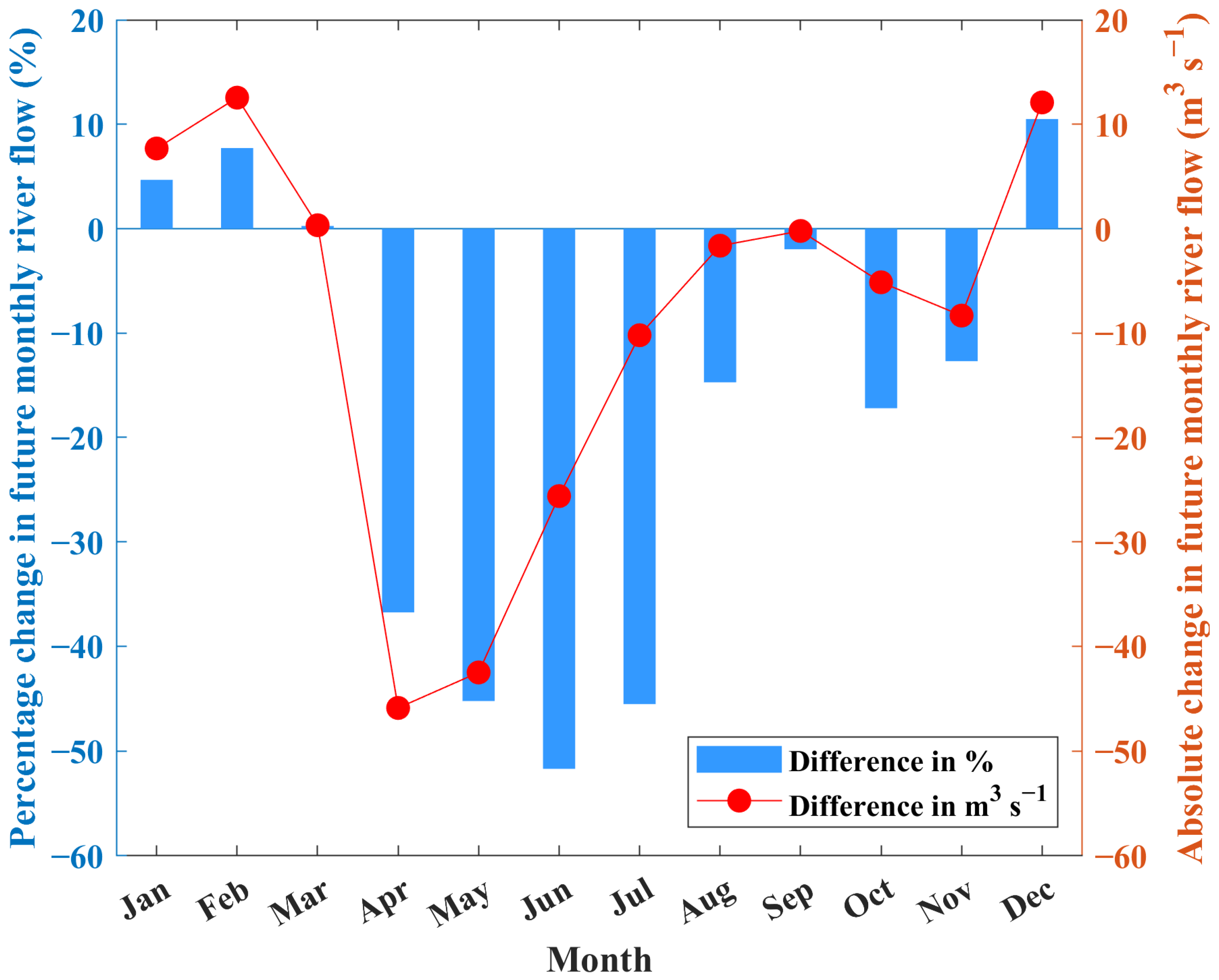
The analysis begins with the high-emission SSP5-8.5 scenario, in order to evaluate the upper bound of the potential hydrological impacts that the basin under study could experience. Thus, the analysis of projected river flows under this scenario reveals noticeable changes when comparing historical and future monthly averages (Figure 2). On the one hand, an increase in flow is expected during the winter months (January, February, and December), reaching up to a +10% rise by the end of the year. On the other hand, the overall trend indicates a reduction in flow for the remainder of the year, with the most pronounced decreases occurring in April, May, June, and July. In particular, flows in June are projected to drop by more than −50%, which corresponds to an approximate reduction of −25 m3 s−1 on average.
These patterns align with the expectation that extreme hydrological events will become increasingly frequent in most regions under future climate change [13,15,47]. Accordingly, lower values would be expected during dry months, indicating water scarcity, whereas higher streamflow would be anticipated during the rainy season, reflecting the intensification of highly extreme river flows [48,49].
A more detailed analysis at the daily scale is presented in Table 2. The results provided by the average of the neural network ensemble indicate that the 10th percentile, selected to represent low flows, is expected to decrease in the future (~−11%), whereas the 99.997th percentile, selected to represented high flows (flow with a one year of return period), is projected to increase (~+5%). Both the decrease in the low percentile and the increase in the high percentile values clearly point to an intensification of extreme events. Specifically, a lower 10th percentile in future projections suggests more severe and frequent dry conditions, while a higher future 99.997th percentile is associated with greater magnitudes and increased frequency of flood conditions. In all cases, the individual models within the ensemble consistently indicate both the decrease and the increase in the respective low and high selected percentiles, which, together with the relative low associated standard deviation, adds robustness to the results obtained. This trend has also been identified in other studies within the Miño-Sil basin, such as in the city of Ourense, where future projections based on CMIP5 data under RCP8.5 scenario, combined with hydrological models, indicated higher extreme streamflow values and an increased frequency of flood events [15]. In addition, ref. [15] also projected more frequent low values in the future, reflecting reduced water availability. It should be emphasized that this is not merely a local phenomenon, as similar trends toward increasingly extreme streamflow values, specifically in both drought and flood situations, have also been reported in other Iberian basins, such as the Tagus [14]. Regarding flood events, ref. [50] analysed future streamflow projections for several European rivers, identifying an increasing trend in flooding across various basins, including the Douro River in the Iberian Peninsula. Concerning drought events, an increasing trend was also identified by [47], who characterized the projected occurrence of droughts in the Iberian Peninsula and reported that they are expected to become increasingly severe. Following the same pattern, ref. [8] observed a decline in low-flow values across several Iberian basins, including the Douro, Tagus and Guadiana, with the latter showing the most pronounced reduction.
Furthermore, when analysing the average streamflow for both periods, the expected decline in future mean river flow, with a decrease of approximately −16%, is also confirmed for upper Miño, indicating reduced water availability in the basin. This decline in water availability has also been reported in other studies, such as [51] at the global scale, and [52], focused on the Iberian Peninsula.
Beyond the hydrological assessment, understanding how hydrological alterations affect riverine habitats is essential for ensuring the ecological integrity of fluvial systems. In this regard, from an ecosystem perspective, the concept of ecological flow was formally established in Spain in 2009 under the Spanish Water Law, managed by the Ministry for the Ecological Transition and the Demographic Challenge. This measure defines the flow required to sustain river-dependent ecosystems and aims to guarantee the long-term conservation of fluvial habitats. In the basin of this study, ecological flows are defined based on the results obtained from two complementary models: a hydrological model and a habitat-hydrobiological model. The first one relies on statistical flow indicators such as percentiles, moving averages, and variations in the minimum and maximum flow values necessary for maintaining ecosystem functions and target species, as both extremes can be detrimental. Meanwhile, the hydrobiological model focuses on constructing habitat suitability curves for selected species across their different life stages. By integrating both modelling approaches, season-specific ecological flow values are derived that reflect species-specific requirements and capture the natural temporal variability throughout the year (Confederación Hidrográfica del Miño-Sil, CHMS, https://www.chminosil.es/es/chms/planificacionhidrologica/caudales-ecologicos (accessed on 6 November 2025)). Similar ecohydrological approaches have been adopted in recent studies that quantify flow regimes during target species spawning seasons and evaluate optimal flow variations [45,52,53]. Although the defined ecological flow values for each season could change over time as a result of evolving climatic and environmental conditions, the current rigorously established thresholds are maintained in this study to allow a consistent comparison between present and projected future conditions.
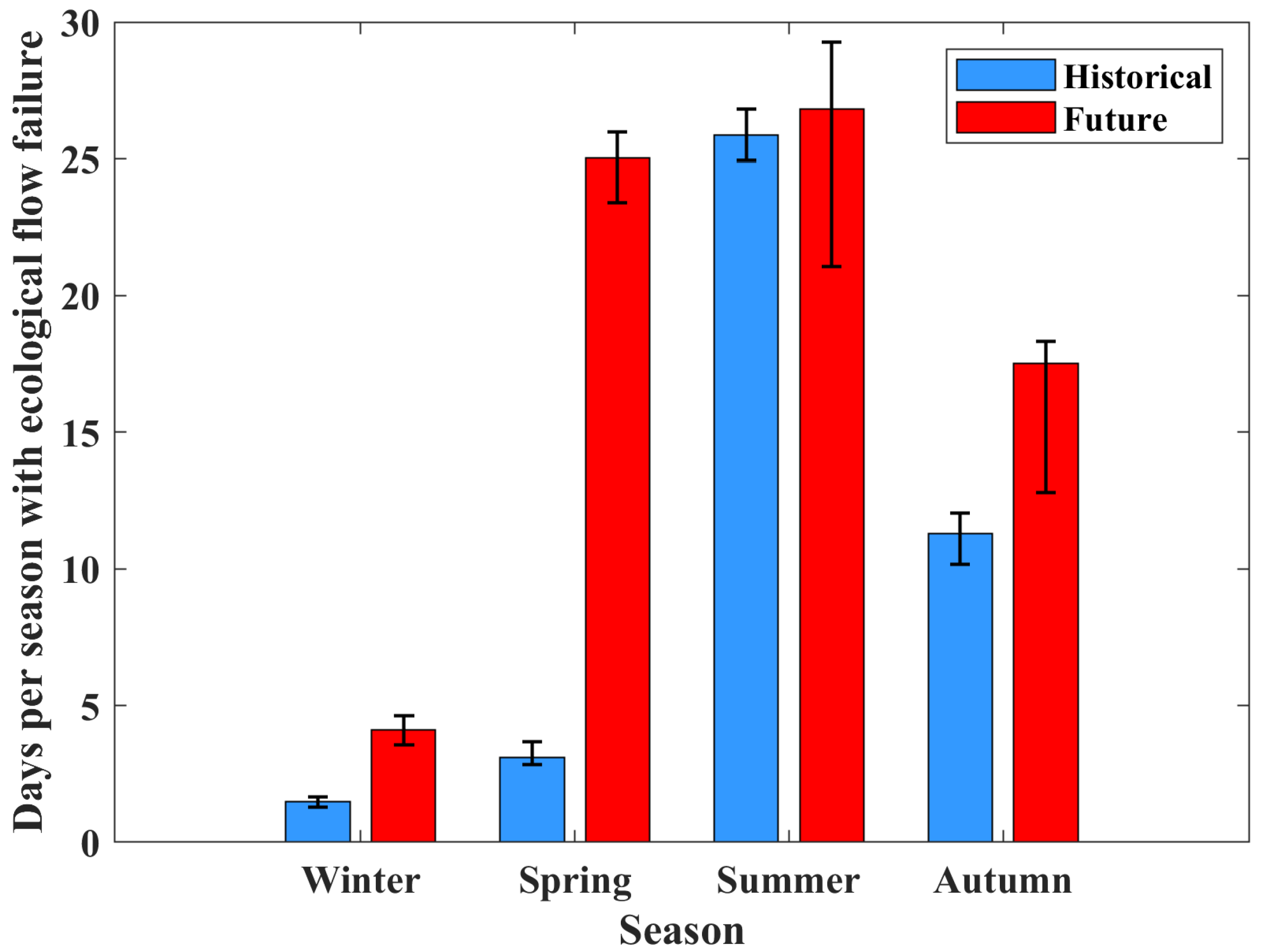
In this context, the changes in the number of days during which the ecological flow, guaranteeing flow conditions to sustain river ecosystems, is not met, were also analysed in the upper Miño. Figure 3 shows that, in the future, ecological flow shortfalls are expected to increase across all seasons in the Belesar reservoir entrance. The relatively low standard error among the individual models of the ensemble reinforces the robustness of the projected pattern. The most pronounced rise is projected for spring, increasing from fewer than 5 days per season in the historical period to approximately 25 days per season in the future. Summer is expected to remain the most critical season, with nearly 30 days per season during which the ecological flow would not be maintained.
This projected increase in the number of days during which the ecological flow is not met is consistent with other studies, such as [53], which recommend a revision of the ecological flow values for the Tagus River basin. However, as commented above, it should be noted that the analysis of ecological flow in this study was performed using current reference values, which are not fixed but may vary over time depending on changes in influencing variables such as extreme flow conditions or the target species considered (CHMS, https://www.chminosil.es/es/chms/planificacionhidrologica/caudales-ecologicos (6 November 2025)).

3.2. Analysis of Changes Between Historical and Future River Flows: SSP5-4.5 Scenario

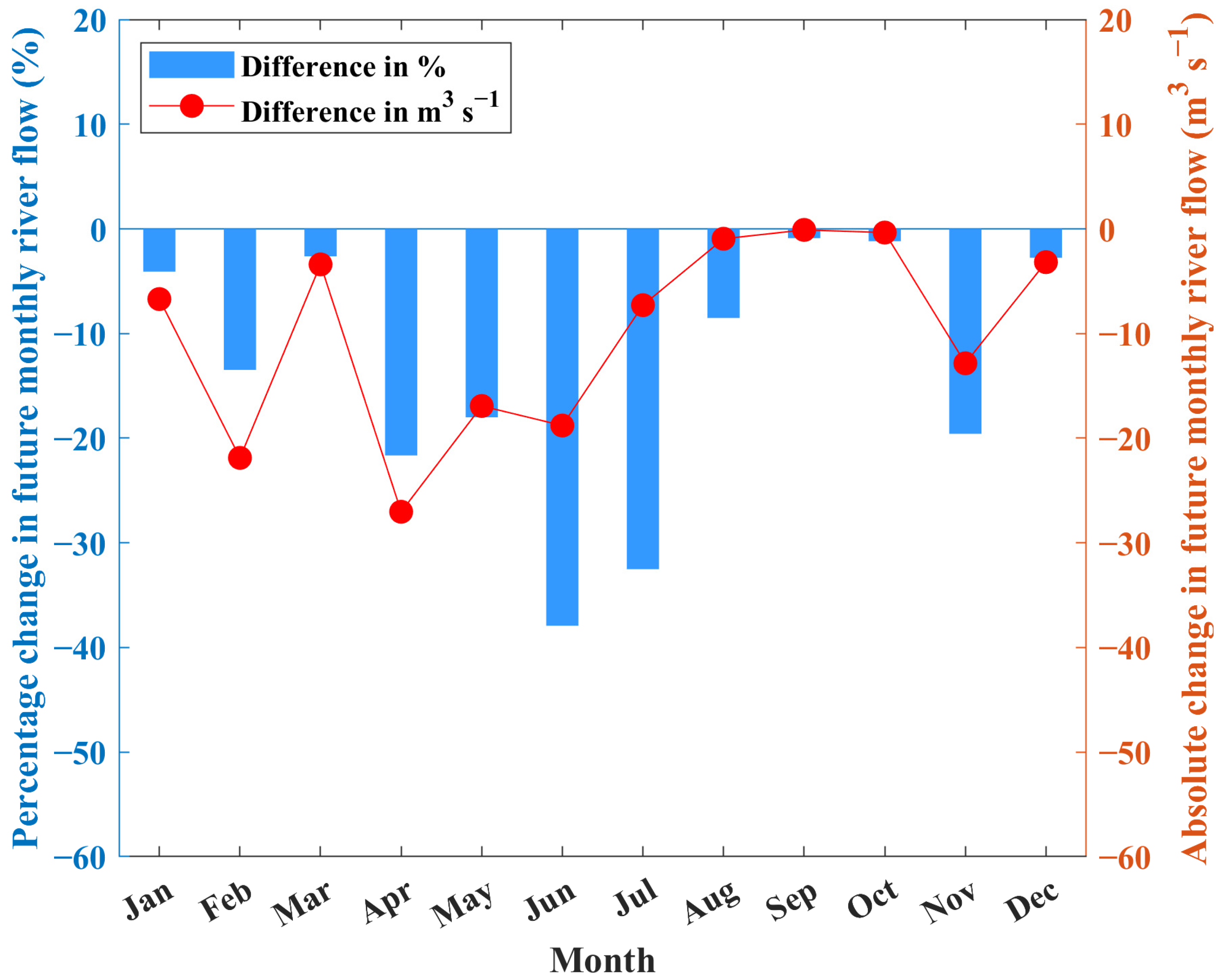
In the previous section, the projections of streamflow under an extreme future climate scenario were analyzed. However, it is also relevant to examine the evolution of these flow values under a more moderate scenario, such as SSP2-4.5. As shown in Figure 4, under this more moderate scenario, differences in streamflow are also expected throughout the different months of the year. A general decreasing trend in flow is observed across the entire year, in contrast to the extreme scenario, where winter flows were projected to increase. In particular, a pronounced reduction is expected to occur during the spring and summer months (mainly June and July), when decreases of up to −20% relative to historical values are projected. Still, the flow decrease in these months is less severe than under the extreme scenario, where the river flow in June is expected to fall to less than half of the historical values. Thus, under this more moderate scenario, water availability during the driest months is projected to be lower than in the historical period, although not as critical as under the SSP5-8.5 scenario.
For this scenario, variations are also observed in the flow extremes (10th and 99.997th percentiles) compared to the historical period (Table 2). For the percentile representing low flows, an approximate −5% decrease is expected, similar to what was found under the most extreme scenario, although in that case the projected decrease exceeded −15%. In contrast, when analyzing the evolution of the percentile representing high flows, a decrease of around −30% in discharge values is found. This indicates that, whereas in the SSP5-8.5 scenario these high flows capable of causing floods are expected to increase, under the SSP2-4.5 scenario they are projected to decline relative to the historical periods. Such a change would imply less severe flood situations under the moderate scenario, marking a substantial difference from the high-emission scenario. It is also worth noting that an overall reduction in the mean annual flow is projected, from values close to 85 m3/s in the historical period to approximately 72 m3/s, slightly higher than that expected under the extreme climate change scenario.
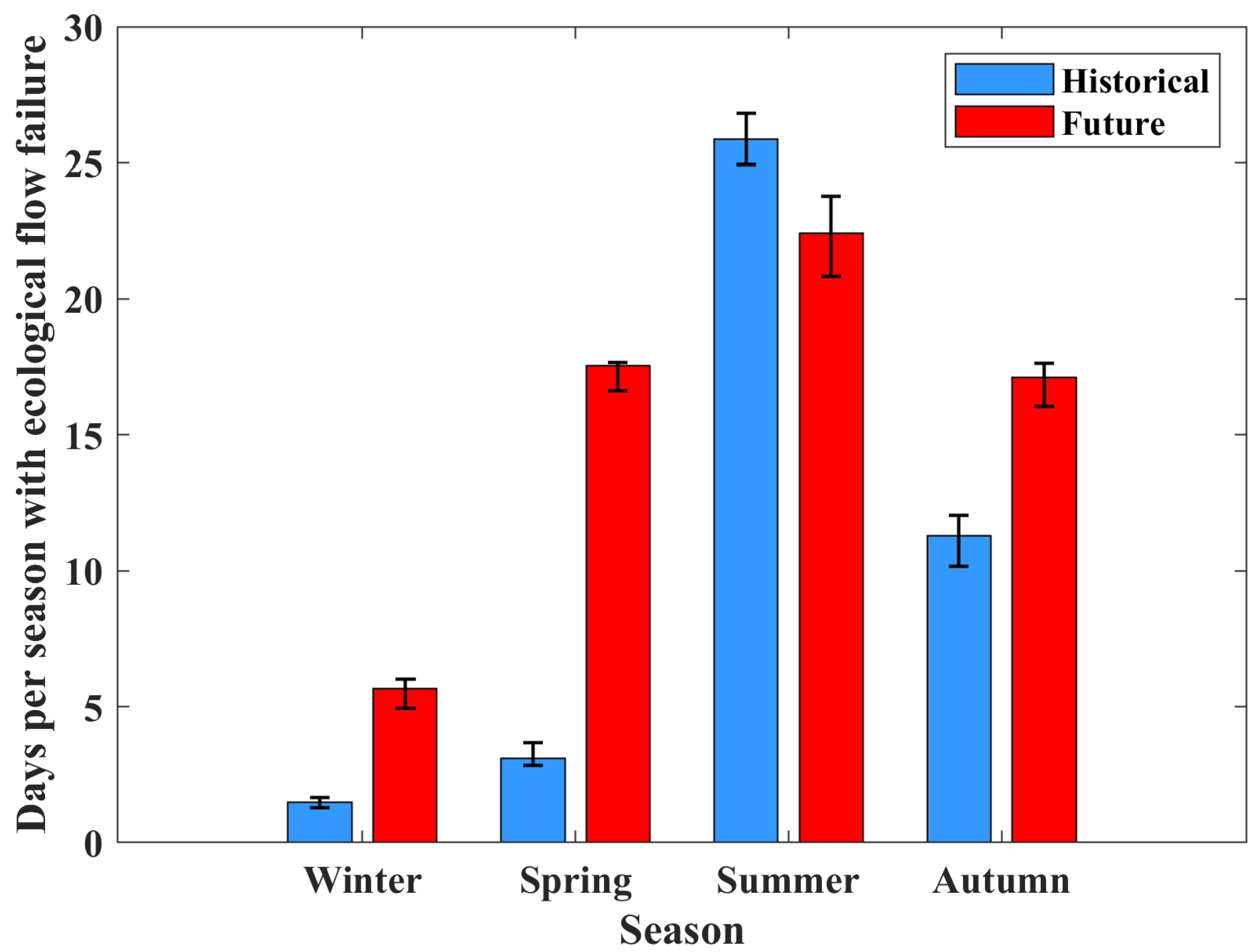
Finally, when analyzing the evolution of the ecological flow (Figure 5), an increase in the number of days during which this threshold is not met is also expected for the winter, spring, and autumn seasons, whereas a decrease is projected during summer, in contrast to the extreme emission scenario. The most pronounced change would occur in spring, where the number of non-compliance days per season would increase from fewer than 5 to approximately 17, following the same trend observed under the more extreme SSP5-8.5 scenario, although with lower intensity.

3.3. Analysis of Impact of Belesar Reservoir in Future River Flows Obtained for the SSP5-8.5 Scenario

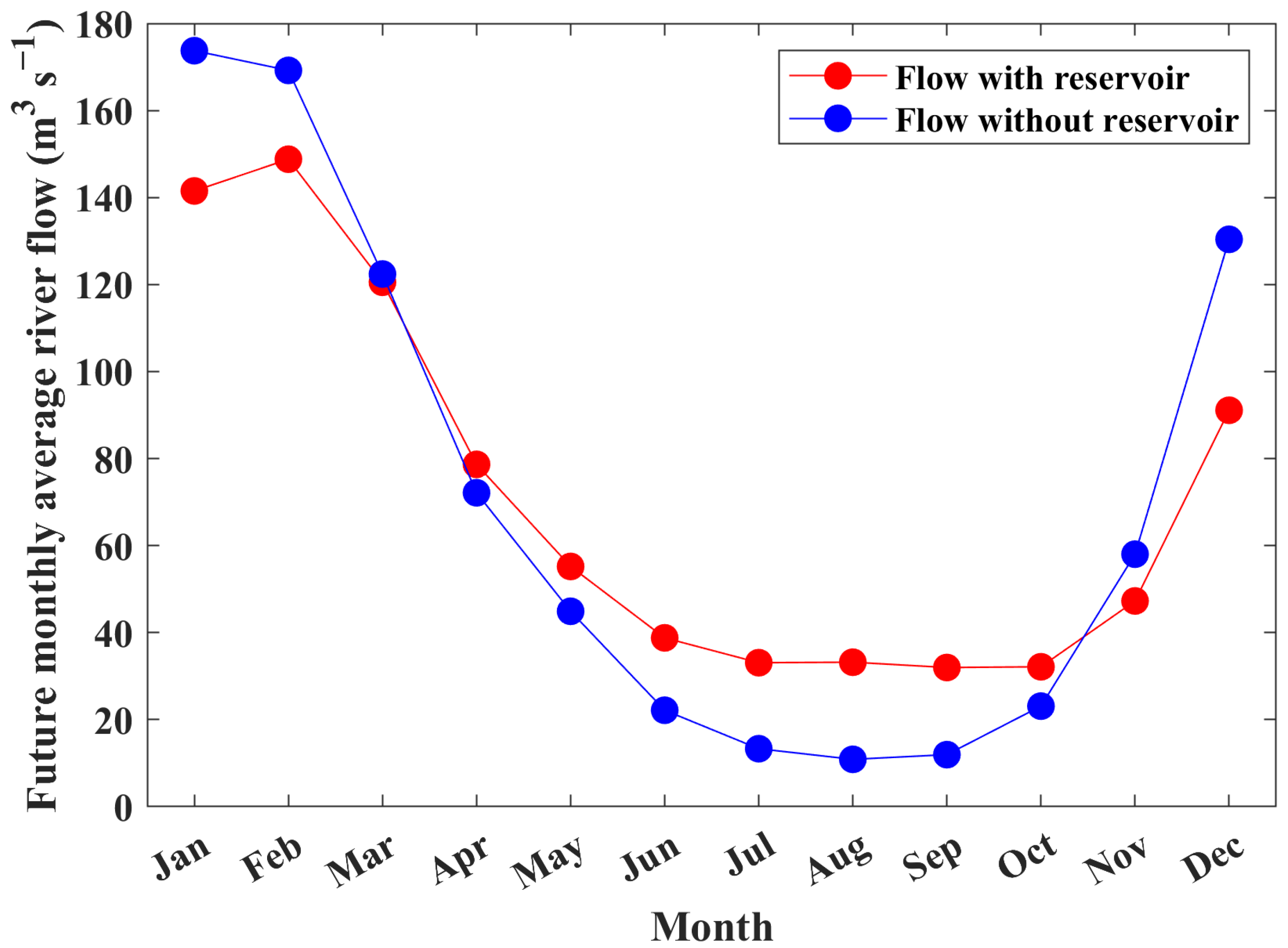
The trained neural network developed to model Belesar reservoir operation was applied to the future flows obtained from the neural network ensemble previously developed for the SSP5-8.5 scenario. This evaluation was carried out under the most extreme climate change conditions in order to assess the reservoir’s capacity to mitigate the greatest potential hydrological impacts. In this sense, Figure 6 and Table 3 show the projected monthly distribution of flow at the Belesar reservoir inflow and outflow. The results reveal a clear moderating effect of the reservoir on extreme flows. During the winter months, Belesar outflow is projected to be approximately −20% lower than inflow, on average, while in summer, when the lowest flows are expected, the reservoir contributes to maintaining higher and more stable flows. Notably, projected summer flows at the outlet are expected to be more than twice as high as those at the inlet, thanks to reservoir regulation. In particular, August discharges would be nearly three times the projected natural flow, with July and September showing increases of around +150% at reservoir outlet. The low standard deviation provided by the models in the ensemble adds robustness to the projected mitigating effect of the reservoir on future river flows.
This redistribution of water throughout the year is consistent with the operational role of reservoirs, which store water during wet months to reduce flood peaks or excessively high flows and release it in a controlled manner during dry or summer months to sustain minimum flow conditions. Such reservoir dynamics have also been observed in other studies conducted in river basins across the Iberian Peninsula, such as [54], which focused on northern basins, and [55], which examined reservoir management in the Douro River Basin.
A more detailed daily-scale analysis, which compares percentiles of inflow and outflow, is presented in Table 4. Results indicate that the 10th percentile (representing low flows) with the reservoir is higher than without it (~+55%), while the 99.997th percentile (representing high flows) is lower under reservoir operation (~−15%). This clearly demonstrates the capability of this reservoir to alleviate dry conditions and mitigate flood events even under future climate change scenarios. These findings support the interpretation in Figure 6 regarding the redistribution of flows driven by reservoir operation. Notably, when comparing Table 2 and Table 4, it can be corroborated that the future low-flow percentile at the reservoir outlet under the most extreme climate change scenario is expected to be higher than the current low-flow percentile at the reservoir inlet, while the future high-flow percentile at the reservoir outlet is projected to be lower than current natural conditions at the reservoir inlet, underscoring the positive effect of the reservoir in mitigating extremes.

4. Conclusions

This study examined the evolution of river discharge in the Miño-Sil basin, focusing on the upper section of the Miño River up to its first reservoir, Belesar, comparing the historical period (1985–2014) with the distant future (2070–2099). This site was selected because it allows the assessment of both natural river flow (reservoir inflow) and the influence of reservoir regulation (reservoir outflow), enabling the evaluation of climate change impacts on river flow patterns and the reservoir’s mitigation capacity.
Neural networks were applied to model river discharge from precipitation and temperature data. Several configurations were tested, and to further ensure robustness, multiple random data partitions were applied during the training phase. The configuration with eight neurons consistently showed the best performance, and the networks trained under this setup with the different splits were retained to form an ensemble, reducing uncertainties associated with both modelling and climate data. Once trained, these neural networks were fed with outputs from a climate model under the SSP5-8.5 and SSP2-4.5 scenarios to obtain historical and future river flows. The same neural network configuration was also selected to simulate Belesar reservoir operation, which was then fed with the projected river flows obtained under the high-emission SSP5-8.5 scenario, allowing the evaluation of its regulatory effect under the most extreme projected conditions.
Upstream of the reservoir, where Miño River flows under a natural regime, results under the SSP5-8.5 scenario project a clear shift in river discharge toward the end of the century, with an approximate average decrease in water availability of about −16% and an intensification in both extremes (low and high flows). Specifically, the 10th percentile, defining low-flow conditions, is projected to decrease by around −11%, while the 99.997th percentile, defining high-flow conditions, is expected to increase by approximately +5%. Under the more moderate SSP2-4.5 scenario, the reduction in mean river discharge and the decrease in the percentile defining low-flows conditions are less pronounced. In contrast, the percentile defining high-flow conditions is expected to decrease in the future under this scenario. These results demonstrate that future hydrological conditions in the upper Miño River would be less critical if global emissions follow a more moderate trajectory, leading to fewer potential droughts and flood situations compared to the high-emission scenario.
The comparison of the most extreme future scenario with and without reservoir operation highlights its important moderating role. In the presence of the reservoir, a redistribution of flows throughout the year is projected, storing water during wet periods to sustain higher flows in drier months. As a result, summer flows downstream may more than double those upstream, while floods would be reduced.
Overall, findings underscore that under future natural conditions, the Miño River is projected to face a higher probability of both droughts and floods, along with reduced water availability, while highlighting the potential of reservoir management to moderate these projected extremes and buffer the impacts of climate change.

Author Contributions

Conceptualization, H.B.-F. and D.F.-N.; Methodology, D.F.-N.; Validation, D.F.-N.; Formal analysis, H.B.-F.; Investigation, H.B.-F. and D.F.-N.; Resources, H.B.-F.; Writing—original draft preparation, H.B.-F.; Writing—review and editing, H.B.-F. and D.F.-N.; Supervision, D.F.-N. All authors have read and agreed to the published version of the manuscript.

Funding

This research was funded by Xunta de Galicia under project ED431C 2021/44 (Grupos de Referencia Competitiva) and by the Interreg POCTEP program under project RISC_PLUS (0031_RISC_PLUS_6_E). D.F.-N. was supported by Xunta de Galicia through a postdoctoral grant (ED481D-2024-004).

Data Availability Statement

River flow and reservoir data are available under request on https://www.chminosil.es/es/ (accessed on 6 November 2025). Iberia01 data are available at https://doi.org/10.20350/digitalCSIC/8641. Climate model data are available at request on https://ephyslab.uvigo.es/ (accessed on 6 November 2025) (helena.barreiro@uvigo.es).

Acknowledgments

The authors thank the Confederacion Hidrográfica del Miño-Sil (CHMS, https://www.chminosil.es/es/), and the developers of the Iberia01 database (https://doi.org/10.20350/digitalCSIC/8641) for the data provided for this work. During the preparation of this work the authors used ChatGPT-5 in order to improve language and readability. After using this tool/service, the authors reviewed and edited the content as needed and take full responsibility for the content of the publication.

Conflicts of Interest

The authors declare no conflicts of interest.

References

  1. Masson-Delmotte, V.; Zhai, P.; Pirani, A.; Connors, S.L.; Péan, C.; Berger, S.; Caud, N.; Chen, Y.; Goldfarb, L.; Gomis, M.I. Climate Change 2021: The Physical Science Basis; Working Group I to the Sixth Assessment Report of the Intergovernmental Panel on Climate Change; Cambridge University Press: Cambridge, UK, 2021; Volume 2, p. 2391. [Google Scholar]
  2. Allan, R.P.; Barlow, M.; Byrne, M.P.; Cherchi, A.; Douville, H.; Fowler, H.J.; Gan, T.Y.; Pendergrass, A.G.; Rosenfeld, D.; Swann, A.L.S.; et al. Advances in Understanding Large-scale Responses of the Water Cycle to Climate Change. Ann. N. Y. Acad. Sci. 2020, 1472, 49–75. [Google Scholar] [CrossRef]
  3. Lambert, F.H.; Allan, R.P.; Behrangi, A.; Byrne, M.P.; Ceppi, P.; Chadwick, R.; Durack, P.J.; Fosser, G.; Fowler, H.J.; Greve, P.; et al. Changes in the Regional Water Cycle and Their Impact on Societies. WIREs Clim. Change 2025, 16, e70005. [Google Scholar] [CrossRef]
  4. Chukwuma Sr, C. Invariance of Extreme Hydrologic Events and Climate Change in the Risk Reduction on Environment and Health. Grn Int. J. Apl. Med. Sci. 2025, 3, 92–102. [Google Scholar] [CrossRef]
  5. Müller, O.V.; McGuire, P.C.; Vidale, P.L.; Hawkins, E. River Flow in the near Future: A Global Perspective in the Context of a High-Emission Climate Change Scenario. Hydrol. Earth Syst. Sci. 2024, 28, 2179–2201. [Google Scholar] [CrossRef]
  6. Páscoa, P.; Russo, A.; Gouveia, C.M.; Soares, P.M.; Cardoso, R.M.; Careto, J.A.; Ribeiro, A.F. A High-Resolution View of the Recent Drought Trends over the Iberian Peninsula. Weather. Clim. Extrem. 2021, 32, 100320. [Google Scholar] [CrossRef]
  7. Tramblay, Y.; Koutroulis, A.; Samaniego, L.; Vicente-Serrano, S.M.; Volaire, F.; Boone, A.; Le Page, M.; Llasat, M.C.; Albergel, C.; Burak, S. Challenges for Drought Assessment in the Mediterranean Region under Future Climate Scenarios. Earth-Sci. Rev. 2020, 210, 103348. [Google Scholar] [CrossRef]
  8. Blöschl, G.; Hall, J.; Viglione, A.; Perdigão, R.A.; Parajka, J.; Merz, B.; Lun, D.; Arheimer, B.; Aronica, G.T.; Bilibashi, A. Changing Climate Both Increases and Decreases European River Floods. Nature 2019, 573, 108–111. [Google Scholar] [CrossRef] [PubMed]
  9. Arnell, N.W.; Gosling, S.N. The Impacts of Climate Change on River Flood Risk at the Global Scale. Clim. Change 2016, 134, 387–401. [Google Scholar] [CrossRef]
  10. Wu, J.; Miao, C.; Zhang, X.; Yang, T.; Duan, Q. Detecting the Quantitative Hydrological Response to Changes in Climate and Human Activities. Sci. Total Environ. 2017, 586, 328–337. [Google Scholar] [CrossRef]
  11. Wang, Q.; Deng, H.; Jian, J. Hydrological Processes under Climate Change and Human Activities: Status and Challenges. Water 2023, 15, 4164. [Google Scholar] [CrossRef]
  12. Ngwira, S.; Damazio, C. Quantification of the Effects of Climatic Factors and Anthropogenic Activities on Streamflow: A Systematic Review. Discov. Water 2025, 5, 31. [Google Scholar] [CrossRef]
  13. Xiong, J.; Yang, Y. Climate Change and Hydrological Extremes. Curr. Clim. Change Rep. 2024, 11, 1. [Google Scholar] [CrossRef]
  14. Fernández-Nóvoa, D.; Soares, P.M.; García-Feal, O.; Costoya, X.; Trigo, R.M.; Gómez-Gesteira, M. Neural Network Approach for Modeling Future Natural River Flows: Assessing Climate Change Impacts on the Tagus River. J. Hydrol. Reg. Stud. 2025, 58, 102191. [Google Scholar] [CrossRef]
  15. Fernández-Nóvoa, D.; García-Feal, O.; González-Cao, J.; DeCastro, M.; Gómez-Gesteira, M. Multiscale Flood Risk Assessment under Climate Change: The Case of the Miño River in the City of Ourense, Spain. Nat. Hazards Earth Syst. Sci. 2022, 22, 3957–3972. [Google Scholar] [CrossRef]
  16. Trigo, R.M.; DaCamara, C.C. Circulation Weather Types and Their Influence on the Precipitation Regime in Portugal. Int. J. Climatol. 2000, 20, 1559–1581. [Google Scholar] [CrossRef]
  17. López-Moreno, J.I.; Vicente-Serrano, S.M.; Zabalza, J.; Beguería, S.; Lorenzo-Lacruz, J.; Azorín-Molina, C.; Morán-Tejeda, E. Hydrological Response to Climate Variability at Different Time Scales: A Study in the Ebro Basin. J. Hydrol. 2013, 477, 175–188. [Google Scholar] [CrossRef]
  18. Trigo, R.M.; Ramos, C.; Pereira, S.S.; Ramos, A.M.; Zêzere, J.L.; Liberato, M.L. The Deadliest Storm of the 20th Century Striking Portugal: Flood Impacts and Atmospheric Circulation. J. Hydrol. 2016, 541, 597–610. [Google Scholar] [CrossRef]
  19. Lorenzo, M.N.; Alvarez, I. Climate Change Patterns in Precipitation over Spain Using CORDEX Projections for 2021–2050. Sci. Total Environ. 2020, 723, 138024. [Google Scholar] [CrossRef]
  20. CEDEX. Evaluación Del Impacto Del Cambio Climático En Los Recursos Hídricos y Sequías En España; Centro de Estudios y Experimentaci’on de Obras Públicas: Madrid, Spain, 2017. Available online: https://ceh.cedex.es/web/documentos/CAMREC/2017_07_424150001_Evaluaci%C3%B3n_cambio_clim%C3%A1tico_recu.pdf (accessed on 6 November 2025).
  21. Soares, P.M.M.; Lima, D.C.A. Water Scarcity down to Earth Surface in a Mediterranean Climate: The Extreme Future of Soil Moisture in Portugal. J. Hydrol. 2022, 615, 128731. [Google Scholar] [CrossRef]
  22. Ramos, A.M.; Trigo, R.M.; Liberato, M.L.R.; Tomé, R. Daily Precipitation Extreme Events in the Iberian Peninsula and Its Association with Atmospheric Rivers. J. Hydrometeorol. 2015, 16, 579–597. [Google Scholar] [CrossRef]
  23. Ramos, A.M.; Roca, R.; Soares, P.M.M.; Wilson, A.M.; Trigo, R.M.; Ralph, F.M. Uncertainty in Different Precipitation Products in the Case of Two Atmospheric River Events. Environ. Res. Lett. 2021, 16, 045012. [Google Scholar] [CrossRef]
  24. González-Cao, J.; García-Feal, O.; Fernández-Nóvoa, D.; Domínguez-Alonso, J.M.; Gómez-Gesteira, M. Towards an Automatic Early Warning System of Flood Hazards Based on Precipitation Forecast: The Case of the Miño River (NW Spain). Nat. Hazards Earth Syst. Sci. 2019, 19, 2583–2595. [Google Scholar] [CrossRef]
  25. Fernández-Nóvoa, D.; García-Feal, O.; González-Cao, J.; de Gonzalo, C.; Rodríguez-Suárez, J.A.; Ruiz del Portal, C.; Gómez-Gesteira, M. MIDAS: A New Integrated Flood Early Warning System for the Miño River. Water 2020, 12, 2319. [Google Scholar] [CrossRef]
  26. PLAN HIDROLÓGICO 2022-2027 (EN VIGOR RD 35/2023)—Confederacion Hidrográfica del Miño-Sil. Available online: https://www.chminosil.es/es/chms/planificacionhidrologica/propuesta-de-proyecto-de-plan-hidrologico2022-2027-version-cna (accessed on 19 September 2025).
  27. Descripción—Confederacion Hidrográfica del Miño-Sil. Available online: https://www.chminosil.es/es/chms/demarcacion/marco-fisico/descripcion (accessed on 19 September 2025).
  28. Le, X.-H.; Ho, H.V.; Lee, G.; Jung, S. Application of Long Short-Term Memory (LSTM) Neural Network for Flood Forecasting. Water 2019, 11, 1387. [Google Scholar] [CrossRef]
  29. García-Feal, O.; González-Cao, J.; Fernández-Nóvoa, D.; Astray Dopazo, G.; Gómez-Gesteira, M. Comparison of Machine Learning Techniques for Reservoir Outflow Forecasting. Nat. Hazards Earth Syst. Sci. 2022, 2022, 3859–3874. [Google Scholar] [CrossRef]
  30. Li, D.; Chen, Y.; Lyu, L.; Cai, X. Uncovering Historical Reservoir Operation Rules and Patterns: Insights From 452 Large Reservoirs in the Contiguous United States. Water Resour. Res. 2024, 60, e2023WR036686. [Google Scholar] [CrossRef]
  31. Herrera, S.; Cardoso, R.M.; Soares, P.M.; Espírito-Santo, F.; Viterbo, P.; Gutiérrez, J.M. Iberia01: A New Gridded Dataset of Daily Precipitation and Temperatures over Iberia. Earth Syst. Sci. Data 2019, 11, 1947–1956. [Google Scholar] [CrossRef]
  32. Skamarock, W.C.; Klemp, J.B.; Dudhia, J.; Gill, D.O.; Liu, Z.; Berner, J.; Wang, W.; Powers, J.G.; Duda, M.G.; Barker, D.M. A Description of the Advanced Research WRF Version 4; National Center for Atmospheric Research: Boulder, CO, USA, 2019; Volume 145. [Google Scholar]
  33. Thomas, B.; Costoya, X.; Decastro, M.; Insua-Costa, D.; Senande-Rivera, M.; Gómez-Gesteira, M. Downscaling CMIP6 Climate Projections to Classify the Future Offshore Wind Energy Resource in the Spanish Territorial Waters. J. Clean. Prod. 2023, 433, 139860. [Google Scholar] [CrossRef]
  34. Schwalm, C.R.; Glendon, S.; Duffy, P.B. RCP8.5 Tracks Cumulative CO2 Emissions. Proc. Natl. Acad. Sci. USA 2020, 117, 19656–19657. [Google Scholar] [CrossRef] [PubMed]
  35. Hewamalage, H.; Bergmeir, C.; Bandara, K. Recurrent Neural Networks for Time Series Forecasting: Current Status and Future Directions. Int. J. Forecast. 2021, 37, 388–427. [Google Scholar] [CrossRef]
  36. Oliveira, A.R.; Ramos, T.B.; Neves, R. Streamflow Estimation in a Mediterranean Watershed Using Neural Network Models: A Detailed Description of the Implementation and Optimization. Water 2023, 15, 947. [Google Scholar] [CrossRef]
  37. Oliveira, A.R.; Ramos, T.B.; Simionesei, L.; Neves, R. Assessing the Reliability of a Physical-Based Model and a Convolutional Neural Network in an Ungauged Watershed for Daily Streamflow Calculation: A Case Study in Southern Portugal. Environ. Earth Sci. 2024, 83, 215. [Google Scholar] [CrossRef]
  38. Asadi, S.; Jimeno-Saez, P.; Lopez-Ballesteros, A.; Senent-Aparicio, J. Coupling SWAT+ with LSTM for Enhanced and Interpretable Streamflow Estimation in Arid and Semi-Arid Watersheds, a Case Study of the Tagus Headwaters River Basin, Spain. Environ. Model. Softw. 2025, 186, 106360. [Google Scholar] [CrossRef]
  39. Verma, R. ANN-Based Rainfall-Runoff Model and Its Performance Evaluation of Sabarmati River Basin, Gujarat, India. Water Conserv. Sci. Eng. 2022, 7, 525–532. [Google Scholar] [CrossRef]
  40. Kedam, N.; Tiwari, D.K.; Kumar, V.; Khedher, K.M.; Salem, M.A. River Stream Flow Prediction through Advanced Machine Learning Models for Enhanced Accuracy. Results Eng. 2024, 22, 102215. [Google Scholar] [CrossRef]
  41. Meresa, H. Modelling of River Flow in Ungauged Catchment Using Remote Sensing Data: Application of the Empirical (SCS-CN), Artificial Neural Network (ANN) and Hydrological Model (HEC-HMS). Model. Earth Syst. Environ. 2019, 5, 257–273. [Google Scholar] [CrossRef]
  42. Wang, Q.; Sun, Y.; Guan, Q.; Du, Q.; Zhang, Z.; Zhang, J.; Zhang, E. Exploring Future Trends of Precipitation and Runoff in Arid Regions under Different Scenarios Based on a Bias-Corrected CMIP6 Model. J. Hydrol. 2024, 630, 130666. [Google Scholar] [CrossRef]
  43. Schulze, R.E. The Use of Soil Moisture Budgeting to Improve Stormflow Estimates by the SCS Curve Number Method. Univ. Natal. Dep. Agric. Eng. Pietermaritzbg. S. Afr. 1982, 63. [Google Scholar]
  44. Cea, L.; Fraga, I. Incorporating Antecedent Moisture Conditions and Intraevent Variability of Rainfall on Flood Frequency Analysis in Poorly Gauged Basins. Water Resour. Res. 2018, 54, 8774–8791. [Google Scholar] [CrossRef]
  45. Moriasi, D.N.; Arnold, J.G.; Van Liew, M.W.; Bingner, R.L.; Harmel, R.D.; Veith, T.L. Model Evaluation Guidelines for Systematic Quantification of Accuracy in Watershed Simulations. Trans. ASABE 2007, 50, 885–900. [Google Scholar] [CrossRef]
  46. Li, F.-F.; Wang, Z.-Y.; Zhao, X.; Xie, E.; Qiu, J. Decomposition-ANN Methods for Long-Term Discharge Prediction Based on Fisher’s Ordered Clustering with MESA. Water Resour. Manag. 2019, 33, 3095–3110. [Google Scholar] [CrossRef]
  47. Ojeda, M.G.-V.; Gámiz-Fortis, S.R.; Romero-Jiménez, E.; Rosa-Cánovas, J.J.; Yeste, P.; Castro-Díez, Y.; Esteban-Parra, M.J. Projected Changes in the Iberian Peninsula Drought Characteristics. Sci. Total Environ. 2021, 757, 143702. [Google Scholar] [CrossRef]
  48. Alfieri, L.; Burek, P.; Feyen, L.; Forzieri, G. Global Warming Increases the Frequency of River Floods in Europe. Hydrol. Earth Syst. Sci. 2015, 19, 2247–2260. [Google Scholar] [CrossRef]
  49. Ficklin, D.L.; Null, S.E.; Abatzoglou, J.T.; Novick, K.A.; Myers, D.T. Hydrological Intensification Will Increase the Complexity of Water Resource Management. Earths Future 2022, 10, e2021EF002487. [Google Scholar] [CrossRef]
  50. Di Sante, F.; Coppola, E.; Giorgi, F. Projections of River Floods in Europe Using EURO-CORDEX, CMIP5 and CMIP6 Simulations. Int. J. Climatol. 2021, 41, 3203–3221. [Google Scholar] [CrossRef]
  51. Zhang, Y.; Zheng, H.; Zhang, X.; Leung, L.R.; Liu, C.; Zheng, C.; Guo, Y.; Chiew, F.H.; Post, D.; Kong, D. Future Global Streamflow Declines Are Probably More Severe than Previously Estimated. Nat. Water 2023, 1, 261–271. [Google Scholar] [CrossRef]
  52. Paredes-Beltran, B.; Sordo-Ward, A.; Martin-Carrasco, F.; Garrote, L. High-Resolution Estimates of Water Availability for the Iberian Peninsula under Climate Scenarios. Appl. Water Sci. 2024, 14, 167. [Google Scholar] [CrossRef]
  53. Sanz, D.B.; Iribas, B.L.; Calvo, P.C. Proposal for Analysis of Minimum Ecological Flow Regimes Based on the Achievement of Technical and Environmental Objectives: Tagus River Basin Case Study (Spain). Environ. Earth Sci. 2025, 84, 26. [Google Scholar] [CrossRef]
  54. Vicente-Serrano, S.M.; Zabalza-Martínez, J.; Borràs, G.; López-Moreno, J.I.; Pla, E.; Pascual, D.; Savé, R.; Biel, C.; Funes, I.; Martín-Hernández, N. Effect of Reservoirs on Streamflow and River Regimes in a Heavily Regulated River Basin of Northeast Spain. Catena 2017, 149, 727–741. [Google Scholar] [CrossRef]
  55. Morán-Tejeda, E.; Lorenzo-Lacruz, J.; López-Moreno, J.I.; Ceballos-Barbancho, A.; Zabalza, J.; Vicente-Serrano, S.M. Reservoir Management in the Duero Basin (Spain): Impact on River Regimes and the Response to Environmental Change. Water Resour. Manag. 2012, 26, 2125–2146. [Google Scholar] [CrossRef]
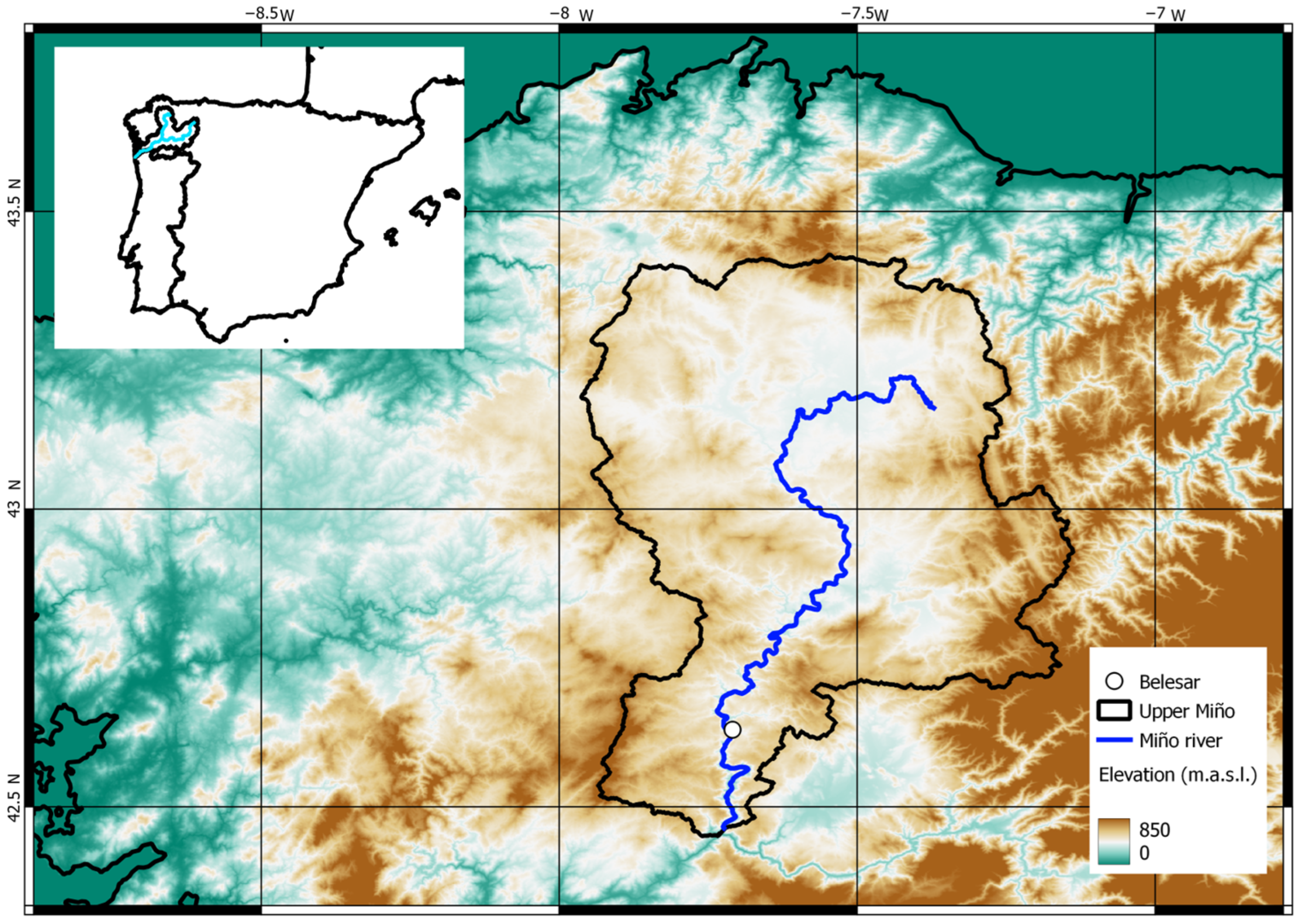
Figure 1. Map of the upper Miño basin (black inner contour), showing the Miño River course (blue) and the location of the Belesar reservoir (white circle). The entire Miño basin within the Iberian Peninsula is shown in the upper-left corner.
Water 17 03514 g001
Figure 2. Monthly differences in mean river flow between the historical (1985–2014) and future (2070–2099) modeled periods under the SSP5-8.5 scenario, considering the average of the neural network ensemble. Blue bars represent the percentage change (%) in future flow relative to the historical period (left axis), while the red line shows the absolute difference in flow (m3/s) between the two periods (right axis).
Water 17 03514 g002
Figure 3. Average projected number of days per season in which the ecological flow would not be met for historical (1985–2014) (blue) and future (2070–2099) (red) periods under the SSP5-8.5 scenario. Black bars represent the corresponding standard errors.
Water 17 03514 g003
Figure 4. Monthly differences in mean river flow between the historical (1985–2014) and future (2070–2099) modeled periods under the SSP2-4.5 scenario, considering the average of the neural network ensemble. Blue bars represent the percentage change (%) in future flow relative to the historical period (left axis), while the red line shows the absolute difference in flow (m3/s) between the two periods (right axis).
Water 17 03514 g004
Figure 5. Average projected number of days per season in which the ecological flow would not be met for historical (1985–2014) (blue) and future (2070–2099) (red) periods under the SSP2-4.5 scenario. Black bars represent the corresponding standard errors.
Water 17 03514 g005
Figure 6. Projected monthly distribution of future river flow at reservoir inflow (natural flow, without reservoir influence) (blue), and at reservoir outflow (regulated flow, with reservoir influence) (red), under the SSP5-8.5 scenario.
Water 17 03514 g006
Table 1. Mean statistical parameters, and the corresponding standard deviation, for each neural network configuration developed to model river discharge, considering the 10 different data splits.
NeuronsNSEPBIAS
10.858 ± 0.01111.2 ± 3.1
20.844 ± 0.03512.3 ± 5.8
30.885 ± 0.0393.7 ± 3.9
40.864 ± 0.0426.1 ± 9.5
50.889 ± 0.0414.9 ± 4.1
60.920 ± 0.0544.1 ± 6.4
70.929 ± 0.0391.8 ± 2.3
80.942 ± 0.0330.4 ± 1.6
90.929 ± 0.0442.3 ± 5.0
100.939 ± 0.0340.5 ± 1.7
Table 2. Summary of low and high flow percentiles, mean flow, and standard deviations for historical and future periods under the SSP5-8.5 and SSP2-4.5 scenarios.
Period10th
Percentile
(m3 s−1)
Std
(m3 s−1)
99.997th
Percentile
(m3 s−1)
Std
(m3 s−1)
Mean Flow (m3 s−1)Std
(m3 s−1)
Historical7.80.81574.1256.384.32.7
Future (SSP5-8.5) 6.92.21655.2304.470.74.6
Future (SSP2-4.5) 7.41.11069.7108.771.82.8
Table 3. Summary of projected average monthly flows and standard deviations for natural (reservoir inflow) and regulated (reservoir outflow) flows, along with the percentage change calculated as: R e s e r v o i r   o u t f l o w R e s e r v o i r   i n f l o w R e s e r v o i r   i n f l o w   ×   100 .
MonthNatural Conditions (m3 s−1) Reservoir Operation (m3 s−1)Percentage Change (%)
January173.7 ± 8.7141.5 ± 9.6−19
February169.2 ± 12.9148.8 ± 13.4−12
March122.4 ± 10.2120.5 ± 10.7−2
April72.1 ± 7.678.7 ± 7.3+9
May44.9 ± 4.755.2 ± 4.1+22
June22.1 ± 2.138.8 ± 1.1+75
July13.3 ± 2.833.1 ± 1.3+148
August10.8 ± 4.133.2 ± 1.6+205
September11.9 ± 5.331.9 ± 2.5+167
October23.1 ± 6.232.2 ± 4.1+39
November58.0 ± 5.647.3 ± 4.8−18
December130.4 ± 7.391.1 ± 8.1−30
Table 4. Summary of 10th (low-flow) and 99.997th (high-flow) percentile averages, with the corresponding standard deviations, for future river flow under natural conditions (without reservoir) and under reservoir operation.
Future River Flow10th
Percentile
(m3 s−1)
Std
(m3 s−1)
99.997th
Percentile
(m3 s−1)
Std
(m3 s−1)
Natural conditions 6.92.21655.2304.4
Reservoir operation 10.72.01413.7370.1
Disclaimer/Publisher’s Note: The statements, opinions and data contained in all publications are solely those of the individual author(s) and contributor(s) and not of MDPI and/or the editor(s). MDPI and/or the editor(s) disclaim responsibility for any injury to people or property resulting from any ideas, methods, instructions or products referred to in the content.