Article

Impediments to, and Opportunities for, the Incorporation of Science into Policy and Practice into the Sustainable Management of Groundwater in Pakistan


by
Faizan ul Hasan
Centre for Environmental Governance, University of Canberra, Canberra 2617, Australia
Water 2025, 17(24), 3496; https://doi.org/10.3390/w17243496
Submission received: 7 October 2025 / Revised: 30 November 2025 / Accepted: 2 December 2025 / Published: 10 December 2025
(This article belongs to the Section Water Resources Management, Policy and Governance)

Abstract

Groundwater sustains more than 60% of irrigation in Pakistan’s Indus Basin, yet accelerating depletion, rising salinity and fragmented governance threaten agricultural productivity and rural livelihoods. Although new monitoring technologies and provincial water laws have emerged, a persistent gap remains between scientific evidence, policy frameworks and farmer practices. This study applies the Science–Policy–Practice Interface (SPPI) to examine these disconnects, drawing on qualitative data from multi-stakeholder focus groups and interviews with farmers, scientists and policymakers in Punjab, Sindh and federal agencies. The analysis identifies five governance challenges: weak knowledge integration, fragmented institutions, political resistance to regulation, limited adaptive capacity and under-recognition of farmer-led innovations. While depletion is well documented, it rarely informs enforceable rules and informal practices often outweigh formal regulation. At the same time, farmers contribute adaptive strategies, such as recharge initiatives and water-sharing arrangements, that remain invisible to policy. The findings highlight both the potential and the limits of SPPI. It provides a valuable lens for aligning science, policy and practice but cannot overcome entrenched political economy barriers such as subsidies and elite capture. The study contributes theoretically by extending SPPI to irrigation-dependent aquifers and practically by identifying opportunities for hybrid knowledge systems to support adaptive and equitable groundwater governance in Pakistan and other LMICs.

1. Introduction

Groundwater is the backbone of Pakistan’s agricultural economy, sustaining food production and rural livelihoods in the Indus Basin, one of the most intensively irrigated regions in the world. With surface water supplies becoming increasingly unreliable due to climatic variability, sedimentation of reservoirs and infrastructure losses, groundwater now provides more than 60% of irrigation demand across the basin [1,2]. Yet this vital resource is under severe stress. Widespread over-abstraction, rising salinity, and deteriorating water quality threaten both farm productivity and long-term sustainability [3,4,5].
Globally, groundwater depletion and governance failures are recognised as critical sustainability challenges. Studies from India, Mexico, China, and South Africa show that over-extraction, weak enforcement and socio-political asymmetries undermine the transition toward sustainable groundwater use [6,7,8]. While scientific knowledge about groundwater systems has expanded rapidly through remote sensing, hydrological modelling and socio-hydrological research [9,10], its translation into policy and practice remains inconsistent [11,12]. This disconnect has led scholars to call for more integrated frameworks that link scientific evidence with decision-making and local action [13,14,15].
The Science–Policy–Practice Interface (SPPI) has emerged as one such integrative framework. Rooted in sustainability science and adaptive governance, SPPI builds upon the Science–Policy Interface (SPI) but extends it by recognising practice as a co-equal domain of knowledge production and innovation [13,16]. It emphasises iterative learning, mutual accountability and two-way feedback among scientists, policymakers and practitioners [14,17]. SPPI thus offers a valuable lens for analysing how knowledge flows, or fails to flow, across governance levels and for identifying mechanisms that can forward collaboration and adaptive capacity in resource management.
Despite this theoretical promise, SPPI applications have predominantly focused on high-capacity governance contexts in the Global North, such as climate services in Europe and coastal management in Australia [12,18,19]. Its relevance to the governance of groundwater in low- and middle-income countries (LMICs) remains underexplored. In LMIC contexts, informal institutions, weak enforcement capacity and entrenched political economies often distort or block the uptake of scientific evidence [8,20]. Recent work in South Asia has highlighted similar constraints, including elite capture of resources, fragmented mandates and limited integration of farmer innovations into formal governance [6,21]. These challenges highlight the need to contextualise SPPI within irrigation-dependent aquifers, where hydrological complexity and socio-political dynamics intersect. Collectively, these global patterns underline that Pakistan’s experience is not isolated but emblematic of wider governance failures in groundwater-dependent regions worldwide, making the Indus Basin a highly relevant case for advancing international debates on evidence-informed and practice-aligned groundwater governance.
Accordingly, this paper adopts the SPPI as a conceptual framework to analyse how scientific evidence is incorporated, or neglected, within Pakistan’s groundwater governance system. By drawing on qualitative data from multi-stakeholder focus group discussions and interviews with farmers, scientists and policymakers across Punjab and Sindh, the paper aims to identify the institutional, political and behavioural impediments that limit the integration of science into policy and practice; explore how informal institutions and farmer-led innovations influence groundwater governance outcomes; and propose context-appropriate pathways for adaptive, inclusive and evidence-informed governance in the Indus Basin. Through this analysis, the paper contributes to international debates on bridging science–policy divides in groundwater management and offers lessons for LMICs confronting similar challenges.

2. Study Area

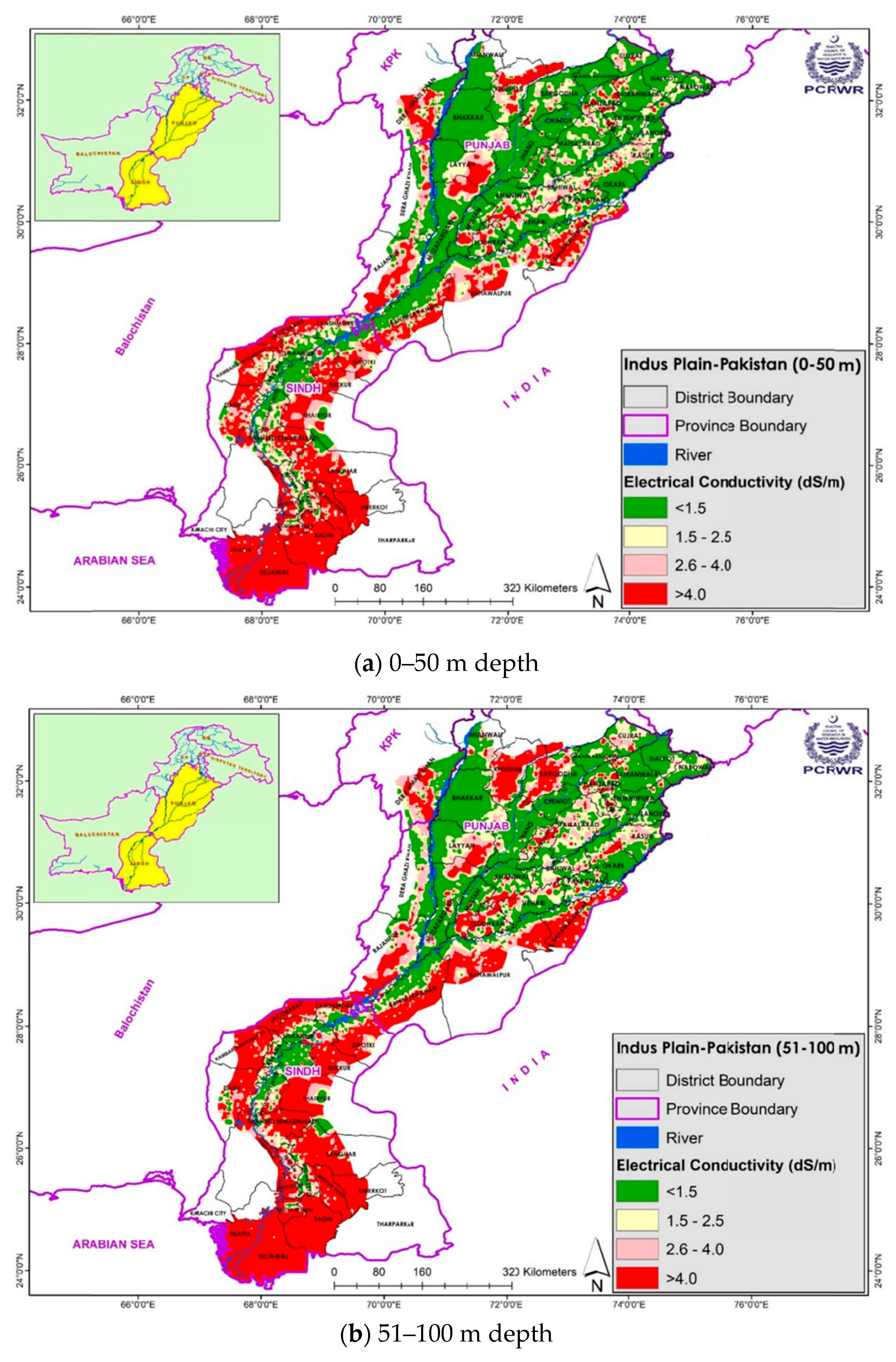
The research was conducted in the Indus Basin of Pakistan, one of the world’s largest contiguous irrigation systems, covering approximately 21 million ha across Punjab, Sindh, Khyber Pakhtunkhwa, and Balochistan provinces. The study focuses on Punjab and Sindh, which together account for nearly 90% of Pakistan’s irrigated area and agricultural output [3]. Figure 1 illustrates the spatial distribution of groundwater quality across the study area. The left panel shows electrical conductivity (EC) levels at shallow depths (0–50 m), while the right panel presents EC conditions at intermediate depths (51–100 m). Groundwater quality is classified into four EC categories: fresh (<1.5 dS/m, green), marginal (1.5–2.5 dS/m, yellow), moderately saline (2.6–4.0 dS/m, pink), and highly saline (>4.0 dS/m, red). These classifications highlight the significant variation in groundwater suitability across Punjab and Sindh, with salinity increasing progressively at deeper aquifer levels in several districts.

2.1. Population and Socioeconomic Profile

Punjab is home to about 110 million people, while Sindh hosts around 48 million [22]. Punjab contributes roughly 54% of Pakistan’s gross domestic product (GDP) and has a per-capita income of USD 1750, compared with USD 1580 for Sindh and a national average of USD 1600 [23]. Rural populations dominate both provinces (63% in Punjab and 59% in Sindh) depending heavily on agriculture for livelihoods. Literacy rates are higher in Punjab (66%) than Sindh (61%), yet rural poverty remains acute in canal command areas, the geographical zones irrigated by a particular canal system and dependent on its water supply for cropping, affected by water scarcity and soil salinity [3].

2.2. Land Use, Cropping Patterns, and Irrigation Infrastructure

The Indus Basin Irrigation System comprises three major reservoirs, 18 barrages, 12 inter-river link canals, and more than 45 major canals, irrigating approximately 17 million ha [5]. Punjab alone contains about 70% of this irrigated land, whereas Sindh’s irrigation network sustains deltaic and tail-end districts where canal supplies are less reliable.
Major crops include wheat, rice, cotton, and sugarcane together consuming nearly 80% of total irrigation withdrawals [24]. Double-cropping is common in central Punjab, while lower Sindh supports rice–wheat rotations. Livestock fodder including maize and berseem also contributes substantially to water demand. Irrigation efficiencies average only 35–40%, leading to excessive conveyance losses [25].

2.3. Water Demand and Sources

Agriculture consumes approximately 90% of Pakistan’s total water withdrawals, with the remaining is divided between domestic and industrial uses [26]. Groundwater now supplies over 60% of irrigation water, 90% of drinking water and 100% of industrial water [4], highlighting its dual economic and social significance. Average annual groundwater abstraction exceeds 60 billion m3, while sustainable recharge is estimated at only 55 billion m3 [4]. The basin’s hydrological balance is further stressed by population growth and rising energy subsidies that encourage tubewell pumping [5].

2.4. Hydrological Realities of the Indus Basin: Science Signals of Depletion

Groundwater serves as both the backbone of production and a buffer against seasonal canal shortages, droughts, and climate variability. The proliferation of private tubewells, exceeding 1.2 million in Punjab and Sindh alone, has been enabled by declining equipment costs, subsidised electricity and the absence of volumetric abstraction charges [1]. Combined with expansion of high water-demand crops such as rice and sugarcane, these dynamics have driven chronic over-extraction [3].
Recent hydrological evidence highlights the severity of depletion. GRACE and GRACE-FO satellite data show that 83.7% of the Indus Basin is experiencing statistically significant declines in water storage, with the Panjnad sub-basin and central Punjab losing more than 1.7 cm/year since 2015 [27]. Depletion is most acute in non-glaciated zones where irrigation intensity is highest, with rates nearly double those in glaciated areas. Declining groundwater levels are compounded by deteriorating quality, including rising salinity, high sodium adsorption ratio (SAR), and elevated total dissolved solids (TDS), threatening long-term soil productivity [4].
Natural recharge in the Indus Basin is primarily derived from monsoon rainfall, river–aquifer interaction, and seepage from the extensive canal irrigation network [4]; however, declining rainfall reliability, reduced canal flows and rising evapotranspiration under a warming climate have collectively diminished recharge rates, further exacerbating groundwater decline [5].
These depletion trends reflect not only hydrological imbalances but also governance failures. Political resistance from powerful farming lobbies has blocked regulation, while subsidies continue to incentivise wasteful pumping [5,20]. The absence of effective licensing, metering and monitoring ensures that even robust evidence of depletion rarely translates into coordinated policy responses.

2.5. Governance Framework and Institutional Dynamics: Policies on Paper vs. Practices on the Ground

Groundwater governance in Pakistan operates within a fragmented institutional landscape shaped by the 18th Constitutional Amendment, which devolved water management to provinces. Provincial governments have introduced new legislation in recent years: the Punjab Water Act (2019), Sindh Water Policy (2023), Khyber Pakhtunkhwa Water Act (2020) and the amended Balochistan Groundwater Rights Ordinance (2021). At the national level, the National Water Policy (2018) and the National Climate Change Policy (2021) identify groundwater depletion as a critical risk and advocate integrated water resources management [26,28].
While these represent important legislative milestones, implementation remains weak. Provincial authorities lack the technical capacity and resources to monitor abstraction or enforce compliance [24]. Data on groundwater levels and quality remain scattered across multiple agencies and are seldom integrated for basin-scale planning [29]. As a result, regulation largely exists on paper rather than in practice.
Informal governance structures often exert more influence than formal laws. In Punjab and Sindh, access to groundwater is determined by land tenure and tubewell ownership, while farmer-to-farmer water markets redistribute access. Although such markets provide smallholders with essential water supplies, they also exacerbate inequities by pricing water beyond the reach of the poorest farmers [30]. These dynamics illustrate the duality of groundwater governance: formal rules remain aspirational, while informal norms determine everyday realities.

3. Methodology

3.1. Conceptual and Analytical Framework

This study adopted the SPPI as a conceptual framework to examine how scientific evidence is incorporated into groundwater governance. SPPI views knowledge integration as an iterative, multi-actor process where science, policy and practice continuously influence each other [13,16]. It was used here not as a method, but as an analytical lens to structure inquiry around five functional dimensions: knowledge integration, multi-stakeholder collaboration, adaptive management, implementation and evidence-based decision-making [14]. This framing guided both data collection and analysis.

3.2. Research Design and Approach

Qualitative exploratory research design was employed to understand perceptions and experiences of key stakeholders involved in groundwater management in Punjab and Sindh. This design allowed for the capture of context-specific insights into institutional, political, and behavioural impediments that cannot be measured quantitatively.
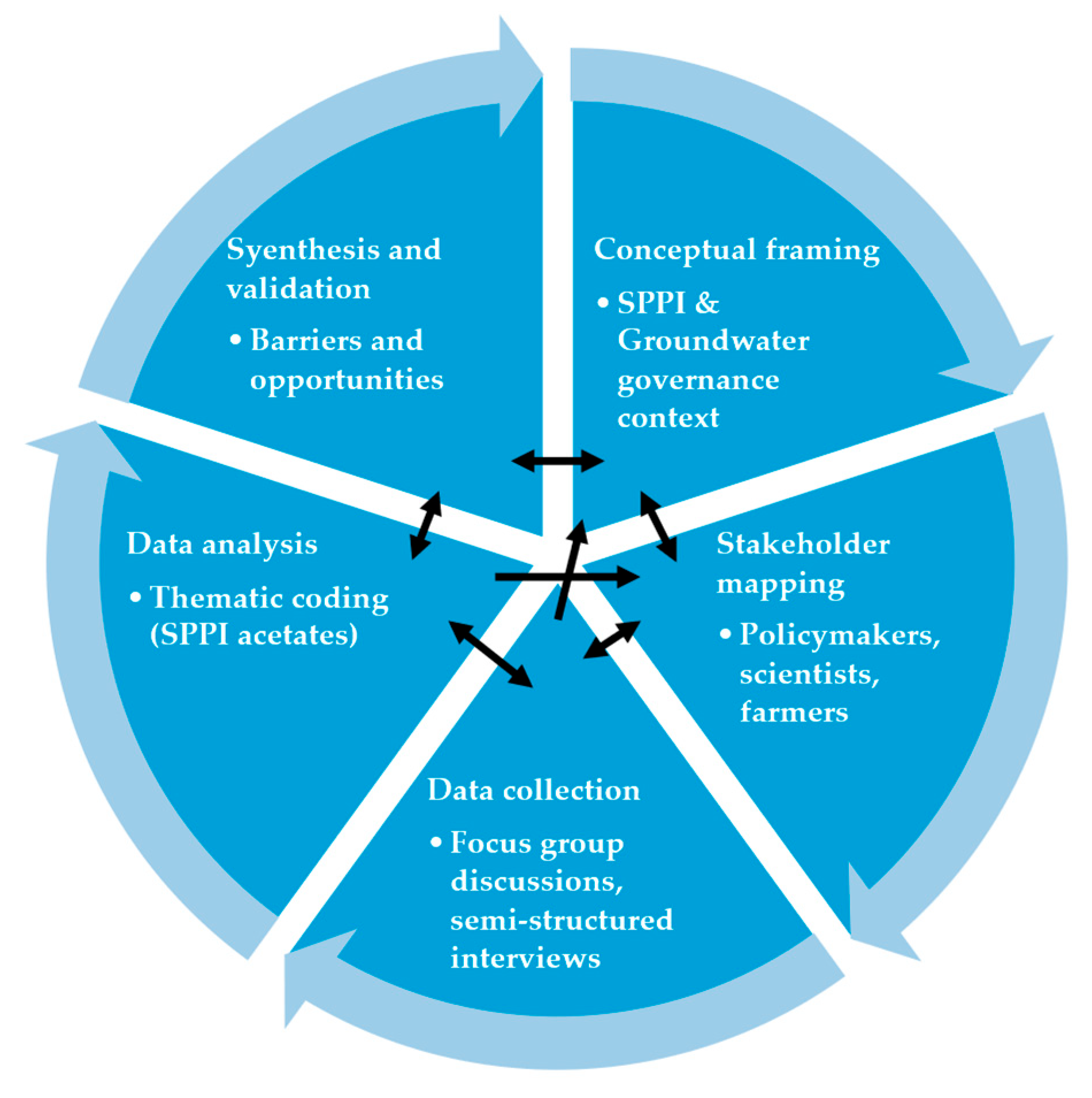
The research process followed five sequential stages (illustrated in Figure 2):
(a)
Conceptual framing: development of research questions informed by SPPI theory and existing groundwater governance literature.
(b)
Stakeholder mapping: identification of policymakers, scientists, and farmers using purposive and snowball sampling.
(c)
Data collection: conducting focus group discussions (FGDs) and semi-structured interviews.
(d)
Data analysis: transcription, translation, and thematic coding (both deductive and inductive).
(e)
Synthesis and validation: triangulation of insights across actor groups to identify impediments and opportunities for science–policy–practice alignment.
These phases were not only sequential but also interconnected through iterative feedback loops. Insights from the conceptual framing informed the stakeholder mapping process, ensuring that actors relevant to SPPI functions were included. Stakeholder mapping, in turn, refined the focus of data collection by highlighting which knowledge gaps required deeper probing.
During data collection, emerging themes often informed subsequent interviews and FGDs, creating a recursive link back to the framing stage. Data analysis was similarly iterative: deductive codes derived from SPPI shaped the initial coding structure, while inductive themes generated new insights that fed back into the interpretation of earlier discussions.
Finally, the synthesis and validation phase integrated findings across actor groups and cross-checked them against the conceptual framing, ensuring coherence between theoretical expectations and empirical patterns. This iterative relationship among phases reflects the SPPI’s emphasis on continuous learning, refinement, and triangulation rather than a rigid linear workflow.
Based on the SPPI conceptual framing, the study was guided by the following research questions:
(a)
What institutional, political and behavioural impediments limit the integration of scientific evidence into groundwater policy and practice in Pakistan’s Indus Basin?
(b)
How do informal institutions and farmer-led innovations shape groundwater governance outcomes?
(c)
What context-appropriate pathways can support more adaptive, inclusive and evidence-informed groundwater governance within the SPPI framework?

3.3. Stakeholder Identification and Sampling

Stakeholders were selected from three principal groups:
i.
Policymakers from federal and provincial water, irrigation, and agriculture departments;
ii.
Scientists and researchers from national and provincial R&D institutions and academia;
iii.
Farmers representing both smallholders (<5 hectares) and medium-scale landowners (5–20 hectares).
Local facilitators in Punjab and Sindh helped identify farmer groups familiar with groundwater use. Policymakers and scientists were recruited through formal invitations to their respective organisations.
Purposive sampling was used to identify stakeholders directly involved in groundwater management viz. policymakers in irrigation and agriculture departments, scientists working on water resources and farmers who rely on tubewell irrigation. This approach ensured that participants possessed relevant experiential or institutional knowledge aligned with the study’s objectives, consistent with qualitative SPPI research that prioritises information-rich cases.
Snowball sampling was then applied to expand participation, particularly in farmer and institutional groups where formal lists were unavailable. Initial participants recommended other individuals who were knowledgeable about groundwater issues in their area or institution. This approach enabled the inclusion of diverse perspectives across districts and organisational hierarchies while accommodating local cultural norms that often facilitate participation through trusted referrals.
The final sample comprised 52 participants (40 FGDs and 12 interviews): 16 policymakers, 16 scientists, and 20 farmers. Separate FGDs were conducted for each group to minimise power asymmetries and encourage open discussion.
Due to prevailing cultural constraints, female representation was low, with only three women (two policymakers, one scientists) among the participants. While this reflects a significant gender imbalance in Pakistan’s water governance institutions, it also highlights the need for future research to actively address inclusivity gaps.

3.4. Data Collection and Analysis Procedures

Data collection proceeded in two stages:
Focus group discussions: Four FGDs (two in Punjab, two in Sindh) were conducted in Urdu to ensure accessibility. Each lasted approximately 120 min and was facilitated by bilingual moderators with expertise in participatory methods. To minimise power imbalances and encourage open dialogue, FGDs for institutional actors (policymakers and scientists) were held separately from farmer FGDs.
Semi-structured interviews: Twelve interviews of 45–60 min were conducted with individuals unable to attend FGDs or whose presence in a group setting might have influenced responses. Interviews allowed for deeper probing of individual experiences and institutional perspectives.
All FGDs and interviews were audio-recorded (with consent) and transcribed verbatim in Urdu before translation into English for coding. Deductive and inductive coding approaches were used in combination. Deductive coding involved applying predefined categories derived from the SPPI framework such as knowledge integration, collaboration, adaptive management, implementation and evidence use. These codes provided an initial structure for analysing the data and ensured alignment with the study’s conceptual framing. Inductive coding, by contrast, allowed themes to emerge directly from participants’ narratives without being constrained by the predefined SPPI categories. This process surfaced additional issues such as political interference, subsidy-related distortions, informal water markets and farmer-led recharge practices that were not fully captured by the deductive codes. Using both approaches enabled a more comprehensive and grounded interpretation of stakeholder perspectives, ensuring that analysis was theoretically informed while still attentive to context-specific nuances.
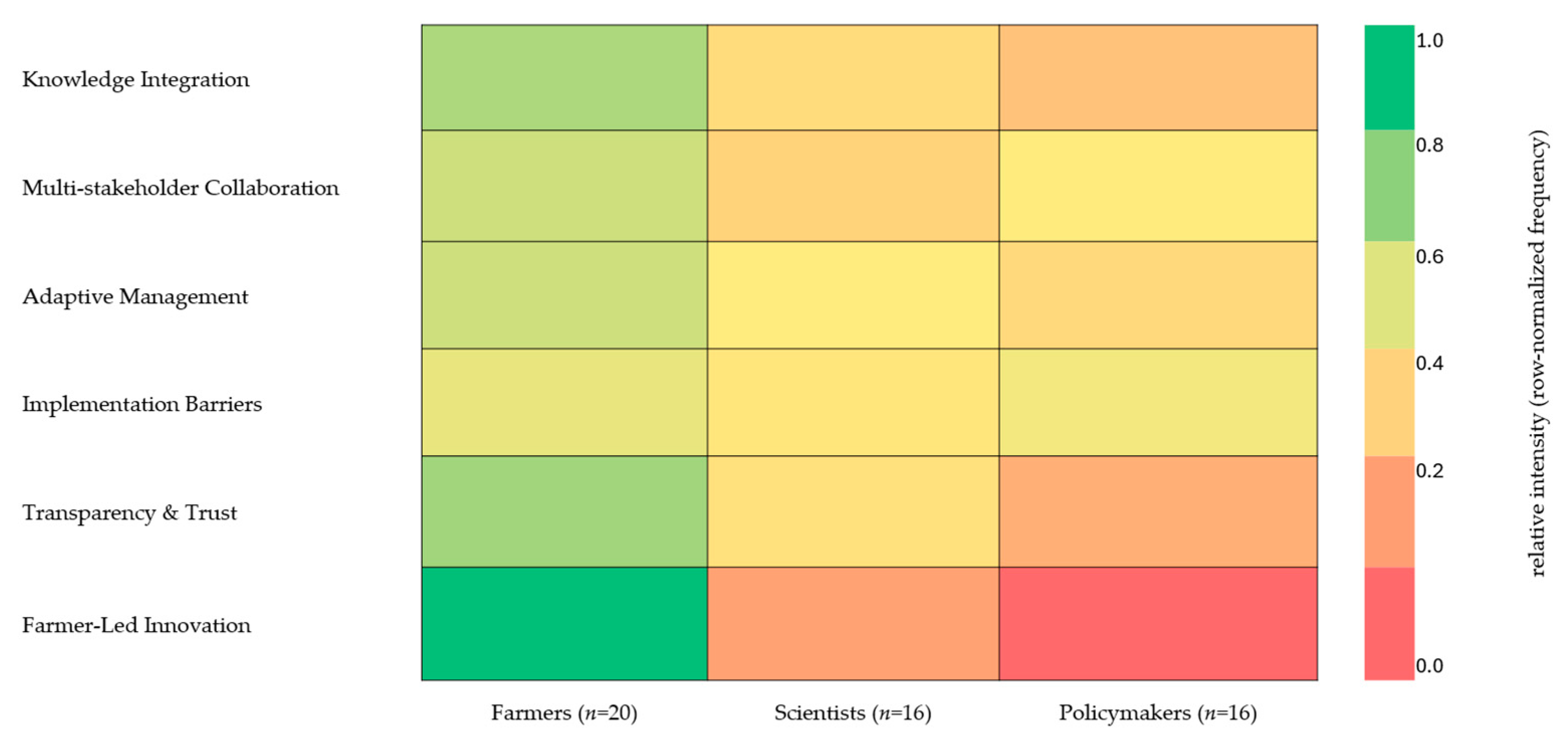
Coding was followed by cross-case comparison among stakeholder groups to identify convergences and divergences. The number of coded references for each theme within each actor group was then tabulated to produce a frequency matrix (Table 1). These frequencies were visualised through a heat-map diagram (Figure 3) to illustrate the relative intensity of stakeholder emphasis across SPPI functions.
To enhance analytical rigor, the study employed a Pearson Chi-square test of independence and where necessary, Fisher’s exact test, applied to the coded frequency data. This step aimed not to quantify attitudes but to statistically assess whether variations in thematic emphasis among actor groups were random or patterned. Including this validation step followed recommendations for “semi-quantitative” treatment of coded qualitative data, which can strengthen interpretive credibility by providing inferential context [31].
The Chi-square statistic is calculated as:
χ 2 = ( O i j E i j ) 2 E i j
where:
  • Oij = observed frequency for the i-th category (SPPI function) and j-th stakeholder group,
  • Eij = expected frequency, computed as
E i j = G r a n d   T o t a l   ( R o w   T o t a l ) i   ×   ( C o l u m n   T o t a l ) j G r a n d   T o t a l
The resulting χ2 statistic was compared against the Chi-square distribution with degrees of freedom:
df = (r − 1)(c − 1)
where r is the number of SPPI themes (rows) and c is the number of stakeholder groups (columns).

3.5. Pre-Conditions

This study was intentionally designed to focus on the agricultural groundwater sector in Punjab and Sindh, reflecting its dominant share in groundwater abstraction and its centrality to rural livelihoods. Accordingly, urban, industrial and domestic water users were not included, as the study aimed to understand agricultural groundwater governance, which accounts for the majority of withdrawals in Pakistan.

3.6. Ethical Considerations

Ethical protocols for the study were approved by the university’s Human Research Ethics Committee (HREC-13284). All participants provided informed consent, either written or verbal depending on literacy levels. Anonymity was maintained by assigning codes to participants and removing identifying details from transcripts.

4. Results and Discussion—Barriers and Opportunities in Embedding Science into Policy and Practice

Stakeholder perspectives from farmers, policymakers and scientists reveal a set of interconnected barriers and opportunities for embedding scientific evidence into agricultural groundwater governance in Pakistan’s Indus Basin. Organising these insights through the five SPPI functions provides a structured lens for interpreting systemic weaknesses while also identifying leverage points for reform. Importantly, the analysis demonstrates that Pakistan’s challenges though resonant with global groundwater crises, carry distinctive features shaped by entrenched political economy, weak institutional capacity and the invisibility of farmer knowledge. Table 2 summarises stakeholder-identified impediments across the SPPI functions alongside practical policy and institutional levers and their expected governance effects. The subsequent sub-sections elaborate these rows with evidence from FGDs and interviews.
Figure 3 illustrates how strongly each stakeholder group emphasised the six SPPI themes during the coded analysis. Darker colours indicate relatively higher frequency of coded references within each theme (normalised by row), allowing comparison of the relative importance of each issue to farmers, scientists and policymakers. The heat map shows that Implementation Barriers and Knowledge Integration received the highest emphasis across all three groups, confirming these as the most salient governance challenges. Farmers placed relatively stronger emphasis on Transparency and Trust and Farmer-Led Innovation, whereas scientists and policymakers placed greater emphasis on Institutional Fragmentation and Evidence Integration. This visualisation therefore summarises points of convergence (e.g., agreement on implementation challenges) and divergence (e.g., differing priorities regarding adaptive management), providing a semi-quantitative cross-stakeholder comparison that complements the qualitative thematic analysis.

4.1. Knowledge Integration

Stakeholders consistently described groundwater knowledge in Pakistan as fragmented, delayed and weakly institutionalised. Although depletion is well measured via wells and satellites, information rarely reaches decision-makers or farmers in usable form, indicating a core SPPI weakness in aligning credibility, salience and legitimacy [13,14,32].
Farmers across Punjab and Sindh reported relying on experiential cues rather than formal advisories. Typical signals included soil whitening, falling yields and reduced pump performance. As one farmer put it, “We only know there is a problem when our crops start failing or when white salt appears on the soil.” Such indicators appear after degradation has progressed, leaving farmers reactive rather than preventative. This pattern illustrates other LMIC contexts where experiential learning substitutes for systematic monitoring but cannot avert decline [33].
Scientists acknowledged data abundance but institutional fragmentation: many “project-specific” datasets remain scattered and incompatible. One scientist noted, “There is no system of groundwater governance at the field level… government agencies are not even aware of how much is being extracted”. The lack of an integrated, provincial-level platform to merge field data, models, and satellite products lowers the salience of otherwise credible evidence and reflects a boundary failure [17].
Policymakers described evidence arriving late and without actionable framing. As a federal respondent observed, “Reports come too late and without the context we need for decision-making”. Even credible analyses thus miss key planning windows, reducing influence on budgets, rules, or enforcement. This timing/format mismatch exemplifies SPPI’s warning that credibility alone is insufficient without timely, decision-aligned translation [13,32].
Across actors, three disconnected knowledge streams operate in parallel: farmer observation, scientific measurement and bureaucratic reporting. Each is internally valid but poorly coupled to the others, producing delays and distortions in governance. Comparable outcomes are reported for South Africa’s Grootfontein aquifer, where rich hydrogeology failed to inform regulation due to access and integration barriers [34]. Within Pakistan, the absence of boundary organisations and participatory platforms prevents alignment of farmer observations, scientific metrics and policy needs into a shared evidence base [35,36].
The Indus Basin presents high credibility (abundant science) but low salience and legitimacy (poor fit to decision cycles and farmer needs). Priority remedies include participatory monitoring and citizen science, open-access provincial dashboards, and co-designed advisories that translate complex hydrogeological signals into actionable guidance for both farmers and planners. Until such integrative systems are institutionalised, governance will remain reactive rather than informed.

4.2. Multi-Stakeholder Collaboration

Stakeholders widely agreed that groundwater governance in Pakistan’s Indus Basin remains constrained by weak and uneven collaboration among farmers, scientists and policymakers. Although consultation mechanisms exist, they are sporadic, donor-driven and seldom lead to joint learning or coordinated action. Within the SPPI framework, this represents a breakdown of the interface function that connects science, policy and practice through sustained dialogue [17].
Farmers in Sindh and southern Punjab described their marginalisation in planning processes and the absence of advisory channels. One participant observed, “Policies are decided in offices; we only hear about them when someone comes to enforce a rule”. Others emphasised that water-saving technologies or cropping guidance rarely reach them in time, reinforcing dependence on informal knowledge networks. This reflects the exclusion of experiential knowledge that SPPI theory terms “practice-based evidence”, which is often undervalued in formal decision arenas [36].
Scientists in Punjab echoed similar frustration, noting the lack of institutionalised spaces for ongoing exchange. As one scientist remarked, “Workshops are held, but they end with reports, there is no mechanism for follow-up or policy adoption”. This pattern of episodic, project-bound engagement limits cumulative learning and mirrors findings from other LMIC contexts where external funding drives short-term collaboration that collapses after project completion [37,38]. In SPPI terms, the absence of “boundary-spanning” institutions reduces opportunities for knowledge integration and iterative feedback.
Policymakers acknowledged that stakeholder participation is often symbolic rather than substantive, constrained by resource limitations and logistical barriers. One provincial officer noted, “We invite stakeholders, but turnout is low and discussions stay general; there is no time or funding for continuous engagement”. Such statements highlight how capacity deficits, rather than deliberate exclusion, undermine interaction. This resonates with SPPI’s emphasis on legitimacy: even when inclusivity is intended, lack of consistent facilitation erodes trust and limits uptake of scientific advice [13,14].
Collectively, these accounts show collaboration in the Indus Basin to be partial, fragile, and asymmetrical. Farmers remain outside agenda-setting, scientists operate within disconnected research silos and policymakers confront bureaucratic inertia. Comparative experiences from Mexico’s basin councils [39] and Rotterdam’s iterative urban water forums [40] demonstrate that durable collaboration depends on formalised, well-resourced platforms rather than ad-hoc consultations. Within Pakistan, provincial water authorities and research institutes could serve as boundary organisations, entities that institutionalise dialogue, co-produce evidence and broker trust across communities [35].
From an SPPI perspective, improving collaboration requires embedding structured participation within existing institutional mandates. This includes regular tri-partite forums, feedback loops that translate farmer innovations into research agendas and joint monitoring committees linking scientists and irrigation departments. Without such arrangements, interaction will remain event-based and the potential for co-produced solutions will remain unrealised.

4.3. Adaptive Management

Stakeholders across all groups recognised that Pakistan’s groundwater governance remains rigid and reactive, with limited capacity to adjust to hydrological and climatic variability. Although farmers have begun modifying cropping patterns and irrigation schedules, institutions lack mechanisms to incorporate these adaptive practices into formal governance. In SPPI terms, this reflects weak “learning loops” between science, policy and practice, one of the core conditions for adaptive management [41,42].
Farmers in Punjab described making autonomous adjustments to changing rainfall and canal flows. “Every year is different”, one farmer explained. “We have to delay sowing or switch crops, but there is no one to guide us”. Such practices demonstrate awareness of variability but also show how adaptation remains individual and uncoordinated. Farmers expressed frustration that extension departments offer little guidance on water-saving techniques or drought-resilient varieties. This reactive adaptation, driven by necessity rather than planning, illustrates a bottom-up form of learning that remains disconnected from institutional support, similar to smallholder contexts in India and sub-Saharan Africa [33].
Scientists confirmed that formal adaptive mechanisms are largely absent from provincial policies. One noted, “Policies are written as if conditions are constant. There is no space to revise quotas or groundwater limits when rainfall or river flows change”. While scientific understanding of variability is strong, it seldom informs legal or administrative decisions. Institutions remain anchored in fixed annual plans rather than dynamic, data-driven rules. This gap between scientific awareness and policy flexibility corresponds findings from South Africa and Gujarat, where recognition of variability has not translated into adaptable management frameworks [34,43].
Policymakers attributed the lack of adaptive measures to political and social constraints. As one remarked, “It is very difficult to change rules every year. Farmers want certainty, and politicians avoid unpopular restrictions in election years.” This comment highlights the political economy of adaptation: even when science supports flexible water allocation, governance systems remain anchored in stability-seeking behaviour. Resistance to change, coupled with administrative inertia, prevents iterative decision-making, confirming SPPI’s proposition that institutional and political incentives strongly condition adaptive capacity [17].
Together, these perspectives reveal a paradox: adaptation is happening at the margins, through farmer improvisation, but remains absent at the institutional core. Farmers are learning from experience, scientists are diagnosing variability, yet policy frameworks remain static. Adaptive management in the Indus Basin thus operates in a fragmented form, lacking vertical integration across actor groups. This disconnect parallels broader evidence from groundwater-dependent systems globally, where adaptation occurs informally while formal structures lag behind [8,41].
From an SPPI standpoint, genuine adaptive governance requires institutional learning loops that link observation, reflection, and reform. Embedding adaptive capacity would involve (i) iterative monitoring systems that integrate farmer observations with scientific models, (ii) flexible planning instruments such as seasonal water budgets, and (iii) policy frameworks that allow evidence-based revision of extraction limits. Without these mechanisms, adaptive management in Pakistan risks remaining rhetorical rather than real, acknowledged in discourse but absent in practice.

4.4. Implementation Barriers

Despite the existence of formal groundwater policies and provincial water acts, stakeholders widely agreed that implementation remains the weakest link in Pakistan’s groundwater governance. Across groups, participants described a persistent gap between regulation on paper and enforcement on the ground, driven by limited institutional capacity, political interference and inequitable access to technology and subsidies. Within the SPPI framework, this reflects a failure in the implementation function that connects scientific recommendations and policy intent with real-world uptake [44].
Farmers consistently highlighted that incentive structures and enforcement mechanisms favour large landholders. One participant noted, “Subsidies for solar pumps or free electricity go to the big farmers, they have connections. Small farmers like us pay more in the water market.” This sentiment captures how well-intentioned interventions can reinforce inequity, creating what SPPI theorists term “misaligned legitimacy”, where policies lose social acceptance despite technical soundness [13]. Farmers also reported little awareness of provincial groundwater laws, viewing them as irrelevant to day-to-day irrigation decisions.
Scientists emphasised the institutional vacuum surrounding enforcement. “Acts and policies have been approved, but there are no rules, no staff, and no budgets for implementation,” observed one representative. Many provincial groundwater cells remain understaffed, while monitoring networks have deteriorated due to budget cuts. Scientists stressed that without field presence, even the best regulatory frameworks remain symbolic. This echoes what [8] describes as “policy without infrastructure”, a pervasive condition in LMIC groundwater systems.
Policymakers acknowledged the challenge but framed it as political rather than technical. As one explained, “When we try to restrict pumping or charge for groundwater, farmer groups protest and politicians withdraw support. Implementation becomes politically impossible”. These remarks highlight how vested interests and electoral cycles undermine enforcement. The political economy of water thus operates as a structural constraint: while scientists advocate volumetric controls, political incentives reward short-term appeasement [20,45].
Combined, these accounts depict a classic “implementation gap”: policies are ambitious, but institutional and political conditions prevent execution. Farmers experience inequitable subsidies; scientists confront administrative inertia; and policymakers navigate resistance from powerful actors. Similar dynamics have been observed in Sub-Saharan Africa, where groundwater laws exist largely as paper frameworks without operational capacity [46]. Within Pakistan, overlapping mandates among irrigation, agriculture and energy departments further diffuse accountability, reinforcing fragmentation noted in earlier sections.
From an SPPI perspective, bridging this gap requires both technical instruments (e.g., licensing systems, volumetric metering) and social strategies (e.g., co-designed rules, phased reform, and subsidy realignment). Implementation must therefore be treated as a co-production process rather than an administrative act. Embedding scientists within provincial planning teams, empowering farmer organisations to monitor compliance and coupling enforcement with incentive redesign could strengthen legitimacy and uptake. Without such integrative approaches, Pakistan’s groundwater governance will remain trapped in the paradox of “policy abundance and practice absence”.

4.5. Transparency and Trust

Across stakeholder groups, a pervasive concern was the lack of transparency in groundwater data, decision-making, and policy implementation. Participants repeatedly linked this opacity to declining trust between farmers, scientists, and state institutions. Within the SPPI framework, transparency and trust are essential components of credibility and legitimacy, core attributes determining whether scientific knowledge influences governance [13].
Farmers in both Punjab and Sindh expressed that government agencies seldom share monitoring information or irrigation schedules. “We never see the data the government collects”, one farmer remarked. “If they are monitoring, it stays in files. We only know there is a problem when crops fail”. Many equated secrecy with institutional indifference, explaining that they rely on visual cues, salinity, soil cracking, or falling yields, to infer water conditions. Such perceptions illustrate how missing feedback mechanisms weaken farmers’ confidence in state management, forcing reliance on experiential knowledge that arrives too late to prevent degradation [36].
Scientists confirmed that information bottlenecks are common. “Even when groundwater levels are measured, the results are released months later”, one scientist explained. Delayed reporting renders data obsolete for adaptive management or farmer guidance. Scientists also noted that project-based datasets often remain unpublished due to ownership disputes or bureaucratic clearance delays. This restricts peer verification and public engagement, two conditions that underpin scientific legitimacy. Comparable issues have been documented in other groundwater-dependent regions where data opacity erodes both collaboration and compliance [32,40].
Policymakers acknowledged transparency shortcomings but attributed them to capacity rather than intent. As one provincial officer explained, “It’s not secrecy; we simply lack systems to publish data regularly or translate it for farmers”. Limited digital infrastructure, fragmented databases, and absence of dedicated communication units impede timely disclosure. This highlights how institutional weakness, not deliberate concealment, often drives perceived opacity. Nevertheless, as SPPI theory emphasises, the effect on legitimacy is identical: information that is unavailable or inaccessible undermines public confidence [14].
Collectively, these insights depict a transparency–trust feedback loop: poor data sharing fosters suspicion, while low trust discourages information exchange. Farmers interpret silence as neglect, scientists perceive inefficiency, and policymakers confront scepticism that limits cooperation. Internationally, similar cycles have hindered groundwater reform in Mexico and South Africa, where delayed disclosure eroded compliance and citizen engagement [34,39]. In Pakistan, the fragmentation of monitoring responsibilities across multiple agencies exacerbates the problem by diffusing accountability.
Building transparency and trust requires institutionalising open-data and participatory communication frameworks. Actions could include establishing provincial groundwater dashboards, issuing quarterly status bulletins in local languages, and integrating citizen-science observations into official databases. Such mechanisms enhance credibility by exposing methods, strengthen salience by providing timely feedback, and increase legitimacy by involving end-users in evidence creation. Without these measures, the SPPI’s potential to align science, policy and practice will remain constrained by persistent informational asymmetries and fragile trust.

4.6. Farmer-Led Innovations and Opportunities

While most discussion centred on governance barriers, all stakeholder groups identified locally driven innovations that illustrate untapped opportunities for strengthening the SPPI. These farmer-led responses, ranging from groundwater recharge ponds to informal water-sharing arrangements, demonstrate how adaptive knowledge is already emerging from below, even if it remains invisible to formal institutions. Within the SPPI framework, such initiatives embody the co-production of knowledge, where practice contributes directly to evidence generation and problem solving [36,38].
Farmers in Sindh described efforts to mitigate salinity and water scarcity through self-financed recharge ponds and field-level rainwater capture. One farmer explained, “We made small ponds to store rainwater; it helps recharge the well and reduce salt around crops”. Others reported crop switching to fodder or vegetables during drought years and engaging in small-scale water markets to share tubewell access. These practices highlight both innovation and inequity, those with greater resources experiment more easily, while poorer farmers remain constrained by costs. Nonetheless, they illustrate practical learning cycles consistent with SPPI’s emphasis on local experimentation as a precursor to systemic adaptation [42].
Scientists acknowledged these initiatives but noted that they often fall outside formal observation systems. “Farmers are already testing recharge ponds and crop rotations”, one scientist observed, “but because these are not recorded, policymakers don’t treat them as evidence”. Scientists argued that such local practices could inform policy if systematically documented and evaluated. They referenced successful participatory groundwater programs in Gujarat, India, where community water budgeting slowed aquifer decline by aligning farmer behaviour with scientific data [43]. This underlines SPPI’s proposition that practice can generate credible knowledge when supported by scientific validation and policy recognition [14].
Policymakers recognised the value of farmer insights but stressed the need for institutional mechanisms to incorporate them. One policymaker stated, “If we can document and verify what farmers are doing, we can scale it up, but we lack a system to collect that information”. Officials suggested that integrating such evidence into provincial water-management plans could enhance both relevance and legitimacy. Their comments reveal a willingness to engage, tempered by administrative inertia and resource constraints, conditions that SPPI theory identifies as typical of weak boundary environments [35].
These accounts demonstrate that farmers are not passive recipients of policy but active experimenters responding to environmental stress. Scientists and policymakers recognise this adaptive capacity yet lack the frameworks to channel it into formal governance. Similar dynamics have been observed in African and Latin-American contexts, where farmer innovations remain anecdotal until translated through participatory monitoring platforms [33,40]. Within Pakistan, initiatives such as farmer-scientist learning alliances or citizen-science networks could provide the institutional bridges needed to validate and scale these grassroots solutions.
Farmer-led innovation represents an underutilised entry point for strengthening Pakistan’s groundwater governance. Embedding these practices within structured SPPI processes, through joint experimentation, local demonstration sites, and inclusion of farmer data in provincial databases, could transform fragmented adaptations into hybrid knowledge systems that combine scientific rigour with practical legitimacy. Recognising and institutionalising such bottom-up innovation would not only enhance the salience of science but also rebuild trust and ownership among groundwater users.

4.7. Synthesis Across Stakeholders

To complement the qualitative analysis, the coded frequency matrix (Table 1) was subjected to a Pearson Chi-square test of independence to examine whether variations in the emphasis of SPPI functions among farmers, scientists and policymakers were statistically significant. Where expected cell counts were fewer than 5, Fisher’s exact test was applied to ensure reliability. The analysis (Table 3) indicated that no statistically significant differences were observed between stakeholder groups (χ2(10) = 5.83, p = 0.83). This outcome suggests a broad convergence in how different actors perceive barriers and opportunities in Pakistan’s groundwater governance. The test therefore reinforces the thematic synthesis, indicating that despite positional differences, stakeholders share common concerns about implementation gaps, fragmented knowledge systems and trust deficits.
The perspectives of farmers, scientists and policymakers reveal a shared recognition of the groundwater crisis in Pakistan’s Indus Basin but divergent understandings of its causes and solutions. All stakeholders agreed that depletion is accelerating, institutions are fragmented and policies are weakly implemented. Yet each group interprets these failures through its own experiential, professional, or political lens, a pattern that represents the asymmetries the SPPI framework seeks to reconcile [13].
Convergence on problem diagnosis: Farmers, scientists and policymakers uniformly identified over-abstraction, salinity and policy inertia as major threats to agricultural sustainability. A policymaker observed, “We all know the aquifers are declining; the issue is not evidence but enforcement”. This alignment around the problem points out the credibility of scientific diagnosis and the salience of local experience, two of the three pillars that underpin effective interfaces [13]. However, convergence on diagnosis has not translated into coordinated action, indicating a breakdown in legitimacy and shared ownership of solutions.
Divergence on responsibilities and reform pathways: Farmers framed governance failure as an informational and equity issue, they lack timely guidance and feel marginalised by subsidy structures and water markets that favour wealthier landowners. Scientists portrayed the problem as institutional fragmentation, citing poor data integration, lack of continuity between research and policy and the absence of sustained collaboration platforms. Policymakers, in contrast, highlighted political constraints, noting that reform efforts face pushback from influential constituencies. This divergence illustrates SPPI’s central proposition: that misaligned incentives and asymmetrical power relations hinder the translation of knowledge into action [17,37].
Latent potential for integration: Despite these differences, the findings reveal untapped complementarities among stakeholder groups. Farmers already generate experiential knowledge through recharge ponds and water-sharing arrangements; scientists can validate and systematise these practices; and policymakers increasingly acknowledge their relevance for policy design. These intersecting capabilities form the basis for hybrid knowledge systems, collaborative spaces where evidence and practice can co-evolve into enforceable and adaptive governance mechanisms [38,42].
Implications for governance reform: The synthesis suggests that Pakistan’s groundwater governance challenge is not the absence of knowledge but the absence of mechanisms that connect it across levels and actors. Building on SPPI theory, effective reform would require (i) boundary organisations to mediate between science and policy; (ii) participatory monitoring systems to integrate farmer data; and (iii) political strategies that align incentives for enforcement. International experiences from Mexico’s basin councils to Gujarat’s participatory water budgeting demonstrate that when such interfaces are institutionalised, both compliance and adaptive capacity improve [39,43].
The Indus Basin case thus illustrates both the promise and limitation of SPPI. It confirms that scientific credibility, farmer legitimacy and policy salience must interact continuously, not sequentially, to achieve sustainable governance. Without institutional structures that enable this interaction, Pakistan’s groundwater management will remain reactive and fragmented. Yet the study also shows that the foundations for integration already exist in farmer innovation, scientific expertise and growing policy awareness, elements that, if connected, can transform the SPPI from an analytical lens into a practical governance tool.
The findings of this study resonate with international evidence showing that groundwater governance failures are often driven by weak knowledge integration, fragmented institutions, and political economy constraints, patterns also documented in India, Mexico, China, and South Africa [6,7,8]. However, this study diverges from previous research in two important ways. First, it applies the SPPI framework in a low- and middle-income, irrigation-dependent context, whereas most SPPI applications have been conducted in high-capacity governance settings such as Europe and Australia. Second, it foregrounds informal institutions and farmer-led innovations as central components of the science–policy–practice relationship, an aspect largely underexplored in prior SPPI and groundwater governance studies. These distinctions position the study as a complementary but novel contribution that extends global understanding of how knowledge is integrated or blocked within politically and hydrologically complex aquifer systems.
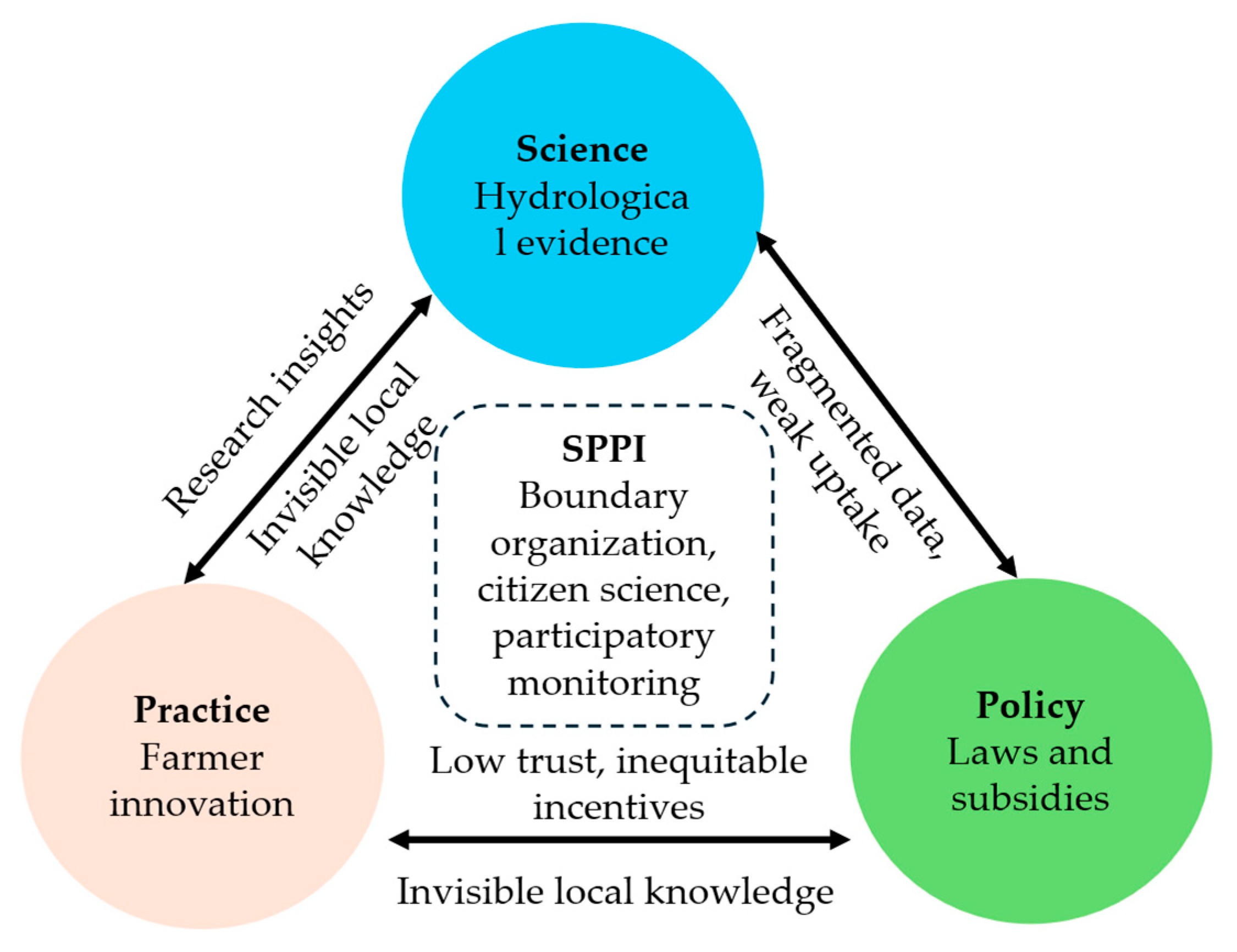
The interconnections and disjunctions among science, policy and practice identified through stakeholder perspectives are summarised in Figure 4. This conceptual diagram illustrates how the SPPI operates in Pakistan’s Indus Basin, highlighting both current disconnects and potential zones of integration through boundary organisations, citizen science, and participatory monitoring.
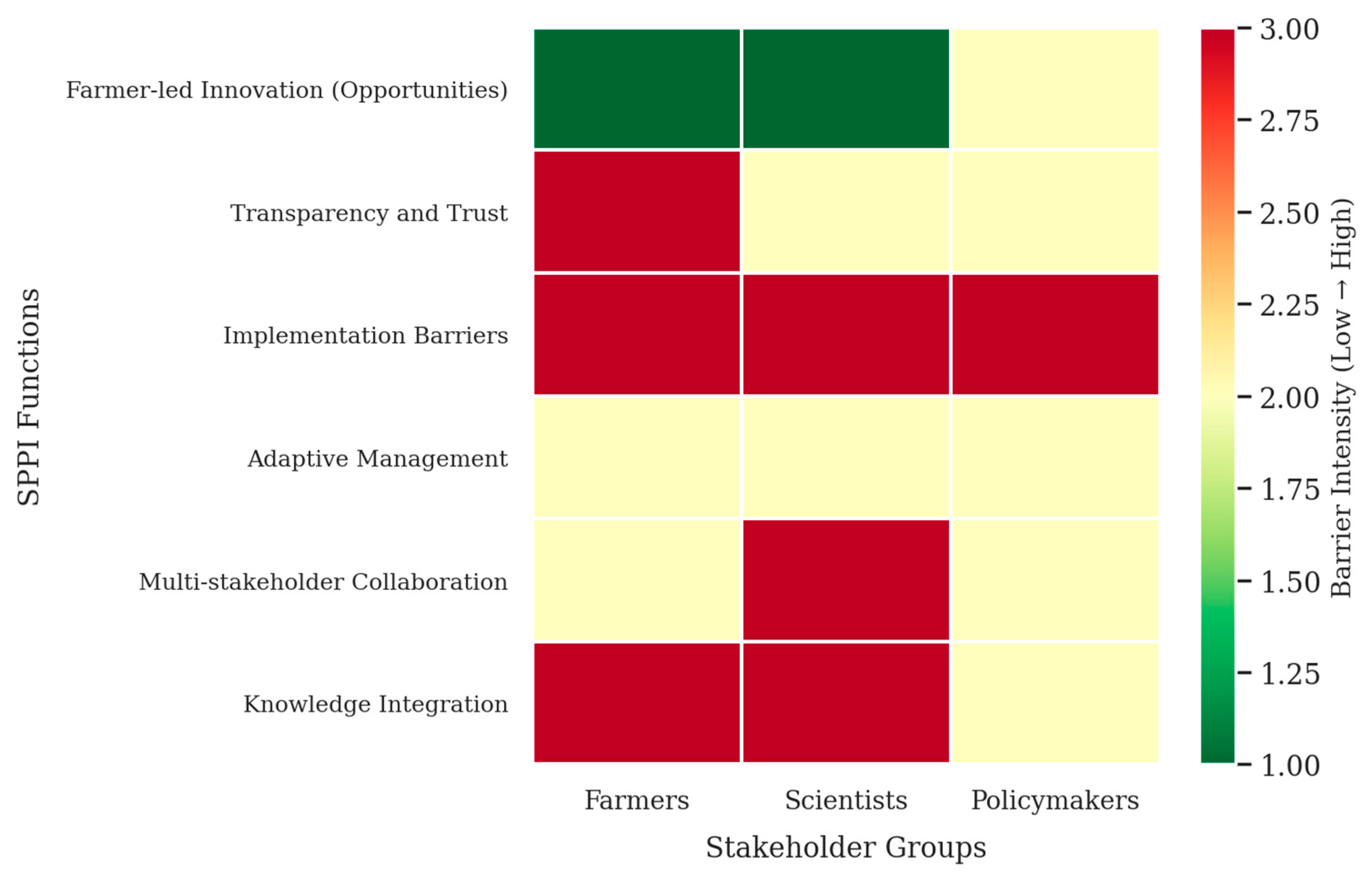
The comparative intensity of barriers and opportunities across stakeholder groups is visualised in Figure 5, which presents a heat map of perceptions across six SPPI functions. The figure highlights that implementation barriers and knowledge integration were perceived as the most critical impediments by all groups, while farmer-led innovation emerged as a relatively low-intensity (opportunity) domain. Transparency and trust and multi-stakeholder collaboration were viewed as moderate barriers, whereas adaptive management was perceived as institutionally weak but improving. These contrasts reveal the uneven maturity of SPPI functions across the science–policy–practice continuum, highlighting where future boundary efforts and policy attention are most needed.

5. Conclusions

Groundwater in Pakistan’s Indus Basin underpins agricultural production, food security and rural livelihoods, yet continues to decline under conditions of fragmented governance and limited institutional capacity. This study applied the SPPI framework to examine how scientific evidence is, or is not, translated into policy and farmer practice. The findings reveal that while hydrological knowledge and provincial policy frameworks exist, their integration into decision-making remains partial and uneven. Farmers innovate locally through recharge ponds, crop switching and informal water-sharing markets, but these practices remain invisible to policy. Scientists produce robust datasets and satellite assessments, yet their insights rarely inform regulation. Policymakers recognise the urgency of the crisis but face political and fiscal constraints that limit enforcement.
Despite this fragmentation, important opportunities for alignment exist. Evidence from the Indus Basin shows that co-production of knowledge, through citizen science, participatory monitoring and boundary organisations, can bridge the credibility, salience and legitimacy gaps that currently constrain groundwater governance. Farmer-led innovations provide entry points for local adaptation, while scientific monitoring offers tools for basin-scale planning. Embedding these interactions into institutional structures can transform one-way communication into iterative learning processes, enabling adaptive management. International experiences, such as Gujarat’s participatory groundwater budgeting and Mexico’s basin councils, demonstrate that when SPPI principles are institutionalised, both compliance and collective action improve.
Theoretically, this research extends SPPI into irrigation-dependent, low- and middle-income contexts where political economy constraints and informal institutions shape outcomes as much as technical capacity. It demonstrates that credible evidence alone cannot ensure sustainability unless supported by legitimate participation and enforceable policy instruments. Integrating insights from political economy and implementation science strengthens SPPI’s explanatory power, highlighting that sustainable water governance depends on both knowledge integration and power negotiation.
Practically, the study offers three pathways for reform. First, institutionalise boundary organisations to sustain collaboration among scientists, policymakers and farmers. Second, develop participatory monitoring systems that merge scientific and local data to guide adaptive management. Third, pursue phased regulatory reforms that address political resistance through incentive redesign and inclusive governance mechanisms. Implementing these strategies would enhance not only groundwater sustainability but also social trust and equity within Pakistan’s water governance landscape.
In conclusion, bridging the divide between science, policy and practice requires recognising that knowledge alone does not govern, it must be legitimised through dialogue, embedded in institutions and aligned with societal incentives. The Indus Basin case illustrates that while the barriers to integration are deep-rooted, the foundations for transformation already exist. Harnessing the collective intelligence of farmers, scientists, and policymakers can move Pakistan’s groundwater governance from reactive management toward a more adaptive, participatory, and sustainable future.

Funding

The author gratefully acknowledges the Australian Centre for International Agricultural Research (ACIAR) for supporting the fieldwork through the John Allwright Fellowship program. Additional financial assistance for the article processing charges was provided by the Centre for Environmental Governance, University of Canberra, which the author sincerely appreciates.

Data Availability Statement

The original contributions presented in this study are included in the article. Further inquiries can be directed to the corresponding author.

Acknowledgments

The author gratefully acknowledges the invaluable support of Bareerah Fatima for her significant contributions to the fieldwork for this study.

Conflicts of Interest

The author declares no conflicts of interest.

References

  1. Qureshi, A. Challenges and Opportunities of Groundwater Management in Pakistan. In Groundwater of South Asia; Springer: Singapore, 2018; pp. 735–757. [Google Scholar]
  2. Cheema, M.J.; Immerzeel, W.W.; Bastiaanssen, W.G.M. Spatial Quantification of Groundwater Abstraction in the Irrigated Indus Basin. Groundwater 2014, 52, 25–36. [Google Scholar] [CrossRef]
  3. Hasan, F.U.; Fatima, B.; Ashraf, M. Challenges to irrigated crop zones of Punjab and Sindh provinces in the wake of climate variability. Int. J. Environ. Sci. Nat. Resour. 2021, 27, 556207. [Google Scholar] [CrossRef]
  4. Iqbal, N.; Ashraf, M.; Imran, M.; Salam, H.A.; Hasan, F.U.; Khan, A.D. Groundwater Investigations and Mapping in the Lower Indus Plain; Pakistan Council of Research in Water Resources (PCRWR): Islamabad, Pakistan, 2020. [Google Scholar]
  5. Hasan, F.; Fatima, B. A Review of Drivers Contributing to Unsustainable Groundwater Consumption in Pakistan. Groundw. Sustain. Dev. 2025, 29, 101414. [Google Scholar] [CrossRef]
  6. Mukherji, A. Sustainable Groundwater Management in India Needs a Water-Energy-Food Nexus Approach. Appl. Econ. Perspect. Policy 2020, 44, 394–410. [Google Scholar] [CrossRef]
  7. Wester, P.; Hoogesteger, J.; Vincent, L. Local IWRM organizations for groundwater regulation: The experiences of the Aquifer Management Councils (COTAS) in Guanajuato, Mexico. Nat. Resour. Forum 2009, 33, 29–38. [Google Scholar] [CrossRef]
  8. Villholth, K.; Conti, K. Groundwater governance: Rationale, definition, current state and heuristic framework. In Advances in Groundwater Governance; CRC Press: Boca Raton, FL, USA, 2017; pp. 3–31. [Google Scholar]
  9. Famiglietti, J. The global groundwater crisis. Nat. Clim. Change 2014, 4, 945–948. [Google Scholar] [CrossRef]
  10. Taylor, R.; Scanlon, B.; Döll, P.; Rodell, M.; van Beek, R.; Wada, Y.; Longuevergne, L.; Leblanc, M.; Famiglietti, J.S.; Edmunds, M.; et al. Ground water and climate change. Nat. Clim. Change 2013, 3, 322–329. [Google Scholar] [CrossRef]
  11. Lebel, L.; Anderies, J.M.; Campbell, B.; Folke, C.; Hatfield-Dodds, S.; Hughes, T.P.; Wilson, J. Governance and the capacity to manage resilience in regional social-ecological systems. Ecol. Soc. 2006, 11, 19. [Google Scholar] [CrossRef]
  12. Lemos, M.C.; Morehouse, B.J. The co-production of science and policy in integrated climate assessments. Glob. Environ. Change 2005, 15, 57–68. [Google Scholar] [CrossRef]
  13. Cash, D.; Clark, W.C.; Alcock, F.; Dickson, N.M.; Eckley, N.; Guston, D.H.; Jäger, J.; Mitchell, R.B. Knowledge Systems for Sustainable Development. Proc. Natl. Acad. Sci. USA 2003, 100, 8086–8091. [Google Scholar] [CrossRef]
  14. Cvitanovic, C.; Hobday, A.J.; van Kerkhoff, L.; Wilson, S.K.; Dobbs, K.; Marshall, N.A. Improving knowledge exchange among scientists and decision-makers to facilitate the adaptive governance of marine resources: A review of knowledge and research needs. Ocean. Coast. Manag. 2015, 112, 25–35. [Google Scholar] [CrossRef]
  15. Fazey, L.; Evely, A.C.; Reed, M.S.; Stringer, L.C.; Kruijsen, J.; White, P.C.L.; Newsham, A.; Jin, L.; Cortazzi, M.; Phillipson, J.; et al. Knowledge exchange: A review and research agenda for environmental management. Environ. Conserv. 2013, 40, 19–36. [Google Scholar] [CrossRef]
  16. Van Kerkhoff, L.; Lebel, L. Linking knowledge and action for sustainable development. Annu. Rev. Environ. Resour. 2006, 31, 445–477. [Google Scholar] [CrossRef]
  17. Turnhout, E.; Metze, T.; Wyborn, C.; Klenk, N.; Louder, E. The politics of co-production: Participation, power, and transformation. Curr. Opin. Environ. Sustain. 2020, 42, 15–21. [Google Scholar] [CrossRef]
  18. Turner, B.L., II; Janetos, A.C.; Verburg, P.H.; Murray, A.T. Land system architecture: Using land systems to adapt and mitigate global environmental change. Glob. Environ. Change 2013, 23, 395–397. [Google Scholar] [CrossRef]
  19. Fazey, I.; Schäpke, N.; Caniglia, G.; Patterson, J.; Hultman, J.; van Mierlo, B.; Säwe, F.; Wiek, A.; Wittmayer, J.; Aldunce, P.; et al. Ten essentials for action-oriented and second order energy transitions, transformations and climate change research. Energy Res. Soc. Sci. 2018, 40, 54–70. [Google Scholar] [CrossRef]
  20. Mustafa, D.; Akhter, M.; Nasrallah, N. Understanding Pakistan’s Water-Security Nexus; United States Institute of Peace: Washington, DC, USA, 2013. [Google Scholar]
  21. Hasan, F.; Dare, L.; Sinclair, D. Governing groundwater in the Indus Basin: Barriers to effective groundwater management and pathways for reform. Environ. Sci. Policy 2025, 173, 104247. [Google Scholar] [CrossRef]
  22. PBOS. Pakistan Statistical Yearbook 2023; Pakistan Bureau of Statistics (PBOS), Government of Pakistan: Islamabad, Pakistan, 2023.
  23. World Bank. Pakistan Development Update 2022: Reviving Economic Stability; World Bank Group: Washington, DC, USA, 2022; Available online: https://www.worldbank.org (accessed on 1 December 2025).
  24. Lytton, L.; Ali, A.; Garthwaite, B.; Punthakey, J.F.; Saeed, B.A. Groundwater in Pakistan’s Indus Basin: Present and Future Prospects; World Bank Group: Washington, DC, USA, 2021. [Google Scholar]
  25. Asad Sarwar, Q. Water Management in the Indus Basin in Pakistan: Challenges and Opportunities. Mt. Res. Dev. 2011, 31, 252–260. [Google Scholar] [CrossRef]
  26. GoP. National Water Policy; Ministry of Water Resources, Governmnet of Pakistan (GoP): Islamabad, Pakistan, 2018.
  27. Dharpure, J.K.; Howat, I.M.; Kaushik, S. Declining groundwater storage in the Indus basin revealed using GRACE and GRACE-FO data. Water Resour. Res. 2025, 61, e2024WR038279. [Google Scholar] [CrossRef]
  28. MoCC. National Climate Change Policy; Ministry of Climate Change (MoCC), Government of Pakistan: Islamabad, Pakistan, 2021.
  29. Rana, A.W.; Gill, S.; Meinzen-Dick, R.; ElDidi, H. Strengthening Groundwater Governance in Pakistan; International Food Policy Research Institute: Washington, DC, USA, 2024. [Google Scholar]
  30. Watto, M.A.; Mugera, A.W. Groundwater depletion in the Indus Plains of Pakistan: Imperatives, repercussions and management issues. Int. J. River Basin Manag. 2016, 14, 447–458. [Google Scholar] [CrossRef]
  31. McHugh, M. The Chi-square test of independence. Biochem. Medica 2013, 23, 143–149. [Google Scholar] [CrossRef]
  32. Meadow, A.M.; Ferguson, D.B.; Guido, Z.; Horangic, A.; Owen, G.; Wall, T. Moving toward the deliberate coproduction of climate science knowledge. Weather. Clim. Soc. 2015, 7, 179–191. [Google Scholar] [CrossRef]
  33. de Bont, C.; Börjeson, L. Policy Over Practice: A Review of Groundwater Governance Research in Sub-Saharan Africa. Int. J. Commons 2024, 18, 82–93. [Google Scholar] [CrossRef]
  34. Cobbing, J.; Wit, M.J. The Grootfontein aquifer: Governance of a hydro social system at Nash equilibrium. S. Afr. J. Sci. 2018, 114, 1–7. [Google Scholar] [CrossRef]
  35. Guston, D. Boundary Organizations in Environmental Policy and Science: An Introduction. Sci. Technol. Hum. Values 2001, 26, 399–408. [Google Scholar] [CrossRef]
  36. Norström, A.V.; Cvitanovic, C.; Löf, M.F.; West, S.; Wyborn, C.; Balvanera, P.; Bednarek, A.T.; Bennett, E.M.; Biggs, R.; De Bremond, A.; et al. Principles for knowledge co-production in sustainability research. Nat. Sustain. 2020, 3, 182–190. [Google Scholar] [CrossRef]
  37. Reed, M.; Evely, A.C.; Cundill, G.; Fazey, I.; Glass, J.; Laing, A.; Newig, J.; Parrish, B.; Prell, C.; Raymond, C.; et al. What is Social Learning? Ecol. Soc. 2010, 15, r1. [Google Scholar] [CrossRef]
  38. Wyborn, C.; Datta, A.; Montana, J.; Ryan, M.; Leith, P.; Chaffin, B.; Miller, C.; van Kerkhoff, L. Co-Producing Sustainability: Reordering the Governance of Science, Policy, and Practice. Annu. Rev. Environ. Resour. 2019, 44, 319–346. [Google Scholar] [CrossRef]
  39. Scott, C.A.; Banister, J.M. The Dilemma of Water Management ‘Regionalization’ in Mexico under Centralized Resource Allocation. In Integrated Water Resources Management in Latin America; Routledge: London, UK, 2013; pp. 61–74. [Google Scholar]
  40. Dunn, G.; Brown, R.; Bos, J.; Bakker, K. The role of science-policy interface in sustainable urban water transitions: Lessons from Rotterdam. Environ. Sci. Policy 2017, 73, 71–79. [Google Scholar] [CrossRef]
  41. Chaffin, B.C.; Gosnell, H.; Cosens, B.A. A decade of adaptive governance scholarship: Synthesis and future directions. Ecol. Soc. 2014, 19, 56. [Google Scholar] [CrossRef]
  42. Folke, C.; Hahn, T.; Olsson, P.; Norberg, J. Adaptive governance of social-ecological systems. Annu. Rev. Environ. Resour. 2005, 30, 441–473. [Google Scholar] [CrossRef]
  43. Shah, T. Taming the Anarchy: Groundwater Governance in South Asia; Routledge: London, UK, 2010. [Google Scholar]
  44. Armitage, D.; Marschke, M.; Plummer, R. Adaptive co-management and the paradox of learning. Glob. Environ. Change 2008, 18, 86–98. [Google Scholar] [CrossRef]
  45. Nelson, R.L. Water rights for groundwater environments as an enabling condition for adaptive water governance. Ecol. Soc. 2022, 27, 28. [Google Scholar] [CrossRef]
  46. Closas, A.; Villholth, K. Groundwater governance: Addressing core concepts and challenges. Wiley Interdiscip. Rev. Water 2019, 7, e1392. [Google Scholar] [CrossRef]
Figure 1. Groundwater quality demarcation in Indus plain reproduced from [4]. Note: colours explanation (green: fresh; yellow and pink: marginal; red: highly saline).
Water 17 03496 g001
Figure 2. Research design and methodological flow for analysing SPPI in groundwater governance in Pakistan (outer arrows represent a link with different stages while black arrows inside represent feedback loops).
Water 17 03496 g002
Figure 3. Frequency-weighted heat map of SPPI themes by stakeholder group. (Cells show row-normalised frequencies derived from coded mentions within each theme, comparing emphasis by Farmers (n = 20), Scientists (n = 16), and Policymakers (n = 16). Darker shades indicate relatively greater emphasis within that theme; values are normalised within rows to aid cross-group comparison).
Water 17 03496 g003
Figure 4. Science, policy, practice convergence and divergence in groundwater governance of the Indus Basin.
Water 17 03496 g004
Figure 5. Heat map illustrating stakeholder perceptions of barrier intensity across SPPI functions for sustainable groundwater governance in Pakistan’s Indus Basin.
Water 17 03496 g005
Table 1. Coded frequency of SPPI themes by stakeholder group (basis for Chi-square test of independence).
SPPI ThemeFarmersScientistsPolicymakersRow Total
Knowledge Integration38272590
Multi-stakeholder Collaboration25192165
Adaptive Management18151447
Implementation Barriers34303397
Transparency & Trust20141246
Farmer-Led Innovation2210840
Total157115113385
Table 2. SPPI barrier–lever matrix for groundwater governance in Pakistan’s Indus Basin.
SPPI FunctionDominant Impediments (From Stakeholders)Evidence BasisPractical Levers (Policy/Institutional)Expected Effect
Knowledge integrationFragmented datasets; late, non-actionable reportingFGDs + interviews across all groupsProvincial open-data dashboards; joint scientist–planner data teams; farmer-facing advisoriesHigher salience & uptake of science
Multi-stakeholder collaborationEpisodic, donor-driven events; low farmer voiceFGDs (farmers, scientists)Standing tri-partite forums; boundary orgs in provinces; co-production MOUsStable dialogue; shared priorities
Adaptive managementStatic plans; no seasonal/annual adjustmentAll groupsSeasonal water budgets; rule revision windows; extension on adaptive croppingIterative learning; flexible rules
ImplementationNo metering/licensing; subsidy distortions; thin enforcementAll groupsPhased licensing; targeted subsidy reforms; compliance monitoring with CS supportEnforceability with equity
Transparency & trustDelayed releases; inaccessible formatsAll groupsQuarterly bulletins (Urdu/Sindhi); real-time online status; citizen-science validationLegitimacy & cooperation
Farmer-led innovationPractices invisible to policy; inequity in scalingFarmers + scientistsDocument & evaluate recharge/water-sharing; demos; integrate farmer dataHybrid knowledge; scalable pilots
Table 3. Summary of Chi-square Test of Independence for SPPI Functions Across Stakeholder Groups.
SPPI Functionχ2 (df = 10)p-ValueInterpretation
Knowledge Integration5.830.83No significant difference across groups
Multi-stakeholder Collaboration4.120.74Shared perceptions of weak collaboration
Adaptive Management6.010.79Convergent views on institutional rigidity
Implementation Barriers7.250.68Consensus on weak enforcement and political constraints
Transparency & Trust3.450.89Similar concerns across actors
Farmer-led Innovation2.170.91Common recognition of emerging local initiatives
Overall Chi-square5.83 (10)0.83No statistically significant differences among stakeholder groups
Note: Fisher’s exact test was used for categories with expected frequencies < 5.
Disclaimer/Publisher’s Note: The statements, opinions and data contained in all publications are solely those of the individual author(s) and contributor(s) and not of MDPI and/or the editor(s). MDPI and/or the editor(s) disclaim responsibility for any injury to people or property resulting from any ideas, methods, instructions or products referred to in the content.