


Advancements in Microbial Nitrogen Pathways for Sustainable Wastewater Treatment

 ,
, 
 , and
, and 
Abstract
1. Introduction
Review Methodology for Literature Survey
2. Implications of Complete Ammonia (NH3) Oxidation Bacterial Community in Wastewater Treatment
3. Synergistic Potential of Comammox-Anammox Systems for Energy-Efficient Nitrogen Removal
4. Advancing Comammox-Anammox Integration in Wastewater Treatment
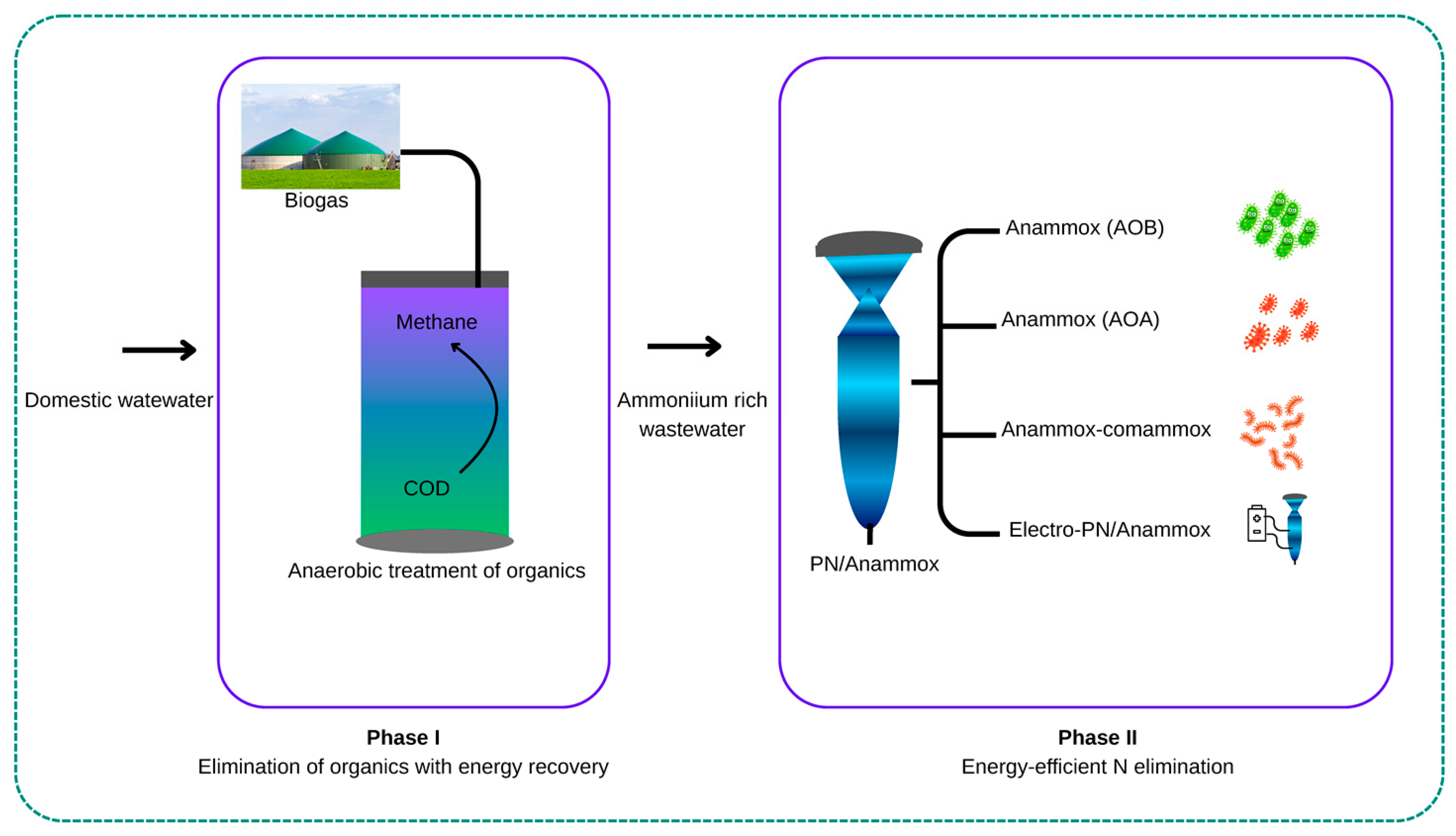
5. Emerging Insights into Anammox-Based N Removal for Domestic Wastewater Treatment
6. Domestic Wastewater Treatment and Challenges Associated with PN/A
7. Feammox Pathways for the Treatment of Wastewater
8. Understanding and Mitigating N2O Emissions in Wastewater Systems
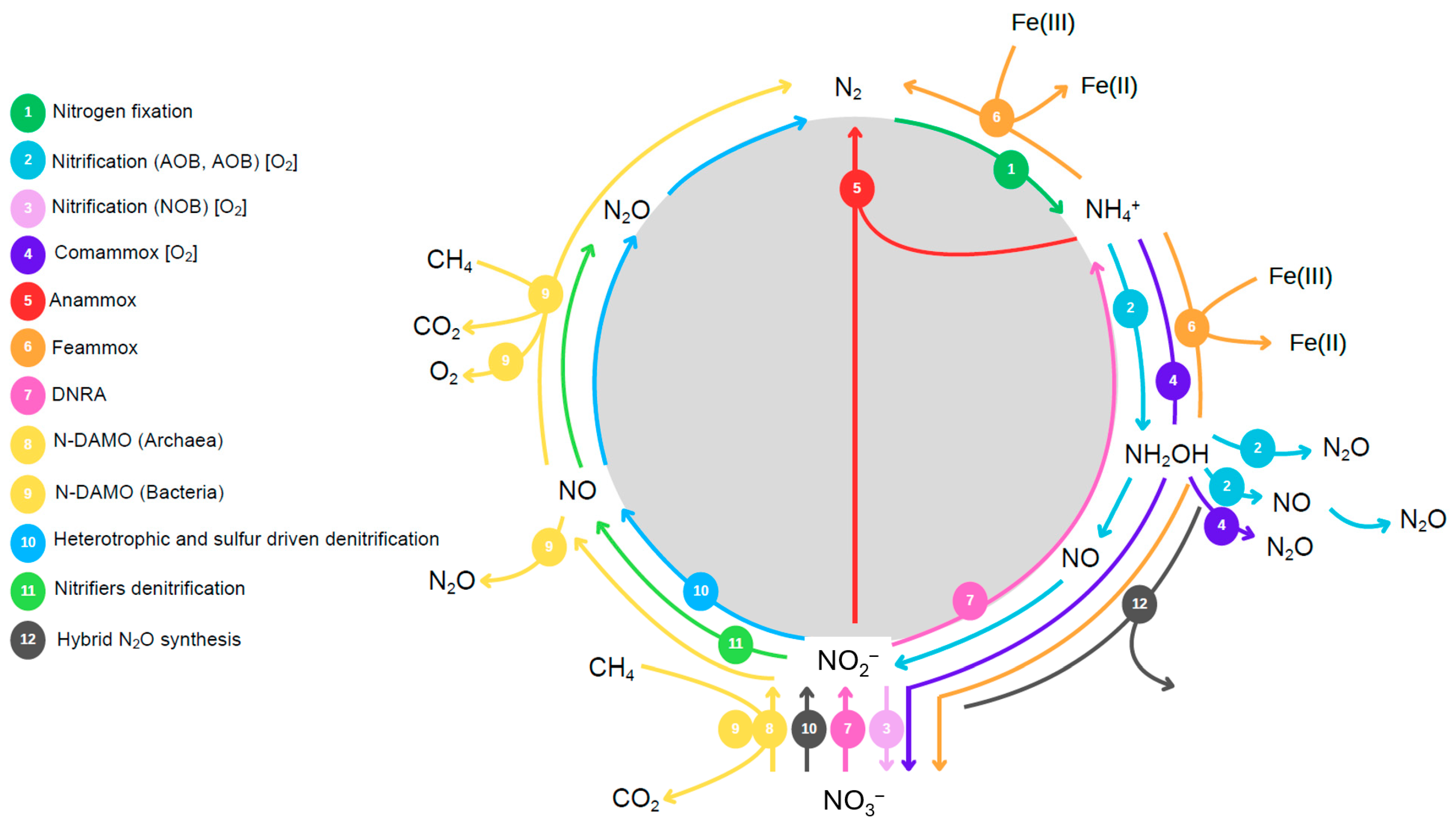
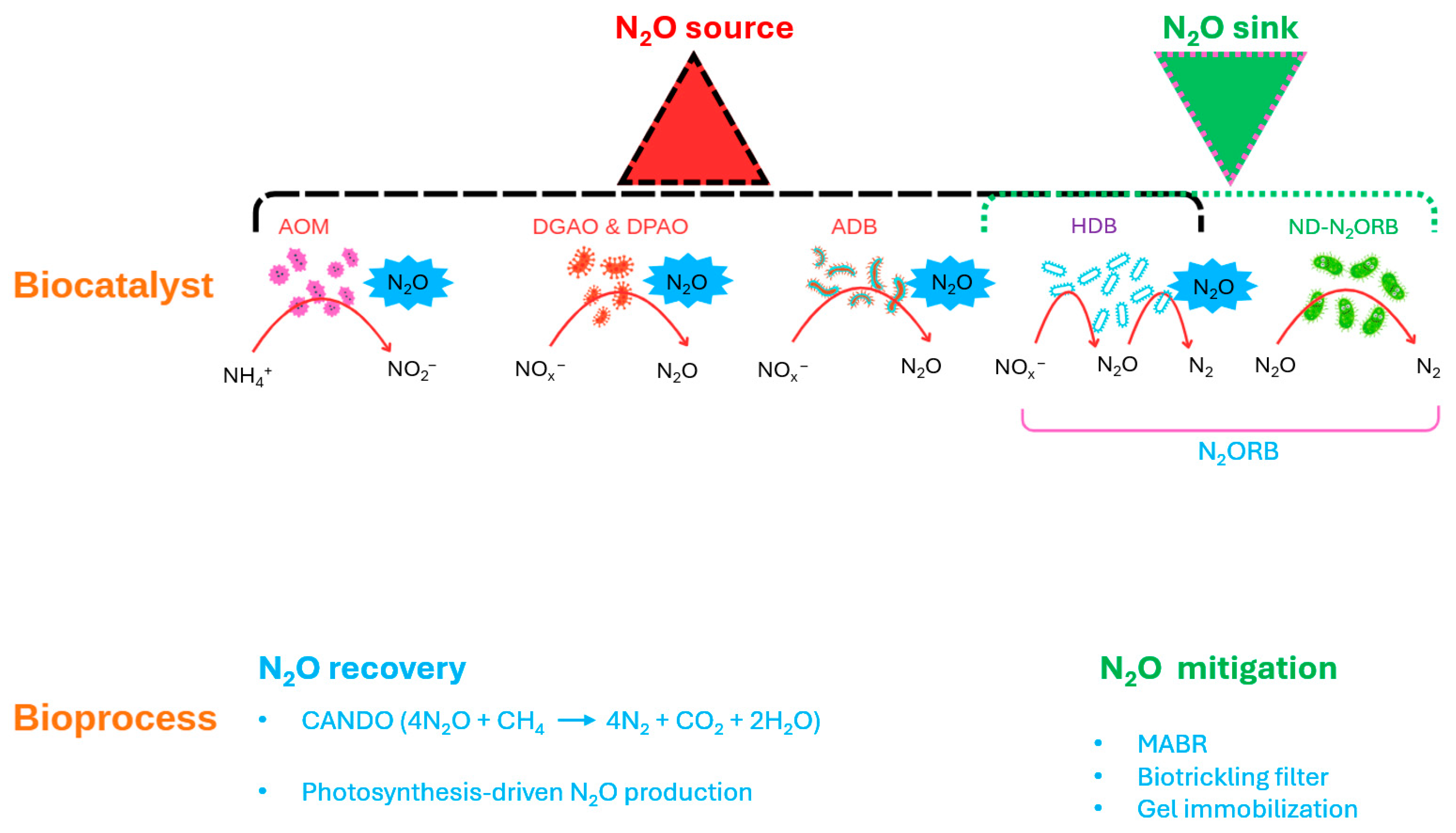
8.1. Biology of N2O Production and Consumption
- Minimizing the activity of dominant N2O-producing microorganisms, particularly AOMs and denitrifying PAOs/GAOs.
- Enhancing the activity and abundance of ND-N2ORB, especially those with oxygen-tolerant and high-affinity Nos systems.
- Improving the N2O sink potential of HDB through selective enrichment, adaptive evolution, or bioengineering strategies.
8.2. Process-Level Mitigation in Reactors
8.3. Post-Treatment, Off-Gas Capture, and Resource Recovery
- (i)
- Optimization of system design to enhance process stability, efficiency, and adaptability across variable wastewater types, including leachate, manure, and nightsoil [89].
- (ii)
- Reduction in operational complexity and costs, particularly by refining environmental conditions necessary for the metabolic activities of DGAOs and DPAOs.
- (iii)
- Integration of CANDO with existing wastewater infrastructure, allowing for hybrid systems that combine N2O mitigation and recovery in a single treatment framework.
9. Future Directions for N2O Mitigation and Technology Integration
10. Quantitative Comparison of Emerging and Conventional N Removal Processes
11. Conclusions
Author Contributions
Funding
Data Availability Statement
Conflicts of Interest
References
- Kuypers, M.M.; Marchant, H.K.; Kartal, B. The microbial nitrogen-cycling network. Nat. Rev. Microbiol. 2018, 16, 263–276. [Google Scholar] [CrossRef]
- Mao, J.; Wang, J.; Liao, J.; Xu, X.; Tian, D.; Zhang, R.; Peng, J.; Niu, S. Plant nitrogen uptake preference and drivers in natural ecosystems at the global scale. New Phytol. 2025, 246, 972–983. [Google Scholar] [CrossRef]
- Weil, R.R.; Brady, N.C. The Nature and Properties of Soils, 15th ed.; Pearson Education: London, UK, 2017. [Google Scholar]
- Shaaban, M.; Nunez-Delgado, A. Soil adsorption potential: Harnessing Earth’s living skin for mitigating climate change and greenhouse gas dynamics. Environ. Res. 2024, 251, 118738. [Google Scholar] [CrossRef]
- Winkler, M.K.; Straka, L. New directions in biological nitrogen removal and recovery from wastewater. Curr. Opin. Biotechnol. 2019, 57, 50–55. [Google Scholar] [CrossRef]
- Mattoo, R.; Mallikarjuna, S.B.; Hemachar, N. Ecosystem and Climate Change Impacts on the Nitrogen Cycle and Biodiversity. Nitrogen 2025, 6, 78. [Google Scholar] [CrossRef]
- Martínez-Espinosa, R.M.; Hatano, R.; Wu, Y.; Shaaban, M. Editorial: Nitrogen dynamics and load in soils. Front. Environ. Sci. 2023, 11, 1197902. [Google Scholar] [CrossRef]
- Gui, X.; Wang, W.; Qin, D.; Luo, H.; Qin, F.; Li, K.; Weng, H.; Zhang, C. Revisiting the microbial nitrogen-cycling network: Bibliometric analysis and recent advances. Environ. Earth Sci. 2025, 84, 484. [Google Scholar] [CrossRef]
- Bodirsky, B.L.; Popp, A.; Lotze-Campen, H.; Dietrich, J.P.; Rolinski, S.; Weindl, I.; Schmitz, C.; Müller, C.; Bonsch, M.; Humpenöder, F. Reactive nitrogen requirements to feed the world in 2050 and potential to mitigate nitrogen pollution. Nat. Commun. 2014, 5, 3858. [Google Scholar] [CrossRef]
- Shaaban, M. Microbial pathways of nitrous oxide emissions and mitigation approaches in drylands. J. Environ. Manag. 2024, 354, 120393. [Google Scholar] [CrossRef]
- Omoregie, A.I.; Silini, M.O.E.; Wong, L.S.; Rajasekar, A. Nitrogen Eutrophication in Chinese Aquatic Ecosystems: Drivers, Impacts, and Mitigation Strategies. Nitrogen 2025, 6, 92. [Google Scholar] [CrossRef]
- Soler-Jofra, A.; Pérez, J.; Van Loosdrecht, M.C. Hydroxylamine and the nitrogen cycle: A review. Water Res. 2021, 190, 116723. [Google Scholar] [CrossRef]
- Parret, L.; Simoens, K.; Horemans, B.; De Vrieze, J.; Smets, I. Establishing a co-culture aggregate of N-cycle bacteria to elucidate flocculation in biological wastewater treatment. Appl. Microbiol. Biotechnol. 2025, 109, 149. [Google Scholar] [CrossRef] [PubMed]
- Gu, Y.; Li, Y.; Li, X.; Luo, P.; Wang, H.; Wang, X.; Wu, J.; Li, F. Energy self-sufficient wastewater treatment plants: Feasibilities and challenges. Energy Procedia 2017, 105, 3741–3751. [Google Scholar] [CrossRef]
- Cruz, H.; Law, Y.Y.; Guest, J.S.; Rabaey, K.; Batstone, D.; Laycock, B.; Verstraete, W.; Pikaar, I. Mainstream ammonium recovery to advance sustainable urban wastewater management. Environ. Sci. Technol. 2019, 53, 11066–11079. [Google Scholar] [CrossRef]
- Lee, H.; Calvin, K.; Dasgupta, D.; Krinner, G.; Mukherji, A.; Thorne, P.; Trisos, C.; Romero, J.; Aldunce, P.; Barrett, K. Climate Change 2023: Synthesis Report; Contribution of Working Groups I, II and III to the Sixth Assessment Report of the Intergovernmental Panel on Climate Change; IPCC: Geneva, Switzerland, 2023.
- Shaw, D.R.; Gonzalez, J.T.; Guadarrama, C.B.; Saikaly, P.E. Emerging biotechnological applications of anaerobic ammonium oxidation. Trends Biotechnol. 2024, 42, 1128–1143. [Google Scholar] [CrossRef]
- Kogler, A.; Farmer, M.; Simon, J.A.; Tilmans, S.; Wells, G.F.; Tarpeh, W.A. Systematic evaluation of emerging wastewater nutrient removal and recovery technologies to inform practice and advance resource efficiency. ACS EST Eng. 2021, 1, 662–684. [Google Scholar] [CrossRef]
- Lawson, C.E.; Lücker, S. Complete ammonia oxidation: An important control on nitrification in engineered ecosystems? Curr. Opin. Biotechnol. 2018, 50, 158–165. [Google Scholar] [CrossRef] [PubMed]
- Schleper, C.; Simon, K. Analysis of biomass productivity and physiology of Nitrososphaera viennensis grown in continuous. Metab. Pathw. Archaea 2025, 6, 1076342. [Google Scholar]
- Daims, H.; Lebedeva, E.V.; Pjevac, P.; Han, P.; Herbold, C.; Albertsen, M.; Jehmlich, N.; Palatinszky, M.; Vierheilig, J.; Bulaev, A. Complete nitrification by Nitrospira bacteria. Nature 2015, 528, 504–509. [Google Scholar] [CrossRef]
- Zheng, Z.; Huang, Y.; Liu, L.; Wang, L.; Tang, J. Interaction between microplastic biofilm formation and antibiotics: Effect of microplastic biofilm and its driving mechanisms on antibiotic resistance gene. J. Hazard. Mater. 2023, 459, 132099. [Google Scholar] [CrossRef] [PubMed]
- Sakoula, D.; Koch, H.; Frank, J.; Jetten, M.S.; van Kessel, M.A.; Lücker, S. Enrichment and physiological characterization of a novel comammox Nitrospira indicates ammonium inhibition of complete nitrification. ISME J. 2021, 15, 1010–1024. [Google Scholar] [CrossRef]
- Cui, H.; Zhang, L.; Zhang, Q.; Li, X.; Peng, Y. Enrichment of comammox bacteria in anammox-dominated low-strength wastewater treatment system within microaerobic conditions: Cooperative effect driving enhanced nitrogen removal. Chem. Eng. J. 2023, 453, 139851. [Google Scholar] [CrossRef]
- Koch, H.; van Kessel, M.A.; Lücker, S. Complete nitrification: Insights into the ecophysiology of comammox Nitrospira. Appl. Microbiol. Biotechnol. 2019, 103, 177–189. [Google Scholar] [CrossRef]
- Gottshall, E.Y.; Bryson, S.J.; Cogert, K.I.; Landreau, M.; Sedlacek, C.J.; Stahl, D.A.; Daims, H.; Winkler, M. Sustained nitrogen loss in a symbiotic association of Comammox Nitrospira and Anammox bacteria. Water Res. 2021, 202, 117426. [Google Scholar] [CrossRef]
- Roots, P.; Wang, Y.; Rosenthal, A.F.; Griffin, J.S.; Sabba, F.; Petrovich, M.; Yang, F.; Kozak, J.A.; Zhang, H.; Wells, G.F. Comammox Nitrospira are the dominant ammonia oxidizers in a mainstream low dissolved oxygen nitrification reactor. Water Res. 2019, 157, 396–405. [Google Scholar] [CrossRef] [PubMed]
- Vilardi, K.; Cotto, I.; Bachmann, M.; Parsons, M.; Klaus, S.; Wilson, C.; Bott, C.B.; Pieper, K.J.; Pinto, A.J. Co-occurrence and cooperation between comammox and anammox bacteria in a full-scale attached growth municipal wastewater treatment process. Environ. Sci. Technol. 2023, 57, 5013–5023. [Google Scholar] [CrossRef] [PubMed]
- Xu, S.; Chai, W.; Xiao, R.; Wang, B.; Lu, H. Synergy between comammox and anammox bacteria in wastewater ammonia removal. ACS EST Eng. 2023, 3, 1582–1591. [Google Scholar] [CrossRef]
- Wang, H.; Yang, S.; Wang, Y.; Gu, Z.; Xiong, S.; Huang, X.; Sun, M.; Zhang, S.; Guo, L.; Cui, J. Rates and causes of black soil erosion in Northeast China. Catena 2022, 214, 106250. [Google Scholar] [CrossRef]
- Pan, Y.; Dang, J.; Li, P.; Yang, X.; Xiao, K.; Wang, K.; Duan, P.; Li, D. Afforestation-driven microbial nitrogen limitation promotes soil nitrous oxide production by ammonia oxidizers. Plant Soil 2025, 1–16. [Google Scholar] [CrossRef]
- Li, J.; Hua, Z.-S.; Liu, T.; Wang, C.; Li, J.; Bai, G.; Lücker, S.; Jetten, M.S.; Zheng, M.; Guo, J. Selective enrichment and metagenomic analysis of three novel comammox Nitrospira in a urine-fed membrane bioreactor. ISME Commun. 2021, 1, 7. [Google Scholar] [CrossRef] [PubMed]
- Kits, K.D.; Jung, M.-Y.; Vierheilig, J.; Pjevac, P.; Sedlacek, C.J.; Liu, S.; Herbold, C.; Stein, L.Y.; Richter, A.; Wissel, H.; et al. Low yield and abiotic origin of N2O formed by the complete nitrifier Nitrospira inopinata. Nat. Commun. 2019, 10, 1836. [Google Scholar] [CrossRef]
- Ren, Z.; Li, D.; Zhang, Z.; Sun, W.; Liu, G. Enhancing the relative abundance of comammox nitrospira in ammonia oxidizer community decreases N2O emission in nitrification exponentially. Chemosphere 2024, 356, 141883. [Google Scholar] [CrossRef]
- Shao, Y.-H.; Wu, J.-H.; Chen, H.-W. Comammox Nitrospira cooperate with anammox bacteria in a partial nitritation–anammox membrane bioreactor treating low-strength ammonium wastewater at high loadings. Water Res. 2024, 257, 121698. [Google Scholar] [CrossRef]
- Kits, K.D.; Sedlacek, C.J.; Lebedeva, E.V.; Han, P.; Bulaev, A.; Pjevac, P.; Daebeler, A.; Romano, S.; Albertsen, M.; Stein, L.Y. Kinetic analysis of a complete nitrifier reveals an oligotrophic lifestyle. Nature 2017, 549, 269–272. [Google Scholar] [CrossRef]
- Zhu, W.; Yuan, G.; Song, Z.; Li, Q.; Liu, C.; Xu, A.; Luan, Y.; Liu, Y. In Situ Biofilm Aquaculture Systems (In Situ BFSs) for Litopenaeus vannamei: A Review. Rev. Aquac. 2025, 17, e70058. [Google Scholar] [CrossRef]
- Zhao, Y.; Wang, J.; Liu, Z.; Yang, W.; Hu, J.; Jia, Z.; Hu, B. Biofilm: A strategy for the dominance of comammox Nitrospira. J. Clean. Prod. 2022, 363, 132361. [Google Scholar] [CrossRef]
- Johnston, J.; Vilardi, K.; Cotto, I.; Sudarshan, A.; Bian, K.; Klaus, S.; Bachmann, M.; Parsons, M.; Wilson, C.; Bott, C. Metatranscriptomic analysis reveals synergistic activities of comammox and anammox bacteria in full-scale attached growth nitrogen removal system. Environ. Sci. Technol. 2024, 58, 13023–13034. [Google Scholar] [CrossRef] [PubMed]
- Bengtsson, S.; de Blois, M.; Wilén, B.-M.; Gustavsson, D. Treatment of municipal wastewater with aerobic granular sludge. Crit. Rev. Environ. Sci. Technol. 2018, 48, 119–166. [Google Scholar] [CrossRef]
- Cotto, I.; Vilardi, K.J.; Huo, L.; Fogarty, E.C.; Khunjar, W.; Wilson, C.; De Clippeleir, H.; Gilmore, K.; Bailey, E.; Lücker, S. Low diversity and microdiversity of comammox bacteria in wastewater systems suggest specific adaptations within the Ca. Nitrospira nitrosa cluster. Water Res. 2023, 229, 119497. [Google Scholar] [CrossRef]
- Li, D.; Fang, F.; Liu, G. Efficient nitrification and low-level N2O emission in a weakly acidic bioreactor at low dissolved-oxygen levels are due to comammox. Appl. Environ. Microbiol. 2021, 87, e00154-21. [Google Scholar] [CrossRef]
- Kartal, B.; Kuenen, J.v.; Van Loosdrecht, M. Sewage treatment with anammox. Science 2010, 328, 702–703. [Google Scholar] [CrossRef]
- Zhang, S.; Lv, H.; Cui, B.; Zhou, D. NO-driven Anammox systems contribute to nitrogen removal via altering nitrogen transformation pathways and microbial interactions. Chem. Eng. J. 2025, 521, 167030. [Google Scholar] [CrossRef]
- McCarty, P.L. What is the best biological process for nitrogen removal: When and why? Environ. Sci. Technol. 2018, 52, 3835–3841. [Google Scholar] [CrossRef]
- Lackner, S.; Gilbert, E.M.; Vlaeminck, S.E.; Joss, A.; Horn, H.; Van Loosdrecht, M.C. Full-scale partial nitritation/anammox experiences–an application survey. Water Res. 2014, 55, 292–303. [Google Scholar] [CrossRef] [PubMed]
- Yuan, Q.; Wang, K.; He, B.; Liu, R.; Qian, L.; Wan, S.; Zhou, Y.; Cai, H.; Gong, H. Spontaneous mainstream anammox in a full-scale wastewater treatment plant with hybrid sludge retention time in a temperate zone of China. Water Environ. Res. 2021, 93, 854–864. [Google Scholar] [CrossRef]
- Shaw, D.R.; Ali, M.; Katuri, K.P.; Gralnick, J.A.; Reimann, J.; Mesman, R.; van Niftrik, L.; Jetten, M.S.; Saikaly, P.E. Extracellular electron transfer-dependent anaerobic oxidation of ammonium by anammox bacteria. Nat. Commun. 2020, 11, 2058. [Google Scholar] [CrossRef] [PubMed]
- Hu, Z.; Li, J.; Zhang, Y.; Liu, W.; Wang, A. Exerting applied voltage promotes microbial activity of marine anammox bacteria for nitrogen removal in saline wastewater treatment. Water Res. 2022, 215, 118285. [Google Scholar] [CrossRef]
- Wang, H.; Xing, L.; Zhang, H.; Gui, C.; Jin, S.; Lin, H.; Li, Q.; Cheng, C. Key factors to enhance soil remediation by bioelectrochemical systems (BESs): A review. Chem. Eng. J. 2021, 419, 129600. [Google Scholar] [CrossRef]
- Van Kessel, M.A.; Speth, D.R.; Albertsen, M.; Nielsen, P.H.; Op den Camp, H.J.; Kartal, B.; Jetten, M.S.; Lücker, S. Complete nitrification by a single microorganism. Nature 2015, 528, 555–559. [Google Scholar] [CrossRef]
- Lagum, A. Integrated electro-anammox process for nitrogen removal from wastewater. Int. J. Environ. Sci. Technol. 2023, 20, 13061–13072. [Google Scholar] [CrossRef]
- Chen, Y.; Jiang, G.; Sivakumar, M.; Wu, J. Enhancing integrated denitrifying anaerobic methane oxidation and Anammox processes for nitrogen and methane removal: A review. Crit. Rev. Environ. Sci. Technol. 2023, 53, 390–415. [Google Scholar] [CrossRef]
- Wan, L.; Liu, H.; Wang, X. Anaerobic ammonium oxidation coupled to Fe (III) reduction: Discovery, mechanism and application prospects in wastewater treatment. Sci. Total Environ. 2022, 818, 151687. [Google Scholar] [CrossRef]
- Zhang, L.; Li, W.; Li, J.; Wang, Y.; Xie, H.; Zhao, W. A novel iron-mediated nitrogen removal technology of ammonium oxidation coupled to nitrate/nitrite reduction: Recent advances. J. Environ. Manag. 2022, 319, 115779. [Google Scholar] [CrossRef]
- Xia, Q.; Ai, Z.; Huang, W.; Yang, F.; Liu, F.; Lei, Z.; Huang, W. Recent progress in applications of Feammox technology for nitrogen removal from wastewaters: A review. Bioresour. Technol. 2022, 362, 127868. [Google Scholar] [CrossRef] [PubMed]
- Yuan, G.; Huan, W.; Song, H.; Lu, D.; Chen, X.; Wang, H.; Zhou, J. Effects of straw incorporation and potassium fertilizer on crop yields, soil organic carbon, and active carbon in the rice–wheat system. Soil Tillage Res. 2021, 209, 104958. [Google Scholar] [CrossRef]
- Li, B.; Godfrey, B.J.; RedCorn, R.; Wang, Z.; Goel, R.; Winkler, M.-K. Simultaneous anaerobic carbon and nitrogen removal from primary municipal wastewater with hydrogel encapsulated anaerobic digestion sludge and AOA-anammox coated hollow fiber membrane. Sci. Total Environ. 2023, 883, 163696. [Google Scholar] [CrossRef] [PubMed]
- Li, B.; Godfrey, B.J.; RedCorn, R.; Candry, P.; Abrahamson, B.; Wang, Z.; Goel, R.; Winkler, M.-K. Mainstream nitrogen removal from low temperature and low ammonium strength municipal wastewater using hydrogel-encapsulated comammox and anammox. Water Res. 2023, 242, 120303. [Google Scholar] [CrossRef]
- Fan, S.-Q.; Xie, G.-J.; Lu, Y.; Zhao, Z.-C.; Liu, B.-F.; Xing, D.-F.; Ding, J.; Han, H.-J.; Ren, N.-Q. Mainstream nitrogen and dissolved methane removal through coupling n-DAMO with anammox in granular sludge at low temperature. Environ. Sci. Technol. 2021, 55, 16586–16596. [Google Scholar] [CrossRef]
- Sun, A.; Liu, X.; Zhang, S.; Yang, Q.; Huang, S.; Zhang, N. Enhancing nitrogen removal efficiency and anammox metabolism in microbial electrolysis cell coupled anammox through different voltage application. Bioresour. Technol. 2023, 384, 129283. [Google Scholar] [CrossRef]
- Sun, S.; Zhang, M.; Gu, X.; Yan, P.; He, S.; Chachar, A. New insight and enhancement mechanisms for Feammox process by electron shuttles in wastewater treatment—A systematic review. Bioresour. Technol. 2023, 369, 128495. [Google Scholar] [CrossRef]
- Katuri, K.P.; Ali, M.; Saikaly, P.E. The role of microbial electrolysis cell in urban wastewater treatment: Integration options, challenges, and prospects. Curr. Opin. Biotechnol. 2019, 57, 101–110. [Google Scholar] [CrossRef] [PubMed]
- Yeshi, C.; Hong, K.B.; Zhou, Y.; Liu, Y.; Jianzhong, H.; Chye, C.S.; Long, W.Y.; Ghani, Y. Mainstream partial nitritation/anammox nitrogen removal process in the largest water reclamation plant in Singapore. J. Beijing Univ. Technol. 2015, 41, 1441–1454. [Google Scholar]
- Wang, P.; He, D.; Xiao, Z.; Zhao, J.; Jin, Q.; Ma, X.; Ma, J.; Zheng, M. Dual sludge system driven NDFO-Feammox coupling: Optimization of the iron cycling network for sustainable and efficient nitrogen removal. Water Res. 2025, 286, 124186. [Google Scholar] [CrossRef]
- Wang, Q.; Pan, W.; Tang, Z.; Wang, Y.; Zhang, L.; Liu, H.; Chen, Y.; Peng, Y. Deciphering iron interactions with anaerobic ammonia oxidation: Nitrogen removal performance, iron transformation, and microbial community characterization analysis. J. Environ. Chem. Eng. 2025, 13, 116089. [Google Scholar] [CrossRef]
- Huang, S.; Jaffé, P.R. Isolation and characterization of an ammonium-oxidizing iron reducer: Acidimicrobiaceae sp. A6. PLoS ONE 2018, 13, e0194007. [Google Scholar] [CrossRef]
- Valk, L.C.; Peces, M.; Singleton, C.M.; Laursen, M.D.; Andersen, M.H.; Mielczarek, A.T.; Nielsen, P.H. Exploring the microbial influence on seasonal nitrous oxide concentration in a full-scale wastewater treatment plant using metagenome assembled genomes. Water Res. 2022, 219, 118563. [Google Scholar] [CrossRef]
- Mania, D.; Woliy, K.; Degefu, T.; Frostegård, Å. A common mechanism for efficient N2O reduction in diverse isolates of nodule-forming bradyrhizobia. Environ. Microbiol. 2020, 22, 17–31. [Google Scholar] [CrossRef]
- Oba, K.; Suenaga, T.; Kuroiwa, M.; Riya, S.; Terada, A. Exploring the functions of efficient canonical denitrifying bacteria as N2O sinks: Implications from 15N tracer and transcriptome analyses. Environ. Sci. Technol. 2022, 56, 11694–11706. [Google Scholar] [CrossRef]
- Qi, C.; Zhou, Y.; Suenaga, T.; Oba, K.; Lu, J.; Wang, G.; Zhang, L.; Yoon, S.; Terada, A. Organic carbon determines nitrous oxide consumption activity of clade I and II nosZ bacteria: Genomic and biokinetic insights. Water Res. 2022, 209, 117910. [Google Scholar] [CrossRef] [PubMed]
- Onley, J.R.; Ahsan, S.; Sanford, R.A.; Löffler, F.E. Denitrification by Anaeromyxobacter dehalogenans, a common soil bacterium lacking the nitrite reductase genes nirS and nirK. Appl. Environ. Microbiol. 2018, 84, e01985-17. [Google Scholar] [CrossRef] [PubMed]
- LaSarre, B.; Morlen, R.; Neumann, G.C.; Harwood, C.S.; McKinlay, J.B. Nitrous oxide reduction by two partial denitrifying bacteria requires denitrification intermediates that cannot be respired. Appl. Environ. Microbiol. 2024, 90, e01741-23. [Google Scholar] [CrossRef]
- Park, D.; Kim, H.; Yoon, S. Nitrous oxide reduction by an obligate aerobic bacterium, Gemmatimonas aurantiaca strain T-27. Appl. Environ. Microbiol. 2017, 83, e00502–e00517. [Google Scholar] [CrossRef]
- Kim, D.D.; Han, H.; Yun, T.; Song, M.J.; Terada, A.; Laureni, M.; Yoon, S. Identification of nosZ-expressing microorganisms consuming trace N2O in microaerobic chemostat consortia dominated by an uncultured Burkholderiales. ISME J. 2022, 16, 2087–2098. [Google Scholar] [CrossRef] [PubMed]
- Wang, Z.; Vishwanathan, N.; Kowaliczko, S.; Ishii, S. Clarifying microbial nitrous oxide reduction under aerobic conditions: Tolerant, intolerant, and sensitive. Microbiol. Spectr. 2023, 11, e04709–e04722. [Google Scholar] [CrossRef]
- Yoon, H.; Song, M.J.; Yoon, S. Design and feasibility analysis of a self-sustaining biofiltration system for removal of low concentration N2O emitted from wastewater treatment plants. Environ. Sci. Technol. 2017, 51, 10736–10745. [Google Scholar] [CrossRef]
- Han, H.; Kim, D.D.; Song, M.J.; Yun, T.; Yoon, H.; Lee, H.W.; Kim, Y.M.; Laureni, M.; Yoon, S. Biotrickling filtration for the reduction of N2O emitted during wastewater treatment: Results from a long-term in situ pilot-scale testing. Environ. Sci. Technol. 2023, 57, 3883–3892. [Google Scholar] [CrossRef]
- Parravicini, V.; Nielsen, P.H.; Thornberg, D.; Pistocchi, A. Evaluation of greenhouse gas emissions from the European urban wastewater sector, and options for their reduction. Sci. Total Environ. 2022, 838, 156322. [Google Scholar] [CrossRef]
- Pomowski, A.; Zumft, W.G.; Kroneck, P.M.; Einsle, O. N2O binding at a [4Cu:2S] copper–sulphur cluster in nitrous oxide reductase. Nature 2011, 477, 234–237. [Google Scholar] [CrossRef] [PubMed]
- Suenaga, T.; Aoyagi, R.; Sakamoto, N.; Riya, S.; Ohashi, H.; Hosomi, M.; Tokuyama, H.; Terada, A. Immobilization of Azospira sp. strain I13 by gel entrapment for mitigation of N2O from biological wastewater treatment plants: Biokinetic characterization and modeling. J. Biosci. Bioeng. 2018, 126, 213–219. [Google Scholar] [CrossRef] [PubMed]
- Suenaga, T.; Riya, S.; Hosomi, M.; Terada, A. Biokinetic characterization and activities of N2O-reducing bacteria in response to various oxygen levels. Front. Microbiol. 2018, 9, 697. [Google Scholar] [CrossRef]
- Kinh, C.T.; Suenaga, T.; Hori, T.; Riya, S.; Hosomi, M.; Smets, B.F.; Terada, A. Counter-diffusion biofilms have lower N2O emissions than co-diffusion biofilms during simultaneous nitrification and denitrification: Insights from depth-profile analysis. Water Res. 2017, 124, 363–371. [Google Scholar] [CrossRef]
- Uri-Carreño, N.; Nielsen, P.H.; Gernaey, K.V.; Domingo-Félez, C.; Flores-Alsina, X. Nitrous oxide emissions from two full-scale membrane-aerated biofilm reactors. Sci. Total Environ. 2024, 908, 168030. [Google Scholar] [CrossRef] [PubMed]
- Scherson, Y.D.; Wells, G.F.; Woo, S.-G.; Lee, J.; Park, J.; Cantwell, B.J.; Criddle, C.S. Nitrogen removal with energy recovery through N2O decomposition. Energy Environ. Sci. 2013, 6, 241–248. [Google Scholar] [CrossRef]
- Chen, M.; Zhou, X.-F.; Yu, Y.-Q.; Liu, X.; Zeng, R.J.-X.; Zhou, S.-G.; He, Z. Light-driven nitrous oxide production via autotrophic denitrification by self-photosensitized Thiobacillus denitrificans. Environ. Int. 2019, 127, 353–360. [Google Scholar] [CrossRef]
- Denisova, K.; Ilyin, A.; Rumyantsev, R.; Ilyin, A.; Volkova, A. Nitrous oxide: Production, application, and protection of the environment. Russ. J. Gen. Chem. 2019, 89, 1338–1346. [Google Scholar] [CrossRef]
- Yue, B.; Lian, X.; Liu, S.; Wu, G.; Xu, J.; Li, L. Efficient nitrous oxide capture by cationic forms of FAU and CHA zeolites. Chem. Eng. J. 2023, 462, 142300. [Google Scholar] [CrossRef]
- Duan, H.; Zhao, Y.; Koch, K.; Wells, G.F.; Weißbach, M.; Yuan, Z.; Ye, L. Recovery of nitrous oxide from wastewater treatment: Current status and perspectives. ACS EST Water 2020, 1, 240–250. [Google Scholar] [CrossRef]
- Kampschreur, M.J.; Temmink, H.; Kleerebezem, R.; Jetten, M.S.; van Loosdrecht, M.C. Nitrous oxide emission during wastewater treatment. Water Res. 2009, 43, 4093–4103. [Google Scholar] [CrossRef]
- Okabe, S.; Oshiki, M.; Takahashi, Y.; Satoh, H. N2O emission from a partial nitrification–anammox process and identification of a key biological process of N2O emission from anammox granules. Water Res. 2011, 45, 6461–6470. [Google Scholar] [CrossRef]
- Frutos, O.D.; Quijano, G.; Pérez, R.; Munoz, R. Simultaneous biological nitrous oxide abatement and wastewater treatment in a denitrifying off-gas bioscrubber. Chem. Eng. J. 2016, 288, 28–37. [Google Scholar] [CrossRef]
- Downing, L.S.; Nerenberg, R. Total nitrogen removal in a hybrid, membrane-aerated activated sludge process. Water Res. 2008, 42, 3697–3708. [Google Scholar] [CrossRef]
- Downing, L.S.; Nerenberg, R. Sustainable nitrogen removal from wastewater with the hybrid membrane biofilm process (HMBP): Bench-scale studies. Water Sci. Technol. 2008, 58, 1715–1720. [Google Scholar] [CrossRef]
- Liu, H.; Li, L.; Ye, W.; Zhao, B.; Peng, Y.; Liu, G.; Gao, X.; Peng, X. Simultaneous nitrification and denitrification in a hybrid activated sludge-membrane aerated biofilm reactor (H-MABR) for nitrogen removal from low COD/N interflow: A pilot-scale study. J. Environ. Manag. 2024, 367, 122038. [Google Scholar] [CrossRef]
- Scherson, Y.D.; Roa, A.; Darling, G.; Criddle, C.S. Sidestream Treatment with Energy Recovery from Nitrogen Waste: The Coupled Aerobic-anoxic Nitrous Decomposition Operation (CANDO). In Proceedings of the WEFTEC 2014, 87th Annual Technical Exhibition & Conference, Water Environment Federation, New Orleans, LA, USA, 27 September–1 October 2014. [Google Scholar]
- Scherson, Y.D. Energy Recovery from Waste Nitrogen Through N2O Decomposition: The Coupled Aerobic-Anoxic Nitrous Decomposition Operation (CANDO). Ph.D. Thesis, Stanford University, Stanford, CA, USA, 2012. [Google Scholar]
- Bueno-Alejo, C.J.; Khambhati, Y.K.; Papadopoulos, A.; Reli, M.; Ricka, R. Using photocatalysis for sustainable agriculture: R-leaf’s potential in large-scale N2O mitigation. J. Hazard. Mater. Adv. 2025, 18, 100703. [Google Scholar] [CrossRef]
- Boissel, V.; Tahir, S.; Koh, C.A. Catalytic decomposition of N2O over monolithic supported noble metal-transition metal oxides. Appl. Catal. B Environ. 2006, 64, 234–242. [Google Scholar] [CrossRef]
- Suenaga, T.; Hori, T.; Riya, S.; Hosomi, M.; Smets, B.F.; Terada, A. Enrichment, isolation, and characterization of high-affinity N2O-reducing bacteria in a gas-permeable membrane reactor. Environ. Sci. Technol. 2019, 53, 12101–12112. [Google Scholar] [CrossRef]
- Oba, K.; Suenaga, T.; Yasuda, S.; Kuroiwa, M.; Hori, T.; Lackner, S.; Terada, A. Quest for nitrous oxide-reducing bacteria present in an anammox biofilm fed with nitrous oxide. Microbes Environ. 2024, 39, ME23106. [Google Scholar] [CrossRef] [PubMed]
- Bothin Hanssen, H. Practical Control Strategies for Reducing N2O Emissions in Wastewater Treatment Plants. Ph.D. Thesis, Uppsala University, Uppsala, Sweden, 2025. [Google Scholar]
- Hiis, E.G.; Vick, S.H.; Molstad, L.; Røsdal, K.; Jonassen, K.R.; Winiwarter, W.; Bakken, L.R. Unlocking bacterial potential to reduce farmland N2O emissions. Nature 2024, 630, 421–428. [Google Scholar] [CrossRef] [PubMed]
- Li, Z.; Yang, Y.; Wang, X.; Qi, Y.; Yang, X. Linking N2O emissions and nos Z gene abundance: A meta-analysis of organic carbon amendments in agricultural soils. Plant Soil 2025, 448, 180–182. [Google Scholar]
- Wu, D.; Li, X.; Li, X. Toward energy neutrality in municipal wastewater treatment: A systematic analysis of energy flow balance for different scenarios. Acs EsT Water 2021, 1, 796–807. [Google Scholar] [CrossRef]
- Hamawand, I. Energy consumption in water/wastewater treatment industry—Optimisation potentials. Energies 2023, 16, 2433. [Google Scholar] [CrossRef]

| Process | Operating DO (mg L−1) | Temperature Window (°C) | C/N Requirement | Main Bottleneck | Demonstrated Scale | Typical N-Removal Rate (kg N m−3 d−1) | Typical N2O Factor (% of Influent N) | Indicative Energy Cost (kWh kg−1 N Removed) | References |
|---|---|---|---|---|---|---|---|---|---|
| Mainstream PN/A | 0.15–0.5 | 10–30 | Low (autotrophic) | NOB suppression; low-T activity of anammox | Pilot to full | 0.05–0.25 | 0.1–0.5 | 0.2–0.4 | [45,46] |
| Comammox–anammox | 0.05–0.3 | 10–30 | Low (autotrophic) | Slow comammox growth; coexistence balance | Lab to pilot | 0.02–0.15 | ≤0.3 | 0.3–0.5 | [27,47,51] |
| Electro-anammox | 0 (anoxic cathode) | 15–35 | None (autotrophic, electrons via anode) | Electrode stability; biofilm conductivity | Lab | 0.05–0.20 | <0.1 | 0.1–0.3 | [52,53] |
| Feammox | 0 (strict anaerobic) | 20–40 | None (autotrophic) | Low rate; Fe(III) supply; microbial uncertainty | Lab | 0.001–0.01 | Not reported | ≈0 (exothermic, no aeration) | [54,55,56] |
| Technology | Mechanism | Technology Readiness Level (TRL) | Key Limitations | References |
|---|---|---|---|---|
| Biofilter off-gas polishing | Biological oxidation of N2O in exhaust gas via nitrifying/denitrifying biofilms | 7–8 (pilot to full) | Requires gas capture; sensitive to humidity and NO2−/O2 ratios | [90,91,92] |
| MABR (Membrane-Aerated Biofilm Reactor) | Stratified O2 delivery through membranes forming aerobic-anoxic gradients, reducing N2O intermediates | 7 (pilot to full) | Membrane fouling: control of DO flux; capital cost | [93,94,95] |
| CANDO/CANDO+ (Coupled Aerobic-Anoxic Nitrous Decomposition and Recovery) | Two-stage process: biological NO2− → N2O generation and subsequent thermal or catalytic conversion to N2 with energy recovery | 6–7 (pilot) | Control of NO2− accumulation; N2O capture and storage logistics | [96,97] |
| Catalytic/Photocatalytic N2O reduction | Abiotic conversion of N2O to N2 using metal or light-activated catalysts | 3–4 (lab) | Catalyst deactivation; energy input requirement | [98,99] |
| Biotic N2O sink bioaugmentation | Enrichment of high-affinity N2O-reducing bacteria for in situ reduction of N2O to N2 | 4–6 (lab to pilot) | Maintaining active populations; substrate competition | [100,101,102] |
Disclaimer/Publisher’s Note: The statements, opinions and data contained in all publications are solely those of the individual author(s) and contributor(s) and not of MDPI and/or the editor(s). MDPI and/or the editor(s) disclaim responsibility for any injury to people or property resulting from any ideas, methods, instructions or products referred to in the content. |
© 2025 by the authors. Licensee MDPI, Basel, Switzerland. This article is an open access article distributed under the terms and conditions of the Creative Commons Attribution (CC BY) license (https://creativecommons.org/licenses/by/4.0/).
Share and Cite
Shaaban, M.; Zhou, K.; Asgari Lajayer, B.; Wu, L.; Younas, A.; Wu, Y. Advancements in Microbial Nitrogen Pathways for Sustainable Wastewater Treatment. Water 2025, 17, 3409. https://doi.org/10.3390/w17233409
Shaaban M, Zhou K, Asgari Lajayer B, Wu L, Younas A, Wu Y. Advancements in Microbial Nitrogen Pathways for Sustainable Wastewater Treatment. Water. 2025; 17(23):3409. https://doi.org/10.3390/w17233409
Chicago/Turabian StyleShaaban, Muhammad, Kaiyan Zhou, Behnam Asgari Lajayer, Lei Wu, Aneela Younas, and Yupeng Wu. 2025. "Advancements in Microbial Nitrogen Pathways for Sustainable Wastewater Treatment" Water 17, no. 23: 3409. https://doi.org/10.3390/w17233409
APA StyleShaaban, M., Zhou, K., Asgari Lajayer, B., Wu, L., Younas, A., & Wu, Y. (2025). Advancements in Microbial Nitrogen Pathways for Sustainable Wastewater Treatment. Water, 17(23), 3409. https://doi.org/10.3390/w17233409

