Article

Analytical Model for Three-Dimensional Reactive Transport of Coexisting Chlorinated Solvent Contaminants in Groundwater Under Time-Varying Source Discharge Concentrations Induced by Remediation Efforts

by
Zhong-Yi Liao
1,
Heejun Suk
2,
Thu-Uyen Nguyen
1,
Chen-Wuing Liu
3,
Ching-Ping Liang
4,* and
Jui-Sheng Chen
1,5,*
1
Graduate Institute of Applied Geology, National Central University, Taoyuan City 320317, Taiwan
2
Korea Institute of Geoscience and Mineral Resources, Daejeon 34132, Republic of Korea
3
Department of Bioenvironmental Systems Engineering, National Taiwan University, Taipei City 10617, Taiwan
4
Department of Nursing, Fooyin University, Kaohsiung City 83101, Taiwan
5
Center for Advanced Model Research Development and Applications, National Central University, Taoyuan City 320317, Taiwan
*
Authors to whom correspondence should be addressed.
Water 2025, 17(23), 3401; https://doi.org/10.3390/w17233401
Submission received: 28 October 2025 / Revised: 19 November 2025 / Accepted: 27 November 2025 / Published: 28 November 2025
(This article belongs to the Section Hydrology)

Abstract

Chlorinated solvents, common groundwater contaminants, can cause coexistence of the original contaminant and its degradation products during the transport process. Practically applicable analytical models for reactive transport are essential for simulating the plume migration of chlorinated solvent contaminants and their degradation products within a complex chemical mixture. Although several analytical models have been developed to solve advection–dispersion equations coupled with a series of decay reactions for simulating transport of the coexisting chlorinated solvent contaminants, the majority assume static, time-invariant inlet boundary conditions. Such time-invariant inlet boundary conditions may fail to adequately represent the temporal evolution of dissolved source discharge concentration concerning mass reduction, especially in the context of diverse DNAPL source remediation strategies. This study seeks to derive analytical models for three-dimensional reactive transport of multiple contaminants, specifically addressing the challenges posed by dynamical, time-varying inlet boundary conditions. The model development incorporates two distinct inlet functions: exponentially decaying and piecewise constant. Analytical solutions are obtained using three integral transform techniques. The accuracy of the newly developed analytical models is verified by comparing them with solutions derived from existing literature using multiple illustrative examples. By incorporating two distinct time-varying inlet boundary conditions, the models exhibit strong capabilities in capturing the complex transport dynamics and fate of contaminants within groundwater systems. These features make the models valuable tools for improving the understanding of subsurface contaminant behavior and for quantitatively evaluating and optimizing a range of remediation strategies.

1. Introduction

Analytical models based on the advection–dispersion equations (ADEs) are widely recognized as efficient and commonly employed tools for simulating the movement of contaminants within groundwater systems. Numerous analytical models have been proposed to characterize the transport behavior of a single contaminant [1,2,3,4,5,6,7]. Common groundwater contaminants, such as chlorinated solvents, radionuclides, and pesticides, often undergo degradation, leading to the coexistence of the original contaminants alongside their respective degradation products. Analytical models solving advection–dispersion equations (ADEs) with first-order decay reactions effectively simulate the transport of contaminants and their degradation products in chemical mixtures. Several analytical models have been developed for the transport of multiple contaminants within chemical mixtures, with the public domain model BIOCHLOR [8] standing out as one of the most widely recognized and extensively utilized. While the BIOCHLOR model is widely used, it assumes identical retardation factors for all contaminants. Subsequent studies [9,10,11,12,13,14] have addressed this limitation by developing models that assign contaminant-specific retardation factors. Liao et al. (2021) [13] investigated the effects of varying retardation factors on the concentration distributions of multiple contaminants, revealing that employing the same retardation factor value for all contaminants could result in either underestimation or overestimation of concentrations. Although the aforementioned solutions account for contaminant-dependent retardation factors, most of them still assume time-invariant inlet boundary conditions, treating them as continuous, constant source discharge concentration originating from NAPL sources for the downgradient dissolved plume.
In real-world scenarios, the source discharge concentration frequently becomes a focal point in the model calibration process, presenting a challenge due to its unknown and difficult-to-estimate nature [15]. Remediation-driven depletion of Non-Aqueous Phase Liquid (NAPL) mass or back diffusion can substantially change the source discharge concentration at various contaminated sites. Consequently, models that assume a constant source concentration face difficulties in accurately representing the temporal evolution of dissolved source discharge concentrations driven by remediation-induced mass reduction.
Semi-analytical models [16,17] simulate multi-contaminant transport under time-dependent boundaries but have limited computational efficiency. Suk et al. (2022) [18] developed an innovative three-dimensional analytical model that comprehensively addresses the transport of multiple contaminants, incorporating consideration for both NAPL source and plume remediation. This model effectively captures the temporal evolution of source discharge concentrations driven by the depletion of NAPL source mass. However, it only accounts for a time-dependent source concentration of the original contaminant while neglecting the source discharge concentration of daughter compounds. This limitation reduces the applicability to certain contaminated sites.
The above review highlights the need for an analytical model that accounts for time-dependent source discharge concentrations for all contaminants within a chemical mixture. Hence, the objective of this study is to develop new practical analytical models for three-dimensional reactive transport of multiple contaminants under time-varying source discharge concentrations for all contaminants. Analytical solutions, although based on idealized assumptions such as homogeneous and isotropic aquifers, provide rapid computation and efficient evaluation of multispecies reactive transport. Such models are particularly useful for preliminary site assessment or when field data and computational resources are limited. Compared with existing analytical models like BIOCHLOR, the present solutions incorporate additional practical features, such as contaminant-specific retardation factors and time-varying source concentrations, enhancing their applicability to real-world remediation scenarios. Unlike full numerical simulations, which can handle more complex heterogeneity and boundary conditions but require extensive data and computational resources, the proposed analytical solutions offer a practical and efficient alternative for quick assessments, complementing rather than replacing numerical approaches. The newly derived analytical solutions possess three key features that enhance their practical applicability: (1) they can accommodate both exponential decaying and piecewise constant time-dependent boundary conditions; (2) each contaminant is assigned a unique retardation factor value; and (3) they demonstrate exceptional computational efficiency.

2. Mathematical Model

In this study, the groundwater system is assumed to be homogeneous and isotropic, with uniform flow along the x-axis. The initial contaminant concentrations are zero throughout the domain, and velocities in the y- and z-directions are assumed to be negligible, indicating no flux across the remaining four boundary planes. These assumptions define the range of applicability of the analytical solutions, which are valid for systems where the aquifer properties and flow conditions are approximately uniform, and where contaminant transport is primarily governed by advection along the main flow direction.
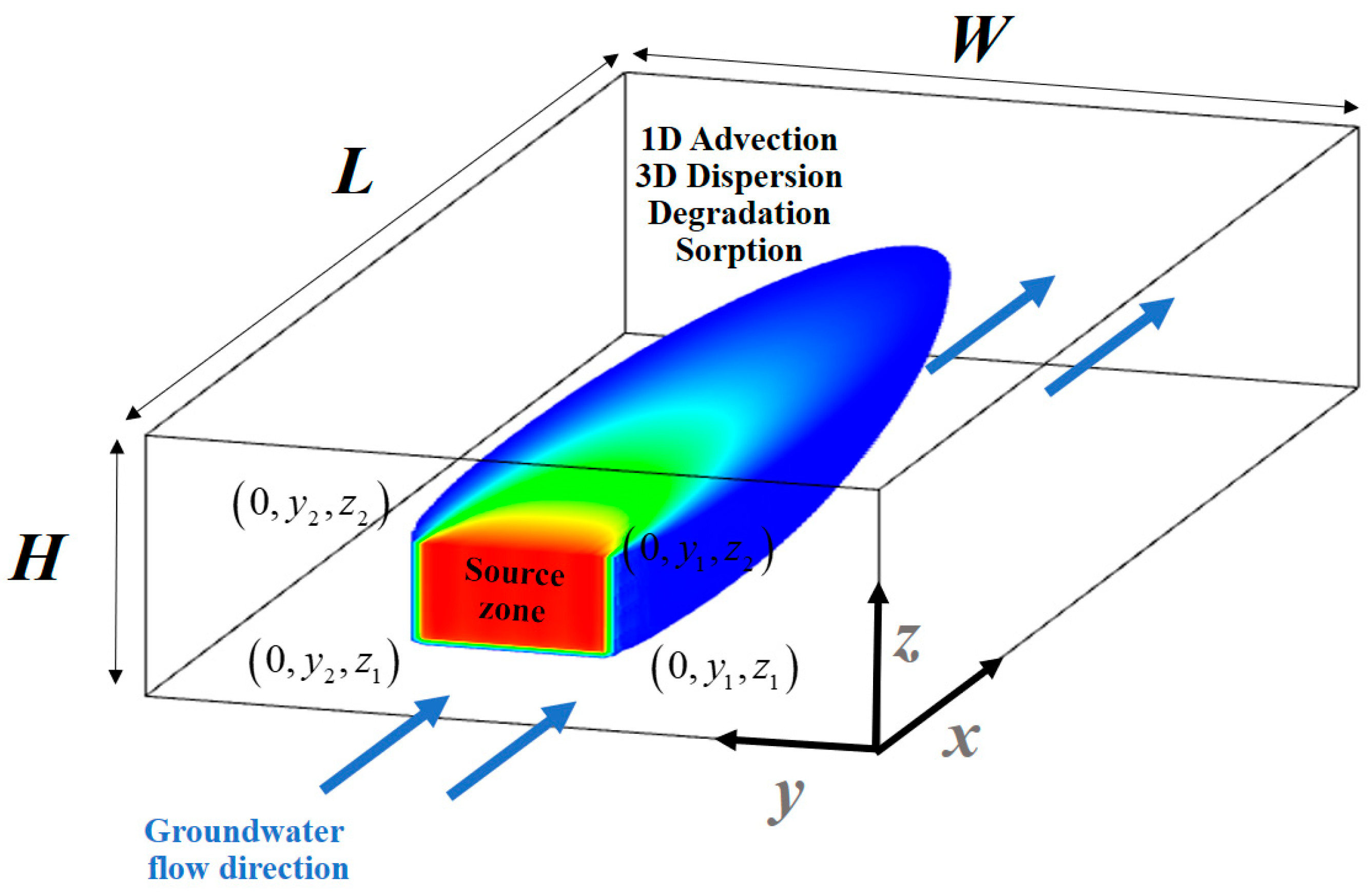
The analytical solutions are designed for a groundwater system with the geometry L × W × H (Figure 1). Here, L represents the domain length, W denotes the domain width, and H signifies the domain height. The groundwater flow is assumed to be uniform and oriented along the x-axis.
The governing equations for three-dimensional reactive transport of multiple contaminants, incorporating one-dimensional advection, three-dimensional dispersion, first-order degradation, and equilibrium-controlled sorption, are mathematically represented as follows (based on the general form of the advection–dispersion Equation [7]):
D x 2 C i x , y , z , t x 2 + D y 2 C i x , y , z , t y 2 + D z 2 C i x , y , z , t z 2 v C i x , y , z , t x μ i R i C i x , y , z , t + g i 1 i μ i 1 R i 1 C i 1 x , y , z , t = R i C i x , y , z , t t ,     g 0 1 = 0 , 0 x , 0 y W , 0 z H ,   i = 1,2 , , 5
where C i x , y , z , t is the concentration of the ith contaminant [ M L 3 ], x, y, and z represent the spatial coordinates [L], t represents time [T], D x , D y and D z denote the hydrodynamic dispersion coefficients along x, y and z directions, respectively [ L 2 T 1 ], v is the average seepage velocity [ L T 1 ], μ i is the first order degradation reaction rate constant of the ith contaminant [ T 1 ], g i 1 i is the yield coefficient (parent contaminant i − 1/daughter contaminant i) [-], R i represents the retardation factor of the ith contaminant, characterizing the sorption effect [-].
The initial condition adopted in this study is assumed to be zero, as any pre-existing contaminants are likely flushed out rapidly by groundwater flow and the source serves as the primary and sustained driver of solute transport in the system is defined as follows:
C i x , y , z , t = 0 = 0         0 x , 0 y W ,           0 z H , i = 1,2 ,   . . . ,   5
Several analytical models developed in previous studies [8,13], which assume time-invariant inlet boundary conditions as continuous sources of contaminant plumes down-gradient, are constrained in their ability to capture the temporal variation in source discharge concentrations caused by source depletion during NAPL source remediation.
Therefore, the time-dependent source discharge concentration for each contaminant in this study is specified at the inlet boundary as follows:
C i x = 0 , y , z , t = f i t H y y 1 H y y 2 H z z 1 H z z 2 t > 0 ,       i = 1,2 ,   ,   5 for the first-type BC ;
D x C i x = 0 , y , z , t x + v C i x = 0 , y , z , t = v f i t H y y 1 H y y 2 H z z 1 H z z 2 t > 0 ,           i = 1,2 ,   ,   5 for the third-type BC ;
The expression involves the Heaviside function, H . , where four parameters y 1 , y 2 , z 1 and z 2 delineate the source area at inlet boundary, f i t represents the source concentration of the ith species which varies with time due to various remediation treatments applied to the source area. The source functions, f i t , can either follow an exponential decaying pattern or a piecewise time-dependent, as shown below:
f i t = C i , 0 e λ i t for concentration with exponential decay .
f i t = n t = 1 n t = N C i , t m H ( t t n t 1 ) H ( t t n t ) for piecewise constant concentration .
A boundary condition for the ith contaminants is defined at infinity to ensure unique solution. A zero-concentration boundary at infinity is assumed to simplify the model, based on the premise that the contaminant undergoes degradation and sorption within the domain of interest, making long-distance migration unlikely and the effect of the outflow boundary negligible:
C i x , y , z , t = 0 ,           i = 1,2 ,   ,   5
Consequently, the no-flux boundary conditions are applied on the remaining four boundaries in the y- and z-directions:
C i x , y = 0 , z , t y = 0 ,           i = 1,2 ,   ,   5
C i x , y = W , z , t y = 0 ,           i = 1,2 ,   ,   5
C i x , y , z = 0 , t z = 0 ,           i = 1,2 ,   ,   5
C i x , y , z = H , t z = 0 ,           i = 1,2 ,   ,   5
The set of partial differential equations and their corresponding boundary conditions, as defined in Equations (1)–(9), are analytically solved using the Laplace transform with respect to t and double finite Fourier cosine transforms with respect to y and z, respectively. The inverse transforms were analytically performed using the corresponding inversion formulas, resulting in fully explicit, closed-form solutions in the original space–time domain. These analytical expressions were implemented and evaluated using a self-developed FORTRAN code. Detailed derivations of the solutions, addressing two distinct time-dependent boundary conditions specified in Equation (4a,b), are provided in Appendix A and Appendix B, respectively.

3. Results and Discussion

The newly derived solutions in this study are subsequently applied to simulate four examples. The first scenario examines the transport of a single contaminant with a constant source concentration. The second and third scenarios address the transport of a radionuclide decay chain and a chlorinated solvent degradation reaction chain, both influenced by exponentially decaying source functions. The fourth scenario explores chlorinated solvent transport with a piecewise constant source concentration. These scenarios are compared with existing analytical solutions to assess the capability of the developed models in accurately simulating single or multiple contaminant transport under time-varying source functions.

3.1. Scenario 1

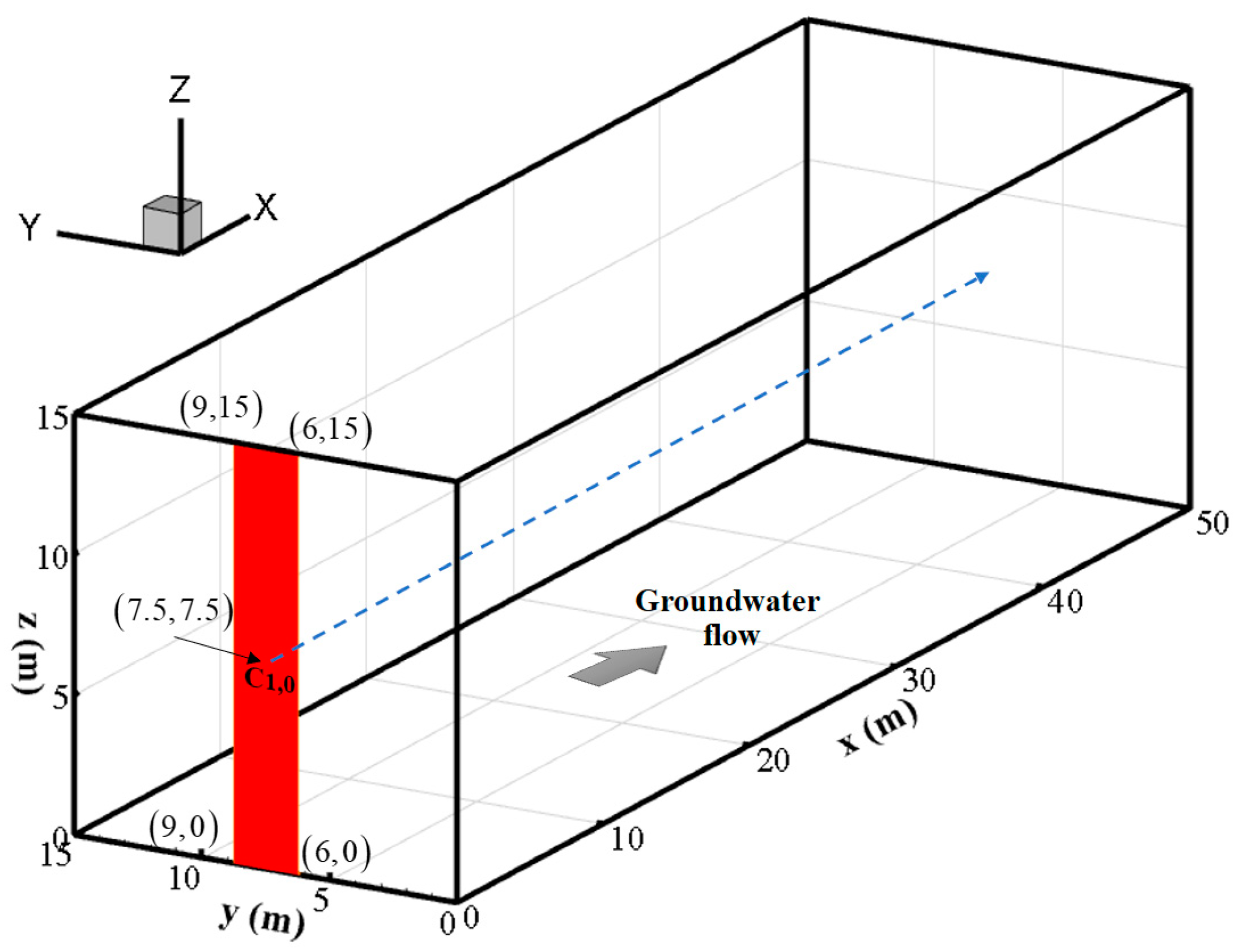
In the first scenario, the developed models are utilized to simulate the transport of a single contaminant originating from a constant source concentration. This scenario is based on an example from the BIOSCREEN User’s Manual [19], which focused on a petroleum fuel release site contaminated by BTEX compounds (Benzene, Toluene, Ethylbenzene, Xylene). The estimated contaminant release at this site is 2000 kg. In this example, the aquifer system is assumed to have a geometry of 50 m (length) × 15 m (width) × 15 m (height), with the source zone dimensions defined as 6 m y     9 m and 0 m z     15 m (Figure 2). The validity of the derived solution is verified with BIOSCREEN, an analytical model widely recognized for its accuracy in simulating the migration of a single contaminant plume.
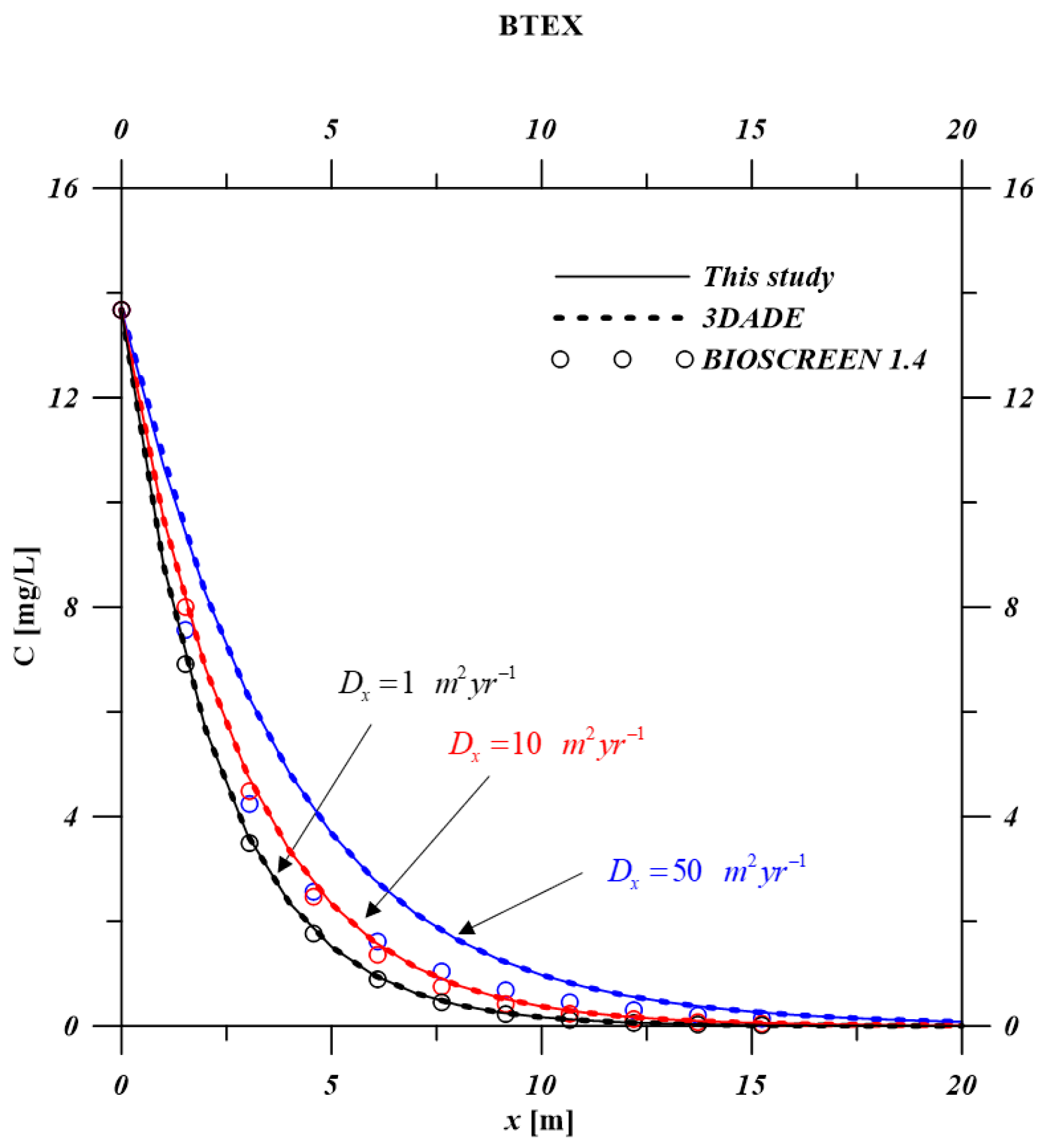
However, it is important to acknowledge that previous studies have indicated that Domenico’s approximate solution, which is employed in BIOSCREEN, may lead to significant errors in simulations when large longitudinal dispersion coefficients are used [20]. Therefore, this study compares our results with those obtained from BIOSCREEN and those from the 3DADE code [21], employing a range of dispersion coefficients to assess their impact on model predictions. Three different sets of longitudinal dispersion coefficients (1, 10, and 50 m2/year) are applied in the analysis. The remaining transport and reaction parameters are summarized in Table 1. To ensure a constant source concentration over time in both solutions, the source decay rate constant in the derived solution is set to be zero. Figure 3 illustrates the spatial concentrations of BTEX along the central line passing through the middle of the source area (denoted by the blue dashed line in Figure 3) at a depth of 15 m over a 5-year period, under first-type boundary conditions.
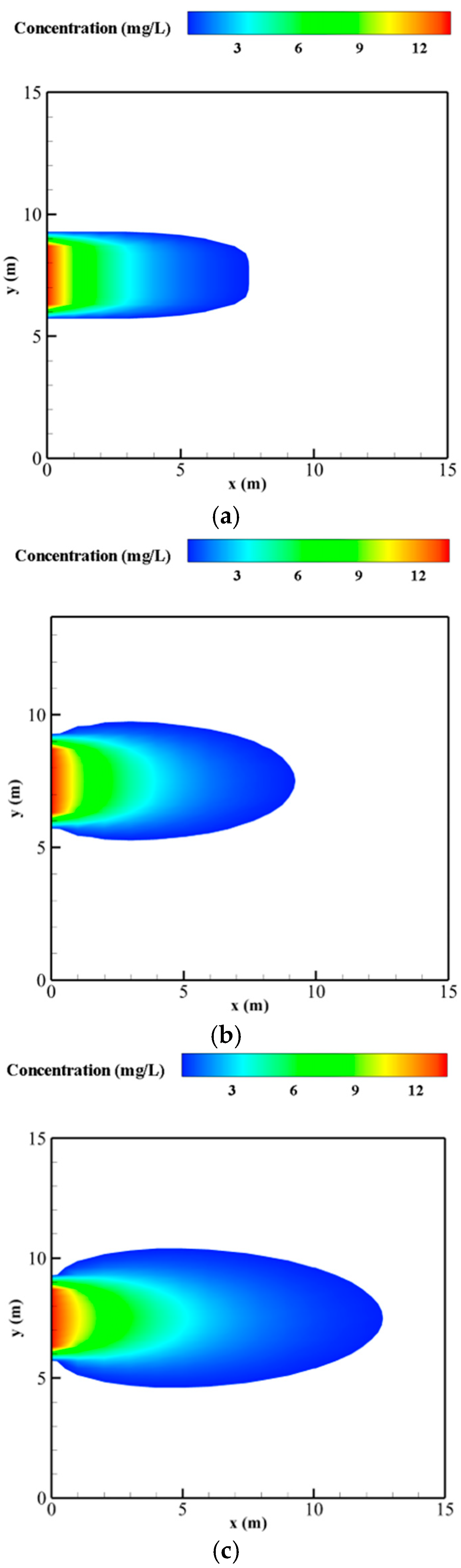
The results show that the simulations from the three solutions closely align when the longitudinal dispersion coefficient is small (1 m2/year), as represented by black-colored lines or dots. However, as the longitudinal dispersion increases (depicted by blue and red lines), the simulated concentrations from BIOSCREEN diverge significantly from those produced by our developed model and 3DADE. This observation is consistent with the findings of the previously mentioned studies. Subsequently, plume migration on the x-y plane at a depth of 15 m is simulated using three distinct sets of dispersion coefficients. The results clearly demonstrate that the plume size expands with increasing dispersion coefficients, with longitudinal spreading being more pronounced due to the larger D x values and the direction of groundwater flow, as shown in Figure 4.
These results confirm that the developed model accurately simulates single-contaminant transport under varying dispersion conditions, providing a robust baseline for subsequent scenarios involving more complex source functions and multi-species transport.

3.2. Scenario 2

In the second scenario, the objective is to assess the effectiveness of the derived solutions for simulating the behavior of multiple contaminants with an exponentially decaying source function. This example specifically focuses on modeling a four-member radionuclide decay chain: Pu-238 U-234 Th-230 Ra-226. The source function, which considers multiple terms of exponential decay, is commonly known as the Bateman-type function [22]. It can describe cases such as radioactive nuclides that continuously decay at the source and produce daughter nuclides, including the contribution from the parent nuclide. The source function for the four radionuclides can be expressed as:
f 1 t = B 1 e λ 1 t
f 2 t = B 2 e λ 1 t + B 3 e λ 2 t
f 3 t = B 4 e λ 1 t + B 5 e λ 2 t + B 6 e λ 3 t
f 4 t = B 7 e λ 1 t + B 8 e λ 2 t + B 9 e λ 3 t + B 10 e λ 4 t
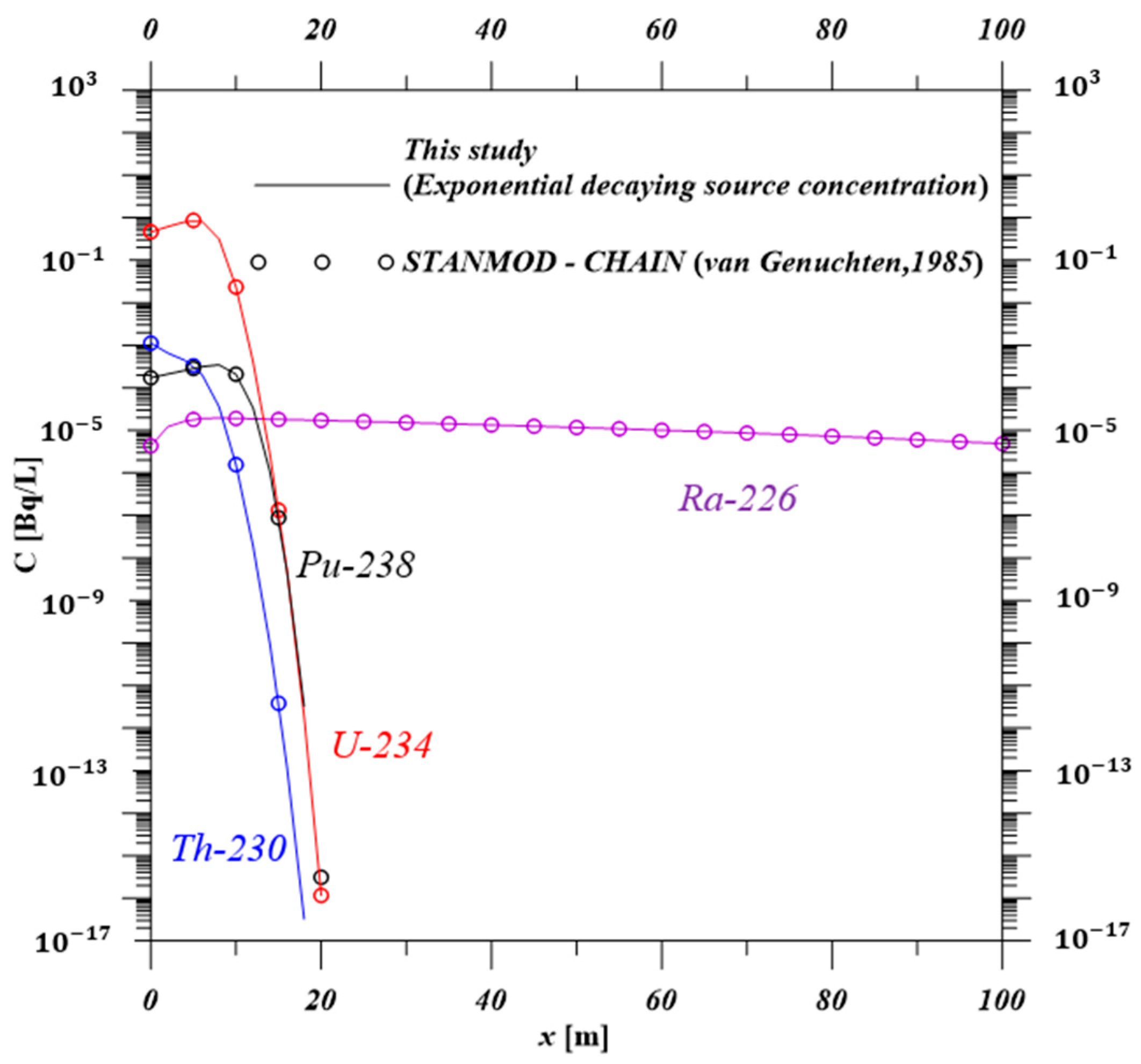
In this scenario, the developed model is compared with a previously established analytical model for one-dimensional transport, CHAIN code [22], which is integrated into the STANMOD user interface [23]. The transport and reaction parameters for each radionuclide are summarized in Table 2, while the coefficients of the Bateman-type function, B i , are detailed in Table 3. Figure 5 illustrates the concentration profiles of four radionuclides along the x-direction at t = 1000 years, as predicted by the model developed in this study and the CHAIN code [22] for comparison. The results clearly demonstrate that Ra-226 exhibits a greater transport distance than the other three radionuclides, which can be attributed to its significantly lower retardation factor compared to Th-230. The close agreement between the two models confirms the accuracy of the solution derived in this study, particularly for cases involving multiple exponential decay source functions.
This scenario demonstrates that the developed model can accurately simulate the transport of multiple contaminants influenced by exponentially decaying sources, providing a foundation for more complex multi-species transport scenarios with varying source behaviors in the following cases.

3.3. Scenario 3

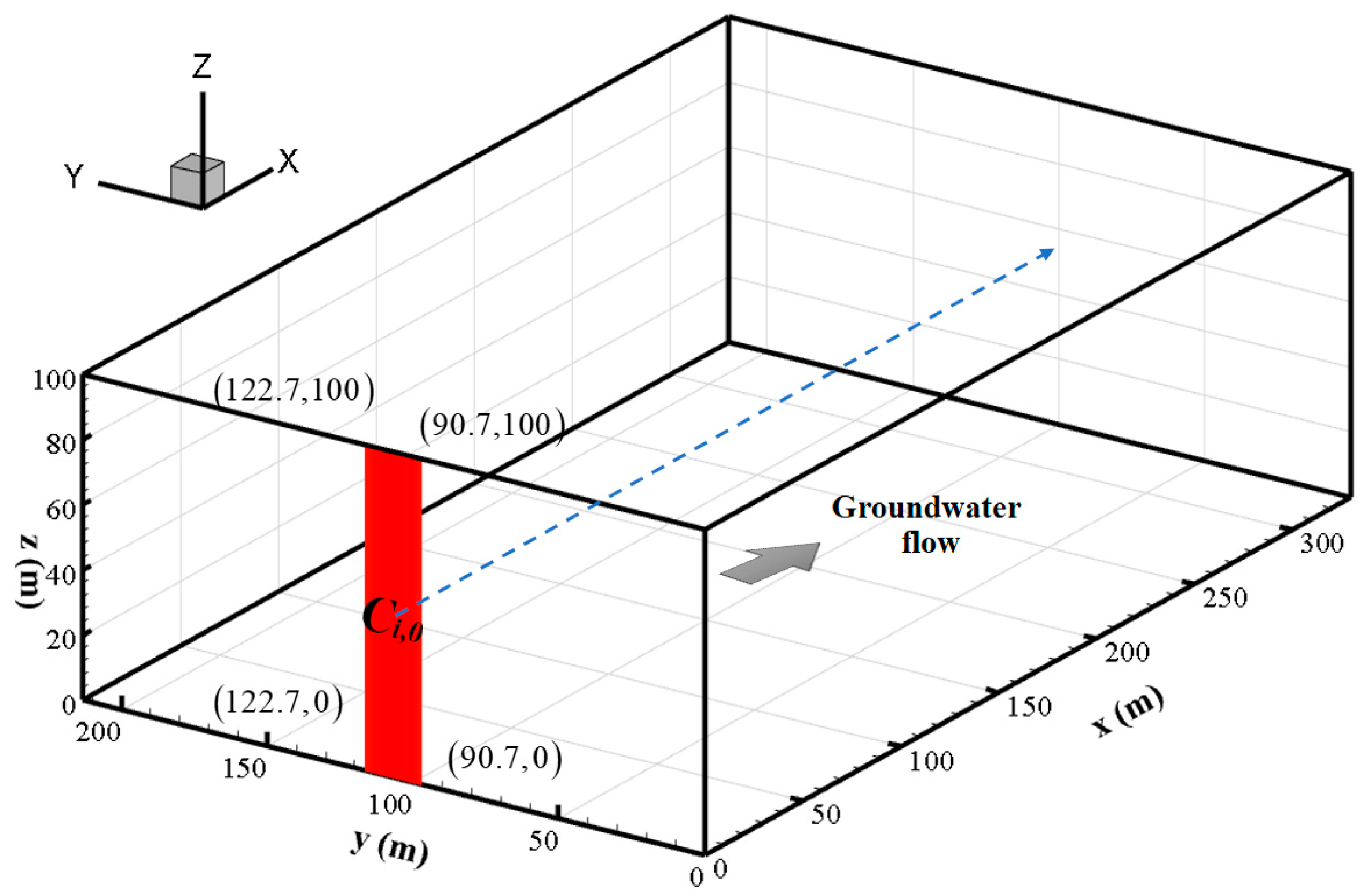
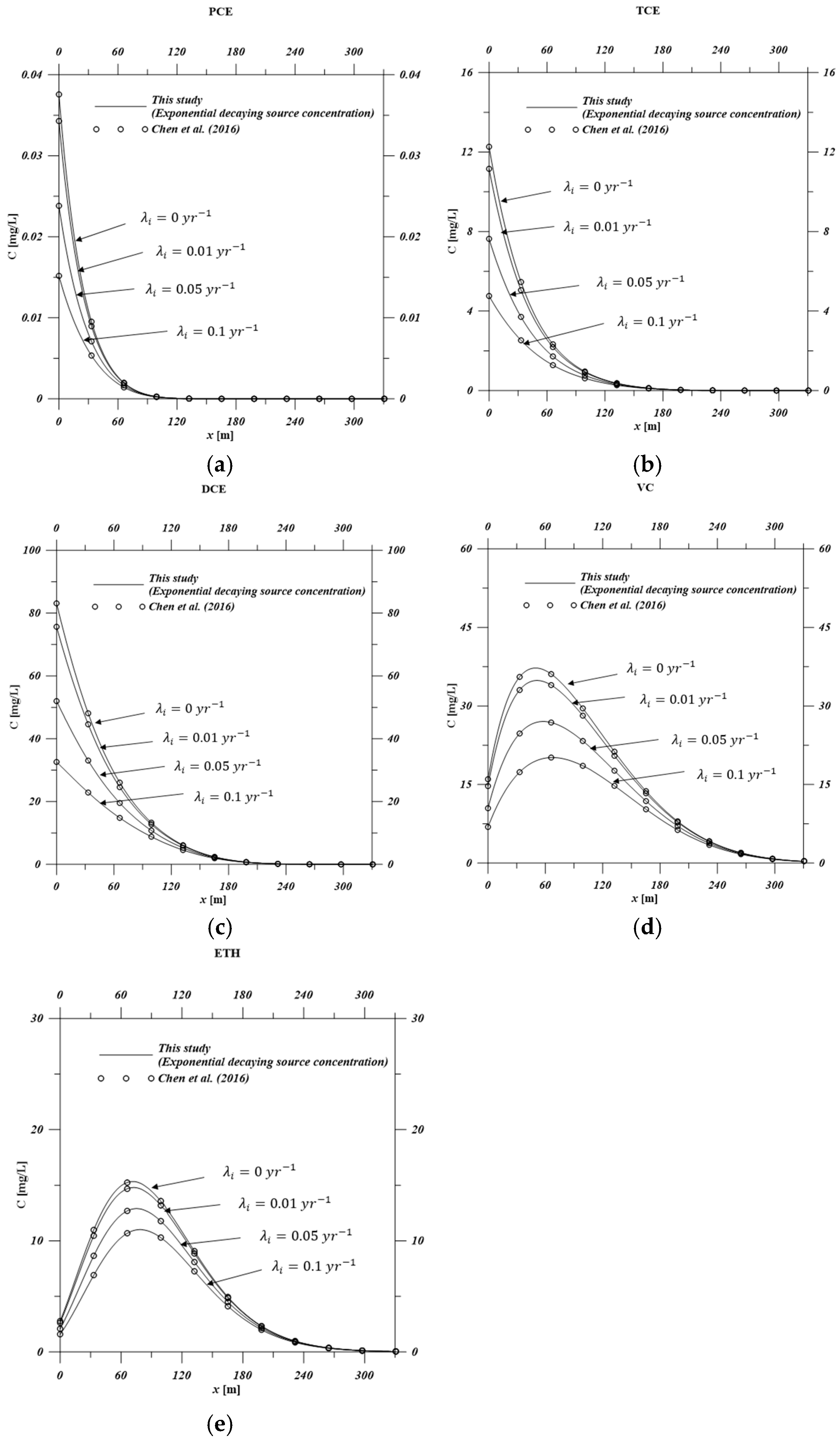
In the third scenario, the newly derived analytical solutions with an exponentially decaying time-dependent source function are verified against a previously developed two-dimensional analytical model [24] designed for simulating multi-dimensional solute transport involving five contaminants in a decay chain. In this example, a real groundwater contaminated site at Cape Canaveral Air Station, Florida, is considered, as described in the example provided in the BIOCHLOR user’s manual [8]. The site features a chlorinated solvent chemical mixture consisting of five contaminants: tetrachloroethylene (PCE) trichloroethylene (TCE) cis-1,2-dichloroethylene (cis-1,2-DCE) vinyl chloride (VC) ethylene (ETH). The geometry of the aquifer system used in this verification example is 330.7 m (length) × 213.4 m (width) × 100 m (height) (Figure 6). The transport parameters listed in Table 4 are adopted from BIOCHLOR user’s manual. Figure 7 illustrates the spatial concentrations of the five contaminants along the x direction (represented by the blue dashed line in Figure 6) at t = 10 years, considering four different source decay rate constants under third-type boundary condition.
The results show a close match in the numerical simulations of these two solutions, confirming the accuracy of the analytical solutions derived in this study. Additionally, the impact of source decay rate constant is analyzed and discussed. We compare the cases with zero decay rate ( λ i = 0, representing a constant source) and the maximum decay rate used in the simulations ( λ i = 0.1 yr−1). Focusing on two representative species—tetrachloroethylene (PCE, the parent compound) and vinyl chloride (VC, a key degradation product)—we observe significant differences in peak concentrations. For PCE, the peak concentration under a constant source condition ( λ 1 = 0) is approximately 0.038 mg/L, whereas with the maximum source decay rate ( λ 1 = 0.1 yr−1), the peak concentration decreases substantially to about 0.015 mg/L. Similarly, for VC, the peak concentration reduces from approximately 37.2 mg/L at λ 4 = 0 to 20.1 mg/L at λ 4 = 0.1 yr−1.
This comparison not only demonstrates the significant reduction in contaminant concentrations due to source decay but also emphasizes how the interplay between source depletion and subsequent degradation reactions shapes the overall contaminant plume. When the source concentration remains constant, continuous input of parent compound maintains higher plume concentrations for both parent and daughter species. In contrast, considering source decay leads to a diminishing source strength, which reduces the mass of contaminant entering the system, consequently lowering the concentrations of downstream degradation products. This dynamic is critical for accurate prediction and effective remediation planning, as neglecting source decay can result in overestimating long-term contaminant risks.
These results confirm the importance of accounting for source depletion in multi-species transport, including all five chlorinated solvent species considered in this scenario (compared to the four radionuclides in the previous scenario). A different analytical solution is presented in the following scenario to address cases involving distinct, time-varying source functions.

3.4. Scenario 4

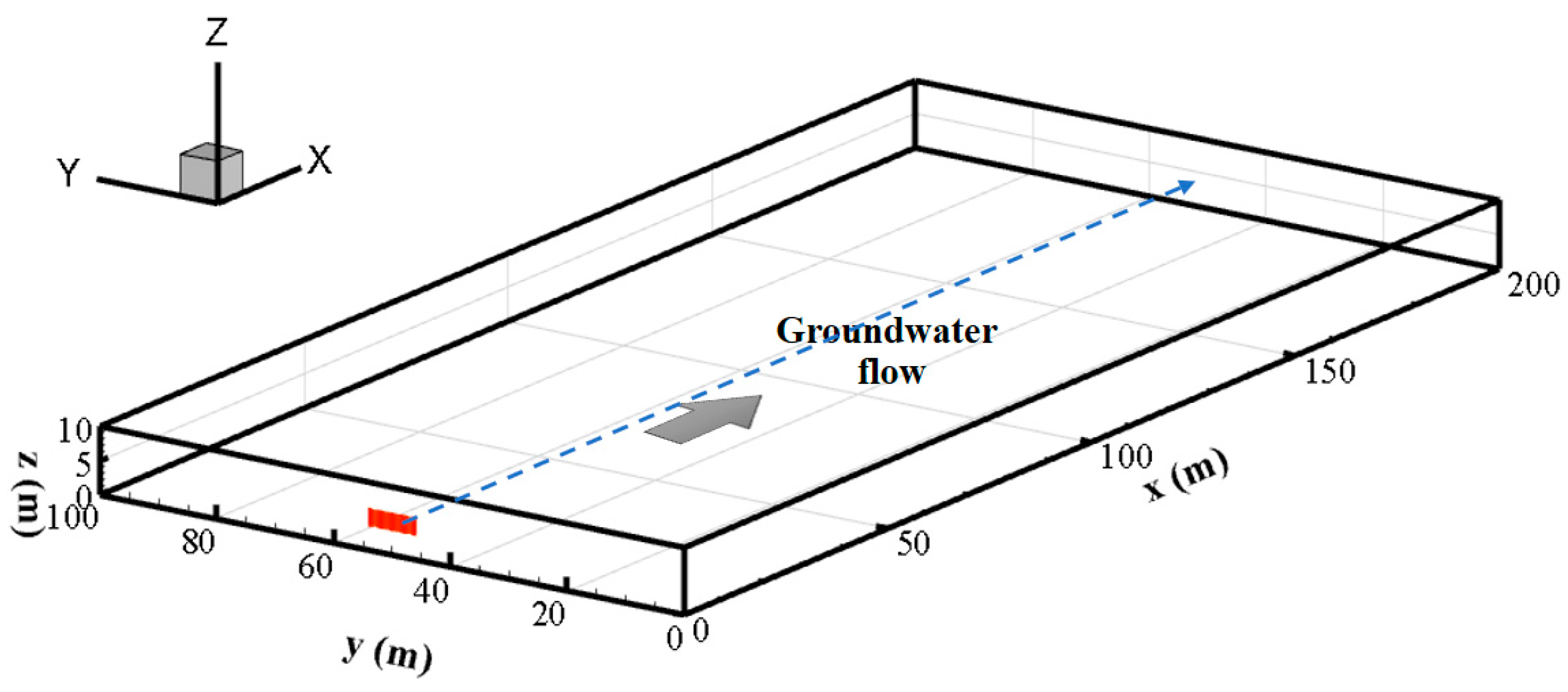
The final scenario illustrates the application of the developed models, showcasing their capability to simulate the transport of multiple contaminants with piecewise constant source concentrations at the inlet boundary. The simulation scenario is based on Tutorial 6 from the REMChlor user manual [25]. The initial presence of 1620 kg of PCE in the subsurface environment gradually dissolves, leading to the formation and release of three degradation products: TCE, DCE, and VC. The geometry of the groundwater system is illustrated in Figure 8.
The derived analytical solutions with piecewise constant source concentrations are verified against a three-dimensional analytical model [18], which assess site remediation of both NAPL source and downgradient contaminant plume. The time-dependent source function in the solution [18], known as the power function, is formulated as a combination of the initial source mass, initial source concentration, source decay rate constant, and empirical parameters. In this specific scenario, the values used are 1620 kg, 100 mg/L, 0.1 year−1, and 0.5, respectively. In contrast, the piecewise constant source concentration used in this study requires only the specification of source concentrations at defined time intervals, aligning the approach [18]. The input source concentrations at various time intervals used in this study are provided in Table 5. The transport and reaction parameters for the four chlorinated solvents are summarized in Table 6.
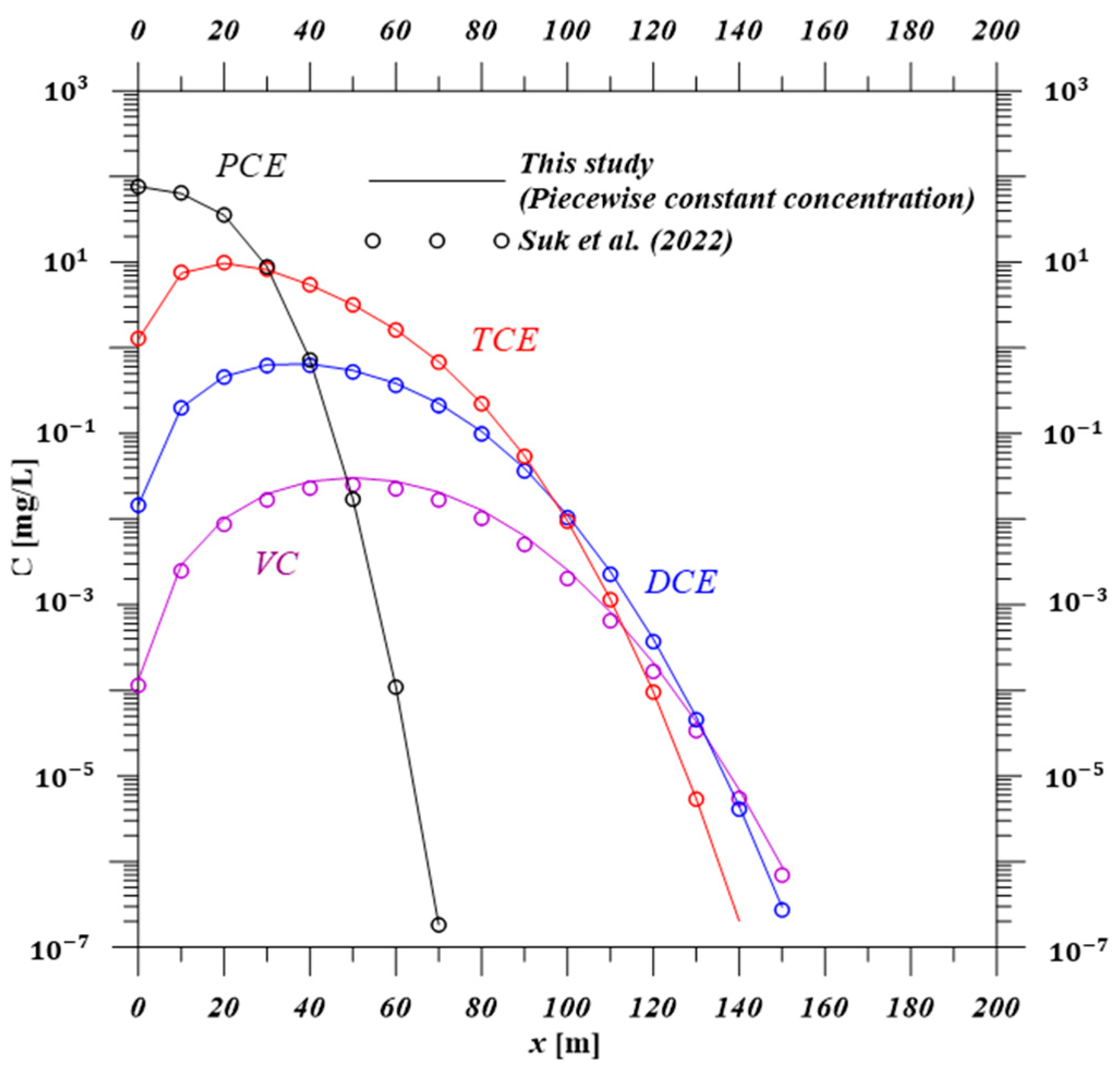
Figure 9 presents the concentration profiles of the four chlorinated solvents along the x-direction (indicated by the blue dashed line in Figure 8), simulated by both the model developed in this study and the model [18] over a 5-year period. It is evident that the initial release of the PCE contaminant leads to increased concentrations of its degradation products in the vicinity of the source area. The results of the two simulations show high consistency, demonstrating that the source function used in this study can effectively be characterized by monitoring source concentrations at different time intervals in the field.
The analytical solution has been verified through four benchmark cases under different conditions—covering a single contaminant, four radionuclides, five chlorinated solvent species, and four chlorinated solvents with site-specific, piecewise constant source concentrations—each compared with previously published analytical solutions. The curves are completely overlapping, indicating identical results within numerical precision.

3.5. Model Verification and Applicability

The analytical solutions developed in this study have been verified across four representative scenarios, each designed to highlight different aspects of contaminant transport and source variability.
  • Scenario 1 examined the transport of a single contaminant under a constant source concentration. Comparison with 3DADE confirmed that the developed solution accurately reproduces plume migration, particularly for large longitudinal dispersion, and highlights the influence of dispersion coefficients on model predictions.
  • Scenario 2 involved a four-member radionuclide decay chain under an exponentially decaying source function. The results closely match the CHAIN code solutions, demonstrating that the model can reliably simulate multiple species undergoing sequential decay processes.
  • Scenario 3 focused on a five-species chlorinated solvent degradation chain with exponentially decaying source concentrations. Comparisons with published analytical model show excellent agreement and illustrate the impact of source decay on the peak concentrations of both parent and daughter species, emphasizing the importance of accounting for time-dependent source depletion in multi-species transport.
  • Scenario 4 simulated four chlorinated solvents with piecewise constant source concentrations, verified against a 3D analytical model. The results confirm that the developed model can accurately capture site-specific source variations over time, highlighting its practical applicability for field scenarios where source concentrations can be monitored and updated.
Together, these four scenarios demonstrate that the proposed analytical solutions are robust, versatile, and capable of handling time-dependent source functions for single and multiple contaminants conditions. The solutions provide both accurate predictions and computational efficiency, making them suitable for preliminary site assessments, remediation planning, and scenarios with limited field data.
Table 7 summarizes the main differences between the present analytical model and several existing models, including those used for verification as well as other commonly applied analytical and numerical approaches, highlighting key features, limitations, and applicability for various transport scenarios.

4. Conclusions

This study presents practical analytical models for three-dimensional reactive transport under two types of time-varying source discharge concentrations: exponentially decaying and piecewise constant source functions. The solutions are derived analytically using three integral transform techniques, eliminating the need for numerical inversion. The accuracy of the derived solutions is validated through comparison with existing analytical models, using various examples, including scenarios involving chlorinated solvents and radionuclides. The comparison of results shows excellent agreement between the models across a variety of examples. The solution offers high flexibility, allowing for the incorporation of both exponentially decaying source functions and arbitrarily defined time-dependent concentration inputs, enabling the simulation of a wide range of contaminant transport scenarios. The analytical solutions developed in this study are versatile and computationally efficient, providing a robust framework for evaluating the reactive transport of multiple coexisting contaminants under time-varying source discharge conditions.
The simulation results from the four benchmark cases highlight the practical implications of the analytical models: for DNAPL-contaminated sites, incorporating time-varying source concentrations helps avoid overestimation of contaminant and degradation product levels, supporting more accurate remediation planning; for radionuclide transport, the models provide reliable predictions of parent and daughter nuclide migration, aiding long-term risk assessment and contamination control.
The developed analytical model provides rapid evaluation of transport behavior and source parameters, even when field data are limited. In the future, the framework could be extended to include coupled biogeochemical reactions and time- or space-dependent flow conditions. While such extensions would increase mathematical complexity, they represent important steps toward improving the model’s applicability to realistic, field-scale contaminant transport problems. Overall, the analytical approach offers a valuable tool for understanding reactive transport and supporting parameter estimation in practical applications.

Author Contributions

Conceptualization, J.-S.C., C.-P.L.; methodology, Z.-Y.L. and J.-S.C.; software, validation, writing—original draft preparation, Z.-Y.L.; writing—review and editing, J.-S.C., H.S., T.-U.N., C.-P.L., and C.-W.L.; visualization, Z.-Y.L. and H.S.; supervision, J.-S.C. All authors have read and agreed to the published version of the manuscript.

Funding

This research and the APC were funded by the National Science and Technology Council (NSTC), grant number 114-2116-M-008-019-, and by the Soil and Groundwater Pollution Remediation Fund Management Board, Environmental Management Administration, Ministry of Environment.

Data Availability Statement

The original contributions presented in this study are included in the article. Further inquiries can be directed to the corresponding authors.

Conflicts of Interest

The authors declare no conflicts of interest.

Appendix A

Following the procedures [13], the Laplace transform and two finite Fourier cosine transforms are applied to the set of partial differential equations defined in Equation (1). These transforms are used to eliminate the time-dependent first derivatives and the second-order spatial derivatives with respect to y and z.
The general formula for the Laplace transform is defined as:
L [ C i ( x , y , z , t ) ] = 0 e s t C i ( x , y , z , t ) d t
L [ C i ( x , y , z , t t ] = s L [ C ¯ i ( x , y , z , t ) ] C i ( x , y , z , t = 0 )
where s is the Laplace transform parameter.
The finite Fourier cosine transforms with respect to y and z are defined by the following transformation relations:
C i ¯ ¯ ( x , m , y , s ) = F y C i ¯ ( x , y , z , s = 0 W C i ¯ ( x , y , z , s ) c o s ( m π y W ) d y
F y 2 C i ¯ ( x , y , z , s y 2 = 1 m C i ¯ ( x , y = W , z , s y C i ¯ ( x , y = 0 , z , s y m 2 π 2 W 2 F y C i ¯ ( x , y , z , s
C i ¯ ¯ ¯ ( x , m , n , s ) = F z C i ¯ ¯ ( x , m , n , s ) = 0 H C i ¯ ¯ ( x , m , z , s ) c o s ( n π z H ) d z
F z 2 C i ¯ ¯ ( x , m , z , s ) y 2 = 1 n C i ¯ ¯ ( x , m , z = H , s ) z C i ¯ ¯ ( x , m , z = 0 , s ) z n 2 π 2 H 2 F z [ C i ¯ ¯ ( x , m , z , s ) ]
where m and n are the finite Fourier cosine transform parameters.
After applying the three integral transformations, the partial differential equations are reduced to the second-order ordinary differential equations (ODEs) and their respective boundary conditions. These simplified equations facilitate solving the system analytically. Subsequently, the general and particular solutions for each species can be derived sequentially, following the decay chain and transport processes.
The solutions in the transformed domain C i ¯ ¯ ¯ ( x , m , n , s ) can be expressed as follows:
C 1 ¯ ¯ ¯ ( x , m , n , s ) = v C 1,0 D x ξ 1 m , n , s + v s + γ 1 Ψ 1 ( m ) Z 1 ( n ) e ξ 1 x
C 2 ¯ ¯ ¯ ( x , m , n , s ) = C 2,0 Ψ m Ζ n ω 2,2 x , m , n , s + C 1,0 Ψ m Ζ n g 1 2 μ 1 R 1 α 21 s ω 2,1 x , m , n , s ω 1,1 x , m , n , s
C 3 ¯ ¯ ¯ x , m , n , s = C 3,0 Ψ m Ζ n ω 3,3 x , m , n , s + C 2,0 Ψ m Ζ n g 2 3 μ 2 R 2 α 32 s ω 3,2 x , m , n , s ω 2,2 x , m , n , s + C 1,0 Ψ m Ζ n g 1 2 μ 1 R 1 g 2 3 μ 2 R 2 α 21 s ω 3,1 x , m , n , s ω 2,1 x , m , n , s α 32 s ω 3,1 x , m , n , s ω 1,1 x , m , n , s α 31 s
C 4 ¯ ¯ ¯ x , m , n , s = C 4,0 Ψ m Ζ n ω 4,4 x , m , n , s + C 3,0 Ψ m Ζ n g 3 4 μ 3 R 3 α 43 s ω 4,3 x , m , n , s ω 3,3 x , m , n , s + C 2,0 Ψ m Ζ n g 2 3 μ 2 R 2 g 3 4 μ 3 R 3 α 32 s ω 4,2 x , m , n , s ω 3,2 x , m , n , s α 43 s ω 4,2 x , m , n , s ω 2,2 x , m , n , s α 42 s + C 1,0 Ψ m Ζ n g 1 2 μ 1 R 1 g 2 3 μ 2 R 2 g 3 4 μ 3 R 3 α 21 s 1 α 32 s ω 4,1 x , m , n , s ω 3,1 x , m , n , s α 43 s ω 4,1 x , m , n , s ω 2,1 x , m , n , s α 42 s 1 α 31 s ω 4,1 x , m , n , s ω 3,1 x , m , n , s α 43 s ω 4,1 x , m , n , s ω 1,1 x , m , n , s α 41 s
C 5 ¯ ¯ ¯ x , m , n , s = C 5,0 Ψ m Ζ n ω 5,5 x , m , n , s + C 4,0 Ψ m Ζ n g 4 5 μ 4 R 4 α 54 s ω 5,4 x , m , n , s ω 4,4 x , m , n , s + C 3,0 Ψ m Ζ n g 3 4 μ 3 R 3 g 4 5 μ 4 R 4 α 43 s ω 5,3 x , m , n , s ω 4,3 x , m , n , s α 54 s ω 5,3 x , m , n , s ω 3,3 x , m , n , s α 53 s + C 2,0 Ψ m Ζ n g 2 3 μ 2 R 2 g 3 4 μ 3 R 3 g 4 5 μ 4 R 4 α 32 s 1 α 43 s ω 5,2 x , m , n , s ω 4,2 x , m , n , s α 54 s ω 5,2 x , m , n , s ω 3,2 x , m , n , s α 53 s 1 α 42 s ω 5,2 x , m , n , s ω 4,2 x , m , n , s α 54 s ω 5,2 x , m , n , s ω 2,2 x , m , n , s α 52 s + C 1,0 Ψ m Ζ n g 1 2 μ 1 R 1 g 2 3 μ 2 R 2 g 3 4 μ 3 R 3 g 4 5 μ 4 R 4 α 21 s 1 α 32 s α 43 s ω 5,1 x , m , n , s ω 4,1 x , m , n , s α 54 s ω 5,1 x , m , n , s ω 3,1 x , m , n , s α 53 s 1 α 32 s α 42 s ω 5,1 x , m , n , s ω 4,1 x , m , n , s α 54 s ω 5,1 x , m , n , s ω 2,1 x , m , n , s α 52 s 1 α 31 s α 43 s ω 5,1 x , m , n , s ω 4,1 x , m , n , s α 54 s ω 5,1 x , m , n , s ω 3,1 x , m , n , s α 53 s + 1 α 31 s α 41 s ω 5,1 x , m , n , s ω 4,1 x , m , n , s α 54 s ω 5,1 x , m , n , s ω 1,1 x , m , n , s α 51 s
where
Ψ m = y 2 y 1 m = 0 W m π s i n m π y 2 W s i n m π y 1 W m = 1,2 ,
Ζ n = z 2 z 1 n = 0 H n π s i n n π z 2 H s i n n π z 1 H n = 1,2 ,
ω i , j x , m , n , s = v D x ξ i m , n , s + v s + λ j e ξ i m , n , s x
ξ i m , n , s = v v 2 + 4 D x D y m π W 2 + D z n π H 2 + μ i R i + R i s 2 D x
α j i = R i R j s + μ i R i μ j R j R i R j
Finally, the analytical solutions in the original domain are obtained by sequentially applying the finite Fourier cosine transform inversion twice, followed by the Laplace transform inversion. The formulas for the Laplace transform inversions are summarized in Table A1.
Table A1. Inverse Laplace transform formulas [1].
f s F t
e x s s a 2 1 2 C + D
e x s ( s a 2 ) ( a + s t A 1 + C 4 a 1 4 a ( 1 + 2 a x + 4 a 2 t ) D
e x s s a 2 b + s C 2 a + b D 2 a b + b a 2 b 2 e b 2 t + b x e r f c x 2 t + b t
where a and b are constant, and AD are expressed as:
A = 1 π t e x p x 2 4 t
B = e r f c x 2 t
C = e x p a 2 t a x e r f c x 2 t a t
D = e x p a 2 t + a x e r f c x 2 t + a t

Appendix B

This study also considers time-dependent source boundary condition with piecewise constant values. The transport equations and their associated initial and boundary conditions are identical, except for the source boundary condition, which is given in Equation (3b). In this approach, multiple piecewise constant values are used to represent the observed concentrations C = C i , t 1 , C i , t 2 , . C i , t 3 , , C i , t N at different time intervals ( t = 0 , t 1 , t 2 , . t 3 , , t N ).
The initial step is to apply the Laplace transform to the given equations. As per the properties of the Laplace transform for a shifted unit step function:
L H t a = 1 s e a s
After applying the Laplace transform to Equation (3), the term associated with the unit step function on the right-hand side is transformed as follow:
L C i , t j H ( t t n t 1 ) H ( t t n t ) = C i , t j s e t n t 1 s C i , t j s e t n t s
If L f ( t = F ( s , then according to the time displacement theorem, it follows:
L H ( t a ) f ( t a ) = e a s F ( s )
The term, C i , t j s , on right hand side of Equation (A22) is identical to previously derived analytical solution, which assumes a constant source concentration. This term corresponds to the specific term, F s , in Equation (A23).
Using the definition of the Laplace transform, the inverse transformation is expressed as:
L 1 e a s F s = H t a f t a
The solutions in the transformed domain, denoted as,   C i ¯ ¯ ¯ ( x , m , n , s ) , can be derived from Liao et al. (2021) [13] after applying three integral transforms. However, this study employs multiple unit step function terms to characterize the temporal variation in source concentrations. Therefore, according to the superposition principle, the solutions can be obtained by summing individual terms.
Thus, the final solutions in the original domain are formulated as follows:
C i x , y , z , t = C i , t 0 A i x , y , z , t + C i , t 1 C i , t 0 A i x , y , z , t t 1 + C i , t 2 C i , t 1 A i x , y , z , t t 2 + . . . + C i , t N C i , t N 1 A i x , y , z , t t N
where A i x , y , z , t represents the analytical solutions for species i from Liao et al. (2021) [13], normalized by source concentration strength, C i , 0 .
The difference lies in the additional summation terms, which the variable should be changed from t to t t j . By rearranging the terms in Equation (A25), the following formula is obtained:
C i x , y , z , t = C i , t 0 A i x , y , z , t + j = 1 j = N Δ C i , j A i x , y , z , t t j
where Δ C i , j represents the difference in the source concentration for ith species during the different time interval t j to t j 1 , which can be either positive or negative.

References

  1. van Genuchten, M.T.; Alves, W.J. Analytical Solutions of the One-Dimensional Convective–Dispersive Solute Transport Equation; Technical Bulletin No. 1661; U.S. Department of Agriculture: Washington, DC, USA, 1982; p. 151.
  2. Leij, F.J.; Skaggs, T.H.; van Genuchten, M.T. Analytical solution for solute transport in three-dimensional semi-infinite porous media. Water Resour. Res. 1991, 27, 2719–2733. [Google Scholar] [CrossRef]
  3. Park, E.; Zhan, H. Analytical solutions of contaminant transport from finite one-, two, three-dimensional sources in a finite-thickness aquifer. J. Contam. Hydrol. 2001, 53, 41–61. [Google Scholar] [CrossRef] [PubMed]
  4. Zhan, H.; Wen, Z.; Gao, G. An analytical solution of two-dimensional reactive solute transport in an aquifer–aquitard system. Water Resour. Res. 2009, 45, W10501. [Google Scholar] [CrossRef]
  5. Pérez Guerrero, J.S.; Skaggs, T.H. Analytical solution for one-dimensional advection-dispersion transport equation with distance-dependent coefficients. J. Hydrol. 2010, 390, 57–65. [Google Scholar] [CrossRef]
  6. Sim, Y.; Chrysikopoulos, C.V. Three-dimensional analytical models for virus transport in saturated porous media. Transp. Porous Media 1998, 30, 87–112. [Google Scholar] [CrossRef]
  7. Ogata, A.; Banks, R.B. A Solution of the Differential Equation of Longitudinal Dispersion in Porous Media; Professional Paper 411-A; U.S. Geological Survey: Washington, DC, USA, 1961.
  8. Aziz, C.E.; Newell, C.J.; Gonzales, J.R.; Hass, P.; Clement, T.P.; Sun, Y. BIOCHLOR—Natural Attenuation Decision Support System v1.0, User’s Manual; EPA 600/R-00/008; U.S. Environmental Protection Agency: Washington, DC, USA, 2000.
  9. Bauer, P.; Attinger, S.; Kinzelbach, W. Transport of a decay chain in homogeneous porous media: Analytical solutions. J. Contam. Hydrol. 2001, 49, 217–239. [Google Scholar] [CrossRef] [PubMed]
  10. Cho, C.M. Convective transport of ammonium with nitrification in soil. Can. J. Soil Sci. 1971, 51, 339–350. [Google Scholar] [CrossRef]
  11. Quezada, C.R.; Clement, T.P.; Lee, K.K. Generalized solution to multi-dimensional multi-species transport equations coupled with a first-order reaction network involving distinct retardation factors. Adv. Water Resour. 2004, 27, 507–520. [Google Scholar] [CrossRef]
  12. Wang, X.; Neville, C.J. A semi-analytical solution for the transport of solutes with complex sequences of first-order reactions. Comput. Geosci. 2019, 123, 121–136. [Google Scholar] [CrossRef]
  13. Liao, Z.Y.; Suk, H.; Liu, C.W.; Liang, C.P.; Chen, J.S. Exact analytical solutions with great computational efficiency to three-dimensional multispecies advection-dispersion equations coupled with a sequential first-order degradation reaction network. Adv. Water Resour. 2021, 155, 104018. [Google Scholar] [CrossRef]
  14. Nguyen, T.U.; Chen, Y.H.; Suk, H.; Liang, C.P.; Chen, J.S. Development of a semi-analytical solution for simulating the migration of parent and daughter contaminants from multiple contaminant sources, considering rate-limited sorption effects. Hydrology 2025, 12, 249. [Google Scholar] [CrossRef]
  15. Zheng, C.; Bennett, G.D. Applied Contaminant Transport Modeling, 2nd ed.; John Wiley & Sons, Inc.: New York, NY, USA, 2002. [Google Scholar]
  16. Chen, J.S.; Liang, C.P.; Chang, C.H.; Wan, M.H. Simulating three-dimensional plume migration of a radionuclide decay chain through groundwater. Energies 2019, 12, 3740. [Google Scholar] [CrossRef]
  17. Nguyen, T.U.; Ho, Y.C.; Suk, H.; Liang, C.P.; Liao, Z.Y.; Chen, J.S. Semi-analytical models for two-dimensional multispecies transport of sequentially degradation products influenced by rate-limited sorption subject to arbitrary time-dependent inlet boundary condition. Adv. Water Resour. 2024, 184, 104612. [Google Scholar] [CrossRef]
  18. Suk, H.; Zheng, K.W.; Liao, Z.Y.; Liang, C.P.; Wang, S.W.; Chen, J.S. A New Analytical Model for Transport of Multiple Contaminants Considering Remediation of Both NAPL Source and Downgradient Contaminant Plume in Groundwater. Adv. Water Resour. 2022, 167, 104290. [Google Scholar] [CrossRef]
  19. Newell, C.J.; McLeod, R.K.; Gonzales, J.R. BIOSCREEN Natural Attenuation Decision Support System User’s Manual; Version 1.3, USEPA/600/R-96/087; U.S. Environmental Protection Agency, National Risk Management Research Laboratory: Washington, DC, USA, 1996.
  20. Srinivasan, V.; Clement, T.P.; Lee, K.K. Domenico solution-Is it valid? Ground Water 2007, 45, 136–146. [Google Scholar] [CrossRef] [PubMed]
  21. Leij, F.J.; Bradford, S.A. 3DADE: A Computer Program for Evaluating Three-Dimensional Equilibrium Solute Transport in Porous Media; Research Report No. 134; U.S. Salinity Laboratory, USDA, ARS: Riverside, CA, USA, 1994.
  22. van Genuchten, M.T. Convective-dispersive transport of solutes involved in sequential first-order decay reactions. Comput. Geosci. 1985, 11, 129–147. [Google Scholar] [CrossRef]
  23. Simunek, J.; van Genuchten, M.T.; Sejna, M.; Toride, N.; Leij, F.J. The STANMOD Computer Software for Evaluating Solute Transport in Porous Media Using Analytical Solutions of Convection-Dispersion Equation; Versions 1.0 and 2.0; U.S. Salinity Laboratory, USDA, ARS: Riverside, CA, USA, 1999.
  24. Chen, J.S.; Liang, C.P.; Liu, C.W.; Li, L.Y. An analytical model for simulating two-dimensional multispecies plume migration. Hydrol. Earth Sys. Sci. 2016, 20, 733–753. [Google Scholar] [CrossRef]
  25. Falta, R.W.; Stacy, M.B.; Ahsanuzzaman, W.M.; Earle, R.C. Remediation Evaluation Model for Chlorinated Solvents (REM-Chlor); EPA/600/C-08/001; U.S. Environmental Protection Agency: Washington, DC, USA, 2007.
Figure 1. A schematic representation of the three-dimensional reactive transport of multiple contaminants in a groundwater system, influenced by a time-varying source discharge concentration, as considered in this study.
Water 17 03401 g001
Figure 2. Schematic diagram of the Scenario 1: The groundwater system has dimensions of 50 m in length, 15 m in width, and 15 m in height. The source area (red) extends from 6 m to 9 m in the y-direction and 0 m to 15 m in the z direction at the inlet boundary (x = 0). The blue dashed line indicates the profile along which verification was performed using the model results, with the arrow pointing in the +x-direction.
Water 17 03401 g002
Figure 3. Comparison of the spatial concentration profile of BTEX along the x direction (y = 7.5 m, z = 7.5 m) at t = 5 years, obtained using different dispersion coefficients. The results derived obtained from the analytical solutions with exponentially decaying compared with those obtained from BIOSCREEN and 3DADE code.
Water 17 03401 g003
Figure 4. Simulated BTEX plume migration on the x-y plane (at z = 7.5 m) after 5 years, using three different sets of dispersion coefficients (a) D x = 1   m 2 / y r , D y = 0.1   m 2 / y r , D z = 0.01   m 2 / y r ; (b) D x = 10   m 2 / y r , D y = 1   m 2 / y r , D z = 0.1   m 2 / y r ; (c) D x = 50   m 2 / y r , D y = 5   m 2 / y r , D z = 0.5   m 2 / y r .
Water 17 03401 g004
Figure 5. Spatial concentration profiles of the four radionuclides: Pu-238 (black), U-234 (red), Th-230 (blue), Ra-226 (purple) along the x direction at t = 1000 years, obtained from the derived solutions with an exponentially decaying source function, are compared with those from van Genuchten (1985) [22].
Water 17 03401 g005
Figure 6. Schematic diagram of Scenario 3: The groundwater system has dimensions of 330.7 m in length, 213.4 m in width, and 100 m in height. The source area (red) extends from 90.7 m to 122.7 m in the y-direction and 0 m to 100 m in the z-direction at the inlet boundary (x = 0). The blue dashed line indicates the profile along which verification was performed using the model results, with the arrow pointing in the +x-direction.
Water 17 03401 g006
Figure 7. Numerical comparisons of spatial concentration profiles for (a) PCE; (b) TCE; (c) DCE; (d) VC; and (e) ETH along the x direction (y = 106.7 m, z = 50 m) at t = 10 years, considering four different source decay rate constants. The results are obtained from the three-dimensional exact analytical solutions developed in this study for the third-type BCs and the two-dimensional analytical solutions for the third-type BCs developed by Chen et al. (2016) [24].
Water 17 03401 g007
Figure 8. Schematic diagram of Scenario 4: The groundwater system has dimensions of 200 m in length, 100 m in width, and 10 m in height. The source area (red) extends from 45 m to 55 m in the y-direction and from 3.5 m to 6.5 m in the z direction at the inlet boundary (x = 0). The blue dashed line indicates the profile along which verification was performed using the model results, with the arrow pointing in the +x-direction.
Water 17 03401 g008
Figure 9. Spatial concentration profiles of four chlorinated solvent contaminants along the x direction (y = 50 m, z = 5 m) at t = 5 years, using the solution with a piecewise constant source concentration function derived in this study and the solutions developed by Suk et al. (2022) [18].
Water 17 03401 g009
Table 1. Simulation conditions and transport parameters used in Scenario 1.
ParametersValues
Domain   length ,   L [m]50
Domain   width ,   W [m]15
Domain   height ,   H [m]15
Seepage   velocity ,   v   [ m   y e a r 1 ]10
Longitudinal   dispersion ,   D x   [ m 2 y e a r 1 ] 1
Horizontal   transverse   dispersion ,   D y   [ m 2 y e a r 1 ]0.1
Vertical   transverse   dispersion ,   D z   [ m 2 y e a r 1 ]0.01
Individual   retardation   factors ,   R 1 [-]1
Degradation   reaction   rate   constant ,   μ i   [ y e a r 1 ]4.6
Source   concentration ,   C 1,0   [ mg   L 1 ]13.68
Source   decay   rate ,   λ 1   [ y e a r 1 ]0
Parameters used to specify source area, [m]
y 1 6
y 2 9
z 1 0
z 2 15
Table 2. Simulation conditions and transport parameters used in Scenario 2 [22].
ParametersValues
Domain   length ,   L [m]100
Seepage   velocity ,   v   [ m   y e a r 1 ]100
Longitudinal   dispersion ,   D x   [ m 2 y e a r 1 ] 10
Retardation   factors ,   R i [-]
Pu-23810,000
U-23414,000
Th-23050,000
Ra-226500
Decay   reaction   rate   constant ,   μ i   [ y e a r 1 ]
Pu-2380.0079
U-2340.0000028
Th-2300.0000087
Ra-2260.00043
Source   decay   rate ,   λ 1   [ y e a r 1 ]
Pu-2380.0089
U-2340.0010028
Th-2300.0010087
Ra-2260.00143
Yield   coefficients   for   g 1 2 , g 2 3 , g 3 4 1
Table 3. Coefficients of B i for the four radionuclides [22].
Radionuclides B i  Values
Pu-238 B 1 = 1.25
U-234 B 2 = −1.25 B 3 = 1.25
Th-230 B 4   =   4.436   × 10−4 B 5   =   5.934   × 10−1 B 6   =   5.938   × 10−1
Ra-226 B 7   =   5.167   × 10−7 B 8   =   1.208   × 10−2 B 9   =   1.226   × 10−2 B 10   =   1.789   × 10−4
Table 4. Simulation conditions and transport parameters used in Scenario 3.
ParametersValues
Domain   length ,   L [m]330.7
Domain   width ,   W [m]213.4
Domain   height ,   H [m]100
Seepage   velocity ,   v   [ m   y e a r 1 ]34
Longitudinal   dispersion ,   D x   [ m 2 y e a r 1 ] 415
Horizontal   transverse   dispersion ,   D y   [ m 2 y e a r 1 ] 41.5
Vertical   transverse   dispersion ,   D z   [ m 2 y e a r 1 ] 41.5
Retardation   factors ,   R i [-]
PCE7.13
TCE2.87
DCE2.8
VC1.43
ETH5.35
Degradation   reaction   rate   constant ,   μ i   [ y e a r 1 ]
PCE2
TCE1
DCE0.7
VC0.4
ETH0
Source   decay   rate ,   λ i   [ y e a r 1 ]
PCE
TCE
DCE0, 0.01, 0.05, 0.1
VC
ETH
Yield   coefficient ,   g i 1 i [-]
g P C E T C E 0.79
g T C E D C E 0.74
g D C E V C 0.64
g V C E T H 0.45
Parameters used to specify source area, [m]
y 1 90.7
y 2 122.7
z 1 0
z 2 100
Table 5. The input source concentrations of PCE at different time intervals used in Scenario 4 of this study.
Time
(Year)
12345678910
PCE source concentration
Input (mg/L)
10090.586827874.570676461
Table 6. Simulation conditions and transport parameters used in Scenario 4.
ParametersValues
Domain   length ,   L [m]200
Domain   width ,   W [m]100
Domain   height ,   H [m]10
Seepage   velocity ,   v   [ m   y e a r 1 ]30
Longitudinal   dispersion ,   D x   [ m 2 y e a r 1 ] 50
Horizontal   transverse   dispersion ,   D y   [ m 2 y e a r 1 ] 5
Vertical   transverse   dispersion ,   D z   [ m 2 y e a r 1 ] 1
Retardation   factors ,   R i [-]
PCE7
TCE2.2
DCE1.8
VC1.5
Degradation   reaction   rate   constant ,   μ i   [ y e a r 1 ]
PCE0.4
TCE0.15
DCE0.1
VC0.2
Source   concentration ,   C i , 0   [ m g L 1 ]
TCE0
DCE0
VC0
Yield   coefficient ,   g i 1 i [-]
g P C E T C E 0.79
g T C E D C E 0.74
g D C E V C 0.64
Parameters used to specify source area, [m]
y 1 45
y 2 55
z 1 3.5
z 2 6.6
Table 7. Comparison of key features of selected analytical models for reactive contaminant transport.
ModelDimensionMulti-SpeciesSpecies-Specific RetardationTime-Varying Source
BIOSCREEN [19]3D-
BIOCHLOR [8]3D
REMChlor [25]3DParent only
CHAIN code [22]1D
Chen et al. (2016) [24]2D
Suk et al. (2022) [18]3DParent only
This study3D
Note 1: ✓indicates the option can be considered by the software, and ✕ indicates it cannot. Note 2: “Parent only” indicates that the model only accounts for time-dependent source concentration of the original contaminant.
Disclaimer/Publisher’s Note: The statements, opinions and data contained in all publications are solely those of the individual author(s) and contributor(s) and not of MDPI and/or the editor(s). MDPI and/or the editor(s) disclaim responsibility for any injury to people or property resulting from any ideas, methods, instructions or products referred to in the content.