Mangrove Zonation as a Tool to Infer the Freshwater Inflow Regime in the Data-Poor Ruvu Estuary, Tanzania


Abstract
1. Introduction
1.1. Decreased Freshwater River Flows Threaten Estuaries
1.2. Ensuring Estuarine Freshwater Inflows Requires a Basinwide Perspective
1.3. Obtaining Field Data in a Data-Poor Region
1.4. Mangrove Zonation in Estuaries
2. Methods
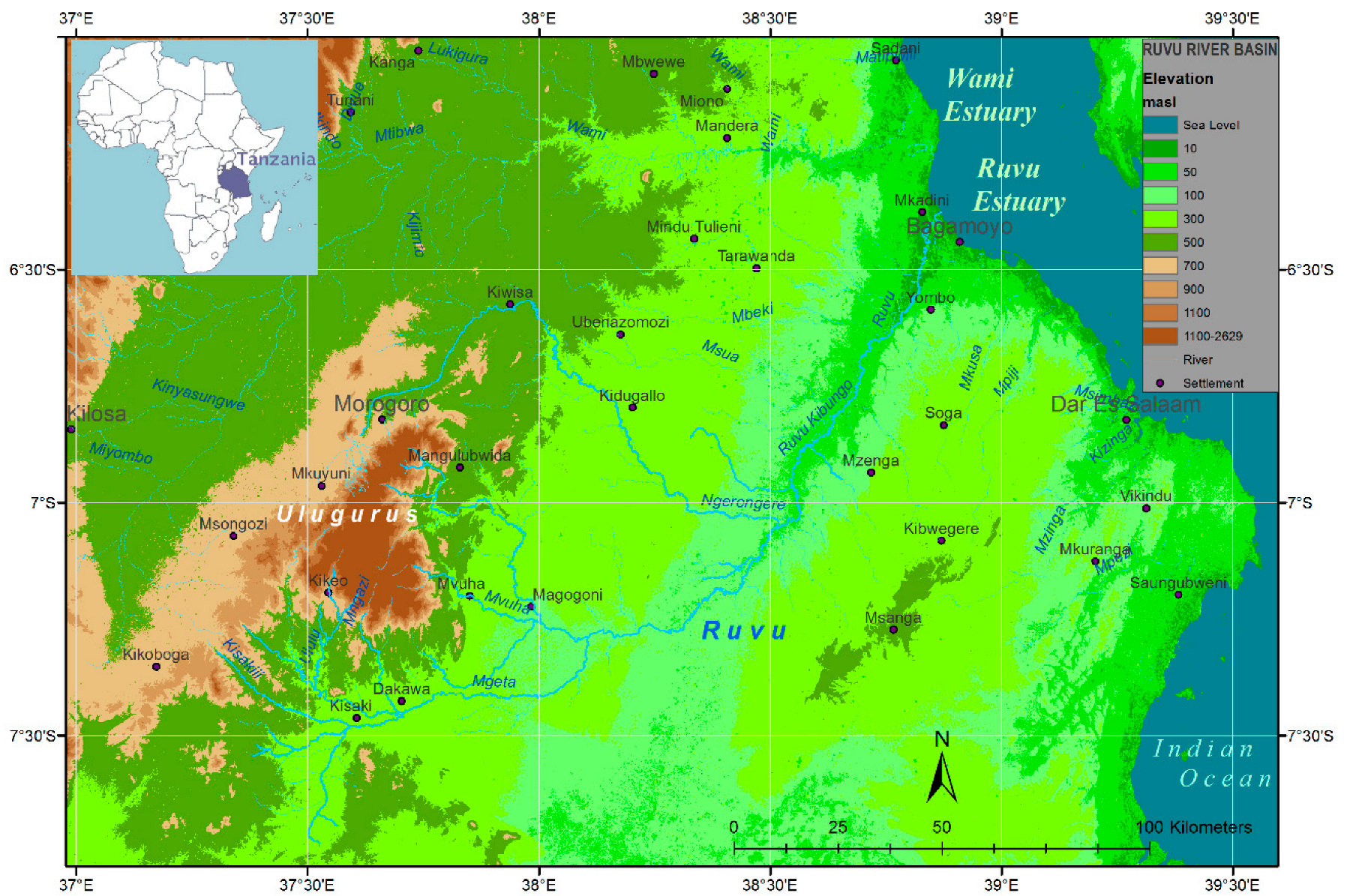
2.1. Study Area
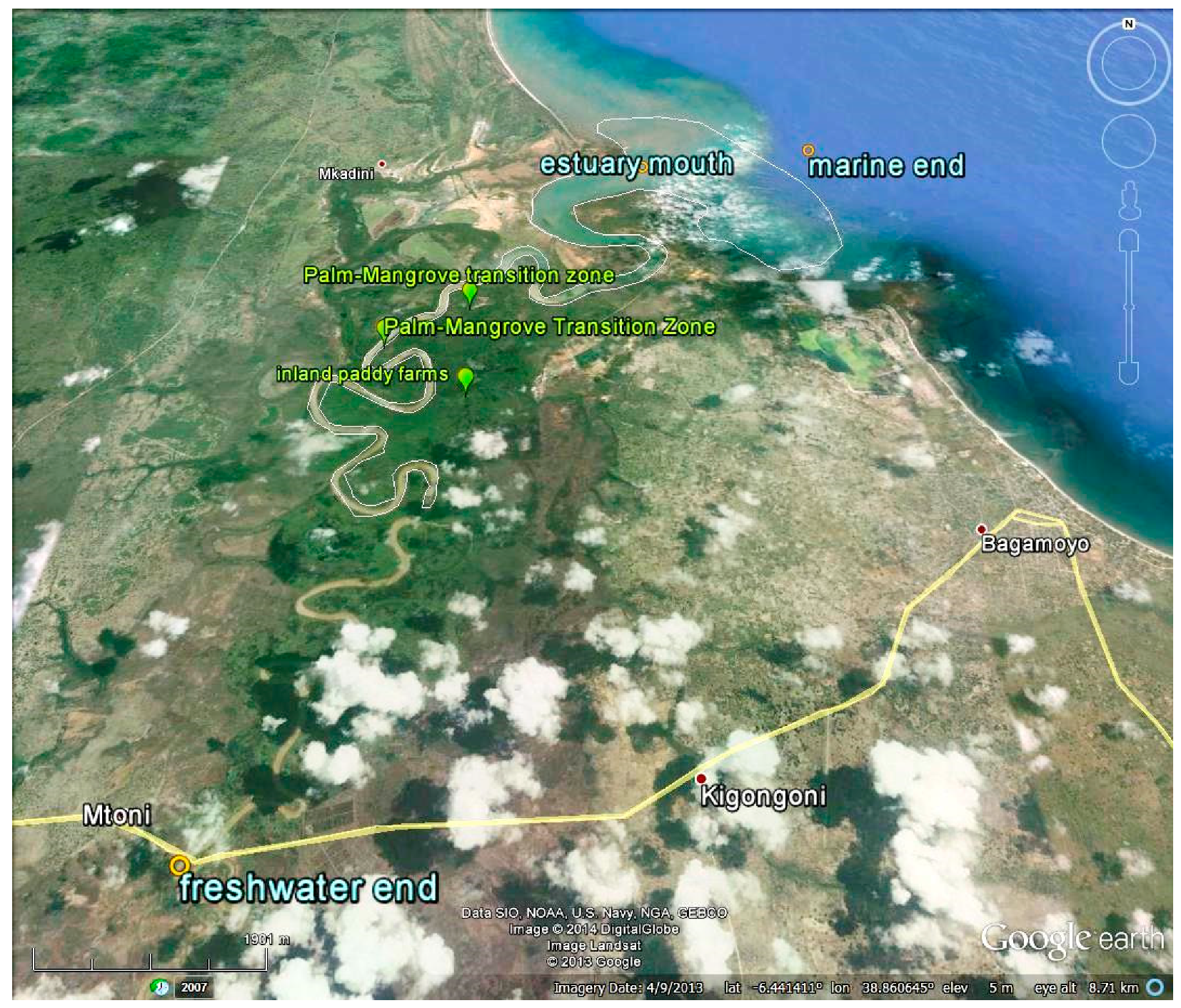
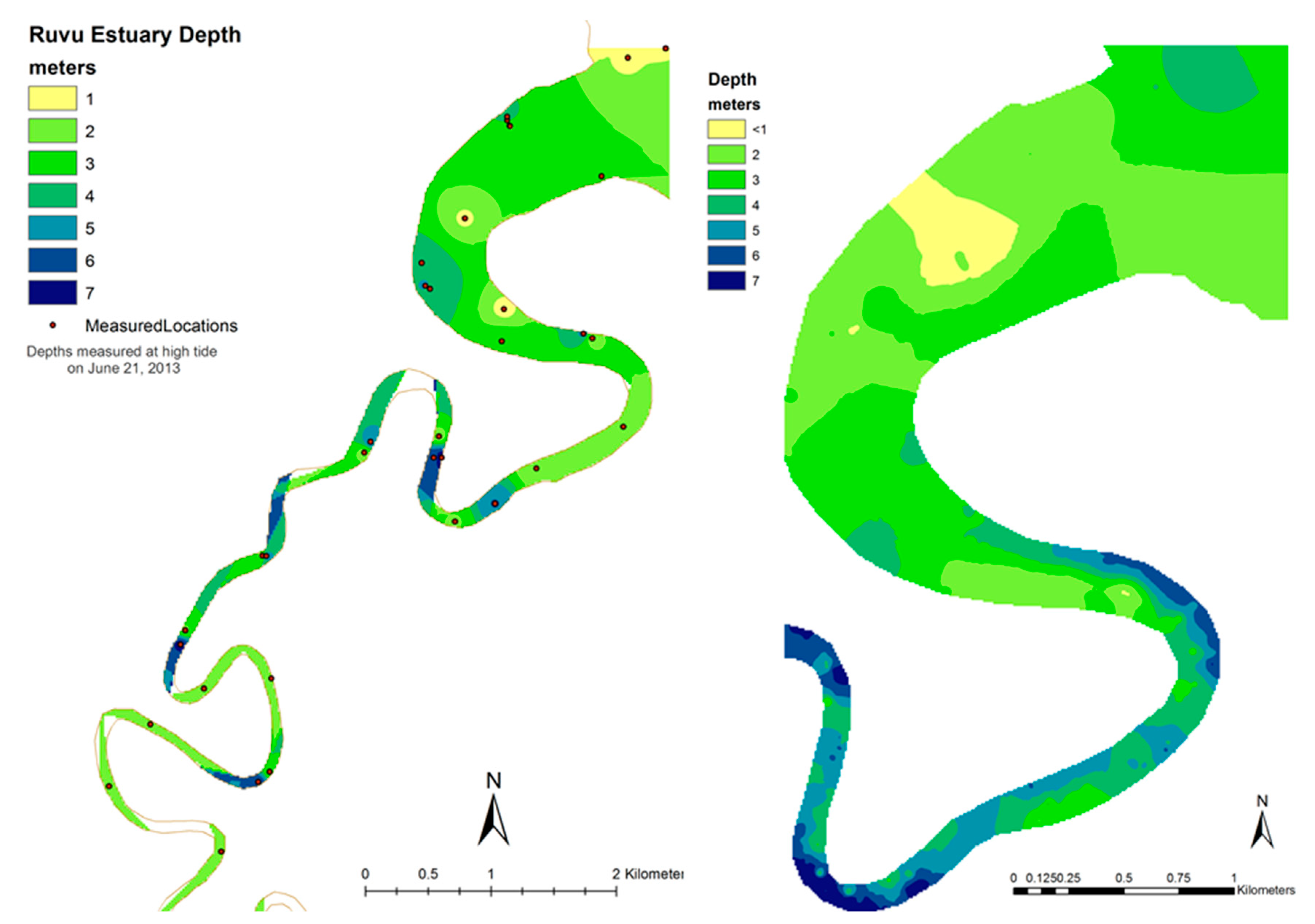
2.2. Rapid Ecohydrological Assessment of the Ruvu Estuary
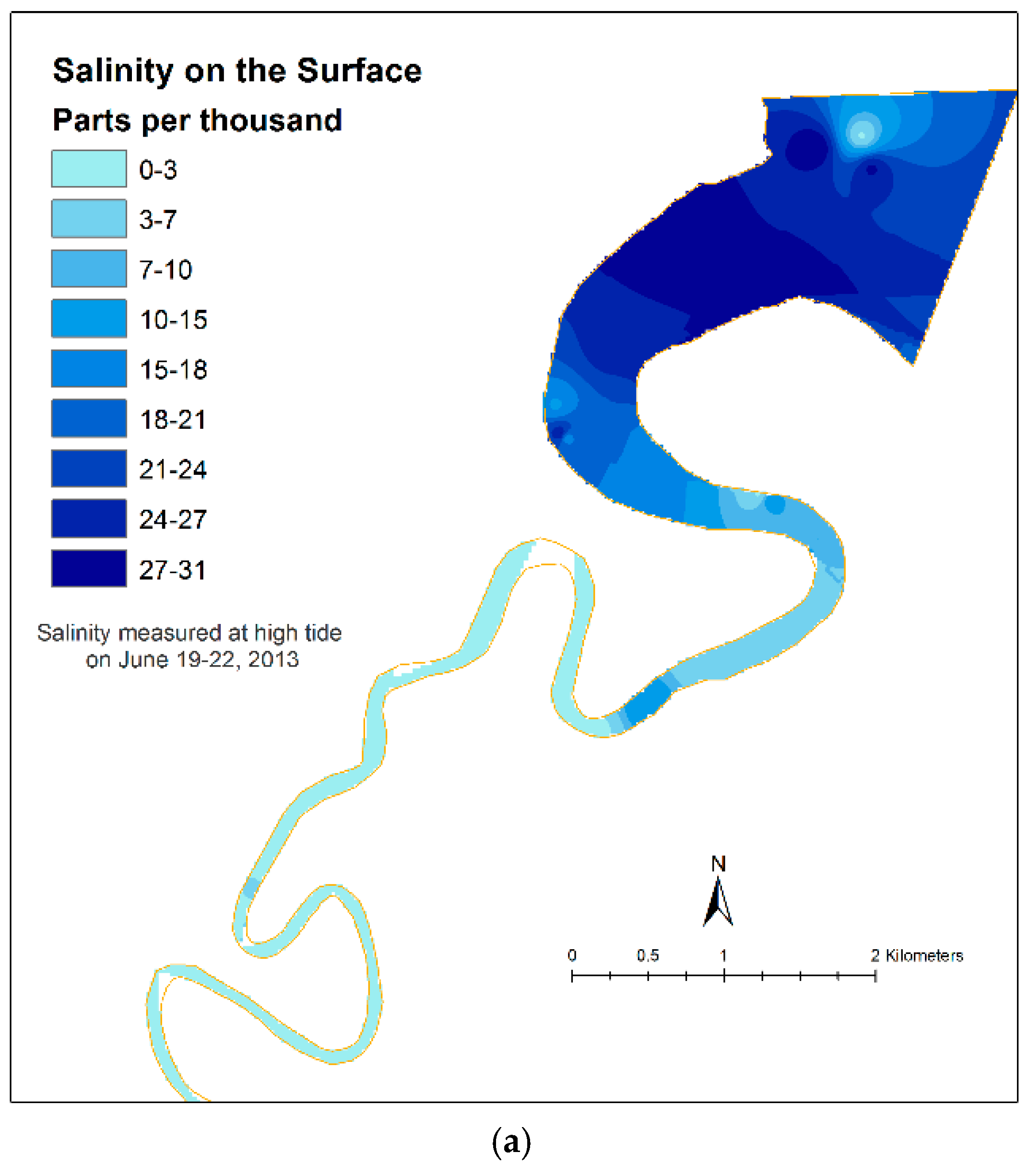
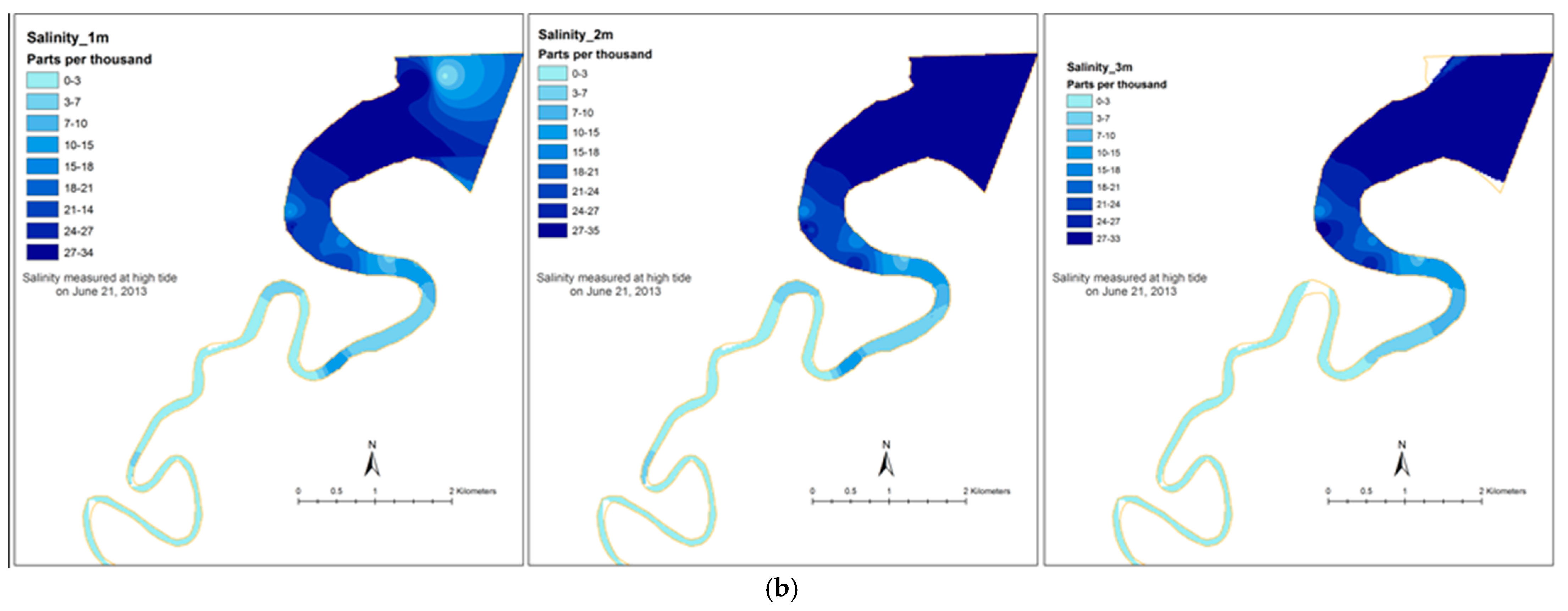
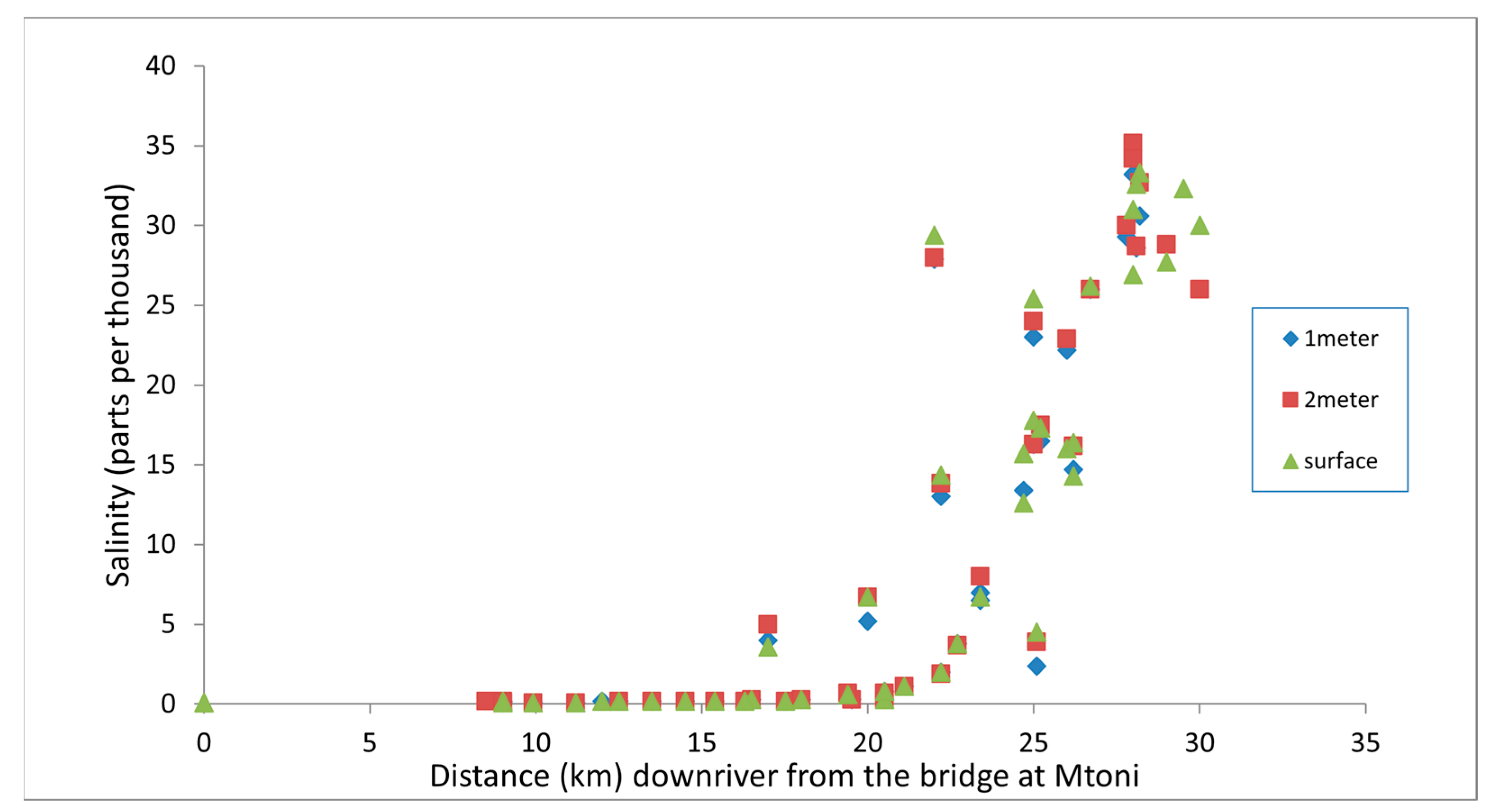
2.3. Salinity Measurements
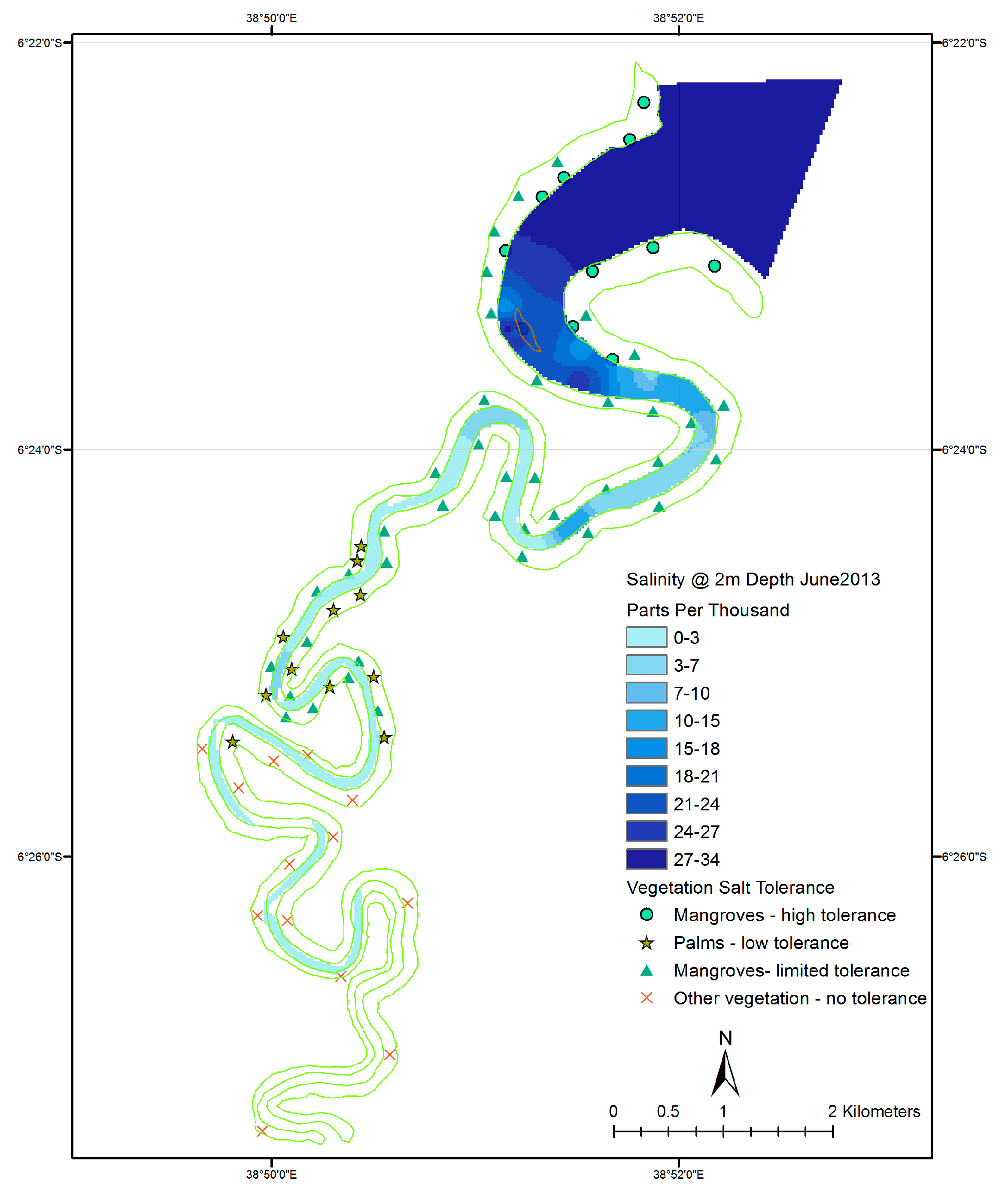
2.4. Vegetation Composition and Relationship to Salinity
- (i)
- Mangroves that are fully tolerant of marine salinity levels (30–35 ppt) and long periods of continuous inundation;
- (ii)
- Mangrove species with intermediate tolerance to salinity level (brackish conditions: 10–30 ppt);
- (iii)
- Mangroves and palms with low tolerance to salinity (<10 ppt);
- (iv)
- Plants intolerant to salinity.
3. Results and Interpretation
3.1. River Salinity
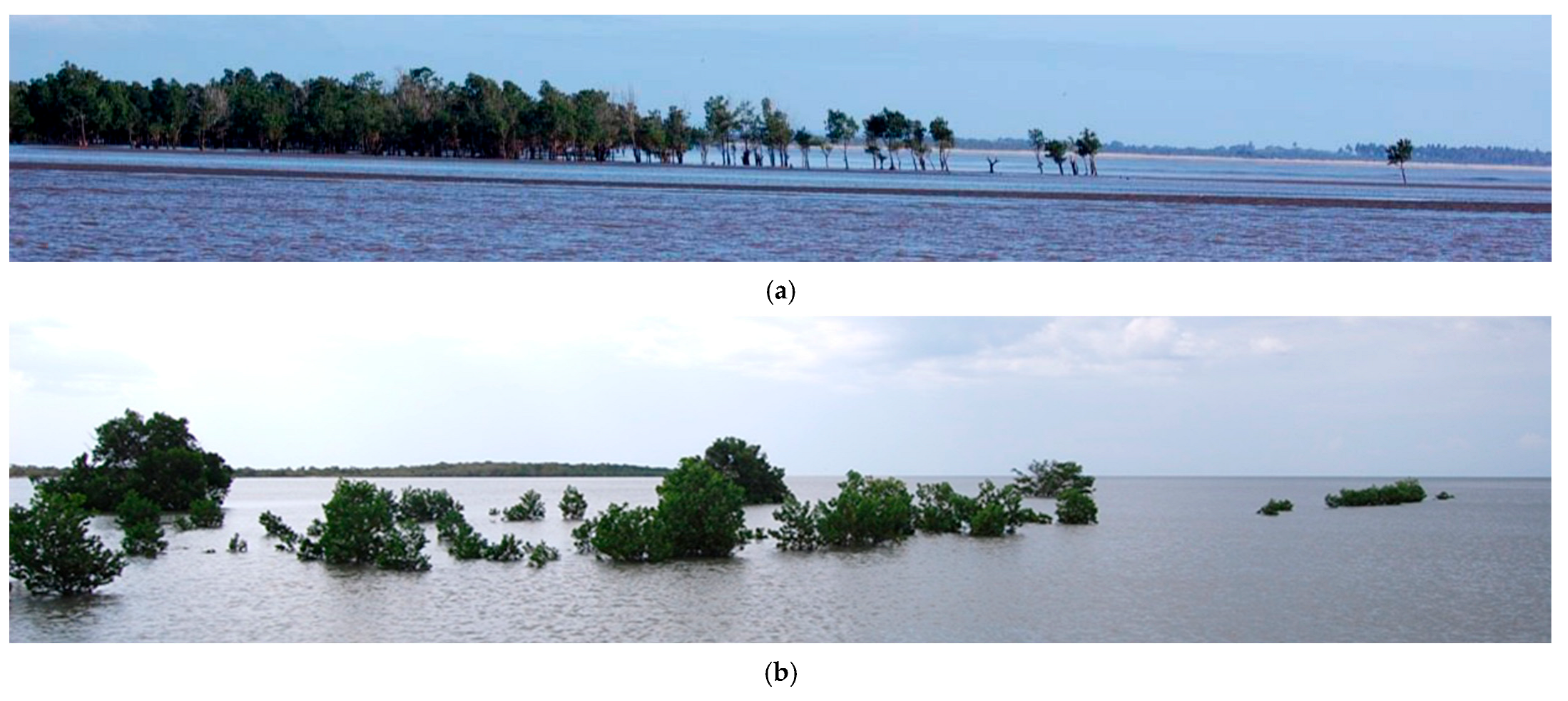
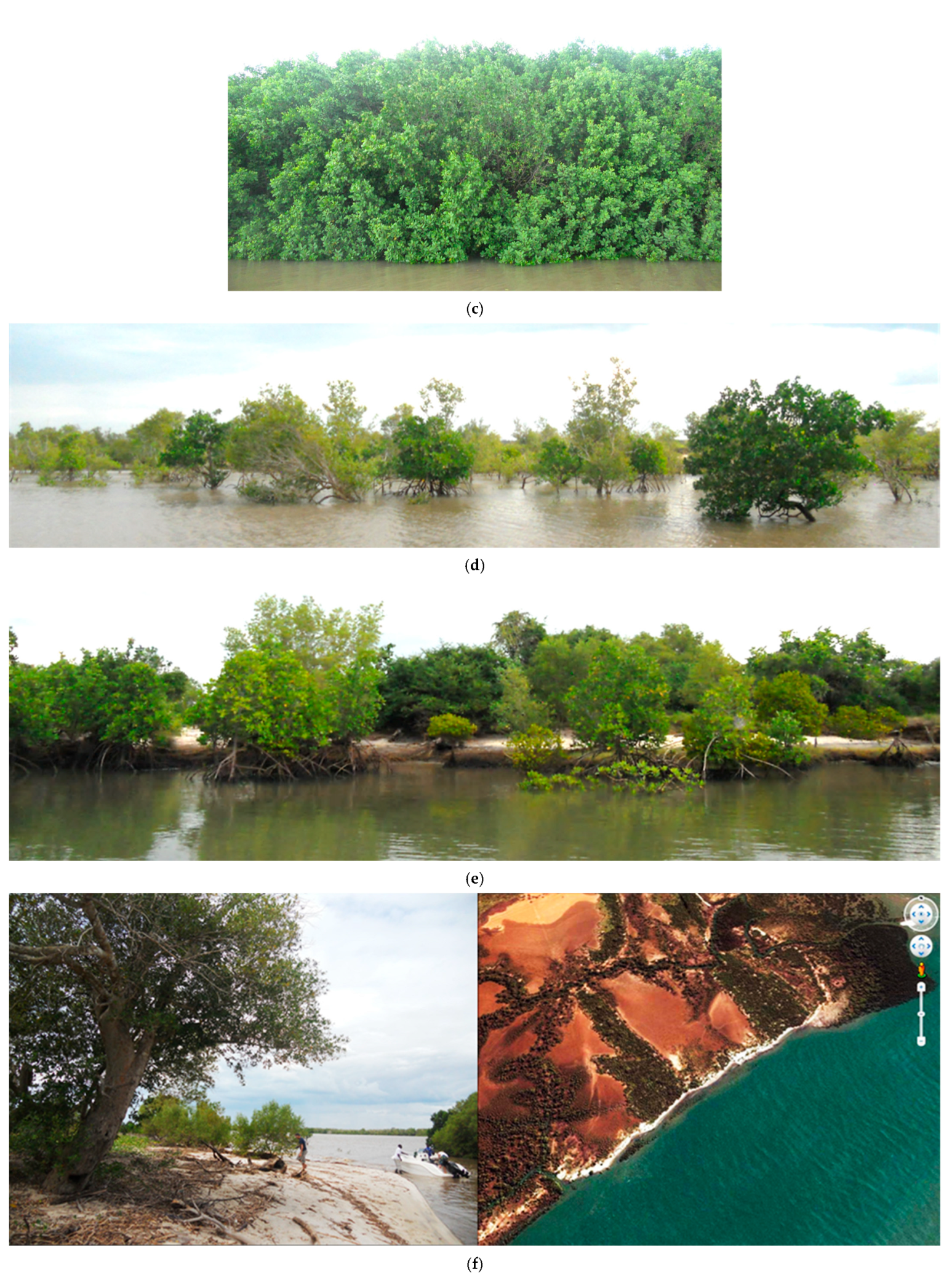
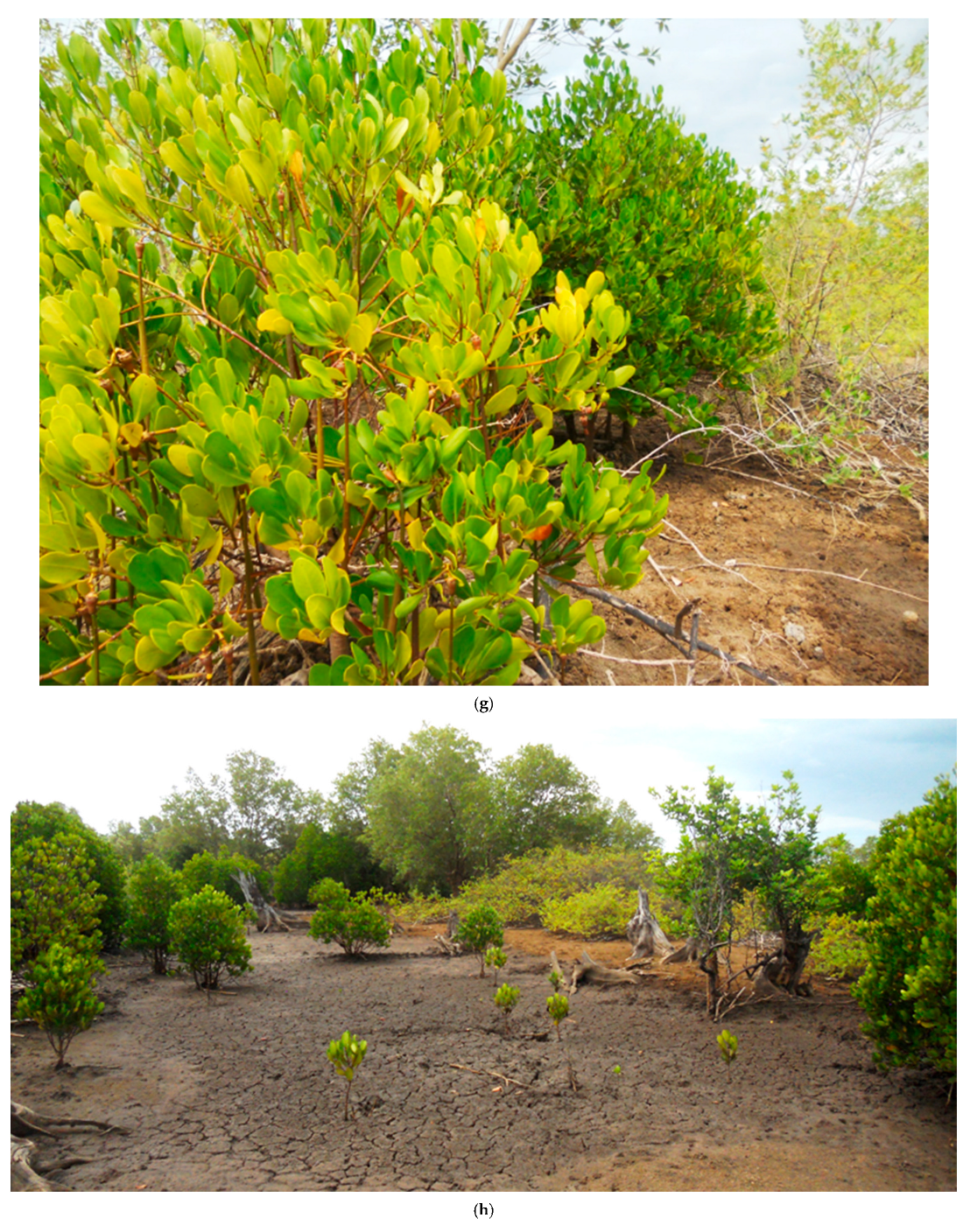
3.2. Mangrove Zonation in the Ruvu Estuary
3.2.1. Estuary Mouth
3.2.2. Low-Lying Riverbanks—Fully Inundated at High Tide
3.2.3. Elevated Sandy Banks
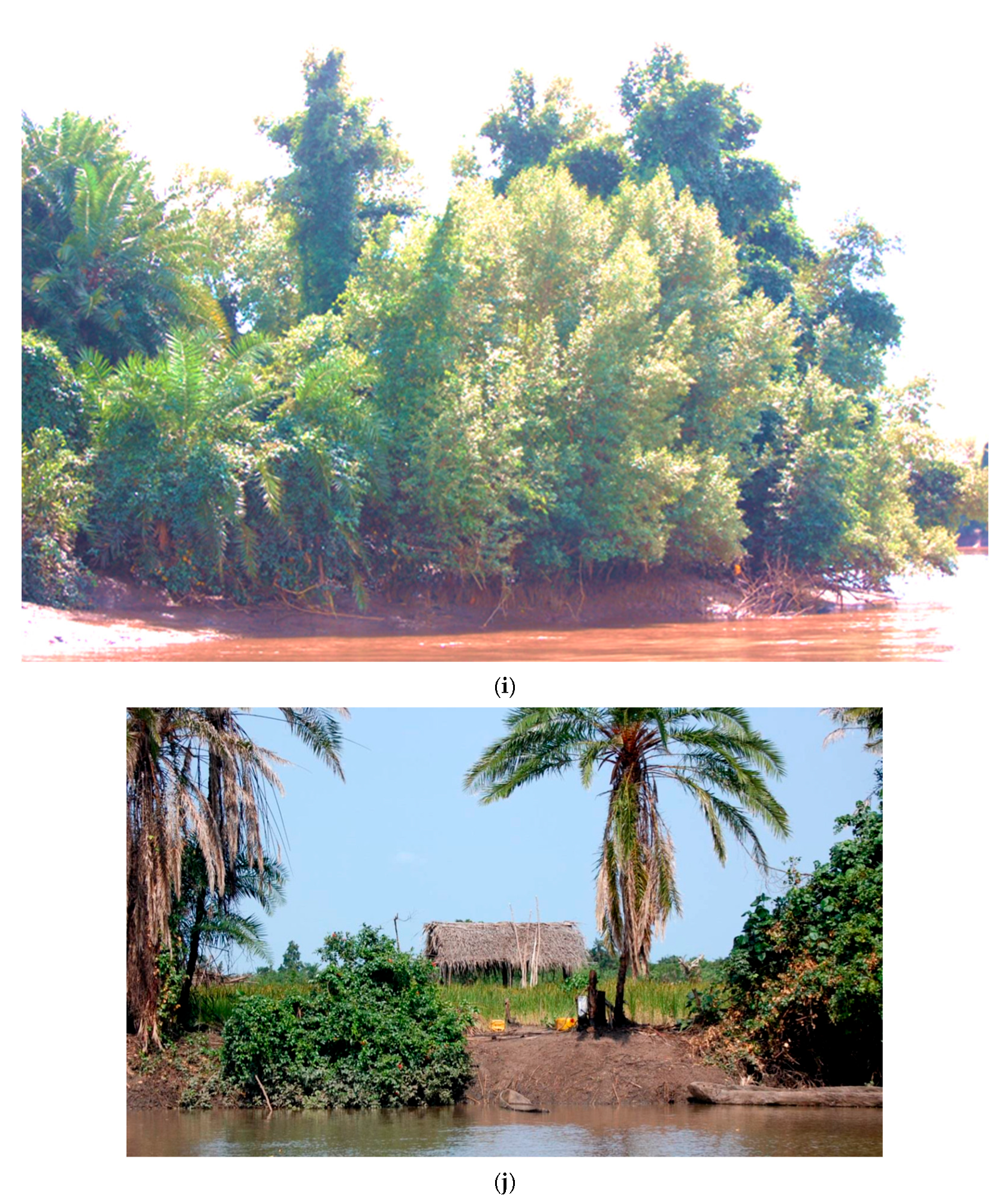
3.2.4. Mangrove—Palm Transition Zone
3.2.5. Freshwater-Dependent Vegetation Zone
4. Discussion
4.1. Using Mangrove Zonation to Infer Salinity Regime via Estuary Modeling
4.2. Ancillary Use of Mangrove Species Composition Data for Mangrove Monitoring
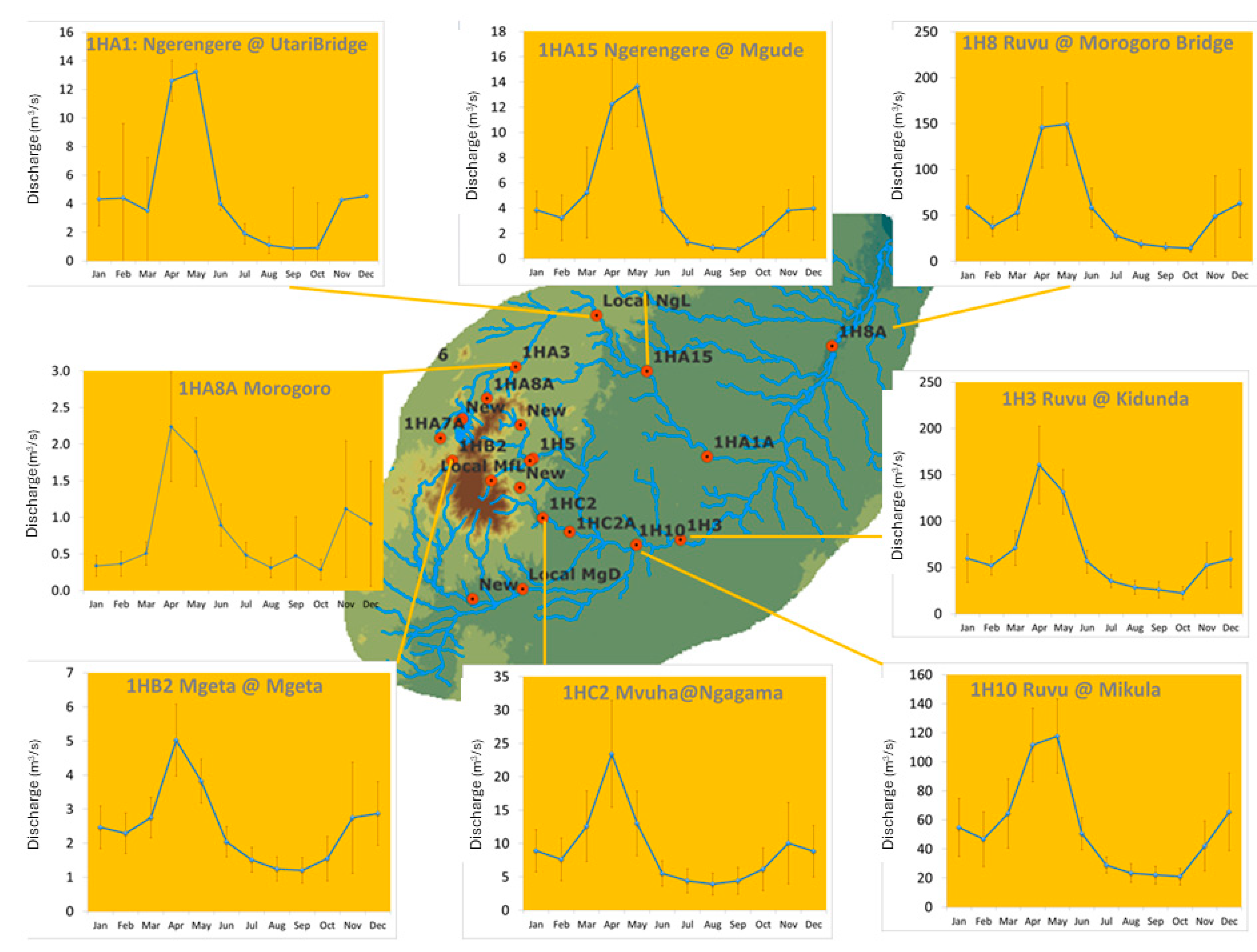
4.3. The Ruvu River Basin: Climate, Land Use, and Vulnerability of Water Resources
5. Conclusions
Author Contributions
Funding
Data Availability Statement
Acknowledgments
Conflicts of Interest
References
- Pritchard, D.W. What Is an Estuary: Physical Viewpoint; American Association for the Advancement of Science: Washinton, DC, USA, 1967; Volume 83, pp. 3–5. [Google Scholar]
- Bwathondi, P.O.J.; Mwamsojo, G.O.J. The Status of the Fishery Resource in, the Wetlands of Tanzania. In Proceedings of the Wetlands of Tanzania, Proceedings of a Seminar on Wetlands of Tanzania, Morogoro, Tanzania, 27–29 November 1993; Kamukala, G.L., Crafter, S.A., Eds.; p. 170.
- Semesi, A.K. Developing Management Plans for the Mangrove Forest Reserves of Mainland Tanzania. Hydrobiologia 1992, 247, 1–10. [Google Scholar] [CrossRef]
- Groeneveld, J.C.; MacKay, F.; Kuguru, B.; Mchomvu, B. Socio-Ecological Change in the Ruvu Estuary in Tanzania, Inferred from Land-Use and Land-Cover (LULC) Analysis and Estuarine Fisheries. West. Indian Ocean J. Mar. Sci. 2021, 1/2021, 75–91. [Google Scholar] [CrossRef]
- Semesi, A.K.; Mgaya, Y.; Muruke, M.; Francis, J.; Julius, A.; Mtolera, M.; Kivia, D.; Msumi, G. Coastal resources utilization and conservation issues in Bagamoyo, Tanzania. Ambio 1998, 27, 635–644. [Google Scholar]
- Martin, E.B.; Chryssee, M. Cargoes of the East: The Ports, Trade and Culture of the Arabian Seas and Western Indian Ocean; Tree Books: Petersfield, UK, 1978; ISBN 0-241-89855-2. [Google Scholar]
- Mangora, M.M.; Lugendo, B.R.; Shalli, M.S.; Semesi, S. Mangroves of Tanzania. In Mangroves of the Western Indian Ocean: Status and Management; Western Indian Ocean Marine Science Association: Zanzibar, Tanzania, 2016; pp. 33–49. [Google Scholar]
- Rull, V. Rise and Fall of Caribbean Mangroves. Sci. Total Environ. 2023, 885, 163851. [Google Scholar] [CrossRef]
- Kennish, M.J. Drivers of Change in Estuarine and Coastal Marine Environments: An Overview. Open J. Ecol. 2021, 11, 224–239. [Google Scholar] [CrossRef]
- Sklar, F.H.; Browder, J.A. Coastal Environmental Impacts Brought about by Alterations to Freshwater Flow in the Gulf of Mexico. Environ. Manag. 1998, 22, 547–562. [Google Scholar] [CrossRef] [PubMed]
- Drinkwater, K.F.; Frank, K.T. Effects of River Regulation and Diversion on Marine Fish and Invertebrates. Aquat. Conserv. Freshw. Mar. Ecosyst. 1994, 4, 135–151. [Google Scholar] [CrossRef]
- Alber, M. A Conceptual Model of Estuarine Freshwater Inflow Management. Estuaries 2002, 25, 1246–1261. [Google Scholar] [CrossRef]
- Powell, G.L.; Matsumoto, J.; Brock, D.A. Methods for Determining Minimum Freshwater Inflow Needs of Texas Bays and Estuaries. Estuaries 2002, 25, 1262–1274. [Google Scholar] [CrossRef]
- Estevez, E.D. Review and Assessment of Biotic Variables and Analytical Methods Used in Estuarine Inflow Studies. Estuaries 2002, 25, 1291–1303. [Google Scholar] [CrossRef]
- Ezekiel, I.T.; Lasisi, K.H. Seawater Intrusion in the Coastal Aquifers of East and Horn of Africa: A Review from a Regional Perspective. Sci. Afr. 2020, 8, e00402. [Google Scholar] [CrossRef]
- Nguyen, A.D.; Savenije, H.H.G. Salt Intrusion in Multi-Channel Estuaries. Hydrol. Earth Syst. Sci. 2006, 10, 743–754. [Google Scholar] [CrossRef]
- Parida, A.K.; Das, A.B. Salt Tolerance and Salinity Effects on Plants: A Review. Ecotoxicol. Environ. Saf. 2005, 60, 324. [Google Scholar] [CrossRef] [PubMed]
- Sotthewes, W. Forcing on the Salinity Distribution in the Pangani Estuary. Master’s Thesis, University of Delft, Delft, The Netherlands, 2008. [Google Scholar]
- Tobey, J. A Profile of the Wami River Sub-Basin; Report Prepared for USAIDby the Tanzania Coastal Management Program and the Coastal Resources Center; University of Rhode Island: Kingston, RI, USA, 2008. [Google Scholar]
- Tolley, S.G.; Brosious, B.B.; Peebles, E.B. Recruitment of the Crabs Eurypanopeus depressus, Rhithropanopeus harrisii, and Petrolisthes armatus to Oyster Reefs: The Influence of Freshwater Inflow. Estuaries Coasts 2012, 36, 820–833. [Google Scholar] [CrossRef]
- van Eeden, A.; Mehta, L.; van Koppen, B. Whose Waters? Large-Scale Agricultural Development and Water Grabbing in the Wami-Ruvu River Basin, Tanzania. Water Altern. 2016, 9, 608–626. [Google Scholar]
- Scott, J.C. Praise of Floods—The Untamed River and the Life It Brings; Yale University Press: London, UK, 2025; ISBN 978-0-300-27849-1. [Google Scholar]
- Pielou, E.C. Freshwater; University of Chicago Press: Chicago, IL, USA, 1998; ISBN 978-0-226-66816-1. [Google Scholar]
- Kiwango, H.; Njau, K.N.; Wolanski, E. The Need to Enforce Minimum Environmental Flow Requirements in Tanzania to Preserve Estuaries: Case Study of Mangrove-Fringed Wami River Estuary. Ecohydrol. Hydrobiol. 2015, 15, 171–181. [Google Scholar] [CrossRef]
- Ngondo, J.; Mango, J.; Liu, R.; Nobert, J.; Dubi, A.; Cheng, H.L.-U. Land-Cover Change Detection and the Implications for Coastal Water Resource Management in the Wami–Ruvu Basin, Tanzania. Sustainability 2021, 13, 4092. [Google Scholar] [CrossRef]
- Lazaro, B.H.; Hagai, M.M.; Mato, R.R. Effects of Climate Change, Land Use and Land Cover Variability on Green and Blue Water in Wami/Ruvu Basin, Tanzania. Tanzan. J. Sci. 2023, 49, 250–262. [Google Scholar] [CrossRef]
- Global Water for Sustainability Programme. Climate and Landscape-Related Vulnerability of Water Resources in the Wami/Ruvu River Basin, Tanzania; Global Water for Sustainability Program; Florida International University: Miami, FL, USA, 2014. [Google Scholar]
- Global Water for Sustainability Programme. Water Atlas of Wami/Ruvu Basins, Tanzania; Florida International University: Miami, FL, USA, 2014; ISBN 978-1-941993-01-9. [Google Scholar]
- Kashaigili, J.J. Rapid Environmental Flow Assessment for the Ruvu River; U.S. Agency for International Development (USAID): Washington, DC, USA, 2011. [Google Scholar]
- Global Water for Sustainability Programme. A Rapid Ecohydrological Assessment of the Ruvu River Estuary, Tanzania; Global Water for Sustainability Program; Florida International University: Miami, FL, USA, 2014. [Google Scholar]
- Tomlinson. The Botany of Mangroves; Cambridge University Press: Cambridge, UK, 2016. [Google Scholar]
- Liu, Y.; Zhang, Y.; Cheng, Q.; Feng, J.; Chao, M.C.; Tsou, J.Y. Mangrove Monitoring and Change Analysis with Landsat Images: A Case Study in Pearl River Estuary (China). Ecol. Indic. 2024, 160, 111763. [Google Scholar] [CrossRef]
- Semesi, A.K. Mangroves of Tanzania. In The Present State of Knowledge in Marine Science in Tanzania; Ngusaru, A.S., Ed.; For Tanzania Coastal Management Program: Muheza, Tanzania, 2001; Chapter 5. [Google Scholar]
- Banerjee, L.K. Influence of Salinity on Mangrove Zonation. Tasks Veg. Sci. 1993, 27, 181–186. [Google Scholar] [CrossRef]
- Punwong, P. Holocene Mangrove Dynamics and Sea Level Change: Records from the East African Coast. Ph.D. Thesis, University of York, Heslington, UK, 2013. [Google Scholar]
- Mikolaev, Y.O.; Bernal, E.S.; Baños, J.B. Saline Year-Gradients in the Lagoon "La Salina"; Water Air Soil Pollut; Effects on Growth of Mangrove Biotope: Tonameca, Oaxaca, Mexico, 2016; Volume 227. [Google Scholar]
- Barik, J.; Mukhopadhyay, A.; Ghosh, T. Mangrove Species Distribution and Water Salinity: An Indicator Species Approach to Sundarban. J. Coast. Conserv. 2018, 22, 361–368. [Google Scholar] [CrossRef]
- Wang, W.; Xin, K.; Chen, Y.; Chen, Y.; Jiang, Z.; Sheng, N.; Liao, B.; Xiong, Y. Spatio-Temporal Variation of Water Salinity in Mangroves Revealed by Continuous Monitoring and Its Relationship to Floristic Diversity. Plant Divers. 2024, 46, 134–143. [Google Scholar] [CrossRef] [PubMed]
- Ma, W.; Wang, W.; Tang, C.; Chen, G.; Wang, M. Zonation of Mangrove Flora and Fauna in a Subtropical Estuarine Wetland Based on Surface Elevation. Ecol. Evol. 2020, 10, 7404–7418. [Google Scholar] [CrossRef] [PubMed] [PubMed Central]
- Richmond, M. (Ed.) A Field Guide to the Seashores of Eastern Africa and the Western Indian Ocean Islands; Sida/WIOMSA: Sundbyberg, Sweden, 2011; ISBN 99867-8977-9-7. [Google Scholar]
- Njana, M.A. Structure, Growth, and Sustainability of Mangrove Forests of Mainland Tanzania. Glob. Ecol. Conserv. 2020, 24, 2351–9894. [Google Scholar] [CrossRef]
- Anderson, E.; McNally, C. A Rapid Ecological Assessment of the Wami River Estuary; Technical report prepared for the Tanzania Coastal Management Partnership and the Coastal Resources Cener; University of Rhode Island: Kingston, RI, USA, 2007. [Google Scholar]
- Feng, X.; Xu, S.; Li, J.; Yang, Y.; Chen, Q.; Lyu, H.; Zhong, C.; He, Z.; Shi, S. Molecular Adaptation to Salinity Fluctuation in Tropical Intertidal Environments of a Mangrove Tree Sonneratia Alba. BMC Plant Biol. 2020, 20, 178. [Google Scholar] [CrossRef]
- Yong, J.W.H. Comparative Guide to Asian Mangroves; International Tropical Timber Organization (ITTO): Yokohama, Japan, 2013. [Google Scholar]
- Saha, A.K.; Sternberg, L.S.L.; Miralles-Wilhelm, F. Linking Water Sources with Foliar Nutrient Status in Upland Plant Communities in the Everglades National Park, USA. Ecohydrology 2009, 2, 42–54. [Google Scholar] [CrossRef]
- Omar, S.H. The Influence of Environmental Factors on Species Diversity on Crab and Mangrove Community in Salt Panning and Non-Salt Panning in Wete District; Pemba. Master’s Thesis, The Open University of Tanzania, Dar es Salaam, Tanzania, 2019. [Google Scholar]
- Savenije, H.H.G. A One-Dimensional Model for Salinity Intrusion in Alluvial Estuaries. J. Hydrol. 1986, 85, 87–109. [Google Scholar] [CrossRef]
- Oliver, T.S.N.; Rogers, K.; Chafer, C.J. Measuring, Mapping and Modelling: An Integrated Approach to the Management of Mangrove and Saltmarsh in the Minnamurra River Estuary, Southeast Australia. Wetl. Ecol Manag. 2012, 20, 353–371. [Google Scholar] [CrossRef]
- Hamilton, P. Modelling Salinity and Circulation for the Columbia River Estuary. Prog. Oceanogr. 1990, 25, 113–156. [Google Scholar] [CrossRef]
- Chatwin, P.C. Some Remarks on the Maintenance of the Salinity Distribution in Estuaries. Estuar. Coast. Mar. Sci. 1976, 4, 555–566. [Google Scholar] [CrossRef]
- Warner, J.C.; Geyer, W.R.; Lerczak, J.A. Numerical Modeling of an Estuary: A Comprehensive Skill Assessment. J. Geophys. Res. Ocean. 2005, 110, C05001. [Google Scholar] [CrossRef]
- Atekwana, E.A.; Ramatlapeng, G.J.; Ali, H.N.; Njilah, I.K.; Ndondo, G.R.N. Tide-Salinity Patterns Reveal Seawater-Freshwater Mixing Behavior at a River Mouth and Tidal Creeks in a Tropical Mangrove Estuary. J. Afr. Earth Sci. 2022, 196, 104684. [Google Scholar] [CrossRef]
- Qiu, C.; Wan, Y. Time Series Modeling and Prediction of Salinity in the Caloosahatchee River Estuary. Water Resour. Res 2013, 49, 5804–5816. [Google Scholar] [CrossRef]
- Teh, S.Y.; DeAngelis, D.L.; Sternberg, L.d.S.L.; Miralles-Wilhelm, F.R.; Smith, T.J.; Koh, H.-L. A Simulation Model for Projecting Changes in Salinity Concentrations and Species Dominance in the Coastal Margin Habitats of the Everglades. Ecol. Model. 2008, 213, 245–256. [Google Scholar] [CrossRef]
- Wang, Y.; Bonynge, G.; Nugranad, J.; Traber, M.; Ngusaru, A.; Tobey, J.; Makota, V. Remote Sensing of Mangrove Change Along the Tanzania Coast. Mar. Geod. 2003, 26, 35–48. [Google Scholar] [CrossRef]
- Giri, S.; Mukhopadhyay, A.; Hazra, S. A Study on Abundance and Distribution of Mangrove Species in Indian Sundarban Using Remote Sensing Technique. J. Coast. Conserv. 2014, 18, 359–367. [Google Scholar] [CrossRef]
- Maurya, K.; Mahajan, S.; Chaube, N. Remote Sensing Techniques: Mapping and Monitoring of Mangrove Ecosystem—A Review. Complex Intell. Syst. 2021, 7, 2797–2818. [Google Scholar] [CrossRef]
- Julius, A. Monitoring Programme for Resource Condition, Environmental and Biological Parameters for Mnazi Bay Ruvuma Estuary Marine Park (MBREMP); The United Nations University Fisheries Training Programme (UNU-FTP): Reykjavík, Iceland, 2005. [Google Scholar]
- Saha, A.K.; Kashaigili, J.; Mashingia, F.; Kiwango, H.; Mohamed, M.A.; Kimaro, M.; Donoso, M.C. Determination of environmental flows in data-poor estuaries—Wami river estuary in saadani national Park, Tanzania. Hydrology 2023, 10, 33. [Google Scholar] [CrossRef]
- Japan International Cooperation Agency. The Study on Water Resources Management and Development in Wami/Ruvu Basin in the UNITED REPUBLIC OF TANZANIA. In Main Report. Japan International Cooperation Agency and the Division of Water Resources, Ministry of Water; Japan International Cooperation Agency: Tokyo, Japan, 2013; p. 489. [Google Scholar]
- Ngana, J.; Mahay, F.; Cross, K. The Ruvu Basin: A Situation Analysis., xviii +; International Union for Conservation of Nature and Natural Resources: Gland, Switzerland, 2010; p. 87. ISBN 978-2-8317-1225-3. [Google Scholar]
- Yanda, P.; Munishi, P. Hydrologic and Land Use/Cover Change Analysis for the Ruvu River (Uluguru) and the Sigi River (East Usambara) Watersheds; Report for World Wildlife Fund/CARE: Dar es Salaam, Tanzania, 2007. [Google Scholar]
- W.R.W.B.O. Annual Hydrological Report 2009/2010; Wami Ruvu Basin Water Office: Morogoro, Tanzania; Ministry of Water: Morogoro, Tanzania, 2010. [Google Scholar]
- Seeteram, N.A.; Hyera, P.T.; Kaaya, L.T.; Lalika, M.C.; Anderson, E.P. Conserving Rivers and Their Biodiversity in Tanzania. Water 2019, 11, 2612. [Google Scholar] [CrossRef]
- Alphayo, S.M.; Sharma, M.P. Water Quality Mapping of Ruvu River in Tanzania. Am. J. Appl. Sci. Res. 2018, 4, 52–59. [Google Scholar]
- Jantzi, S.C.; Dutton, C.L.; Saha, A.; Masikini, R.; Almirall, J.R. Novel B “Filter Pellet” Sample Preparation Strategy for Quantitative LA-ICP-MS Analysis of Filter-Bound Sediments: A B “Green Chemistry” Alternative to Sediment Fingerprinting in Tanzania’s Ruvu River Basin. J. Soils Sediments 2019, 19, 478–490. [Google Scholar] [CrossRef]
- Saha, S.; Sadle, J.; van der Heiden, C.; Sternberg, L. Salinity, Groundwater, and Water Uptake Depth of Plants in Coastal Uplands of Everglades National Park (Florida, USA). Ecohydrology 2015, 8, 128–136. [Google Scholar] [CrossRef]



| Community | Latitude | Longitude | Remarks |
|---|---|---|---|
| Sonneratia | −6.368287° | 38.871491° | A sandbar jutting out into the sea is completely inundated at high tide |
| Sonneratia, Rhizophora | −6.375122° | 38.858313° | North bank, estuary mouth |
| Rhizophora, Avicennia, Ceriops, Brugeria, Hereteria | −6.378841° | 38.852970° | Diverse high sandy bank in the estuary, floods from behind |
| Sonneratia | −6.390415° | 38.853958° | Island in a river channel |
| Avicennia, Rhizophora, Sonneratia | −6.386967° | 38.860841° | South bank in the estuary mouth |
| Avicennia | −6.396982° | 38.861010° | Avicennia forest on the north bank |
| Hereteria, Rhizophora, Ceriops, Avicennia | −6.398293° | 38.871330° | High bank on the south side |
| Brugeria, Ceriops, Avicennia | −6.407859° | 38.858598° | High bank on the south side, further upriver |
| Phoenix palm, Avicennia | −6.409481° | 38.845097° | First palms appear on banks in the upriver |
| Phoenix palm, Avicennia | −6.416805° | 38.835464° | Mangrove–palm transition zone |
| Paddy farms | −6.425406° | 38.845945° | Paddy farm situated a few meters away inland |
| Species | Local Name | Relative Salinity/Flood Tolerance |
|---|---|---|
| Sonneratia alba | Mpira, Mlilane, Evening blossom mangrove | High, monospecific stands on flooded sandbanks |
| Rhizophora mucronata | Mkoko, red mangrove | High, on coastal margins, flooded at high tide |
| Avicennia marina | Mchu, white mangrove | Medium–high |
| Ceriops tagal | Mkandaa | Medium–low, occurs on high sandbanks |
| Hereteria littoralis | Mkungu, silver mangrove | Medium–low, occurs on high sandbanks |
| Bruguiera gymnorrhiza | Mshinzi | Medium–low |
| Xylocarpus granatum | Mkomafi | Medium–low, occurs on high sandbanks |
Disclaimer/Publisher’s Note: The statements, opinions and data contained in all publications are solely those of the individual author(s) and contributor(s) and not of MDPI and/or the editor(s). MDPI and/or the editor(s) disclaim responsibility for any injury to people or property resulting from any ideas, methods, instructions or products referred to in the content. |
© 2025 by the authors. Licensee MDPI, Basel, Switzerland. This article is an open access article distributed under the terms and conditions of the Creative Commons Attribution (CC BY) license (https://creativecommons.org/licenses/by/4.0/).
Share and Cite
Saha, A.K.; Kimaro, M.H. Mangrove Zonation as a Tool to Infer the Freshwater Inflow Regime in the Data-Poor Ruvu Estuary, Tanzania. Water 2025, 17, 3404. https://doi.org/10.3390/w17233404
Saha AK, Kimaro MH. Mangrove Zonation as a Tool to Infer the Freshwater Inflow Regime in the Data-Poor Ruvu Estuary, Tanzania. Water. 2025; 17(23):3404. https://doi.org/10.3390/w17233404
Chicago/Turabian StyleSaha, Amartya Kumar, and Michael Honorati Kimaro. 2025. "Mangrove Zonation as a Tool to Infer the Freshwater Inflow Regime in the Data-Poor Ruvu Estuary, Tanzania" Water 17, no. 23: 3404. https://doi.org/10.3390/w17233404
APA StyleSaha, A. K., & Kimaro, M. H. (2025). Mangrove Zonation as a Tool to Infer the Freshwater Inflow Regime in the Data-Poor Ruvu Estuary, Tanzania. Water, 17(23), 3404. https://doi.org/10.3390/w17233404