Impacts of Land Use Intensity on Ecological Quality Dynamics in the Central Yunnan Plateau Lake Basins, China

 ,
,
Abstract
1. Introduction
2. Study Area Overview and Data Sources
3. Methodology
3.1. Extraction and Fractionation of CYP-LBs
3.2. Construction of Remote Sensing-Based Ecological Index (RSEI)

| Components | Index | Equation | |
|---|---|---|---|
| Greenness | NDVI | (2) | |
| Wetness | WET | (3) | |
| Dryness | NDBSI | (4) | |
| (5) | |||
| (6) | |||
| Heat | LST | (7) | |
| (8) | |||
| (9) |
3.3. Land Use Intensity
3.4. Ecological Quality Unit Delineation
3.5. Center of Gravity Migration Model
3.6. Local Spatial Autocorrelation
3.7. Random Forest Model
4. Results
4.1. Temporal Variation in Ecological Environment Quality in CYP-LBs
4.2. Spatial Variation in Ecological Environment Quality in CYP-LBs
4.3. Spatial Variation in Land Use Degree in CYP-LBs
4.4. Relationship Between RSEI and LUI in CYP-LBs
4.4.1. Land Cover Under Different Ecological Quality Grades
4.4.2. LUI Spatiotemporal Variation and Correlation Analysis
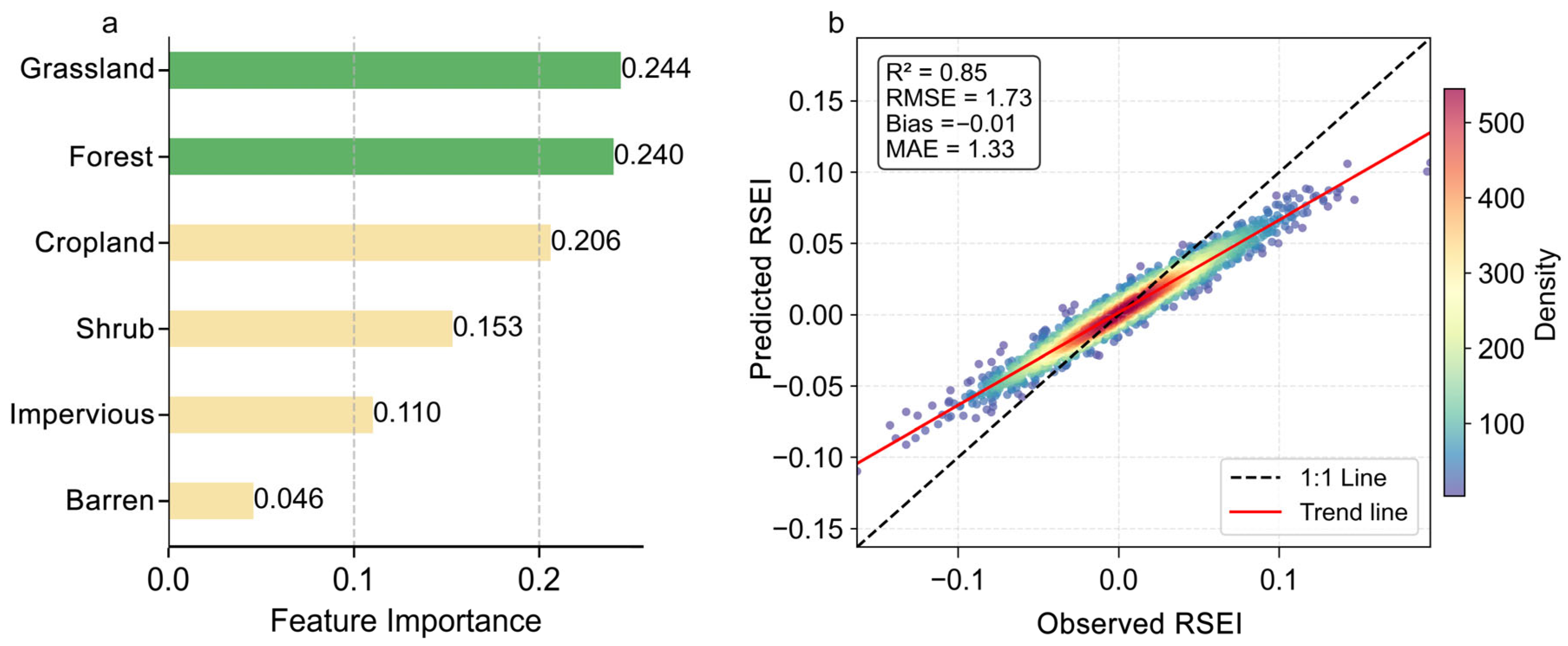
4.4.3. RSEI Response to Changes in Different Land Types
5. Discussion
6. Conclusions
- (1)
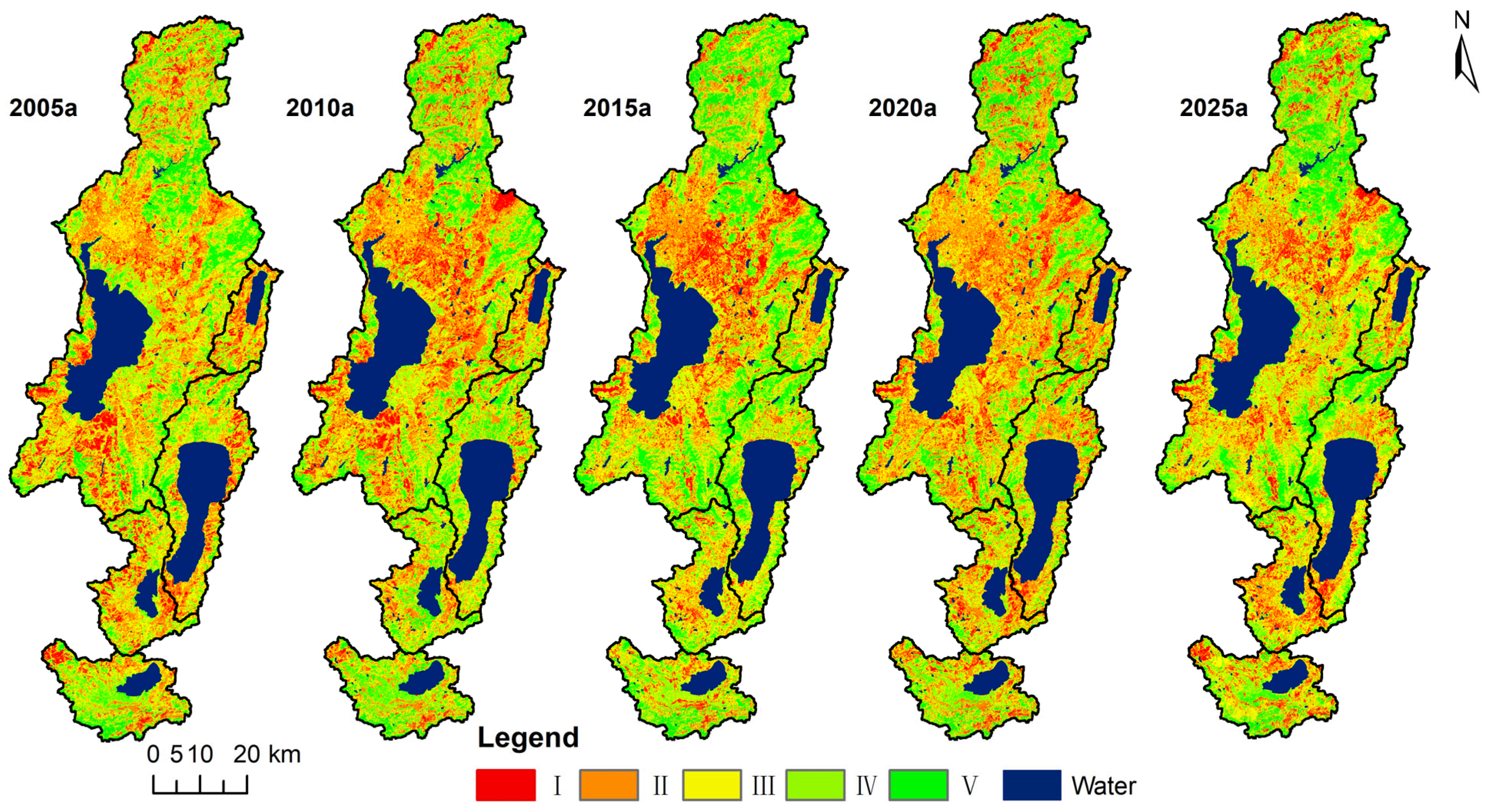
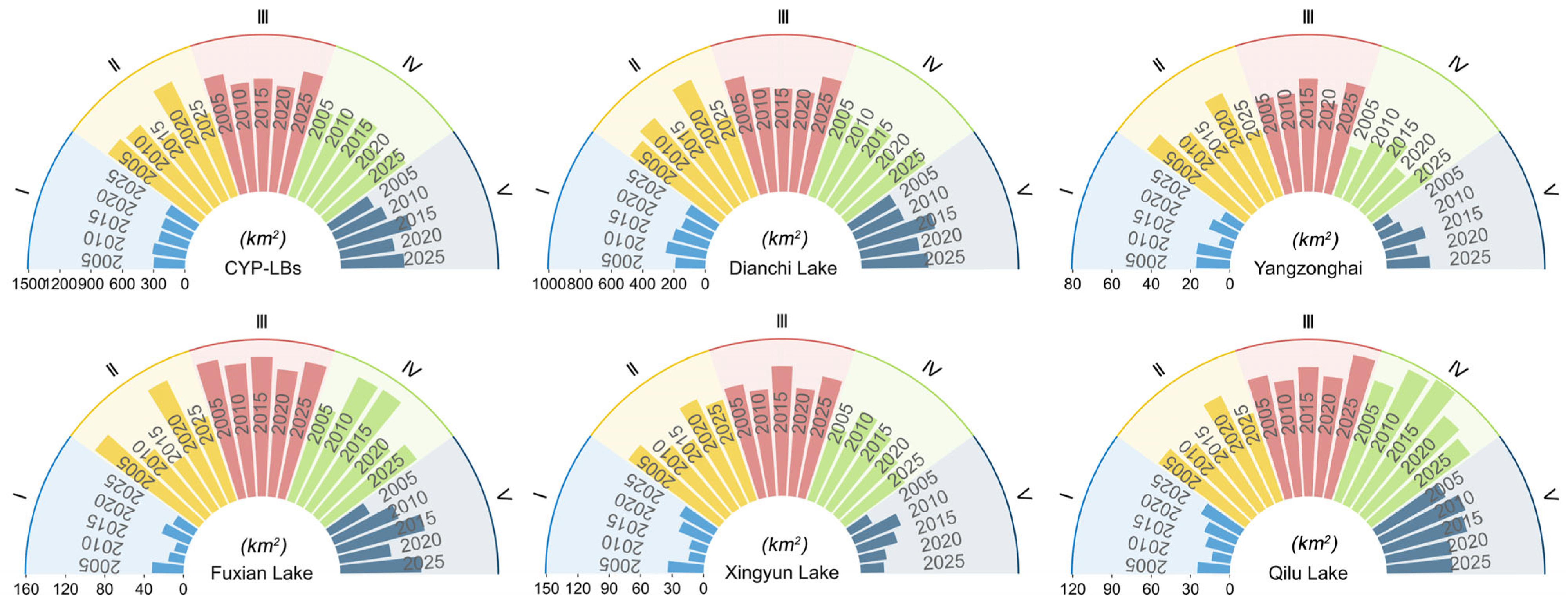
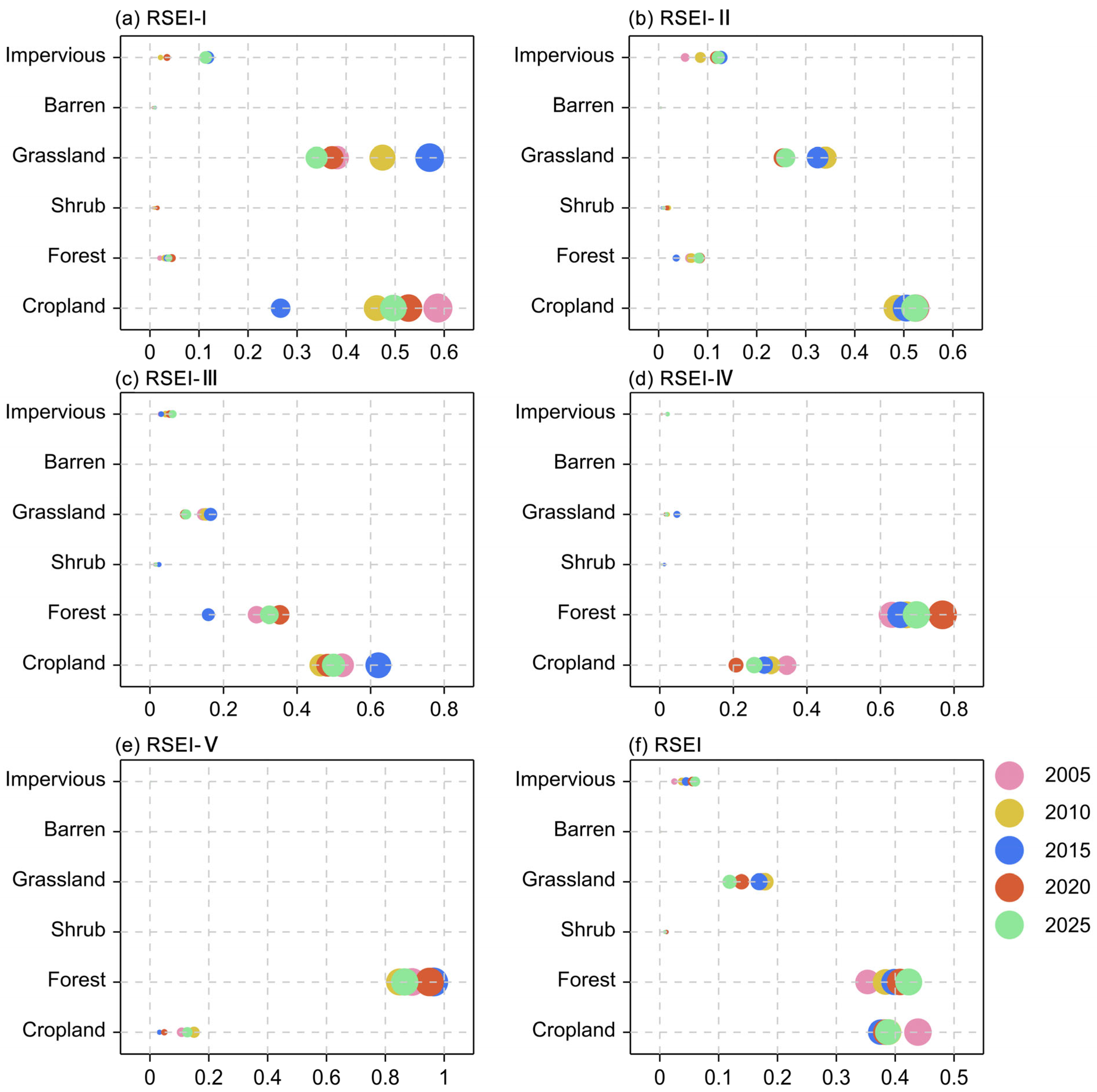
- Over the 20-year period, the ecological quality of CYP-LBs exhibited an overall trend of initial improvement followed by decline. The average RSEI peaked in 2015 at approximately 0.5519, with the largest areas within the study region classified as ecological quality grades II, III, and IV.
- (2)
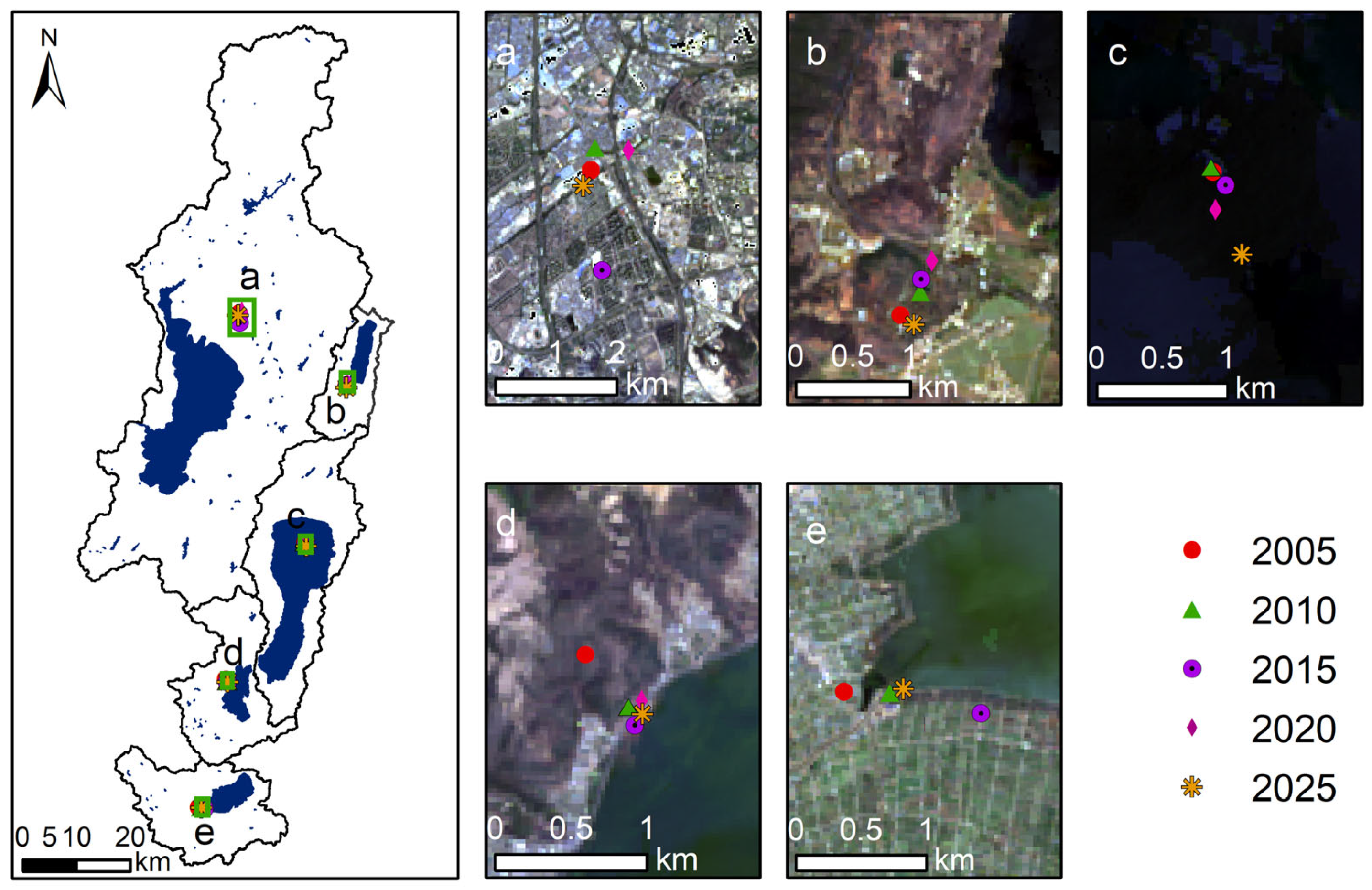
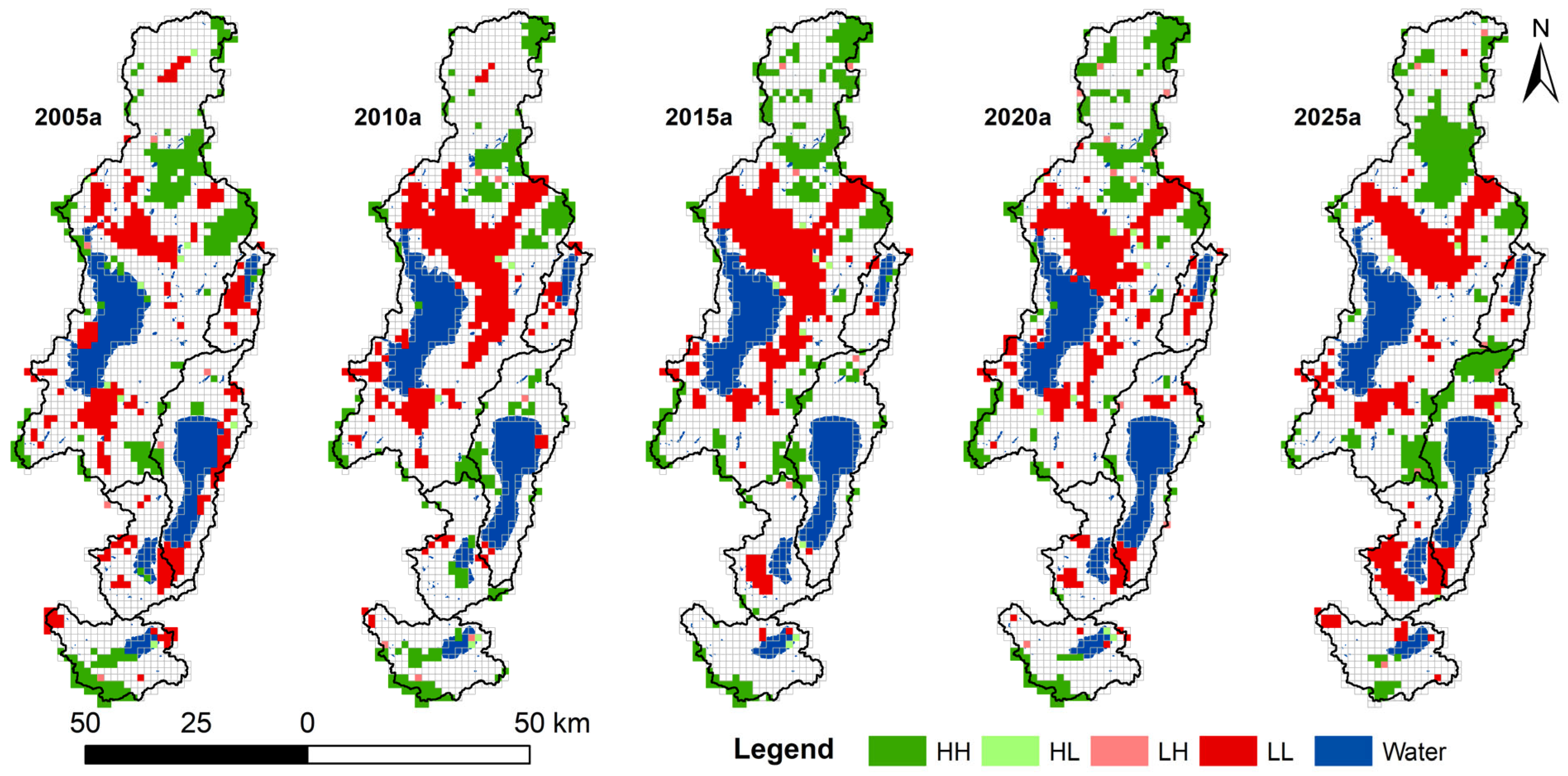
- During the study period, the centers of gravity for ecological quality shifted eastward to varying degrees across individual basins, while the overall distribution remained relatively stable. Ecological quality within the study area exhibited a significant positive spatial correlation. ‘High–High’ clusters were predominantly distributed in the Dianchi Lake basin in the north and the Qilu Lake basin in the south, while ‘low–low’ clusters were largely concentrated in the northwestern part of Dianchi Lake and the southern part of Fuxian Lake.
- (3)
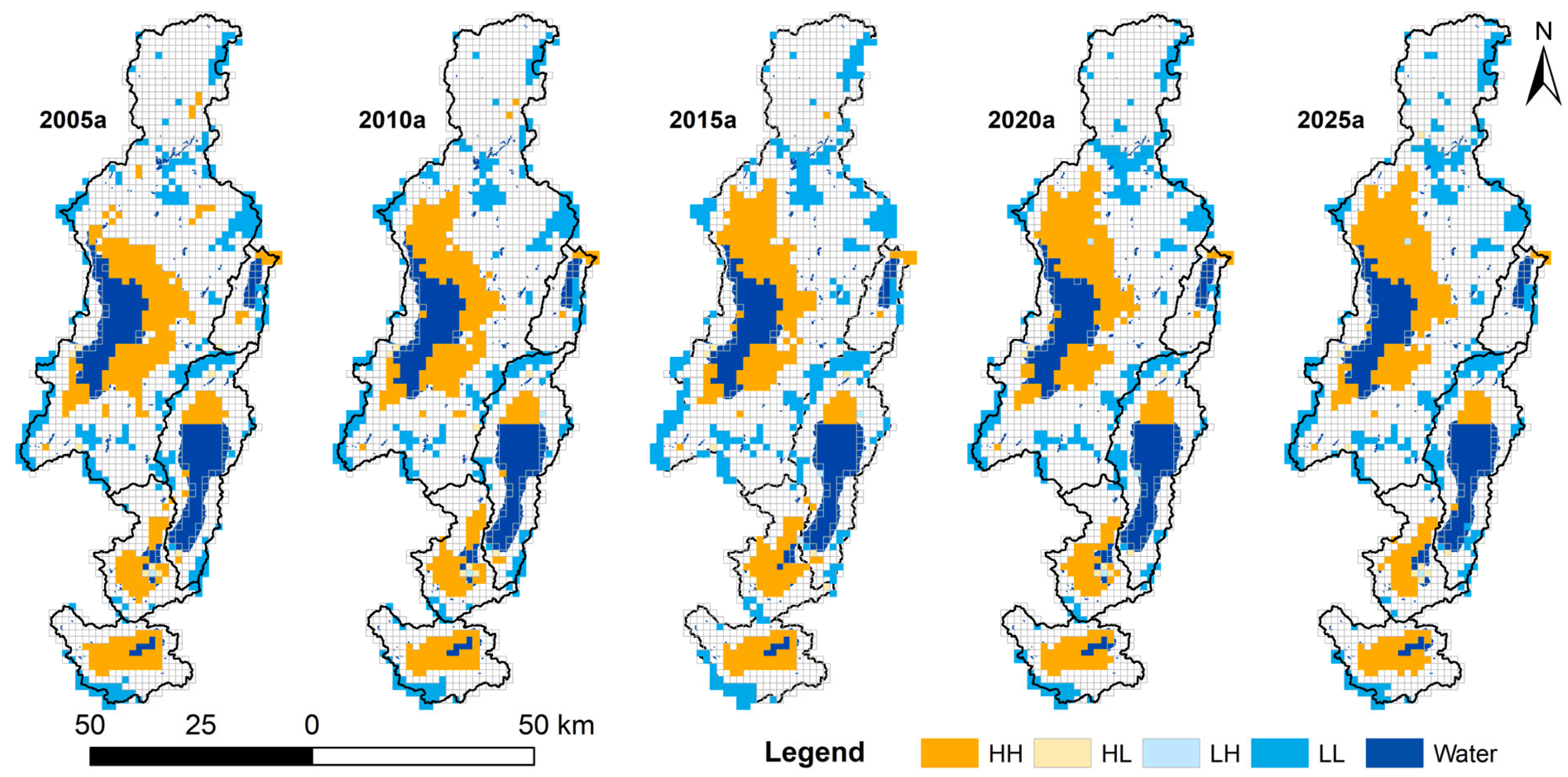
- From 2005 to 2025, land use intensity in the CYP-LBs exhibited significant spatial correlation. High–high clusters clustered along lakeshores, with notably increased high-intensity use in eastern Dianchi Lake, Xingyun Lake, and Qilu Lake. Low–low clusters predominantly occurred at basin margins, exhibiting ecological stability, with the overall trend expanding from localized to regional scales.
- (4)
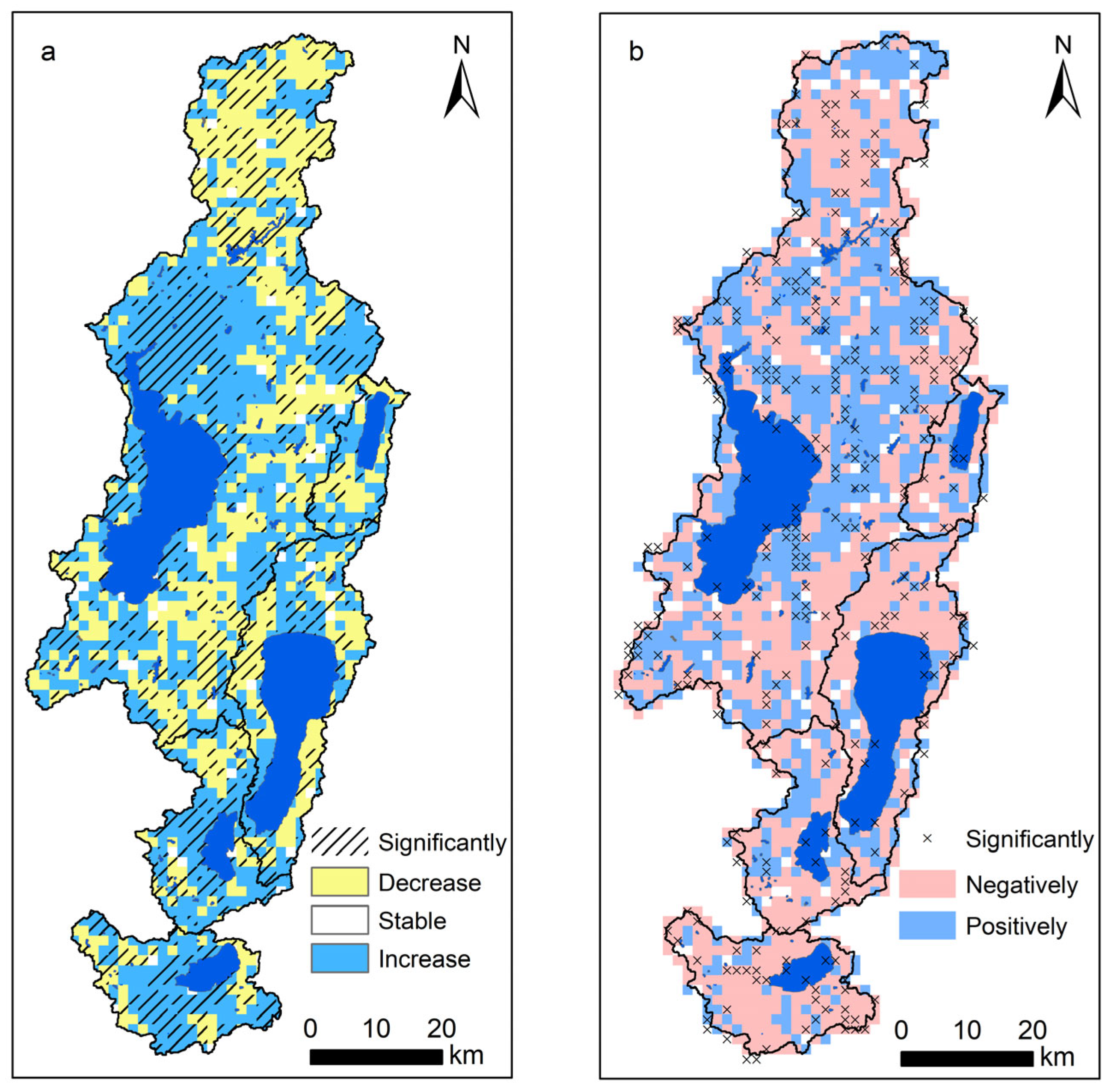
- Within the study area, RSEI and LUI predominantly exhibited negative correlations, indicating poorer ecological quality with higher land use intensity. Regional positive correlations emerged on the eastern and northern shores of Dianchi Lake, reflecting the intertwined processes of urbanization and ecological restoration.
Author Contributions
Funding
Data Availability Statement
Acknowledgments
Conflicts of Interest
References
- Yang, G.; Gui, Q.; Liu, J.; Chen, X.; Cheng, S. Spatial-temporal evolution and driving factors of ecological security in China based on DPSIR-DEA model: A case study of the Three Gorges reservoir area. Ecol. Indic. 2023, 154, 110777. [Google Scholar] [CrossRef]
- Zheng, Z.; Wu, Z.; Chen, Y.; Guo, C.; Marinello, F. Instability of remote sensing based ecological index (RSEI) and its improvement for time series analysis. Sci. Total Environ. 2022, 814, 152595. [Google Scholar] [CrossRef] [PubMed]
- Xiong, Y.; Xu, W.; Lu, N.; Huang, S.; Wu, C.; Wang, L.; Dai, F.; Kou, W. Assessment of spatial–temporal changes of ecological environment quality based on RSEI and GEE: A case study in Erhai Lake Basin, Yunnan province, China. Ecol. Indic. 2021, 125, 107518. [Google Scholar] [CrossRef]
- Wang, S.; Xu, Q.; Yi, J. Multi-scale identification of driving forces for landscape ecological risk: A case study of the basin containing three plateau lakes in Yunnan, China. Ecol. Indic. 2025, 70, 13037. [Google Scholar] [CrossRef]
- Wang, S.; Li, Z.; Long, Y.; Yang, L.; Ding, X.; Sun, X.; Chen, T. Impacts of urbanization on the spatiotemporal evolution of ecological resilience in the Plateau Lake Area in Central Yunnan, China. Ecol. Indic. 2024, 60, 111836. [Google Scholar] [CrossRef]
- Wang, D.; Tang, B.-H.; Fu, Z.; Huang, L.; Li, M.; Chen, G.; Pan, X. Estimation of Chlorophyll-A Concentration with Remotely Sensed Data for the Nine Plateau Lakes in Yunnan Province. Remote Sens. 2022, 14, 4950. [Google Scholar] [CrossRef]
- Liu, Q.; Duan, X.; Zhang, Y.; Duan, L.; Zhang, X.; Liu, F.; Li, D.; Zhang, H. Rainfall seasonality shapes microbial assembly and niche characteristics in Yunnan Plateau lakes, China. Environ. Res. 2024, 257, 119410. [Google Scholar] [CrossRef]
- Duan, Z.; Wang, M.; Chang, X.; Gao, W. Response of river-lake hydrologic regimes to local climate change in the Yunnan-Guizhou Plateau region, China. Reg. Environ. Change 2020, 20, 122. [Google Scholar] [CrossRef]
- Tanaka, T.; Sato, T.; Watanabe, K.; Wang, Y.; Yang, D.; Inoue, H.; Li, K.; Inamura, T. Irrigation system and land use effect on surface water quality in river, at lake Dianchi, Yunnan, China. J. Environ. Sci. 2013, 25, 1107–1116. [Google Scholar] [CrossRef]
- Van Der Ploge, S.W.F.; VLIJM, L. Ecological evaluation, nature conservation and land use planning with particular reference to methods used in The Netherlands. Biol. Conserv. 1978, 14, 197–221. [Google Scholar] [CrossRef]
- Tubbs, C.R.; Blackwood, J.W. Ecological evaluation of land for planning purposes. Biol. Conserv. 1971, 3, 169–172. [Google Scholar] [CrossRef]
- Munkittrick, K.R.; Dixon, D. G A holistic approach to ecosystem health assessment using fish population characteristics. Hydrobiologia 1989, 188, 123–135. [Google Scholar] [CrossRef]
- Edwards, C.J.; Ryder, R.A.; Marshall, T.R. Using lake trout as a surrogate of ecosystem health for oligotrophic waters of the Great Lakes. J. Great Lakes Res. 1990, 16, 591–608. [Google Scholar] [CrossRef]
- Kowalska, J.B.; Mazurek, R.; Gąsiorek, M.; Zaleski, T. Pollution indices as useful tools for the comprehensive evaluation of the degree of soil contamination—A review. Environ. Geochem. Health 2018, 40, 2395–2420. [Google Scholar] [CrossRef]
- Wolfram, J.; Stehle, S.; Bub, S.; Petschick, L.L.; Schulz, R. Water quality and ecological risks in European surface waters–Monitoring improves while water quality decreases. Environ. Int. 2021, 152, 106479. [Google Scholar] [CrossRef]
- Sun, C.; Li, J.; Liu, Y.; Cao, L.; Zheng, J.; Yang, Z.; Ye, J.; Li, Y. Ecological quality assessment and monitoring using a time-series remote sensing-based ecological index (ts-RSEI). GISci. Remote Sens. 2022, 59, 1793–1816. [Google Scholar] [CrossRef]
- Zhang, T.; Yang, R.; Yang, Y.; Li, L.; Chen, L. Assessing the Urban Eco-Environmental Quality by the Remote-Sensing Ecological Index: Application to Tianjin, North China. ISPRS Int. J. Geo-Inf. 2021, 10, 475. [Google Scholar] [CrossRef]
- Zhang, W.; Zhang, W.; Ji, J.; Chen, C. Urban Ecological Quality Assessment Based on Google Earth Engine and Driving Factors Analysis: A Case Study of Wuhan City, China. Sustainability 2024, 16, 3598. [Google Scholar] [CrossRef]
- Chen, N.; Cheng, G.; Yang, J.; Ding, H.; He, S. Evaluation of Urban Ecological Environment Quality Based on Improved RSEI and Driving Factors Analysis. Sustainability 2023, 15, 8464. [Google Scholar] [CrossRef]
- Pariha, H.; Zan, M.; Alimjia, K. Remote sensing evaluation of ecological environment in Urumqi city and analysis of driving factors. Arid. Zone Res. 2021, 38, 1484–1496. [Google Scholar]
- Wu, Z.; Lai, X.; Li, K. Water quality assessment of rivers in Lake Chaohu Basin (China) using water quality index. Ecol. Indic. 2021, 121, 107021. [Google Scholar] [CrossRef]
- An, M.; Xie, P.; He, W.; Wang, B.; Huang, J.; Khanal, R. Spatiotemporal change of ecologic environment quality and human interaction factors in three gorges ecologic economic corridor, based on RSEI. Ecol. Indic. 2022, 141, 109090. [Google Scholar] [CrossRef]
- Akhtar, N.; Ishak, M.I.S.; Ahmad, M.I.; Umar, K.; Md Yusuff, M.S.; Anees, M.T.; Qadir, A.; Ali Almanasir, Y.K. Modification of the Water Quality Index (WQI) Process for Simple Calculation Using the Multi-Criteria Decision-Making (MCDM) Method: A Review. Water 2021, 13, 905. [Google Scholar] [CrossRef]
- Wang, J.; Jiang, L.; Qi, Q.; Wang, Y. An Ecological Quality Evaluation of Large-Scale Farms Based on an Improved Remote Sensing Ecological Index. Remote Sens. 2024, 16, 684. [Google Scholar] [CrossRef]
- Li, X.; Wu, K.; Yang, Q.; Hao, S.; Feng, Z.; Ma, J. Quantitative assessment of cultivated land use intensity in Heilongjiang Province, China, 2001–2015. Land Use Policy 2023, 125, 106505. [Google Scholar] [CrossRef]
- Shrestha, S.; Poudyal, K.N.; Bhattarai, N.; Dangi, M.B.; Boland, J.J. An Assessment of the Impact of Land Use and Land Cover Change on the Degradation of Ecosystem Service Values in Kathmandu Valley Using Remote Sensing and GIS. Sustainability 2022, 14, 15739. [Google Scholar] [CrossRef]
- Wu, Y.; Liu, X.; Zhao, Q.; Liu, H.; Qu, F.; Zhang, M. Impact of Land Use/Land Cover Change on Ecosystem Service Trade-Offs/Synergies—A Case Study of Gangu County, China. Sustainability 2024, 16, 5929. [Google Scholar] [CrossRef]
- Yang, Y.; Zhang, J.; Hu, Y. Land Use Intensity Alters Ecosystem Service Supply and Demand as Well as Their Interaction: A Spatial Zoning Perspective. Sustainability 2024, 16, 7224. [Google Scholar] [CrossRef]
- Chillo, V.; Vázquez, D.P.; Amoroso, M.M.; Bennett, E.M. Land use intensity indirectly affects ecosystem services mainly through plant functional identity in a temperate forest. Funct. Ecol 2018, 32, 1390–1399. [Google Scholar] [CrossRef]
- Xia, C.; Yeh, A.G.O.; Zhang, A. Analyzing spatial relationships between urban land use intensity and urban vitality at street block level: A case study of five Chinese megacities. Landsc. Urban Plan. 2020, 193, 103669. [Google Scholar] [CrossRef]
- Zabel, F.; Delzeit, R.; Schneider, J.M.; Seppelt, R.; Mauser, W.; Václavík, T. Global impacts of future cropland expansion and intensification on agricultural markets and biodiversity. Nat. Commun. 2019, 10, 2844. [Google Scholar] [CrossRef]
- Lan, Y.; Wang, J.; Liu, Q.; Liu, F.; Liu, L.; Li, J.; Luo, M. Identification of critical ecological restoration and early warning regions in the five-lakes basin of central Yunnan. Ecol. Indic. 2024, 158, 111337. [Google Scholar] [CrossRef]
- Summers, T. The belt and road initiative in Southwest China: Responses from Yunnan province. Pac. Rev. 2021, 34, 206–229. [Google Scholar] [CrossRef]
- Yang, L.; Liu, F. Spatio-Temporal Evolution and Driving Factors of Ecosystem Service Value of Urban Agglomeration in Central Yunnan. Sustainability 2022, 14, 10823. [Google Scholar] [CrossRef]
- Yang, J.; Huang, X. The 30 m annual land cover dataset and its dynamics in China from 1990 to 2019. Earth Syst. Sci. Data 2021, 13, 3907–3925. [Google Scholar] [CrossRef]
- Uniyal, B.; Kosatica, E.; Koellner, T. Spatial and temporal variability of climate change impacts on ecosystem services in small agricultural catchments using the Soil and Water Assessment Tool (SWAT). Sci. Total Environ. 2023, 875, 162520. [Google Scholar] [CrossRef]
- Liu, X.; Zhou, Q.; Zhou, L.; Meng, H.; Li, M.; Peng, C. RSEI-Based Dynamic Monitoring of Ecological Quality of the Soil and Water Conservation Functional Area in the Chongqing Section of the Three Gorges Reservoir Area. Res. Soil Water Conserv. 2021, 28, 278–286. (In Chinese) [Google Scholar]
- Hammoumi, D.; Al-Aizari, H.S.; Alaraidh, I.A.; Okla, M.K.; Assal, M.E.; Al-Aizari, A.R.; Moshab, M.S.; Chakiri, S.; Bejjaji, Z. Seasonal Variations and Assessment of Surface Water Quality Using Water Quality Index (WQI) and Principal Component Analysis (PCA): A Case Study. Sustainability 2024, 16, 5644. [Google Scholar] [CrossRef]
- Wu, B.; Zheng, F.; Fu, Y.; Peng, S.; Yang, X.; Wang, L.; Flanagan, D.C.; Zhang, J.; Li, Z. Decoupling Land Use Intensity and Ecological Risk: Insights from Heilongjiang Province of the Chinese Mollisol Region. Remote Sens. 2025, 17, 2243. [Google Scholar] [CrossRef]
- Chen, W.; Chi, G.; Li, J. The spatial association of ecosystem services with land use and land cover change at the county level in China, 1995–2015. Sci. Total Environ. 2019, 669, 459–470. [Google Scholar] [CrossRef]
- Jing, X.; Tian, G.; He, Y.; Wang, M. Spatial and temporal differentiation and coupling analysis of land use change and ecosystem service value in Jiangsu Province. Ecol. Indic. 2024, 163, 112076. [Google Scholar] [CrossRef]
- Su, H.; He, A. Analysis of land use based on RS and geostatistics in Fuzhou city. J. Nat. Resour. 2010, 25, 91–99. (In Chinese) [Google Scholar]
- Li, X.; Zulkar, H.; Wang, D.; Zhao, T.; Xu, W. Changes in Vegetation Coverage and Migration Characteristics of Center of Gravity in the Arid Desert Region of Northwest China in 30 Recent Years. Land 2022, 11, 1688. [Google Scholar] [CrossRef]
- Lemmerz, T.; Herlé, S.; Blankenbach, J. Geostatistics on Real-Time Geodata Streams—High-Frequent Dynamic Autocorrelation with an Extended Spatiotemporal Moran’s I Index. ISPRS Int. J. Geo-Inf. 2023, 12, 350. [Google Scholar] [CrossRef]
- Patoine, G.; Eisenhauer, N.; Cesarz, S.; Phillips, H.R.; Xu, X.; Zhang, L.; Guerra, C.A. Drivers and trends of global soil microbial carbon over two decades. Nat. Commun. 2022, 13, 4195. [Google Scholar] [CrossRef]
- Nong, L.; Wang, J.; Yu, Y. Research on Ecological Environment Quality in Central Yunnan Based on MRSEI Model. J. Ecol. Rural. Environ. 2021, 37, 972–982. (In Chinese) [Google Scholar] [CrossRef]
- Li, Y.; Li, S.; Peng, S. Temporal and Spatial Evolution of NDVl and lts Response Relation withthe Climate in the Nine Plateau Lake Basins of Yunnan Province. Res. Soil Water Conserv. 2020, 27, 192–200. (In Chinese) [Google Scholar] [CrossRef]
- Liu, X.; Wang, H. Dianchi Lake, China: Geological formation, causes of eutrophication and recent restoration efforts. Aquat. Ecosyst. Health Manag. 2016, 19, 40–48. [Google Scholar] [CrossRef]
- Luo, Y.; Zhao, Y.; Yang, K.; Chen, K.; Pan, M.; Zhou, X. Dianchi Lake watershed impervious surface area dynamics and their impact on lake water quality from 1988 to 2017. Environ. Sci. Pollut. Res. 2018, 25, 29643–29653. [Google Scholar] [CrossRef]
- Wang, S.; Liu, F.; Chen, W.; Liu, Y.; Cai, W. Landscape ecological risk evaluation and driving factors in the lake basin of Central Yunnan Plateau. Chin. J. Eco-Agric. 2024, 32, 391–404. Available online: https://www.ecoagri.ac.cn/cn/article/doi/10.12357/cjea.20230412 (accessed on 17 November 2025).
- Wang, K.; Zhang, C.; Chen, H.; Yue, Y.; Zhang, W.; Zhang, M.; Qi, X.; Fu, Z. Karst landscapes of China: Patterns, ecosystem processes and services. Landsc. Ecol. 2019, 34, 2743–2763. [Google Scholar] [CrossRef]
- Haddad, N.M.; Brudvig, L.A.; Clobert, J.; Davies, K.F.; Gonzalez, A.; Holt, R.D.; Lovejoy, T.E.; Sexton, J.O.; Austin, M.P.; Collins, C.D. Habitat fragmentation and its lasting impact on Earth’s ecosystems. Sci. Adv. 2015, 1, e1500052. [Google Scholar] [CrossRef]


| Years | Index | PC1 | PC2 | PC3 | PC4 |
|---|---|---|---|---|---|
| 2005 | NDVI | 0.20 | 0.08 | −0.08 | −0.03 |
| WET | 0.37 | −0.08 | 0.02 | 0.01 | |
| LST | −0.04 | 0.06 | −0.04 | 0.05 | |
| NDBSI | −0.11 | 0.10 | 0.11 | 0.00 | |
| Eigenvalue | 0.19 | 0.03 | 0.02 | 0.00 | |
| Percent eigenvalue | 79.01 | 11.53 | 8.28 | 1.18 | |
| 2010 | NDVI | 0.24 | 0.08 | −0.09 | −0.03 |
| WET | 0.35 | 0.07 | 0.00 | −0.03 | |
| LST | −0.11 | 0.08 | −0.06 | 0.05 | |
| NDBSI | −0.14 | 0.10 | 0.11 | 0.00 | |
| Eigenvalue | 0.21 | 0.03 | 0.02 | 0.00 | |
| Percent eigenvalue | 77.94 | 11.21 | 9.10 | 1.75 | |
| 2015 | NDVI | 0.26 | 0.07 | −0.09 | −0.02 |
| WET | 0.23 | 0.14 | −0.04 | 0.02 | |
| LST | −0.24 | 0.02 | 0.02 | −0.04 | |
| NDBSI | −0.17 | 0.10 | 0.12 | 0.00 | |
| Eigenvalue | 0.21 | 0.04 | 0.02 | 0.00 | |
| Percent eigenvalue | 76.85 | 13.20 | 9.10 | 0.85 | |
| 2020 | NDVI | 0.18 | −0.12 | −0.06 | 0.03 |
| WET | 0.06 | 0.13 | −0.12 | 0.01 | |
| LST | −0.40 | −0.07 | −0.01 | 0.01 | |
| NDBSI | −0.01 | 0.08 | 0.10 | 0.04 | |
| Eigenvalue | 0.20 | 0.04 | 0.03 | 0.00 | |
| Percent eigenvalue | 73.51 | 15.40 | 10.22 | 0.88 | |
| 2025 | NDVI | 0.26 | −0.08 | 0.10 | 0.02 |
| WET | 0.10 | 0.13 | −0.05 | 0.03 | |
| LST | −0.29 | −0.09 | −0.01 | 0.03 | |
| NDBSI | 0.20 | −0.10 | −0.12 | 0.00 | |
| Eigenvalue | 0.18 | 0.04 | 0.03 | 0.00 | |
| Percent eigenvalue | 72.24 | 16.50 | 10.80 | 0.46 |
Disclaimer/Publisher’s Note: The statements, opinions and data contained in all publications are solely those of the individual author(s) and contributor(s) and not of MDPI and/or the editor(s). MDPI and/or the editor(s) disclaim responsibility for any injury to people or property resulting from any ideas, methods, instructions or products referred to in the content. |
© 2025 by the authors. Licensee MDPI, Basel, Switzerland. This article is an open access article distributed under the terms and conditions of the Creative Commons Attribution (CC BY) license (https://creativecommons.org/licenses/by/4.0/).
Share and Cite
Xu, C.; Zheng, S.; Chen, C.; Liu, S.; Dao, J.; Lu, S.; Wang, J. Impacts of Land Use Intensity on Ecological Quality Dynamics in the Central Yunnan Plateau Lake Basins, China. Water 2025, 17, 3338. https://doi.org/10.3390/w17233338
Xu C, Zheng S, Chen C, Liu S, Dao J, Lu S, Wang J. Impacts of Land Use Intensity on Ecological Quality Dynamics in the Central Yunnan Plateau Lake Basins, China. Water. 2025; 17(23):3338. https://doi.org/10.3390/w17233338
Chicago/Turabian StyleXu, Chenwei, Shuyuan Zheng, Cheng Chen, Shanshan Liu, Jian Dao, Shixian Lu, and Jianxiong Wang. 2025. "Impacts of Land Use Intensity on Ecological Quality Dynamics in the Central Yunnan Plateau Lake Basins, China" Water 17, no. 23: 3338. https://doi.org/10.3390/w17233338
APA StyleXu, C., Zheng, S., Chen, C., Liu, S., Dao, J., Lu, S., & Wang, J. (2025). Impacts of Land Use Intensity on Ecological Quality Dynamics in the Central Yunnan Plateau Lake Basins, China. Water, 17(23), 3338. https://doi.org/10.3390/w17233338