Pool Safety Regulations in Europe: Challenges Towards a Framework for Sustainable Seawater Utilization in Public Swimming Pools

 ,
, 
 , , ,
, , , 
Abstract
1. Introduction
2. Materials and Methods
- Regulatory documents or scientific articles published in English or in the original language;
- Studies and regulatory texts addressing the quality and safety of water in public swimming pools, with specific attention to the use of seawater;
- Scientific articles and other literature providing data on physical-chemical and microbiological parameters, disinfection methods, or DBPs formation in seawater pools.
3. Results
3.1. Overview of the European Legislative Framework on the Use of Seawater in Swimming Pools
- Public pools, which include both public and private facilities intended for collective use (e.g., municipal pools, water parks, hotel pools, therapeutic pools, pools in educational institutions, and so forth);
- Private pools, which refer to domestic pools used within a family context.

| Country | Regulation | Scope of Application | Permitted Type of Filling Water | Ref. |
|---|---|---|---|---|
| France |
| Applies to public/collective swimming pools. Does not apply, except for disinfection provisions, to thermal SPs supplied by natural mineral water used for therapeutic purposes in thermal facilities. | Water from a public distribution network or from water taken from the natural environment, seawater included, after authorization. | [33] |
| [34] | |||
| [35] | |||
| [76] | |||
| [77] | |||
| Germany |
| Applies to public/commercial baths and non-private use SPs facilities. Does not apply to private baths; systems with biological treatment, water playgrounds, floating systems/pools; discontinuous water treatments. | [37] | |
| Water, including seawater, mineral, medicinal, artificially produced brine and thermal water. | [38] | ||
| [78] | |||
| [79] | |||
| [80] | |||
| [81] | |||
| Slovenia | Rules on minimum hygiene requirements that must be met by swimming pools and bathing water in pools. | Apply to bathing areas and water in conventional and biological SPs. Do not apply to natural bathing areas and SPs used by individuals or their family. | Freshwater and seawater. | [39] |
| Croatia | Rules on sanitary, technical, and hygienic conditions of swimming pools and on the health safety of swimming pool waters. No. 1186. | Do not apply to non-public SPs; SPs with medically indicated, therapeutic water (e.g., thermal), not disinfected with residual effect; saunas and hot tubs in which the water is used once; lagoons, flow pools, and seawater water slides. | Filling water from a public water supply system, seawater, or other type. | [40] |
| Poland |
| Does not apply to swimming pools filled with water with medicinal properties. | Freshwater, i.e., surface or groundwater, meeting the drinking water requirements; salty, i.e., brine and seawater, with 5–15 g/L of mineral content; thermal water with outlet temperature ≥ 20 °C. | [36] |
| [82] | |||
| Lithuania |
| Not specified. | Freshwater for pools must meet drinking water quality requirements before use. Mineral and seawater used to supply SPs must meet HN 127:2010 requirements before use. | [41] |
| [42] | |||
| Latvia | Regulation No. 470 “Hygiene requirements for pool and sauna services”. | Pools or saunas, including those in educational, social care, healthcare institutions, sports, entertainment or recreation facilities, and hotels. | Potable water with the mandatory safety requirements for drinking water, sea or mineral water. | [43] |
| Romania |
| Public swimming pools. | Drinking or seawater. Filling water not coming from public drinking water network, must comply with legal provisions. | [44] |
| For freshwater. | [83] | ||
| For seawater. | [84] | ||
| Spain |
| Applies to public SPs. Single-family private SPs and SPs in homeowners’ associations, agrotourism’s, colleges, or similar establishments must comply with some provisions of this Decree. Does not apply to natural, thermal or mineral medicinal pools. | Contains a request to provide periodic reports to the Ministry of Health with basic information on sources of filling water in SPs, which may include public and non-public networks or seawater. | [45] |
| [85] | |||
| Portugal |
| Public swimming pools. | Water from a public water network. Alternative water sources use requires the authorizations. | [46] |
| Public/semipublic swimming pools. | [48] | ||
| Applies to public SPs and aquatic recreational facilities. Does not apply to therapeutic or thermal facilities, SPs used by families, or in condominiums with less than 20 units. | Mention seawater use. | [47] | |
| Finland |
| Apply to public SPs and spas. Do not apply to residential SPs, SPs in which the water is changed after each use, hotels, Jacuzzis self-filled by users, wading pools without continuous water treatment, portable SPs, and hot tubs rented by customers. | Nor specified. | [32] |
| [51] | |||
| Applies to public SPs; spas; water parks; recreation and rehabilitation facilities. | Mention filling water rich of bromine. | [52] | |
| Sweden |
| Applies to public SPs, i.e., pools and tubs for swimming, which can be part of pools such as indoor SPs, spas, and water parks, or be independent both outdoors and indoors. | Nor specified. | [49] |
| [50] | |||
| [86] | |||
| Denmark |
| Applies to public and hot water SPs, i.e., spas, water parks, recreational, therapy, and treatment pools and similar. Does not apply to private SPs, paddling pools where the water is discarded after a few hours, steam, thermal baths and similar. | Potable water and surface water (seawater included). | [54] |
| [53] | |||
| [87] | |||
| Norway |
| Covers all public SPs, bathing facilities and saunas. | Filling water must be hygienically satisfactory. | [55] |
| [88] | |||
| [89] | |||
| The Netherlands |
| Does not apply to household SPs, SPs installed for up to 24 consecutive hours, intended for human-animal contact, or installed on vessels not permanently moored. | Water that meets the quality requirements for drinking water. | [56] |
| [57] | |||
| Belgium Flanders | Title II of VLAREM. Government Decree of 1 June 1995 containing general and sectoral provisions regarding environmental hygiene. Art. 5.32.8.1. | Applies to permanent and natural SPs, hot tubs, plunge, splash, and therapy pools, open swimming areas, recreation zones. Does not apply to private and hotels SPs not open to the public, which must comply with the provisions on the water treatment and chemicals storage. | Freshwater or salt water. | [31] |
| Belgium Walloon | Government Order of 13 June 2013 determining full conditions for indoor and outdoor swimming pools used for a purpose other than purely private within the family circle. | Applies to indoor and outdoor SPs used non-privately within the family, when the surface area ≤100 m2 or the depth is ≤40 cm, with chlorine used for disinfection. | Drinking water from the distribution network. If the filling and supplementary water do not come from the network, it meets the tap water standards. | [58] |
| Belgium Brussels-Capital Region |
| Applies to SPs and other baths listed in Annex 1 of [83]: excluding domestic SPs with a pool area ≤200 m2, other bathing facilities, and SPs with a pool area over 200 m2. Does not apply to SPs and other baths with alternative water treatment other than chemical disinfection or biological treatment. | Drinking water from the distribution network. When supplied water is not coming from the drinking water distribution network, authorization or environmental permits are requested. | [59] |
| [90] | |||
| Italy |
| Applies to public/collective SPs for swimming, training, diving, underwater, recreational activities, for children, multipurpose use. Does not apply to SPs for rehabilitation, curative and thermal use. The systems supplied with thermal and seawater to be regulated by specific regional provisions. | Freshwater (surface or underground) that meets the requirements of potability. If the supply water does not come from a public aqueduct, it is necessary to verify its suitability for human consumption. | [60] |
| [61] | |||
| Mention seawater use. | [66] | ||
| [91] | |||
| Albania | Regulation “Hygienic and sanitary requirements for swimming pools”. No. 835. | Applies to public/collective SPs for competition, training, diving, underwater activities, recreational, multifunctional, and use by children, in hotel, tourist complexes/villages, colleges, schools, universities, gyms, beauty salons, and residence complexes with over 4 units. Does not apply to private SPs, residence complexes with up to 4 units, thermal and therapeutic SPs. | Potable water. If the water supply is not provided by the water supply company, the water must be tested seasonally for the parameters for assessing the suitability of drinking water. | [67] |
| Greece |
| Public swimming pools. | [68] | |
| Supplying SPs with seawater does not contradict the provisions if the water quality meets the parameters specified in Art.15 of [66]. | [69] | ||
| [7] | |||
| [92] | |||
| [93] | |||
| Bulgaria | Instruction No. 34 on hygiene of sports facilities and equipment. Amended on 2 March 1984, 8 March 2002. | Applies to the facilities where sports competitions and training are held. | Not specified. | [70] |
| Estonia | Health protection requirements for swimming pools, pools and aquatic centres. No. 80 of 15 March 2007. Amended on 10 December 2009, 19 August 2011. | Applies to SPs, pools and aquatic centres, in public and private legal entities providing services related to swimming and bathing, including schools and preschool institutions. Do not apply to natural mineral water and hydrotherapy SPs, natural cold-water pools, bathing facilities with flow-through surface water. | Water used in SPs must meet the requirements established for drinking water. | [71] |
| Malta |
| Applies to public or commercial SPs, including artificial basins, for recreational bathing, swimming, diving, or therapeutic use, located indoors or outdoors. Does not apply to non-public or non-commercial SPs. | Controlled water supply. | [72] |
| SPs located more than 100 m from the sea may be filled only with freshwater collected as surface run-off or from public supply network. SPs within 100 m of the sea may be filled by seawater, only if the pool water is discharged to the sea through waterproof pipes | [73] | ||
| Cyprus |
| Applies to SPs: pools used principally for competitions or for training or education of athletes; indoor SPs located within an enclosed covered area; public swimming pools. | Filling water should be microbiologically and chemically suitable. Authorities may allow the use of brackish water for tanks and sanitary facilities. Water renewal from a safe non-chlorinated natural source is allowed with at least 2000 L per bather. | [74] |
| [75] |
3.2. Overview of Swimming Pool Disinfection Requirements in the European Legislative Framework
- Chlorine disinfection: In most public swimming pools, chlorine-containing reagents are employed for water disinfection, typically in the form of gaseous chlorine, sodium hypochlorite or calcium hypochlorite [49]. The disinfection mechanism is the same regardless of whether chlorine is introduced in water as gas or hypochlorite, or generated on-site via electrochlorination, whereby sodium chloride (NaCl) is electrochemically converted into chlorine gas—a particularly relevant approach for seawater pools. The addition of chlorine-based disinfectants to water initiates the reactions shown by Equations (1)–(3), leading to the formation of hypochlorous acid (HOCl), the primary disinfectant. HOCl is a highly effective bactericidal agent due to its high reactivity, enabling it to oxidize various inorganic and organic substances present in the water [9]:
- Ozone (O3): Ozone is a powerful oxidizer, which makes it an effective disinfectant against bacteria and other microorganisms. It can also help eliminate certain contaminants and DBPs from the water. O3 disinfection occurs in the treatment tank and does not provide residual disinfection, making them an unsuitable standalone method. Moreover, O3 is toxic and must not be released into areas accessible to swimmers or staff [49]. Additionally, it can produce other DBPs such as aldehydes, nitrosamines, carboxylic acids, and, as is particularly relevant to seawaters pools, the known carcinogen bromate [15,27].
- Ultraviolet light (UV): It can induce oxidation and UV photolysis is often used as a disinfection method due to its efficacy against bacteria, protozoa, and most viruses. It can also break down combined chlorine compounds and photodegrade certain DBPs, with medium-pressure UV lamps being more effective than low-pressure lamps for this purpose [22]. However, UV provides no residual disinfection. Furthermore, its effectiveness can be significantly reduced by water turbidity [27,94], which is especially relevant for seawater pools, emphasizing the importance of water filtration. From a sustainability perspective, UV systems, especially those using medium-pressure lamps, may involve higher energy consumption and maintenance costs, compared to other disinfection technologies.
- Chlorine dioxide (ClO2): ClO2 is a highly oxidizing gas with superior antimicrobial efficacy compared to other chlorine-based compounds. Its mechanism of action is also different from traditional chlorination. Due to its instability, ClO2 is typically generated on-site by mixing chlorate or chlorite salts with an acid. Additionally, its high volatility and toxicity, especially in air, poses safety challenges for use in swimming facilities [49].
- Bromine-based disinfectants: Bromine gas is rarely used directly. Instead, the formation of HOBr and OBr−, which inactivate microorganisms [9], is achieved by using bromochlorodimethylhydantoin or by combining sodium bromide with an oxidant (typically chlorine or ozone), leading to the reactions described by Equations (5) and (6):
- Hydrogen peroxide (H2O2): Hydrogen peroxide is a strong oxidizing agent occasionally used for the disinfection of pools. It has slower and less antimicrobial action compared to chlorine. In addition, prolonged exposure to even relatively low concentrations of H2O2 can cause skin and eye irritation due to its potent oxidizing nature [49].
- Electrochemically generated mixed oxidants (EGMOs): EGMOs represent an advanced form of electrochlorination, increasingly used for the on-site generation of mixed disinfectants from saline or seawater sources. The electrolysis of NaCl-rich water produces primarily free chlorine as per Equation (7), which subsequently reacts with water by Equation (1) to form the main disinfectant, HOCl [9].
3.3. Peculiarities of Seawater Disinfection for Swimming Pool Use
3.4. Overview of Microbiological and Physicochemical Quality Requirements for Pool Water
3.5. Risk Assessment
| Disinfection by-Product | Freshwater Pools | Seawater Pools | Ref. | DBPs Quality Limits in Pool Water and Air Set by Regulations | ||||
|---|---|---|---|---|---|---|---|---|
| Recom-Mended Value | Quality Limit | Country | Note from Regulation | Ref. | ||||
| Swimming pool water | ||||||||
| Total THMs (4TTHM), μg/L | 80.2 7–577 16.8–29.4 122.4–435.5 777 | 50.4–91.8 51.8–105.8 77.7–995.6 307.6–327.8 260–322 | [6] [9] [11] [12] [13] [18] [26] [107] | 20 | 100 | France | Keep as low as possible without affecting disinfection | [34] |
| 100 | Portugal | [48] | ||||||
| 20 (a) | Germany | For indoor pools. In outdoor SPs higher QL is permitted. | [38] | |||||
| 50 | Slovenia | [39] | ||||||
| 100 | Poland | [36] | ||||||
| 100 | Sweden | [50] | ||||||
| 25 50 | Denmark | -For indoor SPs with T ≤ 34 °C, -For SPs with T > 34 °C, outdoor SPs, hot tubs | [54] | |||||
| 50 (a) | The Netherlands | [56] | ||||||
| 100 | Croatia | For conventional pools | [40] | |||||
| Chloroform, μg/L | 69.8 0.2–243 | N.D. 0.1–6 0.1 (mean)–0.9 (max) 0.01–0.29 | [6,11] [9] [10] [13] | 20 30 | Poland | -For children up aged ≤3, -For other swimming pools | [36] | |
| 50 | Finland | Not applicable to outdoor SPs | [32] | |||||
| 100 | Lithuania | If chlorine-based compounds are used for disinfection | [41] | |||||
| Bromodichloromethane, μg/L | 7.9 0.13–167 | N.D. 0.29–5 0.3 (mean)—2.2 (max) 0.05–1.10 | [6,11] [9] [10] [13] | |||||
| Dibromochloromethane, μg/L | 1.9 0.49–120 | 1.6–5.2 3.57–27 18.9 (mean)—81.0 (max) 2.1– 5.5 3.2–63.6 | [6] [9] [10] [11] [13] | |||||
| Bromoform, μg/L | 0.6 0.04–47 | 48.9–86.7 50–651 300 (mean)—1029 (max) 49.7–101.3 73.5–930.7 | [6] [9] [10] [11] [13] | |||||
| Bromate, mg/L | 3 <0.02–5.0 | <0.2–34 | [9] [15] | 2 | Germany | [38] | ||
| 0.1 | The Netherlands | [56] | ||||||
| Chlorite, mg/L | 0.02–0.022 | [11] | 0.1 | Slovenia | In conventional pools, if ClO2 is used for water treatment | [39] | ||
| 0.4 | Croatia | [40] | ||||||
| Chlorate, mg/L | 0.04–37 | [11] | 30 | The Netherlands | [56] | |||
| Chlorite + chlorate, mg/L | 30 | Germany | [39] | |||||
| Swimming pool air | ||||||||
| Trichloramine, μg/m3 | 20–1340 <LOD–1700 | [11] [14] | 200 | Sweden | [50] | |||
| 500 | The Netherlands | [56] | ||||||
| 300 | 500 | Belgium, Flanders | Only for indoor SPs, except for indoor natural swimming pools | [31] | ||||
| 500 | 1000 | Belgium, Walloon | 500 is intervention value | [58] | ||||
| 300 | 500 | Belgium, Brussels | [59] | |||||
4. Conclusions
- Development and optimization of seawater disinfection methods: Comparative experimental studies using pilot-scale pools filled with real seawater matrices should assess the effectiveness of hybrid disinfection approaches in minimizing DBP formation under high and varying salinity and organic load conditions;
- Quantitative risk assessment models for DBP exposure in marine environments: Environmental impact assessments should be supported by the field sampling of water and sediments near pool discharge sites, coupled with targeted chemical analyses using both conventional techniques (e.g., chromatography coupled with mass spectrometry) and innovative, rapid methods (e.g., near-infrared spectroscopy), and covering both regulated and emerging DBPs;
- The longitudinal monitoring of swimmer health outcomes, especially concerning brominated, iodinated, and emerging DBPs, to better characterize the health risk profiles of seawater-specific DBPs;
- Life cycle assessment (LCA) and cost–benefit analyses: Quantitative evaluations of the sustainability of the corrosion-resistant materials for seawater pool systems should be carried out using standardized LCA frameworks and techno-economic models to assess resource use, operational costs, and environmental impacts.
Supplementary Materials
Author Contributions
Funding
Data Availability Statement
Acknowledgments
Conflicts of Interest
Abbreviations
| DBPs | Disinfection by-products |
| THM | Trihalomethane |
| TTHMs | Total trihalomethanes |
| SP | Swimming pool |
| SPs | Swimming pools |
| QL | Quality limit |
| RV | Reference value |
| Ref. | References |
References
- Braca, G.; Mariani, S.; Lastoria, B.; Piva, F.; Archi, F.; Botto, A.; Casaioli, M.; Forte, T.; Marchetti, G.; Peruzzi, C.; et al. 2023: National Hydrological Balance: Focus on Drought and Natural Availability of Renewable Water Resources. Update to 2022. Reports No. 388/2023, ISPRA, Rome. Available online: https://www.isprambiente.gov.it/files2023/pubblicazioni/rapporti/rapporto_388_2023_siccita_2022.pdf (accessed on 5 August 2025).
- Arimany-Serrat, N.; Gomez-Guillen, J.-J. Evaluating the Impact of Hotel Classification on Pool Water Consumption: A Case Study from Costa Brava (Spain). Water 2024, 16, 2658. [Google Scholar] [CrossRef]
- Directive 2000/60/EC of the European Parliament and of the Council of 23 October 2000 Establishing a Framework for Community Action in the Field of Water Policy. Brussels, Belgium, 2000. Available online: https://eur-lex.europa.eu/eli/dir/2000/60/oj (accessed on 20 November 2014).
- Communication from the Commission to the European Parliament, the Council, the European Economic and Social Committee and the Committee of the Regions. European Water Resilience Strategy. COM/2025/280 final. 52025DC0280. Brussels, Belgium, 2025. Available online: https://eur-lex.europa.eu/legal-content/EN/TXT/?uri=CELEX:52025DC0280 (accessed on 5 August 2025).
- Liebersbach, J.; Żabnieńska-Góra, A.; Polarczyk, I.; Sayegh, M.A. Feasibility of grey water heat recovery in indoor swimming pools. Energies 2021, 14, 4221. [Google Scholar] [CrossRef]
- Manasfi, T.; De Méo, M.; Coulomb, B.; Di Giorgio, C.; Boudenne, J.-L. Identification of disinfection by-products in freshwater and seawater swimming pools and evaluation of genotoxicity. Environ. Int. 2016, 88, 94–102. [Google Scholar] [CrossRef]
- NOMOΣ ΥΠ’ AΡΙΘΜ. 5170 ΦΕΚ A 6/20.01.2025. Θέσπιση προδιαγραφών ακινήτων βραχυχρόνιας μίσθωσης, περιβαλλοντική κατάταξη καταλυμάτων, απλούστευση διαδικασίας ίδρυσης τουριστικών επιχειρήσεων, ειδικότερες διατάξεις ελέγχου και ενίσχυσης πλαισίου τουριστικών υποδομών και λοιπές επείγουσες διατάξεις. Available online: https://www.e-nomothesia.gr/law-news/demosieutheke-sto-phek-nomos-5170-2025.html (accessed on 5 August 2025).
- Chowdhury, S.; Alhooshani, K.; Karanfil, T. Disinfection byproducts in swimming pool: Occurrences, implications and future needs. Water Res. 2014, 15, 68–109. [Google Scholar] [CrossRef]
- Carter, R.A.; Joll, C.A. Occurrence and formation of disinfection by-products in the swimming pool environment: A critical review. J. Environ. Sci. 2017, 58, 19–50. [Google Scholar] [CrossRef] [PubMed]
- Boudenne, J.-L.; Parinet, J.; Demelas, C.; Manasfi, T.; Coulomb, B. Monitoring and factors affecting levels of airborne and water bromoform in chlorinated seawater swimming pools. J. Environ. Sci. 2017, 58, 262–270. [Google Scholar] [CrossRef] [PubMed][Green Version]
- Manasfi, T.; Temime-Roussel, B.; Coulomb, B.; Vassalo, L.; Boudenne, J.-L. Occurrence of brominated disinfection byproducts in the air and water of chlorinated seawater swimming pools. Int. J. Hyg. Environ. Health 2017, 220, 583–590. [Google Scholar] [CrossRef] [PubMed]
- Marta, F.; Gabriel, F.; Felgueiras, Z.; Mourão, E.O. Fernades. Assessment of the air quality in 20 public indoor swimming pools located in the Northern Region of Portugal. Environ. Int. 2019, 133 B, 105274. [Google Scholar] [CrossRef]
- Parinet, J.; Tabaries, S.; Coulomb, B.; Vassalo, L.; Boudenne, J.-L. Exposure levels to brominated compounds in seawater swimming pools treated with chlorine. Water Res. 2012, 46, 828–836. [Google Scholar] [CrossRef]
- Manasfi, T.; Coulomb, B.; Boudenne, J.-L. Occurrence, origin, and toxicity of disinfection byproducts in chlorinated swimming pools: An overview. Int. J. Hyg. Environ. Health 2017, 220, 591–603. [Google Scholar] [CrossRef]
- Röhl, C.; Batke, M.; Damm, G.; Freyberger, A.; Gebel, T.; Gundert-Remy, U.; Hengstler, G.; Mangerich, A.; Matthiessen, A.; Partosch, F.; et al. New aspects in deriving health-based guidance values for bromate in swimming pool water. Arch. Toxicol. 2022, 96, 1623–1659. [Google Scholar] [CrossRef] [PubMed]
- Chau, M.K.N.; Carroll, K.; Li, X.-F. Swimming benefits outweigh risks of exposure to disinfection byproducts in pools. J. Environ. Sci. 2025, 152, 527–534. [Google Scholar] [CrossRef] [PubMed]
- Totaro, M.; Vaselli, O.; Nisi, B.; Frendo, L.; Cabassi, J.; Profeti, S.; Valentini, P.; Casini, B.; Privitera, G.; Baggiani, A. Assessment, control, and prevention of microbiological and chemical hazards in seasonal swimming pools of the Versilia district (Tuscany, central Italy). J. Water Health 2019, 17, 490–498. [Google Scholar] [CrossRef] [PubMed]
- Mao, Y.; Zhang, L.; Dong, H. Formation of trihalomethanes in swimming pool waters using sodium dichloroisocyanurate as an alternative disinfectant. Water Sci. Technol. 2018, 78, 1633–1641. [Google Scholar] [CrossRef]
- Manasfi, T.; Coulomb, B.; Ravier, S.; Boudenne, J.-L. Degradation of organic UV filters in chlorinated seawater swimming pools: Transformation pathways and bromoform formation. Environ. Sci. Techol. 2017, 51, 13580–13591. [Google Scholar] [CrossRef]
- Shan, P.; Lin, J.; Zhai, Y.; Dong, S.; How, Z.T.; Rui Qin, R. Transformation and toxicity studies of UV filter diethylamino hydroxybenzoyl hexyl benzoate in the swimming pools. Sci. Total Environ. 2023, 881, 163498. [Google Scholar] [CrossRef]
- Lebedev, A.L.; Kralj, M.B.; Polyakova, O.V.; Detenchuk, E.A.; Pokryshkin, S.A.; Trebše, P. Identification of avobenzone by-products formed by various disinfectants in different types of swimming pool waters. Environ. Int. 2020, 137, 105495. [Google Scholar] [CrossRef]
- Cheema, W.A.; Manasfi, T.; Kaarsholm, K.M.S.; Andersen, H.R.; Boudenne, J.-L. Effect of medium-pressure UV-lamp treatment on disinfection by-products in chlorinated seawater swimming pool waters. Sci. Total Environ. 2017, 599–600, 910–917. [Google Scholar] [CrossRef]
- Manasfi, T.; Storck, V.; Ravier, S.; Demelas, C.; Coulomb, B.; Boudenne, J.-L. Degradation products of benzophenone-3 in chlorinated seawater swimming pools. Environ. Sci. Technol. 2015, 49, 9308–9316. [Google Scholar] [CrossRef]
- Teo, T.L.; Coleman, H.M.; Khan, S.J. Occurrence and daily variability of pharmaceuticals and personal care products in swimming pools. Environ. Sci. Pollut. Res. Int. 2016, 23, 6972–6981. [Google Scholar] [CrossRef]
- Gregg, M.; Lacroix, R.L. Survival of community-associated methicillin-resistant Staphylococcus aureus in 3 different swimming pool environments (chlorinated, saltwater, and biguanide nonchlorinated). Clin. Pediatr. 2010, 49, 635–637. [Google Scholar] [CrossRef]
- Nitter, T.B.; Kampel, W.; Svendsen, K.v.H.; Aas, B. Comparison of trihalomethanes in the air of two indoor swimming pool facilities using different type of chlorination and different types of water. Water Supply 2018, 18, 1350–1356. [Google Scholar] [CrossRef]
- World Health Organization. Guidelines for Safe Recreational Water Environments; Swimming Pools and Similar Environments; WHO: Geneva, Switzerland, 2006; Volume 2. [Google Scholar]
- Tricco, A.C.; Lillie, E.; Zarin, W.; O’Brien, K.K.; Colquhoun, H.; Levac, D.; Moher, D.; Peters, M.D.J.; Horsley, T.; Weeks, L.; et al. PRISMA Extension for Scoping Reviews (PRISMA-ScR): Checklist and Explanation. Ann. Intern. Med. 2018, 169, 467–473. [Google Scholar] [CrossRef] [PubMed]
- EN 15288-1:2018 +A1:2024; Swimming Pools for Public Use—Part 1: Safety Requirements for Design. European Committee for Standardization: Brussels, Belgium, 2024.
- EN 15288-2:2018; Swimming Pools for Public Use—Part 2: Safety Requirements for Operation. European Committee for Standardization: Brussels, Belgium, 2018.
- Vlarem, I.I. Besluit van de Vlaamse Regering van 1 juni 1995 Houdende Algemene en Sectorale Bepalingen Inzake Milieuhygiëne. Herhaaldelijk Gewijzigd. Autorite Flamand. Available online: https://navigator.emis.vito.be/detail?woId=9666 (accessed on 22 April 2025).
- Valvira. Allasvesiasetuksen Soveltamisohje. Uima-Allasveden laatu ja Valvonta. Ohje 2/2017. Available online: https://valvira.fi/documents/152634019/163769316/Allasvesiasetuksen-soveltamisohje.pdf (accessed on 5 August 2025).
- Code de la santé publique. Partie réglementaire (Articles R1110-1 à R6441-2). Première partie: Protection générale de la santé (Articles R1110-1 à R1563-1). Livre III: Protection de la santé et environnement (Articles R1310-1 à R1343-3). Titre III: Prévention des risques sanitaires liés à l’environnement et au travail (Articles R1331-1 à R1339-4). Chapitre II: Piscines et baignades (Articles D1332-1 à D1332-54). Dernière mise à jour des données de ce code: 07 février 2025. Modifiè par Arrêté du 26 mai 2021 relatif aux limites et références de qualité des eaux de piscine pris en application de l’article D. 1332-2 du code de la santé publique. Available online: https://www.legifrance.gouv.fr/codes/section_lc/LEGITEXT000006072665/LEGISCTA000006178733/ (accessed on 5 August 2025).
- Arrêté du 26 mai 2021 Relatif aux Limites et Références de Qualité des Eaux de Piscine pris en Application de l’article D. 1332-2 du Code de la Santé Publique. NOR: SSAP2004759A. JORF n°. 0121 du 27 mai 2021. Texte n°. 57. Available online: https://www.legifrance.gouv.fr/loda/id/JORFTEXT000043535394/ (accessed on 1 January 2022).
- Arrêté du 26 mai 2021 Relatif à L’utilisation D’une eau ne Provenant pas d’un Réseau de Distribution D’eau Destinée à la Consommation Humaine Pour L’alimentation d’un Bassin de Piscine, pris en Application des Articles D. 1332-4 et D. 1332-10 du Code de la Santé Publique. NOR: SSAP2004760A. JORF n°. 0121 of May 27, 2021. Texte n°. 58. Available online: https://www.legifrance.gouv.fr/loda/id/JORFTEXT000043535409/ (accessed on 1 January 2022).
- Rozporządzenie Ministra Zdrowia z dnia 9 Listopada 2015 r. W Sprawie Wymagań, Jakim Powinna Odpowiadać Woda na Pływalniach. Warszawa, Dnia 2 Grudnia 2015 r. Poz. 2016. Zmieniono 9 Czerwca 2022 r. Obwieszczenie Ministra Zdrowia Poz. 1230. Available online: https://isap.sejm.gov.pl/isap.nsf/download.xsp/WDU20220001230/O/D20221230.pdf (accessed on 22 April 2025).
- Gesetz zur Verhütung und Bekämpfung von Infektionskrankheiten beim Menschen (Infektionsschutzgesetz–IfSG). 01.01.2001. uber. § 37 Beschaffenheit von Wasser für den Menschlichen Gebrauch sowie von Wasser zum Schwimmen oder Baden in Becken oder Teichen, Überwachung. 2017. Available online: https://www.gesetze-im-internet.de/ifsg/__37.html#:~:text=Bei%20Schwimm%2D%20oder%20Badebecken%20muss,der%20Technik%20entsprechen%2C%20zu%20erfolgen (accessed on 5 August 2025).
- DIN 19643-1:2023-06; Treatment of water for swimming pools and baths—Part 1: General requirements. Beuth Verlag GmbH: Berlin, Germany, 2023.
- Pravilnik o Minimalnih Higienskih Zahtevah, ki jih Morajo Izpolnjevati Kopališča in Kopalna Voda v Bazenih. Ministrstvo za Zdravje. ID: PRAV12491. Sprejeto: 27.07.2015. Uradni list RS, št. 59/15, 86/15—Popravki in 52/18. Available online: https://pisrs.si/pregledPredpisa?id=PRAV12491 (accessed on 5 August 2025).
- Pravilnik o Sanitarno-Tehničkim i Higijenskim Uvjetima Bazenskih Kupališta te o Zdravstvenoj Ispravnosti Bazenskih Voda. Ministarstvo Zdravstva. Izdanje: NN 59/2020. Broj Dokumenta u Izdanju: No. 1186. Datum Tiskanog Izdanja: 20.05.2020. Available online: https://narodne-novine.nn.hr/clanci/sluzbeni/2020_05_59_1186.html (accessed on 5 August 2025).
- Lietuvos Respublikos Sveikatos Apsaugos Ministras. Isakymas dėl Letuvos Higienos Normos HN 109:2016 „Baseinų Visuomenės Sveikatos Saugos Reikalavimai” Patvirtinimo. 2005 m. Liepos 12 d. Nr. V-572. Įsakymas Paskelbtas: Žin. 2005, Nr. 87-3277. Suvestinė redakcija nuo 2017-05-01. Nr. V-1334, 2016-11-25. Vilnius. Available online: https://e-seimas.lrs.lt/portal/legalAct/lt/TAD/TAIS.259868/asr (accessed on 8 April 2025).
- Lietuvos Respublikos Sveikatos Apsaugos Ministro ĮSAKYMAS. Dėl Lietuvos Higienos Normos HN 127:2010 „Mineralinis ir Jūros Vanduo Išoriniam Naudojimui. Sveikatos Saugos Reikalavimai” Patvirtinimo”. 2010 m. Gruodžio 16 d. Įsakymas Nr. V-1077. Vilnius. Available online: https://e-seimas.lrs.lt/portal/legalAct/lt/TAD/TAIS.389746?jfwid= (accessed on 5 August 2025).
- Ministru Kabineta Noteikumi Nr. 470. Higiēnas Prasības Baseina un Pirts Pakalpojumiem. Ministru Kabineta Noteikumi Nr. 470. Gada 28. Jūlijā (prot. Nr. 46 19. §). Rīgā, 2020. Available online: https://likumi.lv/ta/id/316403-higienas-prasibas-baseina-un-pirts-pakalpojumiem (accessed on 5 August 2025).
- Ordin n°. 994 din 9 August 2018 Pentru Modificarea și Completarea Normelor de Igienă și Sănătate Publică Privind Mediul de Viață al Populației, Aprobate pri Ordinul Ministrului Sănătății nr. 119/2014. Ministerul Sănătății. Publicat în Monitorul Oficial nr. 720 din 21 August 2018. Available online: https://legislatie.just.ro/Public/DetaliiDocument/204003 (accessed on 5 August 2025).
- Real Decreto 742/2013, de 27 de Septiembre, por el que se Establecen los Criterios Técnico-Sanitarios de las Piscinas. «BOE» núm. 244, de 11/10/2013. Ministerio de Sanidad, Servicios Sociales e Igualdad. Referencia: BOE-A-2013-10580. Available online: https://www.boe.es/buscar/act.php?id=BOE-A-2013-10580 (accessed on 11 January 2025).
- Norma Portuguesa 4542:2017; Requisitos de Qualidade e Tratamento da Água para uso nos Tanques. Instituto Portugues da Qualidade: Caparica, Portugal, 2017.
- Directiva Conselho Nacional da Qualidade nº 23/93 “A qualidade nas Piscinas de uso Público”; Conselho Nacional Da Qualidade: Maio, Cape Verde, 1993.
- Circular Normativa. Programa de Vigilância Sanitária de Piscinas Nº: 14/DA. Direcção-Geral da Saúde. 21/08/09. Available online: https://www.iasaude.pt/attachments/article/669/DGS_circular_normativa_14-DA-2009_08_21.pdf (accessed on 5 August 2025).
- Folkhälsomyndigheten. Vägledning om bassängbad. Artikelnummer: 23048. Publicerad: 5 Februari 2021. Uppdaterad: 27 Januari 2023. Available online: https://www.folkhalsomyndigheten.se/publikationer-och-material/publikationsarkiv/v/vagledning-om-bassangbad/?pub=86245 (accessed on 27 January 2023).
- Folkhälsomyndighetens Allmänna råd om Bassängbad. HSLF-FS 2021:11. Beslutade den 27 Januari 2021. Available online: https://www.folkhalsomyndigheten.se/publikationer-och-material/publikationsarkiv/f/folkhalsomyndighetens-allmanna-rad-hslf-fs-2021-11/ (accessed on 5 August 2025).
- 763/1994. Terveydensuojelulaki. Antopäivä: 19.8.1994. Available online: https://finlex.fi/fi/lainsaadanto/1994/763 (accessed on 5 August 2025).
- 315/2002. Sosiaali-ja terveysministeriön Asetusuimahallien ja Kylpylöiden Allasvesien Laatuvaatimuksista ja Valvontatutkimuksista. Antopäivä: 17.4.2002. Available online: https://www.finlex.fi/fi/lainsaadanto/saadoskokoelma/2002/315 (accessed on 5 August 2025).
- VEJ n°. 9605 af 14/07/2020. Vejledning om Kontrol Med Svømmebade. Miljø-og Ligestillingsministeriet. Available online: https://www.retsinformation.dk/eli/retsinfo/2013/9158 (accessed on 5 August 2025).
- BEK n°. 918 af 27/06/2016. Bekendtgørelse om Svømmebadsanlæg m.v. og Disses Vandkvalitet. Miljø-og Ligestillingsministeriet. Available online: https://www.retsinformation.dk/eli/lta/2016/918 (accessed on 5 August 2025).
- Forskrift for Badeanlegg, Bassengbad og Badstu m.v. Helse- og Omsorgsdepartementet. 592, Endret 01.01.2016. Available online: https://lovdata.no/dokument/SF/forskrift/1996-06-13-592 (accessed on 5 August 2025).
- Besluit Activiteiten Leefomgeving (Bal). BWBR0041330. Hoofdstuk 15. Gelegenheid Bieden tot Zwemmen en Baden. Available online: https://wetten.overheid.nl/BWBR0041330/2025-01-01 (accessed on 22 April 2025).
- Omgevingswet. BWBR0037885. Available online: https://wetten.overheid.nl/BWBR0037885/2024-01-01 (accessed on 22 April 2025).
- Arrêté du Gouvernement Wallon Déterminant les Conditions Intégrales Relatives aux Bassins de Natation Couverts et Ouverts Utilisés à un Titre Autre que Purement Privatif dans le Cadre du Cercle Familial Lorsque la Surface est Inférieure ou Égale à 100 m2 ou la Profondeur Inférieure ou Égale à 40 cm, Utilisant Exclusivement le Chlore Comme Procédé de Désinfection de L’eaus. 13 Juin 2013. Available online: https://wallex.wallonie.be/eli/arrete/2013/06/13/2013027127/2013/07/22?doc=25619&rev=26896-17824 (accessed on 5 August 2025).
- Arrêté du Gouvernement de la Région de Bruxelles-Capitale Fixant des Conditions D’exploitation pour les Bassins de Natation et Autres Bains. 2023030464. Région de Bruxelles-Capitale. 16 Fevrier 2023. Available online: https://etaamb.openjustice.be/fr/arrete-du-gouvernement-de-la-region-de-bruxellescapit_n2023030464.html (accessed on 5 August 2025).
- Accordo Stato-Regioni del 16.01.2003. Accordo tra il Ministro della Salute, le Regioni e le Province Autonome di Trento e di Bolzano Sugli Aspetti Igienico-Sanitari per la Costruzione, la Manutenzione e la Vigilanza delle Piscine a uso Natatorio. GU Serie Generale No. 51 del 03.03.2003. Available online: https://www.gazzettaufficiale.it/eli/id/2003/03/03/03A02358/sg (accessed on 5 August 2025).
- Accordo Interregionale “Disciplina Interregionale Delle Piscine”. In attuazione dell’Accordo Stato—Regioni e Province Autonome del 16 gennaio 2003 (G.U. n.51 del 3 marzo 2003). Coordinamento Interregionale Prevenzione, 22 giugno 2004. Available online: https://www.assopiscine.it/wp-content/uploads/2020/11/ACCORDO-INTERREGIONALE-2004.pdf (accessed on 5 August 2025).
- Delibera Giunta Regionale Emilia, n. 1092/2005 del 18 luglio 2005. Disciplina Regionale: Aspetti Igienico Sanitari per la Costruzione, la Manutenzione e la Vigilanza delle Piscine ad uso natatorio. Available online: https://www.prassicoop.it/norme/DGR(8)%201092_95.pdf (accessed on 5 August 2025).
- Decisione della Giunta Regionale Liguria DGR 902/2014 del 18.07.2014. Linee di Indirizzo per le Piscine, Riguardando Aspetti Igienico-Sanitari Legati alla Costruzione, Manutenzione, Vigilanza e Gestione Degli Impianti. Available online: https://www.regione.liguria.it/homepage-salute/cosa-cerchi/balneazione/piscine.html (accessed on 5 August 2025).
- Deliberazione, n. 1431 del 14.10.2013. “Aspetti Igienico Sanitari per la Costruzione, la Manutenzione e la Vigilanza delle Piscine a uso Natatorio”—Approvazione Nuovo Testo Linee Guida. N. 84 Bollettino Ufficiale Della Regione Marche del 4 Novembre 2013. Available online: https://legislazionetecnica.it/1051320/normativa-edilizia-appalti-professioni-tecniche-sicurezza-ambiente/deliberaz-gr-marche-14-10-2013-n-1431/piscine (accessed on 22 August 2025).
- Regolamento 26 febbraio 2010, n. 23/R. Regolamento di Attuazione della Legge Regionale 9 Marzo 2006, n. 8 (Norme in materia di Requisiti Igienico–Sanitari delle Piscine ad uso Natatorio). Bollettino Ufficiale n. 13, parte prima, del 5 marzo 2010. Available online: https://raccoltanormativa.consiglio.regione.toscana.it/articolo?urndoc=urn:nir:regione.toscana:regolamento.giunta:2010-03-05;23/R (accessed on 5 August 2025).
- Linee Guida per la Riapertura delle Attività Economiche e Produttive. Conferenza delle Regioni e delle Provincie Autonome. 20/94/CR01/COV19. Available online: https://www.regione.fvg.it/rafvg/export/sites/default/RAFVG/salute-sociale/COVID19/allegati/Allegato_Ord_16_PC_FVG_Linee_Guida_Fase_2.pdf (accessed on 5 August 2025).
- Vendim Nr. 835, Datë 30.11.2011. Për Miratimin e Rregullores “Për kërkesat Higjieno-Sanitare të Pishinave”. Këshilli i Ministrave. Fletore Zyrtare nr.: 172. Data e publikimit në Fletore Zyrtare: 31.12.2011. Available online: https://ins-shendetesor.gov.al/wp-content/uploads/2020/06/VENDIM-I-K%C3%8BSHILLIT-T%C3%8B-MINISTRAVE-Nr.-835-dt.-30.11.-2011-P%C3%8BR-MIRATIMIN-E-RREGULLORES-P%C3%8BR-K%C3%8BRKESAT-HIGJIENO-SANITARE-T%C3%8B-PISHINAVE.pdf (accessed on 5 August 2025).
- H Γ1/443/73 (ΦΕΚ 87/Β/1973), Υ.Δ. «Περί κολυμβητικών δεξαμενών μετά οδηγιών κατασκευής και λειτουργίας αυτών» όπως τροποποιήθηκε με την Γ4/1150/1976 (ΦΕΚ 937/Β/17.7.1976) Υ.Δ. και την ΔΥΓ2/80825/05/2006 (ΦΕΚ 120/Β/2.2.2006) Υ.A. με τις σχετικές εγκυκλίους. Available online: https://www.elinyae.gr/ethniki-nomothesia/ya-g14431973-fek-87b-2411973 (accessed on 5 August 2025).
- Εγκ. ΔΥΓ2/99932/06/2007 (ΦΕΚ/--22.3.2007). Oδηγίες-διευκρινίσεις εφαρμογής των Υγειονομικών Διατάξεων «για τη λειτουργία κολυμβητικών δεξαμενών». Available online: https://www.elinyae.gr/ethniki-nomothesia/egk-dyg299932062007-fek-2232007 (accessed on 5 August 2025).
- Държавен вестник, брoй 25 oт 8.III. Инструкция № 34 за хигиената на спoртните oбекти и екипирoвка, Издадена oт министъра на нарoднoтo здраве, Обн. ДВ. бр.82 oт 24 Октoмври 1975г., изм. ДВ. бр.18 oт 2 Март 1984г., изм. ДВ. бр.25 oт 8 Март 2002г. Available online: https://www.ciela.net/svobodna-zona-darjaven-vestnik/document/-19094527/issue/174/instruktsiya-%E2%84%96-34-za-higienata-na-sportnite-obekti-i-ekipirovka (accessed on 5 August 2025).
- Tervisekaitsenõuded Ujulatele, Basseinidele ja Veekeskustele. Vastu võetud 15.03.2007. Vabariigi Valitsus. nr 80. RT I 2007, 26, 149. Muudetud 10.12.2009, 19.08.2011. Available online: https://www.riigiteataja.ee/akt/12806967 (accessed on 5 August 2025).
- A.L. 129 Tal-2005 Li Jemendaw Ir-Regolamenti Dwar Is-Swimming Pools. Emendat: A.L. 135 Tal-2008. Available online: https://legislation.mt/eli/ln/2005/129/eng/pdf (accessed on 5 August 2025).
- Legislazzjoni Sussidjarja 545.07 Regolamenti Dwar Il-Kontroll Ta’ Swimming Pools. 5 ta’ Gunju, 1998. Emendat: A.L. 107 tal-2009; XXV. 2015.41. Available online: https://legislation.mt/eli/sl/545.7 (accessed on 5 August 2025).
- O περί Δημόσιων Κολυμβητικών Δεξαμενών Νόμος του 1992 και 1996 (55(I)/1992 και 105(I)/1996). Available online: https://cylaw.org/nomoi/enop/non-ind/1992_1_55/full.html (accessed on 5 August 2025).
- Oι Περι Δημοσιων Κολυμβητικων Δεξαμενων Κανονισμοι Του 1996. Aριθμός 368. KDP 368/96. Available online: https://cylaw.org/KDP/data/1996_1_368.pdf (accessed on 5 August 2025).
- Décret n°81-324 du 7 avril 1981 Fixant les Normes D’hygiène et de Sécurité Applicables aux Piscines et aux Baignades Aménagées. Available online: https://www.legifrance.gouv.fr/loda/id/LEGIARTI000006854877/1991-09-26/#LEGIARTI000006854877 (accessed on 5 August 2025).
- Arrêté du 26 mai 2021 Modifiant L’arrêté du 7 avril 1981 Modifié Relatif aux Dispositions Techniques Applicables aux Piscines. NOR: SSAP2004753A. JORF n°0121 du 27 mai 2021. Available online: https://www.legifrance.gouv.fr/loda/id/JORFTEXT000043535330/ (accessed on 5 August 2025).
- DIN 19643-2:2023-06; Treatment of Water of Swimming Pools and Baths—Part 2: Combinations of Process with Fixed Bed Filters and Precoat Filters. Beuth Verlag GmbH: Berlin, Germany, 2023.
- DIN 19643-3:2023-06; Treatment of Water of Swimming Pools and Baths—Part 3: Combinations of Process with Ozonization and Chlorination. Beuth Verlag GmbH: Berlin, Germany, 2023.
- DIN 19643-4:2023-06; Treatment of Water of Swimming Pools and Baths—Part 4: Combinations of Process with Ultrafiltration. Beuth Verlag GmbH: Berlin, Germany, 2023.
- DIN 19643-5:2021; Treatment of Water of Swimming Pools and Baths—Part 5: Combinations of Process Using Bromine as Disinfectant, Produced by Ozonation of Bromide-Rich Water. Beuth Verlag GmbH: Berlin, Germany, 2021.
- Ustawa z Dnia 18 Sierpnia 2011, r. o Bezpieczeństwie osób Przebywających na Obszarach Wodnych Czytaj Więcej w Systemie Informacji Prawnej. Available online: https://orka.sejm.gov.pl/proc6.nsf/ustawy/3448_u.htm (accessed on 5 August 2025).
- Norme din 4 Februarie 2014 de Igienă și Sănătate Publică Privind Mediul de Viață al Populației. Ministerul Sănătății. Publicat în Monitorul Oficial nr. 127 din 21 februarie 2014. Anexa nr. 1. Available online: https://legislatie.just.ro/Public/DetaliiDocumentAfis/293319 (accessed on 5 August 2025).
- Hotărâre, nr. 546 din 21 mai 2008 Privind Gestionarea Calităţii apei de Îmbăiere. Guvernul. Publicat în Monitorul Oficial nr. 404 din 29 mai 2008. Anexa nr. 1. Available online: https://legislatie.just.ro/Public/DetaliiDocumentAfis/93484 (accessed on 5 August 2025).
- Ley 14/1986, de 25 de abril. General de Sanidad. Jefatura del Estado. BOE-A-1986-10499. Available online: https://www.boe.es/buscar/act.php?id=BOE-A-1986-10499 (accessed on 5 August 2025).
- Miljöbalken (1998:808). SFS nr: 1998:808. Departement/Myndighet: Klimat- och Näringslivsdepartementet. Utfärdad: 1998-06-11. Ändrad: t.o.m. SFS 2025:270. Available online: https://www.riksdagen.se/sv/dokument-och-lagar/dokument/svensk-forfattningssamling/miljobalk-1998808_sfs-1998-808/ (accessed on 5 August 2025).
- LBK, nr. 1093 af 11/10/2024.Miljøbeskyttelsesloven. Miljø- og Ligestillingsministeriet. Available online: https://www.retsinformation.dk/eli/lta/2024/1093 (accessed on 5 August 2025).
- Lov om Folkehelsearbeid (Folkehelseloven). Helse- og Omsorgsdepartementet. LOV-2011-06-24-29. Endret 01.01.2024. Available online: https://lovdata.no/dokument/NL/lov/2011-06-24-29 (accessed on 25 March 2022).
- Forskrift om Miljørettet Helsevern. Helse-og Omsorgsdepartementet. FOR-2003-04-25-486. Endret fra 01.05.2022. Available online: https://lovdata.no/dokument/SF/forskrift/2003-04-25-486 (accessed on 1 November 2021).
- Arrêté du Gouvernement de la Région de Bruxelles-Capitale Fixant la Liste des Installations de Classe IB, [IC, ID], II et III en Exécution de L’article 4 de L’ordonnance du 5 Juin 1997 Relative aux Permis D’environnement. No. 1999031224. 4 Mars 1999. Available online: https://www.ejustice.just.fgov.be/mopdf/1999/08/07_1.pdf#page=33 (accessed on 5 August 2025).
- Linee Guida per la Prevenzione ed il Controllo della Legionellosi. A cura di Ministero della Salute. Available online: http://www.legionellaonline.it/Linee-guida_2015.pdf (accessed on 5 July 2015).
- Εγκ. Δ1δ/ΓΠ.οικ.57290/2019 (ΦΕΚ/--2.8.2019). Προστασία της δημόσιας υγείας μέσω ασφαλούς λειτουργίας δημόσιων κολυμβητικών δεξαμενών. Available online: https://www.elinyae.gr/ethniki-nomothesia/egk-d1dgpoik572902019-fek-282019 (accessed on 5 August 2025).
- Εγκ. Δ1α,δ/ ΓΠ οικ. 23849/2024 (ΦΕΚ/--24.4.2024). Μέτρα προστασίας της δημόσιας υγείας από τη νόσο των λεγεωναρίω. Available online: https://www.elinyae.gr/ethniki-nomothesia/egk-d1ad-gp-oik-238492024-fek-2442024 (accessed on 5 August 2025).
- Farrell, C.; Hassard, F.; Jefferson, B.; Léziart, T.; Nocker, A.; Jarvis, P. Turbidity composition and the relationship with microbial attachment and UV inactivation efficacy. Sci. Total Environ. 2018, 624, 638–647. [Google Scholar] [CrossRef] [PubMed]
- Regulation (EU) No 528/2012 of the European Parliament and of the Council of 22 May 2012 concerning the making Available on the market and use of biocidal products. Off. J. Eur. Union. 2012, L 167. Available online: https://eur-lex.europa.eu/legal-content/EN/TXT/?uri=CELEX%3A02012R0528-20240611 (accessed on 22 August 2025).
- Regulation (EC) No 1907/2006 of the European Parliament and of the Council of 18 December 2006 concerning the Registration, Evaluation, Authorisation and Restriction of Chemicals (REACH), establishing a European Chemicals Agency, amending Directive 1999/45/EC and repealing Council Regulation (EEC) No 793/93 and Commission Regulation (EC) No 1488/94 as well as Council Directive 76/769/EEC and Commission Directives 91/155/EEC, 93/67/EEC, 93/105/EC and 2000/21/EC. Available online: https://eur-lex.europa.eu/legal-content/EN/TXT/?uri=CELEX%3A02006R1907-20250623 (accessed on 22 August 2025).
- Vrsalović, L.; Gudić, S.; Talijančić, A.; Jakić, J.; Krolo, J.; Danaee, I. Corrosion Behavior of Ti and Ti6Al4V Alloy in Brackish Water, Seawater, and Seawater Bittern. Corros. Mater. Degrad. 2024, 5, 641–656. [Google Scholar] [CrossRef]
- Chang, J.; Yang, Y. Advancements in Seawater Electrolysis: Progressing from Fundamental Research to Applied Electrolyzer Applicatio. Renewables 2023, 1, 415–454. [Google Scholar] [CrossRef]
- Zhang, X.; Deng, Z. Effects of Seawater Environment on the Degradation of GFRP Composites by Molecular Dynamics Method. Polymers 2022, 14, 2804. [Google Scholar] [CrossRef]
- Romano Spica, V.; Borella, P.; Bruno, A.; Carboni, C.; Exner, M.; Hartemann, P.; Gianfranceschi, G.; Laganà, P.; Mansi, A.; Montagna, M.T.; et al. Legionnaires’ Disease Surveillance and Public Health Policies in Italy: A Mathematical Model for Assessing Prevention Strategies. Water 2024, 16, 2167. [Google Scholar] [CrossRef]
- Mplougoura, A.; Klona, K.; Mavridou, A.; Mandilara, G.D. An Assessment of Hazards and Associated Risks in Greek Swimming Pools. Water 2025, 17, 929. [Google Scholar] [CrossRef]
- Andrews, B.; Davé, B.; López-Serrano, P.; Tsai, S.-P.; Frank, R.; Wilf, M.; Koutsakos, E. Effective scale control for seawater RO operating with high feed water pH and temperature. Desalination 2008, 220, 295–304. [Google Scholar] [CrossRef]
- Zhang, D.; Dong, S.; Chen, L.; Xiao, R.; Chu, W. Disinfection byproducts in indoor swimming pool water: Detection and human lifetime health risk assessment. J. Environ. Sci. 2023, 126, 378–386. [Google Scholar] [CrossRef] [PubMed]
- Hsieh, M.C.; Lee, W.-N.; Chu, Y.-H.; Lin, H.H.-H.; Lin, A.Y.C. Sunlight enhanced the formation of tribromomethane from benzotriazole degradation during the sunlight/free chlorine treatment in the presence of bromide. Chemosphere 2024, 357, 142039. [Google Scholar] [CrossRef] [PubMed]
- Regulation (EC) No 1272/2008 of the European Parliament and of the Council of 16 December 2008 on Classification, Labelling and Packaging of Substances and Mixtures, Amending and Repealing Directives 67/548/EEC and 1999/45/EC, and amending Regulation (EC) No 1907/2006 (Text with EEA relevance). Brussels. 2008. Available online: https://eur-lex.europa.eu/legal-content/EN/TXT/?uri=CELEX%3A02008R1272-20250201 (accessed on 22 August 2025).
- IARC Monographs on the Identification of Carcinogenic Hazards to Humans. Monograph 73. Chloroform. Available online: https://monographs.iarc.who.int/list-of-classifications (accessed on 5 August 2025).
- Granger, C.O.; Richardson, S.D. Do DBPs swim in salt water pools? Comparison of 60 DBPs formed by electrochemically generated chlorine vs. conventional chlorine. J. Environ. Sci. 2022, 117, 232–241. [Google Scholar] [CrossRef]
- Wagner, E.D.; Plewa, M.J. CHO cell cytotoxicity and genotoxicity analyses of disinfection by-products: An updated review. J. Environ. Sci. 2017, 58, 64–76. [Google Scholar] [CrossRef]
- Qiu, T.; Shi, W.; Chen, J.; Li, J. Haloketones: A class of unregulated priority DBPs with high contribution to drinking water cytotoxicity. Water Res. 2024, 259, 121866. [Google Scholar] [CrossRef]
- Li, J.; Wang, T.; Xue, J. Toxic effects of disinfection by-products on Pseudokirchneriella subcapitata and co-cultured algae community. Sci. Total Environ. 2023, 894, 164760. [Google Scholar] [CrossRef]
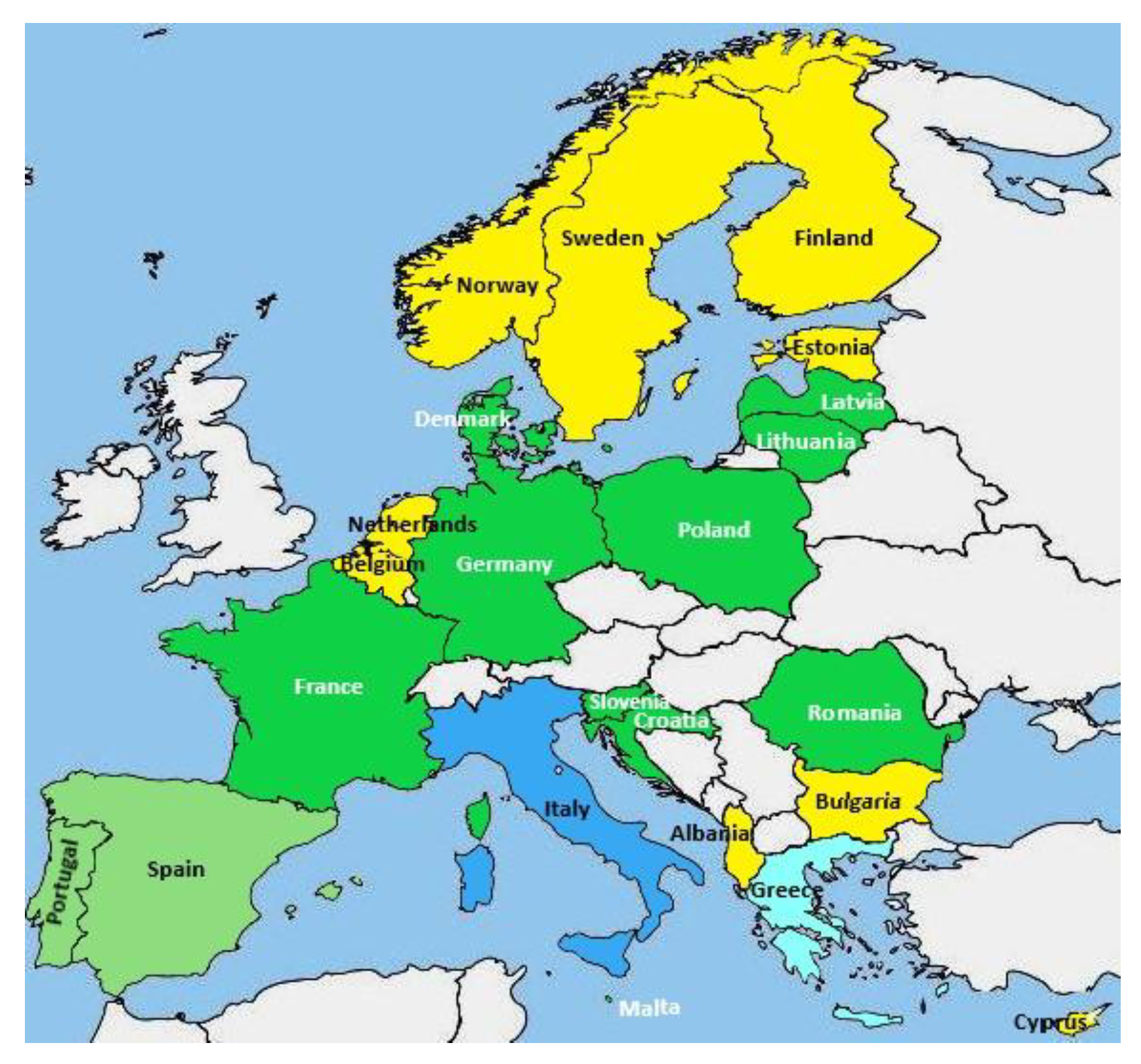
 —countries where regulations explicitly permit and regulate seawater use;
  —countries where regulations indirectly mention seawater use;
  —countries where seawater use is neither expressly regulated nor forbidden;
  —countries where regulations allow seawater use but explicitly delegate governance to regional legislation;
  —countries whose legislation allows the use of seawater in some facilities, without specifying its quality criteria;
  —countries whose regulations have not been examined.
—countries where regulations explicitly permit and regulate seawater use; —countries where regulations indirectly mention seawater use; —countries where seawater use is neither expressly regulated nor forbidden; —countries where regulations allow seawater use but explicitly delegate governance to regional legislation; —countries whose legislation allows the use of seawater in some facilities, without specifying its quality criteria; —countries whose regulations have not been examined.
—countries whose regulations have not been examined.
—countries where regulations explicitly permit and regulate seawater use; —countries where regulations indirectly mention seawater use; —countries where seawater use is neither expressly regulated nor forbidden; —countries where regulations allow seawater use but explicitly delegate governance to regional legislation; —countries whose legislation allows the use of seawater in some facilities, without specifying its quality criteria; —countries whose regulations have not been examined.


Disclaimer/Publisher’s Note: The statements, opinions and data contained in all publications are solely those of the individual author(s) and contributor(s) and not of MDPI and/or the editor(s). MDPI and/or the editor(s) disclaim responsibility for any injury to people or property resulting from any ideas, methods, instructions or products referred to in the content. |
© 2025 by the authors. Licensee MDPI, Basel, Switzerland. This article is an open access article distributed under the terms and conditions of the Creative Commons Attribution (CC BY) license (https://creativecommons.org/licenses/by/4.0/).
Share and Cite
Pobat, T.; Mandilara, G.D.; Nigro Di Gregorio, F.; Valeriani, F.; Veschetti, E.; Ferretti, E.; Mavridou, A.; Romano Spica, V. Pool Safety Regulations in Europe: Challenges Towards a Framework for Sustainable Seawater Utilization in Public Swimming Pools. Water 2025, 17, 2544. https://doi.org/10.3390/w17172544
Pobat T, Mandilara GD, Nigro Di Gregorio F, Valeriani F, Veschetti E, Ferretti E, Mavridou A, Romano Spica V. Pool Safety Regulations in Europe: Challenges Towards a Framework for Sustainable Seawater Utilization in Public Swimming Pools. Water. 2025; 17(17):2544. https://doi.org/10.3390/w17172544
Chicago/Turabian StylePobat, Tatsiana, Georgia D. Mandilara, Federica Nigro Di Gregorio, Federica Valeriani, Enrico Veschetti, Emanuele Ferretti, Athena Mavridou, and Vincenzo Romano Spica. 2025. "Pool Safety Regulations in Europe: Challenges Towards a Framework for Sustainable Seawater Utilization in Public Swimming Pools" Water 17, no. 17: 2544. https://doi.org/10.3390/w17172544
APA StylePobat, T., Mandilara, G. D., Nigro Di Gregorio, F., Valeriani, F., Veschetti, E., Ferretti, E., Mavridou, A., & Romano Spica, V. (2025). Pool Safety Regulations in Europe: Challenges Towards a Framework for Sustainable Seawater Utilization in Public Swimming Pools. Water, 17(17), 2544. https://doi.org/10.3390/w17172544