Article

Hydrogeochemical Characterization of Mineral Springs in Peruvian Tropical Highlands

by
Damaris Leiva-Tafur
1,2,*,
Hardy Geoffrey Manco Perez
2,
Jesús Rascón
2,
Lorenzo Culqui
2,
Oscar Andrés Gamarra-Torres
2 and
Manuel Oliva-Cruz
2,*
1
Escuela de Posgrado, Programa Doctoral en Ciencias para el Desarrollo Sustentable, Facultad de Ingeniería Zootecnista, Biotecnología, Agronegocios y Ciencia de Datos, Universidad Nacional Toribio Rodríguez de Mendoza de Amazonas, Chachapoyas 01001, Peru
2
Instituto de Investigación para el Desarrollo Sustentable de Ceja de Selva (INDES-CES), Universidad Nacional Toribio Rodríguez de Mendoza de Amazonas (UNTRM), Chachapoyas 01001, Peru
*
Authors to whom correspondence should be addressed.
Water 2025, 17(17), 2539; https://doi.org/10.3390/w17172539
Submission received: 8 July 2025 / Revised: 20 August 2025 / Accepted: 26 August 2025 / Published: 27 August 2025
(This article belongs to the Section Hydrogeology)

Abstract

Water quality in natural mineral springs is essential for sustainable use and conservation in the Amazon region. This study presents a hydrogeochemical characterization of 21 springs in the Peruvian Tropical Highlands, expanding on previous records of only six sources. The springs, which are thermal, saline, and sulfurous, are located between 384 and 3147 m a.s.l., mainly in mountainous areas with structural slopes and permeable sedimentary formations, such as the Pulluicana Group (composed mainly of sandstones and shales) and the Sarayaquillo Formation (characterized by reddish sandstones and siltstones). Physicochemical analysis showed temperatures ranging from 15.1 to 38.2 °C, pH from 5.20 to 8.72, conductivity between 0.05 and 253 mS/cm, and total dissolved solids from 0.02 to 162.50 g/L. High levels of arsenic and aluminum, likely originating from the natural weathering of rocks rich in these elements, exceeded national limits. Microbiological analysis detected fecal coliforms and Escherichia coli, indicating potential health risks. The results highlight the importance of regular monitoring and proper management to ensure safe use and explore its therapeutic and biotechnological applications, such as microbial bioremediation or development of extremophile-based enzymes.

1. Introduction

Mineral water sources have played, since ancient times, a fundamental role in developing the populations that have settled in their surroundings and whose uses are mainly sanitary and social [1]. Mineral waters are understood as all those waters whose dissolved element content is greater than 1000 mg/L [2]. However, alternative definitions adopt variable criteria that take into account not only the concentration but also the composition and geological origin of the resource. For example, the U.S. Food and Drug Administration specifies that mineral water must contain at least 250 mg/L of total dissolved solids (TDS), originating exclusively from a protected natural source, without the addition of artificial minerals [3]. Similarly, Directive 2009/54/EC of the European Union requires that water is bottled at the source, is microbiologically safe, and retains its original composition in minerals and trace elements [4]. The World Health Organization also considers waters with TDS levels below 1000 mg/L as potable, although it classifies degrees of mineralization into ranges that influence both sensory perception and physiological function [5]. In this context, the term “content of elements” refers to the set of inorganic and organic substances present in molecular, ionic, or colloidal form that remain in solution after filtration and are quantified as TDS, including cations (Ca2+, Mg2+, Na+, K+), anions (HCO3, SO42−, Cl, NO3), and trace elements with therapeutic potential such as Fe, Mn, Li, or Sr [6]. Worldwide, sources of mineral waters with diverse physicochemical properties have been reported [7,8,9,10].
One type of mineral water is hot springs, water resources with temperatures higher than their atmosphere [11]. The temperature of these thermal waters is produced by geothermal energy, exothermal chemical reactions, and geothermal cycling involving the percolation of meteoric water, its heating, and drainage along geological faults until its appearance at the surface [12]. These waters interact intensely with the underlying minerals and rocks, depending on the geology and geomorphology of the spring [7]. This causes interesting variations in parameters such as temperature, pH, electrical conductivity (EC), total dissolved solids (TDS), various ions, and heavy metals that are distinctive in these springs [13]. On the other hand, saline water sources—which can be salt lakes, salinity ponds, Antarctic and brine lakes [14]—show as the main distinguishing feature a variation in their dissolved Na+, Mg2+, Cl, NO3, and SO42− ions, despite large temperature oscillations (<12 °C or >68 °C) [15,16]. Sulfur springs mainly occur as thermal waters with high sulfate levels and alkaline pH [17], sometimes including fluorides attributed to natural geological processes [18].
In recent years, these environments and their characteristics have gained special attention from the scientific community, specifically in the prevention and treatment of diseases and to the peculiar conditions in relation to their physicochemical parameters and microbial diversity [19,20]. However, for such sources to confer health benefits, they need an evaluation of their physicochemical, microbiological (absence of pathogens and parasites), hydrological and geological parameters [4]. This is because many of these environments, transformed into spas, have incidences of pathogens such as intestinal enterococci, and in some sources below 37 °C, there is a risk of the presence of Escherichia coli [21]. Regarding physicochemical characteristics, many present high loads of sodium (Na+), calcium (Ca+), chlorine (Cl), and sulfate (SO4−2) ions, which are considered harmful by the World Health Organization [22]. On the other hand, some other sources, despite the risk of anthropogenic contamination due to population growth, have managed to conserve their physicochemical and microbiological values within the limits established by their jurisdiction [23].
The physicochemical and microbiological characterization of mineral water sources is essential not only for understanding their natural properties but also to ensure their safe and sustainable use. This type of assessment helps identify ionic composition, trace metal concentrations, microbial activity, and other factors that determine water quality and its potential impact on human health and the environment. Recent studies emphasize that comprehensive evaluations are critical for therapeutic, recreational, or touristic use, since some springs may contain high concentrations of toxic elements such as arsenic, fluoride, or nitrates, as well as pathogenic microorganisms [24,25]. Furthermore, microbiological analysis of these environments can uncover unique microbial communities, including extremophiles with significant biotechnological potential [26]. Therefore, scientific data on the composition and quality of these waters serve as a crucial baseline for environmental management and for their valuation in conservation and sustainable development strategies [27,28].
The Peruvian Tropical Highlands are characterized by high biological diversity and unique environmental conditions [29]. This is due to varied altitudinal gradients and diverse geographic and climatic conditions throughout the territory [30], which give rise to multiple ecosystems and life zones [31]. These attributes provide many opportunities across productive, extractive, and research sectors. Huamaní [32] reports the presence and origin of eight natural mineral water sources located in the Aramango, Chaquil, Colpar, Corontochaca, Michina, Rentema, Salinas, and Tocuya areas. However, according to local testimonies and unofficial sources, such as tourism websites, other mineral hot springs in the Amazon region remain undocumented. These environments represent valuable opportunities for tourism development, and due to potential risks, it is necessary to protect them with adequate infrastructure.
In this context, the present study aims to identify, characterize, and understand the genesis of mineral water springs in the Amazonian region of Peru, focusing on their physicochemical and microbiological profiles, as well as the geological processes that contribute to their origin and mineral composition. For the first time, we report the existence of 13 additional springs, complementing the 8 previously documented by Huamaní [32]. By evaluating water quality through key indicators and relating it to local geological features, this study not only assesses their suitability for recreational or touristic use, but also contributes to the understanding of their formation mechanisms. This integrated approach establishes a scientific baseline for sustainable management and future research in hydrogeology, microbial ecology, and environmental biotechnology.

2. Materials and Methods

2.1. Study Area

The study area corresponds to the Peruvian Tropical Highlands, located in the sub-Andean Cordillera in northern Peru [33]. Situated on the northern continental margin of South America, the Nazca Plate subducts beneath the South American Plate, and this geotectonic setting, together with regional thermal gradients, promotes the development of geothermal systems [34]. From a geological perspective, the Peruvian Amazon region is characterized by a complex tectonic and sedimentary evolution, dominated by extensive sedimentary basins filled with Paleozoic to Cenozoic deposits. These include sequences of shales, sandstones, limestones, and conglomerates, with volcanic intercalations present in higher elevation areas [35]. This lithological diversity promotes groundwater infiltration, mineral dissolution processes, and the formation of mineral springs.
The physiography of the area includes four main landform units: (1) river-influenced alluvial plains, (2) flat to undulating terrains with high and medium terraces, (3) mountainous zones with pronounced structural slopes, and (4) hilly areas and periodically flooded plains [36]. Physiography refers to the study of landforms, their morphology, structure, and origin and plays a key role in regulating surface runoff, groundwater infiltration, and spring emergence.
Climatic conditions vary throughout the region. Precipitation exceeds 4000 mm/year in the northern zone, while it falls below 1000 mm/year in the southern zone. Temperature also varies with altitude, being warmer in Bagua (~26.3 °C) and cooler in Chachapoyas (~14.7 °C). The water balance indicates a deficit in Bagua (−924 mm/year) and a surplus in Condorcanqui (+2987 mm/year), suggesting a climatic gradient from dry to super-humid conditions [37]. The Geological, Mining and Metallurgical Institute of Peru (INGEMMET) first reported the presence of eight hydrothermal springs in the region in 2011 [32].

2.2. Identification of Natural Sources of Mineral Waters

In order to identify the extremophile reservoirs, eight previously reported hydrothermal sources were taken as references, which constitute the main background of this research [32] (Table 1). Identifying the new hydrothermal sources was developed through field visits from the places referred by oral sources of the population.
Once at the site of interest, the geographic location of each of the sources was georeferenced using global positioning systems (GPS). ArcGIS Desktop 10.8.2 software [38] was used for mapping and spatial analysis, integrating layers in shapefile format extracted from the GEO GPS PERU [39] database.

2.3. Sampling and Determination of Physicochemical and Microbiological Parameters

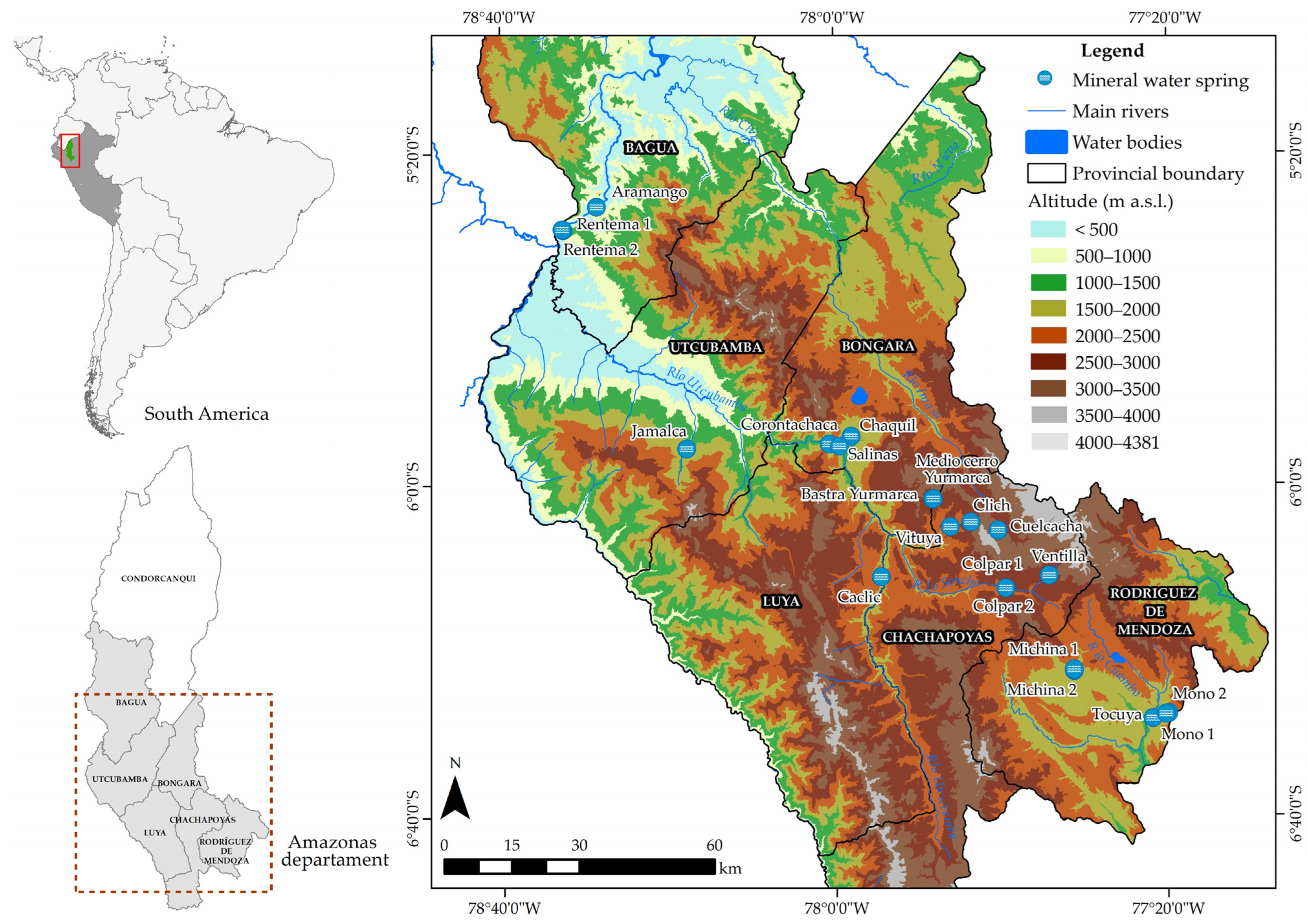
Water samples were collected in August and September 2023, months with little rainfall in the region [30], to avoid mixing with meteoric waters [40]. In situ physicochemical parameters such as hydrogen potential (pH), temperature (°T), dissolved oxygen (DO), and electrical conductivity (EC) were determined directly at the hydrothermal source, with the use of multiparametric equipment (WTW Multi 3620 ids, Xylem Analytics Germany Sales GmbH & Co., KG, Weilheim, Germany), being the accuracy of the pH (±0.004 pH units), EC (±0.5% of the measured value), DO (±0.5% of the measured value) sensors, the T° value (±0.2 °C) was determined using the pH sensor [41]. Samples were collected from 21 hydrothermal vents (Figure 1), taking three replicates for each, resulting in sixty-three samples. For the collection, high-density polyethylene bottles (1 L) were used for the analysis of physicochemical parameters; for trace elements, high-density polyethylene bottles (100 mL) were used, which were treated with a 1 M nitric acid solution at 10% for 30 min and subsequently rinsed with distilled or deionized water, for microbiological parameters sterile borosilicate bottles were used [42]. Samples collected and refrigerated at 4 °C were immediately transferred to the Water and Soil Research Laboratory, a laboratory accredited under ISO 17025:2017 [43], of the Universidad Nacional Toribio Rodríguez de Mendoza de Amazonas, Chachapoyas, for analysis. Quality control procedures were rigorously applied during sampling, transport, and laboratory analysis to ensure the reliability and traceability of the results. All field instruments were calibrated daily using certified standard solutions, in accordance with the manufacturer’s instructions. For trace element analysis, Certified Reference Materials (CRMs) were used to verify analytical accuracy, and triplicate samples were collected at each site to assess precision and reproducibility. Microbiological samples were handled using aseptic techniques to prevent cross-contamination. All procedures followed the ISO/IEC 17025:2017 guidelines, ensuring methodological rigor and traceability from field collection to final data reporting.
Prior to storage, the water samples intended for trace element determination were filtered through cellulose filter paper (brand: CHMLab; qualitative grade: F1002; thickness: 190 μm), and the filtered product was acidified with HNO3 (1 + 1) until reaching a pH less than 2. The most probable number (MPN) technique was used to determine microbiological parameters such as total coliforms and streptococci. Total coliforms were detected in brilla broth (37 °C, 48 h) and lauryl sulfate broth (37 °C, 24–48 h). For the identification of fecal coliforms, an Escherichia coli broth medium was developed (44 °C, 24 h), and the presence of E. coli was confirmed on EMB (Eosin Methylene Blue) agar (37 °C, 24 h). Total streptococci were enriched in Azide Dextrose Broth (35 °C, 24–48 h) and confirmed in KF Streptococcus Agar (Base Medium) (35 °C, 24 h), and fecal streptococci were confirmed in Brain Heart Infusion Broth (BHI) (44 °C, 24–48 h). For Salmonella spp. and Vibrio cholerae, 100 mL of sample was filtered and enriched in Alkaline Peptonized Water (37 °C, 24 h) and APT broth (37 °C, 24 h), Salmonella spp. was confirmed in Rappaport Vassiliadis Broth (44 °C, 24 h) and Vibrio cholerae in XLD (Xylose-Lysine-Deoxycholate) agar [42].
The determination of physicochemical parameters was carried out using the following standard methods: total dissolved solids, total suspended solids, and total solids were analyzed according to Method 2540D [44]; sulfates by Method 375.4 [45]; alkalinity by Method 2320B [46]; chlorides by Method 4500-CL-B [47]; and hardness by Method 2340C [48]. The determination of trace elements such as Al, As, Ca, Cu, Fe, K, Mg, Mn, Na, Pb, Sb, Sr, and Zn was developed with a back transfer of samples to glass tubes previously cleaned with 0.1 M HCl. 0.5 mL of concentrated HNO3 (brand: Fermont, Productores Químicos Monterrey S.A. de C.V., Monterrey, México; purity: 65%) was added to the tubes, which were capped and placed in a Hot Block (brand: Environmental Express, Environmental Express, Inc., Charleston, SC, USA; model: SC154). Digestion was carried out at 105 ± 5 °C for 2 h, following the APHA 3030-E method [49]. After digestion, the tubes were cooled to room temperature before analysis by microwave plasma atomic emission atomic spectroscopy (MP-AES) using the 3120-B methodology adapted for inductively coupled plasma.

2.4. Classification of Natural Mineral Springs

In this study, a classification was adopted based on physicochemical criteria widely recognized in specialized scientific literature. The waters were classified according to their pH, distinguishing between acidic waters (pH < 7) and alkaline waters (pH > 7), and based on temperature: cold (<20 °C), hypothermal (20–30 °C), and mesothermal (30–40 °C), following approaches commonly used in geothermal system analyses [50,51]. The degree of mineralization was evaluated based on total dissolved solids (TDS), classified according to the dry residue into oligometallic (<100 mg/L), low (100–250 mg/L), medium (250–500 mg/L), high (500–1000 mg/L), or very high mineralization (>1000 mg/L), as proposed by Figueiredo et al. [52]. Finally, water hardness was considered, categorizing the waters as very soft (0–100 mg/L CaCO3), soft (100–200 mg/L), hard (200–300 mg/L), or very hard (>300 mg/L CaCO3) [53,54]. The integration of these criteria enables a robust, quantifiable, and scientifically comparable characterization aligned with international standards.

2.5. Evaluation of Water Quality Using the Ica-PE Index

In Peru, the Ica-PE index is based on comparing the set of physicochemical and biological parameters with values established in the Environmental Quality Standards for Water (ECA-Water) according to the category the water body corresponds [55]. For our case, the evaluation was made we compared the results with the values established in the ECA-Water Category 1 Subcategory B1: Surface waters intended for primary contact recreation [56]. The selected parameters amount to 15: pH, dissolved oxygen, fecal coliforms, Escherichia coli, enterococci, Salmonella spp., Vibrio choleare, Al, As, Cu, Fe, Mn, Pb, Sb and Zn. To calculate the ICA-PE, the Canadian formula comprising three factors was used: extent, frequency, and amplitude [57]. The result of this formula is a single value between 0 and 100, established in five ranges that represent sensitivity levels and qualify the water quality status as Poor, Bad, Fair, Good, or Excellent (Table 2).

2.6. Data Analysis

Geospatial graphs, downloaded from the official maps of the Geological, Mining, and Metallurgical Institute of Peru [35], were used to visualize the precise location of each reservoir. Additionally, geological and geomorphological maps of each area were prepared to infer the relationship between the geological formation at each location and the nature of the water in these springs. Descriptive statistics of mean, standard deviation, and maximum and minimum values were used with R software version 4.2.1 [58] to express the physicochemical characteristics of the hydrothermal springs. To find the interrelation of variables, spatial and temporal dynamics, and explain their hydro geochemistry, a principal component analysis (PCA) was performed. The PCA used a correlation matrix. The percentage of cumulative variance ranged from 70 to 90% [59,60,61,62]. PCAs were performed for all the classifications listed in item 2.5.

3. Results

3.1. Identified Mineral Water Sources

Twenty-one natural mineral springs were identified, primarily distributed across the central sector of the study area (Figure 1). The status of eight springs previously documented in the technical bulletin Aguas Minerales y Termales en el Norte del Perú [32] was updated, and thirteen new springs were recorded. These sources span a wide altitudinal gradient—from 384 to 2585 m above sea level—highlighting the physiographic and geological heterogeneity of the region. To better understand the potential origin and nature of these waters, their locations were compared with thematic geology and geomorphology maps developed by the Instituto de Investigaciones de la Amazonía Peruana [29], enabling preliminary inferences regarding the hydrogeological processes involved.

3.2. Geomorphology Location of Mineral Water Springs

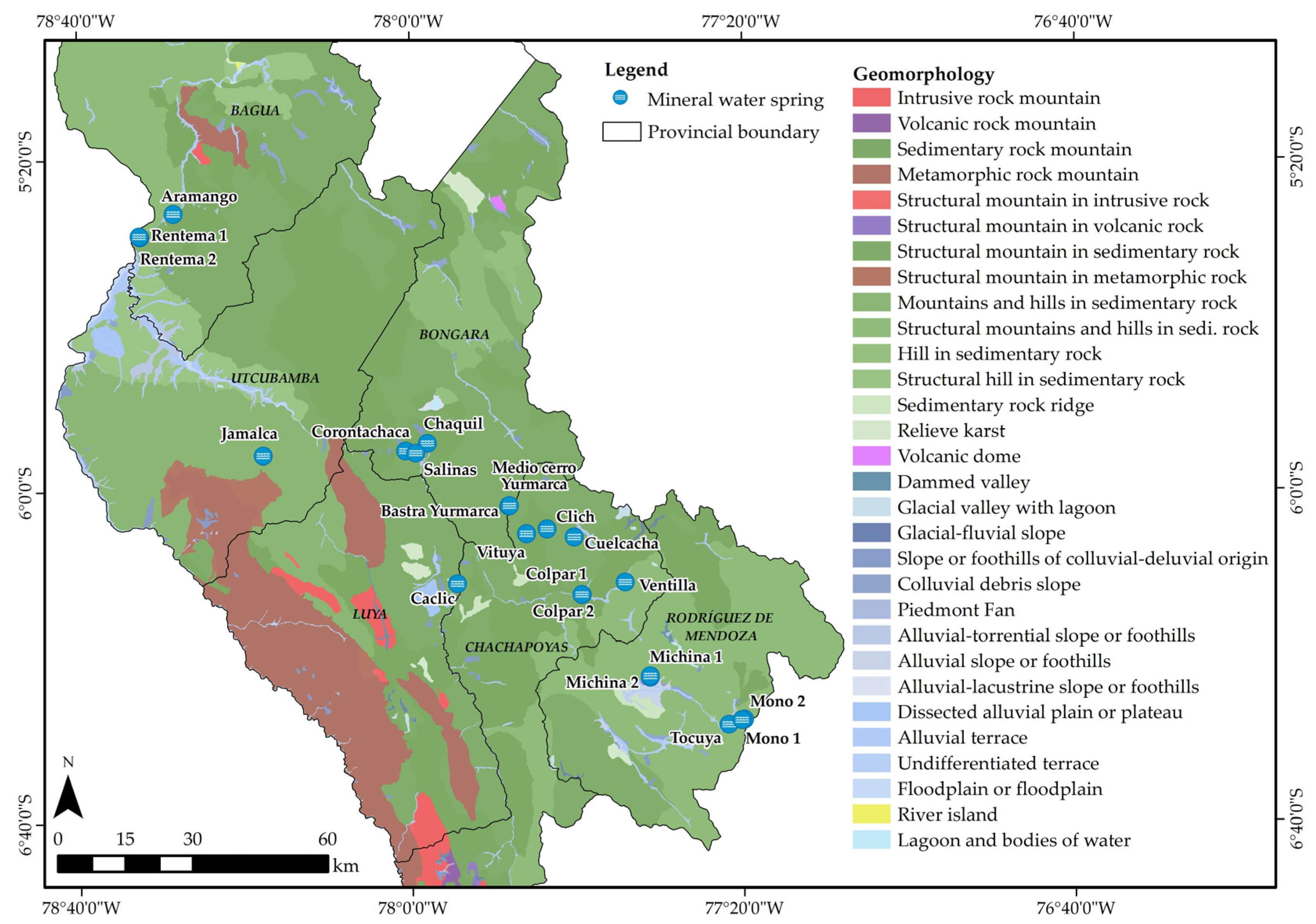
The spatial analysis of mineral water springs in relation to the geomorphological units of the study area (Figure 2) shows that most of the sources, regardless of their type, are located in mountainous areas characterized by structural mountains and hills in sedimentary rock and structural mountains in metamorphic rock. These environments, with steep slopes and a well-defined stratification of rock layers, favor deep water infiltration, allowing underground flow to become warm and enriched with dissolved minerals before emerging at the surface.
In the case of the Colpar and Chaquil springs, their location on alluvial–lacustrine slopes and alluvial slopes facilitates groundwater storage and extends the interaction with the surrounding rock material, thereby increasing the concentration of dissolved salts and trace minerals. The Michina spring is notable for being the only one situated on a volcanic dome, a formation composed of rock and loosely consolidated deposits. This geological condition allows rapid percolation of meteoric water through fractures and porous zones, promoting mineral enrichment from volcanic materials. These geomorphological configurations are consistent with what has been documented in other hydrothermal systems in Peru, where mountainous and volcanic terrains with structural slopes are closely associated with the emergence of mineral-rich springs.

3.3. Distribution of Mineral Water Springs in Relation to Regional Geology

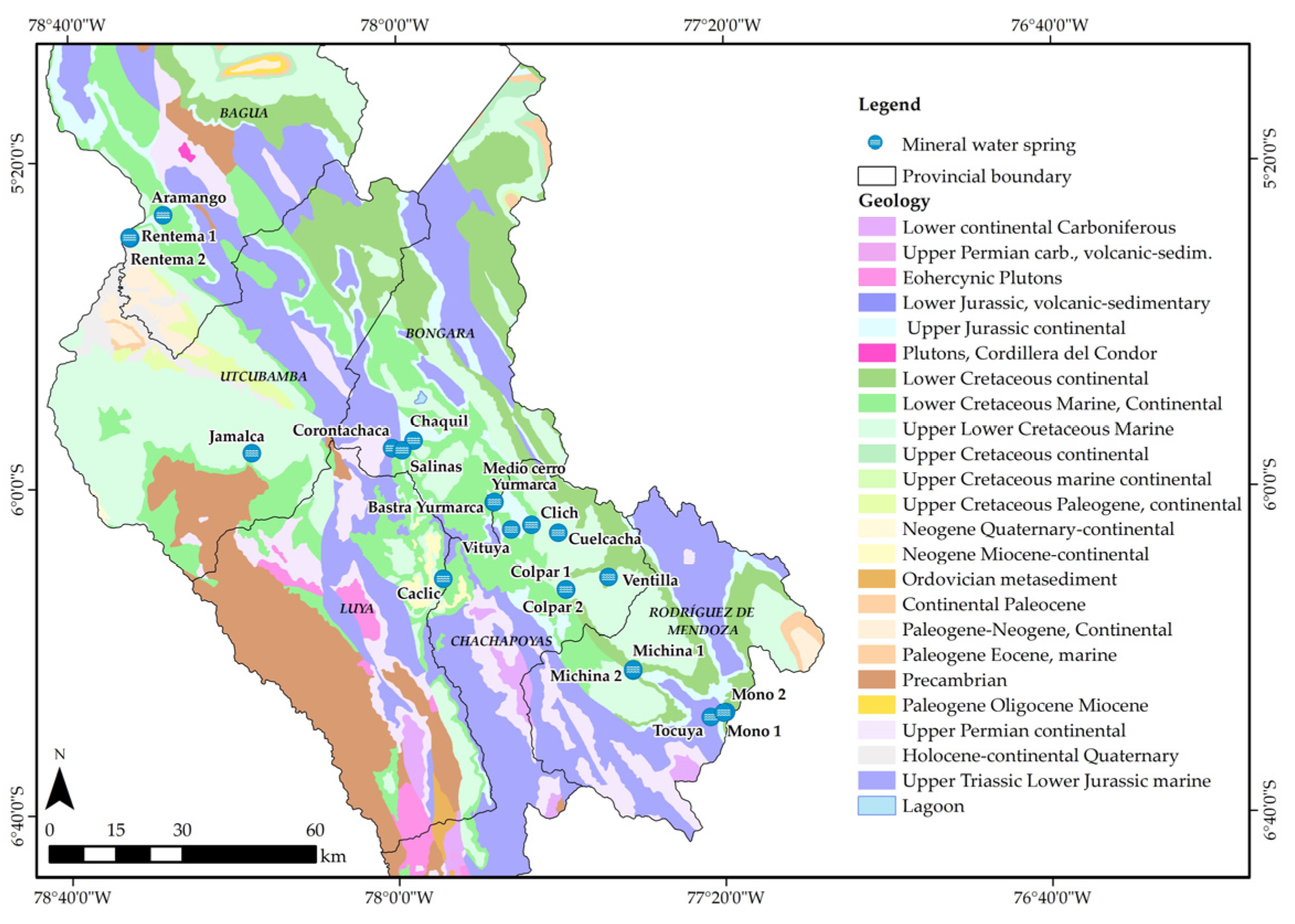
Based on the comparative analysis between the geology of the study area and the maps developed from the geological cartography provided by INGEMMET [35], the spatial distribution of mineral springs in the Amazonas region shows a clear association with various lithostratigraphic units, ranging from the Precambrian to the Quaternary (Figure 3). A total of 21 mineral springs were identified, whose locations coincide with a variety of geological formations of a sedimentary, volcano–sedimentary, and plutonic nature. These springs are mainly located on continental Cretaceous formations (Ks-c, Ki-c) and Upper Jurassic formations (Js-c), characterized by the presence of sandstones, shales, and limestones. These formations are predominant in the provinces of Chachapoyas, Rodríguez de Mendoza, Bongará, and Luya, where the highest concentration of springs is also observed. In the eastern area, particularly in the province of Rodríguez de Mendoza, springs such as Michina 1, 2 and Mono 1, 2 are located on continental Neogene–Quaternary units (NQ-c), as well as on Jurassic volcano–sedimentary formations (Ji-vs). On the other hand, springs such as Salinas and Chaquil in the province of Bongará are situated on Lower Cretaceous marine formations (Ki-mc9) and Upper Jurassic units (Js-c). Additionally, some springs, such as Rentema 1 and 2 in the province of Bagua, are in contact with units of the Eohercynian Pluton (Dc-to/gd). The Jamalca mineral spring, located in the province of Utcubamba, is geologically settled on a continental Upper Cretaceous formation (Ks-c), with geological contact zones with older units such as those of the Carboniferous.

3.4. Classification of the Mineral Springs Based on Temperature, pH, Hardness, and Total Dissolved Solids (TDS)

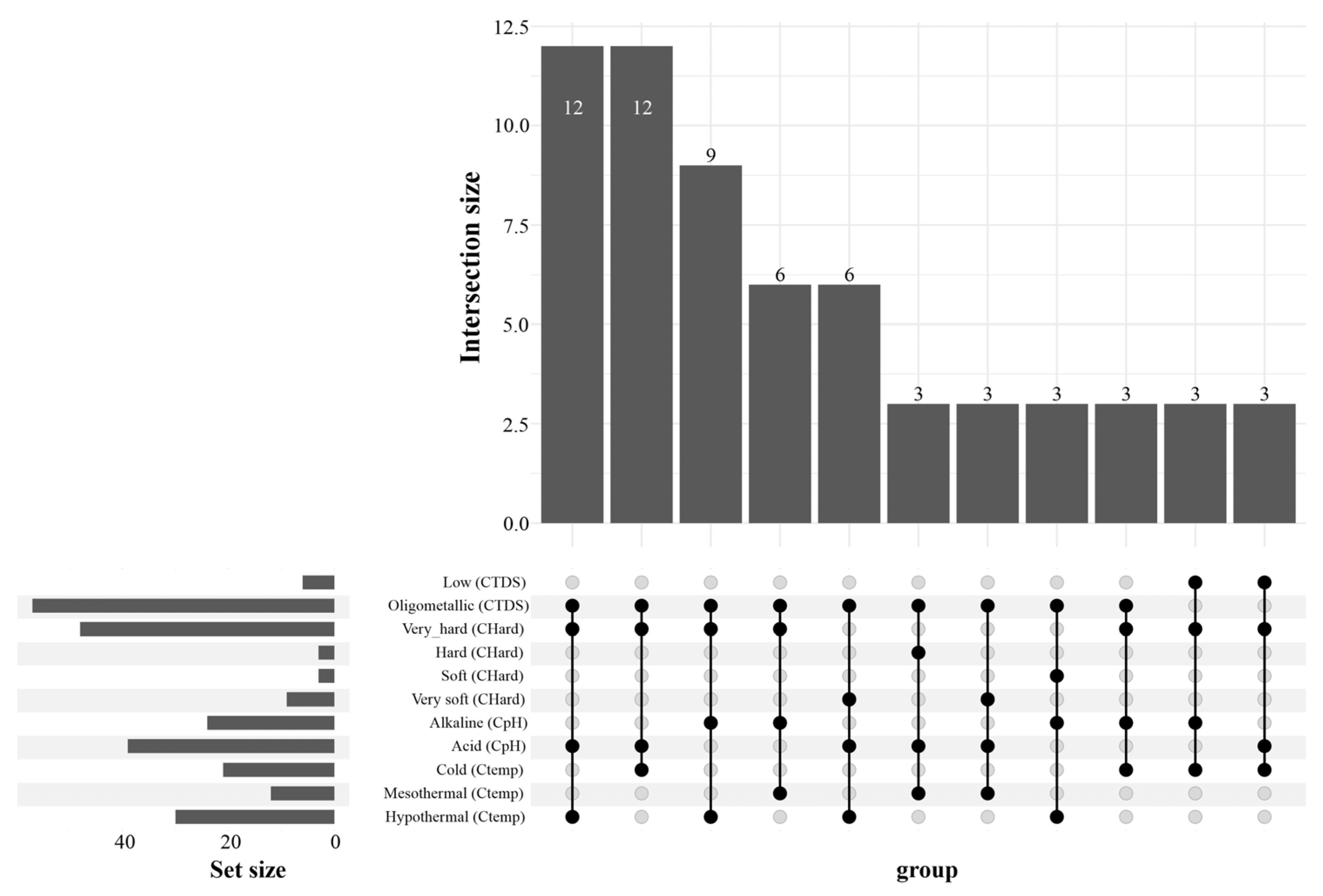
The classification of natural mineral water sources according to temperature (Ctemp), pH (CpH), hardness (CHard), and total dissolved solids (CTDS) showed marked variability between sources (Figure 4). The most frequent combination was cold, acidic, very hard, and oligometallic waters (n = 12), a pattern that was also observed in hypothermal, acidic, very hard, and oligometallic sources (n = 12). Likewise, nine sources classified as hypothermal, alkaline, very hard, and oligometallic were identified. Other combinations recorded were mesothermal, alkaline, very hard, and oligometallic (n = 6); hypothermal, acidic, very soft, and oligometallic (n = 6); and cold, alkaline, very hard, and oligometallic (n = 3).

3.5. Physicochemical, Microbiological, and Trace Element Characterization of Natural Mineral Water Sources

Analysis of the physicochemical, microbiological (Table 3), and trace element (Table 4) parameters of the twenty-one natural mineral springs revealed considerable variability between sampling points (Supplementary Table S1).
Physicochemical parameters (Table 3) such as water temperature ranged from 15.1 to 38.2 °C, with an average of 24.38 ± 6.79 °C. Springs located below 1000 m above sea level exhibited higher average temperatures (34.60 ± 2.51 °C), whereas those above 2000 m showed significantly lower values (18.56 ± 4.17 °C). pH values ranged from 5.20 to 8.72, with a mean of 6.74 ± 0.75, indicating the presence of both acidic and alkaline waters across the sites. Electrical conductivity varied considerably, from 0.05 to 253.00 mS/cm, with a mean of 57.09 ± 86.50 mS/cm, while total dissolved solids (TDS) ranged from 0.02 to 162.50 g/L (mean 28.60 ± 46.11 g/L). Acidic waters (pH < 7) tended to have higher TDS concentrations, indicating increased ionic mineral content. Dissolved oxygen (DO) levels were generally low, with values ranging from 0.27 to 9.19 mg/L and a mean of 3.39 ± 2.70 mg/L, consistent with the characteristics of groundwater or thermal upwellings with low atmospheric exchange. In terms of hardness classification, very hard waters (>300 mg/L CaCO3) were predominantly found at lower altitudes, while very soft waters (<100 mg/L CaCO3) were associated with higher elevation sites When grouped by pH, alkaline waters showed higher levels of total coliforms (55.59 ± 134.15 MPN/100 mL) and fecal coliforms (36.10 ± 79.14 MPN/100 mL) compared to acidic sources. Similarly, cold and mesothermal waters exhibited higher E. coli and coliform counts, supporting the trend of inverse correlation between temperature and bacterial proliferation.
Microbiological indicators (Table 3) also displayed notable variability (Table 3). Total coliforms ranged from 0.00 to 462.20 MPN/100 mL (mean 29.77 ± 85.72), and fecal coliforms from 0.00 to 239.80 MPN/100 mL (mean 20.04 ± 52.49). The presence of E. coli was recorded in several sources, with values ranging from 0.00 to 93.30 MPN/100 mL (mean 7.14 ± 17.00). Total streptococci and fecal enterococci concentrations reached maximum values of 149.40 and 42.70 MPN/100 mL, respectively, with means of 17.35 ± 36.78 and 5.39 ± 9.89 MPN/100 mL.
Geographical analysis showed that the highest microbiological contamination occurred in sources located in Rodríguez de Mendoza, where mean total coliforms and fecal coliforms reached 84.62 ± 164.54 and 54.11 ± 96.29 MPN/100 mL, respectively. In contrast, in Bongará province, neither fecal coliforms nor E. coli were detected. Saline waters exhibited the highest average counts of total (55.10 ± 119.96 MPN/100 mL) and fecal coliforms (37.91 ± 72.27 MPN/100 mL), whereas thermal springs presented the lowest concentrations—9.14 ± 4.05 and 2.95 ± 2.07 MPN/100 mL, respectively.
The analysis of trace elements in the natural mineral springs revealed significant variability across the study area (Table 4). Aluminum reached concentrations of up to 27.66 mg/L in low-altitude thermal springs, particularly in the Rodríguez de Mendoza province. Arsenic concentrations were also elevated, with a maximum value of 4.59 mg/L, especially in sulfide and saline sources. Both values far exceed international drinking water standards. Calcium showed maximum concentrations of 85.40 mg/L, particularly in saline springs from the Chachapoyas province. Magnesium reached up to 71.36 mg/L in low-altitude springs. In addition, the Jamalca ubicado en spring presented the highest sodium level (393.51 mg/L), indicating high salinity. Although lead and antimony were generally low, isolated springs showed elevated concentrations. Table 4 summarizes these results, including their statistical distribution

3.6. Distribution of Mineral Water Springs Based on Principal Component Analysis (PCA)

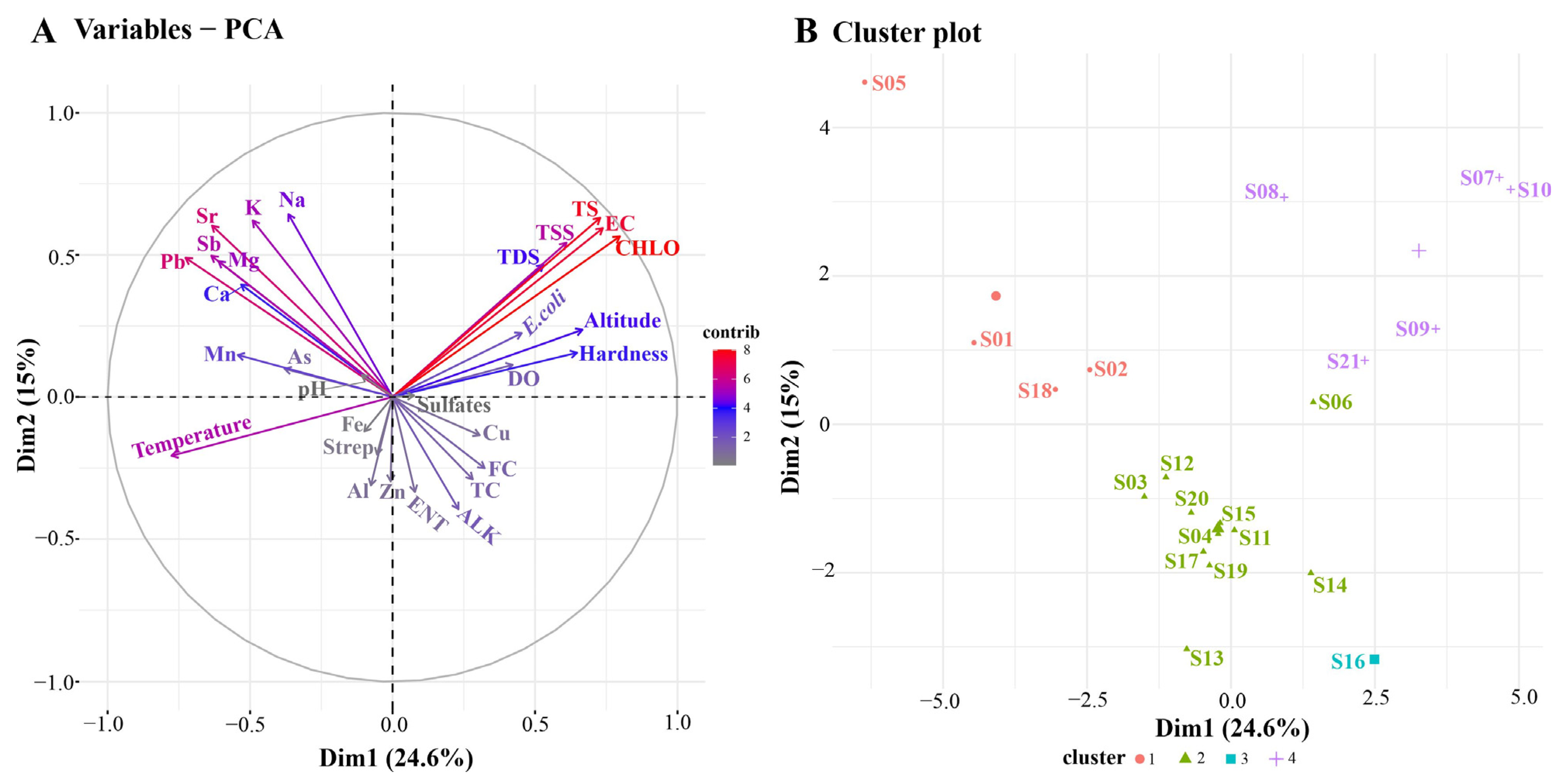
The principal component analysis (PCA) allowed the identification of the variables that most clearly explain the variability among the evaluated mineral water springs. Dimension 1 (24.6% of explained variance) was mainly associated with the presence of chlorides (Cl), total dissolved solids (TDS), electrical conductivity (EC), sodium (Na), sulfates (ST), and calcium (Ca), while Dimension 2 (15%) was strongly influenced by temperature. In contrast, variables such as altitude, manganese (Mn), and arsenic (As) showed negative correlations with Dimension 1. Based on cluster analysis, four well-defined clusters were identified: Cluster 1 grouped springs characterized by high temperature and low mineralization (F01, F02, F05, F18); Cluster 2 included the largest number of springs with intermediate physicochemical characteristics (F03, F04, F06, F11–F15, F17, F19, F20); Cluster 3 corresponded exclusively to spring F16, which presented a unique profile; and Cluster 4 included springs with higher concentrations of trace elements such as lead (Pb), iron (Fe), sodium (Na), and potassium (K), mainly in springs F07, F08, F09, F10, and F21.
The multivariate analysis using principal component analysis (PCA) and hierarchical clustering allowed for a detailed visualization of the relationships among mineral water sources and their physicochemical and microbiological characteristics, as well as their groupings (Figure 5).
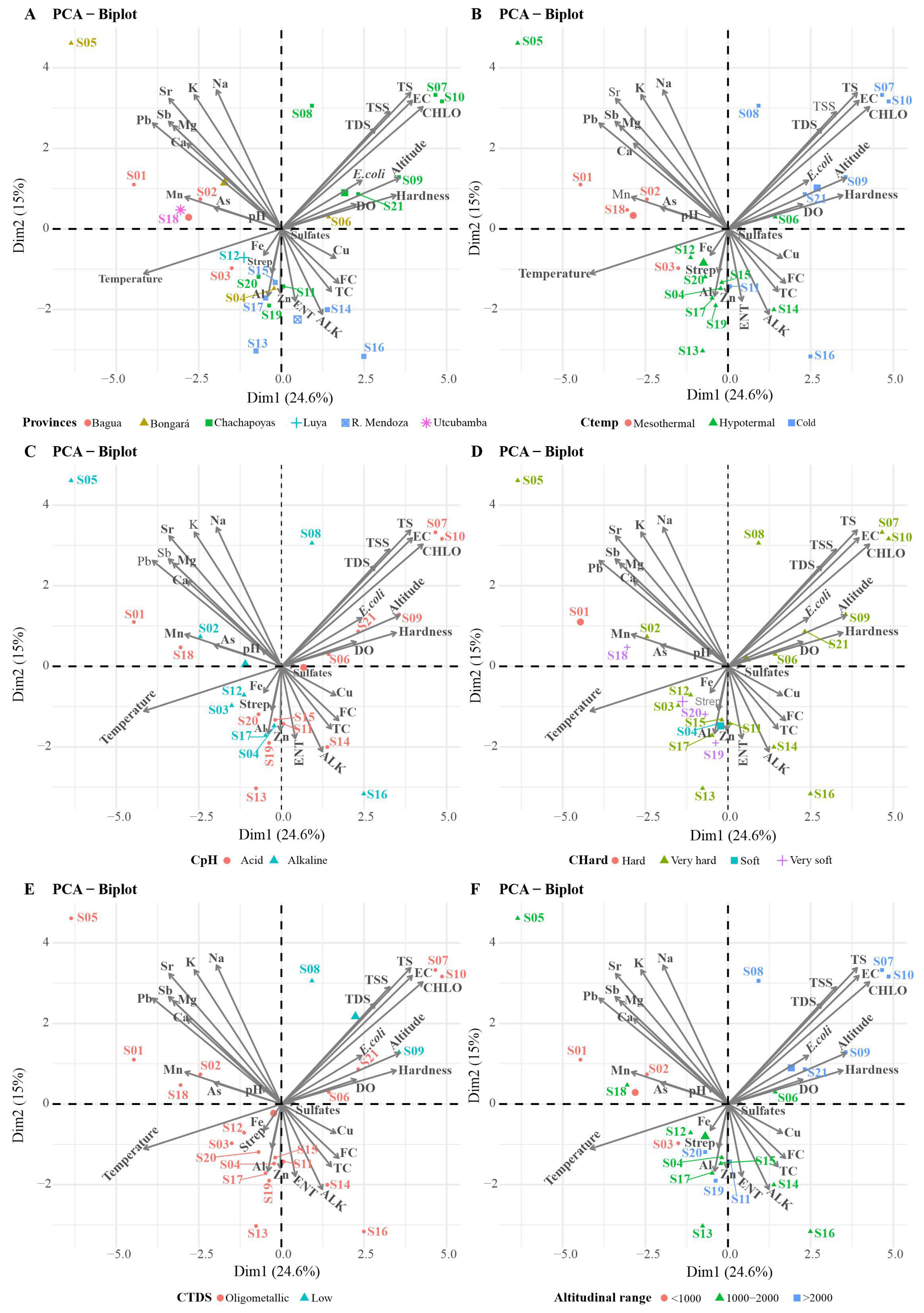
The PCA revealed distinct distribution patterns according to geographic location (Figure 6). Mineral springs from Bagua province (F01, F05) were positioned at opposite ends of the biplot, reflecting contrasting conditions such as high temperature or low mineralization. In Rodríguez de Mendoza, springs F08 and F16 also displayed marked dispersion, whereas most springs from Chachapoyas, Luya, and Bongará clustered around the center of the plot, suggesting an intermediate composition in relation to the analyzed parameters. According to the temperature classification (Ctemp), mesothermal sources such as F05 were located in the upper-left quadrant, associated with higher temperatures. Hypothermal springs were concentrated in the central region, while cold springs (e.g., F08, F10) were found in the upper-right quadrant, showing positive correlations with total dissolved solids (TDS), electrical conductivity (EC), chlorides, and sulfates—indicating elevated mineralization despite lower temperatures.
The pH classification (CpH) revealed a clear separation between acidic and alkaline sources. Acidic springs (F01, F02, F18) were positioned on the left side of the biplot, negatively associated with mineralization variables. In contrast, alkaline sources (F08, F10) were situated on the right, close to TDS, EC, and chloride vectors, reflecting a higher content of dissolved minerals. Regarding hardness (CHard), very hard waters (F07, F10) were located on the right side of the plot, associated with higher concentrations of sulfates, TDS, and chlorides. Hard waters (F01, F02) with lower mineralization appeared on the left side. Very soft waters were more dispersed, without a defined association with the main variables. The TDS classification (CTDS) showed that most sources were oligometallic, broadly distributed in the PCA space, with several located near the vectors for TDS, sulfates, and chlorides. Interestingly, some sources classified as low-TDS (e.g., F08, F10) also appeared near these vectors, possibly due to subtle differences not captured by the categorical classification or the influence of other variables.
Finally, the altitudinal distribution indicated that springs located below 1000 m a.s.l. (F01, F02) were negatively associated with mineralization variables. Springs located between 1000 and 2000 m a.s.l. were found mostly in intermediate positions, while those above 2000 m a.s.l. (F07, F10) clustered to the right of the biplot, showing positive associations with chlorides, TDS, and sulfates—suggesting higher mineralization at greater altitudes.

3.7. Water Quality Index

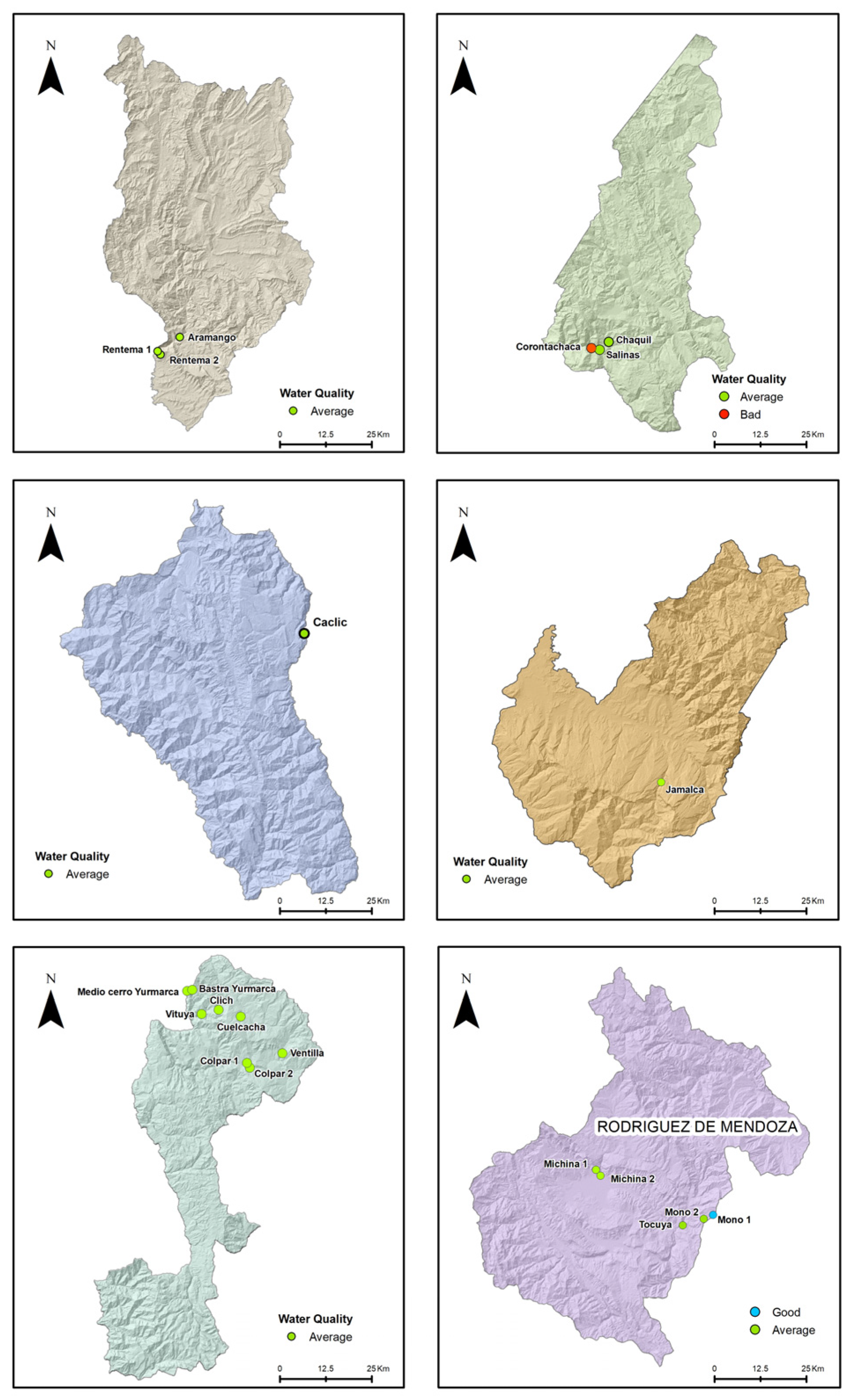
The Ica-PE water quality index for inland surface water bodies [55] was calculated based on the uses and purposes of the nearby communities, mainly spas and tourist areas. The ECA-Water Category 1 Subcategory B1 [56] regulations were applied, corresponding to primary contact recreational use (Figure 7). The evaluation included key parameters such as pH, dissolved oxygen, fecal coliforms, Escherichia coli, enterococci, Salmonella spp., Vibrio cholerae, and trace elements including aluminum, arsenic, copper, iron, manganese, lead, antimony, and zinc. Among the evaluated sources, the “Corontachaca” spring presented the poorest water quality, with 7 out of 15 parameters exceeding the permitted thresholds. In contrast, the “Mono azufrada” spring exhibited overall good quality, although it exceeded the limits for arsenic and dissolved oxygen. No presence of Salmonella spp. or Vibrio cholerae was detected in any of the evaluated springs.

4. Discussion

4.1. Geological and Hydrogeomorphological Influence on the Composition and Classification of Mineral Water Springs

The mineral springs identified in the Amazonas region emerge from a complex lithostratigraphic sequence that includes sedimentary, volcano–sedimentary, and plutonic formations ranging from the Precambrian to the Quaternary, as revealed by regional geological and geomorphological maps [63]. This geological diversity gives rise to multiple hydrochemical profiles, as groundwater, during its infiltration and deep circulation, comes into contact with various rock types that determine its chemical composition [64]. When this interaction is prolonged, especially through soluble lithologies such as limestones and sandstones, a gradual dissolution of minerals occurs within the rock matrix [65]. This process facilitates the release of major ions such as sodium (Na+), calcium (Ca2+), chloride (Cl), and sulfate (SO42−), as well as trace elements such as manganese (Mn), aluminum (Al), and arsenic (As), which are incorporated into the subsurface flow [66]. The final composition of the emerging mineral water therefore depends on the chemical nature of the geological formations traversed and the water’s residence time underground [63], explaining the observed presence of key parameters such as total dissolved solids (TDS), electrical conductivity (EC), chloride (Cl), sodium (Na+), calcium (Ca2+), sulfate (SO42−), and trace elements including iron (Fe), potassium (K), lead (Pb), arsenic (As), manganese (Mn), and aluminum (Al).
From a hydrogeomorphological perspective, most springs are located in mountainous zones with steep structural slopes, which facilitate the deep infiltration of meteoric water. These conditions promote the recharge of confined aquifers through fault zones and fractured strata, generating deep circulation systems that enable geothermal heating and interaction with mineral-rich rocks [67]. In the Andes, active faults have been shown to act as preferential conduits for the ascent of hydrothermal waters [68], a phenomenon also observed in the Bagua and Rodríguez de Mendoza springs, where temperature is a distinguishing parameter. The genesis of these waters is predominantly associated with high-altitude meteoric recharge, such as precipitation, combined with thermal signals indicating interaction with magmatic sources or deep geothermal flows [69]. This recharge is influenced by alternating permeable and confining layers, such as interbedded limestones and shales, which regulate flow velocity, dissolution rate, and mineralization [70].
In areas where waters emerge over alluvial or travertine deposits, the flow may be slower and more superficial, allowing for secondary dissolution processes and enrichment in trace elements, as observed in travertine aquifers in Iran and Turkey [71]. Although this interaction was not directly measured in the Amazonas springs, its geological presence suggests a possible influence on the chemical characteristics of springs such as Jamalca.
The classification of mineral springs by temperature, pH, hardness, and total dissolved solids (TDS) provides insight into groundwater interaction with geologic formations during subsurface transit. In this study, most springs were identified as cold or hypothermal, acidic, very hard, and with low mineralization (oligometallic). This water type dominates in the Chachapoyas province (springs S07, S09, S10, S11, S21), where volcanic and siliceous geology with limited carbonate presence prevails, restricting the dissolution of easily soluble minerals and resulting in acidic waters with low ionic content. This pattern aligns with findings by Tóth [72], who noted that volcanic rocks tend to yield acidic, oligometallic waters.
The high water hardness observed in most springs, particularly in Bagua (S02, S03) and Rodríguez de Mendoza (S13–S17), indicates elevated concentrations of calcium (Ca2+) and magnesium (Mg2+), likely derived from the dissolution of limestones and dolomites in Jurassic and Cretaceous sedimentary formations in these areas [73]. Mesothermal waters with alkaline pH and very high hardness, such as those from S02 and S03, reflect greater geochemical interaction, possibly due to deep circulation through fractured zones. Conversely, in Bongará province, springs such as S04 exhibit an uncommon combination of hypothermal, alkaline, and soft waters, suggesting shallower flow paths or partial mineralization. In Luya (S12), hypothermal–alkaline and very hard waters were found, similar to those in Rodríguez de Mendoza, possibly associated with mafic lithologies and ion exchange processes in confined aquifers [74].
Mesothermal waters in the Utcubamba valley (S18) are characterized as acidic, very soft, and oligometallic, which may reflect rapid meteoric recharge in steep areas with limited rock–water interaction time. This type of composition has also been reported in hydrogeologically young or less evolved systems [75,76]. The diversity of observed combinations reflects the lithological complexity of the Amazonas region, with notable variation even among nearby springs. This highlights the combined influence of rock type, flow depth, tectonic structures, and recharge type on the genesis and characteristics of mineral waters.

4.2. Variability of Physicochemical, Microbiological, and Trace Element Parameters in Mineral Water Springs

The physicochemical characterization of the springs revealed significant variations across parameters. Water temperature ranged from 15.1 to 38.2 °C, with higher values in springs located below 1000 m a.s.l. and lower values in those above 2000 m a.s.l. This pattern aligns with previous hydrogeological studies documenting the direct influence of altitude on water temperature, driven by variations in geothermal gradients and subsurface structural conditions. For instance, in thermal springs of southern Peru, lower-altitude sources present higher temperatures due to their proximity to active magmatic sources and deep fault structures [63]. Similarly, research in cold spring systems has shown that water temperature also reflects gravitational potential energy and subsurface residence time, with higher-elevation waters generally being cooler due to shallower circulation depths [77].
pH values ranged from 5.2 to 8.7, indicating the coexistence of acidic and alkaline waters. Acidic springs exhibited, on average, a higher ionic load, attributable to mineral dissolution in formations containing sulfides or to sulfate oxidation processes. This pattern has also been reported in the thermal springs of Andahuaylas, Peru, where acidic waters have higher ionic and trace metal content [78]. Likewise, studies of acidic springs in the western United States reveal elevated arsenic and sulfate concentrations resulting from the interaction of meteoric waters with sulfide-rich rocks [79].
Regarding hardness, there was a marked predominance of very hard waters, especially in low-altitude springs, such as those in the provinces of Bagua and Rodríguez de Mendoza. This suggests a strong influence of carbonate mineral dissolution, particularly calcite (CaCO3) and dolomite (CaMg(CO3)2), present in Jurassic and Cretaceous sedimentary formations, which significantly increase calcium (Ca2+) and magnesium (Mg2+) concentrations. Similar behavior has been documented in high-Andean springs of southern Peru, where hardness ranged from 77.7 to 355.8 mg/L as CaCO3, depending on the prevailing geology [78]. Studies in semi-arid regions such as Sayq, Oman, have also reported that very hard waters (>300 mg/L CaCO3) are closely linked to prolonged groundwater circulation through confined aquifers and carbonate rocks [80]. These findings are consistent with the hydrogeological conditions observed in the present study, where water hardness reflects intense geochemical interaction along subsurface flow paths.
From a microbiological standpoint, total coliforms, fecal coliforms, and E. coli were detected in several springs, occurring more frequently in cold and alkaline waters and in sources located in heavily impacted areas. This pattern may be explained by the greater stability of bacteria in environments with moderate temperatures, near-neutral pH, and the presence of organic matter—conditions that favor the survival and proliferation of fecal contamination indicator microorganisms [81]. Lower water temperatures reduce thermal stress, potentially allowing bacterial populations to remain viable for longer periods, particularly when there is a continuous nutrient source, such as in agricultural zones or in communities lacking adequate wastewater treatment. The highest bacterial loads were recorded in Rodríguez de Mendoza springs, coinciding with areas where rural sanitation practices, such as the use of pit latrines or direct discharge of domestic wastewater near natural sources, have been reported. This finding is consistent with research conducted in rural high-Andean communities of Cajamarca, where 57% of water sources showed the presence of thermotolerant coliforms and E. coli, associated with the proximity of livestock enclosures, household waste, and absence of treatment infrastructure [82]. Conversely, no coliforms or E. coli were detected in Bongará province, suggesting greater protection of recharge zones or lower anthropogenic pressure. This underscores the importance of territorial context in determining microbiological water quality and the need for differentiated conservation strategies. In some areas, rock type and groundwater flow depth may also limit surface contaminant intrusion, acting as natural barriers against microbial contamination, as observed in more confined hydrogeological settings [83].
Trace element analysis revealed elevated concentrations of aluminum (up to 27.66 mg/L) and arsenic (up to 4.59 mg/L), far exceeding World Health Organization (WHO) guidelines. For arsenic, the WHO guideline value is 0.01 mg/L, given its carcinogenic nature and the chronic risks associated with prolonged exposure. While no definitive health-based guideline value has been set for aluminum due to toxicological uncertainties, the WHO recommends an operational limit of 0.2 mg/L as a reference for aesthetic and technical considerations in distribution systems [84]. These elevated concentrations were primarily found in low-altitude thermal springs and in zones with sulfide mineralization, suggesting intense geochemical processes. Similar findings have been reported in the Andean region of Ecuador, where Cumbal et al. [85] documented arsenic concentrations in geothermal spring waters ranging from 2 to 969 µg/L and sediment contents between 1.6 and 717.6 mg/kg, with aluminum and sulfur associated with organic matter interactions leading to As immobilization. Additionally, studies in the Bolivian Altiplano by Ormachea Muñoz et al. [86] also reported elevated As and Al levels (53.5 µg/L) in thermal waters, linked to interactions with fractured volcanic rocks and complex hydrogeological processes.
Multivariate analysis using PCA distinguished clear hydrochemical patterns: mesothermal and cold waters with high mineralization were associated with elevated Na+, Cl, SO42−, and TDS, whereas Mn and As showed negative correlations with the first principal component. These results suggest the presence of distinct hydrogeological regimes determined by lithology, temperature, and redox conditions. For example, Busico et al. [87] applied PCA in thermomineral springs in central Italy to identify the origin of trace elements according to geological composition. In contrast, some clusters grouped warm springs with low mineralization, while others concentrated springs with higher heavy metal content. This pattern is consistent with geothermal systems such as the Rehai geothermal field in Yunnan, China, where Zhang et al. [88] reported that concentrations of K, Na, F, Cl, and silica are strongly linked to geological and tectonic context, and that arsenic levels can reach up to 687 µg/L, indicating an active geogeochemical origin related to deep structural features.

4.3. Application of the Ica-PE Index for Assessing Water Quality in Mineral Springs of the Andean–Amazon Region

The Ica-PE index, proposed by the National Water Authority of Peru [55], has proven to be an effective tool for evaluating the quality of natural mineral water sources, enabling a comprehensive assessment of their suitability for recreational and tourism purposes. In this study, its application under the criteria of the Environmental Quality Standard (ECA)-Water, Category 1, Subcategory B1, allowed the integration of physicochemical, microbiological, and trace element parameters, providing a holistic overview of the sanitary status of the springs.
One of the most relevant findings was the strong influence of trace elements on water quality. In particular, the presence of arsenic and aluminum at concentrations exceeding the maximum values recommended by the World Health Organization (0.01 mg/L for As and 0.2 mg/L for Al) is a cause for concern, as these levels pose potential risks to human health. This phenomenon was most evident in thermal springs such as “Corontachaca” and “Mono,” where water–rock interaction processes, enhanced by temperature and the mineralogy of the geological formations, mobilize elements such as As, Al, Fe, and Sb. These findings are consistent with patterns reported in Andean geothermal systems, where deep hydrothermal activity intensifies the leaching of heavy metals [89,90,91].
From a microbiological perspective, substantial variability was observed among the springs. The occurrence of fecal coliforms and E. coli in certain areas—particularly in Rodríguez de Mendoza and Bongará—indicates possible contamination from anthropogenic sources such as domestic wastewater discharges or livestock presence. This situation is especially critical in springs used for recreation or tourism, as it represents a direct health risk to visitors. Conversely, springs such as “Mono azufrada” showed low or undetectable levels of biological contamination, which may be due to their remote location and minimal human disturbance. This contrast highlights the need for differentiated protection and monitoring measures, as also suggested by Gere et al. [92] and Federigi et al. [93] in similar settings.
Spatial interpretation using the index revealed differences between provinces. Springs in areas such as Chachapoyas and Rodríguez de Mendoza exhibited greater deterioration, whereas Luya and Utcubamba displayed more favorable conditions. This spatial variability underscores the utility of the Ica-PE as a planning and environmental monitoring tool at local and regional scales. Although originally designed for conventional water bodies, its application to mineral springs demonstrates its adaptability and potential for guiding conservation policies in fragile environments with tourism value. Unlike other international indices such as the NSF-WQI or CWQI, the Ica-PE incorporates parameters required by national legislation, making it more relevant for water management decision-making in the Peruvian context [55].
This study represents one of the first comprehensive approaches to the hydrogeochemical and microbiological characterization of mineral springs in the tropical highlands of Peru, providing valuable information on their composition and quality. Nevertheless, as with any exploratory study, certain limitations should be considered when interpreting the results. Regarding the geological component, although official maps from the Geological, Mining, and Metallurgical Institute of Peru (INGEMMET) were used to infer the lithological and structural context of the springs, no site-specific geochemical or mineralogical analyses were conducted. This could be addressed in future research to better elucidate water–rock interaction processes. Likewise, the characterization was based on single-time sampling campaigns, without accounting for seasonal variability, which limits the understanding of the temporal dynamics of physicochemical and microbiological parameters—a limitation also noted in regional hydrogeochemical studies [94]. Additionally, the application of the Ica-PE index, originally developed mainly for surface water bodies, proved useful as a preliminary comparative tool, although more specific methodologies adapted to hydrothermal springs could be incorporated [95]. Despite these limitations, the results provide a solid foundation for future research in hydrogeology, environmental health, and the design of conservation strategies for the sustainable use of these resources.

5. Conclusions

The hydrochemical characterization of 21 mineral springs in the Tropical Highlands of Peru revealed marked diversity in their properties, determined by the interaction between lithology, circulation depth, tectonic structures, and recharge type. Cold or hypothermal, acidic, very hard, and oligometallic waters predominated in volcanic and siliceous areas with low carbonate content, while the high hardness in Bagua and Rodríguez de Mendoza was associated with the dissolution of limestones and dolomites. In contrast, soft waters were identified in Bongará, possibly due to shallow flows, and mesothermal, acidic, and very soft waters in Utcubamba, linked to rapid recharge with limited water–rock interaction.
The comparison between the location of the mineral springs and the geological and geomorphological mapping of the Amazonas region reveals that their genesis is strongly conditioned by the interaction between lithology and landforms. Most springs are located in mountainous areas with steep structural slopes in sedimentary, volcano–sedimentary, and plutonic formations ranging from the Precambrian to the Quaternary, favoring the deep infiltration of meteoric water and its circulation through faults and fractured strata. This prolonged underground transit allows geothermal heating and the dissolution of minerals present in limestones, sandstones, and volcanic rocks, enriching the water with major ions such as Na+, Ca2+, Cl, and SO42−, as well as trace elements such as As, Al, Fe, Mn, and Pb. In areas with alluvial or travertine deposits, slower and more superficial flows promote secondary dissolution processes and the incorporation of additional trace elements, generating marked hydrochemical diversity even among nearby springs.
The physicochemical, microbiological, and trace element characterization of the mineral springs shows pronounced hydrochemical heterogeneity associated with altitudinal gradients, geological conditions, and water–rock interaction processes. Temperatures ranged from 15.1 to 38.2 °C, showing a clear inverse relationship with altitude, while pH values (5.20–8.72) reflected the coexistence of acidic and alkaline waters, each with distinctive ionic patterns. Microbiological analysis revealed fecal coliform and E. coli contamination mainly in cold and alkaline waters near agricultural and populated areas, with Rodríguez de Mendoza being the most affected, whereas Bongará showed no fecal indicators—suggesting lower anthropogenic pressure or greater natural protection of recharge zones. Trace elements, especially arsenic (up to 4.59 mg/L) and aluminum (up to 27.66 mg/L), far exceeded WHO limits, concentrating in low-altitude thermal springs and in environments with sulfide mineralization, pointing to intense leaching processes in the presence of faults and deep circulation. Multivariate analysis (PCA) identified four well-defined hydrochemical clusters differentiated by mineralization, temperature, pH, and metal concentration, reflecting contrasting hydrogeological regimes. These results confirm that water quality and composition are controlled by lithology, circulation depth, tectonic dynamics, and anthropogenic influence, providing quantitative foundations for the management and monitoring of these resources.
The application of the Ica-PE index allowed an integrated evaluation of water quality for recreational and tourism purposes, revealing that the presence of arsenic (up to 4.59 mg/L) and aluminum (up to 27.66 mg/L) above WHO limits constitutes the main health risk, particularly in thermal springs such as Corontachaca and Mono. Microbiological contamination showed high spatial variability, with greater values in Rodríguez de Mendoza and absence in some remote springs such as Mono azufrada, highlighting the influence of human activities and the need for differentiated protection strategies. Spatial analysis indicated greater deterioration in Chachapoyas and Rodríguez de Mendoza and more favorable conditions in Luya and Utcubamba. Although the index was designed for conventional water bodies, it proved to be a useful and adaptable tool for mineral springs, providing a solid basis for management, conservation, and future hydrogeological studies. This study is one of the first to comprehensively characterize these mineral water sources in the tropical highlands of Peru, revealing high variability in their composition and quality, influenced by geological, geomorphological, and anthropogenic factors. Although exploratory in nature, it provides key information for management and conservation.

Supplementary Materials

The following supporting information can be downloaded at https://www.mdpi.com/article/10.3390/w17172539/s1, Table S1: Physicochemical, microbiological, and trace-element profile of 21 mineral springs in Amazonas, Peru.

Author Contributions

D.L.-T.: conceptualization, funding acquisition, investigation, writing—original draft. H.G.M.P.: investigation, data curation, writing—original draft. J.R.: conceptualization, visualization, writing—original draft. L.C.: investigation, methodology, writing—original draft. O.A.G.-T.: methodology, supervision, writing—review and editing. M.O.-C.: investigation, resources, writing—review and editing. All authors have read and agreed to the published version of the manuscript.

Funding

This work was funded by the National Council for Science, Technology, and Technological Innovation (CONCYTEC) and the National Program for Scientific Research and Advanced Studies (PROCIENCIA) as part of the “Basic Research Projects 2023-01” competition, with contract number (PE501082606-2023). Also, this research was also funded by the National Council for Science, Technology and Technological Innovation (CONCYTEC) and the National Program for Scientific Research and Advanced Studies (PROCIENCIA) under call E077-2023-01-BM “Scholarships for Doctoral Programs in Interinstitutional Alliances”, grant PE5010 PE501088695-2024, and under call E033-2023-01-BM “Interinstitutional Alliances for Doctoral Programs”, grant PE501084305-2023.

Data Availability Statement

All information generated and analyzed during the study is included in this manuscript. Any additional data required can be requested directly from the corresponding author.

Acknowledgments

The authors would like to express their gratitude to the National Council for Science, Technology, and Technological Innovation (CONCYTEC) and the National Program for Scientific Research and Advanced Studies (PROCIENCIA) as part of the “Basic Research Projects 2023-01” competition, with contract number (PE501082606-2023). The authors would like to express their gratitude to the Doctorate in Sciences for Sustainable Development at the Toribio Rodríguez de Mendoza National University of the Amazon. We also express our special thanks to the National Council for Science, Technology, and Technological Innovation (CONCYTEC) and the National Program for Scientific Research and Advanced Studies (PROCIENCIA), within the framework of Call E033-2023-01-BM “Interinstitutional alliances for doctoral programs,” with grant number PE501084305-2023. We would also like to express our gratitude to the municipalities of Chiliquín, Quinjalca, Bagua, Aramango, Jamalca, Jazán, Florida, Jumbilla, Molinopampa, Mariscal Benavides, and Omia, as well as to the various tourist associations and local landowners for facilitating access to the mineral springs located within their respective jurisdictions.

Conflicts of Interest

The authors declare no conflicts of interest.

References

  1. Van Tubergen, A.; van der Linden, S. A brief history of spa therapy. Ann. Rheum. Dis. 2002, 61, 273–275. [Google Scholar] [CrossRef]
  2. Komatina, M.M. Geological Factors. In Developments in Earth and Environmental Sciences, 2nd ed.; Komatina, M.M., Ed.; Elsevier: Amsterdam, The Netherlands, 2004; pp. 38–235. [Google Scholar] [CrossRef]
  3. US Food and Drug Administration. Standards of Identity for Bottled Water, Title 21 CFR Part 165; FDA: Silver Spring, MD, USA, 2023. Available online: https://www.ecfr.gov/current/title-21/chapter-I/subchapter-B/part-165 (accessed on 25 September 2023).
  4. European Union. Directive 2009/54/EC of the European Parliament and of the Council of 18 June 2009 on the exploitation and marketing of natural mineral waters. Off. J. Eur. Union 2009, 164, 45–58. [Google Scholar]
  5. World Health Organization. Total Dissolved Solids in Drinking-Water: Background Document for Development of WHO Guidelines for Drinking-Water Quality; WHO: Geneva, Switzerland, 2003. Available online: https://www.who.int/docs/default-source/wash-documents/wash-chemicals/total-dissolved-solids-background-document.pdf?sfvrsn=3e6d651e_4 (accessed on 25 September 2023).
  6. Quattrini, S.; Pampaloni, B.; Brandi, M.L. Natural mineral waters: Chemical characteristics and health effects. Clin. Cases Miner. Bone Metab. 2016, 13, 173–180. [Google Scholar] [CrossRef] [PubMed]
  7. Giri, S. Water quality prospective in Twenty First Century: Status of water quality in major river basins, contemporary strategies and impediments: A review. Environ. Pollut. 2021, 271, 116332. [Google Scholar] [CrossRef]
  8. Bhateria, R.; Jain, D. Water quality assessment of lake water: A review. Sustain. Water Resour. Manag. 2016, 2, 161–173. [Google Scholar] [CrossRef]
  9. Haque, M.A.; Jewel, M.A.S.; Sultana, M.P. Assessment of physicochemical and bacteriological parameters in surface water of Padma River, Bangladesh. Appl. Water Sci. 2018, 9, 10. [Google Scholar] [CrossRef]
  10. Yan, T.; Shen, S.; Zhou, A. Indices and models of surface water quality assessment: Review and perspectives. Environ. Pollut. 2022, 308, 119611. [Google Scholar] [CrossRef]
  11. Chalise, B.; Paudyal, P.; Kunwar, B.B.; Bishwakarma, K.; Thapa, B.; Pant, R.R.; Neupane, B.B. Water quality and hydrochemical assessments of thermal springs, Gandaki Province, Nepal. Heliyon 2023, 9, e17353. [Google Scholar] [CrossRef]
  12. Cattin, R.; Martelet, G.; Henry, P.; Avouac, J.P.; Diament, M.; Shakya, T.R. Gravity anomalies, crustal structure and thermo-mechanical support of the Himalaya of Central Nepal. Geophys. J. Int. 2001, 147, 381–392. [Google Scholar] [CrossRef]
  13. Rai, S.M. Hot water springs (thermal springs) in Nepal: A review on their location, origin, and importance. J. Dev. Innov. 2020, 4, 24–42. [Google Scholar]
  14. Oren, A. Halophilic microbial communities and their environments. Curr. Opin. Biotechnol. 2015, 33, 119–124. [Google Scholar] [CrossRef] [PubMed]
  15. Mancilla Villa, O.R.; Bautista Olivas, A.L.; Ortega Escobar, H.M.; Sánchez Bernal, E.I.; Can Chulim, Á.; Guevara Gutiérrez, R.D.; Ortega Mikolaev, Y.M. Hydrogeochemistry of salinas Zapotitlán and the crater-lakes Alchichica and Atexcac, Puebla. Idesia 2014, 32, 55–69. [Google Scholar] [CrossRef]
  16. Kalwasińska, A.; Deja-Sikora, E.; Szabó, A.; Krawiec, A.; Felföldi, T.; Swiontek Brzezinska, M.; Walczak, M. Microbial communities of low temperature, saline groundwater used for therapeutic purposes in North Poland. Geomicrobiol. J. 2019, 36, 212–223. [Google Scholar] [CrossRef]
  17. Cruz, W.B.; Peixoto, C.A.M. A evolução química das águas subterrâneas de Poços de Caldas—MG. Rev. Bras. Geociênc. 1991, 21, 23–33. [Google Scholar] [CrossRef]
  18. Andreazzini, M.J.; Figueiredo, B.R.; Licht, O.A.B. Comportamento geoquímico do flúor em águas e sedimentos fluviais da região de Cerro Azul, Estado do Paraná, Brasil. Rev. Bras. Geociênc. 2006, 36, 336–346. [Google Scholar] [CrossRef]
  19. Valeriani, F.; Protano, C.; Gianfranceschi, G.; Leoni, E.; Galasso, V.; Mucci, N.; Vitali, M.; Romano Spica, V. Microflora Thermarum Atlas project: Biodiversity in thermal spring waters and natural SPA pools. Water Sci. Technol. Water Supply 2018, 18, 1472–1483. [Google Scholar] [CrossRef]
  20. Pascoal-Ferreira, P.; Glez-Peña, D.; Miranda, C.; Poeta, P.; Coutinho, J.; Fdez-Riverola, F.; Torrado-Agrasar, A.; Rodriguez, M.L.R.; Igrejas, G. Are there benefits from thermal bacteria for health? The hydrogenome role. Water 2021, 13, 1439. [Google Scholar] [CrossRef]
  21. Flores, R.T.; Antonio, L. Bacteriological Contamination by Total Coliforms, Fecal Coliforms, Escherichia coli and Salmonella sp. in Thermal Waters of Tourist Scope of the San Martin Region—Peru. 2016. Available online: https://api.semanticscholar.org/CorpusID:134499676 (accessed on 25 September 2023).
  22. Amarouche-Yala, S.; Benouadah, A.; El Ouahab Bentabet, A.; Moulla, A.S.; Ouarezki, S.A.; Azbouche, A. Physicochemical, bacteriological, and radiochemical characterization of some Algerian thermal spring waters. Water Qual. Expo. Health 2015, 7, 233–249. [Google Scholar] [CrossRef]
  23. Carvalho, A.M.; Duarte, M.C.T.; Ponezi, A.N. Quality assessment of sulfurous thermal waters in the city of Poços de Caldas, Minas Gerais, Brazil. Environ. Monit. Assess. 2015, 187, 4743. [Google Scholar] [CrossRef]
  24. Hoaghia, M.-A.; Moldovan, A.; Kovacs, E.; Cornel, I.; Kenesz, M.; Brad, T.; Cadar, O.; Micle, V.; Levei, E.A.; Moldovan, O.T. Water Quality and Hydrogeochemical Characteristics of Some Karst Water Sources in Apuseni Mountains, Romania. Water 2021, 13, 857. [Google Scholar] [CrossRef]
  25. Xia, Y.; Chen, G.; Liu, F.; Zhang, J.; Ning, H. Hydrogeochemical Characteristics and Health Risk Assessment of Groundwater in Grassland Watersheds of Cold and Arid Regions in Xilinhot, China. Water 2024, 16, 2488. [Google Scholar] [CrossRef]
  26. Urbieta, M.S.; Panyushkina, A.; Cuadros-Orellana, S.; Gonzalez-Toril, E.; Aguilera-Bazán, A.; Blamey, J.M. Editorial: Microbial communities from geothermal fields: Recent advances on characterization, interaction with the environment, and potential applications in biotechnology. Front. Microbiol. 2023, 14, 1205759. [Google Scholar] [CrossRef]
  27. Ferrara, C.; Masini, N.; Lasaponara, R. Hot springs and eco-tourism: An integrated approach for environmental assessment and sustainable development. Sustain. Cities Soc. 2020, 52, 101859. [Google Scholar] [CrossRef]
  28. Rodríguez-González, A.; Soto-Viruet, Y.; Esparza-Soto, M. Water quality assessment of thermal springs for recreational use. Sci. Total Environ. 2021, 761, 143278. [Google Scholar] [CrossRef]
  29. IIAP. Zonificación Ecológica y Económica del Departamento de Amazonas; Gobierno Regional de Amazonas & Instituto de Investigaciones de la Amazonía Peruana, Ed.; IIAP: Bengaluru, India, 2010; Available online: https://sinia.minam.gob.pe/sites/default/files/sinia/archivos/public/docs/estudio_de_la_propuesta_de_zee_0.pdf (accessed on 15 January 2024).
  30. SENAMHI. Climas del Perú. Mapa de Clasificación Climática Nacional. 2020. Available online: https://www.senamhi.gob.pe/load/file/01404SENA-4.pdf (accessed on 15 January 2024).
  31. BIODAMAZ. Estrategia Regional de la Diversidad Biológica de Amazonas. 2006. Available online: https://sinia.minam.gob.pe/sites/default/files/siar-amazonas/archivos/public/docs/1067.pdf (accessed on 15 January 2024).
  32. Huamaní, A. Aguas Termales y Minerales en el Norte del Perú. Inst. Geológico Min. Met. Perú Ser. D Estud. Reg. 2000, 22, 93. Available online: https://repositorio.ingemmet.gob.pe/bitstream/20.500.12544/344/209/D-022-Boletin-Aguas_termales_minerales_norte_Peru.pdf (accessed on 25 September 2023).
  33. Bellido, E. Sinopsis de la Geología del Perú; INGEMMET: Lima, Perú, 1969; 53p, Available online: https://repositorio.ingemmet.gob.pe/bitstream/20.500.12544/140/2/A-022-Boletin_Sinopsis_de_la_geologia_del_Peru.pdf (accessed on 15 January 2024).
  34. Tyc, A.; Gaidzik, K.; Ciesielczuk, J.; Masías, P.; Paulo, A.; Postawa, A.; Żaba, J. Thermal springs and active fault network of the central Colca River basin, Western Cordillera, Peru. J. Volcanol. Geotherm. Res. 2022, 424, 107513. [Google Scholar] [CrossRef]
  35. INGEMMET. Geological Map of Peru Scale 1:1000 000 Updated 2016. In Catálogo de Mapas y Metadatos. 2016. Available online: https://repositorio.ingemmet.gob.pe/bitstream/20.500.12544/3859/7/2022-Geological_map_of_Peru.pdf (accessed on 25 September 2023).
  36. Escobedo, R. Fisiografía. In Serie: Estudios Temáticos para Zonificación Ecológica y Económica del Departamento de Amazonas; IIAP: Iquitos, Perú, 2010; Available online: http://terra.iiap.gob.pe/assets/files/macro/zee-amazonas/04_Fisiografia_2010.pdf (accessed on 25 September 2023).
  37. Vargas, J. Clima. In Serie: Estudios Temáticos para Zonificación Ecológica y Económica del Departamento de Amazonas; IIAP: Iquitos, Perú, 2010; Available online: http://iiap.org.pe/Archivos/publicaciones/PUBL510.pdf (accessed on 15 January 2024).
  38. Esri. ArcGIS Desktop, Release 10.8.2; Environmental Systems Research Institute: Redlands, CA, USA, 2020; Available online: https://www.esri.com (accessed on 25 September 2023).
  39. GEOGPSPERU. Peru Database—Shapefile—.shp—MINAM—IGN. 2022. Available online: https://www.geogpsperu.com/ (accessed on 25 September 2023).
  40. Rascón, J.; Gosgot, W.; Oliva, M.; Quiñones, L.; Barrena, M.A. Determinación de las épocas lluviosas y secas en la ciudad de Chachapoyas para el periodo de 2014–2018. Rev. Climatol. 2020, 20, 15–28. [Google Scholar]
  41. WTW Multi 3620 IDS. Instrumento de Medición Digital Para Sensores IDS. 2020. Available online: https://www.xylemanalytics.com/en/File%20Library/Resource%20Library/WTW/01%20Manuals/ba77169s05_3620_Multi.pdf (accessed on 15 January 2023).
  42. APHA; AWWA; WEF. Standard Methods for the Examination of Water and Wastewater, 23rd ed.; American Public Health Association: Washington, DC, USA, 2017. [Google Scholar]
  43. ISO 17025:2017; Requisitos Generales para la Competencia de los Laboratorios de Ensayo y Calibración. Dirección de Normalización—INACAL: Lima, Perú, 2017. Available online: https://transparencia.produce.gob.pe/images/stories/Repositorio/transparencia/proyectos-de-inversion/niveles-de-servicio/2021/ITP/NC/NTP_ISO_IEC_17025_2017.pdf (accessed on 15 January 2023).
  44. APHA; WEF; AWWA. Method 2540D. Total Suspended Solids Dried at 103–105 °C. 1999. Available online: https://www.researchgate.net/profile/Arvind_Singh56/post/what_methods_are_used_in_determination_of_suspended_solids/attachment/59d631c479197b807798f88a/AS%3A367478443134981%401464625096492/download/4.pdf (accessed on 15 September 2023).
  45. NPDES Method 375.4. Sulfate (Turbidimetric). 1978. Available online: https://www.nemi.gov/methods/method_summary/5316/ (accessed on 15 September 2023).
  46. NEMI Method 2320B. Método de Titulación. Métodos Estándar en Línea: Métodos Estándar Para el Análisis de Agua y Aguas Residuales. 2005. Available online: https://www.nemi.gov/methods/method_summary/9694/ (accessed on 15 September 2024).
  47. APHA; WEF; AWWA. Method 4500-CL-B. Standard Methods for the Determination of Water and Wastewater. 1992. Available online: https://law.resource.org/pub/us/cfr/ibr/002/apha.method.4500-cl.1992.pdf (accessed on 15 September 2023).
  48. Standard Methods Committee. Method 2340C2340 Hardness. 2021. Available online: https://docs.publicnow.com/viewDoc?filename=139931%5CEXT%5C5C8AC7486B9F7554E99B335FCE44BDBEABEAC4FD_91EE111B51FE1E3A314FC0597140CE9541A72F96.PDF (accessed on 15 September 2023).
  49. Standard Methods Committee. 3030, E. Nitric Acid Digestion. 2004. Available online: https://www.nemi.gov/methods/method_summary/4691/ (accessed on 15 September 2023).
  50. Zhao, Y.; Liu, J.; Xie, Y.; Han, Z. Geothermal water classification based on temperature and hydrochemical evolution in tectonically active areas. Water 2021, 13, 2274. [Google Scholar]
  51. Gao, Z.; Hao, M.; Liu, J.; Li, Q.; Tan, M.; Niu, Y. A Comprehensive Study on the Hydrogeochemical and Isotope Characteristics and Genetic Mechanism of Geothermal Water in the Northern Jinan Region. Energies 2023, 16, 7658. [Google Scholar] [CrossRef]
  52. Lourenço, C.; Ribeiro, L.; Cruz, J. Classification of natural mineral and spring bottled waters of Portugal using Principal Component Analysis. J. Geochem. Explor. 2010, 107, 362–372. [Google Scholar] [CrossRef]
  53. Sawyer, C.N.; McCarty, P.L.; Parkin, G.F. Química Para la Ingeniería y la Ciencia Ambiental, 5th ed.; McGraw-Hill Education: Columbus, OH, USA, 2003. [Google Scholar]
  54. World Health Organization (WHO). Hardness in Drinking-Water. Background Document for Development of WHO Guidelines for Drinking-Water; World Health Organization: Geneva, Switzerland, 2010. Available online: https://iris.who.int/bitstream/handle/10665/70168/WHO_HSE_WSH_10.01_10_Rev1_eng.pdf?sequence=1&isAllowed=y (accessed on 25 September 2023).
  55. ANA. Metodología Para la Determinación del Índice de Calidad de Agua Ica-PE, Aplicado a los Cuerpos de Agua Continentales Superficiales. 2018. Available online: https://repositorio.ana.gob.pe/handle/20.500.12543/2440 (accessed on 15 January 2024).
  56. El Peruano. Normas Legales. Aprueban Estándares de Calidad Ambiental (ECA) para Agua y Establecen Disposiciones Complementarias; Diario Oficial El Peruano, 7 June 2017. Available online: https://www.minam.gob.pe/wp-content/uploads/2017/06/DS-004-2017-MINAM.pdf (accessed on 15 January 2023).
  57. Canadian Council of Ministers of the Environment. CCME Water Quality Index User’s Manual. Update 2017; In Canadian Water Quality Guidelines for the Protection of Aquatic Life; Canadian Council of Ministers of the Environment: Winnipeg, Canada, 2017; pp. 1–5. [Google Scholar]
  58. R Core Team. R: A Language and Environment for Statistical Computing; R Foundation for Statistical Computing: Vienna, Austria, 2022; Available online: https://www.r-project.org/ (accessed on 15 January 2024).
  59. Baioumy, H.; Nawawi, M.; Wagner, K.; Arifin, M.H. Geochemistry and geothermometry of non-volcanic hot springs in West Malaysia. J. Volcanol. Geotherm. Res. 2015, 290, 12–22. [Google Scholar] [CrossRef]
  60. Ghobadi, A.; Cheraghi, M.; Sobhanardakani, S.; Lorestani, B.; Merrikhpour, H. Hydrogeochemical characteristics, temporal, and spatial variations for evaluation of groundwater quality of Hamedan-Bahar Plain as a major agricultural region, West of Iran. Environ. Earth Sci. 2020, 79, 177. [Google Scholar] [CrossRef]
  61. Guo, Q.; Wang, Y.; Liu, W. Major hydrogeochemical processes in the two reservoirs of the Yangbajing geothermal field, Tibet, China. J. Volcanol. Geotherm. Res. 2007, 166, 255–268. [Google Scholar] [CrossRef]
  62. Ormachea Muñoz, M.; Bhattacharya, P.; Sracek, O.; Ramos Ramos, O.; Quintanilla Aguirre, J.; Bundschuh, J.; Maity, J.P. Arsenic and other trace elements in thermal springs and in cold waters from drinking water wells on the Bolivian Altiplano. J. South Am. Earth Sci. 2015, 60, 10–20. [Google Scholar] [CrossRef]
  63. Taillefer, A.; Truche, L.; Audin, L.; Donzé, F.V.; Tisserand, D.; Denti, S.; Manrique Llerena, N.; Masías Alvarez, P.J.; Braucher, R.; Zerathe, S.; et al. Characterization of Southern Peru Hydrothermal Systems: New Perspectives for Geothermal Exploration Along the Andean Forearc. Geochem. Geophys. Geosyst. 2024, 25, e2023GC011344. [Google Scholar] [CrossRef]
  64. Upin, H.E.; Newell, D.L.; Colman, D.R.; Boyd, E.S. Tectonic settings influence the geochemical and microbial diversity of Peru hot springs. Commun. Earth Environ. 2023, 4, 112. [Google Scholar] [CrossRef]
  65. Guo, Q.; Zhang, L.; Liu, H. Geochemical evolution and element mobility in groundwater during water–rock interaction processes: Insights from carbonate aquifers. Appl. Geochem. 2023, 154, 105651. [Google Scholar] [CrossRef]
  66. Li Vigni, L.; Daskalopoulou, K.; Calabrese, S.; Kyriakopoulos, K.; Bellomo, S.; Brusca, L.; Brugnone, F.; D’Alessandro, W. Characterization of trace elements in thermal and mineral waters of Greece. Environ. Sci. Pollut. Res. 2023, 30, 78376–78393. [Google Scholar] [CrossRef]
  67. Tóth, Á.; Havril, T.; Simon, S.; Galsa, A.; Monteiro Santos, F.A.; Müller, I.; Mádl-Szőnyi, J. Groundwater flow pattern and related environmental phenomena in complex geologic setting based on integrated model construction. J. Hydrol. 2016, 539, 330–344. [Google Scholar] [CrossRef]
  68. Tamburello, G.; Chiodini, G.; Ciotoli, G.; Procesi, M.; Rouwet, D.; Sandri, L.; Carbonara, N.; Masciantonio, C. Global thermal spring distribution and relationship to endogenous and exogenous factors. Nat. Commun. 2022, 13, 6378. [Google Scholar] [CrossRef] [PubMed]
  69. Liu, W.; Zhang, M.; Liu, Y.; Cui, L.; Sano, Y.; Xu, S. Chemical and isotopic constraints on fluid origin and genesis of geothermal systems in the Tingri-Tangra Yumco rift, southern Tibetan Plateau. Geotherm. Energy 2024, 12, 33. [Google Scholar] [CrossRef]
  70. Li, J.; Chen, J.; Li, M. Theoretical Study on the Groundwater Flow Induced by Artificial Recharge in Confined Aquifer Considering Permeability Degradation. In Proceedings of the Eighth International Conference on Case Histories in Geotechnical Engineering, Philadelphia, PA, USA, 24–27 March 2019. [Google Scholar] [CrossRef]
  71. Rezanezhad, M.; Mahmudy-Gharaie, M.H.; Fohrer, N.; Rosado, D. Travertine increases the concentration of trace elements in groundwater in Chahar Takab, Fariman county, northeast Iran. Environ Earth Sci. 2025, 84, 129. [Google Scholar] [CrossRef]
  72. Tóth, J. Groundwater as a geologic agent: An overview of the causes, processes, and manifestations. Hydrogeol. J. 1999, 7, 1–14. [Google Scholar] [CrossRef]
  73. Hem, J.D. Study and Interpretation of the Chemical Characteristics of Natural Water, 3rd ed.; Water-Supply Paper 2254; U.S. Geological Survey: Reston, VA, USA, 1985. [CrossRef]
  74. Carrillo-Rivera, J.J.; Cardona, A.; Moss, D. Importance of the vertical component of groundwater flow: A hydrogeochemical approach in the valley of San Luis Potosi, Mexico. J. Hydrol. 1996, 185, 23–44. [Google Scholar] [CrossRef]
  75. D’Amore, F. Applications of Geochemistry in Geothermal Reservoir Development: Series of Technical Guides on the Use of Geothermal Energy; UNITAR/UNDP Centre on Small Energy Resources: Rome, Italy, 1991. [Google Scholar]
  76. Minissale, A. Origin, transport and discharge of CO2 in central Italy. Earth-Sci. Rev. 2004, 66, 89–141. [Google Scholar] [CrossRef]
  77. Manga, M.; Kirchner, J.W. Interpreting the temperature of water at cold springs and the importance of gravitational potential energy. Water Resour. Res. 2004, 40, W05110. [Google Scholar] [CrossRef]
  78. Choque Quispe, D.; Froehner, S.; Palomino Rincón, H.; Peralta Guevara, D.E.; Barboza Palomino, G.I.; Kari Ferro, A.; Zamalloa Puma, L.M.; Mojo Quisani, A.; Barboza Palomino, E.E.; Zamalloa Puma, M.M.; et al. Proposal of a Water Quality Index for High Andean Basins: Application to the Chumbao River, Andahuaylas, Peru. Water 2022, 14, 654. [Google Scholar] [CrossRef]
  79. Horne, J.D.; Brikowski, T.H.; Johannesson, K.H. Natural arsenic-rich spring waters discharging from the Austin Chalk, North-Central Texas, USA: Mineral and chemical evidence of pyrite oxidation followed by reductive dissolution of neo-formed Fe(III) oxides/oxyhydroxides. Appl. Geochem. 2023, 150, 105547. [Google Scholar] [CrossRef]
  80. Al-Kalbani, M.S.; Juayfan, A.; Al-Hosni, H.S.; Balushi, N.I.; Al-Hashmi, A.N. Environmental quality assessment of groundwater from the Sayq area in the Sultanate of Oman. Appl. Water Sci. 2017, 7, 1483–1490. [Google Scholar] [CrossRef]
  81. Uribe-Lorío, L.; Brenes-Guillén, L.; Hernández-Ascencio, W.; Mora-Amador, R.; González, G.; Ramírez-Umaña, C.J.; Díez, B.; Pedrós-Alió, C. The influence of temperature and pH on bacterial community composition of microbial mats in hot springs from Costa Rica. MicrobiologyOpen 2019, 8, e893. [Google Scholar] [CrossRef] [PubMed]
  82. Larson, A.; Hartinger, S.M.; Riveros, M.; Salmon-Mulanovich, G.; Hattendorf, J.; Verastegui, H.; Huaylinos, M.L.; Mäusezahl, D. Antibiotic-resistant Escherichia coli in drinking water samples from rural Andean households in Cajamarca, Peru. Am. J. Trop. Med. Hyg. 2019, 100, 1363–1368. [Google Scholar] [CrossRef]
  83. Xu, Z.; Hariharan, J.; Passalacqua, P.; Steel, E.; Chadwick, A.; Paola, C.; Paldor, A.; Michael, H.A. Effects of Geologic Setting on Contaminant Transport in Deltaic Aquifers. Water Resour. Res. 2022, 58, e2022WR031943. [Google Scholar] [CrossRef]
  84. World Health Organization. Guías Para la Calidad del Agua de Consumo Humano, 4th ed.; WHO: Geneva, Switzerland, 2011; p. 608. Available online: https://iris.who.int/bitstream/handle/10665/272403/9789243549958-spa.pdf?sequence=1 (accessed on 12 September 2023).
  85. Cumbal, L.; Vallejo, P.; Rodríguez Guerrero, B.B.; López, D. Arsenic in geothermal sources at the north central Andean region of Ecuador: Concentrations and mechanisms of mobility. Environ. Earth Sci. 2010, 61, 299–310. [Google Scholar] [CrossRef]
  86. Ormachea Muñoz, M.R. Hydrogeochemistry of Naturally Occurring Arsenic and Other Trace Elements in the Central Bolivian Altiplano—Sources, Mobility and Drinking Water Quality. Ph.D. Thesis, KTH Royal Institute of Technology, Stockholm, Sweden, 2015. Available online: https://www.diva-portal.org/smash/get/diva2:814652/FULLTEXT01.pdf (accessed on 25 September 2023).
  87. Busico, G.; Cuoco, E.; Kazakis, N.; Colombani, N.; Mastrocicco, M.; Tedesco, D.; Voudouris, K. Multivariate statistical analysis to characterize/discriminate between anthropogenic and geogenic trace elements occurrence in the Campania Plain, Southern Italy. Environ. Pollut. 2018, 234, 260–290. [Google Scholar] [CrossRef] [PubMed]
  88. Zhang, G.; Liu, C.; Liu, H.; Li, L. Geochemistry of the Rehai and Ruidian geothermal waters, Yunnan Province, China. Geothermics 2008, 37, 73–83. [Google Scholar] [CrossRef]
  89. Giggenbach, W.F. Isotopic shifts in waters from geothermal and volcanic systems along convergent plate boundaries and their origin. Earth Planet. Sci. Lett. 1992, 113, 495–510. [Google Scholar] [CrossRef]
  90. Tassi, F.; Aguilera, F.; Darrah, T.; Vaselli, O.; Capaccioni, B.; Poreda, R.; Delgado Huertas, A. Fluid geochemistry of hydrothermal systems in the Arica-Parinacota, Tarapacá and Antofagasta regions (northern Chile). J. Volcanol. Geotherm. Res. 2010, 192, 1–15. [Google Scholar] [CrossRef]
  91. Smedley, P.; Kinniburgh, D. A review of the source, behaviour and distribution of arsenic in natural waters. Appl. Geochem. 2002, 17, 517–568. [Google Scholar] [CrossRef]
  92. Gere, D.; Róka, E.; Erdélyi, N.; Bufa-Dőrr, Z.; Záray, G.; Vargha, M. Disinfection of therapeutic water—Balancing risks against benefits: Case study of Hungarian therapeutic baths on the effects of technological steps and disinfection on therapeutic waters. J. Water Health 2022, 20, 92–102. [Google Scholar] [CrossRef] [PubMed]
  93. Federigi, I.; Bonadonna, L.; Bonanno Ferraro, G.; Briancesco, R.; Cioni, L.; Coccia, A.M.; Della Libera, S.; Ferretti, E.; Gramaccioni, L.; Iaconelli, M.; et al. Quantitative Microbial Risk Assessment as support for bathing waters profiling. Mar. Pollut. Bull. 2020, 157, 111318. [Google Scholar] [CrossRef]
  94. Zhang, H.; Sun, H.; Li, J.; Li, Y.; Zhang, L.; Zhao, R.; Hu, X.; Ren, N.; Tian, Y. Natural and anthropogenic imprints on seasonal river water quality trends across China. npj Clean Water 2025, 8, 49. [Google Scholar] [CrossRef]
  95. Tyagi, S.; Sharma, B.; Singh, P.; Dobhal, R. Water quality assessment in terms of water quality index. Am. J. Water Resour. 2013, 1, 34–38. [Google Scholar] [CrossRef]
Figure 1. Study Area: Location of Mineral Water Springs in the Amazonas Region, Peru.
Water 17 02539 g001
Figure 2. Geomorphology map of the 21 sources according to the traditional knowledge classification. The legend of the geomorphology map of Peru produced by the Geological, Mining, and Metallurgical Institute (INGEMMET) was used, the original source of which is available at https://geocatmin.ingemmet.gob.pe/geocatmin_v3/?codigou=010100923 (accessed on 13 March 2024).
Water 17 02539 g002
Figure 3. Map of geology and location of identified mineral water sources. The legend of the geological map of Peru produced by the Geological, Mining, and Metallurgical Institute (INGEMMET) was used, the original source of which is available at https://geocatmin.ingemmet.gob.pe/geocatmin_v3/?codigou=010100923 (accessed on 13 March 2024).
Water 17 02539 g003
Figure 4. Distribution of Natural Mineral Springs by Temperature–pH and Hardness–TDS Combinations.
Water 17 02539 g004
Figure 5. Principal Component Analysis (PCA) of water quality variables from mineral springs. (A) PCA biplot showing the relationship among physicochemical parameters, trace elements, and environmental variables, and (B) Cluster plot of mineral springs (S01–S21) based on the first two principal components, illustrating grouping patterns according to water quality variables. Mineral springs (S01–S21); potential of hydrogen (pH); electrical conductivity (EC); dissolved oxygen (DO); total dissolved solids (TDS); total suspended solids (TSS); total solids (TS); water hardness (Hardness); alkalinity (ALK); chlorides (CHLO); total coliforms (TC); fecal coliforms (FC); Escherichia coli (E. coli); Streptococcus spp. (Strep); Enterococci (ENT); aluminum (Al); arsenic (As); calcium (Ca); copper (Cu); iron (Fe); potassium (K); magnesium (Mg); manganese (Mn); sodium (Na); lead (Pb); antimony (Sb); strontium (Sr); zinc (Zn).
Water 17 02539 g005
Figure 6. Principal component analysis (PCA) biplots of physicochemical and microbiological parameters according to different classification factors. (A) PCA by province. (B) PCA by temperature. (C) PCA by pH. (D): PCA by hardness. (E) PCA by total dissolved solids. (F) PCA by altitude. Mineral springs (S01–S21); classification by temperature (Ctemp); classification by pH (CpH); classification by hardness (CHard); classification by total dissolved solids (CTDS); temperature (Temp); potential of hydrogen (pH); electrical conductivity (EC); dissolved oxygen (DO); total dissolved solids (TDS); total suspended solids (TSS); total solids (TS); water hardness (Hardness); alkalinity (ALK); chlorides (CHLO); total coliforms (TC); fecal coliforms (FC); Escherichia coli (E. coli); Streptococcus spp. (Strep); Enterococci (ENT); aluminum (Al); arsenic (As); calcium (Ca); copper (Cu); iron (Fe); potassium (K); magnesium (Mg); manganese (Mn); sodium (Na); lead (Pb); antimony (Sb); strontium (Sr); zinc (Zn).
Water 17 02539 g006
Figure 7. Water quality map according to the Ica-PE index by provinces.
Water 17 02539 g007
Table 1. Hydrothermal sources identified in Amazonas and their characteristics according to Huamaní [32].
SourceProvinceGeographical CoordinatesPhysical Parameters
LengthLatitudeAltitudeT (°C)pHEC (µS/cm)
RentemaBagua78°28′2″5°26′26″370268.1100
AramangoBagua78°32′49″5°29′00″410---
ChaquilBongará77°58′02″5°54′14″155023151950
CorontachacaBongará78°00′38″5°54′55″1310257.49200
SalinasBongará77°59′25″5°55′23″1300206.41000
ColparChachapoyas77°39′27″6′12′37″2380256.32300
MichinaRodríguez de Mendoza77°31′19″6°22′37″1587265.8200
TocuyaRodríguez de Mendoza77°21′48″6°28′17″1370287.43600
Table 2. Interpretation of the ICA-PE result according to ANA [55].
ICA-PERatingInterpretation
90–100ExcellentWater quality is protected with no threats or damage. Conditions are very close to natural or desired levels.
75–89GoodWater quality deviates somewhat from natural water quality. However, desirable conditions maybe with some minor threats or damage.
45–74RegularNatural water quality is occasionally threatened or impaired. Water quality often deviates from desirable values. Many of the uses require treatment.
30–44BadWater quality does not meet quality objectives, often desirable conditions are threatened or impaired. Many of the uses need treatment.
0.29LousyWater quality does not meet quality objectives, is almost always threatened or impaired. All uses require prior treatment.
Note: Methodology for determining the Ica-PE water quality index applied to inland surface water bodies [55].
Table 3. Descriptive statistics of physicochemical and microbiological parameters of natural mineral water sources.
ParametersMean ± SDMinimumMaximum
pH6.74 ± 0.755.208.72
Electrical conductivity (mS/cm)57.09 ± 86.500.05253.00
Dissolved oxygen (mg/L)3.39 ± 2.700.279.19
Temperature (°C)24.38 ± 6.7915.1038.20
Total dissolved solids (g/L)28.60 ± 46.110.02162.50
Sulfates (mg/L)103.26 ± 46.4222.21195.76
Total Coliforms (NMP/100 mL)29.77 ± 85.720.00462.20
Fecal Coliforms (NMP/100 mL)20.04 ± 52.490.00239.80
E. coli (NMP/100 mL)7.14 ± 17.000.0093.30
Total Streptococcus (MPN/100 mL)17.35 ± 36.780.00149.40
Fecal enterococcus (MPN/100 mL)5.39 ± 9.890.0042.70
Table 4. Descriptive statistics of trace elements of natural mineral water sources.
ParametersMean ± SDMinimumMaximum
Aluminum (mg/L)2.42 ± 5.690.1127.66
Arsenic (mg/L)1.26 ± 0.910.004.59
Calcium (mg/L)20.39 ± 24.750.6485.40
Copper (mg/L)0.62 ± 1.320.005.39
Iron (mg/L)0.35 ± 0.200.000.83
Potassium (mg/L)0.46 ± 0.850.003.33
Magnesium (mg/L)8.09 ± 18.380.0771.36
Manganese (mg/L)0.09 ± 0.140.010.62
Sodium (mg/L)115.50 ± 115.641.71393.51
Lead (mg/L)0.04 ± 0.090.000.35
Antimony (mg/L)0.06 ± 0.110.000.45
Strontium (mg/L)1.01 ± 2.080.008.82
Zinc (mg/L)0.07 ± 0.120.000.54
Disclaimer/Publisher’s Note: The statements, opinions and data contained in all publications are solely those of the individual author(s) and contributor(s) and not of MDPI and/or the editor(s). MDPI and/or the editor(s) disclaim responsibility for any injury to people or property resulting from any ideas, methods, instructions or products referred to in the content.