Green Stormwater Infrastructure (GSI) Performance Assessment for Climate Change Resilience in Storm Sewer Network



Abstract
1. Introduction
2. Methodology
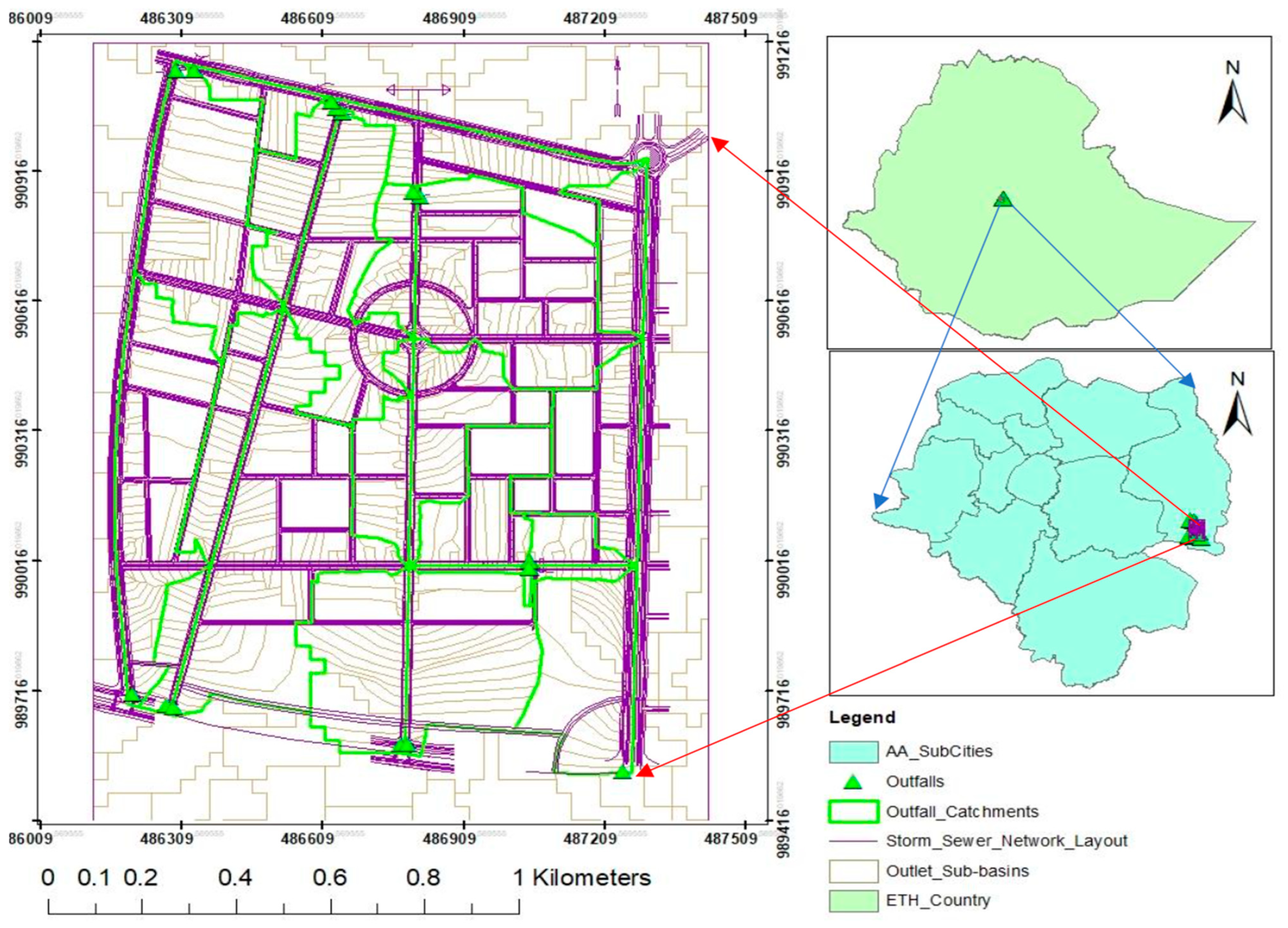
2.1. Case Study Overview
2.2. SWMM Model Configuration
Model Calibration and Validation
2.3. Data Processing
2.3.1. Data Collection
2.3.2. Bias Correction
2.3.3. Disaggregation
2.3.4. Scenario Development
2.4. Green Stormwater Infrastructure (GSI) Integration
3. Results and Discussion
3.1. Preliminary Data Processing Results
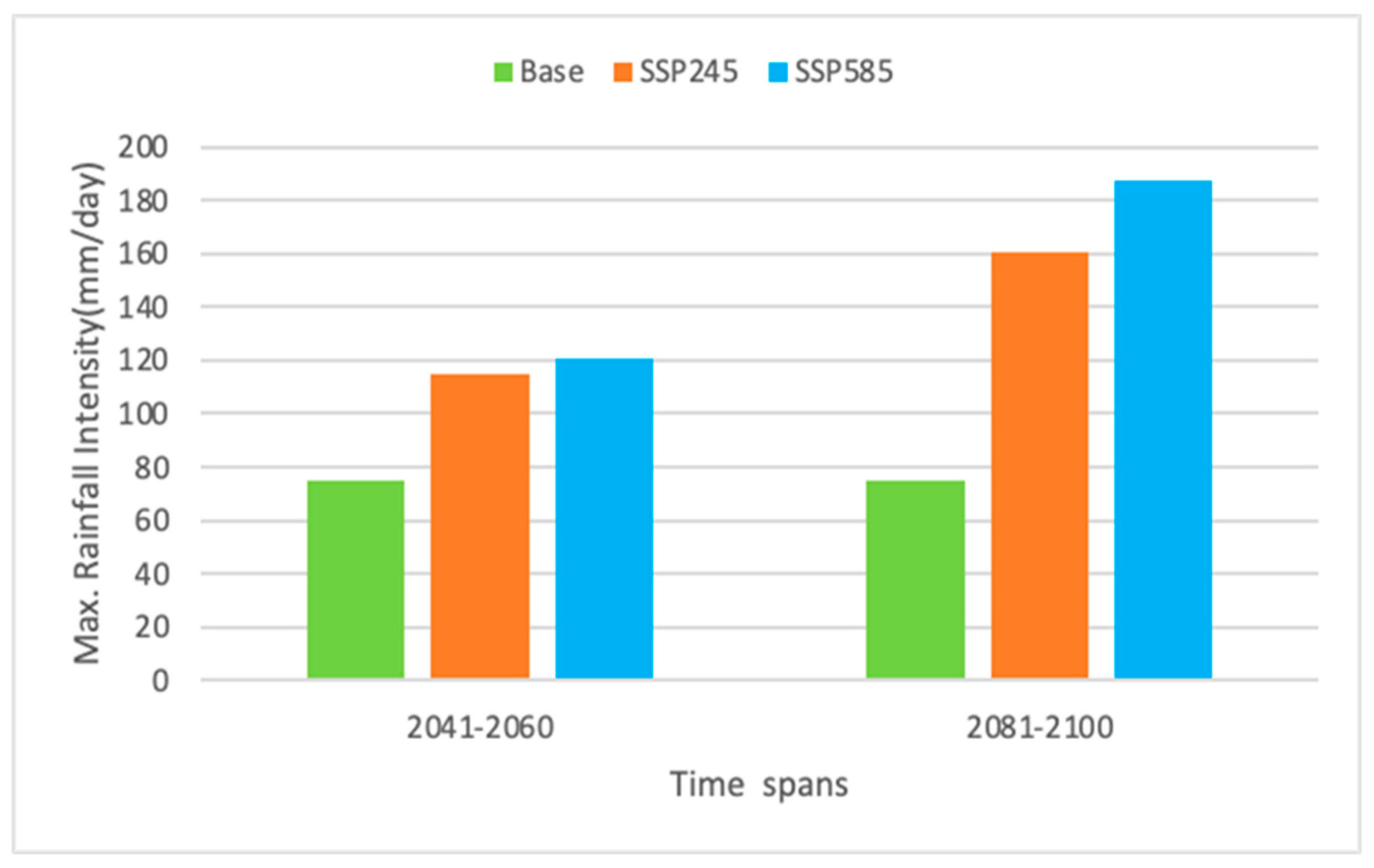
3.1.1. Rainfall Characteristics
3.1.2. SWMM Calibration and Validation Results
3.1.3. Baseline Scenario
3.2. Mid-Century (2041–2060) Projection Scenario
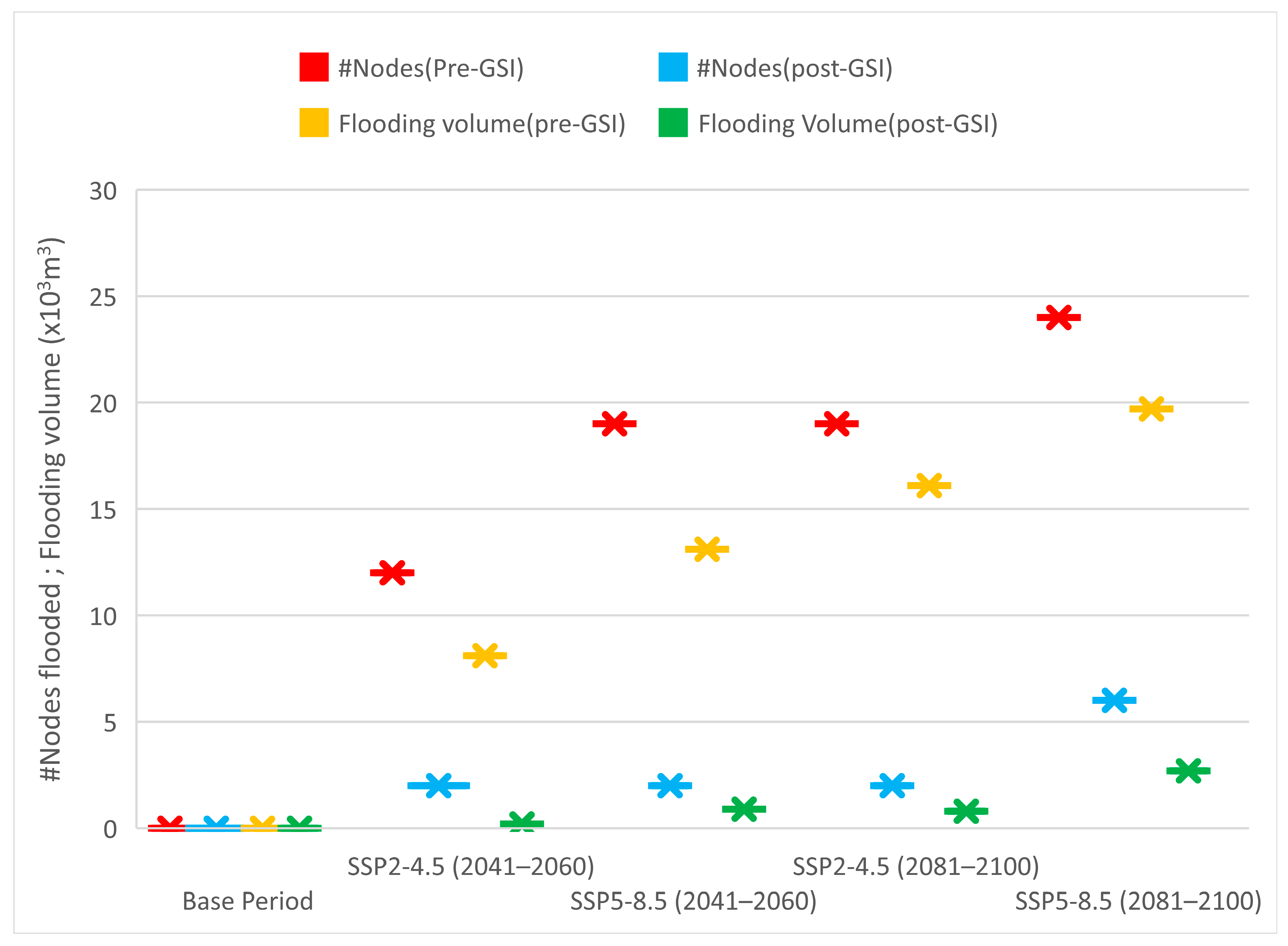
3.2.1. Pre-GSI-Integration Scenario for Mid-Century
3.2.2. Post-GSI-Integration Scenario for Mid-Century
3.3. Late-Century (2081–2100) Projection Scenario
3.3.1. Pre-GSI-Integration Scenario for Late-Century
3.3.2. Post-GSI-Integration Scenario for Late-Century
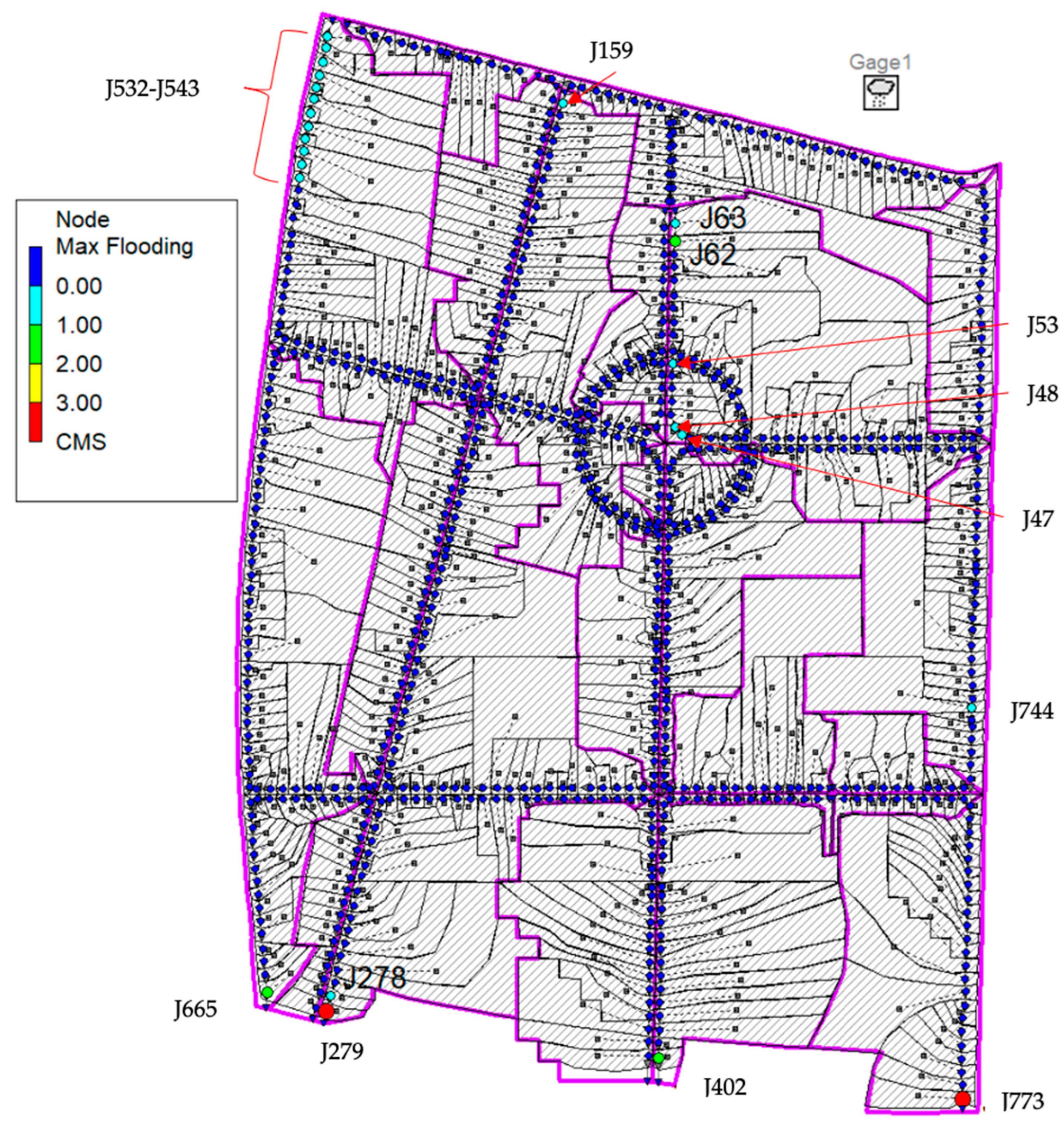
3.4. Identification of Critical Spots
3.5. Limitations and Future Research Directions
4. Conclusions
Author Contributions
Funding
Data Availability Statement
Acknowledgments
Conflicts of Interest
References
- Tradowsky, J.S.; Philip, S.Y.; Kreienkamp, F.; Kew, S.F.; Lorenz, P.; Arrighi, J.; Bettmann, T.; Caluwaerts, S.; Chan, S.C.; De Cruz, L. Attribution of the Heavy Rainfall Events Leading to Severe Flooding in Western Europe during July 2021. Clim. Change 2023, 176, 90. [Google Scholar] [CrossRef]
- Muleta, T.N.; Knolmar, M. Ecological Impacts of Combined Sewer Overflows on Receiving Waters. Discov. Water 2025, 5, 24. [Google Scholar] [CrossRef]
- Ahiablame, L.; Shakya, R. Modeling Flood Reduction Effects of Low Impact Development at a Watershed Scale. J. Environ. Manag. 2016, 171, 81–91. [Google Scholar] [CrossRef]
- Ayoublu, S.A.; Vafakhah, M.; Pourghasemi, H.R. Efficiency Evaluation of Low Impact Development Practices on Urban Flood Risk. J. Environ. Manag. 2024, 356, 120467. [Google Scholar] [CrossRef]
- Macedo, M.B.d.; Oliveira, T.R.P.d.; Oliveira, T.H.; Junior, M.N.G.; Brasil, J.A.T.; Lago, C.A.F.d.; Mendiondo, E.M. Evaluating Low Impact Development Practices Potentials for Increasing Flood Resilience and Stormwater Reuse through Lab-Controlled Bioretention Systems. Water Sci. Technol. 2021, 84, 1103–1124. [Google Scholar] [CrossRef]
- Santos, M.F.N.d.; Barbassa, A.P.; Vasconcelos, A.F.; Ometto, A.R. Stormwater Management for Highly Urbanized Areas in the Tropics: Life Cycle Assessment of Low Impact Development Practices. J. Hydrol. 2021, 598, 126409. [Google Scholar] [CrossRef]
- Jemberie, M.A.; Melesse, A.M. Urban Flood Management through Urban Land Use Optimization Using Lid Techniques, City of Addis Ababa, Ethiopia. Water 2021, 13, 1721. [Google Scholar] [CrossRef]
- Neupane, B.; Vu, T.M.; Mishra, A.K. Evaluation of Land-Use, Climate Change, and Low-Impact Development Practices on Urban Flooding. Hydrol. Sci. J. 2021, 66, 1729–1742. [Google Scholar] [CrossRef]
- Sun, Y.W.; Li, Q.Y.; Liu, L.; Xu, C.D.; Liu, Z.P. Hydrological Simulation Approaches for BMPs and LID Practices in Highly Urbanized Area and Development of Hydrological Performance Indicator System. Water Sci. Eng. 2014, 7, 143–154. [Google Scholar]
- Ding, X.; Liao, W.; Lei, X.; Wang, H.; Yang, J.; Wang, H. Assessment of the Impact of Climate Change on Urban Flooding: A Case Study of Beijing, China. J. Water Clim. Change 2022, 13, 3692–3715. [Google Scholar] [CrossRef]
- Kumar, S.; Agarwal, A.; Ganapathy, A.; Villuri, V.G.K.; Pasupuleti, S.; Kumar, D.; Kaushal, D.R.; Gosain, A.K.; Sivakumar, B. Impact of Climate Change on Stormwater Drainage in Urban Areas. Stoch. Environ. Res. Risk Assess. 2022, 36, 77–96. [Google Scholar] [CrossRef]
- Sharma, S.; Kumar, S.; Singh, A. Assessment of Green Infrastructure for Sustainable Urban Water Management. Environ. Dev. Sustain. 2023. [Google Scholar] [CrossRef]
- Muleta, T.N. Climate Change Scenario Analysis for Baro-Akobo River Basin, Southwestern Ethiopia. Environ. Syst. Res. 2021, 10, 24. [Google Scholar] [CrossRef]
- Junqueira, J.R.; Serrao-Neumann, S.; White, I. Using Green Infrastructure as a Social Equity Approach to Reduce Flood Risks and Address Climate Change Impacts: A Comparison of Performance between Cities and Towns. Cities 2022, 131, 104051. [Google Scholar] [CrossRef]
- Tirpak, R.A.; Hathaway, J.M.; Khojandi, A.; Weathers, M.; Epps, T.H. Building Resiliency to Climate Change Uncertainty through Bioretention Design Modifications. J. Environ. Manag. 2021, 287, 112300. [Google Scholar] [CrossRef]
- Bibi, T.S.; Kara, K.G. Evaluation of Climate Change, Urbanization, and Low-Impact Development Practices on Urban Flooding. Heliyon 2023, 9, e12955. [Google Scholar] [CrossRef]
- Shade, C.; Kremer, P.; Rockwell, J.S.; Henderson, K.G. The Effects of Urban Development and Current Green Infrastructure Policy on Future Climate Change Resilience. Ecol. Soc. 2020, 25, 37. [Google Scholar] [CrossRef]
- Bhusal, A.; Thakur, B.; Kalra, A.; Benjankar, R.; Shrestha, A. Evaluating the Effectiveness of Best Management Practices in Adapting the Impacts of Climate Change-Induced Urban Flooding. Atmosphere 2024, 15, 281. [Google Scholar] [CrossRef]
- McPhillips, L.E.; Matsler, M.; Rosenzweig, B.R.; Kim, Y. What Is the Role of Green Stormwater Infrastructure in Managing Extreme Precipitation Events? Sustain. Resilient Infrastruct. 2021, 6, 133–142. [Google Scholar] [CrossRef]
- Shen, C.; Xia, H.; Fu, X.; Wang, X.; Wang, W. Developing Green Infrastructure Strategies Based on the Analysis of Sewer System Critical Components. Water 2021, 13, 2694. [Google Scholar] [CrossRef]
- Zhang, Y.; Xu, H.; Liu, H.; Zhou, B. The Application of Low Impact Development Facility Chain on Storm Rainfall Control: A Case Study in Shenzhen, China. Water 2021, 13, 3375. [Google Scholar] [CrossRef]
- Wu, J.; Yang, R.; Song, J. Effectiveness of Low-Impact Development for Urban Inundation Risk Mitigation under Different Scenarios: A Case Study in Shenzhen, China. Nat. Hazards Earth Syst. Sci. 2018, 18, 2525–2536. [Google Scholar] [CrossRef]
- Bae, C.; Lee, D.K. Effects of Low-Impact Development Practices for Flood Events at the Catchment Scale in a Highly Developed Urban Area. Int. J. Disaster Risk Reduct. 2020, 44, 101412. [Google Scholar] [CrossRef]
- Knight, K.L.; Hou, G.; Bhaskar, A.S.; Chen, S. Assessing the Use of Dual-drainage Modeling to Determine the Effects of Green Stormwater Infrastructure on Roadway Flooding and Traffic Performance. Water 2021, 13, 1563. [Google Scholar] [CrossRef]
- Feyissa, G.; Zeleke, G.; Gebremariam, E.; Bewket, W. GIS Based Quantification and Mapping of Climate Change Vulnerability Hotspots in Addis Ababa. Geoenviron. Disasters 2018, 5, 14. [Google Scholar] [CrossRef]
- Beshir, A.A.; Song, J. Urbanization and Its Impact on Flood Hazard: The Case of Addis Ababa, Ethiopia. Nat. Hazards 2021, 109, 1167–1190. [Google Scholar] [CrossRef]
- Eshetu, S.B.; Yeshitela, K.; Sieber, S. Urban Green Space Planning, Policy Implementation, and Challenges: The Case of Addis Ababa. Sustainability 2021, 13, 11344. [Google Scholar] [CrossRef]
- Tietjen, B.; Jacobsen, K.; Hollander, J. Climate Change and Urban Migration in Sub-Saharan African Cities: Impacts and Governance Challenges. J. Clim. Resil. Justice 2023, 1, 20–32. [Google Scholar] [CrossRef]
- Rossman, L. Storm Water Management Model (SWMM) User’s Manual Version 5.2.1; United States Environmental Protection Agency: Washington, DC, USA, 2022.
- Berhanu, D.; Alamirew, T.; Taye, M.T.; Tibebe, D.; Gebrehiwot, S.; Zeleke, G. Evaluation of CMIP6 Models in Reproducing Observed Rainfall over Ethiopia. J. Water Clim. Change 2023, 14, 2583–2605. [Google Scholar] [CrossRef]
- Kim, Y.H.; Min, S.K.; Zhang, X.; Sillmann, J.; Sandstad, M. Evaluation of the CMIP6 Multi-Model Ensemble for Climate Extreme Indices. Weather Clim. Extrem. 2020, 29, 100269. [Google Scholar] [CrossRef]
- Thrasher, B.; Wang, W.; Michaelis, A.; Melton, F.; Lee, T.; Nemani, R. NASA Global Daily Downscaled Projections, CMIP6. Sci. Data 2022, 9, 262. [Google Scholar] [CrossRef]
- Tadese, M.T.; Kumar, L.; Koech, R. Climate Change Projections in the Awash River Basin of Ethiopia Using Global and Regional Climate Models. Int. J. Climatol. 2020, 40, 3649–3666. [Google Scholar] [CrossRef]
- Worku, G.; Teferi, E.; Bantider, A.; Dile, Y.T. Statistical Bias Correction of Regional Climate Model Simulations for Climate Change Projection in the Jemma Sub-Basin, Upper Blue Nile Basin of Ethiopia. Theor. Appl. Climatol. 2020, 139, 1569–1588. [Google Scholar] [CrossRef]
- Holthuijzen, M.; Beckage, B.; Clemins, P.J.; Higdon, D.; Winter, J.M. Robust Bias-Correction of Precipitation Extremes Using a Novel Hybrid Empirical Quantile-Mapping Method: Advantages of a Linear Correction for Extremes. Theor. Appl. Climatol. 2022, 149, 863–882. [Google Scholar] [CrossRef]
- Robertson, D.E.; Chiew, F.H.S.; Potter, N. Adapting Rainfall Bias-Corrections to Improve Hydrological Simulations Generated from Climate Model Forcings. J. Hydrol. 2023, 619, 129322. [Google Scholar] [CrossRef]
- Tong, Y.; Gao, X.; Han, Z.; Xu, Y.; Xu, Y.; Giorgi, F. Bias Correction of Temperature and Precipitation over China for RCM Simulations Using the QM and QDM Methods. Clim. Dyn. 2021, 57, 1425–1443. [Google Scholar] [CrossRef]
- Katiraie-Boroujerdy, P.S.; Naeini, M.R.; Asanjan, A.A.; Chavoshian, A.; Hsu, K.l.; Sorooshian, S. Bias Correction of Satellite-Based Precipitation Estimations Using Quantile Mapping Approach in Different Climate Regions of Iran. Remote Sens. 2020, 12, 2102. [Google Scholar] [CrossRef]
- Seo, G.Y.; Ahn, J.B. Comparison of Bias Correction Methods for Summertime Daily Rainfall in South Korea Using Quantile Mapping and Machine Learning Model. Atmosphere 2023, 14, 1057. [Google Scholar] [CrossRef]
- Dodangeh, E.; Shahedi, K.; Solaimani, K.; Kossieris, P. Usability of the BLRP Model for Hydrological Applications in Arid and Semi-Arid Regions with Limited Precipitation Data. Model. Earth Syst. Environ. 2017, 3, 539–555. [Google Scholar] [CrossRef]
- Islam, M.A.; Yu, B.; Cartwright, N. Bartlett–Lewis Model Calibrated with Satellite-Derived Precipitation Data to Estimate Daily Peak 15 Min Rainfall Intensity. Atmosphere 2023, 14, 985. [Google Scholar] [CrossRef]
- Kossieris, P.; Makropoulos, C.; Onof, C.; Koutsoyiannis, D. A Rainfall Disaggregation Scheme for Sub-Hourly Time Scales: Coupling a Bartlett-Lewis Based Model with Adjusting Procedures. J. Hydrol. 2018, 556, 980–992. [Google Scholar] [CrossRef]
- Harisaweni; Yusop, Z.; Yusof, F. The Use of BLRP Model for Disaggregating Daily Rainfall Affected by Monsoon in Peninsular Malaysia. Sains Malays. 2016, 45, 87–97. [Google Scholar]
- Kriegler, E.; Edmonds, J.; Hallegatte, S.; Ebi, K.L.; Kram, T.; Riahi, K.; Winkler, H.; Vuuren, D.P.v. A New Scenario Framework for Climate Change Research: The Concept of Shared Climate Policy Assumptions. Clim. Change 2014, 122, 401–414. [Google Scholar] [CrossRef]
- O’Neill, B.C.; Kriegler, E.; Ebi, K.L.; Kemp-Benedict, E.; Riahi, K.; Rothman, D.S.; Ruijven, B.J.v.; Vuuren, D.P.v.; Birkmann, J.; Kok, K.; et al. The Roads Ahead: Narratives for Shared Socioeconomic Pathways Describing World Futures in the 21st Century. Glob. Environ. Change 2017, 42, 169–180. [Google Scholar] [CrossRef]
- Riahi, K.; Vuuren, D.P.v.; Kriegler, E.; Edmonds, J.; O’Neill, B.C.; Fujimori, S.; Bauer, N.; Calvin, K.; Dellink, R.; Fricko, O.; et al. The Shared Socioeconomic Pathways and Their Energy, Land Use, and Greenhouse Gas Emissions Implications: An Overview. Glob. Environ. Change 2017, 42, 153–168. [Google Scholar] [CrossRef]
- Rohat, G.; Flacke, J.; Dao, H. Application of the New Scenario Framework for Climate Change Research: Future Social Vulnerability in Large Urban Areas. EGU Gen. Assem. 2016, 18, EGU2016-13323. [Google Scholar]
- Fricko, O.; Havlik, P.; Rogelj, J.; Klimont, Z.; Gusti, M.; Johnson, N.; Kolp, P.; Strubegger, M.; Valin, H.; Amann, M.; et al. The Marker Quantification of the Shared Socioeconomic Pathway 2: A Middle-of-the-Road Scenario for the 21st Century. Glob. Environ. Change 2017, 42, 251–267. [Google Scholar] [CrossRef]
- Carvalho, D.; Rafael, S.; Monteiro, A.; Rodrigues, V.; Lopes, M.; Rocha, A. How Well Have CMIP3, CMIP5 and CMIP6 Future Climate Projections Portrayed the Recently Observed Warming. Sci. Rep. 2022, 12, 11983. [Google Scholar] [CrossRef]
- Rodriguez, M.; Fu, G.; Butler, D.; Yuan, Z.; Sharma, K. Exploring the Spatial Impact of Green Infrastructure on Urban Drainage Resilience. Water 2021, 13, 1789. [Google Scholar] [CrossRef]
- World Urbanization Prospects: The 2018 Revision; United Nations: New York, NY, USA, 2019.
- Lee, H.; Song, K.; Kim, G.W.; Chon, J. Flood-Adaptive Green Infrastructure Planning for Urban Resilience. Landsc. Ecol. Eng. 2021, 17, 427–437. [Google Scholar] [CrossRef]
- Chapman, C.; Horner, R.R. Performance Assessment of a Street-Drainage Bioretention System. Water Environ. Res. 2010, 82, 109–119. [Google Scholar] [CrossRef]
- Mehri, M.; Shahdany, S.M.H.; Javadi, S.; Movahedinia, M.; Berndtsson, R. Block-Scale Use of Bioretention Cells to Restore the Urban Water Balance: A Case Study in Tehran Metropolis. J. Hydrol. Reg. Stud. 2024, 51, 101621. [Google Scholar] [CrossRef]
- Rodriguez, M.; Fu, G.; Butler, D.; Yuan, Z.; Cook, L. The Effect of Green Infrastructure on Resilience Performance in Combined Sewer Systems under Climate Change. J. Environ. Manag. 2024, 353, 120229. [Google Scholar] [CrossRef]
- Zhang, L.; Ye, Z.; Shibata, S. Assessment of Rain Garden Effects for the Management of Urban Storm Runoff in Japan. Sustainability 2020, 12, 9982. [Google Scholar] [CrossRef]



| Category of Previous Literature | Major Limitation of Previous Studies Observed | Modification by Current Study | Remark |
|---|---|---|---|
| 1. e.g.: [1,9,10] | Lack of necessary finer resolution | Based on 15 min temporal resolution | Effective stormwater system simulation needs sub-hourly resolution |
| 2. e.g.: [5,8,16,17] | Based on SRES or RCP, which do not explicitly include socio-economic development pathways | Based on combined SSP and radiative forcing scenarios | SSP–radiative forcing complement better represents realistic future scenarios |
| 3. e.g.: [18,19,20,21] | Applied event-based simulation, less capture of climate variability | Applied continuous simulations | Continuous simulation is more effective for sustainable GSI performance analysis |
| 4. e.g.: [23,24] | Based solely on historical data | Projected future climate scenarios | Systems based on historical data are vulnerable under future climate conditions |
| Layer | Parameter | Unit | Value (BRC) | Value (RG) |
|---|---|---|---|---|
| Surface | Berm Height | mm | 400 | 300 |
| Vegetation Volume Fraction | (-) | 0.2 | 0.2 | |
| Surface Roughness | (-) | 0.4 | 0.4 | |
| Surface Slope | % | 0.1 | 0.1 | |
| Soil | Thickness | mm | 600 | 600 |
| Porosity | (-) | 0.5 | 0.5 | |
| Field Capacity | (-) | 0.2 | 0.2 | |
| Wilting Point | (-) | 0.1 | 0.1 | |
| Conductivity | mm/h | 11 | 11 | |
| Conductivity Slope | (-) | 40 | 40 | |
| Suction Head | mm | 110 | 110 | |
| Storage | Thickness | mm | 400 | (-) |
| Void ratio | (-) | 0.65 | (-) | |
| Seepage Rate | mm/h | 0.5 | 0.5 | |
| Clogging Factor | (-) | 0 | (-) | |
| Drain | Flow Coefficient | (-) | 2 | (-) |
| Flow Exponent | mm/h | 0.5 | (-) | |
| Offset | mm | 300 | (-) | |
| Open Level | mm | 0 | (-) | |
| Closed Level | mm | 0 | (-) | |
| Control Curve | (-) | (-) | (-) |
| Index | SSP2-4.5 | SSP5-8.5 | ||||
|---|---|---|---|---|---|---|
| Pre-GSI | Post-GSI | %Change | Pre-GSI | Post-GSI | %Change | |
| Number of nodes flooded | 12 | 2 | 83.3 | 19 | 2 | 89.5 |
| Total flooding volume (×103 m3) | 8.1 | 0.2 | 97.5 | 13.3 | 0.9 | 93.2 |
| Max. node flooding rate (m3/s) | 2.7 | 0.4 | 85.2 | 3.6 | 1.0 | 72.2 |
| Flooding duration (h) | 1.3 | 0.2 | 84.6 | 2.8 | 0.3 | 89.3 |
| Number of pipes surcharged | 12 | 2 | 83.3 | 19 | 2 | 89.5 |
| Max. surcharging duration (h) | 1.3 | 0.2 | 84.6 | 2.8 | 0.3 | 89.3 |
| Index | SSP2-4.5 | SSP5-8.5 | ||||
|---|---|---|---|---|---|---|
| Pre-GSI | Post-GSI | %Change | Pre-GSI | Post-GSI | %Change | |
| Number of nodes flooded | 19 | 2 | 89.5 | 24 | 6 | 75.0 |
| Total flooding volume (×103 m3) | 16.1 | 0.8 | 95.0 | 19.7 | 2.7 | 86.3 |
| Max. node flooding rate (m3/s) | 3.6 | 0.8 | 77.8 | 3.8 | 1.6 | 57.9 |
| Flooding duration (h) | 3.7 | 0.8 | 78.4 | 6.4 | 0.9 | 85.9 |
| Number of pipes surcharged | 19 | 2 | 89.5 | 24 | 6 | 75.0 |
| Max. surcharging duration (h) | 3.7 | 0.8 | 78.4 | 6.4 | 0.9 | 85.9 |
Disclaimer/Publisher’s Note: The statements, opinions and data contained in all publications are solely those of the individual author(s) and contributor(s) and not of MDPI and/or the editor(s). MDPI and/or the editor(s) disclaim responsibility for any injury to people or property resulting from any ideas, methods, instructions or products referred to in the content. |
© 2025 by the authors. Licensee MDPI, Basel, Switzerland. This article is an open access article distributed under the terms and conditions of the Creative Commons Attribution (CC BY) license (https://creativecommons.org/licenses/by/4.0/).
Share and Cite
Muleta, T.N.; Knolmar, M. Green Stormwater Infrastructure (GSI) Performance Assessment for Climate Change Resilience in Storm Sewer Network. Water 2025, 17, 2510. https://doi.org/10.3390/w17172510
Muleta TN, Knolmar M. Green Stormwater Infrastructure (GSI) Performance Assessment for Climate Change Resilience in Storm Sewer Network. Water. 2025; 17(17):2510. https://doi.org/10.3390/w17172510
Chicago/Turabian StyleMuleta, Teressa Negassa, and Marcell Knolmar. 2025. "Green Stormwater Infrastructure (GSI) Performance Assessment for Climate Change Resilience in Storm Sewer Network" Water 17, no. 17: 2510. https://doi.org/10.3390/w17172510
APA StyleMuleta, T. N., & Knolmar, M. (2025). Green Stormwater Infrastructure (GSI) Performance Assessment for Climate Change Resilience in Storm Sewer Network. Water, 17(17), 2510. https://doi.org/10.3390/w17172510