Article

The Water Footprint of Pastoral Dairy Farming: The Effect of Water Footprint Methods, Data Sources and Spatial Scale †

School of Agriculture and Environment, Massey University, Palmerston North 4442, New Zealand
*
Author to whom correspondence should be addressed.
OECD disclaimer: The opinions expressed and arguments employed in this publication are the sole responsibility of the authors and do not necessarily reflect those of the OECD or of the governments of its member countries.
Water 2024, 16(3), 391; https://doi.org/10.3390/w16030391
Submission received: 23 December 2023 / Revised: 15 January 2024 / Accepted: 19 January 2024 / Published: 24 January 2024

Abstract

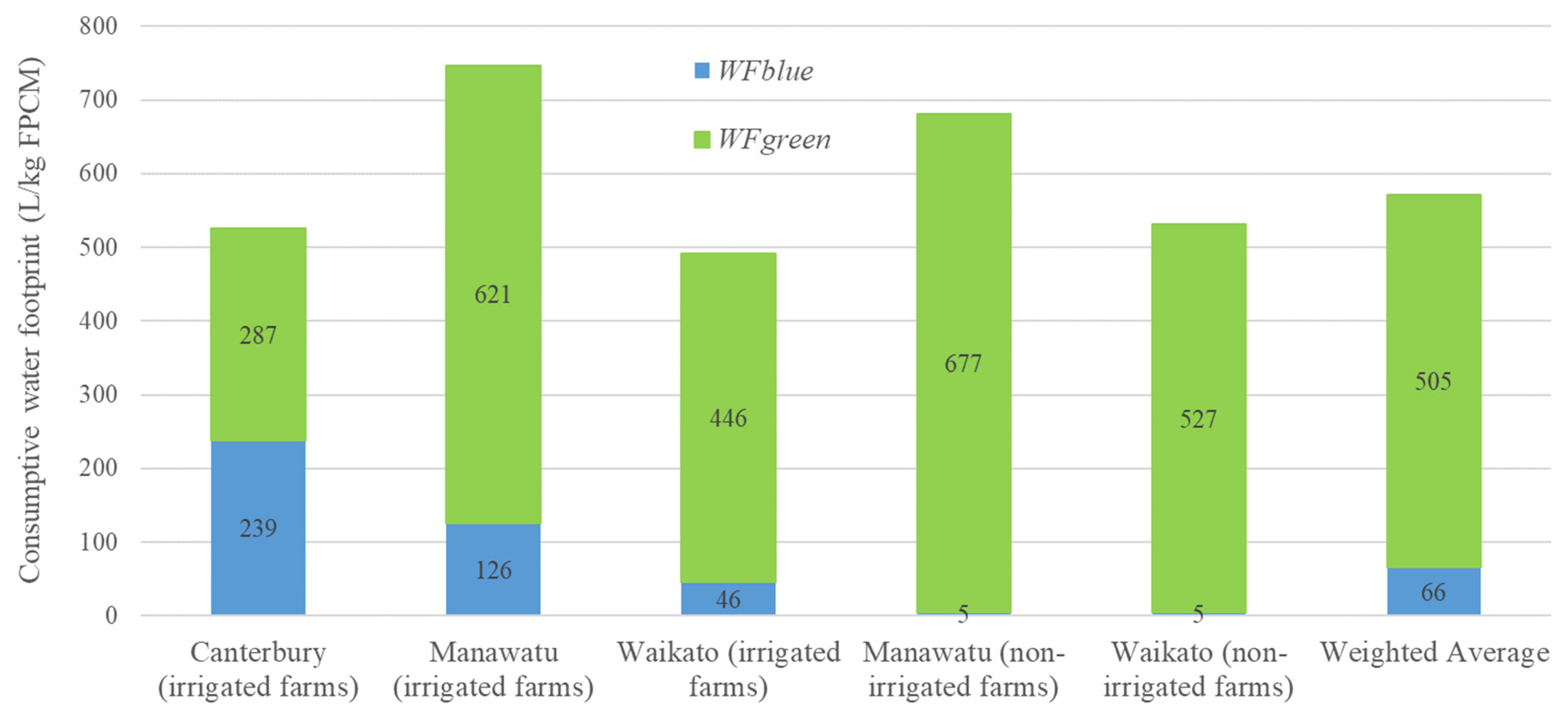
The water footprint of pastoral dairy milk production was assessed by analysing water use at 28 irrigated and 60 non-irrigated ‘rain-fed’ pastoral dairy farms in three regions of New Zealand. Two water footprint methods, the WFN-based blue water footprint impact index (WFIIblue) and the Available WAter REmaining (AWARE) water scarcity footprint (WFAWARE), were evaluated using different sets of global or local data sources, different rates of environmental flow requirements, and the regional or catchment scale of the analysis. A majority (~99%) of the consumptive water footprint of a unit of pastoral dairy milk production (L/kg of fat- and protein-corrected milk) was quantified as being associated with green and blue water consumption via evapotranspiration for pasture and feed used at the studied dairy farms. The quantified WFIIblue (-) and WFAWARE (m3 world eq./kg of FPCM) indices ranked in a similar order (from lowest to highest) regarding the water scarcity footprint impact associated with pastoral dairy milk production across the study regions and catchments. However, use of the global or local data sets significantly affected the quantification and comparative rankings of the WFIIblue and WFAWARE values. Compared to the local data sets, using the global data sets resulted in significant under- or overestimation of the WFIIblue and WFAWARE values across the study regions and catchments. A catchment-scale analysis using locally available data sets and calibrated models is recommended to robustly assess water consumption and its associated water scarcity impact due to pastoral dairy milk production in local catchments.
Keywords: agriculture; livestock farming; dairy milk production; dairy water use; sustainable development; water footprint; water scarcity agriculture; livestock farming; dairy milk production; dairy water use; sustainable development; water footprint; water scarcity