Review

Disentangling Effects of Natural Factors and Human Disturbances on Aquatic Systems—Needs and Approaches

1
International Joint Commission, P.O. Box 32869, Detroit, MI 48232, USA
2
Institute for Fisheries Research, University of Michigan, Ann Arbor, MI 48109, USA
3
Natural History Survey, University of Illinois, Champaign, IL 61820, USA
4
Department of Fisheries and Wildlife, Michigan State University, East Lansing, MI 48824, USA
*
Author to whom correspondence should be addressed.
Water 2023, 15(7), 1387; https://doi.org/10.3390/w15071387
Submission received: 4 March 2023 / Revised: 25 March 2023 / Accepted: 1 April 2023 / Published: 3 April 2023

Abstract

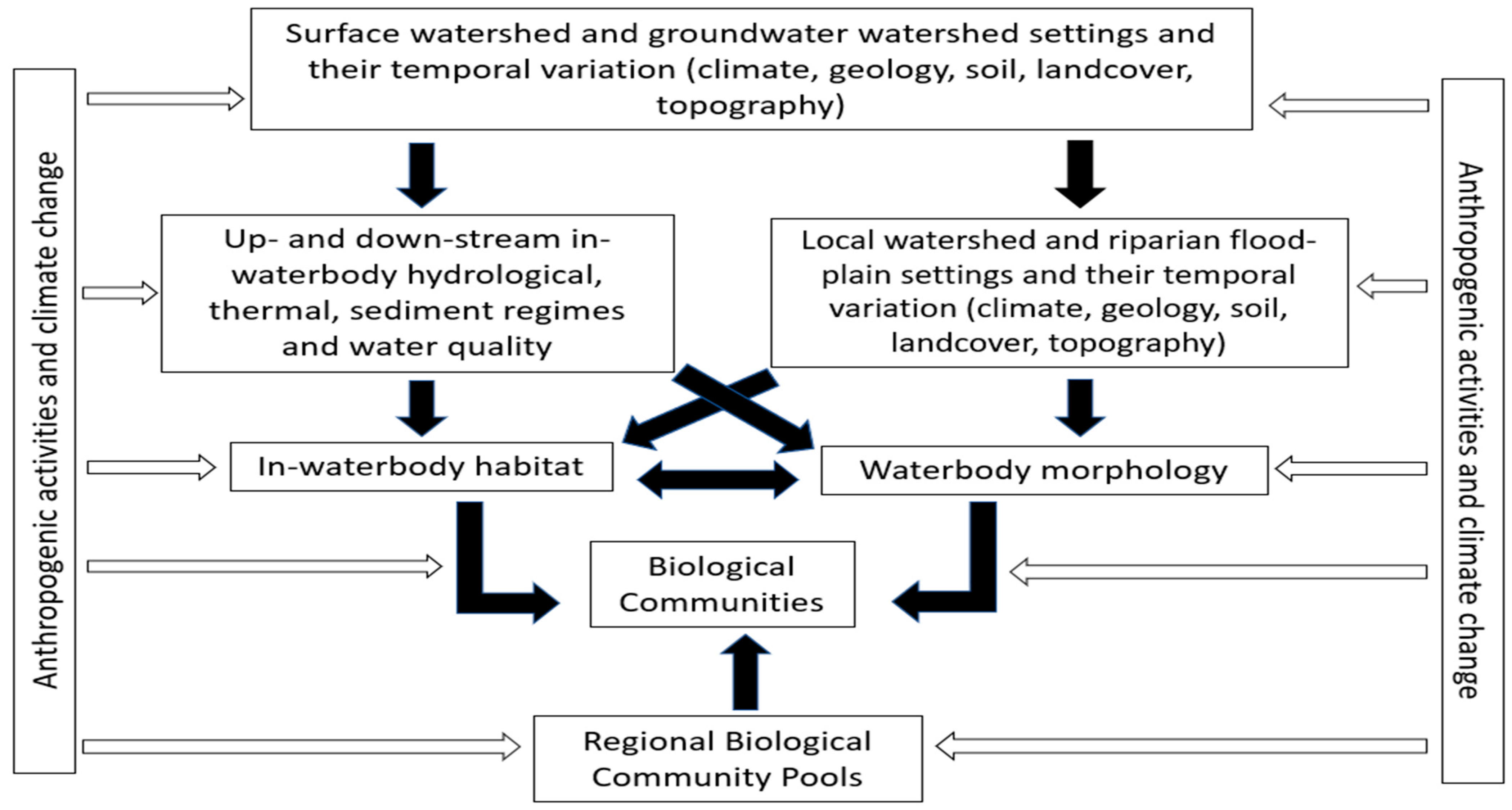
Disentangling the effects of natural factors and human disturbances on freshwater systems is essential for understanding the distributions and composition of biological communities and their relationship with physicochemical and biological factors. As the spatial extent of ecological investigations increases from local to global scales, efforts to account for the increasing influence of natural factors become more important. This article synthesizes the current knowledge and commonly used approaches for disentangling these effects on aquatic systems. New understanding has been facilitated by the availability of large-scale geospatial landscape databases that facilitate regional analyses and classifications in conjunction with novel approaches to identify reference conditions and statistical partitioning analyses. This synthesis begins with a summary of how natural factors and human disturbances interactively affect aquatic systems. It then provides an overview of why it is essential to separate the effects of natural factors and human disturbances and a description of examples of landscape databases that make the separation of natural and human factors feasible. It last synthesizes currently-used common approaches for separating the effects of natural factors from human disturbances. Our synthesis assembles representative approaches to disentangling human disturbances in one place to provide new insights that stimulate integrated uses of multiple approaches and the development of new approaches so that management actions can be taken to protect and restore aquatic ecosystem health.
Keywords: aquatic system; human disturbance; natural factor; bioassessment; landscape; disentangling aquatic system; human disturbance; natural factor; bioassessment; landscape; disentangling