



Modelling Transport and Fate of Copper and Nickel across the South Saskatchewan River Using WASP—TOXI

 , ,
, ,  and
and 
Abstract
1. Introduction
2. Materials and Methods
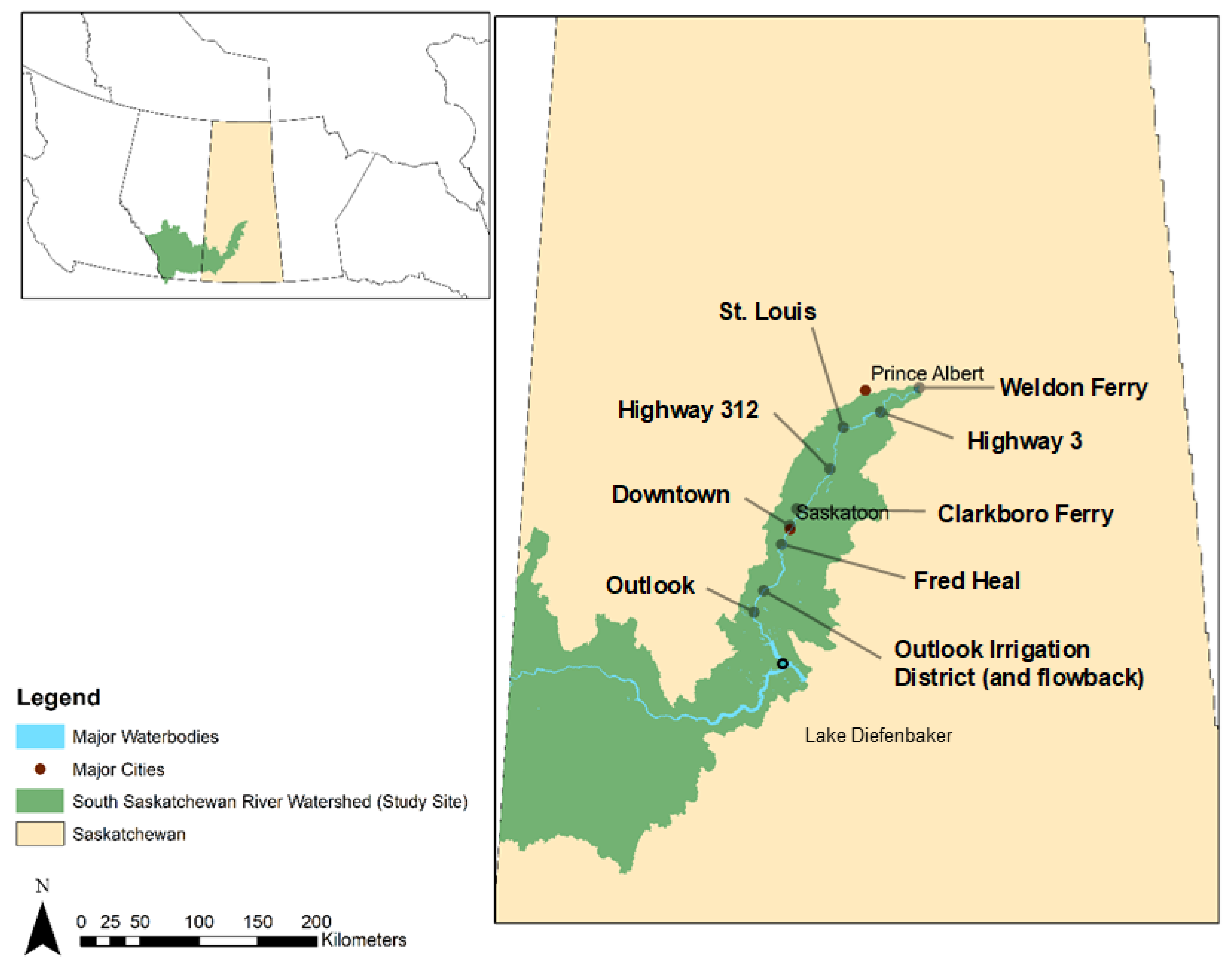
2.1. Study Site
2.2. Modelling Approach
2.3. Setup for Water Quality Modelling
2.4. Kinematic Wave
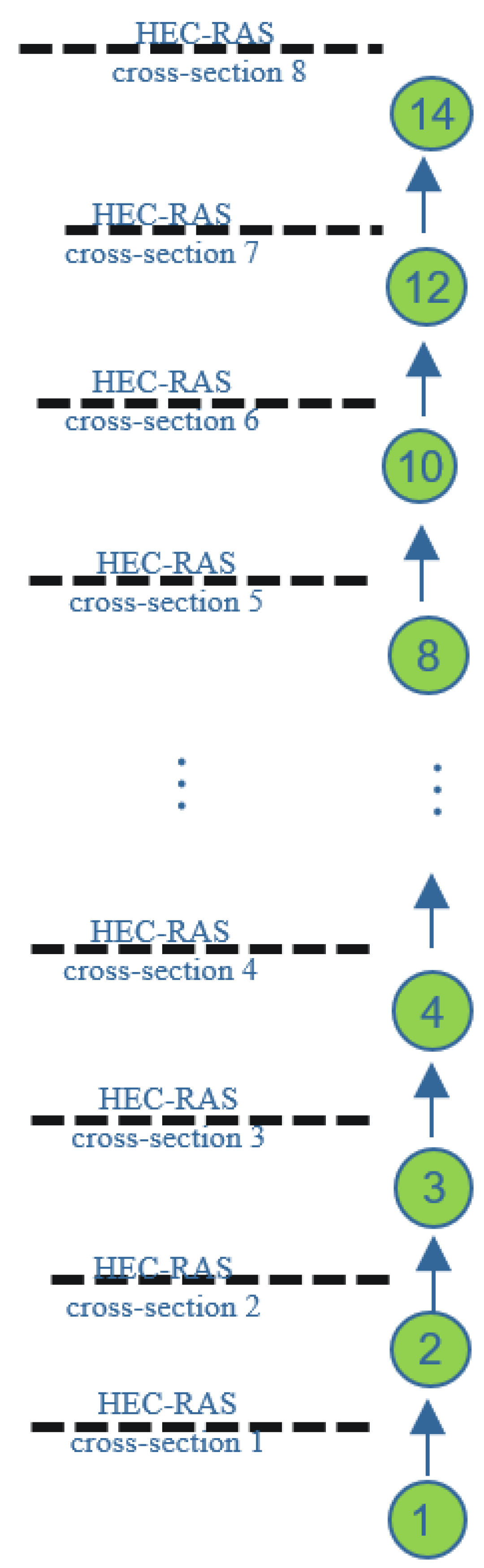
2.5. Discretization
2.6. Visualization, Calibration, and Validation
3. Results
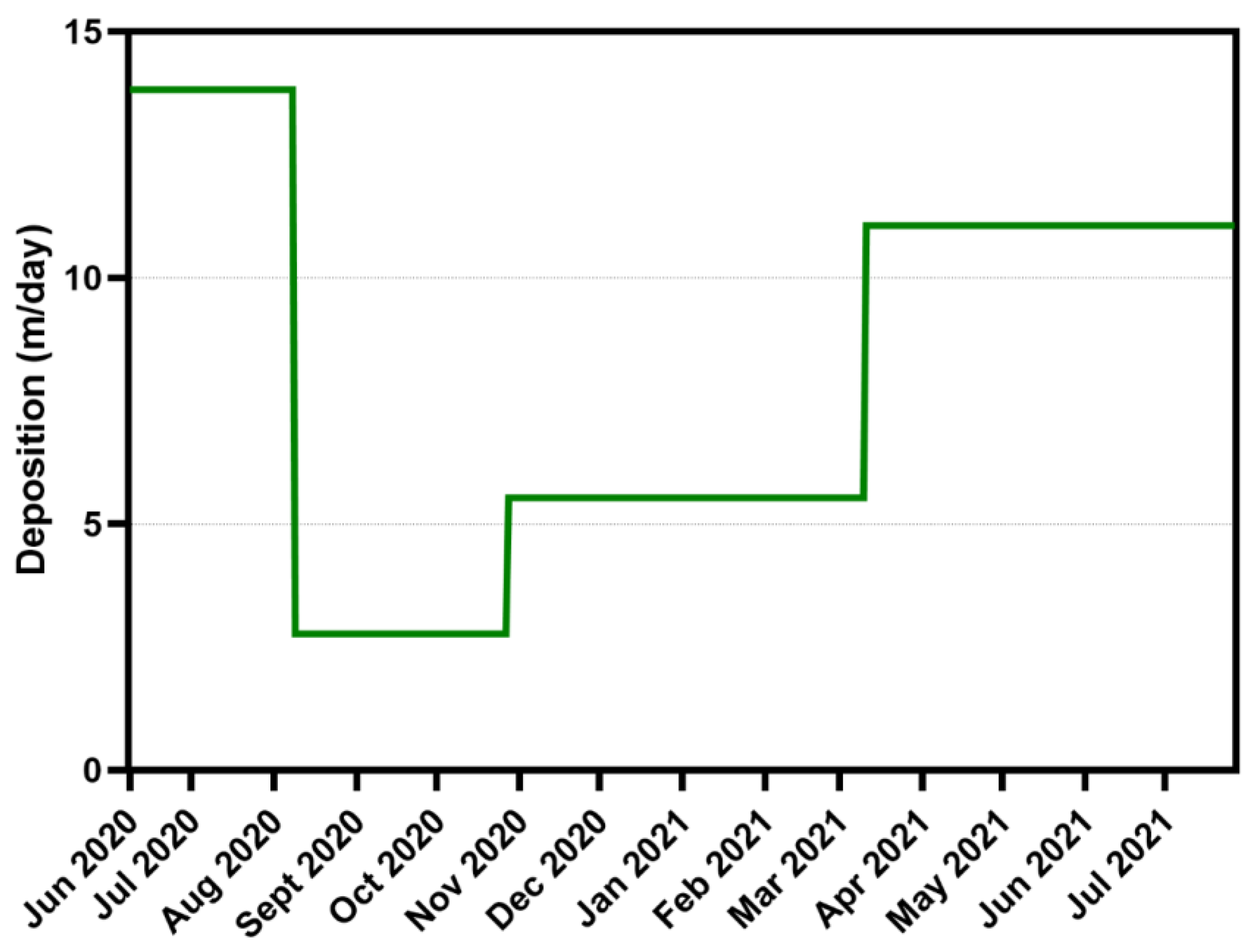
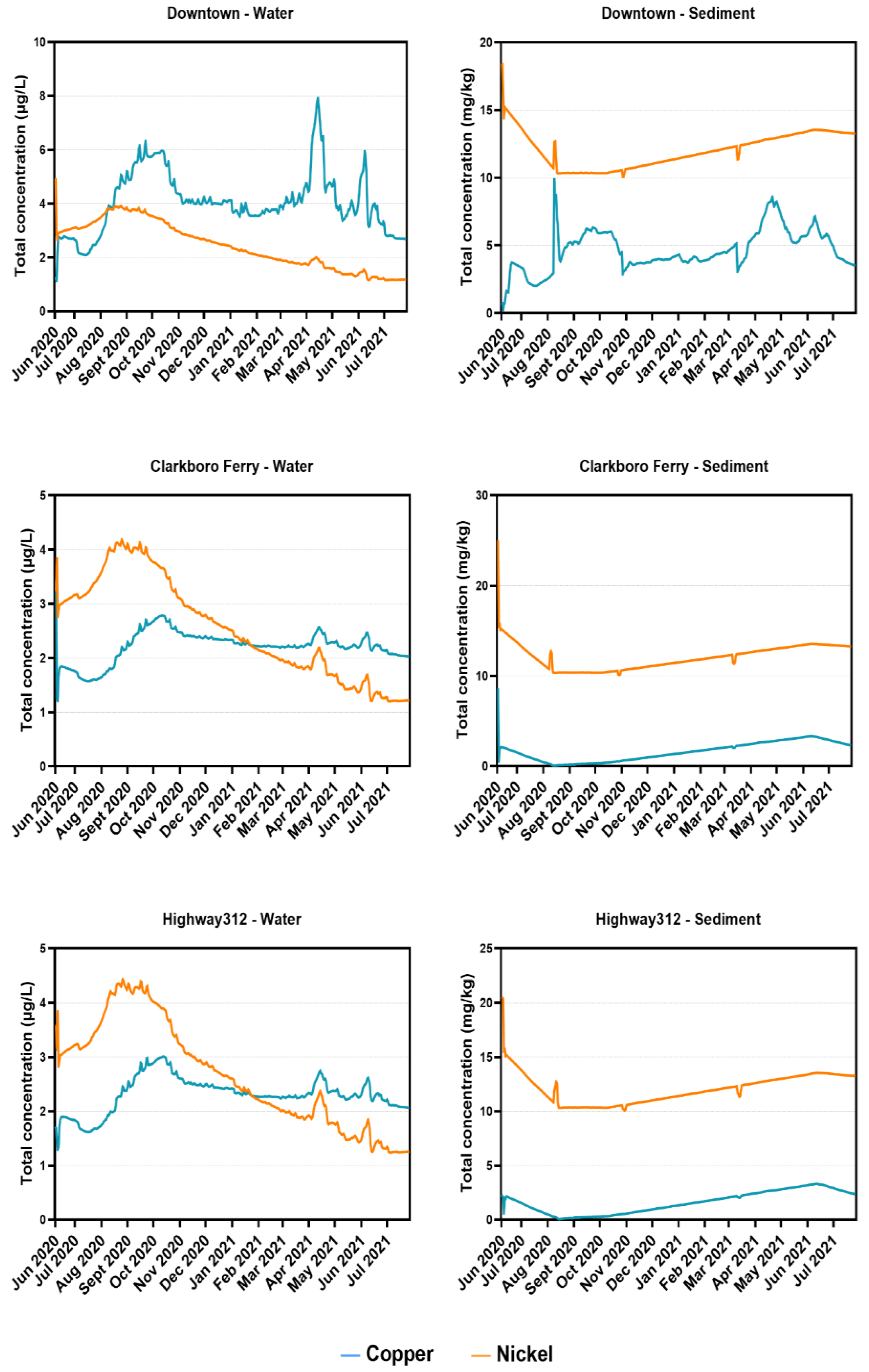
3.1. Deposition Rates and Overall Concentration Trends
3.2. Copper
3.3. Nickel
4. Discussion
5. Conclusions
Supplementary Materials
Author Contributions
Funding
Data Availability Statement
Conflicts of Interest
References
- Tonkin, J.W.; Balistrieri, L.S.; Murray, J.W. Modeling sorption of divalent metal cations on hydrous manganese oxide using the diffuse double layer model. Appl. Geochem. 2004, 19, 29–53. Available online: http://pubs.er.usgs.gov/publication/70027390 (accessed on 18 October 2022). [CrossRef] [Scilit]
- ATSDR. Toxicological Profile for Copper. Public Health 2004. Volume 314. Available online: https://www.atsdr.cdc.gov/ToxProfiles/tp132.pdf%0Ahttps://stacks.cdc.gov/view/cdc/7006 (accessed on 18 October 2022).
- Food, T. Copper in Drinking Water; National Research Council: Rockville, MD, USA, 2000. [Google Scholar]
- Ellingsen, D.; Horn, N.; Aaseth, J. Chapter 26—Essential metals: Assessing risks from deficiency and toxicity. In Handbook on the Toxicology of Metals, 3rd ed.; Academic Press: Cambridge, MA, USA, 2007; pp. 163–176. [Google Scholar]
- WHO. WHO Guidelines for Drinking-Water Quality; Eisei kagaku; WHO: Geneva, Switzerland, 1998; Volume 35, pp. 307–312.
- Georgopoulos, P.G.; Roy, A.; Yonone-Lioy, M.J.; Opiekun, R.E.; Lioy, P.J. Environmental copper: Its dynamics and human exposure issues. J. Toxicol. Environ. Health B Crit. Rev. 2001, 4, 341–394. [Google Scholar] [CrossRef] [Scilit] [PubMed]
- Gaetke, L.M.; Chow-Johnson, H.S.; Chow, C.K. Copper: Toxicological relevance and mechanisms. Arch. Toxicol. 2014, 88, 1929–1938. [Google Scholar] [CrossRef] [Scilit] [PubMed]
- Health Canada. Copper Pesticides; Health Canada: Ottawa, ON, Canada, 2009.
- Cuppett, J.D.; Duncan, S.E.; Dietrich, A.M. Evaluation of copper speciation and water quality factors that affect aqueous copper tasting response. Chem. Senses 2006, 31, 689–697. [Google Scholar] [CrossRef] [Scilit]
- Pagenkopf, G.K.; Russo, R.C.; Thurston, R.V. Effect of complexation on toxicity of copper to fishes. J. Fish. Res. Board. Can. 1974, 31, 462–465. [Google Scholar] [CrossRef] [Scilit]
- Santore, R.C.; Di Toro, D.M.; Paquin, P.R.; Allen, H.E.; Meyer, J.S. Biotic ligand model of the acute toxicity of metals. 2. Application to acute copper toxicity in freshwater fish and Daphnia. Environ. Toxicol. Chem. 2001, 20, 2397–2402. [Google Scholar] [CrossRef] [Scilit] [PubMed]
- Cempel, M.; Nikel, G. Nickel: A review of its sources and environmental toxicology. Pol. J. Environ. Stud. 2006, 15, 375–382. [Google Scholar]
- IPCS. Environmental Health Criteria; Environ Heal Criteria: Geneva, Switzerland, 1991; Volume 204. [Google Scholar]
- Havas, M.; Hutchinson, T.C. The Smoking Hills: Natural acidification of an aquatic ecosystem. Nature 1983, 301, 23–27. [Google Scholar] [CrossRef] [Scilit]
- Environment Canada. National Pollutant Release Inventory. 2007. Available online: https://www.canada.ca/en/services/environment/pollution-waste-management/national-pollutant-release-inventory.html (accessed on 24 October 2022).
- Callahan, M.A. Water Related Environmental Fate of 129 Priority Pollutants; USEPA: Washington, DC, USA, 1979; I:43-1-43–10.
- Coogan, T.P.; Latta, D.M.; Snow, E.T.; Costa, M.; Lawrence, A. Toxicity and Carcinogenicity of Nickel Compounds. CRC Crit. Rev. Toxicol. 1989, 19, 341–384. [Google Scholar] [CrossRef] [Scilit]
- Nieminen, T.M.; Ukonmaanaho, L.; Rausch, N.; Shotyk, W. Biogeochemistry of Nickel and Its Release into the Environment. Met. Ions Life Sci. 2007, 2, 1–30. [Google Scholar]
- Bryan, S.E.; Tipping, E.; Hamilton-Taylor, J. Comparison of measured and modelled copper binding by natural organic matter in freshwaters. Comp. Biochem. Physiol. C Toxicol. Pharmacol. 2002, 133, 37–49. [Google Scholar] [CrossRef] [Scilit] [PubMed]
- Dwane, G.C.; Tipping, E. Testing a humic speciation model by titration of copper-amended natural waters. Environ. Int. 1998, 24, 609–616. Available online: https://www.sciencedirect.com/science/article/pii/S0160412098000464 (accessed on 3 November 2022). [CrossRef] [Scilit]
- Christensen, J.B.; Christensen, T.H. Complexation of Cd, Ni, and Zn by DOC in Polluted Groundwater: A Comparison of Approaches Using Resin Exchange, Aquifer Material Sorption, and Computer Speciation Models (WHAM and MINTEQA2). Environ. Sci. Technol. 1999, 33, 3857–3863. [Google Scholar] [CrossRef] [Scilit]
- Oste, L.A.; Temminghoff, E.J.M.; Lexmond, T.M.; Van Riemsdijk, W.H. Measuring and modeling zinc and cadmium binding by humic acid. Anal. Chem. 2002, 74, 856–862. [Google Scholar] [CrossRef] [Scilit] [PubMed]
- Ambrose, R.B.; Wool, T.A. WASP7 Stream Transport—Model Theory and User ’s Guide Supplement to Water Quality Analysis Simulation Program (WASP) User WASP7 Stream Transport—Model Theory and User ’ s Guide Supplement to Water Quality Analysis. Environ. Prot. 2009. [Google Scholar]
- Tipping, E.; Hurley, M.A. A unifying model of cation binding by humic substances. Geochim. Cosmochim. Acta 1992, 56, 3627–3641. Available online: https://www.sciencedirect.com/science/article/pii/001670379290158F (accessed on 3 November 2022). [CrossRef] [Scilit]
- Kinniburgh, D.G.; Milne, C.J.; Benedetti, M.F.; Pinheiro, J.P.; Filius, J.; Koopal, L.K.; Van Riemsdijk, W.H. Metal Ion Binding by Humic Acid: Application of the NICA-Donnan Model. Environ. Sci. Technol. 1996, 30, 1687–1698. [Google Scholar] [CrossRef] [Scilit]
- Sigg, L.; Black, F.; Buffle, J.; Cao, J.; Cleven, R.; Davison, W.; Galceran, J.; Gunkel, P.; Kalis, E.; Kistler, D.; et al. Comparison of Analytical Techniques for Dynamic Trace Metal Speciation in Natural Freshwaters. Environ. Sci. Technol. 2006, 40, 1934–1941. [Google Scholar] [CrossRef] [Scilit]
- Prajapati, S.; Challis, J.K.; Jardine, T.D.; Brinkmann, M. Levels of pesticides and trace metals in water, sediment, and fish of a large, agriculturally-dominated river. Chemosphere 2022, 308 Pt 1, 136236. [Google Scholar] [CrossRef] [Scilit]
- Lac, S.; Colan, C. South Saskatchewan River Basin Biogeography; Institutional Adaptation and Transformation in Climate Change: Regina, SK, Canada, 2004; pp. 1–44. [Google Scholar]
- Alberta, E. South Saskatchewan River Basin. Reg. Serv. South Reg. 2003, 2003, 1–39. [Google Scholar]
- Rosenberg, D.; Chambersy, P.; Culp, J.M.; Franzin, W.G.; Nelson, P.A.; Salki, A.G. Rivers of North America; Chapter 19; Benke, A., Cushing, C., Eds.; Association of American Publishers: Washington, DC, USA, 2005; pp. 853–901. [Google Scholar]
- US Army Corps of Engineers. HEC-RAS River Analysis System: 1D Vs. 2D Hydraulic Modeling. HEC-RAS River Anal Syst User’s Man 2022. Volume 6.3, pp. 1–4. Available online: https://www.hec.usace.army.mil/confluence/rasdocs/r2dum/latest/steady-vs-unsteady-flow-and-1d-vs-2d-modeling/1d-vs-2d-hydraulic-modeling (accessed on 6 November 2022).
- Akomeah, E.; Lindenschmidt, K.-E. Seasonal Variation in Sediment Oxygen Demand in a Northern Chained River-Lake System. Water 2017, 9, 254. Available online: https://www.mdpi.com/2073-4441/9/4/254 (accessed on 14 October 2022). [CrossRef] [Scilit]
- Lindenschmidt, K.E.; Sabokruhie, P.; Rosner, T. Modelling transverse mixing of sediment and vanadium in a river impacted by oil sands mining operations. J. Hydrol. Reg. Stud. 2022, 40, 101043. [Google Scholar] [CrossRef] [Scilit]
- Sabokruhie, P.; Akomeah, E.; Rosner, T.; Lindenschmidt, K.E. Proof-of-concept of a quasi-2d water-quality modelling approach to simulate transverse mixing in rivers. Water 2021, 13, 3071. [Google Scholar] [CrossRef] [Scilit]
- Wool, T.; Ambrose, R.B.; Martin, J.L.; Comer, A. WASP 8: The Next Generation in the 50-year Evolution of USEPA’s Water Quality Model. Water 2020, 12, 1398. Available online: https://www.mdpi.com/2073-4441/12/5/1398 (accessed on 15 July 2022). [CrossRef] [Scilit]
- Mamani Larico, A.J.; Zúñiga Medina, S.A. Application of WASP model for assessment of water quality for eutrophication control for a reservoir in the Peruvian Andes. Lakes Reserv. Res. Manag. 2019, 24, 37–47. [Google Scholar] [CrossRef] [Scilit]
- Shabani, A.; Woznicki, S.A.; Mehaffey, M.; Butcher, J.; Wool, T.A.; Whung, P.Y. A coupled hydrodynamic (HEC-RAS 2D) and water quality model (WASP) for simulating flood-induced soil, sediment, and contaminant transport. J. Flood Risk Manag. 2021, 14, 1–17. [Google Scholar] [CrossRef] [Scilit] [PubMed]
- Costello, D.M.; Hammerschmidt, C.R.; Burton, G.A. Copper Sediment Toxicity and Partitioning during Oxidation in a Flow-Through Flume. Environ. Sci. Technol. 2015, 49, 6926–6933. [Google Scholar] [CrossRef] [Scilit]
- Teuchies, J.; Bervoets, L.; Cox, T.J.S.; Meire, P.; de Deckere, E. The effect of waste water treatment on river metal concentrations: Removal or enrichment? J. Soils Sediments 2011, 11, 364–372. [Google Scholar] [CrossRef] [Scilit]
- De Jonge, M.; Teuchies, J.; Meire, P.; Blust, R.; Bervoets, L. The impact of increased oxygen conditions on metal-contaminated sediments part I: Effects on redox status, sediment geochemistry and metal bioavailability. Water Res. 2012, 46, 2205–2214. [Google Scholar] [CrossRef] [Scilit] [PubMed]
- Richter, R.; Theis, T.R. Nickel Speciation in a Soil/Water System; John Wiley & Sons: Hoboken, NJ, USA, 1989. [Google Scholar]
- Rahimpour Asenjan, M.; Danesh-Yazdi, M. The effect of seasonal variation in precipitation and evapotranspiration on the transient travel time distributions. Adv. Water Resour. 2020, 142, 103618. [Google Scholar] [CrossRef] [Scilit]
- Unsworth, E.R.; Warnken, K.W.; Zhang, H.; Davison, W.; Black, F.; Buffle, J.; Cao, J.; Cleven, R.; Galceran, J.; Gunkel, P.; et al. Model predictions of metal speciation in freshwaters compared to measurements by in situ techniques. Environ. Sci. Technol. 2006, 40, 1942–1949. [Google Scholar] [CrossRef] [Scilit] [PubMed]
Disclaimer/Publisher’s Note: The statements, opinions and data contained in all publications are solely those of the individual author(s) and contributor(s) and not of MDPI and/or the editor(s). MDPI and/or the editor(s) disclaim responsibility for any injury to people or property resulting from any ideas, methods, instructions or products referred to in the content. |
© 2023 by the authors. Licensee MDPI, Basel, Switzerland. This article is an open access article distributed under the terms and conditions of the Creative Commons Attribution (CC BY) license (https://creativecommons.org/licenses/by/4.0/).
Share and Cite
Prajapati, S.; Sabokruhie, P.; Brinkmann, M.; Lindenschmidt, K.-E. Modelling Transport and Fate of Copper and Nickel across the South Saskatchewan River Using WASP—TOXI. Water 2023, 15, 265. https://doi.org/10.3390/w15020265
Prajapati S, Sabokruhie P, Brinkmann M, Lindenschmidt K-E. Modelling Transport and Fate of Copper and Nickel across the South Saskatchewan River Using WASP—TOXI. Water. 2023; 15(2):265. https://doi.org/10.3390/w15020265
Chicago/Turabian StylePrajapati, Saurabh, Pouya Sabokruhie, Markus Brinkmann, and Karl-Erich Lindenschmidt. 2023. "Modelling Transport and Fate of Copper and Nickel across the South Saskatchewan River Using WASP—TOXI" Water 15, no. 2: 265. https://doi.org/10.3390/w15020265
APA StylePrajapati, S., Sabokruhie, P., Brinkmann, M., & Lindenschmidt, K.-E. (2023). Modelling Transport and Fate of Copper and Nickel across the South Saskatchewan River Using WASP—TOXI. Water, 15(2), 265. https://doi.org/10.3390/w15020265

