Managed Aquifer Recharge of Monsoon Runoff Using Village Ponds: Performance Assessment of a Pilot Trial in the Ramganga Basin, India


Abstract
1. Introduction
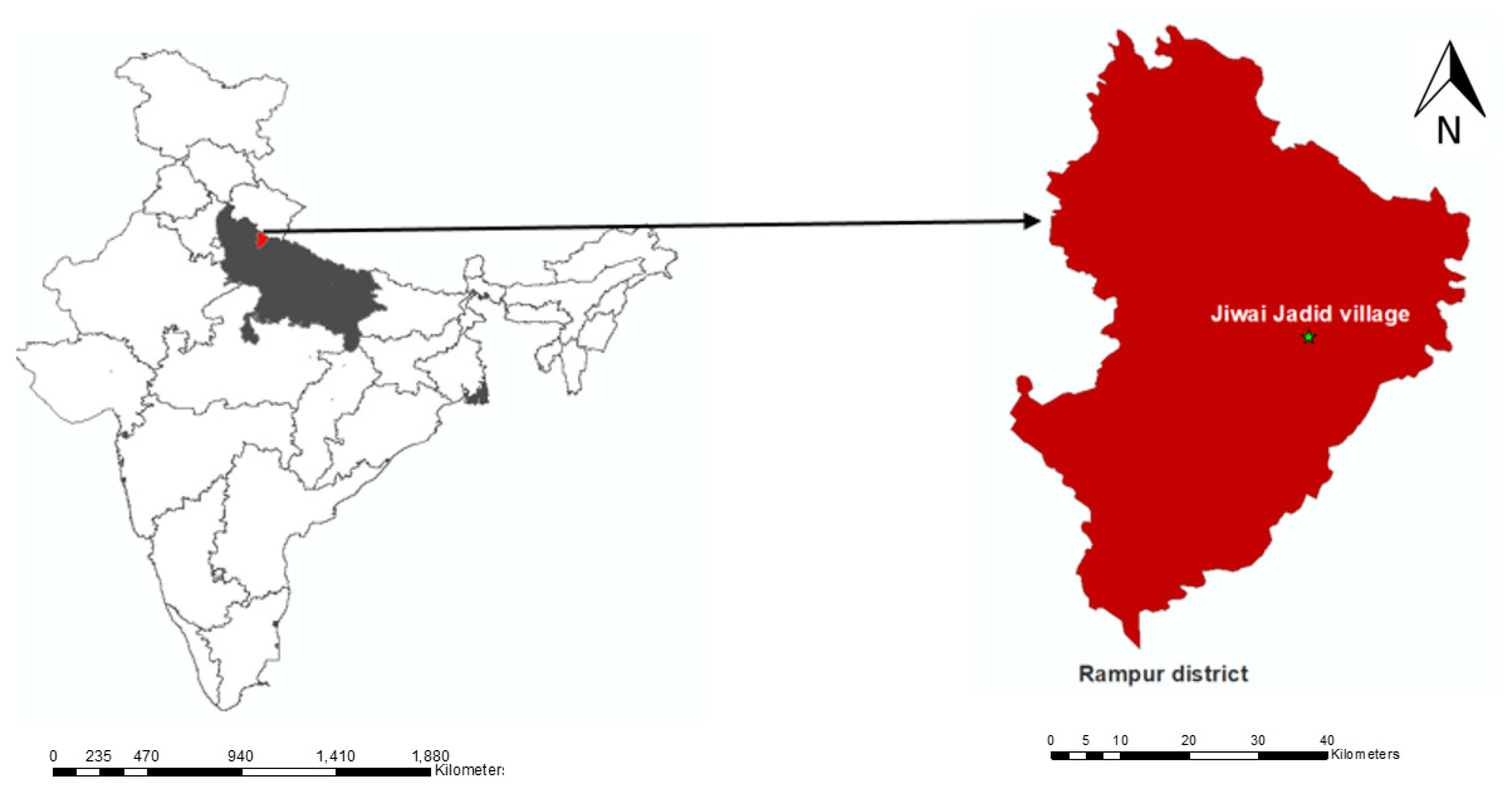
2. Study Area
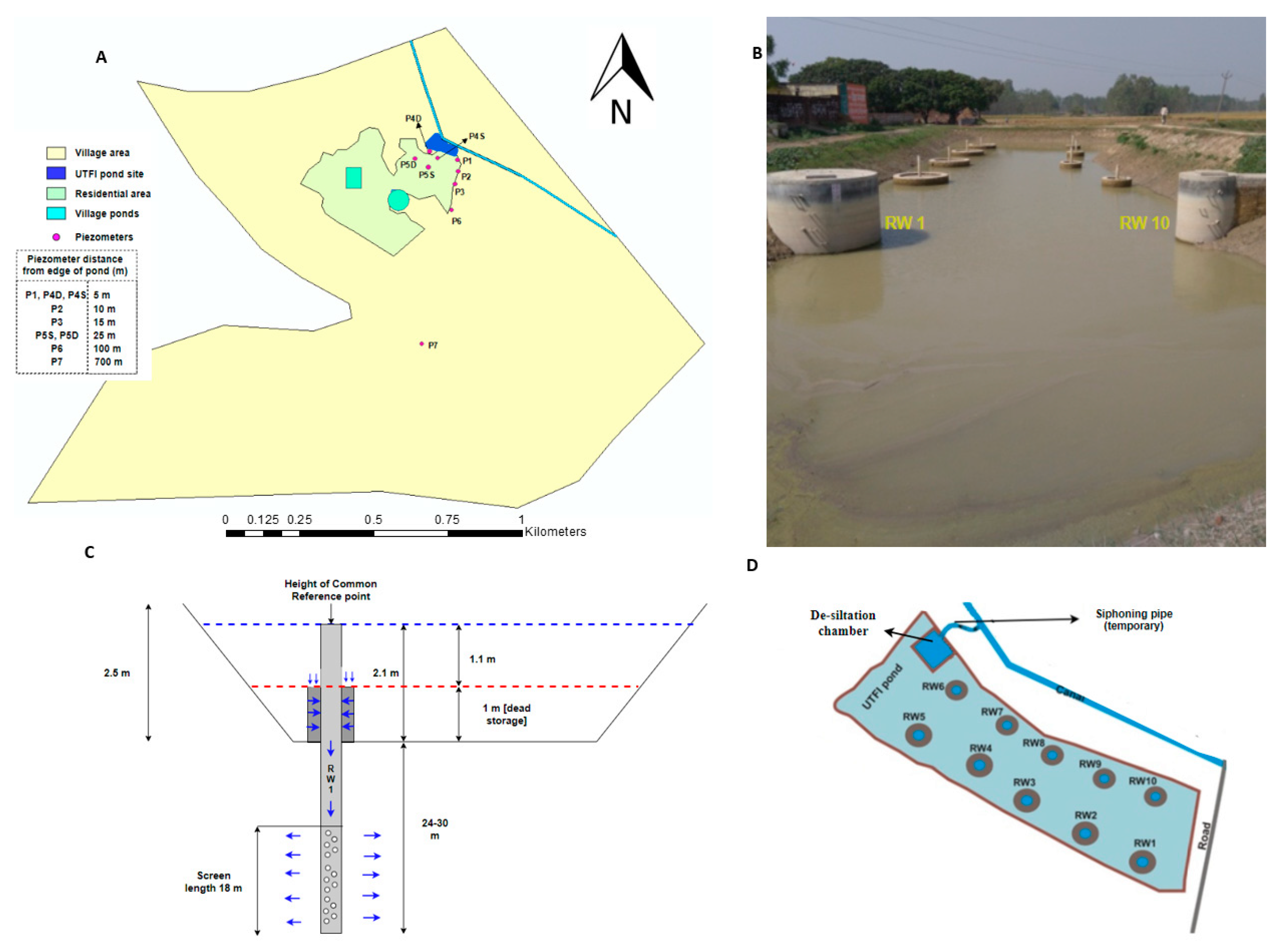
3. Pilot Trial Design
Operation and Maintenance
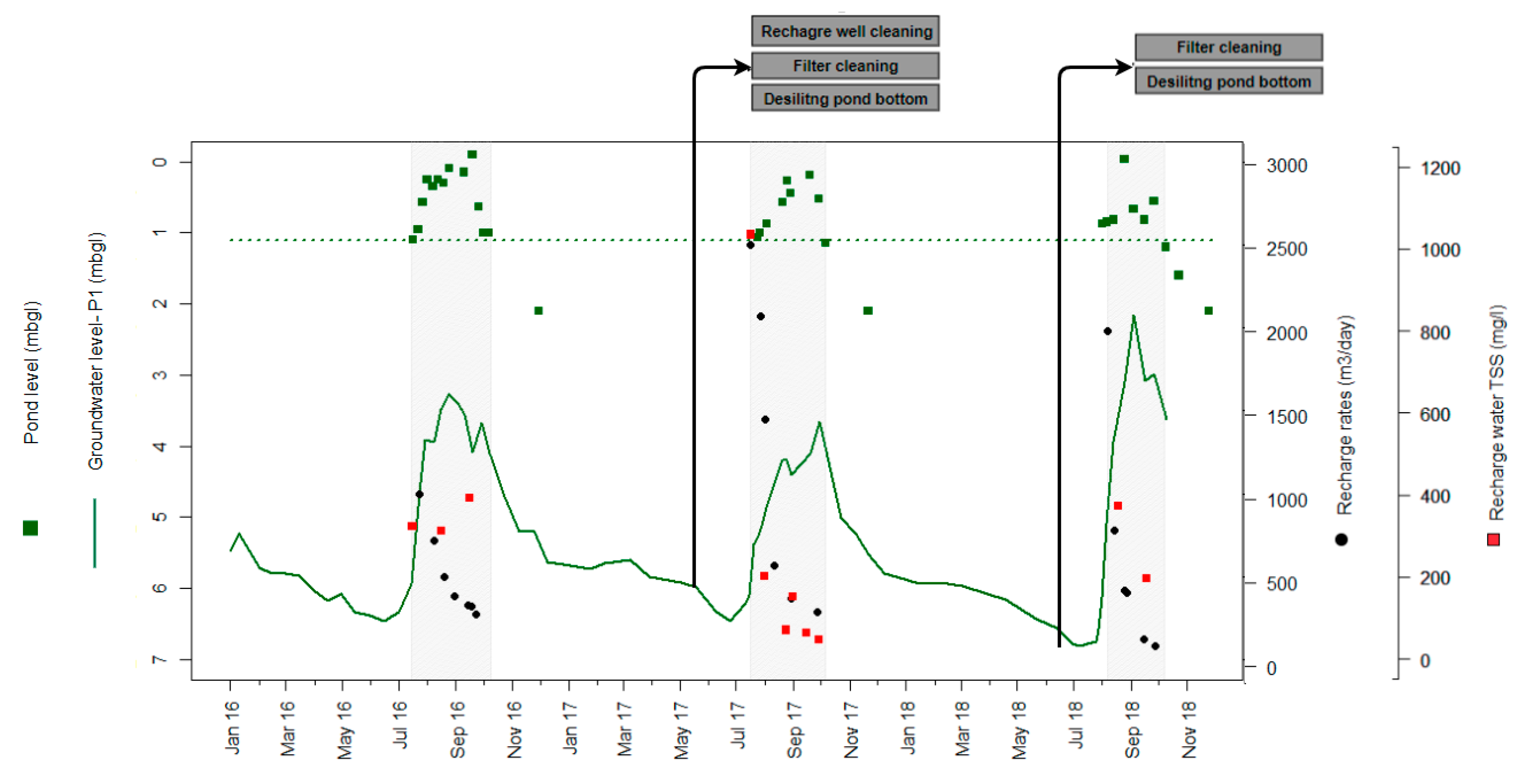
- Recharge well cleaning: recharge wells were cleaned using a compressor to remove silt deposited inside the recharge wells and fine particles that had blocked the slots of the recharge well.
- Recharge well filter cleaning: pea-gravels in the recharge filters packed in brick structures were cleaned by removing and washing by hand.
- Desilting pond bottom: silt deposited at the pond bottom was scraped off, and the embankments and side slopes were restabilized.
4. Methods
4.1. Monitoring and Data Collection
4.2. Groundwater Recharge from the UTFI Pond
4.3. Groundwater Level Response to UTFI Recharge
The Hantush Analytical Solution
4.4. Groundwater Bbalance at the Village Scale
5. Results
5.1. Groundwater Recharge from UTFI
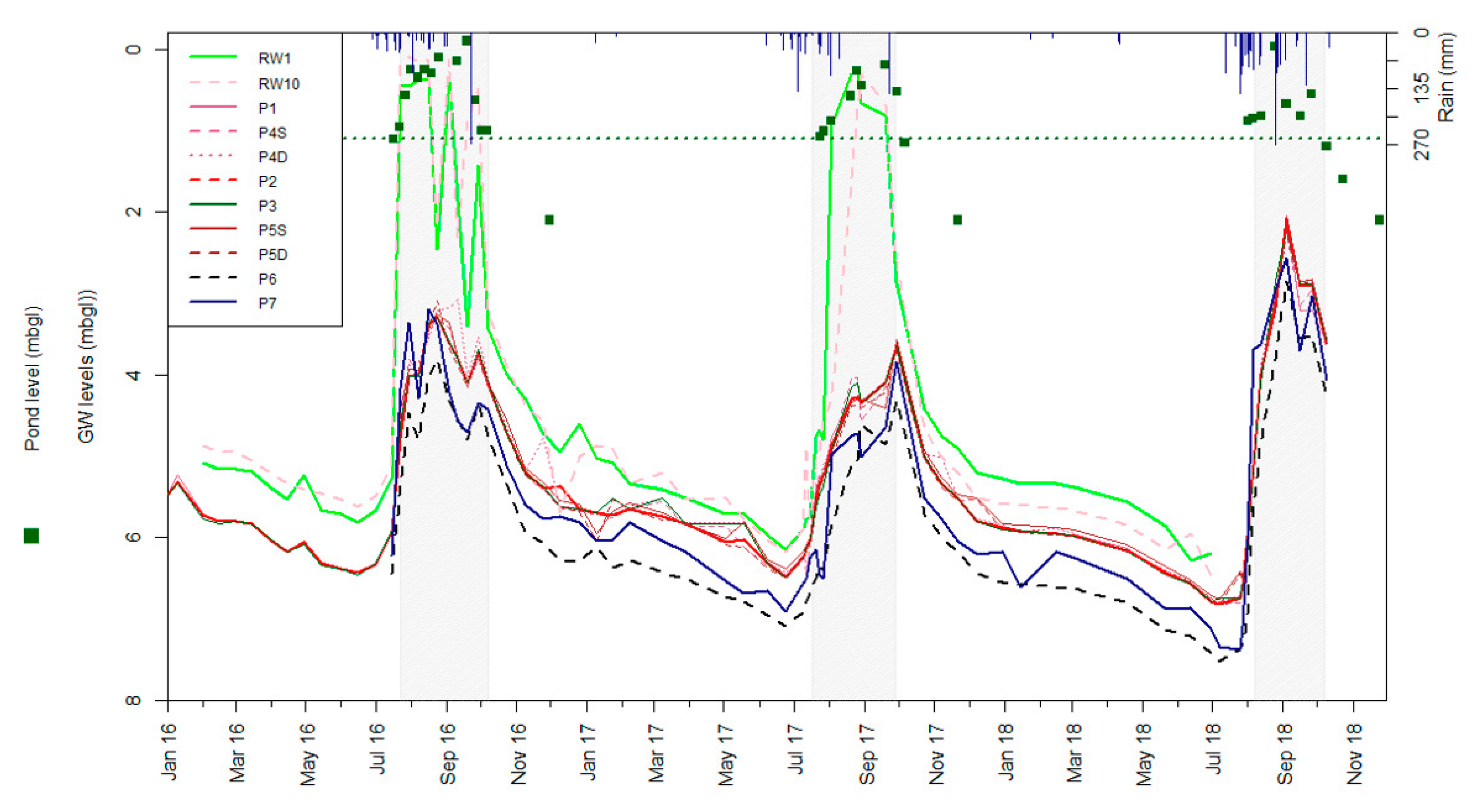
5.2. Groundwater Levels and the Response to UTFI Recharge
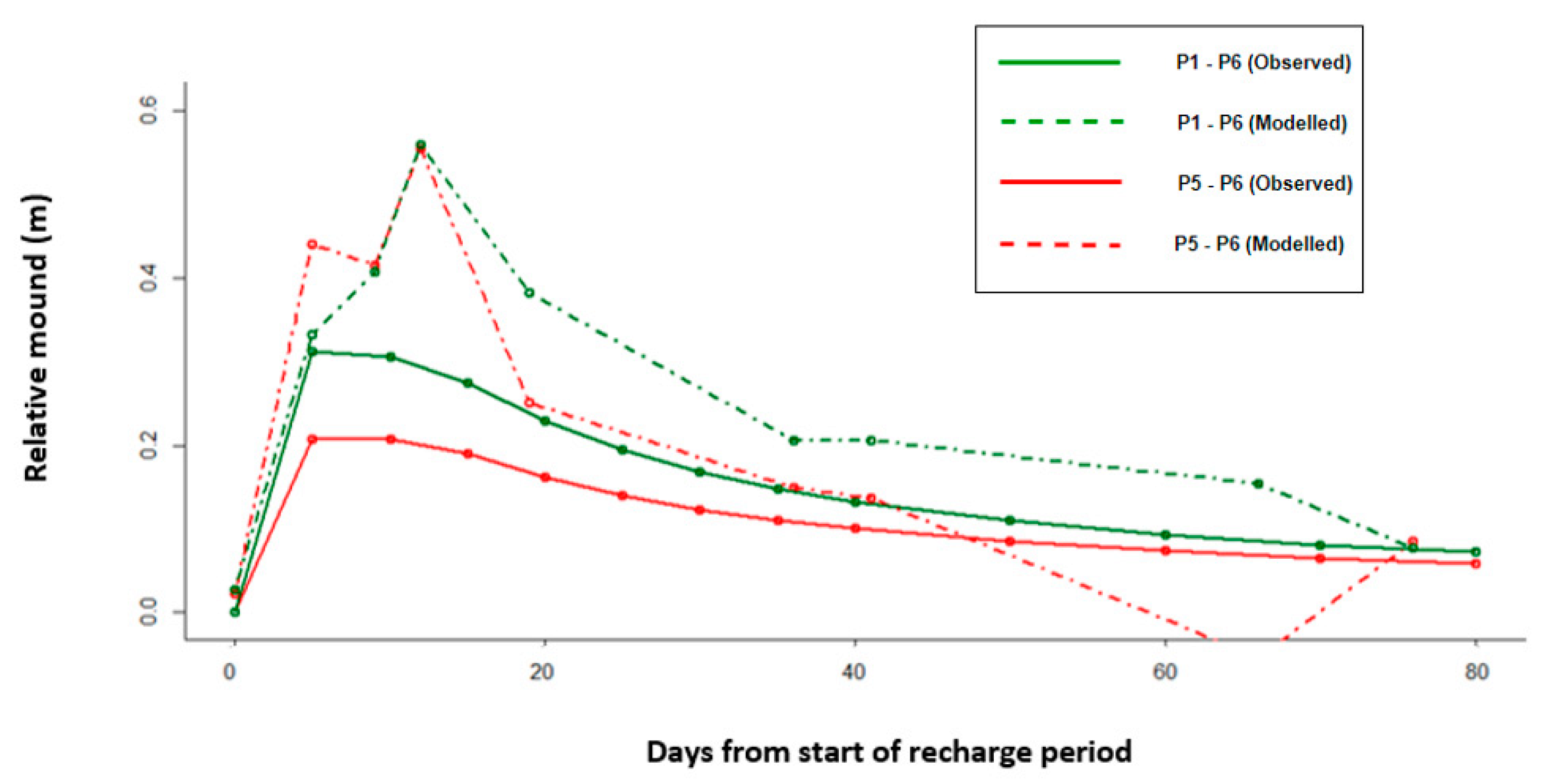
The Hantush Analytical Solution
5.3. UTFI Contribution to Recharge
5.4. Clogging Effects on Recharge
6. Discussion
6.1. Factors Influencing Recharge Rates
UTFI Recharge Variation Implications for Flood Mitigation
6.2. Performance of the UTFI Pilot
6.2.1. Comparing Recharge Wells to the Infiltration Pond
6.2.2. Comparing UTFI to Comparable Studies in the Region
6.3. Dependence of Aquifer Type on Groundwater Mounding
6.4. Scaling up of UTFI
7. Conclusions
Author Contributions
Funding
Acknowledgments
Conflicts of Interest
References
- Hall, J.; Grey, D.; Garrick, D.; Fung, F.; Brown, C.; Dadson, S.; Sadoff, C.W. Water Security. Coping with the curse of freshwater variability. Science 2014, 346, 429–430. [Google Scholar] [CrossRef]
- Hoekstra, A.; Mekonnen, M.; Chapagain, A.; Mathews, R.; Richter, B. Global Monthly Water Scarcity: Blue Water Footprints versus Blue Water. PLoS ONE 2012, 7, e32688. [Google Scholar] [CrossRef] [PubMed]
- FAO. The Impact of Disasters on Agriculture and Food Security; Food and Agriculture Organization of the United Nations (FAO): Rome, Italy, 2015. [Google Scholar]
- United Nations. Climate Change and Water: UN-Water Policy Brief; United Nations: Geneva, Switzerland, 2019. [Google Scholar]
- IPCC. Summary for Policymakers. In Managing the Risks of Extreme Events and Disasters to Advance Climate Change Adaptation, A Special Report of Working Groups I and II of the Intergovernmental Panel on Climate Change; Field, C.B., Barros, V., Stocker, T.F., Qin, D., Dokken, D.J., Ebi, K.L., Mastrandrea, M.D., Mach, K.J., Plattner, G.-K., Allen, S.K., et al., Eds.; Cambridge University Press: Cambridge, UK; New York, NY, USA, 2012; pp. 1–19. [Google Scholar]
- Van der Gun, J. Groundwater and Global Change: Trends, Opportunities and Challenges; UNESCO: Paris, France, 2012. [Google Scholar]
- Döll, P.; Schmied, H.M.; Schuh, C.; Portmann, F.T.; Eicker, A. Global-scale assessment of groundwater depletion and related groundwater abstractions: Combining hydrological modeling with information from well observations and GRACE satellites. Water Resour. Res. 2014, 50, 5698–5720. [Google Scholar] [CrossRef]
- Pavelic, P.; Brindha, K.; Amarnath, G.; Eriyagama, N.; Muthuwatta, L.; Smakhtin, V.; Gangopadhyay, P.K.; Malik, R.P.S.; Mishra, A.; Sharma, B.R.; et al. Controlling Floods and Droughts through Underground Storage: From Concept to Pilot Implementation in the Ganges River Basin; IWMI Research Report; International Water Management Institute: Colombo, Sri Lanka, 2015; Volume 165, 33p. [Google Scholar] [CrossRef]
- Brindha, K.; Pavelic, P. Identifying priority watersheds to mitigate flood and drought impacts by novel conjunctive water use management. Environ. Earth Sci. 2016, 40, 407–431. [Google Scholar] [CrossRef]
- Pavelic, P.; Srisuk, K.; Sarap, P.; Nadee, S.; Pholkern, K.; Chusanathas, S.; Sitisak, M.; Theerasak, T.; Teerawash, I.; Vladimir, S. Balancing-out floods and droughts: Opportunities to utilize floodwater harvesting and groundwater storage for agricultural development in Thailand. J. Hydrol. 2012, 470–471, 55–64. [Google Scholar] [CrossRef]
- Chinnasamy, P.; Muthuwatta, L.; Eriyagama, N.; Pavelic, P.; Lagudu, S. Modeling the potential for floodwater recharge to offset groundwater depletion: A case study from the Ramganga basin, India. Sustain. Water Resour. Manag. 2018. [Google Scholar] [CrossRef]
- Khan, R.M.; Voss, C.I.; Yu, W.; Michael, H.A. Water resources management in the Ganges Basin: A comparison of three strategies for conjunctive use of groundwater and surface water. Water Resour. Manag. 2014, 28, 1235–1250. [Google Scholar] [CrossRef]
- MacDonald, A.M.; Bonsor, H.C.; Taylor, R.; Shamsudduha, M.; Burgess, W.G.; Ahmed, K.M.; Mukherjee, A.; Zahid, A.; Lapworth, D.; Gopal, K.; et al. Groundwater Resources in the Indo-Gangetic Basin: Resilience to Climate Change and Abstraction; British Geological Survey Open Report OR/15/047; British Geological Survey: Nottingham, UK, 2015. [Google Scholar]
- Kaledhonkar, M.J.; Singh, O.P.; Ambast, S.K.; Tyagi, N.K.; Tyagi, K.C. Artificial groundwater recharge through recharge tube wells: A case study. J. Inst. Eng. (India) 2003, 84, 5. [Google Scholar]
- Sakthivadivel, R. The groundwater recharge movement in India. In The Agricultural Groundwater Revolution: Opportunities and Threats to Development; Giordano, M., Villholth, K., Eds.; CAB International Publishing: Colombo, Sri Lanka, 2007. [Google Scholar]
- Gupta, S. Groundwater Management in Alluvial Areas, Incidental Paper. CGWB, Ministry of Water Resources, Government of India; 2011. Available online: http://cgwb.gov.in/documents/papers/incidpapers/Paper%2011-%20sushil%20gupta.pdf (accessed on 12 November 2019).
- Glendenning, C.J.; van Ogtrop, F.F.; Mishra, A.K.; Vervoort, R.W. Balancing watershed and local scale impacts of rain water harvesting in India: A review. Agric. Water Manag. 2012, 107, 1–13. [Google Scholar] [CrossRef]
- Prathapar, S.; Dhar, S.; Rao, G.T.; Maheshwari, B. Performance and impacts of managed aquifer recharge interventions for agricultural water security: A framework for evaluation. Agric. Water Manag. 2015, 159, 165–175. [Google Scholar] [CrossRef]
- Dashora, Y.; Dillon, P.; Maheshwari, B.; Soni, P.; Dashora, R.; Davande, S.; Purohit, R.C.; Mittal, H.K. A simple method using farmers’ measurements applied to estimate check dam recharge in Rajasthan, India. Sustain. Water Resour. Manag. 2018, 4, 301–316. [Google Scholar] [CrossRef]
- Reddy, V.R.; Pavelic, P.; Hanjra, M.A. Underground Taming of Floods for Irrigation (UTFI) in the river basins of South Asia: Institutionalizing approaches and policies for sustainable water management and livelihood enhancement. Water Policy 2017, 20, wp2017150. [Google Scholar] [CrossRef]
- Reddy, V.R.; Rout, S.K.; Shalsi, S.; Pavelic, P.; Ross, A. Managing underground transfer of floods for irrigation: A case study from the Ramganga Sub-Basin (Ganges Basin), India. J. Hydrol. 2020. [Google Scholar] [CrossRef]
- Census of India. District Census Handbook, Rampur; Village and town wise primary census abstract; Directorate of Census Operations: Uttar Pradesh, India, 2011. [Google Scholar]
- DoES. Total Area and Classification of Area in Each District of Uttar Pradesh State for the Year Ending 2014-15 (Hectare); Special Data Dissemination Standard Division, Directorate of Economics & Statistics (DoES), Ministry of Agriculture and Farmers Welfare; Govt. of India: New Delhi, India, 2015. Available online: https://aps.dac.gov.in/LUS/Index.htm (accessed on 22 October 2019).
- Government of Uttar Pradesh. District Disaster Management Plan; DDMA: Rampur, India, 2010. [Google Scholar]
- Government of Uttar Pradesh. District Disaster Management Plan; DDMA: Rampur, India, 2013. [Google Scholar]
- Government of Uttar Pradesh. Report of Officer-in-Charge, District Flood Protection and Relief; Government of Uttar Pradesh: Rampur, India, 2015. [Google Scholar]
- Government of Uttar Pradesh. District Statistical Handbook; Government of Uttar Pradesh: Rampur, India, 2014. [Google Scholar]
- Tripathi, A.K. District Ground Water Brochure of Rampur District; U.P. Central Ground Water Board (CGWB): Rampur, India, 2009. [Google Scholar]
- CGWB. Dynamic Groundwater Resources of India (As on 31st March, 2013); Central Ground Water Board, Ministry of Water Resources, River Development & Ganga Rejuvenation Government of India: Faridabad, India, 2017. [Google Scholar]
- Bouwer, H. Artificial recharge of groundwater: Hydrogeology and engineering. Hydrogeol. J. 2002, 10, 121–142. [Google Scholar] [CrossRef]
- Hantush, M.S. Growth and decay of groundwater-mounds in response to uniform percolation. Water Resour. Res. 1967, 3, 227–234. [Google Scholar] [CrossRef]
- Yihdego, Y. Simulation of Groundwater Mounding Due to Irrigation Practice: Case of Wastewater Reuse Engineering Design. Hydrology 2017, 4, 19. [Google Scholar] [CrossRef]
- Poeter, E.P.; McCray, J.E. Modeling water table mounding to design cluster and high-density wastewater soil absorption systems. J. Hydrol. Eng. 2008, 13, 702–709. [Google Scholar] [CrossRef]
- Carleton, G.B. Simulation of Groundwater Mounding Beneath Hypothetical Stormwater Infiltration Basins; U.S. Geological Survey: Reston, VA, USA, 2010. [Google Scholar]
- Sharma, B.; Gulati, A.; Mohan, G.; Manchanda, S.; Ray, I.; Amarasinghe, U. Water Productivity Mapping of Major Indian Crops; NABARD and ICRIER: New Delhi, India, 2018. [Google Scholar]
- MoWR, RD & GR, GoI. Ministry of Water Resources, River Development & Ganga Rejuvenation Government of India. In Report of the Ground Water Resource Estimation Committee (GEC-2015); MoWR, RD & GR, GoI: New Delhi, India, 2017. [Google Scholar]
- Healy, R.W.; Cook, P.G. Using groundwater levels to estimate recharge. Hydrogeol. J. 2002, 10, 91–109. [Google Scholar] [CrossRef]
- Holländer, H.M.; Mull, R.; Panda, S.N. A concept for managed aquifer recharge using ASR-wells for sustainable use of groundwater resources in an alluvial coastal aquifer in Eastern India. Phys. Chem. Earth Parts A/B/C 2009, 34, 270–278. [Google Scholar] [CrossRef]
- Martin, R. (Ed.) Clogging Issues Associated with Managed Aquifer Recharge Methods; IAH Commission on Managed Aquifer Recharge: Adelaide, Australia, 2013. [Google Scholar]
- CSRRI. Technological Assessment of Underground Taming of Floods for Irrigation; Progress report prepared for the International Water Management Institute for project: Piloting and Up-scaling an Innovative Approach for Mitigating Urban Floods and Improving Rural Water Security in South Asia; ICAR-Central Soil Salinity Research Institute, Regional Research Station: Lucknow, India, 2018. [Google Scholar]
- NRMMC, ERHC and NHMRC. Australian Guidelines for Water Recycling: Managed Aquifer Recharge (National Water Quality Management Strategy No. 24); Natural Resource Management Ministerial Council (NRMMC), Environment Protection and Heritage Council (ERHC) and National Health and Medical Research Council (NHMRC): Canberra, Australia, 2009. [Google Scholar]
- Miret, M.; Vilanova, E.; Molinero, J.; Sprenger, C. The Management of Aquifer Recharge in the European Legal Framework (DEMEAU Project, European Commission). Available online: https://demeau-fp7.eu/sites/files/D121%20legal%20framework%20and%20MAR%20DEMEAU%20project_1.pdf (accessed on 12 October 2019).
- Hutchinson, A.; Milczarek, M.; Banerjee, M. Clogging phenomena related to surface water recharge facilities. In Clogging Issues Associated with Managed Aquifer Recharge Methods; Martin, R., Ed.; IAH Commission on Managed Aquifer Recharge: Adelaide, Australia, 2013; pp. 95–106. [Google Scholar]
- Kumar, A.; Bahadur, Y. Water quality of River Kosi and Rajera system at Rampur (India): Impact Assessment. J. Chem. 2012, 2013, 618612. [Google Scholar] [CrossRef]
- Kohli, A.; Frenken, K. Evaporation from Artificial Lakes and Reservoirs (FAO AQUSTAT Reports); FAO: Rome, Italy, 2015. [Google Scholar]
- IWP. India Water Portal Met Data [WWW Document]. Available online: https://www.indiawaterportal.org/met_data/ (accessed on 22 November 2019).
- Dillon, P.J.; Vanderzalm, J.; Page, D.; Barry, K.; Gonzalez, D.; Muthukaruppan, M.; Hudson, M. Analysis of ASR clogging investigations at three Australian ASR sites in a Bayesian context. Water 2016, 8, 442. [Google Scholar] [CrossRef]
- Dillon, P.J.; Liggett, J.A. An ephemeral stream aquifer interaction model. Water Resour. Res. 1983, 19, 621–626. [Google Scholar] [CrossRef]
- Glendenning, C.J.; Vervoort, R.W. Hydrological impacts of rainwater harvesting (RWH) in a case study catchment: The Arvari River, Rajasthan, India. Part 1: Field-scale impacts. Agric. Water Manag. 2010, 98, 331–342. [Google Scholar] [CrossRef]
- Dashora, Y.; Dillon, P.; Maheshwari, B.; Soni, P.; Mittal, H.; Dashora, R.; Singh, P.K.; Purohit, R.C.; Katara, P. Hydrologic and cost benefit analysis at local scale of streambed recharge structures in Rajasthan (India) and their value for securing irrigation water supplies. Hydrogeol. J. 2019, 27, 1889–1909. [Google Scholar] [CrossRef]
- FAO. Irrigation in Southern and Eastern Asia in Figures—AQUASTAT Survey—2011. 2011. Available online: http://www.fao.org/nr/water/aquastat/basins/gbm/gbm-CP_eng.pdf (accessed on 12 November 2019).
- GoI. Master Plan. for Artificial Recharge to Ground Water in India; Ministry of Water Resources and Central Groundwater Board, Government of India: New Delhi, India, 2013. [Google Scholar]
- Alam, M.F.; Pavelic, P. Underground Transfer of Floods for Irrigation (UTFI): Exploring the Potential at the Global Scale; IWMI Research Report; International Water Management Institute: Colombo, Sri Lanka, in press.



| Parameter | Measurement Method | Frequency |
|---|---|---|
| Groundwater levels | Nine piezometers were installed (Figure 2). All groundwater levels of piezometers are given relative to the reference point, RW1 (in mbgl). | Measured weekly using a portable water level meter during recharge operations, and every 2 weeks during non-recharge periods |
| UTFI pond infiltration rate | (A) Single ring infiltration test up to 8 h was conducted at the bottom of pond at four locations after pond cleaning/development (B) Days taken for pond dead storage to dry out after stopping recharge operations | (A) 6 h test at 4 locations at 45 cm depth on the 11 and 18 September, 2015 (B) At the end of the recharge operations each year |
| Rainfall | Rain gauge at Krishi Vigyan Kendra (KVK), Rampur city, situated approximately 20 km from the pilot site | Daily from 24 June 2016 |
| Canal water levels | Measuring scale was marked in canal wall near road bridge | Daily basis during the recharge operation and at 15 day intervals during non-recharge periods |
| UTFI pond storage volume | Relationship between depth of water in pond and volume of water in pond was developed | After pond development |
| UTFI Pond water level measurement | Measuring scale was marked at recharge well (RW1 in Figure 2) to record pond water level. All depths are relative to the RW1 reference point. | Pond water level was recorded on a daily basis during the recharge operations |
| Source water silt content | Water samples analyzed for total solid solids (TSS); Mass of silt accumulated at pond bottom after recharge seasons (tonnes) | Monthly; After recharge season of 2016 and 2017 |
| Socio-economic survey | Socio-economic survey of 120 farmers within a 1 km radius of the UTFI site | At the start of the pilot trial in 2016 |
| Year | Start Date–End Date | Number of Recharge Days a | VUTFI (m3) | RUTFI (m3 day−1) (mm day−1) b |
|---|---|---|---|---|
| 2016 | 15 July–7 October | 85 | 45,070 | 537 (204) |
| 2017 | 17 July–5 October | 78 | 61,969 | 775 (295) |
| 2018 | 6 August–6 October | 62 | 26,207 | 430 (164) |
| Average | - | 75 | 44,415 | 580 (221) |
| Parameter | Time Period | 2016 | 2017 | 2018 |
|---|---|---|---|---|
| Rainfall (mm) | Annual | 857 | 905 | 1812 |
| Monsoon (28 June–22 September) | 857 | 874 | 1708 | |
| Recharge period | 737 | 472 | 992 | |
| Rainy days | Annual | 23 | 22 | 27 |
| Monsoon (28 June–22 September) | 23 | 20 | 22 | |
| Recharge period | 14 | 8 | 12 |
| (×103 m3) | |||||
|---|---|---|---|---|---|
| Year | ΔGWS a | VAmonsoonb | VVillage | VUTFI | UTFI (% of Recharge) |
| 2016 | 581 | 1158 | 1739 | 45.07 | 2.6 |
| 2017 | 583 | 1158 | 1741 | 61.97 | 3.6 |
| 2018 | 835 | 1158 | 1993 | 26.21 | 1.3 |
| Year | RUTFI (m3 day−1) | Recharge Well Cleaning | Filter Cleaning | Desilting Pond Bottom | Gravity Head for Recharge (m) a | Avg. water Quality Entering Pond (TSS: mg/L) b | Total Silt Accumulated c (Tonnes) | Days Taken for Dead Storage to Dry d | End Season Infiltration Rate (mm day−1) e | ||
|---|---|---|---|---|---|---|---|---|---|---|---|
| Start | End | Avg. | |||||||||
| 2016 | 996 | 274 | 537 | No | No | No | 4.0 | 340 | 12.2 | 55 | 14.4 |
| 2017 | 2499 | 289 | 775 | yes | yes | Yes | 4.7 | 260 | 21.2 | 48 | 17.0 |
| 2018 | 1978 | 85 | 430 | No | Yes | Yes | 3.5 | 282 | - | 50 | 16.2 |
© 2020 by the authors. Licensee MDPI, Basel, Switzerland. This article is an open access article distributed under the terms and conditions of the Creative Commons Attribution (CC BY) license (http://creativecommons.org/licenses/by/4.0/).
Share and Cite
Alam, M.F.; Pavelic, P.; Sharma, N.; Sikka, A. Managed Aquifer Recharge of Monsoon Runoff Using Village Ponds: Performance Assessment of a Pilot Trial in the Ramganga Basin, India. Water 2020, 12, 1028. https://doi.org/10.3390/w12041028
Alam MF, Pavelic P, Sharma N, Sikka A. Managed Aquifer Recharge of Monsoon Runoff Using Village Ponds: Performance Assessment of a Pilot Trial in the Ramganga Basin, India. Water. 2020; 12(4):1028. https://doi.org/10.3390/w12041028
Chicago/Turabian StyleAlam, Mohammad Faiz, Paul Pavelic, Navneet Sharma, and Alok Sikka. 2020. "Managed Aquifer Recharge of Monsoon Runoff Using Village Ponds: Performance Assessment of a Pilot Trial in the Ramganga Basin, India" Water 12, no. 4: 1028. https://doi.org/10.3390/w12041028
APA StyleAlam, M. F., Pavelic, P., Sharma, N., & Sikka, A. (2020). Managed Aquifer Recharge of Monsoon Runoff Using Village Ponds: Performance Assessment of a Pilot Trial in the Ramganga Basin, India. Water, 12(4), 1028. https://doi.org/10.3390/w12041028