


Abstract
This article focuses on the subject of odours forming in sewage transfer chambers with displacement inlets, as well as the odours in their vicinity. It further covers the locations of odour formation, factors influencing the formation of hydrogen sulphide in wastewater, methods of removing hydrogen sulphide from wastewater, and laboratory testing of filtration media efficacy at various concentration levels of H2S. The laboratory testing of filtration media efficacy is performed for products normally used by sewerage system operators guaranteeing the elimination of hydrogen sulphide (activated carbon, natural minerals and gels), recyclable materials (paper) and secondary raw materials in the field of waste management (biochar—the final product of microwave pyrolysis). Odour generated by sewerage systems is a secondary issue faced by all sewerage system operators, who sustain considerable expense in corrective measures to address this problem. The most economical and widespread measure used by those operators is hydrogen sulphide removal by filtration (filtration materials). Filtration media are installed in special cartridges under sewage covers in locations where the irritating odour is formed. These filtration cartridges, designed solely to eliminate odour from the surroundings, show various degrees of efficacy in removing H2S.
1. Introduction
Odour is one of the organoleptic properties of wastewater, which differ in terms of smell sensitivity. The sewerage operator should prevent the formation of odours and try to emit as few odour components into the air as possible. The primary objective is to prevent the formation of odours, mainly by controlling and managing processes at the producer level, as well as in the sewerage system and wastewater treatment plant [1]. However, odour cannot often be reduced at the point of origin and it is, therefore, necessary to apply a secondary solution to prevent the spread of odour and its resulting hazardous substances.
As a result of organic matter degradation by microorganisms under anaerobic conditions, odours are already formed during wastewater flow in the sewerage system. Another source of odorous substances is industrial wastewater connected to the public sewerage system. Wastewater components participating in the formation of odour [2,3] include sulphide (hydrogen sulphide), ammonia, organic sulphur compounds, thiols (e.g., mercaptans), amines (indole and skatole) and other organic compounds.
The characteristic conditions for the formation of odour in the sewerage network can be defined as:
- in sewerage networks and house drains under adverse technical conditions;
- in transfer manholes with delivery pipe inlets;
- in long pressure pipes;
- in discharges of special industrial wastewater;
- in wastewater reuse by consumers and the resulting minimal flow rates in sewers;
- in sludge storage and sludge treatment facilities (sediments);
- improper operation and maintenance of both sewerage and facilities.
Elimination of odour from sewerage systems should be a high priority of operators. Odour causes nuisance to inhabitants living in the vicinity of the sewerage systems and has a direct impact on the service life of those sewers and machinery installed in sewerage facilities. In this case, the operator should perform a sensitivity analysis of the sewerage system and facilities, based on various combinations of variables, in order to assess the reliability of pipes and facilities using a software developed model [4,5].
European Union law defines “odour quality” in Directive 2008/50/EC of the European Parliament and of the Council on ambient air quality and cleaner air for Europe [6] for Europe and Directive 2010/75/EU of the European Parliament and of the Council on Industrial Emissions, Integrated Pollution Prevention and Control [7].
Sulphates (SO42−) are converted by bacteria in municipal wastewater and through their metabolism into hydrogen sulphide. This process occurs predominantly in biofilms and sediments under anaerobic conditions in a submerged part of the sewer. The major reactions involving sulphur compounds in sewage are:
- Reduction of sulphate to sulphide by sulphur-reducing bacteria.
- Decomposition of amino acids containing sulphur.
- Methylation of methyl mercaptan (CH3SH) by H2S [3,8].
- Dimethyl sulphide (DMS) generation via oxidation of CH3SH [9].
Hydrogen sulphide easily escapes from water, predominantly in areas of turbulent flows where water is spread into the surrounding air. Volatile hydrogen sulphide is heavier than the air and it accumulates in the free space inside the sewerage where it is slowly carried by the stream of wastewater in gravity sewers [10,11].
The main factors influencing the formation of odour in the sewerage are:
- Sewage composition: there is a significant influence of sulphide and sulphate concentrations in wastewater and special industrial service water [12]. Oxidation-reduction potential with values suited to anaerobic conditions: −50 mV. Temperature: biological oxygen demand increases with rising temperatures and anaerobic conditions are established in the sewerage system [13]. pH value: in more alkaline water there is a lower risk of hydrogen sulphide formation. Oxygen concentration: where values below 0.5 mg/L result in anaerobic conditions.
- Hydraulic factors: residence time, as longer residence times beyond 8 h result in anaerobic conditions in the sewerage system [12]. Poor technical design of the sewerage, where over-sizing results in low flow rates in the sewerage system, promoting sedimentation and the creation of an anaerobic environment. Velocity gradient, as a high velocity gradient causes considerable release of hydrogen sulphide into the air. Sediments and biofilm, where organic substrate is hydrolysed in anaerobic sediments along with fermentation, sulphate reduction and methane production [14].
- Sewerage facilities and pumping stations, where long switching intervals of wastewater pumping result in an anaerobic environment. Pressurized sewers, causing long retention times in the pipeline and vacuum stations missing biofilters for exhaust air treatment.
Odour removal technologies can be divided into primary and secondary. The primary activity should be to prevent odour formation through controlled sewerage operations. In many cases, the operation cannot be controlled to avoid such formations. Thus, odour removal is a secondary activity and can be ensured either directly from wastewater or from the air. These activities cannot protect concrete pipelines against biogenic sulphuric corrosion. The hydrogen sulphide formed escapes through sewerage manholes to the surroundings and causes nuisance to the inhabitants, mostly in the summer months.
Methods of removing odour from wastewater consist of chemical dosing into wastewater, which limits the formation of odour compounds. Such chemical dosing is carried out and recommended to be performed directly at the sewerage pumping stations. Methods used for the removal of odour from wasterwater are listed in Table 1.
Table 1.
Methods of removing odour from wastewater.
Secondary methods of removing odour from the air consist in the installation of an auxiliary system which, by means of physical, biological and chemical processes, captures hydrogen sulphide escaping into the environment. Methods used to eliminate odour from air are listed in Table 2.
Table 2.
Methods of removing odour from the air.
The application of filtration media under the covers of the sewage chambers is the most widespread measure taken by operators of sewerage systems. Currently, the most common application uses standard filtration media on the basis of organic carbon, placed into special cartridges. Products offering filtration media used for sewage chambers worldwide are very widely used, with varied guaranteed effectiveness. So far, an overall independent effectiveness comparison of filtration media used has not been carried out.
2. Materials and Methods
Recycled materials from garbage management were also included among standard filtration media, such as recyclable paper and biochar (a product of microwave pyrolysis). The manipulation with and use of recycled material is in accordance with the strategic concept of a circular economy.
2.1. Parameters of Laboratory Measurement
Filtration media testing was carried out in a filtration column with a reaction tank for the production of hydrogen sulphide. Hydrogen sulphide was produced using powdered ferric sulphide FeS in a reaction vessel, with a dosing of hydrochloric acid HCl diluted with distilled water (see Equation (1)) and using a peristaltic pump into the reaction chamber.
FeS + 2HCl → H2S + FeCl2
Molar mass of individual compounds Mr (FeS) = 87.834 g·mol−1, Mr (H2S) = 34 g·mol−1. Amount of substance FeS = 0.0114 mol with a theoretical volume of 0.255 L.
Constant flow monitoring was provided by manometer and anemometer detectors with a control system. Measurement of hydrogen sulphide concentration at the inlet and outlet of the filter column was performed by a detector with a datalogger, manufactured by OdaLog Logger L2, with the following parameters:
- input detector: LL-H2S-1000, declared measuring range of 0–1000 ppm with a resolution of 0.5 ppm and detector accuracy of 0.5%,
- output detector: LL-H2S-200, declared measuring range of 0–200 ppm with a resolution of 0.1 ppm and detector accuracy of 1%. Recorded measuring range of 350 ppm with a resolution of 0.1 ppm.
All the tested filtration media had the same boundary conditions set for laboratory measurements, which were calculated or verified during operation. The filtration media efficacy testing parameters for hydrogen sulphide removal filters are:
- volume of one tested filtration medium: 0.5 L;
- maximum concentration of hydrogen sulphide at the inlet to the filtration unit: 300 ppm;
- maximum duration of one test: 30 min;
- hydrochloric acid concentration—HCl: 35%;
- dilution ratio with distilled water: 1:8;
- FeS volume: 1 gram;
- air flow rate set by anemometer: 3 L·min−1.
Laboratory conditions for measuring the efficiency of filtration media:
- all filtration products were stored in a dry laboratory environment;
- testing was performed at a constant temperature of 20 °C;
- air humidity was maintained at 55%;
- atmospheric pressure in the room equalled 1013.25 hPa;
- and constant temperature of the filtration media was 20 °C.
The laboratory space was aired out after each measurement, along with a control measurement for H2S neutral odour and calibration of both H2S detectors. The testing of each filtration medium took place on three occasions to ensure sufficient measured data for statistical evaluation.
Before the laboratory tests, the anemometer was used to determine the actual airflow values in the sewerage. The air flow set through the filter column in the laboratory was selected with a 100% reserve.
2.2. Filtration Media
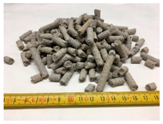
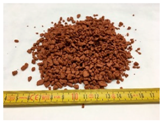
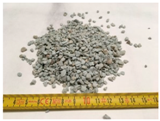
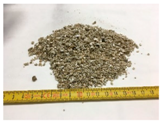
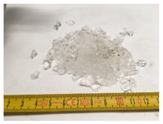
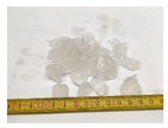
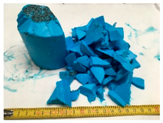
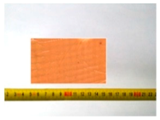
The filter media tested are divided into three basic groups according to structure, these being pelletized materials, granulates and gels—see Table 3, Table 4 and Table 5.
Table 3.
Selected filter medium pelletized.
Table 4.
Selected filter medium granulates.
Table 5.
Selected filter medium gels.
The recyclable material is the cellulosic biofilter Rehau containing nutrients. The secondary raw material is biochar, the product of the microwave pyrolysis process. The pyrolysis unit is located in the laboratories of AdMaS Research Center, Technical University in Brno, Faculty of Civil Engineering.
Spruce wood was used for the microwave pyrolysis (filtration medium Biochar I in Table 1) and sludge from the municipal wastewater treatment plant in Karlovy Vary, Czech Republic (filtration medium Biochar II in Table 1) with a design capacity of 80,000 PE.
Biochar I is a pyrolysis product produced without admixtures. Biochar II is a pyrolysis product from sewage sludge with an organic dry matter content of 55% and a zeolite admixture at a weight concentration of 1%. The biochar yield from sewage sludge is currently the subject of research at the Brno University of Technology, AdMaS. Without admixtures, the sewage sludge biochar yield contains a small amount of organic matter (up to 23%) and liquid (up to 10%). Biochar II contains organic matter thermogravimetrically 40.3%, Total organic carbon (TOC) biochar 29.3%, biochar yield 58.9%, liquid yield 18.2% and gas yield 22.9%.
A Grena GV Vermicularis natural mineral test was carried out in combination with Ona Gel Liquid and Ecosorb 505 milk gels. The ratio between the Grena GV Vermicularis filtration material and the Ona Gel and Ecosorb 505 gels was experimentally established at 1:1. The gel producers do not recommend any optimum ratio with other filtration materials.
The basic composition of all filtration media, i.e., the main and secondary components of the media are listed by the manufacturer in the product data sheets and have not been tested by the laboratory.
No material inoculation was performed and there was no conditioning, stability of the material during the test, material compaction, and water retention in the material. The damping capacity of the filtration media was not evaluated.
3. Results
The evaluation of overall efficiency of filtration media used an original multi-criteria analytical method—see Table 6. Among the evaluation criteria were: effectiveness of the filtration medium, sorption capacity of the filtration medium, preparation of the filtration medium prior to the experiment into the filtration column and the odour impression.
Table 6.
Proposed evaluation criteria of filtration media.
The service life of the filtration media is set by each manufacturer in the product data sheets.
The preparation of the filtration material is an indicator defining a collection of works prior to testing of the filtration material. Preparation works included manipulation of the material, its treatment prior to filling, and emptying the test cartridge.
Residual odour perception was evaluated at the end of laboratory testing for all filtration materials and is based on the sensory sensitivity of an experienced laboratory worker.
Purchase price of the filtration material was not included in the evaluation criteria due to varied stock levels of the suppliers, various specific costs regarding their purchase, our own production costs and varying costs of material delivery.
Mathematically, the evaluation of the overall efficiency of the material can be expressed using Equation (2).
where: i—1, 2,…p,
- ui—general assessment of i-media;
- vj—rate of importance of j-criterion;
- Cji—sub-assessment of i-media based on j-criterion;
- n—number of criteria;
- p—number of media.
The final assessment values “ui” are dimensionless figures in an interval <0.1–0.5>. Sufficient filtration media are recommended due to their resulting values in the interval of <0.1–0.25>, less suitable values in the interval of <0.25–0.40> and unsuitable in the interval of <0.4–0.5>. We recommend suitable and less suitable filtration media for direct application under the sewage covers in sewerage systems. The minimum required effectiveness of the filtration material should be larger than 60% (Category CII).
The measured results shown in Table 7 include detector deviation at the inlet and outlet of the filtration column.
Table 7.
Recommendations for applications of filtration media in sewerage systems.
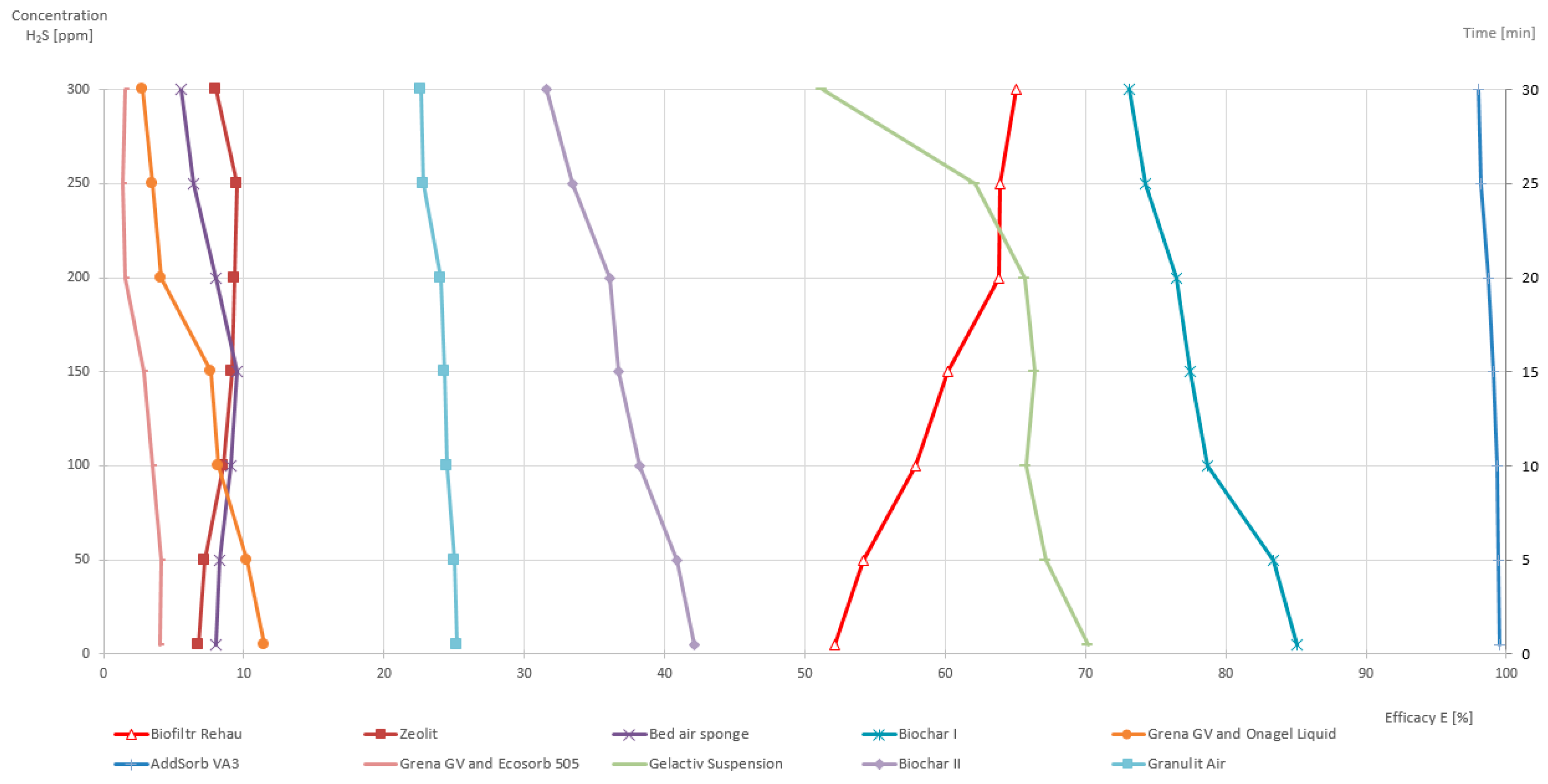
The winners among the tested filtration media are pelletized materials that have organic carbon as their basic component. The measured values show one common indicator, i.e., decreasing efficiency of filtration media with increasing H2S concentrations (with the exception of Rehau Biofilm).
Activated Coal AddSorb VA3 shows the highest achieved average efficiency at 98.9%, high sorption capacity over 12 months, and is easy to prepare and handle.
Recycled materials Biochar I and Rehau Biofilm achieved surprising results. Biochar I, a product of microwave pyrolysis, produced from fir wood and containing 100% organic matter, has a very good average efficiency of 78.4%. Rehau Biofilm, a product made from recycled paper, was the only medium whose efficiency increases with the increasing concentrations of H2S. This product is a combination of a filtration granulate with active substances that microbiologically degrade hydrogen sulphide and transform it into air of a neutral odour. It can be assumed for the relevant product that with higher humidity of the environment and biofilter inoculation, the filtration material will show increased hydrogen sulphide removal efficiency.
Granulated filtration materials show very low efficiency of H2S removal, equal in terms of units. Their advantage is in easy manipulation and guaranteed good sorption capacity. The main component of zeolite is a clay-silicate mineral and the main component of Grena GV Vermicularis is a phyllosilicate. We can state with regard to their low efficiency in removing H2S that granulated materials are not suitable as a product for removing H2S from sewerage systems. The use of separate granulates is preferred as suitable substrates for plants, nutrient management, as e filtration materials for aquariums and ponds, and to prevent algae formation.
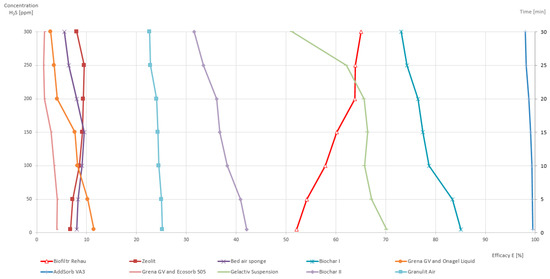
Laboratory measurements, graphically evaluated in Figure 1, illustrate that the best base component in the filtration media is organic carbon.
Figure 1.
Efficacy of filtration materials.
Filtration medium gels, along with granules, show a removal efficiency of H2S up to 10% and they have their own smell. Due to the low efficiency of H2S removal, after the completion of the experiment, the odour impression above the filtration media was very strong. The preparation of the gel is complicated and time-consuming. The gel is supplied in an unsuitable consistency requiring treatment and adjustment to the size of the filtration cartridge. The main components of Grena GV Vermicularis are an emulsifier, an etheric oil and phyllosilicate (Ecosorb 505) or terpenes (Ona Gel Liquid). The main component of Bad Air Sponge is a neutralizing agent with a sorption capacity of 1.5–3 months. The manufacturer recommends the use of gel with granulates to accomodate reduction pressure losses and to potentially aerate the medium. Gels are, according to manufacturers, used to remove H2S from the air as well as in various environments. The tests proved simple odour masking effects. As regards practical use, masking is very dangerous as human senses do not sense the odour of the original substance and the human body is therefore exposed to hydrogen sulphide for far longer. Granulates and gels are intended for a different area of use than removing H2S odour—they can absorb moisture and mask odours. However, they are not at all suited for eliminating hydrogen sulphide.
The Gelactiv Suspension gel sheet achieved surprising results as the third highest efficiency of H2S removal, reaching 64.1%. Its main components are aldehydes and polymeric gel with active substance sorption capacity of 3–6 months. This is a material that neutralized odour with very good results that prioritise the product for direct application.
4. Discussion
Sulphide concentration of around 0.5 ppm already registers in the respiratory system. Operators of sewerage system use various filtration media to eliminate H2S.
The application of filtration media under sewer covers is the simplest and most widespread measure for the sewerage systems entailing low capital and operating expenditures (capex and opex). This article’s innovation is based on an independent comparison of readily available filtration media (pelletized, granulated and gels) and recycled materials (biochar and cellulose paper). The filtration materials were categorized as suitable, less suitable and unsuitable for direct application, using a multi-criteria analytical method stipulating weights of evaluation indicators.
Among the suitable filtration materials were Activated Coal AddSorb VA3, Biochar I (from fir wood) and Biofilm Rehau (cellulose paper). We recommend using these materials under the sewer covers in sewerage systems. We found the Gelactiv Suspension gel sheet and Biochar II (from treatment-plant sludge) less suitable. Grena GV Vermicularis and Ecosorb 505, Zeolite, One Gel Liquid, Granulit Air and Bad Air Sponge were categorized as unsuitable materials.
In general, we conclude that pelletized products on the basis of organic carbon are suitable filtration materials. The sulphide removal is very good at over 70%, the preparation of the filtration material is excellent, and both during and after testing, the filtration medium is without a noticeable odour.
Recycled materials and secondary waste materials are a new group of materials and resources replacing strategic raw materials. In 2014, the EU adopted a strategic concept that aims to implement a so-called “circular economy”. The aim is to minimize the volume of materials leaving the economic cycle. In the circular economy, secondary recyclable products have an economic and environmental potential. The current market offers very few recyclable products.
The research and development of new technologies for the production of filtration materials from recyclable and secondary waste materials should be continued along these lines. We are currently researching the uses of secondary waste in the laboratories of AdMaS Research Center, Technical University in Brno, Faculty of Civil Engineering. A pilot unit of microwave pyrolysis tests various combinations of recyclable or waste materials. The result of the thermic microwave degradation of a “mix” of biodegradable waste is a product named biochar. Biochar has a very specific surface—hundreds of square meters per gram, a large sorption capacity and a wide application in practice, including active filtration material, fertilizer, silage agent, fodder supplement, soil decontamination, soil remediation, air humidity regulation and more.
Among the newly tested filtration materials are recycled paper, plastics and organic materials provided by sludge from waste water treatment plants and drinking water treatment plants. Recyclable paper has very good potential, as its fibres are shortened during repeated treatment (known as downcycling). The pelletization of recycled paper enables its repeated use. Currently, newspaper printer paper is being used, although other types of paper are not yet being tested (such as multi-layer Tetrapacks).
Plastics form a significant group of recyclable materials that are not yet used in the area of filtration materials applicable for sewerage systems. Among the potentially usable waste types are polyethylene terephthalate (PET) bottles, polyvinyl chloride (PVC) waste, tyres and more. There is currently no product on the market that would include this group of waste materials.
We always recommend combining recyclable materials such as paper and plastic with an organic material (biofilter, compost and other) or refreshing them with active compounds that increase the overall efficiency of sulphide removal. Recyclable biodegradable waste and secondary waste materials are the future of filtration materials used for the removal of hydrogen sulphide in sewerage chambers.
5. Conclusions
Prior to application of the filtration medium, the operator of the sewerage system must know the concentrations of H2S reached in the problematic location. The measured sulphide concentrations can occasionally reach up to 500 ppm in a sewerage system (at an air temperature of 20 °C where, at the atmospheric pressure of 101.3 kPa, the dependence is 1 ppm = 1.4 mg·m−3).
When applying the filtration medium, the operator aims to achieve the longest possible service life, meaning a decrease of H2S concentration values and increase in sorption capacity. The service life of the filtration media is affected by temperature, ambient air flow rate, duration of the extreme concentrations of hydrogen sulphide and technical measures taken by the operator in the sewerage system. These technical measures applied in the locality where the odour occurs most often include, the sewerage discharge in the transfer manhole below the wastewater level in the sewerage system, a suction pipeline leading out of the manhole set-up of switching levels in the pumping stations, additional aeration in the sewers, and other measures.
A frequent measure taken by the operator is the replacement of perforated sewer manhole covers with solid covers. Replacement of sewer covers is a measure that only moves the hydrogen sulphide odour along the length of the sewer and with possible consequences of biogenic sulphide corrosion. Sealing the sewer covers by the operator is a technical measure which contradicts standard ČSN EN 752 “Drain and sewer systems outside buildings”. The standard requires that gravity sewers and house drains must be sufficiently ventilated into the air while ensuring free passage of air throughout the system [35]. For the application of the filtration material, it is necessary to take into account the ratio between the efficiency and cost of the filtration material, the possibility of material regeneration, sorption capacity, harmlessness and the material handling itself.
Author Contributions
P.H. performed the experimental laboratory measurements, discussed and analyzed the data, and wrote the paper. J.N. assembled a filtration column and searched for filtering medium. All authors have read and approved the final version of the paper.
Funding
This research was funded by project No. BD 12800028/21000 “Elimination of odor from sewer networks”, Institute of Municipal Water Management, Faculty of Civil Engineering, Brno University of Technology, supported by The European Structural and Investment Fund, the Operational Program Research, Development and Education.
Acknowledgments
This paper has been enabled by project No. LO1408 “AdMaS UP—Advanced Materials, Structures and Technologies”, supported by Ministry of Education, Youth and Sports under the “National Sustainability Programme I”.
Conflicts of Interest
The authors declare no conflict of interest.
References
- Gil, K.; Shin, G.; Im, J. Investigation of odor release from combined sewer. J. Korean Soc. Hazard Mitig. 2010, 10, 185–191. [Google Scholar]
- ČSN EN 12255-9. Wastewater Treatment Plants—Part 9: Odour Control and Ventilation; Czech Office for Standards, Metrology and Testing: Praha, Czech Republic, 2003. [Google Scholar]
- Pandey, S.K.; Kim, K.; Tang, K. A review of sensor-based methods for monitoring hydrogen sulfide. Trends Anal. Chem. 2012, 32, 87–99. [Google Scholar] [CrossRef] [Scilit]
- Kanakoudis, V.; Tsitsifli, S. Reliability assessment & data classification using discriminant functions & factor analysis. In Proceedings of the 4th IWA Specialized International Conference on Water Loss, Bucharest, Romania, 23–16 September 2007; pp. 836–845. Available online: https://scholar.google.ca/scholar?oi=bibs&cluster=14412914019176863058&btnI=1&hl=en (accessed on 13 March 2016).
- Zeleňáková, M.; Vido, J.; Portela, M.M.; Purcz, P.; Blištán, P.; Hlavatá, H.; Hluštík, P. Precipitation Trends over Slovakia in the Period 1981–2013. Water 2017, 9, 922. [Google Scholar] [CrossRef] [Scilit]
- European Environment Agency. Council 2008/50/EC. On Ambient Air Quality and Cleaner Air for Europe. Directive 2008/50/EC of the European Parliament and of the Council. 2008. Available online: http://data.europa.eu/eli/dir/2008/50/oj (accessed on 14 March 2018).
- European Parliament. Council 2010/75/EU. On Industrial Emissions (Integrated Pollution Prevention and Control). Directive 2010/75/EU of the European Parliament and the Council. 2010. Available online: http://data.europa.eu/eli/dir/2010/75/oj (accessed on 14 March 2018).
- Lomans, B.P.; Pol, A.; Camp, H.J.M. Microbial cycling of volatile organic sulfur compounds. Cell. Mol. Life Sci. 2002, 59, 575–588. [Google Scholar] [CrossRef] [Scilit] [PubMed]
- Yarosz, D.P.; Chen, Y.; Murthy, S. Mechanisms of volatile sulfur compounds and odor production in digested biosolids. In Proceedings of the Water Environment Federation, Baltimore, MD, USA, 19–22 February 2013. [Google Scholar]
- Zhang, L.; Schryver, P.; Gussume, B.; Muynck, W.; Boon, N.; Vestraete, W. Chemical and biological technologies for hydrogen sulfide emission control in sewer systems: A review. Water Res. 2008, 42, 1–12. [Google Scholar] [CrossRef] [Scilit] [PubMed]
- Dobrynkin, N.M.; Batygina, M.V.; Noskov, A.S. Water depollution and the odor control by wet air catalytic oxidation of ammonia, sulfides, and mercaptans of industrial wastewater. Chem. Eng. Trans. 2010, 23, 339–344. [Google Scholar]
- ČSN EN 1671. Pressure Sewerage Systems Outside Buildings; Czech Office for Standards, Metrology and Testing: Praha, Czech Republic, 1998. [Google Scholar]
- Sekyiamah, K.; Kim, H.; McConnell, L.L.; Torrents, A.; Ramirez, M. Identification of seasonal variations in volatile sulfur compound formation and release from secondary treatment system at a large wastewater treatment plant. Water Environ. Res. 2008, 80, 2261–2267. [Google Scholar] [CrossRef] [Scilit] [PubMed]
- Ray, S.; Kim, K.; Yoon, H. Effect of incineration on the removal of key offensive odorants released from a Landfill Leachate Treatment Station (LLTS). Chemosphere 2012, 87, 557–565. [Google Scholar] [CrossRef] [Scilit] [PubMed]
- Cipriani, M.; Schiavi, R.; Santos, F. Odour Control: A Successful Experience in Sorocaba City—Brazil; IWA Publishing: London, UK, 2018. [Google Scholar] [CrossRef] [Scilit]
- Vilmain, J.B.; Courousse, V. Kinetic study of hydrogen sulfide absorption in aqueous chlorine solution. Chem. Eng. Res. Des. 2014, 92, 191–204. [Google Scholar] [CrossRef] [Scilit]
- Cuevasanta, E.; Carballal, S.; Zeida, A.; Alvarez, B. Insights into the mechanism of the reaction between Hydrogen sulfide and peroxynitrite. Free Radic. Biol. Med. 2014, 80, 93–100. [Google Scholar] [CrossRef] [Scilit] [PubMed]
- Willey, B.F.; Jennings, H.; Muroski, F. Removal of Hydrogen Sulfide with Potassium Permanganate; American Water Works Association: Denver, CO, USA, 1964; Available online: http://www.jstor.org/stable/41264210 (accessed on 12 March 2018).
- Zhang, D.; Du, J.; Tang, C.; Huang, Y.; Jin, H. H2S-Induced Sulfhydration: Biological Function and Detection Methodology. Front. Pharmacol. 2017, 8, 608. [Google Scholar] [CrossRef] [Scilit] [PubMed]
- Chou, S.J. Hydrogen Sulfide: Human Health Aspects; World Health Organization: Geneva, Switzerland, 2003; ISBN 9241530537. [Google Scholar]
- Aempfer, H.W.; Berndt, M.; Voigtlaender, G. Estimation of Residual Service Life for Existing Sewerage Systems. 2002. Available online: http://www.irbnet.de/daten/iconda/CIB9270.pdf (accessed on 12 March 2018).
- Zaldivar, E.C. Settlement Agreement Final Order—Civil Action No. 01-191-RSWL and Civil Action No. 98-9039-RSWL Consolidated—2011 Sewer Odor Master Plan; Wastewater Engineering Services Division, Bureau of Sanition: Los Angeles, CA, USA, 2011.
- Bioteg.com. Biofilter and Odor Control Systems Products and Solutions. Available online: http://www.bioteg.com/biofilter/ (accessed on 10 March 2018).
- Talaiekhozani, A.; Bagheri, M.; Goli, A. An overview of principles of odor production, emission, and control methods in wastewater collection and treatment systems. J. Environ. Manag. 2016, 170, 186–206. [Google Scholar] [CrossRef] [Scilit] [PubMed]
- Jacobi Carbons. A Story of Success. Available online: https://www.jacobi.net/ (accessed on 14 March 2018).
- Bionic Fuel Technologies. Available online: http://bionic-enterprises.com/bionic-fuel-technologies/ (accessed on 14 March 2018).
- Rehau, Unlimited Polymer Solutions. Available online: https://www.rehau.com/group-en/ (accessed on 14 March 2018).
- Biothys, Olfactive Silence. Available online: http://www.biothys.co.kr/ (accessed on 14 March 2018).
- Subio Eko. Available online: http://www.subio.cz/sekce-5/ (accessed on 14 March 2018).
- Grena. Available online: http://www.grena.cz/cz/ (accessed on 14 March 2018).
- Industrial Strength Odor Control. Earth-friendly Odor Solutions. Available online: http://odormanagement.com/ (accessed on 14 March 2018).
- Neutralizes Odors, Naturally. Available online: http://onaonline.com/ (accessed on 14 March 2018).
- Mateson Chemical Corporation. Available online: http://badairsponge.com/ (accessed on 14 March 2018).
- Biothys GmBH. Available online: http://www.biothys.com/home/ (accessed on 14 March 2018).
- ČSN EN 752. Drain and Sewer Systems Outside Buildings—Sewerage Pipelines; Czech Office for Standards, Metrology and Testing: Praha, Czech Republic, 2017. [Google Scholar]

© 2018 by the authors. Licensee MDPI, Basel, Switzerland. This article is an open access article distributed under the terms and conditions of the Creative Commons Attribution (CC BY) license (http://creativecommons.org/licenses/by/4.0/).