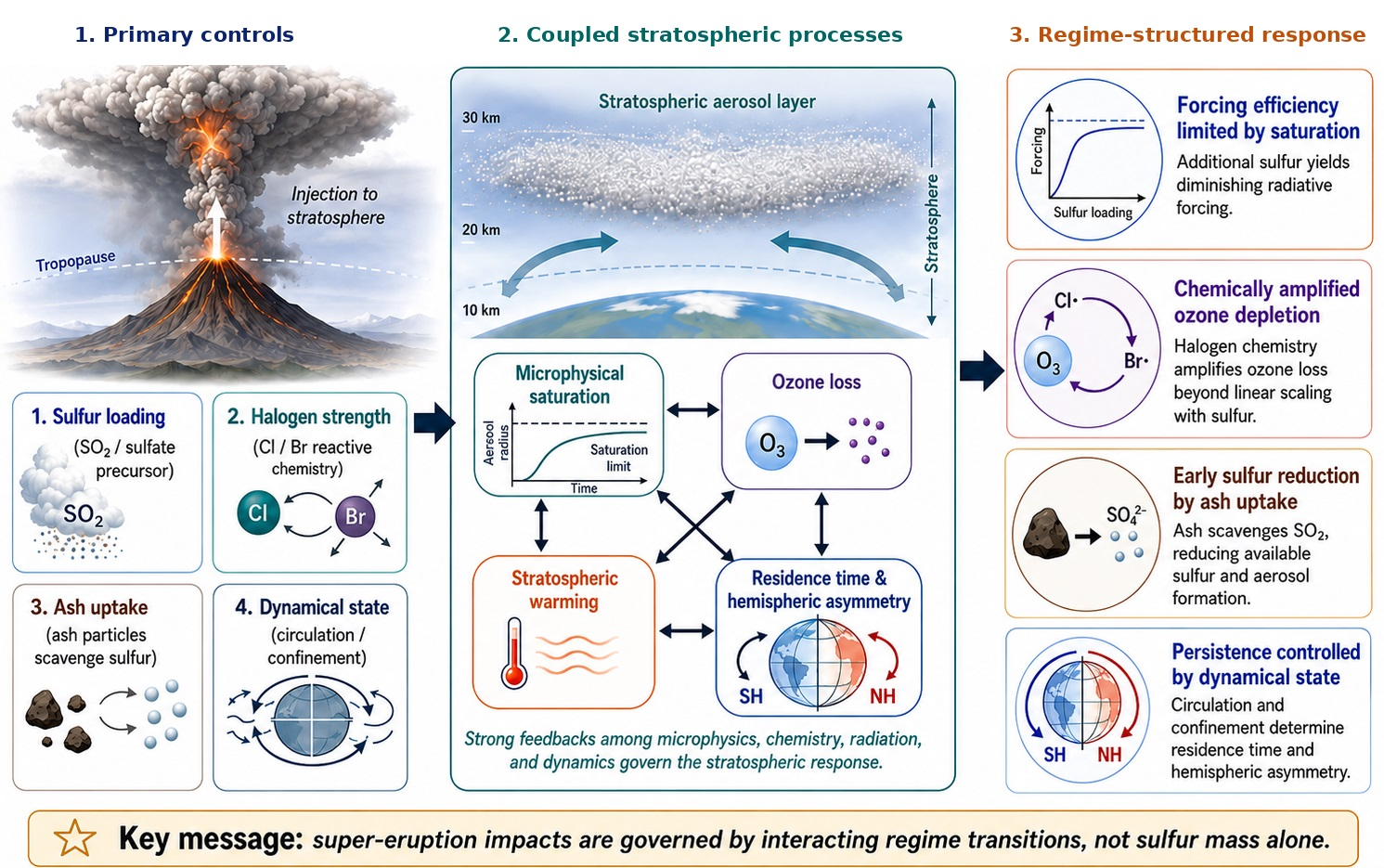

A Reduced-Order Regime Theory for Aerosol–Halogen–Dynamics Coupling in Volcanic Super-Eruptions


Abstract
1. Introduction
2. Materials and Methods: Empirical and Modeling Basis for a Nonlinear Theory
2.1. Sulfate Aerosol Forcing Is Not Indefinitely Scalable
2.2. Halogen-Rich Eruptions Define a Distinct Chemical Regime
2.3. Ash Modifies Sulfur Availability Before the Sulfate Cloud Fully Forms
2.4. Dynamical Adjustment Is State-Dependent
2.5. The Unresolved Theoretical Problem
3. Materials and Methods: Reduced-Order Formulation
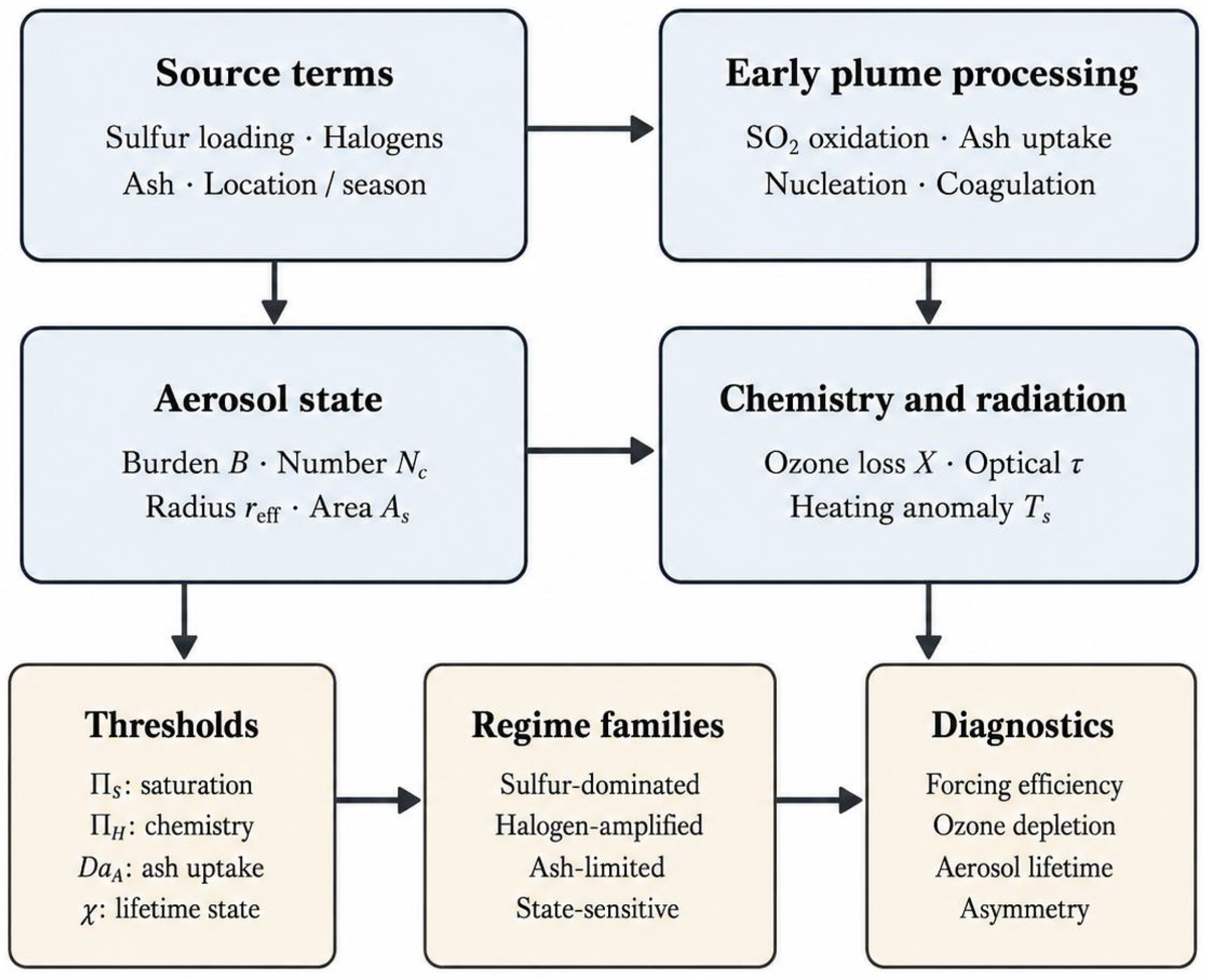
3.1. State Variables and Conceptual Architecture
3.2. Sulfur Conversion with Explicit Ash Scavenging
3.3. Sulfate Burden, Particle Number, and Effective Radius
3.4. Optical Depth and Aerosol Surface Area
3.5. Reactive Halogens and Ozone Loss
3.6. Stratospheric Thermal Tendency and Bulk Residence Time
3.7. Nondimensional Form
- 1.
- : sulfur loading relative to microphysical saturation,
- 2.
- : effective halogen burden relative to the ozone-loss threshold,
- 3.
- : early ash scavenging strength,
- 4.
- : signed dynamical state parameter.
4. Results: Analytical Regime Theory
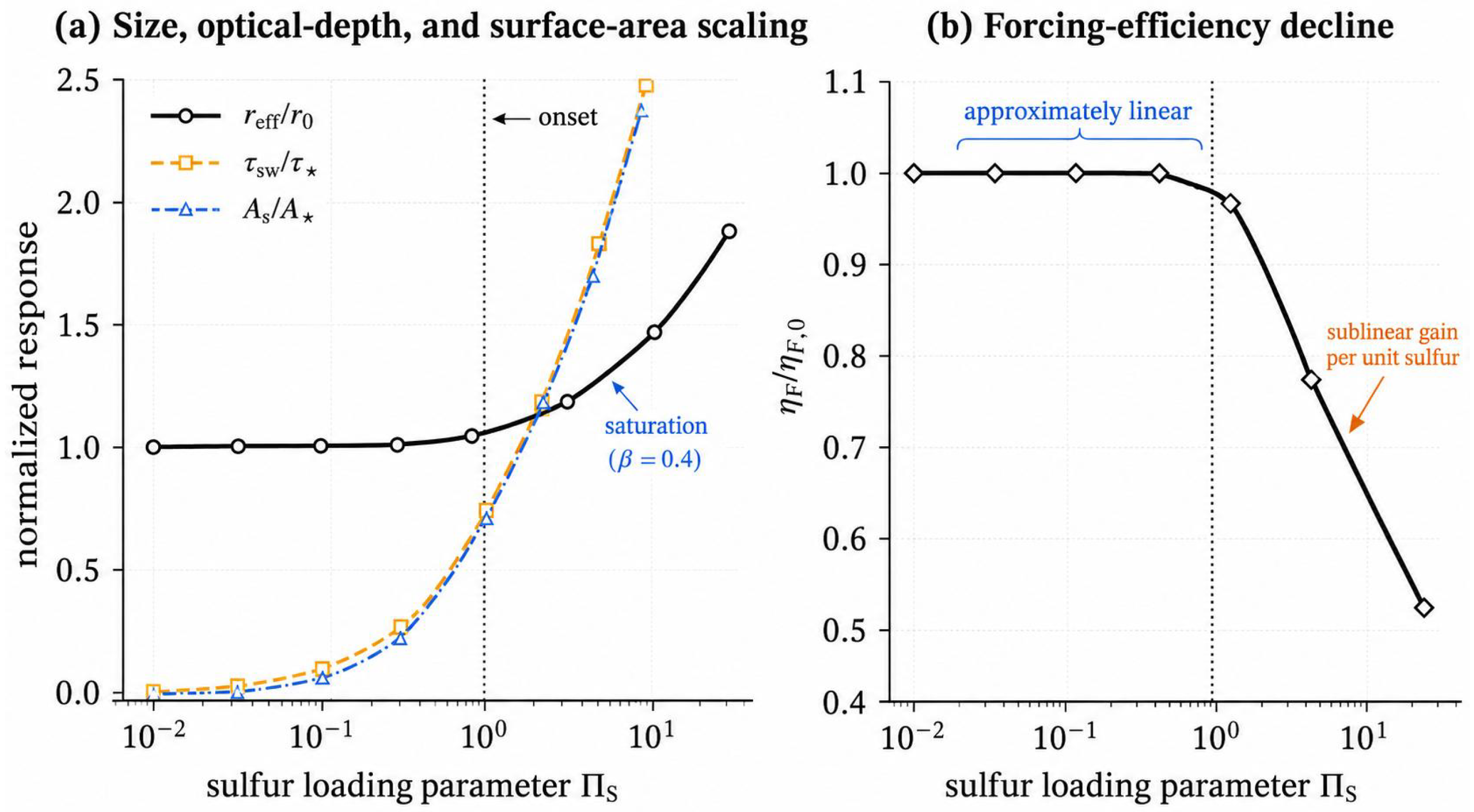
4.1. General Burden-Size Scaling
- 1.
- If , then and , which is the quasi-linear regime.
- 2.
- If , then and , which is the saturation regime.
- 3.
- The same burden dependence controls both optical depth and heterogeneous chemical capacity.
4.2. Sedimentation and Residence-Time Scaling
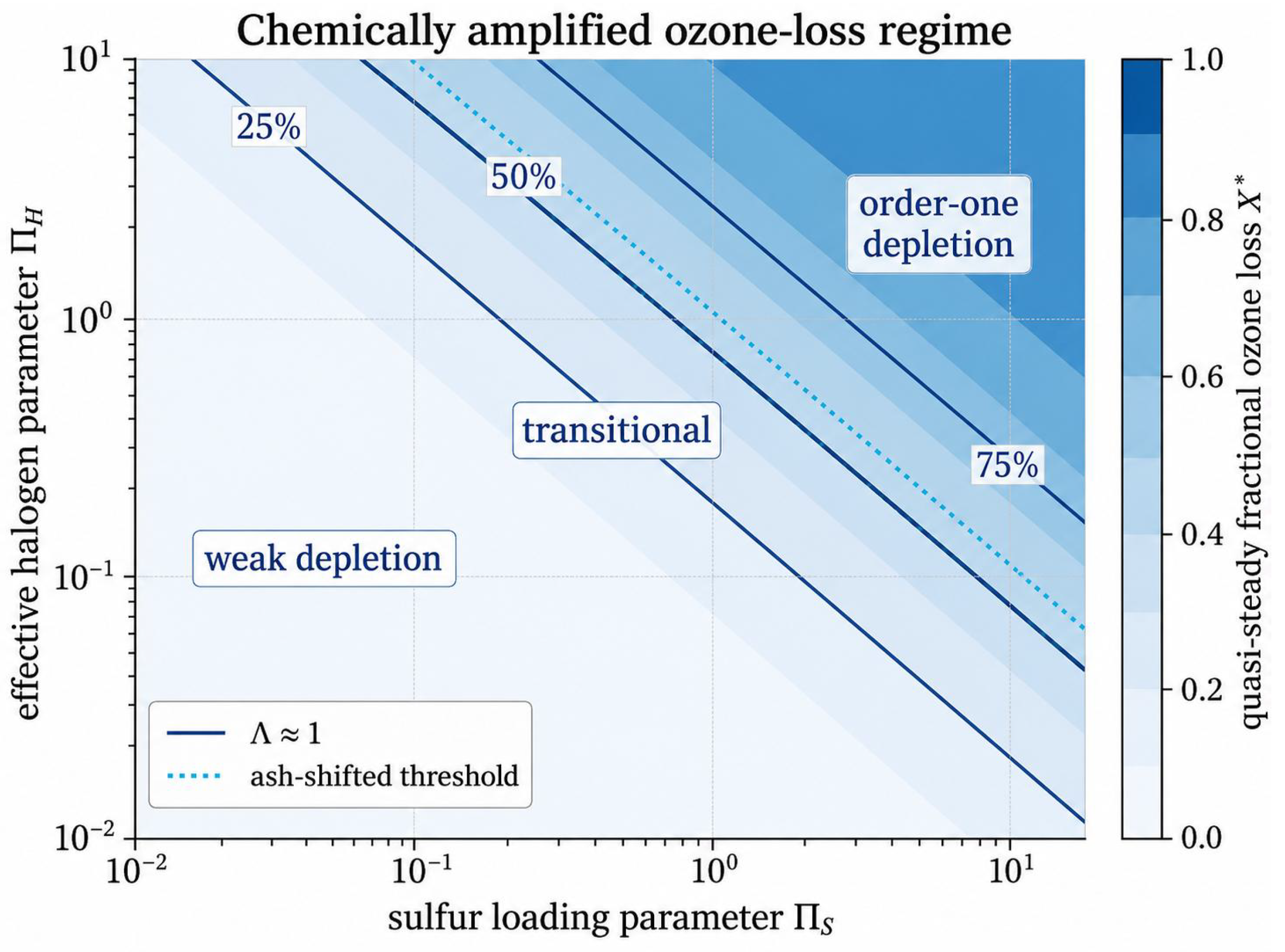
4.3. Threshold for Chemically Amplified Ozone Depletion
4.4. Ash Scavenging Shifts Both Radiative and Chemical Thresholds
4.5. Competition Between Aerosol Heating and Ozone-Loss Cooling
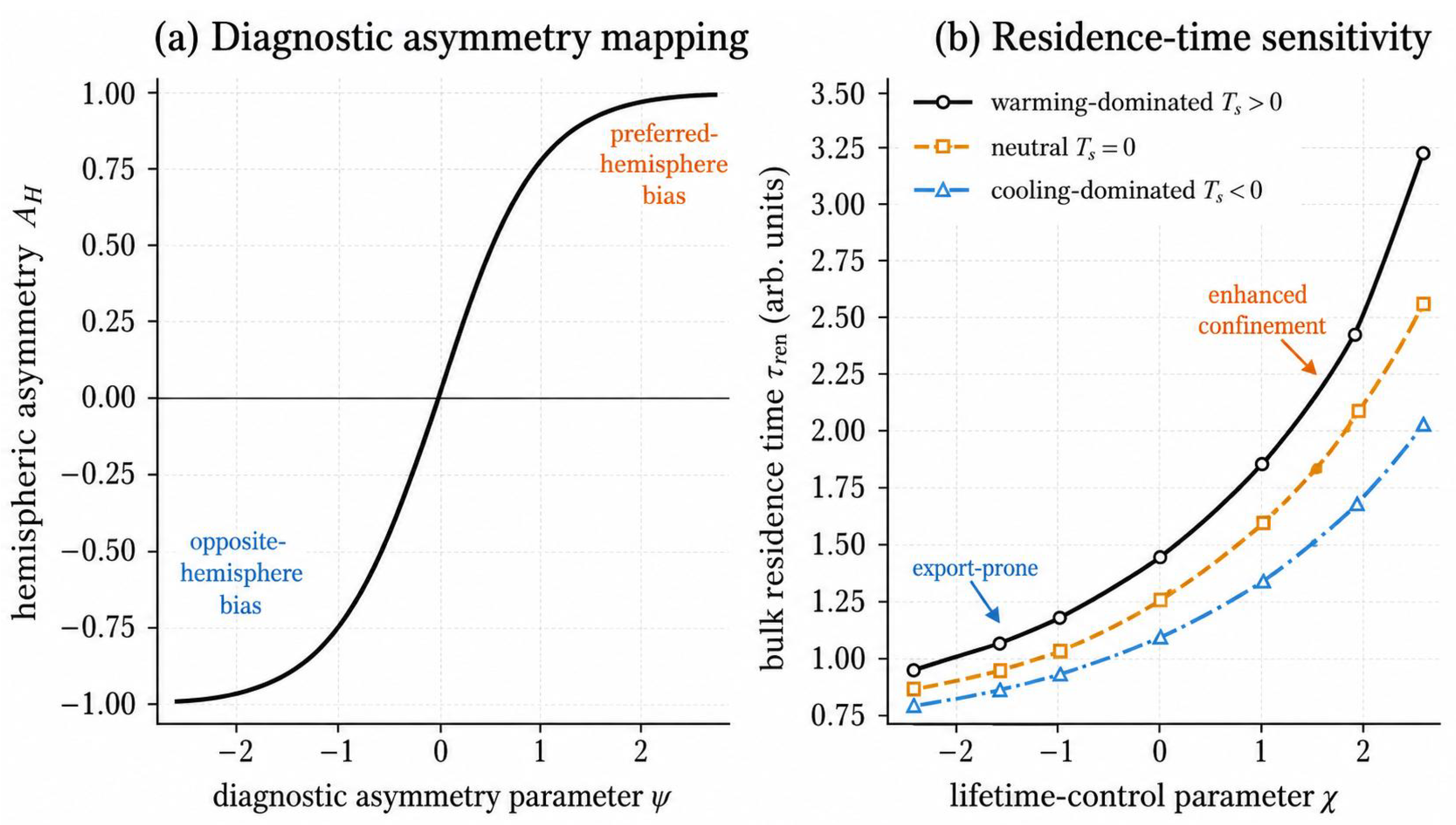
4.6. State Dependence and Hemispheric Asymmetry
5. Results: Literature-Anchored Parameter Benchmarking
5.1. Transparent Mapping from Published Quantities to Control Parameters
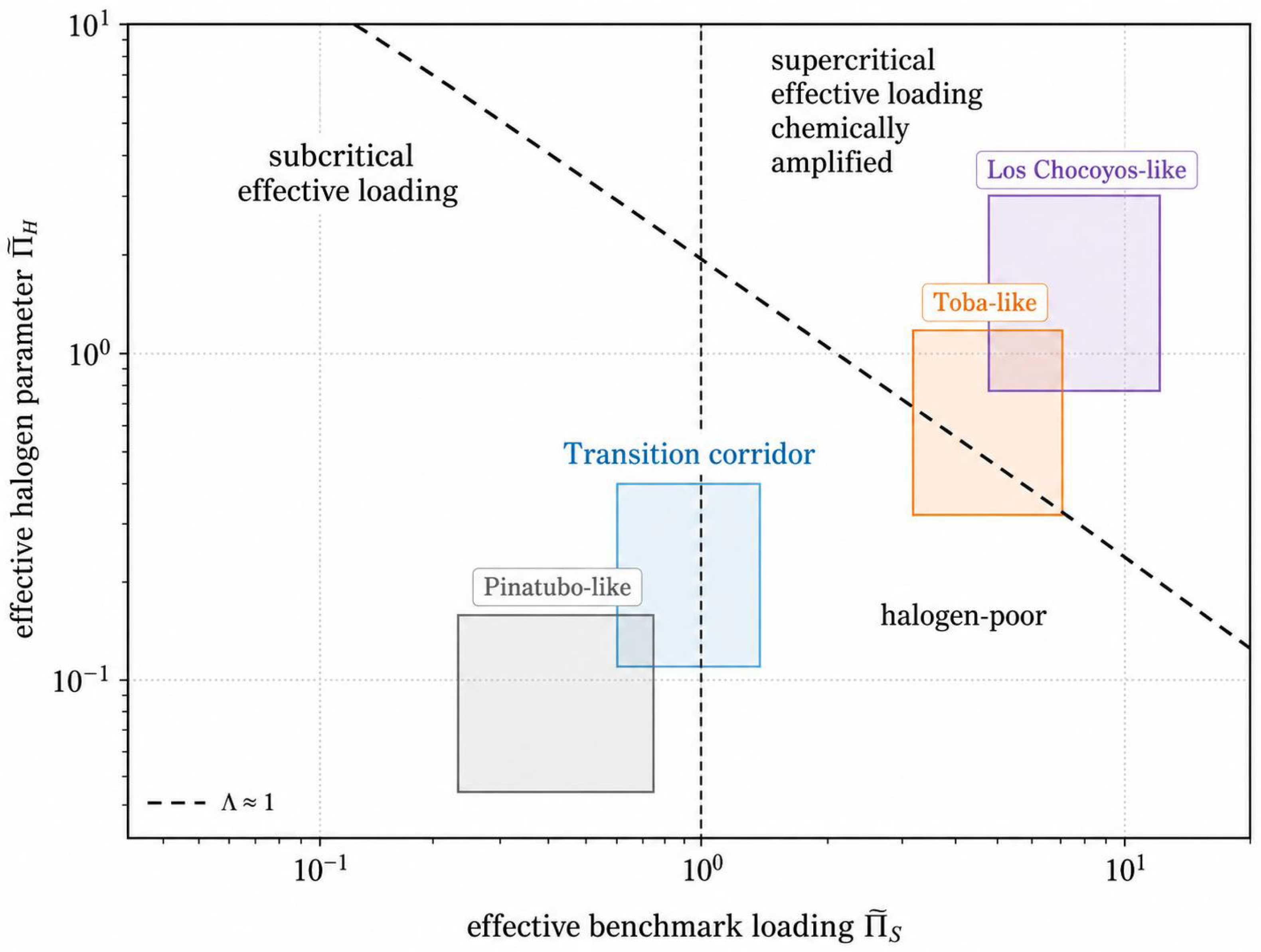
5.2. Benchmark Placement of Representative Eruption Classes
5.3. External Consistency Against Published Eruption Responses
6. Results: Illustrative Reduced-Order Integrations
6.1. Computational Implementation and Scenario Design
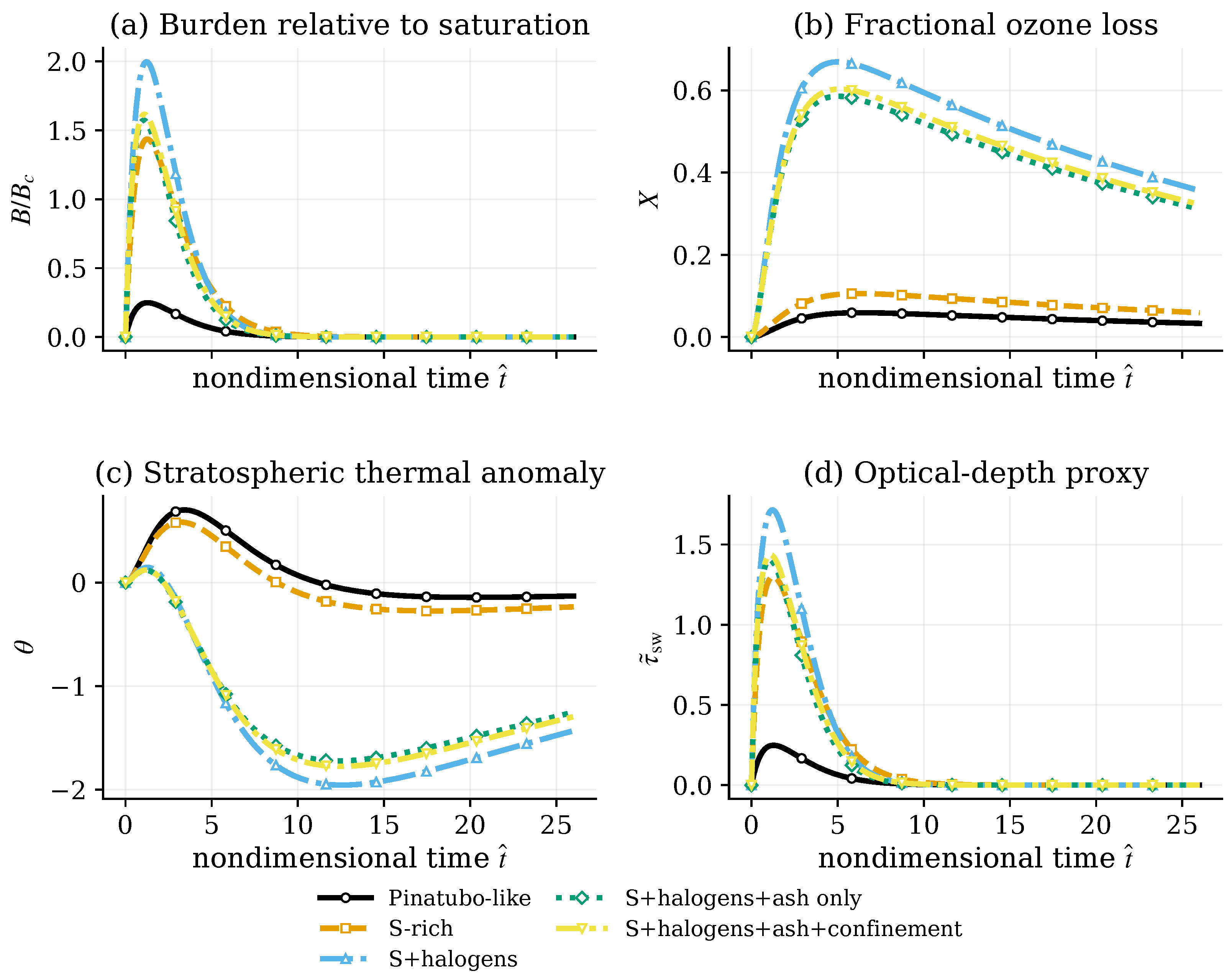
6.2. Integrated Response Families
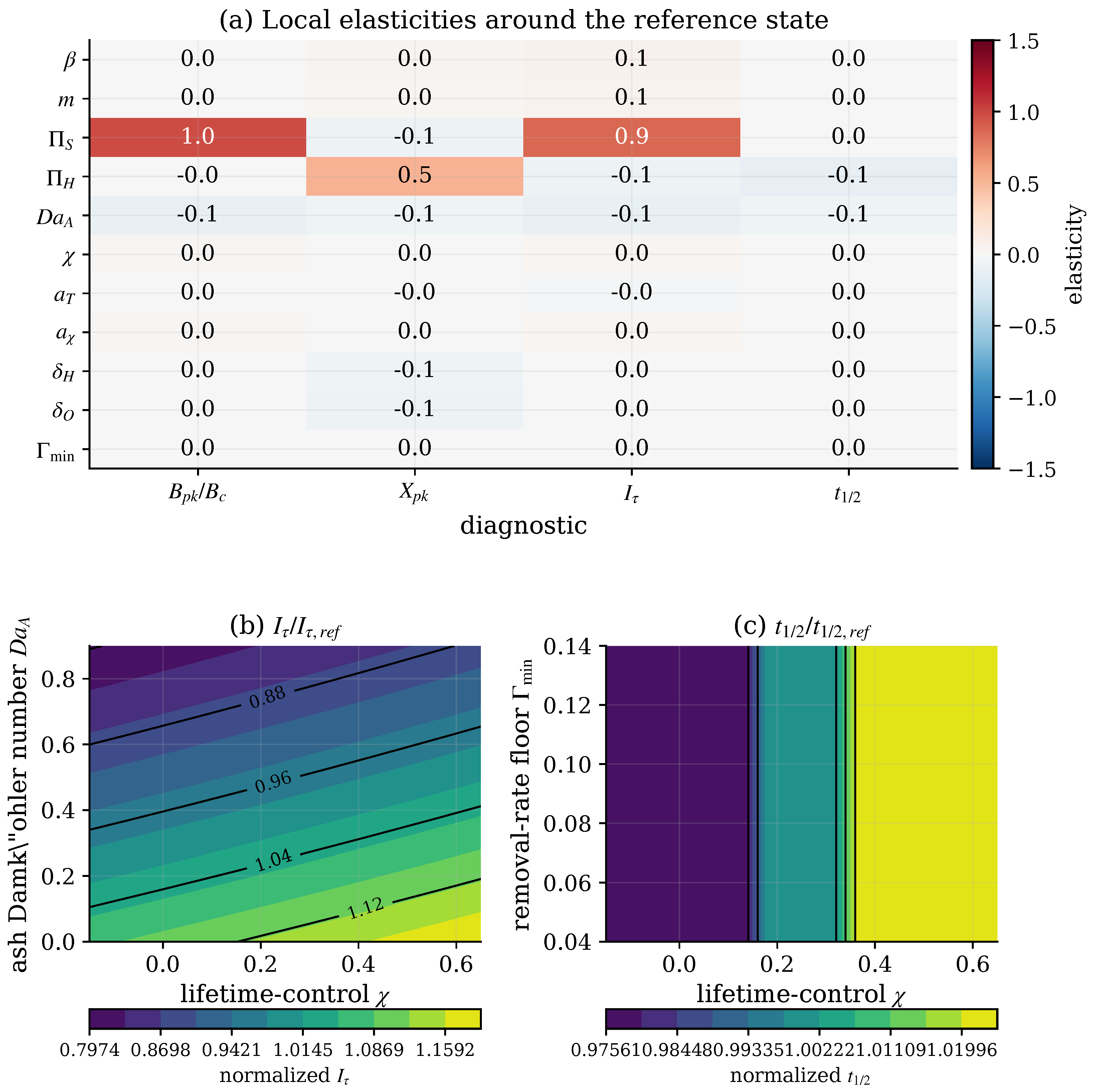
6.3. Structured Sensitivity Analysis
7. Discussion: Implications for Model Hierarchy and Interpretation
7.1. Results Shown Directly by the Reduced Theory
7.2. Hypotheses Suggested by the Reduced Theory
7.3. Broader Inferences Consistent with the Literature
8. Discussion: Limitations and Extensions
9. Conclusions
- 1.
- 2.
- 3.
- Ash scavenging modifies both the radiative and chemical branches by reducing sulfur yield before the sulfate cloud matures, thereby shifting multiple thresholds at once [19].
- 4.
- 5.
- Expanded local sensitivity tests around representative states indicate that, within the explored parameter neighborhood and chosen integration horizon, the main response families remain identifiable under moderate perturbations of the principal closures, whereas the precise magnitude of peak ozone loss, integrated optical depth, and lifetime remains closure-dependent and becomes most uncertain in strongly confined cases.
Supplementary Materials
Funding
Institutional Review Board Statement
Informed Consent Statement
Data Availability Statement
Acknowledgments
 source preparation, language refinement, and Graphical Abstract drafting. The author reviewed and approved the outputs and assumes full responsibility for the manuscript.
Conflicts of Interest
Abbreviations
| ERF | Effective radiative forcing |
| QBO | Quasi-biennial oscillation |
| SAOD | Stratospheric aerosol optical depth |
| Sulfur dioxide | |
| Sulfuric acid |
Appendix A. Derivation of the Burden-Size-Optical-Depth Scaling
Appendix B. Derivation of the Ash-Modified Sulfur Yield
Appendix C. Derivation of the Sedimentation Scaling
Appendix D. Benchmark-Mapping Details

| Quantity | Evidence Basis | Transformation Used in This Manuscript | Confidence Class |
|---|---|---|---|
| Injected sulfur | Published event or experiment-class sulfur estimates and idealized forcing corridors [7,8] | Normalized by to form the effective loading coordinate | Direct-to-moderate |
| Onset scale | Transition between quasi-linear and saturating behavior in model studies [7,8] | Treated as an order-of-magnitude threshold rather than a universal constant | Moderate |
| Ash yield | Ash-mediated sulfur-removal estimates [19] | Converted to through Equation (49) and to through Equation (47) | Moderate |
| ozone-loss proxy | Published halogen-rich eruption simulations [15,16,18] | Converted to and then to through Equation (48) | Theory-mediated |
| Dynamical class | Initial-condition, season, and circulation-sensitivity studies [9,22,23] | Assigned as a bounded lifetime-control class rather than estimated as a retrieved physical observable | Interpretive |
| Asymmetry coordinate | Hemispheric partition diagnostics when available [22] | Mapped through | Moderate when diagnostics exist; otherwise interpretive |
| Class | (Tg S) | (Tg S) | Output | Output | |
|---|---|---|---|---|---|
| Pinatubo-like | 6–12 | 0.95–1.00 | 15–18 | 0.32–0.80 | 0.00–0.08 |
| Transition corridor | 12–24 | 0.95–1.00 | 18–20 | 0.60–1.20 | 0.00–0.08 |
| Toba-like | 65–120 | 0.82–0.97 | 18–20 | 3.0–6.0 | 0.05–0.30 |
| Los Chocoyos-like | 85–145 | 0.55–0.82 | 17–20 | 4.0–7.0 | 0.30–0.90 |
| Class | Output | Band | Range | Output | ||
|---|---|---|---|---|---|---|
| Pinatubo-like | 0.02–0.05 | 0.45–0.55 | 0.03–0.10 | – | – | – |
| Transition corridor | 0.05–0.15 | 0.45–0.55 | 0.08–0.25 | – | – | – |
| Toba-like | 0.30–0.55 | 0.40–0.50 | 0.20–0.60 | – | – | – |
| Los Chocoyos-like | 0.50–0.80 | 0.40–0.50 | 0.50–1.60 | – | – | – |
| Class | Raw | Interpretive | Raw | Interpretive |
|---|---|---|---|---|
| Pinatubo-like | 0.32–0.80 | 0.32–0.80 | 0.02–0.14 | 0.03–0.10 |
| Transition corridor | 0.57–1.33 | 0.60–1.20 | 0.05–0.27 | 0.08–0.25 |
| Toba-like | 2.67–6.47 | 3.00–6.00 | 0.10–0.51 | 0.20–0.60 |
| Los Chocoyos-like | 2.34–6.99 | 4.00–7.00 | 0.20–1.32 | 0.50–1.60 |
Appendix E. Additional Tables
| Symbol | Interpretation | Comment |
|---|---|---|
| S | Sulfur-equivalent gas-phase burden | Sulfur residing in the stratospheric sulfur dioxide () reservoir |
| B | Sulfur-equivalent sulfate burden | Sulfur carried by sulfate aerosol; aerosol mass is |
| Aerosol particle number column | Explicit or implicit microphysical state variable | |
| Effective particle radius | Diagnostic of the burden–number ratio and sedimentation | |
| H | Effective reactive-halogen burden | Reduced representation of chemically active chlorine and bromine |
| X | Fractional ozone loss | |
| Stratospheric thermal anomaly | Net effect of aerosol heating and ozone-loss cooling | |
| Sulfur-loading parameter | Burden relative to onset of microphysical saturation | |
| Halogen parameter | Reactive halogen strength relative to ozone-loss threshold | |
| Ash-uptake Damköhler number | Early ash scavenging relative to gas-phase oxidation | |
| Lifetime-control parameter | Encodes confinement/export sensitivity and initial-state dependence in the residence-time branch | |
| Diagnostic asymmetry coordinate | Encodes partitioning toward the preferred versus opposite hemisphere |
| Regime | Approximate Condition | Dominant Behavior | Representative Literature Context |
|---|---|---|---|
| Quasi-linear sulfur regime | , | Optical depth nearly proportional to sulfur; effective radius weakly varying | Moderate tropical eruptions and the idealized 10–40 Tg S range [7,10] |
| Microphysical saturation regime | , | Sublinear forcing growth, faster sedimentation, declining forcing efficiency | Large or super-eruptive sulfur injections [4,5,8] |
| Chemically amplified regime | or | Strong ozone depletion and possible suppression of self-lofting | Halogen-rich Los Chocoyos- and Toba-like scenarios [15,16,18] |
| Ash-modified regime | non-negligible | Reduced sulfur yield into sulfate and displaced radiative and chemical thresholds | Persisting ash affecting early loss [19] |
| State-dependent dynamical regime | non-negligible and/or non-negligible | Residence-time sensitivity and, when diagnosed, hemispheric asymmetry linked to season, , and initial circulation | Initial-condition spread and circulation sensitivity [20,22,23,24] |
References
- Robock, A. Volcanic eruptions and climate. Rev. Geophys. 2000, 38, 191–219. [Google Scholar] [CrossRef]
- Kremser, S.; Thomason, L.W.; von Hobe, M.; Hermann, M.; Deshler, T.; Timmreck, C.; Toohey, M.; Stenke, A.; Schwarz, J.P.; Weigel, R.; et al. Stratospheric aerosol—Observations, processes, and impact on climate. Rev. Geophys. 2016, 54, 278–335. [Google Scholar] [CrossRef]
- Marshall, L.R.; Maters, E.C.; Schmidt, A.; Timmreck, C.; Robock, A.; Toohey, M. Volcanic effects on climate: Recent advances and future avenues. Bull. Volcanol. 2022, 84, 54. [Google Scholar] [CrossRef]
- English, J.M.; Toon, O.B.; Mills, M.J. Microphysical simulations of large volcanic eruptions: Pinatubo and Toba. J. Geophys. Res. Atmos. 2013, 118, 1880–1895. [Google Scholar] [CrossRef]
- Niemeier, U.; Schmidt, H. Changing transport processes in the stratosphere by radiative heating of sulfate aerosols. Atmos. Chem. Phys. 2017, 17, 14871–14886. [Google Scholar] [CrossRef]
- Wrana, F.; Niemeier, U.; Thomason, L.W.; Wallis, S.; von Savigny, C. Stratospheric aerosol size reduction after volcanic eruptions. Atmos. Chem. Phys. 2023, 23, 9725–9743. [Google Scholar] [CrossRef]
- Timmreck, C.; Olonscheck, D.; Ballinger, A.P.; D’Agostino, R.; Fang, S.W.; Schurer, A.P.; Hegerl, G.C. Linearity of the climate response to increasingly strong tropical volcanic eruptions in a large ensemble framework. J. Clim. 2024, 37, 2455–2470. [Google Scholar] [CrossRef]
- Enger, E.R.; Graversen, R.; Theodorsen, A. Saturation in forcing efficiency and temperature response of large volcanic eruptions. J. Geophys. Res. Atmos. 2025, 130, e2024JD041098. [Google Scholar] [CrossRef]
- Toohey, M.; Krüger, K.; Niemeier, U.; Timmreck, C. The influence of eruption season on the global aerosol evolution and radiative impact of tropical volcanic eruptions. Atmos. Chem. Phys. 2011, 11, 12351–12367. [Google Scholar] [CrossRef]
- Marshall, L.R.; Smith, C.J.; Forster, P.M.; Aubry, T.J.; Andrews, T.; Schmidt, A. Large variations in volcanic aerosol forcing efficiency due to eruption source parameters and rapid adjustments. Geophys. Res. Lett. 2020, 47, e2020GL090241. [Google Scholar] [CrossRef]
- Quaglia, I.; Timmreck, C.; Niemeier, U.; Visioni, D.; Pitari, G.; Brodowsky, C.; Brühl, C.; Dhomse, S.S.; Franke, H.; Laakso, A.; et al. Interactive stratospheric aerosol models’ response to different amounts and altitudes of SO2 injection during the 1991 Pinatubo eruption. Atmos. Chem. Phys. 2023, 23, 921–948. [Google Scholar] [CrossRef]
- Clyne, M.; Lamarque, J.F.; Mills, M.J.; Khodri, M.; Ball, W.; Bekki, S.; Dhomse, S.S.; Lebas, N.; Mann, G.; Marshall, L.; et al. Model physics and chemistry causing intermodel disagreement within the VolMIP-Tambora interactive stratospheric aerosol ensemble. Atmos. Chem. Phys. 2021, 21, 3317–3343. [Google Scholar] [CrossRef]
- Toohey, M.; Jia, Y.; Khanal, S.; Tegtmeier, S. Stratospheric residence time and the lifetime of volcanic stratospheric aerosols. Atmos. Chem. Phys. 2025, 25, 3821–3839. [Google Scholar] [CrossRef]
- Brenna, H.; Kutterolf, S.; Krüger, K. Global ozone depletion and increase of UV radiation caused by pre-industrial tropical volcanic eruptions. Sci. Rep. 2019, 9, 9435. [Google Scholar] [CrossRef]
- Brenna, H.; Kutterolf, S.; Mills, M.J.; Krüger, K. The potential impacts of a sulfur- and halogen-rich supereruption such as Los Chocoyos on the atmosphere and climate. Atmos. Chem. Phys. 2020, 20, 6521–6539. [Google Scholar] [CrossRef]
- Staunton-Sykes, J.; Aubry, T.J.; Shin, Y.M.; Weber, J.; Marshall, L.R.; Abraham, N.L.; Archibald, A.; Schmidt, A. Co-emission of volcanic sulfur and halogens amplifies volcanic effective radiative forcing. Atmos. Chem. Phys. 2021, 21, 9009–9029. [Google Scholar] [CrossRef]
- Osterstrom, F.F.; Klobas, J.E.; Kennedy, R.P.; Cadoux, A.; Wilmouth, D.M. Sensitivity of stratospheric ozone to the latitude, season, and halogen content of a contemporary explosive volcanic eruption. Sci. Rep. 2023, 13, 6457. [Google Scholar] [CrossRef]
- Osipov, S.; Stenchikov, G.; Tsigaridis, K.; LeGrande, A.N.; Bauer, S.E.; Fnais, M.; Lelieveld, J. The Toba supervolcano eruption caused severe tropical stratospheric ozone depletion. Commun. Earth Environ. 2021, 2, 71. [Google Scholar] [CrossRef]
- Zhu, Y.; Toon, O.B.; Jensen, E.J.; Bardeen, C.G.; Mills, M.J.; Tolbert, M.A.; Yu, P.; Woods, S. Persisting volcanic ash particles impact stratospheric SO2 lifetime and aerosol optical properties. Nat. Commun. 2020, 11, 4526. [Google Scholar] [CrossRef] [PubMed]
- DallaSanta, K.J.; Gerber, E.P.; Toohey, M. The circulation response to volcanic eruptions: The key roles of stratospheric warming and eddy interactions. J. Clim. 2019, 32, 1101–1120. [Google Scholar] [CrossRef]
- Butchart, N. The stratosphere: A review of the dynamics and variability. Weather Clim. Dyn. 2022, 3, 1237–1272. [Google Scholar] [CrossRef]
- Zhuo, Z.; Fuglestvedt, H.F.; Toohey, M.; Krüger, K. Initial atmospheric conditions control transport of volcanic volatiles, forcing and impacts. Atmos. Chem. Phys. 2024, 24, 6233–6249. [Google Scholar] [CrossRef]
- DallaSanta, K.; Orbe, C.; Rind, D.; Nazarenko, L.; Jonas, J. Response of the quasi-biennial oscillation to historical volcanic eruptions. Geophys. Res. Lett. 2021, 48, e2021GL095412. [Google Scholar] [CrossRef]
- Brenna, H.; Kutterolf, S.; Mills, M.J.; Niemeier, U.; Timmreck, C.; Krüger, K. Decadal disruption of the QBO by tropical volcanic supereruptions. Geophys. Res. Lett. 2021, 48, e2020GL089687. [Google Scholar] [CrossRef]
- Black, B.A.; Lamarque, J.-F.; Marsh, D.R.; Schmidt, A.; Bardeen, C.G. Global climate disruption and regional climate shelters after the Toba supereruption. Proc. Natl. Acad. Sci. USA 2021, 118, e2013046118. [Google Scholar] [CrossRef]
- Innes, H.M.; Hutchison, W.; Sigl, M.; Crick, L.; Abbott, P.M.; Bigler, M.; Chellman, N.J.; Davies, S.M.; Kutterolf, S.; McConnell, J.R.; et al. Ice core evidence for the Los Chocoyos supereruption disputes millennial-scale climate impact. Commun. Earth Environ. 2025, 6, 137. [Google Scholar] [CrossRef]
- Aubry, T.J.; Toohey, M.; Marshall, L.R.; Schmidt, A.; Jellinek, A.M. A New Volcanic Stratospheric Sulfate Aerosol Forcing Emulator (EVA_H): Comparison with Interactive Stratospheric Aerosol Models. J. Geophys. Res. Atmos. 2020, 125, e2019JD031303. [Google Scholar] [CrossRef]
- Devine, J.D.; Sigurdsson, H.; Davis, A.N.; Self, S. Estimates of sulfur and chlorine yield to the atmosphere from volcanic eruptions and potential climatic effects. J. Geophys. Res. 1984, 89, 6309–6325. [Google Scholar] [CrossRef]
- Kutterolf, S.; Hansteen, T.H.; Appel, K.; Freundt, A.; Krüger, K.; Pérez, W.; Wehrmann, H. Combined bromine and chlorine release from large explosive volcanic eruptions: A threat to stratospheric ozone? Geology 2013, 41, 707–710. [Google Scholar] [CrossRef]
- Kutterolf, S.; Hansteen, T.H.; Freundt, A.; Wehrmann, H.; Appel, K.; Krüger, K.; Pérez, W. Bromine and chlorine emissions from Plinian eruptions along the Central American Volcanic Arc: From source to atmosphere. Earth Planet. Sci. Lett. 2015, 429, 234–246. [Google Scholar] [CrossRef]
- Vidal, C.M.; Métrich, N.; Komorowski, J.-C.; Pratomo, I.; Michel, A.; Kartadinata, N.; Robert, V.; Lavigne, F. The 1257 Samalas eruption (Lombok, Indonesia): The single greatest stratospheric gas release of the Common Era. Sci. Rep. 2016, 6, 34868. [Google Scholar] [CrossRef] [PubMed]
- Hunter, J.D. Matplotlib: A 2D Graphics Environment. Comput. Sci. Eng. 2007, 9, 90–95. [Google Scholar] [CrossRef]
- Virtanen, P.; Gommers, R.; Oliphant, T.E.; Haberland, M.; Reddy, T.; Cournapeau, D.; Burovski, E.; Peterson, P.; Weckesser, W.; Bright, J.; et al. SciPy 1.0: Fundamental Algorithms for Scientific Computing in Python. Nat. Methods 2020, 17, 261–272. [Google Scholar] [CrossRef]
- Harris, C.R.; Millman, K.J.; van der Walt, S.J.; Gommers, R.; Virtanen, P.; Cournapeau, D.; Wieser, E.; Taylor, J.; Berg, S.; Smith, N.J.; et al. Array programming with NumPy. Nature 2020, 585, 357–362. [Google Scholar] [CrossRef] [PubMed]




| Symbol | Interpretation | Comment |
|---|---|---|
| S | Sulfur-equivalent gas-phase burden | Sulfur residing in the stratospheric sulfur dioxide () reservoir |
| B | Sulfur-equivalent sulfate burden | Sulfur carried by sulfate aerosol; aerosol mass is |
| Aerosol particle number column | Explicit or implicit microphysical state variable | |
| H | Effective reactive-halogen burden | Reduced representation of chemically active chlorine and bromine |
| X | Fractional ozone loss | |
| Stratospheric thermal anomaly | Net effect of aerosol heating and ozone-loss cooling | |
| Sulfur-loading parameter | Initial sulfate burden relative to the onset of microphysical saturation | |
| Halogen parameter | Effective halogen strength relative to the ozone-loss threshold | |
| Ash-uptake Damköhler number | Early ash scavenging relative to gas-phase oxidation | |
| Lifetime-control parameter | Signed proxy for confinement versus export in the residence-time branch | |
| Diagnostic asymmetry coordinate | Signed proxy for partitioning toward the preferred versus opposite hemisphere |
| Equation(s) | Status | Physical Origin or Interpretation | Main Limitation |
|---|---|---|---|
| Equations (1)–(4) | Mass-balance closure | First-order sulfur oxidation with an early ash-mediated uptake term, motivated by heterogeneous sulfur loss on ash [19] | Does not resolve ash size spectra, fall speed, or surface chemistry explicitly |
| Equation (5) | Reservoir budget | Conversion from gas-phase sulfur into sulfate burden and bulk removal from the stratospheric reservoir | Collapses detailed aerosol transport and removal into a single residence time |
| Equations (9)–(12) | Microphysical bridge law | Burden–number–radius geometry with sublinear particle-number growth under coagulation, motivated by volcanic aerosol microphysics [2,4,5] | Captures scaling and saturation, not full sectional or modal microphysics |
| Equations (13)–(15) | Optical/surface-area proxy closure | Geometric scaling of optical depth and surface area with burden and effective radius | Wavelength, humidity, and composition dependence are compressed into bulk constants |
| Equations (17)–(20) | Chemical threshold closure | Effective reactive halogen loss acting on ozone through aerosol surface area, motivated by sulfur–halogen simulations [14,15,16,18] | Suitable for ozone-loss thresholds, not for quantitative halogen-family partitioning |
| Equations (21)–(23) | Thermal and lifetime closure | Competition between aerosol heating, ozone-loss cooling, sedimentation, confinement, and self-lofting [5,20,22] | Compresses vertical structure and circulation into effective coefficients |
| Equations (26)–(30) | Nondimensional model | Direct scaling of the prognostic equations into a compact control space | Parameter values remain literature-informed rather than event-calibrated |
| Equations (38)–(40) | Regime criterion | Quasi-steady ozone-loss threshold expressed as a halogen–surface-area product | Assumes the reduced surface-area closure and a fixed chemical timescale |
| Category | Quantities | Role in the Manuscript |
|---|---|---|
| Prognostic variables | s, b, h, X, | Advanced explicitly in time by Equations (26)–(30). |
| Diagnostic relations | , , | Used to interpret thresholds, thermal sign, and hemispheric partitioning without being solved prognostically in Section 6. |
| Closure functions | , , , | Define the reduced microphysical, chemical, radiative, and lifetime closures of the model. |
| Benchmark-only quantities | , benchmark sectors introduced below, and the worked ranges in Appendix D | Used only for heuristic literature placement in regime space; they are not advanced by the prognostic integrations of Section 6. |
| Assumption | Role in the Analysis | Main Limitation |
|---|---|---|
| Sulfur-equivalent burden basis | Keeps the gas-phase and aerosol sulfur budget explicit while allowing a fixed conversion to dry sulfate-aerosol mass for optical and geometric relations | Does not resolve evolving sulfate composition or water uptake explicitly |
| Bridge-law microphysics | Represents the transition from quasi-linear particle-number growth to coagulation-dominated effective-radius growth | Does not replace sectional or modal aerosol microphysics |
| Shared optical-depth/surface-area nonlinearity | Allows analytical coupling between radiative and heterogeneous-chemical branches through the common ratio | Quantitative thresholds may shift if humidity, composition, or broad size spectra decouple and |
| Single effective halogen variable | Captures threshold behavior of heterogeneous ozone loss in a transparent form | Does not predict detailed chlorine, bromine, nitrogen, or partitioning |
| Bulk lifetime parameter | Encodes confinement/export tendency in the residence-time branch | Does not predict the circulation from first principles and must be interpreted as a low-dimensional state proxy |
| Parameter | Working Mapping | Literature Inputs Used for Benchmarking |
|---|---|---|
| Injected sulfur mass , ash-suppressed sulfate yield , and a saturation-onset scale informed by the 10–40 Tg S transition corridor and large-eruption saturation studies | ||
| with | Published ozone-loss fraction, reactive halogen delivery efficiency, and a representative microphysical exponent | |
| Early sulfur-yield suppression inferred from ash-mediated uptake estimates | ||
| Assigned as a bounded dynamical-state class inferred from season, latitude, and initial-condition sensitivity | Reported transport sensitivity, preferred confinement/export tendency, and eruption-context diagnostics | |
| when an asymmetry estimate is reported | Hemispheric aerosol asymmetry or equivalent partition diagnostics |
| Class | Adopted Band | Diagnostic Criteria | Interpretation |
|---|---|---|---|
| Export-prone | to | Published or expected early export from the main aerosol reservoir, weak confinement, or strong cross-equatorial dilution | Shorter effective residence time |
| Neutral | to | No strong evidence for preferential confinement or export, or insufficient dynamical information | Background residence-time branch |
| Weakly confined | to | Initial-state or seasonal context favors slower export or partial hemispheric retention | Moderately prolonged residence time |
| Confined | to | Published simulations or eruption context indicate strong confinement, delayed export, or persistent reservoir retention | Long-tail residence-time sensitivity |
| Eruption Class | Benchmark Sector | Interpretation Within the Reduced Theory | Principal Literature Basis |
|---|---|---|---|
| Pinatubo-like | –, , negligible | Near-quasi-linear sulfate response, limited chemical amplification, and residence-time sensitivity dominated by ordinary transport variability | [1,10,11,13] |
| Idealized 10–40 Tg S tropical corridor | –, low-to-moderate , negligible | Transition from approximately linear scaling toward saturation; useful corridor for locating the onset of nonlinearity | [7,8] |
| Toba-like | –6, 0.2–0.6, modest , state-sensitive | Saturated forcing efficiency, large aerosol surface area, and marked ozone vulnerability without requiring extreme | [4,18,24,25] |
| Los Chocoyos-like | –7, 0.5–1.6, –, state-sensitive | Strong chemical amplification, ash-modified sulfur yield, substantial ozone depletion, and pronounced sensitivity to transport history | [15,19,22,26] |
| Anchor Class | Literature Behavior Used as Qualitative Target | Behavior Produced by the Reduced Theory | Consistency Level |
|---|---|---|---|
| Pinatubo-like | Near-linear optical response, moderate lifetime, limited halogen amplification unless halogen delivery is unusually efficient [1,10,11] | Below or near the saturation threshold, weak chemical amplification, and transport-dominated lifetime variability | High for regime ordering |
| 10–40 Tg S tropical corridor | Approximately scalable temperature and precipitation anomalies over a finite moderate-loading range, approaching saturation at upper loadings [7,8] | Transition sector near , where the bridge law begins to depart from linear optical scaling | High for onset behavior |
| Toba-like | Large sulfur loadings, forcing-efficiency saturation, strong ozone vulnerability under halogen-rich assumptions, and strong dynamical sensitivity in models [4,18,24,25] | Supercritical sulfur loading, sublinear forcing efficiency, and strong chemical response only when approaches an order of unity | Moderate to high; event details remain model-dependent |
| Los Chocoyos-like | Sulfur- and halogen-rich forcing, substantial ozone depletion in chemistry–climate simulations, ash-mediated sulfur loss, and contested long-duration climate expression [15,19,26] | Chemically amplified, ash-modified sector with strong short-lived chemical disruption but non-proportional radiative scaling | High for qualitative regime logic; not an event reconstruction |
| Diagnostic Target | Published Behavior Used as External Target | Reduced-Order Behavior Without Event-Specific Recalibration | Consistency Assessment |
|---|---|---|---|
| Aerosol size and forcing efficiency | Pinatubo-like cases remain near the quasi-linear regime, whereas Toba-like and larger idealized eruptions produce larger particles and declining forcing efficiency [4,7,8] | yields weak radius growth; produces sublinear optical-depth scaling and declining | Correct rank ordering of forcing-efficiency loss |
| Moderate 10–40 Tg S corridor | Published ensembles indicate approximate scalability over a finite tropical corridor, not unlimited linearity [7] | The corridor lies near the transition into saturation rather than deep in the supercritical regime | Consistent transition behavior |
| Halogen-rich ozone loss | Los Chocoyos-like and Toba-like sulfur–halogen simulations show substantially stronger ozone depletion than sulfur-only scaling would imply [15,16,18] | The threshold moves high-surface-area, halogen-rich cases into a chemically amplified regime | Correct chemical-amplification ordering |
| Ash-mediated sulfur suppression | Persisting ash can remove a substantial fraction of sulfur before complete sulfate formation [19] | Increasing lowers the effective loading coordinate and reduces the integrated optical-depth proxy at fixed nominal loading | Consistent sign and early-phase timing |
| Dynamical persistence | Initial state, season, and transport history alter hemispheric partitioning and aerosol lifetime in comprehensive models [20,22,23] | Positive lengthens the late-tail response while diagnoses hemispheric partitioning independently | Consistent direction of state dependence |
| Case | ||||
|---|---|---|---|---|
| Pinatubo-like | 0.55 | 0.05 | 0.00 | 0.00 |
| Sulfur-rich, halogen-poor | 3.20 | 0.10 | 0.00 | 0.05 |
| Sulfur-rich, halogen-rich | 4.50 | 1.20 | 0.00 | 0.10 |
| Sulfur-rich, halogen-rich + ash only | 4.50 | 1.20 | 0.75 | 0.10 |
| Sulfur-rich, halogen-rich + ash + confinement | 4.50 | 1.20 | 0.75 | 0.55 |
| Parameter | Tested Range | Effect on Threshold Placement | Robustness Interpretation |
|---|---|---|---|
| – | Changes the chemical-threshold slope through the exponent ; high- threshold positions shift by order tens of percent across the tested range. | Qualitative separation between sulfur-saturated and chemically amplified regimes persists. | |
| m | 1–4 | Changes the sharpness of the transition near but leaves the low- and high-burden asymptotic scalings unchanged | Onset location is somewhat closure-dependent; asymptotic regime ordering is stable. |
| – | Does not move the microphysical or chemical threshold lines; affects the decay tail only when the raw removal rate would fall below the admissibility floor. | Lifetime magnitude in the most confined cases is floor-sensitive; early-to-intermediate regime ordering is unchanged. |
| Conclusion | Support Within the Explored Neighborhood | Status |
|---|---|---|
| Microphysical saturation reduces forcing efficiency | Follows analytically from the burden–radius scaling and remains visible under moderate perturbations of , m, and | Structurally robust within the adopted bridge-law family |
| Chemically amplified ozone loss requires the halogen–surface-area product to exceed threshold | Supported by Equation (20), the regime map, and the sensitivity of to , , and | Locally robust, but quantitatively closure-dependent |
| Ash reduces integrated optical-depth proxy at fixed nominal loading | Isolated by the ash-only trajectory and by the interaction test | Locally robust for the tested uptake range |
| Confinement modifies late decay and lifetime diagnostics | Appears in the perturbations and in the interaction with | Most sensitive to closure, floor, and integration horizon |
| Benchmark sectors organize published case classes | Supported by explicit mapping equations, worked ranges, and anchor-case consistency | Interpretive only; not calibrated event retrieval |
Disclaimer/Publisher’s Note: The statements, opinions and data contained in all publications are solely those of the individual author(s) and contributor(s) and not of MDPI and/or the editor(s). MDPI and/or the editor(s) disclaim responsibility for any injury to people or property resulting from any ideas, methods, instructions or products referred to in the content. |
© 2026 by the author. Licensee MDPI, Basel, Switzerland. This article is an open access article distributed under the terms and conditions of the Creative Commons Attribution (CC BY) license.
Share and Cite
Spoto, S.E. A Reduced-Order Regime Theory for Aerosol–Halogen–Dynamics Coupling in Volcanic Super-Eruptions. Atmosphere 2026, 17, 606. https://doi.org/10.3390/atmos17060606
Spoto SE. A Reduced-Order Regime Theory for Aerosol–Halogen–Dynamics Coupling in Volcanic Super-Eruptions. Atmosphere. 2026; 17(6):606. https://doi.org/10.3390/atmos17060606
Chicago/Turabian StyleSpoto, Sebastiano Ettore. 2026. "A Reduced-Order Regime Theory for Aerosol–Halogen–Dynamics Coupling in Volcanic Super-Eruptions" Atmosphere 17, no. 6: 606. https://doi.org/10.3390/atmos17060606
APA StyleSpoto, S. E. (2026). A Reduced-Order Regime Theory for Aerosol–Halogen–Dynamics Coupling in Volcanic Super-Eruptions. Atmosphere, 17(6), 606. https://doi.org/10.3390/atmos17060606