Global Insights into the Synergistic Characteristics of Methane and Nitrous Oxide Emissions from China’s Animal Husbandry and Their Policy Implications


Abstract
1. Introduction
2. Materials and Methods
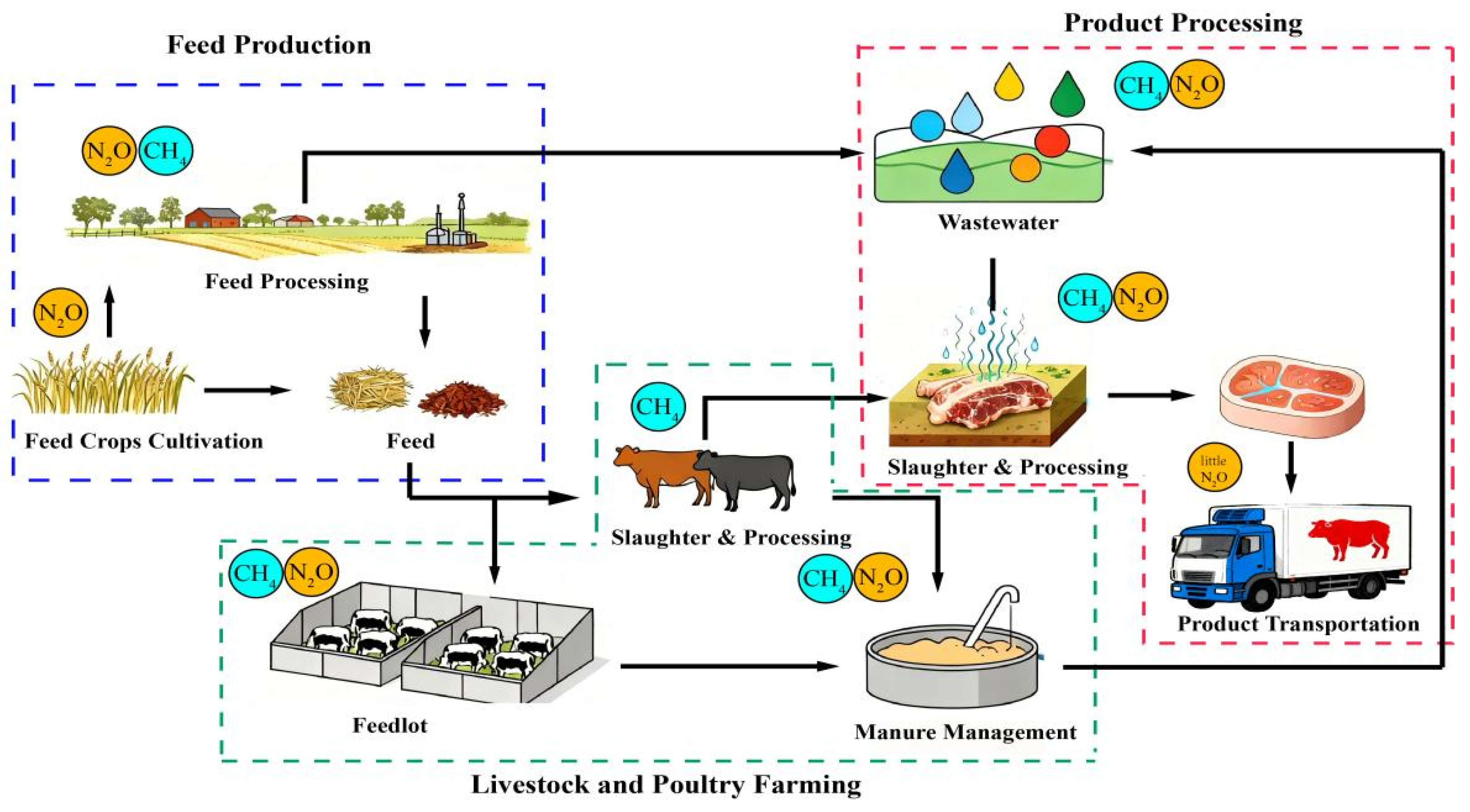
2.1. Data Sources
2.2. Model Construction
3. Results
3.1. Spatiotemporal Distribution Characteristics of CH4 and N2O Emissions from Animal Husbandry
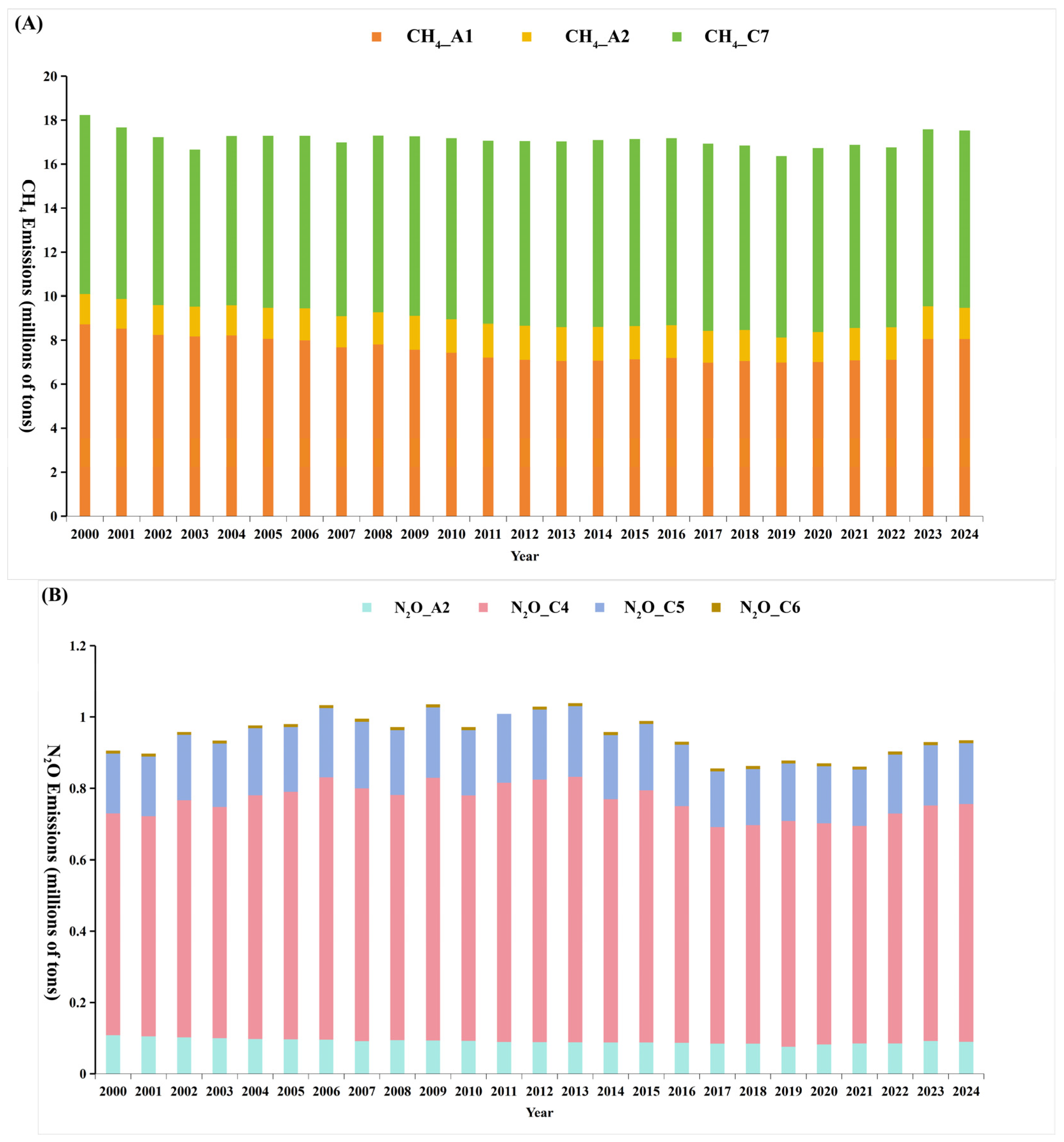
3.1.1. Characteristics of CH4 and N2O Emissions from Animal Husbandry in China
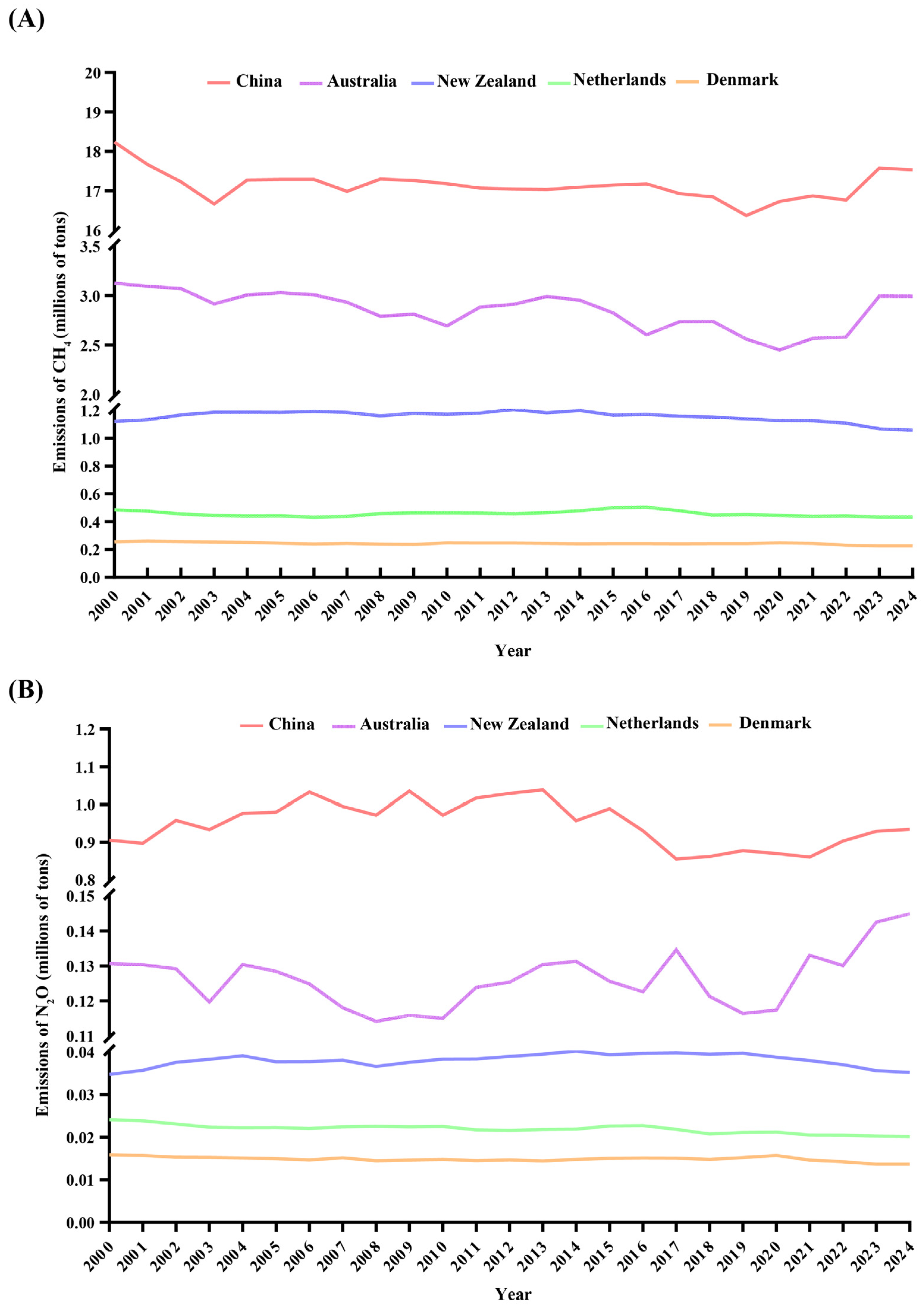
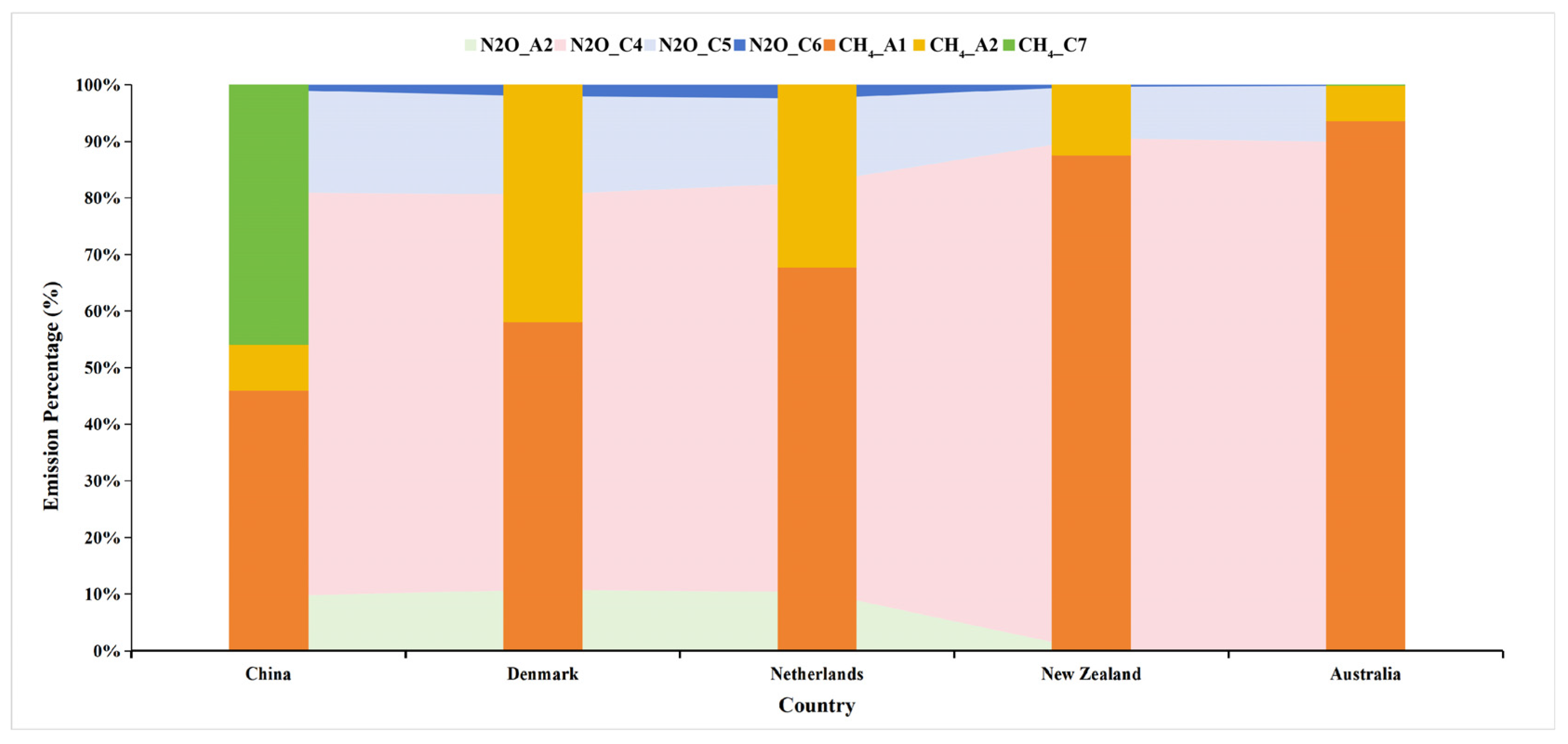
3.1.2. International Comparison of Characteristics and Structure of CH4 and N2O Emissions from Animal Husbandry
3.1.3. Evolution of the Spatial Pattern of CH4 and N2O Emissions from Animal Husbandry in China
3.2. Projection of CH4 and N2O Emissions from Animal Husbandry in China
3.2.1. Correlation Test and Collinearity Analysis
3.2.2. Ridge Regression Analysis and Model Prediction
+ 0.126388 × ln(YLLI) − 0.209582 × ln(POP) + 0.303422 × ln(CFA)
− 0.250527 × ln(MRR)
3.2.3. Development Scenario Setting and Analysis
4. Discussion
4.1. Synergistic Emission Characteristics of CH4 and N2O from Animal Husbandry
4.2. Synergistic Mitigation Strategies for CH4 and N2O from Animal Husbandry
4.2.1. “Top-Down” Government Guidance
- (a)
- Strengthening the emission data foundation and establishing a differentiated accounting framework
- (b)
- Setting synergistic mitigation targets and implementing categorized and tiered control pathways
- (c)
- Establishing emission functional zones and implementing targeted control measures
4.2.2. “Bottom-Up” Farmer-Driven Approaches
- (d)
- Strengthening the participation of livestock producers and bridging the “last mile” of technology adoption
- (e)
- Optimizing incentive policy design to balance emission reduction benefits with farmer incomes
- (f)
- Improving demonstration and dissemination mechanisms to develop replicable mitigation models
5. Conclusions
- (1)
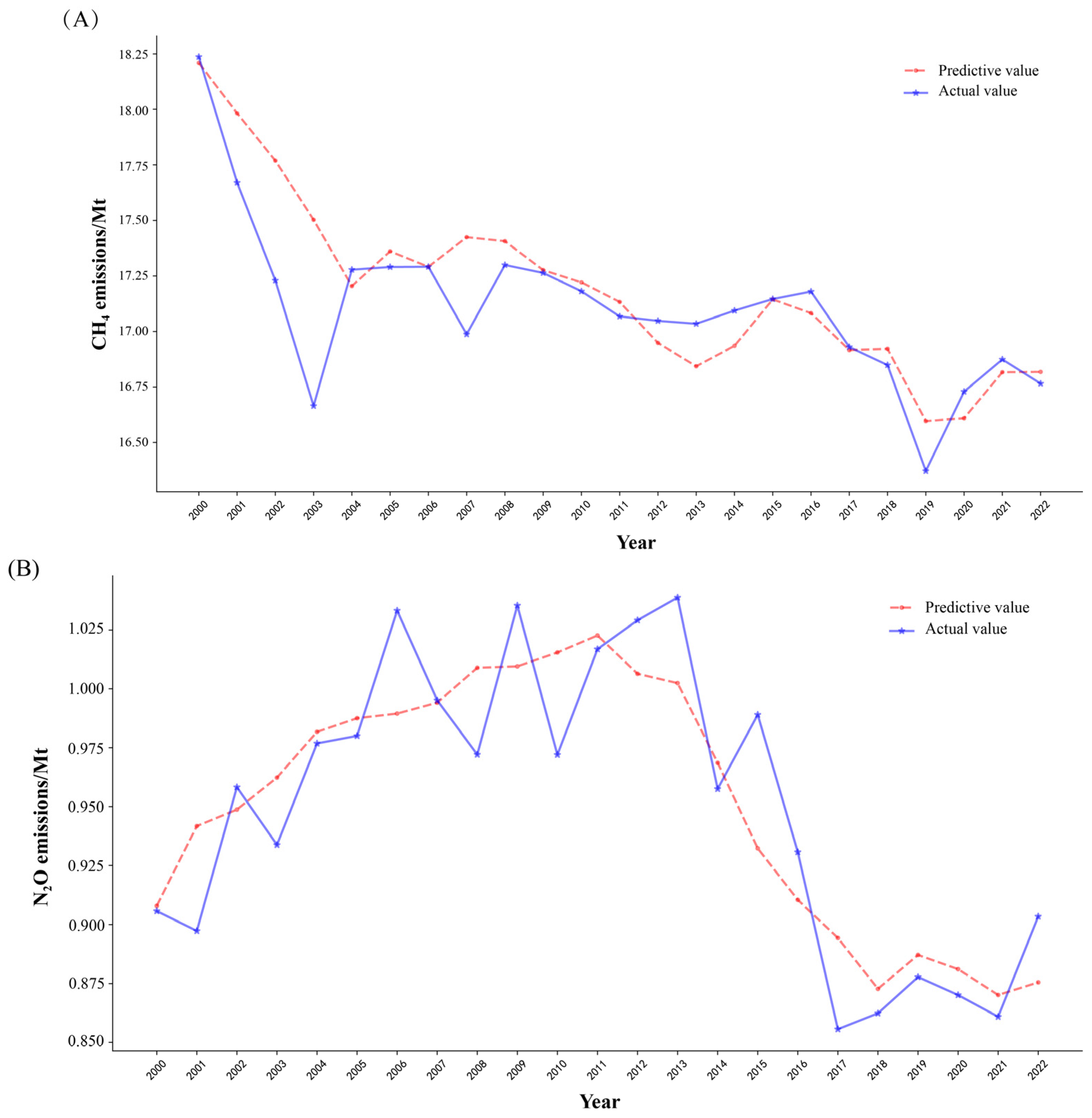
- From the perspective of temporal evolution and international comparison, China’s animal husbandry CH4 emissions have exhibited an early-stage fluctuating trend followed by a late-stage rebound, while N2O emissions have fluctuated sharply. The two gases display strong synergy yet are driven by distinct mechanisms. Globally, China’s total emissions dominate, and its emission structure is characterized by comparable contributions from enteric fermentation and rice paddies—a feature distinct from both pasture-based and intensive developed countries.
- (2)
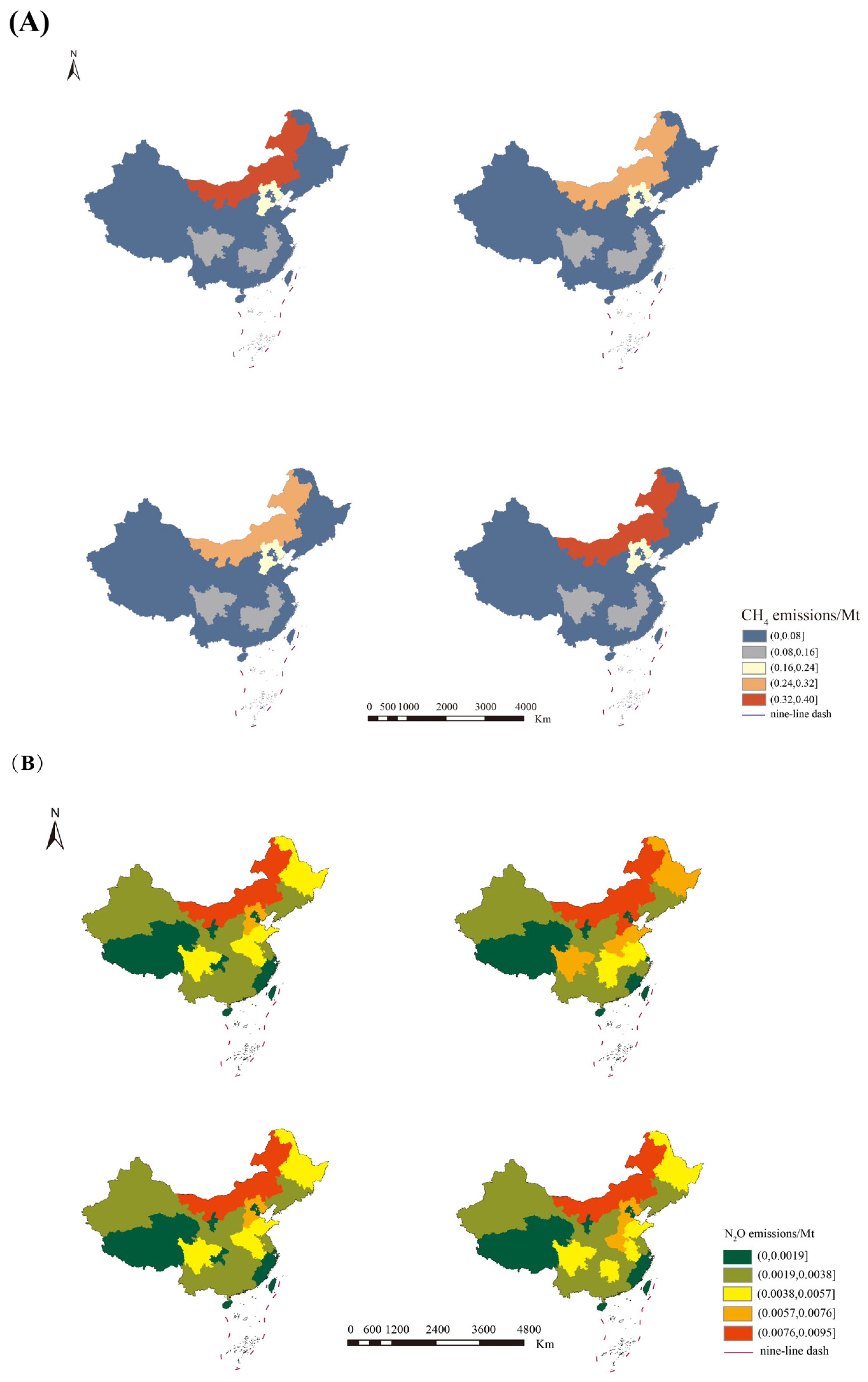
- Spatially, CH4 and N2O emissions share highly similar distribution patterns. High-emission areas have become increasingly concentrated from the North China Plain to the northern agro-pastoral ecotone, forming contiguous high-emission zones across major northern production regions. Emissions in southern provinces remain generally low, underscoring the dominant role of production scale and resource endowments in shaping spatial patterns.
- (3)
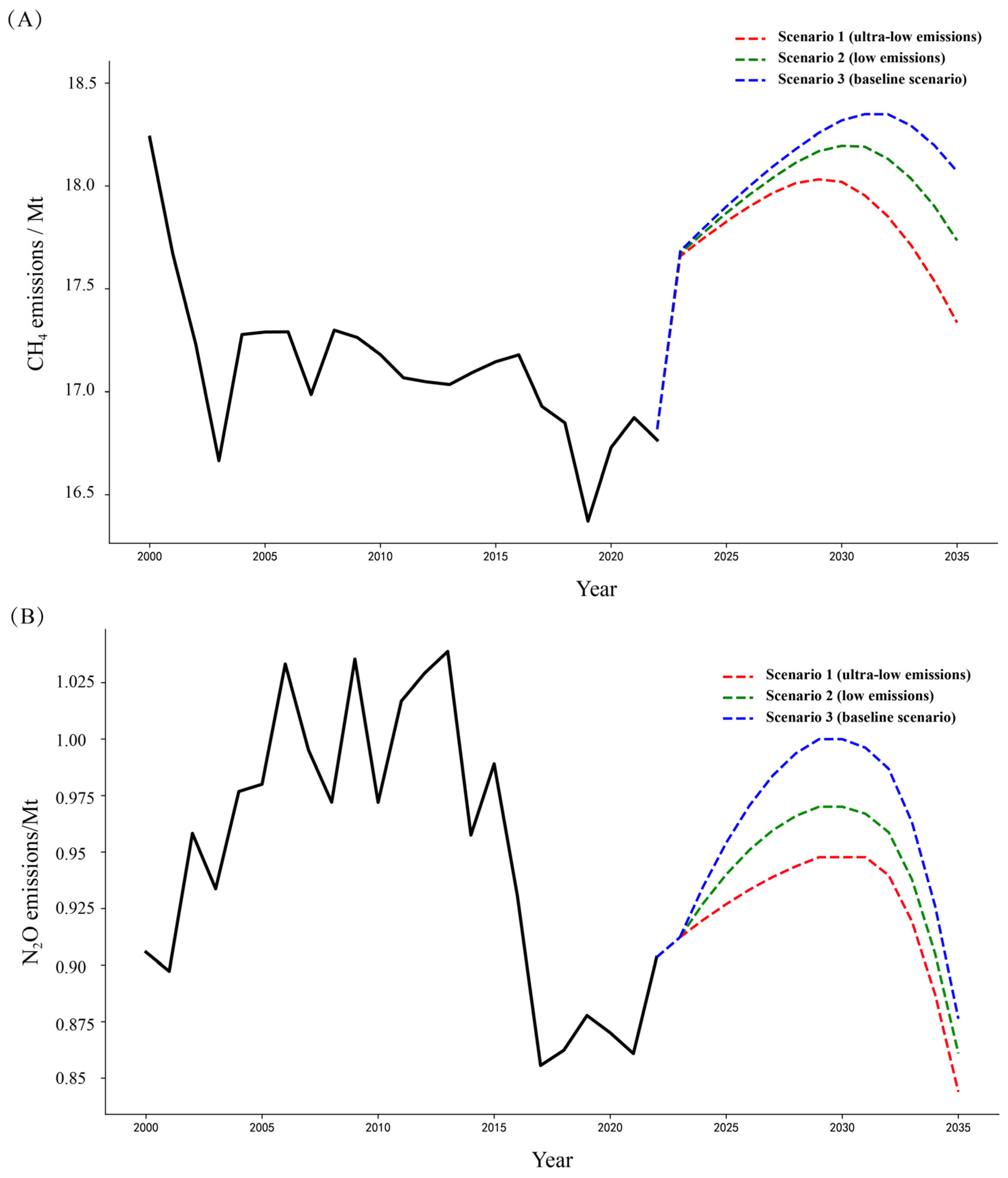
- Scenario projections reveal distinct peak pathways for the two gases under different mitigation intensities. In the baseline scenario, CH4 emissions continue to rise and peak in 2032, while N2O emissions peak in 2030 and then decline slowly. In the low-carbon scenario, growth rates of both gases slow considerably, with lower peak levels. In the ultra-low-carbon scenario, both gases peak earlier, in 2029, with further reductions in peak magnitudes. Structural changes and efficiency improvements are key drivers of emission reductions, and policy stringency decisively shapes emission trajectories. The two gases thus offer substantial potential for synergistic mitigation.
- (4)
- For synergistic mitigation, a regionally differentiated control framework combining top-down government guidance with bottom-up farmer participation should be established. At the government level, priorities include strengthening accounting systems and implementing functional zoning for targeted regulation. At the farmer level, efforts should focus on facilitating technology adoption and improving incentive policies. Given the differing drivers of the two gases, mitigation strategies must avoid a one-size-fits-all approach. Instead, coordinated efforts to manage enteric fermentation and optimize manure treatment are essential to achieve synergistic reductions and support the low-carbon transition of the animal husbandry.
Author Contributions
Funding
Institutional Review Board Statement
Informed Consent Statement
Data Availability Statement
Conflicts of Interest
Appendix A

| Emission Source | Sector Description | Gas | IPCC Sector Code |
|---|---|---|---|
| Agricultural soils | Rice paddies; application of lime and urea; direct emissions from managed soils | CH4, N2O | 3C2 + 3C3 + 3C4 + 3C7 |
| Enteric fermentation | Enteric fermentation | CH4 | 3A1 |
| Manure management | Manure management | CH4, N2O | 3A2 |
| Indirect N2O emissions from agriculture | small contributions from human sewage and volatilised nitrogen, but are derived predominantly from nitrogen lost through leaching and surface runoff | N2O | 3C5 + 3C6 |
References
- FAO. Livestock’s Long Shadow: Environmental Issues and Options; FAO: Rome, Italy, 2006; Volume 16, p. 7. [Google Scholar]
- Clough, T.J.; Cardenas, L.M.; Friedl, J.; Wolf, B. Nitrous oxide emissions from ruminant urine: Science and mitigation for intensively managed perennial pastures. Curr. Opin. Environ. Sustain. 2020, 47, 21–27. [Google Scholar] [CrossRef]
- FAO. How to Feed the World in 2050. Available online: https://www.fao.org/fileadmin/templates/wsfs/docs/expert_paper/How_to_Feed_the_World_in_2050.pdf (accessed on 20 February 2025).
- IPCC. Climate Change 2021—The Physical Science Basis: Working Group I Contribution to the Sixth Assessment Report of the Intergovernmental Panel on Climate Change; Cambridge University Press: Cambridge, UK, 2023. [Google Scholar]
- Institute for Global Environmental Strategies. NDC Database, version 7.4; Institute for Global Environmental Strategies: Hayama, Japan, 2022. Available online: https://pub.iges.or.jp/pub/iges-ndc-database (accessed on 20 February 2025).
- Wang, J.; Ciais, P.; Smith, P.; Yan, X.; Kuzyakov, Y.; Liu, S.; Li, T.; Zou, J. The role of rice cultivation in changes in atmospheric methane concentration and the Global Methane Pledge. Glob. Change Biol. 2023, 29, 2776–2789. [Google Scholar] [CrossRef]
- Methane Review Panel. Methane Science and Target Review; Methane Review Panel: Wellington, New Zealand, 2024. [Google Scholar]
- FAO. World Food and Agriculture-Statistical Yearbook; FAO: Rome, Italy, 2022. [Google Scholar] [CrossRef]
- Qian, H.; Zhu, X.; Huang, S.; Linquist, B.; Kuzyakov, Y.; Wassmann, R.; Minamikawa, K.; Martinez-Eixarch, M.; Yan, X.; Zhou, F.; et al. Greenhouse gas emissions and mitigation in rice agriculture. Nat. Rev. Earth Environ. 2023, 4, 716–732. [Google Scholar] [CrossRef]
- Havlík, P.; Valin, H.; Herrero, M.; Obersteiner, M.; Schmid, E.; Rufino, M.C.; Mosnier, A.; Thornton, P.K.; Böttcher, H.; Conant, R.T.; et al. Climate change mitigation through livestock system transitions. Proc. Natl. Acad. Sci. USA 2014, 111, 3709–3714. [Google Scholar] [CrossRef]
- Hu, Z.; Zhang, X.; Dong, H.; Wang, S.; Reis, S.; Li, Y.; Gu, B. Integrated livestock sector nitrogen pollution abatement measures could generate net benefits for human and ecosystem health in China. Nat. Food 2022, 3, 161–168. [Google Scholar] [CrossRef] [PubMed]
- Chang, J.; Peng, S.; Yin, Y.; Ciais, P.; Havlik, P.; Herrero, M. The key role of production efficiency changes in livestock methane emission mitigation. AGU Adv. 2021, 2, e2021AV000391. [Google Scholar] [CrossRef]
- Cross, L.; Gruère, A. Public Summary—Medium-Term Fertilizer Outlook 2023–2027. In Proceedings of the IFA Annual Conference; IFA: Berlin, Germany, 2023. [Google Scholar]
- Tian, H.; Pan, N.; Thompson, R.L.; Canadell, J.G.; Suntharalingam, P.; Regnier, P.; Davidson, E.A.; Prather, M.; Ciais, P.; Muntean, M.; et al. Global nitrous oxide budget 1980–2020. Earth Syst. Sci. Data 2024, 16, 2543–2604. [Google Scholar] [CrossRef]
- Duan, Y.; Gao, Y.; Zhao, J.; Xue, Y.; Zhang, W.; Wu, W.; Jiang, H.; Cao, D. Agricultural methane emissions in China: Inventories, driving forces and mitigation strategies. Environ. Sci. Technol. 2023, 57, 13292–13303. [Google Scholar] [CrossRef] [PubMed]
- Wang, X.; Gao, Y.; Wang, K.; Sang, Y.; Wang, Y.; Zhang, Y.; Hong, S.; Zhang, Y.; Yuan, W. The greenhouse gas budget for China’s terrestrial ecosystems. Natl. Sci. Rev. 2023, 10, nwad274. [Google Scholar] [CrossRef]
- Ministry of Ecology and Environment of China. Methane Emission Control Action Plan. 2023. Available online: https://www.mee.gov.cn/xxgk2018/xxgk/xxgk03/202311/t20231107_1045421.html (accessed on 7 November 2023).
- Li, Y.; Chen, M.P. Influencing factors of methane and nitrous oxide emissions from agricultural sources in China. Acta Sci. Circumstantiae 2021, 41, 710–717. [Google Scholar]
- Yuan, J.; Liu, Y.; Tang, R.; Ma, R.; Li, G. A review of carbon and nitrogen losses and greenhouse gas emissions during livestock manure composting. J. Agro-Environ. Sci. 2021, 40, 2428–2438. [Google Scholar]
- Sun, J.; Zhao, G.; Li, M.M. Using Nutritional Strategies To Mitigate Ruminal Methane Emissions From Ruminants. Front. Agric. Sci. Eng. 2023, 10, 390–402. [Google Scholar] [CrossRef]
- Zhang, X.M.; Wang, R.; Ma, Z.Y.; Wang, M.; Tan, Z. Enteric methane emissions and mitigation strategies in ruminants. J. Agro-Environ. Sci. 2020, 39, 732–742. [Google Scholar]
- Chen, R.R.; Wang, Y.M.; Hu, J.L.; Lin, X. Methane emission and mitigation strategies in animal manure management system. Acta Pedol. Sin. 2012, 49, 815–823. [Google Scholar]
- Hu, W.L.; Huang, M.L.; Wang, H.L. Methane emission and mitigation strategy of animal husbandry under low carbon background. J. Huazhong Agric. Univ. (Nat. Sci. Ed.) 2022, 41, 115–123. [Google Scholar]
- Wang, K.Y.; Li, X.; Lu, J.D.; Zhou, B.; He, Y. Low-carbon development strategies of livestock industry to achieve goal of carbon neutrality in China. Trans. Chin. Soc. Agric. Eng. 2022, 38, 230–238. [Google Scholar]
- Wang, X.X.; Li, J.K.; Ye, L.; Lin, B. Mitigation of non-CO2 greenhouse gas emissions in China’s agricultural sector: Policy measures, technology applications, and future perspectives. Chin. J. Eco-Agric. 2024, 32, 1793–1804. [Google Scholar]
- Zhang, J.X.; Liu, J.T.; Huang, M.L.; Wang, H.L.; Hu, W.L. Analysis of Spatiotemporal Heterogeneity and Influencing Factors of Methane Emissions from Animal Husbandry in China. Res. Environ. Sci. 2025, 38, 1184–1194. [Google Scholar] [CrossRef]
- Gu, S.Y.; Qiu, Z.J.; Zhan, Y.B.; Wang, F.; Zhang, Y.; Chen, S.H. Spatial-temporal characteristics and trend prediction of carbon emissions from animal husbandry in China. J. Agro-Environ. Sci. 2023, 42, 705–714. [Google Scholar]
- Chen, Y.; Shang, J. Estimation and Effecting Factor Decomposition of Green House Gas Emission of Animal Husbandry Industry in Four Pastoral Areas. China Popul. Resour. Environ. 2014, 24, 89–95. [Google Scholar]
- Solazzo, E.; Crippa, M.; Guizzardi, D.; Muntean, M.; Choulga, M.; Janssens-Maenhout, G. Uncertainties in the emissions database for global atmospheric research (EDGAR) emission inventory of greenhouse gases. Atmos. Chem. Phys. 2021, 21, 5655–5683. [Google Scholar] [CrossRef]
- Oreggioni, G.D.; Ferraio, F.M.; Crippa, M.; Muntean, M.; Schaaf, E.; Guizzardi, D.; Solazzo, E.; Duerr, M.; Perry, M.; Vignati, E. Climate change in a changing world: Socio-economic and technological transitions, regulatory framework and trends on global greenhouse gas emissions from EDGAR v.5.0. Glob. Environ. Change 2021, 70, 102350. [Google Scholar] [CrossRef]
- Crippa, M.; Guizzardi, D.; Pagani, F.; Banja, M.; Muntean, M.; Schaaf, E.; Becker, W.; Monforti-Ferrario, F.; Quadrelli, R.; Risquez Martin, A.; et al. Insights into the spatial distribution of global, national and subnational greenhouse gas emissions in the emissions database for global atmospheric research (EDGAR v8.0). Earth Syst. Sci. Data 2024, 16, 2811–2830. [Google Scholar] [CrossRef]
- York, R.; Rosa, E.A.; Dietz, T. STIRPAT, IPAT and ImPACT: Analytic tools for unpacking the driving forces of environmental impacts. Ecol. Econ. 2003, 46, 351–365. [Google Scholar] [CrossRef]
- York, R.; Rosa, E.A.; Dietz, T. Bridging environmental science with environmental policy: Plasticity of population, affluence, and technology. Soc. Sci. Q. 2002, 83, 18–34. [Google Scholar] [CrossRef]
- Zhang, X.Z. Assessment of Methane and Nitrous Oxide Emissions from Agricultural Systems in Mainland China and Low-Carbon Measures. Ph.D. Thesis, Jilin Agricultural University, Changchun, China, 2023. [Google Scholar]
- Zhu, Z.P.; Dong, H.M.; Wei, S.; Ma, J.; Xue, P. Impact of changes in livestock and poultry manure management on greenhouse gas emissions in China. J. Agro-Environ. Sci. 2020, 39, 743–748. [Google Scholar]
- Xu, B.; Wang, L.Z.; Yan, T. Methane emission inventories for enteric fermentation and manure management of yak, buffalo, dairy and beef cattle in China (1988–2009). Agric. Ecosyst. Environ. 2014, 195, 202–210. [Google Scholar] [CrossRef]
- Gao, Y.Y.; Li, Z.M.; Hong, S.B.; Zhang, L.; Xu, M.; Wang, X.H. Recent stabilization of agricultural non-CO2 greenhouse gas emissions in China. Natl. Sci. Rev. 2025, 12, nwaf040. [Google Scholar] [CrossRef]
- Hu, B.; Zhang, L.J.; Liang, C.; Zhang, T.; Wang, Y.C.; Li, Y. Characterizing spatial and temporal variations in CH4 emissions from dairy manure management in China based on IPCC methodology. Agriculture 2024, 14, 753. [Google Scholar] [CrossRef]
- Han, R.M.; Wang, Y.; Fan, Y.Q.; Wang, H.L.; Li, X.Y. Spatial-temporal evolution and influencing factors of nitrous oxide emissions from animal husbandry in China. J. Agric. Resour. Environ. 2026, 43, 186–193. [Google Scholar] [CrossRef]
- Chen, Z.L. A study on the comparison of urban fecal treatment system models at home and abroad. J. Wuhan. Urban. Constr. Inst. 2000, 1, 48–51. [Google Scholar]
- Hu, Y.; Hu, J.Z. The Latest Progress of Denmark’s Livestock Carbon Tax and Its Enlightenment to China. Environ. Prot. 2025, 53, 75–78. [Google Scholar] [CrossRef]
- Gerber, P.J.; Steinfeld, H.; Henderson, B.; Mottet, A.; Opio, C.; Dijkman, J.; Falcucci, A.; Tempio, G. Tackling Climate Change Through Livestock: A Global Assessment of Emissions and Mitigation Opportunities; Food and Agriculture Organization of the United Nations (FAO): Rome, Italy, 2013. [Google Scholar]
- Knapp, J.R.; Laur, G.L.; Vadas, P.A.; Weiss, W.P.; Tricarico, J.M. Invited review: Enteric methane in dairy cattle production: Quantifying the opportunities and impact of reducing emissions. J. Dairy Sci. 2014, 97, 3231–3261. [Google Scholar] [CrossRef]
- Linquist, B.; van Groenigen, K.J.; Adviento-Borbe, M.A.; Pittelkow, C.; van Kessel, C. An agronomic assessment of greenhouse gas emissions from major cereal crops. Glob. Change Biol. 2015, 18, 194–209. [Google Scholar] [CrossRef]
- Zhu, Z.; Wang, Y.; Yan, T.; Zhao, J.; Zhang, W. Greenhouse gas emissions from livestock in China and mitigation options within the context of carbon neutrality. Front. Agric. Sci. Eng. 2023, 10, 226–233. [Google Scholar] [CrossRef]
- Li, S.J.; Zhang, Q.X.; Shi, X.Y.; Sun, Y.; Zhao, L.J. Spatial-temporal evolution, regional difference and heterogeneity influencing factors of carbon emissions from animal husbandry in China. Acta Ecol. Sin. 2026, 46, 3279–3295. [Google Scholar]
- He, L.J.; Ma, H.M. Theoretical Logic and Implementation Pathways of the Green and Low-Carbon Transformation of Animal Husbandry in the Process of Chinese-Style Modernization. Anim. Husb. Feed. Sci. 2026, 47, 92–97. [Google Scholar]
- Qiang, S.Y.; Han, X.; Huang, Y.B.; Wang, J.L.; Liu, Y. Current status of methane emissions in the livestock sector, emission reduction technologies, and challenge analysis. Clim. Change Res. 2026, 22, 186–197. [Google Scholar]
- Wang, J.L.; Jiang, Z.X.; Liu, Y.; Qiang, S.Y.; Han, X. Agricultural methane emissions in China: Dynamic accounting, socio-economic drivers and future trends. J. Agro-Environ. Sci. 2026. Available online: https://link.cnki.net/urlid/12.1347.S.20260311.1544.007 (accessed on 20 February 2025).
- Liu, S.L.; Yan, W.; Gao, Q.X.; Wang, Y.; Zhang, X. Dual-Perspective Analysis of the Warming Effect of the Methane Emissions from Animal Husbandry in China. Environ. Sci. 2023, 44, 6692–6699. [Google Scholar]
- Zhou, J.; Ma, Y.H.; Yang, S.Y.; Wang, L.J. Mechanism of Greenhouse Gases Emission from Livestock and Its Reducing Measures. Agric. Environ. Dev. 2013, 30, 78–82. [Google Scholar]
- Zhu, G.D. Characterizing CH4 and N2O Emissions from Intensive Dairy Operations. Master’s Thesis, Hebei Agricultural University, Baoding, China, 2014. [Google Scholar]
- Huang, M.G.; Chen, B.G. Implementation of manure reduction and resource utilization in animal husbandry. North. Anim. Husb. 2025, 2, 53. [Google Scholar]
- Li, G.L.; Wu, Z.H.; Zhao, L.S.; Zhang, Y.L.; Wang, J.F. Advancements in Researchon Methane Emission Reduction in Ruminant Animals. China Anim. Husb. Vet. Med. 2024, 51, 4812–4823. [Google Scholar]


| Variable | Description | Unit | Data Sources |
|---|---|---|---|
| I | CH4 and N2O emissions | million tonnes | EDGAR database |
| PLP | Proportion of livestock production value | % | China Statistical Yearbook (various years) |
| PGDP | Per capita disposable income | Yuan | China Statistical Yearbook (various years) |
| YLLI | Year-end large livestock inventory | 104 head | China Statistical Yearbook (various years) |
| POP | Year-end resident population | 104 persons | China Statistical Yearbook (various years) |
| CFA | Chemical fertilizer application in agriculture | 104 tonnes | China Animal Husbandry & Veterinary Medicine (various years) |
| MRR | Manure recycling rate | % | China Animal Husbandry & Veterinary Medicine (various years) |
| Variable | Ln I | Ln PLP | Ln PGDP | Ln YLLI | Ln POP | Ln CFA | Ln MRR | |
|---|---|---|---|---|---|---|---|---|
| CH4 | ln I | 1.000 | 0.720 | −0.668 | 0.532 | −0.688 | −0.404 | −0.624 |
| Ln PLP | 0.720 | 1.000 | −0.884 | 0.727 | −0.902 | −0.320 | −0.902 | |
| Ln PGDP | −0.668 | −0.884 | 1.000 | −0.921 | 0.997 | 0.487 | 0.947 | |
| Ln YLLI | 0.532 | 0.727 | −0.921 | 1.000 | −0.913 | −0.701 | −0.807 | |
| Ln POP | −0.688 | −0.902 | 0.997 | −0.913 | 1.000 | 0.477 | 0.961 | |
| Ln CFA | −0.404 | −0.320 | 0.487 | −0.701 | 0.477 | 1.000 | 0.272 | |
| Ln MRR | −0.624 | −0.902 | 0.947 | −0.807 | 0.961 | 0.272 | 1.000 | |
| N2O | ln I | 1.000 | 0.498 | −0.351 | 0.119 | −0.387 | 0.432 | −0.590 |
| Ln PLP | 0.498 | 1.000 | −0.884 | 0.727 | −0.902 | −0.320 | −0.902 | |
| Ln PGDP | −0.351 | −0.884 | 1.000 | −0.921 | 0.997 | 0.487 | 0.947 | |
| Ln YLLI | 0.119 | 0.727 | −0.921 | 1.000 | −0.913 | −0.701 | −0.807 | |
| Ln POP | −0.387 | −0.902 | 0.997 | −0.913 | 1.000 | 0.477 | 0.961 | |
| Ln CFA | 0.432 | −0.320 | 0.487 | −0.701 | 0.477 | 1.000 | 0.272 | |
| Ln MRR | −0.590 | −0.902 | 0.947 | −0.807 | 0.961 | 0.272 | 1.000 |
| Model | Significance Test | Collinearity Statistics | |||
|---|---|---|---|---|---|
| t | p | Tolerance | VIF | ||
| CH4 | a | 3.193 | 0.006 | ||
| Ln PLP | −0.079 | 0.938 | 0.112 | 8.939 | |
| Ln PGDP | 1.487 | 0.157 | 0.004 | 236.446 | |
| Ln YLLI | −2.763 | 0.014 | 0.053 | 18.886 | |
| Ln POP | −2.394 | 0.014 | 0.002 | 433.054 | |
| Ln CFA | −1.032 | 0.317 | 0.196 | 5.102 | |
| Ln MRR | 1.864 | 0.081 | 0.024 | 41.592 | |
| N2O | a | 0.251 | 0.805 | ||
| Ln PLP | 0.578 | 0.572 | 0.112 | 8.939 | |
| Ln PGDP | 1.065 | 0.303 | 0.004 | 236.446 | |
| Ln YLLI | 0.328 | 0.747 | 0.053 | 18.886 | |
| Ln POP | −0.157 | 0.878 | 0.002 | 433.054 | |
| Ln CFA | 1.565 | 0.137 | 0.196 | 5.102 | |
| Ln MRR | −2.501 | 0.024 | 0.024 | 41.592 | |
| Variable | Unstandardized Coefficients | Std. Error | Standardized Coefficients | t | p | |
|---|---|---|---|---|---|---|
| CH4 | Ln PLP | −0.009450 | 0.017569 | −0.000780 | −0.538 | 0.6014 |
| Ln PGDP | 0.083108 | 0.030542 | 0.002340 | 2.721 | 0.0199 * | |
| Ln YLLI | −0.108425 | 0.044969 | −0.014774 | −2.411 | 0.0345 * | |
| Ln POP | −4.244217 | 0.044969 | −2.495832 | −4.749 | 0.0006 *** | |
| Ln CFA | 0.026605 | 0.040532 | 0.005996 | 0.656 | 0.5251 | |
| Ln MRR | 0.138876 | 0.030513 | 0.007755 | 4.551 | 0.0008 *** | |
| Constant term | 59.369916 | 10.131520 | —— | 5.860 | 0.0001 *** | |
| N2O | Ln PLP | 0.055399 | 0.080213 | 0.014010 | 0.691 | 0.5041 |
| Ln PGDP | 0.114799 | 0.068273 | 0.009900 | 1.681 | 0.1208 | |
| Ln YLLI | 0.126388 | 0.221065 | 0.052744 | 0.572 | 0.5790 | |
| Ln POP | −0.209582 | 0.356455 | −0.377466 | −0.588 | 0.5684 | |
| Ln CFA | 0.303422 | 0.187827 | 0.209443 | 1.615 | 0.1345 | |
| Ln MRR | −0.250527 | 0.111582 | −0.042845 | −2.245 | 0.0463 * | |
| Constant term | 5.314751 | 5.314751 | —— | 3.435 | 0.0056 ** |
Disclaimer/Publisher’s Note: The statements, opinions and data contained in all publications are solely those of the individual author(s) and contributor(s) and not of MDPI and/or the editor(s). MDPI and/or the editor(s) disclaim responsibility for any injury to people or property resulting from any ideas, methods, instructions or products referred to in the content. |
© 2026 by the authors. Licensee MDPI, Basel, Switzerland. This article is an open access article distributed under the terms and conditions of the Creative Commons Attribution (CC BY) license.
Share and Cite
Yang, L.; Wang, M.; Feng, X.; Zhu, L. Global Insights into the Synergistic Characteristics of Methane and Nitrous Oxide Emissions from China’s Animal Husbandry and Their Policy Implications. Atmosphere 2026, 17, 590. https://doi.org/10.3390/atmos17060590
Yang L, Wang M, Feng X, Zhu L. Global Insights into the Synergistic Characteristics of Methane and Nitrous Oxide Emissions from China’s Animal Husbandry and Their Policy Implications. Atmosphere. 2026; 17(6):590. https://doi.org/10.3390/atmos17060590
Chicago/Turabian StyleYang, Lin, Min Wang, Xiangzhao Feng, and Ling Zhu. 2026. "Global Insights into the Synergistic Characteristics of Methane and Nitrous Oxide Emissions from China’s Animal Husbandry and Their Policy Implications" Atmosphere 17, no. 6: 590. https://doi.org/10.3390/atmos17060590
APA StyleYang, L., Wang, M., Feng, X., & Zhu, L. (2026). Global Insights into the Synergistic Characteristics of Methane and Nitrous Oxide Emissions from China’s Animal Husbandry and Their Policy Implications. Atmosphere, 17(6), 590. https://doi.org/10.3390/atmos17060590