Article

Incorporating 15N into the Multi-Resolution Emission Inventory to Simulate the Spatiotemporal Variations of δ15N in Emitted NOx over the Pearl River Delta Region, China


1
School of Ecology, Sun Yat-sen University, Shenzhen 518107, China
2
School of Atmospheric Sciences, Sun Yat-sen University, Zhuhai 519082, China
3
Department of Earth, Atmospheric, and Planetary Sciences, Purdue University, 550 Stadium Mall Drive, West Lafayette, IN 47907, USA
4
Department of Chemistry and Biochemistry, University of South Carolina, Columbia, SC 29208, USA
*
Author to whom correspondence should be addressed.
Atmosphere 2026, 17(6), 572; https://doi.org/10.3390/atmos17060572
Submission received: 28 April 2026 / Revised: 24 May 2026 / Accepted: 27 May 2026 / Published: 1 June 2026
(This article belongs to the Special Issue Air Quality in China (4th Edition))

Abstract

Nitrogen oxides (NOx), comprising nitric oxide (NO) and nitrogen dioxide (NO2), are key precursors of atmospheric nitrate, a major component of fine particulate matter (PM2.5) that critically affects air quality, human health, and ecosystems. Emission inventories provide detailed spatial and temporal information on NOx sources, while stable isotope techniques offer an additional constraint for source apportionment. Here, we incorporated stable nitrogen isotopes (14N, 15N) into the widely used Multi-resolution Emission Inventory for China (MEIC) over South China, with a focus on the Pearl River Delta (PRD) region, one of the most highly urbanized and industrialized regions in China, using an isotopic mass–balance model. The 2008 MEIC inventory indicated that NOx emissions across South China were spatially heterogeneous, dominated by transportation sources, and concentrated mainly in the PRD and other urban clusters. We then compared the simulated isotopic composition of emitted NOx with atmospheric measurements to assess the role of emission sources in controlling atmospheric nitrate (NO3). The simulated δ15N(NOx) values were found to generally underestimate the observed δ15N(NO3) values. This discrepancy highlights the need for future 15N-enabled air quality modeling to better represent both source contributions and atmospheric processing, thereby improving source apportionment, emission inventory evaluation, and our understanding of reactive nitrogen cycling.

1. Introduction

Nitrogen oxides (NOx), comprising nitric oxide (NO) and nitrogen dioxide (NO2), can be oxidized in the atmosphere to form atmospheric nitrate (NO3), a major component of fine particulate matter (PM2.5) that critically affects air quality and human health [1]. The subsequent deposition of NO3 and other reactive nitrogen (N) species contributes to acid rain, soil acidification, aquatic eutrophication, and biodiversity loss, thereby threatening ecosystem functions and environmental sustainability [2,3,4]. The primary anthropogenic sources of NOx emissions include power plants, transportation, industry, and residential combustion [5,6].
Coastal bay areas are strongly influenced by human activities because they represent zones of intense interaction among marine, terrestrial, and atmospheric systems [7]. The Pearl River Delta (PRD) region, where the Pearl River discharges into the South China Sea, is one of the most highly urbanized and industrialized regions globally. Rapid urbanization in the PRD region has been accompanied by large emissions of NOx, making it a hotspot of inorganic N deposition in China [8,9,10,11,12]. Accurate characterization of NOx emission sources in the PRD region is therefore crucial for developing effective emission control strategies.
Emission inventories provide detailed spatial and temporal information on source distributions and serve as fundamental inputs for air quality modeling, source attribution, and pollution control strategy design. Over the past decade, continuous improvements in emission inventory development have greatly enhanced the characterization of regional air pollutant emissions, yet substantial uncertainties remain for individual source sectors and regions [13,14,15]. Meanwhile, stable isotopes have emerged as another promising tool in atmospheric pollution research, especially for source apportionment [16,17,18,19]. Different NOx sources tend to exhibit distinct δ15N signatures, expressed as the per mil deviation of the 15N/14N ratio in NOx from that of atmospheric N2. For example, coal-fired power plants generally emit 15N-enriched NOx, with δ15N values ranging from +2.1‰ to +25.6‰; industrial sources show δ15N values between −10.9‰ and +8.1‰; whereas transportation (e.g., on-road gasoline/diesel vehicles) and residential sources (e.g., natural gas furnace, off-road gasoline/diesel equipment) show lower or more variable δ15N values, ranging from −28.1‰ to +17‰ and from −21.1‰ to +8.5‰, respectively [20,21,22,23,24,25,26]. These differences suggest that δ15N can serve as a useful tracer for distinguishing NOx sources. Nevertheless, what remains lacking is the incorporation of δ15N fingerprints into emission inventories to enable large-scale, source-resolved air quality modeling.
To address this gap, this study incorporated 15N into the Multi-resolution Emission Inventory for China (MEIC) across South China, including the PRD region, and simulated the spatiotemporal variations in δ15N of emitted NOx using an isotopic mass–balance framework based on source mixing. The simulated δ15N(NOx) values captured the inherent emission-derived isotopic variability and were compared with available atmospheric δ15N(NO3) measurements to evaluate the role of emission sources in controlling atmospheric NO3 in the PRD region. The resulting 15N-enabled emission dataset will provide input for future air quality modeling to better resolve N emission, transport, and transformation.

2. Methodology

2.1. The Spatial Domains

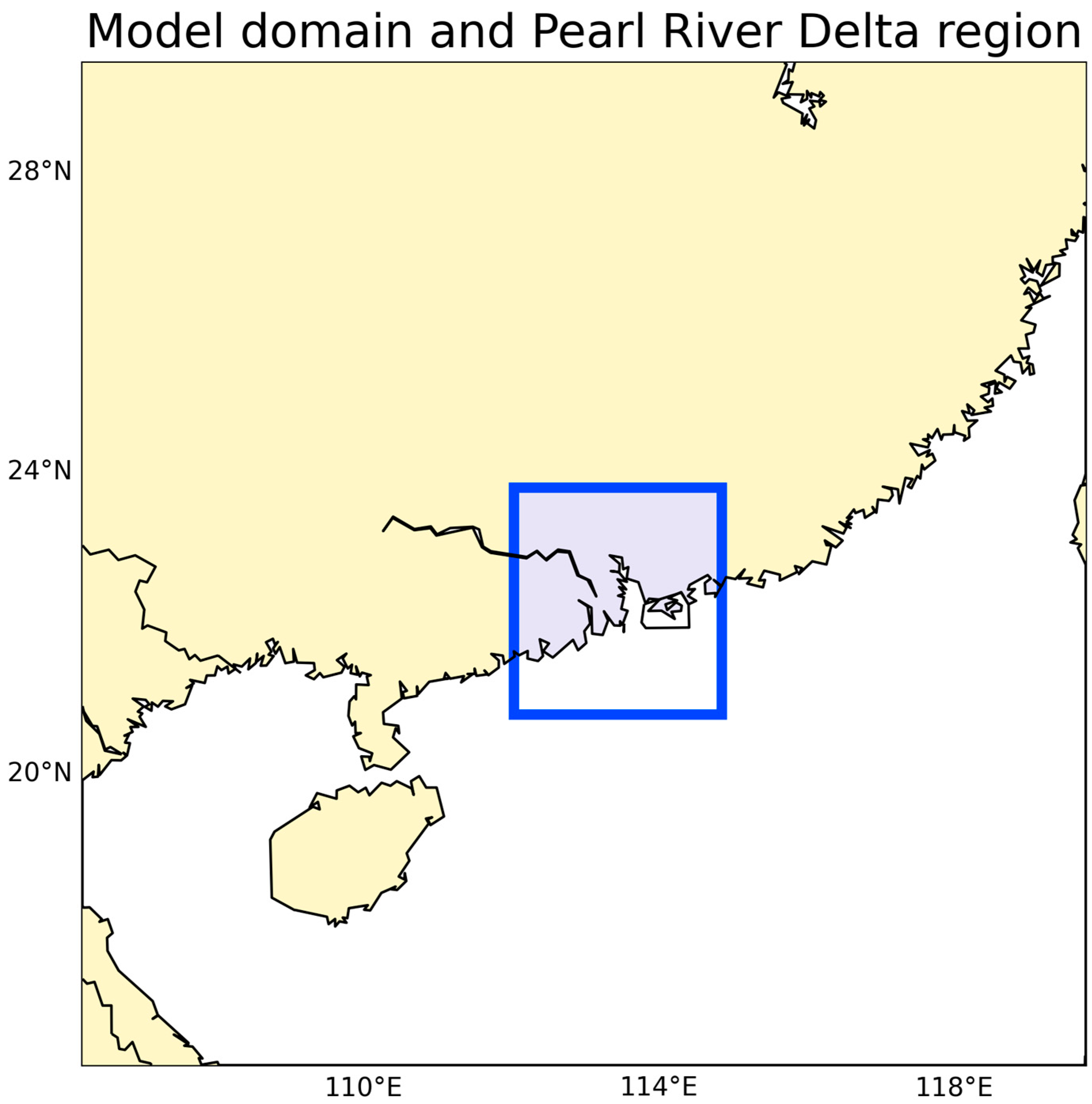
Two spatial domains were employed: an outer domain covering South China and an inner domain focusing on the Pearl River Delta (Figure 1). The outer domain spans 18–30° N and 106–120° E, encompassing the entirety of Guangdong Province, Guangxi Zhuang Autonomous Region, Hainan Province, Jiangxi Province, and Hunan Province, and part of Guizhou Province. The inner domain, representing the Pearl River Delta, includes the cities of Guangzhou, Shenzhen, Zhuhai, Foshan, Dongguan, Zhongshan, Jiangmen, Huizhou, Zhaoqing, Hong Kong and Macau (Figure 1; light purple). Both domains were simulated at a horizontal resolution of 36 km × 36 km.

2.2. MEIC Inventory

The Multi-resolution Emission Inventory for China (MEIC), developed by Tsinghua University, is a bottom-up anthropogenic emission inventory for mainland China that includes major source sectors such as power, industry, residential, transportation, solvent use, and agriculture (http://meicmodel.org.cn). It provides gridded emissions for multiple pollutants, such as SO2, NOx, CO, NMVOCs, NH3, PM10, PM2.5, BC, and OC, and has been widely used in air quality modeling and emission assessment studies in China and abroad.
In this study, the 2008 MEIC inventory was adopted as the input emission dataset, consistent with the period of historical NO3 δ15N observations available for the PRD region. Within the MEIC framework [13,15], NOx emissions from the power sector, dominated by coal-fired power plants, were estimated at the level of individual units or plants using detailed information on activity levels, fuel consumption, boiler size, combustion technology, coal type, and the penetration of end-of-pipe control measures. Industrial NOx emissions were estimated using activity-based approaches linked to industrial fuel consumption, product output, production technology, and control measures, with large point sources such as cement plants and iron and steel plants increasingly represented using factory- or plant-level information. Transportation NOx emissions primarily represented mobile sources, including on-road vehicles, shipping, and other off-road engines (e.g., agricultural equipment, industrial equipment, locomotives, and commercial aircraft). Residential NOx emissions were derived from bottom-up estimates that link household energy consumption for cooking and heating to source-specific emission factors associated with the combustion of fossil fuels and biofuels. Agricultural NOx emissions were estimated using a bottom-up approach based on multi-source activity data, including fertilizer application rates, livestock numbers, and crop residue burning, together with localized emission factors. However, agricultural NOx emissions were found to be relatively minor in the study domain and therefore not considered further in this study. Solvent use was not treated as a separate sector in this study because it is primarily associated with emissions of non-methane volatile organic compounds rather than NOx.
The 2008 MEIC inventory was subsequently processed to generate hourly NOx emissions over South China. Similar to the work of Wang et al. [27], we allocated monthly sectoral emissions to hourly emissions using sector-specific weekly and hourly temporal profiles, with concurrent species splitting and unit conversion. For spatial allocation, we applied different approaches by sector to allocate emissions from coarse grids to fine grids. Power plant, industrial and residential emissions were allocated using source- or activity-related spatial proxies. Transportation emissions were spatially allocated using line-based surrogates (e.g., roads and flight paths).

2.3. Compilation of δ15N Values of NOx

Based on an extensive review of relevant literature [28], the source-specific δ15N(NOx) values were compiled and summarized in Table 1. The adopted δ15N values (Table 1) were selected through literature synthesis rather than simply taking the midpoint of each reported range, as in our previous study [28]. This selection considered the most frequently reported values, source characteristics, and the relative consistency of observations within each emission sector. Given the relatively wide source-specific δ15N ranges reported in the literature, these adopted values should be interpreted as simplified sector-level estimates for regional-scale simulations rather than precise source-specific endmembers. Future work should incorporate sensitivity analyses and region-specific endmember constraints to better quantify and reduce this uncertainty associated with endmember selection.

2.4. Incorporating 15N into NOx Emission Datasets

The N isotope ratio δ15N is defined as:
δ N ( N O x ) 15 = [ ( N O x 15 / N O x 14 ) ( N 15 / N ) 14 a i r 1 ] × 1000 ,
where 0.0036 is the natural 15N/14N ratio in air N2 (thus δ15N(N2) = 0), which is the reference point for δ15N measurements.
Within each grid cell, by combining the known 14NOx emission flux, treated as the NOx flux, from each source i with its corresponding δ15N(NOx, i) value, δ15N(NOx) can be calculated based on source mixing using an isotopic mass–balance framework:
δ 15 N ( N O x ) = [ f i × δ 15 N N O x , i ]
where f(i) is the fraction of 14NOx emissions contributed by source i, derived from the emission dataset as:
f i = N O x 14 i N O x 14 i

3. Results and Discussion

3.1. Spatiotemporal Variability of NOx Emission Rates and Source Fractions

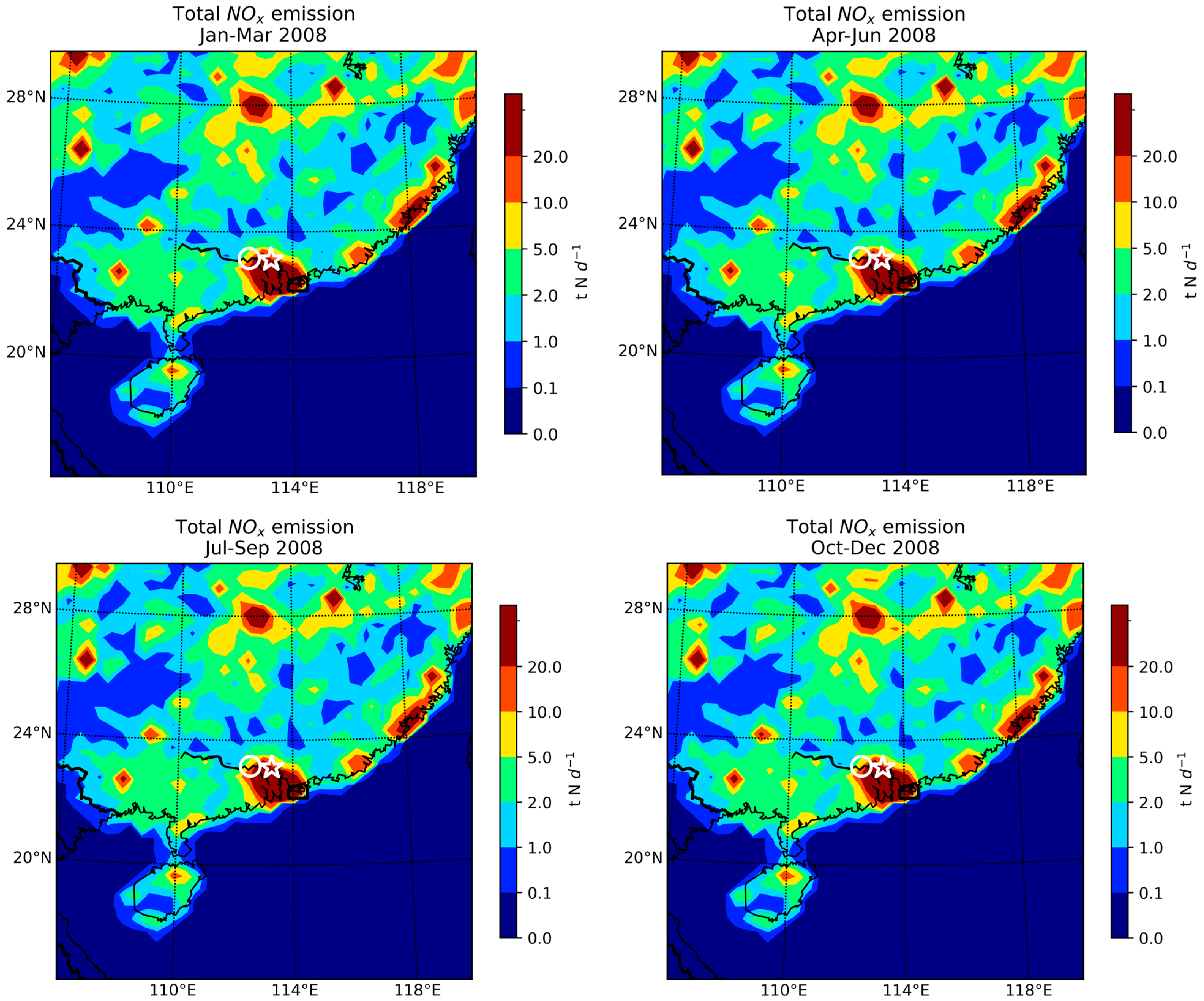
Figure 2 shows that NOx emissions in 2008 displayed pronounced and seasonally persistent spatial heterogeneity across South China (including the PRD region). Total NOx emissions varied substantially, ranging from near zero in offshore and remote inland areas to more than 30 t N d−1 in the strongest hotspot grids (Figure 2). However, most of the mapped domain was characterized by relatively low emissions (<5 t N d−1), while only a small fraction of grids had high emissions (>20 t N d−1). These high-emission grids were concentrated mainly in the PRD region and other urban clusters around the cities of Xiamen, Changsha, Nanchang, Guiyang, and Chongqing. By contrast, the low-emission grids were located mainly in offshore areas and in many inland rural regions. Moderate-emission areas were mainly distributed in the peripheral zones surrounding the major urban clusters, resulting in distinct spatial gradients from the cluster cores to the adjacent areas. These spatial distributions and approximate orders of magnitudes of NOx emissions are broadly consistent with satellite-derived NO2 vertical column densities in 2018 [29], after accounting for NOx lifetime, NO-NO2 partitioning, transport, chemical transformation, dilution, and deposition.
Figure 2 further shows modest seasonal changes in emission intensity, but the hotspot pattern remained largely unchanged throughout 2008. Among the four seasons, the overall distribution in October–December appeared slightly stronger in several hotspot regions, whereas the distribution during July–September was comparatively weaker. However, these seasonal differences were much smaller than the persistent spatial contrast between coastal urban hotspots and low-emission offshore or rural areas. This was due to the fact that the spatial distribution of NOx emissions across South China (including the PRD region) was largely controlled by the locations of major anthropogenic sources, which change little seasonally [30,31].
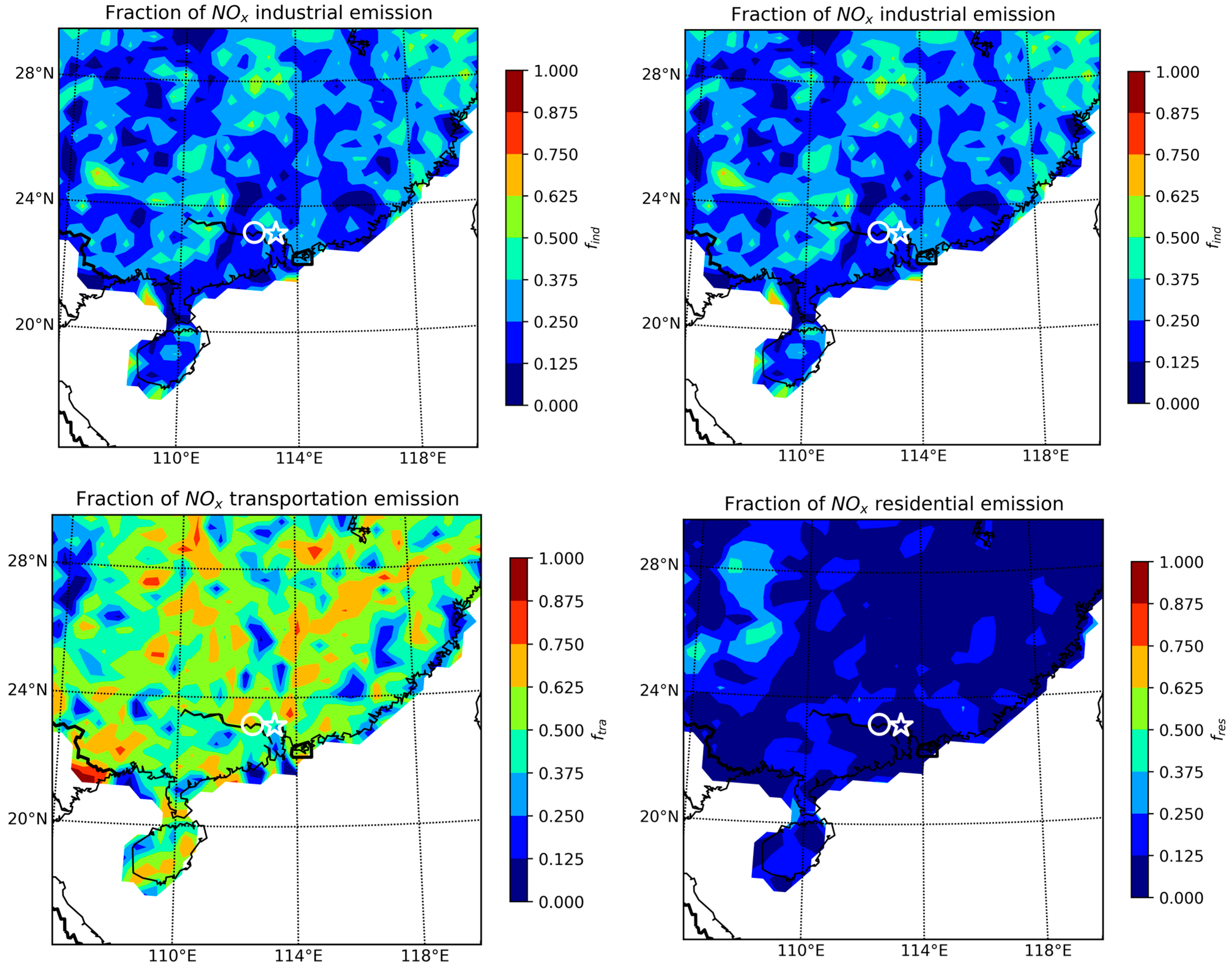
Figure 3 indicates that power plant sources contributed a limited fraction of the total NOx emissions over South China, although their contribution was locally very high in a small number of grids. High grid-level fractions of power plants (fpow) were confined mainly to grids containing major power plants, often in proximity to metropolitan regions, consistent with the typical siting of large thermal power plants in South China [32]. At the regional scale, ftra in South China appeared to be lower than the fraction of 0.343 for annual anthropogenic NOx emissions from power plant/point sources over the continental United States [14].
Industrial sources made a substantial contribution to NOx emissions across South China and were more spatially widespread than power plant sources. The grid-level fraction of industrial NOx emissions (find) was generally moderate over large parts of both inland and coastal areas, with elevated find values mainly occurred in industrial belts and peri-urban manufacturing areas rather than in urban cores dominated by mixed sources. This spatial pattern is consistent with previous reports [33,34,35].
Transportation sources were the most important contributors to NOx emissions across South China and displayed the most spatially extensive influence among the four major source sectors. High grid-level transportation fractions (ftra) were observed mainly in parts of the coastal zone, including the PRD region and the eastern Guangdong coast, as well as in portions of the Beibu Gulf region, Hainan Island, and several inland areas. In the PRD region and other major urban clusters, high ftra likely reflected dense road networks, port-related activities and intense traffic flows [36,37]. In non-urban core regions, however, elevated ftra may reflect the weaker influence of other NOx sources, making transportation relatively more important in the local emission mix.
Residential sources contributed only a minor fraction of NOx emissions over most of South China, with only a few scattered areas showing moderate contributions. Relatively higher grid-level residential fractions (fres) were observed mainly in a few inland areas where strong competing emissions from transportation and large industrial or point sources were lacking. Even in these areas, however, residential emissions generally did not emerge as the primary NOx source at the grid scale.
Taken together, transportation emissions were the most spatially pervasive and dominated much of the domain; industrial emissions were also regionally important and spatially widespread, but generally less significant than that of transportation; power plant emissions were highly localized and dominant only in a limited number of grids; residential emissions contributed only a minor fraction over most of the domain and played a comparatively limited role in shaping the regional NOx distribution.

3.2. Simulated Spatiotemporal Variability of δ15N(NOx) Values

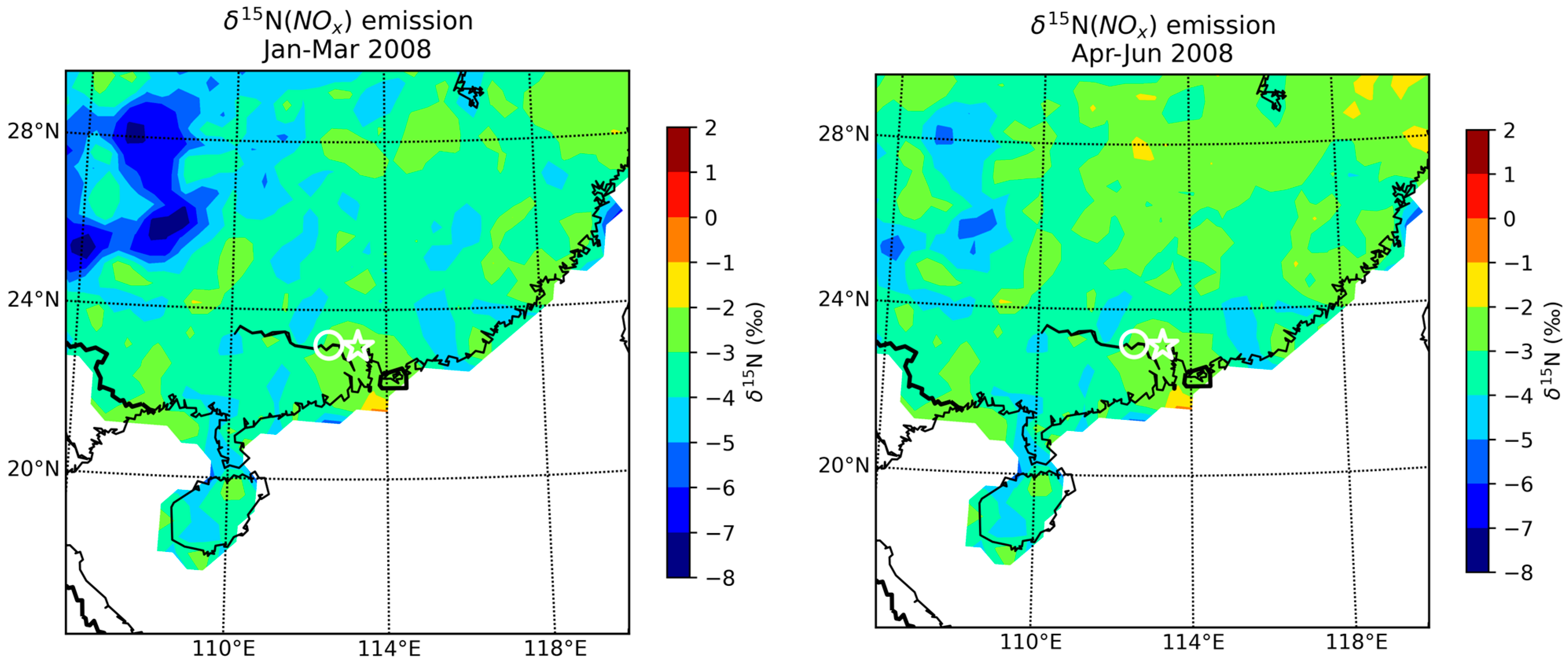
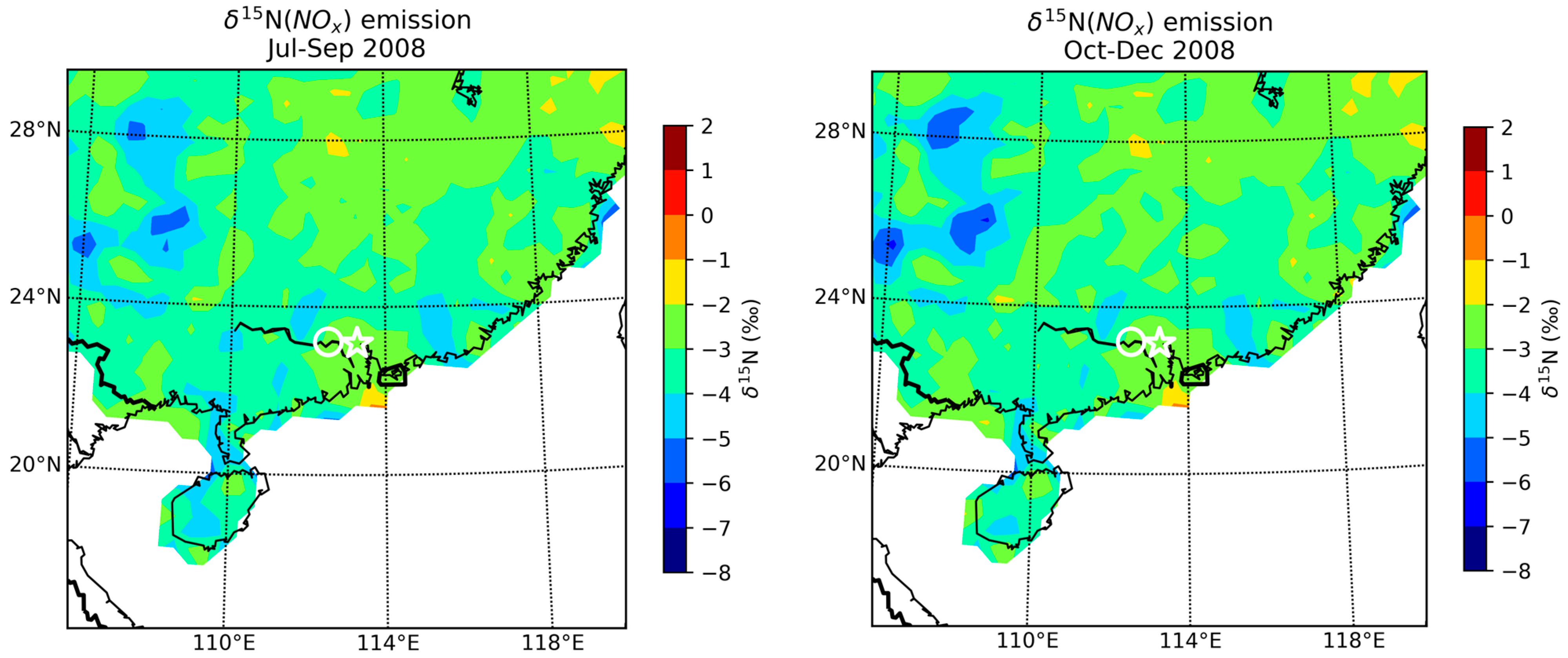
Using the gridded NOx emission source fractions of four major sectors, the δ15N values of NOx were simulated across South China in 2008. The predicted δ15N(NOx) ranged from approximately −8‰ to +2‰ and displayed pronounced spatial heterogeneity (Figure 4). Despite some seasonal variability in magnitude, the overall spatial pattern of δ15N(NOx) remained broadly consistent among the four seasons.
Widespread δ15N(NOx) values fell between −4‰ and −2‰, with a few localized grids approaching positive values. This pattern is consistent with the substantial contributions of transportation sources (Figure 3; δ15N: −28.1‰~+17‰; median: −2.6‰). In contrast, more depleted δ15N(NOx) values ranging from −8‰ to −4‰ occurred mainly in inland and northwestern parts of the domain, suggesting significant contributions of residential sources, whose δ15N endmember is approximately −11‰ (Table 1). Seasonally, April–June and July–September appeared slightly more enriched than the other periods in several hotspot regions, whereas January–March was the most depleted period. However, these seasonal differences were small relative to the persistent spatial contrast across the domain.

3.3. Model–Observation Comparisons

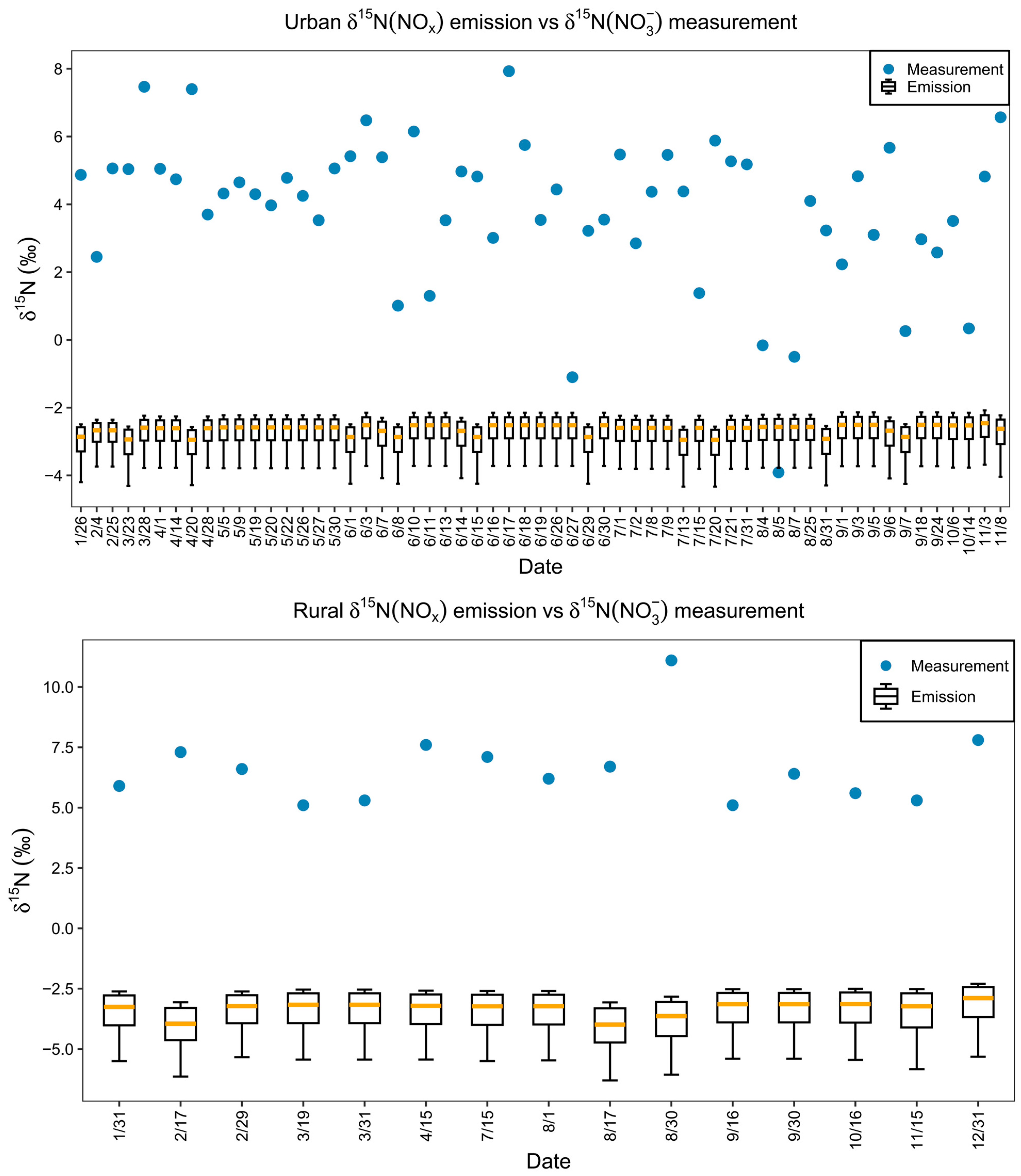
The simulated δ15N(NOx) values in the PRD region were compared with measured δ15N values of atmospheric NO3, the most accessible form for isotopic analysis, at two sites: Guangzhou (urban; indicated by the star in Figure 5) and Dinghushan (rural; indicated by the circle in Figure 5). The measured δ15N(NO3) values ranged from −3.9‰ to +7.9‰ (n = 59) at the urban Guangzhou site [9] and from +5.1‰ to +11.1‰ (n = 15) at the rural Dinghushan site [38]. These observed ranges overlap with recently published δ15N measurements of particulate NO3 in Guangzhou, which ranged from +2.59‰ to +9.3‰ in July 2013 [39] and from −14.2‰ to +13.0‰ during September 2017–August 2018 [40].
At both urban Guangzhou and rural Dinghushan sites, the simulated δ15N(NOx) values were generally lower than the observations, but the underestimation was relatively milder at the urban Guangzhou site (Figure 5). The large underestimation at the rural Dinghushan site could be partly due to its proximity to a power plant to the west, which contributed significantly to local NOx emissions, whereas the mixing caused by atmospheric transport was not considered in the current “emission-only” simulations.
Indeed, the uncertainty in our simulated δ15N(NOx) values, as well as the approximate 2–6‰ offset between the modeled δ15N(NOx) and the observed δ15N(NO3), may arise from three main factors. First, uncertainties in source-specific δ15N endmembers, possible biases in the emission inventory, and the simplified representation of broad emission sectors may contribute to the model–measurement mismatch. Second, atmospheric transport, mixing and deposition can blur the regional δ15N signal of emissions, depending on emission strength, mixing intensity, and deposition schemes [28]. Third, photolytic [41], kinetic [42], and equilibrium [43] isotope effects may occur during the transformation of NOx into NO3. Therefore, the present “emission-only” model is not expected to directly predict atmospheric δ15N(NO3). Rather, this study serves as a proof of concept by demonstrating the feasibility of incorporating 15N into the NOx emission inventory to simulate emission-derived δ15N(NOx) patterns and to evaluate the role of emission sources in controlling atmospheric NO3 in the PRD region. The remaining model–observation offset indicates that atmospheric nitrate is not determined solely by local NOx emissions but is also influenced by subsequent atmospheric transport, mixing, deposition, and photochemical transformation.

4. Conclusions

The 2008 MEIC inventory showed strong but seasonally persistent spatial heterogeneity in NOx emissions across South China, with hotspots concentrated in the PRD and other urban clusters. Transportation was the dominant and most spatially pervasive source, while industrial emissions were regionally important, power plant emissions were localized, and residential sources contributed only minor fractions. The δ15N(NOx) values were then simulated using sectoral NOx emissions from MEIC together with source-specific δ15N values compiled from previous studies. The widespread δ15N(NOx) values between −4‰ and −2‰ across South China, especially in the PRD region, were consistent with the substantial contribution of transportation sources. Compared with the measured δ15N(NO3) values at the urban Guangzhou and rural Dinghushan sites within the PRD region, the simulated δ15N(NOx) values were significantly lower, suggesting that an emission-only framework is insufficient to reproduce atmospheric NO3 isotopic composition. This discrepancy likely arises from the combined effects of inventory uncertainty, atmospheric transport and deposition, and isotope fractionation during NOx oxidation. Future work will explore the impacts of atmospheric processes and tropospheric photochemistry by incorporating 15N into the CMAQ model to enable process-resolved simulation of the emission, transport, chemical transformation, and deposition of atmospheric reactive N.

Author Contributions

Conceptualization, F.W. and H.F.; methodology, Y.L., H.F. and F.W.; validation, F.W. and H.F.; formal analysis, F.W. and H.F.; investigation, F.W., Y.L. and H.F.; resources, G.M. and W.W.; data curation, F.W. and H.F.; writing—original draft preparation, F.W. and H.F.; writing—review and editing, Y.L., G.M. and W.W.; visualization, F.W. and H.F.; supervision, G.M. and W.W.; project administration, F.W.; funding acquisition, F.W. All authors have read and agreed to the published version of the manuscript.

Funding

This research was funded by the National Key Research and Development Program of China (2023YFF0805403), the Guangdong Provincial Natural Science Foundation General Program (No. 2021A1515012210) and the Guangdong Provincial Natural Science Foundation Youth Enhancement Program (No. 2024A1515030206).

Institutional Review Board Statement

Not applicable.

Informed Consent Statement

Not applicable.

Data Availability Statement

The original contributions presented in this study are included in the article. Further inquiries can be directed to the corresponding author. Additional GIF figures are available on Zenodo at https://doi.org/10.5281/zenodo.20355136.

Acknowledgments

During the preparation of this manuscript, the authors used ChatGPT (OpenAI; GPT-5.4) for language polishing only. The authors have reviewed and edited the output and take full responsibility for the content of this publication.

Conflicts of Interest

The authors declare no conflicts of interest.

Abbreviations

The following abbreviations are used in this manuscript:
NOxNitrogen oxides
MEICMulti-resolution Emission Inventory for China
PRDPearl River Delta

References

  1. Galloway, J.N.; Dentener, F.J.; Capone, D.G.; Boyer, E.W.; Howarth, R.W.; Seitzinger, S.P.; Asner, G.P.; Cleveland, C.C.; Green, P.A.; Holland, E.A.; et al. Nitrogen cycles: Past, present, and future. Biogeochemistry 2004, 70, 153–226. [Google Scholar] [CrossRef]
  2. Bowman, W.D.; Cleveland, C.C.; Halada, Ĺ.; Hreško, J.; Baron, J.S. Negative impact of nitrogen deposition on soil buffering capacity. Nat. Geosci. 2008, 1, 767–770. [Google Scholar] [CrossRef]
  3. Clark, C.M.; Morefield, P.E.; Gilliam, F.S.; Pardo, L.H. Estimated losses of plant biodiversity in the United States from historical N deposition (1985–2010). Ecology 2013, 94, 1441–1448. [Google Scholar] [CrossRef]
  4. Duan, L.; Yu, Q.; Zhang, Q.; Wang, Z.; Pan, Y.; Larssen, T.; Tang, J.; Mulder, J. Acid deposition in Asia: Emissions, deposition, and ecosystem effects. Atmos. Environ. 2016, 146, 55–69. [Google Scholar] [CrossRef]
  5. Svirejeva-Hopkins, A.; Reis, S.; Magid, J. Nitrogen flows and fate in urban landscapes. In The European Nitrogen Assessment, Sources, Effects and Policy Perspectives; Sutton, M.A., Howard, C.M., Erisman, J.W., Eds.; Cambridge University Press: Cambridge, UK, 2011. [Google Scholar]
  6. de Foy, B.; Lu, Z.; Streets, D.G.; Lamsal, L.N.; Duncan, B.N. Estimates of power plant NOx emissions and lifetimes from OMI NO2 satellite retrievals. Atmos. Environ. 2015, 116, 1–11. [Google Scholar] [CrossRef]
  7. Grimm, N.B.; Faeth, S.H.; Golubiewski, N.E.; Redman, C.L.; Wu, J.; Bai, X.; Briggs, J.M. Global change and the ecology of cities. Science 2008, 319, 756–760. [Google Scholar] [CrossRef]
  8. Jia, G.D.; Chen, F.J. Monthly variations in nitrogen isotopes of ammonium and nitrate in wet deposition at Guangzhou, south China. Atmos. Environ. 2010, 44, 2309–2315. [Google Scholar] [CrossRef]
  9. Fang, Y.T.; Koba, K.; Wang, X.M.; Wen, D.Z.; Li, J.; Takebayashi, Y.; Liu, X.Y.; Yoh, M. Anthropogenic imprints on nitrogen and oxygen isotopic composition of precipitation nitrate in a nitrogen-polluted city in southern China. Atmos. Chem. Phys. 2011, 11, 1313–1325. [Google Scholar] [CrossRef]
  10. Wang, X.M.; Wu, Z.Y.; Shao, M.; Fang, Y.; Zhang, L.; Chen, F.; Chan, P.-W.; Fan, Q.; Wang, Q.; Zhu, S.; et al. Atmospheric nitrogen deposition to forest and estuary environments in the Pearl River Delta (PRD) region, southern China. Tellus B 2013, 65, 20480. [Google Scholar] [CrossRef]
  11. Yu, G.R.; Jia, Y.; He, N.; Zhu, J.; Chen, Z.; Wang, Q.; Piao, S.; Liu, X.; He, H.; Guo, X.; et al. Stabilization of atmospheric nitrogen deposition in China over the past decade. Nat. Geosci. 2019, 12, 424–429. [Google Scholar] [CrossRef]
  12. Wen, Z.; Xu, W.; Li, Q.; Han, M.; Tang, A.; Zhang, Y.; Luo, X.; Shen, J.; Wang, W.; Li, K.; et al. Changes of nitrogen deposition in China from 1980 to 2018. Environ. Intern. 2020, 144, 106022. [Google Scholar] [CrossRef] [PubMed]
  13. Li, M.; Liu, H.; Geng, G.; Hong, C.; Liu, F.; Song, Y.; Tong, D.; Zheng, B.; Cui, H.; Man, H.; et al. Anthropogenic emission inventories in China: A review. Natl. Sci. Rev. 2017, 4, 834–866. [Google Scholar] [CrossRef]
  14. United States Environmental Protection Agency. 2002 National Emissions Inventory (NEI) Booklet. Available online: https://archive.epa.gov/epa/air-emissions-inventories/2002-national-emissions-inventory-nei-booklet.html (accessed on 15 January 2026).
  15. Geng, G.; Liu, Y.; Liu, Y.; Liu, S.; Cheng, J.; Yan, L.; Wu, N.; Hu, H.; Tong, D.; Zheng, B.; et al. Efficacy of China’s clean air actions to tackle PM2.5 pollution between 2013 and 2020. Nat. Geosci. 2024, 17, 987–994. [Google Scholar] [CrossRef]
  16. Hastings, M.G.; Casciotti, K.L.; Elliott, E.M. Stable isotopes as tracers of anthropogenic nitrogen sources, deposition, and impacts. Elements 2013, 9, 339–344. [Google Scholar] [CrossRef]
  17. Chang, Y.H.; Liu, X.J.; Deng, C.R. Source apportionment of atmospheric ammonia before, during, and after the 2014 APEC summit in Beijing using stable nitrogen isotope signatures. Atmos. Chem. Phys. 2016, 16, 11635–11647. [Google Scholar] [CrossRef]
  18. Pan, Y.; Tian, S.; Liu, D.; Fang, Y.; Zhu, X.; Zhang, Q.; Zheng, B.; Michalski, G.; Wang, Y. Fossil fuel combustion-related emissions dominate atmospheric ammonia sources during severe haze episodes: Evidence from 15N-stable isotope in size-resolved aerosol ammonium. Environ. Sci. Technol. 2016, 50, 8049–8056. [Google Scholar] [CrossRef]
  19. Michalski, G. Oxygen and nitrogen stable isotopes in reactive nitrogen compounds in the troposphere: A new tool for understanding tropospheric photochemistry. In Treatise on Geochemistry, 3rd ed.; Anbar, A., Weis, D., Eds.; Elsevier: Oxford, UK, 2025; pp. 469–497. [Google Scholar]
  20. Felix, J.D.; Elliott, E.M.; Shaw, S.L. Nitrogen isotopic composition of coal-fired power plant NOx: Influence of emission controls and implications for global emission inventories. Environ. Sci. Technol. 2012, 46, 3528–3535. [Google Scholar] [CrossRef]
  21. Felix, J.D.; Elliott, E.M. Isotopic composition of passively collected nitrogen dioxide emissions: Vehicle, soil and livestock source signatures. Atmos. Environ. 2014, 92, 359–366. [Google Scholar] [CrossRef]
  22. Felix, J.D.; Elliott, E.M.; Avery, G.B.; Kieber, R.J.; Mead, R.N.; Willey, J.D.; Mullaugh, K.M. Isotopic composition of nitrate in sequential Hurricane Irene precipitation samples: Implications for changing NOx sources. Atmos. Environ. 2015, 106, 191–195. [Google Scholar] [CrossRef]
  23. Walters, W.W.; Goodwin, S.R.; Michalski, G. Nitrogen stable isotope composition (δ15N) of vehicle-emitted NOx. Environ. Sci. Technol. 2015, 49, 2278–2285. [Google Scholar] [CrossRef]
  24. Walters, W.W.; Tharp, B.D.; Fang, H.; Kozak, B.J.; Michalski, G. Nitrogen isotope composition of thermally produced NOx from various fossil-fuel combustion sources. Environ. Sci. Technol. 2015, 49, 11363–11371. [Google Scholar] [CrossRef]
  25. Savard, M.M.; Cole, A.; Smirnoff, A.; Vet, R. δ15N values of atmospheric N species simultaneously collected using sector-based samplers distant from sources–Isotopic inheritance and fractionation. Atmos. Environ. 2017, 162, 11–22. [Google Scholar] [CrossRef]
  26. Liu, Z.Q.; Cui, Y.; Zhang, Z.Y.; Gao, T.; Li, W.; Wang, X.; Liu, S.; Hua, J.; He, Q.; Geng, L. Characterizing nitrogen stable isotope composition of typical industry emitted NOx and implications for the sources of atmospheric NOx in a polluted city in Northern China. J. Geophys. Res. Atmos. 2025, 131, e2025JD045189. [Google Scholar] [CrossRef]
  27. Wang, H.; Qiu, J.; Liu, Y.; Fan, Q.; Lu, X.; Zhang, Y.; Wu, K.; Shen, A.; Xu, Y.; Jin, Y.; et al. MEIAT-CMAQ: A modular emission inventory allocation tool for Community Multiscale Air Quality Model. Atmos. Environ. 2024, 331, 120614. [Google Scholar] [CrossRef]
  28. Fang, H.; Michalski, G. Assessing the roles emission sources and atmospheric processes play in simulating δ15N of atmospheric NOx and NO3 using CMAQ (version 5.2.1) and SMOKE (version 4.6). Geosci. Model Dev. 2022, 15, 4239–4258. [Google Scholar] [CrossRef]
  29. Wang, C.; Wang, T.; Wang, P.; Rakitin, V. Comparison and validation of TROPOMI and OMI NO2 observations over China. Atmosphere 2020, 11, 636. [Google Scholar] [CrossRef]
  30. Gu, D.; Wang, Y.; Smeltzer, C.; Liu, Z. Reduction in NOx emission trends over China: Regional and seasonal variations. Environ. Sci. Technol. 2013, 22, 12912–12919. [Google Scholar] [CrossRef]
  31. Zhao, B.; Wang, S.X.; Liu, H.; Xu, J.Y.; Fu, K.; Klimont, Z.; Hao, J.M.; He, K.B.; Cofala, J.; Amann, M. NOx emissions in China: Historical trends and future perspectives. Atmos. Chem. Phys. 2013, 13, 9869–9897. [Google Scholar] [CrossRef]
  32. Liu, F.; Zhang, Q.; Tong, D.; Zheng, B.; Li, M.; Huo, H.; He, K.B. High-resolution inventory of technologies, activities, and emissions of coal-fired power plants in China from 1990 to 2010. Atmos. Chem. Phys. 2015, 15, 13299–13317. [Google Scholar] [CrossRef]
  33. Lei, Y.; Zhang, Q.; Nielsen, C.; He, K. An inventory of primary air pollutants and CO2 emissions from cement production in China, 1990–2020. Atmos. Environ. 2011, 45, 147–154. [Google Scholar] [CrossRef]
  34. Zheng, B.; Zhang, Q.; Tong, D.; Chen, C.; Hong, C.; Li, M.; Geng, G.; Lei, Y.; Huo, H.; He, K. Resolution dependence of uncertainties in gridded emission inventories: A case study in Hebei, China. Atmos. Chem. Phys. 2017, 17, 921–933. [Google Scholar] [CrossRef]
  35. Zhou, Y.; Zhao, Y.; Mao, P.; Zhang, Q.; Zhang, J.; Qiu, L.; Yang, Y. Development of a high-resolution emission inventory and its evaluation and application through air quality modeling for Jiangsu Province, China. Atmos. Chem. Phys. 2017, 17, 211–233. [Google Scholar] [CrossRef]
  36. Ohara, T.; Akimoto, H.; Kurokawa, J.; Horii, N.; Yamaji, K.; Yan, X.; Hayasaka, T. An Asian emission inventory of anthropogenic emission sources for the period 1980–2020. Atmos. Chem. Phys. 2007, 7, 4419–4444. [Google Scholar] [CrossRef]
  37. Zheng, B.; Huo, H.; Zhang, Q.; Yao, Z.L.; Wang, X.T.; Yang, X.F.; Liu, H.; He, K.B. High-resolution mapping of vehicle emissions in China in 2008. Atmos. Chem. Phys. 2014, 14, 9787–9804. [Google Scholar] [CrossRef]
  38. Koba, K.; Fang, Y.; Mo, J.; Zhang, W.; Lu, X.; Liu, L.; Zhang, T.; Takebayashi, Y.; Toyoda, S.; Yoshida, N.; et al. The 15N natural abundance of the N lost from an N-saturated subtropical forest in southern China. J. Geophys. Res. 2012, 117, G02015. [Google Scholar] [CrossRef]
  39. Liu, J.; Ding, P.; Zong, Z.; Li, J.; Tian, C.; Chen, W.; Chang, M.; Salazar, G.; Shen, C.; Cheng, Z.; et al. Evidence of rural and suburban sources of urban haze formation in China: A case study from the Pearl River Delta region. J. Geophys. Res. Atmos. 2018, 123, 4712–4726. [Google Scholar] [CrossRef]
  40. Chen, T.-S.; Xiao, H.-W.; Tao, J.-L.; Xiao, H.; Yin, M.-J.; Xu, Y.; Xiao, H.-Y. Revealing underestimated ship contribu-tions to atmospheric nitrate over the Pearl River Delta: Based on dual isotopes. J. Hazard. Mater. 2025, 500, 140339. [Google Scholar] [CrossRef] [PubMed]
  41. Fang, H.; Walters, W.W.; Mase, D.; Michalski, G. iNRACM: Incorporating N-15 into the Regional Atmospheric Chemistry Mechanism (RACM) for assessing the role photochemistry plays in controlling the isotopic composition of NOx, NOy, and atmospheric nitrate. Geosci. Model Dev. 2021, 14, 5001–5022. [Google Scholar] [CrossRef]
  42. Walters, W.W.; Michalski, G. Ab initio study of nitrogen and position-specific oxygen kinetic isotope effects in the NO + O3 reaction. J. Chem. Phys. 2016, 145, 224311. [Google Scholar] [CrossRef]
  43. Walters, W.W.; Michalski, G. Theoretical calculation of oxygen equilibrium isotope fractionation factors involving various NOy molecules, radical ·OH, and H2O and its implications for isotope variations in atmospheric nitrate. Geochim. Cosmochim. Acta 2016, 191, 89–101. [Google Scholar] [CrossRef]
Figure 1. The outer modeling domain over South China and the inner domain focusing on the Pearl River Delta region, indicated by the blue box.
Atmosphere 17 00572 g001
Figure 2. Variability in total NOx emissions across South China, including the PRD region, during four quarterly periods in 2008. The star indicates the urban Guangzhou site, and the circle indicates the rural Dinghushan site.
Atmosphere 17 00572 g002
Figure 3. Spatial distribution of the fractional contributions of four major source sectors (power plants, industry, transportation, and residential sources) to grid-level NOx emissions across South China in 2008. The star and circle indicate the Guangzhou and Dinghushan sites, respectively.
Atmosphere 17 00572 g003
Figure 4. Geographical distribution of the simulated δ15N values (‰) of total NOx emissions across South China, including the PRD region, for four quarterly periods in 2008. The star and circle indicate the Guangzhou and Dinghushan sites, respectively.
Atmosphere 17 00572 g004aAtmosphere 17 00572 g004b
Figure 5. Simulated δ15N(NOx) values and measured δ15N(NO3) in the 36 km × 36 km grids centered on the urban Guangzhou (top) and rural Dinghushan (bottom) sites in 2008.
Atmosphere 17 00572 g005
Table 1. δ15N(NOx) values (‰) by MEIC emission sector.
MEIC Sectorδ15N Range (‰)Adopted δ15N (‰)Main References
Power plant (coal-fired)+2.1~+25.6+15[20]
Industry−10.9~+8.1−0.75[24,26]
Transportation−28.1~+17−2.6[23]
Residential sources−21.1~+8.5−11[24,26]
Disclaimer/Publisher’s Note: The statements, opinions and data contained in all publications are solely those of the individual author(s) and contributor(s) and not of MDPI and/or the editor(s). MDPI and/or the editor(s) disclaim responsibility for any injury to people or property resulting from any ideas, methods, instructions or products referred to in the content.