Article

Impacts of Different Averaging Intervals on CO2 Flux Calculation in a Moso Bamboo Forest

1
Jiangxi Academy of Forestry, Nanchang 330013, China
2
Jiangxi Jinggangshan Bamboo Forest Ecosystem Observation and Research Station, Jinggangshan 343600, China
*
Authors to whom correspondence should be addressed.
Atmosphere 2026, 17(5), 430; https://doi.org/10.3390/atmos17050430
Submission received: 10 March 2026 / Revised: 17 April 2026 / Accepted: 21 April 2026 / Published: 22 April 2026
(This article belongs to the Section Biosphere/Hydrosphere/Land–Atmosphere Interactions)

Abstract

The eddy covariance technique has become one of the most popular methods for measuring CO2 exchange between ecosystems and the atmosphere. Flux averaging intervals typically range from 15 to 60 min, with 30 min being the most commonly adopted setting. However, due to variations in site conditions and turbulent regimes, the choice of averaging interval can substantially influence flux calculations. In this study, we applied the eddy covariance method to examine how different averaging intervals affect CO2 flux measurements in a subtropical Moso bamboo forest during winter in Jinggangshan, Jiangxi Province, China. The results showed that the bamboo forest maintained a relatively high CO2 uptake rate even in winter. When relative humidity exceeded 80%, the averaging interval had a pronounced effect on CO2 flux estimates, and in some cases even altered the direction of the flux. Based on a comparative analysis, an average interval of 60 min is recommended. These findings offer practical guidance for eddy covariance observations in subtropical Moso bamboo forests and provide useful insights for flux measurements in humid environments more broadly.

1. Introduction

The eddy covariance (EC) method, which includes a sonic anemometer and an infrared gas analyzer (IRGA), is widely used to measure CO2 flux in ecosystems due to its high-frequency samplings (typically at 10–20 Hz) at the interface between ecosystem and the air [1]. Several studies have shown that EC methods can accurately estimate CO2 exchange rates in different ecosystems [2,3,4]. However, despite improvements in measurement accuracy, data sampling, and processing techniques, uncertainties in EC measurements still exist across different land surfaces, such as grasslands, farmlands, and forests, due to insufficient turbulence development, fluctuations in air density, and signal interference [1,4,5].
The inadequate capture of low-frequency large-sized eddies is considered the main reason for uncertainties in EC measurements [5]. This problem can be addressed by choosing an appropriate averaging interval during flux estimation, e.g., the ensemble block time averaging method [6] or the Ogive method [7]. Due to their large size and slow motion, contributions to the low frequency of turbulence cannot be detected by the EC, which are typically averaged over 30 min [8]. Averaging intervals of 15–30 min are more suitable for agricultural environments, whereas flux estimation above forests requires intervals of 60–120 min [6,8]. Other studies have noted that shorter averaging intervals (15 min) are suitable for daily flux measurements, whereas longer averaging intervals (60 min) are more appropriate for long-term flux calculations [9]). Determining the optimal averaging interval is critical for accurate flux measurement using EC [4,10].
Subtropical forests in the East Asian monsoon region contribute approximately 8% to the global annual net carbon uptake, highlighting their crucial role in the current global carbon cycle [11]. Bamboo forests are a significant component of these subtropical forests, covering 4.8 to 5.7 million hectares in China alone [12,13]. Bamboo has a higher rate of carbon sequestration than other plant species. It is characterized by its widespread distribution and rapid growth [14]. For example, the carbon sequestration capacity of Moso bamboo is approximately 5.09 t hm−2, which is 1.46 times greater than that of fir forests and 1.33 times greater than that of tropical rainforests [15]. Furthermore, the mean annual net ecosystem production of Moso bamboo forests is higher than that of the other forest types in subtropical China [16,17].
Bamboo forests exhibit diurnal and seasonal variations in CO2 uptake, which are significantly influenced by environmental factors such as temperature, radiation, and soil moisture content [16,17]. Intense and concentrated rainfall in subtropical and tropical regions directly affects the humidity levels in mountain forests [17,18]. The EC typically used in Moso bamboo forests is set to an average interval of 30 min [16,17]. Nevertheless, the impact of this interval on CO2 flux measurements under high relative humidity remains poorly understood.
This study investigated the effect of high humidity on CO2 flux measurements in a subtropical Moso bamboo forest, using an open-path eddy covariance system. The aim here was to determine the best averaging interval for high humidity. Finally, the CO2 uptake of Moso bamboo forests was evaluated. These findings will enable the carbon sink capacity of these forests to be quantified more precisely and provide valuable insights into their response to climate change.

2. Data and Methods

2.1. Measurements

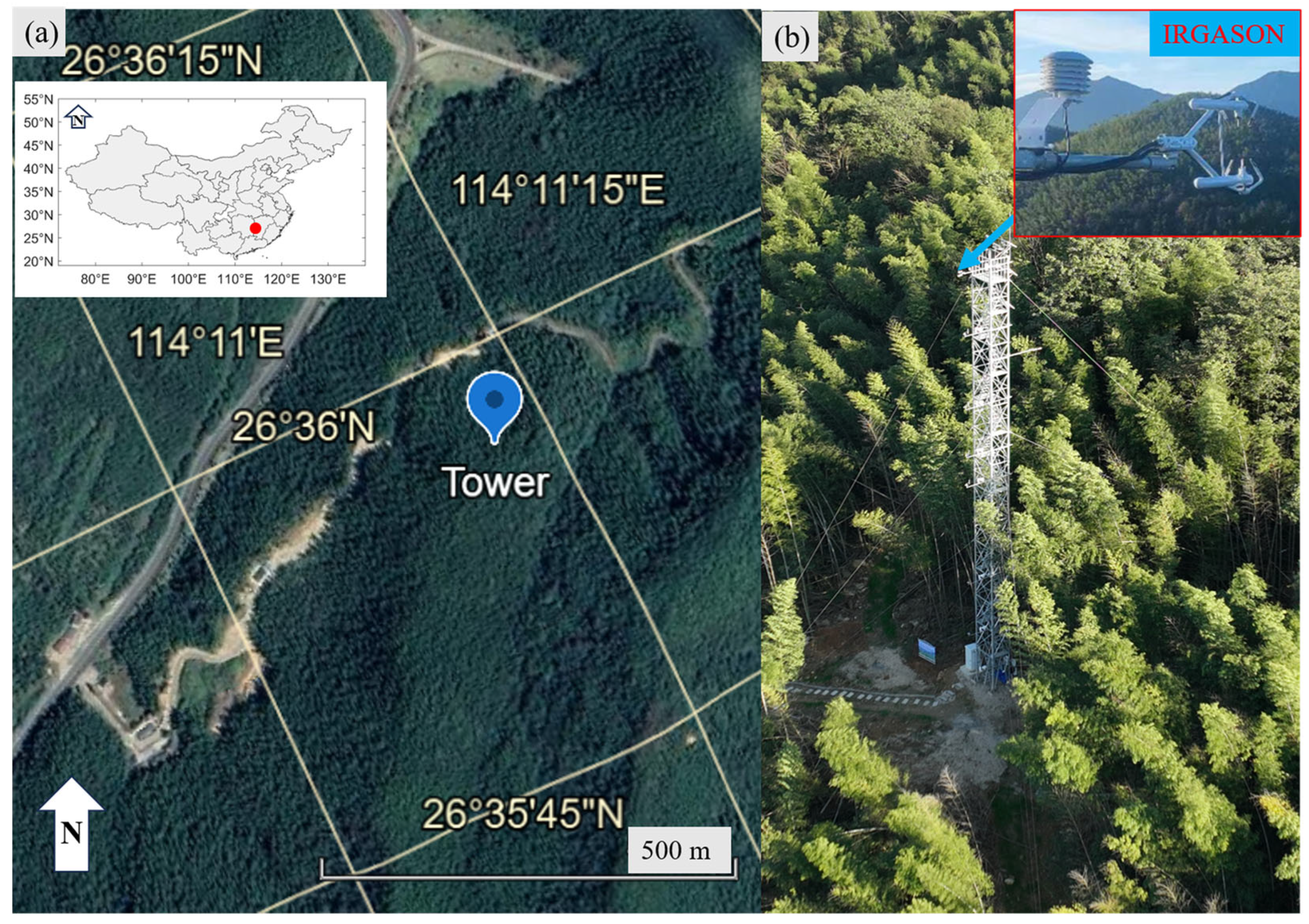
The study area is located in Jinggangshan City, Jiangxi Province, China. The average annual temperature is 14.2 °C, with total annual precipitation of 1856.2 mm and an average relative humidity of 84.0%. The highest elevation in the study area is 1040 m, while the lowest is 898 m (114°11′12″ E, 26°35′55″ N, Figure 1a). The dominant vegetation in the forest is Moso bamboo (Phyllostachys edulis), with an average height of 16.8 m and an average diameter at breast height (DBH) of 11.6 cm. To avoid the impacts of high temperatures and intense radiation, the experiment was conducted during the non-growing season, from 13 November 2024, to 20 March 2025, as the light saturation point of Moso bamboo is 1500 μmol m−2 s−1 [17].
The selected EC system was the IRGASON (Campbell Inc., Logan, UT, USA) (Figure 1b), which can simultaneously measure CO2 and H2O densities, three-dimensional wind velocities, and temperatures within the same air volume [19]. The IRGASON was installed on a cross-arm at the top of a 30 m tower. It was oriented at an azimuth of 280°, and positioned approximately 4.8 m away from the tower. Meteorological variables, including air temperature (Ta) and relative humidity (RH) (HMP155, Vaisala, Helsinki, Finland) [20], wind speed (WS) and direction (WD) (034E, Metone, Grants Pass, OR, USA) [21], precipitation (52203, R.M. Young, Traverse City, MI, USA) [22], and photosynthetically active radiation (PAR) (SQ-202X, Apogee, Logan, UT, USA) [23], were recorded at a height of 26 m above the ground. All the sensors were connected to a data logger (CR1000X, Campbell Inc., Logan, UT, USA) [24]. The EC measured three-dimensional wind speed, sonic temperature, CO2 and H2O mass density, and air pressure (PTU300, Vaisala, Finland) [25] at a frequency of 10 Hz, while meteorological data were collected at 1 Hz. The IRGASON underwent factory calibration before the experiment, and a field calibration was conducted using a zero air generator (31022, Campbell, Logan, UT, USA) [26] on 18 January 2025.

2.2. Flux Process and Data Quality

CO2 flux (Fc) was calculated as follows [27]:
F c = w ρ c o 2 ¯ + μ ρ c o 2 ρ d w ρ v ¯ + ( 1 + μ σ ) ρ c o 2 T w T ¯
where w′ and ρco2′ represent the turbulent fluctuations in the vertical velocity and CO2 mass density, respectively. μ denotes the ratio of dry air molecular weight to that of water molecules, while σ indicates the averaged mixing ratio of water vapor. ρco2 and ρd refer to the mass density of CO2 and the dry air density, respectively. T is the air temperature. The over line represents averaging. w ρ v ¯ and w T ¯ are the water vapor flux and heat flux, respectively.
The derivation of CO2 flux from the raw data (10 Hz) was performed using EddyPro (V7.0.9, Licor, NE, USA). Only data with a signal strength above 0.8 (as recorded in the IRGA’s diagnostic logs) were selected [19]. Key steps in the process included removing spikes, correcting for virtual temperature, applying double rotation, conducting WPL correction [27], and performing frequency correction. Thresholds were set as ±5 m s−1 for vertical velocity, ±30 m s−1 for horizontal wind speed, ±5 °C for air temperature, and 600–800 mg m−3 for CO2 mass density.
Quality assurance and control steps for Fc were applied as follows: (1) EddyPro provides flags ranging from 0 (best) to 2 (poorest); data with a flag of 2 were excluded [28]. (2) Data were excluded during rainfall, and 30 min before and after. (3) Fc threshold was set to ±15 μmol m−2 s−1 due to 95% of the data falls within this range [29]. (4) Data with friction velocity (u*) < 0.2 m s−1 was excluded [17]. (5) Spikes in Fc were removed using the criterion X(t) < (X − 3σ) or X(t) > (X + 3σ), where X(t) denotes Fc series, X is the average and σ is the standard deviation. (6) All gaps in Fc were left unfilled to ensure data accuracy. Following the steps, 3172 of the 6144 data were available for this study.

2.3. Turbulence Spectrum Analysis

The data collected by the EC system capture the temporal variation characteristics of turbulence [30,31]. Through Fourier transform, the turbulence signals in the time domain can be converted to the frequency domain, allowing the analysis of the contributions of turbulence signals at different frequencies to the overall signal and assessing the observation system’s performance in capturing signals across various frequencies [32,33]. The turbulence spectrum is generally divided into three parts: the energy-containing eddy range, the inertial subrange, and the dissipation range. Turbulent energy is generated in the energy-containing eddy range, transferred from large eddies to smaller eddies in the inertial subrange, and ultimately dissipated into heat energy in the dissipation range [34]. Kolmogorov [35] demonstrated that, for steady turbulence, in the inertial subrange, the turbulent kinetic energy decreases with frequency following a −5/3 power law:
S a ( f ) = α ε 2 / 3 ( 2 π f U ) 5 / 3
where Sa is the turbulence spectrum function, α is the dimensionless Kolmogorov constant, ε is the turbulence dissipation rate, 2 π f U is the wavenumber derived from Taylor’s hypothesis, f is the natural frequency, and U is the mean wind speed.

2.4. Ogive Plot

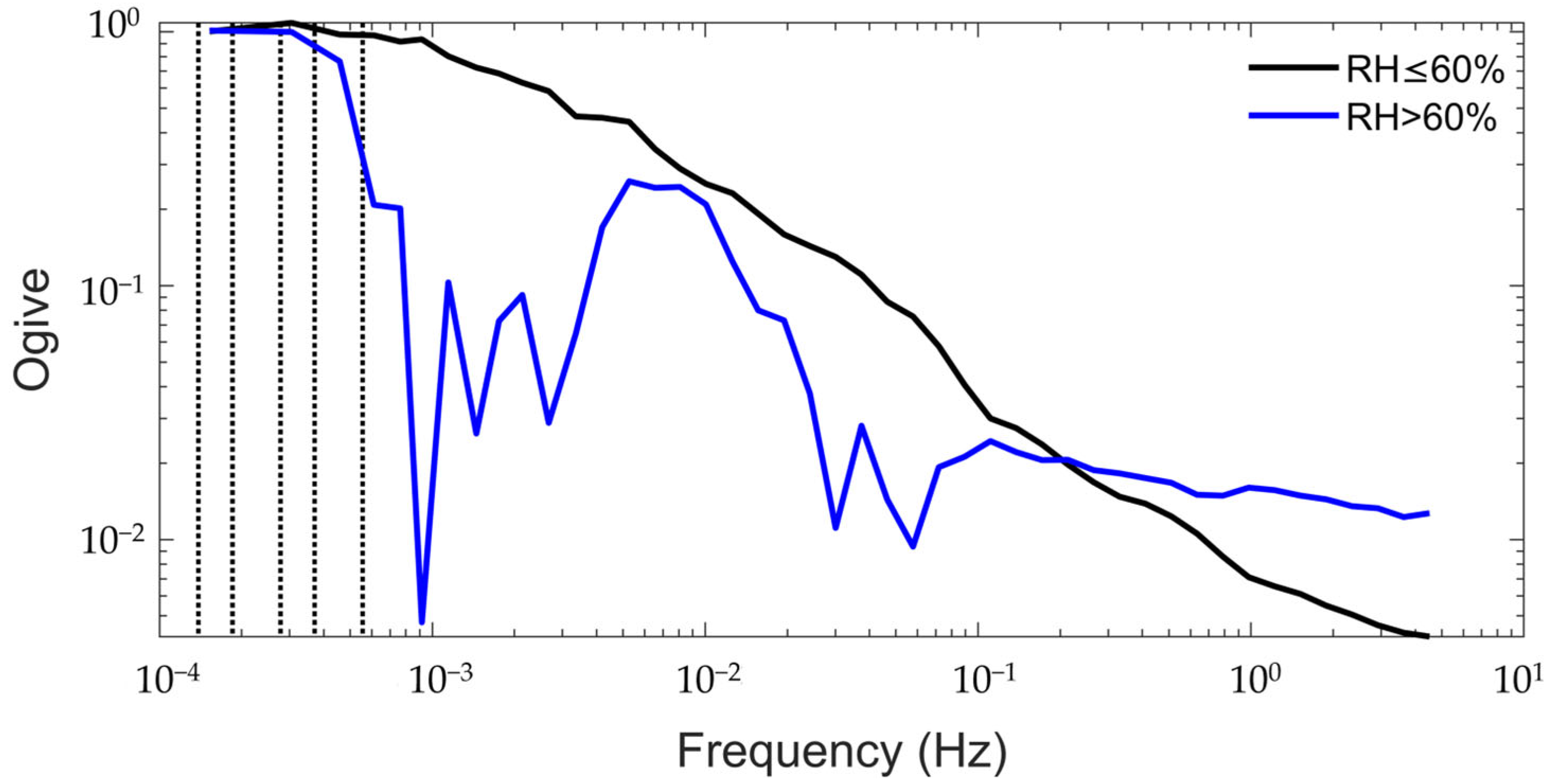
Ogive is the integral of a cospectrum from the current frequency to the Nyquist frequency [36,37]. The ogive curve accurately reflects the distribution characteristics of the given data or the likelihood of data falling within a certain frequency range. By plotting the points corresponding to the cumulative frequency of each class interval, an ogive is constructed. It can be described as follows:
O g = f C o w ( f ) d f
where f is the frequency, Cow represents the cospectrum of two variables of interest. When it has an asymptotic shape toward the highest and lowest frequencies and its plateau at the low frequency end is close to 1, the flux averaging period is adequate. Otherwise, the flux averaging period is not adequate [36].

3. Results and Discussion

3.1. Meteorological Conditions

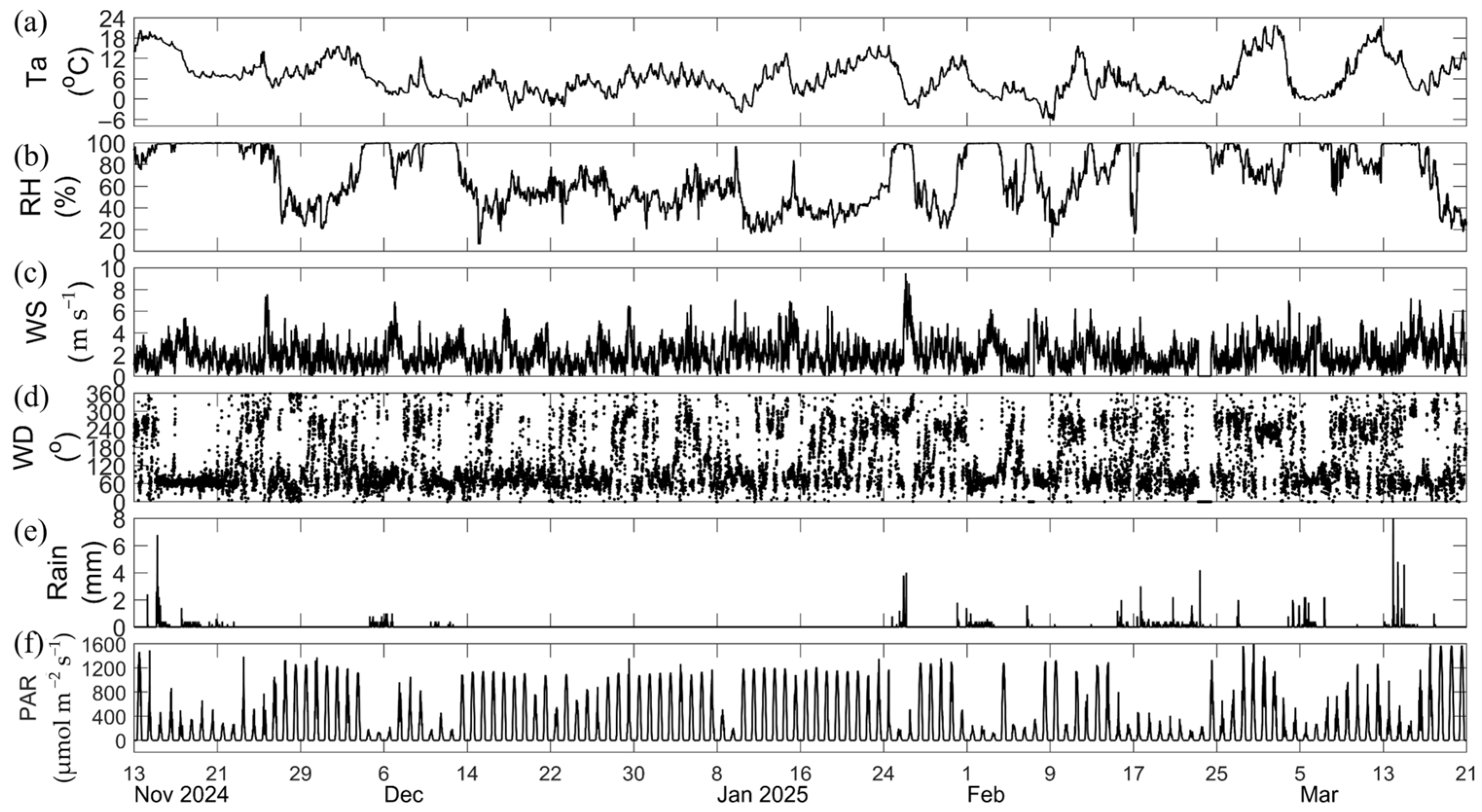
Figure 2 shows the time series of the observed Ta, RH, WS, WD, rainfall, and PAR. Ta exhibited considerable variation, with a minimum of −6.39 °C and a maximum of 21.79 °C, averaging at 6.17 °C (Figure 2a). Rainfall causes a decrease in Ta while increasing RH, with RH generally exceeding 95% during rainfall events (Figure 2b,e). WS remained low throughout the study period, with an average of 1.97 m s−1 and a peak of 9.50 m s−1. Most WS were around 1.50 m s−1 (Figure 2c). WD fluctuated significantly (Figure 2d). A total of 387.8 mm of rainfall was recorded, and RH was predominantly above 60% (Figure 2b,e). PAR displayed a single peak, reaching a maximum of 1586.42 μmol m−2 s−1 at noon (local time, Figure 2f). In summary, the site experienced abundant rainfall, significant temperature fluctuations, high relative humidity, low wind speeds, and variable wind directions during the period.

3.2. Effect of Averaging Interval on CO2 Flux Calculations

Table 1 presents the effects of different averaging intervals (30, 45, 60, 90, and 120 min) on Fc. As the averaging interval increased from 30 to 90 min, and the mean Fc gradually decreased from −0.92 μmol m−2 s−1 to −1.04 μmol m−2 s−1. When the interval was extended to 120 min, the Fc was −0.82 μmol m−2 s−1. Using the averaging interval commonly applied in EC measurements of moso bamboo forests [16,17,29], the Fc values for the 45, 60, and 90 min intervals increased by 4.35%, 10.87%, and 13.04%, respectively, while the value for the 120 min interval decreased by 7.61%. The standard deviation was smallest at the 60 min interval and largest at the 90 min interval. The standard error was smallest at the 30 min and 120 min intervals and largest at the 90 min interval. These results indicate that the choice of averaging time significantly affects the estimation of CO2 flux magnitude, and that using a 30 min averaging interval leads to an underestimation of the carbon sink strength in the Moso bamboo forest.
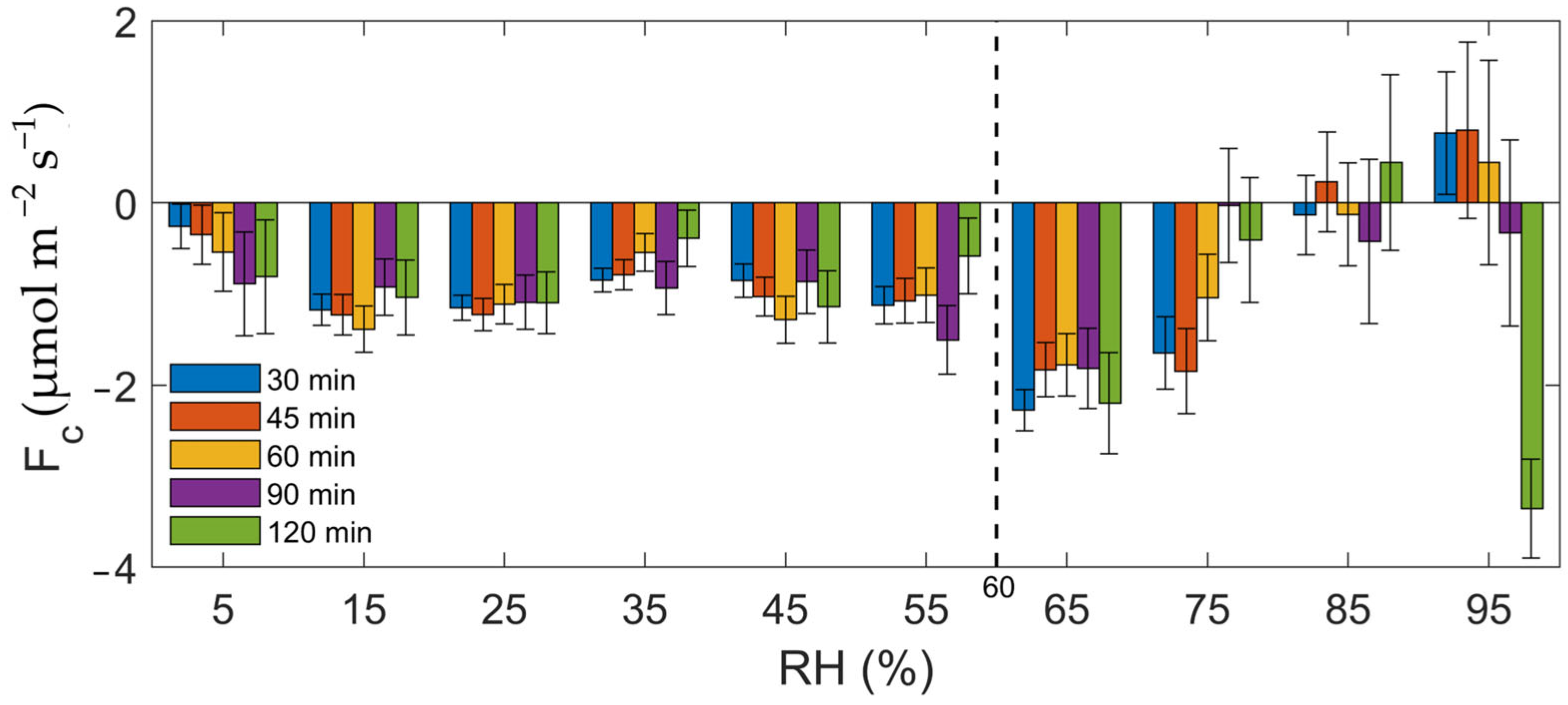
The effect of the averaging interval on Fc under different RH ranges is shown in Figure 3. Using the 30 min interval as a reference, a t-test revealed that the mean values at the both 60 and 90 min intervals were significantly different (p < 0.05). For RH ≤ 10% and 80% < RH ≤ 90%, all intervals showed significant differences (p < 0.05). For 90% < RH ≤ 100%, all intervals showed significant differences (p < 0.01). For 30% < RH ≤ 40% and 50% < RH ≤ 60%, the 120 min interval showed a significant difference (p < 0.05). For 70% < RH ≤ 80%, the 60, 90, and 120 min intervals showed significant differences (p < 0.05). Within the same RH bin, different averaging intervals affected Fc in distinct ways. When RH ≤ 10%, Fc becomes more negative as the averaging interval increases, with values of −0.26 ± 0.25 μmol m−2 s−1 (mean ± stand error) at the 30 min and −0.54 ± 0.42 μmol m−2 s−1 at 90 min. In contrast, when RH is between 70% and 80% (RH = 75%), Fc gradually increases with longer averaging intervals, approaching 0 at the 90 min interval. It is worth noting that the influence of time interval on Fc calculation was particularly evident when RH > 80%, and could even reverse the direction of CO2 exchange. For example, Fc showed opposite directions at the 30 and 120 min intervals. The results indicate that the typical 30 min averaging interval underestimates the CO2 flux of the Moso bamboo forest. At RH ≤ 60%, the average Fc at different averaging intervals were −0.89 ± 0.14 μmol m−2 s−1 (30 min), −0.95 ± 0.13 μmol m−2 s−1 (45 min), −0.98 ± 0.12 μmol m−2 s−1 (60 min), −1.04 ± 0.09 μmol m−2 s−1 (90 min), and −0.84 ± 0.12 μmol m−2 s−1 (120 min), respectively. In contrast, the average Fc at different averaging intervals were −0.82 ± 0.17 μmol m−2 s−1 (30 min), −0.66 ± 0.17 μmol m−2 s−1 (45 min), −0.63 ± 0.16 μmol m−2 s−1 (60 min), −0.65 ± 0.12 μmol m−2 s−1 (90 min), and −1.38 ± 0.15 μmol m−2 s−1 (120 min) when RH > 60%. Fc becomes increasingly negative with longer time intervals, except for the 120 min interval, whereas at RH > 60%, Fc fluctuated. Thus, the effect of the averaging time on Fc was evident. Although increasing the averaging interval helps reduce the uncertainty in flux measurements [38], it is important to note that greater uncertainty will occur if the time interval is excessively long, e.g., 120 min in this study.

3.3. Determine the Optimal Averaging Interval on CO2 Flux Calculations

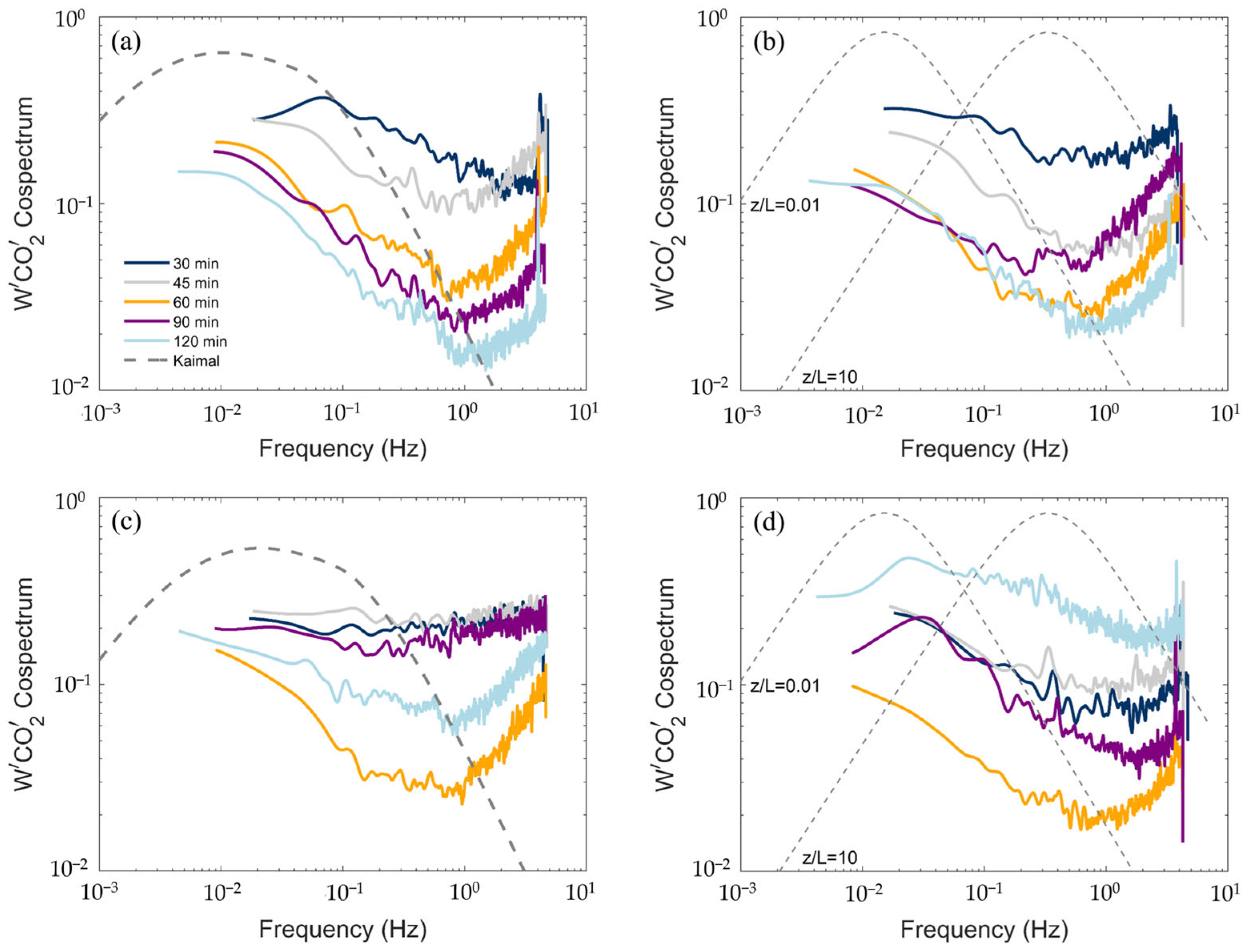
The cospectrum describes turbulent transfer in a mathematical form. It covers a range from small-scale motions on the order of milliseconds to large-scale motions on the order of hours. The cospectrum shows the contribution of the flux to transport at each frequency [28,33,36]. This is achieved by converting the time series into the frequency domain using a Fourier transform, as shown in Figure 4. Under RH ≤ 60% during the daytime (Figure 4a), the spectral decline rate for the 30 and 45 min intervals was lower than the ideal shape proposed by Kaimal et al. [33]. This indicates insufficient turbulence development during this time period. As the averaging interval increased, the decline rate gradually became more consistent, reflecting enhanced turbulent dissipation. During the nighttime (Figure 4b), the cospectral attenuation for the 30 min interval was mainly concentrated in the strongly stable region (z/L = 10, where z is the measurement height minus zero displacement and L is the Monin Obukhov length). With longer averaging intervals, the attenuation gradually shifted to the weakly stable region (z/L = 0.01). When the interval exceeded 60 min, the cospectra below 0.8 Hz became nearly identical.
Under RH > 60% during the daytime (Figure 4c), the cospectra for the 30 and 45 min intervals remained mostly flat with no obvious attenuation. At the 60 min interval, the attenuation became clear. When the interval was further extended to 90 or 120 min, the attenuation became relatively slight. This suggested insufficient turbulent mixing during this period, which may lead to underestimation of CO2 flux. During the nighttime (Figure 4d), the cospectral attenuation for the 30 and 45 min intervals occurred in both the weakly stable and strongly stable regions. When the interval was extended to 60 min, the attenuation was mainly in the weakly stable region. As the interval increased further, the attenuation gradually shifted to the strongly stable region. At the 120 min interval, the attenuation was mainly in the strongly stable region.
The cospectra of vertical wind speed and CO2 fluctuations showed different degrees of variation across averaging intervals. High-frequency attenuation only appeared in two cases: during daytime with RH < 60% at the 30 min interval (Figure 4a), and during nighttime with RH > 60% at the 90 and 120 min intervals. For other intervals, high-frequency attenuation was not obvious. Instead, most intervals showed enhanced energy at low frequencies (Figure 4a), which is a cospectral aliasing phenomenon [36,39]. Aliasing means that high frequency fluctuations are shifted to lower frequencies in the cospectrum. This shift may arise from fluctuations caused by step changes in the sampled data. The aliasing phenomenon was observed to varying degrees under other conditions, especially at the 60 and 120 min intervals (Figure 4).
In summary, different averaging intervals include different turbulence states, thus affecting CO2 flux estimation. This effect was more pronounced when RH > 60%. The Ogive spectra (Figure 5) showed that for RH ≤ 60%, the curve at the 30 min interval was relatively smooth and converged with the curve at the 45 min interval. In contrast, for RH > 60%, the curve at the 30 and 45 min intervals continued to increase and began to converge to a constant at the 60 min interval. Therefore, for RH ≤ 60%, averaging intervals from 30 to 120 min are acceptable. For RH > 60%, the choice of time interval is critical for the flow, and we recommend using a 60 min interval.
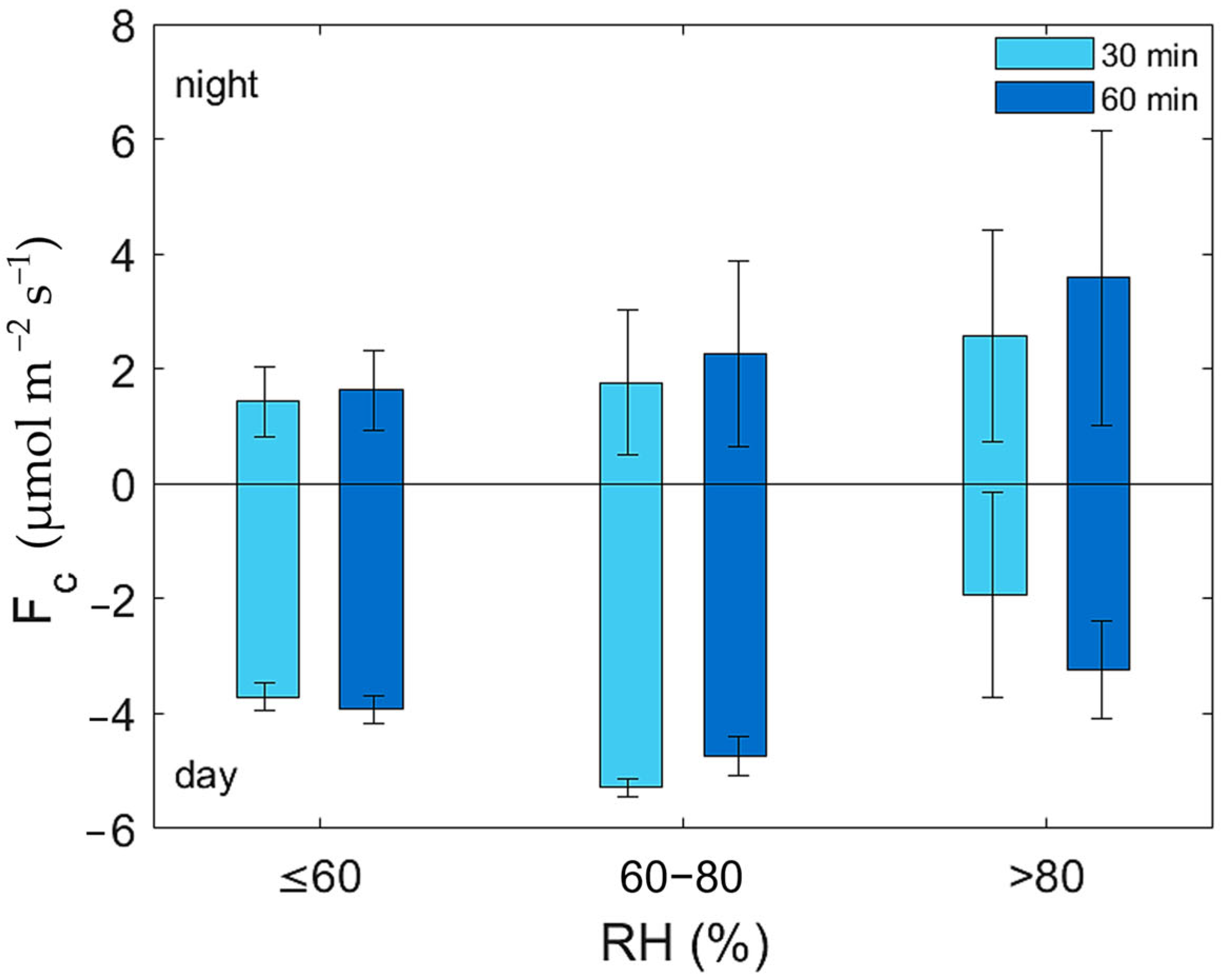
We examined the effect of RH on Fc estimations by analyzing 60 and 30 min fluxes. Compared to the 60 min flux, the 30 min flux was underestimated by 9.2% at RH ≤ 60% and overestimated by 30.2% at RH > 60% (Figure 3). We further compared Fc during day and night over 30 and 60 min time intervals at RH ≤60%, 60–80%, and >80% (PAR < 10 μmol m−2 s−1 was defined as night-time, Figure 6). During the 30 min intervals, the mean Fc at night was 1.43 ± 0.62 μmol m−2 s−1, 1.76 ± 1.23 μmol m−2 s−1, and 2.58 ± 1.84 μmol m−2 s−1, respectively, and during the day, the mean Fc was −3.70 ± 0.23 μmol m−2 s−1, −5.29 ± 0.16 μmol m−2 s−1, and −1.94 ± 1.78 μmol m−2 s−1, respectively. At 60 min intervals, Fc was −3.93 ± 0.23 μmol m−2 s−1, −4.74 ± 0.35 μmol m−2 s−1 and −3.24 ± 0.85 μmol m−2 s−1 during the day and 1.62 ± 0.71 μmol m−2 s−1, 2.27 ± 1.62 μmol m−2 s−1 and 3.58 ± 2.56 μmol m−2 s−1 during the night. Compared to the 60 min intervals, Fc with 30 min intervals was underestimated by 11.7%, 22.5%, and 27.9% at night. However, during the day, Fc was underestimated by 5.9% and 40.1% for 30 min intervals when RH ≤ 60% and RH > 80%, respectively, and overestimated by 11.6% when RH was 60–80%. Fc was most affected by the time interval when RH > 80%. The t-test showed that Fc exhibited significant differences when RH > 80% (p < 0.05), as well as at night in the 60–80% RH range (p < 0.05). Under other RH conditions, the differences were not significant (p > 0.15).

4. Discussion

Research conducted in forests suggests that 60 to 120 min averaging intervals are appropriate [6,7]. However, our results indicate that a 30 min average interval fails to meet the requirements for EC measurement during daytime when RH > 60%. This interval is acceptable when RH ≤ 60%. Increasing the interval to 120 min may lead to larger errors due to low-frequency pollution (Figure 4). Studies on crops have shown that a single averaging interval is not suitable for capturing flux at different growth stages. For example, a 15 min interval is sufficient for the early growth stage, while a later stage requires a 45 min interval [10]. Moso bamboo grows rapidly and has a strong regenerative ability. It reaches vigorous growth in summer, when synchronized increases in temperature and precipitation from June to October enhance photosynthesis, resulting in a strong carbon sink. In winter, photosynthesis declines while respiration remains relatively stable, leading to net carbon emissions [16,17]. The combination of heavy rainfall during the rainy season, high temperatures, and vigorous growth greatly increases evapotranspiration, thereby raising air humidity. Further investigation is required to determine whether RH under such high temperature and high humidity conditions exhibit the characteristics identified here.
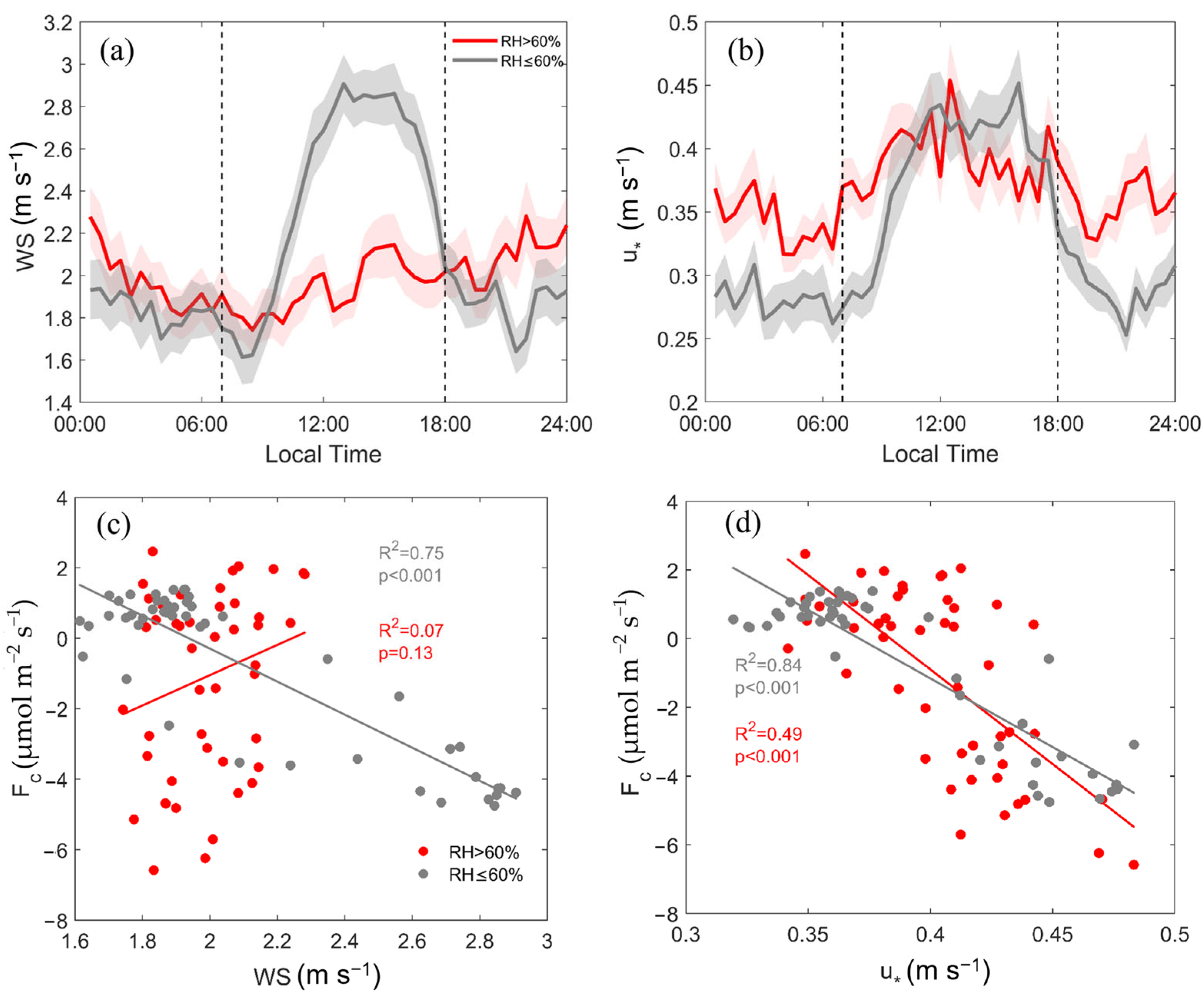
The trends in flux standard errors support the opinion that longer averaging intervals reduce uncertainty in flux calculations [37,38]. For low humidity conditions (RH ≤ 60%), the standard errors for 30 and 60 min Fc were ±0.14 μmol m−2 s−1 and ±0.12 μmol m−2 s−1, respectively. Conversely, when RH > 60%, these errors increased to ±0.17 μmol m−2 s−1 (30 min) and ±0.16 μmol m−2 s−1 (60 min). Turbulence parameters such as WS and u* were used to characterize turbulence under the two RH conditions. Figure 7 shows the daily variations in WS and u* for RH ≤ 60% and RH > 60%. When RH ≤ 60%, both parameters exhibited clear diurnal patterns, with lower values at night and higher values during the day. However, when RH > 60%, the diurnal variations in u* became weaker. The variation in WS no longer followed a diurnal trend. Compared to RH ≤ 60%, the high humidity case (RH > 60%) had lower daytime values and higher nighttime values. Specifically, at RH > 60%, the mean values of WS and u* are 1.98 m s−1 and 0.37 m s−1, respectively. At RH ≤ 60%, the mean WS was 2.13 m s−1 and the mean u* was 0.33 m s−1. Under high humidity conditions, WS and u* remains relatively high and shows no obvious diurnal variation. This may be caused by local circulation induced by topographic effects [40,41]. This may be the reason why the cospectra under different humidity conditions exhibit differences across different time scales between daytime (Figure 4a,b) and nighttime (Figure 4c,d).
Additionally, Fc was significantly correlated with WS (p < 0.001, R2 = 0.75) when RH ≤ 60%. This correlation became very poor (p =0.13) when RH > 60% (Figure 7c). Under both humidity conditions, Fc showed a significant negative correlation with u* (p < 0.001) (Figure 7d). When RH ≤ 60%, 84% of the variation in CO2 flux could be explained by u* (R2 = 0.84). When RH > 60%, the explained variance decreased to 49% (R2 = 0.49). At RH > 60%, WS was lower while u* was higher. This suggests that turbulence was dominated by dynamic factors and that thermal factors were suppressed [40,42,43]. The site is located in a mountainous area with topographic effects (Figure 1). Under the influence of topography, local effects such as intermittent turbulence, valley wind circulation, and abrupt wind changes [41,44,45,46] are further intensified. This enhances the dynamic role in turbulence [45,46]. This may be the reason that the turbulent dissipation region in Figure 4 deviates from the ideal curve. The above deviations may further cause overestimation or underestimation of CO2 flux under high humidity conditions [44,46]. It should be noted that this issue is beyond the scope of this study. Further investigation is needed through more detailed observations and simulations.
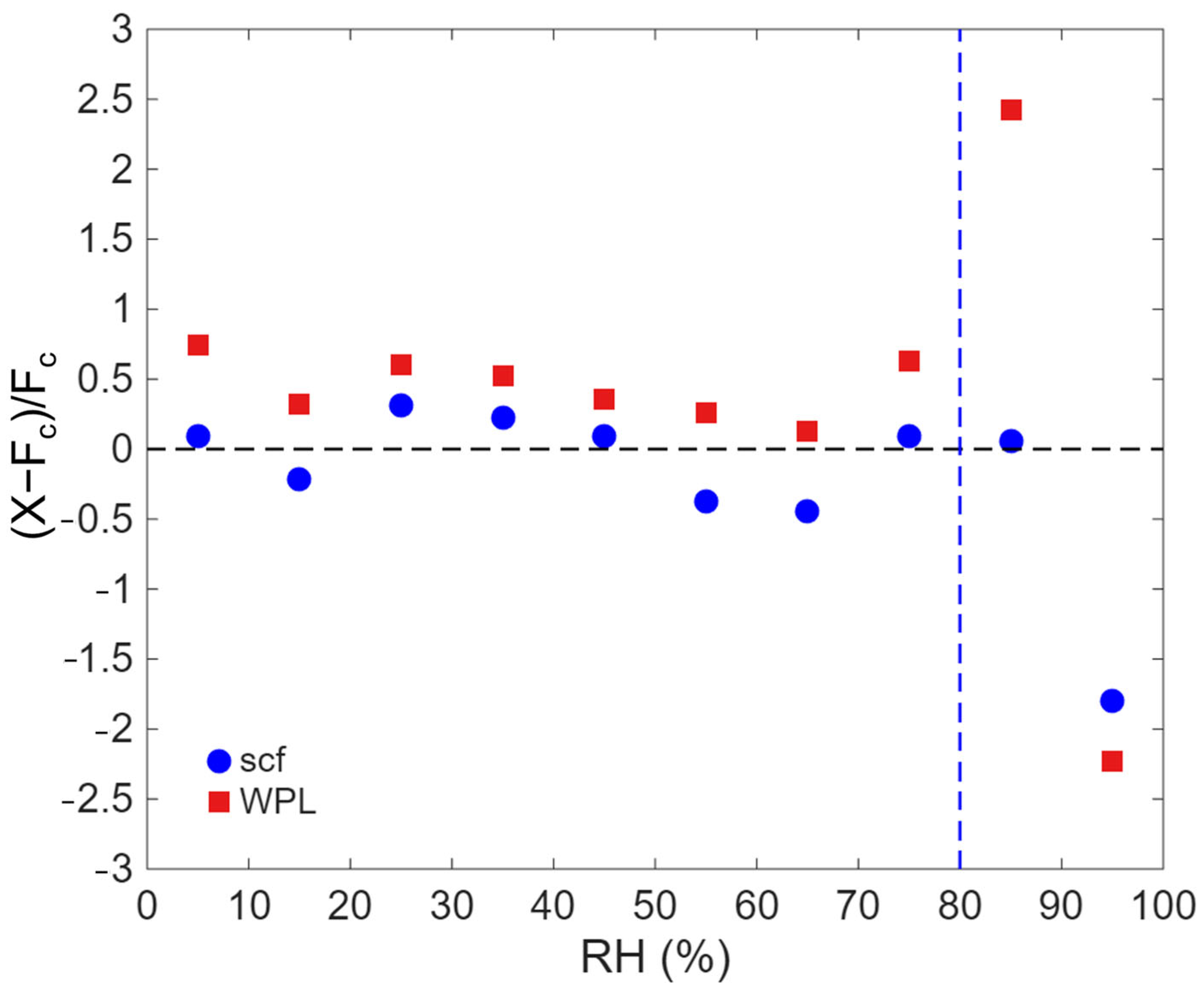
Furthermore, according to Equation (1), the second and third terms on the right side constitute the WPL correction term, which also has an important influence on CO2 flux estimation [27]. The effects of the spectral correction term (the first term on the right side of Equation (1)) and the WPL correction term on CO2 flux vary with RH, as shown in Figure 8. The CO2 flux without WPL correction (scf) underestimates the ecosystem CO2 flux in some RH ranges, specifically from 10% to 20% and from 50% to 70%, due to the effects of temperature and humidity [36]. After applying the WPL correction, the CO2 flux intensity increases significantly. Overall, when RH ≤ 60%, the influence of the WPL correction term gradually decreases as RH increases. When RH > 60%, its influence increases markedly with RH. Specifically, the contribution of the WPL correction is smallest in the RH range of 60% to 70%. When RH > 80%, its contribution exceeds 200%. However, as this paper focuses mainly on the effect of averaging period on CO2 flux, the specific role of the temperature and humidity correction terms will be analyzed further using longer time series data.
Our findings also confirm that Moso bamboo forests maintain a strong net CO2 uptake while being significantly sensitive to humidity. We also evaluate the differences in CO2 flux estimates from the EC method under different humidity conditions and with different time-averaging intervals, providing important insights to improve measurement techniques in wet ecosystems. To our knowledge, it is difficult to directly compare our results with earlier research because there is a scarcity of studies that specifically examine the effects of high humidity on Fc. However, since humid conditions are common and EC systems are frequently used in tropical and subtropical areas, it is unavoidable that humidity will affect the accuracy of observations. This methodological gap still necessitates investigation.

5. Conclusions

Moso bamboo forests have a substantial carbon sequestration capacity and play an important role in mitigating climate change. This study employed an open-path eddy covariance system to investigate how different averaging intervals influence CO2 flux estimates in a subtropical Moso bamboo forest during winter. The results showed that when relative humidity exceeded 60%, the averaging interval began to affect CO2 flux calculations, and in some cases even caused a shift between carbon sink and source. Further analysis revealed that high humidity often accompanied weaker atmospheric turbulence, which reduced the efficiency of CO2 mixing within the canopy and thus compromised the accuracy of flux measurements. Extending the averaging interval effectively reduced uncertainty in flux estimates, but excessively long intervals introduced potential systematic biases. Based on these findings, an averaging interval of 60 min is recommended for eddy covariance measurements in subtropical Moso bamboo forests. This study not only improves the accuracy of CO2 flux estimation in this ecosystem but also provides valuable guidance for applying open-path eddy covariance systems in humid regions.

Author Contributions

Conceptualization, G.Z. and W.W.; Methodology, G.Z.; Software, W.W., J.D. and S.H.; Validation, J.D., L.Y. and J.X.; Writing—original draft preparation, G.Z., W.W. and J.D.; Writing—review and editing, G.Z., L.Y. and J.X.; Visualization, S.H.; Supervision: G.Z. All authors have read and agreed to the published version of the manuscript.

Funding

This research was funded by Natural Science Foundation of China (42565005;32560341), The Special Program for the Cultivation of Early Career Young Science and Technology Talents in Jiangxi Province (20244BCE52292), Natural Science Foundation of Jiangxi Province (20232BAB215046), and Basic Research and Talent Research Special Project of the Jiangxi Academy of Forestry Sciences (2024523102; 2024523103).

Data Availability Statement

The data presented in this study are available on request from the corresponding author due to privacy.

Acknowledgments

We are grateful to the Administration of Jiangxi Jinggangshan National Nature Reserve for their assistance during our observational experiments. We also thank the reviewers for their hard work in improving the quality of this paper.

Conflicts of Interest

The authors declare no conflict of interest.

References

  1. Baldocchi, D. Measuring fluxes of trace gases and energy between ecosystems and the atmosphere-the state and future of the eddy covariance method. Glob. Change Biol. 2014, 20, 3600–3609. [Google Scholar] [CrossRef]
  2. Campioli, M.; Malhi, Y.; Vicca, S.; Luyssaert, S.; Papale, D.; Peñuelas, J.; Reichstein, M.; Migliavacca, M.; Arain, M.A.; Janssens, I.A. Evaluating the convergence between eddy-covariance and biometric methods for assessing carbon budgets of forests. Nat. Commun. 2016, 7, 13717. [Google Scholar] [CrossRef]
  3. Liu, Y.; Liu, H.; Du, Q.; Xu, L. Multi-level CO2 fluxes over Beijing megacity with the eddy covariance method. Atmos. Ocean. Sci. Lett. 2021, 14, 100079. [Google Scholar] [CrossRef]
  4. van Ramshorst, J.G.V.; Knohl, A.; Callejas-Rodelas, J.Á.; Clement, R.; Hill, T.C.; Siebicke, L.; Markwitz, C. Lower-cost eddy covariance for CO2 and H2O fluxes over grassland and agroforestry. Atmos. Meas. Tech. 2024, 20, 6047–6071. [Google Scholar] [CrossRef]
  5. Wilson, K.; Goldstein, A.; Falge, E.; Aubinet, M.; Baldocchi, D.; Berbigier, P.; Bernhofer, C.; Ceulemans, R.; Dolman, H.; Field, C.; et al. Energy balance closure at FLUXNET sites. Agr. Meteor. 2002, 113, 223–243. [Google Scholar] [CrossRef]
  6. Finnigan, J.J.; Clement, R.; Malhi, Y.; Leuning, R.; Cleugh, H.A. A re-evaluation of long-term flux measurement techniques part I: Averaging and coordinate rotation. Bound. Layer Meteorol. 2003, 107, 1–48. [Google Scholar] [CrossRef]
  7. Berger, B.W.; Davis, K.J.; Yi, C.; Bakwin, P.S.; Zhao, C.L. Long-term carbon dioxide fluxes from a very tall tower in a northern forest: Flux measurement methodology. J. Atmos. Ocean. Tech. 2001, 18, 529–542. [Google Scholar] [CrossRef]
  8. Charuchittipan, D.; Babel, W.; Mauder, M.; Leps, J.P.; Foken, T. Extension of the averaging time in eddy-covariance measurements and its effect on the energy balance closure. Bound. Layer Meteorol. 2014, 152, 303–327. [Google Scholar] [CrossRef]
  9. Zhang, P.; Yuan, G.F.; Zhu, Z.L. Determination of the average period of Eddy covariance measurement and its influences on the calculation of fluxes in desert riparian forest. Arid. Land Geogr. 2013, 36, 400–408. [Google Scholar]
  10. Karimindla, A.R.; Kumari, S.; R, S.S.; Chintala, S.; Kambhammettu, B.V.N.P. The role of time averaging of eddy covariance fluxes on water use efficiency dynamics of maize. Atmos. Meas. Tech. 2024, 17, 5477–5490. [Google Scholar] [CrossRef]
  11. Yu, G.; Chen, Z.; Piao, S.; Peng, C.; Ciais, P.; Wang, Q.; Li, X.; Zhu, X. High carbon dioxide uptake by subtropical forest ecosystems in the East Asian monsoon region. Proc. Natl. Acad. Sci. USA 2014, 111, 4910–4915. [Google Scholar] [CrossRef]
  12. Chen, X.; Zhang, X.; Zhang, Y.; Booth, T.; He, X. Changes of carbon storages in bamboo stands China during 100 years. For. Ecol. Manag. 2009, 258, 1489–1496. [Google Scholar] [CrossRef]
  13. Song, X.; Zhou, G.; Jiang, H.; Yu, S.; Fu, J.; Li, W.; Wang, W.; Ma, Z.; Peng, C. Carbon sequestration by Chinese bamboo forests and their ecological benefits: Assessment of potential, problems, and future challenges. Environ. Rev. 2011, 19, 418–428. [Google Scholar] [CrossRef]
  14. Nath, A.J.; Lal, R.; Das, A.K. Managing woody bamboos for carbon farming and carbon trading. Glob. Ecol. Conserv. 2015, 3, 654–663. [Google Scholar] [CrossRef]
  15. Yen, T.M.; Lee, J.S. Comparing aboveground carbon sequestration between moso bamboo (Phyllostachys heterocycla) and China fir (Cunninghamia lanceolata) forests based on the allometric model. For. Ecol. Manag. 2011, 261, 995–1002. [Google Scholar] [CrossRef]
  16. Chen, L.; Liu, Y.; Zhou, G.; Mao, F.; Du, H.; Xu, X.; Li, P.; Li, X. Diurnal and seasonal variations in carbon fluxes in bamboo forests during the growing season in Zhejiang province, China. J. For. Res. 2019, 30, 657–668. [Google Scholar] [CrossRef]
  17. Song, X.; Chen, X.; Zhou, G.; Jiang, H.; Peng, C. Observed high and persistent carbon uptake by Moso bamboo forests and its response to environmental drivers. Agric. For. Meteor. 2017, 247, 467–475. [Google Scholar] [CrossRef]
  18. Zhang, W.; Scholten, T.; Seitz, S.; Zhang, Q.; Chu, G.; Wang, L.; Xiong, X.; Liu, J. Rainfall redistribution in subtropical Chinese forests changes over 22 years. Hydrol. Earth Syst. Sci. 2024, 28, 3837–3854. [Google Scholar] [CrossRef]
  19. Campbell Scientific. IRGASON Integrated CO2/H2O Open-Path Gas Analyzer and 3D Sonic Anemometer. Available online: https://www.campbellsci.com/irgason (accessed on 20 April 2026).
  20. Vaisala. HUMICAP Humidity and Temperature Probe HMP155. Available online: https://www.vaisala.com/en/products/weather-environmental-sensors/humicap-humidity-temperature-probe-hmp155 (accessed on 20 April 2026).
  21. Metone Instruments. 034E Wind Speed & Direction Sensor. Available online: https://metone.com/products/034e-wind-sensor/ (accessed on 20 April 2026).
  22. Young. Tipping Bucket Rain Gauge 52202/52203. Available online: https://www.youngusa.com/product/tipping-bucket-rain-gauge/ (accessed on 20 April 2026).
  23. Apogee Instruments. SQ-202X-SS: Amplified 0-2.5 Volt Original Quantum Sensor. Available online: https://www.apogeeinstruments.com/sq-202x-ss-amplified-0-2-5-volt-original-quantum-sensor/ (accessed on 20 April 2026).
  24. Campbell Scientific. CR1000X Measurement and Control Datalogger. Available online: https://www.campbellsci.com/cr1000x (accessed on 20 April 2026).
  25. Vaisala. PTU300 User Guide. Available online: https://docs.vaisala.com/v/u/M210796EN-J/en-US (accessed on 20 April 2026).
  26. Campbell Scientific. 31022 ACC Zero Air Generator. Available online: https://www.campbellsci.com/order/31022 (accessed on 20 April 2026).
  27. Webb, E.K.; Pearman, G.I.; Leuning, R. Correction of flux measurements for density effects due to heat and water vapor transfer. Q. J. Roy. Meteor. Soc. 1980, 106, 85–100. [Google Scholar] [CrossRef]
  28. Li-cor. Support: EddyPro 7 Software. Available online: https://www.licor.com/support/EddyPro/manuals.html (accessed on 20 April 2026).
  29. Sun, C.; Jiang, H.; Chen, J.; Liu, Y.; Niu, X.; Chen, X.; Fang, C. Energy flux and balance analysis of phyllostachys edulis forest ecosystem in subtropical China. Acta Ecol. Sin. 2015, 35, 4128–4136. (In Chinese) [Google Scholar]
  30. Massman, W.J. A simple method for estimating frequency response corrections for eddy covariance systems. Agric. For. Meteor. 2000, 104, 185–198. [Google Scholar] [CrossRef]
  31. Massman, W.J. Reply to comment by Rannik on “A simple method for estimating frequency response corrections for eddy covariance systems”. Agric. For. Meteor. 2001, 107, 247–251. [Google Scholar] [CrossRef]
  32. Moncrieff, J.B.; Clement, R.; Finnigan, J.; Meyers, T. Averaging, detrending and filtering of eddy covariance time series. In Handbook of Micrometeorology: A Guide for Surface Flux Measurements; Lee, X., Massman, W.J., Law, B.E., Eds.; Kluwer Academic: Dordrecht, The Netherlands, 2004. [Google Scholar]
  33. Kaimal, J.C.; Wyngaard, J.C.; Izumi, Y.; Coté, O.R. Spectral characteristics of surface-layer turbulence. Q. J. R. Meteorol. Soc. 1972, 98, 563–589. [Google Scholar] [CrossRef]
  34. Willis, G.E.; Deardorff, J.W. On the use of Taylor’s translation hypothesis for diffusion in the mixed layer. Q. J. R. Meteorol. Soc. 1976, 102, 817–822. [Google Scholar] [CrossRef]
  35. Kolmogorov, A.N. The local structure of turbulence in incompressible viscous fluid for very large Reynolds numbers. Proc. R. Soc. London. Ser. A Math. Phys. Sci. 1991, 434, 9–13. [Google Scholar] [CrossRef]
  36. Burba, G. Eddy Covariance Method for Scientific, Industrial, Agricultural, and Regulatory Applications; Li-cor Biosciences: Lincoln, NE, USA, 2013. [Google Scholar]
  37. Mauder, M.; Foken, T. Impact of post-field data processing on eddy covariance flux estimates and energy balance closure. Meteorol. Z. 2006, 15, 597–609. [Google Scholar] [CrossRef] [PubMed]
  38. Rannik, Ü.; Kolari, P.; Vesala, T.; Hari, P. Uncertainties in measurement and modelling of net ecosystem exchange of a forest. Agric. For. Meteor. 2006, 138, 244–257. [Google Scholar] [CrossRef]
  39. Moore, C.J. Frequency response corrections for eddy correlation systems. Bound.-Layer Meteorol. 1986, 37, 17–35. [Google Scholar] [CrossRef]
  40. Gao, T.; Zhu, J.; Xu, Y.; Li, X.; Wang, X.; Yu, F.; Teng, D.; Sun, Y.; Zhang, J. Wind regimes and their drivers in mountainous forests: Collaborative observations by Qingyuan Ker Towers. Agric. For. Meteor. 2025, 368, 110545. [Google Scholar] [CrossRef]
  41. Schilperoort, B.; Coenders-Gerrits, M.; Rodríguez, C.J.; van Hooft, A.; van de Wiel, B.; Savenije, H. Detecting nighttime inversions in the interior of a Douglas fir canopy. Agric. For. Meteorol. 2022, 321, 108960. [Google Scholar] [CrossRef]
  42. Jayaraman, B.; Brasseur, J.G. Transition in atmospheric boundary layer turbulence structure from neutral to convective, and large-scale rolls. J. Fluid Mech. 2021, 913, A42. [Google Scholar] [CrossRef]
  43. Liang, J.; Zhang, L.; Wang, Y.; Cao, X.; Zhang, Q.; Wang, H.; Zhang, B. Turbulence regimes and the validity of similarity theory in the stable boundary layer over complex terrain of the Loess Plateau, China. J. Geophys. Res. Atmos. 2014, 119, 6009–6021. [Google Scholar] [CrossRef]
  44. Feigenwinter, C.; Montagnani, L.; Aubinet, M. Plot-scale vertical and horizontal transport of CO2 modiffed by a persistent slope wind system in and above an alpine forest. Agric. For. Meteor. 2010, 150, 665–673. [Google Scholar] [CrossRef]
  45. Whiteman, C.D.; Zhong, S. Downslope flows on a low-angle slope and their interactions with valley inversions. Part I: Observations. J. Appl. Meteorol. Climatol. 2008, 47, 2023–2038. [Google Scholar] [CrossRef]
  46. Jiang, F.Y.; Zhang, M.J.; Li, Y.L.; Zhang, J.Y.; Qin, J.X.; Wu, L.H. Field measurement study of wind characteristics in mountain terrain: Focusing on sudden intense winds. J. Wind Eng. Ind. Aerod. 2021, 218, 104781. [Google Scholar] [CrossRef]
Figure 1. The geographical location of the measurement site in mainland China (a) and the eddy covariance system used for measurements (b).
Atmosphere 17 00430 g001
Figure 2. Meteorological data for the area during the study period. Ta is air temperature, RH is relative humidity, WS is wind speed, WD is wind direction, Rain is rainfall, PAR is photosynthetically active radiation.
Atmosphere 17 00430 g002
Figure 3. Variation in CO2 flux with RH averaged over different time intervals. The RH range is divided into 10 bins at 10% increments. On the X-axis, RH = 5% represents the interval RH ≤ 10%, 15% represents 10% < RH ≤ 20%, and so on. Error bars are standard error with RH intervals of 10%.
Atmosphere 17 00430 g003
Figure 4. Cospectra of vertical velocity and CO2 concentration fluctuations with different averaging intervals. (a,b) show the cospectra for RH ≤ 60% and RH > 60% during the day, and (c,d) show the cospectra for RH ≤ 60% and RH > 60% during the night. Kaimal represents the ‘ideal’ shape proposed by Kaimal et al. [33]. z/L represents the stability.
Atmosphere 17 00430 g004
Figure 5. Ogive plots for different relative humidity (RH) conditions. The black dotted lines in the plot represent 120, 90, 60, 45 and 30 min intervals from left to right.
Atmosphere 17 00430 g005
Figure 6. Performance of Fc at different RH levels during the daytime and night-time, with 30 and 60 min time intervals. Error bars represent standard error.
Atmosphere 17 00430 g006
Figure 7. Mean diurnal variation in wind speed (WS, (a)) and friction velocity (u*, (b)) and their relationship with CO2 flux (Fc) (c,d) under RH ≤ 60% and RH > 60%. Shading represents the standard error.
Atmosphere 17 00430 g007
Figure 8. The influence of different flux terms on CO2 flux. scf is the first term on the right-hand side of Equation (1), representing the CO2 flux after spectral correction. WPL refers to the second and third terms on the right-hand side of Equation (1), representing the WPL correction term [27].
Atmosphere 17 00430 g008
Table 1. Statistical results of CO2 fluxes with different time intervals.
Time Interval
(min)
Mean
(μmol m−2 s−1)
Stand Deviation
(μmol m−2 s−1)
Stand Error
(μmol m−2 s−1)
Maximum
(μmol m−2 s−1)
Minimum
(μmol m−2 s−1)
Median
(μmol m−2 s−1)
30−0.927.090.1314.98−14.84−0.96
45−0.966.420.1414.97−14.91−0.98
60−1.026.380.1414.88−14.87−1.04
90−1.047.110.1514.89−14.96−1.02
120−0.856.930.1314.97−14.82−0.83
Disclaimer/Publisher’s Note: The statements, opinions and data contained in all publications are solely those of the individual author(s) and contributor(s) and not of MDPI and/or the editor(s). MDPI and/or the editor(s) disclaim responsibility for any injury to people or property resulting from any ideas, methods, instructions or products referred to in the content.