Article

Indoor Air Filtration System Performance: Evidence from a Two-Week Office Study Within the EDIAQI Project


by
Nikolina Račić
1,2,
Valentino Petrić
2,3,
Gordana Pehnec
1,
Ivana Jakovljević
1,
Marija Jelena Lovrić Štefiček
1,
Goran Gajski
1,
Francesco Mureddu
2 and
Mario Lovrić
2,4,5,*
1
Institute for Medical Research and Occupational Health, 10000 Zagreb, Croatia
2
The Lisbon Council, 1040 Brussels, Belgium
3
Smart Sense d.o.o., 10000 Zagreb, Croatia
4
Institute for Anthropological Research, 10000 Zagreb, Croatia
5
Faculty of Food Technology Osijek, Josip Juraj Strossmayer University of Osijek, 31000 Osijek, Croatia
*
Author to whom correspondence should be addressed.
Atmosphere 2026, 17(4), 393; https://doi.org/10.3390/atmos17040393
Submission received: 27 February 2026 / Revised: 28 March 2026 / Accepted: 11 April 2026 / Published: 14 April 2026
(This article belongs to the Special Issue Emerging Technologies for Observation of Air Pollution (2nd Edition))

Abstract

This two-week pilot study within the Horizon Europe EDIAQI project evaluated the real-life performance of portable air filtration units in two office environments (a small office and a shared kitchen) under continuous device operation and daily filter replacement. Indoor particle concentrations were monitored continuously using low-cost sensors (LCS) from three providers and supported by gravimetric measurements, while daily activity logs documented occupancy patterns, printing, cooking, and other source events together with purifier ON/OFF status. Particulate matter (PM) mass concentrations showed no systematic improvement during purifier ON periods; instead, temporal variability was dominated by indoor activities and episodic emissions, with occasional short-term peaks around filter replacement suggestive of minor resuspension. Chemical analysis provided a clearer picture: polycyclic aromatic hydrocarbons (PAHs) responded differently across fractions and compositions. Across monitored locations, high-molecular-weight PAHs in the PM1 fraction decreased during purifier ON periods (approximately 30% lower on average), whereas low-molecular-weight PAHs measured in total suspended particles (TSP) were higher during ON periods, indicating that semi-volatile fractions and activity/ventilation dynamics can outweigh simple filtration effects. Overall, the findings highlight a gap between laboratory-derived filtration performance metrics and outcomes in occupied, mixed-source indoor environments and emphasise the importance of device sizing, placement, airflow mixing, and complementary source control and ventilation strategies when deploying filtration-based IAQ interventions.

1. Introduction

Indoor air quality (IAQ) is a recognised factor of human health, comfort, and work performance, particularly in office and commercial environments where employees spend most of their working hours indoors [1]. In such settings, particulate matter (PM)—a complex mixture of solid and liquid particles suspended in air that vary in size, composition, and origin—originates from a mixture of processes: resuspension from movement and cleaning, emissions from office equipment and printing, cooking and food heating in shared areas, and infiltration of outdoor particles through ventilation and windows [2,3]. Because these processes vary strongly over time and space, indoor PM levels can differ significantly even within the same building and on the same day [4].
Beyond particles, indoor air contains a diverse mixture of chemical and biological pollutants whose levels depend on building characteristics, materials, ventilation strategy, and occupant behaviour [5,6]. Common gaseous pollutants include carbon dioxide (CO2) as an indicator of occupancy and ventilation adequacy, carbon monoxide (CO) from incomplete combustion, nitrogen dioxide (NO2) from gas appliances or outdoor infiltration, and ozone (O3), which may enter from outdoors and also react with indoor surfaces [7,8,9]. A major pollutant class in modern office environments is volatile organic compounds (VOCs), emitted from paints, adhesives, sealants, floorings, composite wood products, insulation, furniture, office supplies, cleaning agents, and consumer products [10,11]. Some VOCs are associated with acute irritation (eyes, nose, throat), headaches and odour nuisance, while certain compounds (e.g., formaldehyde, benzene) are of particular concern due to well-established toxicological profiles [12,13]. In addition to VOCs, polycyclic aromatic hydrocarbons (PAHs) are an important group of indoor pollutants due to their persistence and potential health effects, particularly for particle-bound high-molecular-weight compounds [14,15,16]. PAHs are chemical constituents associated with airborne particles and are therefore measured within specific PM size fractions. This distinction is important as PAH concentrations and behaviour can differ substantially between size fractions depending on their volatility and particle association. In office environments, PAHs can enter indoors through infiltration of outdoor combustion emissions (traffic and residential heating), but may also arise from indoor activities and equipment such as cooking/food heating in shared kitchen areas, resuspension of contaminated settled dust, and episodic emissions associated with printing and other office processes [11,17,18].
Particle size fraction (PM1—particles with aerodynamic diameter ≤ 1 µm, versus coarse fractions contributing to total suspended particles, TSP—encompassing all airborne particle sizes) influences removal by filtration, deposition and resuspension, and interactions with indoor air dynamics. Likewise, chemical constituents can behave differently depending on volatility and particle association. For example, lower-molecular-weight PAHs are more influenced by volatility and ventilation, whereas higher-molecular-weight PAHs are predominantly particle-associated and can be more affected by filtration efficiency and particle dynamics [19,20].
Portable air cleaners and standalone filtration units are widely promoted as a practical intervention to reduce indoor particle concentrations without requiring major building upgrades [21,22,23]. Many devices combine mechanical filtration (HEPA or “HEPA-like” media) with additional stages such as activated carbon, UV-C irradiation, or ionisation [24]. Their effectiveness is typically communicated through laboratory-derived removal efficiencies for standard aerosols and through clean air delivery rate (CADR), which reflects the volume of cleaned air delivered per unit time under controlled test conditions [25]. In real indoor environments, however, performance depends not only on the filter medium itself, but also on airflow patterns, mixing and short-circuiting, device placement, room volume, occupant activities, and the balance between emission rates and air exchange [26,27,28]. In particular, room size and the ratio of device CADR to room volume are critical determinants of real-world effectiveness, a device adequately sized for one room type may be insufficient in a larger or more heavily occupied space [29]. Airflow patterns and air mixing efficiency further modulate how effectively cleaned air is distributed throughout the room, with poor mixing or unfavourable device placement potentially resulting in localised clean zones that are not captured by fixed monitoring points. Environmental conditions such as temperature, humidity, and ventilation rate add further complexity, as these factors influence both particle dynamics and the balance between indoor emission rates and removal [30]. Ventilation strategy in particular has an important role; mechanically ventilated buildings with controlled air exchange rates create fundamentally different conditions for portable air-cleaner operation compared to naturally ventilated spaces where air exchange is episodic, weather-dependent, and highly variable [29,31]. Together, these variables mean that laboratory-derived performance metrics such as CADR may substantially overestimate real-world effectiveness in occupied, mixed-source environments. As a result, high nominal filtration efficiencies do not always automatically translate into measurable reductions at the room scale, especially when sources are intermittent or spatially localised [28].
Within the Horizon Europe EDIAQI project [32], a pilot experiment was conducted to evaluate the real-life performance of commercially available portable air-cleaning devices in an occupied office building. Cleaning units’ filters were replaced daily to minimise filter loading and to approximate “best case” operation. Indoor particle levels were monitored using multiple LCS systems deployed at fixed indoor points (representing typical breathing-zone/room locations), supplemented by gravimetric sampling of the PM1 and TSP mass fraction. In parallel, integrated sampling of PAHs in both the PM1 and TSP fractions was performed to explore whether chemical composition responded differently from bulk particle metrics during purifier ON versus OFF periods. LCSs have seen rapid development in recent years, offering continuous, high-temporal-resolution monitoring of indoor pollutants at relatively low cost compared to reference instrumentation [33]. However, their performance characteristics, including sensitivity, cross-sensitivity to humidity and temperature, and accuracy at low concentrations, vary substantially across sensor types and manufacturers [34]. Recent advances in real-time monitoring technologies, including multimodal sensor fusion approaches for atmospheric gas detection, further highlight the growing importance of continuous indoor air quality surveillance in occupied environments [35,36,37].
This paper describes the pilot design and summarises the initial findings across two rooms and three monitored locations. Rather than aiming to deliver definitive causal estimates, the objective is to document how measured particle and PAH compounds behaved under routine office occupancy and mixed indoor sources, and to examine whether any consistent patterns emerged when the purifier was operating. In doing so, the study highlights a practical gap between laboratory performance claims and the complexities of real indoor environments, and it provides evidence to inform IAQ management decisions (e.g., device sizing, placement, complementary ventilation strategies) and future technology development and evaluation protocols.

2. Materials and Methods

2.1. Experimental Setup

The experiment was conducted in an occupied office building over two weeks (21 March–3 April 2025) to evaluate the real-life performance of portable air filtration units under typical workplace conditions. Two indoor environments with contrasting activity were selected: (i) a small office (≈20 m2) with regular occupancy and routine office activities, and (ii) a shared kitchen/common area (≈30 m2) characterised by higher occupancy and episodic particle emissions associated with food preparation and heating. In the small office, the space was typically occupied by up to three persons during working hours and included routine activities such as computer work, conversations, and occasional printing. In the kitchen/common area, occupants entered intermittently throughout the day, particularly during morning coffee and lunch periods. This space also contained additional potential sources such as cooking/heating activities (electric stove and microwave oven) and office equipment (printer and server unit), which may contribute to particle emissions and heat generation.
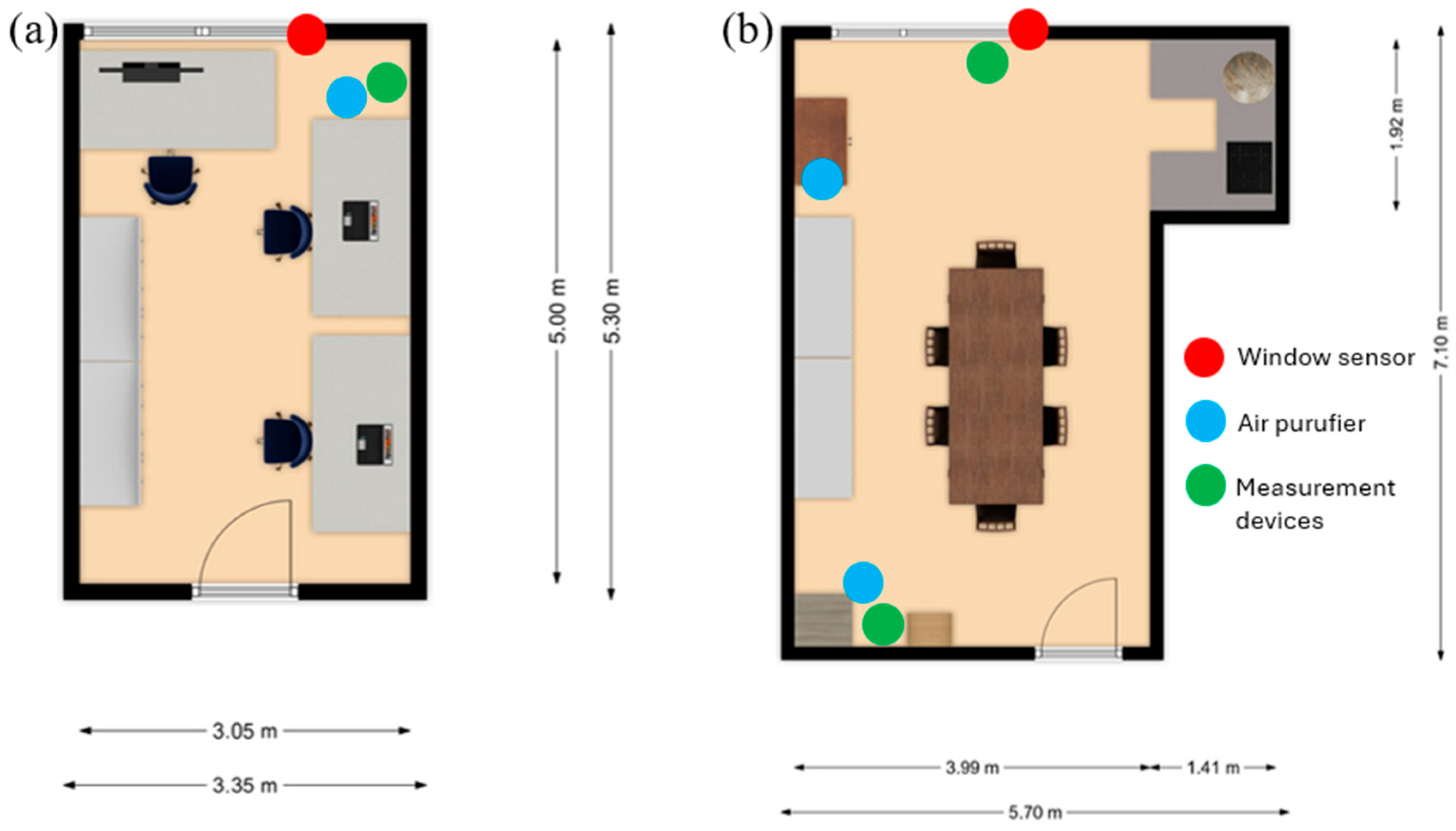
Portable air filtration devices were deployed in both environments and operated according to a predefined ON/OFF schedule, with daily filter replacement implemented to minimise filter loading and to approximate best-case maintenance conditions. Purifier placement followed practical constraints typical of real-world office deployments—in the small office the device was positioned near the floor/window, and in the kitchen/common area two units were deployed: one positioned on top of a tall cabinet and one on the floor near the door. While both rooms represent typical office sizes for which the deployed devices were nominally suited, placement was not systematically optimised relative to emission sources or room airflow patterns, which may have influenced local air mixing and pollutant capture efficiency. The units employed multi-stage filtration systems comprising a pre-filter, activated carbon filter, and HEPA-type filter media, supplemented by additional treatment stages including UV-C irradiation and ionisation. The devices were operated continuously at a fixed fan speed setting throughout the campaign, with manufacturer-rated coverage areas corresponding to the room sizes monitored in this study. Filter changes were typically performed in the morning (around 08:00–09:00 a.m.), and any relevant operational events were recorded in a daily log. The study design therefore enabled comparison of indoor pollutant levels across periods when the air purifier was operating (ON) versus not operating (OFF), while documenting contextual factors that could influence concentrations. To characterise spatial variability within the kitchen/common area, two indoor sampling points were established: one near the printer/network equipment (Location 2) and one near a window (Location 3). The small office was monitored at a single indoor point (Location 1) near windows. All sampling points were treated as fixed monitoring locations throughout the campaign, as shown in Figure 1. The resulting dataset includes three observations per sampling day (Locations 1–3), enabling both day-to-day and location-specific comparisons.
Alongside continuous monitoring, integrated filter-based sampling was performed to support mass-based PM quantification and chemical characterisation. Three sensor types were deployed continuously throughout the campaign with the following sampling intervals: Sensor 1 at 10 min intervals, Sensor 2 at 1 min intervals, and Sensor 3 at 5 s intervals. All sensors were factory-calibrated by their respective manufacturers prior to deployment). Continuous LCS data were used for visual inspection of temporal PM trends only and are presented as raw data without additional filtering, smoothing, or normalisation. Although LCS data were collected in parallel across three sensor providers and are presented in the Supplementary Materials (Figures S2–S5), the quantitative analyses in this manuscript are based exclusively on gravimetric filter-based measurements. LCS readings at the lower concentration ranges encountered in this study showed inconsistencies across sensors and underestimated concentrations relative to the gravimetric reference, consistent with known limitations of optical particle counters including reduced precision near detection limits, cross-sensitivity to indoor humidity and temperature fluctuations, and potential signal drift [38]. A detailed characterisation of LCS performance and inter-sensor variability across multiple providers within the EDIAQI project framework is described in Lovrić et al. [39]. In particular, PM1 and TSP concentrations were measured gravimetrically, and PAHs were analysed in both the PM1 and TSP fractions to assess whether filtration effects differed between particle size fractions and PAH composition. The measured PAHs included fluoranthene (Flu), pyrene (Pyr), benzo[a]anthracene (BaA), chrysene (Chry), benzo[j]fluoranthene (BjF), benzo[b]fluoranthene (BbF), benzo[k]fluoranthene (BkF), benzo[a]pyrene (BaP), dibenzo[a,h]anthracene (DahA), benzo[g,h,i]perylene (BghiP), and indeno[1,2,3-cd]pyrene (IP). For interpretation, PAHs were additionally grouped into lower-molecular-weight (LMW) compounds (Flu, Pyr, BaA, Chry) and higher-molecular-weight (HMW) compounds (BjF, BbF, BkF, BaP, DahA, BghiP, IP). Detailed daily logs were maintained to record occupancy, notable activities (printing, cooking/food heating), and any specific experiments or unusual events that could influence pollutant levels, thereby supporting interpretation of variability in the measured time series. Window opening events were monitored continuously using a dedicated window sensor recording open/closed status throughout the campaign, allowing precise documentation of the timing and duration of window opening periods. However, the degree of opening and resulting air exchange rate were not quantified, which limits formal accounting of ventilation contributions in the statistical analysis.
PM samples were collected by 24 h sampling on quartz filters using low-volume samplers (Sven Leckel, Berlin, Germany). PAHs were extracted from the filters using an ultrasonic bath with a solvent mixture of cyclohexane and toluene for about 60 min. The extract was then centrifuged, evaporated to dryness, and re-dissolved in acetonitrile. The samples were analysed using high-performance liquid chromatography (HPLC, Agilent Infinity 1260, Agilent Technologies, Santa Clara, CA, USA) with a fluorescence detector, based on established protocols [40].

2.2. Statistical Analysis

The data were processed and analysed using Python programming language (v3.12, www.python.org) in the Spyder environment. Statistical analyses were performed to compare pollutant levels between periods when the portable air filtration unit was operating (ON) and periods when it was not operating (OFF), for measurements across three monitoring locations.
The primary comparison of ON vs. OFF conditions was performed using the Welch two-sample t-test (unequal variances) to test for differences in mean concentrations. For each metric, summary statistics were calculated, including the mean during ON, the mean during OFF, the absolute difference (ON–OFF), and the percentage change relative to OFF. Because multiple related PAH outcomes were analysed (ΣPAHs, LMW PAHs, and HMW PAHs in both PM1 and TSP), Benjamini–Hochberg false discovery rate (FDR) correction was applied across the six primary p-values to reduce the risk of false-positive findings due to multiple comparisons. As a non-parametric sensitivity analysis that does not assume normality, Mann–Whitney U tests were additionally used for selected key metrics to compare ON vs. OFF distributions.
To assess spatial consistency, ON/OFF comparisons were also repeated within each station. Given the limited number of sampling days per station, station-level interpretation emphasised effect direction and magnitude rather than statistical significance alone. Uncertainty in the ON–OFF mean differences were further characterised using non-parametric bootstrap procedures, with 95% confidence intervals calculated for key aggregated metrics. Results were visualised using time series plots with purifier ON periods highlighted and station-wise distribution plots (boxplots with overlaid observations) comparing ON and OFF periods for ΣPAHs and the LMW/HMW groupings.

3. Results and Discussion

3.1. General Concentration Levels

Daily 24 h TSP and PM1 mass concentrations were measured at three indoor monitoring locations between 21 March and 3 April 2025 and are summarised in Table 1. Overall, particle mass levels were moderate but clearly time-varying, consistent with changing occupancy patterns and episodic indoor activities rather than a stable indoor background.
Across the campaign, Station 1 (small office) showed TSP values of 13–30 µg/m3 (mean ≈ 21.7 µg/m3) and PM1 values of 6–21 µg/m3 (mean ≈ 15.4 µg/m3). The lowest PM1 in the office occurred on 1 April (6 µg/m3), while higher values (≥17 µg/m3) were observed on several working days, consistent with typical indoor activity and resuspension. In the kitchen/common area, concentrations were comparable but more episodic, reflecting higher occupant turnover and activity-related emissions. At Station 2, available TSP ranged from 12 to 24 µg/m3 (mean ≈ 18.0 µg/m3) and PM1 from 8 to 19 µg/m3 (mean ≈ 14.7 µg/m3). At Station 3, available TSP ranged from 11 to 23 µg/m3 (mean ≈ 18.7 µg/m3) and PM1 from 5 to 19 µg/m3 (mean ≈ 13.4 µg/m3). These differences between two sampling points within the same room show spatial variability, likely driven by the relative positioning of emission sources (cooking/printing), airflow pathways and mixing, and the placement of both the air-cleaning unit and the monitoring equipment. Overall, the TSP levels observed here are within the range reported for European office environments, e.g., indoor TSP of ~7–31 µg/m3 (mean ~18 µg/m3) measured in offices in Belgium [41]. In addition, the fine particle mass is of a similar order of magnitude to indoor fine-particle concentrations reported across modern European offices in multi-building campaigns [42].
When both size fractions were available, PM1 represented a substantial share of TSP, indicating that fine particles contributed importantly to indoor particle loading during the campaign. Several TSP entries were missing at Stations 2 and 3 (Table 1); therefore, TSP comparisons should be interpreted with this limitation in mind. Importantly, daily averages did not indicate a consistent reduction in particle mass during purifier ON periods; instead, day-to-day variability appeared dominated by indoor activity patterns and short-lived emission events.

3.2. Activity-Based Interpretation of Concentration Variability

This interpretation is supported by the daily activity logs (Table 2). In the office (Station 1), concentrations reflect routine occupancy and office activities, while specific event days (e.g., filter replacement in the morning and CPC operation using butanol) may introduce deviations from typical conditions. CPC operation is expected primarily to affect VOC-related metrics; any influence on particle mass or PAHs is uncertain, so these periods are treated as event days in the interpretation. In the kitchen/common area (Stations 2–3), repeated higher PM1 days are consistent with episodic indoor sources such as cooking/food heating, frequent movement and higher occupant turnover.
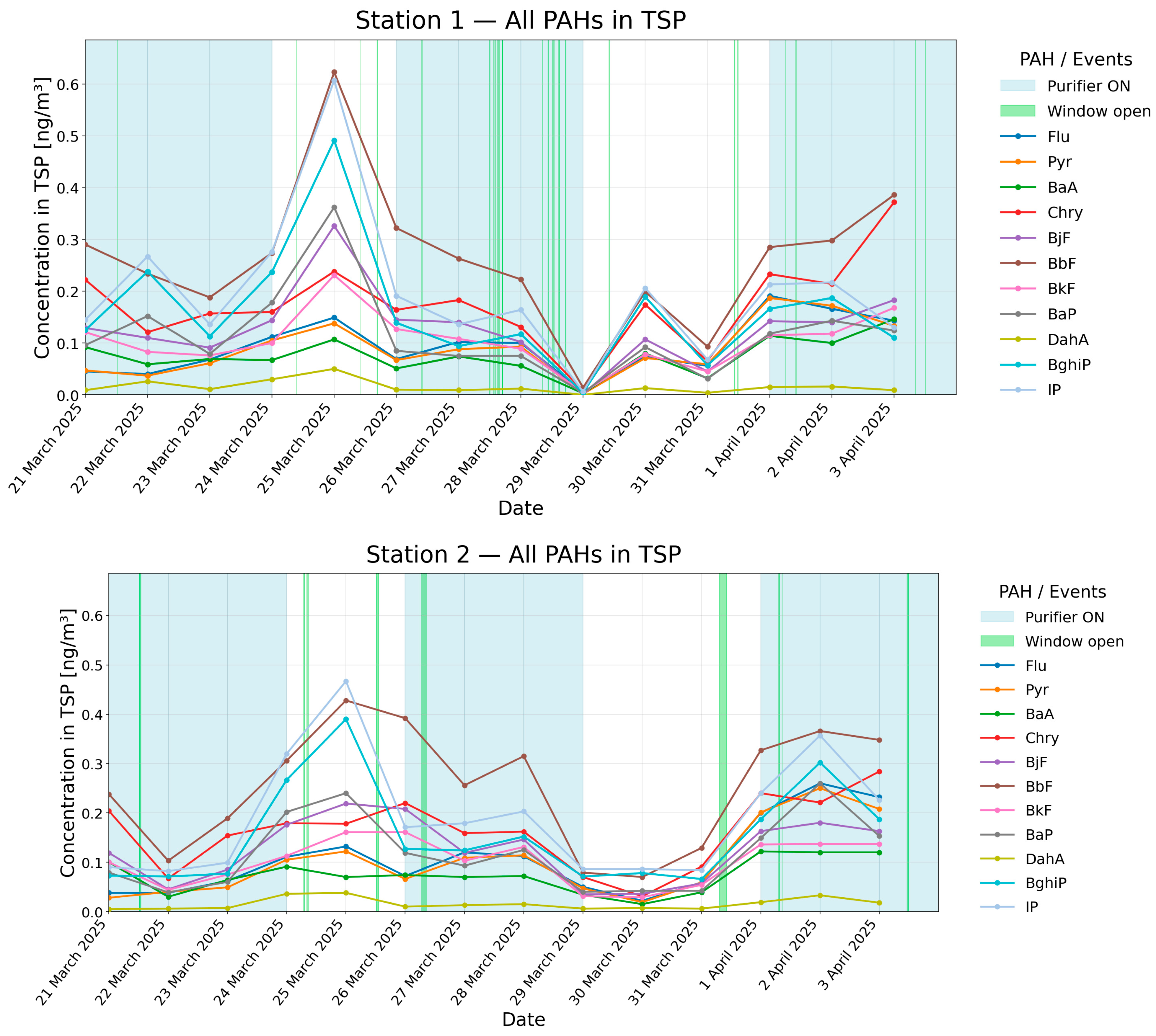
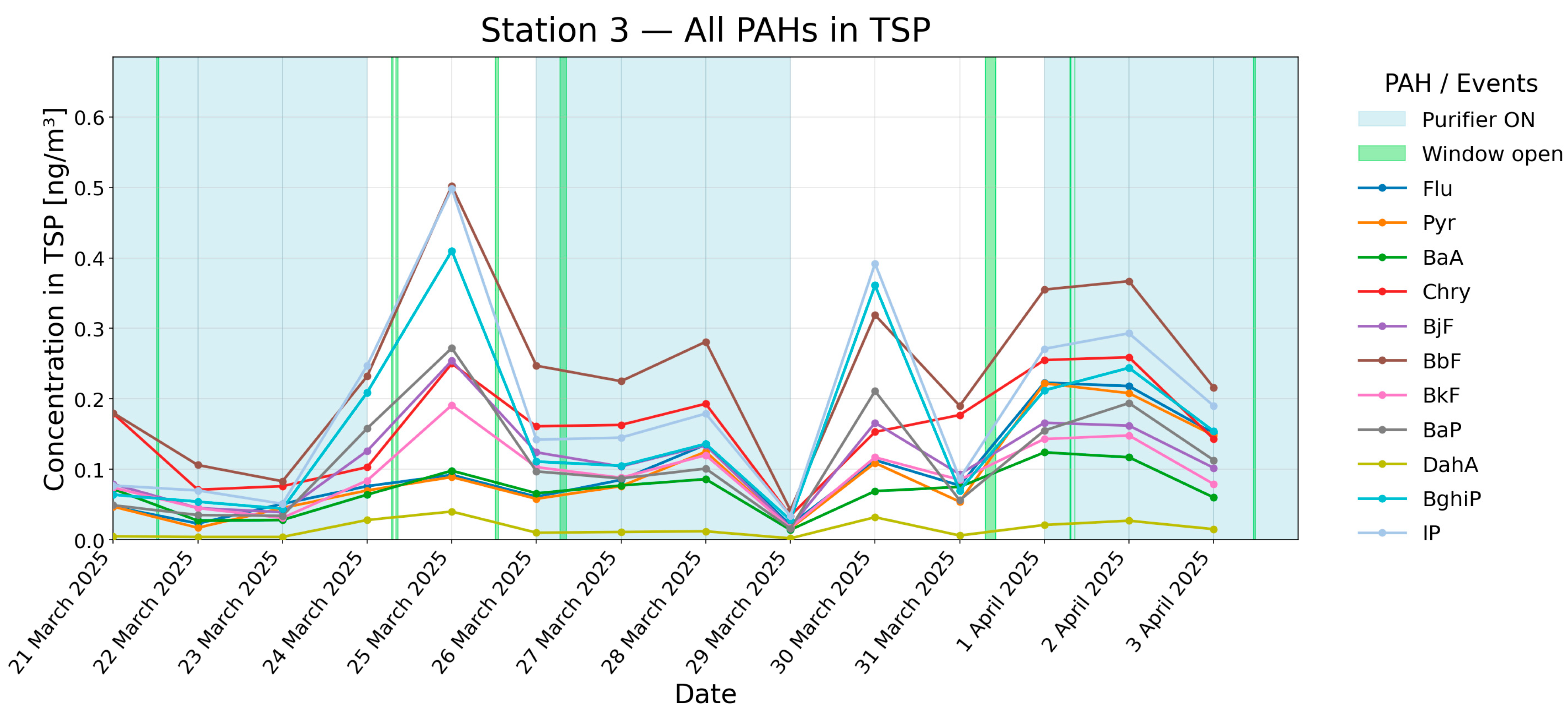
PAH concentrations showed clear day-to-day variability and strong variation across compounds at all three monitoring locations. Figure 2 presents the TSP-bound PAH time series for Stations 1–3, with purifier ON periods shaded. Overall, the highest concentrations have higher-abundance compounds, most consistently BbF and IP, with frequent elevation of BghiP and chrysene Chry. In contrast, DahA remained at the lowest concentrations throughout the campaign, and BaP tracked the broader mixture but at comparatively lower absolute levels. Similar PAH profiles have been reported in other European indoor environments, where BbF, IP, and BghiP often together with Chry are among the most dominant particle-bound PAHs, while DahA typically contributes only a small fraction of ΣPAHs [43,44,45].
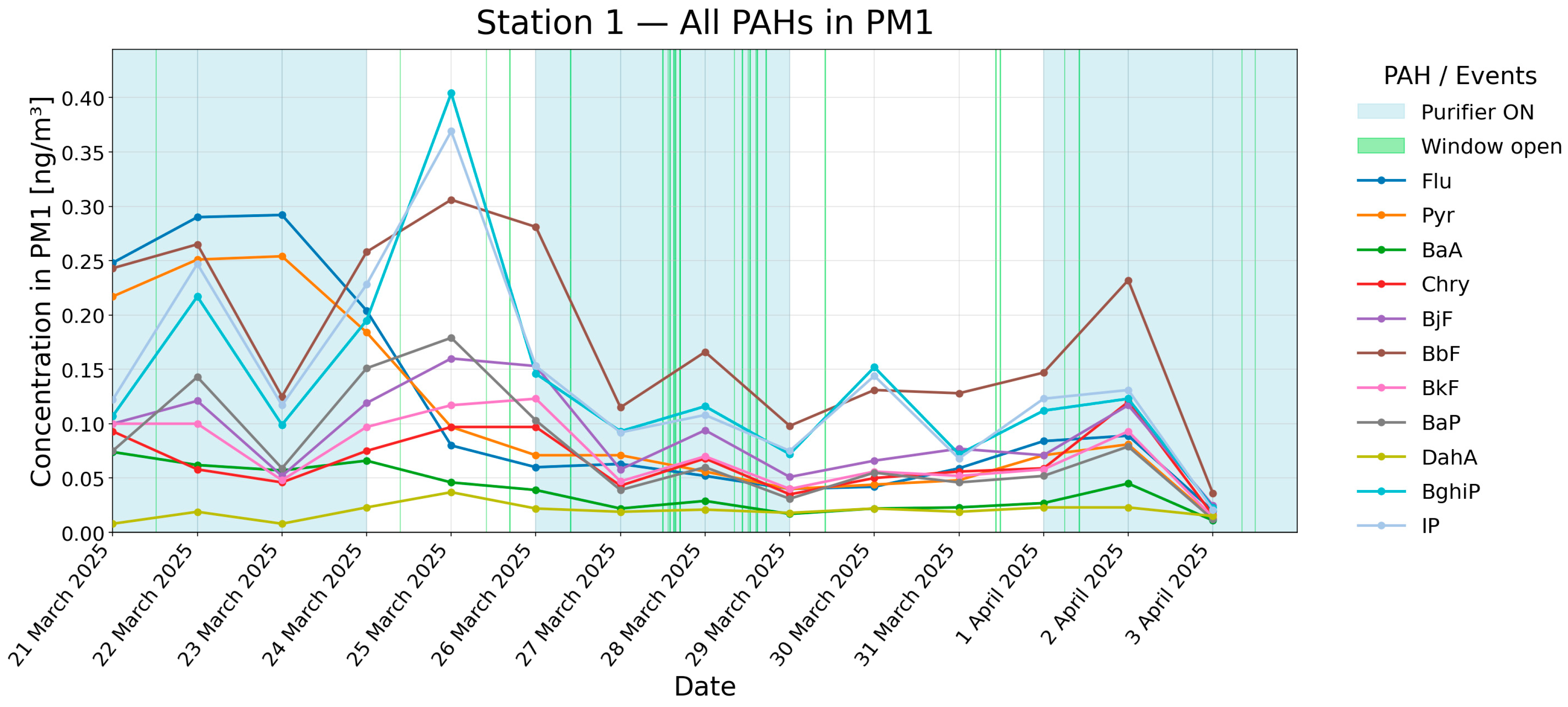
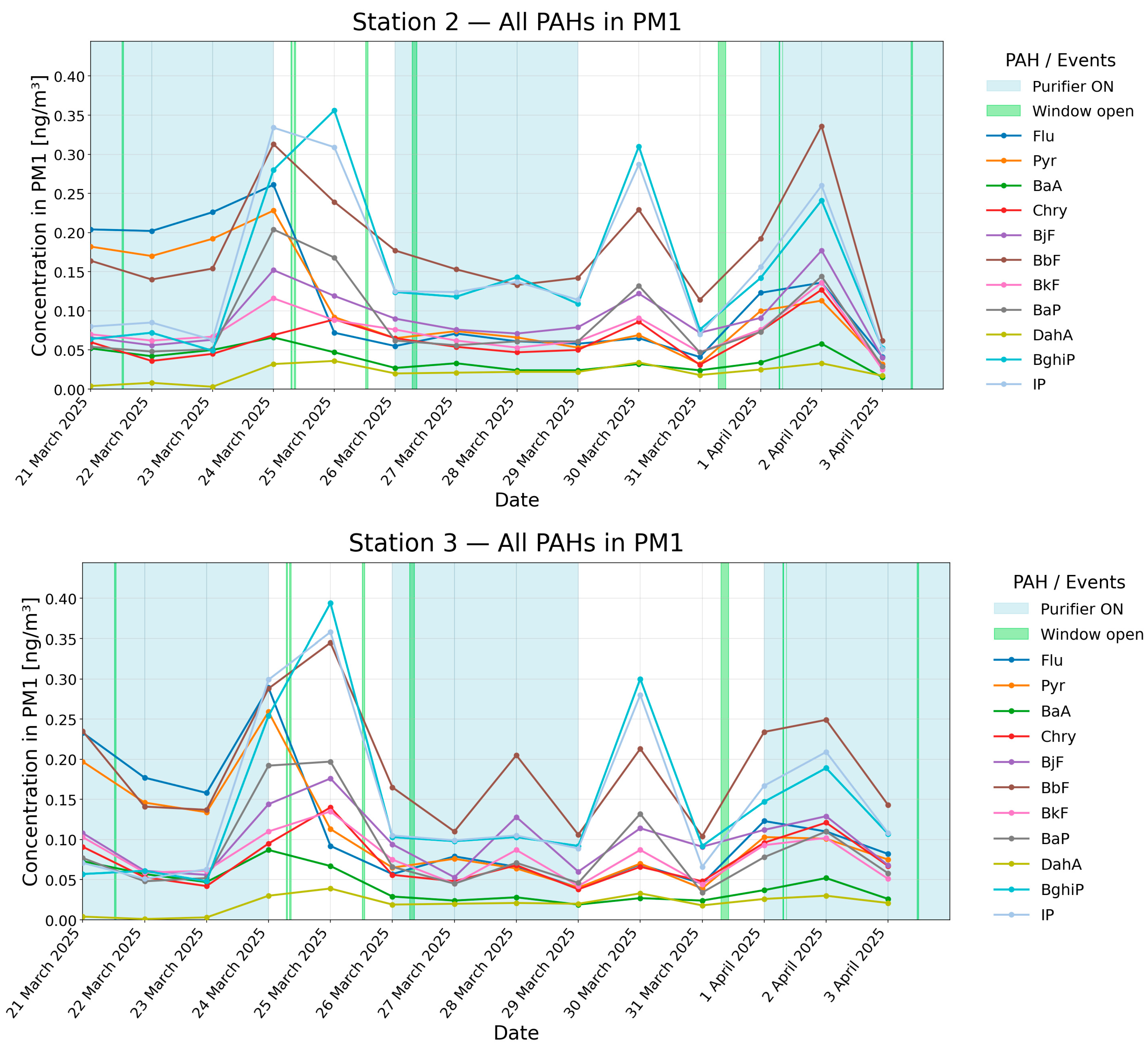
Across stations, PAH time series were characterised by episodic peaks rather than gradual trends. A multi-compound elevation occurred around 25–26 March, visible at all stations (especially for IP, BghiP and BbF), indicating a shared driver affecting the building (a similar peak was observed in the outdoor PAH measurements at same measuring location, supporting that outdoor conditions/infiltration contributed to the indoor episode, in addition to indoor sources and room-specific dynamics, Figure S1 on Supplementary Materials). A second elevated period was observed during 1–3 April, again with coherent increases across several compounds. In contrast, a clear minimum (near-baseline across most PAHs) is apparent around 30 March, suggesting a low-activity/low-infiltration period during the weekend/off-period. Importantly, the timing of these peaks is not perfectly aligned with purifier ON/OFF status, which supports the broader observation that indoor PAH variability was dominated by short-term sources and daily context rather than by stable filtration removal. Figure 3 presents the PM1-bound PAH time series for Stations 1–3, with purifier ON periods shaded.
Comparing Figure 2 and Figure 3 indicates broadly similar temporal behaviour in PM1 and TSP, but with differences in how the mixture responds across size fractions. The TSP-bound PAHs show multi-compound shifts, consistent with contributions from coarser particle mass and resuspension processes in addition to fine-mode combustion-related particles. The PM1-bound PAHs show strong coherence across stations during peak periods, consistent with a larger contribution from fine particles carrying combustion-related PAHs (higher-molecular-weight species).
To evaluate whether purifier operation coincided with systematic PAH changes, PAHs were aggregated into total PAHs and into low- and high-molecular-weight groups and compared between purifier ON and OFF periods using independent-samples tests. Total PAHs were lower during purifier ON (mean ON ≈ 0.99 vs. OFF ≈ 1.24; ~20% decrease), but this difference was not statistically significant (p = 0.16). The clearest directional signal was observed for high-molecular-weight PAHs in PM1, which were lower during ON periods (mean difference ON–OFF ≈ −0.30; ~31% decrease; p = 0.034; 95% CI [−0.54, −0.05]). This suggests the purifier may have been more effective (or conditions more favourable) for the fine-mode HMW PAHs, although the evidence should be interpreted cautiously, given the limited sample size and multiple-testing considerations.
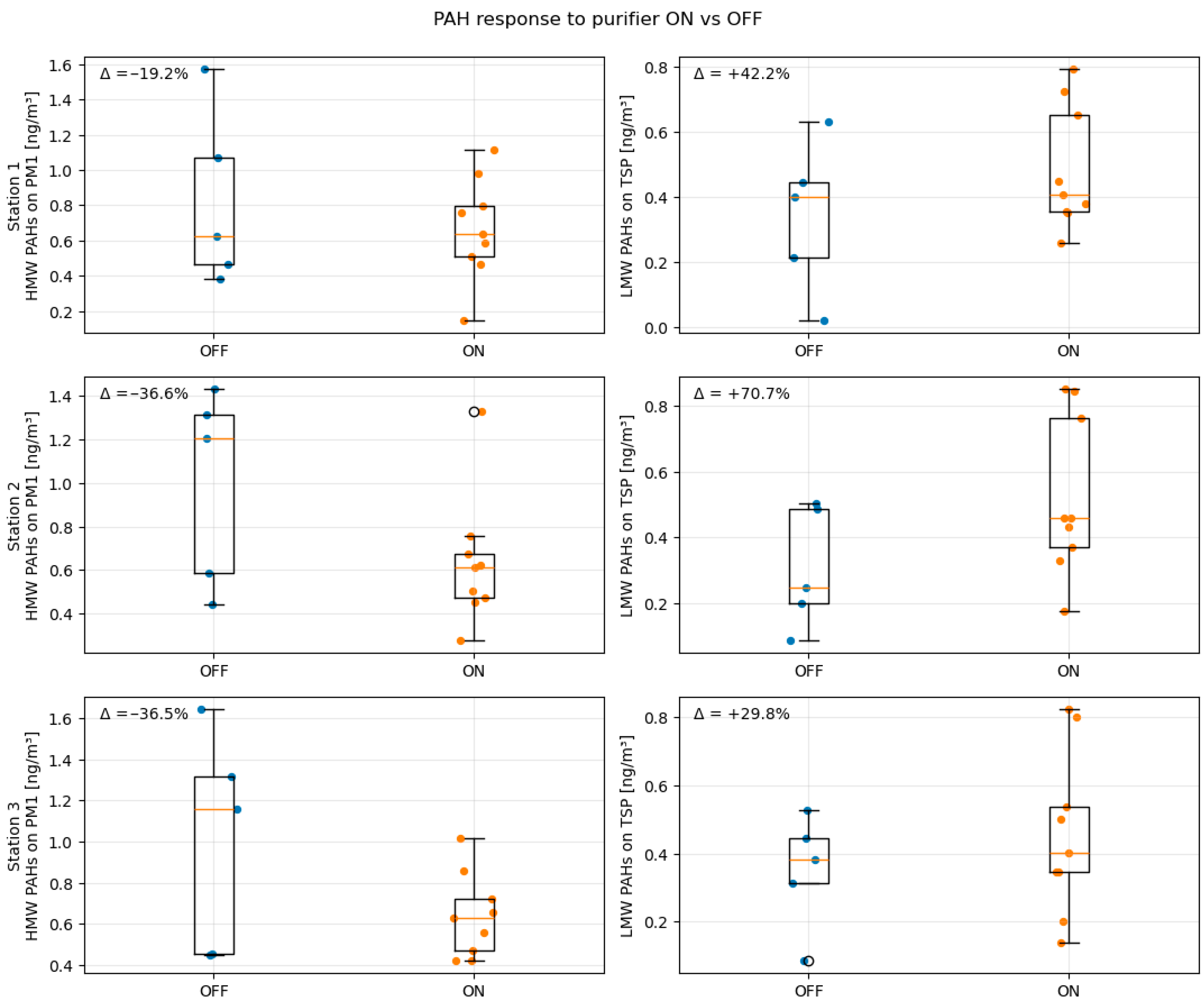
Total TSP-bound PAHs did not show a reduction during purifier ON (mean ON ≈ 1.41 vs. OFF ≈ 1.35; p = 0.83). Notably, low-molecular-weight PAHs in TSP were higher during ON periods (mean difference ON–OFF ≈ +0.155; ~47% increase; p = 0.020; 95% CI [+0.04, +0.28]). This pattern is consistent with the idea that real-life conditions (resuspension, mixing, local activity, and/or partitioning behaviour) can dominate over any removal by filtration, particularly for the coarser/mixed fraction represented by TSP. After false discovery rate (FDR) correction across the six aggregated metrics, none of the p-values remained significant. It should be noted that with 9 ON days and 5 OFF days per station, the sample size is limited and the results should not be extrapolated to other office environments or purifier types. The observed patterns are presented as indicative findings to inform future study design rather than as definitive evidence of filtration effects. Non-parametric tests (Mann–Whitney) showed similar directions but were generally not significant, which is expected given the small group sizes and high day-to-day variability. Figure 4 summarises the ON–OFF response for two PAH groupings that showed the strongest directional patterns.
High-molecular-weight PAHs in the PM1 fraction were consistently lower during purifier ON periods at all three stations (Δ ≈ −19% at Station 1, −37% at Station 2, and −37% at Station 3), suggesting a potential preferential reduction of particle-bound HMW PAHs in fine particles. In contrast, low-molecular-weight PAHs in the TSP fraction were consistently higher during purifier ON periods across stations (Δ ≈ +42%, +71%, and +30% for Stations 1–3, respectively). This opposite behaviour between fractions highlights that day-to-day variability, activity patterns, and partitioning/resuspension processes can dominate integrated TSP measurements, and that any filtration-related signal, if present, appears more clearly in the fine PM1-bound HMW PAHs than in TSP-bound LMW PAHs. This fraction-dependent behaviour is consistent with previous evidence that particle filtration preferentially affects strongly particle-associated PAHs. For example, building ventilation filter materials tested on real urban aerosol were shown to remove particle-bound PAHs, and the same work notes that higher-molecular-weight PAHs are almost entirely associated with particles, whereas lower-molecular-weight PAHs have a much larger non-particle fraction [46,47]. In contrast, multiple partitioning studies show that LMW PAHs are predominantly in the gas phase (or dynamically partition between gas and particles), meaning their 24 h integrated TSP signals can be driven by re-equilibration, surface re-emission and resuspension rather than by particle removal alone [23,48,49]. Additionally, a substantial portion of the measured TSP samples were found to be damaged and were therefore excluded from the analysis, which may also have influenced the final results.
Taken together, the PAH results indicate that the purifier was not associated with uniform decreases across the PAH mixture, and that responses differed by fraction and chemical character. The apparent reduction in HMW PAHs in PM1 is directionally consistent with filtration acting on fine, particle-associated contaminants, whereas the increase in LMW PAHs on TSP suggests that semi-volatile components and/or room dynamics (activity patterns, ventilation, mixing, partitioning) can outweigh simple filtration removal in real occupied settings. These findings revealed that chemical composition can respond differently than bulk PM metrics, and that purifier performance in practice should be interpreted in the context of indoor sources, occupancy, and ventilation conditions.

3.3. Limitations and Future Directions

This pilot has several limitations that constrain the causal interpretation of purifier effects. Purifier ON/OFF periods were not randomised; however, the ON/OFF schedule was designed to include both weekdays and weekends in both conditions, partially mitigating systematic day-type bias. Nevertheless, with only 14 sampling days in total, the number of observations per condition per station (9 ON vs. 5 OFF) remains insufficient to fully control for natural day-to-day variability driven by occupancy patterns, episodic emission events, and outdoor infiltration. A longer measurement campaign with more balanced and randomised ON/OFF blocks within strictly comparable day types would substantially improve the ability to disentangle filtration effects from contextual variability. Additionally, the continuous monitoring relied on LCSs, which exhibit well-documented limitations at low particle concentrations, including reduced measurement precision near detection limits, cross-sensitivity to humidity and temperature, and inter-sensor inconsistencies; given the relatively low PM1 concentrations observed in this study, these uncertainties may have obscured small purifier-related effects in the continuous data, which is why the quantitative analyses are based exclusively on gravimetric measurements. Independent formal co-location of LCS against certified reference instruments was not performed; the comparison against gravimetric measurements provides only general confidence in sensor functionality rather than a rigorous uncertainty characterisation. Filter replacement itself may act as a disturbance (minor resuspension), while unmeasured factors such as ventilation rate, window opening/HVAC operation and outdoor infiltration episodes could plausibly drive the building-wide PAH peaks seen around 25–26 March and 1–3 April. Furthermore, the results obtained in this naturally ventilated office building may not be directly transferable to buildings with mechanical ventilation systems, where higher and more consistent air exchange rates could substantially alter the baseline pollutant levels and airflow patterns against which any purifier effect must be detected. Future work should systematically compare purifier performance across buildings with different ventilation strategies, including naturally ventilated, mixed-mode, and mechanically ventilated spaces, as ventilation strategy is expected to substantially modulate the detectable effect of portable air filtration on indoor pollutant concentrations. Additionally, purifier placement followed practical real-world constraints rather than optimised positioning, which may have limited effective air mixing and pollutant capture regardless of filtration status. Future work should therefore use a more controlled intervention design (randomised crossover ON/OFF blocks within comparable day types), increase time resolution with shorter-duration chemical samples targeted to activity windows and post-event decay, directly quantify air exchange/infiltration, standardise or quantify activity intensity, and test purifier capacity/placement/fan settings relative to room volume and source strength; expanding to additional metrics (black carbon, ultrafine particle counts, targeted VOC speciation and more detailed PAH source diagnostics) and reporting effect sizes with uncertainty via robust or mixed-effects models would provide clearer evidence on when and where portable filtration delivers measurable benefits. Expanding the study duration and number of monitored rooms and building types would improve the robustness and generalisability of findings, allowing more reliable conclusions about the conditions under which portable air filtration delivers measurable benefits across diverse office settings. Future studies should also consider paired deployment of devices with and without regular filter replacement operating simultaneously in comparable conditions, which would allow the actual contribution of filter maintenance to real-world filtration effectiveness to be directly assessed.
Beyond study-specific limitations, the findings of this pilot offer some preliminary implications for the design and evaluation of portable air filtration devices. The absence of a measurable PM reduction signal, even under favourable operating conditions with daily filter replacement, is consistent with broader evidence suggesting that manufacturers should complement standardised laboratory test conditions with validation under realistic, occupied indoor environments with mixed emission sources. From a user and facility management perspective, these findings support the view that portable air cleaners are most effective as one component of a broader IAQ strategy, complemented by source control, adequate ventilation, and informed device placement, rather than as a standalone solution. While the limited scale of this pilot does not allow definitive design recommendations, the results highlight device placement, airflow mixing, and source-responsive operation as areas warranting attention in future device development and real-world evaluation protocols.

4. Conclusions

This two-week pilot study evaluated portable air purification under favourable operating conditions (continuous operation and daily filter replacement) across three indoor monitoring points in an office building. Despite these optimised conditions, daily integrated particle mass (PM1 and TSP) did not show a consistent reduction during purifier ON periods, and variability was largely explained by occupancy patterns and episodic indoor activities (routine office work, printing, and cooking/food heating in shared areas), rather than by filtration status alone.
PAH measurements provided a clearer picture. PAH concentrations varied strongly across compounds and locations, with pronounced multi-compound peaks indicating shared building-level drivers. When grouped by molecular weight and size fraction, the clearest and most consistent purifier-associated signal was a decrease in HMW PAHs in the PM1 fraction, observed across all three stations (approximately 19–37% lower on ON days). In contrast, LMW PAHs in TSP were higher during purifier ON periods across stations, underscoring that integrated TSP chemistry can be dominated by partitioning behaviour, resuspension, and daily activity differences, rather than reflecting filtration removal alone. Based on these findings, practitioners deploying portable air filtration in office environments should consider the following practical recommendations: device placement should be optimised relative to dominant emission sources rather than following convenience-based positioning; adequate air mixing should be ensured through complementary mechanical or natural ventilation strategies, particularly in rooms with episodic high-emission activities; source control should be prioritised for activities such as cooking and printing, which dominated PM variability in this study and were not effectively mitigated by filtration alone; and manufacturer performance claims should be interpreted with caution in occupied, mixed-source environments where real-world conditions differ substantially from standardised test conditions.
Overall, these findings suggest that the real-life performance of portable air cleaners in occupied spaces may diverge substantially from expected efficiencies based on standardised tests, particularly when indoor sources and dynamic activity patterns dominate exposures. While the pilot indicates a possible preferential reduction of particle-bound HMW PAHs in fine particles, the limited sample size and potential confounding by daily context mean that results should be interpreted as evidence of complex, context-dependent responses rather than definitive causal estimates. Future work should combine controlled intervention design (matched ON/OFF periods, controlled activities), better characterisation of ventilation/infiltration, and higher time-resolution chemical measurements to disentangle filtration effects from indoor source variability and to define when, and for which pollutants, portable filtration provides meaningful benefit.

Supplementary Materials

The following supporting information can be downloaded at: https://www.mdpi.com/article/10.3390/atmos17040393/s1, Figure S1. Outdoor PAH concentrations at same measuring stations where indoor PAHs were measured; Figure S2. Time series of PM1, PM10, and CO2 concentrations measured by three sensors in the kitchen/common area (21 March–3 April 2025). Shaded areas indicate periods of purifier operation (ON); Figure S3. Time series of continuous PM1 concentrations measured by two LCSs in the kitchen/common area, overlaid with daily gravimetric PM1 measurements at Stations 2 and 3 (dashed lines). Shaded areas indicate purifier ON periods (blue) and weekends (red), 21 March–3 April 2025; Figure S4. Time series of PM1, PM10, and CO2 concentrations measured by four sensors in the small office (21 March–3 April 2025). Shaded areas indicate periods of purifier operation (ON); Figure S5. Time series of continuous PM1 concentrations measured by three LCSs in the small office, overlaid with daily gravimetric PM1 measurements (dashed line). Shaded areas indicate purifier ON periods (blue) and weekends (red), 21 March–3 April 2025.

Author Contributions

Conceptualisation, M.L., G.P., G.G. and V.P.; Data curation, I.J., M.J.L.Š. and V.P.; Formal analysis, N.R.; Investigation, M.J.L.Š., V.P. and G.G.; Methodology, M.L., N.R. and V.P.; Resources, F.M. and M.L.; Supervision, M.L., G.P. and F.M.; Visualisation, N.R.; Writing—original draft, N.R.; Writing—review and editing, M.L., G.P., G.G. and F.M. All authors have read and agreed to the published version of the manuscript.

Funding

This study was funded by the Horizon Europe programme under the EDIAQI project, Grant ID: 101057497, and supported by Next Generation EU under the EnvironPollutHealth and BioMolTox projects, Program Contract of 8 December 2023, Reg. no. 533-03-23-0006.

Institutional Review Board Statement

Not applicable.

Informed Consent Statement

Not applicable.

Data Availability Statement

The dataset supporting the findings of this study can be provided by corresponding author upon reasonable request.

Acknowledgments

We gratefully acknowledge the use of facilities and equipment at the Institute for Medical Research and Occupational Health, made possible through the European Regional Development Fund project KK.01.1.1.02.0007: Research and Education Centre of Environmental Health and Radiation Protection—Reconstruction and Expansion of the Institute for Medical Research and Occupational Health. During the preparation of this manuscript, the authors used ChatGPT (OpenAI, GPT-5.2) to assist in reviewing and refining written content, as well as for support in developing and debugging code. The authors have reviewed and edited all outputs and take full responsibility for the accuracy and integrity of the final manuscript.

Conflicts of Interest

The authors declare no conflicts of interest. Valentino Petrić is employed in Smart Sense d.o.o., company had no role in the design of the study; in the collection, analyses, or interpretation of data; in the writing of the manuscript; or in the decision to publish the results.

Abbreviations

The following abbreviations are used in this manuscript:
PMParticulate Matter
IAQIndoor Air Quality
LCSLow-cost sensor
PAHPolycyclic Aromatic Hydrocarbons
TSPTotal Suspended Particles
LMWLow Molecular Weight
HMWHigh Molecular Weight
VOCVolatile Organic Compound

References

  1. Hartiala, M.; Elenius, V.; Pesquera, A.A.; Androulakis, S.; Annesi-Maesano, I.; Badyda, A.; Brandsma, S.; Chatziprodromidou, I.; Gajski, G.; Garcia-Aymerich, J.; et al. Exposures in Indoor Air Affecting Health. Allergy 2025, 81, 700–719. [Google Scholar] [CrossRef]
  2. Bo, M.; Salizzoni, P.; Clerico, M.; Buccolieri, R. Assessment of Indoor-Outdoor Particulate Matter Air Pollution: A Review. Atmosphere 2017, 8, 136. [Google Scholar] [CrossRef]
  3. Zhang, L.; Ou, C.; Magana-Arachchi, D.; Vithanage, M.; Vanka, K.S.; Palanisami, T.; Masakorala, K.; Wijesekara, H.; Yan, Y.; Bolan, N.; et al. Indoor Particulate Matter in Urban Households: Sources, Pathways, Characteristics, Health Effects, and Exposure Mitigation. Int. J. Environ. Res. Public Health 2021, 18, 11055. [Google Scholar] [CrossRef] [PubMed]
  4. Zhou, Y.; Yang, G.; Xin, S.; Yang, Y. An Evaluation Model of Indoor PM2.5 Dynamic Characteristics Considering Human Activities. Energy Build. 2022, 263, 112037. [Google Scholar] [CrossRef]
  5. González-Martín, J.; Kraakman, N.J.R.; Pérez, C.; Lebrero, R.; Muñoz, R. A State–of–the-Art Review on Indoor Air Pollution and Strategies for Indoor Air Pollution Control. Chemosphere 2021, 262, 128376. [Google Scholar] [CrossRef] [PubMed]
  6. Wei, W.; Ramalho, O.; Mandin, C. Indoor Air Quality Requirements in Green Building Certifications. Build. Environ. 2015, 92, 10–19. [Google Scholar] [CrossRef]
  7. Becerra, J.A.; Lizana, J.; Gil, M.; Barrios-Padura, A.; Blondeau, P.; Chacartegui, R. Identification of Potential Indoor Air Pollutants in Schools. J. Clean. Prod. 2020, 242, 118420. [Google Scholar] [CrossRef]
  8. Tran, V.V.; Park, D.; Lee, Y.-C. Indoor Air Pollution, Related Human Diseases, and Recent Trends in the Control and Improvement of Indoor Air Quality. Int. J. Environ. Res. Public Health 2020, 17, 2927. [Google Scholar] [CrossRef]
  9. Vardoulakis, S.; Giagloglou, E.; Steinle, S.; Davis, A.; Sleeuwenhoek, A.; Galea, K.S.; Dixon, K.; Crawford, J.O. Indoor Exposure to Selected Air Pollutants in the Home Environment: A Systematic Review. Int. J. Environ. Res. Public Health 2020, 17, 8972. [Google Scholar] [CrossRef]
  10. Liu, N.; Bu, Z.; Liu, W.; Kan, H.; Zhao, Z.; Deng, F.; Huang, C.; Zhao, B.; Zeng, X.; Sun, Y.; et al. Indoor Exposure Levels and Risk Assessment of Volatile Organic Compounds in Residences, Schools, and Offices in China from 2000 to 2021: A Systematic Review. Indoor Air 2022, 32, e13091. [Google Scholar] [CrossRef]
  11. Račić, N.; Terzić, I.; Karlović, N.; Bošnjaković, A.; Terzić, T.; Jakovljević, I.; Pehnec, G.; Horvat, T.; Gajski, G.; Gerić, M.; et al. Volatile Organic Compounds (VOCs) and Polycyclic Aromatic Hydrocarbons (PAHs) in Indoor Environments: A Review and Analysis of Measured Concentrations in Europe. Indoor Air 2025, 2025, 5945455. [Google Scholar] [CrossRef]
  12. Fuselli, S.; De Felice, M.; Morlino, R.; Turrio-Baldassarri, L. A Three Year Study on 14 VOCs at One Site in Rome: Levels, Seasonal Variations, Indoor/Outdoor Ratio and Temporal Trends. Int. J. Environ. Res. Public Health 2010, 7, 3792–3803. [Google Scholar] [CrossRef]
  13. Maung, T.Z.; Bishop, J.E.; Holt, E.; Turner, A.M.; Pfrang, C. Indoor Air Pollution and the Health of Vulnerable Groups: A Systematic Review Focused on Particulate Matter (PM), Volatile Organic Compounds (VOCs) and Their Effects on Children and People with Pre-Existing Lung Disease. Int. J. Environ. Res. Public Health 2022, 19, 8752. [Google Scholar] [CrossRef]
  14. Maragkidou, A.; Arar, S.; Al-Hunaiti, A.; Ma, Y.; Harrad, S.; Jaghbeir, O.; Faouri, D.; Hämeri, K.; Hussein, T. Occupational Health Risk Assessment and Exposure to Floor Dust PAHs inside an Educational Building. Sci. Total Environ. 2017, 579, 1050–1056. [Google Scholar] [CrossRef] [PubMed]
  15. Romagnoli, P.; Balducci, C.; Perilli, M.; Gherardi, M.; Gordiani, A.; Gariazzo, C.; Gatto, M.P.; Cecinato, A. Indoor PAHs at Schools, Homes and Offices in Rome, Italy. Atmos. Environ. 2014, 92, 51–59. [Google Scholar] [CrossRef]
  16. Seo, S.-H.; Jung, K.-S.; Park, M.-K.; Kwon, H.-O.; Choi, S.-D. Indoor Air Pollution of Polycyclic Aromatic Hydrocarbons Emitted by Computers. Build. Environ. 2022, 218, 109107. [Google Scholar] [CrossRef]
  17. Qi, H.; Li, W.-L.; Zhu, N.-Z.; Ma, W.-L.; Liu, L.-Y.; Zhang, F.; Li, Y.-F. Concentrations and Sources of Polycyclic Aromatic Hydrocarbons in Indoor Dust in China. Sci. Total Environ. 2014, 491–492, 100–107. [Google Scholar] [CrossRef] [PubMed]
  18. Shi, S. Contributions of Indoor and Outdoor Sources to Airborne Polycyclic Aromatic Hydrocarbons Indoors. Build. Environ. 2018, 131, 154–162. [Google Scholar] [CrossRef]
  19. Krugly, E.; Martuzevicius, D.; Sidaraviciute, R.; Ciuzas, D.; Prasauskas, T.; Kauneliene, V.; Stasiulaitiene, I.; Kliucininkas, L. Characterization of Particulate and Vapor Phase Polycyclic Aromatic Hydrocarbons in Indoor and Outdoor Air of Primary Schools. Atmos. Environ. 2014, 82, 298–306. [Google Scholar] [CrossRef]
  20. Orecchio, S. Polycyclic Aromatic Hydrocarbons (PAHs) in Indoor Emission from Decorative Candles. Atmos. Environ. 2011, 45, 1888–1895. [Google Scholar] [CrossRef]
  21. Aldekheel, M.; Altuwayjiri, A.; Tohidi, R.; Jalali Farahani, V.; Sioutas, C. The Role of Portable Air Purifiers and Effective Ventilation in Improving Indoor Air Quality in University Classrooms. Int. J. Environ. Res. Public Health 2022, 19, 14558. [Google Scholar] [CrossRef]
  22. Cooper, E.; Wang, Y.; Stamp, S.; Burman, E.; Mumovic, D. Use of Portable Air Purifiers in Homes: Operating Behaviour, Effect on Indoor PM2.5 and Perceived Indoor Air Quality. Build. Environ. 2021, 191, 107621. [Google Scholar] [CrossRef]
  23. Fazlzadeh, M.; Hassanvand, M.S.; Nabizadeh, R.; Shamsipour, M.; Salarifar, M.; Naddafi, K. Effect of Portable Air Purifier on Indoor Air Quality: Reduced Exposure to Particulate Matter and Health Risk Assessment. Environ. Monit. Assess. 2022, 194, 638. [Google Scholar] [CrossRef]
  24. Wang, Y.H.; Wang, H.; Zhao, C.Z.; Zhang, Y. Research Progress of Air Purifier Principles and Material Technologies. Adv. Mater. Res. 2015, 1092–1093, 1025–1028. [Google Scholar] [CrossRef]
  25. Yoon, B.; Yang, J.; Yun, H. Assessment of Nanoparticle Clean Air Delivery Rate (CADR) for Portable Air Purifiers: A Comparative Study with the Existing Standard. Indoor Air 2025, 2025, 8933801. [Google Scholar] [CrossRef]
  26. Guo, M.; Zhou, M.; Wei, S.; Peng, J.; Wang, Q.; Wang, L.; Cheng, D.; Yu, W. Particle Removal Effectiveness of Portable Air Purifiers in Aged-Care Centers and the Impact on the Health of Older People. Energy Build. 2021, 250, 111250. [Google Scholar] [CrossRef]
  27. Hart, J.F.; Ward, T.J.; Spear, T.M.; Rossi, R.J.; Holland, N.N.; Loushin, B.G. Evaluating the Effectiveness of a Commercial Portable Air Purifier in Homes with Wood Burning Stoves: A Preliminary Study. J. Environ. Public Health 2011, 2011, 324809. [Google Scholar] [CrossRef] [PubMed][Green Version]
  28. Shaughnessy, R.J.; Sextro, R.G. What Is an Effective Portable Air Cleaning Device? A Review. J. Occup. Environ. Hyg. 2006, 3, 169–181. [Google Scholar] [CrossRef] [PubMed]
  29. Ebrahimifakhar, A.; Poursadegh, M.; Hu, Y.; Yuill, D.P.; Luo, Y. A Systematic Review and Meta-Analysis of Field Studies of Portable Air Cleaners: Performance, User Behavior, and by-Product Emissions. Sci. Total Environ. 2024, 912, 168786. [Google Scholar] [CrossRef]
  30. Cheek, E.; Guercio, V.; Shrubsole, C.; Dimitroulopoulou, S. Portable Air Purification: Review of Impacts on Indoor Air Quality and Health. Sci. Total Environ. 2021, 766, 142585. [Google Scholar] [CrossRef]
  31. Ben-David, T.; Waring, M.S. Impact of Natural versus Mechanical Ventilation on Simulated Indoor Air Quality and Energy Consumption in Offices in Fourteen U.S. Cities. Build. Environ. 2016, 104, 320–336. [Google Scholar] [CrossRef]
  32. Lovrić, M.; Gajski, G.; Fernández-Agüera, J.; Pöhlker, M.; Gursch, H.; The EDIAQI Consortium; Borg, A.; Switters, J.; Mureddu, F. Evidence Driven Indoor Air Quality Improvement: An Innovative and Interdisciplinary Approach to Improving Indoor Air Quality. BioFactors 2025, 51, e2126. [Google Scholar] [CrossRef]
  33. Karagulian, F.; Barbiere, M.; Kotsev, A.; Spinelle, L.; Gerboles, M.; Lagler, F.; Redon, N.; Crunaire, S.; Borowiak, A. Review of the Performance of Low-Cost Sensors for Air Quality Monitoring. Atmosphere 2019, 10, 506. [Google Scholar] [CrossRef]
  34. Ródenas García, M.; Spinazzé, A.; Branco, P.T.B.S.; Borghi, F.; Villena, G.; Cattaneo, A.; Di Gilio, A.; Mihucz, V.G.; Gómez Álvarez, E.; Lopes, S.I.; et al. Review of Low-Cost Sensors for Indoor Air Quality: Features and Applications. Appl. Spectrosc. Rev. 2022, 57, 747–779. [Google Scholar] [CrossRef]
  35. Liu, S.; Zhang, Y.; Feng, J.; Gao, W.; Li, T.; Liu, Y. Atmospheric Carbon Concentration Scenario Classification Based on the Fusion of Spectral and Acoustic Modalities. Opt. Lett. 2026, 51, 949. [Google Scholar] [CrossRef]
  36. Zhen, Q.; Wu, Z.; Liao, H.; Lin, Z.; Cai, H.; Deng, X.; Chen, X. Multimodal Sensing and Intelligent Disinfection Technology in Indoor Integrated Research and Application of Air Quality Management. World Sci. Res. J. 2026, 12, 95–106. [Google Scholar] [CrossRef]
  37. Lee, M.J.; Zhang, R. Multimodal Data Fusion and Deep Learning for Occupant-Centric Indoor Environmental Quality Classification. J. Comput. Civ. Eng. 2025, 39, 04024061. [Google Scholar] [CrossRef]
  38. Stoll, D.; Kerner, M.; Paas, S.; Antonyuk, S. Suitability of Low-Cost Sensors for Submicron Aerosol Particle Measurement. Appl. Syst. Innov. 2023, 6, 69. [Google Scholar] [CrossRef]
  39. Lovrić, M.; Petrić, V.; Strbad, D.; Terzić, T.; Frka, S.; Kušan, A.C.; Fermoso, J.; Düsing, S.; Alas, H.D.; Ladavac, M.D.; et al. Indoor and Ambient Air Pollution Dataset Using a Multi-Instrument Approach and Total Event Monitoring. Sci. Data 2025, 12, 1584. [Google Scholar] [CrossRef] [PubMed]
  40. Jakovljević, I.; Sever Štrukil, Z.; Godec, R.; Bešlić, I.; Davila, S.; Lovrić, M.; Pehnec, G. Pollution Sources and Carcinogenic Risk of PAHs in PM1 Particle Fraction in an Urban Area. Int. J. Environ. Res. Public Health 2020, 17, 9587. [Google Scholar] [CrossRef] [PubMed]
  41. Horemans, B.; Worobiec, A.; Buczynska, A.; Van Meel, K.; Van Grieken, R. Airborne Particulate Matter and BTEX in Office Environments. J. Environ. Monit. 2008, 10, 867. [Google Scholar] [CrossRef]
  42. Mandin, C.; Trantallidi, M.; Cattaneo, A.; Canha, N.; Mihucz, V.G.; Szigeti, T.; Mabilia, R.; Perreca, E.; Spinazzè, A.; Fossati, S.; et al. Assessment of Indoor Air Quality in Office Buildings across Europe—The OFFICAIR Study. Sci. Total Environ. 2017, 579, 169–178. [Google Scholar] [CrossRef]
  43. Gherardi, M.; Gordiani, A.; L’Episcopo, N.; Pelliccioni, A. Carcinogenic Content of PM10-Bound PAHs in University Classrooms and Outdoors at an Urban Location in Rome, Italy, during Winter Working and Not-Working Days. Sustainability 2021, 13, 10790. [Google Scholar] [CrossRef]
  44. Lovrić, M.; Račić, N.; Pehnec, G.; Horvat, T.; Lovrić Štefiček, M.J.; Jakovljević, I. Indoor Polycyclic Aromatic Hydrocarbons—Relationship to Ambient Air, Risk Estimation, and Source Apportionment Based on Household Measurements. Atmosphere 2024, 15, 1525. [Google Scholar] [CrossRef]
  45. Majd, E.; McCormack, M.; Davis, M.; Curriero, F.; Berman, J.; Connolly, F.; Leaf, P.; Rule, A.; Green, T.; Clemons-Erby, D.; et al. Indoor Air Quality in Inner-City Schools and Its Associations with Building Characteristics and Environmental Factors. Environ. Res. 2019, 170, 83–91. [Google Scholar] [CrossRef]
  46. Naumova, Y.Y.; Offenberg, J.H.; Eisenreich, S.J.; Meng, Q.; Polidori, A.; Turpin, B.J.; Weisel, C.P.; Morandi, M.T.; Colome, S.D.; Stock, T.H.; et al. Gas/Particle Distribution of Polycyclic Aromatic Hydrocarbons in Coupled Outdoor/Indoor Atmospheres. Atmos. Environ. 2003, 37, 703–719. [Google Scholar] [CrossRef]
  47. Sadiktsis, I.; Nilsson, G.; Johansson, U.; Rannug, U.; Westerholm, R. Removal of Polycyclic Aromatic Hydrocarbons and Genotoxic Compounds in Urban Air Using Air Filter Materials for Mechanical Ventilation in Buildings. Sci. Technol. Built Environ. 2016, 22, 346–355. [Google Scholar] [CrossRef]
  48. Chimjarn, S.; Delhomme, O.; Millet, M. Temporal Distribution and Gas/Particle Partitioning of Polycyclic Aromatic Hydrocarbons (PAHs) in the Atmosphere of Strasbourg, France. Atmosphere 2021, 12, 337. [Google Scholar] [CrossRef]
  49. Yang, X.; Li, Z.; Liu, Y.; Xing, Y.; Wei, J.; Yang, B.; Zhang, C.; Yang, R.T.; Tsai, C.-J. Research Progress of Gaseous Polycyclic Aromatic Hydrocarbons Purification by Adsorption. Aerosol Air Qual. Res. 2019, 19, 911–924. [Google Scholar] [CrossRef]
Figure 1. Measuring station locations and placement of the equipment. Office (a)—location 1, and kitchen/common area (b)—location 2 near the printer device, and location 3 near the windows. The figure was created using Floorplanner (https://floorplanner.com/, accessed on 14 February 2026).
Atmosphere 17 00393 g001
Figure 2. Polycyclic aromatic hydrocarbons (PAHs) concentrations in total suspended particles with marked periods of purifier on (blue) and open windows (green).
Atmosphere 17 00393 g002aAtmosphere 17 00393 g002b
Figure 3. Polycyclic aromatic hydrocarbons (PAHs) in PM1 fraction with purifier on periods marked (blue) and windows open (green).
Atmosphere 17 00393 g003aAtmosphere 17 00393 g003b
Figure 4. Distributions of high-molecular-weight (HMW) and low-molecular-weight (LMW) polycyclic aromatic hydrocarbons (PAHs) in total suspended particles (TSP) and PM1 at all stations during on and off purifier periods.
Atmosphere 17 00393 g004
Table 1. TSP and PM1 concentrations at three measurement locations during the experiment, where “/” represents missing or damaged samples.
DatePurifierDayTSP [µg/m3]PM1 [µg/m3]TSP [µg/m3]PM1 [µg/m3]TSP [µg/m3]PM1 [µg/m3]
Station 1Station 2Station 3
21 March 2025ONFriday2320128155
22 March 2025ONSaturday3021/121111
23 March 2025ONSunday1913/15/11
24 March 2025OFFMonday2311/161814
25 March 2025OFFTuesday3014/192317
26 March 2025ONWednesday261620131916
27 March 2025ONThursday201719152117
28 March 2025ONFriday191315141911
29 March 2025OFFSaturday17171512/6
30 March 2025OFFSunday1313/15/17
31 March 2025OFFMonday/201414166
1 April 2025ONTuesday20621182119
2 April 2025ONWednesday231722172019
3 April 2025ONThursday191824182318
Table 2. Daily activity log (station 1, 2 and 3).
Date DayPurifierDaily ContextNotable Event/Note
Office (station 1)
21 MarchFridayONNormal workday (computer work, occupancy, conversation, printing)
22 MarchSaturdayONNo occupancyFilter replacement ~08:00
23 MarchSundayONNo occupancyFilter replacement ~08:00
24 MarchMondayOFFNormal workday (computer work, occupancy, conversation, printing)
25 MarchTuesdayOFFNormal workday (office activities)CPC using butanol ON from Tuesday 16:00 to Wednesday 09:00
26 MarchWednesdayONNormal workday (office activities)CPC period ends in the morning
27 MarchThursdayONNormal workday (office activities)
28 MarchFridayONNormal workday (office activities)
29 MarchSaturdayOFFNo occupancyFilter replacement ~09:00
30 MarchSundayOFFNo occupancyFilter replacement ~09:00
31 MarchMondayOFFNormal workday (office activities)
1 AprilTuesdayONNormal workday (office activities)
2 AprilWednesdayONNormal workday (office activities)CPC using butanol ~10:00–13:30
3 AprilThursdayONNormal workday (office activities)
Kitchen/common area (stations 2 and 3)
WorkdaysMonday–FridayON/OFFHigher occupancy; morning coffee + lunch; cooking/food heating; printing; network switcher present
22–23Saturday–SundayONNo occupancyFilter replacement ~09:00
29–30Saturday–SundayOFFNo occupancyFilter replacement ~09:00
Disclaimer/Publisher’s Note: The statements, opinions and data contained in all publications are solely those of the individual author(s) and contributor(s) and not of MDPI and/or the editor(s). MDPI and/or the editor(s) disclaim responsibility for any injury to people or property resulting from any ideas, methods, instructions or products referred to in the content.