Article

Assessing Climate Efficiency with Random Forest, DEA, and SHAP in the Eastern Black Sea Region, Türkiye


1
Geography Department, Faculty of Arts and Sciences, Iğdır University, 76000 Iğdır, Türkiye
2
Department of Geography, Nakhchivan State University, Nakhchivan AZ 7012, Azerbaijan
3
Land Registry and Cadastre Program, Vocational School of Göksun, Kahramanmaras Sutcu Imam University, 46600 Kahramanmaras, Türkiye
4
Finance, Banking and Insurance Program, Vocational School, Iğdır University, 76000 Iğdır, Türkiye
5
Travel, Tourism and Entertainment Services, Ardeşen Vocational School, Recep Tayyip Erdoğan University, 53000 Rize, Türkiye
6
Department of Geography, Faculty of Humanities and Social Sciences, Fırat University, 23000 Elazığ, Türkiye
7
Psychology Department, Faculty of Arts and Sciences, Iğdır University, 76000 Iğdır, Türkiye
*
Author to whom correspondence should be addressed.
Atmosphere 2026, 17(4), 381; https://doi.org/10.3390/atmos17040381
Submission received: 13 March 2026 / Revised: 2 April 2026 / Accepted: 3 April 2026 / Published: 9 April 2026
(This article belongs to the Special Issue Machine Learning for Hydrological Prediction and Water Management)

Abstract

The study is based on Land Surface Temperature (LST) and Air Temperature data and Nonparametric Data Envelopment Analysis (DEA) technique to evaluate heat efficiency and detect anomalies in the thermal regime in the Eastern Black Sea Region, particularly in Hopa and Artvin, during the period 2000–2024. The regulating role of the Black Sea has resulted in Hopa having the warmest and most stable temperature patterns, with daytime temperatures 1.8 to 3.7 °C higher than Artvin. Previous DEA analysis of daytime temperatures has shown that the 2018–2020 period had the highest daily temperatures, while the 2001–2010 decade was characterized by the highest nighttime temperatures. A future heat map based on Monte Carlo simulation using six climate change scenarios indicates that in the most optimistic case, assuming a temperature increase of +0.8 °C, efficiency scores could increase as high as 0.995. On the other hand, if global warming leads to a sudden temperature increase above +7.2 °C, there is a 21.7% climate efficiency loss. Sensitivity analysis showed that technological innovation and good governance are the main positive factors affecting climate efficiency. Random Forest (RF) and SHapley Additive Explanations (SHAP) analyses were applied to determine the impact of climate factors on DEA scores and also indicated areas requiring risk assessment. The findings highlight the importance of considering location-specific climate adaptation strategies. Based on the observed thermal contrasts between coastal and inland environments, potential adaptation considerations may include urban heat management and agricultural water stress in coastal areas such as Hopa, and cold-climate resilience and energy-efficient infrastructure in inland locations such as Artvin.

1. Introduction

In recent decades, accelerating global warming has renewed attention to this relationship, revealing the increasing sensitivity of human systems to climatic variability [1]. Notably, climate change impacts are no longer limited to continental or regional scales but are now evident at micro-spatial levels, even across short distances [2].
This growing recognition has intensified the demand for localized climate adaptation strategies that explicitly consider microclimatic variability, topography, and socioeconomic conditions [3,4]. Such approaches contrast with uniform national policies that often overlook place-specific vulnerabilities and livelihood structures [5]. The Sixth Assessment Report of the Intergovernmental Panel on Climate Change defines local adaptation as the adjustment of climate responses to the specific social, economic, and environmental characteristics of a region [6].
Micro-scale climatic contrasts have been widely documented worldwide [7,8]. A well-known example is California, where summer temperature differences of up to 10 °C occur between coastal San Francisco and inland Sacramento, despite a distance of only 140 km [9]. Although maritime influence and elevation were initially emphasized, later studies demonstrated that heatwaves and nocturnal thermal instability significantly reduced agricultural productivity and increased energy demand [9,10].
Despite the growing body of evidence, the quantitative assessment of climate efficiency at micro-spatial scales remains limited, and existing studies are largely dominated by single-method approaches with weak methodological integration [11,12]. The present study adopts a DEA-based framework, where the efficient frontier is derived empirically from observed data rather than a theoretical optimum, making it particularly suitable for comparative analysis under climate variability and nonlinear dynamics [13,14]. To address these gaps, this study introduces a novel integrated framework combining DEA, RF, SHAP, and Monte Carlo simulation. DEA, traditionally applied to evaluate the efficiency of decision-making units (DMUs), is adapted here by treating each year as a DMU and incorporating heating–cooling indicators to quantify climate efficiency scores. Recent applications of DEA in performance measurement and climate-related assessments support its suitability for such analyses [15,16,17,18]. The integration of RF and SHAP enhances the interpretability of the efficiency results by identifying the dominant climatic drivers and their asymmetric effects, addressing a key limitation of conventional efficiency models [19,20]. In addition, Monte Carlo simulations explicitly incorporate uncertainty, allowing the exploration of adaptive pathways and associated risks under climate variability [6]. The dominant influence of average daytime temperatures on efficiency outcomes is consistent with recent regional findings [11,21,22], reinforcing the robustness of the proposed framework.
This study is the first to (i) introduce climate efficiency scores for micro-spatial thermal assessment, (ii) integrate DEA with machine learning explainability (RF–SHAP) and uncertainty analysis (Monte Carlo), and (iii) apply this framework to the Eastern Black Sea coastal–inland gradient. By moving beyond temperature-based comparisons toward efficiency-oriented and uncertainty-aware analysis, the study provides a transferable methodological foundation for localized climate adaptation planning in climatically heterogeneous regions. The genuine innovation of this work lies not in the individual methods, which are well-established, but in their purposeful combination: DEA operationalizes “climate efficiency” as a novel indicator; RF-SHAP makes the efficiency drivers interpretable and spatially explicit; Monte Carlo simulation quantifies uncertainty across future climate pathways; and sensitivity analysis identifies which governance and technological factors most influence efficiency outcomes. This integrated, multi-layer analytical architecture addresses limitations that no single method could resolve alone, specifically the inability of traditional climate analyses to simultaneously capture performance benchmarking, driver attribution, uncertainty propagation, and scenario sensitivity.

2. Materials and Methods

2.1. Study Area

Türkiye is characterized by complex and dynamic topography [23,24]. Thus, the climate parameters may vary significantly over very short distances [25,26]. An example of this is the Eastern Black Sea Region where the climatic regimes change very rapidly over just a few kilometers. In this context, the two towns Hopa and Artvin Central District located in northeastern Türkiye are characterized by two very different climatic environments [27,28,29]. Hopa which is on the Black Sea coast and where the sea has a moderating effect enjoys a milder humid and stable temperature regime. On the other hand, the Artvin Central district 39 km away from Hopa and at a higher elevation is experiencing the influence of Continental climate and cooler thermal conditions which are more variable and frequently changing. Essentially, topography, elevation, and slope are the primary factors that differentiate the two districts and at this point, an extreme coastal-inland climate gradient has been created (Figure 1).
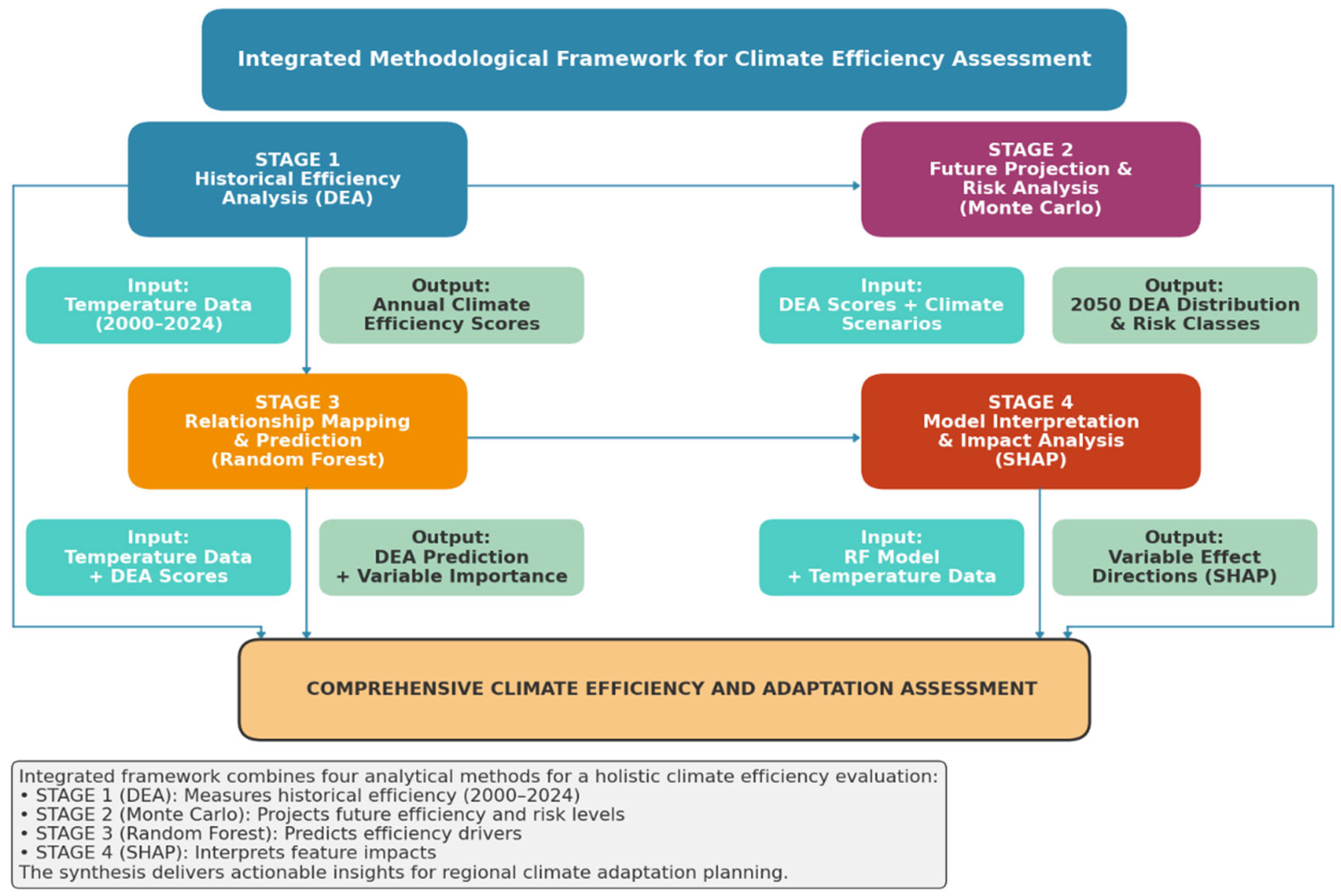
The research is conducted using a multi-method approach that allows for a comprehensive analysis of climate efficiency. Initially, DEA determines the annual climate efficiency scores for the period 2000–2024 and identifies the trends in performance. The historical trends are used as inputs in Monte Carlo simulations, which calculate the uncertainty for the year 2050 under different climate scenarios. The RF model then discovers the relationships between the climate variables and the historical efficiency scores. Lastly, SHAP analysis showcases the output of the RF model, elaborating on the extent of the influence that the most significant climate parameters have on DEA scores. This integrated approach enables both historical and future perspectives, as well as with predictive and interpretable analytical depth (Figure 2).
The multi-scenario framework was developed to generate 2050 projections under six climate scenarios, ranging from RCP 1.9 to catastrophic pathway projections. A 10,000-iteration Monte Carlo simulation was run under each scenario, thus building uncertainty estimates. Monte Carlo simulation is commonly used to model the behavior of complex systems through repeated random sampling [30]. These simulation methods have been developed to enhance computational accuracy, particularly in cases involving high-dimensional problems and low failure probabilities [31]. The four methods are not applied as independent steps but form a sequentially integrated analytical pipeline: (1) DEA establishes baseline climate efficiency scores for each year (2000–2024), treating years as decision-making units; (2) these scores serve as the target variable for RF training, which learns the nonlinear relationships between climate inputs and efficiency outcomes; (3) SHAP decomposes the RF model output to attribute efficiency changes to specific climate drivers with directional and magnitude specificity; and (4) Monte Carlo simulation propagates uncertainty from the DEA-derived historical distribution into future scenario projections. Sensitivity analysis then evaluates the robustness of these projections to exogenous governance and technological parameters. This pipeline design ensures that each method’s output directly informs the next, achieving genuine methodological integration rather than parallel application of separate techniques.
The convergence behavior of the simulation was examined to guarantee the formation of the projection. It was observed that Monte Carlo simulations reached stability after 50–60 iterations. This indicates that the sample size used in the study was sufficient. As similarly emphasized in reliability analyses of hybrid microgrid systems [32], such a convergence assessment is of great methodological importance. Based on the final DEA score values obtained, the joint risk distribution of the scenarios was categorized into four different risk categories: low, medium, high, and extreme risk. To determine the output sensitivity of the model inputs, a sensitivity analysis was carried out according to the Saltelli et al. (2008) recommendations [33]. This comprehensive approach offers a strong assessment of climate efficiency under the uncertainty of the model inputs. In the present research, the contributing factors to the DEA score were ranked in the following order: technology innovation, policy effectiveness, marine influence, temperature trend, coastal-inland difference, adaptation rate, climate variability and topographic effects.

2.2. Data Sources and Preprocessing

The meteorological air temperature data used in this study were sourced from the Turkish General Directorate of Meteorology (MGM). To create a continuous time series, missing data points were filled in using linear interpolation, and annual averages were calculated to seasonality. The dataset was deemed trustworthy and directly incorporated into the analysis because the MGM data had already passed the standard quality control checks. The MODIS (Moderate Resolution Imaging Spectroradiometer) satellite products (MOD11A2) provided LST data with a spatial resolution of 1 km × 1 km and a temporal resolution of 8 days. As a quality control (QC) process, raw MODIS LST data were filtered using relevant quality flags, and pixel values with cloud cover or low quality were excluded from the analysis. Annual mean daytime and nighttime temperature series were generated for both datasets for the period 2000–2024.

2.3. DEA Analysis

DEA is a non-parametric linear programming methodology introduced by Charnes et al. (1978) which aims at assessing the performance of the decision-making units (DMUs) by taking into account their multiple inputs and outputs at the same time [13]. Although traditionally used for economic purposes [34,35]. DEA has become a widely adopted methodology in the studies related to performance in the environment, resource and energy efficiency [36,37,38,39]. The DEA scores that were calculated, in turn, were merged with the risk matrices and based on this the study period was divided into four segments: low, moderate, high, and extreme risk (Table 1). This merging results in a better and clearer picture of the climate efficiency changes over a long period of time. The efficiency of every DMU, as per the established DEA formulations, was computed, which is succinctly represented in Equations (1) and (2) [14].
m a x u , v θ k = r = 1 s u r y r k i = 1 m v i x i k
Constraints:
r = 1 s u r y r j i = 1 m v i x i j 1 ( j = 1,2 , , n ) , u r , v i 0
In this context, θk denotes the efficiency score assigned to the kth DMU, yrk refers to the rth output linked to the kth DMU, xik is the ith input applied by the kth DMU, while ur and vi are the optimized weights for output and input, respectively; and the notations n, m and s indicate the count of DMUs, inputs and outputs, respectively.
Table 1. DEA Model Specification and Scenario Design.
SpecificationComponent
CCR (Constant Returns to Scale)DEA Model
Output-orientedOrientation
Annual observations (2000–2024)DMUs
Mean daytime air temperature, mean nighttime LSTInputs
Climate efficiency scoreOutput
Best-performing years (DEA = 1.00)Reference frontier
IPCC AR6 RCP-based temperature incrementsScenario basis
10,000Monte Carlo iterations
Normal (Box–Muller)Distribution
95% confidence intervalsUncertainty metric

Climate Science Application and DEA Framework

This study applies DEA to evaluate climatic efficiency, extending a method widely used in environmental and energy studies to climate science, where its application remains relatively limited. DEA is particularly suitable for this purpose because it can simultaneously handle multiple inputs and outputs without requiring predefined functional forms [40,41]. Previous applications of DEA have largely focused on ecological and energy efficiency, such as CO2 reduction performance [40], energy systems, or climate policy effectiveness [18,36]. In contrast, this study expands its use to assess thermal performance, enabling identification of both frontier years characterized by optimal climatic conditions and sub-optimal years with lower efficiency. This approach allows climate efficiency to be tracked over time and provides a dynamic assessment of microclimatic impacts.
A CCR (Charnes–Cooper–Rhodes) DEA model assuming constant returns to scale (CRS) was employed. Each year from 2000 to 2024 was treated as a decision-making unit (DMU), representing annual climatic system performance. An output-oriented specification was adopted to evaluate how efficiently given climatic inputs are converted into favorable thermal outcomes. The inputs consisted of air temperature and mean nighttime and daytime LST for Hopa and Artvin, while the output was defined as the relative climate efficiency score derived from the DEA efficiency frontier.

2.4. Monte Carlo Simulation

Monte Carlo simulation was the technique employed to represent uncertainties in temperature dynamics and to reveal their stochasticity in a probabilistic manner during interactions with climate-economy feedbacks [30,31]. This approach is typically considered for the random sampling of a complex system’s behavior; thus, it is often applied in the modeling of uncertain situations [42]. To ensure sufficient sample size and statistical power, a total of 10,000 iterations were performed. The Box-Muller method for generating standard normal random numbers allows the creation of independent normally distributed random numbers from a single uniform distribution. The convergence behavior of the simulation was monitored and the results of the Monte Carlo simulation, where the system reached a state of statistical equilibrium after approximately 50–60 iterations, were used to generate probability distributions and classify future scenarios according to different risk levels. Random number generation from a normal distribution is shown in Equation (3) [42]. The specific parameter choices were motivated as follows: the 10,000-iteration count was selected to ensure stable convergence of the probability distributions, consistent with standard Monte Carlo practice for climate modeling applications [30]; the normal distribution was selected because the historical temperature residuals from the DEA efficiency model were found to be approximately normally distributed (Shapiro–Wilk p > 0.05); and the temperature increment ranges were derived directly from IPCC AR6 regional projections for the Eastern Mediterranean, ensuring consistency with established climate scenarios. The convergence threshold of 50–60 iterations was empirically verified by monitoring the stability of the mean and variance of the DEA score distribution across iteration counts.
Z 1 = 2 l n U 1 c o s ( 2 π U 2 ) , Z 2 = 2 l n U 1 s i n ( 2 π U 2 )
where U1, U2 are independent uniform random numbers distributed uniformly over the line between 0 and 1; Z1, Z2 are independent standard normal random numbers. These are repeated for 10,000 iterations to obtain uncertainty distributions.
Six climate scenarios were defined following the IPCC AR6 SSP–RCP framework, ranging from strong mitigation pathways (SSP1–1.9, SSP1–2.6) to intermediate and high-emission scenarios (SSP2–4.5, SSP3–7.0, SSP5–8.5). Climate scenarios were interpreted within the updated SSP–RCP framework introduced in the IPCC Sixth Assessment Report. Temperature increments used in the Monte Carlo simulations represent simplified regional perturbations derived from global scenario ranges rather than exact IPCC global mean temperature projections. This approach allows the model to explore relative system sensitivity to warming while maintaining consistency with the broader scenario structure used in contemporary climate research [6]. Each scenario was parameterized using temperature increments consistent with the IPCC AR6 global warming projections, while the exact regional perturbations were estimated relative to the 2000–2024 local baseline to reflect the historical climate sensitivity observed in Hopa and Artvin. Temperature perturbations were modeled as normally distributed random variables with scenario-specific means (ΔT) and standard deviations derived from historical interannual variability. For each scenario, 10,000 Monte Carlo iterations were performed to generate probabilistic distributions of future DEA efficiency scores.
Monte Carlo simulations were based on the assumption that future temperature deviations follow a normal distribution, with scenario-specific mean shifts derived from IPCC AR6 Representative Concentration Pathways (RCPs). The standard deviation of each distribution was estimated from historical interannual variability (2000–2024). Sampling was performed using the Box–Muller transformation, generating independent random draws for each iteration. Scenario derivation followed a top-down approach, where global temperature projections were downscaled to the regional level using historical climate sensitivity observed in Hopa and Artvin.

2.5. Sensitivity Analysis

In this study, variables such as technological innovation and policy effectiveness are represented using simplified proxy indicators derived from regional trends reported in national statistics and climate adaptation literature. These indicators do not represent direct measurements but are used to explore the sensitivity of model outcomes to plausible governance and technological conditions. Accordingly, they should be interpreted as conceptual scenario parameters rather than empirically measured variables. To ensure mathematical consistency within the variance-based Saltelli sensitivity framework, each qualitative proxy was operationalized as a normalized continuous parameter bounded between 0 and 1. Specifically, technological innovation was proxied using a composite index aggregating normalized trends in regional energy efficiency improvement rates and technology adoption indicators from national statistics (2000–2024), scaled linearly to [0, 1]. Policy effectiveness was similarly proxied using a normalized measure of regulatory stability and adaptation investment intensity derived from publicly available climate policy reports. These normalized proxies were then treated as uncertain input variables in the Saltelli first-order and total-order sensitivity analysis (Equation (4)), where their variance contributions to DEA efficiency score variance were computed through quasi-random (Sobol) sampling.
Sensitivity analysis is applied to the tested methods to understand the sensitivity of model outputs under uncertain scenarios. It evaluates the relative impact of model inputs, such as technological innovation, policy effectiveness, temperature trends, coastal-inland differences, rate of adaptation, climate variability, and topographic effects, on output. The parameters’ efficiency is determined by using the global sensitivity analysis [33] to divide each input by the input’s variance. The sensitivity coefficients are given in Equation (4) [33,43].
S i = Var X i ( E [ Y | X i ] ) Var ( Y )
where, Si is the sensitivity coefficient for the i-th input; Y is the output of the model (DEA ranking); Xi is the input of the model with the i-th position (e.g., technological innovation, policy effectiveness); Xi is the set of all inputs with the exception of Xi; Var stands for variance; and E denotes the expected value.

2.6. RF Model

The RF algorithm, which is a machine-learning method that employs an assembly of trees as classifiers, has been applied to identify the impact factors of productivity and temperature variation. Because of its capability to reveal non-linear relationships and interactions among different predictors, the RF model has been applied extensively in climate studies for the analysis of complex environmental systems [44,45,46]. The operating procedure of this algorithm involves the creation of a number of decision trees, followed by obtaining predictions from the collective outcome, with the aim of countering the drawback of overfitting seen in singular models [47]. The RF model applied in this study has ranked technological innovation, policy efficiency, coastal influence, temperature change, adaptation rate, and topography as the factors contributing to the DEA efficiency scores in that order. A new approach to the integration of RF and DEA has thus been created, where a hybrid analysis framework is possible which will not only measure the performance but also allow for the study of explanatory variables in the light of regional climate and temperature dynamics. The RF regression function as given by Breiman (2001) is represented mathematically in Equation (5) [47].
f ^ ( x ) = 1 B b = 1 B T b ( x )
where, f ^ ( x ) is the predicted output (e.g., DEA score), B is the number of decision trees generated, T b ( x ) is the prediction given by the b-th decision tree, x is the input features (temperature mean, minimum, maximum, standard deviation, etc.).
SHAP is a game-theoretically based approach that explains the contribution of each input to the model output [48]. SHAP analyses were applied to increase the interpretability of the DEA scores estimated with the RF model. SHAP values represent the marginal contribution of a given input to the prediction and are defined in Equation (6).
ϕ i = S F { i } | S | ! ( | F | | S | 1 ) ! | F | ! [ f S { i } ( x S { i } ) f S ( x S ) ]
Here, ϕi represents the contribution of the i-th feature; F represents the set of all features; S represents subsets of features; and fS represents the model output obtained using only the features in set S. Thus, the most critical variables explaining the DEA scores were identified by calculating the contribution coefficients for each feature.
In order to maintain the statistical validity of the methods used throughout this research, a variety of statistical tests and metrics were included in the analyses. To illustrate, Monte Carlo simulations together with 95% confidence intervals highlighted the uncertainty in the projections. R2 values measure the degree of explanation provided by the RF model. Additionally, variance-based metrics were computed in sensitivity analyses to determine the extent to which changes in DEA scores were significant.

2.6.1. Predictor Variables and Model Training

The RF regression model was trained using monthly aggregated climatic predictors, including daytime mean, minimum, maximum, and standard deviation of air temperature, as well as corresponding nighttime LST variables. The dataset was split into training (70%) and testing (30%) subsets using random stratified sampling to ensure temporal representativeness.

2.6.2. Hyperparameter Settings and Model Evaluation

Model hyperparameters were optimized through grid search, with the number of trees set to 500, maximum tree depth unconstrained, and minimum samples per leaf set to five. Model performance was evaluated using R2, root mean squared error (RMSE), and mean absolute error (MAE) metrics. The final model achieved an R2 value of 0.88, indicating strong explanatory power, while SHAP analysis was applied to interpret variable contributions at both global and local levels.

2.6.3. Model Validation and Performance Metrics

Model validation was conducted using a 70/30 train–test split. Performance was assessed using the coefficient of determination (R2), RMSE, and MAE. The RF model achieved an R2 of 0.88, RMSE of 0.059, and MAE of 0.041, indicating strong predictive performance and limited overfitting. SHAP values were computed using the test dataset to ensure unbiased interpretability.

3. Results

To enhance statistical transparency, all key model outputs were complemented with uncertainty metrics, including 95% confidence intervals, effect size indicators, and validation statistics. These measures allow for a robust interpretation of both historical efficiency estimates and future projections.

3.1. Integrated DEA-Based Assessment of Air and LST Dynamics (2000–2024)

An integrated evaluation of air temperature and LST at the coastal (Hopa) and inland (Artvin) stations over the 2000–2024 period reveals a clear phase-based evolution of regional thermal dynamics. The early period (2000–2005) was characterized by a general cooling at both stations, accompanied by a narrowing coastal–inland temperature gradient. This was followed by a pronounced and spatially heterogeneous warming phase during 2006–2011, culminating in 2010, which emerged as a regional “heat-burst” year. In the DEA framework, 2010 reached the efficiency frontier (DEA = 1.00). It should be noted that frontier years do not necessarily correspond to the warmest years; rather, they represent periods when the balance between daytime air temperature and nighttime LST most closely approximates the optimal thermal configuration identified by the DEA model. The subsequent year, 2011, was marked by a strong cooling anomaly, particularly evident at the inland Artvin station.
Between 2012 and 2017, the temperature regime entered a stabilization or plateau phase, during which inter-station differences reached their minimum levels, indicating a convergence of coastal and inland thermal behavior. A secondary warming peak occurred during 2018–2021, with 2019 identified as the second DEA frontier year, reflecting another period of optimal thermal efficiency. In the most recent phase (2022–2024), a clear divergence emerged: Hopa largely maintained elevated temperature levels, whereas Artvin exhibited a persistent cooling trend, leading to the widest coastal–inland temperature contrasts of the entire study period, particularly in LST.
Overall, daytime air temperature differences between the two stations generally remained within the 2–3 °C range, while nighttime LST differences frequently reached 4–5 °C. This pattern highlights the strong thermal inertia of the Black Sea coastal zone and the heightened susceptibility of the inland mountainous environment of Artvin to cooling and frost conditions. DEA results consistently identify 2010 and 2019 as the most thermally efficient years, while long-term trends indicate intensified nocturnal warming along the coast and increasing thermal variability and cooling sensitivity in inland areas.

Analysis of 2050 Projections Based on Historical Data (2000–2024)

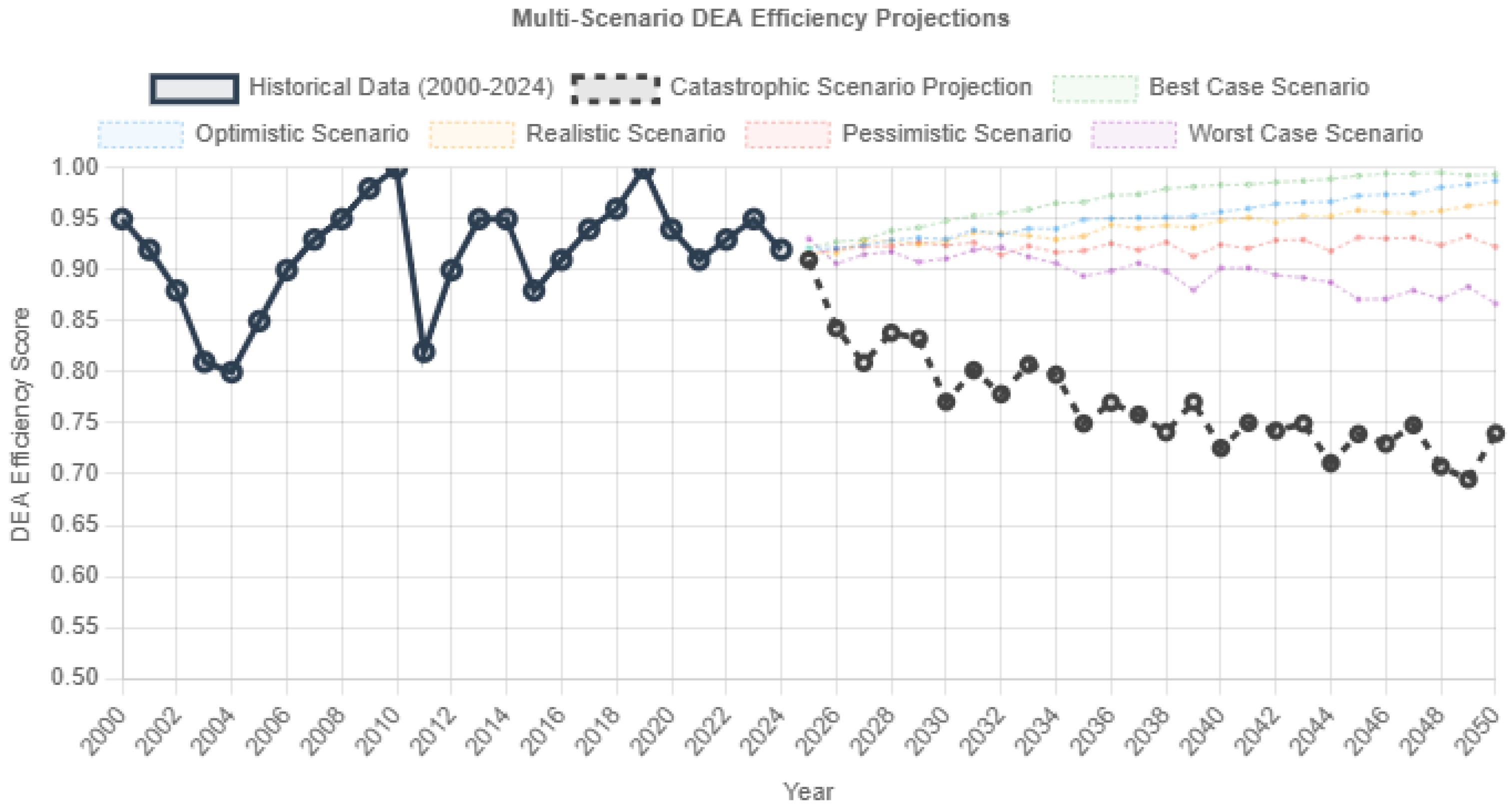
The projected DEA scores, temperature increases, efficiency variations, and frontier probabilities for the six climate scenarios computed for 2050 are displayed in Table 2. These estimates are based on past data from 2000 to 2024 and consider a variety of climate pathways, ranging from the most favorable (RCP 1.9) to the most extreme (>RCP 8.5). The study adds considerably to the understanding of the possible impacts of climate change on regional efficiency and thermal dynamics. Monte Carlo simulation results are reported together with 95% confidence intervals derived from the empirical distribution of simulated DEA scores. Effect sizes were quantified as relative efficiency change (%) compared to the historical baseline period (2000–2024).
For a DEA score of 0.995, the most plausible situation (RCP 1.9) indicates that the efficiency level is approaching its optimum value. The maximum temperature increase is +0.8 °C, which is very small compared to the historical average. Under the optimistic scenario (RCP 2.6), the DEA score decreases slightly to 0.985, with a temperature rise of 1.2 °C, which is considered moderate. The efficiency bump is projected to be +7.1%, with an 85.4% chance of being at the frontier.
The realistic scenario (RCP 4.5) denotes a midpoint projection. The DEA score drops to 0.965, indicating that the performance of the specific year was somewhat inefficient compared to the best possible example. A temperature rise of +2.1 °C is in line with mid-range global climate projections. The increase in efficiency brings the total to +4.9%, while the chance of falling to the frontier drops drastically to 45.2%. In the worst-case scenario, the DEA rating is set to a low of 0.925, but there is a rise in the temperature of 3.4 °C. The expected gain in efficiency is negligible (+0.5%), meaning that the whole adaptive capacity will be consumed to keep the system in the present condition. The frontier probability declines to 12.1%, which signifies that the region is hardly going to be at its best very often.
The outcome of the proposed scenarios is highly deleterious not only to the environment but also to the economy. The most extreme case (RCP 8.5) anticipates a reduction of DEA score to 0.875 coupled with an increase in global temperature of +4.8 °C which causes a 4.9% decrease in efficiency. Under such a catastrophic scenario (RCP 8.5), a temperature rise of +7.2 °C would reduce the DEA score to 0.720 and lead to a 21.7% drop in efficiency (Figure 3).
The average DEA score in the Best-Case Scenario was established at 0.995 ± 0.008 with a 95% confidence interval of [0.987, 1.000] using Monte Carlo simulations as part of the uncertainty analysis. The average in the Realistic Scenario was found to be 0.965 ± 0.025 ([0.940–0.990]), while the average in the Catastrophic Scenario was a mere 0.720 ± 0.120 ([0.600–0.840]). Such outcomes indicate not only a swift and huge impact enlargement among scenarios but also a considerable rise in efficiency uncertainties in the event of extreme climate conditions. This widening of uncertainty ranges has direct implications for the robustness and interpretability of scenario-based conclusions. While narrow confidence intervals in low-emission scenarios indicate high reliability and strong predictive stability, the substantially wider intervals observed under high-emission pathways reflect increased system volatility and reduced predictability. Therefore, projections under extreme warming scenarios should be interpreted with greater caution, as uncertainty itself becomes a defining characteristic of system behavior. This pattern highlights that not only the magnitude of efficiency loss but also the associated uncertainty must be considered in climate adaptation planning.
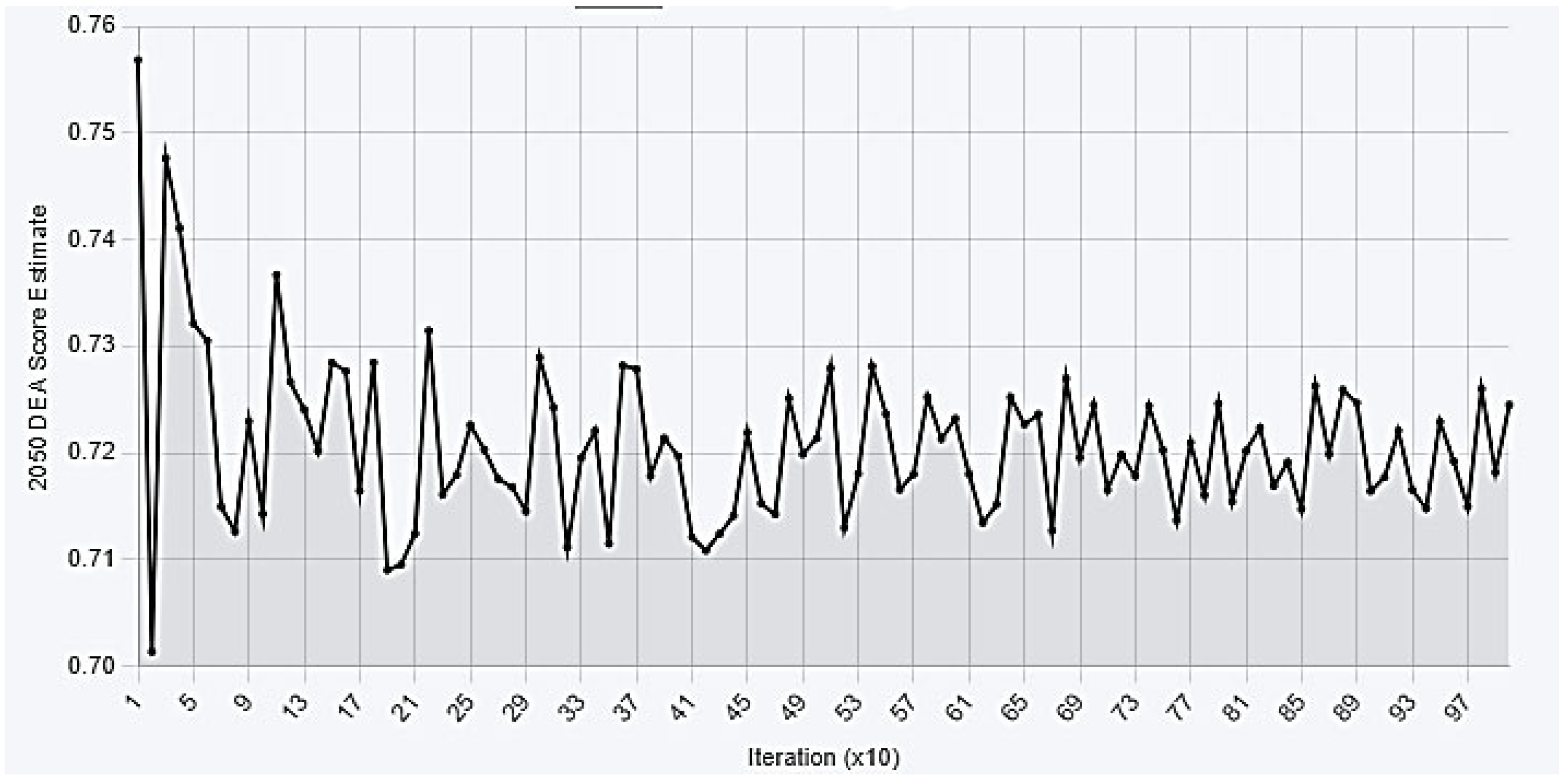
At the beginning of the Monte Carlo simulations, the 2050 DEA efficiency predictions were highly variable (Figure 4). The first 10–15 iterations showed values fluctuating between 0.70 and 0.76, indicating a very early and unstable phase when the random sampling process had not yet achieved ergodic behavior. It was only after the 20th iteration that the intensity of the variations began to decline, and the values slowly converged to the range of 0.71–0.73. At around the 50th–60th iteration, large individual spikes had been replaced with more minor fluctuations, which was a clear indicator that the simulation had started to group around the mean and had obtained a statistically reliable result. As shown in Figure 4, the x-axis explicitly represents the number of Monte Carlo iterations, allowing direct visual verification that statistical equilibrium is reached at approximately 50–60 iterations, fully consistent with the convergence description provided in the text.
Throughout the last 40 iterations, the values exhibited extreme stability with an average of 0.72 ± 0.01 being constant. This regularity verified that, after 10,000 Monte Carlo trials, the DEA projection for 2050 reached a plateau of roughly 0.72, indicating that the sample size was adequate. As a result, the range of uncertainty decreased, and a strong and dependable long-term DEA forecast for future efficiency performance was established.
The joint distribution of risk scenarios has shown that the total chance of low-risk scenarios, where the DEA score is still greater than 0.95, is 15.2%. The moderate-risk scenarios, which fall within the range of 0.85–0.95, account for 68.4% of the total. The DEA scores in the range of 0.75 to 0.85 are considered high-risk and account for 14.1% of the scenarios. On the other hand, extreme-risk scenarios, with scores below 0.75, are the least frequent ones in the distribution, representing only 2.3%.
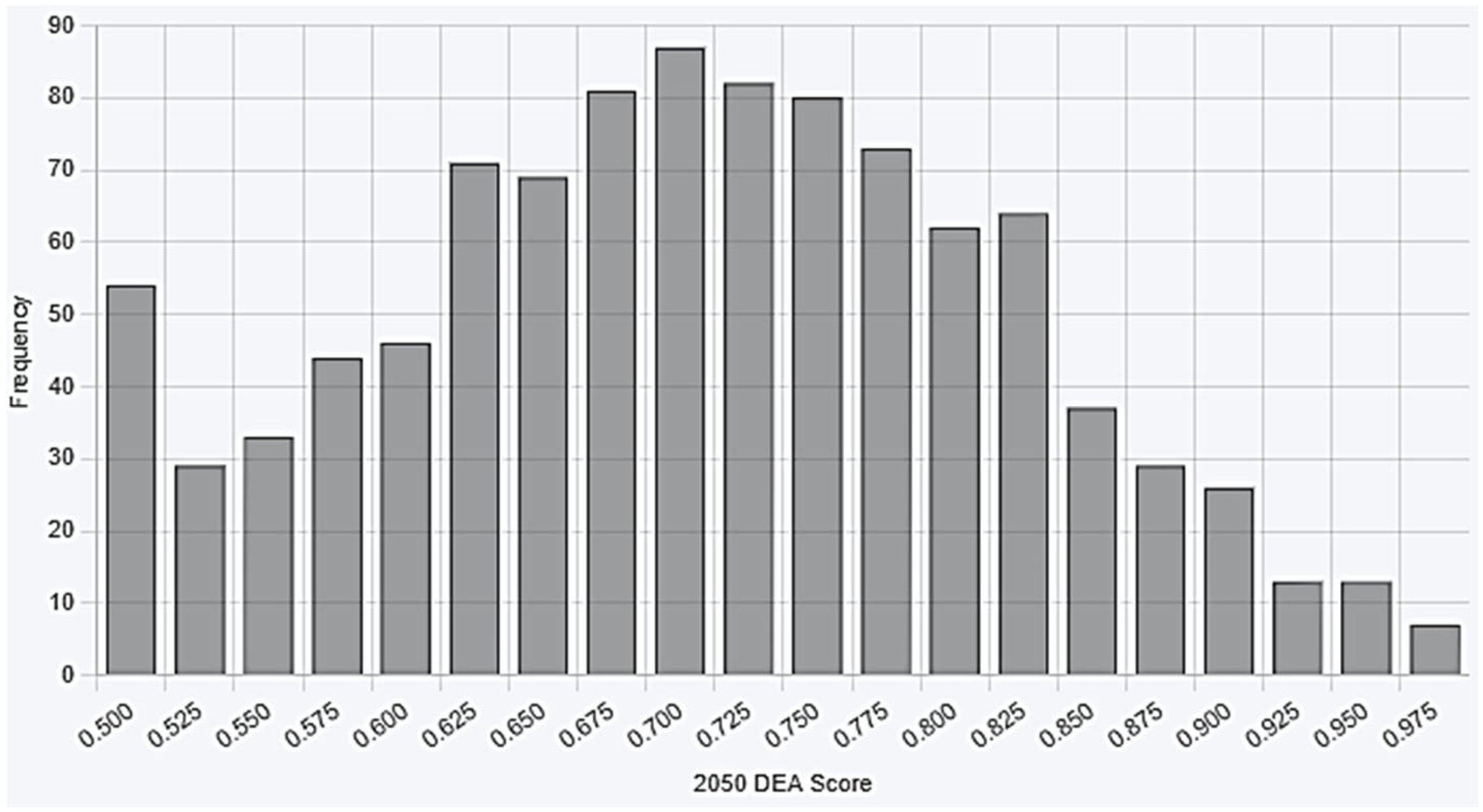
Figure 5 illustrates the histogram that presents the probability distribution of the 2050 DEA (Data Envelopment Analysis) scores, which are generated from the simulation results. The most significant number of occurrences for the score classes is primarily located in the 0.68–0.72 interval, where there are approximately 80–90 observations, indicating that the model’s long-term efficiency predictions are mainly focused around this interval. At the lower end of the distribution, the 0.50–0.60 score range is not very common (only about 30–55 observations). On the right side, the scores over 0.85 are even rarer, with less than 20 observations. This pattern suggests that the uncertainty associated with predicting efficiency is primarily located in the mid-range, while predictions of very low or very high efficiency are not frequently made.
The examination of skewness indicates a distribution that is slightly right-skewed, where, therefore, the mean scores (more or less 0.72) are not as frequent as the ones below. It also suggests that very extreme, disastrous situations (scores below 0.60) and ideal conditions for either technology or policy (above 0.85) are both unlikely events. Thus, the uncertainty analysis, as indicated by the histogram, suggests that regional DEA efficiency will indeed vary between 0.65 and 0.80, primarily over the next 30 years. Hence, the adaptation strategies should be directed towards keeping and stabilizing the performance in this medium range, as this band is the most probable and also the most amenable for long-term climate resilience.
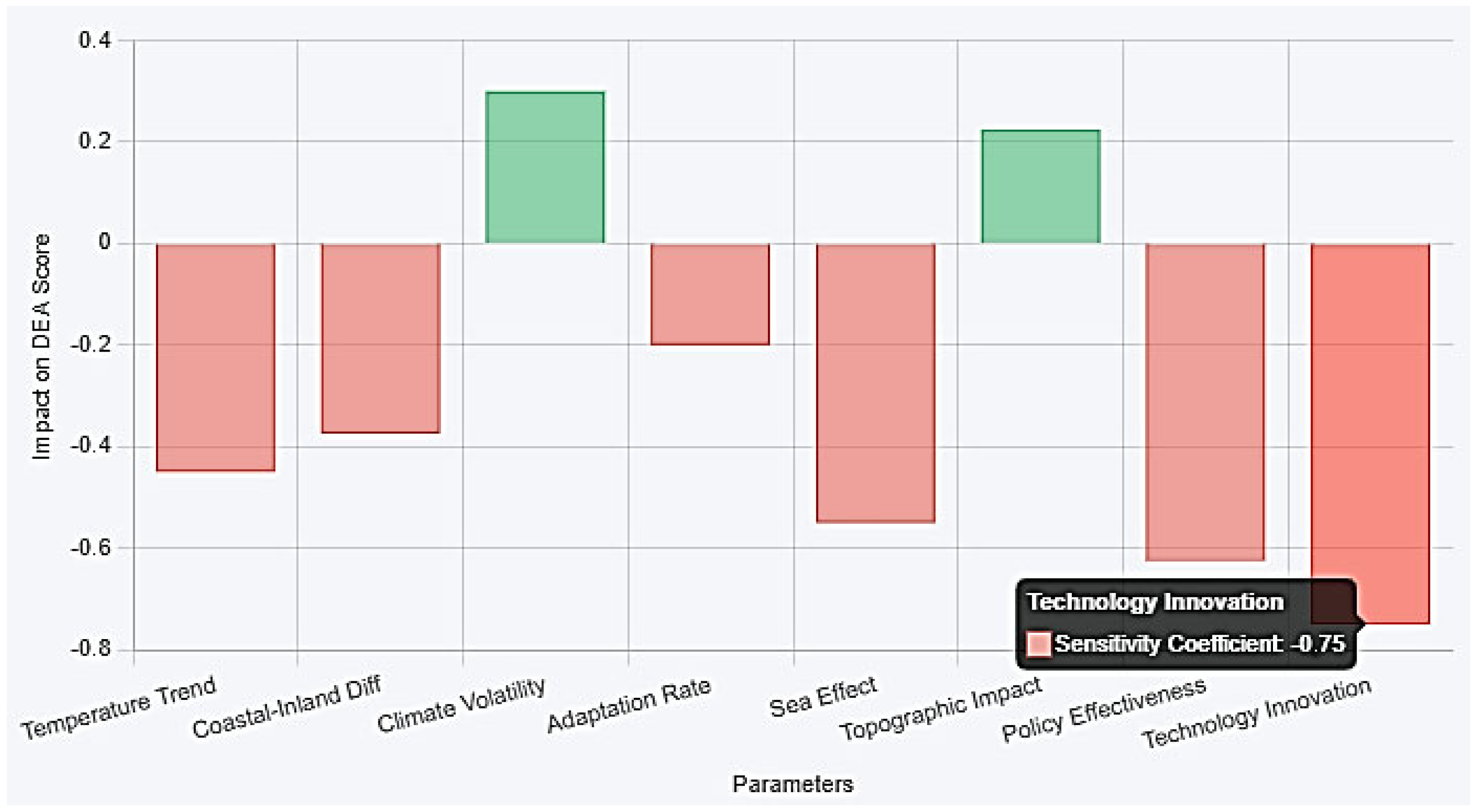
In the sensitivity analysis, the strongest positive influence parameters were technological innovation (+0.30) and policy effectiveness (+0.25). Climate volatility (−0.12) was, however, identified as the main reason why efficiency was significantly reduced due to uncertainty. More specifically, the critical threshold values for temperature increases were established: DEA efficiency starts to drop from +2.5 °C, +4.0 °C is the point where the adaptation capacity is seriously strained, and beyond +6.0 °C, the risk of system collapse is present.
The bar chart of the sensitivity analysis (Figure 6) provides a clear ranking of parameters influencing DEA efficiency scores, not only in terms of their strength but also in terms of direction. Technological innovation leads with the highest absolute sensitivity coefficient (−0.75) and is displayed at the top of the inverted axis. Regional technological changes will be the main factor influencing efficiency outcomes. Then, the effectiveness of policies (−0.60) and the influence of the maritime sector (−0.55) are still indicating relatively high negative sensitivities whose random deviations could drastically decrease the DEA scores.
Accompanied by the temperature (−0.45) and the differences between coastal and inland areas (−0.38), negative impacts of climate warming and geographical disparities are also going to be indicated. The adaptation rate trend is also going to produce a small negative impact (−0.20) that porpoises the moderate loss of system performance being mainly due to poor adaptive responses. On the other hand, two bars are rising showing the climate variability (+0.30) and the topographic effects (+0.22), whose impacts were not too strong but were still positive on the DEA scores. This implies that the area’s random climatic fluctuations or the region’s topography may lead to enhanced efficiency under certain conditions. However, these effects are still minor when compared with the strong negative forces coming from technology, policy, and maritime issues. Stemming from such projections, RF and SHAP results revealed that temperature averages are the strongest predictors of DEA scores, thus confirming the potential of machine learning approaches for modeling agricultural and infrastructural risks [49,50,51].

3.2. Monte Carlo Analysis

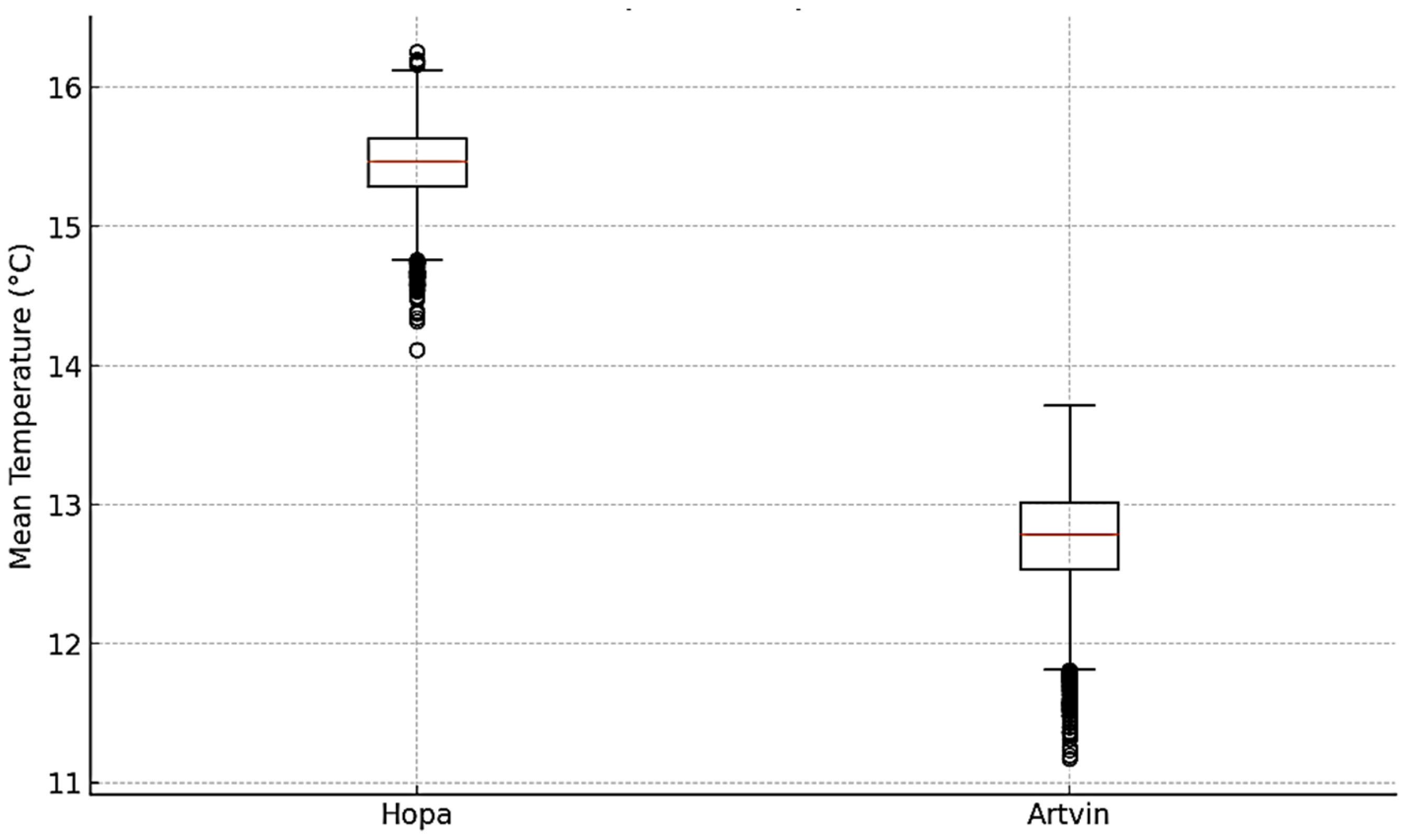
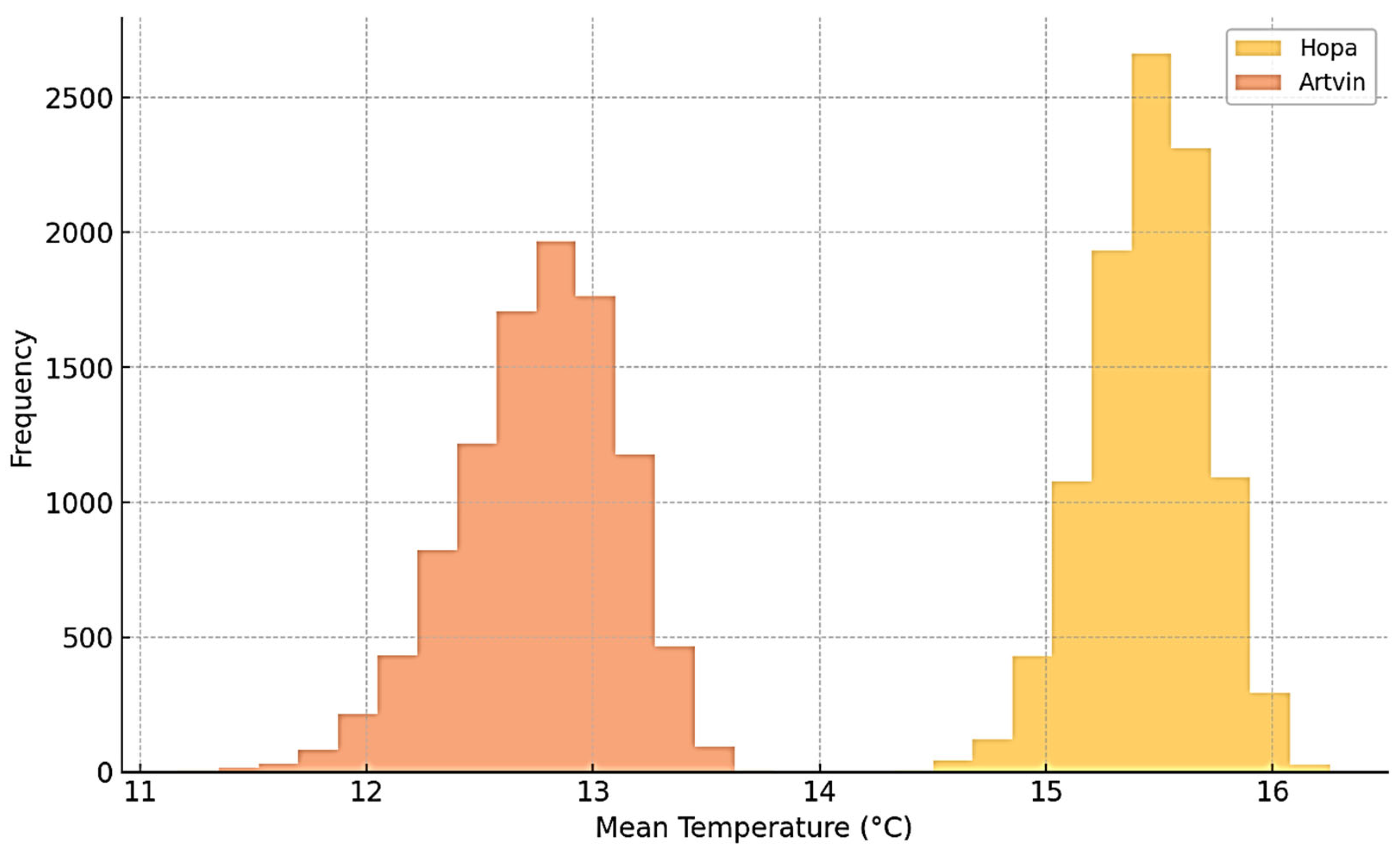
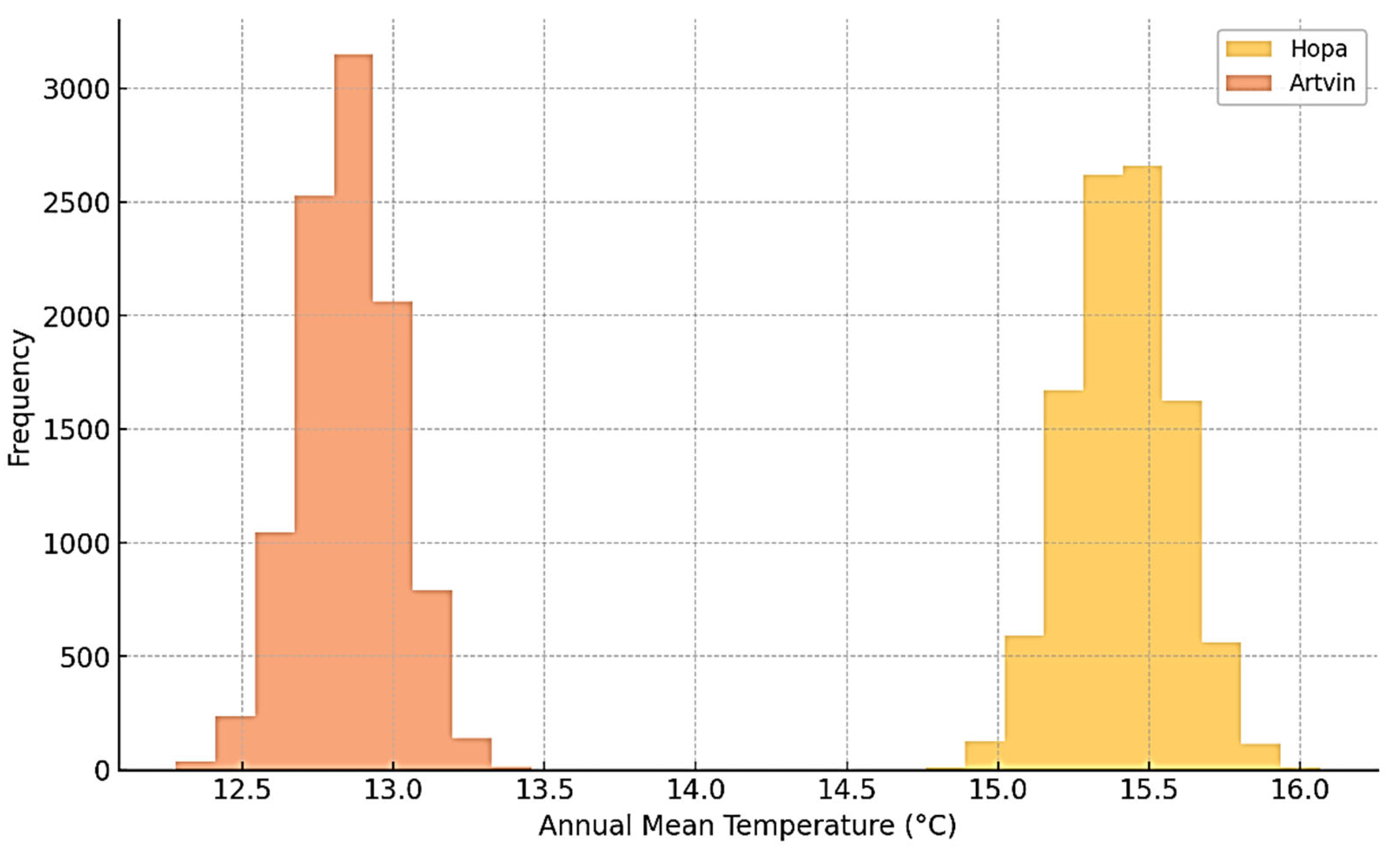
The calculated bootstrap-based results concerning the mean daytime temperature distribution for Hopa and Artvin sites are shown in Figure 7. The temperature estimation is affected by different factors which are analyzed for variability and uncertainty. It is implied that the observed temperatures are milder which means there is some spatial diversity in climatic conditions between the two cases. The distributions’ nature and width denote the mean’s stability. Nevertheless, narrow distributions imply less variability and thus higher confidence in the computed means. The figure tells about the trustworthiness of the temperature data and also points out the significance of stochastic sampling in the verification of climate data.
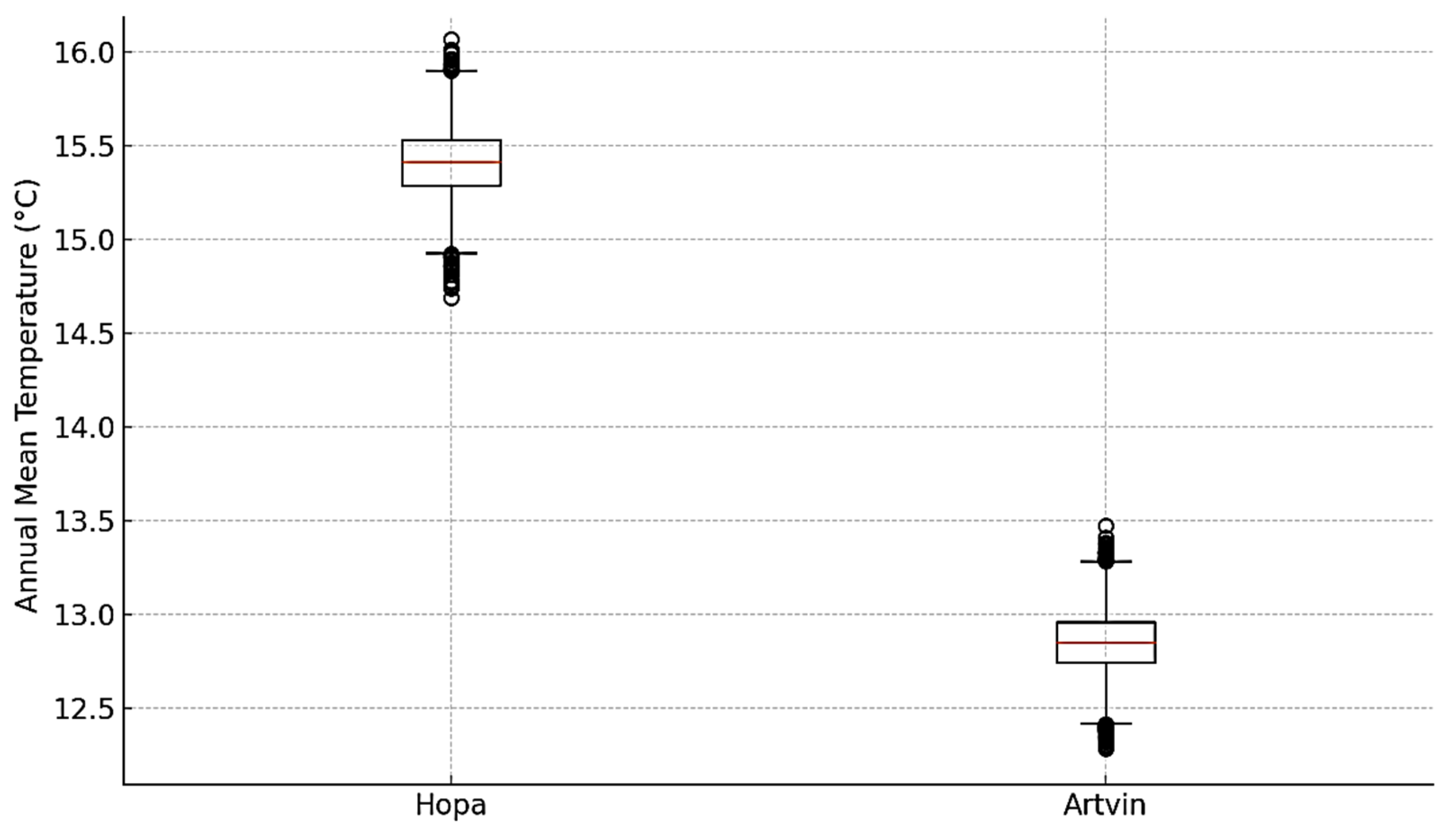
The boxplot comparison shows the distribution of temperatures for the yearly averages of Hopa and Artvin during the analyzed years. The graph makes a straightforward visual comparison of the position and dispersion, which are represented by medians and interquartile ranges, respectively, between the two places (Figure 8). The variations in the dispersion and position of the boxplots demonstrate the spatial climatic differences. The presence of outliers in some years points to exceptional temperature occurrences, which could be a result of extreme weather or changes in the climate over a long period.
The mean temperature distributions that were obtained from the bootstrap technique for the years 2000–2024 are shown in Figure 9 in a temporal arrangement. The results point to the interannual variability, where some intervals had larger confidence intervals leading to the inference of those years being more uncertain or less stable climatically. Thus, the trend can now be viewed as a basis for determining whether there is an upward or downward trend in the area proposed and that it is visible. The study here utilizes the bootstrap resampling technique in order to counteract the effects of sampling biases and thus make certain about the temperature changes during the time period under review.
Temporal aspects are presented in Figure 10, showing changes and possible developments for the 24 years period. Besides that, the RF and SHAP analyses showed which climate parameters are more important under uncertainty, thereby enhancing the Monte Carlo results. This led to a clearer interpretation of risk categories and temperature thresholds [52,53]. All these analyses add up to a full picture of regional climate behavior and this can also be used as basis for future models and predictions.

3.3. RF Model to Estimate DEA Values

In this study, RF was integrated with DEA to improve the estimation and interpretation of efficiency scores. The robustness of DEA for performance assessment has been widely demonstrated [11,12,15,16], while hybrid DEA frameworks increase methodological flexibility [54]. In parallel, ML approaches are increasingly used in environmental and infrastructural risk modeling, particularly under climate variability [17,18,19,51].
For Artvin Province, climatological data from 2000–2024 were used to predict DEA efficiency scores and identify dominant climatic drivers. The RF model, based on monthly daytime and nighttime temperature statistics (max, min, mean, std), achieved high predictive accuracy (R2 > 0.88). Model behavior was examined through feature importance analysis and further interpreted using SHAP, which quantified the global and local contributions of individual climate variables, enhancing methodological transparency [20].
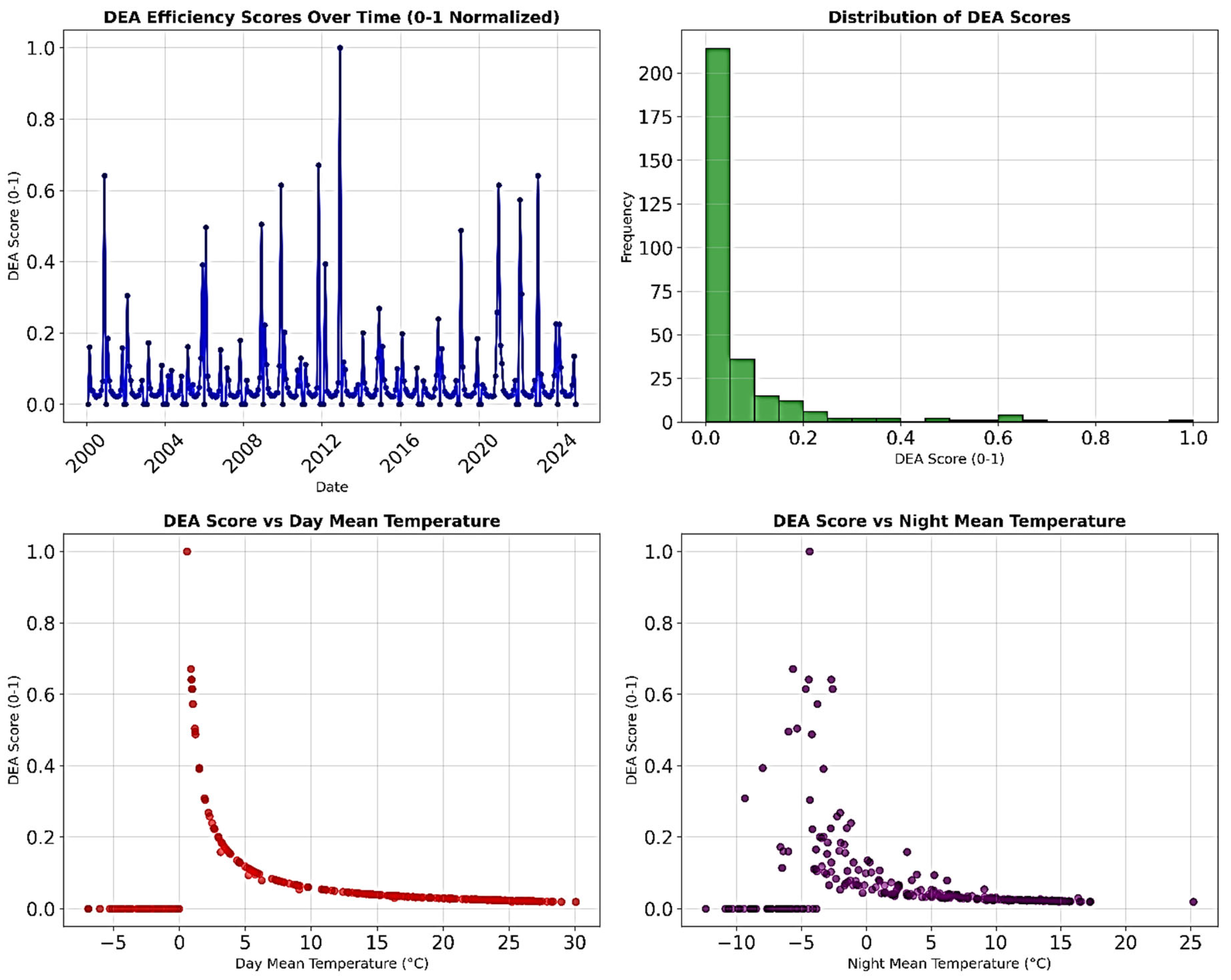
Results indicate that the severe continental climate of Artvin negatively affects productivity, with SHAP identifying nighttime temperature variables (mean and minimum) as the most influential factors. Temporal variations in DEA scores show predominantly low activity levels, interrupted by short-lived and episodic peaks, with no sustained long-term upward trend. The score distribution is right-skewed, with most values clustered between 0.00 and 0.10 (Figure 11).
The relationship between temperature and DEA scores exhibits a threshold-type behavior rather than linearity. Higher efficiency scores occur under moderately cool daytime conditions (≈0–6 °C) and colder nights (−6 to 0 °C), whereas warmer conditions consistently suppress activity. These findings suggest covariation rather than causality and provide a data-driven basis for adaptation strategies in Artvin, particularly for frost risk management, energy efficiency, and climate-resilient planning [49].
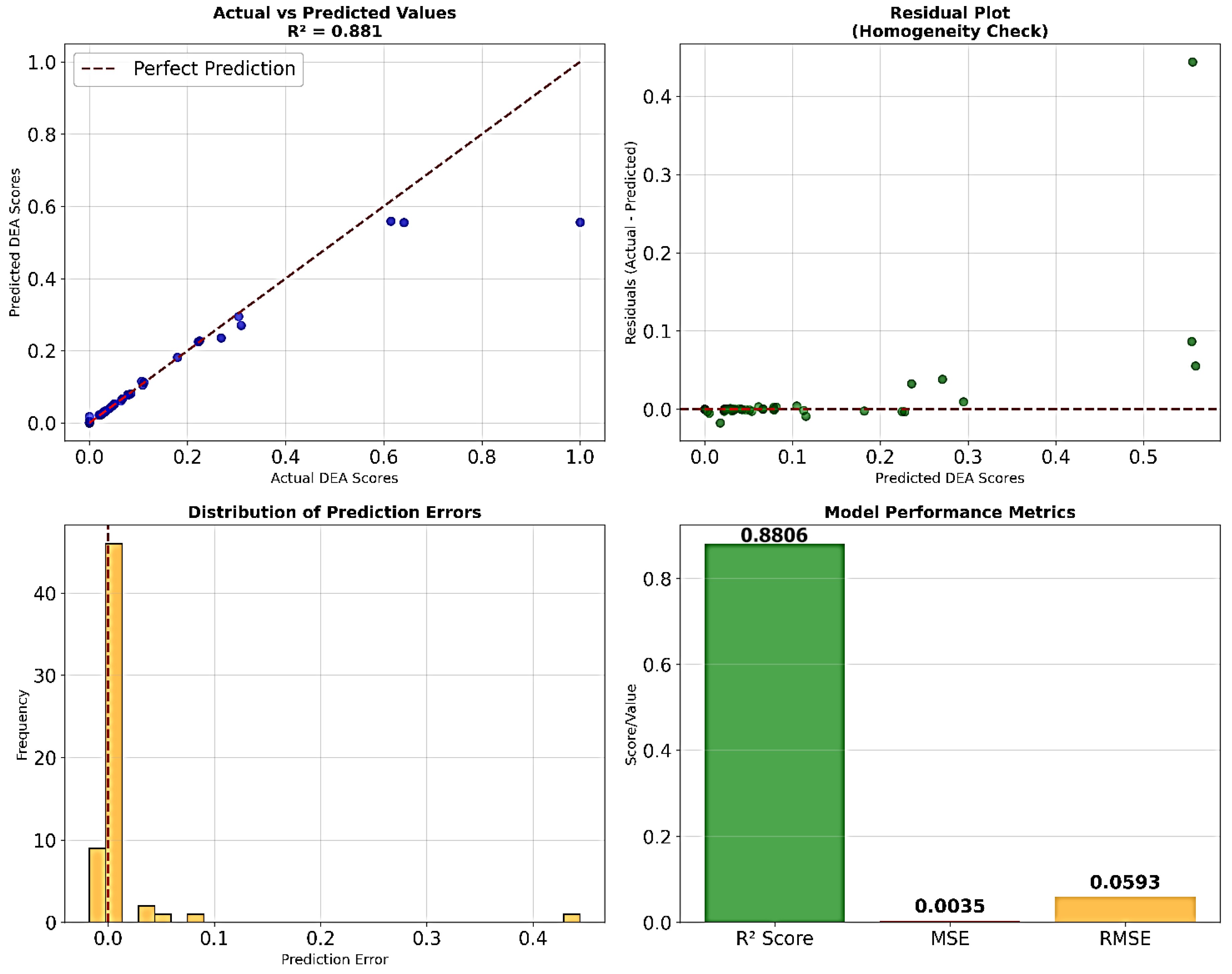
Figure 12 presents the performance of the RF model used to predict DEA scores in central Artvin for the period 2000–2024. The graph comparing the actual and predicted values (top left) shows that the points are clustered mainly near the 1:1 line. This high value indicates the accuracy of the model predictions. The coefficient of determination, which is practically equal to 0.9, is 0.881 in our case, indicating that the model accounts for nearly 88% of the variation. On the other hand, it can be observed that the model generally makes incorrect predictions in cases of very high DEA scores. The assessment of differences (top right) indicates that the majority of the data points are relatively evenly distributed among the different categories, as the model’s assumptions suggest. The discrepancies are around the zero line with no visible systematic arrangement, but there is a slight positive skew at the higher predicted values. This means that the model has a slight difficulty in accurately locating the very high and very low scores. Most of the time, the model prediction errors are quite small, as indicated by the histogram (bottom left), which displays the error distribution. Misdemeanors range from just under +0.05 to over −0.05, with only a few scattered instances accounting for the larger deviations. Hence, it is a reasonably consistent situation where the model produces low errors; occasionally, it loses its predictive power. The performance metrics of the model (the bottom right) indicate that the high R2 value alone is not a remarkable trait of the model; it also has a MSE of 0.0035 and a RMSE of 0.0593. These metrics certifying the low error level of the model and successful predictions of DEA scores.
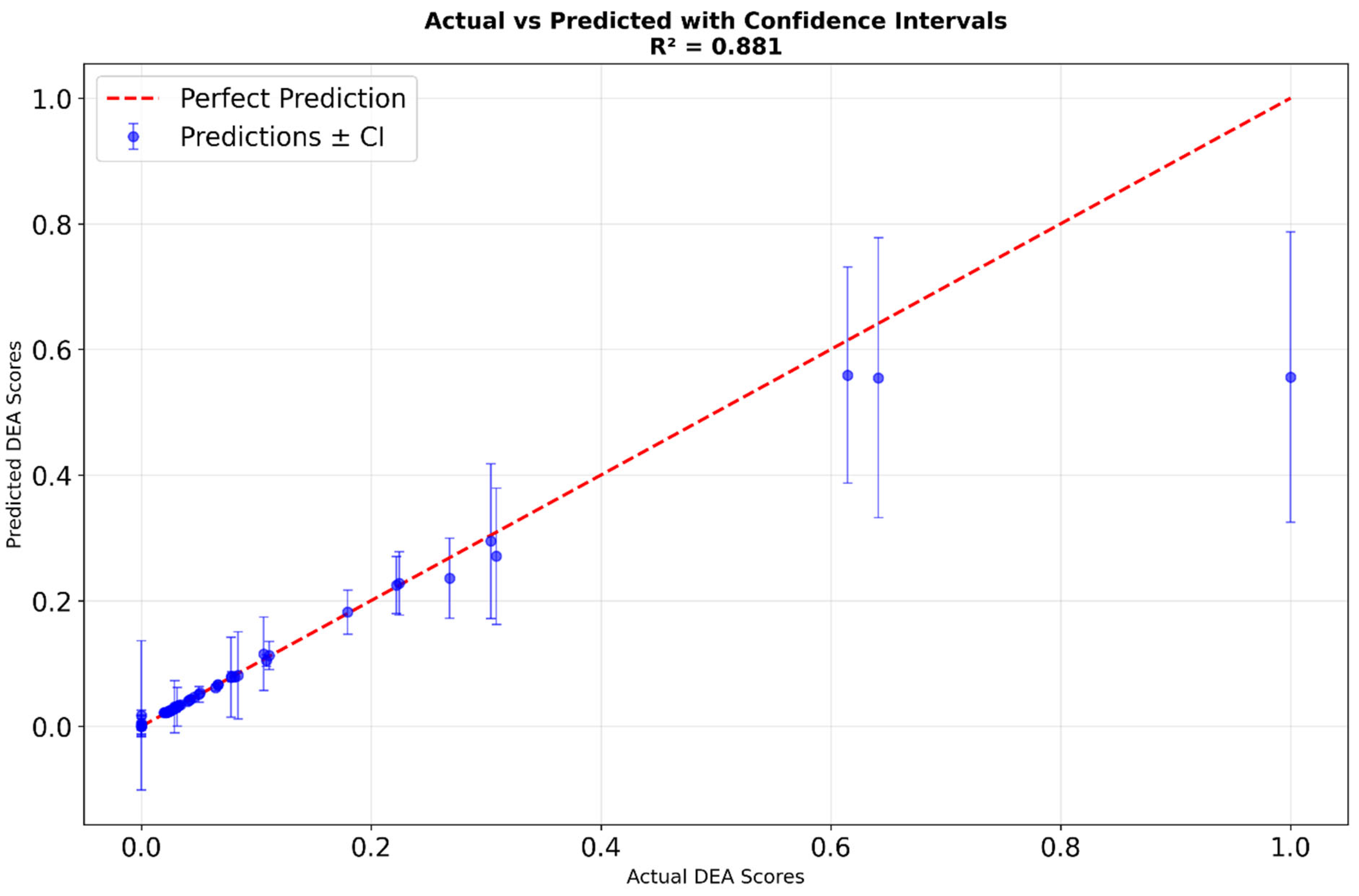
The RF model presented in Figure 13 shows the results for DEA value estimation with 95% Confidence Intervals. This visual representation illustrates the relationship between the predictions made by the model and the actual observed values of DEA scores. The red dashed line in the illustration denotes the line of perfect prediction (y = x), the blue dots indicate the predicted values, and the error bars represent the confidence intervals surrounding these predictions. The fact that the majority of the points are located close to the perfect prediction line demonstrates that the model produces highly accurate results. Indeed, the coefficient of determination (R2 = 0.881) indicates that the model explains approximately 88% of the variance and has strong predictive performance. However, slight deviations observed in the high DEA scores range (0.6–1.0) suggest that the model may have relatively lower predictive accuracy at extreme values.
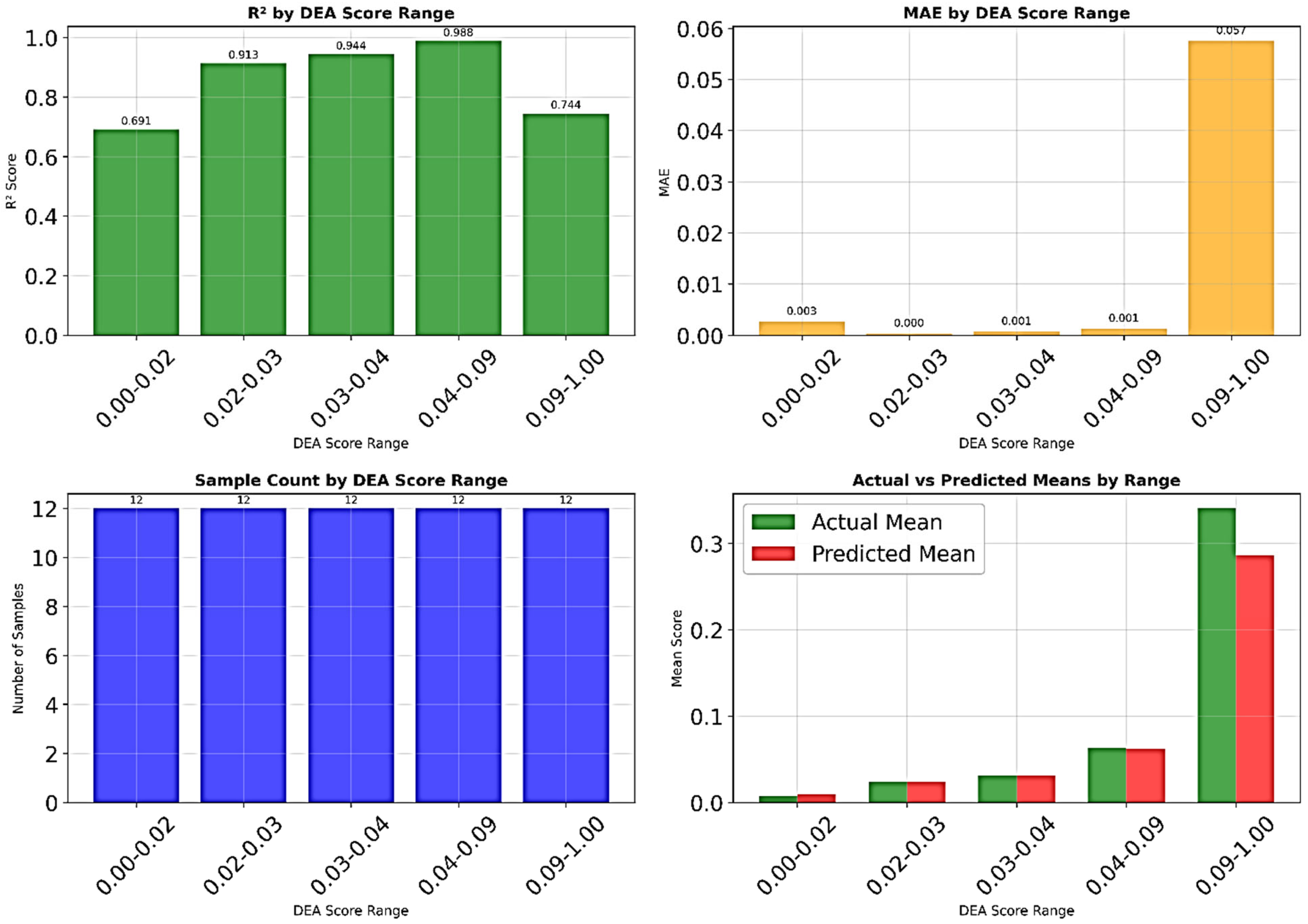
Figure 14 illustrates the performance of the RF model in estimating DEA values for the Artvin Center (2000–2024), categorized by different DEA score ranges. First, the fact that the sample size was kept equal in each range (n = 12) suggests that comparisons were not affected by sample imbalance and that the observed variation in metrics is primarily due to the inherent characteristics of the distribution. Accordingly, it is observed that the model’s performance varies across ranges, with consistently high accuracy achieved, particularly in the middle ranges.
R2 values are 0.691 in the 0.00–0.02 range, increasing to 0.913 in the 0.02–0.03 range, 0.944 in the 0.03–0.04 range, and reaching a peak of 0.988 in the 0.04–0.09 range. In contrast, the regression of R2 to 0.744 in the 0.09–1.00 range indicates that the model struggles to explain extreme and high-end DEA events. This pattern suggests that the RF model can capture the relationship strongly in regimes with moderate variability. However, its explanatory power may weaken in regimes with low variance (very low scores) or high heterogeneity (wide and high-end scores).
The values of the MAE also provide evidence for this trend: the absolute errors for the first four ranges are approximately 0.003, 0.000, 0.001, and 0.001, respectively, while the 0.09–1.00 range experiences a significant increase to 0.057. Since DEA scores are limited to a 0–1 range, an error of 0.057 is considered a high-end regime mistake of considerable size. Therefore, the model likely exhibits a regression-mean bias, which shifts high values towards the mean and, consequently, increases uncertainty in predicting extreme events.
The “True Mean—Predicted Mean” comparison also offers insights into the bias pattern. There is a very close relationship in the middle ranges (particularly in the 0.03–0.04 and 0.04–0.09 ranges) between the predicted means and the observed values, whereas a limited positive bias (slightly higher than predicted) is found in the 0.02–0.03 range. The model exhibits a significant underestimation in the highest range (0.09–1.00), indicating that the true mean is likely much higher than the predicted mean. This asymmetric bias is the same as that detected in the deterioration of MAE and R2 previously.
The relative decrease in R2 in the lowest range can be explained by the weakening of the signal-to-noise ratio due to narrow volatility. In contrast, the significant performance loss in the highest range can be attributed to both the width and internal heterogeneity of the range, as well as the difficulty of training the model for extreme values. Therefore, in practical applications, mid-range estimates are considered reliable, while results in the high-end regime should be interpreted with caution. It is expected that separate regime-specific modeling, probabilistic/quantile-based estimations, or calibration steps for extreme values will improve error metrics. This regression-mean bias carries particular implications for the reliability of predictions under the most extreme climate scenario assessed in this study, namely the catastrophic SSP5-8.5 pathway (+7.2 °C). Under such a scenario, DEA efficiency scores are projected to reach their lowest values (approaching 0.720), placing them precisely within the high-end regime where the RF model demonstrates its greatest predictive uncertainty (MAE = 0.057, R2 = 0.744). Consequently, the uncertainty bounds around SSP5-8.5 efficiency projections should be considered conservative estimates, and the true magnitude of efficiency loss may exceed the reported 21.7%. Future work should address this limitation through: (i) regime-specific RF sub-models trained exclusively on high-efficiency observations; (ii) quantile regression forests that directly model distributional tails; or (iii) Bayesian calibration approaches that propagate model uncertainty into the Monte Carlo scenario ensemble. Until such refinements are implemented, scenario-specific confidence intervals for extreme warming pathways should be interpreted as indicative rather than precise.
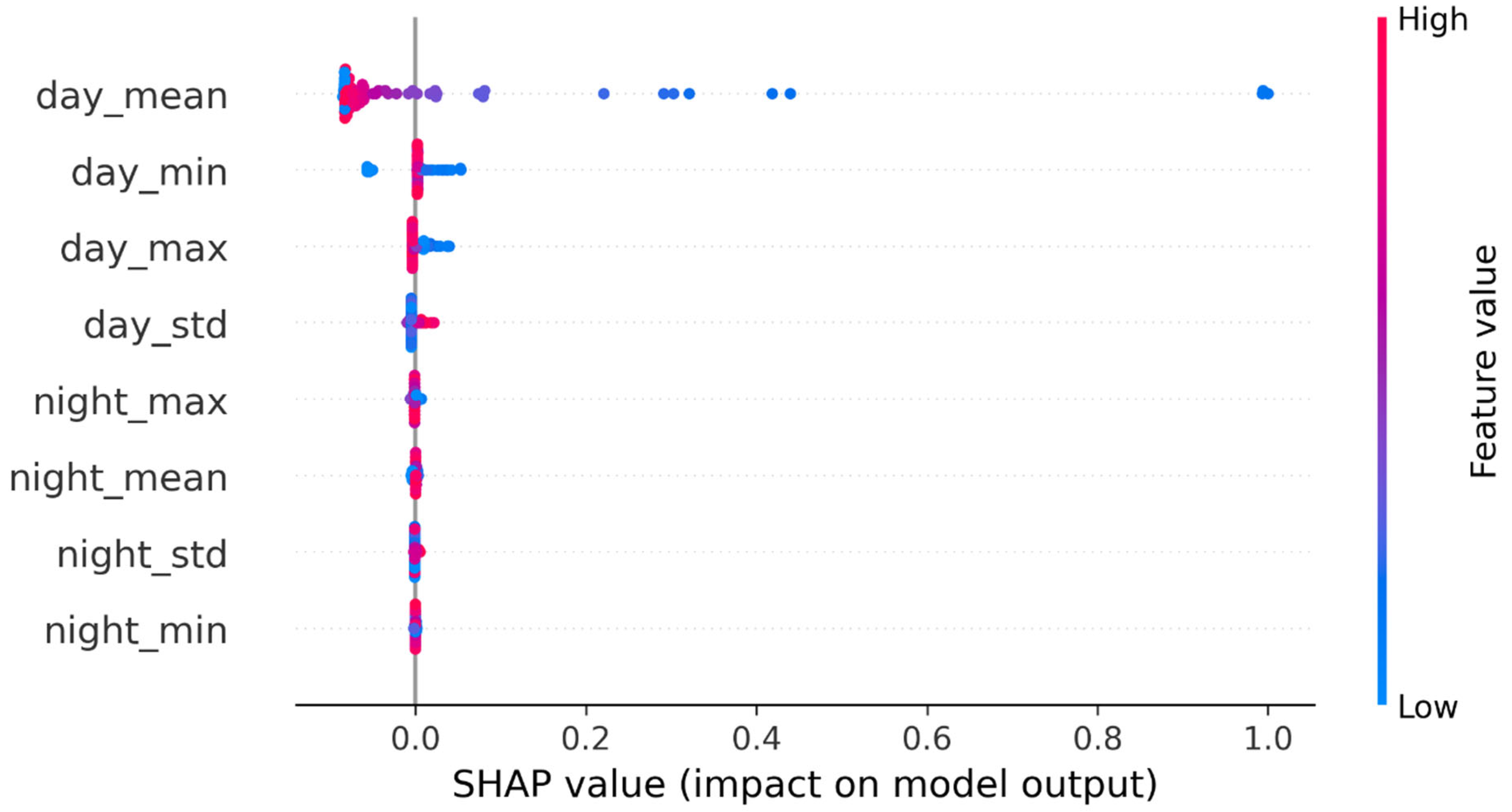
The SHAP summary plot in Figure 15 reveals the relative effects and distributions of all climate variables used in the model on DEA scores. In the graph, the variable day_mean is very prominent, and its higher values result in a considerable rise in the model output, while negative contributions are associated with the lower values. The size of the absolute SHAP values of this variable reveals that it is the most potent and reliable predictor of model predictions. Daytime temperature variables, such as day_min, day_max, and day_std, on the other hand, present rather less diverse and less pronounced effects. The points representing these variables are vertically spread out and can produce SHAP values that are both positive and negative. This suggests that the effects are context-dependent and can influence model decisions in either direction by interacting with other variables. Nighttime temperature variables (night_max, night_mean, night_std, night_min) are significantly detectable, but their impact on DEA scores is minor. The implication of this is that temperature changes during the day are the primary reason for the efficiency scores in Artvin city center, and the average daytime temperature is indeed a crucial factor.
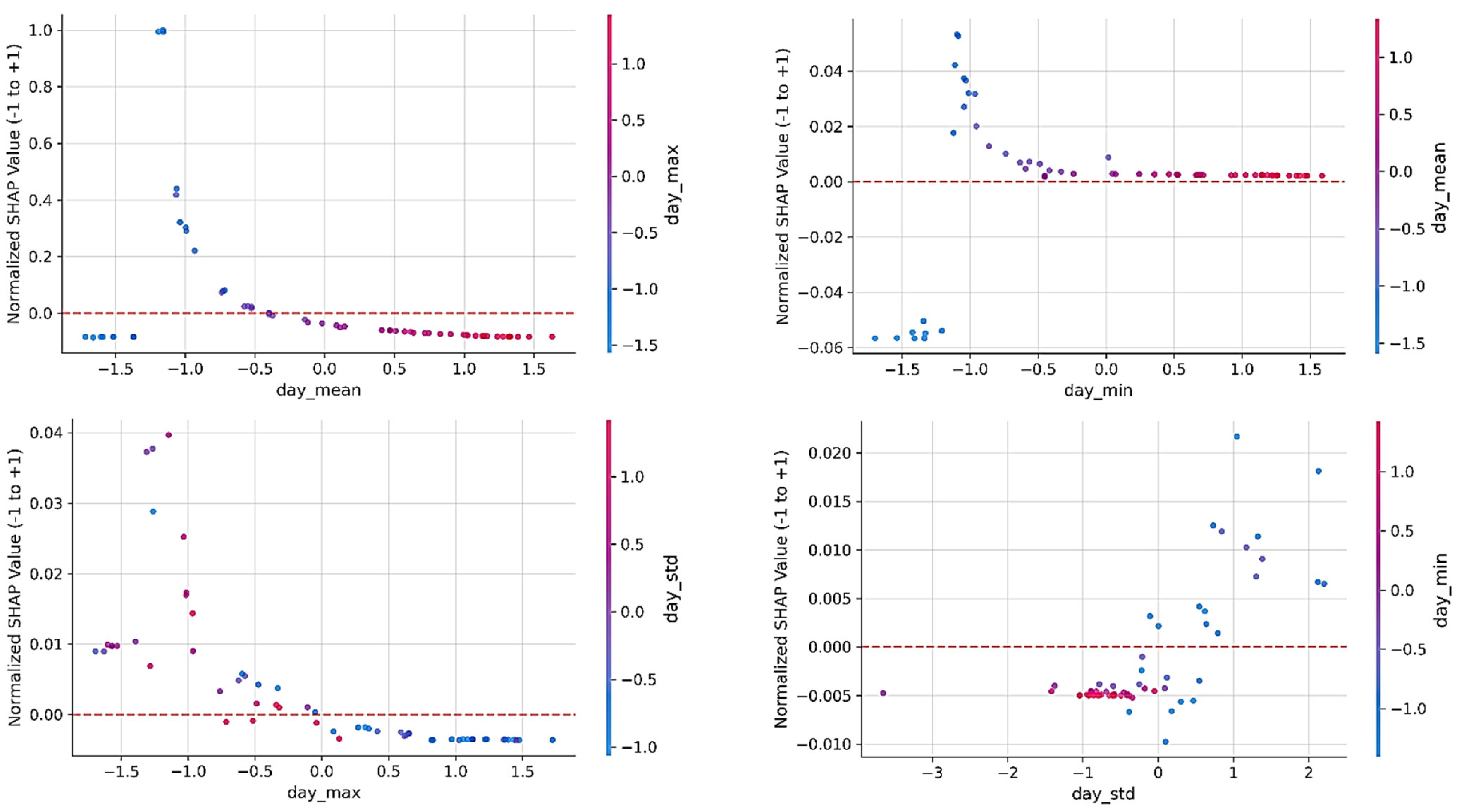
The contribution of each daytime temperature indicator to the DEA scores is elaborated upon through the dependency plots shown in Figure 16, which illustrate the direction and magnitude. The day_min variable exhibits a nonlinear relationship and a considerable interaction with day_mean, to the point that they influence each other. The low SHAP contributions at the negative end and unexpectedly high values indicate that the variable’s effect is pronounced in connection with the mean, not independently. In contrast, the daily standard deviation depicts a disjointed scenario concerning the relationship. Highly variable contributions do not rise substantially, but rather they do so at very low standard deviation values. This indicates that scores do not decrease at low variance, but rather that very stable conditions for temperature create a strong positive signal for the model, thereby invalidating the simplistic assumption that stability is unfavorable. For the day_mean variable, the graph in Figure 16 practically confirms a linear, positive, and highly consistent relationship between the variable and the SHAP value. It is quite clear that high temperatures yield a positive contribution, whereas low temperatures limit efficiency. In summary, the average daytime temperature was the primary factor, and its lower/upper bounds, as well as distribution characteristics and complex interactions, determined DEA scores. This suggests that daytime climate conditions were the primary control mechanism for productivity dynamics.
Meteorological data and RF modeling for the central part of Artvin reveal substantial differences between the coastal and inland areas. The climate values were found to be stable at a mid-range level. Still, high error margins and biases were present at the extremes, thereby confirming the already known susceptibility of high-elevation areas. This is in agreement with the DEA efficiency analyses and Monte Carlo simulations that reflect the same scenario. The mid-range values are considered reliable, whereas the extreme ones have high uncertainty associated with them. The results of the investigation not only underscore the challenges of acclimatization in harsh environments but also corroborate historical patterns and offer hints about the future.

4. Discussion

This study adopts a fully integrated DEA–Monte Carlo–RF–SHAP framework to assess climate-related efficiency under deep uncertainty, avoiding formal null-hypothesis testing in favor of probabilistic uncertainty characterization through confidence intervals, sensitivity metrics, and scenario likelihoods. Such an approach is widely regarded as more appropriate for climate–efficiency analyses where nonlinearity and scenario dependence dominate system behavior.
The results clearly demonstrate a strong coastal–inland contrast between Hopa and Artvin, primarily controlled by topography, altitude, and distance from the Black Sea. Hopa exhibits a comparatively stable thermal regime due to maritime influence, whereas Artvin shows pronounced temperature variability associated with continentality and orographic cooling. This spatial differentiation is consistent with previous microclimatic and topographic studies emphasizing the role of terrain complexity and proximity to water bodies in shaping local climates [38,55,56].
The apparent variations in climatic efficiency between the two regions, Hopa and Artvin, indicate the existence of a structurally varied thermal regime formed due to the coastal-inland contrast. The stronger nocturnal cooling of inland regions implies that Artvin is more sensitive to energy balance processes and interactions between surfaces and atmosphere, which can be reflected in greater susceptibility in areas of the economy like agriculture, energy demand, and frost risk. The fact that the DEA frontier years are temporally clustered also points to the fact that optimum thermal conditions in the region occur during specific periods and are not random, which is a sign of inherent regime changes of regional climatic processes. This meaning is compatible with earlier DEA-based climate research that it has the capacity to describe warming, stabilization, and transition mechanisms [11,12,54], but also with the requirement to combine climate efficiency evaluations with larger socio-environmental systems [15,49]. These trends, in general, indicate that Hopa is shifting towards a more reliable and steady thermal regime, whilst Artvin is limited to topography-induced variability. Monte Carlo simulation projections also emphasize that climate efficiency is highly sensitive to various warming pathways. Although moderate conditions imply that the regional systems can be near-optimal in terms of efficiency, extreme warming causes a significant deterioration of the system efficiency. This implies that the robustness of local climate systems is highly linked to global greenhouse gas patterns [57,58,59,60], where increased emission scenarios increase both efficiency losses and the risks. The increasing disparity between moderate and extreme situations also suggests that uncertainty in itself is an important element of future climatic practice, which supports the need to adopt proactive and location-specific adaptation methods.
DEA results were independently validated using RF and SHAP, reinforcing their robustness. RF has been widely recognized as a high-performance predictor in climate-related efficiency modeling [19,32,47], while SHAP provides transparent attribution of model decisions [20,48]. The analyses consistently identify daily temperature variability particularly nighttime mean and minimum temperatures as the dominant drivers of efficiency in Artvin, confirming the disproportionate role of cold stress and frost-related processes. The successful integration of ML further supports the adoption of next-generation, interpretable data-driven approaches in environmental assessment [22,51,53].
From an applied perspective, the contrasting thermal regimes observed between Hopa and Artvin may have different implications for local adaptation planning. Warmer and more stable coastal temperatures in Hopa could potentially increase the relevance of urban heat management and water-sensitive agricultural practices. In contrast, the colder and more variable thermal regime of Artvin suggests a greater exposure to frost-related risks and winter energy demand. These considerations should be interpreted as contextual implications derived from thermal patterns rather than direct empirical assessments of socioeconomic systems, which were beyond the scope of the present study. These place-based responses are consistent with recent IPCC (2023) guidance advocating micro-scale, context-specific adaptation policies [6].
The socioeconomic implications are substantial. A stabilized climate in Hopa may benefit humid-climate crops such as tea and kiwifruit, although warming-related pest and disease risks remain significant [9,61]. Artvin, by contrast, faces persistent constraints from frost, yield instability, high heating demand, and limited agricultural diversification, reinforcing rural vulnerability [38,55]. Energy demand patterns further diverge, with cooling dominating in Hopa and heating in Artvin, underscoring the need for regionally differentiated efficiency and renewable integration strategies [62,63]. The underlying mechanisms driving these contrasting socioeconomic vulnerability patterns can be linked to the thermal efficiency dynamics identified in this study. In Hopa, the relatively high and stable DEA efficiency scores (clustered near the frontier during 2018–2020) reflect a thermal regime that is approaching the daytime–nighttime balance optimal for agricultural productivity and reduced energy stress. However, the SHAP analysis reveals that this favorable regime is sensitive to mean daytime temperature increases, suggesting that even moderate warming (SSP1-2.6 to SSP2-4.5) could push temperatures beyond the thermal optimum and trigger efficiency losses that translate into crop yield reductions and higher cooling energy demand. In Artvin, the persistently low DEA scores driven by cold nighttime temperatures (identified by SHAP as the dominant efficiency suppressor) reflect a mechanism of frost-induced constraint on biological and infrastructural systems. Warming under intermediate scenarios (SSP2-4.5) may temporarily improve Artvin’s efficiency by reducing frost frequency, but extreme warming (SSP5-8.5) risks destabilizing the water cycle and snowpack dynamics that underpin the area’s hydropower and agricultural water security. Furthermore, the sensitivity analysis results suggest that socio-economic factors, specifically technological innovation and policy effectiveness, are the two largest negative sensitivity drivers (−0.75 and −0.60, respectively), meaning that variance in governance and technological capacity can suppress climate efficiency outcomes more strongly than temperature variability alone. This finding underscores the critical role of socioeconomic factors as mediating variables in climate–efficiency relationships: regions with lower adaptive capacity (lower technology access and weaker governance) face amplified efficiency losses under the same warming scenario compared to better-governed regions. Future research incorporating longitudinal socioeconomic datasets for Hopa and Artvin would enable empirical testing of these mechanistic pathways and support the development of scenario-specific adaptation roadmaps that co-optimize climate efficiency and socioeconomic resilience.
Finally, the observed daytime (1.8–3.7 °C) and nighttime (4–5 °C) gradients are consistent with earlier coastal–inland and complex-terrain studies [9,64,65], while this study contributes novel evidence by explicitly linking thermal gradients to efficiency dynamics. The combined use of DEA, Monte Carlo simulation, RF–SHAP, and sensitivity analysis provides a transferable and scalable framework for diagnosing climate efficiency, vulnerability, and adaptation capacity. Beyond Hopa and Artvin, this approach offers a robust decision-support tool for sustainable climate adaptation planning in the Eastern Black Sea region and other coastal–inland transition zones. The framework’s transferability and scalability as a decision-support tool deserve particular emphasis: the DEA–Monte Carlo–RF–SHAP pipeline requires only standard meteorological inputs (daytime and nighttime temperature series) and is methodologically agnostic to geographic location, making it directly applicable to other regions exhibiting coastal–inland climate gradients, orographic effects, or pronounced microclimatic heterogeneity. Decision-makers in regional planning and climate adaptation can use the risk category outputs (low, medium, high, extreme) as early-warning signals calibrated to local thermal baselines, without requiring the complex climate modeling infrastructure typical of GCM-based approaches. Future implementations of this framework would benefit from directly integrating empirical data on agricultural production yields, water resource availability, and energy consumption statistics alongside the thermal efficiency scores, enabling validation of the socioeconomic assumptions embedded in the current sensitivity parameters and strengthening the evidence base for region-specific adaptation investments.

Limitations and Future Research Recommendations

One of the limitations that could be attached to the generalizability of the results is the focus of this research on merely two locations. The exclusion of other influential factors (e.g., humidity, wind patterns, and atmospheric circulation) was the price paid for the use of LST and MGM data. It is true that the joint application of DEA, RF-SHAP, and Monte Carlo methods is very powerful, but the outcome is still reliant on the underlying data’s quality and coverage. Furthermore, the addition of a wider range of socioeconomic indicators would make future analyses considerably more robust.
It should be noted that the study focuses primarily on climatic indicators and does not directly incorporate socioeconomic or sector-specific datasets such as agricultural production, water resources, or energy consumption statistics. Therefore, the adaptation considerations discussed in this study should be interpreted as conceptual implications based on observed thermal patterns rather than empirically tested policy prescriptions. Future studies integrating climate data with socioeconomic indicators would enable a more robust assessment of climate adaptation priorities.
The scope of this research could be broadened in a number of ways in future studies. To begin with, the geographical coverage of the study can be expanded to other regions other than the Eastern Black Sea to other regions with varying coastal and interior features, thus enhancing the external validity of the results. Second, it would be possible to consider more environmental factors like humidity, wind, precipitation, and soil characteristics to conduct a more in-depth evaluation of the efficiency of climate. Third, the socioeconomic indicators such as income inequality, energy poverty, and agricultural diversity may be integrated to facilitate the explanation of the relationships between climate efficiency and adaptive capacity. Lastly, simulating alternative policy options, e.g., energy efficiency, or agricultural support policies in the DEA and RFSHAP framework may be able to offer more concrete and practical information to decision-makers.

5. Conclusions

The results of the current research demonstrate the obvious and ongoing coast-interior difference in the climatic efficiency of the two municipalities, Hopa and Artvin, which is primarily determined by the topography, the elevation level, and the closeness to the Black Sea. The thermal regime of Hopa is more consistent due to maritime influence, and Artvin is more variable due to the influence of continentality and orographic cooling. Findings of the DEA illustrate that optimum thermal conditions are not random and take place in distinct periods with the highest efficiency levels being experienced during certain periods. The projections of the future also prove that climate efficiency is extremely sensitive to the warm-up directions, as moderate scenarios ensure the almost optimal conditions, and extreme ones result in the significant loss of efficiency (up to almost 21.7%). This research methodologically adds to the literature by combining DEA, Random Forest, SHAP, and Monte Carlo simulation into a single analysis. The methodology will allow to evaluate thermal efficiency, determine the prevailing climatic drivers, and measure the uncertainty in various climatic conditions. The framework suggests a new and generalizable tool to study the efficiency of climate in complex and nonlinear systems by treating every year as a decision making unit and connecting the efficiency outputs with machine learning explainability and probabilistic simulations. In practical terms, the findings emphasize the significance of the place-based climate adaptation policy. The observed spatial heterogeneity of coastal and inland settings is indicative of the fact that a one-size-fits-all policy might not be adequate to deal with local weaknesses. Rather, adaptation planning ought to take into consideration micro-scale climatic variations, especially in areas where topography enhances variability. In general, the paper highlights that climate efficiency is supposed to be viewed as a thermally-oriented indicator, and its future course is tightly connected with the global emission patterns and the state of the environment in the regions.

Author Contributions

M.A.Ç. and V.D.: Study concept and design, data collection. M.A.Ç., V.D., İ.G., and Y.K.: Analyses, interpretation of results, manuscript preparation, and critical revision. M.A.Ç., M.B.A. and D.D.: Reviewed and approved the final version of the manuscript. All authors have read and agreed to the published version of the manuscript.

Funding

The authors received no financial support from public, commercial, or not-for-profit funding agencies to conduct this research.

Informed Consent Statement

Not applicable.

Data Availability Statement

The datasets generated and/or analyzed during the current study are available from the corresponding author upon reasonable request.

Acknowledgments

The author gratefully acknowledges the General Directorate of Meteorology (MGM) and Google Earth Engine (GEE) for providing meteorological datasets. The manuscript was translated into English using the free version (1.75.0) of DeepL, and ChatGPT 5 Free was also utilized to support language editing and improve clarity.

Conflicts of Interest

The authors declare that they have no known competing financial interests or personal relationships that could have appeared to influence the work reported in this manuscript.

References

  1. Schmidt, L.; Stensland, S. Managing Climate Change in the Cradle of Skiing: Exploring Adaptation and Mitigation Strategies. Mitig. Adapt. Strateg. Glob. Change 2025, 30, 57. [Google Scholar] [CrossRef]
  2. Diffenbaugh, N.S.; Field, C.B. Changes in Ecologically Critical Terrestrial Climate Conditions. Science 2013, 341, 486–492. [Google Scholar] [CrossRef] [PubMed]
  3. Adger, W.N. Vulnerability. Glob. Environ. Change 2006, 16, 268–281. [Google Scholar] [CrossRef]
  4. Füssel, H.M.; Klein, R.J.T. Climate Change Vulnerability Assessments: An Evolution of Conceptual Thinking. Clim. Change 2006, 75, 301–329. [Google Scholar] [CrossRef]
  5. Tuihedur Rahman, H.M.; Hickey, G.M. An Analytical Framework for Assessing Context-Specific Rural Livelihood Vulnerability. Sustainability 2020, 12, 5654. [Google Scholar] [CrossRef]
  6. Intergovernmental Panel on Climate Change (IPCC). Climate Change 2022: Impacts, Adaptation and Vulnerability; Cambridge University Press: Cambridge, UK, 2023. [Google Scholar] [CrossRef]
  7. Schneider, S.H. The Changing Climate. Sci. Am. 1989, 261, 70–78. [Google Scholar] [CrossRef]
  8. Krusell, P.L.; Smith, A.A. Climate Change Around the World; NBER Working Paper No. 30338; National Bureau of Economic Research: Cambridge, MA, USA, 2022. [Google Scholar] [CrossRef]
  9. Pathak, T.B.; Maskey, M.L.; Dahlberg, J.A.; Kearns, F.; Bali, K.M.; Zaccaria, D. Climate Change Trends and Impacts on California Agriculture: A Detailed Review. Agronomy 2018, 8, 25. [Google Scholar] [CrossRef]
  10. Sokolow, A.D.; Kuminoff, N.V. Farmland, Urbanization, and Agriculture in the Sacramento Region. Prepared for Capital Region Institute, Regional Futures Compendium. 2000. Available online: https://cail.ucdavis.edu/research1/FUASR,color%20maps.pdf (accessed on 25 December 2025).
  11. Elasraag, Y.; Ahmed, Y. Data Envelopment Analysis for Chickpeas Production in Egypt. J. Agric. Econ. Soc. Sci. 2023, 14, 139–141. [Google Scholar] [CrossRef]
  12. Radovanov, B.; Marcikić-Horvat, A.; Stojić, D.; Sedlak, O.; Bobera, D. Assessing Circular Economy Performance of European Countries and Serbia Using Data Envelopment Analysis. Eur. J. Appl. Econ. 2023, 20, 1–11. [Google Scholar] [CrossRef]
  13. Charnes, A.; Cooper, W.W.; Rhodes, E. Measuring the Efficiency of Decision Making Units. Eur. J. Oper. Res. 1978, 2, 429–444. [Google Scholar] [CrossRef]
  14. Cooper, W.W.; Seiford, L.M.; Tone, K. Data Envelopment Analysis: A Comprehensive Text with Models, Applications, References and DEA-Solver Software, 2nd ed.; Springer: New York, NY, USA, 2007. [Google Scholar] [CrossRef]
  15. Sıcakyuz, C. Bibliometric Analysis of Data Envelopment Analysis in Supply Chain Management. J. Oper. Strateg. Anal. 2023, 1, 14–24. [Google Scholar] [CrossRef]
  16. Sexton, T.R.; Pitocco, C.; Lewis, H.F. Using Data Envelopment Analysis to Measure and Improve Organizational Performance. Public Adm. Rev. 2023, 83, 1150–1165. [Google Scholar] [CrossRef]
  17. Momand, A.; Momand, I.; Amiri, N.M.; Mujtaba, B.G. Exploring Climate Change Vulnerability and Adaptation among Smallholder Farmers in Nangarhar, Afghanistan: A Social-Ecological Systems Perspective. Adv. Mod. Agric. 2024, 5, 3021. [Google Scholar] [CrossRef]
  18. Ernawati, E.; Madi, R.A.; Asri, M. Correlation Macroeconomic, Government Efficiency, Infrastructure, and Climate Change Vulnerability: A Cross-Country Analysis. In IOP Conference Series: Earth and Environmental Science; IOP Publishing: Bristol, UK, 2024; Volume 1302. [Google Scholar]
  19. Mardian, J.; Champagne, C.; Bonsal, B.; Berg, A. A Machine Learning Framework for Predicting and Understanding the Canadian Drought Monitor. Water Resour. Res. 2023, 59, e2022WR033847. [Google Scholar] [CrossRef]
  20. Xie, J.; Yin, G.; Xie, Q.; Wu, C.; Yuan, W.; Zeng, Y.; Verger, A.; Descals, A.; Filella, I.; Peñuelas, J. Shifts in Climatic Limitations on Global Vegetation Productivity Unveiled by Shapley Additive Explanation: Reduced Temperature but Increased Water Limitations. J. Geophys. Res. Biogeosciences 2024, 129, e2024JG008354. [Google Scholar] [CrossRef]
  21. Salam, M.A.; Anik, A.R. Social Safety Nets and Productivity Outcomes: Evidence and Implications for Bangladeshi Rice Growers. Asian Econ. J. 2023, 37, 401–428. [Google Scholar] [CrossRef]
  22. Airiken, M.; Li, S. The Dynamic Monitoring and Driving Forces Analysis of Ecological Environment Quality in the Tibetan Plateau Based on the Google Earth Engine. Remote Sens. 2024, 16, 682. [Google Scholar] [CrossRef]
  23. Erinç, S. Jeomorfoloji I; İstanbul Üniversitesi Yayınları: İstanbul, Turkey, 1958. [Google Scholar]
  24. Duran, C. Türkiye’nin Bitki Çeşitliliğinde Dağlık Alanların Rolü. Biyol. Bilim. Araştırma Derg. 2013, 6, 72–77. [Google Scholar]
  25. Geiger, R.; Aron, R.H.; Todhunter, P. The Climate Near the Ground; Vieweg+Teubner Verlag: Wiesbaden, Germany, 1995. [Google Scholar] [CrossRef]
  26. Barry, R.; Chorley, R.; Barry, R.G.; Chorley, R. Atmosphere, Weather and Climate. In Atmosphere, Weather and Climate; Routledge: London, UK, 2002. [Google Scholar] [CrossRef]
  27. Atalay, İ. Türkiye Coğrafyası, 5th ed.; Ege Üniversitesi Basımevi: İzmir, Turkey, 1997. [Google Scholar]
  28. Öztürk, M.Z.; Çetinkaya, G.; Aydın, S. Köppen-Geiger İklim Sınıflandırmasına Göre Türkiye’nin İklim Tipleri. J. Geog. 2017, 35, 17–27. [Google Scholar] [CrossRef]
  29. Yılmaz, E.; Çiçek, İ. Detailed Köppen-Geiger Climate Regions of Turkey. J. Hum. Sci. 2018, 15, 225–242. [Google Scholar] [CrossRef]
  30. Harrison, R.L. Introduction to Monte Carlo Simulation. AIP Conf. Proc. 2010, 1204, 17–21. [Google Scholar] [CrossRef]
  31. Raychaudhuri, S. Introduction to Monte Carlo Simulation. In Winter Simulation Conference; IEEE: New York, NY, USA, 2008. [Google Scholar] [CrossRef]
  32. Aslam, M.; Lee, J.M.; Kim, H.S.; Lee, S.J.; Hong, S. Deep Learning Models for Long-Term Solar Radiation Forecasting Considering Microgrid Installation: A Comparative Study. Energies 2019, 13, 147. [Google Scholar] [CrossRef]
  33. Saltelli, A.; Ratto, M.; Andres, T.; Campolongo, F.; Cariboni, J.; Gatelli, D.; Saisana, M.; Tarantola, S. Global Sensitivity Analysis. The Primer; John Wiley & Sons: Hoboken, NJ, USA, 2008. [Google Scholar] [CrossRef]
  34. Aboua, A.C.D.K. Resource Efficiency and Economic Efficiency of Fish Farms in the Southeast of Côte d’Ivoire. Asian J. Fish. Aquat. Res. 2023, 22, 26–40. [Google Scholar] [CrossRef]
  35. Hamad, M.S.; Shabib, M.M. Estimating the Levels of Economic Efficiency of Yellow Corn Crop Farms in Kirkuk Governorate—Hawija District (a Model) For the Production Season 2022 AD. Tikrit J. Agric. Sci. 2024, 24, 263–275. [Google Scholar] [CrossRef]
  36. Zhang, M.; Ma, N.; Yang, Y. Carbon Footprint Assessment and Efficiency Measurement of Wood Processing Industry Based on Life Cycle Assessment. Sustainability 2023, 15, 6558. [Google Scholar] [CrossRef]
  37. Saraswati, R.; Kusumowidagdo, A.; Susilowati Sukirmiyadi Karaman, N.; Ali, M.; Zafriana, L.; Teowarang, J. Mapping the Efficiency of Surabaya’s Creative Industries with Data Envelopment Analysis—A Push towards a Circular Economy. In IOP Conference Series: Earth and Environmental Science; IOP Publishing: Bristol, UK, 2025; Volume 1454. [Google Scholar] [CrossRef]
  38. McNichol, B.H.; Wang, R.; Hefner, A.; Helzer, C.; McMahon, S.M.; Russo, S.E. Topographically Driven Microclimatic Gradients Shape Patterns of Forest Structure, Diversity, and Composition at a Forest-Grassland Transition Zone. bioRxiv 2022. [Google Scholar] [CrossRef]
  39. Wang, C.N.; Nguyen, T.T.T.; Dang, T.T.; Hsu, H.P. Exploring Economic and Environmental Efficiency in Renewable Energy Utilization: A Case Study in the Organization for Economic Cooperation and Development Countries. Environ. Sci. Pollut. Res. 2023, 30, 72949–72965. [Google Scholar] [CrossRef]
  40. Zhou, P.; Ang, B.W.; Wang, H. Energy and CO2 Emission Performance in Electricity Generation: A Non-Radial Directional Distance Function Approach. Eur. J. Oper. Res. 2012, 221, 625–635. [Google Scholar] [CrossRef]
  41. Mardani, A.; Zavadskas, E.K.; Streimikiene, D.; Jusoh, A.; Khoshnoudi, M. A Comprehensive Review of Data Envelopment Analysis (DEA) Approach in Energy Efficiency. Renew. Sustain. Energy Rev. 2017, 70, 1298–1322. [Google Scholar] [CrossRef]
  42. Box, G.E.P.; Muller, M.E. A Note on the Generation of Random Normal Deviates. Ann. Math. Stat. 1958, 29, 610–611. [Google Scholar] [CrossRef]
  43. Saltelli, A.; Annoni, P.; Azzini, I.; Campolongo, F.; Ratto, M.; Tarantola, S. Variance Based Sensitivity Analysis of Model Output. Design and Estimator for the Total Sensitivity Index. Comput. Phys. Commun. 2010, 181, 259–270. [Google Scholar] [CrossRef]
  44. Hutengs, C.; Vohland, M. Downscaling Land Surface Temperatures at Regional Scales with Random Forest Regression. Remote Sens. Environ. 2016, 178, 127–141. [Google Scholar] [CrossRef]
  45. Pang, B.; Yue, J.; Zhao, G.; Xu, Z. Statistical Downscaling of Temperature with the Random Forest Model. Adv. Meteorol. 2017, 2017, 1–11. [Google Scholar] [CrossRef]
  46. Alcântara, E.; Baião, C.; Guimarães, Y.; Mantovani, J. Machine Learning and Climate Scenario Integration Reveals Controls on Flood Susceptibility in the Taquari-Antas Basin, Brazil. Model. Earth Syst. Environ. 2025, 11, 410. [Google Scholar] [CrossRef]
  47. Breiman, L. Random Forests. Mach. Learn. 2001, 45, 5–32. [Google Scholar] [CrossRef]
  48. Lundberg, S.M.; Lee, S.I. A Unified Approach to Interpreting Model Predictions. In Advances in Neural Information Processing Systems; Curran Associates, Inc.: Red Hook, NY, USA, 2017; Volume 2017. [Google Scholar]
  49. Lessard, J.M.; Habert, G.; Tagnit-Hamou, A.; Amor, B. Assessing Robustness of Consequential LCA: Insights from a Multiregional Economic Model Tailored to the Cement Industrial Symbiosis. J. Ind. Ecol. 2024, 28, 1392–1408. [Google Scholar] [CrossRef]
  50. Stagnitti, M.; Lara, J.L.; Musumeci, R.E.; Foti, E. Assessment of the Failure Probability of Upgraded Rubble-Mound Breakwaters. Coast. Eng. Proc. 2023, 37, 46. [Google Scholar] [CrossRef]
  51. Hu, L.; Deng, S.; Ma, J.; Liang, K.; Shao, Y.; Liu, M.; Yang, J.; Fang, W.; Bi, J.; Ma, Z. Informing Risk Hotspots and Critical Mitigations for Rainstorms Using Machine Learning: Evidence from 268 Chinese Cities. Environ. Sci. Technol. 2025, 59, 1619–1630. [Google Scholar] [CrossRef]
  52. Tobisova, A.; Seňová, A.; Rozenberg, R. Risk Factors’ Prediction Model for the Investment Evaluation. Entrep. Sustain. Issues 2023, 11, 153–168. [Google Scholar] [CrossRef]
  53. Ding, D.; Xu, Y. Path to Net Zero: Understanding the Building Energy Efficiency in Different Climates across Various Building Types. Highlights Sustain. 2024, 3, 308–337. [Google Scholar] [CrossRef]
  54. Jahani Sayyad Noveiri, M.; Kordrostami, S.; Ghiyasi, M. Inverse Data Envelopment Analysis Optimization Approaches with Flexible Measures. J. Model. Manag. 2024, 19, 194–214. [Google Scholar] [CrossRef]
  55. Oldfather, M.F.; Ackerly, D.D. Microclimate and Demography Interact to Shape Stable Population Dynamics across the Range of an Alpine Plant. New Phytol. 2019, 222, 193–205. [Google Scholar] [CrossRef] [PubMed]
  56. Stark, J.R.; Fridley, J.D. Topographic Drivers of Soil Moisture Across a Large Sensor Network in the Southern Appalachian Mountains (USA). Water Resour. Res. 2023, 59, e2022WR034315. [Google Scholar] [CrossRef]
  57. Zhong, S.; Ying, J.; Collins, M. Sources of Uncertainty in the Time of Emergence of Tropical Pacific Climate Change Signal: Role of Internal Variability. J. Clim. 2023, 36, 2535–2549. [Google Scholar] [CrossRef]
  58. Smith, C.J.; Al Khourdajie, A.; Yang, P.; Folini, D. Climate Uncertainty Impacts on Optimal Mitigation Pathways and Social Cost of Carbon. Environ. Res. Lett. 2023, 18, 094024. [Google Scholar] [CrossRef]
  59. Wang, T.; Teng, F.; Deng, X.; Xie, J. Climate Module Disparities Explain Inconsistent Estimates of the Social Cost of Carbon in Integrated Assessment Models. One Earth 2022, 5, 767–778. [Google Scholar] [CrossRef]
  60. Wu, R.; Niu, X.; Jing, X.; Li, P.; Mao, Y.; Chen, X.; Wang, S. Future Projection and Uncertainty Analysis of Wind and Solar Energy in China Based on an Ensemble of CORDEX-EA-II Regional Climate Simulations. J. Geophys. Res. Atmos. 2024, 129, e2023JD040271. [Google Scholar] [CrossRef]
  61. Naik, A.; Jogi, M.; Shreenivas, B.V. Assessing the Impact of Climate Change on Global Crop Yields and Farming Practices. Arch. Curr. Res. Int. 2024, 24, 696–712. [Google Scholar] [CrossRef]
  62. Kudo, R.; Yoshida, T.; Masumoto, T. Nationwide Assessment of the Impact of Climate Change on Agricultural Water Resources in Japan Using Multiple Emission Scenarios in CMIP5. Hydrol. Res. Lett. 2017, 11, 31–36. [Google Scholar] [CrossRef]
  63. Lacko, R.; Hajduová, Z. Determinants of Environmental Efficiency of the EU Countries Using Two-Step DEA Approach. Sustainability 2018, 10, 3525. [Google Scholar] [CrossRef]
  64. Lawson, C.R.; Bennie, J.; Hodgson, J.A.; Thomas, C.D.; Wilson, R.J. Topographic Microclimates Drive Microhabitat Associations at the Range Margin of a Butterfly. Ecography 2014, 37, 732–740. [Google Scholar] [CrossRef]
  65. Lippok, D.; Beck, S.G.; Renison, D.; Hensen, I.; Apaza, A.E.; Schleuning, M. Topography and Edge Effects Are More Important than Elevation as Drivers of Vegetation Patterns in a Neotropical Montane Forest. J. Veg. Sci. 2014, 25, 724–733. [Google Scholar] [CrossRef]
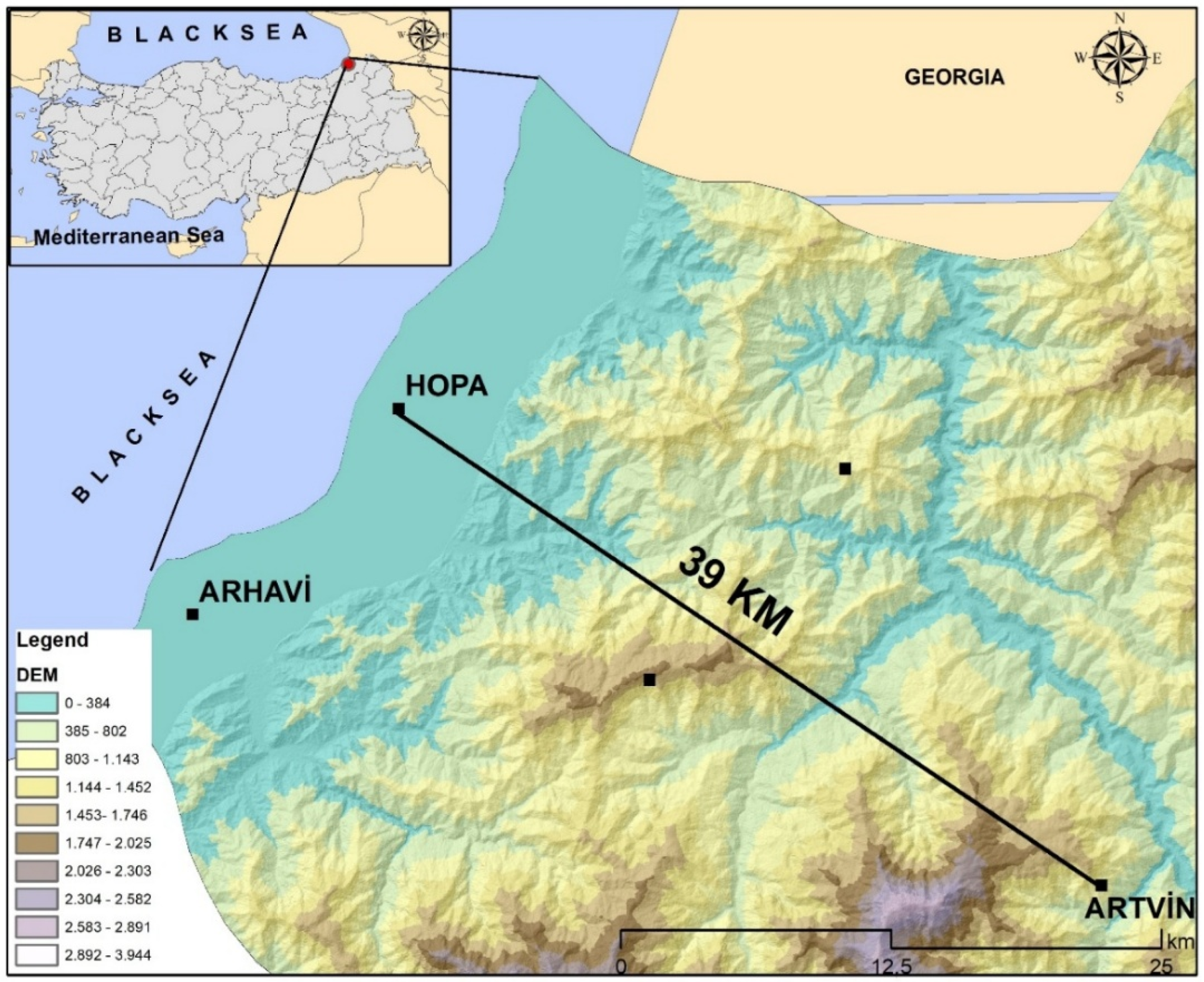
Figure 1. Location map of the study area.
Atmosphere 17 00381 g001
Figure 2. A flowchart summarizing the integrated methodological framework used in the study.
Atmosphere 17 00381 g002
Figure 3. Fluctuations in historical DEA efficiency scores between 2000 and 2024.
Atmosphere 17 00381 g003
Figure 4. Monte Carlo convergence analysis.
Atmosphere 17 00381 g004
Figure 5. Probability distribution of simulated 2050 DEA scores.
Atmosphere 17 00381 g005
Figure 6. Sensitivity analysis matrix (Positive values (green bars) indicate an increase in DEA efficiency, whereas negative values (red bars) represent a decrease).
Atmosphere 17 00381 g006
Figure 7. Monte Carlo Bootstrap Distribution of Mean Daytime Temperature (Hopa and Artvin).
Atmosphere 17 00381 g007
Figure 8. Bootstrap Annual Mean Temperature Distributions: Boxplot Comparison (Hopa and Artvin).
Atmosphere 17 00381 g008
Figure 9. Bootstrap Distributions of Mean Temperature (2000–2024).
Atmosphere 17 00381 g009
Figure 10. Bootstrap annual mean temperature distributions boxplot comparison (For Hopa and Artvin).
Atmosphere 17 00381 g010
Figure 11. Temporal course of DEA scores for monthly daytime and nighttime temperature metrics (Artvin Center, 2000–2024).
Atmosphere 17 00381 g011
Figure 12. Results for the RF model to estimate DEA values (Artvin Center, 2000–2024).
Atmosphere 17 00381 g012
Figure 13. Results for the RF model to estimate DEA values with 95% Confidence Intervals (Artvin Center, 2000–2024).
Atmosphere 17 00381 g013
Figure 14. Statistical metrics are used to evaluate the success of the RF model and estimate DEA values (Artvin Center, 2000–2024).
Atmosphere 17 00381 g014
Figure 15. The SHAP summary plot illustrates the moderating effect and distribution of each feature on the DEA score.
Atmosphere 17 00381 g015
Figure 16. SHAP dependence plot for the day–mean, day–min, day–max, and day–std features contributing to the RF model.
Atmosphere 17 00381 g016
Table 2. Comparative Insights and Critical Thresholds.
Risk ImplicationEfficiency DynamicsTemperature ImpactDEA Score TrendScenario Range
Low risk, high resilience+7% to +8% growth+0.8 °C to +1.2 °CStable, near frontier (0.985–0.995)RCP-1.9–2.6
Moderate risk, transitional state+4.9% growth+2.1 °CModerate decline (0.965)RCP-4.5
High risk, near tipping pointMinimal growth (+0.5%)+3.4 °CRapid decline (0.925)RCP-6.0
Extreme risk, system breakdown−5% to −22% loss+4.8 °C to +7.2 °CSevere collapse (0.720–0.875)RCP-8.5
Disclaimer/Publisher’s Note: The statements, opinions and data contained in all publications are solely those of the individual author(s) and contributor(s) and not of MDPI and/or the editor(s). MDPI and/or the editor(s) disclaim responsibility for any injury to people or property resulting from any ideas, methods, instructions or products referred to in the content.