Article

Improving Indoor Air Quality in a University Teaching Complex: Continuous Monitoring and the Impact of Renovation Works


by
Mattia Paolo Aliano
1,†,
Matteo Antonelli
1,†,
Alessandro Gambarara
2,
Raffaella Campana
2,
Giulia Baldelli
1,3,*,
Giuditta Fiorella Schiavano
1,4,
Giulia Amagliani
1,3,
Francesco Palma
3,
Massimo Santoro
5,
Giorgio Brandi
3 and
Mauro Magnani
1,3
1
STE—Sanitizing Technologies and Equipments s.r.l., 61020 Petriano, Italy
2
Prevention and Protection Office, University of Urbino Carlo Bo, 61029 Urbino, Italy
3
Department of Biomolecular Sciences, University of Urbino Carlo Bo, 61029 Urbino, Italy
4
Department of Humanities, University of Urbino Carlo Bo, 61029 Urbino, Italy
5
Division of Biotechnologies, Department for Sustainability, Italian National Agency for New Technologies, Energy and Sustainable Economic Development (ENEA), 00123 Rome, Italy
*
Author to whom correspondence should be addressed.
These authors contributed equally to this work.
Atmosphere 2026, 17(4), 379; https://doi.org/10.3390/atmos17040379
Submission received: 25 February 2026 / Revised: 3 April 2026 / Accepted: 4 April 2026 / Published: 8 April 2026
(This article belongs to the Section Air Quality and Health)

Abstract

This study investigates whether a university teaching complex equipped with CSA S600 continuous air purification and sanitation units can maintain indoor air quality (IAQ) within recommended thresholds under real occupancy conditions and evaluates the impact of renovation works on IAQ. The work provides the first real-world assessment of the CSA S600 integrated monitoring system in an academic environment. CO2, PM2.5, PM10 and VOCs were continuously measured over three months; moreover, indoor PM10 values were compared with outdoor data from the regional monitoring network. Indoor CO2 generally remained below 800 ppm, with short peaks of 1000–1500 ppm during high occupancy. PM2.5 and PM10 consistently stayed below the latest WHO guidelines, showing uniform recurring temporal patterns overtime; furthermore, indoor PM10 showed limited coupling with outdoor trends, indicating the predominance of internal sources and ventilation dynamics. After renovation of the main Lecture Hall, particulate levels remained low, while VOCs showed a modest increase attributable to new materials. Overall, the findings demonstrate that the CSA S600 system effectively supports healthy IAQ in educational settings and that continuous monitoring is essential for managing occupancy-driven fluctuations and assessing the effects of structural interventions.

1. Introduction

Indoor Environmental Quality (IEQ) in educational environments is a critical determinant of the health and academic performance of students and staff. Among the various parameters that compose it—thermal comfort, acoustics, and lighting—Indoor Air Quality (IAQ) is the one that most directly influences both psychophysical well-being and cognitive abilities. In recent years, numerous studies have documented how poor air quality in classrooms is associated with respiratory symptoms, difficulty of attention, reduced school performance and increased absenteeism [1,2].
Poor indoor air quality has been consistently associated with an increased risk of both infectious and non-infectious respiratory diseases. Evidence indicates that inadequate ventilation, high levels of particulate matter, volatile organic compounds, and microbial contamination in indoor environments can facilitate the transmission of respiratory viruses, including influenza and influenza-like illnesses [3,4]. Moreover, exposure to indoor pollutants such as NO2, mold, and chemical irritants has been linked to asthma exacerbation, allergic rhinitis, and other chronic respiratory conditions in children and adults [5,6]. These findings highlight IAQ as a critical factor influencing both acute infection outcomes and long-term respiratory health.
The impact of the main air pollutants on health is now a well-known topic: prolonged exposure to critical concentrations of air contaminants such as CO2, particulate matter, volatile organic compounds (VOCs), and other gaseous pollutants is associated with the appearance of diseases affecting the respiratory tract and beyond. CO2 levels above 1000 ppm can lead to symptoms classically associated with sick building syndrome (dry eyes and upper airways) as well as cognitive and decision-making deficits, even for short periods of exposure [7]. As far as particulate matter is concerned, a publication by Pryor and others reports that, in addition to direct exposure to the respiratory system, atmospheric particulate matter can cross endothelial barriers, enter the bloodstream and accumulate in multiple organ systems [8]. Continuous exposure to VOCs not only impacts sino-nasal pathological conditions, but can also have repercussions on the incidence of infectious diseases not limited to the respiratory tract [9]. Persistent or recurrent exposure to substantial amounts of VOCs could cause health problems such as central nervous system (CNS), kidney, and liver injury [10,11]. Several VOCs are carcinogenic, genotoxic, mutagenic, and neurotoxic [12,13].
The most frequently encountered critical issues in educational environments concern the excessive concentration of carbon dioxide (CO2), fine particulate matter (PM2.5 and PM10), VOCs, and the presence of mold and other biological agents. CO2 values often exceeding 1000 ppm have been observed in numerous studies conducted in naturally ventilated classrooms, with negative effects on both the health and cognitive performance of students [14]. Scientific evidence confirms that insufficient ventilation and inadequate comfort conditions impair learning: increases in ventilation rates are in fact associated with better results in standardized tests [15], while poor air quality in the classroom significantly reduces the ability to concentrate [16]. The link between IAQ and academic performance has also been investigated in epidemiological studies, which have shown associations between high CO2 levels, higher absenteeism, and lower educational success [17]. This evidence is also confirmed by a systematic review: a recent study summarized how the main critical factors of IEQ in educational environments are insufficient ventilation, excessive concentration of chemical and biological pollutants and poor quality of thermal comfort, emphasizing their joint impact on health and performance [18]. In this context, the document of recommendations of the UNESCO Chair in Health Education and Sustainable Development and the Italian Society of Environmental Medicine reiterates that air quality in school environments is not only a technical issue of construction, but a determinant of educational equity: ensuring adequate IAQ means reducing inequalities and promoting the right to health and learning in optimal conditions [2].
The combination of this evidence makes it clear that air quality cannot be considered a secondary aspect in the design and management of educational spaces but constitutes a central factor for the protection of public health and for the improvement of student performance.
In addition to the level of ventilation and the occupancy of spaces, materials and finishes in university environments—such as carpeted floors, wall tiles, furnishings, and adhesives—play a non-negligible role in affecting air quality, especially in environments where natural or mechanical ventilation is insufficient. In a recent study [19], for example, it was observed that in a carpeted amphitheater, PM10 levels far exceeded the latest WHO air quality guidelines [20], showing that occupant movements and flooring type are correlated with significant increases in PM. In addition, the same study recorded CO2 peaks above 1000 ppm, up to 3000 ppm in some rooms with poor natural ventilation during classes. Another example is found in the investigation conducted by Abbas and others, which measured contaminants such as PM2.5, PM10, formaldehyde, NO2, TVOC in Egyptian university classrooms: even if some of these variables were within the WHO limits [20], exceedances of formaldehyde and NO2 were found in specific rooms, which had interior finishes with materials that seemed to contribute to the release of these pollutants [21].
These results show that ventilation is not enough: the combined effect of interior materials, occupancy rate, layout of furniture and type of flooring can lead to significant risk factors for respiratory health, comfort (olfactory, acoustic, thermal) and concentration of students.
At the University of Urbino Carlo Bo, air purification and sanitization units were deployed across teaching rooms to improve indoor air quality for students and staff. Each unit integrates a sensor platform providing continuous, real-time measurements of key IAQ parameters. After installation, the main Lecture Hall underwent renovation and refurnishing while the devices were already in operation.
In this study, we provide a first real-world assessment of the CSA S600 integrated monitoring system in a university teaching complex, combining multi-parameter continuous IAQ tracking, indoor–outdoor comparison, and a before–after renovation analysis of the main Lecture Hall. Here, we report continuous IAQ monitoring across the university teaching complex by tracking CO2, PM2.5, PM10, and VOCs from January to March 2024. Indoor PM10 was compared with concurrent outdoor measurements from the ARPAM Regional Air Quality Network to examine indoor–outdoor coupling. Finally, we performed a month-matched comparison between March 2024 and March 2025 in the Lecture Hall to evaluate the effect of renovation and refurnishing on IAQ.

2. Materials and Methods

2.1. Study Site

The Paolo Volponi Scientific Teaching Area (ASD)—Carlo Bo University of Urbino is a university complex (Urbino, Italy; latitude/longitude: 43.722282, 12.637022) (Figure 1) dedicated to frontal teaching, located within the historic center of the city of Urbino (13.849 inhabitants) (ISTAT, 2025).
The ASD consists of six floors, two located above the ground floor (floors A and B), one at the ground floor (floor C) and three basements (identified as floor D and floor E, between which there is a service floor for university staff): the floors below the ground floor are not equipped with windows for ventilation of the rooms, whose task is completely supported by the air handling unit, which operates with a mixed-flow configuration, ensuring a flow rate composed of 50% recirculated air and 50% fresh external air. The scientific teaching area has common areas, classrooms for lessons, offices, and laboratories.
In 2023, between the months of July and September, the complex was equipped with 50 plug and play devices dedicated to air sanitization and purification called Continuous Sanitization Air (CSA) System S600 (STE Sanitizing Technologies and Equipment, Petriano, Italy): these devices are installed on the wall, at a minimum height of 1.5 m from the ground, following the distribution by rooms specified in Table 1.
In particular, the Lecture Hall environment is a space used for lessons and conferences that can be architecturally divided into two smaller rooms (Lecture Hall E1 and Lecture Hall E2) thanks to a partition system that delimits the two classrooms. Recently, in the period from 1 June 2024 to 31 August 2024, the Lecture Hall underwent modernization and structural revisitation works, such as the replacement of the flooring (elimination of carpeting) and the renovation of seating and other supplies—also important actions for the state of air quality in the environment itself.
Following a review of the data collected from the sensors positioned throughout the complex, the results derived from 13 environments located on different floors will be presented. For each floor, at least four environments were identified to ensure continuous coverage of sensor data throughout the entire monitoring period. For floor E, which has only two environments, only data from one environment is reported. The sensors belong to CSA System S600 devices (STE-Sanitizing Technologies and Equipments srl., Petriano, Italy) installed in the following areas:
Floor A/B: Computer Room, Microscopy Laboratory, Room B1, Room B2;
Floor C: Room C1, Room C2, Room C3, Room C6;
Floor D: Room D1, Room D2, Room D3, Room D5;
Floor E: Lecture Hall E2.

2.2. Tracking Campaigns

This study examines air quality monitoring data collected over the period of January, February, and March 2024. For this monitoring campaign, the daily average values were collected for each parameter measured by the sensor within the time window of interest. The data resulting from this quarter of surveillance, those relating to PM10 within the complex, were compared with the PM10 data collected in the same time window by the regional body “ARPAM—Regional Agency for Environmental Protection of the Marche Region” within the “R.R.Q.A.—Regional Air Quality Network” project. The data were collected by a PM10 [µg/m3] analyzer (STE-Sanitizing Technologies and Equipments srl., Petriano, Italy) placed at street level (in Urbino, Via Neruda, 1.54 km as the crow flies from the study site) (Figure 1).
As regards the IAQ sampling within the Lecture Hall environment after one year (before–after renovation), the reported time windows have been identified in the months of March 2024 and March 2025.

2.3. Instrumentation and Monitored Parameters

All the CSA System S600 devices incorporate the CSA System Technology: CSA system is a continuously operating air sanitation and purification system that aims at killing airborne microorganisms and reducing potential pollutants in the air (e.g., PM10, VOCs). Similar devices involving this technology have already been studied in train environment [22] and indoor sports environment [23]. The system (international patent application: N.PCT/IB2021/054194) consists of an ionizer (according to the manufacturer’s specifications, the device does not produce ozone under normal operating conditions), an ISO Coarse 90% self-sanitizing filter (STE-Sanitizing Technologies and Equipments srl., Petriano, Italy), UV-C LEDs (STE-Sanitizing Technologies and Equipments srl., Petriano, Italy), and a sensor platform for detecting air quality parameters; the “plug and play” CSA System S600 solution comes with an own ventilation system capable of moving air up to 600 m3/h.
Each CSA System S600 is equipped with an air quality sensor platform; the sensor platform is a modular measuring point for monitoring the range of indoor environments. It keeps the main parameters related to environmental quality under control. The version installed into the CSA Technology measures carbon dioxide concentration, particulate matter (PM1.0, PM2.5 and PM10), VOCs, temperature, relative humidity, and air pressure. The CO2 sensor is an NDIR (Non-Dispersive Infrared) sensor, whose operating principle is based on the ability of CO2 molecules to absorb specific infrared wavelengths, typically around 4.26 µm. The sensor features a self-calibration algorithm that adjusts its internal correction function based on data collected over the previous seven days. The PM sensor operates using optical scattering: a laser beam is collimated onto a constant airflow. A photodiode measures the light scattered by the particles, allowing the device to count and size the individual particles hit by the beam and thus determine their concentration. According to the supplier, these sensors are factory-calibrated and do not require additional calibration, maintaining stability over time. The VOC sensor is based on MOx (metal-oxide) technology. Its principle relies on measuring the electrical resistance of a gas-sensitive metal-oxide layer, which reacts to oxidizing and reducing gases, as well as to temperature and humidity. The device includes a compensation algorithm for humidity and temperature, allowing these parameters to be excluded from the measurement. The gases detected include oxidizing gases such as NOx and reducing gases such as VOCs (formaldehyde, ethanol, toluene, etc.) and hydrogen (H2). The sensor is not sensitive to CO or methane. VOCs are measured on a broad spectrum, and because the sensor reacts to multiple gases, it cannot distinguish them or determine their concentration in ppb; for this reason, the output is expressed in levels rather than absolute values. The validation of the sensor’s performance is carried out by the supplier, in accordance with the instructions provided in the document “20240615_IOP_Procedura test QuAir postproduzione”.
The collected data are sent to a web platform through a Wi-Fi connection, where it is possible to view the data in real time, consult the history of the measurements taken, set or modify the thresholds for each parameter, define and activate alarms for each parameter. All the data collected can be consulted via graph or downloaded in .csv format, so that data analysis can be performed. All specifications for the detection of the air quality parameters monitored by the sensor platform are shown (Table 2).
In this publication, only the results for the parameters CO2, PM2.5, PM10 and VOCs are presented. Microclimatic parameters (temperature, relative humidity, and atmospheric pressure) were also recorded by the platform and are reported as descriptive context in the Supplementary Material (Table S1).

2.4. Statistical Analysis

Normality of distributions was assessed using the Shapiro–Wilk test. Exploratory associations among pollutants (CO2, PM2.5, PM10, VOCs) and microclimatic variables (T, RH, pressure) were evaluated using correlation analysis (Spearman’s rank). The presence and periodicity of seasonality in the analyzed time series were evaluated using the FORECAST.ETS.SEASONALITY function in Microsoft Excel, Version 2207 (Build 16.0.15427.20182) for Windows (Microsoft Corporation, Redmond, WA, USA, https://www.microsoft.com). This approach relies on an exponential smoothing (ETS) algorithm to identify statistically significant repeating patterns and to estimate the most likely seasonal cycle length. Additional exploratory analyses were performed to relate pollutant metrics to room capacity as a surrogate descriptor of occupancy potential. The indoor–outdoor (I/O) PM10 ratio was used to evaluate the relative contribution of indoor and outdoor sources, as calculated using the following equation (Equation (1)):
Equation (1)
I / O = C i n d o o r C o u t d o o r
where Cindoor and Coutdoor represent the indoor and outdoor PM10 concentrations, respectively.
To compare the differences between indoor and outdoor PM10 concentrations, 2024 vs. 2025 Lecture Hall’s CO2, PM2.5, PM10 and VOC concentration, an unpaired t-test with Welch’s correction was performed using GraphPad Prism version 10.6.1 for Windows [GraphPad Software, Boston, MA, USA, www.graphpad.com].

3. Results and Discussion

3.1. IAQ Monitoring: January 2024–March 2024 Window

This section of the paragraph reports the main data resulting from monitoring in 13 environments within the complex; the most interesting data relate to CO2, PM2.5, PM10, and VOCs, for which tables are presented with monthly average and maximum values, daily trends for the parameter over the period of interest, and distribution graphs of the values average. Additional data are available in the Supplementary Materials (Table S2).

3.2. CO2

The average CO2 concentrations (ppm) measured over the three months of monitoring, along with the maximum daily average values recorded in each month, are presented in Table 3.
The CO2 data collected over the three months of surveillance reveal distinct patterns across the various monitored environments, both in terms of average values and maximum recorded peaks. Overall, the monthly averages remain within a relatively contained range (470–770 ppm), with most rooms showing modest increases from January to March, suggesting a progressive rise in occupancy or activity levels as the quarter advanced. Maximum values, by contrast, display greater variability and highlight specific episodes of high crowding or limited ventilation, particularly in rooms such as the Computer Room, Room C6 and Room D5, where peaks exceed 1700 ppm (up to 1900 in the Computer Room).
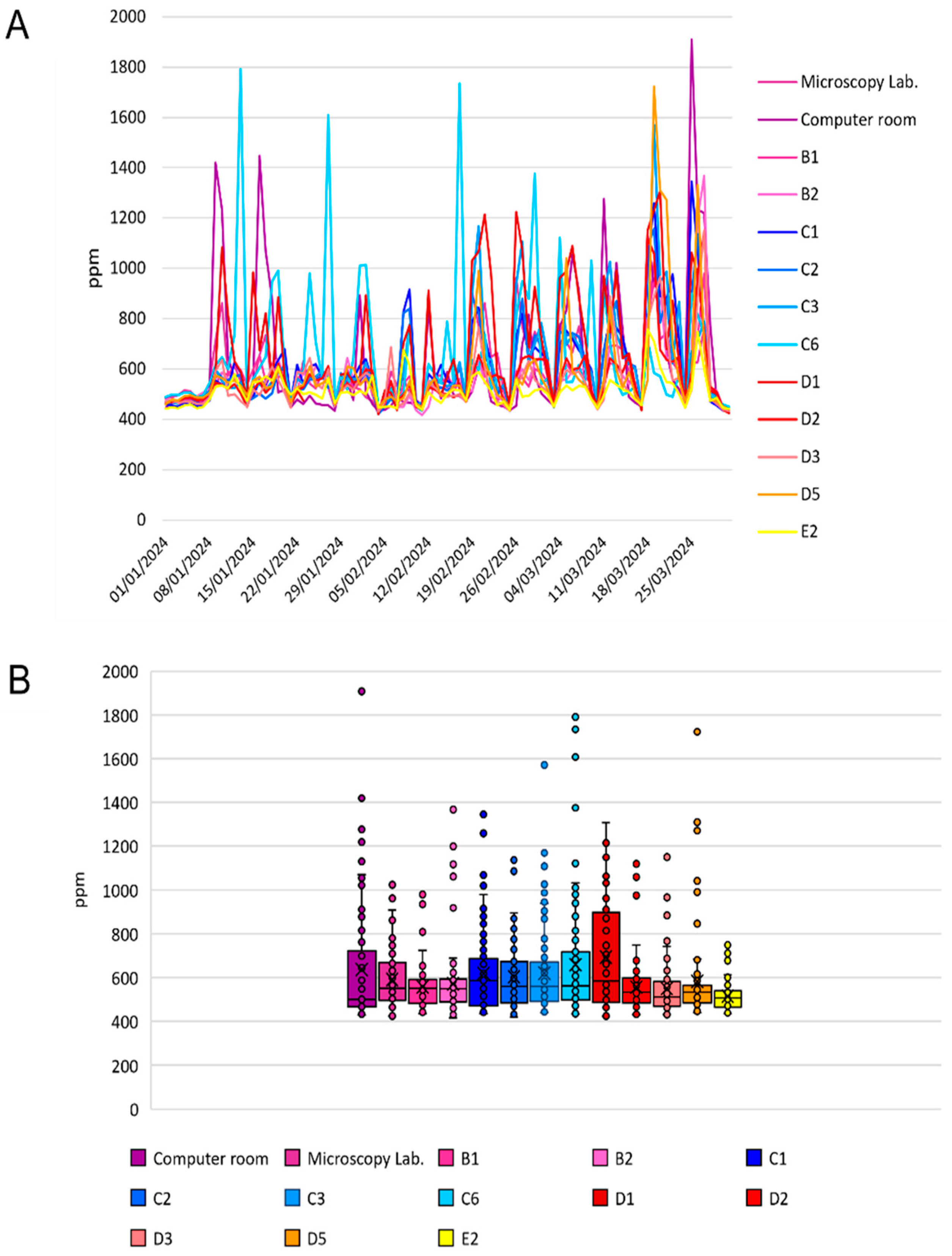
Shown in Figure 2, the graphical outputs provide a comprehensive depiction of both the temporal behavior and statistical distribution of CO2 levels within the monitored areas.
The distribution of CO2 concentrations, visualized through the daily trends and boxplots, confirms these differences among environments: some spaces exhibit stable and well-ventilated conditions throughout the period (e.g., Rooms E2, B1, B2), while others show broader fluctuations and occasional sharp increases, a pattern that may be partly explained by their smaller volume and reduced air-exchange capacity. In these more confined rooms, even short periods of increased occupancy can lead to rapid CO2 accumulation, making them more sensitive to variations in crowding and ventilation efficiency. Taken together, the three-month dataset illustrates a heterogeneous situation across the complex, with generally acceptable average CO2 levels but with sporadic high-concentration events that may warrant targeted improvements in specific rooms. The maximum values recorded in some environments (reaching up to 1900 ppm) exceed the thresholds typically associated with adequate ventilation according to international standards such as EN 16798-1 [24] and ANSI/ASHRAE 62.1 [25], suggesting episodes of insufficient air exchange during periods of higher occupancy. These findings highlight the need to pay particular attention to the ventilation performance of the rooms exhibiting the most pronounced peaks, where targeted improvements may help prevent recurrent CO2 accumulation. A time series seasonality analysis was performed to identify recurring temporal patterns in indoor CO2 concentrations: the results indicate heterogeneous behavior across the monitored rooms, with alternating presence and absence of seasonality, with a recurring pattern from 0 to 7 days. This suggests that CO2 dynamics are primarily driven by occupancy patterns and room usage, rather than by consistent cyclic environmental processes.

3.3. PM2.5

Table 4 presents the average PM2.5 levels observed during the three-month monitoring period and the corresponding monthly peak values.
Across the complex, PM2.5 concentrations show a seasonal decrease from January to March, with nearly all monitored environments exhibiting their highest average levels in January and their lowest in March. This uniform reduction suggests the influence of seasonal ventilation patterns, reduced heating-related emissions, or changes in occupancy as the academic period progresses. February often exhibits the highest peak values, even if its monthly average is not the largest. For instance, in the Microscopy Lab, the maximum daily average PM2.5 concentration reaches 13.73 µg/m3, and in Room B2, the peak daily average rises to 15.37 µg/m3; these values remain below the 24 h guideline set by the WHO, which recommends a maximum of 15 µg/m3 for PM2.5 exposure [20].
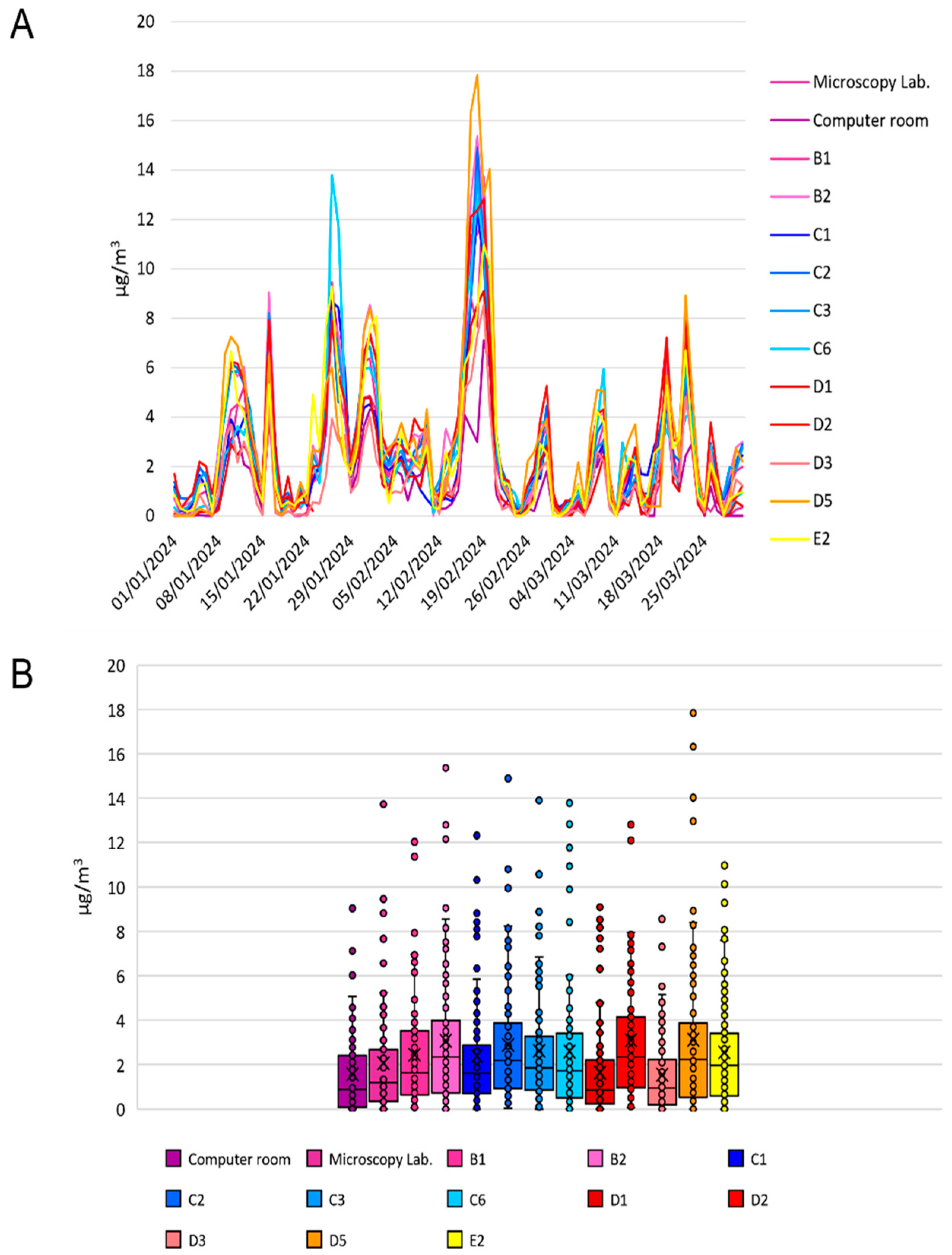
Figure 3 presents the temporal evolution of PM2.5 during the surveillance period, using daily averages measured by each device in the environments of interest, and the corresponding distribution of these measurements over the same timeframe.
The graphical trends further highlight day-to-day variability superimposed on the general monthly pattern. Environments such as the Microscopy Lab or Rooms B1, B2, C1 and C3, show greater dispersion in the data distribution, whereas areas such as the Computer Room or D-series rooms, display more consistent and moderate values across the surveillance period. The distribution plots reinforce the observation that high-concentration events are sporadic rather than persistent, clustering most measurements in the lower range while a limited number of outliers contribute to the monthly maxima. Overall, the monitoring results suggest that PM2.5 levels within the university complex remain generally low and well-controlled, with temporary increases likely linked to specific operational activities rather than baseline air quality issues. The progressive decline from winter to early spring, combined with the episodic nature of peak events, provides a clear interpretation of the environmental dynamics governing particulate concentrations in these academic settings. A seasonal analysis of the time series was performed to identify periodic patterns in PM2.5 concentrations. The findings reveal a consistent and uniform seasonal component across all monitored environments, which repeats every 18 days, suggesting stable and recurrent behavior likely driven by common background sources, which makes the phenomenon highly predictable.

3.4. PM10

Displayed in Table 5 are the mean PM10 concentrations from the three-month monitoring period and the highest value observed in each month.
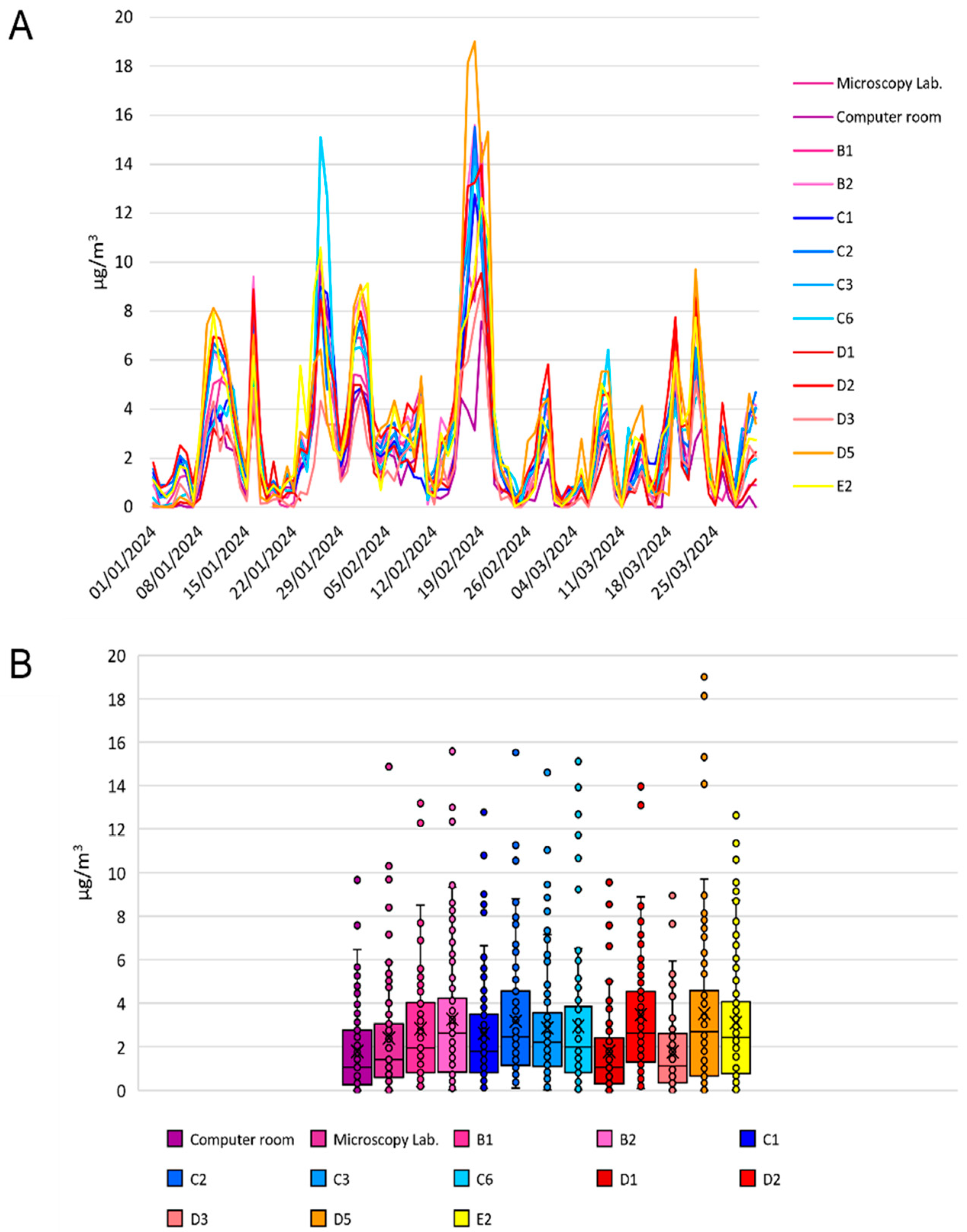
The PM10 data in Table 5 show generally low particulate concentrations across all monitored lecture rooms, with average values remaining in the low single-digit range throughout the three months. February displays slightly higher averages in many environments (such as B1, B2, C2, and D5) before values decrease again in March, suggesting seasonal influences or temporary increases in occupancy and indoor activity. Maximum average daily concentrations follow the same pattern, with several rooms showing higher episodic peaks in February, though these remain moderate and consistent with normal fluctuations in occupied educational spaces; the highest recorded values are well below the 24 h exposure guideline (45 µg/m3) set by the WHO [20].
Figure 4 depicts the trend of PM10 concentrations over the surveillance period, obtained from the daily average readings collected by each monitoring device in the environments considered, and the distribution of these data throughout the same timeframe. By integrating both the temporal progression and the statistical distribution of the measurements, these figures provide a more comprehensive overview of how PM10 levels fluctuated and how frequently specific concentration ranges occurred in each monitored environment.
The daily patterns shown in Figure 4 confirm the coexistence of a stable, low background level and occasional fluctuations of PM10 tied to typical classroom dynamics. Given that the monitored environments are primarily lecture rooms, the observed PM10 variability is plausibly linked to student presence, movement, and normal indoor activities, as well as the characteristics of room furnishings and ventilation cycles. Overall, these data indicate that PM10 concentrations remain consistently low, with only limited episodic elevations that fall within expected ranges for occupied educational spaces. A seasonal analysis of the PM10 time series was conducted to assess recurring cycles: consistent with the findings for PM2.5, the analysis shows a clear and uniform seasonal pattern across all rooms, repeated every 18 days.

3.5. VOCs

Table 6 reports the average VOC concentrations measured over the three months of monitoring, along with the maximum values recorded in each month of the surveillance period.
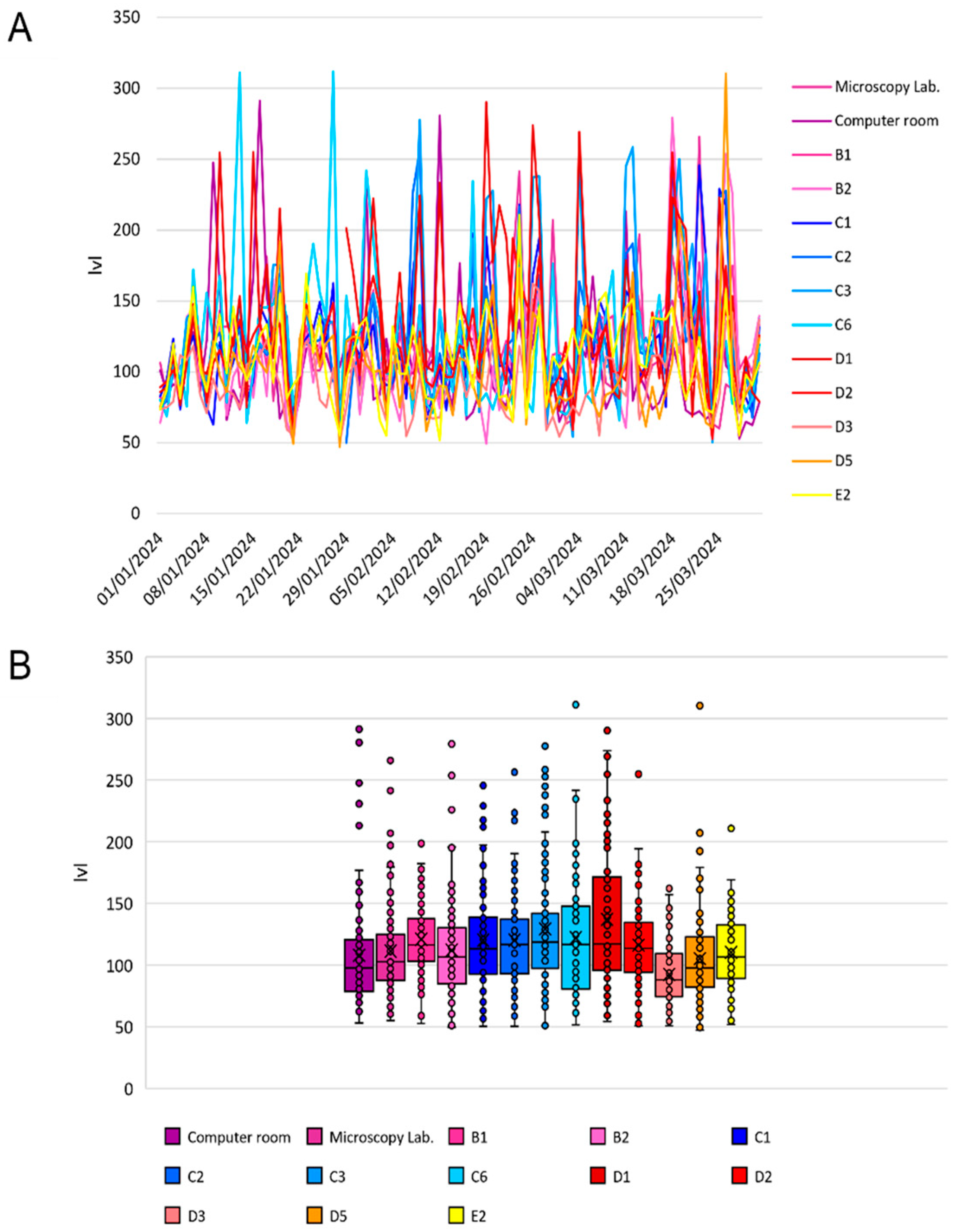
The monitoring results in Table 6 reveal notable spatial and temporal variability in VOC concentrations across the surveyed environments, with average values generally ranging from about 90 to 135 lvl. Some rooms, such as the Computer Room, show a decline from January to February followed by a partial rise in March, while others (e.g., Microscopy Lab, B1, C1, C2 and C3) exhibit higher averages in the later months, likely reflecting changes in activities. Maximum average daily concentrations highlight episodic peaks well above these mean values, such as the Computer Room in January (311.84 lvl) and D5 in March (310.25 lvl). Many environments show their highest peaks in February or March, suggesting increasing episodic emissions as the monitoring period progresses.
Figure 5 illustrates the temporal trend of VOC concentrations during the surveillance period—derived from the daily averages recorded by each device in the environments under study—and the distribution of these values over the same period. Together, the two figures provide an overview of both the day-to-day variability of VOC levels and their overall statistical behavior across the monitored environments.
The daily trends illustrated in Figure 5A and the distribution patterns in Figure 5B further reinforce the presence of both sustained background concentrations and intermittent spikes: given that most monitored environments are university lecture rooms, the variability is plausibly associated with differences in furnishing materials (such as wood-based components and carpets), occupancy levels, and the presence of students carrying personal care products, perfumes, or other VOCs-emitting items. These factors likely contribute to a stable baseline of emissions, occasionally amplified during periods of high attendance, or increased human activity. Overall, these data suggest that baseline VOC levels remain relatively stable across the monitored period, with some rooms showing occasional peak values reflecting normal fluctuations linked to occupancy and environmental conditions. A seasonal analysis of the VOC level time series was carried out to investigate cyclical patterns. The results reveal irregular behavior (with patterns ranging from 0 to 10 days), with seasonality present only in some environments, suggesting that VOC concentrations are affected by localized and intermittent emission sources, which results in less predictable temporal dynamics.
Monthly VOC levels recorded in the Aula Magna from October 2024 to October 2025 (following the completion of the renovation and installation of new materials by August 2024) show an overall decreasing trend. Although the associated linear fit explains a limited to moderate portion of the variance (R2 ≈ 0.4), the direction of the trend is consistent with a gradual decay in emissions attributable to post-installation degassing. This supports the interpretation that the increase in VOCs observed in March 2025 was, at least in part, transitory and consistent with a post-renovation stabilization process rather than a persistent deterioration in baseline indoor air quality; the monthly dataset is therefore reported as Supplementary Material (Figure S1).

3.6. IAQ Monitoring: Indoor and Outdoor PM10

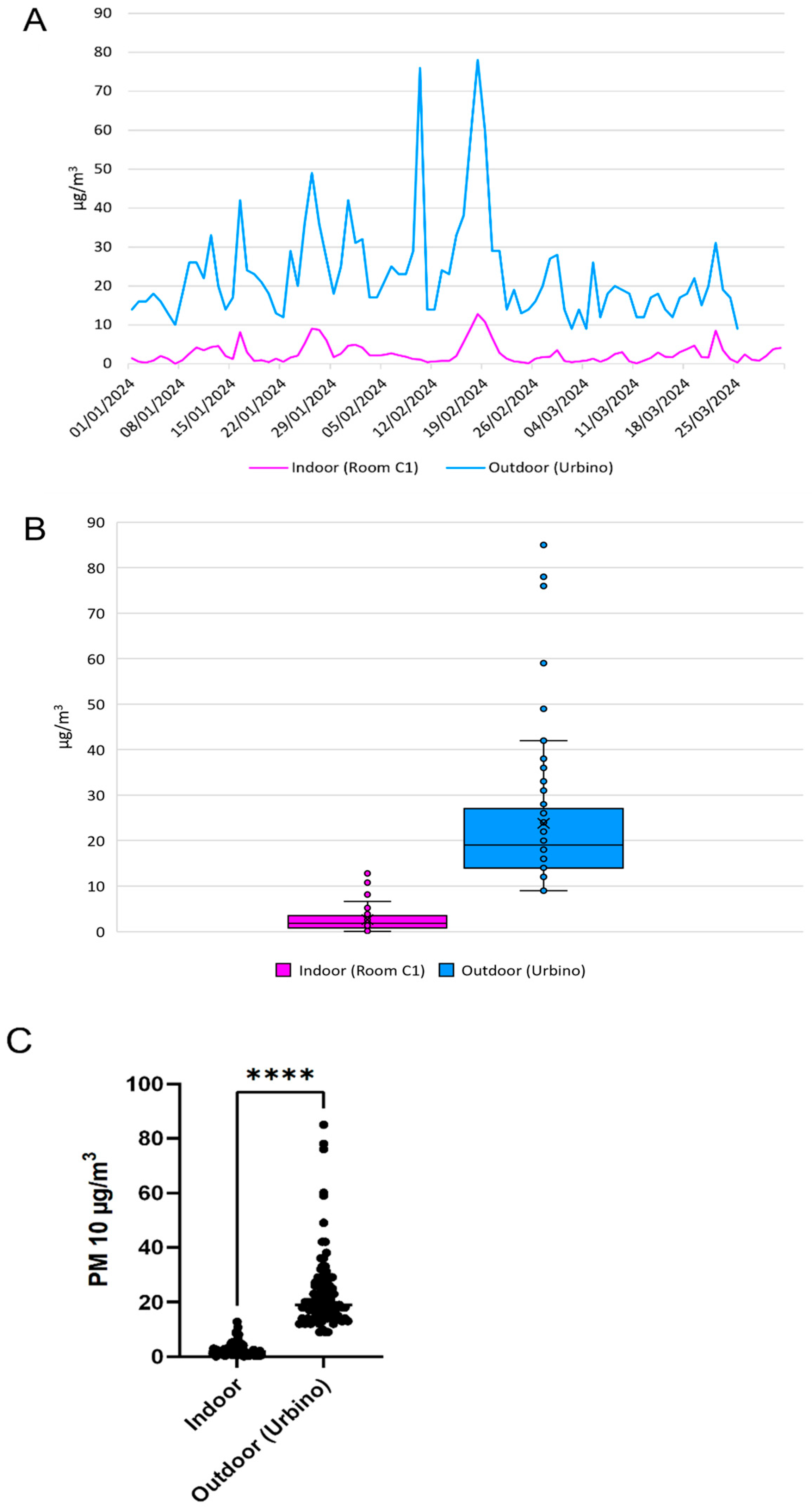
The particulate matter data is the only certified parameter of interest available for the meteorological station located in Urbino, as indicated in Section 2.1. Figure 6 presents the indoor PM10 concentration data collected within the ASD complex and compares it with the corresponding PM10 outdoor measurements provided by ARPAM for the same monitoring period (from January 2024 to March 2024).
The comparison between indoor and outdoor PM10 concentrations highlights a clear and consistent difference between the two environments: as shown in Figure 6B, indoor levels measured within the building remain generally low and stable, with limited variability and only occasional minor fluctuations. In contrast, the outdoor dataset recorded by ARPAM exhibits markedly higher values and a wider dispersion, including several pronounced peaks that significantly exceed indoor concentrations. Some of these outdoor peaks also surpass the most recent WHO Air Quality Guideline [20] for 24 h PM10 exposure (45 µg/m3), highlighting the occurrence of short-term pollution episodes in the surrounding urban area during the monitoring period. This trend is further confirmed by the temporal analysis (see Figure 6A), where outdoor PM10 displays recurrent spikes associated with episodic pollution events, while indoor values follow a much flatter and more contained pattern. The PM10 indoor-to-outdoor (I/O) ratio, computed on a daily basis as the ratio between indoor and outdoor concentrations, consistently remained below 0.3 throughout the monitoring period, indicating a substantial attenuation, likely associated with the filtration system efficiency. Overall, the results suggest that the indoor environment of the complex experiences might substantially lower particulate levels than those observed outdoors during the same monitoring period. To support this difference, the PM10 concentrations measured inside the indoor environment were subjected to statistical testing. The reported scatter dot plot (see Figure 6C) shows a significant statistical difference between the average concentration recorded indoors and that measured outdoors.

3.7. IAQ Monitoring: March 2024 and March 2025

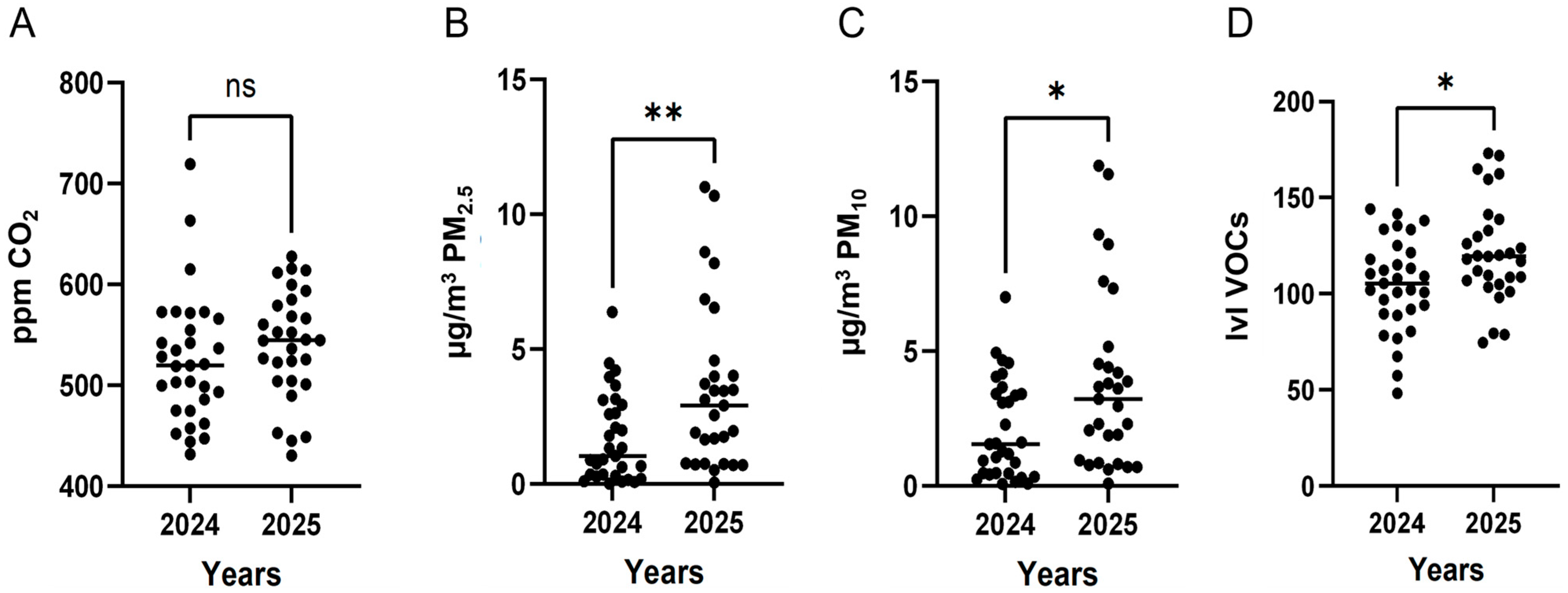
The comparative analysis was carried out in a classroom environment intended for educational activities, characterized by an average occupancy rate of approximately 80% of its nominal capacity. As described in Section 2.1, the space is conditioned by an air-handling unit operating with a mixed-flow configuration, supplying equal proportions of outdoor air and recirculated air. The comparative analysis was carried out by examining the meteorological conditions recorded in March 2024 and March 2025 in the Urbino area, using data provided by an online meteorological database service (www.ilmeteo.it) (accessed on 2 February 2026). The comparison between the two periods reveals only limited differences in the main atmospheric parameters. Monthly mean temperatures show modest variations, with slightly lower values in March 2025 compared to March 2024, yet still within the typical range of local climatic variability. The precipitation regime is likewise comparable: both months exhibit distributed rainfall events throughout the period. Secondary parameters, such as relative humidity and wind speed, do not display variations indicative of substantially different climatic conditions between the two years. Overall, the meteorological data indicate that March 2024 and March 2025 present similar climatic conditions, allowing for a homogeneous comparison of the environmental and HVAC performance of the analyzed building. Figure 7 presents the comparison of daily average concentrations of CO2, PM2.5, PM10, and VOCs measured in the Lecture Hall during the monitoring campaigns conducted in March 2024 and March 2025. The combined analysis of the datasets enables the evaluation of annual trends and supports the interpretation of influencing factors such as occupancy, ventilation performance, and contributions from outdoor air.
Regarding CO2 (Figure 7A), both monitoring periods show values within a similar range, and the statistical test does not indicate a significant difference (p > 0.05). Nevertheless, a slight upward shift is observed in 2025 along with reduced variability, which may be associated with higher occupancy levels or less efficient ventilation compared to the previous year.
For PM2.5 and PM10 (Figure 7B and Figure 7C, respectively), statistically significant differences emerge between the two campaigns (p < 0.05), with generally higher concentrations recorded in 2025. However, the increase is modest, and all values remain well below international guideline thresholds for indoor air quality [20], confirming a healthy environment throughout both monitoring periods. The variations observed are likely linked to normal operational changes or fluctuations in outdoor air and ventilation behavior.
Finally, VOC levels (Figure 7D) show a significant increase in 2025 (p < 0.05) compared with 2024. Although still within typical ranges for regularly occupied indoor environments, this trend may be attributed to the introduction of new furnishings in the Lecture Hall prior to the second monitoring campaign, contributing to additional emissions through the off gassing of materials. Exploratory capacity-related summaries and correlation results are provided in the Supplementary Material (Table S3 and Figure S2).
Microclimatic parameters (temperature, relative humidity, and atmospheric pressure) were recorded throughout the monitoring period and considered as contextual variables potentially influencing both indoor pollutant dynamics and sensor response. Given the multifactorial nature of IAQ in occupied buildings (occupancy patterns, ventilation rates, outdoor contributions and indoor sources), relationships among pollutants (CO2, PM2.5, PM10, VOCs) and microclimatic variables were addressed as exploratory. In addition, room capacity was evaluated as a static descriptor of the spaces; however, it does not capture real-time occupancy nor air-exchange conditions and should therefore be interpreted with caution. For transparency, exploratory correlation outputs and capacity-related plots are reported in the Supplementary Material (Table S3 and Figure S2).

4. Conclusions

This study provides a real-world assessment of indoor air quality (IAQ) in a university teaching complex equipped with CSA S600 continuous air sanitation units. Across 13 monitored environments, CO2 concentrations remained largely within acceptable ranges, with monthly averages between approximately 500 and 750 ppm and short peaks of 1000–1500 ppm only during periods of high occupancy. PM2.5 and PM10 levels consistently stayed below latest WHO guideline values, with maximum daily averages never exceeding 15 µg/m3 for PM2.5. Indoor PM10 showed limited correlation with outdoor ARPAM data, indicating that the CSA S600 purification effects and building-specific ventilation patterns predominantly shaped indoor particulate dynamics. However, meteorological outdoor conditions that can modulate outdoor PM levels have not been related to the results, representing a possible source of bias. Following the renovation of the Lecture Hall, particulate concentrations remained low, while VOC levels increased slightly, likely due to emissions from new materials.
These findings demonstrate that the CSA S600 system is suitable for long-term, distributed IAQ monitoring in educational settings and can support the identification of occupancy-driven fluctuations as well as the evaluation of structural interventions. The integration of continuous monitoring with air sanitation technologies represents a valuable approach for maintaining healthy indoor environments in high-density academic buildings.
Future studies could focus on fewer rooms with direct occupancy tracking to better quantify the relationship between human presence and pollutant dynamics. In this study, the monitoring period spanned three months, providing a robust snapshot of winter–early spring conditions but not a full seasonal cycle. Extending the observation to 12 months would allow for an assessment of seasonal variability.
Despite these limitations, the study establishes a solid foundation for more controlled future investigations and highlights the importance of continuous IAQ monitoring as a decision-support tool for university facility management.

Supplementary Materials

The following supporting information can be downloaded at https://www.mdpi.com/article/10.3390/atmos17040379/s1, Table S1: Microclimatic parameters monthly mean values (January, February and March 2024) for temperature, relative humidity, and air pressure across the 13 monitored environments; Table S2: Room capacity (nominal seats) and March 2024 monthly mean values for CO2, PM2.5, PM10 and VOCs across the 13 monitored environments. Capacity is reported as a static descriptor of the spaces and does not represent real-time occupancy; Figure S1: Monthly mean VOC levels measured in the Lecture Hall from October 2024 to October 2025; Table S3: Spearman’s rank correlation coefficients (ρ) computed using room-level mean values for CO2, PM2.5, PM10 and VOCs across the 13 monitored environments; Figure S2: Heatmap representation of Spearman’s ρ based on room-level mean values.

Author Contributions

Conceptualization, M.P.A., M.A., A.G. and M.M.; Providing significant technical knowledge and access to CSA S600 system, M.P.A. and M.A.; Formal analysis and data curation, M.P.A., M.A., G.B. (Giulia Baldelli), G.F.S., G.A., F.P., M.S., R.C. and M.M.; Writing—review and editing, A.G., R.C., G.B. (Giulia Baldelli), G.F.S., G.A., F.P., G.B. (Giorgio Brandi) and M.M. All authors have read and agreed to the published version of the manuscript.

Funding

This research did not receive any specific grant from funding agencies in the public, commercial, or not-for-profit sectors.

Institutional Review Board Statement

Not applicable.

Informed Consent Statement

Not applicable.

Data Availability Statement

The data that support the findings of this study are available from the corresponding author upon reasonable request.

Conflicts of Interest

Authors M.P.A. and M.A. were employed; G.B., G.F.S. and M.M. were founders by the company STE-Sanitizing Technologies and Euqipments s.r.l. The remaining authors declare that the research was conducted in the absence of any commercial or financial relationships that could be construed as a potential conflict of interest.

References

  1. da Ferreira, A.M.C.; Cardoso, M. Indoor air quality and health in schools. J. Bras. Pneumol. 2014, 40, 259–268. [Google Scholar] [CrossRef]
  2. Pulimeno, M.; Piscitelli, P.; Colazzo, S.; Colao, A.; Miani, A. Indoor air quality at school and students’ performance: Recommendations of the UNESCO Chair on Health Education and Sustainable Development & the Italian Society of Environmental Medicine (SIMA). Health Promot. Perspect. 2020, 10, 169–174. [Google Scholar] [CrossRef]
  3. Alqarni, Z.; Rezgui, Y.; Petri, I.; Ghoroghi, A. Viral infection transmission and indoor air quality: A systematic review. Sci. Total Environ. 2024, 923, 171308. [Google Scholar] [CrossRef]
  4. Fakunle, A.G.; Jafta, N.; Naidoo, R.N.; Smit, L.A.M. Association of indoor microbial aerosols with respiratory symptoms among under-five children: A systematic review and meta-analysis. Environ. Health 2021, 20, 77. [Google Scholar] [CrossRef]
  5. Nie, T.; Zhang, G.; Sun, Y.; Wang, W.; Wang, T.; Duan, H. Effects of Indoor Air Quality on Human Physiological Impact: A Review. Buildings 2025, 15, 1296. [Google Scholar] [CrossRef]
  6. Agache, I.; Canelo-Aybar, C.; Annesi-Maesano, I.; Cecchi, L.; Biagioni, B.; Chung, F.; D’Amato, G.; Damialis, A.; Del Giacco, S.; De las Vecillas, L.; et al. The impact of indoor pollution on asthma-related outcomes: A systematic review for the EAACI guidelines on environmental science for allergic diseases and asthma. Allergy 2024, 79, 1761–1788. [Google Scholar] [CrossRef] [PubMed]
  7. Azuma, K.; Kagi, N.; Yanagi, U.; Osawa, H. Effects of low-level inhalation exposure to carbon dioxide in indoor environments: A short review on human health and psychomotor performance. Environ. Int. 2018, 121, 51–56. [Google Scholar] [CrossRef] [PubMed]
  8. Pryor, J.T.; Cowley, L.O.; Simonds, S.E. The Physiological Effects of Air Pollution: Particulate Matter, Physiology and Disease. Front. Public Health 2022, 10, 882569. [Google Scholar] [CrossRef]
  9. Jung, Y.S.; Chiang, S.; Athni, T.S.; Shah, J.; McCurdy, K.; Yu, S.E.; Kariveda, R.; Mitchell, M.; Ruan, M.; Zou, J.; et al. Characterizing everyday exposure to volatile organic compounds and upper respiratory health effects. Sci. Rep. 2025, 15, 23555. [Google Scholar] [CrossRef]
  10. Rao, G.; Vejerano, E.P. Partitioning of volatile organic compounds to aerosols: A review. Chemosphere 2018, 212, 282–296. [Google Scholar] [CrossRef] [PubMed]
  11. Chauhan, S.K.; Saini, N.; Yadav, V.B. Recent Trends of Volatile Organic Compounds in Ambient Air & Its Health Impacts: A Review. Int. J. Technol. Res. Eng. 2014, 1, 667. [Google Scholar]
  12. Talibov, M.; Sormunen, J.; Hansen, J.; Kjaerheim, K.; Martinsen, J.-I.; Sparen, P.; Tryggvadottir, L.; Weiderpass, E.; Pukkala, E. Benzene exposure at workplace and risk of colorectal cancer in four Nordic countries. Cancer Epidemiol. 2018, 55, 156–161. [Google Scholar] [CrossRef]
  13. Boulind, C.E.; Gould, O.; de Lacy Costello, B.; Allison, J.; White, P.; Ewings, P.; Wicaksono, A.N.; Curtis, N.J.; Pullyblank, A.; Jayne, D.; et al. Urinary Volatile Organic Compound Testing in Fast-Track Patients with Suspected Colorectal Cancer. Cancers 2022, 14, 2127. [Google Scholar] [CrossRef]
  14. Fuoco, F.; Stabile, L.; Buonanno, G.; Trassiera, C.; Massimo, A.; Russi, A.; Mazaheri, M.; Morawska, L.; Andrade, A. Indoor Air Quality in Naturally Ventilated Italian Classrooms. Atmosphere 2015, 6, 1652–1675. [Google Scholar] [CrossRef]
  15. Haverinen-Shaughnessy, U.; Shaughnessy, R.J. Effects of Classroom Ventilation Rate and Temperature on Students’ Test Scores. PLoS ONE 2015, 10, e0136165. [Google Scholar] [CrossRef]
  16. Twardella, D.; Matzen, W.; Lahrz, T.; Burghardt, R.; Spegel, H.; Hendrowarsito, L.; Frenzel, A.C.; Fromme, H. Effect of classroom air quality on students’ concentration: Results of a cluster-randomized cross-over experimental study. Indoor Air 2012, 22, 378–387. [Google Scholar] [CrossRef]
  17. Gaihre, S.; Semple, S.; Miller, J.; Fielding, S.; Turner, S. Classroom Carbon Dioxide Concentration, School Attendance, and Educational Attainment. J. Sch. Health 2014, 84, 569–574. [Google Scholar] [CrossRef] [PubMed]
  18. Toyinbo, O. Indoor Environmental Quality, Pupils’ Health, and Academic Performance—A Literature Review. Buildings 2023, 13, 2172. [Google Scholar] [CrossRef]
  19. Mustață, D.-M.; Bisorca, D.; Ionel, I.; Adjal, A.; Balogh, R.-M. Real-Time Insights into Indoor Air Quality in University Environments: PM and CO2 Monitoring. Atmosphere 2025, 16, 972. [Google Scholar] [CrossRef]
  20. World Health Organization. WHO Global Air Quality Guidelines: Particulate Matter (PM2.5 and PM10), Ozone, Nitrogen Dioxide, Sulfur Dioxide and Carbon Monoxide. Available online: https://iris.who.int/handle/10665/345329 (accessed on 29 October 2025).
  21. Sabry Elattar, S.M.; Abdullah, I.D.; Abbas Saleh Gebriel, A. Evaluation of the impact of air pollutants on university indoor air quality: A case study. Front. Built Environ. 2025, 11, 1552679. [Google Scholar] [CrossRef]
  22. Baldelli, G.; Aliano, M.P.; Amagliani, G.; Magnani, M.; Brandi, G.; Pennino, C.; Schiavano, G.F. Airborne Microorganism Inactivation by a UV-C LED and Ionizer-Based Continuous Sanitation Air (CSA) System in Train Environments. Int. J. Environ. Res. Public Health 2022, 19, 1559. [Google Scholar] [CrossRef] [PubMed]
  23. Palma, F.; Baldelli, G.; Amagliani, G.; Aliano, M.P.; Magnani, M.; Brandi, G.; Schiavano, G.F. Assessment of a new UV-C light-emitting diode–based technology for air sanitization in indoor sports environments. Indoor Built Environ. 2024, 33, 237–249. [Google Scholar] [CrossRef]
  24. EN 16798-1:2019; Energy Performance of Buildings—Ventilation for Buildings—Part 1: Indoor Environmental Input Parameters for Design and Assessment of Energy Performance of Buildings Addressing Indoor Air Quality, Thermal Environment, Lighting and Acoustics. CEN—European Committee for Standardization: Brussels, Belgium, 2019.
  25. ANSI/ASHRAE Standard 62.1-2022; Ventilation for Acceptable Indoor Air Quality. ASHRAE—American Society of Heating, Refrigerating and Air-Conditioning Engineers: Atlanta, GA, USA, 2022.
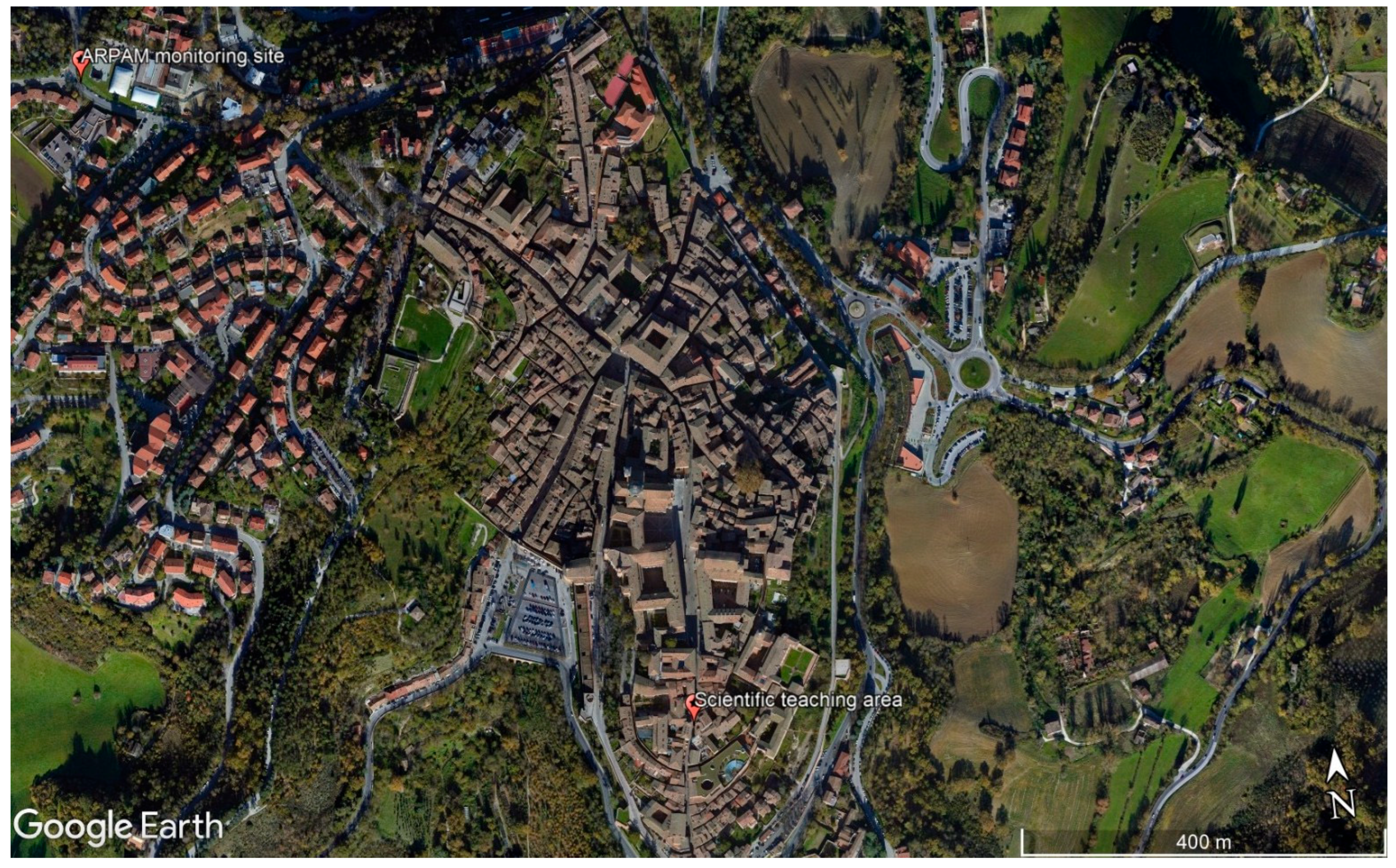
Figure 1. Aerial photograph of the city of Urbino. The indoor teaching area and the outdoor monitoring sites are reported with red dots. The outdoor monitoring sensor site is positioned in an area defined as rural and suburban, with low traffic flow and without significant emission sources.
Atmosphere 17 00379 g001
Figure 2. CO2 level distriburions. (A) Illustration of the temporal trend of CO2 concentrations over the entire surveillance period, showing the daily average recorded by each monitoring device across all environments of interest. This representation allows an immediate comparison of how the parameter evolves month by month and highlights eventual differences in ventilation dynamics and occupancy patterns between the various rooms. (B) The boxplots complement the view by presenting the distribution of the same CO2 data, offering a clear overview of the variability, median values, and occurrence of peak concentrations in each environment.
Atmosphere 17 00379 g002
Figure 3. PM2.5 distributions. (A) The panel shows the time-series trend of PM2.5 concentrations. (B) Boxplots display the PM2.5 distribution across environments.
Atmosphere 17 00379 g003
Figure 4. PM10 concentration trends. (A) The graph illustrates how PM10 concentrations evolve over time. (B) Boxplot panel summarizes the distribution of PM10 across the environments.
Atmosphere 17 00379 g004
Figure 5. VOC concentration temporal trends. (A) On the panel is shown the time-series pattern of VOC levels. (B) The boxplots provided the VOC distribution among environments.
Atmosphere 17 00379 g005
Figure 6. Comparison between indoor and outdoor PM10 concentration trends. (A) The daily trend provides the time-series patterns for indoor (fuchsia) and outdoor (cyan) PM10 concentrations: both datasets show how concentrations evolved over the quarter and enable a direct assessment of parallel fluctuations between the indoor environment and the regional outdoor monitoring station. (B) The boxplot offers an overview of the distribution of indoor (fuchsia) and outdoor (cyan) PM10 values, allowing for a visual comparison of their respective ranges and variability. (C) The scatter dot plot reports the significant statistical difference observed between the indoor and outdoor PM10 concentrations between January 2024 and March 2024. Data are presented as mean ± SD. **** p < 0.0001.
Atmosphere 17 00379 g006
Figure 7. Comparison of the considered parameter concentration measured in the Lecture Hall during the March 2024 and March 2025 monitoring campaigns. (A) CO2; (B) PM2.5; (C) PM10; (D) VOCs. Dots represent daily average values, horizontal lines indicate the median for each period, and asterisks denote the statistical significance of the applied test (* p < 0.05; ** p < 0.001; ns = not significant).
Atmosphere 17 00379 g007
Table 1. Summary table of the rooms in the ASD Volponi complex equipped with CSA system air purification and sanitization technology: for each room, based on the expected attendance according to its capacity and the size of the space, one or more devices have been installed.
FloorRoomRoom CapacityN. CSA S600 Devices
FLOOR A/BComputer Room401
Room B1752
Room B2752
Microscopy Laboratory301
Graduation Room602
Living B/1
FLOOR CEntrance C/1
Room C11003
Room C2752
Room C3401
Room C4301
Room C5241
Room C6241
Room C7241
Living C/1
FLOOR DRoom D11503
Room D2602
Room D3903
Room D4903
Room D5601
Room D6301
Cinema902
Living D/1
FLOOR ELecture Hall E13136
Lecture Hall E23266
Living E/1
Table 2. Main parameters detected by the sensor for monitoring air quality in the CSA System S600 device.
ParameterUnits of MeasurementMeasurement RangeResolutionAccuracy
CO2ppm0–50001±5–±50
PM1.0/PM2.5μg/m30–20001±10 (@0–100)
±10% (@101–500)
PM10μg/m30–20001±25 (@1–100)
±25% (@101–500)
VOCsLevel0–5001-
Temperature°CFrom −40 to +850.1±0.5 (@0–65 °C)
Relative humidity%RH0–1000.1±3 (@20–80%RH)
PressurehPa300–11000.01±1.5
Table 3. Monthly average CO2 concentration value (in ppm) for each room during the monitoring months, and the highest daily average value recorded during each monitoring month for each room.
RoomMean Values (ppm)Maximum Values (ppm)
JanuaryFebruaryMarchJanuaryFebruaryMarch
Computer Room610.07 ± 284.29536.63 ± 126.55755.03 ± 344.671446.48892.861909.14
Microscopy Lab557.66 ± 88.68590.48 ± 146.62625.46 ± 134.07861.77961.911023.45
B1540.94 ± 57.71525.85 ± 54.50605.11 ± 139.34653.52626.40978.77
B2540.00 ± 53.65517.64 ± 57.29650.96 ± 234.18644.03638.781368.02
C1535.53 ± 67.34610.44 ± 133.49711.37 ± 234.64679.29915.521344.62
C2468.80 ± 46.86590.03 ± 142.46689.63 ± 198.18598.58887.381155.68
C3529.02 ± 45.07619.55 ± 189.17709.53 ± 236.72613.171168.541570.48
C6675.16 ± 308.35695.83 ± 296.73607.90 ± 179.691791.061734.061121.92
D1602.47 ± 172.36696.37 ± 252.78766.41 ± 271.121082.961223.951307.27
D2517.63 ± 43.39533.40 ± 67.86617.70 ± 167.15620.67656.701119.14
D3518.97 ± 57.27526.40 ± 78.79601.75 ± 183.94643.40766.681150.71
D5529.68 ± 44.12542.05 ± 105.21670.82 ± 320.47610.15990.921722.93
E2506.52 ± 44.99506.12 ± 146.62528.94 ± 81.71610.46677.15757.07
Table 4. Monthly average PM2.5 concentration values (in µg/m3) for each room during the monitoring months, and the highest daily average values recorded during each monitoring month for each room.
RoomMean Values (µg/m3)Maximum Values (µg/m3)
JanuaryFebruaryMarchJanuaryFebruaryMarch
Computer Room1.88 ± 2.221.82 ± 1.851.01 ± 1.289.047.124.58
Microscopy Lab2.18 ± 2.262.93 ± 3.031.12 ± 1.389.4613.735.24
B12.36 ± 2.133.45 ± 3.331.56 ± 1.927.9312.031.55
B23.08 ± 2.644.26 ± 4.011.95 ± 1.929.0515.371.92
C12.57 ± 2.452.83 ± 3.081.77 ± 1.598.6912.321.59
C22.93 ± 2.343.88 ± 3.521.90 ± 1.488.3114.891.48
C32.91 ± 2.433.44 ± 3.231.54 ± 1.368.2113.911.36
C62.55 ± 3.233.57 ± 3.491.69 ± 1.5313.7812.831.53
D11.25 ± 1.342.45 ± 2.551.19 ± 1.894.759.091.89
D23.01 ± 2.324.17 ± 3.512.18 ± 2.027.9312.812.02
D31.31 ± 1.442.18 ± 2.181.17 ± 1.314.488.551.31
D52.59 ± 2.584.68 ± 4.842.16 ± 2.147.4517.832.14
E22.68 ± 2.483.28 ± 3.031.74 ± 1.669.2810.981.66
Table 5. Monthly average PM10 concentration values (in µg/m3) for each room during the monitoring months, and the highest daily average values recorded during each monitoring month for each room.
RoomMean Values (µg/m3)Maximum Values (µg/m3)
JanuaryFebruaryMarchJanuaryFebruaryMarch
Computer Room2.11 ± 2.392.06 ± 1.961.20 ± 1.429.657.585.26
Microscopy Lab2.50 ± 2.453.38 ± 3.281.38 ± 1.4710.3114.885.87
B12.72 ± 2.323.92 ± 3.581.91 ± 1.758.5113.187.69
B23.23 ± 2.704.44 ± 4.042.20 ± 2.029.4115.588.61
C12.79 ± 2.513.04 ± 3.182.05 ± 1.739.0012.778.54
C23.16 ± 2.454.18 ± 3.652.23 ± 1.628.7715.525.80
C33.14 ± 2.563.71 ± 3.371.79 ± 1.498.8514.606.49
C62.88 ± 3.494.00 ± 3.742.00 ± 1.6015.1113.926.41
D11.36 ± 1.422.66 ± 2.631.33 ± 1.965.009.548.54
D23.39 ± 2.454.60 ± 3.752.51 ± 2.138.8813.968.49
D31.46 ± 1.552.46 ± 2.291.40 ± 1.444.878.945.34
D52.90 ± 2.835.22 ± 5.202.59 ± 2.328.1919.009.70
E23.23 ± 2.813.88 ± 3.532.26 ± 1.8810.5812.637.75
Table 6. Monthly average VOC concentration values (in lvl) for each room during the monitoring months, and the highest daily average values recorded during each monitoring month for each room.
RoomMean Values (lvl)Maximum Values (lvl)
JanuaryFebruaryMarchJanuaryFebruaryMarch
Computer Room116.39 ± 48.5468.55 ± 46.6093.42 ± 34.74291.25280.53213.10
Microscopy Lab102.12 ± 24.79124.27 ± 38.86108.27 ± 42.15181.35241.43265.87
B1110.86 ± 27.24123.33 ± 25.71128.93 ± 28.52163.74198.54182.06
B2101.56 ± 28.28103.98 ± 30.00130.00 ± 50.74165.24195.00279.35
C1110.68 ± 28.19120.71 ± 45.97128.78 ± 52.10162.49217.84250.50
C2109.09 ± 24.70124.03 ± 48.21127.08 ± 46.59169.25256.24227.71
C3117.63 ± 28.63136.01 ± 59.44134.48 ± 57.78175.72277.54258.32
C6135.87 ± 59.94119.15 ± 50.56111.15 ± 33.16311.84241.67173.79
D1133.69 ± 51.62152.86 ± 59.86124.98 ± 54.61255.16290.16269.11
D2111.19 ± 24.25121.31 ± 32.26115.81 ± 38.90148.51194.18254.76
D390.98 ± 20.0089.90 ± 26.9095.92 ± 26.62122.50162.18146.10
D5109.07 ± 28.0398.60 ± 29.00107.20 ± 51.65192.30173.03310.25
E2109.86 ± 27.58106.15 ± 35.03114.61 ± 27.08169.11210.75158.47
Disclaimer/Publisher’s Note: The statements, opinions and data contained in all publications are solely those of the individual author(s) and contributor(s) and not of MDPI and/or the editor(s). MDPI and/or the editor(s) disclaim responsibility for any injury to people or property resulting from any ideas, methods, instructions or products referred to in the content.