Article

Long-Term Dew Analysis Through Multifractal Formalism and Hurst Exponent Under African Climate Conditions

by
Gnonyi N’Kaina Mawinesso
1,
Noukpo Médard Agbazo
2,
Guy Hervé Houngue
1 and
Koto N’Gobi Gabin
1,*
1
Laboratoire de Science des Matériaux et Modélisation (LaSMMo), Faculté des Sciences et Techniques (FAST), Université d’Abomey-Calavi (UAC), Cotonou 01 BP 526, Benin
2
Département d’Hydrologie, Université de N’Zérékoré, N’Zérékoré BP 50, Guinea
*
Author to whom correspondence should be addressed.
Atmosphere 2026, 17(4), 375; https://doi.org/10.3390/atmos17040375
Submission received: 31 December 2025 / Revised: 7 March 2026 / Accepted: 11 March 2026 / Published: 7 April 2026
(This article belongs to the Special Issue Analysis of Dew under Different Climate Changes)

Abstract

Dew constitutes a component of the near-surface water balance, but its large-scale fractal dynamical properties remain poorly documented across Africa. This study estimates dew amounts and investigates their fractal and multifractal behavior under African climatic conditions using gridded ERA5 datasets from 1993 to 2022. The Rescaled-Range (R/S) method, Multifractal Detrended Fluctuation Analysis (MFDFA), and the Improved Complete Ensemble Empirical Mode Decomposition with Adaptive Noise (ICEEMDAN) algorithm are used. Hurst exponent (Hu) and the multifractal spectrum width (ω) are evaluated at daily and monthly scales over the full period and two sub-periods (1993–2007 and 2008–2022). The results reveal pronounced spatial heterogeneity in dew distribution. Daily mean amounts range between 0 and 0.18 mm, corresponding to annual accumulations reaching up to ~85 mm·yr−1 in humid coastal, equatorial, and sub-equatorial regions, while remaining below 0.5 mm·yr−1 in hyper-arid deserts. The continental mean annual amount is ~35.5 mm·yr−1. The Hurst exponent exhibits values between zero and one, indicating region-dependent persistent and anti-persistent behaviors. This suggests that prediction schemes based on preceding values may be suitable for dew time series prediction in African regions exhibiting persistent characteristics. The multifractal spectrum width (ω), reaching values of up to 10, highlights strong scaling heterogeneity, particularly at the monthly timescale. These findings indicate that African dew dynamics exhibit significant long-range dependence and multifractal variability, providing new insights into the intrinsic temporal structure of dew and into appropriate approaches for its forecasting.

1. Introduction

Securing water resources under increasing climate variability worldwide represents a major global challenge in the context of population growth, climate change, and intensifying hydrological extremes [1]. Over recent decades, changes in precipitation regimes, rising temperatures, and increasing climate variability have significantly altered water availability, with direct consequences for agricultural productivity, ecosystem functioning, and socio-economic stability [1,2,3]. Since the 1970s, many regions have experienced pronounced hydroclimatic fluctuations, including long-term rainfall declines and an increased frequency of extreme events such as prolonged droughts and episodic heavy rainfall [4,5]. These changes have contributed to recurrent droughts that severely affect crop yields and trigger major socioeconomic crises. Under such water-limited conditions, surface water availability plays a critical role in sustaining crop performance and food security [6,7,8].
Atmospheric moisture, including rain, fog, dew, and vapor absorption, represents an essential component of the hydrological balance, especially in arid and semi-arid regions. Among these resources, dew has received increasing attention due to its ecological and environmental significance [8,9]. Several studies worldwide emphasize its role as a non-negligible water input. Pan et al. [10] demonstrated a positive feedback between dew deposition and vegetation in the arid desert ecosystem of Shapotou (China). Dew has also been identified as a critical water source that enhances sand stability and supports the survival of planted vegetation in desert environments [11]. Kidron [12] suggested that dew may even serve as an essential water source for cyanobacteria. In many arid and semi-arid regions, dew occurs on up to 70% of days per year [13,14], highlighting its potential importance for ecosystems facing persistent water scarcity.
Quantification of dew has commonly relied on semi-empirical, numerical, or analytical approaches based on surface-atmosphere energy balance relationships [9,15,16,17,18]. Previous studies have shown that dew contributes to improving vegetation water-use efficiency [19], supports cereal growth in specific regions [20], and may represent a vital moisture source for both plant and animal survival [21]. In addition, the physical and chemical properties of dew have been investigated in several regions, including North Africa [22]. Observational studies indicate substantial variability in dew amounts across climatic zones, with reported mean values of approximately 0.086 mm·day−1 in India [23], about 0.2 mm·night−1 in Israel [24], and average rates of 0.1 mm·day−1 and 0.17 mm·day−1 in tropical and Mediterranean climates, respectively [25].
Although dew has been extensively investigated from microclimatic, thermodynamic, and agronomic perspectives, its large-scale temporal and spatial variability remains poorly documented, particularly at the continental scale. Dew formation arises from complex interactions among radiative cooling, atmospheric humidity, surface properties, cloud cover, and turbulence, which can generate nonlinear, scale-dependent, and non-stationary dynamics across multiple temporal scales. Such characteristics are common in hydro-meteorological and meteorological variables, which are often marked by self-similarity, intermittency, multi-intensity fluctuations, nonlinear trends, abrupt shifts, and long-range dependence [26,27,28]. These intrinsic features pose significant challenges for conventional modeling and forecasting approaches [26,29], as traditional linear or spectral methods are often inadequate to fully capture such complexity [30,31].
In this context, fractal and chaos theories, particularly multifractal analysis, have been widely recognized as powerful frameworks for investigating the intrinsic dynamics of complex hydro-meteorological and meteorological time series [32]. Several studies have demonstrated the effectiveness of multifractal approaches in characterizing scaling behavior, long-range dependence, intermittency, and nonlinear variability in environmental systems [27,32,33,34]. Multifractal theory has been successfully applied to a wide range of variables, including relative humidity [35], streamflow [6], evapotranspiration [36], rainfall [37], temperature [38], wind speed, cloud cover, soil temperature, vegetation indices, and dew point.
Historically, the foundations of fractal analysis in hydrology and climatology trace back to the pioneering work of Hurst in the 1950s, who introduced the Hurst exponent to describe long-term persistence and memory in hydrological records, particularly in the context of reservoir storage and river flow variability (Hurst [39], as discussed by Rehman [40] in later syntheses). This framework was subsequently formalized and expanded by Mandelbrot, who established the theoretical foundations of fractal geometry and multifractal theory, notably through the concepts of self-similarity and intermittency in natural systems [41]. These theoretical developments were later extended to atmospheric and environmental sciences through seminal contributions by Lovejoy and Schertzer, who demonstrated scale invariance and multifractal behavior in rainfall and cloud fields [42,43], as well as by Tessier et al. [44], who applied multifractal analysis to rainfall and river flow processes.
Within this theoretical framework, persistence and multifractality are now widely recognized as key properties for understanding the intrinsic dynamics of meteorological and hydroclimatic variables [45]. Despite the growing literature applying fractal and multifractal approaches to hydro-meteorological variables, no study to date has systematically investigated the multifractal characteristics of dew time series, particularly at the continental scale and under diverse climatic regimes. This gap is especially pronounced in Africa, where strong climatic gradients, extensive arid and semi-arid regions, and limited observational networks complicate the assessment of non-rainfall water inputs.
To address this knowledge gap, the present study aims (1) to estimate dew amounts across Africa using the semi-empirical model proposed by Beysens [9], applied to long-term ERA5 reanalysis data spanning the period from 1993 to 2022, and (2) to investigate the persistence and complexity of dew dynamics across different African climate zones using fractal and multifractal analysis. By characterizing long-term memory, scaling behavior, and intrinsic variability of dew time series, this study seeks to improve understanding of dew variability at the continental scale and to provide a scientific basis for assessing its potential contribution as a supplementary atmospheric moisture source in water-scarce environments.

2. Materials and Methods

2.1. Material

2.1.1. Study Area Description

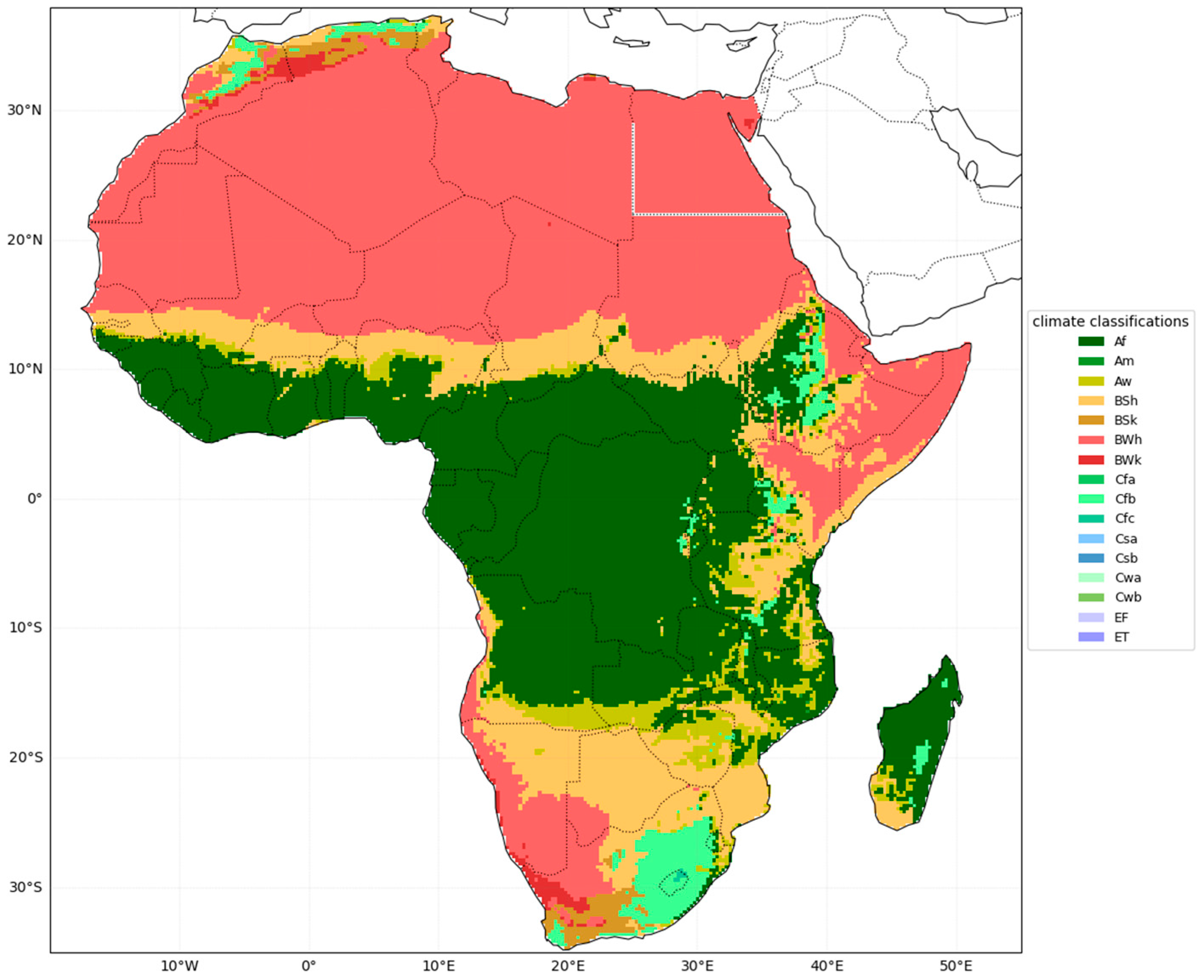
The study area covers the entire African continent (Figure 1), extending from equatorial to temperate latitudes and exhibiting pronounced climatic and environmental heterogeneity. To facilitate interpretation, major climatic zones and desert regions are explicitly highlighted in Figure 1. Africa’s climate is governed by large-scale atmospheric circulation systems, including the Intertropical Convergence Zone (ITCZ), subtropical high-pressure systems, monsoon flows, and trade winds. These systems jointly regulate precipitation regimes [46], near-surface humidity, wind conditions, and nocturnal radiative cooling, which are key drivers of dew formation [11,13].
Rainfall across Africa displays strong spatial and temporal variability, with annual totals ranging from less than 100–200 mm in arid and hyper-arid regions such as the Sahara, the Horn of Africa, and southwestern Africa, to more than 2000 mm in humid equatorial regions, including the Congo Basin and coastal West Africa [46]. This marked precipitation gradient is associated with substantial contrasts in atmospheric moisture availability, which directly influence both the frequency and magnitude of dew occurrence [9,11]. However, precipitation alone does not fully explain dew availability, particularly in regions characterized by extreme surface dryness.
Air temperature is generally high across much of the continent, with mean annual values often exceeding 25 °C in tropical and subtropical regions, while lower temperatures prevail in highland areas and Mediterranean coastal areas [47]. Relative humidity exhibits a sharp spatial contrast, with persistently high values in equatorial and coastal regions and much lower values in arid inland areas [47]. In hyper-arid environments, such as major desert regions, extremely low humidity combined with dry, sparsely vegetated surfaces strongly limits dew formation, despite frequent clear-sky conditions that favor nocturnal radiative cooling. Therefore, surface characteristics play a critical role in modulating dew processes. Extensive desert cover, characterized by low soil moisture, minimal vegetation, and high thermal inertia, significantly constrains condensation potential by limiting near-surface moisture availability [19]. Consequently, while latitude and climate zone influence dew dynamics, surface aridity and land cover emerge as key controlling factors in desert and semi-desert regions [19].
Wind speed and direction also display strong regional and seasonal variability, influenced by trade winds, monsoon circulations, and local thermal gradient [23,48]. Near-surface wind conditions regulate turbulent heat and moisture exchanges between the surface and the atmosphere. Low to moderate nocturnal wind speeds generally favor dew condensation by maintaining radiative cooling near the surface, whereas strong winds tend to inhibit dew formation by enhancing mixing and sensible heat transfer [19,48].
According to the Köppen–Geiger climate classification shown in Figure 1, Equatorial climates (Af) dominate central Africa and are characterized by persistently high humidity and limited diurnal temperature variability. Surrounding this core, tropical monsoon (Am) and tropical wet-dry climates (Aw) extend across large parts of West, Central, and East Africa, where seasonal alternation between wet and dry periods strongly modulates near-surface humidity and radiative cooling. Semi-arid climates (BSh), including transitional zones such as the Sahel and parts of southern Africa, exhibit highly variable rainfall and enhanced nocturnal cooling, conditions under which dew occurrence is intermittent but potentially significant. Arid desert climates (BWh), prevalent in northern Africa and parts of eastern and southwestern Africa, are characterized by extremely low precipitation and extensive desert surfaces, which severely restrict dew formation [21,24]. Temperate climates (Csa, Csb, Cfa, Cfb), confined to localized coastal and highland regions in northern and southern Africa as well as Madagascar, reflect the combined influence of elevation and maritime effects on temperature and moisture regimes [47].
Overall, this spatial distribution of climatic zones and surface characteristics provides a coherent framework for analyzing continental-scale variability in dew-related parameters across Africa, as it governs the combined effects of humidity, land cover, cloudiness, and wind conditions that control dew occurrence and availability.

2.1.2. Data Collection

This study uses ERA5 reanalysis data produced by the European Centre for Medium-Range Weather Forecasts (ECMWF), which represents the fifth generation of global atmospheric reanalyses and constitutes a major improvement over ERA-Interim in terms of spatial resolution, temporal continuity, and data assimilation techniques [49]. ERA5 is a physically consistent, long-term reanalysis dataset widely used in hydro-meteorological studies, including across Africa [49].
ERA5 delivers hourly mean estimates of atmospheric and land-surface variables on a regular latitude-longitude grid with a horizontal resolution of 0.25° for atmospheric fields. The meteorological variables considered in this study include 2 m air temperature (°C) and 2 m dew point (°C), 10 m wind speed (m·s−1), total cloud cover (ranging from 0 to 1), and geopotential height (m). These variables were selected because dew formation is primarily governed by near-surface temperature gradients, atmospheric humidity, radiative cooling conditions, and wind-induced turbulence [9,50,51,52]. Geopotential height, which reflects large-scale atmospheric structure, was included to characterize background circulation conditions, while all other variables were extracted at hourly temporal resolution.
To adequately include nocturnal conditions favorable for dew formation, a 14 h daily time window from 18:00 to 07:00 UTC was defined for all grid points across Africa. Dew formation predominantly occurs during nighttime under conditions of enhanced radiative cooling, weak to moderate wind speed, and high near-surface humidity [16,53,54]. These physical processes are inherently transient and cannot be accurately represented using daily or monthly averaged data.
The reliability of ERA5 near-surface meteorological variables over Africa has been evaluated in numerous studies. [1,2,55]. These assessments indicate small biases in near-surface air temperature, generally within ±1 °C to ±2 °C, and a realistic representation of humidity and wind field at the regional and continental scales [47,49]. Consequently, ERA5 has been extensively used in African climate studies focusing on temperature variability, humidity processes, drought dynamics, and land-atmosphere interactions [1,2,55].
Because dew formation is a short-lived nocturnal process controlled by instantaneous convergence between air, dew point, winds, and clear-sky radiative cooling [16,53,54,56,57], the use of hourly resolution data is essential to preserve the physical consistency of the condensation mechanism. ERA5 hourly data are therefore well suited for long-term, large-scale analyses of dew variability across Africa [49].

2.2. Methods

2.2.1. Dew Quantification Method

In this study, dew amount is estimated using the semi-empirical formulation proposed by Beysens [9], which relies on routinely available meteorological variables. Several approaches exist for estimating dew formation, including the physically based energy balance method of Monteith [16], the empirical formulation of Nilsson [53], and the semi-empirical/physical approach of Beysens [9]. The Monteith method calculates dew by assessing the surface energy balance, considering radiation, soil heat flux, and the difference between air and dew point, which provides high accuracy at local scales but requires detailed measurements often unavailable in large-scale datasets. The Nilsson approach is empirical, relying on readily available variables such as air temperature, dew point, humidity, and wind speed; it is simple and computationally efficient but may be less precise under extreme or highly variable surface conditions. The Beysens formulation combines physical principles with empirical validation, using temperature, dew point, wind speed, and cloud cover, which are all available in hourly ERA5 data. The model of Beysens [9] has been successfully applied in previous studies at various scales, including Tomaszkiewicz et al. [58] in the Mediterranean basin, Muselli et al. [59] in Northwest Africa, and site-specific applications such as Valparaíso, Chile [60], highlighting its validity across different climatic and geographic contexts. For these reasons, the Beysens method was considered the most appropriate for estimating dew across Africa in this study.
Furthermore, the model has produced satisfactory performance in a wide range of climatic conditions worldwide, thereby supporting its suitability for continental-scale application. Beysens’ formulation is given by the following equation:
d h d t 1 = 0.37 × 1 + 0.204323 H 0.0238893 H 2 18.0132 1.04963 H + 0.21891 H 2 × 10 3 T d × T d + 273.15 285 4 1 N 8 + 0.06 T d T a × 1 + 100 × 1 e x p V V 0 20 i f   p o s i t i v e 0 i f   n e g a t i v e
where H(m) is the altitude of the grid point, Td is the dew point (°C), Ta is the ambient air temperature (°C), V is the wind speed (m·s−1), Vo is the reference wind speed set to 4.4 m·s−1, and N is the cloud cover (oktas). The term (dh/dt)1 represents the estimated dew yield in (mm·day−1).
Hourly meteorological data are used, and dew formation is computed at a 1 h time step between 18:00 UTC and 07:00 UTC of the following day for all grid points. Following Beysens et al. [9], the dew amount corresponding to the time step Δt is obtained as follows:
d h d t Δ t = Δ t 12 d h d t 1
In this study, Δt = 1 h, yielding
d h d t t = 1 12 × d h d t 1
The total dew amount is finally obtained by summing all positive hourly dew values over the considered period.

2.2.2. Hurst Exponent and Rescaled-Range (R/S) Methods

Persistence Detection Method
The persistence properties of meteorological time series are commonly quantified using the Hurst exponent, which provides a measure of long-range dependence and allows discrimination between persistent, anti-persistent, and random behaviors in time series.
According to Kantelhardt et al. [61,62], Tatli [63], and Baranowski et al. [33,64], the interpretation of the Hurst exponent (Hu) is as follows:
(i)
when Hu ∈ [0, 0.5), the time series exhibits anti-persistent behavior, meaning that an increase is more likely to be followed by a decrease, and inversely;
(ii)
when Hu = 0.5, the series is uncorrelated, indicating a random process with no memory, for which future trends are highly uncertain;
(iii)
when Hu ∈ (0.5, 1], the series shows long-term persistence, implying that observed trends tend to continue in the future. Specifically, persistent behavior indicates that the direction of past variations is likely to be maintained over time, whereas anti-persistent behavior reflects a tendency toward frequent reversals in the temporal evolution of the variable.
Methods of Rescaled-Range (R/S) and MFDFA
In this study, both the R/S method and the MFDFA-based approaches are applied to estimate the Hurst exponent. The mean Hurst exponent derived from the two methods is then computed to provide a robust assessment of persistence in dew time series:
First, the classical Rescaled-Range (R/S) method, originally introduced by Hurst and subsequently applied in numerous hydro-meteorological studies, is briefly described by the following equations [65]:
  • Calculate the subsets of the dew time series mean, y ¯ τ = 1 τ k = 1 τ y k , where y t t = 1 : 1 : N represents the studied records and 1 ≤ τ ≤ N.
  • Calculate the range ( R τ ) and deviation ( S τ ) respectively as follows:
    R τ = max 1 i τ k = 1 i y k y ¯ τ min 1 i τ k = 1 i y k y ¯ τ
    S τ = 1 τ k = 1 τ y k y ¯ τ 2 1 / 2
  • Compute the rescaled range as follows:
    R / S τ = R τ / S τ
  • Plot l o g R / S τ  versus  l o g ( τ )  and deduce the Hurst exponent ( H R / S ) as the slope:
    l o g R / S τ = l o g a + H R / S . l o g ( τ )
Second, the classical MFDFA method [61] is the most popular and useful method employed to capture the multifractal spectrum [66] of hydro-meteorological and meteorological time series. From the multifractal spectrum, the time series are characterized and described through the following complexity parameters: the Hurst exponent ( H u M F D F A ), the base width of the multifractal spectrum (w) and asymmetry (r) [61]. Among these parameters, the Hurst exponent and the base width of the multifractal spectrum are the most important to understand the complex temporal evolution dynamic characteristics of hydro-meteorological and meteorological time series, necessary to develop advanced methods for their forecasting [33,45,67].
The theoretical description of the MFDFA method can be found in [61,62]. The generalized Hurst exponent h ( q ) is computed as follows:
F q s s h ( q )
F q s denotes the fluctuation function and s the timescale. The multifractal spectrum f α and Hölder exponent α ( q ) are deduced from h ( q ) by means of the first-order Legendre transforms as follows:
α = h q + q h ( q ) d q Legendre   f α = q α h q + 1
Recently, Zhan et al. [68] highlighted several limitations of the traditional (MFDFA) related to the fitting and detrending procedures. In classical MFDFA, the underlying trend of hydro-meteorological and meteorological time series is not known in advance and is typically approximated using polynomial functions (linear, quadratic, cubic, or higher-order). However, when the polynomial order is chosen arbitrarily, the traditional MFDFA may overestimate the complexity of the analyzed variable. To address this limitation, the polynomial local trend used in the conventional MFDFA algorithm can be replaced by an ICEEMDAN-based local trend. ICEEMDAN is a refined signal decomposition algorithm developed by Colominas et al. [69], which allows the nonlinear intrinsic trend of complex time series to be extracted without imposing prior assumptions on its functional form.

2.2.3. Multifractal Spectrum Width Computation

The multifractal spectrum ω is derived using the first-order Legendre transform and is defined as:
ω = α m a x α m i n
where α m a x and α m i n represent the maximum and minimum of α , respectively. The value of ω measures the multifractality degree and describes the variability or complexity of time series fluctuations.
The parameter ω quantifies the degree of multifractality: larger values indicate stronger multifractality behavior and higher structural complexity, whereas values close to zero indicate monofractal behavior. A higher multifractality reflects increased heterogeneity and irregularity in dew dynamics [35,61,70].
The analysis was conducted over the full study period (1993–2022), which was further divided into two sub-periods: 1993–2007 and 2008–2022. This division was adopted to ensure balanced sub-period lengths and robust estimation of fractal and multifractal parameters, whose reliability depends on sufficient data length. It also allows the assessment of the temporal stability of the intrinsic scaling properties of dew time series under potentially evolving climatic conditions. Hurst exponents and multifractal parameters were computed for both daily and monthly dew time series over the full period, and each sub-period, and the results were systematically compared across timescales and periods.
All computations were performed using MATLAB R2022a (MathWorks, Natick, MA, USA) for fractal and multifractal analysis, while Python 3.10 (Python Software Foundation, Wilmington, DE, USA) was employed for spatial analysis and mapping of the results across Africa.

3. Results

3.1. Dew Amount Distribution

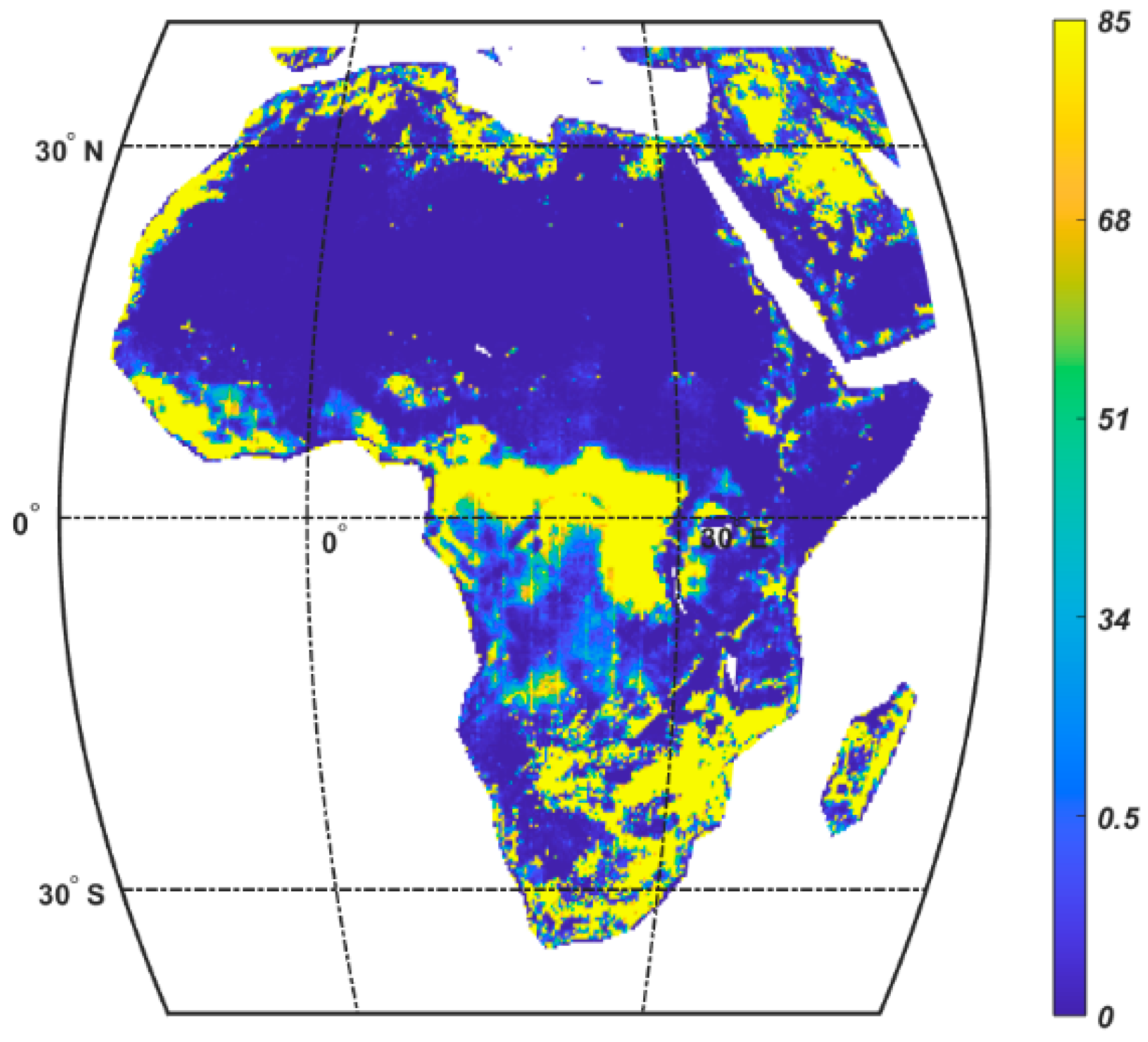
Figure 2 presents the spatial distribution of the mean annual cumulative dew amount over Africa for the period 1993–2022. The values shown correspond to the annual sum of all hourly dew occurrences at each grid point, subsequently averaged over the full study period. The spatial pattern reveals a marked latitudinal and regional variability, closely associated with large-scale climatic regimes, atmospheric moisture availability, and nocturnal surface-atmosphere exchanges.
The highest annual dew amounts are observed in equatorial and sub-equatorial regions, including the Congo Basin, the coastal belt of the Gulf of Guinea, parts of the northern and northwestern Africa coastline, southern and southeastern Africa, and Madagascar. In these regions, mean annual cumulative dew values locally exceed 40–80 mm·yr−1, reflecting persistently high atmospheric humidity, frequent clear-sky nights conducive to radiative cooling, and relatively weak nocturnal winds. Such conditions are well known to favor dew condensation and have been documented in previous observational and modeling studies [51,52,71].
In southern Africa, moderate to relatively high dew amounts are also observed in regions influenced by seasonal moisture transport from the Indian and Atlantic Ocean and by cooler nocturnal temperatures, which enhance the convergence between air temperature and dew point [9,72]. In contrast, very low dew amounts, generally below 10–20 mm·yr−1, characterize arid and semi-arid regions, notably the Sahara Desert, the Horn of Africa, and parts of south-western Africa. These areas are dominated by extremely low atmospheric moisture content, frequent nocturnal winds, and limited radiative cooling efficiency, which constrain dew formation despite the occurrence of clear-sky conditions [9,71,72]. Overall, the spatial distribution of dew closely mirrors the Köppen–Geiger climate, highlighting the strong dependence of dew formation on atmospheric humidity, temperature gradients, and land-atmosphere interactions [9,52,71,72]. While dew represents a relatively modest water input in absolute terms, the results indicate that it can constitute a non-negligible supplementary moisture source in humid and sub-humid regions, whereas its contribution remains limited in hyper-arid environments.

3.2. Hurst Exponents Spatial Distribution

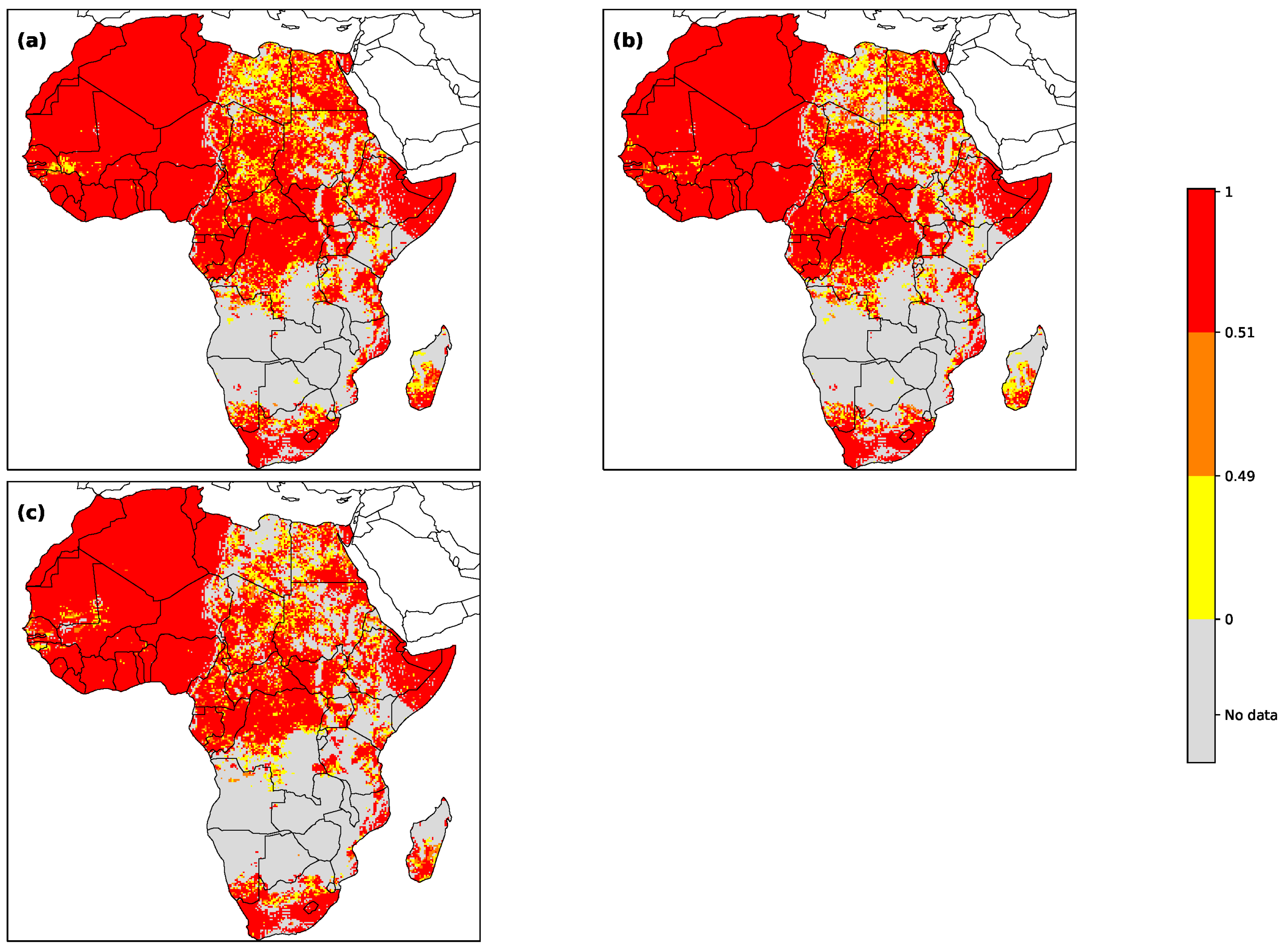
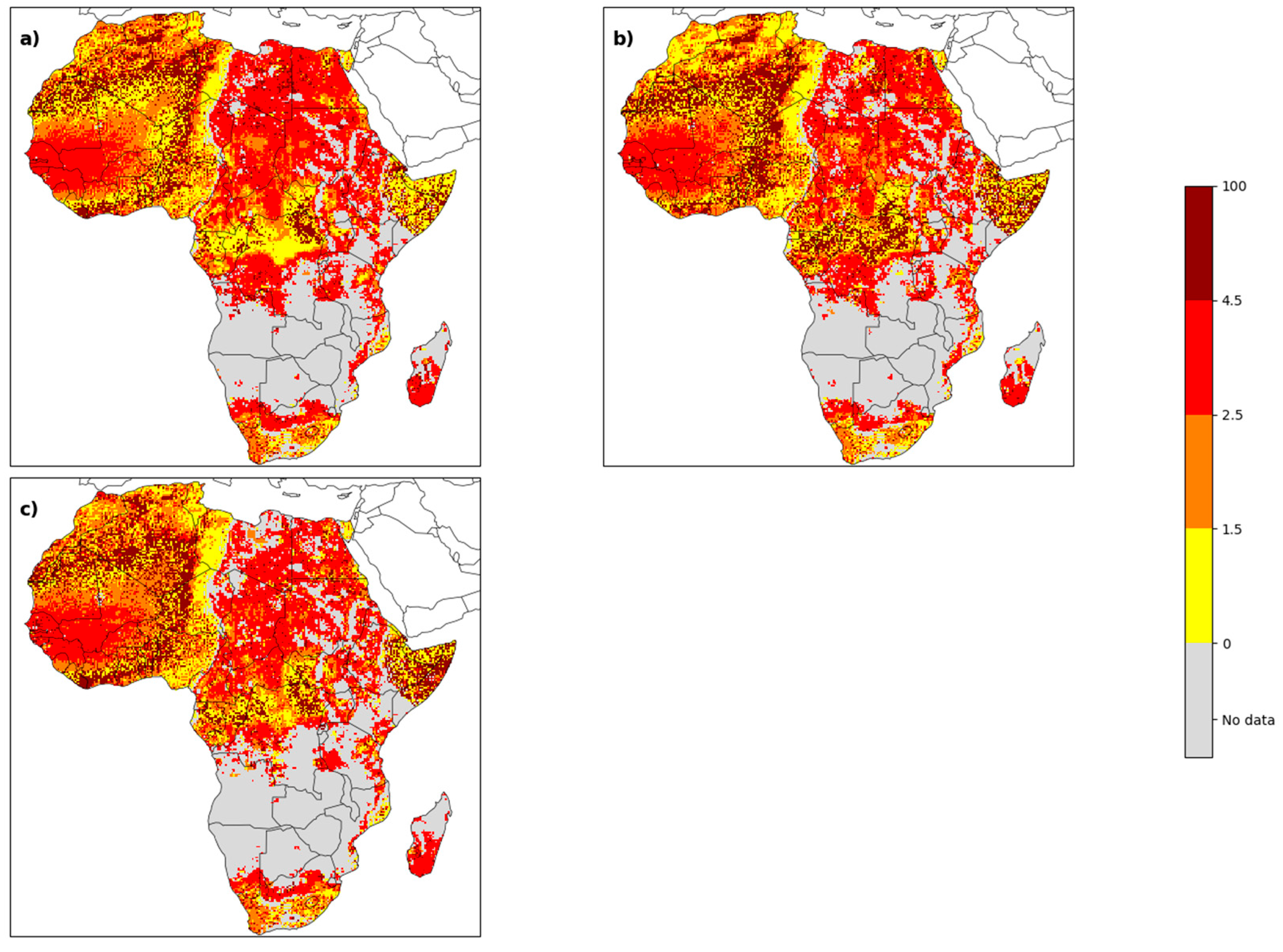
Figure 3 represents the spatial distribution of the Hurst exponents of the daily dew series over Africa for the full period 1993–2022 and for the two sub-periods: 1993–2007 and 2008–2022. Figure 3a indicates that during 1993–2022 period, Hurst exponent values of daily dew series are greater than 0.6 and lower than 1 in most part of Africa, including extreme East, extreme southern, North-western and western part, desert and semi-arid zones in the North and the Sahel, indicating that daily dew series in most parts present a long-term persistent auto-correlation and exhibit long memory that enables predictability. This result implies that the dew amount continues to increase from 1993 to 2022. Thus, if an increase (decrease) is observed in the dew levels during a studied period, a similar increase (decrease) is expected to continue during a similar period of time, suggesting that the prediction schemes based on the trends of the preceding elements will be appropriate for dew time series prediction in these parts of Africa.
In the equatorial and forested regions of Central and East Africa, Hurst exponent values fluctuate between thresholds below 0.5 and range from 0.51 to 1. These findings indicate that daily dew series across most of Africa exhibit either long-term anti-persistent or long-term persistent characteristics, varying by geographical region. Thus, in regions with anti-persistent behavior, an upward value is more likely followed by a downward value, and vice versa, and are characterized by a decreasing predictability. Whereas, the direction of the next value is more likely to be the same as the current value in the region characterized by anti-persistent behaviors.
However, in a few regions, which are located in the central, eastern and northeastern part of Africa, the values of Hurst exponents are close to 0.5, indicating that in the period, the dew amount series are uncorrelated, random, and represent a Gaussian process. Overall, it seems that the parts of Africa characterized by arid desert climates (BWh) are predominantly characterized by long-term persistent autocorrelation.
The spatial distribution of Hurst exponents across Africa for the two sub-periods (1993–2007 and 2008–2022) is presented in Figure 3b,c. No significant differences are observed between these two sub-periods. Moreover, the spatial patterns of the Hurst exponent during both sub-periods are almost identical to those obtained for the entire period 1993–2022. This indicates that, at the daily time scale, the long-range dependence of dew time series over Africa exhibits little to no temporal change throughout the study period.

3.3. Multifractal Spectrum Width Distribution

3.3.1. Daily Scale Spatial Distribution

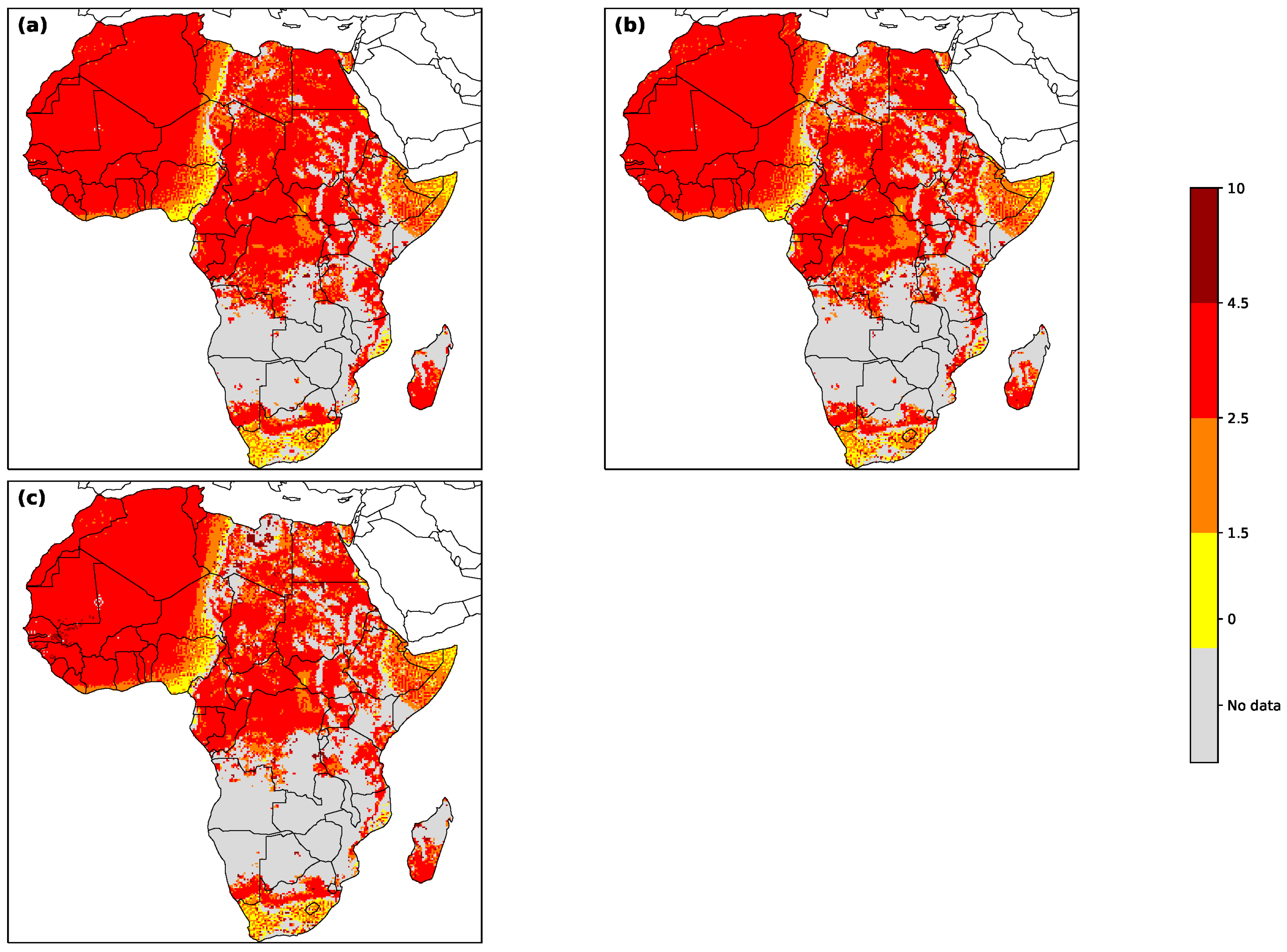
The spatial distribution of the multifractal spectrum width (w) of daily dew series over Africa for 1993–2022 and for the two sub-periods: 1993–2007 and 2008–2022 is shown in Figure 4a, Figure 4b, and Figure 4c, respectively. For the entire period 1993–2022 (Figure 4a), the w values exhibit pronounced spatial variability over the continent, indicating the high variability of the strength of the multifractality of dew values in Africa. Larger values of w, indicating stronger multifractality and implying a higher degree of structural complexity and heterogeneity in the dew datasets, are mainly observed in West, Central, and East Africa. However, a narrow transition zone between West and Central Africa is characterized by a marked decrease in values of w, suggesting that the corresponding dew time series tend toward monofractal behavior. Weaker multifractality is also observed in extreme eastern and southern regions of Africa. In the eastern part of the continent, a clear west–east gradient of w values is observed, whereas a north–south gradient is evident in southern Africa. Overall, during the period 1993–2022, the multifractal spectrum of daily dew series shows high spatial variability, particularly in central, eastern, and southern Africa, while West Africa exhibits relatively more homogenous w values. No clear and systematic relationship is observed between climate type and multifractal spectrum width. Nevertheless, higher w values appear more frequently under BWh-type climates. The physical mechanism underlying these spatial patterns is not investigated in the present study and warrants further research.
The spatial distribution of the multifractal width across Africa for the two sub-periods (1993–2007 and 2008–2022) is presented in Figure 4b,c. Only minor differences are observed between these two sub-periods. However, their spatial pattern shows slight deviations with respect to the full period 1993–2022, particularly in the Southern, large portions of West Africa, and in several regions of Central and East Africa. In these areas, w values are lower during the two sub-periods than during the full periods, indicating weaker multifractality.

3.3.2. Monthly Scale Spatial Distribution

The spatial distribution of the multifractal spectrum width (w) for monthly dew series over Africa during 1993–2022 and for the two sub-periods: 1993–2007 and 2008–2022 is shown in Figure 5a, Figure 5b, and Figure 5c, respectively. There is a high variability in w values across some regions of Africa during the 1993–2022 period (Figure 5a), indicating the degree of complexity of multifractality. Specifically, a mixture of high and low values is observed across northern and eastern West Africa; this indicates a coexistence of highly multifractal areas and regions that exhibit lower multifractality, bordering on monofractal behavior. In contrast, more homogeneous areas are observed in western and central Africa, where w values fluctuate between extremes, reflecting an intermediate degree of multifractality. No clear relationship between w values and climate types is apparent. When comparing w values between daily and monthly dew series over this period, the monthly series exhibit a larger spectrum width, indicating a higher degree of multifractality and therefore greater variability in dew at the monthly timescale over Africa. Thus, for a dew time series, the degree of multifractality appears to increase with the timescale. The spatial distribution of w values across Africa for the two sub-periods (1993–2007 and 2008–2022) is shown in Figure 5b,c. No significant changes are observed between these sub-periods. Moreover, their spatial patterns differ slightly from those of the 1993–2022 period. However, at the monthly timescale, the degree of multifractality is higher in both sub-periods compared to the daily timescale.

3.4. Hurst Exponent and Multifractal Spectrum Width Correlation

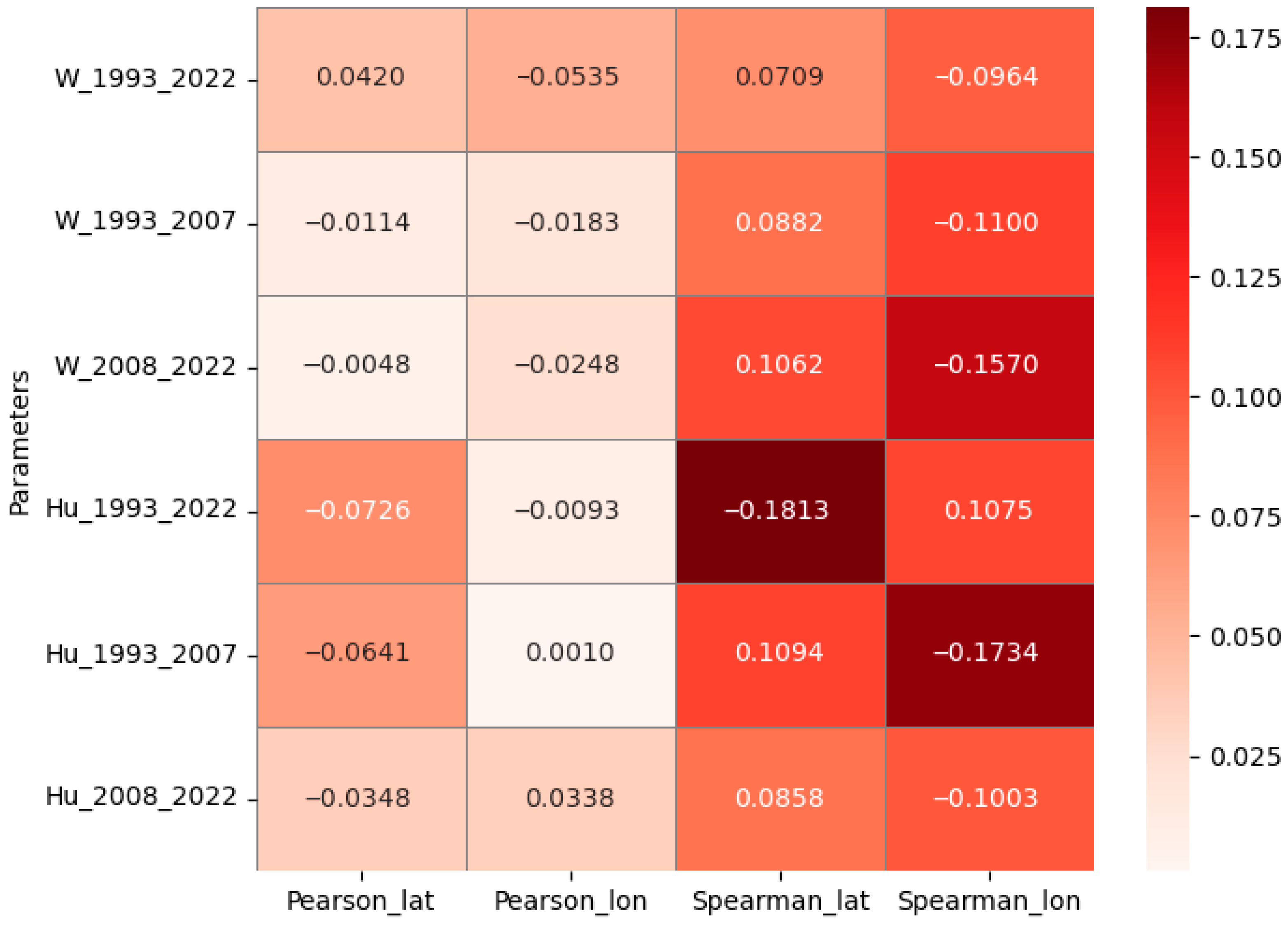
Figure 6 presents the Pearson and Spearman correlation coefficients between the scaling parameters derived from dew time series (Hurst exponent Hu and the multifractal spectrum width, w) and the geographical coordinates (longitude and latitude) across Africa. Both linear (Pearson) and rank-based (Spearman) correlation metrics consistently indicate a weak and statistically non-significant relationship between the fractal parameter and the geographical position. This result demonstrates that the spatial variability of Hu and w cannot be explained by a simple latitudinal or longitudinal gradient. Instead, it is suggested that the long-range dependence and multifractal characteristics of dew formation are primarily governed by regional atmospheric dynamics and local climatic controls such as humidity variability, nocturnal radiative cooling, and wind regimes rather than by geographical location alone. The absence of a direct geographical control highlights the non-stationary and nonlinear nature of dew processes at the continental scale. Regions located at similar latitudes may exhibit markedly different fractal behaviors depending on their climatic regime, confirming that dew temporal organization is climate-driven rather than geographically structured. This finding reinforces the relevance of applying fractal and multifractal frameworks to characterize dew dynamics beyond conventional spatial descriptors.

4. Discussion

This study provides a first continental-scale assessment of dew dynamics over Africa by combining long-term ERA5 reanalysis data with fractal and multifractal analyses. To our knowledge, very few studies (if any) have investigated dew time series within a fractal or multifractal framework at the continental scale, either in Africa or elsewhere. Consequently, our results cannot be quantitatively compared with previous studies focusing on dew. Instead, the discussion relies on qualitative comparisons with findings reported for other hydro-meteorological variables that have been extensively analyzed using similar methodologies.
The results reveal a strong spatial heterogeneity of dew amounts across Africa, closely linked to regional climatic conditions, and demonstrate that dew time series exhibit pronounced persistence and multifractal behavior across most of the continent. The analysis further shows that these temporal properties remain relatively stable over the two sub-periods (1993–2007 and 2008–2022) and are weakly correlated with geographical coordinates, highlighting the dominant role of regional atmospheric processes rather than simple spatial gradients.
The spatial distribution of mean annual cumulative dew amounts highlights a strong contrast between humid, sub-humid, and arid regions. Higher dew accumulations in equatorial, coastal, and sub-equatorial areas reflect persistently high atmospheric humidity, reduced nocturnal cloud cover, and favorable radiative cooling conditions. Because large-scale in situ dew observations are scarce across Africa, the plausibility of the estimated dew amounts was assessed through comparison with observational studies reported in the literature. Table 1 summarizes some annual dew amounts measured in different climatic environments worldwide.
These studies indicate that annual dew totals typically range from about two to 90 (mm·yr−1) depending on climatic conditions. Therefore, the values obtained in this study (exceeding 40–80 mm·yr−1 or below 10–20 mm·yr−1), depending on the region, remain within the range reported in certain field observations.
Similar spatial patterns have been reported in observational and modeling studies conducted in humid and coastal environments, where dew represents a recurrent non-rainfall water input [51,52,71]. Conversely, extremely low dew amounts observed in desert and hyper-arid regions confirm that limited atmospheric moisture and frequent nocturnal winds strongly constrain dew formation, despite clear-sky conditions. This finding supports previous conclusions that dew cannot totally compensate for water scarcity in hyper-arid environments, but may play a supplementary role in regions with moderate humidity availability [9,71,72].
The predominance of Hurst exponent values greater than 0.5 over large parts of Africa indicates that dew dynamics exhibit long-range dependence and persistent behavior. This suggests that dew formation is not governed by purely random nocturnal events but reflects cumulative atmospheric processes such as seasonal humidity cycles, land-atmosphere coupling, and boundary-layer stability.
Quantitatively, comparable results related to the persistency, anti-persistency, and randomness characteristics of dew datasets obtained, depending on the considered regions, have been widely documented in other hydro-meteorological variables, including rainfall, temperature, and humidity-related processes by Gómez-Gómez et al. [81] for evapotranspiration and meteorological variables in Spain; by Adarsh et al. [29] in India for daily maximum air temperature, minimum air temperature, average wind speed, and evapotranspiration time Series; by Sankaran et al. [36] and Devi and Chattopadhyaay [82] in India for monthly rainfall and Aggie Suman et al. [83] in India for daily streamflow, rainfall, and potential evapotranspiration. Therefore, the persistence observed in the dew series appears consistent with the intrinsic memory effects reported for variables driven by large-scale and slowly varying climatic controls. The absence of significant differences in Hurst exponent patterns between the two sub-periods indicates that the temporal dependence of dew has remained relatively stable over recent decades at the continental scale.
Qualitatively, the multifractal analysis reveals that dew time series exhibit scale-dependent complexity across most regions of Africa. The presence of broad multifractal spectra indicates intermittent behavior and heterogeneous scaling properties, suggesting that dew formation integrates multiple interacting processes acting across different temporal scales. Similar multifractal features have been reported by Serpa-Usta et al. [27] for meteorological time series (temperature, relative humidity, pressure, wind, speed, and wind direction) in Mexico; Agbazo et al. [38] for daily temperature in Benin; López-Lambraño et al. [34] for daily rainfall in Mexico; Baranowski et al. [64] for daily air temperature, wind velocity, relative air humidity, global radiation, and precipitation from stations located in Finland, Germany, Poland, and Spain, then reinforcing the interpretation that dew variability shares common nonlinear dynamics with other climate variables. The increase in multifractality from daily to monthly timescales suggests that longer temporal aggregation enhances the influence of seasonal transitions and low-frequency climate variability. The lack of a systematic correspondence between multifractality and Köppen climate types further indicates that dew complexity arises from nonlinear interactions between humidity intermittency, cloud cover variability, wind regimes, and surface heterogeneity rather than from climate classification alone.
The weak and statistically insignificant correlations between fractal parameters and geographical coordinates confirm that latitude and longitude are not primary controls of dew temporal structure. Regions located at similar latitudes may exhibit markedly different fractal behaviors depending on their climatic regime, atmospheric circulation, and local surface-atmosphere interactions. This result contrasts with some climatic variables that display clear latitudinal gradients and highlights the highly localized and process-driven nature of dew formation. It further supports the relevance of fractal and multifractal approaches for characterizing dew dynamics beyond conventional spatial descriptors. From a practical perspective, the persistence and structured variability of dew dynamics suggest a degree of predictability in regions where dew occurrence is recurrent, particularly in humid and sub-humid environments. Although dew represents a modest water input in absolute terms, it may contribute to ecosystem resilience by supplementing soil and vegetation moisture during dry periods, especially in coastal and transitional climatic zones.
Several advantages and limitations should nevertheless be acknowledged. The semi-empirical formulation proposed by Beysens et al., combined with meteorological data derived from the ERA5 reanalysis dataset, presents advantages for large-scale analysis, including its physically based formulation, its compatibility with widely available meteorological variables, and its suitability for long-term continental assessments where direct observations are scarce. However, it also has inherent limitations. In particular, the use of reanalysis data may not fully resolve micro-scale nocturnal processes that control dew formation, such as local radiative cooling, surface heterogeneity, and near-surface turbulence. In addition, the lack of dense in situ dew measurement networks across Africa prevents direct large-scale validation of the computed dew amounts. Despite these limitations, the annual dew totals obtained in this study (~20–40 mm·yr−1 or ~40–80 mm·yr−1), depending on the region, remain within the range reported in observational studies worldwide (Table 1). This agreement supports the physical plausibility of the estimated dew magnitudes and suggests that the adopted modeling approach provides a reasonable first-order representation of continental-scale dew dynamics across Africa.
Also, multifractal parameters are sensitive to time series length, scaling-range selection, and noise, particularly for low-intensity variables such as dew. Despite these limitations, the long temporal coverage and hourly resolution of ERA5 provide a robust basis for continental-scale characterization. Overall, the combined use of ICEEMDAN, Hurst exponent analysis, and multifractal formalism offers complementary insights into the persistence, intermittency, and complexity of dew dynamics over Africa. These results demonstrate that dew exhibits structured, scale-dependent temporal behavior rather than random variability, providing a new perspective on non-rainfall atmospheric water processes under diverse African climate conditions.

5. Conclusions

This study represents, to our knowledge, the first investigation of the long-range dependence and multifractal properties of dew time series derived from long-term ERA5 reanalysis data (1993–2022). Dew amounts were estimated under diverse climatic conditions, and the intrinsic temporal structure of dew variability was analyzed using the Hurst exponent and multifractal spectrum width derived from R/S and ICEEMDAN-MFDFA approaches. The main findings can be summarized as follows:
(1)
Mean annual cumulative dew amounts exhibit strong spatial heterogeneity across Africa. Values locally exceed 40–80 mm·yr−1 in equatorial, coastal, and sub-humid regions, while remaining generally below 10–20 mm·yr−1 in arid and hyper-arid environments. This spatial pattern closely follows major climatic regimes and reflects contrasts in atmospheric humidity, nocturnal radiative cooling, and wind conditions.
(2)
The Hurst exponent of daily dew time series predominantly ranges between 0.6 and one over large parts of the continent, indicating persistent temporal behavior and long-range dependence. Anti-persistent or near-random behavior (Hu ≤ 0.5) is limited to specific regions, mainly within equatorial and transitional climatic zones.
(3)
The spatial distribution of Hurst exponents remains remarkably stable between the two sub-periods (1993–2007 and 2008–2022), suggesting that the long-term memory of dew dynamics exhibits no significant temporal shift at the continental scale over the study period.
(4)
Multifractal analysis reveals pronounced spatial variability in the degree of multifractality of dew time series. Daily dew series display moderate to strong multifractality across most regions, with higher spectrum width values frequently observed in arid (BWh) climates. Monthly dew series exhibit systematically larger spectrum widths than daily series, indicating increased multifractality at longer timescales.
(5)
From a practical perspective, the persistence and structured variability of dew dynamics suggest a degree of predictability in regions where dew occurrence is recurrent, particularly in humid and sub-humid climates. Although dew represents a modest contribution to the overall water balance, it may constitute a supplementary atmospheric moisture source supporting ecosystem functioning and near-surface moisture availability during dry periods.
(6)
Dew amounts were estimated using a semi-empirical formulation driven by the reanalysis dataset, without validation with in situ dew measurements, due to the lack of observations across Africa. Future research should integrate ground-based observations, investigate long-term temporal evolution using dedicated trend analyses, and explore the coupling between dew dynamics and land-surface processes under changing climate conditions.

Author Contributions

Methodology, N.M.A.; Data curation, G.H.H.; Writing—original draft, G.N.M.; Writing—review & editing, K.N.G. All authors have read and agreed to the published version of the manuscript.

Funding

This research received no external funding.

Institutional Review Board Statement

Not applicable.

Informed Consent Statement

Not applicable.

Data Availability Statement

The data presented in this study are available in ERA5 at https://cds.climate.copernicus.eu/datasets/reanalysis-era5-land?tab=download, accessed on 15 December 2024, reference number [5].

Acknowledgments

We thank the editor and anonymous reviewers for their constructive comments.

Conflicts of Interest

The authors declare no conflicts of interest.

References

  1. Adeyeri, O.E. Hydrology and Climate Change in Africa: Contemporary Challenges, and Future Resilience Pathways. Water 2025, 17, 2247. [Google Scholar] [CrossRef]
  2. Ayompe, L.M.; Epie, W.N. Building Africa’s climate resilience: Understanding the impacts and future strategies in the face of climate change. Front. Clim. 2025, 7, 1619799. [Google Scholar] [CrossRef]
  3. Teklu, A.; Simane, B.; Bezabih, M. Effect of Climate Smart Agriculture Innovations on Climate Resilience among Smallholder Farmers: Empirical Evidence from the Choke Mountain Watershed of the Blue Nile Highlands of Ethiopia. Sustainability 2023, 15, 4331. [Google Scholar] [CrossRef]
  4. Alexis, M.E.; Basile, K.B.; Clément, K. Dynamics of Water Flow in the Atmosphere-Aerial Roots Continuum. Open J. Fluid. Dyn. 2018, 8, 404–415. [Google Scholar] [CrossRef][Green Version]
  5. Vijai, C.; Wisetsri, W.; Elayaraja, M. Climate change and its impact on agriculture. Int. J. Agric. Sci. Vet. Med. 2023, 11, 1–8. [Google Scholar] [CrossRef]
  6. Cai, X.; Yang, Y.-C.E.; Ringler, C.; Zhao, J.; You, L. Agricultural water productivity assessment for the Yellow River Basin. Agric. Water Manag. 2011, 98, 1297–1306. [Google Scholar] [CrossRef]
  7. Wallin, J.R. Agrometeorological aspects of dew. Agric. Meteorol. 1967, 4, 85–102. [Google Scholar] [CrossRef]
  8. Zhang, Q.; Huang, R. Water Vapor Exchange between Soil and Atmosphere over a Gobi Surface near an Oasis in the Summer. J. Appl. Meteorol. 2004, 43, 1917–1928. [Google Scholar] [CrossRef]
  9. Beysens, D. Estimating dew yield worldwide from a few meteo data. Atmos. Res. 2016, 167, 146–155. [Google Scholar] [CrossRef]
  10. Pan, Y.; Wang, X.; Zhang, Y. Dew formation characteristics in a revegetation-stabilized desert ecosystem in Shapotou area, Northern China. J. Hydrol. 2010, 387, 265–272. [Google Scholar] [CrossRef]
  11. Zhuang, Y.; Zhao, W. Dew formation and its variation in Haloxylon ammodendron plantations at the edge of a desert oasis, northwestern China. Agric. For. Meteorol. 2017, 247, 541–550. [Google Scholar] [CrossRef]
  12. Kidron, G.J. The enigmatic absence of cyanobacterial biocrusts from the Namib fog belt: Do dew and fog hold the key? Flora 2019, 257, 151416. [Google Scholar] [CrossRef]
  13. Hao, X.; Li, C.; Guo, B.; Ma, J.; Ayup, M.; Chen, Z. Dew formation and its long-term trend in a desert riparian forest ecosystem on the eastern edge of the Taklimakan Desert in China. J. Hydrol. 2012, 472–473, 90–98. [Google Scholar] [CrossRef]
  14. Kabela, E.D.; Hornbuckle, B.K.; Cosh, M.H.; Anderson, M.C.; Gleason, M.L. Dew frequency, duration, amount, and distribution in corn and soybean during SMEX05. Agric. For. Meteorol. 2009, 149, 11–24. [Google Scholar] [CrossRef]
  15. Gandhidasan, P.; Abualhamayel, H.I. Modeling and testing of a dew collection system. Desalination 2005, 180, 47–51. [Google Scholar] [CrossRef]
  16. Monteith, J.L. Evaporation and surface temperature. Q. J. R. Meteorol. Soc. 1981, 107, 1–27. [Google Scholar] [CrossRef]
  17. Nikolayev, V.S.; Beysens, D.; Gioda, A.; Milimouka, I.; Katiushin, E.; Morel, J.-P. Water recovery from dew. J. Hydrol. 1996, 182, 19–35. [Google Scholar] [CrossRef]
  18. Pedro, M.J.; Gillespie, T.J. Estimating dew duration. II. Utilizing standard weather station data. Agric. Meteorol. 1981, 25, 297–310. [Google Scholar] [CrossRef]
  19. Ben-Asher, J.; Alpert, P.; Ben-Zvi, A. Dew is a major factor affecting vegetation water use efficiency rather than a source of water in the eastern Mediterranean area. Water Resour. Res. 2010, 46, 8. [Google Scholar] [CrossRef]
  20. Koto N’Gobi, G.; Kounouhéwa, B.; Kouchadé, C.; Anago, R.; Beysens, D. Perception of Dew by Cereal Growers in Semi-Arid Climate (Guéné, North Benin). Int. J. Humanit. Soc. Sci. Educ. 2018, 5, 25–36. [Google Scholar] [CrossRef]
  21. Zhang, S.; Lövdahl, L.; Grip, H.; Jansson, P.-E.; Tong, Y. Modelling the effects of mulching and fallow cropping on water balance in the Chinese Loess Plateau. Soil. Tillage Res. 2007, 93, 283–298. [Google Scholar] [CrossRef]
  22. Muselli, M.; Clus, O.; Ortega, P.; Milimouk, I.; Beysens, D. Physical, Chemical and Biological Characteristics of Dew and Rainwater during the Dry Season of Tropical Islands. Atmosphere 2021, 12, 69. [Google Scholar] [CrossRef]
  23. Sharan, G.; Beysens, D.; Milimouk-Melnytchouk, I. A study of dew water yields on Galvanized iron roofs in Kothara (North-West India). J. Arid. Environ. 2007, 69, 259–269. [Google Scholar] [CrossRef]
  24. Neumann, J. Estimating the amount of dewfall. Arch. Met. Geoph. Biokl. A 1956, 9, 197–203. [Google Scholar] [CrossRef]
  25. Clus, O.; Ortega, P.; Muselli, M.; Milimouk, I.; Beysens, D. Study of dew water collection in humid tropical islands. J. Hydrol. 2008, 361, 159–171. [Google Scholar] [CrossRef]
  26. Vahab, S.; Sankaran, A. Multifractal Applications in Hydro-Climatology: A Comprehensive Review of Modern Methods. Fractal Fract. 2025, 9, 27. [Google Scholar] [CrossRef]
  27. Serpa-Usta, Y.; López-Lambraño, A.A.; Fuentes, C.; Flores, D.-L.; González-Durán, M.; López-Ramos, A. Santa Ana Winds: Multifractal Measures and Singularity Spectrum. Atmosphere 2023, 14, 1751. [Google Scholar] [CrossRef]
  28. Fan, J. Nonlinear Time Series: Nonparametric and Parametric Methods; Springer Series in Statistics; Springer New York: New York, NY, USA, 2003. [Google Scholar] [CrossRef]
  29. Adarsh, S.; Nourani, V.; Archana, D.S.; Dharan, D.S. Multifractal description of daily rainfall fields over India. J. Hydrol. 2020, 586, 124913. [Google Scholar] [CrossRef]
  30. Kantz, H.; Schreiber, T. Nonlinear Time Series Analysis. Available online: https://ualberta.scholaris.ca/server/api/core/bitstreams/0b8d5a3f-6a90-487a-bfc2-7592fc32e864/content (accessed on 20 February 2026).
  31. Ingle, V.K.; Proakis, J.G. Digital Signal Processing Using MATLAB, 3rd ed.; CL-Engineering; Cengage Learning: Boston, MA, USA, 2011. [Google Scholar]
  32. Svensson, C.; Olsson, J.; Berndtsson, R. Multifractal Properties of Daily Rainfall in Two Different Climates. Water Resour. Res. 1996, 32, 2463–2472. [Google Scholar] [CrossRef]
  33. Baranowski, P.; Gos, M.; Krzyszczak, J.; Siwek, K.; Kieliszek, A.; Tkaczyk, P. Multifractality of meteorological time series for Poland on the base of MERRA-2 data. Chaos Solitons Fractals 2019, 127, 318–333. [Google Scholar] [CrossRef]
  34. López-Lambraño, A.A.; Fuentes, C.; Serpa-Usta, Y.; González Tejada, N.M.; López-Ramos, A. Multifractal Measures and Singularity Analysis of Rainfall Time Series in the Semi-Arid Central Mexican Plateau. Atmosphere 2025, 16, 639. [Google Scholar] [CrossRef]
  35. Schertzer, D.; Lovejoy, S. Physical Modeling and Analysis of Rain and Clouds by Anisotropic Scaling Multiplicative Processes. J. Geophys. Res. Atmos. 1987, 92, 9693–9714. [Google Scholar] [CrossRef]
  36. Sankaran, A.; Krzyszczak, J.; Baranowski, P.; Devarajan Sindhu, A.; Kumar, N.; Lija Jayaprakash, N.; Thankamani, V.; Ali, M. Multifractal Cross Correlation Analysis of Agro-Meteorological Datasets (Including Reference Evapotranspiration) of California, United States. Atmosphere 2020, 11, 1116. [Google Scholar] [CrossRef]
  37. Benavides-Bravo, F.G.; Martinez-Peon, D.; Benavides-Ríos, Á.G.; Walle-García, O.; Soto-Villalobos, R.; Aguirre-López, M.A. A Climate-Mathematical Clustering of Rainfall Stations in the Río Bravo-San Juan Basin (Mexico) by Using the Higuchi Fractal Dimension and the Hurst Exponent. Mathematics 2021, 9, 2656. [Google Scholar] [CrossRef]
  38. Agbazo, M.N.; Gabin, K.; Basile, K.; Eric, A.; Abel, A.; Norbert, H. Multi-fractal Behaviors of long term daily relative humidity and temperature observed over Benin synoptic stations (West Africa). Earth Sci. Res. J. 2019, 23, 365–370. [Google Scholar] [CrossRef]
  39. Hurst, H.E. Long-Term Storage Capacity of Reservoirs. Trans. Am. Soc. Civ. Eng. 1951, 116, 770–799. [Google Scholar] [CrossRef]
  40. Rehman, S. Study of Saudi Arabian climatic conditions using Hurst exponent and climatic predictability index. Chaos Solitons Fractals 2009, 39, 499–509. [Google Scholar] [CrossRef]
  41. Mandelbrot, B.B. Intermittent turbulence in self-similar cascades: Divergence of high moments and dimension of the carrier. J. Fluid Mech. 1974, 62, 331–358. [Google Scholar] [CrossRef]
  42. Lovejoy, S.; Mandelbrot, B.B. Fractal properties of rain, and a fractal model. Tellus A Dyn. Meteorol. Oceanogr. 1985, 37, 209. [Google Scholar] [CrossRef]
  43. Lovejoy, S.; Schertzer, D. Scale Invariance, Symmetries, Fractals, and Stochastic Simulations of Atmospheric Phenomena. Bull. Amer. Meteor. Soc. 1986, 67, 21–32. [Google Scholar] [CrossRef]
  44. Tessier, Y.; Lovejoy, S.; Hubert, P.; Schertzer, D.; Pecknold, S. Multifractal analysis and modeling of rainfall and river flows and scaling, causal transfer functions. J. Geophys. Res. Atmos. 1996, 101, 26427–26440. [Google Scholar] [CrossRef]
  45. García Bu Bucogen, G.; Piccolo, M.C.; Bohn, V.Y.; Huck, G.E. Using Chaos theory fundamentals for analysing temperature, precipitation variability and trends in Northern Patagonia, Argentina. J. South. Hemisph. Earth Syst. Sci. 2022, 72, 179–190. [Google Scholar] [CrossRef]
  46. Nicholson, S.E. The West African Sahel: A Review of Recent Studies on the Rainfall Regime and Its Interannual Variability. ISRN Meteorol. 2013, 2013, 1–32. [Google Scholar] [CrossRef]
  47. IPCC. IPCC, 2021: Climate Change 2021—The Physical Science Basis; Cambridge University Press (CUP): Cambridge, UK, 2021; Available online: https://search.informit.org/doi/abs/10.3316/informit.315096509383738 (accessed on 12 January 2026).
  48. Barry, R.G.; Chorley, R.J. Atmosphere, Weather and Climate; Routledge: London, UK, 2009. [Google Scholar] [CrossRef]
  49. Hersbach, H.; Bell, B.; Berrisford, P.; Hirahara, S.; Horányi, A.; Muñoz-Sabater, J.; Nicolas, J.; Peubey, C.; Radu, R.; Schepers, D.; et al. The ERA5 global reanalysis. Q. J. R. Meteorol. Soc. 2020, 146, 1999–2049. [Google Scholar] [CrossRef]
  50. Rego, C.R.C.; Frota, H.O.; Gusmão, M.S. Multifractality of Brazilian rivers. J. Hydrol. 2013, 495, 208–215. [Google Scholar] [CrossRef]
  51. Chen, L.; Meissner, R.; Zhang, Y.; Xiao, H. Studies on dew formation and its meteorological factors. J. Food Agric. Environ. 2013, 11, 1063–1068. [Google Scholar]
  52. Agam, N.; Berliner, P.R. Dew formation and water vapor adsorption in semi-arid environments—A review. J. Arid. Environ. 2006, 65, 572–590. [Google Scholar] [CrossRef]
  53. Nilsson, T. Initial experiments on dew collection in Sweden and Tanzania. Sol. Energy Mater. Sol. Cells 1996, 40, 23–32. [Google Scholar] [CrossRef]
  54. Tomaszkiewicz, M.; Abou Najm, M.; Beysens, D.; Alameddine, I.; El-Fadel, M. Dew as a sustainable non-conventional water resource: A critical review. Environ. Rev. 2015, 23, 425–442. [Google Scholar] [CrossRef]
  55. Tatli, H. Statistical complexity in daily precipitation of NCEP/NCAR reanalysis over the Mediterranean Basin. Int. J. Climatol. 2014, 34, 155–161. [Google Scholar] [CrossRef]
  56. Beysens, D.; Ohayon, C.; Muselli, M.; Clus, O. Chemical and biological characteristics of dew and rain water in an urban coastal area (Bordeaux, France). Atmos. Environ. 2006, 40, 3710–3723. [Google Scholar] [CrossRef]
  57. Muselli, M.; Beysens, D.; Mileta, M.; Milimouk, I. Dew and rain water collection in the Dalmatian Coast, Croatia. Atmos. Res. 2009, 92, 455–463. [Google Scholar] [CrossRef]
  58. Tomaszkiewicz, M.; Abou Najm, M.; Beysens, D.; Alameddine, I.; Bou Zeid, E.; El-Fadel, M. Projected climate change impacts upon dew yield in the Mediterranean basin. Sci. Total Environ. 2016, 566–567, 1339–1348. [Google Scholar] [CrossRef]
  59. Muselli, M.; Lekouch, I.; Beysens, D. Physical and Chemical Characteristics of Dew and Rain in North-West Africa with Focus on Morocco: Mapping Past and Future Evolution (2005–2100). Atmosphere 2022, 13, 1974. [Google Scholar] [CrossRef]
  60. Minonzio, J.-G.; Aguilera, A.; Beysens, D. Estimation of dew resources in Valparaíso, Chile, using available meteorological data and semi analytical modeling. Ingeniare Rev. Chil. Ing. 2024, 32, 32–42. [Google Scholar] [CrossRef]
  61. Kantelhardt, J.W.; Zschiegner, S.A.; Koscielny-Bunde, E.; Bunde, A.; Havlin, S.; Stanley, H.E. Multifractal detrended fluctuation analysis of nonstationary time series. Phys. A Stat. Mech. Its Appl. 2002, 316, 87–114. [Google Scholar] [CrossRef]
  62. Kantelhardt, J.W.; Koscielny-Bunde, E.; Rybski, D.; Braun, P.; Bunde, A.; Havlin, S. Long-term persistence and multifractality of precipitation and river runoff records. J. Geophys. Res. 2006, 111, 2005JD005881. [Google Scholar] [CrossRef]
  63. Tatli, H. Detecting persistence of meteorological drought via the Hurst exponent: Persistence of meteorological drought via Hurst exponent. Meteorol. Appl. 2015, 22, 763–769. [Google Scholar] [CrossRef]
  64. Baranowski, P.; Krzyszczak, J.; Slawinski, C.; Hoffmann, H.; Kozyra, J.; Nieróbca, A. Multifractal analysis of meteorological time series to assess climate impacts. Clim. Res. 2015, 65, 39–52. [Google Scholar] [CrossRef]
  65. Agbazo, N.M.; Tall, M.; Sylla, M.B. Nonlinear Trend and Multiscale Variability of Dry Spells in Senegal (1951–2010). Atmosphere 2023, 14, 1359. [Google Scholar] [CrossRef]
  66. Stosic, T.; Stosic, B.; Tošić, M.; Lazić, I.; Djurdjević, V.; Tošić, I. Climate Change Effects through MFDFA Study of Temperature in Serbia. Atmosphere 2023, 14, 1532. [Google Scholar] [CrossRef]
  67. Lopez-Lambrano, A.; Carrillo-Yee, E.; Fuentes, C.; Lopez-Ramos, A.; Lopez-Lambrano, M. Una revisio’n de los me’todos para estimar el exponente de Hurst y la dimensio’n fractal en series de precipitacio’n y temperatura. Rev. Mex. Fis. 2017, 63, 244–267. [Google Scholar]
  68. Zhan, C.; Liang, C.; Zhao, L.; Zhang, Y.; Cheng, L. Multifractal characteristics analysis of daily reference evapotranspiration in different climate zones of China. Phys. A Stat. Mech. Its Appl. 2021, 583, 126273. [Google Scholar] [CrossRef]
  69. Colominas, M.A.; Schlotthauer, G.; Torres, M.E. Improved complete ensemble EMD: A suitable tool for biomedical signal processing. Biomed. Signal Process. Control 2014, 14, 19–29. [Google Scholar] [CrossRef]
  70. Lovejoy, S.; Schertzer, D. The Weather and Climate: Emergent Laws and Multifractal Cascades; Cambridge University Press: Cambridge, UK, 2013. [Google Scholar]
  71. Kidron, G.J. Analysis of dew precipitation in three habitats within a small arid drainage basin, Negev Highlands, Israel. Atmos. Res. 2000, 55, 257–270. [Google Scholar] [CrossRef]
  72. Monteith, J.L. Dew. Q. J. R. Meteorol. Soc. 1957, 83, 322–341. [Google Scholar] [CrossRef]
  73. Lekouch, I.; Muselli, M.; Kabbachi, B.; Ouazzani, J.; Melnytchouk-Milimouk, I.; Beysens, D. Dew, fog, and rain as supplementary sources of water in south-western Morocco. Energy 2011, 36, 2257–2265. [Google Scholar] [CrossRef]
  74. Meunier, D.; Beysens, D. Dew, fog, drizzle and rain water in Baku (Azerbaijan). Atmos. Res. 2016, 178–179, 65–72. [Google Scholar] [CrossRef][Green Version]
  75. Carvajal, D.; Minonzio, J.-G.; Casanga, E.; Muñoz, J.; Aracena, A.; Montecinos, S.; Beysens, D. Roof-integrated dew water harvesting in Combarbalá, Chile. J. Water Supply Res. Technol. 2018, 67, 357–374. [Google Scholar] [CrossRef]
  76. Maestre-Valero, J.F.; Martínez-Alvarez, V.; Baille, A.; Martín-Górriz, B.; Gallego-Elvira, B. Comparative analysis of two polyethylene foil materials for dew harvesting in a semi-arid climate. J. Hydrol. 2011, 410, 84–91. [Google Scholar] [CrossRef]
  77. Rasoafaniry, A.; Muselli, M.; Beysens, D. Dew and Rain Evolution from Climate Change in Semi-Arid South-Western Madagascar between 1991 and 2033 (Extrapolated). Atmosphere 2024, 15, 784. [Google Scholar] [CrossRef]
  78. Sharan, G. Harvesting dew with radiation cooled condensers to supplement drinking water supply in semi-arid. Int. J. Serv. Learn. Eng. Humanit. Eng. Soc. Entrep. 2011, 6, 130–150. [Google Scholar] [CrossRef]
  79. Karaeen, M.; Odeh, M. Dew Harvesting From Atmosphere to Supply Water from the Mid Heights in the West Bank of Palestine. In Proceedings of the 4th Inernational Conference on Energy and Environmental Protection in Sustainable Development; IEEE: New York, NY, USA, 2016. [Google Scholar]
  80. Jia, Z.; Zhao, Z.; Zhang, Q.; Wu, W. Dew Yield and Its Influencing Factors at the Western Edge of Gurbantunggut Desert, China. Water 2019, 11, 733. [Google Scholar] [CrossRef]
  81. Gómez-Gómez, J.; Ariza-Villaverde, A.B.; Gutiérrez De Ravé, E.; Jiménez-Hornero, F.J. Relationships between Reference Evapotranspiration and Meteorological Variables in the Middle Zone of the Guadalquivir River Valley Explained by Multifractal Detrended Cross-Correlation Analysis. Fractal Fract. 2023, 7, 54. [Google Scholar] [CrossRef]
  82. Devi, R.R.; Chattopadhyay, S. A modified multifractal detrended fluctuation analysis to study the precipitation across northeast India. Dyn. Atmos. Ocean. 2023, 104, 101402. [Google Scholar] [CrossRef]
  83. Suman, A.; Devarajan Sindhu, A.; Nayak, A.K.; Sankaran Namboothiri, A.; Biswal, B. Unveiling the climatic origin of streamflow persistence through multifractal analysis of hydro-meteorological datasets of India. Hydrol. Sci. J. 2023, 68, 290–306. [Google Scholar] [CrossRef]
Figure 1. Spatial distribution of African climate types according to the Köppen–Geiger classification.
Atmosphere 17 00375 g001
Figure 2. Spatial distribution of the mean annual cumulative dew amount (mm·yr−1) over Africa, averaged over the period 1993–2022.
Atmosphere 17 00375 g002
Figure 3. Spatial distribution of the Hurst exponent for daily dew time series in the periods of 1993–2022 (a), 1993–2007 (b), and 2008–2022 (c).
Atmosphere 17 00375 g003
Figure 4. Spatial distribution of the multifractal spectrum width w for daily dew time series over Africa for the periods: 1993–2022 (a), 1993–2007 (b), and 2008–2022 (c).
Atmosphere 17 00375 g004
Figure 5. Spatial distribution of the multifractal spectrum width for monthly dew time series over Africa for the periods: 1993–2022 (a), 1993–2007 (b), and 2008–2022 (c).
Atmosphere 17 00375 g005
Figure 6. Pearson and Spearman correlation coefficient between the parameters (Hurst exponent Hu and the multifractal spectrum width, w) and the geographical coordinate (longitude and latitude). Pearson_lat (Pearson_lon) represents the Pearson correlation between the parameters on the y-axis and the latitude (longitude), while Spearman_lat and Spearman_lon correspond to the Spearman correlations for latitude and longitude, respectively.
Atmosphere 17 00375 g006
Table 1. Reported annual dew amounts from observational studies worldwide.
RegionDew Amounts (mm·yr−1)Reference
Negev Desert (Israel)30–90Kidron, 2000 [71]
Kutch (India)15–40Sharan et al., 2007 [23]
Morocco (Id Ouassaksou, Mirleft)7–18I. Lekouch et al., 2011 [73]
South Croatia (Komiza, Zadar)2–21Muselli et al., 2009 [57]
semi-arid, Baku, Azerbaijan15D. Meunier, 2016 [74]
semi-arid, Coquimbo region, Chile~17D. Carvajal et al., 2018 [75]
semi-arid, Southern Spain21J.F. Maestre-Valero et al., 2011 [76]
semi-arid, Southwest Madagascar10–30A. Rasoafaniry et al., 2024 [77]
semi-arid, Northwest India20–30G. Sharan, 2011 [78]
semi-arid, West Bank, Palestine27M. Karaeen, M. Odeh, 2016 [79]
semi-arid, Shaanxi Province, China~30Z. Jia et al., 2019 [80]
coastal, Valparaíso region, Chile~30J.-G.Minonzio, 2024 [60]
Disclaimer/Publisher’s Note: The statements, opinions and data contained in all publications are solely those of the individual author(s) and contributor(s) and not of MDPI and/or the editor(s). MDPI and/or the editor(s) disclaim responsibility for any injury to people or property resulting from any ideas, methods, instructions or products referred to in the content.