Next Article in Journal
Preliminary Assessment of ICON-LAM Performance in Romania: Sensitivity Studies
Previous Article in Journal
A Multi-Agglomeration Assessment of Air Quality Responses to Top-Down NOx Emission Changes: Insights from Trends in Surface NO2 and O3 Across Urban China (2014–2021)
 
 
Due to scheduled maintenance work on our servers, there may be short service disruptions on this website between 11:00 and 12:00 CEST on March 28th.
Article

Comparison of Near-Surface Turbulence Spectral Shapes over Built and Open Terrain Using Commercial Drones as Portable Probes


by
Aaron Daniel G. Delima
*,
Winston Keith Cunanan
,
Rhodgene Abenoja Carcuevas
,
Francis Paul Alvarez
,
Vincent Rhey Montebon
,
Christian Bengal
,
Christian Dimas
and
Michael Loretero
Department of Mechanical and Manufacturing Engineering, School of Engineering, University of San Carlos, Nasipit, Talamban, Cebu City 6000, Philippines
*
Author to whom correspondence should be addressed.
Atmosphere 2026, 17(3), 314; https://doi.org/10.3390/atmos17030314
Submission received: 11 December 2025 / Revised: 3 February 2026 / Accepted: 11 February 2026 / Published: 19 March 2026
(This article belongs to the Section Atmospheric Techniques, Instruments, and Modeling)

Abstract

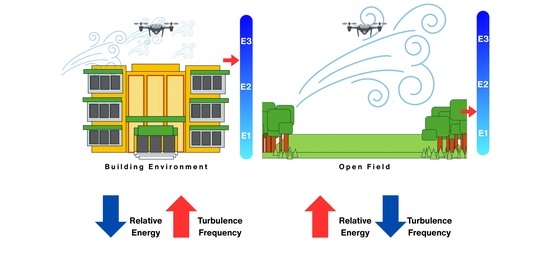
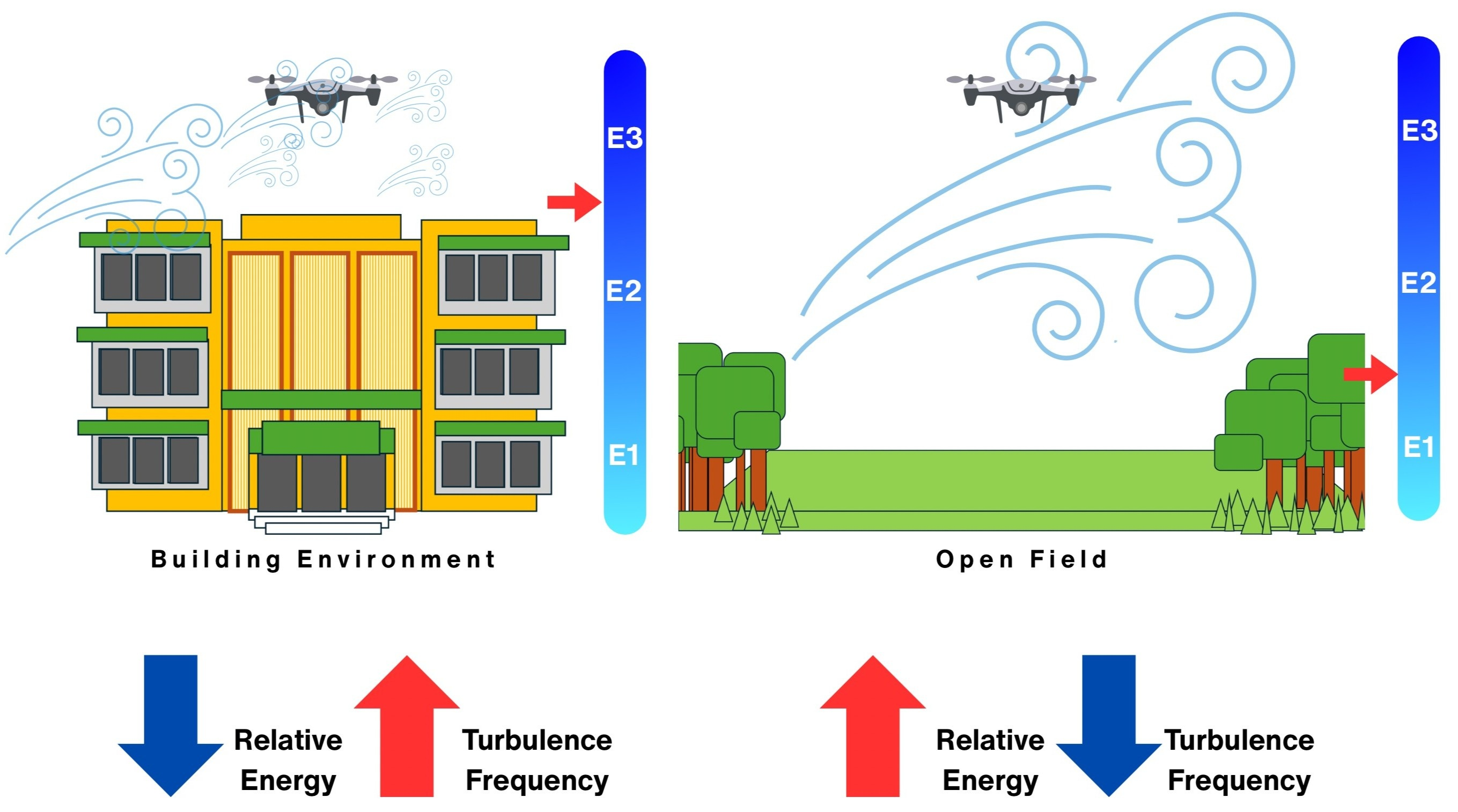
Monitoring atmospheric turbulence data of the near-surface sublayer presents a difficult challenge on complex and heterogeneous terrain such as mixed land areas where weather facilities are not always available. This study uses tilt data derived from the flight logs of two hovering unmanned aerial vehicles (UAVS) as portable probes (DJI Mavic 2 and DJI Mavic 3 Classic) to compare the turbulence spectral characteristics of two adjacent contrasting surfaces; a built open courtyard and an open grass field. Turbulence spectra were divided into three ranges: E 1 (0.05–0.2 Hz), E 2 (0.2–1 Hz), and E 3 (1–5 Hz). A 30 s moving mean and welch methods were used to filter out noise to ensure that the resulting spectra only showed the small tilts that were derived to show atmospheric turbulence. Normalization was applied to compare spectral shapes. Comparisons were made within platform (M2 vs. M2, M3 vs. M3). Observations show that spectral shapes generally agree. Contrasts were systematic within the energy bands and were not global. The study concludes on the notion that the unobstructed surfaces produce stronger fluctuations at the largest scales, whereas the built environments intensify turbulence at smaller scales.

Graphical Abstract

1. Introduction

Urban locations often have many zones of mixed land use combining courtyards, buildings, grass fields, and tree belts in the same proximity. This heterogeneity of surface types affects the layer of the atmosphere near the ground or the near-surface layer [1,2]. This causes changes in the surrounding turbulent airflow that drives ventilation, pollutant dispersion, and structural loads [2,3,4]. With the increasing pollutant density as well as more frequent atmospheric phenomena that greatly affect densely populated areas, local atmospheric monitoring has gradually become a necessity [4,5,6]. While fixed towers and dense sensor networks, being the most widely used monitoring systems, are difficult to deploy in these settings, remote profilers resolve larger scales and smooth out the meter-scale eddies that matter for local design and operations [7]. Remote profilers and portable probes, thus, contribute to a detailed understanding of how different surface types shape turbulence within the first few meters above the ground.
Turbulent energy is distributed across scales. Large eddies contain most of the variance and feed smaller eddies through the cascade. In the inertial range, spectra follow an approximate −5/3 scale slope [8,9]. Confinement, roughness, and shear shift where energy sits in frequency and modifies characteristic time scales. These shifts are visible in variance-normalized spectra, in banded energies at low, mid, and high frequencies, in the inertia-range slope, in the median energy frequency f 50 , and in the integral time scale τ [10,11,12,13].
Experiments performed with small commercial multirotor UAVs have shown that they can act as portable point samplers [13]. With a small-tilt hover balance, lateral attitude and control responses map to horizontal wind fluctuations [13]. Welch spectral estimates applied to the resulting time series provide stable variance-normalized spectra with confidence bounds [14]. Prior validation work shows that hover-based UAV probing can reproduce key spectral features and reasonably agree with reference instruments within the resolvable band [12,15,16].
Earlier studies have used fixed-wing UAVs and multirotor UAVs to measure turbulence [17]. These have shown that methods using fixed-wing UAVs tend to average over long legs while multirotor drones reduce spatial averaging due to the hovering capabilities [18,19]. However, many reports center on flights using a single site, bulk statistics, or mean profiles rather than paired spectral contrasts over adjacent surfaces with contrasting surface types under comparable conditions.
Urban canopy turbulence research has increasingly focused on how local surface conditions shape the spectral distribution of turbulent energy. Large-eddy simulation demonstrates that canopy geometry strongly influences turbulence intensities and spectral slopes, highlighting the need to account for surface heterogeneity in model parameterizations [20]. Similar studies show that coherent structures in unsteady urban flows alter the scales of energy transport, underscoring that spectral characteristics are sensitive to local surface conditions rather than solely synoptic forcing [21]. High-resolution datasets provide LES-derived spectra for urban canopy layers, offering benchmarks for validating whether observed spectral shapes match modeled distributions across different terrains [22]. These studies collectively suggest that spectral analysis is a powerful tool for diagnosing how built versus open surfaces redistribute energy across scales.
This study proposes a UAV-based comparison between two adjacent areas with different surface types located within a campus setting in an urban environment and summarizes the contrast with spectral metrics across a specific frequency band. By directly comparing spectra over adjacent contrasting surfaces under similar synoptic conditions, this study addresses a critical gap: the lack of empirical, mobile measurements that capture how local surface type modulates turbulence energy distribution. In doing so, the results provided observational evidence that can validate existing canopy models and refine their treatment of near-surface turbulence across heterogeneous urban landscapes [20,23].
Section 2 provides the details of the study site involving the two contrasting surfaces; it also presents the flight missions and weather conditions during the field campaign. Furthermore, the conversion of flight logs to longitudinal and lateral fluctuations as well as the data treatment are discussed. Section 3 then provides the results of the field campaigns, starting with the turbulence spectra, and then presents the contrasts within specific frequencies. Section 4 discusses the inferences and interpretations made by the authors from the gathered results. Section 5 provides the overall conclusions of the study.

2. Materials and Methods

2.1. Study Site and Surface Geometry

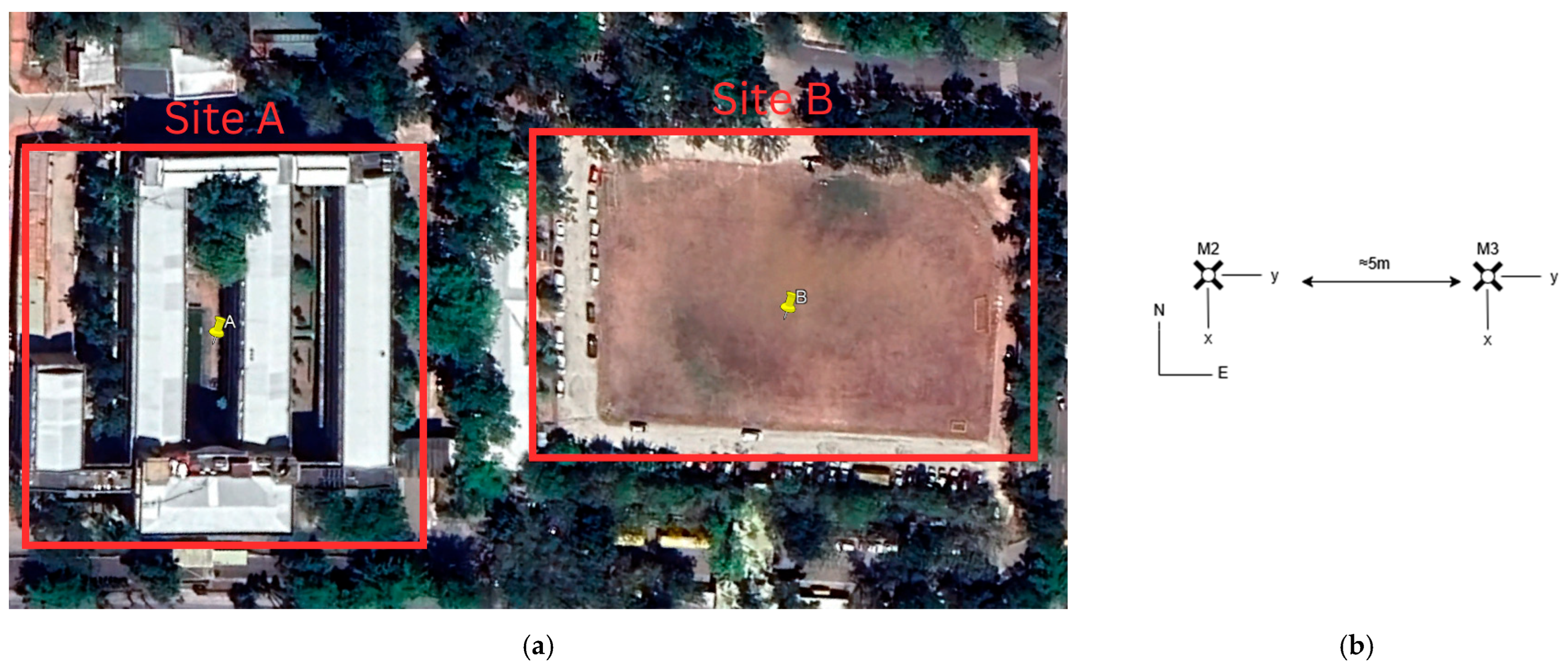
The University of San Carlos Talamban Campus (10°21′9.32″ N, 123°54′48.00″ E) in Cebu City is a mixed-land-use area where dense vegetation interweaves with university buildings and facilities, making it a suitable setting for an exploratory atmospheric turbulence study. Two neighboring sites were sampled: the Bunzel Building (Site A) and the football field (Site B) as can be seen in Figure 1a. The sites are only a few hundred meters apart, so they experience the same mesoscale forcing but have very different roughness and building layout.
Site A is a semi-enclosed rectangular courtyard 12 m in width and 60 m in length with a characteristic building height of H b 16–21 m. The primary hover point used in the September 2025 campaign was located near the courtyard centerline, approximately 6 m from the opposing long facades and about 30 m from the shorter end walls (Figure 1a). With the M2 and M3 flown at 5 m and 7 m above ground level (AGL), respectively, the sampling height corresponded to z / H b 0.23–0.31 within the roughness sublayer, while horizontal offsets gave d l o n g / H b 0.30 and d s h o r t / H b 1.5 with d l o n g and d s h o r t corresponding to the hover point’s distance relative to the building. Thus, the UAVs sampled within the courtyard shear zone were influenced by the surrounding buildings but remained away from immediate corner recirculation.
Site B is an 8000 m2 open grass field 80 m in width and 100 m in length and framed by trees with an average canopy height of H t   18   m and tree density corresponding to 20 tree stems per 1000 m2, respectively. The baseline hover positions for the September 2025 campaign were placed over the central part of the field at 5 m (M2) and 7 m (M3) AGL, corresponding to z / H t 0.28–0.39, i.e., within the lower roughness sublayer above the grass but below the treetops.

2.2. September 2025 Campaign and Flight Strategy

Flights were conducted over three days (3 to 5 September 2025) using two commercial multirotor UAVs: DJI Mavic 2 Pro (M2) and DJI Mavic 3 Classic (M3) (DJI, Shenzhen, China). Figure 1b shows the basic layout of the experiments. On each day, both UAVs were simultaneously flown up to altitude at ≤ 1   m   s 1 with a south-facing heading and held in steady hover for 5 min in each site. A 5 m distance between each drone was maintained to avoid mutual rotor interference. Weather data collected during the week of the field experiments predominantly moved northwards due to the southerly winds of the monsoon [24]. The M2 hovered at 5 m above ground level (AGL) while the M3 hovered at 7 m AGL. Flights at Site A always preceded and were immediately followed by flights at Site B. This yields four flights per day (A/B on Day 1, A/B on Day 2, and A/B on Day 3) and 12 flights in total. Since the platforms differ in height and sampling rate, all site-to-site comparisons are within platform (M2 vs. M2; M3 vs. M3), not across platforms.
Favorable meteorological conditions were observed from 3 to 5 September 2025. Over the three days, conditions were generally clear to partly cloudy with weak synoptic winds and no rainfall. These are favorable conditions for stable hover with minimal gusts and convective burst. Table 1 summarizes the mean meteorological parameters recorded during each flight day.
The M2 has a logging frequency of 10 Hz while the M3 has a logging frequency of 5 Hz. These sampling rates set the Nyquist limits (5 Hz for M2; 2.5 Hz for M3), which constrain the highest resolvable fluctuation frequencies in the spectra. Accordingly, the interpretable one-sided spectral bands were restricted to 0.05–5 Hz for the M2 and 0.05–2.5 Hz for the M3, and these limits were adopted as both the UAVs’ respective main analysis bands for the study.

2.3. Flight Log and Attitude Data

DJI flight logs provide the aircraft attitude as roll Φ , pitch θ , and yaw. Roll Φ is rotation about the body x-axis (positive right wing down) and pitch θ is the rotation about the y-axis (positive nose up). During hover the yaw angle was held constant with no pilot input so changes in Φ and θ correspond to lateral tilting of the rotor disk required to balance the ambient wind and keep the UAV stable. The longitudinal fluctuation u was defined in the plane of the rotor disk along the nominal direction, taken as the pointing direction of the UAV (facing south), and the transverse fluctuation v was defined perpendicular to it in the horizontal plane. Because the mean wind direction varied by at most one quadrant between flight days (Table 1), this definition ensures that u and v remain aligned with the dominant in-hover force balance rather than a fixed geographic axis.
Data from the DJI flight logs were directly extracted from both drones, with the M2 logging at 10 Hz while the M3 was logging at 5 Hz. Raw logs were converted to time series of Φ ( t ) and θ t in radians. Since both UAVs were held at near constant heading for all flights, yaw was not used.
Despite minimal pilot input (hands-off hover), low-frequency variability can still be influenced by autonomous station-keeping and gradual drift, motivating a controlled high-pass definition of fluctuations. Thus, to remove slow drift in the platform attitude in frequencies below the main analysis band (≤ 0.05   H z ) while retaining the turbulent signal, a 30 s moving-mean window length was selected as a high-pass cut-off (≈1/30 s ≈ 0.03 Hz) and was subtracted from each angle of the flight logs.
Φ = Φ Φ ¯ 30 s
θ = θ θ ¯ 30 s .
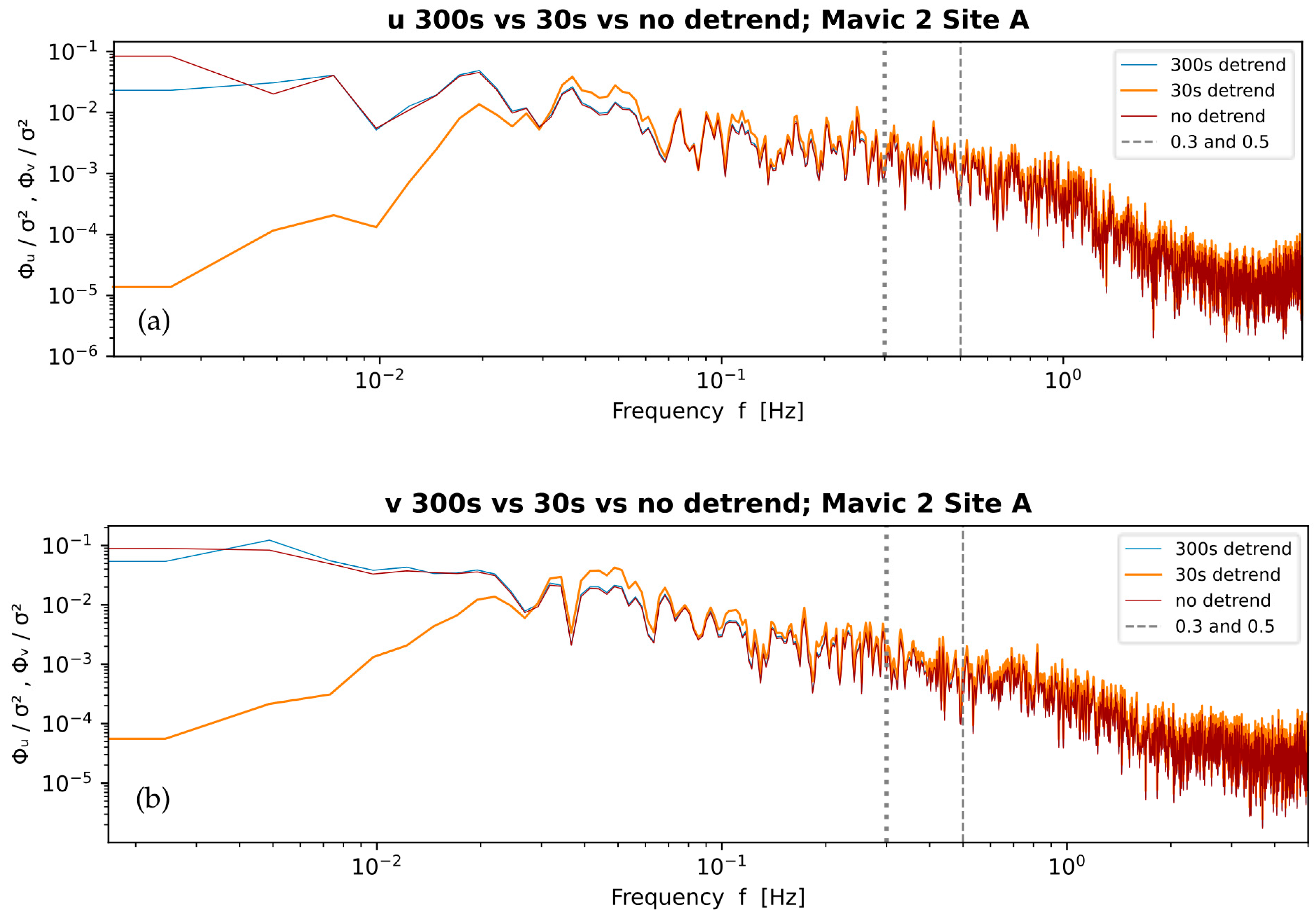
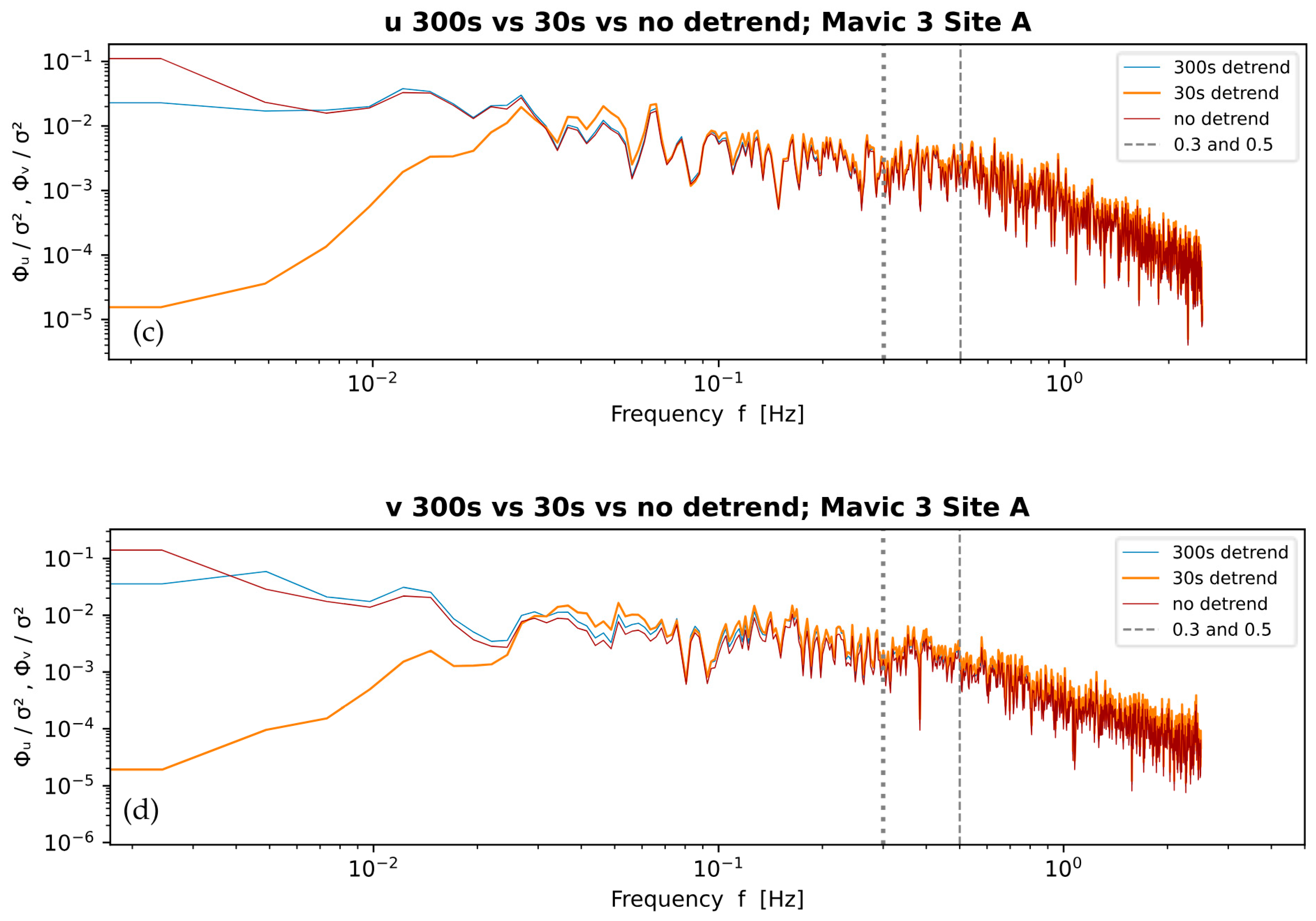
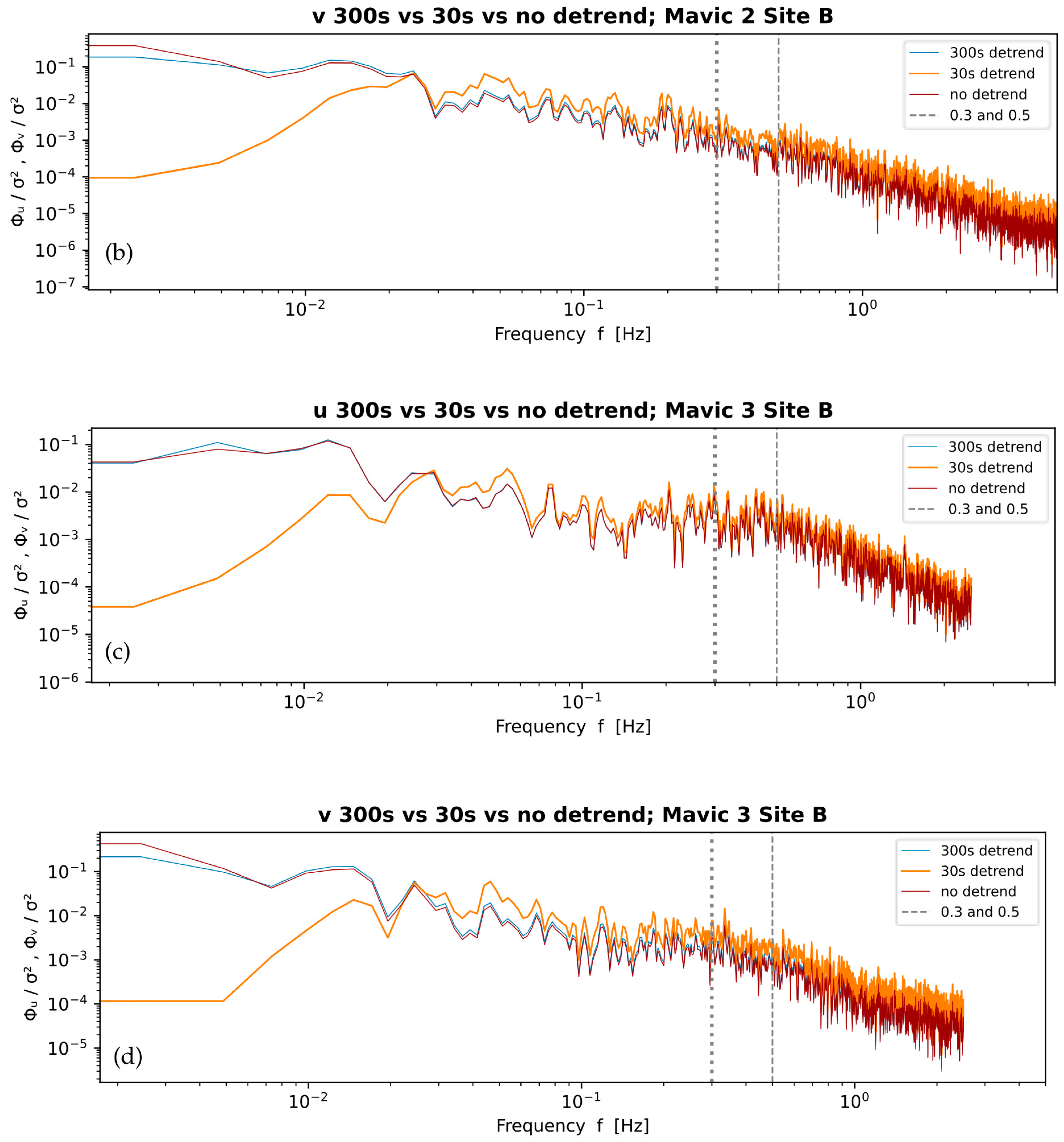
Motions at periods longer than ~30–60 s can therefore be influenced by both station-keeping drift and the detrending; this sensitivity was quantified using the January 2026 long-hover experiments and reported separately from the main-site comparison results (see Appendix C, Figure A5 and Figure A6).
Small-tilt hover balance gives lateral wind fluctuations from attitude perturbations:
u = m g c x Φ c o s θ + θ s i n θ
v = m g c y Φ s i n θ θ c o s θ
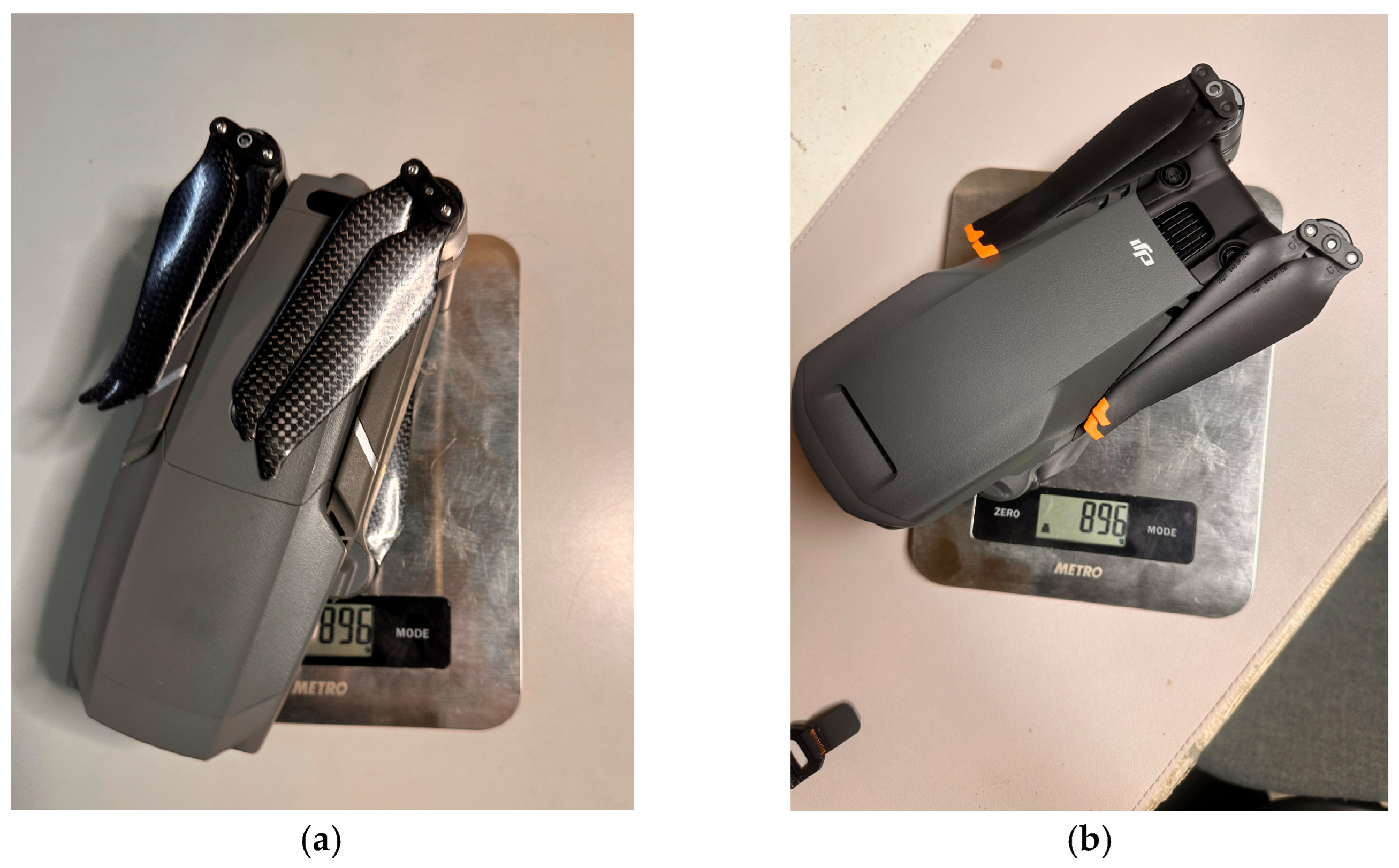
where m is the aircraft’s mass equal to 896 g for both UAVs, and c x and c y were effective proportionality constants [12]. All spectral comparisons were variance-normalized, making absolute scale factors largely cancel out. The analysis focuses on relative energy distribution across scales and was not sensitive to the absolute values of c x and c y . In Equations (3) and (4), Φ and θ denote the detrended roll and pitch angles defined above while θ ( t ) in sin θ and cos θ denotes instantaneous pitch angle used to project these perturbations onto the UAV-fixed longitudinal/transverse axes under the small-tilt hover balance assumption; yaw was held constant and was therefore not used.

2.4. Spectral Estimation and Band-Integrated Metrics

One-sided power spectra of u and v are estimated with Welch’s method with Hann window 50% overlap. The 30 s detrend was performed prior to spectral estimation as an effective high-pass cut-off below the lower edge of the lowest analysis band (≈ 0.03   H z ) . Segment length was chosen to give approximately eight segments per flight (minimum 256 samples, capped at 2048) producing K averaged segments. Because the M2 and M3 sample at 10 Hz and 5 Hz, respectively, this corresponds to segment durations of roughly 25–205 s for M2 and 51–410 s for M3, with slightly different frequency resolutions in the two platforms. For each flight and component, K windowed segments were averaged to obtain the Welch spectrum with K being the number of welch average was reported for each spectrum. Uncertainty intervals for spectral curves and derived spectral metrics were obtained by bootstrap resampling of the Welch segments within each flight (resampling the set of windowed segments with replacement, recomputing the median spectrum and derived metrics per replicate), whereas the integral time scale used a block bootstrap in the time domain (fixed-duration time blocks) to preserve autocorrelation. Moreover, because the hover records (including the additional flights shown in detail in Appendix B) range from 5 to 15 min and have a high-pass filter, the analysis focuses on the near-surface, obstacle-affected part of the spectrum and does not attempt to characterize mesoscale/very-large eddies at periods longer than the available stationary hover windows.
Spectra were variance normalized, making Φ σ 2 d f = 1 , leading to fair comparisons for each flight and platform and enabling direct comparison between flights and platforms despite absolute wind speeds. A 95% confidence band using the chi-square approximation with degrees of freedom v = 2 K was used, where K is the number of Welch-averaged segments. These intervals convey the sampling uncertainty at each frequency without assuming stationarity over the entire record. The lowest-frequency portion of the spectrum is treated as method-sensitive and is not reliably stationary because hover records are finite (5–15 min) and can contain low-frequency variability associated with autonomous station-keeping and gradual attitude drift. The primary site-to-site interpretation therefore focuses on frequencies 0.05 Hz where the spectra are more consistently constrained for both platforms.
The inertial subrange slope was computed from a log–log linear fit over 0.3–2 Hz and compared with Kolmogorov’s −5/3 law. The median energy frequency f 50 was obtained as the frequency at which the cumulative integral of the variance-normalized spectrum reached 0.5. Integral time scale summarized the temporal coherence and was computed as the area under the normalized autocorrelation of u t   ( o r   v t t ) from lag to 0 to the first zero crossing (with a 5 s cap if no crossing occurred).
For each platform and component, Site A and Site B spectra were put on a common log-spaced frequency grid inside their shared band. All processing were repeated per component ( u and v ) and per platform to respect height and bandwidth differences.

3. Results

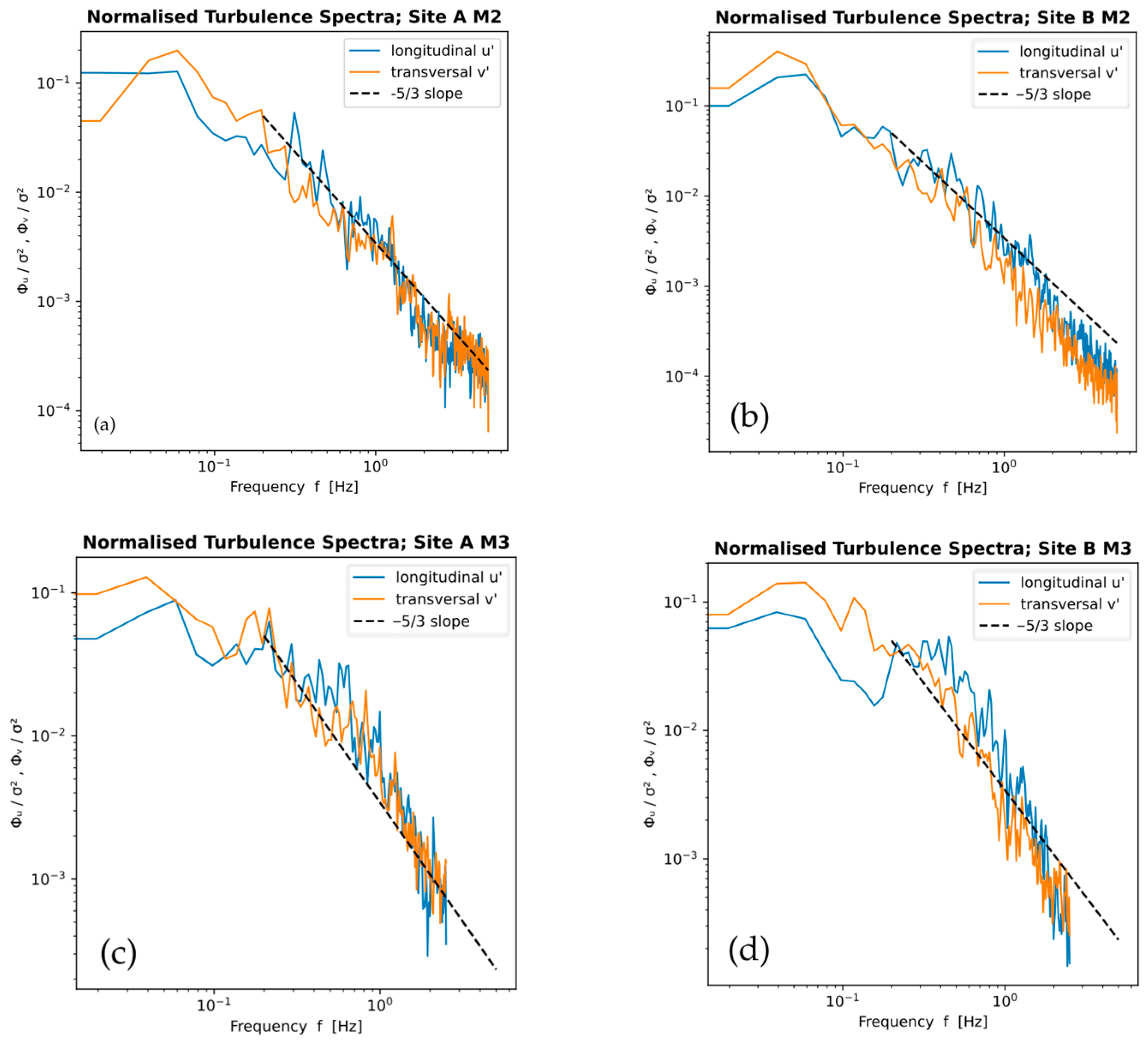
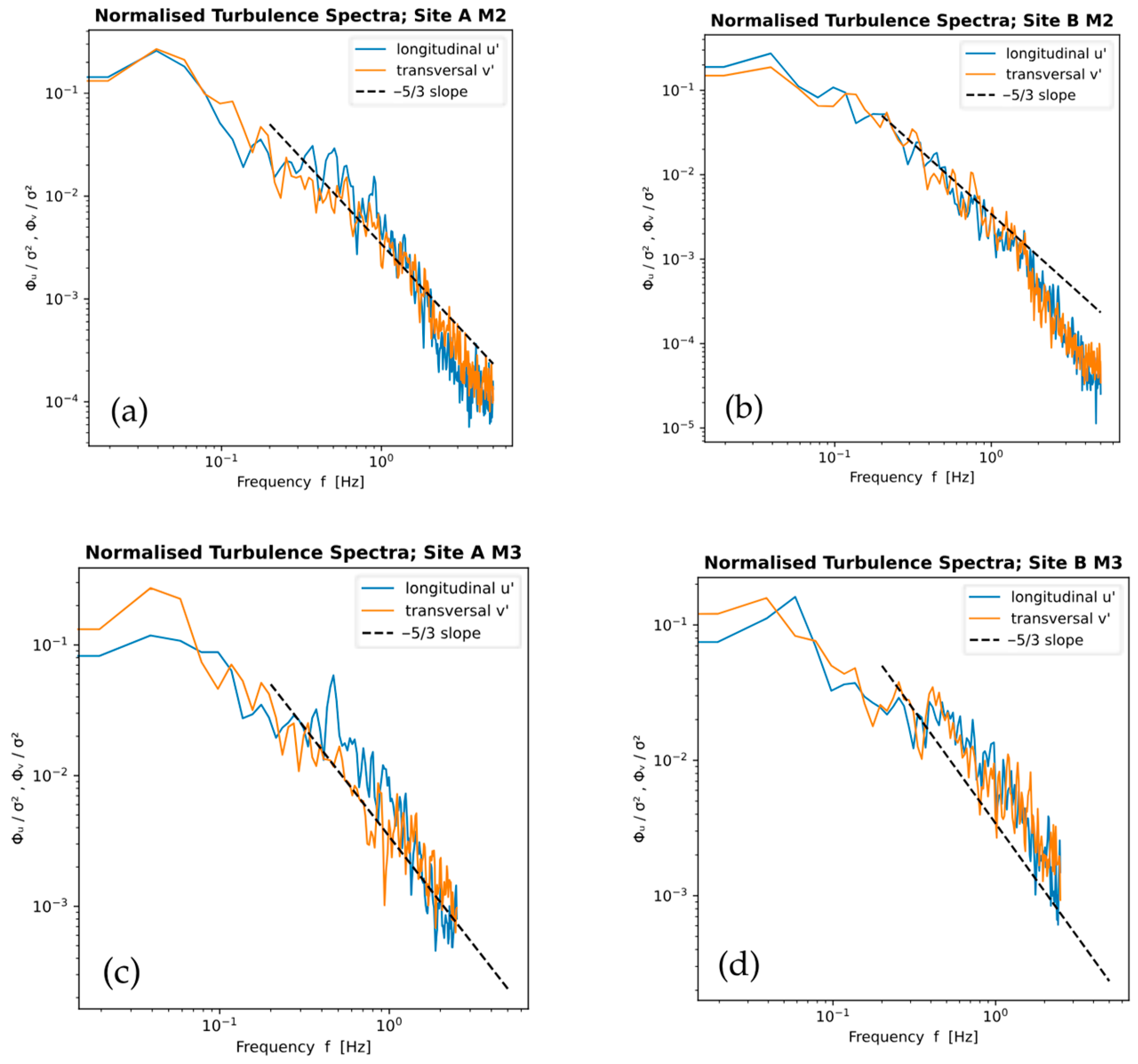
The flight logs of the three-day September campaign were converted into velocity fluctuations and summarized as variance-normalized turbulence spectra in Figure 2, Figure 3 and Figure 4 and Figure A1, with corresponding band-integrated metrics listed in Table A1 and Table A2. The x-axes represent the frequency range while the y-axes represent the variance-normalized spectral density. On the flights of 3 September 2025, the M2 and M3 spectra at both sites still follow near Kolmogorov slopes close to −5/3 over roughly 0.3–2 Hz for both u and v . Slightly more energy is present at Site A in the 0.2–1 Hz and 1–5 Hz bands ( E 2 and E 3 differ by about 15–40%, p > 0.1 ). These differences are not significant because their bootstrap confidence intervals strongly overlap. The clear contrast is in the median energy frequency f 50 with Site A being almost twice that of Site B, which means half of the longitudinal variance at Site A is contained in somewhat faster motions. The integral time scale τ u at both sites stay around 1.4–1.5 s. For the transversal component of M2 on 3 September 2025, shown in Figure 2a, point estimate suggests a bit more low-frequency energy and longer τ v at Site A. The significant difference lies in the log–log slope over 0.3–2 Hz. Site A spectrum is significantly shallower, indicating more cross-stream energy at higher frequencies within the courtyard. The median frequency f 50 shows no significant difference but data indicates Site A being slightly lower.
M3 flights on the 3 September 2025 show behavior of the longitudinal spectra near −5/3 with band energies that are close between both sites. Site A has slightly more energy in E 2 and slightly less in E 3 as compared to Site B, but these differences remain within the bootstrap confidence intervals. The main difference is in the spectral shape where the slope of u at Site A is significantly steeper ( 1.97   v s . 1.41 ,   p 0.05 ), consistent with a faster roll-off of longitudinal energy toward higher frequencies above the built site. On the other hand, the transverse component for M3 shows more low-frequency energy, with E 1 being approximately 50% larger, and a lower median frequency as well as a longer τ v . Overall, the flights on 3 September 2025 show only modest but internally consistent site contrasts, mainly the transversal component slopes and in shifts in the median frequency.
The flights for 4 September 2025 (as shown in Figure 3) show a slightly different pattern. For M2 u , the low-frequency band E 1 is essentially identical between the two sites, while E 2 point estimates differ by about 25 %   ( 0.28   v s .   0.37 ) . However, their bootstrap confidence intervals strongly overlap and p 0.1 , so we treat this difference as not statistically significant. In contrast, Site A carries almost 50% more energy in E 3 (0.127 vs. 0.086, p 0.10 ). The slope and the median frequency f 50 remain statistically indistinguishable. The longitudinal time scale τ u is only slightly shorter at Site A at 0.36 s with Site B at 0.41 s. The transversal component for the M2 shows strong differences at high frequencies. Site A has more than double the 1–5 Hz energy of Site B ( 0.113   v s .   0.053 ,   p 0.05 ) , while the other energy bands along with the median frequency f 50 do not have significant difference.
For the M3 on 4 September 2025, the u spectra show the opposite behavior at low frequency. Site A now sits on the lower end, with Site B now having roughly 40% more E 1 energy ( 0.135   v s .   0.224 , p 0.05 ), while E 2 ,   E 3 ,   f 50 and τ u are similar between sites. In contrast, the M3 v spectra redistribute energy toward slower motions at Site A. Both E 1 and E 2 are larger at Site A, and the median frequency f 50 significantly drops from 0.39   H z at Site B to 0.27   H z at Site A ( p 0.05 ). At the same time, Site A has significantly less high-frequency E 3 v energy ( 0.072   v s .   0.110 , p 0.05 ) and steeper slope over 0.3–2 Hz ( 1.85   v s .   1.38 , p 0.10 ). This combination suggests that, for the transversal component of the M3 on 4 September 2025, the built area of Site A shifts variance away from small-scale eddies into larger-scale, slower cross-stream motions.
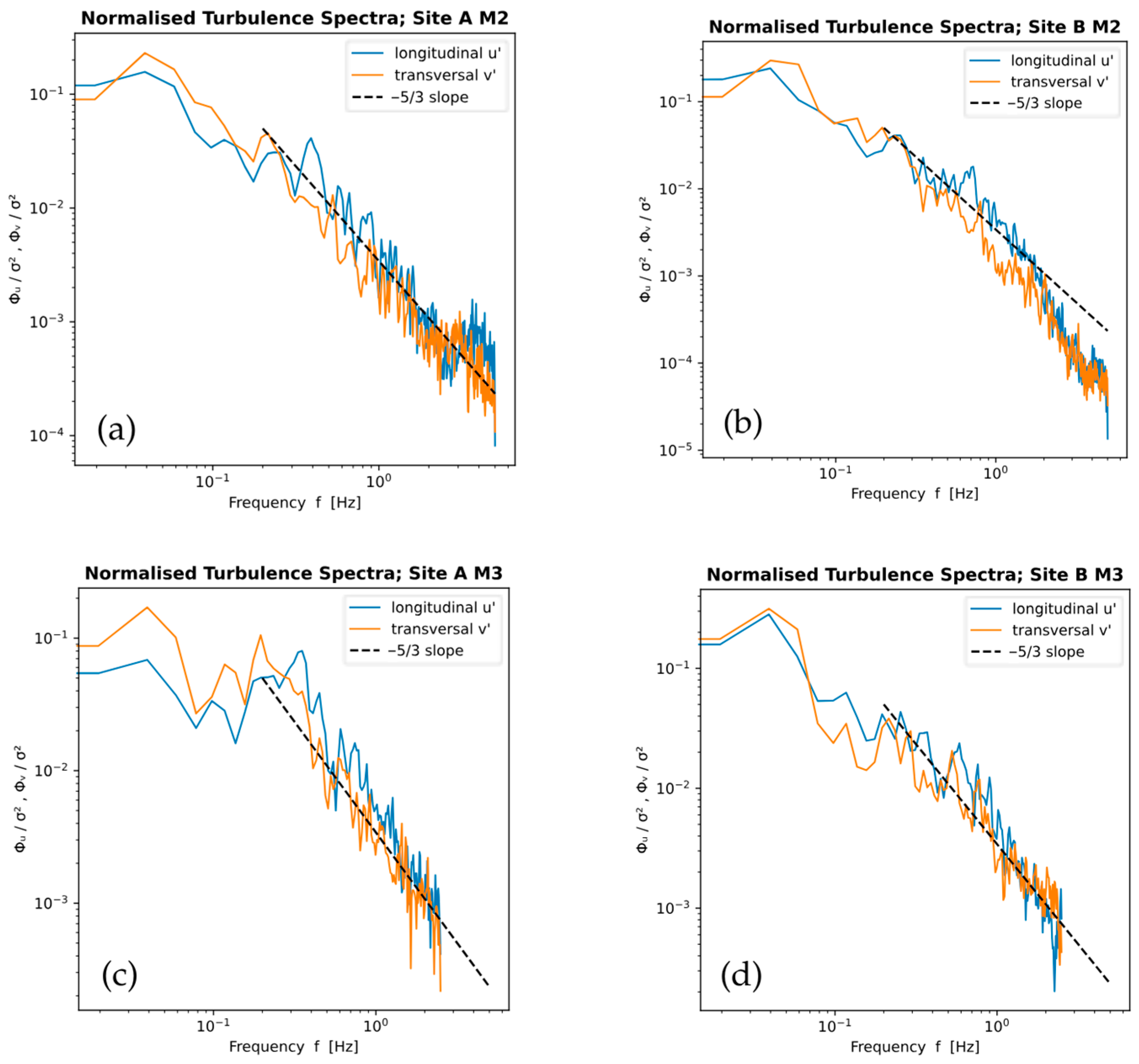
The 5 September 2025 flights shown in Figure 4 again reorganizes the pattern. For M2 u , the significant differences are at the lower frequencies. Site A has noticeably less E 1 energy than Site B ( 0.145   v s .   0.318 , p 0.10 ), while E 2 , E 3 , and f 50 show modest point-estimate difference with strongly overlapping confidence intervals and non-significant p-values. Site A presents a shorter longitudinal time scale ( 0.39   s   v s .   0.50   s ). For M2 v , Site A shows both a shallower slope and enhanced high-frequency energy. E 3 is about 65% larger than Site B ( 0.095   v s .   0.058 , p 0.05 ). and the v -slope over 0.3–2 Hz significantly flattens from −2.01 at Site B to −1.31 at Site A. Median frequencies f 50 present only minor changes. The results from the M2 data show more short-scale cross-stream variability in the built environment of Site A on this day.
For M3 flights on 5 September 2025, both components show clear spectral-shape differences. In u , Site A has higher E 1 (0.154 vs. 0.104, p 0.10 ) than Site B, and Site A also has significantly shallower slope ( −1.99   v s . −2.33 ,     p 0.05 ) . By contrast, the differences in E 2 and E 3 are small (with an order of 20 % or less), their confidence intervals strongly overlap, and the associated p -values exceed 0.1 so these bands, along with the median frequency f 50 , were treated as not significantly different between sites. In v , Site A spectra concentrate more variance at high frequencies. E 3 more than doubles from 0.044 at Site B to 0.096 at Site A ( p 0.05 ), and the v-slope flattens from −2.35 to −1.40 ( p 0.05 ). The median frequency f 50 and the time scale τ v change insignificantly.
Across all flights, Site A does not exhibit a single fixed characteristic, but repeated patterns appear where it either shows enhanced low-frequency energy with long-lived motions, as observed in the transversal components on the flights on 3 to 4 September, or enhanced high-frequency cross-stream variance and shallower spectra, particularly for the transverse component on the flights on 4 to 5 September. All quantitative metrics for both platforms and components are summarized in Table A1 and Table A2.

4. Discussion

The rise in the use of small commercial UAVs for atmospheric probing has been instrumental to the development in turbulence monitoring at complex locations, supplementing traditional methods [12]. Expected spectral shapes, following Kolmogorov’s −5/3 slope, were observed while also exhibiting intermittent but systematic differences in energy distribution. Contrasts in band-limited energy, spectral slope, and median frequency between the two sites, particularly in the lateral component and in the highest-frequency band, were observed during the September 2025 campaign. The observed patterns suggested that local surface modulated the shape and the energy distribution of the turbulence spectra under broadly similar conditions, even though the magnitude and the sign of the differences vary from flight to flight. These observations support the hypothesis that local surface conditions influence the flow structures, rather than the spectra being determined by the background synoptic forcing.
Additional sensitivity tests conducted in January 2026—including longer 10–15 min records, alternative high-pass windows (30–120 s), and altitude hover experiments—showed that the main spectral metrics (band-integrated energies, slopes over 0.3–2 Hz, and median frequency f 50 ) vary modestly with these methodological choices compared to the contrasts between Sites A and B. This gives confidence that the September results were not artifacts of record length, filter choice, or a single hover point, but reflect robust surface-type effects.
At the same time, the analysis intentionally emphasizes the part of the spectrum that can be interpreted most consistently from short, quasi-stationary hover segments. The fluctuation definition subtracts the moving average, which acts as a controlled high-pass filter; therefore, very-large-scale motions (periods longer than the detrending window and/or the available hover duration) were not interpreted as turbulence statistics in this dataset. For this reason, the present results are indications of scale-partition on how built geometry redistributes energy only within the reliably sampled band rather than as a complete accounting of the energy-containing range.
Contrary to the intuitive notion that built structures amplify turbulent effects at all scales when generating eddies, results show a more nuanced partitioning. In most flights, the open field produced stronger fluctuations at the largest scales, whereas the built courtyard intensified turbulence at smaller scales. While some flights of the September campaign exhibit the opposite observations, with more large-scale energy over Site A and smaller-scale energy in Site B, these were not systematic and were considered outliers. The implication is that the surface type of Site A introduces turbulence by disrupting flow at lower frequency eddies while the open field of Site B does not obstruct such flows and eddies at larger scales dominate. Site B’s uninterrupted wind fetch allowed large eddies to fully develop, whereas Site A’s surrounding walls broke the incoming wind into smaller eddies through mechanical turbulence production. The courtyard’s confined geometry effectively filtered out the largest turbulent motions (beyond the courtyard scale) while injecting energy into finer-scale eddies.
The January record-length tests reinforce this picture: when 5, 10, and 15 min hovers were compared for both platforms, normalized spectral slopes over 0.3–2 Hz remained within the 95% confidence intervals of the original 5 min estimates, while the largest relative changes occurred in the lowest band ( E 1 ), consistent with the expectation that very-low-frequency motions were most sensitive to sampling length (see Appendix B, Table A6). Additionally, the Site A vs. Site B differences in E 2 , E 3 , and slope typically exceeded the intra-site variability introduced by record length.
The contrast in spectral slope between the two sites further supports this interpretation, especially for the lateral component on 4 to 5 September. At Site B, observed spectra featured a steep drop-off in the 0.3–2 Hz range, approaching the classical −5/3 power–law slope expected for an inertial subrange in homogeneous surface-layer turbulence. In the courtyard (Site A), the transversal spectra were noticeably flatter in the 0.3–2 Hz range, indicating more high-frequency energy. The expected rapid decay of energy at smaller scales was less apparent at Site A, suggesting that additional energy was being injected into those scales instead of cascading normally to dissipation. Walls and sharp edges in the built environment can generate shear layers, shed vortices, and create recirculation zones that continuously feed energy into smaller eddies [25]. This mechanical turbulence generation by obstacles tends to flatten the velocity spectra and shorten the integral time scales, a behavior that was observed for several flights at Site A when E 3 increased and the slopes became less negative than at Site B. The lateral confinement and numerous flow impingements in the courtyard effectively disrupted the standard energy cascade, resulting in excess spectral energy at high frequencies (evident in the elevated E 3 band) and a corresponding reduction in large-eddy energy. Similar spectral distortions have been reported in other rough or obstructed flows. For instance, turbulence above a dense forest canopy shows a deficit in mid-frequency power and an excess at the highest frequencies due to wake production by the roughness elements [26]. In this study, the courtyard obstacles acted comparably, injecting additional turbulent kinetic energy at finer scales and thereby partially suppressing the energy that normally reside in the largest eddies.
The moving-average sensitivity tests, detailed in Appendix B, Table A3, extend this argument. Re-processing selected flights with 60 and 120 s high-pass windows shifted more variance into the lowest band E 1 , as expected, but produced only (10–20%) changes in E 2 E 3 and negligible shifts in the fitted slopes over 0.3–2 Hz. Thus, the choice of a 30 s moving mean mainly controls how much of the very-slow drift is removed, while the conclusions about excess high-frequency energy in Site A and enhanced large-scale motions at Site B remain unchanged.
Flow confinement appears to be the key factor explaining the absence of very large eddies at Site A. Eddies of integral scale were inherently limited by physical boundaries [25], so a courtyard surrounded by buildings cannot sustain turbulence larger than the enclosure itself. Site B’s open exposure, in contrast, allowed eddies to grow with the natural surface roughness length, unimpeded by nearby barriers. In several flights, particularly for the lateral component, Site B carried a larger fraction of low-frequency energy and slightly longer dominant time scales, consistent with the expected behavior of turbulence over open terrain [27]. By comparison, the flow at Site A was continually being reset by impingement and separation around the courtyard’s periphery. With southerly monsoon winds, the buildings induced recirculating winds that shed smaller eddies off roof and wall edges. This generated strong mechanical turbulence in the mid-to-high-frequency range (elevating the E 2 E 3 bands) at the expense of the largest scales. The confined geometry effectively truncated the low-frequency end of the spectrum, as eddies larger than the courtyard could not form or persist. Such outcomes were consistent with wind-tunnel and modeling studies of enclosed or urban canyon flows, which note that large-scale turbulence is greatly diminished in restricted flow regions while obstacle-induced shear dramatically increases small-scale fluctuation intensity [25]. The results thus reinforce fundamental fluid-mechanic principles stating that the presence and arrangement of solid boundaries strongly redistribute turbulent energy across scales. There were no observations of anomalies suggesting instrumentation errors or unusual atmospheric events, lending confidence that the noted spectral differences indeed stem from surface-type effects.
A complementary manner of expressing the same mechanism was through a turbulence length-scale interpretation inside the urban canopy/roughness sublayer. Urban-flow theory and experiments commonly indicate that the dominant eddy sizes in the canopy are constrained by canopy geometry and proximity to solid boundaries, rather than freely expanding with height as in an ideal surface layer [20]. When the distance-to-obstacle is small, the characteristic turbulent length scales are expected to decrease, which results in relatively greater energy at smaller scales and reduced energy at the largest resolvable scales. This is consistent with observations of building clusters where flow distortion and turbulence enhancement are strongest near buildings and depend on separation/proximity effects, and with canopy/roughness-sublayer formulations where additional geometry-linked length scales govern the flow adjustment near the canopy top [28]. In this setting, the short distance to the surrounding walls at Site A provided a physically plausible cause for reduced turbulent length scales compared with Site B, aligning with the repeated observation of flatter spectra and amplified high-frequency variance in the courtyard.
Altitude hover experiments conducted in January 2026 further clarify the role of height. For the M2 (5, 10, 15 m) and M3 (7, 12, 17 m) platforms at both sites, variance-normalized spectra at the three tested altitudes were very similar in shape, with band-integrated energies and slopes typically varying by less than ~20–30% relative to the lowest level and without any systematic trend toward steeper or flatter slopes. In other words, over the lowest 10 m the spectra primarily reflect the near-surface roughness sublayer, and the September 2025 hover levels (5 m for M2, 7 m for M3) were representative of that layer rather than outliers. This is consistent with the analysis that the observed site-to-site contrasts arise from surface geometry.
All comparisons above were made for a given UAV platform to avoid conflating platform-specific responses. Side-by-side, the two multirotor measured similar spectral shapes and turbulence metrics when flown under the same conditions. Across all flights, the longitudinal and lateral spectra derived from both M2 and M3 at both sites produced slopes generally close to the expected −5/3slope. For instance, during the 5 September 2025 flights, when the M2 spectra showed enhanced high-frequency cross-stream energy and a flatter slope on the lateral axis at Site A, the M3 spectra followed the same behavior with larger E 3 and less negative slopes over Site A than over Site B. On other flights where Site B carried more low-frequency variance, both platforms showed a consistent shift toward slower motions, which is reflected in higher E 1 , lower median frequency f 50 , and slightly longer time scales τ . Small discrepancies in absolute band energies between the two UAVs were expected given that the flight missions required them to fly at different altitudes for safety reasons as well as minute and unavoidable pilot input differences in the field campaigns. However, by comparing within platform, the evaluation remains internally consistent. The agreement between platforms indicates that resulting spectral shape and behavior are properties of the two surface types rather than artifacts of any one sensor or platform.
This inference was strengthened by the horizontal-variability tests in January 2026 (see Appendix B, Table A4), where three hover locations per site (near-wall, courtyard/field center, and tree-line) were sampled for both drones. Within a given site and platform, the relative spread in E 2 E 3 and slope among the three locations was typically smaller than, or comparable to, the day-to-day variability already present in the September campaign and clearly smaller than the mean Site A vs. Site B contrasts. Thus, the main findings are not solely dependent on a single hover point but were representative of the broader built-vs-open setting.
The present dataset should be interpreted as evidence of hints and repeatable patterns rather than definitive urban-turbulence statistics. The results consistently demonstrate that UAVs can resolve variance-normalized spectra shapes and scale-partition contrasts between a built courtyard and an open field in situ. However, conclusive statements about climatology of τ ,   f 50 or band energies, and about these quantities which vary with wind direction, stability, or time of day require substantially more observations (by an order of magnitude) than the current set of flights. The primary contribution is therefore methodological: demonstrating that small commercial UAVs can reproduce physically plausible spectra signatures in complex near-building flows, while motivating a larger follow-on dataset for stronger statistical inferences.
Overall, the findings illustrate that built features such as walls and buildings can substantially alter the turbulence spectrum by injecting energy at smaller scales and limiting the growth of large eddies. In contrast, open terrain allows turbulence to develop more freely, preserving the traditional cascade and larger coherent structures. These insights have important implications for urban wind engineering and dispersion modeling, where the modified turbulence in courtyards or street canyons (flatter spectra, higher dominant frequencies, shorter integral scales) must be accounted for. The use of UAV-based measurements, as demonstrated here, provides a powerful means to capture these effects in situ, bridging the gap between classical turbulence theory and the complex realities of urban flow. The evidence-based interpretations presented are supported by the recent literature on urban turbulence, and together they paint a consistent physical picture: surface geometry plays a decisive role in shaping how and where turbulent kinetic energy is distributed across scales in the near-surface atmosphere.

5. Conclusions and Recommendations

The main objective of this study was the comparison of the near-surface turbulent spectra over two adjacent and contrasting surfaces within the same area to determine whether surface type influences the shape and distribution of energy across the spectrum. Surface-influenced mechanical turbulence was evident in the contrasts between the sites. These generated turbulences affect the energy distribution across the observed frequencies and produce measurable differences in turbulence intensities and scales. Two sites were observed: the open courtyard (Site A) and the adjacent open field (Site B). Site A repeatedly, though not in every flight, shifted energy toward mid and high frequencies indicating the breaking down of large eddies into smaller-scale eddies caused by the geometric features of the surrounding structures.
Across the September campaign, both UAVs recovered spectra with slopes close to the expected −5/3 behavior over 0.3–2 Hz, but with systematic differences in band-limited energies, slopes, and median frequency between the two surfaces. Additional sensitivity tests conducted in January 2026, using longer record lengths (5–15 min) and alternative moving-average windows (30–300 s), as well as multiple altitude tests (5–17 m) and different hover points at each site, showed that these qualitative contrasts in spectral shape point to reasonable changes in processing choices and sampling height/position.
The contrasts observed were repeatable across platforms and days. Moreover, small commercial UAVs proved capable of atmospheric turbulence monitoring in locations where fixed instrumentation is impractical. These findings support the use of UAV-based spectral diagnostics for microclimate analysis, site screening, design checks, and targeted wind assessments in complex environments under similar synoptic conditions and measurement configurations.
While the spectral shapes and metrics agree within platform, given the nature of the study using two different instruments with the same method, numerical results of each drone do not necessarily coincide cross platform (M2 vs. M3) upon examination of the absolute band energy values of both datasets. Thus, future research must be conducted to establish standardization of utilizing multiple commercial UAVs as portable atmospheric probes paired with sonic anemometers or deployed weather stations placed within tens of meters of the hover points for calibration and absolute wind validation.

Author Contributions

Conceptualization, A.D.G.D.; methodology, A.D.G.D. and W.K.C.; software, W.K.C. and A.D.G.D.; investigation, A.D.G.D., W.K.C., R.A.C., F.P.A. and C.D.; formal analysis, A.D.G.D.; writing—original draft preparation, A.D.G.D.; writing—review and editing, A.D.G.D., W.K.C., R.A.C., F.P.A., V.R.M., C.B., C.D. and M.L.; visualization, W.K.C. and R.A.C.; supervision, M.L. All authors have read and agreed to the published version of the manuscript.

Funding

This research was funded by the Department of Science and Technology of the Philippines through the Engineering Research and Development for Technology Research Dissemination Grant.

Institutional Review Board Statement

Not applicable.

Data Availability Statement

The raw data supporting the conclusions of this article will be made available by the authors on request.

Acknowledgments

The authors are grateful to the University of San Carlos—School of Engineering and the Department of Science and Technology of the Philippines for the opportunity, facilitation, guidance, and support that allowed the accomplishment of this work. The first author thanks Alberto D. Delima for instilling the idea of internal resilience and quiet determination to keep going, especially in the midst of adversity, that served as the guiding light for this endeavor. The authors would like to thank Rosanna Ramos and Hannah Faye Rafols for the support in the conceptualization, writing, and editing of this research project. The authors would like to thank Alchris Go, Jenny Bulawin, and Kenrich Dela Rosa.

Conflicts of Interest

The funders had no role in the design of the study; in the collection, analyses, or interpretation of data; in the writing of the manuscript; or in the decision to publish the results.

Appendix A. January 2026 Supplementary Experiments Campaign

In this study, additional hover experiments were carried out in January 2026 using the same two platforms at the same sites to assess the sensitivity of the spectral metrics to methodological choices and sampling geometry.
To explicitly address record-length effects and the treatment of larger eddies, dedicated 15 min supplementary hovers were conducted, and sensitivity was quantified by relative changes in band energies and derived metrics when the record is reduced to 10 and 5 min, and by the frequency-by-frequency containment of the 5 min spectrum within the 15 min 95% confidence band. Variance fractions in fixed bands were also computed for concise comparison between sites, namely, E 1   (0.05–0.2 Hz) , E 2   (0.2–1 Hz) , a n d   E 3   (1–5 Hz). These band limits were selected so that E 1 captures the lowest-frequency motions within the reliably resolved bands ( 0.05 Hz) for the hover records, E 2 samples the lower inertial range for the observed wind speeds and records lengths, and E 3 covers the upper inertial and near-dissipation scales that remain reliably resolved by the multirotor measurements. A low-frequency band E 0   (0.005–0.05 Hz) was added to evaluate the stability of the energy-containing range under different lengths and detrending settings for the analysis of record-length sensitivity.
The time scale metric τ was computed from the same detrended fluctuation time series used for spectral estimation so that τ reflects the temporal coherence within the analysis band and is not dominated by very-low-frequency drift associated with station-keeping or gradual attitude bias. Because the hover records are finite and the detrending acts as a high-pass filter, τ is interpreted as a near-surface, method-bounded integral time scale rather than a full outer-scale estimate of the largest energy-containing eddies. To quantify sampling uncertainty in τ and to support height-trend interpretation, uncertainty intervals for τ were obtained using a block bootstrap in the time domain (fixed-duration blocks to preserve autocorrelation), consistent with the approach used to compute confidence intervals (CI) for spectral metrics from resampled Welch segments. For each hover segment, 2000 bootstrap replicates were generated, and the 2.5th–97.5th percentiles were reported as a 95% confidence interval for τ . In parallel, uncertainty intervals for f 50 were obtained by bootstrap resampling of the Welch segments within each flight segment and recomputing the median spectrum and derived metrics per replicate.
Vertical-structure sensitivity was evaluated with continuous flights at three nominal heights per platform (5, 10 and 15 m for M2; 7, 12 and 17 m for M3) over both sites, using 5 min hovers at each level within a single flight. The vertical-structure flights were designed to test whether the median frequency f 50 and the integral time scale τ exhibit systematic height dependence over the modest near-surface range accessible to commercial multirotors. Each plateau was identified directly from the altitude time series using a tolerance band about the nominal height (±1.5 m) and a minimum contiguous duration criterion (≥180 s), after smoothing the altitude trace; within each detected plateau, the first and last 30 s were trimmed to remove transition and settling periods. The resulting per-height segments were processed identically to the main dataset to obtain f 50 and τ (with uncertainty intervals), and height trends were reported as within-flight relative changes referenced to the lowest nominal level for that platform.
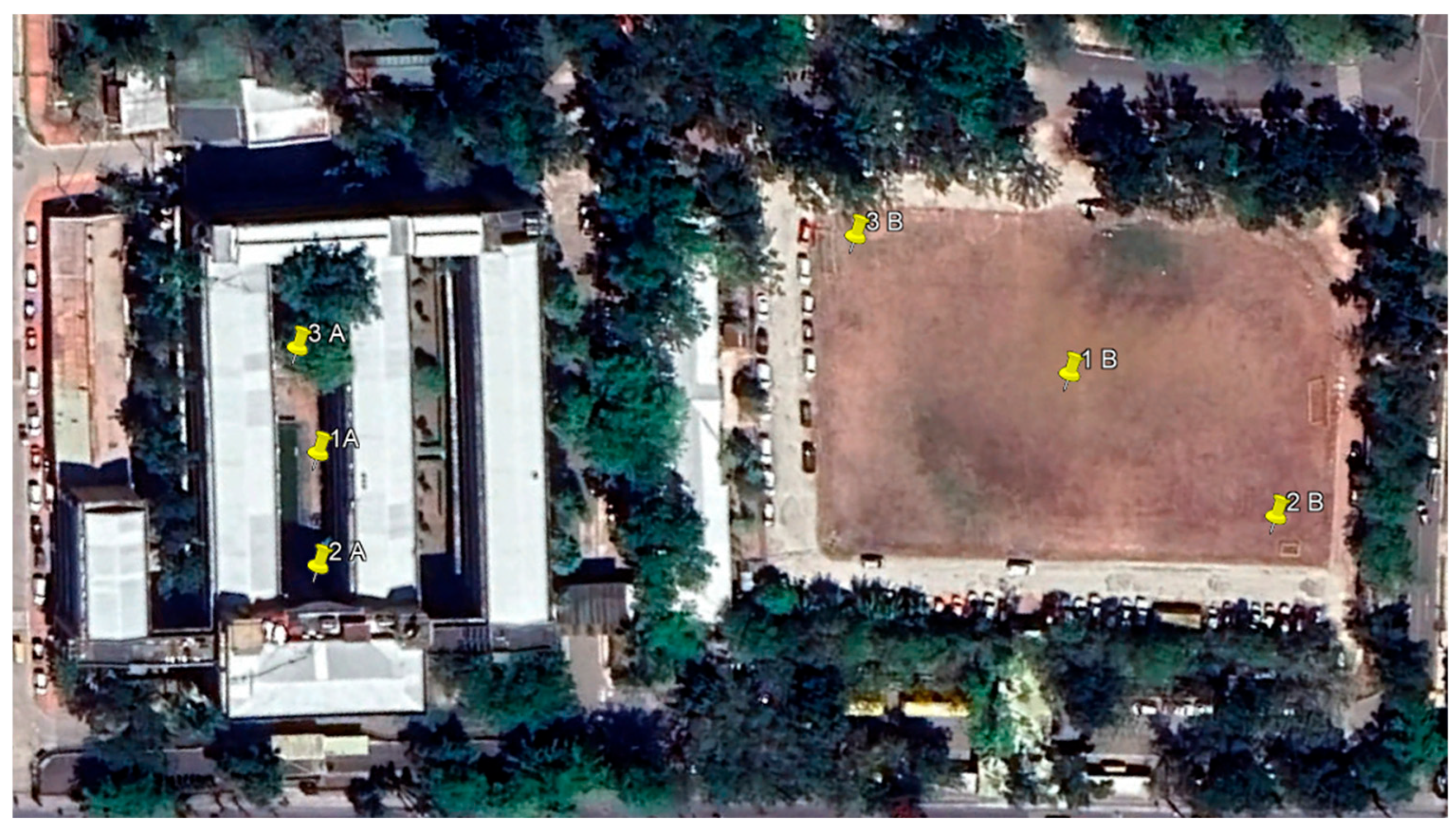
Horizontal location tests at three positions within each site (1A–3A and 1B–3B in Figure A2) indicated that within-site variability of E 2 E 3 , slopes and f 50 is smaller than or comparable to the day-to-day spread reported in Table A1 and Table A2 and does not erase the systematic differences between the built courtyard and the open field. Together, the January campaign supports the interpretation that the spectral-shape contrasts reported from the September campaign are robust to record length, detrending, exact hover height, and local sampling location. However, because the hover records are 5–15 min long and include a controlled high-pass definition of fluctuations, the robustness analysis is restricted to f 0.05   H z   (periods 20 s) and variability at longer periods is not interpreted within these short stationary hover windows.
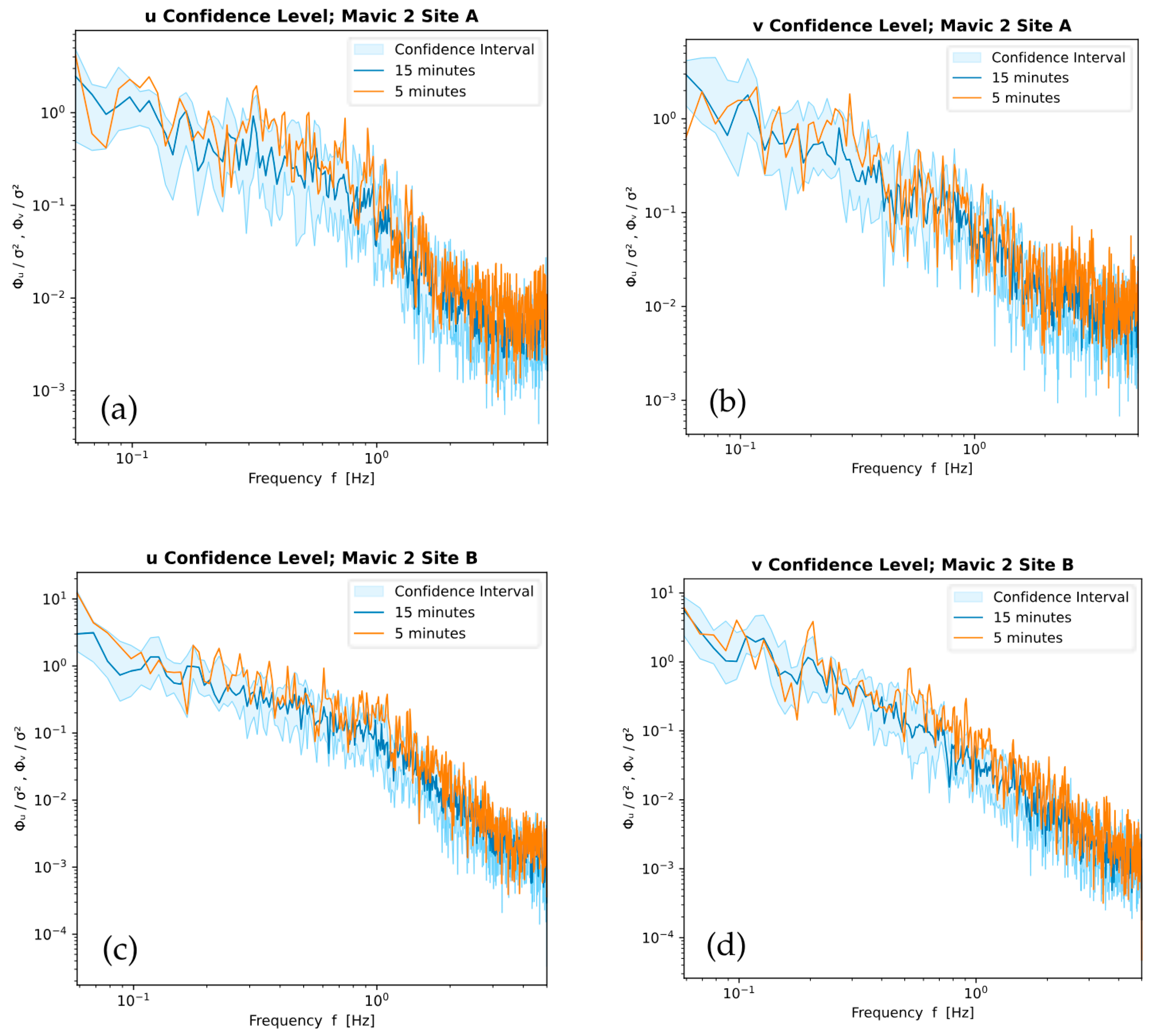
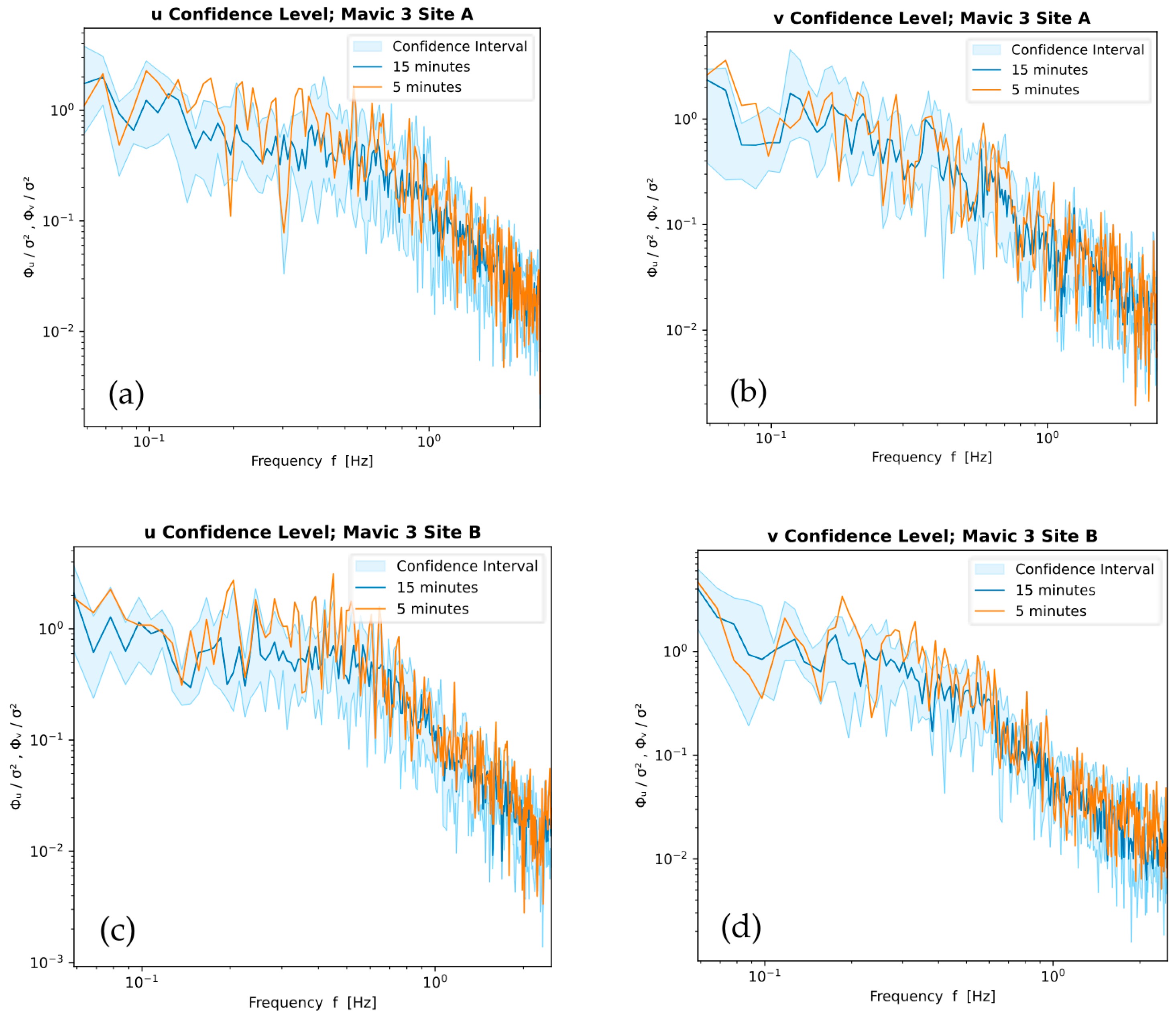
The sensitivity experiments described in Section 2.3 indicated that 5 min hover records reproduce the band-integrated energies and inertial-range slopes of 10 and 15 min records to within the 95% confidence bands of the longer spectra over 0.05–2 Hz, and that moderate changes in sampling height (5–15 m for M2, 7–17 m for M3) and horizontal position within each site lead to smooth, order −10–30% variations in the variance-normalized metrics that were smaller than the systematic differences observed between the built courtyard and open field. This supports the research methodology that the September 2025 5 min hovers were retained as the main comparison dataset, while the January 2026 flights were used to document robustness rather than to redefine the core sampling approach. Because the ladder flights sample only 5–17 m AGL within the roughness sublayer and use a controlled high-pass definition of fluctuations, the height analysis was interpreted as a test of consistent monotonic tendencies in τ and f 50 over this limited range. Sensitivity results were reported as relative changes with respect to the 15 min baseline and as containment fractions of the 5 min spectrum within the 15 min 95% CI band (see Figure A3 and Figure A4 and Table A6 and Table A7).
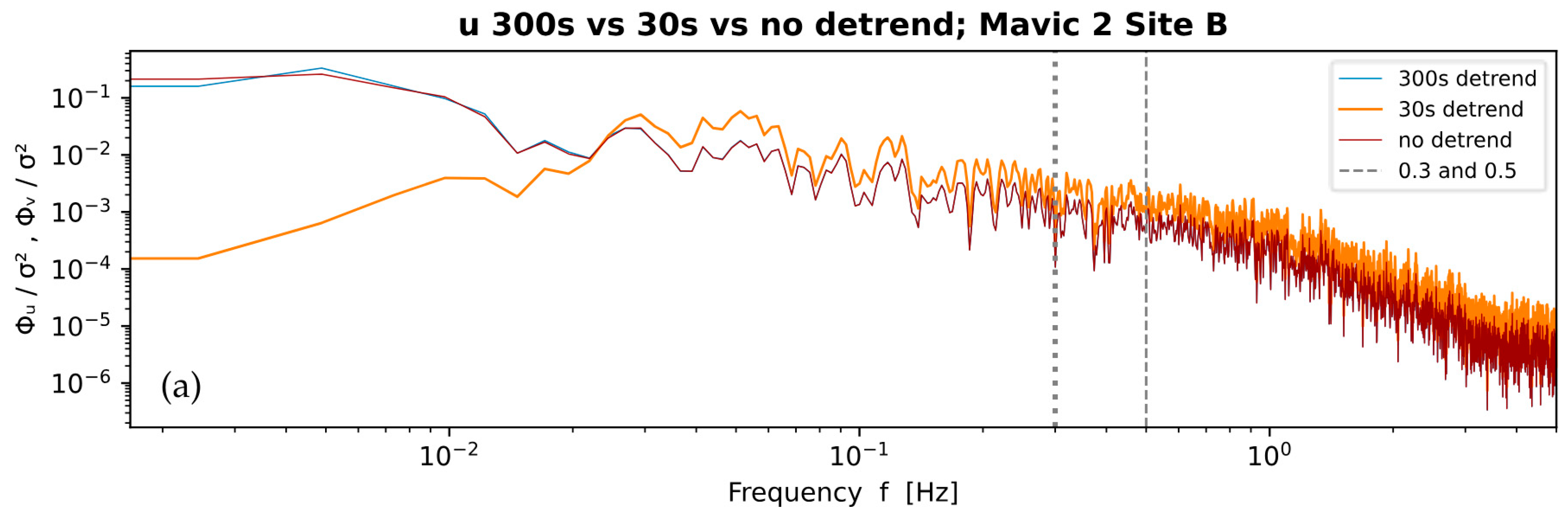
Record-length tests compared 5, 10, and 15 min hover segments at each site and platform. For both M2 and M3, the 5 min spectra and their band-integrated metrics ( E 1 E 3 , slopes and f 50 ) generally lay within the 95% bootstrap confidence intervals of the 15 min reference, with occasional deviations confined mainly to f 50 . This behavior is shown explicitly by the 5 min spectra overlaid against the 15 min 95% confidence band in Figure A3 and Figure A4 and summarized by containment fraction and K l o n g (Welch segment counts used for the 15 min confidence band) in Table A6. Moving-average sensitivity tests using 30, 60, and 120 s windows showed that band energies and slopes varied at the level of a few tens of percent but that the qualitative contrasts between Sites A and B were preserved. Detrending sensitivity is further quantified in Table A7 by the containment fraction of alternative detrend choices (no detrend and 300 s detrend) within the 30 s baseline 95% confidence band over f 0.05   H z . New 5 min hover tests at 5, 10, and 15 m for M2 and at 7, 12, and 17 m for M3 in single continuous flights were additionally used to evaluate whether f 50 and the integral time scales exhibit measurable height dependence over this near-surface layer. Across these altitude tests, fitted linear trends of τ with height were weak and not consistently monotonic within each site/platform, with small slopes ( d τ d z 0.05   s   m 1 and r 0.72 across components) and τ ranges across the sampled heights that remained comparable to the record-to-record spread observed in the September flights. Similarly, f 50 showed only modest height dependence (|df50/dz| ≲ 0.011 Hz m−1; |r| ≤ ~0.84), with overlapping uncertainty intervals across heights in most cases. These results indicate that within the limited 10 m altitude span covered by both UAVs and short stationary hover windows, the altitude sensitivity experiments do not robustly resolve a simple proportional scaling of τ with height, but importantly the A–B site contrasts in spectral shape do not reverse with altitude over the sampled near-surface layer (all results are summarized in Figure A4, Figure A5 and Figure A6 and Table A5, Table A6 and Table A7).

Appendix B

Table A1. M2 spectral metrics across flights.
MetricSite ASite Bp-Value
3 September 2025
Longitudinal
Slope (0.3–2 Hz)−1.807−1.7480.676
E 1 (0.05–0.2)0.19190.30520.490
E 2 (0.2–1)0.18480.16010.435
E 3 (1–5)0.054390.038810.108
f50 [Hz]0.26720.1369≤0.05
τ [s]1.4121.535
Transverse
Slope (0.3–2 Hz)−1.548−1.907≤0.05
E 1 (0.05–0.2)0.26060.22440.742
E 2 (0.2–1)0.15470.20270.481
E 3 (1–5)0.054250.037880.110
f50 [Hz]0.17050.2070.486
τ [s]1.4431.173
4 September 2025
Longitudinal
Slope (0.3–2 Hz)−1.707−1.6840.330
E 1 (0.05–0.2)0.15780.15620.664
E 2 (0.2–1)0.28120.36780.921
E 3 (1–5)0.12710.08595≤0.10
f 50 [Hz]0.39470.35410.347
τ [s]0.35570.4144
Transverse
Slope (0.3–2 Hz)−1.209−1.8820.34
E 1 (0.05–0.2)0.3150.3370.36
E 2 (0.2–1)0.2020.2710.74
E 3 (1–5)0.1130.053≤0.05
f 50 [Hz]0.2020.1980.27
τ [s]0.5670.663
5 September 2025
Longitudinal
Slope (0.3–2 Hz)−1.761−1.8560.755
E 1 (0.05–0.2)0.1450.318≤ 0.10
E 2 (0.2–1)0.2150.2610.755
E 3 (1–5)0.0800.0800.710
f 50 [Hz]0.3500.2110.146
τ [s]0.3940.502
Transverse
Slope (0.3–2 Hz)−1.305−2.008≤0.05
E 1 (0.05–0.2)0.28220.30860.713
E 2 (0.2–1)0.16470.2480.219
E 3 (1–5)0.095040.05753≤0.05
f 50 [Hz]0.19670.20.810
τ [s]0.65380.7216
Table A2. M3 spectral metrics across flight.
MetricSite ASite Bp-Value
3 September 2025
Longitudinal
Slope (0.3–2 Hz)−1.968−1.41≤0.05
E 1 (0.05–0.2)0.15270.16080.846
E 2 (0.2–1)0.35310.32120.639
E 3 (1–5)0.07460.10770.176
f 50 [Hz]0.42340.45920.493
τ [s]0.74370.8984
Transverse
Slope (0.3–2 Hz)−1.405−1.3720.617
E 1 (0.05–0.2)0.16650.11090.553
E 2 (0.2–1)0.19380.28760.132
E 3 (1–5)0.075310.099780.302
f 50 [Hz]0.28310.4444≤0.10
τ [s]1.3730.9239
4 September 2025
Longitudinal
Slope (0.3–2 Hz)−1.923−1.8410.273
E 1 (0.05–0.2)0.13490.2243≤0.05
E 2 (0.2–1)0.42160.52840.704
E 3 (1–5)0.09160.09580.493
f 50 [Hz]0.3820.35260.960
τ [s]0.33990.3786
Transverse
Slope (0.3–2 Hz)−1.85−1.382≤0.10
E 1 (0.05–0.2)0.22890.16850.241
E 2 (0.2–1)0.370.320.906
E 3 (1–5)0.071730.1101≤0.05
f 50 [Hz]0.26680.3936≤0.05
τ [s]0.47580.3761
5 September 2025
Longitudinal
Slope (0.3–2 Hz)−1.884−2.334≤0.05
E 1 (0.05–0.2)0.15430.104≤0.10
E 2 (0.2–1)0.41870.53150.122
E 3 (1–5)0.092250.077550.243
f 50 [Hz]0.42050.42580.915
τ [s]0.34660.3154
Transverse
Slope (0.3–2 Hz)−1.403−2.348≤0.05
E 1 (0.05–0.2)0.24880.30450.608
E 2 (0.2–1)0.29460.35030.943
E 3 (1–5)0.095510.04445≤0.05
f 50 [Hz]0.32010.24490.280
τ [s]0.46260.5509
Table A3. Moving-average sensitivity of spectral slopes.
Moving Average (s)slopeu Δslopeu [%] slopev Δslopev [%]
Site A (Bunzel Building)
M2
30−2.2540−1.7960
60−2.2510.11−1.7940.12
120−2.2520.08−1.7940.11
M3
30−1.9210−1.9410
60−1.9190.12−1.9380.14
120−1.9190.11−1.9380.13
Site B (Open Field)
M2
30−2.0140−2.1670
60−2.0130.07−2.1650.09
120−2.0140.02−2.1650.08
M3
30−2.2410−2.0780
60−2.2390.11−2.0760.09
120−2.2380.14−2.0770.06
Table A4. Horizontal location sensitivity of spectral slopes.
Locationslopeu Δslopeu [%] slopev Δslopev [%]
21 January 2026
Site A (Bunzel Building)
M2
1−1.7290−1.4200
2−1.900−9.9−1.524−7.3
3−2.099−21.4−1.940−36.6
M3
1−1.8710−1.5740
2−2.062−10.2−1.25420.3
3−2.169−15.9−1.847−17.4
Site B (Open Field)
M2
1−1.9210−1.9550
2−2.278−18.6−2.036−4.2
3−2.110−9.8−1.7808.9
M3
1−2.3390−2.0580
2−2.375−1.5−2.156−4.8
3−2.689−14.9−2.329−13.2
22 January 2026
Site A (Bunzel Building)
M2
1−1.7490−1.2380
2−1.767−1−1.905−53.9
3−2.057−17.7−1.542−24.6
M3
1−2.2000−1.5250
2−2.1671.5−1.3789.7
3−1.81617.5−1.701−11.5
Site B (Open Field)
M2
1−1.7610−2.1670
2−1.7351.5−1.9828.6
3−1.6854.3−1.80316.8
M3
1−1.9680−1.9840
2−2.092−6.3−1.77910.3
3−2.363−20.1−2.105−6.1
The altitude test for the M2 at Site B on 21 January 2026 was not completed due to premature battery depletion, which triggered an automatic landing sequence of the UAV. As a result, the UAV successfully maintained hovering at altitudes of 5 m and 10 m but was unable to complete the test at 15 m.
Table A5. Altitude sensitivity of spectral slopes.
AltitudeslopeuΔslopeu [%]slopevΔslopev [%]Δτu [%]Δτv [%]
19 January 2026
Site A (Bunzel Building)
M2
5−1.9030−1.882000
10−2.061−8.3−1.46322.3−17.02−22.34
15−2.006−5.4−1.7158.9−74.65−51.83
M3
5−1.8370−1.564000
10−2.189−19.1−1.26918.8−49.68−36.32
15−1.7206.4−1.5033.9−71.59−78.96
Site B (Open Field)
M2
5−1.8070−1.652000
10−1.7174.9−1.866−12.955.2135.15
15−1.54314.6−1.39915.316.6964.61
M3
5−2.0880−1.478000
10−2.194−5.09−1.651−11.614.42−9.73
15−2.0870.03−1.758−18.9−9.9110.16
21 January 2026
Site A (Bunzel Building)
M2
5−1.7320−1.692000
10−1.6534.6−1.972−16.528.02−11.43
15−1.6972.1−2.188−29.3161.2227.49
M3
5−1.8040−1.748000
10−1.886−4.5−1.5779.8−9.50−38.17
15−1.7721.8−1.994−14.033.38−25.97
Site B (Open Field)
M2
5−1.7950−2.131000
10−1.971−9.8−1.76226.0−33.12−8.95
15
M3
5−2.4080−1.698000
10−1.90620.8−1.801−6.0−2.37−19.43
15−2.031215.6−1.5389.447.05−7.84
Table A6. Record-length relative change and containment fraction (15 January 2026).
Site A (Bunzel Building)Site B (Open Field)
M2M3M2M3
u v u v u v u v
K 15   1616161616161616
Relative Change in E 0 (5 min) [%]2.110.3−50.8−50.6−64.6−41.9−22.9−54.5
Relative Change in E 0 (10 min) [%]67.879.9−18.8−26−26.724.841.325.6
Relative Change in f 50 (5 min) [%]−10.2−1.8−8.9−10.240.61.2−2.31
Relative Change in f 50 (10 min) [%]−22.5−18.37.284.5−27.8−13.9−11
Relative Change in τ (5 min) [%]39.631.8−4.3−9.3−6.43.2−229.2
Relative Change in τ (10 min) [%]34.229.94.8−12.2−16.20.9−17.41.4
Relative Change in Slope (5 min) [%]−4−0.512.316.2−0.23.2−6.99.3
Relative Change in Slope (10 min) [%]−6.40.59.58.7−1.22.3−3.7−3.8
Containment Fraction ( 5   m i n / 15   m i n ) [%]63.767.977.677.264.560.269.272.4
Table A7. Detrend setting containment fraction (15 January 2026).
Site A (Bunzel Building)Site B (Open Field)
M2M3M2M3
u v u v u v u v
K 30 77887777
Containment Fraction ( 300   s / 30   s )9691.499.299.25664.381.664.6
Containment Fraction ( 0   s / 30   s )94.187.597.893.255.953.781.852.1
Containment Fraction ( 300   s / 30   s ) low boundary7050607030404020
Containment Fraction ( 0   s / 30   s ) low boundary7050605030504020
Containment Fraction ( 300   s / 30   s ) high boundary96.391.810099.856.264.582.465.5
Containment Fraction ( 0   s / 30   s ) high boundary94.487.998.69456.153.782.652.7
Table A8. Record-length sensitivity of spectral slopes.
MAVIC 2MAVIC 3
Site ASite BSite ASite B
Lower Bound Upper BoundLower Bound Upper BoundLower Bound Upper BoundLower Bound Upper Bound
E 1 u 0.0850.0830.3790.1470.210.4250.0910.1310.240.1030.120.2
v 0.0860.2140.2380.2310.2410.380.0950.2250.290.1720.1880.283
E 2 u 0.0970.3520.5590.1730.1460.3330.1880.3220.5350.3520.3150.583
v 0.1040.1980.3060.1540.160.2510.1480.2860.480.2490.1990.409
E 3 u 0.0280.0770.1230.040.0410.0770.0510.080.1270.0540.0520.087
v 0.0510.0590.1020.0230.0290.0430.0270.060.0940.0430.040.059

Appendix C

Figure A1. Measured weight of (a) DJI Mavic 2 and (b) DJI Mavic 3 Classic drones.
Atmosphere 17 00314 g0a1
Figure A2. Hover points of the January campaign with pins: (1A) Center region, (2A) near the front side, (3A) near the tree at the back end of the courtyard, (1B) central region, (2B) downwind edge, and (3B) upwind edge of the open field, via google earth pro.
Atmosphere 17 00314 g0a2
Figure A3. The 5 min median PSD overlaid on 15 min median PSD with 95% bootstrap CI (variance-normalized) for M2’s (a) longitudinal and (b) transverse components at Site A, and (c) longitudinal and (d) transverse components at Site B.
Atmosphere 17 00314 g0a3
Figure A4. The 5 min median PSD overlaid on 15 min median PSD with 95% bootstrap CI (variance-normalized) for M3’s (a) longitudinal and (b) transverse components at Site A, and (c) longitudinal and (d) transverse components at Site B.
Atmosphere 17 00314 g0a4
Figure A5. Sensitivity of variance-normalized turbulence spectra to detrending at Site A for (a) longitudinal component of M2, (b) transverse component of M2, (c) longitudinal component of M3, and (d) transverse component of M3. Vertical dashed lines mark the frequency cutoff (0.3 and 0.5 Hz) defining the analysis band used in this study.
Atmosphere 17 00314 g0a5aAtmosphere 17 00314 g0a5b
Figure A6. Sensitivity of variance-normalized turbulence spectra to detrending at Site B for (a) longitudinal component of M2, (b) transverse component of M2, (c) longitudinal component of M3, and (d) transverse component of M3. Vertical dashed lines mark the frequency cutoff (0.3 and 0.5 Hz) defining the analysis band used in this study.
Atmosphere 17 00314 g0a6aAtmosphere 17 00314 g0a6b

References

  1. Mo, Z.; Liu, C.-H.; Ho, Y.-K. Roughness Sublayer Flows over Real Urban Morphology: A Wind Tunnel Study. Build. Environ. 2021, 188, 107463. [Google Scholar] [CrossRef]
  2. Grimmond, C.S.B.; Oke, T.R. Aerodynamic Properties of Urban Areas Derived from Analysis of Surface Form. J. Appl. Meteor. 1999, 38, 1262–1292. [Google Scholar] [CrossRef]
  3. Li, Z.; Ming, T.; Shi, T.; Zhang, H.; Wen, C.-Y.; Lu, X.; Dong, X.; Wu, Y.; de Richter, R.; Li, W.; et al. Review on Pollutant Dispersion in Urban Areas-Part B: Local Mitigation Strategies, Optimization Framework, and Evaluation Theory. Build. Environ. 2021, 198, 107890. [Google Scholar] [CrossRef]
  4. Liu, Y.J.; He, Y.C.; He, Y.H.; Liu, Y.H.; Fu, J.Y. Influence of Turbulence Intensity on Wind Effects toward a High-Rise Building with Curved Cross-Section at Coastal Area. J. Wind. Eng. Ind. Aerodyn. 2024, 253, 105835. [Google Scholar] [CrossRef]
  5. Hossain, S.T.; Yigitcanlar, T.; Nguyen, K.; Xu, Y. Platform Urbanism for Resident Safety: A Real-Time Predictive Microclimate Risk Monitoring and Alert System. Urban Clim. 2025, 61, 102445. [Google Scholar] [CrossRef]
  6. Hintural, W.P.; Carayugan, M.B.; Park, B.B. Modeling Regulating Ecosystem Services and Environmental Impact through Urban Green Space Expansion: A Case Study of Manila City. Urban Clim. 2025, 64, 102641. [Google Scholar] [CrossRef]
  7. Kotthaus, S.; Bravo-Aranda, J.A.; Collaud Coen, M.; Guerrero-Rascado, J.L.; Costa, M.J.; Cimini, D.; O’Connor, E.J.; Hervo, M.; Alados-Arboledas, L.; Jiménez-Portaz, M.; et al. Atmospheric Boundary Layer Height from Ground-Based Remote Sensing: A Review of Capabilities and Limitations. Atmos. Meas. Tech. 2023, 16, 433–479. [Google Scholar] [CrossRef]
  8. Wyngaard, J.C. Turbulence in the Atmosphere; Cambridge University Press: Cambridge, UK, 2010; ISBN 978-0-521-88769-4. [Google Scholar]
  9. Pope, S.B. (Ed.) The Scales of Turbulent Motion. In Turbulent Flows; Cambridge University Press: Cambridge, UK, 2000; pp. 182–263. ISBN 978-0-521-59886-6. [Google Scholar]
  10. Feigenwinter, C.; Vogt, R.; Parlow, E. Vertical Structure of Selected Turbulence Characteristics above an Urban Canopy. Theor. Appl. Climatol. 1999, 62, 51–63. [Google Scholar] [CrossRef]
  11. Kaimal, J.C.; Wyngaard, J.C.; Izumi, Y.; Coté, O.R. Spectral Characteristics of Surface-layer Turbulence. Q. J. R. Meteorol. Soc. 1972, 98, 563–589. [Google Scholar] [CrossRef]
  12. Shelekhov, A.P.; Afanasiev, A.L.; Shelekhova, E.A.; Kobzev, A.A.; Tel’minov, A.E.; Molchunov, A.N.; Poplevina, O.N. Using Small Unmanned Aerial Vehicles for Turbulence Measurements in the Atmosphere. Izv. Atmos. Ocean. Phys. 2021, 57, 533–545. [Google Scholar] [CrossRef]
  13. Shelekhov, A.; Afanasiev, A.; Shelekhova, E.; Kobzev, A.; Tel’minov, A.; Molchunov, A.; Poplevina, O. Low-Altitude Sensing of Urban Atmospheric Turbulence with UAV. Drones 2022, 6, 61. [Google Scholar] [CrossRef]
  14. Welch, P. The Use of Fast Fourier Transform for the Estimation of Power Spectra: A Method Based on Time Averaging over Short, Modified Periodograms. IEEE Trans. Audio Electroacoust. 1967, 15, 70–73. [Google Scholar] [CrossRef]
  15. Shelekhov, A.; Afanasiev, A.; Shelekhova, E.; Kobzev, A.; Tel’minov, A.; Molchunov, A.; Poplevina, O. High-Resolution Profiling of Atmospheric Turbulence Using UAV Autopilot Data. Drones 2023, 7, 412. [Google Scholar] [CrossRef]
  16. Palomaki, R.T.; Rose, N.T.; Van Den Bossche, M.; Sherman, T.J.; De Wekker, S.F.J. Wind Estimation in the Lower Atmosphere Using Multirotor Aircraft. J. Atmos. Ocean. Technol. 2017, 34, 1183–1191. [Google Scholar] [CrossRef]
  17. Alaoui-Sosse, S.; Durand, P.; Medina, P.; Pastor, P.; Gavart, M.; Pizziol, S. BOREAL—A Fixed-Wing Unmanned Aerial System for the Measurement of Wind and Turbulence in the Atmospheric Boundary Layer. J. Atmos. Ocean. Technol. 2022, 39, 387–402. [Google Scholar] [CrossRef]
  18. Wildmann, N.; Wetz, T. Towards Vertical Wind and Turbulent Flux Estimation with Multicopter Uncrewed Aircraft Systems. Atmos. Meas. Tech. 2022, 15, 5465–5477. [Google Scholar] [CrossRef]
  19. Ghirardelli, M.; Kral, S.T.; Cheynet, E.; Reuder, J. SAMURAI-S: Sonic Anemometer on a MUlti-Rotor Drone for Atmospheric Turbulence Investigation in a Sling Load Configuration. Atmos. Meas. Tech. 2025, 18, 2103–2124. [Google Scholar] [CrossRef]
  20. Blunn, L.P.; Coceal, O.; Nazarian, N.; Barlow, J.F.; Plant, R.S.; Bohnenstengel, S.I.; Lean, H.W. Turbulence Characteristics Across a Range of Idealized Urban Canopy Geometries. Bound. Layer Meteorol. 2022, 182, 275–307. [Google Scholar] [CrossRef]
  21. Li, W.; Giometto, M.G. The Structure of Turbulence in Unsteady Flow over Urban Canopies. J. Fluid Mech. 2024, 985, A5. [Google Scholar] [CrossRef]
  22. Nazarian, N.; Lu, J.; Lipson, M.J.; Hart, M.A.; Liu, S.; Krayenhoff, E.S.; Blunn, L.; Martilli, A. UrbanTALES: A Large-Eddy Simulation Dataset for Urban Canopy Layer Turbulence and Parameterization. Bull. Am. Meteorol. Soc. 2025, 106, E2461–E2478. [Google Scholar] [CrossRef]
  23. Hendricks, E.A.; Knievel, J.C.; Nolan, D.S. Evaluation of Boundary Layer and Urban Canopy Parameterizations for Simulating Wind in Miami during Hurricane Irma (2017). Mon. Weather. Rev. 2021, 149, 2321–2349. [Google Scholar] [CrossRef]
  24. Hersbach, H.; Bell, B.; Berrisford, P.; Biavati, G.; Horányi, A.; Muñoz Sabater, J.; Nicolas, J.; Peubey, C.; Radu, R.; Rozum, I.; et al. ERA5 hourly data on single levels from 1940 to present. Copernicus Climate Change Service (C3S) Climate Data Store (CDS). 2023. Available online: https://cds.climate.copernicus.eu/datasets/reanalysis-era5-single-levels?tab=overview (accessed on 2 October 2025).
  25. Nithya, D.S.; Quaranta, G.; Muscarello, V.; Liang, M. Review of Wind Flow Modelling in Urban Environments to Support the Development of Urban Air Mobility. Drones 2024, 8, 147. [Google Scholar] [CrossRef]
  26. Santana, R.A.S.; Dias-Júnior, C.Q.; do Vale, R.S.; Tóta, J.; da Silva, R.; Tapajós, R.; Manzi, A.O.; Beldini, T.P. Comparing the Air Turbulence above Smooth and Rough Surfaces in the Amazon Region. Atmosphere 2021, 12, 1043. [Google Scholar] [CrossRef]
  27. Fortuniak, K.; Pawlak, W. Selected Spectral Characteristics of Turbulence over an Urbanized Area in the Centre of Łódź, Poland. Bound. Layer Meteorol. 2015, 154, 137–156. [Google Scholar] [CrossRef]
  28. Pu, O.; Yuan, B.; Li, Z.; Bao, T.; Chen, Z.; Yang, L.; Qin, H.; Li, Z. Research on the Characteristics of Urban Building Cluster Wind Field Based on UAV Wind Measurement. Buildings 2023, 13, 3109. [Google Scholar] [CrossRef]
Figure 1. (a) Bunzel Building (left) and adjacent football field (right) via google earth pro (b)—setup of the experiment.
Atmosphere 17 00314 g001
Figure 2. Turbulence spectra obtained using the M2 at (a) Site A and (b) Site B, and using the M3 at (c) Site A and (d) Site B on 3 September 2025.
Atmosphere 17 00314 g002
Figure 3. Turbulence spectra obtained using the M2 at (a) Site A and (b) Site B, and using the M3 at (c) Site A and (d) Site B on 4 September 2025.
Atmosphere 17 00314 g003
Figure 4. Turbulence spectra obtained using the M2 at (a) Site A and (b) Site B, and using the M3 at (c) Site A and (d) Site B on 5 September 2025.
Atmosphere 17 00314 g004
Table 1. Summary of flight-day meteorological conditions (3–5 September 2025).
DateMean Temp (°C)Mean Dew Point (°C)Mean Wind Speed (m/s)Mean Wind
Direction
Mean Gust
(m/s)
Max Gust
(m/s)
Mean RH
(%)
Day 127.7124.321.75225.44 (SW)3.186.4581.9
Day 227.2524.091.93153.36 (SE)3.405.2083.0
Day 326.8424.121.6398.70 (E)2.634.3985.1
Note: Meteorological parameters were derived from ERA5 reanalysis data obtained from the Copernicus Climate Data Store [24].
Disclaimer/Publisher’s Note: The statements, opinions and data contained in all publications are solely those of the individual author(s) and contributor(s) and not of MDPI and/or the editor(s). MDPI and/or the editor(s) disclaim responsibility for any injury to people or property resulting from any ideas, methods, instructions or products referred to in the content.