
Article

A Multi-Agglomeration Assessment of Air Quality Responses to Top-Down NOx Emission Changes: Insights from Trends in Surface NO2 and O3 Across Urban China (2014–2021)

1
College of Marine and Geographical Sciences, Yancheng Teachers University, Yancheng 224007, China
2
Key Construction Laboratory for the Evolution and Intelligent Regulation of Jiangsu Coastal Zone Resources and Environment, Yancheng Teachers University, Yancheng 224007, China
3
International Institute for Earth System Science, Nanjing University, Nanjing 210023, China
4
Human Resources Department, Yancheng Teachers University, Yancheng 224007, China
5
Central China Research Center for Economic and Social Development, Nanchang University, Nanchang 330031, China
*
Author to whom correspondence should be addressed.
Atmosphere 2026, 17(3), 313; https://doi.org/10.3390/atmos17030313
Submission received: 28 January 2026 / Revised: 17 March 2026 / Accepted: 18 March 2026 / Published: 19 March 2026

Abstract

China’s stringent clean air policies have substantially reduced nitrogen oxides (NOx) emissions, leading to a general decline in nitrogen dioxide (NO2). However, surface ozone (O3) pollution remains severe, creating a complex challenge due to the non-linear relationship between O3 and its precursors. To disentangle the drivers behind these trends, this study quantifies the impacts of interannual variations in top-down constrained NOx emissions on surface NO2 and O3 concentrations from 2014 to 2021 across mainland China and five national urban agglomerations. We employed the WRF-CMAQ model with a fixed-emission simulation approach, using an observationally optimized NOx emission inventory derived from the assimilation of surface NO2 measurements. Results reveal that NO2 reductions were predominantly emission-driven (>80% post-2017), with declines most pronounced in winter. A strong linear consistency was found between interannual changes in top-down NOx emissions and attributed NO2 concentration variations, validating the methodology. In contrast, O3 responses to NOx reductions were spatially and seasonally heterogeneous, reflecting a non-linear photochemical regime. In major urban agglomerations (e.g., Beijing–Tianjin–Hebei (BTH), Yangtze River Delta (YRD), Pearl River Delta (PRD)), NOx reductions post-2018 showed limited effectiveness in mitigating summertime O3 and even increased O3 in spring and autumn, indicating a prevalent VOC-sensitive regime where NOx reduction can disinhibit O3 formation. Conversely, certain provinces (e.g., Anhui, Shanxi, Jilin) exhibited O3 decreases, suggesting a NOx-sensitive regime. The area benefiting from NOx reductions expanded steadily in summer after 2017 but not in other seasons. This study confirms the efficacy of NOx-focused policies for reducing primary NO2 pollution but highlights that mitigating persistent O3 requires a strategic shift to synergistic, region-specific control of volatile organic compounds alongside NOx, informed by local chemical sensitivity.

1. Introduction

Air pollution is one of the leading environmental threats to humanity, with profound impacts on socioeconomic productivity. China has implemented a series of stringent national clean air policies, most notably the Action Plan for Air Pollution Prevention and Control (2013–2017) and the Three-year Action Plan to Win the Battle for a Blue Sky (2018–2020) [1,2]. These policies have targeted substantial reductions in primary pollutant emissions, particularly sulfur dioxide and nitrogen oxides (NOx) [3], leading to a significant nationwide decline in fine particulate matter (PM2.5) concentrations [4,5]. Accompanying this progress, ambient nitrogen dioxide (NO2) levels, primarily emitted from fossil fuel combustion, have also shown a general decreasing trend [6]. However, surface ozone (O3) pollution has emerged as a new critical air quality challenge, with concentrations persistently high or even increasing in many urban and regional hotspots across China during the same period [7,8]. This phenomenon has been extensively documented through studies of the weekend effect [9,10]. Researchers have observed higher ozone concentrations on weekends than weekdays in many urban areas, despite lower NOx emissions from reduced traffic and industrial activity [11,12]. Early studies in Los Angeles, New York, and other U.S. cities established that this weekend ozone excess arises from the NOx-saturated chemistry typical of urban cores [9]. Subsequent research has confirmed similar patterns across Europe, Japan, and China [13,14]. This contrasting trend presents a complex scientific and policy dilemma, as the photochemical production of O3 is non-linearly related to its precursors, NOx and volatile organic compounds (VOCs) [15]. Consequently, the effectiveness of NOx focused control strategies in mitigating concurrent O3 pollution remains ambiguous and regionally variable, necessitating a thorough investigation into the attribution of observed concentration trends.
Emerging evidence indicates that air pollutants like O3 and NO2 serve as leading contributors to air pollution-related acute mortality [16]. Quantifying the drivers behind the trends of NO2 and O3 is essential for evaluating policy efficacy and informing future strategies. Interannual variations in observed concentrations are governed by a combination of changes in anthropogenic emissions and fluctuations in meteorological conditions, which influence atmospheric dispersion, chemical transformation, and regional transport [17,18]. Globally, the intricate relationship between NOx emissions and O3 constitutes a central challenge in atmospheric chemistry and air quality management. While aggressive emission controls in North America and Europe have successfully reduced peak O3 levels over recent decades, background O3 concentrations have increased or stabilized, and some urban areas continue to experience non-attainment [19,20]. In developing regions of South and Southeast Asia, rapidly growing emissions coupled with favorable meteorology have led to widespread and worsening O3 pollution [21,22]. This global pattern underscores that the response of O3 to changes in its precursors is not linear but is mediated by the local chemical regime, shifting from NOx-saturated to NOx-sensitive conditions depending on the relative abundance of precursors [23]. Therefore, quantifying the impact of emission changes on pollutant trends requires disentangling them from the confounding effects of meteorological variability, a challenge pertinent to air quality studies worldwide.
Substantial research has been conducted globally to attribute air pollutant trends to emissions and meteorology [24,25,26]. A range of statistical modeling tools, from traditional regression to computational frameworks like learning techniques [27,28,29], use long-term observational data to derive meteorology-normalized trends, effectively filtering out the meteorological influence [4,30,31]. While valuable, these methods may not fully capture complex, non-linear chemical interactions. In contrast, chemical transport models (CTMs) provide a process-based, physical framework to simulate atmospheric chemistry and transport [32,33]. A powerful application of CTMs is holding emissions constant at a baseline level while using actual, interannually varying meteorological fields to directly quantify the pollutant variability induced by meteorology alone [6]. The difference between simulations with varying emissions and these fixed-emission runs then isolates the emission-driven signal [34]. Studies in North America and Europe have successfully separated the influences of emission controls and meteorological variability on long-term O3 and NO2 trends, highlighting the dominant role of emission reductions [35,36,37]. This method has increasingly been used in Asia [38,39]. However, its application in assessing the impacts of recently implemented, stringent policies across China’s diverse urban agglomerations remains limited, particularly concerning the dual effects on NO2 and O3 over an extended, policy-relevant period.
Furthermore, the accuracy of such attribution studies heavily depends on the quality of the emission inventory input. While bottom-up inventories are essential and have been widely used [3,40,41], they are subject to uncertainties and may not fully capture recent, rapid emission changes due to policies [42,43]. Top-down constraints on emissions, derived from assimilating satellite or surface observations into models, offer a valuable approach to reduce these uncertainties and provide more realistic spatiotemporal variations in emissions for trend analysis [44,45,46,47,48]. A synthesis of the fixed-emission simulation method with a top-down optimized emission inventory presents a robust framework for attribution but has not been extensively applied to a multi-year and multi-region analysis in China.
Thus, this study aims to systematically evaluate the impacts of interannual variations in top-down constrained NOx emissions on the trends of surface NO2 and O3 concentrations from 2014 to 2021 across mainland China, especially five typical and economically significant urban agglomerations—Beijing–Tianjin–Hebei urban agglomeration (BTH), Yangtze River Delta urban agglomeration (YRD), Yangtze River Middle Reach urban agglomeration (YRMR), Cheng-Yu urban agglomeration (CY), and Pearl River Delta urban agglomeration (PRD). We employ the Weather Research and Forecasting (WRF) model and Community Multiscale Air Quality (CMAQ) model in conjunction with a fixed-emission simulation approach. A critical foundation is the use of an observationally constrained, top-down NOx emission inventory derived from the assimilation of hourly surface NO2 measurements [49], which better represents real-world emission changes. The specific objectives are to isolate and quantify the relative impacts of anthropogenic NOx emission variations and meteorological factors on interannual NO2 trends in different regions and seasons; evaluate the consistency between the interannual variations in optimized NOx emissions and the attributed NO2 concentration changes; elucidate the spatially and seasonally heterogeneous impacts of NOx emission changes on O3 pollution patterns across the nation and within key regions; and discuss the implications of the non-linear O3 chemistry for future synergistic control strategies. By integrating advanced emission constraints with a process-based attribution method, this work seeks to provide a clearer mechanistic understanding of the drivers behind recent air quality trends in China, offering insights that are relevant for policy evaluation and for air quality management in other regions facing similar complex pollution challenges.

2. Materials and Methods

2.1. Data

2.1.1. Ground Measurement Data

Real-time NO2 and O3 concentrations data were obtained from the National Urban Air Quality Real-time Release Platform, maintained by the China National Environmental Monitoring Centre. The dataset, covering 31 provincial-level administrative divisions in mainland China (excluding the regions of Hong Kong, Macao, and Taiwan), sourced from the official website (https://air.cnemc.cn:18007/, accessed on 17 March 2026). The monitoring network exhibits a heterogeneous spatial distribution, with station density higher in the economically advanced eastern coastal regions but markedly lower in the central and especially western areas. All stations, with sampling ports positioned 3–20 m above ground level, provided hourly measurements [50,51,52]. In accordance with the pollutant concentration specifications outlined in China’s Ambient Air Quality Standards 2012, a stringent quality assurance procedure was applied following the methods described in a previous study [6], removing outliers for both species and retaining only monitoring sites with continuous multi-year records.
The performance of the CMAQ model was evaluated by comparing simulated concentrations with ground-based observations. To ensure a consistent comparison, a rigorous spatiotemporal matching protocol was implemented. Spatially, for each monitoring site, the simulated value was extracted from the CMAQ grid cell encompassing its geographic coordinates. Temporally, hourly model outputs were paired with observations from the corresponding hour, and these matched hourly pairs were subsequently aggregated into monthly statistics for further assessment.

2.1.2. Meteorological Data

The meteorological simulations utilized the initial and lateral boundary conditions sourced from the National Centers for Environmental Prediction (NCEP) Final Operational Global Analysis datasets. The datasets are produced by the Global Data Assimilation System, which integrates observational data from multiple platforms, including ground stations, satellites, and aircraft. The resulting products provide global coverage at a 1° × 1° spatial resolution and 6-hourly temporal intervals (available from NCEP at http://rda.ucar.edu/datasets/ds083.2/, accessed on 17 March 2026). The key variables comprise thermal variables (including air temperature, sea surface temperature, and soil temperature), dynamic variables (such as wind speed and direction, surface pressure, and sea-level pressure), and relative humidity, etc.
For validation of the simulated meteorological conditions, observed data from ground stations across China were downloaded from the public FTP repository of the National Climatic Data Center (available from NCDC at ftp://ftp.ncdc.noaa.gov/pub/data/noaa/isd-lite/, accessed on 17 March 2026). The variables include thermal variables (air temperature, dew point), dynamic variables (wind speed, wind direction, atmospheric pressure), precipitation, and cloud cover. The records were incorporated from more than 400 stations, most of which offer data at 3 h intervals in recent years, with a limited number of stations providing measurements at 1 h resolution.

2.1.3. Anthropogenic Emission Data

The NOx emissions were derived from our earlier optimization of mainland China’s emission inventory constrained by surface hourly NO2 measurements [49]. These optimized NOx emissions were inferred by the Regional Air Pollutant Assimilation System (RAPAS), a system designed to quantitatively optimize regional-scale air pollutant emissions [53]. RAPAS is built upon the integrated WRF-CMAQ modeling framework (see Section 2.2) and employs the three-dimensional variational algorithm along with the ensemble square root filter methodology. RAPAS can simultaneously assimilate multiple hourly scale observations of surface air pollutant concentrations to retrieve daily emissions of various air pollutants at regional scales. The overall performance of the optimized emissions has been evaluated by forward simulations of atmospheric pollutant concentrations to indirectly assess the accuracy against ground measurements. Results from our previous studies demonstrate that simulating concentrations of different species using the retrieved emissions leads to significant improvements in site -averaged mean bias, root mean square error, and correlation coefficient [47,49,54].
Multi-resolution Emission Inventory (available from MEIC at http://meicmodel.org/ [3,55], accessed on 17 March 2026) developed by Tsinghua University was used as a priori emission over mainland China, while for other East Asian regions, the MIX inventory was utilized [21]. Biogenic emissions were derived from the Model of Emissions of Gases and Aerosols from Nature (MEGAN) model [56]. Biomass burning emissions were not included based on the lower fire counts in mainland China compared to other Asian regions.

2.1.4. Satellite Data

The satellite-derived ratio of formaldehyde (HCHO) to NO2 column concentrations, denoted as the formaldehyde-NO2 ratio, is widely employed to delineate ozone formation sensitivity regimes [57,58,59]. The analysis employed HCHO and NO2 data acquired from the Ozone Monitoring Instrument (OMI) spanning the years 2014 to 2021, specifically focusing on spring (March, April, May), summer (June, July, August), and autumn (September, October, November) seasons. The HCHO dataset was acquired from the OMHCHOd product (available at https://disc.gsfc.nasa.gov/datasets/OMHCHOd_003/summary, accessed on 17 March 2026), which provides quality-controlled, gridded vertical column densities at a spatial resolution of 0.1° × 0.1°. The NO2 data were obtained from the QA4ECV product (available at https://www.temis.nl/airpollution/no2col/no2regioomimonth_qa.php, accessed 17 March 2026), providing the monthly mean datasets with a spatial resolution of 0.125° × 0.125° distributed by the Royal Netherlands Meteorological Institute.

2.2. WRF-CMAQ Model

The regional chemical transport model WRF-CMAQ was employed in this investigation, which, developed by the U.S. Environmental Protection Agency, operates as a three-dimensional Eulerian “one-atmosphere” framework designed to simulate complex multi-pollutant processes and address interrelated air quality issues. Meteorological drivers for CMAQ (version 4.7.1) were provided by the WRF (version 3.5) model, a mesoscale numerical weather prediction system widely used for atmospheric research and operational forecasting. The initial and lateral boundary conditions required for the WRF model were derived from the National Centers for Environmental Prediction (NCEP) Final (FNL) Operational Global Analysis data, with a spatial resolution of 1° × 1° and a temporal interval of 6 h. For the CMAQ chemical simulations, the chemical initial and lateral boundary conditions were generated using the default, static clean-air concentration profiles provided by the CMAQ default dataset. Because our modeling domain encompasses the entirety of East Asia (Figure S1), the focal urban agglomerations in central and eastern China are located sufficiently far from the lateral boundaries. Given the short atmospheric lifetime of key precursors like NOx, this large spatial buffer effectively minimizes the direct influence of boundary transport on the simulated anthropogenic pollution trends within the target regions. To further minimize the impact of initial conditions, each simulation period was preceded by a 20-day spin-up run.
The simulation covered a major portion of East Asia with a horizontal grid spacing of 36 km × 36 km (Figure S1), which is considered sufficient to capture the regional transport and synoptic-scale meteorological features influencing the major urban agglomerations in China [45,49,53]. The CMAQ configuration used 15 sigma-pressure layers vertically, derived by compressing the WRF model’s original 51-layer structure while maintaining the same model top at 50 hPa. Of these 15 layers, 7 are located within the planetary boundary layer, typically extending up to approximately 1–2 km above the ground. The remaining layers are situated in the free troposphere, which spans from the top of the boundary layer to the tropopause, at an altitude of roughly 10–12 km. The simulation employed the Carbon Bond 05 mechanism with updates to toluene reactions (CB05tucl) to represent gas-phase chemistry, and particulate matter was simulated using the sixth-generation aerosol module (AERO6) [60,61]. Additionally, biogenic emissions were derived from MEGAN version 2.1 [56], a modeling framework used to estimate biogenic emissions exchanged between terrestrial ecosystems and the atmosphere. It simulates key known processes controlling biogenic emissions via relatively simple mechanistic algorithms [56,62], and it accounts for environmental influences on these emissions by parameterizing meteorological inputs, which were simulated by the WRF model in this study.

2.3. Method

To separate the contributions of emissions and meteorology to the interannual variation of NO2 concentrations, two simulation scenarios were conducted using a fixed-emission simulation approach (Table 1), namely a base (Base) simulation and a fixed-emission (FixedEmis) simulation. For the Base simulation, daily continuous simulations from 2014 to 2021 were performed using annual-varying meteorological conditions and inversion-optimized emissions for each corresponding year. For the FixedEmis simulation, daily continuous simulations from 2015 to 2021 were conducted using annual-varying meteorological conditions while keeping emissions fixed at the inversion-optimized 2014 level. The starting point of 2014 was selected as it provides the first full year of consistent monitoring data following the 2013 network launch and the implementation of the Action Plan for Air Pollution Prevention and Control [1]. The Base simulation, incorporating both annual varying meteorology and corresponding emissions, provides annual NO2 concentrations for each year. Differences in NO2 concentrations between adjacent years in the Base simulations arise from the interplay of meteorological variability and changes in emissions. The FixedEmis simulation provides NO2 concentrations under the meteorological conditions of each year from 2015 to 2021 with emissions held constant at the 2014 level. By comparing NO2 concentrations between adjacent years in the FixedEmis simulation, the year-to-year differences in NO2 concentrations attributable to changes in meteorological conditions can be derived. By subtracting the meteorology induced changes obtained from the FixedEmis simulation from these combined changes, the emission related changes in NO2 concentrations—i.e., the quantitative contribution of emission changes to NO2 concentration variation—can be isolated. The model domain and the physical and chemical configurations used in the simulations are consistent with those described in Shen et al. (2023) [63].

3. Results

3.1. Model Evaluation

Meteorological processes significantly influence pollutant transport, mixing, and photochemical reactions, making the performance of the WRF model critical for accurate pollutant simulations. In our previous studies [6,49], the performance of the model over the study region was evaluated by comparing simulated 2 m temperature (T2), 2 m relative humidity (RH2), and 10 m wind speed (WS10) against ground-based observations. The results demonstrated that the WRF model successfully reproduces T2 and RH2, exhibiting relatively low bias and high correlation coefficients. Although WS10 is slightly overestimated, a tendency also reported in other WRF-based studies [64,65], the resulting enhanced pollutant dispersion and transport partly offset the potential impacts of biases in T2 and RH2. Following the criteria proposed by Emery et al. (2001) [66], the performance of the WRF model in simulating meteorological parameters in this study is acceptable. Furthermore, the yearly statistical results remain consistent across different years, indicating that the WRF simulations reliably capture interannual variations in weather conditions.
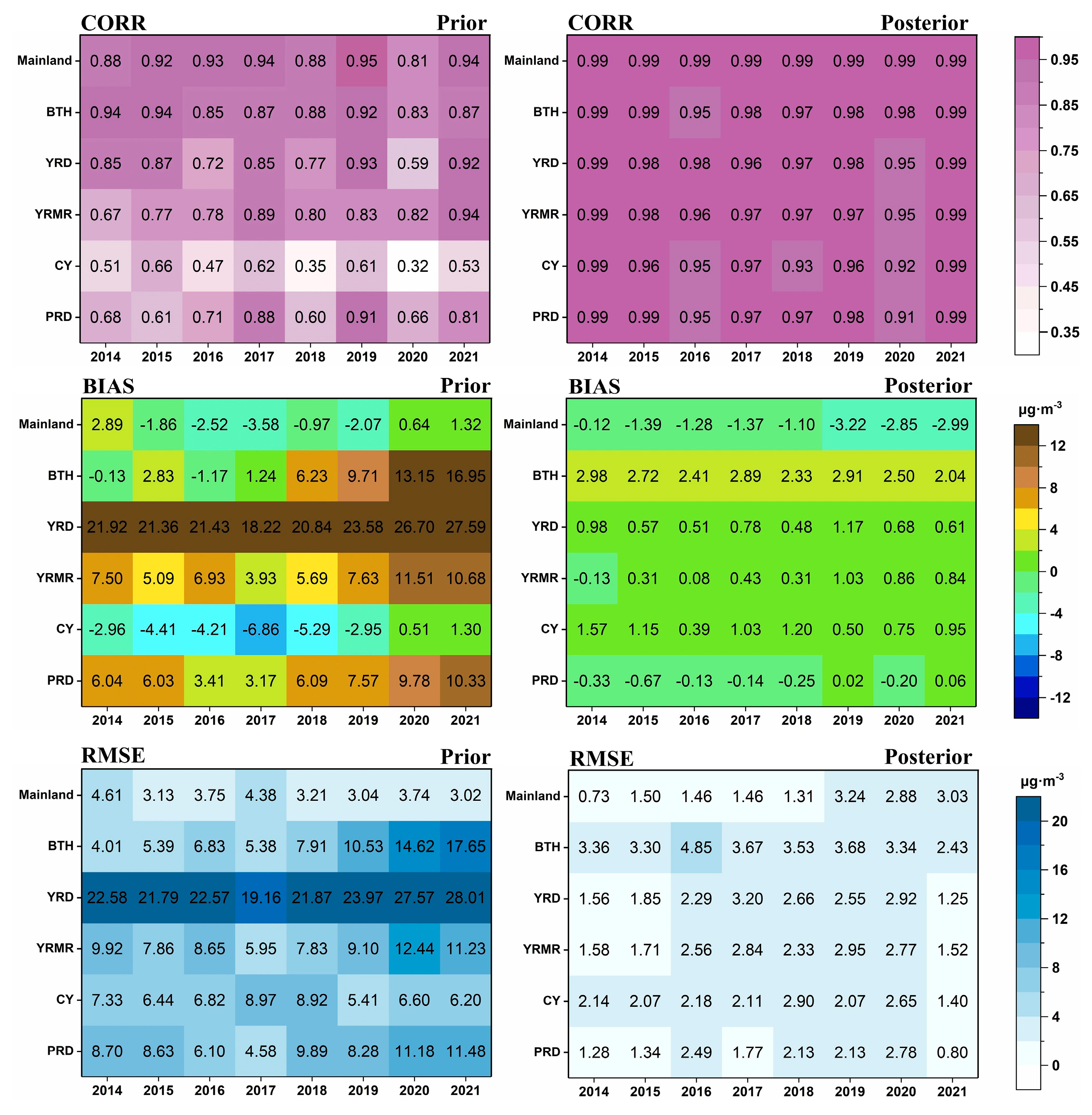
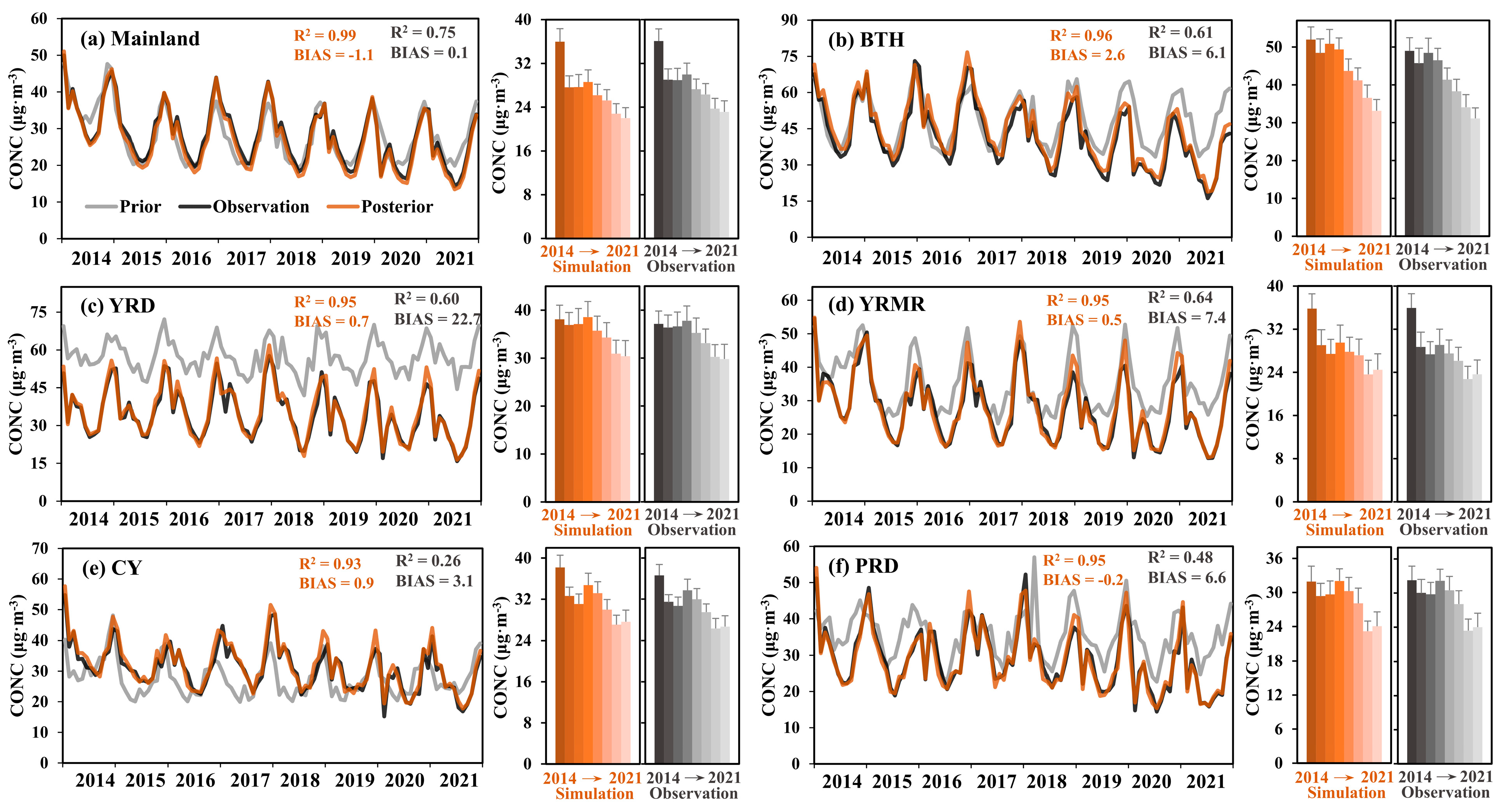
Figure 1 presents the evaluation results of simulated NO2 concentrations for each urban agglomeration in the Base simulations. Compared to the simulations using prior emissions (MEIC), the posterior simulations utilizing optimized emissions show excellent agreement with ground-based observations. The correlation of monthly mean concentrations between the posterior simulations and observations exceeds 0.95 across all urban agglomerations. According to widely adopted performance benchmarks in regional air quality modeling [67,68], a correlation coefficient (CORR) greater than 0.50 is considered acceptable, while a value exceeding 0.60 to 0.70 satisfy the rigorous criteria for high-fidelity model performance. Therefore, our model effectively captures the interannual variation characteristics of NO2 concentrations in each region (Figure 1). As shown in Figure 2, the posterior CORR frequently reaches 0.99 for individual agglomerations, markedly higher than prior correlations. While absolute metrics do not have universally fixed thresholds due to their dependence on regional concentration baselines, the site-averaged bias in each urban agglomeration is also significantly reduced relative to the prior simulations, particularly in the Yangtze River Basin and the Pearl River Delta. Similar improvements are evident in the mean bias (BIAS) and the root mean square error (RMSE), with posterior RMSE values consistently lower than the prior counterparts, reflecting analogous reductions and robust model optimization (Figure 2). In terms of annual mean concentrations, NO2 levels began to decline after 2014, exhibited a slight rebound in 2017, and then continued to decrease thereafter. Both ground observations and posterior simulations demonstrate highly consistent trends in NO2 concentration changes. The above statistical analysis indicates that the Base simulations reliably capture the trend characteristics of NO2 concentrations over the study period.
For O3 concentrations, the simulated results show high consistency with observations across all urban agglomerations and the whole country (Figure S2). The correlation coefficients exceed 0.80 in all urban agglomerations except PRD. Specifically, the correlation coefficient reaches 0.81 in YRMR, while exceeding 0.87 in others. Nevertheless, some discrepancies were noted in the O3 simulations, with varying magnitudes across regions. The model tended to overestimate observed O3 levels in certain areas and periods. These biases are likely attributed primarily to uncertainties in O3 precursor emissions. For instance, the resolution of the emission inventory may inadequately resolve fine-scale spatial variations in urban areas. Additionally, deviations between simulated and observed wind speeds could further contribute to the overestimation of O3 concentrations.
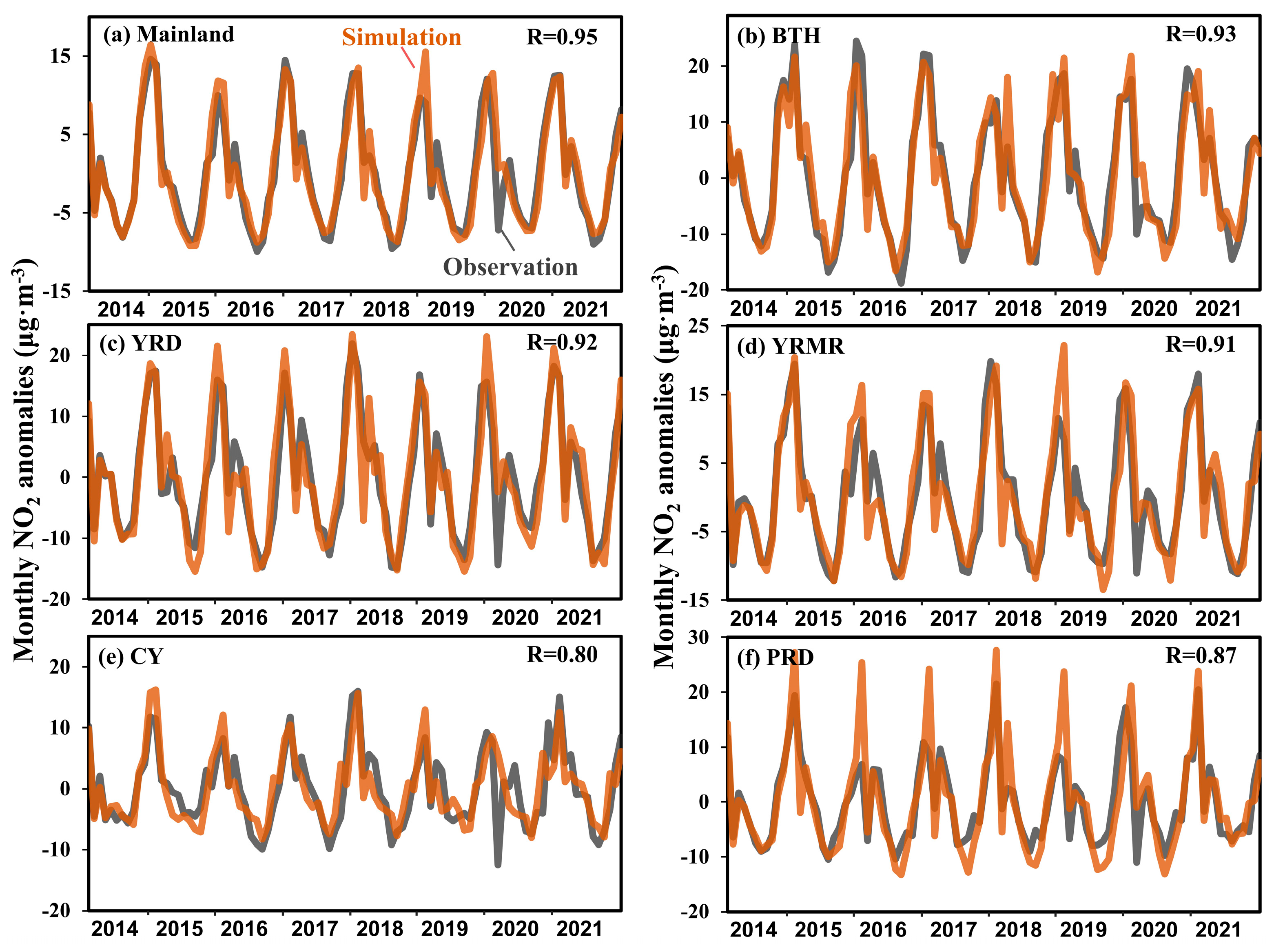
Monthly average NO2 observational data and corresponding FixedEmis simulation results were extracted for the whole country and five national urban agglomerations for the evaluation of interannual NO2 variations driven by different meteorological conditions under the FixedEmis simulations (Figure 3). Detrending analysis was performed on the monthly mean NO2 observations and FixedEmis simulation data to remove trends derived from linear regression models [69], thereby eliminating the influence of anthropogenic emission controls on interannual NO2 concentration changes. Monthly anomalies of the detrended observations and FixedEmis simulations relative to the respective monthly averages during 2014–2021 were further calculated to reflect meteorologically driven interannual variations in NO2 concentrations. The correlation coefficients between the detrended observational anomalies and FixedEmis simulation results ranged from 0.82 to 0.95 across different regions, indicating good agreement between observations and simulations in all areas. These results demonstrate that our FixedEmis simulations effectively capture the meteorologically driven interannual NO2 variations across all studied regions.

3.2. Impact of Interannual Variations in NOx Emissions on NO2 Pollution

3.2.1. NOx Emission Trends of Five National Urban Agglomerations

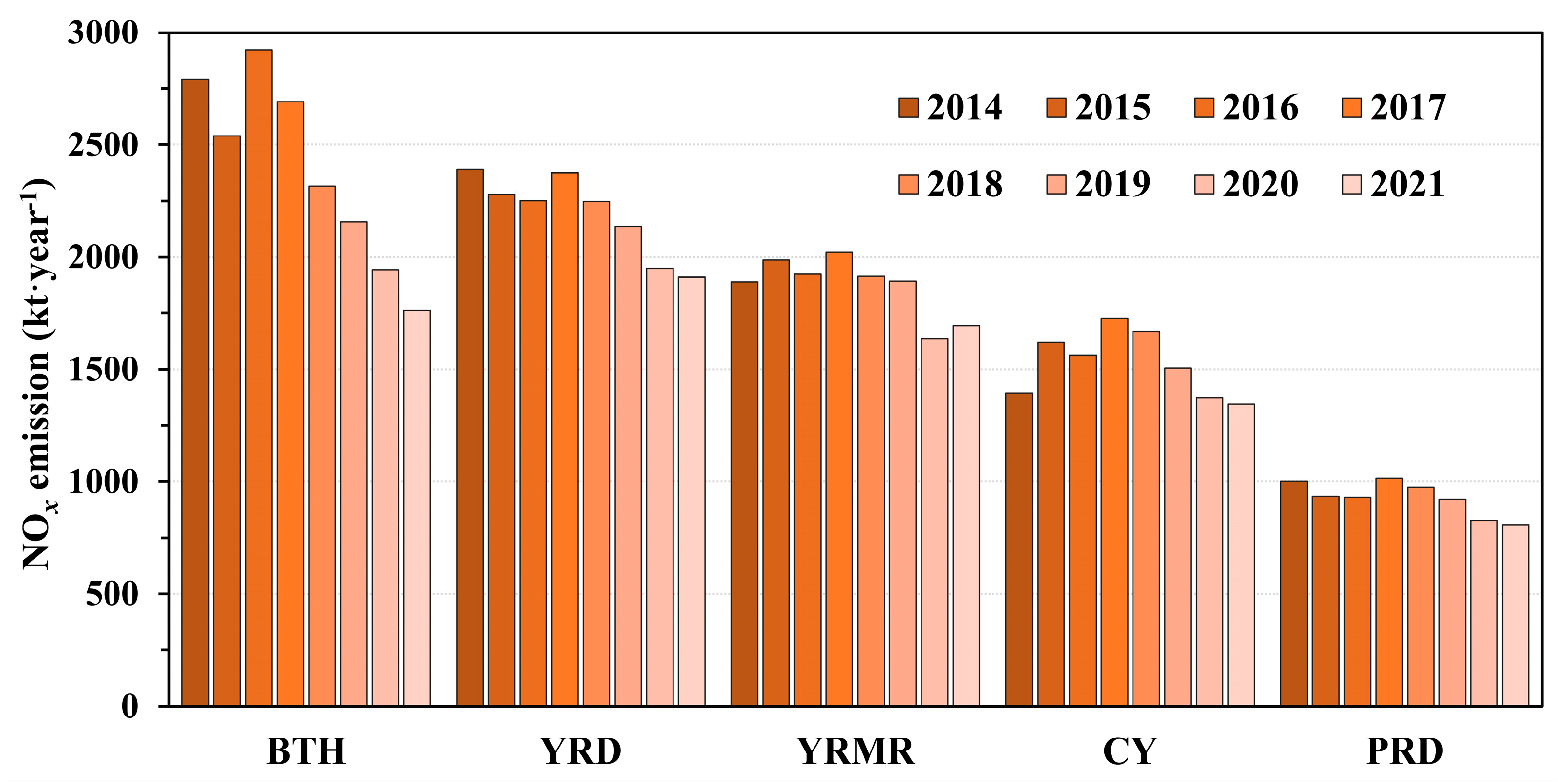
Figure 4 illustrates the NOx emission trends for the five national-level urban agglomerations from 2014 to 2021. BTH exhibited the highest emission levels throughout the study period, peaking at 2900 kt in 2016 before declining sharply to 1760 kt in 2021, with a reduction of 39% from the peak. This substantial decline reflects the region’s stringent emission control measures, particularly in the industrial and transportation sectors [70]. In contrast, YRD and PRD displayed U-shaped patterns, with emissions increasing slightly during 2014–2017 before transitioning to continuous declines after 2017. By 2021, NOx emissions in YRD had fallen to 1910 kt, while PRD reached nearly 800 kt. YRMR and CY showed more fluctuating trends. The emissions in YRMR ranged between 1910 and 2020 kt during 2014–2018, declined to a low value in 2020, but rebounded in 2021. Similarly, the emissions in CY increased from 2014 to a peak of 1720 kt in 2017, then declined in 2020, followed by a rebound in 2021. Despite these regional differences, a consistent pattern emerges that all five urban agglomerations experienced emission reductions after 2017, coinciding with the implementation of the Three-year Action Plan to Win the Battle for a Blue Sky [2].

3.2.2. The Contributions of NOx Emission Changes on NO2 Concentrations

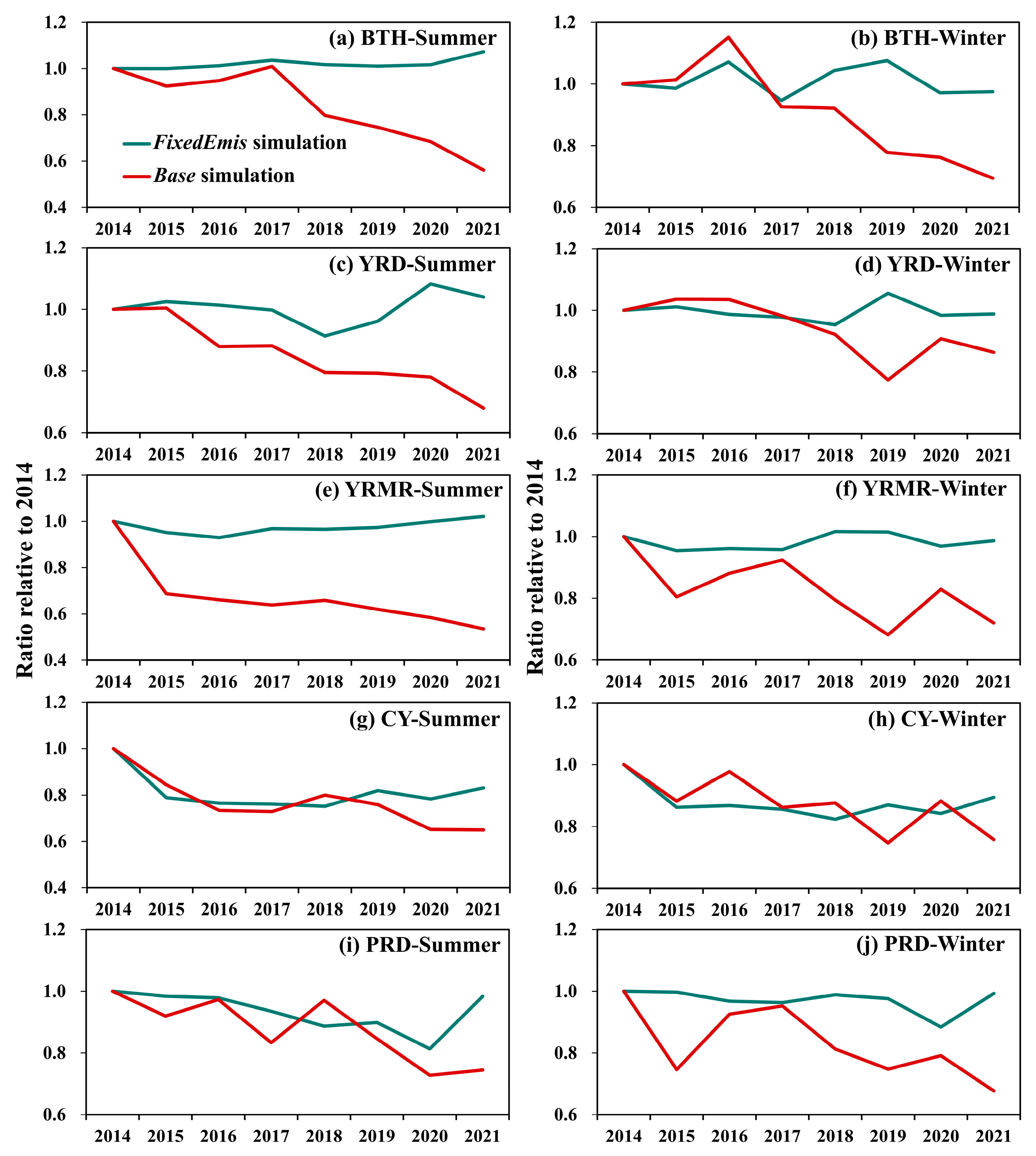
Figure 5 displays the interannual trends of NO2 concentration ratios relative to 2014 levels from the Base and the FixedEmis simulations during summer (June to August) and winter (December to the following February) across five national urban agglomerations from 2015 to 2021. Compared with the Base simulations, the trends and interannual variations in NO2 concentrations from the FixedEmis simulations were substantially weaker across all urban agglomerations. In summer, the simulated NO2 levels with fixed emissions in BTH, YRD, and YRMR remained relatively stable from 2014 to 2021. This stability indicates that NO2 reductions observed in BTH during 2015, and 2018 onward, as well as the declining trend in YRMR after 2015, were primarily attributable to emission reductions. The decreases in NO2 from the FixedEmis simulations were much smaller than those from the Base simulations in BTH after 2017 and in YRD and YRMR after 2015, demonstrating concurrent influences from both meteorological variations and emission reductions. PRD showed opposing interannual trends between the two simulation scenarios, suggesting that NO2 variability here was dominantly controlled by emission changes while still being modulated by meteorological conditions. Winter analyses revealed stable NO2 levels in the FixedEmis simulations throughout the study period for YRMR, CY, and PRD, confirming emission changes as the principal driver of interannual NO2 variability. In BTH and YRD from 2014 to 2017, along with CY in 2015, the near-identical trends between the two simulation scenarios implied weaker anthropogenic contributions, with meteorology being the predominant factor. However, from 2017 to 2021, dynamics showed dramatically weaker variability in the FixedEmis simulations compared to the Base simulations across BTH, YRD, YRMR, and PRD. The particularly pronounced NO2 increase observed in 2020 Base simulations for YRD, YRMR, CY, and PRD provided compelling evidence for substantial emission-driven contributions. These findings collectively demonstrate that interannual NO2 variability is predominantly governed by emission changes, though with varying degrees of meteorological influence across regions and seasons.
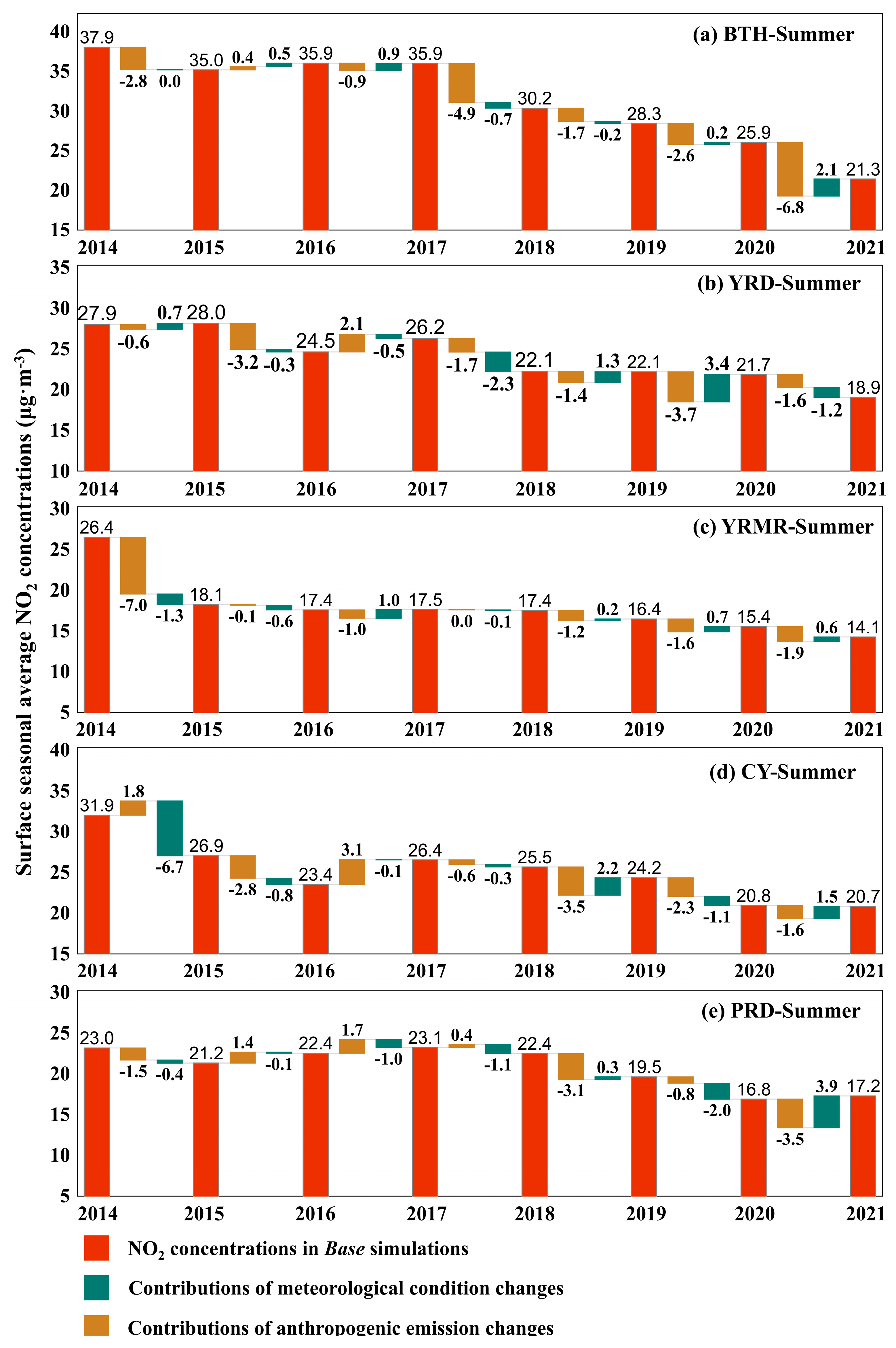
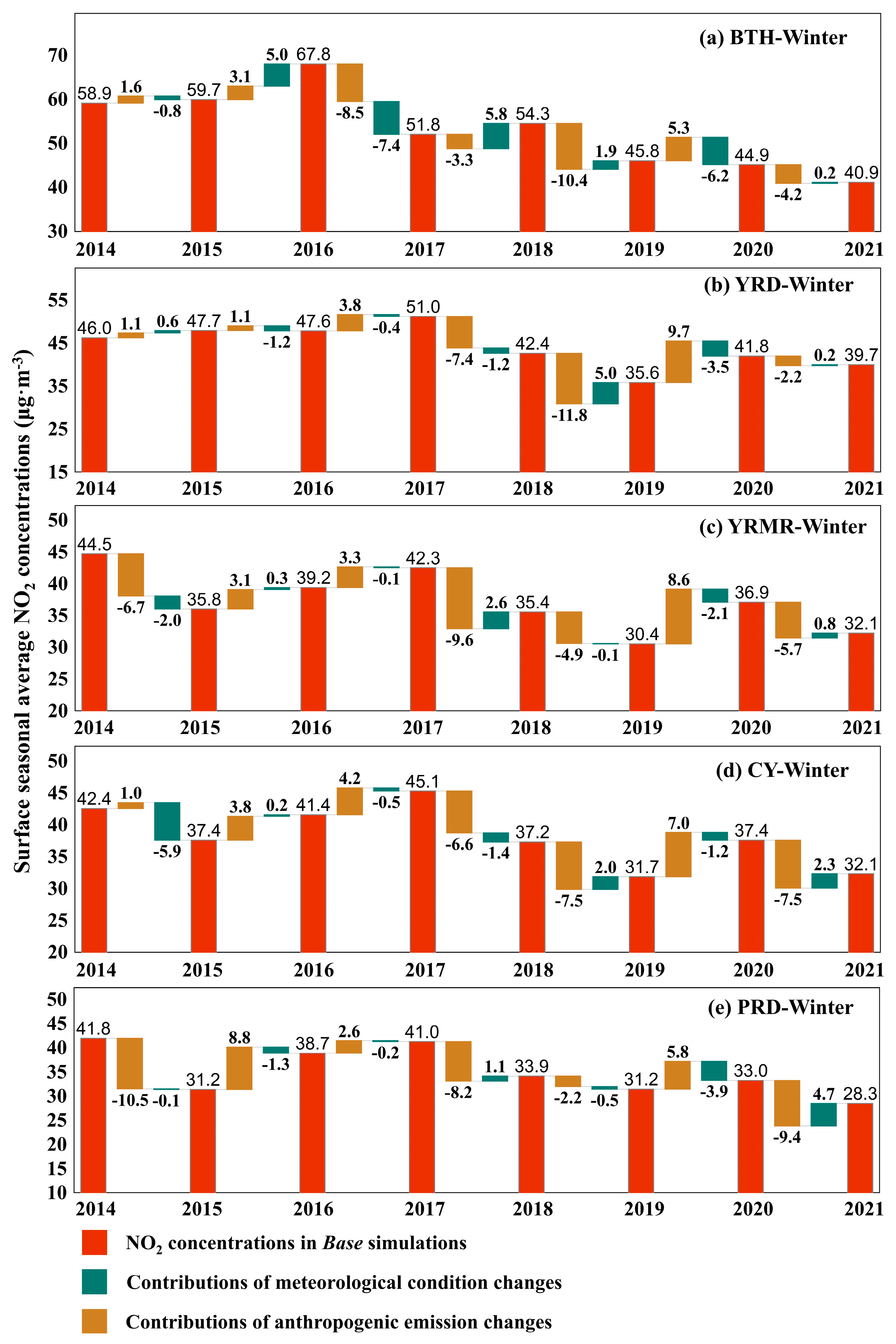
Figure 6 and Figure 7 present the quantitative contributions of meteorological condition and anthropogenic emissions variations to the interannual changes in NO2 concentrations in summer and winter across five national-level urban agglomerations. The results demonstrate that, overall, emission changes exerted a greater influence on NO2 concentration variations than meteorological factors, particularly during winter when NO2 concentrations were higher and emission-driven contributions became more pronounced.
In BTH, anthropogenic emission reductions led to NO2 concentration decreases of 2.8, 4.9, and 6.8 μg·m−3 during summer 2015, 2018, and 2021, respectively. Winter meteorological effects were more significant in BTH than in other urban agglomerations, altering NO2 concentrations by +5.0, −7.4, +5.8, +1.9, and −6.2 μg·m−3 annually from 2016 to 2020. YRMR exhibited an 84% attribution of its total NO2 reduction to emission controls during summer 2015. YRMR recorded significant dual-season reductions in 2015 (−7.0 μg·m−3 in summer, −6.7 μg·m−3 in winter), with reductions in winter 2018 approaching −10 μg·m−3. Similarly, in YRD, emission reductions accounted for 91% (summer 2016) and 86% (winter 2018) of NO2 declines, with reductions in winter 2019 reaching −11.8 μg·m−3. In CY, emissions increased NO2 concentrations before 2017. From 2018 onward, the benefits of emission reductions became apparent, with NO2 concentrations decreasing by 6–8 μg·m−3, though emissions caused an increase of 8.6 μg·m−3 in NO2 concentrations in 2020. In PRD, the impact of emission changes on NO2 concentrations was also evident. Emission reductions in summer 2019 and 2021 each lowered NO2 concentrations by more than 3 μg·m−3. However, in 2021, the reduction from emission control was offset by unfavorable meteorological conditions that increased NO2 concentrations. A similar pattern occurred in winter 2021, where over half of the emission-driven decrease was counteracted by worsened meteorological conditions. In winter, emission reductions were particularly effective, with associated NO2 decreases reaching 10.5, 8.2, and 9.4 μg·m−3 in 2015, 2018, and 2021, respectively. Nevertheless, emission control in PRD was ineffective in some years, with anthropogenic emissions leading to NO2 increases, for example, by 1.7 μg·m−3 in summer 2017, and by 8.8 and 5.8 μg·m−3 in winter 2016 and 2020, respectively.
Overall, summer NO2 concentrations displayed gradual declines across all urban agglomerations from 2014 to 2021, though the rate of decrease was relatively slow. Winter trends were more dynamic, characterized by an initial decline and subsequent rise during 2014–2017 (2014–2016 for BTH), before transitioning to a fluctuating downturn after 2018. These patterns largely mirror changes in emissions, consistent with the post-2014 trend in NOx emissions reported in the inventory, rising initially and then declining [49].

3.3. Impact of Interannual Variations in NOx Emissions on O3 Pollution

3.3.1. Seasonal Variation in O3 Concentrations over the Years

The spatial patterns of summer O3 concentrations in China from 2014 to 2021 were presented in Figure S3, simulated based on optimized NOx emissions in Base simulations. The O3 pollution patterns consistently exhibited urban agglomeration characteristics, with elevated concentrations predominantly clustered in BTH, YRD, and CY metropolitan regions. North China Plain, Central China, and East China progressively merged into a contiguous high-O3 zone, forming an extensive polluted area encompassing the Bohai Rim, Guanzhong Plain, Central Plain, YRD, YRMR, and CY. Eastern coastal areas also exhibited relatively high O3 concentrations, particularly in the Shandong Peninsula and the coastal regions of Jiangsu province. The core area of O3 pollution was mainly located in southeastern Shanxi province from 2014 to 2017, gradually expanding and shifting westward, with pollution intensifying annually and peaking in 2017. This is consistent with previous studies indicating an increasing spatial agglomeration of high O3 concentrations from 2015 to 2017 [71]. After 2018, O3 pollution in the Central Plain regions gradually decreased, although northern Shanxi and Shaanxi remained areas of high O3 concentrations. The O3 pollution in Central and Eastern China also showed some mitigation. Overall, the spatial distribution of summer average O3 concentrations across China exhibited a clearer pattern of higher levels in the north and lower levels in the south.
Summer is the peak season for O3 pollution, while spring, as temperatures gradually rise, also exhibits notable O3 pollution issues (Figure S4). Compared to summer, the center of high O3 pollution shifts westward in spring, transitioning from the North China and Central Plain toward the southwest into the Chengdu-Chongqing region, particularly affecting Sichuan province and surrounding areas. Consistently elevated O3 concentrations indicate severe ozone pollution across these regions annually. Notably, the highest O3 levels predominantly encircle the Sichuan Basin, forming a distinct ring-shaped distribution along its periphery. Recent interannual trends suggest mitigation, with peak O3 concentrations demonstrating a decreasing pattern. Furthermore, Central and South China also exhibit relatively high O3 levels, especially in 2019 when O3 pollution in provinces such as Hubei and Hunan intensified compared to 2018. By 2021, nationwide spring O3 pollution showed further improvement, with only western Sichuan Basin maintaining notably high O3 concentrations. While localized O3 pollution remains substantial, the overall national trend is moving to a favorable direction.
In autumn, declining temperatures coincide with reduced O3 pollution intensity (Figure S5). Most regions across the country exhibit relatively low ozone concentrations, especially in northeastern and eastern North China, where seasonal averages frequently fall below 50 μg·m−3. However, the western part of the Sichuan Basin remains an area with relatively high O3 levels; for instance, from 2014 to 2019, ozone concentrations in these regions still exceeded 100 μg·m−3. Moreover, similar to spring, Southern China experienced prominent ozone issues in autumn 2019, emerging as both the most concentrated and highest-magnitude O3 hotspot nationwide.

3.3.2. The Impact of NOx Emission Changes on O3 Concentrations

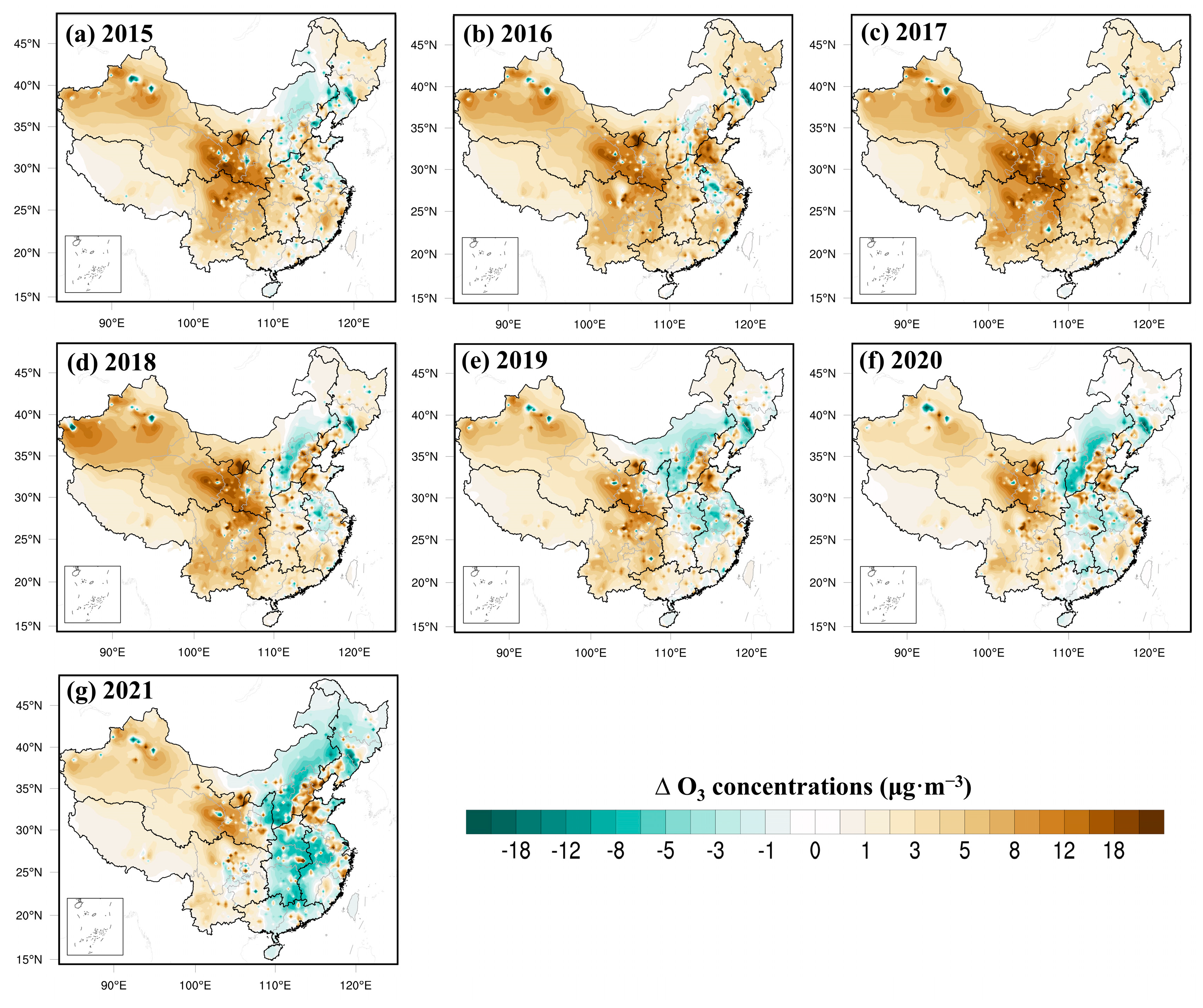
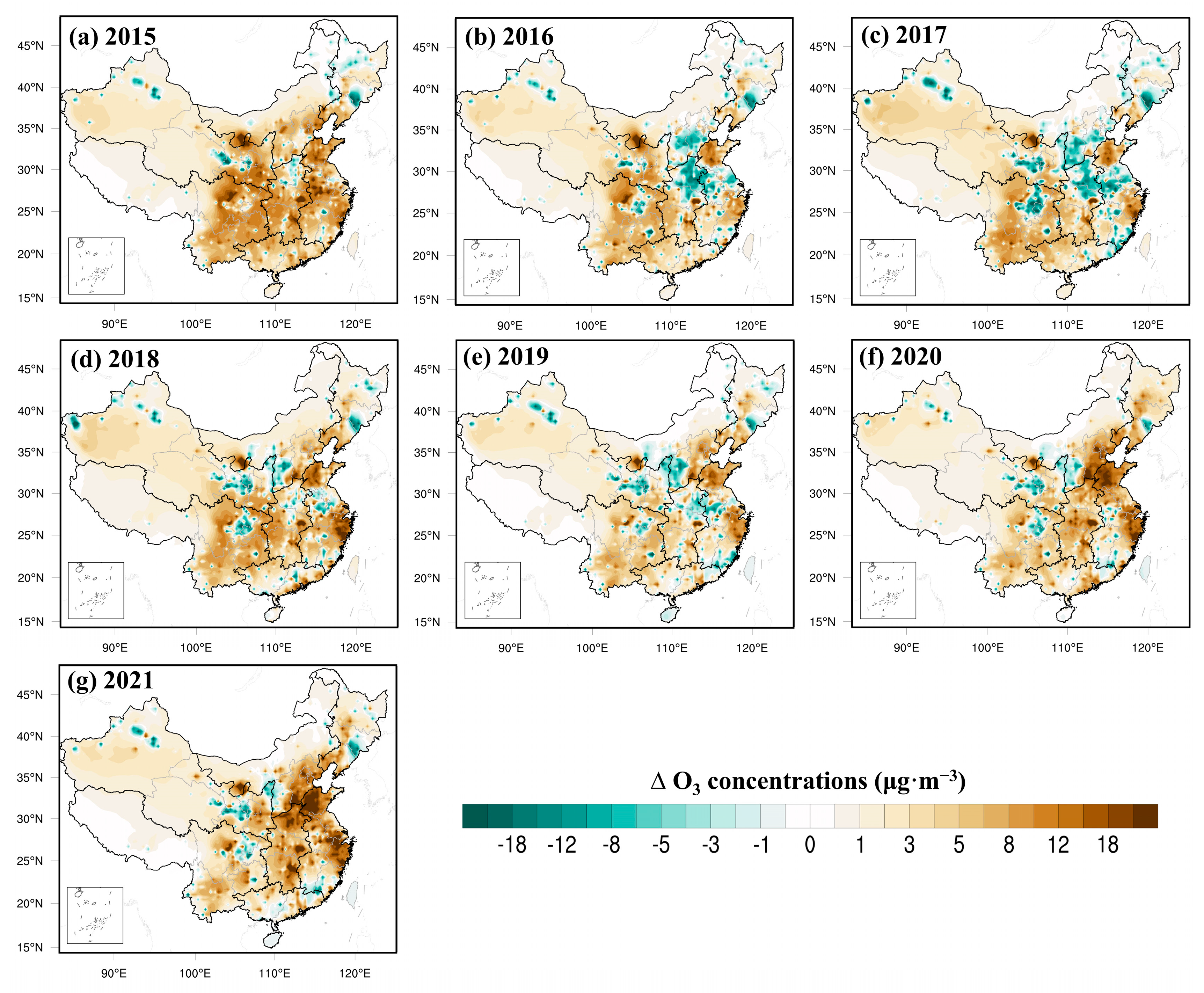
Figure 8 illustrates the differences in summer mean O3 concentrations between the Base and FixedEmis simulations during 2015–2021, representing the impact of NOx emissions variations relative to 2014 levels. In 2015, NOx emission modifications led to reduced O3 concentrations in North China, Liaoning province, and central provinces of East China, while intensifying O3 pollution in the Northwest and Southwest regions. Additionally, aggravated O3 pollution was observed across Central China, South China, southern parts of East China, and the central-northern region of Northeast China. With further NOx emission increases in 2016 and 2017, O3 pollution intensified correspondingly. In 2016, O3 reductions were limited only to northern Liaoning, northwestern Hebei, northeastern Shanxi, and eastern Anhui and Henan provinces, whereas western regions continued experiencing worsening pollution. The Shandong Peninsula and coastal areas of YRD also exhibited moderate O3 increases. In 2017, when NOx emissions peaked in recent years, O3 pollution worsened further, with only sporadic areas showing improvement. Notably severe pollution occurred in eastern Gansu, southern Shaanxi, and the Sichuan Basin. By 2018, the regions with reduced O3 pollution began to expand, extending southward from Northeast and North China, and further expanding to northern Central China and central East China by 2019. However, western Shandong Peninsula maintained persistently high O3 levels. In 2020, the nationwide O3 pollution level remained largely comparable to that in 2019. By 2021, sustained NOx emission control measures yielded substantial improvements, with marked O3 reductions across most central-eastern regions except the Bohai Rim area. The declines of O3 concentrations were also achieved in the Northwest and eastern Southwest China.
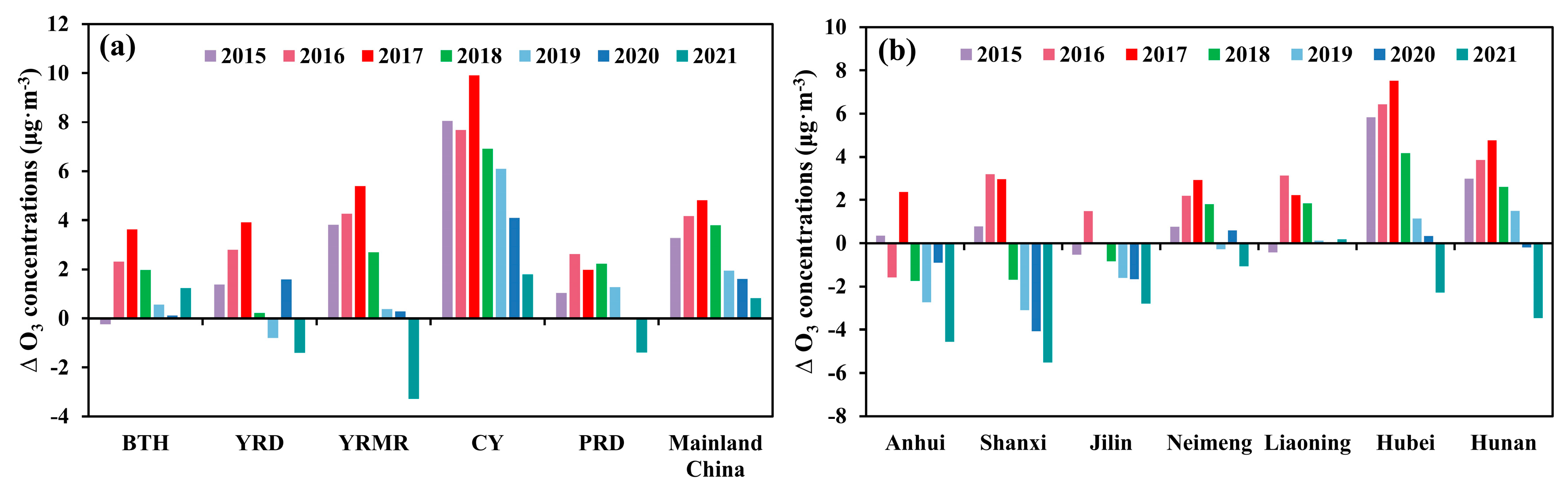
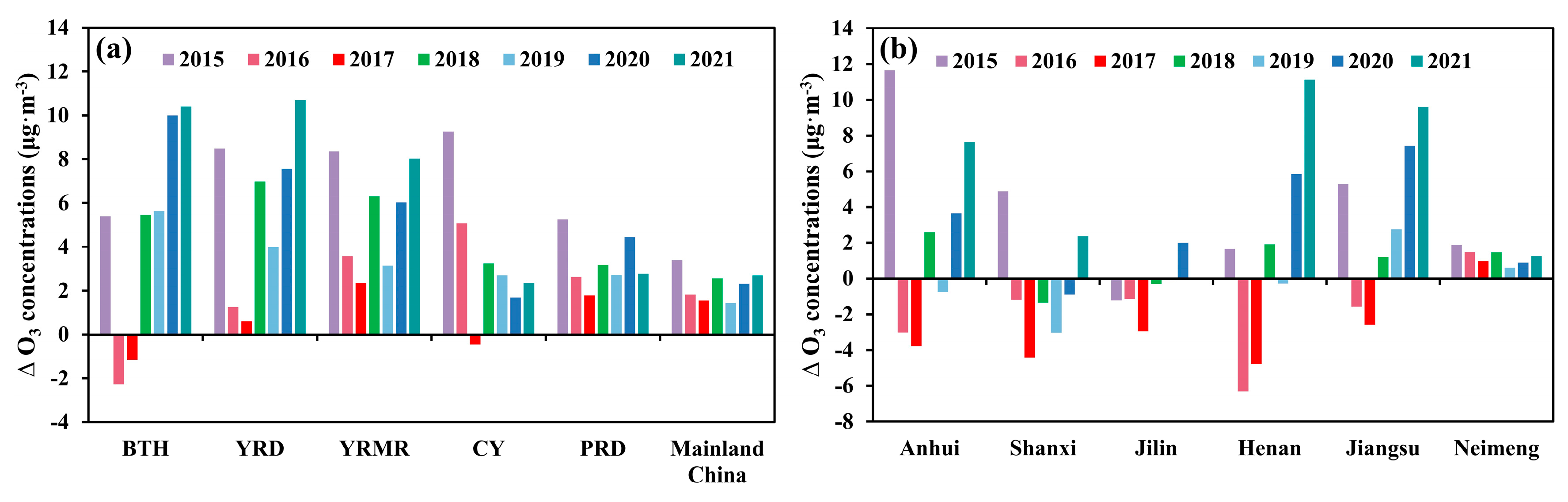
The analysis of nationwide summertime O3 concentrations (Figure S6) and their deviations from simulations using fixed 2014 NOx emissions (Figure 9a) reveals a distinct post-2018 decline in O3 levels across the national urban agglomerations. However, compared to scenarios maintaining 2014 NOx emission intensities, O3 concentrations remain elevated in recent years, indicating limited effectiveness of NOx reduction measures in mitigating O3 pollution within economically developed regions. Similar situations have been documented in other Asian countries. For instance, stringent NOx emission controls implemented in South Korea to reduce PM2.5 levels paradoxically increased O3 concentrations in the Seoul metropolitan areas [72]. This occurs because these regions have entered a NOx-saturated regime, where initial emission reductions temporarily exacerbate O3 formation. Consequently, the observed O3 increase represents a transitional threshold before further NOx cuts enable progression into the NOx-controlled regime, wherein continued reductions ultimately suppress O3 production. Notably, NOx abatement has demonstrated substantial efficacy in controlling O3 pollution in several provinces, such as Anhui, Shanxi, and Jilin (Figure 9b). After 2018, sustained and progressively stronger reductions in O3 levels were observed, suggesting that NOx mitigation strategies are achieving meaningful impacts in these areas. Additionally, Inner Mongolia, Liaoning, Hubei, and Hunan province exhibited marked O3 decreases after 2018 compared to pre-2017 levels, further evidencing the gradual emergence of NOx reduction benefits for O3 control.
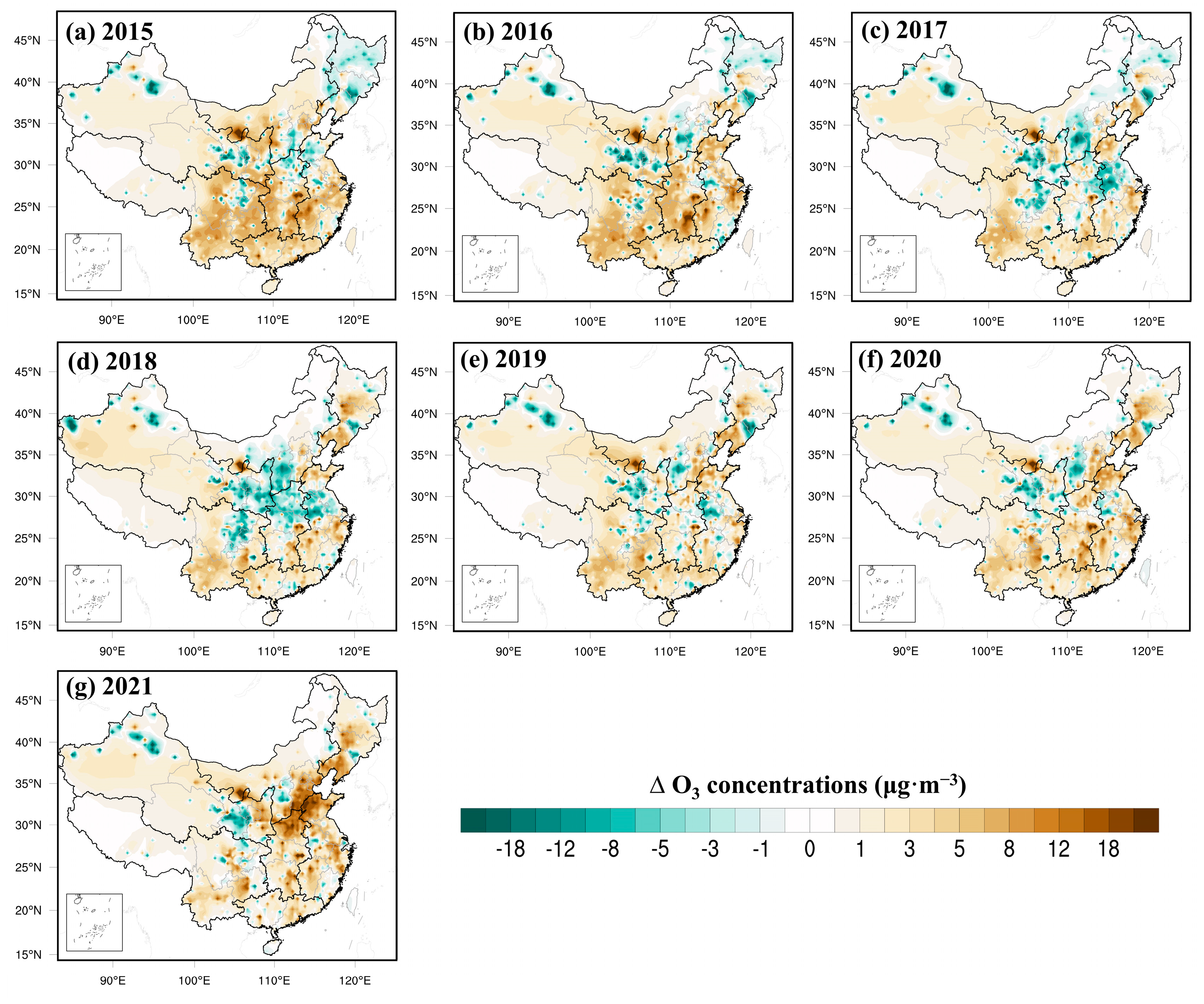
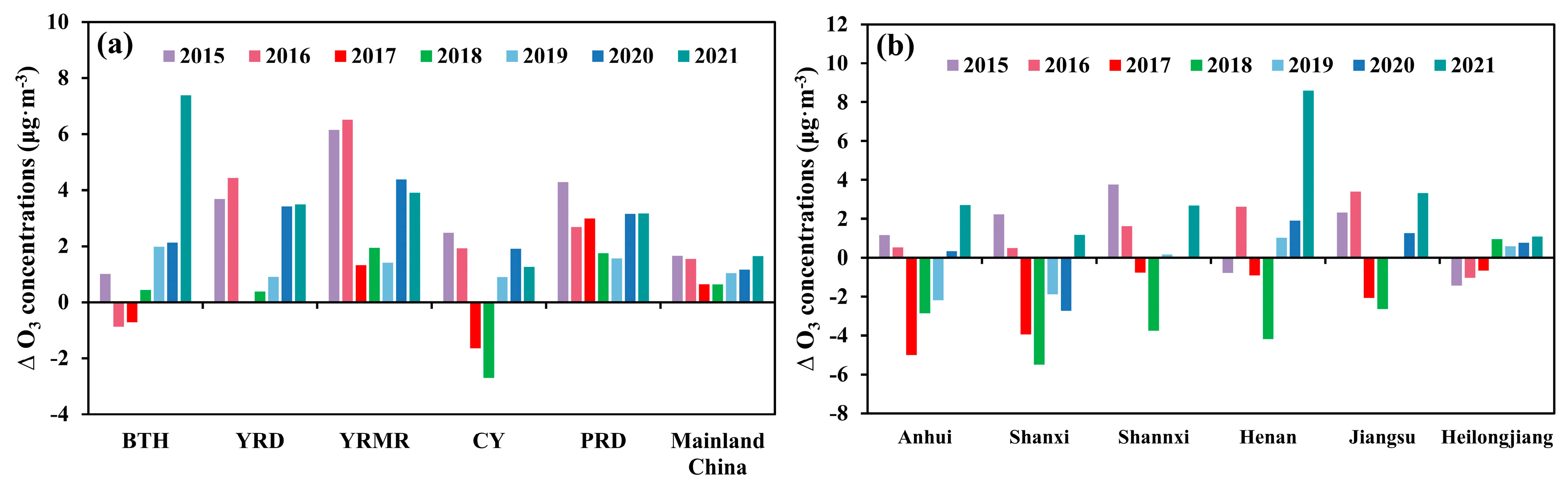
The impact of NOx emission reductions on springtime O3 concentrations exhibited distinct patterns compared to summer effects. During 2016–2017, emission changes primarily contributed to significant O3 decreases in southern North China, northern Central China, and northwestern East China. In contrast, during 2020–2021, O3 increases were pronounced in East China and North China, with concentrations rising by over 18 μg·m−3 in areas such as the western Shandong Peninsula and parts of East China (Figure 10). Among the urban agglomerations, apart from some alleviation of O3 pollution in BTH and YRD in 2016 and 2017, other agglomerations also showed clear O3 increases (Figure 11). At the provincial level, Anhui, Shanxi, and Jilin province exhibited notable O3 decreases, similarly to the summer pattern. Additionally, NOx emission changes played a role in mitigating spring O3 pollution in Henan and Jiangsu provinces (Figure S7).
Autumn responses to NOx reductions largely resembled spring patterns, with Central and North China (especially Henan, Anhui and Jiangsu provinces) showing substantial O3 decreases (Figure 12). However, urban agglomerations maintained severe O3 pollution with minimal improvement (Figure 13). Provincially, besides the improvements seen in Anhui, Shanxi, Henan, and Jiangsu during spring, Shaanxi and Heilongjiang also began to show favorable trends in O3 pollution in autumn (Figure S8). A statistical analysis of the areal extent of O3 concentration reduction across spring, summer, and autumn revealed that the area with decreasing O3 concentrations in summer began to expand steadily from 2017 onward, indicating effective implementation of control measures. In contrast, the area of O3 reduction in spring and autumn did not show significant interannual expansion (Figure S9).

4. Discussion

This study quantitatively assessed the relative contributions of interannual variations in anthropogenic NOx emissions and meteorological conditions to surface NO2 and O3 concentrations across five major Chinese urban agglomerations from 2014 to 2021. The core methodological approach, employing a pair of fixed-emission simulations, effectively isolated the emission-driven signal from the confounding influence of meteorological variability. Our results demonstrate that, while meteorology modulates concentrations at seasonal and interannual scales, anthropogenic emission changes are the predominant driver of long-term trends in NO2 and a critical, though complex, factor influencing O3 pollution patterns.

4.1. Consistency Between NOx Emission Variations and Associated NO2 Concentration Changes

Changes in NO2 concentrations are driven by both meteorological conditions and anthropogenic emissions, with the latter being the dominant factor. Consequently, variations in NOx emissions significantly impact trends of NO2 concentrations. Therefore, the contributions of emission changes to NO2 concentrations were isolated through systematic comparison between the annual Base simulations and the FixedEmis simulations (Table 1). Seasonal consistency between these derived contributions and documented NOx emission changes was then rigorously evaluated (Table 2, Figure 14).
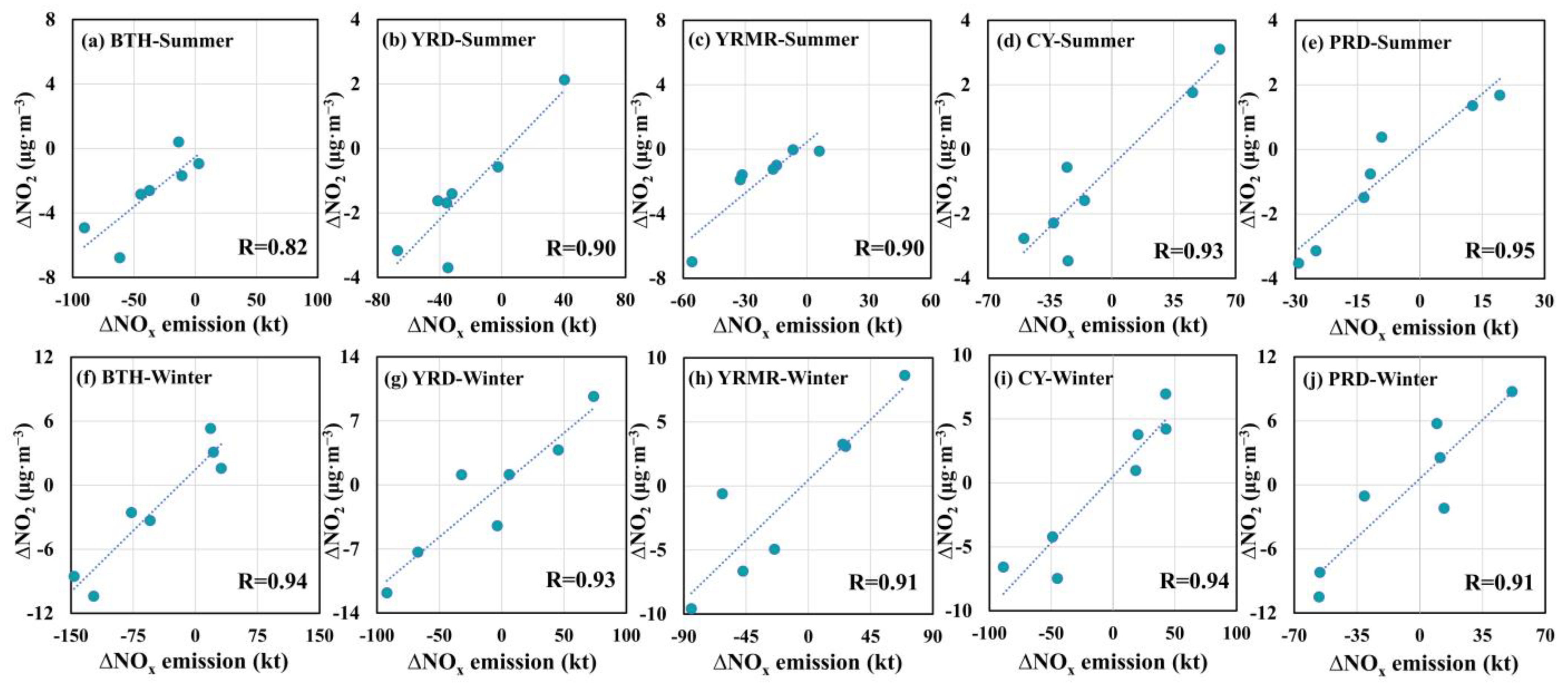
Table 2 presents the statistical results of NO2 concentration changes attributed to anthropogenic NOx emission variations during summer and winter from 2014 to 2021 for the five national-level urban agglomerations. Correspondingly, Table 3 shows the interannual changes in NOx emissions for each agglomeration. A regression analysis between the two sets of changes reveals a high consistency across the urban agglomerations (Figure 14). In summer, the correlation coefficient reaches 0.82 in BTH, while in the other four agglomerations it exceeds 0.90.
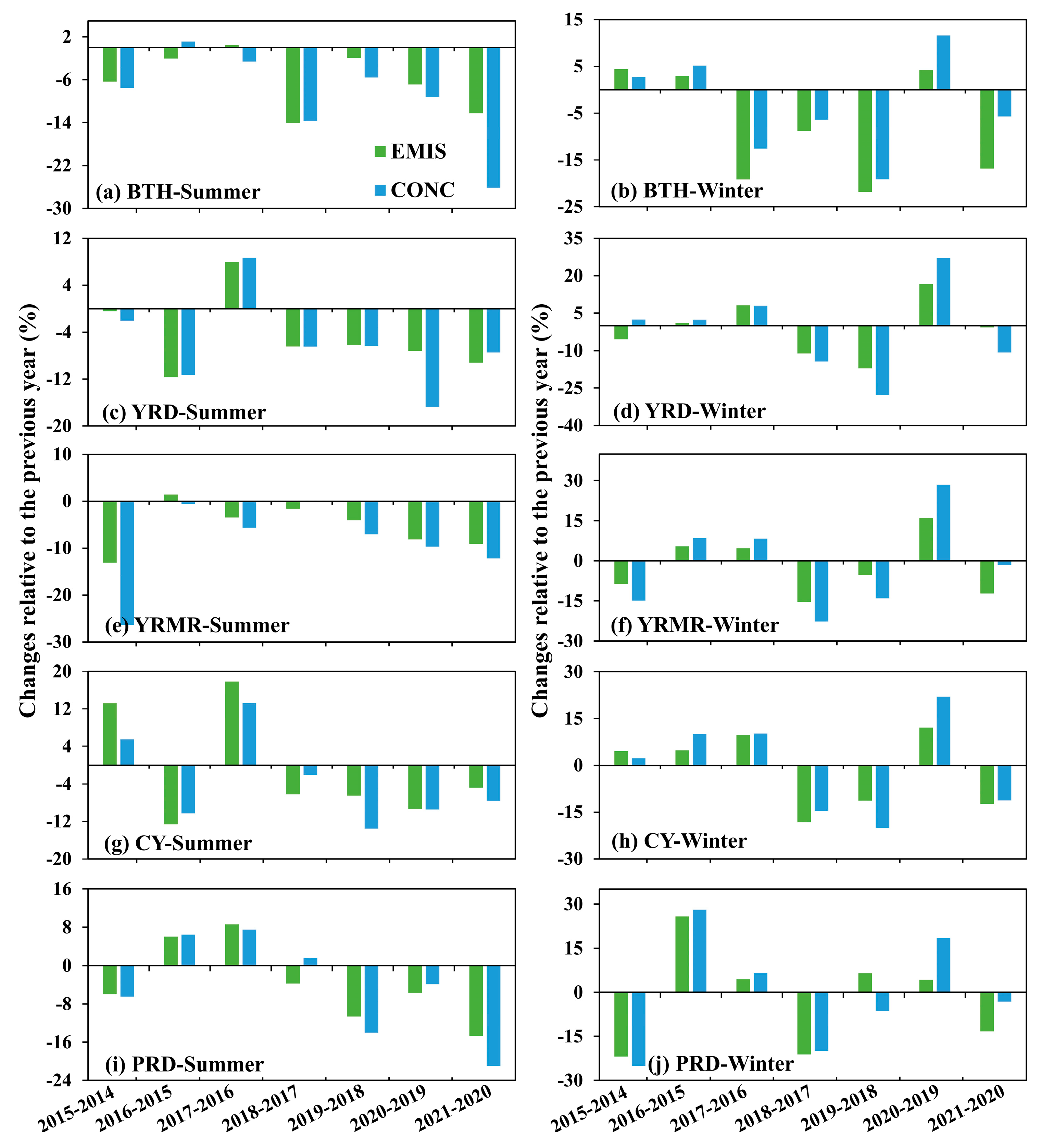
The annual changes in NOx emissions were normalized relative to the change in the preceding year to facilitate a more intuitive comparison of their trends, resulting in the histograms shown in Figure 15. Overall, the trends show strong agreement, particularly in YRD, CY, and PRD. However, opposite trends occur in certain years, for example, in BTH in 2016 and 2017, in 2016 in YRMR, and in 2018 in PRD. Further analysis indicates that these opposing trends generally occur during periods with relatively small changes in both concentration and emissions, whereas higher consistency is observed when changes in concentration and emissions are larger. Winter exhibits stronger consistency between NOx emission changes and NO2 concentration variations across most urban agglomerations (except PRD) compared to summer, with correlation coefficients reaching 0.94 in BTH and CY. This seasonal contrast is particularly evident in comparative histograms, though exceptions occur, specifically, YRD (2015) and PRD (2019) display anomalous opposing trends.

4.2. Dominance of Emission Controls on NO2 Trends

The pronounced decline in NO2 concentrations across all studied urban agglomerations post-2014, particularly the sharp decreases observed after 2017/2018, aligns temporally with the rigorous nationwide implementation of emission reduction policies and measures. Our quantitative attribution confirms that emission reductions were the principal contributor to these declines. The high consistency between the year-to-year changes in top-down optimized NOx emissions and the corresponding emission attributable NO2 variations (Section 4.1) robustly validates the effectiveness of the optimized emission inventory and the attribution methodology. This strong linear relationship underscores a direct, regionally coherent link between policy-driven emission abatement and observed air quality improvements for primary pollutants like NO2.
Notably, the relative importance of emissions versus meteorology exhibited seasonal and regional nuances. Winter NO2 concentrations showed larger emission-attributable changes than summer, consistent with higher absolute emission levels and more stagnant meteorological conditions in winter amplifying the impact of emission changes. Furthermore, the efficacy of emission controls varied regionally. For instance, PRD, an early adopter of stringent air quality measures, displayed complex dynamics where meteorological counteractions occasionally offset emission-driven benefits (e.g., winter 2021). In contrast, regions like YRMR and CY showed particularly strong emission-driven responses in certain periods, potentially reflecting the more recent and intensive application of control measures in central and western China.

4.3. Complex and Non-Linear Impacts of NOx Reductions on O3 Pollution

The impact of NOx emission changes on O3 concentrations revealed a more intricate picture, characterized by strong non-linear chemistry and regional disparities. The nationwide increase in summer O3 concentrations from 2014 to 2017, concurrent with initially rising or peaking NOx emissions [49]. In several agglomerations, particularly the YRD and PRD, O3 showed slight increases or plateaued during the study period, consistent with the weekend effect phenomenon, whereby urban areas experience higher O3 on weekends despite lower NOx emissions. The subsequent limited decline of O3 despite substantial NOx cuts after 2018, point to China’s widespread transition into or persistence within a NOx-saturated (VOC-sensitive) photochemical regime in key urban agglomerations [57,73]. In such a regime, reducing NOx can paradoxically increase O3 production by slowing the titration of O3 by NO and shifting chemical pathways, as evidenced by the positive O3 anomalies under reduced-emission scenarios (Figure 8 and Figure 9).
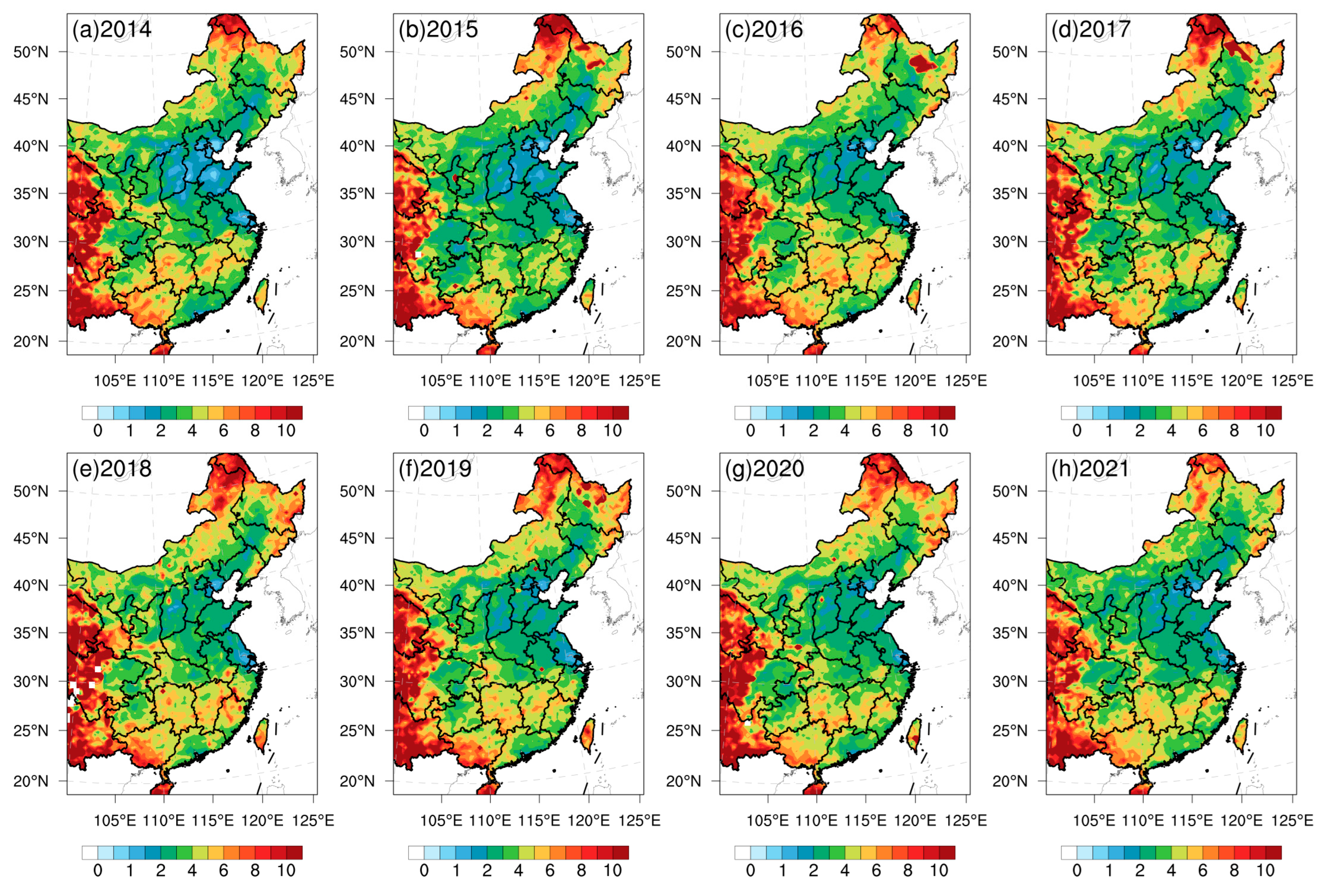
This interpretation is strongly supported by the spatial and temporal patterns of the satellite-derived formaldehyde-to-nitrogen dioxide ratio (HCHO/NO2 ratio, FNR), a robust indicator for O3 formation sensitivity [57,58]. Our analysis for summer from 2014 to 2021 shows persistently low FNR values (less than 1.5) over the major emission hotspots of Eastern China (e.g., North China Plain, YRD), consistent with a VOC-sensitive regime (Figure 16). Notably, the observed increase in FNR over these regions from 2014 to 2017, and its subsequent stabilization after 2018, aligns with the documented shift from VOC-limited towards transitional regimes driven by aggressive NOx controls. Concurrently, the higher FNR values (more than 4) observed in parts of Central and South China (e.g., Jiangxi, Guizhou, Guangxi province) suggest a prevailing NOx-sensitive regime in these less developed areas.
However, the O3 response to NOx changes is not uniform. We identified provinces such as Anhui, Shanxi, and Jilin where NOx reductions consistently led to O3 decreases across multiple seasons, suggesting these areas may reside in a NOx-sensitive regime. This spatial divergence underscores the critical importance of region-specific chemical regimes. Furthermore, the seasonal modulation of control effectiveness is evident. The expansion of areas showing summer O3 reductions between the Base and FixedEmis simulations after 2017, a pattern not mirrored in spring or autumn (Figure 9, Figure 11 and Figure 13), implies that precursor balances, solar radiation, and background conditions seasonally alter the chemical sensitivity. The pronounced O3 increases in eastern China in response to NOx cuts during the 2020–2021 spring and autumn periods reinforce this seasonal complexity, likely due to lower biogenic VOC emissions and altered photochemistry that exacerbate the disinhibition effect from NOx reduction.
The spatial patterns of FNR and the divergent O3 responses necessitate a differentiated, synergistic control strategy. In major urban agglomerations like the BTH, YRD, and PRD, where FNR values are typically low and regimes are VOC-sensitive or transitional, effective O3 reduction requires concurrent, stringent cuts in anthropogenic VOC emissions alongside NOx controls. The observed plateauing of FNR increases after 2018 in these regions suggests that further O3 gains may now be critically dependent on accelerating VOCs emission reductions (Figure 16). Conversely, in provinces demonstrating a NOx-sensitive response (e.g., parts of Central and South China with higher FNR), sustained NOx reduction remains the primary and effective strategy for O3 control.

4.4. Progress Toward WHO Air Quality Guidelines: The Role of Emissions and Meteorology

Benchmarking against the World Health Organization (WHO) Air Quality Guideline 2021 reveals both progress and persistent challenges in air quality management [74]. By 2021, the national annual mean NO2 concentration had reached the WHO interim target II of 30 μg·m−3, with YRMR, CY, and PRD also attaining this level (Figure 1). Regarding PM2.5, concentrations declined from 46 μg·m−3 in 2015 to 30 μg·m−3 in 2021, thereby meeting the WHO interim target I, with BTH exhibited the most substantial emission-driven reduction during this period [75]. However, the trend for O3 presents a stark contrast. Since 2014, over 90 percent of days across China have recorded maximum daily 8 h average O3 concentrations exceeding the WHO guidelines of 100 μg·m−3, with similarly high exceedance rates observed in PRD and YRD [76]. Furthermore, since 2017, more than 98 percent of Chinese cities have experienced at least one day with O3 exceedance, indicating widespread acute health risks despite the long-term reductions in NOx emissions [76]. These contrasting patterns highlight that while emission controls have successfully reduced primary pollutants, secondary pollution remains a major challenge when assessed against health-based standards.
As mentioned above, anthropogenic emission changes are the primary driver of long-term trends in NO2, while O3 exhibits a more complex response due to its nonlinear photochemistry. However, meteorological conditions modulate pollutants at seasonal and interannual scales, explaining variability not captured by emission trends alone. Wintertime accumulation of NO2, as well as PM2.5, in northern agglomerations (e.g., BTH) is exacerbated by shallow boundary layers and weak winds, which trap pollutants near the surface [77]. In southern regions, precipitation enhances wet removal, contributing to interannual fluctuations. For O3, high summer temperatures and strong solar radiation drive photochemical production, with the record-high O3 in 2017 coinciding with eastern China heatwaves [78]. Regional transport further links agglomerations. For example, southerly monsoon winds carry O3 and its precursors from PRD and YRD to inland areas such as YRMR, explaining synchronized pollution episodes [79]. The increase in O3 after 2017, despite reductions in NOx, reflects a phenomenon known as ozone penalty, a nonlinear response under VOC-limited regimes that is exacerbated by warming trends [80]. The strong influence of meteorology on pollutant behavior also has implications for how progress toward WHO guidelines is perceived. Interannual meteorological variability can temporarily mask or amplify the benefits of emission reductions, potentially leading to over-optimistic or overly pessimistic interpretations of short-term trends.

4.5. Limitations and Future Perspectives

While this study advances understanding of emission-driven changes in NO2 and O3 trends, several methodological considerations and associated limitations should be acknowledged. The fixed-emission approach employed here effectively isolates the net effect of total emission changes but does not resolve sector-specific contributions (e.g., transportation versus industry). The scenario design focuses primarily on NOx variations and does not explicitly isolate the potential co-variation in other precursors such as VOCs that could influence O3 formation pathways. The assumption of constant 2014-level VOCs emissions within the FixedEmis simulation, while necessary for isolating certain drivers, may not reflect actual temporal trends and could influence simulated O3 responses. Additionally, the use of a 36 km horizontal resolution, though suitable for regional analysis, may not fully resolve finer-scale chemical gradients within urban areas. Furthermore, we employed static default chemical boundary conditions rather than dynamic outputs from global models. While the extensive modeling domain effectively buffers interior target regions against boundary inflows of short-lived species, this simplification may introduce uncertainties in estimating background concentrations of longer-lived species like O3. Finally, because our primary focus was on capturing long-term trends and interannual variability, we did not assess the modeling performance for short-term air quality. It should be noted that modeling short-term pollutant behavior is inherently more challenging than modeling mean monthly concentrations due to high-frequency fluctuations in meteorological conditions and short-term emission profiles.
Future work would benefit from more targeted sensitivity experiments (e.g., fixing NOx or VOCs emissions individually) to better disentangle the roles of different precursors. Higher resolution modeling and the integration of sector-specific emission inventories would enhance the mechanistic understanding and support more targeted policy design. Coupling regional models with global chemical transport models to provide time-varying boundary conditions would also improve the assessment of intercontinental background O3 transport. Long-term monitoring and analysis are also needed to determine if and when key urban agglomerations will transition into a NOx-sensitive regime, allowing NOx reductions to yield consistent O3 benefits. Finally, while this study relied on monthly mean values to evaluate broad O3 trends, health impacts are most closely associated with the maximum daily 8 h average (MDA8) concentrations. Therefore, analyzing the trends in the number of exceedances of the MDA8 O3 standard represents a critical direction for future study to provide a more rigorous assessment of the associated acute health risks.

5. Conclusions

This study systematically evaluated the impacts of interannual variations in top-down constrained NOx emissions on surface NO2 and O3 concentration trends across five national urban agglomerations in China during 2014–2021, using WRF−CMAQ model with a fixed-emission sensitivity approach. Key findings are summarized as follows.
NO2 concentration trends were predominantly driven by emission changes. Emission contributions were quantitatively isolated via the Base and FixedEmis simulations, revealing that NOx controls accounted for over 80% of NO2 declines in several regions, especially after 2017, with significant reductions observed in winter across BTH, YRD, YRMR, and PRD. Meteorological conditions could cause interannual fluctuations, occasionally offsetting emission-driven improvements, but did not alter the long-term downward trend dictated by emission controls. Regression analyses confirmed strong consistency between the interannual changes in top-down NOx emissions and the attributed changes in NO2 concentrations (r > 0.80 in summer, r > 0.90 in winter), validating the RAPAS-assimilated emission inventory and the attribution method.
O3 responses to NOx reductions were spatially and seasonally heterogeneous. In economically developed urban agglomerations (e.g., BTH, YRD, PRD), NOx reductions since 2018 have shown limited effectiveness in mitigating summertime O3 pollution and have even led to O3 increases in some seasons (spring and autumn). This indicates a disinhibition effect where reduced NOx titration slows O3 loss. Certain provinces (e.g., Anhui, Shanxi, Jilin) exhibited consistent O3 decreases in response to NOx reductions, highlighting the necessity for region-specific control strategies. Seasonal differences in O3 response were pronounced. The areal extent benefiting from NOx reductions (i.e., showing O3 decreases) expanded steadily in summer after 2017 but showed no similar clear expansion in spring or autumn, indicating seasonal differences in chemical sensitivity and the influence of varying meteorological and background conditions.
In conclusion, China’s stringent NOx emission control policies have been highly effective in reducing primary NO2 pollution. However, to combat the persistently high and complex O3 pollution, a shift towards integrated, multi-pollutant control strategies is imperative. This involves implementing stringent VOC controls alongside NOx reductions in VOC-sensitive urban agglomerations, while continuing NOx-focused measures in NOx-sensitive regions. Future efforts should refine emission inventories to better resolve sector-specific contributions and account for spatial and seasonal disparities in photochemical regimes. This will enable the design of scientifically grounded, integrated policies that effectively leverage NOx-VOC synergies to improve overall air quality.

Supplementary Materials

The following supporting information can be downloaded at: https://www.mdpi.com/article/10.3390/atmos17030313/s1, Figure S1: The location of five national urban agglomerations (Beijing–Tianjin–Hebei (BTH), Yangtze River Delta (YRD), Yangtze River Middle Reach (YRMR), Cheng-Yu (CY), and Pearl River Delta (PRD)) and provinces in mainland China; Figure S2: Correlations between O3 monthly means in the Base simulations and surface observations over mainland China and five national urban agglomerations during 2014–2021; Figure S3: Temporal and spatial distribution of O3 concentrations in China during summer (June to August), 2014–2021; Figure S4: Temporal and spatial distribution of O3 concentrations in China during spring (March to May), 2014–2021; Figure S5: Temporal and spatial distribution of O3 concentrations in China during autumn (September to November), 2014–2021; Figure S6: Summer mean O3 concentration for five national urban agglomerations and mainland China, and several provinces, 2014–2021; Figure S7: Spring mean O3 concentration for five national urban agglomerations and mainland China, and several provinces, 2014–2021; Figure S8: Autumn mean O3 concentration for five national urban agglomerations and mainland China, and several provinces, 2014–2021; Figure S9: Proportion of the area with reduced O3 concentration in the spring, summer, and autumn of 2015–2021 in the total area of mainland China; Table S1: The number of air quality monitoring stations used in typical urban agglomerations and the whole country from 2014 to 2021.

Author Contributions

Conceptualization, Y.S. and S.F.; methodology, Y.S. and S.F.; software, S.F., R.Z. and Y.Y.; validation, Y.S. and C.P.; formal analysis, Y.S., Z.Y., G.W. and S.F.; investigation, Y.S. and Z.Y.; resources, R.Z., Y.Y., Z.Y. and C.P.; data curation, Y.S., S.F. and C.P.; writing—original draft preparation, Y.S.; writing—review and editing, Y.S., S.F., R.Z. and G.W.; visualization, Y.S., R.Z. and Z.Y.; supervision, Y.S. and S.F. All authors have read and agreed to the published version of the manuscript.

Funding

This research was funded by the National Natural Science Foundation of China, grant numbers 42305116 and 42304033; and the Natural Science Foundation of Jiangsu Province, grant numbers BK20241092 and BK20230801.

Institutional Review Board Statement

Not applicable.

Informed Consent Statement

Not applicable.

Data Availability Statement

The ground hourly monitoring data for NO2 and O3 concentrations were obtained from the China National Environmental Monitoring Centre (available at https://air.cnemc.cn:18007/, accessed on 17 March 2026). The NCEP FNL reanalysis datasets are publicly accessible via http://rda.ucar.edu/datasets/ds083.2/ (accessed on 17 March 2026). Meteorological observations from ground stations were downloaded from the NOAA Integrated Surface Database Lite repository (available at ftp://ftp.ncdc.noaa.gov/pub/data/noaa/isd-lite/, accessed on 17 March 2026). Anthropogenic emission inventories were sourced from the Multi-resolution Emission Inventory for China (MEIC) at http://meicmodel.org/ (accessed on 17 March 2026). Satellite-based HCHO column concentrations were acquired from the OMI HCHO product (available at https://disc.gsfc.nasa.gov/datasets/OMHCHOd_003/summary, accessed on 17 March 2026). Satellite-based NO2 column concentrations were acquired from the TEMIS NO2 column dataset (available at https://www.temis.nl/airpollution/no2col/no2regioomimonth_qa.php, accessed on 17 March 2026).

Acknowledgments

The authors wish to express their appreciation to the High Performance Computing Center (HPCC) of Nanjing University for providing essential computational resources on its blade cluster system, which made the numerical calculations in this study possible.

Conflicts of Interest

The authors declare no conflicts of interest.

References

  1. State Council of the People’s Republic of China. Notice of the General Office of the State Council on Issuing the Air Pollution Prevention and Control Action Plan. 2013. Available online: http://www.gov.cn/zwgk/2013-09/12/content_2486773.htm (accessed on 17 March 2026).
  2. State Council of the People’s Republic of China. Notice of the General Office of the State Council on Issuing the Three-Year Action Plan for Winning the Blue Sky Defense Battle. 2018. Available online: http://www.gov.cn/zhengce/content/2018-07/03/content_5303158.htm (accessed on 17 March 2026).
  3. Zheng, B.; Tong, D.; Li, M.; Liu, F.; Hong, C.; Geng, G.; Li, H.; Li, X.; Peng, L.; Qi, J.; et al. Trends in China’s anthropogenic emissions since 2010 as the consequence of clean air actions. Atmos. Chem. Phys. 2018, 18, 14095–14111. [Google Scholar] [CrossRef]
  4. Zhang, Q.; Zheng, Y.; Tong, D.; Shao, M.; Wang, S.; Zhang, Y.; Xu, X.; Wang, J.; He, H.; Liu, W.; et al. Drivers of improved PM2.5 air quality in China from 2013 to 2017. Proc. Natl. Acad. Sci. USA 2019, 116, 24463–24469. [Google Scholar]
  5. Xue, T.; Liu, J.; Zhang, Q.; Geng, G.; Zheng, Y.; Tong, D.; Liu, Z.; Guan, D.; Bo, Y.; Zhu, T.; et al. Rapid improvement of PM2.5 pollution and associated health benefits in China during 2013–2017. Sci. China Earth Sci. 2019, 62, 1847–1856. [Google Scholar] [CrossRef]
  6. Shen, Y.; Jiang, F.; Feng, S.; Zheng, Y.; Cai, Z.; Lyu, X. Impact of weather and emission changes on NO2 concentrations in China during 2014-2019. Environ. Pollut. 2021, 269, 116163. [Google Scholar] [PubMed]
  7. Li, K.; Jacob, D.J.; Shen, L.; Lu, X.; De Smedt, I.; Liao, H. Increases in surface ozone pollution in China from 2013 to 2019: Anthropogenic and meteorological influences. Atmos. Chem. Phys. 2020, 20, 11423–11433. [Google Scholar] [CrossRef]
  8. Liu, Y.; Geng, G.; Cheng, J.; Liu, Y.; Xiao, Q.; Liu, L.; Shi, Q.; Tong, D.; He, K.; Zhang, Q. Drivers of increasing ozone during the two phases of clean air actions in China 2013–2020. Environ. Sci. Technol. 2023, 57, 8954–8964. [Google Scholar] [CrossRef] [PubMed]
  9. Tonse, S.R.; Brown, N.J.; Harley, R.A.; Jin, L. A process-analysis based study of the ozone weekend effect. Atmos. Environ. 2008, 42, 7728–7736. [Google Scholar] [CrossRef]
  10. Chen, S.; Chen, J.; Li, J.; Gong, D.; Wang, B. Holiday effect of ozone pollution in China. Atmosphere 2025, 16, 559. [Google Scholar] [CrossRef]
  11. Wolff, G.T.; Kahlbaum, D.F.; Heuss, J.M. The vanishing ozone weekday/weekend effect. J. Air Waste Manag. 2013, 63, 292–299. [Google Scholar] [CrossRef]
  12. Simon, H.; Hogrefe, C.; Whitehill, A.; Foley, K.M.; Liljegren, J.; Possiel, N.; Wells, B.; Henderson, B.H.; Valin, L.C.; Tonnesen, G.; et al. Revisiting day-of-week ozone patterns in an era of evolving US air quality. Atmos. Chem. Phys. 2024, 24, 1855–1871. [Google Scholar] [CrossRef]
  13. Sicard, P.; Paoletti, E.; Agathokleous, E.; Araminienė, V.; Proietti, C.; Coulibaly, F.; De Marco, A. Ozone weekend effect in cities: Deep insights for urban air pollution control. Environ. Res. 2020, 191, 110193. [Google Scholar] [CrossRef] [PubMed]
  14. Tang, W.; Zhao, C.; Geng, F.; Peng, L.; Zhou, G.; Gao, W.; Xu, J.; Tie, X. Study of ozone “weekend effect” in Shanghai. Sci. China Ser. D Earth Sci. 2008, 51, 1354–1360. [Google Scholar] [CrossRef]
  15. Tan, Z.; Lu, K.; Dong, H.; Hu, M.; Li, X.; Liu, Y.; Lu, S.; Shao, M.; Su, R.; Wang, H.; et al. Explicit diagnosis of the local ozone production rate and the ozone-NOx-VOC sensitivities. Sci. Bull. 2018, 63, 1067–1076. [Google Scholar] [CrossRef] [PubMed]
  16. Huang, W.; Li, T.; Masselot, P.; Xu, R.; Gasparrini, A.; Sera, F.; Bell, M.L.; Hashizume, M.; Breitner, S.; Tong, S.; et al. Improved global air quality health index reveals ozone and nitrogen dioxide as main drivers of air-pollution-related acute mortality. One Earth 2025, 8, 101488. [Google Scholar] [CrossRef]
  17. Wang, Y.; Wang, H.; Guo, H.; Lyu, X.; Cheng, H.; Ling, Z.; Louie, P.K.K.; Simpson, I.J.; Meinardi, S.; Blake, D.R. Long-term O3–precursor relationships in Hong Kong: Field observation and model simulation. Atmos. Chem. Phys. 2017, 17, 10919–10935. [Google Scholar] [CrossRef]
  18. Liu, Y.; Wang, T.; Stavrakou, T.; Elguindi, N.; Doumbia, T.; Granier, C.; Bouarar, I.; Gaubert, B.; Brasseur, G.P. Diverse response of surface ozone to COVID-19 lockdown in China. Sci. Total Environ. 2021, 789, 147739. [Google Scholar] [CrossRef]
  19. Fleming, Z.L.; Doherty, R.M.; von Schneidemesser, E.; Malley, C.S.; Cooper, O.R.; Pinto, J.P.; Colette, A.; Xu, X.; Simpson, D.; Schultz, M.G.; et al. Tropospheric ozone assessment report: Present-day ozone distribution and trends relevant to human health. Elem. Sci. Anthr. 2018, 6, 12. [Google Scholar] [CrossRef]
  20. Cooper, O.R.; Schultz, M.G.; Schröder, S.; Chang, K.-L.; Gaudel, A.; Benítez, G.C.; Cuevas, E.; Fröhlich, M.; Galbally, I.E.; Molloy, S.; et al. Multi-decadal surface ozone trends at globally distributed remote locations. Elem. Sci. Anthr. 2020, 8, 23. [Google Scholar] [CrossRef]
  21. Li, M.; Zhang, Q.; Kurokawa, J.-I.; Woo, J.-H.; He, K.; Lu, Z.; Ohara, T.; Song, Y.; Streets, D.G.; Carmichael, G.R.; et al. MIX: A mosaic Asian anthropogenic emission inventory under the international collaboration framework of the MICS-Asia and HTAP. Atmos. Chem. Phys. 2017, 17, 935–963. [Google Scholar] [CrossRef]
  22. Lu, X.; Zhang, L.; Wang, X.; Gao, M.; Li, K.; Zhang, Y.; Yue, X.; Zhang, Y. Rapid Increases in Warm-Season Surface Ozone and Resulting Health Impact in China Since 2013. Environ. Sci. Technol. Lett. 2020, 7, 240–247. [Google Scholar] [CrossRef]
  23. Schroeder, J.R.; Crawford, J.H.; Fried, A.; Walega, J.; Weinheimer, A.; Wisthaler, A.; Müller, M.; Mikoviny, T.; Chen, G.; Shook, M.; et al. New insights into the column CH2O/NO2 ratio as an indicator of near-surface ozone sensitivity. J. Geophys. Res. Atmos. 2017, 122, 8885–8907. [Google Scholar] [CrossRef]
  24. Grange, S.K.; Carslaw, D.C. Using meteorological normalisation to detect interventions in air quality time series. Sci. Total Environ. 2019, 653, 578–588. [Google Scholar] [CrossRef]
  25. Grange, S.K.; Sintermann, J.; Hueglin, C. Meteorologically normalised long-term trends of atmospheric ammonia (NH3) in Switzerland/Liechtenstein and the explanatory role of gas-aerosol partitioning. Sci. Total Environ. 2023, 900, 165844. [Google Scholar] [CrossRef] [PubMed]
  26. Liu, T.; Gong, S.; He, J.; Yu, M.; Wang, Q.; Li, H.; Liu, W.; Zhang, J.; Li, L.; Wang, X.; et al. Attributions of meteorological and emission factors to the 2015 winter severe haze pollution episodes in China’s Jing-Jin-Ji area. Atmos. Chem. Phys. 2017, 17, 2971–2980. [Google Scholar] [CrossRef]
  27. Chen, L.; Guo, B.; Huang, J.; He, J.; Wang, H.; Zhang, S.; Chen, S.X. Assessing air-quality in Beijing-Tianjin-Hebei region: The method and mixed tales of PM2.5 and O3. Atmos. Environ. 2018, 193, 290–301. [Google Scholar] [CrossRef]
  28. Zhang, Y.; Lei, R.; Cui, S.; Wang, H.; Chen, M.; Ge, X. Spatiotemporal trends and impact factors of PM2.5 and O3 pollution in major cities in China during 2015–2020. Chin. Sci. Bull. 2022, 67, 2029–2042. (In Chinese) [Google Scholar] [CrossRef]
  29. Vu, T.V.; Shi, Z.; Cheng, J.; Zhang, Q.; He, K.; Wang, S.; Harrison, R.M. Assessing the impact of clean air action on air quality trends in Beijing using a machine learning technique. Atmos. Chem. Phys. 2019, 19, 11303–11314. [Google Scholar] [CrossRef]
  30. Xu, Y.; Xue, W.; Lei, Y.; Huang, Q.; Zhao, Y.; Cheng, S.; Ren, Z.; Wang, J. Spatiotemporal variation in the impact of meteorological conditions on PM2.5 pollution in China from 2000 to 2017. Atmos. Environ. 2020, 223, 117215. [Google Scholar] [CrossRef]
  31. Dai, Q.; Dai, T.; Hou, L.; Li, L.; Bi, X.; Zhang, Y.; Feng, Y. Quantifying the impacts of emissions and meteorology on the interannual variations of air pollutants in major Chinese cities from 2015 to 2021. Sci. China Earth Sci. 2023, 66, 1725–1737. [Google Scholar] [CrossRef]
  32. Zhang, Y.; Bocquet, M.; Mallet, V.; Seigneur, C.; Baklanov, A. Real-time air quality forecasting, part I: History, techniques, and current status. Atmos. Environ. 2012, 60, 632–655. [Google Scholar] [CrossRef]
  33. Chen, D.; Liu, X.; Lang, J.; Zhou, Y.; Wei, L.; Wang, X.; Guo, X. Estimating the contribution of regional transport to PM2.5 air pollution in a rural area on the North China Plain. Sci. Total Environ. 2017, 583, 280–291. [Google Scholar] [CrossRef]
  34. Gao, Y.; Wang, S.; Zhang, Z.; Yu, W.; Wang, S.; Zhu, S.; Wang, P.; Li, Y.; Sun, Y.; Zhang, H. Response of warm season secondary pollutants to emissions and meteorology in the North China Plain region during 2018–2022. Atmos. Ocean. Sci. Lett. 2024, 17, 100495. [Google Scholar] [CrossRef]
  35. Crippa, P.; Sullivan, R.C.; Thota, A.; Pryor, S.C. Sensitivity of simulated aerosol properties over eastern North America to WRF–Chem parameterizations. J. Geophys. Res. Atmos. 2019, 124, 3365–3383. [Google Scholar] [CrossRef]
  36. Ye, Q.; Li, J.; Tang, X.; Chen, X.; Kong, L.; Chen, H.; Yang, W.; Du, H.; Pan, X.; Wang, W.; et al. Uncertainties in the simulated intercontinental transport of air pollutants in the springtime from emission and meteorological inputs. Atmos. Environ. 2023, 293, 119431. [Google Scholar] [CrossRef]
  37. van Caspel, W.E.; Klimont, Z.; Heyes, C.; Fagerli, H. Impact of methane and other precursor emission reductions on surface ozone in Europe: Scenario analysis using the European Monitoring and Evaluation Programme (EMEP) Meteorological Synthesizing Centre–West (MSC-W) model. Atmos. Chem. Phys. 2024, 24, 11545–11563. [Google Scholar] [CrossRef]
  38. Xu, X.; Jiang, Z.; Li, J.; Chu, Y.; Tan, W.; Li, C. Impacts of meteorology and emission control on the abnormally low particulate matter concentration observed during the winter of 2017. Atmos. Environ. 2020, 225, 117377. [Google Scholar] [CrossRef]
  39. Zhang, W.; Wang, H.; Zhang, X.; Peng, Y.; Zhong, J.; Wang, Y.; Zhao, Y. Evaluating the contributions of changed meteorological conditions and emission to substantial reductions of PM2.5 concentration from winter 2016 to 2017 in Central and Eastern China. Sci. Total Environ. 2020, 716, 136892. [Google Scholar] [CrossRef] [PubMed]
  40. Zheng, B.; Cheng, J.; Geng, G.; Wang, X.; Li, M.; Shi, Q.; Qi, J.; Lei, Y.; Zhang, Q.; He, K. Mapping anthropogenic emissions in China at 1 km spatial resolution and its application in air quality modeling. Sci. Bull. 2021, 66, 612–620. [Google Scholar] [CrossRef]
  41. Kurokawa, J.; Ohara, T. Long-term historical trends in air pollutant emissions in Asia: Regional Emission inventory in ASia (REAS) version 3. Atmos. Chem. Phys. 2020, 20, 12761–12793. [Google Scholar] [CrossRef]
  42. Zheng, B.; Zhang, Q.; Tong, D.; Chen, C.; Hong, C.; Li, M.; Geng, G.; Lei, Y.; Huo, H.; He, K. Resolution dependence of uncertainties in gridded emission inventories: A case study in Hebei, China. Atmos. Chem. Phys. 2017, 17, 921–933. [Google Scholar] [CrossRef]
  43. Elguindi, N.; Granier, C.; Stavrakou, T.; Darras, S.; Bauwens, M.; Cao, H.; Chen, C.; Denier van der Gon, H.A.C.; Dubovik, O.; Fu, T.M.; et al. Intercomparison of magnitudes and trends in anthropogenic surface emissions from bottom–up Inventories, top–down estimates, and emission scenarios. Earth’s Future 2020, 8, e2020EF001520. [Google Scholar] [CrossRef]
  44. Berezin, E.V.; Konovalov, I.B.; Ciais, P.; Richter, A.; Tao, S.; Janssens-Maenhout, G.; Beekmann, M.; Schulze, E.D. Multiannual changes of CO2 emissions in China: Indirect estimates derived from satellite measurements of tropospheric NO2 columns. Atmos. Chem. Phys. 2013, 13, 9415–9438. [Google Scholar] [CrossRef]
  45. Feng, S.; Jiang, F.; Wu, Z.; Wang, H.; Ju, W.; Wang, H. CO Emissions inferred from surface CO observations over China in December 2013 and 2017. J. Geophys. Res. Atmos. 2020, 125, e2019JD031808. [Google Scholar] [CrossRef]
  46. Zhang, Q.; Boersma, K.F.; Zhao, B.; Eskes, H.; Chen, C.; Zheng, H.; Zhang, X. Quantifying daily NOx and CO2 emissions from Wuhan using satellite observations from TROPOMI and OCO-2. Atmos. Chem. Phys. 2023, 23, 551–563. [Google Scholar] [CrossRef]
  47. Feng, S.; Jiang, F.; Wang, H.; Liu, Y.; He, W.; Wang, H.; Shen, Y.; Zhang, L.; Jia, M.; Ju, W.; et al. China’s fossil fuel CO2 emissions estimated using surface observations of coemitted NO2. Environ. Sci. Technol. 2024, 58, 8299–8312. [Google Scholar] [CrossRef] [PubMed]
  48. Kong, L.; Tang, X.; Wang, Z.; Zhu, J.; Li, J.; Wu, H.; Wu, Q.; Chen, H.; Zhu, L.; Wang, W.; et al. Changes in air pollutant emissions in China during two clean-air action periods derived from the newly developed Inversed Emission Inventory for Chinese Air Quality (CAQIEI). Earth Syst. Sci. Data 2024, 16, 4351–4387. [Google Scholar] [CrossRef]
  49. Shen, Y.; Feng, S.; Yang, Z.; Peng, C.; Wei, G.; Yang, Y. Constrained Estimates of Anthropogenic NOx Emissions in China (2014–2021) from Surface Observations. Atmosphere 2025, 17, 51. [Google Scholar] [CrossRef]
  50. Ministry of Environmental Protection. Ambient Air-Determiation of Nitrogen Oxides-N-(1-Naphthyl) Ethylene Diamine Dihydrochloride Spectrophotometric Method; Ministry of Environmental Protection: Beijing, China, 2009.
  51. GB 3095-2012; Ambient Air Quality Standards. Ministry of Environmental Protection: Beijing, China, 2012.
  52. Ministry of Environmental Protection. Technical Regulation for Selection of Ambient Air Quality Monitoring Stations (on Trial); Ministry of Environmental Protection: Beijing, China, 2013.
  53. Feng, S.; Jiang, F.; Wu, Z.; Wang, H.; He, W.; Shen, Y.; Zhang, L.; Zheng, Y.; Lou, C.; Jiang, Z.; et al. A Regional multi-Air Pollutant Assimilation System (RAPAS v1.0) for emission estimates: System development and application. Geosci. Model Dev. 2023, 16, 5949–5977. [Google Scholar] [CrossRef]
  54. Feng, S.; Jiang, F.; Wang, H.; Wang, H.; Ju, W.; Shen, Y.; Zheng, Y.; Wu, Z.; Ding, A. NOx emission changes over China during the COVID-19 epidemic inferred from surface NO2 observations. Geophys. Res. Lett. 2020, 47, e2020GL090080. [Google Scholar] [CrossRef]
  55. Li, M.; Liu, H.; Geng, G.; Hong, C.; Liu, F.; Song, Y.; Tong, D.; Zheng, B.; Cui, H.; Man, H.; et al. Anthropogenic emission inventories in China: A review. Natl. Sci. Rev. 2017, 4, 834–866. [Google Scholar] [CrossRef]
  56. Guenther, A.B.; Jiang, X.; Heald, C.L.; Sakulyanontvittaya, T.; Duhl, T. The model of emissions of gases and aerosols from nature version 2.1 (MEGAN2.1): An extended and updated framework for modeling biogenic emissions. Geosci. Model Dev. 2012, 5, 1471–1492. [Google Scholar] [CrossRef]
  57. Wang, W.; van der A, R.; Ding, J.; van Weele, M.; Cheng, T. Spatial and temporal changes of the ozone sensitivity in China based on satellite and ground-based observations. Atmos. Chem. Phys. 2021, 21, 7253–7269. [Google Scholar] [CrossRef]
  58. Li, Y.; Yu, C.; Tao, J.; Lu, X.; Chen, L. Analysis of ozone formation sensitivity in Chinese representative regions using satellite and ground-based data. Remote Sens. 2024, 16, 316. [Google Scholar] [CrossRef]
  59. Kang, H.; Liu, B.; Hong, L.; Shi, J.; Lu, H.; Zhang, Y.; Guo, Z. Emission control and sensitivity regime shifts drive the decline in extreme ozone concentration in the Sichuan Basin during 2015–2024. Remote Sens. 2025, 17, 3238. [Google Scholar] [CrossRef]
  60. Sarwar, G.; Simon, H.; Bhave, P.; Yarwood, G. Examining the impact of heterogeneous nitryl chloride production on air quality across the United States. Atmos. Chem. Phys. 2012, 12, 6455–6473. [Google Scholar] [CrossRef]
  61. Appel, K.W.; Pouliot, G.A.; Simon, H.; Sarwar, G.; Pye, H.O.T.; Napelenok, S.L.; Akhtar, F.; Roselle, S.J. Evaluation of dust and trace metal estimates from the Community Multiscale Air Quality (CMAQ) model version 5.0. Geosci. Model Dev. 2013, 6, 883–899. [Google Scholar] [CrossRef]
  62. Guenther, A.; Karl, T.; Harley, P.; Wiedinmyer, C.; Palmer, P.I.; Geron, C. Estimates of global terrestrial isoprene emissions using MEGAN (Model of Emissions of Gases and Aerosols from Nature). Atmos. Chem. Phys. 2006, 6, 3181–3210. [Google Scholar] [CrossRef]
  63. Shen, Y.; Jiang, F.; Feng, S.; Xia, Z.; Zheng, Y.; Lyu, X.; Zhang, L.; Lou, C. Increased diurnal difference of NO2 concentrations and its impact on recent ozone pollution in eastern China in summer. Sci. Total Environ. 2023, 858, 159767. [Google Scholar] [CrossRef]
  64. Hu, J.; Chen, J.; Ying, Q.; Zhang, H. One-year simulation of ozone and particulate matter in China using WRF/CMAQ modeling system. Atmos. Chem. Phys. 2016, 16, 10333–10350. [Google Scholar] [CrossRef]
  65. Zheng, Y.; Jiang, F.; Feng, S.; Cai, Z.; Shen, Y.; Ying, C.; Wang, X.; Liu, Q. Long-range transport of ozone across the eastern China seas: A case study in coastal cities in southeastern China. Sci. Total Environ. 2021, 768, 144520. [Google Scholar] [CrossRef]
  66. Emery, C.; Tai, E.; Yarwood, G. Enhanced Meteorological Modeling and Performance Evaluation for Two Texas Ozone Episodes. Final Report Submitted to Texas Natural Resources Conservation Commission; Environ, International Corp.: Novato, CA, USA, 2001. [Google Scholar]
  67. Emery, C.; Liu, Z.; Russell, A.G.; Odman, M.T.; Yarwood, G.; Kumar, N. Recommendations on statistics and benchmarks to assess photochemical model performance. J. Air Waste Manag. 2017, 67, 582–598. [Google Scholar] [CrossRef]
  68. Huang, L.; Zhu, Y.; Zhai, H.; Xue, S.; Zhu, T.; Shao, Y.; Liu, Z.; Emery, C.; Yarwood, G.; Wang, Y.; et al. Recommendations on benchmarks for numerical air quality model applications in China—Part 1: PM2.5 and chemical species. Atmos. Chem. Phys. 2021, 21, 2725–2743. [Google Scholar] [CrossRef]
  69. Zebende, G.F. DCCA cross-correlation coefficient: Quantifying level of cross-correlation. Phys. A Stat. Mech. Its Appl. 2011, 390, 614–618. [Google Scholar] [CrossRef]
  70. Yu, Y.; Wang, T. New urbanization, energy-intensive industries agglomeration and analysis of nitrogen oxides emissions reduction mechanisms. Atmosphere 2021, 12, 1244. [Google Scholar] [CrossRef]
  71. Huang, X.; Zhao, J.; Cao, J.; Song, Y. Spatial-temporal variation of ozone concentration and its driving factors in China. Environ. Sci. 2019, 40, 1120–1131. (In Chinese) [Google Scholar]
  72. Bae, C.; Kim, H.C.; Kim, B.U.; Kim, S. Surface ozone response to satellite-constrained NOx emission adjustments and its implications. Environ. Pollut. 2020, 258, 113469. [Google Scholar] [CrossRef] [PubMed]
  73. Li, K.; Jacob, D.J.; Liao, H.; Shen, L.; Zhang, Q.; Bates, K.H. Anthropogenic drivers of 2013–2017 trends in summer surface ozone in China. Proc. Natl. Acad. Sci. USA 2019, 116, 422–427. [Google Scholar] [CrossRef] [PubMed]
  74. Zhu, T.; Wan, W.; Liu, J.; Xue, T.; Gong, J.; Zhang, S. Insights into the new WHO Global Air Quality Guidelines. Chin. Sci. Bull. 2022, 67, 697–706. (In Chinese) [Google Scholar] [CrossRef]
  75. Zheng, H.; Kong, S.; Seo, J.; Yan, Y.; Cheng, Y.; Yao, L.; Wang, Y.; Zhao, T.; Harrison, R.M. Achievements and challenges in improving air quality in China: Analysis of the long-term trends from 2014 to 2022. Environ. Int. 2024, 183, 108361. [Google Scholar] [CrossRef] [PubMed]
  76. Yang, Z.; Li, Z.; Cheng, F.; Lv, Q.; Li, K.; Zhang, T.; Zhou, Y.; Zhao, B.; Xue, W.; Wei, J. Two-decade surface ozone (O3) pollution in China: Enhanced fine-scale estimations and environmental health implications. Remote Sens. Environ. 2025, 317, 114459. [Google Scholar] [CrossRef]
  77. Li, Q.; Wu, B.; Liu, J.; Zhang, H.; Cai, X.; Song, Y. Characteristics of the atmospheric boundary layer and its relation with PM2.5 during haze episodes in winter in the North China Plain. Atmos. Environ. 2020, 223, 117265. [Google Scholar] [CrossRef]
  78. Li, M.; Yang, Y.; Wang, H.; Li, H.; Wang, P.; Liao, H. Summertime ozone pollution in China affected by stratospheric quasi-biennial oscillation. Atmos. Chem. Phys. 2023, 23, 1533–1544. [Google Scholar] [CrossRef]
  79. Liu, X.; Zhao, C.; Niu, J.; Su, F.; Yao, D.; Xu, F.; Yan, J.; Shen, X.; Jin, T. Spatiotemporal patterns and regional transport of ground-level ozone in major urban agglomerations in China. Atmosphere 2022, 13, 301. [Google Scholar] [CrossRef]
  80. Zhang, Z.; Jiang, J.; Lu, B.; Meng, X.; Herrmann, H.; Chen, J.; Li, X. Attributing increases in ozone to accelerated oxidation of volatile organic compounds at reduced nitrogen oxides concentrations. Proc. Natl. Acad. Sci. USA Nexus 2022, 1, pgac266. [Google Scholar] [CrossRef] [PubMed]
Figure 1. Comparison of monthly average NO2 concentrations between the Base simulations (Posterior) and ground observations (Observation) over mainland China and five national urban agglomerations during 2014–2021. NO2 concentrations simulated by prior emissions (MEIC, Prior) were also compared and evaluated. Simulations were extracted based on the locations of observation sites. The number of surface measurements stations used annually in this study were listed in Table S1.
Atmosphere 17 00313 g001
Figure 2. Thermal maps of statistical metrics comparing prior and posterior NO2 simulations with ground observations across mainland China and five national urban agglomerations, 2014–2021. The evaluation metrics include mean bias (BIAS, simulated minus observed), root mean square error (RMSE), and correlation coefficient (CORR).
Atmosphere 17 00313 g002
Figure 3. Time series of monthly NO2 concentration anomalies over mainland China and five national urban agglomerations, based on detrended NO2 observations and FixedEmis simulations relative to their individual month means during 2014–2021. Simulations were sampled with ground observations.
Atmosphere 17 00313 g003
Figure 4. Annual total NOx emissions over five national urban agglomerations, 2014–2021.
Atmosphere 17 00313 g004
Figure 5. The interannual trends of NO2 concentration ratios relative to 2014 levels from the Base and FixedEmis simulations during summer and winter across five national urban agglomerations from 2015 to 2021.
Atmosphere 17 00313 g005
Figure 6. Interannual variability of summer NO2 concentrations attributable to anthropogenic emissions versus meteorological conditions in five national urban agglomerations during 2014–2021.
Atmosphere 17 00313 g006
Figure 7. Interannual variability of winter NO2 concentrations attributable to anthropogenic emissions versus meteorological conditions in five national urban agglomerations during 2014–2021.
Atmosphere 17 00313 g007
Figure 8. The differences in summer mean O3 concentrations between the Base and FixedEmis simulations during 2015–2021.
Atmosphere 17 00313 g008
Figure 9. Summer mean O3 concentration anomalies relative to simulations with fixed 2014 NOx emissions, for (a) five national urban agglomerations and mainland China, and (b) several provinces, 2015–2021.
Atmosphere 17 00313 g009
Figure 10. The differences in spring mean O3 concentrations between the Base and FixedEmis simulations during 2015–2021.
Atmosphere 17 00313 g010
Figure 11. Spring mean O3 concentration anomalies relative to simulations with fixed 2014 NOx emissions, for (a) mainland China and five national urban agglomerations, and (b) several provinces, 2015–2021.
Atmosphere 17 00313 g011
Figure 12. The differences in autumn mean O3 concentrations between the Base and FixedEmis simulations during 2015–2021.
Atmosphere 17 00313 g012
Figure 13. Autumn mean O3 concentration anomalies relative to simulations with fixed 2014 NOx emissions, for (a) mainland China and five national urban agglomerations, and (b) several provinces, 2015–2021.
Atmosphere 17 00313 g013
Figure 14. Correlations between anthropogenic NOx emission changes and resulting NO2 concentration variations across summer and winter during 2014–2021 in five national urban agglomerations.
Atmosphere 17 00313 g014
Figure 15. The proportion of interannual variations in NOx emissions (EMIS) and the resulting NO2 concentrations (CONC) to the previous year’s variations in summer and winter from 2014 to 2021.
Atmosphere 17 00313 g015
Figure 16. Spatial distribution of HCHO/NO2 ratio (FNR) over eastern China in summer from 2014 to 2021, showing the annual mean FNR for each year in panels (ah).
Atmosphere 17 00313 g016
Table 1. Simulation under different emission scenarios.
ScenariosNumber of YearsYear of Meteorological DataYear of NOx Emissions
Base82014–20212014–2021
FixedEmis72015–20212014
Table 2. Variations in NO2 concentration related to anthropogenic NOx emission in five national urban agglomerations in summer and winter during 2014–2021 (unit: μg·m−3).
YearBTHYRDYRMRCYPRD
SummerWinterSummerWinterSummerWinterSummerWinterSummerWinter
2015–2014−2.81.6−0.61.1−7.0−6.71.81.0−1.5−10.5
2016–20150.43.1−3.21.1−0.13.1−2.83.81.48.8
2017–2016−0.9−8.52.13.8−1.03.33.14.21.72.6
2018–2017−4.9−3.3−1.7−7.40.0−9.6−0.6−6.60.4−8.2
2019–2018−1.7−10.4−1.4−11.8−1.2−4.9−3.5−7.5−3.1−2.2
2020–2019−2.65.3−3.79.7−1.68.6−2.37.0−0.85.8
2021–2020−6.8−2.6−1.6−4.5−1.9−0.6−1.6−4.2−3.5−1.0
Table 3. Interannual NOx emission variations in five national urban agglomerations in summer and winter during 2014–2021 (unit: kt).
YearBTHYRDYRMRCYPRD
SummerWinterSummerWinterSummerWinterSummerWinterSummerWinter
2015–2014−44.431.3−2.3−32.2−55.8−47.345.718.3−13.5−56.1
2016–2015−13.521.8−67.26.15.926.9−49.620.212.751.5
2017–20163.0−146.340.645.5−14.824.961.042.819.211.4
2018–2017−90.4−54.6−35.4−67.2−6.8−84.6−25.3−88.7−9.2−55.7
2019–2018−10.9−122.7−32.1−92.1−16.4−24.5−24.7−45.0−25.013.6
2020–2019−37.318.4−34.673.8−31.469.7−32.942.6−11.99.6
2021–2020−61.6−77.1−41.2−3.5−32.3−62.2−15.4−48.9−29.2−30.8
Disclaimer/Publisher’s Note: The statements, opinions and data contained in all publications are solely those of the individual author(s) and contributor(s) and not of MDPI and/or the editor(s). MDPI and/or the editor(s) disclaim responsibility for any injury to people or property resulting from any ideas, methods, instructions or products referred to in the content.