Article

Multivariate Analysis of Factors Influencing the Concentration of Persistent Organic Pollutants and Microplastics in Mosses Sampled Across Germany in 2020

1
PlanWerk—Office for Ecological Planning, Unterdorfstraße 3, 63667 Nidda, Germany
2
Landscape Ecology, University of Vechta, P.O. Box 1553, 49364 Vechta, Germany
3
ANECO Institut für Umweltschutz, Großmoorkehre 4, 21079 Hamburg, Germany
4
IUTA—Institut für Umwelt & Energie, Technik & Analytik (IUTA) e.V., Bliersheimer Str. 58–60, 47229 Duisburg, Germany
*
Author to whom correspondence should be addressed.
Atmosphere 2026, 17(2), 223; https://doi.org/10.3390/atmos17020223
Submission received: 6 January 2026 / Revised: 9 February 2026 / Accepted: 12 February 2026 / Published: 21 February 2026
(This article belongs to the Special Issue Biomonitoring Air Pollution for a Healthier Planet)

Abstract

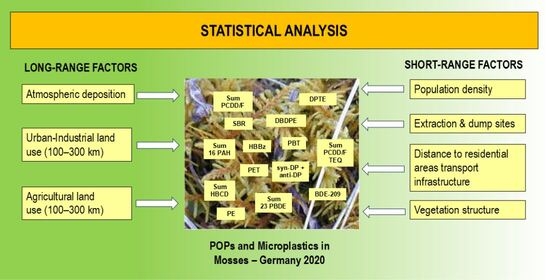
Mosses (Bryophyta) are well-established biomonitors of atmospheric deposition, including persistent organic pollutants (POPs) and microplastics (MPs). Using German Moss Survey 2020 data, this study identified factors influencing POPs and MPs in mosses through correlation and random forest analyses. For 10 of 11 POP groups, the models explained a variance of more than 20%. Key predictors included atmospheric deposition and the density of urban–industrial and agricultural land uses within 100–300 km. Population density and the density of extraction and dump sites within radii of <5 km (PCDD/Fs, PCDD/F TEQ values, HBCD, 23 PBDEs, BDE-209, DBDPE, PBT, and HBBz), as well as distances to residential areas and transport infrastructure (PCDD/Fs, HBCD, PBDEs, DP, and DBDPE), also proved to be highly relevant, although a direct causal relationship seems unlikely for flame retardants. These findings indicate that POP concentrations in mosses are influenced not only by large-scale atmospheric deposition but also by local emission sources near sampling sites. Vegetation parameters, particularly the leaf area index, showed additional effects. For MP, only two polymer groups (SBR and PE) yielded models with sufficient predictive strength, again dominated by proximity to local sources. Minimum sample size analysis demonstrated that a denser sampling network is required to achieve a 20% tolerance error in future monitoring campaigns.

Graphical Abstract

1. Introduction

Mosses (Bryophyta) function as effective biomonitors of atmospheric deposition because, as poikilohydric and rootless organisms, they take up potentially harmful substances primarily from the atmosphere [1,2]. This makes them, alongside technical deposition collectors and chemical transport models, well suited for monitoring spatial and temporal patterns of atmospheric deposition [3,4,5,6]. The use of moss as a biomonitor has been widespread since the late 1960s, after studies showed that Hylocomium splendens is capable of accumulating and retaining metals from atmospheric deposits [7,8]. Later, mosses were also used to investigate nitrogen deposition and the deposition of POPs.
Recently, however, the question has arisen as to whether mosses can also be used to determine the deposition of microplastics. In 2016, a study in Ireland demonstrated the general suitability of this method, which identified microplastic fibers visually in moss samples [9]. Whether other forms of microplastics can also be detected on mosses was shown in a study by Wenzel et al. (2023) [10]. A recent review by Bargagli et al. in 2026 [11] addressed the results of various studies on the subject as well as unresolved issues. In particular, the different approaches to collecting and analyzing moss samples were highlighted as a challenge. It was also emphasized that, unlike lichens, mosses show great promise for use as biomonitors.
However, previous moss monitoring studies have shown that, in addition to atmospheric deposition, factors such as moss species, leaf area index, distance and height of adjacent tree structures, the spatial density of different land-use classes around sampling sites (agricultural, forest, and urban–industrial, expressed as percentage cover), population density, elevation, and precipitation can influence substance concentrations in mosses [12,13]. These relationships have been demonstrated for M and N, but not for POPs or MPs.
To find out whether there are similar influencing factors for POPs or MPs, moss samples were collected at 25 locations in Germany as part of the European Moss Survey (EMS) of the International Cooperative Programme on Effects of Air Pollution on Natural Vegetation and Crops (ICP Vegetation) [14] and analyzed for POPs and microplastics.
Metadata on sampling conditions, site characteristics, and spatially explicit environmental information (potential local emissions sources, meteorology, atmospheric deposition, land use, topography, and soil) were analyzed using bivariate and multivariate statistics to quantify and test these relationships.
The POP analytical spectrum included polycyclic aromatic hydrocarbons (PAHs), polychlorinated dibenzo-p-dioxins and dibenzofurans (PCDD/Fs), polychlorinated biphenyls (PCBs), brominated and chlorinated flame retardants (polybrominated biphenyls (PBBs), polybrominated diphenyl ethers (PBDEs), and various other halogenated flame retardants (HFRs)), and per- and polyfluoroalkyl substances (PFASs). The microplastic analysis covered polypropylene (PP), polystyrene (PS), polyethylene terephthalate (PET), styrene–butadiene rubber (SBR), and polyethylene (PE).
In addition to this point, minimum sample sizes were determined. In environmental research, determining an appropriate sample size is crucial for drawing sound conclusions. Defining a minimum sample size represents a significant step forward in generating reliable data and can serve as a guideline for the design of future monitoring campaigns. Based on the results of the statistical analysis, minimum sample sizes for POPs and MPs were estimated for the first time in order to ensure a predefined tolerance error limit (20%) in the national mean concentration estimates [15].

2. Materials and Methods

2.1. Data

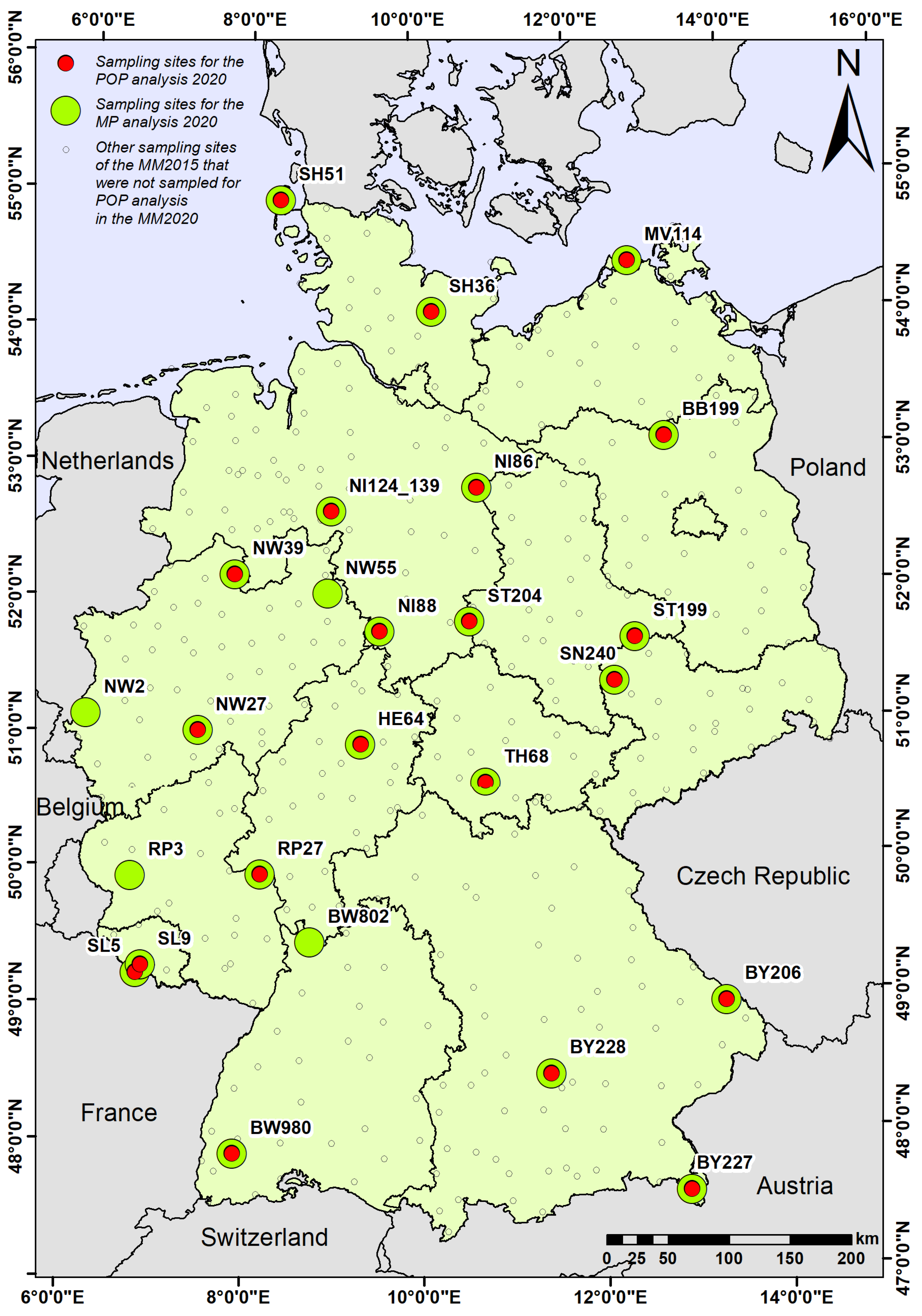
This study was based on concentrations of POPs and MPs measured in mosses at up to 25 sampling sites in Germany in 2020 (Figure 1; see also [16]). POPs were analyzed using several standardized and internationally established analytical procedures covering 120 target compounds; an overview of the methods and analytical results is provided in [17,18]. Microplastic analyses were conducted using two approaches: Thermo-Extraction–Desorption Gas Chromatography–Mass Spectrometry (TED-GC-MS) (Gerstel GmbH & Co KG, Mülheim, Germany) and microscopic–spectroscopic examination of selected samples using Raman spectroscopy (μRaman) (WITec, Wesel, Germany). The TED-GC-MS analysis provided information on the mass and polymer identity of the microplastics. The Raman spectroscopy analyses additionally yielded information on particle morphology (size and shape) as well as particle counts. A detailed description of the method can be found in [10].
Not all POPs were observed at a high frequency of quantification (i.e., above the limit of quantification (LOQ)). Therefore, sum concentrations excluding LOQ values (LOQ set to zero) were statistically examined to ensure a sufficiently dense dataset regarding the sum parameters for 16 EPA-PAHs, PCDD/Fs, PCDD/F TEQ values, HBCD, 23 PBDEs congeners (BDEs 17, 28, 47, 49, 66, 71, 77, 85, 99, 100, 119, 126, 138, 153, 154, 156, 183, 184, 191, 196, 197, 206, and 207) and DP (syn-DP plus anti-DP). BDE-209, DPTE, HBBz, PBT, and DBDPE were statistically investigated as individual compounds (all acronyms are defined in the Abbreviations Section). For PCBs, PBBs and PFASs, neither individual nor sum concentrations could be evaluated due to their particularly low quantification frequency. A similar limitation applied to the polymers PP and PS, so that only PET, SBR and PE were included in the MP data analysis.
In addition to Schröder et al. 2025 [16], this investigation includes bi- and multivariate analyses based on a comprehensive set of 87 potential explanatory variables, along with a complementary evaluation of the monitoring network using minimum sample size (MSS) analyses. The potential explanatory variables comprised a set of parameters selected according to scientific criteria and updated and adapted in comparison with the corresponding evaluations for M and N in MM2015 [13]. The variables were recorded in the field in accordance with the guidelines of the Moss Manual [14], derived from these field observations, or obtained from publicly accessible data sources (Table 1). All variables were subsequently linked to the site-specific MM2020 monitoring data based on their shared spatial reference.
Data on atmospheric deposition of POPs were obtained from the European Monitoring and Evaluation Programme (EMEP), modeled using the MSCE-POP model developed by MSC-East [22]. The model integrates multiple environmental compartments and processes, including emissions, long-range transport, deposition, degradation, and air–surface exchange [23], and provides the annual total deposition at a 0.1° × 0.1° resolution. The modeled deposition of benzo[a]pyrene (B[a]P) and PCDD/F TEQ values were used as predictor variables and spatially linked to the moss concentration data. Deposition modelings for HCB and PCB-153 were excluded due to insufficient quantifiable moss data. Consistent with the 2- to 3-year moss shoots analyzed chemically [14], 3-year (2018–2020) and 2-year (2019–2020) mean deposition, as well as annual values, were considered.
The amount of precipitation, included as a potential influencing factor and indicator of wet atmospheric deposition, was assessed using data from the German Meteorological Service (DWD—Deutscher Wetterdienst) as the arithmetic mean of annual precipitation totals in the 1 km × 1 km grid cells for the period of 2018–2020.
The elevation of each sampling site was extracted from the Shuttle Radar Topography Mission (SRTM) digital elevation model (90 m × 90 m) using its geographic coordinates.
To quantify land-use densities around the sampling sites as indicators of potential emission sources, the Corine Land Cover 2018 [24] classes were grouped into agricultural areas (CLC categories: 211 (non-irrigated arable land), 212 (permanently irrigated land), 213 (rice fields), 221 (vineyards), 222 (fruit trees and berry plantations), 223 (olive groves), 231 (pastures), 241 (annual crops associated with permanent crops), 242 (complex cultivation patterns), 243 (land principally occupied by agriculture, with significant areas of natural vegetation), and 244 (agro-forestry areas)), forests (CLC categories: 311 (broad-leaved forest), 312 (coniferous forest), and 313 (mixed forest)), urban-industrial areas (CLC categories: 111 (continuous urban fabric), 112 (discontinuous urban fabric), 121 (industrial or commercial units), 122 (road and rail networks and associated land), 123 (port areas), 124 (airports), 131 (mineral extraction sites), 132 (dump sites), and 133 (construction sites)), further separated into industrial (CLC categories: 121 (industrial or commercial units), 122 (road and rail networks and associated land), 123 (port areas), and 124 (airports)) and urban land uses (CLC categories: 111 (continuous urban fabric) and 112 (discontinuous urban fabric))—and extraction and dump sites (CLC categories: 131 (mineral extraction sites), 132 (dump sites), and 133 (construction sites)) [25]. For each sampling location, the percentage cover of these land-use groups was calculated within radii of 5 and 50 km (CLC 100 m × 100 m) and 100 and 300 km (resampled to 250 m × 250 m) using neighborhood analysis (ESRI ArcGIS 10.1 Focal Statistics).
Population density, used as an additional indicator of potential emission sources, was derived from the Gridded Population of the World dataset (GPW; ~1 km × 1 km grid) for 2015 by calculating mean population values within 5, 50, and 100 km radii around the 25 MM2020 monitoring sites.
The leaf area index (LAI), representing the filtering capacity of trees and shrubs, was obtained from Copernicus data for 2018 (~2 km × 2 km grid). In addition, the LAI was estimated following the approach of [26] using the literature-based land-use-specific LAI values [21] combined with land-use information collected at the sampling sites (simple LAI). A weighted LAI was further derived by incorporating the canopy cover of trees and shrubs within the 50 m × 50 m sampling plots.
The distance to local emission sources was determined through field observations complemented by a subsequent review of aerial imagery (Google Maps).
All other site-specific parameters—including moss species, frequency of occurrence, visible dust particles, humus thickness and form, slope aspect and gradient, distances to tree and shrub canopy projections, and tree-layer height—were recorded in the field according to the guidelines of the Moss Manual [14].
All statistical analyses and modeling were conducted using R and its associated packages [27]. Version 3.0.2 was used for the steps involving the rattle() package, while the remaining analyses were performed with version 4.1.2.

2.2. Correlation Analysis

For the (sum) concentrations of POP and MP determined in the moss samples (target variables) as well as for the ordinal and metric independent variables included in the set of potential predictors, non-parametric correlation analyses were performed using Spearman’s rank correlation coefficient. The resulting correlations were subsequently tested for statistical significance (p < 0.05).
Following [28], correlation strength was evaluated as very weak (<0.2), weak (0.2 to <0.4), moderate (0.4 to <0.6), strong (0.6 to <0.8), and very strong (≥0.8).

2.3. Regression Analysis Using Random Forests

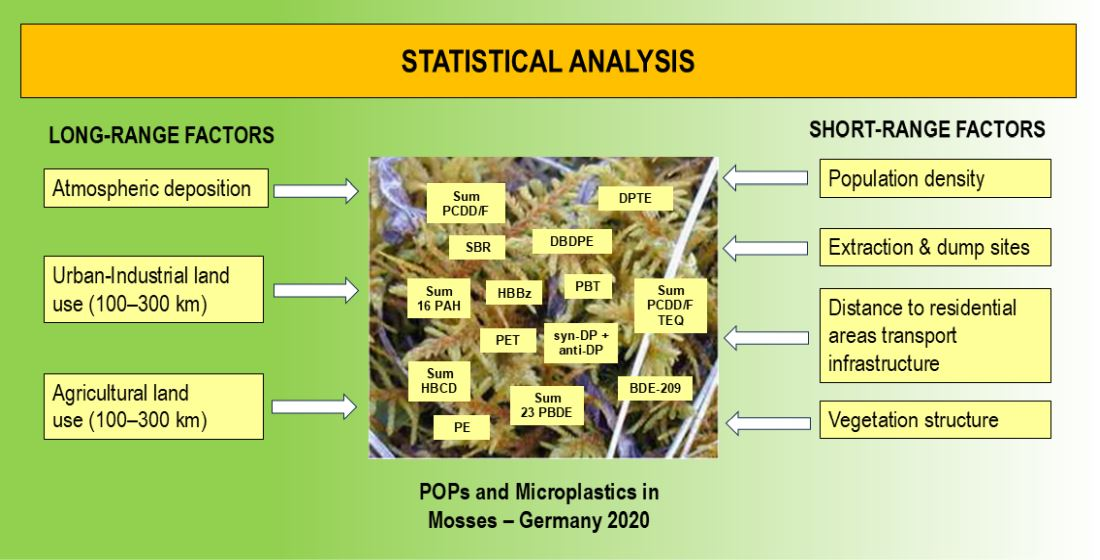
For the multivariate statistical analysis of potential influencing factors on the (sum) concentrations of POP and MP in mosses (Table 1), random forest (RF; [29]) was selected. RF is an artificial intelligence, machine learning method for classification and regression that aggregates a large number of decision trees. Depending on the measurement scale of the target variable, each tree is either a classification or a regression tree (CART; [30]). The trees identify patterns in predictor variables by recursively partitioning the dataset into two subgroups, thereby increasing the homogeneity of the target variable distributions step by step. Unlike CART, which produces a single model from the available data, RF generates ensembles consisting of hundreds of trees [31]. For each tree, random subsets of the data and predictors (bags) are used. All RF trees grow to their maximum size without pruning, and the results of all trees contribute to the final aggregation (majority vote for classification; mean prediction for regression). Owing to the random selection of predictors and data, RF is more robust than single decision trees such as CART with respect to variations in the training dataset, outliers, and overfitting [32,33]. By allowing each tree to grow fully, RF retains predictive power, while predictor randomization mitigates the overfitting typical of individual trees [32].
All cases in the dataset were used to build the RF models. Missing values in the training data were imputed using standard missing-data techniques. The number of variables considered at each node was set to one-third of the total number of predictors [32]. The number of trees to be generated was determined using plots in which the progressively reduced number of trees was plotted against the corresponding error rate according to Equation (1).
Model performance in RF is typically evaluated using out-of-bag (OOB) data, i.e., observations excluded from the training subset through randomization [34]. The mean squared error (MSE) was calculated as the sum of squared deviations between the observed values yi and the OOB predictions yiOOB, divided by the sample size. Ideally, the MSE approaches zero.
Mean squared error:
M S E O O B =   1 n   i = 1 n y i y i O O B 2
The root-mean-square error (RMSE) reflects the average deviation between predicted and observed values, expressed in the units of the target variable. The percentage of explained variance is represented by a pseudo-R2, where the standard deviation (SD) is calculated as the square root of the uncorrected variance using the sample size as the divisor (Equation (2)).
Explained variance [%]:
Pseudo- R 2 =   1 M S E O O B S D y 2
Model performance was classified according to the proportion of explained variance as follows: weak (<30%), moderate (30–50%), good (50–70%), and very good (>70%) [35].
In the third step, all RF models were optimized using backward selection until the predictors with the highest relevance for estimating the (sum) concentrations of POP and MP in mosses had been identified. In addition to the model performance metrics described above, two commonly used measures of relative variable importance in RF models were applied.
The increase in node purity (INP) quantifies the total gain in homogeneity in the dataset that is achieved by a given split variable across all nodes of the random forest. For each split variable (i.e., explanatory variable), this measure is calculated as the average increase in the Gini index across all individual decision trees, following Equation (3) [36].
Increased node purity:
I N P ( X m ) =   1 N T T   t T : v s t = X m p ( t ) i ( s t , t )
Here, X m denotes the explanatory variable; T the decision tree; t the node; N T the number of decision trees; i ( t ) the impurity measure at node t (here, the Gini index); p ( t )   Δ i ( s t , t ) the increase in node purity at an individual node; s t the split; and v ( s t ) the corresponding split criterion.
As a second measure of relative variable importance, the percentage increase in the mean squared error (%IncMSE) was calculated. This was done by (1) randomly permuting the values of a given predictor while keeping all other predictors unchanged, (2) repeating this procedure for each predictor, (3) computing the mean squared error (MSE) for each RF model in which exactly one predictor had been permuted (according to Equation (1)), and (4) determining the predictor-specific %IncMSE by comparing the MSE of the unaltered RF model with that of the permuted model. The higher the %IncMSE, the more important the corresponding predictor is for the target variable [37].
Predictor variables with low importance for explaining the target variable were iteratively removed through backward selection based on %IncMSE and INP. The optimized RF model with the highest proportion of explained variance (pseudo-R2 according to Equation (2)) was generated using the R package rattle [27].

2.4. Determination of Minimum Sample Sizes

The calculation of minimum sample sizes (MSSs) served both as a statistical quality-control measure for this study and as a basis for planning future monitoring designs targeting POPs and MPs in mosses. The underlying concept is to estimate the minimum number of samples required to ensure that the true mean does not deviate from the empirical mean of the selected sample by more than a specified error tolerance. MSS estimation was performed using the (sum) concentrations of POPs and MPs measured in the MM2020 moss samples, following Equation (4) recommended in [14]:
M S S = 1.96 S t d e v t o l × M e a n 2
Here, Mean denotes the average concentration of the measured elements in moss, Stdev the corresponding standard deviation, tol the accepted error factor, and tol × Mean the resulting error tolerance.
The resulting z-value of 1.96 ensures, at a significance level of α = 0.05 and assuming sufficiently large sample sizes (several hundred observations), that the true mean deviates from the empirical mean by no more than the predefined error tolerance with 95% confidence. Following [38,39], a uniformly accepted error factor (tol) of 0.2 (20%) was applied.
Equation (4) fundamentally assumes that concentration data are normally distributed. In cases where the data follow a lognormal distribution, Equation (5) is recommended as an extension to the Moss Manual [40].
M S S = B 4 A + B 4 A 2 S t d e v l o g 2 A
with
A = 1 1.96   ln M e a n × 1 + t o l M e a n l o g S t d e v l o g 2 2 2
B = 2 A 2 × S t d e v l o g 2 S t d e v l o g 4
M e a n l o g = ln M e a n S t d e v l o g 2 2
S t d e v l o g = ln 1 + S t d e v 2 M e a n 2
This equation also builds on the confidence interval for the arithmetic mean [41] but differs in that the distribution of the mean on the logarithmic scale is used. Based on this distribution, the confidence interval for the true mean is derived, and the MSS is determined, such that the difference between the upper confidence limit and the assumed true mean remains below the accepted tolerance.
For cases in which the data follow neither a normal nor a lognormal distribution, and to compare the results obtained from the analytical formulas (Equations (4) and (5)), minimum sample sizes were additionally calculated using the SSAD approach (Sample Size for Arbitrary Distributions; [15]). The core of this method is an iterative Monte Carlo simulation that, unlike the analytical formulas, does not require any assumptions about the underlying data distribution. The procedure uses reference data (previous measurements) to estimate the achievable accuracy for a wide range of candidate sample sizes. A nonlinear regression between candidate sample sizes and their corresponding accuracies is then used to identify the MSS that satisfies the predefined accuracy requirement for estimating the arithmetic mean.
For quality control, the minimum sample sizes derived for POPs and MPs were compared with the actual sample sizes of the MM2020 survey. A uniform error factor (tol) of 0.2 (20%) and a significance level of α = 0.05 were applied throughout. The SSAD method was applied to all MM2020 samples regardless of their distributional form and, where appropriate, compared with the results obtained from the analytical formulas.

3. Results

3.1. Correlation Analysis

3.1.1. Persistent Organic Pollutants

Statistical relationships between the (sum) concentrations of POPs in moss and the potentially explanatory predictors examined in this study revealed several notable patterns (Table 2).
Atmospheric deposition. Strong and highly significant correlations were observed between the modelled atmospheric PCDD/F TEQ deposition values (EMEP, mean for 2018–2020) and the corresponding concentrations of polychlorinated dibenzo-p-dioxins and dibenzofurans in moss (MM2020, sampling year 2021), with Spearman coefficients ranging from rs = 0.54 to 0.62. In contrast, no statistically significant correlations were found between modeled benzo[a]pyrene deposition and the sum concentrations of the 16 PAHs. Although deposition estimates for HCB and PCB-153 were available from the EMEP Meteorological Synthesizing Centre–East, these could not be evaluated due to the very small number of moss samples with concentrations above the LOQ (HCB: n = 0; PCB-153: n = 5). No model data were available for other POP groups.
Vegetation structure. Significant to highly significant correlations were also found between vegetation structure and the concentrations of numerous POPs in moss. Shorter distances to tree canopies and shrubs were associated with higher concentrations of 16 PAHs, HBCD, 23 PBDEs, BDE-209 and DBDPE (rs = −0.49 to −0.63). The height of adjacent trees, canopy cover and leaf area index showed moderate to strong positive correlations with halogenated flame retardants (DBDPE, PBT, and HBBz) and PCDD/Fs (rs = 0.45 to 0.74). Moss samples collected within or beneath dense vegetation tended to exhibit elevated POP concentrations. Similar to patterns reported for metals and nitrogen [42], this suggests a pronounced canopy-drip effect, driven by the physical filtering of atmospheric particles and gases by trees and shrubs and their subsequent deposition onto the moss layer.
Population and land-use density. Regarding the spatial density of surrounding land-use types within 5–300 km of sampling sites, higher densities of urban–industrial land use within a 100 km radius were associated with higher PAH concentrations in moss. This relationship likely reflects the clustering of emission sources such as traffic, industrial facilities, and residential heating in densely populated and industrialized regions. A similar pattern was observed for agricultural land use within 50–300 km, although the underlying reason for this positive correlation remains unclear. In contrast, forested areas within 100–300 km showed negative correlations, consistent with their distance from major emission sources.
Positive correlations were also found between the density of urban–industrial land use within 300 km and PCDD/F concentrations in moss, indicating that long-range atmospheric transport plays a relevant role in the distribution of these PCDD/Fs. At the same time, positive correlations with population density and the density of extraction and dump sites and construction areas within 5 km point to strong local emission influences.
For the legacy flame retardants HBCD and PBDEs, moderate to strong correlations with urban–industrial land-use density were observed across both small and large radii, reflecting both local emissions and long-range transport. This is in line with the expectation that urban–industrial areas host a high density of predominantly diffuse emission sources for these compounds. In contrast, alternative flame retardants showed fewer associations with land-use density. One notable exception was DPDPE, which correlated with the density of extraction and dump sites within 5–50 km.
Local emission sources. Distances to known local emission sources also showed significant to highly significant correlations with POP concentrations in moss. Shorter distances to large and smaller industrial facilities were associated with higher concentrations of PAHs, PBDEs and DBDPE (rs = −0.77 to −0.93). Proximity to major residential areas correlated with higher concentrations of PAHs, PCDD/Fs, 23 PBDEs and syn/anti-DP (rs = −0.67 to −0.76). Shorter distances to major transport infrastructure (motorways, federal roads, and railway lines) were associated with higher concentrations of PAHs, PCDD/Fs, HBCD, PBDEs and DBDPE (rs = −0.50 to −0.79). Similarly, smaller distances to arable land were linked to higher concentrations of PCDD/Fs, HBCD, PBDEs and syn/anti-DP (rs = −0.63 to −0.82).
Predictors with low relevance. No notable statistical relationships were found for the remaining variables listed in Table 1 (meteorology, topography, geology and soil).

3.1.2. Microplastics

Only a few statistical relationships were observed between the concentrations of PET, SBR and PE in moss and the full set of explanatory variables (Table 3). Due to the very small number of samples with concentrations above the limit of quantification for PP (n = 4) and PS (n = 4), these categories were excluded from the correlation analysis. No model data on the atmospheric deposition of microplastics were available.
Vegetation structure. Moderate positive correlations with tree canopy and shrub cover, as well as with the derived cover-weighted leaf area index, indicate that vegetation structure exerts a significant influence on SBR and PE concentrations in moss. As observed previously for metals, nitrogen [42] and POP, this pattern suggests a pronounced canopy-drip effect at the moss sampling sites also for MP.
Land-use density. The analysis of land-use density further showed that increasing proportions of agricultural land within a 100 km radius around sampling sites were associated with decreasing PE concentrations in moss. This indicates that PE levels in agricultural landscapes are significantly lower than in areas dominated by other land-use types.
Local emission sources. With increasing distance from agricultural areas, the PE content in moss decreases, indicating the influence of local emission sources. Similarly, PET concentrations decline with increasing distance from animal farming units, and the greater the distance to unsealed roads, the lower the SBR concentration in mosses.
Predictors with low relevance. For all other variables presented in Table 1 (meteorology, topography, geology/soil, and moss species), no significant statistical relationships were identified.

3.2. Random Forest Models

3.2.1. Persistent Organic Pollutants

Of the eleven random forest models developed for the POP, ten showed a pseudo-R2 of ≥20% (i.e., proportion of explained variance; Table 4). Only for 2,3-dibromopropyl-2,4,6-tribromophenyl ether (DPTE), the RF analysis yielded a pseudo-R2 below 20%, and, therefore, DPTE was excluded from further consideration. The analysis of the RF regressions resulted in the following findings.
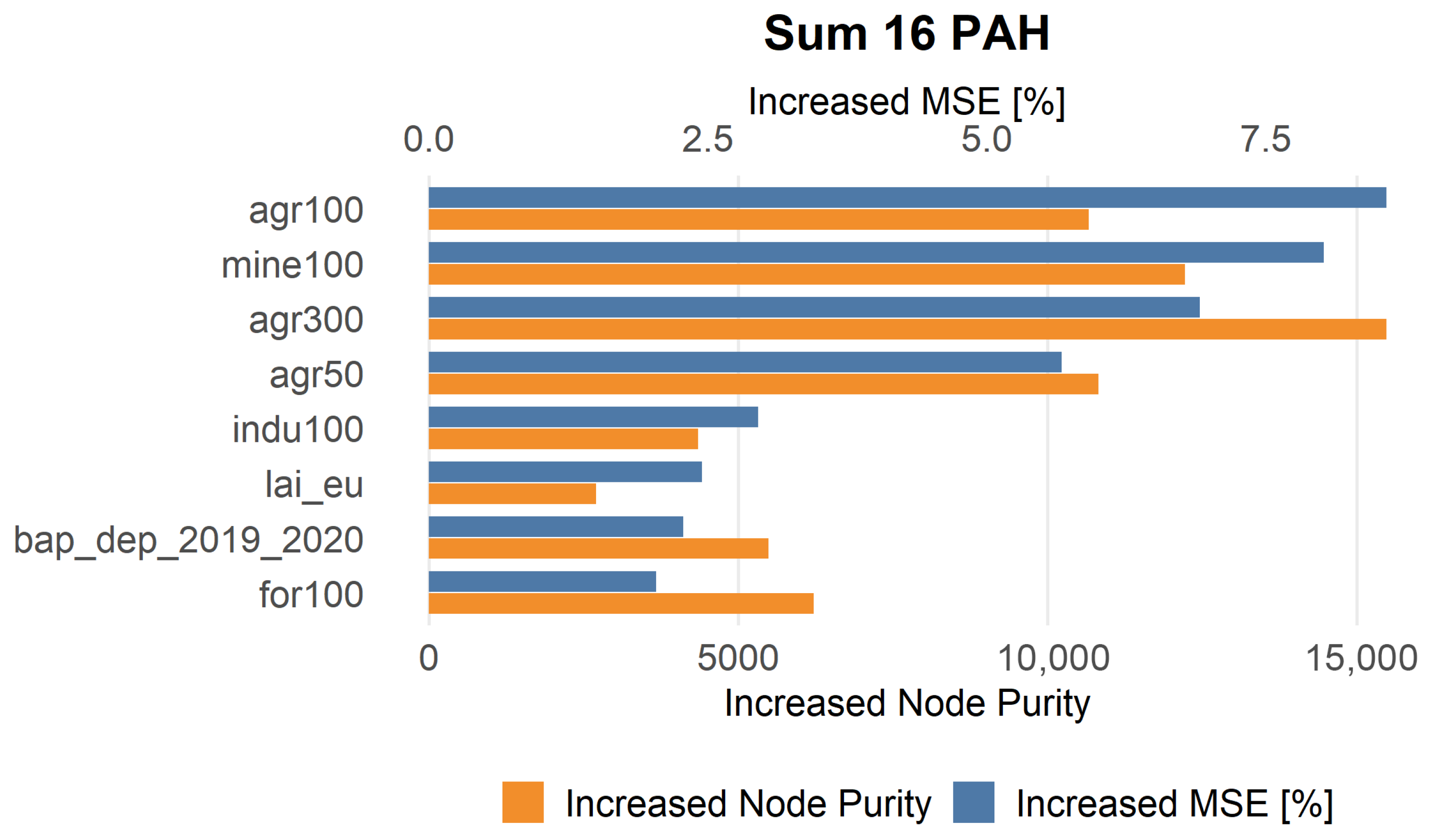
Polycyclic aromatic hydrocarbons. The RF model explained 33% of the variance in PAH concentrations. Agricultural land-use density (50–300 km) and the density of extraction and dump sites (100 km) were the strongest predictors (Figure 2), with higher values associated with increased PAH levels (Table 2). Industrial land-use density and a lower proportion of forested area (100 km) also contributed. Benzo[a]pyrene deposition (EMEP) and leaf area index (LAI, 2 km × 2 km) showed moderate importance.
Polychlorinated dibenzo-p-dioxins and dibenzofurans (PCDD/Fs and PCDD/F TEQ values). The RF models for PCDD/Fs and PCDD/F TEQ values (both excl. LOQ) explained approximately 31–41% of the total variance, indicating a moderate predictive performance. The highest explanatory power for PCDD/F TEQ values was obtained when using log-transformed sum concentrations in moss.
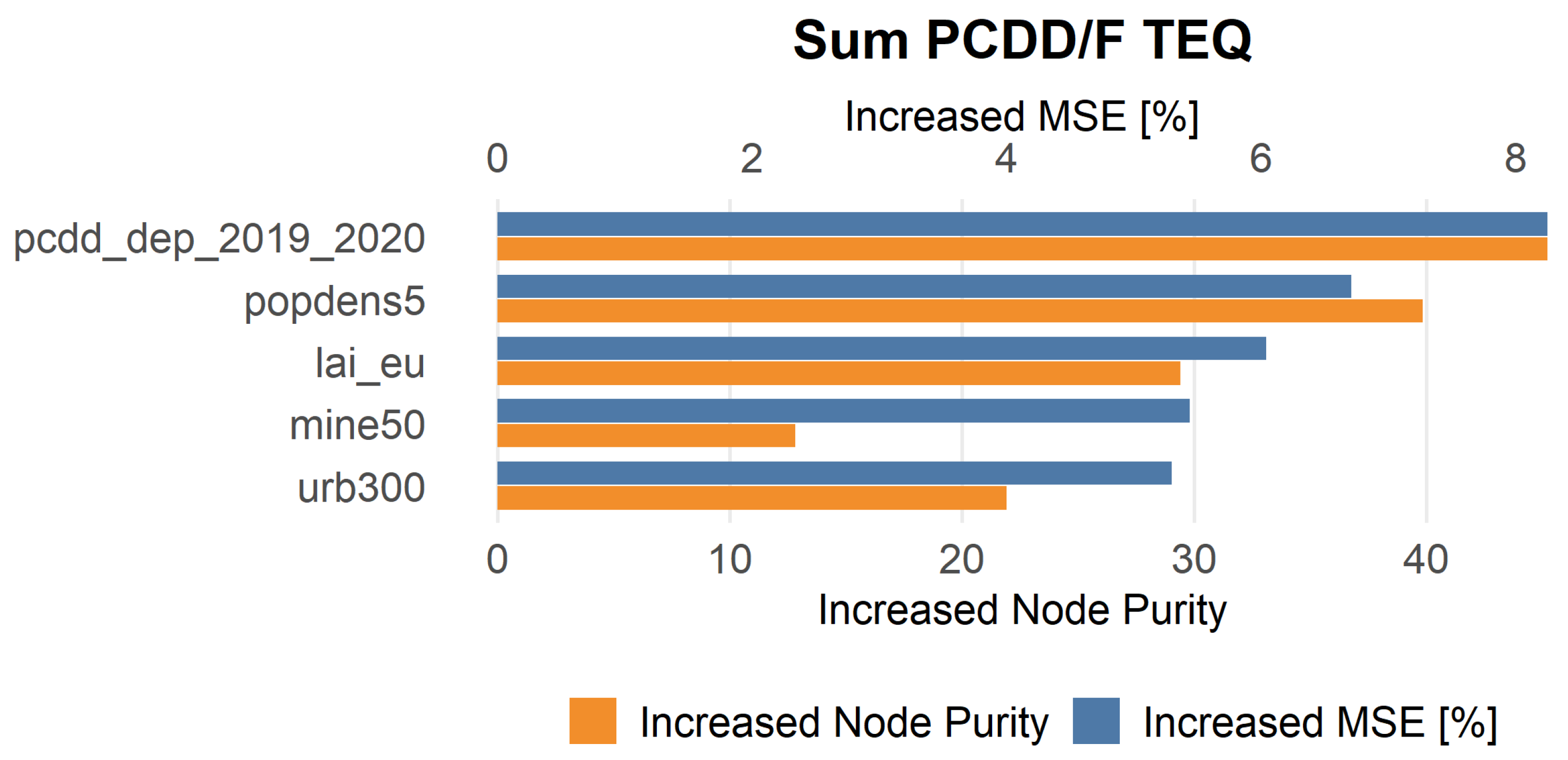
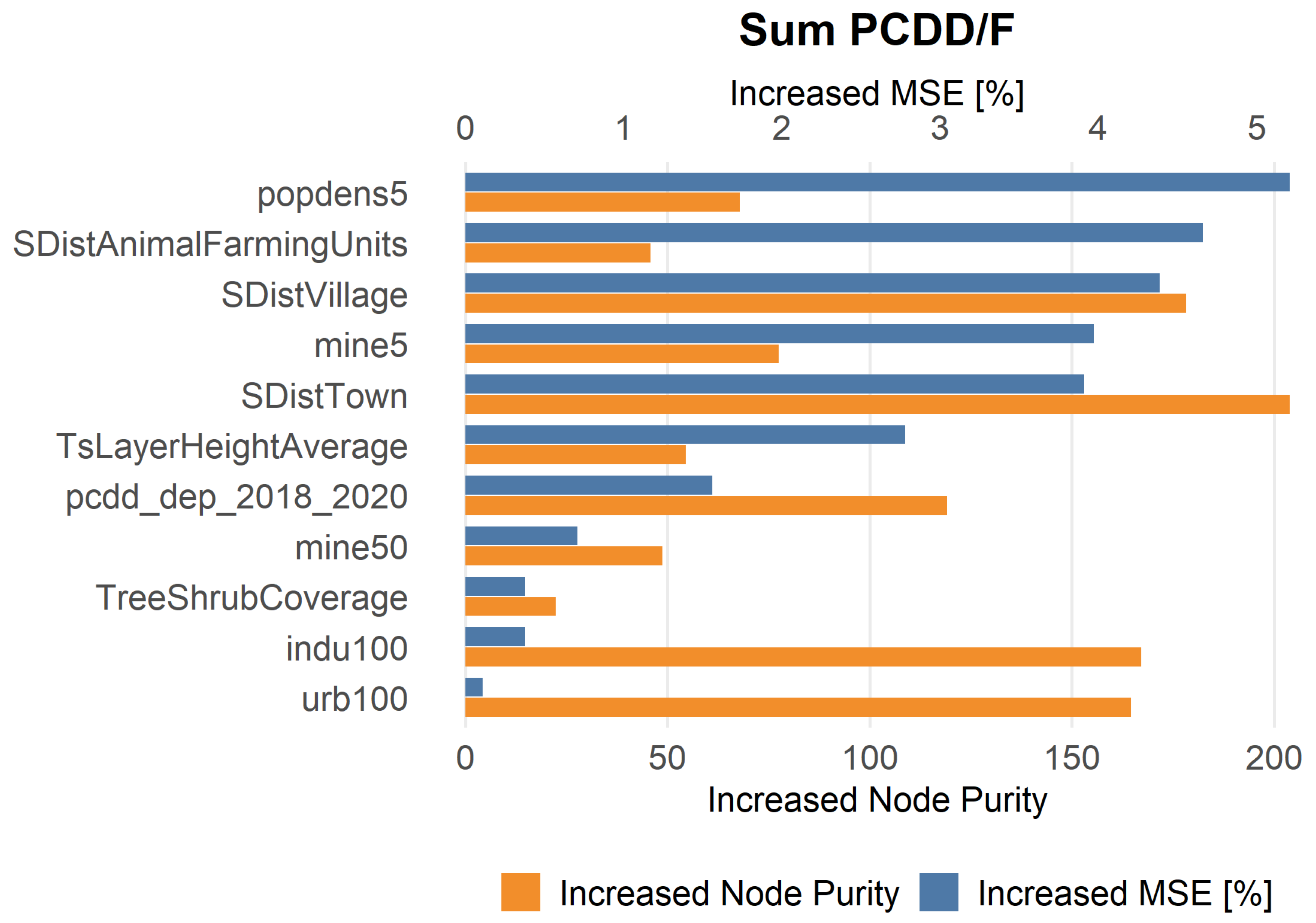
For PCDD/F TEQ values, atmospheric deposition (EMEP) and population density (5 km) were the most influential predictors, followed by LAI (Figure 3). Extraction and dump sites (50 km) and urban–industrial land use (100–300 km) also contributed.
For PCDD/F concentrations, vegetation structure (stand height and canopy/shrub cover) and distance to smaller built-up areas were additional predictors (Figure 4).
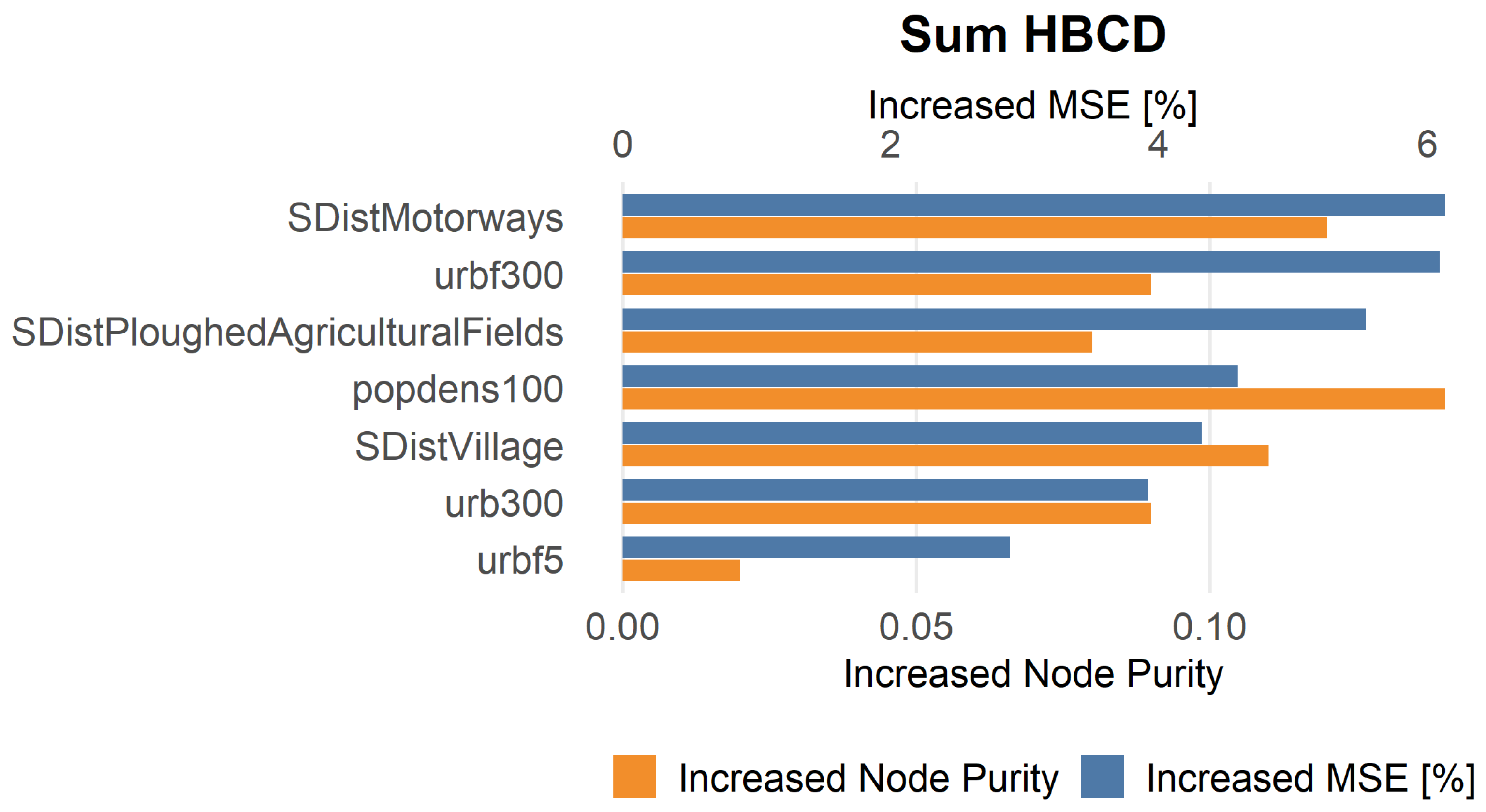
Hexabromocyclododecane. The model explained 33% of the variance. Population density and settlement area proportions (100–300 km) were the strongest predictors (Figure 5). Distances to smaller settlements and motorways, as well as settlement density within 5 km, also influenced HBCD concentrations.
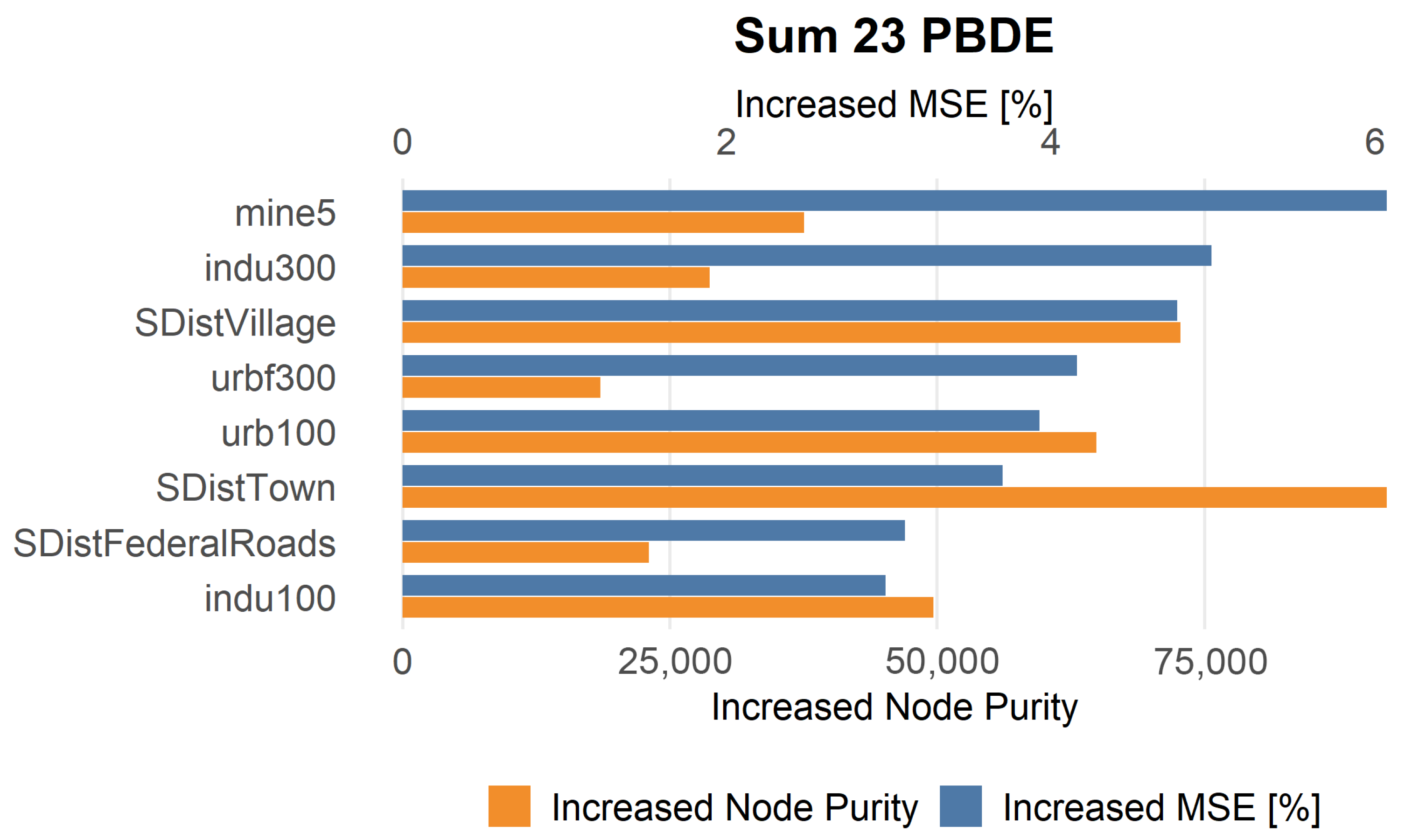
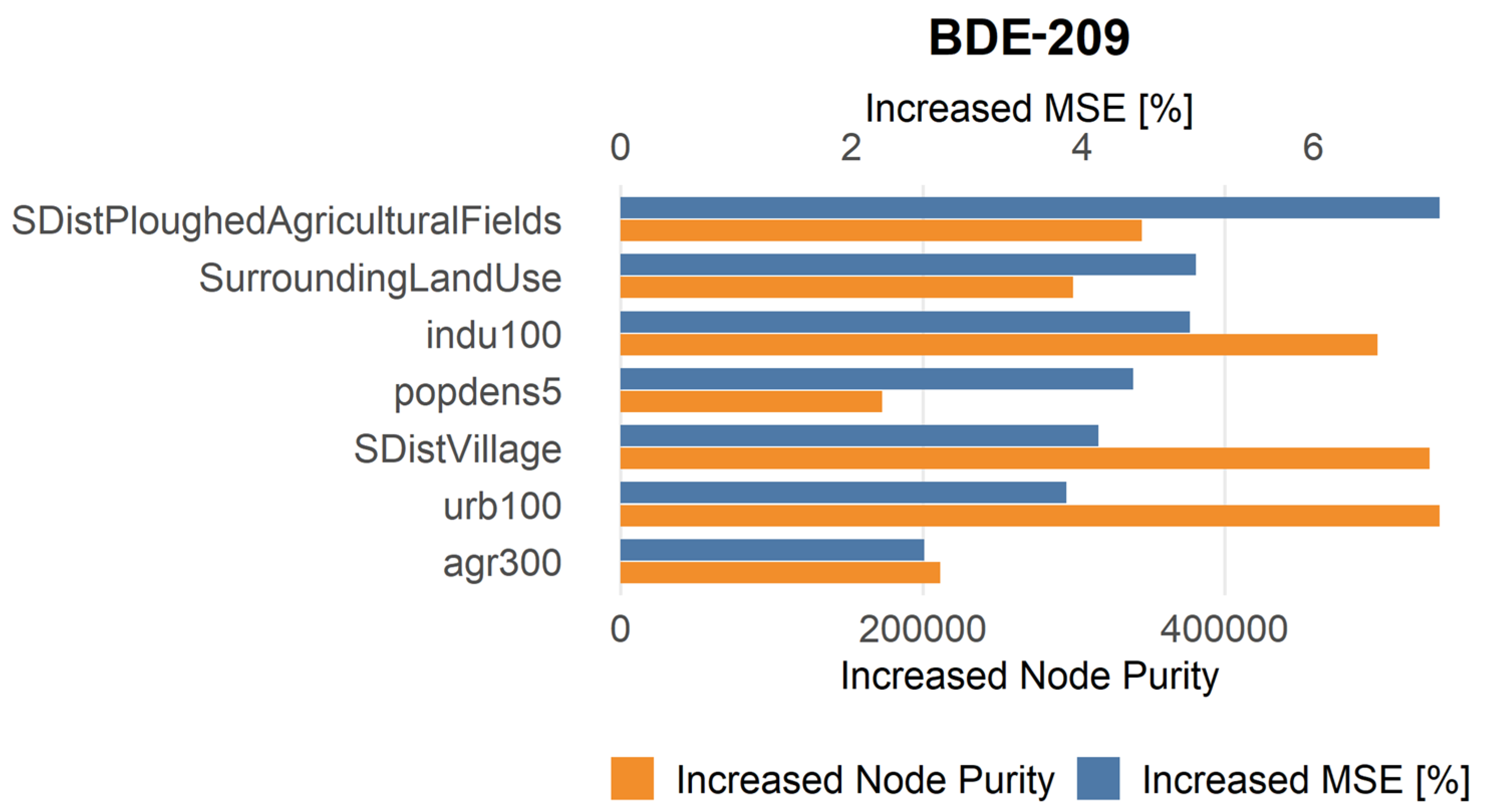
Polybrominated diphenyl ethers (PBDEs). The RF models for 23 PBDEs and BDE-209 showed the highest explanatory power (pseudo-R2 = 0.57–0.59). Key predictors included population density, extraction and dump sites (5 km), and urban–industrial land use (100–300 km) (Figure 6 and Figure 7). Shorter distances to settlements, major roads and arable land were associated with higher PBDE concentrations.
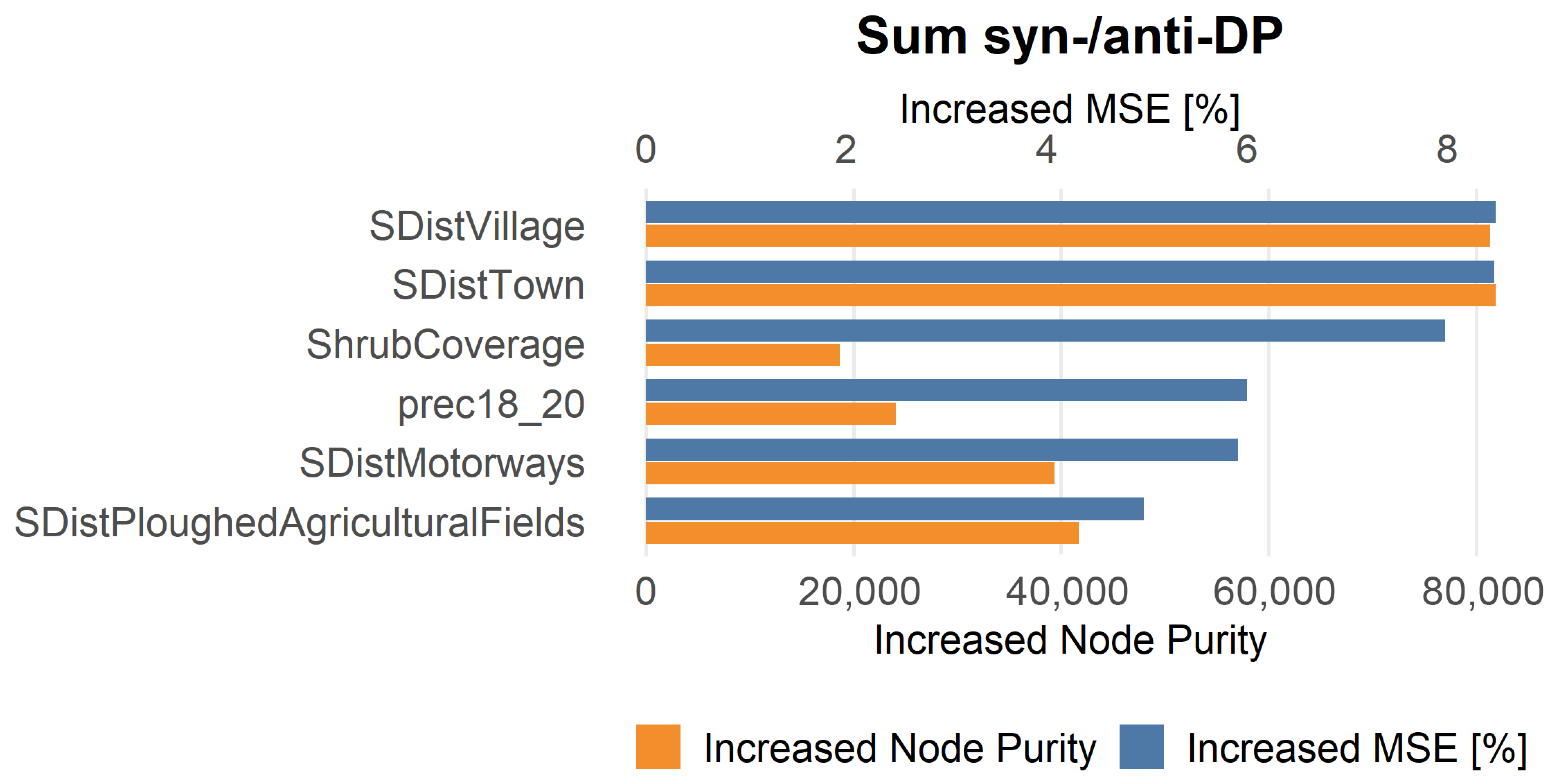
Dechlorane plus. The model explained 52% of the variance. Distances to smaller settlements, motorways and arable land, as well as mean annual precipitation (2018–2020), were the most influential predictors (Figure 8).
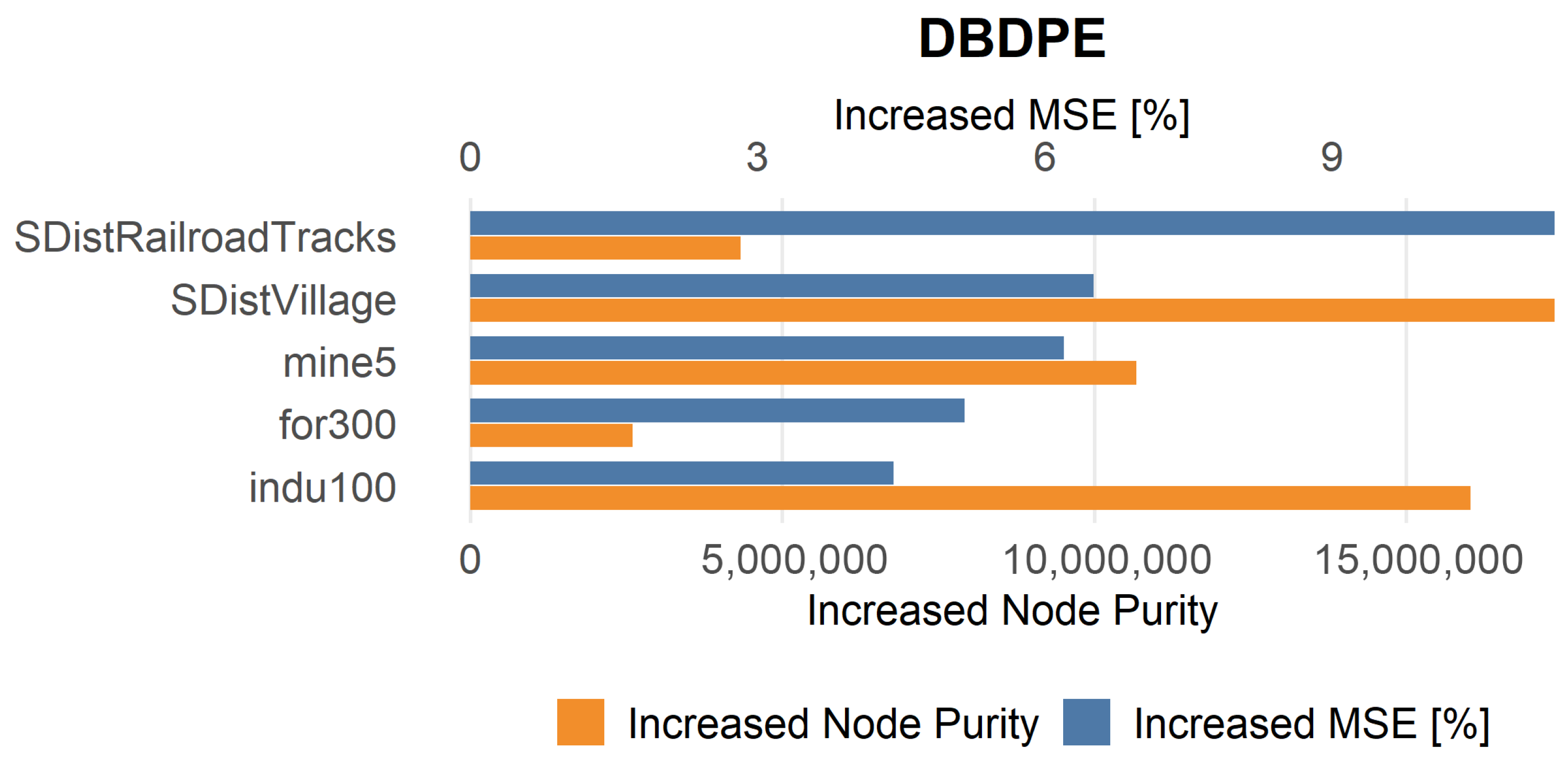
Decabromodiphenylethane. The model achieved a pseudo-R2 of 0.54. Important predictors included distances to railway lines and smaller settlements, extraction and dump sites (5 km), and industrial and forest land use (100–300 km) (Figure 9). Lower concentrations occurred in forest-dominated regions.
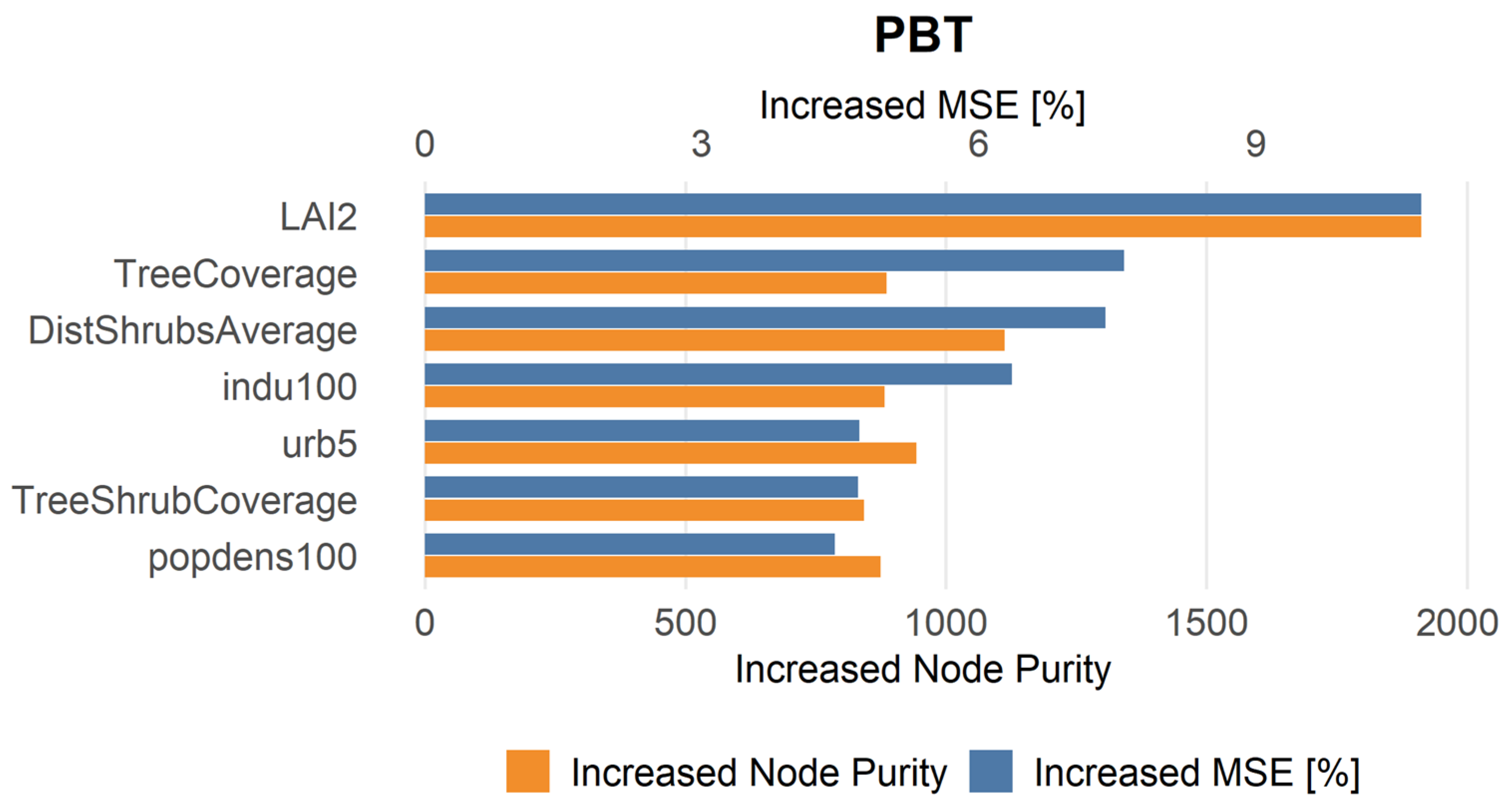
Pentabromotoluene. The model explained 45% of the variance. Vegetation parameters (tree/shrub cover, LAI) were the strongest predictors, followed by population density and industrial land use (100 km) and urban–industrial land use within 5 km (Figure 10).
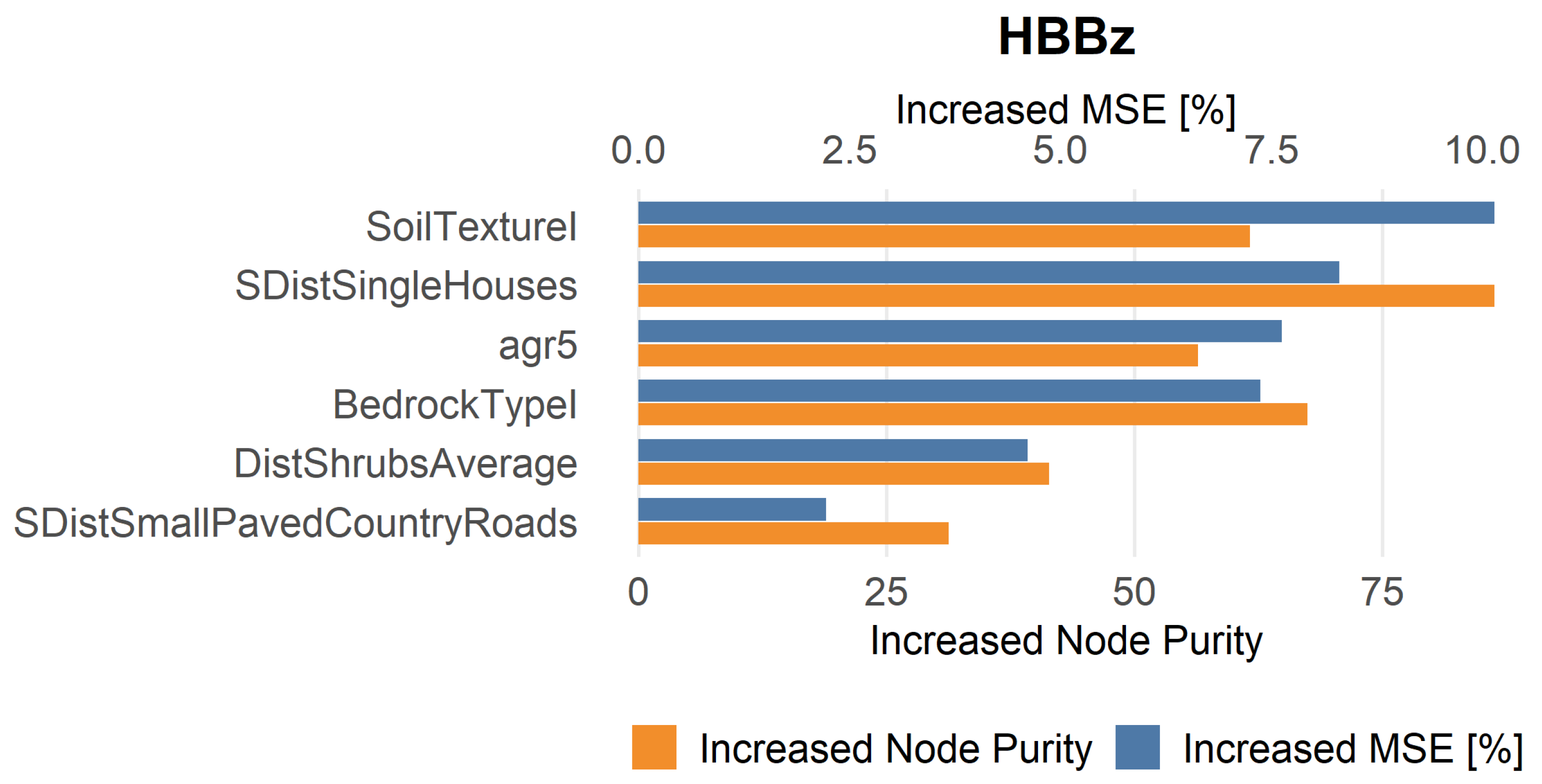
Hexabromobenzene. The model explained 41% of the variance. Soil and bedrock type, vegetation structure and distances to potential emission sources contributed (Figure 11), although some relationships (e.g., distance to single houses) appeared implausible.
In summary, atmospheric deposition was moderately important for PCDD/F-TEQ and less so for PCDD/Fs and PAHs. Meteorological variables showed little influence, except for precipitation on DP. Geological and soil variables were generally unimportant, except for bedrock and soil type for HBBz. Moss species, substrate type and moss abundance showed no effect. Vegetation structure (especially LAI) was a strong predictor for several POP groups. Land-use proportions at large spatial scales (100–300 km) and land-use density within 5 km, as well as extraction and dump sites, were consistently relevant. Distances to local emission sources—small settlements, arable land, motorways and railways—substantially contributed to explaining POP concentrations.

3.2.2. Microplastics

Only two RF models for microplastic concentrations in moss yielded a pseudo-R2 of ≥20% (i.e., proportion of explained variance; Table 5). The measurement data for PP and PS could not be evaluated due to the high number of values below the LOQ. For PET, the RF analysis resulted in a pseudo-R2 of less than 20%, and PET was, therefore, not considered further. The analysis of the RF regressions for SBR and PE produced the following results:
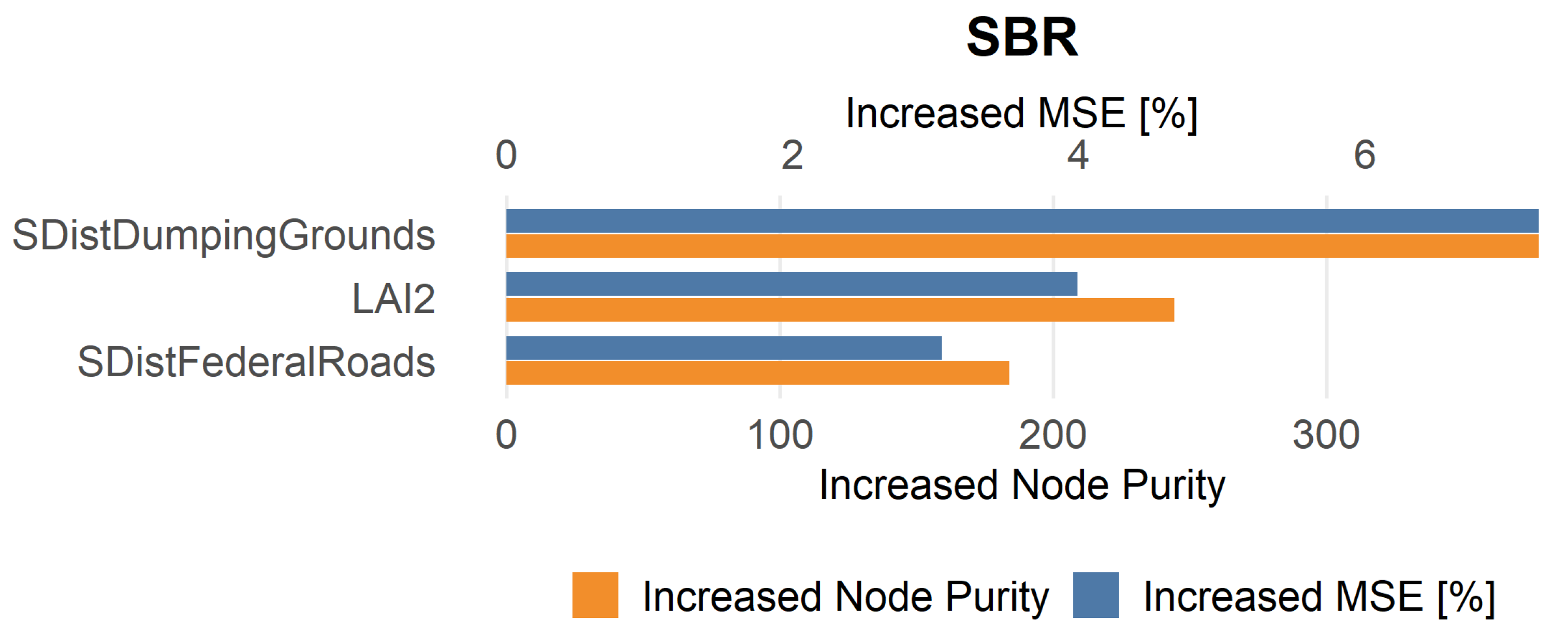
Styrene–butadiene rubber. For SBR, the RF model explained 21% of the variance in SBR concentrations in moss (Table 5). This indicates that many additional relevant factors influencing SBR levels are likely not captured by the model. Among the identified predictors, the distance to dump sites was the most important factor. The leaf area index at the sampling site and the distance to major roads were also significant predictors of SBR concentrations in moss (Figure 12). These results show that SBR concentrations are primarily determined by proximity to emission sources such as dump sites and road traffic. In addition, the canopy drip effect of vegetation at the sampling sites influenced SBR concentrations, with higher leaf area index values associated with higher SBR levels in moss (Table 3).
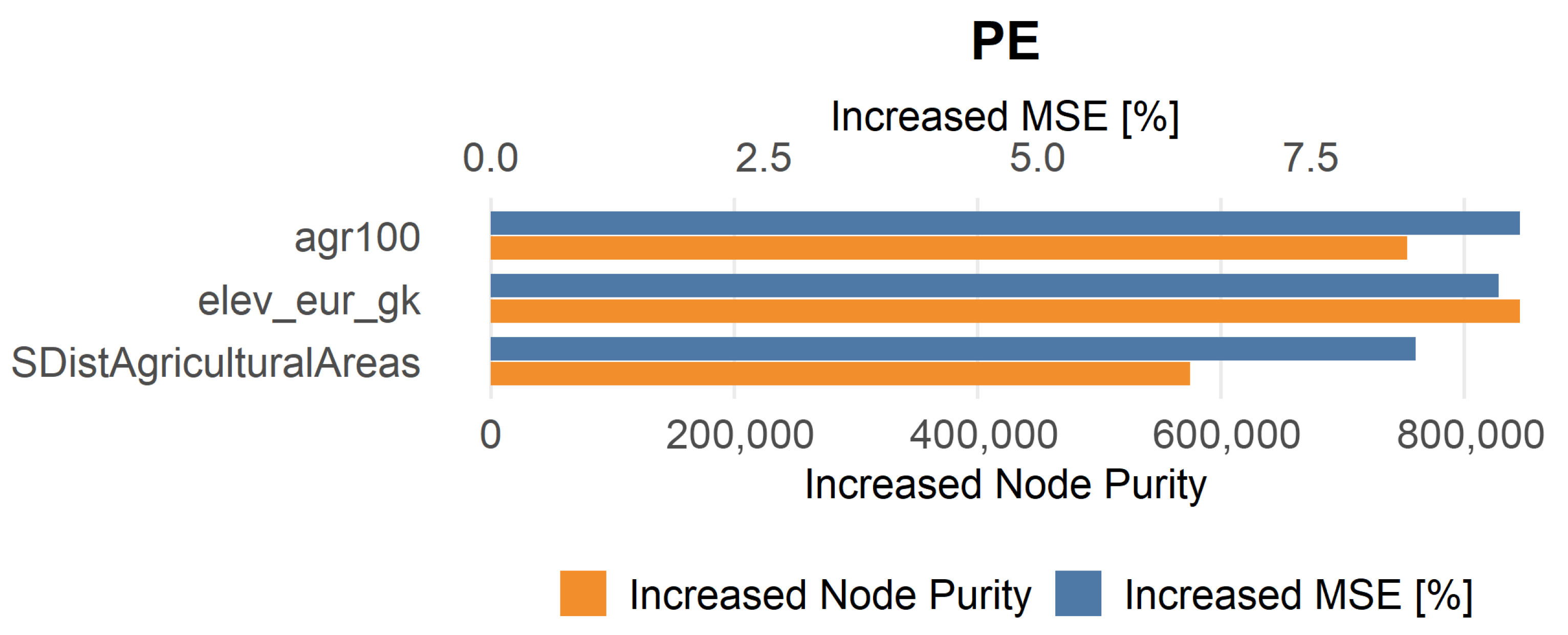
Polyethylene. The model showed weak explanatory power (pseudo-R2 = 25%; Table 5). The strongest predictors were the distance to adjacent arable land, agricultural land-use density (100 km), and elevation (Figure 13). As in the correlation analysis (Table 3), the relationships for PE were difficult to interpret. The seemingly contradictory effects of agricultural land-use variables arise from their different spatial scales: the proportion of agricultural land reflects large-scale broad landscape structure, whereas the distance to adjacent fields captures local site conditions. These scales influence PE differently, which explains why the patterns are not directly comparable.
Overall, the results for microplastics show that SBR and PE concentrations in moss are primarily influenced by the presence of local emission sources in the immediate surroundings of the sampling sites. The influence of atmospheric deposition on microplastic concentrations in moss could not be analyzed due to the lack of modeled deposition data. Among the remaining 79 potentially explanatory variables listed in Table 1 (meteorology, topography, geology, soil, sampling characteristics, vegetation structure, population density, spatial density of surrounding land uses, and local emission sources), only a few showed statistically significant relationships with microplastic concentrations in moss.

3.3. Minimum Sample Sizes

3.3.1. Persistent Organic Pollutants

Six of the eleven (sum) POP concentrations examined in MM2020, each with sample sizes of 20 or 21, exhibited either a normal or lognormal distribution (Table 6). Because the dataset size was close to the minimum requirement for applying the SSAD approach (n ≥ 25), the formula for lognormally distributed data (Equation (4)) was additionally applied to all datasets that did not follow a normal or lognormal distribution, in accordance with the recommendations of [15]. Notably, all non-normally distributed datasets showed a high proportion of samples with concentrations below the limit of quantification (LOQ). In these cases, values below the LOQ were set to zero.
Applying the analytical formulas (Equations (4) and (5)) resulted in minimum sample sizes (MSS = number of sites) between 56 and 256 to ensure a tolerance of 20% when estimating the arithmetic mean. In contrast, the SSAD approach yielded MSS values ranging from 76 to 281. For POPs, SSAD-based estimates were on average 21% higher than those obtained from the analytical formulas. Only for HBBz did the Monte Carlo simulation produce lower MSS values than the formulas, whereas for PBT it produced nearly three times more than those obtained from the formulas. Compared with POPs, SSAD-based MSS values for heavy metals and nitrogen in MM2015 were on average 38% higher than those derived from the formulas [13].
Based on the recommended MSS values in Table 6, the upper bound for POPs corresponds to the maximum MSS of 281 sites. A monitoring network of this size would ensure, with 95% confidence, that the empirically estimated mean of all (sum) POP concentrations deviates by no more than 20% from the true mean. A network with 150 sites would meet this accuracy requirement for approximately three-quarters of the investigated POPs, and a network with 100 sampling sites for roughly one-third of them.
In MM2020, deviations between actual sample sizes and the calculated MSS ranged from −62.5% (PBT) to −93% (PCDD/F TEQ values). Thus, for all POP, the nationwide monitoring network fell substantially below the statistically required MSS needed to achieve a 20% accuracy level for the arithmetic mean. Particularly pronounced deficits of more than 80% were observed for PCDD/Fs, PCDD/F TEQ values, HBCD, PBDEs, and DBDPE.

3.3.2. Microplastics

Of the five microplastic categories analyzed in MM2020 (n = 25), only the PET measurements followed a normal distribution. The data for the remaining categories deviated from both the normal and lognormal distributions (Table 7). Owing to the high proportion of samples with PP and PS concentrations below the LOQ, these categories were excluded from the calculation of minimum sample sizes.
Applying the ICP vegetation formula (Equation (4)) to the PET data resulted in a required minimum sample size of 20. The SSAD approach yielded an MSS of 125 for styrene–butadiene rubber (SBR) and 40 for polyethylene (PE). On average, SSAD-based MSS values for microplastics were approximately 5% higher than those obtained from the analytical formulas.
A comparison of actual sample sizes with the calculated MSS values showed that only the PET dataset from MM2020 met the required minimum sample size to ensure a 20% tolerance for the arithmetic mean. In contrast, the sample size for PE fell below the recommended MSS, and the sample size for SBR was substantially smaller than required.

4. Discussion

This study provides a comprehensive analysis of the factors that potentially influence the accumulation of POPs and MPs in moss. To this end, random forest models, correlation analyses and minimum sample size (MSS) calculations were combined. The results show that concentrations in moss are determined by an interaction between atmospheric long-range transport, local emission sources, vegetation structure and land-use patterns. Despite the small sample size, statistically significant relationships between POP concentrations and several of the examined predictors were observed. At the same time, clear differences emerge between POPs and MPs with respect to the relevance of individual predictors and their spatial relation to the moss sampling sites. Nevertheless, the limited number of observations reduces the overall confidence in the results, and the findings should, therefore, be regarded as preliminary.
Atmospheric deposition. For several POP groups—particularly PAHs and PCDD/Fs—the RF models and correlation patterns indicate a substantial influence of atmospheric deposition. The importance of benzo[a]pyrene deposition for PAHs, as well as the strong contribution of modeled PCDD/F TEQ deposition values, suggests that long-range transport processes largely shape the concentration gradients observed in the moss samples. For those POPs with available model data, this is consistent with earlier findings for heavy metals [43]. The relevance of land-use proportions within large radii of 100–300 km further supports the importance of long-range transport and aligns with geostatistical variogram analyses that identified spatial autocorrelation within ranges of 258–900 km for various POPs [44].
For microplastics, the influence of atmospheric deposition could not be assessed due to the lack of deposition model data, representing a major limitation for interpreting the results. However, recent studies clearly show that atmospheric transport processes play a key role in the long-range transport of microplastics. Global simulations of the transport of tire wear particles (TWPs), which often contain SBR, have shown that particles in the PM10 size range in particular are transported through the atmosphere and deposited in distant marine regions [45]. Although chemical transport models are fundamentally capable of representing the deposition rates of microplastics, there are currently no publicly available datasets that would have made it possible to include this pathway in our study. In addition, the quantities of TWPs actually emitted in the small-size range (PM10 and PM2.5) have not yet been comprehensively investigated, and estimates of the quantities are, therefore, subject to a certain degree of uncertainty. A correlation analysis with atmospheric POP and MP measurements was not feasible, as no suitable air-monitoring measurements were available.
Local emission sources. Emissions from nearby anthropogenic activities emerge as major factors influencing POP concentrations in moss. For PAHs and PCDD/Fs, the results indicate that the main sources identified in national emission inventories—residential heating, traffic and industry [46]—contribute substantially to local deposition. The strong correlations with proximity to industrial facilities, residential areas and transport infrastructure support this interpretation. Also, the RF models reinforce these findings by showing that PAHs are strongly influenced by local emission sources such as traffic, residential heating and industry. For PCDD/Fs, the RF results highlight the importance of emissions from small-scale residential heating.
Flame retardants such as PBDEs, HBCD, DP and DBDPE, despite their regulatory restrictions, continue to show clear statistical associations with urban–industrial land use and the vicinity of industrial facilities. This points to ongoing emissions from long-lasting legacy materials, such as polystyrene or styrofoam insulation boards used in buildings, as well as from transport vehicles and automotive textiles [47]. In a similar manner, the RF models suggest that DBDPE is strongly linked to industrial areas and dump sites. For HBBz, the RF model hints at possible re-emissions from agricultural soils. Regarding the correlations observed with distances to roads and agricultural land-use, it should be noted that these relationships do not initially suggest a causal link, as current uses of the regulated compounds in road surfaces, car tires, or agriculture within the EU are unlikely. The extent to which these flame retardants were used in such applications prior to regulation—and whether they may still act as emission sources today—cannot be assessed within this study.
Taken together, the spatial patterns across multiple POP groups demonstrate that, in addition to long-range atmospheric transport, local emission sources exert a substantial influence on POP concentrations in moss. These findings indicate that POP concentrations in moss are influenced by local emission sources even when the recommended [14] distance criteria are met. Proximity to traffic infrastructure and residential areas has a stronger effect than previously observed for metals and nitrogen [48,49]. The MM2020 data point toward the need for increased minimum distances, with preliminary indications suggesting distances of roughly 400–3000 m from motorways and railway lines, about 400 m from settlements, and approximately 200 m from smaller roads and agricultural fields.
For MPs, the results indicate that certain polymers are influenced by nearby emission sources. SBR shows elevated concentrations close to dump sites and roads, suggesting contributions from waste handling and traffic. SBR associated with tire abrasion shows links to road networks and transport corridors, suggesting that mobility patterns and infrastructure density are relevant predictors. PE and PET also display spatial patterns consistent with local activities, although the relationships are weaker than those observed for POPs. For PET, elevated concentrations near settlements may reflect emissions from textile use, household activities and waste management. Overall, local sources appear to contribute to MP accumulation as well, although the relevance of spatial predictors is less pronounced and less consistent than for POPs.
Vegetation structure and canopy drip effects. The pronounced influence of vegetation structure on the concentrations of POPs and MPs in moss is consistent with previous studies showing that, for metals and nitrogen, filtering and canopy-drip effects in the area of tree canopies substantially enhance atmospheric deposition [42]. The present results extend this understanding to POPs and MPs, indicating that similar physical processes also contribute to their deposition onto moss surfaces. The strong influence of the leaf area index (LAI) on several POP groups (PAHs, PCDD/F TEQ values, and PBT) is consistent with the assumption that tree canopies—particularly those of conifers—provide larger interception surfaces and thereby enhance deposition. Likewise, canopy cover (PCDD/Fs, DP, and PBT) and the distance to adjacent tree and shrub stands (PBT and HBBz) indicate that vegetation structure at the sampling sites substantially influences the concentration of POP mosses. Some vegetation-related relationships—such as the positive correlation between concentrations of DP and distances to tree crowns—appear implausible and may reflect model artefacts rather than real environmental processes.
For microplastics, the consistent, though less pronounced, correlations with vegetation structure similarly suggest that—at least for SBR and PE—canopy-drip effects also contribute to MP deposition, reflecting the role of vegetation as a filter and interceptor of airborne MPs.
Land-use patterns and population density. The results clearly demonstrate that the spatial density of land use and population density around the sampling sites substantially influences POP concentrations in moss. In particular, the proportions of industrial, urban, and agricultural land use within large radii of 100–300 km emerge as strong predictors for nearly all investigated analytes (16 PAHs, PCDD/Fs, PCDD/F TEQ values, HBCD, 23 PBDEs, BDE-209, DBDPE, and PBT). This pattern indicates that POP concentrations in moss are largely shaped by long-range atmospheric transport and the spatial heterogeneity of large-scale deposition. This interpretation is supported by previous geostatistical variogram analyses, which reported spatial autocorrelation ranges of several hundred kilometers for multiple POP groups [44]. In contrast with metals and nitrogen [48,49], the POPs examined here also show pronounced effects of land-use density parameters within short distances (<5 km) of the sampling sites (PCDD/Fs, PCDD/F TEQ values, HBCD, 23 PBDEs, BDE-209, DBDPE, PBT, and HBBz). Population density, as well as the density of mineral extraction and dump sites in proximity to the sampling areas, emerge as particularly relevant predictors. These findings support the above results, indicating that POP concentrations in moss are influenced not only by large-scale atmospheric deposition but also substantially by local emission sources in the immediate surroundings of the sampling sites.
For MP, the negative association between agricultural land-use density and PE concentrations may indicate lower emission intensities in agricultural regions compared with urban–industrial areas, although differences in atmospheric transport or particle size may also play a role. The generally weak influence of land-use density parameters at larger radii around the moss sampling sites further suggests that MP concentrations vary on smaller spatial scales and do not exhibit pronounced spatial autocorrelation compared with POPs [44]. The lack of deposition model data for MP limits the ability to clarify these mechanisms. At the same time, the spatial patterns of SBR and PET suggest that population density and human activity influence MP levels, with higher concentrations in areas characterized by traffic, waste handling and settlement structures.
Predictors with low relevance. In contrast with previous findings for metals and nitrogen [42,48,49,50], the moss species investigated here, Pleurozium schreberi (BRID.) MITT., Hypnum cupressiforme HEDW. s.str. and Pseudoscleropodium purum (HEDW.) M.FLEISCH (synonym Scleropodium purum HEDW. LIMPR.), provide no evidence for species-specific accumulation of the investigated POPs and MPs and, therefore, no indication that moss species act as an explanatory variable for POP and MP concentrations in moss. Neither substrate type (ground or dead wood/tree stump) nor moss frequency affects concentration levels, and the potential role of calcareous particles could not be assessed due to their absence in the field. Meteorological variables generally play only a minor role in determining POP and MP concentrations. Only precipitation shows a moderate influence on Dechlorane Plus, while prevailing wind direction appears to be irrelevant. Topographic and soil-related parameters (elevation, slope, aspect, humus type, and humus layer thickness) also show limited influence, except for bedrock and soil type in the case of HBBz, whose unclear patterns may indicate re-emissions from adjacent agricultural fields, consistent with the observed importance of agricultural land-use density within a 5 km radius of the sampling sites.
The high number of predictors with low relevance for MPs should be viewed in light of the relatively small number of measurements (n = 25), which substantially limits statistical power and increases the risk of a β-error. As a result, even actual relationships between MP concentrations in moss and relevant influencing factors may remain undetected.
Evaluation of the monitoring network. The analyses of minimum sample sizes (MSS) highlight the central importance of distributional assumptions for determining the sample size needed to estimate the arithmetic mean within a 20% error tolerance. The two analytical formulas provide more precise and reliable MSS estimates—provided that normal or lognormal distributions are present—than the SSAD approach [15]. For datasets that do not follow these distributions, SSAD is the more appropriate method, as it does not rely on any assumptions about the underlying data distribution. Although the dataset used here falls slightly below the recommended minimum sample size for SSAD (n ≥ 25), the method produced only moderately higher MSS values than the analytical formulas, indicating robust applicability even under constrained conditions.
However, the results show that the actual sample sizes of the MM2020 network fell well below the calculated minimum requirements for all POP categories. The deficits were particularly pronounced for PCDD/Fs, PCDD/F TEQ values, HBCD, PBDEs and DBDPE, which exhibit high variability and, in some cases, many values below the LOQ. For microplastics, only PET met the required sample size, whereas the necessary sample sizes for PE and especially SBR were substantially higher. The large number of values below the LOQ for PP and PS meant that these categories could not be meaningfully included in the MSS calculations.
Overall, the combined methodological approach of analytical formulas and SSAD simulations demonstrates that both methods offer complementary strengths. While the analytical formulas are efficient and precise when distributional assumptions are met, SSAD provides a robust alternative for datasets that are not (log)normally distributed. However, the results also show that insufficient sample sizes and the high number of values below the LOQ limit the interpretability of the bi- and multivariate analyses, as they reduce both the reliability of the analysis and the ability to identify influencing factors.

5. Conclusions

This study demonstrates that POP concentrations in moss are influenced by a complex combination of long-range atmospheric transport, local emission sources and vegetation-dependent deposition processes. Strong correlations with industrial facilities, residential areas and transport infrastructure underscore the importance of local emissions, while associations with land-use density at larger radii highlight the role of long-range atmospheric transport. The spatial patterns observed across multiple POP groups show that local influences remain detectable even when current distance criteria of the Moss Manual [14] are met. The MM2020 results, therefore, indicate that larger minimum distances are required to ensure that moss samples represent true background deposition of POPs. Vegetation structure further modulates deposition through canopy drip and filtering effects, underlining that the minimum distances to tree canopies recommended in the Moss Manual are also relevant for POPs.
For microplastics, the findings reveal weaker and less consistent relationships with the examined predictors than for POPs, yet certain polymers—particularly SBR—show clear indications of local influence.
The combined MSS approach, comprising the analytical formulas and the SSAD procedure, provides a valuable tool for planning and evaluating future monitoring networks. The framework applied here can support the definition of ecoregion-specific minimum sampling sizes and facilitate the harmonization of monitoring designs across countries participating in the European Moss Survey. However, the substance-specific MSS values derived from MM2020 indicate that for Germany, substantially higher sampling densities are required to achieve a 20% tolerance for the arithmetic mean. Future monitoring strategies should, therefore, incorporate these requirements to ensure reliable estimates of POP and MP concentrations in mosses.
Overall, the results reinforce the value of moss as an effective biomonitor for assessing spatial patterns and temporal trends of atmospheric deposition. Future monitoring designs should incorporate refined distance criteria and improved sampling densities to more reliably capture background levels of POP and microplastics across landscapes. In addition, future studies should also investigate temperature as a predictor or temperature-dependent predictors to better capture secondary emissions of semi-volatile banned compounds such as PBDEs. As moss accumulates organic contaminants for periods of about 3 years [51], this should be performed in future moss monitoring when data for longer time scales and more than two data points within five years are available. This implies that investigating temperature as a predictor would need (interpolated) data from nearby national weather stations as the closest approximation of the real onsite situation, or that such investigations can only be performed at a few sampling sites which are located in a very close proximity to such stations.
With respect to MP, the results of this study highlight the importance of considering both long-range and local processes when interpreting spatial patterns in moss. As atmospheric transport processes play a key role in the long-range distribution of microplastics [45], atmospheric transport and deposition models should be systematically integrated into future assessments of MP concentrations in mosses. At the same time, the results of this study indicate that more detailed data on local emission sources (e.g., traffic intensity and waste handling) would likely enhance the accuracy and interpretability of MP exposure estimates.

Author Contributions

Conceptualization, S.N. and W.S.; methodology, S.N.; data curation, S.N.; chemical analyses, A.D., C.K. and C.W.; writing—original draft preparation, S.N.; writing—review and editing, W.S., A.D., C.K. and C.W.; supervision, W.S.; project administration, W.S.; funding acquisition, W.S. All authors have read and agreed to the published version of the manuscript.

Funding

This research was funded by the Federal Environment Agency, Germany (FKZ 3720 63 201 0).

Institutional Review Board Statement

Not applicable.

Informed Consent Statement

Not applicable.

Data Availability Statement

Not applicable.

Conflicts of Interest

The authors declare no conflicts of interest.

Abbreviations

The following abbreviations were used in this article:
B[a]PBenzo[a]pyrene
BDEsBrominated diphenyl ethers
CARTClassification or a regression tree
CLCCORINE Land Cover
DBDPEDecabromodiphenylethane
DPDechlorane plus (syn-DP plus anti-DP)
DPTEDechlorane plus ethane
DWDDeutscher Wetterdienst
EMEPEuropean Monitoring and Evaluation Programme
EMSEuropean Moss Survey
HBBzHexabromobenzene
HBCDHexabromocyclododecane
HCBHexachlorobenzene
HFRsHalogenated flame retardants
ICPInternational Cooperative Programme
IncMSEIncrease in mean squared error
INPIncreased node purity
LAILeaf area index
LOQLimit of quantification
MMetal
MMMoss monitoring
MPsMicroplastics
MSCMeteorological Synthesizing Center
MSEMean squared error
MSSsMinimum sample sizes
NNitrogen
nSample size
OOBOut-of-bag
PAHsPolycyclic aromatic hydrocarbons
PBBsPolybrominated biphenyls
PBDEsPolybrominated diphenyl ethers
PBTPentabromotoluene
PCBsPolychlorinated biphenyls
PCDD/FsPolychlorinated dibenzo-p-dioxins and dibenzofurans
PEPolyethylene
PETPolyethylene terephthalate
PFASsPer- and polyfluoroalkyl substances
POPsPersistent organic pollutants
PSPolystyrene
RFRandom forest
RMSERoot-mean-square error
SBRStyrene-butadiene rubber
SDStandard deviation
SRTMShuttle Radar Topography Mission
SSADSample Size for Arbitrary Distributions
TEQToxic equivalency quotient

References

  1. Frahm, J.P. Mosses as Bioindicators. Biologische Arbeitsbücher 57; Quelle & Meyer: Wiesbaden, Germany, 1998. [Google Scholar]
  2. Zechmeister, H.G.; Grodzinska, K.; Szarek-Lukaszewska, G.H. Bryophytes. In Bioindicators and Biomonitors; Markert, B., Ed.; Elsevier: Amsterdam, The Netherlands, 2003; pp. 329–375. [Google Scholar]
  3. Amodio, M.; Catino, S.; Dambruoso, P.R.; de Gennaro, G.; Di Gilio, A.; Giungato, P.; Laiola, E.; Marzocca, A.; Mazzone, A.; Sardaro, A.; et al. Atmospheric deposition: Sampling procedures, analytical methods, and main recent findings from the scientific literature. Adv. Meteorol. 2014, 2014, 161730. [Google Scholar] [CrossRef]
  4. Berg, T.; Røyset, O.; Steinnes, E. Moss (Hylocomium splendens) used as biomonitor of atmospheric trace element deposition: Estimation of uptake efficiencies. Atmos. Environ. 1995, 29, 353–360. [Google Scholar] [CrossRef]
  5. Harmens, H.; Foan, L.; Simon, V.; Mills, G. Terrestrial mosses as biomonitors of atmospheric POP pollution: A review. Environ. Pollut. 2013, 173, 245–254. [Google Scholar] [CrossRef]
  6. Jacobson, M.Z. Fundamentals of Atmospheric Modeling; Cambridge University Press: Cambridge, UK, 2005. [Google Scholar]
  7. Rühling, Å.; Tyler, G. An Ecological Approach to the Lead Problem. Bot. Not. 1968, 121, 321–342. [Google Scholar]
  8. Rühling, Å.; Tyler, G. Sorption and Retention of Heavy Metals in the Woodland Moss Hylocomium splendens (Hebw). Br. Sch. Oikos 1970, 21, 92–97. [Google Scholar] [CrossRef]
  9. Roblin, B.; Aherne, J. Moss as a biomonitor for the atmospheric deposition of anthropogenic microfibres. Sci. Total Environ. 2020, 715, 136973. [Google Scholar] [CrossRef] [PubMed]
  10. Wenzel, M.; Schoettl, J.; Pruin, L.; Fischer, B.; Wolf, C.; Kube, C.; Renner, G.; Schram, J.; Schmidt, T.C.; Türk, J. Determination of atmospherically deposited microplastics in moss: Method development and performance evaluation. Green Anal. Chem. 2023, 7, 100078. [Google Scholar] [CrossRef]
  11. Bargagli, R.; Rota, E. Potential Role of Mosses in Evaluating Airborne Microplastic Deposition in Terrestrial Ecosystems. J. Xenobiotics 2026, 16, 21. [Google Scholar] [CrossRef]
  12. Pesch, R.; Schröder, W.; Genssler, L.; Goeritz, A.; Holy, M.; Kleppin, L.; Matter, Y. Moss Monitoring 2005/2006: Heavy Metals IV and Total Nitrogen. In Environmental Research Plan of the Federal Minister for the Environment; Federal Environment Agency: Berlin, Germany, 2007. (In German) [Google Scholar]
  13. Schröder, W.; Nickel, S.; Völksen, B.; Dreyer, A.; Wosniok, W. Use of Bioindication Methods to Determine and Regionalize Pollutant Inputs; UBA-Texte 91/2019; Umweltbundesamt: Dessau-Roßlau, Germany, 2019. [Google Scholar]
  14. ICP Vegetation. Metals, Nitrogen and POPs in European Mosses. In Monitoring Manual Survey 2020; ICP Vegetation: Bangor, UK; Dubna, Russia, 2020; pp. 1–27. [Google Scholar]
  15. Wosniok, W.; Nickel, S.; Schröder, W. Development of the software tool SampleSize for Arbitrary Distributions and its application to calculating minimum numbers of moss samples. Environ. Sci. Eur. 2020, 32, 9. [Google Scholar] [CrossRef]
  16. Schröder, W.; Dreyer, A.; Nickel, S.; Völksen, B.; Wenzel, M.; Wolf, C.; Kube, C.; Türk, J. Pilot Studies on the Suitability of Bioindication with Mosses for Detecting Atmospheric Deposition of POPs and Microplastics; TEXTE 02/2025; Umweltbundesamt: Dessau-Roßlau, Germany, 2025. [Google Scholar]
  17. Dreyer, A.; Nickel, S.; Schröder, W. (Persistent) Organic pollutants in Germany: Results from a pilot study within the 2015 moss survey. Environ. Sci. Eur. 2018, 30, 43. [Google Scholar] [CrossRef]
  18. Dreyer, A.; Nickel, S.; Schröder, W. Monitoring of (Persistent) Organic Pollutants in Mosses: Results from the German Moss Monitoring Surveys 2015 and 2020; Environmental Research 2026; Springer: Berlin/Heidelberg, Germany, 2018; submitted. [Google Scholar]
  19. Bürger, M. Bodennahe Windverhältnisse und Windrelevante Reliefstrukturen. In Nationalatlas Bundesrepublik Deutschland. Band 3—Natur Und Umwelt II: Klima, Pflanzen-Und Tierwelt; Leibnitz-Institut für Länderkunde, Ed.; Leibnitz-Institut für Länderkunde: Leipzig, Germany, 2003; pp. 52–55. Available online: http://archiv.nationalatlas.de/wp-content/art_pdf/Band3_52-55_archiv.pdf (accessed on 12 November 2021).
  20. BGR. Nutzungsdifferenzierte Bodenübersichtskarte der Bundesrepublik Deutschland 1:1,000,000 (BÜK 1000); Bundesamt für Geowissenschaften und Rohstoffe (BGR): Hannover, Germany, 2007. Available online: https://download.bgr.de/bgr/Boden/BUEK1000N/v232/Gesamt/shp/buek1000n_v232.zip (accessed on 8 February 2026).
  21. Bremicker, M. The LARSIM Water Balance Model—Model Fundamentals and Application Examples. Freiburger Schriften zur Hydrologie, Vol. 11; Institut für Hydrologie der Universität Freiburg: Freiburg, Germany, 2000. [Google Scholar]
  22. Travnikov, O.; Batrakova, N.; Gusev, A.; Ilyin, I.; Kleimenov, M.; Rozovskaya, O.; Shatalov, V.; Strijkina, I.; Aas, W.; Breivik, K.; et al. Assessment of Transboundary Pollution by Toxic Substances: Heavy Metals and POPs; EMEP Status Report 2/2020; MSC-East: Moscow, Russia, 2020. [Google Scholar]
  23. Gusev, A.; Mantseva, E.; Shatalov, V.; Strukov, B. Regional Multicompartment Model MSCE-POP; EMEP/MSC-E Technical Report 5/2005; EMEP: Moscow, Russia, 2005. [Google Scholar]
  24. EAE (European Environment Agency). Corine Land Cover 2018 (Raster 100 m). 2019. Available online: https://land.copernicus.eu/en/products/corine-land-cover/clc2018 (accessed on 19 December 2024).
  25. Keil, M.; Kiefl, R.; Strunz, G. CORINE Land Cover 2000—Germany; Final Report; German Aerospace Center, German Remote Sensing Data Center: Oberpfaffenhofen, Germany, 2005.
  26. Nickel, S.; Schröder, W.; Völksen, B.; Dreyer, A. Influence of the canopy drip effect on the accumulation of atmospheric metal and nitrogen deposition in mosses. Forests 2022, 13, 605. [Google Scholar] [CrossRef]
  27. R Core Team. R: A Language and Environment for Statistical Computing; R Foundation for Statistical Computing: Vienna, Austria, 2023; Available online: https://www.R-project.org/ (accessed on 20 January 2025).
  28. Brosius, F. SPSS 21; MITP Verlag: Heidelberg, Germany, 2013. [Google Scholar]
  29. Breiman, L. Random forests. Mach. Learn. 2001, 45, 5–32. [Google Scholar] [CrossRef]
  30. Breiman, L.; Friedman, J.; Olshen, R.; Stone, C. Classification and Regression Trees; Wadsworth: Belmont, CA, USA, 1984. [Google Scholar]
  31. Prasad, A.M.; Iverson, L.R.; Liaw, A. Newer classification and regression tree techniques: Bagging and Random Forests for ecological prediction. Ecosystems 2006, 9, 181–199. [Google Scholar] [CrossRef]
  32. Williams, G. Data Mining with Rattle and R: The Art of Excavating Data for Knowledge Discovery; Springer: Berlin, Germany, 2011. [Google Scholar]
  33. Ziegler, A.; König, I.R. Mining data with random forests: Current options for real-world applications. WIREs Data Min. Knowl. Discov. 2014, 4, 55–63. [Google Scholar] [CrossRef]
  34. Liaw, A.; Wiener, M. Classification and regression by random forest. R News 2002, 2, 18–22. [Google Scholar]
  35. Moriasi, D.N.; Arnold, J.G.; Van Liew, M.W.; Bingner, R.L.; Harmel, R.D.; Veith, T.L. Model evaluation guidelines for systematic quantification of accuracy in watershed simulations. Trans. ASABE 2007, 50, 885–900. [Google Scholar] [CrossRef]
  36. Louppe, G.; Wehenkel, L.; Sutera, A.; Geurts, P. Understanding Variable Importances in Forests of Randomized Trees. 2013. Available online: http://papers.nips.cc/paper/4928-understanding-variable-importances-in-forests-of-randomized-trees.pdf (accessed on 21 January 2025).
  37. Foulkes, A.S. Applied Statistical Genetics with R: For Population-Based Association Studies; Springer: New York, NY, USA, 2009. [Google Scholar]
  38. Garten, C.T.; Kang, S.; Brice, D.J.; Schadt, C.W.; Zhou, J. Variability of soil properties at different spatial scales (1 m–1 km) in a deciduous forest ecosystem. Soil Biol. Biochem. 2007, 39, 2621–2627. [Google Scholar] [CrossRef]
  39. Qiu, Y.; Fu, B.; Wang, J.; Chen, L. Spatial variability of soil moisture content and its relation to environmental indices in a semi-arid gully catchment of the Loess Plateau, China. J. Arid Environ. 2001, 49, 723–750. [Google Scholar] [CrossRef]
  40. Schröder, W.; Nickel, S.; Schönrock, S.; Meyer, M.; Wosniok, W.; Harmens, H.; Frontasyeva, M.V.; Alber, R.; Aleksiayenak, J.; Barandovski, L.; et al. Spatially valid data of atmospheric deposition of heavy metals and nitrogen derived by moss surveys for pollution risk assessments of ecosystems. Environ. Sci. Pollut. Res. 2016, 23, 10457–10476. [Google Scholar] [CrossRef]
  41. Schönwiese, C.D. Practical Statistics for Meteorologists and Geoscientists; Gebrüder Bornträger: Berlin/Stuttgart, Germany, 2000. [Google Scholar]
  42. Meyer, M. Site-Specific Differentiated Recording of Atmospheric Nitrogen and Heavy Metal Input by Means of Mosses, Taking into Account the Canopy Drip Effect, and Supplementary Studies on the Relationship Between Atmospheric Nitrogen Deposition and Accompanying Vegetation. Ph.D. Thesis, University of Vechta, Vechta, Germany, 2017. (In German) [Google Scholar]
  43. Harmens, H.; Ilyin, I.; Mills, G.; Aboal, J.R.; Alber, R.; Blum, O.; Coskun, M.; De Temmerman, L.; Fernandez, J.A.; Figuera, R.; et al. Country-specific correlations across Europe between modelled atmospheric cadmium and lead deposition and concentrations in mosses. Environ. Pollut. 2012, 166, 1–9. [Google Scholar] [CrossRef]
  44. Schröder, W.; Nickel, S.; Dreyer, A. Mapping of measured concentrations of persistent organic pollutants and polycyclic aromatic hydrocarbons in mosses and correlation with modelled atmospheric deposition in Central Europe. Environ. Sci. Eur. 2025, 37, 177. [Google Scholar] [CrossRef]
  45. Evangeliou, N.; Grythe, H.; Klimont, Z.; Heyes, C.; Eckhardt, S.; Lopez-Aparicio, S.; Stohl, A. Atmospheric transport is a major pathway of microplastics to remote regions. Nat. Commun. 2020, 11, 3381. [Google Scholar] [CrossRef]
  46. NaPE. Nationale Trendtabellen für Die Deutsche Berichterstattung Atmosphärischer Emissionen (Persistente Organische Schadstoffe, POPs) 1990–2022; Umweltbundesamt: Dessau-Roßlau, Germany, 2022. [Google Scholar]
  47. Potrykus, A.; Milunov, M.; Weißenbacher, J. Identification of Waste and Recycled Materials Potentially Containing POPs—Derivation of Limit Values; Federal Environment Agency: Dessau-Roßlau, Germany, 2015. Available online: https://www.umweltbundesamt.de/system/files/medien/378/publikationen/texte_35_2015_identification_of_potentially_pop-containing_wastes.pdf (accessed on 26 January 2026). (In German)
  48. Holy, M.; Pesch, R.; Schröder, W.; Harmens, H.; Ilyin, I.; Alber, R.; Aleksiayenak, Y.; Blum, O.; Coșkun, M.; Dam, M.; et al. Factors associated with Cd, Hg and Pb concentrations in mosses sampled in the European Surveys 1990–2005. J. Atmos. Chem. 2010, 63, 109–124. [Google Scholar] [CrossRef]
  49. Nickel, S.; Schröder, W. Correlating elements content in mosses collected in 2015 across Germany with spatially associated characteristics of sampling sites and their surroundings. Environ. Sci. Eur. 2019, 31, 80. [Google Scholar] [CrossRef]
  50. Lequy, E.; Dubos, N.; Witte, I.; Pascaud, A.; Sauvage, S.; Leblond, S. Assessing temporal trends of trace metal concentrations in mosses over France between 1996 and 2011. Environ. Pollut. 2017, 220, 828–836. [Google Scholar] [CrossRef] [PubMed]
  51. Foan, L.; Leblond, S.; Thöni, L.; Raynaud, C.; Santamaria, J.M.; Sebilo, M.; Simon, V. Spatial distribution of PAH concentrations and stable isotope signatures (δ13C, δ15N) in mosses from three European areas—Characterization by multivariate analysis. Environ. Pollut. 2014, 184, 113–122. [Google Scholar] [CrossRef] [PubMed]
Figure 1. Spatial distribution of sampling sites in the 2020 moss survey.
Atmosphere 17 00223 g001
Figure 2. Relative predictor importance in the random forest model for the sum of 16 PAH concentrations (excl. LOQ) in moss, measured by increased MSE and increased node purity.
Atmosphere 17 00223 g002
Figure 3. Relative predictor importance in the random forest model for the sum of PCDD/F TEQ concentration values (excl. LOQ) in moss, measured by increased MSE and increased node purity.
Atmosphere 17 00223 g003
Figure 4. Relative predictor importance in the random forest model for the sum of PCDD/F concentrations (excl. LOQ) in moss, measured by increased MSE and increased node purity.
Atmosphere 17 00223 g004
Figure 5. Relative predictor importance in the random forest model for the sum of HBCD concentrations (excl. LOQ) in moss, measured by increased MSE and increased node purity.
Atmosphere 17 00223 g005
Figure 6. Relative predictor importance in the random forest model for the sum of 23 PBDE concentrations (excl. LOQ) in moss, measured by increased MSE and increased node purity.
Atmosphere 17 00223 g006
Figure 7. Relative predictor importance in the random forest model for BDE-209 concentrations in moss, measured by increased MSE and increased node purity.
Atmosphere 17 00223 g007
Figure 8. Relative predictor importance in the random forest model for Dechlorane Plus (syn-DP + anti-DP; excl. LOQ) in moss, measured by increased MSE and increased node purity.
Atmosphere 17 00223 g008
Figure 9. Relative predictor importance in the random forest model for DBDPE concentrations in moss, measured by increased MSE and increased node purity.
Atmosphere 17 00223 g009
Figure 10. Relative predictor importance in the random forest model for PBT concentrations in moss, measured by increased MSE and increased node purity.
Atmosphere 17 00223 g010
Figure 11. Relative predictor importance in the random forest model for HBBz concentrations in moss, measured by increased MSE and increased node purity.
Atmosphere 17 00223 g011
Figure 12. Relative predictor importance in the random forest model for SBR concentrations in moss, measured by increased MSE and increased node purity.
Atmosphere 17 00223 g012
Figure 13. Relative predictor importance in the random forest model for PE concentrations in moss, measured by increased MSE and increased node purity.
Atmosphere 17 00223 g013
Table 1. Potential explanatory variables for POP and MP concentrations in mosses (MM2020).
CategoryVariablesDescriptionUnit
Atmospheric deposition 1bap_dep_2018, bap_dep_2019, bap_dep_2020, bap_dep_2019_2020, bap_dep_2018_2020Modeled total deposition of benzo[a]pyrene (annual values and multi-year means)μg m−2 a−1
Atmospheric deposition 1pcdd_dep_2018, pcdd_dep_2019, pcdd_dep_2020, pcdd_dep_2019_2020, pcdd_dep_2018_2020Modeled total deposition of PCDD/F TEQ (annual values and multi-year means)ng TEQ m−2 a−1
Meteorology 2prec18, prec19, prec20, prec18_20Mean annual precipitation (annual values and multi-year means)mm a−1
Meteorology 3MainWindDirectionLocal prevailing wind direction-
Topography 4,5elev_eu_gk, SlopeDirection, SlopeGradientElevation, slope direction, and slope gradientm a.s.l., -, °
Soil and geology 4,6HumusLayer, HumusSpecies, SoilTexture, BedrockTypeHumus thickness, humus form, soil texture, and bedrock typecm, -
Sampling 4MossSpecies, SamplingFrom, Frequency, VisibleDustParticlesMoss species, substrate, occurrence frequency, and visible dust particles-
Vegetation–distances 4DistTreeCrownsAverage, DistTreeCrownsMin, DistTreeCrownsMax, DistShrubsAverage, DistShrubsMin, DistShrubsMaxDistances to tree and shrub canopy projectionsm
Vegetation–height 4TsLayerHeightAverage, TsLayerHeightMin, TsLayerHeightMaxTree layer height (mean, min., and max.)m
Vegetation–cover 7TreeCoverage, ShrubCoverage, TreeShrubCoverageTree and shrub canopy cover%
Vegetation–LAI 4,7LAI, LAI2, lai_euLeaf area index (simple, weighted, and Sentinel-2)-
Land use density 8agr5–300, for5–300, indu5–300, mine5–300, urb5–300, urbf5–300Land-use proportions within radii of 5–300 km%
Population density 9popdens5-100Population density within 5–100 kmInhabitants per km2
Local emission sources 4,10SDistNoneVegetationAreas, SDistAgriculturalAreas, SDistAnimalFarmingUnits, SDistPloughedAgriculturalFields, SDistSingleHouses, SDistVillage, SDistTown, SDistUnsealedRoads, SDistSmallPavedCountryRoads, SDistFederalRoads, SDistMotorways, SDistRailroadTracks, SDistIndustriesWithHighChimneys, SDistSmallIndustries, SDistWasteIncinerationFaculties, SDistDumpingGrounds, SDistCombustionEnergyPlants, SDistConstructionSites, SDistGravelPitDistances to potential local emission sourcesm
1 EMEP/MSC East: https://msceast.org/pollution-assessment/emep-domain-menu/data-hm-pop-menu (accessed on 8 November 2022). 2 DWD Climate Data Center (CDC); annual total of monthly precipitation raster data for Germany: https://opendata.dwd.de/climate_environment/CDC/grids_germany/annual/ (accessed on 19 December 2024). 3 Nationalatlas Bundesrepublik Deutschland [19]. 4 Variables recorded in the field according to [14]. 5 http://www2.jpl.nasa.gov/srtm/cbanddataproducts.html (accessed on 1 September 2015). 6 Nutzungsdifferenzierte Bodenübersichtskarte der Bundesrepublik Deutschland [20]. 7 Vegetation structure metrics derived from 4 in combination with [21]. 8 CORINE Land Cover: https://land.copernicus.eu/en/products/corine-land-cover/clc2018 (accessed on 20 December 2024). 9 https://www.earthdata.nasa.gov/data/projects/gpw (accessed on 15 July 2019). 10 https://www.google.com/maps (accessed on 15 December 2021).
Table 2. Spearman correlation coefficients between POP (sum) concentrations in moss and the selected set of potentially explanatory variables.
nSum
16 PAHs
Sum PCDD/FsSum PCDD/F TEQ ValuesSum HBCDSum
23 PBDEs
BDE-209Syn-DP + Anti-DPDBDPEDPTEPBTHBBz
Atmospheric deposition
pcdd_dep_201821 0.57 ***0.56 ***
pcdd_dep_201921 0.62 ***0.62 ***
pcdd_dep_202021 0.54 **0.54 **
pcdd_dep_2019_202021 0.61 ***0.60 ***
pcdd_dep_2018_202021 0.61 ***0.60 ***
Vegetation structure
DistTreeCrownsAverage21 0.43 **
DistShrubsAverage17−0.49 ** −0.53 ** −0.52 **0.49 **
DistShrubsMin17 −0.55 **−0.56 **−0.63 ***
TsLayerHeightAverage21 0.53 **
TsLayerHeightMax21 0.45 **
TreeCoverage21 0.45 **0.59 ***
ShrubCoverage21 −0.51 **
TreeShrubCoverage21 0.46 **
LAI21 0.51 **
LAI221 0.51 **0.74 ***
lai_eu21 0.48 **
Population and land-use density
agr50210.58 ***
agr100210.63 ***
agr300210.60 *** 0.46 ** 0.44 **0.50 **
for10021−0.47 **
for30021−0.45 **
urb521 0.51 **0.49 **0.48 **
urb5021 0.55 ***0.62 ***
urb100210.46 ** 0.48 **0.57 ***0.49 **
urb30021 0.47 **0.50 **0.60 ***0.65 ***0.54 **
urbf521 0.54 **0.52 **0.50 **
urbf5021 0.59 ***0.64 ***0.43 **
urbf30021 0.47 **0.50 **0.62 ***0.66 ***0.54 **
indu521 0.51 ** 0.45 **
indu5021 0.47 **0.56 ***
indu100210.51 ** 0.48 **0.53 **0.48 ** −0.45 **
indu30021 0.49 **0.53 **0.58 ***0.66 ***0.59 ***
mine521 0.61 ***0.61 ***0.59 ***0.75 ***0.59 ***0.51 **0.56 ***
mine50210.51 **0.55 **0.59 ***0.56 ***0.76 ***0.66 ***0.46 **0.51 **
mine100210.73 *** 0.49 **0.51*
mine300210.54 **
popdens521 0.55 **0.55 **0.76 ***0.77 ***0.52 **0.45 **
popdens5021 0.58 ***0.61 ***0.46 **0.45 **
popdens10021 0.53 **0.47 ** 0.44 **
Distances to potential emission sources
SDistAnimalFarmingUnits11 0.75 ** 0.67 **
SDistPloughedAgriculturalFields11 −0.76 **−0.76 **−0.77 ***−0.82 ***−0.82 ***−0.63 **
SDistSingleHouses19 0.77 ***
SDistVillage17 −0.54 ** 0.61 ***
SDistTown11−0.76 ***−0.74 **−0.72 ** −0.70 ** −0.67 **
SDistSmallPavedCountryRoads13 0.58 **
SDistFederalRoads16−0.50 ** −0.53 **−0.55 **−0.67 ***−0.65 *** −0.58 **
SDistMotorways14 −0.76 ***−0.65 **−0.62 **
SDistRailroadTracks13 −0.68 **−0.79 ***−0.66 ** −0.68 ***
SDistIndustriesWithHighChimneys7−0.86 ** −0.93 *** −0.90 ***
SDistSmallIndustries9−0.77 ** −0.85 ***
*** = p ≤ 0.01 (highly significant); ** = p ≤ 0.05 (significant).
Table 3. Spearman correlation coefficients between MP concentrations in moss and the selected set of potentially explanatory variables.
nPETSBRPE
Vegetation structure
TreeShrubCoverage25 0.45 **
LAI225 0.48 **
Land-use density
agr10025 −0.42 **
Distances to local emission sources
SDistAgriculturalAreas20 −0.59 ***
SDistAnimalFarmingUnits15−0.57 **
SDistUnsealedRoads14 −0.62 **
*** = p ≤ 0.01 (highly significant); ** = p ≤ 0.05 (significant).
Table 4. Model parameters and model performance measures of the random forest models describing the relationships between POP concentrations in moss and the predictors shown in the subsequent figures.
Sum
16 PAHs
Sum PCDD/FsSum PCDD/F TEQ ValuesSum HBCDSum
23 PBDEs
BDE-209Syn-DP + Anti-DPDBDPEDPTEPBTHBBz
Model parameters
n2120202121212121212121
n < LOQ03300907759
ntree500300500250350350500500300500600
mtry23223222222
Model performance measures
MSE4641.564.898.240.046212,65490,16112,4111,881,79813,382354.7218.06
RMSE68.198.062.870.2149112.49300.26111.401371.8115.6818.8354.25
Pseudo-R2 [%]33.2631.0940.8733.0156.8858.5651.5454.1217.1945.1841.05
n = sample size; n < LOQ = number of samples below the limit of quantification; ntree = number of regression trees in the random forest model; mtry = number of variables randomly selected at each split; MSE = mean squared error; RMSE = root-mean-square error; pseudo-R2 = proportion of explained variance.
Table 5. Model parameters and model performance measures of the random forest models describing the relationships between MP concentrations in moss and the predictors shown in the subsequent figures.
PPPSPETSBRPE
Model parameters
n2525252525
n < LOQ2020040
ntree------500200500
mtry------211
Model performance measures
MSE------350564.39144,815
RMSE------59.208.02380.54
pseudo-R2 [%]------18.2421.2624.88
n = sample size; n < LOQ = number of samples below the limit of quantification; ntree = number of regression trees in the random forest model; mtry = number of variables randomly selected at each split; MSE = mean squared error; RMSE = root-mean-square error; pseudo-R2 = proportion of explained variance.
Table 6. Minimum sample sizes (MSSs) and actual sample sizes for different POP categories, MM2020, Germany.
Sum
16 PAHs
Sum PCDD/FsSum PCDD/F TEQ ValuesSum HBCDSum
23 PBDEs
BDE-209Syn-DP + Anti-DPDBDPEDPTEPBTHBBz
Sample size n (MM2020)2120202121212121212121
Of which items < LOQ03300907759
Distribution type (MM2020)(2)(3)(3)(2)(2)(3)(2)(3)(3)(1)(3)
MSS, formula-based a86137256114128149811737256109
MSS, SSAD method b106141281119136157871867615787
Deviation ((n − MSS)/MSS)−75.6%−85.8%−92.9%−81.6%−83.6%−86.6%−74.1%−88.7%−72.4%−62.5%−75.9%
MSS complied/not compliedNoNoNoNoNoNoNoNoNoNoNo
Bold = recommended minimum sample size; distribution type: (1) = normal distribution, (2) = lognormal distribution, and (3) = other distribution; methods: a ref. [14] for case (1) and ref. [40] for cases (2) and (3); b ref. [15] for cases (1) to (3); LOQ = limit of quantification; italic = MSS values derived by the formula-based method, although classified as distribution type (3).
Table 7. Minimum sample sizes (MSSs) and actual sample sizes for different microplastic categories in MM2020 in Germany.
PPPSPETSBRPE
Sample size n (MM2020)2525252525
Of which items < LOQ2020040
Distribution type (MM2020)(3)(3)(1)(3)(3)
MSS, formula-based a------2011941
MSS, SSAD method b------2412540
Deviation ((n − MSS)/MSS)------25.0%−80.0%−37.5%
MSS complied/not complied------YesNoNo
Bold = recommended minimum sample size; distribution type: (1) = normal distribution, (2) = lognormal distribution, and (3) = other distribution; methods: a ref. [14] for case (1) and ref. [40] for cases (2) and (3); b ref. [15] for cases (1) to (3); LOQ = limit of quantification; --- = not determined.
Disclaimer/Publisher’s Note: The statements, opinions and data contained in all publications are solely those of the individual author(s) and contributor(s) and not of MDPI and/or the editor(s). MDPI and/or the editor(s) disclaim responsibility for any injury to people or property resulting from any ideas, methods, instructions or products referred to in the content.