Article

Meteorological Drought Under Climate Variability in the Wadi Sly Basin, Algeria (1967–2022)

1
Water and Environment Laboratory, Faculty of Nature and Life Sciences, Hassiba Benbouali University of Chlef, B.P. 78C, Ouled Fares, Chlef 02180, Algeria
2
Department of Civil Engineering, Faculty of Engineering, Karadeniz Technical University, Trabzon 61080, Turkey
3
G. B. Pant National Institute of Himalayan Environment, Garhwal Regional Centre, Srinagar 246174, Uttarakhand, India
4
Research Institute of Engineering and Technology, Hanyang University, Ansan 15588, Republic of Korea
5
Department of Civil Engineering & Technology, Qurtuba University of Science and Information Technology, Dera Ismail Khan 29050, Pakistan
6
National Research Council—Research Institute for Geo-Hydrological Protection (CNR-IRPI), 87036 Rende, Italy
*
Author to whom correspondence should be addressed.
Atmosphere 2026, 17(2), 207; https://doi.org/10.3390/atmos17020207
Submission received: 13 January 2026 / Revised: 3 February 2026 / Accepted: 11 February 2026 / Published: 14 February 2026

Abstract

Meteorological drought is a major natural hazard in semi-arid regions, where high climate variability and strong dependence on precipitation intensify pressure on water resources and socio-economic systems. This study examined the spatiotemporal characteristics of meteorological drought in the Wadi Sly basin (northwestern Algeria) over the period 1967–2022, using long-term monthly precipitation records from seven meteorological stations. The Standardized Precipitation Index (SPI) was calculated at multiple time scales (1-, 3-, 6-, 9-, and 12-month) to characterize drought onset, severity, persistence, and temporal variability. In addition, drought severity probability and frequency analyses were conducted to evaluate the likelihood and recurrence of different drought classes. The results indicate pronounced inter-annual and decadal variability in drought conditions, with severe and prolonged drought episodes occurring during the mid-1980s, early-to-mid-1990s, and late 2010s. During these periods, SPI values frequently fell below −2.0, signifying extreme drought conditions. Spatial analysis reveals strong basin-wide synchronicity of drought events, suggesting the influence of large-scale atmospheric drivers, although localized variations in drought intensity remain evident. Overall, near-normal conditions dominate the record (accounting for approximately 60–70% of observations), while moderately dry conditions occur more frequently than moderately wet conditions at several stations. Drought characteristics exhibit strong scale dependence, with short-term droughts prevailing at shorter SPI time scales, while longer time scales emphasize drought persistence and accumulation. Overall, the findings indicate an increasing prominence of long-duration drought conditions in recent decades, as evidenced by recurrent low SPI values at longer aggregation scales. Such conditions may pose heightened risks to groundwater recharge processes and long-term water resource availability. Despite the limitations inherent in precipitation-based indices, this study provides a robust statistical framework for drought characterization and contributes valuable insights for improved drought monitoring, early warning systems, and climate-resilient water resource management in semi-arid basins.

1. Introduction

Drought is one of the most complex and destructive natural events impacting semi-arid regions, where noticeable climatic variation, limited water resources, and heavy reliance on rain-fed agriculture affect ecosystems and human livelihoods [1,2]. Due to these inherent vulnerabilities, drought develops gradually rather than abruptly like other natural disasters, often remaining unnoticed until cascading effects such as crop failure, groundwater depletion, food insecurity, and escalating socio-economic stress become severe. Consequently, the slow-onset nature of drought, combined with increasing climate variability, makes early detection and management particularly challenging [3,4]. In the context of ongoing climate change, the projected increase in the frequency, intensity, and duration of drought events in semi-arid landscapes further heightens these risks, underscoring the necessity for timely and systematic drought assessment and monitoring as a cornerstone of sustainable water and land management [5]. Furthermore, the integration of drought assessment tools with climate trend analysis strengthens the understanding of drought–climate interactions, thereby supporting the formulation of robust, adaptive, and region-specific strategies for enhancing resilience in vulnerable semi-arid environments [6,7,8,9].
Meteorological drought, mostly caused by precipitation deficits and temperature anomalies, is the first signal in the drought cascade and assists as a footing for interpreting the consequent agricultural and hydrological droughts [10,11,12]. Meteorological drought indices offer a precisely robust and operationally effective means to compute drought onset, severity, duration, and spatial extent using long-term climatic data; widely applied indices such as the Standardized Precipitation Index (SPI), Standardized Precipitation Evapotranspiration Index (SPEI), Reconnaissance Drought Index (RDI), and Palmer Drought Severity Index (PDSI) are commonly used to quantify both precipitation variability and atmospheric water demand, offering important significant understanding into drought dynamics under changing climatic conditions [13,14].
Traditionally, communities in semi-arid regions have relied on indigenous knowledge and experiential observations to assess and cope with drought, using indicators such as delayed monsoon onset, changes in wind and cloud patterns, declining water levels in wells, soil moisture conditions, livestock behavior, and phenological changes in native vegetation [15,16]. Decisions on crop selection, sowing time, water conservation, and risk avoidance have been influenced by these qualitative approaches, which have evolved over generations of intimate engagement with the environment, particularly in regions with little climate information [17]. In order to improve early warning, local relevance, and adaptive drought management in semi-arid regions, it is necessary to incorporate these conventional measures with experimentally derived meteorological drought indices. However, increasing climatic variability and land-use changes have decreased the dependability of these traditional measures when used in isolation.
Using the SPI, SPEI, SRI, and NDVI/VCI, Mliyeh et al. [18] discovered that 42–55% of years were impacted by moderate–severe drought, with a 30–45% decrease in vegetation during peak droughts (2002, 2015) and substantial hydro-ecological relationships (r = 0.70–0.82) in the semi-arid basin. According to Haied et al. [19], meteorological indices (SPI, SPEI, and RDI) revealed that 35–45% of years had moderate–severe drought (SPI-12 < −1.5), with drought frequency increasing by ~0.6 occurrences each decade and duration rising by 10–20%, indicating rising climatic stress. Furthermore, in order to evaluate drought severity and vulnerability throughout Tamil Nadu, Natarajan et al. [20] used a precipitation-based SPI (3, 6, 12 months). They found that moderate to severe drought occurred in approximately 30–40% of years in arid/semi-arid districts compared to approximately 15–20% in humid districts, with higher drought persistence in rain-fed areas. In semi-arid Mediterranean grasslands, Almeida-Ñauñay et al. [21] assessed a multi-time scale SPI and SPEI (1–12 months). They found that ~45% of years had short-term droughts (1–3 months) and ~25–30% had prolonged droughts (6–12 months), with the SPEI indicating greater severity due to evapotranspiration. In Dak Nong, Vietnam, Viet and Thuy [22] discovered substantial vegetation stress in around 30–40% of the land during major drought years, especially under 3–6 months of drought, and strong vegetation responses (NDVI, VCI) to meteorological drought (SPI, SPEI) (r = 0.60–0.78). Using remote sensing indices (SPI, VCI, TCI, and VHI) in the North Basin of Afghanistan, Nabizada et al. [23] found that 35–50% of the region was affected by moderate to severe drought, with agricultural drought occurring 1–2 months after meteorological drought and getting worse during extended dry periods. Lastly, SPI-driven meteorological drought assessment in Iran’s semi-arid regions showed moderate to severe drought in about 40–55% of years, with SPI-12 often below −1.5 and a significant increase in drought frequency and persistence after the 1990s, indicating increasing climatic stress [24].
Therefore, the present study focuses on the assessment and monitoring of meteorological drought in the Wadi Sly basin, a semi-arid region characterized by strong climate variability. The main objective is to analyze the spatiotemporal variability, frequency, severity, and persistence of drought over the period 1967–2022 using long-term precipitation records. The Standardized Precipitation Index (SPI) is employed as the primary drought index due to its robustness, minimal data requirements, and widespread applicability for drought assessment across different climatic conditions and time scales. Its multi-time scale structure allows the identification of both short-term drought events and long-term moisture deficits relevant to water resources and agricultural systems.
In addition, the Probability of Drought Severity (PDS) approach is applied in conjunction with the multi-time scale SPI to quantify the likelihood and recurrence of different drought classes, providing a statistical perspective on drought risk beyond event-based analysis. By integrating the multi-time scale SPI with drought severity probability assessment, this study offers a comprehensive characterization of meteorological drought behavior in the basin and could contribute region-specific evidence to support improved drought monitoring, early warning, and water resource management in semi-arid environments.

2. Materials and Methods

2.1. Study Area

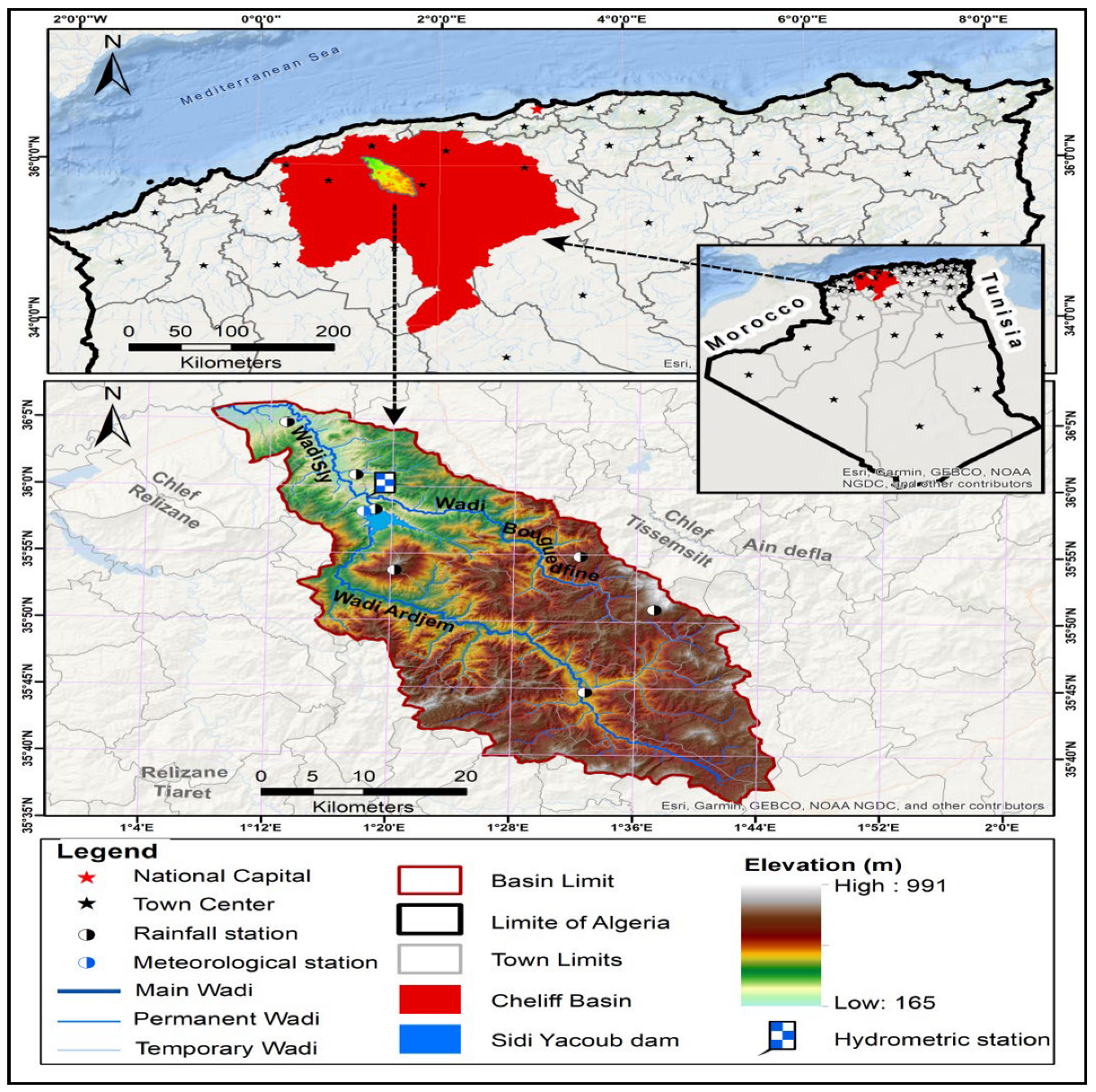
As shown in Figure 1, the study area is the Wadi Sly basin, located in northwestern Algeria. The basin covers an area of approximately 1225 km2 and extends between latitudes 35°36′05″–36°05′53″ N and longitudes 1°08′16″–1°44′56″ E. It has a maximum width of about 30 km and a length of approximately 70 km, exhibiting a predominantly narrow and elongated morphology. The basin is characterized by a well-developed and dense hydrographic network.
Streamflow in the lower reaches of the basin is influenced by the Sidi Yakoub Dam, which was constructed primarily for agricultural water supply. According to the Köppen–Geiger climate classification, the basin experiences a hot-summer Mediterranean climate (Csa), characterized by warm temperate conditions, dry summers, and hot summer temperatures. January is typically the coldest month, with mean temperatures remaining above 0 °C. At least one month per year has an average temperature exceeding 22 °C, while at least four months have mean temperatures above 10 °C. Precipitation exhibits strong seasonality, with rainfall in the wettest month generally exceeding that of the driest month by a factor of three.

2.2. Data Analysis

The National Agency of Water Resources (ANRH) provided the data for this study from seven precipitation stations across Wadi Sly basin (Figure 1 and Table 1), each having long-term monthly precipitation records from 1967/68 to 2021/22.
However, these stations present records of varied durations, and some have missing records; as a result, only observation stations with data series covering 70% or more of the whole period were chosen for our study in order to improve data quality. Prior to drought analysis, the precipitation data were subjected to quality control to ensure consistency and reliability. This included screening for missing values, outliers, and physically inconsistent records. Missing data were infilled using linear regression based on neighboring precipitation stations exhibiting strong correlations with the target station. For each station with data gaps, regression relationships were established using overlapping periods of record, and the station with the highest correlation coefficient was selected as the predictor. The resulting regression equations were then applied to estimate missing monthly precipitation values. This approach preserves the temporal variability of precipitation while minimizing bias in long-term drought characterization and has been widely applied in climatological and hydrological studies.

2.3. Standardized Precipitation Index (SPI)

The Standardized Precipitation Index (SPI) [3,25] was employed to quantify meteorological drought conditions. The SPI is based on the transformation of accumulated precipitation into a standardized normal variable, allowing comparison across different climates and time scales. In this study, the SPI was computed at 1-, 3-, 6-, 9-, and 12-month time scales using a parametric approach based on the two-parameter Gamma distribution. The probability density function of the Gamma distribution is expressed as
g x = 1 β α Γ α x α 1 e x β ,   x > 0  
where α and β are the shape and scale parameters, respectively. Because the Gamma distribution is undefined at zero, the probability of zero precipitation was explicitly incorporated into the SPI calculation. Let q represent the probability of zero precipitation, estimated as the ratio of zero-precipitation observations to the total number of observations. The cumulative probability is then defined as
H x = q + 1 q G x  
where G x is the cumulative distribution function of the fitted Gamma distribution. The cumulative probability H x was subsequently transformed to the standard normal distribution to obtain SPI values as follows:
S P I = ϕ 1 H x
where ϕ is the standard normal distribution.
SPI values were classified into drought severity categories using the standard thresholds given in Table 2 [25].

2.4. Probability of Drought Severity (PDS)

The Probability of Drought Severity (PDS) [26] was calculated to quantify the likelihood of different drought severity classes. For each station and SPI time scale, the probability of each severity class was computed as
P S P I , j = n j N
where n j is the number of SPI values within severity class j and N is the total number of SPI observations. By definition,
j = 1 m P S P I , j = 1  
where m denotes the number of severity classes.

2.5. Drought Frequency

Drought frequency was used to quantify how often drought conditions occur at different time scales. A drought event was defined as any month with an SPI value less than or equal to 0 (SPI ≤ 0), indicating drier-than-normal conditions relative to the long-term climatological median.
The drought frequency for each station and SPI time scale was calculated as
F d = n S P I 0 N × 100
where n S P I 0 represents the number of months classified as drought (SPI ≤ 0) and N is the total number of valid SPI values in the corresponding time series.
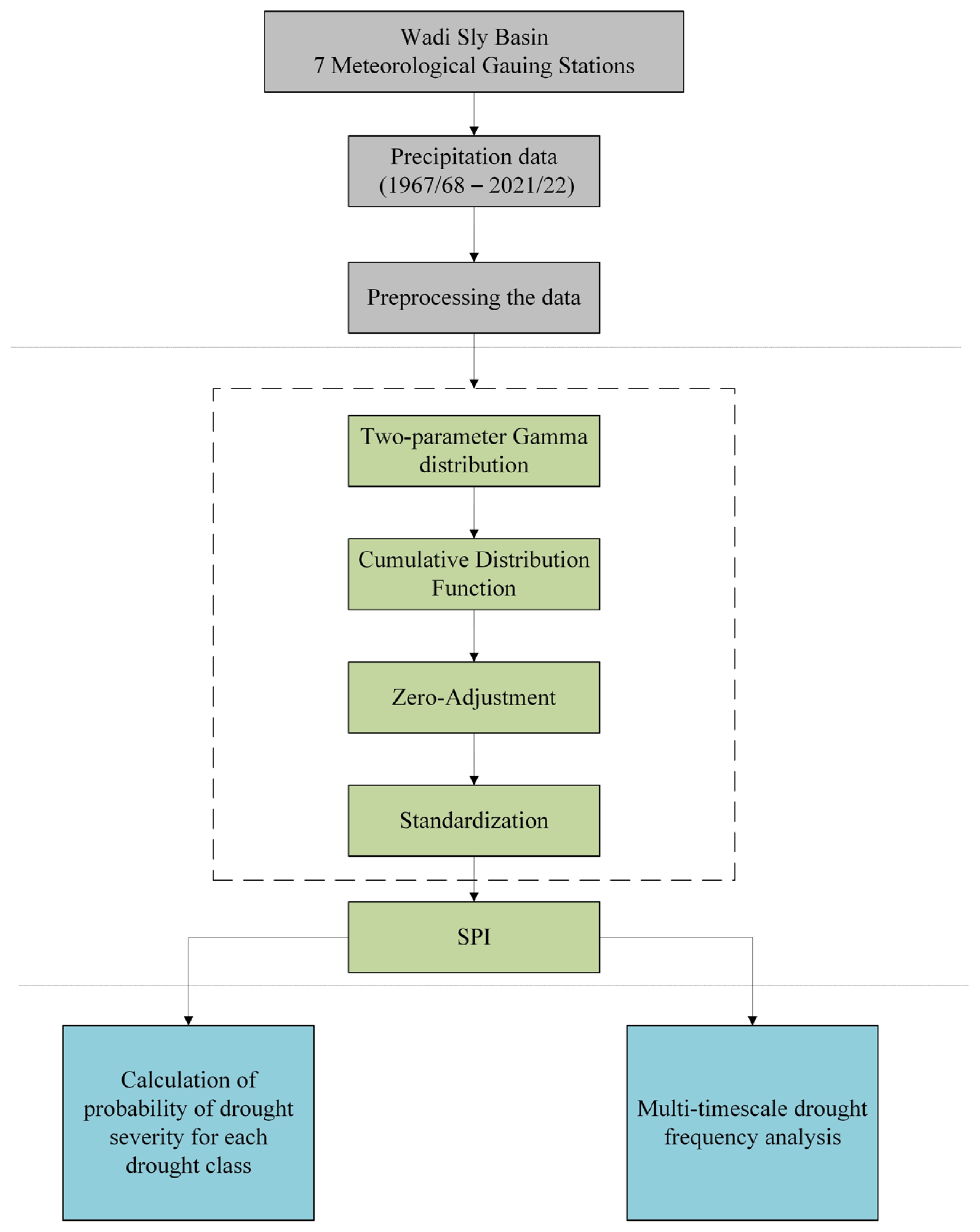
Drought frequency was evaluated separately for each SPI time scale in order to assess the effect of temporal aggregation on drought occurrence. This approach allows differentiation between frequent short-term droughts driven by monthly precipitation variability and less frequent but more persistent long-term droughts associated with cumulative precipitation deficits. To clarify the methodological framework adopted in this study, a conceptual flowchart of the main analytical steps is shown in Figure 2.

3. Results

3.1. Temporal Variability of SPI

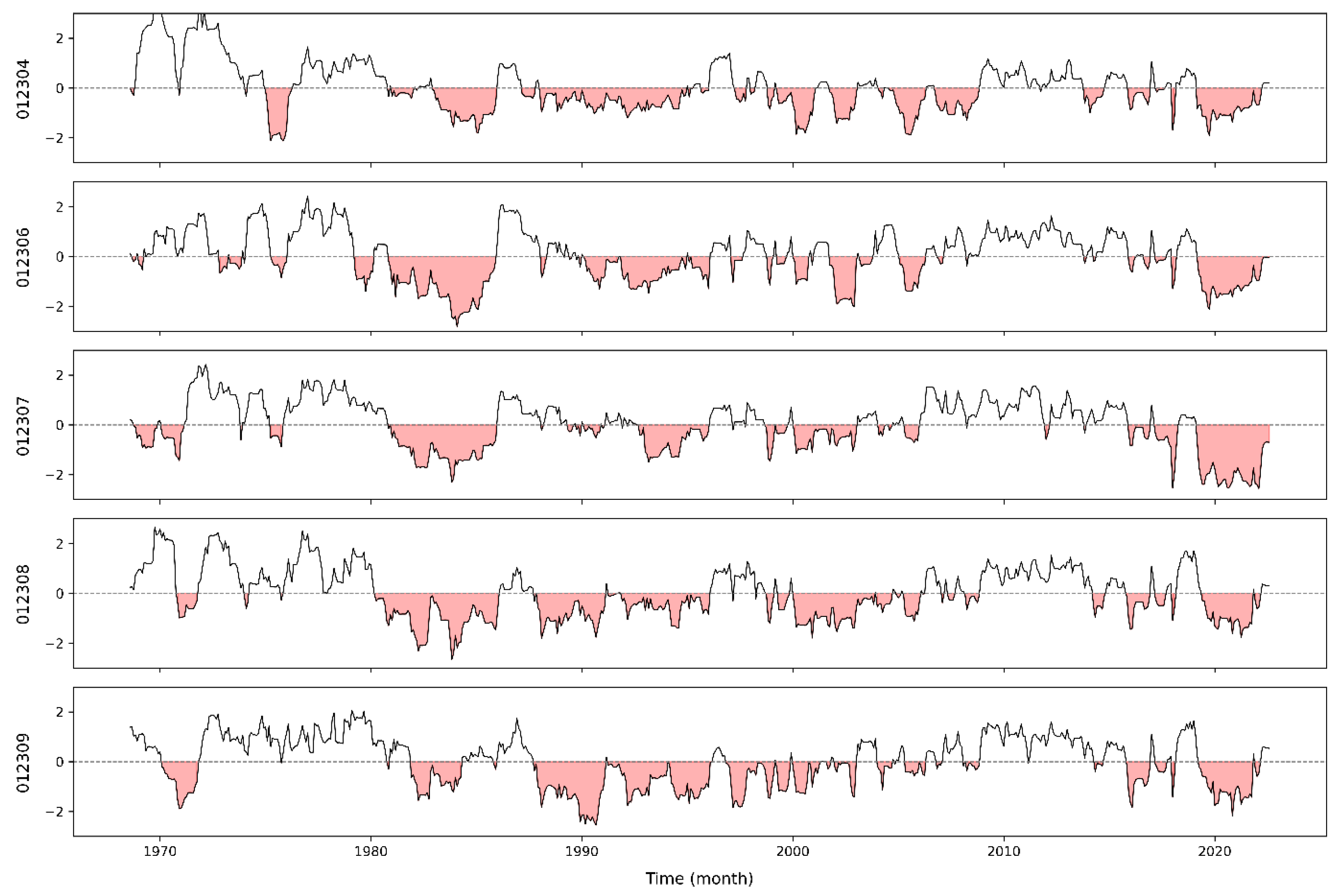
The temporal evolution of the Standardized Precipitation Index (SPI) highlights pronounced inter-annual and decadal variability in meteorological drought conditions across the Wadi Sly basin (Figure 3). The SPI-12 time series, which reflects long-term moisture anomalies, clearly delineates alternating wet and dry phases throughout the 1967–2022 period. Several prolonged drought episodes are evident, particularly during the mid-1980s and the early 1990s (1990–1995), when SPI values consistently remained below −1.5 and frequently dropped below −2.0, indicating severe to extreme drought conditions across multiple stations.
In contrast, the early 1970s and early 1980s were characterized by sustained positive SPI values, with several peaks exceeding +2.0, reflecting periods of exceptional precipitation surplus. These wet episodes suggest a temporary recovery of regional water availability, which was, however, followed by abrupt transitions into dry conditions. The latter part of the record (approximately 2018–2022) shows a notable dominance of negative SPI values across most stations, as illustrated by the persistence of red-shaded areas in Figure 2. This recent clustering of drought conditions indicates an increased tendency toward precipitation deficits in the basin, potentially linked to enhanced climate variability. Overall, the temporal patterns demonstrate that droughts in the Wadi Sly basin are not isolated short-term events but often occur as multi-year episodes with significant implications for water resources and ecosystem stability.

3.2. Spatial Consistency of Drought Conditions

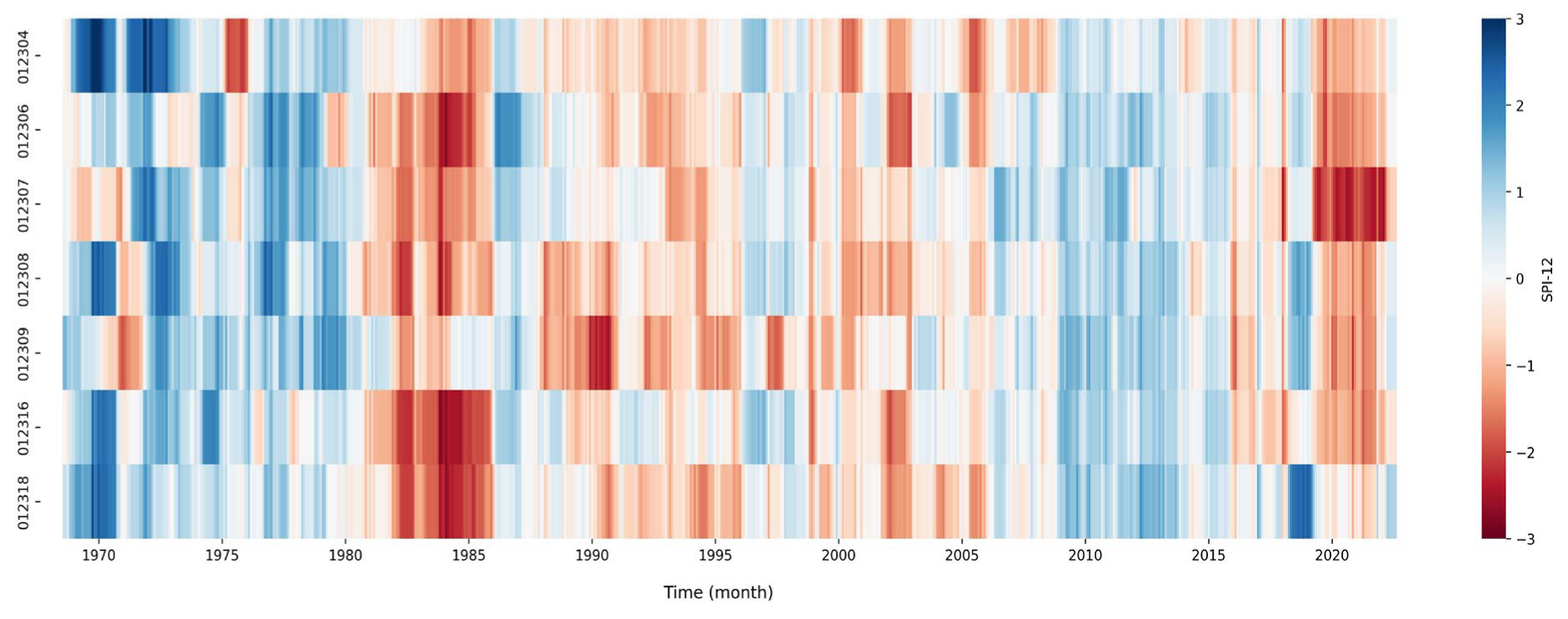
The spatiotemporal heatmap of SPI-12 values (Figure 4) provides a comprehensive overview of the spatial coherence of drought and wet events across the seven precipitation stations. The figure reveals a strong synchronization of drought occurrences throughout the basin, with extreme dry (dark red) and extreme wet (dark blue) periods appearing simultaneously at most stations. This spatial consistency suggests that drought development in the Wadi Sly basin is primarily controlled by large-scale atmospheric circulation patterns rather than localized climatic anomalies.
Despite this overall coherence, variations in drought intensity are evident among stations. For example, station 012304 exhibited more pronounced wet anomalies during the first decade of the study period, whereas stations 012308 and 012309 displayed a higher concentration of moderately dry to severely dry conditions during the late 1980s and early 1990s. These spatial differences likely reflect the influence of local factors such as elevation, proximity to the coast, and basin geomorphology, which can modulate the magnitude of precipitation anomalies. Nonetheless, the widespread spatial agreement confirms that meteorological drought events generally affect the entire Wadi Sly basin concurrently, emphasizing the basin-wide nature of drought risk.

3.3. Probability of Drought Severity

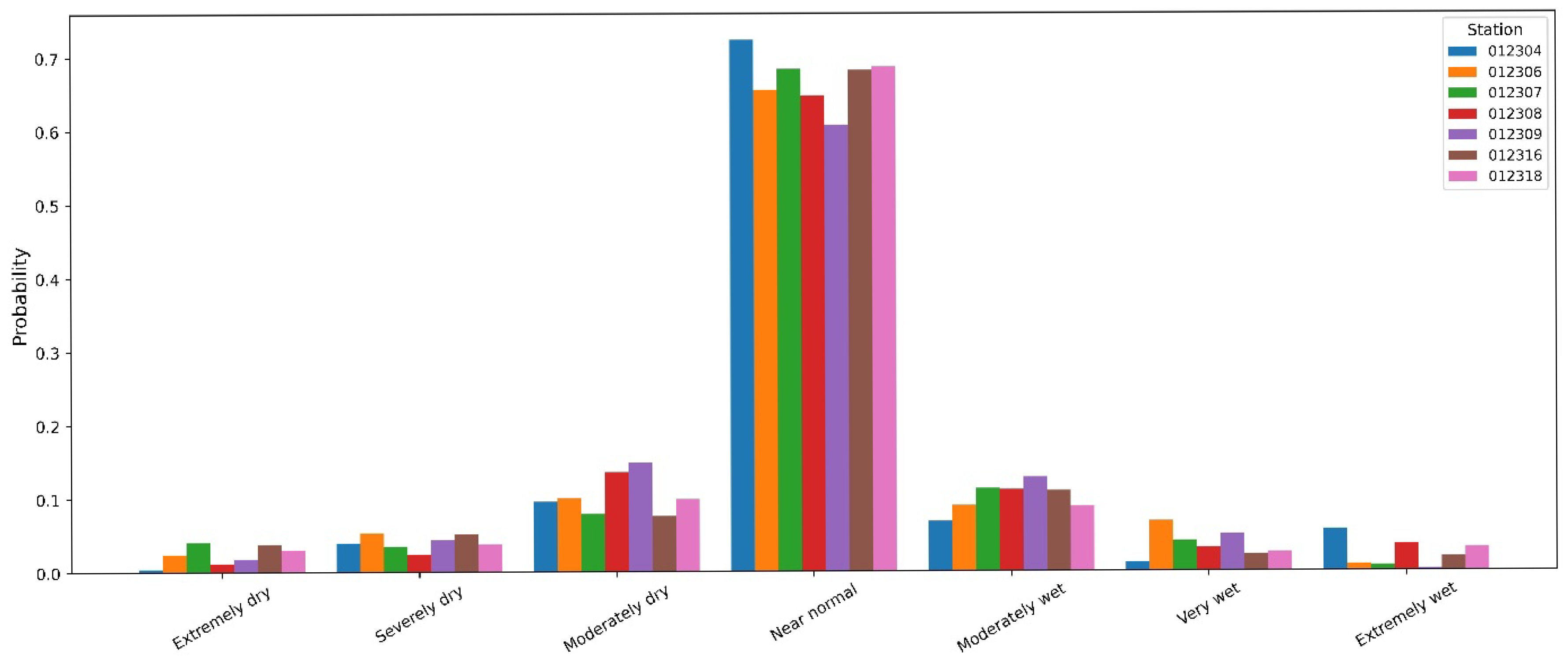
The probability distribution of SPI severity classes for each station is presented in Figure 5. Across all stations, the “near normal” category dominates the distribution, accounting for approximately 60–70% of all observations. This concentration around normal conditions reflects the statistical characteristics of the SPI, which is designed to normalize precipitation variability over long time series.
However, the asymmetric distribution of the dry and wet tails provides important insights into drought behavior. At several stations, particularly 012308 and 012309, the probability of “moderately dry” conditions exceeds that of “moderately wet” conditions, indicating a tendency toward more frequent precipitation deficits than surpluses. Although the probability of “extremely dry” events is relatively low, these events occur consistently across all stations, underscoring that extreme droughts, while infrequent, are a recurrent feature of the regional climate. The persistence of these dry-tail probabilities highlights the importance of considering low-probability, high-impact drought events in water resource planning and risk management.

3.4. Drought Frequency Across Time Scales

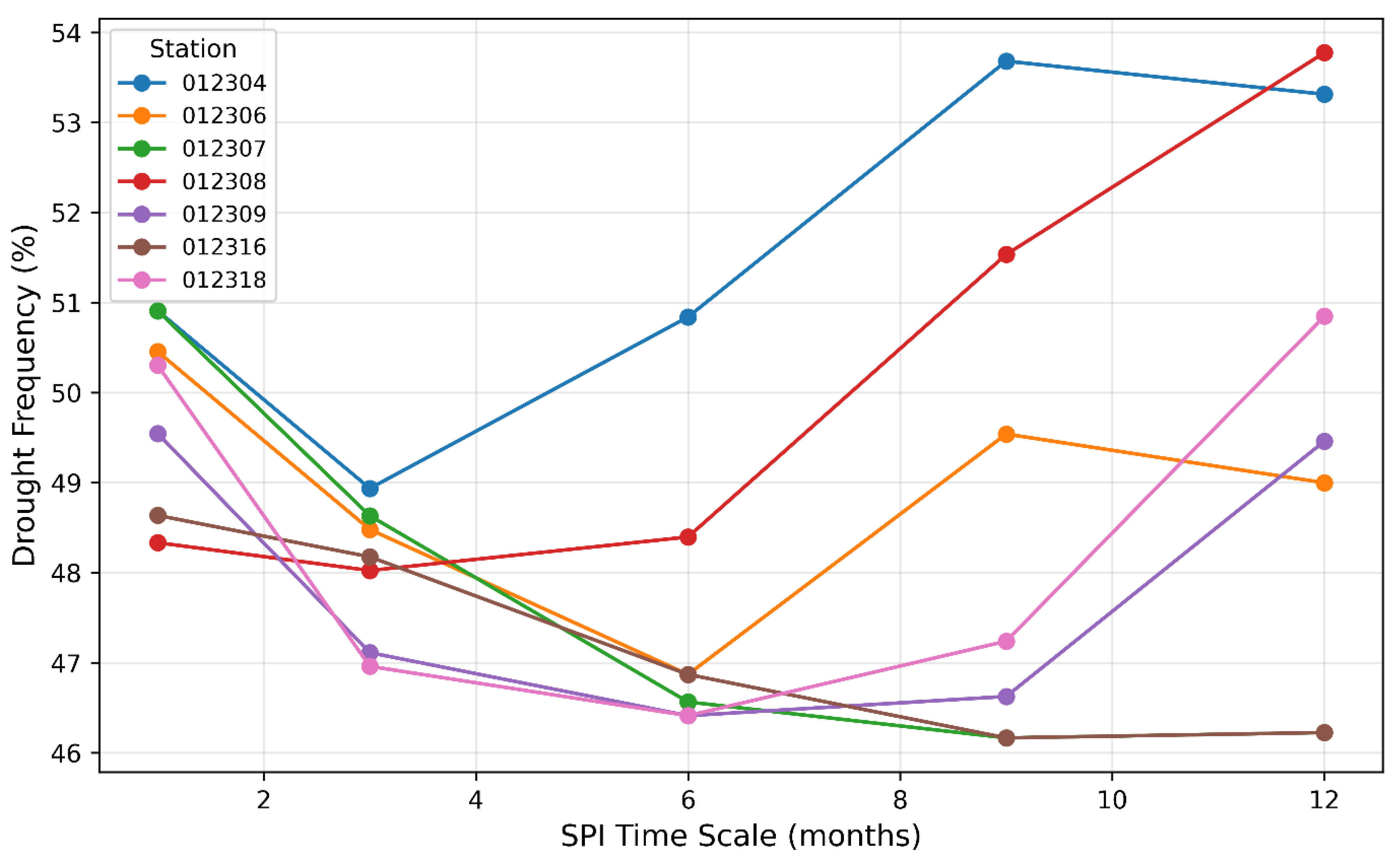
Figure 6 illustrates the sensitivity of drought frequency to SPI time scale, revealing marked differences between short-term and long-term drought behavior. At the 1-month time scale (SPI-1), drought frequency is relatively high across all stations, ranging from approximately 48% to 51%. This high frequency reflects the strong month-to-month variability of precipitation typical of Mediterranean semi-arid climates. As the aggregation period increases to 3 and 6 months, drought frequency generally decreases, indicating that short-term precipitation deficits are often compensated by subsequent precipitation events. With longer aggregation periods (SPI-9 and SPI-12), drought frequency exhibits increased variability among stations rather than a uniform trend. In particular, at the 12-month scale, some stations (e.g., 012304 and 012308) show elevated drought frequencies exceeding 53%, suggesting the accumulation of precipitation deficits into persistent, long-duration drought conditions.
These results indicate that drought characteristics are scale-dependent: short-term droughts dominate at shorter time scales, while longer time scales emphasize persistence and accumulation effects, which are more relevant to groundwater recharge, reservoir storage, and long-term water availability. This variability across time scales underscores the importance of multi-temporal drought assessment for capturing both immediate meteorological stress and prolonged hydrological impacts.

4. Discussion

The findings of this study reveal a highly variable and persistent meteorological drought regime in the Wadi Sly basin, characterized by strong inter-annual fluctuations, multi-year drought episodes, and marked spatial coherence across precipitation stations. The SPI-based temporal analysis highlights recurrent drought phases during the mid-1980s, early to mid-1990s, and the late 2010s, during which SPI-12 values frequently fell below −1.5 and, in some cases, below −2.0. These periods coincide with drought phases previously identified in northern and central Algeria, where several studies have reported an intensification of drought frequency and duration since the 1980s [19]. However, the present work extends these findings by providing a basin-scale assessment based on long-term, station-level observations spanning more than five decades, allowing for a more robust interpretation of drought persistence and variability. For example, SPI analyses in the Wadi Mina Basin highlight recurrent drought conditions and notable dry decades that align with the mid-1980s/1990s signals identified in this paper [27]. Similarly, SPI-based assessment over the Chéliff–Zahrez Basin documents a marked intensification of multi-year droughts in the 1990s (SPI reaching extreme values) [28]. Compared to earlier drought studies in Algeria, which often relied on regional-scale analyses or shorter time series, this study offers a finer spatial resolution and a comprehensive temporal coverage. Previous works, such as those by Haied et al. [8,19], demonstrated increasing drought severity and frequency using the SPI, SPEI, and RDI across broader climatic zones. In contrast, the present study focuses on a hydrologically coherent Wadi basin, enabling the identification of localized drought sensitivities while confirming the dominance of basin-wide atmospheric forcing. At the national scale, recent high-resolution mappings over northern Algerian basins using the SPI (multi-month scales) confirm widespread drought clustering and hotspots, supporting the findings of this study [29,30].
Mediterranean-wide datasets of exceptional drought events (1975–2019) also show that severe droughts often occur as broad regional episodes, consistent with the multi-year drought phases identified in this work [31]. In addition, Mediterranean-scale drought–vegetation studies indicate that multi-scalar drought signals propagate widely across the basin, supporting the interpretation that station-level differences reflect local modulation rather than isolated forcing [32]. Moreover, the strong spatial synchronicity observed among stations supports findings from Mediterranean and semi-arid environments, where drought events tend to affect large areas simultaneously due to synoptic-scale circulation patterns [2,21]. Despite the overall spatial coherence of drought variability across the basin, notable differences in drought frequency and severity are observed among stations. This pattern suggests that, while large-scale atmospheric forcing governs the timing of drought events, local physiographic and climatic gradients modulate drought persistence and severity at the station scale. At the global scale, the dependence of drought frequency on SPI time scales observed in this study is consistent with the results reported in semi-arid regions of Iran, Afghanistan, India, Vietnam, and Mediterranean Europe. Studies have shown that short-term meteorological droughts (SPI-1 to SPI-3) are frequent but often transient, whereas long-term droughts (SPI-12) reflect cumulative precipitation deficits with greater implications for groundwater recharge and water security [9,14,23]. The elevated SPI-12 drought frequency at selected stations in the Wadi Sly basin confirms that short-term precipitation anomalies frequently aggregate into persistent annual-scale droughts, a behavior also reported in other Wadi-dominated and semi-arid basins [18]. A major added value of this study lies in the combined application of multi-time scale SPI analysis with the Probability of Drought Severity (PDS) and drought frequency metrics. While the SPI has been widely employed in drought research, its integration with probabilistic severity assessment allows for a more nuanced quantification of drought risk by accounting not only for occurrence but also for the likelihood of different severity classes [26]. This approach enhances the interpretability of drought dynamics and provides information that is directly relevant for drought preparedness, early warning systems, and long-term water resource planning. Such integrated analyses remain relatively limited in Algerian drought studies, making this contribution particularly valuable at the national level. Despite these strengths, the study acknowledges limitations related to the exclusive use of precipitation-based indices. In semi-arid environments, high potential evapotranspiration can significantly exacerbate water stress, which may not be fully captured by the SPI alone [5,33]. Nevertheless, by establishing a statistically robust and long-term baseline of meteorological drought variability, this study provides a critical foundation for future research incorporating temperature-based indices such as the SPEI, hydrological drought indicators, and large-scale climate teleconnections. In fact, this work contributes new insights into the temporal persistence, spatial coherence, and probabilistic characteristics of meteorological drought in northwestern Algeria. Its long observation period, basin-focused framework, and integrated analytical approach differentiate it from previous studies in Algeria, advancing the understanding of drought behavior in semi-arid regions.

5. Conclusions

This study provides a comprehensive assessment of meteorological drought characteristics in the Wadi Sly basin (northwestern Algeria) over the period 1967–2022 using long-term precipitation records and multi-time scale SPI analysis. The results reveal pronounced interannual and decadal variability, with severe and persistent drought episodes occurring during the mid-1980s, early 1990s, and recent years. The analysis shows that short-term droughts are frequent due to high monthly rainfall variability, while long-term droughts reflect cumulative precipitation deficits with significant implications for groundwater recharge and water resource sustainability. Spatial patterns indicate strong basin-wide synchronicity in drought occurrence, suggesting that large-scale atmospheric processes play a dominant role in drought development, although local variations in severity persist. The integration of drought severity probability and frequency analyses enhances understanding of both the likelihood and persistence of drought conditions, providing valuable information for drought monitoring and water resource planning. Despite these contributions, the study has some limitations. The exclusive reliance on precipitation-based indices, particularly the SPI, limits the ability to capture the effects of temperature and evapotranspiration on drought intensity. Moreover, the absence of hydrological and agricultural drought assessments constrains the understanding of drought propagation across environmental and socio-economic systems. In addition, the basin-scale focus of the study may limit the generalization of findings to other climatic and hydrological contexts. Future research should therefore integrate temperature-based indices, hydrological observations, remote sensing data, and climate teleconnection analyses to provide a more holistic representation of drought dynamics under ongoing climate variability and change. To enhance resilience to meteorological drought, a combination of adaptation and mitigation measures is essential. These include strengthening drought monitoring and early warning systems through multi-index and multi-scale approaches, improving water storage and groundwater recharge capacity, and promoting efficient irrigation and water-saving technologies. The adoption of climate-resilient agricultural practices can reduce vulnerability in rain-fed systems. Integrated basin-scale water resource management, demand-side conservation policies, and stakeholder engagement in climate-informed planning are also crucial for sustainable drought risk reduction. Overall, this study establishes a robust baseline for understanding meteorological drought in the Wadi Sly basin and provides a scientific foundation for improved drought management and long-term climate adaptation strategies in semi-arid regions.

Author Contributions

All authors contributed equally to the study’s conception and design. Conceptualization, M.A. and M.J.; methodology, M.A. and T.B.T.; software, T.B.T.; formal analysis, M.A. and T.B.T.; validation, M.A., T.B.T., M.J. and K.P.; investigation, M.A. and T.B.T.; data curation, M.A.; writing—original draft preparation, M.A., T.B.T., M.J., K.P. and T.C.; writing—review and editing, M.A., M.J. and T.C.; visualization, M.A. and T.B.T.; supervision, M.J. and T.C. All authors have read and agreed to the published version of the manuscript.

Funding

The authors declare that no funds, grants, or other support was received during the preparation of this manuscript.

Institutional Review Board Statement

Not applicable.

Informed Consent Statement

Not applicable.

Data Availability Statement

The original contributions presented in this study are included in the article. Further inquiries can be directed to the corresponding author.

Acknowledgments

We thank the National Agency of the Water Resources (ANRH) and the General Directorate of Scientific Research and Technological Development of Algeria (DGRSDT).

Conflicts of Interest

The authors declare that they have no known competing financial interests or personal relationships that could have appeared to influence the work reported in this paper.

References

  1. Kim, T.-W.; Jehanzaib, M. Drought risk analysis, forecasting and assessment under climate change. Atmosphere 2020, 12, 1862. [Google Scholar] [CrossRef]
  2. Shahabfar, A.; Eitzinger, J. Spatio-temporal analysis of droughts in semi-arid regions by using meteorological drought indices. Atmosphere 2013, 4, 94–112. [Google Scholar] [CrossRef]
  3. Jehanzaib, M.; Sattar, M.N.; Lee, J.-H.; Kim, T.-W. Investigating effect of climate change on drought propagation from meteorological to hydrological drought using multi-model ensemble projections. Stoch. Environ. Res. Risk Assess. 2020, 34, 7–21. [Google Scholar] [CrossRef]
  4. Tijdeman, E.; Barker, L.; Svoboda, M.; Stahl, K. Natural and human influences on the link between meteorological and hydrological drought indices for a large set of catchments in the contiguous United States. Water Resour. Res. 2018, 54, 6005–6023. [Google Scholar] [CrossRef]
  5. Svoboda, M.D.; Fuchs, B.A. Handbook of Drought Indicators and Indices; World Meteorological Organization: Geneva, Switzerland, 2016; Volume 2. [Google Scholar]
  6. Achite, M.; Gul, E.; Elshaboury, N.; Jehanzaib, M.; Mohammadi, B.; Mehr, A.D. An improved adaptive neuro-fuzzy inference system for hydrological drought prediction in Algeria. Phys. Chem. Earth Parts A/B/C 2023, 131, 103451. [Google Scholar] [CrossRef]
  7. Golian, S.; Mazdiyasni, O.; AghaKouchak, A. Trends in meteorological and agricultural droughts in Iran. Theor. Appl. Climatol. 2015, 119, 679–688. [Google Scholar] [CrossRef]
  8. Haied, N.; Foufou, A.; Khadri, S.; Boussaid, A.; Azlaoui, M.; Bougherira, N. Spatial and temporal assessment of drought hazard, vulnerability and risk in three different climatic zones in Algeria using two commonly used meteorological indices. Sustainability 2023, 15, 7803. [Google Scholar] [CrossRef]
  9. Myronidis, D.; Fotakis, D.; Ioannou, K.; Sgouropoulou, K. Comparison of ten notable meteorological drought indices on tracking the effect of drought on streamflow. Hydrol. Sci. J. 2018, 63, 2005–2019. [Google Scholar] [CrossRef]
  10. Jehanzaib, M.; Shah, S.A.; Yoo, J.; Kim, T.-W. Investigating the impacts of climate change and human activities on hydrological drought using non-stationary approaches. J. Hydrol. 2020, 588, 125052. [Google Scholar] [CrossRef]
  11. Salimi, H.; Asadi, E.; Darbandi, S. Meteorological and hydrological drought monitoring using several drought indices. Appl. Water Sci. 2021, 11, 11. [Google Scholar] [CrossRef]
  12. Sattar, M.N.; Jehanzaib, M.; Kim, J.E.; Kwon, H.-H.; Kim, T.-W. Application of the hidden Markov bayesian classifier and propagation concept for probabilistic assessment of meteorological and hydrological droughts in South Korea. Atmosphere 2020, 11, 1000. [Google Scholar] [CrossRef]
  13. Keyantash, J. Indices for meteorological and hydrological drought. In Hydrological Aspects of Climate Change; Springer: Singapore, 2021; pp. 215–235. [Google Scholar]
  14. Zhu, Y.; Wang, W.; Singh, V.P.; Liu, Y. Combined use of meteorological drought indices at multi-time scales for improving hydrological drought detection. Sci. Total Environ. 2016, 571, 1058–1068. [Google Scholar] [CrossRef]
  15. Behrang Manesh, M.; Khosravi, H.; Heydari Alamdarloo, E.; Saadi Alekasir, M.; Gholami, A.; Singh, V.P. Linkage of agricultural drought with meteorological drought in different climates of Iran. Theor. Appl. Climatol. 2019, 138, 1025. [Google Scholar] [CrossRef]
  16. Hooshyaripor, F.; Sardari, J.; Dehghani, M.; Noori, R. A new concept of drought feeling against the meteorological drought. Sci. Rep. 2022, 12, 16711. [Google Scholar] [CrossRef]
  17. Wei, W.; Zhang, J.; Zhou, L.; Xie, B.; Zhou, J.; Li, C. Comparative evaluation of drought indices for monitoring drought based on remote sensing data. Environ. Sci. Pollut. Res. 2021, 28, 20408–20425. [Google Scholar] [CrossRef]
  18. Mliyeh, M.M.; Aqnouy, M.; Laaraj, M.; Bouizrou, I.; Tariq, A.; Benaabidate, L.; Kraiem, H.; Shitu, K. Assessing drought dynamics in a semi-arid basin: A multi-index approach using hydrological and remote-sensing indicators. Environ. Sci. Eur. 2025, 37, 180. [Google Scholar] [CrossRef]
  19. Haied, N.; Foufou, A.; Chaab, S.; Azlaoui, M.; Khadri, S.; Benzahia, K.; Benzahia, I. Drought assessment and monitoring using meteorological indices in a semi-arid region. Energy Procedia 2017, 119, 518–529. [Google Scholar] [CrossRef]
  20. Natarajan, N.; Vasudevan, M.; Ahash Raja, S.; Mohanpradaap, K.; Sneha, G.; Joshna Shanu, S. An assessment methodology for drought severity and vulnerability using precipitation-based indices for the arid, semi-arid and humid districts of Tamil Nadu, India. Water Supply 2023, 23, 54–79. [Google Scholar] [CrossRef]
  21. Almeida-Ñauñay, A.F.; Villeta, M.; Quemada, M.; Tarquis, A.M. Assessment of drought indexes on different time scales: A case in semiarid mediterranean grasslands. Remote Sens. 2022, 14, 565. [Google Scholar] [CrossRef]
  22. Viet, L.V.; Thuy, T.T.T. Drought sensitivity analysis of meteorological and vegetation indices in Dak Nong, Vietnam. J. Water Clim. Change 2024, 15, 4968–4988. [Google Scholar] [CrossRef]
  23. Nabizada, M.J.; Köylü, Ü.; Rousta, I. Assessing spatiotemporal dynamics of meteorological and agricultural drought in the North Basin of Afghanistan using multiple remote sensing-based drought indices. Int. J. River Basin Manag. 2025, 1–27. [Google Scholar] [CrossRef]
  24. Hamarash, H.; Hamad, R.; Rasul, A. Meteorological drought in semi-arid regions: A case study of Iran. J. Arid Land 2022, 14, 1212–1233. [Google Scholar] [CrossRef]
  25. McKee, T.B.; Doesken, N.J.; Kleist, J. The relationship of drought frequency and duration to time scales. In Proceedings of the 8th Conference on Applied Climatology, Anaheim, CA, USA, 17–22 January 1993; pp. 179–183. [Google Scholar]
  26. Ipek, A.F.; Altas, A.; Serencam, U.; Dabanli, I. Spatio-Temporal Drought Assessment by Using the Innovative Probability of Drought Severity (PDS) Method. Water Resour. Manag. 2025, 39, 5135–5150. [Google Scholar] [CrossRef]
  27. Achite, M.; Wałęga, A.; Toubal, A.K.; Mansour, H.; Krakauer, N. Spatiotemporal Characteristics and Trends of Meteorological Droughts in the Wadi Mina Basin, Northwest Algeria. Water 2021, 13, 3103. [Google Scholar] [CrossRef]
  28. Habibi, B.; Meddi, M.; Torfs, P.J.; Remaoun, M.; Van Lanen, H.A. Characterisation and prediction of meteorological drought using stochastic models in the semi-arid Chéliff–Zahrez basin (Algeria). J. Hydrol. Reg. Stud. 2018, 16, 15–31. [Google Scholar] [CrossRef]
  29. Ceppi, A.; Achite, M.; Toubal, A.K.; Caloiero, T. Mapping drought characteristics in northern Algerian Basins using the ERA5-Land dataset. Sci. Rep. 2025, 15, 10720. [Google Scholar] [CrossRef]
  30. Achite, M.; De Marco, A.; Caloiero, T.; Ceppi, A. Multi-scale analysis of drought events in Northern Algeria based on ERA5-Land SPI data. Euro-Mediterr. J. Environ. Integr. 2025, 10, 4179–4193. [Google Scholar] [CrossRef]
  31. Mathbout, S.; Lopez-Bustins, J.A.; Royé, D.; Martin-Vide, J. Mediterranean-Scale Drought: Regional Datasets for Exceptional Meteorological Drought Events during 1975–2019. Atmosphere 2021, 12, 941. [Google Scholar] [CrossRef]
  32. Gouveia, C.M.; Trigo, R.M.; Beguería, S.; Vicente-Serrano, S.M. Drought impacts on vegetation activity in the Mediterranean region: An assessment using remote sensing data and multi-scale drought indicators. Glob. Planet. Change 2017, 151, 15–27. [Google Scholar] [CrossRef]
  33. Kim, W.; Park, E.; Jo, H.-W.; Roh, M.; Kim, J.; Song, C.; Lee, W.-K. A meta-analytic review on the spatial and climatic distribution of meteorological drought indices. Environ. Rev. 2022, 31, 95–110. [Google Scholar] [CrossRef]
Figure 1. Location of the study area and the precipitation stations.
Atmosphere 17 00207 g001
Figure 2. Conceptual flowchart illustrating the methodological framework used in this study. The dashed frame highlights the detailed SPI calculation process, while the arrows indicate the sequential data flow between modules.
Atmosphere 17 00207 g002
Figure 3. Temporal evolution of the 12-month Standardized Precipitation Index (SPI-12) for stations 012304 through 012309.
Atmosphere 17 00207 g003
Figure 4. Spatiotemporal heat map of SPI-12 values across all study stations. The color scale indicates the standardized deviation from the mean, where dark red signifies extreme drought and dark blue signifies extreme wetness, highlighting regional synchronicity in climatic anomalies.
Atmosphere 17 00207 g004
Figure 5. Probability distribution of Standardized Precipitation Index (SPI) severity categories across the seven monitored stations.
Atmosphere 17 00207 g005
Figure 6. Sensitivity of drought frequency (%) to SPI temporal scales (1, 3, 6, 9, and 12 months).
Atmosphere 17 00207 g006
Table 1. Precipitation station characteristics.
StationsIDNameLong (°)Lat (°)Elevation (m)Period of Observation
S1012304Souk El Had1.5535.755501967/68–2021/22
S2012306Bordj Bounaama1.6235.8510501967/68–2021/22
S3012307Ain Lellou1.5435.939001967/68–2021/22
S4012308Ouled Ben AEK1.2736.031601967/68–2021/22
S5012309Oued Sly1.2036.09951967/68–2021/22
S6012316Saadia1.3435.9010001967/68–2021/22
S7012318Sidi Yagoub Bge1.3235.972021967/68–2021/22
Table 2. Classification of SPI values following McKee et al. [25].
SPI RangeClassification
SPI ≤ −2.0Extremely dry
−2.0 < SPI ≤ −1.5Severely dry
−1.5 < SPI ≤ −1.0Moderately dry
−1.0 < SPI ≤ 1.0Near normal
SPI ≥ 1.0Wet conditions
Disclaimer/Publisher’s Note: The statements, opinions and data contained in all publications are solely those of the individual author(s) and contributor(s) and not of MDPI and/or the editor(s). MDPI and/or the editor(s) disclaim responsibility for any injury to people or property resulting from any ideas, methods, instructions or products referred to in the content.